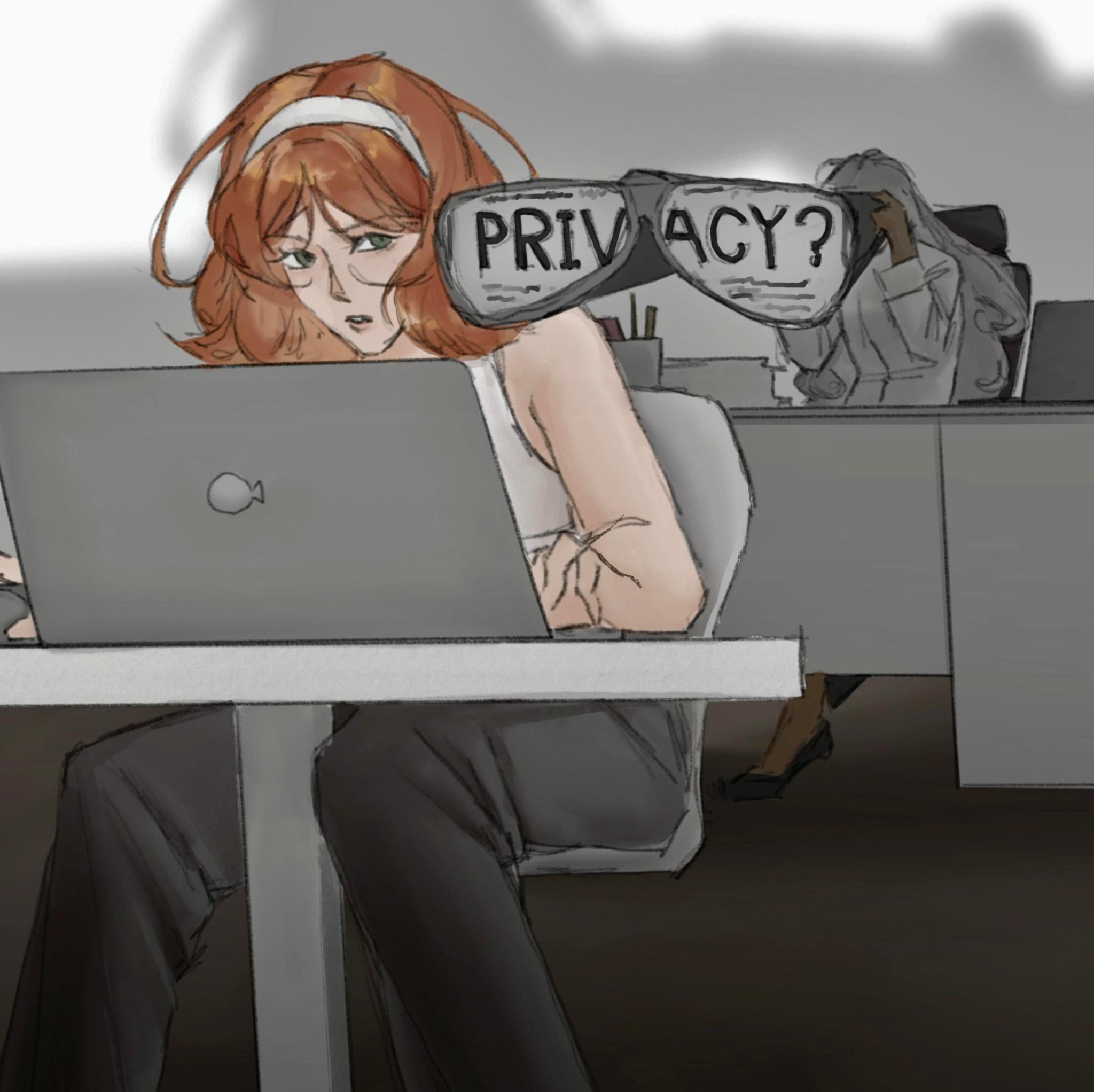
At the start of this year Paly administration implemented an ex tension, called Classwize, on all high school Chromebooks. decision was made after some of the high school teachers expressed interest in piloting it. It gives teachers the ability to screenshot, monitor and control students’ screens in real time. It also allows them to directly message students and pause their internet and is operational on Macbooks if stu dents are logged into their PAUSD Google accounts on Chrome.
Jackie Smith, Career Technical Education & Educational Technology Coordinator, said Classwize was installed this year because of its available safety measures and unique functions.
“Our primary responsibility is to provide a safe, focused learning environment,” Smith wrote in an email to the Campanile. “While PAUSD has always used internet #lters to comply with CIPA (Children's Internet Protection Act), we moved to Classwize this year because it o suite of products to meet our evolving needs.” While the system is automatically installed on all school-issued Chromebooks, it is not limited to working on them.
Smith said Classwize is connected to students’ school accounts and the district network rather than speci#c devices.
"erefore, personal device activity can be viewed during a Classwize session while at school,” Smith wrote “Any device using the district network
dents do their work during class so they don't get stressed at home because they're messing around playing video games and doing other homework.”
Smith said one advantage of Classwize is that it connects multiple groups involved in students' digital pro#les.
“It provides us with an ecosystem that enables IT (via Linewize), parents and guardians (via Qustodio), and teachers (via Classwize) a uni#ed way to
Ultimately, Smith emphasized transparent communication.
“Open conversations are important to build understanding and help ease discomfort,” Smith wrote. “Our hope is that if teachers are using Classwize, they clearly communicate when and why they are using it.”
Christopher Lee Sports Editor
Admin implements further restrictions on technology
Paly administration sent an email to Paly families on May 4 informing them about an update to the campuswide phone ban during instructional time, which has now been adapted to also include smartwatches, earbuds, smartglasses and other wearable tech unless otherwise directed by a teacher. Teachers received notice of the updated policy in an email from Steiren on April 29.
"e move is an extension of the “O and Away During Instructional Time” policy, which requires teachers to collect phones at the beginning of every class in a designated area.
"e original policy was implemented at the beginning of the 2025-2026 school year in compliance with the Phone-Free School Act, which requires school districts in California to adopt policies that limit or prohibit student smartphone use on campus.
“Ultimately there is a delicate balance to maintain between the responsible use of technology and the importance of human interaction and genuine learning,”
the email said. “We are proud of how our students have adapted to these changes so far.”
Vice Principal Michael Stieren, who drafted the new policy, said these changes were implemented because technology other than phones can cause distractions.
"ey’re all connected,” Stern said. “You can disconnect them, but they can all be connected. And so the idea of just telling you to put away your phone doesn’t necessarily do the thing that the law intends, which is to limit the distractions that you may be engaged in during instructional time.”
Junior Elif Dogan said she is glad the school is taking a proactive approach to combat the use of potentially invasive technologies, but they should be aware that a student’s choice to focus and do their work is their own responsibility.
“You're not gonna be able to ever successfully make sure every single student is listening to you, and that is okay,” Dogan said. “If a student's not paying attention, it's going to a ect them in the future.”
While she said most of the policy is reasonable, sophomore Olivia Roper said parts of it are frustrating.
“I think (the ban makes sense for) AirPodswhile the teacher is talking, but I don't think there's a reason to ban AirPods while we're working independently, because it helps me focus and listen to music,” Roper said.
Still, Roper said she recognizes the need to limit technology due to its potential to create distractions in the classroom.
“If I have my phone on me, I'm de#nitely more distracted, and I'm more prone to look at it if it's near me,” Roper said.
Yet moving forward, principal Brent Kline said he doesn’t envision a more restrictive technology policy coming to Paly.
“I'm not convinced that a bell-to-bell policy works here at Palo Alto High School, just because of kids going o campus,” Kline said. “I don't want somebody stuck o campus, nor am I into dealing with (locking phone pouches). I think that we just all need to con-
tinue to increase not only awareness of what is best for (them) as a student, so (they) can focus and maintain connection with (their) teachers in the subject matter and do our best e ort that way.”
Ultimately, Stern said the policy is a proactive response to a fast-moving technological landscape.
“It's not about having some sort of draconian policy whereby you can't interact with tech ever, because that's just unrealistic and not the world that you're growing up in,” Stern said. “It's more about just honoring the spirit of the law that we're being asked to implement, which is telling us that you need to limit device usage and device access during instructional time.
Leilani Chen & Elise Andrade News & Opinion Editor and Senior Sta Writer
ARTBYSOFIASINGER
ARTBY EDENYOO
Multivariable Calculus to be
o ered on campus during the day
Beginning in the 2026-2027 school year, Paly will o er
Multivariable Calculus, the college-level math course that succeeds AP Calculus BC, on campus during school hours. However, the course will be o ered through Foothill Community College, not Paly. In recent years, students and parents have heavily demanded that MVC be taught on Paly campus. Previously, students had to take either online or after school classes through local community colleges.
e course will be taught by Paly math teacher Daniel Nguyen.
According to Principal Brent Kline, the school is now able to o er MVC during the school day in a way that can bene t students that seek the course without hurting other students.
“ e main criteria is having a teacher that has a master’s in mathematics and because we do have that, it just makes sense,”
Kline said. “It’s not going to go away in terms of student demand, so it would be foolish to think that maintaining just Calculus BC is going to be enough, especially since the district elementary and middle school math programs have changed, which will a ect our programs as well.” Nguyen will teach one section of MVC at Paly and one at Gunn. Kline said he expects about 30 students will take the course at Paly.
Junior Jennifer Yang, who is currently taking AP Calculus BC, said adding MVC as an on-campus option will support students who may need additional resources.
“It de nitely o ers a way for people to take an in-person class where they can get more help if they need it,” Yang said. Nguyen said the o ering of MVC on campus will also make it more accessible.
“A lot of the kids were having to think about having to give up some of their extracurricular activities or jobs in order to take the class,” Nguyen said. “Now, they can take it during the school day, which will be a lot more convenient for them and help them be able to focus on learning instead of having to overcome barriers.”
During a Dec. 16 school board meeting, parent Joan Plastiras said students should seek learning in other areas instead of math.
“ ere’s always time to go on and do mathematics at the college and graduate level,” Plastiras said. “Frankly, the teaching of mathematics at the high school level really doesn’t represent advanced math.”
Plastiras said teaching MVC would put greater attention towards those already advanced in math.
“I would like to see you focus more on raising math literacy for students who really are struggling and can bene t from high school teachers,” Plastiras said. “Gifted students very much can learn themselves.”
Some have expressed concern that o ering MVC as a Paly course would hurt students at lower levels of math because many colleges compare students within the context of the courses o ered within their school. If a student does not take MVC, some worry that colleges will think they are not taking the highest level of math available.
However, Kline said this issue will be mitigated, as MVC will not be o ered through Paly, but rather through Foothill College.
“ is is a course taken through (Foothill College), and students can put up to 40 credits of outside coursework on their high school transcripts either way,” Kline said. “It’s more about the mathematical experience they want and continuing their growth as a mathematician.”
Ultimately, Nguyen said it is the school’s job to provide options for students to pursue their interests.
“I don’t think it makes sense to hold students back by making it more di$cult for them to take classes just because they have reached a higher level,” Nguyen said. “We want to give all students the chance to seek further education in areas they enjoy.”
Music program acquires Steinway concert grand piano
After nearly eight years of fundraising, the Palo Alto High School Music Department purchased a $239,000 Steinway Model D on May 7, bringing what choir director Brittney Kerby called a transformative addition to the school’s performing arts program.
Funded through a combination of private donations — which covered roughly 70% of the cost — and school support, Kerby said the concert grand piano marks a major investment in elevating Paly’s music program.
Kerby said the new piano will be instrumental in making Paly’s music program more prominent.
e Steinway is a world-class instrument, so I see it as an asset that makes us stand out,” Kerby said. “It really is the principal instrument you will encounter in the collegiate and professional world.”
Michael Najar, the other co-director of Paly Choirs, said the piano will be housed in a cage at the back of the Performing Arts Center when not in use. However, he said he hopes the piano will be accessible to all students.
“As long as it’s supervised, it will be available to everyone in the music program,” Najar said. Kerby said she hopes the piano will stay well-maintained for years to come.
“If you take proper care of a Steinway, it should last 100 years,” Kerby said. “We want to protect it so that when we are long gone from this place, that instrument will still be here and still be valuable to Paly students.”
Todd Billingsley, choir’s resident pianist for 18 years, said the upgrade was long overdue.
“For the rst 10 or so years that I was here, we had to do our concerts o campus at Saint Mark’s or di erent churches in the area because they had nicer pianos than what was in the Haymarket theater,” Billingsley said. “ e piano is really the crowning jewel of any performance space.” Billingsley said the di erence between the Steinway and the previous Kawai baby grand piano is
immediately noticeable. “It’s an order of magnitude greater than the last couple pianos we’ve had,” Billingsley said. “It can express any dynamic. It can sound like any instrument in the orchestra, from deep basses and cellos to a %ute or a horn section.” And Billingsley said the cost of the piano is justi ed by the long term bene ts it provides for students.
“Two hundred and forty thousand dollars is an awful lot of money to pay for an instrument,” Billingsley said. “But it enriches
Hong Guest Writer
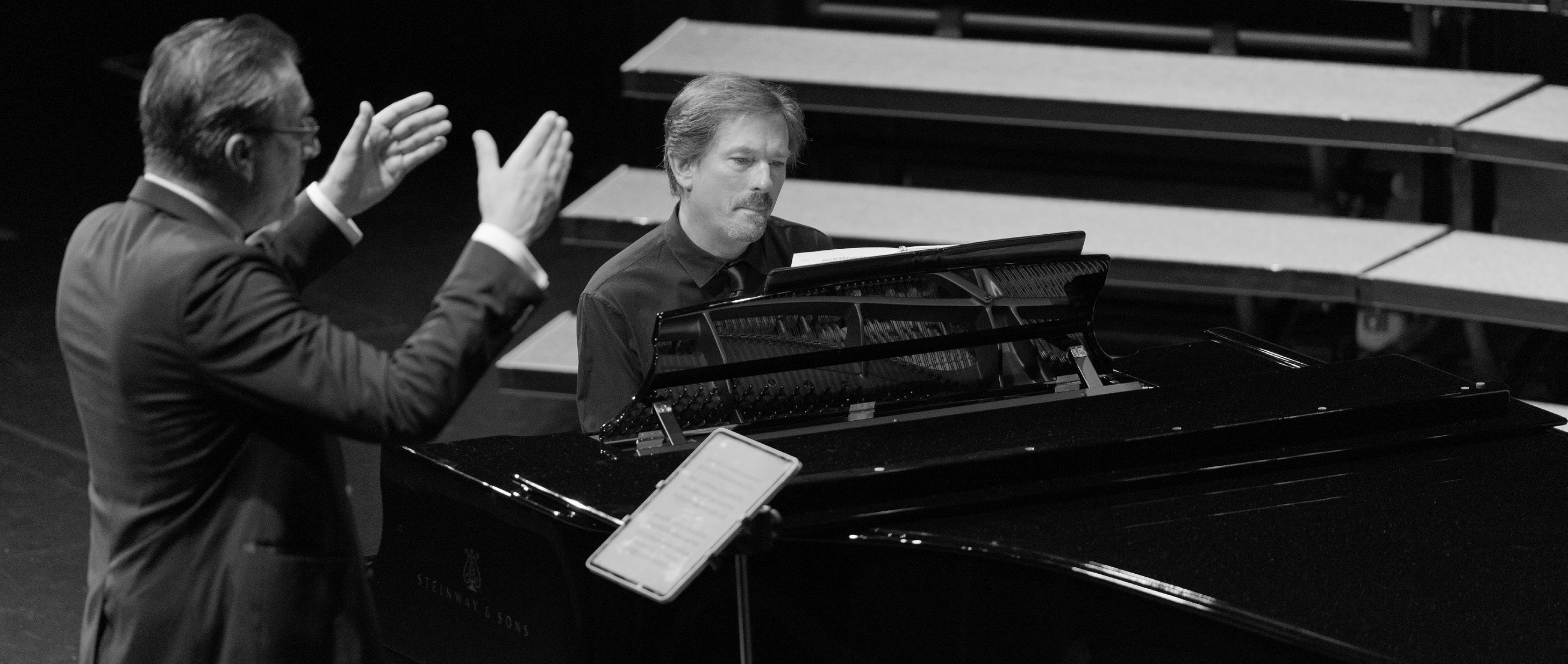
Todd Billingsley plays the piano at a choir concert. e music program recently announced the addition of a Steinway Model D piano to its collection. “
hundred
forty thousand dollars is an awful lot of money to pay for an instrument,” Billingsley said. “But it enriches students’ lives, and that’s really
in California. I think it deserves that piano.”
Leilani Chen News & Opinion Editor
PHILIP SHEN/THE CAMPANILE
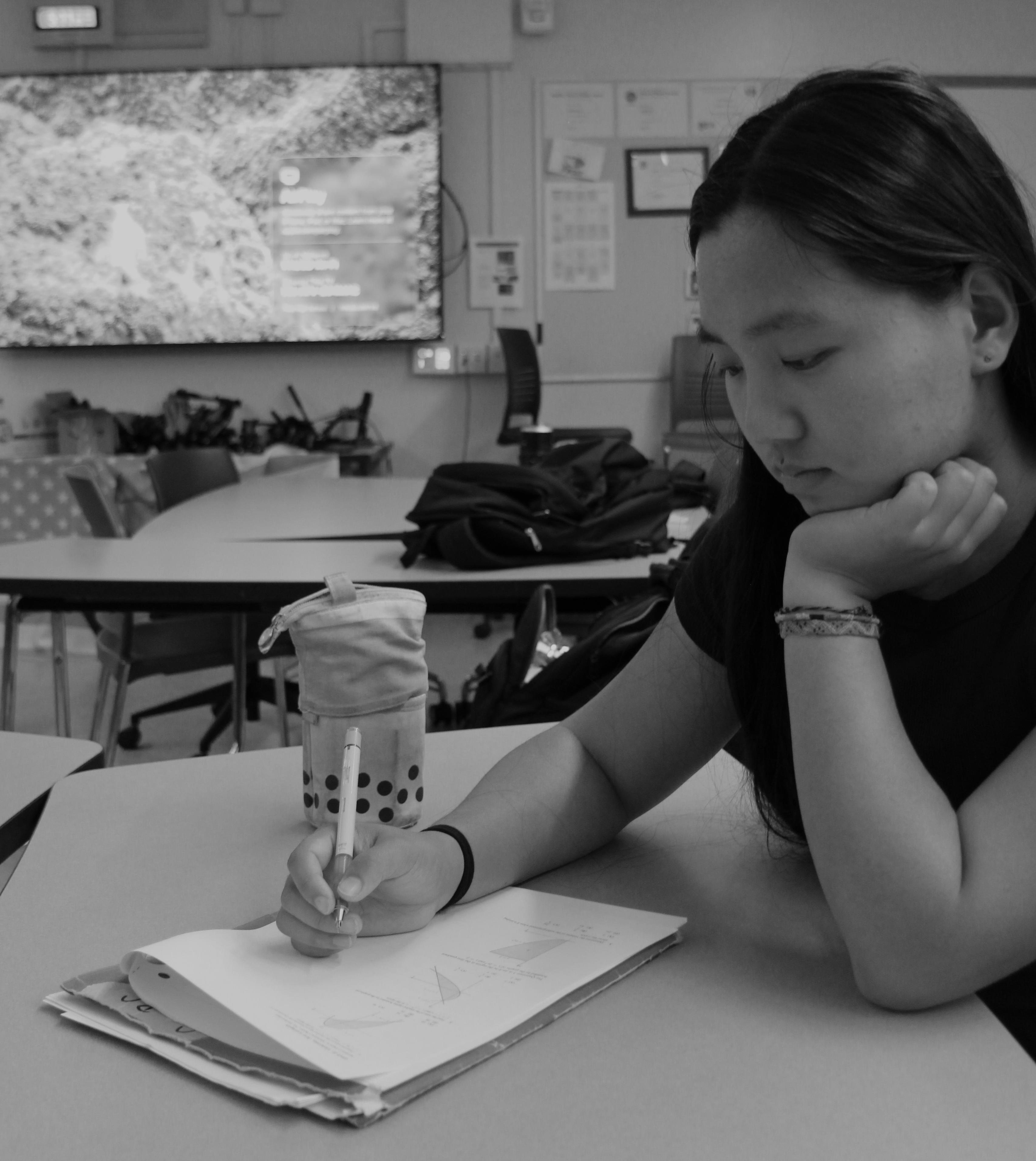
PHOTO ILLUSTRATION BY LEILANI CHEN Junior Kira Tzeng works through a math packet before an upcoming exam as Paly prepares to o
Multivariable Calculus on campus beginning in the 2026-27 school year. “We want to give all students the chance to seek further
in
they enjoy,” Paly math teacher Daniel Nguyen said.
Pain at the Pump
Since the start of the U.S.-Iran war, Americans have paid over $29.2 billion more than before the war for fuel. In California, gas prices have reached an average $6.01 per gallon, an increase of 30% when compared to pre-war prices. In an area already burdened with a high cost of living, many student drivers are being impacted by these rising gas prices.
Economics teacher Eric Bloom said in theory, gas prices should re ect the amount of demand from community members.
“Most people feel they need to drive, or they have to drive,” Bloom said. “So they get mad when prices go up, but it’s called an inelastic demand curve. ey can’t really drive that much less. In theory, as the market price rises, consumption should start to drop, because people are less likely to be willing to pay that higher price.”
But Bloom said this theory is economically unrealistic because oil prices are determined by global consumers, and each country impacts the next.
“Oil is sold on a world market, so when the price of Iranian oil goes up, the price of Saudi Arabian oil goes up,” Bloom said. “ en, the price of American oil goes up because the global market says people are willing to pay a higher price. Now we could have Exxon and Chevron say they feel bad for people that the price of oil has gone up, so they’re going to take less pro t and not raise their prices. Except for that never happens in capitalism. And so even though there’s been no constraint on the supply of American oil or Venezuelan oil or Mexican oil, the price of all oil has risen because the overall world market price is rising.”
Auto Shop teacher Doyle Knight said he has noticed student lifestyles have been a$ected by the rising gas prices.
“I know one kid; he was telling me that he’s actually riding his bike more now because he doesn’t want to put the money into gas,” Knight said.
Additionally, a rise in gas prices can impede student’s shift towards economic independence. Senior Esme Forshaw said she now nds driving a gas-powered car more di%cult economically.
“How are teenagers expected to learn about money when everything is so expensive?” Forshaw said. “I drive a Mazda, which is fully gas, and the last time I got a tank it was $70 for the whole thing, which is crazy. I have to ll my gas up once every two weeks or so, so that’s around $140 a month on gas. And when I go to college, I don’t know how I’m going to pay for that.” Bloom, though, said teens usually don’t bear the brunt of the cost of increasing gas prices.
“If they actually had to pay for their own gas, they might stop driving to school this much, or they’ll carpool and then cut costs in two,” Bloom said. “It’s easier for students if they don’t have to pay for their gas because they can drive the car that mom and dad drive. ey’re not really responsive to price.”
Junior Luna Lim said rising gas prices have made her more appreciative of having access to an electric car.
“We use it as much as we can, and I’m really grateful for it,” Lim said. “I used to be kind of embarrassed of having a Tesla because of Elon Musk, but now I’m glad (we) don’t have to pay for gas.”
And Knight said he has also noticed a di$erence in the cars people choose to purchase and how they maintain them.
“Because of gas prices, people are actually choosing hybrid cars,” Knight said. “So that’s one big di$erence. e other is that … people would normally bring their cars in for maintenance, but because gas prices are so high, they don’t. ey can’t a$ord it.”
Junior Seth Khan said especially in a uent communities like Palo Alto, higher gas prices disproportionately impact individuals of lower income.
“Palo Alto is already an expensive area, and the rising gas prices further drain people from their money in order to pay for gas,” Khan said “It’s emptying out anyone who can’t a$ord to be in Palo Alto and making it a very exclusively rich place. I think that’s ridiculous.”
According to the U.S. Department of Energy, the U.S. has around 400 million barrels of oil in its reserves,
which are stored for major emergencies and disruptions to oil supply such as wars, economic crises and natural disasters. However, Bloom said the U.S. cannot fall back on this supply every time prices increase, as there is a limited amount of it.
“We’d only have about one or two months of oil if we took it out every single day,” Bloom said. “We ll it back up when oil prices are low. Oil prices have not really been that low since 2002, so it’s not lled back up yet. e idea of the strategic reserve is that if we can’t get resources, the government can choose to release oil instead of having people buy it on the market. So we could do that. e argument is that it would probably not make a huge di$erence, but could make maybe a ve or 10 cents a gallon di$erence.” Assuming gas price hikes stay constant, Knight said there are ways students and community members can maintain their cars to use less gas.
“(Check the) air pressure in your car and your tires,” Knight said. “People don’t think about air pressure, but they should check it once a month, because even though it’s supposed to be airtight, it still goes down. e other one is changing the oil. Just changing the oil does a lot for the engine, makes it run better.”
Looking forward, Forshaw said she fears rising gas prices and their a$ect on her nancial independence in college.
“It’s really scary going into the future knowing that gas won’t just be a commodity that we can rely on,” Forshaw said. “Especially with the wars coming up, it’s really a$ecting prices.”
Zoya Prabhakar Digital Managing Editor
e city of Palo Alto will face a projected $14.9 million de cit during the next scal year which has prompted City Manager Ed Shikada to reconsider funding for Phase 1, a grant program that distributed $500,000 last year to local nonpro ts that did not meet requirements for more traditional funds. e potential cuts have raised concerns among businesses and nonpro ts like Pathwise and Magical Bridge.
Councilmember Patrick Burt, who also serves on the nance committee, said the city’s de cit comes from both internal cost pressures and changes in state tax policy.
“Half of that amount is rising costs and leveling o$ of revenues,” Burt said. “ e other half is a result of the state changing rules for sales taxes which signi cantly reduced what the city received.” Palo Alto distributes more than $6 million annually to nonpro ts through multiple grant programs. According to PaloAltoOnline, a majority of that funding comes from programs such as the Human Services Resource Allocation Program, which is currently not slated for cuts. But the Phase 1 grant program, which helps nonpro ts that do not t the criteria to qualify for the Human Services Resource Allocation Program, is in danger.
Lupita Alamos, assistant to City Manager Ed Shikada, said the city’s de cit is tied to economic pressures that a$ected city revenues which might mean less money for programs like the Phase 1 grant system.
e city is navigating a period of adjustment in our major tax revenues,” Alamos said. “We’re seeing reduced sales tax baselines and slower growth in property tax.” Alamos said the city’s approach is focused on preserving essential services such as public safety, communication services, libraries, parks and utilities while making adjustments where necessary.
“ e budget is a direct re ection of the City Council’s annual priorities, investing in actionable e$orts that deliver essential
services today while securing a resilient scal future,” Alamos said.
According to the city’s budget report, the Palo Alto city council is also prioritizing infrastructure and housing over more exible areas like small nonpro t grants. Alamos said, though, that reductions are not being proposed for the city’s primary nonpro t funding programs.
“Nonpro ts currently funded by established city grant programs are not recommended for reductions at this time,” Alamos said. “We’ve worked with other service providers to manage and limit impacts.”
And Burt said nonpro ts are crucial to the city’s goals.
“If the city is in the business of providing services, one of the best ways to do that is to have a small portion of that budget go to supporting nonpro ts,” Burt said. “W ey provide services that we wouldn’t have.”
Nicole Chiu-Wang, Executive Director of Pathwise, said her organization provides after-school academic support for socioeconomically disadvantaged middle school kids. Pathwise receives support from city funding that could be a$ected by future budget decisions.
Chiu said the organization’s impact extends beyond tutoring.
“ e greatest impact we see is a sense of community, belonging and con dence,”
Chiu-Wang said.
Chiu-Wang said potential reductions in funding could force the organization to scale back some programs, but she does not want to sacri ce quality.
“We may have to serve fewer students, but we’ll try not to serve them any less deeply,” Chiu-Wang said. “ is could mean discontinuing a summer camp program or serving students at fewer sites.”
Chiu-Wang said Pathwise is already adjusting to nancial pressures, including cuts from county funds.
“We’re trying to do more with less by building partnerships with other non-pro ts
and nding more cost-e$ective ways to support our students,” Chiu-Wang said.
Olenka Villarreal, founder of the Magical Bridge Foundation, said her organization creates inclusive playgrounds and community programs for people of all abilities. Villarreal said Magical Bridge partners with the city to provide services that were previously lacking for residents with disabilities and that recent changes could a$ect their budget.
“I noticed that the city did not have funds set aside for people with disabilities, so I decided to partner with them,” Villarreal said.
Villarreal said the organization’s mission is centered on inclusion.
“We create programs that include people with disabilities, which is every 4th person,” Villareal said. “We exist to bring people together and make them feel welcome. With the disconnect in the world today, we should try to connect more.”
Amos Mak, a teacher at Achieve Kids, a special education school serving students with emotional and behavioral needs, said the Magical Bridge playground in Mitchell Park is important for a lot of his students. e structures here are conducive for a lot of our students because they require sensory input and there are a lot of things that they can interact with,” Mak said.
He also said the park’s location next to Achieve Kids makes it especially valuable.
e park’s location is really convenient,” Mak said. “If it were to become unavailable, we would have to nd another place.”
Villarreal from Magical Bridge also said city-funded programs provide a cheaper way to o$er services to residents.
“ e programs we run in Palo Alto are 100% supported by city funds, and we’re able to do it much more e%ciently than hiring full-time sta$ with bene ts,” Villarreal said. “If the funding went away, those programs would go away. We’re serving 15,000 to 20,000 people every month across
di$erent cities, many of whom don’t have other options.”
One of these programs, Magical Tennis, brings volunteers to Mitchell Park to teach tennis to neurodiverse teens, providing these teens with a sense of community. “ ese are what I call normal life experiences,” Villarreal said. “Unless you don’t have them, you don’t realize how valuable they are.
Burt said the City’s Finance Committee will negotiate funding as part of the budget process on May 5 and 6, and will allow the community to provide input before sending the recommendations back to the entire council.
After a nal round of recommendations, the nal budget will be determined on June 15.
Burt also encouraged residents to participate in the process, though he said the process can be di%cult because residents often prioritize di$erent services.
“People value services di$erently,” Burt said. “What seems like an easy solution to x the budget to one person may come at the expense of something another person values deeply. We do not have agreement for what is most important.”
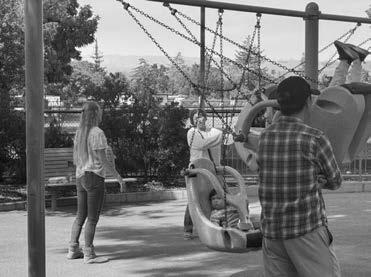
Children play on a swing at the Magical Bridge playground at Mitchell Park. e playground, designed to be inclusive for children of all abilities, is part of programming supported by city funding. “We exist to bring people together and make them feel welcome,” said Olenka Villerreal, founder of the Magical Bridge foundation.
PHOTO ILLUSTRATION BY ZOYA PRABHAKAR
Anthony Zhou Sta Writer
ANTHONY ZHOU / THE CAMPANILE
Small packages, big impact: student leaders support domestic violence survivors
The Paly Chick- l-A Leader Academy chapter hosted a service project on April 22 to assemble care packages for survivors of domestic violence. e nationwide student leadership program, which is sponsored by Chick- l-A restaurant operators, strives to make a positive impact on the community by providing volunteering opportunities.
Students from schools around the Bay Area came together at this event, which focused on creating care packages. ese items were later distributed to the Riley Center, an organization that supports domestic violence survivors.
Arnold Chong, the restaurant operator at the Sunnyvale Chick- l-A, said the Paly Chick- l-A Leader Academy chapter worked hard to organize this day.
“ e amazing thing about today’s event was that it was truly organized and led by our student leaders and school facilitators,” Chong said. “Local Chick- l-A owners love to support and sponsor these events, but the real magic happens when the students and teachers come together to create something great.”
Junior Benjamin Kim, president of Paly’s Chick- l-A Leader Academy Club, said the project, while complex, taught him key leadership skills.
“Planning the project was a very complicated process,” Kim said. “I learned how to be organized, how to plan well and also how to be smart nancially from this project, because we ran into some problems with the amount of money that we were given and all this stu that we needed to buy.”
Kayla Choe, a freshman at Crystal Springs Upland School, said she joined in the project because she was looking for opportunities to support the local community.
“One of the reasons I wanted to participate in this project was because it really pains me to see people, speci cally women and children, struggle with even going to a safe home,” Choe said. “If these
care packages can make these families even smile and know that someone cares for them, it is exciting to participate in something like that.”
Volunteer Sean Chae, a sophomore at Valley Christian High School, said he appreciated the opportunity to both hang out with friends and serve the community.
“ e most memorable part was seeing my friends from other schools and spending time with them, but more speci cally volunteering in this project with them,” Chae said. “It was basically my rst time volunteering with my friends because usually I do it alone, and I thought that it was pretty unique.”
In addition, Choe said she learned how her actions, even as a high schooler, can have a positive impact on her community.
“ e most memorable moment was getting to see the people from the organization share their mission and how much these packages will positively impact a family,”
Choe said. “It really made me excited about it and how our work was going to be something amazing.”
Chae said he hopes this event will prove to others that even small acts of service can lead to big change.
“I hope that it inspires the older generation and the people around us to know that there is still a heart to serve within communities and that even something like this can make a huge di erence in someone’s life,” Chae said.
For Chong, this project re ects the Chick- l-A Leader Academy’s commitment to community service. is was a perfect example of the powerful outcomes that can occur through Chick- l-A Leader Academy programs,”
Chong said. “Chick- l-A Leader Academy generously donated all of the emergency kit supplies for this event and enabled our student leaders to bring this project to life for a local Bay Area organization. ey also ew out to Palo Alto and joined us on-site
to help facilitate and participate in creating impact at a local level.”
And Kim said he thinks this project will have a greater impact than expected.
“I really do think that this will be a very impactful project because these care packages don’t only have essential things, but they also have small toys and things to just take their mind o of their current situation and really help them nd some sort of comfort,” Kim said.
Chong said the project was ultimately successful, and he hopes there will be more student-led events he can attend in the
future. is event had an immediate positive impact on our recipient organization, the Riley Center, with both the emergency kits and the nancial donations that were presented,” Chong said. “In addition to that, I hope that our event inspires future studentled projects and fundraising campaigns that will bene t local organizations across the Bay Area.”
For Choe, she said she hopes students believe their actions can change society, no matter how small their volunteering actions may feel.
e Palo Alto Transportation Management Association has expanded Bike Love, a program launched in 2022 that rewards Palo Alto workers for biking in partnership with the smartphone app Motion. e program now o ers payouts of $5 per ride up to $600 per year, set to encourage residents to shift away from driving and towards more sustainable methods of transportation.
Justine Burt, executive director of the Palo Alto Transportation Management Association, said the program aims to make eco-friendly commuting methods more attractive by o ering app users an incentive to use these methods.
“Encouraging behavior change to more sustainable transportation options is about more than providing information,” Burt said. “Ultimately, it’s about whether perceived bene ts of a new way of commuting are greater than the perceived barriers of making that change.”
Burt said the Bike Love app uses geofencing — a method that uses GPS technology to create virtual geographic boundaries — to automatically track when users enter designated areas, at which point they will receive an award.
“As soon as they pass that invisible barrier with their smartphone, $5 immediately goes onto a virtual debit card they can use at any brick-and-mortar store in Palo Alto,” Burt said.
Social studies teacher Austin Davis, who bikes to work, said he supports the idea of the program but thinks it will need adequate publicity to succeed.
“I already ride my bike to school, so if I can get extra money to do what I’m already doing, that sounds excellent,” Davis said “I feel like if it’s not well-publicized, it will just reward people who already bike.” Burt said the program has already accounted for some of these criticisms, and also said many users have moved from driving to using refurbished bikes.
“Critics have said that Bike Love pays people for biking who
“I hope that the community will be inspired to make an impact in their local communities,” Choe said. “Whether it’s food drives or public clean-ups, we can help out in so many ways that are simple and bene cial at the same time. I hope that this event inspired many students today so we can make the Bay Area a place that serves others.”
Grace Kim Senior Sta Writer
probably already were biking to work,” Burt said. “Many people who start using Bike Love come to us asking for a refurbished bike so they can bike to work. en we refer them to the Silicon Valley Bike Exchange to receive their refurbished bike.”
Even so, Davis said there are many reasons why someone might choose to drive instead of bike.
“Maybe you have to buy a bike in the rst place, and then you have to deal with the fact that you can’t carry everything with you,” Davis said. “Not everyone can bike the distance (to work), and biking might take too much time out of their day.”
While Davis said the program is a good step forward he thinks it may be less impactful than expected.
“An incentive program seems like a place to start, but it’s not going to remedy the larger tra$c problem or pollution problems,” Davis said. “On its own, the program is unlikely to yield a lot of change.”
Still, AP Computer Science teacher Christopher Bell said the habits the program is trying to instill in the community are important.
“I’d love to see more people taking public transit,” Bell said.
“I’d love to see people biking to work, so the more that we get people to want to do that the better.”
And Burt said biking is not only important for the environment, but also for personal wellbeing. e point of the app is to encourage people to try biking to work and hopefully develop a habit,” Burt said. “ ey get exercise and fresh air and bike among the tree-lined streets of Palo Alto, all of which is great for mental health, too.”
Moving forward, Burt said the program is looking at alternative funding measures, such as feebate systems, to attract more users to the platform.
“A feebate is a charge levied on a behavior you want to discourage, like driving a gas-powered car, that uses the revenues to encourage the behavior you want, such as biking to work,” Burt said.
Ultimately, Burt said Bike Love’s goal is to help address the broader issue of sustainable transportation and employee well-being.
Burt said, “Success is having another tool in our tool chest to encourage sustainable mode shift that improves workers’ lives.”
GRACE KIM/THE CAMPANILE
Students put together care packages to support domestic violence survivors. “I hope that (this event) inspires the older generation ... to know that there is still a heart to serve within communities and that even something like this can make a huge di erence,” volunteer Sean Chae said.
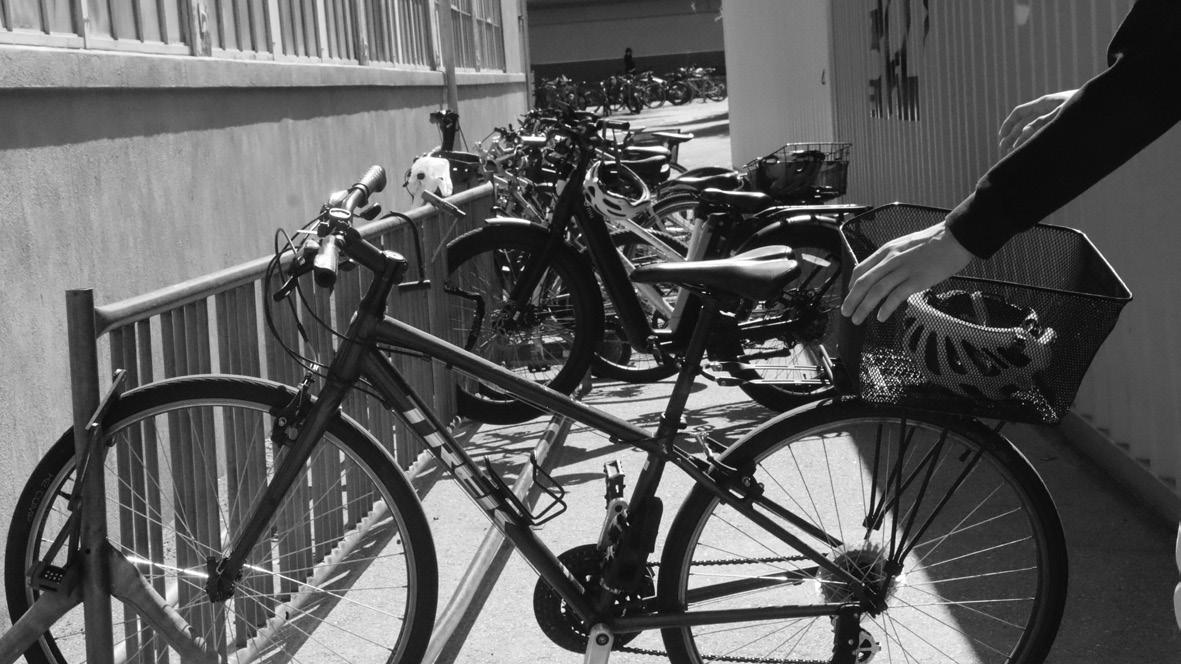
A student reaches for their bike as the Palo Alto Transportation Management Association (PATMA) expands Bike Love, a program that rewards Palo Alto workers for biking to work. “Encouraging behavior change to more sustainable transportation options is about more than providing information,” PATMA executive director Justine Burt said.
JONATHAN GU/THE CAMPANILE
Lifestyle
Four years at Paly: seniors re ect
ART BY EDEN YOO
e endless rush of morning tra c on Embarcadero. A cat curled up on a lap. e earthy smell of freshly brewed co ee wafting through the air. ese real, sensory details are what students may lack in an increasingly digital life.
Senior Gia Cicero, president of the Paly Neuroscience Club, said she has observed an uptick in technology use among her peers.
“When you’re at school, you need to work on assignments. You meet friends. You talk to them through devices,” Cicero said. “I think society really just promotes people to use technology more as time goes on.” Sophomore Ethan Bradley agreed and said devices have become a constant presence in his daily life.
“Since I started high school, I feel like I’ve been on screens so much more than I used to be,” Bradley said. “It’s pretty much constant, because I go from being on a screen at school to being on a screen at home, and it just takes over every part of your life at that point. I feel like in terms of social media like Instagram, it makes me a lot less productive.”
Senior Kathryn Chen said increased dependence on technology has made her more aware of her own screen time habits.
“Sometimes, I’ll stop scrolling, and I’ll just feel really drained and unproductive, because I feel like a couple hours have evaporated before me,” Chen said. “I am trying to be better about how I spend my time online.”
Cicero said the increase in technology use takes advantage of the brain’s distractibility and need for constant stimulation.
“Our brain is always seeking something to do,” Cicero said. “If you can just keep scrolling and keep scrolling, your brain doesn’t have to nd anything (to do),
whereas, if you’re like, ‘Oh, what do I do right now?,’ then you have to think of something to do.”
Cicero said this reliance on technology also lessens attention spans.
“I think there de nitely are lots of attention span issues that are very much linked to short-form content versus long-term,” Cicero said. “You notice it at school when a teacher puts on a ve-minute clip, nobody can watch it.”
However, Bradley said social media also creates opportunities to connect with others.
“I don’t really text people a lot, but I will start conversations by sending them an Instagram reel, and then we actually get into a conversation,” Bradley said. “So I feel like it can be a way to get closer to other people, because it’s a conversation starter.”
Amid the rise in digital technology, some students like Chen are choosing to live lives of greater intention.
“I try to have a little more intention behind what I watch,” Chen said. “For instance, watching YouTube videos versus scrolling and then just taking whatever the next video is. Even though they are both technically social media and social media algorithms, I nd that I prefer longer form content, because it sometimes feels more intentional.” Bradley said he manages his technology use by assigning di erent purposes to di erent devices.
“For example, my computer, I try to keep that mainly (for) schoolwork, that way I’m not tempted to goof o while I’m on my computer,” Bradley said. “But then I separate that with my phone, which I mainly use for stu like Instagram or playing games. So I think separating the two di erent kinds of technology helps me stay focused when I need to be and then relax when
High school is a time for growth, self-re ection and learning. Yet, after four years of Paly, what has the graduating class learned? Senior Jerry Yan said high school — especially freshman year – is a time of large changes which can lead to confusion.
“Freshman year is, I wouldn’t want to say the worst year, but it’s the transition year” Yan said. “You have no friends, and then you meet a couple people and your network grows exponentially.”
However, senior Marcello Attardi said upperclassmen can act as strong role models for newer students, especially through extracurriculars such as theatre.
“I knew very few people at Paly, and then I met a bunch of upperclassmen,” Attardi said. “ ey were really encouraging and also really talented. I was like, ‘I want to be like them,’ and that inspired me.”
Currently acting as Mr. Darcy, one of the lead characters in the Pride and Prejudice production, Attardi has become a role model himself. He said his time in theatre led him to take on greater responsibility.
“When I started it was very, very small things: interacting one on one with people and just trying to be friendly,” Attardi said. “But now I’m doing tangible things, like organizing events.”
On the other hand, Attardi said increased responsibility has led to his own personal growth.
“ e level of independence that you get is a lot,” Attardi said. “It’s a lot higher in high school, and you get more each year, and that makes you readier for college and beyond.”
Yet, senior Brian Liu said personal growth does not come without di culty.
“Kids understate how much work there is, especially junior and senior year,” Liu said. Yan agreed, and said that a prep period can lighten the load of more rigorous classes.
“I got saved by my prep today because my bike was broken,” Yan said. “So I drove to school. I couldn’t nd a spot, so it took 30 minutes.”
As important as the academic side of high school is, the social growth — more con dently navigating social situations and making more friends — is just as important. Yan said meeting more people in high school is not as stressful as it seems.
“I met most of my friend groups through … I don’t know,” Yan said. “I started with Connor Lee, at freshman orientation, and Connor Lee got me into (a) friend group, and that friend group got me into a di erent friend group. It’s like your network only grows.”
He also said his being friendly towards everyone has bene ted him greatly during his time at Paly.
“I think the most important thing in high school is probably to put yourself out there,” Yan said. “It doesn’t hurt to have more friends; It hurts to have more enemies.”
All of the academic and personal growth leads to learning and, for some seniors, insight into their journeys at Paly. Liu said the college-focused culture of Paly caused him to neglect himself.
“I would have slept earlier, drank less ca eine and taken high school less seriously,” Liu said. “You see all these di erent people getting into di erent colleges and at the end of the day, it’s an arbitrary name.”
Yan said it’s easy to neglect social life in favor of studying.
“Have a lot of friends, be in many friend groups or just be in one friend group, that’s enough,” Yan said. “Hang out with people.”
Attardi said students should nd their own paths.
“Go out there and don’t be afraid to get what you want or go for what you want,” Attardi said. “You can’t control (everything) all the time, but one thing I think that a lot of freshmen have to learn is that you have to nd a couple things you’re passionate about and stick with them. … Pursue what you want to pursue.”
Liu said he agreed and focused on nding personal joy in high school.
“People work as hard as they want,” Liu said. “I think they put themselves in whatever position they think is best. But at the end of the day, it’s what you want to do and what makes you happy.”
Gavin Lin Senior Sta Writer
I need to.” Cicero said being more intentional with screen use also increases creativity.
“Boredom creates creativity, because you have to be bored to need to think outside of the box,” Cicero said.
Bradley said choosing to use analog objects instead of digital ones creates more meaning in his life.
“I own a record player, and I have a lot of vinyl that I got from my grandparents,” Bradley said. “Physically
having the music that you’re listening to with you, it’s changed the way that I use Spotify. It just makes the way that you listen to music a lot more intentional, because you’re physically pulling out a record, setting it up, putting on the needle. You don’t just click a button.”
Isabella Bian Senior Sta Writer
Wow factor inconsistent at Wow Tea
Wow Tea Drink, the modern bubble tea shop, which had its re-opening on El Camino on March 28, o ers a wide variety of oral and fruit drink options. When we rst walked in, we were met with a clean and sterile smell. Combined with the light blue and white decor, along with the harsh white lighting, the space did not exude warmth. e attempt at plant greenery felt forced, if acknowledged at all, and the modern seating was not comfortable. We enjoyed the music, but it was too loud for our liking. While the creative drinks may be worth exploring, we would not recommend this store for a study or hangout spot. e ambiance tainted our rst impressions, but it only got worse as we learned they did not have boba ready 30 minutes after opening. Seeing as boba is the main attraction of the shop, this left us void of satisfaction and seemed unacceptable. However, the employees were extremely kind and attentive. ey were knowledgeable about the menu and were ready and willing to answer any questions we had. Now, let’s dive into the drinks.
Drink: The Best Jasmine Green Tea Latte ($6.50)
e rst drink we tried was the Jasmine Green Tea Latte, which was recommended by the employees. e drink was extremely oral and tasted fresh, with a light sweetness that gave the perfect amount to taste the avor without being overly bitter. Upon rst taste, the jasmine pro le came through and was not overly milky, which we liked, but after a while, we felt bored and felt the drink could have been elevated with actual boba pearls. Overall, we felt the drink was a solid order, but we wouldn’t necessarily call it “ e Best.”
Taste: 8.5/10
Description accuracy: 9/10
Value for price: 8.5/10
Drink: White Peach Guan Yin Lemon Tea ($6.75)
is drink has the word “tea” in its name, but there was barely any taste of it — which isn’t a bad thing, because what you do taste is impressive in its own way. Despite its distinction from its name, the drink reminded
us of tasting an actual peach, even giving us the same velvety feeling inside our mouths after drinking. Not only that, but it tasted exactly like white peach juice with a small hint of lemonade. With regular sugar, it wasn’t too sweet to be unable to nish, and the price point was reasonable for a large sized drink as it aligned with other drink stores nearby. If you’re looking for tea with bitterness, we recommend you to pick a di erent drink, but if you’re looking for a refreshing fruit drink that tastes organic, the White Peach Guan Yin Lemon Tea is the way to go.
Taste: 9/10
Description accuracy: 10/10
Value for price: 8/10
Drink: Fruit Infused Qilan ($6.75)
“Apple-infused,” and with “freshly muddled orange and lemon,” the description read. Each sip was supposed to deliver a “nuanced and satisfying burst of avors.” Flavors burst in our mouths, but it was unfortunately not nuanced. We were hit with an overwhelming blast of orange and cinnamon, while other fruit avors, if present at all, were muted to the point where they were almost nonexistent. ose looking for a multi-fruit infused drink will be sorely disappointed. In addition to the unexpected avor mishap, there were also massive slices of orange in the drink; they were completely unnecessary and were there merely for the added visual appeal, which sadly meant we got less of the actual drink. With all that being said, the drink was quite pleasant; the oranges tasted fresh, and the cinnamon added a nice kick. As for the value, we thought it was a little pricey given the fact that it was essentially a cinnamoney orange juice.
Taste: 6/10
Description accuracy: 4/10
Value for price: 5/10
Drink: Matcha Mochi Rice with Matcha Cloud ($7.99)
e drink started out as your typical high-quality matcha, earthy and grassy with nutty undertones and a subtle, lingering sweetness. e mochi rice, stretchy and chewy with a milky, silk-like consistency, sat at the bottom of the cup, bringing welcome
As we transition from winter to spring, Paly students are noticing changes in their academic and personal lifestyles, motivation, and overall mental health.
Junior Oakley Koegler sits on the quad, soaking in the rst sunny day of spring while working on his math homework. Koegler said as the weather warms up, he feels more motivated to work.
“(Time) outside makes the time inside studying less of a drag,” Koegler said. “In general, warmer weather gives me more energy, makes me happier to do things. (It) reminds me of summer, where you’re free and you have fun.”
Senior Ella Segev, however, said she has a di erent experience.
“When it’s sunny, I’m obviously going to be more inclined to go do stu in the sun,” Segev said. “It’s also turning from cold to hot. So I want to … take advantage of it. And I want to go be with my friends, go get food or play something rather than (study).”
Junior Poppy Morrison said for her, warmer weather can go either way, but helps remind her that summer is approaching.
“I nd it both easier and more di cult,” Morrison said. “On the one hand, I feel a little bit more motivated because it is the home stretch before summer, but on the other hand, when it is sunny out, I want to be outside and doing fun things.” History teacher Christopher Farina said in his experience, students become less focused near the end of the year as the weather usually gets warmer and sunnier.
“I know that there’s some research on temperature,” Farina said. “When you’re cooler, you tend to feel a little bit more alert. When you’re warm, you tend to feel a little bit more groggy.”
Many studies have shown that when it is hot outside, bodies have to work overtime to keep cool, displaying how some students could lose focus in the heat.
Despite some students’ struggles to stay focused, the warmer weather also has mood-boosting e ects
texture to an otherwise boba-less drink. e matcha cloud was where things started to take a turn for the worse. After enjoying a satisfactory cup of delicious matcha and rice mochi, the foam added to the top of the drink reached the straw, bringing saltiness into the taste palette that ruined our previous appreciation. Did the menu warn us about this? Yes: “ e top is covered with salted cheese matcha cream,” the description read, but given that the title neglected to inform us about its salty quality and simply said that it was going to be a “Matcha Cloud,” we weren’t expecting such an imposing savory avor to be integrated into our otherwise sweet-to-neutral drink. If we were to order it again, we would select the option to remove the matcha cloud, because we did enjoy the rest of it. e description was very accurate, although we would push back on the claim that the “salted cheese matcha cream (created) a delightful … experience.” Still, we recognize that this might
have been due to our unfamiliarity with the avor combinations of the cheese matcha cream, and others may enjoy it. While we thought the drink was a little pricey, most boba drinks are comparable in cost, and it was reasonable given the addition of the matcha mochi rice and the cloud layer on top.
Taste: 7/10
Description accuracy: 9/10
Value for price: 7/10
Overall, we felt that Wow Tea wasn’t the best drink spot. Located behind California Avenue, we’re not sure that many Paly students will go out of their way to visit. And although we’re weary about the caliber of the boba pearls, we felt that there was a good variety of drinks with kind employees who were willing to help.
Lucas Lai Editor-in-Chief
Cindy Liang Editor-in-Chief
Meryem Orazova Senior Sta Writer
Luca Vostrejs Senior Sta Writer
“When it’s like a rainy day or a foggy day, it’s just kind of gloomy,” Segev said.
And junior and ASB president Katie Kim said the warm weather brings more life to campus.
“I think generally many people are in a more positive mood, especially if the sun is out,” Kim said.
“ASB activities typically cater towards the opportunities that warmer or colder weather brings. For example, in colder weather we tend to do more hot chocolate and (in) warmer (weather) ice cream.”
Morrison said this increase in stu dents spending time outside helps create more of a sense of togetherness.
“During the transition to spring, because it is getting warmer and sunny out, so many more people are out on the quad playing games or just sitting,” Morrison said.
“Campus just feels like one big community.”
Ultimately, Segev said this shift in weather reveals what she says is the tight-knit student body.
“I noticed that a lot more people are during passing periods, being out more, playing spikeball in the quad or playing vol leyball,” Segev said. “I really like it because it brings the campus life out and really shows the Paly community and just like a happier vibe.”
Alana Chun Lifestyle & Sci/Tech Editor
Elise Andrade Senior Sta Writer
Wow Tea’s Matcha Mochi Rice with Matcha Cloud (left), e Best Jasmine Green Tea Latte (right) and White Peach Guan Yin Lemon Tea (back) sit on Wow Tea’s table. We thought the tables were decorative, but not functional due to the size.
MERYEM ORAZOVA/THE CAMPANILE
Music beyond the classroom
Agrowing number of Palo Alto High School students are creating student bands, exemplifying a shift in how young musicians further their artistic talents beyond the traditional school programs.
Although there have been student-formed bands in previous years, the number of active bands are increasing, driven by a desire to connect with friends outside of the classroom.
Stanford University freshman Dexter Cleveringa is a drummer for Strother Field, a band formed by students during their time at Paly. Cleveringa said the growth of student bands marks a change from what he experienced during his time in high school.
“During my time at Paly, I felt like there were a lot of talented musicians and people with strong interests in music,” Cleveringa said. “But outside of school bands, not many people took the initiative to form groups on their own or jam with others.”
Cleveringa also said the band has also become a consistent way for him and his friends to spend time together.
“I think it’s just a way for me and my friends to hang out and just have something to do,” he said. “It’s very fun. Ever since we started doing it, it’s something I enjoy doing.”
Cleveringa said compared to his time at Paly, more students are sharing their band’s music online too.
“Recently, I’ve been seeing a lot of my friends starting to form bands, cover songs and make content,” Cleveringa said. “I think they are utilizing social media more than we used to. It seems to be really e ective.”
Junior Daniel Segev, pianist for Paly student band Static Revival, said joining a band gave him the chance to cooperate with other musicians and showcase his own expertise in a cohesive way.
“I’ve been playing piano for a decent amount of time now, but I haven’t really been able to use the skill that I have,” Segev said. “But when I was posed with the opportunity of joining a band, I was delighted and we went to do a couple practice sessions and it was really fun.”
Compared to practicing alone, Segev said practicing with the band requires more focused attention.
“ ere’s more things you have to pay attention to, like the rhythm and the beat,” Segev said.
Junior Juliet Frick said that she is a fan of all of the bands being formed by her classmates and appreciates hearing their music.
“I think all the bands are really talented, and it’s super cool to see my peers pursue something they’re passionate about,” Frick said.
Cleveringa said he hopes high school bands appreciate their time playing together and cautions students not to get too caught up on fame or success.
“I think that the discussion of success is out of the scope of high school bands,” Cleveringa said. “Obviously, everyone wants to make an impact and play great songs, but it is important to remember that the reason we form bands is to play music together and enjoy that experience. Only after that, success can build from cultivated relationships and a collaborative work ow.”
The Funpanile
READING REGRES
After a long week lled with assignments and stressful tests, sophomore Liani Ragade curls up on a nice, warm couch to read the library book that has been sitting untouched on her desk since she checked it out last week. She only has an hour to immerse herself in another world far away and free from outside distractions.
However, in another house just a few blocks away, sophomore Anisha Shetty settles down on her bed after digging through her backpack and shes out her phone. Instead of reading a book, Shetty scrolls on Instagram, a weekend activity that has subconsciously become part of her routine. She isn’t alone; a growing number of young adults and teenagers are losing their ability to focus long enough to read and resort to social media as a source of entertainment.
A generation loses focus
National testing data con rms a trend many teachers have observed — a decline in traditional literacy skills. According to the 2025 National Assessment of Educational Progress, 12th-grade reading scores have reached their lowest point since 1992, with approximately one-third of high school seniors performing below basic comprehension levels. As students increasingly rely on digital media and arti cial intelligence, researchers suggest this shift is creating a gap in the foundational skills required to analyze complex, long-form texts.
Laura Sterponi, a professor of language, literacy and culture at the University of California, Berkeley, wrote in an email to e Campanile that the de nition of literacy is shifting to include more than just physical books.
“Traditionally, being literate meant being able to decode and comprehend written text, especially in print,” Sterponi wrote. “Nowadays, literacy also includes uency with multimodal texts, which combine image, sound and design, not just alphabetic text. In addition, our everyday reading and writing is increasingly carried out in interactional contexts — decoding is connected with commenting, sharing and remixing.”
Sterponi also wrote in her email that the ability to interpret traditional books is still a necessary skill in an increasingly digital world.
“ e ability to engage deeply with sustained, complex texts — to follow arguments and interpret nuance — remains crucial and, in some ways, even more important now,” Sterponi wrote. “ e challenge for education is not to choose between them but to support students in developing all of these capacities.”
Despite the nationwide literacy decline, Palo Alto Uni ed School District still outperforms other school districts across Santa Clara County. In the 2024-25 California Assessment of Student Performance and Progress, 82.26% of PAUSD students met or exceeded their English Language Arts/ Literacy grade-level standards. In contrast, 59.82% of Santa Clara County students met or exceeded those standards.
Despite this seemingly successful PAUSD data, senior Kathryn Chen said it has become much easier for students to skip assigned reading with the rise of tools such as AI and online book summaries.
“You can get away with looking like you read and thought about the book without actually practicing those skills,” Chen said. “It has become easier because there’s a resource that synthesizes so many di erent interpretations and observations from the text for you.”
ally engaging your mind or thinking about what the author did; that goes against the bene ts you’re supposed to be getting by taking the class.”
Sarah Freedman, a University of California, Berkeley professor who specializes in writing and English in educational settings and is a former adviser for the National Assessment of Educational Progress, said to help students in their reading skills, schools should focus on teaching students how to use AI tools e ectively rather than as a shortcut.
“Because these new tools are available, teachers have to be alert to them,” Freedman said. “Kids will use them, so we need to teach kids how to use them well, as opposed to using them as crutches.”
For AP English Language and Composition and Literature of Visual Media teacher Alanna Williamson the gap between students who read a summary versus the students who read the book becomes obvious during class discussions.
“I can often tell that they didn’t understand what the reading was saying,” Williamson said. “Whether that’s due to them not actually reading it fully or them legitimately not having the skill, either way, it’s a noticeable di erence.”
Williamson also said students have become less interested in reading for class.
“I got a lot more pushback this year about the reading in AP Language and Composition and Literature of Visual Media,” Williamson said. “I can tell that students are not always reading because of the way that they annotate or fake annotations. Even when they are reading, their comprehension has gotten worse based on how they do on reading assessments and our conversations in class.” English and Advancement Via Individual Determination teacher Lizzie DeKraai also said students seem to have a harder time sticking with di%cult books than they used to. ey don’t want to do it,” DeKraai said. “ ey won’t do it. ey avoid di%cult, complex texts. ere’s also a lack of reading stamina and ability to really stick with the text and push through and also an unwillingness to try to use strategies to comprehend a text that they don’t automatically get.” ese teachers’ experience mirrors a decline in reading stamina and interest nationwide. A 2025 study by researchers from the University of Florida and University College London found reading for pleasure has dropped 40% in the last 20 years. In 2004, nearly 30% of Americans read for fun on a daily basis. By 2023, that number had fallen to just 16%.
Sterponi from UC Berkeley wrote in her email that the issue may not be students have stopped reading entirely, but rather that they are spending more time on shorter, digital content.
“If we are thinking of sustained engagement with long-form texts — novels, academic articles — then there is evidence that many students are doing less of that and teachers are asking less of that,” Sterponi wrote. “At the same time, students are constantly engaged with texts in di erent formats — messages, social media, multimodal content … What is changing is the temporal structure of attention, the kind of texts, and the purposes of reading.”
Freedman also said today’s digital environment has changed the ways students use their attention.
“ ey attend to a lot of things at once,” Freedman said. “Some people see that as jumping around and not focusing, and other people see that as an ability that kids have. I don’t worry about the digital world and kids reading and writing.”
signaling — often on digital platforms — and another oriented toward depth, coherence and analytical rigor, often in academic settings.” e move toward digital media, she notes, has trained students to prioritize fast information intake, which makes the slower process of reading a book feel unnatural.
“Social media environments shape reading by encouraging speed and responsiveness,” Sterponi wrote. “Students learn to scan quickly, pick up cues and react in real time. Social media also normalizes fragmentation — texts are shorter, interlinked and multimodal, so meaning is often assembled across snippets rather than developed linearly.”
Distractions and shortcuts lead to less reading
While traditional literacy loss is apparent to some, the reasons behind the loss are nuanced and diverse, but among the reasons experts cite are the rapid growth of digital media, AI and the busy lives of students.
A 2026 study from Powers Health found that since the COVID-19 pandemic, students’ access to technology has spiked, leading to a subsequent increase in screen time. Jamie Nunez, the senior manager of outreach and learning at Common Sense Media, a nonpro t which provides ratings and reviews of digital media, said he has seen an increase in educational technology use since the pandemic.
A 2025 College Board study found over 80% of students report using AI in classes. And Williamson said to avoid school-assigned reading, some students use AI summaries. She said this reliance has recently become more pronounced.
“Last year, it was a problem, but not as much,” Williamson said, whereas this year, (it’s) a constant problem and a constant con ict for students because they’re getting di erent messages from di erent teachers about what … is OK. I think it’s also just better technology this year, and it’s more readily available.”
For some, the decline in literacy can be attributed to the rise in social media. According to a 2025 study published in the Journal of the American Medical Association, adolescents who use social media perform worse on reading, vocabulary and memory tests compared to adolescents who do not.
Chen said she sees this play out in her life as she only reads books if she nds them more engaging than her social media feed.
“I care more that my book has something interesting in it,” Chen said. “Unless the book is actually good, then I start to lose interest a lot faster because if I’m getting the same experience as just randomly scrolling, why am I reading the book?”
But while people still read when interacting with social media posts, junior Maya Angela Cheng said the form and quality of literacy is di erent.
“People read the text on social media, but I don’t think reading 10 bursts of 10 words is going to get you the same e ect as reading 100 words all put together,” Cheng said. “ e number of words could hypothetically be the same, but I don’t think you’re getting the same learning or higher-level thinking or critical thinking that you would from reading a longer thing.”
In addition to distractions, Chen said students also approach reading with the wrong mindset.
“ ere’s this idea that you don’t have time to read, especially with the mentality that you have to nish the whole book in one go,” Chen said. “It’s also so much easier to do social media. Books can be heavy, or you have to go buy it or go to the library. at’s more work than opening your phone.”
Since many students take a rigorous course load in addition to their multiple extracurriculars, history teacher Katya Villalobos said these students’ schedules allow little time for leisure or reading.
“ eir schedules are packed, whether it be school, sports, outside activi
REGRES SION
The loss of literacy diminishes critical thinking
While a decline in reading may seem insigni cant, students and adults alike say the implications for such a decline can be grave.
A 2025 study published in the journal iScience analyzed data from 2003 to 2023 and found that daily time spent reading for pleasure in the U.S. has decreased consistently at a rate of around 3% per year.
Sophomore Megan Murphy-Chutorian said she has noticed how a decrease in the amount of time her classmates spend reading has led to a downward trend in their reading skills.
“It’s extremely disappointing how bad some people are at reading, and reading out loud especially,” Murphy-Chutorian said. “I don’t really know what caused this, because personally, I remember learning how to read out loud in kindergarten, but I think it is a skill that many people are losing and should probably be recti ed soon.”
Murphy-Chutorian also said students’ dependence on technology is ap parent in the quality of their work.
“During discussions or essays, you don’t have a lot to actually go o Murphy-Chutorian said. “You have to go o of certain things you were given from AI and you have to stick to it more, so you’re thinking a lot less and the analysis is probably not as in-depth.”
Hilary McDaniel, who teaches the Early Childhood Development Pathway, said AI tools are harmful for brain development.
“I have serious reservations about the health of it, about how it impacts the developing brain,” McDaniel said. “All the things that I would have been concerned about social media, but then times 100.”
Additionally, English learner specialist and literacy teacher on special assignment Kindel Launer said a decline in literacy can lead to impaired attention spans and poor time management; when students cannot hold focus, Launer said they read only in short segments.
“Currently, most students appear to lack the skill to sustain attention over time,” Launer said. “When you can’t sustain attention, that fragmentation makes (reading take) longer and longer, so students aren’t as e cient.”
Maryanne Wolf, the director of University of California, Los Angeles’s Center for Dyslexia, Diverse Learners and Social Justice, wrote in an email to e Campanile that research suggests literacy is crucial to develop the ability to think analytically.
“We now have extraordinary evidence for why every adolescent should rethink how deep reading can help them build their own cognitive processes,” Wolf wrote in the email. “Furthermore, the time-and e ort-demanding processes used in deep reading represent an act of resistance against a culture that invisibly robs them of their attention and oh-so-subtly changes their ability to think for themselves.” English and Advancement Via Individual Determination teacher Lizzie DeKraai said she fears students’ lack of reading will make their future lives di cult.
“What worries me the most is the lack of critical thinking,” DeKraai said. “Nobody has ever come to school super excited to read the assigned reading. However, you do it because you’re practicing the skill, and you’re learning more about the world and your place in it. I really worry that students are going to go out into the world where the lines are blurring
Chen said she ghts distractions when she is reading by limiting her technology.
“I de nitely do lose focus, especially when I’m reading for school, be cause it’s not necessarily what I want to be reading,” Chen said. “So I use focus apps like Focus Friend so I can’t access the rest of my phone for a certain amount of time, or I’ll put my phone in another room.”
For students who struggle with focus, said it’s possible to improve attention span.
“We know that a lot of the short form, social media, YouTube content damages our ability to focus on something for a long period of time, but reading a book actually rebuilds that focus, because you are focusing on this one narrative that is built and developed over time,” omas said.
Ultimately, even in to day’s digital world, Chen said she thinks reading still serves a purpose.
“It helps you be more aware of the power of words, not just the written word, but speeches and conversations,” Chen said. “It helps you actively think about what’s being put in front of you, pick up on what’s given to you and apply your own logic and analysis so you can come to your own conclusion. Being able to practice that skill is so important when it’s getting even easier to just have opinions given to you instead of forming your own.”
STORY
BY
BROOKE BRESSLER, ANNIKA CHU, DASHEL CHUN & PHILIP SHEN
ART BY SOFIA SINGER & ELLEN WANG
Bigger commitments ahead
As junior Akansha Chatterjee catches her breath, having just nished her race over Cardiac Hill, she cheers on others from the crosscountry team as they cross the nish line. Reminiscing over the shorter middle school course, Chatterjee re ects on how she has grown since then, both as a runner and a person.
Chatterjee, who ran both track and cross-country since middle school, said she has built stronger relationships in high school compared to middle school because teams spend more time together.
“In middle school, we really didn’t have that many people doing training, and we weren’t very consistent, so a lot of people would skip a few days,” Chatterjee said. “But in high school, there’s a group of people on the team that’s consistently there every day, so I think just spending such a large amount of time with them and going to races that last the whole day with our team is a very e ective way of team bonding.”
In addition to forming closer bonds on the high school team, Chatterjee said another of the biggest di erences in high school sports is the time commitment.
“It was a big di erence because the practices would go on for two hours versus only an hour max in middle school,” Chatterjee said.
However, not all athletes experience a greater time commitment in high school. Junior Zoe Quintana said her high school lacrosse team held less time commitment than her out-of-school team in middle school.
“When I was on (the local lacrosse team) we had practices twice a week after school,” Quintana said. “ at was di cult because then you have to go right after school. In high school they became more lax about it. It becomes more where you have to do it on your own.”
While Quintana has not had much di culty with commitment for practices, she said games late at night are often a hurdle to nishing schoolwork.
“Now, I don’t have to miss school, but (lacrosse) does take up more of my time,” Quintana said. “Instead of just getting it over with, you don’t really have time in between school and the game to do work, and then you just have to take a shower after the game, and it’s 10 p.m. already.”
In addition to the increase in commitment, other athletes said the level of competition also increases from middle to high school. Chatterjee said she had to adjust to the greater number of quali ed competitors in high school.
“ ere are a lot more people who (run track) in high school,” Chatterjee said. “In all of our races, we have around 100 people per race, and in middle school, I don’t think there were that many people who did the cross country and track programs, so it was de nitely a big jump because a lot of the races are more crowded and there are a lot of really good runners in our area.”
Similarly, junior Brian Miller, who is on the Paly wrestling team, said the middle school league held lower standards for winning matches.
“Wrestling as a middle schooler, from the league that we wrestle with, you don’t really have anybody that’s good, so you can just scrap and just go, go, go and win these matches,” Miller said.
Despite the large shift in competitiveness, Miller said he had been practicing with Paly’s wrestling team since middle school, which he said made his transition easier than for athletes competing at a higher level for the rst time.
“I started wrestling in the seventh grade and stayed year round, so the people I was wrestling with were either in high school or older,” Miller said. “I always was wrestling people that are better than me in the room, so when I got to the point of competing, I had already gotten used to that physicality.”
Miller’s coach, Jonathan Kessler, coaches at both Greene Middle School and Paly. Similarly to in other sports, Kessler said the work and time commitment of high school is a large step up from the previous middle school level.
“In middle school, you don’t hold the kids accountable,” Kessler said. “When they get to high school, they have the wrath of the season where
it’s a long season, a lot of hours, tournaments are long days, and they didn’t realize what they signed up for by doing a middle school season.”
Beyond time commitment and competitiveness, some athletes said the structure and strategy of their sport also became more complex in high school.
For instance, in some cases, high school coaches are not as strict as their middle school counterparts. Freshman Mia Wong, who plays ag football at Paly, said while her high school coaches were more experienced, her middle school coaches were more intense with the team.
“Nancy, the defensive coach at Paly, is really nice,” Wong said. “Since she’s on the US ag football team, she had a lot to teach, and we had a lot to learn. My other coach only played tackle football, and he wasn’t very strict on his coaching, so I feel like middle school was de nitely harder.”
Wong also said one new aspect of high school ag football is running more than one play.
“In middle school, we didn’t have a playbook; it was just try-to-catchthe-ball-and-hopefully-score,’” Wong said. “I de nitely had to spend more
time learning my playbook and routes, which is something that we had no clue how to do going into high school. I was just going with the ow, but now, it’s more structured and you actually have to run exact routes and be accurate with it.”
Despite the increase in commitment and competition level in high school sports, Chatterjee said her journey has expanded her perspective about high school sports.
“I’m not a very competitive runner — I’m not going to college for it — but I think running’s such a good sport because it’s very individual and it requires a lot of determination,” Chatterjee said. “Running has really made me be able to keep pushing when things get hard, and races are consistently di cult, and it’s de nitely taught me to prioritize my own tness and my own exercise along with doing schoolwork.”
Kira Tzeng Print Managing Editor
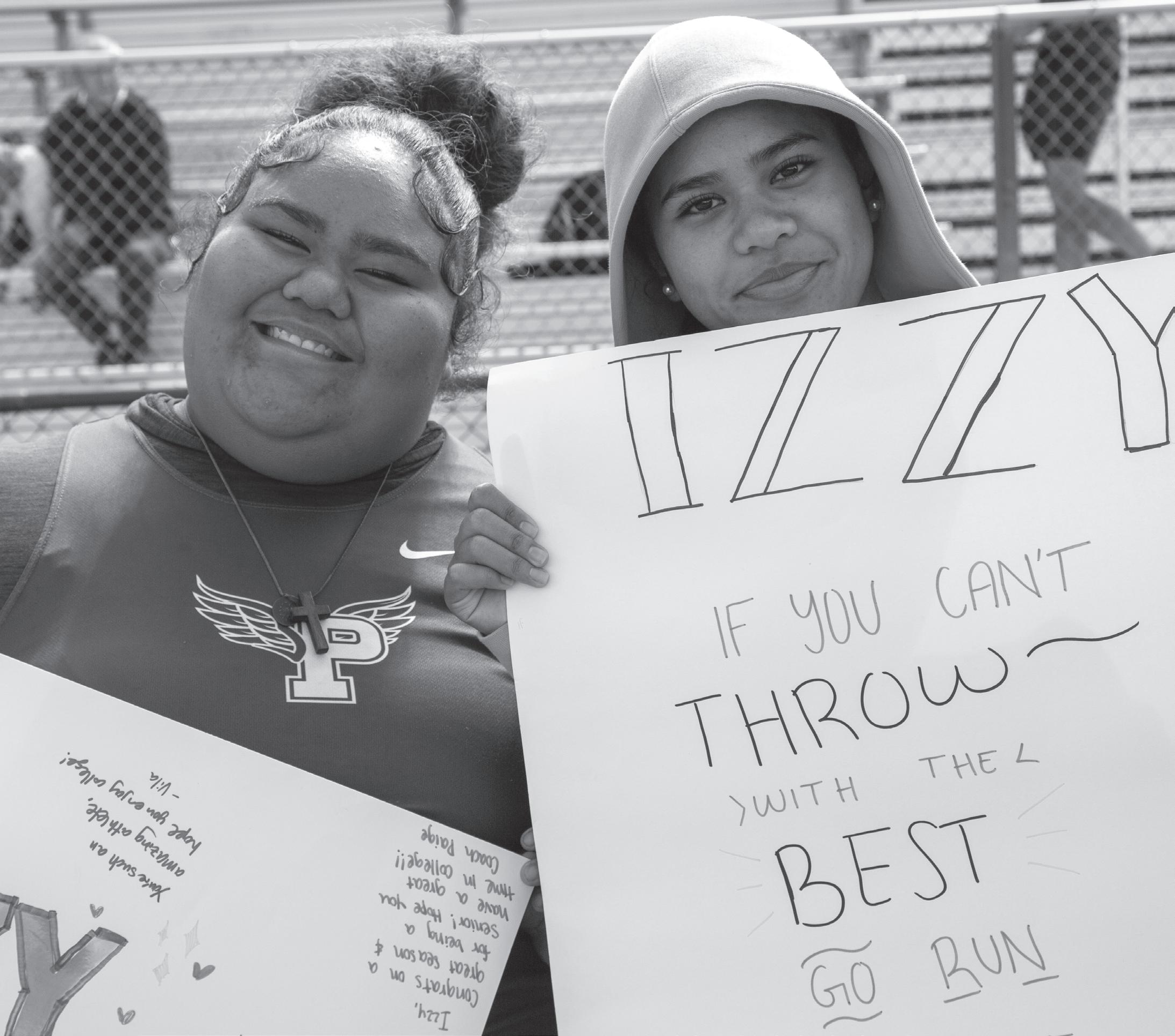
As senior and track and eld athlete Lilia Kuzmicheva walked through the balloon arch on Senior Night, her underclassmen teammates cheered as they presented her with a poster signed by all of them. Surrounded by her team, friends and family, she felt an immense sense of pride, nostalgia and love for her team as she re ected on four years of hard work and memories on the track.
Moments like these are a larger tradition across Paly athletics. For every sport, the senior celebration honors graduating athletes by presenting them with personalized posters signed by members of the team. is event often takes place during one of the nal home games of the season, giving teammates, coaches and parents a chance to recognize the seniors during their nal days on the team.
Kuzmicheva said senior night allowed her to re ect on her experiences throughout her years at Paly.
“I really liked reading everybody’s comments and signatures on (the poster) because they were very heartfelt, and I feel like most people actually took it seriously,” Kuzmicheva said. “I’m going to hang it in my room, and I’ll de nitely keep it so I can look back on it.”
Senior night is also meaningful for parents and families. Lilia’s dad, Kirill Kuzmichev, said the night o ered him a chance to support his daughter’s achievements.
“It was a bit sad because it was the last days of the season and the last days of her running for the school,” Kuzmichev said. “But I was also quite proud that she made it through four years of training, running and competing.”
Junior and soccer player Ellie Knott said, in addition to commemorating seniors, senior night creates a special atmosphere during the game.
“I think senior night makes the environment a lot more fun because everyone wants to put their all out on the eld because it’s our last home game, and it feels like the most important game of the season,” Knott said. “More
people come. It feels like family and friends are there to support, and everyone just wants to play their best.”
Kuzmicheva agrees and said it meant a lot to her to celebrate other seniors she has bonded with in track and eld as an underclassman.
“Giving a poster to them felt really special too,” Kuzmicheva said. “It was nice to give something to a person that they’d have for a long time.” Knott said she experienced a mix of emotions during her last home game of the season.
“I feel maybe more sad than happy, because in the beginning, it’s sad because you’re saying goodbye to all these seniors, and they’re acknowledging what colleges they’re going to go to,” Knott said. “But in the middle of the game, it’s fun because it’s our last time playing together, and you just want to have the most fun possible.”
Kuzmichev said as a parent, he also felt bittersweet about the event.
“I think it would be great if she continued to run for a team because she could make a lot of friends through that and keep working on her skills, stamina and competitiveness,” Kuzmichev said. “Sometimes it’s a little sad, but there are also a lot of good moments, that’s what you live for, and those are worth celebrating.”
For seniors, the event ultimately serves as a lasting reminder of their time on the team. Kuzmicheva said the event allows her to keep memories for a lifetime.
“It’s really sad, though, because it’s all the underclassmen, and it’ll be our last year running with them,” Kuzmicheva said. “I’m going to look back at that poster in a couple of years, and it’s going to bring all the memories back.”
Amaya Bharadwaj Senior Sta Writer
Junior Zoe Quintana runs the ball towards the goal during the team’s game against Los Gatos on March 30. e girl’s lacrosse team added the win to many others on their record that led to their championing of the SCVAL league. “( is team has) just made me realize that a lot of people are just doing this to hang out with their friends and it made me see that I could have more fun playing lacrosse,” Quintana said.
PHILIP SHEN/THE CAMPANILE
Senior Sose na Veamatahau holds a signed poster for senior and track and eld teammate Isabella Grodnitzky to commemorate the years of her time on the team and her future plans after high school. “Giving a poster to them felt really special too,” Kuzmicheva said. “It was nice
Bay Area fencing nds its point
The sound of steel on steel rings through the air as junior Richard Klinkner lunges and parries his opponent’s attacks, seeking to land a hit and score a point. Behind the masks and white jackets, Klinkner is part of a growing number of students in the Bay Area who nd both competition and community in fencing.
“I would call it directionally challenged,” Klinkner said. “You have to make a lot of fast movements … I think the swords make it pretty unique.”
Fencing traces its history back to ancient Egyptian swordsmanship, but the modern sport was re ned during the Renaissance by the Italians and later the French. Nicolas Rousset, a former French national team fencer who now coaches a club in Burlingame, said fencing is, rst and foremost, a combat sport.
“It’s an opposition sport, a ghting sport,” Rousset said. “It’s like boxing with a weapon.” But unlike other combat sports, fencing doesn’t involve the use of one’s sts. Instead, it features specialized blades.
Speci cally, fencers have the opportunity to choose between three types, each with their own distinct strategies: foil, épée or sabre.
“ e three weapons are for di erent tempers,” Rous- set said. “Épée is for people who like to take their time, elaborate on strategy and don’t rush. Foil is a mix of épée and sabre. It’s a little bit faster. Sabre is the quickest one, where you need to make very quick decisions in a very short time for your tactical strategy.”
Sophomore Henry Chan, a sabre fencer, said fencers score points when their blade makes contact with an opponent’s target body area, although the targets vary between each of the three blade types.
“I fence sabre, so my target area is waist up, including the head and arms. It’s the fastest one, and the only one where you can slash your opponent instead of poking them,” Chan said.
Chan said the sport’s fast-paced nature and unique tactics make it distinctive.
“Fencing (is) very unique because it requires a lot of speed and explosiveness,” Chan said. “But fencers aren’t necessarily in the standard running position. It’s more of a crabwalk, where your front leg is facing forward and your left leg is at a 90-degree angle.”
e tools of the trade are also appealing to fencers like Klinker.
An épée fencer, he said the blades were part of the reason he picked up the sport.
“I think the swords make it unique,” Klinkner said. “I rst got into fencing about ve years ago, partly because I thought swords were cool.”
One aspect of fencing that has contributed to the sport’s popularity in the Bay Area is its bene cial impact on college admissions, Klinker said.
“I do think it gets enough recognition in that colleges just love it,” Klinkner said. “I got into fencing because I was trying to college farm.”
Rousset said fencers compete at national tournaments where athletes can attract the attention of and network with college coaches.
“With national competitions, you have a ranking, and the universities base their (recruiting) criteria on these national rankings,” Rousset said. “At these national competitions … you have coaches from the universities who are there and can see and talk with fencers and parents to prepare an interest in their university.”
However, Chan said this pressure to impress coaches and do well at tournaments can be excessive.
ere’s a constant pressure on you, because the Bay Area constantly has pressure from school and competition and parents, but especially in sporting events,” Chan said.
Celine Chang, a freshman on UC Berkeley’s fencing club team who also fenced in high school, said the tradeo between focusing on fencing and her academ-
ics ultimately pushed her away from attempting to get recruited for the sport.
“I realized that the pool of people that these highlevel coaches are looking for is just for what I wanted to do, like academically, and just like what I wanted to have as a student, not sustainable for me,” Chang said. “Another thing that dissuaded me from that process was, when you’re trying to get to that level and be noticed by coaches … you feel that pressure to perform and give certain results, and I think that sucks the joy out of it.”
Chang also said fencing can be expensive, illustrated by its association with the upper class and costs that can reach thousands of dollars.
“If you’re participating in a regional tournament, registration is $50 to $100,” Chan said. “Equipment – if you break something – that’s at least a couple hundred dollars, and if you lose something, you have to buy that again. Also, travel. I’m from NorCal, but we would go to SoCal a lot for competitions. So whether it be gas money for driving, or $ights …. the hotel … minimum, for a travel competition, even within California you have to spend $500. e maximum is probably in the thousands, which sounds crazy, but that’s the reality of it.”
Regardless, the sport shows no sign of decreasing in popularity.
Internationally, in 2023, the Junior and Cadet World Championships drew more than 1,500 athletes from 100 countries, an 11% increase from the year before and the largest turnout in the event’s history, according to the International Fencing Federation.
is growth is exempli ed locally too.
e sport’s growing a lot. A lot of new clubs are opening in the Bay Area,” Rousset said. “I think we are the club who’s opened the most recently. But you
already have some very big clubs existing in San Francisco, in San Jose, in e Peninsula.” Rousset said demand is what drew him to founding a club in Burlingame, which originally had no place for fencers to develop their skills. ere were no clubs where we were,” Rousset said.
“So we are trying to develop it here.” Rousset, a fencer with overseas experience, also said many coaches from around the world are $ocking to the United States.
“A lot of coaches from everywhere in the world are coming to the USA,” Rousset said. “And when you have more coaches, you have more clubs.”.
And despite the expectations placed on athletes, many still genuinely enjoy the sport. Now in college, Chang said she appreciates fencing on Berkeley’s club team, especially due to the lower stress.
“ e di erence between college and high school is that it’s just a lot more relaxed and chill,” Chang said. “We don’t really care that much about results or anything. It’s really just to go and fence and have fun and learn together.” at aspect of learning and fencing together within a community is also what keeps Klinkner in the game as a high school fencer..
“What made me stick with it was the magni cent community,” Klinkner said. “I’ve made lots of good friends, and I’ve met lots of amazing people.” Rousset, too, said the people are the reason he coaches.
“I love the sport. I love what it brings to you as an athlete, but also as a human,” Rousset said. “ e values of the sport too, with the respect and giving everything you have to make it happen. And I became a coach because I love to … have interactions with people.”
Yihan Zhao Lifestyle & Sci/Tech Editor
Climbing to the top: sport promotes whole body health
Inside an indoor climbing gym, surrounded by colorful holds and projecting grey boulders, junior Arunav Ramanathan reaches for a climbing hold that is designed to mimic a natural boulder formation. He then swings his left leg onto a foothold before pulling himself to the top of the wall.
Many students, including Ramanathan often climb at Movement Gym Mountain View, a climbing gym that includes traditional workout equipment, bouldering walls and yoga. He said he was initially drawn to climbing because unlike traditional gyms, climbing gyms frame workouts as problems to solve.
At Movement Gym, students can climb on a day pass for $30 student day pass, and $6 climbing shoe rentals. ose interested in climbing more regularly can purchase a monthly student membership for $121 per month.
Ramanathan said rock climbing is both a physically and mentally demanding sport, requiring athletes to solve problems and exercise many parts of their body.
“Climbing combines both a technical aspect and physical aspect,” Ramanathan said. “It’s awesome that you’re continuously multitasking with your body and brain.”
Junior Harry Bittinger began climbing the past few months and found it appealing because of its social and challenge-based aspects.
“I feel like there’s some sort of mental connection between, solving the problem and in each situation asking yourself, ‘How should I assess this?,’” Bittinger said. “I’m hoping to climb more this summer because I think it’s a really good workout for both the body and the brain.”
Dan Earhart, Assistant Director of Climbing at the Stanford Recreation and Wellness Center, said he started climbing in college through his school’s outdoor program.
“Pretty much all I ever wanted to do all the time was rock climb,” Earhart said. “So it was kind of this head over heels, falling very hard in love with climbing, mainly for the community, but also just the sport as well.”
Earhart said the mental challenges of climbing also helped him in many ways.
“Getting involved with the sport has de nitely improved my con dence and my willingness to approach problems that I might not feel like I’m super well-equipped to handle,” Earhart said. “Most of the time it’s not actually completing the project; it’s just working towards it.”
For many climbers, that con dence eventually leads them from indoor gyms to outdoor climbing. Earhart said outdoor climbing requires more planning, since there is greater risk involved.
“I think the inherent risk also adds something to it as an added feature and added element of the sport that people kind of have to consider more,” Earhart said. “It’s di erent than, say, a pickup game of soccer; you’re not really actively having to consider the same risks.”
For people interested in climbing, Ramanathan said they should try climbing gyms rst, since they are relatively inexpensive and o er rental gear.
“It’s pretty easy to start, and there are lots of di erent levels throughout the gym, so you can try di erent things without going far,” Ramanathan said. “ ere’s a really great community at the gyms, and you can almost always run into people you know from Paly when you go.”
Chen News & Opinion Editor
BERKELEY FENCING CLUB/USED WITH PERMISSION
Leilani
A fencing athlete attempts a deep lunge to score a point in the match, with onlookers examining. “With national competitions, you have a ranking, and the universities base their (recruiting) criteria on of these national rankings,” Nicolas Rousset, a former French national team fencer said. “At these national competitions … you have coaches from the universities who are there and can see and talk with fencers and parents to prepare an interest in their university.”
e AI Shake-Up
Sitting at her desk at home, junior Maria Uribe Estrada struggles with a math problem. Instead of using an AI platform like ChatGPT and immediately getting an answer, she opens Claude to collaborate with the platform and further her learning.
Uribe’s seems to be one of many people moving away from using ChatGPT. By October 2025, ChatGPT downloads decreased by more than 8% globally, and Americans were spending signi cantly less time on the app, with the average time dropping 22.5% since July 2025.
Gemini, one of ChatGPT’s competitors, has seen the opposite trend. By March 2026, the number of monthly Gemini users increased from 450 million in mid-2025 to more than 750 million, making it the fastest-growing AI platform.
e number of Claude users is also increasing, but to a lesser extent. In early 2024, there were about 2 million users. By the end of 2025, that number had reached more than 20 million users and continues to rise. is decline in ChatGPT users and increase in the use of other AI platforms is also seen at Palo Alto High School. In an informal survey of 20 students, seven said they currently use ChatGPT, compared with nine who use Gemini and 10 who use Claude.
Uribe Estrada said she has been using Claude for more than a year, primarily for her computer science work.
“I started using Claude after Sonnet 3.5 was released, around October 2024,” Uribe Estrada said. “I switched over from ChatGPT because it’s a better model overall and has better coding capabilities, which is what I mainly use it for.”
Senior Amalia Tormala said she also prefers Claude because of its clarity and customization.
“I use Claude, primarily, because I’ve customized it signi cantly such that it provides me with incredibly honest, blunt responses,” Tormala said. “It has grown to become my favorite AI tool for this customizability.”
Uribe Estrada also said Claude has a sidebar that displays visuals in real time. For example, if she asks Claude to program a game, the chatbot can show the working game in the sidebar alongside the conversation.
“I like Claude better than other AI platforms because of Claude Artifacts,” Uribe Estrada said. “ ey are code, documents and interactive web apps that Claude makes that give you a visualization of your conversation, instead of you having to scroll through a wall of text.”
Tormala also said she noticed di erences between
the quality of ChatGPT’s responses and Claude’s.
“I was a bit late to the ChatGPT craze, so I began using it for non-school-related things in early 2025,” Tormala said. “ at fall, I discovered Claude, and its (user interface) was far more appealing to me than that of ChatGPT. e quality of responses also di ered, and still di ers, from ChatGPT’s quality, and I nd that Claude can be more reliable for the things I use it for.”
Computer science teacher Christopher Bell said his students primarily use Gemini because the district has a deal with Google.
“For students, we have to use Gemini in class if it’s something that I need them to do in class because of data privacy,” Bell said. “We have an agreement with Google, but every other platform doesn’t really have that sort of educational agreement.”
Bell said he personally uses both Claude and Gemini, but rarely uses ChatGPT.
“I really like Gemini’s NotebookLM,” Bell said.
“(It) will just take materials that I’ve already curated and work from those instead of getting everything online. But all the chatbots really are easy enough to pick up once you’ve got one, so then I just look for whether it is meeting my needs in a fast enough fashion.”
Tormala said AI is becoming more important in students’ lives, and they should learn how to use it responsibly and determine which platforms work best for them.
“I believe that no one needs AI, but I also believe it is a very relevant, very real factor in my generation’s lives,” Tormala said. “People should get comfortable with prompt engineering, which I found to be pretty straightforward once I saw a couple of examples, and determining which platforms are best suited for which tasks.”
Chun Lifestyle & Sci/Tech Editor
As creatine gains popularity, students weigh bene ts, risks
As senior Iverson Lee wraps up his late-night gym workout, he grabs his shaker bottle and puts inside his most essential ingredients: vanilla- avored protein powder, coconut water, a dash of cinnamon and nally, ve grams of creatine monohydrate.
As creatine grows in popularity, many students, including Lee, have made it a part of their routine at the gym. Lee said he started to use creatine at age 17 when he heard about its variety of bene ts.
“I’ve always read the bene ts of it online, through social media, and I gured if I’m consistently working out in the gym, I gured it could help me at least build muscle,” Lee said.
According to Mayo Clinic, creatine is a compound made in the body from amino acids, which are the building blocks of protein. Stored mostly in muscles, creatine helps regenerate ATP, the body’s quick energy source. ese excess ATP then elevate the body’s endurance and performance during bursts of activity.
According to Ishaan Murthy, junior and co-president of the Paly Sports Lifestyle Club, creatine is primarily used for its function in recovery after working out.
“ e main reason why a lot of bodybuilders use it is because it helps them recover their muscles a little bit faster,” Murthy said. “And then I think it also helps with water retention and muscles and things like that. And that’s how overall muscle size can increase with it.”
Murthy said creatine can also reduce discomfort and harm after working out.
“ ere are some studies that suggest creatine may reduce the occurrence of muscle cramps, strains and other musculoskeletal injuries,” Murthy said. “It helps reduce in ammation after intense training sessions.” Murthy said creatine also has bene ts beyond improving physical wellbeing.
“New studies have come out that creatine is also positively linked to neural function and cognition,” Murthy said.
As planned with his goals, Lee said he saw the results he desired after taking creatine.
“After taking it for a while, I felt like my muscles were much more lled out,” Lee said. “You could de nitely feel the di erence, and mass-wise, I was de nitely bigger.”
Despite these bene ts, athletic trainer Justine Iongi said creatine does have potential risks, especially for athletes.
“ e biggest instance (of risk) was not in high school, but when I worked at the collegiate level,” Iongi said. “A lot of sprinters in track use creatine, but if they don’t drink enough water, they end up pulling their muscles while they do their sprint workouts.”
e reason for this, Iongi said, comes down to what creatine does inside the body.
“Creatine can dehydrate and cause you to pull muscles because you have to drink a ton of water in proportion to how much creatine you’re taking and the intensity of your normal exercise,” Iongi said.
In addition to dehydration, Lee said he noticed other side e ects of creatine that led him to stop taking it.
“I felt like I was bloated because personally I didn’t drink enough water, so I could de nitely feel the e ects more than if I drank a lot more water,” Lee said. Despite these side e ects, Lee said taking creatine was worth it. “ e only negative thing I can think of was me being bloated,” Lee said. “But again, that’s kind of on me, because I didn’t drink enough water. ” Murthy said while goals for individuals vary for the gym, people can view creatine as a safe and useful supplement for improved performance.
“Creatine
Alex Isayama & Naveen Narayanaswami Senior Sta Writer & Senior Sta Writer
Alana
500 grams of creatine monohydrate from Nutricost performance sit on a table among other supplements. Junior Ishaan Murthy said creatine is useful for improving performance. “Creatine is one of the most studied supplements,” Murthy said. “It’s safe for people to use — teens and adults. It’s just a supplement, not a drug or anything — it’s naturally found in di erent foods, like steaks, so it’s the same idea as supplemented protein powder but you’re supplementing something else.”
ART BY EDEN
YOO
ALEX ISAYAMA/THE CAMPANILE
Meaning beyond milestones
WLuca Vostrejs Senior Sta Writer
hen I nished reading my college acceptance letter, I quite literally jumped for joy in the parking lot. I was the happiest man alive … for about a day.
I woke up the next day, and instead of studying for nals along with the rest of my classmates, I stared at the empty quad for almost an hour. And I couldn’t help but feel like I, too, was empty.
!ere’s a common phenomenon called the “PostOlympic Blues,” where Olympians who win gold often nd themselves in extreme depression afterward. After dedicating their entire lives to achieving this global recognition, they feel like they are not deserving of being one of the most ful lled individuals in the world.
!is is not to say pursuits towards end goals are pointless –– they build character. In fact, in my eyes, it’s the values of dedication, consistency, grit and passion that may make life ful lling.
But this lens of living a ful lling life through hard work is dangerous –– and it’s often inherently baked into Paly’s academic culture.
Many seniors have worked nonstop for so many years. We bear the mental tolls of not only our own pressures, but the pressures our friends put on themselves too. We constantly worry we won’t match the “life-de ning” moments everyone talks so much about.
Still, after my college acceptance, I spent the next few months feeling purposeless. Worst of all, I thought I would have to live the rest of my life pushing myself to the brink of exhaustion to nd purpose and motivation. If I’m not working towards pushing myself to the extremes, will present day me truly be happy?
Re ecting on this mindset a few months later, I’ve realized that despite this prior notion, I’ve let myself slow down. I now have more free time to spend with friends and family, play a mix of pickleball and basketball for seven hours, rock climb during the weekdays and cook long-overdue meals for my friends. I have more time to explore the arts, nding new interest in analyzing literature we read in class, or exploring new ways to push my photojournalistic storytelling.
And while this all sounds like the “peace” everyone talks about in second semester senior year, I still nd myself less happy than I was in the midst of my junior year grind. At least then –– in my mind –– I was working towards something that could alter the trajectory of my life.
!e grind, discovery of new concepts, and impact I made on those around me de ned my life’s meaning. As a result, I believed nonstop drive, sleepless nights and a belief I was working towards
something was the only way to be happy; it was a curse I feared I would have to live with for the rest of my life.
And so as I drifted aimlessly during second semester, it felt as though I needed to throw myself back into the storm of extremes. A more relaxing, but monotonous and predictable life was a painful one. My extreme emotion-peace contradiction revealed that enjoying adversity and the bad days, just as much as the good ones, is essential.
My ultimate takeaway from this internal con ict is that the best way to live a ful lling life is by learning to nd salvation in the journey, not the outcome.
I’m moving on from what I used to believe: that college is the end goal and success only comes with validation from others.
I urge you to nd your own de nition of a ful lling life. And then change it. Over and over. Maybe you, too, will nd peace eventually. Ha. And then what?
Navigating life without lefts and rights is challenging
“Look to your left!”
We’ve all heard the phrase. It shouldn’t ever be a cause for concern; it’s a simple instruction intended to help you nd something or end up in the right place.
Well, it’s like that for most people, at least. Distinguishing my left from my right has always been a challenge for me.
Learning to drive was di cult, to put it mildly. Not because I had trouble steering or was scared to step on the gas, but because when my instructor would tell me to turn left, I had to — on the y — decide which way felt more ‘left’ to me in a split second.
Sometimes, my intuition was spot-on. Other times, I sent the car lurching dangerously in the wrong direction, leaving my instructor wonder ing what on earth was going through my mind.
(In case you, dear reader, struggle with this the way I do, right is that way → to stop and think about it. You’re welcome.)
“Which hand do you write with?” wellintentioned people ask me all the time. !e answer is my right hand, but when I’m trying to gure that out in the moment, I suddenly convince myself I’m ambidextrous. It certainly doesn’t help me reach a directional conclusion.
“Use the L trick!” others advise, wiggling their hands in front of me to demonstrate their (very original, might I add) strategy to tell left and right apart. I do use the L trick, but it’s not foolproof — when my two hands are sitting next to each other like
that, it becomes hard for me to distinguish one from the other.
“Turn right,” people tell me. “Right,” they repeat, when I begin directing myself to the left. !ey nish o with an “OTHER RIGHT!!!” when they have exhausted all other options and need me to urgently comply. I do appreciate the “other” before the “right”; it adds some meaning back into the words coming out of their mouths.
But my struggle isn’t just about navigation. It’s a reminder that the correct way is often
simply a matter of perspective. !e thing is, lefts and rights are arbitrary. !ey are a social construct and they quite literally change depending on what direction you’re facing. Yes, they are useful for navigation, but they aren’t the only way to get around. We live in a world that places enormous value on binaries and labels and norms; that prioritizes singular pathways and pushes expectations of conformity. !ose of us who are directionally challenged aren’t lost. We’re also narrative thinkers, creatives,
wanderers. We learn things in di erent ways, and sure, sometimes we take a wrong turn. But where’s the fun in living a life that’s so predictable and absent of adventure, anyway? Now, I’m not suggesting you should unlearn your lefts and rights; if they come naturally to you, that’s great. I just mean, in a metaphorical sense, that no pathway or system should be the standard, because everyone’s journey and circumstance is di erent.
In both Palo Alto and our greater world, we are pushed to pursue careers and lives that are stable; that will lead to nancial prosperity and allow us to reach a narrow de nition of success.
It’s not wrong to want stability or to approach your future through a realistic lens. But when we center it above our own values and passions, we are stripped of our individuality, our creativity and our ability to nd purpose and meaning in our lives.
It’s OK to need time. It’s OK to not know what you want to do for the rest of your life yet.
It’s OK to learn di erently, to take an unconventional route, to still be guring yourself out, to express yourself in creative ways, to stray from the expectations people have for you.
In fact, it adds much needed texture and authenticity to the fabric of our world. And if you ever need me to see something truly spectacular, do us both a favor and just point at it.
Elise Andrade Senior Sta Writer
ARTBY SOFIA SINGER
When my psychology teacher talked about what would hit us second semester seniors the hardest, she said something none of us expected.
“ e second semester of your senior year is full of lasts,” she said. “As someone who has taught seniors for the last 22 years, I can promise you that this semester is a lot more emotional than you would expect.”
At the time, I remember thinking to myself that this sounded a little dramatic; I probably even glanced over at my friend and gave her a look of amusement. roughout high school, I portrayed myself as someone who counted down the days to graduation. But now, sitting here with less than 10 days left of high school, I’ve started to cling onto my very own lasts.
From my last rst day of school to my last time sitting on the senior deck, soaking in the sunny California weather surrounded by friends I’ve known for almost my entire life, things are ending, and this chapter of my life is closing. My time in high school is coming to an end, and it suddenly feels like life is moving way too fast.
What I didn’t expect, though, is how many of those lasts I would experience at home. For most of high school, I was always physically home, but I was never really present. I often found myself staying in my room upstairs and studying during dinner time or skipping out on my family’s weekly Sunday farmer’s market runs in order to hang out with friends because I had thought it mattered more. Every time I did those things, I told myself that I would sit with my family next time. I would join them next time. Because, as I naively thought, there was always a next time.
As the older sibling, I’ve always felt a responsibility to maintain the image of a good role model. With a 10 year age gap between me and my younger brother, I grew up feeling watched, my brother’s friends’ parents analyzing my every move. What extracurriculars am I a part of? What colleges am I applying to? Growing up in Palo Alto, these sorts of questions have, naturally, followed me everywhere, and for most of high school, I’ve let them. I put pressure on myself to do well, to make the right choices and to show that I was on the right track. So that was where my focus went.
A couple of evenings ago, I was sitting in my warmly-lit room by myself, nishing up the last of my economics homework, when my 8-year-old brother knocked on
my door and asked me if I wanted to play a board game with him. For the rst time in a long while, I said yes. Sitting there with him, moving pieces across the board and listening him talk about whatever 8-yearolds talk about, I realized that I had spent so much of high school chasing this narrow de nition of success that in the midst of it all, I never really took the time to look in front of me and be his older sister.
If you have spent any time on social media recently, you have likely seen graphic political images, bold claims and eye-catching captions being continuously reposted.
Let’s start with the obvious: posting disturbing or highly emotional content may grab attention, but it often lacks context or information by compressing complicated issues into a reactive and oversimpli ed narrative.
A study by the Wharton School of the University of Pennsylvania found that when a post evokes strong emotion, especially anger or awe, the content is more likely to be shared.
When something is designed to induce a quick emotional response, learning rarely happens and people jump to preconceived notions before grasping the full story.
e goal becomes engagement and views, not accuracy. Consequently, social media activism becomes less about helping people or creating change and more about getting strong reactions to go viral.
Activism used to spread an educational message; it encouraged people to learn and stand up for what they believed was right. Yet today, online activism feels performative: Should I repost this? Will people notice if I don’t repost? How can I join the trend?
is January, Paly held a protest against the recent expansion of Immigration and Customs Enforcement, a serious and complex issue. Students lined up on the corner of El Camino and Embarcadero, holding signs with catchy slogans and entertaining drawings. Other students hopped into cars and drove by the protest, speeding and honking their horns, which was barely heard over the chanting and screaming. But as I walked through the protest, I felt like some of signs were less like attempts to communicate the protest’s message and more like attempts to get a reac-
I’m sad that high school is almost over. I’ve spent almost my entire life living in Palo Alto, and I’m grateful for the friends and people I’ve met here. It’s time for me to move on. But in doing so, I’m also leaving my family and my home, and I just wish that I had been more intentional about being present for the people I love most. People say all good things must come to an end, and maybe that’s the point. If they
tion. Some were jokes, some were vague and some didn’t feel relevant.
When opportunities for activism are treated as punchlines, it is fair to question what the real goal of protest is.
Protests are meant to bring attention to an issue, apply pressure to decision makers and create change. When that message gets diluted, whether through humor or the piling on of unrelated causes, activism loses its impact.
I have seen this at larger demonstrations, too. Walking by a No Kings protest, I saw Palestinian and pride ags, as well as signs denouncing ICE.
A protest centered on one topic, the second Trump administration’s erosion of democratic institutions, became a feasting ground for people to advocate for multiple unrelated issues.
While all of these causes matter, combining them without a clear connection can make the original message harder to follow and easier to dismiss. is turns the goal of protest into participation rather than ghting for change, and it feels more like a general expression of frustration.
Some might say any awareness is good awareness, which has some truth to it. Social media and protests can raise awareness, but awareness without education can be more harmful than helpful. If someone is ghting for something they aren’t fully educated on, what are they contributing? If a protest confuses viewers, how e ective will it really be in achieving its goals?
Activism is more than just a repost or a clever pun on a poster — it is about how we meaningfully engage with social issues that deserve attention. Raising awareness should be the rst step, but it cannot be the only one.
lasted forever, we wouldn’t appreciate them. e people in our lives matter, as does the e ort we put into our relationships. And even though it’s hard in our busy lives, the amount of time you are able to spend with your loved ones is dependent on your willingness to make the time. Play that game with your little sibling, even if it’s only for a few minutes. Sit down with your family for a short meal and have a
real conversation
Before reposting or joining a protest, take the time to understand the problem, read beyond the headlines or catchy captions and think critically about what the protesters might be ghting for. Because when activism becomes a performance, it loses the intention and impact it deserves.
at the end of a long day. It doesn’t have to take that long. I learned that the hard way, and I hope you don’t have to.
ART BY ANGELIKA GERA
Meryem Orazova Senior Sta Writer
e cost of silence
At protests on college campuses across the country, students and faculty blockade Jewish students and their living spaces, preventing them from going about their daily lives. Unlike most churches, mosques and other places of religious worship, many synagogues around the US now have teams of full-time security guards due to rising violence. Even at school, Jewish students are criticized for their Jewish identity and mocked behind their backs.
In fact, just two years ago UCLA protesters prevented students who were wearing Jewish symbols like the Star of David or the Israeli ag from maneuvering around campus. According to the New York Times, the university provided the barricades that were used to block Jewish students from getting around and authorized security guards to prohibit Jewish students from passing. Students were only allowed to pass if they proclaimed they were against the existence of the State of Israel. Jewish students and community members all over the globe are dealing with rampant antisemitism at an unacceptable rate. is antisemitism is often rooted in misinformation and a lack of understanding about Jews and the State of Israel. Unfortunately, this reality also exists on our own campus.
During our history unit on the Middle East, while I was walking in the hall, someone told me that if Israel didn’t exist, they wouldn’t have to go through the struggle of learning about all the major con icts in the Middle East. is brash, o handed comment felt deeply personal to me. Because even though I could have brushed it o as a joke, it denigrated the country that my family currently lives in — a country that many ed to for safety after their lives were put at risk by antisemitic actions. If we set aside the broader Middle East and focus only on Israel’s military actions, saying that Israel should not exist because con ict followed would be like claiming any country involved in war should not exist. at logic is clearly awed.
is perspective also highlights a gap in the current history curriculum. Leading students to believe that every war in the Middle East was caused by Israel is largely inaccurate and oversimpli es a complex history.
A common misconception is that Zionism is the idea of the creation of a Jewish state through the colonization of Palestine. is claim, made by people who aren’t Zionists, overlooks so much context and is wrong. e real de nition agreed upon by almost all Zionists is the Jewish right to self-determination in their ancestral homeland of Judea, currently located in the Land of Israel, previously known as Palestine. Judaism as a word comes from the land of Judea — the land that Jews are genetically from and have been living in for thousands of years.
e reason many people think Zionists are European colonizers stems from the fact that Jews were expelled from the land of Judea by a variety of foreign leaders beginning in the 500s BCE by the Babylonians and spanning the next 2000 years. In this time, Jews dispersed all over the world and created what is known as the Jewish Diaspora, or Jews living outside of the Land of Israel.
It wasn’t until the turn of the 20th century that Jews began to move back to the Land of Israel to escape persecution and discrimination in foreign countries. e Jews who were expelled did not return to colonize the land; many came back to their ancestral homeland after realizing the places they had been forced to move to were no longer safe.
Many people also misunderstand the depth of Judaism, because it is not just a religion; Judaism is an ethno-religion. Most Jewish people who did not convert to Judaism trace their roots all the way back to that same land of Judea. ere are three main ethnic divisions of Jews: Ashkenazi, from Central and Eastern Europe, Sephardic from the Iberian Peninsula (Spanish/Portuguese/Mediterranean) and Mizrahi from the Middle East and North Africa, along with other groups like Beta Israel from Ethiopia.
Zionism also doesn’t mean standing by every action of the Israeli government. Most Zionists are critical of the Israeli government, especially regarding recent con icts.
It is not antisemitic to dislike the Israeli government, but it is to deny Jews the right to self-determination, a right that is given to other groups all over the world.
Israel is currently one of the only countries in the world whose legitimacy is being questioned. We know of a lot of other counties with major issues that have never faced any of this type of discussions. Why is that? Why is Israel so di erent? is is where so much of today’s antisemitism comes from: people saying they are antiZionists, without knowing what Zionism even is.
Even though some antisemitism is created through problematic school curriculum, it is circulated much faster and more easily online. Social media is currently the main source of information for many teens all around the world. According to a study by the Media Insight Project, 57% of teens ages 13 to 17 get their news from social media at least once a day.
So when people are exposed to only one side of an argument or inaccurate information, they are more likely to base their own beliefs on it. My algorithm on social media shows me antisemitic and antiZionist clips often, usually involving prejudiced stereotypes or criticizing Jews for actions of the Israeli government.
is is why it is important our school district make workshops dedicated to educating both students and teachers about what antisemitism is and how to address it. We can achieve this through partnering with local Jewish organizations or by doing proper research when making curriculum and setting standards. Schools and educators should be encouraged to properly show students how to check the validity of the information they are being exposed to, including how to notice bias in sources.
It is also important schools hold themselves accountable and report antisemitic incidents rather than dealing with them quietly. When antisemetic issues are brushed o , people think there isn’t as much that needs to be done to address them. Some Jewish students feel hesitant to report incidents, fearing backlash from peers and teachers who are in control of their grades.
At protests on college campuses, Jewish students are blocked from classrooms and dorms. At synagogues, security guards now stand watch where worshippers once entered freely. In schools, Jewish students still hear discriminatory comments whispered behind their backs. ese are not disconnected events. ey are pieces of the same story. e question is whether we will recognize it for what it is and whether we are willing to say that hatred toward Jews deserves the same outrage as hatred toward everyone else.
Today, a phrase is circulating with alarming frequency in comment sections, podcasts and even legislative hearings: “Almost all studies are biased.” is erroneous claim is stated not to provoke investigation; instead, it is used as an excuse to disqualify opposing viewpoints and, oftentimes, science. Consequently, this phrase is one of the most intellectually corrosive ideas of our time. While this phrase is baseless, I understand the frustration behind it. Last fall quarter, I had the pleasure of taking Busting Energy Myths, a freshman introductory seminar at Stanford University. In the rst two weeks, we read one research article and decided whether we agreed with the study’s results. When polled on our position, only one person in the class disagreed with the study’s results. at one person turned out to be right. Our professors explained that other members in the scienti c community had established that the data had been cherry-picked in order to t the study’s narrative. ey urged us to examine all literature with the same skepticism, not simply believing a nding because of the organization behind it. is came as a shock. I had always seen social media posts, opinion pieces and even the news having the ability to carry bias or spread misinformation, but never scienti c
research. As a kid, and throughout my life, I was told to “believe the science,” but now I was being told a highly regarded scienti c study was, in fact, wrong.
So I get it. e skepticism isn’t baseless. Con icts of interest exist. Publication bias — the tendency for journals to favor positive results over null ndings — is a real, well-documented problem. Researchers, consciously or not, can let their assumptions shape their methodology. Over the next few months, I began to understand the di erence between verifying ndings and discrediting research as a whole. Calling out a study for cherry-picking data, for example, takes intellectual rigor, and in the case of the study I read, corroborating scienti c research.
On the other hand, simply declaring “almost all studies are biased” from a position of in uence, dismissing the enterprise of research entirely, is something else. e phrase is misinformation attempting to disguise itself as skepticism. Simply questioning studies does not hold merit. Statements such as, “Are we sure these studies aren’t all funded by Big Pharma?” are attempts to spread a false claim, not to promote investigation or review. Unfortunately, these claims a ect individuals by activating suspicion without supplying any proof.
e consequences of statements such as these are being felt across America. Erroneous claims from the Health and Human Services Department on the e%cacy of vaccines have contributed to a decline in child vaccinations. In March of 2026, the CDC found that child vaccination rates for the u had declined by over 7%, with other vaccination rates for diseases such as Measles and Rotavirus decreasing as well. is has contributed to the spread of diseases previously controlled by herd immunity and, in some cases, caused public health crises. Similar doubt or denial about climate change has given politicians and world leaders an excuse to disregard the destruction of ecosystems across the world. is rejection of scienti c fact, to appease anti-vaxxers or oil manufacturers and gain subsequent political support, promotes widespread doubt detrimental to society. Doubt, when weaponized against research broadly, is not a neutral intellectual position. It comes at a cost. at is not to say researchers should receive immunity from scrutiny; in fact, skepticism is an integral part of research and science. However, the appropriate response to a awed study is not to throw out the scienti c method; it is to read more carefully, to look for replication, to seek out meta-analyses and to notice whether ndings have been independently con rmed. Likewise, when confronted with skepticism and increasing doubt, the scienti c community has increased the use of these methods to ensure the accuracy of studies. At Stanford, many studies face up to six rounds of review, from within the organization, as well as from independent scholars within the discipline. is way, skepticism does not undermine science; it produces
better science by ensuring researchers are held accountable and produce unbiased results.
As the quarter came to a close, I left Busting Energy Myths with a more complicated relationship to research than I walked in with. While I learned bias can exist, even at the highest levels of research, it can be discovered when the norms of a scholarly publication require transparency about their methods of research and con icts of interest. is is our academic system working, not failing. In the process, I gained more trust in the system that produces the science we rely on. We need this system of review, and though it is not perfect, the alternative, a public that does not have trust in evidence itself, is far more dangerous than any
individual awed study because distrust in science can put even our universal principles in danger.
I do think science deserves skepticism, but it does not deserve abandonment. In an era where doubt has been used as a way to gain political support, defending the integrity and upholding the importance of research is one of the most urgent things any of us can do. To put it simply, the answer to bad science is better science, not no science.
Asaf Milman Sta Writer
FREDERIC PAULUSSEN/USED WITH PERMISSION e Civaux Nuclear Power Plant is located at the edge of Vienne River in France. It is a carbon capture hydrogen plant which many experts say promotes a more sustainable energy source. However, some say the research supporting this was cherry-picked, emphazing the importance of being critical consumers of information.
ART BY SOFIA SINGER
Cole Baker Guest Writer
New student device monitoring software
ine ective, unethical
PAUSD administration implemented a new student device-monitoring software at Paly and Henry M. Gunn High School this year called Classwize, distributed by the company Linewize, which allows teachers to monitor students’ screens in real time and control their devices.
e Campanile thinks Classwize will be ineffective in minimizing student distraction in class and is an unethical breach of student privacy. Additionally, the decision to use the software was not communicated to students or teachers for adequate input or notication beforehand. e software comes with a wide array of features, including the ability for teachers to close or open student browser tabs remotely, even if the tab is not currently being viewed by the student. Teachers can also use the system to block websites, directly message students and pause students’ Wi-Fi.
On school-issued Chromebooks, Classwize has a high degree of control, but on personal computers, teachers only have access to devices connected to PAUSD or guest Wi-Fi and can only monitor browser windows where students are logged into their school Google Chrome pro le.
While we understand the motive behind the decision — to facilitate safe internet use, keep students on task and promote learning and engagement during class time — we do not think monitoring student devices to such a high degree is an e ective way to achieve this.
e Campanile does acknowledge under federal law, speci cally the Children’s Internet Protection Act, PAUSD is required to monitor student online activity on district internet. Paly’s previous internet safety policy complied with the law, prohibiting access to material considered harmful to
minors. Given this, we support promoting digital literacy and ensuring safe internet and social media activity rather than heavy-handed surveillance. e additional powers enabled by Classwize, though, will not achieve the potential bene t of reducing student distraction in class. Yes, preventing students from playing games and doing work irrelevant to class could keep them engaged and on task, but ultimately, students who want to be distracted will nd a way to be distracted, whether on their devices or not.
e Campanile thinks high school students should be responsible for their own learning — attentiveness in class cannot be dictated by restricting digital privileges.
Classwize also does not address the root problem that plagues education systems across the nation: schools have failed to adapt to a world that increasingly revolves around digital technology and AI. Instead of ghting against technology, we must reconsider what a high school education means and what it should look like. Students should leave high school knowing how to live in a world lled with distractions.
Another theoretical bene t of Classwize is to ensure academic honesty in light of advancing AI tools like ChatGPT. However, there are existing, less invasive tools to combat this, such as requiring students to use secure testing browsers. ese tools already perform the functions of Classwize in preventing students from accessing other applications while test-taking. Additionally, e Campanile thinks the extent to which student devices can be monitored and controlled with Classwize is a breach of privacy. While Classwize is legally permissible because students have fewer privacy rights when in school, we disapprove of the ability of the software to give teachers access to personal and con dential stu-
dent information. e weight of being constantly monitored while working is akin to having a proctor stare over one’s shoulder while taking a test.
And digital oversight that feels intrusive may well restrict students’ abilities to seek online support when in sensitive situations — including those seeking mental health resources.
is oversight disproportionately a ects students who have limited access to technology and use only their school-issued Chromebooks, which have greater restrictions.
While teachers are unlikely to be constantly watching students’ screens in actuality, which gives students some degree of freedom, this is a major reason that Classwize may not be as e ective as advertised.
e decision to implement Classwize across PAUSD high schools was also not communicated directly to students or teachers. Many teachers say they learned about the software through word of mouth, and students uncovered Classwize’s capabilities through experimentation. is lack of transparency furthers distrust between students, teachers and administrators and does not equip teachers with the right tools or knowledge to use the software e ectively.
While certainly well-intended, the decision comes without explanation, and we call on school o cials to communicate openly with students and sta about the capabilities of Classwize, the reasoning behind the decision to implement and how much it costs.
e Campanile recognizes the need to reform classroom management, especially with the constant presence of AI and other digital technology in students’ lives. However, we reject the premise that monitoring and controlling student computers with a system such as Classwise will have the intended e ect. We also think Classwize is a breach of student privacy and an exempli cation of the district’s lack of transparency when making wide-reaching decisions.
Regardless of the program’s e ectiveness, e Campanile thinks the manner of implementation was unethical, and administrators should immediately provide more information on the decision to implement Classwize or remove it from a teacher’s tool kit entirely.