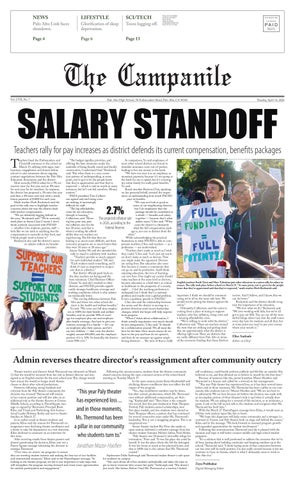
SALARY STANDOFF
Teachers lined the Embarcadero and Churchill entrances to the school on March 19, rallying with signs, tambourines, megaphones and donuts before school to raise awareness about ongoing contract negotiations between the Palo Alto Educators Association and the district.
Most recently, PAEA asked for a 9% retroactive raise for this year and an 8% raise for next year for its members. In response, the district has proposed a 3% raise this year and then a 4% raise next year with a yearly bonus payment of $3000 for each year.
Math teacher Herb Bocksnick said the goal of the rally was to highlight teacher concerns about the way the district deals with teacher compensation.
“We are de nitely lagging behind in the area,” Bocksnick said. “We're currently sixth place in Santa Clara County. I don't think anybody associated with PAUSD — whether it be students, parents, sta# — feels like we are sixth at anything, but the compensation is currently at that level, and I think people need to know it.” Bocksnick also said the district’s stance on salaries re$ects its broader priorities.
“ %e budget signi es priorities, and o#ering the bare minimum under the umbrella of being scally sound and scally conservative, I understand that,” Bocksnick said. “But when there is a very consistent pattern of underspending, at some point, you’ve got to let the people know that they're appreciated, and that they're respected — which is said in words in many instances, but let's not kid ourselves. Money matters.”
PAEA president Tom Culbertson agreed and said rising costs are making it increasingly di cult for sta#
%e big a#ordability crisis for our educators, though, is housing,” Culbertson said. “Housing has gone way past the in$ation rate for the last 20 years, and that is what is eroding the a#ordability that our teachers are experiencing. %e life that they are leading is so much more di cult, and their economic prospects are so much lower than they were 10 years or 20 years ago.”

In comparison, Yu said employees of most other school districts are forced to shoulder insurance costs out-of-pocket, leading to less net money in the bank.
“We have not seen it as an employee, as monetary payment, because it's not going to the bank for me to spend, but it's covering my entire family for really great bene ts,” Yu said.
2.7%
Board member Rowena Chiu, speaking on her personal behalf, stressed the importance of understanding how much PAUSD pays in bene ts. “We may not look as good as some of our neighboring districts, but I do emphasize that the package should be considered as a whole — bene ts and salary together — because that's what makes sense,” Chiu said. “What costs the district is ultimately what the full compensation package is, not one as distinct from the other.”
While acknowledging the practical limitations to what PAUSD is able to compensate teachers, Chiu said teachers — as a profession — are undervalued.
Junior Audrey Mi said she attended the rally to stand in solidarity with teachers.
“Teachers provide so much support for each individual student.” Mi said.
“Each student needs something, and I think it's just so important to reciprocate that as a district.”
But district o cials push back on the idea teachers are being paid the bare minimum.
Chief Business O cer
Charen Yu said she’s worked in other districts, and PAUSD provides signicantly stronger healthcare coverage and working conditions, which is why salaries are technically lower.
%e one big di#erence between Palo Alto and those two other school districts is the health and welfare bene ts,”
Yu said. “We cover our full time employees at 100% for their health and welfare bene ts, and we provide 90% of coverage for employee plus one and employee plus family coverage. And just to give you context, coverage for a family — let's say an employee plus their spouse, and let's say two children — that costs the district roughly around $50,000, and the employee portion of it is 10%. So basically, the district covers 90% of it.”
“Teachers don't make as much as I wish they could,” Chiu said. “Let's just say teachers don't make as much as doctors. Now you might make the argument: Doctors are saving lives. But education also saves lives because it creates a community that can go on and be productive. AndI think enjoying education, the love of learning, can save lives. One might say society should value teachers at the same level as doctors, because education is a eld that's as critical as healthcare to the prosperity of a society, right? … I feel the teaching profession is underpaid, but I think that's a national problem and maybe even a global problem. It isn't a problem speci c to PAUSD.”
Chiu also said the relationship between the union and the district is moving in a positive direction amid recent leadership changes, which she hopes will help negotiations progress.
“When I think about collaboration, I think actually negotiation very much should be less antagonistic,” Chiu said. “It should be a collaboration around: We all want the best for the kids. How much money do we have in the pot, and how do we spend it, and how do we measure up against neighboring districts? … %e tone of that is really

important. I think we should be communicating we're all on the same side here. We should not be pitting the district against the union.” Ultimately, Culbertson said the union is coming from a place of trying to support teachers, who face in$ation, rising costs and a housing a#ordability crisis.
“We're willing to work with the district,” Culbertson said. “ %ere are teachers around the state that are striking and getting deals that are approximately what the district is o#ering right now. %ese are districts that are vastly di#erent from Palo Alto in terms of the economic funding that those districts
receive. And I believe, and I know, that we can do better.”
Bocksnick said the district should recognize the importance of its educators.
“We love what we do,” Bocksnick said. “We love working with kids, but we've all got to pay our bills. You can say all the wonderful things about (us), that the sta# comes every day here for students and all that, but at some point you need to put your money where your mouth is.”
Elise Andrade Editor-in-Chief
Admin reverses theatre director's reassignment after community outcry
%eater teacher and director Sarah %ermond was informed on March 12 that she would be removed from her role as theater director and reassigned as an English teacher for the next school year. %is change would have meant she would no longer teach theater classes or direct after-school productions.
However, following strong backlash and criticism from the Paly theater community, the decision was reversed. %ermond will remain in her current position and will also take on an additional role as the theater director at Greene Middle School, according to ParentSquare message co-signed by %ermond, Principal Brent Kline and Visual and Performing Arts Instructional Leader Brittney Kerby and sent to theater families on March 27.
In an earlier email to theater students and parents, Kline said the reasons for %ermond’s reassignment were declining theater enrollment and a desire to take the department in a new direction. Kline declined to comment on an interview for this story. After receiving emails from theater parents and alumni questioning the decision, Kline sent out a Parent Square message reiterating the decision to reassign %ermond.
“Over time, we review our programs to ensure they are meeting student interest and making the best use of our facilities and instructional resources,” Kline said in the ParentSquare message. “In looking at the theater program, we felt it was important to take steps that will strengthen the program moving forward and create more opportunities for student participation and engagement.”
Following this announcement, students from the theater community shared concerns during the open comment section of the school board meeting on Tuesday March 17.
In the open session, junior Katya Kuykendall said declining theater enrollment does not re$ect the full impact of the program.
“Yes, class enrollment numbers may be down, but after-school, productions, which Ms. %ermond runs without additional compensation, are thriving,” Kuykendall said. “ %en there is the competitive record. Just this past weekend at State %espian Festival, Paly students earned scholarships, won rst place medals, and two students were elected as State %espian o cers, a pattern that has continued for several consecutive years under Ms. %ermond’s leadership. %is is not a struggling program. %is is an exceptional one.”
Senior theater student Rei Prior also spoke at open session, delivered a verbatim message from late theater student Summer Mehta’s father, Nick Mehta. “Paly theater was (Summer’s) invincible refuge for restoration,” Prior said. “It was the place she could be herself. It was the place where she felt she belonged. It was her home as much as her physical home, and that is 100% due to the culture that Ms. %ermond created.”
Sophomore Dalia Yarbrough said %ermond makes theater a safe space for students on campus.
“She cares about all of her students individually, and takes the time to get to know everyone who crosses her path,” Yarbrough said. “She doesn't just teach. She listens. Before I had Ms. %ermond as a teacher, I lacked
self-con dence, could barely perform publicly and felt like an outsider. She believed in me, and that allowed me to believe in myself for the rst time.” Because of instances like this, junior Jonathan Mazor-Hoo en said %ermond is a beacon and called for a reversal on her reassignment.
“ %is year Paly theater has experienced loss, as it has done several times before, and in those moments, Ms. %ermond has been a pillar in our community who students turn to,” Mazor-Hoo en said. “We are not here to be adversarial. We are here because we believe the decision was made with an incomplete picture of what (theater) truly is and what it actually does for students. We are asking for a reversal of this decision, or at minimum, a pause. Look at the full record, talk to the students and recognize what Ms. %ermond has built here.”
With the March 27 ParentSquare message from Kline, it would seem as if Kline took student input like this to heart.
“We hope this alignment will help create community and a stronger investment in Greene and Paly theater, both on stage and behind the scenes,” Kline said in the message. “We look forward to renewed program growth and expanded opportunities for student involvement.”
Following this announcement, %ermond said she is pleased with the decision and hope it will better connect middle and high school student programs.
“It’s a solution that is well positioned to address the concerns that we’ve all been having about building continuity and keeping numbers up at the school,” %ermond said. “I think having more of that connection between our two sites will be really positive. I’m also really excited because it lets me continue to focus on theater, which is what I ultimately came to work in Palo Alto for.”
DASHEL CHUN / THE CAMPANILE
DASHEL CHUN / THE CAMPANILE
Zoya Prabhakar Digital Managing Editor
English teachers Keith Tocci and Marc Tolentino join other educators in a union rally for salary increases. e rally took place before school on March 19. "At some point, you've got to let the people know that they're appreciated and that they're respected," math teacher Herb Bocksnick said.
Espiritu replaces Bahardusingh
Amid ongoing leadership turmoil, the Palo Alto Uni ed School District Board of Education unanimously approved Director of Certi cated Human Resources Herb Espiritu as acting superintendent at its March 19 meeting, just two days after the district announced a separation agreement with Acting Superintendent Trent Bahadursingh. Espiritu will hold this position through April 12, or until the board appoints an external interim superintendent. Bahadursingh served as Acting Superintendent for 22 days. He was appointed after now-Superintendent Emeritus Don Austin parted ways with the district on Feb. 20.
In a letter to the community, Dharap wrote that Bahadursingh’s contract entitled him to 12 months of salary if a separation without cause occurred. PAUSD will pay Bahadursingh $337,017. is follows Austin’s agreement with the district to leave and receive $596,802.
Board Vice President Rowena Chiu agreed to an interview only if e Campanile made clear she was not speaking on behalf of the Board of Education; her comments re$ect her personal opinion, not an o cial board position. Chiu was the only board member who voted against appointing Bahadrusingh and said she did so because of his close relationship with Austin.
ey both came over here from Rancho Palos Verdes and worked together on their external consulting company, SimpleWins,” Chiu said. “I felt that the very close ties with our Superintendent Emeritus would make it hard to e ect a change in culture.”
Tom Culbertson, president of the Palo Alto Educators Association, the union that represents certi cated teachers in the district, said employees are hoping for better working conditions under new leadership.
“(Bahadursingh and Austin) are in business together in their consulting rm, SimpleWins, and (there was a) culmination of a lot of years of frustration for PAEA members,” Culbertson said. “We, as a group, were really clamoring for a signi cant change in the direction of the district.”
Two weeks before Bahadursingh was appointed Acting Superintendent, Victoria Maya, a former PAUSD administrative assistant, led a lawsuit against the district alleging Bahadursingh bullied her on multiple occasions. Her suit alleges the district failed to prevent harassment, discriminated and retaliated against her, violated medical leave laws, wrongfully terminated her and intentionally in$icted emotional distress.
Chiu said she was not aware of the allegations against Bahadursingh at the time of his appointment to acting superintendent.
“I will say that I was concerned about the lawsuit,” Chiu said. “I was concerned that as Vice President of the Board, I only found out about the lawsuit when it was revealed in the press.”
Although he said he is grateful for Bahadursingh and Austin’s commitment to the district, Paly Student Board Representative, senior Dylan Chen, said it is time for a change.
“Although I appreciate their e orts, their work in the district, and the years they put in to make PAUSD a better place, I think at the end of the day, after so much tension, so much controversy, we really do need a cultural refresh,” Chen said.
Chen said this refresh, especially with regard to how people are treated, will be critical for future success.
“I think much of the district’s culture in recent months has been characterized by animosity, con$ict, a lack of respect towards each other by all stakeholders, bullying, and … those are not what a healthy district has,” Chen said. “If you can’t have a place where everyone is heard, if you can’t have a place where everyone’s represented, if you can’t have a place where people can speak without being shut down aggressively, then there’s no way a district can function, and nobody is going to be happy.”
And Chiu said whoever becomes the next superintendent needs to improve communication with the community.
“I know it’s a really hard role for the superintendent because you’re caught between these di erent interests of parents, students, teachers, and they might all have di erent viewpoints, and they might all disagree,” Chiu said. “If you don’t share information with the community, the parents, the students, the teachers, it’s hard to build an environment of trust.”
In addition, Culbertson said he hopes future leaders will engage in problem-solving with empathy.
“ e previous superintendent and his team created a situation where a lot of our members felt alienated and cynical about working together and solving problems and that their voices were not important, and that they were not being respected,” Culbertson said. “ e converse of that is more respect, more collaboration, because that’s what’s best for students, that’s what’s best for school environments.”
Chiu did say, though, changing culture is a challenging task.
“I also am very aware it will not be easy, but I think things that are worth doing are never easy,” Chiu said. “I think together, we can work towards this cultural reset. …(It will be) a lot of work, but I think it’s really worth doing.”
For Culbertson, Espiritu is the right person to meet the current challenge.
“I have a close working relationship with him, and we’ve had many productive conversations where we’ve been able to solve problems together, and that has been a welcome di erence from previous folks,” Culbertson said. “I (know) that he (will) bring that same positivity, problem solving, strong communication, clear communication to this interim role.”
Chiu agrees and said Espiritu will provide unity and stability while searching for a permanent superintendent.
“It was a question of choosing somebody who we felt would o er a steady hand during our time of transition, and I think Mr. Espiritu will do a good job with building the community and bringing people together,” Chiu said. “ ose were skills that we were looking for because the district has undergone a lot of change recently, and I think it was important to nd someone who had a collaborative nature and was willing to work to bring the community together at quite a sensitive time.”
From a student’s perspective, Chen said he hopes the next superintendent will be a good communicator.
“Students want a superintendent that can communicate e ectively so students and community members know what is going on in the district, instead of trying to guess what happens behind the scenes,” Chen said. “We really need a culture of respect, and many students think that has to start from the top.”
Ultimately, Culbertson said despite the many transitions in such a short period of time, he is optimistic
ousands of protesters lined the streets at the El Camino Real and Embarcadero Road intersection on the afternoon of April 4 for a “No Kings” street fest, which included live music and booths set up by local advocacy groups. Vehicles passing through the intersection honked in support as protestors held signs criticizing the second Trump administration on its actions regarding immigration, civil rights, foreign policy and more.
e event is part of a larger movement across the nation called “No Kings,” which held its third nationwide protest on Saturday.
Indivisible Palo Alto Plus member Brian Eaton said the movement is meant to be a show of force against the current administration.
e purpose of the overall No Kings protest is a show of force because we want to demonstrate that we can mobilize, hopefully, the largest protest in American history against government overreach,” Eaton said.
Nicolo Martinez, a community member who attended, said she has been participating in similar protests since last year.
“It’s really important for people to come together and show that they’re against a number of the actions of the administration,” Martinez said. Palo Alto resident Cherrill Spencer said she attended the protest to advocate for people a ected by the Trump administration’s actions.
“I came here today to help the thousands of other people who are sick and tired of what the president and his cabinet are doing to take away democracy, to wage illegal wars, to keep modernizing nuclear weapons,” Spencer said.
According to Spencer, more working people were able to join the protest due to it being held on Saturday, increasing the scale of the event. As such, Martinez said the event is an opportunity for grassroots organizations to expand their reach.
“Behind the scenes, there’s a number of groups that have been organizing,” Martinez said. “So with people coming to these protests, it’s an entry point for them to do additional activities and organizing.” Spencer, who is a member of the Women’s International League for Peace and Freedom, said the organization holds rallies every Friday at the same place across from Palo Alto High School to spread awareness of democratic backsliding.
about the future of leadership in the school district. e people who are more experienced understand that this transition can be a little bit rocky, and in general, as a group, we’re feeling positive that change is coming,” Culbertson said. “We’ve been wanting change for quite some time. We’re quite happy to work together with whoever wants to make positive change and open a new chapter in PAUSD.”
“We see Paly High School students coming for their lunch on Fridays, and we’d like them to pay attention to our signs and think about their own future,” Spencer said. “We’re doing this for the future of young people, so you don’t have to su er a nuclear war, so you don’t have to su er (from) climate change.”
Judah Hansen, a sophomore at Mid-Peninsula High School who participated in the event, said he thinks people should speak out even if they are not directly a ected by the administration’s policies.
“A great proportion of people are experiencing injustice right now under Trump, especially people in the lower class, people (who are) minorities,” Hansen said. “It’s very important that people speak out about that. Just about everybody’s going to nd that somebody (they) know is a ected in some way.”
Hansen, who was handing out candy and signs, said he wants to do more than just be a passive participant.
“(Somebody) has to help make the protest a more enjoyable experience and get people coming back,” Hansen said.
Martinez said she hopes to see youth take on leadership in advocacy groups.
“I’m so sorry about the state of the world that’s being passed on, and certainly I want to be part of passing on a longer, better world,” Martinez said. “A lot of youth are out there also leading and showing what they think will be a better world.”
Jessica Ritcher, who hosted a booth for “Get It Out, Art for the Current Moment,” an art activism project designed to promote activists’ voices, said she is concerned about the country’s future. Like Martinez, Richter said she wants high schoolers to be more involved in their organization.
“It’s about getting out our thoughts and feelings about what’s happening,” Richter said. “We need to … keep expressing our resistance. Don’t silence ourselves. And vote.”
Eaton said the protest gives him hope.
“I’m a part of something bigger, and that’s fantastic,” Eaton said. “It feels really good.”
Ultimately, Eaton said the community needs unity.
“What I would like to tell people is that when we ght, we win,” Eaton

Bahadursingh, Board President Shounak Dharap and Espiritu did not respond to interview requests for this story.
Lucas Lai Sports Editor
Dashel Chun & Jonathan Gu Sta Writers
Protesters hold signs at the No Kings rally on April 4. Individisible Palo Alto Plus member Brian Eaton said he was there to show solidarity with like-minded individuals. “ e purpose of the overall No Kings protest is a show of force because we want to demonstrate that we can mobilize, hopefully, the largest protest in American history against government overreach,” Eaton said.
DASHEL CHUN/THE CAMPANILE
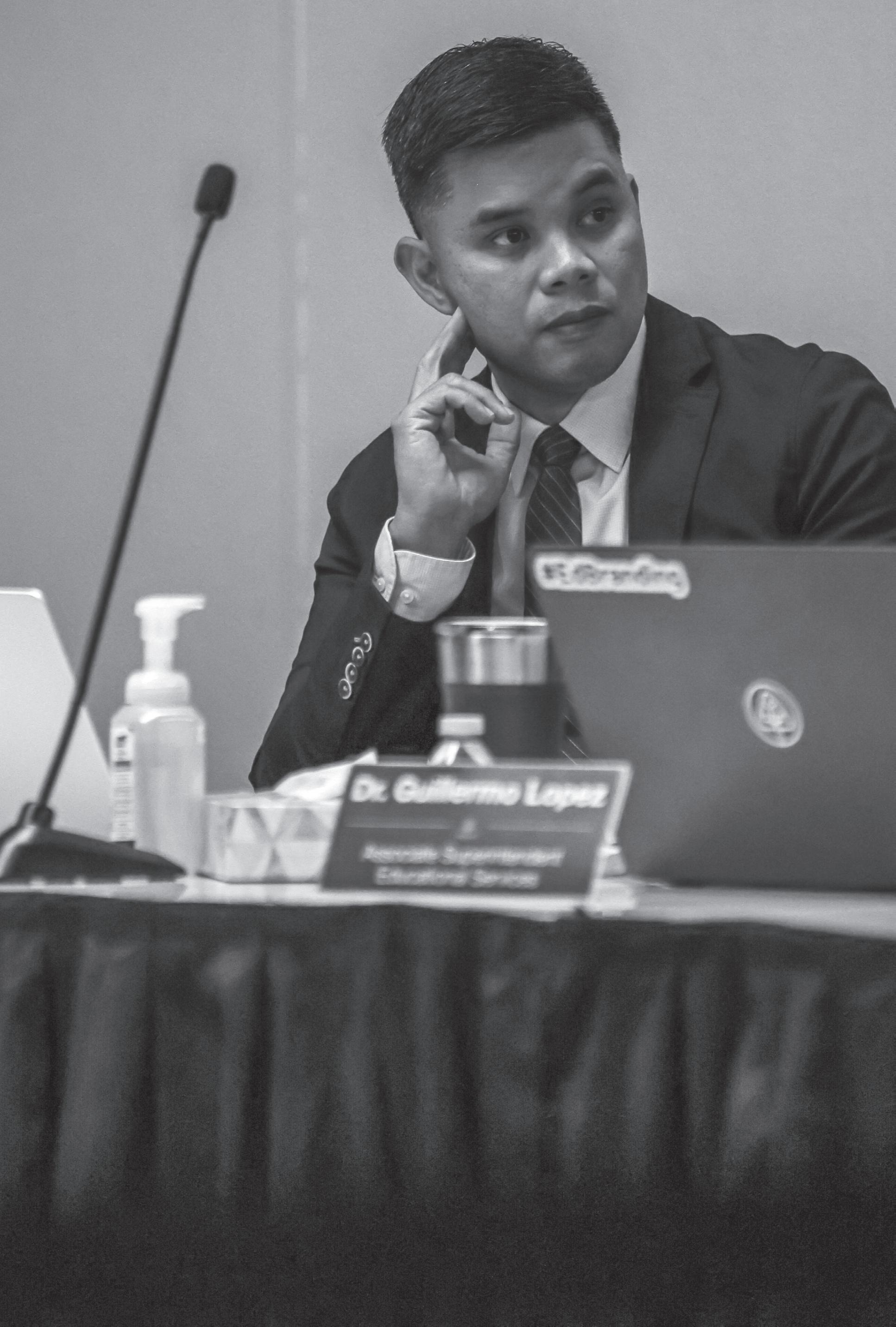
Acting Superintendent Herb Espiritu sits at the March 17 special board meeting where board members unanimously appointed him to the role. Palo Alto Educator’s Associaton President Todd Culbertson said he appreciates Espiritu’s leadership style. “I have a close working relationship with him, and we’ve had many productive conversations where we’ve been able to solve problems together, and that has been a welcome di erence from previous folks,” Culbertson said. “ I (know) that he (will) bring that same positivity, problem solving (and) strong communication ... to this interim role.”
DASHEL CHUN/THE CAMPANILE
e Palo Alto pipeline
With the intensification of overseas conflicts, the Palo Alto-founded data company Palantir’s work has come under increased scrutiny for its rapidly expanding digital work with the military-industrial complex. Now based in Denver, the company builds software platforms that analyze large amounts of raw data to detect patterns, trends and anomalies, and is known for its connection to the United States government.
Linda Xia, a former Palantir engineer who worked on the commercial side of operations, said the company’s primary niche is helping clients process information quickly.
“In simple terms, you can think of it as a collection of apps that allow you to do the whole end-to-end process of ingesting data in raw form, doing any transformations, creating objects that you can work with in non-code ways,” Xia said. “And then you can build workflows on top of that. eir overall goal is to make it easier for companies to build workflows off their data and operationalize it.” Xia said one major misconception is Palantir gathers its own data. On the contrary, Xia said Palantir’s clients provide them with all of their information.
“Palantir has no data of its own,” Xia said. “Anything is what the client brings with them. ere are lots of spreadsheets, your Excel files, your CSV and JSON. In the military and other applications, you might have more images and PDFs.”
Xia also said the type of work Palantir does depends on its clients’ needs, pointing to her experience with a solar company as an example.
“I worked with a solar company, and they had a lot of time series data, like is energy flowing through the inverter? And then you might compare that with weather data, like is the sun out? Because if the sun isn’t out, and there’s no energy coming through, we don’t care,” Xia said.
Xia said another unique aspect of Palantir is its collaboration with a broad variety of businesses in diverse industries.
“ ere’s a huge range of companies that use Palantir, and some famous ones,” Xia said. “PG&E in California uses it for wildfire management. A bunch of hospitals use it for patient processing and screening.”
But Xia said Palantir’s most wellknown work revolves around its ties to the United States government.
“Obviously, there are the Department of Defense, ICE and other government agencies,” Xia said.
And it’s Palantir’s links to the government that have garnered the most negative attention, Xia said. “Palantir doesn’t have the best reputation in the world of people who know about it,” Xia said. “A lot of these companies, especially on the commercial side, think it’s easier to not talk about the partnership.”
Xia said the company’s governmental work can vary, but one aspect is tracing relationships using large sets of data.
“You can build relationship maps between people, and places, and anything else you can think of, using whatever data you have: police reports, cell phone records, et cetera, and use that data to identify associates or suspects,” Xia said. “And there are a lot of ways you can do this badly. Let’s say I’m a
known terrorist, and we’re connected because we’re on this call together. my car into your bike, and from cell tower data it seems we’re often in the same neighborhood at the same time. Does that make you my accomplice?”
Despite some people’s concerns, junior Arman Aditya Basu said he sees Palantir’s work as a necessary part of na tional defense.
“I think that we need a strong America with a strong military capable of defending the country,” Basu said. “And I think there needs to be investment and advancement in military tech.”
But Palantir’s partnerships don’t only exist with businesses or the government. Some universities also have links to the company, including Stanford.
According to John, a pseudonym for an undergraduate student at Stanford who requested to remain anonymous due to safety concerns, Palantir’s ties with Stanford have provoked backlash. In January, students and faculty staged a walkout to protest the university’s investment in the company.
John is a member of one of the student activist groups who coordinated the walkout against Palantir and said there are pipelines within the university that target students as potential recruits for defense companies like Palantir.
In fact, he said he was seen as a good candidate.
“A lot of people assume that because of my background that I’m with the program,” John said. “To the extent that last

mental work.
“Microsoft has a crazy number of government contracts,” Xia said.
“Google also does it. Every tech company has. It’s just that Palantir has decided to make a brand around that, of being very vocal and obvious about it.”
Xia said Palantir also emphasizes its selective nature to its employees.
ere are people who deeply believe the work they’re doing is life-changing, and they are the only people who can do it, which is, again, part of the culture,” Xia said. “ ey want you to feel special.”
Basu said he views that employee-driven ethic positively, even while acknowledging the company’s controversies.
Part of that may be due to a more pragmatic, monetarydriven desire to work at companies like Palantir. John said that this desire is especially prevalent at Stanford.
“You come to a school like this, and most people that go into computer science want to make money, and that extends to most engineering,” John said. “But the tech industry is bottoming out right now, while government contracts and defense are always there. People still want to work at Googlestyle campuses and make a bunch of money, and that’s just at the defense companies now.”
Xia said that Palantir itself also operates on a mindset of making money at any cost.
“Despite all the ideological crap Palantir likes to shovel, it’s a company in a very capitalist country, in a very tech-
change them from within, a notion John said is naive. “Another thing people tell themselves is that to change the system, you have to work within the bounds of the system,” John said. “So if they want to change these defense companies, they have
District begins selection of next superintendent
Following departure agreements with both former Superintendent Don Austin and Interim Superintendent Trent Bahadursingh, the board of education is searching for a new leader, a process that has sparked debate among community members over transparency and potential conflicts of interest.
e Board and Austin reached what Board President Shounak Dharap called a mutual agreement to end Austin’s tenure as superintendent at its Feb. 11 meeting with Austin taking the role of Superintendent Emeritus through June 30. Bahadursingh, the district’s Deputy Superintendent at the time, took the role of acting superintendent while the district began the search for a permanent replacement. However, following a board meeting on March 17, Bahadursingh also agreed to a mutual separation from the district, according to a message from Dharap. e board has since appointed Director of Certificated Human Resources, Herb Espiritu, as the third Acting Superintendent in less than two months. Espiritu’s term will expire on April 21.
Board Vice President Rowena Chiu said although an official timeline for a permanent superintendent has not been made, the board wanted someone to replace Bahadursingh during the search process.
“ e plan is to spend this month looking for an interim superintendent,” Chiu said. “ e interim will be in place for a while, and the hope is that we can use the search firms to put a permanent superintendent in place by the beginning of next year.”
e district is expected to continue discussions about the superintendent search at the upcoming April 21 board meeting, where officials will determine the timeline for selecting a permanent replacement for Espiritu.
Lynette White, the district’s public information officer who said she was answering questions on behalf of Bahadursingh, said a superintendent search is usually done collaboratively between the Board and search firms.
“ e Board hires the superintendent and determines the process. District staff will take direction from the Board on any support or assistance needed,” White said. Chiu said the board voted for solicitation – where district leaders reach out to a small number of firms – in favor of a Request for Proposal – a structured and open process where firms submit applications – and has found three search firms willing to present as part of the superintendent selection process.
“ ese three firms will give us presentations, and then we will choose one of the three firms to work with,” Chiu said. “Once we’ve chosen a firm to work with, the firm will give us a list of candidates, and we will interview each one before choosing a superintendent.”
ough the details of the process are still being finalized, Chiu said community voice in the process is important.
“It was mentioned in the last regular board meeting that we would be holding a special meeting in the evening specifically so that we can get the input of students and community members,” Chiu said. “I hope that students and community members will come and speak.”
Despite these plans, community members like John Craig have concerns about a lack of transparency in the negotiated agreements for Austin and Bahadursingh’s and what he says are conflicts of interest related to Bahadursingh’s appointment as interim superintendent.
In a March 11 letter to community members that signed a petition to fire Don Austin, Craig said Bahadursingh was appointed during a closed session special meeting, which reduced transparency and limited consideration of other candidates.
He also said Bahadursingh has worked with Austin at SimpleWins, a for-profit leadership consulting firm created by Austin, and expressed concern over Bahadursingh pushing for a less formal and less transparent solicitation process instead of a standard RFP, which would be more open to the public.
White, however, said these concerns are being addressed through the transition process.
“(Bahadursingh) has publicly stated and gone on record that he has no aspirations to be the permanent superintendent,” White said. “He takes on the roles and responsibilities of the superintendent while serving in this temporary role.”
As district leaders addressed concerns about the transition, students and parents have turned their attention to the qualities they hope the next superintendent will have.
Sophomore Mathias Sommer said he hopes the focus will be on expanding support for athletics.
“I think that the new superintendent should do more stuff for sports because some parents cannot pay for the donations,” Sommer said.
Freshman Sayan Singh called for a student-centered academic approach.
“I’m looking for a superintendent who allows students to do what they want in academics,” Singh said. “ ere’s all these restrictions on what courses you can take in certain years, and if (they) could remove that, that would be great.”
Sampson Shen, a PAUSD parent, said he hopes the superintendent understands the role of a public servant.
“What I’m looking for the most is a person who has students’ interests at heart and not just a bureaucrat looking to enrich themselves,” Shen said. “I do not want somebody who treats the district as a stepping stone to higher ambition. We are Palo Alto, one of the best school districts, and are fully able to attract premier candidates.”
And for Chiu, she has three things that matter the most to her.

“For me, the three most important factors are collaboration, empathy and transparency,” Chiu said. “People are very passionate about the things that they want, and it is important to include all of these voices. I also think it is important to understand the
driving force behind this advocacy.”
Anthony Zhou Staff Writer
School board President Shounak Dharap announces a separation agreement with Acting Superintendent Trent Bahadursingh at the March 17 board meeting. is marks the second separation agreement the board agreed to in the past month. Board Vice President Rowena Chiu said for her the three most importnat qualities in a new superintendent are collaboration, empathy and transparency.
DASHEL CHUN/THE CAMPANILE
Palo Alto Link faces potential shutdown
Because of reduced grant funding and declining ridership, the Palo Alto City Council discussed the potential of no longer funding the local ride share program Palo Alto Link after June 30.
According to Palo Alto Chief of Transportation Ria Hutabarat Lo, the City has invested in many low-cost modes of transportation over the years, including the Palo Alto shuttle, as well as partnerships with transit agencies, including the Valley Transportation Authority, San Mateo County Transit District and AlamedaContra Costa Transit District.
However, Hutabarat Lo said the Palo Alto shuttle shut down during to COVID due to lack of ridership and decreased funding, which led to the creation of Palo Alto Link.
“ e City had previously had an interest in exploring a kind of on-demand service, so the Palo Alto link provided that after the shuttle service stopped,” Hutabarat Lo said.
According to the City Council meeting notes from March 2, after COVID, the City sta submitted a successful application for $2 million in VTA Measure B Innovative Transit program funds for Palo Alto Link. e system employed hybrid and electric vehicles to provide on-demand rides booked via mobile app or phone and had service hours from 8 a.m. to 6 p.m., Monday-Friday.” e initial fare for adults was $3.50, with a discounted price of $1 for disabled, low-income, senior and youth riders, which has since increased to $4 and $2, respectively. e hours of operation also recently changed to be 7 a.m. to 7 p.m.
Junior Alice Zhan said while she appreciated the Link’s low fares, the system had its drawbacks.
“It’s good because it’s a dollar for a ride, so it was cheaper transportation than Uber,” Zhan said. “But it wasn’t amazing because the wait time for it was really long.”
Junior Riddhi Bansal agreed.
“ e waiting times would be crazy — it would be as much as 30 minutes,” Bansal said. “Sometimes it would do this thing where your driver would be 30 minutes away, and then you’d close the app and open it again two minutes later, and all of a sudden they’re ve minutes away, which kept me on my toes.”
Along with delayed pickup times, Bansal said she had other issues with the Palo Alto Link app. ere are actually a lot of glitches,” Bansal said. “Sometimes the driver would switch up on you midway, but there aren’t many drivers, so that usually wasn’t an issue. But sometimes I would have problems with drivers where the pickup and drop o destinations are never directly where you are. You always have to go some distance to get to your drop o point and your pickup point.”
Transportation Planning Manager Nathan Baird said the distance from one’s true requested location is due to maximize e$ciency and sustainability.
“Palo Alto Link is currently designed to pick up and drop o riders at an intersection near their requested locations as a way of making the ride more e$cient for pooled rides,” Baird said. “Direct address-to-address rides are available, but only for disabled and senior

riders. is helps the service replicate the e$ciency of transit services.”
While the Palo Alto Link provides rides from 7 a.m. to 7 p.m on weekdays, Bansal said another deterrent to ordering a Palo Alto Link is the limited operating hours during school pick up and drop o times. ere’s also another issue where, from 7:30 to 9, they don’t allow they don’t let you get dropped o to school, and then from 3:30 to 5, they don’t pick you up from school because the demand was too high, and they did not have enough drivers,” Bansal said.
Junior Jewon Shin said her parents prefer the decreased risk of accidents from self-driving Waymos compared to an Uber or a Palo Alto Link. “ ey actually want me to take Waymo a bit more often nowadays because they’re concerned that the drivers might be a bit unsafe,” Shin said.
With no potential transportation subsidies lined up to replace Palo Alto Link funding and a tight city
budget, members of the City Council say the program may not last much longer.
“Last year, sta encouraged the Council not to close it at the end of the year, which was their original direction, and to extend it to the end of this scal year — that would be June 30 of 2026,” Hutabarat Lo said.
“However, when we went to council on March 3, they expressed a di erent sentiment, which was that they would like to investigate options, and speci cally, one of the options that they suggested was some sort of Uber or Lyft subsidy.”
With the potential loss of Palo Alto Link and despite some of its drawbacks, Shin said riders who rely on the service will be negatively a ected.
“I think that would be very tragic news to a lot of people who use it,” Shin said. “It’s a great system since it’s very cheap, and it’s an e$cient system where if you aren’t trying to get to your destination as fast as possible, then it’s a big save of your money.”
Ultimately, Hutabarat Lo said the best transportation replacement solution will take into account more community input and perspectives.
“We’re trying to build a system that is space e$cient, that aligns with our values as a community and that is e ective and uses resources wisely,” Hutabarat Lo said. “It’s a whole community and whole city e ort, both in terms of us trying to improve the facilities that are there, to provide services and to advocate services from the regional transit providers, but it’s also decisions that we make individually and collectively.”
Kira Tzeng Sta Writer
Environmental expert named new city attorney
e Palo Alto City Council unanimously voted at its March 16 meeting to appoint Chris Jensen as the new city attorney. Jensen will begin leading the city’s team of nine attorneys on March 30.
After 14 years in private practice, Jensen spent six years serving in city attorney and assistant city attorney roles across the Bay Area, including in Cupertino and Berkeley. He brie y returned to private practice before accepting the Palo Alto position.
Jensen holds both a bachelor’s and master’s degree in environmental science, and he attended Stanford Law School.
“Palo Alto is a unique community,” Jensen said. “I think the council has a lot of interesting ideas, and I hope to be able to support them.”
Meeting attendee and PAUSD substitute teacher Star Teachout said she supports the environmental perspective Jensen may bring to the position.
“As an engineer myself and an environmentalist, I am really thrilled that there is someone with a scienti c background,” Teachout said. “I love that training because it usually involves quite a bit of rigor and trying to maintain a neutral point of view.”
Council Member Julie Lythcott-Haims said the council prioritized nding a candidate with the expertise to lead Palo Alto’s legal team.
“ e city grapples with complex legal issues, so rst and foremost, we looked for an excellent legal mind, and we are very excited that Chris Jensen has had signi cant city experience,” Lythcott-Haims said. “He has also been a partner in a law rm, and so he understands what it’s like to be the one … initiating or defending cases, he has kind of been on all sides of it.”
Palo Alto Mayor Vicki Veenker said Jensen’s extensive public-sector experience led to his selection.
“We want someone with a lot of experience,” Veenker said. “We have a very multifaceted city government that handles a lot of issues that cities of our size typically do not have.”
Former City Attorney Molly Stump left the position in December 2025 after nearly 15 years. e search for her replacement began last summer, with the city council hiring a professional recruiting rm to review applications, conduct background and reference checks and gather public input.
Lythcott-Haims said Jensen was also selected for his ability to navigate the demands of Palo Alto’s civic environment.
“We think he has the temperament needed to serve in a city like Palo Alto, which really brings a high degree of service to the community,” Lythcott-Haims said. “Our community expects a lot more than most, in terms of the visibility of leaders, the availability, the amount of conversations that the public can have.”
Regardless of these high expectations, Jensen said he feels well prepared for the job.
“I think this city attorney job is very well suited to my skills,” Jensen said. “I really started working in the public sector because I thought I could have an impact on policy and the way that cities function.”
In his new role, Jensen said he wants to focus on serving all aspects of the position.
e city attorney’s o$ce is a service job, so I’m very much focused on serving the council and their policy goals, the city manager and his sta and what they’re working to accomplish,” Jensen said. “So that’s going to really dictate my agenda.” Jensen also said he looks forward to the personal and impactful role he can take on as a Palo Alto attorney.
“A great thing about working in local government … is that you’re very close to individual people,” Jensen said. “You get feedback right away, but you also see the impact of what you’re doing right away. To me, that’s always been very powerful, and I think local government is somewhere where you really do feel the impact of your work.” Jensen said he also hopes to build on the foundation established by his predecessor.
“First and foremost, I think I’m stepping into a strong o$ce,” Jensen said. “I know that Molly Stump, the outgoing city attorney, is very well respected, and developed strong systems, so I really am focused on continuity in that respect.”
Veenker agrees and said she expects Jensen to continue the o$ce’s track record.
“My hope and my expectation is that our new city attorney can continue the tradition of excellence in our city attorney’s o$ce,” Veenker said. “(Stump) has assembled an extraordinary legal team of 10 attorneys, so we really need to continue that strength of legal advice, because of the complexity of the legal issues before us, but also the sophistication of our city, who expects us to handle them with excellence.”
Ultimately, Jensen said he appreciates the opportunity to lead the city’s legal team.
“I’m really, really grateful to be able to lead such a strong team of attorneys,” Jensen said. “I hope to get to know them better, to work with them and hopefully to be able to lead them e ectively.”
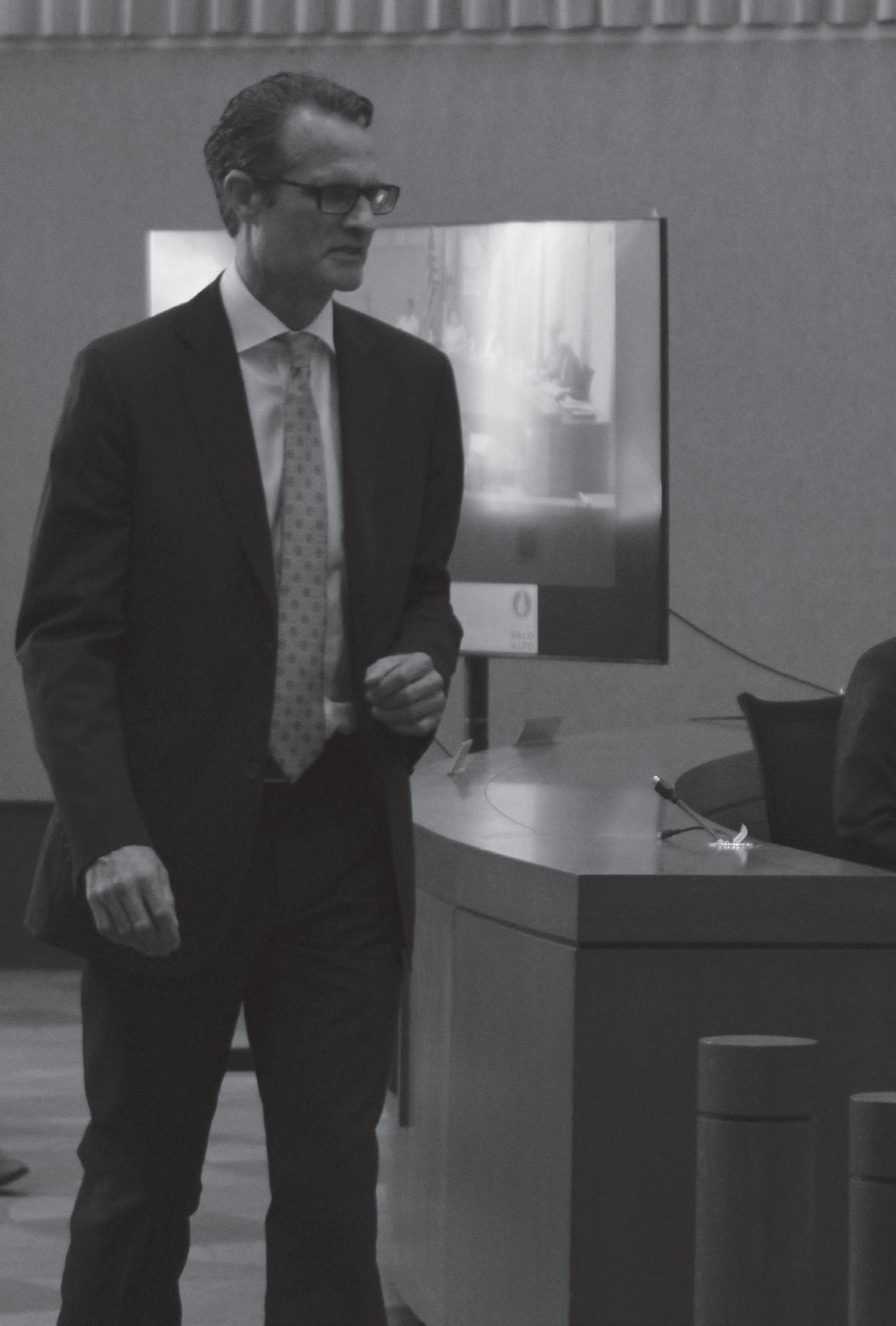
Chris Jensen walks up to the podium to thank the council members for approving him as city attorney during the City Hall meeting on March 16. “I think the council has a lot of interesting ideas, and I hope to be able to support them,” Jensen said.
BROOKE BRESSLER/THE CAMPANILE
A Palo Alto Link vehicle pauses on Waverley Avenue to pick up a rider for the city’s shared transit service. e Palo Alto Link runs
teens with discounts for senior, disabled and low-income riders. “ e City had previously had an interest in exploring a kind of on-demand service, so the Palo Alto link provided that after the shuttle service stopped,” Palo Alto Chief of Transportation Ria Hutabarat Lo said.
KIRA TZENG/THE CAMPANILE
Brooke Bressler Sta Writer
Lifestyle


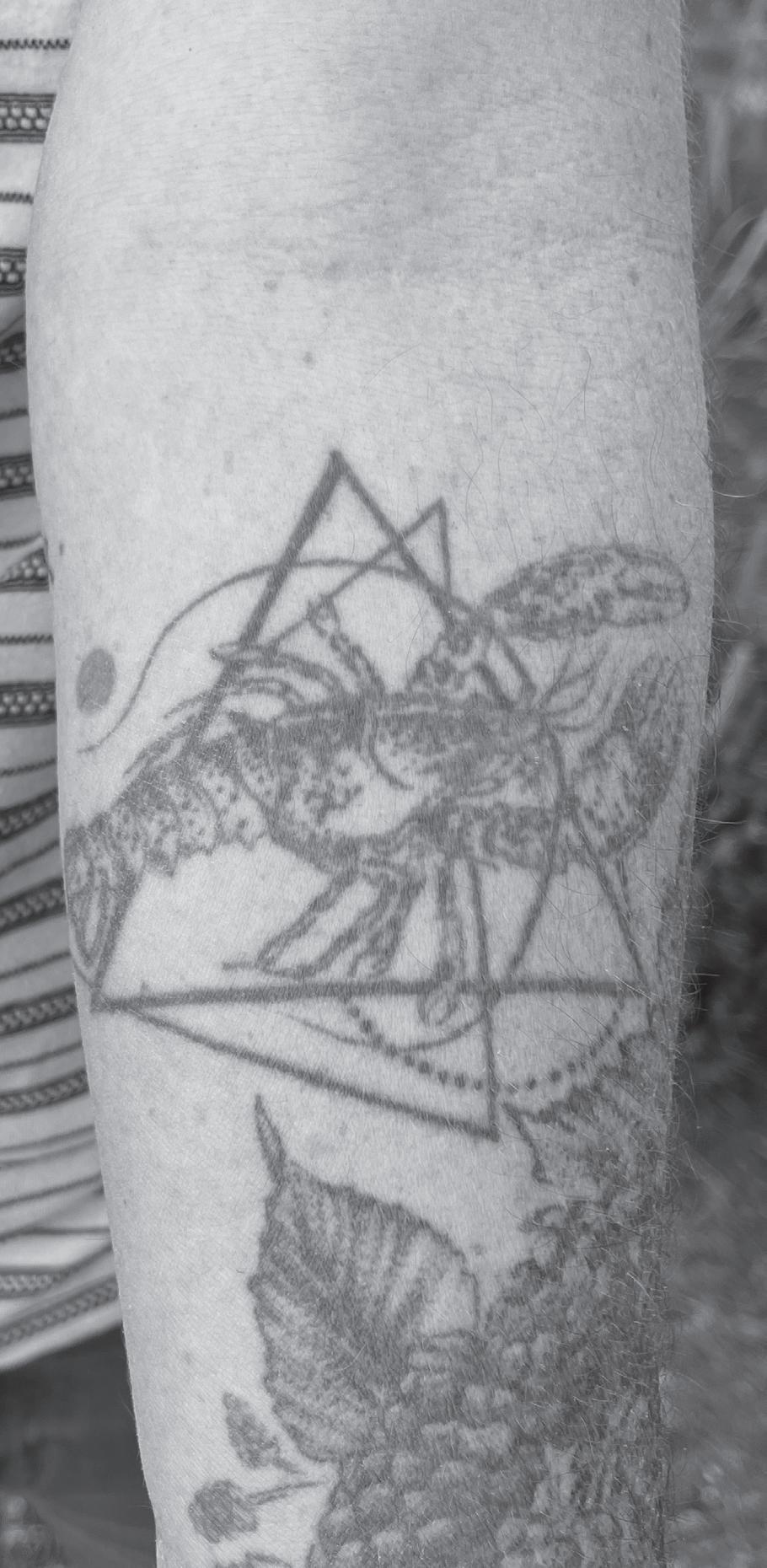
Ink outside the lines
Senior Sarah ieman sat cross-legged on her bedroom floor during the second semester of her sophomore year as she and her best friend unpacked a cheap Amazon stick-and-poke kit, a DIY tattoo method that uses a needle instead of a machine.
Bored and wanting to do something spontaneous, they landed on giving each other matching red heart tattoos — simple, colorful and different from the typical stickand-poke designs they had seen. Her friend goes first, poking the needle into ieman’s inner wrist, and then ieman does the same back.
“Sophomore year is when you’re branching out and, in every aspect of my life, I was in the mindset where I wanted to be spontaneous,” ieman said.
“We were just bored, and then we were like, ‘We’ve always wanted to get something matching — this will be so cute.’ It just was a bonding experience, and we both were like, ‘It’s just temporary. We’re not going to really regret it.’”
ieman said she and her friend designed and gave each other several more tattoos over the next few weeks.
“Once we did that, we were addicted,” ieman said. “We were like, ‘Oh my gosh, let’s just keep doing them. ese are so fun.’ Sometimes, I think these are so stupid, but it’s fun to look back on them and remember them as little memories. My friends would see them and want them too — they’re great conversation starters.”
ieman’s experience reflects a broader shift: tattoos have become a mainstream form of self-expression for adolescents, with studies showing 10-23% of teens already have them and over half of those without expressing interest. While social media has accelerated the trend by normalizing ink as casual, creative and low-stakes, DIY stick-and-pokes carry added health risks — including bacterial infections and bloodborne diseases like Hepatitis B, C and HIV — due to lack of sterile equipment and professional technique.
ieman said platforms like Pinterest and TikTok have played a big role in introducing her to tattoos and normalizing them for people her age. She said social media helped her feel more confident in her choices and made tattoos feel less serious.
“If I scroll on a video and I see someone who looks super pretty and cool with tattoos, I’m like, ‘Wow, now I want that,’” ieman said. “In your everyday life, you may not see many people with tattoos, so you think it’s crazy and not normal, but on social media, you see all these different types you can get. It doesn’t have to be one type of person to get a tattoo, it can be anybody.”
History teacher Benjamin Bolanos, who has ten tattoos, said they are a powerful form of self-expression.
“It’s an art form,” Bolanos said. “It’s what’s interior that becomes exterior. It’s a form of showing who you are to other people. I think it’s also beautiful. I don’t usually pick random tattoos. I definitely think through what I want and if it’s meaningful or not.”
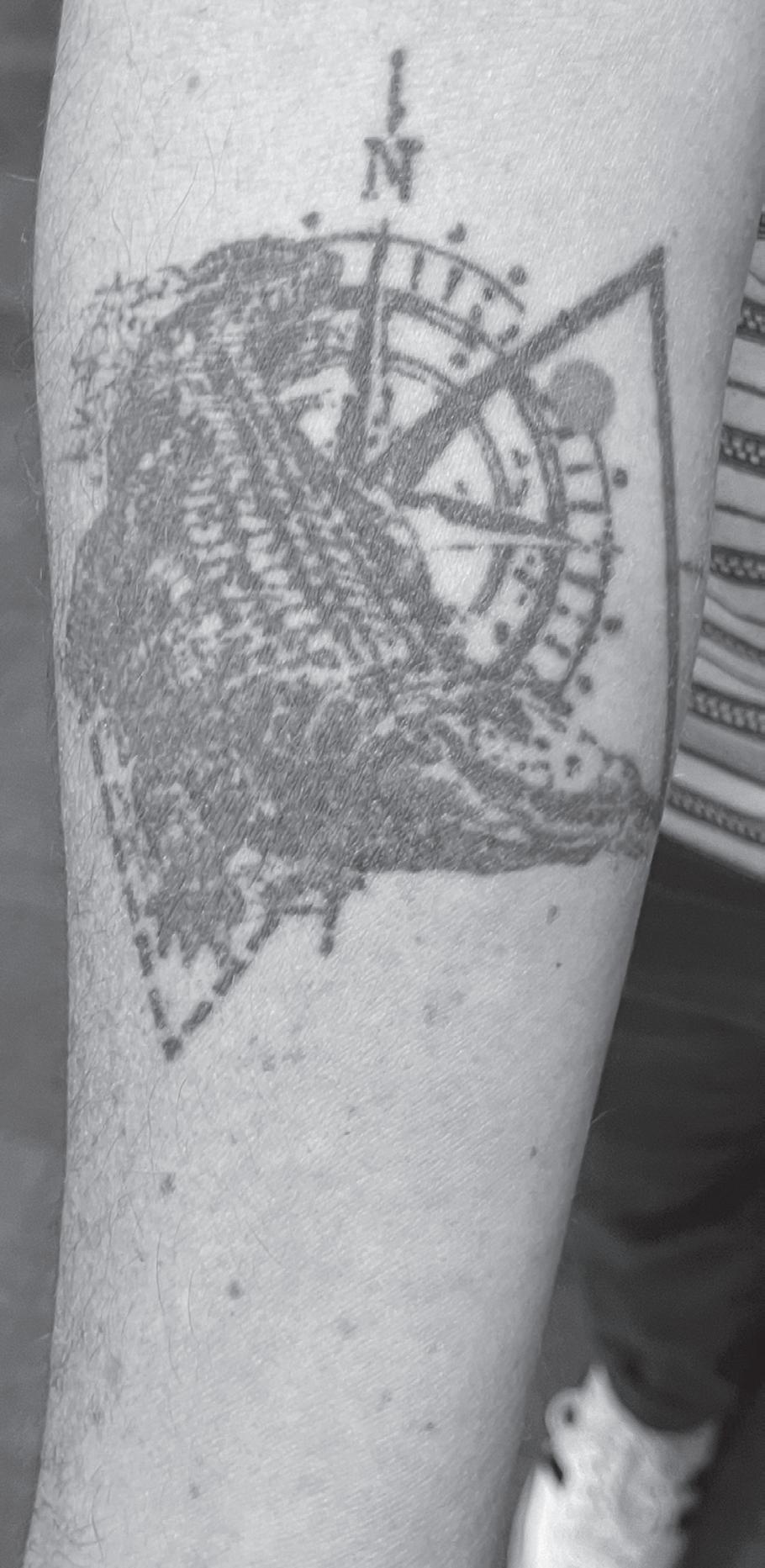
Senior Iverson Lee said his half-sleeve dragon tattoo, inspired by his father’s koi dragon tattoo, carries deep personal and cultural significance. In a Chinese legend, a persevering koi fish swims upstream, endures hardships, crosses a waterfall and is rewarded by the gods with transformation into a dragon.
“My dad told me that story when I was younger, and it’s something that’s always stuck with me,” Lee said. “ at’s why I wanted to get this tattoo. Being AsianAmerican is a very big part of my identity, and it’s something I’m very proud of, so I wanted something to also represent that.”
Photography teacher Kenna Gallagher said they approach tattoos as an extension of their passion for art.
“It’s just another art form,” Gallagher said. “I consider myself an art collector … A lot of my tattoos were co-designed, and I’d say about a third to a quarter of my tattoos are my personal drawing designs.”
Even though tattoos are more accepted now, Lee is still cautious of judgement and intentional about the placement of his tattoo.
“I purposely chose the spot on my arm and my chest so I can cover it with a T-shirt,” Lee said. “Right now, at this age, when I’m going to school and eventually looking for a job, people might have preconceptions about people with tattoos and might look at them negatively. So until I have a career, I feel like personally, it’s important to be able to cover them.”
And Bolanos said there are generational and cultural differences in how tattoos are viewed.
“Older generations definitely viewed them differently,” Bolanos said. “It was associated with criminal elements, at least in American society. We’re also a very puritanical society, where different religions forbade tattoos on the body. ey’re seen as desecration.”
However, Balanos said in some other countries and cultures, the practice of tattooing has existed for centuries.
“It’s a very human thing to do — to mark yourself in some way or another,” Bolanos said. “If it’s not tattooing, we’re always doing body modification, whether you pierce your ears or change your hairstyle. So I don’t see it as any different than that.” ieman, who has multiple small stick-and-poke tattoos, said she will likely continue getting small, subtle designs that are easy to hide.
“It’s just a tiny little thing on your skin,” ieman said. “I didn’t really care about what other people thought about it. Also, it’ll be a funny story to tell because every single one that I have is attached to some sort of story — not that they have meaning, but there’s a memory attached to it, so it’s always just a fun story to tell.”
Now that she is legally able to get a tattoo, ieman said she wants to get a more permanent, intentional design.
“Now that I’m 18, I definitely want to go get a real tattoo, but this time I want it to be a lot more meaningful,” ieman said. ere’s some questionable ones, but most of the time people with tattoos either have beautiful artwork or there is a meaning behind them, or it’s just part of their style. It’s a really cool way for people to express themselves.”
NeeDohs help students squeeze away stress
Senior Anna Kim, who said she has considerable anxiety from exams and assignments, repeatedly squeezes her NeeDoh during class. Soon, the stress gradually reduces and her mind becomes calmer.
NeeDoh, a gel-filled cube widely recognized as a stress relief toy, went viral on TikTok after famous Korean singer Rosé was seen using it in an interview. Soon, NeeDoh quickly gained popularity.
“With final exams and the anticipation of college admission results all piling up at once, my anxiety and stress levels started to rise significantly,” Kim said. “When I actually used it, I found it to be more effective than I had expected. As I held it in my hands and fidgeted with it, I could feel my tension gradually easing.”
Senior Denise Dinh said she also uses her NeeDoh daily.
“I started using it not for anxiety reasons or anything but because of how satisfying it was, and I like to keep my hands busy,” Dinh said. “Also, I found it helps focus. I use it in class and whenever I’m bored on my phone. It’s just another source of stimulation.” Dinh said the toy’s rising popularity shows how trends spread among students.
“I think they’re satisfying to squish but also seeing more and more people having them definitely makes people want to have one as well,” Dinh said. “It’s like a bandwagon thing. I got a NeeDoh because I saw my friend with one, and ever since they’ve been so popular that they’re always out of stock.”
Junior Isabella Zheng, who is the president of the Clinical Psychology Club, said the toy’s ability to redirect attention makes it especially popular among students.
“Usually when students are stressed, they are overwhelmed by millions of negative thoughts and messages,” Zheng said. “ is may cause them to lose their progress and enter into a state called mental exhaustion, a state when the body, as a mechanism to defend itself, may choose to avoid the event
that’s causing stress. ose toys can therefore help the students to shift their focus temporarily and regain their mental stability while squeezing them.”
Psychology teacher Christopher Farina said the toys also provide a physical way to relax.
e research I’m familiar with is on progressive muscle relaxation, which is a technique where you go through your body tensing one set of muscles up at a time and then relaxing them,” Farina said. “It helps patients identify areas where they’re holding tension, helps them notice what it feels like to have those muscles in a relaxed state, and helps them practice relaxing those muscles. As I understand it, it’s a pretty common practice.”
However, Zheng said fidget toys shouldn’t be the main method a person uses for stress relief.
“NeeDoh can be a convenient toy for students to fulfill their needs whenever and wherever they want,” Zheng said. “It’s pretty common to see people squeezing them even during class. I believe it could be used as a means to shift focus on a temporary basis as I’ve mentioned before, but it (doesn’t) solve the root problem. Students should instead speak with counselors or professionals to discuss the root of the stress, which can usually be eliminated by developing good personal habits and becoming a more organized person in their daily routine.”
While this may be a better solution, Dinh said the NeeDoh is an easy additive for her.
“I would recommend them because they’re not too expensive, and you really only need one,” Dinh said. “It’s just a fun thing to have even if you are not stressed.”
Still, Zheng said there are other effective ways to manage stress. e best way for students to deal with academic pressure (is exercise),” Zheng said. “ e dopamine produced by exercising can be way more rewarding, and students can also achieve better physical health at the same time.”

In the end, Farina said managing stress is important regardless of the method. “Chronic stress is associated with all kinds of adverse physiological and psychological outcomes,” Farina said. “Teaching kids how to notice, manage, and leverage stress helps them throughout
Annika Chu Print Managing Editor
Grace Kim Staff Writer
Senior Anna Kim holds a NeeDoh while reading a book. “As I held it in my hands and fidgeted with it, I could feel my tension gradually easing,” Kim said.
GRACE KIM/THE CAMPANILE

THE PRICE OF



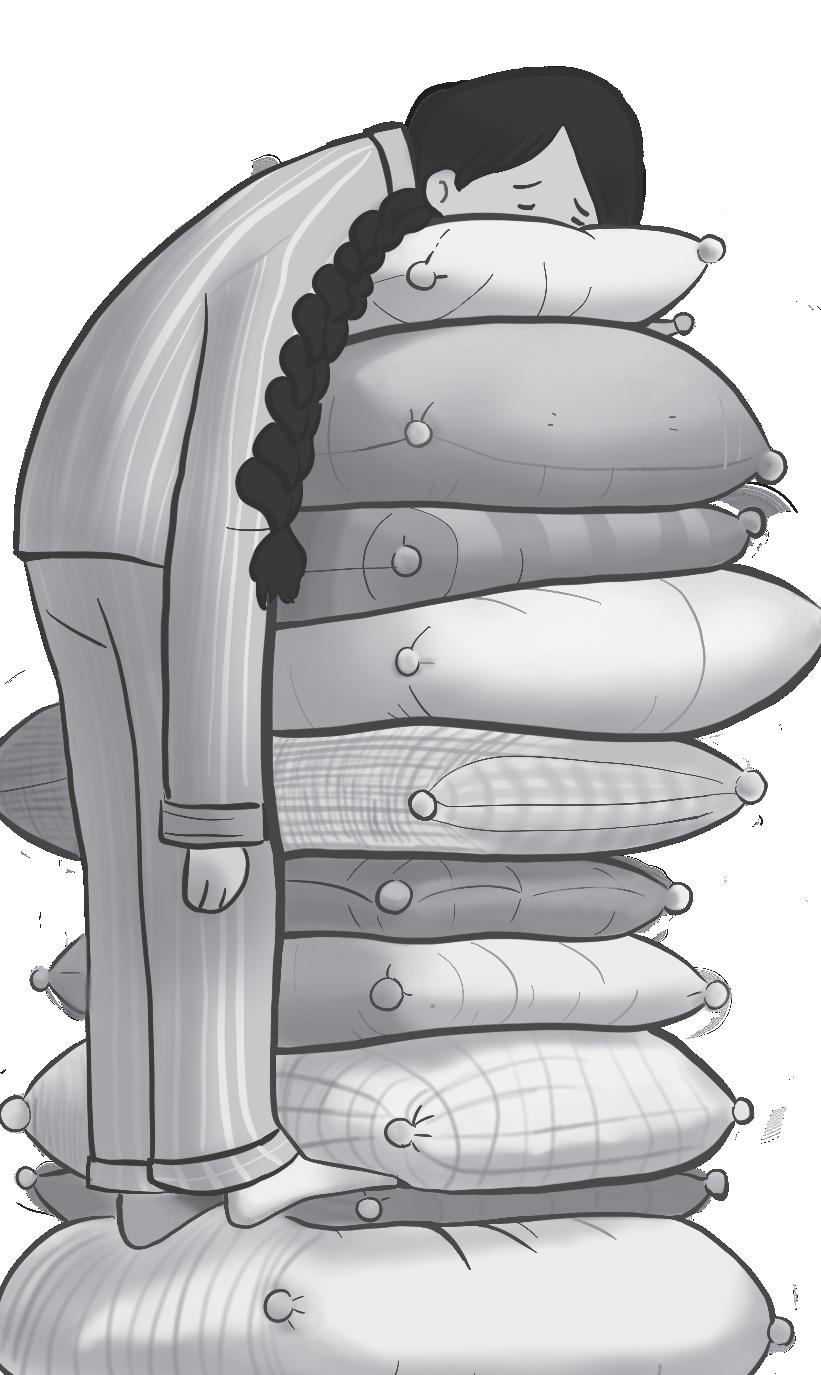

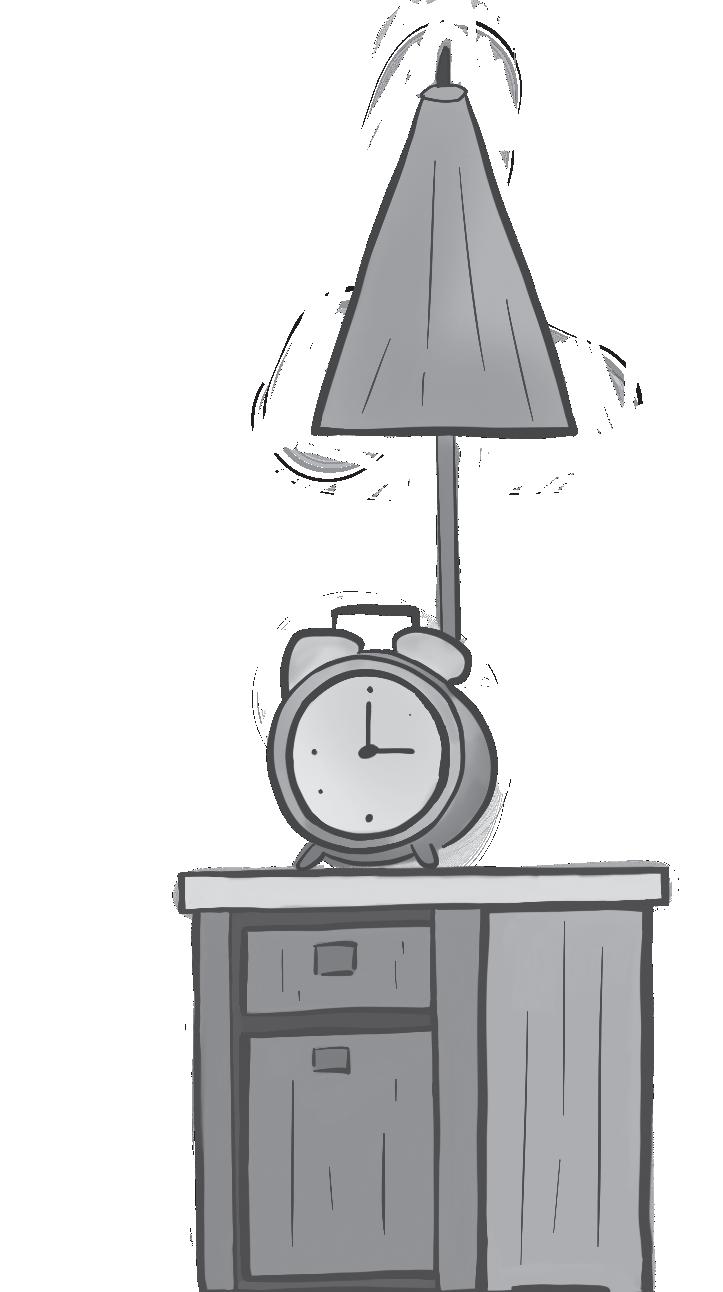
This scenario may seem familiar. It’s 2 a.m. e faint glow of a laptop screen is the only thing keeping you awake. A halfnished problem set sits next to a computer riddled with dozens of open tabs. By the ring of the morning bell, the exhaustion will be shrugged o and repeated the very next day.
At Paly, exhaustion is commonly worn as a medal of honor. Students often exchange stories about nishing homework at 2 a.m. and surviving the week on unhealthy amounts of sleep. e less someone sleeps is often correlated with how impressive their workload seems.
As a result for students like sophomore Derek Chen, staying up isn’t explicitly forced; it’s just something he has to do.

“You can either choose to stay up late or fall behind, and most people just choose to stay up late, including me,” Chen said. Chen said this is the basis of achievement culture at Paly: being sleep-deprived is social currency, a way to prove dedication.
A de ning narrative of sleeplessness
Chen said he particularly remembers a week during his freshman year that illustrates this.
“I had four tests and I got 12 hours of sleep across four days and just survived o ca eine,” Chen said.
History teacher Katya Villalobos said these comments are not isolated and tend to repeat themselves year after year.
“I have heard students say, ‘Well, I only slept like two or three hours last night because I had to do this, I had to do this, and I had to do that,’” Villalobos said. “And when I know
However, Dr. Jennifer Martin, a clinical psychiatrist and professor of health and medicine at UCLA, said while lack of sleep among young people is not a new uence how students nitely hear this a lot,” Martin said. “I hear it from students now. But when I was a college student and a high school student, people thought the same way then, too. So I think we have a lot of work to do in terms of helping people understand how important it is to get a
According to Martin, a lack of sleep is ning narrative in places like the Bay
“In really competitive environments, unfortunately, you see this both in academics and in sports, that a lot of times, students who are really competitive, have a competitive mindset, tend to trade sleep for things that they think will help them advance,” Martin said. e unfortunate part of that is that ect of this, Chen said, is an increased dependence on drinks containing stimulants.
“Because everyone’s running so low on sleep, everyone’s constantly going to CVS at’s the only
Junior Yotam Rachman said he sees this everywhere. Rachman balances school with gymnastics ve days a week, getting home at 9:30 p.m., doing homework until around 1 a.m. and then go-
“I know a lot of people that drink energy drinks ee,” Rachman said, “More than a kid our age should be drinking, just because they’re
Junior Tess Li said the thing that’s noticeable about the exhaustion among her peers is the number of kids who sleep during the school day. fth periods, which are rst thing in the morning, people sleep a lot,” Li said. ey have their heads down for more than 30 minutes. People aren’t even surprised because it’s kind of normal to see a couple kids in the

She also said exhaustion isn’t limited to just a few students.
“In my 7th period math class, we have a new kid falling asleep in class every single day,” Li
Not everyone follows this pattern, though.
Junior Raphy Leung said he has found a unique schedule that works
“When I get home, I go immediately to sleep,” Leung said. “I sleep from 6 p.m. to 3 a.m., then work when no one is awake to distract me and I can be super productive.” Psychology and history teacher
Christopher Farina rsthand ects of sleep deprivation in a
Lifestyle
PERFORMANCE
classroom setting, but also says that some students are doing surprisingly well on getting a healthy amount of sleep.
“I do see that some kids don’t get as much sleep as they should,” Farina said. “But having anecdotally talked to di erent classes over different years about this, in general, I’m actually surprised by the number of students who say they do get the amount of sleep that is recommended, being around eight hours.”
Farina also said freshmen generally get enough sleep based on data he’s seen from freshman advisors.
It seems like at least freshman year, most are getting around the amount of hours of sleep that they really are recommended to be getting,” he said.
Demanding course loads lead to less rest
Rachman said the reason his peers go to sleep later is demanding course loads.
“If you’re in a lot of honors classes, which almost everybody at Paly is, they just give you so much work,” Rachman said. “Junior year, keeping up with all the work you’re given and then SAT prep and AP testing, all that stu , is challenging.” is e ort is ampli ed by pressure from other students, Li said.
“When someone taking easier classes hears other people say that they were up all night studying for a test in an honors or AP class, it doesn’t make them feel good,” Li said. “ en you think, ‘Oh, why did I not have to do that?’ at snowballs into more people signing up for classes that they can’t handle, so they have to sleep late to nish all the work.”
Villalobos said students have a common blind spot.
“ ey see the outcome,” Villalobos said. “But they don’t see the in-between: the late nights, sacri cing time, sacri cing stu that they may love. ey just see the end game. But there’s a lot of time, lack of sleep, and other consequences that happen between that and the end. Somehow people forget that.”
Rafael Pelayo, a clinical professor of psychiatry and behavioral sciences specializing in sleep medicine at Stanford University, was a key player in advocating for California Senate Bill 328, mandating that high schools start no earlier than 8:30 a.m. and middle schools no earlier than 8 a.m. He said there is a psychological reason as to why teens fall to peer-pressure like this so easily.
“When you were a younger child, you were hoping to get your parents’ approval, because attention and gifts come from your parents. So in your younger years, you really focus on getting your parents’ approval on things, and they in uence you greatly,” Pelayo said. “Now that you’re a teenager, you kind of know your parents love you and have your back. So usually when you’re a teenager, you’re trying to get the approval of your peers more so than your parents.”
“I think after 1 a.m., I can’t get any more work into me,” Rachman said. “I’ve already overworked my brain, and I’m just clocked out anyway, unless it’s really mindless work. I can’t actually focus anymore.”
Studies con rm Rachman’s experience. According to the National Library of Medicine, when subjects were 35 hours sleep-deprived, memory declined and letter grades dropped two letters, signi cantly worse than their counterparts who got su cient sleep.
Dr. Mary Carskadon, professor of Psychiatry and Human Behavior at Brown University said what young people need to do is reframe the narrative on sleep deprivation.
“Less sleep does not equal more time, because your time is used so ine ciently when you’re sleepy and tired,” Carskadon said. “It doesn’t make for good work or productive work. We’ve heard this again and again and again and again, and we don’t hear the alternative as a popular point of view. We don’t hear ‘Early to bed, early to rise, makes a man healthy, wealthy and wise.’”
With this in mind, Martin said not all students go to sleep late for the same reasons.
“ e motivations for not getting enough sleep are di erent,” Martin said. “For example, kids who are from low income families may not be able to get enough sleep because they have to work after school.”
Sleep deprivation leads to health consequences
While the reasons for teen sleep deprivation may vary, there are a myriad of unintended health consequences as a result, according to health o cials.
“When teenagers don’t get enough sleep, they miss more school,” Martin said. “Not getting enough sleep compromises your immune system, so you get sick more. (Sleep-deprived people) also tend to reach for very unhealthy food choices. Nobody is studying at 2 a.m. and eating a salad.”
Carskadon also said the consequences of a lack of sleep include a decrease in happiness.
mends high-octane gas — the more expensive gas,” Pelayo said. “But the car could get by with cheaper gas. And if you’re stuck on the highway all day, nobody can tell the di erence. But if you go to the racetrack and look for the full performance of the car, you’ll see that the higher-octane gas makes that same car perform better. e question to you and your peers is: How competitive an environment do you expect to be in the future? Is the goal to get by, or is the goal to be at your optimal best?”
Moreover, staying up late doesn’t necessarily mean a higher GPA. A study by the Massachusetts Institute of Technology found just the opposite. is study showed better quality, longer duration and greater consistency of sleep were directly associated with better grades.
Pelayo said high school is only a small part of life and the idea that sacri cing sleep now will lead to an easier future is misleading.
“It’s a myth to think of it as ‘I’m going to work hard in high school, and then my life will be easy afterwards, because, if anything, most adults will look back at high school as an ideal time where there was less pressure on their lives,” Pelayo said. “Life is going to get more complicated. So another question is: How do you learn your real life lessons? Not by trying to get less sleep. You’ll nd that the more you get healthier sleep, you’re going to have a healthier life.”
And Leung said some of his friends have discovered the importance of healthy sleep.
“Surprisingly, in junior year, some of my friends are actually sleeping at more normal hours, because they realize they need to have the energy to go through the school day,” Leung said.
Carskadon also said staying up later to take more AP classes and balance lots of extracurriculars doesn’t make you a better person.
“All of these things will tend to add up and subtract from your ability to be the best person that you can be,” Carskadon said.
Villalobos said she hopes students recognize the power good sleep has.
“We know that sleep is one of the greatest medicines for human beings,” Villalobos said. “It can relieve stress. It helps you lose weight. It helps you think. It helps you keep focus. It helps you do the things you want to do.”
But at the end of the day, Li said e cient time management should be getting more praise.
“I feel like it’s more of a ex to be able to balance my schedule and still sleep enough,” Li said. “Staying up late isn’t something to brag about. It should be the other way around. It should be like, ‘I was able to do all my work e ciently and sleep early last night.’” 79%
Pelayo said there are other behaviors commonly associated with adolescence which also come as a result of peer pressure.
“If you dress a certain way or behave a certain way, it’s because you’re trying to make your peers notice, not your parents. In fact, you’ll do things behind your parents’ back to get the approval of your peers,” Pelayo said. “As you get older, you kind of care less and less about what your peers think of you because you have your own self-worth and self-identity. So it’s this transition phase that you’re in.”
When she sees students with packed schedules, Villalobos said she asks them to re ect.
“I always counsel them: if you’re really passionate about something, then take it,” Villalobos said. “But if you’re not, then why are you doing this? Is it just because your friend is doing it, or that’s what you hear, or that’s what you think you need to do?”
Outside of coursework and peer pressure, Li said social media aggravates the problem.
“I feel like on social media, you see lots of ‘cram for a test with me,’ and time-lapses of students studying all night,” Li said. “I see that a lot. I also see how much ca eine they drink in a day, then drinking energy drinks at night, pulling all-nighters. I feel like it’s a lot of glorifying pulling all-nighters to study for a test the night before. And I feel like that’s normalized.”
And Pelayo said biological factors also play a role in teens’ sleep.
“With adolescence, there’s a natural tendency to stay up later — there’s a biological shift,” Pelayo said. “When people get older, there’s a natural shift to go to sleep earlier.” Pelayo said human sleep patterns have evolved for group survival just like other animals have.
“Sleeping animals can be attacked at any point. If you’re sleeping, you’re vulnerable to being attacked,” Pelayo said. “But you have to sleep for biological reasons, and we’re social creatures. Somebody stays awake at night and somebody is awake early in the morning. So when people get older — say after age 50 — they tend to wake up a lot at night. It’s actually a good thing for the tribe if somebody is up at night checking on things, so it’s protective.”
But not all students stay up late because of academics. Junior Jessie Kwan used to work before school, waking up at 5:15 a.m. to work until 8:30 a.m. before driving to school. ere was also a period of time where she worked after school until 8:30 p.m. or 9 p.m.
“At Paly, a lot of people think people stay up late because they’re working hard on their classes and their AP courses,” Kwan said. “But what a lot of people don’t see is that some people stay up late because they’re working jobs.” Some of her peers who work morning or night shifts struggle to prioritize their sleep.
“ ey could be waking up at 5 a.m. but then sleeping at 1 a.m., so they only get four hours of sleep,” Kwan said. “ ey’ll just drink a Red Bull or a Monster to wake up.”
Kwan said she understands the struggle.
“If you have a job, and you go to school, and then you have sports practice afterwards, staying up late is a combination of trying to balance all of these,” Kwan said. “It’s really hard when you have tests, and you still have practice and work, and you’re tired, and you want to go to sleep. It’s de nitely not talked about enough when people mention staying up late.” Regardless of why people don’t get enough sleep, Rachman said when staying up late, he feels far less productive.
“It’s harder to engage with the good parts of life,” Carskadon said. “It’s easier to do what we call self-harmful ruminations. So you think about the negative things about yourself, instead of thinking about all the positives that are there in your life.”
Kwan, though, thinks the relationship is more complex.
“I think for many people who sleep less, I don’t think it’s a direct causation between less sleep and feeling negative about themselves, but I think many people who sleep less are oftentimes stressed and feel a lot of pressure, and that’s why they already feel very negative about themselves. Sleeping less can exacerbate negative feelings towards themselves.”
Regardless, Martin said the negative consequences can become increasingly severe and even life threatening if sacri cing sleep is consistent.
“Not getting enough sleep on a chronic basis is associated with a depressed mood,” Martin said.
E ective time management can help
Despite the fact that many students know they should sleep more, some say they reject the notion that sleeping more is associated with academic success. Chen said there is a balance.
“Of course you want to go to sleep, but then you might wake up after sleeping eight hours, have no work done, and three tests that you haven’t studied for,” Chen said. “You kind of just have to consider: OK, do I want to sacri ce my sleep, or do I want to not get an ‘F’?”
And Leung pushes back on the idea that sleeping less signals dedication.
“I can see it may be perceived that way, but in reality, you’re really just not managing your time correctly,” he said.
For Kwan, she said she has found a way to prioritize sleep even when working a job.
“I try to make sure I get at least eight hours because I cannot function otherwise,” Kwan said. “I try not to rely on energy drinks. I try to nish my work during class when there’s extra time. I also have prep, so I try to nish my work during prep as well. Honestly, any time I have a little free time, I make sure to utilize it to get stu done because I really do want enough sleep.”
But Chen said he still feels trapped.
“Everyone is striving to get into a good college,” Chen said. “Most people de nitely know the harms, but they just choose to stay up late.”
Pelayo o ered an analogy for students who think they can function on minimal sleep.
“If you have a sports car, the manufacturer recom-
STORY BY CINDY LIANG & JONATHAN GU
ART BY CINDY LIANG




CLIMATE IN
In 2026 so far, 1,494,338 acres of land have been scorched by wild re.
While this number may seem high, the conversation around environment issues like wild res seems to follow a familiar pattern: brief outrage, widespread concern, posting on social media and nally, a gradual return to normal.
Senior Elsa Lagerblad, a member of the Palo Alto Youth Climate Advisory Board, said part of this desensitization is caused by a culture of justi cation where individuals and corporations downplay their own environmental impact. She also said over time, repeated exposure to climate disasters has led to desensitization, causing urgent warnings to feel routine.
“We’ve grown up in a generation where we’ve always lived with the reality of climate change,” Lagerblad said. “When it becomes normalized, we think it’s such a big issue, and there’s nothing we can do about it.”
Environmental Medicine Club co-president and junior Sidharth Iyer said it is easy for students to ignore environmental issues.
“I think it’s de nitely very easy to see it on TikTok or in news headlines and you just scroll right past it,” Iyer said. “It (can start to feel like) some far away problem.”
In recent years, politics has played an enormous role in attitudes and policies surrounding global warming and climate justice. President Donald Trump — who has withdrawn from international climate agreements — attempted to overrule science and abandon an entire category of federal climate protections on Feb. 12, according to the State of California Department of Justice.
Director of the Berkeley Climate Change Network Bruce Riordan said Trump’s rhetoric has in uenced public attitudes towards climate change.
“His energy secretary and others who are in positions of leadership in the country claim that climate change is a hoax, which is absolutely untrue,” Riordan said.
According to a Feb. 12 New York Times article, Trump announced he would be erasing governmental recognition of the scienti c ndings that
greenhouse gas emissions pose a danger to Americans’ health and welfare. In addition, the Trump administration ended the federal government’s legal authority to control pollution on Feb. 12.
And while climate change is a global issue, it also has very drastic e$ects felt locally.
According to a New York Times article in March, the Trump Administration reopened a controversial oil pipeline o$ the coast of Santa Barbara, previously shut down after one of the worst oil spills in state history in 2015. While the administration argued the move was necessary following the recent closure of the Strait of Hormuz, California o cials say it could lead to future environmental damage.
Despite these setbacks at the federal level, many organizations are still focused on helping the environment.
In recent years, natural disasters have also led to massive consequences over shorter periods of time.
Global warming is the increase in earth’s average surface temperature caused by human activities. According to NASA in 2025 the average global temperature was 1.19° higher than the 1951-1980 average temperature.
Global warming a$ects everyone because it fuels extreme weather, oods, droughts, heatwaves and rising sea levels.
AP Environmental Science teacher Nicole Loomis said rising ocean temperatures cause more severe storms due to warmer temperatures which supply energy to these storms.
“It is condensing ve days worth of rain into one event, which is a lot more rain at once,” Loomis said. “ at can lead to problems, like we’re seeing Oahu, where there’s a ton of ooding and damages.”
Politics blinds climate change assistance
But President Trump has consistently expressed skepticism toward climate change. In 2025, he called climate change a “con job” at the United Nations General Assembly, despite substantial scienti c evidence to the contrary.
In January 2025, Trump withdrew from the Paris Climate Agreement, a global e$ort to reduce greenhouse gases. is was his second withdrawal from the agreement, the rst of which happened in 2017.

According to an NPR article, Trump said the agreement was disproportionately hurting economic growth in the U.S.
“I’m immediately withdrawing from the unfair, one-sided Paris climate accord rip-o$,” Trump said at the time. “ e United States will not sabotage our own industries while China pollutes with impunity.”
However, in June 2025, Trump signed the One Big Beautiful Bill Act, which allotted $889 million for investments in critical water infrastructure projects across the West. is funding supports projects such as improving reservoirs and dams, upgrading irrigation systems, repairing siphons, expanding water storage and modernizing pipelines that deliver water to cities and farms.
According to a U.S. Department of the Interior press release, one of the bill’s goals was to increase water availability in California.
“Signed into law by President Trump on July 4, 2025, the One Big Beautiful Bill represents a historic investment in America’s infrastructure and natural resources,” the release said. “ e legislation provides $1 billion to the Bureau of Reclamation through 2034 to restore and expand existing water conveyance systems and increase surface water storage capacity across the West.”
Regardless of policy decisions, the government’s attitudes toward climate change can have a big impact on climate action. Joana Falla, a bene cial electri cation associate at Acterra: Action for a Healthy Planet, a 501(c)(3) nonpro t based in Palo Alto that focuses on solutions for a healthier planet, said the way policies are implemented can in uence whether people trust scienti c information and feel empowered to take action.
“ e job of the federal administration is to listen to what local actions are working, see what di$erent programs are e$ective, what doesn’t work, and how we can continue and improve,” Falla said.
Falla said having a variety of voices is a major factor in e$ective change.
“We need to make sure that everyone is included in the solution so that problems can be solved equitably and e ciently,” Falla said.
Climate change, however, does not a$ect all populations equally. According to a September 2, 2021 report from the United States Environmental Protection Agency, it disproportionately harms low-income communities and communities of color due to redlining.
Iyer said political messaging plays a serious role in shaping how seriously people take climate change.
“I think (politicians) de nitely have a lot of in uence on whether or not (individuals) think it’s important,” Iyer said. “ ere’s certain policy makers who don’t believe in climate change, which I think is pretty crazy.”
Scale of climate change causes individuals to feel desensitized, discouraged
Rather than becoming more important, the escalation of climate change has made many individuals tune it out. Riordan said immediate crises also tend to overshadow slower, ongoing ones like climate change.
e more we have, a big war getting bigger in the Middle East, that’s another day that you can’t work on climate change,” Riordan said.


IN CRISIS
He also said as climate change grows as an issue, it will be much harder to ignore or put behind other problems.
“I don’t think (ignoring it) will last,” Riordan said. “Climate change is only going to get worse.
With more than 8 billion people, individual actions add up. However, Riordan said while the impact of individuals’ actions are important, relying on individuals is not fair or e ective. e true power lies in local and national governments.
“I think the biggest thing that we can do, as individuals, is to push our elected representatives to do more,” Riordan said.
However, Loomis said individuals need to take action on their own.
“Really, the only recourse you have is to do your personal best when you don’t have control over what other people are doing,” Loomis said. “It’s important to do what aligns with your values, even if it won’t have a huge impact.”
Similarly, junior and leader of the Palo Alto Youth Climate Advisory Board, Aiden Miao said one person can make a large impact.
“You can also do activities that help encourage more people to ght climate change and kind of scale up,” Miao said.
One often discouraging aspect of climate action is that the results are not immediate, but Riordan said change takes time because of the scale of the issue.
“If we ask everybody in the Bay Area to buy an electric car, which is going to be far less polluting of the global atmosphere or to do other things that would cut down on greenhouse gas emissions,” Riordan said, “you still won’t see an immediate result in that. e storms will continue. e heat will continue. e wild res will continue. e sea will continue to rise, because there’s a big lag in the system due mostly to the ocean absorbing much of the heating of the planet.“
And Loomis said individual impact can be achieved even through small habits.
ere’s a lot of small habit changes you can make,” Loomis said. “You can choose to buy clothes that are made of natural bers instead of synthetic bers, and that can help with the microplastics problem. Buy local instead of things far away. You can go to the farmers market and buy what’s local and seasonal right here.”
Still, Miao said personal decisions aren’t enough to solve the entire crisis.
“Beyond just personal impacts or personal actions, there are also larger ways to ght climate change, by working on policy, technology or science in ways that can help even more people or even entire industries reduce greenhouse gases,” Miao said.
Bay Area companies create new initiatives
In the last decade, renewable energy sources have become more common. e transition from relying on fossil fuels to technologies and solutions like fusion, wind and solar power is no longer theoretical. It is happening.
Amir Gur, founder of Value Economics, a company that helps other companies be more sustainable, said he joined the climate space because it was a eld where he saw the most potential for having a real impact.
“It is a framework and a movement, which is trying to max optimize basically every corner of the economy, throw away all the things that are inefcient,” Gur said. “We’re going to make it happen.”
His company views sustainability as encompassing a wide range of sectors, including health, social fairness and climate, but he said some industries need a lot of improvement, especially from an environmental lens. Gur also said the linear economy usually follows the trend of mining materials, making the product, using it, and nally throwing it it in the trash. “ e whole linear economy of physical goods is completely black, completely 100% negative,” Gur said.
A major part of the shift toward clean energy is being driven not just by policy, but by new companies, many based in the Bay Area, working to transform how energy is produced and how carbon is managed.
A growing number of startups are tackling climate change from two directions: removing carbon already in the atmosphere and reinventing how energy is produced. Companies like Charm Industrial and Heirloom Carbon are developing technologies to capture and store carbon dioxide, aiming to reduce the long-term impact of existing emissions. Meanwhile, rms such as Commonwealth Fusion Systems are working to transform energy generation altogether. e company is building what it hopes will be one of the rst commercially viable fusion power plants, a technology that mimics the sun’s energy production and could provide abundant, carbon-free power.
Other companies, including Paci c Fusion and Sunrun, are also advancing renewable energy—either by exploring new fusion approaches or expanding access to existing solutions like residential solar.
Gur said climate-focused companies like these will keep growing.
“ ey’re trying to automate, make it super easy to see the full picture and keep the environment in mind,” Gur said. “ at’s really cool.”
And ultimately, Iyer also said knowledge is one of the most essential rst steps in addressing climate issues.
“ e rst easiest thing is just being educated; understanding what is happening and why it is happening,” Iyer said. “And the second thing is being involved.”
Despite the growth of companies and individual initiative, Gur said progress is urgent.
e good part is that awareness is on the rise,” Gur said. “ e bad part is that it’s moving way too slow, and how much we need to move is massive.”
STORY BY LEILANI CHEN, CHRISTOPHER LEE, ASAF MILMAN
ART BY LEILANI CHEN, SOFIA SINGER

Predetermined pals
Junior Neva Bapna often recalls her seventh birthday, when she had just moved to a new city in India, leaving behind all her friends. Initially disappointed that she didn’t have anyone to celebrate with, her mood shifted when she walked into the restaurant with her parents and was greeted by all her family friends — an entire group of both parents and children. Everyone ew in to be with Bapna on her birthday.
Bapna said this memory has solidi ed in her mind as the sweetest thing anyone has done for her. Family friendships, she said, have brought immense value to her life.
“ roughout my life I had a network of support that I knew I could fall back on,” Bapna said. “We went on trips together. We celebrated every holiday and every birthday together. Even now that we’re in di erent continents, we support one another.”
Because of situations like this, early child development teacher Hilary McDaniel said family friendships are crucial for children.
“Urie Bronfenbrenner’s ecological systems model helps us understand why family friendships matter so much in early development,” McDaniel said. “When families are connected, the microsystem around a young child expands. ey’re not just learning from their parents at home or their teachers at school; those worlds are talking to each other. at overlap creates consistency, trust and a richer social environment.”
Junior Yotam Rachman said having a family friend at school has helped him connect with diverse groups.
“We’re obviously in di erent friend groups, so that opens doors to a lot of di erent friendships that I wouldn’t usually have,” Rachman said. “I’m friends with a lot more people because of my family friends at school.”
And McDaniel said having family friends promotes con dence.
“Students who have family friends tend to engage more con dently in class, connect more easily with teachers and nd their footing socially faster than kids who are starting from scratch,” McDaniel said. “High school can be hard. Having a pre-built map of who your people are makes it a lot less overwhelming.”
Bapna agrees and said her family friendships are more intimate than other friendships.
ey’ve seen me at my most vulnerable,” Bapna said. “ ere’s a sense of openness that you can only nd with family members and family friends. at involves getting into ghts all the time and treating people truly as though they are your family.”
Not all family friendships are so close, though. Rachman said before people build close relationships at school, family friendships are more like acquaintances.
“It depends on how close you are with the actual person,” Rachman said. “I didn’t used to be as close to some family friends I have at school, but now that I am closer with them, it’s more like a real friendship. Before it was kind of like an acquaintance.”
For junior Zara Harwell, age or gender di with family friends harder.
“I have some decent close friendships on and o friends, but if they’re not a girl or the same age as me, it’s hard to connect beyond our parents being friends,” Harwell said. “We kind of have to awkwardly hang out then.”
AP Capstone teacher Lucy Filppu said family friendships can also perpetuate economic-based social capital networks.
“Family friendships can result in friending bias and lead students to only associate with students of their same socio economic status,” Filppu said. is is an unfortunate real ity. e truth is that when we spread economic con nectedness and students break boundaries to form new friendships, every one prospers. Family formed friendships hold a special place, but students should be mak ing their own friends, moving beyond their comfort zones and spreading social capital.”
Ultimately, Bapna said these relationships are not only about friendships between adolescents, but also inter-generational connections.
“I have people that I can call and who will call me and who will listen to me,” Bapna said. “I also have something constantly to look forward to and that I get to see. Because I have such a large network of adults who care about me, I feel like I can go to them, any of them, for advice.”
Zoya Prabhakar
Digital Managing Editor

The Funpanile

F1 through a di erent lens
Editors’ Note: !e writer of this story attended the Formula 1 event in Shanghai as part of the media volunteer team. !e following piece re ects his reporting on what it is like to work in a media support role at a major international sporting event.
“Kimi! Kimi! Signature please!” !e shouts rise above the chaos as VIPs and special guests swarm the Formula 1 driver exiting the paddock, fresh o his rst Grand Prix victory in Shanghai on March 15th.
Just beyond the crush of cameras and credentials, a handful of media volunteers stand quietly, watching from the edges.
!ese volunteers distribute credentials, transport media members and ensure all media areas are set up properly. Some also work as liaisons between the organizers and event sta . As volunteers for F1, they have a lot of freedom, with the ability to explore the paddock when o duty where they can enjoy free food and even see stray drivers going from their pit bay to their resting areas.
Volunteer Dwayne Tao said working at the front desk of F1 events allows him to manage crucial aspects for the media center.
“What we do is we assist all the photographers and journalists,” Tao said. “ When they come to the Media Center, we check them in, give them a seat and we also check them in the Fédération Internationale de l’Automobile o cial system. !ey will also get a photographer tabard, which they wear to gain access to the track.”
Li Ying Zhou, another volunteer, said by working at these events she gains so-called soft skills that are hard to learn elsewhere.
“Working alongside journalists, photographers and professionals from all over the world enhances my communication and crisis-management skills,” Zhou said. “(It’s) personal and professional growth that is di cult to match in a standard job.”
However, Zhou said the work is not easy; volunteers start on the Monday of race week and have long hours.
“On race days, the schedule often demands early starts and late nishes, involving long periods of standing and continuously responding to unexpected issues,” Zhou said. “ !is results in signi cant physical and mental strain. Moreover, journalists are typically under tight deadlines and can easily become agitated when
encountering problems, which places high demands on the sta ’s patience and emotional composure.”
Michelle Wang, a volunteer who worked in the press conference room assisting the FIA, said her job was to ensure journalists followed proper protocols. Wang also volunteered at the 2024 Paris Olympics but said the work she did at the Grand Prix felt more important. !ey are both big events, globally, and the di erence? I feel like at F1 I’m more helpful,” Wang said.
“I felt like I was actually working then. When I was in Paris, I was there to just translate, to volunteer, and I was standing there most of the time.”
Even with the long hours, the volunteers say their work has many bene ts, especially since they describe themselves as passionate motorsport fans. !ese bene ts include allowing the volunteers to meet drivers and celebrities in attendance.
Tao said the experience of meeting these people was unreal.
“You have the chance to meet celebrities, and drivers walk right past you,” Tao said. “It’s very hard to describe in words. For me, it’s a dream come true. My favorite driver, Daniel Ricardo, was here in my rst year, and I was just downstairs walking around, and Daniel Ricardo just passed by me.” Wang worked in the press conference room and TV pen, both of which are in the paddock. She said this allowed her to be in close proximity to the drivers.
“It’s actually pretty cool,” Wang said. “I’ve never been anywhere like that or had the opportunity, so it was special.”
Still, Zhou said volunteering at sporting events and working in the industry requires unique dedication and skill.
“Only those with genuine passion can sustain their commitment, ” Zhou said. “However, passion alone is far from su cient; one must also possess solid professional skills and reliable execution capabilities.”-
In the end, it’s these skills that create opportunities, Zhou said.
“ !e sports industry frequently requires cross-departmental and cross-cultural collaboration,” Zhou said.
“Ultimately, it is these soft skills that often determine how far you can advance in your career.”
Philip Shen Sta Writer



In the team’s rst league home game of the season, featuring an intense back-andforth competition, boys lacrosse fell to Menlo Atherton High School 5-3 on March 19.
Head coach Ed Hattler said despite the loss, he was proud of how the defense’s performance.
“Our defense really did a good job,” Hattler said. “We knew it was going to be a defensive struggle, and we just couldn’t nd enough goals to win this game.”
Senior attacker Shalin Dwivedi agreed.
“Our defense played really well, and our o ense played decent too, but our defense is really what kept us in the game,” Dwivedi said.
Moving forward, Hattler said he wants the team to re ne technical skills that can strengthen the team’s attack.
“We’re still working on trying to win more ground balls, and we’re gonna have to try and
nd more o ense going forward,” Hattler said.
Speci cally, Dwivedi said the o ense needs to improve its goalscoring abilities.
“I think (we can improve on) really just nishing our chances on o ense,” Dwivedi said. We have opportunities — we just need to make sure that we can stick them in the back of the net and just nish them next time.” Hattler said the team can show a lot of growth this year as it’s a younger one.
“We lost 14 seniors last year, so we have a lot of guys coming up,” Hattler said. Ultimately, Dwivedi said the team has its eyes set on winning some titles this year.
He said, “Our team goals for the season are to make CCS, win that championship, (and) bring it home.”
Naveen Narayanaswami
Sports Editor
As Andrea Kimi Antonelli wins his rst Grand Prix, the Italian hits a celebration toward the audience. While many attending the event got to see the win, volunteers are an exception. Li Ying Zhou, who worked the Shanghai F1 race, said,
“Despite being at the very heart of the action, (volunteers) rarely have the opportunity to watch a race in its entirety. ey must rely solely on live results and audio feeds to follow the proceedings, something that can be a source of regret for true racing enthusiasts.”
PHILIP SHEN/THE CAMPANILE
Senior attacker Shalin Dwivedi carries the ball towards Menlo Atherton’s goal during the team’s loss on March 19. Dwiedi said despite the loss, the team did well, but that there are clear areas for improvement.
“I think (we can improve on) really just nishing our chances on o ense,” Dwivedi said.
NAVEEN NARAYANASWAMI/THE CAMPANILE
Sports beyond borders
As junior Aina Arnquist talks to her friends near the library, she struggles to explain the rules of Taekwondo — a sport popular in South Korea, but less well-known in America. For Arinquist, an athlete with a third degree black belt, teaching her friends the nuances of Taekwondo is almost as challenging as the sport itself. She isn’t alone in this struggle:, other students face similar di culties introducing sports that are less familiar in America to their peers.
“A lot of people know about sparring ( ghting in Taekwondo), so everyone just expects that that’s what everyone does, but I actually don’t even do sparring,” Arnquist said. “ at gets kind of complicated, so half the time I don’t even mention the di erence (between sparring and poomsae in Taekwondo).”
Arnquist isn’t alone in this struggle; other students face similar di culties introducing sports that are less familiar in America to their peers. Junior Aadi Tripathi said he has faced similar di culties explaining cricket to his friends, and they often compare it to popular American sports.
“I’ve tried explaining it to my friends, and luckily, they were open-minded,” Tripathi said. “ ey also kind of saw it from a baseball perspective, which I found interesting.”
Even with the comparisons to American sports like baseball, Tripathi said cricket’s complexity can make it hard for people unamiliar with the game to is hard to understand for students unfamiliar with the game.
“It’s pretty interesting how people here don’t really know about it,” Tripathi said. “If you look at the rules, and (cricket) is pretty di erent (from baseball).”
In addition, Junior Aeshaan Singhal also said cultural di erences in sports can shape how students experience the games.
“(WithIn cricket,) every country has its team, and they’re very motivated towards it,” Singhal said. “With sports in the US, it’s more that cities have their own little team that they root for, like the 49ers in San Francisco.”
Despite the challenges, Arnquist said Taekwondo teaches athletes valuable skills that extend beyond the mat.
“In general, because of the values it emphasizes, like respect, hard work, and discipline, (are) something a lot of people want to learn and work on,” Arnquist said. “I think that’s a big reason why it will become more popular.”
Fans nd ways to follow their sports, even from abroad. Tripathi said he and his family, , wake up early to catch India’s cricket matches, even with a large despite the time di erence.
“My parents would wake up early to watch games with their friends; people are really passionate about it,” Tripathi said.
Arnquist said she thinks Taekwondo is not as popular in the U.S. since it originated in another country, but has the potential to grow as a sport.
“It didn’t originate here, but a lot of sports that started here early on, like baseball and football, just became part of American culture and grew really big,” Arnquist said. “Taekwondo was introduced more recently through Korean immigrants and things like that, so it’s been in this country for a much shorter time.”
Despite not being widely understood by Americans, Arnquist said Taekwondo teaches athletes valuable skills that extend beyond the mat.
“In general, because of the values it emphasizes, like respect, hard work, and discipline, (are) something a lot of people want to learn and work on,” Arnquist said. “I think that’s a big reason why it will become more popular.”
On the other hand, Singhal said that he does not think cricket will become widespread in America because of cultural di erences between the countries.
I don’t think it’s gonna become more popular just because the cricket team of the US doesn’t seem to be that good, and I don’t think there’s much hope for improving in the near future, but maybe it is possible with a lot of work.”
But Tripathi hopes that cricket will become equally popular in America. ere are a lot of sports that are growing, and cricket is already very popular outside the U.S., especially in Asian countries like Southeast Asia, as well as places like New Zealand and parts of Europe,” Tripathi said. “I feel like the U.S. would be a great country to introduce it to.”
Amaya Bharadwaj DEI Manager
Badminton falls to Monta Vista after tiebreaker
Dashel Chun & Lucas Lai Sta Writer & Sports Editor
Badminton lost to Monta Vista High School after a tiebreaker on Tuesday, March 17. e outcome came down to the last match, which Monta Vista won. Head coach Gabriel Fossati-Bellani said the loss was disappointing, especially in light of the team’s prior successes.
“We came into this game with a lot of high expectations,” Fossati-Bellani said. “We were undefeated, and it was a tough way for the game to go.”
Senior and team captain Aiden Yuan said roster changes caused skill di erences during games, contributing to Paly’s loss.
“Our roster for this game was interesting because we put a lot of our players in easier games, which forced some of our other players to play harder games, and (they) ended up losing,” Yuan said. However, Fossati-Bellani said many of those players who played unusual match pairings did well.
ere were some crucial mixed games that we won, and (they) were players that don’t normally mix, so people were showing up and playing well in positions they’re not normally asked to play in,” Fossati-Bellani said.
Moving forward, Yuan said the team needs to work on eliminating mental, skill? lapses in performance.
“I think the thing we (can) improve on is consistency,” Yuan said. “…We have had games that were lost due to inconsistent play, games that should have been won.”
Independent of the team’s wins and losses, junior Keira Tung said the team has fostered an unforgettable environment.
“Most of us actually ended up staying for the last two varsity games, and we were all there cheering, so I think that was really good for the team,” Tung said. “It’s nice to know that even if you don’t know everyone on the team, or you’re not popular, everyone’s still there cheering you on because they want you to win.”
Better late than never: athletes adapt to new sports
As junior Richard Zhang weaves his way through the lacrosse eld, with defenders attacking him from multiple sides, it’s hard to tell that he only committed to the sport a few years ago. His skills now feel sharp, con dent and fast: a stark contrast to the doubt he felt when he rst stepped on to the eld.
As athletes try new sports in high school, those who have not played the sport before high school are often expected to catch up quickly to teammates with more experience. Despite the challenges, many of these athletes who start a sport later in their lives say it is still possible to prove themselves as capable players.
Zhang said he was initially introduced to lacrosse in elementary school but didn’t take the sport seriously until recently.
“My mom signed me up for a lacrosse camp in fourth grade, but I never took interest in it,” Zhang said. “I only started playing again in the summer before my freshman year in high school, because I realized lacrosse was a sport where my size wasn’t a disadvantage.”
Because of this late start, Zhang said he encountered many challenges.
“I just don’t have as good of a feel for the game,” Zhang said. “Sometimes I make sloppy mistakes, and I think a huge part of the sport is just experience.” Despite his later start, Zhang said he has worked hard to catch up to his teammates.
“Sometimes I (see) the game di erently than my teammates,” Zhang
said. “I deal with that just by watching more lacrosse and learning more every day for my practices.”
Similarly, junior track and eld athlete Luiza Teixeira, who started running track as a freshman, said entering the sport came with a steep learning curve.
“Starting was de nitely intimidating, and you do just feel like you’re really behind everyone else,” Teixeria said. “I felt behind because I had to learn certain techniques and how to use blocks, but other than that I felt like I was able to pick it up pretty quickly since I had done a lot of sprint training for soccer.”
Despite this ability to learn the technique quickly, Teixeira said not having any prior experience with track and eld initially made her feel di erent from her teammates.
“Starting in high school makes it feel like you’re behind, since a lot of other athletes have been doing club track, while I was treating track as just another school sport at rst,” Teixeira said.
To overcome these challenges, Teixeira said she has devoted more energy to the sport.
“I’ve been putting extra time and focus on it because being good at track will give me personal joy,” Teixeira said.
Despite the delayed beginning, junior varsity lacrosse coach Craig Grifn said late starters can still become heavy contributors.
“Some of the best players on varsity started as freshmen without previous experience,” Gri n said.
While Gri n said it is important to have a good time at practice, he also stressed the value of hard work, regardless of initial skill level.
“We try to have fun at practice, but there is a di erence between primarily being there to have fun and primarily being there to develop yourself,” Gri n said. “When you get better because of hard work, that is a special kind of fun.” Gri n also said consistent practice is key for helping new players catch up.
“We practice fundamentals every day at practice,” Gri n said. “It’s amazing to see the players improve from week to week.”
Because of this late start, Zhang said he works hard alone outside of practice to improve.
“I go to the eld by myself a lot, and I just practice moves or shots that I do during games, and I like to just get 100 shots in every time that I go to the eld,” Zhang said. “I think it’s a super helpful threshold that you should be reaching every day.”
But Zhang said starting late did not o er him any advantages.
“I don’t think starting late helped me in any way,” Zhang said. “I think the extra experience would always be helpful, but I do wish I started earlier because I think it’s a really fun and exciting sport.”
Even with the di culties that may arise as a result of joining sports late, Teixeira said she encourages others to try new things.
She said, “Just do it. Make it a fun experience. It really isn’t the end of the world, and high school sports really don’t matter unless you want to play in college, but it helps build a community.”
Boys tennis beats Los Gatos 4-3, maintaining undefeated streak

Alex Isayama Lifestyle/SciTech Editor
After a close match, the varsity boys tennis won Los Gatos High School 4-3 on Tuesday, March 17, keeping its undefeated record intact.
Senior captain Lucas Tung said despite the team’s early success, there is still room for improvement.
“We need to improve our double line up and have concrete partners because
we’re mixing and matching a lot of people,” Tung said. Tung also said the team has set ambitious goals for the season.
“Our goals are to go undefeated, win the league, and go deep in CCS and maybe go to states,” Tung said.
Senior Nuri Ha zi said he is looking forward to continuing building on the team’s strong start.
“I’m super excited to play with the guys, and keep our winning streak up.
We’ve played some decent competition already and we’ve done well so far.” Ha zi also said the relationships he has built during his high school career have made his experience especially meaningful. Ha zi said, “It’s my 4th year on the team, and my teammates are more like family. I’ve enjoyed becoming close with all of my teammates and motivating everyone to be the best version of themselves.”
ART BY ANGELIKA GERA
Kane Do Sta Writer
Senior Ethan Kleiner swings his racket at the incoming ball against Los Gatos High School. “It’s my 4th year on the team, and my teammates are more like family,” senior Nuri Ha zi said. “I’ve
version of themselves.”
Screen time to free time
When junior Lise Concolato first walked through the halls of Paly her freshman year, she saw groups of students talking, laughing and enjoying time with friends. But as junior year progressed, Concolato saw more heads down than ever, eyes locked on their phones as students maneuvered through the halls.
Concolato said she has come to recognize how socially isolating and academically detrimental social media can be to teens as addictive platforms advance their engagement strategies. Since the widespread adoption of smartphones, young teens have become increasingly dependent on technology.
As a result, more adolescents are spending hours on social media platforms designed to keep users engaged. But in response, a growing number of teens and adults are recognizing the detriments of social media and turning toward self-imposed limitations on social media.
ese solutions come in a variety of platforms — physical devices, online applications or a combination — each of which utilizes different techniques to achieve a digital detox. Popular apps include One Sec, Forest, Opal and Clearspace, while major physical devices include Brick, Blok, Bloom and phone lockboxes. ese tools limit factors such as the number of app opens, time per session and available features, while hardware devices often create barriers that involve physical actions like tapping a phone to a stationary device in order to lock or unlock it.
Some teens also use grayscale mode to make apps less visually stimulating, remove apps from their home screen to reduce the impulse to open them or switch to flip phones to restrict or limit access altogether.
Concolato said she has experimented with a variety of methods to restrict her own social media usage.

“First of all, I took Instagram off of my home screen so that it’s less (addictive) to click on it,” Concolato said. “And then, I also gave myself a five minute time limit, which, yes, most times I ignore, but sometimes I am able to stop myself and not go on Instagram. It’s just that extra minute of having to wait to unlock a thing that helps me get off of Instagram.”
Mark Wayland, a Bay Area parent and founder of On Paz, a startup building a physical social media limitation device, said a major shift of how platforms operate, from chronological feeds of solely followers’ most recent posts to algorithmic feeds of automated content, has contributed to the rise in teens limiting their use of social media.
“Between 2012 and 2014, all the big social media companies switched from chronological feeds to algorithmically driven feeds, and they did so to drive addiction and to try to keep us all on our devices for longer and e Common Sense Consensus, 13- to 18-year-olds spend about 8.5 hours on social media per day, and this number is only growing as social media use increases each year – from 3% from 2015 to 2019 to 11%
Wayland said with a growing social media presence in people’s daily lives, social media addictions have similarly grown.
“Our brains develop until we’re 25, and what these apps are teaching people is (social media) is the way you can get a dopamine hit,” Wayland said. “So if you’re ever bored or restless or whatever it is, you can just always grab your phone, and you’re not bored anymore.”
Given young people’s increasing awareness and recognition of this addiction, teens and adults around the nation have started to find and create methods to limit their own social media use.
Vicki Harrison, the Stanford Program Director at the Center for Youth Mental Health and Wellbeing, said teenagers are able to retake control of their lives by limiting social media.
“With this trend, I think teens are trying to reclaim some of the agency that they do not feel they have when it comes to use of today’s popular tech platforms,” Harrison said in an email. “I think taking steps that favor their health and wellbeing is a good thing and seeing and feeling that they have choices is important.”
Wayland said strategies involving physical separation from devices can be especially effective for digital detox.
“ e average teen today spends eight to nine hours a day behind their screen for nonschool or work purposes,” Wayland said. “I think that you should try to find time during the day where you do not have your phone. Your phone is not like your hands or like parts of your body that have to be with you all the time. You can be without your phone. You can leave it in another room. You can run an errand without it.”
Still, Wayland said one of the biggest obstacles to reducing screen
“Every kid knows that they use their phone too much, but no one wants to be the only one not to use it,” Wayland said.
To prove that social pressure was indeed a challenge for teens, Wayland said he went to a sleepaway camp to ask kids their favorite thing about
sleepaway camp. Wayland said they responded saying, “I loved being without my phone, but more importantly, I loved being without my phone when everyone else was without their phone.”
Similarly, Concolato said she has found limitations that restrict addictive social media scrolling while maintaining the communication messaging with followers are ideal.
“I really like these apps where it gets rid of the reel function, because I’m able to still use Instagram as a way to communicate,” Concolato said.

“For me, I use Instagram to text my friends that are in different countries … so Instagram lets me know what they’re doing in their day to day when they’re posting and send each other funny reels so that we connect more without just simply texting.”
With many teens hesitant to limit their social media because of its restriction of communication with friends, adults have decided to start collective efforts including Wait Until 8th, a parent-led initiative encouraging families to delay giving children phones until at least the end of eighth grade. By having parents restrict phone use for every kid in the grade, it reduces any individual from feeling left out. Harrison said broader community involvement relating to social media restrictions is also significant.
“It is everyone’s responsibility, policymakers, tech industry, educators, parents, civil society organizations and youth themselves,” Harrison said. “I believe we need an all-hands-on-deck approach for tech use.”
Following a landmark case in the California Superior Court in Los Angeles County deciding Meta and YouTube were negligent in promoting addictive social media platforms to young users, many large companies are being forced to take responsibility for their actions. With evidence that their platforms harmed mental health, many further cases are expected to go to trial this year.
Although there is nationwide push for parents and the social media companies to help restrict social media use in teens, Harrison and Wayland both said social media has some positive features.
“ ere are many beneficial aspects to social media use and youth mental health, including identity exploration and affirmation, social support, humor and joy, connection with family and friends, education and skill building, mobilizing around a shared cause and community, creativity and the potential to earn a living,” Harrison said.
However, both still emphasize excessive social media use is linked to anxiety, depression and sleep disruption — which can affect relationships, academic performance and physical health. Concolato said because of this, she hopes to find effective strategies to use social media primarily for its benefits.
“I want to be able to go on my phone without feeling the need to immediately go to Instagram and scroll,” Concolato said. “I’m really hoping that either giving myself a time limit or using an app that controls what I can do on the apps will help me get out of that cycle … I just hope that we’re able to realize the effect that social media has on us, and the fact that while it can help us and be a positive thing in our lives, we also need to understand the consequences.”
Looking ahead, Harrison said meaningful change will require shifts in both user behavior and platform design.
Harrison said, “I hope for a future where tech products compete with one another on healthy and safe design features and young people can use their collective power to move their time, attention and data to platforms that work better for them and don’t require an ongoing struggle all the time.”
Dalia Saal News & Opinion Editor
Having memorization strategies can help students succeed
It’s 11:30 p.m on the day before the test, and sophomore Blake Lopez is still awake memorizing concepts for his test.
“I feel tired, but I can’t fall asleep because I’m stressed about the test. My hands are shaky, and I can barely focus on the thing I’m looking at,” Lopez said. “By 12:30 I still don’t remember the formulas that I need on the test.”
Many students feel the same when studying before tests. Although memorization is often seen as difficult or unnecessary, research shows that the real problem lies in how students study. Strategies that feel easy, like cramming, tend to be less effective, while more difficult techniques can lead to stronger, longer-lasting learning.
Sophomore Caleb Maples said memorization often feels like a chore to him.
“If they want us to memorize something, why not just give it to us on a paper,” Maples said. “Memorization won’t help me in the future either. If I need to know something, I’ll just search it up.” Freshman Albert Wehrman, who is currently in units that involve memorization, agreed.
“I don’t understand how it helps me in the long run, what skill is it giving,” said Wehrman. But, freshman Chloe Ching said memorization saves her a lot of time on tests.
“Instead of having to derive formulas, you can memorize tricks and strategies to solve problems faster,” Ching said.
Chemistry and marine biology teacher Margaret Deng said memorization is an important skill.
“It forces your brain to work and focus, and this strengthens its neural pathways,” Deng wrote in an email to e Campanile. “Memorization also makes
you more adaptable, it helps you think faster and more efficiently, and this way you can analyze concepts more deeply. It makes you more confident in the material as well.” Deng said she often notices differences in performance between students who cram the night before and those who study ahead.
“Students who cram tend to complain they’re more tired and they seem more stressed in general,” Deng wrote. “In terms of grades, it depends on the student, but in Chemistry the people who excel tend to be the people who spend more time with the material and engaging with it fully. is means not cramming.”
Lopez’s experience reflects this issue, as his old memorization strategy relied on rereading material without truly understanding it, often crammed right before the test.
“I would stay up late the night before trying to memorize everything until everything felt familiar,” Lopez said.
But that feeling of familiarity is exactly where the memorization problem begins. According to a paper by Robert Bjork, a leading researcher on human memory at the University of California, Los Angeles, feeling familiar with a topic can be misleading since it is much easier to acquire than true knowledge.
Students judge how well they’ve learned something based on “how readily items come to mind, but that often reflects current retrieval strength, not necessarily storage strength,” Bjork wrote in an email to the Campanile.
His research shows cramming boosts retrieval strength temporarily, but does little for storage strength, meaning most of that information disappears quickly after the test.
Bjork also said mixing different topics while studying helps students see connections between ideas and use what they learn in new situations.
Ching said in some classes she uses the similarity between concepts and ideas to remember things and enrich her understanding.
“In Chinese, a lot of the words and letters look similar, so I use that to remember them,” Ching said. “In math, the routes of different theories and concepts are similar, so I use that to connect them and apply them better on practice and tests.”
Bjork’s research introduced the concept of “desirable difficulties”: study strategies that feel harder in the moment but lead to stronger, longerlasting learning. ese include spacing out studying across multiple sessions, mixing different topics or problem types instead of focusing on one, and testing yourself through practice tests, flashcards or explaining concepts aloud. Although these study methods take more time and effort, they are more effective.
Lopez said that since the start of sophomore year, he has adapted his study habits to align with research on desirable difficulties.
“Since I started spacing out my study sessions, I noticed that I remember things way easier during the test instead of just the night before,” Lopez said.
Wehrman said for his harder classes, he makes sure to space out sessions, doing a little bit every day.
“I feel that I retain the information I memorize better since I started spacing,” Wehrman said. “Not only that, but I can actually apply that information on the test.
Ultimately, Deng said students should use the techniques that work best for them.
“For some people, brute force memorizing, or just staring at it a lot will work,” Deng said. “Some
people like mnemonics. Some will naturally memorize it the more they see it. Once, one of my students put a laminated sheet of polyatomic ions in their shower so they could study it there. Try out different strategies to see what works best for you. But always, the more time you spend with chemistry or any other subject, the better you’ll be at it.”
Asaf Milman Staff Writer
ARTBYANGELIKAGERA
ARTBYANYARASMUSSEN
ART BY ANYA RASMUSSEN
I’m lying on the %oor of my bedroom, staring up at the ceiling and wondering: if I had everything, would I be happy? I’m hit by a sudden clarity: maybe I should stop trying to be happy.
You’ve probably heard the saying “Money doesn’t buy happiness” an exhausting amount of times. e adage is often used to point out the pitfalls of tunnel vision on material gains over deeper, personal connection.
You might’ve even seen the graph of money versus self-reported happiness, where happiness appears to increase and then plateau when the wants and needs of life are met, and the burdens of wealth — like transactional relationships and diminishing leisure time — begin to take their toll.
Ingrained in our society is the belief in the right to pursue happiness. From the Declaration of Independence and the American Dream to religion
e average American today leads a better life than royalty a few hundred years ago. And yet, in 2023, 17.8% of Americans were experiencing or being treated for depression, up from 10.5% in 2015, according to a Gallup poll. Clearly, material satisfaction is not all there is to life satisfaction.
But money can go beyond the physical. Money buys painkillers, literally and guratively.
One of the greatest challenges facing high schoolers is our inability to su$er. In a world of abundance and overstimulation, there are always things we can do to avoid, forget and sidestep being uncomfortable. Whether that’s doomscrolling, drinking and overeating or impulsive shopping, we tend to take the easy way out, to escape our problems and worries temporarily.
major issue: equating a lack of sadness with mental wellbeing, an often dangerous fallacy. Happiness is an emotion, not a destination. Like all emotions, it is %eeting. e expectation that happiness was something I could forever hold on to was detrimental to my own mental health.
Pain is just as important as joy. Even if you still believe the pursuit of happiness is the meaning of life, pain teaches you what doesn’t work so you can make better decisions in the future.
Mental health is more than just the ability to address negative emotions — it is also the ability to endure them. Feeling sad, stressed or upset does not mean you need to be xed.
When I stopped clinging on to the myth of happiness, I stopped fearing sadness. When I stopped idolizing happiness, I stopped demonizing pain.
Despite the dreaded workload and demands of junior year, I’m doing better than ever, and I credit that to my realization that happiness isn’t any more special or any more valuable than excitement, frustration or hopeless-
Many Bay Area high schoolers traditionally go to the San Francisco Ballet’s “Nutcracker” at least once in their lives while celebrating the holidays in the city with their families. But that is only one window into the world of dance.
Both of us have danced for a large part of our lives, learning and developing many skills along the way. Dance is one of the only things we’ve ever done that allows us to be two things at the same time: an athlete and an artist.
rough dance we’re able to balance the act of building strength, stamina and balance, while expressing emotion and immersing the audience in visual storytelling. Sometimes we can even tap into the emotions the choreographer is trying to convey through channeling experiences we’ve had, helping us engage both the technical and creative sides of the brain.
vulture until you’re able to snatch up a spot — or make your own.
e parking lot, once a semi-functional patch of asphalt, has devolved into a daily exercise of frustration, ine ciency and chaos. Why the current system is still standing is incomprehensible.
Let’s start with the obvious: there are not enough spots. Students who spent
empty spots. While I recognize that it is di cult for admin to enforce the parking spots, it is something that a$ects students day-to-day and even causes tardiness, and somehow there is still no solution.
At one point, the parking lots served their purpose. ey gave students a place to land between their tightly packed schedule dictated by bells and extracur-
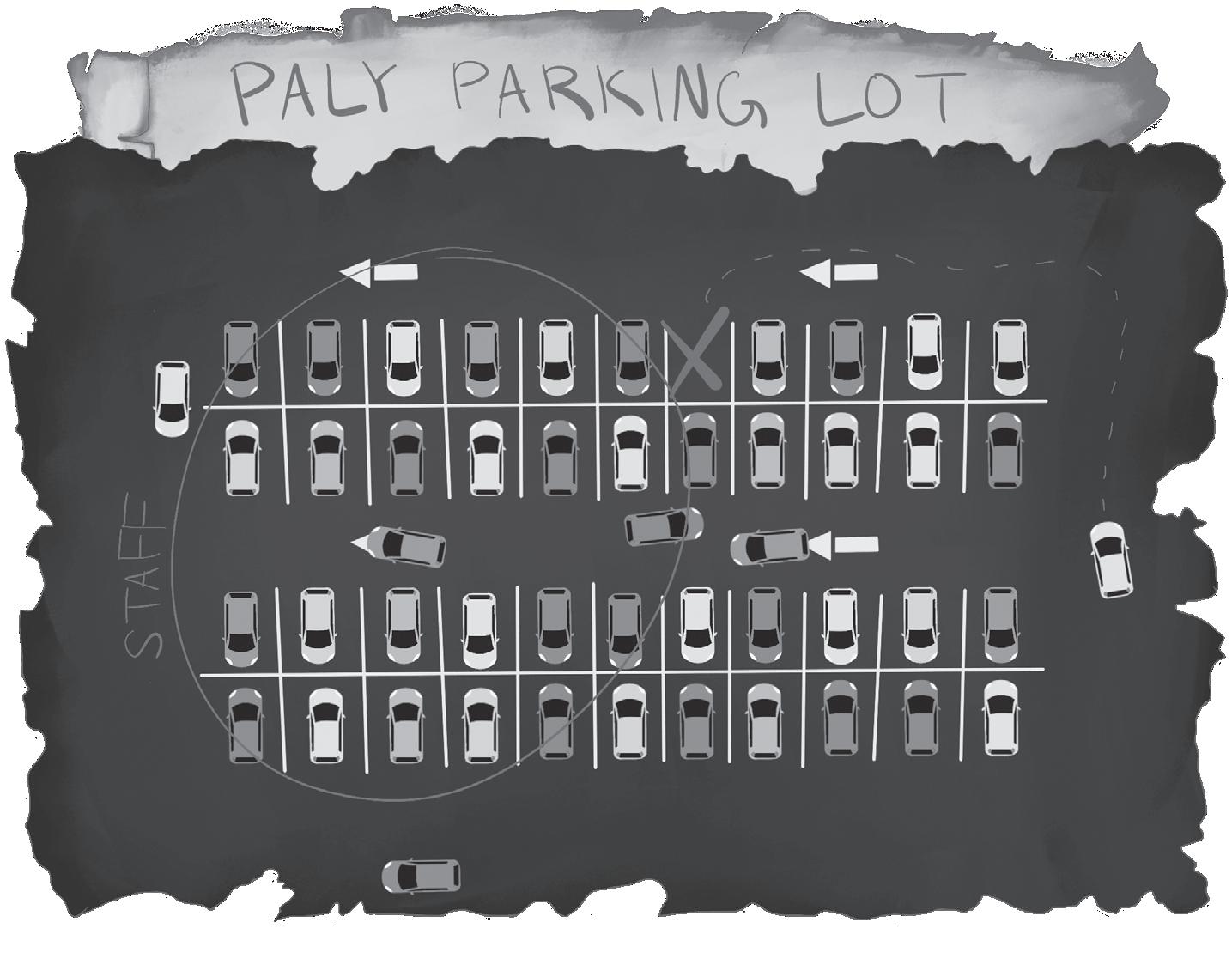
strategy: how early must I wake up? How many laps can I a$ord to take around the parking lot before I’m late to class? Can I drive home during my prep at the risk of not getting a spot when I come back?
While we are at it, let’s talk about the design –– if you can call it that. e parallel, one-way aisles force drivers to go the wrong direction, creating stando$s with people coming in the correct direction. Also, pedestrians weave through moving cars, and as you drive over the speed bumps, you hear the grueling sound of your car’s underside being scratched. And just when you start to escape the labyrinth for the day, congestion clogs up the lot ––20 minutes is a good day.
e parking lots are ine cient and inconvenient. Time spent hunting for a spot could be spent studying, sleeping or, at the very least, not being stuck in a slowly growing cloud of exhaust. Additionally, many students have been pulled out of class by administration to move their cars if they parked in a “madeup spot.” is is only possible if you have a parking permit, though, because then they can track your license plate number and connect it to who you are. e only possible action against people without permits is ticketing by the City of Palo Alto police, and that money doesn’t even go to the school. Essentially, people
prep period, their spot will be snatched up before they come back. In this case, some people park at Town & Country and risk a ticket while others simply make up their own spot. Of course there are solutions. Show up earlier, park o$-campus (at risk of a ticket), bike, carpool. Yes, those options work for some people, but they’re not universal xes. Not everyone lives close enough to bike, not everyone has the time to arrive at dawn, not everyone can rely on carpools. e burden should not fall on the students to navigate through a dysfunctional system. Instead, administrators could assign spots or inform the police of the dozens of people who park without permits. ey should also continue to prioritize seniors and juniors when handing out permits. Anything is better than the current freefor-all, where luck is more important than planning. e parking lots should not be a worry to students. ey should be something that works. And right now? ey do not.

For us, dance is an escape from the world. We can put schoolwork and the various tasks we have to complete on hold, and dancing allows us to let go of our stress and immerse ourselves in a di$erent world. Specally, being able to focus on advancing our dance technique and express ourselves through dance engages us enough for it to become a fully immersive experience.
We spend hours in front of the mirror working to improve our technique and build muscle memory: turning out, maintaining our posture, pointing our feet, keeping a tight core. But once choreography enters the picture, we have to add on the interpretation of the music and decide how we want to move through a space to tell a story. And because dance comes in so many styles — ballet, jazz, hip-hop, contemporary, tap, ballroom, just to name a few — there’s something for everyone. If you like %uidity and graceful movement, ballet or contemporary is a good t. If you prefer a style that’s more grounded and bold, look towards hiphop. A good in-between is jazz, and tap is something unique. You don’t need many pieces of expensive equipment, or a eld, or a team; All you need is music.
Many parents put their kids into dance classes (and often join classes themselves) early for the physical bene ts that dancing e many styles of dance o$er a variety of forms of exercise and train a wide range of muscles.
In addition, dance can be personalized — whether it is children dancing for fun in classes, adults dancing professionally on stage or seniors dancing in chair-dance is versatility leaves an open door for all people and provides %exibility for long-term commitment, making it easier to become a dancer later in life when it may seem intimidating.
Dance also teaches discipline. Ballet, specally, comes with strict rules, and every dancer is always searching for that perfect, ideal body and technique. Every dancer understands what someone means when they say they grew up with a Vaganova ballet teacher — a traditionally strict teacher of the Russian style of ballet — who is stereotypically known to raise their voice impatiently during class and push students to strive for perfection.
Our experiences with more Americanstyle ballet teachers still maintained that expectation of strong personal motivation and constant pursuit for ideal technique — and this discipline has transferred to many other subjects, from engaging in school classes to being well behaved in public settings. Despite this strictness, dance allows for a balance of technique with creativity, speci cally in choreography. Many dancers also understand that once technique is mastered, choreography becomes the time to think outside of the box, to try something new or untraditional. In addition, the perseverance and grit we gain from dance transfers to other things we do in our lives.
Even if you don’t intend to go pro like the dancers at the San Francisco Ballet, dance gives you a place to let your feelings out; a place that carries you to somewhere else for hours each week.
And overall, having the opportunity to perform for others in an expressive and creative manner is a unique aspect of dance. e bright lights shining in your eyes, the blacked-out audience cheering; dance provides an outlet for us to express, nd selfdetermination and bring smiles to our audience.
So try it. You don’t have to be a prima ballerina, and it doesn’t have to be a longterm commitment. Sign up for that class and let the dancing do the talking.


Dalia Saal News & Opinion Editor
Cindy Liang Print Managing Editor
Ethan Chan Lifestyle & Sci/Tech Editor
ART BY REINA LIM

The sequel squeeze
In recent years, Hollywood has discovered a remarkable natural resource: childhood nostalgia. Unlike oil, it never runs out, requires little to no actual exploration and can be extracted simply by adding the number “2” to the title of a formerly loved film. is tool, while seemingly effective, has degraded dozens of oncelegendary film franchises – “ e Godfather 3,” “Independence Day Resurgence,” and “Space Jam: A New Legacy” are a few of many examples of sequels that fell far below the quality of the movies that came before them.
Many of the original films in these franchises were memorable because they told a complete story. By the end of the movie, the characters finish their development arcs, the conflict resolves cleanly and the film ends leaving viewers with a satisfied feeling of closure. But, forcing a sequel produces awkward and misplaced narratives which reopen finished storylines just for some extra profit. In theory, it makes sense that profit-driven companies are doing this. A study conducted by FilmLocal, an online filmmaking network platform, found the average budget for blockbuster films routinely exceeded $300 million in 2026. After tax incentives, a film needs to generate over $427 million just to break even.
ese numbers help explain Hollywood’s attraction towards sequels: Financial risks are seemingly far too high for a movie to flop, so studios prefer recognizable, tried-and-true franchises over new ideas. However, it’s this financial safety that almost always produces bad content. Studios lean on nostalgia as a crutch, and then attempt to do one of two things: play it so safe that a film ends up painfully bland or try to “innovate” on top of a familiar premise and spectacularly ruin it. More often than not, we end up with a horrible combination of both: some parts of these sequels seem like carbon copies of the original, while other parts veer into downright wild plotlines, leaving the audience bouncing between deja vu and confusion. No amount of nostalgia can save a terrible storyline.
For example, “Jaws,” directed by Steven Spielberg, has a tightly constructed story. e shark wasn’t shown much throughout the film to create suspense, and the plot was kept simple and clean, cementing its legacy as one of the greatest thrillers of all time.
With the conclusion of the film, the conflict was resolved, and the story was complete: there wasn’t much reason to create a sequel. Hollywood, of course, disagreed.
More than a decade later came “Jaws: e Revenge”, premised upon the absurdity of a shark targeting the Brody family, the same family that it had attacked in the first film. Aside from the awful idea of a shark holding a personal vendetta for over a decade, the film shows us more of ‘same everything’ from the first film: more shark appearances, more reasons to make fun of it, and definitely more nonsense. e movie completely abandons the suspense of the slow-burning thrill of the original. Instead of building suspense by giving the shark less screen time, the sequel features the shark randomly popping up whenever the plot becomes boring.
e sequel also suffers from a striking lack of innovation. It reuses too many elements of the original, from the Brody family to the shark attacks. e film relies almost entirely on the audience remembering how good the original was.
Jaws is only one example. Consider the fan favorite dinosaur empire “Jurassic Park,” where a sequel missed the mark by neglecting the storyline.
e original was so successful because it felt revolutionary and novel.
Audiences who had never seen CGI could now watch a T. rex casually ruin someone’s day in stunning detail without even leaving their seat. Aside from the near-perfect cinematography during scenes such as the reveal of the Brachiosaurus, the T. rex breakout and the raptors in the kitchen, the film explored themes of humanity’s hasty tendency to push technology forward beyond its ethical limits and the dangers of trying to play God.
Compare that to “Jurassic World Dominion,” where the overreliance on nostalgia 30 years overdue was so excessive it felt as though
the only redeeming quality about it was the cast. e film attempted to juggle multiple storylines and held onto the franchise’s original premise, while adding new villains and mutated locusts. e result was a film that crammed together every possible half-baked plot point. It felt like the franchise’s iteration of a Frankenstein monster — which the franchise would’ve done much better without.
Still, we’ve seen Hollywood produce its fair share of sequels that justify their own existence. “ e Dark Knight,” for instance, deepened the moral stakes of the story “Batman Begins,” introducing e Joker, one of cinema’s most memorable villains. “Kung Fu Panda 2” built upon the charm of the original while adding a more emotional layer introducing Po’s past.
Similarly, much of the “Star Wars,” “John Wick,” and “Indiana Jones” sequels expanded their respective universes and deepened stories by avoiding repeat original adventures without innovating to the point of absurdity.
e difference in these cases is that the sequels respected the basic principles set by the originals. Beyond that, they either expanded the story in meaningful ways or kept the formula simple enough that the familiarity remained enjoyable.
However, the problem is not necessarily that Hollywood produces more bad sequels than good ones. e problem is that when a sequel fails, the damage is noticeable. While a good sequel may extend the legacy of an already successful title, a mediocre sequel drags a beloved original down with it. When audiences watch a disappointing follow-up, they think of it less as a bad movie and more of it as a franchise they once loved dissolving in front of their eyes.
While nostalgia may sell the ticket, it will never be able to fully write the story. Hollywood would do a lot better if they remembered the difference.

Jonathan Gu Staff Writer
Take the scenic route: why roadtrips trump air travel
Wind tousles my hair as my friends chatter around me, cheesy folk music playing on the stereo. I see the road curving around the coastline, waves lapping against the shore. e pleasant shine of the sun warms my skin and I think, “Why didn’t I do this sooner?”
e playful embarkation of a road trip has been lost in the world of modern travel. Scenic routes are being replaced with sterilized TSA lines and cramped seats, sloppy karaoke replaced with barked orders to stash all electronics, leaving little room for the kind of carefree, unstructured moments that once defined the journey itself. e temptation of reduced travel time has drawn many away from longer road trips — but it’s easy to forget choosing a road trip may offer a more meaningful experience than a flight. Vacation destinations are great, but many people don’t realize how valuable the journey is.
Airports are places of chaos and confusion. Everybody knows the stress.
But, the road? Open. Quiet. Yours. You are in control of everything: what gas station you feel like stopping at, what cold drink you feel like buying at the small market you pass and even who gets aux privileges for the next hour. On the other hand, waking up at 6 a.m. for an early flight is not enjoyable. Strict boarding schedules may be ideal for business travelers, but the anxiety of missing a flight turns a fun family trip into a chaotic and miserable one. Vacation should be about the joy and adventure of exploring the world, not about rushing through the airport to your gate.
Instead, road trips foster organic experiences and allow for spontaneity that flights could never offer. From convenience store pit stops to mini expeditions, road trips allow you to explore everything between you and your destination. I still cherish memories of stopping by the “fruit man”’s stand during my family’s annual road trip south to my Grandmother’s. It’s become an important destination for me, and I hold fonder memories of fresh fruit in the backseat over stale plane biscuits. Finding an historic small town or beautiful viewpoint along the way is part of the charm of traveling, but it’s lost in
the busy culture of air travel. Not to mention the flexibility of a road trip: it’s easy to add on extra passengers, and you’re able to bring the whole family, including furry friends. While it is easy to get sick of your family after hours of driving, sometimes the time spent together can form bonds better than sitting alone with your own headset, isolating yourself from your family on a flight. Activities and on-theroad conversation can be an opportunity to understand others and grow closer.
Flying can also leave your wallet unbearably empty. In the bubble of an airport in a capitalist system, everything from seats to snacks comes at an unforeseen premium.

ART BY ANGELIKA GERA

PAUSD, PAEA must reach collaborative compromise
Amid negotiations between district administration and sta regarding pay increases, e Campanile thinks the union and the district need to take a more collaborative approach. Administrators should cooperate with sta to reach a reasonable agreement for teacher pay raises, and the Palo Alto Educator’s Association should also be understanding of nancial limitations placed on the district.
In recent negotiations, PAEA has requested a 9% salary increase this year, and an 8% raise the next year. In response, PAUSD o ered a 4% salary increase for the current school year, with a 3% increase in the following year, as well as continued health bene ts through the 20272028 school year and two $3,000 bonuses. Although e Campanile applauds PAUSD for its willingness to o er bene ts and bonuses to educators, we think the district isn’t being fair.
Currently, neighboring districts provide greater pay to their educators. On average, Mountain View Los Altos rst-year high school teachers receive $101,947 while PAUSD teachers in their rst year earn $76,488. PAUSD is a school district that prides itself on being top-ranked in educational quality, and the teachers who make that education possible should earn a salary re$ecting their work. However, it’s essential to note teacher salary gures do not include healthcare bene ts. Alongside salary, PAUSD also helps pay for a teacher’s medical, dental and vision coverage along with other bene ts like life insurance.
us, e Campanile thinks some arguments regarding employee pay are too narrow, since salary gures do not account for the cost of providing bene ts to teachers. Ultimately, though, teachers provide enormous bene ts to the school district and the community, and e Campanile wholeheartedly thinks
PAUSD noti ed theatre director Sarah ermond she would be removed from her role and reassigned as an English teacher beginning in the 2026-27 school year on March 12. In a message to the theatre community, Principal Brent Kline attributed the decision to declining enrollment. However, after signi cant community pushback, Kline reversed the decision in a March 27 email, announcing ermond will remain Paly’s theatre director while also leading Greene Middle School’s drama program next year.
e Campanile applauds the administration’s willingness to reassess its original decision and thinks keeping ermond at Paly while expanding her role to include running Greene’s drama program is the correct step forward.
In her eight years as the director of Paly’s theatre program, ermond brought measurable changes. In March, ermond took a group of students to the California State espian Festival, which she has done annually since arriving at Paly. e program has won numerous scholarships, secured rst-place prizes in competitions, and some students were even appointed to be statewide California espian O%cers. Under ermond’s leadership, the program has also provided unique opportunities for students to engage in every aspect of theatre production. Students can choose from a variety of opportunities, from writing short plays and musicals for annual One Acts and joining stage tech classes to helping write, direct and perform the yearly Play in a Day in the rst 24 hours of winter break.
Beyond this, many graduates of Paly’s theatre program go on to prestigious, highly selective performing and lm schools, including NYU’s Tisch School of the Arts and USC’s School of Cinematic Arts, a testament to ermond’s tremendous ability as an educator in instilling a lifelong passion for theater in her students.
Although enrollment in theatre classes may be declining, the program itself is not. Participation
they deserve to be fairly compensated. It is teachers who check in on struggling students and connect them with greater resources. It is teachers who introduce students to their passions and inspire students to pursue them to greater heights. It is teachers who provide safe spaces for marginalized students on campus. ey educate the future and ensure student wellbeing. eir pay should re$ect that.
And while e Campanile acknowledges the practical limitations of what the district is able to o er in raises to employees — according to Chief Business O%cer Charen Yu, even a 2% raise with continued health coverage through the 2027-28 school year would cost $27.2 million over three years — we think a greater problem is an erosion of trust and empathy between the teachers and the district.
e school board’s current budget plan, which aims to generate approximately $2.5–$2.8 million in ongoing saving” during the school year
in after-school productions remains consistent, and performances are successful. More broadly, districtwide enrollment has decreased, and recent changes to the VAPA pathway have drawn students toward visual art, decreasing the number of students enrolled in theatre. None of these factors are a re$ection of ermond’s performance. Regardless, measuring the success of a program from one singular metric is misleading and fails to recognize the value of the program beyond pure statistics. eatre is an art that allows for creativity and con dence building and explores the human experience.
eatre is where stories are shared and performed, where real issues are grappled with; it is a catalyst for change because it has the power to comfort the disturbed and disturb the comfortable. eatre is about conveying emotion and creating genuine connection, and in a society and a district so focused on a narrow denition of success, theatre is an invaluable outlet for creative expression, community and belonging.
ermond has created a culture which welcomes every individual, and for many students, it is the only place on campus where they feel safe, included and valued. at is due to work that ermond has put in, and her long-term commitment to deeply support students.
e community, in particular, has faced sig-
ni cant loss in the past two years, and trying to remove such an important pillar in the face of real tragedy is both shortsighted and harmful. When a community is grieving, consistency, familiarity and support from someone trusted is invaluable. e original decision to remove ermond re$ects a lack of care for one of the most vulnerable, nonconforming and diverse communities on campus. e lack of transparency involved in the original decisionmaking process also added injury and confusion to an already painful situation.
Just because the safe space ermond has created may be smaller than other niches on campus does not mean the students who belong to it
is especially hypocritical, considering the recent separation agreements between former Superintendent Don Austin and former Acting Superintendent Trent Bahadursingh which cost the district nearly $1 million, while providing zero education value to the community.. us, while e Campanile recognizes the district is limited in its nances, it needs to be more careful in ensuring the money it spends goes to the right places, such as paying educators. e function of a school is to educate future citizens and leaders, and it is the job of the district to both invest meaningfully in educators, and also treat educators with respect and dignity.
While e Campanile acknowledges that there are real limitations to what the district is able to o er, the district should be making more of an e ort to understand where teachers are coming from and should be less scally conservative with the budget.
The Campanile
matter less than those in large programs. Every student deserves to have a place on campus where they can nd support, and every student deserves an adult on campus they can trust.
Having a safe place and an adult on campus, are lifelines for students who may be struggling for a multitude of reasons: students who may feel bullied or ostracized, students who are unable to nd the same support at home, students with talents, interests and innate passions in certain activities, nd solace through these communities on campus. eatre is one of them, largely due to ermond’s dedication towards making students feel welcomed and valued in her program.
At the March 12 board meeting, students and families showed up with an outpouring of support for ermond, describing the program under her direction as an invincible refuge, and noted her unwavering commitment to supporting students. We applaud the theatre community for dynamically but respectfully voicing its opinion.
In a school district that prides itself on its quality of education, the administration’s decision to slash one essential community is hypocritical. e Campanile also notes that the students, community members and alumni of the eatre programs made multiple attempts to reach out about ermond’s reassignment to Principal Kline and other administrators via email before escalating the situation to a public forum via the board meeting.
At the same time, we commend Kline’s openness to feedback and his taking action to reverse his original decision. Expanding ermond’s role to lead the Greene drama department will hopefully create a stronger bridge between the Paly and Greene programs, increasing enrollment and passion in Paly eatre for future classes of students. Moving forward, we urge administration and instructional leads to consider the impacts that moving a specialized teacher will have on an entire community before deciding to reassign them. In a school that claims to care about the wellbeing of its students, and especially in the months following a tragedy, removing a trusted adult from a vulnerable community is not a decision that should ever be made lightly. Ultimately, e Campanile applauds both the theatre community for speaking out, and the administration for listening.
ART BY SOFIA SINGER