NEWS
Staff cuts reversed after community backlash. Page 2
LIFESTYLE
Students stand up.
Page 5
SCI/TECH
Elon Musk announces SpaceX, AI merger.
PALO ALTO UNIFIED SCHOOL DISTRICT PALO ALTO HIGH SCHOOL 50 EMBARCADERO RD. PALO ALTO, CA 94301
NONPROFIT ORG U.S. POSTAGE
PAI D PALO ALTO PERMIT #44
Page 13
The Campanile Vol. CVII, No. 6
Palo Alto High School, 50 Embarcadero Road, Palo Alto, CA 94301
Wednesday, March 11, 2026
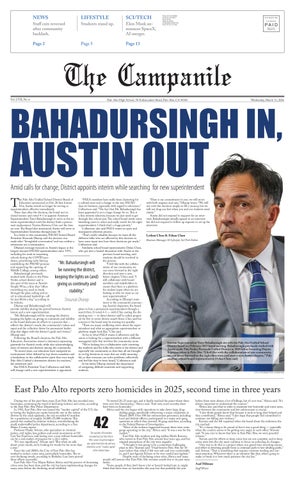
BAHADURSINGH IN,
AUSTIN OUT !"#$%&'(()%*+,%&-'./01%2#)3,#&3%'44+#.3)%#.30,#"%5-#(0%)0',&-#./%%*+,%.05%)640,#.30.$0.3%%
T
he Palo Alto Unified School District Board of Education announced on Feb. 20 that former Don Austin would no longer be serving as superintendent, e#ective immediately. "ree days after the decision, the board met in closed session and voted 4-1 to appoint Assistant Superintendent Trent Bahadursingh to serve as the interim superintendent until the district finds a permanent replacement. Trustee Rowena Chiu cast the lone no vote. "e Board also announced Austin will serve as Superintendent Emeritus through June 30. In a letter to the community, PAUSD School Board President Shounak Dharap said the decision was made after “thoughtful conversation” and was neither a retirement nor a termination. Dharap’s message focused on Austin’s legacy as the longest tenured PAUSD superintendent since 1975, including his work in reopening schools during the COVID pandemic, prioritizing early literacy, establishing the PAUSD promise and supporting the opening of Middle College, among others. Bahadursingh previously worked with Austin in the Palos Verdes school district and is also part of the team at Austin’s Simple Wins, a firm that “o#ers everything you need to break through the glass ceiling and excel in educational leadership—all for just $0.66 a day,” according to its website. Dharap said Bahadursingh will provide stability during the period between Austin’s tenure and a new superintendent. “Mr. Bahadursingh will be running the district, keeping the lights on, giving us continuity and stability as the board dedicates its e#orts to a process that ... reflects the district's needs, the community's values and input and the collective desire for permanent leadership that aligns with the district's goals and visions,” Dharap said. Following the Board’s decision, the Palo Alto Educators Association issued a statement expressing gratitude for Austin’s work, while also acknowledging years of tension and distrust among the community. “In recent years, our educators have navigated an environment often defined by top-down mandates and a breakdown in the collaborative spirit that once made Palo Alto Unified a destination district for teachers,” the statement said. But PAEA President Tom Culbertson said little will change until a new superintendent is appointed.
“PAEA members have really been clamoring for a cultural reset and a change in the way PAUSD does its business, especially with regard to educators,” Culbertson said. “"e fact that Mr. Bahadursingh has been appointed is not a huge change for us. "is is a fine interim selection, because we just need to get through this school year. "e school board needs some breathing room to select and really search for the right superintendent. I think that's a huge priority.” Culbertson also said PAEA wants an open and transparent selection process. “"at's really valuable, because we want all the di#erent folks who are a#ected by this decision to have some input into how those decisions get made,” Culbertson said. Similarly, school board representative Dylan Chen, who got into a heated discussion with Austin at the previous board meeting, said students should be involved in the process. “I feel like with the collaboration of our community, we can move forward in the right direction and start a new, better chapter,” Chen said. “I will collaborate with board members and stakeholders to ensure that there is a platform for student input when we are looking at who we want as our next superintendent.” According to Dharap’s statement to the community announcing Austin’s departure, the board plans to hire a permanent superintendent through a search firm. It voted 4-1 — with Chiu casting the dissenting vote — to direct district sta# to solicit proposals for five to seven diverse search firms. Chiu said her concern is the board may be moving too quickly. “"ere are many conflicting views about the superintendent and what an appropriate superintendent or platform might look like,” Chiu said. As far as what PAEA wants, Culbertson said the union is looking for a superintendent with a di#erent managerial style that involves the community more. “We're looking for a collaborative style centering the students and the folks who work in the district and especially the community, so that they all are brought in on big decisions in ways that are really meaningful, so that everyone can solve problems collectively and feel like they've been heard,” Culbertson said. In his letter, Dharap stressed the importance of navigating di$cult moments and supporting students.
“Here is my commitment to you: we will move with both urgency and care,” Dharap wrote. “We will not rush this decision simply to fill a vacancy, but we will not drag our feet when you and our students need clarity.” Austin did not respond to requests for an interview. Bahadursingh initially agreed to an interview but did not respond to follow up requests to set up the interview.
Leilani Chen & Ethan Chan
Business Manager & Lifestyle, Sci/Tech Editor
!"#$%&'(')*#+,-.(%/,00% 12%#*--,-.%3(2%),+3#,435% 6227,-.%3(2%0,.(3+%8-%9'-):% .,;,-.%*+%48-3,-*,3<%'-)% +3'1,0,3<$=% !"#$%&'()"&*&+
Interim Superintendent Trent Bahadursingh sits with the Palo Alto Unified School District board at a February 2025 board meeting. Bahadursingh previously worked with Austin at the Palo Verdes Peninsula Unified District in 2020 before becoming Deputy Superintendent in Palo Alto. “I feel like with the collaboration of our community, we can move forward in the right direction and start a new, better chapter,” Paly student school board representative Dylan Chen said.
LUCA VOSTREJS/THE CAMPANILE
East Palo Alto reports zero homicides in 2025, second time in three years During two of the past three years, East Palo Alto has recorded zero “It started 20, 25 years ago, and it finally reached the point where there homicides, continuing the trend of declining violence and crime, according were very few (homicides),” Abrica said. “And now, most recently, there to the East Palo Alto Police Department. have been no homicides.” In 1992, East Palo Alto was named the "murder capital" of the U.S. due Abrica said the city began with operations to take down large drugto having the highest per capita homicide rate in the nation. dealing gangs, specifically referencing a major crackdown in Driven by the crack epidemic, the city recorded 42 murders March 2009. Over 500 law enforcement personnel, including for a population of roughly 24,000–25,000 residents. "is local and federal o$cers, participated in a major anti-gang period was marked by extreme violence, overwhelming the operation in which they arrested 30 gang members, according small, understa#ed police department, according to a San to the Federal Bureau of Investigation. Mateo County report. “Most of the violence happened because there were some Professor Hadar Aviram, who specializes in criminal gangs operating in the city,” Abrica said. “It was a war for the 7-0%.6"80,%+*%-+"#&#$0)% justice, civil rights, law, politics and social movements at UC market.” Law San Francisco, said having over a year without homicides East Palo Alto resident and dog walker, Marla Kravatz, ,0&+,$0$%89%:')3%;'(+%!(3+%#.% can be a real marker of progress for a city’s safety. who moved to East Palo Alto around four years ago, said her <==>1%5-0.%#3%-'$%3-0%-#/-0)3% “It's very significant,” Aviram said. “But when we talk original perceptions of the city were negative. 40,%&'4#3'%-+"#&#$0%,'30%'.$%5')% about crime trends, we’re looking for trends for far more than “I thought it was going to be a somewhat challenging ,0*0,,0$%3+%')%3-0%?"6,$0,%&'4#3'(?% place to live,” Kravatz said. “I had lived in Palo Alto for 10 a year.” +*%3-0%@.#30$%A3'30) Since the mid 2000’s, the City of East Palo Alto has years before that, which I felt very safe and very comfortable worked to reduce crime rates, particularly homicides. "e rein, and I just figured I’d have to be very careful and vigilant.” cent declining trends, according to Berkeley Law, have proved Despite years of declining crime rates, Abrica said many these e#orts successful. people still assume that East Palo Alto remains unsafe due to its past repuEast Palo Alto Vice Mayor Ruben Abrica said the process of decreasing tation. crime rates has been slow, and the city has been implementing changes for “Some people, if they don’t know a lot or haven’t looked into it, might many years before the declining trend solidified. think that there were no homicides this year, but that probably the year
42
before there were always a lot of killings, but it’s not true,” Abrica said. “It’s always important to understand the context.” Abrica also said that in order to maintain low homicide and crime rates, trust between the community and law enforcement is crucial. “I also think people know that because it took so long, they helped and they contributed,” Abrica said. “I also hope that people feel committed to continue not falling into violence.” Kravatz said she felt surprised when she heard about the milestone the city reached. “It’s a funny thing to be proud of, but it was a good thing — especially when the country seems to be getting very angry at each other,” Kravatz said. “It was nice to know that here in East Palo Alto, we were peaceful citizens.” Aviram said the e#orts to keep crime low are not complete, and to keep crime rates low, the city must continue to focus on enforcing its changes. “One way to do this is a project where you spend time investing money and e#ort in diverting people from (a criminal) path to law-abiding paths,” said Aviram. “"at is something that requires constant tending and constant attention. Whenever there is an initiative like that, what’s going to make or break it is how much patience the city has.”
Asaf Milman Staff Writer
The Campanile
Wednesday, March 11, 2026
2
News
Staff cuts reversed after community backlash
!"#$%&&$'()%&'%)'"&%*+,'-+%&"*./'$0&.+*-+$%$'*,1'%&.2,+.*-'$%*34'"&5&.%+,6'*'1+$%"+.%' 0")0)$*-'%)'"&1#.&'$.2))-7$+%&'0&"$),,&-'+,'%2&'#0.)8+,6'$.2))-'/&*"'
A
t a jam packed, sometimes raucous meeting, the Palo Alto Uni$ed School District Board of Education voted at its Feb. 10 meeting to reverse a district management decision to cut elementary reading specialists, copy technicians and other support staff positions for the 20262027 school year. The meeting was packed with teachers, students, parents and community members, many of whom spoke in public session to support the staff who were facing layoffs. The comments sparked heated discussion about the priorities and values of the district, and how to best handle the district’s budget, with district administrators painting a dark view of PAUSD’s $nances if these cuts didn’t pass, while opponents of the cuts accused the district of exaggerating its numbers to force contract concessions for the teacher’s union.
!"#$%&'(%)&(*+&*,-)'+(%.&%'+/.00%-$%) During the meeting, PAUSD Chief Business Officer Cheren Yu said the district budget will reflect future needs. “We are rebuilding the budget from the ground up to reflect current realities to help surface outdated or low value spending and redirect dollars to high impact work,” Yu said. “The decision will be driven by priorities and outcomes, not history or convenience.” According to Yu, the projected ongoing savings are between $2.5 and $2.8 million, acknowledging that those increases do not fully absorb the increased cost pressures outside the district such as utilities and medical insurance. Paly Literacy Teacher on Special Assignment and English Learner Specialist Kindel Launer said the district does need to address its budget but should do so in a thoughtful manner. “Budgets are a reality,” Launer said. “So the real question is, what is the most effective delivery model?” Meg Williams, an English Learner Specialist at Escondido Elementary School, said teachers did not have a say in the board’s decision which sparked the large turnout at the meeting. “If it really was about budget, why don’t we have an exit strategy so we could make this as seamless as possible?” Williams said. “How can we have the least impact on students? We were just totally left out of the conversation.” Launer said these kinds of hard conversations are necessary for improving the district. “There is as much potential, if we are hopeful, to see some kind of instruction that is incredibly innovative,” Launer said. “There is nothing like a budget de$cit to force innovation.”
1"&)'+.")%'0,-$2&%(3'+,-+%(-)' Since reading specialists target instruction in small groups for students working to improve their reading skills, Launer said these positions play an important role. “It is vitally important that children learn to read,” Launer said. “And our specialists are a huge part of that effort when a child is struggling to read. The specialists for language learning are really critical as well, because vocabulary is a barrier to access to the curriculum.” During the meeting, PAUSD board member Shana Segal agreed. “(Reading specialists) bring specialized preparation applied directly to improving student outcomes,” Segal said “When we reduce that capacity, I worry we are not just shifting staffing, we are reducing access to preparation.” Board member Alison Kamhi agreed and said the proposed cuts did not reflect the district values of investing in students who may fall below grade level.
“In the PAUSD Promise, we talk speci$cally about elementary education and making sure to devote resources to struggling students,” Kamhi said. “Our reading scores are something to brag about.” Kamhi also said at the meeting that any district management’s budget proposals should not have a negative impact on students. “I know that this budget reflects a restructuring at the elementary level, and my concern is student centered,” Kamhi said. “I worry students will lose services and that that will impact student learning and student outcome.” Executive Vice President of Palo Alto Special Education PTA Mirabel Ramirez spoke against the proposed cuts and said it is vital to have specialists to provide resources to underperforming students “We need specialists who have the training, the knowledge (and) the expertise who can provide the services to English learners and kids who need reading support,” Ramirez said. “That can put them in a position where they feel capable, where they feel comfortable, and where they can achieve just as their peers.” For Launer, another concern is unsupported students may fall behind. “I am concerned that we will have students arriving (at middle and high school) with some gaps,” Launer said. “At the same time, I have real faith in my teaching colleagues that they will rise up to the challenge of the broader needs in their classrooms.”
teachers to work the machines. “When too many hands are on the machines, the machines get broken more often, it’s more errors and more work to be done,” Rodriguez said. Most of all, Rodriguez said she has noticed how impactful and bene$cial her job is to students and teachers. “All (aspects of ) this job, I do them with passion because I really love my job,” Rodriguez said. “I love working with teachers and contributing to the students’ education.” And Bloom said Rodriguez’s work is vital for teachers to run classrooms smoothly. “We need – I need Rodriguez’s support,” Bloom said. “The value and support she offers makes me a better teacher and makes my students smarter.” Chief Business Officer Charen Yu said she would agree to an interview only if The Campanile sent her the questions ahead of time and also said her answers would be reviewed by district spokesperson Lynette White. While The Campanile does not normally share questions with sources ahead of time, because we thought getting Yu’s side of the story was important, we agreed. As of press time, neither Yu nor White has responded to the questions submitted.
!"##$%&'()*+,+%*-)."/()'+.0%&.&1%-)
Brooke Bressler
Staff Writer In addition to cuts to elementary reading specialists and support staff, district management also proposed cuts to the copy technician’ position, one at each high school. Many teachers and students rallied in support of copy technicians. Currently, the role consists of printing tests and homework, prioritizing printing requests, handling machine maintenance and making deliveries to teachers in all departments. Segal said the removal of this position has an instructional impact. “When their support is removed, instructional time shifts away from teaching and toward logistics and students bear that cost.” Paly copy technician Veronica Rodriguez said her position enables teachers to spend more time on students. “We help the educators,” Rodriguez said. “Teachers rely on the technicians because they do a lot of work on paper and those papers end up in students’ hands. So we contribute to students’ education, even though we are not teachers.” During an open forum at the meeting, economics teacher Eric Bloom said he values the copy technicians’ behind the scenes efforts to help him prioritize paper classwork. “I use pencil and paper for practice problems, for notes, (and) for games. I want students to slow down and physically write,” Bloom said. “It Mirabel Ramirez stands in front of the board to speak during a public session. “We need specialists who engages their minds have the training, the knowledge (and) the expertise who can provide the services to English learners and deeply and helps kids who need reading support,” Ramirez said. “That can put them in a position where they feel capable, learning.” where they feel comfortable, and where they can achieve just as their peers.” Without copy technicians, it is up to LEILANI CHEN/THE CAMPANILE
!"#$%#&'()#')*+%(),&-.'/0#1%2'3&)*4'(5)26&'7%2'1#(2&)4&*'(2%441#6'4)7&,$8'9&#,)3'5&)3,5'40::%2,4' Paly junior Julia Curtis launched a petition calling for an immediate reinstatement of paid, trained Caltrains crossing guards and eventual permanent closure, following a recent tragedy in the student community. The petition has garnered over 3500 signatures since its launch on Feb. 4. The ultimate goal is permanent closure or grade separation — such as underpasses or overpasses — at the Churchill crossing, though the petition acknowledges that those solutions are complex, costly and time-consuming. The city responded by approving a one-year, $1.7 million contract with Orion Security — split with PAUSD — for 24/7 paid monitors at all four Palo Alto crossings, with guards now in place. District Assistant Superintendent Yolanda Conaway said the district also supports the goals of the petition, although she noted that the district lacks jurisdiction over the crossing. “Our role is to advocate strongly — as you saw the superintendent do, which I believe was a brave and very necessary move to make,” Conaway said. Suicide is often the result of complex, treatable mental health conditions, rather than a single event or reaction to a tragedy. Conaway said the district is focused on building sustained connections between students and adults as a core element of prevention, alongside sensitive handling of communications after a death to minimize risk.
“When students feel like they’re seen, supported and valued by adults, we know the risk decreases,” Conaway said. “We’re not looking at prevention as this one program. It’s a relationship. The district has to attend to things like contagion and the triggering factor, so we’re being very careful. Sometimes that careful translates into too careful, meaning the conversation is not happening. We are not talking about help-seeking behaviors. We are not talking about suicide, and we need to talk about these things. We just have to be careful in the immediate postvention phase how we do that.” The district is enhancing its training efforts, making annual suicide prevention sessions more interactive and adding a mandatory schoolwide focus on supporting LGBTQ+ youth, which occurred on Feb. 17. Curtis emphasized the importance of fostering an environment where students
feel comfortable seeking support. “It’s okay to talk about it, and you don’t have to be ashamed of mental health,” Curtis said. “It’s something that a lot of people struggle with — almost everyone does.” Curtis said they also explored adding more in-person mental health resources modeled after existing consent education presentations in PE, along with teacher training and targeted check-ins for students showing warning signs. “Even though we have some required online forms, kids are much more likely to open up to a real person than a screen,” Curtis said. “When someone is actually concerned about you and is showing that they care about your well-being, people are a lot more likely to open up.” Curtis said she has received widespread encouragement and support from the community, including city officials, Austin,
;<'2&)31=&',5&2&-4'4%'90(5'5&3:8' )#*'&+&2$%#&'>)#,4',%'5&3:' ,514'?&(%9&')'2&)31,$@'A&&1#6' 5%>'9)#$':&%:3&'()2&')?%0,' 1,'14'2&)33$'(2)=$@'<,-4'2&)33$' )9)=1#6',%'9&@B !"#$%&'"()$*
parents assisting with outreach and students sharing positive feedback. “I realize that there’s so much help, and everyone wants to help this become a reality,” Curtis said. “Seeing how many people care about it is really crazy. It’s really amazing to me.” Lythcott-Haims said the partnership between the city, school district, and Caltrain feels very rewarding. “When a community is suffering, often people splinter and fracture, and it makes it hard to come together,” Lythcott-Haims said. “This time around, it feels like we’re in coalition with each other and that feels really good.” Conaway said student input plays a critical role in shaping the district’s safety and mental health policies. “Students should and have to be our $rst advisors,” Conaway said. “The more students can mobilize and speak up — and I truly encourage it — the more we learn. And once we learn, we can do better too. We put an adult lens on things. We put in a professional educational lens. We rely on research. But none of that matters if it’s not really addressing the needs of our students.” Curtis said launching the petition reshaped her view of who can drive change. “Anyone can advocate for what they believe in — whether it’s just an email, Instagram story, or a petition, or if you just call your representative or the city — there’s no rules for who can advocate. Anyone can do it. I never would have thought that
I could have done this because I’ve never done anything like this before,” Curtis said. “If you believe in something, no matter what, you can speak your mind and advocate for what you believe.” You are not alone. Please contact the following resources if you have safety concerns or need immediate help: Call 911 and request a C.I.T. (crisis intervention team) trained officer to assist you Crisis Text Line: Text HOME to 741741 to connect with a volunteer Crisis Counselor The Trevor Project (LGBTQ+ Youth): Call 1-866-488-7386 or text START to 678-678 Bill Wilson Center Youth Hotline: Call 408-850-6125 for local 24-hour crisis support in Santa Clara County Trevor Lifeline LGBTQQ+ Crisis Support: 1-866-488-7386 Paly Wellness Center: Located on the 2nd floor of the Tower Building. Open school days for walk-in support and checkins. Andi Barker, Mental Health Specialist: Reach out via email at abarker@pausd.org allcove Palo Alto: Integrated mental health and wellness support for ages 12–25. Located at 2741 Middle$eld Road.
Annika Chu
Print Managing Editor
Wednesday, March 11, 2026
The Campanile
3
News
Student petitions to eliminate administration oversight from Board Rep. selection process
!"#$%&'()'&*+,$-&.-,',%/,&.-01$",'&23$"(%/,4&$%'*$*3*$0%(5&.,-'.,/*$1,&%,/,''(-)&60-&+$2+7'*(8,'&.395$/&-,.-,',%*(*$1,&-05,
T
he upcoming Associated Student Body elections — including that of the Paly School Board Representative — has sparked debate on the appropriate amount of in%uence administrators should have in the selection process. To address this dispute, senior Duncan Sego circulated a petition calling for a reduction in administrators’ participation in the election process by eliminating the mandatory review panel for prospective School Board Representative candidates. It has accumulated over 360 signatures. The ASB Constitution calls for a review panel to vet all School Board Representative candidates. Currently, school administration, the ASB Executive Board and the Student Activities Director lead the panel. Candidates who pass the initial screening process advance to a schoolwide ranked-choice ballot election to decide the School Board Representative for the upcoming school year. For students like Sego, the administration holds too much power in this process: they say administrators have bias and in%uence when selecting candidates before the vote. Senior Dylan Chen, the current Paly school board representative, said it’s important for administration to have a balance of involvement. “Admin (should) get a chance to review who’s on the ballot and tell the Student Activity Director thoughts about (candidates), but admin should not be in the same room as students who are trying to approve the candidates,” Chen said. “When a student is in a room with a person that has a level of power over them and such a level of authority over them, that student can be easily emotionally swayed by admin pressure or any sort of negative or positive admin reaction to a candidate’s profile.” However, Principal Brent Kline said his involvement in the elections does not go beyond open-room discussion. “Now, there is an interview part to it, which I’m involved in with students,” Kline said. “They interview all the candidates who want to run. Then after interviews, there’s discussion. People share their opinions — including myself — and I leave the room, and the students decide.” Student Activities Director and ASB adviser Alyssa Bond confirmed this. “I know that there was a misconception that (there was) in%uence from Mr. Kline, because he was in the room when we were voting –– he absolutely was not,” Bond said. “There was no push from Mr. Kline to vote one way or another.” Instead, Kline said disagreement is essential to discussion, especially with an intent of reaching a common agreement. “When you express an opinion, you might sway somebody, but (it’s a) discussion, right?” Kline said. “(Opinions) are what everybody else brings to the table,
all the students in the room, and I feel like my position is more equal versus elevated.” Still, Sego said any administration involvement in the screening process may have unintentional in%uence –– ruining the original purpose of Paly’s School Board Representative as an unfiltered voice for the student body. “Removing (administration in) the screening process would help tremendously with getting the right people that the students want in there who will fight for students and won’t just acquiesce to whatever Paly
administration tells them to,” Sego said. “Also, when I found out Gunn doesn’t have the screening process at all, it made so much sense to remove it, because all we’re doing is hurting student opinion, which should be a more important factor in school board elections.” Junior Paul Wang, who was the ASB treasurer and on the executive board two years ago, also said administration should not say who they prefer as Student Board Representative. “I think that a lot of what the Student Board Representative has to do is to speak out about student issues, and student issues primarily are caused by
ART BY IVY LEE
bad administration,” Wang said. “So when we have these outlets to speak out against corruption within our district, I think that the Board Representatives are in the right. I don’t think it’s necessarily bad to have a bad re%ection of administration, because we need these critiques. By suppressing these critiques we’re making our school worse because there is a whole lot of stuff that they can improve on, but they choose not to.” While acknowledging the importance of student voice, Bond said actions of the School Board Representative hold too much weight to not have some administration opinion. “It is so public, and they are representing the school, and at the end of the day the administration, it comes back to them,” Bond said. “So if the school is misrepresented in any way, it falls back on admin more than more than a student. So in terms of (administration) having input in the process, I think it’s an important piece of it to have their voice in the room, but I also agree that it’s 100% important to leave the vote in the final decision up to the students, because it is a student election. So the power really does rest with the students,and I think it should stay that way.” Similarly, Assistant Principal Jerry Berkson said students should have as much information as possible when voting on this essential role. “Having input from the admin level is important, because while there’s a lot of information out there, we have a lot more information,” Berkson said. “I think at times, we hear things all the time. I heard this. I heard that. And from a global perspective, (administration) hears the most.” Berkson also said administration does not singlehandedly in%uence the elections but instead provides more information for guidance. “It’s hard for us to sway anything, because ultimately the students have the vote, but the input from us as another eye in the sky can be helpful for the long term good of the school,” Berkson said. In the end, regardless of the process, Kline said the number one priority is having a Student Board Representative who is responsible and aware. “(Our goal) is to find people that are curious; we find people that want to build bridges across all of our groups of students and adults here, and that engage with a high level of integrity and professionalism,” Kline said. “That’s something that I would think all of us would want, and that’s really what my frame is when I’m looking at this time of year when we’re looking for the person to take this role.”
Luca Vostrejs Editor-in-Chief
!"#$%&'()"$%&*+,"$&-.+(#/&0%$*+'&1(2+#&3#",&4(#&56+#'7&"89:#"+' After a season marked by a significant number of injuries, the San Francisco 49ers became the center of an unusual online theory. Multiple posts circulating on social media claimed that electromagnetic fields from a nearby electrical substation may have contributed to the team’s injuries. The theory gained traction on platforms such as Instagram and X with some posts about this topic garnering around 22 million views. In these posts, people suggested that EMFs emitted from a substation located near Levi’s Stadium could weaken tendons or collagen, increasing injury risk. The claims spread as multiple players dealt with hamstring strains and other soft-tissue injuries during the season. NBC Bay Area sportswriter Matt Maiocco, who has reported on this issue, said the idea gained attention partly because fans were searching for answers. “People were eager to find reasons why the 49ers had all those injuries,” Maiocco said. “That was an easy answer.” He also said the substation is not new. “That substation has been there since 1988 or 90,” Maiocco said. “I mean, it’s been there a long time. In fact, it was there before the 49ers moved their practice facility to Santa Clara.” Electrical substations convert electricity into different voltages for efficient long distance travel and safe distribution to homes and businesses. Posts circulating online suggest that electromagnetic exposure can contribute to soft-tissue injuries. However, scientific and medical experts have not found evidence linking EMF exposure from electrical infrastructure to sport injuries. In his reporting, Maiocco spoke with Allen Sillis, the NFL’s chief medical officer, about the theory and said he learned injuries stem from multiple factors. “There’s generally not one factor that is the reason that injuries occur,” Maiocco said, summarizing Sillis’ explanation. “Football is very hazardous to your health. I mean, it’s a collision sport, There are a lot of factors that go into it.” Maiocco said the situation also pointed to other possible contributing factors, including scheduling issues, roster age, recovery time and luck. He said chance could also contribute to injuries. Maiocco also said injuries are an unavoidable part of football and are not unique to one team. “In the course of a season, every player gets injured. It’s just the matter of the severity and who is sustaining those injuries,” Maiocco said.
He said injuries can appear more severe when they affect star players, creating the perception of an unusually injury-plagued season. “I think the difference from this year for the 49ers was that it seemed like their injuries happened to their best players,” Maiocco said. Additionally, Maiocco said social media plays a major role in amplifying unverified claims. “Once people get it in their minds of what they believe, it’s really difficult to dissuade them,” Maiocco said. Even as the season ended, the theory continued to spark conversation among fans. At Palo Alto High School several students who follow the 49ers have seen these claims online. Sophomore Cyler Rivera said he finds the theories ridiculous. “That’s so dumb. They don’t even know what they’re talking about,” Rivera said. “There’s no factual evidence that even backs that. They’re just saying that because the team struggled.” He said people are sad the 49ers season ended with a 41-6 blowout loss to the Seattle Seahawks in the NFC Divisional Round. “They’re stretching it way too far for something that’s not even related,” Rivera said. But Maiocco said fan communities often mirror broader society in how they interpret such claims. “I think an NFL locker room kind of mirrors society as far as what they believe.” Maiocco said. “There are players who I talked to who laughed it off and thought it was funny. I think there are people in the locker room who (believe it). I wonder if that is something. I wonder if that is the reason.” Although the electrical substation theory gained attention online, medical experts and existing research have not found evidence linking EMF exposure to football injuries. Yet, Maiocco said conversation surrounding the theory may continue. “I think that it will eventually just kind of go away,” Maiocco said. “I think it’ll always be there because you can see it from Levi’s Stadium.”
;<&-."8=&-.+&,">+#+8)+&4#(*& -."'&/+$#&4(#&-.+&56+#'&2$'& -.$-&"-&'++*+,&%"=+&-.+"#& "89:"#+'&.$11+8+,&-(&-.+"#& 0+'-&1%$/+#'?@ !"##$!"%&''%
OO NY DE YE
TB AR
Christopher Lee Staff Writer
The Campanile
4
Wednesday, March 11, 2026
News
District math validation test draws renewed scrutiny
!"#$%&#''$"()*&)+#,&-"$&#..)/)$#01"2&'$"3$#,4&*'#$5123&$)2)6)%&.",,72108&%)9#0)*&"()$&):71084&'$)**7$)
A
ANTHONY ZHOU/THE CAMPANILE
Eighth grader Felix Wang studies for the math validation test. This is a typical Sunday morning routine for Wang as he prepares for the exam. “I’ve heard the test is hard, so I have to study and be extra careful about those tricky probability problems,” Wang said.
district math validation test that allows Palo Alto Unified School District middle schoolers to accelerate and condense coursework is drawing renewed attention concerning access, preparation and classroom impact. The math validation test, first introduced districtwide in 2022, allows students to demonstrate high understanding of math to qualify for an accelerated pathway. According to a Palo Alto Online article, in 2023 the Palo Alto Board of Education gave school staff discretion to change the math validation process, opting to keep these tests in place. With testing dates now set for the 2026-27 school year, the policy has drawn renewed attention. The validation test functions as a placement exam and is meant to assess whether a student is capable of participating in an accelerated pathway aligned with California state math standards. Students who qualify skip a grade of math or enter an accelerated pathway covering five years of math –– Math 6-8, Algebra I, and Geometry –– in only three years. “The district’s goal is to provide a clear, fair and rigorous pathway for students who are ready to accelerate in math,” Associate Superintendent of Education Services Guillermo Lopez said. Students must first earn a qualifying score on the multiple-choice section in order to advance to the freeresponse section, and students will only be eligible for acceleration if they meet the required threshold in both sections. The test covers five areas which are weighted to reflect district priorities: number sense, statistics and probability, equations and expressions, ratios and proportions, and geometry. Lopez said the process is designed to make acceleration decisions more equitable and consistent across schools. “The math validation process allows students to demonstrate mastery of grade-level standards so that acceleration decisions are based on evidence rather than subjective factors like prior enrichment or recommendations,” Lopez said. Lopez also said that the district prioritizes student readiness and long-term success over rapid advancement. “Acceleration is not about moving faster,” Lopez said. “It is about moving appropriately based on readiness.The most important factors are strong foundational understanding, curiosity and sustained engagement with learning.” While district leaders emphasize transparency and consistency, teachers such as Jorie Fields, a math teacher at Greene Middle School, said the test has had little impact on the classroom. “All students are given the opportunity to learn our course content, and many students in the non-accelerated class, as well as most students who passed the validation test, complete the extension challenge problems,” Fields said. Fields said the validation test is part of the district’s broader “Reimagining Math” initiative, which already condenses four years of state math into three courses: Foundations, Concepts, and Algebra. Students on the standard pathway typically take Geometry Honors in 9th grade. However, students who qualify through the validation test can take Geometry Honors in 8th grade, effectively accelerating another year. “The accelerated students’ only option as an 8th grader is to take Geometry Honors, but all of our students are already on an accelerated pathway compared to state standards,” Fields said. Paly math teacher Alexander Dade said he has mixed opinions regarding acceleration. “Having been in accelerated courses myself, I think it defines your entire experience — which can be a good thing, but can also be a bad thing,” Dade said. Dade said a lack of challenges and engagement could be good indicators of whether or not acceleration is the right decision for a student. “I’d say acceleration is the right choice when it is driven by a passion for learning,” Dade said. “The sort of image that stands out to me is when they are the first one done, but also getting 100%, and they just make it look effortless.” However, he said he is concerned that some students pursue accelerated lanes because they feel pressure to push themselves. “Some challenges include the reality that most students who are in accelerated pathways are in them due to peer pressure or pressure from school or parents, and that a lot of students end up overwhelming themselves in order to have the best looking transcripts,” Dade said. “If it is something that you are doing because you feel like you are not enough, you are enough, and there is nothing wrong with not being in the highest lane for every class.” Dade also said many students from Geometry Honors tend to move back down to Geometry, though those who remain after the first year often continue in honors courses. District data shows that 293 students took the math validation test last year, with 36% qualified for acceleration in the Foundations section, compared to 23% in Concepts and 20% in Algebra. Lopez said that the district monitors these results to ensure that the process is working as intended. “We look at both qualification rates and long-term student performance,” Lopez said. “The goal is to ensure that students are prepared for long-term success, not just short-term advancement.” Although the math validation test has been offered since 2022, district o%cials said recent efforts have been focused on clearer communication, consistency, and public access to data. While no immediate changes to the test are planned the district is continuing to evaluate how acceleration affects students. “The priority is ensuring students are in a learning environment where they can thrive,” Lopez said.“We want to make sure that we support students in ways that promote confidence, resilience and healthy development alongside academic growth.”
Anthony Zhou Staff Writer
Santa Clara County to review Flock Safety cameras amid privacy concerns ;1.)2*)<'/#0)&$)#%123&.#,)$#*&$#1*)&."2.)$2*&#,"23&$)*1%)20*4&."7208&"=.1#/*&-"//"6123&61%)*'$)#%&%#0#&9$)#.>)*
Across Santa Clara County, a small piece of roadside said privacy issues related to Flock cameras raise serious hardware has become a primary subject of controversy. concerns for her. Cameras with automatic license-plate reading features, “Virtually everyone supported ending a relationship operated by Atlanta-based security firm Flock Safety, with Flock,” Sanders said. “We would like the city to have come under scrutiny because of just turn them off until we can be rising privacy concerns related to mass 100% sure that the data is not being surveillance of citizens and concerns used in a way that it wasn’t designed.” !"#$%&'()$*%+,%-./+0-1$2% that local data could be helping federal Duong said an investigation has deportation efforts. 3#+%#-/$%*-42$.%0+&0$*&2% been launched to determine whether Santa Clara County District Two Flock security is reliable and private. 25$0460-778%-)+'1%97+0:% Supervisor Betty Duong said that Flock “I’ve continued the extension is unreliable when it comes to upholding of the [Flock contract] policy for a 2#-*4&;%.-1-%341#% county policies. month, so that our account council, “Cupertino is using Flock cameras; <((4;*-14+&%-&.%='21+(2% our attorneys and our administration Saratoga is using Flock cameras; Los can do a deep dive into what’s hapAltos is using Flock cameras, and they’ve pening with Flock,” Duong said. >&,+*0$($&1%-&.%341#% canceled those contracts,” Duong said. “It However, former Palo Alto Police is a vendor that seems problematic on the ,$.$*-7%-;$&04$2%3#$&%1#$8% Chief Advisor Hamilton Hitchings national landscape in terms of violating Flock cameras are effective law 3$*$&?1%-77+3$.%1+%42%*$-778% said policies they sign onto.” enforcement tools. Duong said other counties are also “There certainly was anecdotal 3+**42+($@A concerned about Flock’s lack of data evidence that within 24 hours of the security. city turning on the systems, they !"##$%&'()* “The number of cities that have canwere able to apprehend someone who celled their contracts with Flock and the drove a stolen car through Palo Alto,” number of advocates who have raised concerns specifiHitchings said. “Other departments in the Bay Area cally about Flock sharing data with Immigration and who have installed license plate readers are becoming Customs Enforcement and with federal agencies when more successful at catching people.” they weren’t allowed to is really worrisome,” Duong Hitchings also said there isn’t any concrete evidence said. of camera abuse. Similar worries have surfaced in Palo Alto. Palo Alto “Flock cameras are only in public spaces where Neighborhoods Association co-chair Becky Sanders there’s no expectation of privacy,” Hitchings said. “ If
they find hard evidence that Flock was lying, then, of course, it would be completely appropriate, but there isn’t that evidence right now.” Duong said that while there isn’t as large an expectation of privacy in public areas, the county’s policy around the use of surveillance is important because it protects against discrimination towards marginalized communities. “Our surveillance-use policy is something that I stand by because it creates parameters where you can’t target a specific community or target specific suspects,” Duong said. “I’m very cognizant of the use of any surveillance technology that singles out certain people and progressive movements. Nobody should be subject to that.” Hitchings also raised concerns about the logistical challenges that may arise if the city were to move away from Flock cameras. “Flock is pretty widely used, and they’ve invested a bunch of money already,” Hitchings said. Duong said that the county is already looking into alternative security solutions and investigating other counties’ changes to be prepared if Palo Alto decides to void contracts with Flock. “I’ve asked the sheriff to work with contracted cities to let them know that there are other vendors and other alternatives out there,” Duong said. “For example, Los Altos Hills has already canceled their contract with Flock. So let’s find out what they’re doing. If they’ve canceled their contract with Flock, what other vendors have they opted for? It’s worthy of a deeper dive investigation.”
JONATHAN GU/THE CAMPANILE
One of Santa Clara County’s many security cameras sits atop a street light in Palo Alto. “We would like the city to just turn them off until we can be 100% sure that the data is not being used in a way that it wasn’t designed,” Palo Alto Neighborhoods Association co-chair Rebecca Sanders said.
Flock Safety did not respond to requests for comment.
Jonathan Gu Staff Writer
Wednesday, March 11, 2026
The Campanile
Lifestyle
Students stand up
5
!"#$%&'("')(&*#+$&*"&,"-./)&0(1./&*"&,'+(/1&/2/+($(,,&"$&(3($*,4&/13"-/*(,&1.3(+,(&'(+,'(-*.3(,
J
unior Brian Miller walks down El Camino Real, taking a moment to appreciate the nearly 1000 Palo Alto students who walked out of school for the ICE protest on Jan. 30. As one of the main organizers of this event, this moment meant a lot for him, following much hard work. In planning and promoting this event, Miller said he took advantage of social media platforms like Instagram to spread awareness about the walkout. Miller is not the only teen increasing his activism. Across the country, thousands of high school students have walked out to protest ICE, and social media activism has increased for many high school students. “Using social media as a way to express my political views stemmed from my natural tendency to share my thoughts and opinions,” Miller said. “I do think it is a core fundamental principle of the United States, to share your opinions, thoughts, and ideas freely.” Despite his inclination to share his ideas, Miller said he worries about how his thoughts could be misconstrued or taken out of context by others. “The only times I’m ever nervous to share my opinion are when I know it is likely to be misinterpreted,” Miller said. “I am open to people disagreeing with me, I am open to logical discussions, I am open to being told when I am wrong, but often when words are misinterpreted, they can be used as a means to disqualify the validity of the message.” English teacher Marc Tolentino, who teaches in the Social Justice Pathway, said fear is a major factor to consider for protesting students. “To be able to use your voice, you have to have a level of confidence that sometimes students don’t have,” Tolentino said. “And then you’re operating with this within a school that has so many rules, and students are sometimes afraid to kind of like, go against authority and stuff like that.” Despite these concerns, Miller said he believes in the importance of expressing his opinion. “People will assume things about your character regardless of what you post, regardless of what you say,” Miller said. “At the end of the day it is imperative that you know what you believe in, and actively remind yourself what you value.”
Junior Sione Fusimalohi agrees and said it is important for students to be informed about issues affecting the world around them. “The more that people know what’s going on in their community, the more people can be aware, learn more and change their ways,” Fusimalohi said. “Try and uplift others with what you share rather than bring others down.” Tolentino said a large part of his job in teaching SJP is making sure students feel comfortable and supported when sharing their ideas. “I think students need a place to grow,” Tolentino said. “So expecting someone to just automatically go out there, it’s great if they can do that and go out and protest because they’re so passionate about it, but at the same time, I do understand that it takes a level of confidence.” Palo Alto Middle College student Mathilde Huynh, who is the President for Youth and Government as well as the Bay Area head of recruitment for the nonprofit Let’s Talk Unite said it’s essential for students to voice their opinions even if they don’t think it’ll make a difference. “Sharing your voice is so important in political issues, some people might think that just one more voice won’t add much but truly every voice matters,” Huynh said. “This also doesn’t have to be going to a big protest, it can be talking to your neighbors or friends at lunch.” Similarly, Tolentino said students can find an arrangement of activities to support their causes or beliefs. “There’s also a lot of subtle ways –– maybe diversify your friend group, because when you diversify your friend group, you develop empathy with people and you understand their stories,” Tolentino said. “And then another way can spark change too is, how do you spend your money? Are you participating in companies that contribute towards social oppression or not?” Even if you’re not actively engaging in activism, Hyunh said it’s paramount for students to start building awareness. “Teenagers aren’t as aware of the power that our voices have, and also democracy truly starts in your teen years,” Huynh said. “You also start building habits, while we may not be able to vote just yet, we are able to read the news and start getting opinions.”
ART BY REINA LIM
Tolentino also said students can make an impact by supporting others and the causes they care about, instead of feeling like they have to start everything themselves. “One of the most powerful people in leadership positions isn’t the leader, but it’s the first follower,” Tolentino said. “Because the leader is just the lone person doing their thing, but it’s the first person who’s brave
enough to join that follower that really gives it momentum.” Ultimately, Miller said teens who want to become more politically involved should not let their worries get in the way. “If you are someone who cares, never let fear and judgment stop you from doing and saying what you believe in,” Miller said. “Living life as a good, genuine person,
who cares about others will keep you on the right path, as long as you consistently remind yourself each day how to be better, and how to get after it.”
Alana Chun Staff Writer
‘Zootopia 2’: a Paw-sitive experience !"#$%&"'(")*((%+,'&-"."#/'*+"0"+')-1(1)&"('2"0"34$."+&/'#"5*"3'("1)-"#'(")4(26-%,-'748'49)"' #13"#':%&-'#-1($'$34&'&*(+#/'%.$4(&1+&'3"##4+#'&4'7(412'1*2%"+)"#
Spoiler alert: This review reveals plot points from the film “Zootopia 2.” Produced by Walt Disney Animation Studios, Zootopia introduces the viewer to a world of colorful fun, unexpected terror and deep symbolic prejudice. Set in a metropolis originally run by mammals, the film is a mirror of our own society, where some fall victim to cycles of discrimination.
The first “Zootopia” was released in 2016 and became a massive box office success, making over $1 billion worldwide. In classic Hollywood fashion, a sequel was produced and launched on Nov. 26, 2025. Despite bearing stark thematic similarities to the original film, “Zootopia 2” surpassed $1.7 billion in global box office gross. In spite of the underdevelopment of character dynamics and motivations, as well as the lack of a unique plot, we still think “Zootopia 2” is worth a watch for its accessibility to the viewer. The directors, Jared Bush and Byron Howard, understood that a movie like “Zootopia 2” would attract both returning fans and newcomers. Specifically, the movie continued Nick Wilde’s arc perfectly. While in the start of the first movie he was a shady rulebending ‘criminal,’ the sequel built off of his growth towards being a better person (or fox) by giving him a role as a cop. Instead of simply telling the audience he has changed, the film features many moments that test Nick’s integrity and virtue, such as when he expresses his admiration for Judy and his need to protect her. The movie also introduces engaging new tensions between Judy and Nick. By showing how other characters believed Judy and Nick to be one-crimewonders, the directors were able to extend the conflict between Judy’s drive for justice and her ability to follow orders. This skepticism creates doubt, forcing both characters to develop in a new way and test their relationship. One of the film’s strongest parts was its plot twist. Rather than relying on a predictable villain reveal or following the same formula presented in the first film, “Zootopia 2” introduces a surprising yet cohesive twist. The revelation that Gary and Pawbert, Judy’s and Nick’s close friend, had a plan to destroy them, adding a new level of political complexity into the film. Oftentimes, kids’ movies like these are very predictable. However, Pawburt turning on Judy, Gary and Nick genuinely shocked me. While this plot twist was not the craziest and some viewers may have been able to predict it, it was still surprising to us and made the movie more captivating. Lastly, there were other small things we found entertaining. For instance, throughout the movie we noticed
pop culture references to The Shining and Ratatouille –– cool easter eggs that made the watch more enjoyable. However, we have three key critiques: the underdevelopment of the parallels between the two duos and the redundancy of the movie plot and themes. When the audience is first introduced to the new duo, Pawbert and Gary, we expect to see them as foils to Judy and Nick’s relationship. While Judy and Nick’s partnership was slowly coming apart, Gary and Pawbert, in their first scenes together, succeed in their joint heist. This had us searching for a thematic message: if our protagonists weren’t successful in their relationship, what was the missing piece? As the movie progressed, we realized that our question had no answer, as there was no scene going into deep context of Pawbert and Gary’s relationship. The biggest issue of the film is the redundancy in the theme of predator vs. prey. Although you can argue the demographic is different (the first film explores mammals while the second explores reptiles), the core message regarding prejudice and systemic bias is redundant, as audience members have already seen the allegory explored in depth. However, the sequel does attempt to broaden the conversation slightly, which we applaud. By expanding the societal divide beyond mammals, it portrays discrimination as a cyclical issue—even after progress has supposedly been made in the first film, a similar issue arises within a broader scope in the sequel. This grounds the film in realism and shows that sometimes social change is not permanent or complete, encouraging the audience to remain vigilant regardless of past successes or positive changes. Overall, we thought this movie had many positives. The plot twists and the building off of the first movie worked well and kept us engaged. However, we wish the character relations could be improved and elaborated on further. Ultimately, while not as good as the original “Zootopia,” it’s still worth a watch.
!"#$%&'(#)%(*#%+),(%+-./,% &00&)#$(%)#,1-2(31$4% 5611(103&%7/%,288#,(,% (*&(%,193&-%9*&$8#%3,% ')&83-#4%&$:%(*&(%,;,(#.39% <3&,%9&$%)##.#)8#% :#,03(#%0&,(%"39(1)3#,=
ART BY ANGELIKA GERA
Naveen Narayanaswami Sports Editor
Alex Isayama
Lifestyle & Sci/Tech Editor
The Campanile
Wednesday, March 11, 2026
6
Lifestyle
Fashion or forecast?
!"#$%&'($")*+",-+')"##&*.).&/+).,01+(,.),&)$2(&'+)*$(,+')*+",-+'3) 1'+..$(2)%&').,4#+)&5+')6&/%&',3)1&(($(2)7$897&8.3),"(:),&8.3).-&',.)
S
ION PHOTO ILLUSTRAT BY ZOYA PRABHA KAR
enior Ivy Hardy readies herself in the morning with her go-to “sandwich method”, donning an emerald sweater with blue jeans and matching emerald shoes. On days where Hardy wants to feel put together without much styling effort, she is drawn to this combination. One aspect Hardy doesn’t consider is the weather. Much like Hardy, senior Kaleb Amanuel said California weather enables him to prioritize fashion. “Almost every day, I choose style over comfort,” Amanuel said. “Even if the weather isn’t ideal, I’ll still wear something if I really like how it looks … fashion comes first for me most of the time.” Hardy said the recent warm weather has encouraged her to bring back some summer staples. “I’ve caught myself wearing flip-flops recently, even though it’s February and raining,” Hardy said. “I just think you can never go wrong with them. Summer’s almost approaching, and flip-flops are the one thing I love.” Amanuel said he has seen students ignore the weather depending on the temperature. “Some people definitely still wear summer style outfits when it gets a little colder,” Amanuel said. “But when it’s actually cold, I notice more people layering and dressing more realistically for the weather.” Junior Lina Ruan, though, said students do dress for the weather, but it isn’t as noticeable. “It doesn’t get that cold in California to the point where it’s necessary to wear a ton of winter clothes,” Ruan said. “So it’s pretty flexible in that way and people still have a lot of options on what to wear.” In other places, however, winter fashion looks very different. Emma Yang, a Paly class of ‘25 and freshman at the University of Minnesota, said there is a distinct difference between how students dress in California versus Minnesota during winter. “In Minnesota, warmth is really important, because if you don’t dress properly for the weather, you can get frostbite or you can get sick,” Yang said. “Being out in the cold for so
long is physically so incredibly uncomfortable that it’s not something you can just ignore.” Yang said she misses the flexibility California weather provides. “I’ve definitely been mourning my outfit choices that I could have made if it was just a little bit warmer,” Yang said. “I really like going out in these heeled boots, but I haven’t been able to do that recently because of how icy it’s been … I have these wool socks from Amazon that I wear in my sneakers. There’s a lot of layering.” But Amanuel said he thinks winter clothes are oftentimes more fashionable than summer ones. “In the summer, it’s so hot that people usually wear fewer garments just to stay cool,” Amanuel said. “During winter, you can layer more pieces, which gives you more freedom to style and experiment with outfits.” Hardy said she appreciates how California weather allows students to express their fashion choices in a variety of ways. “Anyone can wear whatever they want, and it’s really nice,” Hardy said. “You can just express yourself and share that with everyone and just like who you are. At Paly it’s a part of who you are, and I think there’s a lot of aspects to it.” Ultimately, Amanuel said he prioritizes style over weather because of how much it affects his confidence and mood. “Even though dressing for style can sometimes mean being too hot or too cold, it’s usually worth it,” Amanuel said. “When I’m happy with my outfit, it boosts my confidence and makes the whole day feel better.”
!"#$%&'()*+(&,-$../%+&0)-& .'12$&34%&.)5$'/5$.&5$4%& 6$/%+&'))&()'&)-&'))&3)2,7& /'8.&*.*4221&9)-'(&/':&;($%& <85&(4==1&9/'(&51&)*'>'7&/'& 6)).'.&51&3)%>,$%3$&4%,& 54?$&'($&9()2$&,41&0$$2& 6$''$-:@
!"#$%&'(")*$#
Zoya Prabhakar
Digital Managing Editor
Wednesday, March 11, 2026
!e Campanile
7
Lifestyle
Wineburg said this is particularly significant for teens. A Stanford study testing teens’ trust in sources found many struggle to identify the credibility of information on online platforms. !e study reported that “96% of students did not consider why ties between a climate change website and the fossil fuel industry might lessen that website’s credibility. Instead of investigating who was behind the site, students focused on superficial markers of credibility: the site’s aesthetics, its top-level domain, or how it portrayed itself on the about page.” Wineburg said this challenges the assumption that teens’ familiarity with social media translates to stronger media literacy skills. Because of this, Kelmar said efforts must be made to address the susceptibility of teens and adults to misinformation. “!ere are a lot of people out there who don’t have any real media literacy skills,” Kelmar said. “Teachers should be talking about it in middle school and high school to teach kids how to spot fake news.” Wineburg agreed and said school curriculum should incorporate media literacy more intentionally. “We can’t blame your generation for not knowing how to do something that nobody ever taught them how to do,” Wineburg said. “California has a law for teaching media literacy, and the way that that law is generally enacted is to meet the letter of the law, not the spirit of the law.” Wineburg said this problem can be addressed effectively by integrating digital literacy into the core school subjects, as some organizations have begun to do. Following Senate Bill 830 passed in 2018 and Assembly Bill 2876 passed in 2024, both of which establish guidelines surrounding media literacy and AI in school settings, PAUSD has continued updating its AI NOW! policy which, among other things, addresses media literacy in education. Beyond education, Wineburg said additional strategies could also improve media literacy. “One is through policy and government — enacting laws and legislation to regulate some of the things that go on online and bring some pressure to bear on the platforms to essentially police themselves,” Wineburg said. Additionally, Kelmar said it would be beneficial if traditional media outlets created platforms specifically targeting teens. “If those outlets could find a way to put their news more online and put it out in a way that kids and teens gravitate towards to get their news, then I think it would be one step closer to ensuring that facts are getting out there,” Kelmar said. And Wineburg said taking action is necessary to strengthen digital literacy education for younger generations. “Right now, we’re in a severe dip in the stock market of informed citizenship caused by the chaos of technological tools outpacing our ability to keep up with them,” Wineburg said. “So in terms of benefits, right now, we’re in a pretty dark time.”
Dalia Saal
News & Opinion Editor
The Funpanile Across 1 Shiny and expensive 5 Base times height 6 Abbreviation of Matthew 7 Surrender! Or ___!
Strands Theme
Spring Season
Down
1 Matthew! Put down that ___! 2 A type of history 3 ___ dance! 4 Dried fruit
MINI CONNECTIONS ANSWER KEY
Natural Disasters
MINI STRANDS ANSWER KEY
Chirp Mix Up, Jumble, Befog, Discombobulate
Pastel
Synonyms for Confused
Breeze Sprout
Blaze, Smoke, Catch, Scorch
Bloom
Actions of Fire
Blossom College
Scramble, Fry, Crack, Whip Things to Do to Eggs
AR T
BY
AN G
EL IK A
G
ER A
information,” Kelmar said. “In the wild west of social media, anybody can get on and share their opinion, which they can say is news or people might mistake for news, but there’s really no way to know if it’s true.” And Wineburg said social media algorithms further the spread of misinformation. “What determines virality are the number of likes and the nature of influence, rather than the ability to make statements that are based in factual knowledge,” Wineburg said. Quiec said while he receives lots of political content on social media, he also said he values getting reliable information. “I think (students) should get (news) from credible sources at least, so people are at least educated enough,” Quiec said. “But, I think social media is a better place for different opinions.” Wineburg said the growth of misinformation online also affects people’s ability to stay open-minded. “It’s a very disconcerting trend,” Wineburg said. “When we see something that we don’t like or that doesn’t comport with our prior views, the instinctual response is to say, ‘Oh, it can’t be real. It’s fake news.’” Winburg said social media can also intensify confirmation bias. “When you look at TikTok or you look at Instagram, you notice that your feed starts to become narrow and narrower and narrower, and this is the way the algorithm essentially is configured to keep your eyeballs glued to the screen,” Wineburg said. “!ere’s a great deal of capitalistic incentive … which narrows us and makes us more polarized and exposes us to views that in many ways flatter what we already think, rather than exposing us to a broad swath of opinion.” Junior Angela Fang said as a journalism student, she values keeping up with traditional news sources but has also noticed biased political content on her social media feeds. “My social media is filled with a lot of political media and a lot of that is obviously very biased, in either direction, but I think it allows me to see people’s reactions to current events which is important,” Fang said. Fang said she has also noticed how algorithms adapt to user’s personal beliefs and political leanings. “For sure, when you’re seeing political content on social media, your algorithm is naturally going to send you media with the same ideas,” Fang said. “Of course, it is kind of like confirmation bias (so) I think it’s important to look at real news sources.” Research from Boston University and Pew Research Center found growing political polarization in U.S. politics — the percent of people with consistently liberal or consistently conservative opinions doubled over the past two decades from 10% to 21% — aligns with the rise of reliance on online news channels.
Floral
ince the turn of the millennium, many news outlets have shifted away from traditional reporting channels such as newspapers and television to appeal to society’s growing reliance on technology. Today, traditional media outlets have established substantial online presences, including the BBC, !e New York Times and CNN. Because of this, online platforms and social media have become the major medium for news consumption, especially for younger generations. !is trend was verified in a study conducted by Pew Research Center which reported that the percent of consistent news consumption from TikTok was highest among 18- to 29-year-olds. Sam Wineburg, Margaret Jacks Professor of Education and, by courtesy, of History, Emeritus, at Stanford University, said many teens primarily rely on unreliable sources for news. “My generation, and even a generation after my own, would go to major news sources, what’s referred to as the legacy media — New York Times, Wall Street Journal, even CNN,” Wineburg said. “!ese are not the places that are frequented by people of your generation. !e vast (majority of ) people are becoming informed largely through short form video.” Freshman Drake Quiec is an example of this. Quiec said he generally does not consume media from traditional news channels. “If there’s anything really important, honestly, I either go to the people around me or I search it up through Google,” Quiec said. Data from the Pew Research Center supports this trend: social media platforms such as YouTube, Instagram and TikTok have grown significantly as news sources since 2020. !e study found that, “just over half of TikTok users (55%) say they regularly get news on the site, up from 22% in 2020.” Wineburg said that news from short form videos is generally created by people who the consumer has never met, differentiating it from the traditional friend-centric social media. “Social media implies that you know the people that you are interacting with – that you are linked in with them in some type of social network,” Wineburg said. “!e vast majority of content that’s consumed by your generation is created by content providers who you’ve never met and never met personally.” Stephanie Kelmar, a parent of a high school student and founder of KidNuz, a news podcast for children, said these kinds of media formats leave room for the easy spread of misinformation. “Usually in traditional media, in the old days at least, you’d have more than one set of eyes on a story, which can help with misinformation or dis-
Thunderstorm, Hurricane, Wild!re, Tsunami
T
Teen news consumption shifts
The Campanile
Wednesday, March 11, 2026
8
Spotlight
ON THIN ICE <=>-".*$")$8)*&&*+,-(*$")'"8$,%'&'"()8-%'.)/'+-/)%$"(,$0',.3?)%$&&!"*(3)@-%A/-.9)
Editors’ note: Because of potential legal consequences, many sources for this story agreed to be interviewed only on the condition of anonymity. Pseudonyms are used where sources are identified by first name only.
Palo Alto, 15.6% of residents are not U.S. citizens; in neighboring East Palo Alto, that figure is 22.9%. How did ICE’s actions evolve into one of the country’s most contentious debates?
Federal immigration enforcement has ignited a national divide
ICE was born from terrorism, not immigration
ince the start of President Donald Trump’s second term, the expansion and empowerment of immigration enforcement has clashed with many Americans and various courts. The deployment and actions of federal officers in cities across the nation has become a source of polarization between the federal government and communities, inciting protests and outrage. In early December 2025, the Trump administration deployed roughly 3,000 Immigration and Customs Enforcement and Border Patrol agents to Minneapolis and St. Paul under Operation Metro Surge, which the Trump administration said would target the state’s “worst criminal illegal aliens.” The operation later expanded state-wide. Federal officers quickly outnumbered the city’s law enforcement, according to Milo Mumgaard, executive director of Mid-Minnesota Legal Aid, a nonprofit providing civil legal services to low-income residents. “Minneapolis itself only has (about) 600 police officers,” Mumgaard said. “(ICE) really is a military presence showing up on our streets.” By January 2026, the number of enforcement officers in Minneapolis increased by nearly 2,000. Within weeks of deployment, ICE shot and killed Renee Good and Alex Pretti, both legal observers trained to document enforcement interactions with protesters. Subsequently, Mumgaard said schools saw dramatic attendance drops. “We’ve got schools in the Minneapolis area that are two-thirds empty because the families are keeping their kids home,” Mumgaard said. Mumgaard also said Somali and Latino communities have been disproportionately a$ected, including refugees with legal status who have lived in Minnesota for years. “Any brown person in our area, any Somali-looking person, any Latino-looking person, is subject to potential stop,” Mumgaard said. “ICE is very upfront: we will ask them about their papers; we will ask them if they are a citizen.” ICE is particularly active in low-income, vulnerable neighborhoods, where they appear immune from local traffic laws, according to Mumgaard. “Those are the neighborhoods where you will indeed see those paramilitary forces wandering about, locating themselves on a corner, definitely driving slowly through neighborhoods, running red lights,” Mumgaard said. Similar enforcement operations have occurred elsewhere, including Los Angeles and Chicago. Nina Rabin, the director of the Immigrant Family Legal Clinic at the University of California, Los Angeles School of Law, said her office shifted operations online as a result of increased ICE activity in LA. “We had to switch entirely over to Zoom because people couldn’t leave their homes,” Rabin said. Although Palo Alto is far from Minneapolis, the Jan. 30 student walkout re%ected a strong anti-ICE sentiment. In
Following the Sept. 11, 2001, attacks, Congress passed the Homeland Security Act of 2002, consolidating agencies tasked with border and national security into the Department of Homeland Security. ICE was formally established in March of 2003. John Sandweg, the acting director of ICE from 2013 to 2014, said the agency is widely associated with immigration enforcement, however that’s only one component of its mission. ICE’s other roles include investigating cross-border crimes like human trafficking and drug smuggling. It is also the second largest federal criminal investigative agency after the Federal Bureau of Investigation. “The arrest of Chapo Guzman, the former head of the Sinaloa cartel, was the result of an investigation by ICE,” Sandweg told the Campanile. “They save children who are being exploited. They save people from human trafficking. They stop the illegal export of computer chips that are going to Russia and being used in missiles to strike Ukraine. These are all the functions of ICE.” When Sandweg served as acting director, he said about 7,000 of ICE’s 14,000 armed personnel were criminal investigators. However, he said immigration enforcement has increasingly overshadowed those e$orts. “(Criminal investigation is) half of what ICE’s job is, but no one pays attention because immigration debate gets so political in the United States,” Sandweg said. “Because the other half of ICE’s job is to apprehend, locate and detain people who are violating our immigration laws.” Sandweg also said the Trump administration has exacerbated this priority shift by shelving ICE’s investigation role. “Even though it’s called ICE, everyone thinks of the ‘I’,” Sandweg said. “Not the ‘C’ part, and the Trump administration has diminished that part a little bit.”
S
2025, 32 people died in ICE custody, the most in a year in more than two decades. Currently, Sandweg said ICE prioritizes large numbers of arrests over specific, targeted operations. “During the Obama administration, if you encounter someone who’s just undocumented and they have no criminal history, we’re probably not going to arrest them; it’s a waste of our time, we’ve got bigger fish to fry,” Sandweg said. “But in this administration, the whole goal is to get everybody, and that’s why you’re seeing all these people with no criminal history arrested.” Sandweg also said the push for a massive increase in ICE agents has led to questionable hiring procedures. “They have to cut corners,” Sandweg said. “There’s no other way to do it, so they start hiring people and sending them to the academy before their background checks are complete.” Because of the shortened recruitment process, Crystal, a Paly sophomore whose family immigrated from Singapore, said she thinks many agents’ personal beliefs stray from the agency’s original mission. “They have di$erent intentions, so the way they apply that is going to come out very di$erently,” Crystal said. “You just end up with people who are uneducated, who now have power that maybe shouldn’t have power.” After ICE deployed to major cities like Minneapolis and Los Angeles, clashes with protestors and fatal shootings have become a focal point of the agency’s actions. Nora Shay, a sophomore at The Blake School in Hopkins, Minn., said seeing the situation in Los Angeles revealed how national the scale of ICE’s enforcement operations is. “When protests in Los Angeles sparked earlier due to ICE presence, that’s when I started to become more aware of ICE,” Shay said. “Now all I have is sadness and anger that federal agents act like this.” On Jan. 28, 2026, Chief Judge Patrick Schiltz of the federal district court in Minnesota identified 96 court orders the agency had violated in Minnesota that month. “ICE has likely violated more court orders in January 2026 than some federal agencies have violated in their entire existence,” Schiltz wrote in the court order. Jayashri Srikantiah, founding director of Stanford Law School’s Immigrants’ Rights Clinic, said ICE’s willingness to defy the courts is unprecedented. “Under this administration, it appears that ICE, unlike law enforcement agencies that usually see themselves as being controlled by the law, is, in certain circumstances, not following court orders,” Srikantiah said. Srikantiah said Congress, which creates federal agencies, is supposed to keep ICE’s power in check. “One of the tragic things we’re seeing right now is Congress’s failure to provide meaningful oversight on federal agency transgressions,” Srikantiah said. This may be in part because the Trump administration has told ICE agents they have immunity while performing
120,000
!"#$%!&'"('#)*&&*+,-"(.)/*0') *")1-"(-)2/-,-)2$!"(34)567)$8) (9'&)9-0')/*0'#)*")(9'):414)8$,) -()/'-.();6)3'-,.4
The expansion of ICE’s power is both facilitated and challenged by law Since the start of President Donald Trump’s second term, ICE’s scope has expanded significantly. The administration allocated approximately $170 billion to immigration and border enforcement through what it called the “One Big Beautiful Bill Act.” The agency has expanded recruitment, o$ering a $50,000 bonus to new recruits, lowering the minimum age to be an agent from 21 to 18 and reducing training time from about five months to 48 days. Since the beginning of the second Trump administration, ICE has hired more than 12,000 agents, bringing its total personnel to approximately 22,000. In January 2025, the Trump administration directed ICE officials to increase daily arrests from a few hundred to at least 1200 to meet the goal of 1 million deportations annually. About 500,000 deportations have already occurred since then. Shortly after the quota increase, arrests of individuals without criminal records rose from around 100 per day to 500 per day, according to reporting by Axios. In
INFO & RESOURCES
FREQUENTLY HELD BELIEFS
You Have Constitutional Rights to:
Claim: Undocumented immigrants are criminals.
•Remain silent •Refuse search/entry without valid judicial search warrant •An attorney •Record / film agents in public •Due Process: fair hearing •Not sign documents
Nuance: Illegal entry can be a misdemeanor or felony and criminally punishable, but unlawful presence (overstaying a visa) is a civil violation and handled by immigration courts. Undocumented presence only becomes a crime if an individual who was previously removed from the US returns without permission.
duties. Stephen Miller, a White House deputy chief of sta$, recently told ICE agents, “No city official, no state official, no illegal alien, no leftist agitator or domestic insurrectionist can prevent you from fulfilling your legal obligations and duties.” In September 2025, the U.S. Supreme Court ruled ICE agents may detain individuals if they have “reasonable suspicion” of unlawful immigration status. Critics say the decision legalized racial profiling. Sandweg said without immigration documents, many ICE agents rely on other aspects to determine immigration status. “It’s hard to determine when you have probable cause of someone’s immigration history,” Sandweg said. “So what ends up happening is you end up relying on factors like skin color and an accent and a language.” Abraham, a first-generation Latino senior who lives in East Palo Alto, said ICE not only discriminates against certain groups but also treats U.S. citizens poorly. “The people that were getting taken away are basically all Latino, Hispanic or any other race other than white,” Abraham said. “Even though you’re a citizen, they will still treat you like s---.” On Jan. 28, 2026, Todd Lyons, the acting director of ICE, issued a memorandum notifying ICE agents that they could arrest individuals they believe are undocumented and “likely to escape” before a warrant can be acquired. Critics call this a violation of the Fourth Amendment, which requires warrants for searches and seizures. And despite claims by the Trump administration that ICE only targets criminals, one third of arrested individuals do not have a criminal record. Rabin said these new tactics are causing panic in immigrant communities. “Many of the kids at the school, their parents are undocumented, and the level of disruption and fear and upheaval for families is really intense,” Rabin said. “It is incredibly destructive and is really punishing people who haven’t done anything wrong. It’s completely not been focused on criminals; on the contrary, it’s really been focused on workers and parents and people that we would want to have in our community.” With these worries in mind, Palo Alto schools and police departments do not cooperate with ICE unless required by law. Palo Alto Unified School District Board Policy 5145.13 states the district will not collect information about students’ documentation status or assist immigration enforcement on campus unless legally required. James Reifschneider, acting chief of the Palo Alto Police Department, said his officers are prohibited by policy and state law from assisting ICE with immigration raids but may assist ICE with criminal enforcement on a case-by-case basis. Although it has not occurred in Palo Alto yet, he said ICE sometimes requests use of city or police department facilities to stage and discuss their operations. “Our take on that, as well as the take of most other police agencies, is that (those requests) would constitute assisting with immigration enforcement,” Reifschneider said. “We would politely decline that request. If they say, ‘Can we use your briefing room? Can we stage in your lot?’ We would say no.” PAUSD Board of education member Alison Kamhi said she is glad measures have been taken to protect Bay Area residents from ICE. “I’ve been very pleased with the policies that we have in place, and (the policies) so many of our neighboring districts here in the Bay Area and also in California (have),” Kamhi said. “I am also very pleased to see the education that we have on things like ‘know your rights.’” Although city and district policies aim to protect undocumented students, on Jan. 20, 2025, the Trump administration revoked a policy that prohibited ICE from entering “sensitive locations,” which include schools, hospitals and places of worship. Still, ICE is not permitted to enter “private spaces” including classrooms, fenced areas and offices without a judicial warrant.
Claim: Undocumented immigrants don’t pay taxes. Nuance: They pay income, sales and property taxes, and contributed $96.7 billion in 2022 (Institute of Taxation and Economic Policy).
Claim: Undocumented immigrants take other Americans’ jobs. Naunce: Opinions and empirical evidence vary, but the general consensus is that general immigration has very little impact on the jobs and wages of the native population (National Academies of Science, Engineering, and Medicine).
Wednesday, March 11, 2026
The Campanile
Spotlight Fear sparks community action For some immigrant students and their families, the recent surge in ICE enforcement has reshaped their lives. Abraham said he fears being separated from his family. “What I’m afraid of happening is not me getting pulled over, but my parents or anybody else that I know,” Abraham said. “I’d rather have something happen to me than anyone else … Separation just sounds like the most terrible thing in the world.” Although detainment or deportation is unlikely for most students, the immigration crackdown can disrupt people’s lives in other ways. Rabin, whose clinic works in a high school, said several students who were on the path to becoming citizens had their ability to get work authorization revoked. “I’m sure that as high school students, you can imagine the impact that’s going to have on their ability to work and plan for their futures and go to college,” Rabin said. And with the violence she sees in the news — such as the deaths of Renee Good and Alex Pretti — Crystal said she fears the direction the country is heading in. “The more I’m learning about the current investigation of Renee Good’s death — the way the FBI is blocking that — to me, that’s scary,” Crystal said. “I feel like I’m seeing elements of fascism coming through in this current state of America.” Even locally, Abraham said the fear of ICE has changed the atmosphere in his neighborhood. “A lot of my neighbors are all Latino or Hispanic,” Abraham said. “We’re all nervous about what could happen, because even if you’re a U.S. citizen, you could still be profiled.” Amid the surge in immigration enforcement, Angel, a Latino sophomore, said despite her family having green cards, they remain wary. “My parents told me to be cautious about what I post on social media or who I talk to,” she said. “I need to be very careful. My sister is very outspoken — she’s in the Social Justice pathway; she argues with people all the time.” George, a Latino senior, said immigrants like his father benefit America. “He came here from Mexico, and he didn’t have many opportunities because he faced racism,” George said. “Back then, he didn’t have the same opportunities I had, but he still managed to pave his way. He has his own business, and he does plumbing right now. He does hydraulics, and he assists people with their boilers. That’s how immigrants positively impact this country.” Hazel, a Latino junior, agrees but said people who enter the U.S. should do so legally. “I am an immigrant, but I got here the right way, and I think that’s how it should be,” Hazel said. “You should always aim to follow the law, and you cannot feel offended or feel like it’s an injustice when the only thing that’s happening is people are executing the law.” She also said ICE’s actions are misunderstood. “ICE’s goal is to deport illegal immigrants and, honestly, keep the country safe,” Hazel said. “Maybe it gets out of hand sometimes, just like police brutality exists, but we aren’t condemning the whole police organization because we realized they’re a necessity. I don’t think their goal is to create fear. I think their goal is to find the people that they’re looking for.” To those who support ICE, Crystal said they should research different perspectives. “Don’t just read from one news source,” Crystal said. “Read from multiple and educate yourself on the standpoint you are taking so vocally.” But Hazel said the media amplifies fear surrounding ICE. “If people are afraid because they’re afraid of being caught, I do feel bad for these families,” Hazel said. “But I don’t think that is the ultimate goal. I think this is the consequence of what (the media is) doing.” In the face of such uncertainty surrounding ICE, community members and organizations are finding ways to help.
Claim: ICE is detaining or deporting U.S. citizens. Nuance: Large raids and the arrest of protestors has led to the detainment of at least 170 citizens in 2025 (ProPublica).
The Santa Clara Rapid Response Network operates a 24-hour hotline to verify ICE activity. They also connect families with legal aid, provide information to the community on safety and legal rights and do advocacy work such as Know Your Rights presentations. Engels Garcia, the director of human agenda at Amigos de Guadalupe, which runs the Rapid Response Network, said call volume has increased in recent months. “Because ICE is (increasing its) detentions, and they are under pressure to meet their detention quotas, now the community is feeling it,” Garcia said. “The community is afraid and contacting us.” Another reason for suspicion of ICE, according to Garcia, is that many arrests occur when people seek immigration services. “For those who are pursuing some type of immigration relief, in many cases, those who are applying or seeking asylum have been detained at their ICE check-ins,” Garcia said. Garcia said actions like this create cycles of fear where individuals can’t receive help. “People are missing their appointments with their legal representatives,” Garcia said. “People are not going to Know Your Rights presentations, because there is fear.” To combat this, Garcia said the Rapid Response Network provides emergency legal aid to those impacted by ICE and their families. “If ICE detains someone, they place and remove proceedings in detention centers, the (Rapid Response Network) can deploy attorneys to provide emergency consultations to them,” Garcia said. Abraham said unity like this is important in uncertain times. “The fact that we were all built together as a community is strong enough to know that when something bad happens to one of us, we should all work together to protect each other,” Abraham said. In addition to community organizations, student activism has also grown. On Jan. 30, an estimated 1,000 Palo Alto students walked out of class to the El Camino and Embarcadero intersection, joining a nationwide protest against ICE. The students were joined by teachers, parents and community members. Tracy Piombo, a retired teacher and member of Indivisible Palo Alto Plus — an organization that works to defend democracy across the Bay Area — said youth voices are unique and important. “They have this moral authority that we don’t have,” Piombo said. “They don’t have all this political baggage. They see things really clearly in ways that adults don’t.” She also said today’s youth face challenges that previous generations never had to. “This is maybe the first generation where you have fewer rights than we did growing up,” Piombo said.
As enforcement intensifies, communities face uncertainty The rise of immigration enforcement in the past year has fueled protest and division. Whether necessary or excessive, the crackdown and changes to ICE have changed the nation’s view on ICE’s mission and execution. Moving forward, Mumgaard said the rest of the nation should learn from the events in Minnesota. “Minnesota has been a harbinger of what’s coming,” Mumgaard said. “The intensity level is just gonna keep going up. Minneapolis, in particular, has become a lesson for all of us. How do we share that lesson with others?” Ultimately, Srikantiah said everyone has the power and responsibility to spark change. “This is a really unfortunate and sad time for immigrant rights,” Srikantiah said. “It is devastating to see what is happening in Los Angeles, Minneapolis, the Bay Area and other cities. It is a time for all of us to stand together with our immigrant neighbors and community members. There is a lot people can do, including high school students, to be informed and to take action. This is the time to do that.”
STORY BY ETHAN CHAN, LUCAS LAI, CINDY LIANG & YIHAN ZHAO ART BY ETHAN CHAN, ANGELIKA GERA & CINDY LIANG PHOTOS BY DASHEL CHUN, CINDY LIANG, PHILIP SHEN & LUCA VOSTREJS
9
The Campanile
Wednesday, March 11, 2026
10
Sports
Skating under the radar !"#$%&"'#($)#*+$,-.)#/$01*(#2/$32&+$+,1).01#$/"%&&1/$.-$,-&4".*1$02&52*+6$02&+&).-5$)%#$/0&2)$*)$+,1).01#$1#7#1/
A
s junior Miles Joing skates into the ice rink, he leaves the pressures of his homework, tests and quizzes behind and focuses entirely on the puck. Joing said he has enjoyed his time on the hockey team since he first joined over two years ago. “Even though we didn’t make playoffs my freshman year, it was really fun to play with all of the upperclassmen and learn from them,” Joing said. The Palo Alto Ice Hockey team is not an official school sports team, as ice hockey is not governed by the California Interscholastic Federation. Instead, the team competes in the Sharks High School Hockey League, an independent hockey league that allows high school athletes to represent their schools on the ice. Because hockey is not a CIF-sanctioned sport, the team includes players from other local schools — including Mountain View, Serra and Menlo Atherton — to maintain a full roster. Head Coach Craig Janik said one reason the team has been competitive from the start is this combined talents of players. “The Vikings can draw players geographically from Palo Alto and San Mateo,” Janik said in an email. “It turns out that there are many very good players in this region — Club youth hockey is stratified by the competitive level B, A, AA and AAA, and the majority of the Vikings players played at the AA or AAA level.” The league offers junior varsity and varsity levels. JV consists of three different divisions, primarily split by skill level to create a development model. Varsity includes district-created teams separated into North (eight teams) and South (seven teams, including Paly) conferences. Teams play league games within their conference before competing against the other conference for the league championship. Each season lasts approximately four to five months, beginning in September and ending in late January or early February. Sharks High School Hockey League coordinator Shane Galaviz said he has previously worked in other high school hockey roles and said this league is special because
it offers high school-aged athletes the opportunity to play for their school or district. “It gives them a chance to play the sport they love with people they see at school or live near them, whereas (in) travel (hockey), typically you see them at the rink for practice and that’s it,” Galaviz said. “Our league is an option for kids to play the game they love in a low-stress environment and have fun doing so.” Junior Oliver Reid said this is a key reason he decided to try out for this year: everyone meshes together. “One of the great things about the hockey community in NorCal is that it’s small enough where it feels like everyone knows each other, but big enough to be constantly meeting new people,” Reid said. “Because of this, so many people on our team have known each other for a while or played together before, but there were still a lot of players who got to get to know each other. Our locker room is really tight-knit and a great group to play with.” This environment, Joing said, is created through familiarity, leading to the laid-back and relaxed nature of the games. “When I get to the rink and into the locker room, everyone is having a good time and chatting,” Joing said. “Then, getting on the ice, our team just works so well together, which makes the whole experience a nice pause from school, among other things.” Galaviz said this is also due to how the league is structured. “(I want) to foster an environment where kids and families can begin, grow and maintain their love for a sport that I grew up playing,” Galaviz said. “I want everyone who joins this league to have fun and play with a smile on their face. Although freshman Stephen Yu — who currently competes at the AA/AAA level — is not on the high school team, he said he is interested in potentially joining. “I currently play at a high level, so the pace and structure are pretty intense,” Yu said. “ (My decision to join) would depend on whether we could build a strong, competitive roster. I know at least one
MIRAI MATSUZAWA/THE CAMPANILE
Junior Miles Joing prepares to block a shot. “When I get to the rink and into the locker room, everyone is having a good time,” Joing said. “Then, getting on the ice, our team just works so well together, which makes the whole experience a nice pause from school, among other things.”
other Tier 1 player at Paly, and I wouldn’t be surprised if there are more strong players around.” However, Joing said many students are unaware of the team because it is not officially recognized by Paly, making it harder for them to get involved. “We don’t get publicity from the school, and we also have a lot of players on the team who go to different schools, so it’s hard to spread the word that we have a team,” Joing said. “Our Instagram account is moderately successful at showcasing
our team, but one of our main goals next year is to grow the recognition of our team throughout Paly.” Yu said hockey should be considered an official Paly sport because it challenges players both mentally and physically and demands significant dedication. “Hockey requires just as much discipline, condition and commitment as any varsity sport — especially if you count 5 a.m ice time,” Yu said. “But we would also have the struggle of finding a (close by) ice rink that we could play at.”
Looking ahead, Joing said he is excited for next season. “Our team is looking forward to playoffs next year as we have made it the past two years, but we haven’t won the championship yet,” Joing said. “My goal for my senior year is to get over that hump and possibly play for a state championship, which would be really special.”
Mirai Matsuzawa
News & Opinion Editor
Sports superstitions help athletes prepare, assist pre-game mindset In the quiet locker room, senior volleyball player Sophia McGrath prepares for her game. Pulling her kneepads and ankle braces out of her bag, she begins with her routine that is not only consistent but also superstitious. “I have to go right-to-left on everything,” McGrath said. “Right knee pad, left knee pad, right ankle brace, left ankle brace. Right, left. If I do it out of order, I have to restart.” For athletes like McGrath, pregame rituals aren’t just a matter of getting dressed: they’re a matter of winning or losing. Many rely on rites before a game to sharpen their focus and boost performance. Some, like junior badminton player Wyatt Saxon, use music to tune into a focused state of mind. “ I started listening to classical music in the beginning of the school year because when I took psychology I learned about the positive effects that it has for motivation and focus,” Saxon said. “I started and personally felt that it made me lock in. I mainly just listen to Mozart and I would say my favorite would be Serenade No. 13 in G Major ‘Allegro’. I also heard it before and thought it sounded really good so I usually just play it on loop but I … feel like it lowers my stress and increases my focus before a game or any important thing I’m stressed about.”
Other athletes eat specific foods to fuel themselves. Junior lacrosse player Vanessa Martin said carbs are an important part of her pregame diet. “Before every game, I like to have a bowl of pasta the night before, because my coach told us one time freshman year that loading up on carbs would be really beneficial for us and our energy in the game,” Martin said. Martin also said that her routine has become a core part of her preparation for games. “I feel like if I do have pasta — which is 90% of the time before games — I do perform a lot better because I feel like I have a lot more calories to burn and more energy overall,” Martin said. Martin said her pregame meal supports both her energy and her peace of mind before stepping onto the field. “Having pasta before games really helps me not worry about what I had to eat before and I don’t spend any time worrying about if I won’t have enough energy,” Martin said. For others, more physical routines help them concentrate before their game. Senior varsity soccer player Santiago Sanchez said he relies on his warmup to lock in before a game.
!"#$%&'()*+(,-$./#0(%1( ,*+$+(23#(&3)%4+(555(%6(23#( &++7()3(1)+0(%)(#0(3$(&3)58 !"#$%"&'(!"#)*+,
“If I don’t have a good warm up, I feel like I’m not gonna play my best,” Sanchez said. “It helps me out mentally and physically. During the warmup is where you notice if you’re feeling off or if you need to step it up or not. I think having a good one is really important. It decides how you start the game.” Ultimately, many athletes believe in their routines and rely on them to improve performance. Sanchez said preparation helped him excel in his recent soccer match. “We had a game against Saratoga and to be honest, we didn’t warm up at all, and so we started the game pretty badly…our communication wasn’t there, and we were all out of sorts,” Sanchez said. “I think it’s really important to have a good warmup.” Senior dancer Keira Mok said she takes a more aggressive approach to prepare herself. “I ask my teammate to slap my back and then I slap my arms and legs,” Mok said. “It helps get more feel in (my) muscles before going on stage. I do it to make sure I’m awake before I perform.”
Eden Yoo Staff Writer
Wednesday, March 11, 2026
The Campanile
11
Sports
All in or all around?
!"#$%&'()%&*+"$%+%'&,%-+%.&+"%#.&#/%-+#+0&*.(1-/&+"%#.&+%*)2&(+"%.'&*.%&.%/%3-#-4& '1,,%''&50&6.#(.#+#7#-4&5*$*-,%2&)%-+*$&"%*$+"2&)1$+#6$%&6*''#(-'
Amaya Bharadwaj DEI Manager
A
s senior track athlete Alli Katila-Miikkulainen leaves a long day of practice, she heads straight to band and robotics. For Katila-Miikkulainen, juggling multiple interests allows her to create balance — and ultimately helps her perform better in everything she does, in and outside of her sport. “Running is a way to take a break from everything else,” Katila-Miikkulainen said. “During the school day, I can look forward to running and taking a break, I’ll talk to my friends, especially on long runs, and once I’m done with that, I can go focus on whatever other extracurricular or school stuff I have.” Although a combination of sports and other commitments can be relaxing for people like Katila-Miikkulainen, junior and former badminton and tennis player Tessa Berney said playing a sport adds to her daily stress. “Even though I love both sports, what I didn’t like was having to compromise a test for a tennis game or go to two-hour practices knowing I still had a Physics problem set due,” Berney said. “I wasn’t enjoying my sport as much when I had all these extra stressors on top of me.” Both these opinions are common, as AP Psychology teacher Christopher Farina said having many interests outside of a sport can either help or harm an athlete, depending on the situation. “My hunch would be that doing other things could, in a positive way, give them some degree of resetting their brain, and a little time away from the sport could be helpful,” Farina said. “But I could also see it the other way, where if you spend a lot of time in your sport, especially in a competitive format, then you get more used to those high-pressure situations, and they become more normalized and less scary to you.” For senior cross country athlete William Xue, having other hobbies outside of his sport improves his overall well-being. “Being able to choose what I do with my time, instead of having my life dictated by practice schedules, has really helped my mental health,” Xue said. “... I don’t have to wake up for Saturday morning practice, and sometimes all you need to reset your week is a long sleep.” Xue said athletes who participate in sports less competitively may benefit from saving some of their energy for other interests. “I understand that some athletes want to continue their sport in college, and for them, being at practice every day is part of their identity,” Xue said. “But for people like me, who play a sport in their free time, I don’t think you need to give 100% at every single practice.” On the contrary, Berney said she doesn’t want to play a sport if she can’t give it all of her energy. “I didn’t want to do the sport part-time; if I’m going to do it, I want to give it my all,” Berney said. “I know that going to half practices isn’t enough if I want to keep up with the rigor and strength of the team, and I didn’t want to be the weak link.”
However, Farina said consistently giving maximum effort without balance can have long-term consequences. “If an athlete is really, really focused on their sport, that can be really demanding and there’s a risk for individuals to burn out if they’re always trying to compete and feel like there are always high stakes,” Farina said. Farina also said the number of athletes playing sports professionally is extremely small, meaning most should not center everything around a single sport. “Your sport should be something fun because the number of people who are doing it for long-term financial income is incredibly minuscule,” Farina said. Similarly, Xue said his mindset about his sport shifted over the course of high school. “As a freshman and sophomore, I felt guilty missing practice because my coach emphasized the idea that if you miss one day, you’re one day behind your teammates, and you’re setting the team back,” Xue said. By junior and senior year, however, Xue said he began prioritizing other commitments. “I had so many other responsibilities that I felt I should be spending my time elsewhere, especially since I wasn’t going to continue the sport after high school,” Xue said. “I started feeling less bad about missing practice because I had other commitments (such as) working and became an EIC for (my) publication.” Farina said even athletes without strong hobbies should intentionally build in time to relax after practice. “Being able to have some activities that provide a sense of relative ease can be really helpful,” Farina says. “It gives them a sense of balance and a chance to unwind and decompress a little bit.” Due to the busy schedules of Paly students, Berney said there needs to be a change in the way teammates and coaches alike react to decisions made by athletes. “I think there could be a mentality shift where we acknowledge that students here are high-achieving and want to do many different things,” Berney said. “Sometimes that means compromise, but we shouldn’t guilt people for trying to pursue multiple passions.” Ultimately, Katila-Miikkulainen said she encourages younger athletes not to succumb to the pressure of focusing only on a sport. “It’s good to have balance because if you only focus on one thing and something happens, you don’t have anything else,” Katila-Miikkulainen said. “But if you have other interests, you can always shift your focus.”
ART
BY HUDSON PRE SS
!"#$%&'(%)*+'($$&,"-%&%*-".#&-"/0+&(/("-%+&12-'#..)&34567
DASHEL CHUN/THE CAMPANILE
Senior Camryn Ogawa inbounds the ball in the third quarter. Ogawa is the team’s only senior this year. “Senior night is really special to me, because
I’ve been through the program for three years now, and I started when there was a rebranding year,” Ogawa said.
Girls varsity basketball defeated Lynbrook High School 47-20 in its final home game of the season on Feb. 17, senior night. Senior Camryn Ogawa, the only senior on the team, said the team came together for a special win. “I thought today was a great game because it was senior night, and we came through with a win,” Ogawa said. “We had lots of high energy, and we played together as a team.” The game started slowly, with the Vikings leading 18-5 at halftime. However, the team picked up the pace in the second half, outscoring Lynbrook by 14 points. Ogawa said adjusting the team’s strategy was essential to building momentum in the game. “We talked through what parts we felt were not working as well for us, and so we changed up our defense, and we started to hype ourselves up so we could get the energy to keep playing,” Ogawa said. Head coach Kevin Blunt said focusing on defense was central to this shift.
“I think the girls get carried away with wanting to score more, but I think defense is what we need to do,” Blunt said. “That’s what got us started.” Blunt said securing the win on senior night was especially meaningful. “It was important for us to get the victory,” Blunt said. “It’s such a special night, and we really just wanted to get that victory for Cam.” Blunt said Ogawa’s impact on the program reflects her dedication and resilience, as she has consistently contributed both on and off the court throughout her time with the team. “Camryn has been in the program for the three years that I’ve been here,” Blunt said. “And she’s seen the good, bad and the ugly, from when we went 0-24 my first year, to 11-13 last year, to 18-7 right now.” Adding on, Ogawa said senior night was bittersweet. “Senior night is really special to me, because I’ve been through the program for three years now,
and I started when there was a rebranding year,” Ogawa said. “And so me being here, as a senior, is definitely surreal, and it’s sad to think that this is my last home game.” Looking forward, Blunt said the team still has areas to improve. “One thing I like is that they were cheering for each other,” Blunt said. “They were super excited for each other, and they were happy. One thing that I think that we can work on is free throws. We were one for 10 tonight.” Overall, Ogawa said she is pleased with how the team performed. “I thought our season ended really well, and I’m really proud of all my teammates,” Ogawa said. “I’m glad they were able to get where we are today.”
Dashel Chun & Kane Do Staff Writers
!"#$%&'()*%)+,$*%*%-.)%/+,*+*0%)1'23)$+12'+'()&043'+')20%-', Naveen Narayanaswami & Alex Isayama Sports Editor & Lifestyle & Sci/Tech Editor
Lying in bed late at night, senior Iverson Lee scrolls through clips of professional athletes performing at ages once deemed impossible to compete at. NBA superstar LeBron James sprints down the court at 40, while soccer legend Cristiano Ronaldo still scores bicycle kicks with the same explosiveness he had a decade ago. For Lee, these clips are inspiring — but they also make him wonder what it actually takes to sustain that level of performance. “It’s very impressive just as someone who’s played sports knowing the amount of time and effort they need to put in taking care of the body, especially at that old age,” Lee said. For many years, athletes’ careers often declined in their late 20s or early 30s because of physical limitations. However, according to Team Innovation, advances in sports medicine, nutrition and recovery methods have gradually increased that timeline, with more athletes competing into their late 30s and even early 40s. Lee said while most high school athletes do not have access to roundthe-clock trainers or expensive recovery tools such as cryotherapy, watching professionals extend their careers inspires him to continue playing sports in the future. Former professional soccer player and boys varsity soccer coach Luiz Lodino said he still plays competitively, though not at the same level as
before. While he loved competing professionally, Lodino said life responsibilities now shape how often and how intensely he can play. “Now it’s based on scheduling and life events that play at this level right now,” Lodino said. “Of course, being a professional, there’s nothing like it, but now (this is) what I have, so (this is) what I have to work with.” Lee, who has played basketball since childhood, said injuries have significantly shaped his athletic career. “I dislocated my kneecaps twice on my left knee and had to get surgery,” Lee said. “On my right knee, I had a misalignment issue and ended up getting cartilage removed.” Athletic trainer Justine Iongi said the annual Student vs. Staff basketball game highlights how age can influence injury risk, since older players often need to be more cautious to avoid injuries. “The staff members may be more prone to an injury because they don’t … play more often than the students here who have PE because it’s a daily thing,” Iongi said. As athletes age, Iongi said it’s important to take certain injury prevention precautions. “With age, you have to warm up longer and recover longer because when you get older, you might develop more issues,” Iongi said.
Lee agreed and said if he continues playing basketball, injury prevention will be a priority. “(I plan to) not play as often,” Lee said. “I think giving my body rest is probably the most important thing. I don’t know how much I would be playing in general, but I think stretching before, stretching after would probably be the most important thing that I would do.” Iongi said the precautions someone should take vary with the sport or physical activity one pursues, as different activities pose different risks to the body. “If you decide (you’re) going to do distance running, take more precautions, because (in) distance running, you have a higher incidence of stress fractures,” Iongi said. Ultimately, Iongi said many effective prevention methods are simple and accessible, and don’t require expensive equipment or specialized training. “Simple ways (to avoid injury are) just making sure you do cool down exercises,” Iongi said. “That could encompass cool down stretches, mobilization exercises, stuff you don’t really need equipment for.” Lodino said even if younger athletes feel invincible, they should adopt long-term habits early. Lodino said, “So younger athletes, take care of your body like you’re 40 years old or more.”
89+:%&;*#2&"<=#*%%";*&>?%+& (%&%.<*.-*&,0.:%&=$(2*@& %=.#+%&)-.,"-/&+0*&(<.?-+& .A&+"<*&(-@&*B.#+&+0*2&-**@& +.&=?+&"-&+()"-/&C(#*&.A&+0*& '.@2DE !"#$%&'()##
!e Campanile
Wednesday, March 11, 2026
12
H
Sports
US soccer shows rapid growth
ALA MADRID! HALA MADRID! It’s the middle of July, and Real Madrid has just scored to beat Borussia Dortmund 2-0 in the quarter"nals of the FIFA Club World Cup at Metlife Stadium in New Jersey. One would think you were in the Bernabéu, with over 75,000 people in the stadium donning the Real Madrid jersey. Although already common in other countries, soccer has recently increased in popularity in the United States. According to an Economist report from late 2024, soccer has overtaken baseball in popularity, making it the third most popular sport in the U.S. With the World Cup coming to America over the summer, the sport is projected to see huge gains this coming world cup according to ESPN. San Jose Earthquakes’ Director of Communications Ryan Maquiñana said the FIFA World Cup could give an experience like no other, just as it did for him in 1994. "When the ‘94 World Cup came here to Stanford, I was lucky enough to go to Brazil versus Russia with my family,” Maquiñana said. “It was my "rst-ever soccer game that I attended live, but that wasn’t what blew my mind; it was the atmosphere.” Since that time, Maquiñana said the Bay Area has shown potential as an area where soccer becomes popular. “!e proof is if you look at last year alone, in the Bay Area, we hosted … the U.S. Women's National Team against Brazil — that was a sellout. We had the U.S. Men's National Team here for the Gold Cup at PayPal, and then also at Levi's. We have Mexico versus Honduras in the Gold
Cup semi"nals, and that sold out Levi's. We're talking about 71,000 people for a game.” Maquiñana also said the 1994 World Cup started Major League Soccer, now including teams from America and Canada. “(!ere is) a FIFA rule (that says) you cannot host a World Cup unless you have a domestic pro league,” Maquiñana said. “At that time, there was no league (in America), so … thanks to the World Cup we ended up having a domestic league.” Recruiting from U.S. teams also shows America’s growth. !e Earthquakes recently signed 29-year-old German forward Timo Werner from RB Lepizing. Despite recent setbacks, he is a seasoned veteran in Europe, winning one Champions League and Club World Cup. “I think (joining the U.S.) is a trend we've been seeing in the league,” Maquiñana said. “Especially with this World Cup coming up, where all eyes are going to be on the United States, it's going to have that type of effect where more and more elite players are going to pick MLS as their league of choice.” !e MLS, however, has previously faced a challenging issue In soccer, teams are able to sign players when the transfer window is open — usually during preseason and the month of January in Europe. However, the MLS’s transfer window is misaligned causing difficulties for players who want to join the league from Europe. In February 2027, though, MLS will change its schedule to align with other leagues’. Maquiñana said this will make it easier to switch from European leagues to the MLS. “!e one elephant in the room has always been the calendar,” Maquiñana said.
!"#$%$&'()*%$('*++$%(*,(-#$( ".(%/0#-(,*1(-#2,(-#$%$( 3'$4(-*(5$(67(8$2%'(20*9( 2,4(-#$%$&'(2(:*-(*;(#8<$( 1/-#(-#$(1*)$,'(2,4()$,'( ,2-/*,2:(-$2)'=> !"#$%&"'()*+%,+)
“In the past it's affected when players could come in, (but now) MLS is aligning with the rest of the world with the upcoming fall to spring schedule. I think that's going to open the gates even more for teams to sign more high pro"le players.” !e U.S. has also expanded their youth development. In Sep. 2020, MLS founded MLS Next, a youth soccer program. Later, in June 2021, MLS founded MLS Next Pro to add another competitive edge to youth soccer. Rodrigo Baptista, Executive Director of the Silicon Valley Soccer Academy said his club has grown immensely since he joined the academy, from 500 members in 2015 to over 1600 members and 100 teams today. Baptista said the growth can be attributed to different factors. “!ere's more soccer on the TV right now than there used to be 10 years ago, and there's a lot of hype with the womens and mens national teams,” Baptista said. “!ere was COVID a few years ago, and now parents want their kids to have more social activities, so there's a lot of factors that play a big role (in the growth of youth soccer).” !e development of youth soccer in America has seen rewarding results. !e U.S. men's national team recently beat Uruguay, a dominant South American soccer nation. Many other American national teams have found success. Maquiñana said youth fans are important in order to build a sustainable league with returning fans which he said the U.S. has been executing very well over the past few years. “With soccer continuing to grow every year, we see it at its very grassroots,” Maquiñana said. “!at's a testament to how well the United States has been really investing in the infrastructure of soccer. And in that sense, it's a great way to grow fans organically, because they love to play the sport, not just watch it.” Additionally, Maquiñana said having elite players in America allows for a stronger connection between fans and players. “If we have domestic stars, these are
PHILIP SHEN/THE CAMPANILE
Senior Finnegan Schoebel beats his defender in the opening minutes of senior night against Homestead. Family and community showed up to the game in support of the seniors. "Over the years, I've definitely noticed more of my friends in Palo Alto seem to pay attention to soccer, " Schoebel said."Now here, it seems like one of the most dominant sports that is being played."
players that our fans can obviously relate with, because they see them with their national team,” Maquiñana said. !ere are also many different aspects to growing a league. Past leagues, like the Chinese Superleague and the Saudi Pro League, received large sums of cash injections into the league and resulted in many name signings to those respective leagues. However, both leagues have since failed in plans to become a competitor of European football. Dan Margarit, founder of San Jose Earthquakes’s ultras said that fans love teams that are built and not bought. “Real soccer fans would like to see a team being built from the ground.” Margarit said. “!ey don't just like to see a team built in an arti"cial way, and I think it's pretty easy when you have a ton of money just to bring in these big names. Margarit also said that Earthquakes rivals Seattle Sounders have built a very desirable system.
“I hate to say this because I dislike Seattle a lot, but I like their system much better.” Margarit said. “Seattle is raising their own players. Sure, they get one or two big names once in a while, but they have a very good youth system and they have great results.” With clubs developing locally, rapid domestic growth and a World Cup arriving to shine more light on US soccer, Maquiñana said the time has come for more serious questions to be posed. “How is (growth) going to impact the popularity of the sport going forward?” Maquiñana said. “!en you know if that causes an uptick in fandom domestically, does that mean you sell more tickets?”
Philip Shen Staff Writer
Wednesday, March 11, 2026
The Campanile
13
Science & Tech
Elon Musk announces SpaceX, xAI merger !"#$%&'((')*+',"-.%/(+*.%0)%#)1&'*"%#)1/+*'".%#,"+0".%23".0')*.%+&)30%0$"%4303,"%)4%"*",56%/,)73#0')*
Grace Kim Staff Writer
J
unior Steven Rao wasn’t thinking about outer space when he joined the Computer Enhanced Engineering Club — he was thinking about faster processors and more efficient code. But in early February, when Elon Musk announced plans to merge SpaceX with artificial intelligence startup xAI and build massive data centers in orbit, Rao found himself reimagining not just the future of AI, but his own. For Rao the planned merger helped him broaden his perspective on technology and his own future career. “I have been focusing purely on terrestrial-based computing systems and AI clusters, and I’ve been exploring relevant knowledge designed to refine and orchestrate software (and) hardware in power-constrained data centers,” Rao said. “But with the potential rise of space-based data centers with unlimited power and scale, I realized that I could potentially also be an aerospace engineer as well.“ Elon Musk announced a plan in early February to merge aerospace and artificial intelligence company SpaceX with xAI, a comparatively small startup that created and maintains an AI chatbot on the SpaceX website. At an estimated value of $1.25 trillion, the merger would be the largest in history. According to the SpaceX website, a big reason for the merger is a lack of resources like electricity and water for cooling on Earth. Musk said the merger was essential to implement his plans to launch one million satellites into orbit, creating a giant space data center. “SpaceX has acquired xAI to form the most ambitious, vertically-integrated innovation engine on (and off ) Earth, with AI, rockets, space-based internet, directto-mobile device communications and the world’s foremost real-time information and free speech platform.” “Current advances in AI are dependent on large terrestrial data centers, which require immense amounts of power and cooling,” Musk said on SpaceX website. “Global electricity demand for AI simply cannot be met with terrestrial solutions, even in the near term, without imposing hardship on communities and the environment. The only logical solution therefore is to transport these resource-intensive efforts to a location with vast power and space.” As president of the Computer Enhanced Engineering Club, junior Steven Rao said he is optimistic about this merger.
“The electrical energy in low-Earth orbit is virtually unlimited if we are able to harness solar power on a large scale,” Rao said. “A solar panel (in space) is able to generate five to eight times more energy per year than on Earth because it faces the sun 24/7 and suffers no atmospheric loss. ” But Astrophysics teacher Joshua Bloom said there are limitations to Musk’s plan. “Space-based systems may mitigate some issues associated with being groundbased, while introducing others,” Bloom said. “Among these are increased exposure to solar and cosmic radiation as well as impacts from micrometeoroids and other space debris. This can be mitigated, but they do add additional challenges.” Bloom also said he worries about the project’s environmental impacts and longterm consequences. “The more things we put into orbit, the more that has to be monitored and managed to avoid catastrophic collisions,” Bloom said. “Unlike on Earth, where debris eventually falls to the ground, in-orbit debris remains in orbit and now creates a debris field that continues to spread.” Rao also said there are limitations to what hardware in space can do. “Data centers require high stability when running and are prone to hardware failures over time,” Rao said. “Putting them in space would significantly increase the cost of repairing these failures and could reduce the robustness of the clusters. Unless we can send technicians up there within hours or minutes of a failure, these data centers are not economically justifiable.” However, Bloom said solutions exist. “It is possible to build more redundant systems so if something fails there are back-ups, and it is possible to build in more options for issues to be addressed remotely so long as they do not require physical servicing of parts,” Bloom said. “So, that is also going to be a greater challenge for space-based systems. None of these are problems that a company like SpaceX hasn’t thought of or isn’t able to address, but they nonetheless create unique challenges.”
Another big reason for the merger is to provide money to xAl. Since SpaceX possesses more financial and human resources, it can support the substantial funding that xAI requires to compete with other companies. This makes Rao optimistic about increased AI development as a result of the merger. “SpaceX can also mutually benefit from the merger by accepting hardware and software engineers with cutting-edge AI knowledge from xAI to accelerate the engineering of their rockets and spacecrafts,” Rao said. “Overall, I would say this could and would accelerate the development of AI tech, and it is surely mutually beneficial.” ART BY
Economics teacher Eric Bloom, though, said it is unclear whether this merger will affect the stock market. “Both SpaceX and xAI are not publicly traded, so I’m not sure if it will do much,” Eric Bloom said. “But since Musk just created $250 billion of SpaceX stock to buy xAI, it may have an impact if and when Musk tries to bring SpaceX to the public market.” But if the technology is successful, Joshua Bloom said it could have a great impact on human energy production in the future. “While I’m not an expert on this technology, it does strike me as quite the leap in power generation,” Joshua Bloom said.
RA IKA GE ANGEL
“I wouldn’t say it is unachievable, but it is definitely aspirational.” Still, Eric Bloom said he is personally concerned about the merger. “As a citizen, I am concerned when a major government contractor buys out a high risk company and folds it under cost structure,” Eric Bloom said. “Now, every time we use a SpaceX rocket, we are subsidizing Musk’s Grok AI.” Rao said he is excited about the future of this technology. “The idea of building an AI supercomputer in space that’s 10 or 50 times the scale of what we currently have on Earth is something I consider worthy of being optimistic about, despite the numerous technical and economic drawbacks.”
After US order, TikTok transfers control to US investors
As she applies her makeup before school, freshman Lily Chen turns on her phone to tune into the morning news to hear something surprising: TikTok has changed owners. “My initial reaction was this is definitely related to the TikTok ban that happened a few months ago,” Chen said. “I think it is more than just a change in CEO, but it’s more a political thing behind this move.”
ART BY REINA LIM
On Jan. 22, TikTok’s management changed from the Chinese company ByteDance to U.S. investors, including Oracle, Silver Lake and MGX. According to CNBC, “the joint venture — officially the TikTok USDS Joint Venture — was established in compliance with U.S. President Donald Trump’s executive order mandating the divestiture of TikTok in the U.S. from its Chinese parent company ByteDance.” According to CBS News, a TikTok official said, “TikTok updated its privacy policy to include clearer language about location information and plans to soon allow U.S. users to share their precise location with TikTok or opt out of that feature.” However, with the new policy also comes a different handling of sensitive data. “The company now states that it ‘processes such sensitive personal information in accordance with applicable law,’” according to the same CBS article. Computer science instructional lead Christopher Bell said users should spend more time thinking about security because it is an important factor in online consumption, especially as social media apps collect increasing amounts of personal data. “I just think security is really important, and we don’t spend enough time thinking about it,” Bell said. “I don’t know whether these changes will end up being a net positive for us or a net negative, but I think the privacy aspect is something that people should definitely pay attention to and just note because I don’t think we do enough of that with the apps in our phones in general.” Junior Laila Joshi said she quickly scanned and agreed to the new terms on her TikTok app once the sale went through. However, she said she felt more wary after learning about the new change in ownership from her peers. “I feel like it’s a little bit scary because it says it’ll be tracking a lot more of what you do — tracking your location and tracking AI usage,” Joshi said. “I saw that, and that got me a little bit scared.” Freshman Kash Bhat, though, said he doesn’t think people will leave TikTok just because it has new owners, as the app’s popularity and addictive nature will likely keep users scrolling.
“They’re really already so addicted,” Bhat said. “It doesn’t really matter if they can’t see some of the stuff that they want because it’s happened with other apps as well.” With censorship becoming more prominent since the change, according to PBS, junior Kendall Butler said apps should not conflict with consumer rights. “I am very concerned about censorship,” Butler said. “I do not think the government should be involved in decisions about social media apps because it just seems like it’s a strain on our freedom of voice or freedom of speech and all other constitutional rights.” Although some users may see TikTok changes, Chen said most users mindlessly scroll without much thought to their loss of privacy. “Most of us are just focused on the content that we’re consuming instead of what data is being recorded and taken away,” Chen said. “I feel like transparency is really important after this gained attention, and I think it’s more important that both sides of the country and the government will actually tell the consumer what kind of data they’re trying to take from us, or are usually taking.” Additionally, freshman Cecilia Cassago said she hopes for privacy to be maintained. “I hope they cannot take a lot of info because that’s really creepy, especially for an app that’s supposed to be just fun videos and people sharing their daily lives,” Cassago said. “I hope everyone can have their freedom and do whatever you want.” And Joshi said she hopes any new TikTok policies related to its new owners will not repel users. “I hope it’s still a good, fun place where everyone can just share their videos and share experiences that they have,” Joshi said. “I hope that not everybody completely stops using it just because of these privacy concerns, so I hope that nothing really bad happens with any of these new changes and that it can just continue being the app that it has been.”
Kira Tzeng Staff Writer
The Campanile
Wednesday, March 11, 2026
14
Opinion
Community college deserves respect
ED EN YO O
Staff Writer
Customs Enforcement agents, exercising their rights and advocating for change. Still, many students chose not to participate — not necessarily because they didn’t agree with the cause — but because they viewed these smaller actions as ineffective. To be fair, this argument makes sense. After all, what does protesting ICE for an afternoon in a small-ish, suburban, progressive town in one of the bluest states in the country really accomplish? It can seem that at the end of the day, the world moves on, no matter what we do. But what this argument overlooks is that movements for change are never built on singular, monumental moments, but instead persistent and determined action. Martin Luther King Jr.’s “I Have a Dream Speech” didn’t end racism and segregation in the United States. Rather, it represented the culmination of the broader civil rights movement — a sustained, collective struggle for equality and protection that lasted over a decade. I highly doubt anyone reading this is 100% satisfied with the current state of the world. And that is why exercising our First Amendment rights is so paramount. By ensuring that we can freely express our beliefs, share our perspectives and advocate for what we think is right, the First Amendment serves as the first stepping stone in the gradual process for change. Even though it may be easier to stay complacent and passive, I encourage people from all walks of life to take that first step — to find their voice and stand up for an issue they believe in.
BY
Asaf Milman
W
hen founding father James Madison, known as the “Father of the Constitution,” introduced the Bill of Rights in the summer of 1798 at the first United States Congress, he did so with a purpose. An adamant proponent of civil liberties, he envisioned his proposed Bill of Rights would prevent government overreach and abuse by enshrining its citizens with foundational, inalienable rights. At the top of the list? The First Amendment. Ubiquitous by nature, it’s the most well-known amendment and widely considered to be the most important. The First Amendment protects five fundamental freedoms from government infringement — freedom of speech, freedom of religion, freedom of the press, freedom to assemble and freedom to petition. No matter who you are, the First Amendment guarantees you have the right to freely express yourself. Amid the backdrop of a slow but steady decline of American democracy, these ideals have become more important than ever. According to The Century Foundation, a left-of-center think tank, U.S. democracy slid by 28% from a rating of 79/100 to a rating of 57/100 from 2024-2025. The report attributed the fall to an increase in authoritarian tactics ranging from government officials violating rights and disavowing court rulings. But as threats to the freedom of speech, the freedom of the press and the freedom to assemble increase, it becomes imperative to continue exercising these rights. Why? Because not only do they protect us from government abuse, but they also serve as a means for the governed to express themselves to the government. Yet more often than not, Americans take their rights for granted. The Foundation for Individual Rights and Expressions found in 2023 that nearly 33% of all Americans could not name a single right protected by the First Amendment, with an additional 40% only able to name one. Regardless of where you lie on the political spectrum and who you are, exercising your First Amendment rights shouldn’t be taken for granted. It should be treated for what it is: the foundation for individual freedom and societal change. In a country like the United States, opportunities to practice these rights abound. More than a month ago, I watched as hundreds of students participated in a school walkout to protest the aggressive measures taken by Immigrations and
T AR
At Paly, the question isn’t if you’re going to college; it’s where. Beginning freshman year, I was told I needed to stack up on APs and honors classes, build the perfect resume, and aim for a top 50 or even an Ivy League school. Especially since I had just made the transition from middle school to high school, all of this added pressure did more harm than good. I overloaded my schedule with honors courses and was already calculating what I needed to do to get into a top school. I ended up stuck in classes I wasn’t interested in, and it ultimately led me to do worse on tests and get lower grades because I was overwhelmed and uninterested. No one ever told me that community colleges were an option that could still help me achieve my goals. Oftentimes, at Paly, conversations drift towards grades, rankings and college acceptance rates. For many students, the unspoken definition of success is attending a prestigious four-year college. But what if success is more nuanced than that? Parents and peers in the community often hold stricter expectations about what college students should attend. Over time, those expectations become internalized. Students abandon any other ideas or alternative paths and stay hell-bent on chasing goals they didn’t even set for themselves. The decision of what your dream school is or what you’re aiming for isn’t even your decision; expectations are slowly and subtly drilled into the minds of students as early as middle school. The fact is, few parents or teachers are exposing students to the idea that there are other pathways and programs. In many cases, community colleges and their benefits are overlooked. Instead, community college — if mentioned at all — is framed as a last resort; something students look at only if their original plans fall through. That stigma prevents students from recognizing its advantages. Comparisons built into the community can be the reason students follow a basic and “optimal” path to college, rather than exploring their passions. Walking through the halls, I always hear people talking about what college someone else got into or what summer program they are applying for. These comparisons may be beneficial and might help students succeed, but they also put unrealistic ideas into students’ minds. We aren’t all the same, so comparing yourself to someone else is unfair to you and leads to stressing about what you are doing wrong, rather than what’s going right. The cost of ignoring community colleges is higher than most students realize. It means ignoring very real, tangible benefits: lower tuition, stress and higher accessibility, just to name a few. For many students, the stress that accompanies the pressures of high school causes them to burn out, perform poorly in classes, lose sleep or develop mental health issues. For many, learning becomes a chore instead of a place to find meaning. Since community colleges are less competitive, students can focus on exploring their interests, rather than taking difficult classes. Community colleges also offer practical benefits. Smaller class sizes allow students to build direct relationships with professors. Students who are unsure of their major can explore different subjects without the financial burden of committing to a four-year institution. In fact, on average, community colleges cost around $3,500 a year, while public colleges cost $35,000 on average. That means that by going to community college, students can save more than $30,000, according to the National Society of High School Scholars. Foothill College — the highest rated community college in the nation — is located just minutes from here. For students who want to get a good education and stay close to home, this is not only a viable option, but could be an incredible opportunity and the right decision. Community colleges also offer established transfer routes to four-year institutions. According to Foothill College statistics, in the 2022-23 academic year, between 75% and 85% of transfer students enrolled in a University of California campus. For some students, the benefits of community colleges outweigh the negatives and ultimately make them a viable, and sometimes even a better option for obtaining education. By encouraging an open-mindset regarding four-year college alternatives, students play a role in destigmatizing the topic of alternative pathways after high school. The best thing for you to do is to stay open-minded and look for what would help you succeed rather than what would make you look good in the eyes of parents and peers. It’s important to keep in mind that college is not the end goal of life, but it is a jumping point into your post-college life. Your starting point doesn’t matter; where you end up does.
Bravo to students who use the First Amendment
Dashel Chun Staff Writer
ART BY SOFIA SINGER
Maduro’s removal a turning point for Venezuela My sister barged into my room on Jan. 3 with news I never expected to hear: the U.S. military had carried out an operation that resulted in Nicolás Maduro’s capture and removal from Venezuela. My first thought was that I might finally be able to go home. I have never lived in Venezuela. My father was born and grew up there before migrating to the United States in his early 20s, where he met my mother. Soon after, my sister and I were born. We were raised in Palo Alto, but were immersed in Venezuelan culture. My father taught us Spanish, and we spent our childhood feasting on Venezuelan delicacies and attending Venezuelan events. In 2019, the U.S. government withdrew all diplomatic personnel from its embassy in Caracas and suspended operations, and deemed it a do-not-travel country. The last time I visited Venezuela was when I was six months old, but since then, it feels more like a place to worry about than somewhere to vacation. When I heard Maduro was gone, I was relieved. But, just as quickly as that relief came, unease replaced it: removing a leader is far from restoring democracy. The removal of a political leader should alarm anyone who values democracy. However, Maduro’s Venezuela was nonfunctioning. According to Venezuelan journalist Helena Carpio, democracy died “slowly, quietly, and through institutions that once claimed to protect it.”
Venezuela’s crisis began when Hugo Chávez became president in 1999. He ran on a socialist platform, promising to redistribute oil wealth and uplift the poor, but the country’s reliance on oil revenue created vulnerability. During his presidency, oil prices surged from $15 a barrel to nearly $100, Venezuela’s gross domestic product peaked at approximately $375 billion by 2012. But instead of using the money to protect Venezuela’s democracy, Chavez used these oil revenues to gain complete political control. He shut down hundreds of media outlets, and political violence became the new norm. By the time Maduro became president in 2013, Venezuelan democracy was already fragile. According to Carpio, Venezuela already had the highest annual inflation rate in the world, 56%. Three years later, the country entered one of modern history’s longest periods of inflation. When the hyperinflation ended, 78% of Venezuelans lived in poverty, with 57% living in extreme poverty. In 2024, the US government recognized Venezuelan opposition candidate Edmundo González as the election winner, rejecting results announced by authorities who declared Maduro the victor. That history shapes my perspective of what happened on Jan. 3. Accountability matters, and neither Maduro — nor any leader — should be untouchable. For many
Venezuelans, Maduro’s removal brings hope for change in the country we call home. Yet, Venezuela’s democracy cannot be restored by removing one individual. His supporters, security forces, courts and corrupt institutions remain. Although Maduro’s removal is defensible, real change requires dismantling those structures. I feel both hope and fear. Hope, because a leader who represented repression and authoritarianism is gone. Fear, because Maduro’s influence persists and Venezuela’s oil industry, which was once its only source of real income, is broken and unmoving. My first thought the morning of Jan. 3 was I could go home, but I realized home is more than just a single leader. It is constrained under what is left of Chávez and Maduro’s rule. Maduro’s removal marks a turning point in Venezuela’s history and is a sign of the reconstruction of democracy, but the future depends on what happens next. I understand the fear of Trump’s actions, but I believe accountability is crucial, and I am hopeful for a change in my country.
Sofia Singer Art Director
Wednesday, March 11, 2026
!e Campanile
15
Opinion
Everyone should climb a mountain
2).//(34'34$*)05',./$(6(&%'"3$/(.75$%"$4&.%'%17(8$5(35($"+$+1/9//-(3%8$4&(.%(&$:3"#/(74($"+$"#3$5%&(34%)
T
he rain poured over me and mud splattered up to my knees as I hiked down from the summit; back towards the tree line and deep into the rainforest. Over the summer, I attended Beyond Malibu, a Younglife camp that pushed me beyond my physical and mental limits. Nestled in the mountains off the Princess Louisa inlet in British Columbia, I set out in early July on a sixday, five-night backpacking trek. Backpacking stripped me of many comforts I took for granted in my daily life. Out in the wilderness, I did not get to choose my meals. I was constantly walking at a steep incline and my bathroom was a hole dug into the ground. Climbing this mountain opened my eyes to how fortunate I am: privileged to have an able body that does not need assistance to do basic tasks and move freely, have meals that fuel me each day and a clean, dry bed to sleep in, a flushing toilet, not a dirt pit. !e summit stood over 7,000 feet in vertical elevation from where I started hiking at the sea, high above an ocean inlet. Over my first four days, I hiked through forest, rock wall, waterfall, mud and snow. In the Pacific Northwest, rain is almost a constant and a guarantee, but I was met with dreamy blue and sunny skies. And as the days went on, my pack got lighter. I ate food that I had once hauled, got better at pacing myself and got used to having weight on my back and pain in my feet.
After four days on the mountain, I finally climbed to the summit. Summiting was one of the most surreal experiences of my life. I felt metaphorically and physically — on top of the world. I could see everything around myself in every direction. Nothing was above me besides the sky. In the moment, I knew I could do anything I set my mind to. It was an overwhelming sense of achievement and self confidence. But the time had come to make my descent. I set up a tent, cooked a big pot of some type of bean or potato backpacking goo for dinner and went to sleep, ready to continue my way down the mountain. !en, as it often does, the Pacific Northwest brought the worst rainstorm I had ever experienced –– as I walked from 7 a.m. when I packed up to 4 p.m., when I arrived at the next campsite. What I refer to as the “rain day” was one of the worst days of my life. Cliffs turned into waterfalls, and what was once dirt became thick, slimy mud. !e rain soaked through my gore-tex raincoat, my rainpants and my backpack. While I was crying and asking “Why, God, have you done this to me?” I did not understand how other people were able to maintain a positive attitude Eventually, I stopped avoiding the puddles and embraced the earthy muck, sometimes submerging my up to two feet in mud. No one cared that my feet stayed clean out there, anyway. I was overcome with joy when I reached the trailhead. I was tired of walking, and ready to be clean and dry again. But looking back, I would not change a thing. !rough this experience, I learned about perseverance, grit and the true limits of my body and mind. If I could hike through a terrible rainstorm, eating mostly trail mix and LUNA bars the whole day, what else could I do? I think about climbing that mountain every single day, frequently reflecting on the most rewarding and challenging experience of my life.
Despite my misery at the moment, if you asked me to go back, even if it rained all six days, I would go, in a heartbeat. In the end, I was grateful it rained. It showed me I could get through even the toughest days and look back at them fondly. I encourage others to seek out rain, to climb a mountain, run a marathon, swim open water, sail the ocean, go packrafting, try climbing or cycle across the state. Everyone is able to — and should — push themselves beyond their expectations. Find your own mountain to summit. Leilani’s recommendations on local challenges that will test you physically and mentally: Climb Half Dome Run a local marathon or ultra marathon Escape from Alcatraz (open water swim) Climb Mount Whitney Train and compete in an Ironman Triathlon
Leilani Chen
Business Manager
Junior Leilani Chen’s group of hikers trek up towards the summit of Sun Peak, a mountain in Malibu, British Columbia. As she moved up the mountain, Chen said she gained strength and confidence. “When I reached the top, I felt like I could do anything,” she said. LEILANI CHEN/THE CAMPANILE
!"#$%&'()#$!*+#
!"#$%"$#&'%($%)($ *(&+(,%$(-.'/$%"$ 0"1&$%(.,)(& Hi Paly Students, Writing emails to teachers poses more than a few dilemmas: How formal do I need to be? Should I introduce myself ? How do I ask for something, but not seem too pushy? We’ve been there too, and as experienced email-writers, we’d like to give you some advice. !is is a step-bystep on how to write the perfect email to get exactly what you need (and still have your teacher love you). Whether you are going to be absent, need an extension or need clarification on an assignment, a solid foundation in email crafting is precisely what you need, and exactly what we have to offer. First, determine whether it’s an appropriate occasion to send an email to your teacher. To do this, we like to employ an acronym called FWAG, which stands for Future (your long term goals), Work (an assignment, test or content you’re confused about), Attendance and Grade. If the subject of your email touches on any piece of FWAG, send the email. Although, there are other instances when you simply shouldn’t send a message. If you’re just too lazy to reread the assignment or your syllabus, you probably shouldn’t send the email. Just do the work. So don’t go on autopilot and bombard your teacher with emails for every problem you have. !ere are also instances where speaking to your teacher in person is more effective: If you have a complex scenario, such as asking for a letter of recommendation or having a discussion regarding issues with the class or classmates, your situation will require a longer answer from your teacher. Make sure the form of communication you use fits your ask. And now to the real meat of it: the greeting. Every email you write — and especially those to your teachers — should start with a respectful introduction. “Hi ____,” “Dear ____” or “Hello ____” are all solid options. And don’t forget your Mr., Mrs., Ms. or Mx.! Messing this up would be really embarrassing… Next up, add a short, friendly phrase. Some examples include, “I hope you’re doing well,” and “How has your day been?” Some professional advice: be simple, but nice. Your goal is to butter them up before your unfortunate ask. So let’s cut to the chase: go ahead and state your case and why you are reaching out. Remember that the ask you’re about to make is not an ideal circumstance, so add in an “regretably” or a “sorry to bother you,” but still be explicit: don’t leave them confused about your situation or question. Arguably the most important part: make sure to take responsibility for the situation you’ve found yourself in and its consequences. Ask if there’s anything you can do on your end — how you can make up missed work to make the best out of the situation — and make sure they can tell that you care. To cap it all off, conclude your message with a brief salutation: “!ank you,” “Have a nice day/week” and “See you tomorrow” are our top recommendations. And for the most controversial part of email writing: how you choose to sign off. While Cindy prefers using “thanks again”; Dalia always opts to use “best.” Really, there’s no right or wrong way to do this, so to each their own. Other options include “Sincerely,” “Cheers,” “Kind regards” and “Take care.” !anks again and best (see what we did there), !e Double Take: Cindy Liang and Dalia Saal (4th Period, !e Campanile). P.S. Always sign off with our full name and your class and/or period — because teachers have hundreds of students! (See above for example.)
Cindy Liang
Print Managing Editor
Dalia Saal
News & Opinion Editor
The Campanile
Wednesday, March 11, 2026
16
Editorials
PAUSD needs new leaders to bring a culture shift
I
n a Feb. 20 letter from School Board President Shounak Dharap, The Palo Alto Unified School District announced Don Austin would no longer be serving as district superintendent, effective immediately. The letter called the decision a mutual agreement and said this was not a retirement or a termination. Leading up to the mutual separation, PAUSD was embroiled with conflict. At the Feb. 10 board meeting, heated debate took place over salary negotiations and district management’s decision to cut elementary reading specialists, copy technicians and other support staff positions for the 2026-2027 school year. Tensions also boiled over in a public, verbal confrontation between Austin and Paly School Board Representative Dylan Chen. When Chen reflected on a past conversation where Austin argued for staff cuts to account for salary raises requested in teacher union negotiations, Austin sharply criticized Chen’s comments and said he had “grossly” misrepresed the situation. After Chen responded by saying that he was only trying to represent student body concerns, Austin eventually left the meeting altogether. The Campanile acknowledges — and is grateful for — the years of service that Austin has dedicated to the district. As the longest serving superintendent of PAUSD since 1975, he navigated the COVID-19 pandemic and brought measurable advancements in both equity and academics, among other things. We would also like to acknowledge Austin’s positive efforts for community outreach. Austin welcomed a student advisory board, where he listened to and amplified student voices by sharing student opinions at the start of every district-wide email he sent out. We would have liked to see this inclusion effort expanded to reach a more representative sample of the student body, but regardless, his effort is commendable, and we encourage our future superintendent to follow suit. Still, despite his many successes and contributions to the district, we believe the mutual decision for Austin to leave was the right step forward. Recently, Austin has communicated with hostility towards staff and students alike, exemplified by the interaction with Chen. This is particularly concerning in a time where the district is already pushing to create a more positive and supportive environment for students. Beyond his personal conduct, he has often made decisions quickly, without consulting the communities affected, and has responded with similar contempt when faced with pushback. For instance, his sinceoverturned decision to significantly reduce the number of reading and ESL specialists at elementary schools would inevitably roll back recent demonstrated gains in reading levels, result in higher misplacement of English learners into Special Education pathways and lead to lower student equity outcomes, yet he was resistant to feedback that expressed these concerns. Similarly, after the initial announcement of staffing cuts, Paly teachers launched a campaign to save the job of Copy Technician Veronica Rodriguez, who they said was an invaluable member of the Paly staff and whose work directly impacted their ability to teach well. In his email responses to teachers expressing their concerns, he was both aggressive and dismissive of their worries. His disregard for educator insights mirrors past decisions, including the move to create the Advanced Diploma in September 2025. To receive the Advanced Diploma, students would have needed to get an internship, complete the AP Capstone requirements and have qualifying standardized test scores — all metrics more strongly correlated with income than student potential. Just as with more recent decisions, Austin announced the initiative without consulting AP Capstone teachers, who had worked so hard to
diversify the pathway and make it accessible to first-generation and low-income students. This was yet another instance in which he prioritized district image over real implications regarding equity, student mental health and the wellbeing of the entire AP Capstone pathway. Given all of this, it is unsurprising that he has a fractured relationship with many teachers. Palo Alto Educators Association president Todd Culbertson wrote in a statement following the announcement of his departure that “(t)he damage to morale and the erosion of professional trust cannot be ignored,” and The Campanile agrees with this wholeheartedly. Teachers are the heart of this district: they are experts who plan lessons, teach classes, grade assignments, cultivate relationships with kids and support students both academically and personally through every step in their educational journeys — often on top of long commutes because of the incredibly high living costs in Palo Alto. Our teachers deserve to be treated with respect and dignity by leaders in the district. We acknowledge that PAUSD is an incredibly intense community to work in, and the job of a superintendent is never an easy one. We understand that Austin was often navigating very public, complex and demanding situations to the best of his ability, and that the Palo Alto community’s entitlement can make it nearly impossible for a superintendent to please the community. Still, it is the job of any leader to communicate respect and empathy when working through disagreement, especially when it concerns the people who work for them. A top-down mandate leadership style doesn’t make PAUSD a strong community, it is the people who work daily on campuses and in classrooms who do. Ultimately, leadership isn’t just defined by numbers and results. It’s also measured by the relationships you build with the community you lead and the dignity you treat others with. To our future superintendent and the Board of Education:
B#'*"3#+/0-"3'01-0'I*/0%"',-/' "-@%&-0%"&'@#+('?*A;%.J'.)=?;#D'-"3' 3#=-"3%"&'/%0*-0%)"/'0)'01#'A#/0')<' 1%/'-A%;%0(5''!0%;;J'%0'%/'01#'K)A')<'-"(' ;#-3#+'0)'.)==*"%.-0#'+#/?#.0'-"3' #=?-01(',1#"',)+7%"&'01+)*&1' 3%/-&+##=#"05
ART BY IVY LEE
We hope to have a leader who is collaborative, kind and transparent and who responds to feedback with thoughtfulness. PAUSD can be a complicated, challenging district to lead, but we’re also an incredibly diverse, passionate and vibrant community. We hope you take the time to get to know us in authentic ways — on campuses, on sports fields, in classrooms and theaters. We hope we can bring our concerns to you and feel heard, and that you are someone who listens to everyone, not just the most vocal or resourced members of the community. Most importantly, we hope you are invested in building positive relationships with district staff, students and the wider community. Our teachers, in particular, bring an astounding amount of expertise, passion and dedication to their classrooms, and we hope you value their opinions. They understand, on an acute level, the inner workings of the schools, and their perspective should never be overlooked. We recognize that avoiding disagreement is unrealistic, especially in a district with such complex dynamics. We don’t expect perfection or even to always agree with decisions you make — we understand that it’s impossible to please everyone, and sometimes an unpopular policy is still the right decision. What ultimately defines a good leader is not how they carry themselves in times of success; it is the approach they bring to navigating conflict. We hope you are a leader who brings the temperature down. Ultimately, we urge you to listen to those around you; to experts, to teachers, to community members and students before making decisions. And to our community: We recognize a culture shift is only possible with the support and dedication of the entire district, including students, families, staff and administration. Not all responsibility and blame can fall on the superintendent when things don’t go right. Taking on the task of becoming a good superintendent in our district is nearly impossible in our current state of aggression, entitlement and lack of proper civic discourse. When the new superintendent gets appointed, we urge individuals to have patience. Above all, we call on the wider PAUSD community to practice empathy and to approach disagreement with thoughtful civility. This is not to say feedback shouldn’t be given; rather, we must approach disagreements with expectations of mutual respect, and realize that the superintendent, too, is human.
–– a school-wide student vote –– candidates must pass a mandated review panel. Administrators are allowed to sit in on this panel, where they can influence ASB’s decision on which candidates advance. Although administrators leave the room during the final voting period, their earlier participation gives them influence over the election process. This dynamic creates an inherent power imbalance, as students may view administration as superiors. While discussion during this review panel is meant to persuade and build consensus, the
Student Board Representative is meant to represent the student body. Their voice should not be shaped by which candidates administrators prefer. The Campanile urges administrators to limit their involvement in the mandated review panel and instead allow the ASB adviser and executive board members to determine whether candidates should advance. At the same time, The Campanile does not support the current student petition to eliminate the review panel entirely. A Student Board Representative must be ma-
ture, articulate and capable of navigating controversial topics while prioritizing student interests. Because of this, it is necessary to recognize our Student Board Representative reflects not only themself, but ASB, the school and administration. However, this does not mean criticism of administration should be discouraged. In fact, the opposite is true. A strong Student Board Representative should be willing to offer honest and sometimes uncomfortable feedback to the adults in charge of the district. Constructive criticism is
!"#$%&'(#)*+,$-(#$*.+$/*&#*$(-$/0#)12
!*
E#-;%$%"&'01-0'F"3'/#=#/0#+'%/';)"&#+'01-"'G/0'
)
B#-+%"&'/1)+0/')"#'3-('-"3'01+##';-(#+/'01#'"#D0
(
!?#"3%"&'.;-//')"'01#'C*-3'%"/0#-3')<'%"'()*+' .;-//+))=
'
!0+*&&;%"&'0)'/0-('-,-7#'-<0#+'01#'0%=#'.1-"&#/'
&
!)?1)=)+#/'1)?%"&'01#(8;;'�'%"@%0#3'0)'?+)=
%
B1#"'()*8+#'/)'/;##?('()*+'1#-3'<##;/';%7#'-'A+%.7' 3*+%"&'.;-//
$
>*(%"&'01#'?+)='3+#//'()*8@#'A##"'#(#%"&'<)+' =)"01/
#
:#00%"&'()*+'/#.)"3'0+*-".(';#00#+')<'01#'/#=#/0#+
"
4)+�%"&'0)',#-+'&+##"')"'!05'6-0+%.78/'9-(
!
!"##$%"&'()*+',-('-.+)//'01#'2*-3
The Campanile Editors-in-Chief Elise Andrade • Isabella Bian • Gavin Lin Meryem Orazova • Luca Vostrejs News/Opinion Editors Mirai Matsuzawa Dalia Saal
Lifestyle Editors Ethan Chan Alex Isayama
Sports Editors Lucas Lai Naveen Narayanaswami
Print Managing Editors Annika Chu Cindy Liang
Digital Managing Editor Zoya Prabhakar
Art Directors Sofia Singer Angelika Gera
Business Manager Leilani Chen
Writers Amaya Bharadwaj Brooke Bressler Alana Chun Dashel Chun Kane Do Jonathan Gu Grace Kim
essential to improving the school community, and student voices should not be suppressed simply because they challenge administrative decisions. For those reasons, The Campanile thinks the current screening process for student school board representatives should remain in place — but without administrative participation. A reasonable compromise would be to place the ASB adviser in charge of overseeing the mandatory review panel rather than school administrators.
Christopher Lee Isabella Li Philip Shen Kira Tzeng Eden Yoo Yihan Zhao Anthony Zhou Artists
Angelika Gera Eden Yoo
H##?'-3=%"%/0+-0)+/')*0')<'I!>'#;#.0%)"/ A crucial part of the Associated Student Body is the Student School Board Representative, who is tasked with bringing an authentic, unfiltered representation of the student body to the Board of Education and the district. With upcoming elections approaching, The Campanile thinks the process of selecting the Student Board Representative should be largely separated from administrative influence. Currently, the election process begins with ASB creating a list of candidates from student applicants. To advance to the final ballot
!"#$%&'()&'*+&,-.'
Reina Lim Sofia Singer
Adviser Rodney Satterthwaite Letters to the Editors: Email all letters to editors to palycampanile@gmail.com. The Campanile prints letters on a space-available basis. We reserve the right to edit submissions. The Campanile only prints signed letters. Advertisements: Advertisements with The Campanile are printed with signed contracts. For more information regarding advertisements or sponsors in The Campanile and their size options and prices, please contact The Campanile Business Manager by email at lc37118@pausd.us. Note: It is the policy of The Campanile to refrain from printing articles that misrepresent or alienate specific individuals within the Palo Alto community. The Campanile would like to thank the PTSA for supporting the mailing of our newspaper. Our Vision Statement: The Campanile has upheld the highest standard of student journalism for the last century by engaging the community through various mediums of storytelling. Our coverage of news, culture and athletics aims to represent the diverse perspectives of our student body.