NEWS
District cracks down on food 3
LIFESTYLE
Personality tests evaluated 6-7
SPOTLIGHT
History of Paly student activism 8-9
SPORTS
Benefits of coed team bonding 12
PALO ALTO UNIFIED SCHOOL DISTRICT PALO ALTO HIGH SCHOOL 50 EMBARCADERO RD. PALO ALTO, CA 94301
NON-PROFIT ORG U.S. POSTAGE
PAI D PALO ALTO PERMIT #44
The Campanile Palo Alto High School, 50 Embarcadero Road, Palo Alto CA 94301
Vol. CIX, No. 3
Wednesday, November 18, 2026
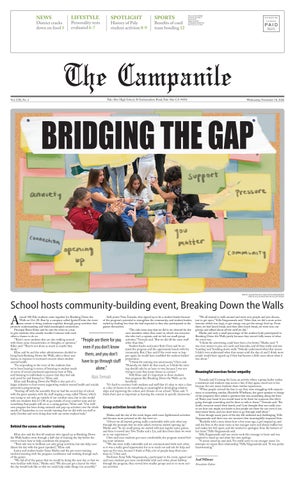
BRIDGING THE GAP
BRENT KLINE/PHOTO USED WITH PERMISSION PHOTO ILLUSTRATION BY ELLEN WANG
!"#$$%&#$'('&"$))*+,(-./*,%0,+1&232+(4&56278,+1&9$:+&(#2&;7%%'
A
round 300 Paly students came together for Breaking Down the Walls on Oct. 28. Run by a company called Ignite2Unite, the event was meant to bring students together through group activities that promote understanding and build meaningful connections. Principal Brent Kline said he saw the event as a way to give students who usually wouldn't interact with each other a chance to do so. “There’s more students that are also walking around with those same characteristics or thoughts or opinions,” Kline said. “They’re not alone as much as maybe they think.” Kline said he and the other administrators decided to bring back Breaking Down the Walls, after a three-year hiatus, in response to increased concern about student mental health. “I’m responding to the voice of the students that we’ve been hearing in terms of listening to student needs in terms of social-emotional experiences here at Paly, and listening to individuals to ensure that they feel safe and cared for and listened to,” Kline said. Kline said Breaking Down the Walls is also part of a larger initiative to host events supporting student mental health and suicide prevention programming “Starting off with the assembly that we had the second day of school with the guest speaker, with the staff singing a song called ‘Home,’ which was trying to not only go outside of our comfort zone, but to also model with our students that it’s OK to go outside of your comfort zone and do something that people will see as a caring gesture,” Kline said. ”Our wellness program has been doing outreach and pop-up activities over the whole month of September, to our suicide training that we did with our staff in early October and we’re doing that with our entire student body.”
Still, junior Naia Tormala, who signed up to be a student leader because of the program’s potential to strengthen the community, said student leaders ended up leading less than she had expected as they also participated in the games themselves. “The only extra step that we did is we cheered for the crew members when they came in, which was everyone else who isn’t a captain, and we led our small group activities,” Tormala said. “But we did all the same stuff other than that.” Student leader and junior Kyle Chen said he enjoyed the program and the opportunity bonds with his community. But, Chen said if the event were to happen again, he would have modi#ed the student leaders’ preparation. “I think the training was unnecessary,” Chen said. “Honestly, we didn’t do that much, so I think the training should only be an hour or two, because I was not trying to miss that many classes as a junior.” Still, Kline said it's important to show students that programs like Breaking Down the Walls can be bene#cial. “It’s hard to convince both students and staff that it’s okay to miss a class or a day of classes to do something as meaningful as developing relationships and improving the culture and climate of our school,” Kline said. “I think that’s just as important as learning the content in speci#c classrooms.”
!"#$%&#'()#'*+#)#',$)'-$.' #/#0'1,'-$.'2$03*'40$5' *+#67'(02'-$.'2$03*' +(/#'*$'8$'*+)$.8+'9*.:' (&$0#;< !"#"$%&'(")"
Behind the scenes at leader training Kline also said the #rst 60 students who signed up as Breaking Down the Walls leaders went through a half-day of training the day before the event to learn how to help coordinate the program. “Their role was to facilitate not only group activities, but also help coordinate the day with the guest (speaker),” Kline said. Junior and student leader Siena Marku said the pre-event training involved meeting with the program coordinator and working through each of the games. “We did all of the games that we would be doing the next day so that we were familiar with them,” Marku said. “We also just got a layout for what the day would look like so that we could help make things run smoothly.”
Group activities break the ice Marku said the day of the event began with more lighthearted activities and became more personal as the day went on. “(Once) we all started getting really comfortable with each other just through the prompts that we were asked, everyone started opening up,” Marku said. “In my small group, we started with just regular name games, and then it moved into Two Truths and a Lie, and then from there we went on to our experiences.” Chen said once students got more comfortable, the program started feeling more intimate. “We also were really vulnerable and we communicated with each other, so it was a really good opportunity for us to reach out and ask for help and open up for once, because I think at Paly, a lot of people keep their emotions in,” Chen said. Freshman Suraj Yella Singanamala, a participant in the event, agreed and said once students got more comfortable with each other, about halfway through the program, they moved into smaller groups and on to more serious activities.
“We all started to walk around and meet new people and just discuss, just to get open,” Yella Singanamala said. “After that, we did a more active exercise, which was (tag), to get energy out, get the energy level up. From there, we had lunch break, and then after lunch break, we went into our groups and talked about all the stuff we did.” Marku said only a small percentage of the student body participated in Breaking Down the Walls partly because they weren’t fully aware of what the event was. “I think the advertising could have been a lot better,” Marku said. “I was even meant to pass out cards and barcodes, and all they really said was ‘bonding’ and ‘breaking down walls.’ Nobody understood what that meant. I didn’t even understand what that meant until the day of, and I think more people would have signed up if they had known a little more about what it was about.”
Meaningful exercises foster empathy Tormala said Crossing the Line, an activity where a group leader makes a statement and students step across a line if they agree, stood out to her because she saw many students share similar experiences. “When people crossed the line to say they were struggling with expectations or something similar, (Rochelle Whellams, the guest speaker in charge of the program) then asked a question that was something along the lines of, ‘Raise your hand if you would want to be there for someone else who’s going through something and be there to talk to them,’” Tormala said. “Basically everyone raised their hands, and I just thought that was really nice to see how you might not know it, but people are there for you even if you don’t know them, and you don’t have to go through stuff alone.” Even though many parts of the day felt awkward and challenging, Yella Singanamala said there was one moment that meaningfully impacted him. “Rochelle told a story about how a few years ago, a girl stepped up and said she lives in the same room as her younger sister and always bullies her and makes her feel upset, and she wanted to apologize from the bottom of her heart,” Yella Singanamala said. Yella Singanamala said one senior took this message to heart and was inspired to stand up and share her own apology. “A senior stood up and said, ‘I’m really sorry to my younger sister,’ (in attempts to) repair their relationship,” Yella Singanamala said. “It was pretty heartwarming.”
Asaf Milman
Newsletter Editor
The Campanile
Wednesday, November 18, 2026
2
News
DOE opens investigation into PAUSD surrounding use of Wheel of Privilege Glass wrote in his email that the district is looking into how the Wheel of Privilege was used in class and how parent requests were processed. However, he said students were not required to complete any activities regarding the wheel. “Both (Paly and Gunn High School) have confirmed students were not asked to complete the activities named in the letter, and that any parent can ask to review instructional materials through their child’s teacher, the school principal or our Educational Services office,” Glass wrote. Farina wrote that the wheel was used to explain the concept of privilege and that it was not part of a standardized curriculum. “All of (the Ethnic Studies teachers) cover privilege,” Farina wrote. “Some of us use the Wheel of Privilege to teach it, but others do not. All classes facilitated a reflection in private journals about privilege; some allowed for small group discussion as well.” Li said the Wheel of Privilege was presented as an in-class activity. “The outside is the least privileged, and then the inside is the most privileged,” Li said. “And I think he made some examples. I don’t think he asked us, ‘Where do you put yourself on this list?’ It was just given as an example and a diagram to help you understand.” Li also said her teacher asked the class to reflect on the Wheel of Privilege, but students were not forced to share personal information. “He never asked what we thought,” Li said. “He definitely asked us for a self-reflection of where you personally think you fall, but I don’t think it was invasive or anything. I think it was fairly normal. I don’t think there’s anything wrong with it.” Sophomore Walt Evans said in his class, a short, voluntary conversation ensued after his teacher talked about the Wheel of Privilege. “I do think there was some form of a talk and share about your experiences relating to where you are on the wheel,” Evans said. “It wasn’t required to share, but it naturally evolved into one.” Still, Evans said there was no survey involved or any obligation to share out with the class. “There was nothing about being forced to complete a survey or share out,” Evans said. “You weren’t forced to share out. It was more voluntary.” And Li said she thought the Wheel of Privilege was a beneficial activity.
!"#$%&'#()*&+&)',#) +&-$.+&%)#,)%.(/0,(&) 1'2#3.'45)&.#3&+)#,) $(),+)#,)&1/3),#3&+67
RT
BY
EL LE N
W A
N
G
!"#$%&'(")#*+,#$-,
A
A
ccusing the district of violating federal parental rights laws, the U.S. Department of Education’s Student Privacy Policy Office opened an investigation into the Palo Alto Unified School District and two other Northern California school districts on Oct. 26. The investigation centers on the classroom use of the Wheel of Power/Privilege and Mapping My Identities activities, which are part of PAUSD’s mandated freshman Ethnic Studies course. The Department of Education alleges these activities required students to reveal intimate details about themselves and their families without parental consent or knowledge. In an email to The Campanile, Ethnic Studies teacher Christopher Farina wrote that students were not forced to disclose compromising information. “The DOE’s concern is that we required students to disclose sensitive information,” Farina wrote. “Students were not required to disclose anything, either to us or to each other. They were asked to reflect privately in their journals on elements of their identity of their choosing. Nothing specific (was) required.” Superintendent Jason Glass wrote in an email to The Campanile that the Department of Education has only presented allegations, which the district is investigating. “On whether the syllabus or materials should change, we are reviewing our practices, and if we find something that should be done differently, we will correct that,” Glass wrote. “However, it is important not to prejudge that decision. An allegation is not the same as a finding.” The Wheel of Privilege was developed in 2020 by Canadian educator Sylvia Duckworth. The stated goal of the activity according to its website is to showcase that people hold several social identities at once — race, gender, class, ability and more — and those identities interact rather than simply add up. The investigation seeks to determine whether the district violated the Protection of Pupil Rights Amendment, which states, among other things, that schools which receive federal funding are required to notify parents and obtain their written consent before surveying students on intimate information, including political beliefs, sexual orientation and religious affiliation. Sophomore Kimberly Li said the Wheel of Privilege she encountered in Ethnic Studies was composed of various categories. “It was a wheel, and then it had a lot of ‘-isms’: ageism, racism, wealthism,” Li said. “It was a lot of skin color, citizenship, gender, language, wealth.”
“I thought it was a really good representation of the levels of privilege because there are a lot of different factors like housing, wealth, race,” Li said. “So I think it really helps me see other perspectives and other factors of privilege and power.” Glass wrote that the district will continue to update the community as the investigation develops. “The Department sets the timeline for its review,” Glass wrote. “We will respond to the Department and keep our community informed as this moves forward.”
Ethnic Studies teachers Katya Villalobos, Benjamin Bolanos and Corbin Dodd all declined a request for comment, instead directing interviews requests to Superintendent Glass. Frank Miller, Director of the U.S. Department of Education’s Student Privacy Policy Office, also declined to comment.
Dashel Chun
News & Opinion Editor
Wednesday, November 18, 2026
The Campanile
News
A
Attack on Snacks
fter a ASB-organized sophomore ice cream social on Sept. 18 was cancelled for violating the district’s policy regarding food distribution at school sites, Superintendent Jason Glass proposed revisions to the School Wellness Committee regarding this policy. ASB President and senior Katie Kim said the purpose of the canceled social was to give students a chance to unwind, connect and enjoy food. But Kim said the district notified ASB adviser Alyssa Bond of the policy violation 30 minutes before they began serving students. “Right before the Class of 2029 had their social on the quad after school, Mrs. Bond was notified that we were not allowed to distribute food that does not follow the nutritional food guidelines outlined by the district board until 30 minutes after the bell,” Kim said. Glass wrote in an Oct. 26 memo that the district’s food policy comes from Administrative Regulation 5030, which sets nutrition standards for food given to students during the school day, including at ASB events. PAUSD nutrition standards follow the federal Smart Snack Standard which requires any food sold to students to have 200 calories or, 200 milligrams of sodium or less, 35% of calories from fat or less, less than 10% of calories from saturated fat, 0 g of trans fat, 35% sugar by weight or less. In addition, there must be 0 grams of trans fat and less than 35% total sugars by weight. These federal guidelines only apply to food that is sold to students. However, PAUSD policy states free food must follow these rules as well. In an email to The Campanile, Glass wrote that the proposal of revisions to the guidelines was created because of concerns voiced by the Paly Student Board Representative. “Student board representative Helen Li raised concerns this fall that the rules were limiting ASB socials, club activities and events like Snack and Study, and I thought she had a fair point,” Glass wrote. Based on district policy, free food that does not adhere to the regulations can not be served between midnight and 30 minutes after the last class ends. Three exemptions from the policy are allowed each year for schoolwide events. Currently, Paly uses two of these exemptions on the Back-toSchool Barbecue and the Cultural Fair. Bond said the policy is not new or unique to ASB. “This is a district policy that also is state and federally mandated for schools,” Bond said. “It is something that has always been in place. This year, they’re just looking at them more strictly.” However, Kim said following these guidelines would mean hosting socials 30 minutes after school ends, which she thinks is not just. “Students are very busy, and most of them do not have time to stay after school as they have arranged rides and other conflicting commitments,” Kim said. “Not only this, but students taking the school bus are also therefore barred from participating, which is unfair.” Glass said the current policy is stricter than what the state and federal law requires, and he proposed six changes to policy that will modify the restrictions. These changes include changing the time free food can be served from 30 minutes after school to right after school, providing a more detailed approved snack list, allowing exempt events to extend up to five consecutive days and allowing the serving of all food if it is served only to a club’s members. “My direction has been to open up opportunities where we can and keep the regulation no more restrictive than the (state and federal) policy,” Glass wrote. Bond said the most challenging part about following the current guidelines is saying no to culture-based clubs who want to share their food with the school. “We want to encourage groups to reach out to the community and to gain more people into their groups and to establish those connections,” Bond said. “One of the beautiful things about clubs is that they can really
3
DASHEL CHUN/THE CAMPANILE
Senior Jocelyn Luna Trejo and freshman Allison Rosas, members of the Latinos Unidos club, hand out fresh fruit to senior Aurelia McKinney on the quad on Nov. 4. Although Student Activities Director Alyssa Bond said ASB was going to hand out more cultural and festive foods at the event, a newly enforced district policy forced a change. “They pivoted with what food they wanted to offer, and they’re just doing fresh fruit, which falls within the healthy snacks,” Bond said.
reach a wide group of people who may not have even known that they had similar interests.” ASB has no upcoming socials planned until the policy is revised, which is expected to happen after a Dec. 4 discussion between the Wellness Committee and Dawn Yoshinaga, the Director of Mental Health and Wellness in PAUSD. Junior Darwin Collins said he was disappointed when he heard there were no socials planned in the near future. For Collins, socials are an easy way to make new friends. “It helps you meet other people,” Collins said. “It’s a reason to socialize, especially in a place where there’s a lot of academic stress.” Junior Kyvan Chen said that he goes to ASB socials often, usually for friends and food.
“I think that food is a major aspect of socials because they provide an incentive for people to attend and socialize,” Chen said. “I’m not sure if my friends and I would still go to any social events if food wasn’t provided.” Moving forward, Kim said she hopes everyone will be able to enjoy food and snacks at school, even with the limited number of exceptions offered. “I hope for there to be real policy change, as this enforcement does not just affect ASB events and socials, but also clubs and their ability to include food in their activities,” Kim said. “We want there to be equal opportunity for all clubs and ASB to be able to have food in their events and this makes it di%cult to determine who gets those exception days.”
Matthew Hong Staff Writer
@&%;)*'$8(&$%$3#+$3)*+#&
!"#$%&'#()*+,(+-.#/,"'#0"('#1%()#*+2'*3#*,%-#,-3#4''3%-5#()%.#1%-(+*6#7*'87(%-5#2'889-%(:#7*+7,*,(%'With Michelle L’Heureux, a physical scientist from National Weather Service, projecting that this year’s El Niño will be stronger than usual and perhaps on par with the strongest El Niños ever recorded, California Gov. Gavin Newsom has declared a statewide emergency, urging residents to prepare for a “Super El Niño” winter. El Niño is a climate pattern that occurs when the ocean absorbs solar radiation, causing its surface to warm.This warming weakens trade winds, or east-to-west winds, and pushes warm water east towards the west coast. This releases heat into the atmosphere and can increase global temperatures by 0.1 to 0.3 degrees Celsius around three to five months after the ocean warming peaks. AP Environmental Sciences teacher Nicole Loomis , said Palo Alto residents should be prepared for potential extreme weather as a result of El Niño. “Even though we have no storms, we are going to have massive flooding all the way up and down California, and it’s going to come around for Thanksgiving and again over Christmas,” Loomis said. For students living in low-lying areas, heavy rainfall brings a real threat of property damage. Senior Lise Concolato has seen the warnings firsthand. “I live in a zone of Palo Alto that (is) a flooding zone, and so we’ve had some emails sent to us saying, ‘Be careful about El Niño
because it might cause floods in your area,’” Concolato said. “Our house is super close to the Baylands and also next to one of those creeks, and so I think both of those together could lead to flooding in my area.” Because of this, Concolato said she and her family have taken the necessary precautions to prepare for this winter. “We’ve bought sandbags to cover our doors and mostly our garage because it’s like the lowest point of our house, and we also are planning on buying tarps to put those sandbags on, so that the least amount of rain possible or water can get into the house if it does end up flooding,” Concolato said. “In the past years when there’s been major floods like this, we’ve also done the same.” San Francisquito Creek — located along the northern edge of Palo Alto — is especially susceptible to flooding primarily because it is a perched creek, meaning it flows at an elevation higher than the surrounding floor. This is further exacerbated by extensive roofs, paved surfaces and parking lots that prevent rainwater from soaking into the ground, increasing the speed and volume of stormwater runoff. However, protective provisions are already in place. During the 1997-1998 El Niño when San Francisquito Creek flooded around 1,700 properties in Palo Alto, East Palo Alto and Menlo Park, elected o%cials from the three cities along with local organizations including the San Mateo County Flood and Sea Level Rise Resiliency
!"#$%&#$'()*'$+($,%-#$ .%//)-#$0((1)*'$%22$ +,#$3%4$56$%*1$1(3*$ 7%2)8(&*)%9$%*1$)+:/$'()*'$ +($;(.#$%&(5*1$8(&$ <,%*=/')-)*'$%*1$%'%)*$ (-#&$7,&)/+.%/>? !"#$%&'($$)"*
District and the Santa Clara Valley Water District, formed the San Francisquito Creek Joint Powers Authority . The SFCJPA helps plan, design and construct capital projects to protect homes and businesses from creek overflows. In 2019, the SFCJPA completed the first part of its Comprehensive Plan to reduce the risk of flooding, which Palo Alto Mayor Greer Stone said helped strengthen floodprone infrastructure. “This project doubled the creek capacity in the area from about 4500 cubic feet per second to about 9000 cfs,” Stone said. “We also coordinated with Caltrans in their design to fix Highway 101 that flooded in 1998 and created more than 22 acres of new and improved marshplain that acts as a sponge to absorb flows.” Stone also said current projects are in place for this year’s El Niño to reduce flood risk. “We are currently evaluating alternatives that can meet our design goal of 7200 cfs, which is the highest measured flow since data has been collected at the USGS stream gauge since the 1930s,” Stone said. “It is considered to be a 70-year flow event. We also have a third project called SAFER Bay to address tidal flooding and projected sea level rise.” And an important flood-preventing resource Loomis cites is the Baylands since its wetlands absorb floodwater themselves. “Make sure that it stays there and no one builds anything on it because that is our sponge,” Loomis said. Concolato said she has noted other helpful measures within the school’s infrastructure. “I think Paly has done a good job in the past years putting out wooden planks,” Concolato said. “So, as long as they keep doing that in the areas that have major puddles or systems like that, and just mak-
SAN FRANCISQUITO CREEK JOINT POWERS AUTHORITY/USED WITH PERMISSION
The Pope Chaucer bridge is a chokepoint that is a flood risk during significant atmospheric events. Vice Mayor Greer Stone said the City is working to strengthen the resistance to flooding. “This project doubled the creek capacity in the area from about 4500 cubic feet per second to about 9000 cubic feet per second,” Stone said.
ing sure that everyone stays safe and isn’t running around on slippery ground.” She also hopes to see more indoor space for students. “I think our infrastructure is pretty good,” Concolato said.“Maybe having some more spots open in Paly to allow people to eat inside and indoors when it’s raining be-
cause it can get really cold, and our outside tables can be wet (could be helpful), but I think otherwise, Paly does a good job, and I just hope everyone stays safe.”
Emily Chan Staff Writer
The Campanile
Wednesday, November 18, 2026
4
News
A Nobel win close to home
K
arl Deisseroth, a Stanford University professor of bioengineering, psychiatry and behavioral sciences, and a Paly parent, won the Nobel Prize in Physiology or Medicine on Oct. 5 for work that lets scientists control the brain with light. He shares the prize with Peter Hegemann and Georg Nagel, whose discoveries, the Nobel committee said, made it possible to “switch individual neural circuits on or off in the brain.” Hegemann and Nagel discovered that certain algal proteins act as ion channels that open in response to light, according to the Nobel article. Deisseroth later inserted the algal genes into rat nerve cells, and blue light set off a signal in neighboring neurons. With this, Deisseroth, Hegemann and Nagel had reached their goal of being able to turn neurons on and off within living animals. In 2006, Deisseroth is credited with naming this method as optogenetics, which helped researchers understand how the nervous system connects with other parts of the body. Deisseroth said this discovery was not made from one specific discovery, but rather through years of research. “It’s a complex technology that took a number of years to develop,” Deisseroth said. “I did one experiment in 2004 that showed me very clearly that these genes from algae could be safely put into mammalian brain cells and used to control the cells with light. Even though that first experiment was just done in a dish in the laboratory, it de-risked a great deal of the overall process because it was quite unlikely that it would work at all. A few years later we did an experiment in a freely moving mouse that was equally exciting because it showed that this approach applied to the large and complex brains of mammals.” As both a neuroscientist and psychologist, Deisseroth said he is able to understand patients’ wellbeing at a fundamentally deeper level, which helps him in his research. “As a psychiatrist I have the privilege of hearing the thoughts and feelings of human beings, both when they’re healthy and when they’re suffering, and this motivates me to help them and to understand the brain more deeply,” Deisseroth said. “Having seen patients, having spoken with them, knowing what is important to them, I’m able to guide the experiments that happen in the laboratory in much more useful ways than if I were just somebody reading lists of symptoms in a textbook.” When Deisseroth received news of the prize, his family was the first to know. His son, junior Hudson Deisseroth, said he was amazed by his father’s achievement. “My dad told me that he won a Nobel Prize, and I was just completely beside myself,” Hudson said. “It took me 10 minutes to grasp the first wave of feelings before I was ready to function. The whole gravity of it hadn’t really dawned on me until a couple days later, but it was such a surreal feeling to hear that.” Leading up to the news, Hudson said he knew his father was doing great things, but he didn’t know the extent of his accomplishment, especially given his father’s humility. “I knew that the things he was doing were incredible, but the Nobel Prize just always seemed so far up there,” Hudson said. “It was one of the greatest things you could do in a career, so I just never really gave it that much thought, especially because my dad never really made a big deal about it, and even after he won, he didn’t really make a big deal about it. I didn’t expect it, but in hindsight, it makes sense because it’s an incredible discovery that he made.” Aside from his family, others such as biology teacher Elizabeth Brimhall and Health Occupations Students of America president Ashley Shin, were astounded by the news. Brimhall, a Stanford alumnus, said she finds Karl’s research fascinating and thinks it has future applications.
JIM GENSHEIMER/USED WITH PERMISSION
Nobel Prize winner and Paly parent Karl Deisseroth poses for a portrait at his lab at Stanford University in August of 2021. “As a psychiatrist I have the privilege of hearing the thoughts and feelings of human beings, both when they’re healthy and when they’re suffering, and this motivates me to help them and to understand the brain more deeply,” Deisseroth said. Deisseroth is the winner of this year’s Nobel Prize in Physiology or Medicine.
“I’m always excited when someone from my alma mater wins a Nobel Prize,” Brimhall said. “It’s cool, and I also just think the research he’s doing, given that it probably could have applications for things like Alzheimer’s and dementia — things that are becoming really common — (is) going to be important.” Shin said she was inspired by Karl’s work and his dedication. “I was really surprised seeing someone so close to Paly winning or receiving a Nobel Prize, especially because the thing that he won or got the Nobel Prize for was very interesting, and I feel like it’s something that only if you’re passionate about the topic you would be able to go into,” Shin said. “Coming from somebody who’s also interested in neuroscience and in medicine, I thought that his discovery gave me inspiration, knowing that I could probably do something like that in the future or contribute something like that.” Shin also said she thinks discussing Karl’s achievement in her club will expand students’ aspirations. “I think that that’ll get more people to know what they can do, and also I think it’ll give more people inspiration on the different career possibilities,” Shin said. “I feel right now a lot of the students in our club want to be either nurses or doctors, but they don’t know there’s so many other jobs that you can do in the medical field.”
Accordingly, Karl’s own career advice for those interested in medicine would be to follow one’s passion. “There are many paths in medicine that allow people to focus on the particular things that interest them, that motivate them, that seem complex and interesting and beautiful in their own right,” Karl said. “This is a very personal decision since you’ll be best at doing what you’re most interested in, and so identifying one’s particular passion is a very key step.” Hudson said by watching his dad persevere through challenges, he keeps in mind his dad’s piece of advice to continue resolving challenges one step at a time. “My dad always says that the best way to get something done is just a little bit every day,” Hudson said. “After a week or a month, you look back on consistent work, no matter how big it is each day. You’ve done something, and that’s what matters. I definitely try to think of that every time I tackle something that seems really big or overwhelming.”
Kira Tzeng
Managing Editor
!"#$%&"'(')*+$",'-*')#$$'+.'/#$-'0#1*'21-* Brooke Bressler
Social Media Manager East Palo Alto voters approved Measure O on Nov. 3, with 71.96% of voters supporting it at the time The Campanile went to print, making it the first city bond measure in East Palo Alto’s history. As a $125 million bond, Measure O’s supporters say it will improve the city’s infrastructure, with construction projects likely starting in 2027. The city plans to build a larger library, consolidate three city hall buildings into one, construct a civic center plaza, improve water pipes, provide the police headquarters with a permanent building and construct a new running track. The bond will take effect between 2028 and 2029, and levy a property tax of $105.26 per $100,000 assessed value on East Palo Alto properties until the bond is paid out. The city has already contributed $20 million to these projects from its general fund and if passed, plans to raise another $10 million following the bond’s approval. Final approval results will be known on Dec. 11 when the Secretary of State certifies statewide election results. However, some amenities, like the running track, will be funded by private donors. Senior and East Palo Alto resident Sione Fusimalohi said the property tax may make it more di$cult for East Palo Alto residents to afford homes. “It would increase our mortgage by about $300, $400,” Fusimalohi said. “For us, that’s a pretty big weight on our shoulders — so for that, I feel like it is a little rocky, because even though we’re getting so many benefits, and we’re able to reap them in future years, for us to be able to pay (the bond) off, we’ll still have that monthly tax for 20 to 25 years, which I know will have a significant impact on a lot of families, especially because many families in East Palo Alto are low income. I know for sure that those families will definitely be hit the hardest, especially those who are renting. ” Until 1983, East Palo Alto was an unincorporated community — an area that is under county jurisdiction but does not have its own municipal government — whereas surrounding cities like Palo Alto and Menlo Park have been incorporated since 1894 and 1927, respectively. Because of this, East Palo Alto Vice Mayor Ruben Abrica said East Palo Alto is trying to catch up
to surrounding cities with better funding and communal spaces. “We don’t have a lot of resources, we don’t have a lot of money, and people would not support (Measure O) if it was only city hall, for example, or even the police department,” Abrica said. “But for a library and saving money, that’s really the main (goal).” Abrica said replacing the current police portables with permanent buildings will save the city money in the long term because of the rent the city currently pays to the county. East Palo Alto City Council member Mark Dinan said the worn-down infrastructure and detached o$ces in East Palo Alto make it hard to recruit municipal o$cials. “We have obsolete facilities that are tremendously out of date and hard for recruitment,” Dinan said. “Nobody wants to work in a terrible building. It’s hard to manage when you have a city manager with important employees that are located half a mile away from where the o$ce is.” Dinan said improved infrastructure will also reduce the effects of redlining because East Palo Alto has historically been underfunded due to discrimination. “In every city — Palo Alto, Mountain View, Menlo Park, etc.— there’s always a time and a place when people step up to get things done, and now is the time for us to do that as a city,” Dinan said. “This is reversing redlining.” Junior and East Palo Alto resident Emilia Angulo said she thinks the improvements to East Palo Alto’s infrastructure will benefit minority communities. “A lot of the time, surrounding cities might not think of East Palo Alto as (measuring) up to Palo Alto, or it essentially doesn’t do anything like Palo Alto does. That it’s very barren. Some maybe refer to it as ghetto,” Angulo said. “I think (the city is) not trying to replace the minority communities in East Palo Alto, but make it better for them. I think that’s a really good way of (improving) East Palo Alto.” Despite the benefits, Fusimalohi said rising housing costs have already displaced residents, and he worries Measure O could add to their financial struggles. “A lot of us are already starting to leave East Palo Alto,” Fusimalohi said. “A lot of my neighbors are starting to become a lot more people who work at Stanford and tech companies, and the people who used to live there, who were strong, long-term East Palo Alto
!"#$%&$'$(&)$*+),$),#$ -.'/#0$12)$,'3+45$'$1+55#6$ -.'/#$*&2(%$%#74+)#(8$5+3#$ 2-$9&6#$/,&+/#-$)&$5+3#$ %+:#6#4)$.6&56'9-$'4%$1#$ 9&6#$-.#/+7/$*,#4$+)$/&9#-$ )&$%+3+%+45$),#$.6&56'9-$ ),')$*#$.6&3+%#;< !"#$%&'(%)$*+,-.)
BROOKE BRESSLER/THE CAMPANILE
East Palo Alto library assistant Elizabeth Gonzalez and manager Ismael Betancourt assist a mom and daughter. “It would be amazing to have a dedicated space where people can eat their meals and stay in the library and use our services,” Betancourt said.
residents, are moving out because they are simply priced out of our homes. I can already see that (Measure O) might be negative.” And Fusimalohi said the bond’s passing in combination with a lack of residential rent control from the city will hurt vulnerable renters. “We already have a lot of tenant issues as of right now,” Fusimalohi said. “With this tax, and with this measure to be passed, I already can tell that their rents are going to rise up, and without a lot of rent and control that is present within the city of East Palo Alto, I can tell that a lot of families will be impacted negatively by this bond passing.” Although Fusimalohi worries that the bond may be a financial challenge for renters, Abrica said features of it, including the new library, will be a great community resource. “If you look at the libraries in Palo Alto, they redid the Mitchell Park Library into a community center where you can have events,” Abrica said. “It’ll be for the benefit, not only currently, but for the future generations.” Additionally, Ismael Betancourt, the East Palo Alto Library manager, said a larger library would be beneficial for a variety of reasons. “We do a lot with the space, but having a bigger space would definitely give us more choices to give
different programs and be more specific when it comes to dividing the programs that we provide,” Betancourt said. As an example, Betancourt said the East Palo Alto Library serves meals to families on weekdays, but there is nowhere for people to sit down to eat their meals. “It would be amazing to have a dedicated space where people can eat their meals and stay in the library and use our services,” Betancourt said. “Right now, families eat anywhere they find space.” Betancourt also said the community needs a space large enough to accommodate the different needs of library users. “We have story time with the adult program going at the same time,” Betancourt said. “It’s di$cult because the kids are singing, having fun, making a lot of noise, but then we have a presentation on sustainability. So definitely having spaces that teens, families and adults can use would be amazing.” Ultimately, Dinan said he looks forward to the benefits Measure O offers to East Palo Alto and its residents. “This is a wonderful opportunity for East Palo Alto,” Dinan said. “It’s expensive; everything’s expensive, but it would be more expensive this time 10 years from now. If you want to live in a functioning city, you have to invest in these things.”
Wednesday, November 18, 2026
The Campanile
5
Lifestyle
A
The Paly Past
!"#$%&%'()*+#,-*-,'.,-$*',-"*&%/-0*"-1-2&%(3*)&4$-(&*24.&4"-*2+#(3-)
s one of the oldest high schools in the Bay Area, Paly’s history is filled with records of students, teachers and traditions going back decades, which is accessible to the public through the Paly Journalism Archive at https://palyjournalismarchive.pausd.org/. Founded as a private school in 1894 and then turned into a public school a few years later, throughout the school’s 132year history, traditions have come and gone. But some of the most prominent ones have stuck around. One example includes seniors wearing camouflage, which began in 1997 when the senior class’ spirit week theme was GI Joe. The following senior class liked the look so much, they decided to keep it. To this day, on the first day of school, the graduating class dons black tops and camo bottoms. Another iconic tradition is Spirit Week, which first began as Girl’s Jinx in 1922, a series of skits celebrated in the auditorium. It evolved into the welcome back Friendship Week in 1951 and over time took the shape of the current Spirit Week. The Generations-themed day dates as far back as 1954. Based on journalism records in The Campanile, Paly was the first school to have a spirit week, influencing schools across the nation to celebrate spirit through dress up days, games, rallies and dances. But some traditions have left Paly, including those that encouraged hazing and violence and promoted traditional gender roles. Looking back, Paly’s colorful history has been full of traditions that have made an impact on both its students and the wider Palo Alto community.
Little Big Game promoted cross town rivalry Current students may not remember a time when Paly played cross-town rivals, Gunn High School, in boys’ tackle football in what was called the “Little Big Game.” Starting as a tradition in 1929 between Paly and then-rivals Sequoia Cherokees, now called the Ravens, , the Little Big Game was an annual tradition hosted on Thanksgiving Day at the Stanford footballsStadium that celebrated a rivalry between the two big schools on the peninsula. The last Paly-Sequoia Little Big Game was in 1973. According to history teacher and 1991 graduate, Steven Foug, in 2001, parents revived the Little Big Game, this time against Gunn. That year, Foug was working as a teacher and coach for the football team. “As a coach, we got dressed, and then the police blocked off El Camino, and we just
walked across El Camino,” Foug said. “It was the old stadium, the big bowl, but it was really cool. That was a once-in-a-lifetime type of thing.” Nancy Shepherd, a former mayor of Palo Alto whose kids and grandkids graduated from Paly, the idea of bringing back the Little Big Game came from parents who wanted to unite the community after the events of 9/11. “We needed to do community builders, and I had heard about the Little Big Game,” Shepherd said. “It was a moment in time to try to reinvent it, and at that time, our rival was Gunn High School.” According to a 2001 article in The Campanile, the game brought 6,000 fans to Stanford Stadium. After 2001, Paly and Gunn continued to play an annual football game until 2012, when the teams went to different leagues. Although the Little Big Game is a tradition of the past, Paly and Gunn students still engage with each other. Junior and ASB Vice President Olivia Woo said having a rivalry with Gunn makes sports and spirit between the two schools more fun. “I do hope that we can have some more friendly rivalry with Paly-Gunn sports games, just because it brings a lot of spirit into Paly students, and I’m sure it goes the same for Gunn as well,” Woo said. “It’s just a fun experience to meet students from across the neighborhood, and I hope that we can go about our rivalry with Gunn in a respectful way, so that we can continue to have fun things to do together.”
Streaking encouraged indecency, chaos sexual harassment In the early 2010s, during the last week of school, you would not be surprised to see a naked senior with a ski mask covering their face sprinting across campus. Streaking was a campus tradition for a while, particularly among seniors seeking to rebel. According to Assistant Principal Jerry Berkson, one year there were as many as 106 streaking incidents. “It was basically just the principal working alone, and it was kind of tough to stop 106 kids from streaking,” Berkson said. Today, streaking seems to be a non-issue on campus. The Paly student handbook, in fact reads,“Seniors who are caught streaking will be suspended for two days. Students will also meet with (the Palo Alto Police Department). If streaking continues, students will be in jeopardy of not participating in their senior activities, including graduation.” According to Berkson, any student will be punished for actions against the law,
against the rules, and cost the school money. Any student would be suspended “As a senior, they probably would not walk for graduation,” Berkson said. Foug said some retired traditions like streaking and those that focused on hazing and destruction of property went too far and had to stop. “There’s things that have happened and reached levels where it’s no longer tolerable,” Foug said.
“We couldn’t have seniors being violent to other students in the name of their seniority,” Launer said. “They were taking it too far, and the beginning of school is meant to be unifying, not terrifying. I’m glad we have switched to better traditions like the back-to-school assembly.”
Freshmen Friday left underclassmen scared of going to school
Some traditions, such as seniors wearing camouflage, flash mob dances during spirit week and the cultural assembly, look like they will continue. Foug said the cultural assembly is one of his favorite new traditions. “I think it’s really nice to see students celebrating their cultures and trying out foods and things that come from other students’ backgrounds,” Foug said. “We need more traditions that focus on unity.”
Perhaps one of the school’s most damaging traditions was Freshmen Friday. Practiced on the last Friday of each month and reaching its height in the 2000s, it was an attempt by seniors to scare freshmen and assert dominance on campus, often through physical violence, egging and taping freshmen to poles. According to Foug, as a freshman, he witnessed a fellow student being snatched off their bike and attached to a tree as he entered campus near the Churchill lot. “His buddy walks up with an industrial roll of plastic wrap, (the kind) you get at the butcher,” Foug said. “They whisked the kid up on the tree and Saran wrapped him to the tree.” English teacher and former student activities director Kindall Launer said one year there was an incident where seniors confused middle schoolers for freshmen and beat them with paddles, leading to the involvement of law enforcement.
Traditions promoting unity and school spirit to stick around
Woo said events like the back-to-school rally can remind students of the fun parts of the school year to look forward to. Sometimes students can get a little bit intimidated by the incoming school year or the school and the workload because Paly is competitive,” Woo said. “It’s just a great celebration at the beginning of the year to show freshmen what Paly school spirit is all about.” Some traditions leave, some take new forms and some never change. Regardless, Shepherd said traditions are important for keeping a community unified. Shepherd said, “I think that it’s always good to have traditions because it keeps people bound together.”
Leilani Chen
News & Opinion Editor
RT
A
BY
A IL LE
H
IC
N
EN
‘Who Iz I’ arrives twenty years too early
https://sacha-baron-cohen.co.uk/film//Fair Use
“Ali G: Who Iz I?”, the much-anticipated return of Sacha Baron Cohen’s was trying too hard to get a laugh, which made everything less funny, more gross wannabe gansta after more than two decades away, isn’t the reboot fans were and even annoying. looking for. The film brings a handful of big laughs, but many scenes feel forced After exposing Ali G to the public, Dr. Nira tries to finish him off by preand repetitive, with Baron Cohen failing to recapture the sharp satire that once tending to be an immigration officer and appealing to conservatives. made Ali G famous. Together, Dr. Nira and Erran Morad a self defense instructor frame Ali G as Like “Borat,” “Bruno” and previous movies with the character Ali G, “Who a deadly cartel leader named Alejandro Gonzalez. They claim Gonzalez runs a Iz I?” is a mockumentary: part scripted story and part social experiment, using brutal gang called Los Chicos del Callejón, which translates to “The Backstreet hidden cameras. Baron Cohen, staying in character as Ali G, interacts with Boys.” That was one of the funnier jokes in the movie and is the start of their real people who almost always don’t know they’re in a comedy. At their best, new mission to destroy Ali G. these movies combine unscripted real-world reactions, sharp political satire and The rest of the movie consists of them carrying out this mission by making gross shock-comedy to expose hidden biases and absurdities in the people he sure Ali G’s baby is born off of American land, but all of it feels staged and the encounters. jokes still feel forced. Unfortunately, “Who Iz I?” rarely reaches those heights. Baron Cohen has trouble reproducing the authenticity of his Other problems include the movie’s soundtrack which leans other movies, when he truly pranked people and tested bound!"#$%"&'#$(&)*+#,$-&$ aries, revealing how far people will go along with bigoted ideas. heavily on Ali G’s own repetitive joke raps, and it’s weak plot that, despite its short runtime of 1 hour and 29 minutes, caused film feels like a piggyback off previous movies in a way that #./&0#$1'2$34$-"&)5"4$ The me to lose interest quickly. makes scenes feel unoriginal, confusing and dull. The movie starts off with Ali G and his wife, Julie, struggling Additionally, Baron Cohen’s idea of testing both sides of the 6##'0$6&*7#8$9+8$'97:#8$ political with financial insecurity because Ali G did not receive a big offer spectrum to see if they would go along with unhinged from HBO. Ali G then introduces his mom, uses her death to *#9'$7&;#8,$&-"#*$-"9+$ ideas is interesting, but his plot lacks real comedy, but rather make some jokes and finds out Julie is pregnant. More jokes folthan comedic, the missions feel too serious and crazy in a dis9$6#%$9<0)*84$*#/#-2-2=#$ gusting way. low. Interestingly, this initial contextualizing segment of the film is one of its moree engaging parts because the jokes don’t feel As a whole, “Ali G: Who Iz I?” has too much gross shock(&:#0> forced, and the plot isn’t confusing. comedy and not enough recognizable figures, or actually funny As the movie progresses, Ali G discovers a 20-year-old letter political satire. The reactions of the people in the movie are often from HBO offering him a job. After celebrating and travelling to America from boring and predicatable, and instead of having different levels of jokes, almost his small town in english, however, he realizes the offer has expired. At this everything was taken to an unnecessary extreme. point, the movie starts going downhill. I do not recommend “Ali G: Who Iz I?”. But if you haven’t seen Baron CoFirst, Baron Cohen brings back another one of his characters, Dr. Nira Cain- hen’s other work like the “Da Ali G Show” or his two Borat movies, definitely N’Degeocello, who he created for the 2018 movie “Who Is America?”. Dr. Nira do that. And then, if you truly enjoy those, you might get some laughs out of this is a liberal whose main goal is to expose Ali G for being a cultural appropriator one, too. and a racist, and Dr. Nira does so by finding real people to help carry out his absurd plans. Dr. Nira tries boycotting Ali G online, but this failed attempt leads him to resort to more severe measures like taking an Ali G semen sample at a DNA testing center, with the help of more unsuspecting civilians. The whole journey to expose Ali G, though, feels forced and lacked real comAsaf Milman edy other than a few absurd, repetitive jokes. The scene where Dr. Nira takes the semen sample from Ali G is disturbing, and it feels so clear that Baron Cohen Newsletter Editor
The Campanile
6
Wednesday, November 18, 2026
Lifestyle
SELF PORTRAIT
!"#$%&$'($)&*($+,-./0$1(23&/,).+#$+(3+3$,/%$2(,%./0$,4&5+$&523()*(36$ I
n a casual conversation about her friend’s new interest in personality tests, senior Hailey Seto found a novel way to learn about herself and those around her. Seto said she enjoyed discussing her personality test with others and seeing how they interpreted her results and their own. “For me, it was just a little geeky obsession,” Seto said. “Honestly, I wasn’t super super into it, but it was always fun to learn about it and see people talk about how ‘Oh, these types of people tend to be like this.’”
Personality tests abundant within pop culture According to Smithsonian Magazine, the first personality test was used to test American World War I recruits’ susceptibility to post-traumatic stress disorder. Personality tests have since developed within pop culture and are often presented as a way to provide greater self-insight. In the time surrounding World War II, Katharine Cook Briggs and Isabel Briggs Myers, students of Swiss psychiatrist Carl Jung, developed the Myers-Briggs Type Indicator test. Rich Thompson, Senior Director of Research of the MBTI company, said after 2007, the company offered two tests, Step I and Step II. “Step One means the four letters — that’s all you get,” Thompson said. “Step Two is the four letters plus 20 facets. Those facets are sub measures, different ways of getting deeper into what it means to be an extrovert or an introvert or what have you.” Another popular personality test is called Big Five. Considered the most established model with scientific research to back it, the Big Five has two versions and indicates levels of five primary traits: openness, conscien-
tiousness, extroversion, agreeableness and neuroticism. Henry Kranzler, a professor of psychiatry at the University of Pennsylvania, said both versions of this test provide greater nuance than pop culture tests or those such as the MBTI. “There are two tests: There’s the NEO Five Factor Inventory and then there’s the NEO Personality Inventory Revised,” Kranzler said. “The latter is 240 items. It not only gives you scores for each of the five factors, but it has facets within each factor, so you can get a more fine-grained measure of personality with it.” A third one is the PrinciplesYou test. In an email to the Campanile, Brian Little, the co-creator of the PrinciplesYou personality assessment, wrote that this assessment was developed for the father of one of his students, who sought to improve the use of personality assessments within his company. Thus, Little said they ran meticulous studies to create the assessment. “PrinciplesYou is based on rigorous psychometric research,” Little wrote. “Most pop culture tests are not. Many invest more in marketing than in providing detailed analyses of its reliability, validity, and utility.” While not created as an explicit assessment, a study in 1995 published by Yuichi Shoda, a University of Washington professor of psychology, and the late Walter Mischel, a psychologist who specialized in personality theory and social psychology proposed the Cognitive-Affective Personality System, a theory focused on the stability of personality traits within specific situations. “Behaviors that may be indicative of conscientiousness may change, (depending) very much on the situation you’re in,” Shoda said. While other tests, such as IQ or aptitude tests, measure quantities of a certain quality, Shoda said personality tests specifically measure emergent qualities. These emergent qualities include characteristics, behaviors or patterns that a complex system gains when its individual parts interact collectively. Because of this, Kranzler said he thinks many pop culture assessments are promotional. “It’s a little hard to generalize about personality tests because there are so many around, and many of them (are) bogus,” Kranzler said. “They’re kind of advertisements.” Alexander Swan, an associate professor of psychology at Eureka College, also said the archetypes are also a marketing strategy. “The scientific ones just aren’t necessarily marketed to people to take,” Swan said. “They are research instruments.”
Tests taken for self-verification, enhancement, insight Christopher Soto, a psychology professor at Colby College who created the Behavioral, Emotional, and Social Skills Inventory personality test, said people enjoy taking personality tests for three general reasons, one of which is self-verification. “Self-verification means confirming things that you already believe about yourself, but it just gives you a language or a framework for thinking about and talking about those things,” Soto said. Similarly, Shoda said many people turn toward these tests to uncover deeper qualities of themselves. “In personality psychology, there is a tendency to think of those personality characteristics as some sort of underlying essence of a person,” Shoda said. “When you do a test, there is this sense that you are kind of finding out the truth about the person that resides somewhere deep in the person.” Thompson also said participants may be interested in the act of taking the test and the ability to understand others’ preferences. “It’s simple, and you can see it,” Thompson said. “Whereas some of the other models, it’s harder to see some of those things, and because they’re on a continuum, it’s not as necessarily as clear. What the MBTI does, it gives you the ability to … find common ground.” This rings true for junior Eileen Lee. “These personality systems define you, but I think it also gave me insight into the kind of person I am because sometimes you just can’t tell what you’re like as yourself,” Lee said. Soto said a second possible motive for taking personality tests is self-enhancement. “Personality tests provide an opportunity potentially for someone to hear good things about themselves,” Soto said. “For example, something that’s always struck me about the MBTI is that there are 16 different ways of being awesome, and it’s just a question of which is your way of being awesome.” And Soto said the third possibility is self-insight which she said is the possibility of discovering something new about yourself.
People may not answer honestly about themselves While each person responds to personality test results differently, Seto said she takes her results with a grain of salt. “It’s always a spectrum, and so in that way, I feel it’s dangerous to trust them too much because most of the time it’s not the box or the archetype that they put you in,” Seto said. The question of whether people accurately describe themselves when taking the tests is something that has also crossed Seto’s mind. “There’s a lot of bias in personality tests because you might put what you want to be or what you think,” Seto said. “A lot of times it’s the whole thing with ‘your actions might not match with your words,’ like the way you think might not always translate to how you act.” Kranzler said the reason for this is the psychological phenomenon of social desirability bias. “It’s the idea that you conform to what you think people will like about you,” Kranzler said. “And everybody engages in it. It’s a well-recognized phenomenon.” Shoda agreed and said believing in personality tests results too strongly can create a self-fulfilling prophecy. “If you believe that these scores reflect the truth, and then if you do well, then you might think that you’re the best at something and that can start affecting your self concept,” Shoda said.
Wednesday, November 18, 2026
The Campanile
7
Lifestyle
WITHIN LETTERS !"#$%&'&()"*"+,-)(%+).+&.+/-0"&.1')*#+*-"*"2+1$$301$#+1.4+0-1$%
But Soto said there are ways to check for these test-taking inaccuracies. “If I take a personality test rating myself, and then you give that same personality test to my friends, my family, my coworkers, and have them rate my personality, you can check to see whether what I say about my personality matches with what other people say about my personality,” Soto said. Another way of checking, which Soto said should be done in tandem with the peer evaluation, is observing how people actually behave. “If you have someone take a personality test, and then you observe their behavior in daily life where you put them into a particular situation to see how they would behave in that situation, you can check to see whether what they said about themselves on the personality test predicts their actual behavior,” Soto said. Soto said the good news is that, on average, the data converges. “What people say about their own personality tends to match up pretty well with what other people say about their personality, and also tends to predict their real-world behavior reasonably well,” Soto said.
Tests vary in accuracy for predicting behavior Soto said the other question of accuracy is, if a person answers truthfully about themselves, how accurate is a personality test in predicting a person’s behaviors in and reactions to situations. Swan said the vagueness of result descriptions is intentional. “It preys upon another bias,” Swan said. “It’s called the Barnum effect: the tendency to believe and ascribe vague statements that are especially positive.” Swan also said this was tested in a 1949 study done by Bertram Forer, who pulled random positive quotes from a horoscope book and asked individuals whether the quotes accurately described themselves. “The majority of these students thought that all of the statements applied to them,” Swan said. Because of the Barnum effect, coupled with confirmation bias, Swan said pop culture personality tests are poor predictors of personality. “It’ll give you some insights, but more often than not, it’s confirmatory,” Swan said. “It preys on confirmation bias. They’re about as accurate as horoscopes.” Soto said that another flaw is that they miss some domains the Big Five test has. “The MBTI includes trait dimensions that are similar to four of the Big Five, but they’re missing neuroticism, which is a big deal because there are individual differences in negative emotions, in sadness, in anxiety,” Soto said. But Thompson said that’s because the creators of MBTI purposely did not include neuroticism as a category. “The reason there’s no neuroticism in the MBTI is because it’s not part of the theory,” Thompson said. “The reason there’s neuroticism in the five factor model is because there was all this leftover things they didn’t know what to do with. They didn’t fit. They put it into the neuroticism bucket.” When it comes to the MBTI, Swan said it’s flawed and unreliable when it attempts to explain behavior beyond what the test is meant to measure. “The Big Five is going to tell you traits that you might have, that you at least think about yourself having,” Swan said. “And that’s as far as it goes. It’s a model to describe. The MBTI tries to take this further by not only trying to describe but to explain.” Soto said pop culture personality tests also categorize individuals into archetypes rather than providing trait percentages. “If you take a Big Five personality test, you will get a score on each of the Big Five dimensions, but you’re not given a type,” Soto said. “You are told that you are either an extrovert or you are an introvert. The problem is that in reality, personality is a spectrum. You can fall anywhere along a personality trait dimension.” Thompson said the MBTI theory proposes that the dichotomous categories are exclusive from each other, rather than on a spectrum. “There’s not a continuum of extroversion where the low end is introversion and the high end is extroversion,” Thompson said. “They are categori-
cally different flavors of being, and that is the theory that underlies the MBTI, and that is why they still use categories.” For Soto, both types of tests can create problems. “I do think one danger in taking personality tests, especially ones that are framed in terms of types, but also ones that are framed in terms of traits, is that they can give you a sense that your personality is fixed,” Soto said. “It’s just something that you’re stuck with and there’s nothing you can do about it. That might undermine people’s motivation to try to change certain aspects of their behavior.” Seto said she also worries about how tests can harm relationships if the results are internalized as the unquestionable truth. “I can imagine if you’re like a kid and you know you’re this type, and your best friend is another type, and you look up a chart, and it turns out you’re not compatible,” Seto said. “Don’t let it define the other person.” Kranzler agrees and said personality can change over a person’s lifetime. “There are people who think it doesn’t,” Kranzler said. “And I’m not one of them. I think it does change. I think it changes slowly — unless there are really major events that lead to personality change.”
Tests can help in career counseling but raise hiring concerns
make better decisions?’ And it’s not necessarily able to distinguish better decisions from decisions that shouldn’t be made because the activity is in violation of law and regulation.” Behm also said the qualities employers and algorithms use are not black and white. “It’s the difference between correlation and causation,” Behm said. “It’s nice that they have these characteristics, but those characteristics don’t necessarily lead to the fact that they are successful.” Shoda agreed. “If something that is only a very weak predictor gets used to determine whether somebody is hired or not, it feels very unfortunate — unfortunate from the point of view of that job applicant, and also from the hiring side,” Shoda said. “If they think that they somehow have a way of predicting who’s going to do really well as an employee, they’re kind of deceiving themselves.” In fact, Thompson said he and the MBTI company recommend against using the test to select applicants to hire. “Type doesn’t tell you ‘Can somebody do a job,’ type tells you ‘How would somebody do a job,’” Thompson said. “When people start (using personality tests) for selection and start trying to match or choose people based on types, they’re ignoring all of the other stuff that’s relevant.” Still, Soto said he thinks personality tests are better than many other strategies when it comes to hiring. “The bottom line is that using personality tests to predict job fit and job performance is not perfect, but it’s a lot better than nothing, and it’s a lot better than some of the alternatives,” Soto said. “For example, the correlation – the relationship between someone’s score and a personality test and how they actually perform in their job, as rated by their coworkers and their supervisors, is often around .20 or .30. Whereas … the relationship between performance on unstructured job interviews and actual job performance is more like .10. So personality tests are two to three times as accurate as unstructured job interviews are.” Although Behm’s son was negatively affected by their use, and he dropped the suit with the EEOC, he said personality tests don’t necessarily need to be eliminated. “It’s not necessarily that you need to do away with personality assessments,” Behm said. “But if you’re going to use them, then you need to adequately validate and test them because if you can demonstrate that there is some correlation between what the personality assessment tells you and the success of an individual at the job in that company, then it might be a reasonable thing to do.” Shoda, though, said he would propose an alternative to using personality tests in the hiring process. “What I think would be useful is to find out the kinds of situations where a person thrives,” Shoda said. “This applies after being hired, but they may give a test or questionnaire or interview (employees) to find out the kinds of environments where (they) do well. If you get that information, of course it’s not going to predict the future perfectly, but you can use that to try to create an environment for each worker in which they really thrive, or you can assign them to an environment to which they’re most likely to thrive.”
!"#$%$&'$(%)*+,-./&%/%.$0%& 1$2*$&/)34&53.&6&.#-*7&-.&+,%)& 8+9$&0$&-*%-8#.&-*.)&.#$& 7-*1&):&'$(%)*&6&+0&5$;+3%$& %)0$.-0$%&/)3&<3%.&;+*=.&.$,,& >#+.&/)3=($&,-7$&+%&/)3(%$,:?@
Beyond self-discovery and connecting with peers, personality tests have been used in practical settings: education, career counseling and hiring. According to Soto, research has found connections between a student’s personality and their academic engagement. “There is a lot of research showing that more conscientious students tend to earn higher grades and be more engaged in school than are their less conscientious peers,” Soto said. “Personality is also a predictor of what kinds of things people tend to be most interested in.” Soto said personality tests can also be used to help students and counselors discover possible career interests. “It can certainly be a tool for things like guidance counselors and career counselors, for students who aren’t sure (about) them,” Soto said. “They’re interested in studying certain kinds of things, but they also want to think about what it would actually be like to do that job in terms of what you would be doing day to day and how you’d be interacting with other people. Those are places where a personality test might be helpful.” According to consulting firm Friedman & Partners, “80% of Fortune 500 companies use personality tests for a variety of reasons, including recruiting, career planning, leadership development and team building.” With hiring managers using personality tests for applicants, many have been affected by their results, including Roland Behm. Behm’s son, who was diagnosed with bipolar disorder, learned he was denied a job because his personality test results were red-flagged. Behm and his son took this up with the Equal Employment Opportunity Commission. “They were going to pick up three or four of the investigations for a systemic review because they thought the issues that I was raising might be such that it’s not peculiar to one employer, but rather to anyone using employment assessments and using automated decision making,” Behm said. “This was before algorithms and AI had as much prominence as they do now.” Because AI is widely used now, Behm is even more concerned about how personality test results are used in hiring decisions. “The computer is only as good as what they’ve been trained on and what they’re told to look at because if you have a generic product, it’s always going to be looking forward to say, ‘How do I make better decisions?’” Behm said. “Not ‘How do I make more discriminatory decisions,’ but ‘How do we
!"#$$%&'$$
STORY BY KIRA TZENG & CINDY LIANG ART BY ELLEN WANG
PALY STUDENT/STAFF SURVEY RESULTS FOR THREE DIFFERENT PERSONALITY TESTS FROM OCT. 26 - OCT. 29
AB"6 6.3% 6.3%
C(-*;-',$%D)3 3.1%
9.4%
6.3%
4.3% 13%
3.1%
12.5%
9.4%
12.5%
9.4% 12.5% 9.4%
13%
"(3$&E),)3(%
4.3% 4.3% Gold 40% 17.4%
4.3% 4.3% 4.3%
8.7% 4.3%
4.3%
4.3% 4.3% 4.3%
Blue 8% Orange 24%
Green 28%
!"#$%&'()*%+,-./'-,-01%,'#23%$'#.3%$'#2%&4*567%,89:0;%,-<.3%$-#.3%$-<23%$'<2%&=5>7%,89:05% .+$'9$.?,-@/A%&'(*)%+,-./'-,-01%,'#,+#8$',+%&4B5>703%$'C$D$CA8?$-#3%$!.?,!,'#,+%&4)7%,89:05%#+A,%9/?/+%&'(*6%+,-./'-,-0
The Campanile
8
Wednesday, November 18, 2026
Spotlight
SIGNS OF THE TIMES
S
!"#$%&"$%'(")*'$#+(*'%,-.'*("/0-(*'/#'-,(1$0-1-.'*(/.,( 2#$'-*'*3(4"/.&).&('"-(5/+('"-)#(0$)4-*(/#-("-/#,().(4$11%.)')-*
tudent activism has been a road walked for generations. Today, it’s become a road just as crowded and a lot more complicated. From anti-ICE walkouts to reposts that fill social media feeds, students have increasingly used their voices to advocate for what they believe in. But as methods of protest expand, so does the complexity. The line between action and performative gesture has become blurrier, and the stakes for speaking out have shifted for students who may feel pressure and scrutinization from all sides. In the midst of all the change, students have begun to redefine the purpose of activism and what it costs.
Student activism has a long history Throughout history, students have mobilized and raised their voices in support of civil rights, peace-making, and countless other reasons. Jake Klein, the communications manager of Heterodox Academy, a nonpartisan organization based in New York that promotes free speech in higher education, said students can be motivated to protest in many ways. “They may have had ideas before they came to college,” Klein said. “They may be from education. It may be from broader culture. It may be from familial ideas.” Adam Goldstein, the vice president of the Foundation of Individual Rights
and Expression, said the legacy of student activism carries many benefits. “There are some (protests) that we take for granted because they were so long ago,” Goldstein said. “The Board of Education v. Barnett is one, which is the case that says they can’t force you to say the Pledge of Allegiance, a big win for freedom of conscience.” Goldstein also said many students protests are motivated by policies that directly impact the protesters He cites the Vietnam War, where a dice-roll drafting system dictated the futures of thousands of students, as an example “The protests against Vietnam were a really big one, because you had people actually in high schools who were going to be fighting this war,” Goldstein said. Superintendent Jason Glass said Supreme Court rulings dating back to the ‘60s and ‘70s guide student activism today. “Students don’t give up their rights to free speech when they come to school, and that goes back to the Tinker v. Des Moines decision out of Iowa, where students wore arm bands to school in protest of the Vietnam War,” Glass said. “That established that students have free speech rights.” But, that right has limits. Glass said court decisions following Tinker v. Des Moines allow schools to step in when protests disrupt education. “Students can wear political or protest clothing or symbols at school, but they can’t do something that creates a disruptive learning environment for other students,” Glass said. “For example, you couldn’t organize a protest in a way that blocked other students from going to school or disrupted school operations.” Additionally, Glass said reflecting on Martin Luther King Jr.’s civil rights protests gives a roadmap on how to protest without doing more harm than good. “He trained protesters to be nonviolent, to dress professionally, to speak softly, but to be firm and be present,” Glass said. “He really showed us the way that protest could be really e$ective through nonviolence and professionalism.” Since its founding, Paly has seen many instances of student activism inciting change. Faizan Kashmiri, a student organizer at American University and Paly 2026 graduate, said the Ethnic Studies program is one example. “The student movement as a whole can absolutely win concessions,” Kashmiri said. “That’s how we managed to save Ethnic Studies here in Palo Alto — because students turned out en masse.”
The Campanile has covered student demonstrations dating back to the 1970s. In March 1971, a story headlined “Viet War Issues Concern Palyites” reported that students held a referendum on a separate peace with the Viet Cong and sent letters to Congress pushing for peace. Three decades later, in 2003, a story headlined “Students Rally Against Budget Cuts” reported that more than 1400 students, including 180 from Paly, protested against former California Gov. Gray Davis’s proposal to cut $120 million from students who were on basic aid in districts including PAUSD.
Identity can be found through unified advocacy For many student activists, advocating for an issue can be motivated by an experience rooted in identity. Senior Maya Cheng, a student in the Social Justice Pathway, said she organized protests during her sophomore year after witnessing the impact of federal immigration policies on local communities. “The current (federal) administration was blatantly hurting a lot of the communities that I’ve grown up with: the LGBTQ+ community, undocumented immigrants or people of color in general, and it was very emotional for me,” Cheng said. “When one of my classmates in SJP actually came in and said, ‘Let’s have a walkout for ICE,’ I was like, ‘Yes,’ because I wanted to do anything I possibly could to help.” For others, the personal stakes of activism can appear early. Kashmiri said his family’s fear following the 2016 presidential election led him to speak up. “My mother, my father, my brother and I were all very distraught after Trump won,” Kashmiri said. “I remember being a little Muslim kid during all of this and thinking, ‘Oh, my God, Trump’s going to deport me.’” Kashmiri said his family acted by joining the Women’s March of 2017, where protesters advocated for women’s rights, human rights and social justice after the election. This was his first experience with community activism. “It was cold and foggy, and me and the rest of my family, we hopped into a car, and we participated in the local Women’s March,” Kashmiri said. “I realized there and then, ‘I want to be someone involved in the social movements for change. This is how we’re going to change the world.’”
Wednesday, November 18, 2026
The Campanile
9
Spotlight Beyond personal motivations, a student’s identity shapes the kind of privilege and responsibility they carry into a movement. Dr. Veronica Terriquez, a professor who researches youth civic engagement at the University of California, Los Angeles, said students at well-funded institutions like Paly face a different world than those in under-resourced areas, who protest for basic necessities. “It’s important for all students to learn how to advocate for themselves, for each other, and also to learn about your own privileges,” Terriquez said. “Palo Alto is a very distinct community. When you have privilege, you may want to take the initiative and take responsibility for supporting others who might have less opportunity and letting them have a voice. Don’t be spokespersons for them, but support their voice and their perspective.” Kashmiri agrees and said high school advocacy demands students break out of their socioeconomic bubbles to create more united communities. “How many Paly kids know kids from East Palo Alto?” Kashmiri said. “They’re the ones who are hit the hardest by the ICE raids. I think students should learn to work with organized labor. Students on their own won’t necessarily change the world, but if it’s the students and the working class together, that’ll change them.”
Students protest to have their voices heard Even when issues aren’t tied to students’ identities and backgrounds, Glass said many students advocate because they lack representation in decisions that impact them. “Young people often see things in very stark contrasts of right and wrong, just and unjust, that frankly older people like me need a reminder of sometimes,” Glass said. David Reichard, a professor of history and legal studies at California State University Monterey Bay, said some students are inspired by their observations in the classroom. “Students encounter ideas that are new and revolutionary to them in their classes,” Reichard said. “I heard from a lot of students I interviewed from my book about LGBT student organizing that they were studying about things that really didn’t resonate with their experience.” In addition to class curriculums, Klein said, students may inadvertently absorb ideas through other means. Reichard said each movement has its own unique spark, but many share a pattern. “In Los Angeles, in the 1960s, when Chicano students walked out of classes and protested, they were a product of their time,” Reichard said. “Movements happened around them, and they’re inspired by those movements. I think a lot of that is happening actually today. A lot of folks that are organizing today are looking around them. They say, ‘What’s around me is not right.’”
“Over time, we all create a record, and we should consider that anything that we write or do online is permanent,” Glass said. “We should all be thoughtful about the things we are saying and consider that we are building a digital record of our statements.” Brendan Giang, a 2026 Paly graduate, is a climate activist who led many protests as a high schooler. Giang said he values the attention social media can bring to pressing matters but also recognizes that the measurable impact of student activism comes from what is done after posting. “What actionable things can we do to concretely make a difference so that it doesn’t happen again, or so that we have better policies and systems in place to protect the people that need it the most?” Giang said.
Activism creates change Many professionals studying student activism say its payoff can be lasting, both for students’ personal growth and for the institutions they push. Terriquez from UCLA said high schoolers who act collectively can learn fundamental skills and strategies regarding how to spark change. “High school students have the potential to understand how to in$uence policy change, program change, community change, when they act collectively and are strategic about making demands that benefit them and their community,” Terriquez said. Terriquez also said many student activists will become adults who can leverage their ability to civically engage and create change. “It’s like learning to develop a political muscle that you continue to grow as adults,” Terriquez said. “You could start building that muscle as high school students, and high school is a prime time to start learning how institutions work.” Reichard said student activists have unique advantages when compared to adult activists. “Students have enthusiasm,” Reichard said. “They are in a community of peers, together in one place, and they can organize effectively.” Reichard said even those who are vulnerable can help create change behind the scenes. “Every organizer, every student takes a risk, but some more than others because they’re more vulnerable,” Reichard said. “Certain people can be leaders, and certain people can’t afford to be leaders, but they can lead behind the scenes.” Reichard said the most impactful protests often involve students who have formed alliances with other advocacy groups. “In Stanford, students in the ‘70s concerned with human rights formed a coalition of different student groups,” Reichard said. “Different groups came together, and they organized around human rights, and that gave them a common language.” In Palo Alto, Glass said student voices have helped improve school decisions, citing the efforts of Gunn Student School Board Representative junior Enzo Wolff de Tourreil. “Enzo raised the issue of why students’ perspectives weren’t being included in the budget reduction process,” Glass said. “That was a misstep that we made as an administration. We had to own it, and we went back and made it right by reaching out to students and involving that perspective.” Goldstein said protest doesn’t always mark a failure of an institution, but a product of success in a functional democracy. “Healthy democracy looks like friction, and it sometimes sounds like yelling, and it sometimes looks like people marching, and that’s good,” Goldstein said. “That means the system is working as we intended.”
!"#$%&'$()*$(+$*,'-(./&+$ 0*(,*)$(+,$%&'1)*$+&.$ 0/2.*+/+3$.&$%&')$2.',*+.24$ %&'$)*(00%$,&$2&$(.$%&')$ &5+$6*)/07$777$8)&.*2.$(+,$ (-./9/2:$/2$($5(%$.&$;*$ <*(),$(+,$.&$;(0(+-*$ 6&5*)7= !"#$%&'($')$'(*+,-.'*/0,--
Social media boosts student activism, risks misinformation Social media has become increasingly integrated into student activism. To balance studies while standing up for important causes, many students look to these platforms as a simple, efficient route to social change. Cheng said the increased use of social media can be a valuable tool for activism, as long as students do appropriate research on the topic. “We all need to ask ourselves two very key questions,” Cheng said. “One: are you actually understanding what the root issues are or are you just sharing a headline? And then two: if our actions don’t back up our words, are we really making a difference?” But sophomore Maia Fisch said social media as a form of information about activism can spread misinformation. “I think everything can go around, and it’s hard to really know what’s true or not. And because everyone has their own way of perceiving media, every view can be misleading,” Fisch said. Glass has additional concern about social media and student activism: the digital footprint people leave behind.
Activism can lead to backlash While activism can bring positive social change, there are also nuances to this view. Klein said he has seen a new form of activism where students silence others’ views. “A lot of what we’ve seen in the last decade is student activists often trying to take part in activities that might be called no-platforming,” Klein said. “So events where people are speaking to try to intimidate people into not sharing their opinions.” Goldstein said social conformity caused by activism can suppress other student voices and minority opinions. “What if people are in a minority that feels strongly different?” Goldstein said. “Part of the school’s obligation also is to ensure that not just the people who want to be heard are heard, but that the people who disagree are also heard, and that can be tricky.” Reichard said student activists may also face backlash from people in power. “There are many examples across the country of campuses, college campuses, saying, ‘No, you can’t do that,’” Reichard said. “So students had to push back. And if you were in a private university, like (the University of Southern California), donors were complaining to the administration, you can’t have a gay group on your campus. We won’t give you any more money. So they refused to recognize groups and took them eight or nine years to successfully organize a group because of that.” And change can be messy. “It’s not linear,” Goldstein said. “Things get better. Things get worse, and it’s difficult to know in a given moment whether you’ve succeeded or not.”
Advocacy in an ideal world should be intentional Looking forward, student leaders and experts agree high school activism should evolve beyond temporary reactions to build long-lasting change. For the school district, Glass said a functioning administration must listen to student voices. “If you are an education leader and you’re not listening to your students, you really do so at your own peril,” Glass said. “Because the students will get mobilized and organized and force the issue to you. Protest and activism is a way to be heard and to balance power.” Cheng said the Bay Area’s competitive academic environment can create cynicism around peer activism. “The Bay Area can be such a toxic environment for activism because for a lot of people, it may feel like it’s not worth your time to advocate or volunteer for something if it’s not going onto your college application,” Cheng said. Kashmiri said creating an inclusive and inviting environment for activism facilitates change. “If you want to be a good activist in this world and make change, you need to be willing to invite people in,” Kashmiri said. “That is how you build a movement. It’s by being inviting. It’s by being a friendly face to others who might not always necessarily know where to start. If you’re willing to do that, I think you have a formula for success.”
STORY BY EVE DIXON, JONATHAN GU, MEDHA MUPPIDI & PHILIP SHEN ART BY MEDHA MUPPIDI
!e Campanile
10
Wednesday, November 18, 2026
Lifestyle
Aye Yia Ya!
!"#$%&'(")$*'+,&-$./'-$'/").$0)$1'#)-'#)$234'$54-'$'6"&0)+$%&".7$839'&.:$3)$3;,)13)<"$'%$-'//0)+.
W
hat’s the scoop? Well, it’s not ice cream. It’s the fact that a new frozen yogurt (better known as “froyo”) spot has come to town that will leave your mouth watering. Yiaya Greek Yogurt, which opened on Oct. 30, is located downtown near Dumpling Hours and Ramen Nagi. After hearing about the store’s soft opening, we decided to see for ourselves whether it was worth the hype.
A Greek Getaway !e moment we stepped into the shop, hues of teal, white and gold gave a minimalist vibe that paired nicely with the Greek-inspired atmosphere. In the middle stood an island with toppings such as fresh fruit and granola, while the back wall was lined with different flavors of froyo. A friendly host greeted us at the door. Alana: I loved the vibe of Yiaya. !e only reason I didn’t give it a 10 was the wait time. When we got to the store, we were greeted by a line of people and waited for about 10 minutes before we could go inside. Luckily, I was with Mirai, which made the time pass quickly, but the wait could get frustrating for those visiting alone. 9.09/10. Mirai: !e flow of tra$c was circular and well organized, though the space felt a bit cramped and it was hard to reverse directions once you committed. !e postcard of a delectable froyo on a sandy beach we received upon entering was also a nice touch. 8.72/10.
The flavors were sweet as sugar Alana: I got a honey-flavored froyo topped with pomegranate seeds, raspberries, cookie dough, dark chocolate shavings and chocolate sauce. It was delectable. I’m a picky eater, so yogurt creeps me out a little (OK, a lot). Tart froyo is a little outside my comfort zone, but this one wasn’t overly sweet or tart. !e toppings were fresh, and the cookie dough had a pleasant, soft texture, which can be hard to %nd at other froyo places. However, the yogurt lacked enough honey flavor and tasted a little plain. Despite this, I still enjoyed it. 9.21/10. Mirai: I decided to %ll half of my cup with two dollops — one of the original Greek yogurt flavor and one of the mixed berry. Like Alana, I have never been fond of plain Greek yogurt, so I was pleasantly surprised when my mouth was met with a sweet flavor instead of an overly bitter one. For toppings, I selected only fresh fruit (strawberries, raspberries, blueberries, mangoes), adding a drizzle of honey at the end. As a non-chocolate lover, I found it di$cult to fully indulge in the wide variety of chocolate toppings. More mochi-like toppings or other non-chocolate options could have elevated Yiaya’s topping game to the next level. 8.84/10.
The texture was smooth sailing Alana: Texture was where I rate Yiaya the highest. !e thick, creamy yogurt, chewy cookie dough, crunchy pomegranate seeds and soft raspberries meshed together perfectly and made every bite satisfying. 10/10, no notes. Mirai: !e texture of Yiaya’s Greek yogurt was one of the best I’ve had. Coming out of the machine, the froyo was smooth and creamy, landing
Alana Chun & Mirai Matsuzawa
Lifestyle & Sci/Tech Editor and Editor-in-Chief MIRAI MATSUZAWA/THE CAMPANILE
A selection of fresh fruit, granola, and other assorted toppings lets customers at Yiaya customize their frozen yogurt. They can build it with their favorite tastes and textures.
in my cup without any problems. As it melted in my mouth, the fruit and chewy honey added a nice bit of texture. !e froyo could have been %rmer, as it quickly lique%ed in my cup — though that might have been because of our failure to %nd seating options in a timely manner. 9.87/10.
In no world should the price of a small sweet treat delight be in the double digits. 5.21/10.
The price left a sour taste
Averaging our ratings across all sections, Alana rated Yiaya slightly higher than Mirai, scoring it an 8.325/10, while Mirai rated it an 8.235/10. We loved Yiaya. It had fresh ingredients, a great interior and soft, delicious froyo. !e one pitfall was the price and the wait, but it’s de%nitely worth a try — especially if you’re not paying. As Greek froyo takes over social media and people stand in line for ages in places like New York, Hong Kong and Spain, Yiaya is a welcome addition to our favorite places downtown.
Yiaya was delicious. It had one of the best and freshest frozen yogurts we’ve had. !e price? Not as amazing. At $1.30 per ounce, Yiaya costs $0.50 more per ounce than Yogurtland, $0.54 more per ounce than Corner Yogurt and $0.59 more per ounce than Pinkberry. Alana: My bowl was $8.83 even though less than half of it was %lled. !at’s a price I’d expect to see at Yogurtland when my bowl is %lled to the brim. It’s not something I want to see at 4 p.m., when I intentionally get a small bowl. !e price could always be worse, but not by much. 5/10. Mirai: After %lling my cup nearly halfway, I was shocked when I put it on the scale and my total came out to be a whopping $10.22.
The Final Verdict
Alana Chun & Mirai Matsuzawa
Lifestyle & Sci/Tech Editor and Editor-in-Chief
The rise of non-traditional remedies has experts advising caution
(LIS ELL E) Y OO
“Whereas steroids are very powerful, they knock down inflammation quite well, and this is why people feel so much better if they’re in pain related to inflammation. !e problem with steroids is that they have a lot of side effects. !ey’re very powerful. And they knock down inflammation too much. People are at risk of infections because now their immune system can’t respond” she said. However, home remedies have a larger scope. “Herbs or plant-based substances are not designed that way by nature. !ey have very broad effects,” Payrovi said. “So a plant, like turmeric, can turn on many pathways. But in a much more gentle and physiologic level.” Payrovi said. Payrovi said treatment with remedies should be taken on a case-by-case basis. “!ere’s a time and place for using steroids, and you want to use them for a limited period of time,” Payrovi said. “!ere’s a time and place for using herbal products. You’re not going to be able to treat a complex autoimmune inflammatory disorder with turmeric alone. You’re gonna need something stronger. So it just depends on the scenario, what the patient’s preferences are, and what might be most helpful.”
EDE N
Cold and hot chills run up junior Ela Celik’s spine, as aches and pains spread throughout her body. A cloying fever clouds her thoughts, leaving her drenched in cold sweat. Nobody likes being sick. So Celik turns to her kitchen cabinet for respite. With a mixture of lemon, honey, and tea, Celik’s symptoms subside. Celik is one of the few who rely on natural remedies. Many people reach for over-the-counter medicines such as VapoRub and NyQuil during times of sickness. However, due to side effects and higher prices, natural, nonmedicinal remedies have risen in popularity. According to the National Institute of Health, the percentage of US adults using at least one non-medicinal approach to various ailments rose from 19.2% in 2002 to 36.7% in 2022 Junior Ori Gur-Ari is part of this rising trend and said he avoids over-the-counter medicine when possible. “It makes me feel more groggy than usual, so when I can, I avoid taking pharmaceutical stuff,” Gur-Ari said.
!ere are also more elaborate home remedies. Senior Loren Arcilla relies on the mixture for body aches, stomach pain, and breathing. “When I’m sick, my dad usually makes garlic and honey, where you soak garlic in honey for a few weeks and wait till it ferments, so you could take it as a type of medicine,” Arcilla said. Susan Payrovi, an integrative and functional medicine specialist at Stanford, said acupuncture can be a remedy for pain and other unpleasant symptoms. “I think acupuncture can be really helpful for people who respond well to acupuncture,” Payrovi said. “I’ve had the personal experience of this several times where nothing works, but the acupuncture knocks out vertigo within a few hours of the treatment.” Payrovi said in addition to vertigo, acupuncture is a plausible treatment for various symptoms . “People also use itfor mood, including stress, anxiety, depression, sleep, chronic pain, even fatigue,” Payrovi said. “Another really good use of acupuncture is for patients with cancer, who might not be able to take a lot of medications for symptoms related to their cancer or their chemotherapy or radiation therapy, because there might be interactions with other supplements and herbs and their chemotherapy medications. But acupuncture is just the insertion of needles. !ere’s no interaction there.” However, Payrovi said remedies do not replace the body’s natural healing system. “While there are a lot of home remedies, none of it replaces routines and behaviors that are going to have the biggest impact,” Payrovi said. “You need to rest, you need to drink a lot of water, go to simple foods.” Payrovi describes this process as supportive management or supportive care in medicine, where a person supports their body and lets time and the body’s own healing mechanisms come alive. “!ere’s no one home remedy that can even rival what your body can do on its own,” she said. But Celik said there is a limit to the bene%ts and scienti%c evidence of home remedies. “I would say they are useful for mild symptoms,” Celik said. “So if someone has a mild cough or an irritated throat, I might suggest these because there are fewer risks with simpler remedies.Traditional remedies are not studied enough to establish whether they work. It’s kind of a thing where it gets passed on through word of mouth. It’s just kind of like a theory, not really scienti%cally proven.” Payrovi said pharmaceuticals have a targeted design. “I always think of pharmaceuticals as being designed to be very targeted and very powerful, where they might knock out a pathway or turn on a pathway,” Payrovi said. “!ey’re very targeted in what they do.”
RAT ION BY
Business Manager
For Celik, her approach is to use traditional Turkish remedies when she’s sick. “In Turkish families, we use honey and lemon tea,” Celik said. “It soothes the throat and helps calm a cough, and the lemon provides vitamins and is believed to help strengthen the immune system. !en we have linden tea, which is to help the body %ght off a cold and make you feel better. Before modern medicine was widely available in Turkey, people relied on ingredients they already had at home.” Celik also said her cold remedies represent familial care and Turkish tradition. “In Turkish culture, using natural remedies when someone is sick is passed down through the generations,” Celik said.”So this is not only used because people believe they can relieve the symptoms, but also because preparing something warm for a sick family member is a way of showing love and care.” Gur-Ari also enjoys home remedies when sick. “My mother’s chicken noodle soup is to die for whenever I’m feeling under the weather,” Gur-Ari said. “When I’m sick, I normally have a very sore throat, so the hot liquid from the soup, paired with the delicious noodles and chicken, really %xes me up.”
PHO TO ILLU ST
Eden (Liselle) Yoo
Wednesday, November 18, 2026
The Campanile
Science & Tech
11
Tesla’s Roadster aims for the sky !"#$%&'()'*"$+",&-."$/0%'1/$"2-&34"*35$(63$/367"*3/5$3'%*/0)'3%3&)*$"20"'3/$86"/3&)*$#,"3,"'$9:&*;$-%'/$-%*$0')+&7"$4"%*&*;<6.$("*"=3/
A
sleek white Tesla Roadster 2 drives up a curved ramp at SpaceX’s test facility in McGregor, Texas on Oct. 15. flips upside down and launches into the air. Spitting out pressurized cold gas from its thrusters, the Roadster flips back over and lands safely, right-side up. The demonstration, led by Tesla CEO Elon Musk, was the first phase of Tesla’s unveiling of the Roadster, which many call the first flying car. But the release of the Roadster has also prompted many to question whether the car is the future of transportation or flashy party trick. While the prototype successfully became airborne during the event, the demonstration lacked a driver. Physics teacher Claudio Malagrino said he sees the Roadster as an interesting performance vehicle but is skeptical of its usefulness for everyday transportation. Although the Roadster successfully landed from the air during the demonstration, creating a vehicle capable of going airborne is a different task. A flying car would have to generate enough force to overcome its own weight and remain stable in the air. “It’s not a car I would like to drive with on the road, but it seems like a cool car for someone to drive on a track or just on places for fun,” Malagrino said. Malagrino also said the cost of developing flying vehicles is likely impractical. “I just don’t think that the demand is there for the cost that it would take,” Malagrino said. “You would need a lot of fuel and energy to be able to propel a vehicle flying at that speed.” Junior Kai Schoebel, though, said the new Tesla Roadster is intriguing. “I think that it’s pretty interesting,” Schoebel said. “It’s cool to see technological advancement, specifically in the car sphere.” Schoebel said he does question whether a regular person could use it, though. “I don’t think that it is possible for the Roadster to go into mass production for the average person,” Schoebel said. “I feel like it’s unrealistic to think that we are gonna have flying cars.” Beyond the technological barriers, many transportation specialists have debated whether flying cars would solve existing problems. While they could potentially avoid road traffic, they could also create new challenges. Kevin Ji, vice chair of the Palo Alto Planning and Transportation Commission, said he does not expect the Tesla Roadster to make a major difference in everyday transportation. “I think that in general, new products like this are pretty gimmicky,” Ji said. “I wouldn’t say that they’re probably going to become mass adoption.” Specifically, Ji said flying cars wouldn’t make much of a difference in time saved from driving. “I think that for the average Joe like me or you, flying cars won’t reduce traffic,” Ji said. And Palo Alto is not planning for the presence of flying car technology. Sylvia Star-Lack, the city’s transportation planning manager, said limited air space would be an issue if flying vehicles become widespread. “I’d expect the flightpaths/airspace used for these devices would rapidly fill up, especially in a scenario where there are low barriers to acquire and operate these devices,” Star-Lack wrote in an email to The Campanile. Star-Lack also said Palo Alto would not have control over these vehicles and major transportation rules would need to be created for safe mobility. “Regulation would need to be developed to handle airspace safety, likely not at the local level,” Star-Lack said. For now, Malagrino said the Roadster is much closer to a fun technology demonstration than a replacement for the cars people drive every day. “I am personally skeptical that flying cars will be a hot commodity anytime soon,” Malagrino said. “(They are) mainly going to be things for fun.”
Christopher Lee Sports & Web Editor
ART BY MEDHA MUPPID
ART BY MEDHA MUPPIDI
At the SpaceX rocket test facility in McGregor, Texas on Oct. 15, Elon Musk and a team of engineers showcased a prototype Tesla Roadster equipped with SpaceX cold-gas air thrusters and a fan suction system that allowed it complete short in the air leaps, upside down driving and rolling maneuvers. “I just don’t think that the demand is there for the cost that it would take,” physics teacher Claudio Malagrino said. “You would need a lot of fuel and energy to be able to propel a vehicle flying at that speed.”
The Campanile
12
Wednesday, November 18, 2026
Sports
A golden victory
!"#$%&'()*+"$(*,')-.%&*/'-,*0123*-'-#(4*)5"%$*(67'-(+(8-*"+.89*2"&*3%("*:"8) E nglish teacher David Cohen jumps from his sofa as the Golden State Valkyries score deep into the fourth quarter of Game 7. The Valkyries won their first WNBA championship, beating the Atlanta Dream 68-63 on Oct. 31. The seventh and final game concluded the series and broke the 3-3 series tie at the Valkyries’ home field, Chase Center arena in San Francisco. Junior and girls varsity basketball player Eleanor Wells said despite the Valkyries’ short time in the WNBA, she is impressed with their skills. “They have only been in the league in the WNBA for two years, and I think that we’re a very strong team,” Wells said. “I’ve been to one (game) this season and one last season, and I watch almost every single game they play preseason or season or postseason.” Senior Paul Wang said the team has made significant strides following its first season where the team struggled. “I feel like our team was a bit inexperienced,” Wang said. “We didn’t have any true center last year, so it was more just scrappy teamwork coming along.” Wang said one of the biggest changes was an increased physical and defensive approach which helped increase viewership throughout the finals. “Both teams are playing really good defense,” Wang said. “I think that both of the teams (are) kind of bad at offense in a way, but I think that it’s driven up a lot of hype.” Math teacher Quinn Basewitz, who went to the first finals game on Oct. 17, said one of the best parts of going was seeing the fans at Chase Center, better known as Ballhalla during the WNBA season. “The atmosphere at Ballhalla is always so high-energy,” Basewitz said. “The crowd was so into it, and having everyone in matching purple T-shirts was awesome.” Cohen said having a local WNBA franchise adds value to the sports culture. “I’m just a big basketball fan in general, and so it’s been really fun to have a WNBA team in the Bay Area,” Cohen said. “I really like the team that they’ve put together, just the personalities of the players, the culture of the organization and the atmosphere they’ve created around the team at their games and in the broader community.” Wang said given the underrepresentation of women in sports, the Valkyries are especially important to the Bay Area. “I think that Coach Natalie Nakase is doing a really good job,” Wang said. “The amount of effort she’s putting in is really crazy.” During Game 3 of the quarterfinals, Nakase collapsed for a brief period, stating she was overtired and stressed. Wang said this is an example of how hard the Valkyries are working this season. “I think it’s really impressive, their work ethic and the discipline involved in it, so it’s pretty inspiring in that way,” Wang said. Teachers and students alike agree that the Valkyries’ championship run offers broader momentum for women’s sports. Specifically, Basewitz said the team’s success will encourage more viewers. “I think the fact that they’ve gotten so far will get more people, including myself, invested,” Basewitz said. “It is exciting to me that (kids) have so many female athlete role models to look up to.” Cohen said it’s important to balance showing up for women’s sports with male sports. “I definitely want to see more interest in women’s sports and more fair treatment,” Cohen said. “It’s important also at the same time not to get too caught up in comparisons.” Wells said as a female basketball player, having a women’s team in the Bay Area gives her a group of women to look up to. “Basketball is really important to me because it’s a big part of my life,” Wells said. “Having a WNBA team in the area, to me, means that there are women out there who are representing girls in sports, and I think that’s important, especially in San Francisco and around us, because there’s a big community of girls and women who play sports that need to be represented.”
Alana Chun
Lifestyle & Sci/Tech Editor
ELEANOR WELLS/USED WITH PERMISSION
Junior Eleanor Wells said she is impressed with the Valkyries after the team’s WNBA Finals victory at Chase Center, also known as Ballhalla. “I’ve been to one (game) this season and one last season, and I watch almost every single game they play preseason or season or postseason,” Wells said.
!"#$%&"'$(')%&#'#*+,%-+./#+#,0%,+1#')+.#',%23/+31# As the whistle blows and the boys water polo game begins, senior and captain Rylie Reklis glances to the sidelines and sees the girls water polo team cheering them on. “For each game that we’re at, we’ll stay for at least the first half of each other’s game and we’ll cheer them on,” Reklis said. Some sports like waterpolo have both the girls and boys team in season at the same time, which allows active support for each other. Reklis said the water polo teams have both found a rhythm for supporting each other like how it is one of the few sports where the girls and boys teams regularly interact. “We’re in the same pool together for practices, same pool for games, and we can both share the same experiences,” Reklis said. “Whereas, I feel like in a lot of other sports, you can’t really do the same thing.” Junior Enya Hurtt, who plays on the girls water polo team, said having the boys team around positively affects the atmosphere. “It makes it more hype,” Hurtt said. “We all bring each other together and uplift each other together.” Seeing familiar faces cheering from the sidelines can also encourage players when a game is not going their way. Hurtt said the boys team often provides encouragement and advice during games. “They can sometimes give us pointers when they’re watching us and the relationship between the two teams has definitely helped me during games,” Hurtt said. “Just having people be like ‘It’s OK’ if we’re losing.”
Senior and cross country captain Ellie Knott said like water polo, cross country fosters a coed support system where boys and girls participate in a combined environment. “Unlike other sports, cross country is coed,” Knott said. “You can run together if you want. We have captains from both teams. We practice at the same time, and I think it really bonds (us).” Knott also said the combined environment creates a community that goes beyond individual teams. “I think everyone really supports each other in cross country,” Knott said. “It’s really heartwarming because when you’re racing, everyone lines up on the side and they cheer your name.” Knott said although the level of interaction varies between sports, creating more opportunities to connect could help athletes feel more supported while strengthening the larger athletic community at Paly. “Having another community to bond with that shares the same sport as you can really help both sides,” Knott said. “You get extra support that you wouldn’t normally get, which can help you mentally and physically in practices and games.”
45"3%2-'%13'%+")#+.#1% (6%7"3%8-'+9%:#%.-;#% 2-<+-(',%61"=%&"+.% +#-=,9%:#%<1-2+(2#%-+%+.#% ,-=#%+(=#0%-'$%>%+.('?%(+% 1#-//7%&"'$,%@3,A9B !""#$%&'())
MAIA WADHWANI/THE CAMPANILE
Senior Paul Wang warms up alongisde sophomore Malu Hadade. “I really enjoy warming up with the boys and the girls team, and I feel like it helps create a stronger support system between us,” Hadade said.
Maia Wadhwani Staff Writer
Wednesday, November 18, 2026
The Campanile
Sports
In a Pickle(ball)
13
!"#$%&#'(')*+,-$.#(/#,+01&$#"'(,$"#"(+,"2#'*+.&,"#"+.#$%&,&#-"34$#&3()5%#,((6#/(,#&7&,.(3&
O
n a weekday evening at Mitchell Park, the sports courts behind the library are bustling with people and noise. To the right, the rhythmic pop of pickleball paddles fills the airblacktop while players crowd the fence waiting for their turn. On the left, tennis players rally on the few courts left to their sport. Pickleball, a sport that combines aspects of tennis, badminton and pingpong and is meant to be played on a smaller court, has dramatically grown in popularity across the country. About 24.3 million Americans played pickleball in 2025, up nearly 172% from three years earlier, according to the Sports & Fitness Industry Association. Within Palo Alto, this abundance of interest has transformed Mitchell Park into the epicenter of recreation. David Siegal, president of the Palo Alto Pickleball Club, said the club had 1,500 members at the end of 2024, in comparison to the Tennis Club “The Palo Alto Tennis Club, which is a public club, had 125 members at the end of 2024,” Siegal said. “At the end of 2024, the pickleball club had 1,500 members.” Anne Warner Cribbs, who runs the Bay Area Senior Games and a swimmer who competed in the 1960 Rome Olympics, served three terms in Palo Alto’s Parks and Recreation Commission. Cribbs said pickleball wasn’t a competitive sport in the Senior Games until a player first asked to add it in 2003. “I said, ‘Unless you change the name, I’m not putting it in the Senior Games,’” Cribbs said. “‘It’s a stupid name.’ So fast forward a little, and I certainly have eaten my words.” Cribbs said the sport has given many longtime athletes a gentler way to stay athletic. “It’s a great sport for a lot of people,” Cribbs said. “It certainly accommodates seniors and tennis players who have worn out their knees and need a more gentle sport.” Cribbs recalled a commission meeting a couple of years ago when members of the Palo Alto Pickleball Club spoke one by one, first in their native languages then in English. She said about 20 languages were spoken and that. She said the social aspect of the sport is what appeals to many of its players. “They play a lot of doubles, and there’s an opportunity during the game to not switch a partner, but finish a game and have another game,” Cribbs said. “So you get to meet a lot of people.” Siegel said that openness is how he found his footing in the sport when he started playing four years ago. “The first day I played at Mitchell Park, I knew zero people,” Siegal said. Current Parks and Recreation Commissioner Yudy Deng, who plays both sports, said pickleball edges out tennis based on its convenience. “For tennis, the wait time is an hour and 15 minutes,” Deng said. “But for pickleball, usually you wait 10 or 15 minutes, then you will get a turn.” Siegel said the sport is quick to learn and takes almost no planning to organize games. Players claim courts for the next game by placing their paddles in a rack beside each court, and games last about 20 minutes. “When you have enough critical mass in one place, you can go and always find a game around your ability level without planning,” Siegel said. Cribbs said the sport isn’t just for older players. “I’m pretty impressed with how students at middle school and also at high school are taking to pickleball and having fun with it because you don’t have to be on a club team,” Cribbs said. Siegel said the players at Mitchell Park range widely in age. “Literally there are people playing from 10 years old to 85 years old,” Siegel said. Cribbs said tennis and pickleball offer players many of the same benefits, and both deserve the city and community’s support. “Both provide outdoors, good mental health, good physical health, good exercise, camaraderie and help with people’s isolation,” Cribbs said.
PALO ALTO PICKLEBALL CLUB/USED WITH PERMISSION
A diverse group of players of the Palo Alto Pickleball Club square up on the court playing doubles at Mitchell Park. Club president David Siegel said the sport is quick to learn and takes almost no planning to organize lively games. “When you have enough critical mass in one place, you can go and always find a game around your ability level without planning,” Siegel said.
Pickleball’s footprint has grown steadily since 2018. That year, Palo Alto temporarily seized and divided three tennis courts for the sport. A year later, it designated one court for pickleball and two others for shared use between the sports. Since then, the city has added courts, lights, and even given pickleball priority on shared spaces. There are now eight dedicated pickleball courts and seven dual-use ones. But Deng said the courts at Mitchell Park haven’t kept up with demand from either sport’s competitors. “Both sides complain they don’t have enough space,” Deng said. “We only have limited courts in Palo Alto.” Cribbs said the shared courts were an experiment that, in her opinion, didn’t fully work. “It didn’t go as well as we thought it would when I was a commissioner because it caused a lot of tension and it caused a lot of people getting into con$icts,” Cribbs said. In May this year, the Parks and Recreation Commission voted 7-0 against the Palo Alto Pickleball Club’s proposal to convert two of the four remaining tennis courts into eight more pickleball courts. The plan would have raised the park’s pickleball court count from 15 to 23. Siegel said the trade made sense, given how many people played pickleball. “Given the demand for tennis in the city versus pickleball, it’s a completely sensible reallocation of resources, and you’re not disturbing any new neighbors,” Siegel said. However, Deng said the tennis court reduction would have pushed residents off the tennis courts almost entirely. “This expansion proposal would reduce the number of tennis courts from four to two, and those two left would usually be used by our city to do their tennis classes,” Deng said. “So basically none left for our residents.”
172%
-30,&+"&#-3#'-01*&8+**#'+,$-0-'+$-(3# /,(6#9:992#;-$%#+#$($+*#(/#9<=>#6-**-(3# !6&,-0+3"#'+,$-0-'+$-35#-3#9:9?=
Still, Siegel said that Mitchell Park’s four tennis courts are a small share of the 58 public courts in Palo Alto, about half of which belong to the school district and are open to the public outside school hours. He said the bigger loss for the tennis plahyers would have been lighting, since only 17 of those courts are lit. To make up for it, he said, the club offered to pay $250,000 to light six tennis courts at Cubberly Community Center. Cribbs said she is sad to see so much animosity between the two groups. “Very often, somebody would say, ‘Oh, those pickleball players,’ or ‘Oh, tennis is doing this’,” Cribbs said. “It’s almost representative of what goes on in our world these days, with people being divided about things that they really care about.” Deng said the two clubs should sit down and collaborate about future solutions. Over the long term, the city’s search for facilities has turned to sites away from Mitchell Park. Deng said the city should study building courts at the Baylands Athletics Center, or adding indoor courts to a rebuilt Cubberly Community Center. The latter proposal depends on Measure J, a sales tax to raise funds for reconstruction, on the Nov. 3 ballot. Both Deng and Cribbs said the goal should be to reunite and reconcile both communities. “Rather than bring our players together and having fun, now they’re divided,” Deng said. “This is not our goal.” Cribbs said her experience as an Olympian reinforced her belief in sports’ ability to join people together. “There is something in our Olympic world that talks about how sports has the power to bring us together,” said Cribbs. “I think pickleball shows that sports do have the power to bring us together, as does tennis.”
Yihan Zhao
Lifestyle & Sci/Tech Editor
!"#$%&'$()*)#$+#",-.$*$"&)$()/#*0
T AR BY A
H ED M UP
M PI DI
As junior and basketball player Ian Cierniak catches the ball in stride, squares his shoulders and releases a picture-perfect jumpshot, one shot goes in, then another, and suddenly he cannot seem to miss. For athletes like Cierniak, getting hot, or entering a $ow state, can lead to sustained success during a game. Cierniak said an opportunity to get more playing time last year led to his best performance of the season, allowing him to enter a “$ow state”. “When the basketball team went down to Santa Rosa for a tournament, one of the players who typically played a lot was on a trip, so I got the chance to play more,” Cierniak said. “At that tournament, I got the chance to shoot more, and the tournament ended up being my best shooting stretch of the season. As I made each shot, I was eager to shoot and make another, so I was consciously making an effort to get myself more shots.” For senior field hockey player Hannah Niebuhr, having success in the beginning of a game triggers a similar shift in momentum. “Early in the first half, I beat my defender through dribbling a couple of times, and that completely $ipped a switch mentally,” Niebuhr said. “The nerves fell away and everything started feeling automatic instead of forced. During that stretch, I stopped second-guessing myself and just played like I practiced, and it $ipped the game, creating more offensive opportunities for us.”
Niebuhr said her hot start helps her build trust in her skills. “Once you make a few successful plays early, you think way less about how you play and don’t let any small mistake get into your head,” Niebuhr said. “You just stop to worry. That shift went beyond just that single game, too. That sustained confidence completely changed how I approached the entire game.” Basketball coach Brandon Byer said coaches actively modify their strategies during the game due to this. “When I notice that a player has achieved a $ow state, or one of extreme confidence, I think that any good coach can make adjustments, whether it be on offense or defense to highlight that player’s state of play,” Byer said. “On offense, that could mean running specific actions or sets for that player, or giving them more leash to shoot the basketball. Conversely, on defense, this may mean leaving them in until they’re exhausted or schematically moving that player to a different matchup to take on the other team’s best player.” For Cierniak, playing well in$uences his willingness to take risks on the court which can help him get into the so-called $ow state.
“I think that I am more confident when I’m on a hot streak, so I end up shooting some shots that I might not shoot if I was struggling to make shots,” Cierniak said. “But at the same time, I think that confidence helps you make more shots because you aren’t second-guessing your abilities.” But Byer said $ow state doesn’t just happen for anyone. “A player has to have put in a substantial amount of repetitions and preparation, in my opinion, in order to be able to achieve a state such as this where $ow is achieved,” Byer said. “I’d say that a player enters a $ow state when their preparation is so detailed, high-quality that they’re able to play so freely, since they know what to expect, that they’re surprised by very little, if anything at all.” Conversely, Cierniak said a lack of confidence can start a cycle that makes it di%cult for players to recover from a tough period of play. “Sometimes when you're struggling to make shots, you end up passing on shots you should be shooting just because you're afraid to miss, and I think that ends up
12"#-$3&4$5#)$,-)&$*$ %&'$()*)#6$,)$(##7($8,0#$ #9#/3)",-5$,($:4()$'&/0,-5$ *4)&7*),;*883<$=&4>/#$7&/#$ /#8*?#.6$*-.$3&4/$("&)$:4()$ (##7($)&$@*88$-&$7*))#/$'"*)$ "*AA#-(<B !"#$%&'(#&")
making you shoot worse and worse at times,” Cierniak said. Cierniak also said playing well can alter his overall approach to the game, on both ends of the $oor. “When you get into a $ow state, it seems like everything is just working automatically,” Cierniak said. “You're more relaxed, and your shot just seems to fall no matter what happens, and I think when your shot is falling, you're also more willing to do other things on the court other than shooting. You're sometimes more willing to play defense and hustle because your mind is in the right space and your energy is high.” Byer said his perspective on $ow state starts from how athletes develop their skills over time. “Preparation and repetitions are a requirement for someone to enter a $ow state,” Byer said. “More often than not, I do believe that entering this phase is natural because the athlete has achieved the prerequisites through working on their craft. On the whole, I believe entering a $ow state is an organic process in athletics.” Ultimately, getting hot or entering a $ow state can transform how athletes respond to crucial high-pressure moments during a game. Cierniak said, “You will have full confidence in your abilities and won't be scared to make big plays.”
Kane Do Staff Writer
The Campanile
Wednesday , November 18, 2026
14
Opinion
The best journeys aren’t planned !"#$%"&'("&#)*"+&,#&)#-.,"/&#+&("'-01+2&*0"1(&/",*1+'*1#+,&*0"3&)#(2"*&*#&%14"&1+&*0"&5#5"+*6&"+7#3&*0"&(1/"
blue skies, but inside the car, I felt stuck in a storm cloud. Why hadn’t we planned for this? Where would we go now? Would I have to redo my entire plan? Every minute that passed felt like another piece of my perfect day was slipping away. But while I was busy thinking about how we had wasted the day, my mom was driving around looking for somewhere else we could go. If she had let the failure of my plan consume her, she never would’ve found the narrow cliffside path leading down into Lake Tahoe. This was no o$cial beach or hiking trail, and it certainly wasn’t on my itinerary. But with my original plans already out the window, I figured we might as well see where it led. And that’s how we stumbled into what became a memory I’ll never forget. Instead of going to a crowded beach, we spent the entire afternoon immersed in nature, bouldering natural rock patterns and pretending we were on American Ninja Warrior. I vividly remember the peace and
happiness I felt sending cannonballs off rocks into the freezing lake. But after five hours, we were finally eliminated by the least impressive obstacle on the course: needing a bathroom. The funny thing is, I thought planning every hour would guarantee the best day, but the part I remember most years later, wasn’t even on my schedule. I didn’t know that little stretch of shoreline existed, and if we had insisted on following my schedule, we never would’ve discovered it. In one of my favorite movies, Forrest Gump says, “Life was like a box of chocolates. You never know what you’re gonna get.” Life is full of surprises, and those surprises are what make it memorable. We plan to make the most of our experience, when in reality, we are setting ourselves up to miss those chocolates. Because sometimes, the uncertainty we’re trying so hard to get rid of is what makes life beautiful. Looking back, I was in one of the most gorgeous places in the world, spending time with people I loved. Yet I was too busy
ART BY EDEN (LISELLE) YOO
worrying about wasting the day to actually enjoy it. In life, we often become so focused on the life we imagined that we forget to appreciate the one we’re actually living. And I wonder what I would’ve missed if I’d approached my volunteer program the same way I approached that day in Tahoe. If I’d waited until I knew exactly what to expect, I never would’ve met my host mom who calls me every week to tell me she misses her beautiful son. I never would’ve made so many friends from around the world who are already planning reunions next summer. And I might’ve never learned to appreciate the little things in life that I’d spent so lon taking for granted. I’m not saying we should abandon planning altogether. Having goals and a sense of direction are important. But a plan should help us see where we’re going, not stop us from noticing what’s right in front of us. That afternoon in Tahoe, I was watching the clock. My mom was looking out the window. And because she was, we found the best part of our day.
The Funpanile Across
Strands Theme
1 Something you give to others 4 Mayflower passenger
Side quests
7 Journalism text 9 Exclamation of joy 10 Zodiac sign for most of November Down 2 What causes absences 3 Common bird on Thanksgiving 4 Strange vegetable 5 Department store with parade 6 Black friday brings 8 Where people go in the summer
MINI CONNECTIONS ANSWER KEY MINI STRANDS ANSWER KEY Yams
DuckDuckGo, Bing, Yahoo, Ecosia Search Engines
Cranberry Stuffing Mac and cheese
Anthropic, OpenAI, xAI, Google Companies with an LLM
Side dishes Apple, Key lime, Pumkin, Pecan Flavors of pie
!"#$%"&'(#$)#*)'$%)+# ,-,%"#./0,*$#)1# )2%#+&-,/3#4,#.%,# .*$2.++"#+)/&'(#)2$# )'#45.$#6.7,/#$5,6# 6,.'&'(12+8
Rolls
I
f you told me a couple of months ago that I’d be in a remote village, thousands of miles from home, with no running water and relying entirely on my basic Spanish 2 vocabulary to communicate, I would’ve thought you were crazy. But that’s exactly where I ended up this summer. And it turned out to be one of the most meaningful experiences of my life. I knew that I was going to volunteer in Panama, live with a host family and speak Spanish, but I couldn’t have predicted the friendships I would make, the lessons I would learn and the impact the experience would have on my life. I came home appreciating things I’d spent my whole life taking for granted, and with a different understanding of what it means to be happy. The crazy part was, just a few months before I left, I didn’t even know the program existed. After learning about it during a brief school presentation, I told my mom, and she encouraged me to do it. I didn’t spend weeks weighing every possibility or waiting until I had it all figured out. I just decided to go. Yet as high schoolers, it feels like we’re constantly expected to do the opposite. What college do you want to go to? What do you want to major in? What career do you want to pursue? We’re constantly being asked to plan out our future before we even know what we enjoy. We choose our classes, extracurriculars and summer activities based on where we want to end up, as if every decision is another step toward some bigger goal. The problem isn’t having a vision. It’s feeling the need to predetermine every step of the journey to get there. Because by trying to control every aspect of our lives, we are actually losing out on what makes them meaningful. So why do we feel like we need to plan everything? I’ll never forget a weekend years ago that I spent with my mom and my friend Ray in Tahoe. I still remember sitting at the breakfast table, talking to Ray about Minecraft or whatever the popular game was back then. We were about to get to the topic of establishing our own Minecraft government
Animals with an adjective in their name
Staff Writer
when my mom interrupted our important business. “What do you want to do today?”’ It was a beautiful summer day in Tahoe, and I remember thinking about all the fun things we could do. But instead of feeling hopeful or excited, I felt a pit in my stomach. Days like this didn’t come around very often, and I felt the overwhelming urge to make the most of it. “Let’s go to the beach at 11 a.m., get kayaks, eat lunch at 1 p.m. Then at 2 p.m. we have to go mountain biking and then take a break to play Minecraft at 4:15 p.m—” By this point, I was one spreadsheet away from becoming a travel agent. But looking back, I wasn’t planning just to have a tight schedule. I was afraid of wasting such a beautiful day. With so many things I could do, I felt like I had to squeeze every possible experience into the few hours we had. And somehow, having every minute figured out made me feel like I could guarantee the perfect day. I think we approach life the same way. We play out conversations in our heads, plan vacations down to the minute and map out our futures. It’s like we think if we make all the right decisions or follow the right path, everything will turn out the way we want. Because the truth is, sometimes we don’t plan just to get somewhere. We plan to feel like we are going somewhere. Planning gives us a sense of security and control because uncertainty is unnerving. That morning in Tahoe, I wasn’t scared of having a bad day; I was scared of the possibility of missing a better one. By the time we reached Emerald Bay Beach, it was well past noon. The parking lot was packed with a line that seemed to stretch halfway around the lake. But I wasn’t ready to give up. We’d come all this way, and I was determined to make my plan work. After what felt like an eternity waiting in line, we finally reached the entrance booth, where we discovered the admission was $10 cash. My mom didn’t have any cash. I had planned every minute of the day, but apparently not how we’d actually get into the beach. As we turned around and headed out of the parking lot, I felt that familiar pit in my stomach. Outside, there were sunny,
Bald eagle, Blue whale, Brown bear, Great white shark
Evan Chevsky
Wednesday, November 18, 2026
The Campanile
Opinion
18 years in the making
15
!"#$%&"'(%)*''($+,%-.%/"'%'"%0"#,%'1(/%'"%'1(%'((/*2($%31"%3*/'+%41*/2(
“OFFICIAL ELECTION MATERIAL” he bolded words stared up at me as I held the envelope gingerly. I read my full name, then read it again. A jolt ran down my spine. I wasn’t due to turn 18 for another two weeks, but my ballot had already arrived. With the midterm elections coming up, my Instagram feed was full of amateur pundits spewing forth cynicism about the purpose and use of voting. But, as my fingers traced the “I VOTED” sticker on my ballot, I realized that regardless of how much we think our voice matters, we should never give up the opportunity to vote. When you think of turning 18, what comes to mind? And if you’re already 18, what was it that you were most excited about on that fateful night? Being a legal adult? Being able to buy a lottery ticket? Or being able to vote? As a student journalist, my duty is to serve the student body by informing them and empowering them to create change. But compared to most adults on and around campus, students are hindered by a lack of authority and power. After three years of telling stories and contributing to editorials, I sometimes wonder if I’ve made any difference. So, it was with a sense of surprise and exhilaration that I $ipped through the folded sheets, scanning the candidate names and propositions. My eyes paused on School Board Candidate and Measure J, which we’d discussed and published editorials on. In my mind, The Campanile’s editorials have always been addressed to our superiors, whether it be teachers, administration or
T
adults. But now, I’m no longer a bystander writing frantically on the sidelines. I’m the audience of our editorials. I often hear adults say things like, “Vote? What’s the point? It’s not like you’re going to change the result.” While that may be true, given our neon-blue location in California, it overlooks the point of voting. Voting is the cornerstone of democracy, and the act of voting is a pledge to our most cherished democratic freedoms. Our democracy is certainly not perfect, but armed with the vote, Americans decide our country’s future. The largest weakness of democracy is that it relies on high participation from an informed body of citizens. So, although the Constitution and 26th Amendment guarantee my right to vote, voting shouldn’t be taken for granted. It’s both a privilege and a duty for me. Even if you despise the idea of doing some research or taking 10 minutes to fill out a ballot, think of voting as the minimum civic duty you pay to have the numerous democratic freedoms and rights we take for granted every day. For us, it’s freedom of the press, which gives life to The Campanile and thousands of other journalists. Voting isn’t just about the result of the election and the policies you want, especially when it comes to the midterms or presidential election. Voting is a symbolic, venerable action that embodies the true American spirit: a declaration of unwavering commitment and pride, not for America as it is, but for the America you dream to see. My vote isn’t a tally mark lost in a sea of numbers and pundits and maps. It’s a sacred
initiation into becoming a civic agent and a full-$edged adult. It’s me placing my palm against the marble of democracy, pushing hard and leaving a handprint. So, in the middle of scrambling to finish my early college applications (that I’d procrastinated horribly on), I sat down with my computer, a pen and my ballot. I’ll admit, the ballot’s descriptions of California’s propositions are dense and confusing. Instead of giving up, I utilized online resources and looked up CalMatter’s voting guide, which helped me understand the arguments for and against each proposition with accessible summaries. So, on Nov. 2, the penultimate day of voting, I walked to Rinconada Library and dropped my ballot in the box. I wasn’t thinking about how pointless this was. I felt proud, like when I graduated from middle school to big-boy high school or when I passed my driving test. Whether you’re freshly 18 like me or thinking, “Why should I listen to some wannabe-adult that’s one-third my age?,” never give up your opportunity to vote. Some 15-year-old student journalist wishes he could right now. Don’t let him down.
Ethan Chan Editor-in-Chief
PHOTO ILLUSTRATION BY ETHAN CHAN
!"#$%&'($)($*%+,$-&++)%.$/0+1$-/&$(-*#, Most of us at Paly don’t read a newspaper. Instead, we find out what’s happening in our world from TikTok, Instagram and YouTube, in clips that are shorter than a minute. In a 2025 Pew Research Center survey, 43% of U.S. adults under 30 said they regularly get news from TikTok, up from 9% in 2020. At the same time, billionaires and corporations are buying up the biggest media organizations in the country. If we combine these two trends, we get fewer people deciding what news we see. And usually, the first thing they’ll leave out is the other side of the story. I read and watch news from sources across the political spectrum, and since 2020, I’ve noticed outlets that used to sit in the center have started picking sides. No single story can show every side of an issue, and every outlet has to decide what to cover and how to frame it. What changed is who’s making those decisions. More and more, they aren’t being made by journalists determining what readers need to know. They’re being made by the people who own the news and the cash monster algorithms that are delivering it. This is one of the most dangerous problems facing our generation. Social media platforms need to show all sides of the story, even when it goes against their algorithms and shareholders, and we need to support independent, nonprofit journalism that doesn’t answer to profitability. In just two years, a few of the most powerful people in the country have bought up a frightening amount of American news. In August 2025, Skydance Media, led by David Ellison, completed an $8 billion merger with Paramount, the parent company of CBS.
While that deal awaited federal approval, Paramount including “angry,” as worth five times as much as a paid $16 million to settle a lawsuit filed by President regular “like.” Donald Trump over how “60 Minutes,” a CBS show, Facebook did this because anger causes people to had edited an interview. This fall, Paramount Skydance react, comment and share, and in turn keeps them on cleared the final hurdles to acquire Warner Bros. Disthe app. Its own researchers later found posts drawing covery, which owns CNN, in a deal worth about $110 many angry reactions were also more likely to include billion. misinformation. If one of the largest social media Sure, news companies rely on funding from rich platforms was built to reward anger, even when it came donors and owners in order to maintain their with misinformation, imagine what the rest are dobusinesses. However, what’s happening now is ing to keep us scrolling. different. The companies buying news outlets When an owner cuts one side and the today have mergers, contracts and lawsuits all algorithm cuts another, what we’re sitting in front of the federal government. An left with feels like news but is only owner with an $8 billion half of it. According to deal waiting on federal apa 2025 Gallup poll, proval has every reason not only 28% of Americans to anger whoever controls trust the mass media to the federal government, no report the news fully, acmatter which party that is. curately and fairly, a record low. AR I cannot say for sure this Among Republicans, it’s 8%. TB YR EIN is why Paramount settled, but Among Democrats, it’s 51%. Each side AL IM it illustrates the dire problem gets its news from different places, so they we face: When a newsroom’s hear different versions of the same story. owner needs something from the government, can we When those versions don’t match, it’s easy to assume really trust its impartiality and independence? the other side is lying. If owners are cutting stories to stay comfortable, Of course, not every claim deserves equal airtime, but digital algorithms are cutting them to keep your attenthat’s why it matters who decides what gets cut. Cutting tion. Social media doesn’t care whether you understand false claims is the duty of journalists, but cutting the the story or whether each side is presented equally. It strongest version of a differing perspective is a problem. only cares whether you keep scrolling. Readers should finish a news story and understand In 2021, internal Facebook documents reported by why the other side believes what it does, even if they The Washington Post showed that starting in 2017, the disagree. So what needs to change? company’s ranking algorithm counted emoji reactions, First, when social media feeds show you a clip about a politically charged issue, the next clip in the feed
should be the same story from a credible source with a different view. Sure, this will cost companies some engagement. However, platforms already know how to build for something other than engagement. X’s Community Notes feature, for example, only shows a correction when users who usually disagree with each other both rate it as helpful. Second, we need to support newsrooms that answer to readers instead of shareholders. Locally, the company behind the Palo Alto Weekly and Palo Alto Online became a nonprofit in 2024. Newsrooms funded by their readers have a motive to give those readers the entire story: the readers are the only people they have to keep happy. Third, we need to change our own habits. Before you repost a news clip, look up the same story from an outlet you wouldn’t normally read. Value the student publications we are grateful to have at Paly, like The Campanile, which aren’t owned by conglomerates, run by algorithms or heavily monitored by school administration. As a generation that gets most of its news from companies with their own interests to protect, we must ask ourselves an essential question: Do we want our view of the world and its issues shaped by the people who profit from what we don’t see, or do we want to decide for ourselves? Next time a news clip shows up on your feed, before you engage with it, ask yourself what’s missing. Then, go find it.
Neel Satyavolu Guest Writer
The Campanile
Wednesday, November 18, 2026
16
Editorials !"#$%&$'()"*()$!(+,-) !"#$%&'(#)*$+&'*"$&,$*"#$-#./$0/1'()$ ,.%%$210#)$.'3$4./51'($*165#*)
Breaking Down the Walls encourages bonding but should better accommodate academic schedules
T
hree hundred Paly students across all grade levels gathered in the Big Gym on Oct. 28 to participate in Breaking Down the Walls, a day of communitybuilding activities. The event was led by Ignite2Unite, an organization that works with schools to build connection and understanding among students. Students began the day with partner activities and small group discussions. After lunch, the second half of the day consisted of activities like partner conversations about personal topics and cross-the-line, an activity to promote empathy among students with questions about loss, mental health and other challenges they encounter in life. In light of recent suicides and concern about student mental health, The Campanile thinks
Breaking Down the Walls was a step in the right direction. Overall feedback from students who attended was positive, and participants were given a day to de-stress, make new friends and feel understood. The execution and planning of the program could’ve been better, though. Although the administration instructed teachers to rearrange class schedules so participating students would not miss tests or heavy instruction, not every teacher followed the instructions. As a result, some students didn’t participate for fear of falling behind in class. Moving forward, The Campanile urges administration to notify teachers early if the event is held again, and teachers to modify schedules so students don’t have to choose between mental health programming and keeping up with classes.
:(-'<0.=0/"+-'*%2-#' 0,."/"#$%0$")/'$)'/)$"13' $-0&(-%#'-0%+3'"1'$(-'-;-/$'"#' (-+,'020"/8'0/,'$-0&(-%#'$)' .),"13'#&(-,*+-#'#)'#$*,-/$#' ,)/>$'(0;-'$)'&())#-'4-$?--/' .-/$0+'(-0+$('=%)2%0.."/2' 0/,'@--="/2'*='?"$('&+0##-#A
Administration could also allow students to vote for the day they participate or hold the event on a Monday or minimum day so students don’t miss long periods of instruction and assessments. One other change we recommend is keeping the after-lunch discussion groups within the same grade level so students feel more comfortable opening up on sensitive subjects and can grow closer with peers they see regularly. During this year’s event, students were assigned partners to discuss personal struggles and deeper topics, and while we value the opportunity for students across different grade levels to connect, working with peers of their own age is more effective. The Campanile thinks Breaking Down the Walls is a positive community-building event. But mental health and emotional well-being require ongoing attention and support. A single-day event cannot fully address student needs. Because of this, we’d like to see administration pair Breaking Down the Walls with other day-long, extended programs throughout the school year that address mental health, including smaller cohort-based bonding or schoolwide events that demonstrate the school’s sustained commitment to prioritizing student mental health.
!"#$%"&$'#()*+,'-+"."/0$-'%-#$%"&$")/#')/'1%--'1)),'$)' #$%-/2$(-/'&)..*/"$3'4*"+,"/2'0$'5678'&+*48'9:5'-;-/$# Following a report that an ASB after-school ice cream social on Sept. 9 violated district food distribution regulations, the district is enforcing its snack and meal policy, which was previously enforced loosely. The snack and meal policy sets limits on calories and mandates levels of certain nutrients for all food distributed on campus between midnight and 30 minutes after school ends, including ASB, PTA and club events. While the federal Smart Snacks in Schools standard applies these restrictions to food sold on campus, the district’s policy expands these regulations to include free food. The Campanile thinks PAUSD should follow federal regulations and remove district restrictions on the distribution of free food on campus. The current district food timing limitations bar ASB and other student organizations from having food at school events such as senior breakfast, after-school class socials and Spirit Week before and after school. These events are integral to bonding and school spirit building, and therefore district food regulations should not apply. The district policy also currently restricts clubs from handing out food to club members during meetings and distributing free food for school-wide events. Many clubs provide snacks to their members during lunchtime meetings, and cultural student organizations often utilize food to promote cultural awareness and engagement. As a result, The Campanile thinks the district should eliminate restrictions on free food to encourage students to passionately participate in student organizations and allow them to share their culture through food. NG ART BY ELLEN WA
Classroom community building also often involves food, such as snacks in class, as a form of celebration. While Superintendent Jason Glass proposed a set of revisions to the district policy that include some of our proposals, we think the district should go one step further and eliminate all on-campus restrictions on free food in order to encourage school spirit, grade bonding and community engagement with student organizations.
.7
)*&&%'( on Veterans Day
6
college apps !"#$%&&%'( allafteryourHalloweekend
5
last sunny +,-+)%+'.%'( the day of the year
4
Thanksgiving #)12%'( uncomfortable conversations about your future
3
#+%'(
late to school because you tried the Starbucks holiday menu the day it came out
2
in preparation for )+31&./%'( movies “Sunrise on the Reaping”
1
sun set before 31&./%'( the leaving school
0
shoes as you walk 3+1)%'( soggy across the quad
/
sophomores’ cars as 41$+'&%'( with they get licenses
.
Thanksgiving break but &/%'0%'( during just watching TV instead
the Hunger Games
the parking lot filling up
you’re going to study for finals
The Campanile Editors-in-Chief Ethan Chan • Lucas Lai • Cindy Liang Mirai Matsuzawa • Dalia Saal Managing Editors Jonathan Gu Kira Tzeng
News/Opinion Editors Leilani Chen Dashel Chun
Lifestyle/Sci-Tech Editors Alana Chun Yihan Zhao
Sports Editors Christopher Lee Philip Shen
Photo Editor Philip Shen
Art Director Medha Muppidi
Business Manager Eden (Liselle) Yoo
Social Media Manager Brooke Bressler
Newsletter Editor Asaf Milman
Web Editor Christopher Lee
Evan Chevsky Emily Chan
Reina Lim
Writers
Eve Dixon Kane Do Matthew Hong Artists Medha Muppidi Ellen Wang
Maia Wadhwani Anthony Zhou
Eden (Liselle) Yoo
Adviser Rodney Satterthwaite Letters to the Editors: Email all letters to editors to palycampanile@gmail.com. The Campanile prints letters on a space-available basis. We reserve the right to edit submissions. The Campanile only prints signed letters. Advertisements: Advertisements with The Campanile are printed with signed contracts. For more information regarding advertisements or sponsors in The Campanile and their size options and prices, please contact The Campanile Business Manager by email at ly39150@pausd.us, Note: It is the policy of The Campanile to refrain from printing articles that misrepresent or alienate specific individuals within the Palo Alto community. The Campanile would like to thank the PTSA for supporting the mailing of our newspaper. Our Vision Statement:
The Campanile has upheld the highest standard of student journalism for the last century by engaging the community through various mediums of storytelling. Our coverage of news, culture and athletics aims to represent the diverse perspectives of our student body.