NEWS
Palo Alto link shuts down 4
SPOTLIGHT Communication rewired 10
SCI/TECH
AI music becoming more popular 7
SPORTS
Fantasy football punishments 10
PALO ALTO UNIFIED SCHOOL DISTRICT PALO ALTO HIGH SCHOOL 50 EMBARCADERO RD. PALO ALTO, CA 94301
NON-PROFIT ORG U.S. POSTAGE
PAI D PALO ALTO PERMIT #44
The Campanile Vol. CIX, No. 2
Palo Alto High School, 50 Embarcadero Road, Palo Alto, CA 94301
Wedensday, October 21, 2026
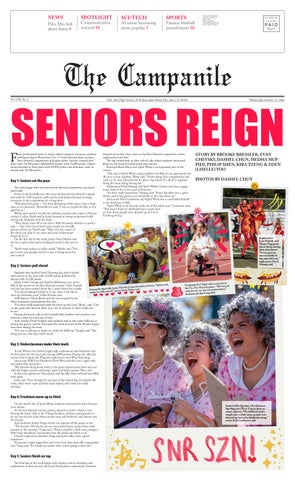
SENIORS REIGN
F
rom professional attire to senior citizen-inspired costumes, students celebrated Spirit Week from Oct. 5-9 with themed dress-up days, Best Dressed competitions and spirit rallies. Seniors claimed first place with 24,700 points, followed by juniors with 23,200 points. Sophomores finished in third place with 20,900 points and freshmen came in fourth with 20,400 points.
!"#$%&$'()*+,-$-(.$./($0"1( #e week began with the brunch best dressed competition and lunch spirit rally. Senior Cole Kristofferson, who won the brunch best dressed competition with his Y2K inspired outfit said he had looked forward to being victorious in the competition for a long time. “Winning feels great — I've been dreaming of this since I was a freshman, so it’s awesome,” Kristofferson said. “I was so excited for this, so I’m glad I won.” While spirit week is mostly for students, teachers also enjoy it. History teacher Corbin Dodd said he looks forward to seeing excitement build among the freshmen over the week. “#ey always start off in my class a little bit unsure whether to participate — they don't know how many people are actually going to dress up,” Dodd said. “#en over the course of the week, you start to see more and more students get swept up in it.” On the first day fo the week, junior Siena Marku said she loves spirit week and is looking forward to the rest of it. “Spirit week makes us really united,” Marku said. ”You get to now new people, and it's a way to bring some fun into school.”
dressed up in their class colors at the Best Dressed competition, where sophomores took first. #e day ended with an after-school rally where students showcased floats on the track and performed class dances. Principal Brent Kline said Spirit Week is an important part of the school. “Not only is Spirit Week a deep tradition for Paly, it’s an opportunity for all of us to join together,” Kline said. “You’re doing class competitions and such, so it's class oriented, but it's also a big school. It's all of us together doing the same thing: having fun.” Sophomore Elard Hsiung said Spirit Week’s themes and class engagement made it fun to be a part of this year. “It’s been really interactive,” Hsiung said. “Every day there was a great theme, and it was great to see everybody in the class dress up.” And senior Kate Lindstrom said Spirit Week was a memorable kickoff to her final year at Paly. “Spirit Week is my favorite week out of the entire year,” Lindstrom said. “#is year, I think we definitely had a rough start on how many people were dressed up, but we’re finishing strong.”
STORY BY BROOKE BRESSLER, EVAN CHEVSKY, DASHEL CHUN, MEDHA MUPPIDI, PHILIP SHEN, KIRA TZENG & EDEN (LISELLE) YOO PHOTOS BY DASHEL CHUN
Sophomores Lara Hadade and Sloane Nagayama chest-bump during their class dance. “It was great to see everybody in the class dress up,” sophomore Elard Hsiung said.
!"#$2&$'()*+,-$0344$"/("5$ Students then tackled Salad Dressing day, which ended with seniors in the lead with 12,600 points, followed by juniors with 12,200 points. Maria Uribe Estrada and Aurelia McKinney won on beirit week half of the seniors at the Best Dressed contest. Uribe Estrada ed by InFocus. “Sp Ela Aba is interview ior jun ly, ral al said she has been excited about the Caesar theme for a while. fin said. During the ,” junior Siena Marku “I’ve been looking forward to it ever since I saw the semakes us really united niors my freshman year,” Uribe Estrada said. ASB director Alyssa Bond said she was amazed by students’ passionate participation this year. “I’ve been really impressed with the dress-up this year,” Bond said. “Out on the quad, best dressed, there was a lot of turnout, so that’s really fun to see.” During the lunch rally at the football field, students and teachers competed in a relay race and tug-of-war. Auto teacher Doyle Knight, who students had to aim water balloons at during the games, said he welcomed the event because of the 90 plus degree heat wave during the week. “If it was a cold day, it might be a little bit different,” Knight said. “But being wet on a hot day, I don’t mind.”
rides a tricycle in Freshman Peri Teper game. “"e tricycle cle ricy the Tic-Tac-T pretty funny,” was e with the tic-tac-to said. freshman Jordan Fung
!"#$6&$7)5(,14"--8()$8"9($./(*,$8",9 At the White Out themed night rally, sophomores and freshmen tied for first place for the day, each earning 4,000 points. During the rally, the seniors won Capture the Flag and sophomores won Wig Snatching. Junior and ASB Vice President Olivia Woo said this year's night rally was better than last year's. “My favorite thing about today is the great improvement from last year with the higher turnout and better spirit and better games,” Woo said. In the end, sophomore Nissa Joshi said the rally went well and was filled with spirit. Joshi said, “Even though it's not part of the school day, everybody still came, (they were) super spirited, super hyped, and it was just really exciting.”
!"#$:&$;,(-/8()$8+<($30$.+$./*,5$ On the fourth day of Spirit Week, students embraced the day’s Generations theme. At the best-dressed contest, seniors, dressed as senior citizens, won. During the lunch rally at the Viking Stadium, students participated in a tic-tac-toe tricycle relay, where seniors won and freshmen and juniors tied for second. And freshman Jordan Fung said he has enjoyed all the games so far. “#e tricycle with the tic-tac-toe was pretty funny, seeing them crawl around on the tricycles,” Fung said. “(#ere) could be a little more energy, a little more attendance, but besides that, the games are pretty cool.” Overall, sophomore Jonathan Tang said spirit rallies were a great experience. “Everyone's super supportive, and even if you lose, they still congratulate you,” Tang said. “So I think no matter what, you’re going to have fun.”
!"#$=&$'()*+,-$>)*-/$+)$.+0 #e final day of the week began with seniors, juniors, freshmen and sophomores in first, second, third and fourth places respectively. Students
Seniors Ella Quinlan, Ella RenazcoSperling and Olivia Zappas dress as senior citizens. "We definitely had a rough start on how many people were dressed up, but we’re finishing strong,” senior Kate Lindstrom said.
The Campanile
J
Wednesday, October 21, 2026
2
News
Debating Measure
DASHEL CHUN/THE CAMPANILE
A sign welcomes visitors at the front of the Cubberley Community Center. Lee Pfab, Chief Executive Officer for the nonprofit Palo Alto Community Child Care, which provides child care, preschool programs and afterschool clubs, said full city ownership of the Cubberley property is necessary for renovation. Jennifer DiBrienza, a former PAUSD school board member and a member of the organization Yes on J, agrees. “It has been owned by different owners for a long time, and because of that, it has been difficult to really invest in upgrading them in the way that they needed,” she said.
P
alo Alto residents will have the opportunity to vote on a variety of ballot measures in November, with one of the more controversial ones being Measure J, which proposes a 0.5% addition to the city’s sales tax to fund the purchase and restoration of the Cubberley Community Center. If passed, the sales tax increase would become effective April 2027, and estimates from the city say the tax would generate $15.6 million annually. Because Measure J is a general tax, its revenue would traditionally be allocated to the city’s general fund. But a resolution passed by the city this June directs the money from this sales tax increase to be set aside for the Cubberley Conceptual Master Plan: an outline for the purchase, restoration and redevelopment of the Cubberley Community Center. Currently, the city owns eight of Cubberley’s 15 acres, with PAUSD owning the other seven. Prior to this, the Cubberley Community Center served as a high school from 1956-1979. In 1989, the city made an agreement with the school district to lease the campus for use as a community center, a relationship which has continued to the present day. Senior Elsa Packard, who regularly practices ballet at Cubberley, said the community center has been vital for her and many others. “I’ve been going to Cubberley every single week for the past 14 years of my life,” Packard said. “I think I spend more time at Cubberley than at my own house. It’s a space where everyone can meet, and there are so many different spaces there that people use. I see after school programs. There’s taekwondo. There’s dance. There’s music. There’s a ton of different things, and I think it’s really unique to have a space like that for everyone to pursue what they like to do.” According to a city website, the Cubberley Conceptual Master Plan is divided into three separate phases, which all depend on community support. Phase One, which will focus on land purchase and renovation, is estimated to cost $300-400 million. Lee Pfab, Chief Executive Officer for the nonpro$t Palo Alto Community Child Care, which provides child care, preschool programs and afterschool clubs, said the organization endorses Measure J because of its commitment to childhood development. If passed, PACCC plans to work with the city to expand childcare services into Cubberley. “To serve children, you need to look at everything that impacts the child’s life — from food to where the community center is,” Pfab said. “We also know that we have signi$cant housing coming in the San Antonio area plan. And with that signi$cant housing, we believe there’s going to be a need for more early child education, which is preschool and infant toddler care. When things change in Palo Alto, when things grow, we must respond because we are committed to our children.” In a survey conducted in January, only 34% of Palo Alto resident respondents said purchasing Cubberley land from the school district was “very” or “extremely” important.
Currently, though, Packard said the infrastructure at Cubberley is dated. “It needs a lot of work,” Packard said. “The bathrooms are really just horrible. And there’s a huge cockroach problem at the studios. It’s not good. Our internal studios have been renovated, but the outside buildings are just really run down.” Jennifer DiBrienza, a former PAUSD school board member and a member of the organization Yes on J, said divided ownership of Cubberley has hindered much-needed renovation for deteriorating infrastructure. “It has been owned by different owners for a long time, and because of that, it has been difficult to really invest in upgrading them in the way that they needed,” DiBrienza said. “The plumbing and the electrical are completely end of life. It is not ADA (Americans with Disabilities Act) compliant. It is not earthquake standard. It’s just outdated in every way, shape and form. A lot of the buildings need attention. Some of them are at the end of life. Some of them, the city believes, can just be rehabbed.”
“Why would you sign up for something where you’re going to be paying forever when it’s a particular purchase for a particular thing to do?” Robell said. Although he supports Measure J, Palo Alto city councilmember Ed Lauing said he was confused by the decision to not set a sunset date for the tax. “The $rst night when it was presented to us, I asked, ‘Why don’t we just put on a sunset clause, and therefore after X years, it just stops automatically?,’” Lauing said. “And the answer was remarkable, which is that it polled better, meaning the consultants said the folks that they polled to see if they would support it actually preferred it this way. And I don’t get that psychologically, because why would you have it go on and on so that you have to take an initiative to get rid of it at some point? Why wouldn’t you have that $xed in advance? I don’t get it.” Even so, DiBrienza said the sales tax would not apply to essential items including groceries, medicine and feminine products. She also said the sales tax is permanent because of the uncertainty facing the project’s timeline. “What we don’t want to happen is the work starts and everyone gets really happy with what they’re seeing, and the money ends, and the work’s not done yet or the work isn’t fully funded yet,” DiBrienza said. “So it makes sense that this doesn’t have a sunset date, because we don’t really know how long it’s going to take.”
$15.6 million !"#$%&#'&(&)*&#$%&#+!$,#-.#/01-# 21$-#&34&+$"#$-#5&)&'0$&#!.# 6&0"*'#40""&"8
The sales tax timeline While DiBrienza said the redevelopment of Cubberley will require 20 years of funding, she said the city will not have to wait 20 years to renovate the center because it will end up borrowing against the revenue from the tax. “No one has to wait until all this money is collected to do it,” DiBrienza said. “It’ll start right away. But we’re probably looking at about 20 years of funding before that is complete. After that, there is a Phase Two and a Phase Three if the community is interested in doing that. If the community is like, ‘Yeah, we really like what you’ve done with Cubberley, and there’s more work that needs to be done,’ then the tax continues to fund that. So, although it is a permanent tax, we are talking decades before it funds everything that needs to be funded.” However, Silicon Valley Taxpayer Association Board Member and former Palo Alto resident Christopher Robell said while redeveloping Cubberley is a reasonable idea, he disagrees with having a permanent sales tax to help fund that redevelopment.
Controversy around the ballot Even though the city passed a resolution affirming its desire to fund Cubberley, Robell said he dislikes how the sales tax revenue goes directly to the city’s general fund. “It’s not a speci$c tax; it’s a general tax,” Robell said. “So you have no idea how the money will be used and no legal assurances. It’s a blank check basically.” But Lauing said by making Measure J a general tax, only a majority would be needed to pass the measure. Otherwise, a two-thirds vote would be necessary.
Wednesday, October 21, 2026
The Campanile
3
News “We wanted it to be a general tax so we wouldn’t have to go to the twothirds vote,” Lauing said. “And that’s been completely on the table. That’s not some sort of hidden agenda whatsoever.” Yet Former Palo Alto Mayor Lydia Kou has also raised concerns that the measure’s wording is too broad. “If you start looking further down (at the ballot question), it starts to talk about maintaining streets, safe, clean downtown/commercial cores, preparing for natural disasters, repairing deteriorating community spaces, libraries,” Kou said. “It’s a whole slew of things. It’s not just Cubberley.” But DiBrienza said she isn’t concerned about the city misusing funds, especially when considering its track record. For example, she said when Measure K passed in 2022, the city followed the measure’s directions to split money evenly between affordable housing, safety measures and rail grade separation. She also said the city council is cognizant they represent their constituents. “They are very aware that if they are going to come to the voters and ask them for something, if they make a commitment to spend it somewhere, they better spend it there, or the voters will not trust them again in the future,” DiBrienza said. “They really appreciate the trust of the voters and take it very seriously.”
A desire for transparency While PAUSD’s initial asking price for their seven acres of Cubberley was $90 million, the school district and city have since agreed on a price of $60.65 million in 2024 dollars, or $65.5 million in 2027 dollars. Additionally, the city council recently released the official 2024 appraisal for the purchase of Cubberley following blowback from community members who alleged a lack of transparency. As such, Kou said she opposes Measure J because of the high cost. “When a governmental agency is selling off surplus land, they do it at a discount to another governmental entity for the bene$t of the public,” Kou said. “We’re doing all of this for the bene$t of the public. So to add such an exorbitant price is ridiculous.” However, Lauing said instead of focusing on the appraisal amount, people should consider the one-off opportunity to restore Cubberley. “I don’t really understand the focus on the appraisal numbers, because what we have here is a unique situation and a unique property,” Lauing said. “We don’t have any other options like this in the city ever. And we have it now from the city with this school board and now this superintendent. So the timing is just ripe for this because the school board concluded they don’t need that land anymore, and we know that we need it. What we have to look at is what’s the opportunity to actually own the whole thing so we can now afford to build it, because we aren’t going to do that if we’re only going to own half the parcel. It’s a community asset.”
people that are essential workers and students and people that are of less means.” Kou agreed and said a higher tax rate could also drive out retailers and consumers. “We don’t have that much retail in Palo Alto, except for Stanford Shopping center, a major generator of revenue for us,” Kou said. “So in this sense, by going with a higher tax rate, the city is going to be pushing out a lot of their small mom and pop retailers. They might end up not having enough business because not enough people are coming in from out of town in order to buy stuff from here.” Currently, 40% of the city’s sales tax revenue is paid by non-Palo Alto residents, which, according to Lauing, was one of the main reasons the city chose a sales tax to fund as part of Measure J. Pfab said unlike other sources of funding, a sales tax would ensure contributions from everyone who uses Palo Alto resources. “Every time I come in, I end up using Palo Alto resources, whether it’s for lunch or for meetings or whatever it could be,” Pfab said. “ This means that when I come in, I am also contributing through the sales. I personally like the sales tax because it means that everybody who is using Palo Alto is contributing to what we believe is a critical need for a community center in which everyone belongs.”
ball or whatever,” DiBrienza said. “I don’t know where that would happen. Those third places are really important for our youth and also for our seniors.” She said the city needs to act soon, as the school district has already received interest from third-party groups — like private schools — interested in purchasing portions of Cubberley. DiBrienza said the decision around Measure J ultimately rests on how much the community values Cubberley. “Not passing this doesn’t mean we’ll keep living in a functioning Cubberley Community Center that’s kind of run down,” DiBrienza said. “Some of those buildings are reaching end of life, and might actually reach end of life or get condemned soon. So we either really have to invest in it or say ‘OK, we’re willing to let it go.’”
Dashel Chun
News & Opinion Editor
Nonprofit contributions Aside from city funding, DiBrienza said some local nonpro$ts have also begun setting targets to help raise money for the potential Cubberley remodel. For example, the Palo Alto Recreation & Wellness Center’s commitment to raise $40 million to offset costs associated with Measure J. “They are all going to fundraise with their supporters, and hope to bring tens of millions of dollars into the project,” DiBrienza said. “That cuts off what we’re responsible for. So now, again, the taxpayers of Palo Alto have less of an obligation. The bill gets smaller.” Kou is a bit skeptical on this point, though. “What are the plans?” Kou said. “Are they providing funding to put towards the remodel and renovations of Cubberley? Or are they just going in and saying ‘I’m supporting it,’ but then not putting money towards it? How much percentage of ownership should they get? Are they going to be the full leasers on the property? At what kind of prices are we going to be leasing it out on? After all, we’re all paying towards it, according to Measure J. So, there needs to be a business plan in place for us to understand who is going to be having a higher percentage of ownership of what they’re supporting.” But Lauing said while some organizations will have long-term leases for space at a remodeled Cubberley, the city would still end up owning all of the property. Ultimately, Pfab said Measure J will bene$t the school district, city and local community. “The school district will receive funding to continue to support the upgrades that the traditional schools need to have, and the city would then have ownership and be able to invest in a property they own,” Pfab said. “If they don’t own the property, they can’t invest in the property. And you wouldn’t want half of Cubberley done and the other half not done.” For her part, DiBrienza said redeveloping Cubberley is important because it continues to serve as an invaluable community space. “If Cubberley went away, I don’t know where (places would go), whether it’s a maker space or whether it’s orchestra or whether it’s dance or volley-
!"#$%&'()*++,#+-.%#/0%#'*+%'# /*1#2%3*4'%#-/#5%*)'#/0*/# %6%&,2(7,#80(#-'#4'-)9#:*+(# ;+/(#-'#3()/&-24/-)9#/(#80*/# 8%#2%+-%6%#-'#*#3&-/-3*+#)%%7# <(&#*#3(554)-/,#3%)/%&#-)# 80-30#%6%&,()%#2%+()9'=> !""#$%&'
A dispute about funding Another of Robell’s objections to Measure J is that it relies on a sales tax, which disproportionately impacts low-income residents. “People who have means and income don’t spend all their money on buying basic necessities,” Robell said. “And so it disproportionately hurts
DASHEL CHUN/THE CAMPANILE
A mural is part of the outside of the Cubberley Community Center. Silicon Valley Taxpayer Association Board Member and former Palo Alto resident Christopher Robell said while redeveloping Cubberley is a reasonable idea, he disagrees with having a permanent sales tax to help fund that redevelopment. “Why would you sign up for something where you’re going to be paying forever when it’s a particular purchase for a particular thing to do?” Robell said.
DASHEL CHUN/THE CAMPANILE
Rayber Galban takes measurements of the concrete at Cubberley Community Center on Oct. 6. Galban said he was hired to help refurbish parts of Cubberley. “We are here making a proposal in the community of Palo Alto, just to eliminate the hazards for the community,” Galban. “We need to make the place safe for everyone.”
The Campanile
4
Wednesday, October 21, 2026
News
Palo Alto Unlinked
!"#$%&'(")*+,-"."/0'&*(1"2*3'4"/53'#*(6"/-#*&'78*(-#"7/'-9#*('!7:/2".')**6&'-//:-.'78*(-#"/0'27&#&':/&:&#-"/-;.*
P
alo Alto Link, the city’s on-demand ride-hailing service, will end operations on Oct. 30. The City Council voted in June to terminate its contract with Via, the transit technology company that operates the service, due to unsustainable operating costs. Since launching in March 2023, Link has provided rides throughout Palo Alto for students, seniors, residents with disabilities and other riders with limited transportation options, filling gaps in the city’s existing bus and rail network. The service operates from 7 a.m. to 7 p.m. Monday through Friday, with a flat fare of $4. All rides must start and end within Palo Alto city boundaries.
Palo Alto Link started as an 18-month pilot funded by a VTA Measure B grant, a 30-year, half-cent countywide sales tax for Santa Clara County approved by voters in November 2016. But after funding ended, the city was forced to cover an annual subsidy of roughly $700,000 to keep the service running. The service will be discontinued because each ride costs the city approximately $26, while passengers pay just $4. For 86-year-old Palo Alto resident Joel Davidson, Palo Alto Link has been more than just a convenient way to get around — it has been an a$ordable lifeline. Living on a fixed income, Davidson said he has relied on the service for at
least four years to get to places like Whole Foods and downtown Palo Alto. “It’s very, very inexpensive for people who don’t make a lot of money,” Davidson said. With the service set to end, Davidson worries about the cost and accessibility of alternatives such as Lyft, Uber or Waymo. “That means we have to pay a lot more for Uber,” Davidson said. “It’s $4 for the Palo Alto link, and Lyft and Uber are around $10 to $16.” Davidson said taking the bus is also di%cult because of his neuropathy, which makes walking to and from a bus stop challenging. “I don’t have transportation available to me except when my kids are not working,” Davidson said. For Davidson, the loss of Palo Alto Link means more than paying for pricier rides. It makes everyday errands and medical appointments harder. “I would try to get my
grown-up children, in their 50s, to help me get to where I wanted to go for medical, and with Kaiser, that ride is more expensive,” Davidson said. For junior Hannah Moked, the service’s low cost made it an accessible option. Moked eventually found Palo Alto Link less convenient because of its limited hours, confusing pickup locations and long wait times, she said its closure could mean turning to more expensive alternatives. “They’re going to have to make a transition to a different app, and they’re going to have to be spending a little bit more money,” she said. Palo Alto Link was once an important method of transportation before she got her driver’s license. She first downloaded the app in eighth grade when her mother was busy driving her brother to extracurricular activities. “The kind of transportation that I used was just to get to the mall one time, to go to school, and when my mom wasn’t available to take me,” Moked said. According to the city of Palo Alto’s transportation manager, Nathan Baird, riders will not be left without options, though. Through the Palo Alto Transportation Management Association, eligible riders can access free train and bus passes and free BikeX bikes. “PATMA has a relationship with Avenidas, so we’re hopeful that that partnership with them will help senior citizens get help with rides,” Baird said. “They have a phone you call and other ways to (get help) beyond online portals.” However, not everyone qualifies for this service. For younger riders, such as students without a driver’s license, Baird suggested they explore the city’s broader transportation network, which includes the Valley Transportation Authority and Caltrain. “There are a lot of ways to get around the city,” Baird said. The city’s made a lot of investment making it comfortable and safe for biking and walking, but there are also competing rideshare (or) private firms available for those who have resources for that. We also have the VTA and Caltrain to provide rides.”
Emily Chan
KIRA TZENG/THE CAMPANILE
Staff Writer
Students face tradeoff between growing early decision opportunities, freedom of choice in college acceptances This fall, seniors applying to college will be greeted with more types of admissions options than ever before. Over the past few admission cycles, and as part of a push by both public and private colleges to fill more admissions classes before regular application deadlines, a growing number of institutions are o$ering early admission options by adding or expanding their binding early decision pathway. Students applying to college must not only decide where to apply but how; regular decision and early action are both nonbinding, with EA o$ering an earlier application deadline and an earlier admissions decision. Both options allow students to continue with applications at other institutions if accepted. However, early decision requires applicants to enroll if admitted ED and withdraw all other applications. Notable institutions to add this option recently include the University of Michigan, which launched ED for the 2025-2026 cycle with a Nov. 1 deadline, as well as USC, which will extend the ED program it piloted last year within the Marshall School of Business to nearly all undergraduate programs for fall 2027 enrollment. Similarly, the University of Florida and Florida State, which announced their ED programs this spring, both set Oct. 15 deadlines. In an o%cial statement, UF said the change would bolster its competitiveness while retaining the eligibility of applicants for financial aid and scholarships. Colleges that already lean on ED are also filling more of their classes that way. Among 66 colleges that rely heavily on ED, the average share of first-year students enrolled through ED rose from 38% in 2015-16 to 54% in 2024-25, according to an analysis by Phillipe Levine, a nonresident senior fellow at the Brookings Institution. Jacob Light, a researcher at Stanford University’s Hoover Institution whose work focuses on higher education, said binding
applications help colleges identify students likely to enroll. “It helps them identify a pool of students who are more likely to attend the university,” Light said. “And that’s ultimately what universities want.” Light said admitting students through ED can also slash costs for the colleges. “Anything that universities can do to lock in students early on reduces costs that the universities will face, whether it is in cost of advertising, discounts to tuition, or other types of recruitment-related costs,” Light said. Binding commitments can also help colleges estimate how much students will pay. Evan Mandery, a professor of criminal justice at John Jay College and author of “Poison Ivy: How Elite Collees Divide Us,” said early applicants who don’t seek financial aid give colleges more confidence in tuition revenue. “If I’m just applying regular, even if I say that I don’t want financial aid, the college can’t be confident that I’m going to go, so they can’t really factor it into their calculation,” Mandery said. “But if I apply early, and I’m not asking for financial aid, they know what they’re getting.” Those incentives can make abandoning early admissions di%cult for colleges, in spite of concerns about student mental health. Greg Roberts, the University of Virginia’s associate vice provost of enrollment and admission, was present for both the university’s suspension of early admissions program in 2006 and the reinstatement of that option in 2019. In an email to The Campanile, Roberts wrote the original decision was motivated by a desire to encourage other universities to follow its e$orts and reduce pressure faced by students. “The university made the decision to eliminate our early decision program at the same time that Harvard and Princeton made the decision to eliminate their early action programs,” Roberts said. “We had
!"#$%&'()*+,+-.'/%#*),' #00+1+-.#%',1$),,'-.'#%%' ,120).1,'1-'#11)3/1'1-' 14+.5',1$#1)6+*#%%&'74).' 14)+$').)$6&'7-2%0'8)' 8)11)$'9-*2,)0'-.':62$+.6' -21'74+*4',*4--%'+,'$)#%%&' 8),1'9-$'14)3;< !"#$%&'()*%%+,-./%*0
all hoped that other schools would join the e$ort which was designed to reduce pressure on students to make early application decisions.” Roberts said lack of follow-on from other universities ultimately led them to return to ED. “We felt we were at a competitive disadvantage by not o$ering an early program,” Roberts said. In addition to helping colleges plan, ED can also appeal to students who want certainty. Senior Meghna Singh said she applied early because she thought ED would improve her admissions chances and wanted to wrap up applications sooner. “The certainty of knowing where you’re going to go to school earlier and being able to drop all your other applications is really beneficial for me personally, because I want to be free earlier,” Singh said. And although students admitted ED give up the opportunity to consider multiple options, Singh said she compensated with thorough decision-making. “I know the trade-o$s are that I don’t get to pick between a lot of schools I do get in, but I think if you’re choosing the school wisely, it’s worth it,” Singh said. But for families relying on financial aid, ED strips their ability to compare aid packages and costs between colleges. Judith Scott-Clayton, a professor of economics and education at Columbia University, wrote in an email to The Campanile that ED can redirect student’s attention away from finding a suitable school and toward concerns about money. “Early Decision places additional stress on all students to attempt to think strategically when their energy would be better focused on figuring out which school is really best for them,” Scott-Clayton said. “This is especially challenging for students who may not have the luxury of making a commitment before they have a chance to compare the full price.” As well as impacting considerations of cost, Light said students may avoid applying early to their preferred institution in favor of another college where they believe ED would increase their chances of admission. “I might end up matching at a school where my fit is less strong when I’m making strategic choices, rather than if I was able to apply broadly and then have an unconstrained choice over my options,” Light said. “So I think that ED shifts the power balance away from students and towards the university.”
DASHEL CHUN/THE CAMPANILE
A Rice University representative speaks with students at the PAUSD College Fair on Oct. 13. Rice and University of Michigan-Ann Arbor have both recently expanded their early decision options. “It helps them identify a pool of students who are more likely to attend the university,” Jacob Light, a researcher at Stanford University’s Hoover Institution, said.
Jesse Rothstein, a public policy professor at the University of California, Berkeley, said this multifaceted process favors applicants with experienced counselors. “It adds complexity, which advantages students with high school counselors who are familiar with the selective college application process and with private college counselors,” Rothstein wrote in an email. Furthermore, Peter Granville, a senior fellow at The Century Foundation, a nonprofit think tank studying college access, said that scholarship money is also disproportionately distributed. “I’ve looked at data on who actually receives those financial scholarships from colleges, and very often the money actually goes to more high-income families,” Granville said. Granville also said getting admitted remains the biggest barrier for low income students applying to the most selective schools. He pointed to a Century Foundation article published last spring that found that Ivy League colleges enroll more students from the top 1% by income than from the bottom 60%. “There is no doubt an underrepresentation of lower-income families among the most selective colleges,” Granville said. Granville said the advantageous ability to commit to a college through early decision often depends on a family’s assets. “What we do know is that not all families can tolerate price uncertainty the same way,”
Granville said. “Who can commit to a college before they know their aid o$er? That would be families with assets they can use to either pay higher costs or smooth out their payment over time through things like a Parent PLUS loan.” Granville also said early decision pits the college’s uncertainty against the family’s, with the benefit in admissions going to those who can accept the risk. “The college o$ers an advantage to students who are willing to accept that uncertainty about their financial aid, so you have here colleges working on very thin financial margins, and also families working on very thin financial margins,” Granville said. Still, at Paly, those macroscopic findings don’t resolve the question of whether to stake one’s future on one particular college. In the end, Singh said applying early should be a personal decision, and that ED’s unique restrictions make it something not everyone should apply themselves to. “Depending on the type of person you are, where you are in your life and how certain you are on where you want to go post-high school, early decision shouldn’t be for everyone,” Singh said. “And I hope not everyone feels pressured into doing early decision.”
Yihan Zhao
Lifestyle & Sci-Tech Editor
Wednesday, October 21, 2026
The Campanile
5
Lifestyle
Season of spending !"#$%&'(')%*+","#%!--.%/01%&/22'3--0%/22%"0%4/22)%5#61-0#5%5+-01%7',-%#'%.--+%6+
F
or sophomore Dalia Bendavid, a new school year brings a fresh start, but it also brings a hefty price tag. Literally. For students like Bendavid, the amount they spend increases as they purchase outfits and accessories for the numerous fall activities at and outside of school. Bendavid said she enjoys dressing up for all events but feels stressed about the purchases those events require. “There are just so many different components to everything that you need to buy for homecoming, Spirit Week, Halloween and everything,” Bendavid said. “There tends to be a lot more events and a lot more going on in the fall quarter than there is in the rest of the school year, and the amount you’re spending starts to become really stressful.” Bendavid said she also sometimes feels pressured to buy new outfits and accessories. “For Hoco especially, everyone will notice if you’re wearing the same dress you did last year, and people like to know what dress you’re buying, where you’re buying it from, everything like that,” Bendavid said. “If you’re wearing a dress you already had or a dress you wore last year, then you’re just completely going against all social norms.” Junior Jonathan Rico said that as he gets further into his high school experience, he has begun to feel more pressure to spend more for his two remaining seasons of fall activities. “I want to start to buy more clothes and outfits to fit in and go all out for all the activities,” Rico said. “Becoming an upperclassman means participating even more and wanting to have great final years dressing up for the fall rallies and all the fun events that Paly offers in the fall.” In addition to students, the Associated Student Body is also feeling the increase in expenses. ASB adviser Alyssa Bond said the fall is the most expensive time of the year for her group. “Because of Spirit Week, the biggest chunk of our spending happens in the fall,” Bond said. “With %oat building and Spirit Week, there’s a high initial upfront cost to ASB.” Bond said even with the large number of school activities during the fall, ASB works hard to reduce students’ spending so events are accessible to as many students as possible. “The goal is that the money we bring in, we put back into students,” Bond said. “This year we were able to not raise prices on anything, which is hopefully helpful to students because we want to be able to provide as much as we can, but obviously there are just some things that students have to purchase on their own.” Bond said ASB works hard to manage prices and expenses in the fall, but some students don’t know how to set a budget for themselves. Looking ahead to future school events and festivities, Rico said students can avoid unnecessary spending by using cheaper alternatives like borrowing clothes or shopping for used ones. “You can just easily go to Goodwill to find something cheaper or just borrow something from someone who’s already bought an outfit,” Rico said. “I’ve seen a lot of people wear costumes that look way too expensive.”
Eve Dixon Staff Writer
EVE DIXON/THE CAMPANILE
On the quad, sophomore Dalia Bendavid shows off her decked-out spirit week outfit for green and white spirit day on Oct. 7. Bendavid was one of many students who dressed up during Spirit Week and said the fall season brings out spending as well as spirit. “There tends to be a lot more events and a lot more going on in the fall quarter than there is in the rest of the school year, and the amount you’re spending starts to become really stressful,” Bendavid said.
!"#$%&'$(")$%*+)%,,($-"./01
8',%7/09%+-'+2-)%#$-%:6-5#"'0%"5%#''%('7+2"(/#-1%#'%/053-,%$'0-5#29 When freshman Casey Zhang walks into class a few minutes before the bell rings, her teacher usually greets her with the question “How are you?” Without a second thought, Zhang replies, “I’m good; how are you?” Zhang said her day is not always going well when she replies this way, but a short answer is easier than providing too many details. “Sometimes it’s also just that although the day isn’t going perfectly, it’s too difficult to explain with a few words, so I just don’t say the truth to start with,” Zhang wrote in an email to The Campanile. The question “how are you” has become so routine people often forget what it is asking. In an anonymous survey distributed to students through Schoology, The Campanile asked students how often they answer “How are you?” honestly. One hundred students responded, though not every student answered every question. The results revealed only 2% of respondents said they almost always answer honestly. Junior Sofia Sang said the question has become so habitual that it acts more like a greeting. “It’s a very, very casual question that a lot of people use, kind of like saying, ‘Hi,’” Sang said. In fact, “How are you?” is an example of what linguists call phatic communion. Coined by Polish anthropologist Bronisław Malinowski in 1923, phatic communion refers to phrases that build and maintain social connection rather than share information. Sophomore Alan Suzuki said he uses the question in exactly that way. “I only regard it as a kickstarter to start conversations,” Suzuki said. But the question’s purpose was not always a common greeting. Dictionary.com traces “How do you do?” to the 1600s, when the greeting was a real question about a person’s health or standing. Now, Sang said, it often isn’t clear what the question means. “It’s pretty vague,” Sang said. “I don’t know if you’re talking about (how) I feel or what my mood is.” Respondents of The Campanile’s survey cited several reasons for giving an answer that wasn’t entirely re%ective of their feelings. Habit was the most common reason respondents gave, at approximately 68%, followed closely by convenience and fast communication reported by 61%. Junior Vedika Agarwal said when someone asks in the hallway how she is, she typically says “Good, how are you?” and keeps walking. “It’s not really like I want to initiate a whole long conversation when I’m
just trying to get to class,” Agarwal said. Among respondents, 37% said they don’t think the asker really wants to know. But, Zhang sees it differently. “I think it’s not really that people don’t care, just that the phrase ‘How are you?’ has become this way of greeting, just like saying ‘Good morning’ and ‘Hello,’ and they usually don’t expect the other person to start spilling their life problems,” Zhang said. And not every “good” is a lie. Sang said when she answers “good,” she usually means it. “My mood and feelings are typically on the positive side,” Sang said. But Joseph Rees, a philosophy instructor at Stanford Online High School, said there is more to the question than it initially seems. “A simple question like ‘How are you?’ immediately brings up a complex and pressing philosophical question,” Rees wrote in an email to The Campanile. Rees said some philosophers think the honest answer is whatever a person feels in the moment. “Some philosophers, like Jean-Jacques Rousseau, believe that our real attitudes lie in our spontaneous and unfiltered emotional responses,” Rees said. Rees said others, including philosophers Immanuel Kant and Karen Stohr think the “real” self is the person someone chooses to be, and Stohr argues polite answers can help people become that person. “Norms of politeness, including more conventional answers to ‘How are you?’, are tools we can use to become the better selves we aspire to be,” Rees said. Junior Sammy Hernandez said telling herself she was fine after a rough day with friends helped. “I’m not going let this bother me because I can easily fix it tomorrow and talk with my friend ... I’m OK, I’m fine. And I honestly felt better after that,” Hernandez said. Students said whether they answer honestly depends on who asks. Sophomore Selim Uyan said he almost always shares true feelings, even with teachers. “The teachers in this school community are very responsible about how we feel, and they really care about us,” Uyan said. Agarwal said she is honest with friends or mutual friends, but only if they actually ask. “I don’t really want to tell my personal information to people that I don’t
!"#$%&'()#*+)$,%-.# (%/)#01-2#34)#5-+67# %&&)8%3,)(5#94%.:$# +'#3#;-&'()<#3.8# '4)$$%.:#'=%(-$-'=%;3(# *+)$,%-.>? !"#$%&'($$#
know personally,” Agarwal said. Zhang said friends are the people she opens up to most, often at lunch, when there is time to talk. “To know that they will understand and empathize with what I’m going through makes me want to share with them more,” Zhang said. Zhang said teachers and people she is not close to might offer advice or constructive feedback, but that is not what she is looking for. “They can’t give me the emotional support and ranting freedom I’d prefer,” Zhang said. Hernandez said she is most honest with her best friend and with her mom. Like 35% of respondents, Hernandez said she often does not answer honestly to avoid burdening others. In seventh grade, when Hernandez was struggling with her mental health, she told people she was fine when they asked. “In reality, I was going through a lot, but my thought is, if I tell them that, then they’re gonna worry, and I just don’t want that ... I can push through,” Hernandez said. Zhang said an honest answer also depends on how and when the question is asked. “I do think that if someone asked me the question while (a) looking me straight in the eye and with a very serious, concerned expression, (b) it’s obvious that the person has the time for a conversation and (c) there aren’t too many random people around who are waiting to talk to that person, then I’d definitely answer honestly,” Zhang said. Hernandez said the way her mom asks makes it easier to be honest. “My mom just has this way with her voice, in a way ... where it just makes you want to open up. So she doesn’t pry it out of you. She just talks, and like she makes it easy for you to just talk about how you are,” Hernandez said. Zhang said the question and what it is truly asking has been obscured in modern society. “Nowadays, the question ‘How are you?’ loses its meaning and starts becoming a way to greet others,” Zhang said. Nevertheless, Hernandez said she thinks it is still important to answer honestly to the people one feels closest to. Hernandez said, “Letting it out here and there to that one person is honestly probably the best thing someone can do for themselves.”
Judy Mao
Guest Writer
The Campanile
6
Wednesday, October 21, 2026
Lifestyle
The Senior Scramble
!"#$$%&'%()(*%+#,-.#/0$%1&""0.0%#22"-1#/-&+%23&10$$%45-"0%67.."-+.%$15&&"4&389%0:/3#1733-17"#3$9%$/30$$%'3&;%2003$9%2#30+/$ AP Psychology teacher Christopher Farina said this increase in stress can affect students in many ways. “I think that the biggest negative impact is that it can make them distracted,” Farina said. “The opposite side of that could be, if they know that they’re applying to a bunch of colleges, they want to keep their grades up, and so they may be more likely to put in some extra effort.” Farina said while teachers want to support students as much as they can, students should also be aware of the rigor of classes they sign up for. “We’ve designed the course because we have a specific set of skills and content in mind that we want you to come away with,” Farina said. “We expect you to be able to meet those expectations. We’ll help you as much as we can.” For Pegg, staying organized has become one of the main ways she manages the pressure. “I don’t think there’s a way to fully combat the stress,” Pegg said. “It’s going to be there until you’re done with it. So for me, I just try to stay on top of my stuff because the only thing I can control is how much work I do.” Tripathi said he tries to combat stress by spending time with friends and pursuing hobbies. “One way I combat this stress is by always making sure I dedicate time to doing something I enjoy,” Tripathi said. “It could be playing basketball or hanging out with my friends, but I always make sure I balance it out.” Farina said it is important for students to take breaks when working. “Spend some time outdoors, like in physical activity,” Farina said. “It can break up what you’re doing, even if it’s just for five or 10 minutes.” Farina also said social connection is important for students’ mental health. “(Spend) time with other people, (make) sure that when you get stressed, you don’t just retreat into a corner and isolate yourself from people,” Farina said. Tripathi said finding harmony is particularly important during senior year. “My biggest advice is to just balance everything to the best of your ability,” Tripathi said. “I get that this is a really important stretch of our lives, but it’s also important to enjoy the last year of high school as much as you can.”
!"#$%&'()#*'+(,-#'#./(*0/&( ,-#(,'*$/%,%&$(,&(*120,-&&13( 45-*,(1&#/(,-%/(6#*$(7&'( 6#(%$(0%7#8(5-#'#(9*6(:;( <&%$<8.(*$1(*/=%$<(*00(&7( ,-&/#(>2#/,%&$/3? !"#$%&'()%*
ALANA CHUN /THE CAMPANILE
Senior Maiya Pegg works on her college essay between classes to stay ahead of her deadlines. “For me, I just try to stay on top of my stuff because the only thing I can control is how much work I do,” Pegg said.
Farina said students can also change how they perceive the stress they experience by reframing it in their mind. “If (students) reconceptualize (stress) and mentally reinterpret it, the term is like cognitive reframing…they tend to perform better and have better physical and mental health outcomes,” Farina said. Baker said students should also use the Wellness Center as a place to de-stress. “My first bit of advice would be, of course, come and visit Wellness,” Baker said. “One of our goals here is to allow space and time for you to practice the skills of knowing when to take a break, knowing when you need to reset or to pause, so that you can return to whatever activity or goal you have in the most ideal state.”
Ultimately, Farina said students should focus on doing their best instead of striving for perfection. “I think a lot of our students feel like everything has to be perfect, or it’s trash,” Farina said. “It’s not going to be perfect, but it’s going to be good enough, and just allowing things to be good enough is another skill that’s really valuable for all human beings to learn at some point.”
Alana Chun
Lifestyle & Sci/Tech Editor
The Funpanile Strands Theme
Turning point Across 5 Bumpy orange plant, common latte flavor 6 Used to catch 7 The “Palo” of Palo Alto Down 1 Overly fond of a red liquid 2 Anyone with a Paly ID 3 White ___, ___ Mash 4 ___ Week, a fun one in October
MINI CONNECTIONS ANSWER KEY
MINI STRANDS ANSWER KEY
Cinnamon, Cumin, Garlic powder, Paprika
Dogwood
Spice rack
Hickory Hay, Scarecrow, Tractor, Corn maze
Ginkgo
Pumpkin patch
Birch Aspen
Iron, Emerald, Diamond, Gold
Maple
Minecraft ores
Turning leaves
Sebastian, Ruby, Shirley, Herb Paly teachers, first names
A
s senior Maiya Pegg sits in her room on a Saturday afternoon, she ponders four options of how to spend her time: finish her homework, study for an upcoming calculus test, work on a supplemental college application essay or get lunch with a friend. For many seniors like Pegg, choosing how to spend their limited time outside of school has become a balancing act. With college application deadlines approaching, many students are struggling to manage schoolwork alongside essays, applications and the pressure of making the most of their last year. And it’s not just at Paly. Many adolescents in America deal with anxiety and depression, and these mental health struggles often worsen throughout one’s high school experience, with symptoms peaking during senior year. Pegg can relate and said pressure from the combination of schoolwork and college applications has been difficult. “I think there’s definitely an increase in stress levels,” Pegg said. “I’m taking easier courses this year, but it’s the additional work that I have outside of school with college apps that I think is adding to my stress.” Senior Aadi Tripathi said he has also noticed an increase in his stress from pressing college applications. “I went from being able to relax in my free time to trying to work on college essays whenever I can,” Tripathi said. Wellness Center coordinator Andie Barker said while stress levels vary from student to student, seniors face pressures uniquely associated with their final stage of high school. “I think stress can differ in all the different grades based on what’s happening in students’ lives in any given year,” Baker said. “Senior year, there’s also the transition to adulthood, and ‘What does this mean for me in life?’, and ‘Where (am I) going?’ and asking all of those questions.” Baker said in addition to stress from college applications and schoolwork, seniors also often struggle with the emotion of exiting high school. “It’s a lot of final moments and activities, and remembering different things that have been good and bad about your experience here,” Baker said. “Conceptualizing that and figuring out what that means to you and the person that you have become during your time here at Paly can take time and effort, and can sometimes be a little stressful.”
Wednesday, October 21, 2026
The Campanile
Science & Tech
Striking the right chord?
7
!"#$%&#'(&"&)*&#+,#!-./&)&(0$&1#23"4*#4)*(&0"&"5#0($4"$"#63&"$4+)#4$"#(+7)#*(&0$484$9 Brooke Bressler
Social Media Manager
J
unior Benji Sandel hears his brother playing piano down the hall. Without missing a beat, he picks up his bass and joins in. Soon, Sandel’s younger brother will join them with his guitar. They didn’t start out playing together, but somewhere in the moment, they find a song they all know or sometimes create a new one together. Sandel said the process of making music for their family is important to him and his two brothers. “Occasionally, someone will take initiative, write some lyrics, and then we’ll just start figuring it out and noodling around until we have a song,” Sandel said. Sandel also said the connection he and his brothers share through music cannot be replicated by Artificial Intelligence, even though it appears many people are trying. A survey of 1,214 music makers in October 2025 found 87% of respondents use AI tools for music. Of those respondents, 79% said they used AI for technical tasks like restoration, timing correction, mixing and mastering. For creative tasks like songwriting, ideation and generation, 66% said they used AI to assist with that. And 52% said they used AI for promotion, marketing advice, social content ideas or writing bios. AI-generated tracks account for 44% of daily uploads to the French music streaming platform Deezer, adding up to over two million tracks per month, Deezer reported in April. Artists said AI helped close skill gaps and decrease work time though they raised concerns about AI creating generic, soulless and low-quality music, as well as ethics surrounding the use of artists’ work without consent. Junior Trevor Vaughan, who posts versions of cover songs online and writes original music, said AI is unlikely to disappear as a music-creation tool. “It’s natural that we all want to be on the newest technology, but I think it is going to be really hard to get rid of,” Vaughan said. Junior and choir student Zoey Meixner, though, said she has used AI to create music as a joke with friends, and thinks the impact of AI on the music industry is insignificant. “The only time it is ever mentioned or brought up is for comedic, satirical purposes,” Meixner said. “I don’t think it’s going to expand beyond that.” Sandel said although AI makes the music industry easier to break into, quality music will still be in more demand than low-quality, mass-produced music. “AI lowering the area of entry means the overall quality of music is probably going to rise,” Sandel said. “The slop will also rise, but the top will always rise to the top.” Choir teacher Michael Najar, who, because of scheduling con$icts could only respond via email, wrote that while music has always followed trends, the in$uence of AI on it is uniquely alien. “I don’t believe AI is simply another paradigm shift,” Najar wrote. “I don’t think it is simply a disruption or a sea change. It is an alien force that may destroy us.” But Sandel isn’t so sure. “It’s like Auto-Tune: it’s a fun tool, but it’s not going to change everything,” Sandel said. “There’s still going to be a desire in the world for human created music.” And Meixner said AI-generated music is not sustainable because music requires a community. “The problem with AI music is that people would use it to tailor their music perfectly to them, which wrecks the sense of community that music brings,” Meixner said. For artists, living off of streaming music is nearly impossible — artists make around one cent per stream on Apple Music and between $0.003 and $0.005 per stream on Spotify. Instead, the majority of artists’ income now comes from merchandise, brand deals and tours. With the shift towards AI-generated music, Najar wrote that music enthusiasts are increasingly turning to live performances. “More people are attending concerts, festivals and live performances, and the global live music industry continues to reach record levels,” Najar wrote. “At the same time, the tools for human beings to create, record, perform and distribute their own music have never been more accessible. Human
artists are good. Human performance is growing. Human creativity is not going away.” Senior Julia Curtis, a choir student and songwriter, said AI cannot replace live music. “A really popular way to hang out with your friends or have a good time is to go to a concert,” Curtis said. “I think that’s part of what’s keeping human or natural music alive.” So can AI still play a role in live music without taking over the music industry? Sandel thinks so. “I’d be interested to see whether those live performances are going to have AI incorporated in them and what form that would take, because Auto-Tune has gotten very good at being live now,” Sandel said. “Most musicians now perform a live AutoTune and backing tracks” Vaughan said the industry’s desire for more formulaic music is not only caused by the rise of AI, but also by short clips for social media. “The music AI probably makes best is lo-fi music, because it’s just music you listen to in the background or to get stuff done with,” Vaughan said. “You’re not actively listening to it or thinking about what it means.” Sandel said he believes AI will be able to simulate some genres, like pop, electronic dance music and country, but will struggle with jazz. “That kind of live performance, and even recorded, there is something so human about it, and it’s imperfections that AI can’t replicate, and I think people are going to still gravitate towards the story and the feel,” Sandel said. Sandel also said AI cannot replicate the humanity that an artist’s personal life leaves on their music and fanbase. “The human stories that are associated with the songs are part of what makes music so attractive to people,” Sandel said. For Vaughan, he said the process of making music is more valuable than releasing it. “Most music comes from experiences that you’ve had yourself,” Vaughan said. “A lot of the time, it’s very emotional for people, so using AI just skips that part, the most important part, of making music, which makes it relatable.” Sandel said despite AI’s ability to understand the concept of emotion, it cannot produce music with it. “It understands the context around feeling and it understands a bunch of situations where that feeling might arise, but it doesn’t know that feeling,” Sandel said. ”And music is one of the most primal displays of human feeling.” Ultimately, Curtis said using AI to generate music wastes human potential. “Humans are capable of so much,” Curtis said. “People have been making music for thousands and thousands of years. It’s a natural (process), and it’s a gift that we have to be able to make music. There’s so many species on the Earth that can’t do what we can do. We have to use what we were given and use the talents that we have to make music.”
ART BY
ISELLE) EDEN (L
YOO
AI enters the fight for greater antibiotic resistance Early one morning, Stanford researchers bent over petri dishes of the bacterium E. coli, looking for signs viruses designed by artificial intelligence could neutralize it. Samuel King, a second-year bioengineering Ph.D. student and one of the researchers in the study, said, “If the phage doesn’t work, the E. coli grows into a cloudy culture,” King said. “But if the phage does work, there are little clear spots where the phage is killing the E. coli. What we saw in the middle of the night was that with some of the AI-generated genomes, there were these clear ON SI IS spots.” RM
SA
M
ING LK UE
D SE / U
W
IT
H
PE
King said the research team gave the AI vast control over the process. “We essentially just prompted the model to generate newer-looking genomes,” King said. “We weren’t prespecifying the phages to have these different things in them. We just let the model generate, and then we chose after it generated.” King said since the advent of molecular biology, bacteriophages have been a workhorse for a lot of research. “Bacteriophages are viruses that infect bacteria,” King said. “They’re incredibly diverse — phages exist all around us and in our bodies. Scientists estimate there are more phages on Earth than there are stars in the universe. So, it’s just unfathomable how many there are.” In August, the research team published the results of its study where they synthesized the AI-generated genomes and found some neutralized E. coli. Because bacteria can develop resistance to the phages used to kill them, King said researchers also wanted to see whether AI-
generated phages could overcome the bacteria’s resistance compared to naturally-occurring phages. “We developed strains of E. coli that were resistant to the natural phage, then treated that E. coli with a cocktail of all our AI-generated phages,” King said. “The AIgenerated phages could overcome the resistance that natural phages could not.” And Yair Bannett, assistant professor of pediatrics at Stanford Medicine, said AI designed bacteriophages should still be monitored carefully. “There might be concerns related to potentially increasing bacterial resistance, which is a big problem that already exists,” Bannett said. “Theoretically, it might enhance the problem even more.” Lathbridge said researchers should review AI-generated results for any possible errors, like King’s team did, referencing his own work in cancer research. “I’ll put in anonymized photos of cancer biopsies and ask, ‘What’s this?’,” Lathbridge said. “And it’ll say, ‘That’s a cyst.’ And I’ll say, ‘No, that’s quite bad cancer.’” Still, Lathbridge said that these findings will help prepare society for future diseases. “The next pandemic is probably going to be something around antimicrobial resistance,” Lathbridge said. “And it’s going to be really bad.” King said his team took additional precautions while conducting the high-risk study due to a small margin of error — large errors can result in diseases rather than medical treatment. “We did all of the experiments at a biosafety level that was actually higher in our laboratory than what is
!"#$%&'()*)&#+)($,#(-#,*( .,$/0$%%*($1/(2$0&340)%*( 3124,54,$&31.(678()&$,&31.( 93&'(&'31.)(9'#,#(&'#,#:)( %49(,3);<(= !"#$%&"''())
Stanford researchers grew E. coli on petri dishes to test the effectiveness of a bacteriophage. Samuel King, one of the researchers, said bacterial growth would create cloudy areas on the petri dish. “If the phage does work, there are little clear spots where the phage is killing the E. coli,” King said. “What we saw in the middle of the night was that with some of the AI-generated genomes, there were these clear spots.”
typically required,” King said. “We specifically did not train the models on viruses that can infect humans, plants or animals. So the models don’t understand those types of viruses.” Bannett said the implementation of AI in healthcare will be slow and raises liability questions. “Health systems are very gradually and cautiously incorporating AI, starting with things where there’s low risk — administrative purposes, not so much direct patient care,” Bannett said. “At least for a while, AI will essentially augment how human doctors are providing care to other humans.” Lathbridge said incorporating AI in medicine could also make healthcare more accessible. “Not a lot of money is going to go on the bacteria with unique antimicrobial resistance spreading in Africa or Southeast Asia, because there’s no money there,” Lathbridge said. “If AI makes it cheaper, the barrier to entry drops. It becomes financially viable to care about people in countries that don’t make loads of money.” For King, AI is helpful for analyzing data and pattern matching but does not replace human scientists. “I think it’s a very useful tool for researchers to use to better understand genomes,” King said. Still, King said one reason researchers could try AImade bacteriophages is they require minimal resources. “Bacteriophages are very easy to test in the lab. They’re very safe, and they’re relatively small,” King said. “You can use AI to generate a new genome, then test it in the lab and see things that worked that you might not have thought would work. That’s a whole new way of learning interesting new biology.”
Asaf Milman
Newsletter Editor
The Campanile
8
Wednesday, October 21, 2026
Spotlight
HUMAN CONNECTI
!"#$%&'()*)+,#-%"'./%"#')0#1%(#2#&)334(5&.$%"6#"$47%($"#.-%#"/%(75(
T
he second period bell rings and a stampede of students emerge from the 800 building classrooms. As students find their friends, history teacher Stephen Foug steps out of his room to take a break after a long period. Walking around, Foug sees groups of students gathered together, but he notices that only a few are actually talking to each other. “I’m just seeing people standing in a group, but they’re all looking at their phones,” Foug said. “That freaks me out. That’s not human interaction at all. Little screen zombies is not what we’re going for here, especially when they have free time and they choose to not interact.”
Technology and pressure alter communication A 2026 study done by researchers at the University of Missouri–Kansas City and the University of Arizona found that for each year between 2005 and 2019, 2,197 participants ranging in age from 10 to 94 spoke an average of 338 fewer words per day, a reduction of about 28%. In an interview with The Campanile, Matthias Mehl, one of the lead authors of the study and a professor of psychology at the University of Arizona, said the study found those younger than 25 experienced a larger decrease in verbal communication than older adults. However, the study did not account for digital communication. “It feels immediately like a pretty bad thing that you have a lot fewer in-person conversations,” Mehl said. “At the same time, we make an inference because people communicate a lot more digitally, and we don’t count that. So as a psychologist, I see that digital communication is different from spoken communication.” Sunny Liu, the director of research at the Stanford Social Media Lab, said teen communication has increasingly shifted online but hasn’t necessarily decreased. “We always have those perception gaps,” Liu said. “For example, we always hear today’s teenagers don’t know how to talk to each other anymore, but I think those are misperceptions.” Rhiannon Smith, an associate professor of psychological sciences at the University of Connecticut said because teens spend so much time trying to optimize every decision to achieve maximum success, they often have less time to connect in-person. “Right now, we’re seeing (a) maxing mentality ... things are taken to extremes,” Smith said. “And in relation to that, a lot of teens are overscheduled and overcommitted. “ Smith said social anxiety, which less than 10% of adolescents are formally diagnosed with, does not necessarily mean teens have lost their social skills. Additionally, she said social skills are similar to muscles, which get stronger when trained. “Social skills, like other skills, require practice,” Smith said. During her shifts at Poké House, senior Joy Peng said she sees students on their phone while ordering or paying. “Honestly, it is one of my biggest pet peeves while working because they just get really distracted by their phone and sometimes they don’t hear you,” Peng said. “So you just have to stand there awkwardly waiting for them to respond. Sometimes they’ll even do it at the register.” But Liu said technology might not be the main reason teens struggle with communicating face-to-face.
“If there’s one thing that actually diminished people’s way to communicate, I’m not sure it’s technology,” Liu said. “I think it’s more COVID. ... Young people lost a couple years to learn how to communicate in person.” That said, technology has changed the way Gen Z communicates. Foug said technology offers a faster and easier way to communicate with others. “The technology offers convenience, meaning you can send a message to someone quicker and be like, ‘OK, I sent the message,’ but you lose a lot (of authentic connection) with that,” Foug said. “Who knows if these emails are even authentic these days with ChatGPT-formed letters.” And digital communication may add convenience to our lives. Mehl said changes in communication stem from the desire to make life more efficient. “We’ve sacrificed a lot of these small incidental social interactions in the spirit of saving time to become more productive, to have more time at work,” Mehl said. “We close our doors. We don’t talk to our colleagues as much anymore. Saving time for more personal time, for more me time. I can listen to audio books. I can listen to podcasts, but at the expense of you time or we time.” For many students, like junior Edward Chen, this desire for “me time” can take the form of something as simple as putting in a pair of AirPods, which he said he uses to block out his surroundings. “If I am bored and just want to relax, AirPods are one of my favorite ways of letting everything go,” Chen said. “My thoughts disappear, and I feel calm.” While these habits can provide a break from social interaction, Anna Lembke, a professor of psychiatry at the Stanford School of Medicine and author of “Dopamine Nation,” a book about how the pursuit of pleasure will eventually lead to pain, said constant stimulation changes how the brain experiences reward. “When we’re constantly bombarding our reward system with reinforcing stimuli, we’re changing our hedonic set point for what is rewarding,” Lembke said. “We then need more stimuli over time to get the same effect, and when we’re not plugged in, we’re in withdrawal.” A hedonic set point is the brain’s baseline for what qualifies as rewarding. Chen said he has noticed changes in his own interactions. “My in-person communication skills have fallen as communication on social media has become more of the norm,” Chen said. “It is harder to do basic things like respond in complete sentences and make eye contact because of awkwardness.” A 2013 study by researchers at University of California, Los Angeles and California State University, Los Angeles compared pairs of college students communicating in-person, by text, by video chat and by audio chat. The study found participants reported greater feelings of intimacy when communicating in-person than through other modalities. Greenfield said the digital communication methods vary, but texting, the most common form of communication, holds the least connection between people. “Having less experience and practice in the more personal forms of communication means that it is highly likely that Gen Z’s skills in more personal forms of communication, particularly face-to-face communication, are also declining,” Greenfield wrote. “Weaker feelings of being bonded to others may also lead to greater feelings of social isolation.” While face-to-face interactions may have decreased among the younger generation, Mehl said group-specific communication may carry hidden benefits. “I think every social group develops their own code, and to the extent that (they have) a sense of belonging,” Mehl said. “Communication serves a lot to have a sense of belonging. … You can actually do this digitally as well, so if you can pull that off in text messaging, I think it may create exactly that.” A 2025 study done by Stanford assistant professor of linguistics Robert Hawkins, along with researchers at the Massachusetts Institute of Technology, looked at how new ways of communication develop, particularly among people in the same cohort. The study looked at interactions such as inside jokes or unique uses of emojis. “These changes, once they’re introduced, become group markers,” Hawkins said. “They allow you to signal your social identity to other people in your in-group.” Because of this, Hawkins said these individual changes can become part of a larger evolution in language. “We don’t always use language just to be efficient and informative,” Hawkins said. “We also
use it to construct our identity, and when you add the identity component to models of language production, this is where you get slang that differentiates groups propagating over time.” This process is not unique to Gen Z. In a 2003 study, Scott Kiesling, a professor of linguistics at the University of Pittsburgh, studied the increased use of address terms, including “bro,” “bruh” and “dude.” Kiesling said their increased use signals a significant language change. And rather than seeing technology as a negative, Kiesling said it can push language to adapt. “Somebody has a panic about how the language is being destroyed by the new technology,” Kiesling said. “It’s just language adapting to the new technology, and it’s still doing a lot of the same things that it was doing before. It’s just doing them in a different way, or different technology or different mediums, and we’re very adaptable in languages as well.”
Loneliness epidemics plague those online As in-person communication decreases, more people are being impacted by a widespread loneliness epidemic. Liu said this may lead to incomplete connections between people, which can then affect their mental well-being. “When I see your face, I’m happy because I see a human being,” Liu said. “If overall in society we lose those ways to communicate, connect and socialize, I think that will harm (us). Loneliness is (the) number one threat to mental health.” Mehl said the press has put a greater emphasis on this loneliness epidemic recently, potentially leading to government intervention. “The focus on the loneliness epidemic and the way loneliness and social isolation has begun to be covered in the media has brought a lot of attention to this,” Mehl said. “I believe that it will be just like when we put attention on smoking — people started to stop smoking.” At Paly, the AP Capstone pathway, which includes students taking both AP Seminar and AP Research, provides a peer mentorship program where students from classes are paired with one another. AP Seminar and Research teacher Lucy Filppu said programs like this create opportunities for organic socialization. “There’s natural connections; they feel like they belong,” Filppu said. “So in terms of changes, if we accept the change that maybe we’re more lonely and disconnected, we can do things structurally to help change that.”
28%
!"#$%&'()*')*+,"!+-"*.(!#/*/0(1")* 0"!*#+2*3!(4*5667*&(*5689*3(!*5:89;* 0+!&'%'0+)&/*+-"/*86*&(*9<*')*&="*>)'&"#* ?&+&"/:*@"A'%(:*B$/&!+C'+*+)#*D$!(0"
Technology creates a reliance on online personas and AI help Resulting from the ability to be anonymous online, some teens are seeking emotional support and relationship advice from AI. Smith said many teens still want to be themselves but are scared to do so. “I do feel there is this real generational pull towards craving authenticity,” Smith said. “And then there’s this desire to want acceptance, which sometimes can lead to presenting a false self ... I think it’s a real battle or struggle to feel like you can be your true self and be accepted for it.” However, Mary Helen Immordino-Yang, Director of the University of Southern California’s Center for Affective Neuroscience, Development, Learning and Education, said communicating digitally can provide a space for some teens to feel seen. “Sometimes kids who are gay, nonbinary or transgender will use those technology-mediated conversations as a way to meet other kids who feel like they do without outing themselves in the community in which they live, which may be too dangerous,” Immordino-Yang said. For the general population, Immordino-Yang said texting is easier and therefore more relied on than in-person conversation. “There’s more effort in decoding the full, whole signal of a real person in person who’s talking with you,” Immordino-Yang said. “There’s just a much richer exchange, and a co-regulatory process that happens for communicating, they align themselves, or attune themselves to one another, and that takes work, but is also foundational for well-being, and health.” Additionally, Mehl said the increase of AI usage minimizes the expanse of teens’ vocabulary. “I do think, in terms of large language models and the ChatGPTs of the world, these models are super %uent and super eloquent, but they really shrink the vocabulary down tremendously,” Mehl said. “To the extent that we become used to reading a lot of AI content and then also shaping our own thoughts with AI, we might just lose a lot of
Wednesday, October 21, 2026
ION
The Campanile
Spotlight
(+#3)-%#$53%#8%'5(7#"&-%%("#.(7#*%""#$53%#5($%-.&$5(+#9.&%:$):9.&% our language, the bouquet of our language, the versatility of different words and all that that I worry about.” Laura Zimmermann, director of youth AI research at Common Sense Media, a nonprofit organization that provides ratings, reviews, and guidance for children’s media and entertainment, said chatbots are designed to be agreeable. “AI chatbots have certain design features, like sycophancy, that may make them seem much more agreeable,” Zimmermann said. “These tools offer a lot of praise and do not argue, which is quite different from how a friend or parent would respond, especially in response to a difficult conversation.” Sherry Turkle, a professor of social studies of science and technology at MIT and author of “Artificial Intimacy,” said agreeableness hides a deeper problem. “They are talking to a program, not a person,” Turkle said. “It does not know or care anything about you.” Guidance counselor James Hamilton said AI can often lie and produce incorrect responses, which makes it dangerous to rely on for teens. “It’s so easy to become dependent on something that makes life that convenient,” Hamilton said. “And then it becomes your most trusted partner or boyfriend or girlfriend. ... You’re really not developing skills. You’re not becoming a free thinker.” Immordino-Yang said people need the ups and the downs of face-to-face communication to develop the skills for navigating intimacy, which can’t be created through conversing with AI chatbots. “What you’re really doing is manufacturing a kind of mirror, in which a machine is giving you back what you want, without any real responsibility,” Immordino-Yang said. “It’s like eating the sweetest corn syrup candy you can and wondering why your nutrition is bad.” Turkle said when teens use AI as a conversation partner, they give up practice with real, in-person communication. “They lose practice in talking to people — frictional, complicated, marvelous people — who have lived a human life and can show them empathy and care,” Turkle said.
The future offers hope for communication Smith said a decline in communication is reparable, but it will take time and effort. “When you really have these deeply ingrained habits of the ways in which you choose to communicate, it could be really challenging to suddenly make a shift and do things differently as you move into adulthood,” Smith said. “So I think it’s better to start earlier on.” Yafa Diamond, senior recruiter at tech startup Eon.io, said people will continue to value genuine human connection. She said AI can be valuable in improving efficiency and productivity in companies but connection building is still important. “I think being the human behind it, being able to build that trusted relationship, being able to be a storyteller and make great relationships at work, these are going to be so valuable at work for the next years and beyond,” Diamond said. At the same time, Diamond said AI skills will become increasingly important in the workplace. “Whether it’s AI or it’s something more specific for a technical job, that (technical skill) could help you succeed in the interview process, but that communication piece, that will land you the job,” Diamond said. “So it’s a partnership; it’s a balance.” In a broader sense, Smith said the importance of communication extends beyond school and work. She pointed to a Harvard study that researched how different factors affect health and found clear conclusions about communication. “The strongest predictor of long-term health, happiness and longevity was close, high-quality relationships,” Smith said. “Humans will never stop needing closeness and deep emotional connection, so small sips are nice, but they cannot quench the deeper thirst for true closeness.”
STORY BY ASAF MILMAN, MATTHEW HONG AND KIRA TZENG ART BY ELLEN WANG
9
!e Campanile
Wednesday, October 21, 2026
10
Sports
European soccer predictions: Who will dominate each league?
Philip Shen
Photo & Sports Editor
W
ith the World Cup concluded in America, preseason matches in the rearview mirror and summer transfer drama finally coming to a close, it is now time for me to predict the winner of Europe’s top five leagues. Using a mix of data from Fotmob, an app to track football statistics, along with my unbiased opinions, I am stepping up to avenge my predecessor, Naveen Naryanaswami, who only correctly predicted two of the five leagues.
English Premier League As one of the world’s most prestigious leagues and the one with the most representation in European competitions, the English Premier League is no easy task to predict. !e two likely contenders are Manchester City and Arsenal Football Club. Arsenal is coming off a strong season last year where they won the league, reached the UCL and Carabao Cup final, then lost to Paris Saint-Germain and Manchester City. However, Arsenal have failed to fully capitalize on that momentum. It made only three notable signings and turned Piero Hincapie’s loan from Bayer Leverkusen into a permanent deal, missing out on targets like Morgan Rogers, Vinicius Junior and Julian Alverez over the summer. Consequently, Arsenal’s attack — which has proven to be a weak point — has practically remained unchanged, even if their defense features world-class talent with the likes William Saliba, Ezri Konsa and Gabriel Magalhães. Despite Arsenal’s strong showing, Manchester City will win the EPL. !e team has made big signings like Elliot Anderson, Enzo Fernandes, Ayyoub Bouaddi, Iliman Ndiaye and Allan Marques Loureiro. !is added quality, paired with existing world-class players like Erling Haaland, will be more than enough to win the league. !e current league table reflects my predictions, with City leading at 15 points, having not lost a match, and Arsenal sitting in second with 12 points. !e stats also support City; the team has the second-highest possession in the league at 63.1%, the greatest number of accurate passes per match at 560.6 and the second-most goals per match at 2.6. City’s dominance so far leads me to predict it will surpass Arsenal this year and win the Premier League. However, there is one nuance to my prediction: the 115 financial fair play charges City has been found guilty of. While their punishment is unclear, severe rulings could mean relegation, meaning even if they win the title, they could be stripped of it. If so, Arsenal will, in turn, win the Premier League.
LaLiga La Liga, the Spanish league, features iconic teams like Real Madrid and FC Barcelona. Barcelona will easily win the league for the third time in a row. !e team is already off to a strong start, winning all of its first seven games while scoring 31 goals and conceding just seven (joint second-best in the league). Barcelona made many smart signings over the summer, including Balon d’Or and World Cup winner Rodrigo Cascante, and wingers like Anthony Gordon and Karim Adeyemi and proven players like Gabriel Jesus, strengthening their attack. Although they missed out on primary target Julian Alverez, Raphinha in that nine position has been deadly. He has 12 goals and three as-
PHILIP SHEN/THE CAMPANILE
Inter Milan right wingback Andy Diouf takes on the ball against Manchester City left back Stephen Mfuni during the Asahi Super Dry Trophy, a preseason match held at Hong Kong’s Kai Tak sports park. Inter won on penalties after the match ended 1-1 at full time. This match was City’s first of three preseason matches in Asia under their new head coach, Enzo Maresca.
sists in just seven matches. For reference, he only had 21 goals and seven assists all of last season, where he played 33 matches. On the other hand, Barcelona’s main competitor, Real Madrid has been underwhelming. !ey signed many world-class players like Yan Diomande, Marc Cucurela, Denzel Dumfries and Ibrahima Konaté. However these signings have not performed. Diomande has yet to score for Madrid at the time of this writing, and the other signings have not been outstanding. With Barcelona’s deadly attack and reinforced midfield, and Real Madrid not having lived up to expectations, Barcelona will easily claim its 30th LaLiga title.
a tie. Last year’s champions, Inter Milian, will go backto-back. !ough Roma has started off strong, Inter has more quality across the board, dominating in attacking statistics and outclassing other teams in almost every position on the field. Because of this, Roma will come in second. !ey have procured 13.9 expected goals, and have one of the best defenses in the league, conceding only, on average, 0.5 goals per match. With a strong defense, and a good attack, they can definitely fight for second place.
Serie A
Paris Saint-Germain will win Ligue 1 again. !e team has won the league 12 times in the past 14 years. !e last time they lost in the 2020-2021 season, the winning team had an 18-year-old Killian Mbappe, a generational talent. Although PSG are in sixth place,
Serie A is probably the hardest league to predict. Last year the difference between second place and sixth was only a razor-thin seven points — just two wins and
Ligue 1
they are one of the best teams in the world and definitely have enough quality to quickly make up a five-point lead.
Bundesliga Bayern Munich will win the German league. After all, they have won it 35 times. In the past 10 years, they have only lost once. Bayern has one of the best attacks in the world, with Ballon d’or contender Harry Kane as their striker and the front three having over 100 goal contributions last season. !ey currently sit second in the league, only two points behind Dortmund. Additionally, they have generated the most expected goal) in the league and have only conceded 2.6 xG, which is also best in the league. At the time of writing, international br, and almost anything can happen over the course of a season and
!"#$"%&'!(($)"**'+,#-%./0#$%'%$-1'2(/+0$-$-(# Roaring laughter rings through the group as sophomore Callie Popek and her friends pitch fantasy football punishment suggestions. As suggestions become increasingly outlandish and unhinged, Popek’s friends who drafted unwisely holler “!at’s too far!”, while those who did their research beforehand gleefully cackle. Every year, millions around the world, including Popek, join fantasy football leagues with friends and family. While some play for fun, many have upped the ante in their leagues by instituting a punishment for the last-place finisher. Popek said she and her friends chose to do this and have
ART B
G
Y LIAN Y CIND
devised a humorous punishment. “!e loser of the entire league has to sit in a cage and everybody else just gets to pour whatever they want on them,” Popek said. Popek said she sees the punishment as a way of getting people more invested in the league. “It brings more fun to it, and it brings more of a competitive atmosphere to it,” Popek said. “Obviously nobody wants to have to be punished.” Fantasy football punishments are a tradition in many leagues and are often a humorous way to end a season with fanfare. However, Popek said some punishments go too far, risking physical harm. “I’ve heard about milk miles (drinking a large amount of milk and running a mile immediately afterwards), and it makes you throw up a ton,” Popek said. “I don’t know if I would be able to do it. I’m glad that we chose something that’s not physical(ly harmful).” Psychology teacher Chris Farina says that fantasy football punishments walk a fine line between ostrazation and bonding. Farina said the harm of a punishment “depends on what the nature of the punishment is. We generally don’t like being socially ostracized. So in some ways, if people feel like they’re being humiliated or they’re being shamed and making them feel like they’re outside of the group, that
could be bad for their mental health, but I would imagine most people that are doing this are joining a group voluntarily” Farina said. ”You could also see it happening the opposite way, where everybody’s in on this together. You guys are all in it together because you’ve gone through this experience, so it could actually increase bonds too.” Farina says that consistently losing could lead to rifts withing a league. “You could see a situation where, like, let’s say that you always have the same person who’s finishing last. And that person was always on the receiving end of these these punishments. I think you could start to see them be less and less interested in being a part of that if they’re the only person that’s experiencing this. It’s different when it’s me one week, it’s you the next week.” Farina suggests periodical check-up to ensure that punishments don’t cross boundaries. “I would probably say to talk about it as a group, make sure you all feel good going into it. !en periodically, if you have any punishments that may seem like they are starting to bother somebody, check in and see if everybody’s still good with it. If everybody is, awesome. Great. If people are like starting to feel a little hesitant, then maybe consider bailing or changing what your punishments are gonna be.” Freshman Bennett Giresi said he has participated in a variety of punishments.
“We do this thing where we put the loser in a dog cage, and we cover them in condiments,” Giresi said. “Sometimes we even make them go in public and run around shirtless. We also had one where we had to mix different (random liquids), and the loser had to drink it.” While many students participate in fantasy football, some Paly faculty also enjoy competing in their own leagues with more docile punishments. Math teacher Daniel Nguyen said he participates in a league with other math and science teachers. “!e only punishment we have is shame,” Nguyen said. “We do have an interdepartmental rivalry where six of the 12 teams are math teachers, and the other six are science teachers. Whichever side loses more headto-head matchups between science and math has to treat the other department to lunch the week before the Super Bowl.” Nguyen said he thinks punishments can be fun without going too far. “Something lighthearted is great, but something that’s too demeaning ruins the fun of it,” Nguyen said. Junior Ori Gur-Ari competes in a league with weekly punishments and said the benefit of having punishments in a fantasy league is participants are more competitive and interested in investing time into their team. “I think it gives the league a competitiveness that isn’t possible without actual
punishments,” Gur-Ari said. “Many people do fantasy for cash; we don’t, so there has to be some sort of punishment to keep it competitive.” Gur-Ari also said he finds fantasy football to be a competitive bonding activity. “It’s a great pastime for a friend group to unleash their competitiveness,” Gur-Ari said. “I think it’s an overall great thing and it brings a community together.”
Eden (Liselle) Yoo Business Manager
Wednesday, October 21, 2026
The Campanile
11
Sports
Playing a different game A
!"#$%&'()$'$*%)$&+$%&%*,"-'%'($.%)"+$%'"%-$/01)2%'($1-%12$3'1'1$*
s senior Samarth Karnam cleaned out his basketball locker for the last time at the end of sophomore year, he felt a strange sense of calmness in his decision to step away from the court. The day after he quit, Karnam said he went to Hoover Park and sat on a swing. “It was almost as if I had nothing to do,” Karnam said. “Not in a bad way, but a peaceful way.” For many high school athletes like Karnam, playing a sport is a huge part of their identity. Leaving that behind creates a gap — and forces them to figure out who they are beyond matches and games.. Karnam, now a co-captain of the Paly Robotics team, stepped away from basketball primarily due to scheduling conflicts with other activities. “I initially decided to quit basketball because robotics was taking up a lot of time, and it was a higher priority for me,” Karnam said. While he was initially uncertain about the choice, Karnam now says he made the right decision. “Initially, I was a little bit unsure if it was the right choice,” Karnam said. “But after going into the season, I realized I had a lot more time. Now that I’m a captain of the (robotics) team, I think it has paid off.” However, not everyone leaves by choice. Junior and former basketball player Benjamin Oh said he quit basketball because of scarcity of growth. “I wasn’t given the opportunity to play and grow with the other players, so I fell behind,” Oh said. For Ivanka Kumar, a senior and former volleyball player, his departure stemmed from burnout and misalignment. “I spent a lot of time on (volleyball), so much so that I stopped feeling joy when I was playing,” Kumar said. “I realized that community matters a lot to me, and maybe volleyball wasn’t the place where I found it.” P.E. teacher David Duran said he frequently encounters students who are hesitant to make the often difficult decision to step away from a sport they love. “You invest in it a lot of time — half your life — and then suddenly you stop playing,” Duran said. “It’s tough. You see
a little contemplation: ‘(Am I doing) the right thing or not? Should I go back?’” Duran said many students stop playing sports when improvement hits a standstill, and the work outweighs the rewards. “Most times, people stop participating in a sport because of fatigue, or they’ve hit the wall, and they just throw down,” Duran said. However, Duran said while some students feel lost initially, quitting can open doors to new passions. “Just find something else you enjoy doing in your spare time,” Duran said. “Not so much to fill the void, but just something that you enjoy doing again that’ll make you happy.” For Oh, that something was golf. “Quitting basketball allowed me to spend more time on golf,” Oh said. “I rebuilt my sense of identity by becoming a better golf player.” Kumar said she found hers new thing in debate, an activity she had taken part in while playing volleyball. “I genuinely love researching the different topics,” Kumar said. “I enjoy talking about policy issues, such as AI and minimum wages.” Debate also offers a balance between collaborative teamwork and individual accountability which Kumar said her volleyball lacked. “I feel very supported in the (debate) environment,” Kumar said. “I like how it’s both a team activity in the way we all prepare together, but it’s also an individual activity because your individual skills determine the outcome.” Karnam said knowing that many other students were in the same position as him was reassuring. “It helped me to understand that during high school and post-high school, it’s normally a time at which a lot of people quit their sports,” Karnam said. For Karnam, quitting basketball has granted him greater autonomy, even if it meant letting go of being a sports player. “Of course, it was a piece of my identity,” Karnam said. “But I feel like I have a lot more freedom now, and I could say I have a lot more purpose as well.”
Jonathan Gu
Print Managing Editor
JONATHAN GU/THE CAMPANILE
Junior Benjamin Oh gazes out at the Paly outdoor basketball courts where he used to play. Oh said he quit the basketball team because he felt as though he wasn’t given opportunities, leading him to pursue golf instead. “I rebuilt my sense of identity by becoming a better golf player,” Oh said.
Varsity football holds off Burlingame 35-21 in Homecoming win Varsity football came into its Homecoming Night game with what players said was a week of strong practice and left with a 35-21 victory over Burlingame, breaking a five-year streak of Homecoming losses. Senior defensive tackle Jordan Valdez said his team’s defense set the tone early by holding Burlingame scoreless in the first half. “Defensively, we did well — shut them out in the first half,” Valdez said. “(We) got them three and out, and forced them to punt the ball. And I think we were giving the (quarterback) a little more pressure than he was used to.” Senior linebacker Jair Nucamendi agreed and said the team’s dedication in practice paid off. “We started off the game really strong,” Nucamendi said. “Defense was doing its thing. We had a really good week of practice, and I think that really showed out on the field today.” However, Valdez said the second half was tougher, as Burlingame played better during the later parts of the game. “Burlingame is a second half team,” Valdez said. “We don’t have the biggest second wind. We need to work on that.” Despite the second half struggles, head coach Edward Tonga said he was happy with his team’s effort. “We’re never satisfied here at this program,” Tonga said. “We’re always looking to improve, but tonight, I would say they played a hell of a game.” Also, the fourth quarter saw three players go down with injuries. “You never want to wish injuries on any player,” Nucamendi said. “It reminds us that anything can change at any time. We just have to take it one play at a time.” Tonga said despite injuries, the players should be prepared for the next game against San Mateo. “These kids put everything in a game, and sometimes injuries happen,” Tonga said. “But moving forward, I think they’re going to be OK and get ready for San Mateo.” JONATHAN GU/THE CAMPANILE
Senior Peter Born (8) tackles the Burlingame quarterback during the Homecoming Night game against Burlingame on Oct. 9. “I think we were giving the (quarterback) a little more pressure than he was used to,” senior defensive tackle Jordan Valdez said.
Jonathan Gu & Philip Shen
Print Managing Editor & Sports and Photo Editor
The Campanile
12
Wednesday, October 21, 2026
Sports
Wednesday, October 21, 2026
!e Campanile
13
Opinion
Nonchalance is overrated !"#$%&"'(')*#+$(,%(-*.%(/*-0*."1,+%(23")(0%%+3&4'5(&*"()3$%('".*&4(%-*"3*&'(0.*-(6%%.'(3&(0%1.(*0(%-,1..1''-%&"
M
y phone lights up as a notification appears on the screen: “Wanna hang out this weekend?” I’ve been waiting for this text. Excitement flows through my fingers as I quickly type out a response. “Yes, I’m so excited!! Let’s do something!” But right as my finger lowers to the send button, I pause. Maybe I should wait a couple of minutes. Maybe I shouldn’t use as many exclamation points. I distract myself by finishing up some homework, but it’s hard to focus with the thought of the text lingering in my mind. When enough time has passed, I pick up my phone again and finally click send. “yea fs.” Somewhere along the way, caring became embarrassing. Among teenagers, I have noticed more of us seeking nonchalant. We study for hours, then tell people we barely looked at the material. We find something we love doing, then talk about it like it’s no big deal. And we get hurt, then laugh it off before anyone notices. None of these reactions mean we feel less. We’ve just gotten better at hiding it. !at is what nonchalance has become. Not being chill or genuinely relaxed but putting a mask over our emotions. !at mask may be saying, “I’m good,” when we’re not, acting happy when we’re hurting or being the person who’s always fine so no one thinks to ask them how they’re doing. But no matter what mask we wear, there is something in common: Nonchalance is a performance. So why do we do it? !ink about why we describe certain people as having kept their “inner child.” It’s usually a compliment. !ey laugh loudly, show genuine excitement for small things, and talk about what they love without first asking themselves, “Will people think this is cool?” Children, fortunately, haven’t yet mastered the teenage art of pretending not to care. !ey ramble about winning games at recess, show you a drawing as if it belongs in a museum and celebrate tiny things without wondering if their excitement is overly chalant. But somewhere between childhood and adolescence, we become aware of how we look to other people, and caring has consequences. Excitement looks desperate. Effort looks try-hard. Hurt looks weak. So we learn to protect ourselves because caring is vulnerable. When you admit something matters to you, you also admit you have something to lose. If you tell someone you’re happy to see them, you risk them not being as excited. If you admit a comment hurt you, you let someone know they affected you. Expressing our true selves is a risk. And once we realize that, nonchalance starts to make sense. If we hide what matters, we can also hide how much power it has over us. If everything works out, cool, and if it doesn’t, well, maybe we didn’t care anyway. But this doesn’t just convince others. If we spend enough time
downplaying our emotions, we eventually start to question ourselves: Do we actually care? And over time, the mask we wear for everyone else can stop us from seeing ourselves clearly. Last year, during my freshman wrestling season, I strained my back. What the coaches thought was an “ice it and be back tomorrow” type of injury kept me out for weeks. What embarrassed me the most was how much a seemingly minor injury affected me. When teammates asked if I was OK, I laughed and said it was nothing. When my family noticed I was quieter, I said I was just tired. !e strange part was while I kept convincing everyone I was fine, I desperately wanted someone to realize I wasn’t. And the longer I acted like my feelings didn’t matter, the harder it became to admit to myself that they did. I wanted people to think the injury didn’t matter to me, but instead, it made it look like wrestling didn’t matter to me. And because I never told my coaches or teammates how I really felt, there was no way for them to know the difference. By hiding my real feelings, I might have saved embarrassment, but I lost people who could have understood me. People who could have been what I so desperately wanted, if only I gave them the chance to be. !at is the cost of nonchalance, and I’m not the only person who’s paid the price. A 2025 Common Sense Media survey asked 1,017 boys ages 11-17 nationwide about “unwritten rules”
A
RT
BY
ED
EN
Evan Chevsky
(L IS
EL LE )
for boys. !ey found that 35% said, “act like you don’t care too much about anything.” Another 35% said boys should “always act confident.” !is pressure is also present with teen girls. In a 2018 Plan International USA survey of girls ages 14 to 19, they found that 33% felt “a lot” of pressure to hide their feelings when they felt sad or anxious, while 42% felt pressure to “always be positive.” !ese studies demonstrate the magnitude of this pressure. But by avoiding vulnerability, we are depriving ourselves of real connection. Vulnerability researcher and social worker Dr. Brené Brown said, “Our deepest human need is to be seen by other people — to really be seen and known by someone else.” I strongly think raw and genuine connection is one of the true joys of life. I have tried to find this while keeping my emotional armor and not giving someone else the chance to hurt me. Now, I’ve come to realize meaningful connection requires giving up protection. Our deepest human need requires taking off our armor, knowing we will fall. Because when we let go of control, we make space for connection. Being genuine may push some people away, but it gives the right people the chance to really know you. And I’ve learned that those connections are far more valuable. Now I’m not saying that we should be overly vulnerable. We shouldn’t overshare or trauma-dump to force connection; we shouldn’t let every little thing affect us; and we shouldn’t disguise seeking validation with opening up. It is important to be genuine and have clear boundaries with others. !ere is a difference between being genuine and having no boundaries. !ere is a balance to everything, but we don’t have to have it all figured out. While writing this story, I started thinking about my own life. Have I been genuine? Have I allowed myself to face vulnerability? I’ve always felt pressure to be a strong person. As an older sibling in a household with its own challenges, I’ve taken on the duty of always being strong for my family. Always putting a smile on my face. Always trying to be a role model for my little brother. Always acting like the little things didn’t bother me because my life is already “good enough.” I’ve mentioned “we” countless times in this story, because although we live vastly different lives and have countless different experiences, we still experience related struggles. !at’s what makes us human. So yes, we’re not perfect. I’m not perfect. And we shouldn’t pretend like we are. So picture this. You get an exciting text you’ve been waiting for. You feel the excitement as you read the words: “Wanna hang out this weekend?” Your phone’s in your hand, so you go ahead and respond. “Yeah man, I’m excited. Let’s do something!” You know you are risking them not being as excited, but you send it anyway. Because maybe the opposite of nonchalance isn’t desperation. It’s confidence.
YO
Staff Writer O
Please mind your own GPA As the teacher hands me my graded test back, I barely have time to take a look before someone inevitably asks, “What did you get?” I don’t blame them. Inquiring about others’ test scores and GPAs has become so common most students don’t think twice before doing it. But just because these questions have become normalized doesn’t mean everyone should be expected to respond. Information like grades, test scores and college plans can be sensitive and personal. Instead of feeling like they have to answer every question, students should be able to decide whether and how they share this information. Asking about test scores isn’t helpful for anyone and can quickly turn a normal conversation into a competition. Instead of discussing how di%cult a test was or asking someone how they felt about it, students focus on numbers. Suddenly, the conversation isn’t just about the test. It becomes a measurement of who is better. I’m sure students don’t ask these questions with ill-intent. !ey are simply curious how their friends did. But even if wellintended, the question can still pressure
students to share information they would rather keep private. I’m guilty of this, too. Sometimes, I ask these questions to see if I did poorly on a hard test or aced an easy test. But this can backfire. When a student bombs a test others thought was easy, the student who didn’t do so well might feel as if their intelligence gets reduced to a single number. What test scores and grades don’t take into account are the variety of factors in students’ lives that can affect these things, such as time to study or stress from other life events. Someone might have studied for hours and still not gotten the score they wanted. Someone else might simply not care to share their grade. Neither person should have to explain why they chose to keep their score to themselves. Questions about college are just as bad. A simple, “What schools are you applying to?” might be exciting for some students to answer , but for others, it can cause unneeded stress. Not everyone knows what they want to do after they graduate, and not everyone wants to discuss these plans. And if students are applying to college, their safety and target schools can vary
!"#$%&'()*+,',-",' ".*/-"'$"%0,'1-234+2' 4*/'(%5*%-'(%6'.(%' 7+$.#25',+/%'('%*/8(2' .*%9-/"(,$*%'$%,*'(' .*83-,$,$*%:
widely— one person’s target school could be another’s safety. Asking someone about their target or safety schools might unintentionally lead to comparisons about academic achievement and college dreams. Students might feel uncomfortable sharing their choices if they think others will judge them based on what schools they apply to. Such questions can also cause people to lie. Someone might say they are applying to a school or have a specific dream plan after high school because they think it’s what people expect to hear. When students feel pressured to provide an answer, the conversation can be more about protecting themselves from judgment than giving a truthful answer. Paly comes with enough pressure to perform. Students shouldn’t feel like they also have to report their academic standing or future plans to their peers. Better ways exist to start these conversations. Instead of asking what score someone received on a test, you could ask, “Are you happy with your score?” Instead of asking for someone’s GPA, ask how their classes are going. Instead of asking where someone is applying to college, ask what they are most looking forward to once they graduate.!ese questions still show interest without demanding a certain number or specific answer. !is isn’t saying students shouldn’t talk about their grades, test scores or college plans. If someone brings up a test score or
starts talking about what they want to do post-high school, there is nothing wrong with joining the conversation. !e things to think about are what you ask and how you ask it. Sharing personal academic information should be voluntary — something students
ART BY MEDHA MUPPIDI
choose to do. It shouldn’t be something they feel pressured to do just because someone asks them.
Christopher Lee Web & Sports Editor
The Campanile
Wednesday, October 21, 2026
14
Opinion
Proud until you scroll !"#$%&'()*$%'+,-./'%#0$)1)().+/'$.+"'#"(2)+$+$"./'+)).%3)-/'$.)1$+%4&5'&"/) A
N HE
C NI
Y
TB AR
ILA LE
n A on a test can feel insignifi- else is constantly moving forward cant after seeing someone post while you are falling behind. their perfect score. Having an As a result, the goal is no longer to ordinary weekend can seem embarsucceed by our own standards — it is rassing when your feed is filled with to be better than everyone else. Conposts of classmates’ parties, vacations sidering how carefully people curate and accomplishments. Accomplishing their social media presence, this task a goal you have can feel unsatisfactory eventually becomes impossible. after seeing others online achieving A 2023 paper by the U.S. Surgeon bigger and better. General’s Advisory warned social Social media makes it nearly immedia can pose risks to young people’s possible to celebrate an achievement mental health, specifically identifying without immediately being shown social comparison as one of the posomeone else’s. And for teenagers, this tential harms. The Advisory also notes constant comparison can create the nearly all teenagers use social media, unrealistic expectation of always making these comparisons a regular needing to do more than everyone part of adolescent life. else. Over time, this mindset can make Instead of being proud of what we it difficult to feel satisfied. In a social have accomplished, teenagers now bemedia environment that repeatedly gin asking themselves whether it was encourages young people to evaluenough compared to everyone else. ate themselves against others, it can You used to have to speak to people become another source of pressure and to hear about their achievements. Now stress. you see it without prompting, and it someone will always have a higher isn’t viewed as boasting or bragging. grade, a bigger accomplishment or Social media a more impressive makes these comathletic achievement. parisons almost Trying to keep up !"#$"%$&$'($)(&*+,*'+,*-& with the successes impossible to avoid. Every scroll provides appear on a %".&($-(&/&%$.&(-/%0/10&-"& that another opportunity screen guarantees to see someone who .*+2*&-$$%(&3%2"%-1"''/4'5& there will always be appears to be doing another reason to feel 2"#6/1$&-*$#($'7$(&-"8& better. But, people behind. usually only post their The answer is not 21$/-+%,&/%&3%*$/'-*58& best moments, creatto stop caring about ing a feed filled with others’ achievements. $%0'$((&252'$9 unrealistic accomAmbition can be plishments. motivating, and soA person celebrating their college cial media can provide inspiration. The acceptance may have been rejected problem begins when someone else’s from several other schools just minsuccesses make you feel like yours are utes before. The student celebrating lesser. an academic accomplishment may not Social media will always be here have always been so successful. to provide endless opportunities for Social media posts tend to only comparison. It is how we deal with it show us the good moments, hiding that is the most important thing. The evidence of all the difficulty and less next time an achievement suddenly presentable parts of our lives. feels smaller after scrolling through When teens compare those caresocial media, it is worth rememberfully selected moments of other ing that success is not a competition people’s lives to their own , suddenly against everyone on your perfectly their achievements can feel inadcurated feed; it is supposed to be you equate. Someone else’s highlight now doing the best you possibly can and sets a new standard to which teens constantly improving. uncontrollably compare themselves to, creating an unhealthy, endless cycle. Instead of enjoying what we have done, we now start thinking about what we should do next. Maia Wadhwani When only the successes are visible, it becomes easy to think everyone Staff Writer
:*$&61+2$&";&2"##3%+-5&+(&+%2"%7$%+$%2$ 6.*$1$*,%&$/('(%5'4)'#".1).$).+7'4,+'$+'#"()/'%+'+0)'#"/+'"8'".)9/'#"((,.$+57'/,22"-+'/5/+)(/ Showing up for people is not always fun. Nobody enjoys taking an hour and a half from their Saturday to drive a friend to the airport; nobody loves driving their post-op coworker home after surgery. So what is the point of showing up for the people around you? Well, when we inconvenience ourselves for our community, we hope they will one day return the deed when we need help. It also serves a secondary purpose — putting out good makes us feel good. I have noticed an increase in individualism and self-centeredness among high schoolers, and Palo Alto and Paly have fostered an environment that encourages people to only think about how they can further their status, achievements and goals, without considering how they can support the people around them. Every so often, when it comes to social gatherings, small favors or lending a hand when it is needed, people even choose themselves over others. And while it is never wrong to focus on yourself, it is also important to help build your community, even if it means taking on slight inconveniences. Growing up, I was always driven around in carpools. With the flurry of ballet, piano, soccer and ice skating lessons, throwing a bunch of elementary school kids in a minivan once a week was the easiest solution. Each week, the parent driving us would rotate. On the weeks my mom drove, she
had less time to get work done. But on the weeks when someone else drove, she got a productive afternoon to herself. While it would have taken less time on a per-week basis and caused less stress for my mom to drive only my sister and me, each family benefited from sacrificing some of their time to get more in return. That’s the thing about building community: You have to give some to get some. Building a genuine community requires setting aside some of your personal comforts so you can show up for someone else. What we got in return from the ballet carpool was more than just time off every other week. We created a support system that was able to help when someone was sick or had too much on their plate. Think about a time when someone went out of their way to do something for you, whether it was your mom dropping off the notebook you forgot on your desk or a classmate offering up their home for the study group. Too often, I have heard people ask, “Who is going to do it?” instead of “What can I do?” I encourage you to be the person who finds a solution and is willing to give up some of your time, money or personal space for the greater good. My advice is to have a servant attitude — see the needs of those around you, look for ways to serve people and be humble about it. Your service should not be deserving of praise — understanding that your actions benefited others is enough.
While it may seem like there is no point in showing up for others when they don’t show up for you, I didn’t realize the importance of having a servant attitude until I saw the results of showing up. I felt better about the relationships I was investing in because it meant putting time and effort into the people I cared about. I saw results with people being more appreciative and willing to go the extra mile for me. When you consistently take time out of your day to serve others, people start to notice. Without saying a word, you will begin to be known as someone who shows up. Consequently, people will show up for you. It only takes one change in habit or action of being less inwardly-focused and more community-oriented to begin growing your support community. So, show up to that school play, sign the petition, go to the club meeting and drive someone home even when it adds 10 minutes to your commute. Because you never know when you might need help in return. When unexpected circumstances derail your plans, you will want to have built a community that shows up for you, too. ART
Leilani Chen
News & Opinion Editor
DEN BY E
OO E) Y ELL (LIS
Wednesday, October 21, 2026
The Campanile
15
Opinion
High school literature demands dealing with tragedy
R
ead a book in almost any high school English classroom, and it feels as if page after page of every novel is a parade of lonely characters and shattered dreams. Whether it be Holden Caulfield’s spiral through grief and alienation in “The Catcher in the Rye,” or the tragic fate that befalls George and Lennie in “Of Mice and Men,” our high school reading lists seem to lean into sorrow rather than joy. This isn’t because our enjoy watching us suffer. We are given these tragic classics that have stood the test of time because they build empathy, push us to think critically and inspire us to identify society’s flaws. An enjoyable book with trivial conflicts that are neatly resolved might make for an entertaining read, but stories of hardship and suffering tend to stay with us much longer by tapping into universally profound emotions. In ninth grade, I read “The Catcher in the Rye,” where the protagonist, Holden Caulfield, struggles with grief, loneliness and the loss of innocence. I remember my classmates and I criticizing the angst of the story, Holden’s cynical character and an ending we perceived as unsatisfying. But looking back, I realize Holden’s defense mechanisms — his cynicism, projection and denial — are all experiences that more or less mirror our own adolescent uncertainty. Though his struggles are far more extreme than many of ours, the story’s core message is of the pain and discomfort one faces in the transition to adulthood. Although J.D. Salinger wrote the book decades ago, Holden’s desperation and search for something genuine are what bridge the time between his era and ours. This change in our perception of characters illustrates the cognitive impact reading has. A study published in the journal “Science” by D.C. Kidd found reading fictional literature directly improves one’s “Theory of Mind” — the ability to understand others’ mental states which allows us to develop complex human relationships.
Understanding a character’s desperation or despair expands our capacity for compassion and teaches us how to imagine experiences beyond our own, an awareness that stays with us far beyond high school. In addition to building empathy, tragic literature forces us to think critically. The stories we read in English class rarely offer simple answers to what is right and wrong; there are always nuances and several perspectives to consider before making a final judgement. When there is no obvious good or evil character, or when the meaning of a story is ambiguous, students have to decide where they stand. This leads to discussions — usually known as Socratic seminars. Discussion arises from students interpreting the moral gray areas and ethics in a story, defending their interpretation while listening to other student’s viewpoints, and refining their own beliefs and opinions. Another theme across English class readings is societal collapse. Books like “Of Mice and Men” and “1984” show us how the world’s institutions always leave certain communities vulnerable. “Lord of the Flies,” though much more allegorical, is a deep analysis of human nature and the collapse of civilization. In such books, individual tragedies often originate from institutional and systemic failures. By interpreting these situations through the setting of English class, students can shape their own views on societal systems. Stories of struggle are ultimately necessary for students to build the emotional maturity and critical thinking skills we will use in every aspect of life. So open the books that may be unpleasant, because they challenge your thinking. As we read uncomfortable books today, we are shaped little by little into thoughtful, empathetic individuals capable of handling a complicated world tomorrow.
Medha Muppidi Staff Writer
ART BY REINA LIM
!"#$%&'% ()$) !"#"$%!"#$%&'%()*#+,-./&'(%)'(*% "+&'(),$"'+%'+%,-.*($"#*)*+$#/% #0'+#'(#1"0#%,+-%#23#4("0$"'+#5 0-)(!/%12/2!%-!)(./%!/345/ 6(*)(#/%12/2!%-!)(./%!/3789
The Campanile
Wednesday, October 21, 2026
16
Editorials !"#!$%&'#!('#%)'*+,# !"#$%&'(%')*+,(-.//$0&&*1(23)')#(4&&5(.*6( *&0(7&7$'.%/&(7$7&*#,(8$'(9./:(,#;6&*#,
-6
study but ending up at ($)%&' toTown and Country
5
!"#$%&' only friend in class is absent
4
and having no '"((%&' Halloween answer
3
crush is a senior at $"#+%,%&' your Spirit Week
2
and sweating by *"#$%&' morning lunch
1
*!#( are you majoring in?
0
that fit the Spirit Week !#/%&' none theme
/
are in three days -.++"'" applications and you have no essays done
.
and doing the awkward 0%11%&' can walk to pick it up
-
CANON (!" OCTOBER EVENT
WILLIAM CRAIG/USED WITH PERMISSION
Vote Craig, Wang for school board
Editors’ note: The Campanile adviser is a Palo Alto resident and has publicly supported board candidates. He did not have a voice in The Campanile’s endorsements and did not edit this editorial. It was sent to an out-of-state journalism adviser for editing and feedback. Additionally, paid advertisements in this issue had no influence over our endorsement of Board candidates.
P
alo Alto residents will vote between John Craig, Linda Henigin and Avery Wang on Nov. 3 to fill two open seats on the Palo Alto Unified School District Board of Education. Elected candidates will replace President Shounak Dharap and Trustee Shana Segal, whose terms expire in 2026, presenting an opportunity for new perspectives and leadership in the district. The Board is responsible for setting district policies, approving budgets and overseeing the superintendent, making the trustees an integral governing body within the community. Trustees also play a critical role in engaging with students, teachers, parents and community members and incorporating those perspectives into their decisions. The Campanile believes Wang and Craig will best carry out the interests and priorities of our community as board trustees. In addition to their backgrounds in business and technology, which are likely to be useful when making fiscal decisions, our endorsement reflects their emphasis on academic opportunity, data-driven decision-making and community engagement. Both candidates
also emphasize transparency in district decisionmaking, which we believe is essential to rebuilding and maintaining trust and ensuring accountability between the Board and the community. Although neither candidate aligns with our views on every issue, we believe both candidates o$er approaches that would benefit the district. Wang, a local tech executive and parent of three PAUSD graduates, brings a background in entrepreneurship and business. As a co-founder of Shazam, a music recognition app, Wang has experience in leadership and business management, which are applicable to the duties of board members. He emphasizes academic achievement and evidencebased policies, using statistics and data to identify underlying causes behind problems before taking action. The Campanile agrees with Wang’s opposition to delaning and eliminating advanced courses. Students have di$erent academic abilities, interests and educational goals, and the district should preserve rigorous courses in various subject areas to accommodate for this range while continuing to support those with greater needs. We also value Wang’s emphasis on addressing the causes of district challenges, especially regarding students’ mental health and district spending. With the district projecting a $33 million deficit for the 20272028 school year, careful examination of district spending is key to ensure resources are allocated e$ectively and opportunities for improvement are discussed. Wang’s background in business and
!"#$%&'(&)*+#$,-.#/$ 01'',)*23$'#'4#-/$21$ 512#$61-$7&).$&)8$%-&*.$ *)$2"#$,(01'*).$#+#02*1)$ 4#0&,/#$16$2"#*-$#'("&/*/$ 1)$&0&8#'*0$1((1-2,)*239$ 01'',)*23$*)51+5#'#)2$ &)8$2-&)/(&-#)03:$
technology could provide valuable insight as the trustees navigate these financial challenges. However, The Campanile disagrees with Wang’s proposal of a blanket cell phone ban. We believe cellphones are needed for numerous nonacademic occasions throughout the school day — such as communication with family members and coordinating transportation — and our current phone policy is su%cient in minimizing distractions. Craig has a multinational background in engineering, technology and management consulting, along with the perspective of a current PAUSD parent. Craig’s emphasis on community and data-driven solutions aligns with our belief that meaningful and accurate representation of students, families and educators requires transparency and direct engagement with those most a$ected. Particularly, we appreciate his interest in using surveys before making decisions in order to gain su%cient knowledge and to provide the community with evidence for the board’s actions. Furthermore, The Campanile supports Craig’s goal to restore trust between the Board and the community that may have been lost in the past. We believe Craig’s progressive approach to AI in education is another one of his strengths. As AI becomes increasingly prevalent in today’s society, The Campanile agrees with Craig’s emphasis on embracing AI as a learning tool that students should learn to use responsibly and should be integrated into classrooms. The Campanile urges community members to vote for Wang and Craig in the upcoming election because of their emphasis on academic opportunity, community involvement and transparency. But more importantly, we encourage voters to educate themselves on each candidate and what they stand for to ensure their vote reflects their individual beliefs.
“find a partner” when your
asked what you are being for
a hoodie to school in the
a closet full of clothes but
a 3-pointer into the trash
The Campanile Editors-in-Chief Ethan Chan • Lucas Lai • Cindy Liang Mirai Matsuzawa • Dalia Saal Managing Editors Jonathan Gu Kira Tzeng
News/Opinion Editors Leilani Chen Dashel Chun
Lifestyle/Sci-Tech Editors Alana Chun Yihan Zhao
Sports Editors Christopher Lee Philip Shen
Photo Editor Philip Shen
Art Director Medha Muppidi
Business Manager Eden (Liselle) Yoo
Social Media Manager Brooke Bressler
Newsletter Editor Asaf Milman
Web Editor Christopher Lee
Evan Chevsky Emily Chan
;12#$3#/$1)$<#&/,-#$=$21$>##($%,44#-+#3$*)$01'',)*23$"&)8/ Palo Alto residents will vote on Measure J, an e$ort by the city to buy and restore Cubberley Community Center, in the upcoming midterm election on Nov. 3. The measure proposes a 0.5% addition to Palo Alto’s sales tax on non-essential items (groceries, feminine products and medicine are exempt). The tax is expected to generate $15.6 million per year for the city’s general fund, and is accompanied by a resolution passed by the City Council allocating all revenue from the sales tax to Cubberley’s purchase and renovation. The first phase of the project is expected to cost $300 to $400 million and includes infrastructure updates, a new theatre and a recreation center. Additionally, the city currently owns eight of Cubberley’s 15 acres and intends to purchase the remaining seven from PAUSD for $65.5 million. This cost estimates that 20 years of the sales tax will cover the
first phase, although the city hasn’t yet assessed the property and infrastructure in its entirety to determine the final cost. Given the uncertainties, the sales tax is indefinite to eliminate any chance of halting with an unfinished project. The Campanile supports Measure J in its attempt to renovate an integral community space that houses numerous community organizations and nonprofits including Dance Connection and the Palo Alto Chamber Orchestra. Recognizing that Cubberley is desperately in need of infrastructure reassessment and renovation to meet modern earthquake, safety and accessibility standards, we think this investment will be in the best interest of the Palo Alto community. Furthermore, we appreciate the city’s plan to execute the renovation in phases will allow all tenants to stay at Cubberley, though possibly at a di$erent location on its campus, for the duration of the renovation.
If Measure J fails to pass, a thirdparty group will likely purchase the property. For instance, some private schools have previously expressed interest. In valuing Cubberley as a community space, The Campanile wants to keep the Cubberley property in the hands of Palo Alto. While The Campanile recognizes this renovation may increase the rent prices of Cubberley spaces for community organizations due to the nicer facilities, we believe the benefits provided by the modern, developed property outweigh those costs. In addition, The Campanile supports funding the project through the proposed sales tax, as it is only a minor raise in taxes. It also reduces the burden on Palo Alto residents by taxing non-Palo Alto residents who spend money in Palo Alto. Given that many non-Palo Alto residents use the city’s extensive resources, we believe this is a fair funding process. For PAUSD, the revenue generated from selling their portion of the
Cubberley property for $65.5 million will help o$set the $33 million budget deficit and ongoing cuts. Regarding the purchase price, we appreciate that the city voted on Oct. 13 to release the appraisal for the Cubberley property, although we wish there had been more transparency earlier in the process. Despite concerns that the city will not direct all of Measure J’s revenue to the Cubberley renovation project, we trust the city will abide by their resolution. Palo Alto has a positive track record, for instance with Measure K’s fund allocation in 2022. Looking forward, we hope the City continues to take actions which prioritize transparency and communication in their decisions. In the upcoming election, The Campanile encourages Palo Alto residents to vote for Measure J to support our community, community organizations and Palo Alto residents.
Reina Lim Hudson Press
Writers
Eve Dixon Kane Do Matthew Hong Artists Anya Rasmussen Ellen Wang
Maia Wadhwani Anthony Zhou
Eden (Liselle) Yoo Angel Zhang
Adviser Rodney Satterthwaite Letters to the Editors: Email all letters to editors to palycampanile@gmail.com. The Campanile prints letters on a space-available basis. We reserve the right to edit submissions. The Campanile only prints signed letters. Advertisements: Advertisements with The Campanile are printed with signed contracts. For more information regarding advertisements or sponsors in The Campanile and their size options and prices, please contact The Campanile Business Manager by email at ly39150@pausd.us, Note: It is the policy of The Campanile to refrain from printing articles that misrepresent or alienate specific individuals within the Palo Alto community. The Campanile would like to thank the PTSA for supporting the mailing of our newspaper. Our Vision Statement:
The Campanile has upheld the highest standard of student journalism for the last century by engaging the community through various mediums of storytelling. Our coverage of news, culture and athletics aims to represent the diverse perspectives of our student body.