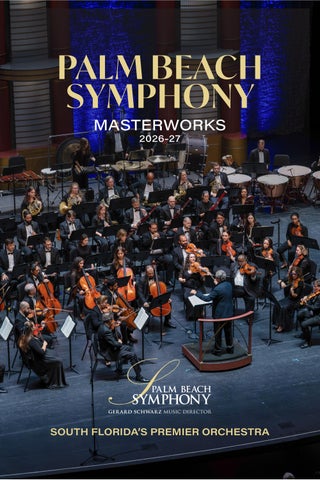
PALM BEACH SYMPHONY MASTERWORKS 2026-27
SOUTH FLORIDA’S PREMIER ORCHESTRA
What’s your
why?
I WANT THE ARTS TO INSPIRE EVERY GENERATION. We all have a different “why” for being here. For us, it’s to celebrate the irreplaceable role that the performing arts play in enhancing and enriching the life of our community. That’s why we’re committed to playing our part in helping the show go on. We’re proud to support Palm Beach Symphony and all of the inspiration you bring.
Let’s talk about your why.
Contact Kelly Wathen, Sr. Vice President, Market Leader, at 561-803-9539 or kelly.wathen@pnc.com, or visit pnc.com/privatebank. The PNC Financial Services Group, Inc. (“PNC”) uses the marketing name PNC Private Bank to provide investment consulting and wealth management, fiduciary services, FDIC-insured banking products and services, and lending of funds to individual clients through PNC Bank, National Association (“PNC Bank”), which is a Member FDIC, and to provide specific fiduciary and agency services through PNC Delaware Trust Company or PNC Ohio Trust Company. PNC does not provide legal, tax, or accounting advice unless, with respect to tax advice, PNC Bank has entered into a written tax services agreement. PNC Bank is not registered as a municipal advisor under the Dodd-Frank Wall Street Reform and Consumer Protection Act. Bank deposit products and services are provided by PNC Bank, National Association, Member FDIC. “PNC Private Bank” is a service mark of The PNC Financial Services Group, Inc. Investments: Not FDIC Insured. No Bank Guarantee. May Lose Value. ©2024 The PNC Financial Services Group, Inc. All rights reserved.
INV WM PDF 0123-057-2186701
TRUST AND ESTATE ADMINISTRATION | WEALTH PLANNING | INVESTMENT MANAGEMENT | CREDIT AND CASH MANAGEMENT
Amy Grantham | Resonant, 2025 | pastel on paper | 41 x 36 in.
F I N D L AY G A L L E R I E S I S H O NO R E D T O S U P P OR T
165 W O RT H AV E N U E , PA L M B E A C H , F L O R I D A 33480 · (561) 655-2090 VIEW OUR GALLERY ONLINE | WWW. FINDLAYGALLERIES. COM Copyright © 2025, Wally Findlay Galleries International, Inc. All rights reserved.
Cummings & Lockwood Proudly Supports Palm Beach Symphony
For over 100 years, Cummings & Lockwood has been building meaningful and lasting relationships with our clients and the communities in which we live and work. We believe in supporting and being involved in our community. Cummings & Lockwood’s attorneys and staff give of their time, expertise and financial support to over 100 charitable organizations in Connecticut and Florida. We offer our individual and commercial clients the following services: Private Clients | Trusts and Estates Fiduciary and Probate Litigation Corporate and Finance Business Litigation and Arbitration Commercial and Residential Real Estate
Palm Beach Gardens Offi fic ce Seacoast Banking Centre 3001 PGA Boulevard Suite 104 Palm Beach Gardens, FL 33410 Phone: 561.214.8500 Fax: 561.214.8514
www.cl-law.com STAMFORD | GREENWICH | WEST HARTFORD | NAPLES | BONITA SPRINGS | PALM BEACH GARDENS
DOES YOUR CHECKING ACCOUNT PAY YOU BACK?
OURS DOES! *7.00% APY ON BALANCES UP TO $3,000 *0.05% APY ON BALANCES $3,000+
Earn more with a myChoice Checking account. A great option to earn money on your deposits while protecting your identity and giving back to your community.
LOCATE A BRANCH NEAR YOU
ithinkfi.org 800.873.5100
Better Banking, the Credit Union Way. *APY = Annual Percentage Yield. These rates are accurate as of January 1, 2026, and are subject to change. A $5.00 monthly service fee will be assessed each month on all personal Checking accounts except for myWallet Free Checking. Limit (1) monthly service fee per membership, even if you have more than one Checking account. Federally Insured by NCUA. $25.00 minimum opening deposit required. palmbeachsymphony.org Fees may reduce earnings on this account.
3
PROUD SPONSOR OF THE PALM BEACH SYMPHONY
ELEVATE YOUR EXPERIENCE. Life at Wellington Bay blends elegance and comfort with beautifully designed homes in a lush setting, distinctive dining experiences, and a variety of cultural, educational, and recreational opportunities—all supported by a no‑entry‑fee rental model and maintenance‑free lifestyle that lets you enjoy each day. DISCOVER MORE ABOUT LUXURY SENIOR LIVING
WellingtonBayFL.com or call 561.667.9893 10430 Stable Lane Wellington, FL 33414 INDEPENDENT LIVING | ASSISTED LIVING | MEMORY CARE palmbeachsymphony.org Retirement Living Options from Liberty Senior Living • Assisted Living License #137935
Fox Rothschild Proudly Supports Palm Beach Symphony
Local Attorneys. National Resources. You can expect custom legal solutions from attorneys with deep connections in West Palm Beach and beyond. We’re right here where you need us, backed by 1000 lawyers in 70 practice areas and 31 offices coast to coast. South Florida knowledge. National strength. The Fox Rothschild Advantage. Adam Wolek
Partner awolek@foxrothschild.com 561.804.4412
CA | CO | DC | DE | FL | GA | IL | MA | MN | MO NJ | NV | NY | NC | OK | PA | SC | TX | WA Attorney Advertising
Table of Contents November 17 Jean-Yves Thibaudet, piano
55
December 16 Yefim Bronfman, piano
61
January 17 Augustin Hadelich, violin
69
February 10 Daniil Trifonov, piano
77
March 15 Julian Schwarz, cello
85
April 28 Pinchas Zukerman, violin
93
May 23 Ray Chen, violin
99
Chair’s Welcome
13
Message from the Music Director
15
Symphony Mission
24
Chief Executive Officer’s Letter
27
Orchestra and Staff
30
Palm Beach Symphony 700 South Dixie Highway, Suite 100 West Palm Beach, FL 33401 Phone: 561.655.2657 I Box Office: 561.281.0145 @pbsymphony palmbeachsymphony.org Photo Credits IndieHouseFilms: All performance photography Capehart Photography: All social photography
palmbeachsymphony.org
7
2026-27
CALENDAR OF EVENTS SPECIAL EVENT: AN EVENING OF FINE WINE, MUSIC, AND CONVERSATION (Invitation Only) Wednesday, September 23, 6:00 p.m. The Lotos Club, New York SCHOOL SHOW 1: SLEEPING BEAUTY AND THE ORCHESTRA Tuesday, October 20, 10:30 a.m. Dolly Hand Cultural Arts Center, Palm Beach State College
YOUNG FRIENDS INSTRUMENT DONATION DRIVE Thursday, November 19, 6:00 p.m. Home of Palm Beach Symphony Center for Philanthropy, 700 South Dixie Highway, West Palm Beach 10TH ANNIVERSARY HOLLY JOLLY SYMPHONY FÊTE Monday, December 7, 10:30 a.m. Cohen Pavilion, Kravis Center
PRE-HOLLY JOLLY GIFT GATHERING PARTY Thursday, October 22, 5:30 p.m. Home of Palm Beach Symphony Center for Philanthropy, 700 South Dixie Highway, West Palm Beach
LUNCH AND LEARN #2: Alberto Bade, Assistant Conductor Thursday, December 10, 12:00 p.m. – 1:30 p.m. Home of Palm Beach Symphony Center for Philanthropy, 700 South Dixie Highway, West Palm Beach
SCHOOL SHOW 2: SLEEPING BEAUTY AND THE ORCHESTRA Monday, October 26, 10:30 a.m. Dreyfoos Hall, Kravis Center
MASTERWORKS #2: Yefim Bronfman, Piano Wednesday, December 16, 7:30 p.m. Dreyfoos Hall, Kravis Center
YOUNG FRIENDS SEASON KICK-OFF COCKTAIL PARTY Wednesday, October 28, 5:30 p.m. Meat Market, Palm Beach
CANDLELIGHT CHAMBER CONCERT 1: Winter Solstice – Brass Quintet Sunday, December 20, 7:00 p.m. Curator/Host: Claudio Jaffé, Principal Cello Exclusive to The Boca Raton Members and Hotel Guests Only The Boca Raton, 501 East Camino Real, Boca Raton
SCHOOL SHOW 3: SLEEPING BEAUTY AND THE ORCHESTRA Wednesday, November 4, 10:30 a.m. Duncan Theatre, Palm Beach State College FAMILY CONCERT: SLEEPING BEAUTY AND THE ORCHESTRA Saturday, November 7, 2:00 p.m. Duncan Theatre, Palm Beach State College AMERICA 250 CONCERT Sunday, November 8, 3:00 p.m. Dreyfoos Hall, Kravis Center LUNCH AND LEARN #1: Alberto Bade, Assistant Conductor Thursday, November 12, 12:00 p.m. – 1:30 p.m. Home of Palm Beach Symphony Center for Philanthropy, 700 South Dixie Highway, West Palm Beach PALM BEACH SYMPHONY SEASON KICK-OFF PARTY (Members Only) Thursday, November 12, 6:00 p.m. Club Colette, Palm Beach MASTERWORKS #1: Jean-Yves Thibaudet, Piano Tuesday, November 17, 7:30 p.m. Dreyfoos Hall, Kravis Center
8 Palm Beach Symphony
PALM BEACH SYMPHONY GALA KICK-OFF RECEPTION (Invitation Only) Thursday, January 7, 6:00 p.m. Findlay Galleries, Palm Beach LUNCH AND LEARN #3: Alberto Bade, Assistant Conductor Thursday, January 14, 12:00 p.m. – 1:30 p.m. Home of Palm Beach Symphony Center for Philanthropy, 700 South Dixie Highway, West Palm Beach MASTERWORKS #3: Augustin Hadelich, Violin Sunday, January 17, 3:00 p.m. Dreyfoos Hall, Kravis Center CANDLELIGHT CHAMBER CONCERT 2: Vienna by Candlelight – String Quartet Sunday, January 24, 7:00 p.m. Curator/Host: Alberto Bade, Assistant Conductor Exclusive to The Boca Raton Members and Hotel Guests Only The Boca Raton, 501 East Camino Real, Boca Raton
PRELUDE SOCIETY EVENT: CURATED CLASSICS (Invitation Only) Monday, January 25, 6:00 p.m. The Ben, West Palm Beach
MASTERWORKS #5: RUN-OUT Tuesday, March 16, 7:30 p.m. The Community Church of Vero Beach, Vero Beach, FL
LUNCH AND LEARN #4: Claudio Jaffé, Principal Cello Thursday, February 4, 12:00 p.m. – 1:30 p.m. Home of Palm Beach Symphony Center for Philanthropy, 700 South Dixie Highway, West Palm Beach
SWINGS FOR STRINGS GOLF INVITATIONAL Friday, March 19, 11:00 a.m. Wellington National Golf Club, Wellington
YOUNG FRIENDS PALM BEACH SHOW KICK-OFF PARTY (Invitation Only) Saturday, February 6, 6:00 p.m. Private residence, West Palm Beach MASTERWORKS #4: Daniil Trifonov, Piano Wednesday, February 10, 7:30 p.m. Dreyfoos Hall, Kravis Center PALM BEACH SYMPHONY 25TH ANNIVERSARY GALA: A STANDING OVATION Monday, February 15, 7:00 p.m., Black-tie The Breakers Palm Beach Orchestra Outreach: AN EVENING OF DIVERTIMENTOS AND DRESSAGE FOR BROOKE USA Thursday, February 18, 7:00 p.m. Jim Brandon Equestrian Center
CANDLELIGHT CHAMBER CONCERT 4: Screen to Stage – String Quartet Sunday, March 21, 7:00 p.m. Curator/Host: Alberto Bade, Assistant Conductor Exclusive to The Boca Raton Members and Hotel Guests Only The Boca Raton, 501 East Camino Real, Boca Raton SUNSET DINNER CRUISE ON “CATALINA” (Invitation Only) Tuesday, April 6, 7:00 p.m. (Boarding at 6:45 p.m.) Riviera Beach City Marina 6TH ANNUAL IMPRESARIO SOCIETY DINNER (Impresario Society Members Only) Tuesday, April 13, 6:00 p.m. Private Residence, Palm Beach
LUNCH AND LEARN #6: Claudio Jaffé, Principal Cello Thursday, April 22, 12:00 p.m. – 1:30 p.m. Home of Palm Beach Symphony CANDLELIGHT CHAMBER CONCERT Center for Philanthropy, 3: Romantic Voices – String Quartet 700 South Dixie Highway, West Palm Beach and Mezzo-Soprano Friday, February 19, 7:00 p.m. PRE-HOLLY JOLLY GIFT Curator/Host: Alberto Bade, Assistant Conductor GATHERING PARTY Exclusive to The Boca Raton Members and Friday, April 23, 5:30 p.m. Hotel Guests Only Home of Palm Beach Symphony The Boca Raton, 501 East Camino Real, Boca Raton Center for Philanthropy, 700 South Dixie Highway, West Palm Beach PLANNED GIVING WINE TASTING RECEPTION MASTERWORKS #6: Friday, March 5, 6:30 p.m. Pinchas Zukerman, Violin The Beach Club, Palm Beach Wednesday, April 28, 7:30 p.m. Dreyfoos Hall, Kravis Center LUNCH AND LEARN #5: Maestro Gerard Schwarz, Music Director LUNCH AND LEARN #7: Maestro Thursday, March 11, 12:00 p.m. – 1:30 p.m. Gerard Schwarz, Music Director Home of Palm Beach Symphony Thursday, May 20, 12:00 p.m. – 1:30 p.m. Center for Philanthropy, Home of Palm Beach Symphony 700 South Dixie Highway, West Palm Beach Center for Philanthropy, 700 South Dixie Highway, West Palm Beach Orchestra Outreach: LADY IN RED GALA Sunday, March 14, 6:00 p.m. MASTERWORKS #7: The Breakers Palm Beach Ray Chen, Violin COMMUNITY SIDE-BY-SIDE MASTERWORKS #5: Sunday, May 23, 3:00 p.m. Julian Schwarz, Cello Dreyfoos Hall, Kravis Center Monday, March 15, 7:30 p.m. Dreyfoos Hall, Kravis Center palmbeachsymphony.org
9
A PARADISE FOR EVERY SEASON
Winter or summer? We have you covered. Winter at Palm Beach’s pinkest hotel and summer in East Hampton—because it turns out you know someone with a fabulous place in both locations. 155 HAMMON AVENUE, PALM BEACH, FL 33480 (561) 655-5430 THECOLONYPALMBEACH.COM 74 JAMES LANE, EAST HAMPTON, NY 11937 (631) 324-7101 THEHEDGESEASTHAMPTON.COM
BOARD OF DIRECTORS EXECUTIVE COMMITTEE
James R. Borynack Chair
Richard Brekus Vice Chair
John D. Herrick Treasurer
Don Thompson Secretary
DIRECTORS
Carol Baxter
Cathleen Black
Nannette Cassidy
Amy Collins
Mary Demory
Carol S. Hays
Percy Kavasmaneck, Ph.D.
Marietta Muiña McNulty
Martha M. Rodriguez, M.D.
Karen Rogers
Adam Wolek
palmbeachsymphony.org
11
CHAIR’S WELCOME
I
t is my great pleasure to welcome you to Palm Beach Symphony's 2026–2027 Masterworks Concert Series. As we embark on our 53rd year, we are excited to continue bringing the joy, inspiration and connection of live orchestral music to our community. Under the extraordinary baton of Music Director Gerard Schwarz, now in his eighth year with us, this season promises to be one of our best yet. We are proud to present an unforgettable lineup that includes legendary artists, thrilling debuts and timeless masterpieces. From Ludwig van Beethoven's poetic Piano Concerto No. 3 in C Minor, Op. 37 to Hector Berlioz's epic Symphonie fantastique and Igor Stravinsky's theatrical Rite of Spring, each concert offers a powerful journey through the world's greatest music. We are honored to welcome back audience favorite soloists Jean-Yves Thibaudet, Yefim Bronfman, Pinchas Zukerman and Julian Schwarz, and to feature Palm Beach Symphony debuts of celebrated artists Augustin Hadelich, Daniil Trifonov and Ray Chen. Our commitment to education and community engagement remains at the heart of our mission. Through initiatives like the Paul & Karen Levy Residency Program and Dale A. McNulty Children's Concert Series, we continue to inspire the next generation of musicians and ensure access to the arts for students throughout Palm Beach County and surrounding areas in South Florida. It is through the dedication and generosity of our patrons, donors and sponsors that we are able to achieve this level of artistic and community impact. On behalf of the Board of Directors, thank you for standing with us in our mission to engage, educate and entertain. Please enjoy this extraordinary season of music.
James R. Borynack Chair
palmbeachsymphony.org
13
West Palm Beach’s Most Refined Retreat
Specializing in weekly and monthly stays, AKA West Palm's stylish hotel residences offer premium service, elevated amenities, and exclusive long stay rates. Experience: • Sophisticated studios, 1 & 2 bedroom suites with kitchens • Tranquil pool deck & outdoor lounge • 24/7 Technogym® fitness center • The Blind Monk: shared plates & curated wines • a.market: gourmet cafe and bakery • Body+Beauty Lab wellness treatments • Circuit car service (2-mile radius) • Morning yoga classes • AKA Pet Spa by D is for Dog
WEST PALM — 695 S. OLIVE AVENUE 561.821.2252 AKAWP@STAYAKA.COM STAYAKA.COM
MESSAGE FROM
GERARD SCHWARZ
W
elcome to Palm Beach Symphony's new season! Each season, we take great care in crafting programs that resonate with our remarkable musical community and highlight the enduring importance of culture in our society. We are proud to contribute to the vibrant arts scene in Palm Beach, bringing world-class music to audiences in our community. This season, our orchestra will perform timeless symphonic masterpieces, including works by Handel, Berlioz, Tchaikovsky, Strauss, Wagner, Mendelssohn, Brahms and Shostakovich. These masterpieces have inspired generations, and we are honored to bring them to life with our orchestra’s distinctive sound and artistry. We are also thrilled to welcome extraordinary soloists to our stage, both familiar faces and exciting new talents, whose artistry brings depth, passion, and brilliance to every performance. Among them are JeanYves Thibaudet, Yefim Bronfman, Augustin Hadelich, Daniil Trifonov, Pinchas Zukerman and Ray Chen. I am especially excited to have my son, Julian Schwarz, returning to play the Strauss Don Quixote, also with our wonderful Principal Violist Chauncey Patterson. Their performances enrich our shared love of music and offer unforgettable moments for our audiences. As a 21st-century American orchestra, we are deeply committed to celebrating contemporary music by American composers. Continuing our country’s 250th anniversary, we will present works by living composers Daron Aric Hagen, with the premiere of his Consolation, Cindy McTee and English composer Anna Clyne.
Gerard Schwarz
Music Director
palmbeachsymphony.org
15
MUSIC DIRECTOR
GERARD SCHWARZ
G
erard Schwarz has built a career spanning more than five decades as a conductor, musician, educator, composer, and champion of new music. He began his professional career as co-principal trumpet of the New York Philharmonic before turning his attention fully to conducting, and went on to lead the Mostly Mozart Festival, Royal Liverpool Philharmonic, Los Angeles Chamber Orchestra, New York Chamber Symphony, and Waterloo Music Festival, among others. His 26-year tenure as Music Director of the Seattle Symphony was a defining chapter, with subscriptions growing from 5,000 to 40,000 and a final season featuring 22 world premieres. As Music Director of Palm Beach Symphony since 2019, he has led a transformation in the
16 Palm Beach Symphony
MUSIC DIRECTOR
orchestra's artistic growth, with box office receipts more than tripling and memberships and subscriptions growing by more than 150%. As Music Director of the All-Star Orchestra, he has led 29 programs broadcast on public television, with an educational series, created with the Khan Academy, that has reached more than 7 million students; the programs have received 11 Emmy Awards. Schwarz's discography includes more than 350 albums with orchestras including The Philadelphia Orchestra, London Symphony Orchestra, and Czech Philharmonic. A passionate advocate for new music, he has conducted more than 300 world premieres and continues to champion contemporary composers. Today, Schwarz serves as Music Director of the All-Star Orchestra, Eastern Festival of Music, Palm Beach Symphony, and Frost Symphony Orchestra, and is Conductor Laureate of the Seattle Symphony Orchestra and Conductor Emeritus of the Mostly Mozart Festival. Over five decades, he has received nine Emmy Awards, 15 GRAMMY® nominations, eight ASCAP Awards, and was the first American named Conductor of the Year by Musical America.
palmbeachsymphony.org
17
ASSISTANT CONDUCTORS Alberto Bade has been an assistant
conductor at Palm Beach Symphony since the 2024-2025 season. He is a former teaching assistant and assistant conductor for Maestro Gerard Schwarz at the Frost School of Music at the University of Miami, where he completed his Doctor of Musical Arts degree. He is also the orchestra director and a professor at Miami Dade College - North Campus. A dedicated advocate of music education, Bade is a frequent guest conductor for local and international youth orchestras that include the South Florida Youth Symphony and the Panamanian Youth Philharmonic Orchestra. As an international performer, Bade has performed as guest conductor for orchestras in Panama, Madrid, Berlin, Prague and St. Petersburg, Russia. Born in West New York, New Jersey, Bade developed his interest in music at a very young age. Although primarily captured by the orchestral language, jazz and other styles were equally prevalent during his musical development. He earned a bachelor’s degree in Studio Music and Jazz and a Master of Music degree from the University of Miami before moving to New York to begin post-graduate studies at The Juilliard School under Maestro Vincent La Selva. Later, Bade took various masterclasses throughout Europe under the mentorship of Maestro Jorma Panula. He’s won the Miami-Dade County Public Schools Educational Outreach Award and Miami Dade County Mayor’s Maestro Award for his performances and educational contributions to the City of Miami. Internationally, Bade received the “Homenaje del Ayuntamiento de Leganés” (“Key to the City”) for his musical and educational contributions to the city of Leganés in the Community of Madrid, Spain. Additionally, he has won 11 EMMY Awards for his televised orchestral performances with Miami Dade College.
18 Palm Beach Symphony
ASSISTANT CONDUCTORS
Linus Ip has established a reputation as
an innovative and dynamic conductor whose work combines artistic excellence, community engagement, and educational leadership. He currently serves as Music Director and Conductor of the Philadelphia Sinfonia and Assistant Conductor of Palm Beach Symphony. He is recognized for championing interdisciplinary collaborations and educational initiatives that engage musicians, audiences, and communities. As Music Director of Philadelphia Sinfonia, Ip leads a vibrant orchestral program that combines artistic excellence with community-centered values. Under his leadership, the organization has expanded collaborations with The Philly Pops, The Philadelphia Orchestra, local schools, and community organizations, creating innovative projects that connect music with education and the broader civic life of the region. In 2025, Ip served as Assistant Conductor and Cover Conductor for the National Symphony Orchestra Summer Music Institute at the John F. Kennedy Center for the Performing Arts, as well as Assistant Conductor of the Orion Youth Symphony and Annapolis Symphony Academy. A strong advocate for contemporary music and underrepresented voices, he has led numerous premieres and interdisciplinary collaborations. As Principal Conductor of the Old Bay New Music Ensemble, he directed performances of newly commissioned chamber orchestra and operatic works while collaborating extensively with composers, performers, and artists across disciplines. Recent highlights include being named a semifinalist in the 2024 Koussevitzky International Conducting Competition in Italy and serving as a Conducting Fellow at the National Orchestral Institute. His conducting and assisting engagements have included collaborations with the Baltimore Symphony Orchestra, National Symphony Orchestra, National Philharmonic, Symphoniker Hamburg, Washington Choral Arts Society, and the Peabody Symphony Orchestra. Among his most influential mentors are Gerard Schwarz and Marin Alsop, whose guidance has helped shape his artistic vision and leadership philosophy. He earned his Master of Music degree in Orchestral Conducting from the Peabody Institute of The Johns Hopkins University, studying with Marin Alsop and Joseph Young. He also studied conducting with Ulrich Windfuhr through an exchange program at the Hochschule für Musik und Theater Hamburg.
palmbeachsymphony.org
19
LADIES GUILD The Palm Beach Symphony Ladies Guild was formed in 2009 to assist the Board of Directors in developing ideas related to Symphony programs and membership. As ambassadors of the Symphony, Ladies Guild members are “friend-raisers” who share their enthusiasm for the organization and work together to invite and encourage membership.
Carol Baxter
Sheryne Brekus~
Carol Bruce
Sophia Burnichon
Nannette Cassidy~
Amy Collins
Dr. Alexandra Carpenter Cook
Suzanne Mott Dansby
Mary Demory
Margaret C. Donnelley
Sandra Goldner+*
Arlette Gordon+
Denis Hanrahan
Carol S. Hays
Dr. Ann L. Johnson*
Dr. Aban Kavasmaneck
20 Palm Beach Symphony
LADIES GUILD
Marietta Muiña McNulty+
Dawn Galvin Meiners*
Sally Ohrstrom+
Teresa Phelan Ford
Ruby Rinker*
Martha M. Rodriguez, M.D.
Karen Rogers
Mary Lynn Rogers
Jody Schwarz
Sherri Stephenson
Mary Thompson+
Sieglinde Wikstrom+*
Susan Willis-Reickert
Erika Wolek
Judy Woods
+Founding Member *Honorary Member ~Legacy Member palmbeachsymphony.org
21
P R O V I D E N TJ E W E L RY. C O M
REDEFINE
LUXURY W E S T PA L M I N A P L E S FORT MYERS
I PA L M B E A C H
I JUPITER I WE LLINGTON
MEMBERSHIP BECOME A MEMBER OF PALM BEACH SYMPHONY
BENEFITS FOR ALL MEMBERS Priority seating in premier sections at Masterworks Concerts (select areas in the orchestra and grand tier levels) Access to Annual Gala Access to Season Kick-Off Party Access to Sunset Dinner Cruise Pre- or Post-Concert Dining Complimentary Valet Parking Recognition in Program Books Complimentary Single Ticket Exchanges Advanced Single Ticket Purchase
Scan to read more about membership benefits:
HISTORY & MISSION
P
alm Beach Symphony is South Florida’s premier orchestra known for its diverse repertoire and commitment to the community. Founded in 1974, this 501(c)(3) nonprofit arts organization adheres to a mission of engaging, educating, and entertaining the greater community of the Palm Beaches through live performances of inspiring orchestral music. The orchestra, led by its Music Director and internationally recognized conductor Gerard Schwarz, is celebrated for delivering spirited performances by first-rate musicians and distinguished guest artists. Recognized by The Cultural Council for Palm Beach County with a 2020 Muse Award for Outstanding Community Engagement and a 2025 EMMY Award for our Dale A. McNulty Children's Concert The Carnival of MORE Animals, Palm Beach Symphony continues to expand its education and community outreach programs with children’s concerts, student coaching sessions, masterclasses, instrument donations and free public concerts that have reached more than 100,000 students and lifelong learners in recent years.
History: In our earliest days, the orchestra performed only a few
concerts a year with a part-time conductor and a volunteer staff. It was not until Mrs. Ethel S. Stone became the Symphony’s board chair, a position she held for 23 years, that Palm Beach Symphony began establishing itself as a cultural force in the community. A visionary leader, Mrs. Stone inherited her love of music from her family and generously shared it with the community she loved. During her tenure, a number of well-known musicians served in leadership roles including Karl Karapetian, John Iuele, 24 Palm Beach Symphony
HISTORY & MISSION
Kenneth Schermerhorn, Stewart Kershaw, David Gray, Ulf Bjorlin, and John Covelli. Upon Mrs. Stone’s death on August 6, 1996, John and Joan Tighe stepped in to continue her legacy. They established a stable board of directors, a dedicated administrative staff, and a small endowment fund to ensure the Symphony’s continued growth. Musicians who led the orchestra during the Tighes’ tenure were Alan Kogosowski, Vladimir Ponkin, Sergiu Schwartz, Ray Robinson, and Donald Oglesby.
Mission: The mission of Palm Beach Symphony is to engage,
educate, and entertain the greater community of the Palm Beaches through live performances of inspiring orchestral music.
Today: From our humble beginnings, Palm Beach Symphony has
grown to become a cultural pillar in the Palm Beach community. Now a key cultural force in the area, we attract members who enjoy pairing quality concerts with fine dining experiences and social events, and who value and support the symphony’s music education and community outreach programs. In 2019, as the Symphony entered its 45th season, we moved our operations across the bridge from Palm Beach (where we’d operated since 1974) to West Palm Beach, allowing us space to realize our full potential by expanding our mission and reaching even more corners of the community with orchestral music. By integrating with the rich fabric of the Downtown West Palm Beach business district, we’re able to align with countless economic development and tourism assets to enrich the lives of families, businesses, residents, students, and tourists. Through important collaborations with our valued community partners – the School District of Palm Beach, the Related Group, the Cultural Council, the Downtown Development Authority, and the West Palm Beach Arts and Entertainment District, to name just a few – we’re continuing to grow our mission and expand our reach in Palm Beach County and beyond, bringing classical music to people of all ages, backgrounds, and life experiences. In its 53rd season, the Symphony continues its strong momentum of growth under the leadership of Chief Executive Officer David McClymont. Music Director Gerard Schwarz is leading spirited performances of Masterworks concerts with an orchestra that reaches 90 players, the mark of a major symphony orchestra. Children’s concerts, student coaching sessions, masterclasses, instrument donations, and free public concerts have reached more than 100,000 students in recent years. In addition to conducting the Masterworks concerts, Maestro Schwarz is also conducting our EMMY award-winning Dale A. McNulty Children’s Concert Series, and the orchestra is recording it for television through a partnership with South Florida PBS. palmbeachsymphony.org
25
SAVE the DATE Palm Beach Symphony
FRIDAY, MARCH 19, 2027, 11:00 AM Wellington National Golf Club
CHIEF EXECUTIVE
OFFICER’S LETTER Dear Friends, s we launch Palm Beach Symphony's 2026– 2027 Masterworks Concert Series, I am thrilled to share a season that celebrates the power, beauty and connection of live orchestral music. This year offers an extraordinary journey through iconic masterworks, exciting solo debuts and two world premieres. We open our 53rd season with legendary pianist Jean-Yves Thibaudet performing Camille Saint-Saëns' Piano Concerto No. 5 in F Major, Op. 103 “Egyptian,” alongside the world premiere of Daron Aric Hagen's Consolation and Johannes Brahms' Symphony No. 4 in E Minor, Op. 98. Later in the season, we proudly present the world premiere of our Music Director Gerard Schwarz’s Symphony, commissioned exclusively for Palm Beach Symphony by Don and Mary Thompson, featuring violinist Pinchas Zukerman. Audiences will also experience the brilliance of Yefim Bronfman, Augustin Hadelich, Daniil Trifonov, Julian Schwarz and Ray Chen, with music ranging from Ludwig van Beethoven and Pyotr Ilyich Tchaikovsky to Jean Sibelius and Igor Stravinsky. Equally meaningful is our work beyond the stage. Through our education and outreach programs, Palm Beach Symphony continues to reach students and lifelong learners across Palm Beach County, offering free school performances and classroom residencies, and placing hundreds of instruments in the hands of deserving students through our Todd Barron Instrument Donation Program. This season also holds special significance as we celebrate the silver jubilee of our Annual Gala, 25 years of bringing our community together in support of this orchestra. This season, on stage and beyond it, reflects our mission to engage, educate and entertain. We are deeply grateful for the supporters who make it all possible. On behalf of our musicians, board and staff, thank you for joining us. We look forward to sharing a season of unforgettable performances with you.
A
With gratitude,
David H. McClymont
Chief Executive Officer palmbeachsymphony.org
27
PLANNED GIVING
LEAVE A MUSICAL LEGACY Palm Beach Symphony is deeply grateful to those who remember us through bequests or planned gifts. There are many ways to make a planned gift to the Symphony. Depending on your age, your income and assets and your vision of giving, you may wish to consider: • Beneficiary Designations under Retirement Plan Assets [401(k), 403(b), IRA] • Bequests via Will or Living Trust • Cash
• Charitable Lead Trusts • Charitable Remainder Trusts • Gift Annuities • Life Insurance • Pledges
Your planned gift will help ensure the Symphony’s bright future by: • Keeping classical music thriving by supporting our world-class musicians and critically acclaimed conductor.
• Building a cultural community by helping us make classical music accessible to all through free outreach events.
• Allowing thousands of local students to be instructed and inspired by our concerts and education programs.
The Dora Bak Society
The Dora Bak Society recognizes the dedication and generosity of music patrons who choose to include Palm Beach Symphony in their bequests or other long-range charitable giving plans. The Society offers a wonderful way to help sustain the Symphony’s mission for generations to come. Dora Bak Society members are acknowledged in a variety of ways, including presence on all printed donor lists and other naming opportunities that will carry the donor’s name into perpetuity.
Contact Us
When you’re ready to learn more about bequest opportunities that benefit Palm Beach Symphony, please contact David McClymont at 561-655-2657. 28 Palm Beach Symphony
S A V E
T H E
D A T E
PALM BEACH SYMPHONY THE ANNUAL PLANNED GIVING
Wine Tasting Reception AN EVENING OF LEGACY, WINE, AND MUSIC, IN HONOR OF THOSE WHO CARRY THE SYMPHONY FORWARD
FRIDAY
MAR .
5 2027
The Beach Club Palm Beach
6:30 PM EVENT INFORMATION Hulya Selcuk|561.568.0265 |hselcuk@palmbeachsymphony.org PRESENTED IN PARTNERSHIP WITH
palmbeachsymphony.org
@pbsymphony
ORCHESTRA & STAFF VIOLIN
VIOLA
Scott Flavin, Concertmaster
Chauncey Patterson, Principal
Avi Nagin, Co-Concertmaster
Felicia Besan, Assistant Principal
Misha Vitenson, First Assistant Concertmaster
Naomi Graf
Marina Lenau, Second Assistant Concertmaster Valentin Mansurov, Principal Second Violin
Alexandra D’Amico Daniel Guevara Roberto Henriquez Angela Kratchmer
Victoria Bramble, Associate Principal Second Violin
Gabrielle Malaniak
Claudia Cagnassone, Assistant Principal Second Violin
David Pedraza
Evgeniya Antonyan
Miguel Misa Taylor Shea
Samvel Arakelyan Kristin Baird Tinca Belinshi Dina Bikzhanova
CELLO Claudio Jaffé, Principal
Huifang Chen
Jason Calloway, Assistant Principal
Monica Cheveresan
Brent Charran
Anne Chicheportiche
Tadao Hermida
Adriana Fernandez
German Marcano
Orlando Forte
Niloufar Nabikhani
Sheena Gutierrez
Aziz Sapaev
Emin Huseynov
Natalie Van Winkle
Natalie Koh Erika Liu Charlotte Loukola Svetlana Salminen Michelle Skinner Nicholas Tavani Patrisa Tomassini Ollantay Velásquez Erika Venable Nicholas Whitley Adrienne Williams Michael Wu Alexander Zhuk 30 Palm Beach Symphony
DOUBLE BASS Juan Carlos Peña, Principal Brian Myhr, Assistant Principal Jeff Adkins Pablo Camacho Paola Garcia Amy Nickler William Penn Shane Savage *Section strings are listed in alphabetical order*
ORCHESTRA & STAFF
FLUTE
TRUMPET
Nadine Asin, Principal
Gabriel Gutiérrez, Principal
Joseph Monticello, Assistant Principal
Stefan Filip
Elizabeth Lu
Ricardo Chinchilla
Dmytro Gnativ
Amy Batchelder Marc Reese
OBOE Antonio Urrutia Mendoza, Principal
TROMBONE
Elias Medina
Domingo Pagliuca, Principal
Karen Trujillo, Oboe/English Horn
Adrian Corredor Andre Prouty, Bass Trombone
CLARINET Santiago Oviedo-Reina, Principal Julian Santacoloma
TUBA Dylan Silverstein, Principal
Molly Wyrick-Flax, Bass Clarinet TIMPANI BASSOON
Lucas Sanchez, Principal
Gabriel Beavers, Principal Christina Bonatakis
PERCUSSION
Lilian Vo
Scott Crawford, Principal
Gabrielle Hsu, Contrabassoon
Nathan Coffman Jordan Holley
FRENCH HORN
Matt Nichols
Amber Dean, Principal Judeny Lebron, Assistant Principal
HARP
James Brandt
Laura Sherman, Principal
Stan Spinola Michelle Haim
KEYBOARD
Joe Morrione
Valeria Polunina, Principal
ORCHESTRA CONTRACTOR Avi Nagin, Nagin Concert Artists, LLC
palmbeachsymphony.org
31
ORCHESTRA & STAFF
Principal Chairs Sponsored by: Gabriel Beavers, Principal Bassoon Sponsored by Dr. Gary Johnson Claudio Jaffé, Principal Cello Sponsored by Leslie Rogers Blum Nadine Asin, Principal Flute Sponsored by David Moscow and Linda Klein Amber Dean, Principal French Horn Sponsored by Karen Hunt Rogers Valeria Polunina, Principal Keyboard Sponsored by Hank Dow and Kelly Winter Antonio Urrutia Mendoza, Principal Oboe Sponsored by Carol and Thomas Bruce Gabriel Gutiérrez, Principal Trumpet Sponsored by Tina and Jeffrey Bolton Chauncey Patterson, Principal Viola Sponsored by Dr. Richard and Diane Farber
STAFF David McClymont Chief Executive Officer Christopher Burnett Director of Finance Sage Lehman Patron Relations Concierge Joshua Schneider Production Coordinator Joseph Monticello Development Assistant Kai Poveda Development Associate Conor Price Director of Marketing and Communications Felix Rivera Patron Advancement Coordinator Hulya Selcuk Director of Special Events Bryce Seliger Education & Programming Associate Kewan Smith Director of Development Olga M. Vazquez Director of Artistic Operations Courtney Zaffuta Marketing Assistant Ruby Ziemer Marketing Assistant
32 Palm Beach Symphony
PRINCIPAL MUSICIANS Avi Nagin, violinist and orchestra contractor for Palm Beach Symphony, is a member of the critically acclaimed Amernet String Quartet and Associate Teaching Professor and Head of Strings at Florida International University, where the quartet serves as Artist-in-Residence Ensemble. A native New Yorker, Nagin has performed across the United States, Europe, and Israel, collaborating with members of the Borromeo, Ébène, and Orion Quartets, Ani Kavafian, and Awadagin Pratt. His recordings appear on the Albany, Navona, Toccata Classics, and Divine Art labels. Nagin serves as Concertmaster and Artistic Manager of the Florida Grand Opera Orchestra, coordinating the artistic and logistical needs of a full opera orchestra across mainstage productions. He has also served as Concertmaster of Opera Naples and Sarasota Opera and guest Assistant Concertmaster of the Orpheus Chamber Orchestra. Each summer he is First Assistant Concertmaster and Personnel Manager of the Eastern Festival of Music, managing faculty and orchestral personnel at one of the country's leading summer music festivals. As founder of Nagin Concert Artists, LLC, Nagin provides orchestra contracting, personnel management, and artist services to opera, symphonic, and festival orchestras. As Orchestra Contractor for the Palm Beach Symphony, he oversees musician hiring, roster development, scheduling, and season-long personnel operations. He holds degrees from Yale University and The Colburn School, and his principal teachers include Ani Kavafian, Robert Lipsett, and Ann Setzer.
34 Palm Beach Symphony
PRINCIPAL MUSICIANS
Scott Flavin, Concertmaster for Palm Beach Symphony, enjoys a multi-faceted musical career, as chamber musician, orchestral concertmaster, soloist, and pedagogue. He is professor of violin, conducting, and chamber music at the University of Miami's prestigious Frost School of Music, where he is also Resident Conductor of The Henry Mancini Institute Orchestra, with whom he has appeared on television broadcasts for PBS and HBO, as well as a host of recordings, collaborating with artists such as Bobby McFerrin, John Williams, Quincy Jones, Denyce Graves, Dave Grusin, Chick Corea, and many others. He concertizes regularly as a member of the Bergonzi Piano Trio. In addition to Palm Beach Symphony, Flavin currently is concertmaster of the Symphony of the Americas, was long-time concertmaster for Florida Grand Opera and Miami City Ballet, and has performed as concertmaster and soloist with artists including Luciano Pavarotti, Itzhak Perlman, and Lena Horne. He is consistently engaged in concert activities around the world, and has served as a judge for the Elmar Oliveira International Violin Competition. Also a composer, his works have been performed and premiered in Paris and New York City, and his work Remembrance, Resilience, and Hope received a Puffin Foundation Grant in 2024. He has appeared on over a dozen Grammy Award-winning albums, and has released three solo recordings.
Valentin Mansurov is Principal Second
Violin for Palm Beach Symphony. An awardwinning musician who has won multiple competitions in the former U.S.S.R., Canada, and the United States, Mansurov has performed in solo recitals and chamber music concerts throughout Europe, North America and South America. In addition to his Palm Beach Symphony performances, both orchestral and chamber, he performs locally as a member of the Florida Grand Opera Orchestra. In 2015, Mansurov became a member of the critically acclaimed Delray String Quartet, performing in concerts nationwide. He began studying violin at the age of seven at Uspenskiy’s School for Musically Gifted Children in Uzbekistan and has pursued further college degrees in Turkey, France, Canada and the United States.
palmbeachsymphony.org
35
PRINCIPAL MUSICIANS
Chauncey Patterson is Principal
Viola for Palm Beach Symphony. Patterson began his professional career at 23 as Assistant Principal, later Principal Viola of the Colorado Symphony, followed by Principal Viola of the Buffalo Philharmonic. He spent 15 years as violist of the award-winning Miami String Quartet, performing at major venues including Lincoln Center, Carnegie Hall, the Kennedy Center, and the Hollywood Bowl, and recording acclaimed albums for the BMG Conifer label. His career has taken him across North America, Europe, Asia, and Latin America, collaborating with many of today’s leading musicians. Patterson later served as interim violist of the Fine Arts Quartet and now resides in Boca Raton, where he is Assistant Principal of the AllStar Orchestra, Principal Viola of Palm Beach Symphony and Symphony of the Americas, violist of the Delray Quartet, and a member of the Nu Deco Ensemble. A dedicated educator, he has held faculty positions at the Cleveland Institute of Music, the Hartt School, Eastern Music Festival, and the Frost School of Music, among others. He is currently Associate Professor of Viola at the Lynn University Conservatory, Associate Principal Viola and Director of Fellowship Quartets at the Eastern Music Festival, and a frequent guest with the Ritz Chamber Players and Brooklyn’s Bargemusic Series. A native of Burlington, North Carolina, Patterson began viola at age eight and studied at UNC–Chapel Hill, the Cleveland Institute of Music, and the Curtis Institute with Ann Woodward, Robert Vernon, Karen Tuttle, and Michael Tree.
Claudio Jaffé is Principal Cello for
Palm Beach Symphony. He launched his solo performance career at the age of 11 with an orchestral debut in his native Brazil. His recitals and guest solo appearances with multiple orchestras have brought him to play in prestigious artistic centers around the world including those in New York City, London, Tokyo, Ottawa, Rio de Janeiro, São Paulo, and Buenos Aires. The New York Times describes Jaffé as “an elegant and accomplished artist” of “taste, technique, musicianship, and a contagious youthful enthusiasm.” A prizewinner in numerous national and international competitions, Jaffé received four degrees from Yale University including Doctor of Musical Arts. He served as Dean of the Lynn University Conservatory of Music and created their Preparatory Division, began the Strings Program at 36 Palm Beach Symphony
PRINCIPAL MUSICIANS
Saint Andrew’s School in Boca Raton, has conducted the Florida Youth Orchestra for over 30 years, and performed as a member of the Delray String Quartet for over 10 seasons. He has performed in music festivals in Kansas, Massachusetts, Brazil, Trinidad, and others, led the cello section at Florida Grand Opera, and taught at Palm Beach Atlantic University as well as Florida Atlantic, Florida International, and University of Florida. He is Music Director of the Florida Youth Orchestra and currently runs a private cello studio where he teaches students of all ages.
Juan Carlos Peña is Principal Double Bass
for Palm Beach Symphony. Born in Honduras, he began his musical studies at the Victoriano López Music School. He holds double bass performance degrees from the Curtis Institute of Music and Rice University, and a degree in orchestral conducting from the University of Maryland. In Honduras, Peña held the positions of Artistic/ Technical Director of the Victoriano López School of Music, Music Director of the San Pedro Sula Orchestra and the Youth Chamber Orchestra of Tegucigalpa. In Cali, Colombia he was director of the Chamber Orchestra of the Antonio Valencia Conservatory, and in La Coruña, Spain he was Music Director of the Madrigalia Chamber Choir. Peña served as Principal Bass with the Orquesta Sinfónica Nacional in Honduras, and with the Orquesta Sinfónica del Valle in Colombia. He also served as Co-Principal Double Bass with the Orquesta Sinfónica de Galicia in Spain. An active educator in the South Florida area, Peña teaches at the New World School of the Arts in Miami, he is a String Consultant at the Dreyfoos High School of the Arts and Bak Middle School of the Arts in Palm Beach, and he also teaches the double bass orchestra repertoire class and is a chamber music coach at Lynn University in Boca Raton. Since 2010 he spends part of his summers in Honduras, collaborating as a conductor, recitalist, and clinician with that country’s most important musical institutions. Peña also performs regularly in the bass sections of the Naples Philharmonic and Atlantic Classical Orchestra.
palmbeachsymphony.org
37
PRINCIPAL MUSICIANS
Nadine Asin is Principal Flute for Palm
Beach Symphony. Asin enjoys a distinguished and multifaceted career as a performer and educator, based in Miami, Florida. She serves as principal flutist of Palm Beach Symphony and has held the same position with the Florida Grand Opera Orchestra. A highly sought-after artist, she has appeared with many of the nation’s leading ensembles and series, including the Metropolitan Opera, the New York Philharmonic, the Great Performers Series of Lincoln Center, the Chamber Music Society of Lincoln Center, Da Camera Society of Houston, the All-Star Orchestra, the Seattle Chamber Music Society, and has been featured on NPR’s Performance Today. Deeply committed to education, Asin regularly presents masterclasses at leading institutions, including Lynn University, the New World Symphony, the New World School of the Arts, and the University of Miami. She is a member of the adjunct faculty at The Juilliard School and the Bard College Conservatory, where she also coaches fellows of the TON Orchestra. A longtime artistfaculty member of the Aspen Music Festival and School, she has also served on its Board, Asin has contributed broadly to the field through additional Board roles with Chamber Music America and Concert Artists Guild. She is a graduate of The Juilliard School, where she studied with Julius Baker.
Antonio Urrutia Mendoza, Principal
Oboe and English Horn for Palm Beach Symphony, is a Colombian-born, Miami-based musician. As an avid free-lancer, Urrutia holds the Principal Oboe Chair with Palm Beach Symphony and South Florida Symphony Orchestra. He also performs frequently with the Florida Grand Opera, Miami City Ballet, Opera Naples, the Sarasota Orchestra, Symphony of the Americas, Seraphic Fire, the New World Symphony, and has been featured as a soloist with Orchestra Miami. Urrutia received his Master of Music in Orchestral Oboe at the McGill University Schulich School of Music, as well as his Graduate Diploma in Professional Performance, where he was a Graduate Teaching Assistant under the tutelage of former Montreal Symphony Principal Oboe, Theodore Baskin. During his time in Canada, he was a Fellow with the National Academy Orchestra of Canada and also performed with the Montreal Symphony Orchestra, Orchestre Classique de Montreal, Ensemble Obiora, Pronto Musica Chamber Orchestra, and made frequent appearances at the Brott Music Festival in Ontario. Urrutia has also been featured internationally, as he was Acting Associate Principal 38 Palm Beach Symphony
PRINCIPAL MUSICIANS
Oboe of the Auckland Philharmonia Orchestra in New Zealand and holds the Solo Oboe Chair at the St. Georges International Music Festival in Guadeloupe, France. During the summers, Urrutia is a fellow at the Aspen Music Festival, where he continues his studies with the Metropolitan Opera Orchestra Principal Oboe Emeritus, Elaine Douvas and Nashville Symphony Orchestra Principal Oboe Titus Underwood.
Santiago Oviedo-Reina, Principal
Clarinet for Palm Beach Symphony, is a clarinetist from Ibagué, Colombia. He holds a Master of Music from the Frost School of Music and an Artist Diploma from The Glenn Gould School, following his Bachelor’s degree from the National University of Colombia. A fellow of Filarmónica Joven de Colombia and a three-time Aspen Music Festival Fellow, Oviedo-Reina has performed with the National Symphony Orchestra of Colombia, Youth Ensembles of Bogotá Philharmonic Orchestra, at the 25th Latin GRAMMY Awards, and served as a Woodwinds Mentor at the Oscar Peterson School of Music in Canada. He has performed under conductors including Peter Oundjian, JoAnn Falletta, Robert Spano, Rafael Payare, William Eddins, Tania Miller and Gerard Schwarz. Oviedo-Reina won 1st prize at ClariBogotá (Youth Division), the Cali Philharmonic Young Soloists Competition, and Banco de la República’s Serie de Jóvenes Intérpretes. He has taken masterclasses with distinguished artists including Yehuda Gilad, Michael Rusinek, Juan Ferrer, YaoGuang Zhai among others, and studying with mentors Robert De Gennaro, Edgar López, Joaquín Valdepeñas and Mark Nuccio.
Gabriel Beavers is Principal Bassoon
for Palm Beach Symphony and the Associate Professor of Bassoon at the University of Miami Frost School of Music. Prior to joining the faculty at Frost, he served on the faculty of Louisiana State University School of Music. Formerly a fellow with the New World Symphony, he has also served as Principal Bassoon with the Virginia Symphony, Acting Principal Bassoon with the Malaysian Philharmonic Orchestra and the Jacksonville Symphony and as Acting Second Bassoon with the Milwaukee Symphony for one season. Beavers has also previously held the position of Visiting Assistant Professor at the University of Missouri-Columbia School of Music. palmbeachsymphony.org
39
PRINCIPAL MUSICIANS
Amber Dean is Principal French Horn for Palm Beach Symphony, and she enjoys an active career as a horn player and teacher throughout Florida. She is currently the principal horn of Palm Beach Symphony and fourth horn and faculty horn teacher at Eastern Festival of Music in Greensboro, NC. She frequently performs with all the major Florida Orchestras including The Florida Orchestra, Jacksonville Symphony, Naples Philharmonic, Orlando Philharmonic and Sarasota Orchestra. In addition, she has performed with Atlantic Classical Orchestra, Boca Symphonia, Miami City Ballet, Mozart Orchestra of New York, Orchestra Miami, Opera Naples, Quad City Symphony, St. Pete Opera, South Florida Symphony, and Symphony of the Americas among others. She previously held the position of principal horn in Florida Grand Opera from 20202025 and fourth horn in Sarasota Orchestra during the 2023-2024 season. In Mexico, she played with two of its major orchestras as second horn in the Orquesta Filarmónica de Jalisco from 2015-2019, and third horn in the Orquesta Sinfónica Sinaloa de las Artes from 2012-2015. Dean completed her Bachelor of Music degree at Western Illinois University and her Master of Music degree at the University of Miami’s Frost School of Music. Her teachers include Dale Clevenger, Richard Todd, and Randall Faus.
Gabriel Gutiérrez is a multi-faceted
trumpet player who serves as Principal Trumpet of Palm Beach Symphony and Acting CoPrincipal Trumpet of the Florida Grand Opera. He has also appeared with the Naples Philharmonic, Sarasota Orchestra, South Florida Symphony Orchestra, and Simón Bolívar Symphony Orchestra of Venezuela. In addition to his orchestral career, Gutiérrez is a founding member of Ensamble 7/4, with whom he has performed internationally at renowned venues, including the Berliner Philharmonie and Walt Disney Concert Hall. His work with 7/4 includes five albums and multiple awards. He has also presented masterclasses at distinguished institutions, including the Curtis Institute of Music, Harvard University, and Berklee College of Music. Originally from Barquisimeto, Venezuela, Gutiérrez holds a master’s degree from Florida International University, where he served as an Adjunct Professor of Trumpet. He is currently pursuing a Doctor of Musical Arts 40 Palm Beach Symphony
PRINCIPAL MUSICIANS
degree at the University of Miami’s Frost School of Music, where he serves as a Teaching Assistant under the mentorship of Professor Craig Morris. Gutiérrez is proud to be a Schagerl Artist.
Domingo Pagliuca is Principal Trombone
for Palm Beach Symphony and is a Latin Grammy Award-winning trombonist who was born in Venezuela and graduated with honors from the University of Miami with Bachelor’s and Master’s degrees in Music in Instrumental Performance. His versatility as an instrumentalist in different musical genres has led him to be one of the most in-demand musicians in Venezuela and Latin America for recording sessions and musical productions in the commercial field. He has given master classes in the continental US and all over the world, and also, he has performed as soloist in the US, Latin America and Europe. Currently, Pagliuca plays with the world-renowned Boston Brass, is a Yamaha Artist, and serves as Principal Trombone of the Florida Grand Opera Orchestra (FGO).
Dylan Silverstein, Principal Tuba for
Palm Beach Symphony, is currently a professional freelance tubist based in the South Florida area. In 2023, he received his Bachelor of Music in Tuba Performance from the University of Colorado Boulder studying with Mike Dunn. He then received his Master's in Tuba Performance studying with Dr. Aaron Tindall at the University of Miami in 2026. He is continuing his studies with Dr. Aaron Tindall in pursuit of a Doctorate of Music in Tuba Performance. Silverstein has been a guest tubist with the Colorado Symphony, North Carolina Symphony, Sarasota Orchestra, and the Naples Philharmonic. Silverstein has also attended the Eastern Music Festival as a Tuba Fellow in 2023 and 2024, as well as the Chautauqua Institution Summer Festival Orchestra in 2026.
palmbeachsymphony.org
41
PRINCIPAL MUSICIANS
Lucas Sanchez is Principal Timpani for
Palm Beach Symphony and enjoys a multi-faceted career as a timpanist, percussionist, and teacher. Sanchez currently performs with the Southwest Michigan Symphony Orchestra, the Charleston Symphony Orchestra, and the Symphony of the Americas; in the past he has appeared with the Houston Symphony and the Amarillo Symphony. Sanchez maintains a private percussion studio in Miramar, Florida. He is an instructor for the South Florida Youth Symphony program and gives masterclasses at high schools and colleges in the tri-county area. After beginning his studies in Albuquerque, New Mexico with Douglas Cardwell, Sanchez received his Bachelor and Master of Music degrees from Rice University under the tutelage of Richard Brown and Matthew Strauss. He completed 3 years of study with Svetoslav Stoyanov at the University of Miami. Sanchez is proudly endorsed by Pearl/Adams instruments and Remo Drumheads, and performs on Adams Philharmonic Dresden Classic Timpani.
Scott Crawford is Principal Percussion for
Palm Beach Symphony. Crawford is a freelance percussionist based in Southwest Florida. He has been performing with Palm Beach Symphony since 2011. He holds a bachelor’s degree from the University of Maryland School of Music, a Master's from Chicago College of Performing Arts and a Performers Certificate from Lynn University in Boca Raton, FL. Crawford currently performs as a Member of The Huntsville Symphony (Huntsville, AL), Palm Beach Symphony and Florida Grand Opera, and as an extra percussionist with the Naples Philharmonic, Sarasota Orchestra and Southwest Florida Symphony. When not performing on stage, he can be found in the pits of The Naples Players and TheatreZone. When not performing, Crawford owns and operates Florida’s premier drum and percussion rental business, Florida Percussion Service, providing instruments to ensembles throughout Florida and the neighboring states.
42 Palm Beach Symphony
PRINCIPAL MUSICIANS
Laura Sherman, Principal Harp for Palm
Beach Symphony, is a Miami-based harpist with extensive experience in classical, popular and commercial music. In 2019, Sherman relocated to south Florida from New York City where she was a popular performer and teacher for thirty-four years, including fifteen years as the original harpist with the Broadway production of Wicked and performances with various symphony, opera and ballet orchestras; numerous national and international tours with Broadway shows and pop stars; as well as performing numerous solo and chamber music concerts. She can also be heard on the Hamilton Broadway Cast Recording, as well as on recordings of Barbra Streisand, Meredith Monk, and numerous film scores. Sherman founded Gotham Harp Publishing in 2012, specializes in playing J.S. Bach’s music on the pedal harp, and is a frequent writer and guest editor for a number of harp publications. In south Florida, she is also the principal harpist with the Nu Deco Ensemble, Florida Grand Opera, Symphony of the Americas and the Master Chorale of South Florida. Sherman has a private teaching studio and also teaches at the New World School of the Arts.
Valeria Polunina is Principal Piano for Palm Beach Symphony. Pianist and vocal coach Valeria Polunina and performs as an accompanist in collaboration with prominent artists throughout the United States, Europe, and Russia. A participant in Italy’s Solti Peretti Répétiteurs, Polunina has held positions at the world’s leading organizations, including as Assistant Conductor at The Metropolitan Opera and the Bolshoi Theater Opera’s Young Artist Program, guest vocal coach at the Mariinsky Theater Opera’s Atkins Young Artist Program, Head of Music Staff for Luzerner Theater in Switzerland, Staff Pianist for Oper Köln in Germany, and founder of a prominent recital series in Estonia with Rene Kirspuu. She has appeared on major television and radio stations including Good Morning America, WQXR, and WXEL Radio, and has performed in recital at Théâtre du Châtelet in Paris as well as at Carnegie Hall for the XV International Tchaikovsky Competition First Prize Winners’ Recital hosted by Valeriy Gergiev and the Marilyn Horne Song Celebration Concert. Polunina received her Master of Music in Collaborative Piano at the Juilliard School, and she is a graduate of The Metropolitan Opera Lindemann Young Artist Development Program. palmbeachsymphony.org
43
PAUL & SANDRA GOLDNER
CONSERVATORY OF MUSIC
E
ach season, our music education initiatives are expanded upon to reach more students in Palm Beach County, and in recent years, our efforts have impacted more than 100,000 students. These programs continuously evolve to deepen and extend student learning opportunities with an expansive array of activities that enhance learning and reinforce academic and arts concepts. Coaching Sessions and Residencies Student musicians learn technique, tone, posture, proper position, and much more in small group settings with professional Palm Beach Symphony instrument instructors.
44 Palm Beach Symphony
CONSERVATORY OF MUSIC
Todd Barron Instrument Donation Fund The Todd Barron Instrument Donation Fund plays a vital role in supporting our mission by providing the resources needed to repair instruments received through our donation program, ensuring they are in excellent condition for deserving students. Additionally, this fund allows us to purchase and donate brand-new instruments to schools and individual students and helps us sustain the Lisa Bruna B-Major Award competition that provides new, professional model instruments to talented high school students in good academic standing with a financial need, and will be music majors in college, enabling them to pursue higher education studies at their dream schools and launch successful musical careers. Lecture Demonstrations and In-School Concerts Presented in a variety of small ensemble combinations, Palm Beach Symphony musicians perform selected works, discuss the music, the composer, their instruments, and their backgrounds and professional careers. These in-school concerts are a highly sought-after program that provides students with the opportunity to ask questions and speak with musicians in an intimate and more personal setting. The program is offered directly to school sites, free of charge to Title I elementary, middle and high schools and select youth orchestras. Instrumental Music Teacher of the Year We pay tribute to one special band or orchestra K-12 music teacher in Palm Beach County as the Instrumental Music Teacher of the Year with an award that includes coaching sessions by Palm Beach Symphony musicians, a classroom visit by Music Director Gerard Schwarz, Symphony concert tickets for the winner’s classes, and a basket-full of personal indulgences. Open Rehearsals Select supporting Members of the community have the opportunity to watch a rehearsal during the year. Open Rehearsals are a behindthe-scenes look into how the final product is pieced together by our Maestro and orchestra musicians in tandem with our featured soloist. Masterclasses A masterclass is an individual coaching session by a master musician in front of an audience, a class, or in public. Student musicians will perform a prepared piece for Palm Beach Symphony featured guest artist for expert feedback on areas for improvement, including musical technique, style, interpretative qualities, presentation, and overall musicality. palmbeachsymphony.org
45
DALE A. MCNULTY
CHILDREN’S CONCERT SERIES
S
tep into a magical musical fairytale with Palm Beach Symphony, conducted by Music Director Gerard Schwarz, narrated by Jody Schwarz, and brought to life through enchanting illustrations by Michelle Sherman. This children’s concert follows Princess Beauty Hamilton, a young girl whose deep love for music leads her to a royal orchestra audition and into a dramatic curse cast by a jealous rival. As the tale unfolds, the orchestra brings her journey to life through enchanting excerpts from Pyotr Ilyich Tchaikovsky’s most beloved works, from the sparkling “Dance of the Sugar Plum Fairy” to the thrilling “Russian Dance,” the lyrical Violin Concerto, and the sweeping drama of Swan Lake and Sleeping Beauty. Blending storytelling, live orchestral performance, and vivid visuals, the concert invites children into a world where music becomes magic, courage triumphs over fear, and a single beautiful waltz has the power to break even the darkest spells, awakening a sleeping princess and restoring harmony to the kingdom.
46 Palm Beach Symphony
CHILDREN’S CONCERT SERIES
FIELD TRIP SHOWS: Tuesday, October 20, 2026, 10:30 am Dolly Hand Cultural Arts Center at Palm Beach State College Monday, October 26, 2026, 10:30 am The Kravis Center for the Performing Arts in Dreyfoos Hall Wednesday, November 4, 2026, 10:30 am Duncan Theatre at Palm Beach State College FAMILY CONCERT: Saturday, November 7, 2026, 2:00 pm Duncan Theatre at Palm Beach State College
$50,000+ MUSICAL MAGIC Herbert H. and Barbara C. Dow Foundation Paul and Sandra Goldner Conservatory of Music Ray K. Farris $10,000+ WALTZES McNulty Charitable Foundation $5,000+ THE SWANS Harry T. Mangurian, Jr. Foundation PHF Foundation Inc./Pamela Howard PNC Foundation $1,000+ OVERTURES Josephine Bayard Carla Crowley Ronnie and William Potter palmbeachsymphony.org
47
DALE A. MCNULTY
CHILDREN’S CONCERT SERIES
48 Palm Beach Symphony
CHILDREN’S CONCERT SERIES
THE CARNIVAL OF more ANIMALS
Eudora’s Fable:
The Shoe Bird Learn more about our Emmy Nominated children’s concert performances by scanning the QR code:
palmbeachsymphony.org
49
COMMUNITY OUTREACH
P
alm Beach Symphony provides impactful outreach programs that allow us to reach beyond our concert venue to engage members of the community. Our community outreach events serve as the cornerstone of our efforts to reach Palm Beach County’s broad and diverse community which together with our educational initiatives enabled us to be recognized by The Cultural Council for Palm Beach County with a 2020 Muse Award for Outstanding Community Engagement.
Randolph A. Frank Prize The mission of the Randolph A. Frank Prize for the Performing Arts is to recognize and reward individual performing artists and dedicated educators in the areas of music, dance, and theater, who enrich the quality of the performing arts in Palm Beach County, Florida. Categories include Performing Artist, Performing Arts Educator, and Emerging Artist. Lisa Bruna B-Major Award Through an annual audition process, Palm Beach Symphony awards one to three high school seniors with an advanced level instrument or major accessory such as a bow or headjoint. Students must reside in Palm Beach County, intend to major in music, and pursue their undergraduate studies at a university, college, or conservatory. This award was renamed in the second year of the program in honor of Lisa Bruna for her talents as a writer, her passion for helping others, and her significant contributions to Palm Beach Symphony. 50 Palm Beach Symphony
COMMUNIT Y OUTREACH
Chamber Chats Palm Beach Symphony presents lively chamber music concerts enhanced by enlightening narration by local musicians, historians, and scholars. These informative and engaging chamber music programs provide both entertainment and learning experiences for audiences of all ages. Nurturing Notes Palm Beach Symphony connects with all corners of the community through music. Through Nurturing Notes, our Symphony musicians work with vulnerable and often isolated populations including but not limited to seniors residing in assisted living and memory care communities, at-risk children, veterans and Holocaust survivors with PTSD, and those receiving inpatient care for medical or mental health needs. Middle Bridge Trio The Middle Bridge Trio is comprised of Palm Beach Symphony musicians who perform a unique and intoxicating blend of music that merges the genres of American fiddle music with classical styles. Musical Masterpieces Through our Musical Masterpieces project, we work with diverse populations throughout the community, from children and adults, to turn decommissioned instruments into works of art. Palm Beach Symphony has partnered with aZul and local artist Craig McInnis from The Peach to help individuals with disabilities create imaginative works of art. Numerous professional artists at Zero Empty Spaces Artist Studios turn these instruments into unique, one-of-a-kind beautiful works of art that can be purchased at their studio. Cox Science Center and Aquarium Partnership Palm Beach Symphony continues to partner with the Cox Science Center and Aquarium located in West Palm Beach. Symphony musicians will present short STEAM (science, technology, engineering, art, and math) lessons and work with children on fun and engaging activities centered around the intersection of science and music.
Learn more by scanning the QR code:
palmbeachsymphony.org
51
Prelude Society
Prelude Society is a community where shared enthusiasm for extraordinary music can grow into a deeper connection with the Symphony, its musicians, and one another. Designed for emerging patrons of all ages, Members enjoy curated access throughout the season, including special events, insider experiences, and elegant pre-concert receptions for each of our world-class Masterworks performances. • INVITATION TO THE OPENING CONCERT DINNER Enjoy a premier Symphony experience with fellow members, musicians, and leadership — an elegant evening that celebrates the start of the season. • PRELUDE SOCIETY KICKOFF AT SALUTE RISTORANTE Exclusive invitation to the social debut of the revitalized Prelude Society — a stylish opportunity to connect, celebrate, and engage with new and returning members. • ACCESS TO SELECT SYMPHONY EVENTS Invitations to curated member experiences throughout the season, designed to bring Prelude members closer to the music and mission. • OPPORTUNITY TO SERVE ON THE PRELUDE SOCIETY COUNCIL Participate in leadership, event planning, and member outreach — a meaningful way to shape the Society’s growth and future direction. • RECOGNITION AS A SYMPHONY MEMBER Be acknowledged as part of Palm Beach Symphony’s philanthropic community, supporting music education, artistic excellence, and community engagement. JOIN TODAY Call (561) 655-2657 or email kpoveda@palmbeachsymphony.org 700 S. Dixie Highway, Suite 100, West Palm Beach, FL 33401
Learn more by scanning the QR code
1
Tuesday, November 17, 2026, 7:30 PM Dreyfoos Hall The Kravis Center for the Performing Arts
Jean-Yves Thibaudet, piano Gerard Schwarz, conductor
The Star-Spangled Banner Joseph Kasputys, guest conductor*
Francis Scott Key (1779-1843)
Consolation**
Daron Aric Hagen (b. 1961)
con gái: a greeting and a farewell
Daron Aric Hagen (b. 1961)
Piano Concerto No. 5 in F Major, Op. 103 “Egyptian” I. Allegro animato II. Andante III. Molto allegro Jean-Yves Thibaudet, piano
Camille Saint-Saëns (1835-1921)
INTERMISSION Symphony No. 4 in E Minor, Op. 98
I. Allegro non troppo II. Andante moderato III. Allegro giocoso IV. Allegro energico e passionato
Johannes Brahms (1833-1897)
*The opportunity to conduct Palm Beach Symphony was an auction item won at Palm Beach Symphony’s annual gala. **World Premiere
54 Palm Beach Symphony
This evening’s Guest Artist is generously sponsored by Suzanne Mott Dansby
ARTIST PROFILE
JEAN-YVES THIBAUDET
T
hrough elegant musicality and an insightful approach to contemporary and established repertoire, Jean-Yves Thibaudet has earned a reputation as one of the world’s finest pianists. He is especially known for his diverse interests beyond the classical world, including numerous collaborations in film, fashion, and visual art. He is the first-ever Artistin-Residence at the Colburn School, which awards several scholarships in his name. This season, Thibaudet appears in concerts and recitals around the world in works ranging from Gershwin’s Concerto in F to Saint-Saëns’s Piano Concerto No. 5, Bernstein’s Symphony No. 2, “Age of Anxiety,” Scriabin’s Prometheus, and Messiaen’s Turangalîla-Symphonie. A major champion of Khachaturian’s Piano Concerto, Thibaudet performs the piece with the St. Louis Symphony Orchestra and New York Philharmonic. In addition to his orchestral dates, Thibaudet joins violinist Lisa Batiashvili and cellist Gautier Capuçon on a fall trio tour, with stops palmbeachsymphony.org
55
ARTIST PROFILE
throughout western Europe. He also continues his multi-season focus on Debussy’s Préludes, performing both books in their entirety at recitals around the world. A prolific recording artist, Thibaudet has appeared on more than 70 albums and six film scores; his extensive catalog has received two Grammy nominations, two ECHO Awards, the Preis der deutschen Schallplattenkritik, the Diapason d’Or, the CHOC du Monde de la Musique, the Edison Prize, and Gramophone awards. Recent recordings include Khachaturian, a celebration of the Armenian composer including his Piano Concerto and several solo piano pieces; and Gershwin Rhapsody, a selection of Gershwin pieces recorded with Michael Feinstein, including four newly-discovered ones. He is the soloist on Dario Marianelli’s recently reissued score for Pride & Prejudice, which was certified Gold by the RIAA in 2025; his playing can also be heard on Marianelli’s score for Atonement, Alexandre Desplat’s scores for The French Dispatch and Extremely Loud & Incredibly Close, and Aaron Zigman’s score for Wakefield. His concert wardrobe is designed by Dame Vivienne Westwood. Mr. Thibaudet's worldwide representation: HarrisonParrott. Mr. Thibaudet records exclusively for Decca Classics. https://www.jeanyvesthibaudet.com/
NOTES ON THE PROGRAM By Aaron Grad
Consolation (Haiku #4) [2025] con gái: a greeting and a farewell (Haiku #3) [2010] DARON HAGEN Born November 4, 1961 in Milwaukee, Wisconsin The prolific, wide-ranging compositions created by Daron Hagen over the last 40 years have continually expanded what it means to be a modern composer. His studies with the master songwriter Ned Rorem at the Curtis Institute put Hagen on a path to be a leader in the field of art songs, and his innate theatricality, nurtured in a private mentorship with Leonard Bernstein, set Hagen up to be a star of contemporary opera (including Amelia from 2010, which Maestro Gerard Schwarz debuted with the Seattle Opera). From orchestras to chamber ensembles to choirs to film productions, Hagen’s works demonstrate a persistent drive for meaningful connection and sonic beauty. Hagen composed Consolation in tribute to the violinist Michaela Paetsch, a former prodigy and fellow Curtis student who premiered the concerto that Hagen wrote for her, and who went on to enjoy a successful career as a 56 Palm Beach Symphony
NOTES ON THE PROGRAM
recording artist and performer based in Switzerland until she succumbed to cancer in 2023. In this latest installment in Hagen’s series of short “haikus” for orchestra, the sweet phrases voiced by oboes and clarinets generate the material for a humble, heartfelt elaboration. Hagen’s previous “haiku” from 2010 celebrated the start of Maestro Schwarz’ farewell season at the Seattle Symphony, and it borrowed themes from the opera they had recently collaborated on. “Con gái translates from Vietnamese into contemporary English as ‘daughter,’” Hagen wrote in a program note, and it appeared in his opera Amelia as “a downed American pilot’s final words, as he draws a snapshot of his daughter back in the States from his flight jacket and shows it to the Vietnamese couple whose daughter has just been killed.” For his orchestral tribute to Maestro Schwarz, Hagen explained, “I marked the occasion by reprising the trumpet flourishes in the opera that I composed to accompany Amelia’s birth several years earlier, as a tribute to his beginnings as a trumpet player, our first artistic collaboration, and our shared bond as fathers.”
Piano Concerto No. 5 in F Major, Op. 103 (“Egyptian”) [1896] CAMILLE SAINT-SAËNS Born October 9, 1835 in Paris, France Died December 16, 1921 in Algiers, Algeria Camille Saint-Saëns was just ten years old when he made his public debut at the Salle Pleyel in Paris, playing a program from memory that included piano concertos by Beethoven and Mozart. He went on to study piano, organ and composition at the Paris Conservatory, and he excelled in all of those pursuits during his long career at the forefront of French music. To celebrate the 50th anniversary of his storied debut, Saint-Saëns returned to the Salle Pleyel with a star-studded program centered on the premiere of a new piano concerto—the fifth that he wrote for himself, in addition to several smaller piano showpieces with orchestra. Saint-Saëns traveled extensively for both work and pleasure, and his contact with many far-flung parts of the globe made a lasting impact on his composing. He wrote the Fifth Piano Concerto while enjoying the winter warmth in Luxor, Egypt, and those origins as well as certain exotic details in the music earned this concerto its nickname as the “Egyptian.” There is no trace of that foreign aspect in the first movement, with its elegant balancing of themes, nor does it sway the effervescent finale that captures Saint-Saëns’ glittering sense of keyboard coloration; the “Egyptian” elements are limited to the central movement, including a tender melody that Saint-Saëns described as a “Nubian love song” that he heard while traveling down the Nile by boat. palmbeachsymphony.org
57
NOTES ON THE PROGRAM
Other details have a more Mediterranean flavor, recalling the Flamenco tropes of southern Spain or the related Arabic music of northern Africa—a place SaintSaëns knew well from his many visits to Algeria, where he eventually died at the age of 86. He lived long enough to give a farewell performance on the 75th anniversary of his Paris debut, and he kept writing vital music to the very end, but he left the “Egyptian” Concerto as the last of his towering contributions to the repertoire for piano and orchestra. Symphony No. 4 in E Minor, Op. 98 [1884-85] JOHANNES BRAHMS Born May 7, 1833 in Hamburg, Germany Died April 3, 1897 in Vienna, Austria “I shall never write a symphony,” Brahms lamented to a friend, at a point when he was already a very successful composer in his late thirties. “You can’t have any idea what it’s like always to hear such a giant marching behind you!” The giant in question was Beethoven, and his legacy haunted Brahms, especially in the signature genres of symphonies and string quartets. Brahms was 40 by the time he released a quartet, and 43 before his Symphony No. 1 reached the public, after 14 years of effort. Having cleared that hurdle, orchestral music finally began to flow freely, with three more symphonies, three concertos and two overtures coming in the decade that followed. Brahms began his Symphony No. 4 in 1884, and he conducted its premiere the next year with the court orchestra in Meiningen, a group directed by his friend and champion Hans von Bülow. Brahms’ hard-earned mastery of the Classical paradigm suffuses every note of what turned out to be his final symphony, starting with a main theme in the first movement that says so much with simple pairs of notes, first falling and then rising—an idea that marries the balance of Mozart with the efficiency of Beethoven. The mystical atmosphere of the slow movement comes in part from Brahms’ use of an even older musical idea, the Phrygian mode that developed within pretonal church music. The movement is technically situated in the key of E-major, but the archaic harmonies and the use of chords borrowed from the minor mode maintain the pathos and tension of the symphony’s overall trajectory in E-minor. The rousing third movement in C-major provides welcome relief from the heavy emotions of the two earlier movements, with piccolo and triangle brought in to add extra sparkle in the treble register. For the finale, Brahms introduced another historical detail by adopting the Baroque-era style of short, continuous variations known as a passacaglia. The theme that serves as the basis for the passacaglia comes from a cantata by Bach, reinforcing Brahms’ reverence for his forebears. 58 Palm Beach Symphony
SAVE THE DATE PALM BEACH SYMPHONY TENTH ANNIVERSARY HOLIDAY LUNCHEON
y
Anniversar
HOLLY JOLLY MONDAY, DECEMBER 7, 2026, 10:30 AM COHEN PAVILION THE KRAVIS CENTER FOR THE PERFORMING ARTS Premier venue, champagne and cocktails, expansive silent auction, glorious music, fine food, a touching instrument donation to local students and schools, and presentation of the 2026 award for Palm Beach Symphony Instrumental Music Teacher of the Year! HONORARY CHAIRS Mary and Will Demory
VICE-CHAIRS Erika and Adam Wolek
CHAIRS Dr. Martha Rodriguez and Dr. Jesús Pérez-Méndez
AUCTION CHAIR Marietta Muiña McNulty
This festive luncheon supports the Symphony’s educational initiatives and instrument donation program to benefit Palm Beach County’s underserved music students, as well as its world-class music and community outreach programs. EVENT INFORMATION Hulya Selcuk | 561.568.0265 | hselcuk@palmbeachsymphony.org Sponsorship & Underwriting Opportunities Available
Wednesday, December 16, 2026, 7:30 PM Dreyfoos Hall The Kravis Center for the Performing Arts
Yefim Bronfman, piano Gerard Schwarz, conductor
2
Selections from Messiah, HWV 56 Glory to God Lift Up Your Heads, O Ye Gates Hallelujah from Messiah
George Frideric Handel (1685-1759) arr. Gerard Schwarz (b. 1947)
Symphony No. 6 in B Minor, Op. 54 I. Largo II. Allegro III. Presto
Dmitri Shostakovich (1906-1975)
INTERMISSION Piano Concerto No. 3 in C Minor, Op. 37 I. Allegro con brio II. Alargo III. Rondo: Allegro Yefim Bronfman, piano
60 Palm Beach Symphony
Ludwig van Beethoven (1770-1827)
This evening’s Guest Artist is generously sponsored by Ari Rifkin/The Len-Ari Foundation
ARTIST PROFILE
YEFIM BRONFMAN
I
nternationally recognized as one of today’s most acclaimed and admired pianists, Yefim Bronfman stands among a handful of artists regularly sought by festivals, orchestras, conductors and recital series. His commanding technique, power and exceptional lyrical gifts are consistently acknowledged by the press and audiences alike. Following return visits to summer festivals in Vail and Tanglewood, the season begins with the St. Louis Symphony Orchestra and concludes with the closing week of the San Francisco Symphony. With orchestras in North America, he returns to Chicago, Los Angeles, New York, Philadelphia, Houston, Pittsburgh, Washington DC, Nashville, San Diego, Buffalo, Ft. Wayne, and Kalamazoo. In addition to a return to the Israel Philharmonic, he can be heard in Europe with orchestras in Berlin, Munich, Paris, Geneva, Milan, Turin, Athens, and Lyon. Mr. Bronfman works regularly with an illustrious group of conductors, including Daniel Barenboim, Herbert Blomstedt, Semyon Bychkov, palmbeachsymphony.org
61
ARTIST PROFILE
Riccardo Chailly, Christoph von Dohnányi, Gustavo Dudamel, Charles Dutoit, Daniele Gatti, Valery Gergiev, Alan Gilbert, Vladimir Jurowski, Zubin Mehta, Riccardo Muti, Andris Nelsons, Yannick Nézet-Séguin, Sir Simon Rattle, Esa-Pekka Salonen, Jaap Van Zweden, Franz WelserMöst, and David Zinman. Summer engagements have regularly taken him to the major festivals of Europe and the US. Always keen to explore chamber music repertoire, his partners have included Pinchas Zukerman, Martha Argerich, Magdalena Kožená, Anne-Sophie Mutter, Emmanuel Pahud and many others. In 1991 he gave a series of joint recitals with Isaac Stern in Russia, marking Mr. Bronfman’s first public performances there since his emigration to Israel at age 15. Widely praised for his solo, chamber and orchestral recordings, Mr. Bronfman has been nominated for 6 GRAMMY® Awards, winning in 1997 with Esa-Pekka Salonen and the Los Angeles Philharmonic for their recording of the three Bartók Piano Concerti. His prolific catalog of recordings includes works for two pianos by Rachmaninoff and Brahms with Emanuel Ax, the complete Prokofiev concerti with the Israel Philharmonic and Zubin Mehta, a Schubert/Mozart disc with the Zukerman Chamber Players and the soundtrack to Disney’s Fantasia 2000. His most recent CD releases are the 2014 GRAMMY® nominated Magnus Lindberg’s Piano Concerto No. 2 commissioned for him and performed by the New York Philharmonic conducted by Alan Gilbert on the Da Capo label; Tchaikovsky’s Piano Concerto No.1 with Mariss Jansons and the Bayerischer Rundfunk; a recital disc, Perspectives, complementing Mr. Bronfman’s designation as a Carnegie Hall ‘Perspectives’ artist for the 2007-08 season; and recordings of all the Beethoven piano concerti as well as the Triple Concerto together with violinist Gil Shaham, cellist Truls Mørk, and the Tönhalle Orchestra Zürich under David Zinman for the Arte Nova/BMG label. Now available on DVD are his performances of Liszt’s second piano concerto with Franz Welser-Möst and the Vienna Philharmonic from Schoenbrunn, 2010 on Deutsche Grammophon; Beethoven’s fifth piano concerto with Andris Nelsons and the Royal Concertgebouw Orchestra from the 2011 Lucerne Festival; Rachmaninoff’s third concerto with the Berlin Philharmonic and Sir Simon Rattle on the EuroArts label and both Brahms Concerti with Franz Welser-Möst and The Cleveland Orchestra (2015). Born in Tashkent in the Soviet Union, Yefim Bronfman immigrated to Israel with his family in 1973, where he studied with pianist Arie Vardi, head of the Rubin Academy of Music at Tel Aviv University. In the United States, he studied at The Juilliard School, Marlboro School of Music, and the Curtis Institute of Music, under Rudolf Firkusny, Leon Fleisher, and Rudolf Serkin. A recipient of the prestigious Avery Fisher Prize, one of the highest honors given to American instrumentalists, in 62 Palm Beach Symphony
ARTIST PROFILE
2010 he was further honored as the recipient of the Jean Gimbel Lane prize in piano performance from Northwestern University and in 2015 with an honorary doctorate from the Manhattan School of Music. OPUS 3 ARTISTS
NOTES ON THE PROGRAM By Aaron Grad
Messiah [1741] GEORGE FRIDERIC HANDEL Born February 23, 1685 in Halle, Germany Died April 14, 1759 in London, England Handel fell in love with opera as a teenager in his native Germany, and from the time of his first job playing violin in the opera orchestra in Hamburg, he dreamed of composing his own. He moved for a time to Italy, the birthplace and epicenter of opera, and he managed to parlay his connections with the heir to the throne of England—the German prince who would soon become King George I—to write the first Italian opera composed expressly for London. Handel ruled London’s opera scene for decades as both a composer and impresario, but gradually tastes changed, and he ran headlong into an intractable problem: English audiences had soured on an art form based on lyrics they couldn’t understand. Ever a shrewd businessman, Handel adjusted by testing different ways of presenting dramatic works sung in English. In the process he invented a new form of oratorio, which combined solo voices, choir and orchestra to dramatize a subject or story on a concert stage, without sets or costumes. He debuted two new English oratorios during his 1738-39 season, including his first written in collaboration with librettist Charles Jennens, a Shakespeare scholar and long-time subscriber to Handel’s published works. It was Jennens who devised the concept and libretto for the oratorio that would become Handel’s crowning jewel. With texts drawn from the King James Bible and the Book of Common Prayer, and following a patchwork structure that weaves Old Testament prophecy around episodes from the life, death and resurrection of Jesus Christ, Messiah was a curious spin on an oratorio, and a controversial one at that, for daring to approach Christ as a theatrical subject in a commercial enterprise (as opposed to the sacred Passions that covered similar territory, but which were meant for use in church services). After taking only 23 days to compose the 53 movements of Messiah, Handel opted for a less risky debut in April 1742 by producing it as a benefit palmbeachsymphony.org
63
NOTES ON THE PROGRAM
concert in Dublin. It was only a modest success when it came to London later that season, but Handel continued to rotate it through his oratorio repertoire, and he started an annual tradition in 1750 of presenting Messiah as a fundraiser for a London orphanage, which helped it overcome any lingering whiff of blasphemy. This performance features Maestro Schwarz’ adaptations of three of the most rousing choruses in Messiah. The first visits the pastoral scene of Christ’s birth, with the chorus playing the role of angels who decree, “Glory to God in the highest, and peace on earth, good will towards men.” Next the choir exhorts Jerusalem to clear the way for the King of Glory by lifting the gates and flinging open the doors. The iconic “Hallelujah” celebrates God’s triumph over the doubters and haters.
Symphony No. 6 in B Minor, Op. 54 [1939] DMITRI SHOSTAKOVICH Born September 25, 1906 in Saint Petersburg, Russia Died August 9, 1975 in Moscow, Soviet Union Shostakovich’s life was upended in 1936, when the Communist party’s official newspaper published a scathing review titled “Muddle instead of Music,” taking issue with Shostakovich’s wildly popular opera Lady Macbeth of the Mtsensk District. The 30-year-old composer went from being the star of Soviet music to a pariah, and he proceeded with understandable caution in that time when Stalin’s enemies were disappearing by the thousands. After he completed his Fifth Symphony the next year, no established conductor would even take it on, but a young assistant conductor at the Leningrad Philharmonic agreed to lead the premiere that turned out to be a watershed moment in Shostakovich’s career, capped by a 30-minute ovation. Two years later, when the same conductor and orchestra took up Shostakovich’s Sixth Symphony, the expectations were enormous. Shostakovich had suggested at one point that it might be a grand tribute to Lenin, complete with chorus and soloists, but instead the new symphony emerged as a purely instrumental work, and one with a relatively subdued tone that, according to Shostakovich, was meant to convey “the moods of spring, joy, youth.” Considering the climate of paranoia and doublespeak that suffused Soviet life under Stalin, it’s hard to know if we can take Shostakovich at his word. Is it truly an expression of “spring, joy [and] youth” to begin a symphony with a 20-minute rumination in a glacial Largo tempo? This extended slow movement constitutes about two-thirds of the symphony’s unusual structure. The scherzo follows in an exuberant triplet pulse, filled with dizzying 64 Palm Beach Symphony
NOTES ON THE PROGRAM
woodwind solos (including a starring role for the bright and chipper E-flat clarinet) and wild blasts that speak to Shostakovich’s knack for cinematic showmanship. The finale maintains maximal forward momentum with a galloping figure that recalls the manic orchestral dashes of Haydn, Mozart and Rossini, especially the latter’s William Tell Overture. There is an explosive hilarity to this music that teeters on the edge of menacing—a fine line that Shostakovich toed brilliantly in the self-protective, multilayered style he mastered for the sake of his own survival.
Piano Concerto No. 3 in C Minor, Op. 37 [1800-03] LUDWIG VAN BEETHOVEN Born December 1770 in Bonn, Germany Died March 26, 1827 in Vienna, Austria When the 21-year-old Beethoven arrived in Vienna in 1792, he was following in the footsteps of his hero Mozart, whose death a year earlier left an opening for a hotshot keyboard player that the young Beethoven eagerly filled. In those early years, before his reputation earned him a measure of artistic independence (and before his deafness cut him off from the world), Beethoven hustled for all sorts of paying gigs around town—teaching lessons, performing public and private concerts, and writing accessible music that could be published and sold to amateurs. And just as Mozart wowed Vienna with self-produced concerts centered on a stream of new piano concertos, Beethoven took up the concerto as an ideal vehicle for self-promotion. Beethoven drafted his Third Piano Concerto in the leadup to a major concert in Vienna in 1800, but he ended up performing an earlier concerto. After a few more years of tinkering, he used the occasion of another highprofile concert in Vienna in 1803 to finally reveal the latest concerto, on a program that also featured the first performance of his Second Symphony. According to his page turner, Beethoven performed the concerto from a hastily written score that contained “almost nothing but empty leaves; at the most, on one page or another a few Egyptian hieroglyphs wholly unintelligible to me were scribbled down to serve as clues for him.” The concerto opens with a definitive statement from the strings countered by a questioning response from the winds. In line with the style that would come to dominate Beethoven’s “middle” period, these themes separate into essential fragments to be examined from all angles, with various rising triads, falling scales, and timpani-like alternations appearing in the foreground and background. The first E-major chord of the central Largo could hardly be more alien, or more luminous. The movement continues as a study in contradictions: palmbeachsymphony.org
65
NOTES ON THE PROGRAM
humble yet ornate, foreign yet familiar, slow yet restless. A striking exchange occurs when the flute and bassoon trade childlike melodies over a simple plucked background, while the piano issues gusts of sound blurred by the sustain pedal. The finale returns to the home key with a theme that lands heavily on an unresolved A-flat: the very same pitch that, in a different guise, defined the bright harmonies of the slow movement. (On the piano, A-flat is identical to G-sharp, the major third in the key of E.) Later in the movement, the same musical pun allows the slow movement’s key of E-major to return briefly to put a radiant new sheen on the finale’s main theme.
Peace of Mind, Mind,Perfectly PerfectlyOrchestrated. Orchestrated. From routine routine inspections From inspections and and storm storm preparation preparation to to vendor vendorcoordination coordination and and unexpected unexpected issues, issues, we we seamlessly seamlessly manage manage the the details details of of your yourhome home so you can enjoy complete peace of mind while you’re away. so you can enjoy complete peace of mind while you’re away.
561.559.0556 hello@sinapiphm.com || www.sinapiphm.com www.sinapiphm.com 561.559.0556 || hello@sinapiphm.com
66 Palm Beach Symphony
BRAVO ROOM FOR AN ENCORE
Proud Partner of Palm Beach Symphony Spacious suites just 2.2 miles from the Kravis Center Free hot breakfast • Complimentary airport shuttle
Home2 Suites by Hilton West Palm Beach Airport
Sunday, January 17, 2027, 3:00 PM Dreyfoos Hall The Kravis Center for the Performing Arts
Augustin Hadelich, violin Gerard Schwarz, conductor
3 Cindy McTee (b. 1953)
Timepiece
Violin Concerto No. 4 in D Minor, M.S. 60 I. Allegro maestoso II. Adagio flebile con sentimento III. Rondò galante - Andantino gaio Augustin Hadelich, violin
Niccolò Paganini (1782-1940) arr. Giuseppe Vaccaro
INTERMISSION Symphonie fantastique I. Rêveries, Passions II. Un bal (A Ball) III. Scène aux champs (Scene in the Country) IV. Marche au supplice (March to the Scaffold) V. Songe d'une nuit du sabbat (Dream of a Witches’ Sabbath)
68 Palm Beach Symphony
Hector Berlioz (1803-1869)
This evening’s Guest Artist is generously sponsored by Ari Rifkin/The Len-Ari Foundation
ARTIST PROFILE
AUGUSTIN HADELICH "The essence of Hadelich’s playing is beauty: reveling in the myriad ways of making a phrase come alive on the violin, delivering the musical message with no technical impediments whatsoever, and thereby revealing something from a plane beyond ours.” ‒ WASHINGTON POST
A
ugustin Hadelich is recognised as one of the foremost violinists of our time. Renowned for his ravishing tone, dazzling technique and deeply compelling interpretations, he captivates audiences and critics alike. He tours extensively across the globe and is a frequent guest with major orchestras, prestigious concert series and international festivals. In summer 2026, Hadelich appears at some of North America's most prominent festivals, including Tanglewood, Aspen, the Ravinia Festival, Bravo! Vail and the Hollywood Bowl in Los Angeles. He then takes centre stage as “artiste étoile” of the Lucerne Festival, with a residency palmbeachsymphony.org
69
ARTIST PROFILE
spanning several concerts in different formats. He also returns to the Salzburg Festival, where he performs Brahms's Violin Concerto with the Vienna Philharmonic under Christian Thielemann. A tour with the Berlin Philharmonic under Kirill Petrenko takes him to Lucerne, Edinburgh and the BBC Proms in London, followed by a European tour with the Pittsburgh Symphony Orchestra under Manfred Honeck. The concerts in Hamburg and Vienna also mark the start of his residencies at the Elbphilharmonie Hamburg and the Wiener Konzerthaus, which showcase the many facets of Hadelich as an artist through a range of concert formats. Since February 2026, Augustin Hadelich has been Artistic Partner of the Mahler Chamber Orchestra. In January 2027, at the Salzburg Mozartwoche, he and the orchestra embark on a multi-year cycle of Mozart's violin concertos, comprising both concerts and live recordings. Further highlights of the 2026/27 season include his concert with the Berlin Philharmonic under Daniel Harding at the Berlin Waldbühne in June 2027. Hadelich also appears worldwide with leading orchestras, including the Symphonieorchester des Bayerischen Rundfunks, the Gewandhausorchester Leipzig, the Chicago Symphony Orchestra, the Cleveland Orchestra and the NHK Symphony Orchestra. Solo recitals in Europe, North America and Asia, as well as a duo tour with Seong-Jin Cho, round off the season. Hadelich's discography documents his stylistic versatility and spans large parts of the violin repertoire. His recording of Dutilleux's Violin Concerto "L'Arbre des songes" earned him a GRAMMY Award in 2016. Since 2018, his recordings have been released on Warner Classics, among them Paganini's 24 Caprices, the violin concertos of Brahms and Ligeti, "Bohemian Tales" with the Symphonieorchester des Bayerischen Rundfunks, Bach's Sonatas and Partitas, and "Recuerdos", featuring works by Britten, Prokofiev and Sarasate. His most recent album, "American Roadtrip" (2024) recorded with pianist Orion Weiss, is a musical journey through American musical culture from jazz and blues to Romanticism and the avant-garde. It received an OPUS KLASSIK in 2025. Augustin Hadelich, now a dual U.S.-German citizen, was born in Italy to German parents. He studied with Joel Smirnoff at the Juilliard School in New York and won the International Violin Competition of Indianapolis in 2006. He has been a member of the faculty at the Yale School of Music since 2021. He plays the 1744 Guarneri del Gesù "Leduc, ex Szeryng", on loan from the Tarisio Trust. Augustin Hadelich appears by arrangement with KD Schmid US, Inc (http://www.kdschmid.com/).
70 Palm Beach Symphony
NOTES ON THE PROGRAM By Aaron Grad
Timepiece [2000] CINDY McTEE Born February 20, 1953 in Tacoma, Washington Inspired by the sounds of her parents playing trumpet and clarinet in a dance band, Cindy McTee began piano lessons at six, and her teacher’s encouragements toward improvisation sparked McTee’s interest in composing. As an undergraduate, she spent a formative year living in Poland with the composer Krzysztof Penderecki, teaching his children English in exchange for composition lessons. She received graduate degrees from the Yale School of Music and the University of Iowa, and went on to earn Guggenheim and Fulbright Fellowships. Over a long career as a professor of composition at the University of North Texas, commissions from the likes of the National and Detroit Symphony Orchestras established McTee as a major force in new music. She wrote the following program note for Timepiece, commissioned by the Dallas Symphony Orchestra to celebrate its centennial in 2000. I entitled the work Timepiece not only for its connection to the celebration of special events marking the Dallas Symphony Orchestra’s one hundredth anniversary and the beginning of a new millennium, but also for the manner in which musical time shapes the work. The piece begins slowly, “before” time, in a womb-like, subjective, holding place. And then a clock-like pulse emerges, takes control, and provides the driving force behind a sustained, highly energized second section of about six minutes. Much of my recent thinking about music is informed by the writings of Carl G. Jung who, in the words of Anthony Storr, “felt that the whole energy of mental functioning” sprang from the tension between the oppositions of conscious and unconscious, of thought and feeling, of mind and body, of objectivity and subjectivity. So too have the integration and reconciliation of opposing elements become important aspects of my work. The frequent use of circular patterns, or ostinatos, offers both the possibility of suspended time and the opportunity for continuous forward movement. Carefully controlled pitch systems and thematic manipulations provide a measure of objectivity and reason, while kinetic rhythmic structures inspire bodily motion. Discipline yields to improvisation, and perhaps most importantly, humor takes its place comfortably alongside the grave and earnest. —Cindy McTee palmbeachsymphony.org
71
NOTES ON THE PROGRAM
Violin Concerto No. 4 in D Minor [1829] NICOLÒ PAGANINI Born October 27, 1782 in Genoa, Italy Died May 27, 1840 in Nice, France At the peak of his career in the 1830s, when Paganini was as rich and famous as any musician ever could have dreamed of, it’s hardly surprising that fans speculated about what kind of deal he had made with the devil. With his tall, slender frame and unusually flexible hands, Paganini found ways to make sounds on the violin that should have been impossible. (Scholars now suspect that those physical attributes suggest the presence of Marfan Syndrome, a genetic disorder affecting connective tissue.) A volatile personality and a propensity to get himself involved in sex scandals only fueled the image of Paganini as an artist of unbridled passion, and a blistering tour schedule—like the year he rode 5,000 miles in a coach in the course of playing 151 concerts—sustained his unprecedented level of stardom. Aside from a modest amount of chamber music and a notorious set of violin exercises that Paganini published, most of his compositions were reserved for his own performances. He poured all of his technical expertise into his five violin concertos, and since he assumed that nobody else ever would (or could) play them, and since he guarded his technical advances like precious trade secrets, he left the solo parts off of his scores. For the Fourth Violin Concerto that Paganini composed in 1829 and premiered the next year, it took more than a century for the violin part and orchestral score to be reunited, after an industrious collector bought the score from Paganini’s heirs and tracked down the violin part in the archives of the bassist-composer Giovanni Bottesini. Until now, the only performing editions available have been riddled with errors and scored for a regrettably large, brass-heavy orchestra, so Augustin Hadelich—perhaps the only living violinist who can make Paganini sound effortless—finally took matters into his own hands. He tracked down the original handwritten materials in an Italian archive, and commissioned and supervised this brand-new edition prepared by the Italian composer Giuseppe Vaccaro, using a smaller, more nimble orchestra. The first movement’s opening tutti proves that Paganini was an inventive and thoughtful composer even when his violin wasn’t the focal point. With that formal exposition of themes complete, the violin takes a maximalist approach from the start, capping its first phrase with leaping flurry up to a note so high that the left hand has to stretch past the end of the fingerboard. In the hands of a lesser musician, maybe all the bouncing bow-strokes, crunching chords, artificial harmonics, running double-stops (i.e. two notes played simultaneously on adjacent strings), and every other flavor of virtuosity might come off as gratuitous, but Paganini made a high art of 72 Palm Beach Symphony
NOTES ON THE PROGRAM
audacious physical achievement, putting on a show as undeniably wondrous as a gravity-defying tumbling run by Simone Biles. The slow movement shows off Paganini’s softer side in music marked “slow and tearful, with feeling,” which links directly to the Rondo finale. Some of Paganini’s greatest innovations came from his phenomenal control of the bow, and how he exploited the natural springiness of the curved stick held under tension by the horsehairs. This movement shows off the many subtle flavors of articulation that are possible when the bow is allowed to ricochet off the strings without changing directions.
Symphonie fantastique, Op. 14 [1830] HECTOR BERLIOZ Born December 11, 1803 in La Côte-Saint-André, France Died March 8, 1869 in Paris, France Hector Berlioz was an unlikely musical revolutionary who only began dabbling in composition and teaching himself harmony out of a book at the age of 12, and who didn’t arrive at the Paris Conservatory until he was 22. A pivotal experience occurred the next year, when he saw a production of Hamlet and fell hopelessly in love with the Irish actress who played Ophelia; she ended up inspiring the composition through which the 26-year-old Berlioz radically redefined orchestral music for generations to come. Berlioz was drawn to great storytelling, and his musical sensibility leaned as much on Shakespeare and Goethe as it did on Beethoven, who set the bar for musical storytelling with his Sixth Symphony and its “pastoral” plot points. Somehow Berlioz, a student with one orchestral overture to his credit, had the audacity to plan a five-movement symphony that would convey a story as vivid and wild as anything in Romantic literature: a dramatization of his own failed romance. This work’s official title was An Episode in the Life of an Artist, with a subtitle of Symphonie fantastique, or “Fantastical Symphony.” Berlioz’ own program note describes the episode that unfolds within the opium-induced hallucination of a young musician whose beloved “appears to him as a melody, … an obsessive idea that he keeps hearing wherever he goes.” The first movement, Daydreams – Passions, “recalls the sickness of the soul, the flux of passion, the unaccountable joys and sorrows he experienced before he saw his beloved; then the volcanic love she suddenly inspired in him, his delirious raptures, his jealous fury, his persistent tenderness, his religious consolations.” About five minutes in, the violins and flute introduce the melody representing the beloved. The artist waltzes through A Ball, and then in the Scene in the Country, he “broods on his loneliness,” contemplating “two shepherds” (a dialogue of palmbeachsymphony.org
73
NOTES ON THE PROGRAM
English horn and oboe) and later the “distant sound of thunder” (played by the timpani). The fantastical thread emerges in the March to the Scaffold, in which the artist “dreams that he has killed his beloved, that he is condemned, led to the scaffold and is witnessing his own execution.” At the end, a whiff of the beloved’s melody from the clarinet is silenced by the startling crash of the guillotine. The macabre final chapter is the Dream of a Witches’ Sabbath, featuring “a hideous gathering of shades, sorcerers and monsters of every kind who have come together for [the artist’s] funeral.” This supernatural scene uses the orchestra in ways that previously would have been unimaginable to convey “strange sounds, groans, outbursts of laughter,” including a terrifying quotation of the Dies Irae (Day of Wrath) plainchant melody. In a bizarre coda to this story, Berlioz managed, after years of practically stalking that actress and being rebuffed at every turn, to get her to come to a concert of his, and in short order he proposed and they got married. Of course his real-life Ophelia couldn’t live up to the fantasy, and he eventually left her for another woman.
74 Palm Beach Symphony
PALM BE ACH SYM P H O NY GE RARD S C H WARZ, M U S I C DIR EC TOR
25 T H A N N UA L G A LA
A STANDING OVATION M O N DAY F E B.
15 20 2 7
THE BRE AKERS PALM BE AC H Enjoy a delightful gala evening with cocktails, live music, dinner, dancing, and a live auction to benefit Palm Beach Symphony.
HONORARY GALA CHAIRS Amy & John T. Collins
BLACK-TIE TICKETS & INFORMATION
Hulya Selcuk | 561.568.0265 hselcuk@palmbeachsymphony.org
Sponsorship & Underwriting Opportunities Available
GALA SPONSORS
palmbeachsymphony.org
@pbsymphony
Wednesday, February 10, 2027, 7:30 PM Dreyfoos Hall The Kravis Center for the Performing Arts
Daniil Trifonov, piano Gerard Schwarz, conductor
4 Anna Clyne (b. 1980)
Masquerade
Symphony No. 6 in D Major, Op. 60 I. Allegro non tanto II. Adagio III. Scherzo (Furiant): Presto IV. Finale: Allegro con spirito
Antonín Dvořák (1841-1904)
INTERMISSION Piano Concerto No. 1 in B-Flat Minor, Op. 23 I. Allegro non troppo e molto maestroso II. Andantino semplice III. Allegro con fuoco Daniil Trifonov, piano
76 Palm Beach Symphony
Pyotr Ilyich Tchaikovsky (1840-1893)
This evening’s Guest Artist is generously sponsored by Ray K. Farris and Mrs. Veronica Atkins
ARTIST PROFILE
DANIIL TRIFONOV
G
rammy Award-winning pianist Daniil Trifonov (dan-EEL TREEfon-ov) has made a spectacular ascent of the classical music world, as a solo artist, champion of the concerto repertoire, chamber and vocal collaborator, and composer. Combining consummate technique with rare sensitivity and depth, his performances are a perpetual source of awe. “He has everything and more, ... tenderness and also the demonic element. I never heard anything like that,” marveled pianist Martha Argerich. With Transcendental, the Liszt collection that marked his third title as an exclusive Deutsche Grammophon artist, Trifonov won the Grammy Award for Best Instrumental Solo Album of 2018. Named Gramophone’s 2016 Artist of the Year and Musical America’s 2019 Artist of the Year, he was made a “Chevalier de l’Ordre des Arts et des Lettres” by the French government in 2021. As The Times of London notes, he is “without question the most astounding pianist of our age.” In the 2026–27 season, Trifonov joins the Berlin Philharmonic and palmbeachsymphony.org
77
ARTIST PROFILE
Kirill Petrenko at New York’s Carnegie Hall and on an extensive South American tour for performances of Brahms’s First Piano Concerto. This is also the vehicle for the pianist’s San Diego Symphony debut and returns to the Minnesota Orchestra, Orchestre Philharmonique de Radio France, and Orchestre National de France. Other orchestral highlights include Prokofiev’s Second Piano Concerto with The Philadelphia Orchestra, Detroit Symphony, and Philharmonia Zürich; Rachmaninov’s First with the St. Louis Symphony; Scriabin’s sole concerto with the Dallas Symphony; Dvořák’s with the Orchestra dell’Accademia Nazionale di Santa Cecilia; and a pair of Beethoven rarities on a high-profile European tour with the Berlin Baroque Soloists. Taking in venues from Carnegie Hall’s main stage to Leipzig’s Gewandhaus, Trifonov embarks on a major transatlantic tour with a new solo recital program of works by Handel, Schubert, Stravinsky, Villa-Lobos, Francisco García, Bullumba Landestoy, Camargo Guarnieri, and the versatile composer-pianist himself. The rich and eclectic music of Latin America also features on My American Story – South, his most recent Deutsche Grammophon recording, due for release in fall 2026. Trifonov’s 2025-26 season included three returns to Carnegie Hall, where he and baritone Matthias Goerne crowned their transatlantic tour of Schubert’s great song cycles; joined Cristian Măcelaru and the Orchestre National de France for concertos by Saint-Saëns and Ravel; and gave a mainstage solo recital of Schumann, Myaskovsky, Taneyev, and Prokofiev, with which program he toured Europe and the U.S. throughout the season. Other highlights included a European tour with violinist Nikolaj Szeps-Znaider; Brahms’s Second Piano Concerto with the Cleveland Orchestra and Orchestra dell’Accademia Nazionale di Santa Cecilia; and Beethoven’s Second Piano Concerto with both the Chicago and Cincinnati Symphonies. In 2024–25, Trifonov opened the Leipzig Gewandhaus Orchestra’s season and undertook year-long residencies with both the Chicago Symphony and the Czech Philharmonic, with which he gave a North American tour that took in Carnegie Hall. Other recent orchestral highlights include headlining the 2022–23 season-opening galas of Washington’s National Symphony Orchestra and Carnegie Hall, where his Opening Night concert with The Philadelphia Orchestra marked the first of four appearances at the venue that season; a multi-faceted, season-long tenure as 2019-20 Artist-in-Residence of the New York Philharmonic, featuring the New York premiere of his own Piano Quintet; a season-long Carnegie Hall “Perspectives” series; the world premiere performances of Bates’s Piano Concerto with ensembles including the co-commissioning Philadelphia Orchestra and San Francisco Symphony; joining Riccardo Muti for the historic gala finale of the Chicago Symphony’s 125th-anniversary celebrations; 78 Palm Beach Symphony
ARTIST PROFILE
launching the New York Philharmonic’s 2018-19 season; headlining complete Rachmaninov concerto cycles at the New York Philharmonic’s Rachmaninov Festival and with London’s Philharmonia Orchestra and the Munich Philharmonic; undertaking season-long residencies with the Berlin Philharmonic, Rotterdam Philharmonic, Radio France, and at Vienna’s Musikverein, where he appeared with the Vienna Philharmonic and gave the Austrian premiere of his own Piano Concerto; and headlining the Berlin Philharmonic’s famous New Year’s Eve concert under Sir Simon Rattle. Since making solo recital debuts at Carnegie Hall, London’s Wigmore Hall, Vienna’s Musikverein, Japan’s Suntory Hall, and Paris’s Salle Pleyel in 2012-13, Trifonov has given solo recitals at venues including the Kennedy Center in Washington D.C.; Boston’s Celebrity Series; London’s Barbican, Royal Festival, and Queen Elizabeth Halls; Amsterdam’s Concertgebouw (Master Piano Series); Berlin’s Philharmonie; Munich’s Herkulessaal; Bavaria’s Schloss Elmau; Zurich’s Tonhalle; the Lucerne Piano Festival; the Palais des Beaux-Arts in Brussels; the Théâtre des Champs Élysées and Auditorium du Louvre in Paris; Barcelona’s Palau de la Música; Tokyo’s Opera City; the Seoul Arts Center; and Melbourne’s Recital Centre. Recent additions to Trifonov’s celebrated and award-winning Deutsche Grammophon discography include the double album Tchaikovsky, which explores the composer’s more intimate side; the double album My American Story: North, featuring Mason Bates’s Piano Concerto – a work dedicated to the pianist – captured live with Yannick Nézet-Séguin and The Philadelphia Orchestra; and Bach: The Art of Life. A bestseller showcasing Trifonov’s own completion of The Art of Fugue, this scored the pianist his sixth Grammy nomination, while an accompanying music video was recognized with the 2022 Opus Klassik Public Award. Trifonov also received Opus Klassik’s Instrumentalist of the Year/Piano award, both in 2021 for Silver Age, his album of Russian solo and orchestral piano music by Scriabin, Prokofiev, and Stravinsky, and in 2018 for Chopin Evocations, which pairs the composer’s works with those by the 20th-century composers he influenced. These releases bookended Trifonov’s three-volume series with The Philadelphia Orchestra and Nézet-Séguin: Destination Rachmaninov: Arrival, for which the pianist received a 2021 Grammy nomination; Destination Rachmaninov: Departure, named BBC Music’s 2019 Concerto Recording of the Year; and Rachmaninov: Variations, a 2015 Grammy nominee. He made his debut as an exclusive DG artist with Trifonov: The Carnegie Recital, which captured his sold-out 2013 Carnegie Hall recital debut live and secured him his first Grammy nomination. It was during the 2010-11 season that Trifonov won medals at three of the music world’s most prestigious competitions, taking Third Prize palmbeachsymphony.org
79
ARTIST PROFILE
in Warsaw’s Chopin Competition, First Prize in Tel Aviv’s Rubinstein Competition, and both First Prize and Grand Prix – an additional honor bestowed on the best overall competitor in any category – in Moscow’s Tchaikovsky Competition. In 2013 he was awarded the prestigious Franco Abbiati Prize for Best Instrumental Soloist by Italy’s foremost music critics. Born in Nizhny Novgorod in 1991, Trifonov began his musical training at the age of five, and went on to attend Moscow’s Gnessin School of Music as a student of Tatiana Zelikman, before pursuing his piano studies with Sergei Babayan at the Cleveland Institute of Music. He has also studied composition, and continues to write for piano, chamber ensemble, and orchestra. When he premiered his own Piano Concerto, the Cleveland Plain Dealer marveled: “Even having seen it, one cannot quite believe it. Such is the artistry of pianist-composer Daniil Trifonov.” OPUS 3 ARTISTS
NOTES ON THE PROGRAM By Aaron Grad
Masquerade [2013] ANNA CLYNE Born March 9, 1980 in London, England Currently resides in New Paltz, New York The London-born, American-based composer Anna Clyne rocketed into the international limelight in 2009, when the Chicago Symphony Orchestra named her as a composer-in-residence. Within her extensive catalog of orchestral, chamber and acoustic-electric music, Clyne has proved especially adept at writing new music in dialogue with the past, including this orchestral score commissioned for the Last Night of the Proms, the annual highlight of London’s beloved summer concert series. The composer provided the following note. Masquerade draws inspiration from the original mid-eighteenth century promenade concerts held in London’s pleasure gardens. As is true today, these concerts were a place where people from all walks of life mingled to enjoy a wide array of music. Other forms of entertainment ranged from the sedate to the salacious with acrobatics, exotic street entertainers, dancers, fireworks, and masquerades. I am fascinated by the historic and sociological courtship between music and dance. Combined with costumes, masked guises, and elaborate settings, masquerades created an exciting, yet controlled, sense of occasion and celebration. It is this that I wish to evoke in Masquerade. 80 Palm Beach Symphony
NOTES ON THE PROGRAM
The work derives its material from two melodies. For the main theme, I imagined a chorus welcoming the audience and inviting them into their imaginary world. The second theme, “Juice of Barley,” is an old English country dance melody and drinking song, which first appeared in John Playford’s 1695 edition of The English Dancing Master. It is an honor to compose music for the Last Night of the Proms and I dedicate Masquerade to the Prommers. -Anna Clyne
Symphony No. 6 in D Major, Op. 60 [1880] ANTONÍN DVOŘÁK Born September 8, 1841 near Prague, Bohemia Died May 1, 1904 in Prague, Bohemia Following the example of his mentor and champion, Johannes Brahms, Antonín Dvořák worked to master the time-honored forms pioneered by Haydn, Mozart and Beethoven. At the same time, Dvořák’s biggest moneymakers were his more casual pieces created for the publishing market, like the Slavonic Dances that celebrated his Czech musical roots. Eventually Dvořák’s devotion to his native Bohemia would be seen as a defining virtue, but for years he battled prejudice that, as an outsider from Prague, he could never live up to the high standards of his heroes who made Vienna the center of the musical world. Dvořák began to crack through that resistance in 1879, when Brahms’ friend Hans Richter conducted the Vienna Philharmonic in a well-received performance of Dvořák’s Third Slavonic Rhapsody. Richter soon invited Dvořák to compose a symphony for Vienna, and the composer devoted two months of 1880 to crafting the Symphony in D Major. The Philharmonic players (who had a say in programming) balked at playing another Czech piece, and so the symphony had a quieter premiere in Prague in 1881. Outside of the snobbery of Vienna, Dvořák’s symphony soon became a global sensation. In 1882, two performances in London within weeks of each other (one conducted by Richter) established Dvořák as a local favorite, leading to a rash of commissions and conducting invitations; by 1883 it reached New York and Boston, sparking a craze that culminated in the 1890s with Dvořák moving to America to spearhead a new national style of music. Dvořák had actually composed five previous symphonies, but none were published before this one in 1882, so what we now know as the Symphony No. 6 was first printed as No. 1. The first movement, constructed in a textbook sonata-allegro form, borrows from Beethoven’s playbook of palmbeachsymphony.org
81
NOTES ON THE PROGRAM
establishing simple, elemental motives and then dissecting and developing them from various angles, like how the leap of a rising fourth heard at the start of the folksy main theme becomes an essential kernel on its own. There are also clear signs of Brahms’ influence, as in the phrases that use two-beat rhythmic groupings to cut against the three-beat meter. Another hallmark of both Beethoven and Brahms was a sense of continuity and cohesion across the movements of a symphony, a skill that Dvořák demonstrated in the symphony’s Adagio when a solo horn comments on the sweet violin melody with a motive built on the same leap of a rising fourth that suffused the first movement. Dvořák used the symphony’s scherzo to lean unabashedly into his Czech heritage, borrowing the ever-shifting rhythms from the local folk dance known as the furiant—the same lively style found in two of the surefire crowd-pleasers among the Slavonic Dances from 1878. In the finale, it was surely no coincidence that the first phrases are whispered by slurred strings, just as in the Second Symphony that Brahms wrote a few years earlier for the same orchestra. By composing a symphony that proudly took its place in the lineage of Haydn, Beethoven and Brahms, this overlooked Bohemian made an undeniable case that he deserved a place in the symphonic pantheon.
Piano Concerto No. 1 in B-flat Minor, Op. 23 [1874-75] PYOTR IL’YICH TCHAIKOVSKY Born May 7, 1840 in Kamsko-Votkinsk, Russia Died November 6, 1893 in St. Petersburg, Russia The musical progress of Pyotr Il’yich Tchaikovsky paralleled the rise of Russia as a concert music powerhouse. After enrolling in the inaugural class of the St. Petersburg Conservatory and studying with Anton Rubinstein, Tchaikovsky graduated into a teaching job at another brand-new institution, the Moscow Conservatory, led by Anton’s brother Nikolai. While his contemporaries (the “Russian Five”) worked outside of academia to forge a distinctly Russian sound, Tchaikovsky studiously educated himself in French, Italian and German-Austrian styles. And despite years of self-doubt and isolation, his hard work paid off: Tchaikovsky was the first Russian to truly integrate the formal genres of the Classical tradition. Tchaikovsky made his first attempt at a concerto—that cornerstone of the Mozart-Beethoven tradition—during the winter of 1874-75. He himself was not a piano virtuoso, so he arranged to show the score to his boss at the conservatory, Nikolai Rubinstein. Tchaikovsky later summarized the blunt feedback he received: “My concerto, it turned out, was worthless and unplayable.” 82 Palm Beach Symphony
NOTES ON THE PROGRAM
Tchaikovsky’s pervasive anxiety and insecurity sometimes left him susceptible to accepting bad advice from less talented peers, but in this case he stood his ground, vowing to “publish the work exactly as it stands.” To secure a first performance, Tchaikovsky went outside Rubinstein’s circle and sent it to the conductor and pianist Hans von Bülow, who loved the concerto and asked for a set of parts that he could take with him on tour, which is how this landmark Russian concerto came to have its world premiere in Boston, in the hands of a German soloist. Tchaikovsky’s First Piano Concerto begins with a stunning introduction, heralded by a four-note horn theme that clears the way for a majestic series of piano chords accompanying a soaring melody from the violins. Leaving that grandeur behind, the fast body of the movement strikes up a melody that Tchaikovsky once heard sung by a blind Ukrainian beggar. In the slow movement, plucked strings and a graceful flute solo establish the simple, humble stride of music marked Andantino semplice. There is a lightness and charm in the piano’s often dry delivery, a quality that comes to the fore in the manic central section that introduces elements of a scherzo into the three-movement form. That fast music quotes a popular French song, and the finale brings in yet another quotation, with a main theme adapted from a Ukrainian folksong.
palmbeachsymphony.org
83
Monday, March 15, 2027, 7:30 PM Dreyfoos Hall The Kravis Center for the Performing Arts
Julian Schwarz, cello Gerard Schwarz, conductor
5 Wolfgang Amadeus Mozart (1756-1791)
Overture to The Magic Flute
Symphony No. 4 in A Major, Op. 90 “Italian” I. Allegro vivace II. Andante con moto III. Con moto moderato IV. Saltarello: Presto
Felix Mendelssohn (1809-1847)
INTERMISSION Don Quixote Julian Schwarz, cello Chauncey Patterson, viola
84 Palm Beach Symphony
Richard Strauss (1864-1949)
This evening’s Guest Artist is generously sponsored by Thomas Harvey & Cathleen Black
ARTIST PROFILE
JULIAN SCHWARZ
J
ulian Schwarz has been heralded from a young age as a cellist destined to rank among the greatest of the 21st century, Julian’s powerful tone, effortless virtuosity, and extraordinarily large color palette are hallmarks of his style. After making his concerto debut at the age of 11 with the Seattle Symphony, he made his US touring debut with the Moscow Radio Symphony Orchestra in 2010. Since being awarded first prize at the inaugural Schoenfeld International String Competition in Hong Kong, he has led an active career as soloist, including concerto appearances with the symphony orchestras of Alabama, Annapolis, Arizona, Boise, Buffalo, California, Charlotte, Columbus, Delaware, Des Moines, Flint, Harrisburg, Hartford, Hawaii, Jacksonville, Louisville, Memphis, Modesto, New Mexico, Omaha, Pasadena, Puerto Rico, Richmond, Rochester, San Antonio, San Jose, Sarasota, Syracuse, Toledo, Tucson, Virginia, West Virginia, Wichita, and Winston-Salem, among many palmbeachsymphony.org
85
ARTIST PROFILE
others. Internationally, he made his Australian debut with the Queensland Symphony, his Mexican debuts with the Boca del Rio Philharmonic in Veracruz and the Mexico City Philharmonic, and his South-American debut in Lima, Peru with the Orquesta Filarmonica Theresa Quesada. As a chamber musician, Mr. Schwarz performs extensively in recital with pianist Marika Bournaki. In 2016 Schwarz & Bournaki were awarded first prize at the inaugural Boulder International Chamber Music Competition’s “The Art of Duo”, and subsequently embarked on an extensive 10-recital tour of China in March 2017. Mr. Schwarz is a founding member of the New York based touring ensemble “Frisson” and was recently appointed the newest core member of the Olmos Ensemble in San Antonio, TX. He is a member of the Palladium Chamber Players (St Petersburg FL), the Alaria Ensemble (New York NY), and has given over 100 performances at Brooklyn’s Bargemusic. He has appeared at the chamber music festivals of Cape Cod, Montreal, Orcas Island, Seattle, Verbier, and the Salzburg Mozarteum. In addition, he serves as Artistic Director of Faculty Chamber Music at the Eastern Festival of Music in Greensboro, NC. Mr. Schwarz is deeply committed to the future of American music, and presented the world premiere of Jennifer Higdon’s first Cello Concerto (written for him) in spring 2026. Past commissioning projects include concertos by Lowell Liebermann (recorded with the Annapolis Symphony for release in 2027), Richard Danielpour, and Samuel Jones (recorded with the All Star Orchestra for public television in 2012, subsequently released as a DVD on Naxos). Other premieres include recital works by Paul Frucht, Scott Ordway, Jonathan Cziner, Gavin Fraser, Alex Weiser, Ofer Ben-Amots, Michael Ippolito, chamber music by Adolphus Hailstork, Henri Lazarof, Jonathan Newman, Eric Ewazen, Bright Sheng, and the US Premiere of Dobrinka Tabakova’s Cello Concerto. Of special note is Mr. Schwarz’s ongoing commitment to the music of Jewish experience, including projects with the YIVO Institute for Jewish Research, the Defiant Requiem Foundation, Central Synagogue, JBS, the Milken Archive of American Jewish Music—for which he has recorded the complete cello/piano works of Ernest Bloch, and a new association with South Florida Public Broadcasting to raise awareness of the history of Jewish chamber music. As a recording artist, Julian was nominated for a 67th Grammy Award for his collaboration on soprano Fotina Naumenko’s “Bespoke Songs” (New Focus Records). In August 2026, the Delos label released Julian’s complete cello music of Arthur Foote (including the world premiere recording of his Cello Concerto from 1894 with the Buffalo Philharmonic), and the Divine Art label released the world premiere recording of Laszlo Varga’s arrangement of Strauss’ Don Quixote with 86 Palm Beach Symphony
ARTIST PROFILE
the Olmos Ensemble. Past projects include the complete Rossini String Quartets for the Leaf label, and an album of Bright Sheng for Naxos. Julian’s recording of Jennifer Higdon’s Cello Concerto with the Rochester Philharmonic and Andreas Delfs is set for release in 2027. A devoted teacher, Mr. Schwarz serves as Associate Professor of Cello and String Area Coordinator at Shenandoah Conservatory of Shenandoah University (Winchester, VA), Distinguished Artist-inResidence at Lynn Conservatory (Boca Raton, FL), and on the artist faculty of NYU Steinhardt. In 2023, he was one of the first cellists to record pedagogical tutorials for the online teaching platform Tonebase, including comprehensive examinations of the Elgar Concerto, Piatti Caprices, tone production, and vocal elements in cello playing. As a writer, he has contributed frequently to Strings Magazine’s Artist Blog, has written learner’s guides for The Violin Channel, has had a featured article in The Strad, and has edited a series of Ernest Bloch editions with written prefaces for Carl Fischer Publishing. Past faculty appointments include Artist-in-Residence at the Lunenburg Academy of Music Performance (Nova Scotia, Canada) and faculty teaching assistant to Joel Krosnick at The Juilliard School. Born in Seattle, WA in 1991 to a multigenerational musical family, Mr. Schwarz studied at the Academy of Music Northwest and the Lakeside School. He continued to the Colburn School in Los Angeles under Ronald Leonard, and then moved to New York City to study with mentor Joel Krosnick at The Juilliard School (BM 14, MM 16). Other influential teachers include David Tonkonogui, Toby Saks, and Lynn Harrell, and chamber music mentors Andre Roy, Arnold Steinhardt, Jonathan Feldman, Toby Appel and Paul Coletti. Julian plays a Neapolitan cello made by Gennaro Gagliano in 1743 and American bows by Paul Martin Siefried. A Pirastro and Melos artist, he endorses and plays the "Perpetual" medium and edition sets of cello strings and Melos light rosin. julianschwarz.com JULIAN SCHWARZ appears by arrangement with Christina Daysog Concert Artists and records for Signum Records.
palmbeachsymphony.org
87
CHAUNCEY PATTERSON Don Quixote, viola see bio on page 36
NOTES ON THE PROGRAM By Aaron Grad
Overture to The Magic Flute, K. 620 [1791] WOLFGANG AMADEUS MOZART Born January 27, 1756 in Salzburg, Austria Died December 5, 1791 in Vienna, Austria In 1791, Mozart joined with his friend and fellow Freemason Emanuel Schikaneder to create a singspiel, a popular form of theater that blended singing and spoken dialogue, akin to today’s Broadway musicals. This new comic opera, The Magic Flute, took shape during the spring and summer of 1791 and debuted on September 30, just months before Mozart’s untimely death. Mozart had completed most of The Magic Flute by July, and then he paused it to dash off another opera, La clemenza di Tito, which would be his last. He finished the overture to The Magic Flute just in time, marking its date of completion as September 28, two days before the premiere. The overture’s slow and solemn introduction draws out the sense of anticipation, until resolution comes in the surprising form of a breathless fugue that serves to whip the first main theme into a glorious frenzy. Ceremonial chords, mysterious detours and a passing flute solo hint at the supernatural adventures to come.
88 Palm Beach Symphony
NOTES ON THE PROGRAM
Symphony No. 4 in A Major, Op. 90, Italian [1833] FELIX MENDELSSOHN Born February 3, 1809 in Hamburg, Germany Died November 4, 1847 in Leipzig, Germany Felix Mendelssohn surely inherited the intellectual curiosity of his grandfather, the famous Jewish philosopher Moses Mendelssohn, but it was also his father’s immense banking fortune that set him up to be the greatest prodigy in musical history. Felix was lucky to have a music teacher who drilled him in counterpoint and other old-fashioned techniques at a time when Bach was all but forgotten, and when Mozart was a fading memory. Modeling his earliest music after those two bygone heroes, the teenaged Mendelssohn had opportunities to test his experiments with the best musicians in Berlin, who would join him (and his sister Fanny) in the family’s opulent music room for readings and private concerts. At twenty, Mendelssohn embarked on the ultimate rite of passage for someone in his social class: a “grand tour” through Europe. Whereas Scotland inspired the stormy “Hebrides” Overture and the “Scottish” Symphony, a visit to sunny Italy sparked a symphony that, according to the composer, was “the jolliest piece I have ever done.” He sketched part of the symphony while in Italy in 1830–31, and he completed it in 1833 for the Philharmonic Society of London, the same group that had commissioned Beethoven’s Ninth Symphony. Mendelssohn’s bright impressions of Italy are borne out by the bouncing themes and running triplet pulse of the Allegro vivace movement that opens the symphony. The Andante con moto second movement, with its walking bass and grave harmonies, might have taken some of its flavor from a religious processional Mendelssohn witnessed in Naples. The moderate pace and smooth flow of the third movement resemble the older minuets found in the symphonies of Mozart and Haydn, as opposed to the more rambunctious scherzos popularized by Beethoven. For the symphony’s whirlwind finale, Mendelssohn borrowed the rhythmic pattern of the saltarello, a folk dance from central Italy defined by its fast triplet pulse and its leaping movements.
palmbeachsymphony.org
89
NOTES ON THE PROGRAM
Don Quixote, Op. 35 [1897] RICHARD STRAUSS Born June 11, 1864 in Munich, Germany Died September 8, 1949 in Garmisch-Partenkirchen, Germany The young Richard Strauss took after his father (a famous horn player) in developing a preference for the older and more buttoned-up Classical style of Mozart and Beethoven. It was only once Strauss left home that his ears opened up to the “music of the future,” to quote a phrase associated with his new musical idol, Richard Wagner. In time, Strauss would inherit Wagner’s mantle as the king of progressive opera, thanks to works like Salome (1905) and Elektra (1909). But first he followed another radical innovator, Franz Liszt, into the storytelling realm of the symphonic poem, as heard in Don Juan (1889), Till Eulenspiegel’s Merry Pranks (1895) and Also sprach Zarathustra (1896). These “tone poems,” to use Strauss’ preferred term, redefined the orchestral genre and placed the young composer at the forefront of the musical avant-garde. The next tone poem in Strauss’ extraordinary sequence, Don Quixote, was based on the novel of the same name that Miguel de Cervantes published in two parts in 1605 and 1615. Poking fun at the tradition of picaresque romances, Don Quixote retells episodes in the life of a hapless knight-errant, Don Quixote of La Mancha, and his squire, Sancho Panza. Strauss crafted his score as a theme and variations, with each variation corresponding to a scene from the book. After a whimsical introduction in which “Don Quixote loses his sanity after reading novels about knights, and decides to become a knight-errant”, a cello soloist presents the theme representing “Don Quixote, knight of the sorrowful countenance.” The lumbering melody that answers, first played by the bass clarinet and tenor tuba, represents Sancho Panza. Over the course of Don Quixote, we witness battles against windmills (Variation I), sheep (Variation II), pilgrims (Variation IV) and monks mistaken for magicians (Variation IX). In Variation VI we meet the woman Don Quixote believes to be his beloved Dulcinea (and who is actually a sex worker whose hips shimmy like the tambourine), and in Variation VII we fly with Don Quixote through the air, accompanied by the whirring of a wind machine. Finally, after all the humor and foolishness, the sincere finale reveals Don Quixote’s deeper humanity as his life fades away.
90 Palm Beach Symphony
Wednesday, April 28, 2027, 7:30 PM Dreyfoos Hall The Kravis Center for the Performing Arts
Pinchas Zukerman, violin Gerard Schwarz, conductor
6
Symphony*
Gerard Schwarz (b. 1947)
Lullaby
Paul Ben-Haim (1897-1984) Max Bruch (1838-1920)
Violin Concerto No. 1 in G Minor, Op. 26 I. Prelude: Allegro moderato II. Adagio III. Finale: allegro energico Pinchas Zukerman, violin
INTERMISSION Symphony No. 7 in A Major, Op. 92 I. Poco sostenuto – Vivace II. Allegretto III. Presto IV. Allegro con brio
Ludwig van Beethoven (1770-1827)
*World Premiere, commissioned for Palm Beach Symphony by the Don and Mary Thompson Foundation in honor of CEO David McClymont
92 Palm Beach Symphony
This evening’s Guest Artist is generously sponsored by Patricia Lambrecht / The Lambrecht Family Foundation and the Honorable Ronald A. Rosenfeld
ARTIST PROFILE
PINCHAS ZUKERMAN
W
ith a celebrated career encompassing five decades, Pinchas Zukerman reigns as one of today’s most sought after and versatile musicians - violin and viola soloist, conductor, and chamber musician. He is renowned as a virtuoso, admired for the expressive lyricism of his playing, singular beauty of tone, and impeccable musicianship, heard throughout his discography of over 100 albums for which he has earned two Grammy® awards and 21 nominations. In the 2026–2027 season, Pinchas Zukerman performs with the Berlin Philharmonic under Zubin Mehta, at the Tsinandali Festival under Gianandrea Noseda, and returns to Japan with the Tokyo Philharmonic, Mito Chamber Orchestra, and Miyazaki International Music Festival. He also appears with Zurich Chamber Orchestra, Sinfonia Varsovia in Warsaw and Katowice, Palm Beach Symphony under Gerard Schwarz, Tallahassee Symphony Orchestra, Verbier Festival Chamber Orchestra in China, Athens International Music Festival, and a special New Year’s palmbeachsymphony.org
93
ARTIST PROFILE
concert in Wuxi, China. Recitals with esteemed pianist Shai Wosner take him to Colorado, Connecticut, North Carolina, and New York. A South American tour includes trio performances, master classes and an orchestral appearance at Buenos Aires’ Teatro Colón. Additional highlights include chamber performances with members of the Berlin Philharmonic, concerts celebrating the Israel Philharmonic’s 90th Anniversary, and a performance of Strauss’s Don Quixote with Amanda Forsyth and the Sofia Philharmonic. Recent highlights include performances with the Vienna Philharmonic in Vienna and Paris, the Belgrade Philharmonic, the Israel Philharmonic with Lahav Shani, Colorado Symphony with Peter Oundjian, Orquestra de València, Euskadiko Orkestra, KG Philharmonic in Seoul, KNN Broadcasting Orchestra in Busan, the Hangzhou Philharmonic, and a tour of Japan with the ARK Philharmonic. Chamber highlights included recitals with pianist Shai Wosner in Philadelphia and San Francisco, appearances with the Zukerman Trio across the United States, performances with the Chamber Music Society of Lincoln Center, and a return to the Rhode Island Philharmonic. A devoted teacher and champion of young musicians, he has served as chair of the Pinchas Zukerman Performance Program at the Manhattan School of Music for over 30 years, and has taught at prominent institutions throughout the United Kingdom, Israel, China and Canada, among others. He served as the Dallas Symphony Orchestra’s Artistic and Principal Education Partner from 2021-2024, collaborating with DSO in partnership with Southern Methodist University’s Meadows School of the Arts to provide intensive coaching and tutoring sessions for its music students. As a mentor he has inspired generations of young musicians who have achieved prominence in performing, teaching, and leading roles with music festivals around the globe. Mr. Zukerman has received honorary doctorates from Brown University, Queen’s University in Kingston, Ontario, and the University of Calgary, as well as the National Medal of Arts from President Ronald Reagan. He is a recipient of the Isaac Stern Award for Artistic Excellence in Classical Music. Mr. Zukerman has recorded for Decca, Analekta, CBS Masterworks, Philips, Angel, Deutsche Grammophon, CBC Records, Altara, Biddulph Recordings, Sony and BMG Classics/RCA Victor Red Seal. Exclusive Representation: Kirshbaum Associates Inc. 307 Seventh Avenue Suite 506 New York, NY 10001 www.kirshbaumassociates.com
94 Palm Beach Symphony
NOTES ON THE PROGRAM By Aaron Grad
Berceuse sfaradite [1939] PAUL BEN-HAIM Born October 1, 1897 in Munich, Germany Died January 4, 1984 in Tel-Aviv, Israel The burgeoning career as a composer and conductor that Paul Frankenburger established in his native Germany through the 1920s became impossible to continue when the Nazis took power in 1933. Frankenburger soon joined the growing ranks of Jewish settlers in Palestine, where he took the new surname Ben-Haim (a Hebrew convention that identified him as Haim’s son). In 1939, Ben-Haim began accompanying the popular folksinger Bracha Zephira as she was transitioning toward a more formal, classical approach to traditional songs. Ben-Haim created a number of arrangements for her, including one of the Ladino song “Mama no yo tengo visto,” drawn from the Sephardic Jewish culture that developed in Spain and then scattered more broadly after the expulsion of Jews in 1492. When Ben-Haim transcribed that melody for violin and piano in 1945, he titled it Berceuse sfaradite (Sephardic Lullaby), writing into the violin part those ornamental arabesques that were a hallmark of Sephardic vocal styles.
Violin Concerto No. 1 in G Minor, Op. 26 [1868] MAX BRUCH Born January 6, 1838 in Cologne, Germany Died October 2, 1920 in Berlin, Germany Max Bruch’s mother was a singer, and also his first music teacher. By the age of 20, Bruch was captivating German audiences as a budding opera composer, and for the next sixty years, he built his sterling reputation on his many works for choir and individual voices. But modern audiences tend not to know of Bruch’s vocal roots, given the outsize influence of a handful of scores he wrote for soloist and orchestra: Kol Nidrei for cello, the Scottish Fantasy for violin, and above all the First Violin Concerto. Bruch’s signature composition transfers his vocal sensitivity to the violin, an instrument that, as he once wrote, “can sing a melody better than a palmbeachsymphony.org
95
NOTES ON THE PROGRAM
piano—and melody is the soul of music.” He began working on the concerto in 1864, and he conducted the premiere of an initial version in 1866, but he was not satisfied until he incorporated suggestions from the Hungarian virtuoso Joseph Joachim, the same violinist who later provided similar guidance for Brahms’ Violin Concerto. Joachim debuted the authoritative version in 1868, and Bruch’s concerto spread quickly into the hands of leading violin soloists. Unlike a typical concerto, with its meatiest music concentrated in the first movement, Bruch’s structure begins with a free-ranging Vorspiel (Prelude) full of improvisatory solo declamations. The central Adagio exemplifies the singing quality of Bruch’s style, with the violin’s initial phrases occupying the instrument’s warm contralto range. Influenced by Joachim’s input, the main theme of the energetic finale evokes Hungarian folk-fiddling with thick chords and double-stops.
Symphony No. 7 in A Major, Op. 92 LUDWIG VAN BEETHOVEN Born December 1770 in Bonn, Germany Died March 26, 1827 in Vienna, Austria In 1811, the ailing Beethoven took his doctor’s advice and spent the summer in the Bohemian spa town of Teplitz. The trip succeeded in refreshing Beethoven’s health and spirits, and soon he started on a new symphony, his first in three years. He completed the Symphony No. 7 the following spring, but with the Napoleonic Wars disrupting concert life in Vienna, the new work did not reach the public until the end of 1813, when Beethoven conducted a benefit concert for wounded soldiers. The Seventh Symphony begins with an introduction, the structure favored by Haydn in his late symphonies. Typically this would be a slow introduction, but Beethoven’s Poco sostenuto tempo has unusual forward drive, its momentum reinforced by repeated notes and rising scales. The introduction is also of an unprecedented length, lasting nearly four minutes before a single repeated pitch links into the lively Vivace continuation, set in a rollicking triple meter infused with the snap of dotted rhythms. The Allegretto second movement again defies the expectation of slow music. It explores a distinctive rhythmic stamp (long, short-short, long, long), advancing a simple theme while expanding the scoring from lower strings to the full orchestra. A contrasting major-key section with broad phrases and pulsing pizzicato intervenes twice, but variants of the opening figure return each time as the heartbeat of the music, even when it is reduced to a skeletal final statement. The audience at the premiere was so struck by 96 Palm Beach Symphony
NOTES ON THE PROGRAM
this movement that they demanded an encore, and it has been a fan favorite ever since. The third movement is a scherzo in all but name, Beethoven’s supercharged answer to Haydn’s minuets. It features cheeky rhythmic play and sudden dynamic contrast, as would be expected from a palate-cleansing third movement; more surprising is the strangely earnest trio section, with winds intoning a hymn-like chorale over droning violins. Instead of the typical three-part structure in which the trio appears once as a central departure, here it enters twice and then echoes again in the movement’s coda. The finale is another marvel of rhythmic drive, with its vigorous accents on the off-beats. It is no wonder that Richard Wagner called this symphony “the apotheosis of the dance”—each movement is a celebration of relentless, infectious rhythms.
palmbeachsymphony.org
97
Sunday, May 23, 2027, 3:00 PM Dreyfoos Hall The Kravis Center for the Performing Arts
Ray Chen, violin Gerard Schwarz, conductor
Prelude from Die Meistersinger von Nürnberg Side-by-side with community musicians Violin Concerto in D Minor, Op. 47 I. Allegro moderato II. Adagio di molto III. Allegro, ma non tanto
7 Richard Wagner (1813-1883) Jean Sibelius (1865-1957)
Ray Chen, violin
INTERMISSION Rite of Spring Part I: Adoration of the Earth Introduction The Augurs of Spring - Dances of the Young Girls Ritual of Abduction Spring Rounds Ritual of the Rival Tribes Procession of the Sage The Sage Dance of the Earth Part II: The Sacrifice Introduction Mystic Circles of the Young Girls Glorification of the Chosen One Evocation of the Ancestors Ritual Action of the Ancestors Sacrificial Dance
98 Palm Beach Symphony
Igor Stravinsky (1882-1971)
This evening’s Guest Artist is generously sponsored by Walter Harper
ARTIST PROFILE
RAY CHEN
V
iolinist and online personality, Ray Chen redefines what it means to be a classical musician in the 21st century. With a global reach that enhances and inspires a new classical audience, Ray Chen's remarkable musicianship transmits to millions around the world, reflected through his engagements both online and with the foremost orchestras and concert halls around the world. Beyond the performing arts, his work has also contributed to philanthropy, popular culture and educational technology. Initially coming to attention via the Yehudi Menuhin (2008) and Queen Elizabeth (2009) Competitions, of which he was First Prize winner, he has built a profile in Europe, Asia, and the USA as well as his native Australia both live and on disc. Signed in 2017 to Decca Classics, the summer of 2017 has seen the recording of the first album of this partnership with the London Philharmonic as a succession to his previous three critically acclaimed albums on SONY, the first of which (“Virtuoso”) received an ECHO Klassik Award. Profiled as “one to watch” by the palmbeachsymphony.org
99
ARTIST PROFILE
Strad and Gramophone magazines, his profile has grown to encompass his featuring in the Forbes list of 30 most influential Asians under 30, appearing in major online TV series “Mozart in the Jungle”, a multi-year partnership with Giorgio Armani (who designed the cover of his Mozart album with Christoph Eschenbach) and performing at major media events such as France’s Bastille Day (live to 800,000 people), the Nobel Prize Concert in Stockholm (telecast across Europe), and the BBC Proms. He has appeared with the London Philharmonic Orchestra, National Symphony Orchestra, Leipzig Gewandhausorchester, Munich Philharmonic, Filarmonica della Scala, Orchestra Nazionale della Santa Cecilia, Los Angeles Philharmonic, SWR Symphony, New York Philharmonic, San Francisco Symphony, Pittsburgh Symphony, Berlin Radio Symphony, and Bavarian Radio Chamber Orchestra. He works with conductors such as Riccardo Chailly, Vladimir Jurowski, Sakari Oramo, Manfred Honeck, Daniele Gatti, Kirill Petrenko, Krystof Urbanski, and Juraj Valcuha. More recently, Ray Chen co-founded Tonic, an independent startup that aims to motivate musicians and learners around the world to practice their craft together. Although new, the innovative app has cultivated a highly engaged and supportive community and is available to download on iOS and Android today. Ray Chen’s presence on social media makes him a pioneer in an artist’s interaction with their audience, utilising the new opportunities of modern technology. His appearances and interactions with music and musicians are instantly disseminated to a new public in a contemporary and relatable way. He is an ambassador for SONY Electronics, a music consultant for Riot Games - the leading esports company best known for League of Legends, and has been featured in Vogue magazine. He released his own design of a violin case for the industry manufacturer GEWA and proudly plays Thomastik-Infeld strings. His commitment to music education is paramount, and inspires the younger generation of music students with his series of self-produced videos combining comedy, education and music. Through his online promotions his appearances regularly sell out and draw an entirely new demographic to the concert hall. Born in Taiwan and raised in Australia, Ray was accepted to the Curtis Institute of Music at age 15, where he studied with Aaron Rosand and was supported by Young Concert Artists. His previous instrument was the 1714 “Dolphin” Stradivarius, once owned by Jascha Heifetz, on generous loan from the Nippon Music Foundation. In 2025, Ray began a new chapter in his musical journey, exploring the world of rare violins and play-testing 24 Stradivari and Guarneri del Gesùs (and counting). Among them, a 1727 Stradivarius has become one of his favorites so far and is the instrument he currently performs on. CAMIMUSIC
100 Palm Beach Symphony
NOTES ON THE PROGRAM By Aaron Grad
Prelude to Die Meistersinger von Nürnberg [1867] RICHARD WAGNER Born May 22, 1813 in Leipzig, Germany Died February 13, 1883 in Venice, Italy With an all-encompassing vision for what German culture should be, and a superhuman fortitude to see his epic projects through to fruition, the opera composer Richard Wagner was one of the most impactful and influential musicians in history. He was also a deeply flawed human who aired his antisemitism quite proudly (making him an icon for the future Nazi party) and whose most notable romances began with the wives of his friends. His music cannot be separated from the uncomfortable context of his personal life and views, and yet that music itself is so gorgeous and foundational for all that came after it that humanity can’t bear to leave it silent. Amid the 26-year ordeal of composing the four mythological operas that make up The Ring of the Nibelung, Wagner took time to revisit an operatic scenario he had first mapped out in 1845, based on the real-life tradition of guilds of Mastersingers—those amateur poets and musicians of the Medieval era who took time out from their building trades to compete in the art of writing and performing songs according to various arcane rules. With a love triangle plot set around a singing contest, Die Meistersinger von Nürnberg (The Mastersingers of Nuremberg) stands out as the only comedy from the prime of Wagner’s career, populated by ordinary people and filled with the kinds of clearly delineated songs and dances that were notably absent from his mystical dramas with their speechlike vocal phrasing and continual flow. The first music that Wagner wrote for the opera was the Prelude that came to him while watching a sunset from the balcony of an apartment in Mainz, Germany, with “the majestic Rhine flooding its outskirts in a glory of light,” he wrote. The ceremonial fanfare at the start serves as a leitmotiv for the Mastersingers, and the prelude goes on to preview the prize-winning song, music associated with the winner’s love interest, and other details that evoke the proud singers and the formal rigor of their craft.
palmbeachsymphony.org
101
NOTES ON THE PROGRAM
Violin Concerto in D Minor, Op. 47 [1904, revised 1905] JEAN SIBELIUS Born December 8, 1865 in Hämeenlinna, Finland (Grand Duchy of Russia) Died September 20, 1957 in Järvenpää, Finland When the Finnish people were just starting to coalesce around a language, culture, and shared dream of political independence from Russia, Jean Sibelius arose as the musical embodiment of those nationalist ideals. The works he composed at the turn of the twentieth century, including Finlandia and his first two symphonies, made him a folk hero and a rising international star. At the same time, his life of heavy drinking and reckless spending in bustling Helsinki began to catch up with him, and his wife and friends intervened with pleas for Sibelius to move to the country. Sibelius composed his Violin Concerto during the chaotic period surrounding his move to the remote estate he dubbed Ainola after his wife, Aino. He first mentioned an idea for the opening of the concerto in a letter to her in 1902, and then he composed the bulk of the music in 1903. Seeking an early payday, Sibelius rushed the debut and ended up with a disastrous performance from a local teacher, instead of the splashy premiere he had planned in Berlin. Even after revisions that made the violin part more playable, the concerto was neglected until the 1930s, when the star violinist Jascha Heifetz finally resurrected it. Over time it has rightfully become a pillar of the repertoire, in the same vaunted class as the violin concertos by Mendelssohn, Brahms and Tchaikovsky. This distinctly Nordic concerto opens with the icy chill of muted strings and an expressive melody from the solo violin. The entire first movement is broad and spacious, with drawn-out harmonies and lyrical solo flights, until the violin returns to the opening melody, now voiced in its luxurious low range. That same deep contralto sound returns at the start of the slow movement, introducing the song-like opening theme with a singer’s expressiveness. The most unforgettable description of the finale, with its romping rhythmic play, came from the musicologist D. F. Tovey, who characterized the movement as a “polonaise for polar bears.” The music does have the typical driving rhythm in a 3/4 meter associated with the polonaise dance, although it is hard to imagine any polar bear that could be as lithe as the acrobatic violin.
102 Palm Beach Symphony
NOTES ON THE PROGRAM
Le sacre du printemps (The Rite of Spring) [1911-13] IGOR STRAVINSKY Born June 5, 1882 near Saint Petersburg, Russia Died April 6, 1971 in New York, New York Igor Stravinsky was an obscure and untested 27-year-old protégé of Rimsky-Korsakov when the impresario Serge Diaghilev tapped him as the last-minute replacement to compose a mythical dance score for the Paris season of the Ballets Russes, a pioneering troupe of Russian dancers. The Firebird was an astounding success when it reached the stage in 1910, and Stravinsky immediately launched into a new ballet idea that would again tap into ancient folklore, this time centering on an imagined pagan sacrifice in prehistoric Russia. Stravinsky ended up pausing those efforts to write Petrushka, a dance score rooted in Russia’s more recent past of carnivals and puppet shows. After the Paris debut in 1911 that cemented Stravinsky’s reputation as the man of the moment, he returned to his pagan ballet, working out the scenario with the artist Nikolai Roerich, who would provide the set designs. The composition of Le sacre du printemps (The Rite of Spring) stretched into 1912, and the orchestration was completed early in 1913, in time for the Ballet Russes to introduce it in Paris on May 29. The riot that ensued that night at the Théâtre des Champs-Élysées is now legendary. Grumbling from the audience began as soon as they heard the opening bassoon melody in the uncharted top range of the instrument. Somehow the conductor Pierre Monteux steered the orchestra through the entire score amid increasingly rancorous heckling and jostling in the audience, while the choreographer Vaslav Nijinsky stood on a chair backstage shouting numbers at the dancers to help them negotiate the jarring rhythms, and Diaghilev flicked the house lights on and off in a futile effort to restore calm. One element that made the musical language of The Rite of Spring so unfamiliar was the way Stravinsky stacked different triads that clashed with each other into erratic chords that defied any expected pattern of harmonic resolution. The signature chord of The Rite of Spring (consisting of an E-flat dominant seventh superimposed over an E-major triad, to be precise) first appears in Augurs of Spring, foretelling the ritual sacrifice to come. The ferocity comes as much from the pounding, unpredictable accents as from the jagged chord itself, and all of it is heightened by the frightful sounds drawn from the enormous orchestra. Underpinning all the provocative innovations of The Rite of Spring are the modal melodies and dance rhythms of Russian folk music. The whole first part of the ballet, The Adoration of the Earth, emphasizes those folkloric elements, fleshing out a springtime celebration filled with games, dances and blessings. Then the fateful second part, The Sacrifice, builds to the fateful selection of a virgin who dances like a possessed spirit until she brings about her own death by exhaustion in the Sacrificial Dance. palmbeachsymphony.org
103
Members of the Impresario Society play a pivotal role in bringing Palm Beach Symphony’s Masterworks concerts to life, featuring the finest musicians in South Florida and distinguished world-class guest artists. We are deeply grateful for their generous support in making this seasons’s performances possible. Grand Impresarios ($100,000 and above) James R. Borynack and Adolfo Zaralegui / FINDLAY Galleries Suzanne Mott Dansby
Contributing Impresarios ($25,000 - $49,999) Carol and Harold Baxter / Baxter Family Foundation
Patricia Lambrecht / The Lambrecht Family Foundation
Kathy Lee Bickham and John Bickham
Park Foundation, Patrick and Milly Park
Tina and Jeffrey Bolton Family Foundation Cynthia and Jerome Canty
Carol and Thomas Bruce Amy and John T. Collins Mary and Will Demory Hank Dow and Kelly Winter Teresa and John J. Ford Douglas E. Gressette Cathy Jacobson Dr. Gary Johnson
Dr. Aban and Dr. Percy Associate Impresarios Diane and Dr. Richard L. Farber Kavasmaneck ($50,000 - $74,999) Gerald Gibian and Marjorie Ray K. Farris Kem and William Frick Janet T. Gusman Charles and Ann Johnson / The C and A Johnson Family Foundation
Yashar
Elaine Kay
GLH Hines Family Philanthropy David Moscow and Linda Klein Fund / George and Lisa Hines Jeanne H. Olofson McNulty Charitable Foundation Dr. Alceste T. Pappas and Karen Hunt Rogers
Sylvan V. Endich
Robin Smith
Nancy and Ellis J. Parker, III
Carol and Jerome Trautschold
Katherine Pinard
Leonard and Norma Klorfine / The Klorfine Family Foundation
Sieglinde Wikstrom
Susan Priem / SWP Fund
Ari Rifkin / The Len-Ari Foundation
Assistant Impresarios ($15,000 - $24,999)
Thomas E. Harvey & Cathleen P. Black Foundation
The Honorable Ronald A. Rosenfeld
Alixander and Stuart D. Baker / Baker Charitable Foundation Kathleen Bleznak Leslie Rogers Blum Paul Broder and Kimberly Griffiths / Broder Family Foundation
Charles F. Schmidt/ Old Charles Fund Dr. Martha Rodriguez and Dr. Jesús Pérez-Méndez Nancy and Dr. William Schneider The Ann Eden Woodward Foundation / Judy S. and James A. Woods, Trustees
TODD BARRON INSTRUMENT DONATION PROGRAM & FUND Help make a difference by donating used or new instruments, accessories, or monetary gifts to help music students in need.
Palm Beach Symphony happily accepts donations of professional or amateur quality band and orchestral instruments. We ensure instruments meet performance standards through an evaluation, repair, and sterilization process. They are then donated to underserved schools and individual students in need throughout Southeast Florida.
FOR MORE INFORMATION visit palmbeachsymphony.org or call 561.655.2657
Learn more by scanning the QR code:
LISA BRUNA B-MAJOR AWARD 2026 WINNERS Through an annual audition process, Palm Beach Symphony awards advanced level instruments to three high school seniors who intend to major in music at a university, college, or conservatory to help them succeed in their musical careers. The winners get to test and select their new instrument, and the first place winner performs at our Annual Gala.
Michael Li, violin - 1st Place Winner (middle) Josefina Ezcurra, piano - 2nd Place Winner (right) Elias Cohen, violin - 3rd Place Winner (left)
FOR MORE INFORMATION
visit palmbeachsymphony.org/programs/b-major
INSTRUMENTAL MUSIC TEACHER OF THE YEAR AWARD 2025 WINNER Each year at the Holly Jolly Symphony Fête, Palm Beach Symphony presents the Instrumental Music Teacher of the Year Award to one marvelous Palm Beach County music teacher with outstanding instructional technique, ability to nurture talent, and ability to connect with and inspire their students.
Christopher M. De León Director of Jazz Studies at the Alexander W. Dreyfoos School of the Arts
FOR MORE INFORMATION
visit palmbeachsymphony.org/programs/ instrumental-music-teacher-of-the-year
IN MEMORY OF
DALE ARCHER MCNULTY 1941-2021
With love, Marietta and sons
108 Palm Beach Symphony
IN LOVING MEMORY
PAUL GOLDNER
May 4, 1934 – March 18, 2025 His wisdom, guidance, and leadership were instrumental in advancing our mission to engage, educate, and entertain the community of the Palm Beaches Palm Beach Symphony
palmbeachsymphony.org
109
IN LOVING MEMORY
MAY BELL LIN
August 8, 1928 – February 1, 2026 Who taught us that true hospitality is making others feel seen Palm Beach Symphony
110 Palm Beach Symphony
IN LOVING MEMORY
LAURIE L. BAY
July 9, 1955 – April 22, 2026 Her kindness and friendship live on in all who knew her Palm Beach Symphony
palmbeachsymphony.org
111
IN LOVING MEMORY: A TRIBUTE FROM OUR LADIES GUILD FOR THE LIVES WE HAVE LOST THIS PAST YEAR Laurie L. Bay moved through the world with quiet grace. A devoted member of the Palm Beach Symphony Board of Directors and a cherished presence in its Ladies Guild and Development Committee, she gave to this orchestra the same warmth and steady generosity she gave to everything she loved. Music was a bond she shared with her late husband, James N. Bay, woven through the home they made together in Palm Beach. Alongside Jim, Laurie was a devoted philanthropist in both Chicago and Palm Beach, lending her heart to the Art Institute of Chicago, the Lyric Opera of Chicago, the Bascom Palmer Eye Institute, and the Raymond F. Kravis Center for the Performing Arts. Those fortunate enough to know her well treasured her wisdom, her elegance, and the quiet kindness she carried into every room. Her belief in the Symphony's mission will continue to resonate in every note played on our stage. Paul Goldner was a longstanding Board member, generous donor, and visionary founder of the Paul and Sandra Goldner Conservatory of Music. A remarkable champion of our mission, his unwavering generosity and passion for music education touched the lives of countless young musicians through our award-winning educational programs. Paul’s leadership and dedication strengthened Palm Beach Symphony and helped shape its future. While we mourn his passing, we celebrate his extraordinary contributions and enduring legacy. His beloved wife, Sandra, and their family remain in our thoughts. Paul’s impact on Palm Beach Symphony and the cultural life of our community will never be forgotten. To Palm Beach Symphony, Jo Neal Gressette was family. A valued member of the Holly Jolly Symphony Fête Host Committee and of the Impresario Society, she supported this orchestra through her philanthropy and, just as meaningfully, through her presence, her encouragement, and her unmistakable joy for music. A Georgia native, Jo gave more than three decades to public education, retiring as an Assistant Principal at Tift County High School in Tifton and serving as an adjunct professor at Abraham Baldwin Agricultural College. She was a lifelong champion of public libraries in Georgia and later in Stuart, Florida. Those who knew her through the Symphony will remember her gracious smile, her welcoming nature, and the genuine delight she brought to every gathering. 112 Palm Beach Symphony
May Bell Lin gave nearly two decades to Palm Beach Symphony, first as Membership Director and later as our Honorary Membership Director, growing the Membership program and shaping many of the traditions we cherish today. Before joining the Symphony, she spent more than twenty years as a gifted Social Secretary in Palm Beach's storied social and philanthropic life, and lent her care to the International Red Cross Ball for more than thirty years. She orchestrated countless gatherings with grace, impeccable attention, and an intuitive gift for making every person feel welcomed and valued. More than anything, she taught us a timeless lesson: that true hospitality is making others feel genuinely seen. Her influence on this Symphony and on our community endures, and she will be deeply missed. Palm Beach Symphony mourns the passing of Marlene Rocks, wife of Dr. Lawrence Rocks and mother of Burton Rocks. Hers was a life of music, family, and generosity. A retired New York City Spanish teacher, Marlene blazed a remarkable trail later in life when she co-founded the sports agency C.L. Rocks Corporation with her son Burton. A classically trained pianist who performed as a teenager in a recital at Carnegie Hall, she carried her love of music throughout her life, most joyfully as a founding member of the salsa band Montoyo Rocks, alongside baseball manager Charlie Montoyo, her son Burton, and musician TD William. Her philanthropy reached widely, from children's charities to our own Palm Beach Symphony, which she supported with warmth and devotion. We are deeply grateful for her friendship and will hold her memory close.
IN LOVING MEMORY Dora Bak James N. Bay Hans D. Baumann Sigrid M. Baumann Helen Alstadler Bernstein David C. Bigelow Harry B. Bissell Dr. Elizabeth M. Bowden Trudy Brekus Mercedes Quevedo Cassidy Barbara Lauman Claeys Jan Rebecca Courte Patricia M. D’Orazio Dr. Jose Figueroa
Felicia Taylor Gottsegen Bernadene Rand Mileti Irwin J. Gusman Charles J. Norton Robert M. Grace Elizabeth L. Norton Dr. Lucia T. Harvey Sarah Pietrafesa Doris L. Hastings Steven C. Pinard William W. Karatz, Esq. Kenneth Rogers Helene C. Karp Leslie Rose James F. Kay Marguerite Rosner Howard Lester Joan G. Smith Patricia B. Lester George Robert (Bobby) Marilyn Macron Spencer Dale Archer McNulty Ethel S. Stone Jeannine Merrien Sandie Tuschak Margarita I. Muiña Heather McNulty Wyser-Pratte palmbeachsymphony.org
113
THANK YOU Palm Beach Symphony extends sincere appreciation to the businesses and government agencies whose generous partnership allows us to enrich and expand our world-class music, education, and community outreach programs.
SPONSORS AND CORPORATE PARTNERS
GOVERNMENT PARTNERS
114 Palm Beach Symphony
PLANNED GIFTS & ENDOWMENT Palm Beach Symphony is grateful to those who have made the commitment – through a planned gift or bequest – to help ensure the continuation of our world-class orchestra, music education, and outreach programs to enrich the community for generations to come.
Dora Bak Society
Dora Bak* Stephen Epstein Doris Hastings* John Herrick Gary and Linda Lachman Linda Laufe Philip Reagan Leslie Rose* Marguerite Rosner* George Robert Spencer*
Ray Robinson Endowment
We are grateful to Palm Beach Symphony’s Ladies Guild for their support in establishing the Ray Robinson Endowment Fund. David Albenda David C.* and Eunice Bigelow Leslie Rogers Blum Trudy B. Brekus* Margaret C. Donnelley Jose* and Lurana Figueroa Paul* and Sandra Goldner Carol and Joseph Andrew Hays JoAnne and Lowell Jaeger Helene Karp* Leonard and Norma Klorfine Foundation Dale* and Marietta McNulty Barbara Rentschler* Ruth A. Robinson Marguerite Rosner* Robin B. Smith Don and Mary Thompson palmbeachsymphony.org
115
INDIVIDUAL DONORS Palm Beach Symphony gratefully recognizes the individuals listed here for their generous financial support, which makes our season of life-enriching programs for the community possible. Received as of September 15, 2026
Diamond Grand Benefactor $1,000,000 and more Dora Bak* Golden Baton Society Patrick and Milly Park, Honorary Chairs James R. Borynack and Adolfo Zaralegui / FINDLAY Galleries Leonard and Norma Klorfine, The Klorfine Foundation The McNulty Charitable Foundation Lois Pope Leslie Rose* IMPRESARIO SOCIETY Palm Beach Symphony is grateful to our members who play a leading role in presenting world-class Masterworks concerts with celebrated guest artists. Grand Impresarios ($100,000+) James R. Borynack and Adolfo Zaralegui / FINDLAY Galleries Suzanne Mott Dansby Patricia Lambrecht / The Lambrecht Family Foundation Park Foundation, Patrick and Milly Park Associate Impresarios ($50,000-$74,999) Ray K. Farris Kem and William Frick Janet T. Gusman Charles and Ann Johnson / The C and A Johnson Family Foundation Thomas E. Harvey & Cathleen P. Black Foundation Leonard and Norma Klorfine / The Klorfine Family Foundation Ari Rifkin / The Len-Ari Foundation The Honorable Ronald Rosenfeld 116 Palm Beach Symphony
Contributing Impresarios ($25,000-$49,999) Carol and Harold Baxter / Baxter Family Foundation Kathy Lee Bickham and John Bickham Tina and Jeffrey Bolton Family Foundation Cynthia and Jerome Canty Diane and Dr. Richard L. Farber Gerald Gibian and Marjorie Yashar GLH Hines Family Philanthropy Fund / George and Lisa Hines McNulty Charitable Foundation Karen Hunt Rogers Robin Smith Carol and Jerome Trautschold Sieglinde Wikstrom Assistant Impresarios ($15,000-$24,999) Alixander and Stuart D. Baker / Baker Charitable Foundation Kathleen Bleznak Leslie Rogers Blum Paul Broder and Kimberly Griffiths / Broder Family Foundation Carol and Thomas Bruce Amy and John T. Collins Mary and Will Demory Hank Dow and Kelly Winter Teresa and John J. Ford Douglas E. Gressette Dr. Gary Johnson Dr. Aban and Dr. Percy Kavasmaneck Cathy Jacobson Elaine Kay David Moscow and Linda Klein Jeanne H. Olofson Dr. Alceste T. Pappas and Sylvan V. Endich
INDIVIDUAL DONORS
Nancy and Ellis J. Parker, III Katherine Pinard Susan Priem / SWP Fund Charles F. Schmidt / Old Charles Fund
Dr. Martha Rodriguez and Dr. Jesús Pérez-Méndez Nancy and Dr. William Schneider The Ann Eden Woodward Foundation / Judy S. and James A. Woods, Trustees
ANNUAL SUPPORT We extend our heartfelt thanks to the individuals, corporations, and foundations whose generous support and sponsorships sustain Palm Beach Symphony’s mission. Grand Benefactors $100,000+ Iris and Carl Apfel Charitable Foundation The Doris L. Hastings Foundation Board of County Commissioners Palm Beach County, the Tourist Development Council, and the Cultural Council of Palm Beach County James R. Borynack and Adolfo Zaralegui / FINDLAY Galleries Suzanne Mott Dansby Patricia Lambrecht / The Lambrecht Family Foundation The Paul and Karen Levy Family Foundation Park Foundation, Patrick and Milly Park Ari Rifkin / The Len-Ari Foundation Benefactors Gifts from $50,000 to $99,999 Mrs. Veronica Atkins Cornelia T. Bailey Foundation Bank of America Charitable Foundation Herbert H. and Barbara C. Dow Foundation Ray K. Farris William Frick / The Frick Foundation Inc. Paul* and Sandra Goldner Janet T. Gusman Walter Harper Thomas E. Harvey and Cathleen P. Black Foundation Charles and Ann Johnson / The C and A Johnson Family Foundation
Leonard and Norma Klorfine Foundation The Murray Family Charitable Foundation The Honorable Ronald Rosenfeld Susan and Dominick A. Telesco / The Telesco Foundation Inc. Gifts from $20,000 to $49,999 Carol and Harold Baxter / Baxter Family Foundation Kathy Lee Bickham and John Bickham Leslie Rogers Blum Tina and Jeffrey Bolton Family Fund Carol and Thomas Bruce Cynthia and Jerome Canty Amy and John T. Collins Mary and Will Demory The Escoll-Lubeck Charitable Foundation Susan Hurley Esson Diane and Dr. Richard L. Farber / The Farber Family Charitable Fund Hamilton Family Charitable Trust Gerald Gibian and Marjorie Yashar Ann R. Grimm Carol S. and Joseph Andrew Hays John D. Herrick Mr. George Hines and Mrs. Lisa Hines / GLH Hines Family Philanthropy Fund Addison Hines Charitable Trust Karen Hunt Rogers Cathy Jacobson The Joel Foundation palmbeachsymphony.org
117
ANNUAL SUPPORT
Drs. Aban and Percy Kavasmaneck Michele and Howard Kessler / The Kessler Family Foundation The Kovner Foundation Sandra and Jeremiah Lambert / Lambert Kayden Family Fund E. M. Lynn Foundation The Boca Raton Donald C. McGraw Foundation McNulty Charitable Foundation Maurice Moradof / Yafa Signed Jewels Nancy and Ellis J. Parker, III Lois Pope / Life Foundation, Inc. PNC Private Bank Susan Priem / SWP Fund Dr. Martha Rodriguez and Dr. Jesús Pérez-Méndez Nancy and Dr. William Schneider Robin Smith Seth Sprague Educational and Charitable Foundation Carol and Jerome Trautschold The Wikstrom Foundation The Ann Eden Woodward Foundation / Judy S. and James A. Woods, Trustees Susan and Bob Wright Gifts from $10,000 to $19,999 Stuart and Alixandra Baker / Baker Charitable Foundation C. Kenneth and Laura Baxter Foundation, Inc. Josephine Linder duPont Bayard Julie and Michael Berube Eunice Bigelow Kathleen Bleznak Paul Broder and Kimberly Griffiths / Broder Family Foundation Inc. Manny and Sophia Burnichon / Private Cask Imports Kurt Crowl of Travel Leaders Palm Beach & Explora Journeys Mr. Thomas D'Agostino, Jr. and Danielle Rollins Hank Dow and Kelly Winter Professor and Mrs. Meyer Feldberg 118 Palm Beach Symphony
John J. Ford and Teresa Phelan Ford Fox Rothschild Joan and David Genser Virginia and John Gildea Jo* and Douglas Gressette David Hess and Syndie Levien Marsha and Carl Hewitt / The Marsha and Carl Hewitt Foundation Inc. Dr. Peter Heydon / The Mosaic Foundation Pamela Howard / The PHFF Foundation, Inc. Lisa Huertas Dr. Gary Johnson Gene and Chehrazad Kaplan Joseph E. Kasputys and Vicki S. Van Mater Elaine C. Kay Dorothy and Sidney Kohl Robert Lewis and Janet Soderberg Robert Lichten Mark J. Lippman Richard K. Lubin Family Foundation Doug Marty Ruth Ann M. Gillis and Michael J. McGuinnis Charitable Fund Marietta Muiña McNulty Merrill Mahoney Charitable Fund / Hildegarde E. Mahoney and Robert Merrill Mark and Biricim Miller The David Minkin Foundation / Karen and Prescott Lester David and Linda Moscow Foundation Edmund and Jennifer Murphy Foundation Norman and Susan Oblon Dr. Alceste T. Pappas and Syl Endich Katherine Pinard Laura and Geoff Rehnert David Sarama and Daniel Drennen, II Charles F. Schmidt / Old Charles Fund Sherri Stephenson Don and Mary Thompson
ANNUAL SUPPORT
IThink Financial Gifts from $4,000 to $9,999 Hotel AKA West Palm William Jaume Ambassador Saving Grace Foundation / David and Robin Jaye Diana and Michael Retzer Evan Jones Christine and Max Ansbacher Lawrence Kaplan The Authenticity Journey / Marlon Stephanie Lefes Bermudez and Clara Vanine Peter and Paula Lunder C Gordon Beck III Arthur Martens Hans Bergstrom and Barbara Bergstrom Mary Bryant McCourt Gene and Kathleen Bernstein David and Millie McCoy Wendy Bingham Cox Michael and Shari Meltzer Edith Bjork Metals Mint Group, Inc. The Walter and Adi Blum Foundation Frank and Geri Morrow Thomas P. Boland Georgia Mouzakis / Citi Private Bank Richard and Sheryne Brekus Joseph and Sharon M. Muscarelle Nancy M. Brown Alexander Myers, Esq. Nannette Cassidy Jennifer Nawrocki Vera Chapman Dudley and Marilynn K Omura Cook Family Charitable Trust / Mr. and Anka Palitz Mrs. J. Michael Cook William A. and Ronnie N. Potter Donna and Andy Cook Philanthropic Fund Dale Coudert Lady Susan Willis-Reickert and Erick Lucy and Edward Crane Reickert Elizabeth DeBrule Eugenia Revson Scott Diament Ari Rifkin/The Len-Ari Foundation James "Chip" DiPaula/The DiPaula Education, William Robertson/Robertson Family Fund Empowerment, and Enrichment Fund Mary Lynn Rogers The Dlabal Foundation/Kathryn and Paul Elaine and Larry Rothenberg Dlabal Kevin Sanford and Mark Samuel Margaret Donnelley Anne E. and David R. Sauber Charitable Fund Mary Ann Ehrlich Gudrun Sawerthal Janet L. Ellis Gerard and Jody Schwarz Linda and Stephen Epstein SCS Financial Steve and Ann Feiertag Jane and John Shalam / Shalam Family Jim and Cherie Flores Charitable Fund The Fortin Family Foundation, Inc. Esther Rosenberg Simon and David Simon Brenda Fritz Eda and Stephen Sorokoff Dawn Galvin Meiners Nancy Stone Carole Gigliotti Jane and Dr. Arthur Tiger Jillian Gilmour Bruce Trent Arlette Gordon James Verrant Roe Green Eli Wachtel and Tracie Elliott-Schulman Paul Gucker Mary Lou Wagner Jorge A Gutierrez Architect LLC Gail Worth Jill Hall and Austin Mehr Judith Zerfoss Denis Hanrahan Caroline Harless palmbeachsymphony.org
119
ANNUAL SUPPORT
Gifts from $2,000 to $3,999 Richard Baker Modestus Bauer Foundation Danny and Talia Bejarano Julia Berdecia and Joseph Holzum Susan Bigsby The Sandra and Stanley Bobb Family Foundation Jodi and Rodd Macklin Tammy Mendelson Beth and Daryle Stanley and Roberta Bogen Charitable Foundation David Brown Robin and Marcia Brown Family Fund David Bush and Timothy McVay Marianne and John Castle Community Foundation for Palm Beach and Martin Counties Maude Cook Christopher and Susan Cowie Todd Dahlstrom Linda de Spirlet Richard Draughon Harriett M. Eckstein David Feinerman and Dionne Schneider Dolores and Jorge Fernandez Alonso First Bank Richard Fischbein Alicia Fraccola Linda Frankel John K. Garvey Jerome and Laura Dorfman Charitable Foundation / Ilene Giaquinta Barbara Gilbert Michael and Theresa Hammond Mort Handel and Barbara Spiller Debora Hartman Younghee Kim Wait Brittany and Joseph Knauss Arsine and Taniel Koushakjian Marilyn and Howard Krone Lilian Kruger Ellen Levy Lytal, Reiter, Smith, Ivey and Fronrath Sarah Beth McCaffrey 120 Palm Beach Symphony
Thomas McDermott Judith Miller The Honorable Matthew Mirones The Ben West Palm Beach The Breakers Palm Beach David Hamilton Nichols Robert Nichols Nicholas Noviello Pauline Nutting Linda R. Olsson Robert and Catherine Ostellino Ximena Pacheco-Veliz Betsey and Dale Pinkert Nicole and Ross Pitcoff Plimpton - Shattuck Fund Michael E. Pou Publix Super Market Charities Florida Power and Light Company Ruby S. Rinker Dr. Marcia Robbins Wilf and Dr. Perry Robbins Dr. Philip Robinson Susan Roman Lawrence Rosenthal Shelley Rothstein Becky and Noam Samson Lloyd B. Schiller and Brooke Samples Martin D. Shafiroff and Jean Shafiroff Foundation Sheehan Foundation, founded by Will Sheehan Everett Sheslow Douglas Williams and Gabrielle Williams Michael Steranka Eliane Strosberg George R. Tauber Richard D. Triggs Trent Vance Leila Warren Wellington Bay Kenneth West / HCA Florida JFK Hospital Shan Wu Judith Wyman
ANNUAL SUPPORT
Gifts from $1,000 to $1,999 B.E. Blank and Company Arlyn and David Bamberger Debra Barron Michael Barron Thomas E. Bishop, Frederick D. Page, Bishop and Page PLLC Dr. Wilma Bulkin Siegel Frances Burns Mary Campbell Susan M. and Philip J. Cardinale Jane and Charles P. Carroll Amelia Carter Celeste Cassidy Jacqueline A. Cestone Lynn Cohen Dr. Alexandra Cook Asher Enterprise / Alan Cooke C A Crawley Giving Fund / Carla Crawley Javier Dadan, CRPC® Truist Wealth / Truist Investment Services, Inc. / Truist Advisory Services, Inc Elizabeth DeBrule Michael Dixon Philip Dunmire Cummings and Lockwood Doug and Ginny Ederle Donald M. Ephraim Family Foundation Henni Kessler and Lenore Eskow Ann and Lee Fensterstock Madeline Fink Karen Fischer Barry P Forman Aneta Glam Judi Gola Peter M. Gottsegen Paul Gucker C. Ryan Haffey, CFP® Truist Investment Services, Inc./Truist Advisory Services, Inc. Yuliya Harris and Alexander Kappaz Hampton Protection Group Tortoise Properties Iovino Family Fund / Thomas Iovino Ann and Robert* Jaeder
Jim Jessiman James Johnson Dr. Marjorie Miller Kihn Sally Kimball Jennifer and James Kimenker John and Kathleen Koons Christina and Jason Lamport Bella Ledda Sarah Leibowitz Suellen Mann Zelda Mason David H. McClymont Matthew McGeever and Steffanie NgoHatchie Florence Berney Metzger William A Meyer Foundation Chryssi Mikus Glen and Carmel Mitchell Foundation Jo Anne Rioli Moeller Arnold Moss NFP Erin and Michael Nickler Kip O'Brien Harold and Elenor Oertell Elaine and Simon Parisier Fund Andrew Parmet Lisa Pennington and David Furlow John and Stephanie Pew Riska Platt Wanago Harriet Primack Chris Rao / Unison Pro-Youth Institute The Raymond F. Kravis Center for the Performing Arts Scarlett Romoff Lana and Lawrence Rouff Michael Rourke and Michele Cestari Schimmel Maureen Saab Ana Elisa Santos Donna Schneier The Sandi and Barry Schwartz Family Foundation Schwartz Family / Edward Schwartz, Michael Schwartz, Lisa Stein Schwartz, palmbeachsymphony.org
121
ANNUAL SUPPORT
and David and Marcy Schwartz Serafini Family Trust / Louis Serafini Sandra Sexton Marise Sheehan Art and Caroline Siegel Silver Raven R P Simmons Family Foundation Sinapi Private Home Management LLC Lisa Sliney TD Bank Flavia Tibaldi Betsy and Wallace R. Turner Suzanne Valentage Hector Vargas Mark B. Wallace Veronica Whitlock Adam and Erika Wolek Rita Zassenhaus Susan Zuckert and Steve Rogers
Gifts up to $999 Julia Amadio Bobbi Berlin and Wally Aptman Wallace Aptman Peter Aschheim Nadine Asin Veronica Barducci Eunice and Jim Baros Blaine Beichler Karen Beil Martine Bernard Doreen Bilezikian Anthony Blanksteen Joan D. and Thomas Block William Braithwaite Ira Brandell Matthew Brinzo Ann Burchill Jean'ette Carrigo Jane and Charles P. Carroll Rachel Carvalho Cary Stamp and Co. 122 Palm Beach Symphony
Maria Cassidy Isabel Cestero Constance Chan The Jeanne Leonard Memorial Fund / Andrea Erstling and Philippe Charles Gay Ann Cinque David M Cohen Allison Colby Leesa Conley / Conley Design Inc Dr. Rae Conron Consulting Technology Solutions Thaddeus J. Cook Victor J. Cook, IV John Corey III Justis Cousins Elizabeth Cunningham Suzanne Currie Allen Dalton Jeanne and David Daniel Nicholas and Joannie Danielides Franklyn DeMarco, Jr. Allan Dinnerstein Leslie Dobbin Christa Dombraski Melissa Dombro Karen Donnelly Joan Donahue Amy Dowds Anna Drubel Dora Dynov Ronald Early La Goulue Palm Beach LLC Dorothy Espinola Elizabeth Eugenio Burt and Marion Fainman Palm Beach County Estate Planning Council Alan Feigenbaum Alexander Ferrera Gloria Fields and Andrew Seligson Joel A Fierman Andrew Filauro Finkelson Family Charitable Fund
ANNUAL SUPPORT
Beth Ashry Fishel Rachael Flanagan Gerri Frankel Susan Galland Michael Ganz Bryan and Christina Garces Mignon Gardner Jennifer Garrigues Robert A. Gebbia Carmen Gilley Amanda Glass Claudia and Shad Goetsch Ludmilla Goldberg Debra Goldenhersh Ben Goldman Donna Goldstone YuHua Golnick Irene Goodkind Mara Goodman-Davies LICSW Joanne Gordon Norman D. Grace Frank Grobman Annya Grom Tibor Gross Sherry Gysler George Halliwell Toni Handegard Rachel and Adam Handfinger Dorothy Harper Philip Hayden Lynn Heck Dr. Peter Heydon / The Mosaic Foundation Stefanie Hill Virginia Hilton Dr. Neri Holzer Veronica Hope Cindy Hoyt Roger Hurd Barbara and Robert Hurwit Karen Ireland Donna M. Jacobs Michelle James
Alyssia Jaume Joanna R. Jiampietro Andrea Johnson Peggy and Dr. William Johnson Elizabeth (Bella) Jones Christina Karas Marcos Lara Theresa Klassen Lawrence Kleinberg Lori Kollmeyer Herbert Krauss Susan Kreisman Andrew Kwan James Lake Antonella Larson Maxine Leiner Logan Lencheski Kathy Leventhal Amanda Locker Shirley Lockshin James Long Megan Luchey Cory Lyon Alexander Mandaro Annette F Mandel Nancy Mandell George and Roberta Mann Philanthropic Fund Michelle K. Manolis Craig Marina Marjorie Marks Cecilia Martinez / Cecy George Matsoukas John McCullough Linda McDavitt Hogan McFadden Cindy and Terrence McGeever Paul Melchiorre Dr. Nelly Mellander Susan Mercurio Lynne Minsky Chris Mitton Linda Moaven palmbeachsymphony.org
123
ANNUAL SUPPORT
C.R. Moore Legacy Foundation Inc. Clementina Morris Xiomi Murray Ivan Narvaez Matt and Roxanna Neisser David Nichols and Maria Raspanti Shirlee Nitz Susan Olsen Nolen Sally O'Connor Diana Olney Xiomara Ordoñez Harriet Overbeck Marilyn and Howard Parmet Faith Paul Maureen Pelkowski Francine Pilgrim Pellegrino Virginia Pellitieri Judy Pesner Marvin Pilo Michele Poole Marjorie Potter-Kolb Randy Powell Quantum Foundation Inc. Adrienne Raptis Daria Reader Related Karen Restaino Michelle Ritter / JP Morgan Private Bank Bryn Roberts Cohen Lisa Rodman Elizabeth Rohaidy Bonnie Roseman Mel Rothstein Mae Cadwell Rovensky Foundation Mark and Lauren Rubin Pilar Ruiz David Sachs Tenchy Salas JoAnn Sanchez Diane S. Sanderson Marlene Sandler April Schink Linda and Michael Schneider 124 Palm Beach Symphony
Elsbeth Schuler Sanford Schuman Walt Schwenk Dorine Seidman Florence Seiler Karen Serituk Steve Sherman and Isora Lopez Sherman Jeanette Sievers Valerie Silverman Jeffrey Silverman Daniel Silverstein Catherine Simoneau Joan Simpson Richard and Arlene Siudek Susan Slater Walter E. Smith Jr Kate Stamm Rachel Stockton Ellen Stone Steven E and Vicki A. Sukup Ethan and Estee Susskind Ryan Swenson Rita Tagle James Tahhan Amina Talipova Gina Tarini Lynn Telling Tom and Tricia Trimble Robert Troy Michael Tyler Taylor Tyson Carol N. Vasquez Templeton Advisors Megan Wellikoff Wells Fargo Clearing Services, LLC Jennifer Whitaker Ava Wilder Eric and Christine Wind Window Gang of Palm Beach Wines for Humanity LLC Katherine Wood Sophie Zak
COMMEMORATIVE GIFTS Gifts of $50 and above contributed in the name of a friend, loved one, program, and colleague are a unique expression of thoughtfulness. CATHIE BLACK AND THOMAS HARVEY from Ann and Lee Fensterstock JAMES R. BORYNACK from Jane and Charles P. Carroll, and Susan and Dominick A. Telesco / The Telesco Foundation, Inc. RICHARD AND SHERYNE BREKUS from David and Robin Jaye AMY AND JOHN T. COLLINS from Robin and Marcia Brown Family Fund, John and Virginia Gildea, Edmund and Jennifer Murphy Foundation, The Murray Family Charitable Foundation, and Ann E. and David R. Sauber
DAWN GALVIN MEINERS from Margaret Donnelley ANETA GLAM from Aneta Kurp JANET T. GUSMAN from Lynn Cohen, and Sarah Leibowitz PAUL AND KAREN LEVY from Jeanne and David Daniel MARIETTA MUIÑA MCNULTY from Suzanne E. Mott Dansby BETSEY AND DALE PINKERT from George and Roberta Mann Philanthropic DR. MARTHA RODRIGUEZ from Suzanne E. Mott Dansby DR. MARTHA RODRIGUEZ from David Sarama and Daniel Drennen, II
IN MEMORY OF MRS. JAMES N. BAY from Margaret Donnelley, Ruth Ann M. Gillis & Michael J. McGuinnis Charitable Fund, Jeanne H. Olofson, and April Schink BURTON D. FISHER from Arlyn and David Bamberger
MAY BELL LIN from Margaret Donnelley, and C.R. Moore Legacy Foundation, Inc. DALE A. MCNULTY from the Iris & Carl Apfel Charitable Foundation CLAIRE & BOB MORRIS from Suzanne Currie
palmbeachsymphony.org
125
VOLUNTEER Join the Palm Beach Symphony family and make a difference! Whether you’re helping at concerts, assisting in the office, supporting symphony events, or engaging in education and community outreach, your time and talents help bring the joy of music to life.
START VOLUNTEERING THIS SEASON!
Learn more by scanning the QR code:
Young Friends is an active group of young professionals who have an appreciation for classical music and are committed to supporting Palm Beach Symphony’s impactful education and outreach programs. As a Young Friends member, you are supporting our programs that provide instruments for needy students, support coaching sessions by professional Symphony musicians for the next generation, and offer free concerts for children.
YOUNG FRIENDS MEMBERSHIP BENEFITS All Members Receive • Invitation to social events • Access to special single ticket rate • Advanced single ticket ordering • Subscription to text-alert reminders • Subscription to select email communications • Access to purchase a discounted gala ticket
All Executive Members Receive • All member benefits • Complimentary champagne at concerts • A Masterworks Series Subscription • Access to special subscription rate • Invitation to Executive VIP events
JOIN TODAY Call (561) 655-2657 or email yfpbs@palmbeachsymphony.org palmbeachsymphony.org/youngfriends 700 S. Dixie Highway, Suite 100, West Palm Beach, FL 33401
Learn more by scanning the QR code:
Lunch & Learn is hosted at Center for Philanthropy: Home of Palm Beach Symphony 700 South Dixie Highway, West Palm Beach, FL 33401 SYMPHONY SESSION 1: Date: Thursday, November 12 Time: 12:00 p.m. - 1:30 p.m. Featuring: Assistant Conductor Alberto Bade SYMPHONY SESSION 2: Date: Thursday, December 10 Time: 12:00 p.m. - 1:30 p.m. Featuring: Assistant Conductor Alberto Bade SYMPHONY SESSION 3: Date: Thursday, January 14 Time: 12:00 p.m. - 1:30 p.m. Featuring: Assistant Conductor Alberto Bade SYMPHONY SESSION 4: Date: Thursday, February 4 Time: 12:00 p.m. - 1:30 p.m. Featuring: Principal Cellist Claudio Jaffé SYMPHONY SESSION 5: Date: Thursday, March 11 Time: 12:00 p.m. - 1:30 p.m. Featuring: Music Director Gerard Schwarz SYMPHONY SESSION 6: Date: Thursday, April 22 Time: 12:00 p.m. - 1:30 p.m. Featuring: Principal Cellist Claudio Jaffé SYMPHONY SESSION 7: Date: Thursday, May 20 Time: 12:00 p.m. - 1:30 p.m. Featuring: Music Director Gerard Schwarz Learn more by scanning the QR code:
SUPPORT PALM BEACH SYMPHONY
W
hen you make a gift, you become a valued member of our donor family, supporting our organization’s mission and facilitating the expansion of our orchestral performances featuring world-class guest artists. Moreover, your contribution extends beyond the stage, enabling us to provide essential music education and community outreach programs. These initiatives are pivotal in fostering collaboration, communication, memory retention, critical thinking, a strong work ethic, and creativity in young minds.
Scan to donate:
PROUD SPONSOR OF THE PALM BEACH SYMPHONY
Set the Stage for the Best Years of Your Life At The Carlisle Palm Beach, opportunities to stay social, active, and engaged are always within reach. Just steps from the beach, our community offers a serene setting where life moves with the rhythm of the tides, along with the freedom of a no-entry-fee rental model and maintenance-free living.
Discover more at CarlislePalmBeach.com or call 561.593.3056 to schedule a visit. 450 East Ocean Avenue, Lantana, FL 33462
INDEPENDENT LIVING | ASSISTED LIVING | MEMORY CARE Retirement Living Options from Liberty Senior Living • Assisted Living License #9713
A CENTURY OF BEING ICONIC A South Florida icon since 1926, The Boca Raton Club is an ever-evolving enclave of extraordinary experiences, set on a private piece of paradise. Where generational stories have been written and the next chapters will be the best yet.
The Boca Raton is the Only Forbes Quadruple Five-Star Resort in The Americas T H E B O C A R AT O N C L U B . C O M | ( 8 5 5 ) 4 2 1 - 3 2 2 3