Palliative Care Quarterly Spring-Summer / 2021
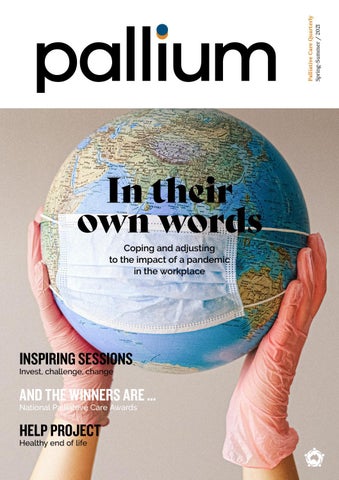
In their own words Coping and adjusting to the impact of a pandemic in the workplace
INSPIRING SESSIONS Invest, challenge, change
AND THE WINNERS ARE ... National Palliateve Care Awards
HELP PROJECT Healthy end of life
NSW snapshot: Forster-Tuncurry area recruit new palliative care support. See article on page 22.
Palliative Care Quarterly Spring-Summer / 2021
C ntents 04 A word from the President 06 From the CEO 18
News & Resources
26 Community Reports 34 Research
‘
Welcome to your new-look Spring edition of Pallium!
‘
08
Palliative Care New South Wales
10 16
23
28 Pallium | 3
Reports
A word from the President
Your new-look Pallium!
4 | Pallium
Welcome to Pallium. We are 10 weeks away from Christmas, and I’m sure many of you will agree it has been a challenging year for all of us working in healthcare settings as the COVID-19 situation continues to pose a challenge across NSW. Like many of you, I share a sense of concern about what the next few weeks and months will look like. The PCNSW Management Committee have continued to meet regularly and discuss the many and varied challenges our services have faced. I would like to thank all of our members as frontline workers for their skills, patience and dedication throughout this challenging period. As always, Linda, our Executive Officer has been advocating to the NSW Ministry of Health on behalf of all Palliative Care providers. Linda and I have also continued discussions with representatives of NSW Ambulance as they review the current NSW Ambulance Authorised Adult Palliative Care Plan. More recently we have taken part in recent discussions regarding Voluntary Assisted Dying legislation. We continue to advocate for the importance of Palliative Care as a stand-alone-issue amongst the often emotive VAD conversations. It was wonderful to join the Oceanic Palliative Care Conference last month. The quality of the virtual format as well as the varied and interesting presentations made for excellent viewing and learning. I have personally found it extremely convenient being able to go back and rewatch sessions that I missed out on viewing live, have you rewatched any sessions? Much like this new format for Pallium, if you have recently visited the Palliative Care NSW website you will notice that it has had a little makeover. Our 40th Anniversary as an organisation is coming up, and
we thought it was time for a little facelift. We hope you like the new look. Included in the new website is the updated Strategic Plan for 2021–2024 . This strategic plan has been developed through extensive consultation with our membership, stakeholders, management committee and through community engagement. As an organisation we remain strongly committed to achieving our stated goals over the next three years and beyond. I hope you enjoy your Pallium.
“As an organisation we remain strongly committed to achieving our stated goals over the next three years and beyond.”
Terese Smeal PCNSW President
Reports
If you have recently visited the Palliative Care NSW website you will notice that it has had a little makeover.
Pallium | 5
Reports
From the CEO
Spring has sprung.
6 | Pallium
Welcome to our Spring edition of Pallium! We hope this edition finds all PCNSW members and their families well after what has been a tumultuous few months. We would first and foremost like to acknowledge the amazing job healthcare workers across NSW have done throughout this recent lockdown. Your tireless contributions do not go unnoticed or unappreciated and we are extremely grateful for all that you continue to do. As we move out of lockdown and into a COVIDnormal lifestyle we recognise there will likely be more challenges ahead, and we hope that you will contact us if there is anything we here at PCNSW can do to support you or your service. Most recently we enjoyed seeing many of you virtually at the Oceanic Palliative Care Conference. There were some wonderful presentations and workshops. Although we missed seeing everyone in-person for a cheeky drink at the end of each day we came away feeling inspired and motivated at the end of the conference. We hope you did too! You can still register at a much reduced rate if you would like to see it all, or you can watch it at any time for 12 months if you are a delegate. Speaking of conferences, we are excited to remind you all that our Biennial Conference will be going ahead in November 2022 in Terrigal. We are looking forward to reconvening with the Conference Organising Committee on the Central Coast to plan an amazing, in-person learning and networking experience for us all! Stay tuned for more details in the coming months. 3–6 November 2022: Save the date and book your leave now! Thank you to everyone who has renewed your membership for 2021–22! We have been thrilled to see so many new members join this year and look forward to working together with you
all over the next year. We value all of your contributions to Pallium and member emails and can’t wait to see you at future online and in-person education programs and social events that we are hoping will be more frequent moving forward! As many of you will be aware, Alex Greenwich MP introduced a new Bill into NSW Parliament last week, the Voluntary Assisted Dying Bill 2021. PCNSW has been consulting with various Members of Parliament and others to discuss the importance of supporting and funding palliative care. We continue to have these discussions and advocate on behalf of our members and the general public to ensure everyone in NSW has equitable access to high quality palliative care where and when they need it. If you would like to read more about the PCNSW position statement regarding Voluntary Assisted Dying you can find more information on our website. Go to members area login, click on ‘Let’s Talk About’ and open the VAD link. Thank you to our members who have contributed to this wonderful edition of Pallium. As a member of PCNSW we encourage you to engage with us throughout the year, feel free to submit research, stories and photos to include in our fortnightly member email as well as the quarterly Pallium editions.
Linda Hansen PCNSW Chief Executive Officer
Reports
“We acknowledge the amazing job healthcare workers across NSW have done throughout this recent lockdown. Your tireless contributions do not go unnoticed or unappreciated, and we are extremely grateful.”
Pallium | 7
210PCC
Conference wrap up Over 1000 delegates from across the globe attended the 2021 Virtual Oceanic Palliative Care Conference (21OPCC) on 7–10 September 2021 21OPCC’s theme, Invest Challenge Change, builds on the continuing global push to ensure that we build better, more resilient health systems designed to meet critical health and palliative care needs in normal circumstances, and are sufficiently resourced to meet needs during times of emergency and crisis. Conference delegates identified the priority actions that represent their commitment to ensuring access to quality palliative care for all, across all Oceanic nations. Download Conference Statement.
INSPIRING SESSIONS One of the most inspiring sessions was the opening plenary with a rousing call for palliative care professionals and services to fight racism and other injustices in their sector and the broader health system, and to put equity at the heart of their work. It was delivered by Dr Naheed Dosani, a palliative care physician and health justice advocate, who is the founder of a mobile palliative care service for the homeless in Toronto, Canada. At PCNSW we were particularly interested in Dr Dosani’s presentations as we are currently developing a program for homelessness and equity of access to palliative care support and services. To hear of Dr Dosani’s work and experience in this sector is timely and inspiring for us as we work towards one of our mission goals of improving equity of, and access to, quality care for everyone, regardless of their circumstances. Here is a short excerpt of Dr Dosani’s opening session: “There’s a growing recognition of the limits of how we deliver health care to marginalized populations. From the most superficial level to the deepest roots in society, we can have an impact through the lens of equity, health, and empathy. To what degree we make that change, is up to each one of us.”
8 | Pallium
210PCC
With a focus on palliative care equity for people experiencing structural vulnerabilities, Dr. Dosani’s inspiring work as founder of Palliative Care and Education for the Homeless (PEACH) a program of the Inner City Health Associates in Toronto, bridges the themes of the Oceanic Palliative Care Conference. PEACH is a mobile, casemanagement, and community-based palliative care approach tailor-made for society’s most marginalized people. This includes individuals experiencing structural vulnerabilities such as homelessness, poverty, substance use, mental illness, and social isolation.
COVID IMPACT Another area of great interest to PCNSW from the conference was the very strong representation of health professionals all around the world who have used the unanticipated opportunities that the COVID-19 pandemic has presented to drive improvements in care for people nearing end of life. In this issue of Pallium we will hear firsthand from some of our own members in the front-line of care who have been confronted by COVID challenges and how they have rallied to the call. We take inspiration from other countries who are adapting to the changes in our work environments, particularly from the UK, where learning from policy and practice during a pandemic has
highlighted the driving need to close the “evidence-policy” gap in striving for improvements in palliative care. Access full session: The future of palliative care in the UK: Learning from policy and practice in a pandemic. And finally, thank you to our own CEO Linda Hansen, who chaired Concurrent Session: Diverse Needs Group on day 4 of the conference. Session topics included the harrowing experience of an asylum seeker dying from cancer, provision of care in prison and understanding the LGBT+ community wishes for palliative care. Access full sessions. Linda was also the driving force behind assembling the virtual choir to sing us out of the conference with a rousing rendition of Queens’ famous rally cry, “We are the champions”. All those working in palliative care during these tough times, indeed you are!
21OPCC ON-DEMAND A reminder that delegates can access conference content over the next 12 months. If you missed the conference, you can still register for 21OPCC post-conference on-demand content.
Pallium | 9
Feature
In their own words COVID-19 has left no healthcare sector untouched in NSW. It is a subject that is widely discussed about how we have adjusted, reacted to and prepared for this unprecedented health crisis.
10 | Pallium
B is a Community Palliative Care Nurse who works primarily in South-West Sydney
How has COVID changed the way you work/provide care? ovid has meant that there are more C patients at home who otherwise would be in hospital or palliative care units. We have had patients taken out of residential aged care facilities because their families could not visit them. Patients are generally worried on top of their usual worries. Trying more than ever to keep people at home. Being in an LGA of concern means that patients and their relatives have to have a swab before every face-to-face appointment at hospital AND if they are coming in to a PCU.
prefer that. He had a terrible cough in his small poorly ventilated bedroom. No one suspected COVID but he tested positive when I sent him to PCU. Poor man died alone in a COVID ward.
Feature
We spoke to a few of our frontline health services members to hear in their owns words how they have coped with and adjusted to the impact of a pandemic in their workplace. In the interest of patient privacy and workplace protocol, our contributors will remain anonymous.
Can you think of lessons we have learned during COVID that will benefit how we provide palliative care in the future? We certainly have learned how to use telehealth and have found that it can be quite effective in some cases. I am overwhelmed by the resilience of families who have learnt to facilitate telehealth and provide care at home rather than in hospital. They have been so patient with all the PPE and questions about being in contact with anyone with COVID, every single time.
Is there anything else you would like to share about your experiences? We are even more short of staff since COVID due to staff attrition to other areas. Some staff have left nursing because of COVID and vaccination requirements. I wish I could retire myself.
What has been the most challenging impact of COVID personally and professionally? Concern about catching COVID but more concerned about unwittingly giving COVID to a patient or their family at home. Worrying about providing care to patients with COVID at home and if I will use the PPE correctly.
“Patients are generally worried on top of their usual worries”
COVID seems to have affected every single aspect of the care we provide. Other services are not visiting but we still are.
What advice do you have for supporting patients and carers during these challenging times? Be prepared. Read up all your procedures. Have your PPE at the ready. I was a close contact of a positive patient and I wore full PPE because I knew the family would
Pallium | 11
Feature
“Nobody was truly prepared for this, and we are learning as we go”
C is a Palliative Care Nurse serving
What advice do you have for
the CALD community
supporting patients and carers during
How has COVID changed the way
these challenging times?
you work/provide care?
There’s help in the hospital and community for them.
COVID has increased the number of virtual and phone consultations. In CALD patients, it means an extra layer of challenge when a CALD patient is unable to navigate the English virtual app. It increased the use of interpreters on phone for the COVID safe questionnaire prior to each home visit.
What has been the most challenging impact of COVID personally and professionally? Zero direct skin contact due to full PPE on each home visit. It was challenging to ask family members and friends who don’t usually live in the same household to withhold or cancel their visit on the same day or leave the room when health professionals arrived. Option of work from home has reduced face to face time with colleagues and reduced informal debrief time. Delayed support from volunteers in CALD charity groups due to restrictions for visits and gatherings.
12 | Pallium
Don’t delay hospital admission. It will only prolong length of stay. For CALD patients – utilise interpreter services for each health consultation so that they can describe their symptoms and concerns in detail and properly understand our advise. Don’t wait till it is too late when visiting from overseas. A number of patients died when their family members were in quarantine. Conditions can change from stable to terminal for people living at the end of their life within two weeks. Seek and accept emotional support.
Can you think of lessons we have learned during COVID that will benefit how we provide palliative care in the future? Virtual care has it benefits. It is working well for multiple family members to be involve in a teleconference with the multidisciplinary team at the same time. This improves communication and reduces duplication.
How has COVID changed the way you work/provide care? We have had to move more towards a telehealth model of care and generally only see patients face to face if they are in the unstable or terminal phase.
What has been the most challenging impact of COVID personally and
Personally, the most challenging thing has been being separated from family, this is what “fills my cup” so to speak and I have not seen some of them for nearly two years now because of border closures. Seeing patients and families not being able to be together, not able to attend funerals and witnessing the obvious distress this causes as well as sometimes bearing the brunt of their frustrations and grief is hard. Particularly when they don’t understand that we are not the ones making the rules.
professionally?
Can you think of lessons we have learned
Professionally, the most challenging impact has been establishing relationships with patients and carers when you can’t meet them face to face and making and maintaining that connection over time. I think it’s often hard to gauge what is happening for patients in the community when you can’t be in their space and see how they are coping. The need to quickly skill up on the use of telehealth technology at the beginning of the pandemic was a challenge and I know some of our older patients really struggle with the technology and feel disconnected from the staff when we can’t be in the same room.
during COVID that will benefit how we
Feature
R is a Clinical Nurse Consultant/Palliative Care, working in rural and remote areas
provide palliative care in the future? I think really learning how to use technology to the best of our advantage particularly in rural and remote settings.
What advice do you have for supporting patients and carers during these challenging times? Be kind, be compassionate, we are all tired frustrated and sick of COVID. Nobody was truly prepared for this, and we are learning as we go.
“The most challenging impact has been establishing relationships with patients and carers when you can’t meet them face to face”
SHARE YOUR STORY
We thank our contributors for their time and for expressing their personal experiences in the line of duty. If you would like to share your own experiences, we would love to publish them. Please contact us at: info@palliativecarensw.org.au Pallium | 13
Recognition
Over 1000 delegates attended the 2021 Oceanic Palliative Care Conference (21OPCC) 7–10 September. In his opening address, The Minister for Health and Aged Care, The Hon Greg Hunt MP paid homage to palliative care staff, volunteers, medical professionals, researchers and carers, for their efforts amid the COVID-19 pandemic, praising them for providing care to ‘our most vulnerable Australians at their most vulnerable time.’ One of the conference highlights was the announcement of the National Palliative Care Awards. Congratulations to all the worthy winners.
PROFESSOR MEERA AGAR’S WELCOME
Professor Meera Agar’s welcome to Palliative Care Australia’s 2021 OPCC.
14 | Pallium
Recognition
AND THE WINNERS ARE... NSW WINNERS
OTHER WINNERS
Team – Outstanding Teamwork Award
Individual – Emerging Leader
Dungog Shire Palliative Care Volunteers Inc.
Dr Graham Grove
Individual – Excellence in Aboriginal or Torres Strait Islander Palliative Care
Dr Claudia Virdun
Cheryl Porter-Pedras, South Western Sydney LHD, Liverpool
Individual – Emerging Researcher
Individual – Excellence in Generalist Palliative Care Dr Jonathan Ramachenderan
Individual – Excellence in Palliative Care – Paediatric Palliative Care
Individual – Excellence in Palliative Care – Community Based Care
Associate Professor John Collins, The Children’s Hospital at Westmead (Sydney Children’s Hospital Network) Westmead
Dr Paula Moffat
Individual – Excellence in Palliative Care in an Aged Care Setting Yasothiny Yogarajah, BaptistCare NSW & ACT, Macquarie
Individual – Excellence in Palliative Care – Rural and Remote Robyn Ellis Individual – Outstanding Achievement by a Volunteer Keri Wassenaar
CONGRATULATIONS TO ALL THE WORTHY WINNERS!
Pallium | 15
Community
‘Live as well as possible, as long as possible’.
PCA ART COMPETITION This year’s competition saw over 300 artists of all ages creatively depict the theme ‘Live as well as possible, as long as possible’. The theme explores how palliative care improves quality of life for people with life-limiting conditions, helps people participate in activities that are important to them, and creates opportunities for love, laughter and fulfilment. A big congratulations to the 2021 winners. View the full gallery of entries online.
16 | Pallium
SEE U OYALL DID ENTRIES ?WONK
Emerging Artist Award: ‘Silver Lining’ by Roderick Burrows.
Community First Nations Artist Award: ‘Life Death Life Journey’ by Robyn Chilcott
People’s Choice Award: ‘Not the Last Dance’ by Phyllis Tay.
Overall Winner: ‘Tuesday Group’ by Cathy Bevis.
Young Artist Award: ‘Life is Only a Holiday’ by Rebekah Dinning.
Pallium | 17
Resources
s e c r u o s e R WHAT IS PALLIATIVE CARE?
VIEW FULL PROGRAM
About Palliative Care is an easy-access online learning tool, designed for use by volunteers, volunteer managers, and anyone else in the community who is interested in understanding more about palliative care. It is designed as a set of five standalone video sessions or, can be used in companion with our printed and online training resources for palliative care volunteers.
GWANDALAN MODULE 4 NOW LIVE The Gwandalan Project is focused on providing practical education to the frontline staff delivering palliative and end-of-life care for Aboriginal and Torres Strait Islander peoples during the returning to Spirit journey. Module 4: Strengthening Relationships from the eLearning series is now live. Learners are encouraged to complete modules 1–3 prior to commencing module 4. Register here.
PaCE YOURSELF PaCE is a directory app that provides links to hundreds of free training resources developed through Australian Governmentfunded palliative care projects. Resources are relevant to generalist or specialist health professionals and cover topics such as communication, symptom management, legal and ethical aspects of care, and decision-making and therapeutic partnerships at end of life.
VIEW THE APP 18 | Pallium
News & updates
END OF LIFE PAEDIATRIC CARE
VIEW MODULE ONLINE
End of Life Law for clinicians is a free training program for medical practitioners, nurses and allied health professionals. New and updated modules include Module 7: Children and end of life decision-making, and outcomes include learning how to: • Identify who may make decisions for children aboutlife-sustaining treatment • Explain when a competent child may be able to consent to or refuse their own treatment • Identify when emergency treatment can be provided to children without consent.
When the time comes
A must read!
This book is a collection of rich and honest short stories told by those who are suffering from irreversible and terminal conditions. It offers powerful insights into the parallel experiences of the caregivers of people who are approaching the end of their life and health practitioners who have spent their careers dedicated to treating, managing, and caring for their dying patients and supporting their families through the process. Read the full review here.
The module references the EOL Essentials Paediatric End-of-Life Care module.
END OF LIFE ESSENTIALS Planning end of life care: Goals of care learning module • How helpful goals of care are to patients, families and health professionals • The importance of family in the provision of care • How to discuss and negotiate goals of care • Strategies on how to manage difference of opinion or expectations in care. Learn more and register.
Pallium | 19
News & updates
s w Ne
“DOCTOR PEYO”
MEET PEYO: A MOST UNLIKELY THERAPIST “Doctor Peyo” is a much-loved horse who comforts cancer patients in the Calais Hospital, France. Peyo and his owner once competed at dressage events. Now they spend their time doing hospital rounds, often staying with people until the end. People who raise horses often claim that the animals have a therapeutic effect on them. Peyo is well known as an “excellent” therapist. Once inside the hospital, Peyo is free to go wherever he wants. Incredibly, Peyo often goes into the rooms of people who are the sickest, in many cases those who are dying. He just stands near the patients and they instantly take a liking to him. A sort of silent communication between Peyo and the patients takes place and people even cry in the horse’s presence.
PCNSW NEW STRATEGIC PLAN NOW ONLINE Our strategic plan outlines our areas of focus for the next three years, which have been determined by membership surveys, collaboration with stakeholders, our own experience as a team, committee consultation, community discussion and of course, the challenges of COVID-19. View our plan online.
View online 20 | Pallium
News & updates
Two world leaders in Palliative Care
EVERY LIFE MATTERS
Lancaster (UK) Professors Nancy Preston and Sheila Payne have both been recognised as world leaders in palliative care. The researchers from the International Observatory on End of Life Care at Lancaster University have both been listed in the top 0.1% of scholars worldwide writing about this topic. HammondCare CEO Mike Baird offered his view on why voluntary assisted dying laws are not the best response to the pain and suffering of an individual’s last days in the Sydney Morning Herald. Read his full statement below. When faced with the terminal suffering of someone you love, almost nothing else matters. I understand the pain. The renewed debate about voluntary assisted dying in NSW is personal for me – my mother died earlier this year following a battle with a terrible disease over a number of years.
Expertscape’s PubMed-based algorithms rate scholars writing about Palliative Care over the past decade, with the top 0.1% rated as “World Expert”. Brendan McAdams and John Sotos from Expertscape congratulated both Lancaster professors. “Reaching this level of expertise is a tremendous achievement.”
There were days when I cried just wishing she would walk, talk or laugh again. It is also easy in these circumstances to understand how people wish it would just end, believing quality of life is over. I don’t agree. In the last 12 months of mum’s life, my eldest daughter was going through a marriage breakdown. It was heart-wrenching for everyone. In the middle of this, my daughter went to visit my mum. She greeted my daughter with tears and eyes that shared the pain. When my daughter came home she said, “I have never felt so loved”. It was as if my mum’s eyes had given her the hug she needed, the tears the comfort.
Read more
Professor Sheila Payne is widely recognised throughout the world as an influential leader in promoting multidisciplinary work in palliative care. She is a former President of the European Association for Palliative Care (EAPC) and also holds a visiting chair at Ulster University, Northern Ireland.
Read more Pallium | 21
Read more
Memory Lane takes people to happy places as final wish
In the final days of their lives, many find themselves in a care or health facility, reflecting on a lifetime of moments and memories in the places where they were happiest. Memory Lane is a no-cost service that supports patients in end-of-life care to visit a place that holds meaning for them. The service is entirely donor-funded and staffed by medically trained health care professionals who volunteer their time. It launched in May this year, after the Royal Flying Doctor Service saw a need for dedicated vehicles to help palliative care patients travel to their happy places. For 93-year-old Jack Smith, it was his family farm in Romsey.
PALLIATIVE CARE FOR FORSTER A palliative care doctor-intraining and palliative care nurse are working with other services to provide support for patients in the ForsterTuncurry area. With assistance from Manning Base Hospital’s Department of Specialist Palliative Care, Mayo and Forster private hospitals and local GPs, palliative care specialist, Arron Veltre has been instrumental in recruiting Yvette Etherden and Emma Mcleod, respectively, to the roles.
22 | Pallium
“Yvette and Emma show incredible commitment to giving patients and their families the support they need at what is usually the most difficult time in their lives,” Dr Veltre said. Dr Veltre and the new recruits will work with local GPs, the community palliative care team and the private hospitals’ allied health care team to provide best-practice palliative care.
Read more
LIONS TAKE PRIDE IN SUPPORTING WAUCHOPE HOSPITAL Wauchope Lions Club has a long history of supporting its local public hospital, and this week the club’s president was on site to present a refurbished gift from seven years ago. Back in 2014, the hardworking Lions, with a dollar-for-dollar grant from the Lions Clubs NSW-ACT Public Health Care foundation, donated two treatment chairs at a cost $13,000 to Wauchope District Memorial Hospital’s newly opened Urgent Care Centre. In 2015, the Lions undertook a labourintensive garden makeover at the hospital. In 2017, the club donated a $13,500 specialised lifting chair, in 2019 it was a $10,720 ECG unit and $12,000 for five pressure mattresses for the Palliative Care Unit. The latest donation brings the Lions support of Wauchope Hospital in the past seven years to a remarkable $42,351.
Read more
The latest donation brings the Lions support of Wauchope Hospital in the past seven years to a remarkable $42,351
8 things you need to know about Palliative Care Volunteering Working in palliative care is one of the most rewarding volunteer choices anyone can make. Not only does it make a huge difference to the person who is dying and their family, but also to the volunteer’s own life. Volunteers learn to cherish each day, listen deeply and value life as a precious gift. But it’s not for everyone - this article outlines what it takes to be a palliative care volunteer. To find out more you can contact your local palliative care service or chat with us here at Palliative Care NSW.
Pallium | 23
PCNSW Programs
PHPC Ambassadors Network
HELP PROJECT
Palliative Care NSW collaborates with like-minded partners and stakeholders to help achieve our collective vision that all people approaching and reaching end of life, have equity of, and access to, quality palliative care supports and services. We are currently delivering some exciting programs in the CAPACITYHELP Project 2021, in partnership with La Trobe University (Vic). The HELP Project (Healthy End of Life) is a research-informed and evidencebased public health palliative care initiative. It aims to identify and build on local community capacity as an integral part of palliative care service, working with carers and family to support those receiving end of life care in their home or other community setting.
The Ambassadors Network aims to link formal and informal alliance networks for a more integrated approach to PHPC. The program fosters leadership and relationships as an ongoing network for cross-sector collaboration. The objective is for the network to actively promote and practice a PHPCapproach to palliative care, in their place of work and community. WHAT IS INVOLVED? • Link formal and informal alliance networks for an integrated PHPC approach • Foster leadership and relationships as an ongoing network for cross sector PHPC collaboration • Embrace the principles of PHPC: – Promote death and grief as a natural part of life – Promote collaborative culture for community support – Support individual and community in planning for and experiencing end of life • Meet/connect regularly to share learnings and experiences • Executive services and resource support provided by PCNSW We invite you as a professional in your business sector or a community leader, who has a passion for supporting people and their family and carers at end of life, to join the Ambassador Network.
Click here to read more about the Ambassadors Network
PUBLIC HEALTH PALLIATIVE CARE
AMBASSADORS NETWORK The CAPACITY-HELP project is supported by funding from COORDINARE-South Eastern NSW, through the Australian Government’s PHN program. The program is being delivered in partnership with Palliative Care NSW and La Trobe University. 24 | Pallium
Join us on our mission to embrace the principles of PHPC and end of life initiatives in your work or community. • • • •
Promote death and grief as a natural part of life Promote collaborative culture Support individual/community planning for EOL Build individual/collective knowledge to share
PCNSW Programs
PHPC Community Conversations PHPC (Public Health Palliative Care) promotes action through clinical care as well as cross-sector collaboration with community. We want to support the community to increase its confidence in dialogue around end of life. In Community Conversations, we have developed an education workshop-style presentation that provides simple and effective information to carers, family and community about PHPC. Topics covered include: what is palliative care, navigating end of life matters, dying as being a normal part of life and advance care planning. These sessions have been developed into long-form for face-to-face community gatherings and an edited onehour session for online. They are designed for anyone, or any community group who would like to know more about supporting PHPC in their community. It’s easy to be involved. For instance, if you are part of a community group, neighbourhood centre, a local business group, a local council member or a volunteer manager we can organise an online session for you in your next meeting. All you need is access to a computer and wifi.
Let's talk about palliative care
Community Conversations Expressions of Interest
These education sessions are for members of the community who have a passion for supporting people at end of life. Topics to be covered include: navigating end of life matters dying as being a normal part of life advance care planning These 3 hour face-to-face, or 1 hour online sessions will be rolled out over NSW from October 2021 onwards. We are seeking Expressions of Interest if you would like to host one in your community or work place. Contact Linda Hansen, C O Palliative Care NSW on 0403 699 491.
FIND OUT MORE Pallium | 25
Reports
Voluntary Assisted Dying Bill (NSW) 2021 The VAD Bill was presented to NSW parliament on Thursday 14th October 2021 by Independent Member for Sydney Alex Greenwich MP. In preparation for the introduction of this Bill, PCNSW met with Mr Greenwich to present our position on VAD and palliative care. We specifically requested additional support for palliative care to respond to and adapt to this new legislation if VAD becomes legal in NSW. We also requested that language used during debate not be discriminatory or inflammatory, nor emotionally charged, out of respect for those living and dying with a range of life limiting conditions. PCNSW supports the position of PCA that the decision whether or not to legislate voluntary assisted dying is one for governments. PCNSW neither advocates for, nor argues against, the legislation of voluntary assisted dying. Our position is to promote the role of palliative care in a person’s end of life experience. Definitions:
Our position is to promote the role of palliative care in a person’s end of life experience. about, palliative care and an investment commitment to support the sector to respond and adapt to this new legislation, should it come to pass. We will keep you updated. In the meantime, members can access current information and provide your own comments and insights through our VAD website forum. Simply visit your Members Only page:
Palliative care: Affirms life and regards dying as a normal process that intends neither to hasten nor postpone death. It improves the quality of life of patients and their families through the prevention and relief of suffering by means of assessment and treatment of pain and other problems, physical, psychosocial and spiritual. Voluntary assisted dying: Medical practitioners may prescribe and potentially directly administer an approved substance for the purpose of causing death where the person meets the eligibility criteria outlined in the relevant legislation and has sought this outcome voluntarily. We have also written to NSW Premier Dominic Perrottet, the Deputy Premier, the Treasurer and Minister for Health. Our primary focus is the request for equity of access to, and information
26 | Pallium
Click on: > ‘Let’s Talk About’ > ‘Voluntary Assisted Dying’
Reports
PALLIATIVE CARE EDUCATION & TRAINING COLLABORATIVE
Funded by the Australian Government Department of Health
PEPA PLACEMENTS
We are looking forward to PEPA NSW placements recommencing once restriction ease and very excited to get back to face to face education sessions as soon as we can. We’ve not been idle during lockdown though and you should pop onto the PEPA Education webpage to take a look at the updated documents/modules/resources/links. If you are interested in undertaking a PEPA placement I encourage you to apply via the webpage as soon as possible so we can start planning.
THE PEPA MENTOR HUB
The PEPA Mentor HUB is enjoying success. PEPA has established a stronger connection to mentoring in palliative care. The PEPA Mentor HUB has been re-booted and commenced monthly one hour webinar sessions online. The sessions have had attendance from PEPA mentors from all over Australia. PEPA understands that mentors are busy clinicians, so the sessions have been recorded for people to watch later for their continual professional development. The sessions recorded have been Imposter Syndrome, Reflective Practice, Positive Mind setting, and Psychological Safety. On 13th October, 5–6 pm we will discuss Emotional Intelligence and if you want to join us contact PEPA at pepa@qut.edu.au and we will send you an invite. The sessions have evolved from requests made by clinicians during PEPA mentoring workshops. If you want to watch past episodes and attend the CPD for your professional
development you can sign up to PEPAs free learning management system to access the materials and created your Certificates of Participation. You can learn more about how PEPA is focused on supporting clinicians to feel more confident in their own mentoring capability. The September session was Psychological Safety and as a group of mentors we had great discussions about how we feel in our organisations in regards to Psychological Safety and how we notice other colleagues and their Psychological Safety. We did edit some of the content as confidentiality is vital to us when we attend the session live (to care for self). You can access the links to sessions on our website in Mentor News. Keep an eye out on the Mentor news site. If you would like to join the PEPA mentor hub and evolve your mentor abilities, please register via this link.
Pallium | 27
Reports
Palliative Care Outcomes Collaboration The latest PCOC Outcomes Reports have recently been distributed to the 43 participating services. From the reports it seems the area we need to review is patients assessed in the unstable phase and our response to managing the identified urgent need. To meet this benchmark, 90% of patients in the unstable phase must be reassessed and a phase change occur within three days or less. The inpatient setting is nearing this benchmark with 86.8% patients having an unstable phase of 3 days or less. However the community setting is at 82.0%. Understanding and acknowledging the variation in the community setting, there is a need for further study to identify possible reasons for this and possible strategies to improve. PCOC’s state and national reports for January – June 2021 are now available at www.pcoc.org.au. The NSW state report includes data from palliative care services across NSW and represents the real life outcomes of >7,500 patients receiving palliative care. 100% 90% 80% 70% 60% 50% 40% 30% 20% 10%
NSW
National
NSW
National
0% Inpatient Unstable phase ≤ 3 days
Community Unstable phase > 3 days
Benchmark
National and state performance for January – June 2021 against PCOC Benchmark two – Time in Unstable phase. This benchmark relates to the time that a patient spends in the unstable phase. To meet this benchmark, at least 90% of unstable phases must last for three days or less.
28 | Pallium
Reports
The Impact of Covid The impact of Covid 19 in NSW and the effect it is having on palliative care staff and service provision cannot be understated. PCOC is acutely aware of this and is certainly mindful of the disruption this is having on some services. With this in mind, PCOC is undertaking a voluntary survey of palliative care services during the months of October, November, December and again early 2022 with the hope it may assist services in the future when returning to ‘normal’. With Covid-19 in mind and the time restraints on services, PCOC is currently planning to facilitate virtual benchmarking and report feedback forums via a community of practice model. This model will mean that similar services with similar outcomes will be invited to come together to share learnings and experiences for improving outcomes. For more information, please contact: pcoc@uow.edu.au
The Benchmark PCOC have launched a newsletter called The Benchmark to keep you up to date with PCOC news. The Benchmark includes a section to showcase quality improvement activities of palliative care services nationwide. If you are interested in submitting to The Benchmark please contact pcoc@uow.edu.au
Residential Aged Care: the Palliative and Aged Care Outcomes Program (PACOP) In July, this year a new centre under the Australian Health Services Research Institute (AHSRI) was established to drive palliative care in the Australian Aged Care Sector, The Palliative Aged Care Outcomes Program (PACOP). With the launch of PACOP, the residential aged facilities that joined PCOC as part of the Wicking Project have transitioned to the aged care program. We congratulate Professor Claire Johnson who has been appointed as PACOP’s National Director.
PCOC Quality Improvement resources: Case review PCOC’s case review tools correlate to a PCOC benchmark or other clinical outcome measure and help identify where further improvements to assessments, processes and/or procedures can be made. There are four tools available to help guide quality improvement activities: • Patients, families/carers who experience severe family/Carer problems • Patients who experience severe pain • Patients in an unstable phase of four days or more • Deaths that have occurred outside terminal phase
Keep up to date with PCOC
YouTube
Newsletter
Pallium | 29
Reports
The network is a fabulous forum for sharing best practice and emerging issues so that we can all learn from each other.
30 | Pallium
Reports
Volunteer Manager’s report The Palliative Care NSW Volunteer Managers Network has had an interesting few months as our members grapple with supporting and engaging our volunteers whilst the majority of inpatient and community volunteer activity have been on hold. The network is a fabulous forum for sharing best practice and emerging issues so that we can all learn from each other. This has been especially important as we have shared the ways in which we have kept connected with our volunteer cohort and developed creative ways to continue services from Check in and Chat with palliative care patients, virtual home schooling support to families in lockdown, Biography interviews over virtual platforms, online choirs and education sessions. These examples just show how resilient and flexible our Volunteer Managers and Volunteers are! However we have also heard from our members that some services are struggling to plan for a reintroduction of in-person volunteering services across NSW, so we have been developing proposed guidelines to safely assist in this process. Finally, we have taken a leap of faith and restarted the ‘parked’ plans to offer a Volunteer Managers Conference in Orange from Monday 20th to Tuesday 21st June 2022 with a theme of Developing our Practice. This will provide a long awaited opportunity to hear from key note speakers and workshop facilitators on issues such as end of life practices for ATSI and CALD communities, supporting volunteers to cope with grief and loss and Diversional Therapies. If you are a Volunteer Manager and are interested in attending please contact us on info@palliativecarensw.org.au
Pallium | 31
Reports
Connecting Australians to palliative care information and support
NEW CARESEARCH PORTAL
The new CareSearch Portal empowers ordinary Australians and health professionals to make informed palliative care decisions. In 2020, Judith Leeson, AM contracted an infection which turned into sepsis and made her critically ill. The near-death experience made the career counsellor and well-loved community advocate to start conversations about her end-of-life care wishes and preferences, and to demystify the words ‘palliative care,’ ‘death’ and ‘dying’ in her family.
The CareSearch Project is funded by the Australian Government Department of Health.
32 | Pallium
“My family have been reluctant to talk about my death, and I know that fear of loss is a constraint, as is embarrassment. However last year they were faced with the sudden reality that I had an unexpected life-threatening illness,” states Judith.
Reports
CareSearch have been useful in my conversations about death and dying with my children.
“Choosing someone to act on your behalf will be less stressful for them if they clearly understand your wishes in advance about what care you think will enable you to live with dignity and where and how that care is delivered. In moments of great stress, when we receive unexpectedly bad news, we need to draw on our sources of reliable information to help us make better informed and considered decisions.” “CareSearch have been useful in my conversations about death and dying with my children,” adds Judith. The CareSearch Project, a leader in the provision of evidence-based palliative care information, has launched its new portal. The interactive and revamped portal is designed to support everyone – patients, carers, health professionals, and ordinary Australians – to have conversations about death and dying and make informed palliative care decisions. “We will all need palliative care at one point, and many of us will also care for a loved one who is dying. The new CareSearch portal is designed to help all Australians to prepare for their palliative care journey with trustworthy information and resources,” says CareSearch Director Professor Jennifer Tieman. The new portal will help individuals, families and communities to start reflections and conversations about dying and death, which are important steps in planning and getting appropriate support. Resources to enable patients and carers to make informed decisions when facing the end of life are included, along with practical information to plan for ageing and caring for older persons. A section to empower diverse and underserved Australians to get appropriate and quality palliative care and support is also featured. “In addition, the portal supports GPs, specialists, nurses, nurse practitioners, and allied health professionals to provide quality care in any setting they may be – whether in hospitals, paediatrics, aged care, or home or community care. Further, it provides the evidence that supports best practice and improved care,” Prof Tieman states. “Our hope is that with the new CareSearch Portal, more Australians will be empowered when the time that they need support comes and our health professionals are equipped to provide quality palliative care.”
In moments of great stress we need to draw on our sources of reliable information.
Pallium | 33
Research
Improving care in end-stage dementia with the End of Life Care Assessment Tool for Dementia This study is being undertaken by Carolyn Bourke (Moir) who is a PhD Carolyn candidate at the University Bourke of Notre Dame, Australia. PhD candidate Carolyn (Moir) Bourke (Moir) has worked in Residential Aged Care for over 20 years as a facility clinical manager and as a palliative consultant. She has observed first-hand the challenges surrounding end of life care for people with advanced dementia. The study is focused on developing an assessment tool called the End-of-Life Care Assessment Tool for Dementia (EoLCATD). The EoLC-ATD will be used by registered nurses to identify when a person living with dementia is in the advanced stage. The tool identifies discrete changes in the person’s bio-psychosocial health status and different areas of function in advanced dementia and, thus, provides relevant data to plan and deliver individualised end of life care. The tool will be of benefit to people with advanced dementia and reduce the variability in end-of-life care that currently occurs in Australian Residential Aged Care (RAC) services (Homes) and community services. The issue that staff face in planning end-of-life care with a person living with advanced dementia, is that very often the person is unable to express their needs, explain the
34 | Pallium
symptoms of late-stage disease and make decisions about care and treatment choices. Features of this irreversible incurable progressive neurodegenerative disease include an inability to recognise familiar objects, surroundings and people, increasing physical frailty with balance issues, difficulty with eating and incontinence. In the advanced stage the person may be aphasic, bed/chair fast, doubly incontinent, unable to attend to activities of living, swallow, and recognise and acknowledge close family. It is of significant concern that aged care staff may fail to recognise when a person with advanced dementia requires palliative care before this advanced-stage occurs. A review of the literature indicates that while instruments exist to screen, measure progression and stage dementia, these generally focus only on changes in physical and cognitive function. A few instruments focus on symptoms of ‘suffering’ in advanced and late-stage dementia. Currently, no single validated dementia assessment instrument identifies the
The tool will be of benefit to people with advanced dementia and reduce the variability in end-of-life care that currently occurs in Australian Residential Aged Care.
Research
stage dementia that they observe in their practice; compilation of a set of items representing the cognitive, physiological, psychological, social, spiritual, and behavioural manifestations of advanced dementia; review and rating of the item bank by dementia experts and researchers through three Delphi rounds; piloting the Delphi-recommended draft EoLCATD items with 10 people living with advanced dementia; and testing of the final EoLC-ATD in 100 residents with advanced dementia across eight Care Homes (metropolitan, regional and rural). The EoLC-ATD is in the final stage of testing. The EoLC-ATD will be incorporated into the current assessments for the aged care sector to support the timely and holistic assessment of the person with advanced dementia, to ensure that their unique symptoms and needs are identified early, managed well and monitored regularly.
‘
The tool provides relevant data to plan and deliver individualised end of life care.
‘
range of cognitive, physiological, psychological, social, spiritual, and behavioural manifestations that distinguish the experience and expression of advanced dementia. Similarly, there is no validated instrument that can assist registered nurses to determine the unique palliative care requirements of persons with advanced and end-stage dementia covering their cognitive, physiological, psychological, social, spiritual needs. The End of Life Care Assessment Tool for Dementia (EoLCATD) will address this lack, by helping registered nurses to identify the unique and multi-domain cardinal signs and symptoms specific to advanced dementia, for the purpose of planning and facilitating timely palliative care that is individualised to the person. The study employs mixed methods to develop and establish the reliability and validity the EoLC-ATD. An Expert Advisory Group has been involved in advising on the research questions, topic focus, instrument domains and items and study methodology. EAG members represent aged, palliative and dementia care, nursing, allied health and medicine, and include consumers, clinicians, managers and researchers in the field. The tool draws together validated assessment constructs from many sources and incorporates aged care, palliative care and dementia expertise. Over five stages the study has involved: a review of existing instruments measuring dementia staging, progression and diagnosis, behavioural and emotional assessment in dementia, and palliative care pathways for a range of terminal illnesses; focus groups with registered nurses from the aged care setting to obtain advice on the cardinal signs and symptoms of advanced and end-
Pallium | 35
Introduction
meet & greet Dr Annmarie Hosie.
36 | Pallium
I started working in palliative care in 2000 and immediately knew I had found my working ‘home’. Prior to that role in the Illawarra After Hours Palliative Care Service, I had worked for many years as a registered nurse in a range of settings, including orthopaedics, high-dependency, surgical, medical and rehabilitation. The difference I noticed in palliative care was that our focus was more on the whole person, and their family, and I learnt so much about the good that could be done for people at the end of life through simple interventions and loving presence. In that role I also learnt how important teamwork, self-care, and ethical, evidence-based practice was to ensure that we achieve the goal of palliative care, which is to improve patients’ and families’ quality of life. I learnt more again through completing a Masters in Palliative Care in Aged Care at Flinders University 2005–09. During these years, I transitioned into a Care Coordinator role at the Illawarra Retirement Trust (where my appreciation of older people grew) and then on to Clinical Trials Nurse role at Calvary Health Care Kogarah. It was through working on the Risperidone study at Calvary that my eyes were first opened to the problem of delirium in palliative care. Delirium is so common for people in palliative care settings that it seemed (then) as though we didn’t notice it; or if we did, we considered it a normal ‘rite of passage’. Like many other clinicians, I couldn’t even correctly spell delirium.
It was through sitting with patients and performing structured assessments of their awareness and cognition for the first time in over 20 years of nursing that I finally saw and heard what delirium was like for them, and it wasn’t good. I realised we needed to do better and decided to begin a PhD to study delirium in palliative care. It was at this point that Professor Jane Phillips providentially crossed my path. Like all the many generous mentors I’ve been blessed with, as my principal PhD supervisor Jane gave me the necessary guidance and support for me to grow again in my palliative care career, this time into a researcher. Since completing my PhD in 2015, I have worked fulltime in palliative care research, first as a coordinator of a national clinical trial, then as a post-doctoral research fellow at IMPACCT, UTS, and now in my current role of Associate Professor in Palliative Care Nursing at the University of Notre Dame Australia and St Vincent’s Health Network Sydney. What has become increasingly clear to me over this time is that it is indeed the simple things that matter most to patients and families at the end of life, and that these things also protect us from delirium. By ‘simple things’, I mean fresh air, natural light and surrounds, movement, food and drink, sleep, cleanliness, and most of all, loving and meaningful connection and communication with others. I believe that a re-valuing of these fundamental human needs – in our hearts and minds as well as in the design and processes of our care environments – is essential to us fulfilling Dame Cicely Saunders’ promise (and ours) to help others to live until their last moments of life. This deeply humane and hopeful approach to palliative care is also that of the Executive, staff, and committee of Palliative Care NSW. It’s been a privilege to work with such committed colleagues, even distantly during COVID-19. Last up, to my fellow PCNSW members: keep up the good work, and I am looking forward to meeting you in person in 2022!
Palliative Care NSW Biennial State Conference
SEE YOU IN 202 2
Terrigal, Central Coast 3–6 November 2022
Palliative Care Quarterly Spring-Summer / 2021
Palliative Care NSW Suite 706, 50 Clarence St, Sydney NSW 2000 02 8076 5600 / palliativecarensw.org.au