Palliative Care Quarterly Autumn / 2022
OVER THE HILL
THE VALUE OF DEATH
PCNSW celebrated 40 years
Call for a worldwide change of attitudes towards death
AND... WE’RE BACK! Upcoming events for 2022
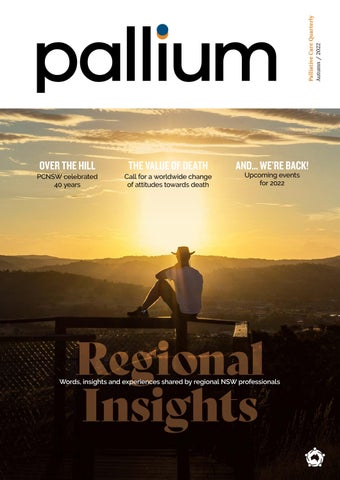
Words, insights and experiences shared by regional NSW professionals
1 | Pallium
NSW snapshot: Broken Hill, where connections are meaningful. See article on page 8.
Palliative Care Quarterly Autumn / 2022
‘
08
Contributors from regional areas of NSW generously share their stories.
‘
16
20
Palliative Care New South Wales
C ntents 04
A word from the President
06
From the CEO
16
Resources
19
Events
20
In the news
25
Reports
12
32
President’s Report
A word from the President
STARTING OFF STRONG
There’s no refuting what a difficult year 2021 was and the challenges this has presented for healthcare workers. We’re acutely aware many of you were on the front line in extremely challenging settings. On behalf of the team I would like to say thank you for all that you have done and will no doubt continue to do. I’m sure I speak for everyone when I say I hope our future is brighter in 2022 and we emerge stronger from these experiences. The importance of self-care has never been more amplified than it is now at the beginning of 2022. The load that the past two years has placed on what was already a stretched workforce is perhaps immeasurable. We hope that you are able to seek out some purposeful and realistic self-help measures both informal and formal that may assist in reducing potential traumatic stress, physical effects and burnout. Your quality of life is important – personally and professionally. As I’m sure you all know, our Biennial conference in 2020 couldn’t go ahead. For the first time in the 17 years we couldn’t all get together. We have begun planning for November 2022 in Terrigal and can’t wait to see everyone there in person.
The importance of self-care has never been more amplified than it is now. Much like our Biennial conference the volunteer managers conference was another COVID casualty, but I know Kate and the committee are busy organising for 2022. A significant impact COVID-19 has had on the administration team was a marked increase in phone contact from the general public. The
4 | Pallium
challenges faced by many families trying to navigate the palliative care journey for their loved ones as well as the COVID-19 restrictions certainly illustrated the many challenges faced by many people. We also heard from our members, who were daily encountering stressful situations caused by visitor limits and other burdensome restrictions. We were so glad to be of assistance, if only as a listening ear and maybe some advice to offer. We continue to liaise regularly with the Ministry for Health (MoH), and we were fortunate to have some of the Minister’s representatives joining us at our AGM and 40th anniversary in early December 2021. I think this is a positive reflection of our ongoing relationship with the MoH and we look forward to working with them in the future. Both Linda and I attended the NSW Parliamentary Upper House Standing Committee on Law and Justice to give evidence at a hearing for enquiry into the provisions of the Voluntary Assisted Dying Bill 2021 in December. Obviously work will continue this year on the Bill. The CCREOL project, a collaborative project with Southern NSW LHD and funded by COORDINARE has been a great success. Fiona has done a wonderful job of establishing new volunteer services in Cooma, Eurobodalla and Queanbeyan with more to come. New training resources developed as part of this project were also headlined in the International eHospice Journal, a great reflection of the quality work being done by our team. Capacity HELP is a project in partnership with La Trobe University that we have also been working on. It’s a public health approach to end of life and palliative care that aims to link formal and informal networks and delivers educations sessions
President’s Report
for communities. Much of this was delayed due to the Covid impact but is gaining more traction now. I would like to acknowledge the resignation of Rachel Simpson from the PCNSW Management Committee as she moves into a new role within the volunteering sector. Thank you Rachel for the freshness and enthusiasm you brought to the Management Committee during your tenure. At the start of 2022, we can look forward to resuming programming of our regular education symposia, the development of our Homelessness and Palliative Care forum, the roll-out of our Community Conversations sessions (read more about these in this edition of Pallium) and the development of our Palliative Care Ambassador Network. There’s more to come on this. We’re starting off strong for 2022 – better together. Enjoy your Pallium.
I’ve learnt that people will forget what you said. People will forget what you did. But people will never forget how you made them feel. Maya Angelou
Therese Smeal PCNSW President
Pallium | 5
CEO’s Report
From the CEO
LOOKING TO THE FUTURE
6 | Pallium
Welcome to the first Pallium of the year and happy New Year to all! I would like to start this report by acknowledging our members in the field of palliative care as well as more broadly those working in healthcare for the incredible work that has been carried out throughout the past two years during the COVID-19 pandemic. Let’s hope we can look to a future that leaves the worst behind us. Fortunately, PCNSW as an organisation has weathered the COVID storm well. For the Management Committee it has been wonderful to work closely with our new committee members from different sectors of palliative care and share ideas and concerns when we have met via zoom each month. We were fortunate to have the opportunity to meet together in person as a committee before the various lockdowns. At these sessions we worked hard to develop the PCNSW Strategic Plan. I am confident that we have addressed the needs and concerns of our members as well as the palliative care community in NSW moving forward. You can view the Strategic Plan 2021–2024 on our website. I continue to work closely with the Ministry of Health regarding funding and support, and in the past year you may have noticed the $82.8 million funding announcement from the NSW Treasurer and Health Minister. This was a welcome boost, and we will continue to advocate for this support to continue. In the past few months our focus has been on the needs of palliative care in light of the VAD discussions currently happening in NSW Parliament. PCNSW neither advocates for, nor argues against, the legislation of voluntary assisted dying. We believe this is a decision for governments. In our
discussions with various Ministers, including the Health Minister and the NSW Premier, we have focused on the need for equity of access to, and information about, palliative care and an ongoing commitment to our sector should the legislation come to pass. While it is important we acknowledge the challenges we have faced in palliative care throughout the past year and a half, we have also skills that will support us in the future. With 40 years behind us we look forward to supporting you and your work for 40 more! Enjoy your Pallium.
Linda Hansen PCNSW Chief Executive Officer
CEO’s Report
With 40 years behind us we look forward to supporting you and your work for 40 more!
Pallium | 7
Feature
Moments…
8 | Pallium
Feature
By Deb Everett, Psycho-oncology Counsellor
The following story belongs to Jack and Mary, for these are ‘their moments’ that Jack has been kind enough to share. (The following has been de-identified).
I
sat with Jack yesterday and felt inspired to write this brief, but important and touching moment of his journey … Jack is an 83 year old gentleman who lives in an RV in a caravan park on the NSW side of the river, from Mildura. Jack’s wife, Mary, who is affected by dementia, moved into a Residential Aged Care Facillity (RACF) in Mildura earlier this year “until Jack’s cancer gets better”. Jack has a palliative diagnosis (lymphoma). I sat with Jack, under the gumtrees, (socially distanced and masked – as per the current requirements) with the wind blowing an absolutely gale, the morning after a night of wind and thunder. He wanted to tell me about the visit he’d had
with his wife the day prior. You see, this was a very unexpected visit, as he didn’t know he was allowed to bring his wife home for a few hours and so this occurred as a moment of chance, rather than as a matter of good communication, planning or processes. Once Jack knew he could bring Mary home for a visit … her first visit since going into care, Jack decided to prepare for her visit. Jack told me about how he has been colouring Mary’s hair for the last 20 years and he knew how unhappy she was with the current variation in colour, so he drove his truck into Mildura to buy his wife’s preferred hair colour and some food for a meal to share during her visit. Not just any meal …
Pallium | 9
Feature
First things first though, after arriving home, Jack proceeded to colour Mary’s hair – an important part of Mary’s identity. Jack then described how he cooked and prepared $100 worth of rock lobster and chilled it in readiness for them to share. He then prepared fresh gnocchi and a spicy ‘satay-like’ sauce. He’d chosen a pink Moscato and chilled this – a lighter wine as he didn’t want to return Mary to the nursing home intoxicated. After the meal, Mary returned to their kitchen, doing the dishes and putting them away, as she normally would have done. She then recognised and commented on Jack looking tired and recognising that he was missing his ‘Nanny’ nap. With that, she told him that if he took her back (to the nursing home now) he would still have time for his nap. As Jack described this to me, there were many tears (as he carefully used one hanky for his nose and one for his eyes), smiles … and much love. As counsellors do, I asked
him how this made him feel? And, through his tears, as he let go of his breath, he could barely say “happy … it made me feel happy.” After we sat with this feeling for a moment, I asked his permission to share with Jack what I’d heard … What I heard Jack say was, that in this moment he felt ‘normal’, like he was a husband again, that Mary felt like his wife again and that in this moment they were a couple again. In this moment he was her husband, not a carer. In this moment, Mary also demonstrated insight into his needs and supported him to meet these. Mary was also able reassure him that she was okay (in the nursing home). Not bad given that Jack had shared with me that he’d thought he was going to have to “knock Mary on the head” to get her to go back to the nursing home. Jack related to each part of this reflection and we further reflected that this one is “a moment to hold.”
In this moment he felt ‘normal’, like he was a husband again, that Mary felt like his wife again and that in this moment they were a couple again.
10 | Pallium
Feature
In this moment ... they were connecting with themselves and each other.
Timing is everything isn’t it? It was just the night before that I had listened to Rob Grenfell (an advocate for dementia), speaking about his journey with his wife (who had a diagnosis of early-onset dementia) and having to be ready to “let her fall into the arms” of other carers and how difficult this was. I also listened to Christine Bryden who had been advisor to the Prime Minister’s office and diagnosed with dementia. She spoke about her experience of being treated as though she was ‘lost to dementia’ and she articulates very clearly that she has lost her memory, but not her ‘story’ and that she just needs help to connect with her story and that in doing this, she is connecting with her ‘self’. In this moment, this is exactly what Jack and Mary were doing … they were connecting with themselves and each
other. In this moment Mary was no longer identified by her dementia and Jack was no longer her carer, they were a couple. I am so privileged to have shared their story, as it is theirs. I really, only took the time to listen … to really hear what was being said. So often we rush people when they’re sharing their story, in order to get to the other side, or hurry them up to deal with the business that we want to deal with. The world we live in is busy and these are the realities of this, but sometimes the gift of listening is the greatest ‘therapeutic’ intervention we can offer. As I finish up in my role of Psychooncology Counsellor in the Cancer and Palliative Care team, I just wanted to share this as ‘one last moment’ as there are many I will carry forward with me. To Mel and the team, keep up the great work!
28th October 2021 We thank Deb Everett and Melissa Cumming from FWLHD Cancer and Palliative Care for sharing these moments with us
Pallium | 11
Community
CELEBRATING 40 YEARS
Palliative Care NSW
40th Anniversary Celebrations
Five PCNSW former and current presidents and current CEO Linda Hansen, were just some of the members who celebrated our 40th Anniversary at The Riverview Hotel Balmain on Thursday 2nd December 2021. About 60 people attended the anniversary/Christmas party and we were all very pleased to be meeting each other face-to-face after the long COVID lockdown. Highlights of the evening included the re-election of Therese Smeal as president elect. Therese has been a stalwart president, guiding us through the past few difficult years. It’s very pleasing to know we have her continuing guidance into the future. Guest speaker Liz Junck, Director, Director, Primary and Community Care Unit, Health and Social Policy congratulated PCNSW staff, committee and members for our collective resilience and urged us to continue our work and commitment to providing quality palliative care for all. We look forward to continuing our work in 2022.
12 | Pallium
Community Left: Five PCNSW former and current presidents (L–R) Carolyn Walsh, Therese Smeal (current), Maree Banfield, Deb Parker, Peter Cleasby and current CEO Linda Hansen. Below left: Current Treasurer Nicole Sutton with committee member Carmen Sanchez. Below right: Dr Josephine Clayton and other members during presentations.
40 Pallium | 13
Community
Left: Professor Meera Agar, Therese Smeal and current committee member Colleen Carter. Below left: Current committee member Felicity Burns, Maree Banfield and Nicole Sutton. Below right: Some of the attendees, happy to be meeting face-to-face Below: Janeane Harlum, Carolyn Walsh and Megan Mitchell.
CELEBRATING 14 | Pallium
In the early days the focus was on clinical education and research. Since then we have also developed services and education… and worked to promote palliative care in community settings.
Community
A little bit of history…
This organisation owes its existence to the vision of Dr Fred Gunz, an Oncologist, who upon returning from Conference in Montreal was inspired to create a state organisation. The first PCNSW meeting was held in September 1981, where committees were established, including the research committee. Data was generated on cancer mortality and place of death that was subsequently passed onto NSW Health and formed the agenda for discussions, leading to the recognition of palliative care as a legitimate element of health care delivery. Our first palliative care seminar was held Concord in 1982 and the first travel grant was awarded for the International Conference on Terminal Care in Montreal. That tradition continues today. In the early days the focus was on clinical education and research, predominantly on cancer and the value of palliative care. Since then we have also developed services and education around palliative care for indigenous people, CALD populations, vulnerable and disabled people, paediatric care and worked to promote palliative care in community settings. The first paid role of Executive Officer was occupied by Judith Ford until early 2002. Sheila Carey ran PCNSW as a volunteer until Paul Washington was appointed later in November 2002. When Paul left, Sheila took over the reigns again until Linda Hansen arrived in 2004, and hasn’t left! Our first website was up and running in 2002. Before then, we could only be contacted by phone, snail mail or fax – and Pallium was originally written and printed by a team of five, plus an editor, then mailed out to members. These days, we more fully appreciate the role of the arts in death and dying – self-care for healthcare workers and carers – we have a broader understanding of complex grief and bereavement and recognise the importance of allied health teams in the management of palliative care patients and their families. All these concepts would have been almost unfathomable in 1981.
These days… we have a broader understanding of complex grief and bereavement and recognise the importance of allied health teams in the management of palliative care patients and their families. While a lot has changed since 1981, some things stay the same. The enthusiasm and passion that inspired Dr Fred Gunz in 1981 is still present in our dedicated leaders, committee members, staff and members.
Pallium | 15
Resources
s e c r u o s e R MEET AKIRA
VIEW INTRODUCTION VIDEO
A Digital Learning Experience for Personal Care Assistants & Home Care Workers Meet Akira is an interactive story inviting users to learn about spiritual care by engaging in familiar scenarios, by following the daily journey of Akira, a Personal Care Assistant, working with older people. As they share Akira’s story, they will learn that: • Spiritual care is more than religious care • Your work already includes acts of spiritual care, that you may not be aware of • Spiritual care can enrich your own sense of professional value. Visit the Meaningful Ageing Australia website to learn more.
Self care isn’t selfish
‘We work in an industry where we’re here to care for others, and often forget to take care of ourselves’ Registered Nurse, Residential Aged Care.
The new ELDAC Self-Care Room offers a diverse range of self-care resources that are tailored to aged care and health-care workers. It is a place aged care workers can better understand self-care, assess their own health, and pick up self-care ideas and resources.
VISIT THE SELF-CARE ROOM 16 | Pallium
One of the first things you will realise is that self-care isn’t selfish. It’s about making a commitment to your own health and wellbeing and having the information, skills and support you need to manage that.
Resources
NEW ONLINE MODULE ON VOLUNTARY ASSISTED DYING AND THE LAW End of Life Law for Clinicians (ELLC) has released a new online training module about voluntary assisted dying and the law. The module can be accessed for free at the ELLC online training portal. The new module is designed for medical practitioners, nurses, allied and other health professionals, and medical students. It explores: • V AD laws in Victoria, Western Australia, Tasmania, South Australia, and Queensland, including eligibility criteria and processes, • t he role different health professionals may play in relation to VAD, and • whether health professionals and institutions have to provide VAD.
VIEW RECORDING
WHEN GRIEF GOES VIRAL At the Australian Centre for Grief and Bereavement AGM, Dr Robert Neimeyer spoke on the topic of “When grief goes viral: Psychological assessment and intervention in the COVID-19 pandemic”. The 45 minute video recording is now available, which you can watch here.
Culturally safe communication skills – tips for non-indigenous health professionals tip sheet Cancer Australia has released Culturally safe communication skills – tips for nonIndigenous health professionals to support health professionals provide culturally safe and appropriate care to Aboriginal and Torres Strait Islander people affected by cancer. The resource comprises five short videos and key messages tip sheet which includes practical tips and advice from medical oncologists, cancer care co-ordinators, Aboriginal and Torres Strait Islander Liaison Officers and Health Workers, as well as Aboriginal and Torres Strait Islander people with cancer.
VIEW RESOURCES
Pallium | 17
Resources
How should we handle death?
The Lancet Commission on the Value of Death is an interdisciplinary team of experts in healthcare, economics, philosophy, theology and community work, alongside community activists. In a report published recently the Commission has called for a worldwide change of attitudes towards death. “While many people are overtreated in hospitals with families and communities relegated to the margins, still more remain undertreated, dying of preventable conditions and without access to basic pain relief,” the report opens. This has been exacerbated by COVID-19. “People have died the ultimate medicalised deaths, often alone but for masked staff in hospitals and intensive care units, unable to communicate with family except electronically,” the report reads. The researchers outline five principles to improve the value and process of death: 1. Death, dying and grieving must be made more equitable: all people should be able to lead healthier lives and die more comfortable deaths. 2. The relational and spiritual process of death must be recognised in addition to the medical event, to allow for better care. 3. F amilies and wider community members should be more heavily involved in caring for the dying, alongside professionals. 4. P ublic conversations and debate about death and grief should be encouraged. 5. D eath should be recognised as having value.
DOWNLOAD THE FULL REPORT
Death should be recognised as having value.
Palliative Caring Handbook For carers and health professionals Caring for someone as they approach the end of their life can be both rewarding and demanding. The Palliative Caring handbook will help to explain what caring involves so you are better equipped to make informed decisions which reflect your personal needs and circumstances. It presents options to consider and references a range of services and supports that might be helpful.
18 | Pallium
Events
2022 EVENTS 25 February 2022
24 March 2022
Caring@home Indigenous Art Competition
PCNSW Palliative Care and Homelessness Forum
Final deadline for submissions
Pullmn Sydney Hyde Park, 36 College Street
3 March 2022 Paediatric Palliative Care Symposium: Shaping PPC Towards Tomorrow
An online event hosted from The Children’s Hospital at Westmead
1–4 May 2022 Palliative Care Nurses Australia Conference
16–22 May 2022 National Volunteer Week: Better together
SAVE THE DATE
22–28 May 2022 National Palliative Care Week
13–14 October 2022 Australian Paediatric Palliative Care Conference
3–5 November 2022 PCNSW Biennial State Conference
Terrigal, Central Coast
Pallium | 19
News
s w e n e h t In THE HUMAN ROOM
The “Human Room” The use of multi-sensory rooms as a form of engagement with art in palliative care is largely unexplored. Albany Hospice WA has conducted a study exploring the experiences of hospice-based inpatients receiving end-of-life care and their carers who immersed themselves into a multi-sensory room. Findings demonstrate that the room provided a safe space for reflection and re-connection that counteracted challenging times during their end of life. It fostered healing and wellbeing by alleviating suffering through respite and sharing of treasured memories with loved ones. This video invites you to explore the Kwop Wirrin Human Room in digital format.
20 | Pallium
News
TILLY THE “COMPAWSIONATE” PUP For the past two years, patients in Tasmania’s palliative care services have been treated to the regular company of Tilly the six-year-old King schnauzer.
FAMILIES LOVE NEW PALLIATIVE CARE WING AT BROKEN HILL A wing of the Broken Hill Medical Ward where palliative care in-patients receive care has been completely refurbished. A total of 10 rooms have received new beds, furniture, sleeping chairs for family members to stay overnight, a kitchenette for patients and families, new window blinds and bedding, freshly painted rooms and corridor, new artwork, increased privacy through new walls and screening, and outdoor tables and chairs for each room. The work was funded by NSW Ministry of Health with a Palliative Care grant of $395,000. The refurbishments have been very well received by family, patients and staff alike. Patients, families and staff have provided positive feedback on the new kitchenette and outdoor sitting areas. They are grateful to be able to sit and enjoy the sun and fresh air or share a coffee in the café space; a good change of scenery and not ‘stuck in a room’. The café space also gives them time to regroup, catch up or share information away from the patient.
The adorable pup is a staff and patient favourite across Launceston’s hospice facilities. Tilly’s commitment to the cause has been recently recognised with the Tasmanian Outstanding Palliative Care Award. Though it’s not for the awards that she or her owner, Edwina Colvin, have been volunteering. “People who have often had dogs and like dogs, but have become more elderly miss having a pet around them,” Ms Colvin said. “It’s a comfort that they have an animal that is relaxed and happy around them.” Meet Tilly in her own video
Families also appreciate being able to bring in their loved one’s favourite food to refrigerate and heat anytime of the day or night.
‘Mum wanted a cup of tea and toast at 3am and I was able to that for her. It was her last meal’. Melissa Cumming, FWLHD
Pallium | 21
News
25 NOT OUT: BRAESIDE HOSPITAL MARKS MILESTONE
After celebrating their 25th anniversary, Braeside Hospital is already looking towards the future. The hospital, which is operated by HammondCare, has cared for more than 27,000 patients since taking its first admission in November 1996. They provide palliative care, rehabilitation and older persons’ mental health to the diverse communities of south-west Sydney. Speaking at a ceremony to mark the hospital’s milestone, HammondCare chief executive Mike Baird said the hospital’s biggest strength was its connection to its local community, including its active Friends of Braeside group. Locals rallied to meet a fundraising target of more than $1 million to help the new hospital open with the best facilities at its present Prairiewood site next to Fairfield Hospital – after 90 years at Petersham. There were walkathons, golf days and even a spaghetti eating competition held at Club Marconi. One Smithfield RSL fundraiser raised $40,000.
Locals rallied to meet a fundraising target of more than $1 million to help the new hospital open.
“At 25 years we have just got started. While we celebrate this incredible legacy, I am excited about what the next 25 years holds.” A $250,000 grant from the state government will fund a new family lounge with work to begin in early 2022.
AUSTRALIA DAY AWARD FOR MONTANA 25-year-old Bolwarra Heights “We are fortunate to have (Hunter Valley) resident young people like Montana Montana Duggan was named in our community. Her Young Citizen of the Year in commitment to her cause, Maitland for her work on the leadership qualities and committee of local non-profit, fundraising efforts are more Friends of Palliative Care. than deserving of this year’s Young Citizen of the Year Since losing her father to award,” Cr Penfold said. cancer in 2011, Ms Duggan has worked with the group Along with Ms Chilcott to raise money for quality and Ms Duggan, nine other palliative care services across outstanding Maitland the Hunter Valley, serving as residents were nominated both vice president and now for their contribution to president of the committee. the community.
22 | Pallium
News
Manly Hospice construction begins Major construction works have begun on the Adolescent and Young Adult Hospice at North Head, Manly. Confirmed as part of the redevelopment master plan for the former Manly Hospital site, the Adolescent and Young Adult Hospice (AYAH) will provide end-of-life care for young adults with life-limiting illness.
No dedicated facility currently exists for families who have young adults in need of hospice care.
Image: NSW Health.
Construction of the hospice is expected to cost $19.5m, which is being funded by an $8m contribution from the NSW Government, a $5m contribution from the Commonwealth Government, and a $5m donation from Manly philanthropists Mr Greg Poche and Mrs Kay van Norton Poche. The Hospice will work closely with nearby children’s hospice Bear Cottage to provide continuity of care for young people as they become adults. No dedicated facility currently exists for families who have young adults in need of hospice care. “Each year, about a quarter of admissions to Bear Cottage are over the age of 16 and there has been no appropriate place for them to move to. No matter where someone is from in NSW, this beautiful state-of-the-art facility in Manly will be a welcoming place for young adults who are diagnosed with life-limiting conditions,” said Mr Griffin. The design of the new hospice is being influenced directly by clinicians with the assistance of feedback from families. When complete, the Northern Beaches will offer a full network of palliative care options, for adults at the new Palliative Care Unit at Mona Vale Hospital, the Adolescent and Young Adult Hospice at Manly for 15–24-year-olds, and Bear Cottage for children. Construction of the new hospice is due for completion late 2022. Credit: Northern Beaches Advocate Pallium | 23
Obituary
Obituary By Maree Banfield
Sheila Knight (Carey) 1936–2021 My friend, mentor and colleague Sheila Knight sadly died last December 27th in Queensland whilst holidaying with family. Sheila was a passionate, inspirational colleague over many years who put kindness and compassion at the centre of everything she did. She combined her role as Deputy Director of Nursing at Calvary, Kogarah with a long parallel career as a strong, vocal, and committed advocate for palliative care in NSW. She spent 2000 to 2006 as Treasurer on the Management Board of Palliative Care NSW (PCNSW). During that time, in 2004, Sheila persuaded the Cancer Council to rent PCNSW a 3m x 3m office. This was a significant time for palliative care when it was establishing itself as the palliative care peak body for NSW. A quote from the current PCNSW CEO Linda Hansen when she was first introduced to Sheila in 2004 says it all: “Sheila was running PCNSW as a volunteer executive officer – a bundle of energy and always incredibly diligent and endlessly cheerful. Without her, PCNSW would not be where it is now. She led me through all of the governance and political issues at the time and I couldn’t have managed it all without her.” What an absolute legend is Sheila. She has left a wonderful legacy, helping so many of us involved and who believe in the importance and need for palliative care and its value in NSW. She will be remembered as a generous, compassionate, determined, and larger than life advocate for palliative care. Rest in peace in Sheila.
“A bundle of energy and always incredibly diligent and endlessly cheerful. Without her, PCNSW would not be where it is now.
24 | Pallium
Reports
PALLIATIVE CARE EDUCATION & TRAINING COLLABORATIVE
Funded by the Australian Government Department of Health
The Program of Experience in the Palliative Approach (PEPA) is a Commonwealth funded project. There is a PEPA Team in each State/Territory. Education opportunities, resources and contact details can be found on the PEPA Education webpage.
SHORT PLACEMENTS & EDUCATION SESSIONS
PEPA NSW is continuing to organise short placements and education session in keeping with current restrictions. Placements are available for all health disciplines from across all health sectors (e.g. community, aged care, GP practice, private hospitals, public hospitals, Aboriginal Health providers, Justice Health, NSW Ambulance). Both education sessions and placements are free and employers can claim reimbursement to release staff to undertaken a PEPA placement. REVERSE placements (where the specialist palliative care nurse goes to the workplace and spends two days with 6–8 nominated staff members) is very popular at the moment. REVERSE placements are a great opportunity for Aboriginal Health providers, Aged Care Facilities and Regional Hospitals.
We’re very excited to have them on board. Keep an eye on the PEPA Education webpage for upcoming education sessions and if you are interested in undertaking a placement in 2022 or 2023 you are encouraged to apply now. The placement application link can be found on the webpage. You will also find a number of FREE on-line modules that you can complete at your own pace. A certificate is issued at the end of each module and can be used towards professional education points. Those working in Specialist Palliative Care Services and interested in partnering up for education sessions (face to face or virtual) and/or placements are encouraged to make contact with PEPA NSW via email to discuss options.
We are taking applications for our STANDARD placements, where the applicant spends 2–4 days with their local specialist palliative care provider. We welcome Mona Vale Hospital Palliative Care Service to our list of Host Sites.
Pallium | 25
Reports
Palliative Care Outcomes Collaboration Happy New Year to all! We hope that everyone had a chance to enjoy time spent with friends and family after a particularly challenging year.
Meet NSW Improvement Facilitator: Le-Tisha Kable I’d like to take the opportunity to introduce myself for those who have not yet met me. I am a PCOC Improvement Facilitator and the first point of contact for NSW PCOC services. I am a dietitian and have worked in various roles across the health sector including clinical dietetics, public health, quality improvement and cancer control. I am proud to have contributed to National guidance for Lung Cancer Control and have a deep understanding of the need for consistent, standardised ways to assess and measure patient outcomes. I’m passionate about providing easy to understand, practical information to support health professionals to deliver best practice care and am always up for a chat on all things PCOC, food and football!
Collaborating for a better future In 2022, PCOC is continuing to collaborate with palliative care services, and key stakeholders in NSW to improve the outcomes for patients receiving palliative care. We are currently collaborating with services and seeking feedback on the next version of the PCOC dataset. We are also delighted to be collaborating with the team at NSW eHealth again to support the use of the eMR end of life module which includes the PCOC data set as it is implemented across the state. The PCOC program is shaped by the feedback from our participating services and we are always interested in hearing your feedback on our resources. We are accepting expressions of interest for services who would like to pilot new resources in 2022. Please contact me if you would like to know more about these resources lkable@uow.edu.au
26 | Pallium
Despite the ongoing challenges of 2021 (and 2022 has continued to bring), we are grateful and thankful for all the healthcare professionals and their continued enthusiasm and commitment to improving the outcomes for palliative care patients and their families and carers. In 2021, PCOC reported on the real life outcomes of patients from 46 services across NSW who provide palliative care. We also welcomed registration into PCOC from a further 12 services delivering palliative care across the state and are excited to support these services in 2022.
Reports
Improving patient outcomes
Education and training Toward the end of 2021, PCOC ran three national workshops to upskill clinical leaders in the use of PCOC. We were delighted to welcome a large contingency of NSW staff at these workshops and would like to take the opportunity to thank attendees for sharing their knowledge and experiences with their interstate peers. The online workshops will run again in 2022: March 2022: Clinical Leaders: Assessment and response workshop March 2022: Clinical Leaders: Advanced – Using PCOC reports workshop April 2022: Fundamentals workshop he PCOC essentials course is a pre-requisite T for these workshops and is available through My Health Learning. For more information or to register for a workshop please contact me at lkable@uow.edu.au
NSW services received PCOC reports
New NSW services registered in 2021
The PCOC data team are busily collating the latest outcome reports for the July – December 2021 period, and these will be available to participating services in March. If you would like to make a time to go through your PCOC reports please get in contact me at lkable@uow.edu.au or 0400 322 314.
Keep up to date with PCOC
Quality Improvement focus: Audit tools PCOC audit tools can be used by any service that are using the PCOC assessment tools to assess patients. The audits help make sure that the tools are used accurately and consistently by staff and help to identify areas where you may want to focus education. PCOC has two audit tools currently available on our website: Response to PCOC assessments: This tool determines if PCOC assessments trigger a response in line with patients’ and family/ carer palliative care needs (i.e. referral, further assessments and changes in the plan of care). Phase definition: This tool reviews if the correct phase has been assessed, in line with the PCOC phase definitions.
YouTube
Newsletter
Pallium | 27
Reports
Volunteer Manager’s report
28 | Pallium
Kate Bowman Manager, Volunteer Support Services Programme
Reports
I would like to congratulate Arlene Roache and her team of volunteers for winning the prestigious NSW Volunteer Team of the Year Award 2021. All through the recent lockdowns at a time when most volunteer services were not allowed to be of service, with the support of her palliative care management team Arlene got creative and managed to keep a group of her volunteers active.
Winning the award for NSW Volunteer Team of the Year 2021 – South Western Sydney LHD Palliative Care COVID-19 volunteers. Pictured here with their Volunteer Coordinator Arlene Roache holding the award.
Unable to provide face-to-face support, volunteers turned to providing patients and carers with support via the telephone. They also handed out bereavement packs providing numbers for other support services, writing condolence cards and follow-up letters. An online platform connected volunteers in their homes with patients in the palliative care ward. Additionally, they were able to distribute ‘Butterfly Boxes’ full of things to help make hospital rooms more homely and “Into the Dreaming” resources to help Aboriginal families with their Sorry Business. Well done, team! Sadly, there are still some palliative care services that have not yet returned their volunteers to active duty. COVID-19 has certainly presented us with new risks and challenges, but I would encourage all those in palliative care management to be inspired by Arlene and her team. Work with your Volunteer Coordinator and find ways to safely re-engage your local volunteer team.
Volunteers are an asset and bring a wealth of experience to their role. It would be shame to lose so much talent through ongoing inactivity. After many months of painstaking development our VolunteerHub website has had a facelift. We love the way it now looks and functions and hope that you too will find it easier to navigate. Go to volunteerhub.com.au to check it out and to access all our palliative care volunteering resources. Let me know what you think. The biggest event on our calendar this year will be our Volunteer Manager Conference. Originally scheduled for 2020 and postponed due to COVID, the conference will now be held in Orange on June 20 and 21. The ‘Developing our Practice’ theme highlights professional development and techniques to improve service delivery and management of volunteers. It is also a great way for managers normally dispersed far and wide across the state to gather and enjoy some time together face-to-face. I hope this year we have a record turn-out with many more Volunteer Coordinators supported to attend.
The biggest event on our calendar this year will be our Volunteer Manager Conference. Several Volunteer Coordinators have recently resigned from their roles. We are all sad to say goodbye to Alison Leaver, Sue Cleary, Catherine Stockil, Katrina Simmons, and Rachel Simpson. Combined these women have decades of experience in the management of palliative care volunteers and they have contributed much time and expertise to our network. This collective loss will not go unnoticed. We thank them wholeheartedly and wish them all the best for their futures.
Pallium | 29
Reports
Connecting Australians to palliative care information and support
VISIT THE DYING2LEARN HUB
Dying2Learn: From MOOC to Hub In 2016, CareSearch created an innovative program called
Dying2Learn, a massive open online course (or MOOC) looking at death, dying and palliative care in Australia.
The CareSearch Project is funded by the Australian Government Department of Health.
30 | Pallium
The intent of Dying2Learn was to provide a safe space for the public to learn about and discuss death and dying. The novel web-based course provided participants with a chance to examine death through the language we use, humour and mourning practices as well as thinking about how death is portrayed in art, literature, TV and other media. The course also covered topics such as the role of medicine in how we die as well as how the internet is influencing our perceptions of death and dying.
Reports
The idea for the MOOC arose from a growing interest in death cafes, death literacy and public health approaches. Understanding public attitudes towards death can inform health policies to foster community death awareness and preparedness.
The intent of Dying2Learn was to provide a safe space for the public to learn about and discuss death and dying.
While extremely popular, a constructivist MOOC is challenging to design and deliver. It also depends on the generosity of some very talented facilitators (and guests) who gave freely of their time and expertise. After four MOOCs and around 5000 MOOC participants, we knew that we needed a more permanent solution. And the new CareSearch portal gave us the opportunity to introduce some of the ideas, content and approaches used in the Dying2Learn MOOC to the CareSearch website.
So, welcome to the Dying2LearnHub This new Hub enables us to look at death and dying as part of life and helps us find answers to the questions we may not be comfortable asking at the dinner table! We had great help from participants in the MOOC and others in the community, who provided comments and helped in reviewing the design, functionalities and content of the new Dying2Learn Hub. In the Hub pages, you can view our interactive world map on death and funeral rites or share what movies and books influenced your views about death and dying. Watch a video on some unexpected occupations or download a list of children’s books that can help you talk about death and dying. Need some tips on a digital legacy or ideas for your bucket list? We can get you started. We even have a death library full of useful, quirky, and interesting online resources.
You can find the Dying2Learn Hub at caresearch.com.au/dying2learn We’re always open to new ideas and suggestions for content, so send us an email to caresearch@flinders.edu.au
Pallium | 31
Introduction
JEANNETTE HURL
meet & greet
Jeanette Hurl, has been a volunteer with the Central Coast LHD Palliative Care Volunteer Service since 2015. Commencing in her role as a Palliative Care Community Volunteer she now also volunteers in the Inpatient Palliative Care unit. What prompted you to volunteer in palliative care? Caring for family members and supporting friends at the end of their lives made me aware of the feelings of isolation and loss that can come with receiving a terminal diagnosis. I became a palliative care volunteer to help support our patients and their families through these difficult times.
What advice would you give someone thinking of becoming a palliative care volunteer? Definitely contact your closest palliative care volunteer service and ask all of the questions that you have regarding volunteering and then give it a go. What is something you think others would be surprised to learn about volunteering in palliative care? Volunteering in palliative care is not all doom and gloom. There are times of laughter, great joy and humour both with our patients and the volunteer team. 32 | Pallium
How do you cope with the challenging parts of your role? I find the support of other volunteers and the wider palliative care team is very important and having someone to talk to that has a similar experience helps. After each shift I have a process of debriefing that works for me as well as prioritising self-care and allowing myself to take time out and switch off when I need to.
Do you have any hidden talents or hobbies you’d like to share? No hidden talents but I do enjoy gardening, it is good physical exercise and calming for the mind.
Which historical figure would you most like to meet and why? I can’t think of anyone in particular.
When someone says “you should live each day as if it’s your last” how would this look for you? Volunteering in palliative care does certainly bring our own mortality into focus and living each day in a meaningful way is a priority because we don’t know what tomorrow will bring. If I had a choice my last day of life would be spent in a natural environment, with my family in tow and listening to the sounds of the bush.
Palliative Care NSW Biennial State Conference
3-5 November, Terrigal NSW
Terrigal NSW
Crown Plaza
3–5 November
PCNSW Programs
PROGRAMS
Homelessness and Palliative Care
Palliative Care and Homelessness Forum Thursday 24 March 2022 10am – 3pm Central Sydney Location
PUBLIC HEALTH PALLIATIVE CARE
AMBASSADORS NETWORK Join us on our mission to embrace the principles of PHPC and end of life initiatives in your work or community. • • • •
Promote death and grief as a natural part of life Promote collaborative culture Support individual/community planning for EOL Build individual/collective knowledge to share
It is estimated that around 38,000 in NSW do not have a place to call home. Instead, they live in the streets or are staying in crisis centres or some other insecure or temporary accommodation, with no-where else to go. These environments are ill-equipped to serve people whose health is deteriorating with a life limiting illness and present insurmountable barriers to providing any kind of care. Palliative Care NSW will be hosting forums throughout NSW starting in March 2022 to explore the experiences of homelessness and palliative care, as part of a National Project funded by Palliative Care Australia, initiated by Parity and the Council to Homeless Persons in 2019. The first forum will be in Sydney however we also intend to hold them in regional and rural areas. We’ll be focusing on the barriers that inhibit, or prevent access to, palliative care by those experiencing homelessness.
If you or your organisation have an interest in this field we welcome your input. We are seeking diverse perspectives, so even if you have minimal experience in this sector but have an interest in learning more, or contributing please get in touch. Visit our website or email Megan for more information
PCNSW Ambassadors Network Anyone in clinical and allied health, or who works or volunteers in the palliative care community can become a PCNSW Ambassador. To find out more email Linda Hansen, CEO Palliative Care NSW or visit our website
34 | Pallium
PCNSW Programs
Community Conversations Are things in order? Would you be comfortable discussing your death with family and other loved ones? Would you consider pinning a check-list of your final wishes to the fridge, for all to see? 82% of Australians think it is important to talk to their family about how they would want to be cared for at the end of their life. Only 28% have done so. (dyingtotalk.org.au) Palliative Care NSW has developed Community Conversations as a free online education session for members of the community who would like to know more about supporting people at end of life. The program aims to increase the awareness of community supports and services available to people in relation to ageing, loss, dying and grief. Delivered by a 1 hour zoom session, with time for Q&A, topics include: myth busting palliative care, dying as being a normal part of life, navigating end of life matters and advance care planning. Visit our website or email Carolyn for more information.
If you belong to a community group, or even in your workplace, and would like to host an online session, we would love to hear from you!
VIDEO: YOU ONLY DIE ONCE
Pallium | 35
Palliative Care Quarterly Autumn / 2022
Palliative Care NSW Suite 706, 50 Clarence St, Sydney NSW 2000 02 8076 5600 / palliativecarensw.org.au