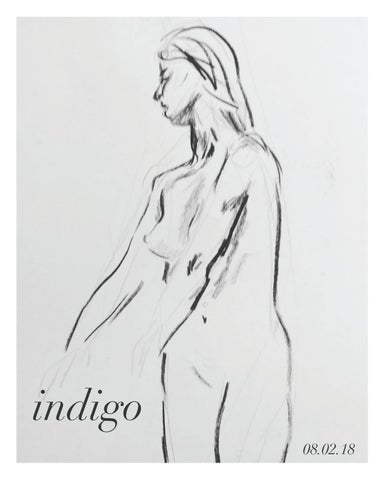
indigo 08.02.18
EDITORIAL Thursday, 8 February 2018
2
CREATIVE WRITING
3 ‘Don’t Push Your Luck With Me, God’ ‘I Don’t Write Poetry’ F E A T U RES / FASHION 4&5 Moral Fibres: sustainability, Positive Fashion and the banning of micro-beads in cosmetics BOOKS 6&7 Just as Austentatious? The continuing relevance of ‘Pride and Prejudice’ Desert Island Books: which literary companion would you choose? V I S UAL ARTS 8&9 Body over Mind in ER157: Anna Thomas discusses the art of life drawing F O OD & DRINK 10 Food for Thought - the ‘Mean Bean Challenge’. Jemima Bush stands in solidarity with those suffering from food poverty TRAVEL 11 Top Travel Trends: 2018 is the year for bold choices. Danielle Cuaycong suggests Iceland, Japan, Canada and Croatia MUSIC 12 & 13 A few words with the madmen of MOON HOOCH: frantic gigs, traffic cones and ephemeral transcendentalism F I LM & TV 14 Queer Baiting: what is it? And why should you care? Florie Moran tells us all STAGE 15 “I go to the theatre to see diverse stories, not familiar ones”: with DDF imminent, Stage interviews Durham graduate and published playwright, Caitlin McEwan I N TERVIEW 16 “It’s a constant conversation you are having with yourself”: Ella Hickson on creativity, playwrighting and the politics of the stage
C
www.palatinate.org.uk
lub nights. Street art. Press evenings. Promotional shoots and videos. 1,820 tickets. 19 Executive Committee members and 52 models. Two nights of unprecedented spectacle. Evolution // Revolution (#theshapeofnow). DUCFS: the largest student-led charitable event in the UK. And this year more than >> £106, 000 << was raised for Mind! Over the past few editions of Indigo, Fashion has conducted several interviews with DUCFS’ fashion and creative teams which outline their desire to boost engagement through art. On their website they describe themselves as “more than a show”; they are simultaneously a “brand and a movement”. Their initiative – the desire to capture an “ever-changing youthful spirit” – is “accomplished by combining mediums of art, fashion, music and performance”. And it is, I believe, incredibly important that they chose this year to put ‘change’ right at the heart of their campaign. In his first editorial for Vogue, Edward Enninful wrote that “Fashion is a conversation, the continual dialogue between you, the Vogue reader, and the times we live in, fusing fashion with art, politics and society”. These “times”, he also noted, are “forever changing”. Fashion has a unique capacity to reach among the crowd; it is therefore an integral form of communication. The atmosphere on Saturday night was one of latent potential and future promise. Reminiscent of Karl Lagerfeld’s Chanel catwalk at Paris fashion week 2014 and advanced by Sarah Mower in her latest article for Vogue, ‘Dressed To Protest: Can Fashion Help Bring About Change?’, DUCFS continued the ‘dialogue’ between fashion and politics; the aesthetic of activism and protest clothing. They placed themselves at the intersection of evolution and revolution; mental health and physical image; art and art. With the show’s innovative, challenging and unflinching appraisal of modern society, it collapsed the distinction between objective view and subjective experience. I am dedicating my entire editorial this week to the DUCFS because I want to keep this ‘conversation’ alive. The vision points beyond the two nights. And the charitable donation will have a vast and continuing impact. If anything was impressed on me this weekend, it was the import and sheer possibility of the following maxim - if you attended, you will know exactly what I mean:
“The more you are seen, the more you are heard” TB Cover image by Anna Thomas
www.facebook.com/palindigo Follow us on Twitter and Instagram: @indigodurham
INDIGO EDITORS Tamsin Bracher Adele Cooke (deputy) FEATURES EDITORS Rosie Dowsing Katie Anderson (deputy)
CREATIVE WRITING EDITORS Chloe Uwitonze Scaling Kleopatra Olympiou (deputy) STAGE EDITORS Helena Snider Helen Chatterton (deputy) VISUAL ARTS EDITOR Madeleine Cater Anna Thomas (deputy) BOOKS EDITORS Tanvi Pahwa Alexander Leggatt FASHION EDITOR Anna Gibbs FOOD & DRINK EDITORS Emma Taylor Sapphire Demirsöz (deputy) TRAVEL EDITOR Harriet Willis FILM & TV EDITORS Imogen Kaufman Sander Priston (deputy) MUSIC EDITORS Tom Watling Ashleigh Goodall
Have a question, comment, or an idea for a story you’d like to write? Email indigo@palatinate.org.uk to get in touch.
CREATIVE WRITING 3
Thursday, 8 February 2018
Don’t Push Your Luck With Me, God By Zarmala Naeem creative.writing@palatinate.org.uk Dear God, if You are out there, I demand that You answer my prayer. I accept that I have done wrong. I am sinful and ignorant and irreverent. I want You to punish me for it. Punish me for things I have not done yet but will. And things I will never do still. Forget about the good I’ve done. Take away my moon, stars and sun. But listen to me. You will help someone. This is an order. Obey Your creation. You will go there right now. Go to her house. Enter quietly. I trust You don’t need a key. Go on, go and sit by her bedside. Put Your right hand on her head. Heal her, or harm me instead. I’ve had enough of You thinking You know best. It’s time for You to sit Your test. If You cannot do this for me, I will know that You are nobody. You’re not a God. You’re not even half of a man. I love You conditionally. And this is my condition.
Photo by Hans Splinter via Creative Commons and Flickr
I Don’t Write Poetry By Ouida Jane Turner creative.writing@palatinate.org.uk My dear friend, I don’t write poetry. And yet, today I had to mend A little piece of broken literature by me. It was disordered in its rhythm And all crippled in its rhyme. I lacked the spark of wisdom That would see to make it fine. Still it was there and looked at me, Forbidding me to give up hope. So I went out to have some tea With the wisest wizard of the Globe. He’ll say, he knows just what to do, And then whip out his wooden wand, Still sipping at his tea of blue, Make to his spell the words respond. He’ll tell an A to leave the text, And teach the rhythm how to dance. A syllable would join it next, ‘Til nothing left be there by chance. Then suddenly it all will rhyme, When words and wisdom are in time, For such old wizards never make A tiny single spelling mistake.
Photo by Chris Blakeley via Creative Commons and Flickr
So to you I came, my friend, To say, ‘I don’t write poetry.’ And yet, I’m here to beg you: ‘Mend This broken piece of literature by me.’
FEATURES / FASHION Thursday, 8 February 2018
4
Moral Fibres: Sustainability, Positive Fashion and the banning of micro-beads in cosmetics
By Rosie Dowsing Features Editor features@palatinate.org.uk
W
hen you buy clothes, do you consider how they were made and how they will impact the environment? Well, the UK fashion industry is, slowly but surely, moving towards an ethical and sustainable future, which will make conscientious shopping a lot easier. In the lead up to London Fashion Week 2018, the British Fashion Council are calling attention to their Positive Fashion initiative. The platform, involving many industry leaders, celebrates sustainability, model health, and local manufacturing and craftsmanship.
By Katie Anderson Deputy Features Editor features@palatinate.org.uk
I
n a month of January blues, new environmental policy has seen optimistic developments for the deepest blue of them all. In the UK, the manufacture of cosmetics that contain plastic microbeads is now prohibited, and a ban on sales is planned for July of this year, all with the aim to combat marine pollution. Plastic is valued for its durability, and yet its greatest asset is also its biggest flaw. The small fragments of plastic that are currently found in facial exfoliators, body scrubs and toothpastes flow through drainage systems and accumulate in bodies of water, where they are inevitably digested by fish or crustaceans. A process which can drastically imbalance food chains and alter the living conditions for other organisms, transforming the world’s oceans into unnatural microplastic soup.
The manufacture of cosmetics that contain plastic microbeads is now prohibited A 2016 report by the Parliamentary Office of Science and Technology approximated that one third of fish found in the English Channel are contaminated with pieces of this microscopic debris and Mary Creagh MP of the Environmental Au-
The recent rise of veganism has, undoubtedly, changed the way many consumers buy and wear fashion. 2017 saw numerous movements against real fur, such as protests at London Fashion Week and celebrity pleas from the likes of Ricky Gervais and Lucy Watson. While our country is deemed to have some of the best animal welfare standards in the world, the banning of real fur farming in the UK has simply made it cheaper to source from abroad.
“You can now use the likes of pineapple skin to create leather”
Other designers who are pioneering crueltyfree fashion and raising industry standards include Stella McCartney and Gucci. Let’s hope this inspires other clothing companies to move towards conscientious design and production. Positive Fashion encompasses energy consumption, too. At LFW18 this February, Vivienne Westwood and the Mayor of London will join forces with the British Fashion Council to launch the Fashion SWITCH to Green campaign, which calls for all fashion companies to SWITCH offices and stores to a green electricity supplier by 2020. Just imagine the positive impact if the whole industry followed suit. In the UK alone, the fashion industry constitutes 33% of the labour force, which is a hefty portion that has the potential to collaboratively halt climate change.
Features asked British Designer, Georgia Hardinge, for her thoughts on the campaign: ‘“I feel proud to be one of the designers supporting LFW’s Positive Fashion. I think it’s a brilliant initiative.” Georgia Hardinge is a sculptural, cuttingedge clothing label and the winner of the 2017 Fashion Trust Award. “I pride myself on not using animal skins. With such an incredible variety of faux furs and leathers, I don’t see the need to harm animals. I find it amazing that you can now use the likes of pineapple skin to create leather.”
Just imagine the positive impact if the whole industry switched to green electricity
Other designers pioneering cruely-free fashion include Stella McCartney and Gucci
London Fashion Week, like Durham’s very own DUCFS, will always be a display of exquisite industry talent. But this year, the message is positive, ethical and green.
dit Committee has outlined how “a single shower can result in 100,000 plastic particles entering the ocean”. These shocking statistics carry extra weight given the range of alternatives available. For example, the cosmetics retailer Lush uses ingredients such as aduki beans, coarse sea salt and bamboo stem extract in their products to create the same effect but with the benefit of biodegradability.
to understand the potential severity of its impacts.
“A single shower can result in 100,000 plastic particles entering the ocean” Luckily, action has now been taken, and anybody who was mesmerised by the rich visuals and soothing tones of David Attenborough’s widely acclaimed ‘Blue Planet’ series will recognise the vital importance of this top-down decision. Government policy has at least anchored responsibility with producers, ensuring that they exercise their power in a non-toxic way.
To be envionmentally conscious on a sudent budget, swap your old clothes to be recycled in H&M for a £5 voucher, so you can be ‘out with the old’ without contributing to landfill.
Photograph by Guccie via Creative Commons and Flickr
A fashion trend that shows no sign of waning, glitter is made frm small flashy pieces of plastic and aluminium The new ban will largely cover glitter found in gels and paints, however there is no harm in applying your consumer power to support sustainable and eco-friendly glitter brands this upcoming festival season. Ella praised ‘Wild Glitter’, a vegan and compostable brand that prides itself on being indistinguishable from its detrimental competitors. Other commendable companies include ‘Ecostardust’ or ‘Guilt-Free-Glitter,’ both of which allow you to shine aesthetically and morally too.
If all of this sounds perfectly reasonable, you may want to consider your glitter usage. A fashion trend that shows no sign of waning, glitter is made from small flashy pieces of plastic and aluminium which fall under the umbrella of microplastics. Ella Blaxland, the president of Durham’s very own Glitter Society has spoken about the impacts of sparkly fun, describing how she is “in the process of phasing out all plastic glitter in favour of biodegradable ones”, having only recently come Photograph by m01229 via Creative Commons and Flickr
FASHION / FEATURES Thursday, 8 February 2018
5
Moral Fibres
Georgia Hardinge is a designer sponsored by the British Fashion Council She will be exhibiting at London Fashion Week 2018 and strongly supports their Positive Fashion campaign
Photographs: Georgia Hardinge Spring/Summer 2018 Collection
BOOKS 6
Thursday, 8 February 2018
Just as Austentateous? 205 Years on, Books considers why Pride and Prejudice is still relevant... By Tessa Counsell books@palatinate.org.uk
W
ith translations in forty languages and more adaptations than any other classic author, Jane Austen scarcely needs advocacy.
If she did, look no further than the first line of Pride and Prejudice. Famously telling us, as she does, of a ‘truth universally acknowledged’, Austen’s narrative genius, sparkling wit, and satirical dexterity unequivocally impress themselves on each and every reader. We are brilliantly plunged into her novel by the acute irony of a statement both morally questionable and logically unsound - a universally acknowledged truth, after all, need not be declared.
book lover, or just a fan of Colin Firth, there is no denying that Jane Austen’s beloved novel Pride and Prejudice is one of the most renowned love stories.
‘Pride and Prejudice’ is one of the most renowned love stories What makes Pride and Prejudice stand out among Austen’s works which, on the surface, all share similar plots and settings? Is it Mr. Darcy, who becomes the prototype for the perfect hero in most of the romance fiction that follows? Or maybe the credit should be-
Jane Austen scarcely needs advocacy
By Helena Chung Whether you are an English literature student, a
It is because of the pure happiness between Elizabeth and Darcy that ‘Pride and Prejudice’ inspires the reader
Jane Austen is one of the most successful and celebrated female authors in British literature. With her face on our bank notes and a devoted fan base of ‘Austenites’, it’s safe to say that she isn’t simply a beloved author, but a cultural icon. But why does she have such a lasting and enduring presence in modernity?
Austen isn’t simply a beloved author, but a cultural icon
Narrative genius, sparkling wit, and satirical dexterity
Pride and Prejudice matters today.
The reason that Pride and Prejudice remains the all-time favourite among Austen’s novels for the mass is because of the chemistry between Darcy and Elizabeth, whilst omitting the darker, more sarcastic tone of her later works. What more could one ask for really?
By Rhiannon Morris
And, as to the exact nature of this universe? It is, without exception, a specific one; Austen has been criticised for rarely straying far beyond the romantic comfort of a rural, genteel setting like that of Longbourn, nor engaging with contemporary political issues of the early nineteenth century. The portraits of some characters - such as the ridiculously materialistic Mrs Bennet - in conjunction with Austen’s predictable reversion to a neat ‘happy’ ending, and a general endorsement of social convention have not always produced a favourable critical response. Mark Twain’s urge ‘to dig her up and beat her over the skull with her own shin-bone’ may be one of the most visceral.
Rather than endorsing the limitations of her environment, Austen’s satirical tone provides some scathing criticisms - as Lady Catherine despairs, for example, at the prospect of whether ‘the shades of Pemberley are to be thus polluted’, we cannot but laugh. And, although the novel’s patriarchal undertones prove uncomfortable for the modern reader, Austen’s very authorship - as a defiance of contemporary gender limitations - is remarkable in itself. When Elizabeth declares that her ‘courage always rises at every attempt to intimidate’, it is Austen’s own proto-feminist voice which reverberates.
Colonel Brandon ends up with the youthful Marianne, with Elinor being stuck with the gentle Edward Ferrars. Maybe Austen is focusing her energy on the bond between sisters and female companionship rather than romance plot.
long to Elizabeth, whose sharp wit and determination is rewarded with true love? It is because of the pure happiness between Elizabeth and Darcy that Pride and Prejudice inspires the reader. This contrasts with later novels such as Emma and Sense and Sensibility in which the marriages of Fanny and Emma indicate the shallowness and limitations of the standard imposed on women at the time. Similar to Pride and Prejudice, Sense and Sensibility also has a popular screen adaptation praised for its casting. The contrast between the Dashwood sisters, who each embody the virtues and defaults of the opposing characters in the title, provides the drama for plot development. However, it is odd that the mature
Austen’s success and esteem are weighted by equal attitudes of contempt and disdain by many. There’s a tendency to see Austen as the lonely spinster penning romantic fantasies of chivalrous and wealthy men adoring, and to an extent rescuing the charming but poor heroines with their fortunes. Her ability to explore serious injustices through the perspectives of young girls celebrates women in a period in which they had to strive to gain worth and respect by becoming ‘accomplished’ as opposed to receiving this naturally. She’s fundamentally moral, and it is the very escapist and fantastical element of her novels which may often be criticised as ‘too neat’ or predictable, that is her strength.
Austen uses the love story to empower individuality In Pride and Prejudice, the decent Charlotte Lucas must marry Mr Collins in a loveless match for financial security. Austen doesn’t depict love as magical, for even poverty can turn it into bitterness or hopelessness. Instead she uses the love story to empower individuality and emphasise the pain in learning difficult lessons. At the very heart of her novels, Austen’s protagonists grow up, and strive to leave socially constructed prejudices behind them.
Illustration by Katie Butler
BOOKS 7
Thursday, 8 February 2018
Desert Island Books Literary companions: what would you choose? The Great Gatsby, F. Scott Fitzgerald By Cecily Hayton
T
he Great Gatsby comprises everything that excites me in a piece of literature: perfectly sculpted passages, a tragically complex hero and an author whose life rivals that of his characters in drama. Set in 1920s America, it focuses on the lives of the very rich and how destructive their extravagant immoralities can be. As the story was inspired by Fitzgerald’s romance with his wife, readers are offered a much deeper understanding of the characters’ emotions.
Perfectly sculpted passages and a tragically complex hero It is a novel that can be read time and time again; there is always another meaning to be found in Fitzgerald’s words, which often morph into a form of poetry in the novel’s most romantic moments. Though he was heavily critical of the hedonism of the 1920s, Fitzgerald even finds a beauty in Gatsby’s parties, which are often seen as symbols of the luxury, describing the guests as being “among the whisperings and the champagne and the stars.” It is the beauty of the descriptions that attracts me to this novel – though the plot is exciting, a reader’s focus is on Fitzgerald’s manipulation of language, as his words form almost tangible emotions in their minds. The Remembrance of Earth’s Past, Cixin Liu By Ewan Jones The box set of Cixin Liu’s The Remembrance of Earth’s Past series consists of The Three Body Problem, The Dark Forest, and Death’s End. The novels were originally published in Chinese, with excellent translations by fantasy authors Ken Liu and Joel Martinsen. The Three Body Problem was the first translated novel to win the coveted Hugo award for science fiction, and has since gone on to dominate the sci-fi scene in China and make a splash in the Western world (it was even included on Obama’s list of must-read books).
Reflect on the intensely human struggles at the heart of everything Liu creates The novels loosely fit the ‘space opera’ genre characterised by the works of Isaac Asimov and other paramount science fiction authors, spanning an inconceivable time scale of cultural revolution China and the literal end of the Universe, billions of years in the fu-
ture. Each novel features a unique protagonist struggling with the issues facing their time period, including a hyper-realistic virtual-reality game that is more than it seems, multiple suicides of physicists due to the conventional laws of physics seemingly being proved inconsistent, and threats posed by a race of aliens.
Varying storylines, settings and ideas encourages multiple re-reads The sheer number of varying storylines, settings, and ideas Liu illustrates in these novels encourages multiple re-reads, making them perfect for a desert island. Let yourself be puzzled by the deeply encoded information communicated in a 20-page fairy tale by
elegant prose, Jane’s voice is both intimate and powerful. I wept alongside Jane with poor Helen died and fell in love with the Byronic Mr Rochester.
With its grand houses, desolate moors, and courageous heroine, ‘Jane Eyre’ leaves a lasting impression With its grand houses, desolate moors, and courageous heroine, Jane Eyre leaves a lasting impression. It raises interesting questions about Christianity, feminism and gender expectations that remain relevant in the 21st century. I remember asking myself ‘what would Jane do?’ when I read it all those years ago, a question which I may find myself returning to, in the face of the challenges of a desert island. The Bear and the Nightingale, Katherine Arden By Francesca Chaplin
a captured human in order to save the human race, explore fantastical spaceship-cities of the future in which class struggles dictate the shape and form of worlds, and if all that is too much, reflect on the intensely human struggles at the heart of everything Liu creates. It is the surprise and interest these novels incite in me that I believe make them the perfect desert island read. Jane Eyre, Charlotte Brontë By May Wall
Jane’s voice is both intimate and powerful The book that called to me, despite its admittedly clichéd status, was Charlotte Brontë’s classic Jane Eyre. This is because every time I read it, I find new aspects of the story to ponder and react in a different way to the characters. I was fourteen when I read Jane Eyre for the first time and immediately I admired how poor and plain Jane was driven by her strong, and occasionally indignant, moral compass. Channelled through Brontë’s
An unforgettable debut, the book takes inspiration from Russian folktales by Morozko and Vasilisa the Beautiful. It tells the story of the strong-willed and compassionate Vasya who must save her community from peril. She must struggle against both the strange and threatening forces lurking in the woods which border her home and the expectations in her time of young women. Vasya’s independence, determination and bravery means that she is a heroine whom you immediately root for and admire. Other unique, complex and fascinating characters include Vasya’s haunted and severe stepmother, Anna, and the obsessive Konstantin, who urges the people in Vasya’s community to abandon tradition, with dire consequences.
Independent, determined and brave, Vasya is a heroine you immediately root for Arden’s prose is beautifully-crafted and the world she creates is enveloping and enchanting. Her descriptions are rich and atmospheric, utterly immersing you in the story. As I was reading I had the most wonderful feeling of contentment – that feeling you get when you are realise that the novel you are reading will become an all-time favourite. Since then I have reread it multiple times. The best thing - and the thing I think is true of all the greatest novels - is that each time I reread it, I find more in it to cherish. Photograph by Chrissie via Creative Commons and Flickr
VISUAL ARTS Thursday, 8 February 2018
8
Body over Mind in ER157 By Anna Thomas
Deputy Visual Arts Editor deputy.visualarts@palatinate.org.uk
L
ife drawing has been a central element of traditional art courses for centuries, originally as a male-only feature of illustrious art institutions. Whilst the concept of drawing a human figure from life has remained largely the same in England since the eighteenth century, modern technology is making it more accessible. The Royal Academy of Art even delivers #LifeDrawingLive, a tutored life drawing class that users can stream on their laptops. In Durham, the Art Society have sessions every Tuesday evening, confidently run by co-ordinators Melissa Frateantonio and Connie Gillespie.
insecurities head on. However, for an activity that is completely body-centric, his emphasis on mindset was surprising.
The model is “the most powerful person in the room” He was interested in how life drawing “reprogrammes” the minds of both the model and the artists. Noting that it is the “mental professionality” of the model that determines the atmosphere in the room, Steve was quick to rebut when I questioned whether he ever felt objectified or vulnerable. As the model, he said, he is “the most powerful person in the room”. Although sketching is the primary point of life drawing, it is difficult to avoid a comparison between Steve’s empowerment and the presentation of bodies that populate social media. Objectification has come to see bodies as commodities, but within the classes the model’s body is desexualised and decontextualised. Melissa repeated “cut the body into shapes” throughout the most recent session. A body becomes several circles, some lines, and bits of light and dark. Further
When we spoke, we talked about expanding the limited art platforms in Durham. Melissa was concerned that the student-art side of Durham can often feel ‘underground’, exclusive or simply absent. By contrast, life drawing is literally naked art. It is emphatically a learning exercise and so the improvements and experimentation in the drawings from session to session are striking. The atmosphere is focused and fun, and whether people are drawing stick men, scribbles or stuff I’d like to take home and stick on my wall, the class is unquestionably accessible.
Life drawing classes are unquestionably accessible I also spoke to Steve Porter, who has been on the life drawing scene for eight years. Whilst Melissa celebrated the artistic liberation that she felt the imperfect and quick sketches bring to the artist, Steve was an advocate for the physical liberation that he feels whilst modelling. He entered the profession after a friend suggested that he tackled his physical
to this, a huge variety of models work for Art Soc. Without preaching body positivity, it is refreshing to realise that a life model is uncurated when naked. The fluorescent overhead lighting in Elvet Riverside does away with the trickery of good lighting, It is not likely that every life drawing model is as comfortable and confident as Steve, but he represents a freedom from which we can take lessons. In his words: “sometimes I forget I’m even naked.” I concluded from this that body confidence does not necessarily mean a labour of enforced positivity and acceptance, but instead, a healthy dose of not caring.
A body becomes several circles, some lines, and bits of light and dark Far from the mark schemes of GCSE and A Level art, life drawing sessions are oriented away from perfectionism. Leading the sessions, Connie and Melissa offer guidance, not instruction. It is perhaps for this sense of freedom that more students are getting involved with modelling for Art Society.
VISUAL ARTS Thursday, 8 February 2018
9
The studentart side of Durham can often feel ‘underground’, exclusive or simply absent
Without preaching body positivity, it is refreshing to realise that a life model is uncurated when naked
Within the classes the model’s body is desexualised and decontextualised Illustrations by Anna Thomas Instagram: @acet_art
FOOD AND DRINK Thursday, 8 February 2018
10
Food for Thought The ‘Mean Bean Challenge’ - a show of solidarity with those affected by food poverty around the world By Jemima Bush food@palatinate.org.uk
F
ood is probably my biggest passion. If I’m not cooking, eating or taking pictures of my food, I’m watching food vloggers and celebrity chefs to work out what I’m going to eat next. When ‘Just Love’, a group of Student Christians who try to promote social justice, announced they were doing a food related challenge, I was immediately interested. About 30 students pledged to only eat plain rice, beans and oats for five days as part of Tearfund’s ‘Mean Bean Challenge’. The aim was to show solidarity with those who live in food poverty and raise money for Tearfund, a charity who among other things work directly with the poorest communities to bring about sustainable solutions to poverty.
About 30 students pledged to only eat plain rice, beans and oats for five days I was expecting the challenge to be difficult and the food to be boring; but, honestly, how hard can five days of boring food be? On the first day I realised quite how disgusting beans are and how bland plain rice and oats taste without any seasoning, and by the afternoon I was really craving sugar. After a couple of days, I noticed a big reduction in my concentration and energy levels that came as a result of such a low calorie intake (less than a quarter of what I was supposed to be having). Work productivity slowed down and I was just generally feeling negative. By day four, I could feel the lack of vitamins and min-
erals in my system; I was weak and aching all over like a walking, talking bruise.
people in poverty face
I was weak and aching all over like a walking, talking bruise
The thing that made this challenge feel possible for me was knowing that at midnight on Friday I could go back to my regular, nutritious and delicious diet. It breaks my heart that there are millions in the world who will live off rice and beans for their whole lives.
For one million people across the world, this state is their daily reality. However, although I was eating the diet of someone in food poverty, my experience was still so far off. During my five days of rice and beans, when I felt tired I let myself have extra breaks and had a nap in the afternoon.
For one million people across the world, this state is their daily reality For those suffering extreme poverty, a further drain on energy is the exhausting manual work that many carry out to earn money, where taking breaks is just not an option. I noticed that concentrating on work became more difficult after just two days, but I will have the chance to catch up on work I missed when my diet is back to normal. For children growing up in poverty who are lucky enough to go to school, lack of food affects their ability to concentrate, and learning is so much harder. On top of that, I was free from the other worries that people in poverty face; I had a hot shower, as much water as I needed and not just a roof over my head but a warm house with all my regular creature comforts.
I was free from other worries that
It breaks my heart that there are millions in the world who will live off rices and beans for their whole lives Tearfund’s ultimate goal is to see an end to food poverty, and since 2006 their work has reached 45 million people. ‘Just Love’ have raised over £3,800 so far and we are excited about the difference this could make. The five days that I lived in food poverty were difficult but barely come close to the daily experience of so many. Please have a look at tearfund.org to find out more. Images by Jemima Bush
TRAVEL 11
Thursday, 8 February 2018
Top Travel Trends
2018 is the year for bold choices: Iceland, Japan, Canada ... By Danielle Cuaycong travel@palatiante.org.uk
N
ew year, new you? What better way to learn new things about yourself than to travel to new destinations around the world? No, we’re not talking about ‘finding yourself’ in the depths of waterfalls in Thailand or glamping, we’re going in the direction of losing yourself in the busy streets of Tokyo and shivering incessantly in Iceland while you watch the Northern Lights. 2018 is the year for bold choices, starting with travel.
Dubrovnik, Croatia From delightful eats to vivacious nightlife, Dubrovnik is a summertime sanctuary; one that has been enticing an increasing number of tourists each year. Exuding a certain historic charm, the buzzing Old City should be at the top of your list. Make sure to go early in the morning to avoid any busy crowds and the glaring midday sun and enjoy the extensive panoramic views on the top of the City Walls. Take an afternoon out and enjoy a horse-riding tour with Kojan Koral (which costs approximately £70) to absorb the sound of the ocean, watch the golden sunset and immerse yourself fully in the culture of Croatia.
Antarctica, Norway and Iceland Despite living in the gloomy and painfully cold Durham, travelling to cold climates is set to be a ‘hot’ (pun intended) trend in 2018. Antarctica, Norway and Iceland are predicted to be the most popular places. Ditch the intense heat of Dubai and instead, opt for shivering in a snowsuit in Iceland. Instagram has been inundated with images of these winter wilderness lodges, such as the Arctic Haven, where you can enjoy seeing Arctic wolves, grizzly bears and caribou. Iceland is not just purely about the Northern Lights; a soothing dip in the natural hot springs and a few days in the local villages will leave you teeming with happiness.
Ditch the intense heat in Dubai and instead, opt for shivering in a snowsuit in Iceland Even better, with the airline, Icelandair, you’ll be able to travel from a place like New York to London, with a free stopover in Iceland for up to seven days. Thus, if you plan in advance, you’ll be able to travel to a multitude of cities for a much cheaper price. If reading incessantly online about Iceland is still not good enough for you, Icelandair also offers Stopover Buddies where employees can help travelers find the local hotspots and even, accompany them on day trips.
Japan
Photograph by inefekt69 via Creative Commons and Flickr
With a plethora of things to do, don’t just go for the cliché Tokyo – stay for longer and explore the other cities of Japan. From swimming naked in the hot springs near Nagano to enriching your knowledge about the history of serene Kyoto, Japan is brimming with culture. A place that is both ancient and futuristic, immerse yourself in the bonsai trees, Zen gardens and the fresh sea-
Photograph by Kamil Porembiński via Creative Commons and Flickr food broths. If you want to feel alive, stand still in Tokyo where you will be surrounded by megalithic, neon skyscrapers and travel to the Shinjuku station which two million people pass through everyday. However, the essential thing to do in Tokyo is to eat ramen at Ichiran Ramen in Shinjuku where you order your choice of ramen at a vending machine, queue for a painfully long time (the only downside) and sit quietly in an individual booth where you are handed your order via a sliding door.
A place that is both ancient and futuristic, immerse yourself in bonsai trees, Zen gardens and fresh seafood broths Canada Winter is considered the new peak season and Canada has already been listed as the New York Times’ top place to go in 2017. Canadian inbound tourism has reached a 14-year high with nearly 20 million travelers in 2016. With its sleek skyscrapers, plush shopping in Yorkville and Bohemian districts in Queen Street, Toronto is bustling with life.
Canada has already been listed as the New York Times’ top place to go in 2017 However, despite the New York vibes that Toronto may radiate, Niagara Falls is worth the day trip. Here you can enjoy the highest waterfall flow rate in the entire world. Additionally, Vancouver - quoted as the ‘best place to live in the world’ multiple times, - is buzzing with a cultural vibrancy and ethnically diverse array of restaurants.
MUSIC 12
Thursday, 8 February 2018
A few words with the mad
MOON HOOCH care only for frantic gigs, traffic cones and ephemeral transcend By John Whitaker music@palatinate.org.uk
I
f you didn’t know what you were getting into you could be forgiven for being a little alarmed when Moon Hooch entered the stage at Band on the Wall in Manchester. A traffic cone leans against a synth bank, the drummer walks on in nothing but his underwear, everyone around you shouts in anticipation. Yet as soon as they play it all starts to make sense. A monstrous wall of sound hits you: intense techno drumming, thumping house basslines and screaming tenor leads. The atmosphere is electric, and the crowd are all moving together, entranced by the ridiculous amount of energy channelled into every single number.
A traffic cone leans against a synth bank, the drummer walks on in nothing but his underwear, everyone shouts in anticipation Moon Hooch is formed of James Muschler on drums, Michael Wilbur and Wenzl McGowen on (mainly) saxophone. They don’t quite fit into any standard genre definitions but have managed to carve out their own niche playing what they call ‘Cave Music’. It’s an amalgamation of EDM, free-jazz experimentalism and funky lines that has been so designed to have a primal effect on its audience. There are stories of their early jams on the subway being shut down by police on occasion as they got too wild. Seeing the mosh pit in front of me, this was easy to believe. There was no respite between pieces and this relentless approach meant that there was always a flow of energy coming from the band, driving the crowd into a hungry tension. Yet this was by no means a case of puppeteers pulling strings, for the visibly profuse
sweat on the faces of every band member made obvious that it was the passion and activity they were putting in that was having this effect. The transition for one song was an excerpt from the solo album Mantra Saxophone; a blisteringly fast collection of meditative arpeggios that aptly demonstrated the real skill and tendency towards experimentation that defines this band as well as bringing sharp relief to the incessant and frantic dance numbers. This experimentation is part of what drives and emboldens them with a unique sound, a remarkable aid to their success. But it has mixed results: putting a traffic cone into a tenor sax to alter its pitch and timbre is interesting and innovative, running the microphones from acoustic instruments through a preplanned set of electronic effects to enhance the sound is brilliant (the bass clarinet was sounding heavier than any dubstep bassline I’ve ever heard) and getting that electronic music effect out of normal instruments is impressive and sounds phenomenal, but occasionally the wacky ideas backfire. For a minute or two of the set Michael Wilbur was shouting improvised poetry into his microphone. Most of it was obscene, little of it was comprehensible. Markedly, it was the only point in the set where there was no longer anyone dancing; all movement had stopped and the audience was gazing up baffled and unsure of what to make of this new spectacle.
An amalgamation of EDM, free-jazz experimentalism and funky lines are designed to have a primal effect on its audience The bursts of true virtuosity may remind you that Moon Hooch are anything but a normal dance band, yet it’s their most danceable music that had the most widespread appeal. I fear anything beyond this, not just musically, but particularly the spirituality they are trying to convey in their music, doesn’t always come across. It gets obscured by and lost in catchy pop lines and funky beats, and it made me wish the brief glimpses that we were given with Mantra Saxophone were more common. Despite these rare blips, it’s apparent that years of full time touring have paid off, and they know nothing if not how to put on a brilliant show. Finishing their set with #9, their most famous song and what everyone has been waiting for, the crowd went wild yet again and are sure to have gone home with little but positive thoughts. The overriding impression of the gig was that of intense and all-encompassing energy and emotion which I had never heard come across fully in their recorded albums. Their live performances are the more full and natural state of their music and must be seen to be believed.
The overriding impression of the gig was of intense and all-encompassing energy In an interview after the gig we talked about their early days, what goes into their music, and how they try to express the meaning behind it. You’ve said before quite a lot of music played now is ‘purposeless, fast food music’. When you started, was that something you considered playing?
MW: I think we had that option; I was always disgusted by it, in fact when we started I was disgusted by our own music; anything slightly commercial made me sick. These guys used to have to drag me down to the subway. I really did not want to play it; I was horrible to work with. Wenzl was far more open to writing pop music; he wrote all the songs and led the band for the first year. I would just turn up and play. Did the subway not give you licence to play whatever you wanted though? MW: Yeah at the time I was playing improvised music, free jazz; odd time signals and weird atonal music. Shit like that. You know whenever I played a gig five people would show up, and all of them were musicians that I went to school with. It was never music that people were interested in listening to. And playing the songs that Wenzl wrote? People loved them! I could bring my weird intense energy to it, and it was still accessible; weirdly accessible. WM: Yeah it’s like if you plant a bunch of seeds; if you leave them and water them they grow into a beautiful forest. What happened with this band was completed unplanned and unpredictable. We were initially drawing a very heavy metal crowd, probably because of Mike’s influence. Like, he wanted to express that intense energy, and I wanted to do pop music. And when it came together it became this intense, accessible, dance centred insanity. So you have the pop, the free-jazz, and the metal, all shoved into one sound. But the part that brings it all together is the energy; you can see the way that a crowd responds to you? WM: Yeah music is insane. Nobody really gets how deep music is, and the effect it can have on us. It’s purely beyond the intellect. I think the less you think about it the more effect it can have. The more we want
MUSIC Thursday, 8 February 2018
13
dmen of MOON HOOCH
dentalism - Music reviews their unique gig and interviews the trio after the carnage Fighting against that demon or other; do you see your music as your way of fighting back against this idea or everything that has been suppressed? MW: I think self expression is that. You know, when people suppress their primal instincts, it drives them to do horrible things to each other. Just by expressing oneself, you are becoming liberated from that, and liberating those downward tendencies which could cause you, or anyone in the audience, to do something horrible.
“Sometimes I’ll see demons and shit, and we’ll crush them together, without them even knowing it” The music is the music, but looking to something beyond that, with the music facilitating it, - when you approach a song does reaching that other realm come spontaneously or is it calculated?
to play, the more that energy comes out. We’re like a faucet; there’s just this stream coming out of us. You’ve talked about how when you started, you two were battling each other to be the front man, but once you had grown as musicians together you started fighting together. Is that something that the audience is part of? MW: Definitely. A lot of the time it feels like we’re all battling this crazy metaphysical war that is beyond our bodies and psyche. Sometimes I’ll see demons and shit, and we’ll crush them together, without them even knowing it.
“It became this intense, accessible, dance centred insanity” WM: Yeah, it feels like that. For me also, I like to acknowledge all the suffering that happens in a particular place when I’m playing. There’s so much war and domination, and then we are all pretending nothing has happened. If you look around you, suffering is everywhere. I was struck by the number of homeless, walking from the station to here. Exactly! There’s such apathy, people are like “oh everything’s fine, great fashion and blah blah”, meanwhile what’s really going on in the world is western society has taken over the planet and created this insane enslavement system, and pretended it hasn’t happened. You know, there’s never been an apology for enslaving black people; it’s all been swept under the rug. If you look at it, and feel the emotions, you can get a lot of energy out. I like to think about that when I am playing, connecting to Native Americans as I am a little Native American too.
JM: That feeling, that inspiration, for me, is somehow deeper than just the sound. It’s all subjective and how you perceive the sound, but anyway for me that feeling comes from a combination of things. First of all its comfort, with the technical aspect of playing your instrument, and having some kind of personal connection with the sound that is happening. And also that combined with the focus, the energy. It doesn’t necessarily have to be a focus on the sound, I may not necessarily be thinking about the sound it could be almost a meditative state. WM: Yeah, I think it is beyond the intellect. When you shut off the intellect that is what happens. So you think the intellect is what is preventing that higher understanding? I think the intellect distracts us from our being. When you stop thinking, you can realise that you still are. You will realise that you are far more than you thought you were. You will realise that thinking was actually a tiny part of your being. It’s a cluster of neurons smaller than a quarter; that’s the size of your rational, computational mind. So it’s almost just a surface level?
need to think about how to express yourself on your instrument? No, you don’t have to think about it! Once you’ve done it for thousands of hours, you don’t need to think about it. I’m not thinking about playing a saxophone when I’m playing. I’m not thinking about it at all. I think the same is true for all musicians who have played for enough time. And that then frees you up; because it all becomes subconscious and you don’t need to think about playing anymore. When you are learning say the C major scale, you play it and you fuck up and you play it again and again and 1000 hours pass and you don’t need to think about it anymore. Now you are free to think about something else, like how you felt when your grandfather died for example. Now you’re expressing how you’re consciously feeling about that through the C major scale. It doesn’t even need to be an entire scale or chord or song, you can fit so much thought into a single note.
“I think the intellect distracts us from our being. When you stop thinking, you realise that you still are” When someone is singing or speaking it is obvious what they are talking about, do you ever find it difficult to express what you are thinking about using only what you can play on your sax? MW: Yeah. I think that I do it just by feeling it. I’m not concerned about formulating it in a rational framework to make it understandable. But for example it gives me a feeling to think about say, a metaphysical thought; all the suffering that is happening on this planet, so many different beings, so much complexity and so much struggle, why can’t we work together? That gives me a feeling in my heart; ‘we can do this!’ I don’t have to say this in words, but if I really feel it when I’m playing I think it will create shivers in the audience, which maybe in a level beyond the intellect transmits that information. JM: Yeah, I think that it is possible to create beauty in any number of ways. You don’t necessarily need to throw out intellect to create beauty in music. It can be a combination of so many things in the mind and the soul. It’s not something that you consciously think about when you’re playing.
Yeah, it’s only that much of your brain that’s thinking. It’s only that rational, computational understanding. The rest of it is already processed, and is mysterious to even neuroscientists, we don’t know what consciousness is; we have no fucking idea. But you can tap into that mystery by discarding logic, discarding thinking and just being. Music does that because it is a language without words, and a language without intrinsic meaning. So you are still expressing yourself but it doesn’t mean anything. So it’s something beyond, yeah, beyond that computation of rationality and logic. But how easy it is to do that when you playing music? Do you
Images by Devon Christopher Adams via Flickr
FILM & TV 14
Thursday, 8 February 2018
QUEER BAITING By Florie Moran film@palatinate.org.uk
Q
ueer baiting is a contentious term with various interpretations. Within film and television it describes tactics used by production companies to appeal to the LGBTQ+ community, increasing their viewership. These underhand techniques allow content creators to widen their demographic, whilst simultaneously exploiting a body of people in need of representation. Filmmaker and LGBTQ+ activist Christopher Racster described queer baiting as the attempt of “actors and producers and studios and publicists […] to appropriate or to capitalize on a community.”
In an attempt to be ‘progressive’, content creators may incorporate queer characters and queer storylines Typically in the form of homoerotic subtexts, hinting at – but never confirming nor denying – potential relationships between leading characters can be a cruel way that production companies ‘bait’ an audience. The BBC’s Sherlock is a prime example. Often playing up to a fan base that ‘ships’ Sherlock Holmes and John Watson as ‘Johnlock’, the show sees characters frequently mistake the pair for a couple, as well as moments of awkward intimacy between them. This is a direct response to the fan art, fan fiction and general hype of young fans of the show that latch onto the potential of a prime-time gay relationship, but the consistent refusal to ever elevate these relationships to anything real means that LGBTQ+ youth are left dissatisfied. Queer baiting can be more overt, sometimes unintentionally. In an attempt to be ‘progressive’, content creators may incorporate queer characters and queer
storylines into their shows. Yet the reality is that these are tagged onto the original plot to boost popularity without actually taking any real steps forward. This is often accompanied by a stranger phenomenon, known as the ‘Bury Your Gays’ trope, or ‘Dead Lesbian Syndrome’, in which these characters are killed off after having fulfilled their purpose or their storyline has dried up. This is most explicit in the CW’s The 100, which sees a relationship develop between protagonist Clarke and her rival-turned-lover Lexa. Once the pair spend their first night together, the next morning Lexa is suddenly and somewhat randomly killed, inciting outrage from fans and widespread boycotting. Not only do these fictional deaths hit harder on a community that has only a handful of characters to invest in, but on a political level it suggests that queer characters are expendable. It goes without saying that there is a lack of diversity within mainstream entertainment. When the queer community are searching for visibility to help normalise queer relationships, it seems cruel to offer it piecemeal. Lauren McInroy from the University of Toronto says, “[In our research] we have found good representations are validating and normalizing for LGBTQ+ youth, and contribute to their identity development…However, many youth have to go online to find these affirming representations.”
Killing off queer characters after they have fulfilled their purpose suggests that they are expendable There is clearly work to be done. In particular, lesbian relationships seem to be the hardest to find. In GLAAD’s ‘Where We Are on TV’ Report for the 201617 television season, lesbians made up only 17% of LGBTQ+ characters on broadcast television. And unfortunately, the more perverted side of queer baiting sees the consistent sexualisation of lesbian relationships for those beyond the community alone; commodifying
and objectifying female-female intimacy as yet another selling point.
When the queer community are searching for visibility to normalize relationships, it is cruel to offer it piecemeal Queer baiting is not always a malicious attempt to increase profit and television ratings or box office numbers. Hints, subtleties and certain readings of characters’ interactions may be utterly unintentional or alternatively well-meaning. There are also some within the LGBTQ+ community that are disparaging of the idea, deeming it mere wish-fulfilment of fans seeking empathy with the characters they adore. This is not the case for out-and-proud LGBTQ+ content like Queer As Folk (released in 2000 and the first of its kind as an definitively queer show), The L Word (likewise, but for the previously starved lesbian community) or Orange Is The New Black (simply brilliant in terms of its diversity). These are shows that aren’t afraid to own and articulate their nature as queer content. They’re not baiting, they’re welcoming people in and responding to an unanswered request. This kind of entertainment is vital in the fight for accurate representation on our screens. Queer baiting needs to be acknowledged in the conversation about diversity in all of media. Women, LGBTQ+ folk, people of colour, people with disabilities are all in shocking minorities both in front of and behind the camera. If we want entertainment that actually tells the stories of the people we live amongst, then we need to call out the manipulation of audiences and half-hearted attempts at representing them. We need to demand and create better content that holds up an accurate mirror to the diverse world we live in. Image via Jen Russo on flickr
Film & TV considers the concept of Queer Baiting: what is it? And why should you care?
STAGE 15
Thursday, 8 February 2018
“I go to the theatre to see diverse stories, not familiar ones” With DDF imminent, Stage interviews Durham graduate and published playwright Caitlin McEwan there, so if you’re persistent then I think you can get your work on somewhere. Ultimately though, I would have struggled to create my own work without forming relationships with like-minded people at Durham, and I think that’s a key for success in the ‘real world’ – finding those with the same approach as you, and forming an alliance. Your play ‘Thick Skin’ concerns the characters’ attitudes towards race and their prejudices. Do you think enough is being done to broadcast underrepresented voices in theatre generally, both in terms of women and ethnic minorities? Yes and no. I think especially in the current climate, we all have to be careful and mindful about the stories we tell, and if they really represent the world around us and the people in it. Those programming influential buildings have more of a responsibility, and some people are doing a cracking job, but some people could do more.
By Helena Snider stage@palatinate.org.uk How was your experience of Durham? It’s funny, because I actually didn’t want to go to Durham at all – I didn’t think university was the right place for me at that time. I did an English degree, so didn’t have loads of contact time, which meant I spent most of my time doing theatre. Through doing shows with DST I got so many amazing opportunities, going to the Fringe and doing the tour in the US, and got involved in societies that I never thought I’d do, like DIM. Ultimately, I did get a lot from my time at Durham: it’s a cliché, but my friends from university are my friends for life, and I learnt a lot about myself, even from the hard stuff. You were a star of the Durham drama scene during your time here. When did you first start writing? I actually didn’t start writing until after I graduated. I had thought about it a lot, but never really considered myself a writer, and I didn’t think I had any good ideas. I went away to New York on my own for a month after I graduated and when I was there I just sort of wrote this play, Winston, and submitted it to DDF. It got
put on, and the judges’ comments were really encouraging, so I just kept doing it. I’m an actor as well and wanted to start producing my own work, and had friends from Durham with similar frustrations, so we just banded together and started creating stuff. Who are your literary inspirations?
There’s a lot of talk about quotas meaning that the quality of work takes a hit, and I don’t buy that at all – there are lots of people, making phenomenal work, and at the end of the day, I’d rather see six plays that are all completely different, by writers from different backgrounds, than the same play over and over again. I personally go to the theatre to see diverse stories, not familiar ones.
So many. I love new writing, especially stuff that plays with form in an inventive way. Mike Bartlett, Nick Payne, Lucy Prebble and Penelope Skinner are all writers that I hugely admire for their ability to create work that’s really theatrical and obviously well crafted, but also has these beautifully drawn, three-dimensional characters that you really care about. How did you find breaking into the theatre world after you left university? How does the Durham drama scene compare to the real world? The professional world is very different to Durham. I think the main difference is that the industry is so broad that there’s a place for everyone’s work – certainly during my time at Durham it was relatively narrow. I did a LOT of Shakespeare, which was great, but I loved new writing and would have loved to explore more of that. It is an oversubscribed industry, but there’s loads of schemes and workshops out
Performance photographs of Caitlin’s play, ‘Thick Skin’; by The Other Richard and Aenne Pallasca
THE indigo INTERVIEW Thursday, 8 February 2018
16
“It’s a constant conversation you are having with yourself”: Ella Hickson on creativity, playwrighting and politics of the stage By Adele Cooke Deputy Indigo Editor indigo.deputy@palatinate.org.uk
E
lla Hickson is a force to be reckoned with. Since her first play, Eight, won a Fringe First back in August 2008, Hickson has gone from strength to strength. Boasting an impressive career that encompasses writing, producing and adapting, Hickson is surprisingly grounded and modest despite her many accolades. I sat down with the playwright to discuss her creative process and the world of professional theatre.
Yeah, it’s excruciating. It’s really tricky and it can be gorgeous. You can see lots of things you never imagined. The production can bring something to it that you never had any idea of. But equally it can be very difficult when you’ve had a very particular idea of something and then that isn’t realised - that’s hard. And often they’re personal. They’re slices of experiences and again because you’re watching them at a much later date to when you lived them, it’s like reading your own diaries. If I ever get to see the early plays from when I was a student I feel desperately self-involved, and neurotic, but also there are bits in them that are lovely, like looking at a picture of yourself from
At what point did you decide you weren’t just dabbling in playwriting, but you could actually make a career out of being a professional playwright?
Yeah I think your voice is always in development, it’s sort of questioning what’s coming out of you. It’s just part of growing up and growing older and how you feel about things and how you think about things changes. Your voice is your person and it’s about how you are in the world and what you go through and what you interact with or feel politically. That’s also to do with the political temperature of the culture that you’re in. I think that’s all environmental.
Do you ever miss student playwriting and student theatre? Yes, I do miss student theatre. There was a great sense of camaraderie and energy. The stakes felt low and I think those three things together create really magic work in a way. Now there is a level of professionalism and the stakes are higher and as a professional you have to set boundaries that you just don’t have as a student. So yeah, I miss it. It was great. It was a very happy time.
Do you think with the division of our society and its polarisation at the moment, it is becoming harder to find a uniting idea or a sentiment or a feeling that can be shared by both the viewer and the character, and you as the playwright? Or do you think that society is dividing itself so much that you won’t be able to do that in the same way that you did with something like ‘Eight’?
Do you also find it challenging to keep writing after you’ve been awarded several accolades , and is there a pressure to keep writing and keep writing high quality works?
Is it strange watching your own plays though, because you’ve already had that experience?
These days it’s less painful, I think it’s about confidence. I get up every morning and go to a studio. I go on retreats probably like two to three months a year. It’s about calm. I find the forces of industry and professionalism contradictory to the places you need to be psychologically to get good work done. That can be hard when you’ve got to keep certain things out. It’s not so painful anymore. I think the key for me was about learning to write things for myself and then giving them to people. Whereas when you’re writing for someone else and you feel that you’re either seeking approval, that’s really hard. It’s sort of not where writing comes from in quite the same way. Have you found that your voice has changed since you were writing as a student versus now and how do you adapt and go along with the difference voice that you’ve developed?
I think everyone always feels like they’re dabbling forever. Creatively you never feel like a professional in that sense I guess. But I had a funny journey as I produced my first few plays, so I was a professional producer at the same time as I was sort of a professional playwright. I knew I could make a living out of it for the first year actually because I had to. But probably it was five years before I felt like it was professional.
I don’t feel like I’ve been awarded accolades, I don’t know what that means. I mean yes with the compulsion to write and the stories that I want to tell. I think that’s quite a human muscular compulsion. It’s little or not very much to do with how the shows are received by other people. It’s a constant conversation you are having with yourself and the nub of that conversation happens during the writing process. Usually the production process or the people seeing it and reviewing it happens some months away. It’s often years from where you were at the time you were writing it. So, the creative conversation that is most alive to you is actually quite disconnected from then. When you sit and watch your own play you’re probably watching a moment of your own psychology or a moment of your creative journey that actually happened two years earlier. So other people’s opinions or how a show is received isn’t that useful often because you’ve already kind of gone past that moment.
You’ve said in the past that the writing process is a painful one, how do you navigate that and what is your process?
when you were seventeen.
I think the theatre industry and audiences in the subsidised sector and theatre practitioners tend to be politically united. That’s more of a problem. I think that theatre audiences and theatre practitioners and theatre in general occupy a very specific political position that isn’t shared by huge sections of the rest of the country. Hence they don’t come and watch theatre. So, I think that divide is actually more significant than any divide within the theatre world itself. We’re all singing from the same hymn sheet.
Do you find it challenging to produce new plays and adaptations in quick succession? Or is it just part of your creative process?
But then how do you cope with that? Is it by isolating yourself as you’ve said and going on the retreats and keeping those voices out of your ears?
Yeah, it’s different parts of your brain actually. Adaptations are easier in some ways. It’s more of a job of craft and logic, whereas new plays are always a bit more personal and you’re often wrestling emotionally with something. So yes, you have to work out how you can navigate those two things at the same time for sure.
Yes, I try and stay outside of it as much as possible. You still try and write in opposition to it. You try and avoid narcissism or solely writing about things for other people. But I think increasingly as TV and film become more prominent we have to think constantly about what they can offer that theatre can’t in terms of accessing mass audiences. That’s a constant and challenging conversation we’re all having all the time.
Photograph by Peter Hickson