Carolina South Wildlife



The South Carolina Department of Natural Resources’ mission is to serve as the principal advocate for and steward of South Carolina’s natural resources
SCDNR website: www.dnr.sc.gov
Henry McMaster, Governor of South Carolina
S.C. DEPARTMENT OF NATURAL RESOURCES BOARD
Dr. Mark F. Hartley, Chairman
First Congressional District, Mount Pleasant
Michael E. Hutchins
Second Congressional District, Lexington Davy Hite
Third Congressional District, Ninety Six Hope Blackley
Fourth Congressional District, Roebuck
James Carlisle Oxner III
Fifth Congressional District, Union
Duane Swygert, Vice Chairman
Sixth Congressional District, Hardeeville
Jerry A. Lee
Seventh Congressional District, Johnsonville
Norman F. Pulliam, Chairman Emeritus Spartanburg
S.C. DEPARTMENT OF NATURAL RESOURCES
Thomas S. Mullikin, Ph.D., J.D. Major General (Ret.) Director
Shannon Furr Bobertz, Esq. Chief of Staff
Deputy Directors
Col. Chisolm Frampton
Law Enforcement Division
Will Dillman
Wildlife and Freshwater Fisheries Division
Tyler Brown
Land, Water and Conservation Division
Blaik Keppler
Marine Resources Division
MAGAZINE STAFF
Cindy Thompson, Editor
Kathryn Badal Diaz, Art Director
Phillip Jones, Photographer Emeritus
Equal opportunity to participate in and benefit from the programs and activities of the South Carolina Department of Natural Resources is available to all individuals regardless of age, race, religion, color, sex, national origin, disability, sexual orientation, status as a parent and protected genetic information. Please direct any questions to the SCDNR Office of Human Resources, P.O. Box 167, Columbia, SC 29202, (803) 734-4400, or the U.S. Fish and Wildlife Service, Office of Diversity and Civil Rights, 1875 Century Boulevard, NE, Atlanta, GA 30345, (404) 679-7080/7148.
South Carolina Wildlife (ISSN 0038-3198) is published bimonthly by the Office of Education, Outreach and Information of the South Carolina Department of Natural Resources, 260 D Epting Lane, West Columbia, SC 29172. July-August 2026, Vol. 73, No. 4. Copyright © 2026 by the South Carolina Department of Natural Resources. No part of the contents of this magazine may be reproduced by any means without the consent of South Carolina Wildlife. Manuscripts or photographs may be submitted to The Editor, South Carolina Wildlife, P.O. Box 167, Columbia, SC 29202-0167, accompanied by self-addressed envelopes and return postage. The publisher assumes no responsibility for unsolicited material. Subscription rate is $20 per year; Canada and foreign rate $24. Canceled subscriptions will not be refunded. Preferred periodicals postage paid at Columbia, SC, and additional mailing offices. Circulation: 1-800-678-7227; Editorial: (803) 734-3859 or email scwildlifemagazine@dnr.sc.gov; Website: www.scwildlife.com. POSTMASTER: Send address changes and inquiries to South Carolina Wildlife, Circulation Department, P.O. Box 167, Columbia, SC 29202-0167.
Directions
WE HAVE MUCH TO CELEBRATE IN SOUTH CAROLINA, from the mountains to the sea, and we will be enjoying the beauty and majesty of the Palmetto State’s precious natural expanse in a matter of weeks (as of this writing) through the annual SC7 Expedition, which is a premier permanent partnership between SCDNR and SC7’s original establishing organizations Global Eco Adventures and the South Carolina National Heritage Corridor.
Beyond SC7, we here at SCDNR have much to celebrate through the great work and herculean efforts of Team DNR, day-in-and-day-out.
This is also a time we commemorate and memorialize those among us who have made the ultimate sacrifice in service to others. In fact, I am penning this column on National Peace Officers Memorial Day, May 15, a day we honor and remember our nation’s law enforcement officers who have lost their lives in the line of duty. National Peace Officers Memorial Day was established by President John F. Kennedy in 1962 to coincide with National Police Week.
Here at SCDNR we have lost twelve serving law enforcement officers (game wardens) since 1908. They are L. Pressley Reeves, 1908; Frank A. Floyd, 1949; Robert Joseph McIntyre, 1956; A.C. Campbell, 1969; Charles Levon McNeil, 1974; Doyle Hayes Hill Sr., 1975; Ray G. Moore, 1975; Robert D. Sadler, 1982; Dewey Thornbrew, 1987; George Don Peeler, 1989; Leroy Mallett Dantzler, 1981; and Rhett Sease Bickley Jr., 2018. A thirteenth “game warden,” K-9 Blue, passed away after conducting a successful training track in Old Santee Canal State Park in 2020. We will never forget any one of them.
Speaking of law enforcement, in my recent address to graduates of the South Carolina Criminal Justice Academy (SCCJA), I reminded them that wearing the badge is not about what they are allowed to do. It is about what they have chosen to do. And that choice is anchored in something sacred, something profound echoed in the words of the Old Testament prophet Isaiah. When God said, “Whom shall I send, and who will go for us?” Isaiah unhesitatingly responded, “Here I am. Send me.”
I reminded the graduates, nine of whom are now newly-minted SCDNR law enforcement officers, that their oath is a binding promise to uphold the Constitution, not just when it is easy, but when it is difficult. Not when it is popular, but when it is tested. Not when it benefits them individually, but when it requires sacrifice. It is a promise to serve all people equally. To be fair when emotions run high. To be calm when others are not. To be steady when situations become uncertain. And perhaps most importantly, it is a promise to do what is right even when no one is watching.
I reiterated to our graduates and all members of SCCJA Basic Law Enforcement Class 855, “You will encounter conflict and you must be the calm within it. You will be tested not just physically, but morally. And when that happens, remember this: fairness is not weakness. Impartiality is not hesitation. It is strength of the highest order.”

— Thomas S. Mullikin, Ph.D., J.D. Major General, SCSG (Retired) Director, South Carolina Department of Natural Resources
RECONNECTING
HOW THE PALMETTO TRAIL IS CALLING COLLEGE STUDENTS BACK OUTDOORS
TEXT AND PHOTOS BY ALDEN ZERKLE
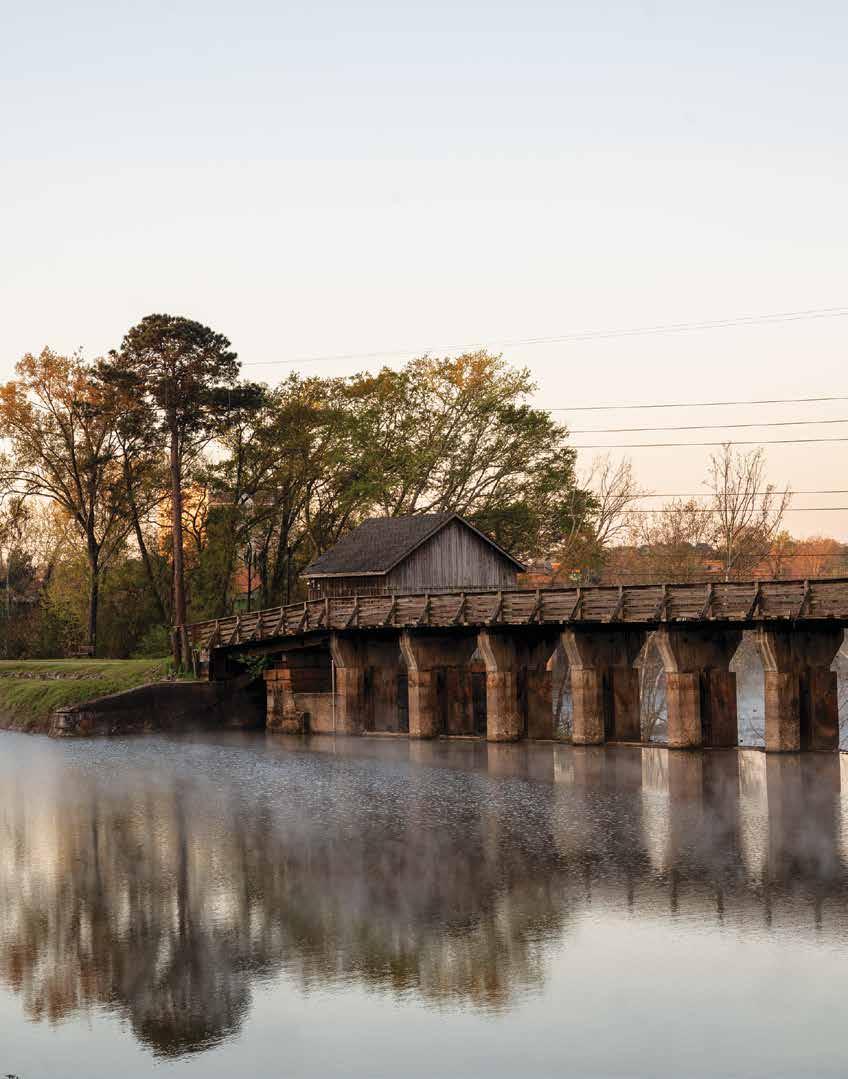
Peaceful morning on the Saluda Riverfront, a part of the Capital City passage.
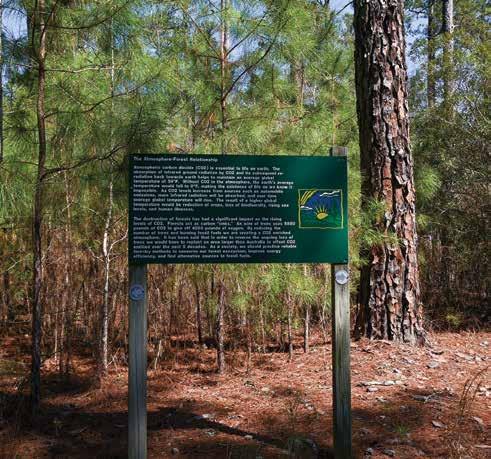
Close your eyes and imagine this: The steady rhythm of your footsteps on packed earth. Wind brushing through longleaf pines. A woodpecker tapping somewhere in the distance. Water moving quietly beneath a onethousand-foot trestle bridge.
You pause. You take a breath. And for the first time all day, no one needs anything from you.
That feeling, that exhale, is what Mary Roe, executive director of the Palmetto Trail, hopes people find on the trail.
“When I’m on the trail,” she says, “the connection it gives me — that’s why I do this work.”
Stretching 416 miles across South Carolina, the Palmetto Trail is one of only sixteen cross-state trails in the country. It runs from the mountains of the Upstate to the marsh-lined coast, and weaves together forests, rivers, railroad trestles, small towns, Revolutionary War battlefields and college campuses — showcasing South Carolina’s natural identity in a way few experiences can.
Eastatoe Passage of the Palmetto Trail
Trailhead sign at Boyd Passage
In 2025, the organization celebrated a milestone: a twenty-six-mile ribbon-cutting that officially connected the capital to the coast. With just over one hundred miles left to build, primarily linking the Midlands to the Upstate, the vision first imagined more than thirty years ago is nearing completion.
But this trail isn’t just about mileage. It’s about an invitation. On early mornings along Columbia’s Congaree riverfront walk, that invitation feels even more tangible. As the first light rises over the water, the riverfront comes alive in a
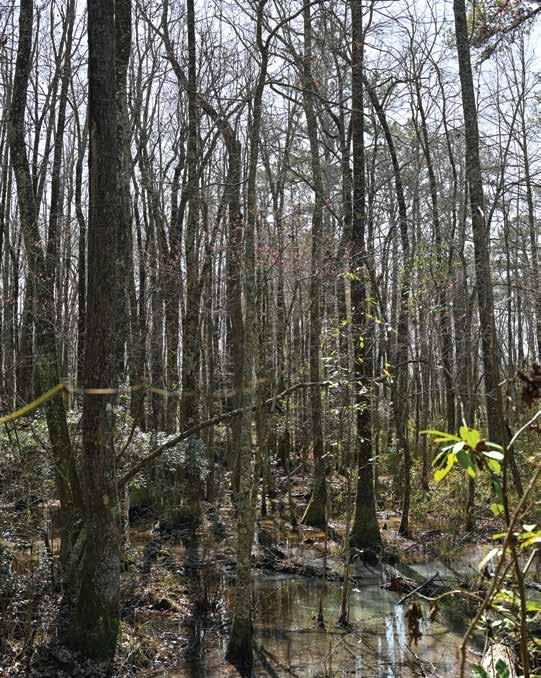
quiet, gradual way. A thin layer of mist hovers above the Congaree, drifting between cypress trunks and low-hanging branches as soft gold light spreads across the surface. The air is much cooler, the path less crowded — just a few runners finding their rhythm and early walkers moving in silence. Birds begin to call from the trees. The city, still waking behind you, feels momentarily distant. Just minutes from the State House, the Palmetto Trail feels unexpectedly wild; a reminder that even in the center of the city, nature is never far away.
A Trail through Every Landscape and Stage of Life
Within two hours of Columbia, you can stand on a mountain overlook or walk through Lowcountry wetlands. Roe describes this geographic diversity as one of the trail’s most powerful features.
“You can drive within two hours and be in a totally different habitat — different foliage, different trees, different wildlife,” she says.
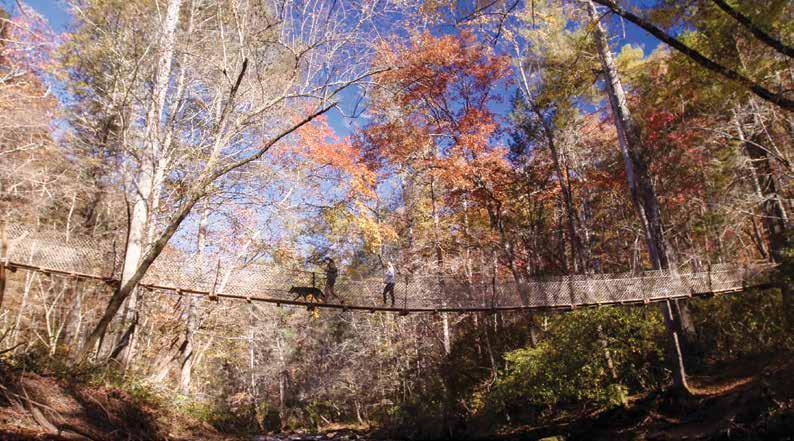
The Palmetto Trail weaves through Revolutionary War sites like Blackstock and Eutaw Springs, crosses historic railroad corridors at Peak to Prosperity, and includes suspension bridges like the Eastatoe Passage in the Upstate. Along the way, hikers encounter pollinator habitats, interpretive signs, and even outdoor amphitheaters designed for environmental education.
It’s part recreation, part conservation, part classroom.
And for college students, it can serve as a living laboratory.
You’re Already On It
On any given afternoon in Columbia, University of South Carolina students gather at coffee shops on Main Street, walk to class with headphones, or study beneath the shade of the Horseshoe’s oak trees. What many don’t realize is that they’re already standing on something much bigger than campus life.
They’re standing on the Palmetto Trail. You might be on the trail while texting. While rushing to class. While heading to a football game. For Mary Roe, that lack of awareness is both surprising and full of potential.
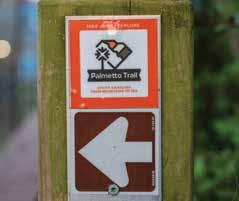
Boyd Passage boardwalk
Palmetto Trail passages are marked by signs.
“There is so much to do around here,” she says, “and not a lot of awareness about it.”
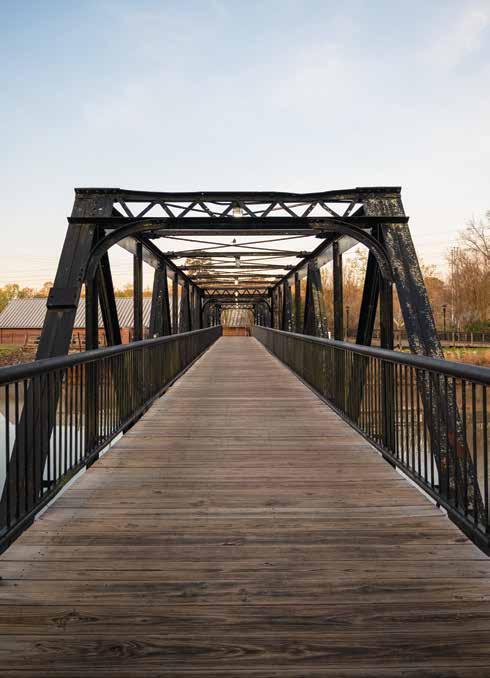
Within thirty-five minutes of campus, the landscape can change entirely. You could be standing on the Peak to Prosperity trestle bridge, suspended high above the Broad River — a one-thousand-foot stretch of historic railroad structure where turtles sunbathe below and bald eagles sometimes glide overhead.
You could be crossing a suspension bridge along the Eastatoe Passage in the Upstate, the forest swaying gently around you.
You could kayak sections near the coast.
Sit beside a quiet stream. Run a flat stretch of trail with friends. Pack a picnic and be back in Columbia before the day is over.
This isn’t extreme backcountry hiking.
The Palmetto Trail is recreational, accessible, marked and designed for everyone from first-time walkers to seasoned adventurers. You don’t need expensive gear. You don’t need wilderness training. You just need to go.
And maybe leave your headphones behind.
“Don’t plug in,” Roe encourages. “Listen to what’s around you.”
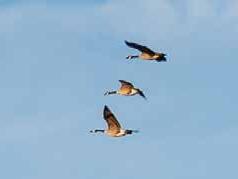
Birdsong. Wind through the trees. Your own breathing.
For students who say they don’t have time for a full-day hiking trip, Roe gently challenges that assumption.
“You all spend two hours having coffee and looking at your phones,” she laughs. “Why not take a thirty-minute walk instead?”
Breaking the “What If” Barrier
For many young adults, especially those who didn’t grow up immersed in nature, stepping onto a wooded trail can feel intimidating.
What if I see a snake? What if I see a bear? What if I get lost?
Roe understands those concerns.
“There’s a study that shows if you’re not introduced to nature early, you can become fearful of it,” she says.
The Palmetto Trail is a recreational trail system that provides access to healthy outdoor recreation. Practicing simple safety measures goes a long way: bring water, tell someone where you’re going, and plan your route beforehand.
The bigger barrier, Roe suggests, is often the story we tell ourselves: I don’t have time. That’s a whole day. I’ll go another weekend.
But a thirty-minute walk can shift your entire mood. A two-hour outing can reset your week.
Roe encourages students to unplug and connect with nature.
“Don’t plug in. You don’t need to hear a podcast while you walk,” she says. “Listen to what’s around you.”
Apps like Merlin can help identify birds by sound. Pollinator panels along the trail explain native plants. Historical markers share stories from the Revolutionary War.
Trails connect people to nature in the heart of the city.
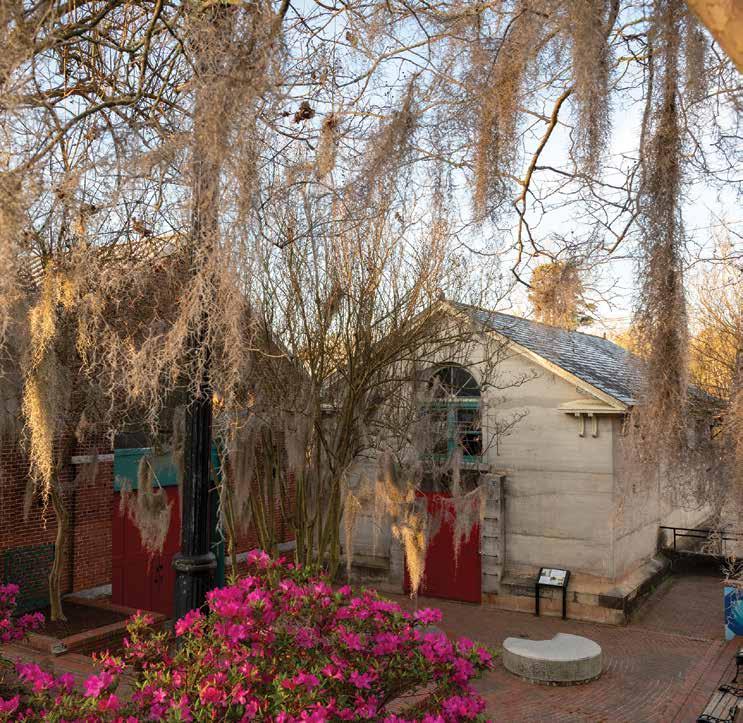
Curiosity becomes the guide. In a generation navigating constant digital stimulation, the trail offers something radically different: stillness.
Conservation in Action and Revitalizing Rural South Carolina
The Palmetto Trail is not only about access; it’s about stewardship.
“We see ourselves as conservationists,” Roe explains. “We build sustainably. We
think about drainage, materials, and how to ensure that a hurricane doesn’t wipe out what we’ve built.”
New projects reflect that commitment.
The Broad River Conservation Education Preserve will integrate hiking, kayaking, pollinator habitats and educational programming, all within thirty-five minutes of downtown Columbia. This blending of recreation and land preservation represents a long-term
investment in South Carolina’s future.
Beyond environmental impact, the Palmetto Trail also supports economic revitalization.
Many of the trail’s passages pass through small towns — places that once thrived before highway rerouting and economic shifts changed travel patterns.
In 2026, the organization will launch its “Outdoor Town” initiative, which will help rural communities leverage outdoor
Palmetto Trail pathways connect the University of South Carolina campus and city residents to the great outdoors.
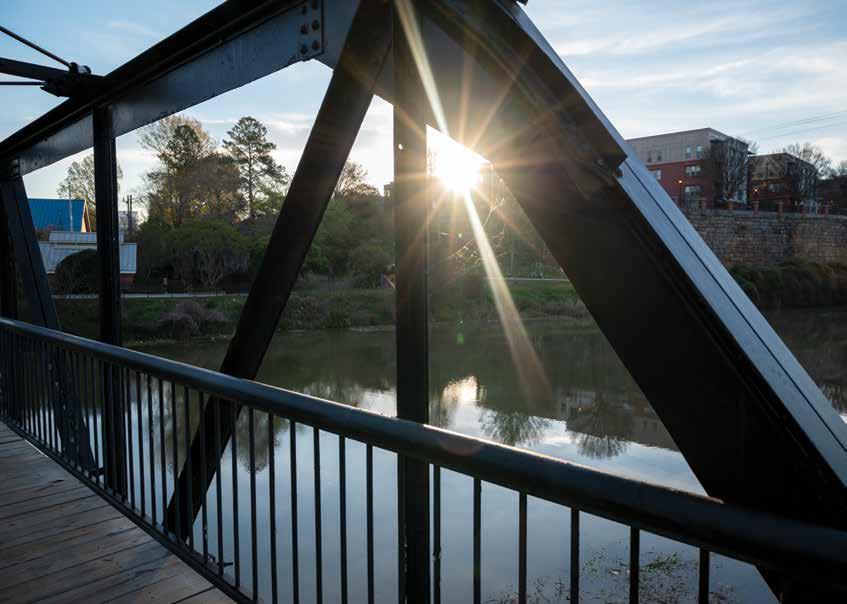
recreation to support local businesses and tourism.
“We want to encourage any kind of outdoor activity, and give those towns support behind them,” Roe says.
For students interested in sustainability, public policy or economic development, this intersection of conservation and community offers powerful real-world implications.
Ownership for the Next Generation
If there’s one message Roe hopes students take away, it’s this: the Palmetto Trail belongs to them.
“This is South Carolina’s trail,” she says. “Not mine. South Carolina’s.”
Students can get involved through volunteer trail days, becoming trailblazers
who adopt sections for regular check-ins, assisting at 5Ks and 10Ks, attending conservation panels, birding hikes, or celebrating National Trails Day in June.
More information about events, volunteer opportunities and trail updates can be found at www.palmettotrail.org.
Beyond formal involvement, Roe emphasizes something deeper.
In a college environment where schedules are packed and social interaction often happens through screens, the trail offers something analog, immediate and grounding.
Pack a lunch. Take a friend. Sit by a stream. Make a day of it; or just an hour.
The Palmetto Trail isn’t asking for perfection or expertise. It’s asking for your presence.
And maybe, especially for a generation searching for connection, that’s exactly what we need.
Stretching 416 miles across South Carolina, the Palmetto Trail has been quietly waiting.
It is an invitation to step outside routine, reconnect with the land, and perhaps reconnect with ourselves.
Visit https://www.palmettotrail.org to get connected with the Palmetto Trail and its vast network of passages from campus to campus and from the mountains to the coast.
University of South Carolina student Alden Zerkle serves as photo processing technician for SCDNR’s Heritage Trust Botany and Plant Conservation Program.
GHOST
ART
TEXT BY MIKE WATTS
ORIGINAL
BY MCCALL MASSEY
PHOTOS COURTESY HUGH FAUST AND JOHN CLARK
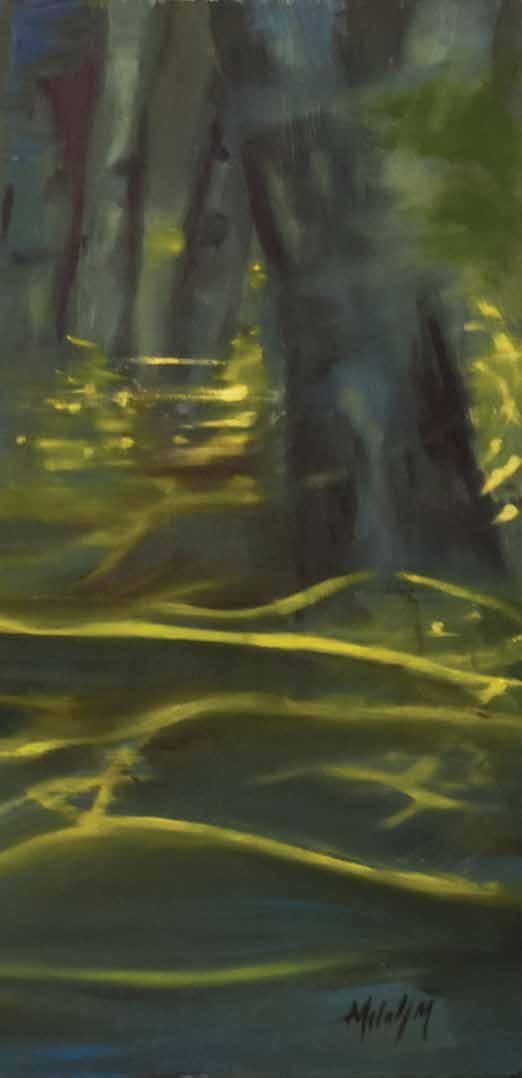
June officially marks the beginning of summer with longer days and late sunsets. It also means short pants, bug spray, and wading through cool mountain streams at dusk searching for trout. It’s peaceful standing in a river at sunset. As the sun descends and the cooler night air settles in, the world seems to come alive.
It was dark when I left the river and began the journey back up the mountain. Finding the path was challenging in the evening’s blackness. I’ve been on this trail many times, but at night it looks entirely different.
I had decided to fly fish this section until dusk, then walk out before dark. It was a good plan, except that I stayed too long.
My flashlight was left lying in my fishing bag in the back of the truck, and my famous last words were, “I won’t need it.” Maybe it was my fishing anticipation, but there was an inner sublime feeling about being out here this evening. I didn’t catch a basketful of fish; instead, I had to work hard for the one I did catch, which made it more memorable.
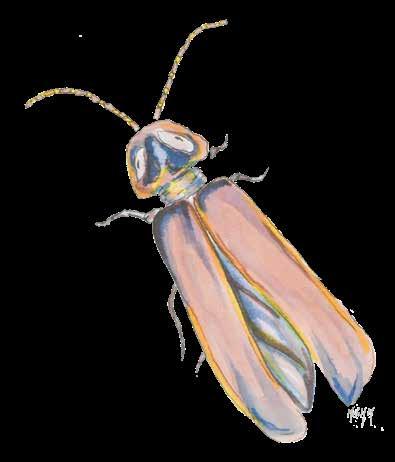
Unfortunately, that one trout made me fish too late and forced me to walk uphill in the dark with no light. Of course, I blamed my circumstances on the fish. If only it had bitten my fly sooner, I wouldn’t have been in this predicament, and I would be on my way home much earlier. Little did I know Mother Nature was about to give me a special gift to be treasured forever.
It’s always strange walking in the woods after the sun sets. Looking up, I hoped the moon would rise over the mountain and light the path, but it didn’t. It was one of those dark nights when even the stars didn’t have their usual amount of glimmer. The night forced my senses to heighten, and my eyes played tricks on me amidst the surrounding shadows. Remembering that there was an old, half-rotted stump near the halfway point on my dark journey, I knew it would be a good place to stop and rest for a few minutes. It was time for a breather. I hoped the
old stump could support my weight as I took a much-needed break.
Listening carefully, I could hear the river below, its water churning over and around the many boulders, resonating with a melodic sound. This was a perfect time to sit and think about nothing but the one fish I caught and released. It was a perfect moment to quietly enjoy the evening and listen.
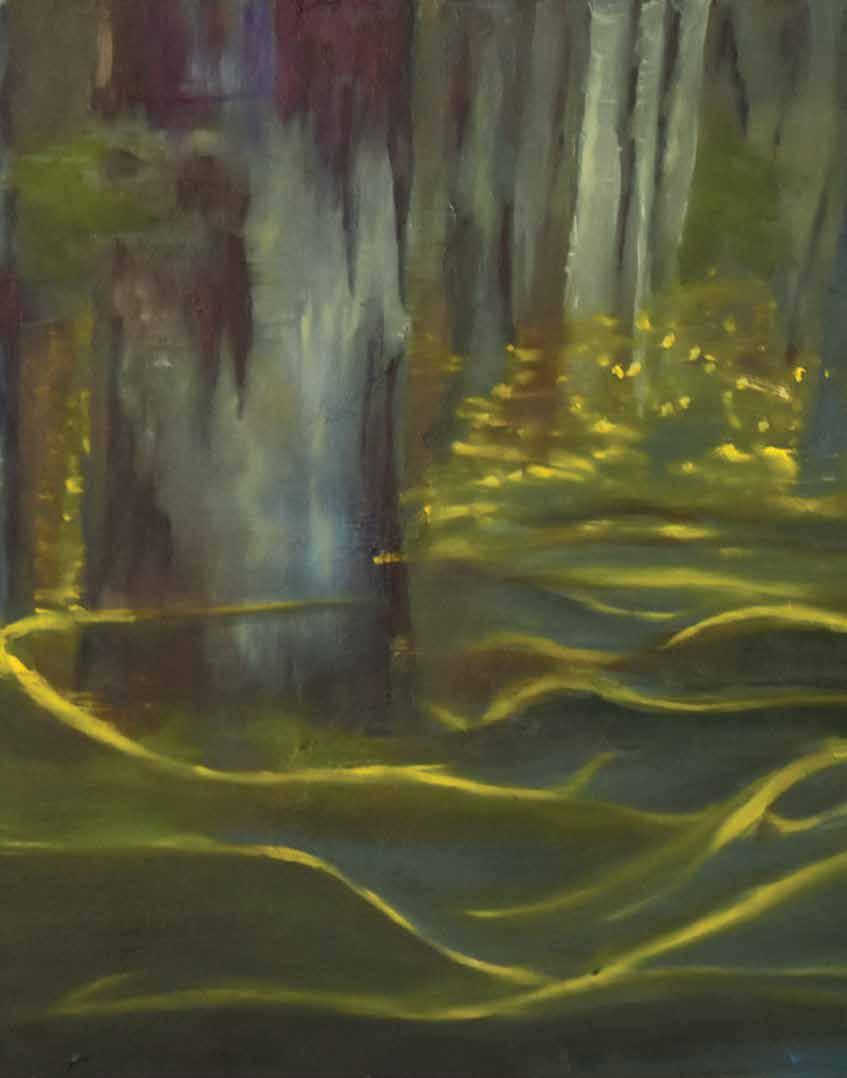
Maybe I hadn’t noticed them while walking, but sitting on the old stump, I realized that fireflies were flashing all around me. It seemed like hundreds of them appeared instantly, quickly lighting their lanterns and illuminating the hillside with a brief burst of yellow. The flashes would fade, leaving only a few lone stragglers glowing, and then it repeated. I was their captive audience.
Looking at my watch was no longer necessary. I was already late; what’s a few extra minutes? Enjoying the light show brought back warm memories. Reflecting, I could vividly remember myself as a little boy on the lawn with my younger brother and sister. Each of us carried a mason jar that Dad had punctured the tops with nail holes. We ran around the yard laughing, chasing lightning bugs, and seeing who could catch the most. Afterwards, Dad made us empty the jars so the fireflies could continue brightening the early summer night. Those were good times.
And then I saw it, bringing me back to the present. Among all the lightning bugs, with their quick burst of brilliance, was a different set of flashes. Taking notice, I scoured the woods intently, looking for them again. It wasn’t a figment of my imagination. Surely, I wasn’t dreaming.
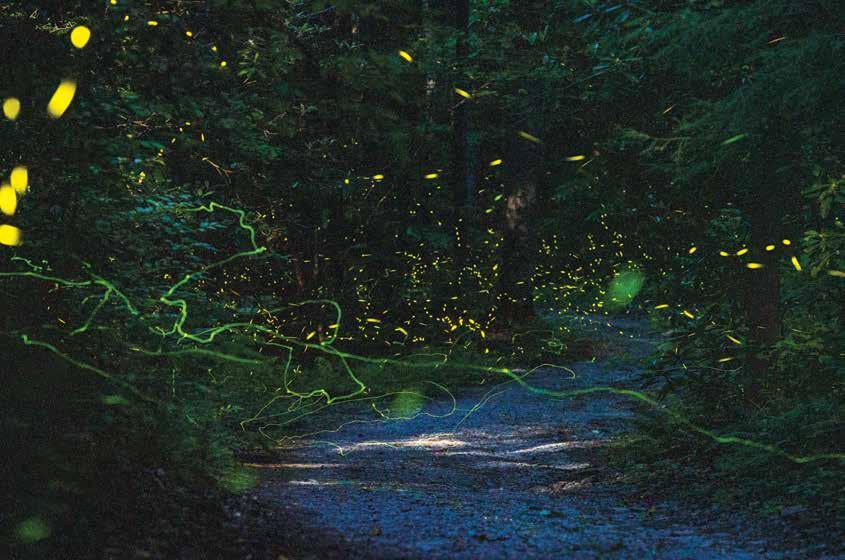
Instead of an intermittent flash, these lightning bugs remained lit much longer than the others — about thirty seconds or more — and their yellow glow had a bluish-green, fluorescent tint, making them appear more iridescent and brighter. Some would light up and maintain their glow indefinitely. It was a surreal moment. Why hadn’t I noticed them here before? With their extended glow lasting so much longer, these bugs looked enormous.
I wasn’t about to leave the performance where I had a free, front-row stump.
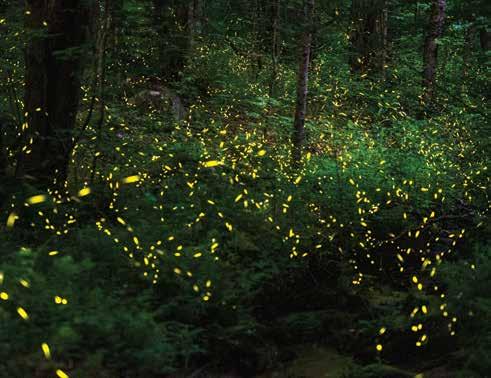
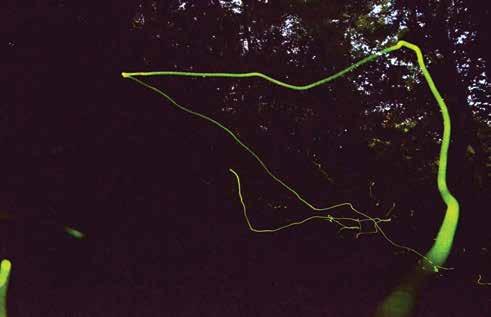
Watching the flickers of fireflies with their short fuses, along with the others flying among them and staying lit, was completely mesmerizing. Time stood still in my world at that moment. What appeared to be hours was probably only ten minutes, but eventually their light beams flickered more sporadically, and their numbers diminished.
Finally, it was time to leave the stump and finish my uphill hike. Maybe it was fate or just simply being in the right place at the right time, but I felt lucky to be there to see the fabulous light show.
Replaying this evening’s sightings made the last part of my journey back to the truck go by quickly. I almost forgot I had trekked there to fish.
After this trip, I needed confirmation of my sightings — to maintain my high level of integrity in telling nonfiction stories. One authority in the Southeast for firefly verification is Lynn Faust, author of Fireflies, Glow-worms and Lightning Bugs: Identification and Natural History of the Fireflies of the Eastern and Central United States and Canada.
John Clark
Hugh Faust
“Did I really see the blue ghost?” was the first question I asked her.
Faust confirmed my sightings and stated, “They are common all over the Appalachians, and in the valleys also, as you move down into South Carolina.”
What I had witnessed was indeed the blue ghost firefly, Phausis reticulata, which is a dark and very active firefly. The more I learned, the more excited I became about my sightings, making that evening event almost magical. Lynn mentioned how lucky I was to finally be at the right place at the right time.
“This species flies after true dark,” explained Faust. “In late June, it is close to ten p.m. before truly dark. They actually glow green, but to ‘more mature’ eyes they look bluish from a distance.” I found it interesting that “the females do not fly, have no wings and look like tiny grains of rice that glow.”
“They [blue ghost fireflies] are more widespread than you think,” Faust continued. “But they need dark and proper undisturbed habitat, and you must be there at the right time of year and night and place.”
She noted that this species is a hardy survivor, but will quickly disappear with earth movers, habitat destruction, pesticides, development and too much artificial light.
It was a privilege to see the blue ghost, an honor to verify my sightings with Lynn Faust, and a good opportunity to learn about fireflies. Having seen them my entire life, and maybe taking them for granted, I gained a new perspective and understanding of the different species and their spectacular night-light show.
The constant yellow flickering of summer fireflies and the bluish-green
hue of the blue ghost made this fishing trip eerily enchanting and one to always remember. I returned several evenings in a row, noticing their numbers seemed to dwindle each night.
Evenings like this remind me to appreciate each journey and to not forget that it’s more about the outdoor experience than just catching a fish.
Visit riversandfeathers.com to read more stories by Mike Watts, or check out his books Riverbank Memories and Pond Fishing with Papa available on Amazon.
John Clark
There are many species of fireflies. Blue ghost fireflies create a glow that lasts thirty seconds or longer.
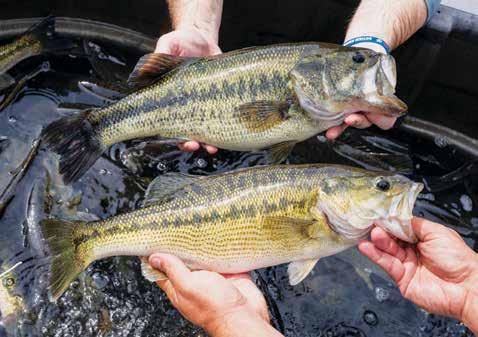
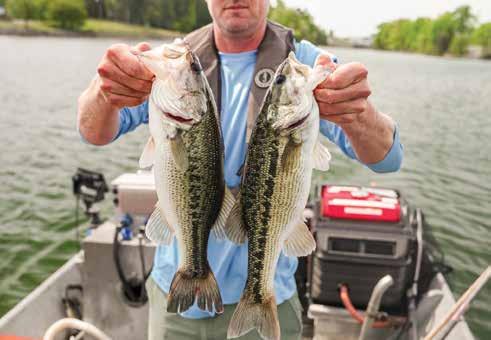
Largemouth bass (top) compared to an Alabama bass, (bottom)
Black Bass Battle Lake Wylie’s

Scan QR code to view documentary video.
TEXT BY TERRY MADEWELL
PHOTOS AND VIDEO BY ALLISON DEVORE AND DANIELLE KENT, SCDNR VIDEOGRAPHERS
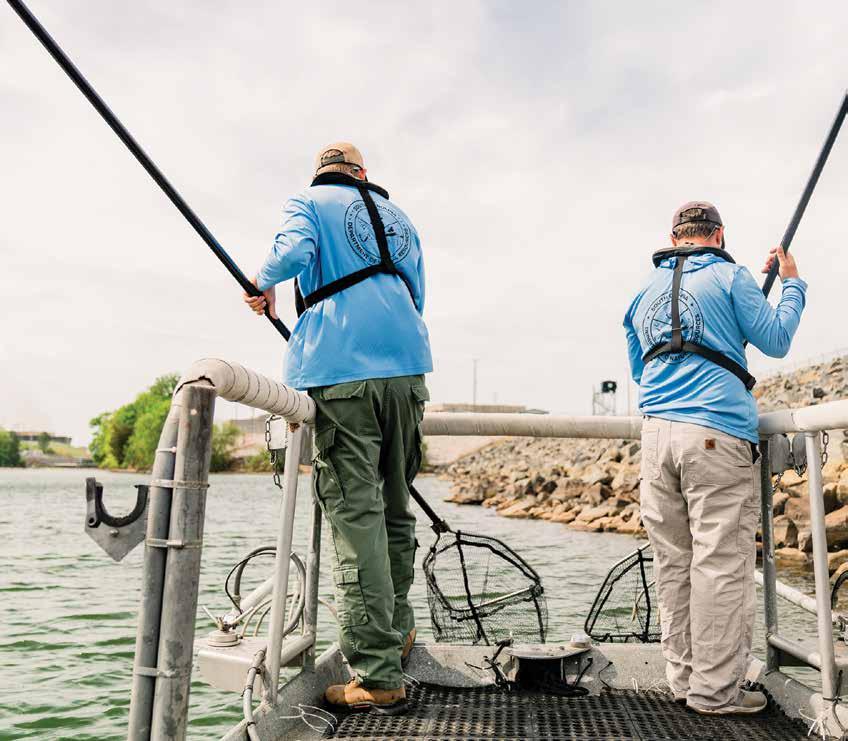
Imagine a black bass fishery in harmony with man and nature, where anglers enjoy outstanding action on quality fish. Within this balanced ecosystem, the largemouth bass is the apex game-fish predator, as nature designed.
During the early 2000s, an elite bass fishery found at Lake Wylie lured the Bassmaster Classic to host leading tournament bass anglers to battle for the
title of Champion. The lake hosted a thrilling tournament in 2004, and all was well in this bass-fishing world.
Concurrently, during those years, a nonnative species of bass was being illegally transported under the radar from Alabama waters into South Carolina river systems and lakes. Astounding disruptions within South Carolina’s native aquatic ecosystems would soon follow.
Upsetting the Balance of a Native Ecosystem
Lake Wylie is the uppermost lake in the Catawba River system in South Carolina. First created in 1904 by a dam near Fort Mill, Lake Wylie is one of the oldest reservoirs in South Carolina.
The SCDNR manages the lake for recreational fishing and maintains multiple fish attractors. Popular sport fish on Lake Wylie include largemouth bass, crappie
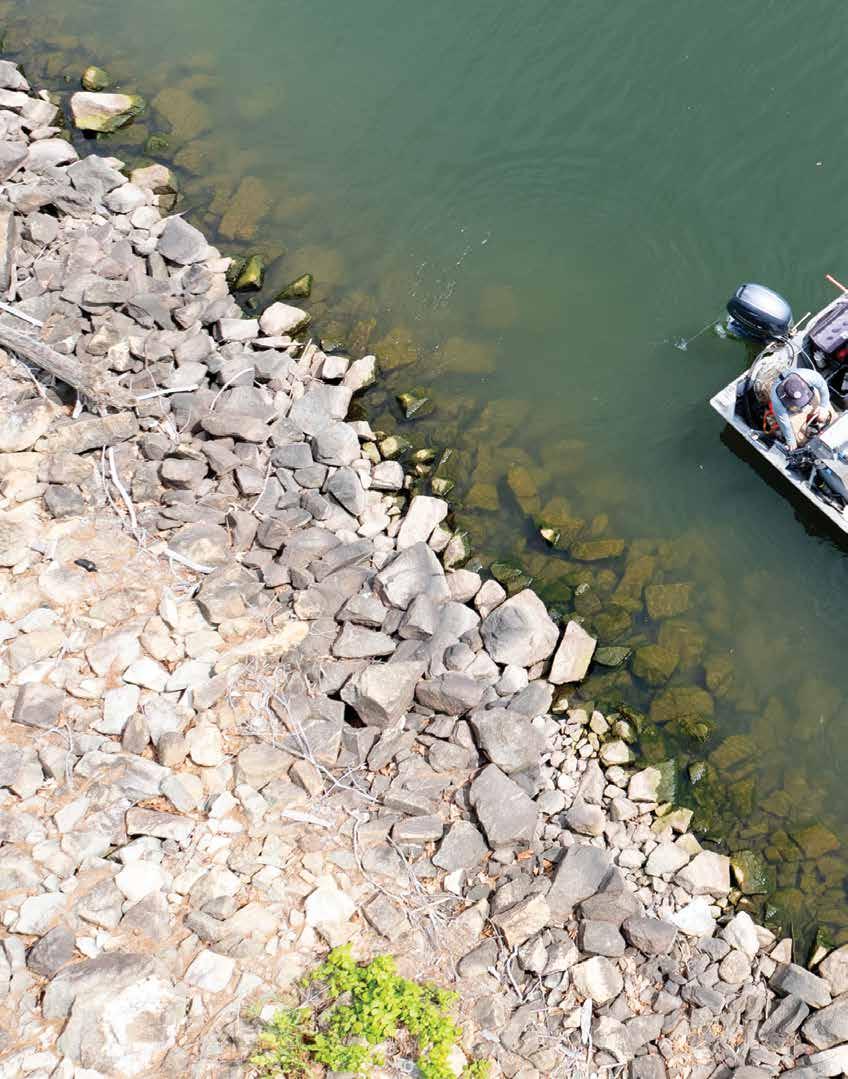
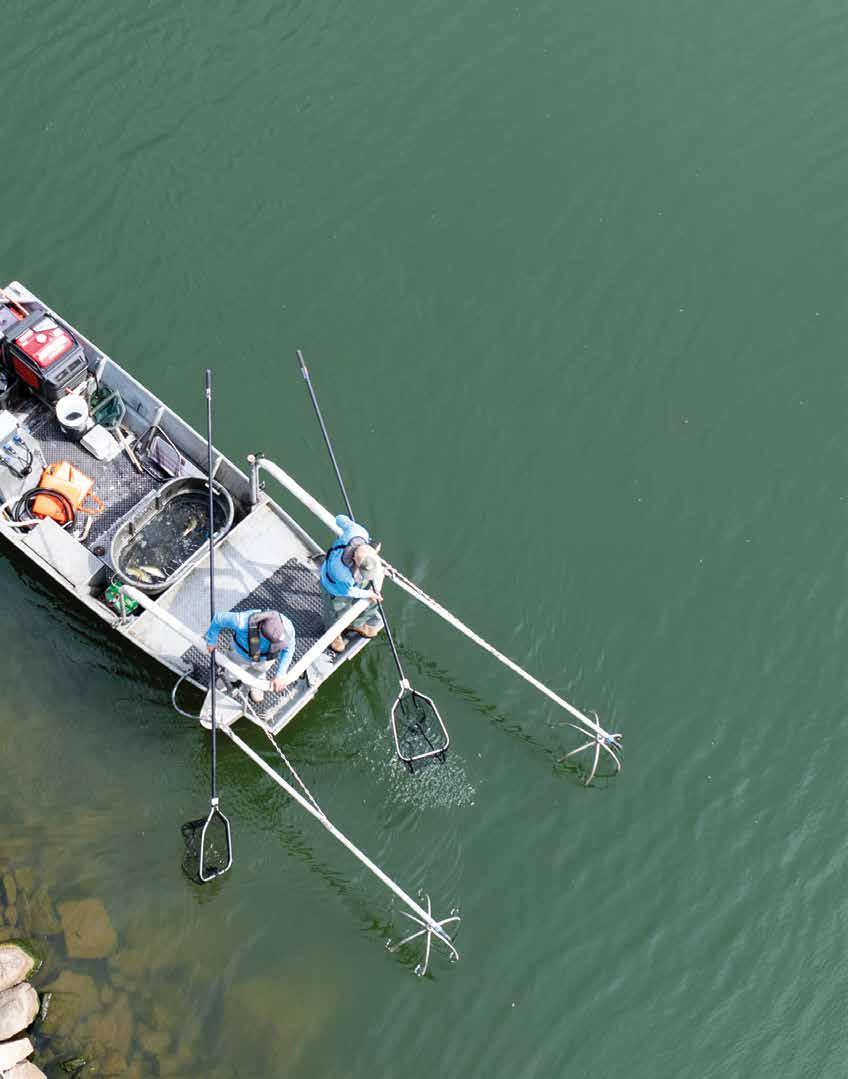
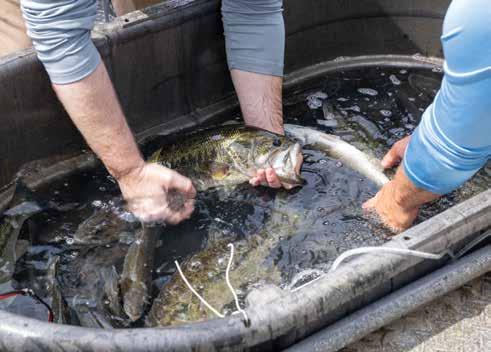
SCDNR freshwater fisheries staff sample and survey lake reservoirs to monitor populations of bass species that are present.
that now sits at the top of the chain: the Alabama bass.
Much has changed at Lake Wylie since this invasive fish was first documented in 2015, because this highly adaptable non-native black bass species has replaced native largemouth bass as the dominant black bass. The Alabama bass is an aggressive, highly effective predator, proven capable of outcompeting native largemouth in their own natural habitat. This is not their first foray into our state. Anglers need look no further than the Savannah River lakes along our western border for a prime example of the dominance invasive bass can inflict on native species.
Preston Chrisman is the Freshwater Fisheries Coordinator for Region Two of the South Carolina Department of Natural Resources (SCDNR) and Chairman of the Black Bass Working Group. He and this SCDNR team are leading efforts to combat the unwelcome spread of this species into the Catawba River system.
“Often referred to by anglers as Spotted bass, the Alabama bass became a specific, named species of black bass in 2008,” Chrisman said. “When introduced into non-native fisheries, the invasive species rapidly overruns the native bass population to the point of dominance. At Lake Wylie, the native largemouth are losing the battle.”
“Alabama bass are typically smaller than the largemouth bass, seldom reaching trophy sizes,” Chrisman said. “Over time, their population explodes, and their growth rates decline when their numbers stabilize,” he said. “Eventually, competition and pressure on forage produce smaller versions of the invasive species, with most in the one-to-three-pound class.”
to gain some control over the situation through a strategic plan.
“I’m passionate because we have opportunities to protect the largemouth bass resource, but we must press forward now,” Chrisman said. “And to literally remove the Alabama bass from any large lake is totally unfeasible. They’re prolific reproducers and extremely effective foragers that we must learn to manage.”
Lake Wylie extends into North Carolina, and their fishery biologists share this concern. Chrisman said neither the North Carolina nor the South Carolina state fisheries programs have stocked Alabama bass into any lakes. Fisheries teams from the two state agencies are sharing data to improve their collective understanding of the foe they both battle.
Alabama bass didn’t just naturally migrate into the Carolinas’ lake systems. In their native environment, the Mobile (Alabama) Basin, they thrive, blending with other native species. Their ecosystem is in harmony, just as the ecosystem was in Lake Wylie with native largemouth bass. But messing with Mother Nature can have ill consequences.
“The problem here, and in other lakes with this issue, is ‘bucket biologists’ illegally stocking these non-native species,” Chrisman said. “It’s illegal for private entities or individuals to introduce fish into public lakes or waterways anywhere. Even professional fisheries managers only consider stocking after extensive research of potential impacts on the entire receiving ecosystem, because it can be a recipe for disaster for the receiving species, as we’re documenting that now at Lake Wylie.”
Chrisman said the Alabama bass exhibits a two-prong path of destruction when introduced into new systems.
and catfish. The SCDNR monitors these species on a regular basis to maintain a healthy population.
Healthy populations of largemouth bass once existed at Lake Wylie, producing an elite-level fishery for decades, until illegal transportation of fish occurred, sabotaging the native black bass fishery and the natural harmony of this ecosystem. Lake Wylie was invaded by an aggressive predator
Chrisman said that while Lake Wylie was not a prolific trophy largemouth bass destination, the lake historically had high numbers of quality largemouth in the twoto-four-pound range, with some topping five or six pounds. As the 2004 Bassmaster Classic proved, it was a highly desirable black bass destination.
Chrisman knows it’s a battle the agency likely can’t win, but SCDNR’s goal is
“The first ‘path of destruction’ is overrunning the historical native bass fishery, with the invasive species becoming dominant,” Chrisman said. “The second path of destruction is hybridization, and in some lakes, with other black bass species, that’s even more devastating.”
For Lake Wylie, the first path is the major concern so far, and Chrisman points to a study at Lake Norman in North
Carolina, upstream from Lake Wylie, that’s indicative of what’s coming.
“Lake Norman was one of the first reservoirs where biologists fully documented the expansion of an introduced Alabama bass population, and the impacts on native black bass,” he said. “Their first Alabama bass was documented in 2001, and the invasive species quickly became dominant. The largemouth bass population dwindled and has not recovered. At Lake Norman, Alabama bass replaced native largemouth in many areas.”
And that’s precisely what Chrisman and staff are documenting at Lake Wylie.
“Alabama bass were first captured in Lake Wylie in December of 2015,” Chrisman said. “Until then, the Lake Wylie largemouth bass catch rates were robust; much higher catch rates of bass than similar reservoirs in our area, and the catch rate trend was increasing.”
Now, largemouth bass catch rates have declined significantly, while Alabama bass catch rates have increased annually. Data from 2025 confirms that the Alabama bass are now the dominant species, and are still expanding at an exponential rate.
“Alabama bass are replacing largemouth here, too,” Chrisman said. “We don’t have more bass; we just have significantly fewer native largemouth. But history documents that the invasive’s numbers will stabilize at a dominant level, and their average size will drop noticeably.”
Because of rapid changes in black bass populations at lakes and rivers with Alabama bass, SCDNR began a statewide black bass genetics inventory in 2022.
“Zooming in on Lake Wylie, the genetics lab found the genetic code for three different black bass,” Chrisman said. “They documented the native species of black bass as a Florida-largemouth hybrid, noted one strain of pure Alabama bass, and one fish was a largemouth-Alabama hybrid.”
Chrisman said the Florida bass genetic makeup (alleles) present in Lake Wylie’s largemouth bass population is important to the Working Group’s plans. In the right climate, the Florida bass genetic strain reaches trophy sizes more
frequently than the pure largemouth strain. Chrisman said this information is a key to ongoing research projects.
“We’re initiating an experimental black bass stocking program on Lake Wylie in 2027,” he said. “The goal is to stock 150,000 fingerling largemouth bass into Lake Wylie, and to repeat the stockings for at least three consecutive years.”
SCDNR plans to use brood stock from the Santee Cooper system for stocking because they possess extremely high
proportions of the Florida bass allele.
“We have two objectives,” Chrisman said. “Number one is to push back against the Alabama bass population by boosting the numbers of the largemouth in the lake. Objective number two is to stock the lake with high Florida bass genetics, hopefully boosting the trophy potential of the lake’s largemouth.”
He explained, “Our goal is that anglers will catch more five-pound largemouth rather than three-pounders, certainly a
Alabama bass are quickly overtaking Lake Wylie waters, resulting in increased competition with native largemouth bass.
Native largemouth (left) and non-native Alabama bass (right)
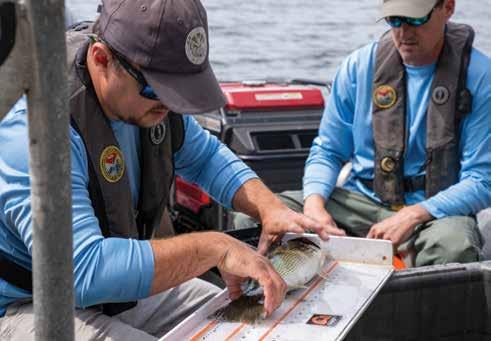
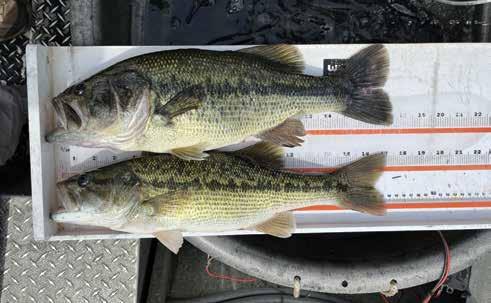
Native largemouth (top) measured beside non-native Alabama bass (bottom). Visit https://www.dnr.sc.gov/news/2026/May/alabama-bass.php to learn more about these species.
positive outcome. We’ll evaluate a few years into the project.”
Alabama bass are problematic because they possess traits that, at first, may appear attractive to anglers. They are aggressive, abundant, fight hard, are easier to pattern for tournament fishing, and are excellent table fare. So, what’s the problem?
“The loss of our native species and the historical legacy of the largemouth bass at Lake Wylie is significant, as is the dilution of the quality and quantity of trophy-fish potential,” Chrisman said. “Recreational
and tournament fishermen who enjoy hooking trophy largemouth are significantly impacted by the decline of Lake Wylie’s historical bass fishery.”
And the problem is spreading. Lake Wylie’s issues are flowing downstream, potentially triggering black bass problems in additional waters of the Catawba River Basin. Invasive Alabama bass were recently documented for the first time in Fishing Creek Lake, which is around thirty miles below the Lake Wylie dam.
These fish will inevitably continue to spread downstream, invading Stumpy Pond and Lake Wateree next, both of which have excellent populations of native largemouth,” Chrisman said.
Alabama bass could be the invasive incarnation of the Grim Reaper for the native black bass fisheries in the remaining Catawba River and lake systems, and beyond.
Chrisman said the agency won’t allow the native black bass fisheries to slip quietly into the night without a fight, but it’s an ongoing, long-term battle, with Lake Wylie the latest casualty.
The Lake Wylie issue is typical of systems overrun with Alabama bass, and this issue is spreading statewide. So far, in their path of destruction, they’ve overrun every native black bass fishery they’ve encountered.
And the second path of destruction, hybridization, may be worse, capable of destroying entire native species rather than merely overrunning them.
Stay tuned to the SeptemberOctober edition of South Carolina Wildlife, as Terry Madewell and Preston Chrisman dive into potential outcomes of the presence of Alabama bass in Carolina waters:
“The hybridization traits of Alabama bass are so powerful that they’ll genetically alter entire ecosystems within a few years,” Chrisman says.
“Their spawning characteristics are suited to hybridize with specific species. Bartram’s and smallmouth bass are two primary species of concern in South Carolina.”
Terry Madewell is a retired wildlife biologist and freelance writer who frequently fishes Lake Wylie and Wateree waters.
SCDNR Fisheries Biologist Preston Chrisman and his team are heading up groundbreaking black bass research in the region, and sharing findings with the public to demonstrate changing dynamics of South Carolina aquatic ecosystems following the introduction of Alabama bass.
Largemouth bass populations are dwindling. Fisheries staff encourage anglers to learn characteristics of native black bass vs. Alabama bass.
When the Rain Stops: Understanding Drought in South Carolina
BY STATE CLIMATOLOGY OFFICE STAFF
SHARP
PHOTOS BY RACHAEL
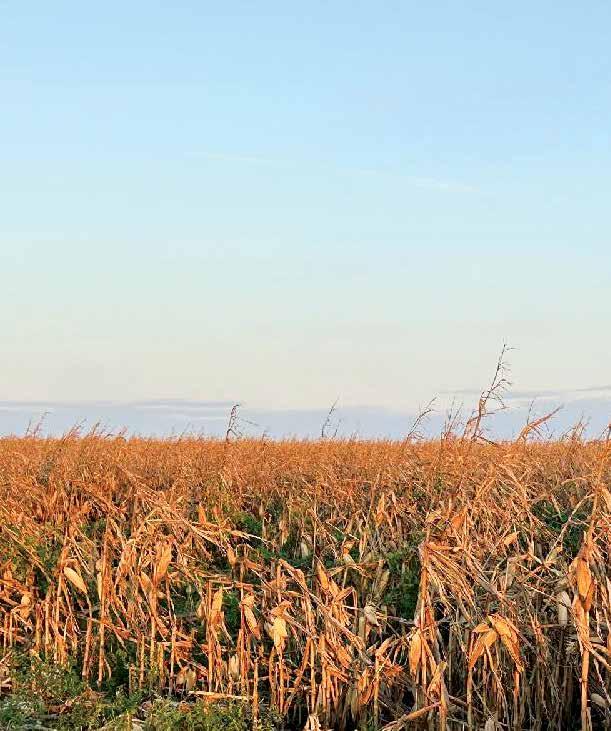
Drought is one of nature’s quiet disasters. Unlike a hurricane or a flood, it doesn’t announce itself with a roar; it builds slowly, week by week, month by month, until the land and the people who depend on it begin to feel its impacts. But what exactly is a drought, and how do we track one?
A Slow-Moving Hazard
Drought is a normal part of climate variability that can occur in virtually any region and any time of year. It develops from a prolonged lack of precipitation, gradually leading to water shortages that have far-reaching impacts on agriculture, industry and daily life. While most droughts unfold over months or even years, a flash drought can intensify in a matter of weeks. Driven by intense heat, absent rainfall, and rapid soil moisture
loss, flash droughts are more difficult to predict and prepare for.
The three main categories of drought each capture a different impact of the hazard.
Meteorological drought is the most common type, defined by below-average rainfall over a period. It is measured by the number of rainless days, the number of days that fall below a certain rainfall threshold, and departures from monthly, seasonal or annual totals. Because rainfall patterns vary widely by region, what is considered a drought in one area might be considered normal in another.
Agricultural drought is usually short-term but affects farmers, foresters and ranchers more directly. It shares features with both meteorological and hydrological droughts, including rainfall shortages, increased evaporation
and transpiration, deficits in topsoil and subsoil moisture, and declining groundwater and reservoir levels. When crops wither and livestock face difficulties, agricultural drought is often the cause.
Hydrological drought is the longestlasting and most widespread of the three types. It often occurs after the other types, sometimes appearing long after rainfall has returned, and its effects can last for years. Low lake, reservoir and river levels, reduced streamflow, diminished wetlands, and groundwater shortages are all signs of a hydrological drought.
Monitoring the Dry Spells
Although South Carolina typically receives adequate precipitation, droughts can occur at any time of the year and last for several months to several years.
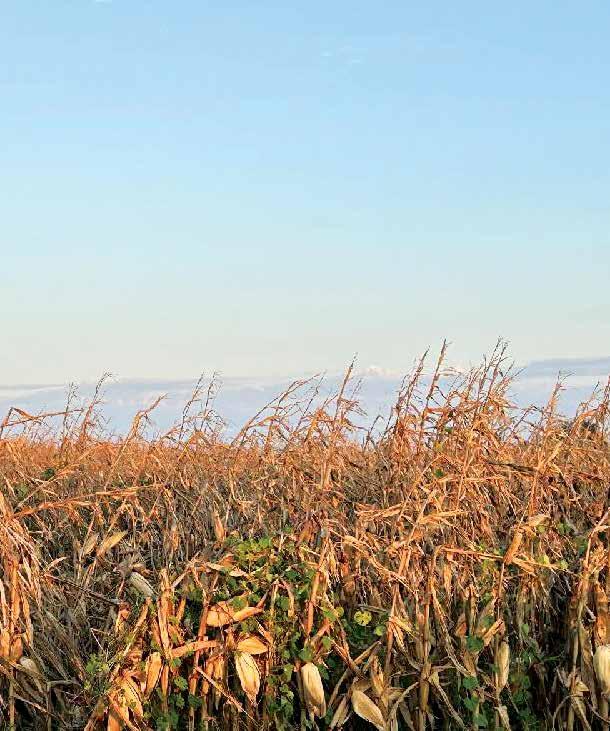


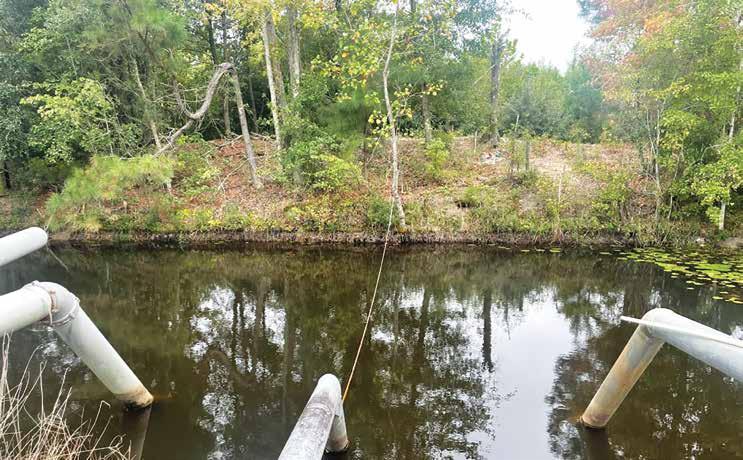
Recent droughts, such as those in 1998 to 2002, 2007 to 2009, and 2010 to 2013, have impacted agriculture, forestry, tourism, power generation, public water supply, fisheries and ecosystems. Beyond the economic toll, droughts can degrade water and air quality, increase public health risks, and impact the overall quality of life in affected communities.
The U.S. Drought Monitor (USDM) is produced through a joint effort between the National Drought Mitigation Center (NDMC) at the University of NebraskaLincoln, the National Oceanic and Atmospheric Administration and the U.S. Department of Agriculture. It provides a broad view of drought conditions across the country and highlights areas where drought effects are likely happening and designates drought conditions in regions based on a convergence of evidence from multiple indicators. In South Carolina, the State Climatology Office (SCO) coordinates the submission of recommendations to the
USDM authors after weekly data reviews and communication with partner agencies and neighboring states. Because the USDM is a blend of indicators, it highlights regional trends and large-scale drought areas. Local conditions can and do vary from the broadscale map.
At the state level, the Drought Response Committee (DRC) takes a more detailed approach. Led by the South Carolina Department of Natural Resources (SCDNR) and the SCO, the gubernatorial appointees to the DRC serve as the primary decision-making body for drought decisions in the state. It organizes local members into four Drought Management Areas and designates drought levels at the county level: normal, incipient, moderate, severe and extreme.
Eyes on the Ground
Tracking drought requires more than just a rain gauge, and neither satellite data nor computer models can fully replace
the observations of someone standing in a field, watching a creek, or tending a forest. That’s where the Condition Monitoring Observer Reports (CMOR) system comes into play. Managed by the NDMC, CMOR collects local weather conditions and drought-impact reports from observers nationwide. These reports are immediately displayed on a publicly accessible interactive map and become part of a permanent record.
Rachael Sharp of Sharp & Sharp Certified Seed, a family-owned farm in Allendale County, began submitting CMOR reports in Fall 2025 and has been sharing information on drought conditions with Water Resources Climatologist Jennifer Simmons ever since. When asked about the process of submitting a CMOR report, Sharp replied, “It’s a quick process, usually no longer than ten minutes. I only answer or check the boxes that are relevant to what I’m seeing on the farm, so I don’t go through every single question. If I already
Condition Monitoring Report photos provided by Rachael Sharp show the impacts of drought on an irrigation pond on the farm property, from September 2025 (left) to December 2025 (right). Due to the lack of precipitation during these months, the pond’s water levels dropped, as evidenced by the water lines on the pipes and the amount of bank exposed in the distance.
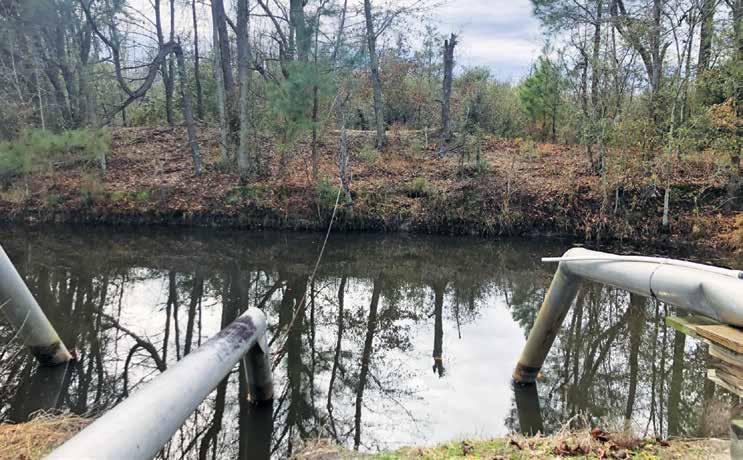
have photos and a clear idea of the captions for them, it goes even faster.”
These ground-level reports are vital and illustrate the real-world impacts of drought on soil, rivers, vegetation and communities. They inform decision-makers of local conditions and verify the data used by the weekly U.S. Drought Monitor map authors, who can identify areas that may require closer inspection.
“From my perspective as a farmer, CMOR reports serve as proof of what’s happening on the ground,” Sharp said. “Broad drought maps aren’t really that useful because they rarely capture the full picture. It can rain on one part of a field and completely miss another. These reports help bridge that gap and show that level of variability. They also create a record of real-world impacts that can support better decision-making, whether that’s at the farm level or for agencies working on resource planning and response.”
Why Your Report Matters
Citizen and agency observers play a surprisingly powerful role in drought
management. Submitting regular condition reports, even during periods of normal rainfall, builds a data baseline for a given location. That baseline is essential: without knowing what “normal” looks like in August versus January, it is impossible to gauge how truly dry things have become.
“Submitting CMOR reports has made me more aware of how conditions evolve over time,” Sharp said. “I started to notice patterns and how quickly things can shift from adequate moisture to stress, or how certain crops or areas respond differently. It also highlights how variable conditions can be, even within a relatively small geographic area. I’ve also found that consistency matters. It helps to submit the same photo each week — same location
and same angle — so I can track changes over time. Using a fixed marker makes that even more useful. I often take photos of a pipe that runs into our pond because I can see the water line change week to week.”
The data obtained from CMOR reports feeds directly into local, state and federal decision-making, ensuring that drought responses are timely, targeted and effective. It is recommended that reports are submitted weekly during dry spells and at least once a month during normal conditions.
A drought may take time to develop, but the best defense against some of its worst effects is through knowledge, and that begins with tracking and monitoring conditions on the ground.
Providing condition-monitoring reports (CMOR) gives agencies across South Carolina insight into localized conditions that may not be apparent in broader-scale datasets. If you are interested in learning how to contribute, use the QR Codes on page 21 to visit the Resources Page on CMOR and the video tutorial from the National Drought Mitigation Center. For more specific information on drought conditions in South Carolina, visit scdrought.com.
CONSERVING SOUTH CAROLINA’S
CRAYFISHES
WHETHER YOU REFER TO THEM AS CRAYFISH OR CRAWFISH, NATIVE POPULATIONS ARE DWINDLING, AND THIS COULD SPELL TROUBLE FOR ENTIRE ECOSYSTEMS.
BY
DR. MICHAEL KENDRICK AND GREGORY ROTHMAN SCDNR MARINE RESOURCES RESEARCH INSTITUTE
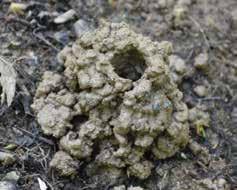
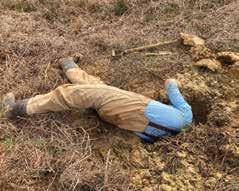
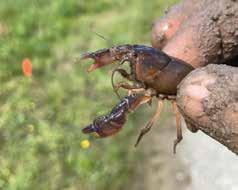
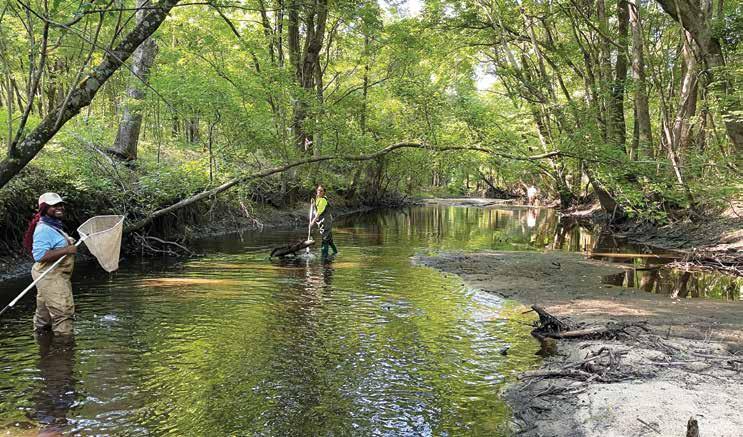
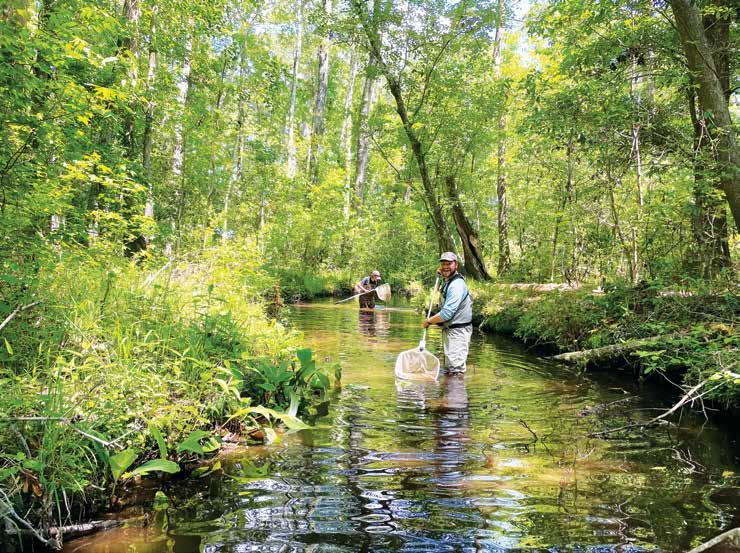
(Top) Biologists sampling crayfish in a sandy-bottomed stream in South Carolina’s coastal plain. (Above, left) A fresh crayfish chimney indicates the presence of a burrow beneath the ground and recent digging activity by a crayfish. (Middle) A biologist uses a hand trowel and a shovel to carefully excavate a crayfish burrow. (Right) a Newberry burrowing crayfish freshly excavated from its muddy burrow.
Crayfish, crawfish, mudbugs and yabbies are a few of the names given to the small, lobster-like crustaceans that are more than just a Southern delicacy associated with boils and fishing bait. The Southeastern U.S. is a global hotspot for crayfish diversity, hosting more than 350 native species — more than anywhere else in the world. In fact, South Carolina is home to thirty-seven described native species, with researchers hard at work describing new species throughout the state. Many crayfish in South Carolina have limited ranges, such as single creeks or river systems, and are found nowhere else on Earth. This is true for several species that are only known to occur in the Palmetto State, including the mimic crayfish, Piedmont prairie burrowing crayfish, Saluda burrowing crayfish, Newberry burrowing crayfish, Edisto
crayfish, shaggy crayfish, and Pee Dee lotic crayfish.
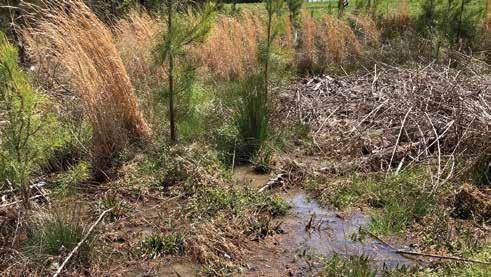
From the Upstate to the coast, crayfish can be found occupying a wide variety of habitats beyond just rivers and streams. These habitats include bogs in the Upstate, forests in the Piedmont, and wetlands on our coast’s barrier islands. Some of the most unexpected habitats crayfish rely on are semi-terrestrial. These
crayfish live much of their lives in deep burrows underground that reach the water table, their presence only marked by muddy holes or “chimneys” rising above the forest floor. Moisture from groundwater, rainfall and runoff can be sufficient to sustain these animals. For species whose burrows reach six feet deep or more, excavation can be a muddy process for the biologists that study them.
Crayfish play an integral role in healthy ecosystems in South Carolina by serving as predators, prey and ecosystem engineers. They feed on everything from plant matter and microscopic organisms to crickets, spiders and even frogs. In turn, they are eaten by fish, otters, raccoons and wading birds like the white ibis. Even some snakes, such as the aptly named crayfish snake and queen snake, rely heavily on crayfish as prey items.
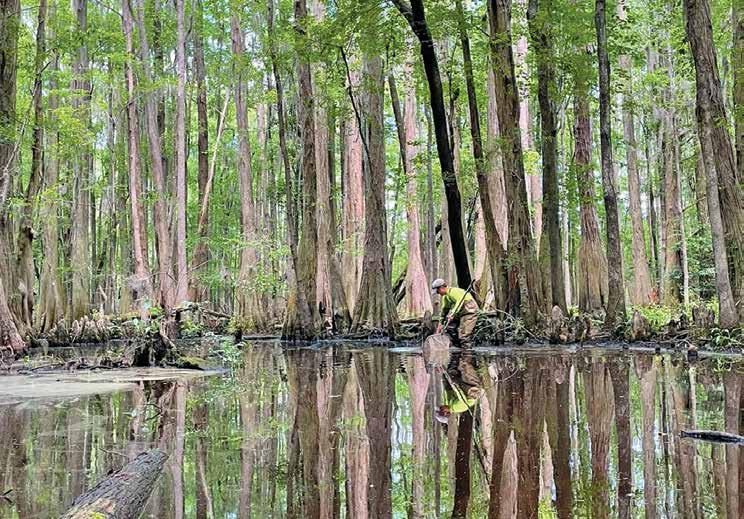
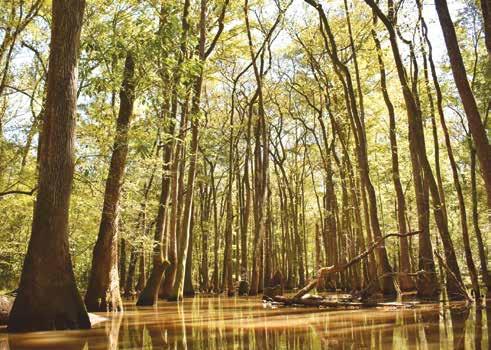
Biologist Greg Rothman sampling crayfish in a cypress-tupelo swamp in South Carolina’s coastal plain.
Cedar Creek crayfish
Crayfish also create habitats for other animals like amphibians and reptiles that can use crayfish burrows as shelter. Additionally, crayfish can be indicators of high water quality, with their absence sometimes signaling problems like pollution that can have negative impacts, especially on juvenile crayfish.
Crayfish face growing challenges. The American Fisheries Society tracks crayfish that appear to be in decline and estimates that at least 160 species of crayfish warrant additional research or conservation action. The U.S. Fish and Wildlife Service notes six species of crayfish found in South Carolina as potentially at risk of population declines. Additionally, South Carolina’s State Wildlife Action Plan (SWAP) lists twentynine species of crayfish as species of concern due to threats such as pollution, habitat destruction, hydrological manipulation, or competition with non-native species like the Louisiana red swamp crayfish and the virile crayfish. Non-native crayfish can have detrimental effects when introduced into the wild, coming from a variety of sources including crawfish boils, bait bucket dumps, or farm ponds where they were reared. Schools also receive shipments of nonnative crayfish for science projects that can be wrongly released into waterways after coursework ends. Introductions of species like the Louisiana red swamp crayfish have led to some areas of the state losing all native crayfish and now containing only nonnative crayfish. Minimizing the movement or release of crayfish in South Carolina is an important step for ensuring the conservation of our state’s native crayfish. While we understand many generalities about native crayfish, we lack details on many species, which makes effective conservation and management difficult. In some cases, we need to learn basic information such as when and where these crayfish mate and raise young. In other cases, we find that some crayfish aren’t even the species we thought they were. For example, recent research found that the Waccamaw crayfish and the Cedar Creek crayfish are actually one widely distributed species, now collectively known as the Cedar Creek crayfish. Other crayfish, like the tentatively named Keowee crayfish,
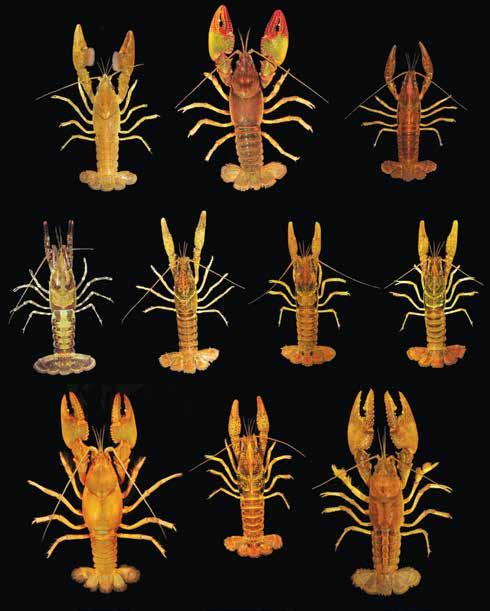
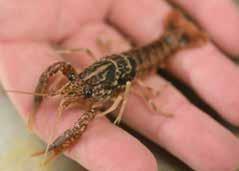
Photographs of select native crayfish in South Carolina (from left to right) Top Row: wandering crayfish, devil crayfish, coastal plain crayfish; Middle Row: Edisto crayfish, Pee Dee lotic crayfish, shaggy crayfish, Cedar Creek crayfish; Bottom Row: pine savannah crayfish, brushnose crayfish, digger crayfish.
Crayfish are found in a wide variety of habitats beyond rivers and streams.
are likely new to science but await formal description. Without assigning formal names or gaining a better understanding of their biology, managing and conserving these animals is difficult.
Additional assessments of crayfish distribution, abundance, life history and taxonomy are needed to guide effective crayfish conservation efforts. Recent collaborations among state agencies and universities are greatly improving our understanding of these crustaceans, but more work and additional resources are needed if we hope to fully understand the diversity, ecological impacts and conservation needs of our state’s crayfish.
Dr. Michael Kendrick and Biologist Greg Rothman conduct research for the SCDNR Marine Resources Research Institute in Charleston.
Biologists sampling a stream in South Carolina’s coastal plain.
Crayfish habitat at a cypress swamp near Congaree National Park.