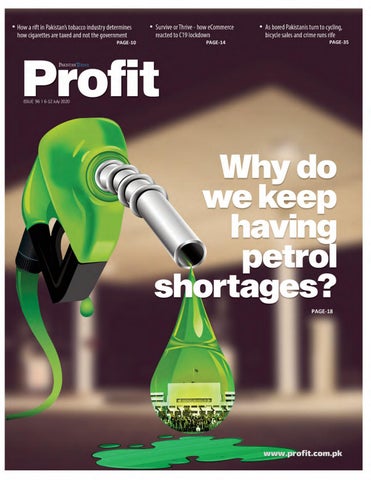
CONTENTS
10
18
10 How a rift in Pakistan’s tobacco industry determines how cigarettes are taxed and not the government 14 Survive or Thrive - how eCommerce reacted to C19 lockdown
18
18 Why do we keep having petrol shortages? 26 Good news and bad news at Hub Power Company
27
27 Pakistani companies are more optimistic than others about the post-pandemic future
14
29 Gul Ahmed: defiant or delusional?
30
30 Is the cement sector overvalued?
10
32 Millat Tractors: set to cultivate sales growth in FY21 33 Avanceon and its Ace cards
WELCOME
The uncanny similarities between Wirecard and Inov8 Don’t speak to the press; just sue them and accuse them of being in cahoots with the competition. Oh, and run a bad business “Sadly, my advice to founders has to remain: do not talk to the NYTimes. If they are doing a story on tech it is 95%+ chance it will be unfairly negative w/a link-baiting headline.” This tweet by Silicon Valley angel investor Jason Calancis recently led to a measure of debate in American startup circles. A lot of the entrepreneurs seemed to like it. The journalists, not necessarily those within the Times, were miffed. No points for guessing what point of view Profit would back. Truth be told, some of the techies in the conversation were of the view that there was nothing wrong with speaking to the Times or any other member of the press. Just tell them the truth and answer all their questions and concerns as best as you can. What’s the worst that they can do, barring printing absolute lies, to which, of course, there is legal recourse, and the resulting good press that would come from a court decreeing a critical piece was libellous. The fact is that in the qualitative aspects of assessing a company’s business model, the sort of thing that a court cannot quite rule over, a company spokesperson can attempt to frame and cue the journalists’ analysis favourably towards the company. If outfits inimical to startups (like the Times was being alleged to be) were to totally ignore a company’s point of view, at least they won’t be able to do so in good conscience. There is absolutely no justification for not talking to the press. Specially since the most part of a CEO’s job is to, well, do press and meet people. Not the CTO’s job, not the CFO’s, not the COO’s. But the captain of the ship has to be a people’s person. If he or she can’t even handle a journalist, then what chance do they have in convincing a potential investor who, because they have skin in the game, are going to be far tougher questioners? Furthermore, perhaps, just perhaps, a good journalist’s common sense questions can perhaps unearth some hitherto undefined weaknesses that a company could do well to fix. ------------------------Oftentimes, when a company simply won’t speak to the press - and yes, here is my bias speaking - it is because there’s something quite fishy going on. This certainly was the case with Wirecard, a fintech firm, which won’t speak properly to the Financial Times and when the latter did some critical bit of reporting on them, had the authorities in Germany conduct potentially criminal investigation against the newspaper and the reporter. Eventually, however, the suspicion
FROM THE EXECUTIVE EDITOR
that the company was lying through its teeth about company fundamentals, was proven right and it went kaput. Profit itself has received a legal notice from Inov8, the Pakistani fintech that we profiled in a recent issue. In addition, WhatsApp messages abound from a company to anyone who would listen that the article and video about their company should be reported to the social media sites that are hosting them. If the company had been this proactive about messaging and PR in the beginning, things might not have come to this pass. No, scratch that, things would have come to this pass, the company’s a damp squib, and our report would have been similar, more or less. Just like Wirecard, Inov8 is trigger happy when it comes to lawyering up. Not clearly specifying what, in particular, in an investigative report is false. This trend in Inov8 isn’t limited to outsiders; after a legal battle with former employees, the Supreme Court ruled in the latter’s favour and the company had to cough up their dues. We hope that is where the similarities between the two companies end. Inov8 does not seem to be a complete fraud like Wirecard and has some services to offer for which it has some paying clients. Unless future press reports prove otherwise. ----------------------------The irony here is palpable, though. Startups, tech startups in particular, have an air of condescending superiority over what they call the status quo, whether in business or in government. A lot of it is warranted; a lot isn’t. But it turns out that the new self-styled wunderkinds are as fond of opacity about their business as the older, seth-run firms were. And despite their Silicon Valley affectations, it turns out many of them are as fond of yes-men within their companies as the seths allegedly are. And the government? Polite to a fault, the bureaucrats and politicians (the latter much more than the former) can’t afford to not get back to the press. Sometimes, one thinks that counter-intuitively, it is these shiny new firms that need to learn from the government, not the other way around.
Babar Nizami
Executive Editor
7
Readers Say Belonging to a family who has a strong background in the retail/wholesale market; The more I read about Bazaar and Tajir, the more excited I get about the future of this industry! Here's another wonderfully researched article by Profit on the subject. Its a good article, goes into more depth on the actual solutions and backstory of the 3 main players. Also huge shoutouts to the two reporters, Meriyum Ali and Taimoor Hassan, for taking out the time to write this. I've been reading a few of your articles listed at profit, and they are just phenomenal. Thank you for educating & informing us about the changing world. Apropos: The retail supply chain is begging for a disruptor. Can these tech startups be just that? Bilal Ahsan Salam, Twitter Very well written article on a neglected financial sector. Let’s hope SECP’s initiative bear fruit. But only time will tell. I think educating the lay man about investment choices is a big challenge in Pakistan. Apropos: What the SECP’s new NBFC regulations mean for the industry Sharique Ayubi, Website Good article on how Pakistani retailers have pushed online sales during the pandemic. Do subscribe to Profit as well they have recently put up a paywall but their content is worth it. Plus you get access to WSJ digital edition. Apropos: Covid finally got Pakistanis to spend on fashion online… but businesses were caught off-guard Adam Dawood, Twitter
facebook.com/Profitpk twitter.com/Profitpk linkedin.com/showcase/13251020 profit.com.pk profit@pakistantoday.com
HOW TO CONTACT
8
How brutal these brand owners are in making profit? They never share profit with their customers in terms of making cuts in price in order to grade larger shares in the market amongst competitors. Apropos: Virus lockdown: Gul Ahmed reports Rs8bn loss in revenue AbdulHameed Soomro, Website We are sick of these 3 companies in Pakistan, Suzuki, Toyota, and Honda. The whole world is switching from hybrid to electric technology whereas these useless companies are busy minting money by selling their useless cars. Apropos: Pakistan
launches electric vehicle plan with cars in slow lane Anonymous, Website Yes there are electricity costs, but no way near as much as petrol. It is much cheaper, plus you won't have to worry about oil change, gear assembly stuff, it will save you money from that side too.However, the question is, do we have enough electricity? Apropos: Pakistan launches electric vehicle plan with cars in slow lane Aashir Waleed, Facebook Even city-states are exporting hundreds of billions of dollars worth of valued goods while we are still busy selling rice and cotton. We must export integrated circuits and electronic items. This can actually turn our deficit into a surplus. Apropos: Rupee continues to slide despite foreign inflows Muntazir Naqvi, Facebook Nobody can stop the free fall of the Pakistani rupee. With interest rates going down, it will result in flight of hot money. Exports have already depleted by 50% plus/minus, domestic debt repayments followed by huge international debt. All these things are a perfect recipe for rupee’s devaluation. Apropos: Rupee continues to slide despite foreign inflows Rashid Mehr, Facebook While I like these series, the conclusion to say "Inov8 is finished" is unfair judgment. And whether true or not, will scare stakeholders. I'd rather the entire series be a presentation of facts with minimum editorializing. Apropos: The promising life and tragic death of Inov8 Nash, Twitter Great news for Pakistan and Punjab. Our very own startup "Airlift" has secured 10 Million USD in Series A-1 financing from abroad. It's a big win Pak and start-up ecosystem especially in these tough times. Airlift moves into grocery delivery with a whopping $10mn in recent funding round Mian Aslam Iqbal, Twitter
COMMENTS
IN BRIEF The Consumer Price Index inflation rate was recorded at 8.6pc yearon-year in June, from
8.22pc year-on-year in May. This is the first increase in the inflation rate number since January 2020.
All that glitters? The Trade Development Authority of Pakistan has refused to issue permits to jewellery exporters. The jewellers claim that importers of Pakistani gold products based in the UK and UAE have threatened to cancel their orders over delays.
Four armed terrorists attacked the Pakistan Stock Exchange on June 29, but were stopped and killed by security guards and police. The PSX has announced a Rs10 million fund for the deceased security personnels’ families.
“We are very concerned. We have to remind ourselves that this is a public health crisis, and only on a secondary basis then it becomes an economic crisis.” Governor of State Bank of Pakistan Reza Baqir on the Covid-19 pandemic, in an interview with CNBC.
The Cabinet Committee on Privatization has decided that the Pakistan International Airlinesowned Roosevelt Hotel in New York will not be privatised. The hotel was taken on lease in 1979 by PIA, which then bought the hotel for $36.5 million in 1999.
In a move guaranteed to annoy young people across the country, the Pakistan Telecommunication Authority has temporarily suspended the PlayerUnknown’s Battlegrounds, or PUBG. No people, no problem: the bus startup Airlift has shifted into grocery delivery, and even raised $10million in recent funding, bringing its total funding to $24.1 million.
Shell Pakistan CEO Haroon Rashid has been elected as the Overseas Investors Chamber of Commerce and Industry’s (OICCI) president. His appointment comes after the resignation of OICCI’s former president Shazad Dada, the current UBL president. “The game is addictive, a waste of time and poses a serious negative impact on the physical and psychological health of children.” In a move guaranteed to annoy young people across the country, the Pakistan Telecommunication Authority has temporarily suspended the PlayerUnknown’s Battlegrounds, or PUBG.
The United States has bought nearly 92pc of all remdesivir production. The anti-viral drug has shown to be effective against Covid-19.
9
10 36
By Hassan Naqvi
Local and multinational tobacco companies engage in brutal lobbying and media wars to try and tax each other out of business and influence.
E
very year, a few months before the budget, the news media is flooded with stories about tobacco. On one side, there are news stories, advertisements, and opinions on the dangers of tobacco smoking. Seminars on the harmful nature of smoking followed by lavish spreads are conducted in large hotels. On the other, multinational tobacco companies also ramp up their PR drives, with top executives regularly giving interviews, and companies releasing reports and studies detailing the untapped taxation potential of a properly regulated tobacco industry. This year, the stories started rolling in somewhere around mid-march, and continued on until June 12, the day of the finance bill being presented to the National Assembly. During the course of this period, major newspapers carried 135 news stories on tobacco related topics. These stories are essentially of two kinds, and behind them is a vast network of lobbyists working either for the local tobacco industry or the multinational tobacco companies operating in the country. The first ‘anti-tobacco’ sector, which quotes organisations such as the Pakistan National Heart Association to lobby for an increase in Federal Excise Duty on cigarettes, are actually the front for the local tobacco industry. They claim to be anti-smoking for health reasons, but their lobbying never mentions a ban on tobacco products, and in fact supports protections for local tobacco growers and calls for an increase in the prices of the cigarettes packs of multinational companies. On the other hand, we have multinational companies, which include the Pakistan Tobacco
Company and Philip Morris Pakistan. Their interests lie in lower taxes for themselves, as well as more taxation for local growers, who often sell in the informal economy and depend on tobacco crops grown mostly in Khyber Pakhtunkhwa. This year, their reports and statements claim Pakistan was forgoing Rs 50 billion by not curbing illicit tobacco trade. They also suggest ‘common sense’ actions such as stricter enforcement and governance, tougher border controls, implementation of track and trace and other digital and technological solutions, destruction of confiscated contraband and imposition of penalties amongst many others – all of which would hurt local manufacturers. This year, like many years before, the budget story had a familiar line: heavy taxes imposed on cigarettes and luxury items. These “pro-public” measures earn the government public accolades, but there is little public knowledge about the flurry of activity behind the scenes to get the “pro-public” and “anti-smoking” measure. While this usually benefits local cigarette manufacturers, in a way, it is win-win for both groups as it is business as usual after the budget. Both groups come alive in March, with the local manufacturers using health to score points against the bigger companies, while the latter use taxation potential when the Federal Board of Revenue (FBR) starts consulting stakeholders for the pre-budget consultations. Afterwards, both sides go back to raking in money in their respective markets.
The multinationals
P
akistan is a moderate sized tobacco market where dozens of local players and two multinational players sell 80-85 billion cigarettes a year. The local tobacco manu-
TOBACCO
“In the last few years the problems of tobacco growers have been further compounded by subjecting the purchase of the crop to advance Income Tax and FED, apparently in the garb of documentation of tobacco purchase and tracing the tobacco purchase to the cigarette manufacturers” Ikram Ghani, Former Chairman of the Pakistan Tobacco Board
facturers often operate under the radar, have smaller markets but there are more of them. While they make up for a significant portion of the tobacco market, ‘big tobacco’ in Pakistan is still the Pakistan Tobacco Company (PTC) – the Pakistani subsidiary of British American Tobacco – and Philip Morris Pakistan Ltd (PMPKL). Pakistan also ranks highest in Asia in the trade of illicit cigarettes. According to some estimates, as much as 34.7% of the cigarettes sold in Pakistan are illicit and this number seems to be growing rapidly. On the other hand, the volumes of the compliant tobacco industry, the largest contributors to cigarette excise revenue continue to decline. These illicit cigarettes are all produced by local manufacturers of course, and have drawn great ire from the two big kahunas in the industry. “Whilst most countries face the issue of illicit cigarette trade in the form of smuggled cigarettes, in Pakistan the issues are more of locally manufactured non-duty paid cigarettes,” says Sadia Dada, the spokesperson for Philip Morris Pakistan Limited (PMPKL). It is the same old story, that big tobacco companies invest in the country while the local manufacturers get away without taxation. “Philip Morris has invested in excess of $800 million in Pakistan, however, the company continues to face challenges on the illicit tobacco trade which not only negatively impacts our business but also government revenues and the economy as a whole,” she says. Citing a study by Oxford Economics, she claims that the illicit cigarettes cause on average a loss of Rs44 billion to the national exchequer annually. When asked what were their expectations from the finance bill 2020-21 and how much of that was met in the finance bill 202021, she came up with a long explanation that Philip Morris Pakistan has been advocating a level playing field for all manufacturers. “The pandemic has affected almost every aspect of life, and we understand that it is difficult for the government to effectively enforce strict action against illicit cigarette manufacturers during this time but we will continue to advo-
12
cate for this,” she tells Profit. “There is a major price differential between the tax paid compliant brands that legally cannot be less than Rs63, whereas there are cigarette brands available in the market for as low as Rs25-30,” she said. “The compliant tax paying cigarette industry faces challenges from the illicit tobacco sector, currently estimated at 34.7% of the total tobacco market. Most of these illicit tobacco manufacturers do not comply with the regulations such as advertising, promotional campaigns and some don’t even comply with the mandatory graphic health warnings required by the government on every cigarette pack.” What do you suggest to create a balanced, reformed tobacco sector in Pakistan? Again, the solution of these multinationals is tax stamps and a tougher stance on illegal cigarettes. While they may present these as pro-public moves, they are mostly for the benefit of PTC and PMPKL. “Illicit cigarette trade continues to grow and thrive,” said Sadia Dada. “This implies that the illicit cigarette traders are using all means possible to circumvent and undermine the enforcement efforts of the government.” “A structured approach needs to be taken which can have sustained and definite results starting with implementation of tax stamps in the country, tougher enforcement and stricter penalties. This will not only create a level playing field for the compliant tax paying businesses in Pakistan but will also increase government revenues.”
The local manufacturers
T
obacco becomes a cash crop for 75,000 families who are tobacco growers in Khyber Pakhtunkhwa districts Swabi, Buner, Mardan, Mansehra and Charsadda. For the local cigarette manufacturers, these farmers are usually at the center of their arguments to promote their own side of the tobacco industry. Ikram Ghani, the former Pakistan Tobacco Board chairman, said the tobacco
crop is also contributing revenue in the form of Federal Tobacco Cess (FTC) and Provincial Development Cess (PDC). On average, the government collects FTC Rs270 to Rs280 million yearly and the PDC Rs400 to Rs500 million per year. The share of the informal cigarette trade in Pakistan, one of Asia`s largest markets where 80-85bn sticks (packing comprising 10 packets) are sold annually, has risen from 34.7 percent to 50pc in the last two years. The cigarettes manufacturing industry also provides substantial revenue in the form of Federal Excise Duty (FED) besides providing livelihood to over a million people directly and indirectly. “Unlike other agricultural produce, tobacco is receiving a step-motherly attitude and is the only crop subjected to harsh taxation in the form of provincial and Federal Tobacco Cess. The primary purpose of Federal Tobacco Cess is to increase the production quality of tobacco, and to enhance tobacco exports,” says Ghani. The primary purpose of Provincial Development Cess is development of tobacco growing areas, plant protection and activities directed towards development of tobacco. Unfortunately, according to Ghani, these levies have never been utilised for the purpose for which they are collected. “In the last few years the problems of tobacco growers have been further compounded by subjecting the purchase of the crop to advance Income Tax and FED, apparently in the garb of documentation of tobacco purchase and tracing the tobacco purchase to the cigarette manufacturers. Tobacco crops have certain peculiar characteristics which have to be appreciated to understand its taxation.” “Tobacco is a bulky crop and cannot be stored like other crops. It is capital and labour intensive and the farmer has to invest huge amounts often taken as loan,” he said. The farmer would sell the crop in haste to retire his loan and to save it from perishing. Alternatively, ,if he can afford to hold it, he has
“Whilst most countries face the issue of illicit cigarette trade in the form of smuggled cigarettes, in Pakistan the issues are more of locally manufactured non-duty paid cigarettes. The illicit cigarette traders are using all means possible to circumvent and undermine the enforcement efforts of the government” Sadia Dada, Director Communications of Philip Morris Pakistan Limited to get it thrashed through the GLT. The sale season is short and the crop has to be taken to the purchase points established by the companies for this purpose. “Thus any advance taxes at the time of sale during the short season will probably never achieve the purpose of tracking tobacco purchase and will only increase the problems and miseries of the growers as is evident from the following historical facts,” he said. Under section 21 of the Pakistan Tobacco Board (PTB) Ordinance the Board has the “powers to call for any returns or other information relating to the cultivation, production, manufacture, sale or purchase of tobacco by such persons or class within such time and giving such particulars as may be specified in the order”. The contract for collection of Federal Tobacco Cess through the contractor lays down that the contractor shall maintain a list of all purchases of tobacco and furnish the same to the PTB fortnightly. But PTB has never been able to enforce these provisions as it is very difficult to record purchase of millions Kgs of tobacco by thousands of purchasers.
The Advance Income Tax conundrum
T
he federal government, through the Finance Act 2017, implemented collection of Advance Income Tax at 5% on purchase value of tobacco from all purchasers of tobacco. Tax under this section is to be collected by the PTB directly from purchasers declaring purchase quota and through its contractors from all other purchasers of tobacco. This, for all intents and purposes, was to tackle the local tobacco industry, which had gotten away untaxed for a very long time. The way the levy was supposed to work was that it would track down all tobacco purchases to the cigarette manufacturers, and get them to pay this advance income tax. This advance income tax has been collected for the last three years and is mainly
collected from the companies on their declared quota which is already fully documented. However, it has totally failed to achieve the purpose of tracking down purchased tobacco to the cigarette manufacturers. But it has definitely proved a disincentive for investors in tobacco trade, thereby shrinking competition for purchase of tobacco and creating problems for the farmers. The local cigarette industry, disguised once again under their anti-tobacco campaigners facade, have been lobbying against this tax in the media, claiming that it is being taken from the farmers in KP and has affected them disproportionately. However, the advance income tax has only indirectly affected the tobacco farmers in the sense that they are a part of the larger demand and supply model that governs all industry. “It is generally argued that the advance taxes on tobacco will not affect the growers as these taxes are to be paid by the cigarette manufacturers and cannot be passed on to the growers. True that the advance tax cannot be passed onto the growers but such tax affects the demand and supply of tobacco,” says Ikram Ghani, explaining this point of view. “These advance taxes push the dealers, exporters, investors and small companies out of competition for the product. There are only a few buyers in the market, mainly the two multinational and the growers are forced to sell their products to the available purchasers. Generally such a situation leads to rejection of huge quantities of tobacco as being substandard,” he said. Once again, it is worth pointing out that the implementation of this kind of tax is what the larger tobacco companies have been gunning for over the years. This advance income tax is part of the “untapped” Rs44 billion in taxation that Philip Morris has repeatedly pointed towards. These two factions of the tobacco industry have for years been trying to tax each other out of business and influence. And this was on display both in the 2017 advance tax, and in this year’s budget.
In store in this year’s budget
I
n the finance bill of 2020-21, the federal government increased FED from 65% to 100%, which may trigger illicit tobacco trade. Subsequently, the FBR may lose Rs77 billion in the fiscal year, according to claims made by the Pakistan Tobacco Company’s Noor Aftab. He proposed withdrawal of additional taxes as this triggers tax evasion by the non-regulated cigarette sector. He demanded FED on unmanufactured tobacco by Rs 500 per kg, and the rate of adjustable advance income tax, which currently stands at 5 percent by 10 percent. Their other demands include the launch of a track and trace system, and its strict implementation at retail level. Essentially, this year was a win for the local tobacco industry. Some have pointed out that National Assembly Speaker Asad Qaiser has a soft spot for the local industry, and has lobbied for them because of his constituents that depend on income from tobacco farming. However, it is unfortunate that taxation decisions on a negative product such as cigarettes and tobacco are made as a result of the media war and lobbying of two factions within the tobacco industry. The matter of the fact is that the tobacco sector needs to be regulated. Even Prime Minister Imran Khan has said on the record that only two [tobacco] companies pay 98 percent of total tax [tobacco collection] and the remaining 40% companies pay 2% tax”. According to Tobacco Taxes in Pakistan, “The most effective way to reduce tobacco use is to raise the price of tobacco through tax increases and ensure that the tax increases are reflected in prices. Higher prices discourage youth from initiating cigarette smoking and encourage current smokers to quit.” The FBR needs to introduce the track and trace system of tobacco products, and this hazardous product needs to be taken seriously. n
TOBACCO
After the pandemic-induced lockdown, online marketplaces and e-tailers braced themselves in a spike in demand following the temporary removal of international modern trade (IMT) and local modern trade (LMT) from the equation. They had to make a decision: adapt or die? Most chose to add C19 essentials for the first time while others learned the hard way that execution trumps ideas
P
By Babar Khan Javed
akistan’s foot traffic is on a double digit decline. While the country has gone on a rollercoaster ride of lockdown, smart lockdown, no lockdown and smart lockdown again ever since the outbreak of the Covid-19 pandemic, the overall effect on footfall has been overwhelmingly negative. Data from the latest COVID-19 Community Mobility Report from Google, which measures an aggregated and anonymized dataset of Android phone users who have chosen to leave location history on, shows Pakistan’s foot traffic has fallen across five categories. Retail & recreation, supermarkets & pharmacies, parks, public transport, and workplaces saw noted drops in activity by 28pc, 16pc, 8pc, 24pc, and 26pc respectively in the five categories. While the decrease in footfall is slightly encouraging from the point of view of containing the pandemic in the country, it is clearly a blow to the country’s very traditional, brick-and-mortar store economy. It also presented a great opportunity for eCommerce to seize the day. While eCommerce, like everyone else, were caught unawares, the Covd-19 pandemic may end up causing a seismic shift in how we shop. This is perhaps best illustrated by grocery shopping. According to Profit’s analysis of Household Integrated Economic Survey (HIES) and Pakistan Social and Living Standards Measurement (PSLM) data borrowed from the Pakistan Bureau of Statistics (PBS), consumer spending on groceries was approximately Rs6,540 billion ($48 billion) in Pakistan, approximately
14 36
“We have had to adjust our product offering because of the lockdown and restrictions on dine-in. We persuaded restaurants to accept Bogo on delivery and take away [by] adding insurance deals through Smartchoice.pk, a provider of Sanitizers, gloves and masks [from] Surgy. pk, added e-grocers like DKMart, [and] added fumigation services and companies offering sprays for coronavirus and disinfection” Tyrone Tellis, Marketing Manager at Bogo 38.5% of total consumer spending. Profit’s analysis of PBS data suggests that while the city of Lahore accounts for 5.4% of the country’s population, it accounts for 6.9% of total grocery spending in the country. The data roughly values that the Lahore grocery market was worth Rs451 billion ($3.3 billion) in 2019, one of the fastest-growing ones in Pakistan, a substantial and attractive market for many internet entrepreneurs to jump in and try to disrupt the market and get a slice of the pie in the process. In Lahore, Imtiaz Supermarket raked in PKR 600 million, PKR 700 million, and PKR 800 million in eCommerce sales during the first 100 days of C19 from its Model Town, Canal Store, and Capital store branches, according to sources familiar with the matter. On that note, Foodpanda accelerated the launch of PandaMart, its grocery delivery service, competing with dMart by Daraz amongst other market challengers. The launch was accelerated by hiring Brandverse, a one stop solution for cataloguing products for launching an owned eCommerce page. Data on Google Trends shows that both Daraz and Foodpanda grew customer acquisition investments in dMart and Pandamart re-
“There is no major increase in brands trying to sell online. We saw a surge in brands contacting us for collaborations and increasing sales online.” Farzadaq Ali Shah, Strategic planning manager at HumMart
spectively, while top of mind recall for grocery shopping was led by Imtiaz Supermarket and Naheed Supermarket respectively. The digital first HumMart led the eCommerce category, with organic interest for all three online marketplaces tapering off since May 2020. “Due to COVID-19, a lot of people are restricting store visits and this has caused a decline in LMT sales across all brands,” said Faizan Syed, CEO of East River. “However this has given a great opportunity to develop the ecommerce sales channel development but still there is a lot of work needed for more internet penetration and getting rid of the trust deficit that was caused by massive internet and phone call scams.” As he explains, groceries have seen a big rise as consumers are experimenting with online ordering. This could drive a shift to online grocery delivery especially in cities like Karachi where corporate life is prevalent and such delivery services would create ease once work resumes. Profit reached out to five different eCommerce companies to do case studies on how eCommerce has reacted to the Covid-19 pandemic. The overwhelming response has been that this is a time for survival, not to grow and expand, but what these companies
do now could shape the post pandemic future as well.
Daraz
W
ithin days of the lockdown, Daraz launched its Humqadam program, which invited Small and Medium Enterprises (SMEs) from across Pakistan to set up their digital ventures on the marketplace platform to reach a large customer base and start selling. The program offered sellers complete business and financial support, which included the waiver of commission fees for the months of May and June. The total investment Daraz made to provide such support amounts to Rs 4.5 crore ($270,000). The first-party data that is generated, on the other hand, will be retained and owned by the company. Essentially, Daraz provided an online platform and mined data in exchange for it. “Since the lockdown in March, 30,000 sellers have registered for the Humqadam program and 4,576 have been verified and are operational on Daraz,” said Imran Saleem, the Director of Commercial at Daraz in Pakistan. “The program was launched to empower the SME sector, which is critical to Pakistan’s economy, contributing 40% of the GDP and 80% of total non-agricultural employment.” According to Muhammad Ammar Hassan, Chief Marketing Officer at Daraz, the enforced closure of stores selling non-essential items resulted in a spike in registrations from SMEs and brands seeking a quick direct to consumer channel - without the hassle of spending 90 days creating their own dot com. In an interview with Hum TV, Hassan shared that within days of the lockdown in place, orders for groceries grew six times for items categorized as personal hygiene, disinfectants, and groceries, with shoppers relying on a third-party to ensure purchases passed every stage of sanitization. The Alibaba-owned marketplace splits revenue between brands
ADVERTISING
and merchants, which make up 35pc and 65pc of its sellers. Speaking to Profit, Saleem said that business revenue is currently split across electronics, lifestyle products, CPG, and fashion products at 40pc, 25pc, 20pc, and 15pc respectively. He said that travel and movement related product categories were on the decline, such as luggage, cameras, and drones, due to the postponement of vacations and international travel. Similarly, health products, groceries, and home & living products grew in sales with buying behavior indicating self improvement and home improvement as being important activities people are engaging in during the pandemic. “Logistics remains tricky right now as we want to ensure the safety of our staff and customers,” said Saleem. “To determine which areas to steer clear of and navigate our planning accordingly is something that we have learned on the go and are rapidly improving our response time to the same. Customers have remained largely understanding of the on-ground situation and that really goes a long way in us planning and executing quick and safe deliveries.”
in March. Because some vendors were closed and their products were not available, this eventually resulted in reduction in the assortment of products that were available on our marketplace.” Naturally, once the lockdown eased and businesses reopened, these challenges resolved themselves. But the new challenge that arose was some imported items becoming limited in availability due to travel restric-
engines as an organic source of traffic that was ready to buy, with the remainder conversion traffic (see data chart) distributed across direct visits, paid media, referrals, branded partnerships and email drip campaigns. He said that while fashion oriented purchases initially fell, all product categories gradually picked up with every passing day of lockdown being eased. “Categories like appliances, entertain-
tions. Speaking to Profit, Malik lamented that due to uncertainty and limited supply, major brands started operating on a trading model whereby they would receive inventory payment in advance instead of operating on commission model. He said that the trading model does not really fit into the e-commerce market and brands need to realize that commission model is the best win-win to boost their e-commerce sales. Similar to most respondents to this study, Malik cited social media and search
ment , fashion saw a decline initially but not a very significant one,” he said. “Tremendous growth was seen in categories like superstore, health and sports, beauty and grooming in initial days and continues on. Some categories picked up pace in later days including mobile, tablets and small electronics.” Similar to other responses to this survey, Malik added that in the initial days of Covid-19 and the lockdown, the bulk of product orders were for sanitizers, disinfectants, masks, hand washes, and complimentary products, with buying behavior gradually shifting to other categories as the initial panic wore off.
Yayvo
A
s an online marketplace backed by a courier service, respondents from Yayvo were the only ones in this survey to complain about supply chain issues. Tanvir Malik, head of operations and vendor management at Yayvo, told Profit that the business did not face any of the conventional challenges related to fulfilment and last-mile deliveries due to its parent company. “This is the main reason why the unprecedented growth post lockdown allowed us to scale painlessly and we fulfilled quicker than any other online marketplace,” said Malik. “The bottleneck for us was primarily related to readiness of vendors and non-availability of products due to lockdown imposed
“This is the main reason why the unprecedented growth post lockdown allowed us to scale painlessly and we fulfilled quicker than any other online marketplace,” Tanvir Malik, Head of operations and vendor management at Yayvo
16
HumMart
B
efore the lockdown was announced, HumMart had made the decision to cut down its stock keeping units (SKUs) in half, from 11,000 to 6,000 by March. This was to focus on selling most groceries and refuse stocking longtail items. “There is no major increase in brands trying to sell online,” said Farzadaq Ali Shah, strategic planning manager at HumMart. “We saw a surge in brands contacting us for collaborations and increasing sales online. Earlier it was predominated by [MNCs] like Unilever
and P&Gs of the world but now local brands have started showing interest in selling online, with the likes of Hilal Foods, Stillman, and others contacting us to increase footprint online.” Shah told Profit that since the C19 lockdown went into place, thirteen CPG companies signed up with the Hum Network Limited-owned e-tailer, most of which were selling hand sanitizers and disinfectants. Stocking the product themselves, HumMart works directly with CPG companies and refuses to work with retailers. Shah said that companies that joined the platform struggled with the basics - from competitive pricing, crafting images to match each new eCommerce partner, to producing better content.
Bogo
A
s the leading buy one, get one (Bogo) dealer in Pakistan, the business model at Bogo relies on working with the hotel, restaurant, and cafe (HoReCa) vertical by offering deals to diners. Understandably, due to the C19 and the lockdown that followed, dining out came to a halt as did the value proposition offered by Bogo. “We have shifted deals to delivery and takeaway and added deals which will create value- insurance, health and hygiene, wellness,” said Tyrone Tellis, Marketing Manager at Bogo. “We have had to adjust our product offering because of the lockdown and restric-
tions on dine-in. We persuaded restaurants to accept Bogo on delivery and take away [by] adding insurance deals through Smartchoice.pk, a provider of Sanitizers, gloves and masks [from] Surgy.pk, added e-grocers like DKMart, [and] added fumigation services and companies offering sprays for coronavirus and disinfection.” Tellis said that Bogo’s response to C19 and the lockdown is one of survival, with the business diversifying to work with a range of in-demand vendors and service providers, while monetizing on the lead generation and repeat purchases created. Speaking to Profit, he said that advertising on Facebook has been put on hold in direct correlation to the drop in sales, with the business focusing its resources on enhancing its new delivery and takeaway segment.
Eat Mubarak
O
perating in the highly saturated mobile food delivery marketplace space, Eat Mubarak struggled to maintain service levels with its hyperlocal marketplace model, where every restaurant is delivering to its nearby areas, which was a massive challenge during the earlier lockdown days. “Timings were controlled, the movement between areas was limited which proved to be a significant challenge to over-
Google Trends Data (Top of Mind recall for online vs offline grocery players)
“The enforced closure of stores selling non-essential items resulted in a spike in registrations from SMEs and brands seeking a quick direct to consumer channel - without the hassle of spending 90 days creating their own dot com” Muhammad Ammar Hassan, Chief Marketing Officer at Daraz come,” said Syed Sair Ali, co-founder & CEO of Eat Mubarak. “As restaurants were hit hard by the lock down due to the loss of their dinein business, many restaurants on a daily basis were thinking of closing down. Some even closed down for a month or two and opened up later. When you are dealing with [over three thousand] restaurants on your platform - where the uncertain environment is making it difficult for your partner businesses to operate - the service levels get affected.” He said that dine-in centric restaurants were badly impacted by the lockdown, flexible food business models such as quick service restaurants (QSRs) - which Ali says often have better health and hygiene practices - fared well during the strict and relaxed lockdown periods. Speaking to Profit, Ali said that QSRs have a stronger historical focus on the delivery vertical. “In app engagement and frequency of orders have increased during C19,” said Ali. “We did not engage in massive acquisition due to the challenges in the service delivery. Our existing digital channels continued to play a role in our paid and organic acquisition. n Additional analysis: Taimoor Hassan.
ADVERTISING
18 36
ENERGY
By Ariba Shahid
A
t a time when people should be staying indoors as much as possible and avoiding crowds, chances are that you recently found yourself waiting it out in long queues to try and get your gas tank filled, or driving around from station to station looking for one actually selling fuel. In the middle of a global pandemic, flanked by a looming food security crisis and political turmoil, the last thing on anyone’s mind will have been whether petrol would remain available or not. With more and more employers calling for people to work from home, and people generally travelling less, should there not have been a surplus? Pakistan’s energy sector works in baffling ways. While there have been numerous government inquiries regarding the fuel shortage crisis that has plagued the country, the findings have been far from ideal, not least because they suffer from a fundamental, structural problem: the entity conducting the inquiries – the federal government – is also the entity that is the single largest owner of assets in the energy supply chain. How unbiased do we expect the bureaucrats who run the nation’s energy system to be? Do we really expect a report that says: “sorry, folks. This was completely our fault.” Somewhat unsurprisingly, therefore, the government’s reports on the matter tend to be highly short-sighted, only explaining the immediate causes and consequences without addressing the deep-rooted structural issues. And never – and we really do mean never – do they ever seem to think that the government of Pakistan has done anything wrong. Profit explains the fuel crisis, why the prices went down as much as they did, and what compelled the government to make them go back up again.
So why was there a shortage?
I
n terms of immediate causes, the general understanding has been that the government’s ban on imports along with a failure of companies in the oil industry to shore up their reserves is what resulted in the most recent shortage. However, there is much more to the recent crisis than just these factors, including allegations of cartelisation and curbs on smuggling. In this article, Profit will attempt to lay out all of the competing explanations in a bid to determine which of them is the most persuasive in explaining how the system works and why it repeatedly breaks down with such
20
“OMCs were forced to cancel their international supply orders. The sudden decision to finish the lockdown across all sectors resulted in an exponential increase in demand followed by emergency purchase orders” Naeem Nawaz, energy economist frequency.
Ban on imports
T
he federal government decided to place a ban on the import of crude oil on March 26, 2020. Ostensibly, the reason for this ban was the massive dip in demand for petroleum products following the nationwide lockdown, this might have. Of course, this explanation makes no sense whatsoever. If there is a dip in demand, there will be an automatic dip in imports. The ban was not needed at all. And of course, the government went ahead and made a bad situation worse by maintaining that ban for far too long. Permission to allow imports again was not granted until April 26, 2020. Even then, the decision was made not because people were driving to commute more again, but because the harvesting season had arrived, and farmers needed diesel to get their tractors and threshing machines fired up. However, what is interesting to note is that this ban was in place at a time when international fuel prices had seen an unprecedented fall. The fall had been significant enough that Profit ran a headline: “A barrel of oil now cheaper than a plate of chicken biryani.” The headline was about the slightly cheaper US-based West Texas Intermediate (WTI) benchmark prices, so it did not quite hold true in Pakistan, where we import Arab Light which follows the London-based Brent crude oil benchmark prices instead. However, the fact is that Pakistan could not fully take advantage of the fall in global prices. A barrel of Brent did not fall to reach the price of a plate of chicken biryani, but it did lay low for quite some time before heading back up. While the government had banned the import of crude oil, “the supply of fuel was entirely dependent on local refineries,” explains
Naeem Nawaz, an energy economist and research fellow at the Punjab Economic Research Institute (PERI), which rely on a combination of crude oil imports as well as domestic crude oil production. According to Nawaz, the sudden decision to lockdown the country was bad enough for the petrol business, but ending it just as quickly made things worse. “OMCs [oil marketing companies] were forced to cancel their international supply orders. The sudden decision to finish the lockdown across all sectors resulted in an exponential increase in demand followed by emergency purchase orders,” he adds. OMCs include companies like the government-owned Pakistan State Oil (PSO), Shell Pakistan, etc.
Reserves
F
ollowing the removal of the ban on importing fuel, all OMCs barring Pakistan State Oil (PSO) delayed the import of petrol and did not keep adequate reserves, or at least that is what the government and the state-owned PSO alleges. As with any allegations leveled by a company against its rivals, this one deserves to be taken with at least some degree of scepticism. Ghiyas Abdullah Paracha, a leader of the All-Pakistan Petroleum Retailers Association (APPRA), said that the unnecessary delay in the import of petroleum products has inflicted a loss of billions of rupees to the government. This, of course, is a nonsensical statement since the government does not pay for petroleum, consumers do. But he is right that the ban on imports prevented the country’s oil industry from taking advantage of low oil prices. PSO management claims that most OMCs did not maintain adequate reserves of petrol even after the ban on imports was lifted. Regulations and licensing requirements
“First and foremost, we are not major players in the international market. Considering a large portion of our import bill is based primarily on the import of fuel, it makes sense for the market to be regularized. This also helps the government control supply and demand” Atta Ali Malik, partner at CMC
require OMCs to keep 21 days’ worth of fuel reserves at all times. However, PSO claims that other OMCs did not follow this requirement through in the month of April. This created an artificial shortage. As a result, despite pumps remaining operational, regular petrol was not available. This resulted in people having to buy expensive High Octane Blended Component (HOBC) grade fuel.
Cartels
A
nd then there is the explanation that the federal civil service favours: the idea that the shortage of petrol being artificially manufactured by private sector oil companies to create a petrol crisis within the country as a kind of pressure tactic. Yes, the same people who made the disastrous decision to ban imports think that somebody else is to blame. It is shocking, we know. According to an inquiry conducted by the petroleum division of the Ministry of Petroleum and Natural Resources, nine companies were responsible for creating the artificial fuel shortage in the country. Here is how their theory works. OMCs supposedly pressured refineries to reduce imports of crude oil by not buying their product and imported refined products instead. In the civil service’s telling of the story, the oil companies somehow did not import motor spirit (better known as petrol), the most widely used fuel for vehicles in Pakistan and instead only imported the higher-cost HOBC. This left no regular petrol available, and only the refined or ‘high octane’ kind, which consumers were then forced to buy. Of course, this theory seems to not understand the difference between revenues and profit margins nor elasticity of demand, assuming that a product with a higher margin (HOBC, in this case) will result in higher overall profits for the oil companies, even though the revenue fall from not selling the fuel that most of their customers need would likely more than wipe out any higher margins from HOBC. Back in June, while the price of petrol was down to Rs75 per litre, HOBC was available at
Rs155-160 per litre depending on the brand or retailer. As a result of the shortage, there were reports of consumers having to purchase HOBC instead of regular petrol in case of emergencies, even motorcyclists. The government report seems to believe that this was the agenda of the private sector oil marketing companies all along: that they wanted to sell this higher margin product and create a shortage of the more widely used motor spirit (petrol) in order to pressure the government to adopt policies that favour the industry, in particular price deregulation. How credible is this theory? Well, it shifts the blame away from the government, which must be highly convenient for the civil servants who wrote the government’s inquiry report. After all, if it was not the private sector oil companies that caused the problem, somebody might start asking about what role the government’s decisions had in the matter, and might ask the people who made energy policy decisions on the government’s behalf. People like the civil servants at the petroleum division of the Ministry of Petroleum and Natural Resources. Reality, of course, is far more complex, and while it is true that the private sector oil marketing companies had lower imports than needed, they were hamstrung by highly rigid pricing regulations (which we will turn to below).
Control over illegal smuggling of petrol from Iran
P
etroleum Secretary Asad Hayauddin recently explained to the Lahore High Court that one of the reasons behind the shortage of petrol in Pakistan was the stricter controls at the Iran-Pakistan border after March 19, 2020. The coronavirus pandemic – which hit Iran particularly hard – caused the government to adopt stricter controls at the border between the two countries. It had the unintended side effect, however, of making it harder for Pakistani and Iranian petrol smugglers to move cheap Iranian petrol into the Pakistani market. But while the petroleum ministry has
been pushing the idea of a stricter enforcement of border controls as a reason for the petrol shortage, this explanation is somewhat unpersuasive. In his testimony, Hayauddin said that the government estimates that approximately 1.2 metric tons of petrol had been smuggled through this corridor into Pakistan on a daily basis. Of course, this is a patently stupid. Iran only produces 0.6 million tons of petrol a year, and if Hayauddin is to be believed, Iranian smugglers somehow managed to smuggle twice as much as Iran’s total oil production into Pakistan. Let us be charitable and assume he simply meant every year, and not every day. That would mean that oil imports from Iran account for approximately 4% of Pakistan’s total consumption of about 27.7 million tons a year. That is significant, but nowhere remotely close to enough to explain the shortages being experienced by the country. So why is the government putting forward such a weak explanation? Surely it is just plain coincidence that this happens to be an explanation that makes the government look good: “Look at us, we are so effective at our job in cracking down on smuggling that it is creating an actual shortage of petrol!”
Politics
T
o their credit, of course, PSO did perform relatively well during the fuel shortage. At times, PSO pumps were the only ones in many parts of the country that were able to sell petrol, whereas many of the other companies ran out of petrol. In an advertisement, PSO even celebrated supplying 20,500 metric tons of petrol from Karachi in a single day, which is a record high for the company. And on June 1, 2020, PSO was able to sell an upward of 48,000 metric tons of petroleum product, which is approximately equivalent to the amount of petrol in a vessel.
ENERGY
It does make one question how PSO was able to undertake preemptive measures. Did they know that OMCs would be making this “mistake”? Is this why PSO shares rallied in May? One reason the other companies failed to act may have been complacency following a significant run of success in gaining market share. Back in 2010, PSO accounted for nearly 70% of the oil market in Pakistan, whereas in 2019, PSO accounted for approximately 45% of the market. However, after the shortage, PSO, being the only OMC providing petrol, was able to see a manifold increase in sales.
Domestic petrol prices: explained
T
he reasons explained above are all short term causes that explain the current shortage. However, there is something fundamentally wrong with this sector’s pricing mechanism, which impacts the entire sector structurally. This is why it is vital to understand the details of all the components that end up giving us the price of petrol.
Components of the petrol price
T
he price of petrol has various components that combine together and are totaled to reach the ex-depot
“Deregulation is the solution. If done in a controlled manner the flaws in the system could be fixed” Mohammad Wasi Khan, Director at Byco Petroleum Pakistan Limitedsays
22
price, or the price the consumer sees at gas stations. The base price is the imported price, in the case of oil imports, or the ex-refinery price in the case of domestic oil production. On top of that, there are retailer and freight costs which include the inland freight equalisation margin, OMC profit margins (what PSO, Shell, etc. earn), and dealer commissions (what the petrol pump owners get to make). Lastly, comes the taxation which includes general sales tax and the petroleum development levy. The ex-refinery price is the price at which refineries can sell their fuel to OMCs and the price at which importers can sell distillates within Pakistan. One of the first additions that happens to this initial pricing are the commissions that retailers and dealers receive. The next significant addition is the Inland Freight Equalization Margin (IEFM), which is the cost of inland movement incurred by a refinery for the transportation of crude oil from the source to the refinery. It also includes the cost incurred by an OMC
while transporting the finished product to various depots across the country. This basically includes all transport costs within the company. The purpose of this margin is to establish and maintain parity in the prices of fuel throughout the country. The money collected from this margin goes on to create a pool. The government then uses this money from the pool to provide indirect subsidies to Pakistanis to ensure the same price of fuel is found throughout the country. Basically, if this subsidy did not exist, petrol prices would be cheaper in Karachi and more expensive in almost every other part of the country, and especially expensive in Gilgit-Baltistan and Balochistan. After all of these pricing tools, we finally come to taxes, because the last two additions to the price the consumer sees at the gas station are the general sales tax (GST) and the petroleum development levy. The GST, as of late, is set at 17%. Keeping in mind that it is a ratio rather than an absolute number, it varies with a change in the price of petrol. The levy, on the other hand, is a surcharge and set as an absolute rupee amount per litre, though the government does vary how much it charges under this tax relatively frequently. It is used as an instrument to bring about stability in the price of petrol by offsetting the impact of drastically changing import prices and costs associated with fuel. The levy, however, is often seen as a political and fiscal tool to either pass on ‘relief’ to consumers during an election year or to generate more revenue in other years. Previously, the levy was priced at Rs15 per litre but it has now been raised to Rs30 per litre. This means that when the government wants to pass on relief to consumers it could keep a levy of zero rupees or some low number. Essentially, this means that after all the costs are added, the government could
TEXTILES
increase the price of fuel up to Rs30.
Problems with the pricing mechanism
T
he fundamental flaw within the market is the pricing structure, which has many, many problems that oil marketing companies dislike and energy analysts believe renders the market inefficient. “Import cost, which is the basic component of the price is determined on the basis of the purchase costs of PSO. This is done by taking a monthly average of cargoes imported by PSO irrespective of whether the purchase cost of other OMCs is higher or lower,” Naeem Nawaz explains. “Ideally, the base component should be an optimal representative, or an average of the import prices experienced by all OMCs.” Considering the change in market dynamics, Nawaz feels that this is crucial. “One must keep in mind that PSOs share within the market is shrinking as the number of market players have increased from 12 to more than 50 within the last 7 years.” The fact that PSO’s share has shrunk explains that PSO should no longer determine the prices for everyone. But then comes an even bigger flaw in the system: prices for oil products are reset by the Oil and Gas Regulatory Authority (OGRA) only once a month. When prices are trading within a narrow range in the international markets, this tends
to not matter. The calculated price of petrol in the country reflects the trend in the markets around the world. This is also due to the fact that the import decisions by PSO are spread throughout the month and do not have to deal with import bans. However, when there is turbulence in the international market, the mechanism shows its structural weakness because the ex-depot price, or derived price does not depict the changes in the international market fast enough, which then creates financial problems for oil companies. If you look at the international market, the prices in the Gulf Arab states had been adjusted to near $40 per barrel as a result of the OPEC supply cuts. “The local price of petrol, however was set at $23 per barrel, exceedingly less than the purchase price of OMCs, which is a prime reason OMCs tried to manage a cut in supplies to control their losses,” says Nawaz This was not the first time Pakistan faced a fuel shortage. In the past, most shortages had been a result of an actual shortage of fuel in the country and had less to do with OMCs refusing to sell at lower prices. But the logic is the same: if my cost of buying a product is less than the price I am allowed to sell it at, why would I sell? Why should the oil marketing companies buy oil at $40 a barrel and be forced to sell it domestically at $23 a barrel? Why would anyone do that? This flaw – and the fact that it consis-
tently leads to petrol shortages in the country – would suggest that revisiting the price mechanism could ensure such problems never emerge. This then begs the question: why are the prices of fuel even regulated in Pakistan in the first place? Mohammad Wasi Khan, Director at Byco Petroleum Pakistan Limitedsays, ““Deregulation is the solution. If done in a controlled manner the flaws in the system could be fixed”
Regulation: fetish of the control freaks
D
ifferent countries around the world determine the local prices of fuel in different ways. These prices could either be market-determined, fixed, or with the implementation of a price ceiling. The extent of intervention, however, depends on government aims and fuel market characteristics. Market determined prices are typically found in more liberalised markets where state intervention in the fuel market is usually restricted to defining terms and conditions and ensuring free competition. In such a market, retailers determine their prices freely and prices of fuel could be different for retailers, regions, cities, or even individual pumps. Price ceilings, on the other hand, is a form of regulation where the government sets a maximum price for fuel. Retailers, however, are allowed to set their selling prices at any price below or equal to the price ceiling. The government revises the maximum price periodically. This acts as a shock absorbent that protects consumers from sharp advances in the price of oil, or cartels keeping prices higher than they should be. The strictest form of regulation, however, is when the government decides to fix the price retailers are allowed to charge. This means all retailers charge the same price regardless of their costs.
Regulation trends around the world
A
ccording to GlobalPetrolPrices.com, an energy data provider, out of 97 countries, 24 countries implement a fixed price mechanism. Pakistan, along with countries like Sri Lanka, South Africa, Egypt, Indonesia, Malaysia, Kuwait, amongst many more are examples of these countries. Fourteen countries have set price ceilings, while the remaining 59 sport market-determined prices. This means that nearly 62% of the reviewed countries have a liberalised fuel market. Most of these are towards the top of the economic development list such as Japan, Australia, New Zealand, many European countries, the United States, and Canada, amongst many more.
ENERGY
The remaining 38% of countries reviewed have some sort of regulation. While some of these countries include both highly developed countries and less developed countries, an interesting fact is that a number of OPEC and oil-producing countries form these regulated markets. This is done by the government to control the retail fuel market through subsidised retail fuel prices. About 24% of the total or approximately 60% of the regulated countries have fixed prices, like Pakistan. The question, however, is, why does Pakistan regulate domestic fuel prices? After all, it is not a producer and there are no subsidies. In fact, the government offers the opposite of a subsidy by taxing the public excessively in the form of petroleum development levy, and of course, through general sales tax. OGRA, being the regulatory authority, has a mandate to advise the government about the prices based on the approved price formula. The final decision, however, is made by the government. The Prime Minister, or at the very least the finance minister, are the ones that decide the price considering the impact it has on revenue collections. It says something about governance in Pakistan that decisions as minute as “what price should we sell petrol at this month” are made at the level of the Prime Minister.
So why does Pakistan regulate fuel prices?
P
rofit reached out to the spokesperson at OGRA to enquire why the regulatory body decides the fuel prices. The spokesperson simply claimed that the prices are, in fact, deregulated. While it could be said that he is lying through his teeth, we will give OGRA the benefit of the doubt and say they are only partially and technically correct. The prices of 97 Research Octane Number (Ron) are deregulated. However, the petroleum most commonly used throughout the country, i.e. 92 Ron which is Euro II (upgraded from 87 Ron in 2016) is nor deregulated. That is why you see the same price of regular petrol everywhere. “Even if the price of petrol was not regulated, the sales tax and petrol levy are to be
decided by the government,” explained Nawaz. Thus one could say that even with deregulation, the government still has significant control over the price of petrol. Some even say that the current pricing mechanism allows the government to meet any budgetary shortfalls. Some energy experts call for the taxation on fuel to be defined and fixed once in the budget, altered only under extreme conditions or out of absolute necessity. However, rather than answering why Pakistan regulates fuel prices, let us see why it does not deregulate. “First and foremost,” Atta Ali Malik, Partner at financial advisory firm CMC says, “we are not major players in the international market. Considering a large portion of our import bill is based primarily on the import of fuel, it makes sense for the market to be regularised. This also helps the government control supply and demand.” The removal of IFEM could deregulate prices, at least between cities. However, the
In the past, most shortages had been a result of an actual shortage of fuel in the country and had less to do with OMCs refusing to sell at lower prices. But the logic is the same: if my cost of buying a product is less than the price I am allowed to sell it at, why would I sell? Why should the oil marketing companies buy oil at $40 a barrel and be forced to sell it domestically at $23 a barrel? Why would anyone do that? 24
reluctance of the government from doing so is primarily because the rural users would be at disadvantage compared to urban users. Pakistan is a net borrower in terms of fuel. In fact, the share of fuel imports as a percentage of merchandise imports is one of the highest in the world. A majority of the fuel that is used to meet local needs is imported, refined locally and then sold. “The oil market in Pakistan is not at a level which is mature enough to compete. This essentially means cartels of OMCs are likely to plague the market resulting in the exploitation of consumers,” notes Nawaz. He adds, “The emergence of cartels is essentially a problem for a country like Pakistan considering how consumer rights protection is not efficient.” Experts believe deregulation will only be fruitful if the prerequisites are available. A step towards that would be revisiting the existing pricing structure and addressing the flaws. However, no one is exaggerating about the emergence of cartels. One look at the cartel in the 97 Ron market, or commonly known as HOBC, shows how strong these cartels really are. Prior to 2016, the price of HOBC was regulated. HOBC was produced by PARCO refinery only and was sold at a regulated price, primarily by PSO. However, in 2016 under then-Petroleum Minister Shahid Khaqan Abbasi, OMCs were allowed to market 97 Ron under different brand names within a deregulated environment. These are the Shell V-Power, PSO
TEXTILES
Hi-Octane, etc. that we see at pumps. “The idea was simple, to pilot the deregulation. The market for 97 Ron, however, is very small. Despite that, the current cartel in the prices shows how in light of today, the idea has failed,” claims Nawaz. The evidence for this? The fact that the premium between HOBC and motor spirit used to be much lower before deregulation than after deregulation. In fact, the difference is stark. The price differential between HOBC and petrol is approximately 88% as per a survey conducted by Profit on 19 May 2020. However, prior to deregulation, the difference between the two averaged at 7% throughout 2016. This makes one question that if the government cannot control cartels within a small segment of the market, how would they counter a larger one? Essentially, the primary problem is the immature market structure. Regulation here somewhat makes sense. But why are the fuel prices decided on a monthly basis? “Some countries allow retailers to determine their prices on a daily basis. That is not possible in a regulated environment like ours, especially where 5 or 6 cargoes of 55,000 metric tons each are enough to meet the demand in addition to the locally refined product,” explains Nawaz. “We’ve tested the model of announcing prices on a fortnightly and then on a weekly basis in 2013 during the PPP government. It has failed in Pakistan. It was taken as an additional source of uncertainty.” However, Khan believes “The decision to move to a monthly decision is bad for the
market considering that fluctuations in the market accumulate. This adds pressure onto the next month. If prices were decided on a fortnightly basis, the impact would lower. In fact the optimal choice for the market would be to decide on a daily basis” Interestingly enough, the government, in 2017 feared irregularities in the market. When the government introduced 92 Ron, some quarters of the industry asked for three different quantities, 82, 92, and 97, similar to India. This gives consumers the ability to choose a grade of petrol based on their purchasing power. However, due to the fact that consumers would seem hesitant and uneasy over whether they were indeed getting the grade they were paying for, the government decided against it. The prospects of cheating consumers would not be new. It is no secret that some smaller players have mixed jet fuel, benzene and kerosene with petrol in order to overcome the “losses” they have incurred owing to taxation and the price differential (levy).
Recent fuel price decisions: explained
O
ver the course of this fuel crisis, two major points have been when the government first decreased the prices of petrol and other fuel products. The move was celebrated as a victory by the government, but it did not last long since prices went up again drastically after the OMCs refused to comply. So what exactly was all this about?
The initial price decrease
T
he government decreased the price of fuel by Rs7.06 in June 2020 following a Rs15 decrease in the month of May. Prime Minister Imran Khan claimed this as a great victory, tweeting that Pakistan now has “the cheapest fuel cost compared to other states in South Asia. India is almost exactly double.” However, to take credit for this fall in fuel prices was a great misrepresentation on the part of the government. You see, the government increased the levy to its maximum of Rs30. How did the government manage to increase the tax and still decrease prices? By making the oil companies take a price cut. Basically, the government is forcing the oil companies to run tens of billions of rupees in collective losses in order to finance the government’s budget deficit. Needless to say, the oil companies were absolutely livid at the government for having done so and were in no mood to cooperate when the inevitable fuel shortage arrived.
So why did the government increase prices?
H
aving monumentally bilked the oil companies and causing the petrol shortage, the government then had to do something in order to make it up to those companies or else risk the shortage continuing. That, more than anything else, is why it decided to raise prices by a whopping 34.3% in late June, to Rs100.10 per liter. Basically, through this price increase, the government is covering the losses it had caused the oil companies in May and June through higher prices in July. How does that make any sense? What good is trying to control a market if your control keeps causing the market to break down and crash? Khan notes, “Deregulation is the solution. If done in a controlled manner the flaws in the system could be fixed” The government also needs to introspect whether its priorities with fuel prices are appropriate. Fuel prices in Pakistan have predominantly become a political decision rather than a market-driven signal. But if we are to remedy the situation, there needs to be some serious introspection at the Petroleum Ministry and the cabinet. Why do we celebrate the lowest fuel prices in the region? Why does the government not have an adjustment variable in the fuel prices that could help smoothen the price of petrol over a period of time? Why do we encourage a greater carbon footprint through lower fuel prices? Why is the price of petrol equated with the ego and popularity of whoever is Prime Minister? n Additional reporting by Syed Masooma & Hassan Naqvi
ENERGY
Good news and bad news at Hub Power Company
The Hub Power Company’s big plans for the CPGHC plant have come to a grinding halt because of a pandemic induced Force Majeure.
T
he website for the China Power Hub Generation Company (CPGHC) is not exactly what one could call slick. Awkward photos of Prime Minister Imran Khan cutting ribbons abound, and the company says the usual gimmicky stuff about social responsibility. Oh great, you probably think. Another CPEC showpiece. You would be wrong. While CPHGC is most definitely a project under the China Pakistan Economic Corridor, this coal-fired power plant approximately 45 minutes away from Karachi in Hub, Balochistan, is single-handedly responsible for the greatest jump in earnings per share for Hub Power Company,
26
which owns 47.5% of the project. Hub Power could care less what CPHGC’s optics are: as far as the company is concerned, the plant has commenced commercial operation and is vital for its profits. This is particularly important, since Hub Power’s other two CPEC showpieces - Thar Energy Ltd, and Thalnova Power Thar Ltd - have come to a complete standstill because of Covid-19. To better understand this, let us look at Hub Power’s structure. Hub Power is Pakistan’s oldest private independent power producer, founded in 1991 and with a total installed capacity 1,601 megawatts. Though it is headquartered in Karachi, its three main segments - Hub Plant, Narowal Plant and
Laraib Plant - are flung across Pakistan. The first is an oil-fired power station with a net installed capacity of 1,292 megawatts located in Mouza Kund, Balochistan; the second is a 225 megawatts oil-fired power station in Mouza Poong, Punjab; and the third is a 84 megawatts of hydel power station in Azad Kashmir. Together, the annual power generation capacity of Hub Power is approximately around 8.7% of the national electricity demand in Pakistan. Now, along with these subsidiaries, Hub power also has three growth projects that fall under the China Pakistan Economic Corridor. The first is CPHGC, which is a joint venture between Hub Power (47.5%) and
China Power International Holding. This was developed with an estimated investment of $2 billion, and is expected to generate nine billion kilowatts of electricity a year, or enough electricity for four million Pakistani homes. This coal plant is estimated to require 4.18 million tonnes of coal a year, which will be imported from either South Africa or Indonesia. Construction for this power plant began in March 2017, and it commenced operations in August 2019. The second project is Thar Energy Ltd. This is a 330 megawatt lignite-fired power plant in Thar. Hub Power currently has a 60% share in the project. As of March 2020, construction progress on TEL facilities had reached 55%. Equity injection to date stands at Rs6.4 billion. Finally, the ThalNova Power Thar Ltd. project. This is another 330 megawatts lignite-fired plant, also in Thar, of which Hub Power holds 38.3% of the total shareholding. Construction on this plant began in 2019, and as of March 2020, around 23% of total construction has taken place. The project is expected to start operations in January 2022. Equity injection to date stands at Rs5.3 billion. So far, so good. That first project, CPHGC, is what is helping Hub Power, as Saad Nandia, analyst at Akseer Research explained in a note issued to clients on June 26. “HUBC’s profitability is expected to grow 1.32x YoY to PKR 20.08/share primarily driven by the commencement of commercial operation of China Power Hub Generation Company Limited (CPHGC),” said Nandia. This is a big jump. For comparison, the earnings per share stood at Rs9.24 in 2017, Rs9.56 in 2018, and Rs8.67 in 2019. CPHGC is likely to contribute Rs12.5 billion to Hub Power, or basically, Rs9.7 per share. The company reported earnings of Rs14.07 in the first nine months of fiscal year 2020, where CPHGC contributed Rs6.9 per share to the total earnings for the period. This also included a loss of Rs0.8 per share booked due to some of CPHGC’s shares transferred to the Government of Balochistan. The bad news is that Thar Energy Ltd, and Thalnova are currently at a standstill because the engineering procurement contractors - aka, the people who build the physical plant - basically packed up their bags and quit for the time being. They did this through declaring a Force Majeure, or a clause in contracts that frees parties from liability or obligation when an extraordinary event or circumstance beyond the control of the parties happens. This could be a war, riot and yes, you guessed it, a pandemic. Due to Covid-19, there has been an uptick in Force Majeure around the world, and Pakistan is no exception. Too bad, because as Nandia points out,
that could have had a real impact on earnings: “We estimated that Thar Energy and ThalNova can potentially add PKR 8.32/share and PKR 5.11/share which have not been incorporated... as their EPC contractor issued a notice of Force Majeure Event on these projects.” So do these excellent earnings translate into handsome dividends? Not exactly. According to Nandia, the company is expected to
restrict its payout, as the company is financing its equity investment requirements for upcoming coal power projects through a mix of internal cash generation and debt. The payout for 2020 is expected to be only Rs2, though this should rise to Rs8 by 2021, and Rs19 by 2022, once the company meets its obligations to inject further equity in Thar Energy and ThalNova. n
Pakistani companies are more optimistic than others about the post-pandemic future Amidst cash flow crunch, and low productivity, Pakistani companies are planning for the post pandemic future
A
t this rate you might be wondering if it is worth your time reading yet another Covid-19 report. Will a cure be found? Will our economy return to normal? These questions, and others we have no answers to, seem to dominate global headlines. ACCA, or the Association of Chartered Certified Accountants, takes a different approach in its June global survey “The Road to Recovery”, authored by Jamie Lyon, the association’s head of business management. Rather than provide its own dire predictions, or speculate on the future, the report allows for respondents to take the centre stage. In doing so, the report acts like a snapshot of our current times, and is a reminder that people and companies, including in Pakistan, are more in control than we think, and have done at least some long-term planning. ACCA has around 227,000 members in 176 countries. For this survey, it asked 4500 ACCA members across the private and public sector, and in companies of varying sizes. Make no mistake: that ‘road’ to
recovery still has a few bumps ahead. According to the report, organisations face increasing operational challenges as a result of the ‘domino effect’ of Covid-19. “Irrespective of size, sector or country the economic and social impact of the pandemic has expanded, and challenges are growing for business and the accountancy profession,” Lyon noted. He also explained the ACCA’s roadmap to recovery advice, known as the three As: Act, Analyse, and Anticipate. In the first two month stage, companies should ‘act’ and respond sustainably to the immediate crisis in the short term; in the second stage of two months, companies should ‘analyse’ the different information sources to start to build the path to recovery; and beyond the fifth month mark, companies should ‘anticipate’ how strategies need to evolve over the longer term. Across the board, respondents are concerned about revenue, with 83% of them expecting revenues this year to decline compared to last year; and 40% expecting revenues to be down by at least 25%. In Pakistan’s case, the ACCA dubbed the country’s overall picture as one of a ‘slow return to normal’. Around
ENERGY
55% of respondents in Pakistan said employee productivity has been negatively affected, while 52% say customers have stopped or reduced their purchases. Most worryingly, 71% admit to cash flow problems. Sajjeed Aslam, head of ACCA Pakistan said: ‘Our data for June reveals continued cash flow challenges, with half of respondents in Pakistan saying this is a problem. Since the March research, the new data reveals greater concerns over financing and debt issues, and given the global economic climate, it means these will be difficult matters to resolve.” “The key issue at the centre of these issues is a collapse in customer demand for many organisations, with more than half of respondents citing purchases as completely stopped or reduced here in Pakistan,” he added. “It is a domino effect, with both product launches and investment plans being deferred, further compounded by supply chain challenges and issues with customer order fulfilment.” However, despite these challenges, Pakistani respondents were still upbeat about future expectations. For instance, only 6% of respondents thought revenue would
28
fall by over 50%; compare that to close to 20% of respondents in Hong Kong, or 25% of respondents in Nigeria. Similarly, a sizable 48% of Pakistani organisations are focusing on the long-term return to strategic opportunities, for the future beyond six months. This is a much better proportion than other countries, such as Brazil, where the pandemic has hit hard. Only 17% of respondents said they were focusing on the long term: the more pressing matter was the here and now. That long-term focus has caused Pakistani organisations to shift gears somewhat. For instance, 72% have now adopted flexible working-from-home strategies, with 42% adopting staff rotas to accommodate social distancing requirements. On the cost front, 47% are implementing an operating cost reduction strategy, while 40% are reviewing organisation processes to identify efficiencies. And yet simultaneously, a significant 27% are evaluating their social responsibility to the wider communities affected by the outbreak: always a positive development. According to Aslam, the pandemic has had a profound effect that will resonate
well beyond 2020. “But it is good to see respondents planning ahead, thinking of the longer-term while managing the present, and also thinking of the bigger picture about their responsibilities to the wider community that’s also been impacted by Covid-19,” he noted. One not so bright spot? Our national grumbling about the state of our government was well and truly represented in this survey. Only 22% of the respondents rated the economic stimulus package as effective. In this regard, Pakistanis were less enthusiastic than China, Singapore and the UK (well above the 50% mark); but also Vietnam, Mauritius and Brazil (around the 30% mark). Lyon noted that there could be implications of time lags for certain jurisdictions, as more broadly our data suggests that “as time goes on and effectiveness measures have time to embed, the perception of the effectiveness of these measures increases.” Translation: if you had kept the lockdowns in place longer, people might begin to see the government as more effective. And that would have implications, again, for how much more confidently Pakistanis can envision their future, post-pandemic. n
COVID-19
Gul Ahmed: defiant or delusional?
As the days get darker and darker for the textile industry, Gul Ahmed is hopeful
A
s this magazine has consistently pointed out for the last three weeks, it is not the best time to be in the textile industry space right now. Just this May, textile exports declined by 37%, standing at a paltry $751 million compared to last May’s $1.19 billion. Most of that was aggravated by an extremely strict lockdown in Pakistan and around the world, and by a delay in shipments to markets due to Covid-19. Any company in the industry would have to be mad to imagine they will come out of this relatively intact. Which is why one has to admire the chutzpah of Gul Ahmed, which in a corporate briefing on June 29 explained that despite a revenue loss of Rs8 billion, it was feeling optimistic. Gul Ahmed’s saviours? Face
TEXTILES
masks, and duvets. Let us explain. Gul Ahmed Textile Mills, which was founded in 1953, is essentially one big textile mill with a big local retail footprint. The installed capacity of its plant is more than 130,000 spindles, with 300 weaving machines and yarn dyeing, processing and stitching units. Its four main business segments are spinning, weaving, retail, and distribution & processing for home textile and apparel. That retail segment is more recognizable as Ideas by Gul Ahmed, which has over 100 stores all across Pakistan. Subsidiary companies of Gul Ahmed include GTM USA Corporation, Gul Ahmed International Limited, and GTM Europe Ltd. The company reaches more than 44 countries around the world. Its greatest revenue contrib-
utor, after Pakistan, is Germany, followed by the US, France, Netherlands, UK and Italy. Now pause and think. What do all of those countries have in common? In the first half of 2020, these countries have been ravaged by the Covid-19 pandemic. As the company’s own financial statement from March points out: “As other countries worldwide, including Pakistan, impose lockdowns to prevent the spread of the pandemic, Pakistan’s textile sector is facing pressure on sales in the form of delays and cancellations of orders, leaving the capacities unutilized. This coupled with a sudden lock down imposed in Pakistan and particularly in Sindh had and will lead to operations loss, exchange losses due to erratic changes and inventory losses due to unnecessary inventory buildup.” The report also noted that “Due to our
29
customer base mainly [being[ in Europe and then in [the] USA, we started to have negative impacts in the form of customers seeking more price reductions/discounts, reduction in already ordered quantity and even rescheduling in orders. This caused lower sales in Feb and March as well as further reduced margin and some increase in inventory levels. With the enforcement of the lockdown in the third week of March our entire operations and sales came to a complete halt. As a result, though we made gross profit in the quarter under review but could not cover our distribution, selling and finance cost.” On top of the loss of exports, those 100 Ideas stores had remained closed for eight weeks. Even when they did reopen, the timings were severely shortened: ranging from 8am to 5pm during the quasi-lockdown, to the current 9am to 7pm store timings. While this may theoretically sound ok, the stores are shut on the weekend, which is usually peak sales time. In a note issued to clients on June 29, analyst Hammad Akram at Topline Securities, explained that the combined loss of exports, and the affected retail sector, resulted in a revenue loss of Rs8 billion and loss of contribution margin (or sales revenue minus variable costs), of Rs1.6 billion. During the first nine months of fiscal year 2020, the capacity utilization of spinning was around 86%, while weaving and processing was operating at 89% utilization level. And yet in this corporate briefing, Gul Ahmed’s management said that for the month of June 2020, textile-related exports are expected to cross the $1 billion mark. How did it arrive at this rosy figure? Gul Ahmed has two items going for it. First, the company has decided to switch over to exporting products related to the health-care segment. These include protective gowns, scrubs and masks. (Previously, on April 23, the Adviser to the Prime Minister on Commerce and Investment Abdul Razak Dawood had said that the federal government had allowed the export of textile masks, though it would not apply to surgical and N95 masks). This time though, Gul Ahmed has made sure that it is exporting US FDA approved health gear, so that it can preserve at least that export market. In fact, the Gul Ahmed said it has sufficient export orders in hand till November 2020 (and in today’s rapidly escalating pandemic world, that is more than enough of a buffer). Now, most textiles companies can not rely on masks alone. Health care exports are often one time, non-repetitive, and have low margins. Fortunately, Gul Ahmed has something other textile companies do not: thriving home goods. If you look at its four
30
business segments, ‘processing, home textile and apparel’ and ‘retail and distribution’ make up the largest and second largest contributions to sales revenue. “The management further highlighted that due to COVID-19, consumption patterns of consumers have changed significantly and every segment will be impacted in a different way,” noted Akram. He added: “The home textile segment is expected to grow in the future as its demand has increased significantly as people are
spending more time at home in wake of the pandemic.” Essentially, Covid-19 is making homebodies out of all of us, and Gul Ahmed has spotted an opportunity to make the experience as comfortable as possible. However, apparels in particular, are likely to suffer due to it being considered a luxury item. There is some consolation, as sales from e-commerce are expected to be in excess of Rs1 billion in fiscal year 2020, compared to around Rs0.5 billion in fiscal year 2019. n
Is the cement sector overvalued?
Things were looking up for the cement sector until Covid-19 hit. But how deep does the damage go?
T
he cement sector in Pakistan has had its rough spots, but one could always look at the last decade and say, here is an industry that has done relatively well. Total net earnings climbed from well below Rs5 billion, in 2011, to Rs40 billion in 2016 at its peak, before falling to around Rs22 billion in 2019. Even then in 2019, there had been trends of positive pricing outlook, demand holding up in choppy times, and macro-rebalancing. In short, things were looking up.
And then, Covid-19 hit.
J
awad Shamim, an analyst at EFG Hermes, does not mince words. In a note issued to clients on June 30, Shamim dubbed the final quarter of the fiscal year 2020 just ‘awful’ (In fact, he would reach for the words ‘awful’ and ‘dire’ a fair bit when commenting on the cement sector). Industry losses in 2020 are predicted to be around Rs7 billion. Of the seven companies listed in the analyst report - Lucky Cement, D.G. Khan Cement, Maple Leaf, Kohat Cement, Pioneer Cement, Fauji Cement, and Cherat Cement - only two, Fauji and Lucky, will post positive earnings.
So what happened, and what is next?
“T
he COVID-19 pandemic has hit the cement sector for six... This has added a new layer of uncertainty, and any estimate from here will be a moving target – contingent upon the curtailment of the outbreak,” noted Shamim. He added construction activity had been curtailed but also shrinking disposable income. The pandemic’s impact is so severe, that Shamim revised his expectations for 2021 downwards by 40%. Initially, industry earnings for 2021 were expected at Rs21 billion - they are now hovering in the Rs13 billion range. This figure is expected to climb to Rs 20 billion in 2022, and to Rs45 billion by 2025. Still, 2021 is technically what one would call a recovery year, even if the earnings are less than expected. In particular, Shamim believes that even if the first quarter of 2021 is weak, by the nine-month mark, it should have recovered. There are four reasons for this. The first is that the expansionary cycle is now well behind the sector, which means that it should be more confident in pricing its cement. “Even if the recent FED cut is passed
on to consumers, we expect it will be gradually reversed,” notes Shamim. Second is that costs for the sector have more or less peaked. Coal prices, for instance, remain weak due to the pandemic. Besides, the sector had made some initial investments in power plants, which reduced their dependence on electricity grids - which is coming in handy right about now. Third, there has been a 625 basis point cut in interest rates, since March 2020, the latest cut of 100 basis points happening on June 26. This will be reflected in income statements for the next year. And fourth and last, dispatches will show some modest growth. That is because, even in the worst quarter of the decade, (aka, the last quarter of 2020), dispatches remained ok, helped by the interest rate cuts and base demand. If dispatches can survive this quarter, so the thinking goes, then there is every reason to expect it to go up in the coming months. Now about those interest rates. The cut had had some interesting ramifications (much more so than the recently announced govern-
ment construction package, which is considered basically irrelevant). First, it's important to note that the cement sector is actually very sensitive to interest rates, more so than perhaps other industries. As Shamim points out, most cement players have ‘geared-up’ balance sheets, which means that interest rate cuts are particularly significant in terms of impact on profitability. Shamim takes the view that it will be very important to watch the interest rate space, as any further aggressive cut would alter the report’s current assumptions and thesis. But one also cannot give too much importance to the interest rate. The recent cuts have meant that there is increased interest in the sector, and cement companies are performing very well on the exchange. This is flawed thinking, even taking into account the cuts and mild recovery of 2021. “We believe that the market has overvalued “problem-child” stocks – we think their recent share price strength is a bubble and probably will burst,” said Shamim. Instead, one needs to look at balance sheets. “Ultimately, poor cash generation will
lead to an accumulation of short-term loans, and thus higher finance costs regardless of interest rate cuts,” says Shamim. EFG Hermes position on cement companies is as follows: sell Cherat, Fauji and Pioneer. Cherat suffers from high debt and Pioneer has weak earnings. Meanwhile, Fauji, though on the surface seems like a strong contender, in fact, depicts a lack of expansion, and has underinvested in power plants. The house is neutral on Kohat and DG Khan, though for very different reasons. Kohat is fast-growing, and has low debt, but has dodgy valuation - hence, the neutral stance. Meanwhile, DG Khan, has historically had poor earnings, and will likely continue to do so. The two winners in all of this are Lucky Cement and Maple Leaf. For the former, Shamim pointed out the company’s robust earnings growth outlook, stronger franchise, and balance sheet: the strongest among its peers. The latter has strong efficiency in its power plants, strong fundamentals, and ability to ride out the recovery cycle. Plus, it is relatively cheap to buy right now. n
CEMENT
Avanceon and its Ace cards
W
hat’s in a name? In 1989, Bakhtiar Wain set up an engineering and IT company that focuses on automations. He decided to dub this company as ‘Automation and Engineering Ltd.’ - keeping in mind the trends of that time, a name well ahead of its time. In 2007, Engro acquired 70% of the company, and thought, this old name simply will not do. It went for an enterprising name of ‘Avanceon’ - a hybrid of French word ‘avance’ and English word ‘eon’, which translates into ‘progressing, forever’ though Engro divested back to original management in 2012. A few years later, Avanceon peculiarly named the subsidiary that handles maintenance contracts as ‘Octopus Digital’. Including its name brands, pretty much
32
everything else is also Avanceon’s strong suit. The company has been shockingly good at finding a niche for itself, and then really just excelling at it. It is the only listed company in Pakistan that offers industrial automation, electrical design, sterilization, project management, and consulting services, enjoying a near monopoly in this segment. It is the only listed company on the PSX to hold plenty of international affiliations and memberships. It is even the only company, as far as we can tell, that when it sets five year goals, it actually meets them. Mohammad Ahmed, analyst at Insight Securities, tried to break down how this came to be in a note issued to clients on June 30. Avanceon’s success roughly relied on four categories: a history of results; export growth; local growth; and diversified clientele. So, to the first topic. In 2013, the com-
pany set out an ambitious five year plan to reach its revenue target of $50 million, called ‘Highway-50’. And the plan actually worked: by 2018 the company had recorded a backlog of orders worth $56 million, up from $20 million in 2016, and $25 million in 2018. In fact, for the last consecutive four years, the company has consistently beaten its annual forecast of backlog orders. Despite the pandemic, Avanceon’s business was not affected given a confirmed order backlog of $59 million for 2020, in which $55 million backlog is confirmed from business in Middle East and $4 million from business in Pakistan. This translates into a consolidated revenue of Rs6.5 billion for this year, higher than last year’s revenue of Rs4.89 billion, assuming a 65% target realization rate (last year’s was 59%), and the rupee at 170 to a dollar.
The company expects the backlog to double in 2022. Avanceon also had a compound annual growth rate (CAGR) of 40% in the last four years, and sales grew by 23%. According to last year’s financial statements, Pakistan and UAE sales contributed 52% of all sales. According to Ahmed, the exports of the company have shown an upward trajectory, as the company has tried to expand the markets it exports to. For instance, revenue from Saudi Arabia grew by 193% YoY. Together UAE and the USA contribute around 75% of revenues, according to 2019 financials. Export revenue is expected to remain high, because Avanceon have decided to expand into Africa. Specifically, the company is collaborating with PE Energy, a Nigerian engineering and supply chain management company, for new projects in Nigeria. Already, Nigeria’s contribution to revenues stands at an impressive 8%. Locally, the company is benefitting from a curious quirk of the Federal Board of Revenue. In March 2020, the FBR floated an invitation for a ‘Track and Trace System’ on cement sugar and fertilizer companies, which would automate taxes for the next five years, and also allow FBR to monitor production and supply chain data. The FBR set out three requirements: the applicant had to have a proven ability to execute projects, with significant experience in handling hardware and software issues, preferably overseas; have a current financial strength of $25 million; and an annual turnover of $50 million. In short, this had Avanceon written all over it. It is a pity that the FBR has currently shelved the planned system, but as Ahmed explains, Avanceon is ‘perfectly aligned to capitalize this opportunity when things get smooth in this regard’. The company has also signed a memorandum of understanding with ParkSol, to provide smart parking to different cities in Pakistan. ParkSol specialises in intelligent parking guidance and parking payments, is present in 40 countries, and is particularly popular in the Middle East. “This would enable AVN to innovate and capture local parking horizon with its historical expertise,” Ahmed notes. The company is also expected to launch the ‘Omni Connect’ platform under Octopus Digital project in the US during 2020-21. Finally, the best asset Avanceon has up its sleeve is not parking, but its many, many clients. It has somehow managed to build up in the last 20 years a diversified collection of segments, including oil and gas, FMCGs, Power, Chemical and Pharma. Clients include Suadi Aramco, Unilever, Nestle, Engro
Fertilizers, Bayer, and Akzo Nobel. Even if one sector or client crumbles, Avanceon will be well protected. And as mentioned before, the company is the only listed engineering and IT compa-
ny to hold international affiliations. It is the sole supplier to companies like Microsoft, Siemens, and Samson. This is incredibly unique for any automation company in Pakistan. n
Millat Tractors: set to cultivate sales growth in FY21 In addition to the obvious potential for the tractor industry in an under-penetrated agrarian country like Pakistan, FY2021 may see an acceleration in Millat Tractor’s sales on the back of changes in the agriculture and construction sector
H
ow important is agriculture to Pakistan? The sector contributes 18.5% to the country’s gross domestic product (GDP) and employs 38.5% of the national labour force. Even our state emblem is made up of four crops: jute, cotton, wheat, and tea. Yet for a country that prides itself on its agricultural base, we do not have enough of the one machine one really needs: a tractor. According to the Pakistan Economic Survey of 2019-2020, there are only 634,000 tractors operating in Pakistan. This, however, is a significant increase from when there were only 35,700 tractors in 1975, 157,300 tractors in 1985, 252,000 tractors in 1994, and 401,700 tractors in 2004. Granted, this is an improvement from the decades before, this still means that the penetration of tractors in Pakistan is only 0.9 horsepower per hectare of cultivable land. Compare that to the required power of 1.4 horsepower per acre, meaning there is a shortfall of 0.5 horsepower per hectare. Now, from July 2018 to March 2019,
the total tractors’ production in the country stood at 37,399. Of that, a substantial 64% was produced by one company alone: Millat Tractors. Millat has always had a bit of a headstart when it came to tractors. Started in 1964 in Lahore, it is the authorized manufacturer of the American Massey Ferguson tractor in Pakistan. The company was nationalized in 1972, and made a part of the Pakistan Tractor Corporation (PTC). The PTC started an indigenisation programme in 1980, and got Millat Tractors on board to set up engine assembly plants in Pakistan. To this day, that programme has been successful: the tractor industry has achieved 95% of localisation in production. As a result, this has led to cheap tractors when compared to tractors around the world, but is still unaffordable for the majority of farmers in Pakistan. As has been previously locally reported, most farmers find it difficult to invest in a tractor given that the average size of their farm is quite small for the purchase of a tractor to make sense. In addition, rates on loans from banks have not been generous in previous years, thus deterring more farmers from owning
INFORMATION TECHNOLOGY
their own tractor. That is why analyst Yasin Muhammad Hanif at Darson Securities is a little more optimistic, in his note sent to clients on June 29. Farmers’ incomes are set to improve for three reasons. First, the government announced a Rs56.6 billion agriculture package. Importantly, this package would also include Rs2.5 billion subsidy on the sales tax on locally-manufactured tractors for a period of one year. Second, the interest rate has been slashed by 625 basis points over the course of four months, from 13.25% in March to 7% in July. This will help in procuring loans. Finally, there is an increase in the wheat support price to Rs1400 per 40 kilograms in March, up from last year’s Rs1,365 per 40 kilograms. All of this bodes well not just for the tractor industry, but specifically also for Millat Tractor, given its high market share. Because the penetration and production figures are so low, there is a strong opportunity for growth.
34
Hanif predicts a five-year compounded annual growth rate of 11% for Millat’s volumes. Though the majority of the focus is on agriculture, it is also important to note that tractors are very useful in the construction sector, especially for cement. In fact, between 20% to 30% of Millat’s sales come from this segment. In the first nine months of fiscal year 2020, cement dispatches had grown by an average of 4.2% year-on-year. However, sales severely declined in April and May of this year, due to lockdown. To prevent a total collapse, the government announced a relief package for the construction sector. “We think the incentives will play well in reviving private sector consumption therefore demand for tractors would also increase,” predicts Hanif. Finally, Millat also benefits from investing early on in Hyundai Nishat Motors. The company currently has an 18% stake in Hyundai, with an investment of Rs1.3 billion. This could contribute Rs30.37 per share.
And so: even though 2020 may have low numbers for Millat, the coming years are expected to be positive. The company’s net profitability is set to rise Rs2500 million in 2021, to Rs3000 million in 2022, to Rs3500 million in 2023. Similarly, its net sales are set to rise from Rs20,000 million in 2021, to Rs27,000 million in 2022, to roughly Rs35,000 million in 2023. Are there any upcoming risks? Yes: there could be an increase in the general sales tax, or perhaps construction will not pick up as predicted. However, perhaps the most worrying factor could be out of everyone’s hands: the locust. Locusts are now present in 46 districts out of Pakistan’s 131 districts. The United Nations’ Food and Agriculture Organization (FAO) has estimated $2.5 billion worth of losses to winter crops and $2.8 billion to summer crops. If our crops collapse, then there is no need for tractors in the agriculture sector - and by default, only the construction sector to save Millat. Though at that point, that would be the least of our concerns. n
AUTO
Pakistan has seen a rising trend of luxury imported bicycles on the road ever since the coronavirus pandemic has hit. But with official distributors failing to meet demand, traditional markets have spread their wings
TWO-WHEELERS 36
35
I
By Shahab Omar
n 1855, 12 small ingots of aluminium were displayed at the ‘Exposition Universelle,’ a ‘World Fair’ organised in Paris at the bequest of French emperor Napoleon III. The wondrous, shiny, and most importantly rare new metal wowed the global audience, and its demand soon skyrocketed. Aluminium’s almost ghostly lightness and the excitement of its discovery made it an ideal metal for jewellery, and it wasn’t long until the French elite were wearing brooches and buttons made of the material. The original purpose of the lightweight, malleable metal were its significant practical applications, but the stupendous cost of refining it ended up turning it into little more than a passing fad for the French court. The story goes that emperor Napoleon III would eat off aluminium plates while his guests would have to slum it out with old fashioned gold cutlery. All this changed in 1886, with the discovery that aluminium could be obtained through the process of double electrolysis. In a few short years, aluminum went from being the most expensive metal in the world to being the cheapest. Sold at more than $1200 per kilo in the 1850s, a kilo of the metal cost less than a dollar by the beginning of the 20th century. Today, aluminum is the cheapest metal in the world, and used widely in products from cans and bicycles to aeroplanes. It is ironic, perhaps, that a lot of modern bicycles are made of aluminium. Because by the time aluminium had fallen from its short stint as the most expensive metal in the world,
“There is no industry in Pakistan. These heavy cycles are imported. Pakistan manufactures cycles like Sohrab which are not export quality. However, people still want these fancier and more reliable imported options. This is where we come in” Khalid Hashmi, Director of SK Business Corporation
36
bicycles were the new passing fad among the European elite. Cycling was considered an easy substitute for horse-riding. Unlike early motor cars, it was not loud or dangerous and still a hallmark of the modern flaneur. Bicycling became popular among the elite, but similar to the case of aluminium, the practical benefits of the self-powered vehicle meant an increase in demand. Innovation resulted in cheap bicycles becoming the ride of the masses, especially in places like China, where the two wheeled contraptions were the most common form of transportation, leading the country to be known as ‘the kingdom of bicycles.’ Today, bicycle riding is divided among those who must bike and those who bike for leisure, with environmental bikers making up a small intersection. A great place to see this divide in biking is Pakistan, where on the one hand you have sturdy double-bar and thin tyred Sohrabs stereotypically ridden by security guards and gardners, and on the other you have imported mountain bikes strapped to the back of four-wheelers to be taken into parks and hills for exercise and fresh air. Except now, as the coronavirus pandemic continues to spread in Pakistan, riding high-tech bikes is no longer just for the fitness conscious elite. Locked at home, away from school and working from home, people with the money to spare on tricked out bicycles have taken to the streets in forming biking groups all over major cities in the country. Originally, it was a result of the empty streets brought about by the lockdown, but even after it was lifted, the biking trend has continued. According to bicycle manufacturers and importers, this new fad among elite circles has directly resulted in the unpredict-
able rise in bicycle sales. However, with this spike in bicycle sales have come other things, such as smuggling operations to bring in these in-demand bicycles, as well as criminals turning to looting these bikers on the streets. Will the fad last, and more importantly, is it making money? Profit, takes a look.
Where to get a bicycle
O
ne thing must be set straight, those jumping onto the biking bandwagon these days do not want locally made economical bicycles. They want the best, branded luxury products that money can buy. One top company in this regard is Giant Bicycles, a Taiwanese company that is the world’s largest manufacturer of bicycles. In Pakistan, their official distributors are the SK Business Corporation, which has its head office and display center in Lahore. Giant provides high quality products that are unmatched in the market, but come at a hefty price tag. Speaking to Profit, the company’s director, Khalid Hashmi, said that a Giant Bicycle in Pakistan could cost anywhere between Rs 50,000 to Rs 500,000. “The difference between other bicycles and Giant Bicycles is huge. Firstly, our bicycles have aluminum frames and are lighter in weight and the ride of cycles with less weight are enjoyable. Other local or Chinese cycles have heavier frames of almost 30 to 40 kg and anyone riding those cycles gets exhausted in a short time.” “The trend to bike has started all over the world, especially with people becoming more environmentally conscious, but the new trend in Pakistan is something different. This was an unpredictable sale because no one saw it coming,” he says. “The sale increased to a level that a shortage was seen for these Giant Bicycles because the manufacturers were also closed and till now the demand could not be met with. Pakistan has good markets in Lahore, Karachi and Islamabad and the trend is also in these same cities.” However, bicycles in Pakistan, at least high-end mountain bikes and streamlined roadsters, are not produced locally. According to annual international trade statistics, the value of imports of bicycles to Pakistan totaled $6.1 million in 2019. During 2019, Pakistan imported about 1.7 million bicycles and bicycle parts, and exported only about 12,000. Because of this, while distributors of companies like Giant Bicycles clearly saw an unexpected boom at a time when a slowdown was expected, they were also unable to keep up with the demand. “There is no industry in Pakistan. These heavy cycles are imported. Pakistan manufactures cycles like Sohrab which
“If it was not on PakWheels, it would have been on any other website, and there are many other sites where such information is available on Youtube as well. Our video is just a bike review, and we are only a drop in the ocean of information on the internet. This is more about the general law and order situation” Raza Saeed, CEO PakWheels
are not export quality. However, people still want these fancier and more reliable imported options. This is where we come in,” Hashmi tells us. More importantly, the price range on the bikes that official distributors were selling was hefty, even by the standards of the ‘elite’ that were the progenitors of this trend, especially considering this may be a passing fancy for many. Which is people turned to more traditional markets to find the same kind of product, which delivered in typical fashion. Let us take Lahore as a microcosm of how bicycles come to the marketplace, where they come from and how they are sold. The City’s most iconic market for bicycles is Neela Gumbad in the historical Anarkali Bazar. It is also a center from where bicycles are sent to other cities all across the country. Most of the bicycles sold in this market are imported from China, since local bicycles are usually considered ugly and have certain class connotations behind them. But the market has the entire range available, from the most expensive imported bikes to cheap knock-offs, the price range of the product starts from Rs2,500 and can go up to as pricey as Rs50,000 for a single set of wheels. According to Haji Tariq, a shopkeeper at Neela Gumbad, despite their concerns regarding the lockdown, even when shops were closed, people kept finding ways to get to bicycles. A lot of the operations shifted to online, with internet savvy middle-men helping many shopkeepers get higher sales sitting at home than they did during regular pre-pandemic days. There are also markets in Lahore where second-hand imported, luxury bikes are also available. The flea market near Lahore’s
railway station is becoming famous as a bicycle markt. Many of the containers that arrive from Europe and America with all kinds of goods also have imported bicycles in them. According to an area shopkeeper, Zia Butt, in Flea Market says that when an imported bicycle comes out from a container, it gets sold out immediately, even before any refurbishment work is done on them, because they are in such high demand. “On average there are around 300 imported bicycles for adults and children in the market,” he told us. “There is no fixed price for the goods coming out from the container, so we fix the price by looking at the customer and bicycles are sold from Rs 10,000 to Rs 50,000.” Similar container markets in Lahore can be found near the Harbanspura area, and an area shopkeeper, Sajid Bajwa, says that people from posh areas have been coming to try and make a good bargain. “We import bicycles from China and sell them here. The price of a bicycle ranges from Rs20,000 to Rs50,000, and while most of them are slightly used, the quality of the bicycles is very good.” Rawalpindi’s Raja Bazar is also famous for the buying and selling of imported and local bicycles. Farrukh Ali, a shopkeeper in Raja Bazaar, told Profit a similar story to the one in Neela Gumbad in Lahore – that most of the bicycles in the market are Chinese and their prices are not high. “In the days of the lockdown, since the shops were closed, we did most of the work online and are selling about twenty to thirty bicycles a month.” Meanwhile, more sub-standard bicycles are also sold in the Rawalpindi market as many bicycles are imported from China without any brand name written on them. The shopkeepers here also sell them under their own names, or simply pasted the stickers of brand names such
as Giant on these bikes from China. The situation in Islamabad was different, where according to shop owners, most of the people use expensive and imported bicycles which cost from Rs50,000 to Rs200,000. Dealers of these bicycles only import bicycles on the demand of their customers. Because these bicycles are expensive, not every shopkeeper can afford them. Karachi’s Jackson Market is also a major market for the sale and purchase of imported and local bicycles. Rashid Burney, a shopkeeper here, told Profit that the market sells all kinds of imported bicycles. Bicycles ranging from Rs3,000 to Rs500,000 are available in this market. “Apart from Chinese bicycles, you can find bicycles of every brand in the world.”
Are bikes being smuggled?
S
imilarly, Quetta’s bicycle market is very important in terms of buying and selling imported bicycles. Niaz Khan, a shopkeeper here, says that all the bicycles sold in their market were imported. However, the ‘imports’ he mentions happen through shady channels. “As the Chaman border is close by, most of the bicycles that come here are also smuggled. Many bicycles also come to Pakistan as scrap through the Chaman border from Japan and China and are repaired here and sold in the market. The price of a bicycle is very low here. Imported bicycles are available in our market for Rs5,000 to Rs20,000.” Atta Khan, a professional cyclist said that bicycles were priced so far apart for a whole range of reasons. And since this was a passing fad, a lot of people that wanted high
TWO-WHEELERS
end bikes were willing to buy refurbished second-hand bikes either brought in through containers or smuggled into the country. “If Giant’s SCR2 is for 125,000 aluminum bikes, whereas if you go for Propel type it is up to 550,000. The difference is in the body and material. Tyres of bicycles are also very expensive. Similarly, there is a huge difference between a $1,000 and a $10,000 bike,” he tells us. “Before corona, there were buyers who were actually enthusiasts of riding. There had been serious riding groups like Critical Mass Karachi, Critical Mass Lahore, and separate groups were also formed in Lahore and Karachi. When the lockdown started, people imported bicycles and the prices of bicycles increased to twice the price. The price of the bicycles of Rs100,000 increased to Rs125,000. People had nothing to do in Pakistan and thus this trend picked up pace during the lockdown days.” Khalid Hashmi, was quick to dismiss these claims of smuggled branded bicycles, container lots and knock offs, despite his earlier acknowledgement that his company had a hard time meeting demand. “Cycle smuggling is being overstated here. People that want to ride an imported cycle prefer to purchase a new one. There are used cycles which come to Pakistan but they are a part of scrap,” he tells us. “Every year the models of bicycles are changed. If the cycle is 10 to 15 years old, then definitely its price would be less and will be in scrap. Those cycles are modified and fixed here and then sold on.” However, everything shopkeepers say is against this, and if this cycling is just a passing fad, those partaking would want to go for cheaper options to start off rather than going for big investments in bikes. They just need a good looking machine for now that works. Atta Khan also disagreed, saying smuggled brands of bicycles come to Pakistan from Quetta via Chaman. “The bicycles worth Rs1 million is sold in half the price after being smuggled, which we also find in Karachi whereas the official distributor of imported bicycles are fewer. The vast majority buy these from Karachi’s Jackson Market, which are smuggled from Quetta and Chaman,” he said.
Crime wave
A
s the cycle riding fad began, there came with it social media trends. Bloggers and other new bikers started sharing cycling videos on social media. This, of course, led to posts detailing the makes, models, and prices of the high-end bicycles. With information flowing on social media and different websites, bikers soon enough became bunnies for robbers. A senior cyclist from Karachi, Omer
38
“This is only the beginning, now that people are realising how valuable these bicycles can be, such crime will spread like wildfire. The value of bicycles over 150000 have been highlighted in videos and posts on the internet, especially on PakWheels” Omer Ehtisham, Veteran cyclist
Ehtesham, said that he had been cycling since 2006, and this was the first time he had been subjected to a crime and felt threatened. “I have hardly heard of one bike being stolen, but since the posts and videos started making the rounds on the internet, there have been 5 to 6 gunpoint bicycle snatching in my area of DHA,” he said. “This is only the beginning, now that people are realising how valuable these bicycles can be, such crime will spread like wildfire. The value of bicycles over 150,000 have been highlighted in videos and posts on the internet, especially on PakWheels. So miscreants are now actively looking for these bicycles, which are a much better business than taking mobile phones or wallets. What I am afraid of now, unless law enforcement takes action, is the day a cyclist is shot in the process of such a crime.” The video on PakWheels being hinted at was an informational video discussing the price and make of the bikes, which some bikers seem to resent, since they claim it has put
them on the map and made the vulnerable to crime. Oher bikers find the argument ‘funny’. The CEO of PakWheels, Raza Saeed, also said PakWheels could not be blamed for putting up a bike review video. “You cannot say that crime is taking place because of the video on PakWheels. The trend of cycling has picked up in the last three months in this country, and previously, we have not seen such a surge. So if you remember, back when there were no mobile phones, there was no interest in them and they were not snatched. This is simply a result of increased use.” “The ones who are blaming us, do they have any factual data that this day the video was uploaded on PakWheels and the same day FIRs were registered. If it was not on PakWheels, it would have been on any other website, and there are many other sites where such information is available on Youtube as well,” he said. “Our video is just a bike review, and we are only a drop in the ocean of information on the internet. This is more about the general law and order situation.” n
TWO-WHEELERS