CONTENTS
12
18
11 Despite losing constantly, Lahore Qalandars is gunning to be ‘the’ Pakistani brand, if the PCB will let it 16 Pakistan needs a data privacy law. The Personal Data Protection Bill is not up to the challenge
20
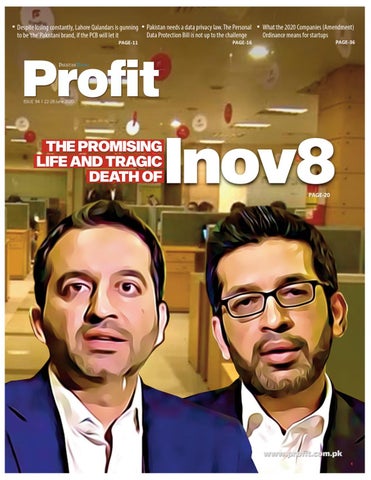
20 The promising life and tragic death of Inov8 30 The pandemic will hit bank earnings, but they have the capital buffers to walk it off
31
32 Collapse in demand hits chemical manufacturing sector
24
33 2020 was supposed to be the beginning of the recovery. Then Covid
34
38
34 Nishat Mills: the PPE orders help, but do not make up for the loss of exports 36 What the 2020 Companies (Amendment) Ordinance means for startups
WELCOME
Why we do not cover the budget If you are a consumer of news in Pakistan, you may be vaguely familiar with the idea that the day the federal government announces its budget is one of the biggest economic stories of the year. We at Profit, as a leading business publication in the country, may well be expected to cover it. But we do not, and the decision not to do so is no accident, but a deliberate one on our part. Here is why: over the past few years, it has become obvious to any casual observer that who the Prime Minister is or who the Finance Minister is does not matter anymore when it comes to crafting a budget for the federal government. What matters is what the babus in the Finance Ministry and the Federal Board of Revenue (FBR) think is possible as far as the jobs they will be required to do, and it is they – not the ministers who are supposedly their superiors – who craft the budget. It is also glaringly obvious that these are men who have not had a new fiscal policy idea since the introduction of the value-addition-based sales tax in 1994. Everything else for them has been a game of making the numbers look just good enough to get the International Monetary Fund (IMF) to keep bailing out the government of Pakistan.
That is why we have largely ignored the shrieking about the 18th Amendment and the National Finance Commission award, about which Prime Minister Imran Khan has made some very ignorant statements. The prime minister is obviously not equipped with the mental faculties to understand the policy matters facing the nation, and hence simply parrots the lines fed to him by the civil servants. (To our friends on the Left of the Pakistani political spectrum: no, the agitation against the devolution of power does not originate in the military. It originates in the federal civil service, which is screaming in agony at the very thought of having to share power with provincial civil servants, whom they consider beneath them.) When the government decides that it has some new ideas about how to govern matters of the federal purse, we will start paying attention. Until then, we will continue to ignore the utter lack of news coming out of the Q Block of the Pakistan Secretariat that houses those tired old ideas of the Finance Ministry.
Farooq Tirmizi Managing Editor
Executive Editor: Babar Nizami l Managing Editor: Farooq Tirmizi l Joint Editor: Yousaf Nizami Reporters: Syeda Masooma l Taimoor Hassan l Abdullah Niazi l Meiryum Ali l Hassan Naqvi l Shahab Omer Director Marketing: Zahid Ali l Regional Heads of Marketing: Muddasir Alam (Khi) Zulfiqar Butt (Lhr) l Mudassir Iqbal (Isl) l Layout: Rizwan Ahmad l Photographers: Zubair Mehfooz & Imran Gillani l Publishing Editor: Arif Nizami l Business, Economic & Financial news by 'Pakistan Today' Contact: profit@pakistantoday.com.pk
FROM THE MANAGING EDITOR
8
Readers Say It is funny to say, at the very least, that we pay Uber and Careem not only for the rides we take with them, but also for the real time data that we generate everytime we use their services. They are not only targeting us through this data, but are most likely also selling it to other companies to make more money. Apropos: Can Careem crack the super-app code? Fahad Siddiqui, Twitter I stopped using Careem for anything when they fired 30% of their staff 3 months after closing a lucrative 3B USD deal to get acquired. I get it. It wasn't their call. Just didn't feel right. I'm off this brand. Maybe in time I'll feel like I used to. On the other hand, despite less than stellar reviews, Foodpanda has been keeping the country open. Their riders are heroes on the urban frontlines. If they want to be superapp, I will support them. I hope they get an emi license. At the same time, easypaisa are way better but they don't have the UX culture needed. I thought the Chinese coming would improve things. But I think they bet on the wrong people. And for anyone that says this is an emotional reaction and unfair from a consumer, how can you not agree with my reason for having an emotional reaction to a brand when that literally is what branding means? What is the main purpose of a brand? To emotionally connect with a customer. If they can't do their job, talk to them, not to me. Whoever I support has employment. In fact they are probably less funded. Apropos: Can Careem crack the super-app code? H U Khan, Twitter Careem Pakistan has gone to the dogs, and I have deleted both the apps. If people can't trust them for rides, they will never trust them for cash. Easypaisa, on the other hand, has really upped their game along with Foodpanda. They are way better than anything comparable in the market right now. Apropos: Can Careem crack the super-app code? Owais, Twitter
facebook.com/Profitpk twitter.com/Profitpk linkedin.com/showcase/13251020 profit.com.pk profit@pakistantoday.com
HOW TO CONTACT
9
There is a misconception here. No one gets the 3 Billion USD. Each round would have diluted founder equity. Most deals are stock and cash combos, that too vested over a 3 to 5 years period. Also, the comparisons to easypaisa are unfair. Easypaisa is stuck between a bank and a tech company catch22. Until they solve it, it is hard to do for easypaisa to be a super app.We keep telling ourselves that it is the best option available to us. The truth is, none of the companies in the market are good enough, maybe they are okay for Pakistan, but given a global market
assumption, we are not good enough. But definitely Careem has the infrastructure and intent in place to definitely try and capture super app space. I don’t agree on the premise that 30% termination should affect customers. I am not sure if that should affect your association. You are well aware of how similar acquisition transactions work. Alignment happens. These deals aren't cash based, vesting takes time. 3B deal means there is a future but not immediately there will be cash. Uber and Careem can’t be competing with each other in similar markets and this alignment was to happen. As far as I knew this 30% was due to the current situation. Apropos: Can Careem crack the super-app code? Talha Izhar, Twitter Now one thing is important that in Pakistan Banks are investing in Public debt issued by the government of Pakistan, which means they are not doing their business as laid down world over to balance with the private sector for minimizing risk which may cause downgrade in rating from rating companies. Apropos: Why foreign investors love MCB Bank Abdul Jabbar, Website I don’t know how foreign investors consider MCB as better choice, but I do know there service is so deteriorated during last few years in all respect for public in general in Pakistan as compared to other banks in Pakistan My MCB account is over 30 years now but the newer accounts with SCBL and HBL are much better, specially wrt customer services I am just maintaining MCB account for my long association. Apropos: Why foreign investors love MCB Bank Javed Nazir, Website In terms of customer service, I can say with absolute confidence that both MCB and UBL come at the very last place with MCB definitely taking the last place and UBL, Askari or BOP taking the second last spot. MCB is better for foreign investors (who are only interested in stock performance) just because Mian Mansha runs that bank just like a Saith company and controls all costs as it goes out of his pockets. That’s why it has the highest RoE as the employees have the lowest salary in the industry, costs are reduced to minimal levels and profits are maximized. MCB would never give loans to the SME or Agriculture sector that have potential to develop the whole industry as it just focuses on risk free profits available on investments. Apropos: Why foreign investors love MCB Bank Anonymous, Website
COMMENTS
IN BRIEF Fruit of the summer: Pakistan is expected to produce 1.1 million tonnes of mangoes this year, a decline from last year’s 1.8 million tonnes. Punjab’s production fell more than 35% this year, while Sindh’s harvest fell by 15%. Pakistan imported mobile phones worth $1.13 billion during July 2019 to May 2020, or a rise of 63.2% compared to the $697.8 million worth of phones imported during the same period, according to the Pakistan Bureau of Statistics.
“We were leaving it on you [the public] until today but unfortunately I did not see people taking it seriously. People think it is like the flu.” Prime Minister Imran Khan on the Covid-19 pandemic
Liquidators now claim that Arif Naqvi stole $385 million from Abraaj Group between 2009 and 2018. Last year, US prosecutors said that the former CEO had stolen more than $250 million.
The Asian Development Bank projects Pakistan’s economy will grow at 2% in the upcoming fiscal year 2020-21. As of now, the economy is expected to contract by 0.4% this fiscal year 2019-20.
Food emergency ahead? The government has imposed the Essential Services Act, 1952, for six months on the Utility Stores Corporation (USC), to ensure an uninterrupted supply of food items. The USC Union chief said the decision is tantamount to encroachment on employees’ rights.
What’s a free ticket here or there? Thanks to a new bill moved by the National Assembly, not only are parliamentarians entitled to
25
A ‘smart lockdown’ will be followed in 40 different union councils of Karachi from June 18 to July 2. Residents’ movements will be curtailed, and only grocery stores and pharmacies will be open.
business class air tickets per year from their constituencies to Islamabad, but now their family members are as well.
Brand update: a 2012 advertisement about Servis Shoes was rediscovered this month, and has gone viral on social media. Servis responded with the social media competition #ServisShoesChallenge, where fans can share their Servis ad memes for prizes.
10
MARKETING
11
By Ariba Shahid and Abdullah Niazi
W
hen the Rana brothers bought the Lahore franchise of the fledgling Pakistan Super League (PSL) in 2015, it was a risky deal to make. Here was a tournament being hosted outside Pakistan with no guarantees of revenue for at least a few years, an equally divisible pool of income among all the teams regardless of amount invested, and high chances of failure. In addition to all this, they were signing it with the infamously fickle Pakistan Cricket Board (PCB). All of the franchises in the tournament have largely been backed by corporate interests from Engro to Leonine Global, ARY, and Haier. And while the Lahore franchise was no exception, being owned by the Qatar Lubricants Company Limited (QALCO), its owners have been the only ones that have managed to make the tournament personal. At the center of this is the belief of the Rana brothers, Fawad and Atif, that a team like the Lahore Qalandars has great potential to be a high-end brand. In their eyes, Lahore Qalandars has always been an opportunity to make inroads into a huge market, and establish the franchise as a recognisable Pakistani product globally and locally. A dream, in their own words, to see their team become the Manchester United of Pakistan. To this end, the Ranas have spent more money than any other team, more than the PCB itself, promoting the PSL at a great cost, all to build the Lahore Qalandar’s brand recognition and equity. This aggressive marketing strategy, however, has been dogged by their constantly poor performance out on the field. The Ranas claim that this has not affected their ability to turn the team into a brand as has been their goal. However, what does seem to be stopping them from getting where they want is the PCB. While the cricket board has managed to make the tournament a hit and has brought it to Pakistan completely in its last edition, its business strategy for the tournament has remained rigid and unpopular among team owners. And no matter how hard the Ranas’ Lahore Qalandars or any other team tries, turning into a brand is impossible if the PSL fails.
A breakdown of the branding
F 12
or starters, the Lahore Qalandars has taken marketing very seriously from day one, and it has been geared towards turning it into the brand. The team
managed to move beyond one dimensional branding and has transcended to forming a unique identity that resonates with the people. The unique thought process behind the mere simple task of choosing a name shows that the team is in a league of its own in terms of creativity. Whether you call it Lahore Qalandars, LQ, Dama Dam Mast Qalandar, or simply Qalandars – you are bound to be thinking what was the reason behind the name Qalandar? Could it be just quirky? Or is there some kind of hidden message or Easter egg in there? Atif Rana, the Chief Executive Officer of the team, explained the reasoning behind the name and who it was a tribute to. “This was a tribute to our mother. She raised nine children with love and care and we wanted the name to celebrate her memory. However, we couldn’t just name it after her. She, like all mothers, was selfless and that is what a Qalandar is – selfless!” The idea behind honoring her memory was simple, “Every time someone mentions the team in good words, her memory lives on.” In addition to this, the team is also banking on the strong connection Sufis have with this region, and that this will help them develop a unique identity that has no comparison. After all, like the Karachi Kings, the Indian Premier League has Chennai Super King, and nearly all other leagues have “Warriors”. But none of them have Qalandars, or something even close to it for that matter, and that is how the team has managed to differentiate itself through its strong alliance with the local culture. Thus explaining the emblem, which is perhaps the greatest achievement of the Qalandars. “The name and branding is exactly what makes the Lahore Qalandars in a league of its own in terms of branding.” notes Khurram Qureshi, a global marketing consultant and the CEO and founder of Captn which happens to be Pakistan’s first emerging sports brand.” The sight of the Turkish dervish whirling in ecstasy is an internationally recognizable symbol of a softer, more mystic version of Islam. But what absolutely no one could have associated it with was cricket . Cricket, as brilliant and magical as the game is, still reeks of a particularly English sense of sobriety and propriety. Even with the flashy, hard-hitting, party-scene form of cricket that is T20 franchise tournaments all over South Asia, whirling Sufis seems like a hard sell. But someone connected those dots somewhere, and when the maker of the Lahore Qalandars logo turned its whirling dervish into a slinky fast bowler knocking over a set of stumps, it channeled the energy of Jeff Thompson, of Shoaib Akhtar and of Andy Roberts: raw, chaotic, untethered and completely explosive. It was, from the get-go, the most unique of all the team logos. Launch the Qalandar name with the catchiest song of the tourna-
ment (Dama Dam Mast Qalandar anyone?), Chris Gayle and Dwayne Bravo for some wild, Caribbean spirit and what you have on your hands is a franchise attracting attention. But how can one forget the lovable team owner, Fawad Rana? It is almost as if the branding team set out to make him a symbol of the brand. In the Indian counterpart, the Indian Premier League, celebrities have been seen as team owners. While Fawad Rana was far from a celebrity before the league, he has indeed turned into a household name, so much so that he can be used as a metric to gauge the team’s popularity. It is almost as if the team was building two brands that complement one another, Lahore Qalandars and Fawad Rana. While Lahore Qalandars was given the task to represent Lahore specifically and Pakistan as a by-product; Fawad Rana was given the task to develop a strong face against loss. For that very reason, regardless of team preference, fans of Fawad Rana grew more than other franchise owners. He became a household name which can be seen by the countless memes or the roar in the stadium when his face is on the screen. While other leagues had celebrities owning franchises, the Pakistani crowd turned Fawad Rana into one. That, however, does not come off as a surprise. This is the same country that turned their cricket hero into a prime minister.
Are Sponsors okay with losing?
O
ne would think that a team known for losing would have a tough time finding sponsors or retaining them. A quick look in the past shows that Lahore Qalandars was able to form the biggest partnership in PSL history with Jazz. A product of this partnership was the Jazz Rising Stars. The deal was essentially supposed to be 10 years long however, with the PSL and other leagues approaching Jazz, the company decided to renegotiate with the Qalandars. The management, however stood their ground and did not compromise on the agreed amount. As a result Jazz left the Qalandars in its third season. However, it is interesting to note that Jazz did not go on to partner with another team. This suggests that Jazz did not ask for renegotiation due to other teams seeming more lucrative, it has more to do with the fact that Jazz just didn’t have the right budget considering the recent merger with Warid amongst other expenses. Who knows, once Jazz finds the right space in the budget it may rejoin the Qalandars. Another interesting partnership that the Qalandars have is with Geo. This has been since day 1 of the team’s inception. When asked why Geo stuck to a team that’s performance on
“For a league that started off outside Pakistan for Pakistan, we were faced with greater challenges. The finances come later, for now, we’re building a brand. Manchester United, one of the biggest teams and brands in the world, went bankrupt in their first three years” Atif Rana, CEO Lahore Qalandars
the field has been disappointing, Yasir Jamal the Business Unit Head of Geo Super and Geo News immediately responded with “Lahore Qalandars is the only team with a vision and plan. The team sets itself apart from others due to this plan. While winning and losing is a part of the game, the team does more than that.” “While the plans of most teams stop with the PSL grand finale, or when they’re out of the tournament, the Lahore Qalandars work all year round. That is why their identity resonated with our brand.” “The management not only talks, but also executes. The fact that the diamond hunting spree for talent resulted in players being found from places like Kashmir and Gilgit shows how Lahore Qalandars is all in and going beyond.” “It is not difficult for Geo to get space of product placement on a kit or merchandise, we decided to stick with the Qalandars primarily for their continued efforts at reaching out and their role in player development.”
The differentiating factor
W
hat differentiates the Lahore Qalandars from other teams is its year round efforts. Qureshi commented on the lack of marketing expenditure in the off season. “That is where Lahore Qalandars manages to set itself apart.” Their grassroot outreach is, apparently, very good. They conduct regular talent hunts and have worked with raw talent that their network of coaches have scouted. They have also sent their teams to non-PSL leagues and training camps in Australia, and have dis-
covered players such as Haris Rauf, who has recently broken into the Pakistan cricket team. If these players become international quality stars, their names and journeys will forever be associated with the grassroots campaigns of the Qalandars, which will go a long way into turning them into a brand. This is what Jamal meant when he talked about how the franchise had a plan and vision. There sheer fact that the franchise has emerged as a market leader in terms of its branding can be seen by Multan Sultans using the same name, “Player Development Program” shows just how Lahore Qalandars were miles ahead since their inception. Right from the first year, the Lahore Qalandars franchise organized “Jazz Rising Stars” trials in various cities across Pakistan to scout for talent in the youth. In order to train and equip this talent with skills, the franchise then arranged for the shortlisted players to travel to Australia so they could train with Sydney Thunder. The two best players would be selected to play for Lahore Qalandars. In addition, the franchise in order to empower women, will also conduct a talent hunt for women across Pakistan. One of the things they have done is try to make the Qalandars a parent entity in Lahore at least. “In the whole world, the most-watched matches are between rivals like India and Pakistan or Australia and England, similarly the most-watched matches are between rival cities like Karachi and Lahore,” Aqib Rana tells us. This is what the team management wants to further. “You see, no one really develops a sense of attachment to a corporate team, like the ones we had such as SNGPL, WAPDA, or the Atif
But someone connected those dots somewhere, and when the maker of the Lahore Qalandars logo turned its whirling dervish into a slinky fast bowler knocking over a set of stumps, it channeled the energy of Jeff Thompson, of Shoaib Akhtar and of Andy Roberts: raw, chaotic, untethered and completely explosive
Rana Cricket Club for that matter. Rivalries exist between cities, so why not extend that to ‘muhallahs’?” For that very reason, Lahore Qalandars set up the Battle of Qalandars whereby neighborhoods in Lahore battle each other and new young talent can emerge. “Our mission is to make Bhatti the Chelsea of our league” “Over the years, we’ve come to realize that we have the power but not the right conditions. Our franchise is helping to uplift the conditions” This is why the management has decided to replicate this model in all major cities. The aim of this model is to engage the youth and build popularity amongst them. It comes as no surprise that the current brand ambassador for the team is their very own star player Shaheen Shah Afridi. What is interesting is that Shaheen Afridi joined the team with a $10,000 a month at the age of 17 and now has a platinum contract worth $150,000 to $170,000 a month. “What other profession in the world gives a 19-year-old a six-figure salary” asks Rana. One would think that due to COVID-19 and the postponement of the remaining PSL matches, the franchise would be resting but that is far from reality. During the pandemic that has taken the world by storm, the team management has launched Qalandar ka Sikandar, a virtual talent hunt. “It’s not just Fawad Rana’s moustache, we’re more than that! We’re innovative.” This connectivity with the grassroots and with people results in the team being a favorite of many. That is why the ratings were off the charts when the Qalandars started to perform this year. “As soon as we improved this season the TRPs became unimaginable. That shows how we’re in the hearts of the people.” Besides, good publicity is publicity in
MARKETING
itself. After all, did anyone protest over other teams losing? No! But the fans protested against the Qalandars losing, and managed to close off Liberty in Lahore. That itself backs the claim that there is love among the people and that Lahore Qalandar have infiltrated into the masses. As a result the Qalandars have spent not only more than their counterpart teams but the PCB itself. Following the request of team owners for consideration on taxes, the PCB asked teams for their audited accounts for the first two years. The PCB, however, compiled all the accounts in the form of one email and sent it to all the teams. As a result, competing teams knew just how much each team was spending and where. However, an analysis of that shows us that Lahore Qalandars’s share of marketing and activation spend for the first two years of 40%, followed by the league itself at 37%, 8% contributed from Karachi, 7% from Islamabad, 4% each from Quetta and Peshawar. The Ranas realize that as the league grows, their team does too!
Is the ‘brand’ profitable?
B
ut where is the money at? While the team has been able to generate revenue to cushion their investment and income, it has not reached its breakeven. Rana explained that there was no shortcut to success. “Manchester United, one of the biggest teams and brands in the world, went bankrupt in their first three years,” he says. “For a league that started off outside Pakistan for Pakistan, we were faced with greater challenges. The finances come later. For now, we’re building a brand.” He explained that a brand is all about perception, and that is why you would not go crazy over a Louis Vuitton bag if they were worth $50 only – which served as a reminder of “Veblen goods” studied during Econ 101. For starters, we know, the Manchester United claim is a long one. You just have to look at two things for this, what is the value of the Manchester United team, and what is the absolute total media spend in all of Pakistan? In Pakistan, before the global pandemic, that number was $750 million, of which 40% would have gone to television advertising, a number that has gone down to $430 million after the pandemic has hit. Let us assume that for some bizarre reason, one PSL team gets all of this $430 million, they would still be ten-times smaller than the $3.8 billion Manchester United. From a quantitative standpoint, the comparison is ridiculous, yes, and Manchester United is a global entity with amazing merchandising. Moreover, as a team that keeps losing, the Lahore Qalandars are a commodity. Again, this magazine’s parent publication,
14
If you look at it, has Pakistan ever successfully created a brand? Now, it can be argued that countless customers flock to their nearest Sapphire or J. outlet during sales, but you need to realize that the crowd is merely there for quality products at a cheaper price rather than the brand value itself. The hallmark of a brand is people buying it despite quality or value for money. Pakistan Today, has in its sports pages carried an article titled “Lahore’s performance is now hurting the PSL.” However, one can still see what the Ranas mean, Manchester United is an ideal for them to aspire to, the shining city on a hill for franchise sports. And as the PSL comes home, the idea is to make Lahore Qalandars an entity like Manchester United within Pakistan. Atif Rana tells us that since the league itself is big, the payoff will be of equal or greater magnitude for sure, considering how the cyclical contracts awarded by the PCB are growing each year. A cycle lasts three years, with the amount for title sponsorship and broadcasting rights rising each cycle; along with gate receipts going up, there is optimism among its owners that the team will be able to enter the green territory in terms of finances. Most important in this has been the return of the PSL and its foreign players to Pakistan in the last years. In fact, team owners have been candid about the fact that in previous editions, they made more from a couple of matches in Pakistan than they did from the rest of the tournament in the UAE. While the current coronavirus pandemic stopped the PSL in its tracks this year, before it hit, things were looking like a success. Rana further added that during the initial seasons all matches were held in the UAE where gate receipts were not substantial. However with matches slowly moving back to the country and a number of full houses being witnessed, the team management was relaxed. “Business is always going to be a concern, but for now, what we want to focus on is the brand.” However, a lot of the problems related to the income of the Qalandars and the other teams can be traced back to the business model adapted by the PCB which raises concerns about the sustainability of the model.
How is PCB killing the league?
I
n simple terms, the model is flawed! While the model made somewhat sense when the league was based in the UAE, there is a strong need to revisit some
policies in wake of the league being brought back home in entirety?
1. Intellectual property
S
ince we talked about why the shirts aren’t as commonly worn as football jerseys it is important to note that while the rules regarding copyright infringement aren’t too strong in Pakistan, the intellectual rights to the shirts and branding belong to PCB, while the ownership remains with the teams. This means that if any team owner wants to take action against businesses that are illegally making team shirts, they cannot do so themselves. They have to push the PCB to take legal action. This resulted in no major legal claim being made so far. It is also pertinent to note that due to this and the lack of respect for intellectual property, the league owners are able to generate dismal revenue from the sale of their merchandise during season and off season.
2. Division of Central Pool
W
e are Profit after all, and sooner than later we have to talk about money. Essentially one would think that the return on investment should be based on the investment. However, in PSL’s case it is the opposite. The yearly income generated from the central pool is divided equally amongst teams. Central Pool consists of the income generated from the title sponsor, in-stadium branding, and broadcasting rights. One could argue that a team that costs more based on the initial investment should have a share of the central pool in accordance to the ratio. That, however, is not the case. Owing to which the team that benefits the most is Quetta Gladiators, while the team that may never be able to break-even is the Multan Sultans that were a later addition to the PSL lineup.
3. Competing against sponsors
T
he PSL itself competes against teams for sponsors. This is further amplified by the fact that Broadcasting rights and
in-stadium branding is both handed over to a third party consortium. This props up the question to brands – would you rather invest in sponsoring the PSL brand and getting coverage for all the matches, or just restrict yourself to a team. The fact that this is done through a consortium results in all the juice from the market absorbed leaving little space for the franchises to cash in.
4. Lack of accountability
W
hile there were talks of the PCB handing over the responsibility of the PSL to a third party in the form of a corporate entity. Basically, the investors in the franchises are the ones that have pumped money into the league. However, it is them that have been facing the brunt of the loses. Every entity other than them can be seen as making some sort of gain, whereas the investor here is being penalized. With the PCB not answerable to the franchises in entirety, the league owners find it hard to get their demands met or their concerns addressed, considering how the PCB is a government entity.
5. Example of potential loss of revenue
I
gnoring the cost on the exchequer, the PCB has set up offices within the Qaddafi Stadium facing the ground. This is unprecedented around the world. During PSL season, these offices that offer the best view of the ground are turned into boxes to view the match. When the matches are held in UAE VVIP boxes such as these go for more than 1 to 1.5 million rupees. However, the PCB uses this as a relationship
building exercise. As a result, there is a loss of potential revenue considering how these seats are not sold, but merely used as gifts. Another question comes to mind on where the officials work from during match season but that is an entirely different debate.
6. The right to gate receipts
I
f you compare the PSL with the IPL, one significant difference in the business model is that the franchise earns gate receipts on home matches and also pay for the expenses. Considering how the team puts in efforts to bring its fans to watch a match, they should be able to gain off of it. However, the PCB decided to distribute gate receipts equally amongst teams for all matches. This made sense when matches were in the UAE and the crowd turnout was negligible. However with the league returning back home, the model needs to be revisited.
7. Perpetuity of team ownership
E
ach team has purchased rights for 10 years. However, if the trajectory of losses continues, one has to question whether the league can continue. After the agreed time passes, franchise owners have the first right of refusal. By then the “brand” value of their team is bound to go up. A simple example could be of how Multan Sultan entered the market at a valuation of 6.3 million. Using that example, one can only assume what a franchise will cost after the 10th edition of PSL. However, despite the brand worth it has accumulated over the years, the real revenue that is coming in is
dismal. Which means team owners may not reinvest in their teams, nor will anyone else be willing to. That basically kills the franchises and the league. One could say a simple solution is brand perpetuity, but the primary concern remains on the need of making the league profitable.
The bottom line
W
hile every business decision usually surrounds the topline, this one seems to be far from it. Up until the previous season none of the teams emerged profitable regardless of how many matches they won or lost. Is this because the brand PSL itself is larger than what the market can meet? Does the market not have the ability to absorb it? It comes as a question whether for the sake of Lahore’s success the league can persist. Considering how the Ranas draw inspiration from Manchester United, a quick look at how the team is highly leveraged and pumps that money back into their team’s development. The question is, how long will the Rana’s be able to continue with their investment? Will the team suffer at the hands of the dismal revenue? Will they not be able to afford expensive and top tier players? How long can they continue with their player development programs? Is this investment doomed from the very beginning? One can only question and hope that the PCB isn’t killing Pakistan’s biggest brand, the PSL - and the subsequent brands it has in the form of franchises. Afterall, how long can the Ranas of the cricket world smile through the pain of losing their money? n
MARKETING TEXTILES
P
By Syeda Masooma
akistan has seen an upsurge in digital and data driven crimes in recent years. Not only has the country gone through multiple instances of ATM fraud and skimming scams, the proliferation of personal data theft, leakage and other such cybercrimes against individuals has gone unchecked. This happens because companies, hospitals, shops, online retailers,and even government organisations collect and tabulate personal data of their consumers without adequate provisions for information security, and when their hit-andmiss security is breached, that personal data is leaked. Entire swathes of national databases have been made public by hackers, including the NADRA database, leading to wire fraud, file sharing and piracy, and counterfeiting and forgery. The wide proliferation of personal data crimes has seen a sharp rise in online blackmailing, and data leakage as well. Now, with a raging pandemic and the new work-from-home regime it has enforced for many white collar workers, the threat against the safety and security of personal data is high. Legislatively, Pakistan has been slow to tackle this problem. Since 2009, the legislature has managed to pass only three acts, the last of which was the Electronics Crimes Act of 2016. Moreover, there has been no particular legislation passed for
16
the protection of personal data. The closest we have come is a bill drafted by the Ministry of Information Technology and Telecommunication (MoITT) in October 2018, which has been revised and presented again in April 2020 as a result of the increasing reliance on information technology because of the Covid-19 pandemic. The new draft, if passed, would essentially work as the legislative framework governing the collection, processing, use and disclosure of personal data. It would also establish and make provisions for offenses in the case of violation of the regulations set by the bill. However, IT Secretary Shoaib Siddique has confirmed to the media that there was no deadline for the consultation process
at the moment, indicating that the government was in no hurry to make the bill law, despite the urgency of the situation, and is still seeking public comments on the bill. Profit takes a look at the viability of the bill, and if it does become enforceable law, whether it will give Pakistan’s citizens the protection they deserve, and what the bill still leaves to chance. In summary, the bill does a reasonable job in protecting consumers against
data privacy breaches by private actors like companies, but does nothing to prevent surveillance and abuses by the government itself.
Defining data
T
raditionally, consumer data or information might be gathered through surveys or focus groups or simple observation, and other situations where explicit consent is usually given to
provide data. However, in these times, those organisations or companies collecting data often do it through more subtle methods. For example, one way to go about this is Automatic Data Processing (ADP) equipment. These are devices that automatically record and process data when it is entered. Companies also tend to make providing personal data part of transactions, since data is considered a ‘currency’ and is often hoarded. Under the bill, data is information that is collected by means of equipment that is operated automatically (such as ADP equipment), or is requested in response to instructions. Providing data for an application, a newsletter, to buy a product or service, or to get a subscription all falls under this. To this end, the bill tries to define “Personal Data.” The most important feature of personal data is that a person is recognisable through it, so for example their name or phone number. The bill deals with this kind of personal data when it is collected as part of transactional exchanges, or when it is provided “in response to instructions given for the purpose of the transaction.” Under this definition, for example, if you were to buy a product and the company selling it to you was to ask for your name, address and phone number, and then file that information somewhere for later use, then only will it fall under the ‘personal data’ category. This further leads to what the bill calls “Sensitive Personal Data.” This refers to personal data consisting of information that reveals racial or ethnic origin, religious, philosophical or other beliefs, political opinions, membership in political parties, trade unions, organizations and associations, biometric or genetic data, or the health or sexual life of an individual, criminal record, or any other personal data. However, this is where the bill makes its
first significant lapse. While there is an entire section in the bill relevant to the notifications and consequences of “data breach” in the bill, there is no definition given to what may or may not constitute a data breach in the first place. What the bill does try to do is set out certain key principles that apply to the processing of personal data. And while some important ones are covered in the bill, a lot of other key principles have been left out. The bill makes provision relating to the lawful basis for processing, purpose limitation, data minimisation, and retention. These four jargony terms essentially mean that when a company is collecting personal data, it must only be collected for lawful and relevant purposes. So fishing for extra data as part of a transaction would become illegal under this law, and only that data must be collected which is necessary for a transaction. The bill goes so far as to detail that data can only be retained by companies after collection if it is still needed for the relevant purpose for which it was collected, and they would be legally obliged to destroy this data responsibly if this was not the case. Once again taking the example of a transaction where name, mobile phone number and address is provided by the customer, there must be reasonable cause to ask for this data, such as for delivery. And unless the delivery is a regular one, the company cannot keep the personal data of the customer and are obliged to dispose of it. This would also mean that companies and stores can no longer keep your phone number or address for advertising purposes. Disposing data is also particularly important here, since the entire point is to avoid personal data leakage in case the company is breached. The bill also places great importance on ‘consent,’ which is to be an essential requirement to process personal data of the data subject under the new bill. It is as simple as this: the company or organisation collecting data cannot disclose it for any purpose without the express permission of the person that owns the data. Not only this, but those collecting data are responsible for the data they control, and are required to take practical steps to protect the personal data from any “loss, misuse, modification, unauthorized or accidental access or disclosure, alteration or destruction,” under the act. There are certain aspects, however, that the bill ignores which have come to be considered standard practice in the European Union (EU). These principles are defined by the EU as ‘Necessity’, ‘Transparency’ and ‘Proportionality’. These are also simple concepts which would go a long way to making Pakistan’s bill
DATA PROTECTION
a much stronger one. Necessity, for example, is simple enough, and is also framed in other words in the current Pakistani bill. It is the idea that a fundamental right such as the right to privacy of information can be restricted when it is a necessary part of the process. Again, a company must collect your address to be able to deliver a product to you. However, in the EU’s data protection conception, it is said in so many words Similarly, ‘Proportionality’ is defined as a general principle that restricts authorities in the exercise of their powers by requiring them to strike a balance between the means used and the intended aim. So this would essentially mean that the benefits being gained from restricting a fundamental right (right to privacy) are more than the disadvantages. This means safeguards accompanying a measure can support the justification of a measure, and thus promotes better cyber-security. The final concept is ‘Transparency,’ which is no less important, since the institutions and bodies that adopt legislation like this data protection bill and make decisions based on that affect the lives of all those living in the country. Transparency is termed by the EU’s body as a significant feature of the law ensuring that the decisions affecting the populace must be taken as openly as possible. They should have the right to know why, how and who is involved in making these decisions and laws as well as have the fundamental right of access to the documents prepared in these activities. Given how a bill for protection of personal data may be misused, especially in a data wilderness like Pakistan, transparency is one key concept that the current bill of the MoITT must incorporate at all costs.
Individual rights in the bill
I
n addition to defining what data is and regulating how it is to be managed by those collecting it, the bill also lists the individual rights that the person who is the ‘subject’ of the data – and thus the original owner of the data – has. Once again, the bill posits these rights in the form of a set of key principles. The bill guarantees the ‘right of access to data/copies of data,’ which in simple terms means if your data is being considered for some action by the authorities, you will have the right to access it. However, there is another clause that gives the discretion of sharing this data to the controller and also implements a certain fee upon the person in concern, should they wish to access their data. Another key principle is the ‘right to rectification of errors,’ which insures that if you do manage to get access to your data
18
“There is no deadline for the consultation process at the moment, and the process is openended for now. We will decide the timeline for implementation depending on the feedback,” Shoaib Siddiqui, Federal IT Secretary after possibly paying a fee, and you discover that the data is inaccurate, incomplete, misleading or not up to date, you have a right to get it corrected by making a written request to the data controller. Corollary to this is the ‘right to deletion/right to be forgotten’ principle, a centerpiece of data protection and laws in Europe and America. Under this principle, the data subject may also request for erasing their personal data, as long as this request is made without undue delay. Other requirements for the ‘right to be forgotten’ include the personal data no longer being necessary to the purposes for which it was collected, and that the data subject withdraws consent on which the processing is based. Similarly, the data subject also holds the ‘right to complain to the relevant data protection authority(ies).’ The bill has provisions for the formation of a National Commission for Personal Data Protection, which will be a tribunal against any violation of personal data protection rights as granted under the bill, regarding the conduct of any data controller, data processor or any such cases. While the bill covers most of the provisions that also exist in the EU’s General Data Protection Regulation (GDPR), the one important one that it seems to miss out as far as individual data rights go, is the ‘right to data portability.’ Going back to the EU’s definitions of these rights, data portability is required in the case that one authority fails to provide the desired outcome to the complainant. The definition of this key principle is that “The right to data portability allows data subjects to obtain and reuse personal data about them for their own purposes, and across different services. It allows data subjects to move, copy or transfer personal data easily from one IT environment to another in a safe and secure way without affecting its usability. This enables data subjects to take advantage
of different applications and services that can use their data to find them a better deal or help them understand their spending habits. The right only applies to information about a data subject provided to a controller.”
Who will watch the watchers?
T
he merits or demerits of the bill as a legal entity aside, as it stands, it is still the subject of considerable criticism. While Pakistan desperately needs a legal framework for data privacy, many digital and human rights groups believe it does not go nearly far enough in protecting individuals from abuses by the government even as it places restrictions on private actors. At the front advocating for these digital rights have been two groups, Media Matters for Democracy (MMfD) and Bolo Bhi, which is a civil society organization dealing with policy, and research in the areas of digital rights and civic responsibility. At a press event in April, Bolo Bhi’s Director, Usman Khilji, told the media that while it was encouraging that the government was thinking about and taking data protection seriously, a month for consultation was very little time. Similar concerns have also been expressed by Nighat Dad of the Digital Rights Foundation and MMfD officials. Bolo Bhi went on to publish a detailed analysis of the proposed bill, and said that while the protection of citizens’ data is long overdue and legislation seeking to extend safeguards is necessary, “the current draft does not adequately extend safeguards to citizens,” and like the Prevention of Electronic Crimes Act (PECA) 2016 and Citizens Protection (Against Online Harm) Rules 2020, “the bill awards discretionary powers which will lead to weak accountability and likely privacy violations of citizens’ communications and, in turn, a chilling effect on speech. Some of this is explained further in the analysis below, which deals with
some of the major concerns.” In an interview with Dawn, Khilji had explained this saying at a time when the government was mass tracking cell phones without any transparency or accountability, there was a greater need for conversation around protection of privacy rights. “I fear the law could be linked to the controversial online harms rules, especially Section 15 of the consultation draft,” he said in the interview. Bolo Bhi’s analysis includes the statement that “Pakistan, like the rest of the world, is currently grappling with a pandemic. Around the world and here, governments have deployed technology to trace, track and surveil citizens citing these as Covid-19 measures. However, concerns about such measures going beyond just dealing with Covid-19 exist and are not misplaced. In light of this, any legislation proposed during this time should not be rushed.” Pointing out the experience from rushing the PECA 2016, the organization states that “The Citizens Protection Against Online Harms Rules 2020 should also be kept separate from this process. The draft Personal Data Protection Bill 2020 merits a discussion while the Citizens’ Protection Against Online Harms Rules 2020 should only be discarded. Meanwhile, the MMfD had submitted a set of recommendations to parliament back in October 2019, when the bill was originally drafted. They had outlined similar issues as those identified by Bolo Bhi. The recommendations were critical of the loose definitions of terms like “commercial transactions”, “personal data”, and “journalistic activities”. They also identified that “The bill currently proposes criminal liability under section 21 in the wake of negligence in protecting data of the citizens.” Their analysis indicated that the bill would result in overlaps with other criminal laws such as Sections 3, 4, 5 and 16 of the Prevention of Electronic Crimes Act 2016 (PECA). Bolo Bhi’s report has, in fact, listed a number of pressing concerns regarding the bill. For starters, they say that the bill provides very vague definitions, with no distinction between individuals, public, and private sector, personal or commercial. Left to interpretation, these vague definitions provide no clarity or certainty in terms of responsibilities, liabilities, or protections. This results in a general absence of clear procedures and guidelines, and a lack of clarity on responsibility and liability. It fails to take into account the scale and nature of operations, and makes no mention of government entities collecting data with the intent to process it. Bolo Bhi also argues that the bill grants broad, discretionary powers to the federal government, allowing them to grant or revoke
“At a time when the government is mass tracking cell phones without any transparency or accountability, there was a greater need for conversation around protection of privacy rights. I fear the law could be linked to the controversial online harms rules, especially Section 15 of the consultation draft,” Usman Khilji, Director Bolo Bhi exemptions to any data controller “which is completely arbitrary, and should be done through an executive process devoid of any checks and balances. This is also prone to political influence.” In addition to this, there is a lack of independent oversight and accountability since it functions under the federal government administratively. With the free reign given to the federal government, the bill also allows the government to come up with a mechanism that requires a “copy of personal data” to be kept in Pakistan. Other than the monetary costs attached to doing this, there are grave privacy concerns. To whom will this data be provided to store, process, protect, and access? For what purpose? On the other hand, MMfD also suggested that “the data collected by government entities i.e. such as the data collected by NADRA [National Database and Registration Authority], is most at risk of being misused as this data falls within the purview of ‘sensitive personal data’. The scope of the bill should be extended to government-controlled, collected and processed data, ensuring protection and legal liabilities for data held by the government entities as much as for commercial entities.”
Why you should be concerned
I
n February this year, before the Pakistan government could announce the confirmation of Pakistan’s first coronavirus patient, the name, photograph, personal
details, as much as his home address were leaked on social media. The person eventually recovered and wrote “My photo was all over social media and I became a pariah”. Some other examples, mentioned in previous articles published on Profit include the incidence on October 27, 2018, when Bank Islami reported an online breach of their system in which the bank lost Rs2.6 million. In November of the same year, the stolen data went on sale on the black market. On February 22, 2019 Moscow-based threat intelligence firm Group-IB reported spotting the sale of nearly 70,000 Pakistani identity cards on the cybercrime marketplace called Joker’s Stash, worth approximately $3.5 million at the time. In June 2019, PTA reported the identity theft of nearly 45,000 Pakistani international travelers for the purpose of registering imported mobile phones on the government’s Device Identification Registration and Blocking System (DIRBS) to avoid payment of customs duty. In December 2019, it was reported that biometric machines available with the myriad of retailers for SIM card registrations were faulty and were potentially leaking data. Now, while we are a step ahead from where we were before, there is still a long way to go. And while this bill is a highly welcome move from the MoITT, the risks that experts from all over the country are highlighting with passing this legislation in a hurry and without taking all due considerations into account, might end up making this bill more damaging than useful. The ministry was open for comments and suggestions from stakeholders until May 15, 2020. However, IT Secretary Shoaib Siddique spoke to a media house that there was no deadline for the consultation process at the moment and the process was open-ended for now. “We will decide the timeline for implementation depending on the feedback,” he said. One hopes that is the case, because there are still a lot of dents in the bill that need to be beaten out. n
DATA PROTECTION
20
By Taimoor Hassan & Babar Nizami
Prologue: Enter Chorus
I
n 2006, Hasnain Sheikh took the speaker’s podium at a large banking convention in Karachi. Surrounded by some of the biggest names in Pakistan’s banking industry, at a time when nobody was taking it seriously, he was there to pitch the opportunity that the
world of fintech offered banks. But instead of buttering up his audience and appealing to their opportunity, he asked them with more than a hint of hauteur, “do you even know how many zeroes that is?” Somewhere in the background, watching approvingly, was his cousin, Bashir Sheikh, with whom he had set out to change Pakistan’s banking landscape. Other bankers in the audience of the convention, however, might not have felt as generous to his rhetorical question. But approval mattered little to the Ivy
League-educated Sheikhs, who believed they were on the brink of a big breakthrough, and could back up their posturing. Back when the concept sounded like little more than futuristic mumbo jumbo, Bashir and Hasnain had gone all-in on mobile banking solutions being the next big thing. Young, hungry, talented and equipped with the best teams, ideas, resources, and the right connections, they were visionaries in the fintech arena – before fintech was even a known term – and years ahead of their closest com-
FINTECH
petitors. It was a dream scenario which they somehow still managed to squander. Perhaps establishment approval should have mattered after all. Today, the company that they founded, Inov8, is little more than a bare bones ghost town littered with the remains of once ambitious products that have one by one met eerily similar ends. The more than 16 year journey of Inov8 has seen dizzying highs, abysmal lows, shocking scandals and millions of dollars down the drain on a company that was always fledgling but never quite able to take off to the heights it had promised. And much like a talented sports star that has the raw promise but never the numbers or performances to back it up, Inov8 has found a whole array of people to blame. But to begin the story, we must go back a few years before the infamous banking convention. That is where our story starts, a tale of pride, hubris and misfortune. And it all begins with a raffle scheme.
Act 1: The beginning
I
t was 2004, the internet was just starting to spread its way into every household, it seemed like President Pervez Musharraf would be in power forever, and Moonis Elahi being the son of the Chief Minister was the de facto political heir of Punjab. The buzz about town at that time was the Punjab Development Fund’s (PFD) Crorepati raffle scheme. While the scheme had been launched by the Pakistan Muslim League Quaid (PML-Q) government in Punjab, other than making the Bank of Punjab (BoP) its banker and collecting agent, the show was being run by a then little known company called Inov8. So little was known about Inov8 at the time that the rumour mill had somehow perpetrated that it belonged to Moonis Elahi, and there was something fishy about how it had gotten the contract. Moonis Elahi was simply a close friend of Bashir and Hasnain Sheikh, having studied with them at the elite Lahore American School. The cousins had an in with the elite circles of Lahore, belonging to an old money family with a huge chemical factory in Kot Lakhpat and prime property on the Upper Mall road. But while that family money managed to put both of them through the prestigious Wharton School at the University of Pennsylvania, they returned to find that their fathers were now presiding over a stagnant estate. They moved to consolidate, selling the property on the Upper Mall and the machinery from the factory to settle their debts. By this point, they would have been set to continue on with their high flying lifestyles in their upper class circles for a lifetime. Instead, the zeal of Wharton still fresh, they
22
Hasnain Sheikh (L) Bashir Sheikh (R)
decided to start Inov8. This was not going to be any other company that churns out boring, steady cash-flow. This was going to be a game changing approach that would make them uber rich and uber powerful. Their idea was fresh, and they were going to settle for nothing less than the best. So even though they had little to show for by means of experience, Inov8 from its very first day had a reputation for having a trailblazing team and brilliant ideas, which managed to secure them the contract for the Crorepati scheme. And this was not any regular contract. Inov8 was a tech company, one which had been formed with the idea of spreading point of sale credit and debit card sales using top of the line technology. But Inov8 took on everything for this project, from marketing to the technology being used. From the get go, it was clear that the cousins would settle for nothing less than complete domination. They pursued aggressive marketing tactics, buying out space on the most prime billboards, newspapers and television slots. They also hired International Brands (Pvt) Limited (IBL), Pakistan’s largest distribution company and the distributors for Unilever Pakistan, to be their official distributor. IBL did what IBL does best, and distributed the tickets for the lottery far and wide and made sure they were being sold at every kiosk and every general store across the country. The success of the Crorepati scheme
could have been a major make-or-break moment for Inov8 and the cousins. But while everything pointed towards it making them, the cookie crumbled the other way. The lottery numbers had duplicates, court cases raged, and the Sindh High Court forbade the distribution of prizes a day before the raffle was supposed to take place. In addition to this, the intense marketing campaign did not work, and people did not buy as many tickets as Inov8 was hoping, meaning they began to default on paying vendors and media houses. This was Inov8’s first failure, and set the tone for a pattern of failings that would continue on for the next decade to come, where Inov8 would impress, fail to meet the mark, and then move to their next grand project. It would also be here that Inov8 would have its first brush with the State Bank of Pakistan (SBP), after media reports began to point fingers at the regulator for not taking any action against the lottery scheme launched by the Bank of Punjab (BoP). The SBP refused to take action on the basis that the scheme was not the lottery scheme of the BoP for mobilizing deposits, but rather the BoP was simply the government’s deposit bank for the development fund scheme, which meant that the SBP felt it had no business taking action against Inov8. But unfortunately for Inov8, SBP would not be such jurisdictional sticklers in the very near future.
Employees working at Inov8’s office in Gulberg, Lahore
Act 2: The biggest blow
T
he Crorepati scheme debacle was easily bounced back from. And besides, for what the cousins were trying to do, there was literally no competition in Pakistan at the time. Inov8 was probably the first fintech company that had launched in Pakistan. It was the pioneer in the industry, providing digital payments solutions to banks and telecom companies long before fintechs such as JazzCash, EasyPaisa, and SimSim entered the market. “They really owned the space. Both the cousins actually developed the space, they were dynamic and competent. Inov8 was the only one that made the effort to build the marketspace, lonely and hard,” a source familiar with the company and its founders told Profit. In addition to this, they were still as young and as impressive as ever before. It was at this point that they were introduced to Zohair Khaliq, who was president of Mobilink (now called Jazz) at the time in 2005. They also formed a close working relationship with Naeem Zamindar, who was Mobilink’s Chief Strategic Officer. Mobilink and Inov8 came to an agreement under which they were to launch a technology platform for mobile payments. The result of this partnership was Mobilink Genie, powered by Inov8. The product itself, much like Inov8, was ahead of its time. It was essentially a payment management app that allowed users to connect multiple bank accounts to their phones, and use them to make payments. Until then, the limited progress achieved in fintech banking had been through online bank accounts, but what Inov8 did was to take the banks out of the equation completely. Mobilink Genie was only a way to make payments at
stores and to other bank accounts, there were no deposits involved at all, and the product was a bank facilitator or catalyst at most, but nowhere close to a bank. Given this, and their past experience with SBP, neither Inov8 nor Mobilink felt it was necessary to go to the State Bank of Pakistan (SBP) and seek the regulator’s opinion or permission on the matter. But they did need banks to take them on as payment providers, so Bashir and Hasnain Sheikh made their way around, attending banking conferences and convincing banks with bluster aplomb to use their technology. But keeping up with the typical startup ethos of “disrupt now and adapt later”, backfired. The people at SBP took the lack of attention to heart, and in 2006, they came to bust the party, banning Mobilink Genie and other methods of pay and transfer. The logic behind this has escaped many since. People within Inov8 and many in the banking circles have said that it had mostly to do with the SBP being miffed that Inov8 had not come to it to pay its respects. A few years after this, the SBP would itself allow pay and transfer apps and technologies, but only at a time when it was too late for Inov8. They had been ransacked and left for dead. But some other bankers have a different opinion. “SBP will never have allowed players to enter the payments space without passing a fit and proper test. This test is often done in the form of a licensing regime. Without going through that prequalification with the regulator, especially with the national payments ecosystem under scrutiny and being highly sensitive because of the war on terror, to assume that SBP would just be ok with it was madness”, one claimed. Mobilink Genie had been their main project, and Inov8’s business model was to work on a product launch basis. So without this big fish, they did not have a revenue model.
“Digital payments were perceived as a threat to conventional banking at that time. But in reality they were going to add to the capabilities of the banks. The conventional banks actually lobbied the SBP to shut these guys down,” our source in the industry tells us. Once again, it was a matter of Inov8 being ahead of the curve, but also of them being so lost in this passion of being innovators that they forgot to get important stakeholders, such as the SBP, on their side. Down for the count, Mobilink was also quick to abandon the sinking ship, and Inov8 was dead weight. What followed was a wilderness period for the company before its last serious resurgence.
Act 3: Cut down to size
H
ere was a company and a family that was supposed to make it. There is little doubt that they already had money, clout and were more than taken care of, but Inov8 was supposed to turn the Sheikh cousins into powerful movers and shakers who were considered pioneers in their field and revolutionaries in Pakistan’s finance scene. But before the turn of the decade, they found themselves turned into a Software as a Service (SaaS) company. SaaS is a software distribution model in which a third-party provider hosts applications and makes them available to customers over the Internet. In simple words Inov8 had become a software development company for the banks. It also took Inov8 down a notch or two from its high horse. Even the name ‘Inov8’ was supposed to indicate a company striving for its own ideas and projects that it owned. Now, it was turned into a tech company for hire. So there was little surprise that the cousins were still working
FINTECH
their charms and finding investors. They may not have had hard cash, but they did have technology and resources to offer. The SaaS model kept them afloat for some time on the limited staff that they had since the Mobilink Genie ban. A ray of sunshine finally came in the form of Gestetner, a European company with its Pakistan office well known for providing copying facilities and Self Service (ATMs) to the banking industry. Its local owner decided to sign a joint venture (JV) with Inov8. In fact, he was impressed enough by the smart talking cousins that he put in $1 million of his
life’s earnings into Mobile Commerce (Pvt.) Limited (MCL), the company that was formed as a result of the JV. Gestetner Pakistan put in the money, and Inov8 put in their technology and software, and the new company began approaching banks. However, with the cousins’ previous reputations among banking circles, the banks did not bite and the million dollar investment began to look like it was disappearing into thin air. A source close to the two companies explained that while Gestetner continued to fret over its possibly lost investment, Inov8 was
STARTUP VALUATIONS Startup
Estimated valuation
AFINITI
Startup
Estimated valuation
BOOKME.PK
$1.6 billion KEEPTRUCKIN
$24 million SASTATICKET
$1.4 billion
$18 million
Emerging Markets Property Group (EMPG)
BYKEA
EASYPAISA
INOV8
$1 billion
$410 million DARAZ
$17.7 million — $22.8 million $16.2 million — $21.6 million PAKWHEELS
$150 million AIRLIFT
$10.5 million — $14 million OLADOC
$36 million — $48 million KNOWLEDGE PLATFORM
$35 million ROZEE.PK
$26 million — $32.5 million
$10 million FINJA
$7.5 million — $9 million MANDI EXPRESS
$6 million
Note: Valuations estimated on basis of most recent disclosed funding round, internet research and estimates provided by industry experts
24
making other arrangements for itself. Claiming a loophole in the contract with Gestetner, the cousins managed to strike a deal with other companies and were providing solutions and technology to them separate from Gestener. One would assume that the deals the cousins were making would be through MCL, but instead, Inov8 signed the deal privately, without including its JV partner. Gestetner sued of course, but there was little that could be done about recovering the lost $1 million investment. The head of Gestetner eventually handed over his control of MCL to Aqeel Karim Dhedhi, the Karachi-based stock broker, to whom he owed money, with the company being part of the debt settlement. Today, MCL is half owned by AKD and the other half is still owned by Inov8, but it is a shell company without an active staff or any projects. What was left now was Inov8 and its young but shaky relationship with Wateen, and where that might take Bashir and Hasnain Sheikh.
Act 4: The final putsch
A
lot of why and how Inov8 has managed to get as many chances as they have has to do with connections. This is not to say that there is some great nepotism stink in this entire situation, just that this is how business works. You know one person, they introduce you to a second and so on and so forth. Inov8 cut an impressive figure on its own merits, and an in with Wateen and the Abu Dhabi Group was exactly what they needed at this particular moment. Wateen was under the umbrella of the UAE-based Abu Dhabi Group – a conglomerate with interests in both telecoms and banking – which in 2011, was undergoing a massive transition after the exit of Bashir Tahir as the right hand man of Sheikh Al-Nahayan, the group’s owner. His replacement was Zohair Khaliq, who had formerly been the President of Mobilink. Khaliq brought with him Mobilink’s former CSO, Naeem Zamindar, as Wateen’s new CEO. The old Mobilink team had jumped ship to Wateen and the Abu Dhabi Group now, and they were still as impressed with Bashir and Hasnain Sheikh’s ideas and proposals as they were back when Mobilink Genie was launched in 2006. The years in between and all that had happened had not dissuaded them. All the official paper signing business happened In 2011. Wateen took Inov8 onboard, signed a technical services and license agreement with Inov8 Ltd to enable mobile financial services in Pakistan, an opportunity to provide managed services in a very high growth potential area. The once high-brow Inov8 would now be completely housed by Wateen. In addition, Wateen got all the rights to the technology and
software. Over the next few years, Wateen housed Inov8 at their offices in Lahore while Bashir and Hasnain reinvigorated their desire to see Inov8 succeed. The cousins saw this second lease on their business life as an opportunity, and despite not being what they had once imagined their company becoming, the deal they got was still a sweet one. Wateen was paying salaries of Inov8 employees, including salaries for the co-founders, and operational costs. In return, Inov8 focused and developed Wateen’s capabilities as a trusted provider of financial solutions. They were even able to re-hire the staff they had to lay off after the SBP banned Mobilink Genie. Two of Inov8’s major clients through Wateen were Askari Bank and Zong, relationships that would later start providing results with the platform and technology solution enabling the launch of “TimePey” by Zong and Askari Bank in 2011. The move provided Wateen an entry into offering cloud based computing services, which was considered the future of the new economy and the IT industry. A little later, Inov8 would go on to sign JS Bank, the Bank of Punjab, Soneri Bank and Meezan Bank as its clients, powering their internet and branchless banking, and mobile banking applications. For a while, Inov8 was even keeping servers of the Bank of Punjab under its roof until 2015 when the SBP disallowed them to keep those servers. But while Wateen was funding Inov8, it was burning itself out of cash, a problem frowned upon by its parent group. Wateen itself was not doing so well and was under a lot of pressure to cut costs. So Inov8 had to start looking for alternate sources of funding. It was here that Zamindar, oddly loyal to the cousins and with a blind faith in their abilities, suggested that the Abu Dhabi Group start funding Inov8 directly instead of through Wateen. Wateen was already going through a major debt restructuring and was under a lot of pressure to cut its expenses. Such a deal would allow Wateen to tighten its belt without forgoing Inov8’s services, which, until then, Zamindar seemed to approve of. In their hope for a good response from their fellow Abu Dhabi Group holding, the cousins went to Bank Alfalah, where they presented in front of the bank’s head, Atif Bajwa. Bashir and Hasnain claim that Bajwa heard them out and shook their hands and seemed interested by their ideas. Soon after these meetings, Bank Alfalah launched a financial services company by the name of Monet, which eerily replicated the Inov8 model that they had heard about in so much detail. This made little sense. Inov8 had been looking for both funding and to work with a top bank to which they could provide their services. They could have helped Bank Alfalah as well to
And even though the cousins refused to talk on the valuation, sources familiar with the industry dynamics tell Profit that even though the industry has the potential to create a $100 million company, Inov8 would not be worth $100 million, and the transaction is being used to exaggerate the market perceptions of the company’s financial strength. Essentially, the cousins just really wanted to make the deal look better than it was increase its technology capabilities and probably a market could have opened exclusively for Bank Alfalah. Bank Alfalah, already being another one of the enterprises under the Abu Dhabi Group umbrella, seemed a safe and trustworthy partner. But sources close to Inov8 claim they got duped and caught up in the internal politics of the Abu Dhabi Group. In fact, they go so far as to say that Monet, owned by one Ali Abbas Sikander, had as one of its investors Atif Bajwa and that there was a conflict of interest. Bank Alfalah and Monet, however, have a very different story. Sources close to the bank claim that Monet was already in contact with Bank Alfalah well before Bashir and Hasnain Sheikh made their pitch to Atif Bajwa, and that everything had been finalised to the extent that Sheikh Al-Nahayan was personally involved in the venture as well and soon acquired more than 90% of Monet in his personal capacity. This would make sense since the Sheikh often involved his employees in investments as well. Even today, Bank Alfalah’s ‘Alfa’ app is based on models made by Monet. Another source at Bank Alfalah, also denied that Monet was directly run by the bank or was housed there, and contended that the company was an independent startup that operated in the same overall space i.e. providing technology solutions to financial services and banking. The people who ran Monet even contended that Monet and Inov8 were not in direct competition to each other because the consumer segments and products were different. “Monet was always a small startup. It is like saying microfinance banks are in competition to commercial banks,” a source told Profit. “Similarly, all tech companies, even all fintech companies are not direct competitors.” There is some evidence that because Bank Alfalah was behind Monet, Inov8 might not have been able to sign up Bank Alfalah as its client which would have given it a huge boost. But the source said that even without Alfalah, the rest of the banking industry and telecommunications companies were open to Inov8. There is no evidence to suggest that the
Group was not ready to fund both the companies at the same time they were competing with each other. But as it turned out, the Group eventually ended up funding Inov8 as well. Sources close to Inov8 claim that Monet was failing to execute on its business model. On the other hand, Inov8 had started generating decent cash flows. The group according to the source eventually decided to put money into Inov8 because Inov8 had proved its business model, while Monet failed to grow to its promise. This entire time, however, Wateen continued its long run of being in a cash crunch, so Inov8 had to find funds to sustain itself and grow eventually. Discussions had already started with the Group to fund it directly, and Monet’s failure was serendipitous in getting funding for Inov8 from the Group. Though sources say that it was Naeem Zamindar who had initiated discussions with the Abu Dhabi Group leadership on Inov8’s behalf, he was let go as the CEO of Wateen in 2014, and the discussions were carried on by Adeel Bajwa who eventually got the funding approved. Consequently, on October 30, 2015, Inov8 announced raising $5.4 million in Series-A round from His Highness Sheikh Nahyan Bin Mubarak Al Nahyan – the chairman of the Abu Dhabi Group – for an equity stake of 5%. After that equity injection, Inov8’s valuation was now $108 million. It was being touted as the largest fintech company in the country, and among the most successful startups. Finally, it seemed that Inov8 was reaching a point of stability that it had always been expected to reach, but with the backing of the Abu Dhabi Group. But things have always seemed to have an ominous air, and the $108 million valuation seemed a little difficult to validate.
Act 5: The valuation, fake it till you make it?
W
ith it’s $108 valuation, Bashir and Hasnain Sheikh were once again walking around with a spring in their step.
FINTECH
They had managed to maneuver a huge valuation, but their smiling faces soon wilted as every investor and client they went to touting the absurdly high number were in no mood to consider the valuation – it became laughable. Let us roll back to when things started at Wateen. Over the years, from 2011 to 2015, Wateen housed Inov8, it ended up spending to the tune of $2-3 million dollars on Inov8. In conversation with Profit, sources close to Inov8 confirmed that they never sold any equity to Wateen, and that the two cousins retained full ownership of the company during the time that it worked with Wateen. What comes next, however, is confusing. In its filings with the Securities and Exchange Commission of Pakistan (SECP), the company states that I-8 Global, the UAE-based holding company controlled by Sheikh Nahyan, invested $5.4 million for an equity stake of 60%. If a $5.4 million cheque resulted in a sale of 60% of the company’s shares, that implies a valuation of $9 million, a far cry from $108 million. Had Wateen acquired a 50% or more stake in Inov8 earlier – as some sources claimed, but Profit was unable to verify – and Sheikh Nahyan consolidated that old share with his new investment into a single holding company, that might make a little more sense. It might have suggested that the Sheikh was simply buying an additional 10% share in the company for the $5.4 million, which would still imply a valuation of just $54 million, still much lower than $108 million. But, of course, Wateen never owned any shares, and Inov8 claims that Sheikh Nahyan received only shares worth only 5% of the total value of the company against his $5.4 million investment. Mathematically speaking, the only way that can be true is if Bashir Sheikh and Hasnain Sheikh own shares in I-8 Global, the UAE-holding company. Specifically, they would have to own 91.7% of I-8 Global, and Sheikh Nahyan would need to own just 8.3% of that company, in order for Sheikh Nahyan’s share to be worth just 5% of Inov8. But again, in conversation with Profit, sources close to the management stated categorically that Sheikh Nahyan is the majority shareholder in I-8 Global. That statement implies that he owns at least 50% of I-8 Global, which in turn owns 60% of Inov8, meaning that Sheikh Nahyan owns at least 30% of Inov8. If he paid $5.4 million for it, that implies a valuation of $18 million, still nowhere close to $108 million. Now, it is still possible that Sheikh Nahyan has issued share options to Bashir Sheikh and Hasnain Sheikh that would ultimately increase their shareholding in I-8 Global, and by extension in Inov8, up to 95%. But options are conditional, and do not, in themselves,
26
increase the equity value of a company. All they do is change the share count, and the individual shareholding percentages. So even options would not actually result in a $108 million valuation. We have tried several mathematical calculations to reverse engineer how the $108 million valuation makes sense, and we were unable to do so. We reached out to Bashir Sheikh and Hasnain Sheikh and asked them to walk us through the calculations, but they stated that they are prevented by a non-disclosure agreement with Sheikh Nahyan from being able to do so and threatened us with legal action if we run the story. We are publishing this story anyway. The cousins are free to offer an explanation of how they reconcile their claimed valuation with the regulatory disclosures to the Securities and Exchanges Commission of Pakistan at any time. We will prominently print that explanation, and revise our story accordingly. And even though the cousins refused to talk on the valuation, sources familiar with the industry dynamics tell Profit that even though the industry has the potential to create a $100 million company, Inov8 would not be worth $100 million, and the transaction is being used
to exaggerate the market perceptions of the company’s financial strength. Essentially, the cousins just really wanted to make the deal look better than it was. The running theory in the industry was that the cousins misrepresented how much Sheikh Al Nahayan paid for his shares in the company. The claim is that they sold 5% shares for $5 million. However, what they fail to mention is that the remaining 55%, according to this theory, was given to the Sheikh in lieu of intangibles. This would mean all of the perks that Sheikh Al Nahayan and the Abu Dhabi group would bring with them, including having an entire umbrella of portfolios under the group, such as Bank Alfalah and Warid. So on paper, they could claim that the 5% was for $5.4 million, but this would still be a misrepresentation, since I-8 global does indeed own 60% now, in exchange for $5.4 million. However, the story that inside sources in Wateen give us is that the misrepresentation that resulted in the $108 million valuation was a little more nuanced. You see, Wateen had been going broke while it was working with Inov8, and by the time this new deal came about, owed them old money including cuts from products that Wateen had sold and salaries. Now, Wateen owed Inov8 and the cousins money but also wanted to buy them out. So Sheikh Al Nahayan offered the cousins a lump sum of money, say $15 million, and asked for a controlling share in the company. The Sheikh would take the company off the cousins’ hands, and give them a lump sum in exchange for settling all scores between the two parties. The cousins agreed, however, when they issued a press release, they said that the 5% was for $5.4 million, without mentioning the rest of the settlement. The secrecy of the cousins regarding the valuation points towards such a possibility, in which technically perhaps they are right, even within the letter of the law. However, the shady and less than transparent deal that got them there means the details remain murky, and the final valuation untrustworthy.
Requiem: FonePay
I
t has been a story of get hit, get back up, and get hit again for Inov8. At every turn, they have kept their pride and it has continued to cost them, most of all in the fact that they have had to change the nature of their company multiple times. Much like they switched to a SaaS model after the Mobilink Genie debacle left them having to shut their operations, Inov8’s last attempt has been FonePay. While Inov8 continued their SaaS operations, which included being a provider for the Bank of Punjab, FonePay was their latest (and
TEXTILES
Inov8 founders in a meeting with employees perhaps last) attempt to become what they had wanted to with this product. The prologue to FonePay was that Inov8’s SaaS business, though a hit in the beginning, started crumbling as the company failed to retain banks as its clients because of certain greed that the company had entrenched in its business model. Sources tell Profit that Inov8 would charge banks exorbitant fees for each upgrade in the banking software or application, whenever a change request was made. These products were new for the banks and had to be modified according to the needs of the users and understandably required modifications. The arrangement eventually became too expensive for the banks to continue further and gradually, while Inov8 failed to sign up new banks, older ones started refusing to renew contracts. It was not only the business model that frustrated banks, it was the lies as well, say sources. While onboarding banks as their clients, the cousins would make extraordinary promises of providing additional features in the software and the application to make partner-
ship with Inov8 look like a real deal, but only to renege on these promises later and eventually lose trust of the banks. The contracts with the existing banks that had started in 2011 were ending in 2016-17. A revenue stream was now dying, but the cousins were already onto their next big scheme: a lucrative partnership with Mastercard to simplify payments. The partnership was materialised with the launch of Fonepay – the mobile application to make those payments – in 2017. Industry sources say that Mastercard was very eager to stay in the payments ecosystem and they did not want wallets and e-payments to disrupt their business because their cards in plastic were already losing to Visa that was dominating the market. Mastercard came up with Masterpass, essentially a digital wallet, to process payments through a QR code that got processed through the Mastercard network. Industry sources say that Mastercard was looking for fintechs and banks to become their agents and pay them to put up these QR codes in retail outlets. Whoever would put up
Today, the company that they founded, Inov8, is little more than a bare-bones ghost town littered with the remains of once ambitious products that have one by one met eerily similar ends. The more than 16 year journey of Inov8 has seen dizzying highs, abysmal lows, shocking scandals and millions of dollars down the drain on a company that was always fledgling but never quite able to take off to the heights it had promised
these QR codes, for eternity, whenever somebody would process a transaction on that QR code, the fintech would get a piece from that. FonePay was the culmination of this partnership that put up QR codes in retail outlets in the country. When you go to McDonalds today and you scan a QR code, that was put there by Fonepay. And that is through Mastercard’s network which means that any bank that is subscribing to the Mastercard network can now read that QR code, put up by Inov8 for Mastercard. It was a brilliant scheme, an innovation in payments space and a partnership that checked all the boxes. There were three parties to this project: Inov8 would develop all the tech and make any application and any ecosystem to run it on, which came in the form of FonePay; Mastercard would deploy its network; and the money would flow through a bank, which in this case was Meezan Bank. Essentially a new and improved version of Mobilink Genie, the FonePay app would link multiple bank accounts of users and the users would then use the app to scan QR codes at points of sale and use whichever bank account has discounts on it or which they needed to use for a specific purpose. When the new plan started rolling, Inov8 assembled a sales team that aggressively signed up merchants to put QR codes at their retail outlets. It was being executed so ambitiously that within the next four months of its launch, FonePay signed upto 48,000 merchants, which, sources familiar with the industry dynamics, say was an impressive feat to pull off. It has well over 100,000 merchants now. The transaction scheme from this business was theoretically supposed to be very lucrative if it grew fast enough but it did not
FINTECH
The Fonepay TVC which was aired in late 2017 grow fast enough. While Inov8 was spending money on getting the merchants onboard and deploying the QR codes, not enough users were processing transactions through them and a lot of the merchants where the QR codes were put did not see any transactions because there were not enough users in the market that had wallets with awareness to do these. The very expensive television campaign didn't do the trick either. Another reason why the transactions were not growing fast enough was because the FonePay app was allowing cash in from a very few sources for users to make QR transactions. Transactions eventually were not going through at enough speed and a lot of merchants that installed the FonePay QR codes either did not ever see any transactions or saw only one or two on it. Because of the lack of transactions, merchants were losing interest in the QR codes and putting them under the counters, where they would not even be visible to shoppers. The hook that Inov8 had, according to sources, was that Mastercard had offered to provide further funds to sustain the project if Inov8 was able to get a certain number of transactions on the QR codes. Inov8 made a last-ditch effort to get users to make those transactions by spending its money to buy those transactions: it started offering users cashback and discounts, something that dealt
the death blow and eventually dried out the company's funds. From a business perspective, it would take a lot of courage for someone to enter the mobile wallets segment because it is a difficult industry to succeed in even after putting in all the blood, sweat and tears. The business of wallets is about user acquisition and companies have to pump in a lot of cash to give incentives to users such as cashback and discounts. The wallets that have the most users on them are going to get the most transactions and trying to get users turns out to be very expensive because the competitors, which in this case are telco-based wallets Jazzcash and Easypaisa, are also throwing these incentives to acquire users. And when the wallet is scaling it to millions of users, it gets enormously expensive. At the same time, the individuals these wallets are throwing cash back incentives at have zero loyalty. While they will be availing cashback from FonePay, they would hop on to Easypaisa, Jazzcash or SimSim when an incentive is offered by them. So it turns out that the users a company is acquiring are never really acquired - they are just hopping and the active users who stay with the particular wallet are just a very small percentage, which means the overall acquisition cost is very high, which
This was Inov8’s first failure, and set the tone for a pattern of failings that would continue on for the next decade to come, where Inov8 would impress, fail to meet the mark, and then move to their next grand project 28
subsequently means that small fintech startups can not really play in this space unless they are big on money. In 2018, things got uglier for Inov8 when it laid off half of its workforce, mainly its sales team that built its merchant portfolio, and court cases ensued because the laid-off employees were not paid salaries for many months against the hard work they put in during their time at Inov8 and FonePay. There has not been any good news about FonePay since then. It seems that this has finally caught up with Inov8, since their app rating on play store has fallen into the low 3s, with all of the latest reviews on app stores claiming the app simply does not work anymore. In addition to this, in typical, decadent, Inov8 fashion, the flashy promotional videos for their cashbacks that FonePay once uploaded regularly have not been since 2018, which is also when they were last active on social media: perhaps that is what the death of FonePay looks like. It seems FonePay is just another one of the many ventures and projects Inov8 started with great hopes, but which are nothing more than dead weight now. And it is indicative of a company that was brimming with potential, got opportunities, had ideas at the right time with the right people, but never managed to make it big like they were supposed to, probably because of a combination of the hubris of those that owned and ran Inov8, unwanted rivals, and some old fashioned bad luck. For now, barring one lucrative contract with the Bank of Punjab, Inov8 is finished. But they have been finished many times in the past as well, and have somehow never failed to find the tailcoats of investors to ride on. Do they have yet another one up their sleeves? n
FINTECH
The pandemic will hit bank earnings, but they have the capital buffers to walk it off
Analysts expect a sharp decline in profitability across the sector, but expect many to be able to maintain their dividend payouts
F
or all their pomp, and obsession with optics, banks in Pakistan do not actually do that well. And Murad Ansari, analyst at EFG-Hermes, does not mince words about the country’s banking sector, calling it the worst performing sector this year, which has also lagged in the recovery cycle, in a note issued to clients on June 12. In fact, Ansari reduced banks’ expected earnings by between 26% and 42%, mostly due to the combined shock of a fall in interest rates and a fall in economic activity. To reach his thesis, Ansari looked at seven different Pakistani banks: Habib Bank (HBL), United Bank (UBL), MCB Bank, Meezan Bank, Bank Alfalah, National Bank of Pakistan (NBP), and Allied Bank. The key threats to these banks are the following: a compression in net interest margins in the second half of 2020 and first half of 2021; a weakness in non-interest income; and higher credit costs. However, across the board, Pakistani banks are liquid, with a loan to deposit ratio at 55%, meaning that a large portion of their deposit base is deployed not in loans that are payable on a set schedule but in tradable securities like government bonds, which they can sell at any time if they need to raise the cash. They also have strong capital buffers, with capital adequacy ratio at around 17% (the State Bank of Pakistan only requires it to be 10%). Furthermore, some banks will be more resilient to interest pressure, have stronger capital ratios, and will also have the ability to sustain dividends. In this regard, MCB comes out on
30
top, followed by Meezan and UBL. Ansari is generally positive about the other banks too, but is decidedly neutral about Allied Bank. First, let us walk through the risks. Between March and May 2020, the central bank drastically cut the benchmark interest rate from 13.25% to 8%. This reversed the outlook for net interest margins. In the short term, this is likely to not be an issue, and it will lead to quicker deposit repricing. But issues could crop up as the loan book gradually reprices. Net interest margins (NIMs) – the difference between the interest rate banks pay out to
depositors and the rates they charge borrowers on loans – are expected to decline to 4.3% in 2020, and 4% in 2021, which is lower than EFG-Hermes’ earlier expectations of 5% and 5.5% respectively. In particular, the aggregate net interest margins of four banks are expected to decline between 10 to 30 basis points (bps) in 2021. (One basis point is one-hundredth of one percent.) However, this risk can still be mitigated. The investment book – which consists almost entirely of government bonds and is between 40% to 45% of total assets – can limit the im-
“Not only will the investment book provide support to NIMs from falling interest rates, they also provide capital gain opportunities to offset the earnings pressure from weak revenues and higher credit costs” Murad Ansari, research analyst at EFG-Hermes
pact on net interest margins. “Not only will the investment book provide support to NIMs from falling interest rates, they also provide capital gain opportunities to offset the earnings pressure from weak revenues and higher credit costs,” notes Ansari. In this area, HBL and MCB are best positioned with unrealised capital gains on long-term government bonds, known as Pakistan Investment Bonds (PIBs). The second risk is the shock to non-interest income, or fee income. Branch banking and trade related fees make up almost one-third of total fee income for banks, but is likely to be affected by the lockdown. Bancassurance and remittances fees, which make up 15% of fee income, are also likely to be dented in 2020. In total, Ansari predicts the fee income to decline by 12%. In this area, NBP is less vulnerable, as almost half of its fee income comes from government transactions. However, Meezan’s trade and guarantee fees account for 35% of its total fee income, which puts it in a precarious spot. The third risk is higher credit costs. According to Ansari, it is difficult to see any significant increase in non-performing loans: yes, there is a weaker economy, but also there has been a sharp fall in interest rates. Additionally, Ansari takes the view that one should not compare this crisis to the crisis of 2008-10, as banks have a much lower exposure to small and medium enterprises and consumer sectors (at 12% of the loan book) then they did back then (at 30%). “We forecast aggregate credit costs of our covered banks to rise from 45 bps in 2019 to 97 bps in 2020 and 125 bps in 2021,” says Ansari. Loan growth, however, will remain muted, with an expected deposit growth of 6% to 10% between 2021 and 2024. That being said, it is important to note that overall banks’ balance sheets are a lot healthier now. In addition, the central bank has provided some respite to banks, such as the deferment of principal repayments for a 12-month period and relaxations offered for rescheduling of loans. Ansari expects dividends to actually be maintained at 2019 levels, or a dividend yield of 8.7%.
At a more granular level, Ansari rates MCB as the best equipped to withstand the current economic shock to its profitability. “The bank has built a high yielding bond portfolio that should support NIMs in the near term, while its strong deposit franchise should help lower funding costs. Moreover, within our coverage, MCB has the highest breakeven credit cost, allowing it to absorb credit quality deterioration,” says Ansari. Other honourable mentions include UBL, which has one of the ‘most formidable’ domestic deposit franchises in the country, which should partially help offset pressure on net interest margins. The bank also has lower unrealised gains on the bond portfolio, compared to other banks.
Meezan Bank is well positioned to handle lower interest rates on net interest margin, since it has no regulatory restrictions on the pricing of savings deposits. (Conventional banks must pay an interest rate of 5%, or the State Bank’s discount rate minus 2.5%, whichever is lower. Islamic banks face no such restriction.) Ansari notes that the issuance of Sukuks by the government also provided the bank’s ability to deploy liquidity. The bank Ansari is not so keen on? Allied Bank has the most corporate loans on its loan books, which are frequently repriced. The bank also added 100 branches, which will weigh on operating costs. On the bright side, however, “the bank’s conservative lending practices should lead to lower asset quality risks,” says Ansari.n
Collapse in demand hits chemical manufacturing sector
Analysts estimate that the shutdowns will have effectively eviscerated a full three months of production capacity, making a huge dent in earnings
I
s there no sector of the economy that the Covid-19 pandemic has not affected? Look no further: the chemicals sector, which has a current market capitalisation of Rs302 billion, was severely affected by the lockdown imposed in March. The two months of lockdown, followed by a gradual reopening in Ramazan, significantly curtailed demand. That is why Ahmed Rauf, research analyst at Sherman Securities, a securities brokerage firm, has revised the expected earnings of Lotte Chemical and Engro
Polymer & Chemicals – two of Pakistan’s largest chemical manufacturers – in a note issued to clients on June 10. The companies are both facing lower sales volumes in the second quarter of 2020, a trend that is expected to continue in the second half of the current calendar year, and affect profit. So first, Lotte Chemical. Lotte is the Pakistan subsidiary of a South Korean conglomerate that bought majority shares in the local company, Pakistan PTA Ltd, in 2009. The PTA in the original name stands for purified terephthalic acid, which is an essential ingredient in the manufacturing of textiles, polyethylene terephthalate
DATA PROTECTION
plastics (PET, used to manufacture plastic bottles and containers), and a whole host of polyesters, like staple fibre and filament yarn. Lotte Chemical’s plant is at Port Qasim in Karachi which was built in 1996, and started operating in 1998. Since 2002, the plant has a capacity of up to 500,000 tons per annum. It is a testament to the Covid-19 shock, that its massive plant is currently sitting shut in Karachi, due to a lack of demand for PTA. Sluggish demand, lower sales volume, along with lower interest rates dampening returns from other incomes, means that the earnings outlook for Lotte does not look great. Rauf revised the 2020 earnings estimate down from Rs1.5 per share to Rs1.1 per share. He also lowered the volumetric sales assumption for 2020 by 24%, to around 375,000 tonnes. In other words, the company was on track to produce nearly 493,000 tonnes (or about 99% of its capacity), but instead will be producing closer to 75% of its annual capacity. That is the equivalent of losing a full three months of production, which is more or less what has actually happened to Lotte Chemical, in the absence of any major industrial activity in the country, not just within the chemical sector, but in the industries that Lotte serves: textiles, plastics, etc. And the reason for the collapse in industrial production in those sectors is that the end markets that they serve – the clothing industry and the consumer packaged goods
32
sector – have seen demand collapse as people continue to stay at home and not go outside their homes due to the effects of the coronavirus pandemic. The average international PTA-PX (PX stands for petrochemical paraxylene, which is used to manufacture PTA) gross margin is currently at $106 per ton. This is 4% lower than Sherman Securities’ assumption of $110 per ton. Gross margin refers to the revenues generated by a product minus the cost of actually producing it, leaving aside the effects of things like overhead costs, etc. In other words, Lotte is able to buy PTA-PX at a cost of $110 lower than it is able to sell the PTA itself for after it is done manufacturing the PTA. The cost of the PTA-PX is the single biggest cost in the manufacturing of PTA. “Hence, we are keeping our margin assumption intact for 2020 and beyond at $110 per tonne, at a discount of 15% from 10-year average margin of $130 per tonne,” said Rauf. On a slightly more optimistic note, Raif expects demand for PTA to pick up, once economies reopen and demand for the textile sector, which exports, finally kicks in. Plant operations may still be subdued, but may recover by the fourth quarter of this calendar year. That is why the earnings per share for 2021 remain unchanged at Rs2.2. Now, moving on to Engro Polymer. The company was founded in 1997, makes polyvinyl chloride (PVC) products (used in the manufacture of pipes and cables), and
also caustic soda, which is used in the textile industry, for water treatment, and to make soap. As of 2018, the company commanded a market share greater than 70% of Pakistan’s market. This time, it was the severely affected construction and textile industries which under lockdown were simply not demanding enough PVC. Rauf revised the 2020 earnings estimate down from Rs3.3 per share to Rs1.4 per share. He also lowered the volumetric sales assumption for PVC this year by 23%, to around 137,000 tonnes, and caustic sales assumption by 25% to around 54,000 tonnes. Note the declines: they are similar to those of Lotte, in that they also represent effectively a threemonth shut-down in operations. The average international PVC-ethylene margin is currently at $360 per ton, which is 10% lower than Sherman Securities’ expectations of $400 per ton. Once again, this represents the gross margin at which Engro can import PVC-ethylene and manufacture the PVC for its customers. “Hence, we are revising down our margin assumption for the second half of 2020 by 8% to around $370 per tonne, which is similar to the 10-year average margin,” said Rauf. And just as in the Lotte case, Rauf expects the textile sector to recover later this year, and for plant operations to also recover by the fourth quarter of this year. However, Rauf revised the earnings estimates for 2021 from Rs4.6 to Rs3.1 per share. n
DATA PROTECTION
2020 was supposed to be the beginning of the recovery.
Then Covid
For the first time since 1952, the country’s economic growth rate has turned negative in real terms, by some measures beating even the misery following the 1971 war
P
akistan’s economy is going to contract this fiscal year, with GDP (gross domestic product) growth expected to stand at -0.38%, a significant decline even from last year’s anemic growth rate of 1.4%. Meanwhile, per capita income has declined to a seven-year low of $1,355 from $1,455 last year. This is the first time the country will experience negative real GDP growth in 68 years. The last time this happened was in 1952, according to data from the Pakistan Bureau of Statistics. To place
MACROECONOMICS
that in context: growth did not turn negative even in the aftermath of the disastrous 1971 war. Which begs the question: how did we get here? If the first answer you grasp for is “Covid-19, of course!”, well, yes. As Zeeshan Azhar, analyst at Foundation Securities pointed out in a note sent to clients on June 11, the Covid-19 outbreak and associated lockdowns resulted in a pronounced contraction during the last four months of fiscal year 2020. But that is not the full picture. Let us first recap what happened
33
before the crisis (if one can even remember a time that was not solely about the pandemic). In July 2019, Pakistan had adopted the $6 billion IMF program, also known as the Extended Fund Facility. This three year stabilization program had actually begun to show fruit within the first eight to nine months of the current fiscal year. In a note issued to clients on June 11, Umer Farooq, a research analyst at AKD Securities, an investment bank, noted that Pakistan’s macroeconomic imbalances had begun to ‘reverse their course’. On the external front, the current account deficit narrowed 73% to $2.76 billion, in the first nine months of fiscal year 2020. In the same period, foreign exchange reserves held by the central bank rose from a low of $7.28 billion in June 2019, to $10.84 billion by March 2020. The rupee also managed to stabilize in that time, hovering between 155 to 160 to a dollar. This improvement was largely brought on by a decline in imports, which were down 16.2% year-on-year. Despite the rapid rupee devaluation, exports only grew 1% year-on-year. Fiscally speaking, Pakistan also did much better. The country recorded a primary surplus of Rs194 billion, in the first nine months of the fiscal year 2020. Compare that to the deficit of the Rs463 billion in the same period of last year. Similarly, the fiscal deficit narrowed from 5.1% of GDP in the first nine months of last year, to 4% of GDP in the same period this year. However, it is important to note that much of that improvement came on the backs on a rise of non-tax revenues. As Farooq noted, these were unusually high due to a one off licence renewal fee of Rs113 billion, and very high central bank profits of Rs635.5 billion (compared to last year’s Rs138 billion). So, Pakistan was on track, fixing its twin deficits with very slow incremental changes. Then along came Covid-19, and derailed this entire journey. “Pakistan’s economy like every other economy across the world was hit by COVID-19, thus making it incredibly tough for the authorities to achieve economic targets for FY20,” explained Farooq. “The gov’t has expectedly missed all major economic targets for FY20 by a wide margin”. When it comes to calculating the GDP contraction figure, it helps to see each sector’s weightage. Services weightage is 61%, followed by the industrial sector at 19%, and the agricultural sector, also at 19%. That is why any contraction in those two sectors is severely felt. Services contracted by 0.6%, compared to 3.8% growth in fiscal year 2019, while the industrial sector contracted by 2.6%, compared to a contraction of 2.3% last year. The only bright spot was in agriculture,
34
which grew by 2.7%, compared to last year’s 0.6%. The services sector, by virtue of having the most contact intensive business, was the most affected by the lockdowns. Wholesale and retail trade declined by 3.4%, while transport declined by 7.1% - a far cry from the 1.1% and 4.6% growth recorded last year. Within the industrial sector, large-scale manufacturing declined by 7.78% year-on-year, due to a lethal combination of a rupee devaluation, utility rate hikes, and higher borrowing costs. Mining declined by 8.82% year-on-year, mostly due to a fall in consumption. Agriculture, meanwhile, was driven by a 2.9% year-on-year growth in crops, and a 2.58% year-on-year growth in livestock. Is there anything to look forward to (aside from a vaccine)? According to Azhar,
agriculture may improve in 2021, considering it has a stimulus package, lower oil prices, and better water availability. However, as Profit has reported on before, locusts could derail that. The industrial sector will also benefit from lower interest rates, and new fiscal incentives and concessionary schemes. However there is a concern about fiscal imbalances impacting Pakistan again. As Farooq points out, during a crisis, the government will want to spend more on its citizens, especially in healthcare and social protection. However, because economic activity has slowed down, there will be a drop in tax revenue. “We project FY20 fiscal deficit climbing to north of 10% of the GDP,” he notes. What is certain is that 2021 is not going to be easy. The World Bank has projected a contraction of 0.2% for fiscal year 2021. n
Nishat Mills:
the PPE orders help, but do not make up for the loss of exports Textile companies in Pakistan have seen a collapse in demand as the pandemic-related shutdowns have dramatically reduced both domestic and foreign spending on clothing
Y
ou may have seen the same posts floating around on your Instagram feed or Facebook timeline: a high-end fashion designer in Pakistan, showing off a brand new PPE (personal protective equipment), with an added note about how many the designer plans to donate. The designer earns some brownie points, the government is criticized for not stepping up on the PPE front, and you move on. No one is discussing what the actual textile sector of Pakistan is doing. Here is the truth: the textile industry is receiving a lot of orders for PPE-related fabric. This is good news for both this country’s doctors, and also for textile mills. Now,
the bad news: these orders are simply not enough. They are often one time, non-repetitive, and have low margins. Even Nishat Mills, arguably the poster child for the textile industry, is struggling in this Covid-19 situation, argued Umer Farooq, a research analyst at AKD Securities, an investment bank, in a note issued to clients on June 9. Nishat Mills falls under the bracket of ‘export-oriented’ sector. This sector has been the hardest hit by the Covid-19, due to both demand and supply disruptions. The month of April was particularly brutal, when textile exports stood at $0.95 billion, which is a multi-decade low, according to data from the Pakistan Bureau of Statistics. This was aggravated by the strict domestic
lockdown. Garment exports fell 73.4% yearon-year and 70.6% month-on-month; knitwear fell 61.7% YoY and 56% MoM; while bed-wear fell 57.5% YoY and 53.1% MoM. Thankfully, it was only up from there: exports in May rose 45% when compared to April. They were buoyed by pent-up demand and relaxations in lock-downs across the globe. However, on a yearly basis, exports in May still fell 33.6%. “Our correspondence with the leading exporters suggests an overall bleak picture over the short-medium term,” said Farooq. So, what is going on? First, the aforementioned PPE problem. Most new orders booked have been for this fabric, but they have low margins. Second, the advance order book, which is usually booked for three to six months, has now been reduced to a few days. Third, fashion fabric has basically completely collapsed, the worst hit being denim. This makes sense: in the middle of a pandemic, the last thing on consumers’ minds is where to buy the latest jeans. New orders in this area are close to none. Even though there was a significant backlog, clients canceled due to lack of demand, and exporters were unable to deliver due to disruptions in the supply chain. These conditions are creating the perfect storm for Nishat Mills: unprecedented weak demand, plant underutilization, and lower-realized prices. That is why Farooq estimates that
Nishat Mills in particular will face a decline of up to 40% in the fourth quarter of fiscal year 2020, and a decline of 30% in the first quarter of fiscal year 2021. This will also mean a contraction of 60 to 90 basis points in the margin at a gross level. Previously, AKD research noted Nishat Mills’ predicted earnings as Rs12.8 per share for fiscal year 2020, and Rs16.3 per share for fiscal year 2021. But after these new insights, Farooq revised the earnings to Rs8.78 and Rs11, respectively. Ok, but surely, a large enough company like Nishat Mills has some buffers in place for unprecedented shocks? That is correct. “Being the flagship holding company of Nishat group, portfolio income has historically cushioned NML during the times of stress in core textile business,” said Farooq. And that is a significant cushion: in fact, income contribution from the portfolio companies to the company’s operating profitability stood at more than 50% in the last five years. Most of that comes from three sectors: power, banking, and cement. However, Covid-19 is not just any shock. It is the kind of shock that affects every sector of the economy, including the ones listed above. As is, the income from the power sector holdings had been limited. The liquidity crunch in the power sector meant that dividend income fell from the average of 37%
between fiscal year 2014 and 2018, to just 17% in fiscal year 2019. But according to Farooq, the government’s tough stance on independent power producers, plus the effect of Covid-19, means that income is set to decline even further. “We revise down our expectations for payouts by 40-60% over the investment horizon. This results in a reduction in portfolio value by PkR10.09 per sh,” said Farooq. Covid-19 has also impacted banking, as the State Bank of Pakistan took aggressive measures to reduce the interest rate. This means that payouts from MCB bank, which is a major banking holding, are also set to decline. There is one silver lining from the central bank’s actions, however. Cement holdings have improved, helped by a drop in commodity prices, as coal dropped 35%, and a support package from the government. In addition, there is a chance of loan deferral and an improvement in cement operations in the medium term. Farooq estimates that D.G. Khan Cement Company will show payouts of Rs0.8 per share in fiscal year 2021, and Rs2.25 per share in fiscal year 2022. So the final verdict? Nishat Mills will still survive. “Despite the afore-said challenges in the near to medium term, NML is relatively better positioned to weather the COVID storm due to vertically integrated textile operations and diverse income stream from the portfolio companies.” said Farooq. n
TEXTILES
Syeda Masooma and Farooq Tirmizi
T
he past 18 months have unquestionably been big for the Pakistani startup scene: two companies with Pakistani founders and significant presence in the Pakistani market had blockbuster transactions, one a multibillion-dollar acquisition (Careem), and the second reaching a $1 billion private market valuation (Zameen. com). This on the heels of the Alibaba acquisition of Daraz and Airlift raising a $12 million Series A funding round – the largest ever in Pakistan – and there has never been a better time to be a startup in Pakistan. But while many things have been going in favour of Pakistani startups, the nature of the law is not one of them. There are many aspects of the way company law is structured in Pakistan that make it abundantly clear that these laws were written with large manufacturing businesses in mind rather than small, nimble, asset and capital-light startups. Both entrepreneurs and venture capitalists have been clamouring for a change in the law to recognise the nature of startups and for regulations to accommodate a variety of different factors such as the fact
36
“When, in 2017, the Companies Act was reformed and re-enacted, it was by and large a new law altogether and a 21st century law. It incorporates technology and up-to-date systematic rules. It obviously isn’t perfect, but it is an up to date law” Barrister Ahmed Uzair, partner at AUC Law
that startups tend to not have a lot of money for upfront expenses, and tend to like paying people in equity, etc. In the 2020 Companies (Amendment) Ordinance, at least, it appears that part of the government has been listening to those concerns, with the Securities and Exchanges Commission of Pakistan (SECP) introducing a legislation that could address at least some of the concerns that Pakistan’s startup ecosystem had been expressing for at least the past two to three years. There are four major changes that the new law would bring into effect. Firstly, the regulations allow for considerably greater leeway to issue equity compensation for employees. Secondly, many of the costly regulatory documentation requirements have been eased for startups. Thirdly, the definition of what constitutes a startup have been expanded considerably so that more companies will be able to benefit from these changes. And lastly, startups will be allowed to buy back their own stocks. Let us examine each in detail and consider the implications of each of these.
1. Paying people in equity will become easier
O
ne of the biggest changes in the new law ratified by the President on May 4, 2020 – and one that both venture capitalists and entrepreneurs had been eager to see – is the easing of rules around paying employees in equity. A whole host of rules around this matter are set to be relaxed under the ordinance and could significantly boost interest among young college graduates in working for startups. The first change proposed is expanding which companies can issue equity compensation. In the previous law, only public limited companies (whether they be publicly listed or privately held) were allowed to issue employee stock options. Now, even private limited companies, especially companies
classified as startups, will be able to offer such benefits as well. “Sometimes when companies are young and new, they cannot afford to pay their employees market competitive salaries. In such cases, they issue employee stock options,” said Barrister Ahmed Uzair, a partner at AUC Law, a law firm based in Lahore. “With the new amendments, now even private companies may issue the same for their employees and may also do so without needing any further approval from SECP.” Beyond simply allowing companies to issue stock options, however, the company has also made it easier for founders to consider the value of their ‘sweat equity’ – or the value of the work they put into the startup without cash compensation – in the valuation of the company. “Strictly speaking it [considering sweat equity in valuing a company] was allowed but required valuation by the SECP which ultimately decided how much worth could be assigned to a resource’s worth,” said Uzair. Under the current regulations, the value of sweat equity would be determined by an independent valuation advisor – typically the advisory arms of major accounting firms – and submitted to the SECP for approval before such valuations could be accepted. Under the proposed regulations, however, startups would be exempted from the requirement of that valuation exercise, which can be quite expensive and often end up costing hundreds of thousands of rupees in advisory fees. Exempting startups from this requirement is likely to be seen as friendly towards startup founders, who are often the people most likely to have their stake in a company be measured in sweat equity. As a company determines its share count and ‘paid up capital’, founders will be able to put up their equity in the form of their own efforts and labour, rather than having to contribute cash. This, in turn, will allow them to retain more equity in the companies they create, incentivising more people to start companies in Pakistan.
2. Many costly regulatory requirements have been relaxed for startups
T
he proposed legislation also seeks to remove many other bureaucratic requirements that may seem minor but add to the headache and cost of running a startup. These include things like the specific time limit during which the company has to deposit the cash it needs for its startup capital, or having a chartered accountant from the very beginning. The startup capital deposit requirement was one that created as part of the 2017 Companies Act, and it stated that if a company had declared a certain amount as its paid-up capital, that amount would need to be deposited into a company-owned bank account within 30 days of registration. This requirement has now been relaxed for companies classified as startups. However, it is not yet clear as to how long companies will now have to deposit the cash, merely that the SECP now has the discretion to allow for extensions in that deadline. Another requirement that has now been relaxed is the one requiring a chartered accountant. Under the amended law, companies were required to have a chartered accountant – duly qualified and a member of the Institute of Chartered Accountants of Pakistan (ICAP) – sign off on their financial statements as an auditor. That, in itself, seems like a reasonable regulation. However, combined with the artificial shortage of accountants in Pakistan created by ICAP, the expense of hiring a chartered accountant ends up being somewhat prohibitive for startups seeking to conserve their cash burn rates. An easing of that requirement, as expected, is welcomed by many entrepreneurs. Then there are other minor regulations that have also been eased, such as the requirement to have a company seal on all documents that need to be signed by senior company executives.
CORPORATE LAW
3. The number of companies eligible for regulatory relaxations for startups has been increased
A
n important change in the proposed regulation has been an expansion in the definition of what constitutes a startup. Under current law, a company that has been in operation for five years or less is considered a startup, and there are few, if any, other ways to have a company be classified as such. Under the new regulations, however, companies that have been in existence for up to 10 years will be able to be classified as a startup. In addition, there will now be other elements of the definition of a startup that will allow more companies to be classified as such. Companies with revenue of less than Rs500 million – or any other amount subsequently defined by the SECP – will also fall under that definition, as will companies that can demonstrate that they are “working towards the innovation, development or improvement of products or processes or services, or is a scalable business model with a high potential of employment generation or wealth creation.” In other words, innovative startups. The expansion of the definition of a startup means that more companies will be able to take advantage of the regulatory relaxations that have been granted to startups under the proposed legislation. The goal of this provision appears to be to expand the scope of the startup ecosystem in Pakistan.
4. Startups will now be able to buy back shares from departing founders
T
his provision is likely to be especially useful for the investors and current management of Patari, where much of the founding team has been forced to depart the company owing to allegations of
sexual harassment against one of the founders and allegations of aiding a cover up on the part of the others. In such circumstances – or in situations where founders leave owing to disputes with each other or with investors – it can often create an awkward situation where the departing founder still owns a large chunk of the company’s equity but is no longer a contributing member of the management team. For startups, this is a very common scenario, and one that is made worse in Pakistan by the fact that, under the very recent law, only publicly listed companies were allowed to buy back their own shares. Under the proposed legislation, startups will be able to buy back their own shares, in addition to all private limited companies. This allows for the amicable settlement of disputes between founders and does not require one founder or investor to buy out others, but rather have the company’s collective resources be made available to resolve such issues.
Limitations to the proposed changes
H
owever, while the SECP – which is not controlled by the Civil Service of Pakistan – has a relatively citizen-serving orientation, the rest of the government does not. The SECP is by no means the only entity that startups have to deal with, and many of the others – most prominently the Federal Board of Revenue (FBR) – are nowhere near as polite and accommodating as the SECP. So while the law would change many things that make life a little inconvenient for startups, it would do nothing to change the biggest bureaucratic hurdle facing all companies in Pakistan: how to comply with the byzantine paperwork requirements of filing tax returns with the FBR. On that front, progress remains relatively unlikely. Despite repeated efforts by multiple governments over the past several decades, the FBR remains hopelessly mired in both corruption and extreme bureaucratic inefficiency. And even the proposed regulations by the SECP do not uniformly ease regulations
The SECP appears willing to institutionalise the process of regulatory iteration in collaboration with startups, creating the “Regulatory Sandbox” – utilising a term used by software engineers to describe an environment where programmers can test their code – that would allow the SECP to try new ideas and examine which of its regulations need to be changed to better facilitate startups 38
entirely. Among the proposed changes is a more stringent requirement for all companies to file their annual financial statements with the SECP, regardless of size. This is part of the SECP’s drive to get more and more data about companies available to the government in line with how regulators operate in most European countries.
The SECP’s approach to regulation
T
here is some good news when it comes to the proposed legislation that the SECP has put forward: it represents a willingness by a regulator to propose amendments to a law that was already one of its biggest achievements in recent decades, the 2017 Companies Act, which was the biggest change to how businesses are regulated by the SECP since the preceding law, which was enacted in 1984. And the 2017 Companies Act is widely considered to be a relatively well-written law. “When, in 2017, the Companies Act was reformed and re-enacted, it was by and large a new law altogether and a 21st century law. It incorporates technology and up-to-date systematic rules. It obviously isn’t perfect, but it is an up to date law,” said Uzair, the partner at AUC Law. So for the SECP to be willing to undertake significant changes to its signature legislative accomplishment over the last two decades speaks well of the intellectual humility and service orientation of the institution, especially when one considers the fact that such changes are on behalf of not large businesses with significant clout, but instead small, cash-strapped startups armed with nothing but big dreams and interesting ideas. Indeed, not only is the SECP willing to go through the process of drafting and advocating for these changes, but it is also willing to explain those changes to aspiring startups in a webinar conducted a few weeks ago, despite a pandemic halting most in-person interactions and generally slowing down the pace of business all over the world. And the SECP appears willing to institutionalise the process of regulatory iteration in collaboration with startups, creating the “Regulatory Sandbox” – utilising a term used by software engineers to describe an environment where programmers can test their code – that would allow the SECP to try new ideas and examine which of its regulations need to be changed to better facilitate startups. In short, the SECP is willing to become the kind of nimble, adaptive regulator that Pakistan will need if the economy is to have any hope of competing globally. Now, if only the rest of the government would cooperate… n
CORPORATE LAW