CONTENTS
12
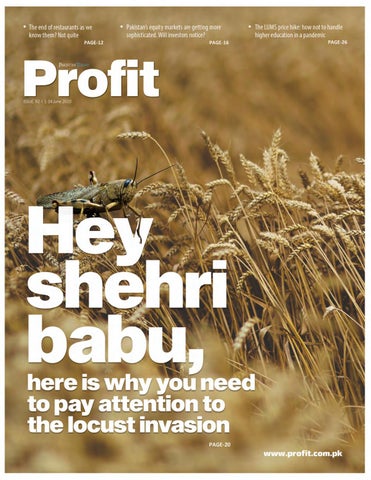
12 The end of restaurants as we know them? Not quite 16 Pakistan’s equity markets are getting more sophisticated. Will investors notice? 20 Hey shehri babu, here is why you need to pay attention to the locust invasion
26
26 The LUMS price hike: how not to handle higher education in a pandemic 30 After Ferozsons, Searle jumps into the remdesivir market 31 Meezan Bank set to benefit from the government’s expansion of Islamic debt issuance
33
33 Name’s matter, even in the stock market Ali Farid Khawaj 35 How to save employment and the unemployed Asif Saad 37 An all you need to know guide for how to reopen large businesses Habibullah Khan
WELCOME
The time for quick fixes at PIA is over There is much about the crash of Flight PK-8308 that we do not know, including the precise cause of the crash. But there is one thing we do know and can say with certainty because the data backs it up: air crashes and safety incidents happen far more frequently on the state-owned Pakistan International Airlines (PIA) that most other airlines around the world. Indeed, according to a 2014 study by FiveThirtyEight, a data-focused news website based in the United States, PIA is among the three worst airlines in the world, among those that have more than 1 trillion seat-kilometres. What is particularly damning is that the other two airlines – Russia’s Aeroflot and Ethiopian Airlines – have been improving over the past two decades. PIA, on the other hand, is the only one with a bad safety record that has gotten worse. Whenever tragedy strikes, such as the flight from Lahore to Karachi shortly before Eid, there is a temptation to blame whoever can be blamed. We will seek to avoid that here, but we will say that this tragedy, and especially the track record of PIA that is behind it, suggests that whatever happens next must include a desire to overhaul the airline as a whole rather than quick fixes that might look appealing but will do nothing to solve the structural problems at the airline.
PIA has been descending into the abyss for close to two decades now, if not longer. And the core problem at the airline is one of accountability: nobody has the incentive to do a good job because they know they can never be fired. Two years ago, we ran a cover story about the turnaround efforts at PIA and concluded – in our headline – that the turnaround was unlikely to happen because what PIA needs is not just better management, but a complete decoupling from the public sector employment regulations that have crippled the ability of successive managers to revive the fortunes of the airline. In our view, the solution will not only require legislation that fully converts PIA into a commercial enterprise rather than a public utility, but also a change in ownership: the government of Pakistan must give up control if the country is to have any chance of fixing this desperately needed piece of infrastructure. Despite the rise of the Gulf airlines, PIA remains Pakistan’s strongest aviation connection to the world beyond our borders. We as a country need it operating effectively if we are to avoid tragedies like last week, and move onto the path towards greater prosperity.
Farooq Tirmizi Managing Editor
Executive Editor: Babar Nizami l Managing Editor: Farooq Tirmizi l Joint Editor: Yousaf Nizami Reporters: Syeda Masooma l Taimoor Hassan l Abdullah Niazi l Meiryum Ali l Hassan Naqvi l Shahab Omer Director Marketing: Zahid Ali l Regional Heads of Marketing: Muddasir Alam (Khi) Zulfiqar Butt (Lhr) l Mudassir Iqbal (Isl) l Layout: Rizwan Ahmad l Photographers: Zubair Mehfooz & Imran Gillani l Publishing Editor: Arif Nizami l Business, Economic & Financial news by 'Pakistan Today' Contact: profit@pakistantoday.com.pk
FROM THE MANAGING EDITOR
8
Readers Say
facebook.com/Profitpk twitter.com/Profitpk linkedin.com/showcase/13251020 profit.com.pk profit@pakistantoday.com
HOW TO CONTACT
10
First of all, these Prudential regulations (PRs) and other instructions and letters issued by SBP from time to time are a major revenue earner for SBP as every year they make heavy income from imposing penalties on all banks over violation of these risk management policies stipulated in PRs. Banks treat guys from SBP as gods and their every word, even from a small manager level person in SBP with less than 3 years experience, is worth in gold and presidents and senior level management of banks even fire their top level employees if that SBP kid raises an objection. SBP’s fear among banks is so much that they don’t even challenge the penalty amount and pay whatever they ask. Everyone in the bank just does their own risk management, as even the President knows that SBP may even fire him so they have no concern about doing the right thing and just follow whatever their gods, the guys over at the SBP, say. This same attitude is witnessed at all management levels of all banks in Pakistan. So forget about any change in banking practice as long as SBP is strictly monitoring these PRs. Onus is on SBP to change its policies. Secondly you forgot a major point that majority of companies in Pakistan do not opt for loans from banks and by choice continue to remain debt free without asking banks to provide services. We are an unbanked economy mainly because of unwillingness to lend from banks, either due to fear of taxes as real income gets exposed, laziness or due to religious beliefs. So the fact that they delay their salaries payment is more to do with their own choice than any issue from banks or SBP. Thirdly and most importantly, delaying salary payments to employees results in substantial savings for every company every month. Time value of money! It is financially beneficial for employers, especially those facing business crunch situations, to delay salary payment even for a single day. So the issue is also about willingness rather than capability. Employers are enjoying this norm as it is beneficial to them at the expense of workers. It’s not just about delaying salary payment, have you ever tried giving a loan to your friend, acquaintance, relative or anyone? Does that person pay back to you on time? Personally at least this never happened whenever I gave any loan as there’s always delays and reminders that need to be sent. It’s a general psyche in Pakistan to find excuses when you owe someone and unfortunately very few honor the commitment within the time. There are many employers with this mindset. Changing banking rules would not result in sudden change in habits of employers to delay the salaries. The link you made between the two is very remote and ludicrous to say the least. Apropos: Your salary does not get paid on time because the State Bank thinks bankers do not know how to do their jobs Anonymous, Website
The article seems to ignore the fact that from where the demand will come? Especially for a city like Karachi where all areas are super expensive and the property prices have gone up so high that they are out of reach of even the middle to upper middle class. Noone kept a check on property prices here which increased by 5-6 times on average from their level in 2010. Forget about DHA, Clifton, PECHS, now even an area like Gulistan e Johar has no 240 yard (little less than 10 marla) house available under 3 crore. This massive historic price speculation conducted by Karachi brokers (backed by provincial Govt) during the period 2010-17 was only possible because of acute shortage of decent housing societies in Karachi. In comparison, in Lahore everywhere you look around there are 100s of nice societies where you can find a plot and build a decent livable house. In Karachi there is only one location (namely DHA phase 8) where you can find a plot that is not outside the city limits. So obviously this artificial shortage led to massive price increases. With the doubling of property prices in DHA and Clifton after every 1-2 years, the property prices in remaining localities like PECHS, Gulshan, Johar etc just followed automatically as people didn't have any choice. There is no one to address this as all the elite classes benefited massively from the game that was played during 201-2017 in Karachi property as their personal properties went up by 1 crore every year. The ironic thing is that almost half of Karachi city area is barren. Instead of remote locations on superhighway where Bahria or DHA City was launched, the area on the west of Native Jetty (Tower) bridge till Hawksbay and beyond can easily be utilized to develop planned housing societies which are also not far from main city and just a 15 minute drive from there will take you to the financial hub. We are wasting such a beautiful naturally available coastal area from Sandspit till Gadani only due to Govt inefficiency. The biggest housing crisis and shortage is in Karachi, but the prices are so high that any scheme won’t work here. There is no use of this Naya Pakistan scheme launched in other cities like Lahore where there is already plenty of supply available at reasonable prices. Karachi property prices on average are double the level of Lahore prices even when the latter is much better in terms of living standards like cleanliness, greenery, road network and utilities infrastructure. It’s a shame everyone talks about housing crises but ignores Karachi.Apropos: This company wants to give your bank money…so it can pay for your house. But are the banks even interested? Anonymous, Website
COMMENTS
IN BRIEF No end in sight: locusts are likely to cause a loss of
Rs 800
billion in agriculture produce this year. In response, the National Disaster Management Authority has started a hotline to register locust complaints, and arranged for nine planes for anti-locust aerial spraying. Last Friday, PK-8303 from Lahore crashed into a residential neighbourhood when trying to land at Karachi’s Jinnah International Airport, killing 97 of the 99 people on board. An 11-member team from Airbus has arrived in Pakistan to help in the investigation.
“The world has seen many crises over the past 30 years, including the Global Financial Crisis of 2007-09. Each has hit human development hard but, overall, development gains accrued globally year-on-year. COVID-19 – with its triple hit to health, education, and income – may change this trend.” Achim Steiner, head of the United Nations Development Programme (UNDP)
“Twitter has now shown that everything we have been saying about them (and their other compatriots) is correct. Big action to follow!” US President Donald Trump. In a separate tweet, the president threatened to strongly regulate or even close Twitter.
Music streaming platform Patari appointed Zarlasht Faisal as the new CEO of the company, almost two years after Patari’s co-founder and CEO Khalid Bajwa resigned on harassment allegations. The appointment faced criticism online, after allegations of nepotism; however Rabeel Warraich, the main investor in Patari, denied the allegations.
Pakistan’s total number of Covid-19 infections have surpassed 60,000. Of that figure, 19,142 have recovered, while the national death toll is at 1,239. The first case in Pakistan was reported on February 26.
Pakistan’s current account deficit in April 2020 stood at
$572
million, a decline of 51% when compared to the
$1.165
billion deficit recorded in April 2019, according to the latest data released by the State Bank of Pakistan. According to reports, Pakistanis spent
Rs 560
billion this year during Eid holidays, compared to the roughly Rs800 billion spent last year, and the Rs1.1 trillion spent in 2018.
This dam is still in the news? A joint venture led by the National Engineering Services Pakistan (NESPAK) won the consultancy contract for the Diamer Bhasha dam project. The other companies are Associated Consulting Engineers and MM Pakistan, both from Pakistan; AFRY from Switzerland, Stantec from the US; and Dolsar Engineering from Turkey.
11
By Shahab Omar Of all the long list of businesses and industries affected by the Covid-19 pandemic, one of the industries most disastrously affected have been restaurants. The food end of the hospitality industry has been hit particularly because of how integral tight spaces and mingling is to them. They are the opposite of social distancing, and even in countries like Pakistan where lockdowns have been eased, restaurants have not been allowed to open more than their limited take-away and delivery services. Stakeholders and wage earners in the industry generally believe that restauranteering has generally been unable to
12
establish roots in Pakistan, and has also stayed away from government attention and has escaped the net of economic relief measures. This has resulted in the job insecurity of the people associated with this sector. And with circumstances changing with every passing day, and no way to predict where this pandemic will go or when it will end, the entire restaurant industry and the supply chain associated with it has been reeling. Workers continue to lose jobs and restaurants that owners have spent a lifetime working towards are going under in a matter of days. With such a morbid situation on hand, the industry has had to cling on the
lifeline of delivery and takeaway. Luckily enough, the World Health Organization (WHO) and other research has shown that the chances of contracting the virus through such food services is negligible. Even more importantly, the little risk there is has been minimised by contactless delivery and delivery services that have improved and tweaked their models in accordance with new realities. But where exactly does the industry stand? Despite the lifeline, they are continuing to bleed into the ground with no help in sight. Do restaurant owners think they can open, or perhaps even have some innovative ideas on how to do so? Profit takes a look at the state of the industry.
Divided industry opinions
T
here are no surprises that the industry, like most industries, is split on this important decision. On one side are those that want to reopen restaurants. On the surface, they sound reckless. Restaurants are places that are crammed, sanitisation is difficult and people may not want to go not just because of the risks, but also because of the diminished experience that enhanced social distancing standard operating procedures would cause. But the crunch is hard enough for them to want the government to relent. And they have a point: the same concerns are true for public transport and malls, but the government has allowed them to function with impunity. In fact, if precedent is anything to go by, the restaurant industry could possibly go to the courts and demand they be allowed to open just like the shopping malls were allowed to open. The judicial logic stands firm, and with the highest court in the land ruling on it, they have little to fear. In fact, they may not even have to go to court themselves, so active and concerned are our berobed heroes that they may take notice of restaurants not being open and open them all over the country, and then perhaps even direct the public to frequent them at pains of being held in contempt. The other side seems more sensible, not just because they are following scientific regulations with their stance, but also because they make more business sense and are more savvy than panicked in this situation. These restaurateurs are of the view that the restaurants should not be opened during the time of pandemic as it would be of no use. In fact, it could very well be counter productive. The fact of the matter is, if the government does open restaurants, they will not just be hubs of disease, but also unpleasant to go to. Running in and out of disinfectant gates, wearing masks and sanitizing are not activities people want to do during a dining experience. So not only will the turnout probably be
“People cooking from home and selling their food are not cloud kitchens, I must point this out. We are working on our own cloud kitchen brand and we will open it after Eid. In my opinion it is the future now,” Abdul Moeed, owner Wasabi low, the cost of maintaining social distancing and enhanced disinfecting protocols will also have an effect. People will continue to order more, and the extra investment in this will have to continue even as the cost to keep the doors of the establishment open make owners sweat. Moreover, if even a single employee tests positive, that means a catastrophic break in operations. This faction goes so far as to suggest that the government should not allow the opening of any kind of restaurants until they overcome the pandemic. And short of a patriotic court order forcing them to open, they are ready to stand by their stance. People from the food sector and associated with the restaurants are also of the opinion that the restaurateurs are not seen on the same page like other industries and businessmen and that was one of the reasons why this industry could not get on to negotiations with the government for getting the restaurants opened. One prominent figure who is a presence in the food industry is Asad Sheikh, the founder of Foodies R Us Facebook group, who told Profit that there was still a lingering fear factor there in the idea of opening restaurants. “We are again seeing tweets and hearing people say that the lockdown might get extended. There is
“We are not considered as an industry by the government. I am sitting at a place which was once the busiest in Lahore, now it is completely empty. To meet the daily needs financially and to support the employees working here the restaurants should be opened” Abrar Hussain, owner Cooco’s Den
a major fear, what if we open up the restaurants, call back our staff, most of whom have gone to their native towns, and suddenly again the government announces to close the restaurants?” he questions. “We will have to manage a great deal under such conditions.” Meanwhile, on an individual level, those that are demanding restaurants open make a compelling emotional argument, this is their lives and their work. One of them is the owner of Lahore’s famous ‘Cooco’s Den’ on Fort Road Food Street, Abrar Hussain, was of the opinion that the restaurants should be opened like other industries. “We are not considered as an industry by the government. I am sitting at a place which was once the busiest in Lahore, now it is completely empty. To meet the daily needs financially and to support the employees working here the restaurants should be opened.”
How far have deliveries got us covered?
A
sad Sheikh agreed that some of the restaurant owners were desperate to open up the restaurants. “Most of them have started the home delivery service, but that is only 10–15% of the restaurant’s revenue. Obviously these people have to pay the landlords and other commercial utility bills. Under the prevailing conditions, some landlords are flexible while some are not, and thus the restaurateurs have to deal with them as well,” he tells us. “Only 2-3% of the restaurants have their own buildings. The rest of them are all in rented spaces as this business is done in this manner. Moreover, the owners have to pay salaries to the staff they have retained and also to the vendors.” Shahzad Khokhar, the owner of Café Zouk, said that home delivery is not the solution. “There are big dine in set ups for restaurants and for home delivery there is just one kitchen needed. We opened our kitchen
DINING OUT
only for home delivery and received a huge electricity bill and gas bill. So that’s not the solution.” Khokhar said that he was not dealing with Foodpanda. “They charge 25-30% commission. We are left with nothing if we give it to them, so for delivery purposes we have hired our own riders. Foodpanda is not worth it. Before all this, almost a year or two ago, they were not charging us anything but now they demanded commission. We cannot be compared with the international restaurants or chains who can afford them.” Meanwhile, Abdul Moeed, the owner of the Japanese restaurant Wasabi, said that home delivery was of no use. “Expenses are there but the sale is not open. When we deliver food, we have to call the staff, open the kitchen etc and the expenses remain there. We also have to pay the landlord even during the closure we have been receiving electricity bills up to Rs200,000. Foodpanda has been associated with my restaurant for a long time and we do give them commissions. When we open our cloud kitchen, we will be partnering with Foodpanda and they might give us a kitchen as well.” Abrar Hussain said that the delivery services like Foodpanda and others were not providing service in the walled city locality of Lahore. “They do not take orders from us in routine and moreover, they demand a lot of commission. If we pay them 20-25%, what are we left with later?’
Cloud kitchens the new reality?
A
s Moeed was explaining, perhaps the new groove that restaurants will settle into are cloud kitchens.This model can be a number of things, including having coworking kitchen spaces that cost less and avoid incurring costs such as rent and utilities. A cloud kitchen is primarily a restaurant kitchen that accepts incoming orders only through online ordering systems and offers no dine-in facility. They have a base kitchen that delivers food to the customers’ doorstep. What is interesting about this is that cloud kitchens have been a pre-pandemic concept. In fact, internationally, in 2018 consumers spent $10.2 billion on delivery services. This was an increase of 42% from the previous year. And considering the kind of world we will inhabit after the pandemic is over will be very different from the one we remember, investing in cloud kitchens may not be the worst idea around. Food bloggers such as Sonal Mishra have been saying for a long time that restaurants that do away with brick and mortar locations and focus only on takeaways will be the ones
14
“A vast majority of the people in this industry are running their business on a monthly basis. No one has earned millions or billions from which they can meet their expenses” Asad Sheikh, founder ‘Foodies R US’ to succeed, especially since restaurant experts unanimously predict the future as being delivery-oriented and there are several studies to support this claim. In Pakistan, the concept has had a mixed reception amid the current pandemic from those already in the business and used to brick and mortar restaurants. Moeed was of the opinion that cloud kitchens are cheaper since there is no staff needed, and no set up like Foodpanda is required either. “People cooking from home and selling their food are not cloud kitchens, I must point this out. We are working on our own cloud kitchen brand and we will open it after Eid. In my opinion it is the future now,” he said. Others were more sceptical, with Khokhar saying that cloud kitchens were not very well established, and it was hard pushing something like this in uncertain times. “Small scale food entrepreneurs are already doing this. Whoever knows how to cook a half decent meal has started an online food service from home without owning any restaurant or dine in set up. Ambiance and dine-in is a completely different experience that cannot be done away with,” he said.
Abrar Hussain was also strongly opposed to the concept, and he would be since his particular restaurant is all about the location and the experience. “People come to my restaurant for the beautiful scenic view of Badshahi Mosque and Lahore fort. These views and dine out experience on rooftops cannot be provided in a cloud restaurant. This is the work of people who happen to learn good cooking and then make a facebook page and sell their food to offices and houses. We have invested so much in ambiance and décor that we cannot move to a cloud restaurant or kitchen.” Meanwhile, for those that are running cloud kitchens already, things are going well. They have been affected too, even though they are in the ‘home cooks’ category that all of the restaurant owners seem to vehemently deride. One such person is Afshan Khalid, who runs a cloud kitchen out of her home in DHA.
“I have been running this business for two years now. A cloud kitchen is a restaurant or a kitchen that accepts orders only through online ordering systems and offers no dine-in facility. I started cooking at home and through facebook and word of mouth I managed to get good customers for my dishes,” she explains to us. “I did not face much problem during the lockdown because I have my son delivering the food on a bike to different houses in the locality. Yes, the loss was when the offices were also closed, but I still managed it. I think people should move to this trend as it needs no investment for dining set up or ambiance and one can also earn.”
Can’t the restaurant industry throw around its weight?
O
ne of the problems is that the restaurant industry does not seem to have any tangible lobby around to fight for its causes and concerns. There is a loose association headed by Kamran Sheikh which did meet with the government according to Khokhar, but little came of it. “We met the provincial government and Aleem Khan as well and proposed the opening of the restaurants. They are thinking it over but have not given us any solid response up until now. Let us see what they come up with,” he told Profit. Meanwhile the owner of Wasabi, Moeed, said that the government may open restaurants after Eid. “We did meet the ministers. They are saying to open the restaurants after Eid so let’s hope for the best. But the government is of the opinion that allowing deliveries has been enough relief as it is for restaurants. Abrar Hussain also feels a lack of cohesion within the industry, saying industry realities mean there cannot be a healthy lobby or grouping among the restaurant owners like they have in textile or other sectors. “If I talk about the restaurants in my area, there is a lot of competition and people are usually leg pullers. Every restaurant owner works for his own interest and there are very few occasions where I have seen unity among all.” Not only do these restaurants not have a strong lobby, another problem is that their owners are usually living month to month and have not made huge sums of money to keep them afloat. “A vast majority of the people in this industry are running their business on a monthly basis. No one has earned millions or billions from which they can meet their expenses,” Asad Sheikh explains to us. The sentiment is resonated by the others. “Do not compare us with chains like McDonald’s or others. We are working on a month to month basis and paying huge bills,”
“Foodpanda charges 25 to 30% commission. We are left with nothing if we give it to them, so for delivery purposes we have hired our own riders. Foodpanda is not worth it” Shahzad Khokhar, owner Cafe Zouk
Khokhar tells us. “There is an impression that we are from a very affluent class and that is why we are running this business. But this is not true for most owners, let alone the staff that actually runs the place.” “People think that it is a money making business and belongs to the rich but they do not know the backend expenses of this business,” says Moeed. “A lot of investors come into this business thinking they will make an easy buck without any know how of this industry. Almost 90% of the restaurants were working from rented buildings and did not own the property. Even those 10% who have their own property include the rent of their building in their expenses.” Abrar Hussain reflected the same, saying it was a misconception that the restaurant owners are rich. “I own this Haveli in which we opened the restaurant and that is my only saving. I don’t have a landlord to whom I have to pay the rent, but on the other hand, I am still paying the bills. I used to meet my daily expenses from the sale of the restaurant, and none of us on the food street has earned millions that can be used during this time.”
What are the demands?
O
ne thing is clear and has everyone in consensus, there needs to be some form of assistance from the government to the industry. Asad Sheikh suggested that the government give special packages for them as they did for textile or other industries. “There should be some package for this industry as well. The hospitality business is among the top five industries when it comes to employment, and in case this industry faces a loss, there will be a lot of unemployment in the country.” Asad Sheikh was of the view that in case the government allows the opening of
restaurants it would be under strict SOPs. “There will be a limit to the number of persons in a restaurant, usage of sanitizers, keeping the place clean, wearing of masks etc. SOPs for restaurants would be very strict if applied and incase of violation the government would surely impose heavy fines.” Khokhar was distressed that so far the government had not declared the restaurants as an industry, which they very much should. “The government has no realization of this industry. This is a serious industry and the staff working in restaurants is becoming jobless because there is no earning of the restaurant. How can we pay them as there are not much back up funds as well? We have met Aleem Khan and asked him to give us a status of industry. Only the business and industry of the rich has been opened like construction, textile, transport etc.” Another suggestion has been that landlords be told to lay off taking rent for the time that the pandemic is going on and the government has forced closure. The logic being that since the government has imposed the lockdown, even if for the public good and public health, it becomes incumbent on the government to either pay their rent or make sure landlords do not demand rents. “When these restaurants are opened with SOPs by the government and if the capacity is to be decreased by 50%, then how would these expenses be met?” Khokhar asks. “The landlords would not understand this and charge the complete rent. The bills will remain the same. The Sindh government did give relief by passing a law that rent up to three million will be reduced to 50% and no tenant will be moved out of the building till the further orders of Sindh government. Similar acts should be made by the Punjab government as well. In Punjab, the buildings are owned by the politicians and thus the monopoly remains there and that is why no such step is being taken up by the Punjab Government.”n
DINING OUT
Meiryum Ali and Syeda Masooma
M
arch 24 should have technically been a good day for the Pakistan Stock Exchange. Right after Pakistan Day, the PSX was finally launching two exchange-traded funds (ETFs), after much hand wringing and regulatory delay for the last four months. Never mind that talks for ETFs had been ongoing since at least 2018. Instead, on what should have been a good PR day, the launch was converted into a virtual launch. The provincial government of Sindh had imposed a 14-day lockdown on March 22, with a curfew imposed in Karachi from 8pm to 8am, owing to the coronavirus pandemic. The PSX spent that week scrambling to reduce footfall at the office, but also
16
make sure that the exchange could continue to function and – at all costs – stay open. Farrukh Khan, the CEO of PSX, had been there to witness the mayhem that followed when the exchange closed in 2008. He was determined that under him, the PSX would not repeat the same mistake twice. If the New York Stock Exchange could stay open in the covid-19 pandemic, then there was nothing stopping PSX. Determined to keep this image of the exchange afloat, he even spoke to Profit for an interview that same week, as if this was a regular PR exercise, as if the very financial world was not on the verge of crumbling in Pakistan. Though in a sense, if one listens to Khan, it is not. This covid-19 blip will pass, and then the PSX will be forced to reckon with what it has always had to deal with: growing the number of investors, growing the number of listed companies, and nudging the exchange towards
international best practises. Indeed, both the PSX and the capital markets’ regulator – the Securities and Exchanges Commission of Pakistan (SECP) – have continued to work through the pandemic to help make Pakistan’s markets more secure for investors and with a wider, more sophisticated array of products to help incentivise more individuals to utilise the stock market as the vehicle for growing their savings. The goal appears to be some version of “build it and they will come”, a business aphorism derived from the 1989 movie Field of Dreams. Essentially, the regulator and the market operator are both hoping that if they build a good enough market for investors, eventually Pakistan’s abysmal market participation rates will start rising. It may well be a good strategy, but one that may take some time before it bears fruit.
“We want to make sure that the credibility of the market is intact, that the demutualization carries on – both here and all over the world. There is also the issue of both a real and perceived conflict of interest. Previously, the brokers who are dealing with the exchange were also owners of the exchange. We are trying to now prove that there is a fair playing field. All exchanges have gone through demutualization and have segregated the brokerage role and exchange ownership” Farrukh Khan, CEO of the Pakistan Stock Exchange
The scale of the problem
B
ut first, a review of the current situation. Just how bad are market participation levels in Pakistan? Pretty bad, from even a cursory look at the data. There are just under 244,000 people in Pakistan who have a capital markets account of any kind, according to data from the Central Depository Company (CDC), which amounts to just about 0.11% of the total population. This compares to 0.81% even in comparable economies like Bangladesh. The number for India is 4.5%, and it is a significantly higher 62% in more sophisticated markets like the United States, according to data compiled by Elphinstone, a securities advisory company. The comparison with Bangladesh is made especially surprising by the fact that the Karachi Stock Exchange, the largest predecessor of the Pakistan Stock Exchange, was founded in 1949, a full five years before the Dhaka Stock Exchange, which was founded in 1954. Incidentally, one of the first listed companies on the exchange, the Karachi Electric Supply Company, is still listed on the PSX as K-Electric. So why exactly is the situation so bad in Pakistan? Why are Pakistanis so uniquely unwilling to invest in the capital markets? The reason has absolutely nothing to do with Pakistani stocks as an asset class. Stock market investing in Pakistan – over a longterm horizon – is actually a great investment. On January 1, 1999, if you had Rs10,000 in your pocket, and you invested that money in a variety of different investment options, here is where it would stand today. To purchase the same amount of goods and services as your could with Rs10,000 in 1999, you would need Rs43,176 today, meaning any investment that you made back then that did not result in you
having at least that much money today lost you money. So here is how the investment options stack up: if you simply bought US dollars with that money, you would have Rs31,827 today. If you bought gold, you would have Rs157,254; if you had bought bonds, you would have Rs75,109. But if you had bought stocks, you would have had Rs355,956. There is, quite simply, no beating the stock market as a venue for investment for ordinary investors. (Of course, this assumes you had the discipline to stay invested and not try to cash out your money in a panic during the stock market crash of 2008 and the many mini-crashes in the middle. Investing of any kind requires self-discipline.) So, if it is such a great asset class, why do more people not invest? For that, there are multiple reasons, at least according to the person in charge of running the market. “That’s a loss that really lies with our predecessor, the Karachi Stock Exchange,” said Farrukh Khan, the Pakistan Stock Ex-
change CEO. “We are certainly [one of] the oldest exchanges in Asia. Many of the other exchanges in Asia were only started in the last two decades. The PSX has not really developed as these other younger exchange exchanges. We’ve had issues with demand and supply, demand meaning the investors and supply meaning the listings.” Beyond just the supply and demand issues were those of the nature of the exchange itself. “We want to make sure that the credibility of the market is intact, that the demutualization carries on – both here and all over the world. There is also the issue of both a real and perceived conflict of interest. Previously, the brokers who are dealing with the exchange were also owners of the exchange. We are trying to now prove that there is a fair playing field. All exchanges have gone through demutualization and have segregated the brokerage role and exchange ownership.” But the bigger, more immediate problem, is the fact that Pakistan’s financial services industry – particularly the non-banking financial
CAPITAL MARKETS
companies (NBFC) sector – is relatively underdeveloped. “No exchange develops in isolation. Most investors actually come through three industries: pension funds, mutual funds and life insurance. All three industries have not grown in the last few years,” said Farrukh. “Individual investors – unless they have knowledge or expertise, they will lose money – they often come through these industries. Historically the rules regulating the mutual funds industry were very strict, and only in the 90s and 2000s has it grown. Life insurance – we have some of the largest life insurance companies in Asia, like State Life, but they have not grown in the last decade. There is a growing pension sector, both private, and through the government,” he said. Given that level of underdevelopment, what exactly does the market and the regulator plan to do to help increase participation from reticent investors? Three things, mainly: better regulations for financial services providers, more streamlined legal requirements for ordinary investors, and more products to invest in.
The SECP’s attempts to help the market develop
F
or its part, the SECP is working on two fronts. Firstly, it is seeking to create a regulatory regime that allows for a wide range of non-banking financial services companies to exist in the market and offer a variety of services to customers in the hopes that they will lead to more people choosing to invest their money in the capital
18
markets. Secondly, it is tightening the regulation around those companies in order to help create more confidence among current and prospective investors that the SECP will crack down on fraud and malfeasance by financial institutions. Towards the first goal, the SECP has been creating different classes of NBFCs, each of which is regulated under different standards, with varying degrees of scrutiny involved in the granting of licences. In general, the SECP appears to be tightening requirements for licencing, in particular for individuals who interact with the consumer. For instance, the SECP has created the Institute of Financial Markets of Pakistan (IFMP), which is now responsible for administering licencing exams for all personnel at NBFCs who deal directly with customers so as to ensure that there is a relatively consistent level of professionalism and education among those dispensing investment advice to the public. IFMP is modeled along the lines of the Financial Institutions Regulatory Authority (FINRA) in the United States, which is charged with the task of administering examinations and professional standards for a wide range of investment professionals in that market.
The latest regulatory changes have come together in a legislative proposal from the SECP called the 2020 Non-Banking Finance Companies and Collective Investment Vehicles Bill, proposed for consideration by Parliament. This bill appears focused largely on granting the SECP more authority to prosecute and punish bad behaviour by financial services companies. More specifically, it creates severe financial and criminal penalties for operating an NBFC without authorisation from the SECP. Among the penalties created are punishments including “imprisonment of either description which may extend to seven years or fine, which may extend to Rs100 million rupees, or where contravention resulted in substantial loss to other person or resulted in pecuniary gain to the person who committed the offence, to a fine which may extend to Rs100 million or twice the amount of loss caused or gain made whichever is higher or with both”. But the SECP’s enforcement powers would go beyond just the ability to fine companies for bad behaviour or to seek the imprisonment of executives who are responsible for wrongdoing. The SECP would have clearer powers to shut down entire companies if their behaviour was egregious enough to justify a complete removal of the entire company from the market as a participant. The goal of both of these changes is to help investors gain more confidence that, while the SECP will not guarantee that their investments will be profitable, it will ensure that they are not defrauded out of their hardearned money by illicit means deployed by bent investment professionals. But it is not just about adding regulations. In some cases, the SECP is also relaxing regulations that have been seen by market participants as overly cumbersome, most notably the sign-up process for new clients of brokerage firms and investment banks. “The challenge, which still remains, is that account opening is cumbersome,” acknowledges Farrukh. “The FATF has some concerns, they have these KYC [know-yourclient] requirements. This is rigorous and cumbersome. Then you have to have a specific bank account with a fund requirement.”
He is referring to the Financial Action Task Force, a global intergovernmental body that is assigned the responsibility for cracking down on global money laundering and terrorism financing. Pakistan has been on the grey list of the FATF for the last two years, and has been threatened with being placed on the black list unless financial institutions in the country do more to crack down on money laundering and terrorism financing. This, of course, makes it difficult for financial institutions to reduce the paperwork requirements for new customers. However, companies are working on the process. “So we are in discussion to make it easier – [the account opening form] is currently 14-15 pages long. The SECP has accepted biometric scanning (to open an account), which they were testing before corona. We are trying to get that in order. So instead of physically opening a brokerage account you can open it online. It’s difficult to give a timeline on this process, it depends on SECP and NADRA [National Database and Registration Authority],” said Farrukh.
New products
A
mong the biggest developments that has taken place over the past year in Pakistan’s capital markets is the introduction of ETFs being traded on the PSX. Farrukh Khan explained the goal and the implications of having this product available to investors in Pakistan. “This is the first product in many years for the PSX. And this is a very significant product for the PSX. Globally, there are about 8,000 ETFs with assets under management of $7 trillion. It really is an essential for a stock
market, for capital markets to have. There are also many different types of ETFs – fixed income products as well as equity.” He explained why it had taken quite some time for the PSX to finally launch ETFs, especially since it had first been floated as an idea by the previous PSX CEO, Richard Morin, the Canadian investment professional who became the first non-Pakistani to run the Karachi bourse, which he did during his tenure from January 2018 through May 2019. “There are various reasons for the delay. The exchange over the last few years has changed quite a bit. It [the Karachi exchange] used to be an exchange that was owned by its members, like other global stock exchanges such as the London Stock Exchange. Then all the exchanges – Karachi, Lahore and Islamabad – were consolidated to make one, more like other Asian stock exchanges. It became a demutualised corporate entity, instead of a mutualised exchange. Then the exchange has a large number of Chinese investors. That’s brought in new products and new innovation, and brought in new trading systems.” But Farrukh’s approach appears to be better late than never. “We are here now, with our soft launch of the ETFs. We have seen a lot of interest from other asset management companies for more ETFs. I am sure that this will grow as a segment of the capital market, since it combines tradability of an
investment feature, but also like a mutual fund gives a lot of diversified exposure to the market, and is very easy to buy and sell.”
Keeping the exchange open during the pandemic
A
key goal of the current management has been to ensure that people are able to access their stock market investments even during the pandemic, a task easier said than done. “The PSX has been functioning normally for the last couple of weeks. As soon as I joined, I spent a lot of time in anticipation of this virus deteriorating. We used to have a footfall of 200 people in the exchange office. But since the lockdown, we’ve gotten most people working from home. No one can tell from the outside,” said Farrukh, with a laugh. “There were some technical issues when the lock down was announced,” he said. “We needed to make instant recoveries. We also had to coordinate with exchange and brokers, to have fewer footfall in the market. For the PSX to work and function properly, you need about 200 people. We brought that down to 20 people, which is the kind of footfall reduction you need. Because of the virus, and its socialised aspect, it is critical to take care of employees. We also had to manage the technical and functional challenges, for our companies, for brokers, for investors.” Farrukh’s experiences from 2008 taught him that keeping the exchange open so that people could continue to access their money would be a crucial task for the PSX management during the pandemic. “It’s not just the banks that are open, the PSX is an essential service. Every country’s exchanges are working, there’s no reason for us to be an exception. We closed the market in 2008, and that was a disastrous step, which hurt the confidence of the market. We haven’t fully recovered from that disaster.” “In 2008 I was a member of the exchange and when the meeting was held [about whether it should be shut] I was one of the few who said no. Now people tell me they wished they had listened to me,” he said. n
CAPITAL MARKETS
20
AGRICULTURE
By Hassan Naqvi
B
ack in February, Profit had done a feature on the swarms of locusts laying waste to entire yields of crops and threatening Pakistan's food security. The problem had seemed a biblical one, but now seems fitting for the year 2020 as it is shaping up. The focal point of our story back then was Ghulam Abbas Nabi, a small time farmer of Mirwah Thari in Sindh. The swarms of locusts that had arrived left Nabi with nothing. His voice had cracked with emotion during the interview. Every reporter hopes deep down while covering a horrific event, that they will be able to return to the scene of the tragedy after some time and do a follow-up full of hope and good news of people fighting back against adversity and getting back up on their feet and prospering. So when the locusts attacked parts of Sindh, Khyber Pakhtunkhwa, Balochistan and Punjab, it was with apprehension that we reached out to Ghulam Abbas Nabi again, worried over a second wave of devastation hitting him and his livelihood. But instead of Ghulam Abbas, the phone was attended by his daughter, Abeera, who promptly informed us her father had died of a heart attack in March, the stress of his lost crops and inability to provide for his family taking a heavier toll on his weary shoulders than they could carry. “The swarm had left a visible toll on our 46-acre farm, and Baba’s health deteriorated with it,” she says. Through choked tears she tells us that the swarm of locusts had spared a second attack in their area, but this is probably because the disastrous effects of the attack back in February have still not disappeared from Ghulam Abbas’ farm. Without Ghulam Abbas to run the farm and the general financial crunch caused by the pandemic, Abeera, says she will not be able to continue her education at the Mehran University after educational institutions are opened once again. Abeera, her family, and her dead father are only one such farm that has left entire households uprooted because of these swarms. Wherever the locusts descend, they leave a trail
of death, destruction and poverty. And with the locusts on the rise once more, many are expected to suffer, not to mention the threat to food security that they may pose. But the locusts attacking is not new news. Pakistan has been under the attack of locusts since June 2019, when the miles long swarms invaded Balochistan from Iran, and after leaving half eaten up tree trucks and barren orchards in district after district, landed in Sindh and did the same before marching onwards to Punjab and Khyber Pakhtunkhwa. While the provincial governments are banking on their ill-equipped and ill-trained district agriculture departments and farmers to cope with this wave of destruction, there seems to be no discussion at the national level on the locusts attack.
What will be most affected
U
p until now, the swarm of locusts that have attacked crops have damaged cotton, wheat, mango and other green crops across the country at a large scale, which is estimated to cause more than Rs800 billion in losses to our agriculture produce. Not only are farmers suffering on a small scale because of the worst such attack in decades, there are also fears of long-term food shortage in the country because of this. The swarms of locusts have attacked mango and cotton belt areas of Punjab including Multan, Shujaabad, Muzaffargarh, Bahawalnagar, Jhang, Kot Addu, Layyah and Rojhan.and other areas. While it also attacked and damaged cotton, mango and other farms in Balochistan, KP and Sindh. Abdul Ghaffar Orakzai, who cultivated cotton along with wheat, onion, chilli and tomatoes said that it is not just cotton that the swarms of locusts have eaten and destroyed: they have attacked his other crops too. “I am completely broke now and have no other source of income,” says Orakzai. A cotton expert said that swarms of locusts attacking the country's cotton crop is a huge blow since Pakistan was already missing its cotton production target by 7 million bales
“I can’t say aerial spraying can cull completely the hatching hoppers. Still, some action is better than no action at all. Our bad luck is that the weather conditions from March to May are perfect for this pest army to grow and feed on our crops” Iqbal Shahid Quershi, Okara Agriculture Deputy Director (Plant Protection)
22
last year. In such a situation, it is a decisive blow to the country’s cotton crop which is likely to impact the country’s textile and cotton goods exports. Agreeing with Orakzai, Shabbir Hussain, a mango fruit farm owner, who is famous for growing mangoes for decades in the Multan region said that this year, all of his mangoes grown on his 100-acre farm are being eaten up and completely destroyed by the swarms of locusts.“Of course, it is the helpless farmer, who bears the brunt of the locusts attack directly,” says Nasir Almani, a former union council nazim and farmer from Muzaffargarh. “Indirectly, masses at a large scale also suffer in the shape of food shortage. A locust attack is not a matter of attack on a farm alone, it is an attack on the whole country.” He says mainstream politicians and national media do not talk about the locust plague because rural and agricultural issues have never been our priority. “Look, when dengue breaks out in a city like Lahore, it becomes a national issue, but when farms are inundated in seasonal river flooding no one bats an eye. It is the same attitude now that these locusts are destroying our crops. But mark my words, this will turn into a bigger problem and will have to become a national issue.” Politically, the response has been lukewarm to this looming crisis. One voice was former federal minister Sardar Awais Ahmad Khan Leghari, who took to social media to estimate that the swarms of locusts attack was likely to cause Rs800 billion loss to our agriculture produce this year and this would be due to incometent and lethargic government which has failed to carryout ariel spray effectively. However, even his voice comes more as a concerned farmer, since he is a large landowner, rather than from a purely political point of view. Perhaps the only politician in the entire country seeking a national level response to this crisis is Pakistan People’s Party (PPP) Chairperson Bilawal Bhutto Zardari. He has pleaded a number of times for the implementation of a National Action Plan for Surveillance and Control of Desert Locust in Pakistan to
“Any delay in the implementation of NAP decided at a meeting between the Federal and Sindh government would mount great danger to agriculture as well as the economy” Bilawal Bhutto Zardari, Chairman Pakistan People’s Party
stem the tide of the drones of locusts before they become an uncontrolled invader. “Any delay in the implementation of NAP decided at a meeting between the Federal and Sindh government would mount great danger to agriculture as well as the economy,” said the PPP chairman in a statement. Citing a United Nations’ Food and Agriculture Organization (FAO) report, Thomson Reuter Foundation reported the Pakistan economy may suffer a whopping Rs800 billion loss altogether in summer crops (like cotton, sugarcane and rice besides fruit and vegetables) and winter crops (like wheat and potatoes). The economy already reeling from the coronavirus pandemic related complications may not be able to survive the locusts blow. “Imagine when the flour price goes up by 100% and sugar 50%, what will be the reaction of the public? Will it take things getting that bad for them to pay any attention to this,” says Nasir Almani.
Origins of the swarms
D
r Muhammad Uzair Mukhtar, who holds a PhD in entomology and molecular biology, says the government did not take the invasion of the pest army seriously, and now farmers may have to live longer with the most dangerous pest. He says when the first swarm entered Pakistan in 2019, it laid eggs all over the place, and now hundreds of billions of hoppers may be ready to fly and soon perch on a green tree or plant to gorge on. Despite how lazy the government has been on this, he says that even now it is not too late to target hatcheries as well as the adult locusts attacking crops. “Time is running out, and we have hardly two to three months to complete the task,” he says. He cited the example of south Punjab districts Rahim Yar Khan and Rajanpur and
central Punjab districts Okara, Sahiwal and Khushab where he himself spotted these hatcheries. In Dipalur tehsil of Okara district, he said, 7,203 acres in riverside along the River Sutlej, locusts eggs were identified and destroyed in March and April. Dr Uzair, who is working with a Chinese university, worked with the Agriculture Department as a volunteer helping the officials to track the hatcheries in Punjab districts. “I can’t say aerial spraying can cull completely the hatching hoppers. Still, some action is better than no action at all. The biggest problem is the rapid growth of nymphs who are ready to fly within three to four weeks from nymph to adult flyer. Our bad luck is that the weather conditions from March to May are perfect for this pest army to grow and feed on our crops,” he explains. Iqbal Shahid Qureshi, Okara Agriculture Deputy Director for Plant Protection, sees impending danger to this year’s maize, cotton, fodder, rice, vegetables and orchards from locusts this year. Districts like Rahimyar Khan, Bahawalpur, Bahawalnagar, Muzaffargarh, Lodhran, Layyah, Dera Ghazi Khan, Mianwali and Toba Tek Singh are currently under the locust attack. According to Dr Qureshi, these swarms flew from Indian Rajasthan desert into Pakistan’s bordering districts like Bahawalpur, Bahawalnagar and Pakpattan in Punjab for their onward flight to Toba Tek Singh, Vehari, Khanewal, and other districts. It means across Pakistan, locusts will spread their eggs one more time. The pest breeds once in spring and once in the monsoon. According to experts, locusts lay eggs on desert-like moisture ground and mud. “The fresh swarm is here on an egg laying tour besides eating up the green plants coming their way,” says Dr Uzair. He says thanks to the negligence of the government, we cannot say for sure that we
have any swath of treated land which is free from the pest. The danger of the flight of the first wave of swarms is going to be ready now while a second wave will grow from hoppers to the young adult stage by June. The United Nations Food and Agriculture Organization (FAO) also sees abnormal weather patterns in Pakistan behind the migration of the swarm from African countries to Pakistan and India. In 2019, the country witnessed unprecedented rains causing feast-to-eye vegetation in Tharparkar and Cholistan deserts. But this turned into locusts’ breeding ground too, FAO locust forecaster Keith Cressman told Thomson Reuters Foundation. He warned swarms in 2020 were likely to be much larger than in 2019, roughly 20 times larger. A swarm, roughly 20 to 100 miles long travels 150 km (93 miles) and devours 200 tonnes of crops per day. In Africa, one swarm as long as 800 kilometres has been spotted. One FAO report warns that Iran and Pakistan are especially prone, as locust breeding is taking place in these areas, also due to the wet winter this year. “In Pakistan, 38% of the area (60% in Balochistan, 25% in Sindh and 15% in Punjab) are breeding grounds for the desert locust, whereas the entire country is under the threat of invasion if the desert locust is not contained in the breeding regions," the report reads.
The fight against the swarms
T
he locust crisis, which experts are calling a pandemic in its own right, has hit Pakistan at a time when it is fighting, along with the rest of the world, the coronavirus pandemic. The country’s state of quasi-lockdown is only compounding problems for the governments to launch control operations. Yet, sluggishness and politics on parts
AGRICULTURE
“Time is running out, and we have hardly two to three months to complete the task. I can’t say aerial spraying can cull completely the hatching hoppers. Still, some action is better than no action at all. The biggest problem is the rapid growth of nymphs who are ready to fly within three to four weeks from nymph to adult flyer. Our bad luck is that the weather conditions from March to May are perfect for this pest army to grow and feed on our crops” Dr Muhammad Uzair Mukhtar, PhD in entomology and molecular biology
of the federal and provincial governments are visible. Sindh and the federal government are undecided about their role. While Bilawal Bhutto Zardari showed maturity in attracting Islamabad’s attention towards the locust attack and the need for the implementation of NAP, the federal ministry for food security has not undertaken any serious actions to prevent the disaster. The representatives of the federal and provincial governments met in January when Sindh’s districts came under attack. Both sides agreed to the National Action Plan for Surveillance and Control of Desert Locust in Pakistan, under which Islamabad would provide aircraft for aerial spray to the Sindh government. The federal government also promised to arrange 12 planes for aerial spray in Balochistan. Now, after weeks of no action, Bilawal Bhutto Zardari complains the federal government did not arrange the promised planes and only one aircraft and three helicopters are being used for operations in Balochistan, “which cannot control the swarms,” he added. Sindh Agriculture Department official Azhar Saeed Bhutto said the Sindh government
had done surveillance of the hatcheries and the figure is alarming. “Locusts laid eggs on 2.5 million acres, mostly in the desert regions,” he said. When asked what action his department had taken, he said the Sindh government sprayed insecticide on 25,000 acres, or about 1% of the affected area. Sindh Agriculture Minister, Ismaeel Rahoo, says the provincial government needs aircrafts and the active support of the Plant Protection Department in the operation. The Sindh government has active support of the army and Rangers personnel and Pakistan Disaster Management Authority in the ongoing spray operation. “Aerial spray will prove to be a game changer and the federal government should spare a few planes from its fleet for this national cause,” he told the media in Hyderabad. The Sindh government released Rs330 million for the locust control operations last year, but unfortunately most of the allocation remained unspent. In Punjab, Chief Minister Usman Buzdar only seemed to thud into action on May 18, when he tweeted that he had asked the federal government to provide three aircraft for aerial
“Aerial spray will prove to be a game changer and the federal government should spare a few planes from its fleet for this national cause” Ismael Rahoo, Sindh Agriculture Minister
24
spray of insecticides on the area under the locust attack. The Punjab government has allocated Rs1 billion for its fight against the locust attack. Provincial Agriculture Minister Malik Nauman Ahmed Langrial told Profit the Punjab government with the Federal Department of Plant Protection would launch spray to put out the flying squad of locusts. When asked if the allocation was enough, he said the government was open for more funding if needed. He said the government was following the policy of tracking and destroying and so far 3.7 million hectares had been tracked and 133,000 hectares had been cleared. While aerial spraying is the most effective method, in the absence of aircraft, the agriculture departments, with the help of local farmers, are using pressure spray machines, mounted on tractors, to repulse the locusts attack. In Khyber Pakhtunkhwa, the provincial government with the help of the Plant Protection Department and the FAO-Pakistan has started a chemical operation against the locust swarm and nymph besides running an awareness program for control of locust among farmers in 12 districts. These districts are Dera Ismael Khan, Tank, South Waziristan, North Waziristan, Karak, Kohat, Orakzai, Hangu, Kurram, Khyber, Peshawar and Nowshera, according to FAO-Pakistan official Irfan Bangash. NDMA chief in his press conference on Tuesday stated that swarms of locusts could enter Pakistan from Iran and Oman in the first and second week of June and in order to counter the threat, aircraft with sufficient spray equipment and pesticides were being deployed in Dera Ghazi Khan, Dera Ismail Khan and along the Iranian border to nip them in the bud. “Arrangements have also been made to undertake anti-locust spray in deserts of Thar and Cholistan,” he added. He claimed that in the past two weeks 1,500 NDMA teams along with the Provincial
TEXTILES
Disaster Management Authorities (PDMA) of Punjab, Sindh and Balochistan, were active in the fight against the locusts. While governments may be busy arranging funds and aircraft to fight the invasive pest, farmers cannot stand the destruction of their hard-earned asset in front of their eyes. In Shehr Sultan, a town of Muzaffargarh, when the attack happened, the residents of Basti Balochan decided to work in groups and keep drumming day and night in an attempt to scare the swarms away. “We in groups would patrol the nearby farms and beat drums to scare the swarms,” says Muzamil Husain. “It was no fun; it was really tiring to keep the drums up for hours and hours until sunset and see the swarms fly.” This traditional method is being employed in almost all the under-attack parts in Pakistan. However, according to Dr Uzair, this method is not effective; and just lets the swarm fly and leave one particular area but the disastrous drone keeps on flying and landing in other areas. So while Muzamil Hussain and the people of Basti Balochan were able to save their village, it only meant more destruction elsewhere. And if everyone starts doing it, the method will just grow ineffective. While speaking to Profit, an agriculture expert, Ramzan Sheikh, said that he maintained that their lifespan is between 3-5 months. They become hoppers after a month and can start laying eggs when they are 60-70 days old. The expert added that they can fly as far as 150 kilometres a day, making them difficult to control. Locust swarms can cover extremely large areas therefore accurate monitoring is important but not very easy.
What the government needs to do
T
o immediately prevent, minimise, mitigate and eliminate this extremely dangerous challenge, the government needs to maximise scientific monitoring of their movement and trends and issue regular warnings as to where they are likely to strike and damage. Experts are under agreement that the government should spray nature-based biopesticides through aircrafts, drones and vehicles (including fire brigade trucks) on a daily basis in the areas under attack. Ramzan Sheikh maintained that Malathion 96, an organophosphate insecticide is considered a potential toxic chemical for non-cropped areas. He added that for areas with agriculture, Chlorpyrifos is used as an effective spray to kill the little monster. “Identify the breeding hubs and kill the eggs as well as hoppers before they become flying adults and continue the operation till their population starts decreasing,” he said. He
“It is the helpless farmer, who bears the brunt of the locusts attack directly. Indirectly, masses at a large scale also suffer in the shape of food shortage. A locust attack is not a matter of attack on a farm alone, it is an attack on the whole country” Nasir Almani, former UC Nazim and farmer feared that if an immediate measure before the monsoons is not taken on war-footing, Pakistan may lose anywhere between 10-25 percent of its crops, causing severe losses to farmers, shortage of the food supply chain, deteriorating quality of agricultural produce, and unprecedented increase in fruits and vegetable prices. “Wake up, act now and save our green fields before it's too late, he said. While Pakistan has been slow to react in the way that it has fought against the attack of locusts, the situation has garnered international attention, concern and support. This support extends to both financial and technical, mostly from China and the United Kingdom, in the fight against the swarm. The UK government, through its Department for International Development (DFID) and the FAO, have both signed a Building Disaster Resilience in Pakistan project under which £1,000,000 will be provided to continue efforts to contain the desert locust upsurge. A release issued by the FAO stated: “The activities supported by DFID will help strengthen Government and farmers’ capacities in surveillance and monitoring of the locust, for identification of the threat and evaluation of risk for informed decisions and to combat the Desert Locust infestation and improve locust management in Pakistan. The agreement was virtually signed by Anabel Gerry, Head of DFID Pakistan and Minà Dowlatchahi, FAO Representative in Pakistan.” “I’m proud of supporting Pakistan in these testing times with the urgent need of controlling desert locusts in the affected areas. This timely intervention will enable food security and sustainable agriculture for over 18,000 vulnerable farmers,” said Anabel Gerry, Head
of DFID Pakistan. “It is great that we were able to work with FAO to rapidly respond to the devastating situation, and save crops and livelihoods especially during the COVID-19 crisis.” Furthermore, the FAO will work in close collaboration with the National Ministry of Food Security and Research, Departments of the Plant Protection, the National Disaster Management Authority and the Provincial Disaster Management Authorities to build capacities of the relevant government departments and local farming communities living in locust-prone and affected areas. Similarly, China has also pledged $5 million to rescue Pakistan from the menace of locust in various parts of the country. They have also provided 50 drones and 300,000 litres of pesticides to the government. In March, a Chinese delegation also visited Pakistan and imparted technical help to the government officials. There is, however, no truth in social media reports that China has provided locust eating ducks. While Prime Minister Imran Khan has announced a state of national emergency to control the locust infestation back in February, after the federating units agreed to the National Action Plan for Surveillance and Control of Desert Locust in Pakistan, there seem no coordinated efforts between provinces and the Centre to control the pest attack. Similarly, aerial spray should be intensified but even before that the government needs to enhance the tracking of the swarms. And while international support is important and helps, as the government fights this menace, it must remember to not just look ahead but also back, and not forget those already devastated by the locusts. The victims of swarm attacks, such as the heirs to Ghulam Abbas Nabi, should not be forgotten. Farmers must be compensated so that orphans like Abeera can continue their lives and complete their educations in some semblance of normalcy. n
AGRICULTURE
26
I
By Abdullah Niazi and Ariba Shahid
t started, as all things seem to these days, with a twitter trend. #LUMSFeeHike climbed the national twitter trend in Pakistan in a matter of hours, reaching the top trend position overnight. The reason? A 41% hike in fees that had the student body in uproar. The university submitted a tacit admission of the new policy that has led to the increase in fee in the form of a clarification, to try and mitigate yet another public relations disaster led by its own students. However, the uproar grew as leading faculty members from the university joined the virtual protest instigated by the students of the Lahore University of Management Sciences (LUMS), urging the institution to reconsider. At a time when universities everywhere are already under scrutiny for charging their students the same amount in lieu of tuition fees, even though their operations have gone online, the impact of such a large surge has a number of people reeling. And with campuses closed, the only way to protest the move has been through social media, where the students and faculty waged a battle against the administration. The nature of higher education, much like most things in the post pandemic world, are changing and will change for good. But as things stand, universities are at a point where they know as much as the next person does. Video Conferencing solutions such as Zoom and Webex have thrown them a lifeline, but the level of engagement in and quality of lectures has been a far-cry from a classroom environment. Once the uproar got particularly loud, LUMS was forced into a more detailed explanation highlighted in an email from the university’s Vice Chancellor, Dr Arshad Ahmad, which claimed that the restructuring of the fee system was to ensure students do not overburden themselves with too many course credits, and that the 41% calculation was overestimated. But the rebuttal has left both students and faculty feeling that the new system will establish an unfair hierarchy within the university that will advantage students with more means to artificially improve their GPAs and transcripts. By the university’s own admission, the move to change their fee structure and in the process increase it had been a decision that had been on the cards since well before the pandemic hit. While LUMS has been using this as a defense, it is a condemnation more than anything else. Academia, for all of its high-horsed posturing and talk about ‘caring’ about students, turns into a shockingly bureaucratic, pencil-pushing clique when professors and educationists make the switch to administration. Universities, more than most other industries, cannot go on as though the pandemic never
happened. Their plans, much like the plans of their students, must be adjusted to accommodate new realities. This is not just something that applies to LUMS. Higher education across the world has had a rude wake up call, and will need to make significant adjustments if they are to survive this brave new world unscathed. The entire online fiasco surrounding LUMS went so far as to garner the attention of the federal government, with Education Minister Shafqat Mehmood fittingly also taking to Twitter to condemn the apparent price hike of 41%, declaring that the move was unethical, particularly in the middle of a pandemic, and that the university should reconsider. It is notable that it was not the student or faculty protests but this attention from a federal cabinet minister for LUMS to send out another detailed explanation, which once again repeated the same talking points, but with the additional promise to grandfather existing third and fourth year students out and let them continue on the old fee scale and charging system. While Shafqat Mehmood’s stern Twitter reprimand did cause the university to scramble and make this important concession, it has still not gone back on the move, or answered questions about the implications of what such a system would mean. It also leaves a lot of other questions unanswered, such as how the higher education system should be reacting to the pandemic, and the extent to which it can expect to change the fee structure for students quite so dramatically in the middle of their degree programs at a time when many families are significantly financially constrained.
The numbers
L
et us start with a disclaimer, because with the name LUMS come many associations. The private university has a hefty price tag, with a degree costing up to Rs3 million for a four year undergraduate programme. And while this gives rise to sneers and jeers that those attending all belong to the economic ‘elite’, there are those in the university that are not on financial aid or scholarships, who still have parents scraping by to pay the hefty fees. Education is supposed to be a path to climbing the social ladder, which is why people are willing not just to pay but to invest in an education from an institution like LUMS. LUMS, like many universities, works on a credit-based system. Students take between 12 and 20 credit hours in a regular semester, and must complete 130 credits to graduate on time in four years. This would mean that students take 16 credit hours most semesters and 18 credit hours in any one semester. However, the fee for 12-20 credit hours is a blanket fee, and you pay the same no matter how many credits you end up taking on. Under the new fee system, LUMS is charging per credit hour, which would mean taking on 20
EDUCATION
“There has unfortunately been significant misinformation on social media, and it is important to clarify that students at LUMS will not pay any more than what they had committed to pay” Dr Arshad Ahmed, Vice Chancellor LUMS
credit hours would cost far more than taking on 12 credits. Based on this method, students that took 12 credit hours in a semester found its courses to be more expensive compared to students that took the maximum allowed, that is, 20 credit hours. The LUMS administration argues that this “cushion” resulted in students taking more than the required course load. They say that it “…incentivized some students to take course overloads each term.”
Many of these students were not able to handle these overloads and took more credit hours than was required by their degree programs. However, the new method removes such a “cushion” without fair warning leaving students that intended to take the maximum number of credit hours at loss. The university, however, claims that the decision of the per credit hour fee is based on 16 credit hours, and not the minimum 12, thereby resulting in negligible difference for a student taking 16 credit
Major Credits to be Min Senior Max Senior Senior Year Fee Min taken in last year Year Fee in Year Fee in in Old System Difference alone (according New System New System (Figure Provided to UG Guide) by Accounts Receivable)
Max Difference
Anthropology 37-40
Rs891,700 Rs964,000 Rs760,000 Rs131,700 Rs204,500
Political science 37-40
Rs891,700 Rs964,000 Rs760,000 Rs131,700 Rs204,500
History
38-40
Rs915,800 Rs964,000 Rs760,000 Rs155,800 Rs204,500
English
37-40
Rs891,700 Rs964,000 Rs760,000 Rs131,700 Rs204,500
Econ
34-40
Rs819,400 Rs964,000 Rs760,000 Rs59,000 Rs204,500
Politics and economics
35-36
Rs843,500
Rs867,600
Rs760,000
Rs83,500
Rs107,600
Chemistry
34
Rs819,400
-
Rs760,000
Rs59,000
-
Math
35-40
Rs843,500
Rs964,000
Rs760,000
Rs83,500
Rs204,500
Law
36
Rs867,600 -
Rs760,000 Rs107,600 -
Management 33 science
Rs795,300 -
Rs760,000 Rs35,500 -
28
hours, a decrease if taking 12, and an increase if taking 20. While the university claims that this is only a 13% increase in the fee, the impact on students is greater in the case of more credit hours and results in an approximate 40% increase in the fee over a semester if a student chooses to take 20 credit hours. While the 13% increase is on the per credit hour fee, it does not hold throughout different levels. According to a table calculated by the LUMS student council in their correspondence with the university administration, the minimum and maximum difference per year are expressed in the table below. It is important to mention at this point that LUMS continues to deny that there has been a 41% price hike. The way they have denied it is legally correct, because there has not been a blanket increase of 41%. Instead, there are certain students who will be more disadvantaged, particularly those who have had to retake courses or have changed their schools or discipline somewhere along their academic career.
The conundrum
P
rofit made many attempts to reach out to the university, the closest we have come to a response are empty emails from the Vice Chancellor, Dr Arshad Ahmad, who continued to simply respond with a passive aggressive manner and without any clear answers to our questions. LUMS did, however, send multiple statements and press
“I have seen reports that LUMS has increased its fee by 41%. If true, this is unacceptable. LUMS is a premier educational institution of the country and needs to take the lead in giving relief to students rather than burdening them and their parents even further” Shafqat Mehmood, Federal Minister for Education
releases on the issue. One addressed to the media read, “There has unfortunately been significant misinformation on social media, and it is important to clarify that students at LUMS will not pay any more than what they had committed to pay. In fact, some will actually end up paying less.” The first important concession here is that existing students will be grandfathered out of the system and not have to pay more than what they agreed upon when joining the university. It must be pointed out that this concession came only after Profit contacted federal education minister, Shafqat Mehmood, who said he would look into the issue and then tweeted about it. More importantly, the grandfathering is only for one batch of students, and at least two other batches will be unfairly affected. There are a few other things that remain unanswered, which Profit once again reached out to Dr Arshad for comment, who continued to evade the topic at hand. The response which Profit received from Dr Arshad was missing the two most important questions, the first being, even if this was planned earlier, is going ahead with the change in fee structure during a pandemic the right call? Would the new system not be such that students with more means would be able to repeat courses and take more courses, thus creating a hierarchy within the university? These are, of course, uncomfortable questions to answer. Dr Arshad is a respected educationist and academic, but his actions in the entire situation have been viewed by many students and faculty as unhelpful to students.
LUMS has often taken pride in having an effect outside of its walls and all over Pakistan. A tone-deaf change in the fee structure with these repercussions is unlikely to have the kind of impact that LUMS might find desirable on the wider higher education sector in Pakistan.
What universities should be doing
I
n a recent article for Dawn, Ahmad Ahsan, a development sector professional and alumnus of Texas A&M University, has argued that the pandemic is a chance for universities to turn a new leaf in Pakistan, and for the Higher Education Commission (HEC) to become a strong and credible institution. It is also a time for universities to become empathetic and trust their students, instead of blinsiding and in certain instances gaslighting them. Unfortunately, all contact with the HEC for the purpose of this story has been fruitless. From a director level up to the chairman’s office, there was little knowledge of the LUMS fee hike let alone any sort of discussion on bigger picture scenarios, a shocking level of apathy at a time of transformation in the sector that the HEC supposedly regulates. According to a study by the World Economic Forum, WEF, “The pandemic that has shuttered economies around the world has also battered education systems in developing and developed countries. Some 1.5 billion students — close to 90% of all primary, secondary and tertiary learners in the world — are no longer
able to physically go to school.” What is clear is that these are unprecedented times. The massive shift to online education is perhaps one of the greatest disruptions that we have seen because of this pandemic. And while universities must sputter on somehow, they clearly do not know just quite what they are doing yet. This is new for everyone, which is why it is so important for universities to scrap any of their old pans, and guide their students and faculty through it step by step with a hold-their-hand approach. What we have seen in this one episode is an administration getting aggressive and condescending with a student body thrown into a serious crisis. Even if the change in fee system had not been shocking, what was surprising was how the student body was taken into confidence only long after they had to rage about it on social media. This will not be enough anymore, and if physical contact is to remain elusive for the time to come, universities need to get much better about their communication with the students, faculty, and wider university communities that they are the stewards for. Otherwise, with the amount of disconnect already facing students, there will be nothing but chaos and discontent. But one thing is certain: at a time of tumultuous change, when leadership was required of LUMS to navigate on behalf of the nation’s higher education sector, the university’s leadership was found wanting. Other universities, whatever they do, must not do what LUMS has done. n
EDUCATION
After Ferozsons,
SEARLE
jumps into the remdesivir market The antiviral medication developed by US pharmaceutical giant Gilead is being manufactured by Ferozsons in Pakistan and imported from Bangladesh by Searle
A
s the world worries about the coronavirus pandemic and how to beat back covid-19, Pakistan now apparently has not one but two drug companies that have the ability to offer a treatment for the disease, though both are linked to the same US-based pharmaceutical giant that has developed the closest thing to a cure. On May 29, the Searle Company announced that it had entered into an exclusive agreement with Beximco Pharmaceuticals of Bangladesh to import the drug remdesivir, the broad-spectrum antiviral medication developed by US-based Gilead Sciences. That made Searle the second Pakistani drug company to acquire the ability to provide remdesivir to the Pakistani market. Earlier, on May 15, Ferozsons Laboratories had announced that it was one among five generic drug manufacturers around the world that had been selected by Gilead to manufacture the drug for rapid distribution in 127 countries around the world. While Searle will not manufacture remdesivir, it will import the drug from Beximco, the Bangladeshi generic drug manufacturer that has already started production of remdesivir. As the world’s pharmaceutical companies race to find both a cure and a vaccine for covid-19, Gilead appears to have taken the early lead in developing a treatment for the disease that has brought the world to a standstill. Remdesivir has been demonstrated to have reduced the amount of time it takes patients to recover from covid-19.
30
However, while it has been approved for emergency usage by the Food and Drug Administration in the United States, it is still undergoing testing in both the United States and the United Kingdom for more comprehensive evidence of its efficacy. The drug has been approved for use in Japan. Gilead Sciences, the company that developed the drug, has had considerable success in recent years in developing cures for previously incurable conditions. Most notably, it developed Sovaldi and Harvoni, two drugs that cure
hepatitis C rather than simply managing the condition, which is what all previous medication for the condition achieved. Remdesivir was also originally developed to help treat hepatitis C but has since shown considerable promise in helping to treat a wide variety of other viral conditions. It has previously been demonstrated to show some promising results against Severe Acute Respiratory Syndrome (SARS), Middle East Respiratory Syndrome (MERS), and the Ebola virus, though it is not an approved treatment yet for any of
these conditions. Ferozsons has had a relationship with Gilead since at least 2015, having first signed an agreement to manufacture and distribute Harvoni and Sovaldi in the Pakistani market. So it was not entirely unexpected when Ferozsons announced that it would be among the first companies to be able to begin manufacturing another blockbuster antiviral drug from Gilead. The agreement that Gilead has with Ferozsons, however, is not exclusive. That means that Gilead remains free to sign agreements with other pharmaceutical manufacturers in Pakistan to produce the same drugs that it has authorised Ferozsons to produce. And other pharmaceutical companies are also free to import Gilead’s drugs from manufacturers other than those based in the United States and Europe. That second route appears to be what Searle has taken in order to be able to capitalise on the need for remdesivir as Pakistan’s coronavirus epidemic appears to be gathering steam. It is not yet clear when Ferozsons will be able to begin production of remdesivir, and by the time it starts its first shipments, Searle may have already begun distributing the imported consignments from Bangladesh into the market, which would dampen Ferozson’s advantage. According to reporting by Reuters, Ferozsons expects that production should start “within weeks,” quoting Osman Khalid Waheed, the chief executive of Ferozsons Laboratories Ltd, which will produce the drug. Waheed said this at a news conference alongside Zafar Mirza, the advisor to the Prime Minister on health. “Pakistan will be among the first three countries in the world where it will not only be produced but will also be exported to the whole world,” Mirza said. It will be exported to 127 countries, he said. Yet given the speed with which the pandemic has grown in Pakistan – and the utter unwillingness of large swathes of the public to engage in meaningful social distancing or otherwise take the disease seriously – the need for remdesivir will likely continue to grow. However, some analysts believe that – even though the drug is likely to be needed by many patients in Pakistan – all is not entirely rosy for the two companies that have been able to acquire the licence to distribute the product in the country. “The key risk to the drug’s sales will be the introduction of a vaccine for covid-19,” wrote Hammad Akram, a research analyst at Topline Securities, a leading securities brokerage firm. The US-based pharmaceutical company Moderna has successfully completed a phase 1 clinical trial of a vaccine for covid-19 and achieved considerable success, with all 8 patients in the trial developing antibodies for the virus. The company announced on May 29 that it is already proceeding with its phase 2 clinical
trial of the drug. Given the urgency of the pandemic and the devastation it has caused, the US FDA – the de facto global regulator for drug safety, given
the importance of the United States in the global pharmaceutical market – has accelerated its approval process for the development of a covid-19 vaccine, as well as a covid-19 treatment. n
Meezan Bank set to benefit from the
government’s expansion of Islamic debt issuance The country’s largest Islamic bank has been rapidly growing its branch network and is poised to buy the bulk of the government’s targeting sukuk bond offerings
A
s the government gears up to borrow as much as Rs750 billion in Islamic bonds from the country’s financial system, one bank is set to benefit more than all others: Meezan Bank, the country’s largest and most profitable Islamic bank. “The government’s intent of tapping Islamic banking resources to meet its budgetary financing requirements – Rs750 billion in ijarah sukuks targeted, with Rs200 billion in bidding for the Power Sukuk II already complete – should carry the other leg of balance sheet growth for Meezan Bank, offsetting the impact of implied contraction in net interest margins as a result of lower interest rates,” wrote Hamza Kamal, a research analyst at AKD Securities, an investment bank, in a note issued to clients on May 29. “Our forecast for the net interest margin for Meezan Bank is 5.43% in 2020 and 4.72% in 2021,” Kamal continued. “This should transpire into a net interest margin growth of 5.6% over calendar years 2020 through 2022, which, along with stable contribution from other income sources – such as capital gains to offset compression in fee income in the immediate run – would
result in a stable earnings outlook for the bank, even after incorporating conservative provision cost of 0.9-1.0% in 2020 and 2021 versus a 0.6% provisioning in 2019.” A second key cause of the bank’s growth is its rapid expansion of its branch network, coupled with the fact that its brand name and credibility in Islamic finance mean that the bank rarely ever struggles to attract deposits at any location that it decides to set up a branch. Over the past two years, Meezan Bank has added 159 branches, which represents a 21% increase over that period. For the year 2020 – at least prior to the pandemic – Meezan Bank’s management had stated that it would add another 150 branches. Having said that, given the coronavirus outbreak, analysts expect that timeline is likely to be delayed at least somewhat. All of this, combined with the bank’s relatively lower stock price has meant that some analysts believe that Meezan Bank may be an attractive investment opportunity. Kamal at AKD, however, cautions against too much optimism, given the fact the economy has currently slowed down dramatically, and that the low interest rate environment may persist for some time. Generally speaking, lower interest
CORONAVIRUS
rates can dampen the profitability of the banking sector. Banks earn the bulk of their revenue in the form of net interest margin, which refers to the difference between the amount of interest a bank earns on loans it gives out to borrowers and the interest it pays out to depositors. While there is a limit to how low deposit interest rates can go over any given period, loan interest rates tend to reprice relatively quickly. As a result, banks go through a sharper reduction in lending rates than in the rates they pay out to depositors, leading to a compression in the profit margins for the bank. Meezan Bank started its existence in 1997 as Al-Meezan Investment Bank, an institution with a limited licence to build up a corporate and investment banking franchise. At the time it started out, Al-Meezan Investment Bank was so small, and considered so insignificant, that it did not even have a full-time CEO. Its first mover advantage has meant that Meezan was always the largest player in the Islamic finance business, and so it – more than any other bank – could afford to invest in a full-time Islamic finance product development team that worked with religious scholars (including some who were on staff and others who were not) to build out the full set of products that would allow Islamic banks to compete for conventional business. To promote the industry as a whole, Meezan Bank has offered consulting services to other Islamic banks on how to create Shariah-compliant products. The key, it turned out, was in the way the contracts were written. Meezan Bank, like every other Islamic financial institution, starts off with a conventional product and then looks
32
“The government’s intent of tapping Islamic banking resources to meet its budgetary financing requirements – Rs750 billion in ijarah sukuks targeted, with Rs200 billion in bidding for the Power Sukuk II already complete – should carry the other leg of balance sheet growth for Meezan Bank.” Hamza Kamal, research analyst at AKD Securities
for creative ways to rename, or in some cases, reconfigure, interest payments to make them smell Islamic. One of the favourite techniques used by such institutions is to give their products an Arabic name. So a car lease becomes Ijarah, a working capital loan for a manufacturing business becomes Murabaha, etc. Over time, Meezan has been able to dominate the Islamic banking market in Pakistan and has never really let go of its status as the
country’s leading Islamic bank, with a market share of just over 36.2% in 2018, a number that has remained largely steady over the past decade. Over the past 10 years, Meezan’s deposits have grown at almost exactly the same rate as the Islamic banking market as a whole: an average growth rate of 27.3% per year for the past 10 years for Meezan versus an average of 27.6% for the Islamic banking market as a whole. What is even more remarkable is the extent to which Meezan dominates profitability for the sector. According to Profit’s analysis of bank financial statements and SBP data, Meezan accounts for just under 50% of all profits made by any Islamic banking institution – whether it be a standalone Islamic bank or the Islamic banking branches and windows of conventional banks. n
BANKING
OPINION
Ali Farid Khawaja
Name’s matter, even in the stock market
Out of the 580-odd listed companies, fewer than 14 stocks in Pakistan have greater than $1 million of daily traded volumes, which is considered to be the minimum investable threshold for global investors. Liquidity also drives the earnings for the capital market infrastructure provides; the brokers, the exchange, and the clearing and settlement systems. The whole sector has shrunk ever since leverage was pulled out. How the little things such as names can change High liquidity used to be a major strength of Pakistani's perceptions and drive major changes capital market. In fact, in 2005, Spencer White, the Asian Strategist of Merrill Lynch highlighted this high liquidity in his initiation report, which drove the market rally between 2005"Whats in a name? That which we call a rose by any other name 2008. He wrote that the daily traded volumes on the KSE were would smell as sweet" - Romeo & Juliet greater than many East Asian markets combined. KASB was Shakespeare was wrong. Names matter. the local partner of Merrill in those times. Spencer and later his Last week I was talking to a fund manager from Singapore, and I mencolleagues had Pakistan as their top pick in Asia. tioned to him that until 2008, the Pakistan Stock Exchange (then called That is, of course, history. A side note on the mention of Karachi Stock Exchange) used to have daily traded volumes of around history: VCAST has published a couple of videos on the history $500 million. I told him that currently there is no leverage available in of the KASB Group which might be interesting for some. the market for share financing. This is why the daily traded volumes have Before attempting to sleep tonight, I saw a recording shrunk by more than 90% to less than $50 million. of a recent Webinar on Pakistan’s capital markets organized Pakistani banks are not too keen to lend in general. They do not by Pakistan Institute of Development Economics (PIDE) – a need to, given the high returns on government bonds. As a result, most of government-backed think tank. One of the speakers – Khalid the volumes on PSX are cash volumes. Mirza – identified phasing out of badla financing as a policy The Singapore-based fund manager had a great suggestion. He sugmishap which shrunk the equities market in Pakistan. gested that based on the experience of regional markets, especially in the He observed that perhaps the regulator didn't like the crypto-exchange eco-system, there should be a peer to peer (P2P) fund, word, "badla". It sounded too local, too negative. He said which could solve this market failure. Savers could invest in a pooled perhaps it sounds similar to "hawala" which was a traditional fund, which then could provide loans to borrowers to fund their purchase way of cross border money transfer, which was deemed to have of stocks. loose know-your-client (KYC) and anti-money laundering While this sounded like a wonderful innovation and a neat solution, (AML) controls. the dilemma is that this is very similar to the financing product which While my musings are mere humble opinions, Mirza's was popular in Pakistan, called "badla". Badla was phased out in 2008 by assessments matter. He was the chairman of Securities and the regulator. They wanted banks to provide loans. A desire that remains Exchanges Commission of Pakistan (SECP), the founding little more than a wish. chairman of the Competition Commission of Pakistant (CCP), Liquidity is critical for any stock market. Most global investors canand prior to that spent many decades as a financial specialist not invest in illiquid stocks due to their risk management requirements. at the World Bank. Until last week, he was the chair of the SECP's policy board and currently teaches at LUMS. Watching his talk ended my attempt to sleep before waking up for sehri. I realise Mirza has a valid point. I also blame the name. It is interesting that Ali Farid Khawaja he gave parallel with another financial product with a local name "hawala". Hawala was the has 15 plus years of standard way used by immigrants to send remittances back home prior to 9/11. Stricter compliexperience in capital ance controls have led to phasing out of hawala. markets and technology However, that is not the end of it. The primary claim to fame of Transferwise, a fintech sector, and is currently the Unicorn and darling of the UK fintech scene, was peer to peer matching of remittances in the Director at KASB Securities sender and recipients corridor. So for example if I was sending £100 to someone in Pakistan, they would match it with someone who wants to send Rs20,000 to the UK. The net settlement will be zero and no money will actually cross borders. This was hailed as a major financial innovation and the genius of the founders. The Financial Times quoted me on a story on TransferWise back in 2014, and yes, I am missing the happy days of covering European tech.
COMMENT
33
OPINION
Asif Saad
How to save employment and the unemployed
employment will be reached. Pakistan Institute of development economics (PIDE) estimates new unemployed to reach 12 to 18 million! So how do we deal with this? The policy response needs to encompass both urgency in the short term as well as long term economic restructuring. First, in the short term (six months to a year in my opinion), in addition to allowing the economy to carefully restart, we have to find ways to distribute as much cash as possible to those in need. A few out-of-the-box solutions The operative words here are “those in need”. Here, the biggest challenge is to find the people who will face the brunt of the financial collapse. The government’s Ehsaas pros the days go by, life in the times of coronavirus can seem ungram is a good initiative which will hopefully have an impact ending. Even as the pandemic has raised fundamental issues at the lowest income levels. However, it will not be the game about our priorities, it is important to consider the impact changer in the current situation, simply because it aims to on livelihoods without looking at the matter as a ‘lives versus support those at the lowest income levels, a large proportion livelihood’ choice. of whom were already beneficiaries under the BISP program The economic fallout seems to be one of the biggest as well as countless other charitable organizations. shocks in decades. When the economy is shut and businesses, both large and In the developed world, governments are able to small, don’t have much revenue, they have no choice but to try and survive by extend unemployment benefits due to the fact that most of cutting costs. The biggest fixed cost in business is the workforce and is thus workforce is registered in one form or another. It is thus not a default prime candidate for cost cuts. No one likes this and it should be the difficult to identify the furloughed or laid-off workers, and last resort for businesses, but reality checks are important and businesses once the government decides to distribute funds, it can reach who are fast running out of cash will be unable to keep their workforce intact the impacted people and ensure their survival. for too long. It is therefore important to look at the developing scenarios on However, in Pakistan where most of the economy still this front. operates in the informal sector this is a major issue. There are Two things are likely to happen immediately. First, we should expect no official workforce counts except for the tax paying busito see pay cuts being put in place by several businesses with immediate effect. nesses, which are relatively fewer in number. Even among We have already seen this begin to happen with pay cuts in the range of 30taxpaying businesses, many do not show a proper count of 50% being implemented in many companies in April. Most businesses will workers within their organizations, while most private busirefrain from doing anything further through the month of Ramzan. But unless nesses still pay a large portion of their wage bill in cash. The there’s a miraculous turnaround, we would expect to see larger number of absence of unions in the private sector also means a large layoffs starting June. From there on it’s just anybody’s guess what levels of unnumber of workers go unrepresented. Whatever the limitations, in the immediate and short term, the only way forward is for the State to identify the most impacted segment of the population and support them for as long as it takes for the economy to restart. Asif Saad A starting point could be FBR and its provincial counterparts developing citizen’s lists based on is a strategy consultant employment status. The private sector could be required to provide proper count of their workforce, who has previously worked including management staff, to be verified by local governments. This will be laborious but in the absence at various C-level positions of anything else, it is the probably the best place to start. The private sector has a big responsibility — for national and this is the time to rise to the occasion and speak the truth about their employment and compensation multinational levels. The tax man needs to be directed to not persecute those who have hidden facts in the past, similar corporations to amnesties provided to investors. Resources need to be found to fund this activity. Fiscal space does not matter at this point. The
A
COMMENT
35
bigger danger for Pakistan is the government managers not spending enough because of their attachment to predetermined economic formulas. The pandemic has rubbished most of these anyway. We can return to them when the situation normalizes. Once the short-term survival strategy is put in place, policymakers need to take a long, hard look at how the structure of the economy is likely to change in the medium to long term. To start with, they need to ascertain which part of the economy is unlikely to return in the post pandemic world. It is now time to make some intelligent projections about economic restructuring. While there can be various estimates using different assumptions, one thing is clear — the economy will shrink and operate at reduced levels for many years. A simple way to think about this is to consider your income to have reduced by 50% (my assumption) and now look at how to survive. Basically, in such a situation, demand for non-essential items will diminish as we try and ensure that we cover essential needs like food, housing, utilities, healthcare and education. All other expenditure heads, including administration and security, need to be questioned. Approximately 40% of Pakistan’s workforce is in the agriculture sector, according to the World Bank, while 60% is in industry and the services sectors. With the former least likely to be disrupted now or in the near future, it is the latter that is likely to be most threatened by the significant reduction in economic activity. Here are some specific trends which are already visible: The largest employer in Pakistan’s manufacturing sector is textiles with approximately 40% of the manufacturing workforce. This
36
primarily export-based industry relies upon US and European markets for its revenues. Given how things are developing in the western world, it is difficult to envisage a full recovery of the retail sector in the foreseeable future. Even when things do normalize, buyers are likely to try and reduce sourcing from overseas as they need to create manufacturing jobs within their respective markets. This means that Pakistan, along with others like China, Bangladesh, India etc, are likely to see a reduction in exports of textiles, and a corresponding reduction in manufacturing activity. Pakistani producers will need to carefully assess their options and perhaps evaluate other markets and product lines as they struggle to maintain operations. A major portion of the labor deployed in the manufacturing sector, having migrated from rural areas in the last few decades, occupies low lying urban areas or slums. For many reasons, there is a case to be made to de-urbanize Pakistan. While this may look like going backwards by a few decades, it may actually be an opportunity to reset the shape of the economy. This can be done by providing matching income and opportunity levels in the rural areas. A shift back to the village is difficult to conceive but if the government can reimagine agriculture as an industry for the future, this could be possible via public and private investment in agriculture. Another major trend which is unsustainable in the post covid-19 world is the retail and associated real estate and service businesses which have formed a large part of the urban economy-particularly in the last decade. These fall in the non-essential part of the economy where, as mentioned before, we should expect demand to nosedive. Urban centers like Karachi, Lahore, Islamabad and others employ large numbers in these sectors who will need to be
directed to other areas. Fortunately, the pandemic has turbocharged the online and virtual economy which is set up well to replace them. As bricks and mortar businesses are threatened, the service sector workforce, mostly young enough to be trained in the use of technology, can shift their services to online shopping, food delivery, call centers, online education etc. Similarly, the post-Covid-19 world will be difficult many businesses engaged in the gig economy which had grown fast in the last few decades. The business models of services where technology was being used to share physical space, whether cars or homes — Uber, Careem, Air BnB — have been badly shaken by the pandemic. Frankly, I do not see these business models surviving. Unless these companies can quickly remodel themselves, they will not be able to make it in the post-pandemic world. On the other hand, technology which reaches its customers directly in their homes — entertainment services like Netflix, workplace substitutes like Zoom and gaming businesses like esports as well as others, are likely to be the main beneficiaries in the future. In order to save employment in Pakistan, policy measures must be directed in the short term to identify and support the newly unemployed. In the longer term, make a gradual shift to sectors where demand remains robust and is likely to gain from the lifestyle changes taking place. The advantage of a young population ought to be their adaptability and resilience to the new world. We can hope that a better world emerges from the pandemic disruption, but this will not happen unless governments plan and redirect the shape and structure of the economy. n Courtesy: NayaDaur
COMMENT
OPINION
Habibullah Khan
An all you need to know guide for how to reopen large businesses
nesses to provide masks to everyone who comes to work even if they are not medical grade. In absence of using a data led strategy and heavy contact tracing enabled by a sentinel surveillance system with government oversight, the only way to minimize impact from Covid 19 and slowing transmission spread in offices is corporate and worker rules, discipline, and governance. If people do have to come to the office, HR has the option of using the 10-4 rule. The 10-4 rule hypothetically brings transmission rates to under 1, by focusing on latency period of the virus post infection. On average, there is a three day delay from the time someone is infected with The do’s and the don’ts Covid-19 and their ability to infect others. Thus, if people work from home 10 days (including weekends) and for four days at the office, then by the time he Covid-19 pandemic continues to rage in Pakistan and the they become infectious they are at home where they cannot rest of the world. However, with governments finally taking infect other workers. This strategy will require workers stands on the lives versus livelihoods debate, large businesstaking their weekends not on Saturday and Sunday, but in es will need to get back to work sooner rather than later. their 10 day stay at home period. This strategy also thins And while these large businesses are suffering economically people in the workplace at any given time, which automatbecause of the pandemic, they still have resources that allow ically restricts virus transmission. them to attempt to find a ‘new normal’ until a vaccine is discovered, and the In the absence of widespread surveillance and conworld can go back to what it was. tact tracing the 10-4 rule may be one of the most effective For starters, businesses need to adopt work from home models as ways for large businesses to keep the economy open while much as possible. However much of the workforce can work from home, protecting their workers to the greatest extent possible. must not just be allowed to do so, but be made to do so. This is despite the Employers should remake workspaces to maintain fact that, even though many soundbites and articles claim the contrary, 2 meter distances between people using floor tape if they productivity from home can often be lower. Businesses must mitigate this have to. If you have many employees, stagger their times of as much as possible by offering or subsidizing home office equipment like coming and leaving from office evenly and switch to rolling office desks and office chairs (no one lasts eight to ten hours on dining times. First batch comes in at 7 and leaves at 3, second chairs). comes in at 8 and leaves at 4, third comes in your standard People with existing conditions and low immunity and those over 60 9 to 5 while the last one comes in at 10 to 6. It is important should not come to work. Period. Arguably, businesses should have a cutoff that this is not left at discretion of employees because each at 50. For people who do come to work, it is the responsibility of large busibatch should be even in number to lessen load at entrances. Large businesses also need to be creative in how to lessen any possible transmission by creating one way entrance and exit walk-throughs only. They should open more entrances and exits to achieve this if possible. Habibullah Khan If businesses bus in their employees, they need to sanitize all vehicles and drivers should be tested runs a digital content for fever before and after pickup. Ideally, seating should be one employee per row and masks should be agency and also advises mandatory and windows should be open. Profit on content related to Businesses need to invest in healthcare workers and a doctor on site, and ideally a 24/7 helpline technology where employees can report symptoms or request help and which can give advice based on best practices and provincial and federal regulations where applicable. All employees must get two daily temperature checks, once while entering and once while exiting by healthcare workers or trained staff wearing full PPE gear, including N95 masks, which is disposed
T
COMMENT
37
daily. Employees should be trained to check their temperature by themselves every morning so they can proactively decide not to come in if needed or call the company’s Covid-19 helpline or HR for next steps. Businesses will need to invest in high efficiency forehead thermometers to enable temperature testing at scale. I personally feel that eventually the largest businesses need to be innovative and think about investing in high efficiency and sensitivity serological tests with finger prick lancet for random testing to identify asymptomatic carriers. Nowadays, these tests come with companion apps which turn any smartphone camera into a lab, thus allowing for immediate diagnosis at office. You simply scan with your smartphone camera and get a result. If call centers are essential to your business, they need to be virtual. The technology exists to enable peak call center worker productivity while they work from home and businesses should task their CIOs to make it happen. Even before implementation of this tech every outbound sales staff based in call center need to work from home (A typical bank can have over a hundred). They work off of sales scripts mostly and any technology they use is easier to modulate. Businesses need to disinfect offices every morning and evening without fail, and possibly even in the middle of the day if possible. They should ideally close cafeterias and any public gathering areas. Conference rooms need to use half or less of the maximum capacity they were built for, everyone must wear masks, and no one should ever sit across from another person. Businesses should provide hand sanitizers everywhere. They should also disinfect spaces like door handles every 30 min and have it noted on a sheet which should be inspected randomly and daily. As much as possible, elevators should be closed and people should only use stairs while keeping distance from other people as they use them. If enough people are working from home and businesses have several floors in a building, they should close upper floors and repurpose lower floors for work to make this easier. Procurement departments should ensure contactless office supply deliveries. They need to disinfect everything and build areas where items can be disinfected and left for three hours where possible. If items need to be refrigerated, they should be wiped down by disinfectant wipes. Businesses need to avoid sending people to increasingly crowded bank branches. Even if SOPs are being followed on how many people should be inside a branch, how many are outside the branch is often a small crowd. In order to manage this, large businesses whose business is coveted by banks need to lean heavily on them to enforce State Bank’s PSD
38
Circular No. 04 of 2020. This circular, dated March 28th, was issued “to combat the potential spread of COVID-19 pandemic by limiting person-to-person interactions”. The circular encourages banks to offer the following services to their corporate customers: n Direct cheque deposit facility: A crossed cheque may be presented by payee/beneficiary directly into the paying/drawee bank, instead of their bank branches as per the existing practice, and funds may be transferred by the paying/drawee bank either through RTGS customer fund transfer – MT102 or Over the Counter (OTC) IBFT or Bank’s internal online system (in case both payer & payee banks are the same). n Doorstep Cheque Collection Facility: Banks/ MFBs may make arrangements to collect cheque from registered addresses of their customers upon their request. n Drop box Cheque Collection Facility: Corporate customers may drop their cheques in drop boxes of their Banks, installed in selected branches and communicated accordingly to businesses. The circular also recommends that “banks may allow their (corporate)… customers to send them the scanned image of the cheque along with relevant details of the Beneficiary either through registered emails or through mobile Apps of their banks to push funds from their accounts to the payee bank.” I feel banks who enable this via apps should
have an edge in the battle of primary corporate accounts and they should treat this as an opportunity. Even though the ban on domestic air travel is partially lifted, businesses should avoid air travel. Use video conferencing wherever possible. For inspections, hire third parties locally present in the city where inspection has to take place. All of this applies to manufacturing units too, and additionally no more than 50% of the shift should come in (all applicable provincial and federal rules take precedence to this recommendation). Remember, a positive case will close down production for a lot longer as the manufacturing facility will be, at the very least, temporarily sealed. Lastly, corporate communication teams should communicate often about the basics like social distancing, washing hands often, avoiding crowded areas when not in office etc. Much about the virus remains unknown. Similarly, reopening the economy without massive data led decision making at the macro level to lean on carries its own unknowns. Everything related to reopening is experimental and it is key that senior leaders stay involved and constantly fine tune their approach to reopening. It is also imperative that they share their learnings, positive or negative, openly so the entire business community can benefit. This will be a long journey, and all Pakistani businesses are in it together. n
COMMENT