CONTENTS
12
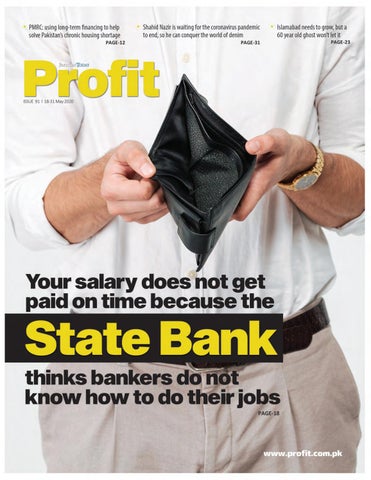
12 PMRC: using long-term financing to help solve Pakistan’s chronic housing shortage 18 Your salary does not get paid on time because the State Bank thinks bankers do not know how to do their jobs
23
23 Islamabad needs to grow, but a 60 year old ghost won’t let it 27 Pakistanis don’t trust the PSX. They should Ali Farid Khawaja 29 KPTGC: up for a long haul journey M Daniyal Kanani
31
31 Shahid Nazir is waiting for the coronavirus pandemic to end, so he can conquer the world of denim 36 Lives versus livelihoods Asif Saad 38 An easy way for your daily Hysab Kytab
WELCOME
The burden of over-regulation
In this edition of Profit, both our cover story and one of our main feature stories are about the financial services sector, and how the government’s desire to regulate businesses has tended to have the effect of stifling progress. In the case of our cover story, we explore the State Bank of Pakistan’s Prudential Regulations that are – in theory – designed to keep the banking sector safe for depositors but in reality have the effect of essentially infantalising the entire banking sector by having the central bank take over risk management for the whole sector. We believe that a more sensible balance needs to be struck between the need to protect borrowers and the overall health of the financial system on one hand, and the needs of borrowers and small businesses to grow the economy and employment opportunities on the other. The current situation is unsustainable and the State Bank knows it. So why are they not acting? The reality is that the central bank has nothing pushing them to do so. Small businesses do not have a strong lobbying voice in Islamabad and the largest businesses – which do have a voice – already have access to capital and financing, and hence do not feel the need to push the govern-
ment to change the regulations. Indeed, they benefit from the status quo, since it prevents their smaller rivals from ever getting the capital they need to achieve scale and seriously threaten the larger incumbents. Yet if this economy is ever to become more egalitarian, and truly provide equality of opportunity, then the rules as they currently stand must change. The central bank cannot continue to treat the banking sector like children in need of strict supervision over even the minutiae of running their businesses. It must allow greater flexibility, which in turn will likely spur competition amongst the banks for the opportunity to lend to some of Pakistan’s most promising businesses. Banking regulations are hardly the stuff of riveting reading, but we felt it was important enough to the health of the economy to put the issue on our cover for this issue. We hope that the regulators – and the bankers – will realise its importance and move towards making the necessary changes.
Farooq Tirmizi Managing Editor
Executive Editor: Babar Nizami l Managing Editor: Farooq Tirmizi l Joint Editor: Yousaf Nizami Reporters: Syeda Masooma l Taimoor Hassan l Abdullah Niazi l Meiryum Ali l Hassan Naqvi l Shahab Omer Director Marketing: Zahid Ali l Regional Heads of Marketing: Muddasir Alam (Khi) Zulfiqar Butt (Lhr) l Mudassir Iqbal (Isl) l Layout: Rizwan Ahmad l Photographers: Zubair Mehfooz & Imran Gillani l Publishing Editor: Arif Nizami l Business, Economic & Financial news by 'Pakistan Today' Contact: profit@pakistantoday.com.pk
FROM THE MANAGING EDITOR
9
Readers Say The big three are a mafia and the root cause of every evil in Pakistan’s car industry. They rant and they rave about imported used cars, but can never match the quality of these used cars. A five year old used car from Japan is a lot better in quality than a brand new car you buy from any of the big three. Why? These manufacturers cannot even produce a standard, quality, car from the same parts imported from Japan? They intentionally reduce quality to increase profit margins. They repeatedly threaten, blackmail, intimidate, bribe every government agency any time they try to reduce their oligopoly. Look at what they have done to the EV Policy. They will never let any policy of public interest be implemented in Pakistan. The cost of production for a suzuki mehran may not be more than Rs 50,000. It is the insane amount of profits that they charge which makes them grow greedier and greedier. The government must allow the import of used cars. The cars from the big three are not Pakistani manufactured either. It is high time that the public should completely boycott the big three, since they are too strong for any government to make policies against them. They need to go completely bankrupt and die before anything good can happen in the automotive sector. Apropos: Why exactly are cars so expensive in Pakistan? Ali, Wesbite It is not the taxes that are behind the high prices of cars in Pakistan, rather it is the hunger for more profits by car assemblers and zero check of the government. Nobody bats an eye about the safety and quality of the vehicles, and there is no concern about the rights of consumers. In Pakistan, there is an unholy cartel of these three assemblers: Suzuki, Honda, and Toyota. Apropos: Why exactly are cars so expensive in Pakistan? Ansar Mahmood, Website
facebook.com/Profitpk twitter.com/Profitpk linkedin.com/showcase/13251020 profit.com.pk profit@pakistantoday.com
HOW TO CONTACT
10
Pakistan’s big three car assemblers are the first and last profiteers. They are like vultures ready to pounce upon the hapless consumers even when the dollar appreciates a couple of rupees. But there is never a downward revision of their car prices even if the dollar dips and rupee is steady once again. Where is the EDB ? It has been unable to reign them in to or to ensure the required level of deletion. The big three will keep their plants underworked and observe NPDs due to reduced demand. They need to understand that Pakistani consumers’ capacity to pay is not unlimited. If a car gets beyond their reach, they will not buy it. So these companies are digging
their own graves by increasing prices even when there are no buyers. These companies are bound to go under if their owners do not learn sooner. Apropos: Why exactly are cars so expensive in Pakistan? Tariq, Website It describes him well. He was above all a wonderful human being. Knowing him for 40 years and working with him for 20 of them was a pleasure and I have very fond Memories of him. The initial years of Indus where we worked closely and travelled together were challenging and his vision was incredible. He was my friend and leaves many memories. May Allah rest his soul in peace. Apropos: Ali Suleman Habib – a man who knew when to step back, and step up Farhad, Website I knew Ali since 1993 when I held the office of the chairman Paapam, parts manufacturers association. We met as, in common perception vendors v/s OEMs, however we immediately discovered the strength of unity and cooperation. Thus we started our friendship. I consider it my honor to have had Ali as my friend. He was a true friend indeed as he was always my friend in need. A great leader, and an inspiring figure, he was above all else a great human being. He will be missed by the thousands whose lives he touched. May his soul be in eternal bliss. Apropos: Ali Suleman Habib – a man who knew when to step back, and step up Feroz Khan, Website COVID-19 pandemic is a global issue people are suffering particularly low income members of society are even unable to earn livelihood for survival in such a situation the above article is a slap on the face of humanity, state Bank of Pakistan issued directives to the banks to facilitate low income borrowers. Now is the time to save humanity not money. Apropos: SBP Myths explained Mohammad Sohrab Saleem, Website Nice article. I know many savers who were basically retired individuals that ran their household expenses on the interest (or profit) earned on their lifelong investments in deposits. Now while their expenses are increasing, the income has been reduced considerably due to decrease in interest rates. Banks have reduced rates of both savings and fixed deposit accounts and more reduction is on the cards, so they have been left with little to cover up their monthly expenses. Apropos: SBP Myths explained Anonymous, Website
COMMENTS
IN BRIEF Gilead Sciences signed an agreement with Ferozsons Laboratories, one of five pharmaceutical companies in South Asia, to produce the anti-viral drug Remdesivir for
127
countries. Remdesivir cuts the duration of COVID-19 symptoms from 15 days to 11 in clinical trials at hospitals.
Wait, we are still an emerging market? Pakistan has retained its status in the Morgan Stanley Capital International (MSCI) Equity Indexes, after being upgraded from the frontier market index in 2017.
“We are doing nothing now no negotiations, everything is stuck. There’s nothing happening in terms of regular work.” Roberto Azevedo, director-general of the World Trade Organization, Roberto Azevedo. The Brazilian, who had been in office since 2013, has announced his departure more than a year before the end of his term A market in Lahore
The government is struggling to enforce standard operating procedures, after markets in the country were opened on Monday. Markets will remain open four days a week.
Shazad Dada has stepped down as CEO of Standard Chartered Bank Pakistan, and will join United Bank Ltd (UBL) as CEO from July 1, 2020. He will replace UBL’s Sima Kamil, who was the first woman to lead a major Pakistani bank.
Large-scale manufacturing contracted 23% in March 2020, compared to March 2019, according to the Pakistan Bureau of Statistics. It shrunk by 21.99% compared to February 2020.
Federal education minister Shafqat Mehmood announced that students in the country will be promoted on the basis of their 9th and 11th grade results, after being given a 3% increase.
The Economic Coordination Committee approved subsidies for agriculture, under which Rs37 billion will be set aside for fertilizers, Rs2.3 billion for cotton seed, and Rs6 billion for white-fly pesticides.
Not a vape: Philip Morris wants to introduce IQOS, an alternative to cigarettes, in Pakistan. The device heats tobacco, instead of burning it, in contrast to vaping products, which heat liquid containing synthetic nicotine, not tobacco. 11
By Meiryum Ali
E
very night, an estimated 20 million Pakistanis go to sleep without a roof over their head. That is a whole 9% percent of our population (consisting largely of nomadic tribes that herd goats and sheep). Want another depressing figure? (warning: there is no shortage of these in this article) Around 50% of Pakistan’s urban population – that is roughly 39 million people – live in a slum, or a katchi abadi. To live in a house in this country is a blessing. To have enough on-hand money to buy a new house is a luxury. To walk into a bank and ask for a housing loan – now that is
12
near impossible. It is in this bleak scenario that the Pakistan Mortgage Refinance Company (PMRC) exists. The company formally commenced business in 2018, and it shows. On its slick, brand new website, PMRC proudly proclaims, against colourful backdrops of various cities of Pakistan: “Housing for all Pakistanis”. All, you say? Yes, all, said its chief operating officer Mudassir Khan in conversation with Profit. The cautiously ambitious but definitely optimistic (who can blame him) former banker is the head of a tiny company, consisting of just 27 staff members. And yet its bold aim is to reshape the entire narrative of home ownership in Pakistan. Its mission: “To be a leading catalyst for the development of housing finance
and capital markets in Pakistan.” It is impossible to understand what PMRC is trying to achieve, or what it is even up against, without first understanding the state of affordable housing finance in Pakistan, or more accurately, the lack thereof. How did Pakistan’s mortgage industry lose the plot so fast? How has the government been so blank on this topic?
Pakistan’s housing problem
B
y several estimates, Pakistan is facing a shortage of anywhere between 10 to 12 million housing units. The housing shortage for urban areas is estimated
to be around 4 million units. And every year, according to the State Bank of Pakistan, 700,000 units are added to the overall deficit. Only about half of this demand is ever actually met. Most of the housing backlog falls on the back of low and lower-middle income segments of the population. According to a Lahore University of Management Sciences (LUMS) policy brief “Urbanization in Pakistan: the availability of housing”, if one looked at the housing shortage by income bracket, those those whose annual income was between Rs12,000 and Rs50,000 faced a housing shortage of 2.6 million units; those whose annual income is between Rs6,000 and Rs12,000 face a housing shortage of 3 million units, and those whose annual income is less than Rs6,000 face a housing shortage of 1.5 million units. How did it get to this point? Several reasons. First, Pakistan’s urban population exploded over the last few decades, due to rapid population growth and rural-urban migration. It stood at just 22% in 1960 but has reached around 37% today, and is expected to cross 50% in 2050, according to the government. So housing demand has far outstripped housing supply. Secondly, there is a shortage of land – well, kind of. The government owns around 40% of all the land in Pakistan, and acquiring that land can be a difficult process. The amount of land that is actually leased out to the private sector does not cater to low income groups – the very groups that need housing the most. Land cost itself also contributes to the total housing cost. “The current land administration system is inefficient because development agencies buy finite urban land from government agencies, develop it, and then sell to consumers; however, government agencies auction off land leading to high prices and speculation,” explains the LUMS brief. And lest one think that this is classic government inefficiency, the private sector is not exactly the most efficient either. Again, perhaps to cater to higher income groups, most housing development is in actual individual houses, rather than the construction of high rise or apartment buildings. As an example, Karachi is perhaps the only city in Pakistan that something actually akin to a skyline – and yet, one 2010 study showed that only 5% of urban land was used for apartment buildings, while 55% was used for individual houses.
Did the government notice the problem? No.
I
f one visits the Naya Pakistan Housing Scheme website, announced with much fanfare in July 2019 (more on that later), the PTI government has in clear letters spelt out:
“Housing sector has largely been neglected by various Governments in Pakistan. If at all it got any attention of the political leadership, it never moved beyond mere political slogans. Even if some work was done at the government level, it did not move beyond some desire and discussions, and not even put on any drawing table.” Political finger-pointing aside, this is actually a valid point. Affordable housing has been criminally neglected in both federal and provincial policymaking. The first stab at improving this housing scenario was taken in 1978, with the Katchi Abadi Improvement and Regularization Programme, or KAIRP. This aimed to give leases and infrastructure to katchi abadi residents. Then, in 2001 came the ‘National Policy on Katchi Abadis, Urban Renewal and Slum Upgradation’, to build further on the 1978 policy. Why, you may ask, have you never heard of these policies? That is because the policies apply to katchi abadis only established before 1985. This is outdated to the point of being laughable. The slogan Roti Kapra Makaan may have been around since the late 1960s, but the National Housing Policy was only created in 2001. It aimed to create affordable housing for middle and low income groups, and also to regularise katchi abadis. Needless to say, this did not happen. Then, there was the federal scheme of 2013, Apna Ghar, which was to provide 500,000 low cost housing units across Pakistan. The project never got off the ground and was shelved in 2017. Provincial governments have fared only a little better. For instance, the Sindh government started the Shaheed Benazir Bhutto Town Scheme for around 27,000 plots, and the Punjab government started the Ashiana Housing Scheme in 2010 (though that one was mired in corruption controversies). The Sindh Katchi Abadi Act was passed in 1987, regularising around 600 katchi abadis, while the Punjab Katchi Abadi Act of 1992 regularised around 300 katchi abadis. This is, of course, when the katchi abadis are not being demolished by an overzealous Supreme Court, though that is another story. Perhaps the biggest indication of whether housing is a priority for the government, is that there was no official definition of what constitutes low-income housing until March 2019.
Housing finance in Pakistan
S
o there is a housing shortage, and the government seems unable or unwilling to provide help. Well, what about the private sector?
The State Bank, in its policy recommendations of 2019, was categorical about the private sector’s failure: “The formal financial sector has been failing to provide adequate and affordable housing finance to a large segment of the population.” Housing finance was only 1.7% of total private private sector credit in 2018. According to State Bank data, the volume of outstanding housing finance from banks stood at only Rs103 billion as of December 2019. This is an improvement when compared to the December 2018 figure of Rs92.4 billion, and the December 2017 figure of Rs82.6 billion. However, outstanding housing finance is only 0.5% of GDP. That ratio, also known as mortgage depth, is abysmally low. For comparison, a country like the Netherlands has a mortgage depth of 83%. But one does not even have to look that far – in our region, both Bangladesh and India have a higher mortgage depth at 3% and 10% respectively. The housing finance industry had two large problems: a lack of a legal framework, and the unavailability of long term funding. On that first point, Khan pointed to a little known ordinance in Pakistan’s banking laws that caused a huge amount of headache for lenders: Section 15 of the 2001 Financial Institutions (Recovery of Finances) Ordinance. “This was Pakistan’s first attempt at a foreclosure law,” said Khan. Prior to the 2001 Ordinance, the law appeared to be biased in favour of borrowers, forcing banks to go through the full court case before they could recover the property from the loan defaulter. However, the 2001 Ordinance allowed banks to auction the mortgaged property of loan defaulters without obtaining a court order first. This would make lending to borrowers easier, since it would reduce banks’ risks. However, in 2013, the Supreme Court declared it unconstitutional, in that it did not adequately protect borrowers rights. The ordinance was then amended in 2015 and signed into law in 2016, before once again being struck down that same year, this time by the Lahore High Court. That constant uncertainty kept the housing finance industry somewhat paralyzed, as why would banks lend if they could not recover property? And it is not just the lack of a robust legal system. The housing finance industry does not exist in a vacuum. According to Khan, there was little to no regulatory oversight over the construction and real estate industry. For instance, there is a high number of benami properties in Pakistan, or property held in the name of one party, but paid for by another party. “It’s difficult to give finance
HOUSING
“Our company has a dual role, it is to create the housing finance market, and then develop that to make it sustainable. A house is a life-long, long-term asset for that family, whereas it is funded by short term deposits of a bank. That is an asset-liability mismatch” Mudassir Khan, chief operating officer of Pakistan Mortgage Refinance Company
for a property if you [the bank] are unsure about documentation,” said Khan. “All sorts of regulations were not there.” Oddly enough, while the real estate sector was under regulated, microfinance banks were severely over regulated. Prudential Regulations for Microfinance Banks before 2019 limited how much these banks could participate in housing finance. For instance, banks could only lend Rs500,000 to a single borrower, and had a regulatory cap of 40% for exposure above Rs250,000.
Naya Pakistan – no, really
O
bviously, this situation could not go on any longer. Something had to change, and between 2017 and 2020, quite a few things changed. First, in 2017, the Benami Transaction Prohibition Act was passed, that was the first serious attempt at giving some semblance of structure to the real estate sector. (For comparison, India had passed similar legislation, back in 1988.) Then in July 2018, the PTI’s Naya Pakistan Housing Scheme was announced, which aimed to give 5 million homes in five years. There was a Rs2.5 million (25 lacs) loan limit, with the loan tenors ranging between three to 20 years, and importantly, at a fixed rate
14
of 12%. It is still to be seen whether the scheme is successful (and based on previous federal government attempts, it is not likely). But the scheme is not as important as the spillover effects it had. First, the Asian Development Bank (ADB) was unwilling to give loans for the new housing scheme, without a change Pakistani law that allowed for banks to be able to recover money if the borrower defaulted. The 2001 Financial Institutions Ordinance, which had been languishing in court, finally got a new lease at life, as the Prime Minister appealed to the Lahore High Court Chief Justice. A date was fixed for the hearing in November 2019, and in March 2020, the court decided that the ordinance was constitutional after all. The second spillover effect was that in March 2019, the State Bank issued its own housing policy recommendations. For the first time, Pakistan now had a definition for what low cost housing actually is: the value of the house unit is up to Rs3 million, the area is up to 850sq ft, and the loan size is up to Rs 2.7 million. The central bank also relaxed several requirements for all banks. For instance, banks now longer had general reserve requirements against low-cost housing finance portfolios. The loan to value ratio was
reduced from 90:10 to 85:15. The minimum capital requirements for residential mortgage finance was reduced from 35% to 25%. Finally, a standardised loan application for all banks in Pakistan was also introduced. Even microfinance banks got a bit of a break: banks could now lend up to Rs1 million, and the regulatory cap was completely removed. So: the legal framework had been improved. As for the unavailability of long term funding, that is where the PMRC steps in. It is the final piece that is meant to work in tandem with everything else, to overhaul the mortgage industry.
Enter PMRC
T
he PMRC was incorporated in 2015, was classified as a development finance institution in October 2017, and commenced operations in June 2018, though it really began to work in around November of that year. There are 10 shareholders in the company. The Ministry of Finance, the state-owned National Bank of Pakistan (NBP) and the state-owned House Building Finance Com-
pany (HBFC) together own 49.3% of shares in the company. The government put in Rs1.2 billion, while NBP and HBFC put in Rs600 million and Rs6.6 million, respectively. The remaining equity came from the other banks, with Habib Bank (HBL) contributing Rs500 million, United Bank Rs500 million, the military-owned Askari Bank Rs300 million, Bank Alfalah Rs300 million, Allied Bank Rs200 million, Bank AL Habib Rs50 million and Summit Bank Rs1.8 million. The State Bank allowed PMRC to operate with a minimum capital requirement of Rs3.5 billion, though for five years, the company cannot make any cash dividend to its shareholders. The organisation was initially led by Malaysian N. Kokul¬arupan Narayanasamy, but in 2018, Mudassir H. Khan took over as the CEO. Khan, who holds an MBA from Stern School of Business at New York University (NYU), was previously a senior executive vice president and chief of retail and commercial banking at the National Bank of Pakistan for four years. Before that, he worked at HBL for nine years, the World Bank for 14 years, and as an investment banker at Citigroup and Bear Stearns. “This has certainly been interesting and very challenging, to basically create a new market which did not exist before,” said Khan. “Here the board is new, they’re bankers, I’m a banker – I want to create and develop my role, and change the market for good.” So, what are his aims? The PMRC is essentially a mortgage liquidity facility set up by the State Bank. The idea is that it will provide secure sources of long term funding, and also develop sound lending habits among mortgage lenders. It will also try to increase the availability of fixed rate mortgages and increase the maturity structure of the mortgage loans. Fundamentally, PMRC will improve the affordability of mortgages, and increase the number of qualifying borrowers. That way, the primary mortgage market will expand.
PMRC is set up along the lines of mortgage refinancing companies in the developed world, such as Fannie Mae in the United States. (Yes, that Fannie Mae: the one that collapsed as a result of the US housing market crash in 2008, and had to be bailed out by the US federal government. Are we creating the exact same thing in Pakistan? Yes. Yes, we are.) The company’s principal source of funding will be from the local bond market – which means that another ‘objective is to help develop the bond and sukuk markets’. PMRC will introduce a new asset class, conventional and Islamic mortgage-backed securities, for investors. These bonds will progressively have longer maturities than the current debt instruments in the market, and will have a yield higher than Pakistan Investment Bonds. To do this, the PMRC is set up along the lines of mortgage refinancing companies in the developed world, such as Fannie Mae in the United States. (Yes, that Fannie Mae: the one that collapsed as a result of the US housing market crash in 2008, and had to be bailed out by the US federal government. Are we creating the exact same thing in Pakistan? Yes. Yes, we are.) But just because there was a collapse in such institutions in the United States does not inherently mean that such a concept is unworkable, with the appropriate precautions. PMRC will buy home loans extended by housing and commercial banks, and then sell them onwards to long-term investors. Banks can start a home loan, sell it quickly to PMRC and extend more home loans using the freed up liquidity. PMRC will issue bonds to raise funds for purchasing home loans from banks. Any bank or development financial institution (DFI) registered with the SECP
can sell to the PMRC. To incentivise banks to work with PMRC, banks and DFI are exempt from cash reserve requirements (CRR) and statutory liquidity requirements (SLR) on borrowings from PMRC. According to the central bank, “these relaxations and incentives will aid PMRC in operating as a viable business entity on a sustainable basis.” What is the benefit? Firstly, there now exists medium to long term funding for banks which will help mitigate maturity mismatch risk. According to company documents, on a microlevel, if a lender faces liquidity issues during the life of the loan, the lender can refinance existing loans. On a macro level, this can play a countercyclical role during a liquidity crunch in the market. This appears to be applying lessons learned from the US housing and financial crisis of 2008: allowing easier restructuring can go a long way towards preventing a crisis. Banks can now also grant fixed rate mortgage loans, once they get fixed rate funds from the PMRC. This something that the central bank has also stressed upon: “Housing finance is currently dominated by variable rate mortgages with no presence of fixed rate mortgages… Introducing fixed rate mortgages will provide needed comfort to the borrowers against fluctuating interest rates.” Thus fixed rate mortgage loans can help reduce the incidences of defaults by borrowers. By the company’s own estimates, if the
HOUSING
“The current land administration system is inefficient because development agencies buy finite urban land from government agencies, develop it, and then sell to consumers; however, government agencies auction off land leading to high prices and speculation.” Zainab Raza, graduate student in city and regional planning at the Georgia Institute of Technology
maturity of mortgage loans is increased from 15 to 20 years, that could lead to a 2% reduction in monthly instalments. Banks could even increase interest rates on mortgages by 1–1.5%, and borrowers would still have lower monthly payments. It is a win-win situation. It is also a view echoed by Khan. “Our company has a dual role, it is to create the housing finance market, and then develop that to make it sustainable.” “A house is a life-long, long-term asset for that family. Whereas it is funded by short term deposits of a bank. That is an asset-liability mismatch,” he explained. Khan wants to extend the tenor of a housing loan, keep the rates low, the installments smaller, and that way make loans more affordable. “That way the market will deepen,” he said. The company, since operating in November 2018, has amassed 11 clients. These include Bank Alfalah, HBL, Askari Bank, JS Bank, Bank Islami, First Women Bank, First Microfinance Bank, Thardeep Microfinance, HBFC, Habib Microfinance, and Orix Modaraba. According to the latest company financials, in 2018, it had two clients who borrowed Rs1.2 billion. In 2019, the total exposure stood at Rs7.8 billion, against six borrowers. That number also includes around Rs1 billion in Islamic refinancing. That Rs1 billion in Islamic refinancing is under a new product called Musharakah, which is the first Islamic mortgage instrument of its kind in the region. While other instruments exist in Muslim-majority countries like
Oman and Malaysia, this is the first to be developed under the Hanafi Sunni jurisprudence, which is notoriously stricter about mortgage issues. “It was approved by the Islamic Sharia board and the State Bank, so I am looking forward to further innovation here,” Khan said. Four clients have already borrowed in 2020, though Khan did not specify the amount. According to Khan, around 65% of new financing in 2019 was provided by PMRC – indicative of how small the market is. Disbursements in 2019 were concentrated in Sindh, with Rs5.6 billion in Sindh, and only Rs1 billion in Punjab. There were no disbursements in KPK, Balochistan or AJK and Gilgit. PMRC also invested in available to sell government securities, investing Rs5.4 billion in treasury bills, and Rs3.4 billion in Pakistan investment bonds. Interestingly, in February 2019, the World Bank lent the Pakistani government around Rs7.1billion for housing finance. This was dispersed in a single tranche, and can be converted into ‘Additional Tier 1 Capital’, should PMRC choose to.
Looking to the future
I
n conversation, Khan drew a distinction between the proposed government schemes, and what PMRC was trying to do. “The Naya Pakistan housing scheme is still being rolled out, the impact hasn’t been felt yet,” he said. The process
The housing finance industry does not exist in a vacuum. According to Khan, there was little to no regulatory oversight over the construction and real estate industry. For instance, there is a high number of benami properties in Pakistan, or property held in the name of one party, but paid for by another party. 16
was long and cumbersome: first the developer industry would make the units, which would be bought by people, who would then need financing etc. But PMRC was about giving immediate financing this year. In time, having regulations and having organizations like the PMRC in Pakistan could only have a positive spillover effect. “The private sector is slowly going to start entering this space,” he said. What Khan really wants is a pivot away from banks, who see housing finance as a small portfolio, and instead see the growth of housing finance companies, whose sole business is just that. “There are more than 70+ HFCs in India, there are none in Pakistan,” said Khan. Once the housing sector takes off, according to Khan, then there is no stopping it. “Forty-five industries are involved in the construction of a single building. From the labour market, to steel and wood to light to tiles and bricks – you name it.” “We expect the growth minimum to be a minimum of 10 to 12%, in 20 years maybe 25 to 30%.” said Khan. “I would like to see the company sitting on a portfolio of 10 billion of housing finance in 5 years.” But is that enough? Much of this article has been dedicated to explaining the scale of the problem at hand. The government, central bank, in some cases the judiciary, and now the PMRC, have in the last three years or so, formed a fragile but nascent environment, in which banks can start lending, and people can start the first step on their way to becoming homeowners. But the level of poverty being described here, and the years and years of neglect, seem a little too insurmountable for one company with six transactions in a year to solve. It will take large scale, aggressive spending and building on the part of both the public and private sector. With a population of 212 million and growing – good luck. n
TEXTILES HOUSING
18
BANKING
I
By Farooq Tirmizi
f you are a Pakistani professional who has not yet experienced not getting paid on time, consider yourself among the very lucky ones. Ask anyone outside the government, the banks, a few multinational corporations, and a handful of sophisticated local companies, though, and you get the same tales: salaries generally do not get paid on time, and some unfortunate cases, for months on end. What is worse than not getting paid is the insolent attitude of many payroll departments and company owners. Both the human resources department and even employers or managers start saying asinine things like “why are you making this about money?” and “don’t worry, it’ll come when it comes”. These are the kind of things that should and do make your blood boil. But why does this keep happening, though? Why is so much of the Pakistani economy permanently late in paying everyone, not just employees, but also vendors, suppliers, and subcontractors? The answer lies in the banking system, specifically in the regulations that concern the risk management policies of banks, designed by the State Bank of Pakistan to keep the banks from being stupid with depositors’ money. In this story, we dive deep into why these regulations exist and – more importantly – how they impact the lives of ordinary people and the economy.
How do the regulations affect business?
“T
he State Bank of Pakistan has said to us all ‘thou shalt lend to bricks and mortar,’” said Saeed Iqbal, the head of investment banking at United Bank (UBL), in an interview with The Express Tribune in 2012. Iqbal estimates that the State Bank’s Prudential Regulations – which govern how much and to whom the banks in Pakistan can lend – effectively preclude close to 62% of the Pakistani economy, owing to the restrictive nature of what they allow as loans, what they require as collateral, the requirements relating to personal guarantees of business owners, and how much can be lent to each type of business. But first, let us dive into why these regulations matter at all. Why, for instance, does a profitable business even need financing? If my company is earning revenue by selling its products or services, why am I not getting paid on time? The answer, of course, lies in
20
“The State Bank of Pakistan has said to us all ‘thou shalt lend to bricks and mortar’” Saeed Iqbal, head of investment banking at United Bank the difference between what constitutes revenue and profits, and what constitutes cash flow. There is an old saying in business: “revenue is vanity, profits are sanity, and cash is reality.” It is possible for a business to be booking strong revenues and profits, but have negative cash flow, simply by virtue of when its customers decide to make payments to it, versus when it has to pay its own vendors and suppliers. Consider, for instance, the case of an advertising agency. Let us suppose that this advertising agency gets the contract to develop advertisements for Unilever Pakistan, and Unilever signs a contract on January 1 for a three-month engagement to develop ads, and the advertising agency begins work immediately. Let us suppose Unilever agrees to pay this advertising agency Rs10 million for this project. Assuming no delays in the work, the agency finishes its work on March 31 of the year in which they signed the contract and receive an acknowledgement from Unilever that they have fulfilled the terms of their contract. At that point, the agency can book the full Rs10 million as their revenue. Now, of course, the agency has its own expenses, including salaries for its employees, rent it owes on office space, utility bills, and any materials it needed to purchase to develop those ads. All of those are expenses it owes, and should have been paying for the past three months. For simplicity in this example, let us assume their expenses for these three months come out to Rs6 million, meaning the agency would make a Rs4 million pre-tax profit from its contract with Unilever. However, despite that Rs4 million in accounting profit, the advertising agency has no cash yet, even though it has had expenses worth Rs2 million in each of the past three months. Even if Unilever decides to pay immediately on March 31 (which it never would), where would the agency come up with Rs2 million every month for the past three months? The company’s founders only have so much money to start their business. Ultimately, the company needs financing, which
a bank should be able to provide. Now, suppose you are a banker who knows this advertising agency, and you know they have a contract that Unilever has acknowledged it needs to pay for Rs10 million. You should be willing to finance the entire Rs6 million in expenses for this advertising agency, knowing that even if they have to pay a high interest rate, they would still be profitable for the contract. Essentially, the interest you charge on the loan would be your fee for lending them liquidity when they need it against expected future cash flows. In this particular example, the banker could even set a very high interest rate – let us say, 20% per annum – and it would still be worth it for the advertising agency to borrow the amount. After all, even if Unilever took six months from the end of the contract to pay the agency, the loan would still only be outstanding for nine months, meaning that the company would only owe the bank Rs900,000 on the loan. Even after taking into account that additional interest cost, the agency would still make a profit of Rs3.1 million. And the bank would walk away from the transaction with an additional Rs900,000 in income. Of course, the agency would prefer to not have to pay that amount in interest, but it may not have a choice, because in reality, Unilever will not be its only client, and that three-month project will not be its only project. It will have several clients asking it to take on multiple projects at any given moment in time, and if it wants to win that business, it cannot say: “sure, but we will start once our previous clients pay us so that we can use that cash to pay all the bills for this project.” Its clients would not do business with it. That interest cost, then, is not something that can realistically be avoided. It is a cost of doing business. So what happens if the bank decides: we will not lend to you. What if all your old clients still have not paid you yet, and you
have Rs2 million in salaries, rent, utilities, and supplies you need to pay for this month? What would you do? You would do what the vast majority of Pakistani businesses do: they would tell their employees that their salaries will be late. They would not pay the utility bills on time and hope that the power does not get cut off before they can pay for it (or they would outright steal the electricity). They might pay for some supplies in cash, and try to get the rest on credit. At the end of this, eventually, when the agency gets paid, it will be able to pay its employers, suppliers, and bills, and will not have the interest cost to pay the bank. So, everything worked out for the better, right? Not quite. Because in that three months, one would have extremely frustrated employees, and because cash would be so tight, the company would not have the ability to aggressively go after new business, knowing that they would not have the cash to fund their operations to serve that new business even if they won it. So, yes, the profits from each individual project might be higher (because employees do not charge interest on late salaries), but morale would be low, and growth would be much lower. In other words, for most businesses, it would be worth it to pay the interest on the loan and grow the business while retaining employee morale. And many businesses would borrow the money if the bank were willing to lend to them. Indeed, the bank would probably even be willing to lend to this company in this situation, were it not for the Prudential Regulations, which severely constrict what they can do. Yes, we are aware that some seth businesses do not want to grow because the owners are happy with their lifestyle, and yes, we are aware that a substantial portion of businesses want to grow, but do not
“We need to have a serious revision of the Prudential Regulations. Why should I, the central bank, do the risk management for the banks?” Yaseen Anwar, former governor of the State Bank of Pakistan borrow because of religious beliefs of the owners, but we still believe that many other businesses would borrow from banks if they were allowed, were it not for the onerous regulations.
So, what are the Prudential Regulations?
T
hese regulations exist in every economy, and every central bank wants to ensure that the financial system does not endanger the safety of the depositors’ cash, nor does a systemic collapse of financial institutions threaten the wider economy. What makes the regulations in Pakistan different from those in developed economies is the extent to which they specify what banks can and cannot do. Specifically, no bank in Pakistan needs to develop a detailed set of risk-management policies, because the State Bank of Pakistan (SBP) has already developed them for the banking sector: everything from counterparty limits, to loan size limits, personal guarantee requirements, relationship of the loan size to the bank’s equity and total lending portfolio.
Sure, there are some minor details that each bank needs to flesh out on their own, but the basic contours of every bank’s risk management policy is developed straight out of the regulations themselves, a situation that even the SBP itself does not find tenable, nor productive for the economy. “We need to have a serious revision of the Prudential Regulations. Why should I, the central bank, do the risk management for the banks?” said Yaseen Anwar, the former governor of the State Bank, in a media interview several years ago. What exactly are these risk management practices that the State Bank is enforcing on the banks? There are many and varied by borrower type, but for most businesses in Pakistan, there are two very important ones that affect their ability to borrow: the first is the requirement that most lending be secured (with severe restrictions on unsecured lending), and the second is that all small business loans be backed by a personal guarantee of the owner. Each of these two rules sounds reasonable enough, and they certainly achieve their goal of protecting depositors. But the purpose of a bank is to be more than just an entity that protects depositors. It should also be looking for ways to profitably lend to the kind of small businesses that make up the bulk of employment in most economies, including Pakistan. Let us take the first – and most serious impediment – of these two regulations: that of providing a security. Simply put, it means the bank is lending you money not against your ability to pay in the future, but against an asset that you own right now. For a manufacturing company, they could borrow against the land on which their factory is built, or against the value of the physical assets they own and so banks would be more than happy to lend to them. But what about that advertising agency? What about a shopkeeper? What about a wholesale trader? Most of these types of businesses operate on rented premises, with very by way little assets that they own outright. Their
BANKING
cash flows – and therefore their financing needs – are far larger than the assets they might need to generate cash flows. These businesses – known as “asset-light” businesses – tend to, on average, be more profitable than businesses that require a large amount of assets. After all, even if you have very thin margins, but require few assets to produce them, it is much easier to produce a high return on equity than a business that may have higher margins, but also high asset requirements. But the State Bank’s regulations effectively mean that these businesses cannot borrow any meaningful amounts of money. Indeed, most services businesses in Pakistan would not be able to meet the requirements of providing assets as collateral against the money they want to borrow. And private-sector services businesses constitute nearly 53% of the economy, according to data from the Pakistan Bureau of Statistics (PBS). This one single rule makes it difficult, if not impossible, for over half the economy to borrow the amount of money they need to run their businesses. No wonder nobody pays anyone on time in Pakistan. If half the businesses cannot raise what they need to make payments, everyone will always be running behind on making their own payments to employees, vendors, suppliers, etc. Even if bankers want to lend to such businesses (and there is evidence to suggest that they may not), the State Bank does not trust the banks to make these decisions. It has decided to adopt the attitude of “we know best” and made the decisions on behalf of the entire banking sector, perhaps because it thinks bankers simply do not have what it takes to make the right judgements on these matters. The second, slightly less onerous, but nonetheless cumbersome, regulation is that surrounding personal guarantees for any business classified as a small or medium-sized business. The State Bank defines a small business as one that has 50 or fewer employees, and annual revenue of Rs150 million or less. It defines a medium-sized business as one that has between 51 and 250 employees, and annual revenue of between Rs150 million and Rs800 million. Most banks and financial institutions – even in larger, more sophisticated economies – require some form of personal guarantee at least initially. I am currently starting a business headquartered in the United States and both JPMorgan Chase and American Express required me to personally guarantee my business’ credit lines. But over time, as my business builds a track record, I expect these personal guarantees to be dropped. In Pakistan, however, unless a business grows to becoming a large business (more than Rs800 million in revenue), it will always require personal guarantees from the owners.
22
This defeats the purpose of incorporating a company as an entity separate from the business owners. The whole point of limited-liability companies is to limit the liability of the owners in case the business suffers losses. Fewer businesses would be willing to borrow and grow if they had to take on the personal risk of losing their family house if they cannot repay their loans. Of course, from a bank’s perspective, that is a good thing: business owners will be motivated to make sure they can pay the bank back. But more often than not, this simply means that businesses do not borrow at all, and the economy grows slower as a result. As a result, access to capital is highly distorted in Pakistan. Manufacturing constitutes only 13.0% of the economy but it got 22.0% of all bank lending (loans and bonds) as of March 2020, according to data from the SBP. Meanwhile, retailers and wholesale traders account for 18.9% of the economy but just 2.8% of total lending. Transportation and communication account for 12.9% of the economy but just 1.7% of total lending. The financial services sector, in other words, is serving only a small sliver of the economy. And that, of course, has major implications for which businesses will have the ability to continue growing, and which ones will struggle to get by.
Change is coming, but slowly
O
ver the past few years, the State Bank has realised that the situation is untenable and the regulations need to be changed. It has over the past few years, for instance, changed the limit for “clean” lending – meaning loans that do not require collateral – from Rs2 million to Rs5 million. And it has introduced language in the Small and Medium Enterprises section of the Prudential Regulations that allows for lending on the basis of estimated cash flows. However, the problem with that latter change is that even though the language says that banks can lend on the basis of future cash flows, it still requires them to lend against a security of some kind, which usually means some sort of collateral. For larger companies, banks may be willing to securitise
the future cash flows and call them a “hypothetication of expected cash flows”, against which they lend, but the capital requirements against such lending still make it onerous on the banks, which is why they are not willing to do it as frequently, and certainly not for their smaller clients. For the banking sector to truly be freed up, the State Bank will have to make unsecured lending much easier for banks, both in terms of removing the actual requirement for security, and by removing the capital requirements for unsecured lending. In other words, the State Bank needs to start trusting the banks to actually do their jobs. Will they fail initially and cause tons of losses? Of course, they will. But how else will banks develop the ability to lend to the economy unless they are first given the freedom to try and fail before ultimately succeeding? It is a bit like a parent wanting a child to learn to walk but also wanting that child to never fall down. The two go together.
The banks are not innocent either
F
or their part, the banks will need to get used to the idea that not all of their lending needs to be to the government, which has been the case for most of the past decade. They will need to invest in the human resources and technology infrastructure to be able to market and gain business with small businesses not just for their deposits but also their lending business. Too many years of easy money have resulted in the banks letting those lending muscles atrophy. And until they reinvest in those, even regulatory shifts will not have much of an impact. n
TEXTILES BANKING
URBAN PLANNING
23
I
n 1960, Pakistan made the momentous move of shifting its capital from Karachi to Islamabad. Establishing a new center of power and governance is a herculean task in itself, but it was a doubly impressive feather in President Ayub Khan’s cap that the city that was to become Pakistan’s capital was built from scratch. Rome may not have been built in a day, but Islamabad was built in four years. The magnum opus of celebrated Greek architect Constantinos Apostolou Doxiadis, the founder of ‘Ekistics’ and one of the fathers of the modern city, Islamabad at the time of its founding was the city of the future. Nestled in the Margalla hills, Islamabad ‘the beautiful’ was conceptualised as a symbol of unity in an ethnically and geographically divided country, and a flag bearer of modernity. But what was envisioned as a cutting edge, sleek, modern capital has since become the victim of insufficient public utilities, lack of affordable housing, commercial and office space, decaying public infrastructure, illegal and haphazard development and mushrooming slums in addition to a rapidly rising cost of living, that disproportionately affects lower income groups. At the center of this fascinating city that was practically willed into existence is the Islamabad Master Plan. A document that has, in recent times, come under vociferous scrutiny. Its supporters are willing to live and die by it, and its detractors fear it has become redundant and needs revising. With the master plan also came the Capital Development Authority (CDA), which first took charge of the city and its five meticulously laid out zones in 1960. In 2017, the Supreme Court of Pakistan (SC) took Suo Motu notice of irregular development in Islamabad and directed the government to find a solution for regularizing these constructions. Later, the Islamabad High Court (IHC) in its judgment dated July 9, 2018 directed the government to form a commission to review the Islamabad Master Plan. Consequently, a commission was formed in August 2019 to review the master plan and give its recommendations. But the commission simply gave recommendations to gloss over the issues in its attempt to maintain the original spirit and architectural integrity of the city. With Islamabad at war with itself over whether to expand to its full potential or continue to cling to its wealthy suburban roots, we look into the short but rich urban history of the country’s capital, and see whether another master plan is needed to revive a city fast losing touch with its character and purpose. Or for that matter, whether these grand, ‘master plans’ have simply become unviable relics of the past. And if that is the case, how
24
exactly should the city be managed?
Islamabad – an urban planning history
I
slamabad was planned as a low density, no-nonsense, administrative unit. But when the city was being formed, Doxiadis was more than just its architect designing roads, buildings and avenues. He was more of a development consultant, building not just the city, but mapping out its future at the same time. And for him, Islamabad could be nothing other than a modern, urban, space. Scholars of history are often critical of the way cities are presented on maps and in designs by developers and architects that wish to fix them by moving lines on a page. Cartography, after all, is a naturally violent process. When it is exerted upon ancient cities such as Lahore and Peshawar or bustling centers such as Karachi, they do away with the pulse of the street. The streets, as they exist outside of maps, are vascular; if you cut them they bleed. This is exactly what made Islamabad such a unique experiment. It had none of the scruples of ancient civilizations still haunting its core or colonial customs ruling the roost. It was an opportunity for a clean slate city, one where governance could be different along with city planning. Perhaps the street would not have the same vitality in the beginning as in older cities, but they would be clean and fresh. A beautiful, idyllic space for its new inhabitants to make of it what they will. At the center of this spirit with which Doxiadis planned Islamabad was the city’s grid iron pattern. There is, fundamentally, a grid dividing the city into 84 sectors, each 4 square kilometres. The other is the ‘natural’ grid created by ravines flowing through the entire site area. Each sector has five sub-sectors – four residential and one commercial (Markaz) – which is encircled by auto routes with pedestrian networks within the sector. Each of the sectors would be low slung and consist of single-family homes, American suburb style. But the plan that Doxiadis envisaged was restrictive, and clearly could not even have dreamed of how many people would migrate to Islamabad and how extensive the city would get. The master plan included nothing about zoning for the poor, or a city center, a commercial business district (CBD) for that matter. The vision was definitely futuristic. Cleanly mapped streets with sectors that had everything you would ever need and thus there would be nothing that would require you to over go anywhere outside of your sector. It was all rather mechanical, and the approach was perhaps summed up best in that no office spaces were created apart from the secretariat, and the master plan did not include any plans for expansion. After all, Islamabad was to be a small
scale center for governance, with bureaucrats, politicians and government functionaries occupying its homes for the most part. What happened instead was in-migration has happened far faster than envisaged and Islamabad now has more than 2 million inhabitants. While the CDA and the courts have generally tried to stay true to Doxiadis’ plan, simply stretching and tweaking it when needed, the master plan continues to suffer from its birth defects: no CBD, no room for the poor, and no elongated car dependence.
Where the plan went wrong
I
t really is not Doxiadis’ fault however, it is simply the nature of master plans everywhere. The problem is, Islamabad’s population has grown far beyond what was once imagined, and it has become a diverse city in terms of the economic and social disparity between its inhabitants as well. However, the desire of the CDA to remain true to the original vision has meant that Islamabad has been over-regulated, limiting both the social and economic potential of the city. The land and building regulations are too rigid, and have resulted in contrived urban development and stifling of economic activities. As Islamabad grew naturally, the ghost of Doxiadis and his master plan continued to haunt the city, stifling the way it would have grown naturally. Even as the street’s of Islamabad gained the pulse that Doxiadis wanted to avoid, the master plan tried to nip it in the bud - policing the natural growth of the capital from the past. Where the situation currently stands is that Islamabad has the problem of a signif-
As Islamabad grew naturally, the ghost of Doxiadis and his master plan continued to haunt the city, stifling the way it would have grown naturally. Even as the street’s of Islamabad gained the pulse that Doxiadis wanted to avoid, the master plan tried to nip it in the bud - policing the natural growth of the capital from the past icant urban sprawl owing to unrestricted growth in housing schemes and roads over large expanse of land, with little concern for urban planning. At present, the housing backlog in the 2 million strong city is about 100,000 units. This gap is expected to increase by 25,000 units per year, while the current supply of houses is growing at about 3,000 annually. Despite these shocking numbers, the CDA has not launched any new residential sector in the past twenty years. The last sector was launched in 1989, and has not seen any development since then. The fact of the matter is that there are barriers to sustainable urban development in Islamabad, and part of the problem lies in restrictive zoning that encourages sprawl and single-family homes against high-density mixed-use city centers and residential areas more in line with the Euclidean zoning which favors single-family residential as the most preferable land use. This leads to inefficient use of land which is a premium asset for any city. Because of these barriers, Islamabad has become the victim of an urban sprawl, an issue that plagues the modern city and developers. An urban sprawl is essentially the expansion
of a poorly planned, low-density, automobile-dependent development, which spreads out over large amounts of land. This puts long distances between homes, stores, and work and creates a high segregation between the residential and commercial uses, with harmful impacts on the people living in these areas. One would be painfully aware that the entire design of Islamabad was such that people were able to access all necessities within their own sector and not have to venture out of it. When high levels of migration to Islamabad happened, the naturally occurring urban sprawl came in conflict with this philosophy. The best way to fight this urban sprawl would be to move towards densification of urban areas beyond the core parts of the city. The question, essentially, becomes one of horizontal development versus vertical development. In lay terms, population density is the major driving force of horizontal urban expansion, while fixed investment is the major driving force of vertical urban expansion for the city as a whole. Densification is a kind of vertical growth that would be against Islamabad’s master plan, and is not an easy task to pull off. However, it is a challenge worth taking on
URBAN PLANNING
since it leads towards the goal of compact city development. After all, while Islamabad may have been designed in a very particular way, at some point the question has to be asked, are cities made for people or vice versa?
Are master plans a relic of the past?
A
ll of this indicates the need to shake things up from the master place. Densification and changing zoning laws are needed to look after the needs of what Islamabad is fast becoming: a 2-million-strong metropolis. This is where the earlier mentioned Federal Commission for the Review of Islamabad Master Plan, set up by the IHC, should have come in. Instead, what they did was double down on the 60-year-old plan. The recommendations of the commission continue to look after cars, and to restrict the development of high-rises while hanging onto the suburban model. This was simply an oversight of the fact that Islamabad is no longer a quaint suburban city or a summer capital. It is the seat of power as well as a growing metropolis in its own right. The commission’s recommendations appear to be oblivious to the needs of the homeless and the needs of the growing metropolis of over 2 million people. But other than their same-old-same-old recommendations about engaging consultants and broad ideas, the commission managed to do very little. In short, after about sixty years since the first plan was made for Islamabad, the city is awaiting a plan that will solve its current problems. The problem of master plans is a pertinent one. Planners unfortunately are willing to knock down buildings, through court injunctions no less, for being a couple of feet higher than suffocatingly stringent regulations. However, just because planners wish to stick to a more than half century old plan does not mean that the existing nature of the city changes. In fact, when life does not adjust to the old ways, cities and their residents end up in years of strife. That is the reality Islamabad is staring down currently. Master plans had their place in the world
The problem of master plans is a pertinent one. Planners unfortunately are willing to knock down buildings, through court injunctions no less, for being a couple of feet higher than suffocatingly stringent regulations. However, just because planners wish to stick to a more than half century old plan does not mean that the existing nature of the city changes at one point, in fact, they were the modus operandi for how to build cities after the destruction of the Second World War. However, they have fallen out of favour for some time now and for many reasons. Master plans use present and past data to chart out the trajectory of a city for the next two decades. And while this is a scientifically sound method, it does not take into account the possibility or space for change that may be needed for any reason, and particularly because people are unpredictable. The plans are also static in nature, based on unrealistic assumptions, rigid, and dictate how markets should develop leaving no room for them to find their own level. But even as the world sheds itself from the constraints of these master plans, in Pakistan, master-planning seems to be an inside job between planners and builders to stay in business. Public participation in the planning process is often perfunctory or nonexistent. These plans, therefore, are never owned by the community nor do planners recognize the needs of the people.
Rethinking the city
T
he most basic and important argument to allow a city like Islamabad to grow instead of to box it in under countless regulations is that it must be treated as a market. Conceptualising the city as a market that facilitates economic growth means that to help the economy grow, the city must be allowed to grow as well. As Nadeemul Haque, currently the vice chancellor of the Pakistan Institute of Develop-
In addition to this, the city itself must be seen as a source of wealth, not to exploit, but to uplift its inhabitants. Cities often sit on a gold mine of assets that include not just real estate and public utilities but can also create wealth through socio economic uplift of its people and regeneration of decaying urban areas. These assets can be materialized through better city management. 26
ment Economics, argued in his Framework of Economic Growth, cities are born out of markets, since markets create order, which manifests itself in the form of cities, based on price signals. And if these basic market units are to help the economy grow, they must be allowed to grow too. Cities that drive productivity and growth are neither neatly planned nor laid out for suburban living and cars. It is the seeming chaotic nature of these cities that drives their productivity and growth. It is for this very reason that many cities are moving away from master plans to guidelines and rules that allow the needs of the market and investors to determine what should be built. The city planner only worries about social and community needs, public health and safety and other common issues but not with regulating everything in the city, or the economy for that matter. In addition to this, the city itself must be seen as a source of wealth, not to exploit, but to uplift its inhabitants. Cities often sit on a gold mine of assets that include not just real estate and public utilities but can also create wealth through socio economic uplift of its people and regeneration of decaying urban areas. These assets can be materialized through better city management (Detter and FÜlster 2017). The world is already moving on from restrictive master planning, and it is becoming apparent that the Islamabad Master Plan was a flawed exercise from the very start, made even worse by not reviewing and updating it after every 20 years. Even as Islamabad fights a status quo that will not allow it to breathe, there are newer methods like neighbourhood planning that are used across the world, and should be employed in Pakistan as well. There is no doubt that the capital is an over-regulated city. It is also not an affordable city for low-income groups to reside in. As the master plan finally goes into the process of being re-evaluated, our suggestion would be a complete paradigm shift in our approach to city management – a shift that should be applied to other cities in Pakistan as well. n Adapted from the PIDE report by Abdullah Niazi
URBAN PLANNING
OPINION
Ali Farid Khawaja
Pakistanis don’t trust the PSX. They should With the stock market looked at with suspicion, what investors need to understand is that fraud will always be out there, and being not having faith is just counterproductive
P
akistan’s market lacks depth. The greatest proof of this is that fewer than 0.1% of the population has ever invested in stocks in the country, despite superior returns in equity investment. The primary reason for this is a lack of trust. The closest that an ordinary Pakistani has gotten to the stock exchange is either Sohail Warraich interviewing Aqeel Karim Dhedi for an episode of Aik Din Geo Kay Saath, or when Danish hit the jackpot by buying stocks in the infamous Khaleel Qamar serial, Meray Pass Tum Ho. There is very little connection between the stock market and the average joe. When I was at LUMS, the only thing I knew about the Karachi Stock Exchange was the paper by Asim Khwaja and Atif Mian titled Price Manipulation in an Emerging Stock Market. I suspect this particular image of stock investing is not just prevalent among the general population, but is also the predominant view point in important policy circles. Most, if not all of these stereotypes, are either completely or partially wrong. Unfortunately, I do not have the strength to rise to the defense of the PSX. The opinions about it are so ingrained, that any factual data that might counter these long held beliefs, is treated with disdain and will
Ali Farid Khawaja
has 15 plus years of experience in capital markets and technology sector, and is currently the Director at KASB Securities
COMMENT
It is important to recognize that the magnitude of these frauds are much larger than anything in Pakistan. Just Wirecard’s market cap is almost equivalent to the total market cap of the Pakistan Stock Exchange. Yet, despite this, there is no witch hunting. No over policing by the regulator. No TV shows. No NAB most certainly not be able to penetrate the walls of bias. Instead, what I can do is talk about other markets - ones we like to look upto and wish to emulate, and see that they don’t really have their act together either. Since leaving Pakistan in 2005, I have directly invested in multiple emerging markets, from Russia in the Northern hemisphere, down to South Africa in the Southern. I have also advised investors investing in Apple in the West and those in the East investing in Samsung. Let’s start with Germany, where the case of Wirecard is making the headlines these days. Wirecard is a €30bn market cap financial services company listed in the Frankfurt Stock Exchange. The stock has been a darling of investors and last year replaced Deutsche Bank as the largest German financial services company. The Financial Times ran a series of investigative articles alleging how the company was doing potentially fraudulent accounting in
order to inflate its earnings. The allegations that have swept Wirecard in these past few weeks include round tripping on acquisitions and making fake customers. While FT ran a series of articles, neither EY, its auditor nor BAFIN the German regulator picked up anything. Now, just last week, the KPMG concluded a special audit where they said they cannot find the source of revenues of over $1bn almost half the earnings of the company. The stock is down 26% since KPMG’s report and there is pressure on the CEO to resign, but there is still no action by the regulator. Moving on to the United Kingdom, you will find tons of stories. My favourite is the case
27
of Teli. Once a billion dollar company listed on London Stock Exchange, Telit is an Israeli technology company founded by Oozi Cats. The Financial Times reported that Oozi Cats was a convict and fugitive who had been indicted for property fraud in the US. He and his wife moved to Europe, changed the spelling of their name from Uzi Katz to Oozi Cats, and managed to clear all background checks. At Telit, he was drawing a salary of over $1m and getting the company to pay the rent for a palace in Italy, where he lived. His wife was also employed by the business. Despite FT’s articles it took a long time for the cat to come out of the bag and for regulators to act. Let’s take another one, insurance and vehicle tracking company, Quindell was at its peak with a £2.7bn market cap business. It was found to have fraudulently turned a loss of £68m in 2014 to a profit of £83m. The corporate brokers who were supposed to check the company were given minimal fines. Another fintech unicorn, Monitise, was a $1bn market cap company and had investments from Visa. I had a sell recommendation with a zero price target. I thought it was completely misleading investors. Again, not an easy thing to do. This was followed by a number of threatening calls from the CEO. Eventually, it tanked and went below its cash value. The most popular case study might actually be the case of Autonomy. It was acquired by HP for $11.1bn. Later, HP found out that
28
When I was at LUMS, the only thing I knew about the Karachi Stock Exchange was the paper by Asim Khwaja and Atif Mian titled Price Manipulation in an Emerging Stock Market. I suspect this particular image of stock investing is not just prevalent among the general population, but is also the predominant view point in important policy circles. Most, if not all of these stereotypes, are either completely or partially wrong there was accounting fraud and they had to write it down by $8.8bn. The CFO has been sentenced to jail since then. I can give many other examples, but I believe the point has already been made. There is a lot of material online about these and other cases, and also a famous book about Exxon and US accounting fraud cases called ‘Fooling Some People All The Time’. It is important to recognize that the magnitude of these frauds are much larger than anything in Pakistan. Just Wirecard’s market cap is almost equivalent to the total market cap of the Pakistan Stock Exchange. Yet, despite this, there is no witch hunting. No over policing by the regulator. No TV shows. No NAB. There is an excellent explanation of why in these countries, despite prevelant fraud, the regulators do not become over zealous.
In the book ‘Talking to Strangers,’ Malcolm Gladwell argues that well functioning societies are built on the concept of “default to truth”. If they break this, then the whole social order of trust will collapse leading to paranoia and eventually chaos. I think this book should be a mandatory read for people in regulatory roles in Pakistan. I fear that in Pakistan, even trivial issues get blown out of proportion. The result is a society of distrust. Stock markets are fundamentally built on a contract of trust. In addition to this, I feel we take ourselves far too seriously. That is why I thought it was important to see things from slightly larger perspective. As they said in Casablanca, “Ilsa, I’m no good at being noble, but it doesn’t take much to see that the problems of three little people don’t amount to a hill of beans in this crazy world.” n
COMMENT
OPINION
M Daniyal Kanani
KPTGC: up for a long haul journey
The NEPRA Act, originally crafted and enacted in 1998, provided solutions to many of these problems. The act came into commission at a time when the concept of private power was new, and Pakistan’s power sector had to be completely re-organised. A major feature of that Act was its monopolistic nature, since it held that a single buyer (the government), would deal with a single he Khyber Pakhtunkhwa (KP) government has recently transmission company (the NTDC), which would then decided to set up a provincial grid company, a decision transport electricity to many industries and households via being widely hailed as a move in the right direction by high nine distribution companies. ups in the province. If the plan is successful, KP will beMany countries that embraced power reforms supcome only the second province to be granted a provincial ported by IFIs like the World Bank, IMF, etc at the same grid company license, with Sindh being the first. time as Pakistan have since moved on to improved versions Before getting into what this grid company would actually do, let of power distribution such as competitive bidding, bilatus try to understand a few things. Consider the example of a small bulb eral competitive markets, state/province wise distribution in your home. For electricity to light up the small energy savers hanging companies. While these developments helped grow the above our heads, it has to travel through wires measuring thousands of sector in those countries, Pakistan was still stuck using kilometers from the point where it is generated to our homes where it is the same model two decades on in 2018. It was only thanks consumed, going through any number of electrical machines along the to a few sane minds in the previous government, that the way. NEPRA amendment act was passed in 2018, near the end Now consider that the many power generation plants in Pakistan of the PML-N’s tenure. are situated in different locations all over the country. This means that The Act aims to transform the electricity markets in power lines can run through different provinces, and different segments Pakistan and brings in the concept of multiple transmisof these lines come under the territorial authority of different provincial sion companies in the country, that would complement governments, which could be controlled by separate political parties. In each other in discharging thoverall responsibility. Section addition to this, investments are not just a few million dollars, they run 18A of that Act talks specifically about a provincial grid into the billions. This means that careful planning is also required in adcompany which would engage in the transmission of elecvance. All this means that an all-inclusive set of rules is needed to ensure tricity in that province exclusively. However, the act has that every stakeholder is adequately catered to, while a stable power a caveat which holds that only a single company may be system remains intact in the country. granted such a license, and the company has to be owned by the provincial government. The responsibilities of that company would mainly be to provide transmission services by the standards laid down by NEPRA. The authority still has the power to determine a reasonable tariff for the company, which means it falls just short of being a completely dereguM Daniyal Kanani lated and competitive market. This development alone was enough to let the Sindh government is a financial analyst by convert its existing special purpose transmission license to this category. And now, KPK is the profession and has done second province to follow suit. extensive research on But this is actually a bit of a sticky wicket. Why make a provincial grid company if the Pakistan’s energy chain same role can be performed by the NTDC? The idea seems to have emanated from article 157 with a specific focus on of the constitution, which says that the provincial government may “construct power houses Power sector and grid stations and lay transmission lines for use within the province,” thereby giving more
T
COMMENT
29
autonomy to the provinces. Practically, there are many reasons for this. The renewable policy of 2006 and provincial power policies envisaged the establishment of small power projects, usually ones that generated less than 50MW. But many projects identified in those policies never materialised, probably because the NTDC could not lay power lines for projects which were ready to sell, as marginal benefit would be much higher than laying a line elsewhere in the country for an industrial supply. Or, it could also have been because the existing DISCO (PESCO or TESCO) had huge losses, which had to be borne by one of the parties, either the electricity generator or purchaser, under the bulk supply model. Those policies are usually brushed under the carpet by those that first initiated them. However, a grid company on the provincial level could reignite the interest of many investors in those small undertakings, since T&D losses would be low. Another benefit would be that priorities for investment would be limited to the province. The purpose of this is to ensure that the investment goes towards the welfare of the people living in that province and to ensure that it does not get quashed
30
in a conflict between the ruling party at the centre and the party in power in the province in question. Infact, it would also be a beneficial situation for the federal government. Had the connection been made through a DISCO, the onus, and the difference between actual tariff and tariff after adjustment of T&D, would have been on the centre to either take the blame for higher circular debt or provide subsidies. As KP braces for more SEZs, the company could play an instrumental role in supplying electricity generated in the province to those SEZs acting as bulk power consumers at low rates. For this, they would have to harness their own resources, thereby giving a boost to the local economy, as well as helping out the federal government by not being a burden on the national exchequer. In addition to this, it would also cut down on needless power losses. As a rule of thumb, the longer that electricity has to travel, the higher the losses. So the point of having a grid station in KP is that had the same amount of energy been brought from a thermal plant somewhere in Punjab, it would have resulted in higher losses. Studies say that KP has a hydel potential of more than 15,000-20,000MW, enough
to meet all its needs at least in the summer season when the flow of water is at its highest. The above discussion sums up the technical benefits. On the fiscal side, since the company would be owned by the provincial government, which would then be its guarantor as well as financing its needs, the rates agreed upon could be lower. Also, it will be an ideal opportunity for public private partnership as well. But keeping in view Sindh’s example in obtaining the license, it took them seven months just to convert their special purpose transmission license to a grid company license. Mind you that they had already obtained the previous license about four years ago. In addition to this, the grid company has to be in constant coordination with the CPPA-G, and other relevant stakeholders to decide on the future procurement power needs of the country. There is already a lot going on in the sector, and excess capacity is being discussed in all quarters of the federal administration. So certainly, there is a long way to go before KP actually gets its license. From there on, the real journey will begin. The fruits of which might be available in the next 15 years or so, or maybe never, as has been the case with many other policies. n
COMMENT
I
By Hassan Naqvi
t takes some audacity to for a company with stagnating revenue to think that they have what it takes to displace Chinese textile companies on the global market, so it is perhaps a testament to just how disruptive the coronavirus pandemic has been to the world of business that a company like Masood Textile is contemplating plans to take market share on the global stage despite currently being on its third consecutive year of declining revenue. Masood Textile is a Faisalabad-based vertically integrated textile manufacturer, and one of the largest such companies in Pakistan. Its CEO, Shahid
TEXTILES
31
Nazir, has a hypothesis: that Pakistani manufacturers have the chance to displace Chinese manufacturers as among the leading suppliers of denim to markets in North America and Europe, a trend that he believes will likely be accelerated by the pandemic. Nazir has in the past few months been trying to capture a slice of the textile industry that has just made itself available. In the past couple of years, China has ceded some space in the denim market, and regional players in South Asia have been butting heads to get a slice of the slice China has let go. But with China in the last throes of its epic battle with coronavirus, and the rest of the world just getting started with its battle, denim and textiles will be the last thing on anyone’s mind. Is the looming crash from the recession and Pakistan’s uphill and crippling battle with the virus the end of the road for Nazir, who aspired to become a dominant player in the market? Or will he find the post corona world to be more opportunity than hindrance? Profit looks into how Nazir was angling to make Pakistan’s industry shine, and whether or not his chances have been dashed by the coronavirus like those of so many others.
State of the industry
T
he coronavirus has effectively led to a virtual shutdown of one of the world’s biggest economies, China, which is also the largest textile producing and exporting country of the world. Their textile production and trade is valued at approximately $119 billion. Over the past couple of years, however, China has been slipping on the textile front. The country has ceded global apparel market space worth approximately $20 billion. This significant loosening of the hold on textiles has meant that textile exporters and manufacturers in the South Asian region, including India and Bangladesh, have been vying to capture this $20 billion. But once again, their ambitions have been rendered redundant over the past couple of months as they too prepare to deal with the worst that the current epidemic has yet to reveal. Pakistan too had been trying its hand in getting a hold of some part of this $20 billion. After learning that China has gradually let some of the market go and it was up for grabs, the Pakistan Ministry of Commerce (MoC) also stepped in to grab this once in a lifetime opportunity to increase the country’s apparel exports by as much as $20 billion. Now Pakistan is also halted, with lockdowns in the country’s financial and textile hubs including Lahore, Faisalabad and Karachi. The MoC had arranged a moot before the complete lockdown comprising office bearers
32
“Once this current wave of outbreak slows down, the textile business in Pakistan can be expected to shift gears, as a major alteration is expected in procurement policies of world’s biggest retailers” Shahid Nazir, CEO of Masood Textile Mills of All Pakistan Textile Mills Association (APTMA), leading textile exporters and manufacturers, in which the impact of coronavirus on international trade and how Pakistan could increase its market share by capitalising this opportunity were discussed. Profit met with one of the largest textile exporters of Pakistan, Shahid Nazir, who is the Chief Executive Officer (CEO), of Masood Textile Mills (MTM), a leading textile and apparel manufacturer of Pakistan. The picture that Nazir paints is a bleak one. The panic of the coronavirus pandemic has meant that a majority of retailers and brands have closed their stores and stopped further shipments of goods due to closure of borders, markets and ports globally including in the European Union and the United States – the places worst hit by the virus, and vital markets for the textile industry globally. However, this has not meant Nazir is giving up hope any time soon, but is rather looking for further opportunities. He hopes that once this current wave of outbreak slows down, the textile business in Pakistan can be expected to shift gears, as a major alteration is expected in procurement policies of world’s biggest retailers. And with the release of duty refunds to exporters by the government, the cash flow position of the textile industry has improved considerably. Many in the industry are hoping to weather out the storm and reap the benefits once it passes. In addition, the plunge in oil prices is yet another opportunity and recent assurance and support from the government for the exports oriented sector to provide electricity and gas at the competitive rate of 7.5 US cents per kilowatt-hour (kWh) and $6.5 per million British thermal units (mmbtu) respectively will further improve the liquidity of the ex-
ports oriented sector once situation improves, he said. “Once the situation starts improving, MTM is all set to take full advantage of the situation and play its part in increasing the country’s exports,” Nazir tells us.
Who are the Masood Textile management?
S
hahid Nazir is the son of leading businessman and former parliamentarian Chaudhary Nazir Ahmad, who was the founder and owner of Kohistan Transport Company. He also founded Masood Textile Mills in 1974. The family is one of the many in Pakistan who run large businesses and have strong political connections as well. Shahid Nazir’s younger brother Asim Nazir is an elected Member of National Assembly of Pakistan (MNA) from the ruling Pakistan Tehrik-e-Insaf (PTI). He is also the son-in-law of Chaudhry Muhammad Ashfaq, vice president of the PTI and brother-in-law of Mian Kashif Ashfaq, CEO of of home textile retail brand ChenOne. His other younger brother Zahid Nazir is a former district nazim of Faisalabad and former member of the Punjab Assembly. The family previously owned a Coca Cola bottling franchise in Faisalabad as well they sold back to Coca Cola, when the global beverage giant re-consolidated its presence in Pakistan under a single bottling company owned by one of its bottling partners in Turkey. Shahid Nazir was also elected as the member of the National Assembly once after the demise of his father but he did not participate much in active politics, although his younger brothers are actively involved in politics. The company’s website mentions that Nazir has an MBA from London, but does
not specify which university he studied at. According to sources in the Faisalabad textile sector, Nazir was instrumental in reviving the fortunes of his family’s company – which is also listed on the Pakistan Stock Exchange – after his return from the UK in 1990. Masood Textile Mills had started off with a single spinning unit in 1974, and over the next few years had been able to expand to four units. Subsequent recessions in the late 1970s and early 1980s meant that three of those four units were eventually shut down again. Nazir’s key insight upon returning to Pakistan and taking control of Masood Textile’s management was to realise that the company could make a significant amount of revenue by converting its production towards manufacturing t-shirts, which were beginning to dramatically increase in popularity back in the early 1990s. That pivot helped the company become one of the leading manufacturers of textiles in Pakistan. The company is now a supplier to some of the largest retailers North America and Europe. Among its customers are names like JCPenney, Macy’s, Amazon, Target, Tommy, Kik, Reebok, PVH, Izod, WalMart, Quicksilver, S. Oliver, DC Shoes, Champs, PME Legend, Jack & Jones, Pepe Jeans, Lee Cooper, Billabong, Mango, Teddy Smith, etc. The company’s management claims that a significant proportion of their revenue comes from companies who have been their buyers for several years and have repeatedly returned to Masood Textiles as one of their suppliers. Over the last few years, Masood Textile has also sought to deepen its capital base by taking strategic equity stakes from Chinese companies. In 2014, Shanghai Challenge Textile, a Chinese textile company acquired a 24.3% stake in Masood Textile. And in 2015, Zhejiang Xinao Industry Company Ltd, another Chinese company, acquired a 12.7% stake of Masood Textile. That injection of capital from Chinese companies has allowed the company to access not just cash, but also the research and development resources and expertise of those
Shahid Nazir, CEO MTM receiving Best Exporter Award from then Prime Minister Nawaz Sharif companies. Masood Textile now operates a product development center in Humen, China, which is part of the company’s efforts to forge itself into a more robust competitor on the global stage. Mian Zeeshan, a Faisalabad-based expert on textiles and the apparel industry, told Profit that Masood Textile has made a concerted effort to evolve its business model and move itself further up the value chain. It used to serve customers with basic, semi-fashioned articles of clothing around the world, with a relatively small portion of its business coming from ready-made garments. “Masood Textile has changed its business modality and converted its business idea by shifting from basic to fashioned articles with a higher profit margin,” Zeeshan said. Confirming the above development, Nasir Ali Zia, director of industrial management at Masood Textile, told Profit that with this strategy, the company now serves only
customers in the fashioned, or readymade garments, segment of the market. Its consistent ability to do so is likely to yield significantly higher profit margins for Masood Textiles.
Stagnation over the past decade
T
he strategy cannot come soon enough for the company, since it has seen a stagnation in its ability to generate revenue over the past decade. Between 2004 and 2011, Masood Textile Mills grew its revenues rapidly, from $56 million in 2004 to $218 million in 2011, an average annual growth of 21.4% per year in US dollar terms, despite that period including 2008 and 2009, both of which saw significant declines in the value of the rupee. Since that time, however, Masood Textile’s growth has stagnated significantly. Between end of fiscal year 2011 and calendar year
TEXTILES
2019 (a period of eight and a half years), the company’s revenue grew by a paltry average of 0.9% per year in US dollar terms, to just $237 million in the 12 months ending December 31, 2019, the latest period for which financial statements are available. Part of the problem had been that it was competing in a market segment that was increasingly dominated by low-cost producers in Bangladesh and Vietnam, who had the added advantage of lower tariff barriers in markets in Europe compared to Pakistani manufacturers. In other words, Masood Textile faced a choice: stay at the bottom of the value chain and watch its business continue to stagnate and possibly even decline, or instead invest in growth and move itself up the value chain. It chose the latter option. As stated above, in 2014 and 2015, the company sought investment from Chinese manufacturers, which gave it access both to cash as well as research and development capabilities. But all of those resources would be wasted without a coherent strategy to implement. That is where the shift from basic garments to fully fashioned, readymade garments came in. Over the next five years – that is, between 2014 and 2019 – Masood Textile invested heavily in capital expenditures to expand its capacity in printing, embroidery, laundry and yarn & cotton dyeing, etc. to execute customer orders, according to Zia. According to Profit’s analysis of Masood Textile’s financial statements, the company invested Rs8.2 billion in expanding its capacity over that five-year period. Indeed, Masood Textile completely reoriented the way it utilises its cash in order to meet that goal. In the five years prior to 2014, the company spent an average of 37% of its earnings before interest, taxation, depreciation, and amortisation (EBITDA) on capital expenditures. Since 2014, that number has gone up to an average of 61% of EBITDA. While that investment has yet to result in an increase in revenue, the company’s management is hoping that the disruption in global
34
“MTM produces a wide range of products including yarn, fabric and finished garments. The diversified product mix with a focus on value added products is a key profitability driver for the company” Nasir Ali Zia, director of industrial management at Masood Textile Mills markets caused by the coronavirus pandemic will create the opportunity for them to continue growing their business and capitalise on all of the investments they have made in their own production capacity.
The scope of the opportunity
A
ccording to the World Denim Fabric Foreign, a trade report released by the Istanbul Textile and Raw Materials Exporters Association in 2019, Pakistan is one of the top five denim exporters in the world along with China, India, Hong Kong and Turkey. China was the market leader in the global market last year with $2 billion worth exports of denim, which is 42% of the total global export. Pakistan stood second with a share of 11.7% followed by India, Hong Kong and Turkey with market shares of 8.2%, 7.4% and 6.8% respectively. The goal for exporters like Masood Textile, before the coronavirus pandemic, was to see Pakistan move ahead of China and become the leader in denim export, but things are a little bit more murky now. But that does not
mean there is no hope. One textile sector expert, who spoke to Profit on the condition of anonymity, added that after the recent Covid-19 outbreak, China is likely to witness a decrease in its market share of the global denim market, and it would be an opportunity for its regional competitors in general and Pakistan in particular to increase its market share of the global denim market. It was with this opportunity in mind that Masood Textile Mills had also added denim to its production line, the expert said. According to them, Masood Textile’s expansion plan included a recent investment of Rs4 billion to expand both horizontally and vertically. “Polyester and denim have been added to Masood’s production profile and value addition has been the main focus,” Nazir confirmed to Profit. “The latest state of the art laundry and printing facilities have been added with other latest equipment. This will certainly contribute towards enhancing MTM’s profitability.” “MTM has converted its Spinning to 100% fashion yarn production and with our current capacity and capability we could easily
cater next 4-5 years business requirements,” Nazir said.
Lean operations
T
here is an ethos behind why Nazir believes he will be able to brave the tides and then continue right where he left off before Corona shook the world. At the core of it is how MTM has built itself into a modern unit, something Nazir proudly tells us about. There is an increasing concern regarding lean operations and supply chain management across the globe in the textile and apparel industry. This has particularly changed drastically during the last couple of decades or so, due to price competition and global sourcing all over the world. For Nazir, his company had the distinction of introducing lean manufacturing in the apparel manufacturing industry by using radio-frequency identification (RFID) Technology. RFID technology helps companies in real time production activities, supply chain management, transportation and items tracking.Nazir claimed that this has and continues to be MTM’s driving force at the moment toward this new technology. “By using lean manufacturing at MTM, we are achieving the reduction of waste in a system through consideration of the following categories; overproduction, waiting (man or machine), transportation, business process, inventory or work in process and motion and rework Nazir added that the switch to lean production and supply chain management came from an approach which focuses on cutting out the wastes while ensuring quality. “We switched to lean production and supply chain management with the aim to cut our costs by making the business more efficient and responsive to market needs,” he said. Nazir, while highlighting the benefits of the lean concepts, said that it is a less expensive, much faster and better way of doing the right things at the right time and right place.
“Lean operation and supply chain management not only eliminates or mitigates the material waste but also reduces the time in order to enhance the efficiency and also improves the processes of the textile and apparel industry,” he said. This provides them with lower costs and short lead time advantages to MTM over its regional competitors. The company is thus completely vertical, providing it the flexibility and versatility towards quick response to customer requirements. Another boon has been GSP Plus status for Pakistan, which Nazir says is a blessing for a company like MTM, since they are focusing on enhancing business in fashion and sportswear while curtailing more basic domains like underwear.
Can they pull it off?
W
ith the given scenario, Nazir thinks that MTM is all set to take full advantage of the opportunities as soon as the Covid-19 outbreak slows down in the textile and apparel industry. The good thing for companies such as MTM is that the space ceded by China in the textile market is not going anywhere, and will be there for the taking in some capacity after the wrose of the corona saga is over. “MTM is planning to take full advantage of reduction in oil, gas and electricity prices. The decrease in oil, gas and electricity prices would make our products regionally competitive and provide an additional advantage over Bangladesh and India, which would definitely help us in enhancing the exports of the coun-
try.” Nazir opined that value addition initiatives taken by MTM recently, especially in laundry, printing, denim and polyester dyeing would also help in enhancing the exports, as now they would be transforming basic low value garments to high value fashion. He added that to increase exports, MTM was making a rigorous and an all-out effort to capture new markets such as Japan and Scandinavia, but they had to stop amid the Covid-19 pandemic. But once this outbreak slows down, they are standing ready to capture those markets. Nazir said that they are improving their delivery time and quality levels to meet customers’ expectations that would also help in enhancing the exports. “We are concentrating on building technical and operational capabilities to anticipate futuristic customer requirements,” he said. “To keep MTM abreast with latest trends, we have already offshore PD Centres and a team of globally renowned designers and sourcing experts as well.” n
TEXTILES
OPINION
Asif Saad
Lives versus livelihoods
to dig into facts and question assumptions for as long as possible in order to make up their minds. Unfortunately, recent decisions announced in Pakistan provide further evidence of two alarming trends. First, that it is a weak state with limited capacity to implement lockdowns or any standard operating procedures (SOPs) for Some lessons in leadership that matter. Second, it is apparently too much to expect this regime to base its policy making on logic, data or evidence. An important leadership lesson here is that when y now, almost everyone understands the lives vs livelihood faced with uncertain situations, clarity of mind is of utmost dilemma policymakers face throughout the world. The importance. In critical times, when there is uncertainty fact that social distancing, or physical distancing to use about one option being better than another, it is all the the recommended term, is a public health requirement more necessary for leaders to, at least outwardly, exhibit to prevent the disease from spreading is at odds with the clarity about and commitment to their chosen path. A economic costs we have to pay for this measure. weak response is often much more damaging than the This is an extreme challenge for policymakers, medwrong response. Clearly spelled out policies and intervenical professionals, and economists the world over, and is unlike anything tions provide confidence to the populace, an assurance they have faced before. Under normal circumstances, governments are that those in charge know what they are doing, no matter expected to take decisions based on cost-benefit analysis. However, in what the difficulties. Take the case of Sweden where no the case of Covid-19, while the costs are fairly simple to assess in terms of lockdown has been implemented because the government, economic and financial loss (GDP, unemployment, tax collection etc), it is unlike other Scandinavian countries, believes the higher difficult to quantify the benefits of physical distancing in economic terms. number of lives lost to be a necessary cost. Medical experts can accurately predict that physical distancing It is sad to see the complete failure of leadership with prevents disease from spreading. But exactly how many lives it saves is regards to the coronavirus pandemic throughout the world, impossible to accurately assess. Also, the projections of epidemiological particularly closer to home. Instead of thinking clearly and models are difficult to apply across the world. inspiring confidence, most leaders, with a few exceptions, The point is that in a lives vs livelihood decision, the dimensions have exhibited confusion, hopelessness and despair in the (economic losses) of livelihood are clear and obvious compared to the face of the pandemic. medical case and will naturally win the argument. This is particularly so At the global level, while the prime minister of New if the leadership chooses to only see the most apparent economic realities Zealand and governor of California and perhaps a few and is naïve in making deeper assessments about the medical aspects others acted decisively, others like US President Donald which could be far more damaging in the long term. It is the leader’s role Trump and British Prime Minister Boris Johnson chose to ignore the experts, and then deliberately confuse their people. In comparison with Jacinda Ardern and Gavin Newsom, the leaders of the UK and the USA indulged in chaotic behavior which was pathetic to watch. Sadly, in Pakistan, we have joined the Trump-Johnson bunch in our approach. Asif Saad A critical issue in such times is who the leadership listens to. Will it be doctors, econois a strategy consultant mists or the business community? While it is good to give all voices a listen, there is a need to who has previously worked prioritize these opinions; when to listen to who is even more critical. In this case, clearly the at various C-level positions medical profession would have an overriding influence on the decision, simply due to their for national and knowledge and expertise in the field. If the leaders find opinion divided within the medical commultinational munity, it may be worthwhile to listen to the World Health Organization or other international corporations bodies of experts.
B
36
It only takes a few hours of watching the international media to determine that lockdowns are only being eased in countries where the curve has flattened. Surely it is just common sense that when the virus spreads the most affected will be the lower strata of society, the ones this government wishes to protect! Even if you deny all evidence and logic, it is still the government’s job to prepare for the worst. In any case, once a decision has been made, based on whatever opinion holds the most merit, the leadership should pursue that course no matter what it takes. Hence, in the third week of March, if the government believed that the economy was much more important than saving lives, it should have done everything in its power to keep the country open with no lockdown. And if the government thought otherwise, it should have put the state’s full force behind properly implementing the lockdown without worrying about the economy at that time. In the latter case, the government could have taken the business community into confidence, assured them that it sees their pain but wants to do the right thing: “If we allow you to
The Pakistani public should now prepare itself to pay for these ghastly blunders. The way it will manifest is not too difficult to foresee. We are already seeing a fast-upward trajectory of cases. Unless there is a miracle, the trend will remain and will only increase until a vaccine is found, as physical distancing is reduced even as I write these lines open now, we may have to shut you down soon after, as the numbers – infections and death -- are likely to increase. Therefore, bear with us and let us take care of the priority, the health of our people”. This would have been logic no one could disagree with. Instead, what we heard from the very top leadership were reasons why lockdowns should not be enforced, and why we never should have done it. We all know about the chaos and confusion which followed! The Pakistani public should now prepare itself to pay for these ghastly blunders. The way it will manifest is not too difficult to foresee. We are already seeing a fast-upward trajectory
Unfortunately, recent decisions announced in Pakistan provide further evidence of two alarming trends. First, that it is a weak state with limited capacity to implement lockdowns or any standard operating procedures (SOPs) for that matter. Second, it is apparently too much to expect this regime to base its policy making on logic, data or evidence
of cases. Unless there is a miracle, the trend will remain and will only increase until a vaccine is found, as physical distancing is reduced even as I write these lines. If, at any point since March, the federal government had accepted the stance of the medical profession and based its decisions on logic, it may have saved the lives of many citizens and possibly avoided endangering more. Instead, opinions from senior government personnel have gone from silly, declaring traffic accidents to be equally dangerous (duhdo accidents grow exponentially?) to bizarre, declaring it “just a flu” based on comparison with last year’s fatalities from the flu! Another important learning therefore, and one hopes there are not many more in future, is for leaders not to have these non-serious voices around them. An excellent quote from the author Simon Sinek captures this aspect: “Bad leaders care about who is right. Good leaders care about what is right”. Finally, the governments’ stance on repeating the lockdown if things become worse is untenable given the difficulties in enforcing it the first time around. While this government is famous for its U turns, it may find such backtracking unavailable on this road.
COMMENT
By Ariba Shahid
38
I
t takes some audacity to for a company with stagnating revenue to think that they have what it takes to displace Chinese textile companies on the global market, so it is perhaps a testament to just how disruptive the coronavirus pandemic has been to the world of business that a company like Masood Textile is contemplating plans to take market share on the global stage despite currently being on its third consecutive year of declining revenue. Masood Textile is a Faisalabad-based vertically integrated textile manufacturer, and one of the largest such companies in Pakistan. Its CEO, Shahid Nazir, has a hypothesis: that Pakistani manufacturers have the chance to displace Chinese manufacturers as among the leading suppliers of denim to markets in North America and Europe, a trend that he believes will likely be accelerated by the pandemic. Nazir has in the past few months been trying to capture a slice of the textile industry that has just made itself available. In the past couple of years, China has ceded some space in the denim market, and regional players in South Asia have been butting heads to get a slice of the slice China has let go. But with China in the last throes of its epic battle with coronavirus, and the rest of the world just getting started with its battle, denim and textiles will be the last thing on anyone’s mind. Is the looming crash from the recession and Pakistan’s uphill and crippling battle with the virus the end of the road for Nazir, who aspired to become a dominant player in the market? Or will he find the post corona world to be more opportunity than hindrance? Profit looks into how Nazir was angling to make Pakistan’s industry shine, and whether or not his chances have been dashed by the coronavirus like those of so many others.
State of the industry
T
he coronavirus has effectively led to a virtual shutdown of one of the world’s biggest economies, China, which is also the largest textile producing and exporting country of the world. Their textile production and trade is valued at approximately $119 billion. Over the past couple of years, however, China has been slipping on the textile front. The country has ceded global apparel market space worth approximately $20 billion. This significant loosening of the hold on textiles has meant that textile exporters and manufacturers in the South Asian region, including India and Bangladesh, have been vying to capture this $20 billion. But once again, their ambitions have been rendered redundant over the past couple of months as they too prepare to deal with the worst that the current epidemic
“While banks often can’t track or make a trend on what money is spent on after it has been withdrawn from an ATM or bank counter, Hysab Kytab can. Through data input by users onto the app, Hysab Kytab can tell how much was spent and where” Abdul Haseeb, Co-founder and business lead at Hsyab Kytab
has yet to reveal. Pakistan too had been trying its hand in getting a hold of some part of this $20 billion. After learning that China has gradually let some of the market go and it was up for grabs, the Pakistan Ministry of Commerce (MoC) also stepped in to grab this once in a lifetime opportunity to increase the country’s apparel exports by as much as $20 billion. Now Pakistan is also halted, with lockdowns in the country’s financial and textile hubs including Lahore, Faisalabad and Karachi. The MoC had arranged a moot before the complete lockdown comprising office bearers of All Pakistan Textile Mills Association (APTMA), leading textile exporters and manufacturers, in which the impact of coronavirus on international trade and how Pakistan could increase its market share by capitalising this opportunity were discussed. Profit met with one of the largest textile exporters of Pakistan, Shahid Nazir, who is
the Chief Executive Officer (CEO), of Masood Textile Mills (MTM), a leading textile and apparel manufacturer of Pakistan. The picture that Nazir paints is a bleak one. The panic of the coronavirus pandemic has meant that a majority of retailers and brands have closed their stores and stopped further shipments of goods due to closure of borders, markets and ports globally including in the European Union and the United States – the places worst hit by the virus, and vital markets for the textile industry globally. However, this has not meant Nazir is giving up hope any time soon, but is rather looking for further opportunities. He hopes that once this current wave of outbreak slows down, the textile business in Pakistan can be expected to shift gears, as a major alteration is expected in procurement policies of world’s biggest retailers. And with the release of duty refunds to exporters by the government, the cash flow
FINTECH
position of the textile industry has improved considerably. Many in the industry are hoping to weather out the storm and reap the benefits once it passes. In addition, the plunge in oil prices is yet another opportunity and recent assurance and support from the government for the exports oriented sector to provide electricity and gas at the competitive rate of 7.5 US cents per kilowatt-hour (kWh) and $6.5 per million British thermal units (mmbtu) respectively will further improve the liquidity of the exports oriented sector once situation improves, he said. “Once the situation starts improving, MTM is all set to take full advantage of the situation and play its part in increasing the country’s exports,” Nazir tells us.
Who are the Masood Textile management?
S
hahid Nazir is the son of leading businessman and former parliamentarian Chaudhary Nazir Ahmad, who was the founder and owner of Kohistan Transport Company. He also founded Masood Textile Mills in 1974. The family is one of the many in Pakistan who run large businesses and have strong political connections as well. Shahid Nazir's younger brother Asim
40
Nazir is an elected Member of National Assembly of Pakistan (MNA) from the ruling Pakistan Tehrik-e-Insaf (PTI). He is also the son-in-law of Chaudhry Muhammad Ashfaq, vice president of the PTI and brother-in-law of Mian Kashif Ashfaq, CEO of of home textile retail brand ChenOne. His other younger brother Zahid Nazir is a former district nazim of Faisalabad and former member of the Punjab Assembly. The family previously owned a Coca Cola bottling franchise in Faisalabad as well they sold back to Coca Cola, when the global beverage giant re-consolidated its presence in Pakistan under a single bottling company owned by one of its bottling partners in Turkey. Shahid Nazir was also elected as the member of the National Assembly once after the demise of his father but he did not participate much in active politics, although his younger brothers are actively involved in politics. The company’s website mentions that Nazir has an MBA from London, but does not specify which university he studied at. According to sources in the Faisalabad textile sector, Nazir was instrumental in reviving the fortunes of his family’s company – which is also listed on the Pakistan Stock Exchange – after his return from the UK in 1990. Masood Textile Mills had started off
with a single spinning unit in 1974, and over the next few years had been able to expand to four units. Subsequent recessions in the late 1970s and early 1980s meant that three of those four units were eventually shut down again. Nazir’s key insight upon returning to Pakistan and taking control of Masood Textile’s management was to realise that the company could make a significant amount of revenue by converting its production towards manufacturing t-shirts, which were beginning to dramatically increase in popularity back in the early 1990s. That pivot helped the company become one of the leading manufacturers of textiles in Pakistan. The company is now a supplier to some of the largest retailers North America and Europe. Among its customers are names like JCPenney, Macy’s, Amazon, Target, Tommy, Kik, Reebok, PVH, Izod, WalMart, Quicksilver, S. Oliver, DC Shoes, Champs, PME Legend, Jack & Jones, Pepe Jeans, Lee Cooper, Billabong, Mango, Teddy Smith, etc. The company’s management claims that a significant proportion of their revenue comes from companies who have been their buyers for several years and have repeatedly returned to Masood Textiles as one of their suppliers. Over the last few years, Masood Textile has also sought to deepen its capital base by
“Hysab Kytab believes in the data privacy of its users. We believe that data is the ownership of the user hence we only provide data insights to businesses. As we are a data centric company, we work with businesses to understand their KPIs and provide them with actionable insights which help them with informed decision making” Yasir Ilyas, Global Head of Hysab Kytab
taking strategic equity stakes from Chinese companies. In 2014, Shanghai Challenge Textile, a Chinese textile company acquired a 24.3% stake in Masood Textile. And in 2015, Zhejiang Xinao Industry Company Ltd, another Chinese company, acquired a 12.7% stake of Masood Textile. That injection of capital from Chinese companies has allowed the company to access not just cash, but also the research and development resources and expertise of those companies. Masood Textile now operates a product development center in Humen, China, which is part of the company’s efforts to forge itself into a more robust competitor on the global stage. Mian Zeeshan, a Faisalabad-based expert on textiles and the apparel industry, told Profit that Masood Textile has made a concerted effort to evolve its business model and move itself further up the value chain. It used to serve customers with basic, semi-fashioned articles of clothing around the world, with a relatively small portion of its business coming from ready-made garments. “Masood Textile has changed its business modality and converted its business idea by shifting from basic to fashioned articles with a higher profit margin,” Zeeshan said. Confirming the above development, Nasir Ali Zia, director of industrial management at Masood Textile, told Profit that with
this strategy, the company now serves only customers in the fashioned, or readymade garments, segment of the market. Its consistent ability to do so is likely to yield significantly higher profit margins for Masood Textiles.
Stagnation over the past decade
T
he strategy cannot come soon enough for the company, since it has seen a stagnation in its ability to generate revenue over the past
decade. Between 2004 and 2011, Masood Textile Mills grew its revenues rapidly, from $56 million in 2004 to $218 million in 2011, an average annual growth of 21.4% per year in US dollar terms, despite that period including 2008 and 2009, both of which saw significant declines in the value of the rupee. Since that time, however, Masood Textile’s growth has stagnated significantly. Between end of fiscal year 2011 and calendar year 2019 (a period of eight and a half years), the company’s revenue grew by a paltry average of 0.9% per year in US dollar terms, to just $237 million in the 12 months ending December 31, 2019, the latest period for which financial statements are available. Part of the problem had been that it was competing in a market segment that was
increasingly dominated by low-cost producers in Bangladesh and Vietnam, who had the added advantage of lower tariff barriers in markets in Europe compared to Pakistani manufacturers. In other words, Masood Textile faced a choice: stay at the bottom of the value chain and watch its business continue to stagnate and possibly even decline, or instead invest in growth and move itself up the value chain. It chose the latter option. As stated above, in 2014 and 2015, the company sought investment from Chinese manufacturers, which gave it access both to cash as well as research and development capabilities. But all of those resources would be wasted without a coherent strategy to implement. That is where the shift from basic garments to fully fashioned, readymade garments came in. Over the next five years – that is, between 2014 and 2019 – Masood Textile invested heavily in capital expenditures to expand its capacity in printing, embroidery, laundry and yarn & cotton dyeing, etc. to execute customer orders, according to Zia. According to Profit’s analysis of Masood Textile’s financial statements, the company invested Rs8.2 billion in expanding its capacity over that five-year period. Indeed, Masood Textile completely reoriented the way it utilises its cash in order
FINTECH
to meet that goal. In the five years prior to 2014, the company spent an average of 37% of its earnings before interest, taxation, depreciation, and amortisation (EBITDA) on capital expenditures. Since 2014, that number has gone up to an average of 61% of EBITDA. While that investment has yet to result in an increase in revenue, the company’s management is hoping that the disruption in global markets caused by the coronavirus pandemic will create the o opportunity for them to continue growing their business and capitalise on all of the investments they have made in their own production capacity.
The scope of the opportunity
A
ccording to the World Denim Fabric Foreign, a trade report released by the Istanbul Textile and Raw Materials Exporters Association in 2019, Pakistan is one of the top five denim exporters in the world along with China, India, Hong Kong and Turkey. China was the market leader in the global market last year with $2 billion worth exports of denim, which is 42% of the total global export. Pakistan stood second with a share of 11.7% followed by India, Hong Kong and Turkey with market shares of 8.2%, 7.4% and 6.8% respectively. The goal for exporters like Masood Textile, before the coronavirus pandemic, was to see Pakistan move ahead of China and become the leader in denim export, but things are a little bit more murky now. But that does not mean there is no hope. One textile sector expert, who spoke to Profit on the condition of anonymity, added that after the recent Covid-19 outbreak, China is likely to witness a decrease in its market share of the global denim market, and it would be an opportunity for its regional competitors in general and Pakistan in particular to increase its market share of the global denim market. It was with this opportunity in mind that Masood Textile Mills had also added denim to its production line, the expert said. According to them, Masood Textile’s expansion plan included a recent investment of Rs4 billion to expand both horizontally and vertically. “Polyester and denim have been added to Masood’s production profile and value addition has been the main focus,” Nazir confirmed to Profit. “The latest state of the art laundry and printing facilities have been added with other latest equipment. This will certainly contribute towards enhancing MTM’s profitability.” “MTM has converted its Spinning to
42
100% fashion yarn production and with our current capacity and capability we could easily cater next 4-5 years business requirements,” Nazir said.
Lean operations
T
here is an ethos behind why Nazir believes he will be able to brave the tides and then continue right where he left off before Corona shook the world. At the core of it is how MTM has built itself into a modern unit, something Nazir proudly tells us about. There is an increasing concern regarding lean operations and supply chain management across the globe in the textile and apparel industry. This has particularly changed drastically during the last couple of decades or so, due to price competition and global sourcing all over the world. For Nazir, his company had the distinction of introducing lean manufacturing in the apparel manufacturing industry by using radio-frequency identification (RFID) Technology. RFID technology helps companies in real time production activities, supply chain management, transportation and items tracking.Nazir claimed that this has and continues to be MTM’s driving force at the moment toward this new technology. “By using lean manufacturing at MTM, we are achieving the reduction of waste in a system through consideration of the following categories; overproduction, waiting (man or machine), transportation, business process, inventory or work in process and motion and rework Nazir added that the switch to lean production and supply chain management came from an approach which focuses on cutting out the wastes while ensuring quality. “We switched to lean production and supply chain management with the aim to cut our costs by making the business more efficient and responsive to market needs,” he said. Nazir, while highlighting the benefits of the lean concepts, said that it is a less expensive, much faster and better way of doing the right things at the right time and right place. “Lean operation and supply chain management not only eliminates or mitigates the material waste but also reduces the time in order to enhance the efficiency and also improves the processes of the textile and apparel industry,” he said. This provides them with lower costs and short lead time advantages to MTM over its regional competitors. The company is thus completely vertical, providing it the flexibility and versatility towards quick response to customer requirements. Another boon has been GSP Plus status for Pakistan, which Nazir says is a blessing for a company like MTM, since they
“When something online is free, you’re not the customer, you’re the product.” Jonathan L. Zittrain, Internet Law Professor and George Bemis Professor of International Law at Harvard Law School and Harvard Kennedy School are focusing on enhancing business in fashion and sportswear while curtailing more basic domains like underwear.
Can they pull it off?
W
ith the given scenario, Nazir thinks that MTM is all set to take full advantage of the opportunities as soon as the Covid-19 outbreak slows down in the textile and apparel industry. The good thing for companies such as MTM is that the space ceded by China in the textile market is not going anywhere, and will be there for the taking in some capacity after the wrose of the corona saga is over. “MTM is planning to take full advantage of reduction in oil, gas and electricity prices. The decrease in oil, gas and electricity prices would make our products regionally competitive and provide an additional advantage over Bangladesh and India, which would definitely help us in enhancing the exports of the country.” Nazir opined that value addition initiatives taken by MTM recently, especially in laundry, printing, denim and polyester dyeing would also help in enhancing the exports, as now they would be transforming basic low value garments to high value fashion. He added that to increase exports, MTM was making a rigorous and an all-out effort to capture new markets such as Japan and Scandinavia, but they had to stop amid the Covid-19 pandemic. But once this outbreak slows down, they are standing ready to capture those markets. Nazir said that they are improving their delivery time and quality levels to meet customers’ expectations that would also help in enhancing the exports. “We are concentrating on building technical and operational capabilities to anticipate futuristic customer requirements,” he said. “To keep MTM abreast with latest trends, we have already offshore PD Centres and a team of globally renowned designers and sourcing experts as well.” n
FINTECH