CONTENTS
12
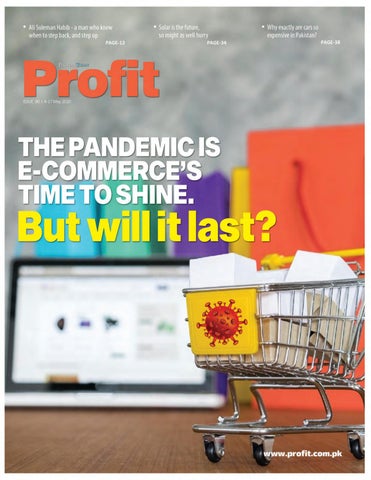
12 Ali Suleman Habib - a man who knew when to step back, and step up 16 The pandemic is e-commerce’s time to shine. But will it last?
22
22 Myths of the SBP: explained 28 Why you should now forget the past Asif Saad
30
30 The Dollar 34 Solar is the future, so might as well hurry 38 Why exactly are cars so expensive in Pakistan?
WELCOME
Hands off the 18th Amendment, Asad Umar! When he came into office as federal finance minister, we warned Asad Umar not to rely too much on the civil servants for advice, given the fact that they have their own interests and perspectives, and that he would be better off developing his own vision of how to govern. By now, we know that Asad Umar may have transitioned from Q Block (Finance Ministry) to P Block (Planning Ministry) of the Federal Secretariat in Islamabad, but he has gone fully native among the civil servants and will parrot their perspectives, trying to pass them off as his own and truly arrogant enough to think that we will not know the difference. The latest example of this came on April 27 in an interview with ARY News, where the planning minister made the claim that the 18th Amendment had flaws as it relates to the relationship between the federal and provincial governments, implying heavily that the provincial governments were not up to the task of running several administrative matters. That, in turn, implies that he would be in favour of returning some of those powers to the federal government, all the while claiming that the ruling Pakistan Tehrik-e-Insaf (PTI) was somehow in favour of the devolution of power to the provinces. This is a view that was bandied about in Islamabad by federal civil servants both before and after the 18th Amendment to the Constitution passed Parliament in 2009 and was signed into law by then-President Asif Ali Zardari in 2010. They do not wish to cede power and will come up with all sorts of intellectualisations and excuses to get it back. Of course the provincial government have had teething issues taking over the responsi-
bilities that were devolved to them. Anyone would have a learning curve in how to run a government department, let alone several. Given that his flailing incompetence as finance minister got him fired in just a few months, we would think that Asad Umar of all people would have some sympathy for the provincial governments getting up to speed on how they deal with such weighty departments as education and healthcare. And we completely disagree with the notion that the provinces are somehow doing a bad job. They could obviously be doing a lot better, and we will cut them no slack on that front, but the fact remains that since the 18th Amendment and the accompanying 7th National Finance Commission award, the provinces have engaged in a robust competition in improving the quality of education and healthcare for their fellow citizens. That is how we got Punjab’s Danish schools program, and KhyberPakhtunkhwa’s health insurance program, policy innovations that would never have taken place had the responsibility for education and healthcare been left to the federal government. Minister, you are absolutely wrong about the 18th Amendment. And you are advised to leave it alone. The amendment has resulted in tangible benefits to the people of Pakistan. Taking it away would be unlikely to result in favourable political outcomes for you or your party.
Farooq Tirmizi Managing Editor
Executive Editor: Babar Nizami l Managing Editor: Farooq Tirmizi l Joint Editor: Yousaf Nizami Reporters: Syeda Masooma l Taimoor Hassan l Abdullah Niazi l Meiryum Ali l Hassan Naqvi l Shahab Omer Director Marketing: Zahid Ali l Regional Heads of Marketing: Muddasir Alam (Khi) Zulfiqar Butt (Lhr) l Mudassir Iqbal (Isl) l Layout: Rizwan Ahmad l Photographers: Zubair Mehfooz & Imran Gillani l Publishing Editor: Arif Nizami l Business, Economic & Financial news by 'Pakistan Today' Contact: profit@pakistantoday.com.pk
FROM THE MANAGING EDITOR
9
Readers Say
facebook.com/Profitpk twitter.com/Profitpk linkedin.com/showcase/13251020 profit.com.pk profit@pakistantoday.com
HOW TO CONTACT
8
Good read. The opaque & anti-consumer nature of the life insurance industry has created a trust deficit. Policies are sold by setting unrealistic expectations, when equity markets are booming, the ordinary policyholder not knowing that bull markets are not perpetual. In the first year, these policies deduct 80pct of premium paid, in the second they deduct 50pct, and in the third around 20pct. Essentially you stay underwater for 7 years if you are lucky, and only break even after 7 years if you are lucky. Most life insurance portfolios are high risk and equity heavy, at times being major market participants, betting with policyholder funds. Bancassurance creates more perverse incentive as the guy who sells the policy doesn't have any skin in the game anyway. Anyone who has bought a policy in the last 5 years is most likely underwater despite being promised returns of 10%+ per annum. No risk profiling is done for policyholders,and the same product is pitched to a retiree as well as someone who is just starting his first job. Better option is to invest in a mutual fund as per your risk tolerance. If you want to hedge death, buy a whole life insurance policy, which pays out when you die. No point in saving with a life insurance policy where you don't even break even till the right year. Apropos: The great life insurance swindle Ammar Khan, Twitter
customer has to suffer, not the companies or their commission partners. The unit link system is made to protect the company's stake rather than benefiting the customer. In the last year, due to bad performance of funds, many policies didn’t achieve break-even after paying 6 to 7 years regular premium with only 4 to 5 premium multiple coverage. In this scenario, companies are making huge profits as fund performance will only affect customer savings. Further death coverage or life insurance benefit is not very attractive when he or she only gets 10 times or less than 10 times coverage of the premium, with all other conditions written in the insurance agreement signed by the person at the time of buying. There are many products which can provide life coverage by paying less than these policies, which have huge commissions (100%) over the term of policies. Companies are making huge profits by earning fee and insurance income. There should be strict regulation regarding fund and commission (should reduce to 10 %) of sellers. The regulator is only focused on the sales process and after sales service not on the product benefits or commission structure. There should be strict regulation like the Mutual Fund industry, where spreads are lower. Apropos: The great life insurance swindle Anon commenter, Website
Jubilee does take digital payment. They also lie in regards to the policy return. They told me if I deposit Rs 400,000 every year for 5 years, I would be able to withdraw double the amount I had paid once the sixth year begins. This was completely false and I was lied to. Now they are saying that I have to make the payments for 5 years, and can withdraw double the amount after 10 years. I was also told that I’d have to wait till I’ve made two payments if I wanted to withdraw the money. If I withdrew the money before 5 years, I would only get my investment and 20 percent. This also proved to be a lie. When I tried to cancel after 4 years, they said you can only have Rs 1.2 million out of the 1.6 million you have paid. Jubilee misrepresents policies in a bid to sell them.cApropos: The great life insurance swindle Shah, Website
“Regarding the recent decrease in key interest rates by the State Bank of Pakistan which was a surprise as we see prices of all other things that are dollar, gold, commodities, gas & electricity bills etc going constantly up. Hence the interest rates whatever were needed to be enhanced rather contrarily declined. The funds in banks are public hard-earned savings and not the property of the government or SBP and need to be given appropriate return in the form of interest to cover ever-increasing all-round prices and maintaining the purchasing power of their rupee holdings in banks. Instead of giving a decrease in interest to those who borrow from banks out of saver funds for facilitating ever increase in prices of their commodities at the cost of victimising saver is sheer injustice. The Government or the state bank thus don’t own the funds in banks have no right to decrease interest particularly when prices of everything go up and should reverse the decision by fixing interest rates at 25%.” Apropos: SBP allows one-year moratorium on consumer loans’ principle S Isar Ali, Website
These policies are just sold to earn commissions and incentives, all investment made in funds which are also managed by the same companies which again get a fee on managing the fund. If a fund does not perform well, the
COMMENTS
IN BRIEF The U.S benchmark price for crude oil dropped below zero on April 20, at one point hitting
- $37.63
a barrel. Demand for oil has dried up as people stay home, which means oil suppliers are willing to pay to sell their oil.
“The federal government has sabotaged our every attempt through their speeches. Through their incompetency, they have let down each and every province” PPP Chairperson Bilawal Bhutto-Zardari, lashing out at the federal government.
Exxon Mobil Corp. posted a $610 million loss this quarter, down from a profit of $2.4 billion in the same period last year. This is the company’s first quarterly loss in three decades.
As if the pandemic itself were not enough, US President Donald Trump now wants to ‘punish’ China for its handling of the pandemic. It is unclear what those retaliatory measures could look like.
Almost a quarter of Pakistan’s Covid-19 confirmed cases come from just one city: Karachi. The city has seen a
United Bank’s profit after tax this quarter rose
in its cases to close to 5000 cases in the space of just 11 days.
year-on-year to Rs4.87 billion.
200% rise 21%
“Tesla stock price price is too high imo” This single tweet by Tesla co-founder Elon Musk erased nearly $14 billion off of the company’s valuation.
Who’s going to spend in a pandemic? Pakistan’s inflation rate fell to 8.5% in April, the third successive month it has declined. March’s inflation rate stood at 10.2%, while February’s stood at 12.4%.
The State Bank of Pakistan has advised all banks to suspend dividends for March and June quarters. Banks that have already declared dividends have been advised to suspend dividends for June and September quarters instead 11
12
T
hat the House of Habib is one of the richest conglomerates in Pakistan is a well established fact (it contributes an estimated 1% of Pakistan’s total GDP, according to its management). That Indus Motors contributed a large chunk of that wealth, was also a well established fact. But the Habib descendant who led Indus Motors, Ali Suleman Habib, needed to impress this fact upon his newly hired CEO, Parvez Ghias, in 2005. Habib had been the chairman of Indus Motors since its inception in 1993, and had already hired two CEOs since then. He had also served as CEO for a brief period between 2004 and 2005. Ghias, who Habib had successfully poached from Engro, would be his latest leader. Around office premises, Habib was known to carry a pad and pencil at all times. It was to draw down ideas, scribble notes, and often show said scribblings to employees. So Habib pulled out his pad, and drew a pie chart for Ghias. The pie represented all of the Habib family wealth. 94% of that wealth, Habib told Ghias, came from automobiles, and (cue more scribbling) 90% came from Indus Motors. It dawned upon Ghias what was happening. Habib was entrusting his entire family’s fortune in the hands of a total stranger. Yes, Ghias was a corporate type, a former CFO and vice president at Engro Corporation, and yes, he was more than competent to lead Indus Motors. But Habib was creating a culture of trust, one in which he was allowing others to take the lead. He would be a different kind of seth then, one who could see the potential of doing things in a new way, in a professional manner. That is what makes Ali Suleman Habib’s life so special. Habib died on April 17 this year, in his hometown of Karachi. He was 63. But what makes him so missed, and so respected in the wider business community, is not just about what he achieved, but that he was brave enough to create space to allow others to also achieve their goals. This was a man who knew when to step back – and in doing so helped cement the status of the House of Habib in the 21st century.
began the Khoja Mithabhai Nathoo Trading Company. His son Habib Esmail joined the firm in 1891, and established Habib and Sons in 1922. This is when the famous Habib family logo was made, with a lion, the Lion of Ali and a sword, the sword of Ali, Zulfiqar, above it. His son Mahomedali Habib is famous for two reasons – first, he and his brother Dawood Habib formed the Habib Bank in 1941, which is now Pakistan’s largest bank (and no longer in the control of the Habib family, due to Prime Minister Bhutto’s nationalization drive of the 1970s). Second, Mahomedali Habib moved the bank to Karachi on the founder of the country Muhammad Ali Jinnah’s request. It had previously been headquartered in Bombay. Famously, Mahomedali Habib even gave Muhammad Ali Jinnah a blank cheque for Pakistan. In Pakistan, the family business was expanded on by first Mahomedali Habib, and then his sons Rafiq Habib, Suleman Habib, Haider Habib, and H.M. Habib. The global bank Habib AG Zurich, along with Thal Jute, were both started in the 1960s, while the Pakistan Papersack Division was started in the 1970s. Ali Suleman Habib was one of the five children of Suleman Habib, and the nephew of Rafiq Habib, who is the only living son of
that generation, and the de facto patriarch of the family. Ali Suleman Habib, his siblings and his cousins represented ‘G3’, or the third generation of Habibs in Pakistan. Born in 1956, Habib’s primary education was not at other schools for sons of elite Pakistani families – say the Karachi Grammar School, or Aitchison in Lahore. Instead Habib was educated at the very school his own family had set up just a few years after his birth: the Habib Public School, in 1959. The Habibs were unusual not just for sending Ali Suleman to Habib Public School. Habib was also part of the first generation to leave Pakistan for his higher education, receiving a bachelors of science in mechanical engineering from the University of Minnesota. He also completed the Program for Management Development at Harvard Business School in 1986. Ali Suleman entered the family business at just the right time in the late 1980s, which were poised to be the years of the Habib family’s re-entry in the private sector. In particular, Pakistan’s auto industry was deregulated in the early 1990s after which major foreign automakers, through joint ventures with local partners, made investments in Pakistan. Among themselves, the Habibs are a relatively egalitarian bunch. Different branches of the family are given different
House of Habib
A
li Suleman Habib spent most of his life in his home city of Karachi. In fact, the Habibs in some ways are the quintessential Karachi business family – that is, they can trace their history to the other side of the border. The House of Habib began in 1841, when Esmail Ali, who was from Gujarat in Western India,
Rock climbing during a trip to a local wilderness camp a few years ago
OBITUARY
Ali S. Habib with Ali Jamali and other members of the House of Habib participating fully at the first Learning Fair in January 2018 aspects of the business to take over. Ali Suleman Habib was given command of Indus Motors Company, which was incorporated in 1989, and started production in 1993. It was a joint venture between the House of Habib, Toyota Motor Corporation and Toyota Tsusho Corporation of Japan. It is also the maker of Pakistan’s most popular sedan, the Toyota Corolla. Habib was also the founding Chairman of the Pakistan Automotive Manufacturers’ Association. Quickly, Habib realised that Indus Motors had two strengths. The Japanese strengths lay in manufacturing, while the Pakistani side of Indus Motors brought in the ‘entrepreneurial spirit’. This hybrid culture was at place at Indus Motors for first ten years or so of operations, To that end, he often brought in entrepreneurial personalities similar to him, such as Farhad Zulficar, the first managing director of Indus Motors, and Mazhar Valjee, CEO of Indus Motors from 2001 to 2003. During his time leading the company, Habib developed a reputation as a hard task master, albeit a fair one. He was also considered a blunt and very straightforward person. This often did not sit well with other Pakistanis, but suited him very well when dealing with the equally blunt Japanese. In fact, several said that Habib was particularly influenced by the Japanese method of getting a job done, and he admired their culture of honesty and punctuality. He also was a frequent traveler, particular to Japanese markets. This association with
14
Japanese business standards was something that would stay with Habib, and marked him as somewhat unusual from other other businessmen in his home country. For instance, the Japanese standard was to keep a very low inventory at all times. This small detail was something that Habib tried to instill at Indus Motors. Around the same time, the chairman oversaw the growth of Indus Motors during a particular interesting episode in the history of the country’s auto sector. Between 1985 and 2005, the auto sector of Pakistan had moved towards a localization process, in which companies had to phase in compulsory local content conditions. Habib himself was a big believer in the localization process. But starting in 2006, the government of Pakistan replaced that with a tariff-based system, as the previous scheme was considered not compliant with Pakistan’s treaty obligations as a founding member of the World Trade Organization (WTO). Increasingly, the formerly gung ho, entrepreneurial figure, was becoming a more detail-oriented and cautious person. Because of his foreign education, and extensive work with foreigners, Habib realized the importance of separating ownership from management. So he paved the way for experienced management to come into the company at the ‘C’ level. It was his attempt to upgrade the hybrid culture that had so far existed in Indus Motors. As he told his incoming CEO,
he wanted to create strong human resource systems, with a greater emphasis on safety and health. Along with the new CEO, he built a team composed of individuals from Ford, Honda, and Engro to create a more professional environment. He allowed the talented team to flourish, though he still was quite personally involved in Indus Motors. Many will remember that Karachi experienced brutal episodes of sporadic strikes, violence, and kidnappning between 2008 and 2013. These incidents in some cases would even affect the smooth running of the plant. And yet Habib would make the daily drive from the leafy residential neighbourhood of KDA Scheme 1 to the Indus Motors assembly plant in Port Qasim every day, to personally make sure that supplies had arrived on time.
Habib University
W
hile Indus Motors was the backbone of the House of Habib, the family still felt it needed to create a lasting legacy. In part, they were inspired by Syed Babar Ali, founder of Packages Ltd, and also the founder of the Lahore University of Management Sciences (LUMS). After speaking to Syed Babar Ali frequently on the subject, the Habib family wanted to create a similar legacy – an educational institution in Karachi that was exclusively for the liberal arts, something different from what places like Aga Khan University and LUMS offered.
The main proponent of this project was again, Ali Suleman Habib. He ended up serving as the Board of Governors of Habib University (which was established in 2014), as well as a director on the board of Habib University Foundation and a trustee of the Habib Education Trust. Habib was aware that he was out of his depth in this subject area. So he adopted a studious and focused persona on the topic of the universities, and listened attentively to the advice coming his way. At Indus he had attempted to reign in the entrepreneurial side, and bring in a more organised approach; at Habib University, he recognised he had to do the opposite. Here, it was he who was the cautious, organised board member, though he deliberately picked a president, Wasif Rizvi, who he felt was entrepreneurial. The yin-yang combination worked well. Rizvi would come up with zany, almost over the top expansion plans, while it was Habib’s job to see if it could be executed, or if the donors would accept it. A little older and wiser now, Habib was open and candid about his mistakes at Indus Motors with the president, and other colleagues, which he did not want to make again in this new university project. Knowing that it was his family legacy on the line, he was careful about not rushing, or wanting too much too soon. It was in the transitional period that many saw a change, as Ali Habib stepped up to take over the symbolic role as it were that his uncle had previously held. He was increasingly becoming the face of his particular generation of the Habibs, a fact that was only accentuated by his prominent role in the university. Still, as some noted, it did not engender his relationship with other siblings or cousins in his family. On the whole, as many have expressed, the Habib family had healthy internal dynamics. At the university, Habib’s characteristic bluntness and assertiveness were on full display. Those who did not know him well could find him intimidating. But to those who did know him, he was a clear communicator, a not commonly found quality in Pakistani business circles – or for that matter, Pakistani academic circles. In certain moments he could be almost overly cautious, but was quick to point out his own mistakes. A few months before the formal opening of the Habib University, the university president and administration showed a sneak peak of the campus housing plan to the Habib family. Ali Suleman Habib loudly proclaimed, “Many times I thought, this wasn't possible, that it had not been achieved, You have proven me very wrong.” It was a moment that reflected his character,
Ali S. Habib with Syed Babar Ali at the Habib University’s convocation held in 2018 and once again, ability to step up, and let someone else's achievements shine.
The patriot
A
s the obituaries and condolences poured in in April, one stood out: the Prime Minister of Pakistan, Imran Khan tweeted about the loss of his old friend. In fact, several government officials expressed their public condolences. Over the last 30 or so years, Habib had developed an extensive network of contacts in Islamabad, where he would fly frequently in order to discuss auto sector policies. The conversation initially centered around intense lobbying, of course, in favour of the auto sector. But increasingly, government officials began to grudgingly appreciate, and in time respect, Habib’s views. His transparency about what he really thought of the government could sometimes alarm people. A close friend once cautioned him to not be so publicly open about his grievances; Habib responded with “Jo baat hai, woh baat hai.” He also closely worked with the Pakistan Business Council, at one point serving as the chairman. Habib viewed this group as a way to channel what he thought were policies that could positively impact Pakistan’s businesses, and also help influence government policies that he did not agree with. In fact, in the last five months of his life he had been working on a six month long project on protecting jobs in Pakistan, and sensible import substitution. Habib basically housed himself in the Ministry of Commerce, where he had been talking to at least 30 different stakeholders, including the Federal Board of Revenue (FBR). There were also government policies he
wholeheartedly agreed with. For instance, he was a big proponent of the documentation drive, despite it in the short term negatively affecting car sales. But he felt he was important for the country, and strongly advocated the government to bring that particular amendment back. It is for these reasons that almost every individual Profit interviewed referred to him as ‘a patriot’. He cared deeply about Pakistan, and his own strong views about how to improve and change the country’s direction. And as his life has shown, that was not just in the business sphere, but also in the philanthropic sphere, with Habib University. On a much quieter level, Habib’s impact could still be seen on the ground – he donated Toyota Hiluxes to the Pakistani government during the 2005 earthquake, when it transpired that those were the only vehicles that could go manage the tough terrain. He also sent supplies and helped set up rehabilitation camps during the 2009 refugee crisis after the army operation in Khyber-Pakhtunkhwa. On an even more personal level, he would often be seen promoting Pakistani culture at the various conferences he attended around the world. He was quick to introduce people, if at all interested, to Pakistani classical music, and if he had more time, then Urdu poetry. Habib’s life was dedicated to making sure that his family legacy survived. Perhaps no greater compliment can be given than this: that he expanded upon that narrow definition of the family, and included the hundreds of Pakistanis he either helped indirectly through the companies he created, or directly through the university he helped build. And he did it all by allowing others to show him the way. n
OBITUARY
By Abdullah Niazi, Meiryum Ali, Ariba Shahid, and Hassan Naqvi
16
T
he coronavirus pandemic has lasted just over two months across most of the world and already it has felled some venerable giants of the retail world: in the United States, several large retailers – including luxury retailer Neiman Marcus – have shown signs of strain and even declared bankruptcy. On the other hand, e-commerce giants like Amazon continue to churn out revenue gains. Will the same happen in the Pakistani market? Will the coronavirus accelerate the market penetration rates of e-commerce in the country and get more Pakistanis comfortable with the idea of shopping online? Everyone has been touting for the longest time that the future is online. Yes, the internet has dominated the past decade, but everything was supposed to go online, from grocery shop-
ping to education. While it did not happen organically, that is pretty where we are now. Except, the disastrous circumstances in which this change has been forced meant that everyone, from providers to consumers of services, were caught unawares. But as the demand for online deliveries increase, and innovations such as contactless delivery become the new norm, companies are not just ramping up their efforts but actually changing the way they operate and picking issues in their structures and business models. At the center of this increase in delivery services are Daraz and Cheetay, two companies that deal with different ends of the e-commerce industry – the first being the country’s largest e-commerce retailer and the latter being one of the fastest growing delivery and logistics services providers – but are looking to expand
their reach into each other's territory. How will e-commerce businesses shape up in this time, and what precautions will they be taking? More importantly, with how sudden all of this has been, are they prepared to deal with all of this even now? This is a once in a century opportunity for companies in this industry. Just how prepared are they to seize advantage of it, or will then let it slip?
The strangest of times
C
ontactless delivery is strange. It is, perhaps, the most dystopian feeling in the pandemic-hit world. Sure, the empty streets, lonely funerals and silent playgrounds are all eerie, but silence sometimes speaks volumes, and speaks to destruction
E-COMMERCE
“COVID took everyone, including ourselves a little bit by surprise. And I think for us the important thing was to ensure that first and foremost, the thing that crossed all of our minds as management was to ensure the safety of our customers, our sellers, and our employees� Ehsan Saya, Managing Director Daraz Pakistan
18
“In the coming months, more and more brands will be dependent on digital platforms. Even traditional vendors, who had no online presence, will have to move to e-commerce. As seen in Dubai, online malls and virtual storefronts opened as soon as a lockdown was imposed. Brands will also shift their marketing efforts and communications online” Majid Khan, CEO Cheetay
and bad times. What contactless delivery does is roboticise an otherwise human interaction. There are a few ways to go about it. For example, if you pay by card beforehand, you do not even have to see the rider. They just leave your package of groceries or food or whatever you have purchased lying at your doorstep. The other, stranger experience is your rider arriving, putting on a fresh pair of gloves and ringing your doorbell, before standing far away from your gate. When you arrive, they lay your order down and step away from it so you can come collect it. Then you leave the money in the same spot and they collect it, before they leave any change there which you may collect, and then leave any tip you may want to. As of now, weird as it is, this kind of delivery is a necessity. But with a second wave of covid-19 in the autumn already on the cards, this is how rituals are born and continue even when they no longer make sense. Whether this will become a ritual or not, it is too soon to tell, but contactless delivery is catching on in Pakistan, and according to Cheetay CEO Majid Khan, it was his company that first initiated it in the country. And according to him, it has been paying off. “Cheetay was the first to introduce ‘contactless deliveries’ in Pakistan. We have designated pick up and drop off points and our riders maintain a safe distance of at least six feet, both from the customers and vendors,” he explains. “Due to the lockdown, we did see a sudden decline, but since then we are on an upward trajectory and have seen a 10% daily increase in orders. We also launched Pantry – a
hyperlocal grocery model – at the same time and saw an overwhelming response to it.” The rise in an increase of orders was going to happen sooner or later as fears about the coronavirus virus pandemic grew in the country. And while e-commerce companies were quick to make their deliveries contactless, they jumped on the idea of delivering groceries quickly as well. Even Foodpanda, which was going to see a rise in demand in any case with people stuck at home and unable to eat out, was fast to create and launch Foodpanda Mart, a contactless grocery delivery service. And while some players in the e-commerce sector have been trying their best to innovate quickly, even the most agile companies have sort of been caught off-guard. Growth strategies and plans that they had hoped would phase in over the years, they are having to implement now. “COVID took everyone, including ourselves a little bit by surprise. And I think for us the important thing was to ensure that first and foremost, the thing that crossed all of our minds as management was to ensure the safety of our customers, our sellers, and our employees,” says Ehsan Saya, managing director of Daraz, Pakistan’s largest e-commerce website, and thus at the heart of this equation. Saya says that the beginning was chaotic, but as people began to settle down, they realised that people still wanted non-essential items as well as the more staple purchases like groceries. “We started focusing on making sure that the customers had what they needed, apart from making sure that there were safe deliveries. Our customers wanted to have hand sanitizers, and
grocery items, but they also still wanted to buy phones,” he tells us. But the process was not easy, and as Daraz’s CEO, Bjarke Mikkelsen, explains, there was a period of absolute mayhem where the company was trying to meet the challenge of the increasing demand and being responsible both officially and on a private company level. “I think we had three weeks where we had a daily two-hour call with all hands on deck every evening from 8 to 10, where we were going through a gigantic project management tool to see what we could do to optimise the supply chain and actually source the products that we need,” he tells us. And these were only the beginning of the considerations “How can we work with the governments to get the right permits to actually operate in the streets? How can we ensure our operation staff safety both for them and their families, but also when they interact with, with customers. How do we redefine our HR processes so that people can work from home or they can work in AB shifts and that we can limit the risk of contagion in the office?”
How to manage in times of crisis
T
hese were all pertinent questions of course. For starters, while it is the responsible thing to do to take care of employees and customers, it is also what is good for business. Imagine one rider turns out to be infected with Covid-19. That means all warehouse employees and all other riders having come in contact with him would
E-COMMERCE
“Right now we all have a bigger problem, which is that the whole economy is stuck, right? Our biggest focus is how can we, as Daraz, help to restart the economy and get that back on track. Because if we don’t do that well then to be honest, it doesn’t matter if we’ve won a little bit of share from offline, right?” Bjarke Mikkelsen, CEO Daraz
20
have to be isolated and get tested. If the virus spreads among company ranks, that is a death sentence, so better to keep as safe as possible. But then there is the fact that this is also the time for e-commerce to thrive. It has its greatest opportunities at a time when all work and physical interaction brings with it great risks. In their case, however, there are also great rewards. Cheetay tells us that there is definitely an increase in demand in these times, but they are balancing this with rigorous checks. “To ease the burden and improve the safety of our customers, we have rapidly expanded our services to include Pantry (local grocery alternative) and Pharma (to order medicines from your local pharmacies). We are also introducing basic Errand services and extending our business hours to help in times of emergency,” their CEO tells us. According to Majid Khan, not only are they taking precautions such as encouraging digital payments and accepting credit cards, Mastercard QR, SimSim and JazzCash, they have started an initiative offering 50% cashback on Mastercard QR in partnership with Bank Alfalah. But this and temperature checks are not the only ways in which the nature of the business of e-commerce is changing. “I think there's a lot of processes that have made us rethink how we operate. For example, working from home. We actually saw in the beginning productivity went up because people don't need to spend two hours per day in traffic and they don't need to sit in an office with too much noise and distractions,” the Daraz CEO tells us. Of course, while they may want to maintain some of the practices they find useful now, not everything has changed because of the pandemic. “Search trends still show that non-essentials are still in demand, which is a, which is a positive sign that people are still, you know, at they are still looking for these items, whether it's on online and online, we can measure it, but it's a positive behavior that they're still looking to purchase these things,” says Ehsan Saya. Somehow the demand for non-essential items continues to be high. People have just been forced to search and shop for things online rather than go out to markets. And with essential items, Saya tells us that they have seen a 35-40% surge in demand, which it has often been difficult to keep up with. He also hinted at people buying in bigger quantities, bulk buying to minimise the number of times they have to order, something that can only be a help to the company. But it also points towards a dangerous trend of bulk buying, something Pakistan has not really had to face yet where the shelves are empty not because of a shortage, but because of people buying much much more than they need.
Of course, that can easily be controlled online, but what cannot be controlled is how to boost supply when there is greater demand on such short notice? Daraz has been trying to expand during these time, creating the ‘D-Mart’ feature which allows customers to buy fresh fruits and vegetables, but this has been a little overwhelming, and by Saya’s own admission, they “were not able to cope up with the demand ourselves at certain times because it's just spiked up, very quickly.” And it is not all great for the e-commerce industry. Cheetay did not say outrightly that supply is ever an issue, especially since they are just a delivery company, but they did say that the government should ensure some way that hoarding does not become a problem and people do not overorder. Ehsan Saya over at Daraz was more candid about the situation. “I think you know that a supply shortage is definitely a problem. I was talking to one of the large FMCGs [fast-moving consumer goods companies] and they said one of their products, which usually takes six months to sell, sold in three days,” says the Daraz MD. “However, what we are doing in order to ensure that we address this inventory shortage is that we have to focus on expanding the universe of small, medium businesses. There is still inventory with a lot of sellers and we want to ensure that the platform that we really have at their odds is one that includes, that essentially allows and small medium business to sell to the customers.”
Is this the postCovid-19 future?
W
e have talked about this plenty. Will the trends that settle in now be the trends of the future, even when we are out of this vicious pandemic? E-commerce companies definitely see the silver lining. According to Cheetay CEO Majid Khan, his figures show that Pakistan has adapted quickly to online commerce. “We’ve noticed that people who feared online ordering in the past are now making multiple online orders on our platform. Grocery orders are on the rise as people don’t want to step out of their homes,” he tells Profit. “Most of the departmental stores quickly signed up with us under Pantry and other lastmile logistics companies to fulfill increased surge in home deliveries.” “In the coming months, more and more brands will be dependent on digital platforms. Even traditional vendors, who had no online presence, will have to move to e-commerce. According to the PTA, internet usage has increased by 15% since the lockdown. This trend will continue to rise as more and more people
practice social distancing. As seen in Dubai, online malls and virtual storefronts opened as soon as a lockdown was imposed. Brands will also shift their marketing efforts and communications online.” However, the team over at Daraz seem to be a little more cautious. They have a natural concern, sure, they are essential and can capitalise on the current situation, but if the economy continues to tank, will that not mean they will be in dire straits too? After all, spending power, infrastructure and buying capacity are all important factors in this business. Currently, Daraz says they are focused on working closely with the federal and provincial governments to make their operations as smooth as possible in these unprecedented times, but they stand aware of the dangers of the future. “It really hit us after the shut down, and to some degree we started to think about how people were going to earn money, especially the small, medium businesses, because they at the end of the day create a large majority of the jobs. And that is how our thought process evolved and we knew we had to be on the side of the small and medium businesses” Saya tells us. “I hope that we build more trust with customers by providing essential services through this difficult time. And that’s great in the long term, but right now we all have a bigger problem, which is that the whole economy is stuck, right?” says their CEO, Mikkelsen. He is candid about why Daraz wants to play the role it is trying to play. “Our biggest focus is how can we, as Daraz, help to restart the economy and get that back on track. Because if we don't do that well then to be honest, it doesn't matter if we've won a little bit of share from offline, right? And then the whole pie is so small that everybody will lose both of us and offline sellers as well.” There are, however, some good signs at least. While the pandemic may continue to ravage, e-commerce may still boom. But it will be important for companies to be on the right side of history for this one. And it is also important for them to continue to hope. “I would just like to make it very clear that we're still very optimistic about the future of e-commerce in, in, in, in Pakistan. And I think, if anything, this whole situation will, in the long term, probably accelerate the shift from offline to online,” says Mikkelsen. “One thing in particular we're seeing right now is the supply side. There's a huge amount of sellers that are signing up under us, right? And this is both small retailers and large brands who before thought that, you know, offline is still more important and we're not ready to really fully commit to e-commerce. This is our chance to win them over. n
E-COMMERCE
22
By Meiryum Ali
T
he last two months have been bizarre, to say the least. The COVID-19 pandemic has brought the global economy to a halt, and Pakistan along with it. The lockdown nationwide lockdown has been extended until April, leaving almost everything minus the country’s food supply and grocery stores on hold. In the midst of this pandemic, the State Bank of Pakistan (SBP) has taken drastic actions, cutting the benchmark interest rate by 75 basis points one week, 150 basis points the next week, to 11%, and then 200 basis points to 9% just three weeks later. (One basis point is one-hundredth of one percentage point.) It has also announced a flurry of relief packages and loan relaxations to borrowers and exporters, in an effort to assuage their financial concerns. Because the pandemic is so unpredictable, and the government and the State Bank’s responses similarly so rapid, it can be difficult to make sense of what is going on. Even a cursory glance at Profit’s comments section reveals a litany of bewildered responses, some confused and others even indignant. However, one in particular stood out. Commenting on an article titled “SBP allows one-year moratorium on consumer loans’ principle,” S. Asrar Ali had the following to say: “Regarding recent decrease in key interest rates by the State Bank of Pakistan which was a surprise as we see prices of all other things that are dollar, gold, commodities, gas & electricity bills etc going constantly up. Hence the interest rates whatever were needed to be enhanced rather contrarily declined. The funds in banks are public hard earned savings and not the property of the government or SBP and need to be given appropriate return in the form of interest to cover ever increasing all round prices and maintaining purchasing power of their rupee holdings in banks. Instead giving a decrease in interest to those who borrow from banks out of saver funds for facilitating ever increase in prices of their commodities at the cost of victimising saver is sheer injustice. The Government or the state bank thus don’t own the funds in banks have no right to decrease interest particularly when prices of everything go up and should reverse the decision by fixing interest rates at 25%.” The uncharacteristically long comment resulted in a back and forth between reporter and editor over whether the reader had a point. And while the conclusion was that
the comment in question did not quite have its bearings right, it did raise a few important questions. FAQs, if you will, that Profit thought might be important to answer. Fundamentally, there are three questions being brought up here: 1. Why did the SBP decrease the interest rate if the prices of commodities are increasing? 2. Why is the SBP giving a preference to borrowers, instead of savers? Does that not erode the savers’ gains? 3. Why does the State Bank have any right to change interest rates to begin with, if it does not own the funds in a bank? Profit will attempt to answer these three, pertinent questions.
1. Why did the SBP decrease the interest rate if the prices of commodities are increasing?
The State Bank changes the interest rate, with one eye out at all times for the inflation rate. The inflation rate is measured monthly by the Pakistan Bureau of Statistics (PBS). In Pakistan, as in most countries around the world, inflation is measured by the Consumer Price Index (CPI), which comprises both urban CPI and rural CPI. The current base year is the fiscal year ending June 30, 2016, meaning prices are measured relative to what they were that year. The urban CPI covers 35 cities and 356 consumer items, while the rural CPI covers 27 rural centres and 244 consumer items. The CPI looks at essential items for all Pakistanis (not the prices of gold or commodities), but the prices of goods like food, housing, electricity, gas, and fuel. It is true that the prices of these goods rapidly rose in the last year. At the start of January 2019, the inflation rate was recorded at 5.6%, meaning prices rose on average by that much compared to the same month in the previous year. It stayed in single digits until August 2019, when the inflation rate was recorded at 10.5%. It then hovered between the 11-12% range from September to December 2019, before climbing to 14.6% in January 2020. But then, in February 2020, something interesting happened. The inflation rate actually fell to 12.4%, and then fell further to 10.2% in March 2020. And according to the State Bank, the average headline inflation is expected to remain within the 11-12% forecast in fiscal year 2020, before falling to the medium-term target (in two years) range of 5-7%. Why are these inflation projections important? Because they give the State Bank wiggle room to decrease the policy interest rate, as long as the real interest rate is safe. The real interest rate is the rate of interest
BANKING
after allowing for inflation, or the nominal interest rate minus the inflation rate. The real interest rate reflects the actual purchasing power of the interest. In economics parlance, this equation is known as the Fisher effect. Under the conditions set by the International Monetary Fund (IMF), the SBP must maintain positive real interest rates, and so far, it has been working. One can calculate this for any month; in March, this is 11% minus 10.2% or 0.8%. The real interest rate in Pakistan for the second half of 2019 was around 1 to 2% (13.25% minus 11% or 12%). Why does the IMF mandate this? Because it believes, like our commenter, that savers should be given a return over and above the inflation rate as a fair rate of return, to incentivise them to put their money in bank accounts or other fixed income investments. Otherwise, it would be tantamount to them losing the real value of their money. To be fair, the current real interest rate is not exactly great. The State Bank Governor, Reza Baqir, has previously said that historically in Pakistan, the real interest rate has hovered slightly higher, at around 3%. He may be referring to the long term average since 1991, which has been around 3.2% during the nearly three decades for which discount rate data is available, according to Profit’s analysis of data from the SBP and PBS.. But as long as the SBP can make sure the real interest rate is positive, by looking at the prices of what the PBS sends out every month, then it is allowed to comfortably decrease interest rates, should it choose to.
2. Why is the SBP giving a preference to borrowers, instead of savers? Does that not erode the savers’ gains? Any monetary policy decision will
24
Why are these inflation projections important? Because they give the State Bank wiggle room to decrease the policy interest rate, as long as the real interest rate is safe. The real interest rate is the rate of interest after allowing for inflation, or the nominal interest rate minus the inflation rate. The real interest rate reflects the actual purchasing power of the interest always have some winners, and some losers. In decreasing the interest rate, this will surely affect the interest rate that savers have been receiving, particularly in the climate of extraordinarily high interest rates in 2019. Keep in mind that at the start of the 2019, the policy rate was only 10%. Subsequent policy reviews – in January, March, May and July – increased the policy rate by a total of 325 basis points to 13.25%. At the time, it was the seventh-highest policy rate in the world, well above the world average of 6.38%. [Also, Pakistan’s policy rate has always been on the higher side. Between the period 1992 and 2019, the highest policy rate was set at 20.0%, and the lowest at 5.75% – not that that has particularly created a culture of saving in Pakistan, but that is a different story.] The year 2019 was an incredibly lucrative time to save. But, as the Prime Minister also keeps saying to justify his ‘smart’ lockdown, decisions have to be made for the economic well being of 200 million Pakistanis, not just savers. Take a look back at the inflation numbers in our first answer. The numbers are going down, but why are they going down so rapidly? Well, aggregate demand has actually fallen, and there is a danger of it collapsing.
The pandemic means that global demand for imports, (even low quality Pakistani exports) has fallen, and locally, the lockdowns, and subsequent layoffs, have severely affected people’s spending power. In drastically cutting the interest rate, and introducing appealing schemes for exporters and borrowers, the SBP is saying it wants to keep demand alive, and make sure that Pakistanis still buy items, and the country still manufactures them. This is a real concern because the pandemic is not like any other financial crisis. In the monetary announcement on 17 March, SBP governor Reza Baqir dryly noted, “Fundamentally, we are dealing with a disease.” Even if interest rates are cut, people will not take the risk of leaving their houses and contracting the disease by standing in a store. And even if they wanted to shop, when will stores reopen? The new SBP measures are a hope against hope to keep Pakistan’s economy afloat. Savers will just have to wait.
3. Why does the State Bank have any right to change interest rates to begin with, if it does not own the funds in a bank? This is one of the most interesting ideas
that needed to be wrangled with. It essentially asks, does the State Bank have any right to operate the levers of the economy like this? Really, it is a fascinating concept, and borderline libertarian. We have all grown up hearing the State Bank change the interest rate to this or that, but who in the world bestowed this unelected body with this authority? There are two ways to answer this: the historical rise of the central bank, and the practical reason for a central bank (which clears concepts of ‘ownership’). Why do we have central banks? They are a relatively new concept having only been around for a few hundred years or so. Most of these precursor banks were started in the late 1700s or 1800s in Europe, to finance wars for governments. The modern central bank is a much more recent phenomenon. As an example, let us look at the United States. It had regular and severe bank panics through much of the 1800s, which would frequently cause banks to collapse. However, there was a particularly severe panic in 1907, when thousands of people scrambled to withdraw their money from banks, leading to massive bank runs and banks across the US declaring bankruptcy. The financier John Pierpont Morgan (yes, the person who started JPMorgan, now the largest financial institution in the world) had to literally step in and act as the banker of last resort, to shore up the banking system. Realizing that an individual had to step in, the US government enacted the Federal Reserve Act of 1913, which created the Federal Reserve System – or the US central bank. [Incidentally, J.P. Morgan died just a few months before the Federal Reserve was created, prompting much commentary that now that he was dead, the US government needed to create a central bank to replace him.]
On the State Bank’s website, it clearly states that the central bank bank defines monetary stability as “ the best way to achieve these objectives on a sustainable basis is to keep inflation low and stable. Low and stable inflation provides favorable conditions for sustainable growth and employment generation over time” This, by the way, is a good example of one of the key features of a central bank: a lender of last resort that provides emergency credit to financial institutions. If banks no longer have other means of borrowing, and if a severe bank run dramatically affects the economy, that is when the central bank steps in. This ushered in a period of the creation of central banks, as countries around the world recognized the importance of central banks. Australia established its first central bank in 1920, Mexico and Chile in 1925 and Canada and New Zealand in 1934. South Asia is no exception. The precursor to the State Bank of Pakistan was the Reserve Bank of India, which was created in 1935 in colonial India, mostly because of financial troubles in India due to the First World War, and the Great Depression which followed it. The Reserve Bank of India continued to be Pakistan’s central bank even after Partition, until 1948, when the State Bank of Pakistan was set up. Under the State Bank of Pakistan Order 1948, the bank’s duties were to “regulate the issue of Bank notes and keeping of reserves with a view to securing monetary stability in Pakistan and generally to operate the currency and credit system of the country to its advantage”.
But eight years later, the bank’s duties, responsibilities and role were all expanded significantly. Under the 1956 State Bank of Pakistan Act, the bank now had to “regulate the monetary and credit system of Pakistan and to foster its growth in the best national interest with a view to securing monetary stability and fuller utilisation of the country’s productive resources”. In India and Pakistan, and South Asia in general, we have had historically more “involved” central banks, due to the legacy of the Reserve Bank of India, which initially financed development projects. On the SBP’s website, it clearly states that “The responsibility of a Central Bank in a developing country [emphasis mine] goes well beyond the regulatory duties of managing the monetary policy in order to achieve the macroeconomic goals. Ever since its establishment, the State Bank of Pakistan, besides discharging its traditional functions of regulating money and credit, has played an active developmental role to promote the realisation of macroeconomic goals”. Pakistan embarked on a series of financial reforms in the 1980s, which led to reforms in the central bank in the 1990s. First, the State Bank of Pakistan was granted autonomy in February 1994. Then in February 1997, Par-
BANKING
liament passed three amendment ordinances to the State Bank of Pakistan Act 1956, the Banking Companies Ordinance of 1962 and the Banks Nationalisation Act of 1974, which in total, granted sweeping autonomy and authority to pursue an independent monetary policy. The State Bank of Pakistan as we know it, with all its powers, monetary policy committees (MPCs) and ability to control the levers of Pakistan’s economy, is a phenomenon of only the last couple of decades. This leads us to point two: the practical reason to have a central bank. For starters, the bank is a regulator, which means it can whip into shape private banks in the country, and can dictate how much banks can lend to customers, or how much cash they have on hand, though reserve requirements. And as discussed already, the central bank can provide loans to a country’s private banks, as the lender of last resort. These loans lent as a last resort are interesting. The central bank sets the policy rate, which is the rate at which commercial banks can borrow from the central bank. This then influences the rate at which banks can lend money to one another. The average rate of lending between banks is known as KIBOR or the Karachi Interbank Offered Rate. Private banks then use KIBOR as a reference and structure their loans to borrowers accordingly. That is how the policy rate ends up indirectly controlling the amount of private borrowing, and subsequent spending, in an economy. Commercial banking – that is, customers depositing money, and banks lending out a portion of that money out to other customers – is one event. A private bank getting a loan from the central bank – the central bank acting as the ‘lender of last resort’ – is another event. The two are not directly related. So how come it is the central bank that gets to decide the interest rate that private banks give out loans at? Well, the central bank gets to do this because of its mandate: securing monetary stability. On the State Bank’s website, it clearly states that the central bank bank defines monetary stability as “ the best way to achieve these objectives on a sustainable basis is to keep inflation low and stable. Low and stable inflation provides favorable conditions for sustainable growth and employment generation over time.” This is kind of what the previous two answers discuss, that the SBP manipulates the interest rate in order to keep inflation in check. This is actually known as Taylor’s rule, which states that interest rates should change as the economy shifts. So higher interest rates when inflation is high, and lower interest rates when inflation is low.
26
In drastically cutting the interest rate, and introducing appealing schemes for exporters and borrowers, the SBP is saying it wants to keep demand alive, and make sure that Pakistanis still buy items, and the country still manufactures them Think of the interest rate as a moving target that the SBP can control. It has to be high enough so that savers can deposit money in the bank, and low enough that borrowers can take out money. Private banks cannot escape the interest rate that the central bank sets, and arbitrarily set their own interest rate. The policy rate is a signal to the entire economy. That policy rate determines how many deposits a private bank is getting. That rate influences the KIBOR, or the rate at which a private bank can get a loan from another private bank. The rate also determines how much interest the private bank itself is getting on its reserves that it has parked with the central bank. Under the SBP’s Cash Reserve Requirement (CRR), private banks must keep a portion of their rupee and foreign currency deposits with the State Bank. A private bank will not keep the rate at which it lends to private borrowers at a lower interest rate than the one set by the State Bank. Were that to happen, the bank would always be incentivised to just not lend, and keep its deposits parked. Instead to make profit, it sets it at a higher interest rate than the policy rate. This makes the interest rate an extremely important lever at a central bank’s disposal, one that has an outsize impact on a country’s economy. To again use an example from the US: in the late 1970s the US experienced out of control inflation, reaching 14.8% in March 1980. Paul Volcker, the Federal Reserve chairman at the time, decided to increase interest rates to double digits, the idea being that it would constrict borrowing and spending, thereby leading to a decrease in price inflation. The interest rates were so high, that it actually led to a recession in 1982. However, once the interest rate was relaxed a little in 1982, the higher interest rates had the desired effect: inflation decreased to less than 3% by 1983. Something similar happened in Pakistan during the Zardari Administration, with slightly different consequences. Shahid Kardar became State Bank Governor in September 2010, a time when inflation was stubbornly high. He raised interest rates twice, once in September and again in November 2010, a move that did not go over well with the President and the Finance Ministry. Rather than letting him continue as head of the central bank, however, they created con-
ditions that forced him to resign in July 2011. Inflation remained high for nearly the entirety of the Zardari Administration, which ended in May 2013, and did not come back down to single digits until two years after Kardar’s resignation. So yes, the State Bank does get to control interest rates, and it does so in order to fulfill its mandate, provided to it in 1956 to “secure monetary stability and fuller utilisation of the country’s productive resources.” Now, as to the more granular point of S. Asrar Ali about owning funds, let us move with a hypothetical. Let us say he deposits Rs1,000 in a private bank (we’ll call it Karachi Bank). He has every right and ownership over the Rs1,000 that he has deposited in the Karachi Bank, and can withdraw the money at any time. But he has no ownership or right over the interest rate that he is accruing on those Rs1,000. That just happens to be a by-product of the deposited Rs 1,000. Whether the interest rate happens to be really high one year (as it was in 2019), or really low the next year, it is not Ali’s right. The only way the interest rate caters to Ali, is that it must be high enough to incentivize him to deposit his Rs1,000 in the first place. In fact (to tie it back historically), by depositing his money in Karachi Bank, Asrar Ali is a member of the modern banking industry. He is not only entrusting Karachi Bank with his money, but is also confident that Karachi Bank will be saved in the event of a bank run, by another, larger bank, which will naturally be the central bank. The central bank’s existence and ability to lend out money at certain interest rates to private banks like Karachi Bank, is what gives Karachi Bank the confidence to lend out money to citizens. This fragile system, based on money, trust, and interest rates, is what we have had in Pakistan, technically since 1935, more than a decade before we even had a Pakistan to talk about. And if the interest rates are not of a particualar saver’s liking, what S. Asrar Ali could do, to make life more predictable, is to realize that instead of keeping money in a savings account in a volatile developing country like Pakistan, it would be more prudent to strategically deposit money in a fixed deposit account, where the return is more stable. Problem solved. n
BANKING
OPINION
Asif Saad
But the current situation is not and has never been a supply-side issue, it is a demand problem. The fear of this virus has, for all intents and purposes, killed the demand for most products and services. From crude oil to schooling, to eating out to travel, and to shopping and so on. Demand is dead, hence the unpredictable situation. In fact, this is probably the first time the world Business owners longing for things to return has collectively seen such a drastic collapse in demand. quickly to what they were in pre-Covid-19 days With the exception of essential food and healthcare, it is difficult to find a sector where demand has not may be on the wrong side of history been disrupted. In order to open up the economy, the demand has to return. ne of the key tasks in developing business strategy is But how does demand reappear and assume its to identify and separate what is relatively predictable pre-Covid-19 levels? That can only happen when evfrom the fundamentally uncertain. Future scenarios eryone feels safe from the disease. When we can return are built by varying the uncertain while keeping the safely to schools and offices, take public transport or predictable constant. Of course, if there is nothing eat at restaurants, go shopping or travel. That is when which can be predicted then there is not much use demand will return. Can that actually happen without for strategy or any sort of planning. a vaccine being developed? Even if a vaccine becomes In this ongoing heated debate between various stakeholders on available tomorrow, it will take a while before all counlockdowns-versus-opening the economy since Covid-19 appeared as tries in the world acquire it. As the refrain goes that a major disruption in our lives, we seem to be dealing mostly with the one often hears in the media, “We will not decide the unpredictable, with some exceptions. timing. It is the virus that will decide.” For those whose livelihoods depend on business, it is natural to What is clear is that a decisive and predictable want the economy opened as soon as possible to prevent financial deeconomic recovery depends on a medical solution -struction, which is already imminent for many. when medical science has successfully identified and However, conducting business requires both supply and demand to contained the virus, treated illness and created immuexist at the same time. You have a product or service to sell. Someone else nity throughout the world. Until then, we will remain needs or wants to buy it. In the current circumstances, when businesses in these cycles of hard and soft lockdowns, opening up, want to open the economy, they want the supply side to be opened, for seeing infection numbers surge and locking down again. their factories, offices and shops to be allowed to operate. This is a pattern we are all likely to become familiar with. In fact, if this pattern continues for a year, will it not have created a new normal, and in doing so have fundamentally changed life? Perhaps, but let us not get that far ahead. What science is making amply clear is that Covid-19 is not “an event”. It is unlike other Asif Saad disruptions we have seen in the past, that have defined generations -- 9/11 or the 2004 tsunami is a strategy consultant or the 2005 Kashmir earthquake or Hurricane Katrina in the USA, 2005. The coronavirus panwho has previously worked demic we are seeing today is more like a ubiquitous phenomenon -- like the advent of the interat various C-level positions net which has changed life over the last 30 years in more ways than we could have imagined. for national and And just like everything else, the world of business must also accept the multitude of multinational uncertain elements in this situation. But what do businesses do then? Unfortunately, the corporations predictable yet bitter pattern is that a lot of current businesses will suffer badly and may not
Why you should now forget the past
O 28
survive -- at least not with the business model they were operating before Covid-19. Governments are trying to mitigate the situation by providing loans, tax reductions, employment grants etc. But how long can this continue? In the business world, hoping for a miracle is a bad strategy. Hence, we will see many closures and accompanying layoffs. These moves will be much more visible in the small and medium enterprise sector. In the corporate sector, those who have been successful over the years -- mostly big companies -- have built up enough cash reserves. They would be well advised to conserve as much of this reserve as possible. However, this should not mean automatically laying off employees. In fact, the strongest predictor of future success for these companies is to retain employees and contribute in this way to the fight against the virus. If they can emerge from this crisis with solid reputations, that will be a big achievement. But that will not happen if they are perceived as lobbying with governments to try and obtain benefits for their industries while laying off employees as a first line of defense. Even if they do influence governments successfully, they need to remember that governments don’t create demand -- at least not under the economic system that currently
Instead of wishful thinking and expecting or hoping for the future to be a return to the past, it would be worthwhile for business owners to take the time to reflect on what sort of change their respective industries will undergo rules most of the world. It’s not that change like this, in demand patterns, does not come with its own set of opportunities. The entrepreneurial-minded who are willing to consider that the new normal is already here might evaluate investment in sectors in which demand has stayed inelastic -- and will continue to grow, hence be more predictable. No, I do not mean we should all start producing masks and sanitizers, although some have already embarked on that path. In general, healthcare as an industrial
sector should see massive public and private investment. Pharmaceutical companies, hospitals, laboratories and other related sectors should see strong demand right now and well into the future. Similarly, governments would do well to give renewed focus on agriculture and the food value chain and provide this sector with plenty of support and opportunities. Education and online models of education were already seeing fast growth pre-Covid-19, but this sector will now grow even faster. And speaking of online, anything online and virtual is ready to take off at warp speed now. If we thought online interactions and products were growing fast before, just wait and see what happens in the next couple of years. Particularly in sectors like education, retail, banking and others. Ultimately, a resolution of the medical problem is necessary to revive demand. Even when it does return, demand will be slow and gradual with many changes in how businesses are used to operating. Instead of wishful thinking and expecting or hoping for the future to be a return to the past, it would be worthwhile for business owners to take the time to reflect on what sort of change their respective industries will undergo. This is not a bad time to start afresh, perhaps in new, emerging sectors or possibly even with new business models. n
COMMENT
F
By Yousaf Nizami
or any new government in Pakistan that comes to power, either through force or through a constitutionally mandated process, there is a reboot period where almost all teething problems can be blamed on its predecessor. Perhaps the area where this excuse is used the most is the economy. This period ends within two years, which is when there is enough stability in the system that the new setup can start weaning off the ‘it’s their fault’ mantra. PTI’s reboot is taking longer to end because that stability in the system that should have come around by now has not, inflation and unemployment has the general public up in arms and mostly because of the lack of direction in an economic team that is overflowing with massive egos of multiple players who can’t seem to effectively work together. In the midst of all the chaotic politics and bad press there is one economic policy that seemed to be working; the FX policy. The dollar is no longer being discussed as it was at the start of PTI’s government. Rupee depreciation makes better headlines, especially if it’s aggressive, which it was in PTI’s case. Currency appreciation, which had also taken place recently, is boring and lack of volatility in the market even more so. In this story, Profit will explain the flaws with the old FX policy and the damage it inflicted, what measures the PTI took to control the market and keep it relatively stable and where the USD/PKR parity is headed in the short to medium term.
30
Dar-sim
I
n June of 2013 the PML-N took over from the PPP. The rupee was hovering at a level of 98.50 on the back of a total liquid foreign exchange (FX) reservesnet reserves with SBP plus net reserves with banks-figure of approximately $10.28 billion; not great, not terrible. By December, USD/ PKR steadily depreciated to peak at 108.20 in December. Although a $6 billion IMF EFF (Extended Fund Facility) had been finalized in September, it would take some time for the first tranche to be released. FX reserves were still bleeding, dropping to a dangerously low $7.98 billion in January 14’; there was desperation for dollars. That much needed FX reserves support kicked in in the first quarter of 2014 enabling Finance Minister Ishaq Dar to set out on his ill-conceived quest to overvalue the Rupee against the dollar to stupendous levels, using borrowed IMF dollars to maintain excess liquidity in the interbank and open markets. By March 14’ the rupee was at 104.90, by June it was 98.80 only to settle at a more maintainable 100.50-100.80 by December. FX reserves continued to climb to reach $15.26 billon as IMF and other bilateral donors kept the tap open. By August 15’ however it started to become clear that the underlying pressures resulting from an unsustainable exchange rate policy had started to penetrate the surface, with the exchange rate jumping to 104.30 in a matter of days; the first of many upward spikes. Apart from a patch of volatility in December, the 104 ‘big-figure’ was maintained throughout 2016 and up till June 2017. By this time the 3-year IMF package had also expired.
In October 16’ FX reserves reached their highest level at $23 billion with two more years of PML-N’s tenure to go. Dar was adamant to continue pumping dollars into the market all the while piling on supply side pressure and reversing the trajectory of FX reserves. On, 5th July 2017, an intraday spike of Rs4/dollar depreciation exposed more fault lines. On July 28th Nawaz Sharif was disqualified by the SC in the Panama Papers case. A new level of 105.00 – 105.50 was maintained until the start of December 17’ when it jumped to 110.60 within two days; by this time reserves had depleted to $19.5 billion. The PML-N government’s exchange rate policy had finally reached a point where market forces could no longer be controlled from Jati Umrah’s drawing room. By March 18’ USD/PKR reached 115.00 by June 18’ it was 121.40. And these were by no means incremental changes; they were massive spikes that neither the market nor the central bank and definitely not Dar had the capacity to correct. Another major factor in all this was the very public spat between Dar and the SBP’s top management of the time. As finance minister, he had taken over the central bank’s policy making, even announcing the monetary policy statement at times, before the SBP governor had a chance to do so as was his prerogative. This was despite an IMF condition to make the central
PERSONAL FINANCE
bank autonomous. These spikes were a result of a central bank unwilling to accept the finance minister’s instructions any longer and letting market forces play out rather than injecting already scarce liquidity into the currency market. The 16th of July 18’, for example, was particularly brutal, with the Rupee closing at 121.55 on Friday and opening at 128.00 on Monday, a Rs. 6.5 fall over a weekend. This level continued for the next seven days, only to start gradually correcting itself, settling at around 124 by election time. All told, Dar’s interference in FX policy, something that he should have had nothing to with in the first place, left the incoming PTI government with the USD/PKR at 123.90, FX reserves at $16.39 billion and a current account deficit at an eye-watering 5.7% of GDP. Khan makes some changes PTI’s FX policy has more sanity than Dar’s but because it initially involved rapid depreciation, it was widely unpopular. This was compounded by the fact that a major expectation from Imran Khan’s economic team was to have a plan, some years in the making, to take the bull by the horns on day one and within 90 days, tame it. The inflationary pressures that came along with the Rupee depreciation did not help matters either, taking headline inflation to above 15%. Then there were the less tangible changes that had more to do with optics. Asad Umar was fired within eight months of becoming Finance Minister, a position he had been promised and was apparently the best man for, as propagated my Imran Khan himself, for years. One of the many reasons he was shown the door was because he wasn’t playing ball with the IMF. Within a month of Umar’s departure, the new SBP governor, Reza Baqir, whose previous job was IMF’s country representative for Egypt, was installed by the fund as ‘their man’, to strictly execute the new FX policy among other key objectives. Some of the depreciation had already taken place, before the economic team shakeup, in order to demonstrate to the IMF that Pakistan was willing to take tough measures that would expose them to a significant amount of backlash. This also had to be done due the external account situation that was out of control with the fiscal deficit at around $18 billion in FY 2017-18. Imports had to be discouraged in order bring this figure down drastically, and that is exactly what the higher exchange rate achieved. In the second week of October 18’, the rupee was depreciated by over Rs 9, bringing the parity to the new level of 133.60 from 124.00. In December another hike of Rs5 took the rate to 138.60. Since precious FX reserves
32
were not being released into the currency markets, they kept hovering around $13 - $15 billion, well into 2019, which is when the bilateral and multilateral donations from ‘friends of the country’ really started kicking in. Rupee depreciation continued, with the next series of depreciation that would take the Rupee-Dollar parity to where the SBP wanted it, in a relatively more gradual and incremental method. By mid-May the new level was at 141.40 and then came the real volatility; a Rs. 10 depreciation to 151.00 and another similar jump to arrive at 160.00. With the IMF’s first tranche released, a second on its way and external debt piled on, FX reserves steadily increased to a more confortable $18.8 billion. By January 2020, the current account deficit, due to a significant drop in imports, had decreased by a massive 75% to a respectable $2.65 billion from $9.48 billion a year ago. This allowed the rupee to appreciate by over Rs5 to a level between 154.50 and 155.00, a range where SBP felt comfortable.
Covid-19 hits hard
W
e spoke to FX dealers at the treasuries of various banks to get a view of where the market was headed in the mid-term. The Coronavirus had not done so much damage to the markets at the time and there was definitely less uncertainty. Things have changed since but for the sake of perspective, this was what the general consensus was: The rupee will appreciate further as FX reserves get more support in the coming months and there is more improvement in terms of the external account. It could go as low as 145.00, not more than that, and also no higher than 155.00 in the medium term. A range bound USD-PKR parity would be maintained by the SBP. This was then, suggesting that all that talk of the dollar hitting 180.00 or 200.00 was unrealistic, unless, and this is the important part, “there was a severe global economic crisis that would deliver a shock to the system”, as quoted by one interbank dealer at one of the top 5 banks’ treasury. Covid-19 is that shock! It has obliterated economies across the globe. While the population of a country can reduce the risk of getting it or infecting others by practicing social distancing, there is no way to defend markets against it. As a nationwide lockdown continues in Pakistan with only essential industries operational, that too at minimum capacity, the economic fallout from this is going to be severe. Sindh, the hub of economic activity in the country went into a lockdown
in mid-march, other provinces and especially the center reluctantly followed soon after. The rupee is also faltering under the pressure. On the 9th of March it broke the 155.00 barrier, and for the remainder of that week it started testing the crucial psycholiogical barrier of 160.00. That was breached on the 25th. The next level to watch was 165 that the central bank was not able to protect as it was broken a mere five days later. Speaking to Profit on condition of anonymity, a currency dealer at one of the top treasuries in Pakistan explained how a bulk of rupee depreciation, apart from the panic caused by the coronavirus, is due to the outflow of hot money parked in the country. SBP Governor Reza Baqir, by maintaining the discount rate above 13 percent over an extended period of time, built up a sort of parallel reserve of dollars amounting to $3.25 billion parked in fixed income securities and equity in the form of Special Convertible Rupee Accounts (SCRA) that facilitate foreign investors to park their money in Pakistan’s financial markets. That money started to flow out in March at the first hint of a discount rate cut. So far close to $2.5 billion of that cushion has flow out of the country, as was expected, after the rate was cut by 225 basis points in two separate Monetary Policy decisions within two weeks. However, by exercising a limited and controlled form of currency market intervention, the return on investment that would have been booked by foreign investors has been significantly eaten up rupee depreciation. With the market currently at 166/167, the next level to watch is 170.00 and the SBP is aggressively defending this rate, which is essential. This is not Dar-style interventionbaseless and pointless- it is necessary to offset the effects of something else, a flight of hot money and severe panic. While a 30% decrease in oil prices will provide considerable relief to the balance of payments there are still significant outflows coming up in terms of loan repayments. A fall in worker’s remittances is bound to take place as Pakistani labourers across the world are laid off due to a fall in overall demand amid a global recession that is setting in. In the short to medium term, it makes more sense now to buy and hold dollars. More depreciation is expected in the coming weeks. A negative flow of dollars, falling reserves, reluctance to intervene in the market and no buffer in the form of hot money means that the current Rupee/Dollar parity will be tough to maintain. *All historical data is sourced from M2M revaluation rates and month-end reserve figure archiv
PERSONAL FINANCE
T
By Shahab Omer
o have a burgeoning solar energy industry, it can be easy to think of more complicated things that a country needs to have: a strong supply of photovoltaic panels, a robust regulatory environment, and a transmission infrastructure that can handle the distributed generation of electricity efficiently. It is easy to forget to think about the most basic ingredient of all: sunlight, and how much of it a country gets on its territory. On that matter, Pakistan is unquestionably blessed. Solar experts believe that an area needs a minimum of four hours of peak sunlight in order for solar energy to be economically viable. Peak sunlight is not just any time between sunrise and sunset: it is when daylight is bright, and directly shining on solar panels. The goods news for Pakistan? Most of the country has 300 or more sunny days every year. And the overwhelming majority of the landmass of the country gets seven or more hours of peak sunlight every year, according to a 2012 research paper by Saifullah Khan, Mahmood-ul-Hasan, and Muhammad Aslam Khan of the University of Peshawar. Their research examined data from 1931 through 1990 for most of the country. Solar energy, therefore, makes all the sense in the world for Pakistan as a major source of electricity, even taking into consideration the limitations of energy storage technology. And given the precipitous collapse in the prices of photovoltaic cells, which has dropped by more than 60% over the past decade, one would assume that solar energy would be more of an energy source for Pakistan.
34
The numbers, however, tell a different story. For the 12 months ending January 2020, solar energy accounted for just 0.58% of Pakistan’s electricity generation, or 722 gigawatt-hours, according to data from the National Electric Power Regulatory Authority (NEPRA). That is up from zero as recently as 2014, to be sure, but still a long way to go before it becomes a major source of energy for the country. That NEPRA data, of course, does not count solar electricity that is being generated by private homes and businesses, and not connected to the national transmission grid. There is at least some evidence to suggest that there may a substantial portion of solar energy generation capacity in Pakistan that is installed and being utilised, but not counted because it is not connected to the grid. Imports of solar panels have risen from as little as $1 million in 2004 to a peak of $772 million in the fiscal year ending June 30, 2017. While they have since dropped down to $409 million in fiscal 2019, the country’s imports of solar panels appear to be a strong upward trajectory, growing at an average rate of 15.9% per year in US dollar terms (22.6% per year in Pakistani rupee terms) in the five years between 2014 and 2019. While a substantial portion of those imports are for grid-scale projects, a significant proportion are for domestic, commercial, and industrial users who are not necessarily connected to the grid. Given the country’s chronic energy shortages – and the public’s increasing scepticism of the state-owned utility companies to deliver a consistent supply of electricity – it makes sense that more and more Pakistanis are adopting the use of solar technology to meet their energy needs. Could solar be the future for Pakistan? Maybe, but only if the government gets out of the way.
Demand, supply and costs
F
or advocates of solar energy, the idea is for everything to go completely solar. Yes, there are already some houses and companies that have on an individual level gone solar. However, expecting the government to initiate sweeping change and switch to solar is asking too much. If there is to be a switch to renewable energy, particularly to solar, it will have to be a gradual, natural switch. One that begins more as a trend than as a necessity, because implementation and execution is where all great, common sense ideas go to die. So can solar become the future of energy in Pakistan? After all, how much electricity are we using exactly?
According to the report of the International Energy Agency (IEA), the average energy demand in Pakistan is approximately 19,000 megawatts (MW) against the average generation of around 15,000 MW. This demand goes beyond 20,000 MW from May to July, when the summer is at its peak and air conditioning systems place an extra burden on the national power grid, often causing power cuts. The IEA also forecasts in its report that the electricity demand would rise to more than 49,000 MW by 2025 as the country’s population increases and the economy grows in size. This is a crucial situation and at this time the government really needs to think of an alternate solution. Solar energy is the obvious candidate. And once again, the government cannot be expected to go knocking on doors with solar panels installing them to houses one by one. What the government can do, however, and actually should be expected to do, is make it easier for businesses to provide solar electricity. They can also encourage consumers to switch to solar panels, rather than creating hurdles in their way as they are currently. Almost 51 million people still do not have access to electricity in Pakistan. This gives a great challenge to the Pakistani government and policy makers, as electricity is a necessity of modern life. But why remain a stronghold for the old guard? Nauman Khan from the Pakistan Solar Association was of the view that in Pakistan, solar was being taken as an industrial item in the consumer market. “In the prevailing conditions, solar is considered a luxury, but it will turn into a necessity soon,” he says. “People initially used solar to avoid load shedding, but this is a low cost billing system. One unit of solar costs Rs6 per unit, and if a battery is added, then it costs Rs9.5 per unit.” “Meanwhile, we are getting electricity at the rate of Rs18 to Rs25 per unit. Different companies like LESCO [Lahore Electric Supply Company], KESC [Karachi Electric Supply Company, the old name for K-Electric], etc have different tariffs and rates. Simply speaking, solar is just cheaper, and this may just be a bigger attraction to the consumer than environmental benefits of sustainability.” “But despite that, the future is solar,” he goes on to add. “This is not just a Pakistan issue or a capacity issue, this is global. The USA and Germany don’t have load shedding, why do you think they are shifting to solar? It’s better to get on the train now rather than hanging onto the railings when it’s already full.” “Back when God installed the solar system, that was it. All that was needed from then was the panels, and even those are really low maintenance,” says Saeed Hussain, a veteran industry expert, who is also head of the So-
lar-Thermal division of the Ministry of Science and Technology.
Enter the government
S
o what prevents solar energy from taking off? Well, as pointed out earlier, where the government should be encouraging solar proliferation, they are instead causing hurdles. Under the Regulation of Generation, Transmission and Distribution of Electric Power Act, 1997, NEPRA is the sole regulator in the power sector. NEPRA issues generation licenses, establishes and enforces standards, approves investment and power acquisition programs of the utility companies, and determines investment tariffs for bulk generation and transmission and retail distribution of electric power. The Alternative Energy Development Board (AEDB) was established as an autonomous body with the aim of promoting and facilitating the exploitation of renewable energy projects in Pakistan. It has been designated as a ‘one-window’ facilitator at the federal level for processing solar projects of all sizes. The Government of Pakistan’s first steps towards firm support of renewable energy in its energy mix came in 2006 when it made the Policy for Development of Renewable Energy Generation (the 2006 RE Policy). The AEDB has been planning to develop cost-effective alternative and renewable energy-based power generation projects through private investors under the Renewable Energy Policy 2006 on the IPP model (independent power producer). The Government of Pakistan’s role in all of this has been offering incentives to investors for solar power development in the country. Investors have been presented with rewarding financial incentives that are of key interest for them to come to this market. Provincial governments, particularly the Government of Punjab, have taken the lead on facilitating development of solar power in Pakistan. The goal that the federal government has set for the AEDB is to ensure 5% of total national power generation capacity to be generated through renewable energy technologies by the year 2030. That may seem like very little and very slow progress, but even that is coming along at a snail’s pace. In addition, under the remote village electrification program, AEDB has been directed to electrify 7,874 remote villages in Sindh and Balochistan provinces through ARE technologies (Alternative and Renewable Energies Technologies). However, there are certain hurdles unique to the industry that make this a difficult task and even 5% solar coverage a big undertaking. “The future of Pakistan is in renewable energy and the solar industry is top most in this kind of energy. However, the problem in
RENEWABLE ENERGY
“The new PTI government has also paid the rental power stations in order to reduce load shedding. If the government also pays to the rental and to the solar then both will suffer and neither will be able to work properly. Almost the entire world is shifting to solar power while we in Pakistan are moving towards rental and coal power, which has no future” Saeed Hussain, Head of the Solar-Thermal division of the Ministry of Science and Technology.
Pakistan is that the rental power station does not let the solar scene grow,” Saeed Hussain explains to us. “The new PTI [Pakistan Tehrik-e-Insaf] government has also paid the rental power stations in order to reduce load shedding. If the government also pays to the rental [power companies] and to the solar then both will suffer and neither will be able to work properly. Almost the entire world is shifting to solar power while we in Pakistan are moving towards rental and coal power, which has no future.”
The rift
T
here are then issues beyond this, and there are questions of import quantities and market shares. For starters, Pakistan has a problem in that all parts needed to install solar panels are imported, which makes things difficult. Local industry stakeholders say that the government does not assist them in allowing them to build these materials themselves, while the government claims that the industry imports sub-par materials. And in this epic match of he-sad, she-said, the dream for 5% solar electricity coverage remains an elusive one. “One container has a maximum of 150 to 200 kilowatts of solar energy and almost 5,700 containers of solar panels come to Pakistan each year having a capacity of approximately 150 kilowatts,” says Nauman Khan, the President of the Pakistan Solar Association. “The value of one container is minimum Rs10 rupees and this makes a market of Rs57 billion. This is only the estimate of solar panels and the average market of solar panels is between Rs50 to 60 billion,” he explains. The numbers from the Pakistan Bureau of Statistics back him up. Pakistan’s imports of solar panels was approximately Rs56 billion in fiscal year 2019.
36
“Inverters, batteries, cables, frames and nut bolts along with manpower is extra cost in the system and if these all are included in the panels the estimated market goes up to Rs100 billion. The market that deals with this import is divided into four sectors which we deal with and these include agriculture, home, commercial and industry.” “Our market is importing almost 1,000 megawatts from this system in the form of solar technology. Almost 70-80% of import is from China, rest is from Germany, USA, Taiwan, Malaysia, Korea etc. The addition of coal and LNG in the production of electricity has raised the prices of electricity in Pakistan. In these summers when one house would turn on 3-4 air conditioners the consumer will have to pay a bill of Rs40-50,000 per month.” The question then becomes, why is Pakistan not producing itself? According to Saeed Hussain, the government’s man on the issue, there is no industry in Pakistan which could convert the raw material into silicon which was found in the northern areas of Pakistan. “Photovoltaic (PV) industry requires silicon, and while our northern areas have ample deposits of silicon, we need industry to convert the silicon raw material into pure silicon and thus we send this material to China. In China, there are four to five huge companies which convert the raw material into silicon and produce PV panels.”
Hussain also added that the inventors of photovoltaic (PV) were Germany and America and when they started working on PV it was an alien thing for all whereas in 1990s they had started installing the solar panels. “When this industry gained boom, China took the lead and now no one can beat China because of the cheap labour there.” He is not entirely accurate there. Yes, China is the global leader in the production of solar panels, but it is not because of cheap labour. As Tim Cook of Apple stated late last year, “China ceased to be the low-labour cost location more than a decade ago.” The reason companies still manufacture such goods in China is due to the cluster effect: there are hundreds of manufacturers of all types of supplies and equipment – as well as technically skilled labour that these companies need – to produce a complex industrial product like a photovoltaic panel. However, Hussain and the government are of the opinion that increasing competition in solar installation companies has meant that to remain competitive, companies were doing everything to bring down their prices, and the easiest way to do this is to import sub-par materials. “With a difference of a few pennies the companies sell the material which is again substandard. If the importers maintain the quality of the product, then this is a brilliant
“Now it is not possible that substandard material is imported in Pakistan. We also got the authorization from the government to check the material and in case of any substandard material proposed an action on it whereas we have recently already pointed out substandard materials which were caught by the government” Nauman Khan, Chairman of the Pakistan Solar Association
business in Pakistan,” he says. But the if remains a big one. Hussain claims that the imported material used in the installation of solar electricity systems was mostly of sub-standard quality. “When our businessmen import material they overlook the quality of material. Sometimes, they import junk or B, C and D class material which is rejected by other developed countries. In 2018-19, all of the imported material was substandard, he says. “Those companies install these materials and after some months the solar system gets problematic and does not support current due to which the system collapses and the money of the consumers goes down the drain.” But then is the government going to do this, because rocking back and throwing its arms up in defeat is not the most ideal way to deal with it. “At the government level, we looked for a solution to stop the import of sub-standard material to Pakistan,” Hussain explains. “For this we started a project with South Korea in Quetta, and also established a lab that tests all the imported panels.” This project was worth Rs1,200 million, and in two to three years another such lab is slated to be established in Islamabad. There are 17 to 18 tests of PV panels which will be done in these labs, and only the good quality panels will be allowed to be installed so that people do not face any financial loss. Naturally, Nauman Khan over at the Pakistan Solar Association has not been too keen on this idea. According to him, the import of substandard material has been going on since 2006. Pervez Musharraf had made the policy according to which the material from 2006 to till was being imported was exempted from import taxes. From 2006 to 2010, it was a very small market and the clientele was the NGOs sector or relatively remote areas, but it was after 2010 that this market got a boom and then became commercialised. This, Nauman says, is where the Afghan traders entered into the market of Pakistan.
“There were two issues associated with this. The first was that in Afghanistan there was a duty on import of solar material, and in Pakistan there was no import duty. Until 2010, the market had grown to 100MW with a worth of Rs10 billion,” Numan tells us. “This is where traders from across the Durrand entered in this business.” These Afghan businessmen had previously established links established in China, and it was from there that they first started bringing in the sub-standard material. “That material was being sold by tempering and with stamps of various brands. At that time (2010) we were importing material from the brands which was costing us Rs70 per watt and we were selling it for Rs90 per watt,” says Nauman. “On the other-hand, the Afghans were importing the low quality material at the rate of Rs50 per watt and selling at Rs70 per watt in the market. This factor gave a setback to us, while the Afghans evolved the market as they took the solar technology business to a level where we would not have taken it in 10 years doing everything by the book.” It was here that the foundation was laid for the Pakistan Solar Association, of which Nauman is now President. And when Ishaq Dar imposed taxes on the import of solar items in 2014, the association was officially founded and decided to fight for the solar industry in Pakistan as it had first been established. “We decided to struggle for the waiver of import duties and worked on the standardization of the imported material. In 2015, we developed a program with collaboration of USAID and GIZ (Deutsche Gesellschaft fur Internationale Zusammenarbeit). German Solar Association and American Solar Association held training sessions with us and transferred the technology for us,” Nauman touts. Later on in 2016, the association conducted a value chain analysis. It recorded the number of off-grade and on-grade materials, along with the locations where it was being
used. They also worked towards sending engineers for training in Germany, as well as training installers in the local market. In this way, quite conveniently, Nauman puts the blame for substandard materials squarely on the shoulders of the enterprising Afghan element in Pakistan’s solar industry history, and gives all the credits for material regulation on his association. “Now it is not possible that substandard material is imported in Pakistan. We also got the authorization from the government to check the material and in case of any substandard material proposed an action on it whereas we have recently already pointed out substandard materials which were caught by the government,” Nauman Khan said.
Covid-19 reality check
O
n a sombre ending note, we can talk all we want, but the solar industry is as much a part of the economy as something else. And as with everything economic, the Covid-19 pandemic has this sector feeling the heat too. And even though it should be something that happens sooner rather than later, as things stand, solar panels are a luxury, not a necessity, and thus not getting any business. “Due to COVID -19, a loss of 10 to 15 billion has been faced by the solar market. I am personally doing a 100 megawatt project for the government and its few documents are delayed due because things just have not been signed over the past couple of months,” says Nauman. “We have an American investor as well for this project who is waiting for the approval of this project. This will be an investment of rupees 10 billion of 100 megawatts and this will be in Punjab. This arranged investment of 10 billion is not being materialized because of COVID -19 and we do not blame the government for this as it is very effectively looking after the corona issue. On the other hand during this time if the investor backs out it will be a loss.” n
RENEWABLE ENERGY
By Shahab Omer
A
fter the 2018 elections and the incoming tide of the Pakistan Tehreek-e-Insaaf (PTI) government in the subsequent months, there was a proliferation of what you could call car hysteria. To be fair, there were all kinds of hysterias in this time, and cars were not even the most notable of these hysterias. But it happened. The Facebook groups sounded the alarm bells, the car forums went up rioting, and the message was clear: buy your cars now because you will not be able to afford them soon enough. For once, it was not senseless hysteria, and it was not even a case of hysteria induced buying and selling driving prices up and down. Taxes were implemented, the import of used Japanese cars was blocked, Honda Atlas and Toyota Indus had to halt production, prices shot up and sales came to
38
a grinding halt. Cars had become expensive. To be fair, cars are an expensive commodity everywhere, but in Pakistan they have always been more expensive than usual compared to other countries like China or India. Most of this, of course, has to do with the barely present infrastructure of car manufacturing in Pakistan and the dependence on imports. It is a bit of a double-whammy for those in the market for cars. A car is much more than just a vehicle for travel - it is an indicator of social status, wealth, power and a great topic of conversation. [Editor’s note: It is a topic of conversation, yes. Whether it is a great one is highly debatable.] A marker of having ‘made it’ for the middle class is being able to upgrade from your WagonR or Cultus to a Toyota Corolla GLI or a Honda City. But why exactly are these cars so expensive? And with taxes rising, used Japanese cars no longer arriving, can you really hope to buy a new car any time soon, or will
you be forced into the shame of looking on the used local car market? Profit takes a look.
Where to begin ...
I
f you think this piece is going to be about taxes and how they have risen, you would be absolutely right. The numbers have been neatly laid out in front of you, taxes are high, manufacturers and in disarray and prices have nearly doubled. A total of 60,862 cars were produced and 59,097 sold in Pakistan during the six months of the current fiscal year ending June 30, 2020. Compare that to last year, when during the same period during fiscal year 2019, 113,494 cars were produced and 104,038 were sold. The numbers are in: the number of cars sold in Pakistan was nearly halved, and the only question is whether the taxes that led us here make sense, and what your options are. For starters, Pakistan is not manufacturing cars like India or other countries. While cars may be assembled here, most of
“Even in case of the cars being manufactured in Pakistan, the raw material is being imported. There is no local made metal sheet for the car and it is imported along with several body parts. Even the steel mill products were not up to the mark and were not of acceptable quality” Sohail Bashir Rana, Chairman of the Pakistan Automotive Manufacturers Association (PAMA)
their parts have to be imported and with the government’s initial anti-import stance, there was little else one could have expected than the situation we have now. Another reason is what a long process car manufacturing is in Pakistan. As if the Ford revolution and assembly lines had changed nothing, a car passes through so many channels before reaching a dealer in any city of Pakistan that it has had a pretty penny spent on it. With each hand the car passes through, the price continues to rise steadily. “There are too many taxes in Pakistan,” says Sohail Bashir Rana, the chairman of the Pakistan Automotive Manufacturers Association (PAMA). It is no surprise, the chairman of a business association claiming taxes are too high. But as things stand, there may be a point here somewhere. “There are import duties and taxes on raw materials, sure, but there have been so many additional taxes since last year. Then there is the disaster withholding tax in which some are adjustable and some non-adjustable. There is an evaluation on import which increases the cost” he continues. It is hard to imagine someone so passionate about taxes. But when it has to do with business slowing down, there is an activist in every chairman and executive. “When we come to the local industry,
the raw material and parts are expensive due to the dollar rising. Federal excise duty is imposed on the finished products, then that is followed by sales tax which makes the overall price high,” he continues to rant and rave. The concept he is arguing is simple enough, when all these taxes are added up, the math is scary, and the dealer does not stand to get much out of selling these vehicles, since most of it is going down the final income tax drain. “Add to this things like workers welfare funds and workers participation fund and God knows what other taxes that are imposed, and the result is higher prices of cars. The end result is people not buying cars, and for the few that do get sold, the net profit is very minimal for the company or manufacturer or seller” ends Rana. Another reason cars are so pricey are the premiums, those infamous ‘ons’ that anyone who has been in the market for a car knows too well about. As you will know, unlike the movies, there is no big car dealership with suave salesman offering you all kinds of cars of all prices and conditions for sale. For starters, car dealers usually just sell a single brand, and if you do decide to buy one, you will not be driving away in your new ride, but will patiently sit on your paperwork for a few months before you can pick your car
up. So if you want a car immediately, you will have to pay significantly more in the form of premiums. Another leading car agent, Murtaza Qazi, told Profit that one main factor in the price hike of the new cars is that the dealers get premiums over cars being booked by the buyers. “Dealers raise the price by adding premium amount to the cost. The buyers are given an option that if they wish to get the car right away rather than waiting for the booking period, then they can pay an amount over the cost of the car and the dealer would get it for them. This ends up increasing the total cost of the car”, he explains.
Is second hand an option?
G
iven the bleak situation, one might think that the only option is to buy a used car, to bite that bullet, swallow all the apprehensions that come with a second hand
AUTOMOTIVES
purchase and go for it. What other option is there. If you ask Murtaza Qazi, that still may not be the best idea, since there is no set standard of quoting prices of used cars in Pakistan, and there may be a greater risk of a bad deal being struck. “One factor is the dealers themselves, who give arbitrary prices and raise the prices of those cars that will give them the most profit. That results in the particular model becoming desirable and expensive on the second hand market” he said. “The the dealers also have their own commission, which is not just an expense, but a cutthroat business. Then you also have this new trend of selling cars on websites and directly buyer to seller. This makes the price and testing completely random unless someone has a trained eye - which most people do not” he goes on to say. “People put up such high prices of used cars that the buyers get confused between choosing a new or a used car. However, with the proliferation of Uber and Careem, the demand for used cars has increased in the market. People are buying used cars and putting them up on Uber and Careem services.” But as Sohail Bashir Rana, the chairman of the PAMA explains, there is always a catch, and as with all good catches, it is deceptively simple: if the prices of new cars go up, then those same models will be worth more second hand. Does it just become a po-tay-toe po-ta-toe situation then? “The price of used cars is adjusted according to the price of a new car. “If the price of Honda goes up to 4 million then the used would also be higher in price.”
40
Cars being manufactured in Pakistan Less than 800cc Suzuki Alto and United Bravo 800 to 1000cc Suzuki Wagon R, Suzuki Cultus and Suzuki Bolan. 1000 to 1300cc Toyota Xli, Toyata GLi, Honda City, FAW V2 and Suzuki Swift 1300 to 2000cc Suzuki Swift, Suzuki Ciaz, Suzuki Jimny Jeep, Suzuki Vitara Jeep, Suzuki APV, Honda Civic, Honda BRV, Honda HRV, Toyota Atlus, Toyota Rush Jeep and Honda City Aspire.
Major manufacturers
Honda Atlas, Kia Lucky, Indus Toyota, Hyundai Nishat, Master Motors (Changan), Al Haj FAW, Karakoram Motors, Pak Suzuki, Prince Motors, Sazgar and United Cars.
Can Pakistani cars be cost effective?
T
he answer to how cars in Pakistan can be cheaper is an easy one to give, but a difficult one to pull off. If you start making parts and metal sheets locally, the prices will fall drastically. But who will produce those things? According to Tajamul Ashfaq, a dealer frustrated with the state of the automobile industry, the government needs to aid and support such endeavours and in fact, actively subsidise them. “If we follow the Chinese model or even the example of India or any other country, the cars manufactured there are stamped by the country’s name. Whereas in Pakistan, anything that has a made in Pakistan stamp on it is automatically looked at with suspicion” he says. “We need a thriving industry that our consumers can not only trust, but take pride in.”
Unfortunately, attempts at pulling something like this off have not been particularly successful. Tajamul points towards United Bravo, a relatively affordable car that has not done too well on the market because it’s Pakistani manufacturing has people questioning its quality. “The car is not getting popular firstly because it is locally made, and secondly because it is cheap. The general mindset of buyers here in Pakistan is that these are the two things to stay away from, even though they should be desirable qualities.” “Obviously there is a marked difference in Pakistan made cars or assembled ones” says Sohail Bashir Rana, the PAMA chairman. “For example, a tractor is manufactured with nearly 90 percent of its parts locally assembled, therefore there is stability in its price. Even when there is any fluctuation in the price, it is affordable. In the case of cars, 40 to 50 percent of a vehicle’s parts are manu-
factured in Pakistan, with some cars having even lower numbers on this front.” “Even in case of the cars being manufactured in Pakistan, the raw material is being imported. There is no local made metal sheet for the car and it is imported along with several body parts. Even the steel mill products were not up to the mark and were not of acceptable quality” he went on. “Body parts are being manufactured in Pakistan by Honda, Suzuki and Toyota. Seats, tyres, bumpers, rims, wind screen, glasses are also being manufactured in Pakistan. Engine and suspension parts, however, are not made here. Suzuki is the only company doing a little better on this front.”
The Japanese question
T
here is a saying in car dealers, that if you buy a refurbished Japanese car, you will not be able to go back to locally assembled cars. Japanese cars were all the rage in Pakistan, it started with a few Toyota Vitzs on the road and ended up being an automobile revolution. Not only were hybrid cars ushered in to Pakistan, but fully loaded cars with great mileage were suddenly affordable and available to buy in a moment – American showroom style. And then, they were gone just as quickly when the government cut off imports. “If you compare Suzuki’s new, locally assembled Alto, which has been built on the Japanese model, with the Japanese version of the same car, it is miles ahead. It has airbags, more accessories, better mileage and this is all despite the fact that it has been driven all
over Japan before coming to Pakistan,” says one consumer. However, in the opinion of Sohail Bashir, the key is quality and fittings. “There are a lot of accessories in imported cars like air bags, push start ignition, power windows, central locking system, intermittent wipers and many others at to the value of the imported cars and thus people think they are better in quality and also these features affect the cost of a car” he says. “There are not many accessories in local cars. These accessories can easily be included in the locally manufactured cars, but once again, that drives up the price. There is a specific category of consumers who wish to have such accessories but otherwise the masses want to have an economical car.” Because of this, and because it was threatening their business, PAMA holds a strong anti-Japanese imported cars stance. “We do not encourage imported cars. Only the assembling plants cost 200-250 million dollars and a vendor industry is set up simultaneously with it and these are the most important things in setting up a car plant” said their chairman. “For example, Hyundai and KIA are setting up plants here and have made a huge investment which needs to be protected so others will be encouraged to enter. Also, imported cars are largely second hand cars which have devalued due to depreciation, and when these are brought in Pakistan and given preference over first hand Pakistan assembled cars, it is unfair” he claims. “Even importers ask for subsidies over such cars. With huge investments made by companies in Pakistan, we should encourage them rather than encouraging the import of second
“United Motors is wholly and solely owned by Pakistanis, unlike the rest of the big three players who are all Joint Ventures with foreign companies” Zawar Tahir, CEO of United Motors
hand cars.”
Then what do they suggest?
W
hat does PAMA and its chairman propose be done about it? For starters, their demand is, surprise surprise, a cut in taxes. But just because the demand may be self serving does not mean it is wrong. “The government has this idea that if you can afford a car, you can pay taxes, but that is not how it works. Everyone wants a car because it means a lot more than just a means of transport” he says. “Cars like Honda, which were going for Rs 2.2 million, are now selling for basically Rs 4 million, and this is all because of the taxes. With such prices, the clientele will continue to shrink. And if the government is thinking that it will increase revenue with taxes, they need to remember that the net income will also fall.”
AUTOMOTIVES
Withholding Tax per seat 851-1000cc
1001-1300cc
1301-1600cc
1601-1800cc
Rs 5000
Rs. 7500
Rs. 12,500
Rs. 18,500
Rs 10,000
Rs 15,000
Rs 25,000
Rs 37,000
1801-2000cc
2001-2500cc
2501-3000cc
3001cc
Rs 25,000
Rs. 37,500
Rs. 50,000
Rs. 62,500
Rs 50,000
Rs 75,000
Rs 100,000
Rs 125,000
for filer and
for non-filer
for filer and
for non-filer
for filer and
for non-filer
for filer and
for non-filer
Annual Token Tax 2000cc
Rs 1500
Rs. 10,000
Rs 3,000
Rs 20,000
for non-filer
AND ABOVE
However, staying true to form, the CEO of United Motors, Zawar Tahir, seemed confident in the future for his company, saying that this situation would give United the edge to produce cars at comparatively much lower prices. “As is evident by newly launched Suzuki Alto 660CC, being smaller in engine size and lesser in options, car strength and there is a price difference of 4 to 4.5 lakhs’ he told Profit. “People who have physically witnessed the difference end up completely satisfied. The current target market of United Motors is the middle class which wants a good quality car at an affordable price.” He said that the ethos of his company kept the cars at the lowest possible price, and that people need to understand that taxes (both direct and indirect) take up almost 40% of car price. “We are thankful to the new EDB policy of 2016-2021 for promoting the industry and encouraging competition in the market while creating more choices for the customers.”
42
for filer and
for non-filer
for non-filer
AND ABOVE
for filer and
for filer and
for non-filer
for non-filer
Federal Excise Duty
1001-1100cc for filer and
for filer and
for filer and
Up to 1000cc
10012000cc
2001cc
2.5%
5%
7.5%
FED
FED
AND ABOVE
FED
for non-filer
Are the cars any good?
T
he problem, at the end of the day, is what car will serve the consumer best. On that front, the Chinese companies vying to take up space in the market have an image problem. The PAMA chairman tells us that they lack credibility compared to Japanese and Korean products. “China lags behind in R&D (Research and Development), while Japan is way ahead. So the quality aspect becomes questionable as some plants in Pakistan are in joint venture (JV) with Chinese companies. Brand equity is definitely an edge for the already established companies, and competing with them is difficult. Lesser known brands cannot compete with Honda, KIA etc, and preference would surely be given to the bigger brands.” United Motors, on the other hand, who are still not a part of PAMA, are the only ones that seem satisfied with the opportunities that are presenting themselves to them.
“United Motors is wholly and solely owned by Pakistanis, unlike the rest of the big three players who are all Joint Ventures with foreign companies” their CEO tells us. “These Joint Ventures mean both Pakistanis and international parties are owners, hence the revenue distribution is divided as per the ownership rights” he explains. “United Motors, being the 1st local car assembler, retains all revenue within the country. Any new car launched takes its time to address the small issues encountered in first 5 to 6 hundred vehicles until the plant smoothens things out. However, we have gone through this phase in record time.” According to him, United has managed to get roughly 2500 units on the road within one year, which seemingly is a very high achievement. The watch and hold phase seems to be coming to an end, and apparently without any significant complaints. But whether the consumers take the final leap and trust local manufacturers, or force the government to go back to the drawing board is yet to be seen. n
AUTOMOTIVES