CONTENTS
10
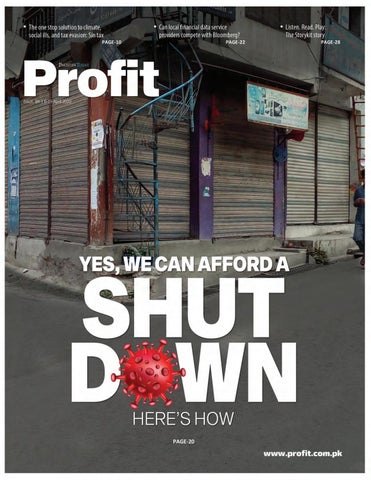
10 The one stop solution to climate, social ills, and tax evasion: Sin tax 16 Coronavirus: Yes, we can afford a shut down. Here’s how
22
22 Can local financial data service providers compete with Bloomberg? 27 The A, B, C and D of leadership in crunchtime Sohail Zindani
28
28 Listen. Read. Play: The Storykit story 32 What’s an American serial entr epreneur doing in Pakistan? Changing the way you bank, that’s what
WELCOME
But what if the virus doesn't go away? Our government, like all governments across the world, could be forgiven for appearing a little frazzled. When it comes to economic management, there is little by way of a playbook to learn from. Yes, there was the Spanish flu of 1918, but one that took place in an economy that doesn’t even remotely resemble the one billions of economic agents occupy in 2020. At the heart of the issue for all governments is how to choose between the two unappealing choices of either letting the economy die or letting millions of people die. To make matters further complicated, these two options are not mutually exclusive either; one will lead to the other anyway. In this issue, Farooq Tirmizi argues (in our cover story on PAGE 16) that we can, in fact, manage a lockdown (or even a curfew) for four months all while making sure that vulnerable segments of society are transferred crucial sums of cash by utilising the cellular networks as well as the existing BISP and NSER channels. That the government should spend the bulk of the cash on this, rather than the breakup it has specified in its Rs 1.2 trillion bailout package. While Tirmizi argues cogently about the merits of his case and the methodologies he thinks the government should employ, let us cast our gaze beyond that. Let us consider that the government does, indeed, spend this money in the manner outlined in the cover story. What if at the end of this time period, the virus still persists, with no vaccine in sight and the risk of infection remains even higher than what it presently is, given how even in some conservative estimates, the cases of infection could swell up to millions? The government, after exhausting its international and local
borrowing options, will have to rely on printing money to sustain the cash transfers. But won’t that lead to runaway inflation? Well, it just might not. You see, understanding inflation as afraat-e-zar, an excess of money, presumably running after the same number of goods, is well and good for normal circumstances. But even thick wads of money might as well be bricks if they aren’t actually being used in transactions. The velocity of money slows down in recessions, which a shutdown of all sectors but food, pharma and power, will most certainly lead to. That money doesn’t do too much of the aforementioned chasing in recessions, what with the public being more frugal in times of uncertainty. In fact, ceteris paribus, we are looking at deflation on our hands. The excess of money in the markets will, we predict, offset that deflation and, yes, stretch things towards inflation. But not hyperinflation. Our humble proposal: we’ve got swathes of the country that are veritable breadbaskets. We have got enough food to feed our population. If the government at first borrows money to feed its people and then prints a controlled amount of money to keep doing the same till the microbiologists come up with a vaccine while the medical and paramedical personnel stave off the disease, inflation won’t shoot through the roof. The GDP, yes, will shrink. The standard of living of households across the country won’t rise as much as they deserve and will most certainly fall. But it won’t be the apocalyptic scenario some of the alarmists are, in good faith, fearing.
Babar Nizami
Executive Editor
Executive Editor: Babar Nizami l Managing Editor: Farooq Tirmizi l Joint Editor: Yousaf Nizami Reporters: Syeda Masooma l Taimoor Hassan l Abdullah Niazi l Meiryum Ali l Hassan Naqvi l Shahab Omer Director Marketing: Zahid Ali l Regional Heads of Marketing: Muddasir Alam (Khi) Zulfiqar Butt (Lhr) l Mudassir Iqbal (Isl) l Layout: Rizwan Ahmad l Photographers: Zubair Mehfooz & Imran Gillani l Publishing Editor: Arif Nizami l Business, Economic & Financial news by 'Pakistan Today' Contact: profit@pakistantoday.com.pk
FROM THE EXECUTIVE EDITOR
7
Readers Say What is the after tax profit? Is there any reasonable explanation for why the new President/CEO is holding her cards so close to her chest, and why she would not want to reveal the figure? The chart has been mentioned up to 2017 only, so we have no data for the bank’s most recent performance under her time. The acting president and her companions are getting benefits. There is also a lack of clarity around the issuing of loans, especially the loans given to Anoud Power worth 3 million. There is also news of there being enquiries into their loaning habits because of loans given to certain political figures. (Apropos: Can Naushaba Shahzad turn FWBL around before it is too late?) Amanullah Sahito, Website There is a lack of transparency in Pakistan that muddies everything. In foreign countries, the first thing that would have been prepared for something like this venture would have been a project feasibility report. It would have been reported and analysed by independent experts, and its nature evaluated in detail and a report presented at the end of it. There would also be a process to make sure that there are qualified personnel for project financing. Instead, what we have here is free for all. Everything is based on the lottery system, and if that does not work out, then we go for the tried and tested traditional approach of picking and choosing as we please. All of this leads to disaster and nothing else. (Apropos: Editor's Note The coming change to Pakistan’s mortgage market) Shams ud Din, Facebook Great work by Ariba Shahid and Meiryum Ali on Pakistan Day 2020. A threadbare discussion on Pakistan’s response to COVIDー19. Businesses should go through the recommendations listed in the article for post corona times. (Apropos: The great big Profit survey of the COVID-19 pandemic) Abid Qayium Suleri, Twitter
facebook.com/Profitpk twitter.com/Profitpk linkedin.com/showcase/13251020 profit.com.pk profit@pakistantoday.com
HOW TO CONTACT
8
It has more to do with individuals running the business than city culture alone. Most people have either inherited a business or have created a world of their own through unfair means. Yes, there are straight arrows out in the world of business too, but they lack vision and they lack a creative flare usually, which means their businesses die slow, painful but natural deaths. What these inherited Seths then live with is a highly incompetent, self centered, insecure teams of employees. A clear example; take top 5 successful business names and analyse their teams documented capability and skills. Trust me you will be shocked. Whether it is Karachi, Lahore, Sialkot, Gujranwala, or Faisalabad, the top business cities, a common problem is this lack of accepting "change" since it will bring insecurity and competition. Start-
ing from one man company to small and medium groups to very few top names, look at their progress of "development". You will find very little. (Apropos: “Lahore L’hore ay” – but is Lahori culture good for business?) Rai Messam Abbas Khan, Facebook I am a Karachite by birth but I love Lahore for the way people enjoy their lives and treat their guests here. Karachi has a ruthless, cut-throat, competitive corporate environment compared to Lahore, which is a more lively, healthy and joyous city. One thing that I do not like about Lahore is intolerance for languages other than Punjabi. On some of industry forums in Karachi, you can easily recognize who is from Lahore. (Apropos: “Lahore L’hore ay” – but is Lahori culture good for business?) Riz Haque, Facebook The judgment of the High court is not practically workable and provides a lengthy procedure. Bank/lender will have to engage a chartered accounting firm for determination of the liabilities of the defaulter and the defaulter may file a suit. So banks/lenders will not be able to sell out/auction the mortgaged/properties directly without determination of liabilities. There are also many other loopholes as well. (Apropos: The Lahore High Court decision that could transform Pakistan’s mortgage market) Muhammad Adeel Chaudhary, Facebook My understanding of this law is that banks do not have to wait for court decree to auction properties of the defaulters. At the time of borrowing , lenders make sure that their loans are fully secured. There is nothing wrong in getting properties auctioned in case of default. Now only genuine business people will borrow from Banks. Defaulted borrower properties sale will enable Banks to recover their money and new owner will once again start project. Presently there are a lot of defaulted cases pending in the court. Defaulters paying having money to lawyers to prolong the cases. Virtually Banks are unable to liquidate the properties of defaulters. Banks in order to keep default in mind , charges heavy spread from good borrowers. After enforcement of this act Banks are bound to reduce their spread. Liability of borrower should be limited to the extent of assets mortgaged. In my opinion management of the company should also be changed that fail to pay dividend for certain period. All ex. State bank governors and important bankers should give their input on this regard. In this way we shall be able to protect the interest of minority shareholders. (Apropos: The Lahore High Court decision that could transform Pakistan’s mortgage market) Mansur ul Haque, Facebook
COMMENTS
IN BRIEF This month, the Pakistan Stock Exchange finally brought Exchange-Traded Funds to the country. Globally, ETFs have been a popular product since 2008; plans to introduce it to Pakistan have been ongoing since 2018. Pakistan’s banking sector spread fell by
33
basis points on a monthon-month basis to 5.37% in February 2020. This is the lowest figure since April 2019.
“PM should have informed the nation about how he plans to control #COVID-19. Unfortunately, there was no mention of any such thing. More than corona tigers, our country needs vents & protective gear for medical staff.” PPP Senator Murtaza Wahab. Out of all the provinces, Sindh has had the most proactive response to the COVID-19 pandemic.
Just one week after cutting the interest rate from 13.25% to 12.5%, the State Bank of Pakistan decided to cut the interest rate again, from 12.5% to 11%. It seems the SBP caved into COVID-19 pressure after all.
Two things are certain in life: death and taxes. The FBR has taken this saying quite literally, asking provincial governments for its officers to be exempt from lockdown, in order to meet their revenue targets.
“I never thought I’d be saying that maybe we have to have an oil price increase, because we do.” US President Donald Trump, who dubbed the ongoing oil price war between Sauid Arabia and Russia as ‘crazy’ in an interview on Fox News.
The rupee fell to a record low of
168
to a dollar on March 27 (before closing at 165.54), forcing the SBP to intervene to stop a rapid plunge.
Dubai is going to give its star airline Emirates an undisclosed amount of financial aid, as the airline has just about grounded its entire fleet. Dubai’s future as an international hub looks shaky now that tourism and corporate travel have declined.
The International Air and Transport Association has said that emergency aid of up to $200 billion will be needed to prop up the global aviation industry. 9
By Syeda Masooma
T
here is an excise levy known as the ‘Sin tax’, and a few months ago, it was the talk of the town. Notwithstanding Pakistan’s obsession with giving everything a religious twist, a sin tax is essentially just the concept that if you are causing harm to society as a result of your choice to consume certain products, you need to pay the cost for that harm as well. The question often raised with a ‘sin tax’ is what determines a sin, and whether it is the government’s job to be deciding what does and does not constitute a sin. Without moral proselytizing, the answer lies somewhere in basic, second chapter, A levels economics: positive and negative goods. Here, the important bit is negative goods or negative externalities, those goods which cause harm to society around you. The classic example, and rightfully so, are cigarettes. While most governments around the world use the tax collected under this policy on health and environmental
10
cleansing projects, one country decided to return all tax money back to its citizens. The process they chose was to do so through tax refund. It turned out to be a massive success. Could the implementation of a similar policy be possible in Pakistan? Profit discusses sin tax; it’s merits, demerits, and effectiveness; and how it holds an incredible opportunity to resolve the unbanked population problem.
A short history
L
et’s go back to A levels economics just for a moment. Think about all those graphs, supply and demand crissing and crossing and areas underneath the lines to calculate. Think about the types of demand, and go back to one particular king: inelastic demand. These are products that are either addictive or necessities, so no matter how high their prices go, it will not affect demand. Yes, competition may affect certain demands, but overall the product continues to sell. The classic example, once again, are cigarettes. “I have sold a Rs 100 pack for Rs 350, when the price hiked or when the supply went down, and still my sales were not affected,” said Qasim Ali, the owner of a paan shop, a usual cigarette selling spot in Pakistan. He sits in a semi urban area of Saddar, Karachi, and has frequent customers ranging from the ages of fifteen upwards and belonging to different social classes. The Ministry of National Health Services and Regulations had announced on December 4, 2018 that a ‘sin tax’ would soon be imposed on cigarettes and sugary beverages. A summary was forwarded to the Cabinet Division in this regard. The ministry recommended imposing a tax of Rs10 per cigarette packet and Rs2 per 100ml of soft drinks. The intention by Pakistan’s health ministry was to reduce smoking rate and increase tax revenue with one policy. Fast forward to February 20, 2020, and the federal cabinet rejected this proposal, citing legal and administrative problems in its enforcement. But the reasons cited for rejecting the policy had nothing to do with the policy, rather it was a matter of who would get to implement it. The ministry had proposed the Sin Tax to “finance the health insurance scheme and fatal diseases programme” of Prime Minister Imran Khan. But the then-finance minister, Asad Umar, raised concerns that since under the Rules of Business, it is Revenue Division’s prerogative to propose tax measures, it was not appropriate for any other ministry to make taxation proposals. Imposing a levy through a finance bill may
TAXATION
not have withstood judicial scrutiny, and then there was the added issue that revenue generated through a levy instead of a tax could not become part of the federal divisible pool that is shared by the provinces and the centre. However, even if this policy had somehow gotten to the implementation stage, the government might still not have achieved either objective. And while the thought is a double whammy of failure, there are lessons from around the world that we can use to craft a better, more successful way to generate this sort of revenue while discouraging social ills. When the news of this proposal first aired, hysteria broke out on social media with many primarily concerned with the title of the tax. Those ascribing to the viewpoint of the ‘sin tax’ being a hilarious or inappropriate title included government officials as well as the tobacco industry. PTI Minister Faisal Vawda, no stranger to sickening displays of adolescent machismo, was naturally the first to share his views on the issue, taking to twitter, where he said “I’m a chain cigarette smoker myself and I appreciate all the measures taken by the government to discourage smoking and I understand it’s injurious to health but this term ‘Gunnah Tax’ is inappropriate,” he complained. “If this is gunnah then what would we name and term the actual gunnahs.” And while his hurt sentiments could be set aside for the greater good, the stakeholders that did matter in this situation were the tobacco farmers. Many of them, particularly from several regions in the KP province, put forth the argument that the government using this terminology was an attempt ‘to create a negative image of their work.’ They decried the government for “calling their earnings gunnah”.
Another short history
‘S
in Tax’, as it came to be known, was first introduced in 1643 Britain as an excise tax on distilled spirits. So for starters, if people like Mr Vawda find the term offensive or judgemental, that is exactly how it was meant in Restoration era England. But some words are mere relics It was not until 1776 then that Adam Smith gave his approval to the policy, saying that taxes on cigarettes, rum and sugar are appropriate since they are not essential for life but are widely consumed. The US started taxing tobacco products during the Civil War and by the 1920s these taxes had become widespread as advertising also doubled the number of smokers. Needless to say, sin taxes have worked better for them than prohibi-
12
tion. Since then, the same logic has been used by several countries to curb consumption of products like alcohol, tobacco, gambling, as well as other forms of consumption that leads to environmental degradation such as vehicles and other modes of high carbon emissions. Sin tax is not restricted to what we might consider unlawful or immoral, but is rather implemented by some 45 countries around the world for sugary beverages, candies, fast foods, and even coffee. In December 2018, the National Health Service (NHS) Director General, Dr Assad Hafeez, told Dawn that Thailand, as well as a number of other countries, have similar taxes that are earmarked for healthcare services. He cited India’s example that imposes a sin tax on gutka and paan masala, and the tax collected from there are then spent on the healthcare sector. Pakistan’s aims were not any different. This sin tax was to be collected and then spent on our own healthcare expenditure by the government, at least that is what was claimed. The general public rarely trusts the government (rightfully so), and in Pakistan, even less so. So you still cannot expect wide ranging support for a sin tax simply based on the argument that the government will spend it on healthcare. But it is still a place to start.
How does it work?
L
et us take the examples of a smoker and a car owner. When one person smokes, it is not just their own money and health at stake, but people around them also inhale smoke passively and the breathing space around them also becomes toxic. Likewise, when someone drives a car, it is not just their money on car and petrol, but the carbon emissions from their vehicle contribute to environmental degradation, and possibly road congestion as well as noise pollution. A sin tax, therefore, becomes a policy to make the individual causing these effects on non-users pay for these extra negative impacts as well. So when someone pays extra on cigarettes or fuel, and that money is spent on public healthcare and green policies, even those people benefit who have not directly paid this tax, and thereby the harm and payment are balanced – at least in theory and economic means. Such taxes are collected from retailers and sellers, which in turn increase the retail price for the end consumer. So if anyone does not want to pay extra for smoking or driving, their only option then becomes to not smoke or drive at all, which is the other side of this tax – discouraging consumption of goods with
negative externalities. This form of excise taxes makes up for considerable tax revenue for governments all over the world. According to “The Balance”, the American state Rhode Island depends on sin tax for approximately 16 percent of its revenue. It also shows that in 2014, revenue from sin tax was $32.5 billion which soared to $98.3 billion in 2015. In a democratically managed economy where healthcare is taken seriously and tax collection is regulated and strongly implemented, sin tax can have three main arguments in its favor: it reduces consumption of unhealthy products, pays for society’s costs, and is popular with voters. Out of these three, there is evidence available for the last two consequences to be true and effective, but as for the first one, the jury is still out on that one. The rules and effects are pretty much the same in Pakistan too. Dr Ismat Tahira, a medical doctor and health expert at Shaukat Khanum Memorial Cancer Hospital and Research Centre said that such taxes may be useful to discourage only new smokers. “The measures taken by the government such as higher costs, or printing images of disturbing medical conditions caused by smoking on cigarette packs can be useful in stopping new smokers from entering the customer base of tobacco companies but I don’t think it has any impact on those who are already addicted.” Qasim Ali, the shopkeeper from the beginning of the article, said that he has cigarette products ranging from Rs 50 to Rs 280, and he has also sold the lowest costing cigarettes for twice their usual price at times such as in rainy weather or during a shutter down strike, and he still did not experience any change in the smoking behavior of his customers. “Cigarettes are not a luxury product, not for smokers at least. It is like food or other staple products. They will pay whatever the price. Very few, if any, even change the brand they smoke due to cost changes.” Qasim makes 3.5 percent profit on local cigarette brands and at least 5 percent on international brands, with no upper limit, often reaching up to 12 percent. He said, “My customers who smoke international brands, expensive ones, are usually affluent to begin with. An increase of 10, 20 rupees doesn’t mean anything for them. Those who smoke the lower brands also rarely show any change in their behavior.” Going by this, we can estimate the economy wide impact of this sin tax as well. And the true impact of such taxes is in fact the actual reason the PTI government came forth with this suggestion, not the protection of health or reducing rates of smoking. According to the summary sent to the cabinet by the health ministry, around 4 billion cigarette packets are sold every year in Pakistan. It has
been estimated that the annual income from the additional tax to be around Rs70 billion. As far as popularity with voters is concerned, there is an obvious moral justification attached to the argument of sin taxes, and discounting Pakistanis’ obsession with adding religious interpretation to every word and phrase, it is usually a popular policy, even from those who are going to pay for it.
The flipside
N
ow let’s move to the downsides of sin tax. Taking help from The Balance again, one downside to sin taxes is that they are not high enough to have any substantial impact, as is also apparent from the statements of a doctor and a cigarette seller. Another argument is that even if they are increased to a high enough degree, the end result is usually the creation of a black market instead of continued legal sales and higher tax collection. Another negative aspect of sin tax comes from the inherent inequality in the policy. Benjamin Lockwood, a professor of economics at Wharton conducted a study along with Dmitry Taubinsky from Dartmouth College examining the impact of sin taxes in 2017. In a conversation with Wharton’s podcast Knowledge@Wharton showed he shared that there have been studies that show that poorer consumers tend to consume things like cigarettes and soda at a higher frequency than richer consumers. \ Sometimes this stems out from higher costs of alternative options, while sometimes it is simply because of lack of availability of healthier products in rural areas. “Survey evidence suggests that at the bottom of the income distribution, people drink about twice as much sugary soda than at the top of the income distribution”, Lockwood said. This is how all indirect taxes behave, by creating a regressive effect on lower income groups. To understand it in layman’s terms, if two people earning Rs 1,000 and Rs 10,000 a week have to pay the same amount of Rs 100 per week in taxes, the impact of the tax would be 10% for the lower income person while it will be 1% for the higher income group. There is one more interesting factor to consider, above and beyond the positives and negatives of sin taxes, which may be understood as “elasticity”. Irrespective of the inherent effectiveness of a sin tax policy, the final impact depends on the products that these taxes are being implemented on. This might be the make or break factor where Pakistan’s policy fell short while a particular Canadian policy shot through the roof. One such scenario arises when sin tax seems to do little to cut down smoking but has a massive impact when implemented on carbon footprints.
Since then, the same logic has been used by several countries to curb consumption of products like alcohol, tobacco, gambling, as well as other forms of consumption that leads to environmental degradation such as vehicles and other modes of high carbon emissions. Sin tax is not restricted to what we might consider unlawful or immoral, but is rather implemented by some 45 countries around the world for sugary beverages, candies, fast foods, and even coffee Why hasn’t it worked yet?
W
hile it is important to note that this term is neither coined by PTI nor bears any link to religious definition of sin, it is equally important that this sin tax would have done little if anything to lower the rate of smoking or smoking related diseases in the country. There is no denying that such taxes, especially when applied on cigarettes, add massively to the national kitty and are also politically popular, as opposed to, say, property taxes. But the changes in prices of tobacco products do not bring about any change in the smoking behavior of the people. More on this later, for now let’s take an example of something similar from another part of the world, which in fact did turn out to be a success and not just politically but also economically. Despite all the benefits of the policy in general, there is a flipside to even this potential benefit of sin tax for Pakistan’s economy. Such tax is going to add twice the tax burden on the international brands of cigarettes being sold in the country. According to an article published in Profit magazine on December 8, the two multinational (tobacco) companies, with a market share of 67 percent, contributed Rs89 billion (98 percent) in excise duties and taxes during the fiscal year 2017-18. On the contrary, the locally-registered companies were paying only 2 percent in taxes despite having 33 percent of the market share. The impact for these international companies will be double because imported cigarettes are already subjected to ‘sin tax’ in the form of excise duties, and any further taxation would be a case of duplication that would result in a repetitive increase in the tax on cigarettes. This, if leads to any fall in the sales, will cause the production volume to decrease, reducing the government’s revenue. In fact the illicit trade of cigarettes in the country could rise.
Therefore it can be seen how this sin tax is self-defeating in both its targeted results, achieving either reduction in smoking or increase in revenue, but not both. If this sin tax leads to an increase in the revenue, then it will mean that the smoking rate has not gone down. And if the smoking rate decreases then there is bad news for the net tax collected from this industry.
A case study
L
et’s zoom out for a moment. We have talked about how the sin tax was received with Pakistan and what the sin tax is. But where in the world exactly has it worked before, after all, there is something about it that we find important enough to discuss and bring to the table. More importantly, how has the concept been moulded and sculpted to make it work, and how and could it ever work in Pakistan? One example that we would urge you all to explore can be heard on Episode 949 of Planet Money on NPR. The brilliant episode follows economist Arthur Cecil Pigou who, almost a century ago, came up with the idea for fixing enormous problems like carbon emissions and products like cigarettes with negative externalities. Pigou was the only economics professor at Cambridge for 35 years and was living near London in the early 1900s. This was also the time when air pollution was starting to become a huge problem. Coal was being burnt heavily and smog had covered the city, known as London fog back then. It was thick. It covered everything. It was an oily substance that covered furniture, enter your rooms. You would breathe it. It killed people. It killed animals. Pigou took it on as an economist. He also saw the cost of the infamous London fog. He thought it would increase health care costs. It would affect vegetation, livestock. It would wreck your furniture. Everyone would have to buy new furniture. Everyone had to wash their clothes more often. Those are all costs. And the people burning the coal weren’t going to
TAXATION
be paying for this; innocent bystanders would. Pigou’s contribution was not the realization that private companies add to problems for society, rather he came up with a solution that he explained in his book “Wealth and Welfare”. That is where he defined negative externalities and graphically explained personal marginal costs and social marginal costs, and putting them together came up with sin taxes. Fast forward to 2016, and Canadian Prime Minister Justin Trudeau announced that Canada was to have a carbon tax. From January 1, 2019 there is a $20 tax per ton of carbon, with an added feature of adding $10 for each of the next three years, making it go up till $50 by 2022. (50 Canadian equals approximately USD 38). Discounting the political decision of how pollution was valued at this much and not lower or higher, the fact of the matter is that where does this carbon emission come from? That would be gasoline, coal, and natural gas. So the tax would be implemented on all these products, which in any modern economy would lead to an increase in prices of almost everything. This, however, will be more progressive than let’s say tax on a cigarette pack or a coke bottle. That is because while even baking a loaf of bread uses some type of fuel, the consumption and therefore carbon release by an aircraft or a luxury car far exceed the ultimate carbon emission of regular everyday products. So, if you are buying baked goods, you would be paying at most in pennies, but if you are taking a flight, your tax amount would be much higher. This will also translate to potentially switching a personal car for a bus ride, or investing in a fuel efficient car instead of a shiny racing vehicle. However, when it came to Canada, Trudeau introduced one more element to this policy overcoming the tax resistance by the general population in one single sweep. The Trudeau government said that they will give all the money back. Not invest in healthcare or any public policy, but return back cold hard cash – in equal amounts to all those who have paid this sin tax. This means that let’s say $1,000 was collected from 5 people with one of them paying only $10 while another pays $400. When this money is returned, they both will receive $200, along with the other three people irrespective of their individual contributions. It came out as a policy of “free money” for most people rather than a tax amount that they needed to pay. Now, since writing everyone a check was also not the most practical idea, the Canadian government came up with another additional feature – simply check a box on your income tax filings if you wanted your pollution refund. In Canada, where it is much more likely than Pakistan that people do indeed pay their taxes, when they started checking this box they
14
One downside to sin taxes is that they are not high enough to have any substantial impact, as is also apparent from the statements of a doctor and a cigarette seller. Another argument is that even if they are increased to a high enough degree, the end result is usually the creation of a black market instead of continued legal sales and higher tax collection found the balance on their income tax to start to drop. People had started to get their carbon tax rebate back. Looking at the entire policy we see so many motivations that actually work – incentive to support the policy, incentive to file taxes, incentive to spend less because irrespective of the rebate the prices are now higher, and finally choosing to spend less and less so you can get more and more in return from those who continue to spend more without regards to this tax. Research conducted afterwards revealed that 8 out of 10 Canadian households received more in carbon tax rebate than they spent on goods with this tax. The reason is simple – wealthier people pollute more, which is why they should pay more.
The math
T
o understand how this policy would work in Pakistan, let’s use some numbers. Let’s assume there are 150 people in a locality. 100 of them own petrol-run cars. Out of these 100, 30 people consume 25 liters per day on average while 70 people consume an average of 10 liters of petrol per day. The remaining 50 people do not use petrol at all. Let’s also assume that only 120 of the total 150 people have bank accounts, or any sort of digital or traditional record of their finances, tax payments, and so on. Now the government imposes, Rs 20 per liter of additional sin-tax petrol. The costs and tax calculations will become as follows: Total petrol consumption (30*25 + 70*10 + 50*0 = 1250+500) = 1,450 liters per day Total sin tax (1,450*20) = Rs 29,000 Now the individual additional costs would something like this, everyone using 25 liters per day would be paying additional Rs 500 per day (25ltr*Rs20) while people consuming 10 kms per day would be paying Rs 200 per day. This means that 30 people would contribute Rs 15,000 while 70 people would contribute a total of Rs 14,000 into the tax. And the remaining 50 would not be paying anything. However, when this collected amount is returned back to the same 150 people,
everyone gets around Rs 193 (29,000/150 = 193.3333). This means that those adding more to the carbon emission would in fact be paying a net of Rs 307 (500 -193) while those who are creating lower pollution comparatively would be paying lower net tax of Rs 7, while those who are not contributing anything towards environmental damage will receive net Rs 193. This way, those who are responsible for a large chunk of the damage will be directly compensating those who are being damaged, and social costs will be balanced as well. This leaves us with the very final step of financial inclusion. If the 30 people who do not own bank accounts wish to receive their individual Rs 193 per day, they will have to get included in the financial records. And if they do not, the government gets to keep Rs 3,860 in sin taxes. Their share of sin taxes, which could have been refunded now stays with the government, off-setting to some extent, however minimal, the effect of non-payment of taxes otherwise. For now, we are planting trees, sometimes those that soak up the entire underground water of a city, as we saw in Karachi’s case. We are offering money backs on mobile wallets to make more people open digital accounts. We are also – almost constantly – extending deadlines for filing tax returns. Right, left and center, the current government is trying to react to and resolve issues like global warming and tax evasion with little to no success. We also struck down a sin tax policy which might have actually done us a favor, but that might be good news, because rebranding and redesigning that very policy might now be the ultimate success story for the PTI government. Admittedly, it is usually not enough and it is not equitable despite the seemingly simple math. The problems with Pakistan is always going to be a deep rooted distrust of government policies, and especially with trusting them with tax money to actually spend the collected amounts on healthcare projects that end up helping the larger population. Resistance to taxes is always a condition to consider. But replicating Canadian model would resolve all these issues in one go. n
TAXATION
16
PANDEMIC
I
By Farooq Tirmizi
f you are reading this, chances are that you have already read a ton of information about the coronavirus and probably do not want to read more of the same. This is not that. This article seeks to address and answer one very specific question: how and why should Pakistan engage in a nationwide shutdown as a response to the Covid-19 pandemic. We leave no mystery on the answer we have come up with: yes, we can and should do so. First, let us establish the verifiable, undisputed facts: the novel coronavirus spreads very fast through interpersonal proximity, is far deadlier than the ordinary flu, and would kill millions if left unchecked. There is no cure, and no vaccine, and so until one is developed, the best solution known to experts who study pandemics is social distancing, effectively involving staying at home until the pandemic dies down. Over time, as the number of new cases subsides, social distancing restrictions may be relaxed by allowing people to go about their daily lives while wearing face masks (and ideally also gloves) in public and when around other people, in addition to diligently washing hands after contact with unknown surfaces. These are established facts, and we do not dispute these whatsoever. Our contention begins with what happens next: social distancing, which means shutting down businesses and preventing people – most of whom in Pakistan are too poor to have substantial enough savings to tide them over an extended period without income – from reaching their places of employment and business. Such a shutdown is necessary for one very big reason: it will save millions of lives, and no amount of money is worth the number of lives Pakistan would lose if we were to not undertake preventive measures. This is not to minimise the economic pain that people would feel, of course. That is very real, and should absolutely be addressed. But the way to address that is through massive government intervention: the government should compensate people for lost income – at least partially – in order to minimise their losses and make it economically feasible for them to stay indoors – and without income – for long enough.
Why the impact will be worse in Pakistan
“Y 18
ou have to understand one thing about Pakistan’s economy,” said one internet entrepreneur based in Karachi and San Francisco,
who wished to remain anonymous. “We can talk all we want about Pakistan’s rising startup scene, e-commerce, and teledensity numbers. But the fact remains that the internet in Pakistan – for most Pakistanis – is only three years old, really probably just two years old for most people, if you think about serious speeds and connectivity.” “All of that came with the advent of 3G and really with 4G mobile internet. Most people do not have internet at home,” he continued. “You and I may have had the internet in our homes since the mid-1990s. But the average Pakistani did not get it until 2016-17 or even later.” Why does this matter? Because it means that, structurally, Pakistan’s economy is simply not set up for remote work. Sure, if you work in, say, the treasury department of United Bank Ltd (UBL), you can do almost the entirety of your job from home, at least theoretically. We have not confirmed with UBL as to how much of their operations are viable over the internet versus requiring personnel to come into the office, but we suspect that the banks in general will have an easier time setting up remote work arrangements than, say, a textile factory. As a result, the vast majority of Pakistan’s labour force – which numbers just over 75 million people, according to estimates from the World Bank – is unable to earn a living without physically going to their place of work, in the case of the employed, and their place of business, in the case of business owners and the self-employed. Most of those people are unlikely to be paid if there is a shut down.
How many people cannot get paid in a shut down?
T
hat is a hard question to answer, and there are not nearly enough economists in the country who would have the data or the research resources to adequately answer that question. (Except perhaps the folks at the State Bank of Pakistan, but there is no significant public estimate from the central bank yet.) The best we can do is examine the structure and composition of the labour force and estimate who might be more vulnerable to a shut down. This is a very crude estimation, but may nonetheless serve as a starting point for estimating the loss of income expected, and the magnitude of the economic damage that the government needs to repair in order to persuade people to stay at home. An estimated 55.6% of Pakistan’s labour force is categorised as ‘vulnerable’ by the Pakistan Bureau of Statistics (PBS), meaning they hold no security of any kind in terms of their employment. People like this are often employed on a daily wage basis, or are what are
called ‘contributing family workers’, meaning they are people “who work without pay in cash or in kind on an enterprise operated by a member of his/her household or other related persons,” according to the 2018 Pakistan Employment Trends Report published by the PBS. It seems reasonable to assume that just about all of these people are likely to fall under a severe economic strain under the pandemic-induced shut down currently being observed in most of the country. And no amount of incentives to help employers and industries will protect these people, because they do not operate in businesses directly – and sometimes even indirectly – connected to the kind of formal economy companies most likely to benefit from a bailout. Of the remaining 44.4% of the workforce, 42.9% are salaried employees (the remaining 1.5% are business owners or self-employed). These salaried employees might have somewhat more protection than the ‘vulnerable employment’ part of the labour force, but even here, there are many people whose economic situation was precarious even before the pandemic. Only slightly more than half of the salaried / wage-earning part of the labour force – or about 22% of the labour force – are salaried employees with a fixed wage rate that is supposed to get paid every month. The rest are divided among people who are ‘casual paid’ – meaning they get paid intermittently or irregularly (yes, that is so common in Pakistan that the PBS actually measures it; they are about 14% of the workforce) – and then workers who might get paid by piece produced or specific task performed. Those numbers make for grim reading. Only 22% of the work force has a contract or any kind of arrangement where they can expect their employer to pay them every month. The rest of the 78% need to go out every day and hope for the best. Even among that 22%, we suspect many are vulnerable to employers who may engage in pay cuts, furloughs, or outright lay offs in the face of the economic shut down. In other words, over 78% of households in Pakistan – and possibly as high as 90% – need the government’s assistance in one form or another if they are to make ends meet in the midst of a shut down, or else they will be forced to keep on looking for work when the public health interest requires them to stay at home in order to prevent the spread of the virus. The scale of the problem would be almost overwhelming, until one realises the alternatives: tens, or even hundreds of thousands of deaths, possibly even running into the millions. No society, no matter how poor, can value human life so little as to let people die in numbers that large in order to try to prevent the economic damage that is all but inevitable anyway
(and – as we argue further down – the shutdown would prevent more permanent forms of economic damage).
The government’s plan
I
n this matter, as in just about everything, there appears to be a wide gulf between what the government of Pakistan plans to do, and what it likely should be doing in order to help people. The government’s announced plan thus far is large in scope – though probably not large enough – but has, in our view, completely the wrong focus. A review of what the government plans to do: the spending package announced by the government is larger than any previous stimulus the government of Pakistan has ever undertaken – or had to undertake. That is good, because it means that the government – and its key decision makers including Prime Minister Imran Khan – understand the scale of the problem. The problem comes with respect to how they plan to spend the money. First, let us look and what we think are appropriate uses of the money. The second biggest chunk of the money is Rs200 billion set aside for “labour” and meant to help prevent mass layoffs. We applaud the effort, though absolute lack of specificity on the biggest line item is disconcerting in the extreme, to say the least. Another Rs150 billion has been allocated towards direct payments to the most vulnerable families – up to 12.5 million families receiving Rs3,000 per month for four months – which we think is much more in line with what the government needs to be doing (spoiler alert: we think this should be the core of the government’s response.) About Rs50 billion has been allocated to purchase protective gear for medical workers, which is an absolutely vital investment in the safety of this critically important segment of our work force, particularly at a time like this. But then there are some elements that are not even really a bailout. For instance, the government is counting Rs280 billion in wheat procurement as the biggest chunk of the bailout, even though that is something the government does every year. And it is not even a bailout. It is not as though the government buys the wheat and then gives it away for free. The government buys the wheat and then sells it to flour millers and distributors for a profit. And the government is also counting Rs100 billion in tax refunds as some sort of bailout, even though it is money that the government owes taxpayers! That is not remotely in the same definition as a bailout. The Imran Khan Administration is also
VULNERABLE
78%
The proportion of the workforce – based on Profit’s analysis of data from the Pakistan Bureau of Statistics – that does not have a steady paycheck and is therefore vulnerable to economic hardship as the result of the shut down
counting Rs75 billion as part of the bailout by pretending like they are responsible for reducing the prices of petrol and other fuels, even though those prices are going down because of the collapse of global oil prices, which have tumbled over 60% since the start of the pandemic. If anything, the government is likely increasing its tax revenues by not fully passing on the full decrease in price to consumers. When all is said and done, there is at least Rs455 billion in the supposed ‘bailout’ package that is not at all a bailout and should not be classified as such. So the real bailout amount is Rs750 billion, which is still sizeable, but when you consider how much of it will go to rich, well-connected businesses, does not mean much for ordinary Pakistanis. Even in the most charitable view, the rest of the bailout becomes debatable, ranging from the well-meaning but possibly not as effective to the outright “goodie bag for Big Business by another name”. [Note to our occasional Marxist readers: we are pro-free markets, not pro-business. The two are not the same, no matter how much your memes and The Guardian tell you that is what “neoliberal” means.] In our view, any form of bailout will not matter at this stage if it does not recognise the structure and composition of the Pakistani labour force that we laid out above. We are not an economy with people who are tied to the formal economy in terms of our employment arrangements. The overwhelming majority of us – at least 78%, according to PBS data – do not even have formal employment arrangements with a regular income. Under such circumstances, the only thing that makes sense is direct cash transfers – bigger and to a much wider segment of the population. And for that, we have a proposed plan of action that might be executable because it involves the use of an infrastructure that already exists.
What might work better
A
s we stated, we believe direct cash transfers – both a larger amount per month, and to more people – is the single biggest component of the solution that the government of Pakistan should be pursuing. For that, we have a suggestion for both how to find the people who will get the money, as well as a fast mechanism of delivering the cash. First, on who should get the money. As we stated, the government’s plan of targeting the poorest 12.5 million households with direct cash infusions is too modest, if in the right direction. We think closer to 80% and probably even more of Pakistani households will need some form of cash infusion. And we think the amounts they will need will be significantly higher. Based on the most recent census data – along with some simple projections by Profit – we estimate that there are approximately 34 million households in Pakistan. How would one decide who among them gets help and who does not? In an ideal world, the government would be able to target the bottom 80% by income and send them straight cash transfers, but in an economy as undocumented as Pakistan’s that is not likely to be possible. So what to do instead? We suggest determining the much shorter list of who not to provide with financial assistance and then find a way to deliver the cash to everyone else. How do we do that? Through a little-known, but very detailed data set jointly maintained by the Federal Board of Revenue (FBR) and the National Database and Registration Authority (NADRA). In 2012, NADRA and the FBR began a project to help identify tax thieves in Pakistan and came up with a list of over 3 million individuals who do not pay any taxes at all, but who have lifestyles (frequent foreign travel, property registrations, weapons licenses, etc.) that indicate considerable wealth. Since then, the data set has come to include data from bank accounts as well, and the list is likely to swell even further, likely close to 4 million individuals, nearly all of whom constitute separate households (separating households was one of the variables the data set sought to control for). In our view, the government should exclude those 4 million people, plus the 2 million households where at least one person is employed by the government itself, and send Rs10,000 per month for four months to every other household in Pakistan. That is 28 million households, receiving Rs40,000 spread over four months. That comes out to Rs1.12 trillion, slightly less than the package announced by the
PANDEMIC
government (their full claim, though, of course, as we pointed out, in reality, it is much less). How would the government deliver this to everyone else? That’s where another of the government’s documentation drive comes in: the drive to get everyone to biometrically verify their ownership of the mobile telephone line that they use. There are 165 million cellular subscribers, or about 78% of the population. We suspect the bulk of the rest are either children or the elderly who do not use cellphones because of their age but are connected to an earning member of their household, or are poorer individuals who would likely be documented by the government as part of the Benazir Income Support Program (BISP) and the National Socio-Economic Registry (NSER). Here is how we think the government should do this: for the 12.5 million households that the government either already has on the BISP rolls or can find through the NSER, it should go ahead and deliver the cash through its existing mechanisms. For the remaining 15.5 million households, the government can rely on the NADRA data set. First, it should run a screen to eliminate the tax thieves and those on its own payroll, followed by people whose national identity card (NIC) numbers or household numbers match those of recipients through the BISP or NSER. Everyone else should be grouped into households (easy enough, since the NADRA database already does that), and one person in each household should be sent one payment of Rs10,000 per month (untaxed) through their mobile balance, based on their biometric registration. This is the part where it gets tricky: this would not be the government giving people Rs10,000 worth of mobile credit per month for four months. This would be the government giving people Rs10,000 worth of credit that would be redeemable for cash at their local store where they buy mobile credit anyway. In order to make this work on as massive a scale as it needs to, the government needs to make sure to pre-deliver the cash into the bank accounts of the mobile companies, who then need to be delivered physical cash in large volumes by the State Bank of Pakistan against those government deposits. The mobile companies then need to go out and pre-deliver cash equal to at least four times the normal annual mobile credit sales volume at each store or stall that sells their credit. Why four times? Because the bailout is worth about four times the amount of revenue the companies make in a year.
20
MASSIVE
Rs1.2 trillion
The amount of money the government of Pakistan has pledged to help deal with the economic consequences of the coronavirus pandemic and its related economic shutdowns
Once that is done, people should be notified via text message to collect their cash at their nearest location, ideally a food / grocery store or a pharmacy, since those are the only kind of retail outlets that should be allowed to remain open during the shutdown.
Some sensitivity analysis
W
ith an approach this broad, is there a risk that some people who do not need the help will get it? Yes. Is there a risk that some people who need the help will not get it? Also, yes. But with this broad an effort, the government has the best chance of helping as many people as possible, while missing as few people as possible who might need the help. How bad is the error rate likely to be? We are fairly sure that at least 78% of households, based on the government’s own data about the work force, need the help. And the proposal we outline calls for delivering aid to 28 million households, or about 82% of all households in the country. Even if we assume that all of those additional households do not need the help, that still implies a nearly 95% effectiveness rate in terms of the money reaching people who need the help. How many other government programs can you think of that are 95% effective in terms of the money spent? These are, of course, back of the envelope calculations, and the government should attempt to refine this as much as possible using the data it has. But given how quickly the virus is moving, it may not have the time to wait around to develop a more robust infrastructure to deliver the amount of aid in the speed and scale that is needed, given the moment we face. The method we outline is quick and a lit-
tle rough, but perhaps more likely to get the job done than most other proposals currently floating around in Islamabad.
The financing problem
A
s we noted above, the government is really only planning a Rs750 billion in terms of what it needs to actually finance. At least Rs230 billion is likely to come from the $1.5 billion in additional funding from the International Monetary Fund that the government has requested and is likely to receive, given the more charitable mood in Washington these days. The remaining Rs520 billion is likely to come through a combination of new borrowing from the banks, suspension of the development budget spending and diversion of cash towards the bailout, and perhaps (hopefully) a small amount of central bank borrowing, also known as simply printing the money. Our proposal calls for actually spending new money close to Rs1.1 trillion, or about Rs370 billion more than what the government is already planning to spend. We believe that such an amount is likely to be possible to raise through a combination of additional bank borrowing and perhaps a small bond issue in the global financial markets. Having said that, however, we do acknowledge that Prime Minister Imran Khan has a valid concern: what if he closes down the country for four months and we still have the virus at the end of it? What then? Because even our plan, while minimising the pain, realistically cannot last much more than those four months. The government would begin to run out of places to borrow the money, particularly in the face of collapsing tax revenues which means that it would need to start printing money, which would dramatically accelerate the already very high levels of inflation in the economy, and further hurt the poor at their most vulnerable time. As we have noted, however, it should be possible to re-open the economy with people wearing masks in four months, provided we actually take the actions to prevent the spread of the disease in those four months. The Prime Minister is right to point out that shutting down the economy for four months is a big risk with massive costs that cannot realistically be increased. We believe, however, that that is all the more reason to make sure that we make the most of these four months, rather than risking massive numbers of deaths and long-term collapse of our healthcare system. It is likely to be the only way we have forward. n
PANDEMIC
B
By Ariba Shahid
eing an institutional investment professional is no easy job. You have the stress of making people money, all the while making sure that you are not the one responsible for losing their money. The weight of the world is on your shoulder, along with the permanent anxiety of facing a crash in markets, and the daunting task of compiling and going through data to search for a competitive edge, to see what others have missed. Nearly everyone who works capital markets finds themselves scavenging through sheets of data on their computers trying to analyze trends. This somewhat simple task is further complicated when you have to set out to search for the data yourself. Scrolling and refreshing websites to update your sheets is definitely not fun, not what your degree was for, and nor is it the smartest way to manage portfolios. However, with the Bloomberg Terminal and Reuters Eikon being very expensive, what option does a Pakistani investment professional have other than slaving away mining for data? With a large quantity of data pouring in from all directions in a market that still has space for growth and maturity; decisions are often left impaired due to relying on informal sources. Considering the dynamics of
22
frontier and emerging markets, and more than 1600 institutions that invest in Pakistan’s capital markets, a number of platforms have entered the local arena to give the Terminal and Eikon a run for their money, or so we have been told. Capital Stake, Investor’s lounge, Zakheera, Mettis Global, and Tresmark are examples. The nature of these businesses and their business models are quite diverse and are catered toward their specific niches.
Equity based data services
B
oth Investors Lounge and Capital Stake are similar with regards to the information they provide such as what stocks or sectors are impacting or driving the market, technical charts for all stocks listed, sectors, and indices. Furthermore, the platforms help with in-depth analysis into foreign and local portfolio investors along with settlement information and insider and off market transactions. In addition to this data, the platforms also provide daily news feed and investment advice from most brokerage houses from across the country. Although operating as competition, both companies align their goals toward providing an in-depth market monitoring tool that proves to be a cheaper alternative to expensive data terminals provided by international companies. The feasibility of the business model, however, is an interesting
concept considering the cost incurred with acquiring, processing, managing and disseminating the data. Capital Stake While speaking to Capital Stake, it was discovered that their business model primarily focused on B2B sales whereby they sell access to Financial Institutions and further allow them to provide access to their clients. Based on this business model they have been able to amass more than 20 clients. Speaking to Profit, Faraz Naeem, CEO Capital Stake said, “We have more than 20 clients using our advanced analytics platforms across brokerage, asset management and news companies. In addition, basic versions of our analytics are accessible by 50+ brokers via KITS trading terminal. Our APIs and research services are also used by a handful of clients. In 2019, our systems served almost a million users by providing them data, analytics or research on the Pakistani market.” The cost of the account is borne by the financial institution and is priced by Capital Stake in accordance with the number of customers the institution will provide access to. Speaking about market share, Naeem further says, “Having the privilege of serving top brokerage and financial institutions including the Pakistan Stock Exchange’s Data Portal, we estimate that
our data, analytics and research are used by more than 40% of investors in Pakistan currently.” While the PSX is the most authentic source of data for the stock market, the data on their website shows a lag with changes in prices. This is because the PSX sells the data to financial institutions thereby would make their business model obsolete if they post live data. The website has been remodeled by Capital Stake. Capital Stake, on the other hand posts live data on its portal. Investor’s Lounge Investors Lounge, while primarily providing the same features as Capital Stake, differentiates itself from it due to the business model it follows. They target institutional clients, B2B, as well as retail clients such as high net worth individuals. In addition, Investors lounge believes that media and research organizations that cover market dynamics are also among their target audience. Investor’s Lounge serves more than 40 institutional clients and HNWIs in Pakistan and abroad. While speaking to profit, Sennen D'souza a founding member of the company says, “Its difficult to comment on market share but we currently have approximately 25% of the market share (Our competitive landscape broadly includes Bloomberg, Reuters Eikon, and Zakheera, while our only competitor in the API provision/ Research Portal solution space is Capital Stake.” The business model is simple, the company has a subscription-based revenue model for terminal access, as well as providing data through APIs to institutional clients in the form of white-labelled solutions. They also engage in fintech development for leading local and international financial institutions. Investors Lounge further plans to expand into other emerging market territories where they are well suited to serve pain points that are similar to Pakistan’s. However, it can be said that the business model for these two businesses are weak. Let’s say you were to look up the price of a stock. As an average Joe, you would go to google and type the stock symbol along with psx. The first result would be of the PSX followed by SCStrade.com. The PSX, however does not disseminate live data, while SCS does. It does not stop there, SCS further provides analyst reports from its research department, charting tools, and analytics.
SCS Trade
W
hile these businesses may make sense for a brokerage firm to disseminate information to their clients, it raises questions around the need for financial data services in Pakistan, in particular for data regarding the equity markets being sold to customers directly as opposed to houses. SCS trade provides data for free. Naushad Chamdia, CEO Standard Capital Securities
feels that his platform is free for all and is far better equipped than counterparts. Despite not posting analyst reports from other platforms, he believes that one, in particular an investor himself, does not need to invest in an account on other platforms. He feels that the financial data needs can be fulfilled easily on the interface and generates more hits than counterparts. In addition, he pointed out that when you search for a stock on google, SCS is the second website that shows up following the PSX. When asked about the business model for this service, he said that they have been providing this service for free since 2002 and may charge in the future. Calling data platforms his passion, he reiterated the fact that his platform could compete with both Investors Lounge and Capital Stake and thereby made paying for them a pointless expense.
Zakheera
Z
akheera on the other hand is an associate business of Optimus Capital. It provides comprehensive economic and financial content relating to Pakistan’s economy, stock market, companies, currencies, commodities, mutual funds, debt market, etc. The platform does now disseminate news or analyst reports of research firms. The platform primarily was built by analysts for analysts and is user friendly in order to make it more accessible as compared to Bloomberg, and to reduce the time clients spend in data processing. Priced at Rs. 25,000 a month, the platform has managed to gain more than 20 customers. Speaking to Profit, the team commented that the business has been able to break even with regards to Zakheera. While Capital Stake, Investor’s Lounge, and SCS Trade were limited to equity; and Zakheera for both equity and Pakistan’s economy- we will not look at two other players that offer more diversified financial data solutions.
All asset class based solutions 1. Mettis Global
Primarily being a b2b startup, Mettis Global is a web-based financial data and analytics portal that provides a large range of data pertinent to the financial markets and the macroeconomic. The portal covers all asset classes such as equity, commodities, money market, and fixed income. In order to establish itself as a complete data provider, it is also equipped with macroeconomic data available from the SBP, PBS and external vendors. As per the business, its unique selling point is its live forex rates that are in line with treasury rates used by importers and exporters
FINANCE & TECHNOLOGY
to negotiate exchange rates (However, there are others providing the same feature- Tresmark). In addition, Mettis global also acts as competition to conventional business news outlets as it publishes regular updates on the economy and sectors. The news platform is a form of under the belt marketing for the product whereby news is displayed to the public following a half hour lag in comparison to paying customers. A major proportion of the news is generated through the use of artificial intelligence thereby justifying the need for a small team. The news, however lacks depth in terms of analysis and thereby cannot compete wholly with traditional news disseminating platforms. Mettis Global charges its clients $200 a month for access to a single usage account and has approximately 170 clients. While speaking to the first customer Mettis was able to get on board, Mr. Jehangeer Jamil at Pak Iran Investment Company, he said, “the platform is beyond cost effective and suits the needs of the business at one tenth the price the firm used to pay”. He commented on the reliability and speed at which the data is available too. While speaking to Profit about the market share, Saad bin Naseer, CEO of Mettis Global states “In terms of key stations we have a good 14% market share obviously the big share goes to Reuters and Bloomberg. But in terms of revenue it is probably only 3% of market leaders like Reuters and Bloomberg, primarily because of the difference in pricing point” He further says, “So far the business model has proven to be quite successful. The business growth has been exponential and the business environment is quite conducive for the data distribution company.”Speaking on the business model, Naseer further says, “Since our business model is different, we compete with Bloomberg and Reuters, we do not consider Investors Lounge and Capital Stake as our direct competition, however they do compete with us in equity market data space” Surprisingly, Mettis did not mention Tresmark as their competition.
“Having the privilege of serving top brokerage and financial institutions including the Pakistan Stock Exchange’s Data Portal, we estimate that our data, analytics and research are used by more than 40% of investors in Pakistan currently” Faraz Naeem, CEO Capital Stake
2. Tresmark
Interesting enough, none of the other data service providers mentioned Tresmark as their competitor either. Tresmark is one of the oldest in the business considering how it started off as a product by Landmark Investments in 2012 and became a separate entity in 2017. Despite not being deemed as competition, the company has managed to amass 350 corporate clients that have single or multiple subscriptions. The total number of users, however, is approximately 800 considering how most of their corporate clients have multiple accounts. While talking to Profit, Waqas Hussain, Vice President Sales at Tresmark Private Limited commented that one key reason behind them not being deemed as competition to the previously mentioned companies is because they primarily deal with equity, whereas Tresmark is more diversified in their clientele. Hussain commented that nearly 80% of their clients belong to the corporate sector,the remaining belong to banks, and very few brokerage firms. He says that the low penetration
“One key reason behind them not being deemed as competition to the previously mentioned companies is because they primarily deal with equity, whereas Tresmark is more diversified in their clientele. Nearly 80% of their clients belong to the corporate sector,the remaining belong to banks, and very few brokerage firms” Waqas Hussain, Vice President Sales at Tresmark Private Limited
24
within the brokerage industry is primarily due to it not being their focus. Clients include Sanofi Aventis, PPL, Parco, Samba Bank, Habib Metropolitan Bank, Habib Asset, Jubilee Insurance, etc. He further commented that their sucess can be guaged by their strong client retention rates. The business model is such that they believe that whilecorporate users usually rely on brokers for their equity needs, they still need a platform for other financial services. This is where Tresmark steps in. Tresmark is a financial terminal that can be used to view market rates for currencies, commodities, fixed income, equities, and futures. The platform allows users to view data, chart, analyze historical trends, and work on technical analysis. This gives users an edge at making informed decisions regarding their investments, funds and remittances. The business provides lives quotes for the FX, local markets and the secondary bond market. Speaking on the inception of the product, Hussain recalled that the company started off as a financial advisor. Corporate clients used Reuters or Bloomberg for their financial needs. An example of such is National Refinery, PSO, PPL using those platforms for oil prices. Considering a gap in the market, Tresmark decided to expand their services. Originally, corporate clients would outsource their treasury departments to the company. Considering Watermark understood the business, they thought the formation of Tresmark made more than sense. After which based on what the company has to say, they have managed to replace Bloomberg and Reuters in most of the corporate world. The company feels that they were able to reach out to banks due to their presence in the corporate sector. Banks got curious about
the product once they saw a number of their corporate clients using it. The business, however, deals with their banking clients differently through altered solutions. Hussain explained that since their services are not only limited to financial date, but also advisory, communication and customized trade solutions. He added that Tresmark provides customized solutions by white-labeling their product to banks whereby their branches and treasury are better connected. As far as security concerns regarding data are concerned, the solution is provided on the banks’ servers to ensure confidentiality. Tresmark is a disseminator of financial news too. However, unlike Mettis, Reuters and Bloomberg; Tresmark shares news from its sources crediting them rather than having an onboard news agency team. However, when asked about whether they think they are competitors for Reuters and Bloomberg, they feel that they cannot drive the two out until transactions can be carried through their platform. Tresmark, however, unlike the other platforms has a chatting application that enables them to work on dealings. Hussain explained that while transactions cannot be carried through the portals, they have managed to come close by allowing users to quote rates through the portal and then realize the transactions over recorded call lines. He said that the SBP regulated transactions through either recorded lines or terminals like Reuters or Bloomberg. Hussain says that Tresmark is working toward facilitating the process further. Speaking on the potential of the market, Hussain feels that their product is able to compete considering their pricing and the services they provide. While the company has not quoted an exact price due to the fact that they charge different clients different prices, it is still cheaper than Reuters and Bloomberg. The business, however, sees a spurt in sales when the market is declining. Hussain explains that brokerage firms are price sensitive considering how their commissions go down when the market does. Then they’re under immense pressure to cut down on costs. That, despite being bad for investors is good for local data service providers considering how local options become more of a viable solution. As for the future, Tresmark is working on a new application called axis that will serve as a communication & business analytics tool for the corporate sector, banks, and brokers. In simple terms, it’s like Whatsapp but for professional use. The platform will enable users to make charts and tables at a tap of a screen and make it easier to relay that information to others. Like the Tresmark platform, this too will have a white labeling option whereby it can be specialized for clients.
“Since our business model is different, we compete with Bloomberg and Reuters, we do not consider Investors Lounge and Capital Stake as our direct competition, however they do compete with us in equity market data space” Saad bin Naseer, CEO of Mettis Global
Review
A
s someone that has used five out of the six (Mettis did not provide a free trial despite numerous requests) platforms mentioned in order to understand the business model, I feel that Capital Stake and Investor’s lounge can be used interchangeably. I, however would not invest in either as an individual investor and would just rather use free data available on SCS trade. Then again, I am not a high net worth individual. As a high net worth individual, I would choose Investor’s Lounge considering Capital Stake is strictly B2B.However, as an equity analyst, the platforms are easy to navigate and provide in depth analysis and make work easier. As a brokerage firm, I would choose either of the two based on their cost competitiveness due to their services being vastly interchangeable. As for Zakheera, the platform is easy to use and captures both equity and economic data through charts and tables. The data is easy to use. However, I feel that the team needs to market its product more as very few institutions are aware of it and therefore unable to comment on its utility. The overall user interface however needs to be improved. It, however, is a straightforward platform. Tresmark and Mettis, being in a different league provided a different user experience. They reminisce with the Refinitiv Eikon, especially due to how market moving news is shared.The platforms are easy to use unlike the Terminal. Being a complete service for all asset classes, I think they are a valuable addition for a business or financial institution that has needs that are restricted to the local market but not to just equities.
From what I have gathered regarding Mettis Global through their website and through the in person demo I received during the interview with the Mettis team, I feel that despite Mettis calling themselves the Pakistani Bloomberg, I would not go as far to call them that because their news lacks substance and because they do not make their own analytical indices. While the platform is certainly easier to use than the Terminal and more like Eikon, calling it direct competition for the Terminal and Refinitiv is an overstatement I would not make. However, considering how the platform failed to provide a free trial despite my request in person and through their portal, their sales and customer services come into question. Tresmark, however, has an upper hand considering the chat option that they have that allows them to facilitate clients with going through with deals. However, the interface needs a little work considering how there is a lag in the way pages load.
Cost effectiveness
I
t is interesting to note that these businesses have entered the market fairly recently. It was, however, easier for them considering the rupee devaluation and the underwhelming performance of the capital markets. As a result, Bloomberg and Reuters were not as cost effective for businesses and they had to look for cheaper alternatives. Institutions could not afford to continue with multiple accounts for the expensive Bloomberg and Reuters. While digging around, we uncovered that even the big brokerage firms, such as
FINANCE & TECHNOLOGY
“It’s difficult to comment on market share but we currently have approximately 25% of the market share (Our competitive landscape broadly includes Bloomberg, Reuters Eikon, and Zakheera, while our only competitor in the API provision/ Research Portal solution space is Capital Stake” Sennen D’souza, founding member of Investor’s Lounge Arif Habib limited, and banks such as Askari Bank Ltd, cut down from multiple accounts to save on costs and now share the terminal or portals between departments. While speaking to Refinitiv, the situation sounds different as they claim they have been able to increase their presence in Pakistan and take over Bloomberg. While speaking on the success of the business, Naseer further states, “We believe Mettis will continue to replace expensive key stations of Reuters and Bloomberg. The value add we provide at the lower cost point to local treasuries, asset managers and investment banks will continue to create room for growth.” Priced between $1500 to $2000 a month, these international financial data services providers have not really played in the local market on volumetric sales. They often have only a few systems or accounts with split screens or shared access. Some institutions further find them expensive considering how one is not enough to fulfil their needs as the Terminal is needed for bonds and Eikon for forex.
Pakistan is not an island
W
hile this does seem like a lucrative business opportunity, research suggests that the business model is not very practical, at least not for companies like Mettis Global and Tresmark, considering their price. The fact that these companies only disseminate local data makes their usage quite limited. It constrains Pakistani financial institutions to local information and does not help in decision making whereby comparisons are to be made. Tresmark, however, manages to sustain itself considering its integration in the corporate
Capital Stake
sector. In most cases, comparisons on a year on year basis are not enough. Cross sectional data comparing counterparts around the world help form conclusive decisions. The sales team at Refinitiv feel that the Pakistani financial institutions cannot restrict themselves to just Pakistan. The financial markets are not an island and therefore, relying on local data is not enough. However, Capital Stake believes that while aligning the local market with the world is important, most local users of their data base their decisions on developments within the country including political environment, stability of the economy, to name a few. The ability to track some international data such as oil and commodity prices, however is important due to some industries being integrated and sensitive to changes. Thereby, companies like Investor’s Lounge and Capital Stake are merely just providing institutions with data they need without making a strong effort to bring a change within the market based on the current product. In addition, licensing data is a cost new entrants may not be able to compete on. With companies like Reuters and Bloomberg playing with data long before Pakistan was even made, they have access to information not many do. In addition, with a team of highly qualified economic and financial experts, they are able to build indices, charts, etc. that give their users and edge over counterparts that do not. Naseer from Mettis believes that room is crowded for a new entrant thus making the effort and investment higher than expected results. That being said, the industry for such services seems crowded and does not seem as lucrative as one would expect. Considering
Investors SCS Zakheera Mettis Lounge Trade Global
Tresmark
Fee Not fixed 20000 Free 25000 $200
Not fixed approx $800
Equity Data
Yes
Yes
Yes
Yes
Yes
Yes
Macroeconomic Data
No
No
No
Yes
Yes
Yes
Live FX rates
No
No
No
No
Yes
Yes
26
the world dynamics, these products are behind in terms of the services they provide. One out of six of the local platforms provide an in-app chatting feature, nor do they provide a ranking for analysts through which credibility and correctness could be ascertained. While Investor’s Lounge is working on such a ranking, the lag in this endeavour by the other data service providers is quite concerning. Furthermore, the development and operational costs seem dramatic as opposed to the revenue they earn. The fact that Bloomberg and Refinitiv are able to charge more and still sustain themselves within the current market is testament to the fact that the service they provide is worth it.
Verdict:
A
s the world accelerates towards more data driven decisions, Pakistan finds itself lagging behind in terms of its reliance on data. “Tip” based investing can only get you as far. With that said, the capital markets need to adapt themselves toward more analytics decisions and integrate the use of AI. That being said, while local competition is moving ahead in the right direction, it is years behind in being a replacement for Bloomberg and Refinitiv as both a data service platform, and a complete financial solution. Each operating in their own niche, local competitors, will not be able to attain significant growth from this point onwards in their business cycle considering the nature of their products. In addition, based on a market consensus, despite these services claiming to be substitutes for the two international platforms, they remain largely inadequate to fulfil that space. Bloomberg and Refinitiv remain undefeated in their conquest of the capital markets, at least in terms of their utility and their effectiveness at carrying out transactions. Considering how none of the local participants are able to provide services at par or near that of Reuters and Bloomberg, the question arises, will they ever be able to drive them out- or better compete wholly? n
FINANCE & TECHNOLOGY
OPINION
Sohail Zindani
The A, B, C and D of leadership in crunchtime
O
ver the last few days, I have been in constant conversations with various C-Suite leaders, trying to gauge and understand their narrative on how they see the business situation in the country, and to understand their concerns and challenges. The economy has been at a troublesome juncture already, and now we have the global pandemic, Covid-19, at our doorstep in the middle of a serious economic crisis. Admittedly, the situation seems bleak and dire. I will give the government and the business community this much, times are tough and frustrations are understandable. These are uncharted territories, and no one can be quite sure how to react in these times. However, the reality is, this time is here, and moaning and groaning about the bad situation we are in will fix nothing, and this sort of defeatist attitude just will not cut it for leaders, especially in the already at peril business community, especially as people begin to try working from home as part of social distancing tactics. So here are the four actions you can take as a business leader, or should expect leaders in business to be taking at a time like this. The A, B, C and D of how to lead during a crisis within a crisi:
Authentically Communicate, Daily
This one is the most important, and it cannot be stressed enough. The rest you can do in whichever order you see fit and makes sense for you, but this one has to be on the top of the priority list. As a leader, you must send out communication on the daily. At a time like this, what employees and investors want first and foremost is clarity and direction, the two things that they are most at risk of losing. And with all of the tension that has overtaken the everyday, an e-mail, 2-minute video, or voice message to all of your employees will go a long way in calming many of their jitters, and in keeping tabs on how things are being run. And remember, this is not just for them, it helps both you, and most
Sohail Zindani
is an innovation and leadership consultant. He calls himself a disruptor, researcher, and author
COMMENT
importantly the organization as a whole. You must remember to overcommunicate during a time like this. That does not mean bore people or be overbearing, your communication can be a few simple sentences - all done and sorted in 90 seconds. But it must be daily, regular, precise and let them know that things are going somewhere. Your team wants to know that you’re in control and sorted. Check this video out (for online readers only) for what it looks like to be in control: http://bit.ly/ABCD-Leadership. The key is to stick to the facts, there is no time for rants, philosophising, ideologies, theories, or personal glorification. Present what is happening, do not sugarcoat, but do balance one negative with several positives over the next several days and weeks. And if you have a negative to share, mention it first, then follow up what is being done to address it. The important thing is that you not just let this be something you read in the internet or with you morning coffee and nod along without doing anything. Sp communicate something now and send it out, do not think too much about it just do it. Your team will be thankful.
Be There
Yes, this is a time for social distance, but no, that does not mean this is a time for loneliness. In fact, we need people more than ever to help us get through these dark times, just not in present, tangibly physical capacity. There is a tendency to turn inward and play defensive when something like this happens, but this is actually quite counter-intuitive. What you should be thinking instead is “How might we support our customers and community.” Gather teams of employees to brainstorm, then act. The key is giving, giving, and giving with no expectation of return. Your customers will remember this when all of this clears up – and it will clear up! And most importantly, it is also the responsible thing to do in such times. Just remember, the best way to combat sadness, depression and sorrow is to help someone else.
Consolidate and Clean Up
Organizations have been running hard for years during the last decade. Sure, there have been a few bumps, but mostly we have as a society been obsessed with growth and getting ahead more than anything. Which is why now might just be a good time to sit back, try to lean away from the picture, and reflect on where this bumpy road of never ending growth has brought us. Use this slow time to clean up and consolidate those aspects of your organization that you have been putting off fixing. Focus on the handful of processes that drive the customer and employee experience and improve them. It is time for sorting and cleaning all aspects of the business. A key focus is on how to make things easier, simpler, better, both for customers and employees, but also for the future, which again, is right around the corner.
Display Compassion
I have a mantra for life, and it is my most indispensable advice that I give to everyone that comes to me for leadership coaching or life advice. The advice is to always be “Playful, Passionful, and Purposeful”. This advice has been especially helpful during this crisis. My life reminder would be to reiterate that you are the one that sets the tone and momentum for the entire organization. So stay calm and breathe. Stay positive and smile. Stay focused and reimagine. Stay blessed. Remember, everyday above ground is a good day. See you all on the other side.
27
Started by Musharraf Ali Farooqi, Storykit wants to revolutionize children’s relationships with books in Pakistan, and help revive the Urdu language along the way. But can they make the many out of it that they need to achieve their goals?
28
By Ariba Shahid
T
he key to any good business initiative is choosing the right market, especially if you are planning on offering something that is new and exciting. Pick people that are willing to pay good money for your product or idea, and you have a lot of your work cut out for you. A stable market allows a
company to focus on ideas, design, and streamlining products and services towards becoming indispensable. Storykit is a unique, upcoming company that has chosen its target market well. The product itself helps children engage with books through interactive storytelling and games. This unique form of literature engages children of all ages in reading along with developing key skills such as communication and confidence. The Storykit uses folktales and various other stories in simple Urdu for the current young generation. The kit is accompanied by a picture book, game, and online audio link. Clearly, it is a product the likes of which the average Pakistani school child will not see. It is part of the new curve of learning that educators in private schools across the country are trying to promote and implement. From experiential learning, which focuses on giving kids real life experiences to draw on to learn from their lessons, to digitizing education and teaching using the Swiss international baccalaureate - the big fancy schools are using big fancy methods. It is, to put it bluntly, bougie. And that is where Storykit has found their market. Through the initiative, Kahani se Kitab Tak (From Story to
Book), Storykit is currently subscribed in the private school sector by fourteen branches of the Roots Millennium and Lahore Grammar School systems in various cities across Pakistan. The fact is, the state of Urdu in these schools is dismal, and as a result the kids graduating from them leave with a confused language identity that does not quite scribe either to English or native Urdu. The token admittance of these schools that Urdu has been neglected by them means products like Storykit have an opportunity to step in and try to make Urdu cool again. But that is also a problem for Storykit, image is important for a company, and any company with an eye on the future realises just how important it is to cultivate images from the very beginning. Luckily, the fact that they offer stories in Urdu means that they have a great opportunity for Corporate-Social Responsibility (CSR) outreach. And this is just the beginning, because Storykit wants to be more than just about telling stories to children. Other than it’s commercial incentives, Storykit has ambitious CSR goals for a new and relatively small setup that is still trying to become corporate in nature. But through the ‘Give a Child the Gift of A Story’ program and the support of individual and institutional sponsors, they engage with Government Schools with Activity-Based Learning programs. The Activity Based Learning component by UNESCO in government schools across Pakistan hopes to fix learning poverty and OOSC enrollment by increasing the effectiveness of its socio-emotional learning pedagogy in student retention and an increase in enrollment. Profit decided to talk to the Founder and CEO of Storykit to understand their business model and their product better, and to see what their story was. At the center of it all is one man, Musharraf Ali Farooqi.
E-LEARNING
“In my experience, interactive storytelling is a powerful method of doing that. Another method is games. With the Storykit we found a way to pack together a picture storybook, a game based on the story, and the audio narration of the story at a low cost” Musharraf Ali Farooqi, Author and CEO of Storykit
The Storykit story
F
irst of all, for reasons of professional territorialism, let us begin by saying that Musharraf Ali Farooqi was a journalist before anything else. He started off as a sub-editor in a then vibrant English language press for the then fresh on the block, maverick newspaper The News International in Karachi. Bu this first job was a simple hazard that many men of letters go through, and the sometimes drab world of news editing and combing through secretariat stories takes its toll before those with a creative bent either buckle down and try to have fun with journalism, or move on to sometimes better and sometimes worse things. Today, Musharraf Ali Farooqi is an author, storyteller, and translator. He is working toward establishing an Urdu language publishing program that specializes in children’s literature and classics. Having founded the publishing house Kitab in 2012, an Urdu thesaurus in 2016, and the Storykit program in 2016, he is playing his role in the promotion of literature within the masses. He has also published multiple books, one novel geared towards adults titled “Sand and Clay” and other works for children. He is, without doubt, one of Karachi’s hidden literary gems, particularly for his prowess with translation and his comparative insight of Urdu and English literature. “I wished to create a method to encourage children to engage with books” Farooqi tells us in an interview. “In my experience, interactive storytelling is a powerful method of doing that. Another method is games. With the Storykit we found a way to pack together a picture storybook, a game based on the story, and the audio narration of the story at a low cost.” The problem that Storykit aims to solve is a global one. Children just are not reading anymore because there are so many more, and yes in the eyes of children, better distraction around for them. No child develops a reading habit out of some great intellectual thirst, it all begins as an antidote to boredom. While this is a global phenomenon,
30
the case in Pakistan with regard to reading is alarming. Based on a survey conducted in 2019 by Gallup and Gillani Foundation, a meager 9% of the 1178 men and women in rural and urban areas across all provinces in the country were avid readers. Three out of four students in Pakistani have never read a book other than their university course books. This rampant absence of reading in a country that already suffers from a deplorable literacy rate, is alarming and can be attributed to a number of factors. A prime reason behind the conditions with regards to reading in Pakistan can be attributed to the lack of early age emphasis on book reading. In order to cultivate a culture of reading, local entrepreneurs have taken a step in the right direction to tackle this problem head on. The way StoryKit has managed to find a localized solution is quite interesting. It is a unique product that helps children engage with books through interactive storytelling and games. This different form of literature engages children of all ages in reading along with developing key skills such as communication and confidence. The Storykit uses folktales and various other stories in simple Urdu for the current young generation. The kit is accompanied by a picture book, game, and online audio link.
What makes the product different from?
B
ut as with any good product, there has to be a catch, something that sets it apart from other options or makes it something unique that any possible competition cannot easily copy. For the Storykit team, it is a simple question of encouraging reading, and using their experience and expertise to model their product perfectly. “We strongly believe that without interesting content children will not be drawn towards reading. If you look around, quality storybooks for children are not available in the market. A lot of substandard books are available that do not engage children and put them
off reading forever. Storykit provides beautifully illustrated, fun stories for the children in a very attractive package.” The book also gives each user the opportunity to engage with it in a different way. Dr. Tiffany Munzer, a fellow in developmental behavioral pediatrics at the University of Michigan C.S. Mott Children’s Hospital says that the print book is the gold standard in eliciting positive interactions between parents and their children. “The print book is a really beautiful object in that each parent and child interacts differently over a print book,” said Dr. Munzer. “Parents know their children well and have to make it come alive for their child to create that magic.” The question for such a product is always what the ethos is, and for Musharraf Ali Farooqi, it is a matter of principle to make sure that it be a love for reading. And it is a love for reading that he thinks will sustain his business. “It is not the delivery platform but the content that builds engagement with reading and literacy. It is for this reason that interactive storytelling and the book are still two of the most powerful platforms to build engagement with books. This has been proven time and again with our field tests and school programs,” Musharraf explains to us. “Another issue is the infrastructure and cost involved with technological interventions in public education. We feel that there is a huge disconnect between what we can affordably incorporate in our public education system and what is available in the market. Our no-tech and lo-tech solutions provide an ideal combination with a tried and tested delivery platform.”
Untraditional books accompanied with programs
A
s things stand, the company is mainly afloat through one of its many initiatives, The Kahani Se Kitab Tak (From Story to Book)
program is currently subscribed in the private school sector by fourteen branches of the Roots Millennium and Lahore Grammar School systems in Lahore, Islamabad, Rawalpindi, Peshawar, Sialkot, Jhelum, and Gujranwala. The program is available for primary and middle schools at present. Storykit, however, does not restrict itself to just writing, publishing and distributing these interactive books. The company actually works on various programs to ensure the business grows. In addition to Kahani se Kitab tak, the StoryKit team is working on the Activity Based Learning (ABL) program, and The Give a Child the Gift of a Story program. “The Storykit Activity Based Learning (ABL) program has proven itself in reducing Learning Poverty, improving enrollment of out of school children, and the effectiveness of its socio-Emotional Learning pedagogy in student retention and increase in enrollment. The Give a Child the Gift of a Story program that brings the joy of storytelling, books, and games to children across Pakistan with the help of Individual and institutional sponsors.”
The test against technology
F
arooqi, however, believes that books if used right can stand resilient against technology and the threat they pose to reading books. “It is not the delivery platform but the content that builds engagement with reading and literacy. It is for this reason that interactive storytelling and the book are still two of the most powerful platforms to build engagement with books,” he says. “This has been proven time and again with our field tests and school programs. Another issue is the infrastructure and cost involved with technological interventions in public education.” Speaking about how the minimal incorporation of technology helps the books act as competition to electronic devices, he said, “We feel that there is a huge disconnect between what we can affordably incorporate in our public education system and what is available in the market. Our no-tech and lo-tech solutions provide an ideal combination with a tried and tested delivery platform.” As per studies, parents and storytellers had the most engagement with their young readers in storytelling whilst using print books.Non verbal signs of bonding are also easily established in comparison to e-books. This is due to the fact that while using an electronic device to read, more statements about how to use the technology were made, such as how to swipe next, or where to push as opposed to the
“The print book is the gold standard in eliciting positive interactions between parents and their children. Parents know their children well and have to make it come alive for their child to create that magic” Dr. Tiffany Munzer, Fellow of Behavioral Pediatrics, University of Michigan C.S. Mott Children’s Hospital content of the book. Keeping that in mind, interactive books, use both concepts to engage and act as an aid to bonding.
readership of Urdu has increased in recent years but on account of a broken distribution system we do not see books easily accessible in the cities.”
Is storytelling enough to prop up readership?
Growth
A
nother reason why the book culture lacks within Pakistan is due to the absence of it being a community activity Professor Khadim Hussain says that in addition to the many barriers promoting the book reading culture in Pakistan. There is a lack of arranging of book reading sessions by government run organizations like National Book Foundation. He feels that such sessions prove to be quite helpful in promoting the culture of reading books. Picking up on this need, StoryKit engages with young minds through interactive storytelling sessions. The organization does not stop there. This could be seen as an under the belt form of promotion for the business, along with serving society. In addition to storytelling sessions, the organization has launched a storyteller certification program due to the strong demand for storytellers remarked Farooqi. “We have over twenty storytellers working with us at this time and we are looking to recruit and train more.”
Urdu, a dying language?
T
he books, however, are in Urdu. It is often believed the urdu readership has declined over the years. However, at Storykit, they believe, “The
B
ut this is not just a feel good project for Musharraf Ali Farooqi, and he very much realises that his business has to be goal oriented and looking towards growth, growth and more growth. The venture is looking to tap into the readership of more mature segments. “We have plans to launch high-quality fiction books for adult readers as well” he tells us. As for organizational partnerships and integrations, Storykit has successfully been tested as an Activity-Based Learning (ABL) product in a UNESCO project for government girls primary schools in Punjab. The Activity Based Learning component by UNESCO in government schools across Pakistan hopes to fix learning poverty and OOSC enrollment by increasing the effectiveness of its socio-emotional learning pedagogy in student retention and an increase in enrollment. “Our "Give A Child the Gift of a Story" program is drawing a lot of attention from individual and corporate sponsors for whom underprivileged children's literacy and school enrollment is a priority.” Through this program, Storykit is able to work towards its Corporate Social Responsibility other than its commercial incentives. As for commercial success only time will tell whether Storykit can thrive in the market. It’s success will act as an indicator to other players in the market on whether traditional books need to evolve to meet modern needs. n
E-LEARNING
32
I “In Pakistan, traditional financial institutions are running on decades-old legacy systems and often offer terrible customer experience. So all the macroeconomic conditions in Pakistan are culminating into a financial services revolution” Brandon Timinsky, CEO SadaPay
By Taimoor Hassan
n September 2018, 26-year old college drop out and serial entrepreneur Brandon Timinsky was invited to come visit Pakistan by an old college buddy. At the time, Timinsky was looking for an Asian market to plant himself and his latest idea in. Today, the born and raised Florida man is still in Pakistan, hoping his Fintech project ‘SadaPay’ will change the way banking and money work in Pakistan. It is a strange thing to think about, an American entrepreneur trying to find a way into Pakistani banking. But Timinsky’s story has been one filled with random moves, lots of failure, and lots of lessons to go with them. It is a fascinating story since it is not just about success, but about reinventing yourself and staying in the race. It all started for Timinsky with basic programming that he taught himself at the young age of 14 while he was a freshman in high-school, and started freelancing as a web developer for local businesses in the US. By 15, Brandon went on to start his first real business and hired some freelancers to help with the workload. Since then, he has started more businesses than he can count. While a few did well, most were failures by his own candid admission, but all failures with a meaningful impact that made him a successful entrepreneur afterwards. “I have ventured across a number of industries such as men’s skincare, automotive parts, wearable technology, and real estate technology, to name a few. This diversity in experience allows me to think laterally from lessons learned across a variety of disciplines.” “As Twitter was getting popular in 2007, I started a website that sold “followers.” The proposition went viral and generated significant revenues for almost a year, but I had failed to stay ahead of my competition. This first failure taught me a number of important lessons in business at an early age,” he says. Today, Timinsky has had a successful career as an entrepreneur during which he has built seven figure revenue generating e-commerce operations from scratch. His most recent business was in fuel logistics, which was acquired by a Silicon Valley-based company in a lucrative deal. And now, Brandon eyes to disrupt traditional banking in Pakistan through his company SadaPay.
All sunshine makes a desert
A
s Timinski speaks about optimism and success, he stresses on the importance of failures to build successful businesses. This has been a long held
and long discussed idea over at Profit, and why stories of failure are important too. As cliche as it sounds, there are lessons to be learnt from failure. “In my life, each failure was a blessing in disguise. Sometimes a business is destined for failure and it’s better to find out sooner rather than later” he advises us. “Accept failure. Entrepreneurs start businesses based on a number of assumptions, and most of those assumptions will usually be wrong. In business, I’ve learned the importance of validating assumptions as early as possible, so as to discover the true direction we should be going in. When you discover an incorrect early assumption about your market/customer/competition/product/etc, accept failure and change course.” He reiterates that there’s no black-andwhite answer for when is a good time to pivot a business, but it’s probably a good idea to make that decision before the company runs out of money. “In my last business, GasNinjas, we pivoted maybe 6 times before finding the model that led to our acquisition.” “I’ve dealt with rotten co-founders, litigation, regulatory roadblocks, difficult customers, but the most common challenge was finding out that customers don’t care enough for the solution being offered. For a business to be viable, it needs to solve a pain point. If the pain point you’re trying to solve doesn’t “hurt enough,” your business might fail to gain traction.”
From GasNinjas to SadaPay
W
e were naturally curious about what GasNinjas was, and how exactly Brandon Taminsky has found himself transitioning from a business of that name to trying to shake up banking in Pakistan. In September 2015, Timinsky along with his co-founder, came up with the idea for ‘GasNinjas’ - Timinsky’s claim to fame and his most successful business. It was built on the novel idea of delivering gas to customers on-demand. It all revolved around saving customers time that they uselessly spent at fuel stations getting their vehicles fueled for everyday runs. For businesses that operated large fleets of vehicles, the idea was a hit. Timinsky built the product and GasNinjas began serving their first customer just 3 months later. While GasNinjas initially started on a business-to-consumer model to fuel customer’s cars at their homes, daytime traffic proved to be a logistical nightmare, prompting Timinsky and co. to pivot to exclusively fueling vehicles overnight while their customers were sleeping. “In our second year, we discovered that
FINTECH
large corporations with distributed fleets had a more valuable pain point to solve. Thus, we pivoted again to a fleet fueling model that would integrate into Enterprise Resource Planning (ERP) systems of large companies. We signed multiple Fortune 500 customers before eventually being acquired by Exajoule a Silicon Valley-based on-demand fuel delivery company and the largest competitor of GasNinjas. They took what we built and turned it into a franchisable model that could be scaled across the country and around the world,” adds Timinsky. The value proposition of GasNinjas was especially attractive because their fuel price was cheaper than at the gas station and the delivery was free because the company bought gas from wholesalers and removed the need for the physical infrastructure of a gas station. This reduced costs enough for the company to provide free delivery - while still being profitable. “SadaPay follows a similar model; by removing the physical infrastructure of banks, we can reduce costs enough to deliver free financial services - while still being profitable,” says Timinsky. After almost two years into operations, GasNinjas was acquired by Exajoule. Though the amount remains undisclosed, it was a multi-million dollar exit for GasNinjas. “After exiting GasNinjas, I started looking beyond the US for opportunities where I could make a lasting impact. The first stop was just a few hours south in Mexico City, where I was exploring financial inclusion. Half the population was unbanked, but the stars didn’t align. I decided to look a little further and moved to Indonesia to better understand Asian markets,” he tells Profit. While both Mexico and Indonesia could have been great avenues of investment, Timinsky was rather unimpressed. This is where the Pakistan part of the story began. In September of 2018, Timinsky was invited to visit Pakistan by an old friend from the university. And like all other foreigners, Brandon also says that he had only been familiar with Pakistan from adverse media over the years, but his first trip actually left a remarkable impression. “People were so kind, supportive, helpful, and generous. I found Pakistanis to be extremely proud of their country, and very grateful that I came to visit. I had never felt so welcomed in a foreign place,” he says. It is a rather cliche story, the foreigner coming to Pakistan and being wowed by the hospitality, but there is also a lot of opportunity here as well. There is always an opportunity when you have a massive population in a country, a high percentage of people that are unbanked, a median age of 22.8 years, and
34
a staggering number of smartphones that are growing each month - numbers that were enticing enough for Brandon to come in and invest in Pakistan. “In Pakistan, traditional financial institutions are running on decades-old legacy systems and often offer terrible customer experience. So all the macroeconomic conditions in Pakistan are culminating into a financial services revolution. This is coupled with the State Bank of Pakistan’s (SBP) desire to promote innovation and release a progressive E-Money license makes this the perfect market for our product.” “Thankfully, cash is disappearing [all around the world] and it is only a matter of time, here in Pakistan,” he says.
SadaPay
B
randon’s bet is on the financially excluded, unbanked population of Pakistan, and at the center of Brandon’s plan is SadaPay. SadaPay is essentially a digital bank that will allow customers to open an app-based account from their phones and get a physical card to spend anywhere in the world. SadaPay cards will be acceptable in any market where Mastercard is accepted. Another hook SadaPay has is that it will allow freelancers to receive payments from international clients through digital invoices that can be paid using a credit card from anywhere in the world. But why fintech? “I’ve always hated cash! I’m obsessed with efficiency, so I was frustrated from an early age by how slow transactions in cash were. Also, I had witnessed first-hand how financial services around the world were being revolutionised by tech companies,” explains Brandon. “Banks were built for an era of paper money that had to be physically printed and distributed to exchange value across countries. Times have changed, and technological advances now allow people to transact electronically. Financial services no longer require these physical branches to be delivered now that smartphones are becoming ubiquitous,” he adds. But the real answer is impact, explains Brandon, because fintech can be one of the best ways to effect massive, lasting impact on a large scale. “What it boils down to is that there are two ways to improve someone’s financial position: a) you give them more money, or b) you help them better manage their finances. The former might work in the short term, but the latter can change lives for generations to come. This is my goal for SadaPay.” But Brandon is a cautious entrepreneur. Without disclosing the amount that he is bringing as investment into Pakistan, he gives
the rather diplomatic answer that it is not a dollar more than what would be enough to make SadaPay operations work. Building a financial institution from scratch isn’t cheap, but, he says, people get distracted by the large funding rounds some tech companies have been attracting. “We’re grateful that SadaPay has gotten attention from top investors around the world, but having too much money can be dangerous. It usually leads to unsustainable business models that focus on short-term growth goals rather than long term viability,” he says. “Also, raising too much money leads to over dilution; this means less equity for current or future team members to stay motivated in even the most difficult of times.” SadaPay has not officially launched yet and is waiting for its license from the SBP, which Brandon says is just around the corner. But SadaPay has been over one year in the making and took its time to assemble the right team to get the job done. “We are joined by some wildly talented and experienced leaders. We have a phenomenal Chief Technology Officer (CTO) who served as CTO at a unicorn tech company in Asia. Also, our Chief Financial Officer (CFO), Chief Operating Officer (COO), and Chief Revenue Officer (CRO) served as senior leaders at some of the top performing financial institutions here in Pakistan.” Pakistan is a surprisingly large market with countless challenges to go after, but SadaPay intends to be very focused on specific pain points. “We feel there are a number of inefficiencies around receiving international transfers such as remittances, or payments to the IT outsourcing sector from overseas clients,” he tells us. “I strongly believe that the future of financial services will require specialization. Financial institutions usually try to offer something for everyone, but that usually results in shallow product coverage and diminishing loyalty.” “The agricultural sector might prefer to work with a bank that offers great loans for farmers. SMEs might gravitate towards a provider that helps with inventory management, receivables and payroll. Gen Y & Z might identify more with a digital bank that has friendly branding and emojis.” The concept is an interesting one, not very different to Sable which launched in America and was covered by Profit in a previous edition. In Pakistan, it will face hurdles, least of all a resistance to change. What does bode well for the project, however, is Brandon Triminsky’s history of making things work and his infectious enthusiasm and belief. Whether this will be another failure he learns from or not though, is a question only time can answer.
FINTECH