CONTENTS
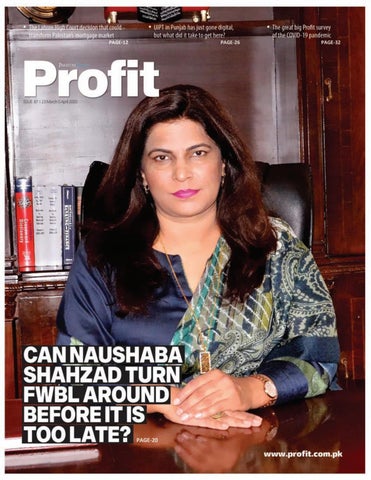
12 10 The Lahore High Court decision that could transform Pakistan’s mortgage market 16 “Lahore L’hore ay” - but is Lahori culture good for business? Asif Saad 20 Can Naushaba Shahzad turn FWBL around before it is too late?
26 30 UIPT in Punjab has just gone digital, but what did it take to get here? 32 The great big Profit survey of the COVID-19 pandemic 38 As Why tax-to-GDP is a farce Atta Ali Malik
41 41 Indus Motors: is the worst over for Toyota in Pakistan? 42 In case you’re wondering, inflation is not good for consumer goods companies either
welcome
The coming change to Pakistan’s mortgage market Change can often come from unexpected quarters. A recent ruling from the Lahore High Court on the law concerning mortgages – specifically, allowing banks to sell mortgaged property owned by loan defaulters without having to wait for a court order – could have a profound impact on the way housing finance evolves in Pakistan, and it is worth having a serious conversation about the relative merits of the law. In general, the law is likely to have a significant positive effect on the banks’ willingness to lend to borrowers to buy and/or build homes. The logic behind this is relatively straightforward: if a bank knows it can recover its losses from a loan gone bad by being able to relatively rapidly sell the house without having to wait around for a court order – which typically takes several years and millions of rupees in legal expenses to procure – then they will be more willing to take a change in lending to consumers directly rather than continuing to lazily plow their deposits into government bonds. There are, of course, legitimate concerns about the prospects of abusing this power, but we believe that Parliament has rectified the law in its most recent iteration (the 2018 version) to include several safeguards, such as requiring that banks hire audi-
tors to determine how much the consumer has defaulted on, and whether it would be appropriate to sell the house to recover the loan, based on the State Bank of Pakistan’s guidelines on what constitutes a loan default. However, while we are grateful that the law currently exists to protect the banks from legal red tape, and are supportive of the measures taken to add borrower safeguards, we believe there is still more the government can and should do. Specifically, if the bank is able to sell the home for a profit – after accounting for selling expenses and auditors’ fees – it should be required to share those profits with the borrower in proportion to the amount of equity the borrower owned in that house. Otherwise, regardless of what safeguards are put in place, the incentive for bad actors to abuse the law will remain in place. While we hope the Supreme Court will uphold the Lahore High Court’s decision in upholding the law, we do hope this recent attention will prompt the government to add in additional protections for borrowers as well.
Farooq Tirmizi Managing Editor
Executive Editor: Babar Nizami l Managing Editor: Farooq Tirmizi l Joint Editor: Yousaf Nizami Reporters: Syeda Masooma l Taimoor Hassan l Abdullah Niazi l Meiryum Ali l Hassan Naqvi l Shahab Omer Director Marketing: Zahid Ali l Regional Heads of Marketing: Muddasir Alam (Khi) Zulfiqar Butt (Lhr) l Mudassir Iqbal (Isl) l Layout: Rizwan Ahmad l Photographers: Zubair Mehfooz & Imran Gillani l Publishing Editor: Arif Nizami l Business, Economic & Financial news by 'Pakistan Today' Contact: profit@pakistantoday.com.pk
FROM THE Managing EdiTOR
9
Readers say But I do have a few questions, not just for Air Sial, but for all other private airlines. Why do they all, for the sake of saving their training cost, hire only trained pilots? This only increases the number of unemployed fresh non experienced pilots. (Apropos: Sialkot prepares for take-off) Khabeer ul Tanwi, Twitter Fantastic piece of research writing Farooq. Kudos to your co-author Ariba Shahid as well. The rise of this very densely populated, fastely urbanizing region has been under reported in our major publications. One important factor, in terms of increasing connectivity in the Gujranwala metropolitan area is the Lahore Sialkot Motorway (M-11). LSM cuts right through Gujranwala metropolitan area, Pakistan's 3rd largest with over 16 million people. It provides unprecedented fast access between Gujrat, Sialkot, Narowal, Daska, Wazirabad and Gujranwala. AirSial with its own hub airport at SIAL and a motorway terminating right at its footstep will have massive competitive advantage over other domestic airlines. Hence, the future is bright for the region and thank you for shining a bright spot light on it. (Apropos: Sialkot prepares for take-off) S Ghumman, Twitter A fascinating piece by Farooq Tirmizi, learned a lot from it. What I am wondering about is cargo facilities given Sialkot is a manufacturing hub? The airport seems to be focused only on passenger footfall. (Apropos: Sialkot prepares for take-off) Dr Eram Ashraf, Twitter We can do a lot as a nation if we set our goals and targets. This is quite an interesting and successful case study that needs to be studied for people that are interested in taking Pakistan ahead and making it one of the countries in the world. The bottom line is that nothing is impossible if we decide our goal and targets and then strive for it. (Apropos: Sialkot prepares for take-off) Muhammad Imran Khan, Website
How to ContaCt
facebook.com/Profitpk twitter.com/Profitpk linkedin.com/showcase/13251020 profit.com.pk profit@pakistantoday.com
10
I am deeply grateful to Mr. Furqan Malik of Profit for writing this important piece, and particularly to people like Mr. Norez Abdullah, CFO Hyundai Nishat Motors, the Climate Change Minister, Malik Amin Aslam, and Dr. Saleem Janjua for their role in Pakistan’s EV policy and the large strides it will make in improving the economic and climatic situation of the country. I have been a student of Dr. Saleem Janjua, and Pakistan is blessed to have personalities like him. It is well known throughout the country, particularly to those of us who are from Lahore, how bad climate change has gotten. In fact, the sorry state of Lahore in the winter months may just
be one of the possible reasons why the country has had to be spurred into action. But what cannot be forgotten is another aspect, which Dr. Janjua may or may not endorse that very close to Lahore the Indian side has coal fired power plants which are possibly affecting Lahore. How exactly will an EV policy sort that out if it is the core of the problem? It is most essential for us to determine the exact source affecting Lahore, whether that is due to emissions from across the border in India which are polluting our cities, or indeed the motor population. Another aspect worth exploring are the emissions from the international satellites and the related carbon emissions from satellites that track and record longitudinal and latitudinal coordinates for weather stations. We need policy guidelines from the respective climate authorities worldwide. The most important thing is the bus assembly of Volvo, Hino Pak and others, which is a sensible place to start off the EV guidelines. No radical solution is a good solution. The standard EV batteries that will be imported must also be of international standards. Charging Stations should be present at all petrol filling stations across the country and the government must talk to companies like Shell and Total to make investments in the charging infrastructure with their incentive to business at the same place of their petrol pumps. (Apropos: Transitioning to EV is the way to go. If we’ll do it is another question entirely) Haroon Rashid, Website The answer to the conundrum is in the article itself: Fauji Cement which is in comparatively good financial shape should go for an acquisition and buy out one of its weaker competitors, thus increasing its capacity and market share. (Apropos: Faltering Fauji: why a lack of expansion will hurt the cement company in the long run) Kashif, Website So what’s the thesis behind a new airline based in Sialkot? Well, one of the most underreported stories from Pakistan’s 2017 census is that the Gujranwala metro area (16m) is now the third largest metro area in Pakistan behind Lahore (20m) and Karachi (17m).And Sialkot is the only airport serving the core of that metro area, within 40 minutes’ drive of Gujranwala, Sialkot, and Gujrat. Karachi Airport saw 6.2m passengers in 2019, and Sialkot just 0.65m. But Karachi Airport traffic is growing at 12Y CAGR of 1% whereas Sialkot Airport is growing at an 11Y CAGR of 40.7%. This is what you get when businesses have a KLI (Karachi, Lahore, Islamabad) bias: you miss opportunities like the rise of the Gujranwala-Gujrat-Sialkot metropolitan area. (Apropos: Sialkot prepares for take-off) Farooq Tirmizi, Twitter
comments
IN BRIEF The government redirected
$40 million of unutilized funds from World Bank projects to fight the coronavirus pandemic. Punjab will receive $7.5 million; Sindh, $10 million; Khyber Pakhtunkhwa, $7 million; Balochistan, $2 million; and the federal government, $13.5 million.
“Yeh corona kaat ta kaisay hai? (how does this corona bite)?” Usman Buzdar, Chief Minister of Punjab, quoted in a Dawn opinion piece. The Punjab government said it would take legal action against the newspaper, calling the quote “baseless”. According to its recently released annual report, Engro Corporation saw its revenue grow
32pc
The Bank of Punjab finally settled on a new president, Zafar Masud, after the previous candidate Atif Bajwa left to head Bank Alfalah. It remains to be seen if the State Bank clears Masud’s fit and proper test.
Not another plague! Locusts have destroyed wheat crops, and are expected to cut Pakistan’s economic
2%
growth to less than by June. China will provide spraying equipment and 300 tonnes of pesticide, according to the National Disaster Management Authority.
75
basis points, from 13.25% to 12.5%. The expected decision marks the first change to the policy rate since July 2019. Pakistan’s cigarette production fell by
to Rs225,920 million in 2019, from Rs171,568 million in 2018. Much of the growth was led by Engro Energy, as the company’s coal mining operations in Sindh finally took off in June 2019.
US crude has lost half of its value in the last two weeks, while Brent has fallen by about 40%, due to the double whammy of the coronavirus pandemic, and the ongoing oil war between Saudi Arabia and Russia.
The State Bank of Pakistan cut the policy rate rate by
33% year-on-year, in the seven months ended January 2020, according to the Pakistan Bureau of Statistics. The industry is expected to have a production shortfall of 20 billion cigarettes at the end of this fiscal year.
The International Air and Transport Association has said that emergency aid of up to $200 billion will be needed to prop up the global aviation industry. 11
Banks and lenders could now be allowed to seize property from mortgage defaulters without a court order; how will that affect your ability to borrow, and what will happen at the Supreme Court? By Meiryum Ali
O
n March 10, a five-member bench of the Lahore High Court issued a 103 page judgement on the issue of mortgaged property, a decision that has the potential to fundamentally transform the mortgage market in Pakistan, though the decision is not without controversy.
12
“It is important to note that this is really the norm around the world – in the US, India. Many jurisdictions have provisions similar to Section 15. It’s really about the delay in the judicial system in actually settling the matter. The key motivation behind this was that the bank should feel more confident and have the security that they will be able to enforce this fairly and efficiently, and not have to go to the court system.” Salman Akram Raja, partner at Raja Mohammed Akram & Company In summary, the court decided that a 2016 provision in banking laws – which allows banks to auction the mortgaged property of loan defaulters without obtaining a court order first – is constitutional. How did the court decide on this? Why was the law promulgated in the first place, and why was it challenged? What does this mean for mortgage borrowers going forward? And what will this mean for the country’s housing market and mortgage finance industry more broadly? The answer to all of these questions lies in understanding a single section of a law that was originally promulgated almost two decades ago: Section 15 of the 2001 Financial Institutions (Recovery of Finances) Ordinance. Profit breaks down the judgement reading, and spoke to both petitioners and defendants about the case to learn more. And we add the economic context surrounding the decision help understand what impact it is likely to have on the country’s housing and financial sectors.
What is Section 15?
T
he 2001 Financial Institutions (Recovery of Finances) Ordinance came into force in the early years of the Musharraf Administration, when then-Finance Minister Shaukat Aziz was seeking to update Pakistan’s regulatory structure to make credit markets in the country function better. It was intended to replace the 1997 Banking Companies (Recovery of Loans, Advances, Credits and Finances) Act. At its heart, the law was designed to address a fundamental problem that drives at the core of banking: how to enforce a loan contract against a borrower who has defaulted on their loan payment obligations, and how to do so cheaply, and efficiently? In designing such a law, there are two sets of interests that need to be considered: those of the borrower, and those of the lender. Make
matters too easy for the lender, and you open up the possibility of the lender engaging in highly exploitative behaviour with the borrower, and with a reduction in the demand for loans over time. Go in the opposite direction, however, and lenders would not be willing to lend to otherwise qualified borrowers, reducing the optimal level of lending and economic activity in the country. Prior to the 2001 Ordinance, the law appeared to be biased in favour of borrowers, forcing banks to go through the full court case before they could recover the property from the loan defaulter, a process that took several years and cost millions of rupees for each individual loan. The 2001 Ordinance – promulgated as it was under a banker finance minister – was designed to make it easier for banks to take control of and sell property of loan defaulters without having to wait for a court order to do so. This would significantly reduce the banks’ risks, and thereby make it easier for them to lend to consumers. The 2001 law has 29 sections, of which Section 15 allows banks to sell mortgaged property. This section was in place until December 10, 2013, when the Supreme Court of Pakistan declared Section 15 of the 2001 Ordinance as ultra vires, or an act that is beyond one’s legal authority, to the constitution of Pakistan. Following the Supreme Court’s judgement, the State Bank of Pakistan scrambled to fix the Ordinance. It started a process to reframe the amendments in light of the judgement, and also in light of the banks’ needs to be able to continue lending while reducing their risks. The result was the Financial Institutions (Recovery of Finances) (Amendment) Bill, drafted in 2015. This bill made amendments to eight different sections of the Ordinance, but made the most substantial changes to Section 15. The Financial Institutions (Recovery of Finances) Amendment Act passed both houses of Parliament and was signed into law in August 2016.
Almost immediately, there was an outcry. A Lahore High Court bench suspended enforcement of the newly reconstituted Section 15 of the law while the matter was under litigation at the court. The matter languished in court right up until November 2019, when arguments for both sides were heard, this time in front of a five-member bench, led by Lahore High Court Chief Justice Mamoon Rashid Sheikh.
The case against Section 15
T
he petitioners – Muhammad Shoaib Arshad and others – argued that Section 15 would give banks arbitrary powers to sell mortgaged property without seeking “adjudication of claims through judicial process”, and that such a process goes against Article 10-A of the constitution, which is the right to fair trial. The petitioners argued that borrowers and banks already had their relationship and dispute resolution mechanism defined under Section 9 of the Ordinance, which identifies the Banking Courts as the venue for adjudicating defaults: “Where a customer or a financial institution commits a default in fulfillment of any obligation with regard to any finance, the financial institution or, as the case may be, the customer, may institute a suit in the Banking Court”. Since Section 9 already exists, in effect, the petitioners argue that the rewritten Section 15 gave too many powers to banks to start proceedings against loan defaulters. As they put it, “the initiation of the recovery process before the determination of default of the customer, is like putting a cart before the horse”. In particular, the petitioners were concerned about the potential misuse of Section 15. For instance, they argue, bank managers could invoke the section against borrowers who have a mortgage against ‘coveted’ assets, presumably a reference to particularly desirable real estate
MORTGAGE FINANCE
“This is a completely political judgement. This case had a very weak judgement, where they just changed the language of the section, but the intention [of the bank] still remains. Out of the five judges, the most junior judge wrote this judgement. Asim Hafeez only became a judge a year ago, and the chief justice did not write this judgement. It has so many weak points.” Shahid Ikram Siddiqui, partner at Lawyers and Lawyers International assets. According to the petitioners, “The unfettered and unstructured discretion extended to financial institutions, without predetermined criterion, would result in exploitation of [borrowers] and expropriation of properties… there is no safeguard available against demands of exaggerated and unrealistic claims, unilateral determination of defaults and hasty, collusive, and pre-arranged sales.” As for who gets to value the mortgaged property, the petitioners argued that banks would appoint evaluators at their own discretion, leading to the possibility of collusion and exploitative behaviour by the banks. They called this method of auction “prejudicial, mere eyewash and classic instance of conflict of interest”. The petitioners argued that the reintroduction of Section 15 via legislation was unconstitutional, because it went against Article 189 of the constitution, which says that decisions of the Supreme Court are binding on other courts.
The case for Section 15
T
he petitioners are a group of lawyers who have – in the past – acted as litigators on behalf of companies that have defaulted on their loans. On the
14
defence is the Finance Ministry, the State Bank of Pakistan (SBP), and the banking industry. While the petitioners were concerned about the banks’ overreach, the defendants, led by the government, were concerned about the rise of non-performing loans in Pakistan, and the relative ease at which people seemed to not pay back banks. According to the government, Section 15 was reenacted precisely to curb this ‘menace’ that was having a significant effect on the economy. And to defend their position, the government pointed to the macroeconomic benefits of the rewritten section of the law: “The growth in the volume of bad debts had resulted in a liquidity crunch, where the profitability of the banks has come down, which has dissuaded them from offering new loans... default in the payment of loans constitute squandering of public funds, as the banks used depositor’s money for extending finances.” The government also argued against the notion that Section 15 was infringing on fundamental rights granted to people under the constitution. According to them, the reintroduced section has two new subsections to protect mortgagors. Under Subsection 13, a banking court could grant an injunction to restrain the sale of a property, under certain conditions. Under
Subsection 14, a borrower could ask the banking court to void the sale of the property on the grounds of fraud. In addition to this, borrowers were also protected by the The Financial Institutions (Recovery of Finances) Rules, 2018, which lays out even more rules on how loan defaulters’ properties are to be sold. For instance, the bank must have loan defaults and amounts verified by a chartered accounting firm, the cost of which will be paid for by the bank. The government argued that this combination of subsections and rules were enough to “discourage predatory tendencies and vested interests of [individual] bankers”.
What did the court decide?
I
n the end, the decision was not close. Four of the five judges agreed with the defendants: the federal government, the State Bank, and the banking industry. The majority opinion, written by Justice Asim Hafeez, addressed the three major issues brought up by the petitioners. The first was the ‘due process’ argument made by the petitioners: that the law as it currently stands does not have enough protections for the borrower.
On that matter, the court acknowledged that the original Section 15 did not have adequate protections for borrowers, and went so far as to say that it was “insufficient and feeble to counter a blitzkrieg by the financial institutions.” But the court agreed with the defence that the new Section 15 had explicit and conspicuous remedies, in particular, Subsections 13, 14, and 15. And it did so despite setting for itself a relatively high standard to meet with respect to what would constitute adequate protections for borrowers: Did the remedies in the rewritten Section 15 provide enough rights to the borrower, “both prior to the conduct of sale and, in particular, after the fall of the hammer?”, the court asked. The court found that, in both cases, it had. Under Subsection 13, the borrower could object to the creation of the mortgage liability and amount of the outstanding loan claimed in a banking court. The borrower could also exercise the right of redemption of property, subject to the payment of the outstanding loan amount. The court also noted Subsection 12, where banking courts are given exclusive rights to judge on disputes. In summary, “Section 15 has not affected, prejudiced or taken away the right of the
[borrower]”. In fact, the court said that Section 15 gave two rights to the borrower: the right of redemption of mortgaged property, and also the right to object to the conduct of sale – this is all after “the fall of the hammer”. The second major argument by the petitioners was an ‘equal protection’ argument: that Section 15 would allow banks to discriminate against borrowers and treat them unfairly. On this, the court needed to define a borrower, and whether the equal protection clauses of the constitution would be relevant in this matter, and if so, whether Section 15 violated those constitutional provisions. On this matter, the court ruled that the law did not violate the equal protection provisions. The constitution prohibits discrimination between citizens, but it does not prevent them from freely engaging in commercial contracts with each other that would then bind them to act in one manner or another. A borrower is one who has signed a legally binding and valid agreement, and secured payment of the money against specified immovable property. The borrower makes contractual promises and commitment with the lender (the bank). Section 15, therefore, was only enacting action against a specific class of people, i.e.
In designing a banking law, there are two sets of interests that need to be considered: those of the borrower, and those of the lender. Make matters too easy for the lender, and you open up the possibility of the lender engaging in highly exploitative behaviour with the borrower, and with a reduction in the demand for loans over time. Go in the opposite direction, however, and lenders would not be willing to lend to otherwise qualified borrowers, reducing the optimal level of lending and economic activity in the country
borrowers, and more specifically, loan defaulters. And that very action, the court ruled, “cannot be declared unconstitutional on mere apprehension or allegation of discriminatory dispensation.” In short, the borrower signed up for this, and cannot declare the commitment discriminatory against him. The third issue was one of the court’s standing: could the Lahore High Court even rule on the matter, given the fact that the Supreme Court had previously ruled on the older draft of the law and had ruled it unconstitutional (the initial 2013 judgement). On that matter, the Lahore High Court was categorical about the separation of the judiciary and Parliament. “It is evident that the Court is not at liberty to inquire into the motives or mala fide intent on the part of the Legislature. Once a statute is competently made, the Court is not entitled to question the wisdom or fairness of the Legislature. Nor can the Court refuse to enforce a law competently made on the ground that the result would be to nullify its own judgment.” Well, that was easily taken care of.
So did the court have a problem with anything after all?
A
ctually, yes. The court said that the Rules of 2018 were acceptable; in fact, section 25 of the 2001 Ordinance gives the federal government the ability to make rules. However, the court had serious reservations with Rule-3 (c) (iv) of the 2018 Rules, which allowed an auction sale to take place even if there was only one bidder. The concept of just one bidder does not sound very public. As the court noted, both Section 15 and the Rules referred to a “public auction”. This particular rule went against Article 24 of the constitution, which protects property rights, and is contrary to the spirit of competitive bidding.
MORTGAGE FINANCE
“A borrower is just someone who goes to the bank for financing. But Section 15 is dealing with someone who has not only borrowed money, but in addition, has provided security in the form of property ie. if I don’t pay you back, feel free to sell my property.” Shafaq Rehman, partner at RIAA Barker Gillette
Ok, enough legalese; what does this mean?
A
ccording to Shafaq Rehman, a Karachi-based corporate lawyer and partner at RIAA Barker Gillette, a law firm, the judgement affirmed what the legislature has already enacted: that it is a bank’s right to enforce a duly created mortgage. Speaking to Profit, Rehman said that the judgment helps clarify the difference between a customer who has simply borrowed funds from a bank, and a customer who has mortgaged property with the bank. “A customer is just someone who goes to the bank for financing. But Section 15 is dealing with someone who has not only borrowed money, but in addition, has provided security by creating a mortgage on immovable property in favour of a financial institution i.e. the customer has given an express right to a financial institution to sell immovable property mortgaged with the bank if the customer fails to pay,” she said. If the mortgage has been created with the consent and knowledge of the customer, then the customer may not pull back from the commitment it has made to the lender. The problem with the initial Section 15, was that the borrower was not kept adequately in the loop, and neither was the borrower provided adequate remedies during the process of enforcement of a mortgage. According to this judgment, the new Section 15 takes into account those deficiencies that the original Supreme Court Judgement noted. According to Rehman, this latest judgement should not affect borrowers. “If anything, it should make them more aware of their rights and obligations towards financial institutions.” Profit also spoke to the lead defence counsel in the case, Salman Akram Raja, the Cambridge and Harvard-educated litigator famous for his arguments on constitutional matters before the Supreme Court of Pakistan. “It is important to note that this is really the norm around the world – in the US, India. Many jurisdictions have provisions similar to
16
Section 15.” said Raja. According to Raja, the court system in Pakistan is a long and laborious process, in which cases would often be heard eight to ten years later. Delayed cases of defaulting borrowers often mean a higher chance of a favorable settlement goes up. “It’s really about the delay in the judicial system in actually settling the matter.” said Raja. “The key motivation behind this was that the bank should feel more confident and have the security that they will be able to enforce this fairly and efficiently, and not have to go to the court system.” According to Raja, the borrower had been disproportionately powerful for far too long. This judgement served to strike a balance between the borrower and the lender.
Why the case moved so fast
I
t is a bit odd that this obscure section regarding mortgaged properties that had been languishing about since 2016 suddenly got a new lease of life in 2019. You can thank Naya Pakistan for that. Prime Minister Imran Khan had introduced the Naya Pakistan Housing Programme in July 2019, which has as its goal to build 5 million new housing units in Pakistan over the next five years. The only problem was that the Asian Development Bank (ADB) was unwilling to give loans for this project without some kind of reassurance with regard to Pakistani law. After all, those 5 million homes need to be sold to people, and most of the buyers will need loans to buy those homes, which in turn means that banks need to be willing to lend to those new borrowers. Banks, however, would not be willing to lend without knowing that, if the borrower defaults, they will be able to recover the money by selling the house. The Prime Minister had appealed to the Lahore High Court Chief Justice, who had fixed the date of the first hearing for September 13. Later, Chief Justice Sardar Muhammad Shamim Khan fixed the date of subsequent hearings before a larger bench in November
2019. This was confirmed by Raja, who said that the ADB, and even the World Bank, had been waiting to give money to the housing sector, but were waiting on a concrete decision by our courts. Profit also spoke to one of the petitioners, senior lawyer Shahid Ikram Siddiqui, the sole partner at a Lahore-based law firm Lawyers and Lawyers International, which has represented loan defaulters in the past. From his perspective, this entire judgement was passed in order to accommodate the government in getting a loan from the ADB. “This is a completely political judgement,” he said.
Will this be appealed in the Supreme Court?
T
he short answer is: yes. Any decision taken by the Lahore High Court, can be appealed in the Supreme Court of Pakistan. No decision taken by a high court is binding, as it is by the Supreme Court. An appeal really just depends on whether the individuals and petitioners in question have deep enough pockets to keep going forward. According to Siddiqui, an appeal is expected to be drafted this very week. For him, it was not even a question that the appeal would not happen. “This case had a very weak judgement, where they just changed the language of the section, but the intention [of the bank] still remains.” he said. He also claimed: “Out of the five judges, the most junior judge wrote this judgement. Asim Hafeez only became a judge a year ago, and the chief justice did not write this judgement. It has so many weak points.” It is unclear if the implementation of the Lahore High Court judgement will be stayed that will depend on appeal filed. But it is a fight that Raja is prepared for. “We completely expect this decision to be appealed,” he said. “Who knows how long this will go on for? It’ll be a couple of years before it’s finally resolved.” n
MORTGAGE FINANCE
OPINION
Asif Saad
administration provides a sense of general wellbeing and prosperity here. But despite all this, Karachi seems miles ahead in terms of output. So why exactly is this so? For starters, Karachi has some inherent advantages. It is a port city and the center for the country’s financial markets. It has always been the base for multinational companies operating in Pakistan, which has helped build its work ethos as well as its trained and developed management cadre. The businessmen I have come to know in Lahore Lahore seems to have some natural advantages return from work-related trips to Karachi surprised at the different business culture there. They comment on when it comes to business. Why is Karachi still far how Karachiites take their work more seriously, how ahead? It’s all about the culture much more professional and disciplined they are. All this, my Lahore friends recognize, is good for business. Many seem to be coming to a realization about the need aving spent my childhood in Lahore but worked to change Lahore’s work ethos in order to make it more most of my life at corporations based in Karachi, a productive. Some even realise that unless they transreturn to the city once known as the ‘Paris of the form their culture, they will be unable to compete and East’ for an ongoing consulting assignment some grow. What a waste of potential that would be. months ago has been an eye-opening experience. “I want to take a group of big business owners Lahore has a lot going for it. For starters, it is from Lahore to Karachi for us to just observe how the hub of business in central Punjab. All large busipeople work in Karachi. We have so much to learn ness houses in the surrounding areas of Faisalabad, Gujranwala, Sialkot from them”, a large business owner in Lahore told me and many other cities converge in Lahore with most having located their recently. head offices here. In the recent past many of these businesses have been I agree. For someone used to Karachi’s fast paced financially successful, as evident in the newfound prosperity behind the and relatively efficient work ethics – far from perfect show of wealth one becomes accustomed to seeing in Lahore. though these may be – it can be frustrating to try and The city has recently built modern infrastructure of roads and do business in Lahore. The workforce focus here seems transport which is a huge advantage to businesses. Lahore also has a to be on maintaining status quo and not to change for plethora of business schools topped by LUMS, reputed to be the country’s the better. Frequently during a work day, I hear Lahoris premier business school (full disclosure, I graduated from the first batch. reflecting upon some inefficiency or work mishap with Sorry, IBA). All this coupled with much better law and order and civil words like: “Things only happen in this way in this industry/sector/city”. What most find difficult to grasp is the process required to get to the next performance level. A certain evolution is required which can only happen if they accept “what got you here will not get you there”. Asif Saad The obsession with large spaces; be it homes, offices, cars, overshadows any sense of is a strategy consultant efficiency or introspection on such issues. Much can be achieved with well designed, compact who has previously worked workspaces. Besides more value for money, such spaces improve teamwork and help with sharat various C-level positions ing ideas, building community among a team, and so on. For these reasons, most company offices for national and in Karachi are located in office buildings, unlike Lahore where most offices are run out of homes multinational converted into workspaces. No wonder they look more like drawing rooms than offices. corporations Another issue in Lahore, probably true for other parts of Punjab as well, is the lack of
“Lahore L’hore ay” — but is Lahori culture good for business?
H 18
diversity in the workforce. There are many different communities in Punjab of course, but the ethnic base is still largely the same. This is very different from Karachi, enriched by a variety of opinions, views, and lifestyles from many ethnic and religious communities other than the mainstream, like Hindus, Parsees, Goan and Anglo-Christians. Another aspect of diversity is that Punjab’s urban labor force includes few women. Many consider it against their traditional community or family ethos to allow “their” women to work outside the home. So, most women in Punjab’s cities don’t go out to work. The lack of women workers is a huge drawback for businesses located here, particularly in the textile and garment industry. Globally, this industry employs mostly women workers for stitching and sewing. However, in Lahore, the biggest and most cosmopolitan city in Punjab province, there are hardly any women in this sector.
This is a problem because women tend to have nimbler fingers and more dexterity, enabling them to produce better quality than men in this field. Women’s increased labour force participation can also bring about positive social change as it has in Bangladesh and other such countries where more women are out working and earning, helping to uplift their family situations. Given all these issues, how can Lahore change its work culture to make it more efficient? To begin with, business owners in Lahore need to become open to new ideas -accepting different perspectives even in their traditional businesses. They need to eschew traditional mindsets, challenge the status quo, and change compensation structures to reward creativity and innovation besides just short-term profitability. In this aspect, Lahore business groups need to learn not just from Karachi but even look at cities abroad. Punjab may not have the diversity that
helps generate creativity, but its business community could take the lead in changing this, for example by opening training institutes for women. Training women and paying them well will encourage families to let them go out and work. The flip side of this of course is that women end up bearing the double burden of domestic work as well as work outside the home – something that begins to change in the next generations with increased awareness as they bring up their children differently. Success won’t come overnight. But to move towards making Lahore, and other cities in Punjab more productive, those with a stake in it must initiate change in their work ethics and culture. The very few companies in Lahore who have realized these things have already started seeing advantages accrue to their businesses and are trendsetters. What will it take for the rest to follow? For the sake of the region’s development and economy, the transformation must begin soon. n
COMMENT
The only bank dedicated to serving women in Pakistan was on the verge of collapse. Then a determined CEO stepped in to rescue it. Will it be enough? By Meiryum Ali
20
I
f you are a woman in Pakistan, and you have a bank account, congratulations! You are one of the lucky few. This country has one of the worst figures for financial inclusion for women – no, really. Only 17% of women in Pakistan have a bank account. It is such an abysmal number that at an event held in Karachi recently, State Bank Governor Reza Baqir was mildly embarrassed just saying the figure out loud. “Why does this persist?”, he asked the audience, pointing out that it stands in sharp contrast to the South Asian regional average of 64%. And lest one think it is a ‘Muslim’ cultural barrier, far from it: the average for majority-Muslim countries stands at 60%, with 90% of Iranian women holding bank accounts, for example. Still perhaps, we are being a little pessimistic; after all there has been a major improvement over the years. The number of women with a bank account in 2015 stood at only 11%; in 2008, that number was 4%. Profit points these numbers out to provide a framework in which to think about where Pakistani women stand in the banking industry’s eyes – not just now, but historically. In an old country briefing paper from the year 2000, commissioned by the Asian Development Bank, the authors noted hurdles that women have with formal financial institutions in Pakistan: “Commercial banks ignore women clients due to their preconceived views on women’s creditworthiness because of their dependency on men for physical collateral, high transaction
cost of small loans, and difficulties in gaining information about a borrower’s reliability.” The one outlier in this bleak scene? “First Women’s Bank Ltd (FWBL)... are the only banks that have small-scale credit programs that cater to women.” The First Women Bank, or FWBL, has been around for women not just since the year 2000, but since its inception in 1989. And you can tell the bank is from 1989, based on its gaudy, pink and purple logo, with its very 80s-esque font, and its somewhat 90s-esque ‘rural-woman-sewing’-type advertising. It is a bank disguised as an anachronism, that stands out amidst newer, privately run, just slicker banks, (that also have been amping up in how they cater to women). But before those banks, there was FWBL. When people were just catching on to the ‘microfinance-is-a-net-good-for-women’ bandwagon, there was FWBL. Before FINCA, before Akhuwat; it was FWBL that pioneered service and banking solutions for women. Since its inception, the bank has catered to 51,661 customers, who received loans worth of Rs66,662 million, with over 90,000 customers who maintain savings accounts at the bank. It is important to recognize why FWBL is so important, even if for most of the last decade, it has had a pretty unimpressive growth record. But last year, after years of either sluggish growth or abject losses, FWBL actually managed to record a generous profit. Profit spoke to acting CEO Naushaba Shahzad, who was appointed to that position in October 2018.
First, some history
F
WBL was set up on November 21, 1989 by Prime Minister Benazir Bhutto, the first woman to become head of government of a Muslim-majority nation, with much fanfare. “Let the Women’s Bank be a pioneer in helping Muslim women secure economic independence and career satisfaction, within the cultural ambiance and social values of an Islamic society.” she said, at the bank’s commencement on December 2. Cultural pandering aside, FWBL quickly got to work. The premise of the bank was simple: it would cater to women at all levels of economic activity, including micro, small, medium and corporate. It was the first commercial bank to launch microcredit in Pakistan. The bank's unique credit policies mean that it finances businesses where either women have 50% shareholding, a woman is the managing director or women employees make up 50% or more of the total workforce. It is also the only bank in Pakistan which offers women single and joint accounts, without any minimum balance requirements or penalties on low balances. FWBL had an initial paid up capital of Rs100 million. About 90% of that came from the five state-owned banks at the time: the National Bank of Pakistan, Habib Bank, Muslim Commercial Bank (now MCB Bank), United Bank, and Allied Bank. The remaining 10% came from the federal government. While the minimum capital requirement to run a commercial bank in Pakistan is Rs10
BANKS
“When I took over the charge as acting CEO/ President in October 2018 the bank was running in losses in excess of Rs200 million. By taking the right steps in the right direction and working hard day and night, the bank has now turned into profits and has recorded pre-tax profits of Rs282 million” Naushaba Shahzad, CEO of First Women’s Bank billion. The State Bank of Pakistan relaxed these rules for FWBL, and changed it to Rs3 billion. The bank’s first president was Akram Khatoon, a former banker at Muslim Commercial Bank. In what would prove to be a serendipitous move that would pay off much later, Khatoon convinced another, much more junior banker at MCB to follow her: Tahira Raza. A Peshawar University graduate, Raza had joined MCB in 1975 right after her graduation. Her first job was an entry-level officer at MCB’s Peshawar Branch, where she handled cheques and daily ledgers. However, over the years she had increasingly become annoyed at how her male peers seemed to be getting ahead in their careers, while her own promotions (and salaries) seemed stalled. Raza jumped at the chance to be a part of a women-led organization, and became an assistant vice-president at FWBL. She also set up the bank’s credit department (more on her later). When most people think of FWBL, they think of two names: Tahira Raza, mentioned before, and Shafqat Sultana. Shafqat Sultana had started her career at the exact same time as Raza in 1975, except in her case, at UBL. She was manager of the UBL branch at Pearl Continental in Rawalpindi in 1988, when she too, jumped at the chance to be assistant vice president at FWBL. Her first task was to set up the FWBL branch in Rawalpindi. Sultana quickly became the ‘branch expert’. Between 1990 and 2001, Sultana estab-
lished 13 branches in Khyber-Pakhtunkhwa and Islamabad (she was posted in Islamabad). Then between 2001 and 2009, she established 15 branches, while posted in Sindh. In 2009, Sultana was appointed the President of FWBL, a position she held until 2014. It makes sense that as the resident branch expert, one of her first tasks as president was to start a decentralization policy. Previously, branches were divided into four sectors and managed by three regional chiefs. Sultana instead told managers to be in charge of clusters of 4 branches in different areas. It is also under Sultana that the bank became a solely public sector financial institution. After four of the five major state-owned banks were privatised, FWBL’s shareholding also moved from public to private. In 2010, MCB Bank held 26.8% of shares; Habib Bank, 25.32%; the National Bank of Pakistan, 8.93%; UBL at 8.93%; ABL, 8.96% and the Ministry of Women Development, 19.62%. For comparison, today, the Ministry of Finance holds an 82.64% share in the bank. Habib Bank has a 5.78% stake; MCB Bank, 5.78%; Allied Bank, 1.94%; National Bank of Pakistan, 1.93%; and UBL, 1.93%. But despite the changes implemented, FWBL continued to grow at a sluggish pace. Consider, when Sultana started out, in 1989, FWBL had five branches across Pakistan. By 1993, this had expanded to 23. But in 2010, the bank had only grown to 38 branches; by the time Sultana left in 2014, the bank had only 41
branches. Under Sultana, the bank declared a profit before tax of Rs95 million in 2012, but then also saw a loss before tax in 2013, at Rs222 million. Instead, Raza was brought in. She had worked at FWBL until 2003, when she pivoted to National Bank of Pakistan. She became senior vice president at NBP in 2012, before leaving in 2014 to become the president of FWBL in 2014. Under Raza, FWBL had around 420 banking employees, 290 of whom were women. It saw around 68% of its 100,000 account holders be women. Also, under Raza, FWBL took the decision in 2016 to also offer loans to men. The Raza years also saw some pretty dismal financial statements, the worst being 2018. According to the company’s latest financial documents, the bank declared a loss before tax of Rs666 million in 2014. It then somewhat improved, declaring profit before tax of Rs34 million in 2015, and Rs4 million in 2016, before once again nosediving and recording a loss before tax of Rs116 million in 2017. The loss before taxation for the period ending 30 September 2018 (the most recent publicly available financial statement) was Rs105.4 million (just for comparison, the loss before tax for the preceding period was Rs139 million). Non-performing loans also shot up during this time period. NPLs shot up from Rs763 million in 2013, to Rs1.4 billion in 2014, to an
Stagnating deposit base at FWBL Total deposits, in Rs millions 19,193
13,815
6,167
6,580
8,126
8,690
8,716
6,965
7,569
8,757
18,398
18,338 13,449
15,163
16,260 13,709
10,195
5,939
-
2001
'02
'03
'04
'05
'06
'07
'08
'09
'10
'11
'12
'13
'14
'15
'16
* As of September 30, 2019
22 Continuing losses at FWBL Net income, in Rs millions 101
161 45
'17
'18
2019*
Source: Company financials
259 124
134
166
158
106 24
44
53
11
2002
'03
'04
'05
'06
'07
'08
'09
'10
'11
'12
'13
'14
'15
'16
* For the 12 months ending September 30, 2019
'17
'18
2019*
Source: Company financials
Loan book at FWBL
Total loans, in Rs millions, and infection ratio, in % 10,000
25%
9,000 8,000
20%
7,000 6,000
15%
5,000 4,000
10%
3,000 2,000
5%
1,000 0
2001
'02
'03
'04
'05
'06
'07
'08
'09
'10
'11
'12
'13
'14
'15
'16
'17
* For the 12 months ending September 30, 2019
all-time high of Rs1.96 billion in 2016. For the period ending 30 September 2018, NPLs remained at Rs1.7 billion. The bank was only able toStagnating recover depositRs178.4 base at FWBLmillion. (In 2017, it was able deposits, Rs millions toTotal recover Rs201inmillion out of the Rs1.6 billion worth of NPLs). It was in the years of 2017 and 2018 that there was talk of closing the bank for good.
But enter Naushaba Shahzad
N 6,167
6,580
8,126
8,690
8,716
6,965
aushaba Shahzad is very much a part of the FWBL original family. An MBA holder from IBA, and gold 2001 medalist '02 '03 '04University '05 at Punjab in'06 statistics, Shahzad 30, spent 25 years at FWBL. * As of September 2019 For most of that time, she headed the risk management division, financial services desk Continuing losses at FWBL and bank’sin credit portfolio. During her time, Netthe income, Rs millions there was a threefold increase in the bank’s 166 134 124 credit101 portfolio, while161the classified portfolio 45 was reduced to 1.51%. Shahzad, on FBWLs’s website, is literally described as ‘a woman who delivers in crises’. And did she deliver. One of the things Shahzad is most proud of is the fast turn around of the bank. “When I took over the charge as acting CEO/President in October 2018 the bank was running of'04 Rs200'05 million.'06 By 2001in losses '02 in excess '03
'18
2019*
0%
Source: Company financials
taking the right steps in the right direction and working hard day and night, the bank has now turned into profits and has recorded pre-tax profits of Rs282 million.” Shahzad said. Let us pause to actually consider just how amazing this is. FWBL in the last eight 19,193 years did not see anything close to that range18,338 of profits. According to Shahzad, the remarkable 13,815 performance convinced the external rating agency to improve its 10,195 rating outlook from 8,757 ‘negative’ to ‘positive’, based on just six months 7,569 of performance. 5,939 Not only did pre-tax profit increase by 372%, but advances increased from Rs10,740 million to Rs11,624 million. Shareholders equity '07 '08 Rs3527 '09 million '10 to Rs3793 '11 '12 '13 rose from million, total assets from Rs23,351 million to Rs23,901 million, while profit per share increased by 200%. How was this achieved? Shahzad credits 259 her years within the FWBL system as preparing 158 her for this: 106 it was almost like she was waiting 44a long to implement her changes. 24 “Since I have association with the bank and am fully aware of its strengths(80) and weaknesses, that gave me an edge to quickly come up with the most appropriate strategy and corrective action plan.”(206) Shahzad said. According to Shahzad, the bank focused on changes in business growth, product innovation, internet'11 banking, '07 '08 improving '09 '10 '12 a 24x7 '13
call center, the relocation of branches, and the furthering of brand image and visibility. While all of that is great, one can also thank the extremely high interest rates that have been prevailing since the latter half of 2019. As Shahzad herself explains: “There is a strong and positive correlation between the interest 18,398 16,260 rates and15,163 the commercial banks’ profitability. 13,709of interest rate increases / It13,449 means if the value decreases, the value of banks’ profitability will also increase/decrease. So we also got the benefit of it with the prevailing situation”. “If banks' interest margin increases they are in benefit but it will have a negative impact on the lenders and borrowers. Throughout the '14 decade '15 an increasing '16 '17trend '18 2019* last in interest margin has been observed. In terms financials of assets, Source: Company we did alter our strategy and introduced new retail products, which have comparably higher margins.” Shahzad is even a little upbeat about the bank’s CASA ratio, or how many current and 53 saving account deposits a bank has, out of- the 11 total number of deposits. “We have formulated a strategy for expanding the retail book with an aim to improve our CASA ratio and so far we have managed to improve(238) the CASA (239) ratio to a level of 66%, which is not bad for a bank of our size.” (500) She also said that the bank introduced a BDO and generate '14 model '15 last year '16 to improve '17 '18 2019*
* For the 12 months ending September 30, 2019
Source: Company financials
FWBL revenues
Net interest income and non-interest income, in Rs millions 1,107 996 856
479 267
437
491
546
596
614
'07
'08
884 784
763
'13
'14
796
873
668 555
311
-
2001
'02
'03
'04
'05
'06
* For the 12 months ending September 30, 2019
'09
'10
'11
'12
'15
'16
'17
'18
2019*
Source: Company financials
BANKS
FWBL profitability
Return on equity, in % 24.8%
19.8%
22.6%
22.8%
13.0%
23.4% 16.9% 9.7% 2.5%
2.2%
2.4%
-7.3%
0.4%
-9.9%
0.0% -6.8%
-6.4%
'17
'18
-30.6%
2002
'03
'04
'05
'06
'07
'08
'09
'10
'11
'12
'13
'14
'15
'16
* For the 12 months ending September 30, 2019
CASA deposits. “To improve our outreach Loan book at FWBL toTotal the customers sales and staffinfection goes toratio, the in % loans, in Rsour millions, customer with the mobile devices and thus 10,000 facilitates them at their doorstep to open the 9,000 account...apart from this we have also incentiv8,000 ized7,000 our team other than BDO by offering them a percentage of the profits.” 6,000 Shahzad was also quick to note the 5,000 4,000 improvements on the compliance front: “You 3,000aware of the strict regulatory environare well ment2,000 that Pakistan faces under the FATF. We 1,000 strengthened the control environment, and have 0 not faced any penalties 2001 '02 from '03the regulator '04 '05in '06 terms of compliance.” * For the 12 months ending September 30, 2019 As for NPLs, Shahzad was brief. “In the past political pressures resulted in NPLs of Rs2 billion on a loan book of just Rs10 billion. Currently ratio is 13% as compared to 15.75% StagnatingNPLs deposit base at FWBL deposits, in Rs millions inTotal December 2018.”
Moving forward
S
o, what is next for the bank? First, just so that we can say we were vindicated when complaining about 8,716 8,690 8,126scheme, the bank’s color apparently 6,965 we 6,580 6,167 were not the only ones that noticed. According to Shahzad: “A brand is the very identity of a company. In a study titled “Impact of color on marketing,” researchers found that up to 90% 2001 '02 '03 '04 '05 '06 of snap judgments made about products can * As of September 30, 2019
2019*
Source: Company financials
be based on color alone.” No kidding, which is why since 2016, when men were also allowed to avail loans, the rebranding of the bank was considered essential. Which is why - and drum roll please - the bank is transitioning from pink to blue. While this seems incredibly on the nose advertising, according to Shahzad, “Blue is the color of the sky and sea, and is associated with depth and stability.” Second, with the rise of micro credit banks that cater to low income communities in the last few decades, FWBL is trying to redefine itself a niche'10 player,'11 with a'12 focus on '07 '08 as '09 '13 the “S” of the SME market segment. According to Shahzad, Nikhar, a product for women, men and transgender communities associated with the beauty industry, is particularly popular. The salary loan, which allows for quick short term financing, is another popular product. “We are working extensively on the designing of new 19,193 innovative financial products and competitive 18,338 solutions to attract new customers towards the 13,815 bank.” said Shahzad. Third, the bank is looking to increase digi10,195 tization. Shahzad 8,757is frank about the low number 7,569 of branches: 5,939 “With only 42 branches, we cannot cover the entire un-banked women population of the country, which means, we must have digital banking solutions for our services and '07 '08 The deployment '09 '10 of technology '11 '12 has '13 products. helped in overcoming the limited number of
branches.” In fact, perhaps it would be better to stop focusing on branches altogether. To increase 25% profitability for 2020, Shahzad said that unproductive branches will be streamlined with20% new staff, or shifted to other commercially viable places. “We cannot allow ill-performing units 15% to cast their shadows on well-performing branches 10% of the bank.” Digitization is almost inevitable, and even 5% welcomed. “We are aware of the challenges that if you do not step into digital banking soon, we 0% will stand We in talks with vari'14 '15 nowhere. '16 '17 are '18 2019* ous partners to start offering e-commerce, moSource: Company financials bile banking and other innovative products to our customers, but obviously we do understand that given limitations of the existing system any such offerings would not be possible. Therefore we have planned to invest in one of the best systems in the market, because we see the bank as a going concern.” 18,398 Throughout these16,260 changes, Shahzad 15,163 remains committed to the core mission of the 13,709 13,449 bank. “We are the only bank for women in the country, we have an edge as we are meant for women, have a separate identity…a symbol of support to women.” According to her, women in Pakistan still feel more comfortable dealing with other wom'15“Due '16 '18of potential 2019* en'14 bankers. to this I'17 see a lot for the bank to growSource: in the next 30 years.” n Company financials
Continuing losses at FWBL
Net income, in Rs millions 101
161
259 124
134
166
158
45
106
53
44
24
11
-
(80) (206)
(238)
(239)
'17
'18
(500)
2001
'02
'03
'04
'05
'06
'07
'08
'09
'10
'11
'12
'13
'14
'15
'16
* For the 12 months ending September 30, 2019
2019*
Source: Company financials
BANKS
FWBL revenues 24 Net interest income and non-interest income, in Rs millions 1,107 996 856
884 784
763
796
873
The PTI has seen the Urban Immovable Property Tax (UIPT) and the digitization of its associated records be finalised under its tenure in Punjab. But what did it cost to get to this important milestone in moving towards e-governance. 26
T
By Shahab Omer
he Pakistan Tehreek i Insaaf (PTI) government has had a few hallmark policies and talking points. As the anti-corruption party, from the very beginning they are the ones that were supposed to clean things up by going digital and introducing e-governance as a wide ranging concept. They were also supposed to expand the tax net, work on transparency, and go after tax
evaders. How successful they have been in these endeavours is another question. The aggressive, untargeted methods the government has chosen to bring in more people into the tax paying fold and increase revenues have been questionable, and the efficiency of projects such as the Prime Minister’s complaint portal has been a mixed bag. One project, however, which encompasses most of these ambi-
tions is the Excise and Taxation department’s planned computerization of the Urban Immovable Property Tax (UIPT).The proposed shift to digital would create a comprehensive repository of data of properties, which can then be used for tax calculation and system generated tax payment challans. But how exactly does investing in this help the government combat tax evasion and help improve transparency in property acquisition? More importantly, with a decade long history, how is the project initiated by previous governments faring in a PTI government in Punjab, which has always had a tilt towards such actions. As things stand, all the data of the UPIT has been digitized in 36 districts of Punjab and the project was completed in September 2019. According to data, before computerization there were 3.4 million registered units, a number that has risen to 5.1 million since digitization. Profit takes a look at the scale, the need, the history, the grueling process, and most importantly the cost, that went into this project.
Why go digital?
T
he computerization would achieve a number of targets, but the most obvious one would be the people over at Excise Taxation and Narcotics Control (EC&NT) getting a much needed break on the property tax front. Evasion in property tax has long been a prime trouble for the department, especially since the 90s, when the country first took the easy but lazy route of indirect taxation, which has made the tax establishment unable to collect effectively, which in turn means that any aggressive revenue collection drive is likely to impact the salaried and lower-classes the most, draining their disposable income. Naturally, of course, the ET&NC department has responded defensively. The need to move to a computerized system shows that they were missing something. And while they claim to be consistently meeting the set targets of collection of property tax, they do admit that the process of collecting property tax is very hectic and inefficient. “Tax evasion cases are particularly high when it comes to property tax, that is true. When it comes to collections, we are facing two basic issues: the first one is corrupt officials, and the second is the many, many extended areas that are building around
major cities” says ET&NC Director Rizwan Sherwani. Sherwani seems to be pointing towards the many housing societies that are so far flung that they are out of reach. Add to this the fact that their buying and selling process of land is so complex and localised, and it is nearly impossible to keep a regulatory check on them. “Take Lahore as an example” he says. “If we talk about Punjab’s provincial capital, houses, commercial markets, and plazas are mushrooming in new housing societies and areas everyday. The rate at which such projects are popping up is greater than the department can keep up with, and registering them will take time.”
The depth of the problem, and a short history
T
he director chiefly blames the rate of expansion of cities and corrupt officials for property tax evasion. But many of the officers under him believe that another reason for the high rate of tax evasion is the manual record system. In fact, it is this very manual record system that allows field staff of the department to easily swing the record one way or the other by tempering or hiding the actual details of any
Property tax plays an important role in the fiscal revenue system of the provincial and local government in Punjab. However, its full potential was not in being harnessed due to various loopholes, shortcomings and the misuse of authority at various levels
property in question. And since it is all done manually, nobody would be the wiser. For example if there is a property which is under the commercial category, it would have a hefty tax on it. But this can easily be avoided with the compliance of field staff, who can convert the nature of tax from commercial to domestic with a few squiggles of their pen, without breaking a sweat in the entire process. These practices have been causing significant losses to the treasury. Property tax plays an important role in the fiscal revenue system of the provincial and local government in Punjab. However, its full potential was not in being harnessed due to various loopholes, shortcomings and the misuse of authority at various levels. The idea to computerize UIPT goes back to 2007, when the Government of Punjab, following a Non-Lending Technical Assistance (NLTA) supported by the World Bank, notified a policy framework for decentralized and integrated administration of Urban Immovable Property Tax and the Medium Term Tax Policy Framework 20072012. The World Bank had been supporting the Government of Punjab in the design and implementation of the UIPT Reforms in the province. A draft bill by the name of ‘Punjab Immovable Property Tax Act, 2008’ was also prepared in close consultation with all stakeholders. Subsequently, the then Chief Minister constituted a committee headed by the Additional Chief Secretary Punjab, with a mandate to formulate and submit recommendations. Consequently, the Policy Framework for Decentralization and Integrated Administration of Urban Immovable Property Tax was
TAXATION
“The most important fact is that this computerization along with New Survey and Valuation Table revision resulted in more than 5 Billion PKR increase. The total cost of the project was recovered in the next year of this implementation” Khalid Sherdil, the CEO of Urban Unit
approved and notified. Further, as per commitment of Government of Punjab with Asian Development Bank (ADB), under the policy matrix (SP-II) of the PRMP, it was decided that GIS based collection of UIPT will be piloted in three of the UIPT Circles of Lahore. The efforts made in this regard did not yield any positive results and failed to provide a workable solution. Thereafter, it was decided to implement the pilot project in the entire district. Hence a Memorandum of Understanding (MOU) was signed amongst the ET&NC department of Punjab, the Urban Sector Planning & Management Services Unit (USPMSU), and the Punjab Resource Management Program (PRMP) to carry out this experiment in the Sialkot district as a pilot project. This was followed by the Urban Unit beginning work on developing a GIS based database and software for the computeri-
zation of UIPT in Sialkot district with the financial assistance of the World Bank. It was completed within a time period of about three months. The software and database was developed in-house by the Urban Unit and pilot was launched by the end of December, 2011 in Sialkot district. However, the software designed had the potential of implementation across the entire province. It all depended on how things would go in Sialkot. The project was started with the main objectives of plugging leakages in tax revenue streams, and increasing in revenue earned through UIPT and removing trust deficits and standardization of calculations. It was also aimed to develop a centralized database for strong monitoring, effective decision making, and to help decrease the workload by speeding up daily processes and increasing efficiency and effectiveness. With the project, the ET&NC department had hoped for an image boost as well.
An outcome of this exercise was the generation of computerized tax challan forms for the taxpayers. Onetime centralized colored tax challan forms (PT-10) of all six districts, which included Sialkot as pilot district, were printed by the Urban Unit and provided to client department for delivery to property tax payers. 28
From the sluggish, corrupt department that it had gained a reputation for being, there were hopes that people and property investors would be reassured by the department’s shift towards becoming a modern, enigmatic, transparent, and fair department that depended on empirical facts rather than staff discretion.
The cost factor
T
he results were astounding. After undertaking the pilot project in Sialkot, according to a rough estimate, the computerization is supposed to have directly resulted in a 25% increase in property taxation. With the glowing results, the Government of Punjab was quick to agree to extend the computerization of property tax to five large districts under the UIPT Phase-I, which includes Lahore, Faisalabad, Gujranwala, Rawalpindi & Multan covering approximately 70% of the total revenue generated by the Punjab Government through Urban Immovable Property Tax collection. But was the government getting the needed bang for its buck? What followed was a complex example of what government projects often go through to get their hands on funding. To determine this, ET&NC initiated a summary to the then Chief Minister Punjab, Mian Shehbaz Sharif, on 10th June, 2013 with
a total project cost of RS971.856 Million which included an amount of RS316.234 million for IT support, infrastructure, and recurring cost of one year. Further, keeping in view timeline and operational expediency, it was requested to waive off approval of the Austerity Committee for procurement of IT and related equipment which was although not supported by Finance Department and it was proposed to route the case through PPRA. The said summary was approved by the Chief Minister on 22nd July, 2013. In accordance with this approval, the Urban Unit started implementation of the project. Meanwhile, on further directions of the secretary finance, a sub-committee was constituted to rationalize the proposed cost of project. The sub-committee recommended a reduced cost of RS 653.007 Million and excluded 5% overhead from the component of Urban Unit, which was RS 475.728 Million. Further, as funding of RS 50 Million for this project was available with the Urban Unit under the World Bank’s project naming Punjab Cities Governance Improvement Project (PCGIP), therefore the funding of Urban Unit’s component was reduced to RS 499.514 Million. The said proposal in continuation of Summary was submitted by ET&NC Department to Finance Department. The Urban Unit’s component was further proposed to be rationalized by the Finance Department to an amount of RS 445.886 Million as a supplementary grant during year 2013-14, after adjusting RS 50 Million to be funded from PCGIP. The said proposal was endorsed by the then Chief Minister Punjab on 10th February, 2014. As a result, the Urban Unit signed a
“Tax evasion cases are particularly high when it comes to property tax, that is true. When it comes to collections, we are facing two basic issues: the first one is corrupt officials, and the second is the many, many extended areas that are building around major cities.” Rizwan Sherwani, Director Excise Taxation and Narcotics Control Department contract with ET&NC department on 12th February, 2014 to execute the project within a period of twelve months starting from 1st July, 2013 till 30th June, 2014. The execution period was further requested to be extended till 30th June, 2015. This was then approved by the Chief Minister on 11th July, 2015. Later on, the ET&NC department, through a summary to the Chief Minister in May 2016, requested an additional amount of Rs.59.209 Million being the cost over-run incurred by the Urban Unit. It was rationalized by the committee constituted under the chairmanship of Finance Minister. It was then directed to make a request for the funds during the next financial year, as the supplementary grant was closed at that time due to finalization of budget. It was finally after this arduous process that Mian Shehbaz Sharif as the Chief Minister approved placement of matter before the Standing Committee of Cabinet on Finance & Development for consideration and appropriate decision in December 2016. It took 18 meetings of the Standing
Committee of Cabinet on Finance & Developmentbefore the entire matter was briefed by the Secretary ET&NCD and the standing committee approved a Rs.59.209 Million through supplementary grant, during FY 2016-17 to meet the liability of cost over-run. “The most important fact is that this computerization along with New Survey and Valuation Table revision resulted in more than 5 Billion PKR increase. The total cost of the project was recovered in the next year of this implementation” claims Khalid Sherdil, the CEO of Urban Unit. But how far has Urban Unit been successful in delivering what the Punjab government went through so many steps to try and pull off?
Project Execution Processes
B
efore the start of this project, the ET&NC was maintaining its property tax record on manual registers which included: PT-1 registers contains property description like its Serial No., Property Unit No., Owner & Occupier details, Total Land & Covered Area, Usage of the property, No. of Plinth, Self/Rented details, Gross Annual Rental Value etc. Whereas; PT-8 registers contained the previous 5 years of tax records of each payee/assessee which helps to observe their trend of payment. In accordance with the approval of the Chief Minister granted on 22nd July, 2013, the Urban Unit, in addition to Sialkot, started implementation of project in five large districts i.e. Lahore, Rawalpindi, Multan, Gujranwala and Faisalabad. The Urban Unit hired about 350 field surveyors, 40 supervisors and 700 data entry operators. A data entry lab was also established in five large districts for the purpose of data entry and related activities. “The Urban Unit provided their services to ET&NC in technology intervention for the betterment of daily processes. The process included all the processes like
TAXATION
scanning of existing PT-1 & PT-8 registers of ET&NC, data entry in UIPT Software (Digitalization), printing of DVLs (Draft Valuation Lists)” says Khalid Sherdil, the CEO of Urban Unit. The critical role that Urban Unit has in this entire effort cannot be overstated. The initial step was to scan and store this data. For this purpose, different teams were formulated and equipped with IT equipment like high resolution digital cameras, stand, special light bulbs, laptops, external hard drives etc. These teams visited each district to carry out their assigned tasks and the process of digitizing existing data went on rapidly. Meanwhile, data entry labs were also established where data entry operators were hired for incorporation of this scanned data into the property tax software to have a centralized database. The data from scanned PT-1 & PT-8 images was provided for entry into the UIPT System. PT-1 & PT-8 images were also uploaded against each property unit for accuracy, evidence & record keeping. In order to ensure correctness of data, a double input method was established, in which data was entered by data entry operators, and then being thoroughly checked by supervisors. This data was further re-verified by concerned officials of ET&NC Department as per draft valuation lists prepared and provided to them. After checking those registers (DVLs), the concerned officials of ET&NC signed those DVLs and returned to the Urban Unit for rectification in the UIPT System. A satellite imagery system was also purchased for the purpose of integration of MIS with Geographical Information System (GIS). A team of GIS professionals digitized each property unit on the satellite imagery as individual ‘parcels’. A list was created by locality of these parcels, containing property unit numbers and unique form numbers were provided to the
30
surveyors hired by the Urban Unit. Surveyors accompanied by ET&NCD officials conducted physical survey of each property unit by taking a picture and filling a form. Both surveyor of Urban Unit and Tax Inspectors signed the survey forms containing updated details of each property. Detail of each property unit along with property image, after detailed lab verification, was uploaded on the dashboard of Urban Immovable Property Tax (UIPT) developed by the Urban Unit.
Results
A
n outcome of this exercise was the generation of computerized tax challan forms for the taxpayers. One-time centralized colored tax challan forms (PT-10) of all six districts, which included Sialkot as pilot district, were printed by the Urban Unit and provided to client department for delivery to property tax payers. Since a unique property number was assigned to each property unit, therefore it facilitated each taxpayer to calculate its property tax from the link provided on the official website of ET&NC Department. In order to train the concerned field officials of ET&NC, teams of Urban Unit visited each district to deliver two days training on UIPT system to ensure smooth execution & implementation. New UIPT System was deployed in the field offices by providing I.P addresses & domain wise login details to the concerned officials of ET&NC department. The Data Centre was established to manage huge traffic and bulk of daily transactions and its real time impact display on the dashboard. But what is happening with all of
“We are giving the public access to their data and empowering them, because without empowering them we cannot eliminate red tapism. Without giving the access of information to the public, we cannot even start the accountability of corrupt elements” Suhail Shahzad, Director General Excise Taxation and Narcotics Control Department
this data that was collected and digitized? According to Director General of the ET&NC department, Suhail Shahzad, it is being given right back to the public directly. “We are giving the public access to their data and empowering them, because without empowering them we cannot eliminate red tapism. Without giving the access of information to the public, we cannot even start the accountability of corrupt elements,” he says. What he hopes will happen is that the open flow of information will allow people to access their tax records as well as have more transparency when situations of buying or selling of property come up. “The revenue collection targets increase every year but the actual issue was the realization and their reconciliation of taxable income. All the taxable income from Punjab comes to the government’s account and previously there was a gap of four to six months between realization and reconciliation but now this gap will reduce gradually,” he explained. “We want to quicken all the procedures, like realization of revenue, recoveries and troubles and making a decision making policy on daily basis. In our model property tax is sustainable tax and the target of current FY 2019-20 is 14.3 Billion rupees.” n
TAXATION
Will this pandemic affect Pakistani businesses in ways that other national crises have not? Profit spoke to economists and business leaders to find out
F
By Meiryum Ali and Ariba Shahid
or anyone who has lived in Karachi, particularly in the 1990s and late 2000s, the current scenes in Pakistan’s largest city are a familiar sight. Rangers are patrolling outside markets, shops have been shuttered, and schools have been ordered closed. But unlike other hartaals, the roads are still open. And the quasi-lockdown is not just being enforced in one locality, or one neighbourhood- it is across Karachi, across Hyderabad, across Sindh. And unlike other hartaals, it will not end with just a phone call from London. It will end with a vaccine cure, and at a much heavier cost. This is Karachi’s - and soon, Pakistan’s - self-imposed corona hartaal. With the number of COVID-19 cases at the time of writing now reaching 510 with 3 confirmed deaths, the gravity of the situation is only just dawning upon us. Recently, the Chief Minister of Punjab, Usman Buzdar, was infamously quoted in Dawn asking the seminal question, “So how does this corona bite again?” While no one is accusing the Chief Minister of being a towering intellectual giant, you can take it to the bank that he will not be making that same
32
mistake anytime soon. So in these stressful times, who do we look to? Well, there are two significant events in Pakistan’s COVID-19 timeline. First, Prime Minister Imran Khan addressed the country on Tuesday, and talked to journalists on Friday. His comments are notable for two aspects. One, in an attempt to perhaps calm the nation down, he came off as extremely relaxed. “Aap ne ghabrana nahi hai (do not panic)” - which inspires little confidence. PM Khan did not think the virus was too much of a risk, since 97% of those who get it recover from it, neve mind that the mortality rate for Covid-19 has gone up to nearly 11% as the crisis hits the gas. His second notable talking point was corollary to his initial sense of chill, that cities will not be shut down. “If we shutdown the cities - people are already facing difficult circumstances - we will save them from corona at one end, but they will die from hunger on the other side,” he said. The Prime Minister’s argument was that Pakistan was not in the same position as the United States or Europe, that we could not possibly hope to afford a shut down. He is correct to an extent, there is great poverty in Pakistan, and the fear is that people might starve. The government seems to have taken this decision quite early, having considered a shutdown when Pakistan was at 20 cases, but seems to be adamant that it will not happen now. Separately, on Friday, he said, “There is a reason for this. Our situation cannot be compared to, for example, Italy; their per capita income and their [economic] situation are much better than ours. If we impose a nation-wide lockdown, we fear for our daily wage workers and labourers. What will they do for the next [few] weeks?” In his quest to save people from poverty, and keep the economy afloat, the prime minister is allowing cities for now, to function. There have been no severe travel restrictions by air, restaurants and shops in Punjab are still open, and Friday prayers across the country are still allowed (will the Council of Islamic Ideology please wake up?). Only the province of Sindh has imposed some restrictions on shops and malls, and even there Chief Minister Murad Ali Shah has requested voluntary social distancing. The second significant event is the recent measures the State Bank has taken. On Tuesday’s monetary policy announcement, the central bank cut the policy rate by 75 basis points, from 13.35% to 12.5%. The bank also announced two new measures to provide subsidised credit to industry: the Rs100 billion Temporary Economic Refinance Scheme
(TERF) for non export-oriented sectors, and the Rs5 billion Refinance Facility for Com bating COVID-19 (RFCC), which will allow hospitals to get loans from banks at a 3% interest to get equipment needed for hospitals. Then on Friday, the State Bank announced six different relaxation for exporters suffering from the delay. These include relaxing the requirements to avail credit, allowing for longer times for payments and export import proceeds, and longer time to ship goods. Profit took these two events and posed some questions to Pakistan’s economists, policy experts and business leaders: what do they think of these measures? How are businesses being impacted? As salaries are affected and people’s bank accounts deplete, how do we prevent poverty? And what are some effective ways of your business surviving pandemic?
First, the economists and policy experts
A
bid Suleri, the Executive Director of the Sustainable Development Policy Institute, said that he appreciated the decision not to take a full lockdown. “We are neither a centralized government and economy, as in the case of China, where lockdown is possible on a single order of the government, nor are we a social welfare state like many European countries, where people can be made to sit at home and get economic compensation for it.” he explained. He did, however, say that if a lockdown becomes essential, then the Government of Pakistan will have to ensure that daily wage earners can sustain the lockdown. He advocated methods such as releasing advance payments for BISP beneficiaries; using some proxy indicators, like the number of electricity units consumed, to provide tariff relief; and mobilizing individual philanthropists to provide to society. Suleri was less enthusiastic about the State bank’s business-as-usual measures. For him, with the recent experience of stock exchanges around the world, the State bank should have realised that market sentiments cannot be improved by slashing the interest rate. “You cannot hope to manage this, not even by slashing them to zero as in the US, only while dealing with a pandemic.” Instead he wanted the SBP to focus on defining the worst and best case scenarios for the spread of COVID-19, and also hopefully bargain with the IMF for flexibility on the monetary target slippage. Interestingly, he also wanted to encourage philanthropists.“Pakistan is a nation of philanthropists,” he said. “Right now, we should encourage corporations and the private sector to play their role and divert their CSR
funds for that purpose. We should organize a community of volunteers under a nodal ministry to do this.” On the bright side, he noted that investment, research, and hiring in the medical sector should flourish. The government could also gain some fiscal cushion through decreased oil bills. “I am envisaging that the government would save $5 billion in oil import bill. This should help the government in compensating for revenue loss and be able to boost some positive sentiments.” said Suleri. Meanwhile economist Salman Shah, the current advisor to the Chief Minister of Punjab on economic affairs, was conflicted about the idea of a lockdown. “Two million people are likely to lose their jobs considering the size of the informal economy. If we think about transfers, a stipend for three months for these two million would cost the country in trillions of rupees.,” he said. Worryingly enough, he was concerned about Ehsaas’ ability to tackle a problem this large. “The need is many times more than what Ehsaas has,” he explains. “The Informal workforces in SMEs, and small micro-businesses probably have no access to banking. We will have to devise ways to accommodate them.” He also called for the SBP to be innovative, as cutting an interest rate at this time will not spur any investment. He called for the arrangement of a lot of working capital at a lower cost, in order to truly increase investment. Looking to the future, Shah said retail and value chains will change forever. “There will be a lot more digitalization going forward, a lot more alternative means for delivering goods and services, online shopping The changes have been coming over the years, but this will accelerate it. Offices will also have to reduce a lot of unnecessary meetings”. Once Pakistan survives the pandemic, Shah expects a lot of opportunities ahead. “Oil prices will lay low for a time, and global production will be more diversified - Pakistan should get a share of the diversification. CPEC will become more important if we are to finish it soon.” Asad Zaman, member of the Monetary Policy Committee of the SBP, said that he thought the SBP did what needed to be done. Regarding the interest rate cut, he said: “Even some economists were arguing that the interest rate needed to be 8%. The interest rate needs to be higher than the inflation rate, for the real interest rate to be positive - for an economist to suggest otherwise is really an outrageous political statement.” He also argued that the crisis represented a massive opportunity for the government to implement radical change. “We could institute large scale social welfare, just like PM
COVID-19
“There is a reason for this. Our situation cannot be compared to, for example, Italy; their per capita income and their [economic] situation are much better than ours. If we impose a nation-wide lockdown, we fear for our daily wage workers and labourers. What will they do for the next [few] weeks?”
“We are neither a centralized government and economy, as in the case of China, where lockdown is possible on a single order of the government, nor are we a social welfare state like many European countries, where people can be made to sit at home and get economic compensation for it”
Imran Khan, Prime Minister of Pakistan
Abid Suleri, Executive Director of the Sustainable Development Policy Institute
Khan has been wanting to do: According to Naveed Iftikhar, adjunct faculty at Lahore University of Management Sciences (LUMS), thinks that PM Khan should have clearly spelt out resource allocation and mechanisms to spend the public money to fight the pandemic. “He advised avoiding fear. It is understandable as a premier he has to suggest avoid panic. But he was also supposed to lay out his plans to boost the confidence of people. I think we need to limit economic and social activities for at least 3-4 weeks.” said Iftikhar. He also said a comprehensive social protection package should be announced for almost 30% of the bottom households in the economy, with a mix of cash and food supply. Adnan Haider, Associate Professor of Economics at IBA, went so far as to say that a lockdown was economically feasible, and should be done immediately. “If he [PM Khan] goes for a strict policy, poor and daily wage workers will suffer most. Let us not forget that 24.7% of the population is living below the
poverty line, which means their monthly income is less than 4000 rupees. In public policy, you have to make choices. Sometimes, less evil is an optimal one.” he said.
34
Now, the business people
U
sman Gul, the CEO of Airlift, said he expects major cities in Pakistan to enter a state of complete lockdown over the next two to four weeks. His company is one of the few that was quick to act, shutting down a service that was based on the opposite of social distancing. “As cities are locked down, businesses will either need to or be forced to, suspend services and operations. In the case of corporate workers, this will likely result in individuals working from home. In the case of the most marginalized segment of society, we will see a clear impact on income in the form of lost jobs or less work.” He called for relief funds set up jointly by
“Two million people are likely to lose their jobs considering the size of the informal economy. If we think about transfers, a stipend for three months for these two million would cost the country in trillions of rupees” Salman Shah, Advisor to the Chief Minister of Punjab on economics
the private sector and the government to lessen the blow of catastrophe. Nauman Lakhani, country manager at Dun and Bradstreet Pakistan, which provides data and analytics to businesses, also expressed disappointment with the State Bank. “The central bank again here could have done more as it was expected in the market and demonstrated by other economies. Historical low-interest rates are common now vs 75bps reduction is quite low. The economic stimulus needed for Pakistan is high.” Lakhani expects the state bank to announce further cuts and economic measures in the coming weeks. “The domino effect of the closure of shops, malls, offices, buses, trains, and especially SMEs will have a ripple effect on the economic degradation. We are dependent on China for a large portion of our trade. If those import-related trade is not affecting the economy, then they should be disallowed or curbed to reduce the import bill post normalization.” Lakhani added,
“Even some economists were arguing that the interest rate needed to be 8%. The interest rate needs to be higher than the inflation rate, for the real interest rate to be positive - for an economist to suggest otherwise is really an outrageous political statement”
“As cities are locked down, businesses will either need to or be forced to, suspend services and operations. In the case of corporate workers, this will likely result in individuals working from home. In the case of the most marginalized segment of society, we will see a clear impact on income in the form of lost jobs or less work”
“The central bank again here could have done more as it was expected in the market and demonstrated by other economies. Historical lowinterest rates are common now vs 75bps reduction is quite low. The economic stimulus needed for Pakistan is high”
Dr Asad Zaman, member of the Monetary Policy Committee of the SBP
Usman Gul, CEO of Airlift
Nauman Lakhani, country manager at Dun and Bradstreet Pakistan
Interestingly, he said that businesses are still optimistic. “Pakistani people and Pakistani firms have seen many economic cycles. We as people are quite passionate about charity. If we can support Afghanistan at this time, then why not our own people? I do not remember in the recent history of hunger being an issue.” Shahid Nazir, the CEO of Masood Textile Mills (the 10th largest textile exporter of Pakistan), said that the release of DDT funds was appreciated, but was quite inefficient. “The government must release funds to exporters on account of pending sales tax and income tax. Support is also needed from the government for compensation on account of payments to workers without production.” He also said that the SBP is expected to freeze markup and defer principal repayment of commercial banks from exporters. Adil Bashir, the chairman of APTMA Punjab, said he was disappointed by the State Bank. “Inventories have started to build up due to cancellation and delays in shipments
and the export oriented sector cannot bear such high interest rates. The SBP should waive interest rates for three months and freeze all repayments till the Coronavirus situation improves. This meager reduction in interest rates will lead to large scale closures if inventories do not move.” Veqar ul Islam, the director of Jaffer Business Systems, and policy board memebr of the SECP, thought the PM’s speech was an enagaging one, but was concerned about the implications of a lockdown. “It is a tough call. Damned if you do, as you kill poor and daily wagers with hunger and unemployment. Damned if you do not, as you risk more people getting infected. I personally believe a two weeks lockdown may be a better idea, but then I may not be showing a lot of consideration to the poor in coming up with this conclusion,” he said. As for the State Bank, he was less enthusiastic: “I am clearly disappointed with the small decrease in interest rates. Around the world, rates are cut to provide stimulus to the
economy. These are not normal times. I have not experienced anything like this in my life. In abnormal times you do not make normal decisions and follow a cookie-cutter approach.” Speaking on businesses, he said that just about everything will be affected. “Slow down is visible and you can literally feel it by the hour and day. Businesses will cut down on expenses to sustain these difficult times, they will delay hirings and any expansion plans. Layoffs are a real possibility.” But is there also a possibility for innovation? Says Islam: “ We can leapfrog into a new era which we have been avoiding for long. As we speak businesses have moved to Remote working, schools have moved to online learnings, the health system is working with remote support, even Govt is working remotely like PM having a meeting of coordination committee digitally. I would like to see these become a lifestyle once we are out of this. We can actually cover the distance of lost decades in the next few months to match with the top nations of the world”
COVID-19
Ammar Habib, head of APAC Investments, i5 Capital, was in the minority of those who viewed SBP positively. “From my conversations with business owners, high-interest rates have been one of the key pain points during our austerity measures in 2019. Lower borrowing rates should hopefully get business expansion into motion.” He, too, was conflicted about the effect of a shutdown of the economy. “The more you lock down businesses, the more you affect the economy. The less you lock down the more strain you put on hospitals. As a citizen, you hope the government is making calculated decisions.”
R
Moving forward: Profit’s guide to your business surviving the pandemic
Keep your employees safe
W
hile there is a 97% chance of recovery from the coronavirus, the same cannot be said about businesses. It is in the best interest for business owners to take the devastating prognosis with a pinch of salt and adapt their businesses accordingly. The coronavirus might be around for many years, with a chance of it being a seasonal occurrence too in the future. Thereby, businesses need to adjust accordingly. Businesses will have to step up, not only to curb the cost of their operations, but also the external costs on the economy. So how should a Pakistani business fight off a global recession worsened by a pandemic? According to recommendations set about by PriceWaterhouseCooper, businesses should:
Plan
E
nvision the worst case scenario and create a plan accordingly. While it would be convenient to live in a bubble, the possibility is far from possible. Having an emergency preparedness plan is an excellent way to give your company a sense of direction during difficult times. This will help lay out rules and efforts that are to be undertaken. In order to calculate risks, stay updated with the number of cases discovered, deaths, and recoveries to understand and position plans. Understanding where the curve peaks and the mitigation measures that are being undertaken will help. This research will also keep you informed about bans and relief given by the government. The most important way to tackle the problem is to stay two steps ahead. Speed is key at battling the repercussions of the disease.
36
Businesses, now more than ever, need to be proactive than reactive with their policies and plans.
Work from home
egardless of whether you have a work from home policy or not, what better time to test it than when the government encourages social isolation? Depending on the industry and nature of work, the evolution of technology makes it easier for employees to work remotely. It is suggested that employees that can work from home should work from home. This is in order to reduce their exposure to the virus and thereby curtailing the spread.
A
business cannot function effectively if its workforce lay at the perils of a deadly virus. While that should not be the only motivation for you to take care of your employees, businesses need to ensure that safe working conditions need to be provided for individuals that cannot work from home. Stocking up on disinfectants and hand sanitizers is important. Regularly requiring desks, floors, door knobs, etc to be sanitized and disinfected is essential too. Along with rules being implemented that curtail the need for meetings, and completely ban any physical interaction such as handshakes, high fives, hugs, or fist bumps. Not only will employees appreciate the extra effort the business is putting in to keep them safe and healthy, but will also ease their minds regarding fear of catching the virus.
Effective dispersion of informations
I
Working Capital management
I
f you do not actively use or refer to your short term cash flow forecast, this is the time. A three month rolling cash flow forecast can help plan in advance for any shortage that is to arise. This also gives you the chance to act prior and hedge positions in FX. Furthermore, this gives businesses the chance to understand when they will need to raise cash and will keep partners and shareholders better informed. Prioritizing payments in terms of urgency is also important. Identifying what key payments are to be made prior are essential to avoid further supply shocks. Businesses further need to identify surplus assets they have in case the need for immediate liquidity.
Supply Chain
S
et out sufficient lead times considering your inventory position. Businesses can use relevant models for this. In addition, as a form of contingency, you will need to identify alternative suppliers and alternative inputs that can be used in the production process. If you import, you will have to take into mind new border regulations and also take into account the spread of the virus in that country.
Sales Strategy
Y
our sales strategy will need revision in light of the business environment and the purchasing power within the economy. Staying in business is a long term affair and thereby, businesses need to understand that protecting customer relations in times like these are in the best interest for the firm.
Corporate Social Responsibility
n order to remove the air of uncertainty and confusion, timely updates and dissemination of information to managers and subsequently to employees will not only improve productivity but will also ensure morale during these difficult times in the nation.
B
Make use of relief from the government
Data integration
T
he government is working on a number of policies that will help cushion the blow on businesses. With the State Bank of Pakistan working towards easing the impact on the economy by beginning a cycle of easing, businesses can now renegotiate rates with banks.
usinesses have the opportunity to give back to society. Corporations that produce disinfectants and sanitary products could help members of society through the distribution of some of their products.
W
hat better time to integrate data into the business operations than now? Devising data models to understand your finances, sales, supply chain, and consumer behavior will not only help beat the virus, but give you an edge in business. n — With additional reporting by Hassan Naqv
COVID-19
OPINION
Atta Ali Malik
And while the current government’s policies have been a catalyst for the existing chaos, the fiscal crisis has been a decade in the making. The problem first began when foreign financing that was being used to cover for state expenses, particularly civil and military US aid, was suspended. The state was then faced with the first signs of a fiscal deficit that was rapidly Pakistan’s current economic woes have been a ballooning. The solution that the PML-N government resortdecade in the making. But with the government ed to was to borrow from other sources. They bridged moving with revenue focused blinkers, where the gap in the budget through forex-denominated borrowing, which then gave birth to the still persistent are things headed? current account deficit. When the PTI inherited these crises, as they never fail to remind the public, they found themselves clueless. akistan’s economy has been in a chokehold for the past two The Prime Minister had been banking of the years. The problem is that there are too many elephants in billions of dollars that expat Pakistanis were asked the room. The slowly tightening grip began with the reckless to send on, but surprise surprise, the plan flattered borrowing and exchange rate manipulation of the previous miserably and the government continued to squeeze the Pakistan Muslim League Nawaz (PML-N) government, economy, putting further strain on revenue collection, particularly in their last couple of years in power. and increasing the budget deficit. The resulting bulging current account deficit was It took time for the PTI to wake up to reality, but followed by the ill-placed economic priorities of the incumbent Pakistan by the time they did, the only possible course of action Tehreek Insaaf government. On top of all this, a monetary policy in flux has was to opt for a short-term solution by engaging in demeant general economic hardships causing great strife to businesses and posit-borrowing from friendly countries like the U.A.E., families. However, if one were to try and spot the largest of the elephants, Saudi Arabia, and China. Despite the mad dash to shore which has caused such deep rooted, lingering economic chaos, it would have up reserves through friendly countries, Pakistan still to be the current government’s misplaced fiscal policy. ended up having to go to the International Monetary At a time when the government should have been bending over Fund (IMF). But by the time we did, it was already too backwards to encourage economic growth and activity, it chose instead late. to squeeze the economy for all it is worth through excessive taxation on The economic meltdown could not be avoided, incomes, utilities, and other goods and services. and has led to the epic deterioration of fiscal deficit with the rupee taking its historic plunge. The government’s initial throes to save its sinking ship have now allowed the IMF to be in a very strong negotiating position. Because of how bad things have gotten, the IMF has been able to demand radical reforms Atta Ali Malik on the fiscal side by the government. The IMF insisted that the government limit its prime Atta Ali Malik is a partner at deficit (the deficit excluding developmental spending), to ensure spending in development Chaudhary Malik & Co. He is an heads. To control such a deficit, any government only really has two options: to cut spending or finance, energy, and economic to increase revenue. The PTI opted for the predictable latter alternative. policy expert. He contributes And here lies the hamartia. Policymakers in Pakistan and economic experts consider the to a number of national and country’s revenue collection to be very poor. The measure often used is tax to GDP, where Pakiinternational publications and stan’s tax to GDP stands at 11.6% compared to India, which is north of 16%. has authored chapters for Going by this measure, increasing revenue seemed an obvious choice for the government renowned research publications
Why tax-to-GDP is a farce
P 38
to make. To this end, the government chose to pursue a two-pronged strategy: increasing tax rates on salaried individuals, on utilities, and on goods and services, and of intimidating individuals and businesses through tax notices and other compliance requirements. The bulk of the tax focus was on indirect taxation and an atmosphere of fear was fostered, causing the business community to retreat into a shell, paralyzing economic activity in the country. We are still reeling from the consequences. What policymakers fail to realise, however, is that while Pakistan’s tax to GDP is low and has potential of improvement, such radical changes cannot come to fruition overnight. For Pakistan fixing this is doubly difficult. Back in the late 90s, the country had taken the easy but lazy route of indirect taxation. This has meant that not only is the tax establishment unable to collect effectively, any aggressive revenue collection drive is likely to impact the salaried and lower-classes the most, draining their disposable income. This drainage, then leads to a collapse in spending, in turn leading to an economic halt.
To understand this, consider a household that has a monthly income of PKR 40,000 through two earners. With this income, let us say the household spends PKR 10,000 on non-essential groceries and other spend, after paying for rent, utilities and other necessities. Now, as the government increases indirect taxes on utilities, and goods and services; this drains this amount, and thus their spending shrinks, leading to lower sales for businesses, who then have to do cost-cutting, thus throwing the economy in a downward spiral. If the income is taxable and the tax rate increases, this further squeezes the household and in-turn the economy. With economy squeezing, increasing taxation, in turn further squeezes the revenue collection for the government, pushing fiscal deficit to record heights – something that we are facing right now in the form of a more than PKR 800 billion shortfall in revenue target. Just when tax-driven spending squeeze was not enough, the government’s fear tactics further pushed investors and businesses to hold spending and hold on to their capital.
And so, a year and a half into the PTI government, economic activity is still way below potential. If there is any lesson that the government can learn, it is that statistics without understanding of underlying reality are more harmful than helpful. The obsessive focus on tax to GDP has proven to be a farce. Tax to GDP should be improved but turns out the measure is an effect not a cause. And unless the underlying causes are not addressed, without hampering economic activity, increased taxation will fail to control fiscal deficit, as is evident. The government needs to wake up to the fact that in the short-to-middle term, the only solution out of this crisis is to reduce the size of government and cut spending on non-developmental spending to control the fiscal deficit. Unless the government focuses on it, the economic meltdown will continue, and any aid or foreign debt driven solutions will make the collapse even worse. Does the government understand this? And does it have the resolve to fix this? Because these questions will determine the economic future of Pakistan. n
COMMENT
Indus Motors:
is the worst over for Toyota in Pakistan? A similarity with the pattern of sales last seen in 2008 suggests that consumers may be regaining enough confidence to start buying cars again this year
I
t is a well-established fact that 2019 was not kind to the automobile sector. Auto assemblers across Pakistan faced exorbitantly high production costs, higher customs duties on imported parts, and higher federal excise duties. Simultaneously, the combination of the weak rupee and economic slowdown led to less disposable personal income, meaning that less people were willing to buy sedans. Not to mention the government’s exhausting tax drive which required excessive documentation for cars, that people simply were not willing to put up. The result? A huge decline in auto sales since June 2019, with sales for most 1,000 cubic centimeter (cc) engines and 1,300-cc cars plummeting. Even now, in March 2020, there is still some trepidation that the automobile sector may still have a while to go before it recovers. But in a recent note issued to clients on March 13, Fahad Shaikh at EFG Hermes, an investment bank, argued that against all odds, Indus Motors – the Toyota subsidiary in Pakistan – might actually see some good news on the horizon. In fact by 2021, the company might see its sales volume increase 20% year-on-year (YoY), and its earnings per share increase 35%. How is this even possible? The answer lies not in Indus Motors’ performance right now, argues Shaikh, but instead, in the year 2008. In the second half of 2008, sales volumes significantly dropped from pre-June rates – almost exactly like they dropped in the second half of 2019. Demand, however, started normalizing from January 2009 onwards – just as they are now, as Indus reported month-on-month sales volume growth of 72% in January 2020 and 12% in February 2020, respectively. “Although sales for the two months are still down 28% over the same period last year, it highlights that from a sequential perspective
AUTOMOBILES
we seem to be past the worst of it.” says Shaikh. This is part of EFG Hermes investment theme: that excess from auto sales has historically tended to wash out very quickly. Essentially, no one is denying that the past and current volumes are reflective of the following problems: vehicle prices are up by 45-50% since January 18; inflation spiking in line with currency devaluation; and the government’s documentation drive, which has seen economic activity shrivel up as most people and businesses still operate informally and do not have sufficient documentation to prove their sources of income and wealth. But what Shaikh is arguing is that current sales volume already reflects these headwinds. In fact, sales volumes over the next 12 to 18 months are likely to be much better, given that inflation and interest rates are both likely to decrease. In fact, even if monthly sales volume were to stagnate at the current average rate of 4,266 units, volumes are going to grow 29% YoY in 2021. Shaikh calls this a conservative estimate, because it does not take into account an interest rate cut, or a new product like the Toyota Yaris. Well, the interest rate has already been cut just this week, from 13.25% to 12.5%. And the Yaris is expected to be launched in the third quarter of the fiscal year ending June 30, 2020, with sales commencing in the fourth quarter. The long overdue Yaris could actually help sales. Firstly, it is significantly cheaper than the Corolla, at Rs2.9 million compared to the Corolla at Rs3.7 million. The sale of just 30,000 to 50,000 units of the Yaris could push annual profits for Indus Motors by between 5% and 31% over the course of this financial year. And what about margins? In general, Indus faced the brunt of the rupee devaluation, along with the additional custom duties on imported raw materials and federal excise duty
on the selling price. It also did not deal with currency devaluation challenges particularly well. Every time there was an upset, Indus would increase its prices, but not necessarily reprice its existing orders. So, there was a lag in its margins, because it was delivering existing orders at the old price, so price increases were not fully reflected. Even when there was exchange rate stability in the second quarter of fiscal year 2020, low volumes meant that it was more difficult to absorb fixed costs, and margins deteriorated further. Still, Shaikh is a little optimistic. Provided that the exchange rate remains relatively stable, which would allow the full impact of the price increases that have already been taken to fall through, and that volumes recover, which would allow for fixed costs recovery, than perhaps margins may begin to normalize. “Given the positive impact from the lower oil price on the current account and inflation outlook, it is unlikely that we will see another sharp macroeconomic/foreign exchange shock,” says Shaikh. Still, currency depreciation remains an extremely big risk to margins. Shaikh’s predictions for margins for 2020 are 5.6%,; 2021, 6.9%; and 2022, 7.5%. This is still on the more conservative side, when compared to the five-year average of 13.7%, mostly to take into account the exchange rate uncertainty. Even cash flows are likely to normalize for Indus Motors. Even though there was significant cash burn in the first quarter and second quarter of fiscal year 2020, mostly due to the higher capital expenditure for Toyota Yaris, there has been a turnaround in the cash conversion cycle as inventory was better managed and customer advances bottomed out. “This should improve free cash flow conversion moving forward,” said Shaikh. n
41
In case you’re wondering, inflation is not good for consumer goods companies either
Profits at publicly listed food and consumer companies were down 26% in 2019, as costs of inputs rose over the course of the year
P
akistani consumer companies just cannot seem to get a break. It does not matter whether you are Nestle, Bata, or even Glaxo: no matter how much you increase your prices, you cannot seem to cover your costs. An analysis of 20 Pakistani consumer companies, across staples, pharmaceuticals and discretionary items, found that total profits declined by 26% in 2019 compared to the previous year, according to Sunny Kumar, research analyst at Topline Securities, a securities brokerage firm, in a note issued to clients on March 17. The fall in profitability, however, is not evenly distributed, with consumer staples and pharmaceuticals – predictably – faring somewhat better than the consumer discretionary sector. Consumer staples – which includes 12 companies such as Nestle, Packages, Pakistan Tobacco, Colgate-Palmolive, among others – saw profits decline by 13% in 2019 to Rs33.9 billion, compared to 2018. Pharmaceuticals – which includes five companies such as GlaxoSmithKline Pakistan, Abbott Laboratories, and AGP Pharma, among others – also saw profits fall by 13% in 2019 to Rs9.1 billion. Kumar had grouped only three companies under consumer discretionaries: Indus Motors, Honda Atlas, and Thal Ltd, which manufactures jute products. The total profits of all three fell by 48% to Rs14.6 billion. The decline in the sector’s profits was drive in large part due to consumers reduced willingness to open up their wallets for purchases that are non-essential. Revenue for the sector was down 23% in 2019 compared to the previous year. The year 2019 comes on the back of a weak run for the discretionary consumer goods companies, with the five-year compounded annual growth rate (CAGR) for
42
revenue for the sector falling to a paltry 3% over that period. In inflation-adjusted terms, the sector has been undergoing a recession over the past two years. By comparison, consumers are far less likely to reduce their purchases of consumer staples such as milk and dairy products (Nestle), dental hygiene and cleaning products (Colgate-Palmolive), or even cigarettes. Even in tough times, it seems, smokers will make room in their budget for their cigarettes. Needless to say, consumer’s purchases of medicines and pharmaceuticals are not directly impacted by economic slowdowns either, since those are often necessities that consumers will often cut back on other spending for in order to be able to continue to afford them. And while both staples and pharmaceuticals saw an increase in sales of 7% for 2019, that is still lower than their recent run, with both sectors having been able to achieve fiveyear annualised revenue growth rates of 8% and 16% respectively. Much of the higher revenue in staples was actually driven by an increase in prices of goods, as the rupee’s devaluation led to costs being passed on to consumers. In some cases, volumes also declined. Nestle had the largest weight in Kumar’s sample size, and its sales declined 4% in 2019. Instead, any sales growth was led by Colgate and Engro Foods, both rising 20% in 2019 compared to the previous year. Most companies were unable to fully pass on the impact of higher costs, as they also had higher taxes to deal with in 2019. Overall, the gross margins of staples declined by 1.4 percentage points to 28.4%. The data from the consumer goods companies from this recent period of accelerating inflation highlights the falsehood of a commonly believed myth among most Pakistanis: that inflation is somehow a conspiracy by a collusive cabal to increase profits. In reality,
inflation in Pakistan is often the result of two factors: the government’s inability to finance itself through its own revenue (and hence needing to engage in inflationary borrowing from the central bank), and macroeconomic policies that render the country vulnerable to sudden socks when the government runs out of the ability to continue subsidizing the lifestyle of the upper middle class of Pakistan. The sales increase in pharmaceuticals was driven by price increases and also higher volumes. However, gross margins declined by 2.4 percentage points to 31.2%. In fact, a price increase on the basis of the higher costs, linked to the annual consumer price index, will be applicable from July 1, 2020. And despite the discretionary firms instituting multiple price hikes, sales still declined, and volumes fell over 25% compared to the previous year. Gross margins also fell by 2.73 percentage points to 10.1%. Is there any bright spot? Well, the fourth quarter of 2019 saw sales across all companies rise 8% compared to the third quarter of 2019. In fact, the revenues of staples and pharmaceuticals increased by 9% and 17% respectively, compared to the previous quarter. In that quarter, increasing prices finally caught up to the total increases in costs, so even overall margins improved by 2 percentage points. The good run could have even continued on into this quarter, were it not for the coronavirus pandemic sweeping the world. Kumar casually drops one short statement on the virus: “The impact of Coronavirus can affect their sales and costs (due to supply chain disruptions), if the country moves towards a complete lockdown to contain the virus.” And if Pakistan were to move to a complete lockdown, you can imagine that the subsequent massive decline in sales would be the least of everyone’s problems. n
FOOD AND CONSUMER GOODS