CONTENTS
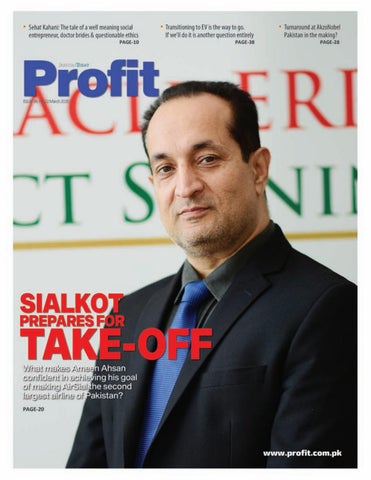
10 10 Sehat Kahani: The tale of a well meaning social entrepreneur, doctor brides & questionable ethics 16 Where the women at? On KLF manels, and why financial inclusion for women matters 20 Sialkot is preparing for take-off 28 Turnaround at AkzoNobel Pakistan in the making?
30 30 Despite growing competition, Adamjee Insurance remains the dominant player 31 After a lackluster first quarter, Hi-Tech Lubricants finally picks up 34 As Thar power plants come online, Engro’s profits soar
35 35 Unity Foods: the former textile company that made a killing in edible oils 36 Letting go Rizwan Ghani 35 Unity Foods: the former textile company that made a killing in edible oils 38 Transitioning to EV is the way to go. If we’ll do it is another question entirely
Readers say Like others in Pakistan, Citi is engaged in a most mundane kind of business. Its exit from consumer banking should be questioned — not celebrated — because it left retail customers worse off. Trading debt securities or midwifing bond sales is neither novel nor revolutionary. What’s the point in uncritical cheerleading? If anything, it should’ve been a requiem for the Citi of 1990s when its existence actually made people’s lives better. (Apropos: Citibank Pakistan scaled back, and became bigger than ever) Kazim Alam, Website via excerpt from Wordpress blog The only real competitor of Citi Bank was ABN AMRO, since these were the only two banks that both had sophisticated systems and processes built around the global model. Deutche, HSBC etc also had that, but their operation size was too small to pose any threat. Standard Chartered, although having a large presence in Pakistan, was operating more like a local bank and the processes/people were a lot more localized, especially after Union Bank merger. So with the demise of ABN AMRO at the end of 2010, Citi benefited a lot with the departure of their main competitor as far as banking with MNCs and getting dollar denominated trade and investment deals is concerned. (Apropos: Citibank Pakistan scaled back, and became bigger than ever) Khurram, Website This article was a waste of a read. It provides factually inaccurate information and very bare basic, elementary insights. Citi certainly is not the preferred investment bank for the Government of Pakistan, that is Credit Suisse and this is not a new revelation or anything of the sort. This is even clearer if you check the recent privatization/divestment mandates. Citi chose to sit on the sidelines of Pakistan’s biggest infrastructure spending spree. (Apropos: Citibank Pakistan scaled back, and became bigger than ever) Ali Malik, Twitter
How to ContaCt
facebook.com/Profitpk twitter.com/Profitpk linkedin.com/showcase/13251020 profit.com.pk profit@pakistantoday.com
10
Just goes to show how a simple change has led to so many problems. They didn’t think it through! You can’t fix corruption with more regulations, that only encourages people to work around the barriers you put up and actually increases corruption because more people get involved in the process. They should remove taxes on mobile imports and satisfy themselves with the taxes on telecom services. Tax revenue on telecom services will increase if mobile imports are freed up. It is also easier to tax the 3-4 telecoms companies than enforce your writ on
our borders. (Apropos: DRIBS is a bust, but there may be a way out yet) Anonymous, Website I am sick and tired of hearing this line again and again that “we are all thieves.” I will agree for the sake of the argument that yes, we are collectively a nation of tax evaders and fraudsters. However, even if that is the case, the way this government has handled the issues is beyond any comprehension and basic logic? If you have to create an environment to induce more people to pay taxes, what do you think the natural advice would be from anyone? What would your 4 year-old advise you? To increase the tax tiers? Yes, we understand that we are being severely monitored by the lenders, but this does not at all mean we pack off common sense and create an aura of fear and distress. That is just counterproductive to everything. And the target set forth, well, let’s just say that it is a case of the lesser said the better. (Apropos: Rs 5.2 trillion tax target? Pakistan will need a miracle) Shakil Sadiq, Facebook What is important is to make sure we have our goals straight. The current focus should be geared towards enlarging and boosting economic activities, and fostering a free and open environment for business, investment and economic activity in general. Things cannot go on when there is this much restriction, regulation, hurdles, red-tapism in documentation etc. Increasing size and volume takes some time and requires great patience from all stakeholders, but particularly the government, which is under pressure to show results. We need to stabilise and introduce integrated policies through system regulators. (Apropos: Rs 5.2 trillion tax target? Pakistan will need a miracle) Shams Uddin, Facebook It is important to keep in mind that the FBR has not been sitting idle, and has in fact achieved something significant. Just remember that the FBR did increase its tax collection target, and even if they were not able to fulfil 100% of their target, they still managed to get 90% of their target fullfied. I think that is a commendable job and deserves appreciation. No matter how you spin it, at least the amount of tax they have collected has been greater than last years or the years before that. (Apropos: Rs 5.2 trillion tax target? Pakistan will need a miracle) Shahzeb Hassan, Facebook
comments
IN BRIEF Sadia Khan
is now the new commissioner of the Securities and Exchange Commission of Pakistan (SECP). Khan, a graduate of Cambridge and Yale University, started her finance career at the now defunct Lehman Brothers in New York.
“6th case of #coronavirus in Pakistan is confirmed. The patient is in clinically stable condition in Sindh and is being well taken care of.” Dr Zafar Mirza, Special Assistant to Prime Minister on Health. Earlier, two cases were detected in Karachi, and three in Gilgit-Baltistan. The first patient has recovered, according to the Sindh government.
1% to 1.25%
February’s inflation rate stood at 12.40%, a relief after January’s unusually high inflation rate of 14.56%. The State Bank, for its part, had dubbed January’s rate ‘a temporary blimp’.
In its latest financial statement, Shell Pakistan saw a further deterioration of its losses - from Rs1.1 billion in 2018, to Rs1.49 billion in 2019. The company’s profitability had been affected by volatility in international crude oil prices. Pakistan is ranked 76th out of 100 countries on the ‘Inclusive Internet Index 2020’ released by the Economist Intelligence Unit. This makes it the least internet inclusive country in South Asia.
The United States’ Federal Reserve cut the policy rate by half a percentage point, to a range of
This is the first emergency rate cut since 2008, and is to do with growing concerns about the COVID-19 outbreak. Perhaps Pakistan’s state bank may follow suit?
Up to 10% of the Oil and Gas Development Company Ltd (OGDCL) might be divested, the Privatisation Committee said earlier this week. The committee had previously decided to divest 7% of the shares in August 2019.
Fauji Fertilizer reduced the price of urea by Rs75 per bag, after a previous reduction of Rs300 per bag, following the removal of the Gas Infrastructure Development Cess (GIDC).
After a three month delay, construction on the Jalalpur Irrigation Project (JIP) will finally begin. The irrigation project on the bank of the River Jhelum is expected to benefit 200,000 people.
9
By Taimoor Hassan
10
“A majority of the people do not get to see a doctor at the right time. So out of the whole population, around 35% of the people do not get to see an authentic doctor in their lifetime. This means they would go to a quack or a midwife or a nurse, a hakeem or a faith healer to get medicine and healthcare. But access to a qualified doctor would still not be possible for them� Dr Sara Saeed, CEO of Sehat Kahani
TELEMEDICINE
Y
By Taimoor Hassan
ou can almost hear the sneers. The smiles are sadistic and self assured because they know they sort of, kind of have a point. As conversation ensues in drawing rooms across the nation, people continue to holler, howl, and hang their head in shame over an old issue, women doctors not practicing medicine after graduation. All these women become doctors only because they want to get good rishtas and not because they actually want to practice medicine. Nevermind that it is our drawing room warriors that would be the first to raise their eyebrows if their own daughter-in-law asked them to babysit while they go run off on an emergency. The government should set up a quota for boys so that resources are not wasted, they continue. Who cares that the pool of husbands in Pakistan refuse to share the regular responsibilities that come with marriage? Dr Sara Saeed says she cares, and the medical doctor turned entrepreneur claims the company she has set up after completing her education is extending an olive branch to doctor brides that still want to practice despite the difficulty of it. Smart, confident, polished and with a fiery temperament, Dr Sara Saeed is the CEO of tele-health provider ‘Sehat Kahani,’ an all female home based health provider network that bills itself as providing healthcare solutions to marginalised communities that face discrimmination in the already inadequate healthcare system of Pakistan. On many levels, Dr Sara’s story is inspiring. She stood up to challenge the culturally conservative social norms that dictate the lives of many young women in Pakistan. Born to a middle-class family, Sara did her Bachelor of Medicine, Bachelor of Surgery (MBBS) from Agha Khan University, but did not then meekly submit to life. In fact, she abandoned the practice of medicine to start her entrepreneurial journey. For Sara, the decision to start Sehat Kahani was not just to deal with the patient end of the problem, but also the doctors’ end, by providing some sliver of opportunity to the long browbeaten and derided doctor wives. A lot of women, she says, become doctors simply to achieve that higher status in society and on the marriage market. It is not the feminist or even politically correct position to take, but Dr Sara likes calling a spade a spade. And in her mission to bring doctor brides back into the fold, she also holds an interesting possibility into fixing the issue of limited access to primary level healthcare. “A majority of the people do not get to see a doctor at the right time. So out of the whole population, around 35% of the people do not get to see an authentic doctor in their lifetime,” she explains to Profit. “This means they would go to a quack or a midwife or a nurse, a hakeem or a faith healer to get medicine and healthcare. But access to a qualified doctor would still not be possible for them.” Once again on the disproportionate receiving end of this statistic are women and children. The way Sehat Kahani works is essentially, and this is an oversimplification, as Careem but for doctors. If a female doctor cannot be out in a field, her patients will be connected to her not in person but over the phone. This also means that remote communities and inaccessible villages also finally gain access to doctors that can treat them on video or audio calls. The company has established 26 clinics all across the country where trained nurses connect patients to doctors. Sehat Kahani has already seen 123,000 patients walk in over a three year period. Initially, in 2017, the project started as a social impact focused company to provide healthcare in low income communities. Since then, other than operating these telemedicine clinics by partnering up with nurses and upgrading their existing clinic infrastructure, Sehat Kahani
12
is also involved in providing health, education, and other promotional activities in these communities. The concept of telemedicine is not a new one, and despite the discomfort one may feel, it is better than quackery overrunning so many households in Pakistan. But all is not sunshine and rainbows. A deeper look into the workings of Sehat Kahani reveal a dark, twisted tale of dubious actions. At the center of this murky situation is Sehat Kahani’s mobile application. The online portal is supposed to connect patients with doctors, the app was launched in the third quarter of 2019. In its very short operational duration, it stands accused of connecting desperate patients to doctors with expired licenses, or ones falsely claiming to be specialists. Surrounding these allegations are questions about ethics and the laws governing unethical practice and the intentions of Sehat Kahani being a ‘for-profit’ social impact enterprise, as Sara likes to call it, providing healthcare services to marginalized communities. As it stands, Sehat Kahani’s online platform is still a modest one, with only 70 doctors appearing on it, most of whom simply have an MBBS degree. The problem is that a lot of them are listed as specialists in different fields of medicine. So doctors that are simply qualified to be general physicians (GPs) will be taking money from patients on this app claiming to be cardiologists or rheumatologists. And then there are doctors practicing on expired licenses. Dr Sara’s response to the accusations was in the form of indignation and outright denial. But despite her refutations, the day after the interview, Profit noticed that many of the doctors on the platform were nowhere to be seen. In the case of others, their qualifications had been changed and specialities removed, and their rates decreased.
Before Interview with Profit
After Interview with Profit
“When I say specialist, I see someone who has done a postgraduate degree, for example, they have done their practice in MD or FCPS or MCPS or an MRCGP or MRCOP. So for example there is a doctor in our app whose name is Hina Ghole, she has actually worked 12 years. She has worked as a GP in Agha Khan for 2 years, she has the experience, when she went on with her residency in gynecology and obstetrics and then she did her diploma in paediatrics also. So you can have multiple specialities,” Dr Sara explains to us. What she says makes sense. Since the app is meant for primary care, it is known that the doctors will all be GPs, and it will be their duty to forward the case to a specialist if it comes to it. Nowhere on the app is it claimed that the doctors have a degree that they do not have. But is this just a clever misrepresentation? Or is Sehat Kahani luring patients by using the word ‘specialist’ irresponsibly?
The sanctity of human life and medical practice
“I
will not give poison to anyone though asked to do so, nor will I suggest such a plan,” reads an excerpt from Hippocratic Oath, an oath of ethics historically taken by doctors around the western world. “But in purity and in holiness I will guard my life and my art.” “Now if I keep this oath and break it not, may I enjoy honour, in my life and art, among all men for all time; but if I transgress and forswear myself, may the opposite befall me.” The Hippocratic oath of medical ethics enshrines respect for the sanctity of all human life, combined with a medical duty of care, and a duty to act according to the sole interests of the patient. In short, medical ethics define that the fundamental role of the doctor is to preserve and protect life. The Pakistan Medical and Dental Council (PMDC), the body that has been regulating medical practice in Pakistan until recently, has its own code of ethics which upholds preservation of human life as the cornerstone of medical practice. The healthcare system that is followed in Pakistan is a three-tier referral based system comprising primary, secondary and tertiary level health care whereby a doctor, instead of just going on with his treatment, refers a patient to a specialist. At primary care level are the general physicians who are the first point of contact for a patient for an illness. It is only the work at primary care level that an MBBS doctor is qualified to do. A specialist doctor can only practice in
“PMC investigates cases of individual malpractice. In this case, it is not necessary that the doctor might be calling himself a specialist but the company that might be presenting him/her as a specialist. This comes under fraud and impostering, and since it is over the internet, the competent authority in this case would be the Federal Investigation Agency (FIA)” Dr Arshad Taqi, President Pakistan Medical Council (PMC) his respective domain of specialisation after acquiring a specialist degree, requisite years of training and then obtaining a license from the Pakistan Medical and Dental Council (PMDC). One might say that a doctor claiming an expertise is simply giving the patient more trust in themselves, especially at the primary level, but doctors masquerading as specialists can actually put a patient’s life in danger. Dr Arshad Taqi, a specialist in the field of Anaesthesia and the President of the now dissolved Pakistan Medical Commission (PMC), the successor organisation to the PMDC, agrees on the unethical nature of such practice and its consequences in the form of danger to the life of a patient. “An MBBS doctor can never be a special-
ist without a degree, even if he has 20 years of experience in a specialist domain,” said Dr Javed Akram, Chancellor of University of Health Sciences (UHS). “It is an unethical practice that can endanger a patient’s life,” a Lahore-based psychiatrist said, affirming the dangers of such practice. And not only that, it also undermines the status of a qualified specialist, who, being a specialist, actually understands the delicacies associated with the profession. And as far as the expired licenses are concerned, it is a legal requirement in absence of which doctors can run into serious trouble if something undesirable happens to a patient under their care. This, however, does not invalidate a doctor’s status as a doctor, be
TELEMEDICINE
Awareness session it MBBS only or a specialist. Nor does it question the authenticity of a doctor. After all, he/she had a license once. It would not be incorrect to say that having an expired license is better than having no license, but it is certainly not desirable. There is, till now, no reported case of malpractice through Sehat Kahani’s online platform or the physical clinics that it operates. But there is also no proof that something of that sort has never happened or is not just waiting to happen. Malpractice happens even when all the boxes are checked, what could possibly happen when things are murky as well? Part of the problem can be blamed on the lack of patient awareness as well. For instance, a patient in a down-trodden community who lacks access to healthcare - the market that Sehat Kahani primarily serves would most likely be unaware of the fact that laws exist to protect patients against medical negligence or malpractice. And, he is most likely not going to be able to call out a doctor who is not a specialist. As of now, there is no government body to regulate medical practice in Pakistan. The Pakistan Tehreek-e-Insaaf (PTI) government dissolved the PMDC on October 21, 2019, and promulgated an ordinance to create the Pakistan Medical Commission (PMC). PMDC’s dissolution was challenged in the Islamabad High Court (IHC) and the IHC on February 12, 2020 restored the PMDC. Sources, however, tell Profit that instead of restoring the PMDC, the federal government has sealed the building that housed PMC, against court orders. That effectively puts the governance of medical practice in limbo. But for the duration PMC was in
14
Consultation session in Bilawal Goth, Karachi
commission, a letter, available with Profit, was sent to the Commission by an individual (who chose to remain anonymous) outlining details of some of the doctors on the app and the status of their licenses. The text of the letter reads: “This [Sehat Kahani] is a paid service and I noticed that a lot of their doctors are claiming to be specialists such as cardiologists, neurologists, etc. I have used many services like call centers and apps, both free and paid. When I checked to see their profiles on the PMC site to verify, it seems they are only M.B.B.S graduates and have no further education to claim to be specialists. I think this is an injustice to people who are talking to these doctors on the face value of what the service provider Sehat Kahani is claiming, especially since this is a paid service.” “No medical institution should support doctors who claim to be a specialist when they are not,” it read, requesting the PMC to investigate the matter. Profit took the matter up with PMC President Dr Arshad Taqi, who, although agrees that Sehat Kahani’s case was unethical, contended that it might not, however, fall under the purview of PMC. “The Commission investigates cases of individual malpractice. In this case, it is not necessary that the doctor might be calling himself a specialist but the company that might be presenting him/her as one,” said Dr Taqi, agreeing to investigate the case nonetheless. “This comes under fraud and impostering, and since it is over the internet, the competent authority in this case would be the Federal Investigation Agency (FIA).”
Dr Taqi was right. Authorities at the FIA Lahore’s cybercrime wing confirmed to Profit that if somebody is masquerading as someone he or she is not on an internet-based service, it comes under fraud and impersonation under various clauses of the Prevention of Electronic Crimes Act of 2016, with the onus falling on the company instead of the doctor. The agency also promised to investigate the case diligently. “Medical negligence and malpractice is very rampant in Pakistan because one, we don’t have any reservations, we don’t have any ethics, we don’t have regulations to save patients even at the best of tertiary care hospitals. And if there is malpractice, the patient cannot appeal or he can not win the cases against hospitals” Dr Sara says. “That is why when we made the app, because I am a medical doctor myself, it is very very important to me that no medical malpractice happens. This is why I was talking about the cut-off point of care when you recognize that it is not a primary care issue anymore. That it is a secondary or a tertiary care issue, and a patient needs to see a physical doctor.” From a patient’s perspective, the problem with Sara’s explanation is that Sehat Kahani is a paid platform, and if a patient consults a doctor on Sehat Kahani app thinking that a doctor is a specialist, the patient would essentially be paying for nothing if that doctor ends up referring that patient to an actual specialist. Though the same can happen offline on physical clinics that MBBS doctors operate, in this case the patient would at least know that the doctor concerned is not a specialist, and, therefore, not fleeced into it.
Sehat Kahani Cleanliness Drive Sehat Kahani does provide the PMDC/ PMC license numbers of respective doctors on its platform to verify a doctor’s credentials and their status with the commission (i.e. active or expired). Whereas other companies operating in the same space enlist qualifications of their doctors on the application to build trust among patients of a doctor. Neither of that is enough, however. For a paid service, a patient should not have to go through the grunt work of researching and verifying a doctor’s qualifications. Though some research would always be necessary, enlisting both the license number as well as the qualifications on the app might help save the patient some time and pain.
Sehat Kahani’s growth plans
A
t the end of the day, Sehat Kahani is a business, and a business that makes money. That is why you are reading about it in this publication. And as they make money, they also have ambitious plans to grow and take their business to the next level, despite the apparent mess. The company’s first line of business, which is an innovation in the telehealth space, are telemedicine clinics, where it provides nurses the training and the the software to upgrade their clinics into a telemed-
Dr Sara Saeed leading a cleanliness drive
icine center so that when a patient comes to her, a nurse can enter history of the patient into a digital software and connect the patient to an online doctor for consultation. With 26 of these clinics across Pakistan functioning in Sindh, Punjab and and Khyber Pakhtunkhwa (KP) and the first one opening in Balochistan as well, Sehat Kahani charges its clients Rs50-500 based on the range of consultation. The company requires 350 patients per month per clinic to break even and each clinic requires $10,000 per year to remain operational, according to Sara. “Our revenue comes from three sources right now. The first one are clinics, which account for around 20% of our revenue, we also hold a lot of health education promotion activities, which is partnering with third parties and providing health education promotion in the community which is part of our clinical activities” she explains. “We have to make the clinics breakeven, which is essentially 350 patients per clinic, per month. We create run rate gradually and slowly through the first year and from second year onward we do not need funding from any external body,” Sara says. “We can make clinics sustainable on their unit structure, which means that the clinic can break even at unit structure and sustain itself, but it would be very difficult for us to sustain company and our overheads on just clinical revenues because clinical revenues are very cash intensive. Cash flows are very very limited. And the gross margin you are making per consultation is around 40%,” she adds. The second stream of revenue are promotional activities with third parties, as part of their clinical activities. Together, the clinics and the promotional activities form bulk of the company’s revenue and the online healthcare application, the third stream of revenue, contributes 30% to the total revenue of the company, which Sara plans to take to 50%, by shifting focus ahead towards the
online application and making it the largest source of revenue for the company. “We anticipate in the next 2 years for it [the mobile app] to be over 50% of the revenue. 20% is going to come from our health education vertical and 20% is going to come from clinics.” In the last three years, through clinics and health education, Sehat Kahani managed to create a revenue of $92,000 dollars in the first year (2018), $159,000 dollars in the second year (2019) when Sehat Kahani application was launched - a 72% increase from the first year. This year, the company expects to make a revenue of $422,000 dollars mainly on the back of its online healthcare app. If Sehat Kahani is able to pull it off, it would be a growth of 165% from the previous year. The company also raised $500,000 seed investment in 2018 and plans to raise Pre Series-A round as well. All of this makes sense. For a company as ambitious as Sehat Kahani, more doctors on the platform, regardless of the status of their licenses and higher qualification, means a bigger target market of consumers to serve which is an imperative for growth. But what it means for them to grow while embroiled in these dubious practices is that the company may be a ticking time bomb, and one that may even put lives at risk. n
TELEMEDICINE
Where the women at?
On KLF manels, and why financial inclusion for women matters Think of this as the Profit female reporters’ manifesto on calling out corporate fluff
By Ariba Shahid and Meiryum Ali
W
hat is a manel? Allow the Karachi Literature Festival to explain. On February 21, someone took a screenshot of the KLF’s description of their panel discussion on “Financial Inclusions and Women Empowerment” and uploaded it on Twitter. The panel list read like a who’s who of
16
the Pakistan’s finance scene: State Bank of Pakistan (SBP) Governor Reza Baqir; Planning Minister Asad Umar; former SBP Governor Dr Ishrat Hussain; and Habib Bank President Muhammad Aurangzeb. Amazingly, despite being a talk about women, the panel included no women. Please let us take a moment to appreciate the irony here. Despite being an event about being inclusive towards women, the panel managed to somehow be exclusive of women. The KLF’s thinking was: why do you need women to talk about women?
Twitter’s outrage paid off. As a form of mitigation and damage control, the organizers quickly looked for women to bring on board for the panel, and brought in one woman, Ayesha Aziz, the CEO and Managing Director of Pak Brunei Investment Co Ltd. There was no way that we were not going to attend this ‘manel + 1’, held at the Karachi Beach Luxury Hotel on March 1. We are the only two young female financial and economic journalists writing in English in Karachi, as far as we can tell. We have had men explain to us what interest rates are, despite
us both being economics majors from IBA and Yale respectively; and yes we do know how to calculate CAGR. (compound annualised growth rate). Our bread and butter is finance reporting, despite men’s incredulity; and these are our thoughts.
Why would anyone agree to this?
A
t the talk, we first asked the panelists why they agreed to be a part of a manel, and then a manel + 1, in the first place, and why they did not object to a lack of female representation on the panel. The response was mixed. Asad Umer was quick to point out that all panelists had felt there was a need for more women. Initially, he did not know who else would be sitting with him, nor did he ask. That makes enough sense, you get a call to be on a panel, you feel you have the experience for it and you say yes As he said, that since the topic was pertinent to him, he was in attendance. “The reason you don’t see women on this panel, is because in your mind it is not important,” he said, referring to unconscious biases. “It is not possible that there were not at least three women in Pakistan who could have spoken on this”. Dr Ishrat also reminded the audience that the panel was all-male to begin with, and it was only after the men called on to speak engage in a dialogue about it that a woman was added. Ayesha Aziz, the late addition that the KLF was magnanimous enough to include, however, took a completely different view. “You are flogging the wrong horse,” she said, stressing that in their own capacities, the men on the panel had tried within their own organizations to bring about change. “If you just want to see women sitting here, just grousing, then perhaps that’s being a little sexist as well,” she said emphatically, to applause.
The problem with the manel
L
ook, first a disclaimer. This is not the first time we have interacted with a manel. As reporters who frequently cover events and talks in the financial sector, we have seen the dearth of women at events. Not a lot of women are deemed experts in their fields, and subjects such as finance and technology skew male. We would also like to add the apparently necessary disclaimer that we are not negating the efforts the male panelists are making within their own organizations. We
appreciate the work they are putting in to formulate and implement inclusive work policies, working towards female independence, as Aziz reminded us. But acknowledging the actions of the male panelists toward helping women does not bar them as people that cannot be questioned. And for all of their work towards fostering inclusive environments, the question still stands, why did these men agree to be a part of a manel + 1 in the first place? After all, as individuals that call for more inclusion of women, should they not have been the first to ask for greater female representation on the panel? Let us reiterate that asking questions does not make female reporters sexist, because reverse sexism does not exist. Let us also note that there are a handful of female CEOs, regulators or people that have risen to higher ranks within the corporate sector. Women like Maheen Rahman, Shamshad Akhtar, Sania Nishtar, Jehan Ara, Sima Kamil, Tahira Raza, and many more exist that could have dominated the discussion without appeasing the male members of society. But organizers of such literary festivals rarely look towards these women. And lest you think they might have ‘less relevant’ experience, here is a rundown of their experiences. Shamshad Akhtar was State Bank Governor during the financial crisis, Sima Kamil runs the third largest bank in the country, Maheen Rahman runs one of the most successful asset management companies in Pakistan, Sania Nishtar runs the Benazir Income Support Program (BISP), Jehan Ara runs Pakistan’s leading tech startup incubator which includes many fintech investments, and Tahira Raza used to run First Women’s Bank. There is not a single man on that panel who has more relevant experience on the subject of financial inclusion than these women. The mere existence of a manel + 1 to talk about women’s issues is beyond absurd and should always be criticized. Without right representation, and thoughts voiced by marginalized voices in society ie. women and gender minorities, how does Pakistan, or the world for that matter, hope to be more inclusive?
How could this have been improved?
T
he topic itself had enough substance to be a powerful and conclusive discussion on its own if things had been structured differently. As a first step, a female moderator could have been appointed, instead of a man. A moderator is essentially entrusted with the task of helping the audience get their needs met through a panel format. They set the tone and pace of the discussion. While organizers could
argue that there is a lack of female CEOs or women that are in positions to make a change, a female moderator would have been an effective way of addressing women’s concerns, and it is not as difficult to find an informed woman to moderate. KLF, however, went the extra mile with a male moderator that decided to comment on the challenges Ayesha Aziz was subjected to, by reminding the audience of the additional challenge women face at making “gol rotis”. While Aziz’s success story can be considered an anomaly seeing as to how few women make it to the top ranks in the business world, specifically in the financial sector; we believe that there are still a number of women that should have been given the chance to speak. For starters, there were three men that represented the government at this talk. Dr Ishrat works for the government, Asad Umer works in the government, and Reza Baqir works besides the government. Did we really need three male voices from the same pond? What the KLF was thinking with this move we can’t quite be sure, but it does show that they were looking with blinkers when trying to find voices that they wanted to feature for this talk. There is, admittedly, a lack of women in important financial positions in the government. This is a problem in its own right, but why was this the only place the KLF was looking towards to talk about inclusiveness? The only non-government presence was HBL, and banking is again a sector heavily dominated by men in Pakistan. Finding a woman from within the organization to represent HBL’s stance would have been a tough ask. Let us get this straight, HBL is trying to do its part in being more inclusive, but as things stand, the bank’s senior management consists of 25 men and one woman, (Neelofer Hameed, Company Secretary). Only 17% of HBL’s workforce are women, though management has said it wants to increase that ratio to 20% this year. Once again, goals like this are commendable. There still, however, remains the fact that more could have done to make this discussion inclusive, and actually about women. Setting up a panel discussion to talk about women’s empowerment and financial inclusion should be seen as a strong enough topic to draw in crowds. But bringing in crowd pullers like Asad Umer, or Dr Ishrat Hussain for the sake of filling up a hall should be avoided. These are some of the men that have actually made efforts, and say the right things and are well meaning, but they get enough of the spotlight. It is time that women begin to be seen as not just viable alternatives for them or late additions, but as the first choice.
COMMENT
The organizers claimed that they had trouble finding female CEOs in the financial world. But this talk was not just restricted to formal banking nets, where barriers to entry for women are taller and stronger. It encompassed independence, entrepreneurship, and vision. There are countless women working toward similar goals but through different streams. Oh, and see the paragraph above. We listed six women who would have been better qualified to be on that panel. We understand that not all of them were available for the event. For instance, Sima Kamil may have been out of the country at that point. But a 50% acceptance rate would have created a panel of three very qualified women to have that conversation. Even a 33% acceptance rate would have resulted in at least two other women joining the panel.
What is wrong with this system?
M
anel + 1s, or the inadequate representation of women, are only part of the problem. In fact, talking about manel + 1s is easy - it is practically clickbait. Get some retweets on Twitter, and wait for the next social media outrage to pop up next week. It’s easy to fall into this dichotomy, on both sides: the activists’ justified, bubbling anger on one hand; and the lazy and confused KLF organizers and irritated bankers on the other hand, with their obsession for optics
18
management. The bigger problem, the real ‘why do we even bother with this’ actually comes from the panel itself: why do we want financial inclusion for women? Why do we want more women to have bank accounts? Why do only 17% of women in Pakistan have a bank account, compared to the regional average of 64%. What do answering these questions mean for us as a society, and as an economy? Since the 1990s, the world has accepted the system of capitalism as a net good. Its very pervasiveness has led to jokes about ‘late stage capitalism’, or the absurdities and strangeness of a modern economy that we are all willing or unwilling participants in. But that is not Pakistan. Let us be very clear – Pakistan is not that kind of capitalist country, per se. It is many things: feudal, bureaucratic, stagnated. Another great term we like to use is ‘rentier state’: essentially that Pakistan’s economic development is based around the wealth and interests of state elites and feudal elites, and their chosen clients and chosen private interest groups. Economic development in Pakistan is not based around actual domestic production, creation of an efficient manufacturing base, an organized and productive labour force, or structural change. Corporate Pakistan, the State Bank, the IMF and the government – basically, the entire makeup of the panel – all have to contend with this state of affairs: how do we turn this around? How do we actually create efficient capitalism? How do we actually make things,
or trade things, or create money? There are people that decry this entire affair as nonsense, as neoliberal nonsense, that ought to be eradicated from our country, for the betterment of our people. It is a fair critique: it is just not a view that Profit takes. This entire magazine is predicated on the fact that businesses and companies and the pursuit of money will always exist (and it is our job as journalists to hold them accountable, as much as we can). AND THAT, for as long as this system of affairs exists, means that it will always be important to discuss when women fit. For as long as there is a Pakistani man out there with a bank account and setting up a shop, our question as journalists, as women, will always be: and where is his female counterpart? For as long as we have a system of absurdly over paid male CEOs, our question will always be: and where are the absurdly over paid female CEOs? If we are going to partake in this neoliberal push, then you best believe that someone will always ask if you are doing enough to make sure women exist. We ought to be challenged constantly: on the scale of microfinance loans given to women, on whether women can purchase items for Rs50,000 without showing her male relatives’ NIC [national identity card], or if her corporate job has a maternity leave policy, on whether she can create financial independence in Pakistan for herself. We write this article so that you, as a reader, can ask yourself: who speaks for this woman? Is it women, or some few good-natured men on a panel?
COMMENT
20
By Farooq Tirmizi and Ariba Shahid
H
ere is a fact you may not know: there are four cities in Pakistan from which you can catch a regular direct flight to London Heathrow Airport: Karachi, Lahore, Islamabad, and Sialkot. You probably guessed the first three. It is possible you may not have known about the fourth. Sialkot, in the imagination of the rest of Pakistan, is the enterprising city known as the birthplace of Iqbal, the home of Pakistan’s sporting goods manufacturing industry, and the city whose business community – in an extraordinary act of self-reliance – got together and made their own airport, the first and only privately owned airport in the country. What is perhaps less well understood is just how well that airport is doing, and just how much Sialkotis love to travel – or need to travel for work. The speed and scale of success of aviation in Sialkot is breathtaking. It is – by far – the fastest growing airport in Pakistan, with international air traffic growing at 62.7% per year for the past 11 years, according to data from the Civil Aviation Authority (CAA). But the numbers alone do not illustrate just how fast things have changed in the city. In 2006, there was no airport in Sialkot at all. If you lived in Sialkot, you had to drive or take the bus to Lahore to then catch a flight to wherever else you were going. Now, in 2020, Sialkot is the fourth most connected airport in the country. Here is a list of global cities that you can catch a direct, non-stop flight to from Sialkot every week: Dubai, Sharjah, Doha, Muscat, Riyadh, Dammam, Manama, Kuwait, London, Milan, and Barcelona. And the flight to Paris has just one stopover, in Barcelona. Needless to say, given that rapid expansion of air travel from Sialkot, it is not surprising that the entrepreneurs in Sialkot want to stop relying on the state-owned Pakistan International Airlines (PIA) and set up their own airline, called AirSial, which will have its hub at Sialkot Airport. It is almost as if the members of the Sialkot Chamber of Commerce said: we built our own airport, and we will now build our own airline. But to understand how AirSial is even possible as an idea, it is important to understand how Sialkot Airport was created.
The story of Sialkot Airport
S
ialkot is part of Punjab’s export triangle, which consists of the industrial cities of Gujrat, Gujranwala, and Sialkot. Unlike the other two cities, however, Sialkot is not on the main Grand Trunk Road that formed the core road transit link between Lahore and Rawalpindi (and is the modern manifestation of the ancient highway that runs from Chittagong to Kabul.) And while Sialkot does have a railway station, it is not on the main railway line that connects Peshawar to Karachi, but rather indirectly connected through a branch line that terminates at Wazirabad. That lack of connectivity has historically been a cause of much concern to the Sialkot business community, specifically the roughly 400 family-owned businesses that form the core of the Sialkot Chamber of Commerce and Industry (SCCI). For a long time, the SCCI tried to get its demands to be taken seriously by decisionmakers in Islamabad, but to no avail. By the later 1990s, the SCCI membership had started coalescing around the idea of: “if the government will not give us our own airport, we will build one for ourselves.” And so, in 2001, the SCCI approached the Musharraf Administration for permission to begin building their own airport. Perhaps it is fitting that it was under a military government that the SCCI was able to secure permissions: the CAA, which governs aviation in Pakistan, is a division of the defence ministry, and Sialkot’s location close to the border with Indian Kashmir may have created complications that did not allow the airport to be built for a long time. However, once the Musharraf Administration gave the go-ahead, the SCCI began to raise capital relatively quickly. The richest 365 members of the SCCI began contributing the equity capital for the newly created Sialkot International Airport Ltd, the company that would run the airport. The minimum contribution was just over Rs1 million, though the 13 richest families invested well over Rs10 million each. The total amount of money raised was just under Rs2.1 billion. The airport itself was built on more than 1,000 acres, in a plot of land that was located outside Sialkot, and strategically accessible to both Gujrat and Gujranwala as well so as to serve as large a population as possible. While the government did not help pay for the airport itself, the Punjab gov-
AVIATION
ernment did build a small road that connected the airport to the highway between Sialkot and Wazirabad. Sialkot Airport is a single terminal, single runway airport, though the runway is the second longest in Pakistan, behind only the new one at Islamabad International Airport. Construction began in January 2003, and the first test flight was conducted in March 2005. Air Blue was the first airline to start regular flights to Sialkot from Karachi, beginning in late September 2007, with PIA starting less than two weeks later. It became very clear early on that Sialkot Airport would be much more about connecting the city to the rest of the world than it would be about connecting it to the rest of the country. By the fiscal year ending June 30, 2009 – just its second full year of operations – Sialkot was handling more international passenger traffic than domestic. In the initial years, international flights were entirely on domestic airlines, primarily Air Blue and PIA, with Shaheen Air starting operations in July 2009. In November 2012, however, the government allowed the airport to begin serving foreign airlines, and the first one to start operations was Air Arabia, which began the direct Sialkot to Sharjah flights in January 2013. FlyDubai started operations just two months later, in March 2013, followed by Emirates in May of that year. The Emirates flights to Dubai started off as being just four times a week, but by September 2015 – just two years after starting – had become daily flights. Meanwhile, PIA had been experimenting with adding direct flights to Europe from Sialkot. As early as 2012, it experimented with a direct flight to Barcelona. While the initial experiment then did not entirely succeed, in January 2019, PIA started a flight route that connected Sialkot to Barcelona and Paris, which appears to have become somewhat more financially feasible. Why Barcelona, you might ask? There is a surprisingly large community of Pakistanis that lives in Barcelona, the vast majority of whom
“If you look at the supply-side, it is evident that passenger demand is both under-served, and poorly served. PIA’s reduced fleet, Air Blue being unresponsive towards the gap in supply, and Shaheen Air folding up is enough to denote that the doors to entry are wide open in the industry” Ameen Ahsan, CEO of AirSial are from the general vicinity of the GT Road area close to Sialkot and Lahore. In addition, Sialkot manufactures fully 40% of the world’s footballs. You may have heard of a football club or two based in Barcelona. Why does Sialkot manufacture footballs? As Joe Pinsker wrote in The Atlantic: “Its origins as a hub of soccer ball-production date back to British colonial times, when Britons eager to play soccer grew impatient waiting for shipments of balls to arrive by sea. In 1889, a British sergeant asked a Sialkoti saddlemaker to repair his punctured soccer ball, and, pleased with the results, put in an order for a batch of balls to be made. Production took off from there: By 1982, Sialkot-produced balls were used in the World Cup.”
AirSial
S
o why start AirSial? Because an international airport cannot expect to continue growing unless it has an airline that creates its hub there. Existing domestic
airlines in Pakistan all have their hubs in Karachi, with PIA now beginning to use Islamabad as one of two major hubs. If Sialkot expects to have its international airport and connectivity continue to thrive and grow, it will need to get more air traffic. “The possibility for this venture to be a success falls from how Sialkot is home to the only privately owned and run airport in not only Pakistan, but the region. We thought it was eminently possible for us to own and run our own commercial airline to save foreign exchange which had been drawn by foreign carriers who had taken advantage of such vast gap between demand and supply in our country,” said Ameen Ahsan, CEO of AirSial, in an interview with Profit. That, of course, begs the question: is there even enough demand to justify an airline? Sialkot Airport has thus far handled a maximum of 817,000 passengers in a single year. Is there really enough to justify more investment? The answer, to AirSial’s investors, appears not in the current levels of demand, but in the
Pakistanis love to travel abroad
Pakistanis love to travel abroad
Total international passenger traffic to and from Pakistan, 2007-2019
7,574,221
7,946,664
8,203,304
8,460,198
7,213,562
2007
2008
2009
2010
2011
13,765,788
9,412,272
9,786,123
2012
2013
10,890,897
2014
14,602,416
13,463,665
13,821,395
2018
2019
11,724,202
2015
2016
2017
Source: Civil Aviation Authority
22 Sialkot's
air traffic has taken off 817,067 718,128
722,918 650,058
“Sialkot’s origins as a hub of soccer ball-production date back to British colonial times, when Britons eager to play soccer grew impatient waiting for shipments of balls to arrive by sea. In 1889, a British sergeant asked a Sialkoti saddlemaker to repair his punctured soccer ball, and, pleased with the results, put in an order for a batch of balls to be made. Production took off from there: By 1982, Sialkot-produced balls were used in the World Cup” Joe Pinsker, staff writer at The Atlantic plane with a typical capacity of 150 passengers, growth trajectory. But being incubated by the Sialkot and a flight range of 6,100 kilometres. That “If you look at the statistics, airline business community is about more than just puts London just out of reach, but direct flights numbers have consistently been on the rise. how the company wants to do business. Ahsan from Sialkot to Paris should be possible (if The IATA [International Air Transport Asbelieves it can be a key competitive advantage somewhat uncomfortable) on that plane. More sociation] forecasts a strong 184% growth in in an industry where exogenous circumstances likely, the A320 is likely to serve as the core of passenger traffic for Pakistan within the next can result in a sudden shift from profits to the airlines fleet on flights to the Middle East, twenty years,” said Ahsan. losses, and thus weaken many airlines without since the plane is designed mainly for short and And they hypothesize that the current committed sources of capital. “[Our shareholdmedium haul flights. airlines are simply not up for the job. “If you er structure] also gives AirSial the ability to look at the supply-side, it is evident that raise additional capital at short notice,” he said. passenger demand is both under-served, and AirSial plans to start commercial operapoorly served. PIA’s reduced fleet, Air Blue tions on domestic routes by June 2020 and will irSial, however, is not the only airbeing unresponsive towards the gap in supply, link its home base of Sialkot to major airports line seeking entry into the Pakistani and Shaheen Air folding up is enough to denote like Karachi and Islamabad through weekly aviation market. In 2019, the govthat the doors to entry are wide open in the flights. The airline then hopes to expand withernment introduced a new Aviation Pakistanis love to travel abroad industry.” in the domestic market by flying to Peshawar Policy, designed to encourage new airlines in So, what exactly is the value proposition and Quetta, and by increasing the frequency of 14,602,416 the 13,765,788 country, and several entities have 13,821,395 been 13,463,665 of the new airline, aside from serving Sialkot flights per week to destinations. looking to enter the market. Besides AirSial, on a dedicated basis? The airline then wants to expand into11,724,202 10,890,897 there is Afeef Zara Airways, Askari Air, Go “AirSial is not like any other private secinternational airspace by starting flight opera9,786,123 9,412,272 Green, Liberty Air. The last of these, Liberty 8,460,198 tor entrant within the industry. The corporate tions to and from the Middle East, in particular 8,203,304 7,946,664 Air, is seen by observers as the most likely to 7,574,221 7,213,562 ownership of AirSial is unique with more than Dubai by next year. There is no word yet on launch commercial operations next. four hundred shareholders, most of which potential operations to Europe. The AirSial management appear to be belong to the Sialkot business community. AirSial’s initial operations will rely on well aware that they are stepping into what This gives the company a natural cohesive three Airbus A320-200s, which the airline has looks like a crowded market and are preparing character. The airline’s driving force is not leased from AerCap, the world’s largest indethemselves to compete. to maximize commercial profits, but more to pendent aircraft leasing company, headquar“There are2017 no shortcuts. Considering 2008 2009 2010 2011 2012 Ireland. 2013 2014 2015 2016 2018 2019 make2007 it a self-sustaining enterprise that will tered in Dublin, how we’re operating in the service industry, become a matter of pride for the Sialkot busiThe A320 is currently the best-selling we understand thatSource: only the fittest survive. Civil Aviation Authority ness community,” said Ahsan. aircraft in the world, and is a narrow-body
A crowded market
A
Sialkot's
air traffic has taken off
Sialkot’s air traffic has taken off
817,067
Total passenger traffic to and from Sialkot, 2007-2019
722,918
718,128
650,058
350,515 212,802
254,859
236,485
2012
2013
286,069
133,273 -
19,034
2007
2008
International
Domestic
53,744
2009
2010
2011
2014
2015
2016
2017
2018
2019
Source: Civil Aviation Authority
AVIATION
Fastest F a s t e s t g growing r o w i n g i n international t e r n a t i o n a l a i r p airports o r t s i n P ain k i Pakistan s ta n
Average Averageannualised annualisedgrowth growthinininternational internationalpassenger passengertraffic traffictotoand andfrom fromairports airports in inPakistan, Pakistan,2007-2019 2007-2019 Sialkot
62.7%
Multan
3,685,783
3,493,916
1,210,919
Multan
10.2%
Gwadar
3,773,826
Peshawar
20.2%
Quetta
Islamabad
Lahore
29.2%
Turbat
Total international Total internationalpassenger passengertraffic traffic to to and and from from airports airports in in Pakistan, Pakistan,2019 2019
Karachi
42.8%
Faisalabad
LLargest a r g e s t i ninternational t e r n a t i o n a l a i r pairports o r t s i n P in a k Pakistan is ta n
877,331
Sialkot
9.0%
617,754
Lahore
6.6%
Faisalabad
Peshawar
6.6%
Quetta
30,829
Islamabad
6.4%
Turbat
17,450
Karachi
Gwadar
1.6%
258,475
7,039
Source: Civil Aviation Authority
We aim to incorporate the best business practices not only to survive, but strongly thrive against competition,” said Ahsan. “I would like to mention our Chairman, Mr. Fazal Jelani’s vision regarding customer friendly pricing policies that will ensure competitive prices even during high or peak season demand. While I cannot disclose much at this point in time, rest assured that AirSial will be offering more than our counterparts in terms of comfort and convenience for our valued passengers whilst adhering to the highest level of safety standards.” That being said, the incumbents in the
current market appear to be doing just fine, if not thriving. Serene Air, for instance, has seen its passenger traffic rise from nothing in 2016 to 1.75 million passengers in 2019. And while growth at Air Blue has slowed down, the airline still flew 1.8 million passengers last year. “Air Blue may not have done exceptionally well but it has not suffered as such,” said Ahsan. The only domestic airline that seems to be doing badly is Shaheen Air, which went from flying 2.8 million passengers in 2018 to almost nothing in 2019 and has now effectively ceased to exist. In Ahsan’s view, the issue with the airline cannot be explained by market
20
17
million
Estimated population of the Lahore metropolitan area, according to the 2017 population census
24
million
Estimated population of the Karachi metropolitan area, according to the 2017 population census
Source: Civil Aviation Authority
factors. “Shaheen’s failure is not explainable in terms of business dynamics as it was performing well on most operational performance metrics, for instance aircraft utilization, regularity, available seat kilometers (ASKs), revenue passenger kilometers (RPKs), seat factors, yields, etc. Apparently, there were other extraneous, unexplained factors that caused its accelerated debacle,” he said. It also helps that the government – particularly the Pakistan Tehrik-e-Insaf (PTI) administration led by Prime Minister Imran Khan – appears to be taking the aviation sector
16
million
Estimated population of the Gujranwala metropolitan area, according to the 2017 population census; the only airport serving this area is Sialkot Airport
Largest domestic airports in Pakistan
Largest airports in Pakistan
L a r gdomestic e s t d o passenger m e s t i c traffic a i r p otor tand s i nfrom P a airports k i s t a nin Pakistan, 2019 Total Total domestic passenger traffic to and from airports in Pakistan, 2019 Karachi 1,366,759
Lahore
Sukkur
5,140,585
Lahore
4,490,182
Peshawar
335,380
Peshawar
6,212,485
Islamabad
996,266
Quetta
Faisalabad
Karachi
2,526,702
Islamabad
Multan
L a r passenger g e s t a i r ptraffic o r t s toi nandP from a k i sairports t a n in Pakistan, 2019 Total Total passenger traffic to and from airports in Pakistan, 2019
1,402,223
Multan
191,304
997,978
Sialkot
120,647
Quetta
366,209
Faisalabad
360,524
102,049 93,592
650,058
Rahimyar Khan
53,970
Sukkur
93,592
Skardu
49,180
Rahimyar Khan
53,970
Gilgit
45,137
Skardu
49,180
Sialkot
32,304
Gilgit
45,137
Turbat
27,177
Turbat
44,627
Bahawalpur
23,882
Gwadar
26,078
Gwadar Mohenjodaro
Bahawalpur
19,039
23,882
8,403
Mohenjodaro
Dera Ghazi Khan
7,205
Dera Ghazi Khan
7,205
Panjgur
5,570
Panjgur
5,570
8,403
Chitral
5,498
Chitral
5,498
Dalbandin
4,399
Dalbandin
4,399
Zhob
1,835
Zhob
1,835
Kadanwari Khairpur
1,276
Kadanwari Khairpur
1,276
Sawan
Sawan
1,218
1,218
Dera Ismail Khan
621
Dera Ismail Khan
621
Sui
282
Sui
282
Source: Civil Aviation Authority
seriously and is trying to craft policies that encourage the sector’s growth, part of the administration’s policy of trying to make Pakistan an attractive destination for global tourists. “It is way better now for the aviation industry, as explained while we were talking about government policies for the sector. Here I would like to mention that the Prime Minister himself is very enthusiastic about the aviation sector as he envisions in it a stimulus to create jobs, bolster economic growth, and a strong contribution to net foreign exchange resources,” said Ahsan. Promoting aviation could certainly be a boost to the economy. “I see it become an important multiplier of economic activity in our national economy, creating jobs and adding to the GDP [gross domestic product, or the total size of the economy]. We expect to achieve accelerated numbers in five years than the long term IATA forecast of 786,300 jobs and GDP support of $9.3 billion over twenty years,” said Ahsan. AirSial aims to surpass all private domestic airlines within the next five years, and become second only to PIA in terms of passengers carried. “I see [AirSial] rising to the top and becoming the second largest airline in terms of size. We envision to be amongst the best in terms of service standards by providing our valued customers comfort and conveniences within and outside Pakistan,” said Ahsan. How will that happen? Well, the answer
depends in large part on the market AirSial is seeking to serve.
Just how big is AirSial’s market?
S
ialkot barely has 1 million people, according to data from the 2017 population census, and most of those people do not have high enough disposable incomes to afford air travel. So just how much does the airport have in terms of demand that it can serve? If one looks at just Sialkot as a population center, then obviously AirSial is likely to have a tough future. However, Pakistani cities are no longer discrete cities surrounded by tens, if not hundreds of miles of countryside before the next small city. Over time, the nation’s cities have developed into major metropolitan areas. And this is where the most under-reported story of the 2017 census comes in: Sialkot is one of four major cities in the Gujranwala metropolitan area, which is now the third largest metropolitan area in the country, behind only Karachi and Lahore. According to the 2017 census, the Lahore metropolitan area is now the largest, with just under 20 million people, Karachi with 17 million people, and metropolitan Gujranwala – which includes Gujranwala, Gujrat, Sialkot, Narowal, Hafizabad, and Mandi Bahauddin – now has just over 16
Source: Civil Aviation Authority
million people. That’s right: the metro area served by Sialkot airport – and the future clientele of AirSial – is almost as big as that of Karachi. Yet Jinnah Airport in Karachi served 6.2 million passengers in 2019 and Sialkot Airport served just 0.65 million. No wonder the passenger traffic at Jinnah Airport has grown at just 1.0% per year for the past 12 years, and traffic at Sialkot Airport has grown at 40.7% over the same period. In other words, Ahsan certainly has a point when he says that existing airlines have not been doing a good job serving one of the largest and fastest growing metropolitan areas in the country, likely a product of the KLI [Karachi, Lahore, Islamabad] bias in economic decision-making in Pakistan. Of course, Gujranwala’s metropolitan area is much more spread out than even Karachi, but nonetheless, the fact remains that for nearly all of it, Sialkot is the closest airport. Some parts of Narowal might be closer to Lahore, but for most people in the region, if Sialkot can be converted into a domestic and international aviation hub, their lives would be greatly improved. That market is the one that AirSial wishes to serve, and one that no other airline seems to be particularly interested in competing for. If that remains the case, AirSial’s projections of future growth are likely to be realised, provided they can execute well on their strategy. n
AVIATION
I
t has been a rough few years at AkzoNobel Pakistan, but there may finally be light at the end of the tunnel. Profits have begun to rise again, and the company is beginning to operate at significantly better efficiency levels than it has been in the recent past. For the financial year ending December 31, 2019, the company announced that it had achieved revenues of Rs5,611 million and net income of Rs549 million. While revenues were actually down by about 3.5% compared to the previous year, profits had grown by an astounding 41.8% over the same period last year, the highest growth rate in the company’s profits since 2013. It represents a remarkable turnaround for AkzoNobel, which has been going through a considerably painful period of restructuring and a general slowdown in the construction industry, which has caused demand for its products to sharply decelerate. AkzoNobel is a paint manufacturing company headquartered in the Netherlands. Its Pakistani subsidiary is among the leading manufacturers of paint in the country and has been a leading supplier to the Pakistani construction industry. What is particularly impressive about AkzoNobel’s results in 2019 is that they have come as the result of the company’s ability to curb its costs, particularly with respect
28
to selling and distribution costs. AkzoNobel Pakistan CEO Saad Mahmood Rashid has presided over a restructuring exercise that has resulted in a reduction in the company’s headcount in the country, in addition to a reorganisation that has resulted in each division of the company becoming more closely integrated with its global business units in order to be better coordinated across the world. Rashid has served as the CEO of AkzoNobel Pakistan since November 2017. He had previously headed the company’s decorative paints business, its core business line in the country, a position he held for three years. Prior to that, Rashid worked for 10 years at Reckitt-Benckiser in a variety of sales roles. He previously worked at PepsiCo Pakistan and British American Tobacco’s local subsidiary, Pakistan Tobacco Company. That a person with primarily sales experience has been able to lead the company at a
time of operational transformation is a particularly impressive feat, and one that speaks to the versatility of the CEO in being able to pivot from being focused on growth to becoming focused on consolidation of operations and bringing efficiencies to an organisation that desperately needed it. AkzoNobel Pakistan’s margins have improved significantly over the past year, particularly its operating margin, which went from 10.7% in 2018 to 14.2% in 2019. While it is still below its 2013 peak of 18.5%, the company’s performance in 2019 represents one of its best single-year improvements. Largely on the back of those operational improvements, the company has been able to improve its net profit margin, which grew from 6.7% in 2018 to 9.8% in 2019. Profit has previously reported that AkzoNobel Pakistan may be interested in restructuring itself, and may also be in the
AkzoNobel Pakistan revenues Pakistan revenues AkzoNobel Rs, in millions Rs, in millions
5,265 4,764
2012
2013
4,902
4,927
2014
2015
5,691
5,813
2017
2018
5,612
5,137
2016
2019
Source: Company financials
process of evaluating an acquisition of one of its local rivals. “In order to ensure that we become the preferred provider in Pakistan’s paints and coatings market, the company is setting transformation targets and investing in people, processes and technologies to steer it forward,” said Rashid, in an interview last year with Profit. “This has resulted in a few changes including creation of multiple new roles, that would help rebuild a more stable and effective framework to eliminate inefficiencies, in turn driving us forward.” The context for the restructuring appears to have been the failed bid by the largest paints and coatings company in the world, the USbased PPG Industries, in early 2017. PPG is the largest paints company in the world and AkzoNobel the second-largest. While the merger failed, it nonetheless had a lasting impact on AkzoNobel. At a time when PPG made its first bid of €83 per share, AkzoNobel’s shares were trading at approximately €60 a share on the Amsterdam-based Euronext stock exchange. PPG subsequently raised its bid twice, first to €88.72 and then to €96.75 per share. AkzoNobel’s board rejected the bid on two grounds: the price was too low, and the merger of the largest and second largest paint companies in the world would likely attract significant antitrust regulatory scrutiny that would significantly complicate the benefits of any merger. Having rejected the bid, however, AkzoNobel’s board was in a bind: they had to prove to their shareholders that they had the ability to create the same value for the company that PPG was offering through its acquisition offer. AkzoNobel’s history in Pakistan starts with its January 2008 global acquisition of the UK-based Imperial Chemical Industries, better known by its acronym, ICI, the legendary industrial giant that was, for decades, the largest manufacturing company in the United Kingdom. ICI’s history in Pakistan starts even before Partition, in 1944, when it started the production of soda ash, a precursor to several
“In order to ensure that we become the preferred provider in Pakistan’s paints and coatings market, the company is setting transformation targets and investing in people, processes and technologies to steer it forward,” Saad Mahmood Rashid, CEO of AkzoNobel Pakistan industrial chemicals, in Khewra, in district Jhelum. Following independence and Partition, ICI incorporated its Pakistan assets under Khewra Soda Ash Company Ltd, set up in 1952. The company was renamed ICI Pakistan in 1966. At least one ICI subsidiary has been listed on the Karachi Stock Exchange since July 1957. ICI has always grown in Pakistan through a combination of organic growth as well as acquisitions. For instance, in 1965, they acquired the Lahore-based Fuller Paints, which was later renamed Paintex. The company also created Pakistan PTA Ltd in 1998, which was then spun off into a separate entity in 2000. In 2008, the global parent ICI was bought out by Dutch paints and chemicals giant AkzoNobel, following which ICI Pakistan became part of AkzoNobel worldwide. In 2010, the company made a decision to focus on the paints business, AkzoNobel’s global specialty, and spin off the chemicals business. The spin-off, labelled a “demerger”, was completed in May 2012, creating two separate companies: AkzoNobel Pakistan and ICI Pakistan, though at the time, both were owned by the global AkzoNobel. The process to find a
buyer for ICI Pakistan began in June 2012, and ended with the Yunus Brothers Group – the industrial conglomerate that owns Lucky Cement, Yunus Textiles among others – won the bid to buy out the industrial chemicals business that was the new ICI Pakistan. Coincidentally, ICI was the result of the 1926 merger of four companies, one of which was Nobel Explosives, which has its origins under Alfred Nobel, the Swedish explosives manufacturer. Another of Nobel’s subsidiaries became one of the component companies of AkzoNobel. However, two recent announcements by the company can have a major impact on how the company performs going forward. One pertains to Rashid’s decision to accept another job outside of the company starting next month and the other about the company’s decision to delist itself from the local stock exchange. This is not the first time that the local subsidiary of a multinational corporation has decided to delist itself from the local bourse and this might not be the last. Unilever Pakistan delisted itself from the Karachi Stock Exchange in 2013, and Colgate-Palmolive Pakistan is currently in the process of doing so as well. Resultantly this could well be the last time that we will be reporting on the financials of AkzoNobel Pakistan. n
A k z o N o b e l Pakistan P a k i s t a n p rprofits o fits AkzoNobel Rs, in millions Rs, in millions
606
573
539 459
387
376
2012
549
491
2013
2014
2015
2016
2017
2018
2019
Source: Company financials
CHEMICALS
Despite growing competition,
Adamjee Insurance
remains the dominant player How Pakistan’s oldest company has managed to retains its market share even as newer companies continue to lure customers
A
fact: Adamjee Insurance is outperforming almost all of its peers, and with Pakistan’s insurance industry still in its nascent stages and with room to grow, the insurance company is set to make even greater gains in the future. The almost glowing recommendation comes from Hassan Irshad, a research analyst at Foundation Securities, a securities brokerage firm, in a note issued to clients on February 26. Pakistan has 36 insurance companies, of which seven are life insurance companies. Insurance penetration remains staggeringly low, with the industry’s gross premiums at 0.9% of gross domestic product (GDP, or the total size of the economy) which is much lower than the region's average of 2.2%. But there is definite room for growth, with the industry trying to adopt digital channels like online sales and mobile apps. The gross premium of Pakistan’s insurance industry has a five-year compounded annual growth rate (CAGR) of 17.7%, from Rs136.3 billion in 2013, to Rs308 billion in 2018. Most of this is dominated by the Life industry (around 63%). “An expanding GDP per capita, economic recovery, utilisation of technology and a massive untapped market hold boundless potential for the insurance industry to grow. Moreover, future impetus to growth would also come from CPEC [China Pakistan Economic Corridor] Phase 2,” states Irshad. Within this industry, Adamjee Insurance Company (AICL) is well poised to
30
remain dominant. Formed in 1960, it is still the largest general insurance company in Pakistan, with a 26% market share (followed by EFU General Insurance at 24%, and Jubilee General Insurance at 12%). Irshad notes that Adamjee Insurance has managed to pull this off for a variety of reasons: by maintaining stability in its core
business, an undervalued investment portfolio, growth in its dividend income, a surge in rental income and the turnaround of Adamjee Life, a subsidiary of AICL. Adamjee Insurance’s underwriting business in both Pakistan and the United Arab Emirates (UAE) massively increased in the last decade. Between 2013 and 2018,
the company’s net premium went from Rs5.5 billion, to Rs13.8 billion. This represents an average annual growth rate of 20.2%. For comparison, the industry’s average compound annual growth rate is 14.4%. Most of that growth can be attributed to a rise in motor insurance, which contributed on average 63.9% to net premium in the last three years. That is because the demand for cars has risen in Pakistan, with a compound annual growth rate of 12.9% between 2013 and 2018. And unlike in Pakistan, buying motor insurance is mandatory in UAE, which makes life easier for Adamjee. Even if the domestic auto industry is experiencing a contraction for now, it is expected to recover in 2021, as the government relaxes a little on its aggressive documentation drive, and monetary easing kicks in. Besides, Pakistan’s motorisation rate is only at 18, which is much lower than the regional average of 67, which suggests there is room to grow. Adamjee Insurance’s main revenue generator is its investment portfolio, which stood at Rs23.3 billion, in the ninth month of calendar year 2019. It also contributed to about 59.1% of profit after tax in 2018. In his note, analyst Irshad explains how that works: “The portfolio has been built on the back of ‘free’ float that is a result of consistently profitable underwriting business. Float refers to money that an insurance company has received in the form of premiums but has not yet paid out in claims. The money received gets invested and earns income from various asset classes until claims are paid out.” The company’s ‘float’ of Rs11.7 billion has grown at an average annual growth rate of 28.7% per year over the past five years. Unlike its competitors, the company's portfolio is titled towards equities, which account for 71% of the portfolio; the remaining 29% include debt securities and term deposits. Within the equity portfolio, MCB Bank accounts for 49% of its holdings. And since MCB Bank’s earnings are expected to grow, this will have a spillover effect on dividend payouts, with the report expecting investment income to grow by 47.9% in 2020. MCB Bank and Adamjee Insurance are both part of the Nishat Group, the financial and industrial conglomerate owned by Mian Muhammad Mansha, arguably the richest man in Pakistan. Adamjee Insurance is also benefiting from rental income. It bought an 10 floor office building in Karachi, and renovated the 15 floor head office in Lahore. These buildings have about 50% rental space availability. Though rental income in the first nine months
of 2019 stood at Rs14 million; Foundation Securities expects it to jump to a whopping Rs161 million in 2020. Finally, there is the question of Adamjee Life Assurance Company, which provides life assurance services to groups and individuals. For now, it only has 6.7% share of the Life market but its average annual growth rate for the last three years has been 13.1%. And while Adamjee Insurance holds a 74.3% stake in Adamjee Life, it is looking to acquire a 100% stake in its subsidiary. What could this
acquisition entail? “We believe that AICL’s existing network could help unlock synergies and allow Adamjee Life to achieve a higher market share and increase profitability as evident by the turnaround in CY18.” said Irshad. “As per the first nine months of calendar year 2019, the company seems to have shifted their strategy by reducing their exposure in Single premium policies and instead focusing on unit linked policies... This signals that the unit linked policy model holds significant
After a lackluster first quarter, Hi-Tech Lubricants finally picks up Company also plans to open up and expand its own retail petrol pump distribution network over the next five years
H
i-Tech Lubricants (HTL), which manufactures engine and machinery lubricants in Pakistan, finally managed to have a somewhat positive second quarter in fiscal year 2020, after a depressing first quarter. In the second quarter, the company’s earnings-per-share stood at Rs0.93, which was an improvement from the loss-pershare of Rs2.09 last quarter, and Rs1.11 during the same period last year. “The results were broadly in line with our theme that HTL will close the second quarter in the green due to recovery in sales volumes after a depressed first quarter. However, topline was below our assumption which led to lower than expected earnings.” wrote Muhibur Rasool, research analyst at Alfa Adhi Securities, a securities brokerage firm, in a note issued to clients on February 24. The ‘topline’, or net sales in this case,
stood at Rs1,613 million, which was 2.5 times higher than net sales in the previous quarter, due to volumetric recovery. However, the finance cost stood at Rs75 million, mostly due to increased borrowing to meet working capital requirements. So, what happened to sales in the first quarter of 2020? There were two problems: first, a lot of pre-selling had occurred in the previous quarter, or the fourth quarter of 2019, as the company had offered a onetime credit facility to distributors to let them benefit from lower product prices before the Finance Act 2020’s conditions on documentation of the economy kicked in. Under the new law, which is an attempt by the government to force undocumented businesses out of the shadows and into the world of documentation where they can be taxed, the government has begun requiring businesses to record the computerised national identity card number of every person or entity with whom they do business exceeding Rs50,000. This condition has caused conster-
INSURANCE
nation among most retailers and wholesale traders, who insist on remaining undocumented, and unwilling to pay their taxes. As a compromise measure, the Pakistan Tehrik-e-Insaf (PTI) led administration, headed by Prime Minister Imran Khan, decided to give traders more time and relaxed the CNIC documentation condition until January 31, 2020. This resulted in several businesses deciding that they would conduct as many transactions as possible before that date – and thus without the legal requirement of being documented. Several companies which are reliant on the bulk of their sales going through such traders and distributors have therefore seen unusually skewed patterns in their revenues, with higher sales during the last quarter of 2019, and the expectation that sales during the first quarter of 2020 will likely be lower. The company did not announce any dividend, despite expectations that it would issue a dividend of Rs1 per share. On the bright side, gross margins remain positive, clocking in at 28.7%, which was higher than Rasool’s expectations of 24%. That is because the portion of locally blended products in HTL’s product mix is increasing. Though locally blended products are cheaper, which means lower net sales,
32
they have much higher margins that imported lubricants, which actually means they have better gross margins. Besides, it seems like HTL will have to rely on locally blended products moving forward: after the series of devaluation of the currency by the Pakistani government, and the changes in the tax regime via the Finance Act 2019 and 2020, the price differential between HTL imported products and locally blended products has increased significantly. The result: a decline in sales of imported lubricants. It is an interesting turn of events, since Hi-Tech Lubricants started out in 1997, as primarily importing lubricants from South Korea to Pakistan. It established distribution in Lahore, and was the pioneer in creating awareness about synthetic lubricants. In 2000, it expanded to Islamabad and Karachi; in 2007, it entered a partnership with South Korea’s SK Lubricants, and Pertamina, an Indonesian State Oil company. HTL is the only pure-play publicly listed lubricants company in Pakistan, since the bulk of lubricants sold in the country are by oil marketing companies that derive the bulk of their revenues from petrol and diesel sales to motorists. While the market for petrol and diesel dwarfs that of lubricants, it is also a highly regulated one, where the Oil and
Gas Regulatory Authority (OGRA) dictates the gross margin. By contrast, lubricants are a largely unregulated sector with respect to pricing, and hence most oil marketing companies sell their own brands of lubricants. The market leader with respect to lubricants in Pakistan is Shell Pakistan, followed by Chevron Pakistan, which markets its lubricants under the name of Caltex. Chevron used to operate Caltex-branded retail petrol pumps in Pakistan until 2013, when it sold off its retail arm to France’s Total, which operates under the Total Parco brand name in Pakistan. Chevron’s presence in Pakistan is now dedicated entirely to lubricants. Unlike HTL, however, Chevron Pakistan is not publicly listed. HTL appears to be moving in the opposite direction of Chevron: it started as a lubricant company and is now moving into the retail petrol pump business, planning to open 360 pumps across Punjab, Sindh, and Khyber-Pakhtunkhwa over the next five years. The company currently sells its lubricants largely through distributors – with its Zic brand being particularly well-known among auto mechanics and workshops across the country – as well as service centers the company owns in select cities. n
CHEMICALS
As Thar power plants come online,
Engro’s profits soar The conglomerate’s net income is up 30% in 2019, investments continue in telecom infrastructure sharing and petrochemicals business
T
here are no two ways about it: Engro had a great year in 2019. Revenue was up 32%, which is no mean feat for one of Pakistan’s largest conglomerates, and profits were up 30%. While the company has eight active business lines, it was abundantly clear that the star for this year was the energy subsidiary, driven by massive increases in both revenue and profitability as the coal-fired power plants in Thar came online. Consolidated revenue grew by 32%, from Rs171.6 billion to Rs225.9 billion over the course of 2019. The single biggest component of that increase was Engro Energy, where revenue grew from Rs12.0 billion in 2018 to Rs50.0 billion in 2019, an over 4-times increase. The next biggest increase came in the food / rice export business, which grew by 22%. Every other business line grew either in single digits or else below inflation levels. In the energy sector, Engro’s big stars were its energy investments in Sindh, both its coal mining operations as well as its coal-fired power generation units. The Sindh Engro Coal Mining Company (SECMC) – a joint venture with the government of Sindh – is scheduled to be able to produce 3.8 million tons of coal per year within its first year. Engro Powergen Thar Ltd operates a 660-megawatt coal-fired mine-mouth power generation unit in Thar. Both projects achieved commercial operations on July 10, 2019. In 2019, the company was able to produce 2.3 million tons of coal from its mine. The company is also beginning work on Phase 2 of SECMC, where it would set up another coal mining operation that would allow it to mine up to 7.5 million ton of coal per year. In a sign of how perverse perceptions of energy security are in Pakistan, the company believes that being the entity that managed to utilise coal-fired power plants in Pakistan will have a positive effect on its public image. However, while the revenue and profit numbers look good for the energy business, entering headlong into the energy business has resulted in Engro having significantly more
34
exposure to a problem it has previously not had direct experience with: intercorporate circular debt throughout the energy supply chain caused by unpaid bills and stolen electricity and gas. What this means is that while the company is able to recognise revenue and accounting profit, its cash flow situation is actually worse than before. Because while it may own both the mine and the power generation plants, it still has to sell its electricity to state-owned utility companies, which do not have enough money to pay Engro, since they are not able to collect the full cost of energy production owing to rampant theft and inefficiencies in the electricity grid. Among its other business lines, Engro continues its investments in the telecom infrastructure sharing business, having invested Rs7.5 billion in buying 1,500 cellular towers that would allow the four mobile telecom operators in the country to share towers by leasing them from Engro and thus reduce their own operating costs. Engro’s goal is to own at least 10,000 towers within the next two years, which would give it a 25% market share in terms of the number of cellular towers it would own in Pakistan. In addition, the company has begun investing in its petrochemical arm – Engro Polymer and Chemicals. It has begun a feasibility study on setting up a polypropylene manufacturing unit, which would be based on a propane dehydrogenation plant. Polypropylene, also known as polypropene, is a thermoplastic polymer used in a wide variety of applications. One key success the company had during the course of the year was its success in lobbying the government to exempt holding companies from having to pay taxes on intercorporate dividends. The company – which owns several subsidiaries – argued that the government should not require it to pay taxes on dividends from its subsidiaries, since it had already paid corporate income taxes on those dividends as part of its subsidiaries’ tax returns. To tax the dividends it receives from them as income would be double taxation on the same income. This exemption of income taxes on
intercorporate dividends is common in many developed economies, including the United States and is widely seen as a standard practice. Engro wants to maintain fertilizer prices at Rs1,840 per bag to ensure profits, but did say in an analyst briefing that it feels that may not be a sustainable premium in a ‘competitive pricing environment.’ As Profit previously reported, the fertilizer industry continues to face challenges in the recovery of longstanding subsidy and retrospective settlement of GIDC. Over the course of the year, the company faced several one-off increases in its cost base, some of which were investments in its future productivity. There were a number of administrative costs, such as human resources training and development costs, implementation of Systems, Application and Products (SAP), and the company following International Financial Reporting Standard 16. There was also the impairment loss in FrieslandCampina Engro Pakistan Limited (better known as Engro Foods until its name change in July 2019 - Friesland Campina is one of the largest dairy cooperatives in the world). A provision of Rs1.224 billion had to be set aside, under the the requirements of International Accounting Standard 36 (Impairment of Assets). Then, there were tax adjustments in Engro Vopak, which is a terminal and storage facility for bulk liquids at Port Qasim, operated jointly by Royal Vopak of The Netherlands and Engro Corporation Limited since 1997. The terminal has a storage capacity of 82,400 cubic meters.
CONGLOMERATES
UNITY FOODS:
the former textile company that made a killing in edible oils A pivot away from a dying industry at the right time has turned out to be a remarkably successful decision; now the company is seeking to continue expansion in the food business
A
bout three years ago, a company called Taha Spinning Mills had an epiphany. It took a good look at the crisis in the textile industry and decided: this is not for us. Instead, it entered the edible oil industry, specializing in edible oil, specialty fats and animal feeds. Today, that switch has finally paid off. The newly dubbed Unity Foods revenue grew a shocking 407% to Rs14 billion in fiscal year 2019, from Rs2.8 billion in fiscal year 2018. When the company entered the edible oil industry, it had a refining capacity of 54,000 metric tons per annum; it now has a refining capacity to 234,000 ton per year. Fawad Naveed, research analyst at Abbasi and Company, a securities brokerage firm, said in a note issued to clients on March 2: “We expect its revenues and earnings to grow at a 5-year compound annualised growth rate [CAGR] of 30% and 50% respectively on account of entering into flour business, rapid acceptance of company’s products by consumers and improved gross margin due to efficient inventory management.” For a former spinning mill, Unity definitely understands the edible oil industry better than most. The introduction of stricter regulatory requirements on sales of edible oil has increased the demand for good quality, hygienic processed edible oil. Unity introduced two new brands, ‘Zauqeen’ and ‘Ehtemaam’, which both cater to the discount segment, and are both incredibly popular. What is most impressive about Unity’s rise is that it has managed to improve gross margins despite an unfavourable exchange rate. Every month, Unity imports four types of raw materials: soybean and canola seeds from the United States, and palm oil and specialised fats from Malaysia and Indonesia. But despite the 55% devaluation of the
FOOD
rupee against the dollar in the last two years, the company has a gross margin at 9.1% in 2019, compared to 8.9% the year before. The margin rose to 9.7% in the first six months of the financial year ending June 30, 2020. “Going forward, we expect the company’s gross margin to remain intact between 10-11% as the establishment of the oil terminal with the capacity of 45,000 metric tons at Port Qasim would allow the company to hold inventory and thereby control costs.” said Naveed. With such stellar numbers, Unity Foods is looking to expand. First, it is spending Rs3.75 billion on setting up a hydrogenation ghee plant, a chemical refinery, a fractionation plant and a storage facility at Port Qasim. In February 2019, the company raised an additional Rs3.75 billion from the equity markets with a follow-on offering, which increased the company’s share count by 222%. The proceeds of that offering are being utilised almost exclusively towards capital expenditures that will expand the company’s production capacity. Over the course of the past year, the company has already spent Rs1.72 billion of that Among the expenditures the company has undertaken is the acquisition of a crude palm oil refinery at Port Qasim that has the capacity to produce 500 tons per day. Second, the company is going to expand in the flour business, hoping it pays off the same way the switch into oil worked. The company wants to acquire 69% of shares in Sunridge Foods, by raising Rs367 million through internally generated funds. Sunridge Foods is a flour company started in 2015, which has a capacity to produce 36,000 metric tons of wheat flour per year at a plant at Port Qasim. Unity’s decision to venture into the food business after having abandoned the
textile business is by no means unique in Pakistan. As the textile industry continues to struggle owing to its uncompetitive business practices and increased competition from Bangladesh and Vietnam, many textile mill owners have decided to give up on the business and move their productive capacity to other, more profitable ventures. Unity Foods appears to have been taken over by a consortium of investors who had previously had experience in the commodities trading business, specifically rice and wheat trading. Abdul Majeed Ghaziani is the chairman of the board and a rice exporter. Farrukh Amin Godil is the CEO, and comes from a family with significant holdings in wheat and rice trading. In the first two years of the company’s transition towards edible oil production – which began in 2018 – the directors and CEO have refused to take a salary, and instead are working entirely for the shares that they own in the company, a remarkable signal of confidence in their own ability to turn around the company and deliver results for the business. Nonetheless, the edible oil and flour business are among the most competitive in Pakistan, and highly fragmented. A very large number of small companies operate in both markets, though the edible oil market is still significantly more consolidated than the flour market. Both markets are highly commoditised as well, meaning that companies are effectively price takers and do not have the ability to set their own prices. Given the fact that the new management appears to have significant experience in commodities, this is likely to be an advantage. However, it also means that the company’s revenues are unlikely to be sticky over the long run, and its customers could switch to a completely different product at any time. n
35
OPINION
Rizwan Ghani
Letting go
Businesses need to be treated like living beings. You can’t put too much pressure on them or not give them enough attention. They need fresh air and space to breathe. This realization is ignored in the vast majority of the local businesses and the enterprise and the entrepreneur manages to spiral down a slippery slope into oblivion. A family business will always remain a family business, unable to grow beyond a certain size, or to change, innovate and hence maintain itself over time. One major reason for that is the absolute dependence on the next generation of the family. If the next generation is better and more business savvy than the previous one, there is no problem, the ntrepreneurship. It’s a buzzword today and it was a buzzbusiness will not just continue until the next succession, but word yesterday. It sounds fancy because it is a big, long may even grow. word and one that gets thrown around a lot. But essentially, But there is no guarantee that this will happen, or anyone in the process of designing, launching and running continue to happen, thus ensuring the continuity of busia new business is an entrepreneur. And while everyone that ness. An efficient business needs “vision” and “Efficient thinks of themselves as such likes to dream and wonder Execution & Operations’ ‘. Where it becomes tricky is that about the success stories of people that have gone on to make millions both of these requisites may be available today, and then not and windows after starting off in garages and basements, most entreprebe available the next day. In that case, what happens to the neurs operate small, subsistence level operations and will continue to for business? Where does it go and what is in its future? the course of the business venture. Take Lahore’s old food markets. The city is famous for Just think about it. Most businesses start small and are established being a hotbed of ethnic cuisines, and despite their small by one person. But why is it that these businesses stay small? Why is it often shabby set-ups, many food establishments are not that you see all these quirky new ideas by excited new entrepreneurs rise only long running, but also serious cash cows. But the ones and then make a resounding crash? Offices and outlets close down left, that have been most successful are those that have moved right and center. But most importantly, what is it that makes successful outside of the inner city are where they first gained fame entrepreneurship ventures that make it big tick? and customers, and gone to more posh areas with nicer According to PricewaterhouseCoopers (PwC), barrely 12% of busidining experiences. The iconic Muhammadi Nihari comes nesses survive the third generation. The business structure by this time to mind, which still has its original shop in Mozzang, but has usually become so complex that failure is inevitable. This number can be found all over the city now with branches in Gulberg, would be much lower for family run businesses in Pakistan. The economDHA, Model Town and all other major areas of the city. The ic pressure to share and feed increasing number of mouths, the burden restaurants that do not branch out like this will eventually of being fair to family members, cultural bindings and the absence of a and unfortunately fade out with time. business constitution ultimately lead to the demise of business. The key ingredient in transforming “a small business” into a great, budding and prosperous one then is to know when it is time to let go. Size has its own dynamics and Rizwan Ghani takes priority after success. No matter how successful a business becomes, stagnation will kill it. Being dynamic is has held managerial often the success factor in the life of businesses, but recognising when it is time to let go is often and leadership roles rarer than dynamism. with one of the world’s This cognizance requires a visionary who recognises limitation, including saying what exactly leading Packaging Group. it is that they can actually do to bring it to this level only. Anywhere beyond this will require skills, Recently he was part of expertise and knowledge which is not available within family run businesses. What is required is an international recruiting the vision and wisdom of the likes of John S. Pemberton or Steve Jobs, who let go and turned Coca company and currently Cola and iPhone into global mega brands. Both these skills are readily available, all it requires is the works for an FMCG. He also wisdom of employing, nurturing, and encouraging the right professionals. teaches at a local university.
Everyone wants to be an entrepreneur. But it takes knowing your limitations and a big heart to make small, family business into large international companies.
E
36
COMMENT
By Furqan Malik
T
he current debate in the United States is whether or not they are going to be able to cut down carbon emissions completely by 2030. The climate crisis dominating the world and causing global changes in politics, refugee movements and global relations has rung the alarm bells late. Within the ongoing democratic race for the American Presidency, Senator Bernie Sanders’ Green New Deal promises
38
an end to 71% of emissions within the US, and a 36% cut to emissions in less industrialized nations in the world. His opponent, former Vice President Joe Biden, claims that no leading scientist in the world agrees with the Vermont Senator’s plan. Pakistan has a 2030 goal too. In its first-ever electric vehicle policy, approved by the federal cabinet back in November 2019, the incumbent Pakistan Tehreek i Insaaf (PTI) government announced that it aims to convert 30% of the vehicles out there into electric vehicles by the year 2030.
It is a goal that no one could logically disagree with. Electronic vehicles would not just be good for the ailing environment, but also a possible way to revive the bruised and beaten auto industry. The goal is, no doubt, a commendable one to pursue. Commendable, but ambitious, and ambition can be a grievous fault. For the first time, the government seems to be serious about climate change. But the electric vehicles and the electric vehicle policy is being seen as more than just a tool to combat climate change – at least by the
“Other things can be done to fight climate change at the moment such as banning the stubble burning and the brick kilns that are releasing toxic smoke at such low heights. Why not go for the low hanging fruit?” Norez Abdullah, CFO Hyundai Nishat motors
et from imploding on itself. The trend has picked up particularly since 2017, as governments all over the world made substantial strides towards this transition and a number of them announced their electric vehicle policies. Pakistan, being the 7th most vulnerable country to the effects of climate change, was bound to follow sooner or later. Fortunately, as far as just making a policy goes, Pakistan has been quick on the uptake with the policy rolling out just last year. It drafted its very first Electric vehicle policy which was approved by the federal cabinet after thorough deliberations. The Policy aims to promote electric vehicle adoption, setting up of necessary infrastructure, and incentivizing the buyers and the manufacturers. Its primary features have been listed out for you, but there is still more to it that has been hinted at by the government. Chief among these hopes is that almost 3000 CNG stations will be converted to EV charging stations.
Not just a climate thing
government. Pakistan faces multiple problems today and the proponents of the electric vehicles believe that they present a solution to a number of those problems. A transition to electric vehicles holds plenty of benefits, but the real question is how will Pakistan make this transition? Will it really even happen, or does it risk meeting a similar fate of the much hyped but ultimately inconsequential billion tree tsunami? A good sign is that all the major auto-manufacturers have shown serious res-
ervations against the initial Electric Vehicle policy. But while these reservations indicate the sweats, it may also mean opposition. Profit takes a look at the salient features of Pakistan’s first Electric vehicle policy, to give you an idea of what the government aims to achieve with it, and whether or not they are biting off more than they can chew.
The what’s what of the EV policy
T
he transition towards electric vehicles is part of the global movement trying to do all the large and small things to try and save the plan-
A
s far as perspectives go, Pakistan has been well received for their efforts on the EV front. The praise for drafting its first electric vehicle policy and joining the ranks of the “environmentally responsible” and progressive countries of the world is well deserved. And while the fuzzy warm feeling that comes with doing the right thing should be enough, the government is looking forward to some other things as well. On the environmental front, the obvious advantage is that it will bring down the level of carbon emissions that are currently associated with automobiles in Pakistan. The proportion of vehicles related to carbon emissions is 40% of the entire volume of pollution in Pakistan – in most developed countries
ELECTRIC CARS
this figure is 20%. Electric vehicles present one of the most realistic and impactful tools in combating environmental pollution in Pakistan, where almost 135,000 die prematurely due to air pollution. But besides serving as a useful tool to fight climate change, the transition to electric vehicles as envisioned in the EV policy will have several other benefits for Pakistan. Consumers will get to save on fuel and maintenance costs for starters, something hybrid users can already tell you. An average motorbike user can expect his fuel consumption to drastically reduce from around Rs7000 per month to under Rs1000 a month. Similarly, an average 800cc car owner can expect his monthly fuel expenses reduced to almost RS1200. On the national level, we’re looking at potentially massive savings in foreign exchange due to a reduction in oil imports in the long run. Almost $2 billion is associated with the oil imports used as fuel for vehicles. The minister for climate change, Malik Amin Aslam, has also spoken on several occasions about how a transition towards electric vehicles will help cut back oil import bills that are running into billions every year, how it will create new jobs by giving birth to an entirely new industry, and how Pakistan can go on to become an exporter of this new breed of vehicles if it takes the right steps now to establish itself in this area. That sounds like an excellent plan – at least on paper – but there are going to be serious hurdles when it comes to the execution.
It’s not going to be easy
A
s with everything, however, making a nice shiny policy is doable, actually following up on it not so much. Many believe that the transition to electric vehicles as envisioned in the EV Policy will not be a walk in the park, and for good reason too, if precedent is anything to go by. For starters, such a massive transition cannot be achieved unless you have the full support of all the major stakeholders. The
On the environmental front, the obvious advantage is that it will bring down the level of carbon emissions that are currently associated with automobiles in Pakistan. The proportion of vehicles related to carbon emissions is 40% of the entire volume of pollution in Pakistan – in most developed countries this figure is 20%. Electric vehicles present one of the most realistic and impactful tools in combating environmental pollution in Pakistan, where almost 135,000 die prematurely due to air pollution. primary stakeholder – the auto sector – is not supportive of the EV policy introduced by the federal government a few months ago. Mr. Norez Abdullah, CFO Hyundai Nishat motors, told Profit that there were several issues with the first electric vehicle policy that came out in November. To begin with, appropriate stakeholder consultation did not take place when the policy was being framed. Besides, he believes that the Ministry of Climate Change, which practically spearheaded the policy, is not the relevant ministry to have done so. The Ministry of Industries and Production (MOIP) and its apex body, the Engineering Development Board (EDB) are the relevant bodies that can understand the dynamics of the auto-sector. He further said, that they are not against the electric vehicles transition but believes it’s “ahead of time” and that hasty decisions and policies that lack proper stakeholder consultation and understanding of the industry, will only hurt the already frail auto-sector, not benefit it. He further added that the policy lacks clarity. The government has made grand claims such as saving almost $2 billion yearly in fuel imports by switching to electric vehicles. He questioned the veracity of such claims and added that the costs that will go into making such a transition are huge. There is no infrastructure available yet to support such a transition and the government does
For the first time, the government seems to be serious about climate change. But the electric vehicles and the electric vehicle policy is being seen as more than just a tool to combat climate change – at least by the government. Pakistan faces multiple problems today and the proponents of the electric vehicles believe that they present a solution to a number of those problems 40
not seem to have a concrete road map as to how they will go about setting it up. The natural question that arises is that it is, at the end of the day, not just about the costs, but the environment as well. “Other things can be done to fight climate change at the moment such as banning the stubble burning and the brick kilns that are releasing toxic smoke at such low heights. Why not go for the low hanging fruit?” “We have nothing against electric vehicles, but the market here in Pakistan (with a per capita GDP of $1357) is not ready yet. Contrary to popular belief, electric vehicles are even more expensive than traditional vehicles. So among other things, it doesn’t even make much business sense at the moment.” While this was still a clear skirting around the environment question, he said that electric vehicles are a novel technology and that Pakistan, given its economic restrictions, cannot afford to be the first mover in this uncharted territory. Most other players from the auto-sector have had issues with the first electric vehicle policy but declined to comment on it as it is in the process of revision now. A committee has been formed with the MOIP and other relevant bodies on board this time and the Final electric vehicle policy will decide what will be their future course when it comes to manufacturing Electric vehicles. One middle ground may be that only two and three wheelers are converted to electricity, and regular cars still be allowed for general use. The rate of motorization in Pakistan is quite low anyways. Only 9% of households own a car according to the Pakistan Bureau of Statistics (PBS). The auto-sector has been on the verge of collapse due to declining sales over the last year. It was natural then, that any move which stands to further hurt the ailing car industry (such as the EV policy and the intended transition towards Electric vehicles) would be fiercely resisted –and so it has been
as we saw. However, the market for two-wheelers and three-wheelers is a different arena altogether. As per PBS data, more than half the households own a motorcycle in Pakistan. And it presents a ray of hope for the intended transition towards electric vehicles. The market is huge, and the electric bikes and rickshaws will not cost as much as the electric cars do. The two-wheelers and three-wheeler manufacturers stand to gain from such a transition.
Sooner than we think?
F
rom what informed sources have revealed to Profit, the government may actually have a similar plan in mind to take this transition forward. Going for two-wheelers and three-wheelers first makes sense. They make up the larger chunk of vehicles out there. And if they can be converted into electric vehicles, the aims of the government to combat climate change; slash its oil import bills; create new jobs or even become an exporter of electric vehicles and related components can be met to a great degree. Besides, it can pave the way for a more comprehensive transition to electric vehicles in the longer run. Profit spoke to Mr. Muhammad Ayaz, Senior Vice Chairman of the Pakistan Electric Vehicles Manufacturers Association (PEVMA) in this regard. He revealed that an S.R.O will soon be issued (probably by the end of February, he speculated). “This will pave the way for at least, the electric bikes and electric rickshaws to be put into production. I am optimistic about the future of electric vehicles in Pakistan, and believe that we may begin to witness this new breed of three-wheelers out on the roads sooner than we thought.” A recent development that goes to validate his claims is the launch of Sazgar’s electric rickshaw. Sazgar is the largest and most trusted rickshaw manufacturer in the Pakistani market. Surprisingly, it has also been exporting three-wheelers to markets such as Sri Lanka and even Japan, revealed Sazgar’s Sales head, Ismail Ghaznavi.
Are the consumers on board?
C
onsumer is King, as the famous marketing adage goes, and they represent a major stakeholder in the transition towards electric vehicles. Profit spoke to a number of them to gauge how they feel about such a transition. The bike owners seemed more willing to switch to the electric variants than the rickshaw owners. One of the major reasons for this is that the rickshaw owners, generally, are not as in-
Incentives announced in the policy
Targets set by the policy Electric cars to make up 30% of the new car sales by 2030 and 90% by 2040 In the two-wheeler and three-wheelers category (bikes and rickshaws), the goal is for the electric variants to make up 50% of new sales by 2030 and 90% by 2040 Electric buses to make up 50% of new bus sales by 2030 and 90% by 2040 Electric trucks to make up 30% of new truck sales by 2030 and 90% by 2040 Setting up a charging station every 3 km across all major cities
GST to be 1% EVs (compared to 17% on the fossil fuel vehicles) Lower electricity tariffs to be offered State bank shall offer Financing to EV manufacturers on lower rates Greenfield incentives to be provided to manufacturers setting up EV manufacturing facilities Duty on the import of charging equipment to be 1% Charging stations to be offered lower power tariffs Providing uninterrupted power to charging stations
Setting up a charging station every 15-30 km along all the motorways
formed as the bike owners about the technology and the benefits it can provide. But when told about the potential cost savings that the new technology will offer, most of them seemed enthusiastic to find out more. They were, however, convinced that it will take a long time before these new rickshaws will finally hit the market. One of the major concerns of both, the rickshaw and bike owners out there is the availability of charging infrastructure. When told about Sazgar’s electric rickshaw that charges off of a household socket and can go up to 170 km on a 5-hour charge, most bike owners seemed convinced that such an arrangement in a bike would more than work for them even in the absence of widespread charging infrastructure. The rickshaw drivers, however, were still skeptical about such a transition due to the range anxiety issues.
The good news and the bad news
I
t is safe to assume that the current government is genuinely serious about making a large scale transition to electric vehicles. That, in itself, is good news, to
begin with. he further good news is that even if the transition to electric cars is not a viable option right away, we can begin with the two and three-wheelers. The market is huge and growing when it comes to two and three wheelers– Pakistan is the 5th largest market for bikes in the world and it is already exporting three-wheelers to markets such as Japan and Sri Lanka. And contrary to popular perceptions, there will also be excess electricity capacity to power such a transition in the coming years as pointed out in “Electric Vehicles in Pakistan” report by LUMS. A lot depends, however, on the electric vehicle policy that is unsettled and in revision at the moment. The ability of the government to come up with a consistent policy to incentivize all the major stakeholders and facilitate such a large scale transition is paramount. But as we have seen on several occasions, the current government, despite best intentions, fails miserably when it comes to execution and delivery – and that is the bad news. n
T
ELECTRIC CARS