CONTENTS
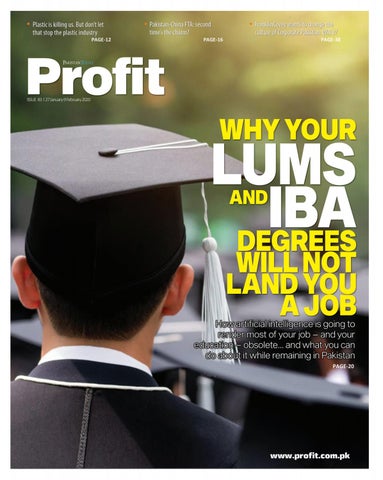
12 12 Plastic is killing us. But don’t let that stop the plastic industry 16 Pakistan-China FTA: second time’s the charm? 20 Why your LUMS and IBA degrees will not be enough
26 26 Atif Mian’s advice for the State Bank: explained 32 Going to America? Meet the bank you can carry in your phone 35 JPMorgan recommends Pakistani government bonds to its global clients
36 36 Rising interest rates fuel stock price rises for Pakistani banks 38 FranklinCovey wants to change the culture of Corporate Pakistan. Will it?
welcome
Imran Khan at Davos Of all leaders Pakistan has ever had in its history, Imran Khan should be completely comfortable at Davos. Only once before did we have a Prime Minister who was as comfortable rubbing shoulders with the global economic elite, and he had the misfortune of being the civilian face of a military regime (we are thinking of Shaukat Aziz). Unfortunately, when it comes to representing Pakistan’s interests in that gathering of the world’s political and economic elite, Prime Minister Imran Khan does not appear to have done much better than his predecessors, which is really quite a shame. We can start with his meeting with US President Donald Trump. By his own account, the meeting focused in large part on Afghanistan and the anticipated drawdown of US troops from the region. This is, in our view, a foreign policy failure on the part of the current administration. Almost since Partition, the government of Pakistan has wanted a relationship with the United States that stretches beyond just security concerns, ideally including closer economic cooperation between the two countries. And since then, Washington has always tried to stay focused almost strictly on military matters. We understand the need to discuss security matters, since they are important, but we wish the prime minister had made more of an effort to move to-
wards a broader relationship with the United States and continued to press for a free trade agreement between the two countries. Unlike with China, Pakistan actually runs a small trade surplus with the United States and President Trump appears to view making trade deals his forte. A failure to bring that in a one-on-one meeting is a significant lost opportunity. Then there was the matter of his tirade against corruption as the root of all evil in Pakistan. His supporters at home may view that message as being on-brand and something they believe in, but when he tries to tie corruption to macroeconomic stability - with which it has little direct relationship - he makes it seem like Pakistan does not have leaders who know how their economy works. At a forum where global leaders are making the pitch to investors and companies to attract capital towards their respective countries, such a misstep is likely to prove costly. More broadly, though, we are grateful that at least the Prime Minister took the event seriously enough to attend. We just wish he had taken it seriously enough to do a little homework before traveling.
Farooq Tirmizi Managing Editor
Executive Editor: Babar Nizami l Managing Editor: Farooq Tirmizi l Joint Editor: Yousaf Nizami Reporters: Syeda Masooma l Taimoor Hassan l Abdullah Niazi l Meiryum Ali Director Marketing: Zahid Ali l Regional Heads of Marketing: Muddasir Alam (Khi) Zulfiqar Butt (Lhr) l Mudassir Iqbal (Isl) l Layout: Rizwan Ahmad l Photographers: Zubair Mehfooz & Imran Gillani l Publishing Editor: Arif Nizami l Business, Economic & Financial news by 'Pakistan Today' Contact: profit@pakistantoday.com.pk
FROM THE Managing EdiTOR
9
10
2003
10,287
2004
2005
11,526
2006
12,200
2007
12,997
2008
13,847
2009
15,982
2010
18,447
2011
21,291
2012
25,153
2013
27,677
2014
30,455
2015
2016
34,707
2017
2018
37,508
Source: Pakistan Bureau of Statistics
32,511
37,051
On average, household income in Pakistan has risen every single year for the past two decades, even during years when there has been a significant economic slowdown and when there has been substantial inflation. However, these averages hide an inconvenient truth: for the top 20% of Pakistanis, incomes keep rising every single year at a pace faster than inflation, regardless of economic circumstances, but for the bottom 20%, the reverse is true, meaning their income growth is slower than inflation regardless of whether the economy is going through a boom or a bust. The middle 60% see their incomes rise faster than inflation when the economy is doing well, but see slower than inflation increases in income during lean economic times. In other words, the popular wisdom about Pakistan’s economy appears to be largely true: the rich keep getting richer, the poor keep getting poorer, and the middle class gets squeezed every time there is a significant spike in inflation.
Series1
2002
9,718
10,889
Total monthly household income, Rs
Household income in Pakistan
News IN NUMBERS
IN BRIEFS Remittances received by the country from overseas workers edged up
As its accounts receivables hit
Rs355 billion
3.3%
to $11.4 billion during the first half of the fiscal year ending June 30, 2020 as compared to $11.0 billion during the same period last year. The improvement in remittances comes at a time of broader improvement in the country’s external balance of payments, which in turn has led to a strengthening of the rupee against the US dollar.
For the first time in 15 years, auto parts vendors have finally spoken out against local vehicle assemblers over low localisation and high prices. They allege that the auto assemblers continue to hide behind high tariffs under the excuse that they are encouraging the development of a local supply chain, but continue to assemble a significant portion of their cars with imported parts.
Prime Minister Imran Khan attended the World Economic Forum at Davos, the resort town in Switzerland, where he met with global leaders including US President Donald Trump, as well as major corporate executives such as Facebook COO Sheryl Sandberg and Telenor CEO Gunn Waersted. He also spoke about the Pakistani economy, identifying corruption as the single biggest problem facing the nation’s economy.
“A part of media is incorrectly reporting about diagnosis of a first case of novel coronavirus in Pakistan. We expect responsible reporting by media. Please do not add to nation’s anxiety about Coronavirus and should meticulously check facts before reporting. Thank you!” Dr Zafar Mirza, Special Assistant to the Prime Minister on Health
in January 2020, the cashstrapped, government-owned Pakistan State Oil (PSO) has cautioned the government that it may stop its oil supply to domestic and international airlines. The company’s receivables have piled up largely as the result of power companies being unable to pay it for furnace oil; those companies in turn, are waiting on state-owned utility companies to pay them.
The All Pakistan Oil Tankers Association (APOTA) has announced its support to United Goods Transporters Alliance (UGTA) in their strike, and threatened to join them in 72 hours if the UGTA’s demands are not met
Hinopak Motors – the makers of buses and trucks in Pakistan – announced their quarterly financial results for the nine-month period ending December 31, 2019, showing a narrowing of their losses to Rs38.71 per share from Rs55.44 per share during the same period last year, an improvement of 30% over the course of one year. The narrowing of losses came despite a continued decline in production.
The federal government has so far authorised the release of Rs301.5 billion for various ongoing and new social sector development projects under its Public Sector Development Programme (PSDP) for the fiscal year 2020. The amount represents 43%, or less than half, of the annual allocation of Rs701 billion for the full year. Given the fact that there are only five months left in the fiscal year, it looks unlikely that the government will be able to spend its full budgetary allocation.
The Oil and Gas Development Company Limited (OGDCL) has announced about the discovery of gas and condensate at Ranipur Block of Sindh. OGDCL said that the well has tested “1.85 million cubic feet per day of gas, six barrels per day of condensate and 38 barrels per day of water through 32 per 64 inch choke at well head flowing pressure of 285 Pounds Per Square Inch (Psi) from Lower Ranikot Formation.”
11
I
By Shahab Omar and Abdullah Niazi
t is truly mind boggling when you think about just how much of our world is made out of plastic. Take a look around wherever you are reading this, something or the other is definitely plastic. Whether it is the cup you are drinking from, the toilet seat you are sitting on, the case protecting your phone (because print is dead and you are
12
most probably reading a digital copy) or just the bottles that contain your shampoo or soft drink or God knows what else. And to think, if someone from just last century were to show up, they would not recognise so much of what we have surrounding us. Plastic was first discovered in some capacity in the 17th century, and again made appearances during the industrial age. But it was only after the First World War that improvements in chemical technology led to an explosion in new forms of plastics, with mass production beginning in the 1940s and
1950s. In 2018, the world celebrated the centenary of the end of the Great War (as World War I was originally known), and in the 100 years since, plastic has taken over and may be brimming to destroy us. Let us not kid ourselves. This is a global problem, and one that is reflected in Pakistan as well. The government at the center, and to some extent the provinces, has been trying to fade out plastic bags at the very least. According to the Pakistan Plastic Manufacturers Association (PPMA), there are nearly 8,000 industries and units that make products
related to plastic.The largest among this group of manufacturers are those that produce polyethylene bags. Representatives of the PPMA have said that the exact significance of the plastic bag manufacturing industry cannot be determined, because Pakistan churns out thousands of tons if this product every single day. Large chains of fast food and shopping malls often require up to 80 tons of shopping bags every single month. In this feature, you will see the same problem, the same complication (which is not really all that complicated), the same defenders of plastic, and the same common sense solutions that are being shouted by environmentalists from dusk till dawn only to fall on deaf ears. The P in Pakistan stands for .. Plastic? First things first: if there is an association for an industry, there is something it needs to defend itself from. One defense is always universal, if the industry is threatened, then all those associated with it also have a sword hanging above their heads. But occasionally, other associations of different industries often have valid points, such as the government not coming through or sudden imposition of regulations. In the case of plastic, everyone knows it really is not doing anyone any good. It is, if anything, still here today because of a rich industry and the mindless lethargy of the consumer. The only thing they have going for them in Pakistan, is the size of the industry, and how many people’s livelihoods it provides. A member of the PPMA, Zeeshan Zahid Malik, told Profit that even the smallest of plastic factories has at least 20 people working there, while larger factories often have hundreds
Plastic bag manufacturers think that recycling is the way to go instead of banning. Countries including Singapore are making electricity through used plastic trash, they argue. Just like this, the other solution is the Oxo Biodegradable technology already being used in some places. However, this causes a hike in prices which the industry does not like at all of employees. The PPMA’s estimates hold that there are 63,000 shopkeepers selling shopping bags in bulk across Pakistan. Meanwhile, the amount of people working in factories and industries is estimated in the hundreds of thousands. If the government does not review its decision on the plastic bag ban, they warn, nearly 300,000 families will be out of commission. The cost is devastating. The problem, however, is that the environmental cost outweighs this one by miles. But things are more sticky when money is involved, and makes even governments slow down in their boots. And with an industry as large as plastic, there is a lot of tax involved.
The money
T
he PPMA has also claimed (with the flimsiest of evidence that relies on the ignorance of their audience) that the plastic industry is one of the five largest industries in Pakistan. By what measure, we are not told. This is an industry that gives billions of rupees in taxes to the national exchequer every year, presumably in the form of taxes, though
given the fact that a significant proportion of them are small, informal sector producers, that stretches credulity. The industry’s lobby believes that the government collects an estimated Rs60 billion because of imports by the plastic industry, while more than Rs70 billion are collected in other forms of taxation. In Lahore’s Shah Alam Market, Muhammad Arsalan Sheikh is a plastic grain trader, Muhammad. He is worried about the current moves to ban plastic bags or make them more environmentally friendly. According to him, people from all over Pakistan involved in the plastic industry have invested Rs150 billion in the form of machinery, market, and buildings. Because plastic grain is imported from Dubai, Iran, KSA and other countries, the industry already has a lot of this grain imported and stored. Just like this, new plastic machines and printing machines have been established by a number of traders. Traders like Muhammad Arsalan Sheikh fears that the ban on shopping bags will break the back of this industry. Yes, you read that correctly: the country should not move forward to new technologies because the incumbent industry’s owners cannot be bothered to upgrade. But despite all of Arsalan’s concerns, the reality is that the environmental consequences of continuing to use plastic have been devastating and may soon overwhelm natural resources. Environmental, ecological and infrastructural damages are rife because of them, and it is estimated that nearly 70% of produced bags are currently lying around in the form of garbage, of which a lot if burnt, causing serious air pollution and the release of carcinogens and other harmful substances. According to another study, these bags will account for 12 billion tons of non degradable waste that will be polluting the planet by 2050. The problem is bad enough that associations like the PPMA or the Plastic Bag Association (PBA) do admit it, but what do they propose we do about it?
INDUSTRIALS
Plan of action?
T
he environmental concerns caused by shopping bags is an international phenomenon, which is why Oxo Biodegradable technology was introduced. The industry at first thought they had a saviour. Two or three other technologies had been introduced before this, but this proved to be the most successful and feasible one yet. With the help of this tech, the hundreds of years that plastic takes to degrade was brought down to a matter of a few months. This is why it is called controlled life plastic technology. The way it works is that it is also made in the shape of plastic grain, and during the process of making plastic, a specific amount of this material is added, which makes the plastic environmentally friendly. In Pakistan, it was introduced on 1 April 2014, and other than Punjab and Islamabad, using this technology was made mandatory under law in the rest of the country. Meanwhile, this technique started being used in the preparation of plastic bags in Lahore and other cities of the Punjab. But the problem was once again the market, and how it responded. The distributor of this technology in Pakistan, Amir Yusuf, told Profit that this innovation was a godsend in making plastic bags environmentally friendly. In Pakistan, large multinationals and exporters of plastic bags are using this technology, and hundreds of tons have already been made. On the other hand, Khalid Zuberi – a plastic factory owner on Sheikhupura Road in Lahore – said that this technology is useful, but using it in plastic means a hike in price of plastic products. “Because of this, people look for cheap plastic instead of responsible plastic. Until legislation is made to make this kind of plastic mandatory, it simply is not competitive on the market. In the provinces where there is legislation, even fruit sellers use degradable bags” he said. The unfortunate situation, however, is that these laws were most needed in the already smog-trodden Punjab, but the provincial government has still not managed to make any laws in this regard.
Enter the government?
I
n the previous year, the government tried to gradually phase out plastic bags beginning from Islamabad. This ban was also placed in high-income neighbourhoods of Lahore, such as Model Town and Gulberg. The argument was that plastic shopping bags were causing environmental, ecological and infrastructural damage in the form of hurting animals and the sewage system. Naseemur Rehman, the director of the Punjab Environment Protection Depart-
14
Investments
Rs150 billion
The amount of money the plastic industry claims it has collectively invested in equipment and capital expenditures for their manufacturing processes
ment, has said since that the greatest reason for environmental problems are small and low grade plastic bags. “Not only are they very cheap, and thus used without thinking, but it also has no recycle value. You can collect them all day and they will not amount to more than 1KG in weight but it will cause great harm to the environment,” he told Profit. “The percentage of plastic in shopping bags being lessened decreases the environmental impact and this is the good practice as established globally.” The PPMA, on the other hand, has a different take. They tell Profit that the plastic bags industry is the backbone of small business in the country. They also point to their own responsibility in the matter, pointing out the standing committee on environment that the PBA has set up. “This committee has given many suggestions to the government to tackle the problem together and responsibly. In a recent meeting with govt stakeholders, it was also decided that plastic bags would be as thick as 45-50 microns, while their size would be 12x15 inches. We are doing this despite the fact that polyethene bags were used all over the world as an FDA approved product, including US, Europe, Canada have not banned plastic bags. In fact, they used similar suggestions to what we at the PBA are saying to the govt.” “Other than Kenya, no country has imposed an outright ban on shopping bags. This has caused a fall in revenue, unemployment
Annual tax revenue
Rs130 billion
The amount of money the plastic industry claims it pays in the form of taxes to the government each year, of which Rs60 billion is customs and import taxes alone
and shutdown of industry in Kenya,” they say. “Because of their many jungles, they have been able to use paper bags. We hope that the govt will listen to the concerns of the PBA.
What is to be done?
P
lastic bag manufacturers think that recycling is the way to go instead of banning. Countries including Singapore are making electricity through used plastic trash, they argue. Just like this, the other solution is the Oxo Biodegradable technology already being used in some places. However, this causes a hike in prices which the industry does not like at all. One factory owner has said that if the populace is told about these issues through a robust public outreach campaign, then the problem could be tackled because consumers could be convinced to buy the more expensive bags. But what do the environmentalists say? Local activist and researcher Ehtisham Sohail Khan suggests that plastic bags should ideally be banned, but at the very least, the government should incentivise paper bags. “Since it is a free market, you can keep selling plastic bags, but make them expensive so cloth tote bags or paper bags are cheaper and better options.” The suggestions are not new one, or even radical ones at that. But if the suggestions are constant and continuing, so is the inaction, and the planet is dying as a consequence. n
Is Phase 2 China Pakistan Free Trade Agreement any better than the previous one? Profit does a close reading of/ summarizes the latest study on the FTA
I
By Meiryum Ali
t is a truth universally acknowledged, that Pakistan’s first free trade agreement (FTA) with China was a bit of a dud. Signed in 2006 with much fanfare, and beginning operations in 2007, Phase 1 of the FTA did little to improve Pakistani exports to China, and only worsened our trade deficit with our neighbour. So Pakistan went back to the drawing board, with somewhere between 11 reported meetings of negotiations over seven years with the Chinese. The result is Phase 2 of the China Pakistan Free Trade Agreement, which was finalized in 2019, and implemented on January 1, 2020. This new phase is set to last until 2024. Not everyone is happy: just this week,
16
there were grumbles from the Federation of Pakistan Chambers of Commerce and Industry (FPCCI) on whether Pakistan could fully take advantage of the FTA, considering how useless and poor Pakistan’s exports are. Instead of signing an FTA, the the FPCCI called upon the government to “urgently develop a robust and holistic industrial policy that would lead to massive industrialisation.” Considering that the last time Pakistan had any semblance of a formal industrialization policy was around 60 years ago, the FPCCI plea is just a little too late. But it is a valid point to raise what is even the point of an FTA with China? Are Pakistani exporters actually going to benefit, or is this another poorly thought out scheme designed to look good in the news, and little else? Fortunately, there’s a study out there to answer this: the “China Pakistan Free Trade
Agreement Phase II – A Preliminary Analysis”. Written by LUMS economists Nazish Afraz and Nadia Mukhtar, the report was commissioned by the Pakistani Business Council (PBC), and the Consortium for Development Policy Research. (The PBC is a lobbying group for big business in Pakistan and was established in 2005. It features 82 Pakistani conglomerates and multinationals.) Their research indicates that, for now, the results look a little promising, albeit with a few caveats.
But first, what happened in Phase 1?
A
little context: Pakistan’s global exports have never been the healthiest. According to the Economic Complexity Index, Pakistan ranks 94th in
terms of the complexity of products it exports. Similarly, on the Global Competitiveness Index, Pakistan ranks 107th out of 140 countries. And despite Pakistan’s global exports increasing by 47% between 2005 and 2018, imports have gone up by 140% in the same period. On top of these great global figures, Pakistan’s trade with China has always been asymmetric. Consider: only 7% of Pakistani exports went to China – most went to Europe and the United States. On the flip side, China took up 28.5% of Pakistan imports – by far the largest trading partner. The original FTA was meant to address, and also foresee, these sorts of problems. The first phase spanned between 2007 and 2012, and involved the elimination of tariffs on 7,500 tariff lines. The original aim was to speed up bilateral trade. As per the report’s analysis: “bilateral trade flourished, growing by 242% between 2007 and 2018—nearly six times faster than the growth of Pakistan’s trade with the rest of the world in the same period.” Total trade with China since the signing of the FTA also shot up, to $16.4 billion in 2018. Phase 1 of the FTA changed the nature of the kind of exports that were sent to China. Prior to 2007, Pakistan was exporting mostly ores, slag and ash; raw hides and leather; machinery and mechanical appliances; oil seeds; and copper to China. But after the FTA, Pakistan began to send more cotton, plastics, organic chemicals, gums and resins. Cotton in particular emerged as a winner, with “exports to China have grown from $271 million to $873 million between 20152018.”, according to the report. However – and it is a big ‘however’ – this FTA benefited China significantly more than it did Pakistan. Between 2014 and 2018, Pakistani exports to China declined 7% annually, while imports from China rose 12% annually. Another way of looking at it: Pakistan’s trade deficit with China represented 25% of Pakistan’s total trade deficit in 2007. By 2018, this had shot up to 38%, or around $13 billion. Why did this happen? Well, Pakistan offered much better concessions to Chinese exports than China did to Pakistani exports. This was something China exploited, as evidenced by the the difference between the utilization rate of preferential tariff lines by China (57%) and Pakistan (5%). According to the report: “This led to the
domestic market being flooded by China’s exports of finished products comprising clothing and shoes, medical and surgical items, and fans and rubber tires, thereby curtailing local production in Pakistan and preventing local producers from achieving economies of scale in the face of low profitability.” Most of the duty-free access to China was given to low value products, like cotton bedsheets, minerals such as chromium and copper, and cotton yarn (the latter made up 40% of Pakistan’s total exports to China in 2017). These industries are a small part of the Pakistani economy, but are important raw material providers to China’s higher value export industries: readymade garments, electronics, etc. But China offered little to no concessions on what are actually Pakistan’s top exports, like rice, frozen fish, crab, leather hides, knitted cotton apparel (the latter made up just 2% of Pakistan’s exports to China in 2017). In hindsight, the first China-Pakistan FTA should have been a warning about the kind of unbalanced, exploitative economic arrangements China has a habit of pursuing. These kinds of discrepancies, real or per-
ceived, also irked business groups in Pakistan. The report claims business groups “believed that Pakistan had negotiated poorly, both in terms of getting access for the products for which it was better placed to export to China, and also in terms of granting access to Chinese goods that were perceived to have inundated the Pakistani market, contributing to premature deindustrialization.” But the biggest impediment in gaining any benefits from the FTA, was in fact something out of the FTA’s control. In 2010, China signed the ASEAN-China FTA (ACFTA). Pakistan’s comparative advantage was practically destroyed, as China offered infinitely better tariffs to ASEAN members and also to one of Pakistan’s biggest competitors, Bangladesh. In fact, the ACFTA has been estimated to have led to a whopping loss of 80% of Pakistani export volume to China. Which obviously leads to the question: what is the point of an FTA between two countries (no matter how poorly thought out), if any gains are to be eradicated due to a completely unrelated FTA?
The new and
Even when exports are cleared to go, sometimes even improved FTA hase 2 of the FTA (to be called FTA2) routine things like inspections can be destabilizing. For was negotiated with these problems in example, the report notes that because Pakistani mind. According to the report’s preliminary analysis, the outlook is hopeful, products are not trusted in China, and there is often and the tariff structure has definitely improved. unnecessary and annoying inspection of Pakistani packages Along the 8,238 product lines that FTA2
P
FREE TRADE
effects, Pakistan is now offered lower tariffs on 46% of the products under FTA2, as compared to FTA1. About 45% of tariff lines, or 3,707 items, have been offered duty free access. A further 30% of tariff lines will have duty-free access by 2030. Additionally, 75% of all products will have zero tariff applied by the FTA’s last year, and 93% of product lines will face a tariff of 10% or less. Only nine out of the 8,238 face a tariff of 30% or more. Other improvements in FTA2 include standard safeguard clauses, which are a feature of FTAs around the world (one wonders why they were not included before), and real time electronic exchange of data to curtail misreporting. The report is also hopeful about Pakistan’s competitiveness, claiming that unlike previously where Pakistan’s exports were eroded because of the ASEAN-China FTA, this time around, Pakistan has better access than its top competitors. What makes this report interesting and relevant, is that it not only shows the difference between the tariffs of FTA1 and FTA2, but also shows how FTA2 could affect three categories of products. These are: Priority 1 products, or products that Pakistan exports to China (5% of the tariff lines); Priority 2 products, or products that Pakistan exports and China imports, but Pakistan does not yet export to China (17% of tariff lines); and Priority 3 products, or products that China imports, but Pakistan does not export at all (65% of tariff lines). The second phase of the FTA can positively benefit all three categories, explained below: A. The Priority 1 category contains those Pakistani products that already have an established market in China, and therefore have the highest potential for growth. There are 401 products in this category under FTA2. Now consider: by the final year of FTA2, 835 of Priority 1 product lines will have duty-free access to China, and 93% of product lines will face tariffs of less than 10%. In total, 445 of the product lines will face lower tariffs under FTA2, compared to FTA1. Looked at another way: almost $11.5 billion, or more than 80% of Pakistan’s export basket to China will now fall in the duty-free category. This is a sharp increase from FTA1, which only affected $5.7 billion of Priority 1 products. The winners in this category are cotton plastics, vehicle parts, footwear, leather, and food items like frozen seafood, sweet biscuits, frozen orange juice, machine parts, acrylic polymers, and steel parts. B. Under the Priority 2 category, fall products that Pakistan could take advantage of, since Pakistan is already globally competitive
18
in these goods, and China has an established import market for those goods. There are 1436 products in this category. Now, under FTA2: 70% of Priority 2 product lines will have duty-free access to China, which is an increase of 575 product lines from FTA1. A full 47% of these product lines will face lower tariffs under FTA2. If Pakistan could expand exports in these goods, it could be looking at an additional duty-free market of $79.6 billion. Even better: under Phase 2, Pakistan will face better or equal access on 77% of Priority 2 tariff lines, compared to its top five competitors in China. The winners in this category are machinery and mechanical appliances, steel and iron. C. Under the Priority 3 category, fall potential new exports for Pakistan. The report includes this because this category provides opportunities “to diversify and expand Pakistan’s
export offering to the world, starting with China”, under which “new trade creation” can happen. This is the largest group of products, with 5872 product lines. Of these, 80% or 4701 product lines will have duty-free access to China by the final year of the FTA2. 34% of Priority 3 product lines have better access under the new FTA. If actually acted upon, the potential winners in this category are accessories of motor vehicles, refrigerators, freezers, heat pumps, woven cotton trousers and woven cotton babies’ garments.
It’s not just about the tariffs
S
o the Pakistani government has ironed out its tariff structure with China – great! Theoretically under the new FTA, Pakistan is looking to gain not just in
the areas where it already has a competitive advantage, but also in new export areas. So what then is stopping Pakistan from increasing its exports to China? Turns out, quite a fair bit. The report highlights significant challenges to Pakistani exports, some of which are China’s fault, and some of which are Pakistan’s fault. First, there is a massive information gap about China’s market. As per the report, Pakistani exporters are much more familiar with European and American markets, and less so about China. This is compounded by the fact that there remains a language barrier with regard to China, and adequate resources for translators do not exist. This can lead to issues such as not knowing enough about Chinese regulatory requirements, to also not knowing which Chinese firms to partner with in the event of exports. This general lack of information also creates an atmosphere of reluctance when it comes to exporting to China. As an example, the report highlighted: “a prominent Pakistani food manufacturer in Pakistan that exported to China was not happy with the Chinese buyer that they partnered with for distribution. After that single bad experience, they have not tried again to find a suitable partner.” There are also issues on the supply side: Pakistani manufacturers have difficulty delivering on the quantities China requires, mostly due to their own low capital and labour shortage. This lack of scale of production means that Pakistani exporters cannot maintain competitive pricing. Finally, despite the big fuss created around CPEC, and general ‘close ties’ with China, there is in fact very little trade facilitation between the two countries. As the report notes, “many exporters present had no knowledge of
the Pakistan-China Joint Business Council.” Even when exports are cleared to go, sometimes even routine things like inspections can be destabilizing. For example, the report notes that because Pakistani products are not trusted in China, and there is often unnecessary and annoying inspection of Pakistani packages. “Exporters of fruit juices reveal that inspections were so invasive that they ruined the packaging which caused leakages and product damage”, the report noted. Additionally, containers from Pakistan often face extra delays and restrictions. Finally, there is little marketing of Pakistani goods. The theory posited by the report is that as China becomes richer, its consumers will be more discerning about quality. In some cases (such as fruit), Pakistani products are often of a higher quality. But due to the lack of information (because of the lack of marketing),
these goods remain overlooked. To combat these problems, the report has a few suggestions. These include having a commercial consulate in China, separate from the embassy, whose sole task is to facilitate research on the Chinese market. This consulate could help Pakistani exporters to find suitable Chinese partners who understand Chinese demand, and have the relevant distribution networks. The report also suggests that the Trade Development Authority of Pakistan create a budget to improve branding and marketing of Pakistani goods. Another suggestion: that the Pakistani government work closely with China to improve inspections, so that unnecessary enforcement on Pakistani shipments is curtailed. The report also calls upon the government to help exporters with their weak supply chain, such as “better access to inputs, trade and customs facilitation, and technical support in meeting Chinese compliances”. Somewhat hilariously, the report also calls on the government to show a little more common sense: “The government should constantly monitor other FTAs that China signs, or any special re-export facilities China offers to other countries.” - basically, to not have a repeat of the ASEAN-China FTA disaster. Why are these suggestions even important? Because it is not enough For Pakistan to have an FTA with China. To truly maximize the benefits that Pakistan can receive, there needs to be structural reform and admittedly, a little bit of hand holding on the part of the Pakistani government to make sure that exporters are actually able to crack the Chinese market, and receive the benefits of lower tariffs. Until then, one can pick and theorize tariff differentials indefinitely - but the asymmetric trade will not change. n
FREE TRADE
20
TECHNOLOGY
By Farooq Tirmizi
C
onsider the following thought experiment: what would it take for a company to replace Google as the default search engine to the world? Nothing lasts forever, and while Google holds a commanding 88% share in the global market for search engines as of October 2019, nobody stays on top forever. One day, Google’s star will fade as well. So that then begs the question: how will it be done? How will the entity that overtakes Google become dominant? While there are likely many possibilities, the one way I can think of is that it will have to be a company that fundamentally changes the nature of search itself. Searching for information right now is an exercise largely in looking for information that has already been put out on the internet by others. The search engine that eventually replaces Google will take the next logical step: it will serve your information needs not just by looking for information, but by creating it. This is not “just another article about artificial intelligence.” It will lay out what the transition towards greater AI sophistication and use is likely to look like, and how it will affect your jobs, and what you might be able to do about it. Before proceeding any further, it is probably important to define the terms “data”, “information”, and “knowledge”, since they are crucial to the arguments put forth here. Data is simply raw numbers or non-numerical characteristics of an entity, unprocessed, and often without context. Organised in a manner that helps answer question, even a very basic one, a collection of data becomes information. Organising a collection of information in a manner that forms a coherent structure constitutes “knowledge”. When you search on Google today, it will provide you either with data (it will answer “Islamabad” if you search “what is the capital of Pakistan”) or with information created by others (it will list recommendations based on people’s ratings when you ask “what is the best restaurant in Islamabad”). But it cannot create new information for you. For instance, let us suppose you are launching a financial technology startup focused on the payments needs of freelancers in Pakistan (this is a very specific example, yes, but life is lived in the specifics, not in general terms). In order to get some sense of your market size, you would need a sense of how many freelancers there are in Pakistan and what proportion of the work force they constitute. When using Google, you can look up “number of freelancers in Pakistan” and come up with multiple results that give you estimates of that population. You can also look up “size of Pakistani labour force” and Google will provide
22
results with estimates of the size of the labour force, including data from the World Bank and the Pakistan Bureau of Statistics. But if you simply typed “proportion of Pakistani labour force who are freelancers”, unless someone has already calculated that number and put it up on a website somewhere, Google will not be able to figure out that all it needs to do is run those two previous searches and divide the best answer from the first one (number of freelancers in Pakistan) with the best answer from the second one (total size of Pakistani labour force). Needless to say, if it cannot yet do that for the current year, it also cannot tell you how much that proportion has grown over time. But someday, someone will crack the code and develop a search engine that has a natural language processing algorithm that is so good that it can process that kind of request and spit out an answer in a fraction of a second something that might take you several minutes or even an hour to calculate. What happens to all of our jobs, especially white collar jobs, when that happens? What happens when it goes one step further and begins integrating all known public (and maybe even some private) data sets into the search engine and able to spit out answers to even more complex questions? For example, let us assume that you are a business analyst at FrieslandCampina Pakistan (formerly Engro Foods) and have been tasked with figuring out which product line the company should start next. There are obviously several elements to that analysis, but right now, you would probably start with looking at consumption patterns by looking up the data in the Household Integrated Economic Surveys (HIES) conducted by the Pakistan Bureau of Statistics over the past few years. You would compile each year’s data into a format in Excel that you could use, and then you would start running the numbers to see which categories grew the fastest and which categories were the largest, etc. But what if a search engine had fully integrated the entirety of the HIES data set into its platform and you could simply ask questions in natural language and get reliable answers? Instead of spending a whole day compiling that data, you would spend maybe an hour or so going through all of the questions you needed answers to before you would be ready to speak to your boss about what you found. Here is where we encounter the problem for the Pakistani economy, though: most of the Pakistani workforce – including graduates of elite universities such as LUMS and IBA – are not trained to ask the relevant questions. They get paid right now because they can engage in mundane data processing and converting data into information that the handful of deci-
sion-makers use. In other words, today in Pakistan, we consider those who can look up answers well to be our best and brightest. But very few of those are also people who know what are the right questions to ask. And one suspects that their numbers have not increased much, even as the world is moving increasingly towards eliminating the kind of grunt work that today constitutes the bulk of time people spend in their white collar jobs. How did we get here? The answer is obvious: the flawed structure of the education system, and its inability to keep pace with technological advancement.
The school problem
T
he headline of this article is a little unfair to LUMS and IBA: both institutions, along with a handful of others, are leading a valiant effort in getting Pakistani students to develop critical thinking skills, the ones that will help them know what the right questions are, not just how to get the right answer to a question. But they face an uphill battle, because by the time they a student enrolls at one of these institutions, they have already had 12 years of a terrible education, which is very difficult to undo in just four years. It is easy to say that the problem with our schools is that teach rote memorisation and studying to pass exams, but the specifics of what is lacking is exceedingly important. So here are some examples. In April 1996, as a student of Class 6, I was asked by our teacher to “look up information on a famous scientist”. I was assigned Louis Pasteur. Now, this was 1996 when fewer than 10,000 Pakistani households had access to the internet, and even the internet back then was a much less useful thing than it is now, so this was a somewhat understandable assignment. The objective, in that still-pre-internet world, was to teach us the skills of navigating a library, looking up the right reference books, and then knowing which section of those reference books contain the relevant information we needed. In a world where a large majority of the jobs done by white collar workers was simply looking for information, this was a useful skill to teach a student. The problem, of course, was that both the teachers and the students were so preoccupied with the labour-intensive task of finding information that we never actually thought about what to do with that information, or what constituted useful information versus information that was not useful. We were never asked, for instance, to figure out the significance of the scientific work conducted by the person we were researching, nor what their impact was. No, just any information was enough.
What makes it worse, though, is that there are still young children who get assigned this exact same assignment, even though the year is now 2020 and most of those children have smartphones with the Wikipedia app installed on them. And the problem only gets worse by the time you hit high school, which is especially a shame considering the fact that there are many very talented teachers who could probably do a lot better at teaching if the curriculum was better designed. Sadly, however, given the nature of high school education in Pakistan, both Matric / Intermediate students as well as O / A level students all have rigid curricula and students face pressure to get good grades on a set of final exams alone, which creates pressure to ace the exams regardless of whether one actually understands the material they are studying or not. In short, we create a system where being a good student and being an intelligent learner are not the same thing. One example: how many of you learnt calculus in school by learning the logic behind differentiation and integration, and how many of you simply learned to multiply the variable’s multiple with its exponent to differentiate and to reverse the process to integrate? I suspect that the overwhelming majority of you learnt it the latter way, because it was faster, easier, and still got you good grades on the exams you needed to take. That is exactly what happened to me, and I supposedly went to some of the best schools in Pakistan. So why does it matter how I learnt certain concepts in school? Nobody ever asks us to apply those in “real life”, right? Wrong. Very, very wrong. The process by which you learn is the single most important thing you learn in school. You do not need to just learn facts: you need to learn how to keep learning for the rest of your life. And if what you learnt was to take the short-cut to pass the exam, then why should we be surprised when that is exactly how we run our government, our businesses, and our entire country? Are we surprised then, that the Finance Ministry is very good at getting the numbers to look just good enough to pass muster at the quarterly inspections that the country now regularly goes through with the International Monetary
Apparently, the idea of having to use his brain to apply accounting principles was too much for this particular classmate of mine. After finishing his MBA, he went on to create an after-school tuition center for O and A level students. Seems a fitting use of his time. And if you, like this classmate of mine, found it hard to keep pace with school before, I have some very bad news for you. It is about to get a lot harder Fund (IMF) but has absolutely no plan to ensure that we do not need to go to the IMF in the first place? The Finance Ministry staff are perfect products of the Pakistani schooling system: they are very, very good at taking exams. They have absolutely no ability to understand what they are supposed to be learning in the first place. This lack of ability to learn comes up for students who are used to take shortcuts to pass exams. I recall sitting in a classroom at IBA in the fall semester of 2011, in an accounting class, where a group of students led by one particular student decided to gang up on the professor to ask him to dramatically slow down the pace at which he was teaching the class. The logic this student used was “sir, humari base nahin hai accounting mein.” The class was titled “Introduction to Accounting”. It was quite literally designed to create the base of accounting knowledge for business professionals. And no, the professor was a good one who taught well, so it was not a case of a bad teacher making things difficult for students. The problem that this student – and many of my other classmates – was having was the fact that this was the heyday of Ishrat Husain’s attempts to convert IBA’s entire MBA curriculum towards the case study method favoured by Harvard Business School, where students learn business concepts by applying them directly to business cases, rather than learning the concepts in isolation and the later learning to apply them. Apparently, the idea of having to use his brain to apply accounting principles was too much for this particular classmate of mine.
The process by which you learn is the single most important thing you learn in school. You do not need to just learn facts: you need to learn how to keep learning for the rest of your life. And if what you learnt was to take the short-cut to pass the exam, then why should we be surprised when that is exactly how we run our government, our businesses, and our entire country?
After finishing his MBA, he went on to create an after-school tuition center for O and A level students. Seems a fitting use of his time. And if you, like this classmate of mine, found it hard to keep pace with school before, I have some very bad news for you. It is about to get a lot harder.
How artificial intelligence is going to make your life easier and harder at the same time
T
o understand what advances in artificial intelligence will mean for your jobs, let us go back to one of the earlier examples: a business analyst at FrieslandCampina being asked to determine which products the company should launch next. In this hypothetical situation, here is how the process is likely to play out. The CEO and management committee of the company look at the company’s financial performance – with its slowing revenue growth – and conclude that their existing product portfolio is not enough to keep growing their business. They then make the decision to study the following question: what product lines could we add to our company’s business that would best help us grow our business? Now, to answer this question requires asking several component questions, such as: what are the fastest growing categories of food expenditures in Pakistan? Which of those categories have low penetration of packaged foods? Which of those categories do we have expertise in producing? And of all those options, which would yield the highest profits for the company? Each of these questions requires answers that rely on crunching numbers. That subset of questions would likely be developed by somebody who is the head of business development, who in turn would pass on each of those questions on to a subordinate, who would then create a plan to answer each element of the further sub-questions embedded in those questions.
TECHNOLOGY
As you can see, there is a tree of questions that is being created here: each question needs to be answered by asking additional questions until you get to the most basic level at which you simply need to process raw data into useable information. That information then gets passed back up the chain of questions until a coherent picture emerges which answers the single, basic question that was asked in the first place. Right now, if you are a young business analyst, fresh out of your bachelors degree program, you will be asked to answer questions likely at least two to three layers deep in the analysis process. It is a labour-intensive process and the company wants to take advantage of the fact that you are cheap to employ and probably do not know much in the first place. But what if artificial intelligence creates those tools that enable the people one level above you to do their job using an algorithm. In that case, the only business analyst the company will hire are those who can think one level above the most basic level of analysis. The one who does not just create nice Excel spreadsheets, but actually knows what to put in them, and how his or her numbers form part of a greater decision-making process. If you are somebody who struggles with learning fast – and by fast, we mean learning something new every single day and becoming comfortable enough with it to communicate it to other people – then you will not get the job that does not require just labour. And very soon, the only good jobs will be ones that require people to be fast learners – meaning they will only be open to people who learned how to learn, not just learned how to do well on tests and exams.
The problem with LUMS, IBA, and all other Pakistani universities
A
nd here we get to the problem with the universities in Pakistan, including the very best ones: they have a culture problem. They include
Today in Pakistan, we consider those who can look up answers well to be our best and brightest. But very few of those are also people who know what are the right questions to ask. And one suspects that their numbers have not increased much, even as the world is moving increasingly towards eliminating the kind of grunt work that today constitutes the bulk of time people spend in their white collar jobs among their student population several students who are genuinely interested in enriching their minds and learning ideas and tools that they plan on using their whole lives. But those students are nearly always a minority. The vast majority of students see the university as a credential they need to get the jobs / careers / spouses that they want. (And lest you men think I am referring to women with the reference to spouses, I am not. There is not a man I know who does not think he would be more attractive to potential spouses if he had better educational credentials.) And so, they go in with the aim of “getting through” with as little effort as possible. Hence the massive plagiarism problem at most universities, and the general inability of too many graduates of even elite institutions to hold interesting, substantive conversations. And when people like that form the majority of an institution’s population, they get to define its culture, and they set the expectations that then, even the ones who wanted to work hard, feel they can live with. Why bother working more when I can make do with less? Why bother polishing my skills when I am surrounded by incompetent idiots and I know I can distinguish myself by doing even less than the bare minimum? This, by the way, is the reason behind the famous “arrogant LUMS graduate” problem: they are arrogant and lazy because they can be. If they faced serious competition from other institutions, they would lose that attitude in a minute. But see, artificial intelligence will mean
There is one way to improve your skills and ensure that your job will never be automated away: to train your mind to get out of its lazy, short-cut obsessed ways. And that is to force yourself to compete on the global level. No matter what you do, there is a global market for people like you on freelance platforms all over the world. Sign up and start offering your services, even if you have a fulltime job
24
that competition will come not just from other human beings at other institutions, but also well-designed algorithms. And unfortunately, these institutions – though they are trying – are still largely places that snuff out the desire to intellectually engage with ideas and learning tools. The fear of being replaced with a machine has yet to pervade these campuses, which means that precious few new employees are prepared for the workplace of the future.
So how should you deal with this?
B
ut what can you do now? You already have a bad education and you know it. A graduate of a foreign university sitting abroad and writing this screed will not help you, and will only make you hate him more than you already did before. But there is one way to improve your skills and ensure that your job will never be automated away: to train your mind to get out of its lazy, short-cut obsessed ways. And that is to force yourself to compete on the global level. No matter what you do, there is a global market for people like you on freelance platforms all over the world. Sign up and start offering your services, even if you have a fulltime job. This approach has two benefits: firstly, it makes you some extra money. And secondly, it will force you to engage with cutting edge trends in your field of work, and may even open up opportunities for you in entirely new fields of work. If you are competing against the best in the world, it will force you to learn how to become better, and in turn will make you a more well-rounded professional at home as well. For the first time in history, you no longer need to emigrate to another country to compete at the global level. You can do it out of your own home, right here in Pakistan. All you need is a laptop and functioning WiFi. A world dominated by artificial intelligence will not be a comfortable one for many people. But it is entirely navigable, if only one is willing to put in the effort. n
TECHNOLOGY
P
By Meiryum Ali
akistani-American economist and Princeton University Professor Atif Mian took to Twitter on Monday, January 20, in effect, critiquing the way central banking functions in Pakistan. His main gripe though, was with what some analysts and commentators in Pakistan have been celebrating: the recent record foreign investment of $2.25 billion in treasury bills during the current fiscal year. Those inflows are what have helped the State Bank of Pakistan (SBP) push reserves up to cross $11.6
26
billion. The total reserves in Pakistan are now at $18.1 billion. Yet Atif says that, in fact, there is little benefit of such inflows in the case of Pakistan, and that such inflows will create potential risk. How did he reach his conclusion? Profit takes a look.
What is the role of a central bank?
A
ccording to Atif, “For central banks to be effective, they must first work on establishing two pre-conditions: (i) flexible exchange rate management, (ii) macro-prudential and capital control regulation.�
Meanwhile capital controls refers to a set of measures that a government can use to control flows from capital markets to and from a country’s capital account. Capital controls used to be popular measures until the 1970s, when more free market economists began to persuade governments to abandon capital controls. But recent financial crises have once again made countries, particularly emerging markets partial towards capital controls. So why is Atif advocating such a strong regulatory approach? His next tweet expands upon his attitude towards free capital flows: that the “benefits of free global capital flows have proven to be elusive or illusive.”
Mian based this understanding of what a central bank is on “Dilemma not Trilemma: The Global Financial Cycle and Monetary Policy Independence”, a paper by French economist Helene Ray. According to this understanding, Mian says: the exchange rate needs to reflect market reality. If the productivity growth is lower than competing countries, the exchange rate has to depreciate.
So far, so good: Pakistan has learnt the hard way that a fixed exchange rate does little for growth, and most agree that the new market-based exchange rate, also advocated by the International Monetary Fund (IMF), is a step in the right direction of a responsible, and more realistic, economy. But what is a little more interesting is the second part on regulatory measures at the SBP’s disposal. Traditionally, central banks have often focussed on the financial soundness of individual financial institutions, like commercial banks. This approach is known as micro-prudential policy. But after the global financial crisis of 2009, this approach was considered too narrow in its scope, and macroprudential policies were introduced, or more holistic regulatory approaches to the economy. These policies are designed to reduce systemic risk in a system. Examples of organizations dedicated to macroprudential policy include the Financial Stability Oversight Committee in the United States (formed in 2010 and overseen by the US Treasury), and the European Systemic Risk Board (also formed in 2010, and overseen by the European Central Bank).
According to Atif, unregulated capital inflow can build dangerous external liabilities that whiplash the economy, and severely constrain the central bank. To make his point about ‘elusive capital flows’ more forcefully, Atif cites two well known crises: the Asian Financial Crisis of 1997, and the Mexico Peso Crisis of 1994. In the years leading up to the crisis, many Asian countries had pegged their currencies to the dollar for favourable exchange rate, and had also focussed on an export led growth strategy. But the sudden influx of foreign financial inflows, plus favourable subsidies, ended up creating a massive investor bubble. And the bubble eventually burst: the countries had to unpeg their currencies one after the other, and the currencies’ value fell as much as 38pc, with stocks declining as much as 60pc. The World Bank and the IMF were then forced to intervene to stabilize the countries. Similarly in Mexico, post the signing of the NAFTA (North American Free Trade Agreement), Mexico enjoyed high investor confidence, and attracted new capital. It also had an overvalued peso, that caused imports to rise and led to a trade deficit. Once Mexico was forced to devalue its currency, it led to massive capital flight. The country was only saved by a bailout organized by the United States and the IMF. The section of the tweet where Atif talks about the central bank being ‘constrained’ is a little more relevant to home. As is the case with Pakistan, the central bank is keeping the interest rate high to attract hot money. Currently, inflation rates are also high, which would justify a high interest rate. But what happens once inflation starts to taper down? The central bank will have to consider whether to cut the policy rate, or keep it high to continue to attract foreign inflow. Hence, maintaining the interest rate becomes a ‘constraint’ on the central bank.
What’s wrong with Pakistan?
A
tif Mian basically says that Pakistan has ignored the two pre-conditions for good central banking. He lists just three cases in the last 20 years that are a reflection of poor central bank governance: One, local dollar accounts were allowed in the 90s. The proceeds of the local dollar accounts were used to fund the then current account defi-
MACROECONOMICS
cit, leading to the severe economic crisis of 1998, where the government literally froze all current accounts.
Pakistan’s over use of repeated IMF programs. Since 1958, Pakistan has gone to the IMF a shocking 22 times. Even more dramatically, between 1988 and 200, there were nine different IMF loan agreements, and all were dropped prematurely. According to Atif, this pattern occured because successive governments have relied on external borrowing for short-term economic boost.
maximum maturity of 3 months, 6 months and 12 months. But there isn’t a lot of investment in long term debt securities. Look at the break down of all of the foriegn investment coming into Pakistan: of the $2.25 billion worth of foreign investment, only a paltry $24 million was in Pakistan Investment Bonds, or PIBs. And there are concerns about the short term bills as well: after 3 or 6 months, one will have to hope that the lender rolls over the debt. If they don’t, the government faces a massive risk of having to make large payments. Atif also tweeted: “The repeated boom-bust cycles raise the risk-premium leading to high cost of funding for businesses.” Essentially, the reason Pakistan had to dramatically raise the interest rate for 4pc to 13.25 pc in a very short time period is because of the risk of Pakistan’s cycles, as shown above. One of the problems of being such a high risk country, and an unattractive place to invest, is that “The country loses sovereignty due to external fragility, finding it harder to run an independent foreign policy as exemplified by multiple recent events.” While veiled, it’s obvious what Atif Mian is referring to. A country that has to borrow $6 billion from Saudi Arabia, then also has to toe the line when it comes to Saudi’s policies, such as when Imran Khan had to decline attending the Malaysia Summit.
The solution
S
o what does Atif Mian propose? He suggests a four-step approach for the State Bank to follow: “(i) Flexible ER management to deliver accumulation of real net reserves, essentially modest current account surplus, for a while. This would also send a strong signal of support to the export sector.
Then, the well known overvalued rupee of the mid 2010’s. Atif Mian actually goes on to name Ishaq Dar, saying that the man believed in ‘mythical’ exchange rate theories. The appreciation of the exchange rate impacted exports heavily, and led to a ‘ very painful adjustment period.’ For Atif, these actions have had serious consequences. “With little confidence that Pakistan will be insulated from external whiplashes, long-term investment does not happen. For example,
Pakistan’s debt has the lowest maturity among its peers.” he tweeted. What does this mean? Well, most of the investment is only happening in the short term. The inflows are only coming in T-bills, which have a
28
(ii) Discourage short term debt and portfolio flows. Promote longterm capital formation via FDI, but with proper valuation protocols and technology transfer.
(iii) Strong safeguards against money-laundering and capital flight. (iv) Capital account convertibility should be prioritized for tradable & high-spillover sectors, and for long-term capital. Convertibility should
be discouraged for non-tradable sectors such as real estate.”
The gist of these is essentially this: stop focusing on short term foregn investment in T-bills. ‘Hot money’ inflows might be increasing reserves, but not actually ‘real net reserves’, Atif writes. What’s to stop the money leaving once the interest rates come down? When then will the SBP find the new capital? Notice also the caveats that Atif writes regarding FDI: the long term FDI has to be based on the fundamentals of an economy (not just speculation), and also technology transfer. Projects like CPEC, are of course long term investments - but constructing roads is not the same thing as creating skills in the Pakistani labour workforce, or transferring new knowledge. And there is little to suggest that CPEC will be able to provide that. Finally, ease of converting rupees into dollars and vice versa, should be reserved for things like the stock exchange, and not non valuable assets like property or gold. Atif takes a pretty pessimistic view of the current situation. “We have not seen a coherent framework that takes these principles into account. In fact, on the worrying side, the government has gone out of the way to encourage short-term foreign investment in government T-bills. There is little benefit of such inflows in the case of Pakistan, and much potential risk...if these short-term liabilities continue to build, they can constrain monetary policy and generate external vulnerability.”
At this point one can argue that the State Bank had to take drastic measures in order to make sure we had reserves. As one commentator on Twitter said, portfolio investment is still the easiest way to secure financing. But if one follows Atif’s thinking: such an influx of foriegn investment does not add anything productive to our economy. So far the only thing ‘good’ the SBP is following is a market-based exchange rate. But it hasn’t constituted any structural reforms to actually create market conditions to foster long term investment. Until the SBP is able to do that, the current economic condition remains nothing but a bubble.
A little bit of backtracking?
W
ere the above tweets a little too dire? Someone (at the State Bank, or in government) clearly thought so, and made it clear to Atif Mian. Or perhaps Atif Mian himself thought his tweets deserved some additional context, based on Pakistani twitter’s reaction. That’s because in a surprise move, just two days later, Atif wrote some clarifying tweets, which somewhat toned down the previous language. First he reiterated that “a major positive change has been the move to a market-based exchange rate regime. SBP under new leadership held the fort through the painful adjustment period.” According to Atif, the SBP deserves ‘praise’ (a direct call to analysts to stop bashing the SBP, perhaps?)
He also said that “steps taken towards digitization and greater transparency of the financial sector are welcome changes.” (Profit takes the view that anytime someone mentions the word digitization but doesn’t explain it, it’s a filler sentence and can be ignored.)
MACROECONOMICS
Amazingly, Atif also back tracked on his critique of the SBP encouraging flow of hot money, instead categorically stating: “It would be wrong to give the impression that the government “caused” the hot money flows - it didn’t.” He then went on to add: “I was critical of the government move to cut taxes to encourage foreign flows into government debt. However, these cuts were on longer-dated bonds, and flows into TBills had started before the change.”
Not so fast, Atif - while it is true that global investors have been pouring in money since at least July (the tax cut was in January), it is also true that the SBP has been perfectly comfortable with encouraging foreign inflows. For example, in an earlier statement issued in December 2019, the SBP tried to allay fears, and said that international investors investing in debt instruments was a manifestation of their growing confidence in the positive outlook for the country. That statement was an attempt to clarify ‘misconceptions’ about the investments in Pakistan’s debt markets. “Such investors have been able to move capital in and out of our financial markets without problems for the Pakistan economy,” the statement read - a much rosier picture than the one Atif is referring to. Still, Atif tries to move the SBP out of the firing line, and instead tries to make the twitter thread a ‘history lesson’. “The next stage is macro-prudential challenge” - he reiterates once again, adding “Tax incentives and ease of convertibility should be targeted towards FDI, and away from portfolio flows at this stage of financial and economic development for Pakistan. This is the broader lesson from history in my view.”
One wonders what caused Atif to back track so much, and frame himself as a neutral professor, as if he were talking about a paper on macroprudential policy, rather than what he actually is - an extremely prominent Pakistani-American economist, who was briefly on our Economic Advisory Council, and therefore, someone whose words carry immense weight. Guess someone at the SBP noticed after all. n
30
MACROECONOMICS
A team of internationals, including a Pakistani woman, want to make banking easier for people moving or traveling to the United States, but their plans are global By Taimoor Hassan
B
ack when she moved from Toronto to New York City to attend the prestigious Columbia Business School, Naveen Qureshi found herself stranded in the Big Apple. Despite having Canadian credit history, bank accounts and assets under her name, the American financial system was slated in a way that made all of this practically worthless. With no credit history, Naveen found herself at square one. It was at Columbia that she also found Andrej Paule, a European student with his own horror story about American banks and trying to find a credit card. As both became friends, one of the things they realised was that they were still using their old credit cards, and it was virtually impossible to get a new one. That is where the seeds of Sable were first sown. Naveen and Andrej came to America
32
for the best education in the world, dreaming of making their lives better. There is a lot happening when you first get to a new country. Settling in takes time, money, effort, confusion, and perhaps a few nights where one thinks if it was all really worth it. And then in the middle of all of that, you realise one hurdle after the other in US banking. Receiving a salary? Good luck explaining your situation to accounts. Finally found a decent place to live in New York City? There was going to be a much higher security deposit since you had no credit history. No access to post-paid cell phone plans, you cannot even pay for Netflix when you first get to America. “As internationals, we had to walk to our local banks to get full service bank accounts. Then, show a million documents. Wait for our cards to get posted. Start our credit histories from scratch...this is not how it should be in the 21st century,” reads Sable’s About Us message on their website. And that is how they define themselves,
as a company that offers free bank accounts and credit cards for internationals in the US. Banking is at the center of our everyday lives, and with so much else going on, Sable is striving to make banking part easier for their customers. Profit caught up with Naveen to get behind the story of Sable, where it has gotten, and what the future holds for this fascinating new startup.
Classroom beginnings
B
efore coming to Columbia, Naveen worked for banks in Canada where she pioneered the usage of public cloud in the financial industry. She worked at Capital One in Canada, in their online banking and credit card business, while Andrej had worked at McKinsey, launching Fintech products for banks across Europe. They also met their third partner at Columbia, Towers Willen, the only American on the team who spent a decade working for American Express
“Our vision really is to become a global bank that helps any international that moves from any one country to another. We are launching from the US because that is where we are based and what we know best. But the need for these products exists in every country in the world.” Naveen Qureshi, CPO at Sable in New York City. on the product and business development side on credit cards. In fact, it was during a class that the idea to start a new card first emerged in their minds. Naveen and Andrej had taken a class titled ‘Lean Launchpad’ taught by Steven G Blank, a retired eight-time serial entrepreneur turned educator and author, who is credited with revolutionizing how startups are built and how entrepreneurship is taught around the globe. It was a rigorous course to say the least, and one that taught team Sable a lot. A course that involved coming up with an idea and actual field work that had them running around from airport to airport interviewing travellers, their discovery made them confident enough that something like Sable was a market requirement. “We had interviewed hundreds of people at JFK airport, at Laguardia, at New York Airport. And we were asking them about needs when travelling internationally. Like what kind of credit card did they want from a travel perspective,” Naveeen explains, recalling the class she took with Andrej. “That was our initial idea, but very quickly we realised that the internationals that were travelling not only used their home country credit cards when they were travelling, but they were also using their home country credit cards when they were in the US.” Collectively twice stung by American banking as internationals, with Naveen continuing to use her Canadian credit card a year into her life in America and Andrej only having a secured card on which he had put around $300, this was their eureka moment. “For all intents and purposes, we have these 300 in person interviews at airports to thank for our idea,” Naveen said. “But after that, there was no looking back. We started diving into business schools, customer problems, the addressable market size, which for credit worthy internationals is 1.5 million new customers every year. And then, essentially, we started looking at revenue streams and regulations and started talking with banks and alternate data service providers to create underwriting orders.”
From the classroom to the outside world
O
nce they were sure they had a good idea on their hands, the still three pronged Sable team applied to Y Combinator, which has a 1.5% acceptance rate, and managed to make the cut and get in on the back of their innovative new idea. It was also here that Naveen, Andrej, and Towers were joined by Joseph Finlayson, a friend of Andrej’s whose portfolio ranges from building digital teams for some of the worlds largest banks, and creating a fitbit for dogs. Now a four person team, Sable went through Y Combinator in the summer and launched Sable in August 2019 when they did their pilot. This was followed by raising their seed round in October 2019, after which they moved back from California to New York City, where they are currently based out of.
How does it work?
T
he hook that Sable uses is that if you are an international just arriving in the United States of America, you do not need to have a social security number (SSN) or credit history to get a credit card that will work not just all over America, but all over the world. All you need is a passport, and if you have just arrived in the US or are travelling there, you definitely have one of those. “There is no requirement to ask for a social security number,” Naveen explains. “What the regulation essentially says is that you should be able to identify a customer. It’s called KYC (know your customer). And when you read into the regulation, it essentially says that you need a government issued ID. It doesn’t say it has to be a social security number.” Traditional banks and Fintechs read this as being a requirement to have a social security number. The SSN is a unique number that every United States citizen gets at birth, which makes it much easier for the banks to just use that. However, it is by no means a banking law to need to have one for a credit card. But when internationals come in, they obviously do not have
any such number, and need to make countless visits to their banks with endless documents to finally get a credit card up and running. Naveen created the proprietary credit risk model that allows immigrants to get US credit without having a US credit history, and created a way to allow customers to sign-up all through a mobile app in under 5 mins without the need of a social security. The way Sable is getting around this is that they have gotten confirmation to use passports for those that do not have a SSN. “It is the same with credit history, it is not a requirement. What credit card companies and banks in terms of credit cards tend to do is that they try to mitigate the risk of their customers defaulting on their credit cards. So the way they do that is that they look at their prior FICO score and their credit history to determine where at the risk spectrum they lie and what type of credit lines should they extend” she says. “As an international, I don’t have a credit history, but I have years and years worth of credit history in my home country. Or I may have bank accounts, assets, retirement savings, you know, TELCO bills and utility bills that can help someone assess my risk differently.” “So that is kind of what traditional banks do is look at the credit history of someone who doesn’t have any. What Sable does is that we look at hundreds of different variables like your profession, your education, your role in a company, what you’re studying, in addition to other alternate data.”
Against the grain much?
T
he fact that they are shrugging off long held banking practices does not bother Naveen or Sable. In fact, they feel that their freer outlook actually gives them more freedom since they are not bogged down with long histories and traditions that promote caution. Team Sable wants to define
FINTECH
their own banking experience, and Naveen says it has actually helped rather than hindered them. “We have actually been able to keep our risk below industry standards. Our model takes into account hundreds of variables. We actually built that with a veteran at Capital One who has 16 years of experience in the subprime market,” she tells Profit. “We are basically continuing to monitor the model, improve it, monitor how our customers are behaving and just improve our underwriting models and also the type of credit line we are extending based on the feedback we are getting.”
Setting up
I
f Naveen is to be believed, you can set up Sable within 5 minutes, including all verifications. There are, of course, moments when documentation and cases have to be looked at more closely and need a human eye. In situations like this, it may take up to 24 hours, but most of that is just waiting around at home. But as things stand currently, around 85% of the accounts go through with the simple online verification in under 5 minutes. So, for example, if you are a Pakistani that has recently moved to the United States or is about to move there, then the verification that Sable will ask you for is your passport and your Visa, and then you would have to have an address in America. “Everything is on the mobile app. You also have your virtual card on the mobile app. And you also have a physical that gets mailed to you on the physical address,” Naveen says quite proudly. “In the onboarding process in the mobile app you go in and put in your personal information, you put in your email, create a password and create an account and provide your address. Then you go into verification. We use third-party services, a few top ones that fintechs use like Jumio.” These services look at passports and ensure they are not fraudulent, not photocopies, and are not tempered with. The technology has basically run machine learning on millions and millions of passports and that is how it determines the data. The same technology is used for US visas. “So we have basically chosen the best in-class KYC providers and obviously the cost for that is high but being a mobile bank we have to ensure that we know our customers and fulfill the internal and external requirements we have for KYC.” As soon as you sign up, you get a checking account. This way, the ones wanting to send money could use your account and routing number to wire money out from Pakistani. In the coming weeks, they are also planning on providing additional ways to transfer mon-
34
Team Sable ey, because wiring money into the US can be expensive. “We are starting to use a service called TransferWise, which you can actually today do on your own as well on their website. But we are starting to integrate that into our app so that the customer does not have to leave the app in order to do it. And in the coming weeks you can also use your credit and debit card to topup your account.”
Business model
D
espite there being so much that sets Sable apart from traditional methods and modes of banking, their business model is still quite traditional in many senses. It is the traditional revenue streams that you would expect, the first one being interchange. So every time a customer makes a transaction on the card, physical or virtual, online or offline, Sable makes an interchange on that, and that becomes one of the leading streams of revenue for them. That is both for debit and credit cards. “The second piece is the interest that you accumulate to revolve your balance on your credit card. So, for example, if you spend $500 and pay off $400 dollars, you would accrue interest on the outstanding 100 dollars. That is the second revenue stream and that is for credit only. And then the third is monthly fees on your bank account and your credit card,” Naveen explains. While Sable has not started monthly fees on credit as yet, they are going to offer an unsecured reward card in the coming months. This would mean charging the customer a monthly fee to use their credit card on that. But for now, bank accounts are free and Naveen says they do not intend on changing anything on that front. One significant way that it is different,
however, is that it is cheaper. “We do not charge any fee on ATM withdrawals. Our APR is lower than conventional banks and we don’t charge anything for incoming wires, whereas banks on average can charge upto $35 upon receiving a wire. That’s crazy. And the banks on average can charge 10-15 dollars for sending a wire. We also don’t charge anything on sending wires.”
The future
S
able is not profitable yet, for the obvious reason that they are still very, very new. But already they are looking towards the future, because they feel this is an idea that traditional banks in America and other possible competitors are going to catch up to very soon. “I think banking is the most profitable industry still and there is a huge addressable market in the US for the need of the products that we are offering. In addition to this, the competition is like slim to none,” says Naveen. “Our vision really is to become a global bank that helps any international that moves from any one country to another. We are launching from the US because that is where we are based and what we know best. But essentially, my CTO is from Europe, he is from the UK, lives in Germany, went through the same thing in Germany. So the need for these products exists in every country in the world. And we really look forward to becoming a global bank for internationals.” “As far as big banks catching up is concerned, it all depends on customer acquisition and customer retention obviously. Since we are a team made up of internationals and we are a bank specifically focused on internationals, we would be laser focused on the needs of the internationals and work backwards from there. Whereas the traditional banks and fintechs in the US are looking at US citizen needs.” n
JPMorgan
recommends Pakistani government bonds to its global clients The world’s largest financial institution has issued a research report recommending that its clients invest in Pakistani government bonds, unhedged for currency risk
T
o read JPMorgan’s latest emerging markets research on Pakistan is to read a basic laundry list of ‘things foreign investors like’. Stable progress on the International Monetary Fund (IMF) program? Check. Current account adjustment? Check. Interest rate unlikely to be drastically cut? Check. As a result, the world’s largest financial institution by assets is now recommending to its global clients that they buy Pakistani government bonds, and to do so unhedged for currency depreciation risk. “We recommend buying 6m T-bills at an indicative yield of 13.1% on an FX-unhedged basis,” wrote Saad Siddiqui and Milo Gunasinghe, two research analysts who work at JPMorgan’s emerging markets headquarters in London, in a wider research report circulated to the bank’s clients on January 17, 2020. In fact, JPMorgan’s research reports plays exactly into what the State Bank of Pakistan (SBP) has been quietly nudging at for the last few months: that foreign investors are interested in short term debt securities, and are willing to continue investing as long as interest rates remain high and the general outlook on the economy remains somewhat positive. The SBP has gone so far as to simplify the tax regime for non-resident investors in the beginning of January. It is this combination of factors that has led to the giant spike in foreign holdings of local bonds and T- bills, having crossed $2.2 billion. In fact, the latest auction on January 15 represents the first time that foreign investment in T-bills crossed $500 million in a single session. In fact, Pakistan’s T-bill turnover of $325 million is more than double the T-bill market in other markets like Nigeria ($80-130
BOND MARKET
million) and nearing Egypt’s ($500 million). No one, not least the State Bank, seems concerned that this excess inflow of ‘hot money’ might create a problem further down the road, once a policy cut is made. For now, let foreign investors buy up as many short term T-bills as possible. JPMorgan points to a few positive indications that have increased foriegn investor interest. First, there has been steady progress in the IMF program, which has ‘engendered macro-stability and injected a dose of confidence to the markets.’ “The IMF program is off to a reasonably solid start, with Pakistan outperforming on the market-critical program Performance Criteria relating to net FX reserve accumulation and the primary fiscal deficit.” the report reads. Adherence to the IMF program comes with two critical tests, both of which Pakistan has passed: a market-based exchange rate, and a narrowing of the current account deficit. As the report notes: “There was a significant adjustment in the currency already (USD/ PKR moved from 105 to 154.5 since mid-17; and we judge it to be around fair value.”, and also “The current account adjustment is ongoing as aggregate demand slows down; the C/A deficit stands at US$6.6bn in 2019/20E, from US$20bn in 2017/18, and imports continue to fall.” According to the report’s authors, a widening of the current account deficit is unlikely to happen, as growth remains constricted due to a tight fiscal and monetary policy. Additionally, JP Morgan believes that the central bank is unlikely to cut the current interest rate of 13.25% anytime soon. This is despite the fact that many in Pakistan believe that the SBP will cut the
35
“Developing the local bond market as a viable and durable source of diversified fiscal and BoP financing, by eventually issuing longer- term debt and targeting index inclusion to attract a captive investor base, could offer a new buffer against modest-sized shocks” Saad Siddiqui, head of local markets research EMEA emerging markets at JPMorgan
interest rate, with speculation of when ranging from anytime between end-January to early March. The current interest rate has remained stubbornly at 13.25% since July 16, 2019. Still, as far as JP Morgan is concerned, the current interest rate maintains the carry support for the currency, while fiscal policy is constrained by the IMF program. “These factors alone should keep the currency well-supported in coming months, and enable investors to realise most of the carry on offer.” JP Morgan predicts that GDP growth in Pakistan will remain anemic in fiscal year 2020 and 2021. The report forecasts GDP growth at 2.7% in FY20, and 3.3% in FY21. (For comparison, Fitch Ratings recently predicted GDP growth at 2.8% in FY20, and 3.4% by FY21). While the predicted growth rate may be somewhat depressing, JP Morgan actually praised the “increased prominence of fiscal discipline in this program”, which is what has led to the sharpest slowdown ever (lucky us). Still, on a slightly more upbeat note, the report noted “the median experience during IMF programs suggests growth sequentially slows for 2-3 years before recovering.” Besides, this low growth is good for FX carry trades: “Low growth is a natural consequence of policy tightening in the short run; it helps keep a lid on the current account, puts downward pressure on inflation and aids currency stability.” In the medium run, the only problem might be increased domestic opposition to the program. On the inflation side, since CPI inflation on a year-over-year basis has continued to rise, interest rates are to remain high. “Eventually, downside pressure to inflation from weak demand should become evident, as in past programs, paving the way for interest rates to normalize in earnest in 2021. For now, we see stable rates, with a modest cutting cycle beginning in 2H20.” As for reserves, the SBP has managed to outperform its FX reserve targets in JP Morgan’s eyes. However gross external financing needs remain unchanged around 9% of GDP. Given this concerning balance of payments
36
outlook, and difficult reserve targets set by the IMF in the future, the report predicts further depreciation of the rupee (again, lucky us). But the good news is the new flexible exchange rate policy advocated by the SBP, will make the adjustment period somewhat easier to stomach. The report isn’t exactly enthusiastic about Pakistan’s medium term prospects.
Pakistan can’t seem to complete IMF programs, loves to borrow, frequently runs in BoP problems, and doesnt ever have enough reserves to prop itself up. Other not so great performance indicators: an underwhelming FBR tax collection rate, with risk of once again relying on the highly unpopular indirect taxes. Then of course, it also remains to be seen whether Pakistan can efficiently tackle reforming the energy sector, or address AML/CFT deficiencies to avoid FATF action. The report does offer some mitigating factors. These include ‘Pakistan’s geopolitical relevance’ (a classic), and ‘a greater emphasis on monetary policy credibility and orthodoxy’ (almost unheard of in relation to Pakistan). “Developing the local bond market as a viable and durable source of diversified fiscal and BoP financing, by eventually issuing longer- term debt and targeting index inclusion to attract a captive investor base, could offer a new buffer against modest-sized shocks.” the report advises. n
Rising interest rates fuel stock price rises for Pakistani banks
Net interest margins for most banks have improved, allowing profitability to rise despite a slowdown in loan growth
A
s interest rates have risen over the past two years on the back of rising inflation, Pakistani banks have seen a significant increase in their net interest margin – the difference between the average interest rates they charge borrowers and the average interest rate they pay out to depositors – which has flowed through to the banks’ bottom lines, resulting in rising profitability despite a slowdown in loan growth.
“Improved earnings visibility on [net interest margin] NIM expansion and so far a benign asset quality environment, has driven the strong valuation re-rating, in our view,” wrote Murad Ansari, a research analyst at EFG Hermes, an investment bank, in a note issued to clients on January 23, 2020. “We recommend sector exposure as the earnings recovery should strengthen, uplifting 2020e ROEs to 16%. Pakistani banks’ valuations remain attractive at 7.0x estimated 2020 price-to-earnings ratio and 1.0x price-to-book ratio. Excluding National Bank of Pakistan, those numbers are a price-to-earnings ratio of 8.2x and a price-to-book ratio of 1.4x.” As EFG Hermes notes in its report, the year 2019 seemed to be the harbinger of a recovery in banking sector profitability: after a painful first half of the year, during which stock prices for the entire banking sector fell substantially, at least in US dollar terms, prices have since stabilised and recovered during the second half of 2019 and appear set to continue their recovery well into 2020. “After a poor first half of 2019 performance (-16% total returns on the sector’s stocks in US dollar terms) driven by strong macro adjustments, our Pakistan banks coverage rebounded strongly in the second half of 2019, rising 22% on average in US dollar terms. This momentum has continued into 2020 with our coverage rising 7.9% year-to-date (up to January 21),” wrote Ansari. Nonetheless, the picture is not all rosy: net interest margins have improved, but there remains a general stickiness to lending rates that the banks have not been able to match on the rates paid out to depositors, especially those who have savings accounts – which account for approximately 40% of all bank deposits – since those accounts have interest rates regulated directly by the State Bank of Pakistan (SBP). “Sector data indicates that loan spreads on the existing balance sheet rose 83 basis points between December 2018 and Novem-
“Improved earnings visibility on [net interest margin] NIM expansion and so far a benign asset quality environment, has driven the strong valuation re-rating, in our view” Murad Ansari, research analyst at EFG Hermes ber 2019. This compares to a 325 basis points increase in policy rates over the same period. Rising policy interest rates have meant that funding costs have outpaced asset yield improvement,” wrote Ansari. A basis point refers to one hundredth of one percent. As the banks’ loan portfolios fully reprice, the net interest margin is set to expand, which forms the basis of EFG Hermes’ thesis for a significant increase in the banking sector’s profitability in 2020. Rising interest rates on the loan portfolio, however, create two problems for banks: they reduce the demand for new private sector loans, and they increase the risk of defaults on existing loans. While both of these are areas of concern for the banking sector in a rising interest rate environment, there is one major mitigating factor that helps reduce risks in Pakistan: the fact that the government is a dominant borrower and has an almost completely elastic demand for loans. In effect, the federal government is willing to borrow from the banking sector about as much as they are possibly able and willing to lend. And the government is also – unlike most borrowers – completely insensitive to interest rates.
This is not supposed to be the case: governments are supposed to care as much about their borrowing costs as any other borrower, and Parliament and the public are supposed to hold the government accountable for over-borrowing. However, the government of Pakistan is effectively a heroin addict when it comes to debt and is willing to get more of it at whatever cost necessary. These are not words that are our opinion or that of analysts at EFG Hermes. They are the opinion of the State Bank of Pakistan, which has said almost as much on several occasions. They do not use the word “heroin”, but they have used the remainder of our description to describe the behaviour of the federal finance ministry when it comes to their borrowing habits. As a result of the government’s heavy borrowing, particularly after 2008, the banking sector is unlikely to face significant defaults on its aggregate loan portfolio, since private sector lending constitutes an increasingly shrinking portion of their loan books. The reason why government loans are safe for the banks in a country like Pakistan, which issues its own currency: the government can just print the money to pay back loans denominated in a currency it controls. That action would cause inflation, which would erode the value of the rupee and thus the banks’ profitability in real terms, but it would technically not constitute a default. However, analysts are still cautious about the extent to which the banks are safe from rising defaults on their lending portfolio. “The asset quality deterioration has been relatively contained so far, but these are still early days, in our view. We await the release of data from the fourth quarter of 2019 to monitor the banks’ asset quality,” wrote Ansari in his note to clients. n
BANKING
FranklinCovey
wants to change the culture of Corporate Pakistan. As a new generation begins to take over, the old guard is wondering what to do about their supposed attitude problem. Could an American self help guru hold the answers to their woes? 38
By Abdullah Niazi
A
Will it?
t a quaint brunch on MM Alam Road in Lahore, a small cross section of corporate Pakistan is gathered to meet a white man visiting from the United States. On the surface of it, the meet and greet function is a laid back event, the kind of lazy Sunday activity you would expect middle-aged uncles and aunties with money to do for fun. There is usually a late night deluge in Lahore. A youthful swarm that bounces around big houses in fast cars to get from one flashy party to the other. The night is when the the children of politicians, bureaucrats, doctors, landlords, journalists, and yes, those at the top of the corporate ladder in Pakistan come out to play. But the mornings, the mornings are for the
oldies. And despite appearances, these brunches are anything but a simple activity of leisure. As cordial as they may be, they are first and foremost networking opportunities. High ranking representatives from the food and beverage industry, such as from Pepsico and Unilever, are joined by people from Lotte Chemical, Packages, and the banking sector. As they move around tables chatting and catching up, they introduce each other and try to establish connections in common. It is all light hearted, but still strictly business. The best and worst qualities of the corporate world are on display. The excuse for this particular gathering is Steve Fitzgerald, the General Manager International Partners at FranklinCovey, the world’s leading organisation in consulting and training that uses human behaviour to change patterns and cultures in companies. The message of FranklinCovey is simple
“We are responsible to help build winning cultures, and we believe, based on empirical data, that winning cultures are what make a company strong and successful. You can copy the technology, the structure or even steal a few people. But you can never copy the culture. It has to be systematically built” Maryam Wazirzada, managing partner at FranklinCovey Pakistan
Profile: Steven Fitzgerald There are oohs and aahs every time a white person shows up to Pakistan. The kind of colonial residue has made travel vloggers famous and has had the unfortunate effect of giving someone like ‘comedian’ Jeremy McLellan a fanbase. As this magazine’s satirical sister publication, The Dependent, once put it in a headline, ‘Hilarious! White American says the word “Biryani”!’ But as white men go (and it is okay to say so because we live in an age where they are not necessarily everyone’s favourite group of people), Steve Fitzgerald was a charming yet silent presence, that was in Pakistan to get a job done and seemed to enjoy his time along the way. With over two decades of experience at FranklinCovey, he is currently the General Manager of the International Partners of FranklinCovey, and works with each unique country office in different ways including strategic planning, leadership development, content training, and sales leadership. Before his current assignment, he successfully ran the Public Programs for all of North America for many years. A salesman at heart, Steve is a simple yet charming man who is unfailingly courteous. Despite being in a business like training and troubleshooting organisations, he talks about how he finds his job fulfilling. Whether it is his training fixing a run down hospital, his talks to a different organisation saving an amputee veteran from committing suicide, or travelling the world and discovering the potential in new places and new cultures, Steve finds contentment in his professional life. A workhorse, he has in the past grown the largest client engagement ever at FranklinCovey where more than 135,000 people were trained in the span of 5 years. His real passions are being outside in his garden and volunteering with different youth and adult groups, things he gets to do when he is back at his home in Utah, where he live with his wife Jennifer and their 5 children. enough. Your company has a serious problem? We will teach you how to fix it and simply by working on your human resource. Essentially, FranklinCovey aims to pep talk and micromanage companies into performing better and developing a culture more conducive to productivity. A heavy makeover, Queer Eye style. FranklinCovey is not new to Pakistan, but this is the first time Fitzgerald is visiting the
country. The brunch Profit attended also served as the signing of a memorandum of understanding between FranklinCovey Pakistan and Finca Microfinance bank for a first all-access pass. Surrounded by so many different sections of corporate Pakistan, Steve Fitzgerald will have been on the prowl, trying to impress and woo possible customers into signing up for the FranklinCovey corporate glow up.
But is it simply quackery, or is there a method to the practice? Profit looks at just what FranklinCovey does, and how badly Pakistan’s corporate section needs it, if it all.
The principle
S
teve Fitzgerald laughs a little when we suggest what his company does is corporate level therapy, but he does not disagree. Armed with brochures, plans, charts, techniques and training sessions from issues ranging from a burnt out workforce to a negligent working environment to dealing with issues regarding diversity and relations within the workspace, FranklinCovey will come in and give your organisation the polite tongue lashing it needs to be whipped into shape. “We believe people are the most important aspect in any organisation. It is the people that make it up, and the people that need to be treated well and invested into again. That is the only way to flourish,” he says in an interview with Profit. A homely presence, he is overwhelmingly polite and eager to get to know everyone and have a lay of the land. Much of these principles sound like they are coming straight out of a self help book. That is because they are, and they may seem particularly familiar because they come from one very familiar source – a book by the name of ‘7 Habits of Highly Effective people’ by the now deceased Stephen Covey. The founder of FranklinCovey, the late author and businessman’s work is widely taught and revered in Pakistan, with his son’s version of the book geared towards teenagers titled ‘7 Habits of Highly Effective Teenagers’ being mandatory reading for many young kids in schools across the country. One wonders at the veracity of these methods. Can you really talk, nag and hype entire payrolls into being more effective? Or is this a homeopathic system, whereby a sort of placebo effect is administered? Fitzgerald, obviously, thinks otherwise.
MANAGEMENT THEORY
“Going into an organization with very little professionalism, it will be a much tougher job fostering personal effectiveness. But if the upper management is fully dedicated, then we will get the job done. It is all about the intention. If Nadeem Abdullah from Sapphire calls us, his own commitment to the project is what we would take into consideration, because remember, we want to succeed at this. For that we need cooperative top management that is in the project with us fully” Huma Maqsood, managing partner at FranklinCovey Pakistan “The 7 ways are tried and tested. A huge part of what we do at FranklinCovey is data. We make sure that the techniques we use work and work efficiently,” Fitzgerald tells us. The 7 habits as set out in the book are to 1. Be Proactive 2. Begin with the End in Mind 3. Put First Things First 4. Think Win-Win 5. Seek First to Understand, Then to Be Understood 6. Synergize 7. Sharpen the Saw To critics, this sounds like a vague collection of words and phrases that do not mean much on their own, and that, more importantly, may really be just common sense. But this is also where Fitzgerald seems to hint ever so slightly at what he sees as shortcomings in corporate Pakistan.
State of the union
“Y
ou’d be absolutely right in pointing out that the 7 habits and the principles we live and teach by, which we base our success on,
are common sense, but as they say, common sense isn’t very common,” says Fitzgerald. “Especially here in Pakistan, I have seen so much potential and so many fascinating people here with bright minds that are sharp on the uptake, but there just isn’t any implementation.” What he is saying points to a culture of hastiness. At the brunch, the general mood across industries was that the new crop of millennials in the workforce were coming to them talented but not ready to get their head into the game. Hot headed and with their own way of doing things, the overwhelming feeling was that one of the services companies would be interested in from FranklinCovey would be training fresh hires. “Take the best possible fresh graduate Pakistan has to offer. Engineering degree from NUST or UET and MBA from LUMS or IBA. They’ll have the technical know how and the business techniques down, but they will never quite be able to adjust,” said one executive from a large engineering firm. “I would much rather have a candidate for a job opening that has done their MBA from the US, because they understand what is required in a workforce because of how intense
“You’d be absolutely right in pointing out that the 7 habits and the principles we live and teach by, which we base our success on, are common sense, but as they say, common sense isn’t very common. Especially here in Pakistan, I have seen so much potential and so many fascinating people here with bright minds that are sharp on the uptake, but there just isn’t any implementation.” Steven Fitzgerald, international general manager at FranklinCovey
40
the linkage of the academia and industry is in America,” said one high ranking person from Packages. “I really don’t think the economy and current conditions are something we cannot get out of. These kinds of things happen and we are still very much posting profit and still have a positive outlook trying to grow,” says Momina Tariq, Head of Talent Management at Pepsico. “There is much about the corporate culture that could have changed in Pakistan, but with the new entrants, we may be heading towards a differently dysfunctional system” she says. “FranklinCovey is obviously not new to Pakistan, but this gentleman has come here for the first time,” explains Usman Qayyum, Chief Executive Officer and Managing Director at Rafhan Maize. “We focus too much on growth, and the desire for unchecked expansion. We need to wrangle with our own long standing demons first,” he says. The mood at the event when talking about the current state of business in Pakistan is not somber, in fact, there is very little dismay. In fact, the focus on the attitude of new employees and their impact on corporate
culture, rather than the many glaring holes in the corporate fabric (such as professionalism, for example), may even indicate an adjustment problem with senior management as much as an attitude problem in new employees. “Again, as common sense as our principles may be, there needs to be an implementation. That is our job, that is the service we provide. We streamline your organization with common sense,” Steve continues on to tell us. “Here in Pakistan, a lot of people are familiar with the 7 habits, which make our lives easier, but we need to be that catalyst which helps get you up and push you in the right direction.” Wanting to give that push is well and good. But he can only attest to the general methods and techniques of FranklinCovey. To traverse Pakistan and its very particular context, the top tier team of FranklinCovey Pakistan is being led by three women, and they think they are offering a service the corporate sector cannot refuse.
FranklinCovey Pakistan
F
ranklinCovey has a presence in 160 countries around the globe with both direct and partner offices. In Pakistan, the partner office is owned by a politician formerly of the now-ruling party Pakistan Tehrik-e-Insaf (PTI), Andleeb Abbas. But while she was bouncing around the room entertaining her guests, she is a background figure not involved in the day to day of the business. On the front are two other women, Maryam Wazirzada and Huma Maqsood, both managing partners at FranklinCovey Pakistan. The project was started by Andleeb Abbas as a sole proprietor nearly 13 years ago, but initially it was sub-licensed under the global company’s South Asia office based out of India. Huma and Maryam came on board the project back in 2014, and from then one of their goals was to become licensed in their own right, directly
“FranklinCovey is obviously not new to Pakistan, but this gentleman has come here for the first time. We focus too much on growth, and the desire for unchecked expansion. We need to wrangle with our own long standing demons first” Usman Qayyum, CEO and managing director at Rafhan Maize Pakistan under the US office – something they achieved back in 2018. “We are responsible to help build winning cultures, and we believe, based on empirical data, that winning cultures are what make a company strong and successful,” says Maryam. “You can copy the technology, the structure or even steal a few people. But you can never copy the culture. It has to be systematically built.” “The mission is to ensure that organisations understand how important it is to invest in human resource. It is humans that build companies, and especially in Pakistan, we need to focus more on the people to create this forward looking vision” she goes on to say. It is, unfortunately, rare enough to see women confidently heading businesses. In the line of business journalism, one rarely gets to interview leading women given their scarcity. Huma and Maryam not only recognize the unique position they have earned over the
years, but also realise the other very Pakistani context of how a company like FranklinCovey would operate in Pakistan, and deal with clients and companies embroiled in the culture of the seths. “Going into an organization with very little professionalism, it will be a much tougher job fostering personal effectiveness. But if the upper management is fully dedicated, then we will get the job done,” says Huma. “It is all about the intention. If Nadeem Abdullah from Sapphire calls us, his own commitment to the project is what we would take into consideration, because remember, we want to succeed at this. For that we need cooperative top management that is in the project with us fully.” The concept, in essence, makes sense. Winning cultures make for winning organisations, but also for happy workplaces. There are many important things that FranklinCovey Pakistan will have to do. But one of the most important things will themselves creating a company culture that others will want to emulate and be impressed by. After all of that, there will be interest in this sort of service. But whether organizations want to change or not, especially corporation, is a question that remains to be answered. n
“I really don’t think the economy and current conditions are something we cannot get out of. These kinds of things happen and we are still very much posting profit and still have a positive outlook trying to grow. There is much about the corporate culture that could have changed in Pakistan, but with the new entrants, we may be heading towards a differently dysfunctional system” Momina Tariq, head of talent management at Pepsico Pakistan
MANAGEMENT THEORY