Can higher LPG prices make rickshaws go electric? PAGE-22
Has Zarea’s promise withered away?
Mobilink buys Apna Microfinance Bank PAGE-25
ISSUE 428 | 16-22 November 2026
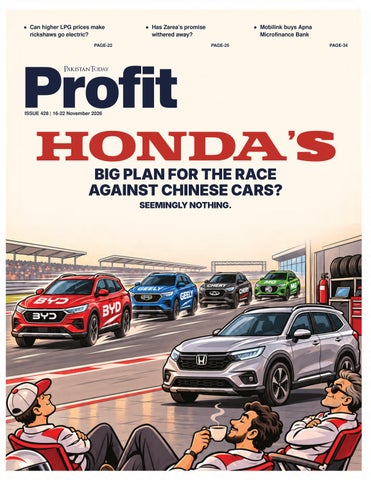
BIG PLAN FOR THE RACE AGAINST CHINESE CARS? SEEMINGLY NOTHING.
PAGE-34
ISSUE 428 · 16–22 NOVEMBER 2026
Inside this issue ON THE COVER
CAPITAL MARKETS
8
The tax bill that might never come The recent clarification by Barkat Frisian says that the deferred tax expense is non-cash. But what is it exactly?
43 Gatron’s ‘merger’ moves a third of the company out of two holding companies The court-sanctioned scheme with Nova Frontiers and Ghani & Tayub hands 35.1 million Gatron shares straight to the shareholders of the two companies. The polyester maker itself gains no new business. MOBILITY
Honda’s big plan for the race against Chinese cars? Seemingly nothing. The family behind one of Pakistan’s (formerly) “Big Three” car companies has remained unmoved in the face of an onslaught by Chinese hybrid and electric cars. As the tide of SUVs from across the Karakorams overtake urban centres, where will Honda go next?
Page 12
22 Can the shakeup in LPG price formula make the rickshaw wala go electric? Rising LPG prices have eroded the advantage of normal ICE rickshaws that used LPG, and made the case for an electric rickshaw much more appealing. TECHNOLOGY
25 Has Zarea’s promise withered away? Since the IPO, the company has started to see an abnormal rise in short term investments which is having a real impact on its core performance as well.
Profit
BANKING
Publishing Editor Babar Nizami / Managing Editor Farooq Tirmizi / Senior Editor Abdullah Niazi / Business Reporters Taimoor Hassan, Usama Liaqat, Zain Naeem, Shahnawaz Ali, Ghulam Abbas, Ahmad Ahmadani, Aziz Buneri / Sub-Editors Saddam Hussain, Abdul Hameed / Video Producer Adnan Maqsood / Director Marketing Muddasir Alam / Regional Heads of Marketing Agha Anwer (Khi), Kamal Rizvi (Lhe), Malik Israr (Isb) / GM Special Projects Zulfiqar Butt / Manager Subscriptions Irfan Farooq
30 NBP’s profit falls 29% in the third quarter as income shrinks on both fronts
Pakistan’s #1 business magazine, your go-to source for business, economic and financial news · profit@pakistantoday.com.pk
Contents
34 Mobilink buys Apna as United Insurance turns to Islamic life insurance VEON’s microfinance bank is adding a small, loss-making rival to a digital finance business that serves 57 million customers. The seller is taking the exit to enter family takaful, one of the fastest-growing parts of Pakistan’s insurance market. TEXTILES
39 Colony Textile’s Rs11 billion loss, and a plan to hand its weaving unit to the banks The spinner and weaver lost five times as much as a year earlier. Its auditors have issued an adverse opinion, and its survival rests on a debt-asset swap with its lenders. FOOD
41 Punjab Oil Mills cut its costs. Its taxes ate the profit The maker of Canolive and Zaiqa doubled its operating profit on flat sales, then lost Rs23 million after finance costs and a tax charge larger than its pretax profit. SATIRE
46 New crypto trading app attempts to provide most efÏcient way of losing money
Net interest income and non-interest income both fell from a year earlier. Deposits are down 9.4% this year, borrowings are up 72.3%, and a Rs74.5 billion dividend has cut the bank’s equity.
11
CAPITAL MARKETS
The tax bill that might never come The recent clarification by Barkat Frisian says that the deferred tax expense is non-cash. But what is it exactly? BY ZAIN NAEEM
A
nyone who has tried to go through the annual report of a company knows that it is a treasure trove of information and data. From financial statements to its governance structure, the company is mandated to disclose everything that they feel is relevant for the stakeholders to make better decisions relating to the company. Much of the report is ignored by investors as they either prefer to consider the financial performance of the company or they feel they do not have the expertise to understand the accounting standards that were used in drawing up the accounts. One element that is hidden in these financial statements is the concept of deferred tax liability and asset. Buried deep inside the notes to the financial statements, this represents the discrepancy between the taxation and accounting system within which the company is operating. The recent disclosure by Barkat Frisian comes on the back of this where they announced to the stock exchange that the Rs 74.46 million deferred tax expense that has been recorded in its recent financial accounts is a non-cash expense and it has been realized due to the Special Economic Zone (SEZ) exemptions that have been granted to it by the government. Something similar also took place for Service Long March where they were able to use their tax exemption status to make its profits look better without having to show relevant performance against it. Even after the clarification being given, the shareholders and investors still have the right to ask what the charge represents in the accounts and what is actually going on inside the company. The reply that has been given by Barkat Frisian has answered a few of these questions but there is still a need to provide details of what is actually happening. 8
The notification On the 20th of October 2026, Barkat Frisian sent a notification to Pakistan Stock Exchange explaining that they had recorded a deferred tax expense of Rs 74.46 million for its financial year ended 30th of June 2026. The company further said that the charge was being made due to the difference in its fixed assets which were primarily attributable to the additions and capital expenditures it had carried out at its Faisalabad factory. The stress was put on the fact that the charge was non-cash and did not represent any additional current tax payable or a cash outflow for 2026. In the same manner, Service Long March Tyres shows the other side of the coin where they reported a non-cash deferred tax asset using the same accounting standards. In both cases, tax accounting moved reported earnings in one direction or the other but this was not reflected in the bank statement of the companies. So what exactly is going on and how are these charged and benefits being recognized?
What is deferred tax? Consider the case of a simple company which buys machinery for Rs 100 million. Accounting standards dictate that the asset has to be depreciated every year based on the assumptions that have been used. The company feels that they will use this asset for 5 years and then the asset will become worthless at the end of the 5th year. Based on these assumptions, the depreciation that will be charged every year would be Rs 20 million. At the end of the first year, the net book value of the asset would be Rs 80 million. The deviation and discrepancy starts to take place as accounting standards and tax
rules can differ. In the same example, tax rules allowed the first year depreciation to be Rs 40 million which would mean that net book value according to the tax value would have been Rs 60 million. Accounts state that the company has assets of Rs 80 million while tax books show that the value should actually be Rs 60 million. The difference between the two values is of Rs 20 million, however, this is a temporary difference. As time goes on, the depreciation being charged according to the accounting standards will start to rise while the tax related depreciation would fall. Over the life of the asset, the net book value difference will converge towards zero. That is an economic reality that will resolve itself over time. However, financial statements have to reflect this divergence on an yearly basis. In year 1, the tax rules allow for depreciation of Rs 40 million to be charged which would mean that the taxable profit will be lower for the company in the first year. Taking tax rate as 25%, the company would pay Rs 5 million less in tax in the current year. The accounting profit would be higher in the first year as it is only recording depreciation of Rs 20 million meaning their accounting profits were higher. Due to this, the company would create a deferred tax expense and a liability. An investor studying the accounts would be able to determine that the company paid less tax in the current year due to the differences in the tax rules and accounting standards. As time goes on, the difference between the tax book value and accounting book value would converge to zero and the company will end up paying higher taxes in the future. Let us flip this situation now. Consider that the tax rules allow for no depreciation to be charged in the first year while accounting still Capital markets
records the depreciation. In this case, the tax rules will dictate that the taxable income would be higher compared to its accounting profit. The company would be mandated to foot a higher tax bill this year, however, this would reverse in the future. In this case, a deferred tax asset is created. Creating such an asset has to be evaluated in terms of its recoverability. The terms of asset and liability do end up confusing the investors as these are just labels that are used in accounting language and do not represent cash coming in or going out of the company. There is no need to pay a deferred tax liability today or collect on a deferred tax asset in the short term. This is just a way of recognizing expected future tax effects of timing differences taking place.
What does the notification mean? The clarification being provided by Barkat Frisian points towards the fact that as the book value of the assets will start to converge in later years, this deferred tax liability will end up decreasing. The tax expense that has been realized this year will change due to the movement in the net book value. This would lead to a deferred tax benefit in the future which will raise later reported profits. No cash will change hands but the company will see its future profit rise. Something similar would take place for Service Long March as well where it has currently realized a deferred tax asset in the previous years based on the view of their accountants. Service Long March would see their deferred tax assets fall in the future. Many times, the tax holidays being granted makes the expected date of reversal crucial to understand how the deferred tax will change over time. In the notification sent, Barkat Frisian has already stated that they are enjoying tax exemptions but there is little expectation that this will reverse after the exemptions end. This has been made possible as it is already using the tax rate applicable once the exemption ends. Barkat Frisian operates in a Special Economic Zone under the Special Economic Zones Act of 2012 which allows for the exemption period to end in April 2029 for the Karachi plant and June 2035 for the newly established Faisalabad plant. The mechanics behind the recent charge of Rs 74.46 million arose due to fixed asset differences relating to the additions being made to the Faisalabad plant. The accounting value Capital markets
and the tax value of the factory assets do not reconcile with each other and, in order to account for that, the company has recorded the expected tax effects. This means that when the company expects the tax related difference to reverse during the tax exempt period, they calculate deferred tax at zero percent. If the difference is expected to reverse after the exemption expires, the company applies the tax rate that will be expected at that time. The company also reiterates the fact that deferred tax liability is not expected to produce a cash outflow during or after the exemption period expires which means that the accounting profit is impacted but there is no cash tax payment obligation that is created. At this juncture, it is important to understand some of the terms that are used. Current tax expense is the tax charge that has to be paid in the present period based on the applicable tax rules. A deferred tax expense or benefit is the accounting effect of timing difference that is expected to matter in future periods. A deferred tax liability is the future tax consequences of a taxable temporary difference while an asset is a potential benefit as a future cost becomes deductible later. A deferred tax asset is not an automatic refund but a benefit which is recognized based on future taxable profit against which it can be used. In case the income is tax exempt, arrives too late or cannot be legally offset against relevant deductions in the future, the asset may end up being less useful than the balance sheet would suggest. Something similar was seen when the prospectus for Service Long March was declared which showed the company earning profit
after tax of Rs 10 billion. This included the non cash deferred tax income reversal of Rs 3 billion which was able to help increase the profits. In case these profits were removed, the company would see profits of Rs 7 billion. This might seem like a footnote, however, the impact of this entry is material and does not reflect the cash generating income of the company. A deferred tax income reversal is considered a tax credit in the income statement where profits increase even though the ability of the company to earn higher revenues and generate higher cash flow is not changing. What needs to be done in this situation is to consider the underlying performance of the company and to remove or isolate the impact of the deferred tax benefit that is being enjoyed. This allows the shareholder to consider only the sustainable profits for the company which are based on earning quality. As the deferred tax benefit keeps getting realized each year, Service Long March expects another Rs 688 million in non cash deferred tax benefit in 2026. Once this is stripped away, the forecasted profit after tax in the prospectus would have gone to Rs 12.5 billion from Rs 13.1 billion earlier. The impact of this would be much greater for Service Long March as the company was using these forecasted profits in its valuation model which would magnify this benefit greatly when the terminal value would be calculated. In case of Service Long March, it would be important to consider how these adjustments are going to be affected once the exemption expiry approaches at the end of 2032. 9
COVER STORY
Honda’s big plan for the race against Chinese cars? Seemingly nothing. The family behind one of Pakistan’s (formerly) “Big Three” car companies has remained unmoved in the face of an onslaught by Chinese hybrid and electric cars. As the tide of SUVs from across the Karakorams overtake urban centres, where will Honda go next?
BY YOUSAF NIZAMI
T
he year is 2016, Pakistan’s automobile sector is dominated by the ‘Big Three’, Honda, Toyota and Suzuki, and the market is buzzing with the news of the latest offering by Honda: The Civic-X. Back, then car launches were a big deal because of how rare they were. When one of the Kahunas of the automobile sector deemed the market worthy of a new model (usually with a gap of at least three to five years) there was always excitement surrounding it. The new Civic was in part unveiled in response to Toyota, which had introduced its 11th Generation Corolla in 2014. While we have gotten another generation of the Civic (launched in 2022), the Corolla has persisted with no more than a facelift here and there. And for a long time that formula worked. New models were few and far between and therefore a lot of hype existed around them when they arrived and they sold like hotcakes in the absence of competition. Take a look at Pakistan’s automobile industry today and it is unrecognisable. Two South Korean players, namely KIA and Hyundai, have had immense success with their flagship offerings. But the real disruptor was always going to be the influx of Chinese cars. Not only are there more options than ever in terms of cars, there are multiple options within each iteration of the powertrain i.e. internal combustion engines (ICE), Hybrids, all electric vehicles (EVs), Range extended EVs (REEV) and plug-in hybrids. Buyers, for the first time, are spoiled for choice. Currently there are 10 major groups selling Chinese cars in the market with at least two more joining the race soon and between them they are offering more than 20 different brands with some reports suggesting that there are as many models in the pipeline to be launched over the next six months. The competition is so intense that both Nishat Group (Hyundai) and Lucky Motors (KIA) have been forced to launch their own Chinese car brands. Nishat, through NextGen Auto, introduced Omoda and Jaecoo in August of 2025 and Lucky Motor Corporation, through an o cial partnership with GAC (Guangzhou Automobile Group Co., Ltd), started selling the latter’s Aion and Hyptec offerings this year. Yet the response from the Big Three has remained muted. None of them have introduced a Chinese sub-brand. Suzuki has recently launched the Hybrid Fronx to try and Cover story
stay relevant, and Toyota has been relying on product refreshes and cars like the Corolla Cross to stay in the game. And apart from minor facelifts to the City and Civic, there has been complete silence from Honda Atlas Cars, the company’s joint venture with the Atlas Group (owned by the Shirazi family) in Pakistan. Has Honda read the writing on the wall and decided it’s not worth their time and money to compete in this new China-dominated market? Is there some other mysterious reason why they’ve apparently decided to completely surrender to this new reality? Or are they perhaps just biding their time waiting for what they might think is a market adjustment that has been seen in other countries as well?
Pakistan’s car dynamics Up until the early 1990s, cars were mostly for the uber elite. Pakistan’s auto industry had flip flopped between privatisation and nationalisation. While India had managed to make its first first indigenous car in 1983, the “Maruti” envisioned by Indira Gandhi’s younger son and original political heir Sanjay Gandhi, Pakistan had lagged behind. In India, Maruti would eventually partner with the Japanese brand Suzuki. Pakistan too would begin its journey of making cars common through Suzuki. The Japanese company made an agreement with the government of Pakistan in 1982, and Pak Suzuki was established the following year, giving the Japanese manufacturer a foothold in a country with limited competition and considerable room to grow. Suzuki was offering small, relatively affordable vehicles to people for whom owning a car was a substantial financial commitment, and as the economy began to deregulate, in the 1990s the company moved to increase its ownership of the business. In 1989, they launched the now iconic Suzuki Mehran, while vehicles like the Bolan found customers among families and businesses alike, demonstrating that there was a market beyond the wealthy buyers traditionally associated with car ownership. Other Japanese manufacturers could see the opportunity, and Toyota entered through Indus Motor Company, established in 1989, with locally assembled Corollas following in 1993. One key mover and shaker in this was
Yusuf H Shirazi, the founder of the Atlas Group. A former journalist and income tax o cer who had abandoned the civil service for business, Shirazi had built a lasting relationship with the Japanese manufacturer Honda in the 1960s introducing their motorcycles to Pakistan through the joint venture called Atlas Honda Ltd. Bikes quickly became the main mode of mobility in Pakistan, and Honda already had a distribution network and name recognition in Pakistan through the Atlas Group. Honda Atlas Cars was incorporated in 1992, the first locally assembled Civic rolled out in 1994, and the City followed in 1997, giving the company two sedans at different price points. Suzuki had already taken firstmover advantage in small cars, which is why Honda and Toyota concentrated on a different market, leaving the three companies with a convenient division of the business. Suzuki did try to fight back with sedans like the Margalla, Baleno and, later, Liana, but never managed to dislodge its rivals from their stronger positions in that category. By 2016, the locally assembled family-car market still revolved around Suzuki’s hatchbacks, Honda’s City and Civic, and Toyota’s Corolla in its various engine sizes and trim levels. Other manufacturers had tried their luck along the way, but the incumbents’ established sales and service networks, and buyers’ attachment to familiar brands with dependable resale markets, made breaking into this arrangement considerably harder than simply putting another car in a showroom.
Breaking the stranglehold So what has happened in the past decade that broke the Japanese grip on Pakistan’s car market? It might on the surface seem a simple function of cheap Chinese cars offering better alternatives. But to understand what has happened in the past few years, it is important to put into context where the tide turned that incentivized new companies to enter the market and compete. The Automotive Development Policy 2016-21(ADP) launched under the PML-N government was monumental in revamping the market with the introduction of competition, as it explicitly gave a windfall of tax breaks to new players while older manufacturers (the Japanese) got far smaller cuts. The success of the policy was grounded in 13
14
Cover story
the fact that older brands were essentially locked out. Suzuki tried to get greenfield status with a commitment of a $450 million plant but never got approval after objections from Chinese and Korean newcomers. At the time, Miftah Ismail who was serving as chairman of the Board of Investment (BOI) said that the incumbents were running 20-year-old models and charging higher prices, so the policy was geared to address that. The one trade-off was the hit to balance of payments since new entrants were required to use as little as 5% localized manufacturing which contributed to a $4.7bn CKD import bill at the time. Two routes were offered for new independent assemblers: Greenfield projects, which most new brands used such as KIA, Hyundai, with many of the early Chinese entrants and Brownfield projects, designed for shuttered down plants like Ghandhara-Nissan. The machinery imports under these projects were made duty free. Additionally, the new manufacturers were allowed to import 100 completely built-up units (CBU) at 50% of the prevailing duty rate for market testing. Early entrants such as MG and Haval used this test marketing allowance at first but later imported thousands of units at full duty to build their brand to eventually set up their local assembly plants. One of the more significant features of the policy was to allow 10% customs duty on non-localized parts for five years against the then rate of 32.5%, while the existing player would pay 30%. This was a big blow for the likes of Honda for example. In absolute rupee terms, by Honda’s own admission from a 2022 corporate briefing, its localization is only around 30%, if the value of the parts is considered, so around 70-80% of parts are still imported. This would include more complex and therefore expensive parts such as the powertrain (engine and gearbox), the ECU and a host of other parts that no local industry in Pakistan can manufacture with quality and efficiency. So, for every Rs100 of imported parts, the Japanese were paying Rs30 in duty while the new manufacturers were paying Rs10. That, coupled with duty free imports of plant machinery and equipment under the policy set in motion the end of the Japanese players' heyday After the expiry of the ADP 2016-21, its benefits carried over into the next policy, the Automotive Industry Development and Export Policy (AIDEP) 2021-26. The policy Cover story
Yusuf H Shirazi Yusuf Sherazi left the civil service to enter the world of business. In the 1960s he helped introduce everyday motorbikes to Pakistan through a partnership with Japanese manufacturer Honda, which itself had only emerged in 1955 and taken its home country by storm.
framework that favored new entrants spanned a full decade, from 2016 to 2026, and each newcomer enjoyed up to five years of concessions once local production began, together, they changed the automotive landscape in Pakistan. The policy attracted about 15 new players who committed close to $1.169bn in investment for assembly plants, dealerships and vendor development. The investment however only targeted the higher-end Sedan and SUV segments while the lower segment offerings were largely left uninterrupted which gave Suzuki a unique advantage over its Japanese competition as it retained its smaller 6601000cc market with the Alto, WagonR and Cultus while Toyota and Honda had no such variant in their portfolio. The AIDEP 2021-26 offered incentives to all manufacturers but this was tied to new products, EVs, hybrids and cars up to 1000cc. More on that later. The policy ran until June 2026 and its successor is still pending approvals. Reporting suggests that the primary consideration in the next policy will be on New Energy Vehicles (NEVs) which naturally pits the older lot against the new Chinese entrants and the former have little to offer from their portfolio in that regard. Profit reached out to Honda for some insight into their view of the current auto
industry and their strategy in this new. An official pointed out that the players who entered the market as far back as 2006 were still being labelled “new entrants” in the draft policy, two decades on. “The three Japanese car makers that are in Pakistan are the market leaders and hold around 70% market share. We have huge investments in the country and have dealerships and a vibrant vending base in addition to modern plants. Our business model is different from the ones who are mostly importing a new brand and different model every other day”, the o cial added. While the original ADP did not specifically set any localisation or export targets, AIDEP set an industry-wide target of 75% of car parts localised by 2026. Additionally, each car manufacturer was expected to meet an export-import ratio: 10% of import bill by June 2026 in dollar terms. A government sector profile published in 2026 found that the export obligation fell “well short” across the industry. Honda’s first export batch amounted to just 38 City units shipped to Japan. “They are still at 10-15% localisation”, the o cial from Honda commented, referring to the new entrants. Pakistan Association of Automotive Parts & Accessories Manufacturers (PAAPAM) puts this number at around 010%. Even legacy players fell short of the 75% 15
Toyota Corolla In 2014, Toyota Indus Motors introduced the 11th Generation of the Corolla in Pakistan. The Corolla is perhaps one of Pakistan’s most iconic cars — used by families, ofÏces, and the government in equal measure. Toyota has not introduced the 12th Generation in Pakistan yet.
localisation target albeit by a much smaller margin when counting parts rather than their value. “Our customers will continue to have aftersales support long after the new fads have faded away. Once again, our business is based on long-term relationships and commitment”, the o cial from Honda added.
KIA sets the tone Up until the ADP 2016-21 was introduced the only alternative car buyers had for the ‘Big Three’ was the used car import market or the more expensive premium European brands, namely, Mercedes, BMW and Audi. At the time, Toyota had the Corolla XLi and Altis Grande, arguably the highest selling sedans in the Country and Honda, the City and Civic as direct competition. Suzuki had long since given up on this segment after the failure of the Liana and the Kizashi and its 2017 imported Ciaz lasted under four years with weak sales. So, the Corolla and the Civic were the staple sedans of that time. Imported cars too were predominantly Japanese used imports and were preferred by buyers due to their better build quality, safety and features with Hybrid drivetrains on offer as well. Used car and minivan imports rose around 70% in 2017, to 65,723 from 38,676 in 2016. The Toyota Vitz became the most imported car in 2017 with 8,680 units, the Toyota Aqua Hybrid had 7,123 units and 2,431 units of the Honda Vezel Hybrid were imported in the same time period. However, import restrictions made this market very inaccessible with only overseas 16
Pakistanis being allowed to import under the Personal Baggage, Gift and Transfer of Residence schemes and only for cars no older than three years. They were better-specced but harder to buy alternatives. As for the European brands, the Audi A3 is one example that was offered as an alternative to the Civic, but it was still priced roughly 50% higher than the Civic Turbo. Buyers too were skeptical of German purchases even if they could afford them. There was the resale aspect; Corollas and Civics sold much easier and at better prices in the used car market. The absence of large dealer and after-sales service networks and the higher maintenance cost in addition to limited spare parts availability made these cars a niche luxury purchase that was never going to challenge the likes of Toyota and Honda.
Kia Sportage Attempts had been made before, but the KIA Sportage became the car to break the three decade long domination of the Big Three in Pakistan’s auto market.
The first hint of trouble was just around the corner however when the South Koreans entered the market. KIA launched the
Sportage in August of 2019 and Hyundai a year later brought the Tucson. Both cars competed directly with the top end variants on offer by Honda and Toyota but it was simply much more car than the latter. Priced only a few lacs higher, buyers got a 2.0-liter compact SUV with a panoramic sunroof and a 4-year warranty. The Sportage went one step further with an infotainment system that supported both Apple Car Play and Android Auto. It made the Civic’s unreliable Chinese aftermarket system look obsolete. The year 2019 was overall a bad one for car manufacturers owing to a weakening rupee, record interest rates, new excise duties and a crackdown on tax non-filers. Months later COVID followed, adding to the economic downturn. Corolla saw a 58% decline in sales year-on-year in the second half of 2019 while the sales of both Civic and City combined dropped by a staggering 68% in the same period. However, KIA’s strategy to enter and disrupt the market at that time proved to be sound. Despite the slump, its first batch of the Sportage sold out in 10 days. By early 2021, the market had started to pick up. In the eight months from July 2020 to February 2021, Honda's combined Civic and City sales rose 52% to 16,213 units, from 10,662 in the same period a year earlier. Toyota, meanwhile, had replaced the 1.3L Corolla XLi and GLi with the Yaris in early 2020, offering it in 1.3L and 1.5L versions. Over the same eight months, the Yaris sold 18,403 units, while sales of the higher-end Corolla fell to 11,129 from 18,902. Combined, Toyota sold 29,532 sedans, against 18,902 a year earlier, a 56% rise. Toyota too had Cover story
recovered. During this time though, KIA had been busy. From when its first locally manufactured car rolled off the line in 2019, KIA reached sales of over 22,300 units, across all its models, in 2021, based on uno cial figures making it the fastest growing car company in Pakistan for those three years. At its peak, the Sportage was selling around 1,600 units a month according to some estimates. (Exact figures are unavailable for that time period since Lucky Motor Corporation was not a Pakistan Automotive Manufacturers Association (PAMA) member). While the Japanese were still wrapping their heads around KIA’s entry into the market and what to do about it, a Chinese wave was just beginning to take shape.
Enter, the Chinese Following the ADP 2016-21 and the arrival of two South Korean giants, Pakistan's market was opening up, and it was not alone. Across Asia, Japanese strongholds were about to face a Chinese assault. In Thailand, for example, Japanese brands went from a 90% market share in 2020 to 69% by late 2025, while Chinese brands rose to 22.2% over the same period. Suzuki went as far as setting out to end all manufacturing there by the end of 2025, selling its plant to Ford. Indonesia, the region's largest market, held out longer but followed the same path: the Japanese share slipped below 90% in 2024 and fell to 82.9% in the first ten months of 2025, while Chinese brands rose from 3.4% in 2023 to 6.4% in 2024, reaching 10.4% in the first quarter of 2025. Globally, Japanese companies sold 25 million cars in 2025, 5 million fewer than in 2018, as their world market share fell from 34% to 28%. As a long-time Japanese-dominated market, Pakistan was already in the crosshairs. Chery named the country as one of seven key markets in 2019, citing its size, supportive policies and opportunities under the China-Pakistan Economic Corridor (CPEC), and arrived in 2022. At the outset, the playbook was specheavy cars priced at, or just above, the Japanese competition, and sometimes below it. Petrol SUVs came first; hybrids and EVs followed. The first wave of Chinese SUVs was not cheap; most landed at, or a step above, the Civic. For the Rs3.8 million of a Civic 1.8 Oriel or the Rs4.7 million of a Civic Turbo, a buyer could now choose an MG crossover, and for under a million more, a Haval packed Cover story
with a panoramic sunroof, adaptive cruise control and a 360-degree camera. The Chinese did not need to win on price. By pricing their SUVs within reach of Pakistan's premium sedans and loading them with features the Japanese had never offered, they turned the Civic and Corolla’s price tag from a mark of status into a question: why pay this much for a sedan when the same money, or a little more, buys a bigger, better-equipped SUV? Changan took the opposite route, going after Honda and Toyota's bread-and-butter sedans, the City and the Yaris, on price. By late 2021, the entry-level Alsvin cost Rs285,000 less than the cheapest Yaris and Rs335,000 less than the cheapest City. At the top of the range, the gap widened: the top Alsvin was Rs265,000 cheaper than the top Yaris and Rs535,000 cheaper than the top City. For a segment where buyers count every lakh, that put a price on the Japanese badge, worth Rs300,000 to Rs500,000 by one estimate at the time.
The Second Wave As with any new market or industry that starts to open up in Pakistan, everyone with capital to deploy, jumps in. From real estate projects such as apartment buildings and housing societies to the boom in coffee shops and padel tennis; any business idea that makes sense on paper, money starts flocking towards it. And the automobile industry acted no differently. Soon after the road presence of cars by Haval, MG and Changan became apparent, business groups that weren’t conventional auto-assemblers joined the race.
BYD Atto 2 And then all at once: The Chinese car influx into Pakistan started with the MG HS and Master Changhan’s sedan, but it has exploded since those initial inroads.
BYD set the tone when it arrived in August 2024 with an all-NEV line-up: the fully electric Atto 3 and Seal alongside the Sealion 6
plug-in hybrid, later joined by the Shark 6 plug-in hybrid pickup. Master Changan followed in late 2025 with Deepal, Changan's electric sub-brand, whose S05 became Pakistan's first locally assembled range-extender, and has since announced the Nevo and Avatr brands. Chery returned in 2026 under the Master Group, this time with an entirely plug-in hybrid Tiggo range, and Xpeng opened pre-bookings for its L03 range-extender in mid-2026. Jetour, whose Dashing and X70 Plus arrived in February 2025 with petrol engines, was the exception rather than the rule. The Japanese did not shy away from the NEV challenge. Toyota began assembling the Corolla Cross hybrid in Karachi in late 2023, and Honda followed in July 2025 with the HR-V e:HEV, its first locally assembled hybrid. But here, too, the Chinese were waiting. Haval's locally assembled Jolion HEV and MG's new-generation HS Hybrid+, launched in April 2026, were priced within a few lakh of the Japanese pair. Before the July 2026 tax change, the Corolla Cross hybrid started at Rs8.54 million, the HR-V hybrid at Rs9 million, the Jolion HEV at Rs9.3 million and the MG HS Hybrid+ at Rs9.5 million. On paper, these were the same kind of car at much the same price. The difference was in what came with it: a newer platform, more power and a longer feature list, from brands that in 2021 had been new to Pakistani buyers and were fast becoming household names. For buyers willing to go further to cut their fuel cost, the Chinese offered options the Japanese simply did not have. BYD's Atto 2, at Rs7.29 million, is a fully electric crossover with 174 horsepower and a claimed range of up to 380 kilometres, about Rs2.6 million cheaper than the cheapest Corolla Cross hybrid at today's prices. Master Changan's locally assembled Deepal S05, at about Rs10 million, offers a middle path. It is a range-extender, driven entirely by an electric motor, that runs 170 kilometres on battery power alone, with a small petrol engine acting only as a generator to push the total range beyond 1,000 kilometres. The most telling competitor, though, came from Hyundai's own partner. Nishat Group's NexGen Auto launched the Jaecoo J7 plug-in hybrid at Rs9.999 million, almost exactly the price of the top Corolla Cross hybrid and the HR-V hybrid after the July 2026 tax changes. For that money, buyers got 341 horsepower and up to 90 kilometres of electric-only driving, against the Japanese hybrids' negligible 17
18
Cover story
electric range. The J7 drew more than 3,000 bookings in its first 40 days, and NexGen assembled 10,000 vehicles in its first eight months. Lucky Motor Corporation, Kia's partner, has had a quieter start with GAC. Its line-up of fully electric cars, from the Rs6.4 million Aion UT to the Rs12–14 million Hyptec HT, arrived in May 2026 as imports, and the company is already offering free servicing to draw buyers in. MG HS and Changan Alsvin Slowly in the beginning ….
Thriving, but still at it! The Japanese face a tougher market than ever before. Profit recently saw a presentation from a reliable source estimating that a quarter of new cars sold in Pakistan in the last year were Chinese. It has been a jolt for the Big Three but out of them Honda has a much steeper mountain to climb. Both Toyota and Suzuki continue to post significantly better financials even in this environment of ever-increasing Chinese and Korean competition. This comes down to two factors: a more diversified product lineup and their response to the changes in the market. Suzuki still dominates the “common man’s” car market. In FY25-26, it sold 94,848 cars, nearly half of PAMA’s recorded car sales for the year, of which more than 50,000 were Alto, its no-frills Rs 3.0-3.3 million mainstay. Total sales saw a 30% YoY increase. Profit before tax in 2025 was Rs24.5bn with a revenue of Rs 228.6bn. Despite these numbers, it felt the need to offer something in the crossover space and launched the Fronx in May of 2026. The car received a solid response from the market as Suzuki managed to sell 1,717 units in June alone. However, it had an unexplained dip with zero units sold in July, but more importantly, it shows the market some intent to compete, from a player that does not need to do much more than it is already doing, with success. Toyota has perhaps the most unique product mix out of all the legacy car companies. Its lineup starts from the Yaris at Rs4.6mn all the way up to the Fortuner for Rs20mn. Its pickups and SUVs are roughly 1 in 5 of the cars it sells: between June and September of this year, 3,192 of 16,767 units sold as per PAMA. By our estimates, at two to three times the price of a Corolla, they bring in around a third of car sales by value, and, analysts say, a disproportionate share of the profit. However, when fewer Fortuners and Hiluxes leave the showroom, Toyota feels it. In the last quarter of FY25, analysts blamed Cover story
a profit dip on a sales mix that leaned towards the Corolla, Yaris and Corolla Cross at the expense of its pricier pickups and SUVs. Like Suzuki, Toyota would do well to perhaps add even more variety to its product mix. While it has refreshed its Corolla with yet another facelift this year, its CEO, Ali Asghar Jamali has taken a different approach to the Chinese problem: public relations. Jamali is taking Toyota’s position on the auto policy and his company's strategy in this new climate into the public domain to effect favourable change in what the government comes up with next. He has done this through various interviews to prominent automotive platforms like PakWheels, podcasts with senior journalists and TV show appearances. One industry insider went as far as to say that there is an element of undisclosed paid partnerships with some of the platforms he frequents, but these are unsubstantiated claims. In all this, with meagre earnings of Rs 3.2bn in FY26 compared to Toyota’s Rs 25.5bn, Honda seems to be either undeterred in its path to staying the course or its owners, the Shirazis and their partners in Japan, know something no one else does.
No worries The big question here is simple: Why not jump ship? And that is exactly the question we posed to Honda Atlas: go the Chinese route and diversify outside the Japanese fold. The reply, in essence: nothing in its agreements stops it, but splitting loyalties with an equity partner is a matter of honour and principle, and the Chinese wave is a fad it expects to outlast. That loyalty runs deep, given the Atlas Group's 64-year partnership with Honda, but there is more at play. Honda Atlas Cars made about Rs30bn in profit in the last decade; that is less than the Rs36.4bn Atlas Honda, the motorcycle company, made in just the last two years. By profit and revenue alike, the Atlas
Group is predominantly in the two-wheeler business. And while electric bikes have become more common in Pakistan, the continued affordability, mileage, and reliability of the Honda CD70 means it is the standard in Pakistan’s two-wheeler market. Cars are still an important part of Honda’s portfolio, but the disruption the Chinese have caused has not forced its hand to do anything radical in that space. That does not mean Honda has given up on cars. Its car sales rose 59% to 25,621 units in FY26, profit edged up, and it launched its first locally assembled hybrid and a refreshed Civic within a year. “We are in this for the long run,” the o cial we mentioned earlier said. Asked about dealers who said they had been made to give up their Honda franchise before taking on another brand, the o cial pointed to the same principle: “We expect that our business partners have the same values and principles as we have. Short of this a long term partnership is just not possible.” But what about the Chinese plug-ins and EVs? Profit asked how Honda, which sold 50,100 cars in FY18 and 25,621 in FY26 with a single locally assembled hybrid, plans to compete with them. The reply skipped the plan and went straight to the numbers: “The fluctuation in the number of units sold pointed out by you was due to overall market size fluctuation. Otherwise, our market share remained the same.” Honda has a point; by its own reports and PAMA’s figures, its share has hovered around 14% of PAMA-reported sales, though PAMA leaves out many of the Chinese brands. The real answer came when we asked whether Honda was working on lobbying and advocating through the media to shape the next auto policy. It isn’t, the o cial said; the company explains its position when approached. What Honda wants is in line with Toyota: conventional hybrids should compete on a level playing field with plug-in hybrids, as 19
20
Cover story
they did under the previous policy, to protect investments made by carmakers and their local vendors, a stake the imported brands, the o cial noted, do not have. Honda’s answer to the plug-in challenge, in other words, is not a plug-in of its own but a policy that stops favouring them. This is not a company in retreat; it is one waiting for the policy to swing back in its favour, while the motorcycles pay the bills.
Writing on the wall So is Honda right to sit tight? For now, perhaps. The motorcycles are printing money, its car sales are recovering and its share of Cover story
PAMA-reported sales has held. But Honda lives in a bubble of its own, and bubbles have a way of bursting. The Civic and City are not safe; every few months brings another Chinese launch with more features at the same price or less, and buyers who once paid a premium for the Honda badge have shown, in Thailand as much as in Pakistan, that they will stop doing so. The shift to electrified cars is still slow, but in an economy where households count every rupee, fuel is the cost buyers feel most, and Honda’s only answer is a Rs10.4 million conventional hybrid that barely runs on its battery. Waiting for a friendlier policy will only
work for so long. The government has its own interests to protect: the Chinese brands now pay billions in taxes, with Sazgar alone contributing Rs84.4bn to the exchequer in FY26, and their backers have put real money into plants, from BYD’s factory at Port Qasim to Sazgar’s Rs22bn expansion. That investment may not yet match what the Japanese built over decades, but it was put down in a handful of years. Across Asia, the pattern is already set: in Thailand, Japanese brands went from 90% of the market to 69% in five years. Honda can choose loyalty over the Chinese. It cannot choose to ignore them. 21
MOBILITY
Can the shakeup in LPG price formula make the rickshaw wala go electric? Rising LPG prices have eroded the advantage of normal ICE rickshaws that used LPG, and made the case for an electric rickshaw much more appealing. BY USAMA LIAQAT
I
n August, this publication asked a simple question: do electric rickshaws make sense as an investment? The article followed a previous one which explained the benefits and downsides of having an electric bike compared to a classic Honda CD70. Our argument for the rickshaws reached a fairly simple conclusion: electric rickshaws do not make as much sense as electric motorcycles or cars because in the case of electric rickshaws, their comparison is not with petrol, but rather with LPG. Almost every rickshaw - as soon as it is bought - is fitted with an LPG kit. And this makes, we argued, quite a difference since while being comparably priced, LPG offers roughly double the mileage of petrol. We based our argument on a few assumptions, one of which was the relative parity of petrol and LPG prices, as was the case before the Iran war. Using that situation as a benchmark, we argued that the savings that would accrue from shifting to electric rickshaws in some cases might be slight, slightly more, or none – depending on the particular situation you found yourself in. It would depend on a host of factors: your ability to finance the rickshaw, the amount of maintenance your electric rickshaw might require, the cost of fuel, an so on. The higher prices for petrol and LPG at the time, we argued, were temporary highs. So, the rates we assumed for petrol and LPG were 300 and 340 rupees respectively, both slightly higher than what they were before the US-Israeli attacks on February 28, 2026. The basis of this assumption was our belief that higher fuel prices were due to an extraordinary situation, and once it diffused, things might return closer, downward to the pre-war normal. 22
Prior to this aggression, petrol was around 270 rupees per litre, while the o cial rates for LPG for February stood at 226 rupees per kg. But soon after, we saw quite a steep rise in both. Petrol reached a peak of around 460 rupees, while LPG rose to 308 rupees. But ever since we made our conclusion, there has been a bit of a rollercoaster with the variable factor in these calculations. Fuel prices fell when the ceasefire happened in April. They rose again when hostilities resumed. And now with geopolitical posturing hinting at an agreement and falling crude oil prices, the prices – at least of petrol – have been falling again. Currently, the o cial petrol price stands at 335 rupees per litre. LPG has been another matter, and the fault, as it were, lies therein. The o cially notified rate for LPG has been increasing every month since July. For November, this rate is 294 rupees per kg, up from 270 in October. The problem, however, is that, as far as the consumer is concerned, this rate works more as a formality. The real rates in the market are often quite higher. Based on our conversations in the market, LPG in Lahore is currently being sold at around 580 rupees per kg, almost 200 rupees higher than the o cial rate. In areas removed from major city centres, the price is even higher, reaching as high as 650 rupees. Given this situation, we thought it might be interesting to revisit our analysis and gauge the impact of rising LPG prices on our previous conclusion, and determine whether electric rickshaws become a more attractive investment now that the prices are so high. The short answer is yes, they do. For the long answer, read on.
A Recap of Assumptions Let us review, in brief, some of the assumptions we based our previous analysis on. As our electric benchmark, we went with Sazgar’s middle of the line model, eVe, costing 13.8 lakh rupees, and sporting a 9kWh battery. We also included, in our analysis, a cheaper model by the name of Tezmo, which retails at 9.82 lakh rupees and comes fitted with an 11.98kWh battery. For our petrol/LPG benchmark, we took a best-selling Sazgar model, the Deluxe XL, which retails for around 4.5 lakh rupees. As far as the range offered by electric rickshaws is concerned, based on our conversations with drivers, we took the average range per kWh or unit of electricity to be 14.5 km. The per unit rate of electricity we took to be 50 rupees. For petrol and LPG, as mentioned in our introduction above, we assumed the per unit price to be 300 and 340 respectively. Petrol, we assumed for a new rickshaw, gives a mileage of 20 km/litre; for LPG, we assumed 40. Concerning depreciation, for the ICE rickshaw, we took it to be 10 percent per year. For the electric rickshaw, we divided the total cost of the rickshaw into the cost of the battery and the cost of the rest of the rickshaw. We took depreciation on the battery to be 20 percent per year, while for the rest of the vehicle, we kept it at 10 percent. Based on conversations in the market, we assumed the battery cost for the Sazgar eVe to be 4.5 lakh. The same for a Tezmo rickshaw we took to be 4.1 lakh rupees. Regarding maintenance costs, for an ICE rickshaw, we took the cost to be 30,000 rupees Mobility
per year. The spare-parts are locally made, and mechanics offer cheap workarounds or jugaads to keep costs down. For the electric rickshaw, we assumed the yearly maintenance costs to be 20,000 rupees. Maintenance problems in electric rickshaws are more frequent than you might think, and the motor and the battery management systems are liable to require maintenance. And beside the battery, the motor, and the battery management system, most of the rickshaw (tyres, body, seating, etc.) is the same across both ICE and electric options. Another major assumption in our analysis was the cost of borrowing. For electric rickshaws in particular, since they are priced more sharply than ICE rickshaws, we envisioned two scenarios. In scenario 1, the rickshaw driver is able to self-finance the whole of the rickshaw. No borrowing here. In scenario 2, however, we assumed that the rickshaw-wala is able to self-finance only half of the price of the electric rickshaw (which is still more than the full price of the ICE rickshaw). The rest, in this scenario, they have to borrow from the market at the – conservatively assumed – rate of 25 percent per annum.
Findings at Current LPG Prices In our previous analysis, we calculated the savings offered by both petrol and LPG compared to electric rickshaws. Petrol was not even a competition, so we’ll not touch on that here, especially since currently the prices of petrol are around 35 rupees higher than what we had assumed. What we will focus on here is on how things change when we use the current effective rate of LPG – 580 rupees – and whether electric rickshaws start making more sense now.
Scenario 1 In Scenario 1, let us first focus on the Sazgar eVe model. Here, we assume the rickshaw driver does not have to borrow any amount from the market to buy the rickshaw. Going by this, when we assumed the rate of LPG to be 340 in our previous analysis, the per month savings came to around 270 rupees if the driver drove 120 km per day. This we felt was not a very good proposition for a shift to electric. If the rickshaw-wala drove 150 km at the same LPG rate, their savings per month would increase to around 4,800. This was slightly better, but not very attractive. However, if we go with the current rate of Mobility
Rickshaws The three-wheel ruler of the road has known many iterations in Pakistan — from Italian imports in the ‘60s to the old blue and orange clunkers that dominated the roads for decades (some of which can still be seen on the roads today) and the green CNG rickshaws that replaced them. The latest iteration are the electric rickshaws that are slowly becoming more visible. The jury is still out on their viability.
LPG (i.e., 580 rupees), the equation changes starkly. Driving 120 km per day yields very good savings of 21,900 rupees per month, while driving 150 km per day yields savings that are even higher. The feasibility of electric rickshaws in this scenario has totally changed, and it makes much more sense to make a shift even from an LPG rickshaw. Let us now look at the savings a cheaper electric rickshaw brand like Tezmo can offer when the rickshaw-wala doesn’t have to borrow a penny to buy it. In our previous analysis, where the rate we took for LPG was 340 rupees, the savings were better than in the case of Sazgar. If the rickshaw driver drove 120 km, they stood at 7,900 rupees, which was decent, and if the daily distance covered rose to 150 km, the savings increased to a good 12,700 rupees. If we go by the current LPG market rate of 580, the shift to an electric becomes quite attractive. Driving 120 km per day yields monthly savings of 29,500, and driving 150 km on the electric rickshaw saves you 39,700 rupees compared to driving the rickshaw on
LPG. These numbers are quite good, and quite tilt the equation in the favour of the electric rickshaw. They are also better than Sazgar’s primarily because the Sazgar eVe is more expensive than the Tezmo. Things in either case, at the current LPG rate start 23
looking quite good for the electric rickshaw.
Chaudhry Pervaiz Elahi Pervaiz Elahi introduced the now-iconic green LNG rickshaws during the tail end of his term as CM in 2005. Pakistan was placing a long bet on cheap LNG being a source of fuel. People were getting their cars kitted out with CNG cylinders to offset expensive petrol, and CNG stations were popping up all over the country. The experiment with CNG cars did not last long, but the rickshaws went nowhere.
Scenario 2 Now let us consider a scenario where the rickshaw-wala can only finance half the price of the electric rickshaw out of their own pocket, and has to borrow the rest from the market. In the case of Sazgar, going by our previously assumed LPG rate of 340, you didn’t save money, whether you drove 120 km or 150 km per day. In fact, you actually lost money by shifting to electric in this case. But what if – all else being equal – the rate of LPG increases? You guessed it: the electric rickshaw’s feasibility shoots up. Whereas before it was offering mere losses, now it actually starts saving you some decent money. The more you drive, of course, the higher your savings become. At 120 km per day, you can save 13,400 rupees per month; at 150 km per day, you can save 23,300 rupees. This particular scenario displays the stark effect the price of the LPG can have on the feasibility of an electric rickshaw. If we look at the Tezmo, the tale unfolds the same way. Current rates of LPG make electric rickshaws just so much more attractive than previous rates did. Monthly savings at 120 km daily distance increases from 1,900 to 23,500. At 150 km, they increase from 6,600 to 33,600. The rise is quite steep. The same happens in both scenarios regardless of the model of electric rickshaw in question: the LPG proposition pales quite quickly at the current rate, and the electric rickshaw increasingly appears to be by far the better option. The sharply rising savings speak for themselves. 24
What About the Future? At the risk of sounding repetitive, this increase in electric rickshaw’s feasibility in our analysis is due to an increase in the prices of LPG. And one thing about prices is that they can change. The higher they go, the better a shift from LPG to an electric rickshaw will appear. But the converse can also be true. Should the prices fall, the electric rickshaw proposition – as it currently stands – will decrease. Currently, the prices are rising. The o cial rate has risen every month since July this year. We import around 70 percent of our LPG, mainly through the Iranian border, and the other 30 percent of our LPG, we produce at home. Recent developments at the Pakistan-Iran
border, where reports of it being closed and then open kept coming out, only added to the uncertainty of Pakistan’s LPG supply, urging the prices even higher. And now there are reports that the government is changing how it prices LPG, with industry leaders warning that this new formula might push prices higher yet. Plus, the situation with the Iran war is not nearly as optimistic as some hopefuls might believe. Things appear to have stalled, and we might have entered a new normal for the near future – should the United States continue its blockade of Iran. Things might get worse, but then again, they might not. The rub, then, is that someone mulling whether to shift to an electric rickshaw has to make the decision in the now. They cannot be speculating about whether LPG prices will rise or fall. And this brings us back to a point we mentioned in our previous article: the prices of LPG are volatile. The prices of electricity are not as much – by quite some distance. Given the wild highs LPG is soaring at right now, it would be quite reasonable for someone to ditch the rollercoaster of pain and pleasure, and seek to put their hopes of earning their livelihood in a more stable basket, one that should things turn sour might actually save them some money. And if that is the prime consideration - as some suffering from high LPG prices might be inclined to believe - the case for an electric rickshaw appears quite appealing. Mobility
CAPITAL MARKETS
Has Zarea’s promise withered away? Since the IPO, the company has started to see an abnormal rise in short term investments which is having a real impact on its core performance as well. BY ZAIN NAEEM
W
hen Zarea was getting listed almost two years ago, there was a sense that the company was going to be the next big tech stock that was going to be traded on the stock exchange. Following companies like Netsol, Systems, TRG, Octopus and Avanceon, there was an expectation that this new company was going to bring something new to the table. Here was a digital technology company which was going to operate a Business-toBusiness platform specializing in commodity trading, procurement and delivery. Zarea was already running its own proprietary trading platform which allowed buyers and sellers to interact, monitor prices and place their orders in real time. It ran on mobile and desktop computers allowing trading to be carried out in cement, steel, building materials and agricultural biomass. The business model was centered around platform fees that were charged to both buyers and sellers as Zarea became the facilitator for the two parties to be able to meet. In addition to that, for buyers and sellers who did not have storage facilities, the company allowed logistical and storage support through third parties which added an additional stream of revenue. Since getting listed, however, it seems that the company has become a trading business and a glorified asset management company with an e-commerce trading platform attached to it. In a span of 3 years, the company has taken its short term investments from Rs 36 million in 2023 to Rs 2.6 billion at the end of June 2026. The impact of this can be seen in the income statement for the year which shows that other income made up Rs 873 million in terms of realized gain from investment and dividend income out of net income of Rs 1.4 Capital markets
billion. To put things into perspective, the company earned a gross profit of Rs 870 million in the same period which shows that the core operations of the company generated income equal to what the company had been able to earn on its short term investment portfolio. A company being able to earn passive income from its cash or short term investments is normal and should not be seen as a concern. However, questions start to be raised when it is considered that in a span of less than 2 years, Zarea has been able to raise Rs 1.03 billion from its IPO, an additional Rs 3 billion from two distinct sukuk issues and is now considering another right share issue in order to payback its recently issued sukuk of Rs 2 billion. The concerning part then becomes that with assets worth Rs 4.8 billion and short term investments of Rs 2.6 billion, why are capital markets being used to raise funds when such a large part of assets are being used to fund a stock portfolio rather than business operations? There are some serious questions that are being raised and there is a need for the senior management to answer them.
Zarea is established Zarea was set up in 2020 and over time it was able to expand its portfolio of commodities to coal, chemical, grains, pulses, sugar, fertilizers, cotton and yarn. With each new commodity, the company decreased its dependence on a small portfolio and was able to diversify its revenue stream further. In a span of five years, the company was able to grow its foothold in the market by leveraging digitisation in an environment where none existed in the past. “Zarea’s revenue grew at a five-year compound annual growth rate of 198%, reaching Rs 2,757.6 million in FY2026. This growth
has been driven by more industrial and B2B buyers using our platform to source commodities; our early entry into agri-biomass, where we helped develop a more organized market; and investment in procurement hubs, collection centres and logistics, partly funded by the IPO. Long-term offtake arrangements with major corporate customers also give us greater visibility of demand and support continued growth.” stated a spokesperson for the company. As the scale of its operations grew, the company was able to translate its customers into revenues and profitability. The Initial Public Offer became a very attractive prospect for Zarea in 2025 where it offered 62.5 million shares at a price of Rs 16 to the market which made up 23.8% of its post-IPO shareholding. At that point in time, the funds raised were going to be used to fund much of the increase in working capital that was required which had been allotted 45% of the funds. There was also a need to allot 24% of the funds to develop its own logistic fleet while 12.5% were going to be used to develop its technological infrastructure. The remaining 18.5% were going to be apportioned towards human resource and marketing and developing its own o ce space. Initially, Zarea held a promise of bringing digitisation to the traditional market place. The automation would have meant that a wider range of buyers and sellers would now be connected together through mobile application and desktop software. Zarea was expected to provide procurement solutions from suppliers to customers. Placing orders through the digital medium would mean that there would be an additional layer of verification which would be applied and Zarea would be able to use its own third party association to ship the goods and store them on behalf of 25
Zarea’s marketplace app
the customers. This reduces the hassle of maintaining a logistical fleet and storage facilities for the customer.
Zarea’s platform
A huge chunk of the supply chain would be looked after by Zarea itself which would allow the buyer and seller to focus on their key operations. Zarea could also become the financier in the middle which could allow the buyer to buy the goods in the present while promising to pay in the future. In order to make itself more e cient, some of the proceeds from the IPO were going to be used to develop its own logistical fleet to increase profitability. The IPO being considered did not come out of thin air. The fact was that in 2021 Zarea recorded revenues of Rs 11.8 million which had increased to Rs 442 million by the end of 2024. The ability to raise revenues by such a degree in a space of 5 years warranted the positivity that was being felt. Being a technology based company, gross profit margin stood at 70% of the revenues in 2023 and most of the earnings could be converted to operating profits and net income. At the end of 2021, net income was Rs 5 million which had increased to Rs 293 million by the end of 2024. Due to the sparse nature of the infrastructure required, there was no need to keep large amounts of debt on the books which kept its finance costs low and any debt was provided by the owners in order to sustain the 26
operations of the company. When required, these debts were turned into equity which allowed the company to maintain its leanness while the owners were able to invest further value into the company. This also played into the philosophy of the company to raise any funds internally rather than having to depend on external financing. This also meant that profits were reinvested back into the company rather than being taken out. At the time of the IPO, it was felt that there was no moat that existed for a technology based company which requires a small amount of capital to be established. A new company could easily enter the market with low barriers of entry and try to eat into the market share of Zarea. With a small need of staff, a cheap alternative can be easily established with an e-commerce platform which can generate its own revenues. To some extent, that has not taken place. Another vulnerability was that the company was trading as an agricultural biomass business and was buying and selling the product itself. This would mean that they would be able to keep a larger margin for themselves from this trading, however, it also meant that the company was tying up necessary working capital in inventory which could be used for marketing and selling its e-commerce platform. The ability to lend to the customers did mean that it could grow its topline by selling more to the customers, however, it also meant that the company was saddled with trade receivables which would only grow as the company started to lend more. The working capital that was being generated would be utilized to fund the customers and would become a burden on its liquidity. So how has the company fared since its IPO? At the end of 2024, Zarea declared revenues of Rs 442 million which have steadily increased to Rs 2.758 billion by the end of
2026. Based on its earlier growth, these figures show that the topline growth of the company has not only consolidated but has actually gotten better in the last two years. An increase of sixfold is something that needs to be paraded around as something significant. It is only when the breakdown of these revenues are seen that show how the revenues have actually improved. To put this performance in context, there is a need to go all the way back to 2022 when the company recorded revenues of Rs 116 million. In that year, Rs 54 million earned were related to platform fees while Rs 62 million had been earned through their agricultural biomass sales. The business model around the biomass trading business was to buy the commodity in the season and then sell them in the off-season when there was demand and a high margin could be earned on it. In 2023, the balance of this sales mix shifted in favour of platform fee with Rs 115 million out of total Rs 159 million were earned from the platform while the remaining could be attributed to the biomass business. By the end of 2024, these revenues stood at Rs 281 million from the platform and Rs 161 million from the biomass trading business. After the IPO was carried out, this balance became lopsided towards the biomass trading business. In 2025, out of total revenues of Rs 1.3 billion, almost Rs 1 billion were generated from the biomass business while only Rs 0.3 billion were earned from the platform. By 2026, any indication that this was a cutting edge technology company was long gone the company earned Rs 2.3 billion from its trading business out of total revenues of Rs 2.8 billion for the company. Now Zarea has become a biomass trading company with an application and a trading platform rather than the other way round. They are not selling a technological promise, they are selling agricultural biomass. At the time of the IPO, the company was Capital markets
considering itself as a tech startup with low cost of goods sold and a gross profit margin of 70%. With gross profits of Rs 310 million and revenues of Rs 441 million in 2024, this was looking promising even when sales of Rs 161 million could be attributed to biomass trading alone. As more trading started to take place, however, much of this facade was destroyed with gross margins falling to 33% in 2025 and 31% by the end of 2026. Moving down the income statement, another element that has seen a huge change is the unrealized gain that the company has been earning on its short term investment. In quite basic terms, this is the income that the company is able to generate on the investments that it has been able to make. It is normal for a company to make these investments in order to earn return on excess funds that it has on its books which are not being utilized but might be needed in the future. At the end of 2023, the portfolio held by the company stood at Rs 36 million which increased to Rs 70 million by the end of 2024. The real impact of this was seen in the unrealized gain which went from a loss of Rs 7.6 Capital markets
million in 2023 to a gain of Rs 34.5 million by 2024. From 2024 to 2025, the short term investments increased more than elevenfold going from Rs 70 million to Rs 792 million and then to Rs 2.6 billion by the end of 2026. To give an idea of how big this change was, the largest asset held in 2024 by the company was advances that had been paid for commodities which were worth Rs 242 million out of total assets of Rs 629 million. In 2025, the largest assets were short term investments of Rs 792 million out of total assets of Rs 2.4 billion and in 2026 these had grown to Rs 2.6 billion out of total assets of Rs 4.8 billion. The impact of this short term investment was to help the operating profits of the company. With the stock market hitting a stock rally during this period, the unrealized gain earned from this investment was ground breaking. In 2024, gain from the portfolio was Rs 34.5 million which jumped to Rs 378 million in 2025 and Rs 873 million in 2026. This gain includes unrealized and realized gain from the portfolio in addition to dividend income that was earned on the portfolio as well.
In regards to the portfolio investment, the company feels that the focus has not shifted from platform fees. “As the business has grown, its cash reserves have also increased. Under our treasury management strategy, we invest funds not immediately required for operations to generate returns. These investments contributed positively to other income in FY2026, although returns will vary with market conditions. We hold these liquid investments as a reserve for expanding the business if suitable opportunities arise in future.” This tells us two primary things of the revenues that are being earned by the company. From being an e-commerce platform, the company has moved towards biomass trading as its dominant generator of revenues and income from 2024 to 2026. In addition to that, the company has become an asset management company where it is investing and generating a large portion of its income from short term investments rather than using those funds to generate operating revenues. When asked if the company thought that their platform fees had hit a ceiling, the company stated in the negative adding that 27
“(p)latform Usage Fee revenue reached Rs 454.0 million in FY2026, and we expect it to continue growing as more industrial buyers adopt streamlined, digital procurement.” They added that “(a)gricultural commodity sales have grown faster, supported by stronger industrial demand and our expanding network of collection centres across Pakistan, farmers and suppliers. Demand for agricultural biomass as a fuel is also increasing as investment in renewable energy and biomass-fired power generation expands.” “Serving this market directly requires working capital for procurement, supplier advances and inventory. The two revenue streams complement each other, but the greater workingcapital needs of agricultural commodities mean that more funding is deployed in that segment. This was anticipated in our IPO prospectus, which allocated Rs 450 million of the proceeds to agricultural commodity working capital.” In terms of the future, the company expects projected sales of Rs 4.594 billion which will be 66.6% higher compared to 2026. “We expect strong growth to continue over the coming years as our expansion plans progress, although the pace will depend on execution and market conditions. These projections are based on current planning assumptions and do not guarantee future sales or profits.” For every Rs 100 of sales that the company is making, it is selling biomass of Rs 83.5 while only Rs 16.5 is being earned from the platform. In addition to that, the company is earning Rs 31 in terms of gross profit from these revenues. This is leading to gross profit of Rs 870 million for the company which is being matched by earnings from its portfolio of Rs 873 million by itself. When asked if the company thought its portfolio income was sustainable, the representative stated that “(o)ur core business continues to grow. Operating profit before investment income rose 111% to Rs 625.3 million in FY2026 and increased 218% to Rs 502.6 million in the September 2026 quarter. We also expect gross profit to increase as sales expand.” “Under the FY2027 plan, sales are projected at Rs 4.594 billion and gross profit at approximately Rs 1.308 billion, compared with Rs 870 million in FY2026. This is a planning projection based on current assumptions, not a guarantee. We expect growth to continue over the coming years as the business expands, subject to execution, demand and margins. Investment returns depend on market 28
conditions.” Concerning the portfolio investment, the company did agree that “FY2026 was an exceptional year, with the KSE-100 rising 44%. The portfolio has not taken focus away from core operations: it is managed by a dedicated investment function. Continued growth in sales and operating profit, together with our FY2027 projections and expansion plans, demonstrates this focus on scaling the core business.” The injection of the new funds after the IPO were not only centred on the short term investments alone. The company held noncurrent assets of Rs 50 million before the IPO which increased to Rs 190 million after the IPO as the company invested in its property and equipment. As the size of operations increased, stock in trade, trade receivables, cash and bank balances and trade payables also increased in conjunction. From 2025 to 2026, another significant jump was seen with noncurrent assets seeing another increase in property and equipment and a subsidiary being established in Dubai. One significant change that took place at the company was that it started to look towards external financing in order to fund some of the increases that were taking place at the company. The establishment of the subsidiary and the increase in short term investments of Rs 1.7 billion was funded by a sukuk which was issued by the company worth Rs 1 billion. In the past, the company had prided itself for not taking outside funding for itself which had changed for the first time in its history. These were issued at a carry profit rate of 12.74% per annum for a period of six months only. This was followed by another sukuk which was issued on the 6th of October of Rs 2 billion. Another break from its principles of the past saw the company giving out a dividend of Rs 1 per share in 2025 which came to around Rs 262.5 million for the year. In the past, the company had always looked to reinvest its profits back into the company to generate further revenues rather than give out any dividends. This changed in 2025 due to the fact that the company earned earnings per share of Rs 5.25. It was a way to reward the shareholders. Uptil now, everything sounds normal to an extent as it can be seen that the company raised funds through an IPO, internal profits and sukuks in order to raise its short term investments and fund some of its balance sheet increases. Now Zarea is looking towards its
shareholders to raise additional funds and investments. On 30th of October, the board of directors approved a right share issue of 16 shares for every 35 shares held by the shareholders which comes to around 45.71% of its existing shareholding. This issue would be carried out at Rs 25 meaning a premium of Rs 24 would be raised per share. The aim of the company is to raise another Rs 3 billion from this issue. At the time of announcement, the share of the company was trading at around Rs 36 which would mean that the investors would be reaping a benefit by exercising their right issue subscription. The aim of the issue is to pay back the sukuk which was carried out in October of 2026 and to use Rs 2 billion from the right shares to pay off the sukuk. The remaining funds that would be raised would be used to fund additional working capital needs. The sudden redemption of the sukuk is not being seen as a sudden move in response to the interest rates increasing. “The Sukuk was planned in August 2026, when PACRA assigned its preliminary rating, to fund agri-biomass and grain procurement during the harvest season. Zarea’s first Sukuk of Rs 1 billion was issued in January 2026 and redeemed in full with profit on 23 July. The second Sukuk of Rs 2 billion, including the green-shoe amount, was fully subscribed and issued on 6 October, before the State Bank raised the policy rate on 26 October.” “A rights issue takes several months to complete, while the Sukuk provided funding for the immediate seasonal procurement requirement. However, with a six-month tenor, the Rs 2 billion principal would need to be repaid or refinanced at maturity, potentially through a rollover or reissue, bringing further financing, advisory and issuance costs. Geopolitical tensions have pushed oil prices higher, adding to inflationary pressure and contributing to rising interest rates and financing costs in Pakistan.” At the current rate, the annual financing cost of Rs 2 billion is estimated at approximately Rs 300 million. As the Company’s working-capital needs continue to grow, management considered it preferable to replace this short-term borrowing with permanent equity capital through the rights issue, rather than repeatedly repay or refinance the Sukuk, which involves additional costs. Once deployed, the funds are expected to support procurement and higher sales volumes, contributing to improved sales and profits in the coming Capital markets
periods. These projections are based on planning assumptions and are not guaranteed.” Zarea is saying that they want to carry out a right share issue at the end of October to pay off a sukuk that they had issued at the start of the month. The sukuk issue was carried out at a time when the company did not expect that it will have access to necessary funds in the near future. After paying heavy fees and charges to issue the sukuks, the company has now declared a right issue to pay back its sukuk and put the shareholders on the hook for the new issue being carried out. The company is also going to commit Rs 48.5 million further to facilitate the right issue being carried out as well. The term value destruction seems to come to mind in relation to its recent activities. When asked why the portfolio is not being liquidated to raise these funds, the company said that “(t)he portfolio is held as a liquidity reserve for expanding the business if suitable opportunities arise in future, including but not limited to merger, acquisition or introducing new line of business.” “Although the investments are liquid, the Company does not intend, for the foreseeable future, to sell them to fund operating working capital. We believe the growing business needs a more permanent capital base, which the rights issue is intended to provide. Our FY2027 plan projects sales of Rs 4.594 billion and growing working-capital requirements. We further expect this growth to continue in the coming years, further increasing workingcapital needs. These funds will support procurement, supplier advances, inventory and receivables as the business expands.” The cash flow impact of these investments can be seen in the cash flow statements for the company from 2024 till now. In 2024, the company was looking to generate higher revenues which meant that it was buying stock and allowing credit to its customers which was seeing a negative cash flow from the company. Add to this the investment being carried out in property and intangible assets, the company had to rely on additional share capital in order to fund these activities. Fast forward to 2026 and the cash flow composition has changed dramatically. Even after earning profits of Rs 1.4 billion, the company saw negative cash from operating activities due to the fact that it carried out additional investments in a portfolio of Rs 1.2 billion. After taking other long term investments into account, the company had a hole Capital markets
How an order moves on Zarea
of Rs 679 million to fill which it did by issuing the sukuks of Rs 1 billion. If this investment had not been carried out, the profits would have translated into a net cash inflow from operations of Rs 1.3 billion. The company places a caveat on its negative operating cash flow. They state that “(t)he negative operating cash flow should be viewed in context. The Rs 1.241 billion net outflow related to purchases of short-term securities, classified within operating cash flows because they are held for trading. These are liquid investments, not expenses. At FY2026 year-end, the portfolio stood at Rs 2.585 billion and had generated Rs 833.8 million in realised gains and dividends during the year.” “Accordingly, this investment activity has not become a burden on the Company’s funds or resources: the funds remain invested in liquid assets and have contributed positively to earnings, although returns can vary. The rights issue will further strengthen the Company’s funding base. PACRA maintained Zarea’s entity ratings at A-/A2 with a Stable outlook in August 2026, reflecting the Company’s sound credit profile.” The company has set eyes on the future where it sees its profitability and revenues to keep on growing. “Our growth trajectory gives us confidence in the next phase of expansion. Momentum continued in the September 2026 quarter, when revenue rose 54% year-on-year to Rs 1,208.9 million. Building on this performance, we project FY2027 sales of Rs 4.594 billion, approximately 66.6% growth over FY2026. These are planning projections, not guaranteed results.” “We believe our track record and expanding business give us a strong platform for continued growth in the years ahead. Our growth opportunities include adding commodity categories, participating in wheat procurement
under the Punjab Wheat Policy 2026, expanding cross-border trade through our UAE subsidiary as regional conditions improve, and working towards digitization of commodity procurement.” “We are also strengthening collection and aggregation, logistics and value-added processing, while investing in technology, data and AI capabilities. Zarea has maintained a Re 1 per-share cash dividend for FY2025 and FY2026. PSX data ranked Zarea the best performing IPO of FY2025. Our October 2026 corporate briefing also highlighted regional comparables with valuations above USD 1 billion. Their scale and business models differ from ours, but they illustrate the potential for organised, technology-enabled commerce and supply chains to grow significantly.” The ambition of the company is to build Pakistan’s leading digital procurement and commodities platform that can tap into the $50 billion commodities market that exists in the country. The Green Pakistan Initiative will lead to agricultural modernisation with schemes like HBL Zarai Services which is bringing in international agricultural businesses like LDC and Cargill which have sales of $53.2 billion and $164 billion respectively. “The potential scale of organised commerce is reflected in selected companies valued at USD 2.6 billion for Infra.Market, USD 5 billion for OfBusiness and USD 800 million for Tul; Travis Perkins had a market capitalisation of USD 1.72 billion. These businesses differ from Zarea in geography and business model, but demonstrate the potential for scaled procurement and supply-chain platforms. We see a significant opportunity ahead and are committed to establishing Zarea as a leading force in Pakistan’s evolving commodities sector while delivering sustainable, longterm value for shareholders InshaAllah.” 29
BANKING
NBP’s profit falls 29% in the third quarter as income shrinks on both fronts Net interest income and non-interest income both fell from a year earlier. Deposits are down 9.4% this year, borrowings are up 72.3%, and a Rs74.5 billion dividend has cut the bank’s equity.
N
ational Bank of Pakistan earned Rs16.5 billion after tax in the three months to September 2026, down 28.8% from Rs23.2 billion in the same quarter last year. The results, approved by the board on October 28, put the bank’s profit for the first nine months of the year at Rs48.9 billion. That is 26.6% less than the Rs66.6 billion it made in the same period of 2025. Earnings per share fell to Rs7.75 for the quarter, from Rs10.89. For the nine months they were Rs22.98, against Rs31.32. The board did not announce an interim dividend.
A bank born in a crisis NBP was set up by ordinance on November 9, 1949, rather than through the normal process of registering a banking company. Pakistan had refused to follow India in devaluing its currency that year, trade between the two countries had broken down, and the financing of East Pakistan’s jute crop was in crisis. The new bank opened on November 20 at six jute centres in East Pakistan, with an issued capital of Rs15 million and 100 employees. Its Karachi and Lahore o ces followed in December. It went on to act as the agent of the State Bank of Pakistan wherever the central bank had no branch of its own, and to handle government treasury operations. In 1950 it opened its first branch abroad, in Jeddah. By 1955 it had branches in London and Calcutta. A branch opened in Baghdad in 1957 was nationalised by the Iraqi government in 1964. The government sold 23.2% of the bank to 30
the public in an IPO in the 2000s. In 2020 the State Bank designated it a domestic systemically important bank. It remains the largest public sector commercial bank in the country. With total assets of about Rs7.1 trillion at the end of 2025, it was the second-largest lender in Pakistan, with a 12% share of the market. Its recent history has not been smooth. In 2017, the bank disclosed a fraud worth Rs18.5 billion at its Bangladesh branch. The same year the Supreme Court ruled against it in the pension case that would cost it Rs49 billion in a single quarter seven years later. The market has since warmed to it. The bank said in February that its market capitalisation had grown tenfold over two years, to about $2 billion.
Where the income went The fall came from both of the bank’s main sources of income. Net interest income, the difference between what the bank earns on its loans and investments and what it pays on its deposits and borrowings, was Rs56 billion in the quarter. A year earlier it was Rs60.7 billion. Interest earned rose 5.5% to Rs200.9 billion. Interest paid rose faster, by 11.7%, to Rs144.9 billion. Over nine months the gap is wider. Net interest income fell 18.4% to Rs156.1 billion, from Rs191.3 billion in the same period of 2025. There was some recovery within the year. Arif Habib Limited, a brokerage, said net interest income rose 16% from the second quarter, as the bank’s assets repriced after the policy rate increase in April 2026.
Non-interest income fell harder. It was Rs10 billion in the quarter, down 32.7% from Rs14.8 billion. Gains on the sale of securities fell to Rs4.5 billion from Rs8 billion. Fee and commission income slipped to Rs4.3 billion from Rs5 billion. Foreign exchange income more than halved, to Rs570 million from Rs1.2 billion. Dividend income was the one line that grew, to Rs1.1 billion from Rs785 million. Total income for the quarter came to Rs66 billion, 12.6% less than a year earlier.
The rate cycle The interest rate environment explains much of the swing. The State Bank held its policy rate at a record 22% for almost a year, until June 2024. It then cut the rate by 1,100 basis points in six decisions, to 11% by May 2025, and to 10.5% in December 2025. Banks with large holdings of government securities earned high yields while rates were at their peak. As rates came down, their deposit costs fell faster than their investment income. That was the gap that produced NBP’s record 2025, when its cost of funds fell to 8.8% from 15.8% and the yield on its investments fell to 13% from 19.3%. The yield on its advances fell less steeply, to 11.1% from 15.4%. Over the first nine months of 2025, its cost of funds fell 43.8% to Rs410 billion, while its gross interest income fell to Rs601.3 billion from Rs838.7 billion. By 2026 that gap was closing. Arif Habib said lower yields on investments than a year earlier were the reason net interest income was down from the third quarter of 2025. The State Bank raised the policy rate by 100 basis Banking
points to 11.5% in April 2026, its first increase in almost three years, citing the conflict in the Middle East. It raised it again, to 12%, on October 26. The overnight rate corridor now runs from 11% to 13%. The October increase came after the quarter had closed. The State Bank cited the Middle East conflict, higher energy prices and disruptions to wheat supply, which had worsened the inflation outlook. Inflation for October was 9.61%, above the central bank’s medium-term target of 5% to 7%. A rise in rates lifts the cost of deposits and borrowings quickly. NBP’s interest expense in the third quarter was 11.7% higher than a year earlier, while its interest income grew 5.5%. The rest of the sector has held up better. Listed banks’ combined profit for the first nine months of 2026 was down 1%, according to Arif Habib, as higher interest expenses and operating costs offset growth in non-interest income and a lower effective tax rate of 53%. NBP’s nine-month profit was down 26.6%.
Costs and provisions Operating expenses rose 2.4% in the quarter to Rs30.5 billion. Over nine months they rose 8% to Rs96 billion. Arif Habib put the bank’s cost-to-income ratio at 51% for the quarter. Provisions helped. The bank reversed Rs775 million of credit loss allowances in the quarter, and Rs6 billion over nine months. In the first nine months of 2025 it had booked a net charge of Rs906 million. Profit before tax for the quarter was Rs35.4 billion. Tax took Rs19 billion of it, an effective rate of 53.5%. Over nine months, profit before tax fell 28% to Rs102.8 billion. Tax fell 29.2% to Rs53.9 billion. On a consolidated basis, which includes the bank’s subsidiaries, profit attributable to shareholders was Rs16.1 billion for the quarter and Rs48.6 billion for the nine months.
A smaller balance sheet on the deposit side The bank’s deposits fell to Rs4,012.7 billion at the end of September, from Rs4,429.3 billion at the end of December 2025. That is a decline of 9.4% in nine months. The bank said it had rationalised certain high-cost deposits. Borrowings went the other way. Banking
They rose 72.3% to Rs2,911.3 billion, from Rs1,689.7 billion. Most of the money is in government paper. Income from the investment portfolio was Rs427.1 billion over nine months, against Rs406.5 billion paid out as the cost of funds. Investments rose 9.1% to Rs5,370.1 billion. The bank said its portfolio continued to favour shorter-duration government securities. Lending barely moved. Net advances rose 1.7% to Rs1,360.8 billion. Lendings to other financial institutions grew far faster, to Rs271.5 billion from Rs46 billion at the end of 2025. Total assets stood at Rs7.75 trillion at the end of September. The bank’s Islamic arm, NBP Aitemaad, has been growing faster than the rest of it. In 2025 its deposits rose 80.6% to Rs558.9 billion and its total assets nearly doubled to Rs651.9 billion. Its pre-tax profit rose 117.1% to Rs13.7 billion. A year earlier, at the end of September 2025, the bank had reported deposits of Rs4,528.3 billion, with current and savings accounts making up 80% of them.
The cost of a record dividend The bank’s equity fell 11.5% in nine months, to Rs470.2 billion from Rs531.4 billion. Two things drove that. The first was the dividend. In February, NBP reported a record profit of Rs85.9 billion for 2025 and recommended a final dividend of Rs35 a share, against Rs8 a year earlier. That payout, approved by shareholders in March and cleared by the government after a delay, came to Rs74.5 billion. The bank said the government and the State Bank of Pakistan would receive about Rs57 billion of it. The payout was equal to about 87% of the bank’s profit for 2025. The second was the bond market. The surplus on revaluation of the bank’s debt investments fell by Rs21.8 billion over the nine months. The bank’s capital adequacy ratio was 21.12% at the end of September, with a Tier 1 ratio of 16.46%. At the end of 2025 it had reported a capital adequacy ratio of 26.21%.
The pension question The bank’s recent history has been shaped by its pension liabilities. In March 2024, the Supreme Court
dismissed the bank’s review petitions in a long-running pension case. NBP booked a charge of Rs49 billion in the second quarter of 2024 and posted a quarterly loss. Profit recovered quickly after that. The year that followed was the best in the bank’s history. In 2025, net interest income rose 45.4% to Rs248.5 billion, as the bank’s cost of funds fell to 8.8% from 15.8%. Operating expenses fell to Rs124.8 billion from Rs177.4 billion, which had included the pension charges. Profit before tax for the year was Rs178.9 billion, up 216% from Rs56.7 billion in 2024. The bank said it contributed Rs93 billion in income taxes that year. The bank earned more than Rs20 billion in each of the four quarters from the end of 2024 to the third quarter of 2025, as its cost of funds fell with the policy rate. A second case has now been decided against it. On September 16, 2026, the Federal Constitutional Court dismissed NBP’s appeal in a case brought by pensioners who were not party to the main litigation, over pension increases announced by the government. The bank said the full text of the judgment was still awaited, and the financial impact could not yet be determined. Topline Securities estimated that every additional Rs5 billion of pension provisions would cut earnings by Rs1.1 to Rs1.3 a share after tax. The brokerage said NBP had already booked Rs57.5 billion in past service pension costs in 2024, and expected further provisions after the latest ruling. NBP disclosed the ruling to the Pakistan Stock Exchange on September 17.
What it adds up to Over the past three quarters, NBP has earned Rs16.1 billion, Rs16.3 billion and Rs16.1 billion attributable to shareholders on a consolidated basis. That is a steady run, but at about twothirds of the level it reached through most of 2025, when falling interest rates cut the bank’s funding costs faster than its income. Consolidated quarterly revenue, net interest income plus non-interest income, peaked at Rs91.3 billion in the last quarter of 2024. In the third quarter of 2026 it was Rs67.1 billion. The bank is now funding more of its balance sheet with borrowings, holding more government securities and lending little more than it did at the start of the year. 31
32
Banking
BANKING
Mobilink buys Apna as United Insurance turns to Islamic life insurance VEON’s microfinance bank is adding a small, loss-making rival to a digital finance business that serves 57 million customers. The seller is taking the exit to enter family takaful, one of the fastest-growing parts of Pakistan’s insurance market.
T
he United Insurance Company of Pakistan has agreed to sell its entire shareholding in Apna Microfinance Bank to Mobilink Microfinance Bank. UIC’s board approved the sale on November 12, 2026, on the terms of a share purchase agreement with Mobilink Bank. The company told the Pakistan Stock Exchange that the transaction still needs corporate, regulatory and third-party approvals. It did not disclose a price. The same notice carried a second decision. UIC’s board approved publishing its intention to enter the family takaful business, Islamic life insurance, and said it was seeking the necessary approvals from the Securities and Exchange Commission of Pakistan. The two decisions describe one trade from opposite ends. A telecom group’s bank is buying a small, loss-making microfinance lender to add to a digital finance business that already serves tens of millions of people. An insurer that has carried that lender for 14 years is leaving banking for a part of insurance that is growing faster than the market as a whole. Shares of Apna Microfinance Bank rose by the 10% limit to Rs23.54 on November 13, the day after the announcement.
A deal ten months in the making The sale did not come out of nowhere. On February 6, 2026, the State Bank of Pakistan allowed Mobilink Bank to carry out due diligence on Apna for about two months. Apna disclosed the approval to the exchange on February 9. Under the State Bank’s letter, if the due diligence and negotiations succeeded, Apna would be merged into Mobilink 34
under Section 48 of the Banking Companies Ordinance, 1962. The central bank set conditions. Members of the due diligence team had to sign confidentiality undertakings, and the signed agreements and the due diligence report had to be submitted to the State Bank. Depositors’ funds of either bank could not be used at any stage. The State Bank also made clear that its approval was not final. Any acquisition or merger would be reviewed separately and could carry further conditions, including a satisfactory funding plan. In March, Arif Habib Limited filed a public announcement of intention on Mobilink’s behalf to acquire shares and control of Apna. The announcement was published on March 12. In September, Mobilink took an extra 90 days to make its public offer to Apna’s other shareholders, as talks between the two sides had not concluded. The new deadline is December 7. The offer is required under the Securities Act, 2015 and the takeover regulations, because Mobilink is buying control of a listed company. Arif Habib Limited is the manager to the offer. UIC had been preparing to leave for longer. In March 2025, its board approved the disinvestment of 59.94 million shares in Apna and sought its shareholders’ approval at the annual general meeting in April that year.
The buyer Mobilink Microfinance Bank was incorporated in November 2010, received its
microfinance licence from the State Bank in September 2011 and began operating in 2012. It is owned by VEON, the global digital operator that also owns Jazz, the mobile network. Its business is unusual for a microfinance bank. Alongside its branches, it is the licensed bank behind JazzCash, which operates under a branchless banking charter in partnership with Mobilink. Under their agency agreement, income from JazzCash, net of agents’ commission, is shared between the bank and Jazz in a ratio of 30 to 70. Mobilink Bank and JazzCash together serve more than 57 million customers, through a network of over one million merchants and agents. JazzWorld said in its results for the second quarter of 2026 that JazzCash now serves more than 60 million users. JazzCash processed transactions worth more than Rs15 trillion in 2025. The partnership shows up in the bank’s accounts. In 2023, Mobilink earned Rs12 billion in mark-up on nano loans, the small digital loans offered through JazzCash, out of Rs30.7 billion in total mark-up. Its branchless banking income that year was Rs8.5 billion, after it paid Jazz Rs10.4 billion as its share of fees and expenses. The bank has grown fast. Its total revenue, mark-up earned plus fees and other income, rose from Rs23.8 billion in 2022 to Rs41.1 billion in 2023. It reached Rs89.5 billion in 2025, up 33% from a year earlier. Profit has not kept pace. The bank made a profit before tax of Rs1.1 billion in 2022 and Rs1.5 billion in 2023. In 2024 it posted a pretax loss of Rs3.1 billion, which its management describes as the cost of cleaning up its loan book. Banking
President and CEO Haaris Mahmood Chaudhary told Business Recorder that before 2024 the bank had been operating largely in rollover mode. It had been concentrated in unsecured, single-payment microloans and agricultural loans, and moved during 2025 towards structured, instalment-based lending with more security behind it. The result was a pre-tax profit of Rs3.62 billion in 2025. Deposits rose 38% to Rs214 billion, the highest in the microfinance industry, and the gross loan portfolio grew 38% to Rs103 billion. The capital adequacy ratio ended the year at 19.53%. The bank told Business Recorder that the 2025 expansion was largely funded by deposits, which accounted for nearly all of its asset growth, and that its funding costs fell by roughly 5 percentage points. Advances rose 35% to Rs101 billion and investments rose 55%. Net equity rose 86%, helped by retained earnings and fresh capital. Lending to women grew 41% to Rs50.3 billion. The bank estimates that it accounts for about 30% of female borrowers in the microfinance sector. It also moved its core banking to Temenos T24 and set up a central data platform for credit scoring and risk monitoring. The recovery has continued into 2026. In the first quarter, total revenue rose to Rs30.9 billion from Rs19.3 billion a year earlier, and profit before tax more than doubled to Rs870 million. Profit after tax rose to Rs540 million from Rs261 million. Deposits reached Rs232.5 billion by the end of March. Fee and commission income rose 54% to Rs7.4 billion in the quarter. Operating expenses rose faster, by 80%, to Rs19.7 billion. Margins remain thin. Credit loss allowances took Rs7.2 billion of the Rs8 billion the bank earned before provisions in that quarter. VEON has been putting money in. It invested $15 million in the bank in January 2025 and another $20 million in January 2026, to expand its digital and Islamic banking. The bank launched Islamic banking in 2025, with branches in Karachi and Peshawar, and now has 124 business locations. In 2025 it also listed its term finance certificates on the Pakistan Stock Exchange. PACRA rated the bank A for the long term and A1 for the short term in April 2025.
Why Apna Apna is small by comparison. It earned Rs3.2 billion in mark-up in 2025, against Mobilink’s Banking
Rs89.5 billion in total revenue. Its deposits stood at Rs30 billion at the end of 2025, about a seventh of Mobilink’s. Apna was incorporated in 2003 and began operating in January 2005, under the Microfinance Institutions Ordinance, 2001. It lends to low-income and underserved customers, and its head o ce is in Lahore. It has also lost money for years. Apna lost Rs4.5 billion in 2022, Rs3.6 billion in 2023, Rs3.1 billion in 2024 and Rs1.6 billion in 2025. Its cumulative losses are about Rs15 billion. But the bank Mobilink is buying is not the one that ran up those losses. In 2025, Apna cut its network from more than 100 locations to 71 branches. Its net interest income turned positive, at Rs146 million, after a negative Rs1.2 billion in 2024. Its interest expense fell 25% to Rs3 billion while its mark-up income rose 12%. Fee and commission income rose 28% to Rs286 million. After that income, Apna earned Rs492 million before operating costs in 2025, against a loss of Rs898 million at the same level in 2024. Its deposits grew to Rs30 billion from Rs25 billion, and it said that at the end of December it had the lowest cost of deposits in the microfinance sector. Its net advances rose by about Rs2.4 billion to Rs10.6 billion, and more than 89% of them are secured, mostly against gold. That is the kind of lending Mobilink says it now wants. Secured, instalment-based loans are the centre of its turnaround, and goldbacked lending is the fastest-growing secured product in the sector. The deal also comes as the sector itself is changing shape.
A sector still losing money According to the State Bank’s Financial Stability Review for 2025, microfinance banks posted losses for a seventh consecutive year in 2025. The loss shrank sharply, to about Rs2 billion before tax from Rs25 billion in 2024. The sector is small, at 1.3% of all financial sector assets, but it reaches people banks do not. Between 2015 and 2024, the number of microfinance borrowers grew at a compound annual rate of 20.6%, against 2.6% for banks. Four of the 11 microfinance banks were still losing money at the end of 2025, down from eight of 12 a year earlier. Four were below the minimum capital requirement, and the sector’s aggregate capital adequacy ratio
was negative, at minus 1.2%. Owners put in Rs22 billion of fresh capital during the year. The State Bank said the sector needs to focus on loan recoveries, optimise operations and strengthen its capital buffers. There were signs of repair. The ratio of bad loans to total loans fell to 9.1% from 9.7%, and provisions covered 138.1% of bad loans, up from 95.2%. Operational self-su ciency, the share of costs covered by operating income, improved to 84.7% from 75.2%. Administrative expenses fell 8.5% in 2025, the first decline after rising 145% over five years. The cost-to-income ratio improved to 70.6% from 89.8%. Net interest income grew 30%, helped by 250 basis points of cuts in the policy rate during the year, while non-interest income fell 12.9%. The sector also lost a member. Telenor Microfinance Bank became Easypaisa Digital Bank, a full-fledged digital bank, and moved into the commercial banking statistics from March 2025. The number of microfinance borrowers fell to 8.3 million from 9.3 million as a result. That move also changed the competition Mobilink faces. Easypaisa, which competes with JazzCash in mobile wallets, now sits inside a full digital bank. The banks that remain are moving away from unsecured lending. The sector’s secured loan portfolio rose to Rs244 billion in 2025 from Rs188 billion, driven by a 26.2% increase in gold-backed loans. Deposits grew 13.3%, while borrowings fell 55%. Gold has driven much of it. Consumer lending at the remaining microfinance banks rose more than tenfold, from Rs1 billion in 2024 to Rs12 billion in 2025, mainly through loans backed by gold, as higher gold prices let borrowers take larger loans. Lending to enterprises rose 35.2%, helped by the Prime Minister’s Youth Business and Agriculture Loan Scheme. Consolidation is one answer to the capital problem. A bank that is short of capital can be absorbed by one that is not, and the State Bank has already set the route for this deal as a merger.
The digital prize The larger reason for the deal sits outside microfinance. Pakistanis are moving their money onto their phones. According to the State Bank’s annual review of payment systems, 14.3 billion retail payments worth Rs673 trillion 35
36
Banking
Banking
37
went through formal channels in the year to June 2026. The number of transactions was 58% higher than a year earlier. Digital channels handled 92% of those payments, up from 88%. Branchless banking mobile apps had 99.1 million users, more than three times the 30.4 million who use banks’ own apps. The trend has continued into the current fiscal year. In the January to March 2026 quarter, retail payments through the banking system reached 3.7 billion, and 92% of them were digital. Mobile apps offered by branchless banking providers, banks and electronic money institutions handled 2.9 billion transactions, or 78% of digital payments. Mobilink’s parent is building around that shift. In March 2026, Jazz acquired a controlling stake in TPL Insurance, a digital-first insurer. In June, JazzCash and Mobilink Bank began offering government treasury bills to retail investors through their apps. TPL Insurance had 277,000 policies in force at the end of 2025. With it, Jazz’s parent now owns a telecom network, a payments platform, a microfinance bank and an insurer. A microfinance bank with a branch network, a deposit base and a book of goldbacked loans gives that ecosystem something it cannot build from a phone alone.
The seller United Insurance is a general insurer, part of the United International Group. It writes fire and property, marine, motor, crop and miscellaneous insurance, and has run a window takaful operation since August 2014. The group bought Apna in January 2012, when it was still called Network Microfinance Bank and belonged to the JS Group. At the time, the group’s companies included United Insurance, Tawasul Insurance in Abu Dhabi, United Track System, SaudiPak Insurance and United International Agro Services. Network had been listed on the Karachi Stock Exchange since its launch in January 2005. In 2010 it had a gross loan portfolio of about $720,000 and 5,734 borrowers. Keeping Apna alive has been expensive. In June 2026, the SECP approved Apna’s issue of 116.06 million shares, worth Rs1.16 billion, against share deposit money already received. The shares went to companies linked to the group, led by United Track Systems with 43.33 million shares, United Software and Technologies International with 29.71 million, and two Tawasal companies. 38
UIC’s own business is in better shape. Its gross premium, including takaful contributions, rose from Rs6.6 billion in 2021 to Rs13 billion in 2024, before falling to Rs10.1 billion in 2025. Takaful is already part of that business, on the general side. UIC’s window takaful contributions were Rs1.4 billion in 2021 and Rs2.4 billion in 2024, before falling to Rs1.7 billion in 2025. According to PACRA, the miscellaneous segment, which includes hospitalisation, travel and bond business, makes up about 43% of its gross premium. Its profit after tax rose from Rs512 million in 2021 to Rs2 billion in 2024, and was Rs1.5 billion in 2025. PACRA attributed the lower 2025 profit largely to a one-off reversal that had lifted earnings in 2024. In the first nine months of 2026, UIC earned Rs1.1 billion after tax, up 35.4% from Rs812 million a year earlier. Its net insurance premium for the period rose to Rs3.4 billion from Rs3.1 billion. Investment income helped. UIC earned Rs134 million from investments in the nine months, against a loss of Rs258 million a year earlier. Net claims rose to Rs766 million from Rs648 million.
Why family takaful The business UIC wants to enter has been growing quickly. Family takaful contributions were Rs5.9 billion in 2014. By 2022 they had reached Rs40.6 billion, and by 2023 Rs48 billion, according to the SECP’s diagnostic study on the future of takaful. The SECP’s insurance statistics show that they rose 37% in 2024, to Rs66 billion, and a further 23% in 2025, to Rs81 billion. Family takaful’s share of all life insurance premium rose from 11% in 2022 to 16% in 2025. Life insurance as a whole grew more slowly. Life premium rose 14% to Rs495 billion in 2025. Total takaful premium, family and general together, rose 27% to Rs123 billion. General takaful grew faster still, by 33% to Rs42 billion, and now accounts for 15% of non-life premium. Premium sold through digital channels rose 71% to about Rs6.8 billion. The growth has come as the conventional life business has lost customers. The number of life policies fell to 7.6 million in 2025 from 7.9 million. The insurance industry as a whole wrote
Rs778 billion in gross premium in 2025, up 15%, so takaful’s growth is outpacing a market that is itself expanding. There is a great deal of room left. Insurance penetration in Pakistan was 0.7% of GDP, according to the SECP. Life insurance penetration was just 0.43%. The State Bank’s Financial Stability Review notes that the industry is concentrated in life insurance and family takaful, which together account for 85.4% of the sector’s assets and 61.8% of its gross premium. Dedicated family takaful operators held Rs67.4 billion in assets in September 2025. Those dedicated operators wrote Rs20.5 billion in gross contributions in the first nine months of 2025 and paid Rs12.9 billion in net claims. The number of players has grown with the market. In 2014 there were two dedicated family takaful operators. By 2023 there were four dedicated operators, one of them digital-only, and seven window operators, according to the SECP. Family takaful’s share of first-year premium, the new business written in a year, was 21% in 2023. The market has also started to put a price on the business. Pak-Qatar Family Takaful listed on the Pakistan Stock Exchange on December 31, 2025, as the only dedicated family takaful operator on the exchange. The SECP has been pushing in the same direction. Its diagnostic study set out a roadmap for moving the insurance industry towards Shariah-compliant takaful.
What happens next Several steps remain. The State Bank must approve the transaction and the eventual merger. Mobilink has until December 7 to make its public offer to Apna’s minority shareholders, under the takeover regulations. UIC needs the SECP’s approval for its family takaful plans. If the deal goes through, Pakistan will have one fewer microfinance bank, and its largest will be larger still. Mobilink will add Apna’s 71 branches, its Rs30 billion in deposits and its gold-backed loan book to a deposit base that was already the biggest in the sector. For United Insurance, it ends a 14-year attempt to own a bank. The company will instead try to build a share of Islamic life insurance, a market that has grown almost fourteenfold since 2014. Banking
TEXTILES
Colony Textile’s Rs11 billion loss, and a plan to hand its weaving unit to the banks The spinner and weaver lost five times as much as a year earlier. Its auditors have issued an adverse opinion, and its survival rests on a debt-asset swap with its lenders.
C
olony Textile Mills lost Rs11.1 billion in the year to June 2026, five times the Rs2.2 billion it lost the year
before. The loss is more than twice the company’s paid-up capital of Rs5 billion. It wiped out most of what was left of shareholders’ equity, which fell to Rs1.4 billion from Rs6.1 billion. The company’s auditors have issued an adverse opinion on the accounts. In their report, filed with the Pakistan Stock Exchange on November 6, they said the financial statements do not give a true and fair view of the company’s position. The company is pinning its survival on a plan to hand its weaving unit to its lenders.
Sales up, losses deeper Colony’s sales rose 21.6% to Rs20.5 billion, from Rs16.9 billion a year earlier. It sold that cloth and yarn for less than it cost to make. The cost of sales was Rs22.6 billion, leaving a gross loss of Rs2 billion, up from a gross loss of Rs1.3 billion. After distribution and administrative costs, the operating loss was Rs2.6 billion, against Rs2 billion. Finance costs fell slightly, to Rs1.3 billion from Rs1.4 billion. What changed the size of the loss was a single line. Other operating charges rose to Rs7.3 billion, from Rs2.5 million a year earlier. The results announcement does not break the charge down. Other income, which had cushioned the 2025 result at Rs1.3 billion, fell to Rs319 million. The company paid a levy of Rs259 million and recorded no income tax. The loss per share was Rs22.19, against Rs4.47. Textiles
The board did not recommend a dividend, bonus or right shares.
Four years of gross losses The losses are not new. Colony made a profit of Rs728 million in the year to June 2021 and Rs300 million in 2022, according to Stockanalysis. Since then its sales have fallen and its margins have turned negative. Sales peaked at Rs30.9 billion in 2022. The company reported a gross loss in 2023, 2024, 2025 and 2026. It still booked a net profit of Rs834 million in 2023, before losing Rs3.6 billion in 2024. Spinning is the bulk of the business. In the year to June 2025, spinning brought in Rs15.2 billion of sales and weaving Rs1.7 billion. Weaving sales had fallen by more than two-thirds from Rs5.9 billion in 2022. The company’s spinning unit is on Sher Shah Road in Multan. Its weaving unit is on the Raiwind Manga Road, in Raiwind near Lahore. The Colony name goes back to 1946. The listed company was set up in 2011 and acquired Colony Mills Limited and Colony Industries (Private) Limited in 2014. That amalgamation still sits on the balance sheet as a reserve of Rs3.2 billion.
An industry in trouble Colony is not alone. The All Pakistan Textile Mills Association said in February 2025 that more than 100 spinning mills, nearly 40% of the industry’s production capacity, had shut down, and that the rest were running at less than half their capacity. The association blames high energy tariffs,
heavy taxes and delayed refunds, along with imports of cheap yarn. Yarn imports reached 111 million kilograms in the first half of the 2025-26 fiscal year, according to the association’s budget proposals in June 2026. The government imposed an 18% sales tax on imported cotton yarn in the 2025-26 budget. The association has asked for the tax to be extended to all yarn and fabric imported under the Export Facilitation Scheme, and for a 10% regulatory duty on yarn imports. Weaving has been hit as well. In October 2026, Daily Pakistan reported that 40% of power-loom units in Faisalabad had shut down. Exports have held up better than the mills. Textile exports rose 3.15% to $7.85 billion in the five months to November 2025, but exporters said factory utilisation remained weak and margins were under pressure. Colony’s own balance sheet shows what the slowdown does to working capital. Its stock in trade fell to Rs2.1 billion from Rs2.9 billion, while trade debts rose to Rs589 million from Rs149 million. It was owed Rs2.2 billion in tax refunds by the government, down from Rs2.9 billion.
What the auditors found The auditors based their adverse opinion on the company’s ability to keep going. They noted that Colony had a net loss of Rs11.1 billion and a gross loss of Rs2 billion during the year. Its accumulated loss stood at Rs13.1 billion, against Rs2.2 billion a year earlier. Its current liabilities exceeded its current assets by Rs24.7 billion, up from Rs4.9 billion. These conditions, the auditors said, 39
indicate a material uncertainty that casts significant doubt on the company’s ability to continue as a going concern, and to realise its assets and discharge its liabilities in the normal course of business. The balance sheet explains the jump. Longterm financing of Rs5.7 billion that sat under non-current liabilities a year earlier has largely moved into current liabilities. The current portion of long-term liabilities rose to Rs7.6 billion from Rs2 billion. Trade and other payables rose to Rs8.6 billion from Rs7 billion. Short-term borrowings were Rs1.5 billion. Total current liabilities reached Rs30.2 billion, against current assets of Rs5.5 billion. The company had Rs47 million in cash and bank balances at the end of June. The accounts for earlier years have also been restated. Colony corrected its treatment of deferred taxation, which added Rs955 million to equity as at June 2024. Deferred liabilities on the balance sheet fell to Rs264 million at the end of June 2026, from Rs3.7 billion a 40
year earlier.
The weaving unit for the debt Management’s answer is a debt-asset swap. According to the auditors’ report, management has firmed up a turnaround plan based on handing over the land, buildings and plant and machinery of the weaving unit in Raiwind to the company’s secured creditors. An independent valuation of the weaving unit’s land, buildings and machinery led management to believe that the debt left over after the swap would be at a level the company can sustain. Management said the proposal had been favourably considered by its lenders, and that it plans to seek the required approvals in the coming months. On that basis, the accounts were prepared assuming the company will continue to operate. The company also revalued its property, plant and equipment during the year. The revaluation added Rs6.3 billion to other
comprehensive income, and the value of its property, plant and equipment rose to Rs23 billion from Rs18.2 billion. Its investment property rose to Rs2.8 billion from Rs1.8 billion. That revaluation is why equity did not fall further. Comprehensive loss for the year was Rs4.7 billion, against the Rs11.1 billion loss on the income statement.
What is left The swap, if it goes ahead, would leave Colony with its spinning unit in Multan, a smaller debt load and a revalued asset base. It would also leave shareholders with very little. Equity of Rs1.4 billion compares with paid-up capital of Rs5 billion. The balance sheet now carries Rs31.9 billion in total assets against Rs30.5 billion in liabilities. Colony’s annual general meeting is scheduled for November 27, 2026, at its registered o ce on Ferozepur Road in Lahore. Textiles
FOOD
Punjab Oil Mills cut its costs. Its taxes ate the profit The maker of Canolive and Zaiqa doubled its operating profit on flat sales, then lost Rs23 million after finance costs and a tax charge larger than its pre-tax profit.
P
unjab Oil Mills has lost money for a third year in a row, even though its operating profit doubled. The maker of Canolive and Zaiqa reported a net loss of Rs23.4 million for the year to June 2026, according to results it filed with the Pakistan Stock Exchange on November 6. That is smaller than the Rs69 million loss of the year before. The loss came after a profit before levy and taxation of Rs73.5 million. Taxes turned that into a loss. The board did not recommend a dividend, bonus or right shares.
Flat sales, better margins Sales were almost flat, rising 0.7% to Rs9.31 billion from Rs9.24 billion. The company kept more of each rupee. Cost of sales rose only slightly, to Rs8.37 billion, so gross profit rose 5.8% to Rs936 million. The gross margin improved to 10.1% from 9.6%. The bigger change came below that line. Selling and distribution expenses fell 14.4% to Rs356 million, from Rs416 million. Administrative expenses fell 14.2% to Rs274 million, from Rs319 million. Together, those savings doubled the operating profit, to Rs307 million from Rs150 million.
Where the profit went From there, most of it leaked away. Finance costs rose 12.4% to Rs148 million. Other operating expenses more than doubled to Rs116 million, from Rs52 million. Other income halved to Rs30 million, from Rs61 million. That left a profit before levy and taxation of Rs73.5 million, up from Rs28 million. The company then paid a levy of Rs22.7 Food
million, against Rs93 million a year earlier, leaving a profit before income tax of Rs50.8 million. Income tax took Rs74.2 million, up from Rs4 million, and pushed the year into a loss. The tax charge was larger than the profit it was charged on. The results announcement does not explain the charge. The loss per share was Rs3.02, against Rs8.89.
Pakistan imports about 90% of its palm oil from Indonesia and the rest from Malaysia, according to the vanaspati manufacturers’ association. Branded makers do have some room on price. In December 2024, Dawn reported that branded ghee and cooking oil makers had raised prices by up to Rs100 a kilogram or litre, even as global palm oil prices eased, while smaller players cut theirs by Rs40.
A longer slide
A bigger, more taxed market
Punjab Oil’s last profitable year was the year to June 2023, when it earned Rs43 million, according to Stockanalysis. It made Rs67 million the year before that. It lost Rs37 million in 2024 and Rs69 million in 2025. Sales have moved in a narrow band, between Rs8.1 billion and Rs9.8 billion, over the past five years. The company was incorporated in 1981 and makes edible oils and fats at its plant in the Industrial Triangle on Kahuta Road in Islamabad. It started commercial production in 1984, as a maker of banaspati and cooking oil. The plant is certified to ISO 9001, 14001 and 45001 standards and is halal certified, according to the company’s letterhead. Its brands include Canolive and Zaiqa, along with Ella, Oliva and King. Its range covers cooking oil, banaspati ghee, specialty fats for bakeries and biscuit makers, laundry soap, mushrooms and Tru Bru coffee. Its sales have grown slowly for years. Business Recorder noted in 2019 that the company’s ten-year sales growth had been close to 7% a year. Margins have stayed thin throughout. Gross profit was 9.2% of sales in 2022 and 9.3% in 2023, according to Stockanalysis. It rose to 11.5% in 2024, when sales fell, and was 10.1% in 2026. The company’s cost base is set abroad.
The market Punjab Oil sells into is growing. Pakistan imported a record 3.48 million tonnes of palm oil in the year to June 2026, worth $3.79 billion, up from 3.21 million tonnes a year earlier. Pakistan meets the bulk of its edible oil requirements through imports. Sheikh Umer Rehan, chairman of the Pakistan Vanaspati Manufacturers Association, attributed the rise to growing demand for ghee and cooking oil from a larger population, and to smaller local crops such as cottonseed. He put annual edible oil consumption at about 4.8 million tonnes, up from 4 million tonnes five years ago. Palm oil imports rose 8.3% in the year. Taxes are rising with it. The budget for 2026-27 expanded the Third Schedule of the sales tax law to cover ghee and cooking oil, which moves sales tax collection to a basis of maximum retail price rather than the ex-factory price. The association said in June that the change would push up prices of ghee and cooking oil by Rs10 to Rs15 a kilogram. Quality has also come under scrutiny. In August 2026, tests by the Pakistan Council of Scientific and Industrial Research found that 48% of vanaspati ghee samples and 75% of refined palm oil samples collected from markets were substandard, according to a review by the National Price Monitoring Committee. 41
More borrowing The balance sheet shows a company leaning harder on its banks. Short-term borrowings rose 54.6% to Rs1.13 billion, from Rs733 million. Trade and other payables rose 39.2% to Rs1.53 billion, from Rs1.1 billion. Accrued mark-up more than doubled to Rs27 million. Current liabilities rose to Rs2.89 billion from Rs2.04 billion. Non-current liabilities fell to Rs175 million from Rs189 million. The deferred tax liability fell to Rs52 42
million from Rs74 million, while staff retirement benefits rose to Rs71 million from Rs65 million. PACRA, which rates the company, pointed in 2020 to its low leverage, strong coverage and e cient management of working capital as strengths. In February 2022 it maintained the company’s long-term rating at BBB+ and its shortterm rating at A2, with a stable outlook. Shareholders’ equity edged down to Rs2.55 billion, from Rs2.58 billion. Most of it is a revaluation surplus on property, plant and equipment of Rs1.73 billion.
The company’s paid-up capital is Rs77.6 million.
What comes next The annual general meeting will be held on November 27, 2026, at the company’s registered o ce in Islamabad. The cost savings show that the business can earn an operating profit. The question for shareholders is whether it can earn enough to cover its finance costs and taxes as well, after three years in which it could not. Food
CAPITAL MARKETS
Gatron’s ‘merger’ moves a third of the company out of two holding companies The court-sanctioned scheme with Nova Frontiers and Ghani & Tayub hands 35.1 million Gatron shares straight to the shareholders of the two companies. The polyester maker itself gains no new business.
T
he High Court of Balochistan has approved a scheme of arrangement between Gatron (Industries) Limited, Nova Frontiers Limited and Ghani & Tayub (Private) Limited, moving 35.1 million Gatron shares, or 32.3% of the company, out Capital markets
of two holding companies and into the hands of their shareholders. The court signed the order on October 28, 2026. Gatron told the Pakistan Stock Exchange on November 11 that a certified copy had become available that day.
The transaction has been described as a merger, and the Competition Commission of Pakistan treated an earlier step in it as one. It is not a combination of businesses. No company is being absorbed into Gatron. No new plant, product line or market is 43
being added. The scheme changes who holds Gatron’s shares, and nothing else at the polyester maker.
Who the parties are Gatron makes polyester filament yarn and PET preforms, the plastic blanks that are blown into soft drink and water bottles. Its plants are in Hub, Balochistan, and its registered o ce is in Quetta. Nova Frontiers Limited is an unlisted public company. The Competition Commission describes its business as investing in shares, stocks, bonds, units of mutual funds and related securities. Ghani & Tayub (Private) Limited is a private company that shares its name with the G&T group, the business family behind Gatron. Gatron’s corporate profile says the group has been in business since 1948 and also runs the Bonanza garments business. Before the scheme, Nova Frontiers held 31,895,139 Gatron shares, a 29.33% stake that made it the company’s largest shareholder. Ghani & Tayub held another 3,240,774 shares, or 2.98%. Ghani & Tayub is also a shareholder in Nova Frontiers. That cross-holding is why all three companies, and their members, had to be party to the scheme.
How the scheme works The order has four main moving parts. First, Nova Frontiers cancels 3,921,109 of its own shares. These belong to a group the scheme calls the outgoing shareholders, Ghani & Tayub among them. That cancellation cuts Nova Frontiers’ paid-up capital to Rs96.6 million, divided into 9,664,574 shares of Rs10 each. Second, the 31,895,139 Gatron shares held by Nova Frontiers are cancelled. Gatron then issues the same number of new shares to Nova Frontiers’ outgoing shareholders. The exchange runs at 8.13 Gatron shares for every Nova Frontiers share they gave up. A professional valuer set the ratio. Third, the Gatron shares that would have gone to Ghani & Tayub for its stake in Nova Frontiers skip the company altogether. They are issued straight to Ghani & Tayub’s own shareholders, in proportion to their holdings. Fourth, the 3,240,774 Gatron shares that Ghani & Tayub already held are cancelled, and the same number of new shares is issued directly to its shareholders. Gatron funds that 44
issue from its general reserve and unappropriated profits. Nova Frontiers and Ghani & Tayub keep, and continue to run, whatever else they own. The shareholders who stay in Nova Frontiers keep their shares in it.
What changes for Gatron Gatron’s share count does not change. Every share cancelled is replaced by a new one. The company receives no cash and pays none. Its plants, debt, products and customers are the same as they were before the order. What changes is the top of the shareholder register. A stake of about 32% that sat inside two holding companies is now spread across the individuals who owned those holding companies. Gatron itself has said as much. When an earlier version of the scheme was withdrawn in August 2025, the company told the exchange that its role was administrative and that the main transaction was between its two corporate shareholders and their own shareholders. The Securities and Exchange Commission of Pakistan told the court it had no objection, as the companies had complied with the filing requirements for the scheme.
A long road to court The arrangement has been more than two years in the making. In June 2024, the Competition Commission approved Nova Frontiers’ acquisition of up to 29.43% of Gatron. It found that the deal would not change Nova Frontiers’ position in polyester filament yarn or PET, the two markets it examined. In February 2025, Gatron’s board authorised the company to enter into a scheme with Nova Frontiers and Ghani & Tayub. The board approved a draft in May 2025. In August 2025, the boards of Nova Frontiers and Ghani & Tayub withdrew the scheme, citing recent developments, and Gatron rescinded its own consent. The scheme returned in January 2026, when Gatron’s board approved it again. The swap ratio was still to be set by an independent valuation. The High Court heard the petition on May 7, 2026 and allowed the companies to call meetings of their members. Gatron’s shareholders met in Hub on June 10, 2026 to vote on it.
The court sanctioned the scheme on October 28.
The business underneath The scheme arrives as Gatron is working its way out of three years of losses. In the year to June 2026, Gatron’s sales rose 14.5% to Rs30.1 billion. Its unconsolidated loss after tax narrowed to Rs325 million, from Rs1.97 billion a year earlier. Polyester filament yarn brought in Rs24.8 billion of those sales, or 82%. PET preforms and resin made up the remaining Rs5.4 billion. The company credits the anti-dumping duty on imported polyester filament yarn, enforced from the end of October 2025, for the recovery in its yarn business. Preform output rose 18% to 870 million pieces. The first quarter of the current year continued the trend. Sales for the three months to September 2026 rose 55% to Rs11.2 billion, against Rs7.2 billion a year earlier. The unconsolidated loss for the quarter fell to Rs124 million, from Rs395 million. On a consolidated basis, Gatron made a profit before levies and income tax of Rs56 million in the quarter, against a loss of Rs330 million. Finance costs remain the largest drag. Gatron paid Rs310 million in finance costs in the quarter, more than its consolidated gross profit after selling and administrative costs. Gatron last reported an annual profit in the year to June 2022, when it earned Rs1.82 billion on sales of Rs24 billion. The company is also cutting its power bill. Its solar capacity rose to 8.3 MW in the year to June 2026, from 2.8 MW a year earlier, and it has signed a memorandum of understanding for wind power.
What comes next Gatron’s board was due to meet on November 17 to consider the number of its directors and an extraordinary general meeting. With the new shares issued, the shareholders of Nova Frontiers and Ghani & Tayub will hold their Gatron stakes in their own names. The register will show who owns the company directly, rather than through two holding companies. For other shareholders, the economics are the same as before the order. They own the same number of shares, in the same company, with the same plants and the same losses to work through. Capital markets
Capital markets
45
SATIRE
S AT I R E
New crypto trading app attempts to provide most efficient way of losing money
I
SLAMABAD: In a bid to “revolutionize” how everyday retail investors engage with digital assets, local fintech startup Safaayia has unveiled its highly anticipated flagship mobile application, promising to make the process of losing money more e�cient, algorithmically optimized, and seamless than ever before. Billed by its founders as a breakthrough in “negative yield technology,” Safaayia guarantees total, unmitigated financial ruin with unprecedented speed, allowing users to achieve absolute bankruptcy without the tedious burden of traditional market volatility. “We noticed retail investors were wasting valuable time agonizing over dips, recoveries, and complex market sentiment,” said Safaayia CEO Qasim Baig during a launch event in Islamabad. “The human emotional cycle is the biggest bottleneck in wealth destruction. Our software removes that anxiety by ensuring your 46
capital evaporates with mathematical certainty. Why wait for a year-long bear market when you can achieve financial oblivion by lunch?” The application features automated “Margin Annihilation” protocols, which leverage personal assets against highly speculative derivatives. Upon registering, users are treated to a gamified dashboard where traditional “Loss” metrics are rebranded as “Financial Liberation Velocity,” allowing them to watch their net worth plummet in real-time with satisfying haptic feedback and celebratory sound e�ects. Early beta testers have praised the streamlined process, noting that the seamless liquidation allowed them to vacate their life savings and transition to a simpler, unencumbered lifestyle in a matter of minutes. “It really takes the suspense out of the market,” said one Islamabad-based user, who wished to remain anonymous. “Before, I’d be checking my phone every five minutes to see if
my coins were down. With Safaayia, they just go straight to zero. It has freed up a lot of my screen time.” When asked about regulatory compliance, Baig was dismissive of traditional hurdles. “Regulation is for people who want to keep their money,” he explained on stage. “We are o�ering true liberation. �ou can’t get sued for failing to deliver returns if your stated mission is to lose everything as fast as possible. True wealth liberation means freeing yourself from the burden of ownership entirely. We’re simply accelerating the inevitable.” Market analysts suggest Safaayia may trigger a broader shift toward mandatory insolvency in the Pakistani digital asset sector. Looking ahead, the startup has already announced plans for an expansion into “ZeroSum Real Estate” and fractionalized debt obligations, with the long-term goal of bringing their high-e�ciency wealth vaporization tools to the global stage. Satire