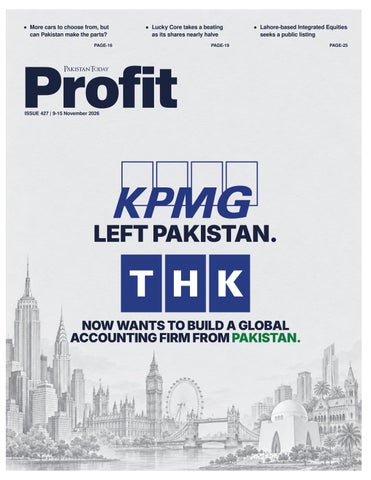
More cars to choose from, but can Pakistan make the parts? PAGE-16
Lucky Core takes a beating as its shares nearly halve
Lahore-based Integrated Equities seeks a public listing
PAGE-19
ISSUE 427 | 9-15 November 2026
LEFT PAKISTAN.
NOW WANTS TO BUILD A GLOBAL ACCOUNTING FIRM FROM PAKISTAN.
PAGE-25
ISSUE 427 · 9–15 NOVEMBER 2026
Inside this issue ON THE COVER
COVER STORY
TECHNOLOGY
8
35 Air Link moves beyond electronics assembly to enter the electric bike business
KPMG left Pakistan. THK now wants to build a global accounting firm from Pakistan
AUTOMOBILES
FINANCIAL SERVICES
16 Pakistan now has more cars to choose from, but can we make their parts?
38 A small Lahore modaraba with most of its money in the bank wants to get into electric vehicles
The arrival of dozens of models has given buyers options, but one question remains. Which models will sell enough, for long enough, to justify making their parts?
BANKING
40 Bank Alfalah finally leaves Afghanistan, eight years after its first attempt
INDUSTRIALS
KPMG left Pakistan. THK now wants to build a global accounting firm from Pakistan Page 8
19 As Lucky Core Industries takes beatings on multiple fronts, its share price has almost halved Declining exports, competition from dumped imports, and rising energy costs have hit two of the biggest segments of the company, leading to a decline in the company’s profitability and turnover.
OPINION
42 The Generational Imperative SATIRE
46 Nation’s 22 poorest families control everything, says vocal, ‘not crazy’ opponent of BISP program
IPOS
25 Integrated Equities: the plucky little brokerage house from Lahore that wants to get listed
Profit Publishing Editor Babar Nizami / Managing Editor Farooq Tirmizi / Senior Editor Abdullah Niazi / Business Reporters Taimoor Hassan, Usama Liaqat, Zain Naeem, Shahnawaz Ali, Ghulam Abbas, Ahmad Ahmadani, Aziz Buneri / Sub-Editors Saddam Hussain, Abdul Hameed / Video Producer Adnan Maqsood / Director Marketing Muddasir Alam / Regional Heads of Marketing Agha Anwer (Khi), Kamal Rizvi (Lhe), Malik Israr (Isb) / GM Special Projects Zulfiqar Butt / Manager Subscriptions Irfan Farooq
The company has seen great financial performance in recent years but it has to be seen with some caution. This is what we can learn from its prospectus. MERGERS & ACQUISITIONS
30 Cherat Cement finally gets to buy something. It is not a cement company
Pakistan’s #1 business magazine, your go-to source for business, economic and financial news · profit@pakistantoday.com.pk
Contents
7
COVER STORY
KPMG left Pakistan. THK now wants to build a global accounting firm from Pakistan. The Pakistani partner firm of the Big Four accounting giant views the exit as an opportunity to build a national champion in professional services, aiming to replicate what Engro did after the Exxon exit from the country.
BY FAROOQ TIRMIZI
I
f a major global company leaves Pakistan – for whatever reason – the standard story to write is what great misfortune has befallen the country. We will call that the “Crybaby Pakistani” reaction. And then there is the reaction that Adnan Rizvi and the other partners of what was until last month KPMG Pakistan have had to the departure of the Big Four accounting firm from the country. As of November 1, 2026, KPMG Taseer Hadi, the Pakistan partner firm of the global Big Four accounting giant KPMG, has become THK, a firm headquartered in Karachi with ambitions to become a global professional service firm that serves clients worldwide. On the surface, this looks very similar to the exit of Deloitte from Pakistan, which took place in November 2020. And indeed, if the partners at KPMG had accepted the same level of demotion, it would have been. But the THK partners have something more ambitious in mind. They view this departure as the kind of opportunity that Shaukat Raza Mirza and his merry band of former Exxon Pakistan employees faced when they bought out the exiting American energy company’s assets in Pakistan and laid the foundations of Engro in 1991. Engro has gone on to become a national industrial champion. Adnan Rizvi, THK’s managing partner, has ambitions to take THK even further. But to understand why this opportunity came their way, one needs to understand how two threads converged for a time in Pakistan, and what has led them to diverge again. The first thread was the global expansion of the large accounting firms – the Big Four of which are all headquartered in London – which, while not entirely being unwound, is being considerably consolidated, resulting in a constriction of opportunities for markets like Pakistan that are considered the periphery. And the second is the development of international quality human capital in Pakistan’s own accounting industry, which now has the ability to serve clients worldwide if they so choose. We will start with the state of play in the global accounting industry, and what led KPMG to make its exit decision in the first place. We then look at the history of KPMG and its Pakistani a liate, and what gives the THK partners the confidence that they have what it takes to build a global franchise from Pakistan. And finally, we will examine the Cover story
state of play in the global accounting market again, but this time from the lens of a Pakistani firm seeking to win business, and why THK may have good timing on entering this market.
The old name The firm practised as KPMG Taseer Hadi & Co. from 1987.
Why KPMG is leaving First, let us make one thing very clear: KPMG did not decide to leave Pakistan. The series of events that started with them ultimately leaving the country involved a decision to consolidate the number of entities they operate around the world, and Pakistan was – in their original proposal – meant to be consolidated into the Middle East region, headquartered in Riyadh. There is a global context to this, based in part on how these firms have historically been organised, and it starts with decisions that have been ongoing for quite some time. The Big Four global accounting firms – Deloitte, PricewaterhouseCoopers (PwC), EY (formerly Ernst & Young), and KPMG – exist as global networks of partner firms rather than being subsidiaries of a single multinational firm. The way the arrangement works is that a local partnership firm is organised under the local laws of the country in which it serves clients, complying with all local laws that apply to the accounting profession in that country. It then signs what is effectively a licensing agreement to use the brand, get access to certain kinds of training for its personnel, and get access to clients from other global o ces who may have needs in that local market, mostly multinationals that sign accounting or auditing agreements worldwide and then expect all of their subsidiaries to be served by the same global firm. In exchange, the local firm agrees to adopt a set of ethical and professional standards,
usually more rigorous than the ones purely local regulations would require it to adopt, and agrees to not solicit business outside the jurisdiction it is assigned. (This last part is a particularly relevant one to THK’s new plans, but more on that later.) Most of these global partnerships were initially organised as cooperatives in Switzerland, known as vereins but around the early 2000s, they started moving towards a different corporate structure. In the case of KPMG, that transition took place in 2003. Over the past decade, however, this relatively loose confederation is slowly being jettisoned in favour of a more traditional multinational corporate structure, with a holding company and subsidiaries being established in some regions, consolidating regional businesses of these companies into multinational member firms of the larger network, rather than single nation members of the global network. So, for example, in 2016, Deloitte consolidated its partner firms in Belgium, Denmark, Finland, Iceland, the Netherlands, Norway, and Sweden, Switzerland, and the UK to become Deloitte North West Europe. In 2018, EY consolidated its global regions and began consolidating the partner firms within those regions as well, starting with the merger of its regions serving Eastern Europe and the former Soviet Union. For KPMG, that transition started in 2024, when they merged their firms serving the UK and Switzerland respectively. That same year, they merged the partner firms in the Middle East, putting the partner firms in Iraq, Jordan, Lebanon, Oman, Saudi Arabia, and the United Arab Emirates into one entity headquartered in Riyadh. This is the entity of which the global network had wanted the Pakistani partner firm to become a subsidiary. That regional context is important. Deloitte and PwC have already consolidated their Middle East operations into one consolidated entity with local subsidiaries. EY goes one step further and consolidated all its partners in the Middle East and North Africa into one entity. All three of these are also headquartered in Riyadh, with a major secondary presence in Dubai. “We faced a defining choice. The path offered to us would have folded our firm into a larger regional structure of the Middle East firm,” said Adnan Rizvi, managing partner of THK, in a written statement to Profit. “Our 9
The partners THK’s partners at the firm’s ofÏce. The firm left the KPMG network on October 31, 2026.
identity, our governance, and ultimately our decisions would have moved beyond Pakistan.” “We gave it serious thought. And we decided that a firm founded in Pakistan, built by Pakistanis, and trusted by Pakistan’s leading enterprises should remain a Pakistani firm, owned here, led from here, and accountable here.”
Inside the ofÏce The firm is headquartered in Karachi.
That identity that they wished to preserve is worth understanding more deeply. Because it reads as a fascinating history.
A history of THK and KPMG Before looking at THK, let us look at the evolution of the accounting industry as a whole, and KPMG’s place in it. That lays important 10
context as to the legacy of which THK sees itself as an heir. It is not an accident that the Big Four accounting firms have a few characteristics in common. They are all headquartered in London, all of their origins go back to the early to mid-1800s, and they all became big as the result of the merger that took place before the year 1900 between one or more firms headquartered in London, and one or more that served the United States. Why is this the case? Because the UK is where corporations well and truly took off. The English East India Company was the first company in the world, founded in 1600 by royal charter. And while the merchants of Florence, Italy may have invented double entry bookkeeping (the foundation of modern accounting), it was the English who developed the company with multiple shareholders – and thus a need for reliable and trustworthy accounts with a basis more than the manager saying “trust me, bro”. Beyond the invention of the concept of companies that active managers and passive investors, the British then expanded that concept and added other important ones. In 1844, the Joint Stock Companies Act allowed the creation of companies without requiring an act of Parliament. In 1855, the Limited
Liability Act began to separate liability between individual shareholders and managers and the company itself. All of this set the stage for the evolution of the modern corporation, which in turn created the need for reliable financial information to be shared between shareholders, managers, lenders, and the government. Thus, the basis of the accounting profession was birthed in London, and hence all of the oldest firms are based there, and why it remains the formal headquarters of the profession. KPMG is the oldest of the Big Four firms, with its oldest predecessor firm starting in 1812 when a man named Robert Fletcher began working at a firm that would, by 1839, bear his name as Robert Fletcher & Company. In 1891, that firm elevated William Barclay Peat (the “P” in KPMG) to a partner and renamed itself William Barclay Peat & Company. In 1897, across the Atlantic, in New York, the firm Marwick Mitchell & Company (the “M” in KPMG) was founded by James Marwick and Roger Mitchell. And in 1925, those two firms merged to become Peat Marwick Mitchell & Company, with the headquarters remaining in London. In the 1910s, the British Empire and the United States were roughly equal in size though America was Cover story
Where it started Archive footage of Karachi from THK’s company video. Taseer Hadi & Co. was founded in the city in 1969.
The letterhead Stationery of Taseer Hadi Khalid & Co., from the firm’s archive.
increasing its share of the global economy, while the British Empire’s was declining. Nonetheless, it was Britain that had set many of the norms of how accounting was conducted in the world, and Pakistan, having been part of the jewel in the crown of the British Empire, inherited much of that legacy. So in 1969, when two young accountants, Salmaan Taseer and Khurshid Hadi created a firm, they knew that they would need the credibility that comes with a liation with a London-headquartered firm. Here is what needs to be appreciated about this: at the time they founded the company, Salmaan Taseer and Khurshid Hadi were both 25 years old. It takes some audacity to be that young and create an accounting firm that would then go on to become one of the Cover story
dominant firms in its industry. In 1973 (yes, before the two initial founders turned 30), they were able to get that coveted British a liation, and began representing Peat Marwick Mitchell in Pakistan and the UAE. In 1982, they became a full member firm of Peat Marwick (as the firm was mostly known). As you will notice, the mergers that led to the creation of what is now KPMG had not yet happened, and Taseer Hadi Khalid & Company was already a full member firm of its oldest predecessor firm still in existence. Those happened in 1987, when Klynveld Main Goerdeler (KMG), a firm founded by the merger of three firms (one based in the Netherlands, the second based in the UK and United States, and the third in Germany) merged with Peat Marwick to form KPMG. In other words, the Pakistan o ces of what is now KPMG precede the creation of KPMG in its current form. Needless to say, this is a history and legacy that the Pakistan partners feel rather proud of, and appear committed to preserving. But here is the question: if KPMG was willing to keep them as part of the global firm, and merely asking them to be a liated with the Riyadh-headquartered region, what is so wrong with that? After all, it is likely that
Full member The 1982 letter from Peat Marwick International confirming the firm as a full member firm.
several Pakistan-educated accountants are partners at that o ce. The answer lies in the fact that this is the exact same bet that EY Pakistan’s partners made when they decided to stay part of EY and became a subsidiary of the regional o ce headquartered in Saudi Arabia. EY now has 11
12
Cover story
only two partners in Pakistan, with the remainder having left the firm or having been eased out.
Early years Partners of the firm at an event, from THK’s archive.
And the partners who remain find themselves hamstrung because they need to beg and plead for permission for even the most minute of decisions, from pricing on contracts they are bidding for to even something as small as hiring an intern.
Masoud Naqvi and Husain Basrai Both feature in THK’s history of the firm.
The partners of KPMG Pakistan, now THK, looked at that, and decided they wanted no part of it. So what is next with respect to what they intend to do?
What comes next? The plan for what comes next is two-fold. At the first level, retain and expand the Pakistan client base to ensure that the firm’s rather solid foundation (with more than Rs8 billion in annual revenue) stays that way. “We see this opportunity beyond our firm, and as something bigger,” said Rizvi. “Pakistan’s economy is at a turning point. Our capital markets, our banks, our Cover story
Four decades Partners at the firm’s Four Decades of Leadership event.
industries, our entrepreneurs, and our growing technology sector all need advisers who understand this country from the inside. They need people who know its regulations, its institutions, its challenges, and above all its
potential. That is what we intend to be: a Pakistani institution invested in Pakistan’s success.” “We will keep investing in our people, in quality, in technology, and in the next generation of Pakistani professionals, who deserve to build their careers in a firm that is truly their own. Based on the response received over the last 6 months since the decision of our exit from the KPMG network became public, we have not only managed to retain almost all our existing clients but have also won new clients,” he said. The next phase is growing the franchise into a global brand, and going after clients that they can now pitch business to because the territorial restrictions that came with 13
From the archive The firm’s partners in a group photograph from THK’s archive.
A presentation A plaque is presented at the Four Decades of Leadership event.
being part of the KPMG network no longer apply. For example, when they were KPMG Pakistan, they could not bid $50,000 for a project that KPMG Canada was bidding $150,000 for. Now that they have exited, that restriction on bidding for business no longer applies, but the quality of human capital that made them comparable to firm employees in Canada remains. Rizvi addressed that in the following manner. “On the entrepreneurial side, with the territorial restrictions removed, we have decided to open o ces globally. In the first wave, based on careful research, we have selected six destinations namely Saudi Arabia, Qatar, US, UK, Ireland and Singapore, and we are now in the process of setting up our 14
corporate structure.” “The idea is to build THK’s presence in the markets that matter most to Pakistani businesses and the Pakistani diaspora: the Middle East, Europe, North America and Asia Pacific,” he continued. “Where our clients go, we intend to be there with them. And where the world wants to engage with Pakistan, we intend to be the first choice.” One major factor that accounts for the difference between KPMG Pakistan and both Deloitte and EY is the fact that KPMG Pakistan was led by Adnan Rizvi, who was the firm’s transaction advisory partner, a business line that involves a bit more entrepreneurial risk-taking than the more staid audit and tax advisory practices.
What makes this possible In professional services, there is one market that is more dominant than all others: the United States. For the Big Four accounting firms, it accounts for around 47% of global revenue. For investment banks, the number tends to be north of 50%. For law firms, the number is somewhat lower, but still about one-third of total legal spending is in the United States. So when they talk about a global expansion
Old colleagues Two of the firm’s senior figures at the same event.
plan, the most important market THK is targeting is the United States. It is not remotely close. There are some unique aspects about the US market that make it potentially the right time for THK to be pursuing business there. The first is a retiring partner problem. Depending on what source of data you look at, approximately half of firm partners in the United States are over the age of 60 and most of those are actively looking for retirement options. At the same time, the number of incoming junior accountants who could eventually replace them has fallen by 42% between 2016 and 2024. In other words, the largest, most lucrative accounting market in the world has a massive Cover story
Opening day Partners cut the ribbon at the opening of a new ofÏce.
The boardroom Inside the firm’s new ofÏce.
talent supply crunch. To be clear, the problem is somewhat alleviated by the fact that artificial intelligence now allows one accountant to do far more work than they could have even five years ago. But the fact remains that accounting is a heavily regulated industry, meaning a certain number of actual humans signing tax returns, annual financial statements, audit reports, and other important regulatory documents will remain needed. And given the legal liability associated with those signatures, doing the work entirely through AI without being familiar with it is not really an option. Add in the fact that the number of young people in the United States has already peaked and is now declining relative to the total population, but Pakistan’s youth population is Cover story
expected to continue increasing well into the 2060s, suggests that there is an arbitrage to be played here. Then, the Covid lockdowns made everyone more comfortable with remote work and global contractors, so a Pakistani firm that can show up to a hospital in Dallas and say “we are all ex-KPMG and can take care of all of your accounting needs for a quarter of the price of KPMG USA” has significant value. And in case being ex-KPMG is not enough, THK has joined Praxity, a global alliance that may help with some initial brand build. “On the professional side, we have joined Praxity Global Alliance as an independent member firm,” said Rizvi. “Praxity is world’s largest global alliance of independent accounting and consulting firms. That gives our clients access to trusted member firms in around 100 countries, while we keep our name and our independence.” All of this to say that THK may have made the right call on exiting the global network and independently staking out their claim to the global market. Whether they have what it takes to succeed is an open question. But Pakistan could benefit from having a firm with global ambitions headquartered within its borders.
The cricket team The firm’s team at a corporate cricket tournament.
If it succeeds, THK will be following in the footsteps of Engro, which turned Exxon’s exit from Pakistan into an opportunity to create what eventually became a national champion in industrials and petrochemicals. Engro’s ambitions to become a global conglomerate were strangled by the incompetent brain dead regulators at the finance ministry and State Bank of Pakistan, who prevented the company from being able to invest its profits in overseas ventures. But perhaps THK will have better luck, because it takes a lot less capital to set up services operations than it does large-scale industrial ones. Here is hoping their success is not once again hampered by the happenstance of being regulated in Pakistan. 15
AUTOMOBILES
Pakistan now has more cars to choose from, but can we make their parts? The arrival of dozens of models has given buyers options, but one question remains. Which models will sell enough, for long enough, to justify making their parts? BY ABDULHAMEED NIAZI
Market filling up Mechanics now have to deal with a greater diversity of parts when fixing cars.
J
ust ten years ago, Pakistan's car market used to offer a familiar set of choices. And while there is a whole host of reasons for why the so-called “Big Three” were so dominant and why that hold started to break around 2018 — the reality is that the auto market is unrecognisable. Buyers can now move between Korean SUVs, Chinese plug-in hybrids, electric 16
hatchbacks and brands that had scarcely figured in the market a few years earlier. Lucky Motor Corporation's profile, for example, lists 12 nameplates across Kia, Peugeot and its new GAC partnership. BYD's Pakistani partner, Mega Motor Company (Pvt) Ltd, listed five while Nishat (Hyundai, Omoda, Jaecoo, iCAUR) listed a whopping 15 nameplates. A vast variety of automotive
brands has now, it seems, brought in a vast array of vehicles to a relatively minuscule market. The pipeline has been growing too. Arif Habib Limited estimated in May that around 23 vehicles would be introduced between June and December 2026, including nine electric vehicles and eleven plug-in hybrids. That forecast itself counted introductions and Automobiles
versions rather than 23 distinct models. The distinction becomes important because a new vehicle places different demands on the parts industry. While this has energised and rationalised car buying in Pakistan in many ways, there is another race going on in the background. You see, when the Big Three were ruling the roost, car maintenance was easy and cheap. Parts were available (both o cial ones and cheaper replicas) and mechanics knew exactly what to do. And why wouldn’t they? With virtually the same 10 cars in circulation year in and year out it was a pretty simple gig. But now the spare parts economy is also changing. A Pakistani company weighing whether to make a bumper, headlamp housing or wiring harness needs to know how many of that specific part it can sell over several years.
How the market got crowded For years, Pak Suzuki, Indus Motor's Toyota operation and Honda Atlas dominated local passenger-car assembly. Their limited ranges gave buyers few alternatives, but gave parts makers recurring orders tied to vehicles that stayed in production and sold in substantial numbers. The Automotive Development Policy 2016–21 set out to change that, certifying seven newcomers, including United, Regal, Master Motor, Kia Lucky, Hyundai Nishat, Sazgar and Al-Haj. A later wave brought MG, Haval, Tank, Omoda, Jaecoo, Deepal, Chery, Jetour, BYD and GAC, though far fewer Pakistani groups stand behind them. Lucky spans Kia, Peugeot and GAC; Nishat pairs Hyundai with Omoda and Jaecoo; Sazgar handles BAIC and Haval; Master works with Changan, Deepal and Chery. And in all of them every version is a separate model. Some petrol and hybrid variants may share parts, but then the electrics are a different sourcing proposition altogether. In the latest quarterly figures from the Pakistan Automotive Manufacturers Association (PAMA), Suzuki sold 15,910 Altos in July–September FY2026–27. Sazgar recorded 3,137 Haval and Tank sales combined, down from 3,550 a year earlier. The figures say nothing about local content, but show how sharply demand differs between product ranges. That difference, however, is decisive for a supplier, because a mould or die must be paid for whatever its output. Nor can a supplier Automobiles
simply combine several brands' sales. Two similar-looking SUVs may need different bumpers, lights, dashboards, electronics and foreign-manufacturer approvals. Conversely, a maker using the same approved part across several versions can offer more choice without forcing new tooling each time. What matters is the number of identical, approved parts ordered, not the number of badges displayed. PAAPAM, the parts makers' association, has long argued that low volumes make additional dies, moulds and facilities hard to justify as models proliferate. It has its own stake in the debate, but the cost it identifies is real: a supplier cannot commit capital on the strength of a busy launch calendar if orders for any individual part remain uncertain.
Finding the parts So what happens when an owner needs a part? For buyers, this arithmetic becomes
visible when something goes wrong. A dealership may sell an imported model successfully while stocking only limited replacement components. But as distinct vehicles multiply, the cost of keeping a slow-moving bumper, sensor or electronic unit in stock gets harder to justify. Two widely discussed incidents show the concern, though both require their full follow-ups. In May, a nearly new Jaecoo J7 plugin hybrid stopped on the route to Taobat in Neelum Valley. According to the owner's account reported by PakWheels, the company's team reached the area and identified damage to a connector associated with the highvoltage system. He said he was quoted Rs36 lac because the connector was not available separately and a battery-pack replacement had been proposed. That was his account of a proposed repair, not evidence that he paid it. In a later update, he said he had paid nothing. The company's response matters as much. 17
NexGen Auto said J7s dispatched from the factory from May 15 would have a batteryprotection sheet, offered free to existing owners. The incident does not establish that all J7s are unreliable. It does show how the availability of a small, separately serviceable component can affect the cost and complexity of repairing an expensive assembly. It also shows a manufacturer changing what it supplies after a problem emerged on Pakistani roads. An August case involving a Deepal S05 went differently. After a motorcycle struck the car's front-right side, around the bumper, fender and wheel, its owner shared preliminary dealership parts estimates of roughly Rs14 lac. He told PakWheels that labour and paint could take the total to about Rs18 lac, with an initial wait of about 20 days for parts. Days later, Changan said another authorised dealership had repaired and returned the car in two days for Rs417,434. In a company advertorial, it said the first estimate had included possible damage that might be found after dismantling; the Islamabad dealership apologised for its initial communication. These are individual cases, not a survey, and other accounts point in more than one direction. In an August owner review, a J7 buyer told PakWheels that body panels, mirrors and bumpers could take 15 to 20 days to order, yet said he would buy the vehicle again. An MG HS owner in 2022 reported being told to wait two weeks for a steering component under warranty, then said the dealership replaced it within days at no charge. But the point here is not that parts are not available: it is that car buyers are used to quick fixes when problems do occur. And that certainty can be tough for all of these new models without some degree of localisation. An importer can keep a well-stocked warehouse, while a locally assembled car can still rely on imported accident parts. But ownership reveals which components a company has planned to supply at scale. If a vehicle sells in su cient numbers for years, making or stocking commonly damaged parts becomes easier to justify; if models change quickly or sell in small batches, the case weakens. The owner's bill and the supplier's investment decision are connected, even though they are not the same measure.
Assembly is just the beginning Pakistan's policy framework has often described localisation as the goal of bringing manufacturers here. An assembly line is 18
progress, but the work it does and the work Pakistani suppliers do must be measured separately. Regal Automobiles' prospectus is a useful historical example. It reported almost Rs1.9 billion in FY2021 revenue from the Prince Pearl hatchback, showing that an early entrant found buyers. The same document said imported CKD material made up 93.7% of its cost of goods sold. These are dated figures for one company, not a measure of today's entrants. They show how a vehicle can be assembled and sold locally while much of its value arrives in imported kits. Imports remain sizable across the industry. The Pakistan Bureau of Statistics recorded Rs67.2 billion of motor-car CKD and SKD imports in June 2026, up 55.89% in rupee terms from a year earlier. Prices, exchange rates, vehicle mix and demand all affect that bill, so the increase cannot be attributed to model proliferation alone, and it gives no localisation percentage for any car. It does show why a longer list of locally assembled vehicles cannot by itself demonstrate a growing locally made share. The distinction is easy to miss in policy wording. The 2021–26 Auto Industry Development and Export Policy specified a minimum of 30% local value addition for certain locally manufactured parts, subject to its rules and exceptions. That was not a blanket requirement that 30% of every vehicle be made in Pakistan. The policy also called for regular updates to the list of locally manufactured parts. For each new model, the question is which parts actually make it onto that list and into the vehicle, and at what value. Greater variety could strengthen the supplier base. A successful model can provide years of orders. Several models can give one supplier enough combined demand if they use compatible components and their manufacturers approve the same local source. Exports can extend production runs. In July, the industries ministry announced an agreement under which MG JW Automobile Pakistan plans to export locally assembled vehicles to Bangladesh, projecting 100 during the year and 5,800 over four years. These are intended exports, not completed shipments or evidence of how much of each vehicle is locally made. The opposite is also possible: a company introduces several vehicles, assembles modest quantities of each from imported kits, and replaces them before suppliers can recover their investment. Electric and plug-in hybrid cars add valuable choice, but some of their
highest-value systems demand technology and scale that the local parts industry may not yet have. Variety is neither a localisation policy nor an obstacle in itself. Its effect depends on what models share, how many of each sell, and whether suppliers get enough continuing work.
What policy should measure The Pakistan Institute of Development Economics argues that adding assemblers without enough demand has fragmented production. Among its proposals is a five-year moratorium on new assembly licences. The scale problem deserves scrutiny, but a ban would restrict competition after years in which buyers had few alternatives. Protecting an incumbent model is no proof that its suppliers will move into more advanced parts. A better start is to publish what the market currently conceals. Annual, model-level figures should show sales and assembly volumes, the value of imported kits, the value bought from Pakistani suppliers and the parts those suppliers make. The government should distinguish complete imports from local assembly, and disclose when different versions or brands share a locally sourced component. For buyers, comparable reporting on prices and lead times for common accident parts would make the ownership implications of a launch clearer. Such figures would let policy judge an entrant by whether local sourcing deepens as its model matures, and hold established manufacturers to the same test. A model selling tens of thousands of units should offer a stronger opportunity to develop suppliers than one selling a few hundred; the public should be able to see whether that opportunity has been used. In September, the government said its forthcoming auto policy would include incentives for parts makers. The hard decision is what those incentives should reward: another model announcement, another assembly line, or repeat orders that let a Pakistani supplier invest in making a part. Pakistan's expanded choice is a gain for buyers. Whether it becomes a gain for local industry will be decided after the launch, when sales settle, replacement parts are needed and suppliers ask how many pieces they can realistically expect to make. A crowded show floor can show how many cars are on offer. It cannot yet show how much of them Pakistan can build. Automobiles
INDUSTRIALS
As Lucky Core Industries takes beatings on multiple fronts, its share price has almost halved Declining exports, competition from dumped imports, and rising energy costs have hit two of the biggest segments of the company, leading to a decline in the company’s profitability and turnover. BY USAMA LIAQAT
T
he price of a share of Lucky Core Industries (LCI) has more than halved from its peak. At one point, things looked very good. From a (split-adjusted) Industrials
price of 120.83 at the end of June 2023, the stock had jumped 213 percent to 386.41 rupees by July 31, 2025. The stock had broadly kept pace with the KSE-100, which too had
risen stupidly fast during this time. But while the KSE-100 kept rising until hitting its peak in January 2026, the twist in LCI’s stock price came as soon as July 2025 ended. The stock 19
has not stopped falling since. It trades now at around 185 rupees, having already hit a low of 173 rupees. It is a tale of seesawing margins. LCI’s gross margins and operating margins both rose in FY24 and peaked in FY25. Then they fell. Net profit margins peaked in 2023 due to a oneoff event, but they too fell after FY25. A closer look at the company’s performance reveals what causes these margins to fall. The fault, as it were, lies in the two biggest businesses that LCI operates: the Soda Ash business and the Polyester Staple Fibre business. Together these two made up 70.96 billion (around 62.5 percent) of the total 113.5 billion the company generated in net turnover in FY26. While the company’s overall margins peaked in FY25, both of these businesses had already been seeing a decline in their profits in that year compared to the preceding one. The operating profit of the Soda Ash business decreased in both FY25 and FY26, while for the Polyester business, the operating profits had been declining since FY22. The latter remained stagnant on a yearly basis in FY25, but fell drastically in FY26, where the business barely escaped registering a loss. This drop in these segments’ profitability proceeds from cheaper imports pushing prices down, falling exports, and rising energy costs. Other businesses of the company, particularly the Pharmaceuticals segment, grew in the meantime. The operating profit of the pharmaceuticals segment since FY23 has risen consistently. In fact it has been the fastest growing business of the company, and while it has grown to replace the Polyester business in terms of operational profits, its heft is not – at this point – enough to offset the declining performance of that business. And therefore, the company’s overall earnings per share have decreased. They would have decreased even more, had it not been for the Pharmaceutical segment. But it is also a case of more than simply the margins. It is also about the premium people are willing to pay on the earnings of the business. The price of a stock, at least according to one way of looking, is a product of the earnings of the company and the premium buyers are willing to pay for those earnings. A lot of the movement in the stock price of LCI – both while it was going up and coming down, but especially in the former case – was due to this latter premium being applied and then reduced. But this happened only because the company’s own performance during this period declined. 20
The Company Lucky Core Industries wasn’t always called that. Once upon a time, before Pakistan was born, four of Britain's largest companies merged together to form Imperial Chemical Industries. This was 1926. By 1944, they entered what would eventually become Pakistan in the form of the Khewra Soda Ash Company. After partition, ICI incorporated its Pakistan assets under Khewra Soda Ash Company, but the name was changed into ICI Pakistan in 1966. By the 1990s, ICI Pakistan had three major verticals: the original soda ash and chemicals business, the paints business, and the comparatively new Pure Terephthalic Acid (used in the production of PET resin) business. In 2008, however, the Dutch paints and chemicals giant AkzoNobel bought out the global parent of ICI Pakistan, with the latter now becoming a part of the AkzoNobel portfolio. AkzoNobel had plans of its own, and aiming to focus more on its paint business, in 2009 it sold the local PTA business to Lotte Chemicals. The next year, AkzoNobel pursued a demerger, splitting into the paints business (AkzoNobel Pakistan), while the remaining chemicals business – which included the soda ash business – became (once again) ICI Pakistan. This latter entity went immediately for sale on the market, where it attracted the interest of the Lucky Group (through the Yunus Brothers Group), which bought a 75 percent stake in ICI Pakistan in 2012. ICI Pakistan was rebranded in 2022 to Lucky Core Industries. So, while the name of the company might be new, its business isn’t. Gradually, however, the company entered into different businesses. Currently, its portfolio comprises 5 segments. First is the original Soda Ash business. It offers three solutions: light soda ash, dense soda ash, and sodium bicarbonate. These products serve various industries including glass, paper, silicate, detergent, textiles, chemicals, and so on. Soda Ash is the biggest segment of the company by net turnover, making up around 31.9 percent of the total share in FY26. It also has the biggest share (38.5 percent) in the company’s total operating profit. The segment also is the one generating most of the export revenues. In FY26, of the total 2.96 billion in export revenues, soda ash accounted for 2.18 billion, or around 73.6 percent. The company’s second biggest business by net turnover is the Polyester Stable Fibres business, which accounted for 30.6 percent of
the total net turnover of LCI. Through this business the company offers various polyester fibres to the local and international textile industry. The company offers the Terelyne brand, which was introduced in Pakistan in 1982 by ICI Pakistan, and has grown to produce specialised variants including recycled, biodegradable, antimicrobial, dope-dyed fibres etc.. Then comes the Pharmaceutical segment. The segment effectively began when LCI acquired Cirin Pharmaceuticals in 2016. The acquisition also placed in LCI’s control Cirin’s manufacturing facility in Hattar and its products, which included anti-infectives, antiviral, analgesics, gastroenterology, intensive care, and anxiolytics. Another manufacturing facility was acquired from Wyeth Pakistan in 2017. And in 2024, LCI acquired yet another manufacturing facility from Pfizer Pakistan, as well as some of its brands in various segments. By net turnover, this segment commands around 19.5 percent of the company’s total. While third in this metric, it is a close second to the Soda Ash segment by its contribution to the company’s total operating profit at 36.3 Industrials
percent. The three above are the major businesses of the company, accounting for around 82 percent of the total net turnover of the company. The contribution of the other two businesses is thinner, therefore, and they are for that reason less important to our story. In any case, one of these businesses is the Chemicals segment. This vertical has four sub-divisions: General Chemicals, Specialty Chemicals, Polyurethanes, and Masterbatches. Through these divisions, the company produces adhesives, polyurethanes, as well as chemicals for hygiene, textile, industrial, and crop protection uses. The final segment of the company is the Animal Health and Agri Sciences business. Until FY26, the Agri Sciences segment was joined with the Chemicals business. Recently, however, it has been decoupled from there and merged with the Animal Health segment. In the Agri Sciences space, the company offers seeds for field crops and vegetables as well as agro-chemicals. As far as the Animal Health business is concerned, it offers solutions for poultry and livestock industries including nutritional, medicinal and bovine genetics products. Now that we know what the company is and does, let us turn to look at what has been happening.
The Rise The end of FY23 can be seen as a safe place from which to start looking at the performance of the company’s stock on the exchange. On June 30, 2023, the price of an LCI share was 120.83 rupees. By July 31, 2025, this share price had shot up to 386.41. What happened? This was the period when the State Bank of Pakistan slashed the interest rates from 22 percent to 11. The overall sentiment regarding capital markets waxed optimistic. And the KSE-100 too started to skyrocket. LCI’s stock did benefit from this general hope, and while the earnings per share did not rise by a lot (they in fact declined from FY23, an unusual year because of a one-off event, but rose in the two successive fiscal years), the price people were willing to pay for those earnings (also known as the P/E ratio) rose sharply. Not to mention the decrease in finance costs the company saw in FY25. The earnings per share in FY24 actually declined from 29.82 rupees in the previous year to 24.12 rupees. FY25 saw a modest recovery Industrials
to 25.2 rupees. In mean time, the P/E ratio of the stock rose from 4.05x in FY23 to 7.71x in FY24, rising even more in FY25 to 12.61x. At the peak stock price of 386.41 rupees, the price people were willing to pay for a rupee of the company’s earnings rose to 15.3x. It had almost quadrupled from FY23. Optimism about the company’s future drove the price up. People were seeing in the company what they liked, and they saw it continuing in the future. What did people see? Let’s talk about the overall company’s
performance first. And for that, let us look at the margins it was able to achieve. First, however, let us describe what these terms mean. Gross profit margins measure essentially what is left after the cost of production of the goods has been subtracted from the total revenue generated. Operating profit margin measures the e ciency of the company’s operations: it is what remains to the company after operational costs (selling, distribution, administration, etc) have been deducted. And finally, there is the net profit margin. This is 21
essentially what the company keeps after all of the above mentioned costs and interest payments, taxes, and any other deductibles have been removed. It is what the company keeps on each rupee they make selling their product. The gross margins the company was able to command in FY23 stood at 20.22 percent. In the succeeding year, they increased to 22.32 percent. The momentum was maintained into FY25, where the gross margins peaked at 22.78 percent. The company was able to maintain control of its pricing power on its products against input costs increasingly well. As far as operating profit margins are concerned, those followed a similar trajectory. In FY23, this margin stood at 13.38 percent. In FY24, it rose to 14.24 percent, and in FY25, it rose yet again to a peak of 14.93 percent. Looking at net profit margins, the trend might appear a little different. These margins peaked in FY23 at 12.58 percent. Of the 100 rupees LCI made that year, it effectively was able to keep 12.58 rupees for itself. This was its best year this decade. However, this was due to a one-off event, where the company partially disposed of its stake in NutriCo Morinaga leading to a one off-gain of 17.1 billion rupees. The net profit margin decreased to 9.25 percent in FY24, rising slightly to 9.7 percent in the following fiscal year. So, in a real sense, the trend broadly follows what we saw happen with the gross and operating profit margins of the company. The company looked increasingly e cient and profitable. A look at some of the business segments shows why this was the case. For the Soda Ash business, exports took off in FY24, bringing in around 11.5 billion rupees, almost double the 6.3 billion rupees they brought in FY23. Operating margin rose to 21.1 percent. A big part of this improving performance was the fact that the 135,000 tonnes per year expansion project had been instituted and running for the year in question. The operating profit of the segment rose 31 percent to 10 billion rupees, which was 58.5 percent of LCI’s total operating profit. The company’s biggest segment was working well. The Pharma business too rose to lift the company. The operating profit of the segment increased 130 percent from 1 billion rupees in FY23 to 2.3 billion rupees in FY24. It almost doubled to 4.6 billion rupees in FY25. There were two major factors behind this. First, in 2024, the government deregulated pricing on non-essential medicines after years of price capping. This newfound relaxation meant that the business’ margins shot up. Operating 22
margins rose from 11 to 18.9 percent. The other major factor was the company’s acquisition of Pfizer Pakistan assets and brands. This gave a boost to the segment’s performance. The segment’s net turnover in FY25 rose by 72 percent, and by then it had easily become the second biggest segment of LCI by gross and operating profits. The rising performance of these two segments was enough to generate momentum for optimism. People were valuing these segments highly, and the stock price kept rising, until they reached their peak by the end of July 2025. The results for FY25 came soon after, and the stock then started falling. What happened?
The Fall There seems little doubt that the company’s performance declined between FY25 and FY26. FY25, as mentioned above, represented yet another year with successively rising margins for LCI. FY26 came with a decline in all of those. Gross margin fell from 22.78 percent in FY25 to 21.68 in FY26. Operating profit margin fell to 12.99 percent from 14.93 percent in FY25. Similarly, the net profit margin from 9.7 percent in FY25 fell in FY26 to 8.56 percent. If we look at the nominal figures, things don’t look appealing either. The company’s turnover was 143.3 billion rupees in FY26, down from 146.7 billion rupees in Industrials
FY26. Operating profit too declined from 17.9 billion to 14.7 billion rupees in this period. Before we examine the causes for this fall, we must first ask: were things actually so good when the stock price was rising? The answer is probably no. FY25 seems to be the turning point. We mentioned how the Soda Ash business performed really well in FY24 on the back of doubling exports. FY25 took that momentum away. So, while the stock price was increasing still, the company’s biggest business had already started lagging. For a once-major business like Polyester, however, the decline seems to have set in even earlier. What seems more likely to be an explanation is that until FY25, the sharp growth of the Pharmaceuticals business appears to have offset the (increasingly) negative performance of the other two segments. But when, as in FY26, this segment too lost some of its momentum, things worsened for the company’s earnings and share price. If we look at the Soda Ash business, in FY25, the exports almost halved to 6 billion rupees from 11.5 billion rupees in FY24. FY25, in this respect, seemed closer to FY23, which we took as our base year. But things did not stop worsening there. In FY26, exports fell even more drastically. From 6 billion in FY25, LCI only earned 2.1 billion rupees in FY26 from exporting soda ash products. The main pressure appears to have come from cheaper soda ash products from China which started flooding regional markets. As a consequence, the turnover generated by this business fell on a year-on-year basis in both FY25 and FY26. Seemingly innocuous, soda ash is a core component in glass making, detergent manufacturing and water treatment. It also has wide applications in the chemical and textiles industry. Cheap soda ash from China has put the local industry under pressure. Falling exports were one – albeit, major – setback. But domestic conditions didn’t improve either. The company had to face steep competition in the local market as well. In July 2025, the government introduced a new National Tariff Policy, which reduced average import duties from 20.2 to 9.7 percent. The idea behind this was to lower input costs and enhance export competitiveness, but it also opened the market to cheaper dumped imports. The National Tariff Commission after an anti-dumping investigation into dumped soda ash imports from Turkey and Kenya, determined that was indeed the case. So, the Industrials
domestic market was being flooded by cheaper imports, while regional markets were already under pressure from cheaper Chinese soda ash. The company was in a bother. Production fell by 9 percent in FY26 to 420,415 metric tonnes, and so did capacity utilisation. Given that this is the biggest segment of the company, LCI too felt the heat. Let us now consider the company’s Polyester business. By turnover, it is still the second biggest segment of the company, although it was the biggest once, last so in FY22. The business, however, has been under pressure for quite some time now. The segment’s operating profit fell each year from FY22 onwards, except in FY25 when it remained unchanged from the previous year. In FY25, the operating profit was 1.8 billion rupees. In FY26, it had become a mere 479 million rupees. The business was barely covering the costs of operating it. And its contribution to the company’s overall operating profit decreased catastrophically from 21.7 percent in FY23 to only 3 percent in FY26. There are two main reasons behind this decline. First is the rising energy costs. In FY24, rising gas tariffs increased the cost, and in FY26, this scenario got exacerbated with the rising fuel prices due to the US-Israeli war on Iran and the consequent impasse in the Strait of Hormuz as well as the Red Sea. The other major cause was the inflow of cheap imports from China, Bangladesh, and Indonesia. These exerted a downward pressure on local prices, keeping them flat, while LCI’s own production fell. Gross margins were thrashed, falling from 9.4 percent in FY23 to 2.7 percent in FY26. Operating profit margin too saw a similar fate. During the same period these reduced from 7.9 percent to 1.4 percent. Production too fell 22 percent in the past 3 years. The business was keeping the company down. But we saw a potential gamechanger for LCI emerging in the form of the Pharmaceutical business. It was comfortably the fastest growing segment of the company. By FY2024, it generated the second largest operating profit of any segment. We already saw how the operating profit grew by 1.3 times in FY24 and doubled in FY25. In FY26, the trend slowed down. The operating profit grew only by 16 percent. It was still the fastest growing business, but was now showing signs of wear. Export revenues in FY26 fell by 62 percent to 587 million rupees. We already mentioned how the operating profit of the Soda Ash business fell during this time. The
comparative slowdown in the Pharmaceutical business meant that it was not enough to offset the impact of other businesses. Together, both these factors meant that the company’s overall performance declined. A word about the other two businesses: Animal Health and Chemicals & Agri Sciences. As mentioned above, together these account for a comparatively small portion of the company’s overall revenues. In FY26, their combined share in the company’s turnover was 18.7 percent, a slight rise over the 17.7 percent in FY25. Of these two, the Animal Health business registered an improvement in recent years. Its margins rose in both FY25 and FY26, and so did its operating profit. The Chemicals & Agri Sciences segment has mostly been stable. In FY23, the total turnover generated by the segment was 14.3 billion. In FY26, it was 15.8 billion rupees. There’s not a lot of growth there, but unlike the Polyester it is not a major anchor weighing the company down.
The Recent Quarter and Beyond The first quarter of FY27 in general confirms the trend. The TTM EPS of the business is 19.21 rupees, compared to 20.99 rupees in FY26. While the company generated 4 percent more in net turnover in this quarter compared to the same quarter last year, its operating profit actually decreased from 3.7 billion rupees in 1QFY25 to 2.82 billion in this quarter. The Soda Ash business suffered. Its operating profit reduced by half compared to the first quarter of FY26. The segment remained under pressure from imports as well as rising energy costs. Gross margins fell from 25.1 percent previous year to 15.6 percent. Operating margin nearly halved from 19 percent to 10 percent. The Polyester business performed a mini-recovery. Net turnover rose 10 percent to 10.1 billion rupees. Both gross and operating margins too improved, but only to 3.8 and 2.8 percent respectively. The business effectively made 285 million of the 10.1 billion they brought in through sales. It is still quite far from a recovery. As far as the Pharma business is concerned, the net turnover increased slightly by 1.78 percent. Gross margins remained more or less constant around 41.9 percent, but the operating margin fell from 22.5 percent to 18.8 percent. So, while the company was still pricing its products well, it needed to spend increasingly more on selling these products. The company cited higher inflation and weaker 23
consumer purchasing power as major pressures on their profitability. Regarding the other two segments, there has been a slight restructuring. The Agri Sciences business has been divorced from the Chemicals business and merged with the Animal Health business. This combined business grew net turnover by 7 percent to 2.4 billion rupees. The operating profit rose 20 percent to 308 million rupees. The Chemicals business, which stands alone now, too registered an increase in sales. But while these sales increased by 25 percent, gross and operating margins both fell, so the cost of these 24
increasing sales increased. With the conflict in the Persian Gulf still at a stalemate, it is not clear how soon energy prices might relent to give the company some breathing room. The Soda Ash business would depend on the still-pending decision on dumped imports from China, about which the company had already lodged a complaint. The Polyester business, at this point, has margins that are thin enough to preclude any substantial contribution towards improving the company fortunes. The Pharma business we saw has maintained gross margins, but growth would depend on whether the
decreasing operating margins would be enough to sell more of the product. If price controls return, the business might suffer even more. The price of the stock depends on what earnings people are expecting the company to make. With the situation still uncertain about the future, their willingness to pay more for each rupee the company earns decreases. And in a situation where both the earnings and the price people are willing to pay for those earnings are decreasing, it is not surprising that the company’s share has seen a downfall. Industrials
IPOS
Integrated Equities: the plucky little brokerage house from Lahore that wants to get listed The company has seen great financial performance in recent years but it has to be seen with some caution. This is what we can learn from its prospectus. BY ZAIN NAEEM
IEL Tower The company’s own head ofÏce in Lahore, occupied since 2024.
T
he recent wave of Initial Public Offers (IPOs) in the stock exchange has proven to be a vote of confidence for not just the capital markets in general but also for specific companies which are underwriting
IPOs
these issues in the first place. One such company which has seen a boon in their financial results has been Integrated Equities Limited which has seen its revenues jump in the last few years. With higher revenues and better
profitability, the brokerage house now wants to get listed on the stock market itself. A deeper dive of its prospectus shows that the progress at the company is real, however, this does come with a few caveats that have to be kept 25
in mind.
Humble beginnings Our story starts in 2008 when Sardar Ali established Integrated Equities Limited as a one stop financial service hub. The aim of the company is to provide equity brokerage and corporate advisory. It started off as a small brokerage house with a small client base initially.
at the brokerage. As the performance of the company strengthened, it was able to get a long term rating of A- and short term rating of A2 by credit rating agencies. This was down to the sound liquidity profile and the increasing brokerage income. It was further helped by the low amount of debt that the company maintains on their balance sheet with a gearing ratio of 0.0x at June end 2026 and an equity base of Rs 798 million.
The brokerage house ecosystem
Sardar Ali and Waleed Zafar Founder and chief executive (left) and senior financial analyst at Integrated Equities Limited.
Fast forward to today where it is currently a licensed brokerage house offering other corporate finance services as well as it operating as a consultant to the issue, underwriter, securities and future adviser, a research entity and an intermediary. It is regulated by the Securities and Exchange Commission of Pakistan (SECP) and follows the rules set by the Pakistan Stock Exchange (PSX). Other than Lahore, the company has a branch o ce in Karachi and caters to an array of clients all over the country. The main focus of the business has always been to provide equity brokerage services to retail and institutional investors while also providing advisory services for IPOs, capital raising, merger and acquisitions, debt syndication and privatization. The company’s interest in getting listed comes on the back of its recent performance and revenue generation. In 2023, the company had brokerage commission of just Rs 21 million and consultancy was able to raise a further Rs 38 million only. This can be compared to its recent year closing out with brokerage income of Rs 192 million and consultancy raising Rs 207 million. The brokerage house was also able to maintain an investment portfolio of Rs 141 million which had been non-existent in 2023. The reason given for the increase was the fact that the company had been able to build a client base and service offerings that it was providing to the market. The clients could rely on the service delivery and the market position and were willing to open their accounts 26
One very important thing to realize at this point is that brokerage houses are mandated to be judged by a broker fiduciary and management rating as well by the SECP and PSX. This allows the regulators to analyze the health of these brokerage houses. If it is felt that these ratings are falling, it can be expected that the financial viability of these houses is falling. This raises any red flags to the regulators before these brokerages go bust. Having faced these complications in the past, the regulators have devised these ratings to protect the markets from any contagion taking place bringing the whole system crashing down. The brokerage house boasts a Broker Fiduciary Rating of BFR2. In addition to maintaining these ratings, they are also expected to maintain issued share capital, liquid capital, base minimum capital and exposure demand of the clearing houses to protect the capital markets from the brokerage houses themselves. These requirements make sure that no broker is taking on too much risk on their books which can endanger the markets in case of a default. At the end of the most recent year, the liquid capital of the company has also improved. This determines the amount of shares, derivatives and portfolio that the company can maintain for itself and its clients. “Liquid capital rose from Rs 29.3m in FY20 to Rs 248.9m in FY26, more than eight times, which allowed us to execute large institutional orders and made revenue more stable. In 2024 we moved from a single rented o ce into our own head o ce in Lahore, with room to hire larger teams in advisory and brokerage at low premises cost.” states Waleed Zafar, senior financial analyst at Integrated Equities Limited. The IPO that is being contemplated will look to issue 50 million new shares into the market at a floor price of Rs 7 while the shares have a face value of Rs 1 bringing in Rs 352 million worth of funds to the company. In case the cap price of Rs 10.5 is achieved in the
IEL Tower 30 Cricketers Colony, Ghazi Interchange, Ring Road, Lahore.
book building phase, a total of Rs 528 million can be raised. From this, around 75% will be raised from the book building exercise while the remaining 25% will be offered to the general public. Currently, the biggest shareholder at the company is its founding sponsor Sardar Ali who owns 81.8% of the company and can expect his shareholding to fall to 65.4% after the IPO has been carried out. The principal purpose of the issue is to raise capital for the company which can be used to strengthen and expand business operations, promotion of Tezi; its online trading platform; increasing client base and support working capital needs for online and conventional brokerage operations. A new brokerage branch in Gulberg is also being considered. In terms of exact numbers, working capital and footprint expansion will utilize 44.8% of the funds while 42.3% will be used in working capital management of online brokerage app. The remaining 13% will be used to market the Tezi app to a wider audience as well. The funds and resources that are being raised are important for any financial institution in order to function. Just like banks, funds act as the raw materials for the brokerage. These funds are used in order to generate better returns and make a profit. Around Rs 222 million that are being raised are going to be used to shore up enhancement of net IPOs
capital balance, base minimum capital and exposures at National Clearing Company of Pakistan Limited. What these two measures do is that they allow the brokerage house to trade on a larger scale and build its client base. This also allows the house to offer futures trading, margin financing and use the margin trading system which generates additional commission and income for the brokerage house as well. This is the reason why such a large chunk of the funds raised will be diverted towards this.
How far the company has come To see how far the company has come, there is a need to go back to the early days when the brokerage house was suffering through periods of losses all the way back in 2011. Around this time, the house has accumulated losses of almost Rs 21 million with total assets worth Rs 55 million and the company having to rely on its equity to sustain itself. IPOs
The DNA of the company still revolved around brokerage and consultancy based income which stood at Rs 3 million for the year. With the portfolio suffering through a loss, the company saw losses of Rs almost Rs 15 million due to high operating expenses. The biggest asset on the company’s books was Lahore Stock Exchange membership worth Rs 29.4 million. 2012 saw better operating revenues of Rs 9.7 million, however, high operating expenses meant that most of this was wiped out with a loss before tax of Rs 7.2 million. The only saving grace was that the company was able to use its carried over losses to recoup from its taxes leading to a small profit of Rs 1 million for the year. The brokerage house had a small sandbox and it was generating its own stream of revenues within its own limitations. Even though revenues had been low in previous years, 2013 saw the company finally reap the rewards of building its client base. Revenues jumped 3 folds in 2013 to Rs 30 million from just Rs 10 million a year ago and the company registered its first year of considerable profits of Rs 11.6 million. This helped improve its equity position as accumulated losses fell significantly. The journey upwards continued with revenues breaching the Rs 60 million mark in 2014 and profits of Rs 15 million being earned in 2014. Accumulated losses finally turned into black.
The year 2015 was pivotal for the brokerage as the strengthening profits meant that the company was able to pay back its directors’ loan and long term liabilities while seeing its accumulated profits grow. In a year where profits and operating revenues actually fell which show that the company was finally getting up on its feet. This was also helped by a growth in capital investment in the company as the equity was ramped up to Rs 130 million by the end of 2018 from Rs 75 million in 2015. With the market hitting an all time high in 2017, the next two years saw a decrease in index which was reflected in the operating revenues falling to Rs 28 million in 2018 and profits shrinking yet again for the company. The fortunes finally started to turn in 2021, as brokerage was able to help revenues cross Rs 70 million mark yet again. The brokerage house was building its client base slowly over time which was able to help the profits return yet again. The efforts of the marketing team are evident in the salaries and benefits increasing during this period. The see-sawing operating revenues and profits meant that the financial performance cratered yet again in 2023 with revenues falling to Rs 62 million yet again. After June 2023, the Pakistan Stock Exchange was going to see a rally like never before and Integrated Equities was ready to take advantage of it. By the end of 2024, operating revenues 27
increased to Rs 90 million and Integrated finally broke through the Rs 230 million mark in 2025 and have now reached Rs 520 million by the end of 2026. Profits followed a similar pattern touching Rs 117 million, Rs 189 million and Rs 248 million in 2024, 2025 and 2026 respectively. The most recent year has seen the total asset base of Integrated grow past Rs 1 billion mark with the growth mostly being fuelled by equity and profitability. The jump in the revenues is down to its brokerage services and consultancy services. In terms of the client base, the brokerage house was able to get many asset management companies and institutional investors on their client list. “During the Covid lockdowns we concentrated on client acquisition, using our relationships to reach people who had time to talk. We deliberately focused on high-networth individuals rather than small retail accounts, and the quality of that clientele helped us grow. Advisory income took a serious hit in that period, while brokerage benefited from the whole team's attention.” states Zafar. He further added that “(o)ver time we added institutions: asset management companies, commercial banks, insurance companies and other corporate accounts. The pace picked up sharply after 2024, and we now serve most of the asset management companies in the country. Domestic institutional clients grew from 18 in FY24 to 43 in FY26.” The increase can be attributed to the many mergers and acquisitions that have been carried out on behalf of Waves Appliances, Stylers International, Fauji group and Go Group Food entities. This has been helped by restructuring and short term sukuk issues carried out for Masood Textiles, Beacon Impex, Go Petroleum and REIT advisory to Orbit Developers. The company has also started to maintain its own investment portfolio in recent years which was non-existent in 2023. The recent year end shows that the portfolio has increased to a value of Rs 141 million due to realized gain of Rs 44 million and unrealized gain of Rs 94 million which is further supporting the profits being earned. In regards to cost, the biggest expense that the brokerage house incurs is salaries and benefits that it pays out to its staff which form 40% of its expenses. These are followed by referral commissions accounting for 21%. As revenues have increased, this expense has gone from being non-existent in 2024 to around Rs 47 million in 2026 which tracks with the 28
client base being increased.
The other side of the financials While the company has shown real growth and strengthening of its financials, this performance needs to be put under a microscope. The company has to make the best impression it can on the investors by showcasing their progress over time in the best light possible. While that is being done, the recent annual accounts do show that the company might be glossing over a few facts that need to be roped in. The net profit of Rs 248 million for 2026 does seem attractive as it yields a higher
earning per share and lower price multiple compared to its peers, there is a need to put this performance into some context. This net income includes unrealized gain of Rs 94 million which has not been realized yet. In addition to that, Rs 89.6 million of the total amount has been generated from one share being held. This share is of a listed, associate company of Pakistan Credit Rating Agency (PACRA). Unrealized gain that has been earned by Integrated Equities by holding these shares is not part of the core operations of the company and the brokerage house has little control over how the share price performs. By making them a part of their operating profit, IPOs
the company is assuming that these gains are down to the skill and management of the company and will continue to grow into the future indefinitely. What makes this worse is that this same net income is then used in the forecasting and valuation model being used which probably over states the valuation being carried out. There is a need to normalize these earnings and then have a more realistic profit which can then be used to value the company. To take these earnings and normalize them as the operating performance of Integrated Equities looks to deny the fact that this will take place each year going forward. In order to account for this, the Rs 90 million should have been subtracted from the current profit of Rs 248 million down to Rs 150 million and then forecasting and valuation should have been carried out. The fickle nature of this gain is reflected in the fact that since June end, the shares were worth Rs 49 which have fallen to Rs 39 since then meaning that the unrealized gains would have fallen by Rs 37 million since then. Just like the gain was added in the financial results, investors should look to account for this loss when considering the investment they are about to make. If these had been deducted from the profits initially, the company would not have to temper the earnings downward due to the price fall since then. The management also feels that investors should weigh the unrealized gains and losses when they consider investing in the company and that brokerage and advisory earnings should be seen as integral to the company rather than gains made by their investment. Making it part of the valuation would have made it more meaningful. Another fact that needs to be considered here is that brokerage income in 2025 and 2026 came in at around Rs 148 million and Rs 192 million respectively which is a signal of a growing company. However, what needs to be kept in mind here is that the spouse of the Chief Operating O cer and executive director of the company, Mrs Sonia Kashan, was charged brokerage commission of Rs 19 million and Rs 29.6 million in 2025 and 2026. This commission was nil in 2024. What this shows is that a large chunk of the brokerage income was generated from within the company’s own management rather than organic growth of the client base. In terms of percentage, this made up 12.8% and 15.4% of total brokerage commission earned for 2025 and 2026. IPOs
In order to put this in perspective, the company saw an increase in brokerage commission of Rs 44 million in the two years. Rs 10.6 million was from a spouse of the senior management alone. Due to this, a caveat has to be placed against the increasing brokerage income for the period as it lacks any organic growth on clients per se. The brokerage is being charged for the assets and funds being held of Mrs Sonia Kashan worth Rs 18 million with the company at year end. In regards to one account yielding almost one-sixth of the brokerage income, the spokesperson stated that “Mrs Sonia Kashan is the spouse of our Chief Operating O cer. Brokerage charged to her account was Rs 19.2m in FY25, which is 13% of brokerage income, and Rs 29.6m in FY26, which is 15%. This is disclosed in the related-party note to our financial statements. Her account trades on the same terms as other clients.” He further added that “Like all other HNW, this is also a HNW account and the client is trading with her own understanding of the market. Excluding her account, brokerage grew 26% in FY26, against 30% in total. Her account accounts for Rs 10.4m of the Rs
44.2m increase in brokerage in FY26.” In regards to building their client base, he stated that “(s)ince 2021, our focus has been on high-net-worth (HNW) individuals and institutions. Our team size and o ce network reflect this. We have 53 employees across 2 offices, in Lahore and Karachi, and this setup is built to serve HNW and institutional clients. To serve retail investors, we are building TEZI, our online platform.” Growth of the volume and trading has taken place for the brokerage house. “2024 and 2025 were pioneer years for us. Traded volume through our desk grew 198% in 2024 and 126% in 2025. We onboarded major institutions and their steady business has kept our revenue stable. Going forward, our focus is on scaling TEZI which will cater to retail investors.” In regards to the investment portfolio being maintained by the brokerage house, there are a few things that have to be highlighted at this juncture. The portfolio came into existence in recent years and was not part of the company’s revenue or asset base. It has seen an expanding role in recent years which has yielded realized and unrealized gain for the company. A closer look at the portfolio itself shows that it is worth Rs 254 million out of which Rs 183 million is constituted by shares of PACRA which is considered an associate company to Integrated Equities Limited. A more diversified portfolio would mean that the swing of a single share would not impact the profitability, equity and liquidity of the company to such a great extent. The increase in consultancy fee is a good sign that the brokerage house is diversifying to new streams of revenue which can lead to higher revenues being earned, however, the fact is that the recent rally in the market has seen an increase in listing and corporate activity. It is usually considered a cyclical phenomenon and there will be times when this will fall back to levels that were seen earlier. This makes this revenue option much more cyclical in nature which cannot be depended upon. Once the recent activity dies down, these revenues can be expected to fall and the company will have to find new opportunities and avenues to sustain their revenues. “We do not expect FY26 levels to repeat every year. We do have a healthy pipeline of mandates in hand across IPOs, M&A, privatisation support and fund-raising, which gives us confidence in the advisory franchise as a continuing second engine alongside brokerage.” opines Zafar. 29
MERGERS & ACQUISITIONS
Cherat Cement finally gets to buy something. It is not a cement company After missing out on Rafhan Maize and Attock Cement, the Ghulam Faruque Group’s cement company is paying Rs24 billion for control of Nimir Industrial Chemicals, a business with more revenue than Cherat and a third of its profit
C
herat Cement has spent the better part of two years trying to buy a company. On its third attempt, it has finally found a seller. On October 30, 2026, Cherat signed two share purchase agreements to buy 64.07% of Nimir Industrial Chemicals Limited, the Sheikhupura-based maker of soap noodles, caustic soda and other industrial chemicals. The price is Rs340 per share, or a little over Rs24 billion for the 70.86 million shares changing hands. Here is the punchline. A cement company with a profit margin of about 20% is paying close to 15 times earnings for a chemicals business that keeps about five rupees of every hundred it sells. That sounds like a strange trade. It is not, once you understand what 30
Cherat has been trying to do with its money, and how few places in Pakistan there are to put it. Let us start with the deal itself, then look at why Cherat went shopping in the first place, and then at what exactly it is getting for its money.
The deal The transaction comes in two parts, according to disclosures Nimir filed with the Pakistan Stock Exchange (PSX) on November 2 and November 3. The first is the controlling block. Nimir’s majority shareholders have agreed to sell 56.4 million shares, or 51% of the company, to Cherat. At Rs340 a share, that comes to about
Rs19.2 billion. The second is a smaller block of 14.46 million shares, or 13.07%, from two other substantial shareholders, Nadeem Nisar and Shaheen Nadeem. Nadeem Nisar is selling 5.95 million shares and Shaheen Nadeem 8.51 million, at the same Rs340 per share, for a combined Rs4.9 billion. Together, that is Rs24.09 billion, or roughly $86.6 million. Both agreements are subject to conditions precedent and to regulatory approvals, and no completion date has been announced. Nor is that the end of the bill. Under the Listed Companies (Substantial Acquisition of Voting Shares and Takeovers) Regulations, 2017, an acquirer that crosses the takeover threshold has to make a public offer to the Mergers & acquisitions
remaining shareholders. KTrade Securities, which Cherat appointed as its manager to the offer in September, will handle that. There are 39.73 million Nimir shares outside the two agreements, about 35.9% of the company. If every one of them were tendered at Rs340, Cherat would have to find another Rs13.5 billion, taking the total to about Rs37.6 billion for the whole company. None of this came out of nowhere. Cherat first told the exchange on September 10 that it intended to buy at least 30% of Nimir, or 33.18 million shares. What started as a minority stake grew, over seven weeks, into outright control.
Third time lucky To understand why Cherat wanted Nimir, it helps to look at what it tried to buy before. In May 2025, Cherat and Shirazi Investments, the investment arm of the Atlas Group, jointly announced their intention to buy up to 75.69% of Rafhan Maize Products from Ingredion, the American corn-processing company that owned it. Rafhan makes starches, glucose and other products from maize. They were not the only ones interested. Within weeks, Nishat Hotels and Properties and Sapphire Fibres had also lined up. Ingredion eventually sold to a Nishat-led consortium, a deal that closed in June 2026 for about $165 million. In June 2025, the same pair announced their intention to buy up to 84.06% of Attock Cement Pakistan from Pharaon Investments Group, its Lebanese owner. That one fell apart. In November 2025, Cherat and Shirazi withdrew, telling the exchange that negotiations with the seller “did not materialize”. Fauji Cement and Kot Addu Power Company (KAPCO) bought Attock instead, signing their agreement in January 2026 and ending up with 92.03% of the company by April. In other words, Cherat bid for a food ingredients business and a rival cement company within a month of each other, and came away with neither. Nimir is a different kind of target. It was not being auctioned by a departing multinational. Cherat negotiated with the people who control the company, and it got a deal done.
Why a cement company? The more interesting question is why a cement company is looking outside cement at Mergers & acquisitions
all. The answer is in Cherat’s own numbers. Cherat runs a single plant in Nowshera with an annual capacity of 4.5 million tons, according to the Ghulam Faruque Group, which controls it. In the year to June 30, 2026, it despatched 2.35 million tons, according to its annual accounts. That is roughly half of what the plant can make. It was not always this way. In FY2021, Cherat despatched 3.95 million tons. Volumes have fallen in every year since. And yet Cherat has made more money, not less. Net profit rose from Rs3.2 billion in FY2021 to Rs8.7 billion in FY2025, before slipping to Rs7.3 billion in FY2026, on sales of Rs36.5 billion. Gross margins went from 26.7% to 33% over the same period, as prices rose and Cherat added solar power to cut its
energy bill. That cash went to pay off debt. Cherat’s gearing, the ratio of its debt to its capital, fell from 56% in FY2021 to 6.9% in FY2026, according to BR Research. At the end of June 2026, it held Rs12.5 billion in cash and shortterm investments against Rs2.7 billion of total debt, according to data compiled by StockAnalysis. So here is the situation. Cherat is a business generating more than Rs7 billion a year in profit, with no debt to speak of, and with a plant running at half its capacity. There is no case for building more cement capacity. And the cement companies that were for sale were contested by groups with deeper pockets. That leaves two options. Pay the money out as dividends, or buy something else that 31
32
Mergers & acquisitions
chlorinated parafÏn wax in Pakistan. The third business is making products for other companies. Nimir does toll manufacturing of soaps, aerosols and home and personal care products for consumer goods companies. In 2022, it opened a home care plant where it makes Harpic and Robin for Reckitt. The group itself dates back to 1964, when it began making alkyd resins, according to the company’s website. Oleochemicals came in 2000, soap noodles in 2007, aerosols in 2020 and chlorinated parafÏn wax in 2022. Nimir Resins, the group’s other listed company, is not part of the deal.
The numbers
grows. The Ghulam Faruque Group, which already runs a packaging company, a sugar mill, an ethanol business and an engineering firm, has never been shy of running more than one kind of business. It chose the second.
What Nimir makes Nimir is not a household name. But if its own claim that it supplies the entire Pakistani market for soap noodles is right, a large share of the soap sold in the country starts at its plant. The company runs a plant at Bhikhi, on the Sheikhupura-Faisalabad road. The first business is oleochemicals, chemicals made from palm oil. The biggest of these is soap noodles, the pellets that soap makers press into bars. Nimir says it has capacity of more than 120,000 tons a year and supplies the whole Pakistani market as well as exports. It also makes up to 20,000 tons a year of stearic acid, along with glycerine and hydrogenated oils. The second business is chlor-alkali. Nimir produces 120 tons a day of caustic soda, along with chlorine, hydrochloric acid and sodium hypochlorite. It says it is the only producer of Mergers & acquisitions
Here is where the deal gets interesting. Nimir is a bigger business than Cherat by sales, and a much smaller one by profit. In FY2026, Nimir had sales of Rs48.3 billion against Cherat’s Rs36.5 billion, according to PSX data. But Nimir’s net profit was Rs2.39 billion, a third of Cherat’s Rs7.25 billion. Its net margin was 5%, against Cherat’s 19.9%. That is the nature of the business. Nimir buys refined palm oil and palm stearin, much of it imported, turns it into chemicals and sells them on. Its gross margin in FY2026 was 15.7%, less than half of Cherat’s 33%. It also runs on borrowed money. At the end of June 2026, Nimir had Rs18.2 billion of debt, Rs15.6 billion of it short-term, against equity of Rs11.5 billion. But Nimir is growing, and its margins are improving. Sales have risen in each of the last two years, and net profit has more than doubled from Rs1 billion in FY2024. In the quarter to September 30, 2026, sales rose 22.6% to Rs15.3 billion and profit rose 32.3% to Rs666 million, compared with the same quarter a year earlier.
The price So what is Cherat paying for all this? At Rs340 per share, Nimir is valued at Rs37.6 billion. Over the 12 months to September 30, 2026, Nimir earned Rs23.11 per share, according to Profit’s calculations from its quarterly results. That puts the deal at 14.7 times trailing earnings, and at about 3.3 times Nimir’s book value of Rs104 per share. Compare that with Cherat itself. The market values Cherat at about 7.8 times its own trailing earnings, according to PSX data. In
other words, Cherat is paying nearly twice the multiple for Nimir’s earnings that investors are willing to pay for its own. The premium to the market is also substantial. Nimir closed at Rs261.56 on September 10, the day Cherat’s intention to buy became public. Rs340 is 30% above that. Even after the news, Nimir closed at Rs276.71 in the first week of November, still 23% below the deal price. The sceptics will argue – correctly – that a cement company has no particular expertise in oleochemicals, and that buying a thin-margin business at twice your own valuation is how shareholder value gets destroyed. That is a fair concern. The problem with that critique is that it assumes Cherat’s alternative was to earn a cement company’s returns on new money. It was not. Cherat cannot build more cement capacity profitably, and its attempts to buy someone else’s did not work. The real alternative was cash sitting in short-term investments, earning whatever the money market pays, a yield that moves with the State Bank of Pakistan’s policy rate. Against that alternative, a business growing at more than 20% a year looks a lot better.
Who pays for it There is one more question, and it is about money. Cherat had Rs12.5 billion of cash and short-term investments at the end of June. The two agreements alone cost Rs24.1 billion. The public offer could add up to Rs13.5 billion more. Cherat has not said how it will fund the gap. It earns roughly Rs7 billion a year and will have earned more by the time the deal closes, and with debt at 6.9% of its capital, it has plenty of room to borrow. But the deal is big relative to Cherat. At Rs24.1 billion, it is equal to about 42% of Cherat’s market value and more than three years of its profit. If minority shareholders tender in large numbers, Cherat’s balance sheet, which it spent five years cleaning up, will carry debt again. That is the bet the Ghulam Faruque Group is making. It thinks that a business it can grow is worth more than cash it cannot use, and that it can run a chemicals plant in Punjab as well as it runs a cement plant in Khyber Pakhtunkhwa. It took three attempts for Cherat to find something to buy. Now comes the harder part. It has to make the money back. 33
TECHNOLOGY
Air Link moves beyond electronics assembly to enter the electric bike business Air Link, best known for making and distributing smartphones, has launched 11 electric bike models under its own AirV brand. It is betting that its factory, its distribution network and its instalment plans will carry it into a market that rising petrol prices have opened up
A
ir Link Communication made its name putting together smartphones. On November 4, 2026, it started selling motorcycles. The Lahore-based company launched AirV, its own electric bike brand, with 11 models across six series. It told the Pakistan Stock Exchange (PSX) that the bikes will be made at its factory in the Sundar Green Special Economic Zone in Lahore, and sold through the distribution network it built for phones. The models come with cruise control, a regenerative battery system, NFC (near-field communication) functionality and anti-theft features. The longest range on offer is up to 200 kilometres on a charge, according to the company. What the company has not said is just as important. It has not disclosed prices. Technology
It has not disclosed how much it is investing, how many bikes the plant can make, or how many it expects to sell.
From phones to bikes Air Link was incorporated in 2014 as a distributor of mobile phones, tablets, laptops and accessories, according to its PSX listing. It has since become a manufacturer of smartphones and other electronics, including for international brands, through its own plant and its subsidiary, Select Technologies. The phone business is big, but it is no longer growing quickly. Air Link’s sales rose from Rs21.5 billion in FY2023 to Rs56.3 billion in FY2024, according to PSX data. They were Rs56.1 billion the year after, and Rs60.1 billion in FY2026, the year to
June 30. The most recent quarter was harder. In the three months to September 30, 2026, revenue fell 6.5% to Rs22.8 billion and profit after tax fell 35.7% to Rs1.02 billion, compared with the same quarter a year earlier, according to Mettis Global. Finance costs rose 19% to Rs1.16 billion. The year before had been uneven too. In the three months to March 31, 2026, sales fell 31% from a year earlier to Rs19.6 billion. ProPakistani linked the fall to lower manufacturing activity as inventory built up, and to geopolitical tensions that disrupted sea shipments. The share price tells the same story. Air Link closed at Rs113.10 on November 6, 2026, down 38.1% from a year earlier and well below its 52-week high of Rs199, according to 35
36
Technology
PSX data. So the company has been looking for something else to make. In September 2025, it announced an eight-acre production facility of about 1.4 million square feet at Sundar, meant to make phones, laptops, LED televisions and other electronics for export. Air Link owns three acres of it, and Select Technologies the other five. It has also set targets for appliances. The company is aiming to sell 65,000 air conditioners and 50,000 televisions in 2027, rising to 95,000 and 65,000 in 2028. Electric bikes are the newest line. The board approved the project on July 23, 2026, and authorised management to complete the regulatory, commercial and operational work it needed. Air Link’s shares rose 2.1% to Rs135.43 on the day the board approved the project, according to Profit’s report at the time. The brand launched a little over three months later.
Why now The timing is not an accident. Pakistan’s twowheeler market is enormous, and in 2026 it got a reason to change. The country sold 1.93 million motorcycles in FY2026, an all-time high, according to Arif Habib Limited data reported by PakWheels. Atlas Honda alone sold 1.69 million of them, or nearly 88% of the market. United Auto, in second place, sold 190,800. The stakes are large for the country as well. About 30 million two-wheelers and threewheeled rickshaws burn roughly 40% of Pakistan’s petrol, according to Inside Retail Asia. Electric bikes were a small part of that until very recently. In calendar 2025, sales of electric two-wheelers nearly tripled to about 90,000 units, or about 5% of all two-wheelers sold, according to data from Renewables First cited by Inside Retail Asia. Then came the fuel shock. After the conflict in the Middle East began on February 28, 2026, petrol prices rose sharply. By early April, the government had raised them by 18% in a single week, according to Inside Retail Asia. That changed the arithmetic for riders. Filling the tank of a petrol bike can cost up to 10 times as much as charging an electric one, according to Inside Retail Asia. Over March and April 2026, more than 30,000 electric bikes and scooters were sold, according to sector expert Mohammad Sabir Sheikh, quoted Technology
by Dawn. Some popular models sold for an uno cial premium of Rs10,000 to Rs15,000 above the list price. By April, electric bikes had passed 10% of monthly two-wheeler sales for the first time, according to Talha Khan, chief executive of the electric bike maker Orko.
The price problem The di culty is the price of the bike itself. A typical electric two-wheeler costs about Rs250,000, according to Inside Retail Asia. A Honda CD 70, the country’s most popular petrol motorcycle, costs about Rs160,000. In other words, the electric bike is 56% more expensive to buy, even if it is much cheaper to run. For a rider earning Rs30,000 a month, that gap is the difference between buying and not buying. The government has tried to close it. The New Energy Vehicles Policy 2025–30, launched in August 2025, set a target of 30% of all new vehicle sales being electric by 2030, and 50% by 2040. It promised a subsidy of Rs65,000 for each electric two-wheeler, paid for by a levy on petrol and diesel vehicles. The policy also requires all federal government purchases of two- and three-wheelers to be electric from 2027. That matters for Air Link, which says it wants to sell to enterprise customers as well as individuals. Electricity tariffs for charging stations were cut by 45% in 2025, according to Inside Retail Asia. In February 2026, the government launched PAVE, a scheme that covers 5% of an electric bike’s price and offers an interest-free loan for the rest. It received about 270,000 applications, nearly seven times the target for its first phase. The government aims to finance 2 million electric vehicles over five years. Air Link’s answer to the price problem is its own credit. Airfin, its buy-now-pay-later platform, already sells smartphones, televisions and air conditioners in monthly instalments. It will now do the same for electric bikes. Management expects the financing to improve both affordability and margins.
Assembled, then made The bigger question is how much of an AirV
bike will actually be made in Pakistan. At first, not much. Air Link plans to source the bikes from international partners, and then move gradually to local assembly and manufacturing, according to Profit’s report on the launch. It will buy replaceable lithium-ion batteries locally to begin with. The longer-term target is ambitious. Group chief executive Muzaffar Hayat Piracha said production capacity would be brought online in phases, and that the company plans to localise almost 95% of production within two to three years, according to Business Recorder. That would be a large step for a company whose experience is in electronics, not frames, motors and suspension. But it is not a strange one. An electric bike is, in large part, a battery, a motor controller and a set of electronics on two wheels, and those are things Air Link already knows how to source and assemble. “As Pakistan moves towards electric mobility, we see immense potential to redefine the future of transportation,” Piracha said at the launch.
The competition Air Link will not have the market to itself. Chinese brands such as Yadea and Jinpeng already sell electric scooters in Pakistan, and local assemblers put together bikes using batteries and components from Chinese makers such as Aima and Sunra. Bigger names are arriving too. In May 2026, Millat Tractors, the country’s largest tractor maker, signed an agreement with a Chinese company to enter the electric bike market. And then there is Atlas Honda, which sells nearly nine out of every ten motorcycles in the country. Air Link’s advantages are its factory, which is already built, its nationwide distribution network, and its financing arm, which already sells phones and appliances in instalments. Its disadvantage is that it has never sold a vehicle before. Buyers of electric bikes will want spare parts, servicing and batteries that last, and a brand that will still be around to provide them in five years. Deliveries were expected to begin about a week after the launch. Prices, and how many bikes Air Link can sell, will decide whether AirV becomes a real business or a sideline for a phone company. 37
FINANCIAL SERVICES
A small Lahore modaraba with most of its money in the bank wants to get into electric vehicles First IBL Modaraba will set up a subsidiary to look at electric mobility, trading and “other profitable avenues”. It has not said how much it will put in
T
he rush into electric vehicles has reached a very small company on the Pakistan Stock Exchange (PSX). On November 6, 2026, First IBL Modaraba told the exchange that its board of directors had approved, in principle, the formation of a subsidiary. The subsidiary would explore business opportunities “including Electric Vehicle (EV) mobility and related businesses, trading activities, and other profitable avenues”. The approval was given at a board meeting on October 27. It is subject to regulatory approvals and to legal and statutory formalities. That is all the notice says. It does not say how much the modaraba 38
will invest, who its partners would be, or what kind of electric vehicle business it has in mind.
What a modaraba is A modaraba is a form of Islamic investment company set up under the Modaraba Companies and Modaraba (Floatation and Control) Ordinance, 1980. Investors buy certificates rather than shares, and a separate management company runs the business in exchange for a fee. First IBL Modaraba is managed by IBL Modaraba Management (Private) Limited, from Gulberg in Lahore. It began operations
on October 19, 1989, according to its PSX listing. Its business is Islamic finance. It leases assets to customers under ijarah, an Islamic lease, and provides financing under musharaka, a partnership arrangement, and murabaha, a cost-plus sale.
A small business The modaraba is very small. It has 21.69 million certificates in issue, and at its last closing price of Rs14.40, the whole company is worth about Rs327 million, according to PSX data. In the year to June 30, 2026, its total Financial services
income was Rs45.3 million and its profit after tax was Rs13.9 million, or 64 paisa per certificate. A year earlier, it earned Rs54.7 million and made a profit of Rs20.3 million. The board did not declare a cash dividend or bonus certificates for FY2026, according to its results filing. In the quarter to September 30, 2026, the first of the new financial year, income was Rs7.6 million and profit Rs3.8 million.
Most of the money is in the bank The more striking number is on the balance sheet. At March 31, 2026, the latest date for which a full balance sheet has been filed, the modaraba had total assets of Rs282.2 million. Of that, Rs184.3 million, or 65%, was cash and bank balances. Its actual financing business was much smaller. Musharaka receivables were Rs58.2 million. Assets leased out under ijarah were Rs15.7 million, down from Rs20.7 million nine months earlier. The income statement shows the same thing. In the nine months to March 31, 2026, the modaraba earned Rs34.7 million in total. Rs14.9 million came from ijarah and Rs7.2 million from musharaka. Another Rs12.7 million, or 36% of the total, was profit on bank deposits. In other words, a large part of what this financing company earns comes from leaving its money in a bank. Its equity stood at Rs249.9 million at March 31, 2026, against certificate capital of Rs216.9 million. It still carries an accumulated loss of Rs25.5 million, though that has narrowed from Rs34.9 million at the end of June 2025.
Why electric vehicles The notice gives no reason for the choice of electric vehicles, beyond pursuing “potential business opportunities”. But the timing fits a wider pattern. Electric two-wheelers made up about 5% of all two-wheelers sold in Pakistan in 2025, and passed 10% of monthly sales for the first time in 2026, as petrol prices rose after the conflict in the Middle East began in February. Companies far larger than First IBL have moved into the business this year. Millat Tractors signed an agreement with a Chinese company in May to enter the electric bike market. On November 4, Air Link Financial services
Communication, the smartphone assembler, launched 11 electric bike models under its own AirV brand. The government is also pushing. Its New Energy Vehicles Policy 2025–30 aims for 30% of new vehicle sales to be electric by 2030. In February 2026, it launched the PAVE scheme, which covers 5% of the price of an electric bike or rickshaw and o ers an interest-free loan for the rest. For a modaraba, the obvious way into that market would be financing, leasing electric bikes or rickshaws to riders and businesses under ijarah, the business it already does. But the notice mentions “EV mobility and related businesses”, not financing, and it puts trading and “other profitable avenues” in the same sentence.
What the market thinks The certificates have been volatile.
They have traded between Rs9.12 and Rs25.48 over the past 52 weeks, and are up 47.6% since the start of 2026, according to PSX data. At Rs14.40, the market values First IBL at about 32 times its earnings over the last 12 months, according to PSX data, and at about 1.3 times its equity at the end of March. Those are high multiples for a business that earns a large share of its income from bank deposits. Whether that is justified depends on details the modaraba has not yet given. How much of its Rs184 million will go into the subsidiary? Will the subsidiary make, sell, lease or charge electric vehicles? And will the regulator approve it? Until First IBL answers those questions, perhaps at its annual review meeting on December 7, its electric vehicle plan is a line in a stock exchange notice. 39
BANKING
Bank Alfalah finally leaves Afghanistan, eight years after its first attempt The sale of its Kabul and Herat branches to Ghazanfar Bank closed on November 5, ending 21 years in the country. It is the second foreign business the bank has agreed to sell this year
B
ank Alfalah has left Afghanistan. On November 6, 2026, the bank told the Pakistan Stock Exchange (PSX) that the sale of its Afghan business to Ghazanfar Bank, a Kabul-based lender, had been completed the day before. The banking business at its Kabul and Herat branches, along with the related assets and liabilities, has been transferred to Ghazanfar Bank. “Bank Alfalah Limited has accordingly ceased its banking operations in Afghanistan,” the bank said. It will now close the two branches under Afghan regulatory requirements. The bank did not disclose the price, or the 40
size of the business it sold.
How the deal came together The sale took just under a year. On December 4, 2025, Bank Alfalah told the exchange that its board had accepted a non-binding offer from Ghazanfar Bank for its Afghanistan operations, subject to due diligence, definitive agreements and regulatory approvals. On January 7, 2026, it said the State Bank of Pakistan (SBP) and Da Afghanistan Bank, the Afghan central bank, had both allowed Ghazanfar Bank to begin due diligence. The final step came this month. After the
two banks signed definitive transaction documents, received approval from both central banks and met their other conditions precedent, the deal closed on November 5. Bank Alfalah has described the sale as part of a strategy to streamline its international operations, according to ProPakistani.
Twenty-one years in Afghanistan Bank Alfalah opened in Afghanistan in 2005, with a branch in Kabul and later one in Herat, according to Business Recorder. It offered both conventional and Islamic banking. At one point, it described itself as the Banking
largest foreign bank in the country, with a balance sheet of about $300 million at the end of 2013, according to ProPakistani. It processed US Department of Defense payments into the local market as a partner of Citibank, and said it was the only Afghan financial institution with a primary relationship with Visa. Its correspondent banks included Citibank in the United States, Commerzbank in Germany, Habib American Bank in the United States and United National Bank in the United Kingdom, according to the same report.
The first attempt failed This is not the first time Bank Alfalah has tried to leave. On May 14, 2018, it announced a business transfer agreement to sell its Afghan operations to Azizi Bank, one of Afghanistan’s private banks. The deal needed approval from regulators in both countries. It did not get it. In March 2019, Bank Alfalah told the exchange that Da Afghanistan Bank had declined Azizi Bank’s application to take over its business. The filing gave no reason. At the time, management said it might look for another buyer, or keep the business for “the next couple of years”. It ended up keeping the business for more than seven. During that time, the Taliban took control of Kabul in August 2021, and the Afghan banking system was cut off from much of the international financial system. Bank Alfalah was not the only Pakistani bank to find Afghanistan di cult. In April 2019, Habib Bank Limited (HBL) said it was winding down its Kabul branch, which it had run since 2004, as part of a “rightsizing” of its operations in some markets, according to Arab News. The Afghan central bank’s governor said at the time that audits had found regulatory violations at the branch. HBL’s spokesman did not answer questions about the accusations. HBL had other problems abroad at the time. In 2017, it agreed to pay $225 million to settle a case brought by New York’s Department of Financial Services over anti-moneylaundering and sanctions compliance failures at its only branch in the United States.
Who is buying Ghazanfar Bank began operations in Kabul in March 2009, according to its own website. It is owned by shareholders from the Ghazanfar Banking
Group, which describes itself as one of Afghanistan’s leading business groups and imports and distributes petroleum and gas. The bank offers conventional and Islamic banking, and lists branches in Kabul, Mazar-iSharif, Hairatan, Kunduz, Takhar, Pul-eKhumri, Jalalabad, Herat and Kandahar. With the purchase, it takes over Bank Alfalah’s customers in Kabul and Herat.
Bangladesh too Afghanistan is the second foreign business that Bank Alfalah has agreed to sell in 2026. The plan was first announced in May 2025. On March 27, 2026, the bank told the exchange that it had approved the sale of its Bangladesh business to Bank Asia, a
Bangladeshi commercial bank, for a base consideration of about 5.8 billion taka, or $47.5 million. That business will be merged into Bank Asia under a scheme of arrangement, which needs approval from the SBP, Bangladesh Bank and other regulators, according to ProPakistani. Neither of these businesses is large next to the bank that owns them. Bank Alfalah made a profit after tax of Rs28.3 billion in 2025, according to PSX data, and Rs30.6 billion in the first nine months of 2026. At its last closing price of Rs59.04, it is worth about Rs185 billion. In Afghanistan, getting out took two buyers, two central banks and more than eight years. 41
The Generational Imperative By Muhammad Azfar Ahsan
Muhammad Azfar Ahsan is a public policy advocate, business strategist, and former Pakistan’s Minister for Investment. He serves as a strategic advisor to leading corporate entities, focusing on business policy, investment facilitation, and leadership branding. He writes and speaks extensively on investment, economic governance, business policy, competitiveness, economic transformation, and society. 42
P
akistan has spent too much of its national life responding to the immediate. We move from one economic challenge to another, from one political crisis to the next, and from one emergency to another, often without pausing to ask a more consequential question: What are we building for those who will come after us? Governments manage inherited pressures, institutions struggle to meet growing demands, and decision-makers are understandably consumed by the urgency of the day. Yet no nation can secure its future by responding only to its present. At some point, the discipline of managing crises must be matched by the larger responsibility of building institutions capable of preventing, absorbing, and reducing the crises future generations will face. This distinction between managing and building lies at the heart of Pakistan’s development challenge. Managing a country is necessarily concerned with the immediate: inflation, fiscal
pressures, political uncertainty, energy shortages, external vulnerabilities, and countless demands competing for the attention of those in authority. Building a country requires a longer horizon. It asks leaders to think beyond their tenure, beyond the next budget and election, and sometimes beyond their own lifetime. These responsibilities are not mutually exclusive, but Pakistan’s difficulty has been that the urgent has too often consumed the important. The result has been a culture of firefighting and ad-hocism deeply embedded in our governance. A crisis emerges, and we respond. A policy underperforms, and another initiative is announced. An institution weakens, and a committee is formed. A new administration arrives, and priorities are reorganized. There may be considerable activity, but activity should never be confused with progress. A country of Pakistan’s scale, complexity, and potential cannot be governed indefinitely through improvisation. Sustainable development is cumulative, and cumulative progress depends on institutions capable of carrying ideas, standards, and responsibilities Opinion
across generations. History records rulers, politicians, elections, wars, speeches, and moments of dramatic change. Yet the daily lives of ordinary citizens are shaped far more consistently by institutions. A child receives an education because a school or university continues to function. A patient receives treatment because a hospital has developed the capacity to provide care. An entrepreneur builds a business because an ecosystem creates opportunity. Knowledge advances because universities protect inquiry and sustain intellectual traditions. Governments change, political slogans fade, and headlines disappear, but strong institutions continue their quiet work. This is why a society should not be judged only by what it announces or celebrates, but also by what it can sustain without constant intervention. Personal success can be achieved within a lifetime, but institutional legacy belongs to generations. Many individuals accumulate wealth, authority, recognition, and influence; far fewer create structures that continue to generate opportunity, knowledge, dignity, and progress after their personal involvement has ended. The difference between achievement and legacy is ultimately found in the durability of what has been built. Over the years, I have developed a particular admiration for individuals who belong to this rare category of builders. My six favorite institution-builders represent different professions, geographies, and intellectual traditions: Sir Ganga Ram, Ratan N. Tata, His Highness Prince Karim Aga Khan IV, Dr. Ruth Pfau, Dr. Adib ul Hasan Rizvi, and Syed Babar Ali. Their lives and methods were profoundly different, yet each understood a fundamental truth: enduring progress cannot remain dependent on personalities. It must be embedded in institutions and systems capable of outliving those who create them. Sir Ganga Ram represents one of the earliest and most compelling examples of this philosophy in the development of the Subcontinent. It would not be an exaggeration to describe him as one of the principal architects of modern Lahore. An engineer by training, he did not approach development as a collection of disconnected construction projects. His work extended across hospitals, educational institutions, public buildings, housing, and civic infrastructure. Taken together, these contributions formed part of the architecture of an evolving city rather than simply a collection of individual structures. His legacy remains visible because he understood a principle
Opinion
that Pakistan’s development planners would do well to revisit: a city cannot be built through isolated projects. A road alone is not a transportation system, a building alone is not an institution, and a project alone is not development. The real test is whether what we create becomes part of an interconnected architecture capable of serving society long after the inauguration ceremony has ended. Pakistan has invested significantly in visible development, but our future will increasingly depend Sir Ganga Ram’s legacy is dotted on whether we can connect across the map of Lahore. He infrastructure, human capabili- designed the GPO, the Lahore ty, institutional strength, and Museum, and Aitchison College economic opportunity into a among others. One of his less coherent whole. known contributions which Ratan N. Tata represents continues to be a commercial another equally consequential success to this day is Model Town tradition: the stewardship of — the self-sustained, garden-city enterprise. At a time when cooperative housing society that much of global capitalism has still commands the highest real become increasingly focused estate prices in Lahore today. on quarterly performance, financial optimization, and immediate returns, the Tata tradition retained a powerful connection between business success and long-term social responsibility. The significance of the Tata ecosystem lies not merely in the size of its companies or their global presence, but in the philosophy behind them. Through Tata Trusts and the broader architecture associated with the group, resources generated by enterprises have been systematically connected to education, scientific research, health care, and social development. This represents philanthropy not simply as generosity, but as institutional design. During one of my discussions with Ratan N. Tata, our conversation also turned to Syed Babar Ali. What stayed with me was the deep respect with which he spoke about Babar Sahib, not merely as a successful businessman, but as a builder whose influence extended far beyond corporate achievement. That distinction is particularly relevant to Pakistan. We certainly need successful businesses and globally competitive companies, but we also need corporate leaders who ask what their success will make possible beyond their own organizations. The future of corporate Pakistan should therefore not be measured only by the market value of its companies. It should also be measured by the ecosystems of knowledge, innovation, opportunity, and social capability that successful enterprise helps create. The strongest businesses do not 43
merely generate wealth for shareholders; over time, they contribute to the broader capacity of the societies in which they operate. This is one of the most important distinctions between building a successful company and creating an enduring corporate legacy. His Highness Prince Karim Aga Khan IV demonstrated an even broader understanding of institutional architecture. His contribution cannot be understood through a single organization or sector. Over decades, a transnational network emerged across education, health care, rural development, architecture, culture, finance, and human development. The Aga Khan Development Network reflects a sophisticated understanding of a fundamental principle: societies cannot be permanently transformed through isolated projects or sustained dependency. They must develop capabilities, professional institutions, intellectual capacity, local ownership, and systems capable of strengthening communities over time. I had the honor of briefly meeting Prince Karim Aga Khan in Karachi in 2017, and he left a lasting impression on me through his quiet depth and extraordinary clarity of thought. His approach demonstrated that institutions can remain deeply rooted in local realities while operating according to the highest international standards. Pakistan must reject the false choice between being local and being world-class. Our institutions must understand our social and economic realities while aspiring to compete globally. Institutions such as the Aga Khan University demonstrate how deep local relevance and international excellence can reinforce, rather than contradict, one another. Dr. Ruth Pfau represents another dimension of the builder’s legacy: the ability to transform moral conviction into organized capacity. When she arrived in Pakistan, leprosy was not merely a medical challenge. It was associated with fear, stigma, exclusion, and profound human suffering. Her response did not remain confined to compassion or individual service. It gradually became an organized There are people in our world national effort. Networks were who lead extraordinary lives. developed, treatment systems Prince Karim Aga Khan lived many were established, rehabilitation such lives. To the international structures emerged, and procommunity, he was a globe-trotting fessional capacity was created. senior statesman. In development Over time, an individual’s circles, he was a billionaire known moral commitment helped for his philanthropy, and patronage build a sustained response to of the arts. To the social elite of a challenge that had long been Europe and beyond, he was an neglected. exotic but noble gentleman of Her life offers a lesson means; he lived in a Chateau in that extends far beyond health France, had a palace in Lisbon, care. Lasting change often remained a close personal friend begins when someone refuses of the King of England, and was a to accept that a problem is famed horsebreeder. But to the 1.5 inevitable and then develops crore Nizari Ismailis spread across the discipline to convert that 25 countries, he was the Hazar refusal into organized action. Imam of his age Pakistan has never lacked 44
people capable of identifying national problems. We organize conferences, commission reports, establish committees, and debate our challenges extensively. What we need more urgently is the ability to convert concern into sustained action. A problem begins to become manageable when responsibility acquires structure, continuity, professional capacity, and ownership. The same principle of dignity embedded in institutional design is visible in the extraordinary work of Dr. Adib ul Hasan Rizvi and the Sindh Institute of Urology and Transplantation. I have personally experienced SIUT during my own kidney treatment, and I state with a deep sense of responsibility that it represents one of Pakistan’s most remarkable achievements in health care and public service. What began as a small medical unit developed over time into an internationally respected institution. Its importance, however, is not defined by scale alone. Its real strength lies in the values embedded in its design: dignity, access, professional excellence, transparency, and an unwavering commitment to service. This illustrates an important distinction between an organization and an institution. An organization may perform exceptionally because of an exceptional individual, while an institution develops systems through which its values continue to shape performance beyond any one person. Pakistan’s challenge is therefore not simply to find more extraordinary personalities. We must create systems capable of producing consistent outcomes even when exceptional individuals are absent. A nation cannot depend indefinitely on remarkable people appearing at remarkable moments. Sustainable progress requires professional institutions in which standards, values, and continuity are embedded in the structure itself. Within this larger tradition of builders, Syed Babar Ali occupies a distinctive position. His contribution cannot be reduced to one company, one university, one philanthropic initiative, or one sector of national life. His legacy is better understood as an interconnected ecosystem spanning industry, education, environmental stewardship, philanthropy, civic engagement, and institution-building. Each area reinforces the others, and together they reflect a coherent philosophy of national development. That is what makes his contribution particularly significant and why I chose to dedicate my first book, Syed Babar Ali: A Centennial Tribute, to examining his extraordinary life and legacy. Syed Babar Ali understood something that Pakistan’s development discourse often misses: national progress cannot be separated neatly into isolated compartments. Economic modernization expands opportunity, education builds human capability, strong
Dr Ruth Pfau and Dr Adib ul Hasan Rizvi — the two physicians have proven to be extraordinary institution builders for Pakistan. Opinion
institutions create continuity, environmental stewardship protects the future, and civic engagement strengthens society. When these elements reinforce one another, they create something greater than a collection of individual achieveents. They form a developmental architecture. The underlying philosophy of his life remained remarkably consistent: systems over symbols, capability over dependency, stewardship over personal visibility, and long-term construction over short-term applause. The six individuals I have discussed came from very different worlds. Sir Ganga Ram was an engineer and civic builder. Ratan Tata represented the stewardship of modern enterprise. Prince Karim Aga Khan developed a far-reaching architecture for human development. Dr. Ruth Pfau transformed moral urgency into organized national capacity. Dr. Adib ul Hasan Rizvi demonstrated how dignity and excellence could become institutional principles. Syed Babar Ali built an ecosystem connecting enterprise, education, environmental stewardship, and civic purpose. Their lives nevertheless reveal a deeper truth: transformation is rarely an event. It is the accumulation of disciplined decisions, sustained commitments, professional systems, and continuity over decades. This is precisely where Pakistan must pause and reflect. Our greatest institutional problem is not a shortage of ideas, nor is it a shortage of talented people. Our deeper difficulty is continuity. We Of all the contributions Syed rarely sustain promising ideas Babar Ali has made to Pakistan, long enough. Reforms begin nothing exemplifies his spirit and with one administration and philosophy more than LUMS — by lose momentum under anothfar Pakistan’s leading academic er. Institutions are reorganized institution. before they mature. Policies are repeatedly redesigned, while priorities often shift with personalities. Every cycle of institutional disruption carries a hidden cost: lost institutional memory, weakened credibility, diminished trust, and the repeated expense of rebuilding what should have been allowed to mature. As a result, progress becomes cyclical rather than cumulative. We repeatedly start again because we have not developed the discipline to continue. This culture of discontinuity is one of the greatest hidden costs of Pakistan’s development journey. Every major crisis naturally demands immediate attention, and no responsible government can ignore inflation, fiscal pressures, energy challenges, unemployment, or external vulnerabilities. Yet the urgent must not permanently consume the important. A capable state must manage the present while simultaneously building the capacity required for the future. These are not competing responsibilities; they are two essential dimensions of responsible leadership. Pakistan’s next phase of development will not be determined by how effectively we respond to one crisis after another, but by whether we finally develop the institutional capacity to reduce the recurrence of those crises. Pakistan’s decision-makers, whether they serve in government, business, academia, public institutions, or civil society, should therefore ask themselves a more demanding question: Are we merely solving today’s problems, or are we also building tomorrow’s capacOpinion
ity? The answer will increasingly determine Pakistan’s future. The greatest builders think across generations because they understand that meaningful outcomes require time. A university takes decades to develop an intellectual culture. A hospital requires years of disciplined investment to establish trust and professional excellence. A company becomes an institution only when its values survive changes in leadership. National reform succeeds only when it outlives the government that initiated it. This requires a different kind of leadership from the one encouraged by a culture of immediacy. It requires patience in an environment that rewards quick results, discipline amid short-term political pressures, and the courage to invest in outcomes whose full benefits may be realized by people who will never know the names of those who made the original decisions. That is the moral dimension of institution-building: the willingness to construct something enduring without demanding that its full value be recognized within one’s own lifetime. Pakistan does not need another generation of leaders remembered primarily for announcements. We need builders who understand the responsibility of creating continuity. We need ministers who design reforms capable of surviving their ministries, policymakers who think in decades rather than electoral cycles, business leaders who create ecosystems rather than merely successful companies, and educational leaders who prepare young Pakistanis for a world that has not yet arrived. We need public institutions that are strengthened rather than personalized and that do not have to be rebuilt every time political power changes hands. Most importantly, we must recover a more serious understanding of legacy. Legacy is not a speech, a title, or a monument erected in someone’s name. It is what continues to work after an individual has left the stage. Sir Ganga Ram built civic foundations that became part of the identity of a city. Ratan Tata demonstrated that a successful enterprise can carry responsibilities far beyond commerce. Prince Karim Aga Khan created an institutional architecture for long-term human development. Dr. Ruth Pfau proved that moral conviction can become a national system of service. Dr. Adib ul Hasan Rizvi showed that dignity and excellence can be embedded in an institution. Syed Babar Ali demonstrated how enterprise, education, environmental stewardship, and civic responsibility can collectively create enduring national value. Their methods were different, but their message was remarkably consistent. The future is not inherited automatically; it is built deliberately through choices made today and sustained over time. Pakistan’s greatest challenge, therefore, is not simply to escape its current crises. It is to stop governing as though every crisis represents the entire horizon. We must learn to manage emergencies without allowing them to define our national imagination, because countries that succeed are not necessarily those that avoid every crisis. They are the countries that continue strengthening their foundations even while confronting them. That is the message Pakistan’s decision-makers must now take seriously. We must think beyond the next meeting, the next budget, the next election, and the next tenure. We must consider what will remain when the immediate moment has passed and what future generations will inherit from the decisions being made today. Nations are ultimately not remembered for every crisis they managed or every announcement they made. They are remembered for what they built, what they sustained, and what they left behind for generations they would never live to see. n 45
SATIRE
S AT I R E
Nation’s 22 poorest families control everything, says vocal, ‘not crazy’ opponent of BISP program
I
SLAMABAD: In a stunning reversal of historical economic theory, local industrialist and avid taxpayer-when-convenient Seth Kamran announced yesterday that Pakistan’s economy is currently being held hostage by exactly 22 of its poorest families. Speaking from the leather-bound interior of his bulletproof Land Cruiser V8, Kamran —whose textile mill hasn’t exported a single garment since 2019 but continues to receive state-subsidized gas—blew the lid off the country’s most dangerous cartel: the beneficiaries of the Benazir Income Support Programme (BISP). “Dr. Mahbub ul Haq warned us in 1968 about the 22 families controlling the banking and industrial sectors,” Kamran explained to a group of nodding journalists, pausing briefly to sign off on a scheme to park his latest corporate profits in an untraceable Dubai real estate venture. “But today, the real oligarchy is at the bottom of the pyramid. These 22 extremely destitute families are absolutely strangling our 46
fiscal space.” According to Kamran’s meticulously handdrawn charts, this shadowy syndicate of widows, landless peasants, and daily wage earners is hoarding unparalleled wealth, extracting a staggering Rs10,500 every single quarter directly from the national exchequer. “Do you have any idea what that kind of liquidity does to the M2 money supply?” he demanded, slamming his fist on the mahogany armrest. “They pay absolutely zero capital gains tax on the subsidized flour they stand in line for. They operate entirely in the black market. Have you ever seen a BISP recipient issue an FBR-approved sales invoice for a used bicycle tire? Exactly. It’s a parallel economy.” Kamran went on to detail the predatory monopolies run by this underclass. He noted that they maintain an iron grip on the nation’s prime urban real estate, aggressively controlling up to 80% of the lucrative trafÏc light begging sectors and holding a near-total monopoly on the strategic
sleeping-under-bridges infrastructure. When a reporter gently pointed out that independent power producers (IPPs) are currently being paid trillions of rupees in capacity payments just to sit idle, Kamran waved the thought away as economic illiteracy. “That is an essential sovereign guarantee to stimulate growth,” Kamran clarified, visibly frustrated by the public’s lack of macroeconomic vision. “But a rural family using their cash transfer to buy lentils? That is a marketdistorting subsidy. It crowds out private investment. How am I supposed to compete for bank credit when the government is recklessly throwing thousands of rupees at people just because they are starving?” The press conference concluded with Kamran announcing the formation of a “Not Crazy” task force to lobby the IMF. Their primary demand: a complete cessation of welfare handouts to the 22 poorest families, with the resulting savings naturally diverted into a bailout package for struggling luxury SUV importers. Satire