The LPG price formula is about to change PAGE-19
Achtung PSX! The gora has (almost) left the market
How rich is Abu Bakr from Dar-e-Nijat?
PAGE-21
PAGE-41
ISSUE 426 | 2-8 November 2026
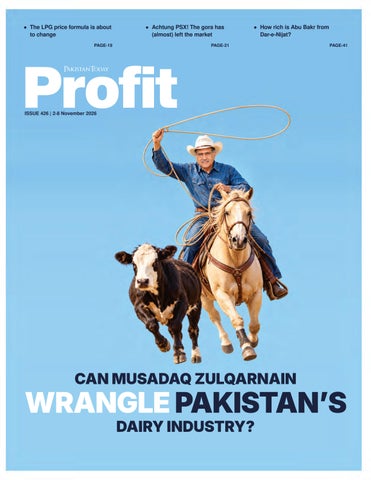
CAN MUSADAQ ZULQARNAIN
WRANGLE PAKISTANʼS DAIRY INDUSTRY?
ISSUE 426 · 2–8 NOVEMBER 2026
Inside this issue ON THE COVER
COVER STORY
CONSUMER GOODS
11 Can Musadaq Zulqarnain wrangle Pakistan’s dairy industry?
31 Colgate is buying what P&G left behind
ENERGY
19 The LPG price formula is about to change Pakistan plans to stop pricing its homeproduced LPG against Saudi Arabia’s benchmark and start pricing it against what the state-owned importer pays. Here is what the change means, and who gains from it CAPITAL MARKETS
Can Musadaq Zulqarnain wrangle Pakistan’s dairy industry? Interloop first entered the dairy business in 2013 and has quietly grown to become one of its largest single players. Now, it is betting on vertical integration to turn Pakistan’s milk obsession into a high-end supply chain for exportable dairy products.
Page 11
21 Achtung PSX! The gora has (almost) left the market The foreign stake ownership in the local market has fallen to very low levels. There are no incentives for them to come back TELECOM
25 Telecard keeps outliving its own products Payphones, wireless landlines and international calls each carried Telecard for a few years before the market moved on. Its latest results show the company it has become, a holding company whose growth now sits in its subsidiary.
Procter & Gamble’s exit from Pakistan left a 58-acre factory at Port Qasim without an owner. Colgate-Palmolive, sitting on Rs31.6 billion in cash and investments and running its own plants at 85% of capacity, has signed to buy it. CAPITAL MARKETS
34 How Vitol secretly bought Hascol shares and (sort of) got away with it Vitol crossed 30% of Hascol Petroleum in January 2020 by buying the founder’s shares at less than half the market price, and offered the other shareholders nothing. Six years later, the SECP has fined it Rs800,000. CULTURE
41 How rich is Abu Bakr from Dar e Nijat? Umera Ahmad’s latest wildly popular drama explores themes of morality, gender, and marriage. Typical stuff. But under the surface there is tension hinging on capital and upwards social mobility. Here’s what the drama tells us about class, social mobility through education, and Pakistan’s rural rich. SATIRE
Profit Publishing Editor Babar Nizami / Managing Editor Farooq Tirmizi / Senior Editor Abdullah Niazi / Business Reporters Taimoor Hassan, Usama Liaqat, Zain Naeem, Shahnawaz Ali, Ghulam Abbas, Ahmad Ahmadani, Aziz Buneri / Sub-Editors Saddam Hussain, Abdul Hameed / Video Producer Adnan Maqsood / Director Marketing Muddasir Alam / Regional Heads of Marketing Agha Anwer (Khi), Kamal Rizvi (Lhe), Malik Israr (Isb) / GM Special Projects Zulfiqar Butt / Manager Subscriptions Irfan Farooq
OPINION
29 The State’s clock, the farmer’s bill
46 Startup wanting to build “the Uber but for Financial Investment” doesn’t yet know it will be “the Airlift, but without even the initial promise”
Pakistan’s #1 business magazine, your go-to source for business, economic and financial news · profit@pakistantoday.com.pk
Contents
7
COVER STORY
Can Musadaq Zulqarnain wrangle Pakistan’s dairy industry? Interloop first entered the dairy business in 2013 and has quietly grown to become one of its largest single players. Now, it is betting on vertical integration to turn Pakistan’s milk obsession into a high-end supply chain for exportable dairy products.
BY ABDULLAH NIAZI
I
t is hard to imagine Musadaq Zulqarnain in the mould of a cowboy. But what he is attempting in Pakistan’s dairy sector is undeniably cowboy-esque. The UET trained mechanical engineer who made his fortune selling socks to global brands like Nike, Adidas, H&M and Puma to name a few recently announced his conglomerate, Interloop Holdings, has partnered with the Turkish dairy giant Rella Gida to set up a $55 million dairy processing plant in Faisalabad that will produce a range of cheeses and butter, as well as WPC80, which is the basic ingredient used to manufacture protein powder. The project, which is part of a small but growing ‘success portfolio’ that the SIFC has laid claim to, marks the first time a Pakistani group is laying dedicated groundwork to turn the country’s milk obsession into a vertically integrated, high-end, supply chain for exportable, dairy products. In conversation with Profit, he is candid about his goals. “Our long-term ambition is to establish the Interloop Group as a significant player in Pakistan’s dairy industry, particularly in the value-added dairy products segment. Vertical integration is an important part of this strategy,” he says. “Over the next two to three years, we aspire to enter the consumer retail market with our own brand, offering a range of high-quality dairy products.” The strategy is similar to what makes (or at least used to make) Pakistan’s textile industry tick — end-to-end supply chain guarantees. In textiles you have cotton coming in from the fields and ginners, which is turned into thread, spun and woven into cloth, dyed and stitched into all manner of value added products ranging from bedsheets and hosiery to t-shirts and denim products. Pakistan’s cotton might have been decimated and the energy-intensive spinning part of the textile supply chain crippled by expensive power, but the dairy industry is alive and kicking. Pakistan is the world’s third largest milk producing country at 60 billion litres a year. The idea is that if you can turn that milk into high-end cheese, butter, and whey you can sell it to the world. But to make it work, Interloop will have to ensure supply from a dairy industry that is as wide as it is disparate. Can the textile giant wrangle the industry and roundup the herd?
Not new to the business The Interloop Group might be better known 12
Musadiq Zulqarnain (right most) in a press photo for the announcement of the new dairy processing plant at Faisalabad. The plant has been made in partnership with Turkish company Rella Gida.
for its textile business, but it has been quietly diversifying its portfolio into sectors like dairy. The group first stepped into the business in 2013 with a herd of 1200 heifers established under a company called Interloop Dairies. Over the years this has grown into one of the largest corporate dairy farms in Pakistan with a herd of over 10,000 animals. For context, Anhaar has a herd of 4,000 cows, the Tareens have a herd of 3,500, and Nishat has a herd of 6,500. Unlike Anhaar, which has its own consumer retail presence and Nishat which tried to launch its own consumer retail brand, Interloop Dairies has remained focused on providing milk to large market players. For many years Interloop had a principal supply agreement with FrieslandCampina, the MNC that runs Olpers. A few months ago, they changed this primary supply arrangement to Fauji Foods. Interloop Dairies sells 80% of its 50 million litre annual production to Fauji. The remaining product is sold to a number of customers including a company called IRC Dairy Products. This is a separate subsidiary of the Interloop Group which has dealings with Interloop Dairies but operates independently. “IRC Dairy Products sources milk from several corporate dairy farms, with Interloop Dairies currently accounting for approximately 10–15% of its total milk procurement,”
explains Musadaq Zulqarnain. “While the two companies maintain a commercial supply relationship, IRC Dairy Products is not dependent on Interloop Dairies for its milk requirements. Both companies independently manage their procurement and sales arrangements based on commercial considerations.” IRC Dairy Product has existed since 2019. It has a 7200 ton production capacity and has been providing dairy products directly to businesses. Their customers include Dominoes, Kababjees, Layers, Cheezious, and Papa Johns among many other high volume buyers. Their Mozzarella cheese is particularly vital to the fast food industry while their desi ghee and butter are also big sellers. The introduction of the new plant in Faisalabad is essentially an expansion of IRC Dairy Product. According to Musadaq Zulqarnain, the plant is being opened as the first phase of a company called “IL Foods” which is a wholly owned subsidiary of IRC Dairy Products. “As Interloop Holdings holds a 60% equity stake in IRC Dairy Products, it also has an indirect 60% ownership interest in IL Foods. The projected annual milk processing capacity of 180 million litres represents the combined capacity of IRC Dairy Products and IL Foods in Pakistan. It does not include the processing capacity of Rella Gida in Turkey.” Cover story
At this point, it is helpful to understand the corporate structure of the Interloop Group. The main business that Musadaq Zulqarnain kicked off in 1992 is what is today the publicly listed company Interloop Limited. The hosiery company has a market capitalisation of over Rs 134 billion but the rest of the group’s companies are housed under a holding company. Interloop Holdings does not have a direct stake in Interloop Limited, but it does have at least six subsidiaries which include Internloop Dairies, IRC Dairy Product, PrintKraft, and Shifa International Hospital in Faisalabad among others. So the new plant under IL Foods is a subsidiary of a subsidiary of the holding company. But within these numbers there are logistical problems. Interloop Dairies has an annual capacity of 50 million litres. Of this, it sells 40 million litres to Fauji Food. Even if it sold all of its remaining milk to IRC Dairy and IL Foods, that would only account for 10 million litres in a production capacity that can handle 180 million litres. While Musadaq Zulqarnain mentioned earlier that IRC Dairy Products sources only about 15% of their milk from Interloop Dairies, the sudden increase in capacity will require more milk. There is no shortage of that in Pakistan, but on such a large scale ensuring supply is vital, particularly to a business hoping to expand into exports. “Pakistan has su cient milk availability to support our planned expansion, and we do not anticipate any significant constraints in sourcing the additional milk required,” Musadaq Zulqarnain tells Profit. “Nevertheless, to strengthen supply chain integration, ensure consistent quality and availability, and maintain a balanced mix of captive and third-party milk procurement, the Group plans to expand Interloop Dairies in two phases, eventually increasing its annual milk production capacity from the current 50 million litres to 100 million litres.” That, of course, will still leave around 80 million litres of milk to source. And while that won’t be a problem, it is worth seeing just who in Pakistan makes this possible.
The Gawala’s dominance Part of the reason Interloop’s bet makes sense is how much milk Pakistan produces. We’ve already mentioned it is the third largest milk producer in the world, but according to the FAO Pakistan ranks 101 on the world’s largest cheese exporters and 150 on the world’s largest cheese importers list. Pakistanis on Cover story
Despite the presence of multinational companies and a number of high-end corporate dairy farms, subsistence and small scale dairy farms in peri-urban areas continue to provide the majority of milk to the average Pakistani table.
average, despite the many pizza places in Urban centres, don’t have the largest appetite for cheese — especially at home. But the fact that cheap milk is available makes cheese and other dairy products a potentially high-value product. Much of this has to do with how Pakistan’s dairy industry is structured. There are essentially three kinds of milk products available on the market. The first is your typical fresh milk from the gawala. Small peri-urban farmers raise herds that are often only three animals and sell to distributors which then sell the milk fresh on a daily basis to homes and milk shops. The second kind is fresh ‘pasteurized’ packaged milk. This is sold by companies like Anhaar and Prema. Pasteurized milk is usually sold by companies with large herds that use machines to milk their cows, heat them at a low temperature, package them, and sell them in retail stores. Anhaar, which is owned by the Sharif family, has a herd of 4000 cows for example. This particular product while processed is still fresh. It needs to be refrigerated and has a (chilled) shelf life of a few days. Then there is Ultra High Temperature (UHT) Processed milk. This includes brands like Nestle’s Milkpak, Fauji’s Nurpur, and Friesland’s Olpers brand. Milk that is UHT treated is heated at intense temperatures in
short bursts, which kills microorganisms before being quickly cooled. The milk is then packaged in an airtight way, giving it a much longer shelf life and no need for refrigeration before the milk is opened. These large companies buy this milk from large corporate farms and small farmers across the country. It is the same arrangement under which Interloop Dairies sells to Fauji Foods. And while these corporate farms play a big role, much of the milk produced in Pakistan comes from small farmers. We do not have the exact numbers for this unfortunately. The last time an agricultural census took place in Pakistan was 2006, so the latest federal data is more than two decades old. What we do have, however, is a census conducted by the Punjab government in 2016. While even this data is dated at this point, it gives us a clearer picture of how things have developed. This provincial livestock census reported that a whopping 70% of the milk producers in Pakistan are subsistence based, compared to a miniscule 0.5% of large peri-urban commercial milk producers. This means most of the milk produced in Pakistan comes from small farmers with herds of 5-15 animals. These farmers sell to shops, households, as well as large milk producers. Nestle, for example, does not just buy from a 13
14
Cover story
few corporate farms it supplements supply with milk from 190,000 dairy farmers in Sindh and Punjab. Olpers does the same, sourcing milk from local farmers before transporting it to their facilities in Sahiwal in Punjab and Sukkur in Sindh. Meanwhile the large farms are often run by politically influential families since the largescale business involves imports (both of animals and bull semen) from places like Australia, and significant investment. It is also a business that makes sense for the landed elite, who have the space and capital to invest in the infrastructure for a large-scale farm including machines, breeding facilities, and veterinary costs. In South Punjab, for example, one of the largest dairy farms is owned by Jahangir Tareen with a herd of nearly 2800 animals in Rahim Yar Khan. Prema Milk, the original pasteurized packaged milk brand that launched in 2008, is owned by the Chauhdry family of Gujrat. Prema in particular prides itself for only using pure Australian Cow’s milk. Similarly the brand Anhaar and its herd of 4000 animals is owned by the Sharif family.
Why big farms should process Looking at Pakistan's milk sector closely presents a pretty clear picture. Numerous small dairy farmers along with a few influential large scale dairy farms produce milk that they sell both to companies like Nestle and Friesland and to local communities. There is no reliable breakdown of the entire volume of sales of these products, but we can make some safe assumptions. But what we do know is how trends are changing within the market. A poll by Gallup Pakistan found that an overwhelming majority of Pakistanis (84%) reported using fresh milk in their homes. Only about 10% used packaged milk, while 5% of households used both fresh and packaged milk. Most of the households that used packaged milk were in urban areas, where the usage of packaged milk was nearly double what it was in rural areas. What matters most is that these numbers have changed in recent years. As early as 2019, according to a Gallup poll that year, the number of households using fresh milk only accounted for 62%. Only 8% of households used just packaged milk, but overall 30% of households used both packaged and fresh milk. This means the market has shrunk significantly. A big part of this is the government’s imposition of additional tax on packaged milk, which has made it expensive during a Cover story
Glorified by mass media, the American Cowboy was menial labour in the late 19th Century. Cattle populations in the rural midwest exploded after the 1850s, leading to high consumption of beef. But without modern refrigeration the animals had to be transported to large cities like New York and Chicago to be slaughtered. Cowboys would lead herds across the midwestern plains to the nearest railroad town to be transported to the cities. It was the smallest unit of labour collecting a wide, disparate, natural resource in an industrial story with timeless lessons.
high inflation period. According to one senior executive of the milk industry, their sales fell by around 40% following the imposition of 18% GST. Loose milk, sold in cash from shops and directly by gawalas, is cheaper because collecting tax on it is impossible.
Gallup’s poll as well. What does that leave us with? Pakistan’s milk obsessed society is being catered to by the Gawala. And if the decline of packaged milk continues, corporate dairy farms will have a major incentive to begin selling to dairy processing companies, or even set up their own. That is the bet Interloop is placing.
What exactly will Interloop do?
Packaged milk is on the dip.
It is a fact that the industry is deeply concerned about. In an interview with Dawn, Managing Director of Tetra Pak Pakistan Limited Awais Bin Nasim said that the penetration of packaged milk is only 3%. If accurate, this is significantly less than what was expected. Back in 2012, this number had gone up to nearly 8%, if it has gone down it means there is significantly less packaged milk being consumed, which would be in line with
For Musadaq Zulqarnain the eventual goal is to establish Interloop as a major end-to-end player in Pakistan’s dairy industry. In conversation with Profit, he said that in the near term their focus will remain on the businessto-business (B2B) segment, while developing export markets for value-added dairy products. But he already has his eyes set on the consumer retail market. “Yes, our longterm ambition is to establish the Interloop Group as a significant player in Pakistan’s dairy industry, particularly in the value-added dairy products segment,” he says. There have actually been some very interesting changes on the retail end of the packaged milk industry. For starters, Olpers is now the market leader ahead of Milkpak. In total, according to a Euromonitor report, packaged milk accounted for sales worth Rs 521 billion, including powdered milk and flavoured milk 15
Musadaq Zulqarnain Chairman and CEO, Interloop Holdings
2023-24. Plain milk provided revenues of Rs 384.4 billion. Out of the overall sales, Friesland has a market share of 36.7% compared to Nestle’s 35.4%. When it comes to plain milk, Olpers has a clear edge over Milkpak with a 34% share compared to Milkpak’s 27%. There is space to enter the market as a retail player, but perhaps not one focusing on just packaged milk. As we have gone to great pains to explain above, packaged milk is on the decline. To make a retail level brand work, it would have to be a reliable product that can compete on price and have everything from regular milk to powdered milk, butter, ghee, cheese, greek yogurt, and all kinds of other products that customers can rely on. The idea would be to displace the incumbents — not capture a share of a market that is not being catered to. It would also mean Interloop’s brand would be competing with Nurpur, which gets its supply from Interloop Dairies. That in itself is an interesting position to 16
watch out for. But the main bet they have going for now is B2B exports. As Musadaq Zulqarnain explains, the entire point of the new IL Food Plant is to have a more diversified product portfolio compared to IRC Dairy Products. “In addition to mozzarella cheese, butter and desi ghee, which are already produced by IRC Dairy Products, IL Foods will also manufacture cheddar cheese, WPC80 (Whey Protein Concentrate containing 80% protein), and Lactose. WPC80 is a higher-value, proteinrich product compared to the conventional whey powder currently produced by IRC Dairy Products,” he says. “In the second phase, we plan to further diversify into a wider range of cheese-based and other value-added dairy products. This expansion will also lay the foundation for our eventual entry into the direct-to-consumer market under our own brand, complementing our existing business-to-business operations.”
It will also be worth watching how quickly the project progresses. The project was facing a number of procedural hurdles at the Board of Investment level. “SIFC has facilitated removal of procedural hurdles at BOI level. We hope their support and patronage will help complete the project on time,” says Musadaq Zulqarnain. The SIFC was also quick to acknowledge the project, describing it as “A remarkable milestone for Pakistan’s dairy sector!” Interloop has spent the past 13 years building up its dairy business. It has one of the largest herds in Pakistan and is supplying processed dairy products to a number of prominent businesses. Their new facility in Faisalabad sets them up to go beyond being a pillar of the industry, and towards being a major challenger for the top slot. With the right backing and investment, Interloop might be able to replicate with cheese what it first achieved with socks. Cover story
ENERGY
The LPG price formula is about to change Pakistan plans to stop pricing its home-produced LPG against Saudi Arabia’s benchmark and start pricing it against what the state-owned importer pays. Here is what the change means, and who gains from it
M
ost urban domestic consumers remain oblivious to the scale of the shortage of LPG going on in the market. And while it is good that the reliance on LPG has reduced over time, even today millions of households, especially in the north and in areas without piped gas, depend upon the steel cylinder for their winter cooking and heat. For October, the Oil and Gas Regulatory Authority (OGRA) fixed liquefied petroleum gas (LPG) at Rs279.34 per kg, or Rs3,296.23 for a standard 11.8kg domestic cylinder. In reality, almost nobody pays that much. A quick market survey of major cities like Islamabad and Lahore reveals that LPG price per kg for a 45 kg cylinder ranges from Rs 480 to Rs 550. This week the petroleum minister, Ali Pervaiz Malik, told the National Assembly that the o�cial Rs280 rate applies only to locally produced LPG, and that no pricing policy covers imported LPG. The legislator who raised this issue told the assembly that LPG was selling for Rs700-800 per kg in remote and northern areas, more than double the notified rate. Since the government cannot do much about the procurement of LNG due to the current situation in the middle east. As a solution, the government now wants to change how the o�cial price is set. From November 1st, according to The News, the ceiling on what domestic producers may charge will be tied to the landed cost of LPG imported by Pakistan State Oil (PSO), replacing the Saudi Aramco Contract Price (SACP). Industry representatives estimate producer prices could rise by as much as 40%, pushing retail prices up 20-25%. The minister has not yet formally confirmed the plan. To see why the change matters, it helps to Energy
understand how the current formula works and why, after nearly two decades, it no longer reflects the market it is meant to regulate.
How the old formula works Pakistan’s LPG price has long been pegged to a single number set in Dhahran. Every month Saudi Aramco publishes contract prices for propane and butane, the two gases that make up LPG. These are free-on-board (FOB) prices, meaning the price of the gas at the Saudi loading port, before shipping. OGRA’s method dates back to an Economic Coordination Committee decision. It blends the two prices in a fixed ratio of 40% propane to 60% butane, then converts the result into rupees at the average exchange rate.
The formula is the same today. OGRA states that the producer price is linked to the Saudi contract price and the dollar exchange rate under the federal government’s legal framework. The margins are set at Rs17,000 for marketing, Rs10,000 for distribution and Rs8,000 for transport, with 18% GST added on top. The formula’s strength is its transparency. Anyone can check it against Aramco’s monthly announcement. Its weakness is built into the benchmark. Because the price is FOB, a local producer is paid as if its gas had been loaded in Saudi Arabia and never shipped. Freight, insurance, supplier premiums, port charges and losses, all costs for anyone importing LPG, are excluded. When the Saudi price swings, the formula 19
passes the swing straight through. In April 2026, the contract price jumped 44% in a single month, and the cylinder price rose by Rs924 to Rs3,588.60. In July, after a 25.6% fall in the Saudi price, OGRA cut the cylinder by almost Rs795. The market, however, hardly ever absorbs such a loss completely.
Two markets under one price The formula’s real problem is what it leaves room for. Locally produced LPG supplies only about 35% of the market. The minister himself has put the figure at between 30% and 40%. The rest is imported, and about 70% of imports have arrived overland, mainly across the Iranian border. Border closures this year have choked that route. The government is now looking for sea shipments from Oman and Saudi Arabia. The result is e�ectively two markets sharing one notified price. Domestic producers must sell at a ceiling based on Saudi FOB prices. Importers, who supply nearly two-thirds of the gas, have no ceiling and price at whatever the market will bear. Since the two products cannot be told apart once they are in a cylinder, the gas reaching households is sold at the importers’ price. The minister acknowledged as much: because local and imported LPG cannot be treated di�erently in the market, OGRA enforcement could create further complications. Even in calmer months the gap has been wide. Last December, retail LPG sold for Rs300315 per kg, almost 50% above the notified Rs209. This points to the most important question about the old formula: who has been capturing the di�erence? It has not been producers, who are paid the regulated price. It has not been consumers who pay the market price. Much of it has gone to the chain between them, the marketing companies, distributors and retailers who buy gas at the regulated price and sell it at import parity.
How the new formula would work The proposal changes only the base price at the top of the table. The Saudi FOB benchmark would be replaced by PSO’s landed cost, i.e, what the state oil company actually pays to bring an imported cargo to Pakistan, including freight, premiums, insurance and port costs. Local producers could charge up to that level. 20
The arithmetic shows why the change is significant. If, as industry estimates suggest, the base price rises by 40%, it would go from about Rs196,976 to about Rs275,766 per tonne. Keep the excise, levy, GST and margins exactly as they are, and the maximum consumer price rises from Rs279 to roughly Rs372 per kg. That would take a domestic cylinder from Rs3,296 to around Rs4,390, an increase of about a third in the o�cial price. What households actually pay may rise by less, because most of them are already paying import-parity prices on the open market. That is probably how the industry arrives at its estimate of a 20-25% retail increase. In e�ect, the reform would bring the o�cial price closer to the price people already pay, and transfer the gap from distributors to producers. It would also raise the government’s GST take, since tax is charged as a percentage of a higher base. There is a reasonable case for this. A price set below the cost of imports discourages domestic production and encourages diversion, in a country that should want more LPG from its own fields and refineries, not less. Aligning the o�cial ceiling with real costs also makes enforcement less impossible.
The objections Industry representatives objected on several grounds, and their concerns deserve to be taken seriously. The first is the choice of benchmark. The Saudi contract price is set in an international market by a seller with no stake in Pakistan’s domestic pricing. PSO’s landed cost reflects the procurement decisions of a single stateowned buyer. If PSO buys a cargo at a poor price, or pays a high premium in a tight month, that cost becomes the legal ceiling for every domestic producer. A benchmark that rewards high import costs gives no incentive to keep them low. The second is competition. Private importers that can source LPG more cheaply than PSO would find the regulated ceiling sitting above their costs. That turns a cap into a price floor in practice. Stakeholders have already asked how the new formula would account for importers able to land gas below PSO’s cost. The third is governance. Industry representatives raised concerns about possible overinvoicing of imported LPG, referring to earlier allegations involving imports by Sui Southern Gas Company. A formula based on the
invoice of a state-owned importer is only as reliable as that invoice, and the person generating it. The legality of the mechanism has also been questioned, and the minister told a parliamentary committee in July that an LPG pricing dispute was already before the courts. The industry’s own proposal is full deregulation. Let buyers and sellers negotiate, and let competition set the price. That is consistent in principle, and is already happening in Pakistan right now, even if the minister would deny it. It would also expose households to the full force of supply shocks of the kind this year’s border closures produced, in a market where the regulator has struggled to enforce even the current price.
What to watch The timing is di�cult. Winter demand can rise from around 4,000-4,500 tonnes a day to 6,000-7,000 tonnes, and the overland import route is still disrupted. A higher o�cial price may bring more domestic LPG to market and reduce the gap that distributors have been pocketing. It may also give o�cial approval to prices households are already struggling to pay. Three questions will decide whether the new formula works better than the old one. First, will PSO’s landed cost be published each month with its components, freight, premium and exchange rate, as clearly as Aramco’s prices are now? Second, will private importers’ cheaper cargoes be reflected in the benchmark, or will they be priced out by it? And third, will the minister’s promised support for low-income households arrive in time to cushion the increase? Without clear answers, the government risks replacing a formula that was transparent but outdated with one that is more realistic but harder to verify.
Energy
CAPITAL MARKETS
Achtung PSX! The gora has (almost) left the market The foreign stake ownership in the local market has fallen to very low levels. There are no incentives for them to come back BY ZAIN NAEEM
T
he Pakistan Stock Exchange (PSX) has been hit with one battering blow after another. From the market analysts predicted to cross the 200,000 points mark, it touched a high of 189,000 before falling to 146,500 in March of 2026. The War in Hormuz certainly did not help the market sentiment as the index remained range bound. With the uncertainty hanging over the market, the index was weighed down as investors could not decide on the direction the market would take. As the earning season started, the index shrugged off much of the profits being recorded by banks, refineries and the cement sector. The last blow came on Monday when the State Bank finally gave in to the inflationary pressures and decided to increase the policy rate to 12%. In a market where many alarm bells were already ringing, a very important one was being ignored. It should have been the first one that should have panicked the market. Before even the first missile was launched at the end of February 2026, the KSE-100 index was already falling. The market had touched its high of 190,000 on the 23rd of January and by the 28th of February, the index had already fallen to 168,000 points. The correction of 17% should be considered a normal phenomenon for a rallying market, however, it is the selling that was seen in the background which should have been concerning. The gora had sold 0.32% of their stake in the local stock exchange for the month of January compared to the month before. With no meaningful structural changes taking place in the economy or the market, this should have been a warning sign in itself. This is not the worst selling pressure that the KSE-100 index has seen by a long way. The investment had seen a month-on-month drop of 0.66% in Capital markets
July of 2008, however, that was the time when the market freeze and the Global Financial Crisis were ongoing. With a further fall of 0.25% in March, a pattern had started to emerge. The foreign investor was leaving the market. Take a step back on the total ownership at the start of 2026 and it is clear that the foreign ownership decreased from 3.89% to 2.9% by October of 2026. Even more worrying is the fact that foreign participation had hit a high of 7.65% in January of 2017 which has fallen by almost three fold since then. The most worrying part about this? The current levels are dangerously close to the levels that were seen at the tail end of the 90s. The difference between now and then? Pakistan was suffering through economic sanctions of 1998 and the terrorist attacks took place in 2001. The current levels almost match the lowest foreign ownership that the stock exchange has seen ever since foreigners were allowed to invest in the stock market. With the uncertainty of war and structural threats to Pakistan’s economy, there are few signs that the trend is going to reverse any time soon.
The gora and the market The relationship between the stock market and the foreign investor has been one where the latter has been given a legendary almost mythical status. In a world filled with jargon, the gora is used as a shorthand to represent foreign investors in the form of individuals and corporates who invest in the Karachi Stock Exchange. This investor has deep pockets, a large pool of resources to invest from and superior research that can never be replicated at the local level. The exalted status means that “they” have the ability to validate
or abandon a stock pick at a whim. This gives them the power to sway the market direction based on what sector they are investing in. In a market characterized by low free float and large market orders, the foreigners had the power to move prices and volumes. Over time, this started to represent a cultural metaphor rather than actual representation of an investor. Due to the diversified characteristics of different types of foreign investors, they could be guided by different investment mandates, goals, strategies, horizons and risk limits. The foreign investor went from being a monolith to a pluralistic set of goals and ambitions. But the memon-centric market stuck to the term they had come up with and it is still widely used today. The foreigner was not just seen in isolation. Their investment was considered a fluid and alive organism that could have a deep impact on the market itself. A strong inflow into the market was seen as not just a trade. It was a validation that the country, the economy and the stock had passed an external test. The company had shown that its earnings were credible and sustainable, the regulatory framework could be adhered to and the investment could be expected to yield a return. The other stakeholders in the capital markets sat up and gave attention to these trades and shaped their own investment decisions based on this single trade. In terms of market impact, the trade was going to have ripple effects as local investors decided to jump in as well. For investors who had little knowledge or ability to value a stock, this proved to be the deciding factor allowing them to make the investment. This was evident to see in the 2000s when the two sides of the market were able to grow on the performance of the other side. In 2007, by some estimates, net equity foreign 21
22
Capital markets
portfolio investment touched $861.5 million with foreigners owning a quarter of the free float available in the market. By 2011, this had increased to 33%. The Pakistani stock market is made up of a handful of banks, fertilizer, energy and cement companies which make up a large portion of the index. With nearly a third of the free float being owned by foreigners, it is a seal of approval from the foreigner. As foreigners invested more, the local participants raised their stake. This built the resilience and the capital formation of the local bourse which then saw more foreign investment being poured in. Before the Global Financial Crisis struck in 2008, the foreign stake in the local market touched a high of 7.25%. Recent trend in the investment shows that the foreign investment has steadily decreased and is now at levels it saw when formal investment was invited by the country back in the 1990s.
The KSE and the foreign investment To comprehend the phenomenon taking place, there is a need to understand the schism and inflection point that took place in the market. Before February of 1991, investment in the market was restricted to a certain extent and foreign share investment had to be approved on a case-by-case basis. After February 1991, the equity markets were liberalized and foreign access was given which allowed investors to carry out trading more seamlessly. Due to this, it is hard to pin down or compare the investments between these two periods. Foreign capital in the listed equity market of Pakistan cannot be represented by a single, clean statistic. Depending on which era is considered, these investments can represent the value of non-resident holdings, net purchase of shares carried out in a period or foreign share of the market’s free float owned. With the additional complication of the rupee depreciating, it can mean that the value of the equity market changes while no material change takes place in the number of shares held. For the sake of this story, foreign stake on the domestic stock market will be considered which measures the percentage of foreign investment in the equity market on a monthly basis. The relationship between foreign investment and the equity market dates back to the partition itself in 1947 when the Karachi Stock Exchange was established and later incorporated in 1949. At this point in time, the market was small and locally oriented with Capital markets
only five listed companies on it. The period from 1950 to 1970 was one that saw rapid expansion in the listings taking place. The 1960s proved to be a golden age of industrialization for the country with an industrial drive, import substitution and an average annual GDP growth of 6.8% through the decade. This led to companies being created earning profits and listings followed suit. As the economy was growing, the government looked to prioritize foreign exchange and control foreign exchange flows. This meant that even the local investor base was narrow and there is a lack of data that can be derived for foreign shareholding for this period. Then came Bhutto and his disastrous nationalization. The breakup of the country in 1971, political instability and the nationalisation meant that the risk environment of the country got elevated for private companies and their shareholders. For a foreign investor, it was important to understand how the future prospects of the new country would impact their investment. With these shocks, foreign investment was going to stay underwhelming until economic rules, structural reforms and the regulatory environment took time to settle down. The 1980s and 90s proved to be better for private enterprises with the economy being privatized and foreign investment being encouraged. In 1992, non residents were permitted to trade through Special Convertible Rupee Accounts (SCRAs). The aim of these accounts is to allow foreign funds to be converted into rupees which can then be used to purchase listed shares on the market. This was the more formalized and proper route that
was set up for foreign investments which could be routed back through a proper channel. By 1994, current account convertibility was also allowed which allowed a wider market access to foreign portfolio investment. In order to compare apples to apples, the data published by State Bank after February 1991 in relation to the SCRAs will be used to keep the comparison as consistent as possible. The change in the trading rules meant that Karachi Stock Exchange was connected to the emerging market investment cycle that was coming into existence during this period. A foreign fund could compare Pakistani companies to their counterparts in other countries and then shift their investment and exposure based on their valuations and risk appetite. This was also the time when the KSE-100 index was launched in November 1991 becoming the national benchmark for the investors. As time passed, electronic settlement, Central Depository Company coming into existence and the creation of Securities and Exchange Commission of Pakistan (SECP) helped the country become investable and safe. With the stability in the markets came the boom in foreign investments as well. In February 1991, foreign stake started off at 0.18% and steadily increased to 5.85% by November 1994. This boom proved to be short lived as political instability, macroeconomic imbalance and a little case of economic sanctions meant that the first boom was followed by the first trough as well. The nuclear tests carried out led to market disruption and sanctions being imposed which dented the investor confidence massively. The index itself fell by 46% 23
in 1998 as the capital markets started to price in the elevated political and country risk attached. The decade showed that money could be attracted by opening the doors but making it stay was the harder task. As the new millennium was rung in, the foreign stake saw a low of 2.35% which persisted due to the terrorist attacks of 2001. The Musharraf era was going to bring in a new wave of economic growth, privatisation and financial sector expansion into the economy. This attracted the foreign investor to jump back in as Pakistan’s equity market started to see increased liquidity and investment. By the end of the decade, the State Bank noted that net foreign portfolio investment into equities had reached a historic peak of $861.5 million in 2007. Foreign ownership was at 7.25% in April of 2007. By the mid of 2008, foreign portfolio holdings had jumped to $4.8 billion which meant that foreigners held around a quarter of the free float market capitalization listed. The Global Financial Crisis of 2008 exposed the vulnerability of this investment system. Foreigners withdrew their investment from the market as risk aversion increased. Coupled with the political turmoil at the domestic level and the market floor being put into place, investor confidence suffered. This was the first time in the history of capital markets in the world that the market was virtually suspended. This taught foreign investors a key lesson. A market collapse could not only prove to be a loss on investment. It could prove to be a liquidity constraint where they are not able to sell and exit their position. The subsequent efforts to restore trading and inclusion in MSCI’s Frontier Markets index in 2009 was supposed to restart inflows, however, the market was still scarred from the recent past. By March of 2009, the foreign participation had fallen to 4.05%. The fruits of index classification were still going to bring inflows into the country which was seen from 2009 to 2017. Pakistan’s addition into the MSCI Frontier Markets index brought benchmark tracking and frontier market funds into the shareholder registers of the listed companies. The end of this rally was seen in May of 2017 when the index was touching its all time high of 53,124 points. In terms of the structural changes, the three stock exchanges had been merged into the Pakistan Stock Exchange in January of 2016 with improvements being made to electronic trading, custody of shares and clearing 24
infrastructure. The improved e ciency of the market saw the foreign ownership finally touch an all time high of 7.65% with investment valued around $8.3 billion and 28.77% of the free float being owned by foreigners. The period after 2018 has been characterized by a persistent slide which has not been reversed even 9 years later. Between 2016 and 2022, the net foreign outflows totalled to around $2.27 billion. The reason for this can be attributed to anything from political uncertainty, balance of payment stress, repeated IMF negotiations, rupee depreciation, high inflation and high interest rates. All these factors have an impact on the valuation of the companies that are being carried out by the investors and a change in even one can change the outlook of the stock or company. Here, they were changing the outlook of the whole market for the foreign investor. This also made the country less attractive as it had small weightage in international benchmarks and global funds could find similar exposures elsewhere with greater liquidity. With a drop from MSCI Frontier Markets index, the investors had to rebalance their portfolios according to their index rules. This was not helped by Covid and the range bound index which failed to stimulate the foreigner. If the index was attractive in 2022, the rally of 2023 and 2024 should have brought some shine back. A stand by agreement with IMF, a stable exchange rate, contained current account pressure and a fall in inflation allowed the index to rally and cross the high it had seen back in 2017. There was a timid response of the foreigner to these macroeconomic developments. The final slide started in September of 2024 when FTSE Russell reclassified Pakistan from Secondary Emerging to Frontier Market status further reducing its position in relevant benchmark portfolios. At this point, foreign stake stood at 4.4%. This started a period of dichotomy that was seen in the stock exchange. Foreigners started to sell while domestic mutual funds became net buyers cushioning much of this foreign selling. The exchange of shares from one hand to another was seen as being routine as the index kept edging higher and higher. This brings us to present day where in the last two years, the foreign stake has steadily fallen from 4.4% to 2.9% from October 2024 to October 2026. While the index increased by 40%, the foreigner stayed at bay from the rally and kept liquidating their position throughout this period. The slide was so dramatic for this two year
period that when finally foreign investors became net buyers for the one month in between, it was seen as ground breaking news that was widely reported in the national media. In July 2026, foreign investors became net buyers for the month buying $34.4 worth of shares more than they sold. The current level of foreign stake stands at 2.9% which is the second lowest level that it has seen only being beaten by 2.35% that was seen after the nuclear sanctions and political instability of the late 90s. The concerning part is that this trend is still continuing downwards and the curve has not flattened as of yet. With the lack of incentives and valuations for investors to return, this might not be the bottom of the trough as of yet. There is no denying that the stock market can be seen as a zero sum game. One investor feels that the market is undervalued and is willing to buy while another feels that it is overvalued and is prepared to sell. Still, foreign investors are important to the market as they broaden the pool of risk capital in listed companies. Their investment also allows lower cost of future equity issuance and inject new liquidity into the market as well. It also helps the process of price discovery and adds to the GDP of the country. Foreign investors also add a layer of market discipline as they demand audited accounts, disclosures, evaluate the performance of the boards and protect the minority shareholders from exploitation. They also carry out their own research and compare different countries based on their risk profile and exposures. Lastly, in a small market like Pakistan, foreign capital acts to increase confidence in the domestic market which signals domestic and other foreign investors to enter the market as well. Any small movement in either direction is multiplied in the local market when they are carried out by foreigners as well. The recent drop is concerning as it shows that global funds are willing to invest when they are given the opportunity to do so. Even in the face of the Global Financial Crisis and the market floor of 2008, they were willing to hold the shares and actually increase their stake. The only time foreign participation fell to these levels was all the way back when Pakistan was suffering through economic sanctions. There is a need to stop this slide from reaching even lower levels in the future or it might be the last time Pakistan sees the coveted gora being mentioned in the hallowed halls of the capital markets. Capital markets
TELECOM
Telecard keeps outliving its own products Payphones, wireless landlines and international calls each carried Telecard for a few years before the market moved on. Its latest results show the company it has become, a holding company whose growth now sits in its subsidiary.
T
elecard Limited announced its results for the year ended June 30, 2026 on October 30. Consolidated revenue fell 11.9% to Rs9.86 billion. Profit after tax rose 35% to Rs373.9 million. The two numbers point in opposite directions, and the gap between them explains the company. Of that profit, only Rs167 million belongs to Telecard’s shareholders. The other Rs206.9 million belongs to the minority shareholders of its subsidiaries. Earnings per share came to 49 paisa. The board recommended no dividend, bonus shares or rights issue. On its own, without the subsidiaries, Telecard lost money. Standalone revenue fell
Telecom
11.2% to Rs1.78 billion, and the company posted a loss after tax of Rs83.6 million, against a profit of Rs65.6 million the year before. That is the company that gave Pakistan the card payphone. Its parent business is now less than a fifth of the group’s revenue. This is not a new story for Telecard. Three times before, the company has watched the product it was built on lose its market. To understand where it stands now, it helps to go back to the street corner.
The payphone years Telecard was incorporated on October 29,
1992, and began with a public payphone service. It sold shares to the public in 1995. The company came out of the Arfeen Group, founded by the late Sultan ul Arfeen, which also ran the mobile operator Instaphone. Its card-operated phones, on streets and in buildings, were meant to replace the public call ofÏce. It worked for as long as Pakistanis had no better option. That option was coming. In 2002, Telecard launched what it describes as Pakistan’s first wireless payphone service. In 2004 it bought licences to offer wireless local loop (WLL) telephony and long distance and international (LDI) calls. The same year it acquired Supernet, an internet 25
26
Telecom
and data company. In 2005 it launched GO CDMA, a WLL service for households. A WLL phone was a landline without the line. It used radio spectrum to connect a home phone to the network, which meant an operator could sell phone service without digging up streets. For a few years, it was the business. Profit reported in 2021 that WLL made up the bulk of Telecard’s revenue between 2004 and 2008, and that by 2004 it had largely displaced the payphone business.
The mobile phone arrives The WLL business ran straight into cheap mobile phones. Telecard’s standalone revenue was Rs1.65 billion in FY04. It rose to Rs2.56 billion in FY06 and then fell, to Rs2.15 billion in FY07 and Rs1.9 billion in FY08. The company lost Rs445 million in FY07 and Rs543 million in FY08. A cheap handset did everything a WLL phone did, and it worked outside the house. Coverage was another problem. “When cellular phones became cheap, WLL stopped making sense. It did not have a great coverage either,” a source told Profit in 2021. The WLL years also left a bill. Telecard still owed Rs1.59 billion of its initial spectrum fee in its 2017 accounts. The operators had asked the government for a moratorium in 2005, and the dispute went through the courts for years. Profit reported that after 2016 there was hardly any revenue left from WLL.
The international call The next lifeline was the LDI licence. Every call from the Gulf, Britain or the United States had to be terminated on a Pakistani network, and the LDI operators were paid for each minute. In FY09, Telecard’s standalone revenue nearly doubled to Rs3.79 billion. The directors’ report that year pointed to the international business as the part that would keep growing. It is the highest revenue in any year for which Telecard’s accounts are available. It did not last. In FY10 revenue was Rs2.44 billion, and the year’s profit of Rs698 million came from a Rs1.48 billion one-off gain on the sale of an intangible asset, not from operations. By FY12 revenue had fallen to Rs1.44 billion and the company made a gross loss. Two things happened to international Telecom
voice. The first was regulation. On October 1, 2012, under a government directive, the LDI operators set up the International Clearing House (ICH), which routed all incoming international trafÏc through PTCL. The Competition Commission of Pakistan (CCP) declared the arrangement illegal in 2013 and fined each operator 7.5% of its FY12 turnover. The Sindh High Court suspended that order. The second was a bill. The Pakistan Telecommunication Authority (PTA) demanded Rs4.46 billion from Telecard in Access Promotion Contribution for the Universal Service Fund, based on its international trafÏc up to September 2012. Telecard paid Rs1.99 billion under protest and went to court over the rest. Meanwhile, the calls themselves were moving to the internet. A family in Lahore did not need an international call to reach a son in Dubai once both had a smartphone and a data plan. Telecard’s directors were blunt about it. Its annual reports for FY16 and FY17 blamed falling revenue on the decline in international incoming trafÏc. Standalone revenue was Rs1.06 billion in FY15, Rs1 billion in FY16 and Rs987 million in FY17. The company lost Rs609 million in FY12, Rs457 million in FY13 and Rs91 million in FY17.
The cost of the debt The bad years were made worse by debt. Telecard had borrowed through term finance certificates (TFCs), listed bonds sold to investors. By FY09, financial charges had reached Rs581 million a year, against an operating profit of Rs693 million, according to the sixyear summary in the 2011 annual report. In FY10 they were Rs530 million. The company paid down part of the debt and restructured the rest. Its 2016 annual report said finance costs fell 69% that year because of repayments, lower rates and the restructuring of the TFCs. They were Rs50 million in FY16. In FY26, the parent’s finance costs were Rs59.9 million.
The subsidiary takes over While the parent shrank, Supernet grew. Supernet started as a data company. It connected bank headquarters to their branches, and corporations to each other, by satellite and radio before the internet was widespread.
According to a source quoted by Profit in 2021, it was the first to sell dial-up internet by the hour. From 2006 it sold satellite backhaul to mobile operators, carrying their trafÏc from remote towers. Supernet also built its own network for the satellite age. It launched satellite broadband in 2013 and a high-throughput service over medium earth orbit satellites in 2016, according to the company’s FY25 corporate briefing. In 2023 it bought a 20-year local loop licence of its own. That made Supernet a supplier to the industry that had killed its parent’s products. Profit reported in 2021 that Supernet’s revenue overtook Telecard’s in 2015. The numbers show it. In FY17, Telecard’s own revenue was Rs987 million. The group’s consolidated revenue was Rs2.84 billion. Rs205 million of the parent’s revenue that year was a fee Supernet paid to use Telecard’s infrastructure. Telecard itself turned to enterprise customers. Its FY17 directors’ report said its enterprise solutions business grew 15% and would be its focus. Today its own business is local loop voice and internet for companies, long distance voice, tower and infrastructure sharing, and value-added services, mostly for banks. Supernet kept adding lines. It started a cybersecurity business, SuperSecure, in 2018. It set up an ofÏce in the United Arab Emirates in 2019. It added power and IT infrastructure, call centre software and business applications. According to the company’s FY25 corporate briefing, non-connectivity business is now almost 36% of the group’s revenue. Group revenue rose from Rs3.38 billion in FY18 to Rs5.69 billion in FY23, then to Rs10.8 billion in FY24 and Rs11.19 billion in FY25.
Untangling the group The jump in FY24 came with a reorganisation. Supernet listed on the PSX’s Growth Enterprise Market (GEM) board in 2022, through a book-building process. Between 2023 and 2024, the group took control of Hallmark Company Limited. In FY24, Telecard sold a 51% stake in Supernet to Hallmark, booking other income of Rs464 million, according to BR Research. Hallmark was renamed Supernet Technologies in 2025. On February 24, 2026, the Sindh High Court sanctioned the merger of Supernet 27
Limited into Supernet Technologies, effective from January 1, 2025. Supernet Technologies, listed on the PSX main board, is now the group’s operating company. In June, Telecard’s board recommended investing up to Rs564 million in a planned rights issue by Supernet Technologies, at no more than Rs10 a share. The board sought shareholders’ approval at an extraordinary general meeting. In other words, the parent is putting cash into the subsidiary, not the other way round.
What the results say The FY26 numbers show the trade-off. Consolidated revenue fell by Rs1.33 billion. But cost of revenue fell faster, by Rs1.58 billion, and gross profit rose 10.2% to Rs2.69 billion. Gross margin improved from 21.9% to 27.3%. The group was selling less, but less of it was low-margin. 28
Operating profit was flat at Rs854 million. Allowances for bad debts rose to Rs246 million from Rs148 million. Finance costs fell to Rs100 million from Rs162 million. A levy of Rs260 million, against Rs112 million the year before, took a large share of pre-tax profit. The parent’s own numbers were weaker. Its gross margin rose to 40.3%, but an allowance of Rs121 million for expected credit losses, against Rs3.9 million a year earlier, wiped out its operating profit. Other income, which added Rs148 million in FY25, became a Rs26 million charge. Telecard has also asked for more time to file its accounts for the quarter to September 2026. Its annual general meeting is set for November 27 in Islamabad.
The licence question The bigger risk is not in the income statement.
Telecard’s LDI and local loop licences have come up for renewal. Profit reported in 2021 that the LDI licence was due to expire in 2024. The company told investors in its FY25 corporate briefing that both were tied up in long-running industry disputes before the courts, and that its services continue under court injunctions. So the businesses Telecard still runs itself depend on licences it is litigating, and the business that is growing belongs to a subsidiary it owns only in part. The stock market has priced that in. At Rs6.72 on October 30, Telecard was worth Rs2.28 billion, less than a quarter of one year’s group revenue. Its shares have fallen 38.5% in a year. Telecard has outlived payphones, wireless landlines and the international call. Each time, it found the next thing. This time, the next thing is Supernet, and Telecard is its shareholder rather than its operator. Telecom
OPINION
Mohsin Leghari
The State’s clock, the farmer’s bill
The writer is a former Senator and a former Irrigation and Finance Minister of Punjab. He is a senior water policy expert with UNDP Pakistan and a member of the Oxford Climate Leadership Research Centre.
I
n south Punjab, there are farmers with sugarcane standing in their fields and no certainty about when the mill will take it. Wheat seeds wait in godowns. Land must be prepared, labour hired and fertiliser purchased. The farmer is ready to move, but the decisions on which he depends are being made elsewhere. The farmer follows the calendar of his crop. The mill follows its financial calendar. The government follows an administrative one. Only one of them cannot postpone the consequences. Earlier this month, the state offered a demonstration of how quickly it can act when it wishes to. Following approval for sugar exports, the State Bank issued detailed instructions on October 2, and revised them on October 13. Mill-wise allocations were identified, banking arrangements specified and reporting obligations imposed. Every Friday, by four in the afternoon, banks handling the exports must report their transactions and shipments. The state knew what information it wanted, who had to provide it and when it had to arrive. That is how government machinery should work. Why, then, can the grower waiting to sell his cane not expect comparable certainty? The sugar industry’s concerns deserve to be taken into account as well. The Pakistan Sugar Mills Association says around 1.25 million tonnes of sugar could remain unsold when the new season begins. It seeks permission to export one million tonnes, warning that stocks have tied up working capital and may delay crushing. Mills purchase cane in a concentrated season and sell sugar throughout the entire year. They need finance. Excess stocks can make it harder to obtain. But consider the two sides of the same transaction. The mill has finished sugar in a warehouse and seeks help converting it into Opinion
Sugarcane being brought to a mill in South Punjab. Farmers with ready crops are in a hurry to sow the wheat for the Rabi season, but they are dependent on the mills which often don’t begin purchasing the crop until they have government permission to export processed sugar.
cash. The farmer has a standing crop and is waiting to turn a year’s work into money. One has an industry association, banks, ministries and export circulars working through its commercial di culties. The other may not know when his nearest mill will open its gate. He grows the crop and nurtures it. The mill controls the gate. For a farmer intending to sow wheat after early-harvested cane, the delay is not simply frustrating. He cannot prepare the field until the cane is removed. Punjab’s Agriculture Department has warned that wheat sown after November 20th can lose roughly 1% of yield for each day’s delay. The cost of a late crush can reappear months later as a smaller wheat harvest for the farmer and a higher import bill and roti price for the consumer. And a farmer need not be waiting to clear the same field to suffer. Even where wheat will be planted elsewhere, cane proceeds often finance seed, fertiliser, diesel and land preparation. The crop standing in the field may be valuable, but value cannot pay an input dealer until someone converts it into cash. A grower already indebted may have to
borrow again. The mill’s delay becomes the farmer’s interest bill. There is a further distinction. Delaying the purchase of standing cane is one thing. Delaying payment after the cane has been delivered is another. In the first case, the grower carries an unsold crop. In the second, the mill has taken the raw material and the grower has become, without choosing to, its creditor. When a mill borrows from a bank, it negotiates terms and pays interest. When the farmer finances the mill through an unpaid cane bill, he has negotiated no lending terms. He has simply sold his crop. Imagine a grower delivering cane worth Rs1 million. Payment becomes due, but a further month passes without settlement. Meanwhile, he must repay creditors and buy inputs. He may borrow to meet those obligations while a million rupees of his money remains with the buyer. The mill’s unpaid bill and the farmer’s new debt are two sides of the same delay. Only one is routinely treated as a financing problem worthy of o cial attention. The law already recognises the injustice. Punjab requires mills to pay within fifteen 29
days of delivery, and its Sugar Factories Control Rules provide for interest at 11% a year on overdue payments. The entitlement is clear. Recovery is the test. We do not lack a principle. We lack the discipline to make it count. The same gap between announcement and reality confronts wheat growers. On Friday, October 23, Prime Minister Shehbaz Sharif announced an indicative price of Rs4,500 per maund for the 2027 crop, Rs1,000 above last year’s benchmark. The increase is welcome. Farmers facing expensive cultivation need more remunerative prices. But an indicative price is not a buyer. Punjab’s wheat programme this year began with an ambition to procure three million tonnes through private aggregators. By the end of May, they had bought about 160,000 tonnes. Financing problems mattered; so did the fact that farmers could find better prices elsewhere. A procurement target was not a purchase then. An announced price will not by itself produce a buyer or a payment now. Is Rs4,500 a signal to the market or a price supported by identifiable buyers and quantities? What protects payment? If there is no guaranteed purchasing commitment, say so. An honest explanation is worth more than another reassuring headline. This is where the state’s ability to hurry should be put to work. The o ce of the Cane Commissioner already has powers to obtain cane estimates, inspect mills and monitor purchases and payments. It can publish which factories are ready, which are actually taking deliveries and which owe growers money. Growers could plan labour and transport; their organisations could identify persistent problems; regulators could act against defaults. Transparency alone will not make a mill solvent, but concealment makes accountability harder. Nor does financial relief to mills have to come at the farmer’s expense. Allow exports where justified, facilitate bank finance where warranted, but ask whether the resulting liquidity is reaching growers. Enforce the fifteen-day payment rule and the interest already owed when mills pay late. A farmer should not have to fight for months to recover the cost of money his buyer has held. None of this asks the state to control rainfall, manufacture buyers or guarantee a profit to every cultivator. It asks the state to bring the same precision to farmers’ rights that it brings to export allocations and bank reporting deadlines. A date for actual cane procurement. A cane price settled before delivery. Clarity about who, if anyone, will purchase 30
A farmer in Swabi circa 2021 harvests his sugarcane crop. Sugar has quickly replaced crops like cotton far beyond Punjab. As a crop, sugarcane requires a lot of water.
wheat at the announced indicative price. Payment rules that mean something outside the statute book. The mill can rearrange its financing. The ministry can amend a circular. A bank can revise a schedule. The farmer cannot renegotiate the season. He has financed the crop, carried the risk and waited for the gate to open. He should not also have to finance everybody else’s delay. The state knows how to hurry. The question is whether it considers the farmer important enough to hurry for.
Opinion
CONSUMER GOODS
Colgate is buying what P&G left behind Procter & Gamble’s exit from Pakistan left a 58-acre factory at Port Qasim without an owner. Colgate-Palmolive, sitting on Rs31.6 billion in cash and investments and running its own plants at 85% of capacity, has signed to buy it.
A
year after Procter & Gamble announced it was leaving Pakistan, one of its factories has found a buyer. The buyer is a rival that grew while P&G shrank. On October 28, Colgate-Palmolive (Pakistan) Limited told the Pakistan Stock Consumer goods
Exchange (PSX) that it had signed an asset purchase agreement with Procter & Gamble Pakistan (Private) Limited. The deal covers P&G’s land, manufacturing facility and other assets at Port Qasim, Karachi. The filing does not disclose a price. Completion is subject to approval by the
Competition Commission of Pakistan (CCP). Colgate’s board first approved talks on May 14. Its annual report for the year ended June 30, 2026 says no agreement had been signed by the time the accounts were approved. It took five more months. 31
32
Consumer goods
What P&G built P&G entered Pakistan on August 5, 1991, when it imported a set of cleaning products for the first time. For most of its first two decades it was a marketing o ce that sold imported goods through large distributors. That changed slowly. Over its first 25 years in the country it invested $150 million in local manufacturing. Ariel was the first product it made in Pakistan. Safeguard soap followed at a plant in Hub, Balochistan, which by 2019 was exporting to 20 countries in Europe. The Port Qasim site came later. In 2019, P&G announced a $50 million investment to make Pantene and Head & Shoulders shampoo locally at the 58-acre facility. By 2024, more than 98% of P&G Pakistan’s revenue came from local manufacturing, according to Profit’s analysis of its financial statements. In 2010 the figure had been less than 25%. Less than 5% of its cost of production was imported raw material. That is the business it is now taking apart.
Why P&G left On October 2, 2025, P&G said it would wind down its manufacturing and commercial operations in Pakistan as part of a global restructuring. Gillette Pakistan, its listed subsidiary, has since applied to delist from the PSX. The brands are not leaving. Pampers, Ariel, Pantene, Head & Shoulders and Always will be sold through third-party distributors and P&G’s regional operations. What P&G is shedding is the risk of owning factories here. In rupees, the business was still large. Revenue reached Rs51 billion in 2023 before falling to Rs44.5 billion in 2024. In dollars, which is how its parent in Cincinnati keeps score, it was shrinking. P&G Pakistan’s revenue peaked at $321 million in fiscal year 2017. By 2024 it was $153 million, below the $158 million it earned in 2009. In other words, eight years of growth were wiped out in seven. The plants were also running well below capacity. Profit reported last year that P&G’s factories were working at between 40% and 50% utilisation.
The template is Hub P&G has already shown what a sale looks like. In September 2024 it sold the Hub soap plant to Nimir Industrial Chemicals for Rs816 million. Consumer goods
Nimir now makes Safeguard in that plant under licence and sells it to P&G’s exclusive distributor, the Pakistani arm of Saudi Arabia’s Abu Dawood Group. P&G keeps the brand and collects a licensing fee. Nimir puts up the capital. Profit’s view at the time of the exit announcement was that the other factories would most likely go the same way. The buyer would own the plant and the expansion risk. P&G would own the brands. Neither company has said whether the Port Qasim deal works this way. The filing covers land, a factory and assets. It says nothing about brands, licences or supply contracts.
Who is buying Colgate-Palmolive (Pakistan) is not a subsidiary of its American namesake. It was incorporated in 1977 as National Detergents Limited and took its current name in 1990 after an agreement with Colgate-Palmolive Company of the United States. The American company owns 30% of the shares. The company is controlled by the Lakhani family of the Lakson Group. Iqbal Ali Lakhani is chairman and Zulfiqar Ali Lakhani is chief executive. Only 10% of the shares trade freely. It is also much bigger than P&G Pakistan. In the year to June 2024, Colgate’s net sales were Rs113.2 billion, two and a half times the Rs44.5 billion P&G reported for 2024. Most of that is not toothpaste. Home care, which includes Brite, Bonus, Express Power and Lemon Max, made up Rs87.3 billion, or 70%, of Colgate’s Rs125.2 billion in net sales in the year to June 2026. Personal care, which includes Colgate toothpaste and Palmolive soap and shampoo, was Rs31.5 billion. The growth has been steep. Net sales rose from Rs50.6 billion in FY21 to Rs125.2 billion in FY26, about 20% a year. The margins rose faster. Gross margin went from 29.4% in FY21 to 35.0% in FY26. Operating margin, measured as profit before tax plus finance cost, went from 16.0% to 24.3%. Net profit more than tripled, from Rs5.7 billion to Rs18.6 billion. P&G’s dollar revenue fell for seven straight years. Colgate’s rupee sales grew two and a half times in five.
Why Colgate wants it The first reason is room. Colgate makes its products at three factories, two in Kotri, Sindh, and one in Sundar Industrial Estate in
Lahore. Together they sit on about 106,000 square metres, or roughly 26 acres. The Port Qasim site alone is 58 acres. Colgate’s installed capacity was 332,745 tons in FY26. It produced 282,870 tons, including output from a toll manufacturer, or 85% of capacity. A company that relies in part on a contract manufacturer has reason to want more room of its own. The second reason is location. Port Qasim is Karachi’s second port. Colgate’s annual report says it relies on the Gulf for much of its raw material and warns that regional conflict has pushed up commodity prices and disrupted supply. A plant next to a port shortens that supply line. The third reason is money. At September 30, 2026, Colgate held Rs7.6 billion in cash and Rs24 billion in short-term investments. Its long-term debt was Rs706 million at June 30. It can pay for a factory without borrowing.
The catch Colgate is buying at a di cult moment for its own margins. In the quarter to September 30, 2026, net sales rose 27.7% to Rs39.4 billion. But cost of sales rose faster, by 38.3%, and gross margin fell from 34.8% to 29.4%. Profit after tax rose only 8.0%, to Rs4.9 billion. Over the 12 months to September, gross margin was 33.4%, down from 35.0% in FY26. The annual report had already warned of volatile input costs, energy tariff revisions and “informal market distortions”. There is also the regulator. The CCP has to approve the deal. Colgate’s Lemon Max is, by the company’s own account, the leading dishwashing brand. If the purchase comes with any of P&G’s brands or production for them, the review will be about more than a factory.
What it means P&G’s exit was a judgement that Pakistan is a market to sell to, not one to build in. Colgate’s purchase is the opposite judgement, made by a local company with a foreign partner rather than by a foreign company with a local o ce. It is buying the factory P&G built and does not want. The machines will stay. The question was always who would carry the risk of running them. If the CCP agrees, it will be a Karachi company. 33
CAPITAL MARKETS
How Vitol secretly bought Hascol shares and (sort of) got away with it Vitol crossed 30% of Hascol Petroleum in January 2020 by buying the founder's shares at less than half the market price, and offered the other shareholders nothing. Six years later, the SECP has fined it Rs800,000.
T
here is a rule in Pakistan's stock market that exists to stop exactly what Vitol Dubai Limited did to Hascol Petroleum in January 2020. Cross 30% of a listed company and you have to offer to buy out everybody else. Vitol crossed it in a single day, going from 28.33% of Hascol to 40.21% on January 24, 2020. Nobody else got an offer. It took the Securities and Exchange Commission of Pakistan (SECP) six years to decide that this broke the law. In an order dated 34
January 16, 2026, and posted on its website this month, the regulator fined Vitol Rs800,000. That is about 0.07% of the Rs1.19 billion Vitol paid for the block of shares that took it over the line. In other words, the rule held. The penalty barely registers. But the fine is the least interesting part of this story. The more important question is why Hascol's founder sold to Vitol at Rs10 a share when the market was paying more than twice that, and what the rest of Hascol's
shareholders were never told.
Why 30% matters The rule sits in Section 111 of the Securities Act, 2015. Anyone who buys enough voting shares to hold more than 30% of a listed company must make a public offer to buy shares from the rest of the shareholders. The logic is simple. Whoever owns 30% of a company usually runs it, and buyers routinely pay extra for the right to run a Capital markets
Capital markets
35
company. The public offer makes sure the small shareholder is not left out of that deal. Everyone gets the chance to sell on the same terms, or to stay on knowing who is now in charge. A public offer is also, by its nature, public. It is announced to the market, it carries a price, and it puts the buyer's intentions on the record for every shareholder to weigh. There are exceptions. The one that matters here covers deals between existing big shareholders who have already been running a company together for at least three years. The idea is that if the same group stays in charge, nothing has really changed for the small shareholder. So there is nothing to protect them from.
How Vitol got in Vitol, one of the world's largest independent oil traders, first bought into Hascol, an oil marketing company, in February 2016. On February 26, 2016, it signed a shareholders' agreement with Hascol's founding group, which the SECP lists as Fossil Energy, Marshall Gas, Mumtaz Hassan Khan, Saleem Butt and Liaqat Ali. Under that deal Vitol took 18,101,880 shares, or 15% of the company. The agreement gave Vitol more than a 15% stake usually buys. One clause required Vitol's vote before Hascol could take several decisions, including on changes in control, the rights attached to its shares and the powers of its board. Vitol was also more than a shareholder. It was Hascol's main supplier, providing 77% of the company's fuel purchases in 2016, 79% in 2017 and 68% in 2018, according to an internal SECP letter reported by Business Recorder in 2021. Over the next four years, Vitol kept adding. It exercised an option for 12,067,920 more shares on June 30, 2017, which took it to 25%. Rights shares and purchases on the stock exchange took it to 27.46% by May 2018. Then Hascol ran out of money.
The collapse Hascol's shares had peaked in May 2017. Adjusted for later bonus and rights issues, the stock was worth about Rs93.57 a share that month, according to Profit's analysis of price data from the Khistocks archive. By 2019 the business was falling apart. In 36
the nine months to September 30, 2019, Hascol lost Rs13.87 billion, against a profit of Rs1.5 billion a year earlier. Sales fell 40%. The company blamed a shortage of working capital, exchange losses and finance costs that had risen more than sixfold. Short-term borrowing had reached Rs43 billion. Hascol was, in plain terms, a fuel company that could no longer afford to buy fuel. On October 30, 2019, Hascol's board approved a rights issue of 800 million new shares at Rs10 each, four for every share already in issue. Vitol later told the SECP the money was an immediate need for Hascol's survival, given its recent losses.
The one-day jump On January 23, 2020, Vitol's 219,672,013 rights shares were credited to its account. The same day, it was allotted another 8,663,773 shares that other shareholders had not taken up, which took it to 28.33%. Still under the line. The next day, it bought 118,684,892 shares from Mumtaz Hassan Khan, Hascol's founder, at Rs10 each. Vitol now owned 401,697,229 shares, or 40.21% of Hascol. Khan was left with three shares. The purchase went through the negotiated deal market, the part of the exchange where a buyer and seller agree a price privately and book the trade. The price is the detail that matters. Hascol closed at Rs22.90 on the day of the sale. It averaged about Rs26.15 on the open market between December 2, 2019 and January 30, 2020, according to the SECP. Vitol paid Rs10, a 62% discount to that average. At the market price, the block would have cost roughly Rs3.10 billion. Vitol paid Rs1.19 billion.
Why sell at Rs10? Here is the question the SECP's order does not ask. Why would the man who built Hascol sell his entire stake for less than half of what the market said it was worth? Founders do not usually sell at a 62% discount to a willing buyer down the street. They do it when they believe the market price is wrong. The most plausible explanation is that Khan knew something the market did not. As chairman, he would have seen Hascol's books for the final quarter of 2019 well before
anyone else did. What those books showed became public only later. Hascol did not publish its 2019 accounts until July 2020. The full-year loss was Rs25.87 billion. Subtract the Rs13.87 billion already disclosed for the first nine months, and Hascol lost roughly Rs12 billion in the last three months of 2019 alone. That quarter ended about three weeks before Khan sold. The loss was later revised again. In November 2021, Hascol restated its 2019 accounts and put the loss at Rs35.2 billion. The buyer makes sense too. Vitol was not a passive investor looking for a bargain. It was Hascol's biggest shareholder and its main supplier, and it had a great deal to lose if Hascol went under. A strategic buyer with that much exposure could reasonably think it could salvage the company, and that buying the founder out at Rs10 was a price worth paying for control. None of that is proof. Khan has not been charged with insider trading, and the SECP's order makes no finding about why he sold. But the price speaks for itself.
What the market was not told This is where the missing public offer matters most. Had Vitol made the offer the law required, the deal would have been announced to the market as a takeover, with a price on it. Every shareholder would have learned that the founder was selling out, and at what price. A founder dumping his stake at Rs10 when the screen says Rs22.90 is about as clear a signal of trouble as a stock market ever gets. Instead, Vitol filed a disclosure on January 31, 2020, a week after the trade, describing it as an exempted transaction. That filing lumped the founder's shares in with the rights shares, reporting 347,020,678 shares acquired in all. The market did not read the signal. Hascol's shares rose in the days after the sale, closing at Rs25.72 on January 31, 2020. Then the news came out in stages. Saleem Butt, the chief executive and one of the founding group, resigned on February 19, 2020, and the chief financial o cer left the same day. On March 31, 2020, Khan was replaced as chairman by Sir Alan Duncan, a director of Vitol Dubai. Later that year, EY Ford Rhodes resigned as one of Hascol's two auditors, citing client confidentiality when asked why. Capital markets
What happened next It is fair to point out that March 2020 was a terrible month for every stock in Pakistan, as Covid-19 hit markets around the world. Hascol closed March at Rs11.65. But Hascol kept falling long after the rest of the market recovered. It crossed below Rs10, the price Vitol had paid the founder, in March 2021, and stayed there for most of the next four years. In July 2021, the Federal Investigation Agency (FIA) opened a criminal inquiry into Rs54 billion of bank borrowing by Hascol. It arrested Khan in January 2022, calling the case the country's biggest financial fraud. The FIA also alleged that $42 million had been sent abroad through over-invoicing by Hascol and Vitol, its exclusive fuel supplier. Those are allegations, and they have not been proven in court. Hascol's shares hit their low of Rs3.67 on July 21, 2022. A shareholder who bought on the day of the founder's sale had lost 84% of their money. The company has been losing money ever since. Hascol lost Rs18.48 billion in 2023, Rs11.63 billion in 2024 and Rs6.77 billion in 2025. At March 31, 2026, its liabilities exceeded its assets by Rs92.7 billion. In other words, the shareholders' stake in Hascol is worth less than nothing on paper. There are signs of life. Hascol made a profit of Rs449 million in the first three months of 2026, a rare profit. In May 2026, its board approved a deal with National Bank of Pakistan that the company says will leave 92% of its bank debt restructured. The stock closed at Rs16.32 on October 28, 2026. That is still 29% below where it stood on the day the founder sold.
Vitol's defence Vitol never claimed to have made an offer. The SECP notes that at no stage did Vitol try to comply with Section 111, a point Vitol never disputed. Instead, Vitol argued that it did not need to. Its case, set out in letters dated January 31, February 4 and March 5, 2020, rested on the exemption for deals between big shareholders. Vitol said it and the founding group had run Hascol together under the 2016 agreement for more than three years, holding more than 51% between them. A sale from one of them to Vitol was therefore a reshufÒe inside 30
Capital markets
the group already in charge. And it cited precedent. In 2012, the SECP had let Bestway take 25.50% of UBL from the Abu Dhabi Group without a public offer, because the two already controlled the bank together.
The tests Vitol failed The SECP o cer who heard the case, Sohail Qadri, read the exemption as three tests, all of which have to be passed. First, the deal has to be between qualifying parties. Second, each of them has to be a major shareholder, which the law defines as someone directly holding more than 20% of the voting shares. Third, they must have been running the company together for three years. Vitol was over 20%. Khan was not. Khan held 17.84% of Hascol when he sold, according to the order, and had been under 20% since June 29, 2017. The seller was not a major shareholder, so the sale was not a deal between major shareholders, so the exemption never applied. Vitol tried to get around this by arguing that the 20% test should apply to the founding group as a whole. Its lawyers leaned on the General Clauses Act, 1897, a colonial-era law which says words in the singular include the plural. The precedents fared no better. In the UBL case, the buyers had taken control of the bank together through a privatisation deal, no additional voting shares were being bought and control did not change. The exemption Vitol relied on was not even law at the time.
Two stories about control The most telling part of the order is about consistency. To claim the exemption, Vitol needed to show it had been jointly running Hascol since 2016. In its January 19, 2021 reply to the SECP, that is what it said. By September 29, 2022, its lawyers at Haidermota & Co were telling the SECP the opposite. In that reply, Vitol described its 2016 stake as a purely minority investment. It could appoint one of Hascol's seven directors, and the founders picked the chairman and the chief executive. If vetoes like Vitol's counted as control, its lawyers argued, every bank with a protective clause in a loan agreement would have to launch a takeover offer.
That is a fair point about vetoes. The problem is that Vitol made it while relying on an exemption that only works if it did have control. The SECP noted that Vitol had contradicted its own position. When the question was whether Vitol had quietly taken control of Hascol in 2016, Vitol was a passive minority investor. When the question was whether it owed small shareholders an offer in 2020, Vitol had been running the company all along. It cannot be both. And by Vitol's own account at a hearing on November 25, 2025, crossing 40.21% did change things. It went from nominating one director to Hascol's board to nominating three.
Six years for Rs800,000 The SECP wrote to Vitol about the deal on January 30, 2020, six days after it happened. A first notice asking Vitol to explain itself followed on December 30, 2020. After a ruling sent the case back for re-examination in March 2021, a fresh notice went out on September 7, 2022. There was one hearing, on February 13, 2023. Then nothing visible happened for more than two and a half years, until two hearings in November 2025 were postponed at Vitol's request. At the final hearing, Vitol's lawyers said any breach was unintentional and came down to how Vitol read the law. That may well be true. The penalty, imposed under Section 126 of the Securities Act, works out to less than one paisa for each share Vitol bought from Khan. Vitol has 30 days to pay the fine, and 30 days to ask the SECP to review the order or to appeal it.
Who lost The SECP's order says a public offer exists so that every shareholder gets an equal chance to weigh the terms and the price, and then decide whether to sell or to stay. Hascol's small shareholders never got that choice. They also never got the information that came with it, that the man who knew Hascol best had decided it was worth Rs10 a share. The ones who bought in the weeks after the sale paid Rs22 to Rs26 for shares the founder had just sold at Rs10. The SECP got the law right. But a rule that costs Rs800,000 to break, settled six years after the fact, is not much of a rule. 37
Partner Content
Adil Salahuddin
Pakistan: Connecting the Growth Corridors of the Global South Pakistan’s next phase of economic growth should be built around its potential as a connector market linking the emerging trade, capital and investment corridors of Asia, the Middle East and Africa. To this end there are three areas of strategic opportunity: strengthening regional trade connectivity, contributing to regional food security systems, and building deeper mineral value chains. Islamic finance and the Pakistani diaspora could provide additional financial and commercial links.
P
akistan has spent decades being judged by the size of its economy and the severity of its challenges. But its next chapter may be shaped by a different question: not only what Pakistan can produce or consume, but what it can connect. Across Asia, the Middle East and Africa, trade, capital, and investment are moving along new routes. Businesses globally are redesigning supply chains for resilience, while food security and strategic minerals are rising on national agendas. These shifts are redrawing the economic map of the Global South, and they create an opening for countries able to
The writer is CEO & Head of Coverage, Standard Chartered Pakistan
38
make those connections work. Pakistan is where I grew up, received my education, and began my professional career. Having spent more than 30 years working across different financial centres and diverse markets has strengthened my conviction that Pakistan can be one of them. Its opportunity is not simply to become a larger domestic market, or a route through which others pass. It is to become a connector market: linking capital with opportunity, producers with consumers, and landlocked economies with global trade. Geography gives Pakistan this potential, but geography alone creates no value. Ports, roads and railways matter, so do efficient customs, reliable payments, bespoke financing solutions and institutions that enable goods and capital to move predictably across borders. The real question, then, is not whether Pakistan sits at an important crossroads. It is whether the country can turn that position into economic relevance. Three opportunities show how.
First is the opportunity to connect Gulf capital, regional trade routes and global markets.
G
ulf economies are deploying capital to diversify and grow. At the same time, countries across the region, including those in Central Asia, are seeking more resilient access to global trade routes. Pakistan sits between these ambitions, with the potential to connect investors, markets and ports. That possibility is beginning to move beyond theory. In April 2026, the first shipment from Kyrgyzstan arrived through a China-linked route using the Khunjerab Pass and Sost Dry Port to reach Karachi, highlighting how Pakistan can facilitate access to global trade routes through its transport and logistics infrastructure. One shipment does not create a corridor. Reliable corridors need efficient borders, competitive logistics, trusted payments, and financing that keeps trade moving. The prize is larger than transit revenue: it is the business generated around the route. Pakistan should therefore aim to do more than provide passage. It should become the place where cargo is financed, insured, stored, processed and redirected
Partner Content
to global markets. Equally important is connectivity in the other direction. International investors should find credible opportunities in Pakistan, while Pakistani enterprises should gain easier access to overseas customers, partners and capital. Pakistan’s role should not simply be to sit on the route. It should be to help make that route work.
Second, Pakistan can become a dependable part of the region’s food-security system.
C
limate pressures, geopolitical disruption, and changing consumption patterns have made resilient food supply systems a strategic concern, particularly for import-dependent Gulf economies. Pakistan has agricultural scale: the sector contributed 23.5 per cent of GDP and employed more than 37 per cent of the labour force in FY2025. Yet scale without consistency will not secure long-term demand. The opportunity is not simply to export more crops. It is to offer buyers reliable volumes, recognised standards, traceability, and predictable delivery turning agricultural capacity into a trusted regional platform. Another niche opportunity here is around Organic food production and exports. Most of Pakistan’s agricultural output is based on non-GMO farming. The challenge is to convert a commercially viable part of that base from non-GMO farming to chemical-input controlled, traceable and verified certified organic agriculture. All this not only requires better productivity (seeds, fertilisers, pesticides) and water management, but also the less visible infrastructure of food trade: processing, storage, cold chains, finance, and insurance. The next important corridor may carry food as much as energy or manufactured goods. Pakistan has the base to participate; the test is whether it can make supply dependable while protecting its own food security.
Third, Pakistan can choose to build mineral value chains rather than simply export resources.
E
lectrification, industrial development, and the energy transition are increasing demand for strategic minerals. Pakistan’s emerging mining agenda has attracted interest from investors, technical partners, and financial institutions. But
Partner Content
extraction alone captures only a fraction of the opportunity. The more valuable path is to connect resources with capital, power, transport, processing, and end markets. This can generate opportunities across infrastructure, logistics, project finance, and industry, while allowing more value to be created and retained in Pakistan. Where commercially viable, downstream industries can deepen this impact further. But these decisions must be guided by competitiveness, reliable infrastructure, technical capability, and long-term policy consistency. The choice is straightforward: only export raw material or build the ecosystem that turns it into lasting economic value.
Two advantages can help finance and extend all three opportunities.
T
he first is Islamic finance. By December 2025, Islamic banking institutions held PKR14.5 trillion in assets, approximately 22.9 percent of Pakistan’s banking-sector assets. That domestic base can support Shariah-compliant structures linking regional pools of capital with trade, infrastructure, and productive businesses. International Islamic finance offers a further opportunity to connect investors seeking long-term asset-backed investments with credible projects in Pakistan. The challenge is to develop bankable opportunities and financing structures capable of attracting that capital. The second is Pakistan’s global diaspora. In FY 2026, Pakistanis abroad sent home more than US$41 billion in remittances, demonstrating the scale of their economic contri-
bution. However, their contribution should not be measured only through remittances. Its networks, knowledge and commercial relationships can help open markets, originate investment, and connect Pakistani businesses with international partners. Together, Islamic finance and the diaspora can turn domestic capability into cross-border reach. They are not separate corridors; they are the capital and relationships that can make each corridor commercially viable. This need is particularly visible internationally. Standard Chartered’s research estimates that Islamic finance assets total approximately US$6 trillion across nearly 100 jurisdictions, yet only 6 per cent of global sukuk capital reaches South Asia and Africa. That gap points to an opportunity for stronger financing corridors between pools of Islamic capital and markets seeking long-term investment. At its core, this is not a question of expanding into new markets. It is about strengthening the connections between markets that exist and are becoming more intricately linked. Pakistan therefore does not need to become everything to every market. It needs to become exceptionally good at connecting specific pools of capital, sources of supply and centres of demand. That will require investment in ports, roads, rail, power, and digital networks but also faster customs, trusted documentation, structured financing capabilities, efficient cross-border payments, and effective dispute resolution. Our next chapter should be defined not only by what Pakistan produces, but by the opportunities it creates through connecting Pakistan to the world, and the world to Pakistan. n
39
CULTURE
How rich is Abu Bakr from Dar e Nijat? Umera Ahmad’s latest wildly popular drama explores themes of morality, gender, and marriage. Typical stuff. But under the surface there is tension hinging on capital and upwards social mobility. Here's what the drama tells us about class, social mobility through education, and Pakistan’s rural rich. BY ABDULLAH NIAZI
Abu Bakr usually drives around in a small car that looks like it is from the early 2000s. He is attached to it because his mother got it for him when he graduated. He does, however, have access to a company owned Toyota Fortuner.
T
here is a telling moment in Umera Ahmad’s latest blockbuster drama, Dar-e-Nijat, in which the female lead, Zaryab (played by Dur-e-Fishan Saleem), is shocked to find out that her television husband, the male lead Abu Bakr Aman (played by Shaheryar Munawar), attended Harvard for his Master’s. Zaryab – herself bound for Harvard in the fall and scouting apartments in Boston – is surprised because Abu Bakr hails from a village in interior Sindh. We discover that every few weeks, Abu Bakr accompanies his mother to Zaryab’s sprawling 4 kanal Karachi home Culture
(probably somewhere in DHA), to pay a visit to her paternal grandmother, Daddo, with whom the Aman family shared neighbourly ties back in the village. Abu Bakr and his mother arrive in what appears to be an old 1980 Corolla Wagon, bearing desi ghee and other village staples that Daddo thoroughly relishes. Without becoming muddled by the socioreligious implications the drama hinges on, it is worth noting that characters like Abu Bakr represent a growing trend in Pakistan — young, college-educated, upwardly mobile individuals who come from rural hometowns.
They are highly employable professionals, often engineers or doctors, and have often gone abroad for their education. As Abu Bakr interacts with characters from varying class backgrounds, the drama offers useful lessons in how to understand the changing class boundaries in Pakistan.
Abu Bakr — Cash rich, asset weak Approximately one out of every eight Pakistanis around the age of 30 has at least some college education. This number is not 41
particularly impressive, but it is higher than most people might assume. Of those with a college education, 4.2% have at least one degree from a college or university outside Pakistan. Pakistani students are not yet a major force on the world stage – certainly not when compared to our neighbours in India and China, which currently boast 1.8 million and 1 million students outside their home countries respectively — but roughly 115,000 Pakistanis are studying abroad. On average, the total number of Pakistanis studying abroad has grown by 8.8% per year between 2000 and 2023, slightly faster than the growth in higher education enrollment overall. Shaheryar Munawar’s Abu Bakr fits perfectly with this trend. A LinkedIn profile for the character illustrates this trajectory helpfully, if lazily; at one point he seems to work two jobs and attend university simultaneously. Abu Bakr graduated from Karachi’s NED University of Engineering and Technology in 2015, which would make him about 32 years old in 2025. He started working at the Fauji Fertiliser Bin Qasim Plant in June 2015 (indicating right after graduation). The plant is around an hour-and-a-half away from main Karachi and arrives after you pass steel town. Larger projects of this nature have housing colonies for their employees close to the premises. For Abu Bakr, whose family is from interior Sindh although it hasn’t been specified where in interior Sindh, living in the colony was closer to Karachi than his village. In 2016, a qualified young engineer could be earning anywhere from Rs75,000-90,000. Add on top of that benefits, housing, and transport and you have a pretty sweet deal. Abu Bakr worked here for at least six years, and by 2021 had been promoted to Head of Manufacturing. This is perhaps a bit of a stretch, given he is still a fresh engineer but assuming he did well and was leading some vertical of manufacturing at the plant his salary increases and benefits in six years would reflect it. How much would he be earning at this point? The infographic with this story charts the average individual monthly income for employed persons in Pakistan from 1999 to 2025. The chart is in rupee terms, so it doesn’t represent whether “real” dollar and inflation adjusted income has increased or decreased, but it can give an idea of how salaries have moved in rupee terms. If Abu Bakr’s salary increased at the same rate from 2016-21, he would be earning at least Rs261,000 a month at this point. That is a low estimate, and a 42
The fake LinkedIn profile created for Abu Bakr’s character leaves a lot to be desired in terms of internal timeline consistency, but it gives us enough to try and eke out how much money he’s making.
large company like Fauji Fertiliser might have been spending as much as Rs350,000 just on salary for a talented resource. The fake LinkedIn profile then sends Abu Bakr off for a Master’s degree in Mechanical Engineering and Industrial Management. No such degree exists, but we will give the drama a ‘suspension of disbelief’ pass for the indiscretion. The profile also notes that he was a “Harvard High Potential Leadership Scholar” which kind of is a thing that exists since Harvard offers a six-day certificate of this name. Of course, we will assume Abu Bakr is not one of those people — the ones who go to an Ivy League for a 30 minute lecture, make a beeline from the hall straight to the souvenir shop, and spend the next 30 years talking about their “time at Harvard”. If there was mention of Abu Bakr winning a scholarship, I would have missed it and have no desire to trawl through the entirety of the drama looking for the details. But we are assuming he had some sort of financial aid that allowed him to attend, unless there is a secretmillionaire plotline Umera Ahmad has saved for the end of the drama. Upon return, he seems to have done a brief stint as a Floor Manager at Engro before Siemens as Senior Executive Engineer. The
overlapping LinkedIn details aside (which would be a red flag for a real person) this is Abu Bakr’s current job. Siemens is a German MNC with a presence in Pakistan, and they make the hardware and software that run factories, electrical grids, train systems, and commercial buildings. There is no obvious project one can say Abu Bakr’s job is based on, but again, that is not the point. What matters is that Abu Bakr was raised in interior Sindh seemingly by a single mother. He gained an education, became an engineer in Karachi, worked for a few years, went to Harvard for his Master’s, came back and joined a multinational company. Over here, his salary could be anywhere from Rs750,000 to Rs1 million a month. On top of that he has a company car, a company house, a staff to run the house, a driver, and fuel to travel between Karachi, the site of his job, and back home in interior Sindh. All in all that is a sweet deal.
Where the big bag falls flat The number of young professionals like Abu Bakr out and about in Pakistan is increasing. But there is often a gap between being asset rich and cash rich. Abu Bakr and his mother, Culture
played by the indomitable Sania Saeed, live in their own home somewhere in interior Sindh. A one kanal house in a district like Sukkur close to main Shikarpur road could potentially fetch up to Rs15 million. The house shown in the drama is tastefully decorated with a lot of solid wood. The value of the home, if constructed recently, could be as much as Rs30 million. As revealed in recent episodes, they also have a large haveli in their village and probably land surrounding it. Although there seems to be no claim that they are “landed elites” and the whole property Culture
might be worth tens of millions of rupees as well. Give Abu Bakr some savings, add in the fact that his maternal grandfather was a jeweler with a large home who probably had some property as well and you might be able to liberally put his net worth at anywhere from Rs100 million to Rs150 million. Not bad for a young professional in their early 30s, especially one who has reliable money coming in every month to maintain a certain lifestyle and save up. Until recently he was unmarried and his mother seems pretty low
Sania Saeed in a scene during episode four. Abu Bakr’s family home in interior Sindh is decked out in what looks like solid sheeshum wood which has been used in everything from the furniture to the banisters and doors. 43
maintenance. But contrast this with the other families you see on the drama and things move differently. Zaryab, the female lead, lives in a large home in Karachi which is central enough for her to get to cafes, padel parks, and her friends houses without any di�culty. The home has a large garden, a swimming pool, and a garage full of cars ranging from a KIA Sportage to a Range Rover and an MG HS. The garage alone is likely worth around what Abu Bakr’s house in interior Sindh costs.
Zaryab in episode one zips out to her family garage and climbs into the KIA Sportage out of a pretty decent selection of cars.
44
If we assume Zaryab’s house is around four to six kanals in DHA Phase 8, the listing for similar homes on Zameen.com would put the value somewhere between Rs1-2 billion. Zaryab’s father does not seem like a particularly busy man. He spends most of his time vaping, being exasperated by his children, and pandering to his mother at the expense of his wife. One can assume the source of the money is from some kind of business. After all, Zaryab’s grandmother comes from the same village as Abu Bakr’s mother – they were actually neighbours. Similar rural backgrounds, although it is entirely likely Zaryab’s family were landed elite and her father sold some land to establish some kind of clearly successful business enterprise in Karachi. Another interesting sidenote from this is the fact that despite sitting on riches, Zaryab still lives in a joint family. That is actually quite common for Pakistan and against global trends. On the surface, the structure of the Pakistani household looks remarkably stable. In the 1998 census, the average household size was 6.8 people. By the 2023 census – a full 25
years later – it had dropped by just 7.4% to 6.3 people per household. Compare this to India, where the average household size is 4.4 people as of 2021, almost two full people per household less than Pakistan. The proportion of Indian households that consist of a single individual was approximately 7.7% of households. Granted, India is now richer on a per capita basis than Pakistan and has been for about two decades. But even countries like Ethiopia, Tanzania, and Uganda – all with lower per capita incomes than Pakistan – have more people living in solo households than us. In this regard there is a major divergence between Abu Bakr and Zaryab’s financial standing. Zaryab is clearly talented and bound for Harvard, but paying for it is not really a question anyone is talking about. She is ambitious, but dropping out of Harvard over heartbreak does not result in any serious lectures or concern from her parents.
When the two worlds collide We see versions of this contrast in Pakistani Culture
society regularly, as wealthy business families with substantial assets encounter professionals whose education and careers are taking them into social settings that would have been less accessible to their parents. It is thus no surprise that mainstream Pakistani dramas often depict the tensions that come with such interactions, although credit to Umera Ahmad, she has done so with more subtlety than you often see. These people might work together, have mutual friends, attend the same universities or consider each other for marriage, despite having very different amounts of money behind them.
Zaryab and her sister relax poolside at their house which, depending on the size and going by its opulence, could easily cost a few billion rupees.
Zaryab laughs as her grandmother scowls over her perceived indecency in their lush, green, open garden.
The barriers to entering some of these circles are low enough for a good salary to clear, particularly in an economy where most people earn very little and the income distribution narrows quickly towards the top. A professional can afford the occasional expensive dinner, a padel membership and a comfortable car without owning anything close to the assets of the people sharing those spaces. During discussion of inequality, particularly in the West, there is the oft brought up “10%” that is the standard. But being in Pakistan’s top 10% tells us less than it initially appears to. It establishes that someone is better off than most of the country, but the comparison is against a population that is overwhelmingly income poor. The more revealing differences emerge closer to the top, where high salaries sit alongside fortunes accumulated through property, business and inheritance. Profit’s analysis of SBP data estimates that fewer than 410,000 individuals earn more than roughly Rs467,000 a month, which places Abu Bakr comfortably within a small group of high earners, assuming our salary estimate is close. It does not tell us how much property he owns, how much he owes or how his resources compare with a family occupying a Karachi house worth over a billion rupees. Culture
A scene showing the home of Zamil, the main ‘villain’ character in the drama. He is a childhood friend of Zaryab, they went to university together, and their families are friends. Anyone with a grand staircase in Karachi probably has more money than you think.
Abu Bakr also has advantages beyond his education, since the family home, the haveli and his grandfather’s occupation suggest a background with resources of its own. His career adds earning power to that foundation, illustrating how education can improve a family’s circumstances across generations without necessarily bringing it level with substantially wealthier households. For Zaryab, meanwhile, education offers opportunities without carrying the same apparent responsibility for financing her lifestyle. Abandoning Harvard might have serious consequences for her ambitions, but her accommodation, transport and everyday comfort appear secure regardless. Abu Bakr’s package provides considerable comfort too, although the company house and Fortuner remain attached to his employment. These differences complicate how the two
A six kanal house in DHA Phase 8 Karachi listed for Rs1.35 billion on Zameen.
families might understand each other, particularly when marriage turns shared interests into expectations about spending, residence and family obligations. A salary can make someone a desirable match while leaving questions about background and accumulated wealth unresolved, just as rural habits and an old car can conceal considerable financial security. Abu Bakr is, by the estimates available to us, an a�uent man whose qualifications have expanded his options, although his family’s property also matters to that position. Zaryab’s family operates with a different scale of resources, even if the two can comfortably inhabit the same social world. What the drama allows us to examine is how education changes who gets to meet whom, while accumulated wealth continues to shape the circumstances in which they live and the choices they can afford to make. 45
SATIRE
S AT I R E
Startup wanting to build “the Uber but for Financial Investment” doesn’t yet know it will be “the Airlift, but without even the initial promise”
L
AHORE — The 32-year-old founders of EquiDash, a recently incorporated fintech startup aiming to become the “Uber but for financial investment,” are reportedly completely unaware that their venture is destined to become the next Airlift, minus the brief period where the company actually provided a useful service to society. Operating out of a DHA co-working space where the Wi-Fi routinely drops during seedround pitches, CEO Haris Mansoor and Chief Vision OfÏcer Waleed Tariq told reporters that EquiDash will “democratize, disrupt, and decentralize” the Pakistan Stock Exchange. While failing to clarify how they are going to democratize a market where the average retail investor has a negative savings rate and no disposable income. “We are building a frictionless, hypergrowth ecosystem for Gen-Z wealth generation,” explained Mansoor, clad in a fleece vest 46
despite the 38-degree ambient temperature. “We are basically tearing down the gatekeepers of capital.” Tariq, the CTO whose previous entrepreneurial experience consisted of a failed Qurbani-animal subscription box, enthusiastically nodded along. “The backend infrastructure is entirely AI-driven,” Tariq noted, referring to a KSE-30 tracker spreadsheet he manually updates every evening while sitting in trafÏc. “Just like Uber connected riders with drivers, we are connecting unbanked university students with fractional shares. The unit economics are incredible once we achieve scale.” According to internal projections reviewed by Profit, EquiDash’s current unit economics involve burning Rs4,500 in targeted Instagram ads and free Careem credits just to convince a single LUMS sophomore to invest Rs500 into a money market fund. Industry analysts predict that unlike
Airlift—which at least managed to briefly bless the middle class with subsidized air-conditioned bus commutes and half-priced imported avocados before spectacularly imploding—EquiDash will o er no such golden era. Its peak contribution to the Pakistani consumer landscape is projected to be a slickly animated onboarding screen that permanently freezes while attempting to authenticate a user’s NADRA smart card. At press time, the founders were seen updating a hockey-stick growth chart that tracked cumulative app downloads rather than active users, blissfully unaware that in exactly eight months, they will be posting a somber, 800-word LinkedIn essay about the “difÏcult decision to sunset operations” before pivoting entirely into B2B blockchain mango logistics.
Satire