What is inDrive really building with Bookme? PAGE-29
Pakistan pushes antimony deposits with new Turkey JV
Idrees Textile wants to move up the value chain
PAGE-41
PAGE-44
ISSUE 425 | 26 October-1 November 2026
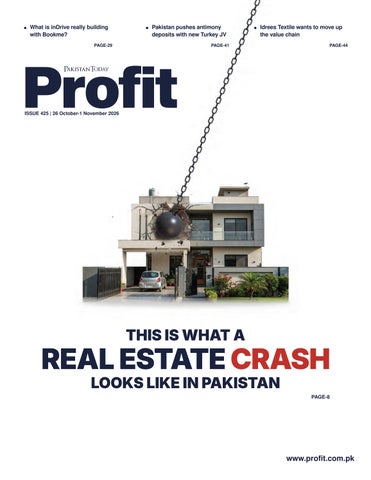
THIS IS WHAT A
REAL ESTATE CRASH LOOKS LIKE IN PAKISTAN
PAGE-8
www.profit.com.pk
ISSUE 425 · 26 OCTOBER–1 NOVEMBER 2026
Contents ON THE COVER
CHEMICALS
39 The quiet brain drain
20 Ghani Chemworld built a plant four times the size of its market
40 From debate to delivery
Pakistan’s first calcium carbide plant needed exports to make sense. It has halted production with more unsold stock in its warehouse than it sold all year. PHARMACEUTICALS
24 Citi Pharma is buying the brands it could not build fast enough One of Pakistan’s largest paracetamol makers wants to sell medicines, not just their ingredients. Pakheim International brings 63 branded products. The price is undisclosed.
This is what a real estate crash looks like in Pakistan In nominal terms, prices look like they’ve just been slowly increasing. In inflation-adjusted terms, the crash is nationwide, and has persisted for at least five years in most parts of the country.
Page 8
TECHNOLOGY
26 Pakistan is borrowing again, and Tasdeeq has hit scale After years of stagnant lending, Pakistanis are borrowing again. For the country’s first listed credit bureau, that has meant sales up 80% in a quarter on costs that did not move.
29 What is inDrive really building with Bookme?
Profit Publishing Editor Babar Nizami / Managing Editor Farooq Tirmizi / Senior Editor Abdullah Niazi / Business Reporters Taimoor Hassan, Usama Liaqat, Zain Naeem, Shahnawaz Ali, Ghulam Abbas, Ahmad Ahmadani, Aziz Buneri / Sub-Editors Saddam Hussain, Abdul Hameed / Video Producer Adnan Maqsood / Director Marketing Muddasir Alam / Regional Heads of Marketing Agha Anwer (Khi), Kamal Rizvi (Lhe), Malik Israr (Isb) / GM Special Projects Zulfiqar Butt / Manager Subscriptions Irfan Farooq Pakistan’s #1 business magazine, your go-to source for business, economic and financial news · profit@pakistantoday.com.pk
Contents
The ride-hailing platform appears to have quietly integrated ticketing through Bookme, opening up questions about its super-app ambitions and the ticketing company’s plans for distribution and regional expansion. OPINION
28 Regulatory credibility on trial 35 Why the Lahore Gymkhana should be turned into an urban forest
TRADE
32 Can Pakistan cash in on Maldives? At the business forum this week, leaders of two dollar-strapped countries promised to multiply bilateral trade fifteen-fold in two years. How? NATURAL RESOURCES
41 Pakistan pushes antimony deposits with new Turkey JV After the discovery of major antimony deposits in March 2025, Pakistan first signed MoUs with the United States and now with Turkey. But what is the bright silver metalloid everyone is after and how can Pakistan position itself as a supplier? TEXTILES
44 Idrees Textile wants to move up the value chain The Allawala family’s spinning mill in Nankana has stopped production. The company calls it a plan to enhance profitability. The filings read more like an admission that commodity yarn no longer pays. SATIRE
46 Tensions in Middle East and political instability have led to bearish activity, explains delivery rider 3 hours late to I.I. Chundrigar Road
37 Why farmers’ losses need to be treated as an emergency 7
COVER STORY
This is what a real estate crash looks like in Pakistan In nominal terms, prices look like they’ve just been slowly increasing. In inflationadjusted terms, the crash is nationwide, and has persisted for at least five years in most parts of the country.
BY FAROOQ TIRMIZI
T
his story goes against everything nearly every Pakistani believes in, but it is important and deserves to be said: over the past five years, the Pakistani real estate sector – the single largest asset class in the country by miles – has been in a deep recession in terms of prices. The above sentence is likely to cause violent disagreements among the WhatsApp forwarding uncles of Pakistan, but consider the following data points. Over the past five years, urban real estate prices across the country have increased by a median 2.1% per year rate, according to Profit’s analysis of real estate index data from Zameen.com, the largest real estate portal in Pakistan. That sounds like slow growth, but not a recession. But then consider the fact that inflation during that same period – August 2021 through August 2026 – ran at an average rate of 15.0% per year during that same period. A rupee in 2026 buys about half what it did in 2021, and you think something that is worth only 11% more than it was in 2021 has not crashed in price? This, ladies and gentlemen, is what a real estate crash in a high-inflation, low financial capital country like Pakistan looks like. Prices stay stable, or even slightly increase in nominal terms. A property listed for Rs1 crore in 2021 is listed for Rs1.1 crore in 2026. But that is a crash. Because if it was not, that property should have listed – and sold – for above Rs2 crore in 2026. Here is the headline number you should be aware of: across all types of real estate in Pakistan over the past five years, only 1.4% of neighbourhoods and property types saw a decline in nominal prices, but when you factor in inflation, 91.8% of property types and neighbourhoods lost real value. Over 10 years, the picture is only marginally better: just 0.9% of neighbourhoods saw a decline in nominal prices, but 76.5% of neighbourhoods saw a decline in value in inflation-adjusted terms. This is a stark reality, and if you, like most Pakistanis, are obsessed with real estate, this is an important story. It tells you what can happen when you park your money in real estate, how long it can get stuck, and how widespread the phenomenon of real estate crashes can be, and how it operates in the real world, and how to spot when you are in a real estate recession. It will also identify opportunities: what are the handful of neighbourhoods bucking the Cover story
trend and continuing to see growth, and what can a prospective buyer of real estate think about when deciding where to buy. (Short preview: the conventional wisdom on what constitutes a good place to invest in real estate is largely validated by the data.) But before we get into all of that, a short note on the methodology of how we calculated all of these data points.
Methodology note For this analysis, we heavily utilized data from Zameen.com’s real estate price indices. We made an attempt to be as granular as possible in the data. So, for example, in Karachi, we do not just look at DHA, but go down to DHA Phase 5, 6, etc. We compared nominal prices – or index levels, wherever available – for the past 10 years, going from August 2016 through August 2026, and then calculated average annual price increases on a nominal and inflation-adjusted basis. There are real limitations to this analysis and this data. It is heavily biased towards more
expensive neighbourhoods and properties, and coverage of Lahore, Karachi, and Islamabad is far better than those of other cities. It reflects only listed prices, not the prices at which transactions actually happen, which can be a significant limitation. Another important caveat – though one that speaks to how the market moves – is that the prices are what can be described as “downward sticky”, meaning they will stay flat rather than declining, particularly during a period of real estate recession, when people simply elect not to sell their property rather record a lower nominal price loss. This means that a real estate market crash looks like a real estate market freeze. Prices do not move downward, but nobody is buying and selling because there is a heavy mismatch between what buyers are willing to pay and what sellers are willing to accept. The data limitation of this is that since we do not have transaction volume data, we cannot tell if this is happening simply because of a lack of listings for a particular area, or if it reflects a fall in demand and thus transactions 9
are not happening at all. One critique of the data quality that we do not accept: while the data from Zameen.com has its biases and limitations, it is not without its usefulness. Aggregated across its whole database, we believe it yields meaningful insights about the current state of play and potential future direction of the real estate market in Pakistan.
The nationwide crash The most common refutation to data about the real estate market – beside the legitimate methodological shortcomings – is when people use anecdotes from either their own lives or those of their families and friends that appear to contradict the findings of the data, not realising that one or two anecdotes do not constitute a refutation of data consisting of tens of thousands or even more observations. So, I am sure your chacha or mamoo sold something in the areas we have mapped as having seen negative returns over the previous 5 and 10 years. That in no way refutes the idea that the real estate market is going through a 10
severe crunch right now. Indeed, we would go so far as to say that if you probe for specific dates of transactions, you will note a distinct dearth of transactions having taken place since 2021, and perhaps even earlier. Because here is what has been happening in virtually every neighbourhood and across virtually all types and sizes of property: prices are up very slightly in nominal terms, but that masks how much inflation has eroded nominal purchasing power, meaning that in real (inflation-adjusted) terms, people who bought property in 2021 have mostly lost money. Across the top 10 cities in Pakistan by population, for the past 5 years, the fall has been near-total. Hardly any neighbourhoods have been exempt from a fall in prices. And the trend is bad across all types of real estate, though commercial real estate appears to be worst affected, followed by flats, then residential plots, and then single-family homes. That order in itself is rather revealing: Pakistanis love living in homes and apartments – particularly outside Karachi – are not a favoured type of real estate. The decline in commercial is somewhat more surprising,
though given the dual effects of struggling consumer spending and the rise of e-commerce, perhaps this should not entirely come as a surprise. Nonetheless, the difference between these asset classes within real estate is minimal, and the overall decline in real returns has been an across-the-board phenomenon. This is driven in large part by the fact that inflation itself has been much higher than the long term historical trend. During the past 5 years, inflation has averaged 15% per year, compared to the 8% annual average since 1958. And one could argue that this crash may in fact represent a correction that is taking place after the government-incentive fueled boom that took place in real estate from about 2018 through 2021, when the Imran Khan Administration was actively promoting home-ownership and using government subsidies that boosted both construction as well as mortgage lending activity. And given how widespread this recession has been, it is perhaps more useful to talk about the rare exceptions rather than the broader phenomenon. Cover story
The exceptions to the crash The handful of areas that bucked the trend on real estate prices over the past five years, and especially over the past 10 years, fall into two buckets that we can largely describe in the following way. The first category consists of neighbourhoods that one might describe as the homes of the rising middle class of Pakistan. They are all neighbourhoods that fall towards what used to be the outskirts of major cities (Karachi, Lahore, Rawalpindi, Faisalabad, Gujranwala, etc.), but the construction of new expressways suddenly made them a much shorter commute to the city center, and real estate developers responded by building massive suburban developments with amenities that match post-World War II American suburbia. These are the kind of places that reflect a happy confluence of the public sector doing its job to improve the infrastructure of the country, and the private sector responding by creating developments that middle class consumers can afford and would want to purchase into. (Were bribes exchanged in order for knowledge on the location of the Cover story
highways, or decisions about the route those highways and their interchanges would take? We have no evidence, but if such things happened, they would not shock us.) Examples of places like this include the entire Ring Road corridor in Lahore, particularly the developments closest to the interchanges on the road (Park City in particular has done well over the past decade, so you can see why they can afford to sponsor so much cricket lately), and Naya Nazimabad and other further flung areas of Karachi that have been made more accessible to the city center through the development of Sharae Bhutto and the completion of the Lyari Expressway. For real estate developers, one word of caution: prices tend to rise in the earliest of these types of developments, suggesting that consumers take time to trust that a development will actually deliver on its promises. The more recent developments continue to languish with stagnant prices. Given how often people have been burned by bad actors in the real estate sector, this is perhaps not surprising. One other surprising characteristic about these neighbourhoods: they did not start off cheap and converge towards the mean prices
of their cities. They started off as middle of the pack developments that gained value to become pricier neighbourhoods in their cities after having proven their value to the first wave of owners. In other words, bargain hunting in real estate in Pakistan – for the most part – does not work. Value picking does (more on that later). Among cities, however, Karachi continues to do worse than Lahore and Islamabad, perhaps quantitative proof of the incompetence and indifference of the Sindh government, led by the Pakistan Peoples Party (PPP), which has made no secret of its contempt for the voters and citizens of Karachi over whom it governs through the mandate of votes from other parts of the province. The other major exception to the crashing real estate market is Islamabad. And one might think: well, Islamabad has a lot of new middle class neighbourhoods and developments coming up. Surely those fall into roughly the same category as the developments described in other cities. No, because the neighbourhoods that have been the most resilient – indeed the ones that have thrived the most – in Islamabad are not 11
the new middle class neighbourhoods, but rather the older, already too expensive for Pakistan neighbourhoods: sectors F-6, F-7, and E-7. The kind of neighbourhoods you buy a house because you are one of three kinds of people: a minister seeking to dole out favours, a businessman who relies on bribing said minister for the bulk of the revenue generated by the business you own, or you are a retired civil servant or diplomat who spends the entirety of his and his family’s net worth to be close to the action and feel a whiff of the relevance you had before retirement. If the first category of neighbourhood represented a hopeful story, albeit one with at least one or two asterisks, this latter category is just downright depressing. The real estate market is signaling the fact that in Pakistan, it still pays a lot to be in close physical proximity to political power in order to gain favours that will ultimately result in monetary benefits.
said.) so it is not as though you move there because it is a good place to raise a family. They buy it because they want to get things out of the government, whether it be political power or money for their politically dependent business. The leeches who are sucking the lifeblood of Pakistan are loaded, and their wealth is reflected in the continually rising prices in the old sectors of Islamabad.
Preferred sizes and locations The price movement data reveals a few key insights with respect to which parts of the market are more robust. In addition to the geographies that we mentioned, there are some other characteristics of the market that reveal both what consumers currently prefer, and what may hold its value more robustly than other segments in the future. Pakistan’s favourite house size – at least as measured by the resilience of the prices in this market over the past 10 years – is the 1 kanal (605 square yards) house. The next favorite is the 15 marla (454 square yards). The Pakistani dream, in other words, is to own a 1-kanal house in a safe neighbourhood with good amenities, and a reasonable commute to a job that delivers an income that allows one to afford living there. The 5 marla (151 square yards) or smaller house does less well in terms of price appreciation, as does the 2 kanal+ (1,210 square yards+) house. This preference for this specific size of house can probably be explained by the nature of the Pakistani joint family: the massive families with multiple earners who could afford the 2 kanal or larger house are a thing of the past, but we do not yet have the kind of nuclear families that can make do with less than 10 marlas. Hence, the middle of the market is the most popular, and therefore the most resilient in terms of its pricing power.
What will drive a recovery
Nobody buys houses in Islamabad for the “prestige”. Nobody with money is “from” Islamabad, and there are generally better places to live in their own home provinces. There is not a single good school in all of Islamabad (yes, Margalla campus alumni: I said what I 12
Now, just because the market has had a bad few years and is currently down does not mean it will stay that way, and indeed, the data on the one-year price trends indicates that the recovery has already begun. Part of this is driven simply by macroeconomic stabilization. The country went through a brutal set of economic conditions from 2022 through 2024, and only slowly started recovering thereafter. It makes sense that the real
estate market is no different than the rest of the economy on that front. But another key factor is how real estate in Pakistan is financed. Given the relatively small size of Pakistan’s banking and financial services sector, mortgages are not a major source of homebuying activity in the country. So how do people buy these expensive homes that are several orders of magnitude above even high incomes for Pakistanis. Because the income that buys those homes is usually not generated inside Pakistan. A massive proportion of Pakistani real estate purchases come from the remittances sent home by Pakistanis working abroad, especially those in the Middle East. The incomes that earn those, in short, are those much higher foreign incomes, which explains why Pakistani real estate prices are so much higher than domestic incomes would justify. It also explains why the Pakistani dream currently involves leaving Pakistan at least temporarily: for most people, it is not possible to afford a home on a purely Pakistani income, at least not one they would like to live in. But if remittances are an explanation for why prices are high to begin with, they also explain why we can expect a recovery in prices after the recent slump. The millions of Pakistanis who left over the past five years – over 3 million in total – have started sending remittances back, and soon those remittances will have accumulated enough money in their family bank accounts to start buying real estate again. When that happens, expect prices to start rising again. Indeed, there are already reports of Pakistanis moving money out of Dubai real estate after the government of the United Arab Emirates started deporting at least some Pakistanis in a rather capricious manner. If Dubai can no longer be seen as a safe bolt hole for rich Pakistanis, there is no sense in parking quite so much of their assets in Dubai real estate. And when those properties get sold, they will likely come back to Pakistan and buy real estate here. The more important takeaway from all of this is that real estate is not a one-way ticket to price appreciation of an asset you own. It can be as cyclical as any other market, and before jumping into it, one should be aware of how those cycles operate, and plan accordingly. For now, though, one can expect a recovery within the next few years to produce a very different set of results over the next five years compared to the last five years. Cover story
Cover story
13
14
Cover story
Cover story
15
16
Cover story
Cover story
17
18
Cover story
Cover story
19
CHEMICALS
Ghani Chemworld built a plant four times the size of its market Pakistan’s first calcium carbide plant needed exports to make sense. It has halted production with more unsold stock in its warehouse than it sold all year.
H
ere is the problem with Ghani Chemworld in one number. Its new plant in Hattar can make about 25,000 tonnes of calcium carbide a year. Pakistan imported 6,612 tonnes of the chemical in 2025, according to UN Comtrade data. In other words, even if Ghani Chemworld (GCWL) replaced every kilogram of imported calcium carbide in the country, it would still need to sell about three-quarters of its output abroad. On October 19, it told the Pakistan Stock Exchange (PSX) that it could not. The company said it had suspended production because it could no longer fulfil export orders, citing “unrest affecting maritime routes in the Middle East and congestion at ports”. Later the same day, it added that it holds “su cient inventory” to keep selling in Pakistan while the plant is idle. It called exports central to its business. It is not short of inventory. That is the other problem.
What calcium carbide is for Calcium carbide is a grey, rock-like chemical made by heating lime and coke in an electric furnace. Add water and it gives off acetylene gas, which is used for welding and cutting metal, and in making some plastics and chemicals. It is a commodity, and China dominates the trade. China supplied almost all of Pakistan’s calcium carbide imports in every year since 2021, and all of them in 2024 and 2025, according to UN Comtrade data. It is also not a large market. Pakistan spent $6.4 million on calcium carbide imports in 2025, an average of about $970 a tonne. At that price, a full year’s output from the Hattar plant would be worth about $24 million, nearly four times what the whole country 20
spends on the chemical. The Ghani group, whose main business is industrial gases, was itself one of the largest importers. Under a scheme approved by the Lahore High Court in 2025, it moved a halfbuilt calcium carbide project out of Ghani Chemical Industries (GCIL) into a new company, Ghani Chemworld, which listed on the PSX in April 2025. The idea was to replace imports and then export the surplus. The plant cost about Rs2 billion, according to VIS Credit Rating Company. VIS put domestic demand at between 8,000 and 15,000 tonnes a year, and said the company planned to export to Afghanistan, the Middle East and other South Asian markets. That demand range is higher than the import data suggests. But even at the top of it, the plant would need to export 40% of its output to run at full capacity.
The first four months Commissioning work began in July 2025, and the company told the PSX the plant had been commissioned on December 24, 2025. Commercial production began about four months before the end of the financial year on June 30, 2026, according to the company’s annual report. In those four months, Ghani Chemworld sold Rs312 million of calcium carbide, net of sales tax. The sales tax on those sales was Rs56 million, or 18% of net sales, which is the domestic rate. Exports are zero-rated. By Profit’s calculation, that means effectively all of the year’s revenue came from customers in Pakistan. About a quarter of it, Rs76 million, came from one customer, Ghani Chemical Industries, its own sister company. The money also flows the other way. Ghani Chemworld buys oxygen and nitrogen from GCIL, and its purchases from the sister company came to
Rs226 million in the year. Selling in Pakistan did not cover the cost of making the product. The cost of the calcium carbide it sold was Rs451 million, leaving a gross loss of Rs139 million. That is a gross margin of minus 44%. Then look at what it made but did not sell. The plant produced goods costing Rs1.11 billion during the year. On June 30, Rs659 million of finished calcium carbide was sitting in stock, more than the cost of everything it sold all year. In other words, the plant made about two and a half times as much as it sold.
Where the profit comes from Ghani Chemworld still reported a profit after tax of Rs67 million. That is because it owns shares in GCIL, and its share of GCIL’s profit came to Rs352 million. Without it, the company lost Rs285 million, after Rs120 million of finance costs. Earnings per share fell to Rs0.27 from Rs1.40 a year earlier, when the company had no sales at all and its income came entirely from its GCIL stake. It is now selling those shares to raise cash. Shareholders approved the sale of 70 million GCIL shares in May, and the company had sold 20 million at an average of Rs38.875 each by late September, according to the annual report. In July it also raised Rs125 million through partially redeemable shares to fund working capital. Its bank had arranged a Rs250 million Istisna facility, a form of Islamic trade finance, to fund calcium carbide exports. It is secured against export contracts and runs until December 31, 2026. In 2025-26, there were no export sales for it to finance.
What comes next The company’s answer, set out in its annual Chemicals
report, has two parts. The first is a new product. Ghani Chemworld is building a plant for precipitated calcium carbonate (PCC), a white powder used as a filler in paint, paper and rubber. Commercial production is due to start by the end of October 2026 at 100 tonnes a day, to be raised later to 180 tonnes. The second is protection. Imported calcium carbide carries an 11% regulatory duty, and the sponsors planned to lobby for more, according to VIS. In May, Pakistan Customs re-determined the values on which duty is charged on calcium carbide from China, replacing a valuation that had stood since 2023, according to ProPakistani. Higher duties might help Ghani Chemworld win more of the domestic market. They do not make that market bigger. Pakistan’s imports have fallen from 11,412 tonnes in 2021 to 6,612 tonnes in 2025, a decline of 42%. Meanwhile, the debt is real. The company Chemicals
assumed Rs800 million of sukuk, Islamic bonds, with principal repayments starting in the second half of the 2025-26 financial year, according to VIS. GCIL’s board and shareholders have approved up to Rs2 billion of loans to support it. VIS assigned Ghani Chemworld an initial long-term rating of Ain January 2026, with a stable outlook. The plant sits in the Hattar Special Economic Zone, which gives it a ten-year tax holiday. That is worth a great deal to a company that makes operating profits. Ghani Chemworld does not make any yet.
The fine print To be fair to the company, the timing has been terrible. The Israel-Iran conflict disrupted shipping in the Gulf just as the plant came online. The annual report notes that “given the nature of calcium carbide”, which reacts with water and must be kept dry, export and transport arrangements “became more
challenging”. And a plant in its first months rarely runs e ciently. Unit costs should fall as output stabilises. Neither the war nor the port congestion was in the company’s control. The problem with that defence, though, is that the arithmetic was visible before the war. A 25,000-tonne plant in a market that imports 6,000 to 8,000 tonnes a year was always going to be an export business, competing with Chinese producers who dominate the trade. The market has noticed. The shares closed at Rs12.00 on October 21, down 52% from their February high of Rs25.15, giving the company a market value of about Rs3.0 billion. They had traded as low as Rs9.56 on July 1, 2025, before the plant was finished. The company says it will tell shareholders through the exchange when production resumes. It has not said when that might be. Until then, Ghani Chemworld is a Rs2 billion plant waiting for a ship. 21
PHARMACEUTICALS
Citi Pharma is buying the brands it could not build fast enough One of Pakistan’s largest paracetamol makers wants to sell medicines, not just their ingredients. Pakheim International brings 63 branded products. The price is undisclosed.
H
ere is the punchline. Citi Pharma is a raw-ingredients business that wants to be a medicines business. Buying Pakheim International Pharma is the fastest way to get there. In a filing to the Pakistan Stock Exchange (PSX) this month, Citi said the Competition Commission of Pakistan (CCP) had cleared its acquisition of 100% of Pakheim International Pharma (Private) Limited. The commission, in an order dated October 9, found that the deal “does not raise competition concerns”. Completion still depends on legal, regulatory and other formalities, Citi said. The two companies signed a share purchase agreement on May 6, the same day Citi’s board approved the deal. Citi has not disclosed the price. It said it would pay from internal cash and bank facilities, and complete the payments by December 31, 2026, according to press reports of the May filing. Pakheim is small. It earns about Rs500 million a year, according to those reports. Citi earned Rs14 billion in the year to June 30, 2026. So why bother? Because of what Pakheim sells.
Two kinds of drug company A pharmaceutical company can make one of two things. It can make the active pharmaceutical ingredient (API), the chemical that does the work in a medicine. Or it can make the finished medicine, the tablet or syrup or injection, known in the trade as a formulation. Citi is mostly the first kind. It is one of Pakistan’s largest paracetamol producers, and it makes nine primary APIs at its plant near Kasur, including ciprofloxacin, cefixime and amoxicillin. It sells them to other drug companies, which turn them into branded medicines. Exports were Rs476 million in 2025-26, 24
about 3% of sales. That is a hard way to make money. Citi’s own annual report describes API margins as “relatively low”. Large formulation makers “take longer credit terms”, it says, so selling more ties up more working capital. Customers who each bought at least 10% of Citi’s output together accounted for 32.2% of its 2025-26 sales. Formulations are the opposite. Margins are “relatively higher”, the company says. But sales grow slowly, because a drug maker has to build brands and a distribution network, pharmacy by pharmacy and doctor by doctor. Citi has been trying to make that shift since it listed in July 2021. Formulations were about 7% of sales at the time of the IPO, according to BR Research. In 2025-26 they were 25%, or about Rs3.5 billion, according to the company’s accounts. The shift shows up in the margins. Gross margin, the share of revenue left after direct costs, sat between 12% and 14% for most of the last decade. It rose to 15.3% in 2024-25 and 17.5% in 2025-26. Operating margin has not kept pace. It slipped to 12.3% in 2025-26 from 12.8% a year earlier, because other income fell by more than half and other expenses more than doubled.
What Pakheim adds Pakheim runs a plant on Ferozepur Road in Lahore, with 55,000 square feet of covered area, according to its website. It makes tablets, capsules, suspensions, syrups and injections. It also makes medicated creams and gels, which Citi’s formulation range does not include. DrugsInfo, a Pakistani drug database, lists 63 Pakheim products across 43 molecules. Profit compared that list with the formulation range Citi publishes on its website.
Fifteen of Pakheim’s molecules overlap with Citi’s own brands. The other 28 do not. They include six antibiotics, among them moxifloxacin, linezolid and cefepime. There are six stomach and anti-nausea drugs, five skin creams and gels, four painkillers and two drugs for epilepsy and nerve pain. In other words, Citi is not buying more of what it already sells. It is buying a range it does not have, already registered with the Drug Regulatory Authority of Pakistan (DRAP). Registering a new medicine can take years. Buying a company that holds the registrations skips the queue. The overlap has its own logic. Pakheim sells ciprofloxacin as Ciproheim and cefixime as Megaxim. Citi makes both as raw ingredients. Citi said in May that Pakheim would buy its APIs from Citi, lifting Citi’s API sales and plant utilisation, according to press reports. Put simply, an ingredient that now earns Citi a thin margin once could earn it a margin twice, first as the ingredient and again as the finished medicine sold at the pharmacy. Citi has also said it wants to grow the business to Rs5 billion in revenue within five years. That is ten times its current size, and more than Citi’s entire formulation business today.
The fine print There are fair reasons for caution. The first is the money. Citi had Rs201 million in cash on June 30, 2026, against Rs2.87 billion of short-term borrowings. A Rs1.5 billion short-term sukuk falls due on December 23, a week before the Pakheim payments are due. Debt was 67% of equity, up from 25% two years earlier. The second is profit. Finance costs rose 18% to Rs388 million in 2025-26. Net profit fell 12% to Rs783 million, and the company lost Rs101 million in the April-June quarter. Pharmaceuticals
The board declined to pay a dividend, citing “planned capital expenditure and future funding requirements”. The third is focus. Citi is also pursuing a demerger involving Citi Core Holdings, a hospital in Lahore, a veterinary subsidiary and a proposed move into cannabis and industrial hemp, which it put to shareholders in September. And there is disclosure. Without a price, nobody outside the company can judge Pharmaceuticals
whether Citi is paying sensibly for Rs500 million of revenue. Its 2025-26 annual report, issued in October, does not mention Pakheim at all. Nor has Citi said anything about the state of Pakheim’s plant, its staff or any debts it carries. The problem with these critiques, though, is that they are about execution, not strategy. An API maker that sells only to other drug companies will always be squeezed on price. One that owns brands, and feeds them its
own ingredients, keeps the margin at both ends. The market is not convinced yet. Citi’s shares closed at Rs59.04 on October 23, 37% below their 52-week high, valuing the company at about Rs13.5 billion, or 17 times last year’s earnings. Citi has spent five years building a medicines business from scratch. Now it is buying one. The strategy is right. The balance sheet will decide whether the timing is. 25
TECHNOLOGY
Pakistan is borrowing again, and Tasdeeq has hit scale After years of stagnant lending, Pakistanis are borrowing again. For the country’s first listed credit bureau, that has meant sales up 80% in a quarter on costs that did not move.
H
ere is the punchline from Tasdeeq Information Services’ latest results. The credit bureau has reached the size at which almost every additional rupee of revenue turns into profit. And it has got there because Pakistanis are borrowing again. In the three months to September 30, 2026, Tasdeeq’s revenue grew 80% over the same quarter a year earlier. Its cost of revenue fell 3%. Read that again. Sales nearly doubled, and the cost of producing them went down. That is the central finding of the result review that Topline Securities published on October 23, the day the company announced its numbers. Tasdeeq earned Rs48 million after tax in the quarter, against Rs12.7 million a year earlier, according to the company’s accounts as summarised by Topline. Tasdeeq listed on the Pakistan Stock Exchange (PSX) on August 24, 2026, at Rs3 a share. It closed at Rs4.59 on October 23, giving it a market value of about Rs4.4 billion. That is roughly 33 times the Rs131 million it earned over the last twelve months, by Profit’s calculation. Investors are not paying that multiple for today’s profits. They are paying for what happens to a business like this once it crosses a certain size, at a moment when its customers are growing again.
What a credit bureau sells When you apply for a loan, the lender wants to know one thing. Have you paid your previous debts? A credit bureau answers that question. Banks and other lenders send it data on every loan they make and every repayment they receive. The bureau collects that data across all lenders, cleans it and sells it back to them as a report on any borrower they are considering. In other words, the lenders are both the 26
suppliers and the customers. They hand over the raw material for free, as the law requires, and then pay to read the finished product. Tasdeeq was incorporated in Lahore in 2016. In November 2018 it became the first private credit bureau licensed by the State Bank of Pakistan (SBP) under the Credit Bureaus Act, 2015, according to its prospectus. As of March 31, 2026, it had data-sharing agreements with 174 lenders, most of them non-bank finance companies such as fintech lenders, leasing companies and modarabas. Its database held records on about 41.5 million borrowers. Lenders bring in 89% of revenue, and the ten largest customers 62%, according to an analysis of the 2025 figures by Mettis Global.
Why scale changes everything Almost all of a bureau’s cost is in building and running the database. The data centre, the software, the security, the service-level agreements with lenders. Those costs are largely the same whether you sell one report or one million. So once a bureau covers that fixed cost, nearly every additional rupee of revenue drops to the bottom line. For years, Tasdeeq did not cover it. Revenue crept from Rs167 million in 2023 to Rs185 million in 2024, and the company lost about Rs70 million in each year. Then revenue jumped 72% to Rs318 million in 2025, and it earned its first annual profit, of Rs70 million. The cost line shows why. Cost of revenue was about Rs108 million in 2025. Over the twelve months to September 2026, it was about Rs109 million, by Profit’s calculation, while revenue rose to about Rs457 million. In other words, the last Rs138 million of revenue cost Tasdeeq roughly Rs1 million to produce. That is what an inflection point
looks like. Gross margin, the share of revenue left after direct costs, was 50% in 2024 on a comparable basis, according to the prospectus. It rose to 66% in 2025 and 76% in the first nine months of 2026, according to Topline. Operating margin went from minus 30% in 2024 to 19% in 2025 and 36% in the first nine months of 2026. Topline attributes the jump to “fixed direct costs, such as data center costs, service level agreements and application maintenance, which do not rise in line with the rising volumes”.
The lending cycle turns Why did volumes rise? Because lenders are lending again. A bureau sells a report every time a lender considers a borrower. Its volumes track the number of loan applications in the economy. And for most of the last four years, that number went nowhere. When the SBP raised its policy rate to 22% in 2023 to fight inflation, credit to the private sector all but stopped. In the 2022-23 fiscal year, net new lending to the private sector came to just Rs46 billion, according to SBP data reported by Profit. In real terms, credit shrank. Consumer lending was hit hardest. Auto financing fell for 26 straight months, from Rs368 billion in June 2022 to Rs227 billion in August 2024. Consumer financing as a whole was Rs804 billion, down 4.9% from a year earlier. Then rates came down, to about 11% by mid-2025. Private sector credit grew Rs1.46 trillion, or 14.8%, in the 2025-26 fiscal year to Rs11.38 trillion. That was the strongest increase in four years, according to Khurram Schehzad, adviser to the finance minister. Consumer financing rose 25.4% to Rs1.145 Technology
trillion by June 2026. Auto loans rose 38% to a record Rs382 billion. Those borrowers are Tasdeeq’s volumes. Every fintech loan, every car loan and every microfinance loan starts with a credit check. The timing matters. Tasdeeq built its database during the lean years, when it was losing money. When the volumes came back, the cost was already paid for.
The fine print Critics make some fair points. The first is the cycle itself. Growth that comes from lending can leave with lending. If rates rise again, volumes will fall, and operating leverage works just as hard in reverse. Fixed costs do not Technology
shrink when sales do. The second is concentration. A company that earns 62% of its revenue from ten customers rests on a handful of procurement decisions at a handful of lenders. A lender can always switch to DataCheck, the other private bureau. The third is that not all of the profit growth is operating profit. Other income rose to Rs5.2 million in the September quarter from Rs0.4 million, most likely interest on the Rs450 million raised at listing. And there are governance questions. The Pakistan Credit Rating Agency (PACRA), which owned 10.8% of Tasdeeq after the listing, faces a show-cause notice from the Securities and Exchange Commission of Pakistan
(SECP) over its disclosures about the bureau, according to Mettis Global. One more note on sourcing. Topline was the consultant to Tasdeeq’s IPO. Its numbers reconcile with the company’s filings, but readers should know who is doing the reviewing. The problem with these critiques, though, is that none of them changes the arithmetic. Tasdeeq has a platform that costs about the same to run whatever passes through it, and the volume is now passing through. The question for investors is whether 33 times earnings already prices in years of it. At Rs4.59 a share, the market has bet that Pakistan’s credit recovery has a long way to run. The next two quarters will tell us whether it was a smart bet. 27
OPINION
K
arachi is the hub of Pakistan’s commerce, manufacturing, finance and international trade. Its ports, factories, supply chains and services underpin export earnings, employment and a substantial share of the economic activity that supports the national exchequer. Reliable electricity is therefore not a local amenity but critical national infrastructure. Yet the controversy over K-Electric’s revised multi-year tariff has been framed largely as an exercise in reducing the government’s subsidy bill. A tariff reduction is a fiscal victory only when it reflects demonstrable e ciency gains, the correction of overstated costs or the removal of excessive returns. If it instead denies recovery of prudent expenditure, the underlying cost does not disappear; it is shifted onto investment, creditors, future consumers or, ultimately, the public purse. The governing principle is therefore not whether the tariff is lower, but whether the e cient cost of reliable service is lower. K-Electric must justify every rupee of capital expenditure, improve service, control losses and face meaningful penalties for poor performance. But regulatory discipline must operate in both directions. NEPRA must explain how each benchmark was derived and demonstrate that it is achievable under Karachi’s operating conditions. A zero allowance for non-recovery, if effectively imposed, therefore requires compelling evidence – even wellmanaged utilities do not collect every bill, and Karachi’s mix of informal settlements, industrial customers and di cult enforcement conditions makes perfection a particularly implausible starting assumption. The right approach is a demanding, declining allowance for e ciently incurred recovery losses, benchmarked against comparable utilities and tied to independently audited performance. Theft and ine ciency must not become a permanent charge on honest consumers. Equally, a benchmark that exists only on paper is not regulation; it is wishful accounting. More troubling is the treatment of previously determined tariff economics. NEPRA has statutory authority to review its decisions, but that power cannot be exercised without rigorous and exhaustive justification. Materially revising a multi-year tariff four years into its course is itself an indictment of regulatory performance. Either the original 28
Regulatory credibility on trial Nadeem Ul Haque
Shahid M. Sattar
The writer is former deputy chairman of the Planning Commission.
The writer is an energy economist, former corporate banker and policy adviser.
determination lacked su cient rigour, or the later revision lacks the predictability and discipline that credible regulation requires. Review authority does not excuse weak evidence, unexplained changes or the rewriting of performance assumptions for years already elapsed. Where investment has been committed in reliance on an approved framework, the regulator must identify the error being corrected, explain the legal basis for applying the change to completed periods and address the consequences of that reliance. The risk extends well beyond K-Electric. Pakistan wants private investors to acquire and rehabilitate loss-making public distribution companies, and prospective bidders will treat K-Electric as the country’s most prominent test of private electricity distribution. If tariff assumptions can be materially reopened after investment decisions—especially for completed periods and without a transparent evidentiary basis—investors will price that uncertainty into their offers, demand sovereign guarantees or decline to participate. Pakistan cannot credibly expect sustained foreign direct investment under regulation that is formally empowered but practically unpredictable. The privatisation programme would inherit a substantial risk premium before its first transaction closes. For Karachi, the cost of an unreliable grid extends far beyond the electricity bill. Production stoppages, missed delivery deadlines, damaged equipment and expensive backup generation weaken industrial competitiveness and deter investment. Pakistan will not strengthen the foreign-exchange earnings needed for imports and debt servicing by starving its principal industrial and commercial hub of reliable power. A defensible resolution requires a published reconciliation of the e cient revenue requirement, prudent investment needs,
financing costs, realistic loss-reduction targets and subsidy implications. It must establish the engineering basis and annual path for loss reductions; provide timely recovery of verified prudent bad debts, or explain how the intervening financing gap will be funded; justify returns against the risks retained under the tariff as a whole; and distinguish legitimate true-ups from substantive changes to completed periods. Neither the earlier determination nor the revision should be presumed correct. The appropriate tariff must emerge from disclosed evidence and a consistent methodology—not from a predetermined number or a politically convenient compromise. The government is entitled to seek lower subsidies. NEPRA is obliged to protect consumers. K-Electric must deliver measurable improvements. None of these objectives requires pretending that the cost of electricity can be reduced by decree. A lower tariff unsupported by lower underlying costs is not reform; it is deferred failure. The real choice is between credible, performance-based regulation and short-term fiscal optics. A defensible settlement must pass three tests – consumers pay only e cient costs; K-Electric is held to measurable service and loss-reduction targets; and investors can rely on transparent, evidence-based and predictable rules. NEPRA’s power to review is not in doubt. The issue is whether it exercises that power consistently with prudent cost recovery, financial viability and investments made in reliance on earlier approvals. Pakistan cannot invite private capital into its power sector while leaving returns contingent on shifting fiscal pressures or retrospective regulatory assumptions. Karachi can have a reliable grid, value for money and enforceable investor obligations—but only if regulation distinguishes correction from improvisation and a lower tariff from a genuinely lower cost. Opinion
TECHNOLOGY
What is inDrive really building with Bookme? The ride-hailing platform appears to have quietly integrated ticketing through Bookme, opening up questions about its super-app ambitions and the ticketing company’s plans for distribution and regional expansion. BY TAIMOOR HASSAN
i
nDrive appears to have quietly added ticketing to its ride-hailing platform in Pakistan, redirecting users to Bookme.pk’s interface to purchase tickets. Neither company has publicly confirmed the partnership, but sources familiar with the arrangement have identified Bookme as the ticketing partner. The integration offers a glimpse into how inDrive could be expanding beyond its core ride-hailing business, using partnerships to add new services without having to build them from scratch. For Bookme, the arrangement could open up a new distribution channel, putting its Technology
ticketing services in front of inDrive’s existing user base. For inDrive, it raises a bigger strategic question. Is the company moving towards a super-app model where ride-hailing becomes one part of a broader platform connecting users to multiple services? Pakistan’s technology companies are increasingly looking beyond their core businesses for growth. Rather than building every service themselves, some are turning to partnerships that allow them to tap into existing customer bases, expand their offerings and enter new markets with less investment in infrastructure. inDrive has been proactive in
this, launching grocery delivery in Karachi in January 2026, which was quickly expanded in Lahore in March after which they fully acquired Kravemart to bolster this vertical. The apparent inDrive-Bookme arrangement fits that strategy. It brings together a ride-hailing platform with a ticketing service, raising a larger question. Could the next phase of competition in Pakistan’s digital economy be less about individual apps and more about who can assemble the most useful ecosystem of services? For Shehryar Hydri of Endeavor, who discussed the strategic implications of the 29
30
Technology
arrangement in an interview, the central idea is distribution. As he put it, “The underlying principle is that distribution is valuable.”
Ticketing takes inDrive beyond rides The strategic rationale becomes clearer when the arrangement is viewed against inDrive’s broader ambitions. The company has been expanding beyond ride-hailing into other services relevant to its presence as a logistics platform; it’s part of a strategy to diversify revenue and increase engagement with its platform. Ticketing could extend that approach into travel. A customer who opens inDrive to book a ride could also use it to arrange an intercity journey or purchase a travel ticket. The integration is a value addition because it connects two complementary parts of the travel journey. A passenger can book an intercity travel ticket through inDrive and, upon arriving at a destination such as Karachi’s Jinnah International Airport, use the same app to book an inDrive ride to their hotel or final destination. This creates a more seamless experience by connecting intercity travel with local mobility on a single platform, reducing the need to switch between multiple apps. The advantage is not simply adding another feature. It is making an existing customer relationship more valuable by offering users additional reasons to return to the app. For inDrive, building every service internally would require specialist teams, supplier relationships and operational capabilities that may already exist elsewhere. Partnering with Bookme offers a way to access ticketing infrastructure without having to recreate the entire business. Hydri described this model as one in which a platform with an established audience works with a specialist that has the relevant service or inventory. The platform supplies distribution; the partner supplies the product and operational expertise. The commercial outcome will depend on the terms of the agreement, how prominently ticketing is integrated into inDrive and whether customers actually use the service. Neither company is guaranteed a substantial increase in revenue simply by making the feature available but the strategic opportunity is clear. inDrive can broaden its offering while potentially generating additional value from an audience it has already worked hard to acquire. Technology
Bookme’s new funnel For Bookme, the proposition is different. Its opportunity lies in opening a new customeracquisition channel without ramping up its marketing efforts substantially. A user might enter inDrive to arrange local transport and discover that the same platform can help with a wider journey. That creates a potential customer-acquisition channel for Bookme, allowing it to reach users through an app they already use. The arrangement could also reduce the friction involved in discovering and purchasing tickets. Instead of requiring customers to find Bookme independently, the service can be presented within an existing digital journey. Bookme has pursued distribution arrangements with other businesses, integrating its ticketing services into third-party digital channels. Such partnerships allow it to reach customers beyond its own app and website. The inDrive arrangement would also be consistent with a broader model in which Bookme distributes its services through platforms that already have established audiences. The potential benefit is getting reach without having to acquire every customer directly. However, distribution alone does not guarantee growth. Bookme will still need to ensure that its ticket inventory, booking process, customer support and commercial arrangements can support additional demand. The economics will depend on how much incremental business the partnership generates and how much revenue Bookme retains from it. The international dimension may be just as important as the immediate opportunity in Pakistan. Hydri suggested that a successful partnership could potentially be replicated across markets where the two businesses operate. inDrive has a presence in multiple countries, while Bookme has ambitions beyond its domestic market. If the model works in Pakistan, the companies could explore whether similar arrangements make sense in other markets. For Bookme, that could provide access to customers without requiring it to build a distribution network from scratch in every country. The broader opportunity for Bookme is to become more than a destination where customers go specifically to buy tickets. It can become the service infrastructure behind ticketing and travel experiences offered through other digital platforms. That approach could allow it to scale
through partnerships rather than relying exclusively on direct customer acquisition. Any international expansion through the inDrive arrangement, however, remains a possibility rather than a confirmed plan. The scope of the agreement and the companies’ future intentions would need to be established directly with them.
Platforms as distributors The apparent inDrive-Bookme arrangement reflects a broader shift in the digital economy. Companies increasingly have to decide whether to build new services themselves or collaborate with businesses that have already developed them. For a large platform, partnerships can accelerate expansion and make its core app more useful. For a specialist company, they can provide access to a much larger audience than it could reach independently. Hydri’s analysis points to the underlying economics. Distribution can be as valuable as the service itself. The model is not limited to ride-hailing or ticketing. Banks can integrate travel bookings, mobility platforms can add delivery services, and telecommunications companies can use partnerships or acquisitions to enter adjacent sectors. But there is an important distinction between accumulating features and building a successful ecosystem. An integration must offer customers a genuine reason to use it, while both partners need a viable commercial arrangement and a clear understanding of their respective responsibilities. For inDrive, the challenge will be to turn a broader service offering into stronger engagement and sustainable revenue beyond ridehailing. For Bookme, it will be to convert partner-platform trafÏc into profitable bookings and use those relationships to extend its reach. The significance of the apparent partnership, therefore, is not necessarily the addition of ticketing to another app. It is the possibility that the two companies can grow by combining their respective strengths rather than competing to build the same capabilities independently. Whether that translates into meaningful business growth will depend, above all, on execution. But the strategic logic is increasingly familiar across Pakistan’s technology sector. The next stage of expansion may belong to companies that know how to distribute services as effectively as they know how to build them. 31
TRADE
Can Pakistan cash in on Maldives? At the business forum this week, leaders of two dollar-strapped countries promised to multiply bilateral trade fifteen-fold in two years. How? BY SHAHNAWAZ ALI
P
rime Minister Shehbaz Sharif arrived at the Pakistan–Maldives Business Forum on Thursday evening straight from Peshawar. He told the room he had held only two of the three meetings scheduled there, cancelling the third so as not to keep President Mohamed Muizzu of the Maldives waiting. But the forum itself had already been pushed ahead by three hours at his request to fit the Peshawar meetings into his day, a point he himself acknowledged from the podium. The rescheduling and the cancelled meeting are representative, not of Shehbaz Sharif’s ever-so-courteous self but of the significance. Because the relationship he was celebrating barely registers in Pakistan’s trade figures. Pakistan exported $9.12 million worth of goods to the Maldives in FY2024-25. Total exports that year were $32.3 billion, so the Maldives took about 0.03% of what Pakistan sold abroad, roughly one rupee in every 3,500. Seen from Malé, the picture is much the same. Pakistan is the Maldives’ 33rd-largest goods trading partner, with about 0.3% of its goods trade. One could argue that the PM’s priorities were therefore more than courtesy. A visit worth so little commercially was being given the attention of a major one, and the reasons lay partly outside trade. Diplomatically, it was a very successful visit, the first by a Maldivian president in eleven years, timed to mark 60 years of relations. However, Profit does not cover diplomatic wins, and commercially, the target that was repeatedly said during the forum deserves a closer look. The prime minister announced a headline figure. Mr Muizzu, he said, had “readily agreed to make a firm understanding to increase our bilateral trade from 13 million dollars to $200 million in the next two years”. The Maldivian president endorsed the same 32
number from the podium shortly afterwards. A day earlier, the two governments had exchanged 20 memorandums of understanding covering health, fisheries, IT, defence, air connectivity and more, putting current trade at $13.9 million. The target is a fifteen-fold increase in two years. For a trading relationship that today equals about a day and a half of Pakistan’s exports to, say, the United Arab Emirates, how is that achievable? The figure is also important because nearly all of it would have to come from Pakistan. Pakistan’s exports to the Maldives are around $9.12 million in FY2024-25 and the Maldives sells Pakistan almost nothing in return. In practice, “$200 million of bilateral trade” means asking Pakistani exporters to sell roughly fifteen times as much to a country of about half a million people, with lesser foreign reserves than even Pakistan, within 24 months.
Ambitious arithmetic The Maldives imported $3.49 billion of goods in 2023, according to World Bank WITS data. Reaching $200 million would give Pakistan almost 6% of that market. As of today it has about 0.3%, making it the Maldives’ 33rdlargest goods trading partner. Meanwhile, India accounts for around 14% of Maldivian imports and China for 11%, with Oman ahead of both in some years. A 6% share could put Pakistan alongside the island’s established suppliers. But that share would have to be taken from competitors, not found in some untapped corner of the market. It is not impossible, but it would require a structural change in which Maldives operates, and in which Pakistan competes. What Pakistan sells today is a modest list of
everyday goods. In 2024 that meant fruit and nuts ($2.27 million), pharmaceuticals ($1.64 million) and cereals, mostly rice ($1.53 million). Commerce Minister Jam Kamal Khan’s pitch on Thursday largely expanded that list. He mentioned rice, meat, halal food, mangoes, citrus, cherries, apricots and dates, along with surgical instruments, textiles and Pakistan’s young olive-oil industry. These are reasonable products to sell. None of them, though, explains how Pakistan would grow fifteen-fold. While fifteen-fold is hugely ambitious, Pakistan can indeed tap some untapped potential with positive diplomatic headwinds.
Pakistan’s real opening The most commercially useful line of the evening came from president Muizzu. “We are not simply a market of half a million residents,” he said. “More than that, two million international visitors come to our shores every year”. The Maldives received a record 2.25 million tourists in 2025. For Pakistan, the real customer is the resort, not the household. Resorts buy food, linen, uniforms, furniture, cleaning chemicals and medical supplies in large volumes and pay in dollars. Mr Kamal acknowledged what this market demands. Resort procurement, he noted, is less driven by price and is “more towards standards”. So let us look at all the list of products that Minister Jam Kamal mentioned in the light of this new consumption market within Maldives. Those “standards” that the federal minister talked about, are both the opportunity and the obstacle for us. Pakistani textile mills that already meet European certification standards could potentially compete for hotel linen and Trade
President Mohamed Muizzu He was accorded a warm welcome in Pakistan, meeting both Prime Minister Shehbaz Sharif and CDF Asim Munir. He is the first Maldivian President to visit Pakistan in more than a decade.
staff uniforms. However, Pakistani food exporters, whose rice has faced rejections, whose mangoes and chickpeas have been returned in the past in demanding markets, will need the food-safety reforms to reap even a fraction of the trades. However both of these need to be produced at a rate that can compete with India’s, and Bangladesh’s lower freight costs due to proximity to Maldives, not to mention the lower production costs due to cheaper power and fuel sources. Staple foods are even harder. India supplies the Maldives with eggs, onions, rice, flour, sugar and lentils under a 1981 quota system. India has approved its largest-ever quota for 2026-27, including a 77% increase in rice. Those shipments are exempt from any Indian export bans. Pakistani basmati can probably look to compete on quality in resort kitchens, but it will struggle against a politically guaranteed supply of cheaper staples for local households. Healthcare looks more promising. About 250 Pakistani doctors already work in the Maldives. The MoUs include cooperation between Pakistan’s Drug Regulatory Authority and the Maldives Food and Drug Authority, and a separate agreement on recruiting health professionals. Mr Muizzu told the forum that demand for “reliable, high-quality and certified medical supplies” will keep growing as the Maldives builds hospitals from regional to island level. This realistically gives Pakistan three possible income streams – medicine exports, earnings from doctors and nurses working abroad, and Maldivian patients travelling to Pakistan for treatment. The last already has a market. Maldivian purchases of foreign currency for medical treatment and education abroad rose 78% in the first five months of 2026. Of all the forum’s themes, this is the one where Pakistan’s offer is clearest and least dependent on new ships or flights. But here Trade
lies the catch. Despite visa-on-arrival services for both country’s citizens, the countries do not have an airlink. No direct flights fly from Pakistan to Maldives or vice versa. And that is probably the biggest potential win of this visit. Amongst the MoUs signed, is the promise to establish a flight link between Karachi and Male. This serves not just as a benefit for Pakistani tourists who want to go to Maldives but also for all the aforementioned businesses to establish. Construction is the opportunity with the largest numbers attached to it and also the point that was repeatedly discussed. InvestMaldives even presented Ras Mala, a planned 1,000-hectare urban development, and a $790 million township project under the Special Economic Zones framework. Mr Muizzu urged Pakistani builders to “bring your investment and build with us”. But the obstacle here is also financing. Mega-projects in the Maldives have usually been funded by Chinese or Indian lenders whose loans steer contracts to their own companies. Pakistani contractors have no comparable export-credit backing, and the Pakistani government’s construction arms simply do not have enough leverage.
Partner or competitor? Fisheries show both the promise and the awkwardness of the relationship between Pakistan and Maldives. Fish accounts for about 95% of Maldivian export earnings, more than 90% of it tuna, said Hawa Mohammed of the Ministry of Fisheries. Much of that tuna is still shipped out raw and processed elsewhere. The government wants to “increase tuna processing capacity from 100 metric tons per day to 350 metric tons per day”, and it is offering duty exemptions and grace periods to investors in processing plants, cold storage and logistics. Pakistan comes to this as an exporter in its
own right. Its seafood exports reached $482 million in FY2025-26 on o cial statistics, mostly frozen fish sent to China. Pakistani processors themselves have spent years trying to sell more value-added products and fewer raw ones. That shapes where the opening lies. Maldivian tuna cannot flow to Pakistan in bulk, and Maldives with more processing capacity will start competing with Pakistan for buyers in Europe, Britain and Thailand. Pakistan’s realistic role is as a supplier to that build-out, not as a buyer of its output. Pakistani firms could provide cold-chain engineering, ice plants, packaging, refrigeration servicing and trained technicians. Basically value addition to Maldives deep sea fishing market. They could take minority stakes in processing ventures that benefit from Maldivian incentives and the island’s reputation for sustainable pole-and-line fishing. The Maldivian side said as much. Mr Muizzu asked for partnerships “in cold chain logistics, temperature-controlled storage, modern food processing”. The fisheries MoU signed on Wednesday gives that a framework as well. Whether Pakistani companies have the capital and appetite to invest abroad while their own processing plants struggle for funding is a whole matter. Mr Muizzu announced that Maldivian, the national airline, “aims to establish direct air link between Malé and Karachi soon”. The prime minister said he had ordered a quick feasibility study for PIA or another Pakistani carrier. A direct flight would fix a weakness long blamed for weak trade. Look at who would fill the seats, though. The Maldives’ biggest source markets are China, Russia and Britain. The most obvious new passengers on a Karachi route are Pakistanis on holiday. Their spending on resorts would count as a services import for Pakistan, a cost to its foreign-exchange earnings rather than a gain. 33
Mr Kamal framed the exchange the other way round. He invited Maldivian hospitality expertise to help train Pakistan’s growing tourism industry, and pitched Pakistan’s 7,000 years of civilisation to visitors. The gain for Pakistan is therefore indirect – management know-how, halal-tourism partnerships, and potential jobs for Pakistani staff in Maldivian resorts. Those are worth having and they will not show up as $200 million of trade.
The fine print As a Pakistani, you train your ears to detect when anyone is trying to seek money from you in creative ways. After all this is a sound you grow up hearing, be it your government, that fraudulent caller posing to be from your bank, your neighbourly kiryana store, or your favorite brand doing an IPO. It's just something scarcity makes you hyper aware of. And this less comfortable truth surfaced late in the evening. Aishath Zamra Zahir, chief commercial o cer of the Bank of Maldives, made her bank’s pitch to Pakistani lenders directly. “We are interested in 34
exploring US dollar term funding and trade financing lines”. That is an unmistakable request for dollars. Made by the largest bank of a country that is badly short of them. Upon a deeper look one finds that the Maldivian reserves fell to $718 million, about 1.4 months of imports, after the country repaid a $500 million sukuk in April. Its black-market dollar rate hit a record MVR22.45 in August, against an o cial rate of MVR15.42. And Pakistanis know all too well what happens when these things occur. For a Pakistani exporter, the risk is not that Maldivian buyers lack any kind of demand. It is that they may struggle to obtain dollars through their banks to pay for what they order. Pakistan has its own foreign-exchange constraints and has little room to lend dollars on easy terms to anyone. Shehbaz Sharif seemed aware that ceremonies are easier than contracts. “I don’t really believe in MOUs,” he told the forum at one point, describing them, in what he called a lighter vein, as “the most outrageous understandings unless they are converted into agreements”. He promised a delegation of business
leaders and o cials would follow Mr Muizzu to Malé within about a week, and asked his maritime minister to produce a shipping plan from Karachi or Gwadar. Mr Muizzu set his own test, the forum “must produce partnerships, it must generate investments, and it must create results”. The evening ended with one more MoU, between the Federation of Pakistan Chambers of Commerce and Industry and the Maldivian trade ministry. Pakistan’s realistic gains in the Maldives are real but specialised. They lie in supplying resorts, in medicines and medical professionals, in building materials for funded projects, and in providing the equipment and skills for Maldivian fisheries. Three things matter more than any trade target. A scheduled Karachi– Malé shipping service, a direct flight, and a way of getting paid in dollars. If those arrive by 2028, tripling trade would be a creditable result. However, reaching $200 million would require Pakistan to take market share from India and China in a market they have dominated for decades, which, for now, sounds like a pipe dream. Trade
OPINION
Abdullah Niazi The writer is senior editor at Profit.
T
he question of what should happen to the land currently inhabited by the Lahore Gymkhana boils down to one simple issue – what is the best, most efficient way to transfer the benefits of this public land to the people of Punjab? The recent proceedings of a special committee of the Punjab Assembly have made it abundantly clear that the current status quo is a nonstarter. The Lahore Gymkhana sits on more than a hundred acres of prime real estate in the heart of Lahore. While the building and amenities have been paid for by the club’s members, the land itself is public property. The club pays a token amount of Rs5,000 a year (Rs417 a month) to maintain its lease over the grounds. We must remember here that public property is not owned by the government — it is owned by you and I. The government, as the elected representatives of the yous and Is of this world, has the solemn responsibility to administer this land and make sure their constituents reap the benefits of any communal wealth. If the government cannot utilise the land, it can be rented out to generate revenue or given out at a token rate for a use that falls in the ambit of public good. The Lahore Gymkhana could not be farther from the ambit of public good. It is a private members club that is exclusionary by design, and is a grazing ground for elite retirees and golf fanatics that enjoy trudging up and down lush green lawns manicured and watered at great expense. It is gated and walled off from the rest of the city. While there is a fraction of Lahore that must have fond and nostalgic memories of the club, they account for such a small subsection of even the elites of Lahore that it would be a pain to accurately measure.
A higher rent? But then what should be done with the land? One argument is to allow the club to continue at a higher rent. The Lahore Gymkhana Club
Why the Lahore Gymkhana should be turned into an urban forest Members of the Punjab Assembly have been correct in raising questions about the existence of an elite private members club on public land. As the conversation goes on, it is vital we understand the spirit behind the uproar. Chairman Salman Siddique conceded to the Punjab Assembly's special committee that the annual rent of Rs5,000 was wholly inadequate. He said the club should be paying at least Rs10 million a year, which comes out to around Rs833,000 a month. But that is exactly the point. Rs10 million a year would still be a token amount. The Punjab Assembly’s assessment of the situation has indicated that the land is worth anywhere between Rs76 billion and Rs218 billion. Even if residential rent rates are applied to the land, the fair compensation would be anywhere from Rs3.9 billion to Rs5.2 billion. By those numbers, the gap between Rs5,000 a year and Rs10 million a year becomes quite meaningless. The alternative, of course, is that the club should be evicted and asked to find private accommodation. But that leaves the Punjab Government with the pesky problem of either finding a tenant willing to pay this much money, or building a hospital or university on this land. That, of course, requires more money. The government will need to conduct an in-depth feasibility study. The last thing one wants is for an elite (but undoubtedly beautiful) club to be replaced by a forever-incomplete grey structure that gets caught up in red tape and funding problems.
An urban forest What does that leave us with? I would argue that the grounds should become a publicly accessible urban forest, preserving the green space while opening its benefits to the city.
NASA’s analysis of satellite observations found that, on the night of May 8, 2024, surface temperatures at Lahore’s Quaid-i-Azam Campus and Model Town Park were respectively 3.7°C and 2°C lower than in nearby built-up areas. This work could begin with what is already there – an inventory of mature trees, a soil and water assessment, and a phased conversion of fairways into woodland using native species. Existing buildings could accommodate public facilities, while walking paths, public restrooms and drinking water would make the grounds usable; maintenance would need a recurring budget, covering irrigation, security and the continued upkeep of paths. The parks authority could manage the transition with forestry specialists and citizen oversight, publishing expenditure and planting outcomes so that the exercise remains accountable after the inauguration photographs are taken. The government should protect the land against commercial conversion and guarantee free public entry. That last safeguard matters because the Gymkhana is a symbol of how Lahore distributes privilege. Replacing it with luxury apartments or another housing society would be worse than retaining an historic, if elitist, institution; the city would lose both its green space and a piece of its past, while access remained determined by wealth. A public forest would let Lahore keep the trees and the history, while finally shedding this continued vestige of empire. The grounds would, at last, belong to the city that has always owned them.
36
Opinion
OPINION
Mohsin Leghari The writer is a former Senator and a former Irrigation and Finance Minister of Punjab. He is a senior water policy expert with UNDP Pakistan and a member of the Oxford Climate Leadership Research Centre.
W
hen flour becomes expensive, governments convene meetings. Stocks are released, subsidies announced and o cials instructed to bring prices down. But when the wheat market collapses for the farmer, he is told that markets must be allowed to function. Pakistan cannot keep treating the farmer’s loss as an acceptable price of affordable food. That contradiction sits at the centre of our wheat economy. The grower absorbs falling prices in the name of reform. Months later, the taxpayer finances relief from rising prices. Somewhere between the harvest and the flour shop, the promise that one hardship would prevent the other breaks down. Affordable flour is essential. But if the farmer’s loss does not secure lasting affordability, we must ask who benefits from the bargain.
Punjab’s harvest Punjab’s experience this year illustrates the problem. Early sellers in South Punjab received around Rs3,000 per 40 kilograms at harvest, below the government’s announced benchmark of Rs3,500. Farmers who had spent months paying for seed, fertiliser, diesel and labour discovered that the reference price did not necessarily mean a buyer was available at that price. The government envisaged strategic reserves of three million tonnes, including 2.5 million tonnes purchased through private aggregators. By the end of May, reported aggregator purchases stood at about 160,000 tonnes against a revised target of 860,000 tonnes. O cials maintained that aggregators still had time to deliver stocks from September onwards. A company might fulfil a later stockholding obligation while offering little help to a farmer who needed to sell at harvest in April. Building reserves and supporting the harvest
Why farmers’ losses need to be treated as an emergency market are related tasks, but they are not interchangeable. By October, wheat and flour prices are rising. Punjab approved a Rs10 billion subsidy and increased wheat allocations to flour mills. Protecting consumers was justified. But the farmer who had already sold cheaply could recover none of his loss from that intervention. He had surrendered his crop to the market. The state returned when the grain belonged to someone else.
Sindh’s parallel Sindh offers a parallel, despite retaining public procurement. It was reported in June that the province had purchased only about 80,000 tonnes against a target of one million tonnes. By the start of procurement, many lowerSindh farmers, whose harvest came earlier, had already sold. Sindh’s campaign initially limited purchases to five bags per acre from registered growers. The restriction hindered procurement and was removed during the campaign. Fertiliser assistance and other support mattered, but could not substitute for an inaccessible buyer. Punjab’s private model and Sindh’s public model differed; neither ensured effective purchasing when many farmers needed to sell. In October, Sindh, like Punjab too approved subsidised wheat releases to contain flour prices. Different procurement arrangements had brought the provinces back to a similar challenge – protecting consumers after many growers had lost their opportunity to benefit from stronger prices. I farm in South Punjab. The harvest is when a season’s accumulated obligations come due. The lender expects repayment. Labour must be paid. Household expenses cannot be postponed until the market offers better terms. The farmer may understand that prices could rise. What he lacks is the financial capacity to act on that knowledge. A trader with
finance and storage has more choice. Holding wheat involves costs and risks, and trading performs an essential function. But the ability to wait allows a stockholder to participate in a recovery that the indebted grower may watch from outside. Once the farmer sells, a subsequent price increase belongs to whoever holds the grain. It does not travel backwards to compensate the person who grew it. Cheap wheat can bring cheaper flour. Consumers can benefit from falling prices, and that relief should not be dismissed. But a depressed harvest price cannot guarantee affordability throughout the year. Financing, storage, transport and milling carry costs. Supply conditions change. The farmer’s loss is permanent; the consumer’s relief may be temporary. Then came imports. In August, it was reported the food minister’s estimate that imported wheat would cost Rs4,200–4,300 per maund. That was above the Rs3,500 domestic benchmark announced, although costs and market conditions change. Imports may be necessary to bridge a genuine supply gap. Better procurement cannot create grain that was never grown. But the foreign-exchange bill and subsequent subsidies must enter any calculation of what government saved by limiting purchases at harvest.
Beyond the wheat belt The issue extends beyond the producing districts. Khyber Pakhtunkhwa reported wheat production of about 1.63 million tonnes in 2026 against annual requirements of roughly 5.44 million tonnes. Its consumers depend heavily on supplies from elsewhere. In July, its government complained that Punjab’s movement restrictions threatened supplies and prices. Governments cannot credibly invoke market freedom at harvest while obstructing access to buyers across provincial boundaries. Restrictions intended to preserve supplies in
one province can transfer costs to another. A national food economy needs grain to move between surplus and deficit areas. Nor are producers and consumers neatly separated. Many rural households own no land. Tenants and labourers depend on agricultural earnings while purchasing food. Smallholders may sell wheat to settle debts and later buy flour for their families. The same household can lose when wheat is cheap in April and when flour is expensive in October. According to the Pakistan Economic Survey 2025–26, rural poverty stands at 36.2%, against 17.4% in urban areas. These households cannot endlessly absorb the costs of adjustment. A bad sale can mean another loan, less fertiliser for the next crop or postponed family needs. The farmer’s loss enters a ledger rather than a television headline. Its effects spread through reduced purchases, delayed payments and weaker demand for rural businesses. The flour increase, by contrast, appears immediately at the counter and demands a governmental response. Rural constituencies possess political 38
weight, but their residents have unequal bargaining power. A landowner with storage can wait. A tenant carrying debt may have no choice. Their circumstances differ, even when they live in the same village and vote in the same constituency.
What reform should mean The answer cannot be unlimited public procurement or permanently elevated wheat prices. The old system carried substantial fiscal costs and did not benefit all farmers equally. Poor consumers cannot be expected to finance producer protection through ever more expensive bread. Reform should instead be judged by whether farmers gain workable choices. Can they reach competing buyers? Obtain credit without selling immediately? Store grain at a reasonable cost? Rely on announced reserve purchases taking place during harvest? The government should identify the purchasing agency, quantities, schedule and payment terms before sowing. A benchmark must explain what it guarantees. Farmers should not discover at harvest that an
expected buyer has no obligation to purchase their crop. Warehouse finance and accessible storage can help smaller growers retain ownership beyond harvest. Grain should move freely between provinces. Vulnerable consumers need assistance directed towards their purchasing power, with transparent checks that relief actually reaches them. Another sowing season is approaching. Farmers are deciding what they can afford to spend on seed, fertiliser and cultivation. Their investment will shape next year’s harvest. Uncertainty about the terms of sale enters those decisions today, long before any future shortage reaches a flour shop. The government cannot guarantee every grower a profit or remove seasonal price movements. It can ensure that reform provides more than exposure to risk for those least equipped to carry it. A rural farmer impoverished in April is no guarantee of an affordable roti for urban consumers in October. If the government must intervene in the flour market anyways, it should ask what was achieved by leaving the farmer unprotected at harvest in the first place. Opinion
The quiet brain drain
OPINION
M. Zia Saleem The writer is CEO of Pronet and writes on IT and cybersecurity policy.
A
cross the global technology industry, value is shifting away from billable hours and toward intellectual property. The companies capturing the largest share of spending are those that own products customers depend on, not those supplying the most hours. Artificial intelligence is speeding this up. Tasks that once filled a services invoice, such as routine coding, testing and documentation, are increasingly automated, and the pricing power of pure labour is thinning. Pakistan has built a genuinely impressive IT export story over the past five years. But it has built it largely on the model the world is moving away from. There is also a problem closer to home that rarely gets discussed. We talk a great deal about brain drain – engineers leaving for the Gulf, Europe and North America. There is a second, quieter kind. People who stay, and work for companies that are not here. Same city, similar work, someone else’s payroll. Physically present, economically absent. It is not a loyalty problem or a hiring problem. It is the structure working exactly as designed. First, credit where it is due. According to State Bank of Pakistan data, IT and IT-enabled services exports reached $4.6 billion in FY2025-26, up 20% year on year. Freelancers contributed $1.1 billion of that, roughly a quarter of the total, up from about 20% the year before. That is the direct result of deliberate policy. A PSEB-registered freelancer pays a final tax of just 0.25% on foreign remittances. That rate made it rational to bring earnings into the formal banking channel rather than keep them offshore or informal. Freelancing has also given many women a route into the workforce. For those who find o ce-based employment di cult for cultural or practical reasons, it allows them to put professional skills to use from home. But the same structure carries a cost, and it falls on companies. A registered firm employing that same engineer must deduct income tax at salaried rates that rise to 35% under the
Pakistan’s IT exports need a second act FY2026-27 slabs. Consider a developer earning Rs500,000 a month gross. After tax, they take home about Rs408,000, an effective rate of roughly 18%. If a foreign client offers them Rs500,000 net to work from home, their employer would need to raise the gross salary to about Rs638,000 simply to match it. That is a 28% increase in cost for identical output. Few local firms can absorb that, so they lose the person. The gap widens further up the salary scale. It bites hardest at the senior level, exactly where companies need experienced people to build and lead products. This matters because of what we are actually selling. Freelancing, and much of our services exports, sells time, and the price of time is set by whoever is cheapest. A significant part of our current competitiveness rests on a weak rupee. If the currency strengthens, or another country becomes cheaper, as one eventually will, that advantage erodes. Talent is replaceable; cheap talent is especially replaceable. A product that customers depend on is not. Intellectual property is built by institutions, not individuals. One person selling hours has a ceiling – one set of hours, one rate, and nothing left standing when they stop. Companies turn talent into products, and products generate revenue per employee that a services model structurally cannot. India’s Zoho is a useful reference. A bootstrapped company, it reported revenue of around $1.4 billion in its 2024-25 financial year. That is nearly a third of Pakistan’s entire IT export figure, from a single firm, built over two decades of product work. The first obstacle is that we cannot currently tell whether we are moving in that direction. Pakistan reports IT exports as essentially one headline number. Within the State Bank’s purpose codes, software licence revenue is bundled together with maintenance and support, so product income cannot be seen on its own. Newer models, such as subscription software, are harder still to track. India, by contrast, runs a separate survey through the Reserve Bank of India that captures the product-services split, invoicing currency, and exports through foreign a liates. Encouragingly, PSEB opened a public consultation in
December 2025 on whether existing purpose codes capture evolving ICT business models. The gap is already o cially acknowledged. The next phase of policy should shift its focus from the individual to the institution. Three interventions would do that, in order of ease. First, measure it. Introduce a dedicated purpose code for software product and licence revenue, publish it as a separate line in SBP data, and set a national target against it. Second, graduate the freelancer regime rather than dismantle it. India offers a workable benchmark. Under Section 44ADA, Indian professionals pay a favourable presumptive tax, roughly 4 to 10% effective, but the scheme stops applying above about $85,000 in receipts, after which they are taxed as a business. Pakistan’s 0.25% applies at any volume. Someone billing $500,000 a year pays the same rate as someone billing $15,000. Pakistan could set a similar threshold of its own, perhaps in the range of $100,000 to $150,000 a year. Everything below that line should stay exactly as it is, which protects the individual freelancer, including the women who have entered the workforce this way. Above it, treatment should shift gradually toward business taxation. This should not be punitive, but enough that incorporating and hiring become the rational next step. Third, make employment competitive, and back those building products. Salaries paid by PSEB-registered exporting firms to technical staff could attract reduced withholding or an offsetting tax credit, narrowing the gap that currently pushes people off company payrolls. Incentives should also be tied to measured product revenue rather than capital raised. The 2020–21 funding boom showed what happens otherwise. Enormous capital went into startups chasing scale, and little of it produced durable IP. As the head of a technology company, I have an obvious stake in this debate. But the case here is not for companies over freelancers. It is for a structure in which building an institution is no longer the irrational choice. We got the first phase right. The second is harder, and it will decide whether Pakistan has a technology industry in twenty years, or just a very good decade of exports.
OPINION
Muhammad Azfar Ahsan The writer is Pakistan’s former Minister for Investment, and a public policy advocate and business strategist.
A
familiar ritual follows every turn in Pakistan’s economy. An old forecast resurfaces, a past interview is circulated, and competing camps assemble evidence that someone was right. The exchange may attract attention, and the record sometimes deserves scrutiny. But when the argument becomes a contest of reputations, the country’s central question slips from view. What does the economy’s present trajectory tell us, and what must change to improve it? Economic forecasts are judgments made under uncertainty, based on assumptions about policy, markets, institutions, and events. Their value lies in helping us understand risks and make better decisions. When they prove wrong, the important questions are why. Was the analysis flawed? Did circumstances change? Were policy choices different from those anticipated, or were critical risks overlooked? When forecasts prove accurate, the same discipline applies. A correct prediction is not, by itself, a solution. Examining the past should improve our judgment, not award permanent victory to one side of an argument. That distinction matters for Pakistan today. Macroeconomic stabilization can ease immediate pressures and restore a measure of predictability. But stability is a platform, not a destination. Stabilization cannot be called a durable economic recovery until it translates into productive investment, stronger competitiveness, and rising real incomes. If reduced inflationary pressures and greater external stability do not lead to these outcomes, stabilization risks becoming a recurring interval between crises rather than the foundation of sustained growth. The more useful questions are therefore practical. Are businesses investing in new capacity, or postponing decisions because the rules may change? Are exporters entering new markets, diversifying their products, and moving up the value chain? Are workers seeing
From debate to delivery Pakistan’s economic future depends on asking the right questions and acting on the answers. improvements in productivity and real incomes? Is capital being directed toward activities that expand the economy’s productive capacity, create jobs, and strengthen its ability to compete internationally? The answers depend on the conditions under which economic activity takes place. Unpredictable taxation, high energy costs, regulatory uncertainty, weak contract enforcement, and inconsistent policy signals raise the risks of investing and operating a business. They also affect decisions that are rarely visible in headline economic indicators – whether an entrepreneur expands a factory, whether a foreign investor commits capital, whether a local supplier invests in better technology, or whether a business chooses to remain small rather than enter a new market. These are not peripheral concerns. They shape the investment, productivity, and employment outcomes on which sustainable growth ultimately depends. The test of economic policy is whether it changes these calculations. Tax reform should broaden the base fairly, reduce arbitrary burdens, and make compliance more predictable. Energy reform should improve reliability and affordability while addressing the structural costs that weaken competitiveness. Regulatory reform should reduce unnecessary friction and make the rules easier to understand and apply. Stronger contract enforcement should give businesses greater confidence that commitments will be honored. Announcements matter only when they produce measurable improvements in the experience of firms and investors. This is also why accountability must extend beyond announcing reforms. Every major initiative should have clear ownership, realistic milestones, and a transparent way to assess progress. When implementation falls short, the response should be to identify the bottleneck and correct it, not to repackage the announcement or shift attention elsewhere. A reform agenda earns credibility through results that can be observed, measured, and sustained. Responsibility for this process is shared, but it is not equal. Policymakers who control
public resources and have the authority to shape economic rules carry the greatest responsibility for creating a predictable environment. Their performance should be assessed not simply by the policies they announce, but by whether those policies remove constraints and improve economic outcomes. Businesses, in turn, must invest in productivity, innovation, workforce development, and competitiveness rather than rely indefinitely on protection or concessions. Economists, journalists, and public commentators have a different but equally important role – to test claims, examine evidence, and explain what the numbers reveal without reducing complex economic questions to personal victories. Pakistan also needs greater continuity in economic policy. Long-term investment decisions cannot be built on the expectation that priorities, rules, and commitments will be repeatedly reconsidered with every political transition. Continuity does not mean preserving every policy regardless of its performance. It means maintaining a consistent strategic direction while correcting what does not work. Institutions must be capable of learning, adapting, and implementing reforms beyond individual tenures. Without that discipline, even well-designed initiatives risk becoming temporary interventions rather than durable improvements. The country has no shortage of economic commentary, forecasts, or competing explanations. What it needs is a more disciplined connection between analysis and action. Debate should clarify choices, expose weaknesses, and help establish priorities. It should challenge the government when progress is inadequate, the private sector when investment and productivity fall short, and public institutions when implementation fails. But it must ultimately serve a purpose larger than the argument itself. The question is no longer who was right about yesterday. It is what the evidence requires us to do today, and whether we have the discipline to do it. Economic debate earns its place when it helps Pakistan make better decisions, build productive capacity, and turn stability into lasting progress.
NATURAL RESOURCES
Pakistan pushes antimony deposits with new Turkey JV After the discovery of major antimony deposits in March 2025, Pakistan first signed MoUs with the United States and now with Turkey. But what is the bright silver metalloid everyone is after and how can Pakistan position itself as a supplier? BY USAMA LIAQAT
Stibnite ore Stibnite-rich ore at a mining operation. It is the raw formulation in which antimony is mined.
P
akistan and Turkey are gearing up to explore and extract critical minerals from Balochistan. These minerals, which include antimony, gold, copper, silver, molybdenum, among others, would be developed as part of a joint venture including the Pakistan Minerals Development Corporation (PMDC), Turkey’s MTA International Company (MTAIC), as well as a to-be-designated entity of the Balochistan government. This was agreed upon in a meeting on October 16 between the PMDC and MTAIC, where they signed a term sheet – i.e., a nonbinding blueprint of what the partnership would consist of – for a joint venture that would cover Exploration License EL-318 in around 499 square kilometres of the Pishin Natural resources
district. The final terms of the agreement, it was decided, would be decided by December 31, 2026. While this venture mentioned multiple minerals as of interest, the focus of the partnership is on developing antimony, in particular. Antimony is a metallic element that is silver-blue white, flaky and brittle, and is used in multiple sectors such as electrical, battery systems, semiconductors, and energy. Perhaps, the most important use of antimony, however, is for military purposes, where it serves as a key material in the production of night vision goggles, bullet casings, tanks, explosives, flares, nuclear weapons, and infrared sensors used in missiles. Antimony is also one of the critical
Pure antimony In its pure form, antimony is a bright silver lustrous, silvery-gray metalloid with the chemical symbol Sb and atomic number 51. It has wide military and defence equipment manufacturing applications.
minerals that have shot into fame since the 41
tariff tussle between the United States and China, and the former’s bid to capture supplies of critical and rare earth minerals as an element of enhancing its national and strategic security. China, which is by far the leading producer of antimony in the world, instituted a ban on antimony exports to the United States in late 2024, but later suspended it. Given that the United States produces barely any antimony of its own, this was a warning call, and started working towards ensuring access to reliable supplies of antimony. And now Turkey wants similar security over this key material that is important to its arms industry. This is conceived of as part of a broader push towards not only gaining access to but also building the capacity to process such critical minerals, and leverage them for its developing industrial base and position it to support energy transition, defence sector innovation, and technological development. But whether this enterprise moves to the actual operation stage and leads into tangible returns remains to be seen. We have already seen several agreements set to a similar tune, which are yet to materialise into binding 42
commitments and actions to realise those commitments. Even with that, issues with security in the Balochistan province would pose a big question mark. We saw how Barrick Gold, the company leading the Reko Diq project, expressed concerns about the security situation in the province earlier this year, and after a review, delayed the starting year of the project by a year to 2029. Attacks on such infrastructure have not really died down. On top of that, concerns about what regulations govern such projects, would certainly not make things easier. The success of this project, if indeed this project starts, would depend greatly on successfully negotiating these concerns.
Context in Pakistan Let us first see what Pakistan has to offer. Pakistan certainly has some of the major global reserves of copper and gold in Balochistan. The Reko Diq project is one of the most significant ones of these, and is estimated to contain 15 million tonnes of copper. It is projected to produce 200,000 tonnes of
copper per year after its estimated opening date of 2029. In the second phase of the project, this production, it is predicted, would double, making the mine one of the top 10 largest copper mines in the world by production. The mine also has sizable deposits of gold – estimated to be around 37 million ounces of the metal – making it the 25th biggest gold mine in the world. There are other mining projects as well, in various stages of development, but most of them function as joint ventures with other countries. China figures the most prominently with shares in 4 of the 6 active critical mineral assets projects (Duddar, Koh-eDaleel, Saindak, and Siadic). Reko Diq is being developed with Barrick Gold, a Canadian mining company, while the copper project at Muhammad Khel is owned solely by Pakistan. As far as antimony is concerned, the situation and the potential are not nearly as clear. For one, it has been known for quite some time that there are small reserves of the material in the Chitral region, which has been exploited on a very small scale since 1939, particularly in Kirinj Kamal. In Balochistan too the Natural resources
knowledge of antimony reserves is decadesold. A 1975 report of a geological survey conducted by the US Department of the Interior makes mention of a report from 1846 which mentioned deposits of antimony in the vicinity of Qila Abdullah. The 1975 survey mentions that the “antimony deposits [there] appear to be small”, but also identified the existence of additional antimony deposits around Haji Sardar. What made Pakistani antimony famous was an announcement in March 2025 by Pakistan’s Special Investment Facilitation Council hailing the discovery of “significant antimony reserves” in Balochistan. The timing was crucial. It was the period when China had banned the exports of antimony to the United States but had not yet suspended the ban (which happened in November 2025). So, the United States was already looking for ways to diversify its procurement of antimony, among other minerals. This was crucial since China dominates the world’s antimony production, producing around 36.3% of the world’s total antimony in 2025. The United States’ own production was negligible. In early September 2025, Pakistan through the Frontier Works Organization (FWO) and the United States through the U.S. Strategic Metals (USSM) signed two MoUs which would focus on the development and processing of critical and rare earth minerals including antimony, copper, gold, tungsten, and other rare earth minerals. In the first phase of the project, it was estimated that there would be an investment of $500 million in this space. As a gesture of the potential of this arrangement, Pakistan dispatched a shipment of rare earth and critical minerals to the United States in October 2025.
leading the initiative, but other Turkish mining companies have also made inroads into the African mining landscape. And it is as a part of this push, that Turkey has made this agreement to collaborate on such mining projects in Balochistan. If we look at the present, we will know that Pakistan currently does not produce much antimony. According to a US Geological Survey report, Pakistan produced 260 metric tonnes of antimony in 2024. The production was estimated to have remained unchanged in 2025. This would make Pakistan’s share in the global production of antimony to be 0.236% in 2025, up from 0.218% in 2024. This is surely a pittance. The survey report estimates Pakistan active antimony reserves to be around 26,000 metric tonnes, around 1.3% of the total estimated global reserves. So, the first thing is that the potential of antimony on its own might not be enough. Certainly, more exploration, development, and investment would be needed to reveal the true extent of this potential. Bear in mind that the announcement of the discovery of major antimony reserves in 2025 too did not disclose the extent of the deposits found. Interest in Pakistan’s reserves of critical minerals has surely arisen, but much of this interest remains exploratory for now. An episode with Nova minerals illustrates this case. In December 2025, it was reported that Nova Minerals, a mining exploration and development company listed on the NASDAQ and ASX, had entered into an agreement to import over 100 tonnes of antimony for $2 million from Pakistan. This, of course, was not a big amount, but even then the company had to issue a clarification in January that there was no solid agreement yet, and that discussions had been exploratory.
Can Turkey strike antimony? Turkey, too, has been looking to expand its access to critical and rare earth minerals to power its changing economy as well as its growing arms industry. It has expanded its presence to Africa, signing similar agreements concerning the development of mineral resources with several African countries, including Nigeria, Niger, Egypt, Sudan, Liberia, Kenya, Sierra Leone, Algeria, Angola, Senegal, and so on. These agreements focus on the development of strategic minerals for Turkey, which are increasingly seen as necessary for the country’s domestic aims for the future as well as its broader strategic security. MTAIC, which is owned by the Turkish state, has been Natural resources
PMDC and MTAIC ofÏcials OfÏcials of the Pakistan Mineral Development Corporation (PMDC) and Türkiye’s MTA International Company (MTAIC) posing for a photo. Both sides have set December 31, 2026 to finalise the JV.
Even the ‘agreement’ between the USSM
and FWO – touted as being worth $500 million – did not provide a lot of clarity over the arrangement. A report by the Center for Strategic and International Studies from April 2026, a few months after the first shipment, expressed reservations on the potential of the agreement. It mentions that there is no clarity on the origins of Pakistan’s critical and rare earth minerals shipments since Pakistan does not have commercial production of antimony, tungsten, or rare earths. It went on to say that “absent credible production and established processing capacity, the agreement is not yet actionable, and it is unclear whether it will turn into tangible results in the near term”. Both these cases sound eerily similar to the agreement with Turkey. The term sheet agreed is not binding, and final terms are yet to be decided. Whether it too will stay at the MoU and ‘agreement’ stage with no binding elements remains to be seen. The history until now is not very encouraging. There are other issues too with the political and regulatory landscape surrounding such projects. The insurgency within Balochistan has focused regularly on attacking such international mining projects. This not only increases the cost of running such projects by so much (security costs, increased, but also significantly undermines the investment horizon of the projects for such foreign investors. Not only that, there are broader, trenchant concerns about the role and share of the province in the value that is extracted from within its borders. Even the scattered regulatory framework governing such projects has seen trouble. In February 2026, for instance, one such act, the Balochistan Mines and Minerals Act, ran into trouble, with the opposition parties rejecting it, alleging that it gave more power to the centre over the province’s natural resources. After backlash, the Balochistan Chief Minister suspended its implementation, and later the Balochistan High Court imposed an interim stay on the implementation of this Act. These conflicts, especially in a context such as this where the question of provincial rights is becoming even more sensitive, add to the complexity and uncertainty investors are looking to avoid before investing their money. None of these are small matters, but could easily either make or break the projects. And whether these issues rear up in the case of this proposed project between Pakistan and Turkey remain to be seen. Until then, great enthusiasm at this news might not be very strongly warranted. 43
TEXTILES
Idrees Textile wants to move up the value chain The Allawala family’s spinning mill in Nankana has stopped production. The company calls it a plan to enhance profitability. The filings read more like an admission that commodity yarn no longer pays.
W
hen a Pakistani spinning mill tells investors it plans to optimise its assets and move into warehousing, it is not announcing a growth strategy. It is announcing that the core business has stopped working. Idrees Textile Mills Ltd said as much itself. In the statement attached to its notice for an extraordinary general meeting (EOGM) in June, the board concluded that spinning without value addition had stopped being a viable business in current economic conditions, and that production had already been curtailed. On October 22, the company told the Pakistan Stock Exchange (PSX) that it had temporarily suspended production at its mill to implement the resolution shareholders passed in June. The filings are clear about what Idrees has given up on. They say almost nothing about what it intends to become.
What the board decided The plan was approved by the board on June 1 and has two parts. The first is replacing certain machinery so the mill can shift towards value-added products. The second is putting surplus space at its facilities to work as a warehousing, logistics and supply chain management business. Shareholders approved both at the EOGM on June 27. The special resolution also authorises the chief executive, S.M. Mansoor Allawala, to negotiate the deals, appoint a valuer and legal advisors, and sign the documents for regulatory approvals on his own. The vote was not close. Of 17,075,309 votes cast, 21 were against. That is unsurprising when directors and their families own 85.9% of the company, according to the pattern of shareholding cited by BR Research. The PSX lists the free float at 10%. 44
The notice listed three benefits. The business might become viable again, giving minority shareholders a shot at capital gains. A dividend might become possible. And improved cash flow might be used to pay off banking obligations. Keep that third one in mind. The road to the shutdown was short. On May 18, the company cut production for about four weeks. In September, independent director Syed Masud Arif, who chaired the audit committee, resigned. On October 1, the company asked the Securities and Exchange Commission of Pakistan (SECP) for 30 more days to hold its annual general meeting, attaching a letter from its auditors, BDO Ebrahim, saying they were still waiting on information from management. The meeting is now due by November 27.
Why spinning stopped paying A spinning mill buys cotton, runs it through machines that use enormous amounts of electricity, and sells yarn to weavers and knitters. It sets neither the price of cotton nor the price of yarn. Its entire business is the gap between the two, minus the power bill. That gap has been squeezed from both ends. In the nine months to March 2026, raw material consumed by Idrees came to Rs1.82 billion, or 59.1% of revenue, according to the company’s interim accounts. Fuel and power cost another Rs692 million, or 22.4%. In other words, more than four of every five rupees Idrees earned went to cotton and electricity before a single worker was paid. The company’s directors blame the usual suspects in their report to shareholders. Energy tariffs that the government keeps promising to make regionally competitive, and does not. High fuel prices and taxes. Local cotton of such poor yield and quality that spinners are pushed towards expensive imports. None of that is wrong. But every mill in
Pakistan pays the same tariff. The difference is how much value a mill captures per unit of power it burns, and a mill that sells undifferentiated yarn to other mills captures the least. That is the logic behind the value-added half of the plan. And Idrees already has a test case. It sells towels and bathrobes, partly through ORA Home LLC, a New Jersey subsidiary it acquired in FY22. Home textile exports fell 27.6% to Rs168 million in the nine months to March, about 5.5% of revenue. The higher-margin business the company wants to grow is currently shrinking.
Bigger, not better The numbers tell the story of a business that grew without getting more profitable. Revenue peaked at Rs6.45 billion in FY24 after a capacity expansion, partly financed by borrowing, that took the mill from 14.8 million kg of yarn a year to 16.72 million kg. But that revenue came at a gross margin of 9.6%, down from 15.5% two years earlier. Then it fell apart. In FY25, revenue dropped 19.4% to Rs5.2 billion, gross margin hit 6.1%, operating margin fell to 2.7%, and the company lost Rs394.8 million. The nine months to March 2026 look better at first glance. Gross margin recovered to 9.3%, helped by cheaper inventory carried over from the year before. But the operating figure includes a Rs34.6 million gain on disposal of property, plant and equipment. And finance cost for the period was Rs286 million, against operating profit of Rs225 million. In other words, the mill does not earn enough to pay its lenders. The balance sheet shows why the banks loom so large. As of March 31, 2026, Idrees owed Rs2.1 billion in short-term bank borrowings, and current liabilities of Rs4.8 billion exceeded current assets of Rs4.6 billion. There is an irony here too. In February Textiles
2021, the board approved a balancing, modernisation and replacement (BMR) and expansion project costing about Rs800 million, financed mainly through long-term loans. Five years later, the same board concluded that the business it was expanding was no longer viable.
What shareholders signed The most telling detail in the June notice is a section number. The resolution was proposed under Section 183(3) of the Companies Act, 2017. Under it, a board cannot sell, lease or otherwise dispose of the whole or a substantial part of the company’s undertaking without a special resolution of shareholders. A company swapping out a few frames for newer ones does not usually need it. A company that might lease its sheds to a logistics operator, or sell a large block of machinery, does. Read alongside the authority to appoint a valuer, the picture is clearer. Shareholders have not approved a machinery upgrade. They have approved a broad mandate to Textiles
restructure the use of the company’s physical assets, and handed one man the power to negotiate the terms. What they have not been given is almost everything else. No filing names the machinery being replaced, the value-added products it will make, what the change will cost or how it will be paid for. No filing says how much of the site at Kot Shah Muhammad in District Nankana counts as surplus, whether it will be leased or sold, to whom, or at what value. Nothing says how long the mill will stay shut. The statement does say that no director has an interest in the business beyond their shareholding. Given that the directors own the vast majority of the company, that is less reassuring than it sounds. The other 14% of shareholders are along for the ride.
The right call, made in the dark In fairness to the Allawalas, stopping is probably the right decision. A mill whose operating profit does not cover its interest bill is destroying value every month it runs. Idrees is
also hardly alone. Ideal Spinning Mills announced the closure of its core spinning division in July 2025. Zahidjee Textile Mills shut a 262-loom weaving unit this month. And the logic of the pivot is sound. Covered industrial floor space is worth something to a logistics operator. A warehouse does not care what cotton costs. The problem with that defence, though, is that it is a defence of the idea, not of the disclosure. Minority shareholders have been asked to approve the most consequential decision in the company’s 36-year history on the strength of four short paragraphs. The audit is running late. The independent director who chaired the audit committee has left. And the clearest benefit the company itself listed is paying back the banks. None of this means anything improper is going on. It means nobody outside the boardroom can tell. Idrees Textile has decided what it no longer wants to be. It has not yet told anyone what it wants to be instead. The audited accounts, due by November 27, are the first chance it has to start. 45
SATIRE
S AT I R E
Tensions in Middle East and political instability have led to bearish activity, explains delivery rider 3 hours late to I.I. Chundrigar Road
K
ARACHI: Standing on the pavement outside the Pakistan Stock Exchange building with a lukewarm plastic bag of biryani, a local delivery rider for the MealRunner app calmly attributed his three-hour delay to escalating geopolitical tensions, domestic political fragmentation, and an unexpected tightening of global supply chains. “Look, boss, the macroeconomic fundamentals of the Saddar area were completely compromised this afternoon,” explained 26year-old rider Rizwan Ahmed, o ering a deadpan briefing to a visibly trembling junior equity analyst who had ordered his lunch at 12:45 PM. “We initially projected a bullish 25-minute ETA. However, unanticipated fluctuations in Brent crude prices, combined with a severe supply chain bottleneck near the Zainab Market intersection, triggered a massive structural readjustment to my delivery timeline.” 46
The customer, a hungry research associate who had spent the last four hours tracking Rizwan’s motorcycle going in circles around Shaheen Complex, demanded to know why his double-masala biryani was currently the temperature of a mortuary. Unfazed, Rizwan adjusted his helmet and cited “prolonged exposure to bearish headwinds on Shahrah-e-Faisal.” “You have to look at the broader picture,” the rider continued, pointing at the greasestained bag. “The food hasn’t just gone cold; it has undergone a natural market correction. The thermal depreciation of the rice is perfectly in line with the current inflationary environment. If anything, you should be glad I didn’t declare bankruptcy at the signal and liquidate the asset entirely.” When the furious analyst opened the container and pointed out that a significant portion of his chicken piece was missing, Rizwan was quick to clarify the discrepancy.
“That wasn’t eaten. That was a sovereign haircut,” Rizwan noted, maintaining a perfectly neutral expression. “Given the rising risk premium associated with delivering to I.I. Chundrigar during trading hours, a 15% physical tax on the underlying asset had to be levied to ensure the sustainability of the transaction.” Sources inside the PSX trading hall later confirmed that despite the delay and the missing chicken, the junior analyst was quietly taking notes on his phone, realizing that the delivery rider’s breakdown of the Middle Eastern conflict’s impact on local logistics was significantly more coherent than his own brokerage firm’s morning briefing. At press time, Rizwan was seen refusing to hand over the customer’s 1.5-liter bottle of Sprite, explaining that he was holding the beverage in reserve to maintain adequate liquidity, but would issue revised forward guidance on its delivery by Q4 of the afternoon. Satire