CONTENTS
12
12
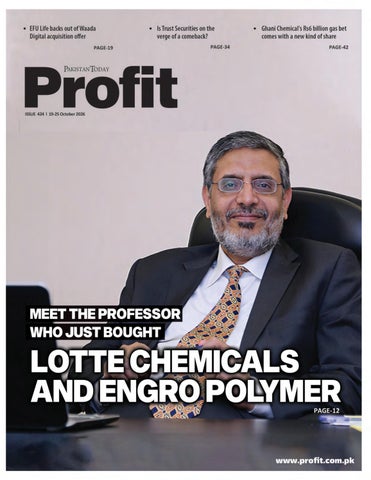
12 Meet the professor who just bought Lotte Chemicals and Engro Polymer 19 EFU Life backs out of Waada Digital acquisition offer
22
22 Select Technologies doubles profits despite falling sales, bets on home appliances for next growth phase 31 Danish Elahi’s Soya Supreme share sale: much ado about nothing
22
34 Is Trust Securities on the verge of a comeback?
39
34
39 Pakistan’s 20 largest listed textile companies generate $5 billion in sales, profits rise 11% 42 Ghani Chemical’s Rs6 billion gas bet comes with a new kind of share
Profit Publishing Editor: Babar Nizami - Senior Editor: Abdullah Niazi Business Reporters: Taimoor Hassan | Usama Liaqat | Zain Naeem | Shahnawaz Ali | Ghulam Abbass Ahmad Ahmadani | Aziz Buneri - Sub-Editors: Saddam Hussain | Abdul Hameed - Video Producer: Adnan Maqsood Director Marketing: Muddasir Alam - Regional Heads of Marketing: Agha Anwer (Khi) Kamal Rizvi (Lhe) | Malik Israr (Isb) GM Special Projects Zulfiqar Butt - Manager Subscriptions: Irfan Farooq Pakistan’s #1 business magazine - your go-to source for business, economic and financial news. Contact us: profit@pakistantoday.com.pk
12
Imtiaz Ahmad returned from his cushy professorship in Philadelphia to a one-room family office importing and selling chemicals to paint companies. Now, he has plans to become Pakistan’s largest chemical manufacturer.
I
By Abdullah Niazi
mtiaz Ahmad was 20-years-old when he first landed at JFK International. He had dropped out of Lahore’s Allama Iqbal Medical College mere months ago. Even today, willingly leaving a seat at a government medical college would elicit at least a gasp or two from close family and friends. In 1984 it was considered the height of stupidity. Yet the sights and sounds of the most famous airport in the world were enough to shake off any vestiges of doubt he still harboured. “There used to be an American Cultural Centre on Mozzang Road with a library I used to visit as a kid,” he says. “They had pictures of the New York and Chicago skylines printed on the walls. I used to look at them and think, wow, will I be fortunate enough to see them one day? The day I landed at JFK I realised I had reached my paradise.” For a decade after he landed, Imtiaz Ahmad played out the typical life-story of enterprising, immigration minded youths of that era. He enrolled in a good college, completed his bachelors early, entered a PhD programme, completed a doctorate in management (specialising in production and operations) and took a job teaching business at St Joseph’s University in Philadelphia. Had he continued on this path, he might still have been a professor in the United States, teaching MBA courses and worrying about how Americanised his children were getting and being shocked at how his grandchildren were pronouncing Urdu words — typical expat desi stuff. But a phone call from his father in 1994 brought him back to Pakistan. Back to a one-room family office on Hall Road that served as a shrine to a series of failed business ideas complete with a broken chair and distressed table. In the three decades since his return, the good professor has grown the family business from that one room into the rarest of creatures: an honest-to-goodness manufacturing focused, international business rooted in Pakistan. In November 2025 one of his companies, Montage Oil, his business group partnered up with AsiaPak Investments to purchase Lotte Chemicals in Pakistan from its South Korean sponsors in a $69 million deal. He has been
Chairman of Lotte’s board since. Nine months after the acquisition, Lotte Chemicals bought a 56% stake in Engro Polymer and Chemicals for Rs 19.7 billion ($71.2 billion at the current exchange rate). These are only his most prominent moves and they have both come in less than a year. The family’s core business is trading — dealing in chemicals like Sulphur, Benzene, MX, Toluene, Styrene White Spirit, OX, PA, Bitumen all over the world. One of their companies, Montage Oil based out of Dubai, has liquid storage facilities in Sharjah, Karachi, Lahore, Ho Chi Minh City, and Qingdao. They also have dry storages in Vietnam and the UAE. But the most key piece of the puzzle is PAChem Global — a greenfield project that started operations in 2019 manufacturing Phthalic Anhydride, which is used in the production of plastics and resins. The arc of this business consolidation is clear: the professor is making a play for Pakistan’s chemicals manufacturing industry. The only question is, can this business professor turned manufacturing magnate teach corporate Pakistan a lesson or two?
Entering the chemicals business
P
akistan’s chemical industry was established three years before its birth when the Empire’s largest conglomerate, Imperial Chemical Industries (ICI), built the Khewra Soda Ash company in 1944. In the 1940s soda ash was in high demand as a core ingredient for glass, soaps, and textiles. It was also the precursor to several industrial chemicals and is still a major component in the production of sodium silicates, sodium phosphates, and baking soda. Khewra was an ideal location for ICI. Its massive deposits of rock salt and local limestone meant access to the raw materials was cheap and closeby. It was from this point on that chemical manufacturing became a core Pakistani industry. After 1947, ICI incorporated its Pakistan assets under Khewra Soda Ash Company Ltd, which was set up in 1952, and in 1966 the company was renamed ICI Pakistan. With its colonial origins and high standards ICI was considered the pinnacle of corporate ambitions in Pakistan — a dream
job for anyone with an MBA. They produced paints, chemicals, and the company did so well during those years that back in 1995, its international parent, ICI PLC, made its largest ever overseas investment in Pakistan, to set up a manufacturing facility of Pure Terephthalic Acid (PTA) at Port Qasim. The establishment of ICI’s PTA facility at Port Qasim offers an almost perfect symmetry for Imtiaz Ahmad’s story. He returned to Pakistan in 1994, only a year before it was established. Three decades later he would become the Chairman of what is still Pakistan’s only PTA manufacturer. But before that, he had a broken family business to fix. The professor’s decade in the United States might have been a dream come true but his family was still in Pakistan. “Family was the biggest reason for returning,” he tells Profit. Our conversation took place at a large house in Lahore’s Model Town with wall-to-wall windows overlooking a massive Gulmohr tree. The house serves as a sort of family office and was purchased at auction around 2014, but the professor lives with his family in Bahria Town. His parents are still alive, and his children are deeply involved in the business. Everything about him screams family, and he says Lahore is the only city in the world that really makes sense for him. “I was born in a village in Gujrat, but we moved to Lahore when I was four. We lived in Samnabad and I remember going to St Anthony’s school celebrating birthdays on a Tanga with my school friends.” The nostalgia and his desire to be close to his family played a big part in moving back to Pakistan. His father wanted to retire and shut down the family business — a small scale import and sell business. They were importing a couple of raw materials for the paint business and selling it to bulk buyers. “All I had was knowledge from my time as a professor and my father’s experience. I asked him where we should start and he suggested I find and source phthalic anhydride, which the paint industry uses to make varnishes and enamel, so that’s where I started.” This was the lowest rung in the chemical industry. “There used to be a library at the Lahore Chamber of Commerce and Industry that I hope is still there. I scoured through the yellow pages and made a list of around 40-50 Cover Story
phthalic anhydride manufacturers around the world and sent letters to all of them. I got two replies, one of them was from a manufacturer in Germany who offered us two containers at $445 per tonne. I opened the line of credit and placed the order. It was the first transaction of my career.” By the time the shipment arrived, the price of phthalic anhydride had increased to $900 per tonne, more than doubling the investment. It was a homerun on the first pitch. From this point on, the professor went all in on the trading business. In his own words, he made risky moves and they paid off — making him a lot of money in the process. “One of my mentors and colleagues was Dr Giles Boyer. During a conversation, he gestured towards a map of the world and circled South Asia and told me this would be my playground when I went back to Pakistan,” he says. That is where the seeds were planted that he would become an international trader of commodities. “I took his words as prophetic. It was a prophecy.” An early transaction in the 1990s involved buying around 200 tonnes of synthetic rubber from a plant in Siberia. The material travelled thousands of miles to St Petersburg, where it was stored in a third-party warehouse and sold to buyers around the world, one container at a time. The model was straightforward: buy a substan-
14
tial quantity of a product from one source, position it for distribution and find customers across different markets. Making it work required actively approaching buyers. But being a trader was far from the height of his ambition. And he says he knew from the very beginning that his Holy Grail was manufacturing.
Foray into manufacturing
“T
he term ‘trader’ was always a bit derogatory here,” Imtiaz Ahmad tells Profit. “People would look down at you for being ‘just’ a trader. I know it is only a perception issue but I had always wanted to get into the manufacturing side of things.” In only a few years, the professor had managed to revive his family’s trading operations and take them well beyond Pakistan. The opportunity to become a manufacturer presented itself in 1999. One of their clients was a sulfuric acid plant near Lahore called Sabir Industries. It had been set up by a retired Lt General, a former Commerce Minister, and a few others. The partnership was not going very well, and the company owed a lot of money to International Petrochemicals (the name the professor was running his operation
under) which was its sulfur provider. When the sulfuric acid plant said they could not pay their suppliers, the professor offered to buy it from them. The deal went through in 1999 for Rs 2.2 crores. “That was the moment I really thought we had arrived,” he says. The professor poured money he had made through the trading business into manufacturing. They set up more plants for products like ammonium sulphate and doubled down on this side of the business. “We didn’t know much about chemical manufacturing really. We gave an ad out in Jang and a chemical engineering graduate from UET named Sajid Rafiq showed up. I hired him on the spot to conduct research. After a few months I moved him from the office to the factory to set up more plants. Eventually we set up around 10 plants over 50 acres.” By the turn of the century, International Petrochemicals had three distinct lines of business. They were trading internationally, trading and distributing raw chemical materials locally, and now manufacturing chemical products as well. Around this time the family had emerged as a mid-level contender within Pakistan’s chemical industry not because one of its businesses was among the largest, but because they were integrated across the supply chain. “Sulfuric acid is the mother of all chemicals, and even for our trading and
Capital markets
distribution business the relationships we made gave us a much wider network and access,” he explains. From this point on it was about consolidation. All three lines of business continued. In 2008 there was a split within the family. One of the maternal uncles separated from the business and the professor was left to deal with the entirety of the operation. For some years it would continue that way — or at least until the next big bet.
Manufacturing Maxxing
T
he commitment to shedding the “trader” label and become a manufacturing giant finally morphed into material reality in 2016. The professor had begun his career importing phthalic
anhydride and distributing it in Pakistan and beyond. Now he wanted to begin producing the phthalic anhydride himself. The result was PAChem Global, a greenfield plant in Faisalabad’s special economic zone, where Ahmad bought land and spent the next three years overseeing everything from construction to commissioning; by his estimate, the project absorbed roughly $20 million, or 40–50% of the business’s capital at the time. The money came from reinvesting earnings, and with no tangible debt. During the interview, the professor told us that when he had first returned to Pakistan he had recommended to his father that one way to grow was through debt. “When I was in my MBA programme, there used to be a standard question asking what the optimal level of debt for a company was. At that time the answer was
PAChem Global’s petrochemicals plant in the Faisalabad Industrial Estate began exports in July 2021. The plant is the largest of its kind in Pakistan with a production capacity of 35,000 metric tons per annum of Phthalic Anhydride — the very same product Dr Imtiaz Ahmad first started trading when he returned to Pakistan. 16
30% debt is optimal to balance the cost of equity with the cost of capital. I told my father this and he said let this idea go, use your own resources and have faith in God. To be very honest that has been the overriding philosophy behind our businesses since,” he says. With a massive chunk of his capital tied into the new project, the professor found he was making an attempt he did not fully grasp the scale of. “From the moment I bought the land I was sucked into the project. It was very new and very different for me,” he says. The demands became particularly clear one Saturday, when the professor was still in his Faisalabad office at around 11pm and a fire broke out near a tank at the site. “Fortunately, it was a small fire and we put it out,” he recalls. “When I was coming back from Faisalabad to Lahore at 2am, I said, ‘Where did I go wrong?’ That was the toughest night.” Around the same time, his process engineer offered an assessment that helped explain why the project had become so difficult: he had experience operating chemical plants, but had underestimated the complexity of building this particular one. To illustrate the point, the engineer described an earlier, 10,000-tonne phthalic anhydride project in Pakistan, backed by German specialists and an engineering contractor, which had still required months of work after product solidified inside its pipelines during commissioning. “You are setting up a plant four times larger,” the engineer told him, as the professor remembered it. “You do not have any German PhDs with you, you have not been awarded an EPC contract, and you are not a chemical engineer yourself.” The professor accepted the criticism; with so much of the family’s capital invested, all through equity and without borrowing, he needed to work out what the project was missing. “He was right, honestly,” he says. “I really appreciated his feedback. I sat down and I said, ‘What can I do at this stage?’” His response was to strengthen the team and increase his own involvement,
and when commissioning eventually came, the outcome was better than he had feared. “Our first batch was world-class quality. The plant’s start-up was smooth. Everything went better than expected.” His family attended the ribbon-cutting together; the chemical he had once found through trade directories and imported in two containers was now being manufactured at a factory of his own. Today, PAChem has a production capacity of 33,000 MT of Phthalic Anhydride and claims to be the most efficient facility of its kind in the world.
The business group emerges
P
AChem Global took a toll on Imtiaz Ahmad. His family and children insisted that this be the last project he takes on because of the stressful three years that had just preceded. And for a little while it seemed as if that would be the case. While the greenfield project was being set up, the family’s third generation began working on a company called Montage Oil in 2017. The professor’s son, Faraz Ahmad, is currently the Managing Director of the company. The purpose behind Montage was keeping the family’s trading business internationally competitive. Based out of Dubai and with offices in Thailand, Vietnam, Cape Town, and Mexico City amongst other places, the company expanded their trade business beyond chemical products and moved into agricultural commodities and fertilisers. The Covid-19 pandemic proved particularly opportune, as the global economy went on the fritz Montage made a number of good calls and quickly became cash rich. The company is not publicly listed and is based in the UAE, so their financials remain elusive. For all intents and purposes the professor had achieved most of his goals. He had a thriving trading business that he had successfully gotten his children as well as some of their cousins involved in. He had a manufac-
turing presence in Lahore and Faisalabad. In fact, he had become a major producer of the very product he started his career trading — Phthalic Anhydride. But then came something that was, for any Pakistani business group, the opportunity of a lifetime. Lotte Chemicals was up for sale. Why would a South Korean manufacturer of PTA matter to a Pakistani business group? Because before it became Lotte Chemical in 2009, it was the PTA plant set up at Port Qasim by ICI — the Big Kahuna of corporate Pakistan. ICI had been bought out globally by the Dutch paint company Akzo Nobel. When they acquired the Pakistani business, they went about getting rid of the non-paint parts of it. The chemicals business was bought by the Tabba family’s Yunus Brothers Group
while the PTA plant was bought by Lotte. Thus only one part of ICI actually came in the hands of a Pakistani owner. And it remained so until November 2025, when Syed Babar Ali’s Packages Group announced their intention to buy AkzoNobel in Pakistan. The paint business was struggling and looking to exit both India and Pakistan, and Packages was more than keen on acquiring it. That meant two of Pakistan’s biggest business groups, the Tabbas and Packages, had acquired two of the three pieces of what was formerly ICI Pakistan. The last remaining piece in foreign hands was Lotte Chemicals. That is until the South Korean parent company decided it was reshuffling its priorities and wanted to get rid of their PTA business in Pakistan. There was
Dr Imtiaz Ahmad and Shaheryar Chishty (Centre front row) after the acquisition of Lotte Chemicals. The two business groups were introduced through mutual friends and purchased the PTA plant from its South Korean sponsors for $69 million in November 2025. Capital markets
talk at the time that either Packages or the Yunus Brothers Group might be interested in buying it and getting their hands on another ICI business — but what emerged instead were two promising new Pakistan business groups joining hands to take the cake. Montage Oil, the company taking shape and giving an international identity to the business Imtiaz Ahmad had built, joined hands with AsiaPak Investment — the investment company run by Shaheryar Chishty which has acquired K-Electric, Bol TV, Daewoo, and Liberty Daharki Power Limited over the past few years. Mr Chishty has been one of the most aggressive investors in Pakistan in recent years and has quickly emerged as a significant player in different industries. His most famous acquisition which turned into a long-winding battle was KE. This was the person that Imtiaz Ahmad was now partnering with — his first time getting involved with someone from outside the family. The two parties did not know each other before but were introduced by mutual friends. In November 2025, the consortium completed the purchase of the South Korean parent’s 75.01% stake for roughly $69 million, through PTA Global Holding. The professor became chairman of Pakistan’s only PTA manufacturer, supplying a raw material for polyester and PET used in textiles and packaging. Chishty brought a banking background and an appetite for acquiring orphan assets, businesses their existing owners wanted to leave, where he believed different ownership could improve the outcome; The professor brought decades of chemical trading, manufacturing and the experience of setting up plants himself. “We didn’t understand the finance
part of things or the M&A part of it, and he didn’t understand the industrial, chemical business part of it,” the professor explains. “So it turned out to be a good, complementary relationship.” The joint venture was an equal partnership, giving Chishty a manufacturing partner who understood the products and processes, and Ahmad a partner familiar with negotiating acquisitions and arranging their financial structure; it also brought the family into the public markets. “Public listing, public markets, was a dream; I honestly didn’t know how that would come true,” says the professor. According to him, the operational work involved identifying five improvements at Lotte, two of which have been implemented, with three still in progress; he puts the reduction in conversion costs at $20 per tonne, from $120 to $100, equivalent to $10 million annually across 500,000 tonnes of production. The next transaction followed within nine months: on August 31, 2026, Lotte signed an agreement to acquire Engro Corporation’s 56.19% stake in Engro Polymer and Chemicals for Rs19.7 billion. The company subsequently became Noventra on October 5; the Engro agreement remained subject to approvals and closing conditions. That transaction would add Pakistan’s sole PVC manufacturer, alongside caustic soda and hydrogen peroxide operations, to a business previously centred on PTA, with plans to combine the companies and improve energy, procurement and operating costs. For the professor and Chishty, Lotte was becoming a base for further expansion, with a second major manufacturing acquisition agreed less than a year after their first.
Share Purchase Agreement being signed by the CEOs of Engro Corporation and Lotte Chemical Pakistan. 18
Why it might work
T
he professor has built a business that earns internationally and invests in manufacturing in Pakistan, and the Lotte acquisition and proposed Engro Polymer deal show how much further he wants to take it. The next generation is already involved, while the professor has increasingly taken on the role of a coach. When his son Faraz was choosing a university, he had offers from American institutions and a scholarship, but his father, who had once left Pakistan to study in the US, suggested he go to LUMS. The circumstances had changed: there was now a family business to learn from, and relationships to build in the country where that business operated. “Your time is different, your situation is different, your opportunities are different and accordingly our strategy should be different,” he recalls telling his son. The professor made sure his son attended summer programmes in Beijing, London and Singapore, and before graduating was sent to the UAE to understand the market and begin building a company. But his father thinks his education and early work combined exposure to other countries with continued involvement in a business rooted in Pakistan. “You go to the US and make great friends but when everyone moves away from that university town it gets difficult to keep up. But LUMS alumni are going to be helpful to you if you are working in Pakistan,” he says. “We owe a big debt to an institution like LUMS. Other than Faraz, my nephews Muhammad Ali and Asad also went to LUMS as well as my daughters Amina and Momina. So we have a corp of seven or eight LUMS grads which are part of the next generation business team taking things forward. The international part of the business in particular has been developed by this generation in the past decade. I’ve taken a bit of a backseat and am trying to guide them.” At a time when many Pakistani business families are moving their personal lives abroad while continuing to run companies here, keeping that connection offers a practical advantage: factories, employees, suppliers and customers are easier to understand when they remain part of everyday life, and problems are easier to follow through when the owners are close enough to see them for themselves. For an emerging group with plans to expand quickly, that familiarity matters, particularly when its ambitions involve operating factories and making them work better over many years. The professor came back to Pakistan to take over his father’s work; he is now giving his children something here that is worth taking forward. And if his plans work out, they will keep working in Pakistan for some time yet. n Capital markets
EFU Life backs out of Waada Digital acquisition offer
Three months after announcing plans to acquire one of Pakistan’s most prominent insurance technology startups, EFU Life Assurance has abandoned the transaction
P
akistan’s insurance industry has lost what might have been one of its more interesting acquisitions of the year. EFU Life Assurance, the life insurance subsidiary of EFU General Insurance, has decided not to proceed with its proposed acquisition of Waada Digital, a Karachi-based insurance technology company that has spent the past six years attempting to make insurance accessible to millions of Pakistanis traditionally excluded from the market. In a disclosure submitted to the Pakistan Stock Exchange (PSX) on October 13, 2026, EFU General announced that the board of its subsidiary had decided, by mutual agreement with Waada Digital, not to proceed with the acquisition of 100% of the startup’s issued share capital. The announcement brings an end to a process that began publicly on June 29, 2026, when EFU Life first disclosed that its board had authorised consideration of a potential acquisition. At the time, the transaction remained conditional on due diligence, commercial negotiations, definitive agreements and the necessary regulatory approvals. Neither company has publicly disclosed a reason for abandoning the transaction, nor was a proposed purchase price announced. The October disclosure offers no indication of whether the disagreement, if any, concerned valuation, the findings of due diligence, the structure of the transaction or a change in strategic priorities. Indeed, the two companies have described the decision as mutual. The withdrawal is nevertheless significant. Waada is not simply another insurance brokerage. It is one of the more ambitious attempts to rethink how insurance is distributed in Pakistan, replacing conventional sales channels with a combination of telecommu-
Insurance
nications partnerships, digital infrastructure, microinsurance products and technology-enabled distribution. For EFU, meanwhile, the proposed acquisition represented an opportunity to bring that infrastructure into an established insurance group with almost a century of operating history.
From startup to acquisition target
W
aada Digital was founded in 2020 by Ishaq Kothawala, an entrepreneur with experience in Pakistan’s technology industry, including an earlier association with ride-hailing platform Bykea. Its founding proposition was relatively straightforward: Pakistanis do not necessarily refuse to buy insurance because they do not recognise its value. Often, insurance is simply too expensive, too complicated, or too difficult to purchase through traditional distribution channels. Waada sought to tackle those problems by making policies inexpensive, simplifying enrolment and selling protection through businesses that already had millions of customers. The company began operations in Pakistan in 2021 and secured an important early distribution arrangement with telecommunications operator Zong that November. The partnership gave Waada access to a potential distribution network of more than 40 million mobile subscribers. For Waada, it represented a way to reach customers without creating an expensive nationwide insurance sales force. For Zong, it meant adding financial protection products to its portfolio of services. An important milestone arrived in
November 2022, when Waada announced the acquisition of MicroEnsure Pakistan, the local operations of an international business specialising in microinsurance for lower-income consumers. The transaction was structured as an allshare acquisition, with no publicly disclosed valuation. It created what Waada described as Pakistan’s largest technology-driven insurance distributor, with approximately 1.5 million active customers across the combined businesses. Alongside the acquisition, Waada announced a $1.3 million seed funding round involving local angel investors and international venture capital investors. Its backers included Haitou Global, Kinnow Capital and Planet N, associated with Pakistani fintech investor and entrepreneur Nadeem Hussain. The MicroEnsure transaction mattered because it gave Waada something that most early-stage technology companies struggle to acquire: an existing customer base, operating relationships and experience selling insurance products to people outside the conventional insurance market. Subsequent expansion took the business beyond its original Pakistani market. Waada introduced mobile phone insurance in 2023 and began expanding into Saudi Arabia in 2024. Its Saudi business now describes itself as a digitally operated managing general agent offering Shariah-compliant life and savings insurance through licensed underwriting partners. The company says its investors include Joa Capital, Qatar Insurance Company, F6Ventures and Gobi Ventures. Its Saudi expansion illustrates an ambition to create a regional technology platform rather than remain a conventional Pakistani insurance broker. However, the publicly available EFU acquisition disclosures identify the target specifically as Waada Digital (Pvt) Ltd. They 19
do not establish whether, or how, overseas operations would have been included in the proposed transaction.
What does Waada actually sell?
W
aada’s business is best understood as an insurance distribution and technology platform rather than a traditional insurance company. In the Pakistani market, its core products include personal accident insurance, hospital cash insurance, life insurance and mobile phone protection. It also offers complementary services, including telehealth consultations and discounts on medicines and diagnostic laboratory services. Its proposition is particularly well suited to customers who cannot afford conventional annual insurance premiums or who have never purchased an insurance policy. For example, Waada’s partnership with Zong offers personal accident coverage with daily premiums starting at Rs2, excluding taxes, for Rs200,000 of specified accidental death cover. Higher premium tiers provide additional coverage. Hospital cash plans similarly offer
20
defined payments for each day a customer is hospitalised, helping offset costs such as transportation, lost income and other expenses that a conventional hospital reimbursement arrangement may not cover. Life insurance plans distributed through the partnership provide specified benefits in the event of death, while mobile phone insurance covers certain forms of theft or damage. The economics of this model are different from traditional insurance distribution. Instead of relying primarily on agents to sell relatively expensive policies, Waada connects insurance products with mobile phone operators, banks, retailers, e-commerce companies and other businesses that already maintain relationships with potential customers. It operates a virtual call centre model, with premiums collected through mobile airtime deductions. Its technology also supports a network of retail and gig-economy agents who can issue policies digitally, along with embedded insurance products offered during online purchases. These channels allow customers to obtain insurance as part of transactions they are already making. A crucial distinction is that Waada ordinarily acts as the intermediary, distributor and administrator, while licensed insurers underwrite the policies and carry the associated
insurance risk. Waada’s website also describes plans to obtain digital insurer licensing, which would allow it to move further into underwriting itself. That should not be confused with already possessing such a licence in Pakistan.
EFU and Waada were already business partners
P
erhaps the most interesting aspect of the abandoned acquisition is that EFU Life and Waada were not strangers to one another. They had an existing commercial relationship, with EFU Life underwriting insurance products distributed by Waada. Under the Zong arrangement, for example, Waada serves as the distributor and administrator, Zong provides access to customers, and EFU Life is the insurance underwriter responsible for paying valid claims under the relevant policies. The two companies subsequently announced a wider strategic arrangement under which EFU Life became Waada’s exclusive partner for life, health and personal accident takaful solutions. EFU Life chief executive Mohammed Ali Ahmed described the alliance as an opportu-
nity to combine EFU’s established insurance expertise with Waada’s technology. Waada founder Kothawala similarly emphasised the potential for the partnership to develop Pakistan’s largely untapped retail takaful market. Against that background, the proposed acquisition was a logical extension of an existing commercial relationship. EFU would have gained direct ownership of distribution technology, customer relationships and a business model designed around low-cost insurance. Waada, in turn, would have become part of one of Pakistan’s best-established insurance groups. The acquisition would therefore have represented a form of vertical integration: an insurance underwriter acquiring a technology company that helps it reach customers. The decision not to proceed does not, by itself, mean the companies’ existing distribution arrangements have ended. Neither the EFU Life disclosure nor EFU General’s subsequent announcement states that those commercial partnerships are being terminated.
The company’s operations remain closely associated with corporate insurance, though it also has an established retail presence. EFU Life, meanwhile, operates in life insurance, family takaful, health insurance, retirement savings and corporate employee benefits. Its gross premiums, including takaful contributions, increased by 37% to Rs57.05 billion in 2025. However, its after-tax profit declined from Rs2.99 billion to Rs2.44 billion. The life insurer has also expanded through acquisitions, including the integration of EFU Health Insurance into its operations in 2024. EFU therefore possesses substantial financial resources and an established insurance platform. The attraction of Waada was unlikely to have been simply its existing premium volumes. Rather, the strategic value lay in the possibility of acquiring new distribution capabilities and access to customer segments that conventional insurers have historically struggled to reach.
EFU: An insurance company with nearly a century of history
Pakistan’s insurtech market: Growing, but from a very small base
E
FU General’s history stretches back to 1932, when Eastern Federal Union Insurance Company was established in Calcutta with backing from Ghulam Mohammed, later Pakistan’s governor-general, the Aga Khan III and the Nawab of Bhopal. Following Partition, the company established itself in Pakistan and grew into one of the country’s leading insurers. By 1961, its life insurance business had become one of the largest in Asia and Africa, excluding Japan. That position changed dramatically in 1972, when the government nationalised the life insurance industry. EFU continued operating in general insurance, while its life insurance operations were absorbed into the state-controlled system. The group returned to life insurance following the liberalisation of the industry in 1990. EFU Life Assurance commenced operations in November 1992, becoming the first private-sector life insurer to enter the newly reopened market. Today, EFU General is one of Pakistan’s largest non-life insurers. Its portfolio covers fire and property damage, engineering, marine, aviation, motor insurance and various specialised commercial risks. It also operates a general takaful window. In 2025, EFU General reported gross premiums and takaful contributions of Rs46.89 billion, an increase of approximately 14% over the preceding year. Its after-tax profit rose from Rs3.71 billion to Rs5.30 billion.
T
he broader insurance market provides considerable context for why such an acquisition might have been attractive. According to the Securities and Exchange Commission of Pakistan’s insurance industry statistics for 2025, gross premiums increased by approximately 15% to Rs778 billion, up from Rs677 billion in 2024. Total industry assets reached approximately Rs4.09 trillion, while takaful contributions increased to Rs123 billion. Yet insurance penetration remained at just 0.7% of GDP, highlighting the considerable distance between Pakistan and more developed insurance markets. The particularly revealing statistic concerns digital distribution. Premiums generated through digital channels increased from approximately Rs4 billion in 2024 to Rs6.8 billion in 2025. That represents growth of around 70% in a single year. Nevertheless, digital distribution still accounted for only 0.85% of the industry’s total premiums. This is the opportunity that startups such as Waada are attempting to capture. Technology-based distribution can reduce customer acquisition costs, simplify policy issuance and make insurance economically viable for smaller transactions. Pakistan’s extensive telecommunications networks and growing digital payments infrastructure potentially offer powerful channels for distributing low-premium products.
The regulatory environment has also become more accommodating. In July 2025, the SECP granted Digi Insurance Ltd Pakistan’s first digital-only non-life insurance licence, establishing a pathway for companies wishing to operate as insurers through entirely digital infrastructure. Other businesses, including insurance comparison platform Smartchoice and technology-led distribution partnerships involving established insurers, are also contributing to the development of the market. But the challenges are substantial. Low household purchasing power, limited awareness of insurance, difficulties collecting recurring premiums and concerns about claims settlement all complicate the economics of selling small insurance policies. For technology startups, the central challenge is converting access to large numbers of potential customers into a commercially sustainable flow of premiums and renewals. A telecommunications partnership may offer access to millions of subscribers, but that does not necessarily translate into millions of profitable policyholders.
What happens next?
T
he cancellation of the Waada acquisition illustrates both the appeal and the complexity of bringing traditional insurers and technology startups
together. EFU Life already had a commercial relationship with Waada. It understood the startup’s distribution model and had experience underwriting products sold through its channels. Nonetheless, a transaction that appeared strategically sensible did not reach completion. For Waada, the immediate question is whether it will continue building independently, seek another strategic investor or eventually revisit the possibility of acquisition. For EFU, the withdrawal does not eliminate the underlying commercial rationale for investing in digital distribution. Its own existing partnerships demonstrate that the group remains engaged in expanding insurance beyond traditional sales channels. And for Pakistan’s insurance industry, the larger question remains unchanged. The country has a growing insurance market, increasing regulatory support for digital innovation and a large population with little or no insurance coverage. What it has yet to demonstrate on a substantial scale is whether technology can turn that enormous potential market into a consistently profitable business. The EFU-Waada deal may have fallen through, but the commercial opportunity that brought the two companies together remains very much alive. n Insurance
Select Technologies
doubles profits despite falling sales, bets on home appliances for next growth phase 22
Better margins and a move into Hisense air conditioners and televisions have helped transform the business, but management’s growth projections will depend on recovering smartphone demand.
P
akistan’s consumer electronics industry has not had the easiest of years, but Select Technologies appears to have discovered something potentially more valuable than rapid revenue growth: the ability to make considerably more money from each product it sells. The Lahore-based manufacturer, which assembles Xiaomi smartphones and televisions and has expanded into Hisense home appliances, reported net income of Rs2.70 billion during the financial year ended June 30, 2026, an increase of 107% from Rs1.30 billion a year earlier. The remarkable part is that this improvement came despite revenue declining 35.5%, from Rs48.89 billion to Rs31.56 billion. The company effectively doubled its profitability while operating a substantially smaller business by sales value. The explanation lies in a combination of better product margins, changes in the economics of its manufacturing arrangements, lower financing costs and an unusually large reduction in its tax expense. And according to management discussions with analysts at Arif Habib Limited on October 15, 2026, the company believes it can sustain much of that improvement while returning to growth through expanded smartphone production and an aggressive push into the domestic home appliances market. That would be an important development for Select, which only recently became a separately listed company, following its initial public offering in July 2026.
The curious economics of falling revenue and rising profits
S
elect Technologies’ financial performance over the past three years illustrates just how dramatically the economics of Pakistan’s smartphone assembly industry can change. In FY2024, the company generated revenue of Rs73.46 billion. This declined to Rs48.89 billion in FY2025 and fell further to Rs31.56 billion in FY2026. However, gross profit moved in the opposite direction, increasing from Rs3.97 billion in FY2024 to Rs4.37 billion in FY2025
and Rs5.27 billion in FY2026. The gross profit margin increased from 5.4% in FY2024 to 8.9% in FY2025, before reaching 16.7% in FY2026. That is a remarkable improvement for a manufacturing business, and the management discussion with Arif Habib provides some explanation. According to the October 15 research note, Select negotiated revised commercial arrangements with its principal, Xiaomi, that allow it to incorporate inventory financing costs into the prices charged for manufactured products. In effect, the company has secured greater compensation for the cost of holding inventory until it is sold. Changes in the mix of products manufactured also contributed to the improvement. The financial results reflect these developments. Operating profit increased approximately 14% to Rs4.53 billion, while finance costs declined 13% to Rs2.08 billion. There was, however, another major contributor to the spectacular increase in net income: taxation. Select’s tax expense collapsed from Rs789 million in FY2025 to just Rs20 million in FY2026. Management attributed the reduction to deferred tax effects, exempt income and adjustments relating to alternative corporate tax. The distinction is important. Profit before tax increased 30%, from Rs2.09 billion to Rs2.72 billion, while net profit increased 107%. Indeed, approximately Rs769 million of the Rs1.40 billion increase in net income came from the reduction in the reported tax charge. That means more than half of the improvement in bottom-line profitability was attributable to taxation rather than an equivalent increase in pre-tax earnings. The company’s operating performance has clearly improved, but it would be misleading to attribute the doubling of profits entirely to manufacturing efficiency.
From an Air Link subsidiary to a listed company
S
elect Technologies was established in October 2021 as a wholly owned subsidiary of Air Link Communication, one of Pakistan’s largest mobile phone
manufacturing and distribution companies. The parent company, controlled by the Piracha family and led by Muzzaffar Hayat Piracha, had already developed significant relationships with international smartphone manufacturers. Select was created to develop a dedicated manufacturing operation, particularly for Xiaomi, allowing the group to expand beyond its traditional distribution activities. The relationship remains central to Select’s business. Its Xiaomi manufacturing arrangements cover smartphones under the Xiaomi, Redmi and POCO brands, along with Xiaomi smart televisions. Meanwhile, Air Link continues operating its own manufacturing and distribution businesses, including activities involving Tecno and itel smartphones, as well as other consumer electronics brands. The two businesses are therefore complementary rather than identical: Select concentrates on Xiaomi manufacturing and the group’s expanding home appliances portfolio, while Air Link retains broader distribution and other manufacturing activities. In July 2026, Select completed its initial public offering, issuing 88.89 million new shares at Rs34 each and raising approximately Rs3.02 billion. The transaction left Air Link with a 90% ownership stake, while the remaining 10% became available to public investors. The proceeds are intended partly to finance expansion into additional manufacturing categories and support the associated working capital requirements. The company’s chief executive, Adnan Aftab, is a manufacturing specialist with more than three decades of industrial experience.
Hisense could transform the business
T
he most significant strategic development for Select is its move beyond smartphones into home appliances. In February 2026, the company announced a manufacturing and distribution partnership with Chinese electronics manufacturer Hisense, covering televisions and air conditioners. The move is intended to reduce the Consumer goods
24
company’s dependence on smartphones, where demand can fluctuate considerably and margins are often constrained by competition between international brands. Its initial sales figures suggest that the appliances business is already gaining a foothold. According to the Arif Habib research note, Select sold approximately 19,359 Hisense air conditioners and 5,327 Hisense televisions in FY2026. Management now expects those volumes to increase substantially. The Hisense projections are particularly aggressive. Management expects air-conditioner sales to more than triple in FY2027, while television volumes are projected to increase more than ninefold. By FY2028, Select expects to be selling almost five times as many Hisense air conditioners annually as it did in FY2026. If achieved, these targets would significantly diversify the company’s revenue and make the home appliances division a much more important component of its business. However, the air-conditioner market presents different challenges from smartphones. Demand is highly seasonal, inventory can remain unsold for extended periods, and competition from established domestic and Chinese manufacturers is intense. Select will therefore need to build an effective distribution network while carefully managing the working capital required to maintain appliance inventories.
Xiaomi remains the foundation
D
espite the excitement surrounding Hisense, Xiaomi smartphones remain Select’s principal business. During FY2026, the company sold approximately 1.10 million Xiaomi smartphones and 32,624 Xiaomi LED televisions. The gross margin on smartphones was 15.61%, while Xiaomi televisions generated a considerably higher margin of 22.96%. That difference helps explain why management is interested in expanding the company’s television and home appliance portfolio. According to the Arif Habib report, management expects Xiaomi smartphone sales to increase 9.2% to 1.2 million units in FY2027 and then a further 25% to 1.5 million units in FY2028. These projections depend partly on improving consumer demand and Select’s ability to capture additional market share. The broader industry environment remains challenging. According to statistics cited by credit rating agency PACRA, local mobile phone production declined approx-
imately 8% during the first six months of calendar year 2026, to 13.1 million units. PACRA attributes Select’s declining revenue partly to weaker industry demand and partly to the company’s deliberate withdrawal from high-volume, low-margin 4G device production. The strategy, in other words, increasingly prioritises profitable sales rather than simply maximising the number of devices assembled.
Consolidating production and capturing tax benefits
A
nother important element of Select’s strategy is the relocation and consolidation of its manufacturing operations at the Sundar Green Special Economic Zone near Lahore. The company currently operates manufacturing facilities at the Quaid-e-Azam Industrial Estate and Sundar. Management reported aggregate capacity utilisation of approximately 28.95%, with the Arif Habib note attributing 19.3 percentage points to Quaid-e-Azam Industrial Estate and 9.65 percentage points to Sundar. Select intends to consolidate manufacturing at Sundar, enabling it to operate more efficiently and benefit from infrastructure developed specifically for industrial production. Management expects capacity utilisation to increase to 34.3% in FY2027 and 42.9% in FY2028. The projected increases indicate that the company still has considerable unused manufacturing capacity. This creates opportunities to increase output without having to make proportionately large investments in additional facilities. The move also offers a potentially significant tax advantage. According to the analyst note, management expects to benefit from a nine-year tax holiday associated with its operations in the special economic zone. If the company qualifies for the anticipated exemptions and retains its improved operating margins, this could support net profitability over several years. That is particularly important given how strongly the reduction in taxes contributed to FY2026 earnings.
The working capital challenge
T
he company’s growth plans also carry financial risks. The Arif Habib note highlights a considerable difference in inventory turnover between smartphones and
televisions. Select’s smartphone inventory turns over approximately 3.94 times annually, compared with just 1.22 times for LED televisions. This implies substantially more capital is tied up in television inventory, and a shift towards home appliances could make the company’s working capital requirements considerably more demanding. PACRA’s October 2026 assessment reinforces this concern. The rating agency reported that Select’s net working capital cycle increased from 34 days in FY2025 to 124 days in FY2026. Net cash used in operating activities reached approximately Rs4.4 billion, while total borrowings increased from Rs12.83 billion to Rs19.39 billion. The company has therefore improved its reported profitability even as additional investment in inventories, receivables and manufacturing capacity has placed pressure on cash flows. For shareholders, the distinction between accounting profits and cash generation will become increasingly important as Select expands into additional product categories. Management nevertheless appears optimistic about shareholder distributions. The company has already recommended a final cash dividend of Rs2.25 per share for FY2026. During its meeting with Arif Habib analysts, management also indicated an intention to distribute approximately 30–40% of future earnings as dividends. That is an attractive proposition for investors in a recently listed manufacturing company, although such distributions will need to be balanced against the capital required for expansion. For now, Select Technologies presents an interesting case of a company attempting to move up the profitability curve rather than simply pursuing higher production volumes. Its FY2026 performance demonstrates that improved product margins and favourable commercial arrangements can produce substantial earnings growth even in a difficult market. The challenge will be sustaining those margins while expanding aggressively into new categories, managing working capital and moving production to a new facility. If management meets its FY2028 sales projections, Select will have evolved from a predominantly Xiaomi smartphone assembler into a more diversified consumer electronics manufacturer. Whether that transformation delivers a corresponding improvement in sustainable cash flows will ultimately determine whether FY2026 marks the beginning of a new phase of profitable growth or merely an unusually favourable year for the company’s financial statements. n Consumer goods
Is Pakistan’s poultry industry clucked? Pakistan’s poultry industry has grown from the backyard to one of the largest in the world. But persistent issues with feed and management have stopped it from becoming a major exportable product
26
By Usama Liaqat
C
ountless hours have been spent debating which came first, the egg or the chicken. That might be too big, if not irrelevant, a question for this humble magazine to answer. What we can say with more certainty is that in Pakistan first came PIA and Shaver Poultry Breeding Farms and then came the commercial production of poultry. The joint venture, finalized in 1964, which led to the creation of the first commercial poultry farm, was intended by the PIA to produce eggs which could be used to make their in-flight meals more interesting and nutritious. This is essentially how the poultry industry got a start in Pakistan. Prior to it, poultry was essentially backyard poultry practised on a much smaller scale, but with the industrialised production of eggs – a cheap and excellent source of protein – not only did the nutritional consumption of Pakistanis change forever, but a whole new industry came into existence. In a recent address to the International Poultry Expo 2026, Finance Minister Muhammad Aurangzeb underscored the extent and potential of this industry. According to him, Pakistan is the 11th largest poultry producer in the world and 1.5 million families in Pakistan are associated with this business. Yet Pakistan’s poultry exports remained below 4 million dollars, nowhere near what, he implied, was the industry’s potential. He highlighted the industry’s significance, too, for national food security and stressed the importance of technological innovation and investment into the industry in order to make the sector more competitive. The industry has seen some positive activity. It has branched into more premium and value-added meat and egg products. There have been multiple IPOs of companies involved in poultry and poultry-adjacent businesses. Exports of eggs and derivative products are also seeing some encouraging signs. The industry has grown, according to the Pakistan Economic Survey, at an annual rate of 8.1 percent over the last decade, forming a key part of the agricultural sector. But there are a host of factors which complicate what the poultry industry has to offer and how it might shape into the future. Chicken meat exports flail weakly, as the finance minister acknowledged, and much of the industry remains. There are broader questions about feed quality and availability too, which the industry actually relies on. Feed, after all, is the biggest input in the process. Then the question of actual translation of all this chicken production into the dietary realities of
Two adverts from PIA-Shaver Starbro (one in English and Urdu each) which was the first real commercial hatchery in Pakistan. the local population rears its head. While the production has increased, per capita consumption of meat (including chicken) fell between FY19 and FY25, although the total demand rose because the population increased. Rising prices of chicken meat are thought to be the main culprit. Investment in improving the cold chain and biosecurity infrastructure would of course be needed, but there are other issues with exporting poultry meat that need to be looked into in greater detail. Perhaps the major factor is the cost of feed, which according to some estimates can account for between 2/3rd and 3/4th of the cost of producing a chicken. Solving the feed problem might be the answer to many issues the industry is facing. Controlling feed costs should in theory make poultry meat cheaper for the population. Soybeans which are a major component of the feed are imported either as feed, or as beans to be crushed into feed here. And instituting clarity about the imports of these – as well as investing in the efficiency of homegrown components of feed – might not only make chicken more affordable for our local population, but also make our exports more competitive.
History of Pakistan’s Poultry Industry
P
akistan’s poultry industry started effectively in the early 1960s. Before the joint effort of the Pakistan International Airlines and Shaver Breeding Farms of Canada to start commercial poultry farming in Pakistan in 1962, poultry was a small-scale enterprise, either involving households or small
chicken farmers serving their immediate communities, and certainly a far cry from what the poultry industry would grow to become. The joint venture, formally established in Karachi in 1964, was the first commercial hatchery in Pakistan, and the PIA-Shaver Starbro broilers and Starcross layers soon gained popularity in the country. In 1964 too was established what would become the most recognisable brand in the industry, K&N’s. Khalil Sattar, the founder, had toured Australian farms and saw the profitability inherent in the poultry business as well as the opportunity to contribute to the protein needs of a fast-growing population. He started with a thousand-chicken farm, and the company would become one of the largest integrated poultry producers in the country. A couple of years ago, the Lever Brothers (the forerunners of today’s Unilever) had already established the first commercial feed mill in Rahim Yar Khan. At that time, the need for nutritional availability – specifically of cheaper protein – was becoming increasingly urgent, and the government was keen to promote this industry. Poultry production was exempt from national levies, and producers were allowed to import genetically improved breeding stocks and production equipment without the imposition of duties. The government invested into and established research and industry institutions. The Sindh government made available state land to the poultry industry for leasing at cheap rates. In the 1970s, when most of the industries were nationalised, poultry was one of the few that was spared, and that continued to invite private interest and investment in the industry.
Agriculture
28
The industry continued to grow, but soon had to face challenges in the form of disease outbreaks and diminishing productivity in the 1980s. The primary movement of poultry farmers was away from Sindh to the cooler and more bio-secure regions northwards, including in Punjab which grew to become the centre of poultry farming in the country, and which it has remained since. Although the industry continued to grow, the rate was slower than the boom of the 1970s, and in the 1980s, new outbreaks of diseases presented a vicious challenge to poultry producers. Hydro Pericardium Syndrome (HPS), Gumboro, and Avian flu outbreaks stressed the importance of vaccination and disease prevention measures.
key part of poultry feed. The ban was lifted a couple of years later, but the industry saw another setback when the Afghanistan border was closed in October 2025. The Afghan market was by some estimates the destination of around 20 percent of our total local poultry production. With that border closed, the industry saw a period of oversupply, where local demand was not sufficient to meet the excess production. The industry has continued to grow, however, with the Pakistan Economic Survey estimating the addition of 999 billion rupees of gross value in FY26. Over the past decade, the industry has grown by an average growth rate of 8.1 percent, and generates employment for 1.5 million people. The survey also points out that the poultry industry also commands a 43.3 percent share in the total meat production of the country. Poultry meat production in FY26 was 2.826 million tonnes, as compared to 2.583 million in FY25, and 2.362 million in FY24. As far as eggs go, the production arose there as well, with 28.2 billion eggs being produced in FY26, up from 26.6 billion and 25.2 billion eggs in FY25 and FY24 respectively.
Industry Dynamics
Khalil Sattar had toured Australian farms and saw the profitability inherent in the poultry business, especially in a protein starved market like Pakistan. In 1964, he started a thousand-bird farm along with his wife Naushaba — naming the venture K&Ns. As the industry invested in these measures, margins improved and growth continued to grow. 2000s saw the emergence of another avian flu crisis in South Asia, while heat waves and loadshedding caused the deaths of a large number of chickens in the mid-decade. The industry however was resilient and by 2007 Pakistan had become a top 10 producer of poultry in the world. A crash in 2008 saw much of the production halt, and in the 2010s, the industry saw the imposition of duties on import of grandparent chicks. Regulations were implemented in Punjab to regulate the industry and protect poultry production against diseases and ensure traceability. These included the Punjab Poultry Production Act 2016, Punjab Poultry Production Rules 2017, and the Punjab Animal Health Act 2019. The industry continued to grow into the 2020s and it was in 2022 when it faced a major crisis with the ban of GMO soybean, a
T
he first thing that we need to know is the value chain of chicken production. It all starts with the primary breeders. These are a handful of international companies – such as Cobb-Vantress, Aviagen, Hubbard, and Hendrix Genetics – that own genetic makeups of elite bloodlines. These companies produce the grandparent stock. One-day old grandparent chicks are imported by certain companies (K&N’s for instance became a Cobb grandparent franchisee in 2008 and imports chicks from them). These chicks are used to produce the parent stock, also known as breeders. It is the parent stock that lays the hatching eggs. Hatching eggs – as opposed to table eggs – are fertilised eggs which, when incubated, produce chicks. These eggs are transferred to hatcheries for incubation, and once the chicks are out and a day old, these chicks are sold to broiler growers across the country. An integrated player such as K&N’s might both supply these chicks to others and grow the chicks themselves. In any case, these broiler chicks then grow into full blown broiler chickens in 5 to 7 weeks, and then supplied to wholesalers. It is estimated that a grandparent chick can produce around 40 parent chicks, each of which can lay 120 chicks on its own. There is a similar, though separate value chain for layer stock, but where the breeds are different and the rearing atmosphere too is different, geared towards encouraging the laying of eggs. These layer hens (and it is hens)
are most productive for 18 to 24 months where they can lay up to 300 eggs a year. After their productivity declines, these hens are culled and usually sold for meat for processing. Most of the commercial production – 65-75 percent by some estimates – of broiler meat is done by independent producers. Partially-integrated firms account for around 15-20 percent, while the rest is done by fully-integrated producers. A fully integrated producer would be one that owns every facet of the value chain from owning (imported) grandparent stock to processing and distribution of the final product. K&N’s would be one example of such a producer, which not only maintains grandparent and parent stock in the northern regions, but also grows the broilers, runs research and diagnostic services to support its operations, and processes chicken into final products. Other noteworthy integrated producers include Big Bird, Sabir’s Group (of Sabroso fame), Sadiq Group, Olympia Group, and Islamabad Group. The industry players have not been without controversy, with several instances where the Competition Commission of Pakistan concluded that the Pakistan Poultry Association had acted as a cartel to not only work to shrink supply and raise prices of poultry, but also to coordinate and ‘fix’ these prices. This anticompetitive behaviour was found, notably, in a 2021 investigation, where the CCP found that feeds mills producers had colluded and coordinated price increases in a WhatsApp group. There was another investigation in 2021, where the CCP found that eight hatcheries were involved in cartel-like behaviour, again through a WhatsApp group, where they would share next-day chick prices. To make matters worse, senior PPA officials were also members of the group but did not take measures to stop this behaviour. The eight hatcheries were fined 155 million rupees collectively. Another interesting thing about the industry is that there has been a recent flurry of IPOs. Three major producers – Big Bird Foods, Barkat Frisian, and Wahdat Poultry – have listed themselves on the Pakistan Stock Exchange. Two of these – Barkat Frisian and Wahdat Poultry – are egg businesses, where cash flows are steadier, and international demand for Pakistani eggs exists. These producers have been investing into processing to shift towards higher margin products. Wahdat, for instance, is investing in a liquid-egg pasteurization plant and has approved a powder-egg line as well. Barkat Frisian has set up a UAE subsidiary. Even Big Bird Foods, which deals in frozen and processed meat products, has been seeing encouraging signs. Earlier in July this year, they announced that they had received a 1.2 billion rupees worth of export order from a Gulf-based halal food company. Agriculture
The Feed Question
I
n our introduction, we mentioned how Pakistan’s per capita consumption of meat, including that of poultry meat, is declining. Between 2019 and 2025, the average per capita quantity of chicken meat consumed per month fell from 360 grams to 340 grams, while the share of chicken meat in the average household food budget actually increased from 3.58 percent to 4.24 percent. So, while an average household spent more on meat as a portion of their budget, the consumption actually decreased, pointing to increases in household incomes not keeping up with chicken prices. And one of the major factors behind this comparative rise in chicken over this time period is the increase in the prices of feed. Feed, for context, can make up around 70 percent of the cost of the total production. While the biggest component of the feed – maize – is grown in Pakistan, and covers the energy needs of the growing chickens, the key source of protein – soybean – is barely grown at home, and therefore needs to be imported. Other amino acids, vitamins, and premixes too need to be procured from abroad. What this means is that the supply of a key part of the biggest component of the production process is dependent on imports, and anything that disrupts these imports directly affects the cost of the final chicken. Over the past few years, these imports have been disrupted. In the balance of payments crisis of 2022/23, letters of credits for the import of these became hard to open. The result was that only a part – around a fifth, by some estimates – of the quantities of soybean that were required were able to be imported, driving the prices of chicken to astronomical levels even when domestic demand appeared to be falling. Similarly, the government’s decision to ban the imports of GMO soybean, which the industry association claimed led to the failure of the industry to meet the rising demand for meat meant that the prices of chickens rose. Shipments were left stranded at the ports. Although the ban was eventually removed in 2024 for some companies, with a blanket approval coming in 2026, it reflected the effect of such policy disruptions on the price of chicken across Pakistan. Adjacent to this effect of the import policy is the fact that, according to the Pakistan Poultry Association, increasing taxes on the import of feed and even grandparent stock has dramatically increased the cost of local poultry production. The industry has taken issue with a flat rate of 10 rupees federal excise duty applicable on every one day old chick sold by hatcheries, which they believe does not account for a fall in the prices of these chicks. There are other taxes too, on the import of feed ingredients including soybean feed, amino 30
The ban on GMO soybeans imported from the United States in 2023 sent a jolt through Pakistan’s poultry sector, raising chicken prices across the country. Poultry meals made from American soybeans provide more protein and are cheaper for importers, particularly since locally produced soy meals often contain high levels of aflatoxin due to poor storage conditions. acids, vitamins, and other major components, for example, which according to the industry association have driven up the price of this major component of the production process. Increasing feed prices also depress demand for chicken, meaning that suppliers have to cut back on production, leading to greater underutilisation of their installed capacities. The price of feed also factors into another major qualm about the poultry industry, one that the finance minister also raised: exports. In FY26, Pakistan exported around 530 million dollars’ worth of meat and meat products. If the minister is to be believed, poultry’s contribution to this category remained less than 4 million dollars, a very low percentage indeed. The matter becomes even more concerning once we see that much of our red meat exports are headed towards the Middle East, which are also massive importers of chicken meat, but where we are still not able to make any meaningful inroads. Some of it has to do with the different nature of these exports - where proximity is more an advantage in the case of red meat, for example - but a lot also has to do with the comparatively high costs of chicken production in Pakistan compared to significant chicken meat exporters to the Gulf, such as Brazil, which grows much of the soybean needed to rear and nutrition its chickens. These appear to be valid concerns, but they must also be understood in terms of the behaviour of the industry which - as mentioned
above - has tended in multiple instances to be cartel-like, especially in fixing prices of poultry feed. The Pakistan Poultry Association has also been accused of illegally importing soybean meal and working to create a monopoly of it. Their behaviour especially in the light of previous CCP judgments does not warrant blind goodwill. But even with that, the effect of higher feed prices cannot be dismissed out of hand, especially when we have seen the policy inconsistencies surrounding it. The closure of the Afghan border, where much of our poultry exports were headed, puts the industry in more of a bother. So, while there is a good argument for instituting modern supply chains, traceability, and expansion of value addition, the major factor might still remain the basic raw material of the production process. Any changes in the dynamics governing feed price directly affect the prices of the end product, and as long as investment is not made into ironing out the kinks here, it might be that the industry struggles to become competitive domestically, as well as internationally. It might be that we cannot afford to rely solely on external shocks in such prices, which are exacerbated by policy weaknesses. The urgency of this point must also be understood in the decreasing household abilities to afford chicken meat and the problems that might cause for the nutritional security of an increasingly young population of Pakistan, which the country would rely on for its future. n Agriculture
Danish Elahi’s Soya Supreme share sale:
much ado about nothing
The recent trades in Soya Supreme’s parent company are coming under focus for allegedly breaching ethical boundaries. Spoiler: No laws have been broken By Zain Naeem
O
ne of the fallouts from the recent interest in the stock market, particularly in the young generation, has meant that there is an active discourse around daily trading. Threads and posts from finfluencers, “whistleblowers” and fundamental and technical analysts have struck up a conversation that was not seen in the past. With the advent of social media and whatsapp, this was always going to be a natural evolution. With more eyes and ears focused on the market, anything that seems out of the norm is quickly highlighted and discussed. Case in point: the recent trading carried out by one Danish Elahi in the shares of Agro Processors and Atmospheric Gases Ltd which is the parent company of Soya Supreme Cooking Oil. Danish Elahi is a substantial shareholder in the company and sold some of these shares in the market. Something did not sit right with the investing crowd. How did a substantial shareholder sell his shares where sponsors are restricted from trading in the shares of the company after it gets listed for at least one year? A disclaimer has to be made here that the selling carried out was legal and the current rules and regulations allow for this trade to be carried out. The ire of the investing crowd revolving around these trades were more concerned with the ethics of this trade. Sponsors of a company are not allowed to trade due to the magnitude of their shareholding and an incentive to dump their holdings after the listing to take advantage of getting a good price. The outrage around this issue makes it out to be a binary one which ignores the reality that this issue is much more nuanced than it might seem. There can be a debate that can raise points against and for the substantial shareholder being allowed to sell their shares. As the anger against this trade was finally dying down, another trade came to light on the 29th of September 2026 which seems to have taken advantage of current regulations.
Capital markets
Profit dissects the trades. First, fleshing out the debate for and against the case for allowing substantial shareholders to sell their shares. Second, detailing how the law was tested again by the latest trade.
The first trade
F
irst let us get some facts out of the way. When any company is looking to get listed on the stock market, the sponsors of the company are mandated to retain their shareholding for one year after the listing takes place. Under Chapter 3 of the Section 5 (1), the sponsors of the issuer shall retain their entire shareholding in the company for a period of not less than twelve months from the last date for public subscription or in case of green field projects from the date of commencement of commercial operations or production by the company, whichever is later. The purpose of this regulation is to make sure that the sponsors do not dump their shareholding into the market after the listing takes place. Based on the quantum of shareholding held, the sponsors have the potential of dumping a large amount of shares into the market which can lead to the bottom falling out of the market. Once the shares have been sold at a higher price, the sponsors can then buy back their shares at a much lower price pocketing the difference. The aim of the regulation is to make sure that investors are protected from any such drastic move which means that sponsors are barred. But what about substantial shareholders? The brouhaha that was caused by the recent sale argues that, just like a sponsor, a substantial shareholder also has a large amount of shares that they can sell in the market. Danish Elahi held around 79 million shares of the company which was more than the initial public offering carried out by the company of 58 million shares. If the sponsors have the ability to cause a market crash based on selling their shares, something similar can be done by the sponsor as well. In terms of the shareholding as well, Danish Elahi held 24% of the total shareholding before the IPO was carried out which was
far greater than any of the original sponsors individually. The rationale holds true for both sponsors and substantial shareholders so the regulations need to take that into consideration. If sponsors have a potential to cause a market crash, so does the substantial shareholder. But what about the case allowing the sale? While the regulations could be amended, the difference between a sponsor and substantial shareholder needs to be recognized as well. Agro Processors & Atmospheric Gases Limited was incorporated in 1980 and has been involved in manufacturing, processing, packaging, marketing and sale of cooking oil, banaspati ghee, industrial fats and sauces. The key sponsors who started the company back in 1980 were Mr Amyn, Mr Ahmad Aziz Ghulamhussain, Mrs Naheed Ahmed Ghulamhussain, Mr Abul Aziz Rafiq and Mrs Ameena Abdul Aziz. Abdul Aziz Rafiq is the father of Mr Amyn and Mrs Ammena is his spouse while Mrs Naheed is the spouse of Mr Ahmad Aziz Ghulamhussain. This was primarily a family affair where the business was given the initial support and funding by a family themselves. Danish Elahi became part of the company much later in 2021 when Agro Processors and Elahi Group joined hands in order to initiate a partnership between the two business groups. Elahi group is known for having supply chain expertise and management which would help both the groups expand the footprint of Soya Supreme. An equity injection was carried out by the Elahi group against which the Danish Elahi was given the 24% shareholding in the company. This saw two right share issues being carried out in April and June of 2021 of 789,474 shares each at a par value of Rs100 and a price of Rs443 per share. The 1,578,948 shares that were allotted to Danish Elahi raised an amount of Rs699.474 million which later went through a 1:50 stock split. This is how Danish Elahi ended up getting 78,947,450 shares in the company before the IPO was carried out. This distinction needs to be made as Danish Elahi invested and carried out an
31
equity injection at a later date compared to the original sponsors. Unlike the sponsor, who establishes and guarantees the enterprise from its inception, the role of a substantial shareholder is to enter and exit their investment once they consider their investment has generated the return that they expected. This can be compared to startups or early stage investments that are carried out. Once an investor in a venture feels that their investment has earned back the 32
desired return, they are allowed to sell off their shares as they want. Another point that can be raised here is that Elahi made his investment all the way back in 2021. Five years have elapsed since the equity injection. Even in private equity funds, the restriction of a lock in or investment period goes from three to five years. The regulation that can be passed needs to account for this fact as an investor would want to liquidate his
investment at a certain amount of time. Such an exception being made part of the regulation needs to be considered as well. When the investment was made by Danish Elahi, the cost paid per share was around Rs 443 per share which fell to Rs 8.86 per share after the stock split was carried out. Now that the company has finally been listed at Rs 33, the market should allow the investor to be able to liquidate his investment after he had stood
by it for the last 5 years. An interesting aspect of this trade was not the sale that was carried out but the buying that was disclosed to the stock market. The book building bidding process started on the 27th of August and concluded on the 28th of August 2026. Based on this, a price of Rs 33 was set and a public offer was going to be carried out on the 3rd and 4th of September. On the 7th of September, KTrade Securities; the lead manager and consultant to the issue, informed the market in relation to the shares being allotted in the public offer. The figures are received by the brokerage house through the e-IPO system integrated with the CDC and the PSX and compiled by the CDC Share registrar services limited. In simple words, this is the record according to which the public are going to get the shares. With the formalities done and shares being credited, the listing takes place on the 15th of September and the shares can be traded on the market. The trade with which the market had an issue was disclosed on the 21st of September where the company notified the stock exchange that Danish Elahi had sold 173,378 shares in the market at a price of Rs36.75 in the Negotiated Deal Market (NDM) on the 15th of September. This was followed by a similar transaction being carried out by Kiran Builders Developers Limited, where Danish Elahi is 50% owner as well, which sold 11,893 shares at Rs36.75 as well. This sale was carried out after Danish Elahi and Kiran Developers had bought 95,936 and 11,893 shares respectively at Rs33 each. Based on this trade, the two parties were able to earn Rs360,000 and Rs45,000. What many missed from these announcements is that the notifications state that the buying was carried out on the regular market on the 9th of September 2026 when the shares had gotten listed on the 15th of September. How were these two parties able to buy the shares in the ready market when the trading had not even begun to start with. How was it possible for the trades to be carried out and recorded when the shares had barely been credited into the accounts of the investors. In order to understand this quandary, sources at the Pakistan Stock Exchange were contacted. Initial replies from the sources concerned the fact that everything had been done above board and that the notifications that had been published on the website were accurate and without any error. After constant inquiries, the source finally stated that the two parties had bought these shares through the IPO process. The notification had been sent by the two parties in order to make sure they were following all regulations applicable on them. The notifications that can be sent to the market only state the regular and NDM market as the two
options available. In order to not fall foul of any regulations, Elahi sent the notification as soon as the shares got listed to make sure he complied with the laws on the books.
The second trade
T
he ethics of the first trade can be debated for a long time as they concern the word of law against the spirit of the law. Is it ethical for the sale to be carried out or not? The second trade carried out also looked to cause a few furrowed eyebrows. When the results of a listed company are being brought in front of the board, the company has to make sure that these results are kept as secret as possible. Any leak of this financial information can be used to trade the shares to make a quick buck before the announcement is made to the market and afterwards. Due to this, the company has to instate a closed period around the time the financials are being considered. This has been codified under the Clause 5.6.4 of PSX regulations. The aim of this regulation is to make sure that the insiders of the company like the directors, Chief Executive Officer and any key executive in the company are not able to trade any shares when they have access to these accounts. Having any information before it is released to the market creates information asymmetry as the market is not aware of information that insiders have access to. Only after this information is released, the insiders are able to trade in the shares like normal. Back in March of 2025, one of the executives at Symmetry traded in the shares of the company during their closed period. The rationale given was that the executive was not aware of the regulations as the company had been listed recently. Once the issue was brought to their attention, they promised to surrender any of the profit to the stock exchange as penalty with an assurance that it would not be carried out again. There are claims being made by some that Danish Elahi has fallen foul of these PSX regulations. Based on the narrow definition of the clause, that is not the case. In terms of the individuals restricted from carrying out the trade, the closing period does not apply to him as he is neither a director, the CEO or an executive at the company. Elahi is a veteran at the stock market as he has substantial shareholdings in quite a few companies while he runs companies like Cordoba Logistics & Ventures Limited and Blue-ex limited which are listed as well. He knows a thing or two about the laws. Agro Processors announced on the 23rd of September that they were going to hold their board meeting to consider and approve the financial statements of the company on the 30th of September 2026. This meant that they set the closed period from the 23rd of Septem-
ber till the 30th of September. The clause of the regulation names director, CEO and executives as being stated outright in the regulations. This means that the sale of shares carried out of 5 million shares on 22nd September and 24th September 2026 do not break the regulations that are part of the PSX rulebook. So this is twice that Elahi has been able to carry out sale of shares that seem to have followed the regulations to the letter. However, there is a likelihood that the legal hammer might still be brought down by the Securities and Exchange Commission of Pakistan (SECP). Part X of the Securities Act of 2015 is related to insider trading which classifies what insider trading is and who are the individuals who are classified as insiders under the law. By definition, insider trading is classified as any trade that is carried out by an insider, directly or indirectly, using inside information to carry out trading in the shares of a listed company. Inside information, in simple terms, is any information that has not been made public and which would have a material impact if it was released to the market. Lastly, insiders of the company are sponsors, executive officers or directors who are part of the listed company. Again this definition would mean that Elahi is excluded. Section c, e, g and i of Section 130 would be the ones that would concern Elahi. These sections can be merged together to mean that any person holding more than 20 percent of the voting shares of the company, any person having the ability to appoint a director or having more than 10 percent of the shares, any person obtaining inside information as part of their employment and any spouse or lineal ascendant or descendant partner or nominee who is an insider. As already stated, Elahi owned 24 percent of the shares before the listing took place and had more than 20 percent of the shares before the recent sales were carried out. He still owns 10 percent of the shares and can appoint a board member through his vote. Lastly, his spouse sits on the board of directors. The recent allegations of Elahi breaching the closed period seem to be false and exaggerated. The claims come on the back of the fact that Securities Act 2015 qualified him as an insider while the closed period does not apply to him. Again a case can be made that the definition of insider can be applied on the closed period by taking away the myopic definition that exists right now. However, as the rules stand, Elahi has not breached any law that is on the books. This still means that the restriction on insider trading still applies on Elahi and he can fall foul to them in the future if he is not mindful. As of now, he still has not crossed the legal boundaries applicable to him.
Capital markets
Is Trust Securities on the verge of a comeback?
The brokerage house announced that it wants to get into crypto trading. The real story is how it got to where it is. 34
By Zain Naeem On the 26th of October 2026, the shareholders of Trust Securities & Brokerage Ltd will gather at Suite No. 401 of the Business & Finance Centre located at I.I. Chundrigar Road, Karachi. They would be voting and charting the course for the company for the coming years. However, the real story of the company is what would lie underneath the feet of the members. The building, the fight and the company that represents the 33 years of its history and the struggle it has gone through since its inception. The result of these efforts can be witnessed with how the company was able to face adversity and turn its fortunes around. Trust Securities & Brokerage Ltd is planning to start a new chapter in its history. In a recent notification sent to the stock exchange, the brokerage house stated that they were looking to increase their authorized share capital, consider applying for a Virtual Asset Service Provider (VASP) from the Pakistan Virtual Assets Regulatory Authority (PVARA) and establish Special Purpose Acquisition Companies (SPACs) which would invest into new ventures and companies. This would seem like a marquee headline that would catapult the company into the spotlight. However, the bigger headline is how the company came to this position. Just 20 years ago, the company was facing negative equity on its accounts and the auditors were highlighting certain key flaws ingrained into the DNA of the company. Even in 2015, the equity totalled only Rs6.8 million and the company was suffering through its worst times thanks to the market freeze of 2008. Since then, the company has been able to rally, closing out 2026 with assets worth Rs1.6 billion, a growing leverage business, a healthy commodities brokerage desk and an eye on digital assets trading. Considering how the company came into existence 33 years ago and the hardships that it faced, the fact that it survived was a feat in itself. From surviving to then being able to grow and sustain itself, the company has seen it all and has been able to come out swinging on the other side.
The unorthodox beginnings
I
t is no hidden secret that the capital markets and the stock market in particular has been through a revolution in the last 30 years. The stock market of today has no similarity to the one that existed in the 90s. The shouting pits of the 90s have been replaced by anonymous and silent computer screen interfaces. Settlement and trading is automated with interbank transfers being carried out
digitally. A whole web of infrastructure exists which allows for instantaneous movement of shares and cash from one account to another. Thirty-three years ago, Trust Securities was set up at Associated House Building on Kashmir Road Lahore. The building lies at the centre of the city where the old and the new fuse together. Nestled between the Punjab Assembly and Governor House, the offices are a stone throw away from the building that was the Lahore Stock Exchange. When many of the current giants of the market were opening up shop in Karachi, Trust went down a different route. The initial aim of the company was to provide share brokerage, portfolio management, investment advisory and consulting services. As the company had been incorporated as a public listed company, it started trading on the Karachi Stock Exchange as early as June of 1994. Something that needs to be stated here is that when Trust was being set up, there were three distinct functioning stock markets in Pakistan. Lahore, Islamabad and Karachi. This meant that rather than an integrated trading floor where all the trades would take place, three parallel markets operated separately to each other. This put Trust in a precarious position. It was a Lahore based broker who was a corporate member at the Lahore Stock Exchange (Guarantee) Ltd and traded on the Lahore floor. It had to trade on the Lahore floor where liquidity and trading was almost non-existent. The brokerage was still able to cater to the market and fill a niche. In an era where investors visited the brokerage offices in order to trade, Trust allowed investors to trade their shares in the Lahore and Karachi market. The investors were prudent in regards to their investments and wanted surety that their money was being looked after. Trust was taking these investments and then using Karachi based brokers in order to carry out the trades. There was an active arbitrage that was taking place where Trust was giving access to the Lahore based clients through their broker in Karachi. For this service, they were able to net a good return for themselves as well.
Fortunes tied to the market
T
he decades of 90s and 00s in Pakistan’s capital market were tumultuous and haphazard. The 90s saw badla financing taking off in terms of volume and value, the nuclear tests and the subsequent sanctions and a KSE 100 index boom that ended in a bust. With a lack of guard rails in place, the market was able to see high momentum and growth which culminated in huge profits for the brokerage giants. A small broker like Trust mostly missed out on
the gold rush. The financials from this time really show how the brokerage house was suffering after the 2000 crash with accumulated losses totalling at around Rs37 million by the end of June 2003 almost wiping out the issued capital of Rs40 million. In a space of 10 years, the company has seen its original equity being decimated. Things only got worse in 2004 when an additional loss of Rs11 million was posted turning equity to negative Rs3.6 million. As the situation was getting dire, there were still some signs of recovery that were being touted as being feasible. First of all, the company was trading on the Karachi floor through brokers in Karachi. This meant that a quarter of its gross brokerage commission generated was being paid to the broker itself. For every Rs100 generated in commission by Trust, they were only able to pocket Rs75 from which it had to deduct other costs and expenses.
The profits creep in
T
rust did not have a license to trade in Karachi by itself and being able to gain access to the floor with only a quarter of its commissions seemed plausible in initial years. As losses began to pile up, an alternative plan was being devised which would try to trade more through the Lahore floor. Another plan that was devised was to expand operations into Faisalabad which would open up new avenues of revenue for the company as well. It seemed like the shift in focus was finally working. From 2005 to 2008, the losses finally started to turn into profits. In 2005, operating revenues jumped to Rs12.9 million from Rs7.2 million just an year ago and the company was able to post a profit of Rs5 million coming in at earnings per share of Rs1.24. The period from 2005 to 2008 was a prosperous one for both the stock market and Trust itself. In terms of the market, badla financing was abolished as it had led to the market crash of 2005. Badla financing was an unregulated, grey market that allowed leveraging to be carried out in order to buy shares. The market made efforts to bring this market under its surveillance and introduced the Continuous Funding System. This new system allowed brokers and financiers to fund client positions against shares for fixed tenors. Formalization led to a new boom in the market as volumes increased and the KSE 100 index followed suit. The index went from 9,900 in 2006 to 14,800 points by April of 2008. Trust was also able to take advantage of this situation. As volumes in the market grew, so did the brokerage revenue earned by the brokerage. The company was further helped by injection of new capital which allowed it to take advantage of the recent stock cycle taking Capital markets
36
place. Rs60 million worth of right shares were issued at par raising paid up capital from Rs40 million to Rs100 million and shareholders’ equity improved from Rs1.1 million to Rs65.8 million. For any financial institution, funds are the raw materials it uses in order to generate further revenues. Rather than letting these new funds sit in the bank, the company was able to invest into the CFS market and create trade receivables. On the balance sheet side, the company was lending at a higher rate while on the income statement it was able to generate operating revenues as well. By 2008, the asset base of the company grew to Rs97.5 million, profit after taxation went to Rs5.3 million and its operating revenues increased to Rs14 million. Most of these revenues were being earned due to the CFS market which was being earned.
The market freeze of 2008
T
hen came the crash which would have long lasting effects on the market and the company as well. The index fell from its peak of 14,814 in April 2008 to 9,144 by August of the year. This led to the most drastic measure being taken by the market to impose a market freeze. This meant that trading activity slowed down to a trickle and receivables of Trust went from being an asset to a huge liability. Leverage has meant that the market could rise without any restrictions leading to commissions for the brokers. Now the reverse was taking place and leverage was showing its dark side. Operating revenues fell for Trust to Rs4.5 million with brokerage income making up a large chunk as CFS income became non-existent. Falling revenues led to losses becoming the mainstay with 2009 recording losses of Rs2.3 million. These losses would extend for the next eleven years. The period after 2009 saw the company suffer through its worst times as revenues dried up to a low of just Rs2 million in 2011 only recovering to Rs3.5 million by 2016. Due to the high amount of losses being recorded, the accumulated losses, which had been recovering, started to fall yet again reaching almost Rs100 million by the end of 2015. As losses increased, the shareholders’ equity almost became negative and assets shrunk to just Rs33 million. To put things into perspective, the revenues earned in 2011 were Rs2 million while the payroll for the year was Rs7 million meaning that the company was not even able to earn enough to cover the salaries of its employees. The losses in this period can be attributed to the performance of the market
and the company, however, the company was also writing off many of its assets which had started to lose value. One of these assets was the trading license that the company had held which was written off which showed that the company realized that the trading right was becoming worthless over time and marked it down to zero. There was an economic reality of this write-down as well. In 2016, the three stock exchanges were merged into the Pakistan Stock Exchange and old memberships were now converted to Trading Right Entitlement Certificates (TRECs). This was a bittersweet moment for Trust. It was saying farewell to its Lahore seat which had been at the core of its existence but it was getting the right to trade at the bigger exchange directly.
The new owners
T
he year 2016 proved to be pivotal for Trust as its owners were willing to sell as well. Emirates Global Investment Ltd and Emirates Investment Group LLC held 74 percent of the shares and felt that it was time to move on. After holding onto the majority stake at Trust for more than a decade, the Emirates shareholders had little to show in the way of performance. The brokerage had lost money in seven of the last eight years and its equity was worth less than the issued share capital that it held. With its trading license becoming worthless as well, the best course of action was to leave. In any other brokerage house, this transfer of control would have been a quiet affair as they would have been small, private limited companies. In the case of Trust, the process was not so simple. As Trust was a publicly listed company, any new buyer would have to buy the majority stake from the Emirates group and then carry out a public offer for half of the remaining shares. This meant that in addition to the 74.05 percent held by the Emirates group, 12.98 percent of the remaining shares had to be bought as well with a public offer. The new acquirers were coming into the company with Sikander Mahmood, Ahmed Kamal and Junaid Shehzad taking over control. The acquirers came with resources and a plan to revive the company from its slump and to increase its branch network. The first year closing out under the new owners was 2018 which saw losses of Rs18.6 million. These losses were attributed to fees and subscriptions paid in to increase the authorised and paid up share capital, hiring of new workforce and upgrading of services in order to provide better facilities to the clients. There was also capital expenditure carried out to renovate the offices with new branches being opened up as well.
While the costs were increasing, revenues were still suffering with brokerage commission only totalling around Rs2.9 million. The gap between the revenues and costs was rising in the wrong direction and the new management had to step in to help the company out further. This culminated in Rs200 million being raised with a rights issue at part increasing paid up capital to Rs300 million. The injection of cash took shareholders’ equity from Rs12 million to Rs193.7 million at the end of the year. This was able to fund a war chest for the company taking its liquidity position to the strongest levels in its history. At this juncture, three key structural changes were made by the new owners. First of all, the company moved its head office from Lahore to Karachi to a building which was walking distance from the PSX trading hall. The second move was to build a new board of directors based on the new sponsors who were supporting the company. Lastly, the sales force at the company was also built from scratch in order to bring new clients who could jumpstart the revenue machine.
The recovery begins
T
he first year which could be used to judge the performance of the new sponsors closed out in 2019 where operating revenues jumped from Rs2.9 million to Rs37 million in a year. Even with an increase in revenues, the company still managed to lose Rs23.4 million in 2019 but the reason for the increase in costs was many expenses and assets being written off in order to clean the balance sheet once and for all. The year 2020 saw the KSE-100 index fall and become range bound, however, the government reducing interest rates meant Trust was able to see further recovery in its revenues. 2020 closed out with revenues of Rs96.56 million which were primarily from the brokerage income from the Pakistan Stock Exchange. Higher revenues meant the company was able to show profits of Rs34.9 million after a span of twelve long years. The losses of the past proved to be an asset for the company as it was able to recognize deferred tax assets, right of use assets and lease liabilities on the balance sheet for the first time. The year 2021 proved to be the breakout year for the company as operating revenues jumped to Rs305.4 million for the year. Trust was expanding into new branches leading to a wider client base and the sales force was able to convert clients into revenues for the company. With profits of Rs88 million, the company registered earnings per share of Rs2.93. The year also marked the first time that accumulated losses of 90s finally turned into a positive reserve of Rs3.1 million at the end of June 2021. The equity stood at Rs303 million which had Capital markets
been only Rs12 million an year earlier and total assets crossed the Rs600 million mark. Just like the rising market of 2020 and 2021 led to higher revenues, the fall in the index in 2022 and 2023 saw the opposite taking place. The political turmoil, a restarted IMF program, currency depreciation and floods in 2022 meant that the market fell more than 10 percent. Trust saw its operating revenue fall by more than 30 percent to Rs195 million. The workforce that had enabled the company to earn higher revenues proved to be a burden leading to losses of Rs13.7 million for the year. The year 2023 proved to be even worse as the index flatlined to 41,500 points and revenues fell further to Rs141.8 million with the company making a loss of Rs10.3 million. While this was a time of doom and gloom, something else was taking place in terms of the breakdown of the revenues being earned. While the equity desk saw a fall in brokerage income, the commodity desk was able to see a jump in its brokerage. In a time when equity brokers were being asked to cut their costs, the mercantile desk was able to rely on a separate membership, a separate client base and a separate regulatory framework. The rise was so meteoric that Trust ended up bagging an award from the Pakistan Mercantile Exchange (PMEX) for 2023 and for subsequent years as well. The company had come a long way from where it was a decade ago. In 2015, a loss of this magnitude would have triggered an existential crisis for Trust due to its negative equity and falling profits. In 2022 and 2023, these were only classified as bad years from which the company could be expected to recover.
The latest rally
T
he company had suffered through its long winter out in the cold till 2023 and was in position to take advantage of the greatest rally in the history of the stock market. From June of 2023 to June of 2026, the index saw a steady increase from 45,000 points touching an all time high of almost 190,000 points. This period saw an increase of 335 percent in terms of rupee and was driven by macroeconomic stability under the new IMF program. Average daily trading volumes recovered from 567 million shares in 2024 to 912 million shares in 2026 with average traded value reaching $152 million per day. During this period of prosperity, Trust was in position to that advantage of the rally in every way possible. First of all, the company started to see higher commissions based on higher trading volumes. Secondly, it started to reach out and open new accounts to expand its client base. Finally, it started to carry out margin financing in order to help clients use
38
leverage to expand their positions and volumes in the market. This was the same model the company had used from 2005 to 2008 of funding leverage for their clients. In 2024, operating revenues recovered back to Rs212 million, however, the company was able to book a gain on investment in commodity futures of Rs93 million for the year as well. Rather than just relying on their clients, the company was able to realize a gain on its commodities position as well which allowed the company to earn a profit of Rs84 million. While 2024 was the year of commodity profits, 2025 proved to be a period of consolidation. The operating revenues grew to Rs251 million, however, profits decreased to Rs19 million. This was a period of consolidation as the company was able to build its trade debts, margin financing receivables and other receivables from its clients. Rather than the focus being on commission income alone, the brokerage house was able to supplement it with an additional Rs66.7 million in other income based on interest earned from bank, exposure deposits and reversal of earlier provisions made. The year 2026 finally saw everything come together at the same time. Operating revenues increased to Rs420 million with brokerage from PSX being the key standout at Rs374 million. The company was also able to see gain on short term investments which further increased the profits by Rs34 million. The biggest improvement for the company was not in its topline but in other income which increased from Rs66.7 million to Rs130.8 million. This was the result of the margin financing and lending the company had done to its clients. Another element that was improving these incomes was the reversal of provisions that had been carried out by the company earlier. The impact of all this was that the company saw its profits increase from Rs19.2 million in 2025 to Rs137 million in 2026. The year 2026 saw another injection of Rs450 million in right shares for the company which allowed paid up capital to increase to Rs750 million and saw an influx of additional funds into the company which can now generate income from margin financing by lending it to the clients. The impact of this injection can be seen already with all the trade receivables of the company coming in at around Rs1.4 billion out of the total assets of Rs1.6 billion. The money that is being raised is being directed towards a margin finance business which is generating commission and additional income for Trust. Now the company feels that it is ready to take the next step by jumping into the digital asset market which is in its formation stages in the country. Trust is asking its shareholders whether they feel that the compan should apply to the PVARA for a license to become
a virtual asset service provider. Under the plan approved by the board, the company will provide custody services, exchange services, virtual asset transfer and settlement services, asset referenced token insurance services and fiat referenced token issuance services or stablecoins. The aim is not to mine cryptocurrency or build a blockchain. It will do what it has expertise in doing. Helping clients trade assets like stocks and commodities. In order to do so, the company has to build the whole infrastructure, comply with regulations and develop policies and plans to execute this endeavor. This is just the first step in order to achieve it. Another item on the agenda is to develop a Special Purpose Acquisition Company (SPAC) which will then look to invest in future projects that the company feels are viable and feasible. Trust is in a unique position for a SPAC as it already has underwriting as part of its memorandum meaning they can carry out the SPAC by themselves rather than having to rely on a third party. This allows them to convert the funds raised into structuring, advisory and underwriting fees for itself. Lastly, the company wants to increase its authorised share capital from Rs750 million to Rs1 billion which will allow it to raise additional capital in the future when they deep it to be necessary. The company has relied on right issues in its past and wants to keep that option available for itself. As it has already issued the authorised capital allowed to it, it is raising this authorization further. The story of Trust Securities & Brokerage Ltd can be seen as one where the company languished in Lahore while other brokers prospered in Karachi. Facing crisis in 2000 and 2005, the company finally got a foothold from 2005 to 2008 until it was marred by another crisis. The old sponsors tried their best to generate revenues, however, their patience ran out in 2016. It was not until a new management came in, injected fresh capital and hired a new workforce, that the company finally started to realize its potential. By 2019, these efforts were rewarded when operating revenues finally started to rebound in the right direction. Since then, Trust and its management has realized that the best course of action for a small brokerage house is to provide a service that many big brokerages avoid. Leverage at favourable terms which generates commission and interest income. With multiple rounds of right share, the company has built up its resources and have used it to broaden the client base and the services being offered to it. With a war chest behind it, the company now feels that it ready for the next step of digital assets. The future of Trust will be defined in the next few years but it will be built on the shoulders of its past. n
Pakistan’s 20 largest listed textile companies generate
$5 billion profits in sales rise 11%
The country’s biggest publicly traded textile manufacturers reported almost no revenue growth in fiscal 2026, but lower borrowing costs and tax relief helped lift profits.
P
akistan’s textile industry has managed to increase its profitability despite virtually no growth in sales, highlighting the importance of lower interest rates and tax relief in sustaining an industry that continues to struggle with high energy costs and intense international competition. The country’s 20 leading publicly listed textile companies generated combined revenue of Rs1.40 trillion, or approximately $5 billion, during the financial year ended June 30, 2026, according to an analysis by Topline Securities. That represented a marginal decline of 0.3% from the preceding year. Yet their combined net income increased by 11.4%, from Rs46.7 billion to Rs52.0 billion. The findings, published in an October 13 research report by Topline analyst Rabia Yousuf, cover 20 listed textile companies operating across the composite textile, spinning, weaving, woollen and apparel segments. Together, these companies account for approximately 83% of the market capitalisation of the sector covered by the study. The results offer an interesting picture of Pakistan’s largest manufacturing export industry: a sector where revenue growth has largely stalled, but where the financial environment has improved sufficiently to allow many companies to report higher profits. The improvement, however, owes more to declining financing costs and changes in taxation than to a broad recovery in manufacturing profitability.
A trillion-rupee industry with stagnant revenues
T Textiles
he scale of Pakistan’s listed textile industry is considerable. The 20 companies included in Topline’s analysis generated Rs1.404 trillion
in annual revenue, compared with Rs1.407 trillion in FY2025. Their collective gross profit stood at Rs183.7 billion, almost unchanged from Rs184.1 billion the previous year. The gross profit margin consequently remained stable at 13.1%. This is significant because it suggests that textile manufacturers were unable to generate meaningful improvements in profitability from their core production activities. Neither selling prices, product mix nor manufacturing costs produced an aggregate improvement in gross margins. Instead, companies benefited from changes further down their income statements. The biggest improvement came from financing costs, which declined 19.2%, from Rs67.4 billion in FY2025 to Rs54.5 billion in FY2026. That represents approximately Rs12.9 billion in savings, a considerable amount for an industry dependent on borrowed money to finance raw materials, inventories and export receivables. Topline attributes the reduction primarily to lower interest rates and reduced borrowings under the Export Finance Scheme. The State Bank of Pakistan’s monetary easing cycle has therefore had a tangible effect on the profitability of Pakistan’s textile manufacturers. Lower financing costs also helped offset a decline in other income, which fell 12.4% to Rs41 billion. As a result, combined profit before tax increased a relatively modest 3.4%, from Rs76.2 billion to Rs78.8 billion. The remaining improvement came from taxation. The industry’s effective tax rate declined from 37.1% to 33.2%, with total tax expense falling from Rs28.3 billion to Rs26.1 billion. According to Topline, the decline was driven primarily by deferred tax reversals following changes to the future super tax treatment of exporters, including exemptions
for export-oriented companies. The distinction matters because deferred tax adjustments do not necessarily represent a recurring improvement in operating profitability. Nevertheless, the combined effect of lower financing costs and taxes was enough to lift net income by approximately Rs5.3 billion.
Pakistan’s textile exports reach a record $17.6 billion
T
he relatively stagnant revenue reported by listed manufacturers contrasts somewhat with the performance of Pakistan’s broader textile exports. According to the report, textile exports reached an all-time high of $17.6 billion in FY2026, an increase of 2% over the preceding year. Textiles accounted for approximately 57% of Pakistan’s total merchandise exports, underscoring the industry’s importance to the country’s balance of payments. More encouragingly, value-added textile exports increased 3% to $13 billion. Value-added products, including garments and other finished textile products, generally provide Pakistan with greater opportunities to capture additional manufacturing value than exporting yarn or other relatively basic textile products. The distinction between the $17.6 billion in total textile exports and the approximately $5 billion in sales generated by the 20 listed companies is important. The latter includes domestic sales and represents a selected group of listed businesses, not the entire textile industry. Some of Pakistan’s largest textile exporters are privately held companies and consequently do not appear in the Topline 39
40
sample. The export performance also occurred despite geopolitical uncertainty and domestic freight-related disruptions. Cotton prices, meanwhile, remained relatively stable. The Cotlook A Index averaged approximately 79 cents per pound in FY2026, compared with local cotton prices averaging Rs18,353 per maund, only marginally above Rs18,268 in FY2025. The relative stability of cotton costs helps explain why aggregate gross margins remained unchanged, even as individual manufacturers experienced substantial differences in profitability.
Interloop emerges as the industry’s most profitable company
P
erhaps the most impressive results came from Interloop, the Faisalabad-based manufacturer of hosiery, denim and apparel products. Interloop generated revenue of Rs187.7 billion in FY2026, an increase of 5%, making it the largest company in Topline’s sample by annual sales. Its net income more than doubled, increasing 129% from Rs5.6 billion to Rs12.7 billion. That made Interloop the single largest contributor to the combined profitability of the 20 companies, accounting for approximately 24% of their aggregate earnings. Unlike some of its competitors, Interloop benefited from a substantial improvement in its core manufacturing margins. Its gross profit margin increased by 2.3 percentage points to 22.8%, considerably higher than the industry average of 13.1%. Finance costs declined 35%, while other income increased more than sixfold, primarily because of income related to discounting of the Gas Infrastructure Development Cess. The company’s results illustrate the advantages of operating in higher-value textile products, although its earnings improvement also benefited substantially from financial and non-operating items. Topline has maintained Interloop as its preferred investment in the textile sector.
Nishat and Sapphire demonstrate contrasting results
N
ishat Mills, another of Pakistan’s largest textile manufacturers, reported a much less impressive year. Its revenue increased 2% to Rs181.6 billion, making it the second-largest business in the sample by sales. However, net income declined 9%, from Rs6 billion to Rs5.5 billion.
The decline was attributable primarily to lower dividend income and weaker manufacturing margins. Nishat’s gross profit margin fell from 11.2% to 9.8%, reflecting increasing pressure on its textile operations. A substantial decline in its effective tax rate, from 44% to 20%, helped prevent an even sharper reduction in earnings. Sapphire Textile Mills experienced almost the opposite combination of revenue and profitability trends. Its sales declined 13% to Rs81.2 billion, but net income increased 73% to Rs6.8 billion. The improvement was driven primarily by a more than twofold increase in other income to Rs7.5 billion, together with lower finance costs and a reduced effective tax rate. The results demonstrate why investors need to distinguish between manufacturing profits and earnings generated through investments or other non-operating activities. Together, Interloop, Nishat Mills and Sapphire Textile accounted for approximately 48% of the combined net income of the 20 companies.
Gul Ahmed’s difficult year
N
ot all textile manufacturers benefited from the more favourable financial environment. Gul Ahmed Textile Mills, one of the largest companies in the industry, reported a particularly difficult FY2026. Its revenue declined 6% to Rs162 billion, making it the third-largest company in the sample by sales. Gross profit fell 26% to Rs23.8 billion, while its gross profit margin contracted by approximately 3.8 percentage points to 15%. Despite a 24% reduction in finance costs, the company reported a net loss of Rs338 million, compared with a profit of Rs4.45 billion the preceding year. Gul Ahmed’s performance demonstrates that cheaper borrowing cannot fully compensate for deteriorating manufacturing margins. Sapphire Fibres also experienced a difficult year, with net income declining 81% from Rs13.7 billion to Rs2.6 billion. Its revenue increased slightly, but gross profit declined 9%, while finance costs actually increased 26%. Elsewhere, however, several companies reported substantial improvements. Kohinoor Textile Mills increased net income 83% to Rs5 billion. JK Spinning Mills reported a 208% increase to Rs1.6 billion, while Fazal Cloth Mills more than quadrupled net income to Rs1.57 billion. Tata Textile Mills reported a 225% increase in profitability to Rs3.6 billion, while Nishat Chunian doubled its earnings to Rs1.6 billion. These highly divergent performances
illustrate that the benefits of lower financing costs and tax changes have not been distributed evenly across the industry.
Can profitability continue improving?
L
ooking ahead, Topline expects measures introduced in the FY2027 federal budget to support textile profitability through lower tax liabilities and more affordable financing. The brokerage also notes increasing investment by textile companies in renewable energy and other lower-cost energy sources. Energy remains among the industry’s most persistent structural challenges. Pakistan’s textile manufacturers compete against producers in Bangladesh, Vietnam, India and China, where energy costs, financing arrangements and industrial infrastructure can differ substantially. For businesses operating on relatively narrow manufacturing margins, even modest differences in electricity and gas prices can determine whether export orders are commercially viable. An increasing reliance on captive renewable energy could therefore help manufacturers reduce costs and improve their international competitiveness. There are external risks as well. The future of Pakistan’s preferential market access under the European Union’s GSP+ scheme remains an important consideration, while weaker demand in the United States and European economies could constrain export growth. For now, Topline maintains a market-weight recommendation on the textile sector. The industry’s FY2026 results provide reasons for cautious optimism. Pakistan’s largest listed textile manufacturers have improved their collective profitability, and the country’s textile exports have reached a new record. Yet the underlying manufacturing businesses remain under pressure. With revenues virtually unchanged and gross margins stagnant, the 11% increase in profits reflects a more favourable financial and tax environment rather than a broad-based recovery in the sector’s operating performance. For Pakistan’s textile industry to achieve sustainable growth, that will ultimately need to change. The next stage of improvement cannot depend indefinitely on lower interest rates and favourable taxation. It will need to come from stronger export demand, greater investment in value-added products, improved productivity and a more competitive cost structure. That is the challenge facing an industry responsible for more than half of Pakistan’s merchandise exports. n Textiles
Ghani Chemical’s Rs6 billion gas bet comes with a new kind of share The industrial gases manufacturer wants to raise Rs1.16 billion through an unusual class of preference shares whose dividends will depend on the financial performance of three natural gas projects
P
akistan’s capital markets are about to witness an unusual experiment in corporate finance. Ghani Chemical Industries, one of the country’s leading manufacturers of industrial and medical gases, is proposing to raise Rs1.16 billion from investors through a class of preference shares that will give them an economic interest in a specific collection of projects rather than the company’s entire operations. The shares, formally designated Class B Tracking Shares, are intended to help finance three natural gas processing and conversion projects in Sindh and Balochistan, with a combined estimated investment of Rs6.02 billion. Unlike ordinary shares, whose value generally reflects the profitability and prospects of the entire company, the new securities will entitle their holders to preferential dividends calculated by reference to distributions from the three projects. The structure is unusual for the Pakistan Stock Exchange (PSX), where companies generally raise equity through ordinary shares and finance projects through conventional borrowing or subsidiary-level investments. Ghani Chemical’s proposal introduces another possibility: raising capital publicly for a particular business while keeping the projects within the existing corporate group. The company’s shareholders approved the necessary special resolutions at an extraordinary general meeting held on October 10, 2026, following a board recommendation on September 14. The rights issue still requires completion of the applicable regulatory, documentation and issuance formalities.
From industrial gases to energy production
T
o understand why Ghani Chemical is undertaking this transaction, it is worth examining the company’s history and how its business has developed. Ghani Chemical Industries is part of the Lahore-based Ghani Global Group, whose interests extend across industrial gases, chemicals, pharmaceutical glass manufacturing and 42
related industrial businesses. The group’s industrial gases operations date back to 2009, when it established its first air separation unit near Lahore, with production capacity of 110 tonnes per day. An air separation unit takes atmospheric air and separates its constituent gases, principally oxygen, nitrogen and argon. Those gases are then compressed or liquefied and supplied to customers in manufacturing, healthcare and other industries. The group established another 110-tonne-per-day plant at Port Qasim in Karachi in 2014, followed by a third plant near Lahore in 2019. Ghani Chemical Industries itself was incorporated in November 2015. In 2019, the manufacturing operations of the group’s original Ghani Gases business were transferred into the company under a court-approved restructuring. It subsequently became a separately listed company on the PSX in 2022. A fourth air separation unit was established at Port Qasim that year, followed in 2025 by a significantly larger 275-tonne-per-day facility at the Hattar Special Economic Zone. The company’s core products include medical oxygen supplied to hospitals, industrial oxygen used in steelmaking and manufacturing, nitrogen supplied to refineries and chemical plants, and argon used in metal fabrication and welding. Its broader product range includes helium, nitrous oxide, carbon dioxide, acetylene and speciality gas mixtures. It serves hospitals, pharmaceuticals manufacturers, chemicals producers, refineries, industrial plants and smaller customers through distributors. Among its important commercial relationships are long-term gas supply arrangements with Attock Refinery and Engro Polymer & Chemicals. Medical gases have traditionally provided a relatively dependable source of demand, while industrial gases offer growth opportunities linked to manufacturing and investment in industrial capacity. The company has also undergone further restructuring. In 2025, its calcium carbide project at Hattar was carved out into Ghani ChemWorld, another group company,
allowing the two businesses to pursue their respective expansion plans independently. Ghani Chemical’s latest financial performance provides some indication of the resources available to finance its expansion. During the financial year ended June 30, 2026, revenue increased approximately 11% to Rs8.28 billion, while net income rose approximately 43% to Rs2.86 billion, according to the PSX’s standardised financial data. The company’s gross profit margin increased from 45.9% to 53.4%. These results place Ghani Chemical in a stronger financial position than it occupied just a few years earlier, when revenue was below Rs5 billion and annual net income was considerably smaller.
Three projects to turn stranded gas into commercial products
T
he proposed investment represents a diversification from atmospheric gases into the processing and commercialisation of domestic natural gas. Pakistan has numerous gas discoveries where production is constrained by pressure, location, insufficient infrastructure or the economics of transporting relatively modest volumes of gas into the national pipeline system. Instead of constructing expensive pipelines to distant customers, Ghani Chemical intends to process gas near the fields where it is produced and transport the resulting products by road. The three projects have different characteristics. Sono Lashari, Sindh. The smallest project is located at the Sono Lashari field near Tando Jam in District Matiari. It will process approximately one million standard cubic feet of natural gas per day purchased from Oil and Gas Development Company (OGDC). The facility is designed to produce approximately 19 tonnes of compressed natural gas (CNG), 3.62 tonnes of liquefied petroleum gas (LPG) and 10.78 tonnes of natural gas liquids (NGL) daily. Its estimated capital cost is Rs557 million, with an expected construction period of approximately six months after the
required conditions are satisfied. Ghani Chemical’s preliminary estimates suggest annual revenue of approximately Rs2 billion and a net profit margin of 32%. These projections imply exceptionally attractive returns, including an indicated internal rate of return of approximately 100%, but they remain unverified sponsor assumptions rather than independently assured financial outcomes. Jandran, Balochistan. The largest project, with an estimated investment of Rs3.31 billion, is located in District Kohlu. It will process approximately five million cubic feet of raw natural gas daily and convert it into 84 tonnes of liquefied natural gas (LNG). An interesting aspect of the project is its procurement arrangement. Maya Gas, which holds the relevant gas procurement award, will purchase gas from OGDCL and supply it onwards to Ghani Chemical or the project vehicle. Maya Gas is entitled to a procurement margin of $0.55 per million British thermal units above the applicable price payable to OGDC. The Ghani project vehicle will undertake the downstream investment in gas processing, liquefaction, storage and commercial transportation. Maiwand, Balochistan. The third project, in District Jaffarabad, will process gas from the Maiwand X-1 well. It has a planned feed-gas capacity of three million cubic feet per day
and is expected to produce approximately 46 tonnes of LNG daily. Mari Energies and OGDC are identified as the joint gas suppliers. The estimated investment is Rs2.15 billion. The company expects commissioning to take approximately 12–14 months from the opening of the relevant letter of credit, with Jandran expected to follow Maiwand by four to five months. Taken together, Jandran and Maiwand are projected to produce approximately 130 tonnes of LNG daily. Ghani Chemical’s preliminary estimates put their combined first-year revenue at approximately Rs10 billion, with a post-tax internal rate of return of around 34%. Those figures depend on securing sufficient gas supplies, completing the required plants on time and establishing commercially viable LNG delivery arrangements.
How the preference shares will work
T
he financing plan is where the transaction becomes particularly interesting. Ghani Chemical has established a special-purpose project vehicle, G3 Oil & Gas Conversion LLP, which was incorporated on October 2, 2026. The limited liability partnership is intended to own or operate the assets and
contractual arrangements associated with the three gas projects. The total estimated project cost is Rs6.02 billion. Approximately Rs4.00 billion will be financed through project debt, while Rs2.01 billion will be financed through equity. Of that equity, Ghani Chemical intends to contribute Rs850 million from its existing resources and raise another Rs1.16 billion through the proposed rights issue. Under the proposed partnership arrangement, Ghani Chemical will hold an 84% economic interest. The remaining 16% is earmarked for other partners providing separately valued services rather than additional cash equity. The proposed rights issue comprises up to 116.37 million Class B Tracking Shares, priced at Rs10 each. Existing shareholders will be entitled to approximately 204 tracking shares for every 1,000 ordinary shares held. The new shares will be preference shares, but unlike conventional preference shares, they will not provide a fixed annual dividend. Instead, holders will collectively be entitled to 57.79% of the eligible net distributions that Ghani Chemical actually receives from the project vehicle. The percentage has been calculated according to the relative contribution of the two sources of equity funding. The proposed rights issue will provide 57.79% of Ghani Chemical’s Industrials
44
Rs2.01 billion equity contribution, while the company’s internal resources will provide the remaining 42.21%. Because Ghani Chemical will own 84% of the project vehicle, the tracking shares’ economic entitlement corresponds initially to approximately 48.54% of the entire project vehicle. Crucially, investors will not directly own 48.54% of G3 Oil & Gas Conversion LLP. They will own preference shares in Ghani Chemical that provide a contractual dividend entitlement linked to the distributions it receives. That distinction matters. A project might report substantial profits but distribute no cash because it needs to repay debt, finance additional expenditure or retain working capital. In that situation, investors in the tracking shares would not automatically become entitled to dividends. The shares also have an unusual redemption arrangement. Of their Rs10 initial nominal value, Rs9 will be redeemable, while Rs1 will remain irredeemable. As the redeemable value is repaid, the proportionate entitlement to tracked dividends will decline. Every five tracking shares will carry the voting power of one ordinary share. The securities will also be convertible into ordinary shares, with mandatory conversion no later than ten years after issuance. Earlier conversion can occur under specified circumstances, including the reduction of nominal value to Rs1 and certain prolonged dividend-payment failures. The company intends to list the shares on the PSX Main Board, subject to the relevant approvals.
Has this been done elsewhere?
A
lthough unusual in Pakistan, the broader concept of tracking shares is well established internationally. The most prominent examples come from the United States, where companies have issued securities designed to reflect the performance of individual business divisions without establishing separately owned listed subsidiaries. One example is Liberty Media, which has used tracking stocks extensively to distinguish the economics of different investments. In 2016, Liberty divided its equity into tracking groups associated with the Atlanta Braves baseball franchise, its media investments and SiriusXM. Following its Formula One acquisition, one group was renamed Liberty Formula One. Investors could buy shares intended to track that business rather than the entire Liberty portfolio. Liberty subsequently separated the Atlanta Braves into an independently listed company in 2023 and reorganised its remaining tracking shares.
Another example is Sprint, the American telecommunications company. In 1998, Sprint introduced separate tracking stocks for its traditional telecommunications businesses and its wireless PCS operations. That allowed investors to place different valuations on two businesses with distinct growth prospects. Sprint eventually abandoned the structure in 2004, recombining the tracking stocks into a single ordinary share class. The United States Securities and Exchange Commission recognises tracking stocks as securities linked to the performance of particular business units, while cautioning that their holders do not necessarily possess direct claims over the underlying assets. Ghani Chemical’s proposal is nevertheless different in two important respects. First, it uses preference shares rather than the common-stock tracking shares employed in many American transactions. Second, its dividend calculation is expressly tied to distributions actually received from a ring-fenced project vehicle, rather than simply allowing the market to value shares according to a division’s financial performance. There are also conceptual similarities with infrastructure investment vehicles and project-finance structures in which investors participate in cash generated by particular assets. However, those investments often provide direct ownership interests in the project companies or trusts. Ghani Chemical’s investors will instead remain shareholders of the parent company, with their rights defined by a special class of security. It is therefore more accurate to describe the proposed issuance as a Pakistani adaptation of an established international financing concept than as an entirely unprecedented invention.
The potential advantages — and the risks
T
he structure potentially offers benefits to both the company and investors. Ghani Chemical can finance a new business without issuing additional ordinary shares at the outset or selling direct ownership of the project vehicle to outside shareholders. Existing ordinary shareholders can choose whether to make an additional investment specifically linked to the natural gas projects. Investors attracted to gas processing but less interested in the company’s established industrial gases business can obtain a more targeted economic exposure. The downside is that tracking shares introduce complexity. Investors must evaluate
not only the profitability of the projects, but also their financing costs, capital expenditure requirements, debt repayment schedules and dividend distribution policies. The projects themselves face substantial execution risks. Gas availability and quality must be verified. Plants must be constructed and commissioned. LNG requires specialised storage and transport infrastructure. Product prices must be sufficient to cover the cost of gas, processing, logistics, debt servicing and taxation. The company’s projected returns, particularly at Sono Lashari, are attractive enough to warrant careful scrutiny of their underlying assumptions. There is also a significant financing exposure for Ghani Chemical’s existing shareholders. The company proposes to provide guarantees of up to Rs4.00 billion associated with project financing and obligations, separate from its Rs2.01 billion equity commitment. Finally, there are questions of governance and valuation. Related-party dealings, project costs, the allocation of expenses and decisions about when to distribute cash will all influence the returns available to tracking shareholders. The proposed terms provide for separate accounting records and disclosures, but investors will need to assess how effectively these arrangements operate in practice. For Pakistan’s capital markets, however, the larger significance extends beyond Ghani Chemical. If the transaction succeeds, it could establish a model through which listed industrial companies finance discrete energy, infrastructure or manufacturing projects without necessarily creating separately listed subsidiaries. Companies could potentially raise targeted equity for an individual power plant, manufacturing facility or infrastructure asset while retaining operational control within an established corporate structure. Whether Ghani Chemical’s proposal becomes a precedent that others follow will depend partly on regulatory treatment and market acceptance, and ultimately on the performance of the underlying projects. For now, the company is attempting something that Pakistan’s listed equity market has rarely offered investors: the opportunity to buy shares in an established business while having their dividends explicitly linked to the cash distributions of an identifiable set of new projects. The transaction’s novelty is intriguing. Its success, however, will depend on a considerably more conventional proposition: whether Ghani Chemical can turn three natural gas fields into profitable, cash-generating businesses. n Industrials
HUM Network revenue falls by 78%
NDMA urges citizens to learn how to prepare saas-bahu drama at home in case all TV entertainment channels shut down
By Profit Following severe macroeconomic tremors in the media sector, the National Disaster Management Authority (NDMA) has issued a “Red Alert,” advising citizens to immediately begin stockpiling non-issues and practicing the art of weeping silently by a window in the event of a total collapse of the domestic television industry. The emergency warning comes on the heels of Hum Network Limited’s annual financial results, which revealed a devastating 78% drop in net profit and a 94% collapse in operating profit. Because Hum is the country’s only publicly listed television network, its balance sheet serves as the primary macroeconomic indicator for the broadcast sector. While privately held conglomerates like Geo Entertainment and ARY Digital are not legally required to publicly disclose their financials, industry analysts suspect their respective chief financial 46
officers are also spending most of the workday staring blankly at a wall while sad acoustic guitars play in the background, as advertising revenues migrate to digital platforms. “We are facing an unprecedented liquidity crisis in the formalized production of domestic misery,” stated an NDMA spokesperson during a national press briefing, clicking through a PowerPoint slide detailing the structural decline in FMCG television ad spending. “If the broadcasting sector defaults on its production schedules, the national supply chain of orchestrated family toxicity will be completely severed. We are urging all households to develop self-sustaining, off-grid saas-bahu capabilities immediately.” The NDMA’s official “Household Entertainment Preparedness Kit” recommends that every family designate at least one scheming aunt (phuppo) and maintain a strategic reserve of tragic, slow-tempo Urdu poetry. Guidelines also mandate that citizens practice the
core survival skill of delivering a devastating, passive-aggressive insult about a daughter-inlaw’s upbringing while calmly pouring tea, to properly simulate the pacing of a standard 8:00 PM broadcast. Despite the grim economic outlook for the centralized media networks, local sociologists remain surprisingly optimistic about the nation’s resilience. Pakistan, they argue, possesses a vast, decentralized infrastructure of generational domestic tension that operates entirely independent of corporate advertising budgets and YouTube CPM rates. “We do not need a publicly traded company to manufacture a prolonged, simmering dispute over a cousin’s rishta,” noted one resilient matriarch while casually dismissing the NDMA guidelines. “This is a robust, indigenous craft. I was taught how to administer the perfect silent treatment by my mother, and she, by her mother before her. The FMCG sector may collapse, but our heritage is completely Satire