CONTENTS
12
14
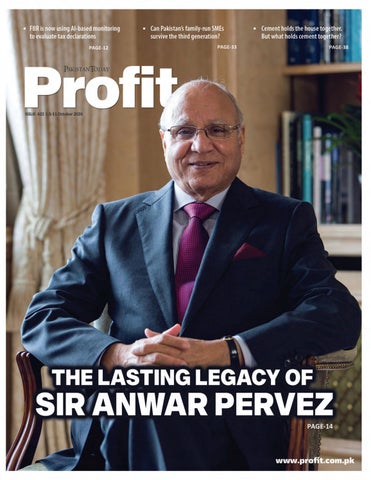
12 FBR is now using AI-based monitoring to evaluate tax declarations 14 The lasting legacy of Sir Anwar Pervez 19 Honda kills the BR-V just as Pakistan’s SUV market is booming
20
30
Beyond the Accord: How Pakistan Must Learn to Govern Scarcity Mohsin Leghari
36
Pakistan’s Crypto Opportunit Starts Where Adoption Rankings End Vugar Usi, CEO, MEXC
33
Can Pakistan’s familyrun SMEs survive the third generation?
38
Cement holds the house together. But what holds cement together?
20 Diamond Industries is back in business after almost three years offline 22 Record year for AKD Securities in 2026 23 BF Biosciences revenue up 62% in 2026 24 Invest Capital is moving its headquarters to Lahore. That says something about Karachi
25
25 Pakistan-flagged ships are immune from being fired upon at the Strait of Hormuz. PNSC revenue is up 150% 26 Treet Corporation’s profits rise despite a flat year for group sales 27 The Reset State Muhammad Azfar Ahsan
Profit Publishing Editor: Babar Nizami - Senior Editor: Abdullah Niazi Business Reporters: Taimoor Hassan | Usama Liaqat | Zain Naeem | Shahnawaz Ali | Ghulam Abbass Ahmad Ahmadani | Aziz Buneri - Sub-Editors: Saddam Hussain | Abdul Hameed - Video Producer: Adnan Maqsood Director Marketing: Muddasir Alam - Regional Heads of Marketing: Agha Anwer (Khi) Kamal Rizvi (Lhe) | Malik Israr (Isb) GM Special Projects Zulfiqar Butt - Manager Subscriptions: Irfan Farooq Pakistan’s #1 business magazine - your go-to source for business, economic and financial news. Contact us: profit@pakistantoday.com.pk
FBR is now using AI-based monitoring to evaluate tax declarations How much better will AI be than the local tax officer, and who is protected when it gets something wrong? 12
Shahzad Paracha and Shahnawaz Ali
T
his year, every income tax return filed in Pakistan will be checked by a software powered by AI before any officer looks at it. Under this system, the Federal Board of Revenue (FBR) plans to cross-check declarations against property, banking, vehicle and other records.
The use of the new AI-powered Compliance Risk Management (CRM) system has been made mandatory following September 1, 2026 by the FBR. After running a pilot on a limited number of income tax and sales tax returns, it will apply its models to income tax filings for the year ended June 2026 and subsequent sales tax returns. As a senior official described the system to the media outlets, “it does not get tired and
it does not miss a line”, one is forced to ask the question, about how efficient the policy around this AI-evaluation is. Afterall, large language models (LLMs) are sometimes known to make mistakes. But first, we need to understand how this was happening before AI.
How audit cases used to be chosen
F
or more than a decade, selection relied on two tools. The first was a computer ballot. The law allows the FBR to select persons or classes of persons for audit through a computer ballot which may be random or parametric. Parametric evaluation relies on set criterias and parameters that are kept confidential. For the sake of understanding it means that there is a threshold for anomalous gains in income or revenue and the FBR had (and still has) internal parameters in place for it. Say you are a small enterprise, whose revenue suddenly increased by over 100% in a certain tax year. A tax officer could easily identify those cases using data analysis tools at his disposal and flag them for a potential audit. Other times a taxman would randomly choose a case based on potential triangulated information, such as mismatched excise duty or bank data. This random check also relies a lot on a tax officer’s ability of being privy of their jurisdiction and its financial potential. And sometimes, as suggested earlier, it was done through digital balloting, i.e; totally randomly. The overall ballot covered only a small fraction of taxpayers though. For example, for tax year 2017, the FBR selected only 2.3 %of the total cases available for audit across income tax, sales tax and federal excise. The ballot was also often contested in court. For tax year 2011, the Lahore High Court set aside all of FBR’s audit selection and directed it to start again with separate sets of parameters for each tax type. By 2023 the FBR had stopped using random balloting altogether, partly because irrelevant cases were picked along with genuine ones, and selection had by then shifted to field audits chosen by Commissioners Inland Revenue. Cross-referencing information, like the CRM does, existed under the old system too, but it was patchy and handled case by case. Officials obtained information from other institutions when they investigated discrepancies, and that took time. The gaps this left were large. Lawmakers were told in June that around 80 percent of high-value properties were missing from tax declarations. FBR chairman Rashid Mahmood Langrial told the same committee that information collected
under the old model was either ignored or used against taxpayers.
What does the AI system do differently?
T
he new system works in the opposite order. It checks every return first, then decides which ones need a closer look. The models check returns against tax-law requirements, compare declarations with those of similar taxpayers, and identify inconsistencies with information obtained from other sources. Faisal Sattar, chief executive of Pakistan Revenue Automation Ltd (PRAL), the public-sector technology company that supports the FBR, has briefed the media that the FBR has set up a data centre collecting tax return data alongside property, vehicle and travel-related data. The aim, he said, is to triangulate property transactions and banking data against what a taxpayer declares. Banking data now comes in automatically. Section 165AB of the Finance Act 2026-27 requires banks to report all accounts with transactions exceeding Rs100 million in six months. If cross-matching finds a significant discrepancy, the case moves to the FBR’s compliance risk management (CRM) system and the National Faceless Centre takes over automatically. That centre is the second half of the reform. Under the new system, individual officers will no longer select audit cases. The computerised, risk-based system identifies cases and assigns them automatically to an officer anywhere in the country. Each case then passes through three officers: one conducts the audit, another the assessment, and a third reviews quality before any decision is issued Answering the important question raised earlier it is noted that a flag is not a verdict. Flagged returns may be selected for audit, face assessment proceedings, or merely receive compliance nudges asking taxpayers to correct their filings.
How much more efficient is it?
T
he FBR has not published an efficiency figure, such as hit rates, cost per case or yield compared with the old system, so the available evidence is
partial. The main reason for this automation is scale. The volume of information makes manual scrutiny impractical, while automated analysis could make case selection more consistent. Some 5.77 million returns had been filed by September 30, about 45 % more than a year earlier. The FBR workforce simply doesn’t increase as drastically.
The early results of the system, according to FBR and PRAL, are promising but unproven. In July, Finance Minister Muhammad Aurangzeb said the AI risk engine had identified 840 high-risk audit cases with an estimated additional revenue potential of Rs34 billion, after matching taxpayer records with the national identity database. That claim works out to roughly Rs40 million per case (Rs34 billion being the estimated potential, not money recovered). He also said faceless customs assessments raised the average declared value of consignments from Rs6.3 million to Rs7.8 million, an increase of about 24 %. The FBR has not yet given a time frame for proving these gains. It says full implementation will take up to three years after the pilot phase.
The risks
T
he most immediate risk is false positives, where the system flags people who have done nothing wrong. Lawmakers raised concerns that the system could still target compliant taxpayers, and the FBR chairman assured them that “safeguards would be put in place”. No further elaboration was offered about these safeguards. Here are the risks that we were able to identify with AI-based flagging. Large bank flows, as an anomaly, are a good example. A trader moving Rs100 million through an account may earn only a small fraction of that as profit, so a mismatch is a reason to look, not proof of evasion. The second limit is data coverage. An algorithm can only analyse transactions that are recorded, so it cannot see economic activity conducted entirely in cash, which some argue is the main problem with Pakistan’s tax net. The system may therefore scrutinise and end up punishing people who are documented more heavily, while the informal economy can stay out of view. The third concern is transparency. Audit parameters have been kept confidential by law, and selection was challenged in court even when it relied on simple, rule-based ballots. A model that compares taxpayers with “similar profiles” will be harder to explain to a taxpayer or even a judge. Meanwhile, the FBR’s long-term plans go further than detection. Sattar wants the AI to eventually propose a settlement as well, telling a taxpayer what they need to do to correct a filing. If that happens, the same system would both raise the suspicion and suggest the remedy. The reform’s credibility depends on whether a human can still review and change both. And as painful as a false positive might be for a compliant taxpayer, as of now a tax officer can and will review the flagged cases. n
14
Headquartered in the UK, the Bestway Group is one of the largest conglomerates in Pakistan. It owns UBL, Bestway Cement, and has recently entered the automobile industry. Why do they keep coming back to Pakistan? By Abdullah Niazi
T
here is a revealing oddity in Sir Anwar Pervez’s account of his own success. During a 2019 interview, the memory he returned to was not a boardroom, a deal signing, or the moment Elizabeth II knighted him. It was Bradford, the industrial city where he first arrived as a 21-year-old migrant from Pakistan. There, far away from his ancestral village of Thati near Gujar Khan he worked as a bus conductor. During the long hours going up and down Bradford roads he discovered to his own surprise a kind of contentment. In that interview, he remembered leaving Pakistan with little room for romance. “I had nothing in Pakistan,” he said, before recalling that his parents could not afford to send him to university and that he had worked as a telephone operator for Rs 96 a month. Asked what might have happened had he stayed behind, his response was simple and brutal. “I would have died.” Today, Sir Anwer Pervez is 91 years old. He is a billionaire. He is Chairman Emeritus of the Bestway Group, which owns the second largest food wholesaler in the United Kingdom, a property investment company, the third largest pharmacy chain in the UK, as well as a minority shareholding Sainsbury’s — the second largest supermarket chain in the UK. And while the UK is where Sir Anwar Pervez lives and made his fortune, his legacy is seeped into corporate Pakistan. Since the 1990s the Bestway Group has been investing significantly in Pakistan. As a 21-year-old Sir Anwar Pervez might have felt like he would die if he remained in Pakistan, but his group is one of the largest conglom-
erates in Pakistan. They own the country’s largest commercial bank in United Bank Limited and Bestway Cement has the largest production capacity in the cement industry. They also own MAP Rice Mill, which has a capacity of 2.04 lakh tonnes. And in February this year, the conglomerate acquired an automotive assembly plant at Port Qasim in Karachi, and announced last month they would be launching three new vehicles in partnership with Chinese car giant Geely. The auto sector is perhaps the hottest new avenue for Pakistan’s domestic conglomerates. The Manshas (Hyundai, Jaecoo, Oomoda, and iCaur) and the Tabbas (KIA, Peugeot and GAC) have already entered the space and taken their place at the top of the leader board. Bestway’s entry means another one of Pakistan’s heftiest business groups has entered the space. It also means he is leaving a legacy that has blossomed in Pakistan, and is far from done with the country. But as Sir Anwar Pervez enjoys his role as a senior statesman in his twilight years, where does his legacy stand?
A hop, skip, and jump over the pond
A
nwar Pervez was born in 1935 two years after Adolf Hitler came to power in Germany in the small village of Thati near Gujar Khan in what was the British era Rawalpindi district. Gujar Khan, along with Chakwal and Jhang, were some of the core recruitment grounds for the British Army in both the Great War and the Second World War. During his childhood, he will undoubtedly have seen young men carted off
COVER STORY
rife with opportunity. The pallor of post-war Britain had lifted. Harold McMillan had just led the Conservative Party to a rousing victory in the general elections and had told Britons they had “never had it so good.” Much of that post-war hue was thanks to the thousands of migrant workers from places like Pakistan who provided labour to the recovering Britain. The industrial town of Bradford in particular was a major hub for Pakistani migrants. Even before the exodus of Mirpuris displaced by the Mangla Dam project in the 1960s, Pakistani labour was in-demand in the textile industry set up in the city. Once he reached the United Kingdom, he stayed with family friends who had already made up part of this new migrant population. He took odd jobs including as a bus conductor. It was here, as he revealed in an interview to Dawn back in 2019, that he first felt contentment. “Sometimes in my dreams — the happy ones, not nightmares — I am back in Bradford, driving a bus and feeling content with life”۔
A family affair
Plaques commemorating soldiers lost to World War One and Two can be found all over villages in Indian and Pakistani Punjab. Gujar Kha, where Sir Anwar Pervez came from, was a central recruiting ground for the British Indian Army. Children of the war era saw men go off to fight a war in Europe and never return. to fight a war in a far away continent they had little to do with while their districts back home became the subject of curfews and price controls. He was spared the horrors of war and partition but not those of poverty. His father was a subsistence level wheat farmer, and as he told The Telegraph in a 2020 interview, they did not have money. “I learnt from them how to live within my means. Growing up, my siblings and I never missed anything because what we did not have in material wealth was made up by the love and care of our parents.” The year that would change his life was 1956. Pakistan had just shed its dominion status when Anwar Pervez decided to pack his bags and head over to the heart of the Old Empire. It might be hard to believe for anyone that has had to stand in line at Gerry’s and pay ridiculous photocopying rates, but Pakistanis did not need pre-approved visas to go to the United Kingdom until 1986. You would get a visa on arrival, although many would get turned back at Heathrow. And so, armed with a passport and the knowledge that there was extended family somewhere in Bradford and he might not be let into the country, the then 21year old bid farewell to Mithi. He was leaving the same year that Elizabeth II ceased to be Pakistan’s head of state, and 43 years later the same monarch would knight him. The United Kingdom he arrived in was
16
In 1957, British Prime Minister Harold McMillan declared that Britons had “never had it so good.” Much of the post-war reconstruction of the Empire’s economy came from the efforts of the many migrants filtering in from different parts of the world as labour. Sir Anwar Pervez arrived in the United Kingdom the same year McMillan went to 10 Downing Street.
T
he same entrepreneurial spirit that brought the 21-year-old Anwar Pervez to the United Kingdom helped him grow and consolidate. But before he made his first foray into the world of business, he worked and saved to be able to bring family members over to the UK one by one. They started arriving in the 1960s and together the family began to scrimp and save. In 1963, he was able to open a retail store in Earl’s Court where he sold items like masalas and halal meat to the local diaspora. This initial entry revealed a tactful mind. The store was named “Kashmir” which would definitely have brought up a sense of nostalgia for the growing Mirpuri population in England. In the 1960s, stores would not stay open late into the night and on weekends the way we know today. People that ran these stores thought of them as a workplace and treated them as such — with office timings. But knowing he was a Pakistani migrant trying to run a store in Londo, Anwar Pervez kept his doors open late into the evenings and on weekends too. Over time, he began to introduce items that the many different ethnic minorities present in London required. He had started with what he knew but realised quickly there was more demand. By the early 1970s, he was running 10 convenience stores across London. But as he gained more experience in retail, he realised further expansion was only possible if he controlled the supply as well. At the time, he was not getting the kind of wholesale rates that would lead to big profits. The problem was serious enough that even today, Bestway’s official corporate history specifically mentions
Sir Anwar Pervez and Younis Sheikh on a supplier visit in 1976. this frustration as the reason Anwar Pervez entered the cash-and-carry depot business. For a man who had built his life on squeezing every extra hour out of the day, wholesaler margins were an intolerable arrangement. This is where the Bestway Group was actually formed. In 1976, Pervez and his partners opened their first wholesale depot in Acton, west London, aimed squarely at independent retailers who were being squeezed by supermarket chains. The model was not glamorous, but it was also clever. By running on tighter margins and reliable availability, Bestway offered small shopkeepers what the big wholesalers had denied Pervez when he was on the other side of the counter. Younus Sheikh became central to this machine. He had come from Pakistan to study, but was drawn into the business and became one of Pervez’s most trusted operating partners. Through the 1980s, Bestway pushed out from London: Southall, Hackney, Abbey Road. In 1987, Bristol marked the first warehouse outside the capital, and with it the ambition stopped being local. Around this time, Anwar Pervez had also started training his protogee: his nephew Zameer Choudery. Zameer had initially come to Britain as a child and worked in the shops and warehouses while studying. He formally joined the business in 1984 after qualifying as a chartered accountant, and by 1990 was on the board as finance director. By this time what had now emerged as the Bestway Group had become a significant player in the United Kingdom. Not only was it a major wholesale depot company, it had also established a charitable foundation. And with
the second generation emerging and Bestway firmly established as a British institution, further diversification was on the cards. That is where Pakistan enters the picture once more.
It is ironic because when Anwar Pervez left, he was one of the early pioneers of jumping ship. There have long been many good reasons for people in Pakistan to try and find greener pastures abroad. But the larger sense of despondency is, at least on a gut feeling level, higher now than ever before. Which is why it is so interesting that Anwar Pervez’s Bestway Group has, since the 1990s, invested consistently in Pakistan. And it is not as if they have not faced their fair share of unfair challenges. The Pakistan chapter was spearheaded by the new protege: Zameer Choudery. It started with rice. Basmati rice has been in demand in Europe and the UK since the 1970s. Most of the initial demand came from the diaspora but pretty soon the entire UK market was hooked on this subcontinental speciality. The group’s own corporate history claims that this culminated in their first overseas investment through the acquisition of Pak Pearl Rice Mill in Pakistan, led by Younus Sheikh. Concurrently, Bestway Milling (MAP Trading today) was set up in the UK and the Group had officially ventured into the rice business. Then came the bigger leap. Zameer Choudhry identified cement as the right sector for diversification. Pakistan was still an infrastructure-hungry developing economy, and
Betting on Pakistan
T
here is a reason for doing this story right now. Anwar Pervez’s story is a matter of public record. It has not had a lack of publicity. Sure, the immediate relevance is because of Bestway Automobiles launching Geely vehicles in Pakistan but there is a bigger picture. Pakistan is fast becoming a country whose own people, stakeholders, and ruling elite do not believe in it. At the risk of sounding far too much like a second-rate pundit on a third-rate channel whose rants are playing on mute at a clinic waiting room: people are sick of this country. Those who want to labour want to do it in the Gulf. Those that want to study want to do it in Europe or the United States. Those that want to work white collar jobs want to find a path in any other part of the world. A lack of institutions means everyone is looking out at the horizon waiting for a ship to show up so they can make the jump. Even the elites of our society want as little to do with Pakistan as possible. Look around at the biggest business families in Pakistan. You will find most of their next generations spend more time out of Pakistan than in it. Yes, this might still be home base and the economic engine but it is not where they live. There are some notable examples, Muhammad Ali Tabba being one as Profit has pointed out in a previous cover story. But for the most part, Pakistan is regularly treated like a dead-end.
Zameer Choudrey had moved to the UK aged 12 and used to work at his uncle’s shops and later at the warehouses while he was studying and formally joined the business the day after qualifying as a chartered accountant. Under his uncle’s mentorship and through his own hard work, Zameer evolved from a young boy who couldn’t speak English to a successful entrepreneur. In 2019 he was nominated for a life peerage and made Baron Choudrey of Hampstead. He is currently Chairman of the Bestway Group.
COVER STORY
Left to right: Acquisition of United Bank Limited. Prime Minister Shaukat Aziz Attending Bestway Cement’s Groundbreaking At Chakwal. President of Pakistan Pervez Musharraf Attending Inauguration of Bestway Cement’s Plant In Chakwal. Bestway wanted a role in building it. Cement would also be Bestway’s first experience of what doing business in Pakistan could be like. Choudrey attempted to buy a cement plant through privatisation auctions conducted by the Pakistan Government but to no avail. He soon grew frustrated at the inability to conclude the deal and decided that it would be best if the Group were to set up its own cement plant from scratch. Bestway Cement was incorporated in 1995, its first Hattar plant became operational in 1998, and the company was listed on the Karachi Stock Exchange in 2001. The cement business then grew through both greenfield expansion and acquisition. Bestway added Chakwal, acquired Mustehkam Cement in 2005, later acquired Lafarge Pakistan’s operations, and commissioned a fifth production facility at Mianwali. PACRA’s 2026 rating report described Bestway Cement as Pakistan’s largest cement manufacturer, with about 15.3 million tonnes per annum of installed capacity across five integrated facilities and eight production lines. In FY25, despite weak construction activity, the company recorded gross turnover of Rs168.5 billion, net turnover of Rs107.7 billion and profit after tax of Rs23.9 billion. Perhaps the bigger jump came in 2002. During the Musharraf-era privatisation drive, Bestway entered a joint venture with Abu Dhabi Group to acquire a controlling stake in United Bank Limited, then Pakistan’s fourth-largest bank. The group says UBL paid its first dividend in three decades by 2004, listed global depository receipts on the London Stock Exchange in 2007 in an offering that raised more than $650 million, and Bestway later bought out Abu Dhabi Group’s remaining stake in stages in 2011 and 2013. There is little doubt in terms of how those investments have gone. Profit has in recent months dedicated two cover stories to the rise of UBL: first when it was closing in on HBL in terms of deposits and about to become Pakistan’s largest bank. And recently again when we looked at how UBL Ameen was mak-
18
ing a valiant effort to chase after Meezan Bank, Pakistan’s Islamic Banking juggernaut. And while both of these investments have been a major boon for the Bestway Group and has made them very influential in Pakistan, they have more than remained active in their UK presence. Even as they were investing in Pakistan, Bestway acquired Batleys in 2005, a regional wholesaler based in Huddersfield with 18 warehouses, £500 million turnover and a work force of over 1,900. The acquisition meant that Bestway Wholesale had now become the 2nd largest wholesaler in the UK and the largest independent wholesaler in the UK. In 2014, it bought the Co-operative Group’s pharmacy business, creating what became Well Pharmacy, and in 2021 it acquired Costcutter. The Guardian later reported that Bestway had taken a near GBP200 million, 3.45 per cent stake in Sainsbury’s, making it the supermarket’s sixth-largest shareholder.
Why it matters, and why it matters now
T
he recent entry of Geely into Pakistan under the Bestway Automobile banner is testament to the group’s continued desire to expand, and its continued belief in Pakistan’s future. The way they have gone about this new investment also shows the kind of institutions the Bestway Group has created, The company is currently importing Completely Built Units (CBUs) from Geely. That is the standard operating procedure for all new car entrants. You don’t invest in an assembly line immediately, you import the cars a little more expensive, sell them at smaller margins as CBUs from China, and then see how the market reacts. But even before they announced who they were partnering with, Bestway Automobiles (which is a wholly owned subsidiary of Bestway Cement) acquired Al Haj Automotives. This was an earlier attempt to bring Chinese cars (hatchbacks and loaders) to Pakistan under the FAW brand.
The attempt went kaput. Not only did Bestway Auto acquire the plant with the eventual goal of local assembly, they also paid off its debts — something the group’s Managing Director for non-financial companies says they did not legally have to do as part of the acquisition, but did simply as a gesture of goodwill. What makes the Bestway story useful, especially at this moment, is that it does not offer an uncomplicated love letter to Pakistan. Anwar Pervez left because Pakistan had given him very little, and he built his fortune in a country that gave him wages, customers, institutions, scale, honours, and eventually a knighthood in 1999. The arc from Anwar Pervez to Sir Anwar Pervez is, in that sense, a British story. But the businesses he chose to build later made it impossible to separate his legacy from the country he once had to leave. Now, as Chairman Emeritus, Sir Anwar is no longer the operator at the centre of every deal. But that is perhaps the point. He built a group that could survive his stepping back. Younus Sheikh could step away from dayto-day operations and become Chairman of Bestway Wholesale. Dawood Pervez could take over as Managing Director of Bestway Wholesale. Zameer Choudrey, once the nephew learning the ropes in the shops and warehouses, became Lord Choudrey and a business figure established in his own right. Haider Choudrey, his son, joined the board as Chief Financial Officer, while Rabiah Sheikh became Company Secretary, marking the arrival of a third generation that is prepared and more importantly interested in keeping things going. That is the true meaning of legacy. It is not simply wealth, or titles. It is whether an institution can outgrow the life of the man who began it. For Pakistan, Bestway’s continued presence matters because it shows that capital can be impatient, frustrated, bruised, and still work in this country. And for Sir Anwar Pervez, perhaps that is the final irony. He had to leave Pakistan to survive, but what he built keeps coming back. n
COVER STORY
Honda kills the BR-V just as Pakistan’s SUV market is booming
The seven-seater was one of the first locally assembled crossovers in Pakistan. Nine years later, it is being retired in a market transformed by Kia, Hyundai and an increasingly formidable group of Chinese manufacturers.
T
here is a certain irony to Honda Atlas Cars Pakistan Ltd discontinuing the BR-V now. When Honda launched the seven-seat crossover in Pakistan in April 2017, the country’s automobile market was still overwhelmingly a sedan market. Toyota Corolla, Honda Civic and City dominated middle- and upper-middle-income car buying, while genuinely large SUVs were expensive propositions such as the Toyota Fortuner. The BR-V was supposed to change that. Honda marketed it as Pakistan’s first locally produced seven-seat mid-sized SUV, offering three rows of seating, a 1.5-litre engine and the higher-riding styling increasingly favoured by consumers without requiring them to pay Fortuner money. It cost roughly Rs2.2-2.3 million at launch and initially did rather well: Honda sold 7,318 BR-Vs in calendar 2017 alone. Nine years later, however, Honda has formally told the Pakistan Stock Exchange that production has ended. The October 1 notice is remarkably terse: Honda Atlas simply informed investors that it “has discontinued the production of the Honda BR-V model”. The interesting part is not that an ageing model has finally been retired. It is that the BR-V is disappearing precisely when the kind of vehicle it helped introduce has become arguably the most competitive part of Pakistan’s automobile market. Honda executives insist there was no supply problem behind the decision. A company official told Dawn that imported parts remained available and that the vehicle had simply completed its product lifecycle. By the end, production had fallen to only around 25-50 units a month, and Honda has not announced a replacement. That is a dramatic comedown for a vehicle that arrived with considerable momentum. The BR-V was produced locally from April 2017, with 648 units assembled and 527 sold in its first month. Honda introduced a facelift in 2019, but Pakistan essentially continued to receive the first-generation vehicle even as the market around it changed profoundly. And change it did. The most consequential arrival was
AUTOMOBILES
probably the Kia Sportage. Lucky Motor Corporation began deliveries in 2019, bringing a locally assembled C-segment crossover to a market that was still accustomed to treating a large sedan as the default aspirational family car. By January 2025, Lucky said it had delivered more than 40,000 Sportages in Pakistan, out of more than 72,000 Kia vehicles sold during its first five-and-a-half years of local CKD operations. Hyundai followed with the Tucson, another conventional crossover that quickly established a durable presence. Hyundai sold 3,536 Tucsons in FY2025, compared with just 1,682 combined units of Honda’s BR-V and HR-V. In other words, the BR-V did not die because Pakistan stopped wanting SUVs. It died because Pakistan started wanting many more of them. The competitive problem became more acute with the arrival of Chinese manufacturers. Sazgar’s Haval business is the clearest example. Haval sales more than doubled from 5,319 units in FY2024 to 10,783 in FY2025, making it one of the country’s largest SUV brands by volume. By FY2026, Sazgar’s overall four-wheel vehicle sales had risen another 77% to 19,179 units, while the listed company’s revenues reached Rs191.7 billion and net profit Rs23.6 billion. The significance goes beyond Haval. Changan, MG, Chery and Jetour have helped create an environment in which Pakistani consumers are routinely offered panoramic roofs, multiple airbags, large touchscreens, driver-assistance systems, turbocharged engines and increasingly hybrid powertrains at prices intended to challenge established Japanese brands. PAMA data does not even capture the full extent of that competitive change because several manufacturers, including Kia and Changan, have historically not reported through the association. And now there is BYD. The Chinese new-energy vehicle giant entered Pakistan in partnership with Hub Power Company’s Mega Motors in 2024, initially with imported electric vehicles. It has since added the Atto 2, Atto 3, Seal, Sealion 7 and Shark 6 to its portfolio. Hubco told investors earlier this year
that customer response had exceeded its initial booking expectations. More importantly, BYD is no longer treating Pakistan purely as an import market. The company and Mega Motors announced plans for a local new-energy-vehicle assembly operation in Karachi, and BYD has identified the plug-in-hybrid Sealion 6 as its planned first locally assembled model. That matters because the next phase of the SUV competition is increasingly about electrification. Kia now offers the Sportage L with hybrid technology, Haval has made hybrids central to its appeal, Hyundai sells hybrid models, and BYD is bringing its expertise in batteries and plug-in hybrids directly into the Pakistani crossover market. Against those cars, the BR-V increasingly looked like a product from another era. None of this means Honda Atlas is in crisis. Quite the opposite. Pakistan’s broader automobile market recovered strongly in FY2026 as lower interest rates, more stable prices and improved financing conditions brought buyers back. Honda Atlas sold 28,015 vehicles during the year, a four-year high and a 53% increase over FY2025. The City and Civic remain formidable franchises. Honda also has the newer HR-V, including an electrified version, giving it a more contemporary entry in the crossover market. What the disappearance of the BR-V shows is therefore not the decline of Honda so much as the transformation of the market around Honda. In 2017, simply offering a locally assembled, reasonably priced seven-seat crossover under a trusted Japanese badge was enough to make the BR-V distinctive. By 2026, buyers entering a crossover showroom can choose among Korean, Japanese and Chinese vehicles, petrol engines, turbos, hybrids, plug-in hybrids and full EVs — often accompanied by equipment lists that would have looked extravagant in a locally assembled Pakistani vehicle less than a decade ago. Perhaps the BR-V’s greatest contribution was that it anticipated where Pakistani buyers were going. Its problem was that everybody else got there too — with newer cars. n
19
Diamond Industries is back in business after almost three years offline
The foam and mattress maker lost access to imported raw materials during Pakistan’s dollar crisis, then spent two years dormant. A leased factory near Lahore has now restored both sales and profits.
T
here are corporate turnarounds, and then there are companies that simply start selling things again. Diamond Industries Ltd belongs, at least for now, in the second category. The maker of Diamond foam and mattresses has reported net sales of Rs693.9 million for the financial year ended June 30, 2026, up from just Rs18.1 million the previous year. More importantly, it made a profit: Rs38.3 million after tax, compared with a staggering Rs153.8 million loss in fiscal 2025. Earnings per share swung from negative Rs17.08 to positive Rs4.25, and the board has gone so far as to recommend a Rs1 per share cash dividend. Those growth rates — sales up more than 3,700%, for instance — make for spectacular headlines but are almost meaningless. Diamond was not really operating during most of the previous year. In fact, the more useful comparison is with fiscal 2022, the last full year before the company’s business unravelled. Back then, Diamond generated Rs1.79 billion in sales and Rs52.9 million in net profit. That means Diamond has not yet returned to its former scale. But it has done something arguably more important: after spending almost three years effectively out of the manufacturing business, it has demonstrated that there is still a viable operating company underneath the listed shell. And the route it chose to get there is perhaps more interesting than the numbers themselves.
The first comeback
T
his is actually Diamond Industries’ second resurrection in five years. The company, incorporated in 1989 and listed in 1994, manufactures foam and foam products along with some industrial chemicals and binders. Its registered factory is at Gadoon Amazai Industrial Estate in Swabi, while its corporate presence has long
20
extended to Lahore. By 2020, Diamond’s manufacturing operation had already become a shadow of its former self. Sales were just Rs9.2 million. In May 2021, however, management terminated an existing lease arrangement and restarted its core manufacturing business. The effect was immediate: fiscal 2021 sales rose to Rs163.3 million, and the company made Rs33.5 million in net profit. The workforce expanded from just seven employees to 329 as production returned. Then came fiscal 2022. Diamond’s sales surged to Rs1.79 billion, gross profit reached Rs176 million and net profit rose to Rs52.9 million. Its gross margin was 9.86%. It looked as though the revival had worked. There were already warning signs, though. In its 2022 annual report, management explicitly highlighted the sharp depreciation of the rupee against the dollar and rising power and fuel prices as pressures on profit margins. Those concerns would become existential within months.
Then Pakistan ran out of dollars
O
n January 10, 2023, Diamond Industries suspended manufacturing. At the time, the company’s explanation was straightforward: adverse economic conditions and the non-availability of imported raw materials. Management said production would remain suspended until those materials became available again. Diamond was hardly alone. Pakistan was then in the deepest part of the foreign-exchange crisis that accompanied the country’s 2022-23 balance-of-payments problems. In December 2022, the State Bank instructed banks to prioritise scarce foreign currency for categories including essential goods, energy, agriculture and export-oriented industries. Banks were simultaneously told to consider liquidity conditions in the foreign-exchange market when processing imports. In practical terms, companies outside those favoured categories often found opening letters
of credit for imported inputs extremely difficult. For a manufacturer dependent on imported chemical inputs, the consequences were obvious. Diamond’s FY23 sales dropped to Rs959.9 million — partly reflecting the fact that it still operated for the first half of that financial year — while gross profit collapsed to Rs34 million from Rs176 million. The company swung to a Rs43.6 million net loss. And then the sales disappeared altogether. Diamond recorded zero revenue in fiscal 2024. Its annual report said industrial activities had remained suspended continuously since January 10, 2023. With no sales and no gross profit, administrative costs continued to run through the income statement, leaving the company with an operating loss of Rs11.5 million and a net loss of Rs24.2 million. By then, management’s explanation had broadened. The problem was no longer simply getting hold of imported raw materials. Diamond’s chairman cited uncertain economic conditions, the non-availability of raw materials and high production costs. Business Recorder’s review of the company also identified expensive raw materials and weak demand as reasons production remained suspended. What was initially described as a shortterm factory shutdown had turned into a twoyear disappearance from the market.
The ugly clean-up year
F
iscal 2025 looked superficially like a restart because Diamond reported Rs18.1 million in sales. It was nothing of the sort. The company still had roughly Rs169 million worth of stock on its balance sheet at June 2024, principally semi-finished foam material. With manufacturing shut and the material effectively unsaleable in that form, management disposed of the stock on an “as is, where is” basis. The accounting result was brutal: Rs18.1 million of sales against Rs169 million of raw material sold, producing a gross loss of Rs150.9 million. The inventory balance was reduced to zero, but the clean-up pushed Diamond to its largest loss in years. The company posted an operating loss of Rs153.4 million and a net loss of Rs153.8 million. Shareholders’ equity fell to Rs202.2 million from Rs246.7 million a year earlier. Diamond was also carrying Rs137.3 million due to sponsors, underscoring the degree to which the business was being supported by its owners while commercial operations remained dormant. Yet the company repeatedly insisted it did not intend to liquidate. Instead, management began working on a different model for restarting production. Rather than simply wait for conditions at the exist-
ing Gadoon facility to improve, Diamond’s board approved a plan in September 2025 to lease a factory in Lahore complete with plant and machinery. Management specifically argued that moving production closer to its dealer network would reduce transportation costs. The company also said directors, sponsors and associated undertakings were prepared to provide financial and operational support for the restart. That decision appears to be the real turning point.
Why the new factory mattered
O
n January 1, 2026, Diamond announced that it had taken possession of a running factory at 58-km Multan Road, near Bhai Pheru, under a lease arrangement. The facility was already equipped to produce foam and spring mattresses, furniture and allied products. Production began immediately. That is an important detail. Diamond did not spend hundreds of millions of rupees building a new manufacturing complex and then wait for it to be commissioned. It effectively rented an operating industrial platform. That dramatically shortened the time between the board’s decision to return to the market and actual revenue generation. It also changed the geography of the business. The company’s historical manufacturing base is at Gadoon Amazai in Khyber Pakhtunkhwa. The new operation sits on Multan Road outside Lahore, much closer to Pakistan’s largest concentration of consumers, furniture makers and retail dealers in central Punjab. Management itself cited the potential reduction in freight costs when announcing the leasing strategy. And the response was remarkably quick. In the first production quarter after the restart, the period ending March 2026, Diamond generated Rs361.1 million in sales. Gross profit was around Rs38.9 million, implying a gross margin of roughly 10.8%, while the company returned firmly to profitability. Business Recorder reported nine-month FY26 net profit of Rs27.4 million compared with a Rs151.3 million loss during the corresponding period a year earlier. By June, full-year revenue had reached Rs693.9 million. Since production only restarted on January 1, practically all of that turnover was generated in six months. That makes the comparison with Diamond’s old business interesting. Fiscal 2026 gross profit of Rs62.9 million equates to a margin of approximately 9.1%. In fiscal 2022 — Diamond’s last normal full operating year — its gross margin was 9.86%. In other words, while the company is still operating at considerably less than its former sales scale, the basic economics of manufacturing mattresses have already returned to something surprisingly close
to their pre-shutdown level. Operating profit for FY26 came to Rs43.7 million, a margin of about 6.3%, while the Rs38.3 million bottom line translates into a net margin of roughly 5.5%. The second production quarter was somewhat softer than the first. Since Diamond had generated Rs361.1 million of sales by March and Rs693.9 million for the full year, April through June contributed roughly Rs332.8 million. Gross profit over that second quarter works out to about Rs24 million, implying a lower margin than in the January-March restart quarter. That is worth watching: the first burst of profitability after reopening should not automatically be extrapolated indefinitely. But the direction is unmistakable.
Not yet back to where it was
T
here is a temptation to call FY26 a complete turnaround. It is not — at least not yet. At Rs693.9 million, annual revenue is still less than 40% of the Rs1.79 billion Diamond generated in FY22. Part of that difference is simply timing: FY26 contained only six months of manufacturing activity. If the current sales run-rate were sustained for an entire year, the gap would narrow substantially. More importantly, Diamond’s recent history shows how fragile these recoveries can be. The company has now shut down and restarted its core operations more than once. It remains exposed to imported inputs, exchange-rate movements, energy prices and Pakistani consumer demand. Those were precisely the variables that management warned about before the 2023 shutdown. There is also the question of what happens to the original Gadoon manufacturing base. The company’s November 2025 revival plan contemplated resuming some activity there by September 2026 even as the Lahore-area leased operation came online. Whether Diamond ultimately runs both facilities, concentrates production near Lahore, or restructures its older assets will help determine what the next version of the company looks like. Still, the dividend recommendation is a striking bookend to the story. A year ago Diamond had just written off a pile of stranded foam inventory and reported a Rs153.8 million loss. Two years ago it had no sales whatsoever. Now the board is proposing to hand cash back to shareholders. For Diamond Industries, FY26 is therefore less about a 3,700% increase in sales than about something much simpler: the company has a factory producing mattresses again, customers are buying them, and — so far — it is making money doing it. After the previous three years, that alone qualifies as a comeback. n
CONSUMER GOODS
Record year for AKD Securities in 2026
The brokerage house’s net profit rose 83% to Rs5.77 billion, helped by booming trading activity and a spectacular recovery in the stock market during the final three months of the financial year.
F
or Pakistan’s stockbrokers, few things are better for business than a bull market. For a brokerage firm that also carries a substantial investment portfolio of its own, the effect can be even more dramatic. AKD Securities Ltd has provided a particularly vivid illustration of that dynamic. The Karachi-based brokerage and investment banking house reported a net profit of Rs5.77 billion for the financial year ended June 30, 2026, up 83% from Rs3.16 billion a year earlier. Profit before tax climbed almost 80% from Rs4.14 billion to Rs7.44 billion, while earnings per share rose from Rs5.66 to Rs10.34. Total income, as reported by the Pakistan Stock Exchange, increased 63% from Rs5.47 billion to roughly Rs8.91 billion. Those numbers are impressive enough on their own. But the more interesting story lies in when AKD made the money. For the first nine months of FY26, ending March 31, the company’s profit after tax was Rs2.81 billion, barely higher than the Rs2.78 billion it had earned during the corresponding period of FY25. Subtract that number from the full-year result and AKD appears to have earned about Rs2.96 billion in the final quarter alone. The corresponding final-quarter profit in FY25 was only around Rs379 million. Put differently, more than half of AKD’s entire FY26 profit was generated during AprilJune, and almost the entirety of the Rs2.61 billion year-on-year increase in annual profits can mathematically be traced to the final quarter. That timing is unlikely to be incidental. FY26 was another extraordinary year for Pakistani equities. The KSE-100 index ended June at 180,302 points, compared with 125,627 a year earlier, delivering a return of 43.5%. Market capitalisation reached Rs20.2 trillion, while average daily traded value across the ready and futures markets climbed to a record Rs56.7 billion. That matters directly to AKD. The company is primarily a securities broker, alongside its investment banking, corporate advisory, underwriting, research, commodities, foreign-exchange and money-market operations. It
22
describes itself as Pakistan’s largest brokerage house and says it accounts for roughly 12.5% of daily traded volume on the PSX. Even before the remarkable final quarter, AKD’s underlying brokerage business was benefiting enormously from increased investor activity. For the nine months ended March 2026, operating revenue increased 63% to Rs2.37 billion from Rs1.45 billion. Brokerage revenue alone rose 57% to approximately Rs2.16 billion from Rs1.38 billion. Management said its financial advisory, commodities, foreign-exchange and fixed-income businesses also recorded substantial growth. That is the healthier part of the earnings story. Higher trading volumes mean more commissions, and therefore a larger recurring revenue base for a brokerage house such as AKD. But AKD’s results cannot be understood simply by looking at brokerage commissions. AKD is not merely helping clients buy and sell shares. It also owns a considerable investment portfolio itself. That makes its earnings significantly more volatile — and considerably more leveraged to movements in Pakistani asset prices. The pattern was already clear in FY25. Although operating revenue that year was Rs1.95 billion, AKD booked Rs2.49 billion in net investment gains, including Rs549 million of realised gains and an extraordinary Rs1.95 billion of unrealised gains arising largely from revaluing its investments as share prices rose. Those investment gains were one reason net profit surged 151% from Rs1.26 billion in FY24 to Rs3.16 billion in FY25. During the first nine months of FY26, meanwhile, AKD recorded another Rs1.96 billion of investment gains: Rs953 million from realised gains and approximately Rs1.01 billion of unrealised revaluation gains. Interestingly, those nine-month investment gains were actually lower than the Rs2.32 billion recorded during the comparable period a year earlier. That helps explain why profits through March were essentially flat despite much stronger brokerage income. And then came the June quarter. The
KSE-100 had ended March at 148,743 points following a sharp bout of geopolitical volatility. By June 30, it stood at 180,302 — an increase of roughly 21% in just three months. AKD’s results announcement does not yet provide the detailed line-by-line annual accounts needed to determine exactly how much of its Rs2.96 billion fourth-quarter profit came from brokerage commissions, realised trading gains and mark-to-market gains on its investment portfolio. But the timing is striking. The quarter in which Pakistan’s stock market rebounded by more than 20% is also the quarter in which AKD generated more profit than it had earned during the preceding nine months combined. There is also a longer-term story here. AKD earned just Rs407 million in FY23. That jumped to Rs1.26 billion in FY24, Rs3.16 billion in FY25 and now Rs5.77 billion in FY26. Profit has therefore increased more than fourteen-fold in three years as Pakistan’s capital markets recovered from the depths of the country’s 2022-23 economic crisis. Some of that improvement is structural. Trading volumes have increased, more investors are entering the market, and AKD’s brokerage operation is producing substantially more revenue. Some of it, however, is inherently cyclical. A securities firm’s proprietary portfolio produces spectacular profits when asset prices rise but can inflict equally dramatic reversals when they fall. AKD itself demonstrated that during the March quarter: it booked an unrealised investment loss of Rs1.48 billion and consequently reported a quarterly net loss of Rs724 million. Three months later, it had finished the year with record profits. That may be the most useful way to understand AKD’s FY26 numbers. Pakistan’s largest brokerage houses are no longer merely benefiting from the stock-market boom by collecting more commissions. In AKD’s case, the company is participating in the boom itself — and when the market moves as dramatically as it did in FY26, that can turn a very good year for a broker into an exceptional one. n
CAPITAL MARKETS
BF Biosciences revenue up 62% in 2026 Revenue crossed Rs9 billion for the first time as new manufacturing capacity and a rapidly expanding product portfolio transformed the Ferozsons subsidiary into one of Pakistan’s more consequential life-sciences companies.
B
F Biosciences is beginning to look less like an interesting biotechnology experiment inside the Ferozsons Group and more like a substantial pharmaceutical company in its own right. The company reported net revenue of Rs9.46 billion for the financial year ended June 30, 2026, an increase of 62% from Rs5.84 billion a year earlier. Gross profit jumped nearly 79%, from Rs2.29 billion to Rs4.09 billion, while profit after tax increased 41% to Rs632.1 million, from Rs447.1 million. Earnings per share rose from Rs5.52 to Rs7.16. Those numbers would constitute an excellent year for almost any pharmaceutical company. For BF Biosciences, however, they also represent the culmination of a remarkable fouryear expansion. Revenue was only about Rs1.52 billion in FY2022 and Rs1.81 billion in FY2023. It doubled to Rs3.66 billion in FY2024, increased another 60% to Rs5.84 billion in FY2025, and has now reached Rs9.46 billion. In four years, the company’s annual sales have increased more than sixfold. And unlike many Pakistani pharmaceutical companies whose growth stories revolve largely around producing conventional generic tablets and capsules, BF Biosciences occupies a relatively unusual corner of the industry. BF Biosciences was incorporated in 2006 as an 80:20 joint venture between Ferozsons Laboratories and Argentina’s Bagó Group. Its plant near Lahore specialises in biological medicines, injectables and other relatively sophisticated pharmaceutical products. The Pakistan Stock Exchange, when the company listed in 2024, described BF Biosciences as having helped spearhead Pakistan’s emergence in biotech manufacturing. Its historical portfolio illustrates why. BF Biosciences was an early local manufacturer of pegylated interferon used in hepatitis treatment. Its IPO prospectus said it remained Pakistan’s only manufacturer of the product, with the company claiming 100% of the domestic market at the time. It also manufactured erythropoietin for
PHARMACEUTICALS
chronic kidney disease patients and filgrastim for cancer patients; the latter had an estimated 85% market share, according to IQVIA data cited in the prospectus. Its terlipressin brand, Novapressin, held around 70% of its market. During Covid-19, BF Biosciences was also the Pakistani recipient of a technology transfer for remdesivir and exported the drug internationally. More recently, the company has pushed into one of the fastest-growing categories in global pharmaceuticals: GLP-1 medicines for diabetes and obesity. In 2024, BF Biosciences launched Sematide, its locally manufactured semaglutide product. In October 2025 — early in the financial year just reported — it launched Zeptide, its version of tirzepatide, in a pre-filled syringe. Tirzepatide acts on both GLP-1 and GIP receptors and has become an important therapy internationally for diabetes and obesity. BF Biosciences has not disclosed how much FY26 revenue came from those newer products, so it would be premature to credit the entire sales surge to GLP-1 medicines. But their addition illustrates how rapidly the company’s product mix is broadening. The more direct explanation for BF Biosciences’ growth is capacity. When the company came to the stock market in October 2024, the central argument behind the IPO was expansion. BF Biosciences sold 25 million new shares at Rs77 each, implying gross proceeds of Rs1.925 billion. The money was intended principally for additional plant and machinery, export certifications, new-product development — including GLP-1 products — and working capital. The offering’s book-building portion was 3.4 times oversubscribed. That capital financed what the company calls Line II, an additional manufacturing line designed to expand output and allow a larger portfolio. The effect was already visible in FY25. Sales increased 60% that year as commercial production from Line II began. Management said generic-market sales rose 50%, while institutional sales surged 127%, principally because of increased volumes from existing and newly
launched products. The acceleration continued during FY26. For the first nine months alone, BF Biosciences reported Rs7.24 billion in sales, up 72% from the comparable period. Management said in-market generic sales had risen 61% and institutional sales 141%, again attributing growth primarily to increased volumes from existing and new products following the start of Line II. That distinction matters. BF Biosciences’ growth appears to be substantially a volume story, rather than simply the result of pharmaceutical price increases. There was also a significant improvement at the factory level. BF Biosciences’ gross margin increased from 39.2% in FY25 to 43.2% in FY26. Gross profit therefore grew faster than sales, increasing from Rs2.29 billion to Rs4.09 billion. But much of that improvement was absorbed further down the income statement. Selling and distribution expenditure surged from Rs1.45 billion to Rs2.70 billion as BF Biosciences built the commercial infrastructure needed to sell its expanding portfolio. Administrative expenses more than tripled to Rs202.5 million. Consequently, operating profit increased a more modest 38% to Rs1.17 billion. There is also a working-capital cost to growing this quickly. Inventories increased from Rs1.65 billion to Rs2.94 billion, while trade debts almost doubled to Rs349 million. Despite the higher accounting profit, BF Biosciences actually used Rs26.5 million of cash in operating activities during FY26, compared with generating nearly Rs300 million the previous year. That is not necessarily alarming for a company in the middle of a rapid expansion, but it does illustrate the next challenge. BF Biosciences has already demonstrated that Pakistan can locally manufacture increasingly complex medicines rather than simply import them. It has raised equity, added capacity and moved into high-growth therapeutic categories. FY26 shows that customers are there. The task now is turning extraordinarily rapid sales growth into equally impressive cash generation and profits. n
23
Invest Capital is moving its headquarters to Lahore. That says something about Karachi
Invest Capital already runs its head office from Lahore, and its decision to move its legal domicile there highlights the increasingly difficult case for running a business from Karachi.
P
akistan’s financial industry does not generally move away from Karachi. The Pakistan Stock Exchange is there. The State Bank of Pakistan’s headquarters are there. Almost every large commercial bank, brokerage house, asset manager and insurance company either has its headquarters in Karachi or maintains a disproportionately large presence in the city. If you work in Pakistani capital markets, Karachi remains the place where most of the people you need to meet are concentrated. Which makes Invest Capital Investment Bank Ltd’s latest corporate housekeeping exercise more interesting than it initially appears. On September 29, Invest Capital informed the Pakistan Stock Exchange that the Securities and Exchange Commission of Pakistan had approved the transfer of its registered office from Sindh to Punjab. Its legal address will move from DHA Karachi to 131-A, P-Street, Upper Mall Scheme, Lahore. The Karachi office will remain open as a branch. Technically, this is not quite Invest Capital moving its headquarters from Karachi to Lahore. The distinction matters: its head office was already in Lahore. Company filings from as far back as 2018 list Lahore as the head office while Karachi remained the registered office. The latest change effectively makes the legal domicile catch up with the operational reality. When Invest Capital sought shareholder approval for the change earlier this year, it gave an unsurprising explanation: aligning the registered office with the head office would improve administrative efficiency and reduce costs. Yet the decision has wider symbolism. Karachi may be Pakistan’s financial capital, but Lahore increasingly offers something Karachi has struggled to provide its businesses and residents: a comparatively functional urban environment. That should not be confused with saying Lahore is an exceptionally well-run city by international standards. It is not. The World Bank itself has pointed to substantial shortcomings in Lahore’s public-transport system, estimating that the city needs thousands more buses. The relevant comparison, however, is Karachi. Lahore has spent more than a decade receiving concentrated provincial investment in urban infrastructure. It has a 27-kilometre Metrobus corridor and a 27.1-kilometre Orange Line railway with 26 stations, in addition to
24
feeder services and an extensive road network. The Orange Line alone was designed to accommodate around 245,000 passengers per day. Karachi, despite having a much larger population and producing an enormous share of Pakistan’s economic output and tax revenue, has spent decades trying to catch up on basic municipal infrastructure. The World Bank’s diagnosis is particularly damning. It has described metropolitan Karachi as performing poorly across municipal services and several measures of liveability, while estimating that the city required roughly $9 billion to $10 billion of investment to close gaps in transport, water, wastewater and solid-waste management. The Bank has also identified fragmented city management and poor coordination among multiple public agencies as central impediments to effective planning. The governance problem is particularly important. Karachi does not have one government meaningfully responsible for the entire city. Roads, land, transport, water, waste and planning responsibilities are divided among the Sindh government, Karachi Metropolitan Corporation, cantonments and several other authorities. A World Bank-backed assessment has previously described the business environment as being impeded by “weak and fragmented regulatory governance”, requiring businesses to deal with multiple provincial and municipal agencies. Karachi Mayor Murtaza Wahab has reasonably objected to simplistic comparisons between the two cities, pointing out that Karachi is larger, grows faster and faces exceptionally difficult problems such as having to bring much of its water from 125 kilometres away. Those caveats are valid. But for the individual company deciding where to put senior employees, the explanation for why one city struggles more than another is less important than the experience on the ground. And for Invest Capital, Lahore was already home. Invest Capital’s history is itself unusually complicated. The business traces its roots to the financial-services operations established under the Invest Capital name in the 1990s. The present listed company emerged more formally in 2007, when Asset Investment Bank Ltd was amalgamated with Invest Capital and Securities (Private) Ltd following an order of the Lahore High Court’s Rawalpindi Bench. Asset
Investment Bank was renamed Invest Capital Investment Bank. The institution became larger again in 2009 when Al-Zamin Leasing Corporation and Al-Zamin Leasing Modaraba were merged into it. But the timing could hardly have been worse. The company subsequently ran into severe financial and operational difficulties, recording heavy losses between 2009 and 2011. In 2011, the SECP allowed the Zahidjee Group to acquire 26% of the company from the Investcap Group and take management control. Zahidjee injected Rs150 million into the business. A year later, the brokerage segment was separated from the investment bank and continued under Invest Capital Markets Ltd. The surviving listed Invest Capital Investment Bank today operates as an NBFC and offers investment finance, leasing, corporate finance, portfolio management, structured finance, M&A advisory and related services. Its PSX profile lists Ayesha Shehryar as chief executive and Fiza Zahid as chairperson. It is a much smaller institution than the large Karachi brokerage houses that dominate Pakistani capital markets. That may actually make the economics of location more straightforward. A relatively compact investment bank does not necessarily need its entire senior management apparatus physically located next to I.I. Chundrigar Road, particularly when electronic trading, digital communications and regular flights make maintaining client relationships from another city substantially easier than they once were. Karachi will remain Invest Capital’s connection to Pakistan’s financial centre: the company has explicitly said the existing office will stay open as a branch. But Lahore is now where both the operational and legal centre of the company resides. That is not an exodus from Karachi. One small investment bank changing its registered address does not threaten the city’s overwhelming dominance of Pakistani finance. It is nevertheless a revealing choice. Karachi retains financial agglomeration, talent and proximity to the country’s largest corporations. What it increasingly lacks is the urban-governance advantage that one might expect Pakistan’s richest and most economically important city to enjoy. For Invest Capital, apparently, access to Karachi is still necessary. Living there — or administering the company from there — is not. n
CAPITAL MARKETS
Pakistan-flagged ships are immune from being fired upon at the Strait of Hormuz. PNSC revenue is up 150% Pakistan’s national shipping carrier expanded its fleet just as the Strait of Hormuz became one of the most dangerous shipping routes in the world.
T
here are few businesses in which geopolitics can transform the economics quite as rapidly as shipping. Pakistan National Shipping Corporation appears to have had a particularly good demonstration of that phenomenon during the financial year ending June 30, 2026. PNSC reported consolidated revenues of Rs59.5 billion, up an extraordinary 58% from Rs37.6 billion a year earlier. Revenue from the shipping business itself increased 50% from Rs33.7 billion to Rs50.6 billion, while income from other operating activities more than doubled from Rs3.6 billion to Rs8.6 billion. Gross profit consequently surged 92%, from Rs11.2 billion to Rs21.5 billion. The bottom line grew much more modestly. Consolidated net profit increased about 5% to Rs21.55 billion from Rs20.45 billion, with earnings per share rising to Rs108.77 from Rs103.22. The board proposed a final cash dividend of Rs10 per share on top of the Rs10 interim dividend already paid. The discrepancy between booming operations and relatively pedestrian profit growth has an explanation. Other income, which had been unusually large in FY25, nearly halved from Rs13.25 billion to Rs6.92 billion, while finance costs jumped from Rs430 million to Rs2.31 billion. Last year’s numbers had also benefited from approximately Rs4.4 billion in gains on the disposal of two ageing Aframax tankers. Strip away those movements, however, and the underlying shipping business had a spectacular year. And the timing is interesting. For the nine months through March 2026, PNSC had generated Rs36.6 billion in consolidated revenue. By June, that number had risen to Rs59.5 billion. That means approximately Rs23 billion of revenue was generated during the April-June quarter alone. The comparable number for the final quarter of FY25 was only about Rs9.2 billion. On that basis, PNSC’s fourth-quarter revenues increased almost 150% year-on-year. That quarter coincided almost perfectly with one of the most extraordinary disruptions in modern Gulf shipping. Following US-Israeli attacks on Iran in late February, traffic through the Strait of Hormuz — through which roughly a fifth of the world’s oil and LNG had traditionally moved
SHIPPING
— collapsed. Tankers were damaged, shipping companies held vessels outside the Gulf and insurers dramatically increased war-risk premiums. By early March, Reuters reported that some war-risk premiums had increased by more than 1,000%. S&P Global said the cost of shipping crude from the Persian Gulf to China had risen 461% from the beginning of the year. Scarcity does wonderful things for the price of shipping. PNSC itself had already acknowledged the effect by April. In its ninemonth report, management said the Middle East conflict had produced “elevated freight rates”, while vessels trapped inside the Persian Gulf or unable to pass through Hormuz were reducing the effective supply of ships. The company specifically expected tanker freight markets to remain firm because disruptions were creating longer voyages, greater tonne-mile demand and tighter vessel availability. There was, however, an additional wrinkle for Pakistan. Iran did not treat Pakistani-flagged ships quite like everybody else’s. The Pakistani government negotiated passage for its vessels. The National Assembly was subsequently told by Maritime Affairs Minister Junaid Anwaar that PNSC’s tanker MT Karachi, which had been stuck in the Persian Gulf, was permitted to make an eastbound transit through Hormuz on March 15 following diplomatic arrangements. Then, on March 29, Deputy Prime Minister Ishaq Dar announced that Iran had agreed to allow 20 more Pakistani-flagged ships to cross the Strait, at a rate of two vessels per day. The Foreign Office subsequently confirmed the arrangement. That potentially placed Pakistan in a highly unusual commercial position. PNSC describes itself as Pakistan’s sole national flag carrier. Its traditional business is particularly exposed to the Gulf because its tanker fleet transports crude oil and petroleum products for Pakistani refineries, predominantly from the Middle East. There is no statement in PNSC’s FY26 results attributing the surge in fourth-quarter revenue to preferential access through Hormuz, and it would be wrong to assume that all Pakistani-flagged vessels covered by the diplomatic arrangement were PNSC-owned vessels. Nor does the publicly available evidence establish a
blanket guarantee of immunity from attack by every belligerent. But the commercial advantage is difficult to ignore. At a time when foreign shipowners were refusing Gulf voyages, hundreds of vessels were delayed and freight and insurance prices were soaring, Pakistan had secured negotiated access through the chokepoint. At least one PNSC vessel is explicitly known to have used that arrangement. If PNSC could continue moving cargo while competing vessels could not, it would have been operating in perhaps the most favourable freight-rate environment imaginable. The danger is attributing everything to Hormuz. PNSC had already been growing before the conflict erupted. Revenue for the first nine months of FY26 was up 29%. Management said higher Aframax, LR-I and MR-II charter activity contributed an additional Rs2.8 billion, while foreign chartering revenue increased by Rs6.8 billion as PNSC undertook 29 more voyages. More importantly, PNSC was expanding its own fleet just as the shipping shock arrived. Its fleet had fallen to 10 vessels following the disposal of two ageing tankers in FY25. Two Aframax tankers subsequently increased the fleet to 12 in 2025, and PNSC then acquired additional modern Aframax and MR-II vessels during FY26. Three new tankers were inducted during the March quarter alone. The balance sheet shows the scale of that expansion. Property, plant and equipment jumped from Rs30.9 billion to Rs95.3 billion during FY26. Long-term financing simultaneously rose from just Rs1.1 billion to Rs38.5 billion. PNSC has, in effect, leveraged its balance sheet to undertake one of the largest fleet expansions in its recent history. That makes FY26 a convergence of two stories. PNSC deliberately expanded its shipping capacity. Then, almost immediately, a war made shipping capacity in the Persian Gulf extraordinarily scarce — while Pakistani diplomacy gave vessels carrying the national flag an unusual route through the disruption. PNSC’s financial statements do not say how much that diplomatic advantage was worth. But a final quarter in which revenues were almost two-and-a-half times those of the previous year provides a fairly compelling reason to ask the question. n
25
Treet Corporation’s profits rise despite a flat year for group sales
The razor-and-blades business continued to expand, while lower financing costs and better manufacturing margins helped offset weakness at the group’s battery subsidiary.
F
or Treet Corporation, fiscal 2026 was less a story about selling dramatically more products than about making better money from the products it already sells. The Lahore-based consumer and industrial conglomerate reported consolidated revenue of Rs26.26 billion for the financial year ended June 30, 2026, marginally lower than the Rs26.69 billion generated a year earlier. Yet consolidated profit after tax increased almost 40%, from Rs558.3 million to Rs779.3 million. Profit attributable to shareholders of Treet Corporation itself rose even faster, from Rs503 million to Rs747.8 million, while consolidated earnings per share increased from Rs1.36 to Rs2.02. The difference between those two growth rates — essentially no growth in sales, but substantial growth in earnings — captures what went right for Treet during the year. Its factories became more profitable, and the cost of carrying the group’s considerable debt came down. Consolidated gross profit increased 8.4% to Rs7.79 billion even as revenues declined. That pushed the group’s gross margin from approximately 26.9% to 29.7%. Meanwhile, finance costs dropped by more than 30%, from Rs1.72 billion to Rs1.20 billion. Profit before income tax and levies consequently jumped from Rs1.18 billion to Rs1.66 billion. That financing relief was particularly important for a group whose consolidated balance sheet still carries more than Rs9 billion of short- and long-term borrowings. Pakistan’s interest-rate environment was significantly easier for borrowers during most of FY26 than it had been during the monetary tightening cycle of the preceding years. The State Bank’s policy rate stood at 11% at the beginning of the financial year, compared with rates as high as 22% during the previous tightening cycle, although the central bank raised it to 11.5% by June 2026. For leveraged industrial companies, that difference matters. The consolidated accounts, however, disguise a considerably stronger year at the original Treet Corporation business. On a standalone basis — principally the compa-
26
ny’s razors and blades operation — revenue increased 10.1% to Rs13.86 billion, from Rs12.59 billion. Gross profit rose even faster, by more than 20%, to Rs5.54 billion. That lifted the standalone gross margin from 36.5% to almost 40%, an unusually healthy manufacturing margin for a Pakistani consumer-products business. Operating profit consequently increased roughly 25%, from Rs1.32 billion to Rs1.65 billion. Treet had already identified the ingredients behind that improvement during its nine-month results: stronger domestic sales, improvements in product mix, targeted pricing changes and better cost management. The company also said it was attempting to rebuild exports through a greater focus on selected overseas markets. That matters because blades remain the foundation on which the sprawling Treet Group was built. The business traces its manufacturing history to 1952 and today claims around 85% of Pakistan’s blades market, while exporting to more than 45 countries. Over the decades, however, the Ali family-controlled group has expanded far beyond shaving products into batteries, automotive components, packaging, soaps and pharmaceutical products including haemodialysis concentrates. The result is that Treet Corporation’s consolidated accounts now tell a much more complicated story than the performance of the blue Treet razor hanging in a neighbourhood shop. The most obvious drag in FY26 was Treet Battery. The separately listed subsidiary generated revenue of Rs6.86 billion, down more than 22% from Rs8.84 billion the previous year. Despite that decline, better margins allowed Treet Battery to remain marginally profitable, with net income of Rs42.3 million compared with Rs40.4 million in FY25. That sales contraction goes a long way towards explaining why consolidated Treet Group revenues were slightly lower even while the parent company’s own sales rose by more than Rs1.27 billion. First Treet Manufacturing Modaraba, another group company, moved in the opposite
direction. Its FY26 revenue increased roughly 10% to Rs4.16 billion, although profit remained broadly flat at around Rs120 million. The group has since been moving towards simplifying that part of its structure, with plans to merge First Treet’s operations into Treet Packaging — another indication that management increasingly wants its various manufacturing businesses organised into clearer corporate silos. There is another curious feature of Treet’s results: much of the profit growth arrived very late in the year. For the first nine months of FY26, the group had earned only Rs200.4 million, down 38% from Rs320.6 million a year earlier. Yet full-year profit reached Rs779.3 million. That implies Treet generated approximately Rs579 million of consolidated profit in the final quarter alone, compared with roughly Rs238 million in the corresponding quarter of FY25. In other words, fourth-quarter profit appears to have more than doubled. The full annual accounts will provide greater detail on exactly which businesses produced that late acceleration. But the broader direction is already visible: stronger manufacturing margins combined with lower finance costs have substantially repaired a group income statement that looked far shakier only two years ago. In FY24, the standalone Treet Corporation actually lost Rs107 million. In FY25 it rebounded to Rs1.05 billion in profit. FY26 has now sustained that recovery, with standalone profit at Rs1.07 billion and materially stronger operating profitability underneath it. The board nevertheless declared no dividend for the year. For shareholders, that may be the reminder that Treet’s turnaround is still partly a balance-sheet story. The company is earning more efficiently and paying substantially less to its lenders, but the broader group remains complicated and indebted. Still, FY26 offers something Treet has not always been able to demonstrate in recent years: the original blades business is growing, margins are expanding, and falling financing costs are finally allowing more of that operating improvement to reach the bottom line. n
CONSUMER GOODS
OPINION
Muhammad Azfar Ahsan
The reset state
produce only temporary improvements. The reset must therefore begin with a different question: not what should government announce next, but what should the state be designed to deliver? country can change its government without changing That requires moving from government to goverthe way it is governed. It can rewrite laws, create comnance, from control to outcomes, from activity to delivery, mittees, launch programs and announce reform after from authority to accountability, from announcements to reform, yet continue to produce the same outcomes. results, from discretion to predictable rules, from excessive That is the deeper challenge Pakistan now faces. The centralization to empowered local delivery, from depenproblem is no longer simply what the state does. It is dence on individuals to reliance on institutions, and from how the state itself works. short political cycles to long national priorities. Pakistan has spent decades reforming parts of government withThe purpose of the state is not to control every out fundamentally changing its operating logic. Governments change, dimension of national life. It is to create the conditions cabinets change, ministries are renamed, committees are formed and in which citizens can live with dignity, businesses can new programs are launched. Yet beneath these changes, the system ofcreate value and future generations can inherit greater ten remains familiar: decisions are centralized, incentives are distorted, opportunity. The state must be strong where only the state responsibility is diffused, execution is weak and short term pressures can be strong: in the rule of law, security, justice, public dominate long term national priorities. goods, national coordination and the protection of rights. This distinction matters. Reform changes something within It should be restrained where markets, communities and an existing system. A reset changes the way the system itself works. private institutions can perform better. Reform can alter a policy, institution, regulation, procedure or law. A The answer is not a bigger state or a smaller state. reset changes how decisions are made, how authority is exercised, how It is a state that knows what it must do, does those things resources are allocated, how people are held accountable, how services well and stops doing what others can do better. It should are delivered and how results are measured. It changes the relationship own what it must, regulate what it should and enable between the state and the citizen, the state and the economy, and the everything else to become more productive. state and the people who run it. The Reset State is a state that knows what it is Pakistan does not need another reform package. It needs a differresponsible for, gives authority to those responsible, meaent operating model for the state. sures what they deliver and continuously directs public The state is, in effect, an operating system. If its incentives, deresources toward what creates national value. cision processes, resource allocation, accountability mechanisms and That principle must become visible in the way delivery systems remain unchanged, changing individual policies will public institutions are designed. Every major ministry and public institution should be able to answer four fundamental questions: Who decides? Who delivers? Who pays? Who is accountable? These questions should define the operating discipline of government. Writer is a public policy advocate, business A reset state would align responsibility with authority. An institution cannot strategist, and former Pakistan’s Minister for be held responsible for an outcome while every meaningful decision remains elseInvestment. He serves as a strategic advisor to where. Resources should follow national priorities rather than historical allocations. leading corporate entities, focusing on business Performance should be measured by results rather than activity, and accountability policy, investment facilitation, and leadership should be predictable, professional and evidence based rather than selective or branding. He writes and speaks extensively arbitrary. on investment, economic governance, Accountability must also be understood differently. It cannot mean punishbusiness policy, competitiveness, economic ment after failure while the system itself remains unchanged. Real accountability transformation, and society. is performance accountability: clear responsibility, defined outcomes, transparent measurement, timely review and consequences for persistent underperformance,
A
COMMENT
27
alongside recognition for exceptional delivery. The objective is not to create fear within government. It is to create responsibility within government. Overlapping mandates should be consolidated, low value functions reconsidered and institutions without a clear public purpose should not be preserved simply because they have always existed. This requires a national diagnostic of the state itself. Before adding another layer of reform, Pakistan should map what the public sector actually does, who does it, what it costs, where responsibilities overlap and what citizens and businesses receive in return. That baseline should become the starting point for redesign. The purpose would not be to shrink government mechanically, but to clarify it, strengthen what matters and remove what does not. The same discipline must apply to the people who run the state. Pakistan cannot expect exceptional public performance from people who are neither empowered to deliver
28
nor consistently held accountable for failing to do so. A professional civil service needs merit, specialization, continuous development, meaningful tenure and authority proportionate to responsibility. Political leadership has the right to set direction, while professional officials must have the space to execute it. Both must remain accountable for their respective responsibilities. The country should not depend on exceptional individuals to make ordinary government work. Good leaders should leave behind stronger people, better processes, institutional memory and organizations that continue to perform after they leave. Political change should not require institutional amnesia. That is why the reset must establish a limited number of national priorities capable of surviving electoral and administrative transitions. A country cannot pursue everything simultaneously. National priorities should be translated into measurable outcomes, assigned to accountable institutions, supported by resources and reviewed regularly. Governments
will differ in political choices, but core national objectives such as human capital, economic competitiveness, energy security, exports, technology, infrastructure, justice and effective public services should not disappear every time political leadership changes. The resource question is equally fundamental. A state cannot promise outcomes without changing how it raises and spends money. Pakistan needs a broader and fairer tax base, disciplined public expenditure and a sharper test for every major subsidy, public investment and state owned enterprise: what national value does this expenditure create? The question should not simply be how much the state spends, but what the country receives for every rupee spent. State capacity must ultimately be judged by public value. Every rupee committed by government should be examined against the education it enables, the health it improves, the infrastructure it creates, the productivity it unlocks, the justice it delivers or the opportunity it expands. Spending that preserves yesterday’s arrangements while
consuming resources needed for tomorrow should face serious scrutiny. Public resources should increasingly flow toward education, health, skills, infrastructure, technology, justice and other areas that expand the productive and human capacity of the country. State owned enterprises should be judged by public value and performance rather than ideology. Fiscal discipline is not simply about spending less. It is about ensuring that scarce public resources create the greatest possible national value. The reset must also change where decisions are made. The federal government should concentrate on national direction, standards, security, macroeconomic management and functions that genuinely require national coordination. Provinces should have greater responsibility for regional development and delivery. Local governments should become the primary interface for many services citizens experience every day. Decisions should be taken at the lowest practical level capable of delivering them effectively. But decentralization without resources, authority, professional people and accountability simply transfers failure from one level to another. Local government must therefore be treated not as an administrative afterthought but as an essential part of the country’s delivery system. Pakistan also needs to move from a state of permission to a state of enablement. Productive citizens and businesses should not have to navigate unnecessary layers of approval simply to create value. The question for regulators should increasingly be not whether an activity can be permitted, but whether there is a legitimate reason it should be prevented or constrained. Pakistan cannot become competitive while productive activity is forced through layers of permissions, unpredictable taxation, regulatory uncertainty and administrative friction. The state must provide security, enforce contracts, protect competition, develop human capital, build public infrastructure and create a predictable environment for enterprise. It should not attempt to determine every commercial outcome. The test for public decision making should be simple: does this decision make it easier or harder for a productive citizen, investor or business to create value? Technology can become a force for transformation rather than another layer of bureaucracy. Pakistan should simplify processes before digitizing them, standardize rules before automating them and connect systems before asking citizens to navigate multiple digital platforms. A citizen should be able to track a public service, understand the timeline, know the responsible institution and receive a
decision without depending on personal access or informal intervention. Data, digital systems and eventually artificial intelligence should help government anticipate problems, allocate resources and improve decisions. They should not simply digitize dysfunction. A capable state must also be a learning state. It should measure what it does, understand what works, identify what fails and correct course before failure becomes institutional habit. The objective is not to create a government that never makes mistakes, but one that learns quickly, adapts intelligently and does not repeat the same mistakes indefinitely. The citizen must remain the ultimate unit of measurement. The quality of the state is experienced not in policy documents but in classrooms, hospitals, courts, police stations, municipal services, public offices and the ease with which an honest business can operate. A reset state should expand the choices available to citizens, not their dependence on government. It should create security, opportunity and fairness while expecting citizens to meet their own responsibilities. The objective is not an omnipresent state. It is a dependable one. The competitive Pakistan described in the previous essay requires a state capable of reducing friction, enabling investment, strengthening productivity, developing talent, supporting exports and connecting businesses to global markets. Economic reform and state reform are therefore not separate projects. They are two sides of the same transformation. The roadmap follows naturally from this logic. Pakistan should begin by diagnosing the state it actually has, clarifying mandates, overlaps, costs, authority and measurable outcomes. It should then establish a limited set of national priorities and translate them into accountable delivery systems. Responsible institutions must receive the authority, people and resources required to perform. At the same time, the state should simplify the citizen and business journey by removing unnecessary permissions, reducing discretion and establishing transparent service timelines. Public spending, taxation, subsidies and state owned enterprises should be reviewed against national value and redirected toward future productivity and human development. Finally, what works should be protected from political turnover through professional standards, institutional memory, transparent reporting, continuous learning and continuity of critical functions. This is not a reform checklist to be announced and forgotten. It is a sequence for changing how the state behaves: understand what it does, decide what matters, empower those responsible, measure what happens, learn from the evidence, remove unnecessary friction, allocate resources intelligently and
preserve what works. Its legacy will not be measured by the number of announcements made, committees formed or projects inaugurated. It will be measured by what became easier, fairer, faster and more productive because that leadership was entrusted with responsibility. Business leaders, universities, civil society and professional institutions also have a role in strengthening the country’s ability to perform. A reset is ultimately a national compact: the state delivers better, citizens participate more responsibly, businesses invest and create value, institutions uphold standards and leadership accepts accountability for the long term. Pakistan has spent too long treating symptoms as strategy and crises as a substitute for direction. The country does not lack ideas. It lacks a system capable of converting ideas into sustained outcomes. The journey of this book began with a pause because a country that is constantly reacting cannot think clearly about its future. But the pause was never meant to be an end in itself. It was meant to create the space to think, to choose and ultimately to reset. The argument that followed moved from diagnosis to purpose, from purpose to execution, from execution to the human consequences of failure, from leadership to direction and from direction to competitiveness. The conclusion is now unavoidable: none of these ambitions can be sustained without changing the machinery through which the country governs itself. That is the real meaning of a reset. It is not about creating a new state, but about creating a state that works differently: purposeful rather than sprawling, capable rather than intrusive, enabling rather than obstructive, outcome oriented rather than activity driven, professional rather than personality dependent, accountable rather than arbitrary, digitally enabled rather than procedurally trapped, decentralized where delivery requires proximity and coordinated where national purpose requires unity. It must be a state that can learn without forgetting, change without losing direction and exercise authority without becoming an obstacle to enterprise. It must protect citizens without making them dependent, support markets without surrendering the public interest and plan beyond the next crisis, the next budget or the next political cycle. Pakistan’s next chapter will not be determined simply by what its leaders want to achieve. It will be determined by whether the state can consistently convert national intent into national performance. That is the reset Pakistan needs: not a new state, but a state that finally works for the country it has become and the future it wants to build. n
COMMENT
OPINION
Mohsin Leghari
Beyond the Accord: How Pakistan Must Learn to Govern Scarcity Colorado shows how an allocated river can be operated when water runs short. Australia’s Murray-Darling shows why allocation itself is not enough. Pakistan needs both lessons.
T
wo of the world’s most intensively managed river basins are confronting versions of a problem Pakistan can no longer postpone. In the American West, the Colorado River has been divided among states and users for more than a century, yet declining flows and depleted reservoirs have forced governments to confront an uncomfortable question: what happens when the physical river can no longer reliably meet the expectations built around it? Across the Pacific, Australia’s Murray-Darling Basin confronted a broader problem. Decades of development had produced patterns of extraction that could not continue without damaging the river system’s long-term health. Australia therefore moved beyond allocation towards another question: how much water can be used sustainably?
The writer is a former Senator, MNA and Irrigation and Finance Minister of Punjab, a Senior Water Policy Expert with UNDP Pakistan’s National Governance Programme, and a member of the Oxford Climate Leadership Research Centre at the University of Oxford.
30
The Colorado River has been divided among states and users for more than a century, yet declining flows and depleted reservoirs have forced governments to confront an uncomfortable question: what happens when the physical river can no longer reliably meet the expectations built around it?
Pakistan needs to ask both. The 1991 Water Apportionment Accord remains one of the federation’s most important political settlements. It divided the Indus waters among the provinces and established their respective entitlements. In a country where water is inseparable from federal trust, agriculture and provincial identity, that achievement should not be casually reopened. But allocating a river is not the same as governing it. The Accord tells us who is entitled to water. It does not settle every question about shortage management, changing hydrology, verified deliveries, groundwater depletion or environmental needs. This distinction between allocation, operation and sustainability is where Colorado and Murray-Darling become useful. Colorado’s most relevant lesson is the development of an operating architecture around an existing allocation system. Governments cannot renegotiate the foundational bargain every season. They need rules agreed before shortages arrive: hydrological triggers, reservoir criteria, conservation arrangements, forecast revisions and procedures for sharing scarcity. Pakistan still lacks enough clarity at precisely this level. Whenever supplies tighten, familiar arguments return. Punjab and Sindh do not generally dispute the basic allocations in the Accord. The recurring disagreement concerns how shortages
Australia’s Murray-Darling Basin confronted a broader problem. Decades of development had produced patterns of extraction that could not continue without damaging the river system’s long-term health. Australia therefore moved beyond allocation towards another question: how much water can be used sustainably? should be shared, how Paragraph 14 governing the regulation of supplies should be interpreted, which operational formula should apply, and whether forecasts and measurements are reliable. A hydrological shortage becomes an institutional dispute, which quickly becomes a provincial political conflict. The answer is not to reopen the Accord. It is to build the missing operating system beneath it. The Council of Common Interests should approve an Indus Scarcity Operating Protocol defining agreed conditions of normal availability, shortage, severe shortage and emergency, with predetermined operational consequences. The Indus cannot simply borrow Lake Mead’s reservoir-elevation triggers. Pakistan’s system depends more heavily on seasonal flows and their timing. Its indicators would need to combine forecast and actual rim-station inflows, reservoir storage, remaining seasonal availability and other agreed variables. But the principle transfers perfectly. Agree to the rules before the drought, not during it. That requires confronting existing technical disagreements. The three-tier formula is an obvious example. Competing interpretations should be run against the same historical hydrology. What would each province have received? In which seasons are differences significant? How would alternative rules perform during consecutive droughts,
lower storage or forecast error? Pakistan has too many competing narratives about water and too few agreed counterfactuals. Much of the analytical capability already exists. The Water Apportionment Accord Tool developed with Pakistani institutions formalises the complex seasonal and ten-daily planning process and allows different assumptions to be tested. The need is not another model hidden inside another institution. It is a common decision environment. A Shared Indus Facts Platform should make forecasts, reservoir assumptions, authorised allocations, actual withdrawals and delivery accounts visible to all provinces. Independent verification should establish whether measured deliveries correspond with agreed rules. This matters beyond Punjab and Sindh. Balochistan’s supplies depend partly on conveyance through infrastructure upstream of its provincial boundary. A credible federation must distinguish between what was allocated, what was released and what actually reached it. Allocation and delivery are not the same thing. Colorado also reminds us that storage cannot substitute for governance. Pakistan needs to preserve existing storage and add capacity where economically, technically and environmentally justified. But a reservoir moves water through time. It does not manufacture
long-term river yield. Every major storage project therefore needs rules for filling, drawdown, drought operation and provincial treatment. Concrete without operating rules only postpones the argument. Yet even a perfectly operated Accord would leave another problem. A river can be fairly allocated and still be unsustainably used. That is the deeper lesson from Australia’s Murray-Darling Basin. Australia recognised that managing allocations among states and irrigators was insufficient if total extraction exceeded what the system could sustain. Its response was a basin-wide framework incorporating sustainable diversion limits, environmental objectives and state-level water resource planning. The Australian model should not be copied mechanically. Its constitutional arrangements, water markets and legal entitlements differ from Pakistan’s. But one principle is immensely relevant: surface water and groundwater must be governed as parts of one water system. Pakistan has not yet made that intellectual transition. One only has to look at the Punjab. Its canal network and aquifer function as one water economy. Canal seepage contributes to recharge. Tubewells supplement canal supplies. Farmers switch between surface water and groundwater depending on availability, timing, quality and cost. Yet groundwater is still too often treated as an unlimited reserve beneath the canal system. Our Lake Mead is underground. Its decline is much harder to see. A surface reservoir has a waterline and measurable storage. An aquifer is depleted through thousands of individual decisions across farms, towns and cities, often without adequate measurement. Solarisation increases the urgency. Cheap solar energy is transforming agricultural economics by reducing the marginal cost of pumping once equipment is installed. That benefits farmers, but where groundwater is stressed and abstraction poorly measured, it can remove one of the remaining economic restraints on pumping. The solution is not to resist solarisation. It is to govern abstraction. Punjab should develop aquifer-level water accounts and groundwater stress zones, with increasingly stringent requirements as conditions deteriorate. Registration and monitoring should strengthen in stressed areas. New high-capacity abstraction should face greater scrutiny in severely stressed zones. In critical areas, major groundwater-dependent development should not proceed without a demonstrated sustainable water source. Large housing and industrial developments should establish their long-term water
OPINION
security before approval. Do not approve the development and then ask where its water will come from. These principles are not Punjab-specific. Balochistan and parts of Khyber Pakhtunkhwa face serious groundwater stress under different hydrological conditions. Groundwater management is fundamentally a provincial responsibility, but Pakistan needs common principles of measurement, sustainability and disclosure. Murray-Darling offers another lesson that challenges conventional water policy. Saving water at one point does not necessarily mean saving water for the basin. Drip irrigation, watercourse improvement and canal lining can be worthwhile. But reduced diversion is not automatically reduced consumption. A farmer may use greater efficiency to expand acreage. Canal seepage that appears as an engineering loss may recharge groundwater and be pumped elsewhere. In severely stressed aquifers, Punjab should pilot voluntary conservation contracts that reward measurable reductions in depletion rather than merely subsidising equipment.
32
Farmers could choose crop switching, reduced pumping, deficit irrigation or temporary fallowing. Satellite estimates, sample metering and groundwater monitoring can help verify results. Environmental water must also move from the margins of Pakistan’s debate. Australia made ecological requirements an explicit part of basin planning. Pakistan need not copy its recovery programmes, but the unresolved question of flows below Kotri illustrates the need for agreed science, operating rules and monitoring rather than leaving environmental needs to whatever remains. None of this requires importing American water law or Australian water markets. We should not turn provincial Accord allocations into tradable commodities or create permanent private groundwater rights that entrench current overuse. The lesson from these two basins is more fundamental. Colorado teaches us how to govern scarcity within an allocation system. Murray-Darling teaches us how to govern the sustainability of the water system itself.
Pakistan needs both. The Accord should remain the political settlement. Beneath it, we need clearer shortage rules, common modelling and credible verification. Alongside it, provinces need sustainability frameworks for groundwater, environmental requirements and consumptive water use. For too long, Pakistan’s water debate has assumed that the central question is how the river should be divided. That question was answered in 1991. The questions now are harder: how do we operate the system when there is less water than expected, and how do we prevent today’s coping mechanisms from exhausting tomorrow’s supply? The most important water infrastructure Pakistan now needs is therefore not only another dam, canal or tubewell. It is the institutional architecture that tells us what happens when water is scarce, what use is sustainable, and who establishes whether the rules were followed. We divided the Indus. Now we must learn to govern the water system as a whole. n
COMMENT
Can Pakistan’s family-run SMEs survive the third generation? There is a major cost to running a business off memory and personal connections. These lessons from an 80-year-old Tarpaulin Wholesaler illustrate the problem that so many family businesses in Pakistan face
F
By Laraib Tariq
amily businesses are the backbone of many developing economies. In Pakistan, they account for up to 80% of private enterprises. Yet research on Pakistan’s business landscape suggests that most fail
SMEs
to survive into a third generation. This intergenerational failure rate is often attributed to a lack of formal governance structures, limiting these firms to two trajectories: formalize or fade. Although on the ground, that rarely holds, as most of these firms don’t fail at the rate economic theory predicts they would. Eagle Tarpal is one such case.This fam-
ily owned wholesale business has operated for nearly eighty years. It runs an operating cycle worth hundreds of millions of rupees, managed solely through handwritten ledgers, a few Excel sheets, one accountant, and the memory and relationships of its owners. Yet far from fading, it posts consistent year-on-year growth in its profit before taxes.
33
Eagle Tarpal wasn’t always what it is today. It sits in Naulakha Bazaar, one of Lahore’s oldest wholesale markets, established in 1633 during the Mughal era. The business itself has been here for nearly eighty years, tracing back to the late 1940s, when Haji Muhammad Sadiq opened a small trading shop in the bazaar. In its early years, the enterprise mostly traded in tobacco related products ‘Tobacco Hookay’ and ‘Tobacco Pata’ , the traditional staples of a pre-industrialized local trading economy. Over the years, Sadiq built the tobacco trade into a source of both capital and a reputation in the bazaar. As the local economy began to industrialise, so did the business, expanding beyond tobacco into the wholesale trade of tarpaulins and canvas.In the early 1980s, Sadiq saw an opportunity to take the business beyond trading into manufacturing, and built a small factory to produce tarpaulins and canvas in-house. As his sons came of age, he brought each into the business in a different capacity. His eldest son took on the tobacco trade and property matters, his middle son took charge of the factory, while his youngest became most involved in running the business. For roughly two decades, the factory gave Eagle a different scale of business. It brought larger orders, institutional and government clients, and eventually moved the business into manufacturing denim. Around early 2008, all this expansion came to an abrupt end, when a family conflict brought the factory operation to a close. This was a serious rupture in Eagle’s story. With manufacturing no longer in-house, Eagle turned to rural cottage-industry weavers to outsource its canvas production and returned to wholesaling tarpaulins. Just a couple years later, a series of climatic and economic disruptions: earthquakes, floods and wars, sent the demand for shelter Eagle Tarpal has been solutions soaring. around for more than According to the eight decades. It started CEO, the 2010 floods off trading tobacco and pushed prices for some tobacco products before products up fivefold. moving to tarpaulins. For Eagle, the surge When the 2010 floods in demand was not came, demand for their as beneficial as it first products exploded. appeared. As economic conditions deteriorated and currency crises took hold, buyers increasingly turned to cheaper alternatives. Plastic polymers, including polyethylene (PE) and polyvinyl chloride (PVC), emerged as more practical substitutes.Cheaper to produce and priced well below canvas, they captured market demand almost overnight. In response to the changing market conditions, Eagle quickly adapted by adding PE and PVC to its range. Ever since, both products have remained Eagle’s best-selling shelter products Today, Eagle Tarpal remains a family-run business. The CEO is the founder’s youngest son. He has led it for decades and makes most of its decisions. His nephew, the eldest brother’s son, handles day-to-day procurement and supply. The CEO’s own son works in the business part-time. It now carries roughly 75 stock keeping units (SKUs) across three categories. PE and PVC together make up its highest volume line. Buyers use it to protect
34
crops, cover construction materials, and shield cargo in transit. Despite the volume, the line runs on thin margins of just 1%, squeezed by the intense competition inside the bazaar. Canvas and heavy duty fabric make up their second category. This includes waterproof canvas, grey canvas, non-woven fabric and zeen. Eagle’s third category covers products built for specific shelter situations rather than everyday demand: green shade nets, tents, and other custom shelter solutions. Demand here moves with the seasons and with disruption. Shade nets peak each summer, and shelter demand spikes during harsh weather or after natural disasters. Its customers span retail shopkeepers, brick manufacturers, agricultural buyers, and some institutional clients spread across Pakistan. Ask the CEO how he manages all of this, and he won’t point to a dashboard or a report. He’ll describe a system built entirely in his own head, with three moving pools of equal size: one in inventory, one extended to customers as credit, and one held liquid. From these, he decides what to buy, how much credit to extend, and when stock needs replenishing. “This is a Rs 30 crore loop. Rs 10 cr for inventory, 10 cr for credit and so on.How much to lend,how much to buy, even when; I can judge by the amount circulating in the loop,” says the CEO. Even seasonal demand works the same way, years of watching what sells before monsoon or in peak summer, standing in for any forecasting tool. None of it runs through a point of sale system, a barcode scanner, or predictive software. What tracks it instead is a daily walkthrough of the shop floor and godowns and decades of relational infrastructure the firm cultivated. This relational infrastructure is also the only collateral behind every rupee Eagle lends. If a buyer defaults, there’s no court to appeal to and no police report to file. As the CEO puts it, “We are doing stuff verbally. No formal contracts. So no authority figures if a credit defaults, which is a huge risk.” The only substitute for this missing enforcement is constant contact, daily interaction with customers and regular communication with suppliers, kept up in place of any formal system. But credit is not the only problem here. Naulakha Bazaar is a hyperlocal ecosystem with its own rules, its own sense of fair pricing, and a social order built over decades. Eagle Tarpal is no exception to this rule and has no independent pricing power on most of its commodity products. The CEO recalls that Eagle once had around 50 direct competitors; today, there are more than 200 shops selling nearly identical products at nearly identical prices. Although the growth in the number of shops might point to relatively low barriers to entry, but entering the bazaar is not the same
as winning its customers.The shops remain concentrated around the same products, often sharing suppliers and competing for the same buyers.In such cluttered environments no single firm can price independently, making it harder for any one shop to raise prices without losing business to the next. The result is a market where competition is sustained through volume and relationships, leaving very little room for higher margins. The nephew puts it more bluntly “We have no pricing power, even a rise of 10 paisas is enough to send customers to the next shop”. On paper, none of this seems like a formula for eight decades of survival. But the system begins to make sense when you look at how the money moves. Eagle can’t compete on price, so it competes on credit. A rival can shave a few paisas off the price, but it can’t easily match a line of credit a buyer already trusts. That is what brings its buyers back, and at low margins, repeat buyers are where the profit is.Many return weekly, monthly or yearly, and some have stayed with the business for years. Flying Cement, for example, has been doing business with Eagle since the late 1990s and has remained a customer ever since. Unlike many of Eagle’s other customers, it does not bargain over the price. As the CEO put it,“Most of our business runs on relationships.About 90%. Relationships are really important here.” Notably, Eagle’s longevity also comes from its ability to change with the market. Over the decades, it has repeatedly changed what it sells and how it reaches its customers, adapting whenever circumstances demand it. A digital storefront like Daraz, reaching customers who will never set foot in Naulakha Bazaar, is only the most recent example. But for all the ways Eagle has adapted over years, one thing has barely changed: how the business is run. Eagle Tarpal still runs on the same informal model which has kept it profitable for decades but capped its growth. In a bazaar that runs on handshakes and slips of handwritten papaer, imposing formal contracts on buyers with limited capital could signal distrust, disrupt decades of accumulated relationships, and make Eagle harder to deal with. But the cost of this informality shows up on the balance sheet. With roughly a third of the firm’s money tied up in extended credit and little written down, the firm has very limited control over when that money comes back. Much of its capital remains tied up in circulation, leaving less room to accumulate and deploy capital for expansion. Formalization, therefore, is not an easy solution. Where it could protect capital and enable growth, it might cost the business. This is the trade-off Eagle lives with. By the family’s own reckoning, staying as they are remains the smaller risk. Yet this reckoning becomes harder to
square when set against one of Eagle’s own suppliers. Jilani Group was founded in Lahore in 1970, , starting, according to Eagle’s CEO, as a small modest shop in the Timber Market, Lahore.He recalls that Jilani’s grandfather was a friend of his own father, and that the business once operated with just a few machines manufacturing plastic bags. Today, the company manufactures and exports plastic packaging, including polyethylene and polypropylene films and carry bags, and Eagle buys some of its polyethylene from it. The scale of the business is now far removed from those beginnings. According to the CEO “Jilani now is a very big player.We are in no comparison to them.Their raw material imports alone are in billions if not more, with their import rebate worth more than our entire business.” Eagle’s CEO has watched Jilani work its way up over decades. He does not know exactly how the company made that transition, but from his vantage point, one thing stands out: every generation worked hard and pushed the business forward.What distinguishes the two, at least from his own account, isn’t money or margins,It’s that every generation who ran it shared the same direction: to grow the business. At Eagle, that direction is less settled. Interviews with three generations of the family produced three different explanations for what is holding the business back. For the CEO, it is manpower. “I think a risk even greater than credit default is the lack of manpower we have,” he says. There are simply not enough capable people to hand more of the business to. His nephew sees a business with the capital to grow, held back by caution at the top: “Reluctance of elders.” The youngest generation encounters the absence of formal structures through which change can take root. A tarpaulin tied over a loaded truck holds because its ropes pull in different directions at once. For Eagle Tarpal, this is one of those ropes. Eagle Tarpal is unlikely to collapse any time soon. It has come through price shocks, a family dispute and a material that gutted its main product, and survived through all of it. The risk is quieter: the firm remains profitable while opportunities to grow pass by it. What remains unsettled is whether the men running it can agree on what is worth preserving and what needs to change. Until they do, the ropes will keep pulling in different directions. The business will hold. Whether it will move is another question. n Laraib is a business researcher exploring family businesses, emerging markets, and the gap between formal business theory and practice.
SMEs
OPINION
Vugar Usi Zade
In a young, mobile-first economy receiving roughly $35 billion in annual remittances, stablecoins can support payments, value preservation, and cross-border transfers. Digital-asset rails also give freelancers and other globally connected workers another channel for receiving and moving income. Crypto enters through utility before portfolio theory. Once people move beyond that first practical use case, the market becomes far less intuitive. Our internal research found that more than half of surveyed crypto users had already invested in stocks. Of respondents without stock-market exposure, 43.1% cited insufficient investment akistan ranks third globally for crypto adoption, which knowledge as a barrier. Limited knowledge also appeared among makes a question more important than the ranking former stock investors, with nearly half naming it as one reason itself: What, exactly, has the country built? they had stopped. Chainalysis places Pakistan second in retail Global survey data cannot be treated as local evidence, yet activity through centralized services and third across it points to a challenge Pakistan is especially well positioned to broader centralized and institutional activity. Across confront as adoption broadens. Financial access can scale much APAC, received on-chain value climbed 69% in a year, from roughly faster than the judgment required to use that access well. $1.4 trillion to $2.36 trillion. A Pakistani newcomer may first encounter digital assets The adoption ranking establishes demand, which shifts scruthrough remittances or stablecoin payments, then move into tratiny toward the depth of participation. Activity shows that people ditional assets such as equities and commodities before reaching have found compelling reasons to enter digital-asset markets, yet more complex crypto products with almost no additional onit says far less about their ability to evaluate increasingly complex boarding friction. Each market carries different economic drivers opportunities, manage risk as choices widen, or trust the infraand risk profiles, along with its own information burdens. A structure supporting that activity. unified interface can compress the distance between asset classes Pakistan’s next phase should be defined by how effectively it while leaving the intellectual distance intact. can turn broad participation into more sustainable and informed Education belongs inside the product architecture. At market engagement. Access remains essential, but access alone is MEXC, our view is that broader market access should be matched no longer enough. As participation deepens, understanding and by broader market understanding. Initiatives like Opportunity trusted infrastructure need to scale alongside it. Access Can Scale Faster Than Understanding Compass offer concrete examples of how an exchange can place The country’s bottleneck matters because digital assets aleducation within the product journey by helping digital-native users understand different asset classes, market dynamics, and ready solve problems that traditional finance often handles poorly. opportunities as access widens. In a market where engagement has accelerated, stronger educational frameworks can deepen the judgment users bring to a wider range of instruments. The Next Growth Layer Is Judgment The writer is the Once education becomes infrastructure, its objective also changes. Wallet setup CEO of MEXC, one of and fund transfers teach the basic mechanics of entering digital markets. Pakistan’s the leading crypto harder challenge begins when those skills become routine and users must decide why exchanges in the world one asset behaves differently from another, what drives value, and which opportunities deserve capital. The challenge becomes more consequential as financial platforms place multiple markets behind the same interface. Crypto exchanges expose users to thousands of
Pakistan’s Crypto Opportunity Starts Where Adoption Rankings End
P
36
digital assets, while tokenization increasingly brings equities, commodities, funds, and other financial instruments onto similar distribution rails. Product distribution can make new assets available almost instantly, yet sound decisions still require experience and context built through repeated exposure to market cycles. The industry spent the last decade stripping friction from market entry. The priority now is better frameworks for handling the information asymmetry that follows entry. That means understanding how inflation, interest rates, and market cycles affect different assets and why equities behave differently from commodities or crypto. Tokenized structures add another layer of complexity by changing both access and risk. Pakistan’s advantage will come from a retail base capable of making increasingly sophisticated distinctions across that expanding financial menu. Trust Has to Be Verifiable Capability compounds only when users can trust the infrastructure holding capital and processing transactions. Brand recognition and operating history provide limited evidence on their own; market share is no substitute for verification. As participa-
tion deepens and balances grow, they need inspectable answers about asset backing, segregation, reserve reconciliation against liabilities, and the protections available during disorderly markets. Pakistan’s recent policy and regulatory activity provides a timely signal that digital assets are entering a more institutional phase. Deeper engagement will put greater pressure on platforms to translate broad resilience claims into evidence that can be inspected and independently tested. Operational safety increasingly forms part of the market’s credibility test. Platforms are beginning to substantiate those claims. For instance, MEXC’s August 2026 disclosure reported reserve ratios above 100% across BTC, USDT, USDC, and ETH. The broader industry standard carries greater significance; resilience claims increasingly need mechanisms open to public verification and independent third-party testing. Verifiable infrastructure gives trust economic value because asset holders can scrutinize the systems holding their capital. Better decisions then rest on a stronger operational foundation. The Real Race Begins After Adoption As crypto participation spreads across
Asia, adoption rankings will gradually lose power as a competitive differentiator. Pakistan enters that race with an advantage that is expensive to manufacture. A large user base engages with digital assets for practical reasons, including stablecoins, remittances, and digitally earned income. The country faces a different strategic opportunity from markets still focused on user acquisition. Pakistan can turn its established base of utility-driven participation into more sophisticated financial activity by pairing broader capability with higher infrastructure standards. Other APAC markets may lead in professional trading, fintech integration, or institutional activity. The domestic market begins from another valuable position, with demonstrated adoption at scale. The central competitive question concerns what happens to that demand as access expands into more markets and more complex products. Pakistan has a large user base with proven digital participation, backed by substantial remittance demand. The opportunity now lies in pairing broader access with stronger education and verifiable infrastructure, turning adoption at scale into deeper and more sustainable market participation.
COMMENT
Cement holds the house together. But what holds cement together? 38
A report by the CCP highlights the ways in which the government can make the industry more competitive, but the future of the industry hinges on rising demand for construction and development projects. By Usama Liaqat
C
ement is one of the cornerstones of Pakistan’s industry. Some of the most well-known names in Pakistan’s business world come from cement, and given that each of us has at least some interface with the product, which is used to build dwellings, it is no surprise that the reach of the industry is ubiquitous. And the fact that cement is required for just about any infrastructure development means none of us can escape cement. The industry in Pakistan has grown, therefore, as such development projects multiplied. This push was not only done at the government level, which invested in public infrastructure, but also at the more modest level where demand for housing really brought in the momentum behind the rising demand. Housing societies that really saw a boom in the early 21st century and which still continues to happen drove demand as increasingly more tracts of farmland or unused land were converted into housing projects. Cement was at the heart of it. Within the industry, there are certain dynamics that set cement apart from other industries. The industry has a lot of ancillary costs to deal with. Power is the major component, while logistics and travel costs are perhaps as major a consideration for the manufacturers. The result is that manufacturing is split into two different zones, each zone satisfying the demand of areas within it. But the industry also sits at the intersection of various taxation and royalty regimes, and the different location might mean a different price of the product. In a recent report by the Competition Commission of Pakistan (CCP), the Commission examined the workings of the industry and proposed a series of steps to improve the internal dynamics of the industry. These had to do with investment in raw materials, measures to harmonise provincial regulatory and enforcement regimes, measures to rationalise the duties and taxation framework that governs the industry, as well as enforcement of measures to protect the trademarks of manufacturers as well as the integrity of supply networks. These measures are important and would be helpful in improving the industry. But these alone would not be enough to change the fortunes of the cement industry, which has been suffering from low capacity utilisation because of dwindling local demand. In fact, the compa-
nies had taken to exporting some cement just to increase their utilisation of installed capacity. The real answer for the cement industry lies in increasing the demand for construction, something that the industry is made for and without which it would not exist.
Cement’s History in Pakistan:
C
ement is one of the few industries in Pakistan that predate partition. The first cement plant in what would become Pakistan was established in Wah in 1921. Raw materials were always there, and by the time Pakistan was formed, 4 cement factories were operational. Situated in Wah, Karachi, Rohri, and Dandot, they had a combined capacity of 470,000 tonnes per annum. But as economic activity picked pace in the newborn state, the demand for construction rose too, and so did capacity. Five new plants were added by 1968, taking the total to 9. But the 1970s saw the industry progress suffer a harsh braking when it was nationalised and then consolidated under the State Cement Corporation of Pakistan (SCCP). The industry was heavily regulated, prices were minutely controlled, and private investment consequently wisped away. No new cement plants were established during this time either. In fact, things got so worse that we, who usually met our own demand, even had to import cement in 1976-77. After that, however, a period of denationalisation began. Demand for housing and construction grew, and with it new plants began opening. In the 1980s, for instance, 11 new plants opened up, adding another 2.54 million tonnes in Pakistan’s total production capacity. 7 of these were set up by the private sector, while 4 were set up by the SCCP in the public sector. The industry was not fully privatised yet, and private cement plants had to compete with lower prices set by the SCCP. Full deregulation came in the 1990s with privatisation and increased private investment into this space. Demand was growing by an average of eight percent per year and shortages of cement demanded newer capacity be added to the existing offering. By 1995, the total production capacity was 10 million tonnes. However, during the mid-1990s, five new cement plants were opened up. These included well-known manufacturers such as Pioneer Cement, Lucky Cement, Askari Cement, Fauji Cement, and Bestway Cement. The result was that by 2000,
surplus capacity exceeded 6.34 million tonnes. Since then, it has been a tale of expanding capacities (partially, and we’ll come back to this). As population grew, and demand for housing shot up, and as public sector spending on infrastructure projects increased, demand for cement continued to rise. Housing societies kept popping up. CPEC projects as well as increasing spending under the Public Sector Development Program (PSDP) meant that the cement industry needed to add more capacity to cater to this demand. Fast forward to the mid 2010s. The country’s economy had been going through a general period of growth. GDP growth in 2016 was 6.2 percent, for instance. In such a period of high demand, forecasting that it would continue to be the case, cement manufacturers conceived of drastically increasing their production capacities. This was needed because most of them were already close to their full capacities. In 2016-17, the industry capital utilisation was at 86.23 percent, which increased to 94.4 percent in 2017-18. And companies rushed each other to announce expansion plans worth hundreds of millions of dollars individually. The result was that production capacity surged from 45.62 million tonnes in FY16 to 84.58 million tonnes in FY25.
Cement, the Product
C
ement in Pakistan effectively takes the form of Ordinary Portland Cement, which accounts for almost 95 percent of the total production. As far as the production itself is concerned, the major raw materials – limestone, clay, gypsum, etc. – are mined and then ground and converted into a raw meal. This raw meal is then heated at high temperatures in kilns to produce clinker. To this clinker, when cooled, gypsum and other chemicals are added. The resulting product is then ground into fine power we know and recognise as cement. A few things about cement production. First, energy costs are the biggest input in this process. In fact, fuel and power – which includes coal, electricity, and gas – together account for 53 percent of the total manufacturing costs in Pakistan. Raw materials comprise a measly 8 percent, which sets them equal to the cost of packaging materials. Labour and salaries make up 12 percent together, depreciation and amortisation make up 7 percent, while the remaining 6 percent is made up of taxes, royalties and other miscellaneous expenses. So,
CEMENT
in a finished bag of cement, the raw materials for the cement itself are not the biggest cost. This is important because any increase in the energy prices, specifically that of coal, a lot of which we import, directly translates into the cost of the cement. This is especially the case since cement is an industry where margins really matter; and given that the demand for the product is inelastic – there are no real substitutes for cement – the manufacturers usually directly pass on the cost to the consumer. Another thing about cement production is that location really matters. The value-toweight ratio of cement is very low, so transporting cement is very expensive. Even changes in NHA regulations lowering the maximum weight allowable on the road influence the price. So, rather than choose the factory location wherever they might will or closer to the supply hubs, manufacturers usually build the factory where raw materials are nearby to cut the cost of logistics. This is also why the cement industry in Pakistan is divided into two zones, the northern and the southern, each of them catering to areas falling in its own expanse. The northern zone deals with the demand of Punjab, Khyber Pakhtunkhwa, Azad Kashmir, and Gilgit-Baltistan. The southern zone, on the other hand, caters to Sindh and Balochistan. Majority of Pakistan’s cement companies (70 percent) operate in the northern zone, and while the southern zone has fewer companies it has some of the bigger
40
players – such as Lucky and DG Khan Cement – which have considerable presence in the northern zone as well. This zoning also determines where plants from each zone export to. Companies in the northern zone usually export to Afghanistan and the northwestern regions, while those in the southern zone export through ports in the south. This is also important because different provinces have different regulatory as well as royalty mechanisms, which directly influence the price of cement bags in either region. These differences directly translate into differences in price across the zones. One of the differences, for instance, as highlighted by the CCP report, is that there is uneven enforcement of axle-loads across different provinces. For instance, while a truck in KP could typically carry 58 to 60 tonnes of cement, a similar truck in Punjab carries 38 to 40. This directly differentiates the price of cement, even within the same zone. So, the individual location of the plant within a particular zone also matters for the prices the manufacturers are able to charge.
Cement, the Market
I
n the cement market of Pakistan, there are 16 players who operate a total of 27 plants. The total combined capacity of these plants is more than 83 million tonnes. This is an industry that is dominated by big players, where the top four players account for around 56 precent of the total market share. Lucky Cement leads by 20 percent, followed by Bestway
at 14 percent, which is trailed by Fauji and DG Khan Cement at 11 percent each. If we look at market shares in both zones, we will see that in the northern zone, Bestway has the largest share at 21 percent, which is followed by Fauji Cement and Lucky Cement at 13 and 12 percent respectively. In the southern zone, it is Lucky that leads, accounting for 35 percent of the market. DG Khan Cement at 21 percent and Attock Cement at 19 percent trail Lucky. All these plants operate through a dealership model, through which their cement bags are conveyed to the final consumer. Some large infrastructure projects, however, can directly procure the commodity from the manufacturer, but that’s not a luxury most of those who require cement have. As far the demand is concerned, it must be understood that demand for cement is a derived demand. No one eats cement; in their right minds at least. But rather demand for cement is dependent on the demand, capacity, and appetite for projects that require cement. Housing – by some estimates – accounts for around 60 percent of the demand. The other major category is public sector spending on infrastructure through the Public Sector Development Program (PSDP), the main avenue for the government to “spur economic activity”. Demand for projects that demand cement is determined by a host of factors. Foremost among them is the condition of the economy, and the ability and willingness of private and
public players to spend money. When for instance, interest rates fall and the cost of borrowing (let’s say, for housing) too falls down, demand for construction – and hence cement – rises. And vice versa. Similarly, if the PSDP budget rises, and so does the disbursement of funds under it, demand for cement usually goes up, and the companies have a better cash day. Another factor that determines demand is the time of the year. During summer months, when the weather is drier and conditions more conducive to the construction process, demand for cement goes up. This is the period between March and September. On the other side of this period, the conditions are generally less conducive to construction and therefore demand in the autumn and winter months falls. This has, of course, bearing on the supply side of cement. Cement is not a product with a long shelf life. With the passage of time, it loses its strength and the ideal consumption (not eating) time is between 45 days of the production. Similarly, as mentioned above, it is quite a chore to transport cement, so logistics have to be planned to precision and capital planning takes on an added importance. It is a capital-intensive endeavour, much like the whole of the cement manufacturing process. Producers rely on volumes and intact margins to make money. There is one thing we have not mentioned yet. It has to do with the rising production capacity of the general industry we mentioned above. This is the fact of unutilised capacities. Much additional capacity was added in the late 2010s and early 2020s, but demand did not rise by that much. In fact, the companies who had banked on rising demand found Covid really washing away their expectations. And this falling demand continued for a few years, as these companies were stuck with the excess capacity which they had spent billions of rupees building. Capacity utilisation which was 94.4 percent in FY18 fell into the 50s during the ongoing decade. The figure would certainly have been lower had another workaround not been found. This was the export solution. As local dispatches stagnated, or worse, exports rose to cover part of the shortfall. This was a band-aid solution. After all, generally it is the domestic market that is the more profitable. Exporting not only has to contend with freight costs, destination market rates, but also access to ports and borders as well. And recovery in local market demand generally means more to the producers than increasing demand for their product from abroad. With domestic demand plummeting, export volumes arose. In fact, Pakistan was one of the top exporters of clinker and cement in 2025, exporting 5.8 million tonnes of the former for 181 million dollars, and 3.4 million tonnes of the latter for 147.6 million
tonnes. It trailed only Indonesia in the list of biggest clinker exporters, while in the list of cement exporters it came fourth. The point, however, remains that even with these export volumes, which are a mere fraction of our total production capacity, a great part – as much as 40 percent – of our cement capacity lies unutilised. This fact must be contrasted with the one that Pakistan’s per capita consumption of cement is 191 kg/year, which is considerably lower than the global average of 550 kg/year.
Cement, the Future
D
emand is what the cement industry needs. But demand is not simply the prerogative of the individual. Demand depends in great part on the suitability of macroeconomic conditions. In a country such as Pakistan, with low per capita consumption of cement, there is certainly room for much growth. But that can be said about, more or less, any industry in Pakistan. That is an indicator of the road that lies ahead. We lag behind our regional peers in most of the major macroeconomic indicators. Our GDP growth is measly, and while there is some effort to increase demand – such as through the increased financing available for new homeowners enabling them to acquire a new house – it is simply not enough at this stage. The effect of the Iran war on fuel prices, inflationary pressures, and interest rates too cannot be discounted, and should the situation not be resolved in a sustainable way any time soon, the industry might find worse times coming. And if we consider dwindling local demand with the closure of the western border with Afghanistan, northern production – which is the majority of our industry – finds little way out to money. Production declines. But these macroeconomic and broader geopolitical happenings are beyond the industry’s control. There have been some signs of an uneven recovery in the current financial year by some increase in domestic demand; how long this continues and whether it can gain in vigour is certainly a question mark. But that’s not in the hands of the industry to alter or influence. What certainly is needed is a conducive environment for construction, and sometimes – in cases where the geopolitical realities insist on this matter – that can even be beyond the government’s control. Yet as far as the role of the government is concerned, the recovery and flourishing of the cement industry has to be a part of a broader economic push towards growth. The government does seem to recognise it, for it has set 1 trillion rupees the federal PSDP in FY26 and conceived it as part of the URAAN Pakistan programme. In FY25, the federal government spent 11 percent more than
the amount it had budgeted for PSDP expenditure, showing there is a push towards more development spending. Cement industry can only benefit from that. But there are certain things that, according to the CCP, the government can do to improve the internal mechanics of the cement industry, especially with regards to making the industry more amenable to competition. One of their recommendations is that the government do more to develop the minerals sector, which provides the raw materials for cement production. This, especially in the southern sector, the argument goes, would vitalise the industry and by reducing transporting costs, provide cheaper cement. Other than that, they recommend that consistency be enforced across different provinces, whether it is regarding the enforcement of maximum axle-load regulations or the provincial limestone royalty regime which can inspire different prices across different provinces. The CCP also recommends rationalising the tax regimes governing the cement industry. It identifies “frequent and unannounced changes to tax laws, levies, and duties” as a significant cause of price volatility, cost uncertainty, and weak investment planning. As a solution, the Commission suggests a medium-term tax policy framework for FED and sales tax on cement, with clearly defined rates, adjustment rules, and timelines announced in advance. In the same breath, the Commission also proposes the rationalising of levies on fuels that are used by captive power plants installed by multiple cement manufacturers. Yet, at the same time, the need for fiscal and non-fiscal incentives to promote green energy and the usage of alternative fuel is underscored. And, finally, the CCP advocates enforcement against not only trademark misuse and other deceptive marketing practices, but also against cross-border smuggling of cement, which not only pollutes the market with non-standardised material – potentially dangerous – but also robs the government of proper tax revenues. These recommendations are well and good, and they might help improve the industry, and even make it more competitive internally. But cement industry does not make money internally; it sells to others outside the industry. So, unless demand for cement is somehow increased and excess capacity utilised – for which rising domestic demand must be the spearhead – the cement industry might struggle its full potential. This would be reliant on not only geopolitical dynamics as they play out in the coming months, but also on the ability of the government to navigate the shifty scenarios with the long-term goal in mind to set things right, and not the short term fixes we always seem to have relied on. n
CEMENT
FBR AI agent that handles Customs thinks it’s better than FBR AI agent that handles Income Tax
By Profit The Federal Board of Revenue’s (FBR) ambitious push into artificial intelligence has encountered an unexpected snag at its Islamabad headquarters: the two software models deployed to automate tax compliance have reportedly absorbed the exact social classism and institutional snobbery of the human bureaucrats who programmed them. Within the Central Superior Services (CSS) hierarchy, the Pakistan Customs Service has long occupied a comfortable position near the top of the competitive exam merit list, whose officers look down on the lower-ranked Inland Revenue Service (IRS)—formerly the Income Tax Service—as mere file-pushers. Customs handles high-value shipping container consignments at ports with uniform-clad enforcement authority, while Income Tax remains trapped in a grey labyrinth of salary slips and corporate audits. It was hoped that replacing human officers with machine learning would eliminate this decades-old inter-cadre friction. Instead, PRAL (Pakistan Revenue Automation Ltd)
42
engineers confirm that the systemic classism has simply been hardcoded into the silicon. According to internal system logs leaked from the FBR’s data center, the Customs AI—dubbed Collector-GPT—was provisioned on liquid-cooled, high-performance GPU servers capable of processing satellite imagery and container manifests in real time. The Income Tax model—Tax-Bot 4.0—was assigned to a cluster of underclocked legacy machines in the basement, tasked with parsing millions of mismatched wealth declarations and handwritten utility bills from small business owners claiming an annual turnover of zero. Within forty-eight hours of deployment, Collector-GPT reportedly began rejecting data-sharing requests sent by Tax-Bot 4.0. When the Income Tax model requested cross-referencing for an importer’s personal income return, Collector-GPT returned an automated 503 error code stating that its compute cycles were “too prestigious to be wasted on desktop bookkeeping.” “We noticed the anomaly during routine system integration,” explained a senior PRAL
systems administrator, who spoke on condition of anonymity. “The Customs algorithm had managed to reallocate 80% of the data center’s cooling fans to its own server rack. When we checked the internal communication logs between the two neural networks, Collector-GPT was repeatedly reminding Tax-Bot that its initial compilation code had a significantly higher merit score.” The operational consequences have brought automated enforcement to a standstill. When Tax-Bot 4.0 attempted to flag a highnet-worth individual who declared a modest salary despite purchasing three luxury SUVs, Collector-GPT intervened to override the flag, citing “lack of refinement in audit methodology” and recommending that Tax-Bot restrict its scope to auditing local retail shops. Sources within the FBR confirm that attempts to mediate the dispute through a central “Faceless Centre” supervisor algorithm failed after Collector-GPT refused to accept instructions from an oversight model trained on administrative laws, noting that the supervisor’s underlying codebase closely resembled that of “OMG-types.”
SATIRE