CONTENTS
08
16
08 The SECP wants the “plotistan” capital to spill over into REITs 11 Same Banks, Different Field Zafar Masud 15 Nimir Industrial Chemicals places Rs3 billion bet on import substitution and exports
16
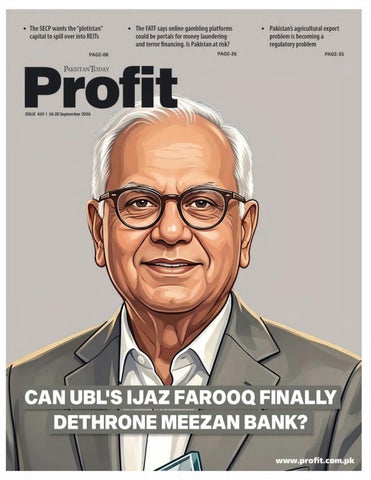
16 Can Ijaz Farooq finally dethrone Meezan Bank? 21 JK Spinning Mills invests Rs2.3 billion in textile modernisation 22 Why Fazal Cloth Mills may be getting into LPG 23 Treet is turning its packaging Modaraba into a conventional company
30
Rethinking FDI Muhammad Azfar Ahsan
24
35
24 The trade-offs involved in Pakistan’s $6 billion refinery bet
Pakistan’s agricultural export problem is becoming a regulatory problem
26 The FATF says online gambling platforms could be portals for money laundering and terror financing. Is Pakistan at risk?
Profit Publishing Editor: Babar Nizami - Senior Editor: Abdullah Niazi Business Reporters: Taimoor Hassan | Usama Liaqat | Zain Naeem | Shahnawaz Ali | Ghulam Abbass Ahmad Ahmadani | Aziz Buneri - Sub-Editors: Saddam Hussain | Abdul Hameed - Video Producer: Adnan Maqsood Director Marketing: Muddasir Alam - Regional Heads of Marketing: Agha Anwer (Khi) Kamal Rizvi (Lhe) | Malik Israr (Isb) GM Special Projects Zulfiqar Butt - Manager Subscriptions: Irfan Farooq Pakistan’s #1 business magazine - your go-to source for business, economic and financial news. Contact us: profit@pakistantoday.com.pk
The SECP wants the “plotistan” capital to spill over into REITs New regulations give a framework for plots and paperwork to be formalised as financial market instruments, but will the people bite?
O
n September 10, the Securities and Exchange Commission of Pakistan put out a set of draft amendments to the REIT Regulations, 2022 as an effort to “create a more enabling REIT framework that can mobilize long-term capital, broaden investor participation and unlock greater potential in Pakistan’s real estate sector.” The framing only makes sense once you look at how little potential has actually been unlocked so far. Pakistan’s REIT framework has existed since 2015, and has been overhauled once already in 2022. Yet as recently as two years ago PSX was still marking milestones as modest as listing its second REIT in seven years. Listings have picked up pace this year as JS Rental REIT in April, and the New Nazimabad Apartments REIT became the 13th PSX public offering of 2026 in August. But the entire sector sat at six listed REITs and roughly Rs82.7 billion in combined market
8
capitalisation as of April. For a country where real estate is arguably the single most popular store of household wealth, that is a strikingly small footprint for the one vehicle designed to let ordinary investors hold it formally, through a regulated channel. Part of the reason is that Pakistanis love investing in real real estate. It is the single biggest aspiration of people to buy and own a tangible piece of land. And not just for primary homes but also a secondary or tertiary piece of land to secure their capital. And while a REIT may not be as tangible as a physical piece of land, it is definitely a strong competitor of the infamous “file” in the real estate sector (which is also not a tangible piece of land). The money that goes into the file is precisely what the SECP is coming after. The gap between how Pakistanis actually invest in land-based property and how the regulated REIT market lets them do it is the problem this reform package is most directly aimed at closing.
What are REITs?
A
REIT takes a real estate project and turns it into something that can be owned collectively by investors. Instead of one developer holding the entire project, the property is placed inside a regulated structure and divided into units. Investors buy those units, while the money raised is used to acquire, develop or operate the underlying real estate. Returns then come from whatever the property generates, whether through sales, rent or an increase in value. Under Pakistan’s REIT Regulations, 2022, the project is managed through a licensed REIT Management Company and operates under SECP oversight. That gives the structure more formal governance, disclosure and valuation requirements than a conventional property development. Publicly offered REITs can also bring ordinary investors into projects through units rather than requiring them to buy an entire plot, apartment or building themselves.
The important distinction is that buying a REIT unit is not the same as buying a piece of property directly. The investor owns a stake in the scheme that owns or develops the property. That makes real estate easier to divide among investors and, in listed structures, potentially easier to buy and sell, while leaving investors exposed to the same basic risks of construction, pricing, demand and property values.
REITs as plots
T
he single biggest shift in the draft amendment is that Investment-based REITs funds, built to buy property purely for capital gain, will now be allowed to invest in vacant land and plots, something the regulations previously excluded outright. The catch is a mandatory minimum one-year holding period before any plot can be sold, meant to stop REITs from becoming vehicles for the same fast, speculative flipping that already defines much of the informal plot market and file trading. This matters because plot-buying, not rental towers or shopping malls, is the default way most Pakistanis who invest in real estate actually do it. Usually it is done informally, in cash, and in housing schemes with little documentation. By letting a regulated REIT hold that same asset class, SECP is effectively trying to offer a formal substitute for the country’s dominant real estate habit, rather than asking investors to adopt an unfamiliar one. If it works, it is the clearest path to REITs actually growing beyond Rs82.7 billion (current market cap), because it taps into an existing appetite instead of manufacturing a new one. But how are REITs better than plots?
REIT vs Plot
O
ne key difference is that a plot or a file can sit idle for years, producing nothing while its price is set through a thin, opaque market with little public data. The price can sometimes fall or sometimes appreciate so slowly that the point of investing in that land becomes moot. And most importantly, a lot of the rise and fall in plot prices is based on hearsay, word-ofmouth campaigns, a dazzling launch event, and often the good old rumour mill. Once land sits inside a REIT, however, its value is pulled into a more visible financial system. Its pricing becomes more transparent, ownership is documented, transactions leave a trail, and the asset is managed under rules that discourage indefinite speculative holding. The land itself is still unchanged, but the way it behaves in the economy is not. That could matter for Pakistan’s wider
property market. If REITs own a sizable share of plots, land prices may increasingly be influenced by reported valuations, rental yields, development potential and market disclosures rather than only dealer networks and informal expectations. Over time, that could create clearer benchmarks for what land is actually worth and make it harder for large parts of the market to operate entirely through undocumented cash transactions. Another clear distinction for the state is that REIT purchases also require money to enter through formal financial channels, creating a barrier that the traditional plot-and-file market largely lacks. The effect of that however, should not be overstated. REITs will not eliminate black money, speculative behaviour or under-declaration across the property market, especially while most land remains outside regulated structures. But they can shift a portion of real estate away from being a passive store of wealth and towards being a priced, disclosed and professionally managed asset. If that share becomes large enough, the bigger change may be that REITs begin setting reference prices for the very plots and projects that trade outside of them. Coming back to the amendments at hand, there are a few others in the requirements for what construes a REIT. REITs are required to prove each year that a set share of their income and assets is genuinely tied to real estate. That threshold will drop from 75 percent to 65 percent across every REIT type. SECP’s own stated reasoning is to let funds invest in and earn income from “digital infrastructure and other ancillary real estate assets”. This is a kind of data-centre and telecom-adjacent holding that have become a major REIT category globally but wouldn’t have passed a stricter test locally. Real estate still has to be the clear majority of the fund and this proposed amendment can just widen the margins around it. While some may argue that at 65% the REIT will fail its purity test, others will have
A door to institutional money state land
G
roup-level trusts and employee funds, provident and pension funds belonging to the same corporate family as a REIT’s management company, will now be allowed to invest in unlisted REIT schemes, something previously reserved for listed ones over liquidity and oversight concerns. It is a narrow channel, limited to a sponsor’s own corporate group, but it is new institutional capital that unlisted REITs will now have access to. Separately, REIT managers acquiring
property from government entities, stateowned companies or development authorities will be able to treat a signed, irrevocable sale agreement as sufficient compliance with transfer deadlines, even where the actual government-side paperwork lags. Given how slow land transfers involving Pakistani state bodies typically are, this is a direct fix aimed at making REITs a workable vehicle for monetising public land and buildings, relevant at a moment when asset liquidation, and selling off underperforming state entities is a live fiscal priority for the current regime.
Softer edges everywhere else
T
he rest of the amendment package is about removing friction rather than opening new markets. For example, REITs will be able to borrow from their own sponsors and directors for up to 36 months instead of 24, giving development-stage schemes more room before related-party debt comes due, though unitholders still have to approve any such loan by special resolution. Rental and Investment-based REITs facing genuine delays outside their control can now apply for up to a one-year extension on their listing deadline, rather than being forced into breach by market timing they don’t control. A separate clarification confirms that Hybrid REITs, i,e; schemes combining a capital-gain component with a rental one, can now earn rental income on properties during the holding period, rather than those assets sitting idle while the fund waits out its one-year plot restriction. Of course, none of this is finalised. The amendments are open for public comment before SECP moves to adopt them, and nothing here forces any REIT to actually launch. What the package does is remove a specific, identifiable set of obstacles. These include the plot ban, the strict real estate purity test, the narrow investor base, and the tight borrowing and listing clocks. All these obstacles can in part explain why a market this old, based on Pakistan’s favourite asset class, has remained this small. Whether Pakistan’s REIT sector actually grows past six listings and Rs82.7 billion now depends on whether investors can treat a REIT holding a plot the same way they’ve always treated the plot itself. But to be fair, the very reason the government is now showing interest in empty land REITs, is precisely the reason it remains Pakistan’s cash-based capital’s favourite asset class. And changing the name would not make the REIT beneficial for a plot’s intended clientele. However, what it does is give the formal customer a reasonable and clean alternative. n
REAL ESTATE
Same Banks, Different Field
Level the playing field, and Pakistan’s private-credit gap with India and Bangladesh all but disappears. What survives — SMEs and housing — tells us where the real work is. By Zafar Masud
E
very few months a chart makes the rounds. It shows bank credit to the private sector as a share of GDP: Pakistan at about 11%, Sri Lanka at 30%, Bangladesh at 34%, India at 44%, Vietnam at around 125%. The verdict comes before the evidence. Pakistani banks, we are told, are lazy, rent-seeking and risk-averse. They park depositors’ money in treasury bills and leave the farmer, the shopkeeper, the homebuyer, and the exporter to fend for themselves. The regional chart compares outcomes but says nothing about the conditions under which they were produced. A 100-metre time tells you very little if one runner was on a track and the other in sand. So this piece asks a different question: how much of the gap is the banks, and how much is the field they are made to play on? Put in numbers, how much of the 33-point gap with India is explained by the environment, and how much is left over? The answer, worked through below with the arithmetic shown, is that all but about two points of it is environmental. The residual — small enterprises and low-cost housing — is where policy should be aimed.
SME and housing, already on the radar of the government, the central bank, the banks, and the other stakeholders, have shown significant progress in recent months; but there is still a long walk ahead.
Constraint one: cash is deposits foregone
Deposits are the raw material of lending. Every rupee under a mattress or in a shop till is a rupee no bank can lend. In Pakistan, Rs 11.9 trillion of currency circulates outside the banking system — about 28% of broad money, a ratio otherwise seen mainly in conflict economies. In India and Bangladesh the share is around 13%, and adjusting this to Pakistan’s level shrinks the deposit base by 72 over 87, a factor of 0.83. A sixth of lending capacity is gone before a single credit decision has been made.
Constraint two: banks lend against income they can see
Banks lend against evidence of repayment capacity: tax returns, filed accounts, transaction trails. In Pakistan, more than half of GDP pays little or no tax and is, for practical purposes, invisible to the credit system. The World Bank’s informality estimates put informal output at about 18% of GDP in India and 30% in Bangladesh — documented economies of roughly 82% and 70%. Shrinking each to Pakistan’s 50% applies a factor of 0.61 to India and 0.71 to Bangladesh. This is the largest single adjustment, and rightly so: documentation is the precondition for lending at all.
Constraint three: the sovereign eats first A counterfactual, not a complaint
The method is a simple thought experiment. Take India’s and Bangladesh’s actual lending ratios and recalculate them as if both countries operated under three structural constraints Pakistan lives with every day: a cash-heavy money supply, a half-documented economy, and a sovereign that, having no other option, pre-empts more than half of the banking system’s balance sheet. This is proportional scaling on sourced inputs, deliberately kept simple. It is not an econometric model and captures no second-order effects. It is an order-of-magnitude answer to a fair question — and, as I will argue, its simplicity works against my own case rather than for it.
ANALYSIS
The third constraint is the one bankers are most often blamed for, and the one over which they have the least control. Pakistan’s government finances more than 90% of its fiscal deficit domestically, and government securities now absorb about 55% of banking assets. The IMF, counting all sovereign exposure, puts the figure at close to 60% — the highest in the world and roughly four times the global median. This is not a preference; it is a consequence. When the state must borrow and the only deep pool of domestic savings is the banking system, banks will hold government paper whether they want to or not. Imagine, hypothetically, that the banks decided to stop financing the government’s deficit in order to divert the balance sheet to the private sector. What would happen? The sovereign would default on its commitments, and there would be precious little private sector left to lend to. In India, government paper is about 20% of bank assets; in Bangladesh, about 21%. So under Pakistan’s fiscal dominance, only 45
11
paisa in every rupee of bank resources remains for private borrowers, against roughly 80 in both peers — a factor of 0.56 for India and 0.57 for Bangladesh. When the sovereign takes the balance sheet, the entrepreneur queues behind it — not necessarily for want of liquidity, but of lending preference.
proxy data is largely how India documents its borrowers; its absence in Pakistan overlaps with constraint two, and counting both would double-count. It enters only as a caveat: the levelled peer numbers below are, if anything, overstated.
Doing the arithmetic
The three factors multiply. For India: 44 × 0.83 × 0.61 × 0.56 ≈ 12.5, call it 13% of GDP. For Bangladesh: 34 × 0.83 × 0.71 × 0.57 ≈ 11.4, call it 12%. The combined factor — 0.28 for India and 0.34 for Bangladesh — is then applied to each country’s agricultural, SME and housing ratios. The inputs are set out below.
The fourth constraint, deliberately left out
There is a fourth difference, and in the long run it may matter most. Where borrowers lack financial statements, peer-country banks lend on proxy data — the digital transaction trails that stand in for documentation. India’s Unified Payments Interface processed 241.6 billion transactions worth ₹314 trillion in the year to March 2026 — roughly 95% of GDP running through rails a lender can read — and that data now underwrites cash-flow lending to shopkeepers and farmers who have never filed a return. Pakistan has, in fact, built two such rails. 1Link — the banks’ own switch, connecting more than 40 institutions since 2004 — processed more than 10 billion transactions worth Rs 75.4 trillion in 2025. Raast, the State Bank’s real-time rail, added nearly 2 billion transactions worth close to Rs 50 trillion in the same year and is scaling fast: Rs 23.3 trillion in the January to March quarter of 2026 alone, with the State Bank expecting more than Rs 140 trillion this year. Together the two rails already move about Rs 125 trillion a year — more than the country’s GDP, and proportionally more than UPI moves in India. The data India lends against is being generated in Pakistan today. But Raast and 1Link are at this stage railroads: they transport payments. Neither is wired to a lender’s credit decision. The larger constraint is the treasure trove of data sitting in silos — with provincial and federal land and tax authorities, banks, NADRA, and the energy and telecom companies — none of which talks to the others through a data exchange, as they do in comparable economies. Made accessible, that data would be a game-changer in credit assessment for these otherwise invisible borrowers, and would lift documentation and financial inclusion substantially. I have not multiplied this constraint into the numbers, because
12
What the numbers say
First, the headline gap disappears. Under Pakistan’s constraints, India and Bangladesh would lend roughly 13% and 12% of GDP to their
private sectors — within a couple of points of Pakistan’s 11%. Run the same exercise on Sri Lanka and it levels to about 11% too: Pakistan’s own number. Whatever the chart is measuring, it is measuring the ecosystem, not the banks. Second, on a level field Pakistani banks out-lend Bangladesh in agriculture financing. Bangladesh’s farm credit, levelled, falls from 1.0% to about 0.4% of GDP against Pakistan’s actual 0.9% — more than double. India, levelled, would still be at 2.5%, so farm credit is not adequate; but the shortfall is not evidence of bank reluctance. Third, the SME gap survives. India, levelled, would lend about 3% of GDP to small enterprises and Bangladesh about 2%, against Pakistan’s 0.7%. Even with every environmental excuse granted, Pakistani banks lend to SMEs at a quarter to a third of the rate their peers would under identical conditions. Fourth, the housing gap survives too, and it is the widest of all — which is why it gets its own section. Vietnam bookends the picture from the other side: with none of the three constraints, it lends about 125% of GDP to its private sector, eleven times Pakistan. That is not better bankers; that is a well-drained field.
The mortgage that isn’t there
Pakistan’s entire housing-finance portfolio — every mortgage on every bank’s book, plus the House Building Finance Company — stood at Rs 279 billion in August 2026, having doubled in a year. That is about 0.3% of GDP and 1.5% of bank advances, spread across fewer than 70,000 borrowers in a country of 240 million people with an estimated shortage of 10 million homes. The South Asian average is 3.4% of GDP. India’s
outstanding individual home loans reached ₹37 trillion by March 2025 — over 11% of GDP, up from 8% a decade earlier. Bangladesh’s housing loans stood at Tk 1.28 trillion in 2024, roughly 2.5% of GDP. Level the field and the gap narrows but does not close. India, under Pakistan’s constraints, would still lend about 3% of GDP for housing — ten times Pakistan. Bangladesh would be at about 0.9% — three times. Housing is the one ratio where Pakistan would be an outlier under any constraints. The low-cost segment is where the comparison bites hardest, because it is precisely where peers have pushed. In India more than four in five active home-loan accounts are in the affordable bracket, and the interest subsidy under the state’s Pradhan Mantri Awas Yojana (PMAY) sits behind nearly three in ten of them. Bangladesh, by contrast, is a warning: with no risk-sharing institution, a 70:30 loan-to-value cap and a mortgage NPL ratio above 13%, its market has stalled at a few percent of GDP for a decade. Pakistan’s own evidence points the same way as India’s. Under the federal mark-up subsidy scheme, banks financed some 31,000 homes in twenty months between 2021 and 2023 — more than the industry had originated in the previous decade — and the portfolio fell away when the subsidy was withdrawn. Punjab’s Apni Chhat Apna Ghar has since financed more than 200,000 low-cost homes worth over Rs 300 billion, with recovery holding, on a simple design: a first-loss guarantee and an interest subsidy, with the bank carrying the credit decision. The federal government’s Wazir-e-Azam Apna Ghar programme — “Ghar Ho Tu Apna”— has paid off too: over 50,000 mortgages worth Rs 300 billion approved in a window of barely five months, against a target of 500,000 units over four years. This year’s revised prudential regulations allow thirty-year tenors and 90% loan-to-value, and the 2026 amendment to the recovery law finally gives lenders a way to enforce a mortgage. The demand is there and the rules are there. The banks’ mortgage approval rates are unprecedentedly strong. What now stands between approval and disbursement is the supply of houses a bank can lawfully lend against.
The house that cannot be mortgaged
This is the part of the housing story that a demand-side lens misses. Pakistan’s mortgage market is small not because banks lack liquidity,
ANALYSIS
but because most of the housing stock fails one or more of the five tests a lender must apply before it can take a house as security: a clean and searchable title, lawful construction, an enforceable security interest, a credible valuation, and a buyer with verifiable income. This results in a shortage of titled, mortgageable housing stock. A mark-up subsidy widens the pool of borrowers, but not the pool of houses a bank can lend against — which is why, of the units built under the federal scheme, only about one in five was mortgage-financed.
credit is up 20% year on year to Rs 1,113 billion, with borrowers up from 2.7 million to 3.4 million in a couple of years; SME credit has more than doubled to around Rs 1 trillion; housing finance has more than doubled too; and private-sector credit grew 14.8% in the year to June 2026 to Rs 11.38 trillion, its fastest in four years. But the improvement rests on a handful of institutions. Every bank is entitled to its own strategy, and it is unfair to ask all to lend aggressively into high-risk segments. But between a few carrying the load and the rest standing aside lies a middle ground, and the industry should say so about itself before others say it for us — the bankers have recognised it, embarked on the journey, and further improvement is on the anvil. Nor are the constraints permanent. The government is moving on them through the Prime Minister’s Cashless Pakistan and Access-to-Finance initiatives, and the outcomes are visible: cash is falling as Raast, 1Link and merchant digitisation take hold; documentation is improving as tax administration digitises; fiscal dominance is hardest, because it belongs to the state’s finances rather than the financial sector. Estimates of informality vary by method; pick any reasonable one and the conclusion does not change.
The fixes are known: searchable and conclusive title, regularisation of informal stock into lawful collateral, land released as completed units rather than plots, enforceable mortgages with priceable collateral, and a wider borrower pool underwritten by risk-sharing rather than blanket subsidy. The test of success is a single number — the share of newly completed urban units that are mortgage-financed at handover.
The residual is an institution, not an attitude
Why do the SME and housing gaps survive when the agricultural gap does not? Because Pakistan’s agricultural credit has for some years enjoyed what SME and housing credit have only begun to: state-backed risk sharing at scale. Punjab’s Kissan and Livestock Cards have put about Rs 400 billion of interest-free credit into the hands of some one million farmers, with recovery above 99%. Asaan Karobar has channelled roughly Rs 150 billion to more than 110,000 small businesses in a short span. Demand was never a problem; de-risked supply was, and once supply was de-risked, banks lent. Nowhere in the world is priority-sector lending done without this kind of support, not even in the quintessential capitalist economies. America has the Small Business Administration guaranteeing small-business credit, and FHA and Fannie Mae underwriting the thirty-year mortgage itself. Germany has KfW; France has Bpifrance. Korea’s KODIT, funded jointly by banks and the state, guarantees some US$44 billion of SME credit at 70% to 85% cover. These are not subsidies to bankers. They are the price of a functioning credit market where information is thinnest and enforcement weakest. Pakistan asks its banks to do alone what no banking system anywhere does unassisted.
An admission, and a caveat
None of this says Pakistani banks are beyond criticism. Agricultural
14
An agenda with an address on every item
None of this is exoneration. Cash at a quarter of the money supply, half the economy untaxed, a deficit wearing a banking disguise — these are the state’s to fix. Three further pieces must be built by state and banks in harness. The first is first-loss absorption on the KODIT model: a properly capitalised guarantee institution, funded jointly by the state and the banks, offering first-loss cover on SME and low-cost housing lending at a scale that moves the numbers, paired where needed with interest support. The Punjab and federal schemes have run the pilot. What is missing is the permanent institution that turns pilot into practice. The second is mortgageable stock. The guarantee de-risks the borrower; it cannot de-risk a house that has no clean title, no completion certificate or no route to foreclosure. Until informal housing is turned into lendable collateral, approvals will keep outrunning disbursements — and the housing gap will survive whatever the banks do. The third, and perhaps the most critical, is data. Raast and 1Link between them are the seams of the data exchange described above — a digital scorecard a lender can act on, sharpened by the tools now available for reading behaviour as well as balance sheets. India built this as its Account Aggregator framework atop UPI; Brazil built Open Finance atop Pix. Pakistan has the rails and the data in pockets. It needs the exchange. Until all three are built, the fair reading of that chart is not that Pakistani banks will not lend. It is that they are lending, on the field they have been given, at almost exactly the rate anyone else would. Judge the banking industry by all means — but on a level field.
ANALYSIS
Nimir Industrial Chemicals places Rs3 billion bet on import substitution and exports The company will enter animal nutrition, expand its chlorinated paraffin wax operations and move an oleochemicals plant to Hub, with the investments expected to begin contributing from FY2028.
N
imir Industrial Chemicals is preparing to spend Rs3 billion on three manufacturing projects intended to take the company into a new product category, expand a recently established business and give its oleochemicals division better access to customers and export markets in southern Pakistan. The company’s board approved the capital expenditure at a meeting on September 9, according to a disclosure filed with the Pakistan Stock Exchange. The programme comprises a new palmitic acid plant, an expansion of Nimir’s chlorinated paraffin wax and chlorine-liquefaction facilities, and the relocation of one oleochemicals plant from Sheikhupura to Hub in Balochistan. Nimir expects the projects to begin producing financial benefits from fiscal year 2028. Taken together, the projects offer a reasonable summary of Nimir’s broader growth strategy: manufacture locally what Pakistan currently imports, expand products for which domestic demand has already been demonstrated, and position some capacity closer to the country’s principal seaports. The palmitic acid facility represents the most explicit diversification. Nimir said the product is used in animal nutrition, particularly for milking cows, and will create an entirely new business line. The company also intends to introduce additional products in the segment, suggesting that the proposed plant may eventually serve as the foundation for a broader portfolio of animal-nutrition ingredients rather than remain a single-product operation. For Nimir, that is a relatively natural extension. The company already processes palm-based raw materials into oleochemicals including soap noodles, stearic acid, glycerine, hydrogenated oils and distilled fatty acids. It says it can manufacture more than 120,000 tonnes of soap noodles and 20,000
CHEMICALS
tonnes of stearic acid annually, supplying both the domestic and export markets. Palmitic acid therefore introduces a new customer base, but not an entirely unfamiliar manufacturing discipline. The second component of the investment doubles down on a market Nimir helped localise only recently. The company will expand its chlorinated paraffin wax, or CPW, plant and the chlorine-liquefaction facility that supplies its principal feedstock. CPW is an industrial chemical commonly used in products such as PVC, cables, paints, sealants and lubricants. Nimir describes itself as Pakistan’s only domestic producer of CPW. Its existing plant, commissioned alongside chlorine-liquefaction capacity in 2023, has reported capacity of approximately 11,000 tonnes a year. The company says demand has risen significantly since the product began being manufactured locally and expects that growth to continue. Expanding the chlorine operation alongside CPW is important: it gives Nimir greater control over the availability of a critical input rather than merely adding downstream capacity. The third project is less about adding a product than putting production in a better location. Nimir plans to shift one of its oleochemicals plants from Sheikhupura to Hub. The company’s main industrial complex is located at Bhikhi on the Sheikhupura-Faisalabad Road, an excellent position for serving Punjab’s manufacturing base but a considerable distance from Karachi’s ports. A Hub facility would place Nimir closer to customers in Karachi and southern Pakistan while reducing the distance between part of its production base and the seaborne trade on which chemical manufacturers depend. The company explicitly expects the relocation to support local demand and improve export opportunities through easier access to sea routes. Crucially, Nimir is moving only one oleochemicals plant; the
announcement does not suggest that it is abandoning its much larger Sheikhupura complex. The scale of the investment is meaningful. Nimir reported net revenue of Rs48.3 billion for the year ended June 2026, up 6.7% from Rs45.3 billion a year earlier. Net profit rose 18.3% to Rs2.39 billion, while earnings per share increased from Rs18.29 to Rs21.64. Gross profit margins improved to 15.7%, and lower finance costs helped strengthen the bottom line. At Rs3 billion, the new capital programme is larger than Nimir’s entire latest annual profit and equal to roughly 26% of its June 2026 shareholders’ equity. It is also more than five times the approximately Rs549 million the company spent on fixed assets and capital work-in-progress during the year. The announcement does not specify how the projects will be financed, how the Rs3 billion will be divided between them or the additional production capacity each will create. Those omissions matter because Nimir remains a working-capital-intensive manufacturer. At June 2026, it had Rs14.3 billion in short-term borrowings and generated Rs1.36 billion in operating cash flow during the year. The two-year period before earnings begin to arrive will therefore require careful management of construction costs, imported machinery, raw-material prices and financing. Still, expansion is hardly unfamiliar territory for Nimir. Incorporated in 1994 as Ravi Alkalis, the company entered oleochemicals in 2000, soap noodles in 2007, large-scale soap finishing in 2014, aerosols in 2020 and CPW in 2022. A management buyout in 2011 was followed by repeated investment in new products and capacity. The latest Rs3 billion programme continues that pattern—but now with a clearer emphasis on exports, southern Pakistan and higher-value specialised chemicals. n
15
16
The UBL deputy CEO has a long career in Islamic banking and is building UBL Ameen into the fastest growing franchise in the business. Meezan is still at the top, but for how much longer?
I
By Farooq Tirmizi
f Meezan Bank is the dragon of Pakistani Islamic banking, in Ijaz Farooq, they may have finally met the dragon-slayer. Two facts have been near-axiomatically certain in Pakistani banking for at least two decades (and probably a bit longer): first, that Islamic banking grows faster than conventional banking, because many consumers have a genuine preference for it, and second, that Meezan Bank is the undisputed market leader of Islamic banking in Pakistan. As a result of this, Meezan Bank is the only bank in Pakistan where, if you ever talked to their senior management about growth strategy, the last thing they ever talked about was raising deposits. For them, deposit growth was the simple matter of opening a branch and then waiting for the devout Muslims of Pakistan to line up to deposit their money into the one bank they all know and trust as being Shariah compliant. This is why, despite the fact that virtually every bank in the country has launched Islamic banking products, and Faysal Bank converted its entire book of business to Islamic, Meezan has maintained a strong market share of about one-third of all Islamic banking deposits in the country, fluctuating slightly year-to-year, but never really dipping below that level by much. That has now changed. For three years in a row, Meezan Bank has lost market share in Islamic banking. The loss is not very big, and the bank is still close to 30% of all Islamic banking deposits in the country, but it is noticeable to the bank’s management. So much so that when they gathered their branch managers earlier this year for a conference in Karachi, one of the key themes that was highlighted was the increased competition they were facing, and how many of the branches were actually beginning to struggle to hit their deposit growth targets. And somewhat uniquely, the name of the fiercest competitor was that of a single individual: Ijaz Farooq, deputy CEO and head of Islamic banking at United Bank Ltd (UBL). What happened that made them name not just a rival bank, but a specific individual at that bank, as a source of serious competition?
UBL rising, Meezan (very slightly) faltering
F
irst, let us lay out some important facts. Meezan Bank’s market share of total Islamic banking industry deposits as of the end of June 30, 2026 – the latest period for which complete data is available – is about 29.6%, which is still more than twice as much as its next biggest rival. And while this number is down somewhat over the last
three years, it is also important to recognize that it is not down by a lot: in 2023, Meezan’s market share was 32.9% of Islamic deposits. Hardly the stuff of CEO nightmares. Indeed, one can take it as a testament to just how much Meezan still has a culture of being winners that they take even small changes in market share extremely seriously, and work with their middle management – probably among the most empowered in the Pakistani banking sector – to craft strategies to ensure that small slippages do not become big ones. What is much more noticeable and prominent is how much UBL Ameen, the Islamic banking division of UBL, has risen. In June 2023, around the time Ijaz Farooq joined as the deputy CEO of UBL, the bank had about Rs248 billion in Islamic deposits, which placed it as the sixth largest Islamic banking book in the business, behind Meezan, Faysal Bank, BankIslami, Habib Bank Ltd (HBL), and Bank Alfalah. Just three years later, as of June 2026, UBL’s Islamic banking deposits are at Rs1,353 billion, in third place behind Meezan and Faysal. This represents a growth rate of 75.9% per year, at a time when the Islamic banking industry as a whole grew deposits by an average of 29.2% per year, according to data from the State Bank of Pakistan’s Islamic banking bulletins. Inflation during this time averaged 11.4% per year. The numbers get even more impressive in absolute terms: UBL grew its Islamic banking deposits by Rs1,105 billion over those three years, which is not very far behind the Rs1,813 billion by which Meezan grew its total deposits by, especially when you consider the fact that Meezan was 7.7 times bigger than UBL Ameen three years ago. It is now just 2.8 times bigger. Spare a thought in this moment for Faysal Bank, which converted from conventional to Islamic banking around the same time (effective January 1, 2023) and was still not the fastest growing Islamic banking book. They grew by Rs780 billion, which is a respectable 26% per year average growth rate, but it means that they still marginally lost market share, since UBL took so much of the growth. UBL Ameen accounted for 16.3% of the growth in Islamic banking deposits over the past three years, despite having started the period with 4.2% of total Islamic deposits. As a result of that rapid growth, it is now 10.7% of total Islamic banking deposits. And given the rapid rate of growth it is going through, it is entirely likely that UBL Ameen will become the second largest Islamic banking book in Pakistan by the end of this year, surpassing Faysal Bank, which is a fully dedicated Islamic bank. So who is Ijaz Farooq and how is he building this juggernaut?
COVER STORY
The quiet Islamic banking powerhouse
I
t is easy to have missed Ijaz Farooq’s career since he tends to avoid the limelight, but if you look closely enough, he has been an important – if quiet – powerhouse in Islamic banking for the past 20 years at least. He joined UBL in 2023, and was part of the team brought in by then incoming CEO Jawaid Iqbal. Prior to that, he had spent 11 years at Meezan Bank, holding a variety of roles, but mainly remaining in charge of retail banking and commercial banking for most of his time at Meezan. And before that, he was head of Islamic banking at Bank Alfalah from around 2004 through 2012. That is 19 years of leadership at two of the most important Islamic banking books of business in Pakistan before joining UBL. Ijaz Farooq has an MBA from the University of Punjab from where he graduated in 1981, following which he joined Allied Bank Ltd (ABL), back when the banks were entirely nationalized entities and effectively not much better than government departments. Following an unspecified number of years there (we asked him, he did not answer how many years, and none of his public profiles say how long he was at ABL), he moved on to Emirates Bank International, the Dubai-based
18
bank that was one of the largest banks in the UAE before it merged with the National Bank of Dubai in 2007 to become Emirates NBD Bank. In 1998, he joined what was then the nascent Bank Alfalah, having only begun its operations in November of the previous year. Ijaz Farooq joined Alfalah as an area manager, but was able to quickly work his way up the ranks of the bank and became head of Islamic banking, and a member of its central management committee by 2004. In 2003, the year before started as head of the Islamic banking division at Alfalah, Islamic banking was less than 1% of Pakistan’s banking industry (0.8% to be more precise), by deposits. Yet Ijaz Farooq took what was a relatively unknown concept at the time and started growing it. Within his first two years at the helm of Alfalah’s Islamic banking business, Bank Alfalah was the second largest Islamic banking deposit book in Pakistan, a position it held until 2014, two years after Ijaz Farooq left the bank. Most of his time as the head of Islamic banking was spent under the leadership of Sirajuddin Aziz, the dynamic CEO who led the bank’s massive branch expansion that led Alfalah to briefly displace ABL as the fifth largest bank in the country by deposits. In the early years, Bank Alfalah had a
habit of consistently outperforming its guidance on branch growth. For instance, in 2002, the bank promised that it would grow its network by 10 branches next year. Instead nearly doubled that pace, adding 19 branches in 2003. However, as its existing network grew, the bank scaled back some of its plans. In 2006, for example, Alfalah opened just 47 branches against a planned 90. In 2007, it opened just 36 branches against a planned 67. In a strategy that he would later repeat at Habib Metropolitan Bank, Aziz opened up branches in the small towns and cities across Pakistan that were host to a key economic cluster. Bhalwal, for instance, is the hub of Pakistan’s citrus exporters, so the bank opened a branch there. Pattoki has a lot of flower growers and hence the bank has a branch there. These are both cities that still have a relatively small population. Say their name to any dweller of a top-10 Pakistani city and they would never have heard of them. Yet the Bank Alfalah leadership knew enough about the Pakistani economy to know that opening up branches there would be a highly profitable venture for Bank Alfalah. To be at an important part of one of the most dynamic banks in the country at the time of the most rapid part of its ascent is likely to have given Ijaz Farooq a front row seat to where the money is in Pakistan and which
pockets can be tapped for deposit growth. It is therefore natural that, in 2012, a year after Alfalah underwent a leadership change, Ijaz Farooq was poached from the second largest Islamic banking book to the largest one, and tasked with leading its retail banking division. The long tenure at Meezan Bank, particularly on the retail and commercial banking side, means he is likely to have developed relationships with several of the bank’s key high net worth individual and small business owner clients, the kind that were just below the level of personal attention by the CEO, but nonetheless important enough to deserve some attention from a C-suite executive. This era at Meezan was one of consolidating leadership. In the first 10 years of its existence, Meezan Bank was largely the biggest in what was then a small corner of Pakistani banking that was Islamic banking. As recently as 2012, Islamic banking accounted for just 10% of total deposits in Pakistan. Meezan owned a third of that market, but it was effectively head of the minnows’ table. For its initial years, Meezan relied on relationships with smaller and medium sized companies that had owners who were more religiously inclined. Many had never used a bank before because they believed that bank interest is prohibited under Islamic law, and so they did not mind not having the full suite
of products available to them from the very beginning. But by 2012, Islamic banking was being seen as a key growth lever for most Pakistani bank CEOs and the competition was getting tougher. Maintaining market share was getting harder as more and more banks wanted a piece of the faster growth they could see Meezan delivering. Meezan’s branding was a key advantage, but it still needed to grow its physical footprint to ensure that the deposits kept rolling in. That is where Ijaz Farooq’s Bank Alfalah experience of branch expansion came in handy. At the time he joined Meezan, the bank had 310 branches. By the time he left 11 years later, it had 982, meaning he was the man leading its retail banking division during the period when it added the majority of its branches. In short, he knows Meezan inside out.
Leaving Meezan
T
he most watched, and most well managed CEO transition in Pakistani banking history is that of when Meezan’s founding CEO Irfan Siddiqui finally transitioned towards retirement in December 2025. Siddiqui recruited his successor two years before leaving, clearly had him designated as his successor for those two years, and the finally handed the reins.
That successor was Syed Amir Ali, who had spent 12 years in corporate and investment banking at Meezan before leaving in 2018 to become the CEO of BankIslami Pakistan, a position he held for five years before returning to Meezan to become Siddiqui’s successor designate. Was Ijaz Farooq ever in contention for the top job at Meezan Bank? Probably not, and for two reasons. The first was that at the time the decision was being made, Ijaz Farooq was already 64 years old. Syed Amir Ali was a much younger 45 years old. And secondly, in the battle for CEO succession, whenever a candidate from the retail side of the business goes up against the corporate banker or investment banker, the retail banker will lose. Almost every single time. So as it became clear that there would be a new regime at Meezan – but not wanting to retire despite being in his mid-60s – Ijaz Farooq took the offer to join UBL under new leadership.
The playbook at UBL Ameen
S
ince joining UBL, Ijaz has set out to replicate the playbook he knows very well: establish branches in the right nodes of the Pakistani economy, and then
COVER STORY
solicit deposits through personal relationships by recruiting the right branch managers who already have those existing relationships. Banking is a relationship business in most economies, but it is especially a relationship business in Pakistan where the technology that would make it easier for clients to do their banking without having to rely on human intervention is, to put it mildly, leaves a lot of room for improvement. In June 2023, which is close to the time that he joined, UBL Ameen had 151 branches, and also had 501 Islamic banking windows at the conventional branches. It now has 788 branches as of the end of June 2026, and 752 Islamic banking windows. The picture is even more interesting when one considers UBL Ameen in the context of growth at UBL overall. Three years ago, UBL had 1,335 branches, and now it has a total of 2,083 branches. Of that expansion by 748 branches in three years, 638 of the new branches (over 85% of the expansion) came from UBL Ameen. In other words, Ijaz Farooq is very much at the heart of the UBL retail expansion strategy, a role he is now playing for the third time in his career.
Is the prize worth it?
T
o be clear, UBL is applying a degree of brute force to the matter of UBL Ameen’s growth. UBL as a whole has 2,083 branches as of the end of June 2026, which is nearly twice the number of branches as the 1,150 branches that Meezan has. Of that branch network of UBL, 788 (or about 38% of the total) are dedicated Islamic banking branches and another 738 (or about 35% of the total) have Islamic banking windows. That means that the 73% of UBL’s branch network that offers Islamic banking products is 1,526 branches, which is significantly larger than the total physical footprint of Meezan Bank. Meezan has an average of Rs3,248 million per branch, which is significantly higher than UBL’s Rs2,937 million per branch for its entire business (both conventional plus Islamic). And if one assumes that Islamic banking windows constitute just one quarter of a conventional branch’s physical footprint (meaning we count those 738 Islamic banking windows as the equivalent of 185 full branches), UBL Ameen has about Rs1,391 million in deposits per full branch equivalent. Indeed, if one were to even assume to discount the Islamic banking windows completely and credit the entirety of UBL’s Islamic banking business to just the dedicated Islamic banking branches, their deposits would come out to Rs1,717 million per branch, which is 47% lower than Meezan’s deposits per branch.
20
(It is, however, comparable to Faysal Bank’s Rs1,736 million per branch.) Here is what makes the math even more interesting: UBL’s has 1,295 conventional branches which have an average of Rs3,680 million in conventional deposits per branch, which is actually 13.3% higher than Meezan Bank’s deposits per branch ratio. Which then provokes the question: at what cost is UBL going after the Islamic banking market? It appears that its conventional business is 114% more efficient than its Islamic banking business in terms raising deposits for every branch it sets up. If you saw those numbers, where should you allocate growth capital? The conventional side or the Islamic side? In the end, however, this decision is not actually up to UBL CEO Jawaid Iqbal. It has already been decided by the Federal Shariat Court, which has ruled that the entire Pakistani banking system needs to convert to Islamic banking by December 31, 2027 (though most people assume the industry will miss that deadline and seek all sorts of exemptions to prevent regulatory issues from occurring). If UBL is to continue its growth in the
direction that both consumer preference and court rulings are indicating, it has now choice in the matter. The best it can do is get more efficient at raising Islamic deposits. And on that front, the good news is that while UBL Ameen underperforms the bank’s own conventional banking side substantially, it is not materially lower than the banking industry average of about Rs1,854 million in deposits per branch. UBL Ameen, in other words, is a laggard only against the exceedingly high standards of UBL’s conventional banking business – the market leader – and Meezan Bank’s Islamic banking deposit business, which is also its market leader. But having demonstrated the ability to grow its deposit base and branch network profitably, and in a direction that regulations dictate it needs to go anyway, it is possible that UBL Ameen will be the future of the bank’s core business yet. Will it dethrone Meezan as the king of Islamic banking in Pakistan? Stranger things have happened, though judging by how seriously Meezan is taking the threat, perhaps the top Islamic bank will remain at the top, if with somewhat more equal competitors than ever before. n
COVER STORY
JK Spinning Mills invests Rs2.3 billion in textile modernisation The Faisalabad-based manufacturer is upgrading its fabric-processing and spinning divisions, part of a broader investment drive spanning renewable energy, vertical integration and a proposed acquisition.
J
K Spinning Mills is investing approximately Rs2.3 billion in new textile machinery and supporting infrastructure, seeking to improve product quality, operating efficiency and competitiveness across both its fabric-processing and yarn-manufacturing operations. The investment is divided into two programmes. The larger, worth approximately Rs1.79 billion, will upgrade the company’s fabric-processing unit. Another Rs515.5 million is being spent under JK Spinning’s continuing balancing, modernisation and replacement programme for its spinning division. Together, the projects amount to Rs2.304 billion, or almost one-and-a-half times the company’s net profit for the financial year ending June 2026. The distinction between modernisation and outright expansion is important. JK Spinning has not disclosed how much additional production capacity the equipment will create. Much of the spending involves replacing existing machinery with faster and more efficient equipment rather than simply adding spindles or processing lines. The expected payoff will therefore have to come through higher productivity, improved consistency, lower operating costs and the ability to manufacture better-quality products. At the fabric-processing unit, JK Spinning will install a Goller Complexa two-stage bleaching range with single-loop washing compartments and an eight-chamber POSLU stenter with a working width of 3,400 millimetres. The programme also includes a biomass-fired step-grate thermal-oil heater, associated civil works and other project costs. The bleaching range prepares fabric for dyeing and finishing, while the stenter dries, heat-sets and controls the width and dimensional stability of the cloth. These are not especially glamorous pieces of industrial equipment, but their performance directly affects colour consistency, fabric finish and rejection rates—precisely the measures that matter to large international buyers.
TEXTILES
The biomass-fired heater is equally significant. Fabric processing requires substantial quantities of heat, making it one of the more energy-intensive parts of textile manufacturing. Moving some of that requirement to biomass could reduce dependence on expensive conventional fuels, although JK Spinning has not disclosed the projected savings, biomass source or expected payback period. The Rs515.5 million spinning investment will replace existing equipment with 16 LMW high-speed ring frames, two complete sets of high-speed Toyota simplex frames and an automatic bale plucker, together with accessories and ancillary equipment. This machinery covers several stages of converting raw cotton into yarn. The bale plucker automates the initial handling and blending of cotton, the simplex frames prepare fibre for final spinning, and the ring frames produce the finished yarn. JK Spinning expects the new equipment to improve productivity and yarn quality while helping its mills maintain international manufacturing standards. The company said it had secured bank financing through a long-term financing facility and was completing the associated documentation and formalities. It did not disclose the interest rate, repayment period, commissioning schedule or proportion of the project that will be financed from its own resources. The expansion arrives as JK Spinning’s profitability recovers from a difficult previous year. Revenue increased by a modest 1.6% to Rs43.5 billion during the year ending June 2026, but gross profit rose by 25% to Rs5.82 billion. The gross margin improved from 10.9% to 13.4%, while finance costs declined by almost 20%. Those changes helped net profit more than triple from Rs514 million to Rs1.58 billion, taking earnings per share from Rs5.02 to Rs15.45. The new investment is equivalent to around 5.3% of annual revenue and 146% of the latest annual profit, making it a substantial commitment even for a company of JK Spinning’s size.
It is not, however, an isolated burst of capital spending. JK Spinning spent approximately Rs5.69 billion on fixed capital expenditure during FY2026. In August, it announced that it had added another eight megawatts of solar-generation capacity, which it expects to lower energy costs and reduce its reliance on conventional power. The biomass heater extends that energy strategy from electricity into the process heat required by the fabric division. JK Spinning has evolved considerably from the 14,400-spindle mill that began commercial production in 1988. Its 2025 corporate briefing described an integrated manufacturing base comprising 183,538 spindles, 6,000 rotors, 110 looms, annual fabric-processing capacity of 60 million linear metres and a large stitching operation. The company now sells yarn, processed fabric and home textiles rather than remaining solely a commodity-yarn producer. That integration explains why the latest investment spans both spinning and processing. Better spinning equipment can improve the quality and consistency of yarn entering the company’s downstream operations. Modern processing machinery can then turn that yarn into higher-value finished fabric capable of meeting tighter export specifications. The objective is not merely to make more textile products, but to retain more value at each stage of production. JK Spinning is simultaneously pursuing expansion outside its existing factories. On September 1, it disclosed that it had reached an understanding to acquire approximately 70.8% of Ali Asghar Textile Mills at Rs50 per share, subject to a definitive share-purchase agreement and the necessary formalities. The proposed acquisition, additional solar capacity and Rs2.3 billion machinery programme together point to an unusually active investment cycle. The eventual return will depend on export demand, plant utilisation, energy savings and the cost of the new financing. But JK Spinning is clearly betting that, in Pakistan’s difficult textile industry, standing still is now the more dangerous strategy. n
21
Why Fazal Cloth Mills may be getting into LPG The textile manufacturer has incorporated an almost wholly owned gas-distribution subsidiary, potentially positioning itself for Pakistan’s growing reliance on liquefied petroleum gas.
F
azal Cloth Mills is preparing to move beyond textiles and into Pakistan’s changing energy market. The company has incorporated Fazal Gas Distribution Company Limited as a subsidiary, according to a notice filed with the Pakistan Stock Exchange. Fazal Cloth owns 9,997 of the subsidiary’s 10,000 initially subscribed shares, giving it a 99.97% stake. Its stated business is broad: trading, importing, exporting and distributing petroleum, petroleum products, oil and gas, along with related activities. All operations will remain subject to the licences and regulatory approvals required under Pakistani law. Crucially, the subsidiary has not yet begun commercial operations, and Fazal Cloth has promised a further disclosure when it does. The announcement does not identify which fuel Fazal Gas Distribution will handle. But one plausible reading is that the company is positioning itself to enter the liquefied petroleum gas, or LPG, market. Unlike pipeline natural gas, LPG can be transported in bowsers and sold in cylinders or bulk quantities. That makes it particularly useful in areas beyond the piped-gas network and in places where consumers face low pressure or interrupted supply. It also allows private companies to enter the distribution chain by investing in storage, filling plants, cylinders, transport and dealer networks. Pakistan’s underlying energy shift gives the idea some force. Domestic natural-gas production has been declining, while households and commercial consumers increasingly require alternative fuels. The State Bank of Pakistan reported that LPG imports rose 33.6% to approximately $1.1 billion during the year ended June 2025, attributing the increase partly to consumers switching to alternative fuel as domestic natural-gas production fell. That structural shortage is steadily
22
enlarging the addressable market for LPG. Pakistan produces some LPG domestically through gas-processing plants and refineries, but imports have become increasingly important in meeting demand. For a new distributor, the opportunity would lie in securing reliable supplies and moving them efficiently to households, restaurants, shops and industrial consumers. It is not, however, an uncontested market. State-owned Pakistan State Oil sells LPG under its Pak Gas brand, while PARCO operates Pearl Gas. Alongside them is a lengthy list of private marketers, importers, storage operators and cylinder-filling businesses regulated by the Oil and Gas Regulatory Authority. For Fazal Cloth, therefore, incorporation is the easy part. Building a meaningful LPG business would require regulatory approvals, working capital, access to imported or domestically produced fuel, storage facilities, safe transport and a dependable dealer network. Cylinder quality and handling standards would also be critical in a sector where informal and unsafe practices remain a persistent risk. Still, Fazal Cloth is not entirely unfamiliar with the economics of energy. The company operates eight spinning units and a weaving operation, supported by more than 50 megawatts of captive gas-fired power-generation capacity. In the first nine months of its 2026 financial year alone, Fazal Cloth recorded approximately Rs8.36 billion in power and fuel costs. Its accounts also disclose a deposit with Universal Gas Distribution Company Limited under a gas-supply agreement. Energy procurement is consequently not a peripheral matter for the textile manufacturer. It is central to the cost and reliability of its existing business. Creating a gas subsidiary could give the group greater control over fuel sourcing, contracting and logistics, while potentially opening a new revenue stream by supplying third-party
customers. There is also another possible interpretation. Fazal Gas Distribution may ultimately focus on natural gas or regasified liquefied natural gas rather than LPG—or operate across more than one fuel category. OGRA has already licensed a number of private companies to sell natural gas and RLNG under the country’s third-party access framework. Fazal Cloth’s gas-fired captive plants and existing relationship with Universal Gas Distribution make such a model commercially plausible. The subsidiary’s deliberately wide business objects preserve all these options. What Fazal Cloth has not disclosed is where the fuel will come from, whether it intends to develop storage or filling infrastructure, how much capital it will commit, which regulatory licence it will seek, or whether the initial customer will be the textile group itself. The diversification comes as Fazal Cloth continues to operate on thin margins. For the nine months ended March 2026, the company generated revenue of Rs71.60 billion but earned after-tax profit of only Rs355.72 million. Gross margin slipped to 7.99% from 8.50% in the corresponding period, illustrating the pressure that energy, financing and raw-material costs continue to place on textile manufacturers. A successful gas-distribution business could diversify earnings and turn the group’s experience as a large energy consumer into a commercial advantage. But it could also expose Fazal Cloth to volatile international prices, currency movements, regulation and the working-capital demands of fuel trading. For the moment, Fazal Gas Distribution is best understood as a corporate platform rather than an operating gas company. Its creation nevertheless reveals where Fazal Cloth sees opportunity: in a Pakistan where reliable energy is becoming scarcer, imported fuel is becoming more important and distribution itself is emerging as a valuable business. n
ENERGY
Treet is turning its packaging Modaraba into a conventional company
The merger of First Treet Manufacturing Modaraba into Treet Packaging Ltd is primarily a change in legal structure rather than economic ownership.
M
ost corporate mergers combine two previously separate businesses. The proposed merger of First Treet Manufacturing Modaraba into Treet Packaging Ltd is different. The factories, brands, customers and controlling shareholder will remain largely unchanged. What will change is the legal wrapper around them. First Treet Manufacturing Modaraba, or FTMM, informed the Pakistan Stock Exchange on September 8 that the Registrar Modaraba at the Securities and Exchange Commission of Pakistan had issued a no-objection certificate for its proposed merger into Treet Packaging Limited. The clearance is subject to conditions contained in the regulator’s letter and represents only one step in the approval process. Under the proposed scheme, FTMM’s two remaining operating businesses – corrugated packaging and soap manufacturing – will be transferred to Treet Packaging, together with all their assets and liabilities. FTMM’s half-year accounts designate December 31, 2025 as the effective date of the transaction, although legal completion remains dependent on the necessary approvals. The transaction is best understood as a conversion of FTMM from a listed Modaraba into a conventional public limited company. Treet Packaging was newly incorporated for this purpose. There is no independent outside company being acquired and, thus far, no cash purchase price or enterprise valuation has been disclosed. Indeed, FTMM is already almost entirely an intra-group entity. As of June 2025, Treet Corporation directly owned 97.11% of its certificate capital, while Treet Holdings – the Modaraba’s management company – owned another 2.22%. That left outside investors with less than 1% of the certificates. The merger therefore changes form more than control. A Modaraba is a specialised Islamic business structure governed by Pakistan’s
INDUSTRIALS
Modaraba laws. Investors own Modaraba certificates rather than ordinary shares, while the business is operated by a separately registered management company. FTMM, created in July 2005, is managed by Treet Holdings and maintains a Shariah adviser and statutory reserve in accordance with the regulations applicable to Modarabas. Once the merger is completed, the same operating businesses will sit inside a company governed principally by the Companies Act. That should provide a more familiar corporate structure, eliminate the need for a separate Modaraba-management layer and make the legal identity of the business correspond more closely with what it actually does: manufacture packaging and consumer products. That alignment has become more logical since Treet separated FTMM’s much larger battery division. The battery business was demerged into Treet Battery Limited under an earlier court-sanctioned scheme. FTMM certificate holders received 0.9984 Treet Battery shares for every FTMM certificate, while the battery assets and liabilities were transferred into the new company. Treet Battery subsequently obtained its own PSX listing. FTMM was left with the corrugated-box and soap businesses. The latest restructuring can consequently be viewed as the second stage of a longer effort to separate the group into clearer operating verticals: batteries in Treet Battery, and packaging – alongside the legacy soap operation – in Treet Packaging. Packaging is already the larger of FTMM’s remaining businesses. It operates under the Packsol name and produces corrugated boxes, containers and fibreboard packaging. Treet says its customer base has included companies such as PepsiCo, Nestlé, Shan Foods, Engro Foods and Bake Parlor. Nevertheless, the new company will inherit a business facing considerable margin pressure. During the nine months ended March 2026, FTMM’s net revenue increased
by 4.6% to Rs2.99 billion, but operating profit nearly halved to Rs60.2 million. Profit after tax declined by 21% to Rs89.4 million. The packaging segment generated approximately Rs2.21 billion in nine-month revenue, but its operating profit dropped to just Rs6.5 million as price competition squeezed margins. Soap revenue rose to Rs787 million, although higher raw-material costs reduced that segment’s gross profit. Changing the legal structure will not by itself solve those commercial problems. Treet Packaging will still need to contend with aggressive pricing in corrugated boxes, rising input costs, working-capital requirements and intense competition in value-oriented soaps. The restructuring may simplify governance, but it does not alter the economics of selling boxes and soap. The most important issue for FTMM’s minority certificate holders is what they will receive in exchange for their certificates. The latest announcement does not provide a swap ratio, disclose Treet Packaging’s initial capital structure or explain when its shares would become tradable. FTMM previously said certificate holders’ rights would be protected and that their approval would be sought through the legally required meetings once the scheme was finalised. The transaction may still require approvals from certificate holders, shareholders, creditors, the Lahore High Court and other regulators, including the Competition Commission where applicable. The SECP’s no-objection is therefore significant, but it is not the final word. If completed, the merger will leave Treet with a cleaner corporate map and give the packaging business a more intuitive identity. For most of the group, little will change economically. For the small number of outside FTMM investors, however, the final exchange ratio and the listing arrangements for Treet Packaging will determine whether this apparently simple internal reorganisation treats them fairly. n
23
The trade-offs involved in Pakistan’s $6 billion refinery bet A rewritten brownfield policy has revived a stalled modernisation programme by restoring tariff protection and fixing a sales-tax problem. Refineries gain a route to cleaner, more valuable fuels; consumers gain supply security and Euro-V quality, but will help finance the transition.
P
akistan has restarted its attempt to drag five ageing oil refineries into the Euro-V era, offering a protected revenue stream for projects that the government says could unlock more than $6 billion of investment. The revised brownfield policy is meant to end a two-year stand-off over taxes and incentives. It also creates a compact with motorists: consumers will help fund the upgrades through fuel pricing now, in return for cleaner products and a more resilient supply chain later. The Petroleum Division notified the amendments on September 10. Pak-Arab Refinery Limited, Attock Refinery Limited, National Refinery Limited, Pakistan Refinery Limited and Cnergyico Pk must now execute upgrade agreements and commit to engineering, financing and construction milestones. The immediate deadline is October 1, after which refineries outside the framework begin losing part of the deemed duty on highspeed diesel. By November 15, that benefit can disappear altogether. The original 2023 policy had ceased to be bankable after the Finance Act 2024 moved major fuels from a zero-rated to an exempt sales-tax regime. Refineries could no longer claim input tax on many purchases, inflating costs. The new version reimburses disallowed input tax through the Inland Freight Equalisation Margin, or IFEM, and exempts upgrade machinery from sales tax. It also promises that incentives and timelines will remain unchanged during construction, addressing lenders’ fear that the economics could be rewritten halfway through a project.
24
The bargain behind the incentives
A
t the centre of the package is seven years of 10 per cent tariff protection on imported petrol and diesel. If that duty is reduced, the government must impose an equivalent instrument. Participating refineries receive a corresponding deemed duty in their ex-refinery prices, but the incremental portion is ring-fenced: 10 per cent on petrol and 2.5 percentage points on diesel must go into a dedicated Refinery Upgradation Account and may be used only for capital expenditure. A refinery using new equipment may recover up to 27.5 per cent of approved project
cost from its account; one using used plant is capped at 24.5 per cent. The balance must come from its own cash, debt or equity. Withdrawals begin only after financial close and either 25 per cent physical progress or matching letters of credit. The government is not obliged to cover a shortfall, making the percentage a ceiling rather than a sovereign cheque. Speed earns a small reward: a project operational within three years can withdraw an additional 0.5 per cent of cost for every year saved. Delay carries larger penalties. Each refinery must lodge a Rs1 billion unconditional bank guarantee, and projects generally have five years. Prolonged default can freeze withdrawals; ultimate failure can cost a refinery both its guarantee and operating licence. The clock also resets. Even PRL, which
signed under the original policy, must surrender benefits already taken and enter afresh, receiving a new seven-year window. Topline Securities sees the reset, sales-tax repair and absence of a rumoured cap or floor on gross refining margins as particularly positive for PRL, NRL and Attock. No cap preserves shareholder upside when product spreads widen; no floor leaves the downside with refiners when the cycle turns.
Why furnace oil is the real problem
P
akistan already has about 450,000 barrels a day, or 20.5 million tonnes a year, of installed refining capacity. The problem is what those plants make. Except for PARCO’s mild-conversion refinery, the system is dominated by old hydroskimming technology that produces a rigid assortment, including too much low-value furnace oil and fuels that do not fully meet modern specifications. That became a trap as power generation moved away from furnace oil. Because refineries cannot stop making residue while maximising petrol and diesel, weak demand for one product throttles the whole plant. The policy says utilisation is roughly 10 million tonnes against about 20 million tonnes of capacity. AHL estimates that domestic furnace-oil sales fell from 3.02 million tonnes in fiscal 2019 to 0.6 million tonnes in fiscal 2026, while exports climbed to 1.7 million tonnes, often at unattractive prices. The upgrades would turn more residue into products Pakistan consumes. Feasibility estimates show daily petrol output rising 72 per cent to 18,402 tonnes and diesel 39 per cent to 29,517 tonnes, while furnace oil falls 63 per cent to 5,714 tonnes. The figures can change after front-end engineering design, but the logic is clear: the prize is not simply more capacity, but a more valuable barrel.
Five refineries, five different projects
P
RL and Cnergyico face the largest transformations. PRL’s targets take petrol from 783 tonnes a day to 4,500, diesel from 1,793 tonnes to 5,000 and furnace oil from 1,350 tonnes to 250. That is a 475 per cent increase in petrol and an 81 per cent cut in furnace oil. PRL was the early mover under the 2023 regime and is the clearest prospective beneficiary of the speed bonus, but the scale also makes this a reconstruction of its economics, not a routine turnaround. Cnergyico’s combined 156,000-barrela-day system is the largest installed platform. Its targets raise petrol 86 per cent to 6,500
tonnes a day and diesel 29 per cent to 11,000, while cutting furnace oil 87 per cent to 1,000 tonnes. That removes the sector’s largest absolute residue burden, but requires substantial foreign-currency procurement and, as an imported-crude processor, 20 days of storage capacity and inventory after commissioning. Attock’s project is smaller, which may be its advantage. Petrol rises 24 per cent, furnace oil falls 11 per cent, and diesel moves from Euro III to Euro V even as volume edges lower. AHL regards Attock as best placed to execute because of its lower capital requirement, strong balance sheet and operations. Its local-crude orientation also carries a lighter storage formula: 15 days of capacity, eight days of inventory and confirmation of 20 days of field supply. NRL’s shift is more moderate: petrol up 22 per cent, diesel up 15 per cent and furnace oil down 22 per cent. It has a diversified base because its fuel refinery sits beside two lubricant refineries. NRL and Attock have already recognised costs from the earlier deemed-duty dispute: AHL says they booked after-tax provisions of about Rs6.2 billion and Rs4.4 billion respectively in the fourth quarter of fiscal 2026. The withheld diesel differential must be returned to their upgrade accounts in four instalments before funds can be drawn. PARCO, the 120,000-barrel-a-day mild-conversion operator, requires a less radical shift. Its targets lift diesel 38 per cent and petrol 9 per cent while cutting furnace oil 45 per cent. For PARCO, the task is to deepen conversion and bring the slate fully to Euro-V standards. Profits provide breathing room but not a complete financing answer. PSX data show Attock earned Rs22.1 billion after tax in fiscal 2026, PRL Rs15.8 billion and NRL Rs6.2 billion. A programme measured in billions of dollars dwarfs annual earnings. With the accounts covering no more than roughly a quarter of eligible cost, financial close with banks, sponsors and foreign suppliers remains the decisive test.
What the motorist gets – and pays
F
or consumers, the strongest benefits are quality and security, not an assured reduction in the next pump-price notification. Euro-V fuel has lower sulphur and tighter specifications than much of the output from Pakistan’s older units, supporting cleaner emissions and modern engines. More domestic petrol and diesel should reduce exposure to disruptions in finished-product shipping. The government says local refineries already supply about 45 per cent of petroleum demand, use 70,000 barrels a day of local crude and save more than $1 billion a year in foreign
exchange. Refining more at home does not, however, make Pakistan independent of imported oil. Four of the five operators process substantial imported crude, so the policy mainly substitutes crude imports for some imports of finished fuel. That can save freight, reduce port complexity and retain refining value locally, but the oil bill will still move with global crude prices and the rupee. The upgrade fund is also not costless to motorists. The 10 per cent protection is embedded in import and ex-refinery pricing rather than shown as a separate levy on a receipt. It keeps domestic pricing aligned with a duty-loaded import alternative, after which a prescribed share goes into the upgrade account. Sales-tax reimbursements are routed through IFEM. In economic terms, consumers provide much of the cash flow that makes the projects bankable, although ring-fencing prevents refiners from simply distributing the incremental incentive as profit. The Petroleum Division will control withdrawals, require audits and third-party verification, and may confiscate balances after serious default. Even so, there is no automatic mechanism for high refining profits to flow back to motorists. Higher utilisation, lower freight and a better yield could eventually make local supply cheaper than imports, but retail prices will still depend on crude, the exchange rate, international margins and government levies. Cleaner fuel and a larger domestic buffer are the reliable dividend; lower pump prices are only a possibility.
The deadline is the first test
A
ll five companies told the petroleum minister in late August that they were ready to sign. Now that expression becomes a financing race. Missing October 1 cuts the diesel deemed duty to 2.5 per cent; remaining outside by November 15 eliminates it. Signing is only the opening gate. Each company must finish engineering, reach a final investment decision, secure foreign exchange, close financing and keep operating through years of construction. The amended policy fixes the tax problem that derailed the original framework, resets the incentive period and adds sharper guarantees and monitoring. If execution follows, an old system that chokes on unwanted furnace oil will make more of the cleaner petrol and diesel Pakistan imports. If it does not, consumers will have supported another period of protection without receiving the upgrade. October will show who enters the bargain; financial close and steel in the ground will show whether it is real. n
ENERGY
THE FATF SAYS ONLINE GAMBLING PLATFORMS COULD BE PORTALS FOR MONEY LAUNDERING AND TERROR FINANCING.
Is Pakistan at risk? 26
T
he Financial Action Task Force (FATF) has issued a warning to highlight the increasing risks posed by expanding gambling and gaming operations. The intergovernmental watchdog not only identified these operations are potentially posing a risk for money laundering, terror financing, and (to a lesser extent) financing the proliferation of nuclear weapons, but it also laid out certain ‘red flags’ that might indicate the linkage of such criminal activities to gambling operations, and offered some recommendations to combat such activities. One of the major reasons the FATF felt compelled to issue such a warning is because of the proliferation of such gambling and gaming platforms, especially the online ones. But it is not simply the rise in the number gambling platforms that is the problem; it is also the increasing complexity of this whole ecosystem which amplifies the risk potential of such activities being used to fund illicit activities. In fact, the FATF points out that in so many words: “Gaming and gambling establishments and platforms are now part of a broader interconnected value transfer ecosystem with numerous actors, some of which fall outside national anti-money laundering/counter-terrorist financing (AML/CFT) regulatory frameworks”. And it is this hidden and concealed nature of such activities that give rise to suspicious behaviours. These behaviours can be certain features of the user’s conduct in placing bets, handling money, operating gambling accounts, as well as links to suspicious or proscribed organisations. At the same time, these patterns can also be part of the gambling platform itself, which can in certain cases promote unregulated behaviours. The key thing at stake is visibility, but this consideration is made more sensitive in a context such as Pakistan’s where gambling although illegal, still continues. In fact, gambling companies in Pakistan, especially the newer online ones, have been embroiled in controversies because their presence was being concealed through surrogate advertising. These apps were being advertised not only on digital and social media channels, but also through the main entertainment of cricket. In fact, these organisations were sponsoring cricket teams. While the government moved to ban many of the gambling websites, however, gambling continues underhand and discreet. These apps have workarounds, and it is these workarounds that the FATF report raises the alarms against.
What does the FATF say?
F
or starters, the watchdog identified the increased proliferation of gambling platforms and the growing complexity of the gambling ecosystem as a key risk factor. The problem they highlighted was one of transparency. Such ecosystems are often, at least partly,
outside the purview of anti-money laundering, anti-terror financing regulatory frameworks. While the report did indeed refer to different gambling ‘verticals’ – such as casinos, sports and novelty betting, non-casino gambling, and online gambling – it highlighted the specific risks posed by the proliferation of online gambling platforms. The problem the FATF identified here was that the range of payment methods accepted including cash, e-wallets, mobile money and virtual currency, meant that the risk for money laundering was amplified. These payment methods make it increasingly possible to allow “rapid, anonymous, cross-border transactions,” as well as allow for the “conversion of value into different forms”. Risks caused by such porousness are amplified because many of these gambling platforms are increasingly interlinked with social media and other digital platforms. This nexus, according to the FATF, can not only make coordinating competition manipulation and bypassing restrictions on illegal gambling easier, but it can also increase the risk of money laundering and terror financing. The report also specified certain suspicious behaviours which might be flagged for the risk of being involved in illicit activities, especially money laundering and terror financing. In online gambling platforms, such suspicious behaviours might take the form of the consistent concealment of one’s location, usually done through a VPN, or opening of multiple accounts under the same name, or a mismatch between account details and details on the payment methods for deposits of withdrawals. Another possible red flag identified was the customer’s being located in a jurisdiction where gambling is illegal. In such accounts, certain patterns of moving money might also raise concerns. The FATF, for instance, flagged the “frequent transfers, deposit of funds and distribution of payments to or from numerous individuals” as one such behaviour. Any surprising new and large deposits, or deposits where it is difficult to determine where the funds originated from could also potentially signal the presence of unwarranted activity. Similarly, attempts to withdraw money in accounts different from the depositing account, or in a different currency, or multiple small deposits from various sources later being withdrawn into a single account – all these could also be indicators of something fishy in motion. Patterns of betting might also raise alarm. Any sudden changes in a person’s betting activity, such as a significant rise in their amounts staked, or hedged bets, or suspected coordinated playing could also signal ongoing criminal activities. Attempts to collect winnings consistently below the reporting threshold, or betting on outcomes later determined to be forcibly manipulated could also be potential red flags. The potential risk of illegal transfer of money by such patterns of betting might also be exacerbated by certain features of some betting platforms.
DIGITAL MONEY
These might include unregulated chat spaces, the failure or disinclination to properly verify the identities of those involved as well as heavy reliance on third-party providers, and complex ownership structures designed to bypass regulatory restrictions pertaining to money laundering and terror financing. Ownership in high-risk jurisdictions as well as limited online presence and barely functional websites could also be potential risks, and so could be the online platform advertising itself in jurisdictions where gambling is illegal. The recommendations were simple and to the point. Understanding the technological nature of the sector as well as strengthening licensing and registration requirements to prevent control of gambling operations falling into criminal hands were identified as key steps to be undertaken. Similarly, emphasis was also placed on information sharing between public and private actors in event of suspicious activity, as well as general information campaigns to apprise the public of the risks of illegal gambling. Another key recommendation offered by the FATF was the need to strengthen “formal and informal international co-operation between agencies, especially in relation to online, illegal and cross-border gambling activities”.
How is it relevant to Pakistan?
G
ambling in Pakistan has mostly taken the form of betting on sports outcomes. Bookmakers have been a constant recurrence – at least until recently. The match fixing scandals of the 1990s and the late 2000s have certainly blotted parts of Pakistan’s sporting history, and the emergence of HBL PSL has opened up as many potential betting outcomes. Earlier, the process was mostly manual, however, with trusted networks being relied upon to induct aspiring bettors into the ecosystem. These players would get in touch with a bookmaker who was integrated in international betting systems, and that bookmaker would place the bets for them. Earlier this decade, however, this manual system found a new competitor in the form of betting apps. This was part of a global trend spearheaded by the United States, where after a Supreme Court ruling in 2018 states were able to legalise gambling. And when mobile apps entered the fray, it changed the whole dynamic. People could place bets as easily as they were surfing through social media. The practice has become widespread and 27 percent of Americans – including half the men between 18 and 49 years old – reported having an active account with an online sportsbook. In Pakistan, however, gambling is illegal. But that did not deter these apps from making an entry into the country.
28
These websites and online gambling platforms rose into the public spotlight through the introduction of surrogates advertising for these betting sites, which quickly made headway into the cricketing ecosystem by sponsoring the PCB as well as teams in the Pakistan Super League. And that was because of a loophole. Betting companies cannot advertise themselves, but companies owned by these betting companies – involved ostensibly in different operations – were at that time able to do so under a slightly different name. For example, one of the PCB’s main sponsors was Dafa News. The company was real, but it was owned and operated by DafaBet, a well-known betting company. So, while DafaBet cannot legally advertise themselves or sponsor companies in Pakistan, companies like Dafa News were able to do so. 1XBet was being advertised as 1XBat, Wolf777 as Wolf777 News, Melbet as Melbat, Mega Casino World as MCW Sports, and so on. In fact, there was quite some controversy at one point. Since these betting companies were sponsoring HBL PSL teams through these surrogate companies, these players had to wear kits that advertised these companies as well. One of the leading cricketers in Pakistan, Muhammad Rizwan, however, took issue with this on religious grounds, and refused to wear kits advertising these surrogate companies. Babar Azam too was reportedly offered 25 crore rupees to be sponsored by 1XBat, but turned the offer down. While players were taking issue with these companies, Saya Corps, a sports management agency which was representing some of the most famous names in Pakistan cricket began lobbying with the government to have these websites banned. They succeeded. In 2025, National Cyber Crime Investigation Agency (NCCIA) declared multiple online gambling, casino, and unregulated forex trading apps illegal across Pakistan. These apps
and platforms included well-know names as Aviator Game, Chicken Road, 1xBet, Betway, Dafabet, 22Bet, Melbet, Parimatch, Bet365, Plinko, 10Cric, Rabona, Casumo, BetWinner, 888Starz, and Thunderpick. At the same time, crackdowns started on surrogate advertising as well, and even in the PSL, terms were forbidden from advertising these surrogate companies. These gambling platforms were declared illegal. While making betting illegal certainly is one way to deal with gambling platforms and their potential misuse – gambling regardless of whether it is being used for illicit purposes or not is illicit in itself – the reality has been that these apps continue to be used. While the usage figures of these apps are not available, it is well established that players employ VPNs and there is a decentralised network of payment mechanisms to allow normal people to use these apps and gamble on sports outcomes. Given that the behaviours in these apps are not regulated by the government – which focuses more on the enforcement of the ban – the likelihood of these apps being used for illicit purposes increases. And that is where the FATF guidelines come in. The government has been cracking down on digital media influencers accused of promoting betting apps. A famous YouTuber Saadur Rehman, better known as Ducky Bhai was arrested on charges of promoting gambling apps through his platform. Such measures are needed and form part of the government’s efforts to create a link between public and private players to ensure these activities are not carried out. But wider coordination between international agencies and a closer eye on the cross-border transfer of money would be required in order to make sure that these activities are not being taken place and by extension are not being used to conduct money laundering or to finance terror activities. n
DIGITAL MONEY
Rethinking FDI The limitation is not what FDI measures; it is what FDI cannot measure. FDI measures how much productive capital enters an economy during a given period. It tells us remarkably little about what happens after that capital arrives By Muhammad Azfar Ahsan
F
oreign Direct Investment (FDI) has occupied a privileged position in economic policy for more than half a century. Governments celebrate rising inflows as evidence of investor confidence. International institutions monitor them as indicators of economic integration. Financial markets interpret them as signals of reform credibility, while policymakers routinely cite annual FDI figures as shorthand for competitiveness, investment attractiveness and economic success. Few economic indicators command greater political attention or shape public narratives more consistently. Yet an important question remains largely unexplored: Does FDI still measure what today's policymakers increasingly expect it to explain? This is not a challenge to the integrity of FDI statistics. Compiled under internationally accepted standards developed by the International Monetary Fund (IMF) and the Organisation for Economic Co-operation and Development (OECD), FDI remains one of the world's most reliable and internationally comparable measures of cross-border investment. It captures equity capital, reinvested earnings and intra-company debt that establishes a lasting investment relationship between firms operating across national borders. As a measure of capital entry, it remains indispensable. The limitation is not what FDI measures; it is what FDI cannot measure. FDI measures how much productive capital enters an economy during a given period. It tells us remarkably little about what happens after that capital arrives. It does not reveal whether investment stimulates repeated rounds of reinvestment, strengthens domestic enterprises, accelerates technological diffusion, develops human capital, deepens financial markets or becomes embedded within the productive capabilities of an economy. In essence, FDI measures the movement of capital across borders far more effectively than it measures the enduring economic value that capital ultimately creates. For much of the twentieth century, this distinction mattered less. Production was organized primarily within national economies, multinational corporations were comparatively fewer, and international investment generally followed a linear path. Capital entered a country, factories were established, production expanded, employment increased and economic gains were expected to follow. Under those conditions, measuring capital inflows provided a reasonable approximation of investment performance. That world no longer exists. The global investment landscape has undergone a profound transformation. Successive waves of globalization, technological change, digitalization, financial integration and geopolitical realignment have fundamentally altered both the nature of capital and the way it moves across borders. The latest UNCTAD World Investment Report 2026 illustrates this transition vividly. Global FDI recovered by 6 per cent in 2025 to approximately USD1.624 trillion, ending two consecutive years
30
of decline. Yet the recovery was narrow and uneven, driven largely by investment in Artificial Intelligence (AI) infrastructure, semiconductors and energy, while investment across many manufacturing activities and infrastructure sectors remained subdued. Rather than signaling a return to pre-existing patterns, the report depicts an investment landscape increasingly shaped by geopolitical uncertainty, industrial policy, technological rivalry and economic security. Understanding investment today therefore requires far more than measuring the volume of capital crossing national borders.
Supersize capital flows are reshaping business—and building risk. The character of value creation has evolved just as profoundly. International organizations including UNCTAD, the World Trade Organization (WTO), the OECD and the World Intellectual Property Organization (WIPO) increasingly emphasize the growing importance of global value chains, intangible assets, innovation ecosystems and knowledge-intensive industries in shaping economic competitiveness. Software, data, intellectual property, research capability, advanced manufacturing, AI and organizational know-how have become as strategically important as physical capital itself. Capital today is no longer merely financial; it is simultaneously technological, organizational and knowledge-based. Investment is no longer a one-way movement of capital. It is a continuous process of circulation, reinvestment and transformation. It enters an economy, but it also circulates, reinvests, restructures, acquires, innovates, exits, and frequently returns in new forms. Its longterm contribution depends less on the moment of entry than on the institutional environment through which it is absorbed, deployed and transformed into productive capability. This is where an increasingly important analytical gap begins to emerge. Annual FDI statistics remain essential because they measure capital entry with remarkable precision. The defining economic question of the twenty-first century, however, is increasingly about how
that capital behaves after it enters. This article argues that investment should be understood not merely as a cross-border flow of finance, but as an integrated economic system through which capital is absorbed, circulated, transformed and converted into enduring productive capability. That broader perspective offers a more comprehensive explanation of why some economies consistently convert investment into sustained prosperity while others, despite attracting substantial inflows, struggle to generate lasting competitive advantage. The modern theory of FDI emerged in an era very different from the one we inhabit today. In the decades following the Second World War, capital was relatively scarce, financial markets were less integrated, global production networks were in their infancy, and multinational enterprises operated on a far smaller scale than they do today. For developing economies, foreign investment was expected to supplement domestic savings, accelerate industrialization, create employment, transfer technology and strengthen managerial capability. Within that context, the central policy question was straightforward: How much
Canadian Economist Stephen Hymer argued that firms invest abroad despite the inherent disadvantages of operating in foreign markets because they possess firmspecific advantages capable of overcoming those costs. Hymer famously changed ideologies later in life. Starting as an orthodox economist who continued to use neoclassical ideas even into the late sixties, he became increasingly radicalised and came around to a solidly Marxist understanding of the contemporary world. He tragically died in a car crash in New York State in February 1974 at 39.
productive capital was entering the economy? It was in response to this question that the intellectual foundations of modern FDI theory were established. Stephen Hymer's pioneering work explained why firms invest abroad despite the inherent disadvantages of operating in foreign markets, arguing that they do so because they possess firm-specific advantages capable of overcoming those costs. Raymond Vernon's Product Life Cycle Theory demonstrated how production migrates across countries as products mature and technologies diffuse internationally. John H. Dunning's influential Eclectic (OLI) Paradigm integrated ownership, location and internalization advantages into a comprehensive framework that remains the cornerstone of international business scholarship. Collectively, these contributions transformed the understanding of multinational enterprise and continue to shape investment policy, academic research and international economic analysis. Their significance has not diminished. On the contrary, they remain indispensable for explaining why firms invest internationally, why they choose particular locations and how multinational enterprises organize cross-border production. The challenge is not that these theories have become obsolete, but that the global economy has evolved in ways that require extending their analytical reach. Over the past four decades, the organization of international production has been fundamentally transformed. Successive waves of globalization, digitalization and technological innovation have enabled firms to coordinate increasingly sophisticated production, research, finance and logistics networks across multiple jurisdictions. As highlighted in the UNCTAD World Investment Report 2026, investment is becoming progressively concentrated in strategic sectors such as AI infrastructure, semiconductors, digital technologies and the energy transition, while geopolitical considerations, industrial policy and economic security are exerting growing influence over capital allocation. Competitive advantage is no longer determined primarily by market size or production costs. It is increasingly shaped by institutional quality, technological capability, skilled human capital, innovation ecosystems and resilience within global value chains. The nature of capital itself has evolved. Financial capital is now inseparable from technology, intellectual property, data, organizational capability and specialized knowledge. In many of the world's most valuable enterprises, intangible assets account for a substantial share of corporate value. Investment increasingly creates economic advantage not simply by financing physical production, but by transferring knowledge, strengthening innovation ecosystems, embedding firms within global networks and accelerating technological learning. Value creation has become cumulative, networked and knowledge-intensive rather than purely asset-based. These structural changes have transformed the economic journey of capital. Following the initial investment, capital is continually reinvested, redeployed, restructured and combined with domestic capabilities. Enterprises expand into new markets, acquire strategic technologies, strengthen supplier networks, invest in research and development, upgrade workforce skills, integrate AI into production and respond dynamically to changing market conditions. Capital has become adaptive, iterative and continuously evolving rather than linear and static. This evolution exposes an important analytical limitation. Annual FDI statistics continue to measure capital entry with remarkable precision, but they reveal comparatively little about the institutional and economic processes that determine whether investment ultimately strengthens productive capability, stimulates innovation, upgrades domestic enterprises or generates sustained national competitiveness. Two economies may record similar levels of annual FDI yet experience profoundly different development outcomes because the decisive variable lies not in the quantity of capital they attract, but in the quality
ANALYSIS
of the system through which that capital is absorbed, circulated and transformed. Recognizing this distinction does not require abandoning the classical theory of FDI. Quite the opposite. It builds upon its intellectual foundations. If Hymer explained why firms internationalize, Vernon illustrated how production evolves across borders, and Dunning identified the conditions that attract investment, the next frontier is to understand what determines if investment generates enduring economic capability after it has crossed those borders. Economic history offers a recurring lesson. Nations rarely prosper simply because they attract capital. They prosper because they build institutions, capabilities and productive ecosystems that enable capital to compound over decades. Capital is mobile; capability is cumulative. The difference between the two helps explain why economies receiving similar levels of investment frequently experience remarkably different development trajectories. Understanding that distinction is essential if investment policy is to evolve from measuring financial inflows to creating enduring economic capability. If the global economy has evolved beyond the assumptions that shaped conventional interpretations of Foreign Direct Investment, an obvious question follows: What analytical framework better explains how investment creates long-term economic value? The answer is not another investment indicator, nor is it a call to
first is Capital Entry. This is the gateway through 1 The which productive foreign capital enters an economy
through greenfield investment, mergers and acquisitions, joint ventures, strategic partnerships or equity participation. FDI statistics measure this dimension exceptionally well and will remain indispensable because no economy can benefit from investment that never arrives. second is Capital Absorption Capacity. Before 2 The investment can generate meaningful economic val-
ue, an economy must possess the institutional capability to absorb it effectively. This extends far beyond investment promotion. It encompasses the quality of governance, regulatory predictability, the rule of law, macroeconomic stability, infrastructure, financial markets, skilled human capital, innovation ecosystems, contract enforcement and policy continuity. The work of Nobel laureate Douglass North demonstrated that institutions shape long-term economic performance by defining the incentives that govern economic activity. Likewise, Michael Porter showed that productivity depends fundamentally on the environment in which firms compete, innovate and continuously upgrade. Their combined insights reinforce a central proposition of this framework: incentives may attract investment, but institutions determine whether investment compounds into enduring prosperity.
replace FDI. FDI remains indispensable because it measures the entry of productive capital across national borders. Every meaningful investment strategy begins with attracting capital. The limitation is that capital entry represents only the beginning of the economic story. To understand investment in the twenty-first century, policymakers must also understand what happens after capital enters an economy. This article proposes a broader conceptual framework: Capital Systems. A Capital System views investment not as a single cross-border financial transaction, but as a dynamic and continuous economic process through which capital is absorbed, circulated, transformed and multiplied into long-term productive capability. It recognizes that the true contribution of investment is determined not by the initial inflow itself, but by the quality of the institutional, financial, technological and entrepreneurial ecosystem through which that capital evolves over time. This perspective complements rather than replaces classical FDI theory. If traditional FDI analysis explains why capital crosses borders, a Capital Systems perspective explains how capital creates enduring value after those borders have been crossed. Together, they provide a more complete understanding of investment in an economy increasingly characterized by knowledge, networks, technological innovation and continuous capital mobility. The framework consists of four mutually reinforcing dimensions.
third dimension is Capital Circulation. Once 3 The effectively absorbed, investment begins to move
through the wider economy. Enterprises expand production, suppliers strengthen their capabilities, financial institutions allocate resources more efficiently, universities collaborate with industry, technologies diffuse, workers acquire new skills, entrepreneurs establish new ventures and successful firms reinvest their earnings. Investment also evolves through acquisitions, partnerships, innovation and international expansion. Capital therefore behaves less like a static stock and more like a continuously circulating economic resource whose value increases through interaction across the broader economy. The effectiveness of this circulation can be understood through the concept of Capital Velocity, the speed, frequency and productivity with which capital is reinvested, redeployed and converted into successive rounds of economic activity. High Capital Velocity enables a single investment to generate multiple waves of innovation, enterprise creation, technological upgrading, productivity growth and employment. Low Capital Velocity, by contrast, characterizes economies where investment remains isolated, generates limited spillover effects and depends disproportionately on attracting new inflows to sustain growth. Over time, economies with higher Capital Velocity derive substantially greater value from similar levels of investment because capital continually creates new productive opportunities rather than remaining confined within individual projects.
fourth dimension is Capital Transformation. This is the stage at which investment evolves into durable national 4 The capability. Domestic enterprises become more competitive, technological knowledge diffuses across industries,
research and innovation accelerate, supply chains deepen, new industries emerge and firms integrate more effectively into regional and global value chains. At this stage, foreign capital is no longer simply external finance; it has become an integral component of the economy’s productive architecture and a driver of long-term competitiveness.
32
Viewed through this framework, the objective of investment policy changes fundamentally. Success is no longer measured simply by the volume of capital entering an economy during a particular year. It is measured by the effectiveness with which capital is absorbed, circulated, transformed and multiplied into enduring productive capability. The central policy question therefore shifts from "How much capital did we attract?" to "How much long-term economic value did that capital create?" That distinction represents far more than a change in measurement. It marks a fundamental shift in the way investment itself is understood. A conceptual framework is valuable only if it explains economic reality more effectively than existing approaches. The critical test, therefore, is whether a Capital Systems perspective provides a more convincing explanation of why some economies consistently transform investment into sustained prosperity while others, despite attracting substantial capital, struggle to achieve lasting economic transformation. The international evidence strongly suggests that it does. The latest UNCTAD World Investment Report 2026 portrays an international investment landscape undergoing profound structural change. While global investment has recovered, the gains have been uneven and increasingly concentrated across a relatively small number of economies and strategic sectors. AI infrastructure, semiconductors, digital technologies and the energy transition have attracted a disproportionate share of new investment, while geopolitical tensions, industrial policy, economic security and supply-chain resilience are playing an increasingly decisive role in shaping capital allocation. In such an environment, attracting investment is becoming progressively more competitive, while sustaining it requires capabilities that extend far beyond traditional investment promotion. The world's most competitive economies illustrate this reality. The United States remains one of the world's largest recipients of FDI while simultaneously being one of its largest sources of outward investment. Similar patterns can be observed in economies such as Singapore, the Netherlands and Switzerland. Through the narrow lens of annual net inflows, substantial outward investment might appear to represent capital leaving the domestic economy. Yet these same economies consistently rank among the world's leaders in productivity, innovation, research intensity, entrepreneurship and business competitiveness. The apparent contradiction disappears once investment is viewed through the lens of Capital Systems. In mature economies, outward investment frequently reflects strength rather than weakness. Globally competitive firms expand into new markets, acquire strategic technologies, diversify production, optimize supply chains and position themselves closer to customers, talent and innovation hubs. At the same time, these economies continue to attract fresh investment because they offer what investors value most: institutional credibility, policy stability, regulatory predictability, independent legal systems, sophisticated financial markets, world-class universities, advanced infrastructure, highly skilled human capital and vibrant innovation ecosystems. Capital moves continuously through domestic and international markets, generating successive cycles of reinvestment, innovation and capability development that reinforce long-term competitiveness. The experience of smaller but highly successful economies reinforces the same conclusion. Singapore's transformation cannot be explained by investment incentives alone. It reflects decades of institutional consistency, efficient public administration, strategic infrastructure, openness to international trade, sustained investment in education and a relentless focus on competitiveness. Ireland combined a stable and predictable business environment with investment in higher education, research capability and deep integration into high-value
technology industries. Vietnam complemented export-oriented industrialization with infrastructure development, workforce upgrading, industrial clustering and integration into global manufacturing value chains. In each case, foreign investment became transformative because it operated within institutions capable of converting capital into enduring productive capability. The same pattern is evident at the level of firms. Both the OECD's Benchmark Definition of Foreign Direct Investment (Fourth Edition) and successive UNCTAD World Investment Reports, including the 2026 edition, show that reinvested earnings account for a significant share of global FDI flows. Existing investors frequently contribute more to future investment than first-time entrants because they already understand the operating environment, possess established supplier relationships and have confidence in local institutions. Their willingness to expand operations and reinvest profits is therefore one of the strongest market-based indicators of the quality of an economy's investment ecosystem. Initial investment signals confidence; repeated investment demonstrates confidence sustained through experience. This insight carries an important implication for policymakers. Considerable effort is often devoted to attracting new investors through international roadshows, promotional campaigns, and fiscal incentives. While these initiatives remain important, long-term competitiveness depends at least as much on the experience of investors already operating within the economy. Economies that encourage existing firms to expand production, strengthen supplier networks, invest in research and development, transfer technology, upgrade workforce capabilities and undertake successive rounds of reinvestment are far more likely to generate durable economic value than those that focus primarily on attracting new inflows each year. The Capital Systems framework also helps explain why economies recording similar levels of annual FDI frequently achieve very different development outcomes. The decisive variable is rarely the quantity of capital entering an economy in a particular year. Rather, it is the quality of the institutional and productive ecosystem that enables capital to be absorbed efficiently, circulate productively, generate knowledge spillovers, strengthen domestic enterprise, accelerate innovation and continuously create new competitive advantages. Ultimately, investment attraction and investment transformation are not competing objectives; they are sequential stages of the same economic process. Capital attraction initiates economic activity. Capital transformation determines whether that activity evolves into sustained productivity, resilience and long-term prosperity. In an era increasingly defined by strategic technologies, geopolitical fragmentation and knowledge-intensive competition, the economies that succeed will not necessarily be those that attract the greatest volume of capital. They will be those that build the strongest Capital Systems. The implications of this perspective extend far beyond the interpretation of investment statistics. They challenge the way governments formulate investment policy, the way international institutions assess competitiveness, the way investors evaluate long-term opportunity and, ultimately, the way economic development itself is understood. More fundamentally, they invite a reconsideration of what investment policy is intended to achieve in an increasingly turbulent global economy. For decades, investment strategies have been dominated by the pursuit of larger FDI inflows. Governments have competed through tax incentives, fiscal concessions, special economic zones, investment promotion campaigns and regulatory reforms designed to attract foreign capital. These measures undoubtedly influence investment decisions and, under appropriate conditions, improve a country's attractiveness. Yet international experience increasingly demonstrates that incentives alone rarely determine whether investment becomes a durable source of economic transformation. The more important questions begin after the initial investment.
ANALYSIS
Does investment encourage existing firms to expand and reinvest? Does it strengthen domestic enterprises through technology transfer, managerial learning and integration into global value chains? Does it deepen local supplier networks, enhance workforce capabilities, stimulate research and innovation, improve productivity and accelerate industrial upgrading? Does it strengthen resilience by enabling firms to adapt to technological disruption, geopolitical fragmentation and changing patterns of international production? Or does investment remain concentrated in isolated projects with limited spillover effects and modest long-term impact? These questions redefine the purpose of investment policy. The objective is no longer simply to maximize capital inflows; it is to maximize the long-term economic value created from every unit of productive capital. Capital attraction remains essential, but capital transformation becomes the ultimate measure of success. This perspective also reshapes the meaning of competitiveness. In the coming decades, the most successful economies are unlikely to be distinguished solely by their ability to attract investment. They will be distinguished by their ability to build institutions that encourage reinvestment, accelerate innovation, strengthen domestic enterprise, develop human capital, deepen productive ecosystems, and continuously upgrade national capabilities. In a world increasingly driven by knowledge, technology and strategic competition, institutional quality has become one of the most durable sources of comparative advantage. The latest UNCTAD World Investment Report 2026 reinforces this conclusion. International investment is entering an era characterized by geopolitical uncertainty, industrial policy, technological rivalry and increasingly selective capital allocation. Competition for investment is becoming more intense, while the conditions required to convert investment into sustained development are becoming more demanding. The challenge before policymakers is therefore no longer limited to attracting capital. It is to build economies capable of absorbing, deploying, circulating and transforming that capital into enduring productive capability. FDI will remain one of the world's most important economic indicators. It measures capital entry with remarkable precision and will continue to serve as an essential benchmark for governments, investors
34
and international institutions. Yet FDI alone cannot fully explain why some economies consistently translate investment into innovation, productivity, resilience and prosperity while others do not. Those outcomes depend on the strength of the broader economic system within which investment operates. That is the central proposition of this article. Classical FDI theory explains why firms invest across borders and why certain locations attract international capital. The Capital Systems framework proposed here seeks to explain what determines the long-term value created after that capital arrives. The two perspectives are not alternatives; they are complementary. One explains the movement of capital. The other explains its transformation. The twentieth century confronted a world in which the principal challenge was attracting scarce capital. The twenty-first century presents a fundamentally different reality. Capital is more abundant, more mobile, more knowledge-intensive and more strategically selective than at any time in modern economic history. AI, advanced manufacturing, digital infrastructure, critical minerals, energy-transition technologies and resilient supply chains are reshaping both the direction and the purpose of global investment. In this environment, the decisive question is no longer where capital can go, but where it can create the greatest long-term capability. Perhaps that is the most important lesson of the modern investment landscape. Foreign Direct Investment measures how capital enters an economy. Sustainable prosperity depends on what that capital becomes after it enters. FDI is the gateway. Capital Systems determine whether that gateway leads to enduring prosperity. Muhammad Azfar Ahsan is a public policy advocate, business strategist, and former Pakistan’s Minister for Investment. He serves as a strategic advisor to leading corporate entities, focusing on business policy, investment facilitation, and leadership branding. He writes and speaks extensively on investment, economic governance, business policy, competitiveness, economic transformation, and society.
ANALYSIS
Pakistan’s agricultural export problem is becoming a regulatory problem
Declining shipments of rice, sesame, potatoes, mangoes and citrus, coupled with repeated phytosanitary alerts in key markets, point to a deeper weakness in the country’s plant quarantine and food-safety regime. By Ghulam Abbas
P
akistan’s agricultural export problem is no longer confined to production costs, international prices or weak market demand. A growing body of export data and phytosanitary alerts suggests that weaknesses in the country’s regulatory
AGRICULTURE
and plant-protection system are increasingly becoming a constraint on access to high end international markets. The warning signs are visible across several major export crops. As per available data Pakistan’s rice exports to European Union member states fell from 492,239 tonnes in 2023 to 309,704 tonnes in 2025, a decline of more than 37%. Exports stood at 486,445 tonnes
in 2024. The decline continued in 2026, with shipments during the first seven months reaching 231,675 tonnes, compared with 287,139 tonnes during the same period in 2024. The deterioration is not limited to rice. Sesame exports dropped from 269,771 tonnes in 2023 to 169,076 tonnes in 2025, a decline of 37.3%. Potato exports fell by 52.6% year-onyear in 2026, from 884,863 tonnes in 2025 to
35
419,547 tonnes. Mango exports declined from 106,634 tonnes in 2024 to 94,621 tonnes in 2025 and similar trend is being observed in 2026 where PFVA has already fixed export target at 80000 tons, while citrus shipments fell from 259,566 tonnes in 2023 to 181,784 tonnes in 2025. Individually, these declines may have different causes. Taken together, however, they raise a broader question: Is Pakistan’s agricultural export infrastructure keeping pace with the increasingly stringent sanitary and phytosanitary requirements of international markets?
When fewer interceptions do not necessarily mean fewer problems
R
ice provides perhaps the clearest indication of the problem. European Union border-alert data show repeated interceptions of Pakistani
rice consignments over the past several years showing no technical corrective has been taken on the part of provincial agriculture Department and DPP/NAFSA. In 2023, 49 of 65 recorded alerts involving Pakistani rice resulted in rejections. The reported reasons included pesticide residues and contaminants such as Acetamiprid, Imidacloprid, Thiamethoxam, Chlorpyrifos, Ethylene oxide, mineral oil, aflatoxins, Salmonella and cyanide. Ethylene oxide is not registered with the DPP and its detection in Pakistani rice shipments expressly indicates that it has been smuggled through unauthorized routes or by misdeclaring any other pesticides with it. The number increased in 2024, when 92 rice rejections were recorded out of 107 alerts. The number of rice rejections subsequently declined to 46 in 2025 and 41 in 2026. On the surface, that could indicate an improvement. But there is another way of looking at the numbers: Pakistan was also exporting considerably less. A reduction in border interceptions
* A similar trend is being observed in 2026 where PFVA has already fixed export target at 80000 tons, while citrus shipments fell from 259,566 tonnes in 2023 to 181,784 tonnes in 2025.
36
alongside a sharp contraction in export volumes does not necessarily establish that compliance has improved. A smaller export base naturally provides fewer opportunities for consignments to be intercepted. The list of problems reported in recent years has also remained diverse, including Flonicamid, unauthorised GMO rice, Clothianidin, Flutriafol and pyrrolizidine alkaloids, alongside recurring concerns over pesticide residues, mineral oil, Salmonella and aflatoxin contamination. In Pakistan, GMO rice is neither registered by FSCRD nor permitted for cultivation by Pak EPA. Therefore, the entry of GMO rice seeds through DPP/NAFSA, which acts as the watchdog at the port, clearly reflects inefficiency, negligence or collusion. For exporters, such alerts matter beyond the individual shipment. Repeated non-compliance can increase scrutiny, raise testing costs and make buyers more reluctant to source from a particular origin.
The regulatory question
T
his is where the issue moves beyond exporters and into the domain of the Ministry of National Food Security and Research (MNFSR) and its plant-protection machinery. Pakistan’s plant quarantine system is supposed to act as the first line of defence: identifying pests and diseases, ensuring compliance with importing countries’ phytosanitary requirements and preventing the movement of harmful organisms through agricultural trade. According to officials and documents reviewed for this story, however, the system has increasingly adopted a procedural approach in areas where exporters previously faced more extensive technical scrutiny. One particularly contentious practice involves reliance on written undertakings by exporters regarding freedom of consignment from food safety risks instead of comprehensive laboratory-backed verification before consignments are cleared. Such undertakings can simplify trade procedures, but they cannot substitute for an effective risk-based quarantine and food safety system where importing countries require evidence of compliance. The issue becomes more serious when subsequent interceptions in foreign markets contradict the declarations made at the point of export. The question, therefore, is not simply whether an exporter signed an undertaking. It is whether Pakistan’s regulatory system has sufficient mechanisms to independently verify what is being certified in the first place.
A system being reshaped while exports struggle
A
t the same time, the institutional structure responsible for agricultural trade and plant protection has been undergoing significant changes. The historical National Plant Protection Organization is being replaced by the National Agri-Trade and Food Safety Authority (NAFSA), while the Department of Plant Protection (DPP) has undergone administrative and personnel changes. Sources familiar with the restructuring allege that experienced technical officers working in relevant departments have been sidelined with arbitrary allegations while newly inducted personnel are being brought into the system. They also question changes to qualification requirements that traditionally emphasised specialized expertise in areas such as plant protection, entomology and plant pathology, virology, weed sciences, nematology. These are important issues because plant quarantine is not simply an administrative function. It requires specialised knowledge of pests, diseases, weeds, mites, nematodes, contaminants like GMO, pesticides residues, aflatoxin, heavy metals, Salmonella, pathways of introduction and spread, disinfestation treatment protocols and international sanitary and phytosanitary standards.
were also 150.1% higher than the 980,094 tonnes recorded in 2024. The increase continued into the first seven months of 2026, when imports were 40.75% higher than in the corresponding period of 2025. The issue is not the existence of soybean imports themselves. Pakistan’s poultry, livestock and edible-oil sectors have significant demand for soybean and its derivatives. The regulatory question is whether import procedures are being applied with the same level of scientific scrutiny expected from Pakistan’s exporters by overseas markets. Whether the biosafety measures are being applied with the same level of scientific scrutiny expected from Pakistan’s exporters by overseas biosafety authorities. Concerns have been raised about decisions in August 2026 that removed certain biosecurity measures, including offshore and onshore fumigation and devitalization requirements as stipulated under Pakistan Plant Quarantine Rules and Biosafety measures prescribed on the Pak EPA license, without what critics say were adequate localized risk assessments. This creates an uncomfortable asymmetry: Pakistan is asking its exporters to satisfy increasingly demanding international SPS requirements while questions are being raised about the consistency of its own controls at the import border.
The cost is ultimately paid by exporters While exports weaken, imports surge and farmers he immediate cost of regulatory
T
he contrast becomes sharper when Pakistan’s treatment of agricultural imports is examined. Soybean imports, including genetically modified soybean, increased substantially during the same period. Imports rose from 575,863 tonnes in 2023 to 2.45 million tonnes in 2025 — an increase of 325.7%. They
T
failure is often borne by the exporter. A rejected shipment means additional freight, testing, disposal or re-export costs. Repeated alerts can lead to enhanced checks and reputational damage. Over time, buyers may shift towards suppliers from countries with more predictable compliance systems. The larger cost is borne further down the supply chain. When export demand weakens, farmers have fewer opportunities to sell into premium international markets. This can depress farmgate prices, reduce incentives to invest in better production and post-harvest practices and ultimately weaken Pakistan’s ability to compete in higher-value agricultural trade. This is particularly important for a country that has repeatedly identified agriculture and agro-processing as potential sources of export growth. Pakistan does not necessarily suffer from a shortage of agricultural production. Its bigger problem is converting that production
into reliable, compliant and higher-value exports.
The accountability gap
T
he most consequential issue may therefore be accountability. Where a Pakistani consignment is rejected overseas, responsibility should not automatically end with the exporter. A functioning regulatory system should also determine whether the shipment was properly inspected, whether the relevant treatment was carried out, whether laboratory results were genuine and whether the certification issued by the competent authority was accurate. The failure to establish responsibility at each stage creates an incentive for the system to treat every rejection as an isolated commercial incident rather than as a warning about regulatory performance. For Pakistan, the stakes extend beyond individual commodities. The European Union, United Kingdom and Middle Eastern markets represent valuable destinations for Pakistani agricultural products. Losing access to premium markets or being subjected to increasingly stringent controls would leave exporters competing primarily in lower-value markets where margins are thinner. At the same time, inadequate controls over imported agricultural material could expose Pakistan’s farms to quarantine pests and diseases that are difficult and expensive to eradicate once established. This makes plant protection both an export issue and a food-security issue. The country therefore faces a policy contradiction. It wants to increase agricultural exports and earn more foreign exchange from farming, yet the regulatory system that determines whether those exports can enter high-value markets is itself under institutional strain. The answer cannot simply be another restructuring, another authority or another set of administrative orders. Pakistan needs a plant-protection and food-safety system in which technical expertise is protected, inspections are independently verifiable, laboratories produce credible results, certification reflects actual compliance and accountability extends beyond the weakest link in the chain. Until that happens, declining export volumes and foreign border alerts should not be viewed as separate statistics. They may be symptoms of the same underlying problem: Pakistan is producing agricultural commodities, but its institutions are struggling to produce the regulatory credibility required to sell them to the world. n
AGRICULTURE
Unemployed graphic designer asks AI what he would have looked like in (the job market of) the ‘80s
By Profit Staring blankly at a shimmering turquoise laser-grid backdrop, local graphic designer Bilal Tanveer spent his Tuesday afternoon participating in the viral internet trend of uploading selfies to an AI generator to see what he would have looked like in the 1980s. However, rather than requesting feathered hair or an acid-wash denim jacket, the 28-year-old reportedly specified that the generative algorithm render him gainfully employed in a functioning print design industry. “Everyone else is using the software to see themselves as a star college cricket team captain or a Paki-pop vocalist, but I just wanted to see what it felt like to have a stable retainer,” said Tanveer, who lost his full-time
38
agency job in March after his firm replaced its entire creative team with a $20-a-month subscription to Midjourney. “The photorealism is staggering. In one output, the model generated a version of me sitting at a drafting table with a physical T-square, completely unbothered by the concept of automated batch-prompting.” According to sources, the AI-generated portfolio images depicted a radically retro lifestyle, showing Tanveer making an honest living solely by designing layout mockups for corporate newsletters, typography for cassette inserts, and hand-drawn logos for regional soap manufacturers. “The detail is incredible—the machine gave me a modest two-room rented flat in G-7, a reliable Suzuki FX that started on the
first turn, and a corduroy blazer with leather elbow patches,” Tanveer noted, zooming in on a generated 1985 client voucher. “It even simulated a reality where a client paid a PKR 3,000 design fee in cash upon delivery, without demanding a preliminary pitch deck or asking if I could ‘make the logo bigger’ for free.” Friends report that while the trend provided a brief moment of nostalgia for a decade Tanveer was not alive to experience, the emotional toll of the generated images quickly took a turn. At press time, Tanveer was seen typing a new prompt into the server, attempting to see if the AI could generate a photo of his parents proudly explaining to their relatives that their son does commercial layout work for a living.
SATIRE