CONTENTS
12
12
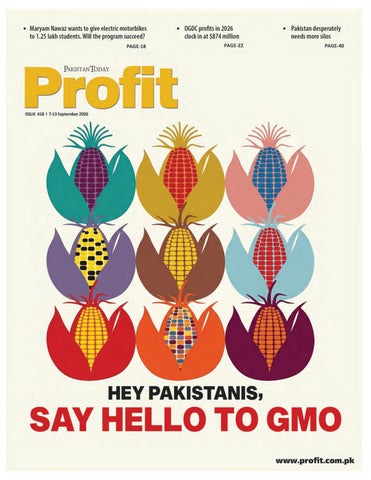
12 Hey Pakistanis, Say Hello to GMO 18 Maryam Nawaz wants to give electric motorbikes to 1.25 lakh students. Will the program succeed?
20
20 Pakistan Must Stop Growing Crops It Cannot Afford to Water Mohsin Leghari 22 OGDC profits in 2026 clock in at $874 million 27 The leadership question Muhammad Azfar Ahsan
18
30
35
30 COCKROACHES: The Invisible Majority Muhammad Azfar Ahsan 35 Here’s how we turn Pakistani sport into a lean, mean, medal winning machine. 40 Pakistan desperately needs more silos
Profit Publishing Editor: Babar Nizami - Senior Editor: Abdullah Niazi Business Reporters: Taimoor Hassan | Usama Liaqat | Zain Naeem | Shahnawaz Ali | Ghulam Abbass Ahmad Ahmadani | Aziz Buneri - Sub-Editors: Saddam Hussain | Abdul Hameed - Video Producer: Adnan Maqsood Director Marketing: Muddasir Alam - Regional Heads of Marketing: Agha Anwer (Khi) Kamal Rizvi (Lhe) | Malik Israr (Isb) GM Special Projects Zulfiqar Butt - Manager Subscriptions: Irfan Farooq Pakistan’s #1 business magazine - your go-to source for business, economic and financial news. Contact us: profit@pakistantoday.com.pk
Hey Pakistanis,
Say Hello to GMO The federal government has, in principle, agreed to the cultivation of genetically modified corn in Pakistan. It is an approval that foreign seed companies have been lobbying to get for decades. But will Pakistan’s agriculture supply chain and society accept these seeds of doubt?
12
By Abdullah Niazi
F
or at least two decades, a loose association of multinational seed companies has been lobbying the federal government to allow the cultivation of Genetically Modified (GM) corn in Pakistan. Last week, they achieved their clearest victory yet. A cabinet committee decided “in-principle” to adopt the cultivation of GM Corn in Pakistan. The committee was chaired by the Finance Minister with the CEO of the SIFC’s Green Pakistan Initiative by his side. In the past, the issue of GM food crops has been contentious in Pakistan. This seemingly routine committee meeting is the most direct acceptance of GM food by the Pakistani state. The decision marks a major shift in policy for a country that has largely remained wary of GM food. Companies like Monsanto, Bayer, Cargill, Syngenta, Corteva and others have been operating in Pakistan since the early 1980s. In this time they have become a vital part of Pakistan’s seed industry. While a 2022 special report by the State Bank of Pakistan (SBP) described the MNC presence in Pakistan’s seed industry as “thin” these companies have punched above their weight in terms of impact. Public sector institutions have failed miserably at producing new seeds that are resistant to climate change, disease, and pest attacks. The local industry has focused more on selling older seeds in bulk with lower margins. As the SBP report points out, the MNCs have filled this gap by becoming the main providers of innovation through hybrid seeds. But their ambitions have always been to introduce GM seeds in Pakistan. While they finally seem to have gotten the nod from the state (and the state’s nod means begrudging acceptance from local players) it will not be as easy to sell the idea to the public. Genetically modified food crops have been received with suspicion all over the world since the science was first introduced in the 1970s. Entire governments have flinched at the thought of introducing GM food into their countries. The European Union has some of the strict bans and regulations regarding GM crops in the world. At least 40 countries around the globe seriously restrict GM foods entering their supply chain. Pakistan is no different. The GM issue elicits visceral reactions and government suspicion because it goes to the heart of our most fundamental fears as a society. The fear that there are certain foods that will affect the health and productivity of a nation. The fear of sickness and the unknown. At the core of a very basic evolutionary fear — that of poison.
How to find a seed in Pakistan
P
akistan’s seed market has developed like most things in this country. Farmers need seeds and the government thought there was no better answer than pawning off the responsibility to the brilliant minds that had managed to crack the CSS. Public institutions initially led research, variety development and distribution, while the Seed Act of 1976 provided the regulatory foundation. The scientists were competent enough at their jobs but funding, staffing and management problems weakened the public sector, allowing private companies to become the principal suppliers of certified seed. Even so, certified seed met only about 40 per cent of estimated national requirements in FY2019-20. Farmers therefore continued to rely heavily on saved seed, informal exchanges and often-unverified “brown-bag” supplies. A lot of the seed market became informal, depending on smuggled seeds from India in particular. As things stand today, Pakistan is far from a modern seed market. Local private companies supply much of the certified wheat, cotton and rice seed, but their business strategy has more to do with surviving today than planning for tomorrow. Registration procedures are long, enforcement against unverified seeds is weak, and institutional uncertainty has caused serious delays in investment and development since agriculture became a provincial subject following the 18th Amendment. The one consistency during these times has been the steady background presence of the MNCs. Monsanto became the first to enter Pakistan in 1984, followed by Pioneer (now Corteva) in 1989, Syngenta in 1991, ICI in 1996 and Bayer (which has now acquired
Monsanto) in 1999. Globally, multinational seed companies operate through a tightly controlled commercial model. They invest heavily in breeding and biotechnology. They then protect their seeds through patents and plant-breeders’ rights. These companies can raise yields and introduce useful technology. In a market like Pakistan where the private industry lacked vision and the public sector was plagued by corruption and inefficiency, these MNCs played a pivotal role in introducing hybrid maize, sorghum and canola, and initially invested in breeding higher-yielding wheat, cotton and rice varieties. But concerns over intellectual-property protection, germplasm security and unauthorised copying led several to scale back local breeding. Consequently, MNCs have operated mainly as suppliers and testers of imported technology—especially hybrid maize seed—rather than as deeply embedded domestic R&D players. In fact, one of the 2022 SBP report’s broader conclusion is that Pakistan needs stronger regulation and intellectual-property enforcement. But despite the hiccups, the MNCs have long seen potential in Pakistan as a large GM market.
The seeds of hope
C
orn has always been the North Star for the seed MNCs operating in Pakistan. As a crop, it is incredibly versatile and relatively easy to grow. Most of the corn crop isn’t actually consumed in food. Products like sweet corn or corn oil are caloric inputs for Pakistan and the rest of the world, but the real scalable potential of corn is industrial. Corn is far more than something eaten off the cob. A large share of the crop is processed into starch, glucose, dextrose, edible oil and animal feed. Corn starch is widely used by textile mills to strengthen yarn during weaving and by paper manufacturers
COVER STORY
to improve surface quality. Pharmaceutical companies use it as a binder, filler and disintegrant in tablets, while food producers rely on it to thicken sauces and make sweeteners. Corn derivatives also appear in cosmetics, adhesives, paints and biodegradable packaging. Through fermentation, corn can be converted into ethanol for fuel and industrial solvents. Its by-products are valuable too: gluten meal becomes poultry feed, while the fibre and germ are used in food and industrial products. This broad demand makes corn an important link between farms and manufacturing. That means there are essentially two layers to this. Corn is grown by farmers as any other cash crop but they have large industrial buyers that pick up bulk orders from them. In that way, maize farming is actually similar to dairy farming in Pakistan. Yes, there are subsistence level farmers around but if you can manage to grow it on enough of an area a corporate buyer will get it from you. In the milk industry, these big buyers are Nestle and Oplers. Brands like Anhaar and Prema have their own herds but Nestle and Opler’s rely on a vast network of buffalo and cow herds to get their milk. In Pakistan’s corn industry, the Big Kahuna is Rafhan Maize. Rafhan is what you would categorise as a corn processing company. They do not grow their own corn but use it as their raw input. Since plenty of corn varieties are grown in Pakistan, they have cheap local inputs. Pakistan currently dedicates around 1.6 million acres to corn farming, and produces close to 10 million tonnes of corn a year. Rafhan began operations in Faisalabad in 1953 as Pakistan’s pioneer corn-refining company. From a modest processor, it developed into a
major producer of starches, glucose, dextrose and other ingredients used across the food, textile, pharmaceutical and paper industries. The company later came under the control of US-based Corn Products International, which was renamed Ingredion in 2012. Ingredion remained its majority shareholder for decades. That changed very recently when a Nishat Group-led consortium completed the acquisition of a 73.9% controlling stake in June 2026. Ingredion received about $165 million for its shares but retained an approximately 20% minority interest in the business. Since they first came to Pakistan, the MNCs have understood that corn is where Pakistan’s GMO experiment needs to begin. It has been highly successful in the United States, where GM corn and soybean are the backbone of their agriculture. On the surface
GM seeds are a no-brainer. It offers higher yields and lower wastage. GM maize has been grown on a trial basis in Pakistan before. National Uniformity Yield Trials conducted across multiple locations showed that GM maize hybrids delivered yield advantages over conventional hybrids, with reported gains ranging from 10 percent to 46 percent. Based on the GM Maize NUYT data, economic analysis for farmer value projected at an illustrative scale, GM maize can add about Re 56,320 per acre through reduced insect-protection costs and additional revenue from higher yield. Assuming the GM maize adoption up to 8 lakh acres, this represents around Rs 45.1 billion in total farmer economic value, including approximately Rs 7.04 billion in pesticide cost savings and Rs 38.0 billion in added revenue from a 22 percent yield advantage. These, of course, are the industry’s own estimates and are likely to be a tad bit optimistic. But for the MNCs trying to sell this product, they do not just have to sell it on the basis that it provides higher profits. They have to sell it on the basis that it will not be harmful — both to the health of the population, and to the country’s existing industry.
The seeds of doubt
T Rafhan Maize is the Big Kahuna of Pakistan’s corn processing industry. In recent years, it has diversified its products and increased its focus on exports. In June this year, the Nishat Group acquired a majority stake in the country.
14
here is a lot behind the maxim of “you are what you eat.” Food is the most basic fuel necessary for human survival. And more even than the air that we breathe, food has a direct relationship with culture, religion, and identity. What we consume, what we put in our bodies, has a singular, laser-focused relation to who we are as people and how we define ourselves. In its rawest form, food serves as the border between nature and culture, between human and non-human. This very human anxiety has resulted in
Genetically Modified (GM) crops being seen with suspicion. It was not so long ago that former Minister for National Food Security Tariq Bashir Cheema claimed chicken was “toxic” because it was being fed with GMO grown soybeans from the United States. The apprehension towards GM is not unique to Pakistan. People, and subsequently governments, are uncomfortable with the possibility that these GM foods could be harmful. This correspondent has a very clear opinion on the issue. Most of the health and safety concerns are hogwash. And it is worth it to understand exactly what GMOs are. The reality is that farmers and agricultural scientists have been involved in genetically modifying the food we eat for a very long time. “For many decades, in addition to traditional crossbreeding, agricultural scientists have used radiation and chemicals to induce gene mutations in edible crops in attempts to achieve desired characteristics,” reads an article by Jane Brody published in The New York Times back in 2018. This is where there is a parting of ways, and one that is very important to understand. Everyone’s agreed that genetic modification has been in place for centuries now. Farmers have used cross-breeding or both livestock and crops to achieve better yields and resistance to weather. What is new, however, is that there are now possibilities of extracting genes from other organisms and including them in different organisms. For example, to make a certain maize crop more resistant to cold, scientists might extract a gene from a fish that swims in icy waters and inject it in the maize. It really is a scientific marvel, and at the same time it makes sense that eyebrows would be raised over this level of interference in nature. But by and large, the scientific community has upheld that GMOs are safe. “Although about 90% of scientists
believe G.M.O.s are safe — a view endorsed by the American Medical Association, the National Academy of Sciences, the American Association for the Advancement of Science and the World Health Organization — only slightly more than a third of consumers share this belief.” And that is the crux of the problem. Even though the scientific evidence is overwhelmingly in the favour of GMOs, the public perception of GMOs is unfavourable. This is mostly coming from the same brand of pseudo-science that promotes homoeopathic remedies over actual, tested, medicine that works and peddles crystal therapy and all manners of snake-oil. Robert Goldberg, a plant molecular biologist at the University of California, Los Angeles, says that such fears have not yet been quelled despite “hundreds of millions of genetic experiments involving every type of organism on earth and people eating billions of meals without a problem.” The main problem is that science rarely uses definitive language when a sample size is small or relatively new. In the case of GMOs, for example, scientists maintain a regular level of human error and make statements like “foods have not shown any harmful effect,” rather than saying categorically that a certain food does not have harmful effects. “You never know for sure, because you can’t prove a negative. After more than a quarter century of growing GMO crops in North America, no detrimental impacts have been detected in North America compared to Europe, where people have been exposed very little to GMOs,” says Goldberg. Meanwhile, the benefits from GMOs have been authoritative. “By engineering resistance to insect damage, farmers have been able to use fewer pesticides while increasing yields, which enhances safety for farmers and the environment while lowering the cost of food
and increasing its availability. Yields of corn, cotton and soybeans are said to have risen by 20 percent to 30 percent through the use of genetic engineering,” writes Brody. “Can you, in fact, feed the 9 billion people we’ll have by 2050 … and how do you do that with minimal ecological impact? “I think the way to do that is through food science,” says Dr Goldberg. “I see no difference between manipulating a gene the classical way, through breeding, or by adding a gene.” Of course, none of this evidence matters for a simple reason: people still don’t trust GM foods. That lack of trust means GM seeds can wreak havoc on a country’s export potential. Think of it this way. Countries that ban GM products ban them on a molecular level. That means even traces of GM corn in a shipment being sent to a non-GM country could jeopardize entire shipments worth hundreds of millions of dollars. GM pollen can cross-pollinate nearby conventional crops, while grain can mix during harvesting, transport and storage. Unless absolute and complete segregation can be ensured between crops, there can be serious consequences. One striking example is from back in 2018, when Syngenta launched its genetically modified Viptera maize in the US before China had approved it for import. Once traces entered the bulk grain supply, China rejected more than one million tonnes of US maize. Farmers who had never planted Viptera were also hit as exports were disrupted and domestic prices fell. Syngenta argued that the seed had US approval and that other factors affected prices. However, it eventually agreed to a $1.51 billion settlement with US farmers and others in the supply chain, without admitting liability. The episode shows how one company’s decision to commercialise a proprietary seed could transfer enormous risks to farmers, traders and exporters while the company captured the initial sales. And there can be other concerns as well. Just look at what happened with Pakistan’s other major GM experiment: Bt cotton. The technology entered informally before receiving official approval and spread through poorly regulated local varieties. Quality checks were weak. Farmers received little guidance, while newer generations of Bt seed never arrived at scale. Pests eventually developed resistance and pesticide use rose again. India had far greater initial success because it approved the technology earlier, involved established technology providers and invested more heavily in research, seed distribution and intellectual-property protection. The lesson for GM maize is straightforward. Approval alone is not enough. Pakistan also needs farmer training and strict regulatory oversight.
COVER STORY
Jack and the seed stalk?
G
MO food seeds are sort of like Jack’s magic beans. They promise an irresistible shortcut upwards. Plant them and the crop loses less to insects. Farmers spray less, harvest more and earn better returns. But there may also be trouble at the top of the stalk. Once GM maize enters open fields, its pollen can travel into neighbouring maize. Grain can also become mixed during harvesting, transport or storage. The technology is precise and, despite all the WhatsApp forwards your Khalu sends you about GMO = Poison, it is safe. The problem is that Pakistan’s agricultural supply chain is anything but equipped to handle the sort of segregation needed. Pakistan has climbed part of this stalk before. Multinational seed companies began pushing their GM maize varieties through the regulatory system more than a decade ago. They have pushed with all their might, hiring the best talent in Pakistan and even exerting pressure through the embassies of their home countries. In 2016 Corteva, then operating as Pioneer, received licences for confined field trials. Bayer followed in 2017. These were biosafety permissions for testing specific GM events, not blank cheques to begin selling seed across the country. The expectation was that successful trials would be followed by registration and eventual commercialisation. Instead, the process became entangled in politics. Rafhan Maize entered the debate and wrote to the prime minister warning that GM cultivation could jeopardise exports of non-GM maize products. As Pakistan’s largest maize processor and a major buyer from farmers, Rafhan was difficult to ignore. The argument was not necessarily that approved GM maize was poisonous. It was that some of Rafhan’s foreign customers wanted certified non-GM ingredients and paid for that assurance. Then came the usual alphabet soup of associations. Seed bodies, farmer collectives, processors and advocacy groups appeared with letters, statements and competing claims about health, yields, corporate control and seed sovereignty. Some represented genuine commercial or farmer interests. Others were harder to place. By 2019, consultations had produced broad opposition from Rafhan, local seed companies and farmer representatives. The government suspended the licences that May. This time feels different. The National Agricultural Biotechnology Policy 2025 has given GM crops an explicit place in the government’s agricultural plans. A committee led by the finance minister has now agreed in principle that GM, conventional and organic
16
“Bt”, the genetically modified cotton seed surreptitiously introduced in Pakistan in 2005, allegedly ended up introducing new pests to what was once Pakistan’s proudest crops. It has done much better in India where it was introduced with proper checks and balances. maize should be allowed to coexist. Rafhan remains concerned, but it is now discussing transition periods and safeguards rather than demanding that the door remain permanently shut. Profit reached out to Hasan Mansha for comment but did not receive a response. However, a senior executive at one of these MNCs mentioned that Rafhan naturally has its reservations. And they have good reason to remain cautious. Rafhan’s 2025 annual report records Rs73.4 billion in net revenue and Rs6.5 billion in profit after tax. Export sales stood at Rs10.1 billion and reached customers across Asia, Africa and Europe. Those sales will depend on Rafhan proving that maize bought for sensitive markets has remained separate from GM grain. The recent decision is also not final commercial approval. The old biosafety licences have expired and must be renewed. Individual seed varieties will still need to complete the remaining trials and registration requirements. The government must also write the coexistence framework that everyone is currently celebrating. MNC professionals involved in the process believe a commercial launch could come around 2029. That leaves time to build the rules. It also leaves plenty of room for the politics to return. What really matters is the balance of Pakistan’s government needs to strike. Words are wind, and just saying “coexistence” will not make it happen. Pakistan needs published local trial results and independent openfield testing. It needs enforceable distances between GM and non-GM farms. Harvesting machinery, trucks, warehouses and process-
ing lines may have to remain separate. Seed bags must be traceable and products properly labelled. Farmers will need training. There must also be a clear answer to a difficult question: who pays when contamination occurs? Otherwise we will inevitably be stuck in the position of having a major consignment turned back and all of its stakeholders embroiled ina messy flight. Against these risks sit some tempting numbers. MNC professionals say National Uniformity Yield Trials showed gains ranging from 10% to 46% over conventional hybrids. Their economic model uses a 22% yield advantage and projects additional farmer value of Rs56,320 per acre. At 800,000 acres, they estimate gains of Rs45.1 billion. This includes around Rs7 billion in lower pesticide costs and Rs38 billion from additional production. These projections come from the companies hoping to sell the technology. They should be tested independently. Yet they should not be dismissed simply because profit is involved. Pakistan cannot afford to reject useful science. Nor can it afford to let corporate enthusiasm substitute for public regulation. GM technology is one of the great inventions of the modern age. It can protect crops, reduce waste and give farmers more control over an increasingly hostile climate. But no seed can repair broken regulation, careless handling or weak markets. Pakistan should climb this seedstalk. It should simply build the guardrails first. If the country gets those right, the prize at the top could belong not only to the companies selling the beans, but also to the farmers planting them. n
COVER TEXTILES STORY
Maryam Nawaz wants to give electric motorbikes to 1.25 lakh students.
Will the program succeed?
The need for such programs cannot be denied, but if this program is to be conceived as part of a broader push towards electrification, it must be supplemented with infrastructural reforms to make Pakistan ready for a real shift towards electric mobility.
T
he Punjab government is looking to accelerate the adoption of electric motorcycles in Pakistan by targeting students. It is no secret that the vehicle category that dominates Pakistani roads is the motorbike. By some estimates, there might be up to 30 million or 3 crore motorbikes in Pakistan. Any meaningful shift towards electric mobility, therefore, cannot do
18
without including the 2-wheeler segment. There have been various schemes to promote shifting towards electric options by the government. These include the Pakistan Accelerated Vehicle Electrification (PAVE) Scheme spearheaded by the federal government. It was essentially a subsidy – up to 80,000 rupees per electric bike and 4 lakh rupees per electric rickshaw. The first phase of that scheme, however, barely got off the ground. The target
was to distribute 41,000 vehicles. Only 5,409 were actually distributed. The second phase of PAVE aiming to streamline the process was approved earlier this year. The Punjab government has also been interested in pushing electrification, especially in the two-wheeler segment. The first phase of the Chief Minister Punjab E-Bike Scheme distributed 20,000 bikes (including both electric and petrol options) across five cities: Lahore,
Faisalabad, Multan, Bahawalpur, and Rawalpindi. Now, however, the second phase is about to be launched, whereby the government has set the target of distributing more than 1.25 lakh electric bikes. The other major aspect of this program is that it is geared towards students within Punjab - for now, at least. Other categories might come in later. In fact, in her post on X, the CM Punjab identified the vision behind the scheme as follows: “We want Punjab’s students to be independent, empowered, and dependent on no one for their mobility.” So, this is another objective of the government. The scheme is undoubtedly important in that it would likely accelerate the electrification of the two-wheeler segment in Pakistan by removing the high cost of capital and financing. But the broader problems with the infrastructure surrounding electric two-wheelers would still remain. More would need to be done in order for both aims - incentivising students, and electrification of the two wheeler - to be achieved in tandem. Solutions exist, but will the optics and short-term benefit be the only consideration, or will we see a broader and sustainable commitment to achieving these goals, that remains to be seen.
What is included in Phase 2?
T
he first thing to understand is the nature of the benefit this scheme intends to provide. Unlike the PAVE scheme which was a direct financial subsidy, the CM Punjab E-bike scheme is more of a financing facilitator. A subsidy does come in, but somewhat obliquely. You (the student, that is, for now) apply for the scheme through a randomized and computerised balloting process. If your name is one of those selected, you can get your bike financed through a bank. The previous phase was conducted through the Bank of Punjab, which seems the likely financing instrument for this second phase. The price of the bike remains the same as it was in the market. Through this scheme, however, you wouldn’t be required to put in a down payment. Moreover, you would also not be required to pay any interest on this loan. Rather, the government will take care of that. That is the major part of the government’s financial subsidy in this scheme. The other oblique, financial incentive of the scheme is that the insurance for the bike will also be paid by the government. You would still be required to pay the full price of the bike in your usage, but now you would not have to bear high upfront costs. Monthly instalments would be the only thing you pay. In fact, the government appears to have approved “in principle” that these install-
ments would amount to around 3,000 rupees - an affordable enough amount. After you have run through your payment schedule, the bike would be transferred to your name. As far as the bike itself is concerned, the scheme would target exclusively the models with lithium iron phosphate batteries. While more expensive than the ‘graphene’ batteries, these batteries last longer. The scheme also somewhat unnecessarily yet comically, covers the colours of the bikes provided through the program; for male students it’s black bikes, and for female students it’s pink. The other salient features of the program include the inclusion of a 2-day training for first-time users, as well as the provision of free helmets and safety rods. It is also envisioned that the scheme would eventually be expanded to include government officials, general public and delivery riders.
Can the scheme succeed?
F
irst, let’s talk about the importance of such schemes geared towards the students. Whatever the political posturing behind such initiatives, making things better and easier for the students is almost always a good thing. One example would be the Punjab government’s laptop scheme under the Shehbaz Sharif government. Though criticised, sometimes unfairly, the scheme went a long way in making the youth of the land digitally-literate, and increased access to expensive hardware beyond the reach of the many. Bikes, though not as easily transferable into skills as laptops, would still allow students, especially from struggling backgrounds, a degree of freedom that should theoretically allow them to better focus on their education. Bear in mind also, that this scheme removes the high cost-of-capital barrier to buying a decent electric motorcycle, so it would likely make achieving this freedom easier. This is an important point. In fact, an electric bike that can give a range enough to go about one’s day with a reasonable degree of freedom costs much more than a comparable ICE-powered bike. The alternative is to buy graphene battery electric bikes, which run out their lives in months. The solution to this problem is financing, but if you finance through the market, you would likely be required to pay high rates on your borrowed amount. This scheme does away with that requirement too. Given the status of our education system, the need for the removal of such auxiliary yet imposing hurdles for our students surely is an attractive proposition. But will good intentions on their own be enough? Will electric motorcycles be the best option for students living in remote areas
with intermittent availability of electricity? How well would it serve those who need to cover longer distances even within the city? Is there charging infrastructure to support these electric bikes to enable students to unlock the freedom that they actually require? There are solutions to this problem. Zvolta, for instance, is a startup based in Karachi, which has been championing destination charging as a solution to the range problem with electric vehicles. The solution is simple: you put communal chargers at places where the ‘dwell time’ is high. These would include shopping malls, office buildings, and, most relevantly, universities. The idea is that while you have parked your bike and are going about your day, you can top off your electric bike and recover your lost range for the journey back home (or to another destination). Solutions such as these might need to be supplemented to realise more fully the potential of such a scheme. Range is, of course, one problem. The other is the after-sales network. What happens when your bike breaks down while you are on your way, or its motor gives up, or its electrical system haywires? Unlike a petrol-powered motorcycle, mechanics and spare parts for which can be found peppered in every other street, electric bikes are a comparatively new contraption. The after-sales network is not nearly as strong. Electric scooties, which is what the scheme appears to be targeting, often have specific spare-parts, which are often to be found only at their official stores. The tyre size is different, the brakes are different, and so on. These bikes aren’t built for emergencies. The point might be raised that these bikes are meant for students and their usage is more predictable: going from home to the university, and then back. And that if they stick to that, there might not be a problem. But isn’t that against the spirit of independence that is supposedly behind this push to empower them with their own vehicles in the first place? We should consider that for many who are opting into this scheme this might be their first vehicle. For some, it might even be the first vehicle in the family. It does not seem far-fetched that they would use this vehicle for more than their studies. And it would be unfair to place this restriction on them. The argument then shifts to whether we are ready enough to make the push towards electrification. While commendable, providing electric bikes in large numbers would be only a step - necessary, yes - towards the goal. Broader readiness for electric mobility needs to supplement these programs. Otherwise, a few years down the road, we might look back at these schemes which appeared great, but did not do much to actually set things on the right path. n
AUTOMOBILE
OPINION
Mohsin Leghari
Pakistan Must Stop Growing Crops It Cannot Afford to Water
F
or decades, Pakistan has asked the wrong questions about its agriculture. How much wheat did we grow? How many bales of cotton? How many tonnes of sugar or rice? How much did we export? These are no longer the right first questions. For a water-stressed country, the first question must be: What did that production cost Pakistan’s water balance? Pakistan’s binding constraint is no longer land, labour, or agricultural potential. It is water. Every serious agricultural policy must therefore begin with a water ledger. Until Pakistan asks how much surface water is reliably available, which crops consume the most scarce blue water, and which exports are effectively disguised water exports, it will continue to confuse production with progress.
The Real Crisis is Water Accounting
A
griculture accounts for roughly 90 percent of Pakistan’s freshwater withdrawals, making it the central battlefield of the water crisis. Yet, our agricultural economy still behaves as if water is free. Flat canal water charges, politically protected crops, and unregulated groundwater extraction have created a dangerous incentive: use as much water as you can capture. Punjab has more than 1.4 million agricultural tubewells, with groundwater withdrawals estimated at over 50 Million Acre Feet (MAF) annually. This groundwater is not a bonus account; it is the
The author is former Minister of Irrigation Punjab, a former Senator and Member of the National Assembly. He is currently affiliated with UNDP as Senior Water Sector Expert and has worked with the EU/ GIZ on parliamentary capacity building. He writes in his personal capacity and does not represent any past or current affiliated organisation.
20
buffer that has allowed Pakistan to compensate for unreliable surface supplies. But in many areas, this buffer is being mined faster than it is recharged. In Rahim Yar Khan, longterm groundwater decline illustrates the immense pressure placed on irrigated agriculture, while in Sindh, the crisis takes the form of drainage failure, salinity, and waterlogging. This is not sustainable agriculture. It is the liquidation of natural capital. Pakistan is running its farm economy like a business that records sales but ignores the depreciation of its main asset: the aquifer.
Solar Pumps Are Not the Enemy
T
he rapid spread of solar tubewells—now estimated at over 650,000 and rapidly increasing has made this problem more urgent. But farmers did not adopt solar pumps to destroy aquifers. They did it because grid electricity was expensive and unreliable, and diesel was costly. Solar power gave them control over irrigation timing and reduced cash costs. Solarisation does not make groundwater free, but it removes the recurring energy cost of pumping. In a system with no defined groundwater rights and weak monitoring, the institutional equation is simple: cheap energy plus unrestricted groundwater equals accelerated extraction. The answer is not to ban solar pumps; it is to govern the water they pump.
An Upside-Down Crop Economy
P
akistan’s current crop mix makes little sense from a water perspective. We grow water-intensive crops in water-stressed zones and export commodities without accounting for the blue water embedded in their production. Sugarcane is the clearest example. While highly profitable under the right conditions, it is a long-duration, water-thirsty crop. When surplus sugar is exported, Pakistan is not just exporting sugar; it is exporting the water, land, and energy embedded in it. In a water-scarce country, surplus sugar from a stressed basin is not a triumph; it is a hydrological warning sign. However, we cannot ignore the elephant in the room: the political economy. Sugarcane is heavily protected because the owners of sugar mills are deeply embedded in the national and provincial assemblies. Any shift away from water-intensive crops will face fierce resistance from this powerful lobby. Breaking this grip on water policy is the true test of Pakistan’s agricultural reform.
The Rice Boom and the Hydrological Hangover
R
ice provides an even sharper warning, as Pakistan has just lived through the full cycle of boom and correction. In FY2023-24, rice exports reached roughly $3.9 billion, aided by India’s export restrictions. Farmers responded rationally, expanding production using tubewells to secure irrigation. From the perspective of an individual farmer, the decision made perfect economic sense. From the perspective of an aquifer, it was disastrous. This is hydrological arbitrage—exploiting a short-term economic opportunity by drawing down a long-term natural asset. By the close of the full FY2025-26, as global markets normalized and Indian restrictions eased, the windfall collapsed. Full-year export earnings plummeted. The export opportunity had changed, but the groundwater pumped to support the expansion had not returned. The state failed to incorporate the long-term hydrological cost into the incentives driving the boom. Using a total water footprint estimate of roughly 2,500 cubic metres per tonne, Pakistan’s recent rice exports implied a massive embedded water footprint. The policy question that matters most is how much scarce blue water—particularly groundwater from stressed aquifers—is being consumed to produce the rice we export. We must measure blue water per dollar earned, not merely tonnes or dollars.
The Efficiency Illusion
P
akistan has invested heavily in irrigation efficiency through laser levelling and drip irrigation. But we must stop assuming that water saved at the farm automatically becomes water saved by the basin. If a farmer uses less water per acre and then uses the saving to expand the cultivated area, basin-level consumption may not fall at all. An efficiency improvement can actually increase the profitability of a thirsty crop, encouraging more production. Pakistan needs to move from field-level efficiency accounting to basin-level water accounting.
The Solution: Hydrological Zoning
T
he answer is not to declare cotton good and rice bad. The answer is to grow the right crop in the right place. This requires national hydrological zoning. Every agricultural district should be classified by water availability, aquifer recharge, and crop water requirements. Crops should then fall into four categories: encouraged, tolerated, restricted, and phased out. • Southern Punjab: Develop as a strategic cotton, oilseed, and pulse zone where soils and water support them. • Central Punjab: Restrict further paddy expansion in areas where groundwater depletion is severe. • Upper Sindh: Focus on drainage rehabilitation, salinity management, and shifting away from water-intensive crops where hydrology cannot sustain them. • Drylands (Thal, Potohar): Emphasize pulses, gram, oilseeds, and millets suited to variable
water availability. • Lower Sindh & Indus Delta: Protect environmental flows to limit saltwater intrusion and sustain ecosystems. Downstream ecological requirements are not leftover water; they are part of the water budget.
Governance, Pricing, and the New Metric
N
o crop strategy will work if groundwater remains an open-access resource. Pakistan needs a national water accounting system built around remote sensing and tubewell registration. In critically stressed aquifers, extraction must be linked to enforceable limits. Crop-differentiated abiana (water charges) must restore a price signal to water use, and agricultural support should follow hydrological zoning. Pricing alone is not enough. A farmer cannot change crops if the alternative has no buyer or price support. The state must change the reward structure. Pakistan’s agricultural success should no longer be measured by tonnes alone. It must be measured by national value per unit of consumptive blue water. A crop that produces more tonnage but destroys the aquifer is a net national loss. Pakistan does not need to grow less agriculture; it needs to grow better agriculture. It must move from crop maximization to water productivity, and from celebrating export volumes to measuring the value created per unit of scarce blue water. The question is no longer simply how much Pakistan can grow. It is: How much can Pakistan grow without spending tomorrow’s water to pay for today’s crop? n
OPINION
OGDC profits in 2026 clock in at $874 million The state-owned oil company is Pakistan’s most profitable company and is closing in on a return to the $1 billion mark in net income for the first time since 2014
T
here is a temptation, when looking at Oil and Gas Development Company’s latest financial results, to treat the $1 billion mark as some distant milestone that Pakistan’s largest company has yet to conquer. It is not. OGDC has been there before. In the financial year ending June 30, 2014, the state-owned exploration and production company earned Rs123.9 billion in net income. At the exchange rates prevailing at the time, that translated into roughly $1.2 billion. It was a record year for the company: revenue had risen to Rs257 billion, profit after tax had increased
22
by nearly 36%, and OGDC was producing an average of 41,330 barrels of oil and 1.17 billion cubic feet of gas every day. Twelve years later, OGDC has come close to that dollar-denominated profit record again. For the financial year ending June 30, 2026, the company reported net income of Rs242.4 billion, approximately $874 million at current exchange rates. Profit rose nearly 43% from Rs169.9 billion the previous year, while earnings per share increased from Rs39.50 to Rs56.35. Revenue rose by almost 12% to Rs449.2 billion. The board also announced a final dividend of Rs6 per share, taking the total payout for the year to Rs17 per share, which
OGDC says is the highest annual dividend in its history. The comparison with 2014 is instructive. In nominal rupee terms, OGDC now makes almost twice as much money as it did then. But the Pakistani rupee has lost so much value against the dollar over the intervening twelve years that Rs242 billion today translates into considerably fewer dollars than Rs124 billion did in 2014. There is another, perhaps more important, distinction. OGDC in 2014 was producing considerably more hydrocarbons than it is today. Its oil production then averaged more than 41,000 barrels per day and gas production
approximately 1.17 billion cubic feet per day. In financial year 2026, average net saleable production stood at 32,861 barrels of oil per day and 667 million cubic feet of gas per day. OGDC has therefore managed to get surprisingly close to its old dollar profit peak despite producing less oil and substantially less gas. And that is what makes the financial year 2026 result interesting. Because underneath an unusually favourable tax adjustment, the company appears finally to be rebuilding production. OGDC drilled more wells than it has in five years, made nine discoveries, is bringing new projects into production and is guiding towards another 6-8% increase in both oil and gas output in financial year 2027. Meanwhile, regulated wellhead gas prices are moving upwards. The billion-dollar question, then, is no longer whether OGDC can ever make $1 billion in a year. It already has. The question is whether it can get back there — and whether this time it can do so through sustained production growth rather than merely favourable accounting and commodity-price conditions.
The headline profit is real, but there is a large tax asterisk
S
tart with the income statement. OGDC’s revenue rose from Rs401.2 billion in financial year 2025 to Rs449.2 billion in financial year 2026, an increase of approximately 12%. Gross profit increased from Rs231.6 billion to Rs246.8 billion, a more modest increase of around 7%. That disparity is important because costs rose considerably faster than sales. Royalty expense increased from Rs47.1 billion to Rs52.6 billion. Operating expenses jumped from Rs120.2 billion to Rs147.7 billion, an increase of nearly 23%. Exploration and
prospecting expenditure rose particularly sharply, from Rs18.8 billion to Rs28.8 billion, while general and administrative expenses increased from Rs7.5 billion to Rs11.1 billion. The resulting gross margin fell from roughly 57.7% to 54.9%. Some of those rising costs should not necessarily be viewed negatively. An exploration company that is spending more aggressively on finding and developing hydrocarbons will naturally incur higher exploration costs, and OGDC’s drilling activity suggests that at least part of this expense reflects an acceleration of investment rather than simple cost inflation. Management also told analysts that fourth-quarter operating expenses contained one-off pension and gratuity charges that should normalise going forward. But there was another drag on earnings. Finance and other income fell by about one-third, from Rs81.8 billion in financial year 2025 to Rs54.4 billion in financial year 2026. Management attributed the decline partly to the absence of delayed-payment surcharge income received in the previous year, along with lower interest income as domestic interest rates fell and some unwinding and exchange-related losses. Consequently, profit before income tax actually declined. OGDC earned Rs259.1 billion before income tax in financial year 2026, compared with Rs279.3 billion the previous year — a decline of around 7%. And then came the tax line. OGDC recorded income tax expense of just Rs16.8 billion in financial year 2026, compared with Rs109.4 billion in financial year 2025. The company’s effective tax rate consequently collapsed from approximately 39% to barely 6.5%. That single line turned falling pretax earnings into a 43% increase in net income. Management told analysts that approximately Rs50 billion of the reversal reflected
provisions relating to the super tax. It also indicated that another Rs36.7 billion — equivalent to approximately Rs8.53 per share — remains on the balance sheet while discussions with the Commissioner of Income Tax continue. Whether that amount can ultimately be reversed remains unresolved. So, no, investors should not look at the increase from Rs170 billion to Rs242 billion and assume OGDC’s underlying earning power suddenly increased by 43%. It did not. But it would be equally misleading to conclude that nothing meaningful improved. The top line grew almost 12%, and the more consequential development may be happening in the physical business rather than in the accounts.
OGDC is finally growing production again
F
or a company whose business consists principally of selling hydrocarbons, the most important numbers are ultimately not profits, margins or even oil prices. They are barrels and cubic feet. During financial year 2026, OGDC produced an average of 32,861 barrels per day of crude oil and 667 million cubic feet per day of natural gas, along with 670 tonnes per day of LPG. According to Topline Securities, those volumes accounted for approximately 51% of Pakistan’s domestic oil production and 28% of its gas production. Oil production increased by about 6% compared with financial year 2025, while gas production rose approximately 2%. Those are hardly spectacular growth rates. But in the context of OGDC’s long-term production trajectory, they matter. The contrast with 2014 demonstrates why. Back then OGDC was producing 41,330 barrels of oil per day and approximately 1.17 billion cubic feet of gas. Twelve years later, its oil output remains around one-fifth below that level
ENERGY
while gas production is more than 40% lower. That decline is partly the unavoidable consequence of depletion at mature fields. Exploration and production companies must continuously find new reserves merely to replace what they extract each year, never mind grow output. But OGDC’s current drilling and development programme suggests the company is trying more aggressively to reverse that decline. During financial year 2026, it spudded 23 wells, the highest number in five years. Those comprised eight exploratory wells, 11 development wells, three tight-gas wells and one geothermal well. The company drilled a record 58,333 metres and reported nine oil and gas discoveries. Those discoveries included oil at Chak80-1, gas and condensate at Birch-7 East-1, hydrocarbons at Baragzai X-1, gas at Sahito-1 and oil at Bobi Deep-1. At the same time, OGDC has been extracting more production from fields it already owns. Production-enhancement initiatives — including new wells, artificial-lift installations, approximately 22 rig workovers and 245 rigless interventions — generated incremental capacity of roughly 5,530 barrels of oil per day, 37 mmcfd of gas and 23 tonnes per day of LPG, according to Arif Habib Limited’s note on the management briefing. Those interventions contributed approximately 921,000 barrels of oil, 12.6 billion cubic feet of gas and 5,870 tonnes of LPG during the year. For an ageing upstream portfolio, that kind of work matters almost as much as headline-grabbing new discoveries.
The next round of projects is larger
M 24
anagement believes financial year 2026 is the beginning rather than the end of the production recovery. OGDC is targeting approx-
imately 6-8% annualised growth in both oil and gas production during financial year 2027, measured against its fourth-quarter financial year 2026 production base. There are obvious risks to that guidance. Production curtailments have repeatedly affected Pakistani gas producers because transmission companies do not always have the capacity — or downstream demand — to accept everything producers can supply. Infrastructure outages are another issue. Topline noted that the Spinwam pipeline had been ruptured several times in recent weeks and that SNGPL was working to restore flows. Security problems can also disrupt operations in some producing areas. Even so, OGDC has a substantial development pipeline. Management expects capital expenditure of roughly $100 million to $120 million in financial year 2027 and plans to spud about 33 wells, compared with 23 in financial year 2026. Two projects — Jhal Magsi and Dakhni — were completed during financial year 2026. KPD-TAY, Uch and Bettani are scheduled for completion during financial year 2027 and financial year 2028 and, according to Topline, could cumulatively add approximately 4,644 barrels per day of oil and 176 mmcfd of gas. Then there is Baragzai. Management has highlighted Baragzai X-1 as a potentially important production catalyst. Initial flows discussed by management were approximately 6,000 barrels per day. Two additional wells are expected to be drilled in financial year 2027, with new production targeted for the first quarter of financial year 2028. Management has previously indicated that production associated with Baragzai could eventually reach approximately 20,000 barrels per day within two years. That number requires some perspective. OGDC’s entire average oil production in financial year 2026 was only 32,861 barrels per day. It would therefore be unwise to simply add 20,000 barrels to existing production and
assume that is where the company will end up. Working interests, natural decline at other fields, development timelines and infrastructure constraints all matter. But even a fraction of that level of incremental production would be financially meaningful. Elsewhere, OGDC is undertaking the Kunnar-Pasakhi water-injection project, which management expects to improve hydrocarbon recovery by around 8-10% and extend field life by seven to eight years. Completion is targeted for March 2027. The company is also attempting to revive the Rajian oil field through two satellite processing units with combined capacity of 10,000 barrels per day. Drilling at Gurgalot is also underway, with production expected during financial year 2027.
The reserves suggest there is plenty left to develop
T
he production ambition is supported by a substantial reserve base. As of June 30, 2026, OGDC estimated recoverable reserves at 728 million barrels of oil equivalent on a proved, or 1P, basis and 1.026 billion barrels of oil equivalent on a 2P basis. Topline estimates that OGDC achieved a reserve replacement ratio of 236% during the year. In other words, it added considerably more reserves than it depleted through production. A reserves evaluation study due in September 2026 could potentially push the replacement ratio to around 405%, according to management guidance cited by Topline. OGDC also retains the largest exploration footprint in Pakistan. The company had approximately 102,000 square kilometres of exploration acreage as of June 2026, equal to around 31% of the country’s total area under exploration. Its portfolio comprises 57 operated exploration licences and interests in another
23 blocks operated by other E&P companies. OGDC has also secured interests in eight offshore blocks from Pakistan’s 2025 offshore bidding round — two as operator and six as a non-operating partner. Offshore exploration is proceeding through a joint venture involving OGDC, Pakistan Petroleum, Mari Energies and Turkish Petroleum, with additional seismic work underway and drilling potentially beginning next year depending on the results. None of that guarantees commercially successful discoveries. Exploration is inherently probabilistic. But it means the company is not running out of places to look.
percentage increases. Not all of OGDC’s gas receives PP2012 pricing, so those increases cannot simply be applied across company-wide gas revenue. But they are directionally positive. Baragzai could be particularly interesting. Management told analysts its pricing is currently linked to the Nashpa block at approximately $2.82 per mmbtu but that OGDC is considering whether the field can be linked to a PP2012 pricing mechanism. If more production comes online at the same time that realised gas prices improve, revenue growth can compound surprisingly quickly.
Gas prices are moving in OGDC’s favour as well
Getting back to $1 billion
P
roduction growth is only one half of the financial year 2027 earnings equation. The other is price. In September, the Oil and Gas Regulatory Authority notified higher wellhead gas prices for the second half of calendar 2026. These are routine semi-annual revisions, but the latest adjustment reflects the sharp increase in the oil-price reference used to calculate regulated gas prices. According to Topline Securities, Arab Light crude averaged $92.2 per barrel during January-June 2026, compared with $68.4 during July-December 2025 — a 35% increase. Because gas prices under Petroleum Policy 2012 incorporate a sliding linkage to international oil prices, Topline estimates that the increase translates into roughly 10-11% higher gas prices for relevant PP2012 fields. The notifications issued so far imply average increases of roughly 8-10%, although individual fields vary significantly. For example, the wellhead price for Fazl X-1 increased from $5.37 to $5.90 per mmbtu, while Dhok Sultan X-1 rose from $5.91 to $6.49. Some Kirthar fields received even larger
T
he historical comparison makes OGDC’s current position both more impressive and more sobering. In 2014, the company earned Rs123.9 billion and that was enough to produce roughly $1.2 billion of net profit. Today, Rs242.4 billion — almost twice as much — translates into only $874 million. That is what twelve years of rupee depreciation does. It also means that simply returning to the billion-dollar level requires substantially more earnings than it once did. At an exchange rate of around Rs277 to the dollar, OGDC would need roughly Rs277 billion in annual net income to generate $1 billion. That is approximately Rs35 billion, or 14%, above financial year 2026 profit. On the face of it, that does not seem especially daunting. But financial year 2026 included approximately Rs50 billion of super-tax reversals. If that benefit does not recur, OGDC needs underlying pretax profitability to improve materially merely to maintain its current after-tax result, let alone push it above Rs277 billion. That is why the production story matters so much. A 6-8% increase in oil and gas volumes, higher regulated gas prices, new
production from development projects and normalisation of some fourth-quarter expenses could begin filling the gap. Baragzai and other projects offer further upside beyond financial year 2027. Another potential reversal of the remaining Rs36.7 billion super-tax provision would accelerate the process, although investors should not treat it as guaranteed. Topline Securities remains bullish. It maintains a BUY recommendation and estimates that OGDC trades at approximately 6.1 times projected financial year 2027 earnings and 5.2 times financial year 2028 earnings. Those low multiples incorporate all the familiar reasons Pakistani investors have learnt to discount exploration and production companies: circular debt, production curtailments, security risks, policy uncertainty and the difficulty of turning discoveries into cash. Yet the comparison with 2014 also offers a useful reminder of what OGDC once looked like at full strength. Twelve years ago, it was producing about 8,500 more barrels of oil and roughly 500 million more cubic feet of gas every day than it does now. That higher production base helped generate $1.2 billion of annual profit despite far lower nominal rupee revenues. OGDC does not need to recreate 2014 exactly. Prices are different, field economics have changed and its portfolio today is more mature. But if the company can begin closing even part of the production gap while benefiting from better wellhead prices, the earnings implications are substantial. The most notable feature of financial year 2026, therefore, may ultimately not be that OGDC earned $874 million. It is that Pakistan’s largest company appears to be moving again towards the level of production growth that could make billion-dollar profits sustainable rather than exceptional. OGDC has crossed that threshold before. After twelve years away, it may finally be on its way back. n
ENERGY
OPINION
Muhammad Azfar Ahsan
The leadership question
Pakistan has never lacked talented individuals. It has produced exceptional public servants, entrepreneurs, professionals, academics, philanthropists, political leaders, and builders of lasting organizations. Individual excellence has never been the country's principal shortage. The deeper deficiency is the absence of a sufficiently strong culture of leadership that consistently thinks beyond the immedihe destiny of nations is not determined merely by what ate crisis, beyond personal tenure, and beyond the lifetime they possess, but by what their leaders are able to build of the individual exercising authority. from what they possess. Resources can remain idle, talToo often, we confuse authority with leadership, acent can remain scattered, and ideas can remain trapped tivity with achievement, and personal success with lasting in speeches, reports, and promises. It is leadership that contribution. Leaders are frequently judged by the offices determines whether these advantages are organized they occupy, the announcements they make, the projects into national strength, translated into progress, and carried forward they inaugurate, or the visibility they command while in beyond the individuals and governments of a particular moment. power. We ask what they achieved during their tenure, Pakistan's tragedy is not that it lacks potential. Its greater failure but far less often ask what remained stronger and more has been the repeated inability to convert extraordinary potential into effective because they were there. sustained national progress. The country has produced exceptional That distinction goes to the heart of Pakistan's individuals, accumulated immense human talent, and possessed every development challenge. An individual can solve a probingredient necessary for advancement. Yet too often, progress has lem, but a well-structured and resilient organization can remained dependent on personalities rather than becoming embedded continue solving it across generations. A capable leader in the national frameworks that can preserve success, multiply it, and can deliver results while occupying a position, but sound carry it across generations. arrangements can continue producing results after that That failure sits beneath many of Pakistan's visible problems. leader has departed. The highest form of leadership, We debate economic instability, weak governance, declining state therefore, is not simply the ability to perform personally. performance, low investment, unemployment, poor public services, It is the ability to develop people, build enduring organipolicy inconsistency, and the country's recurring inability to convert zations, establish effective processes, and create strengths extraordinary potential into sustained progress – each deserves serious that outlast the individual who created them. attention. Yet beneath them lies a more consequential question: what Pakistan has gradually become accustomed to kind of leadership can transform a nation's potential into lasting naoperating within short horizons. Politics revolves around tional progress and ensure that what is built does not disappear when electoral cycles, governments work within annual budgets the individual, government, or political cycle changes? and immediate political pressures, public officials operate amid uncertain transfers and changing mandates, businesses face immediate commercial demands, and public discourse increasingly follows the urgency of the news Writer is a public policy advocate, business cycle. Together, these pressures create a national condition in which the immediate strategist, and former Pakistan’s Minister for repeatedly overwhelms the important. Investment. He serves as a strategic advisor to The consequences are visible throughout governance. Firefighting replaces leading corporate entities, focusing on business strategy, emergency intervention substitutes for preparation, and temporary relief policy, investment facilitation, and leadership becomes easier to deliver than structural reform. We respond to crises after they branding. He writes and speaks extensively become unavoidable rather than preparing to reduce their likelihood. We manage on investment, economic governance, consequences while postponing the more difficult work of correcting underlying business policy, competitiveness, economic causes. transformation, and society. This is not merely inefficient policymaking. It reflects a failure to think of Pakistan as a long-term national project. Ad hocism is, therefore, more than a policy
T
COMMENT
27
problem; it is often a failure of leadership imagination. A country cannot build a stronger future if those responsible for its direction remain permanently occupied with surviving the present. National leadership requires the ability to manage immediate pressures while laying the foundations that will reduce future crises. The essential question should, therefore, be straightforward: what must be built now for Pakistan to become more capable ten, twenty, and thirty years from today? That question changes how leadership should be understood. Every person entrusted with responsibility, whether in government, business, academia, civil society, or public life, should eventually confront a test larger than personal achievement: Did the organization entrusted to me become stronger because I led it? Did it become less dependent on personal influence? Were capable people developed and entrusted with greater responsibility? Were effective processes created that could survive changes in leadership? Did those who followed inherit stronger foundations than those who came before? These questions distinguish achievement from legacy. Pakistan's history provides important examples of leadership that understood this difference. In working on my recent book, "Syed Babar Ali: A Centennial Tribute," I was repeatedly reminded of how leaders can shape society across generations despite the red tape, barriers, and limitations that have long constrained progress in Pakistan. Their significance lies not merely in what they achieved personally, but in what they continued to make possible for others. Sir Ganga Ram's contribution to Lahore was not simply a collection of buildings or engineering projects. His work helped shape civic
28
infrastructure and public organizations whose purpose extended far beyond the life of their creator. Dr. Ruth Pfau demonstrated another dimension of enduring leadership by transforming moral conviction into an organized national response to leprosy, proving that sustained professional effort can change what once appeared to be an unavoidable national condition. Dr. Adibul Hasan Rizvi built an organization around an equally powerful principle: that dignity and quality should not depend on a citizen's ability to pay. The Sindh Institute of Urology and Transplantation demonstrated what becomes possible when competence, professional standards, research, education, and public purpose reinforce one another over time. Syed Babar Ali represents another model of long-term nation-building through his contributions to industry, education, environmental stewardship, philanthropy, and civic life. The larger lesson from these four individuals is not simply the scale of their personal achievement. Their work reflected vision, values, discipline of execution, and a form of leadership directed toward something larger than themselves. Their contributions reached ordinary people and continued across generations because they built with purpose rather than merely pursuing prominence. National progress is cumulative: capable people strengthen organizations, effective organizations create opportunity, and continuity allows progress to compound over time. That combination of vision, values, discipline, and selfless leadership is precisely what appears increasingly absent from too many of Pakistan's power corridors and, more broadly, from leadership across different walks of life. The defining question is not simply what a leader accomplishes personally, but what
becomes possible for others because of what that leader builds. This is particularly relevant because too much of Pakistan's public performance remains dependent on individuals. A capable public official arrives and a department begins functioning better, only for momentum to disappear after a transfer. A visionary head transforms an organization, but succession is neglected and performance weakens after the leader departs. Government changes, and policies are abandoned not because they failed, but because they are associated with a previous administration. A reform begins with energy but loses direction when its original sponsor leaves office. This is not lasting national strength; it is dependence on personalities. A mature organization should not require a permanent savior. Its professional culture, accumulated knowledge, operating practices, internal competence, and accountability mechanisms should enable it to function through changes in leadership. The ultimate test is not whether an organization performs while a particular individual is present, but whether it can continue performing effectively after that individual is gone. That requires a fundamentally different understanding of power. Too often, leadership is associated with control over decisions, information, access, and people. Organizations gradually become dependent on those at the top, and indispensability is mistaken for effectiveness. The alternative requires delegation, professionalization, succession planning, clear responsibilities, distributed authority, and the confidence to develop people who may eventually become more capable than the individual who trained or appointed them. The strongest leaders do not measure
their importance by how indispensable they become. They measure their success by how effectively people and organizations can perform without them. This principle applies across the state and society. Political leadership must think beyond the next election and establish national priorities capable of surviving changes in government. Pakistan cannot make sustained progress if every political transition produces disruption, policy reversal, and the abandonment of accumulated experience. Governments have every right to pursue different mandates, but a country cannot afford to rebuild its foundations every time political leadership changes. There must be a distinction between political choice and the destruction of professional continuity. The civil service carries equally important responsibility. Public servants should not see themselves merely as administrators of files, procedures, and immediate instructions. They are custodians of continuity within the state. Their responsibility extends beyond managing the present to strengthening the professional foundations they hand over to those who follow. That requires clear mandates, relevant expertise, measurable performance, professional autonomy, and sufficient continuity for capable officials to complete meaningful work. The same principle applies to business leadership. The private sector is not merely a collection of companies competing for market share; it is one of the principal mechanisms through which a country creates investment, employment, technology, innovation, skills, exports, and economic strength. Businesses focused exclusively on immediate commercial returns may build successful enterprises. Those that invest in people, research, technology, professional standards, supply chains, governance, and broader business ecosystems contribute to something larger: national competitiveness. Countries do not become competitive merely because individual companies become profitable. They become competitive when businesses collectively raise productivity, develop skills, strengthen supply chains, build technological depth, and connect domestic talent to global markets. The same principle extends to universities, philanthropies, professional associations, and civil society. Their purpose cannot simply be to operate successfully in the present; they must prepare society for the demands of the future. At the center of this argument is a simple principle: leadership should expand the capacity of others. A leader's greatest contribution is often not what he or she accomplishes personally, but the environment created for others to accomplish more. Good leadership
reduces unnecessary barriers, rewards merit, creates access, develops talent, distributes responsibility, and establishes conditions in which capable people can succeed without extraordinary personal connections. This principle is particularly important for Pakistan because a country becomes stronger when its governance architecture reduces the importance of privilege. Transparency makes influence less necessary. Professional environments allow merit to travel further than personal relationships. Predictable regulation enables enterprise, while a dependable state allows citizens to devote more energy to building businesses, careers, families, and communities rather than navigating institutional uncertainty. Ultimately, leadership must be judged by its consequences for ordinary citizens. The purpose of effective public and private organizations is not to create impressive organizational charts or additional layers of administration. It is to expand the possibilities available to people. When a child receives an education that genuinely expands his or her future, when a patient receives treatment with dignity, when a young person acquires skills connected to productive employment, when an entrepreneur can establish a business without arbitrary obstruction, and when a citizen can obtain a legitimate public service without seeking a favor, good governance becomes a lived reality. Pakistan's persistent weakness has been its tendency to address symptoms while leaving foundations unchanged. We launch initiatives, announce packages, establish committees, and create task forces in response to immediate pressure, yet often fail to ask why the same problems continue returning. Why does a crisis recur? What structural weakness produced it? What is missing? Where does responsibility become fragmented? What must change, and what must be built now so that the next generation does not inherit the same problem? These are leadership questions. The difference between firefighting and nation-building lies in the willingness to ask them and then in the discipline to act on the answers. Firefighting will always be necessary because governments cannot ignore immediate crises or ask vulnerable citizens to wait indefinitely while long-term reforms mature. But emergency intervention cannot become the permanent model of national management. Serious leadership must be capable of doing both: managing today's crisis while building tomorrow's resilience. That requires patience, a quality increasingly undervalued in public life. The most consequential investments rarely produce immediate political or personal rewards. Education takes years to translate into national
strength. Reform may initially be invisible. Research, technology, and innovation require long horizons before their full value becomes apparent. Professional cultures cannot be built through announcements, and progress cannot be measured solely by what happens within a single tenure. Countries are built through the accumulation of disciplined decisions over time. Pakistan's future will, therefore, not be secured by one individual, one government, or one organization. It will depend on whether we can develop a broader national culture in which leadership is understood as stewardship across time. Political leaders must look beyond the next election, policymakers beyond the next crisis, public servants beyond the next transfer, business leaders beyond the next financial result, and educators beyond the next graduating class. This is not an argument against ambition. Ambition has built companies, organizations, careers, and nations. The question is what ambition ultimately serves. Personal ambition can create individual success; larger ambition can create collective progress. Pakistan needs more of the latter. The country does not merely need people capable of exercising authority. It needs people capable of converting authority into lasting national progress. It does not merely need successful individuals. It needs leaders who can transform individual success into collective progress and prevent today's recurring problems from becoming permanent national conditions. Pakistan's next phase of development will depend on whether those entrusted with influence and responsibility are prepared to think beyond themselves. A nation moves forward when its leaders measure success not by how much they control, but by what they make possible for others; not by how long they remain important, but by what continues to serve the country after they are gone. That is the legacy test of leadership. A position gives a person authority, and achievement may bring recognition. But authority is temporary, recognition fades, and every individual eventually leaves the stage. What endures is what they build, the people they develop, and the foundations they leave behind for the nation. Pakistan has never lacked talent, ambition, resources, or ideas. Its defining question is whether those entrusted with leadership will finally convert that potential into progress strong enough to survive political cycles, institutional transitions, and individual ambitions. Because Pakistan's future will not be secured by those who merely lead for their time, but by those who build for generations they may never live to see. n
COMMENT
COCKROACHES: The Invisible Majority The Pakistani citizen is not asking for charity when he demands a functioning school, a safe road, a hospital that provides care, a police force that protects, a court that delivers timely justice, or a regulatory system that allows a business to operate without arbitrary obstruction. He is asking the state to perform the responsibilities that give citizenship practical meaning. By Muhammad Azfar Ahsan
ing worthy of the moment: a metaphor for the invisible majority and a challenge to build a state that can no longer afford not to see them.
here are words that describe a condition, words that provoke a reaction, and words that expose a reality we would rather not confront. “Cockroaches” may now be one of them. I do not use the word to insult Pakistan’s young people or any Pakistani citizen. I use it deliberately because it has entered our public consciousness and, if we look beyond the controversy surrounding it, offers an unsettling metaphor for a much larger national failure. For years, millions of Pakistanis have been expected to endure what no functioning state should ask its citizens to endure: inadequate education, unaffordable healthcare, insecure livelihoods, delayed justice, failing municipal services, arbitrary regulation, weak institutions, and diminishing economic opportunity. They have learned to adjust, improvise, and survive because the system has given them little choice. Perhaps that is where the metaphor begins. The real “cockroaches” are not the people; they are the citizens whom the system has expected to survive whatever it throws at them. They are not a generation, a class, or a political constituency. They are the millions whose rights exist formally but whose access to those rights remains painfully unequal: citizens who pay taxes, obey laws, educate their children, build businesses, work, produce, and send remittances, yet too often encounter a state that demands more than it delivers. This is, therefore, not an article about a word; it is about what that word allows us to see: a state increasingly distant from the people it exists to serve; a governing system that spends too much energy managing crises and too little transforming institutions; an economy constrained by weak governance and elite capture; political parties that have repeatedly changed governments without fundamentally changing the governing model; and a citizen-state compact steadily losing its meaning. If “cockroaches” has entered our vocabulary, let us give it a mean-
The Invisible Majority
T
30
Pakistan’s greatest national asset is its people, yet millions experience the state not as an enabler of opportunity, security, and dignity, but as an institution that appears selectively, often when it wants something from them and too rarely when they need something from it. The state expects citizens to follow the law, work, invest, pay taxes, vote, send remittances, and contribute to the economy. These are legitimate obligations of citizenship, but citizenship is not a one-way contract. The state has equally fundamental responsibilities: education, healthcare, security, justice, infrastructure, economic opportunity, predictable regulation, and a fair environment in which merit can translate into mobility. These are not favors bestowed by the government. They are the foundations upon which a modern state earns the confidence of its citizens. The Pakistani citizen is not asking for charity when he demands a functioning school, a safe road, a hospital that provides care, a police force that protects, a court that delivers timely justice, or a regulatory system that allows a business to operate without arbitrary obstruction. He is asking the state to perform the responsibilities that give citizenship practical meaning. That principle became painfully concrete on August 26, when at least fourteen newborns died in a fire in the Mother and Child Health Ward at the Pakistan Institute of Medical Sciences (PIMS) in Islamabad, a public hospital where their families had placed them in the care of the state. The government ordered an investigation, while UNICEF called for an urgent review and strengthening of fire-prevention and safety standards across health facilities. The tragedy must first be mourned as a human loss. But it must also force a harder institutional question: what happens when a foreseeable risk encounters a system that is not sufficiently prepared to prevent it, contain it, or protect the most vulnerable when disaster strikes?
ed where intervention creates little public value while remaining incapable where its presence is indispensable. A state does not become capable merely by expanding its footprint; capability begins when authority is translated into outcomes. Pakistan continues to confront this gap at an enormous scale. Millions of children remain outside school, while the economy struggles to create sufficient productive employment for a rapidly expanding working-age population. A child denied quality education represents lost human capital; a graduate denied meaningful opportunity represents lost productivity and confidence; a citizen denied justice becomes less likely to believe in institutions; and a family forced to purchase privately what the public system should provide is effectively paying twice for citizenship. The middle class deserves particuJaweria (second from right), who said she lost her child in the fire, reacts following the lar attention. It pays taxes, utility bills, school fees, healthcare costs, transportablaze at the Mother and Child Health (MCH) ward of the Pakistan Institute of Medical tion expenses, and often private security Sciences (PIMS) in Islamabad on Aug 26, 2026. The newborns who died at PIMS could costs while continuing to finance a public not ask the state to protect them. Their parents had already done so by entrusting system from which it frequently receives their lives to the hospital. inadequate services. It increasingly carries the burden of a state that is expensive to The cause of the fire and individual responsibility must be estabsustain and insufficiently effective to trust. lished by the investigation. The larger institutional responsibility, A state cannot indefinitely demand the obligations of citizenship however, is clear: a government hospital must be safe for the people while failing to deliver the rights and services that make citizenship entrusted to it. Fire protection, emergency preparedness, functioning meaningful. That is where Pakistan’s crisis becomes deeper than an equipment, evacuation procedures, trained personnel, and effective economic downturn, a fiscal imbalance, or a political disagreement. The oversight are not luxuries; they are basic expressions of state capacity. social contract between citizen and state is steadily fraying. The newborns who died at PIMS could not ask the state to protect them. Their parents had already done so by entrusting their lives to the hospital. This tragedy cannot simply become another cycle of condolences, For years, we have treated symptoms while leaving the structures inquiries, recommendations, and headlines. The real test of an inquithat produce them largely intact. A fiscal crisis arrives and we firery is not whether it identifies failure, but whether the institution is fight; an energy crisis emerges and we fire-fight; inflation accelerates different afterward. A capable state does not merely investigate failure; and we fire-fight; investment falls and another incentive package is it learns from it, corrects it, and prevents its recurrence. Pakistan does not simply need more governance. It needs good governance; it needs a more capable state that knows where its presence is essential, where it should step back, and where institutional capacity can create the greatest public value. The question is not how much the state does, but how well it performs the responsibilities that only the state can discharge. A state can be large without being strong, intrusive without being capable, and busy without being effective. State capacity is measured not by the number of ministries, regulations, offices, or programs it maintains, but by its ability to make decisions, implement them, enforce standards, coordinate institutions, measure outcomes, correct failures, and learn from experience. The problem is, therefore, neither Governments come and governments go in Pakistan much as they do in other parts simply too little government nor too much of the world. The question we need to ask ourselves is why the system repeatedly government. The state can be overextendreproduces the same failures regardless of who occupies offices of power.
A system in paralysis
OPINION
announced; tax revenues disappoint and another revenue measure is considered; an institution underperforms and another committee is formed. The immediate pressure may recede, but the underlying problem remains. This is not reform; it is the management of recurring failure. Pakistan’s predicament has moved beyond the performance of any single government. Political uncertainty, administrative inertia, institutional fragmentation, fiscal stress, and economic weakness reinforce one another. Responsibilities are divided, but accountability is often diffused. Institutions protect jurisdictions, bureaucracies protect procedures, governments defend decisions, and political actors defend positions. Meanwhile, citizens wait for schools to function, hospitals to provide care, roads to be repaired, applications to be processed, land records to be corrected, complaints to be registered, cases to be decided, and government departments simply to respond. This is the deeper meaning of paralysis. It does not mean that nothing happens; it means that too much happens without producing sufficient and sustained improvement in people’s lives. We have become remarkably good at announcing initiatives and disappointingly poor at sustaining institutional reform. We measure activity more readily than outcomes, inputs more readily than impact, and announcements more readily than delivery. The more consequential question is not which government is responsible for the latest failure, but why the system repeatedly reproduces the same failures regardless of who occupies the seat of power.
The real power structure
Why has meaningful reform proved so difficult? Because Pakistan’s problem is not simply poor governance; it is also elite capture, whereby access to power and proximity to decision-making can become sources of economic and institutional advantage. There is nothing inherently wrong with successful citizens, businesses, professionals, or institutions. Every functioning society has elites, and Pakistan urgently needs more entrepreneurs, investors, exporters, professionals, and productive businesses. Economic success should be encouraged, not punished. The problem begins when proximity to power becomes a source
of private advantage, when access to the state becomes a competitive asset, and when public institutions become more responsive to organized influence than to the broader public interest. Elite capture can appear through tax exemptions that outlive their original justification, subsidies that protect interests rather than citizens, protected markets, preferential access to land or resources, politically connected procurement, regulatory arbitrage, selective enforcement, or privileges unavailable to ordinary citizens. The deeper question is not simply who receives a benefit, but who has the power to shape the rules by which benefits are distributed. When productive work, merit, and enterprise do not reliably create opportunity, people rationally begin to seek connections, patronage, and influence. Influence becomes access, access becomes privilege, privilege becomes entitlement, and entitlement becomes the norm; it becomes embedded in the system. Rent-seeking is therefore not merely a cultural problem; it is often a consequence of institutional incentives. The citizen without influence encounters the full weight of the system, while the citizen with influence often finds it remarkably flexible. That is neither equality before the state nor competitive capitalism. Pakistan needs many successful people. What it does not need is a system in which proximity to power is more valuable than productivity. A healthy economy rewards value creation; a captured economy rewards access. The consequences extend beyond economics. When citizens repeatedly see influence prevailing over merit, they begin to doubt whether effort alone can determine their future. Those who can move capital abroad seek opportunities elsewhere. Those who can educate their children elsewhere look beyond the domestic system. Those who can migrate leave. Those who cannot leave may retreat psychologically, lowering their expectations of what Pakistan can offer them. A country can lose the confidence of its citizens long before it loses the citizens themselves. That is how a social contract dies: not necessarily through an explosion, but through the slow normalization of disappointment.
Politics without transformation
Pakistan’s mainstream political parties must also confront an uncomfortable reality. For decades, they have competed intensely for the right to control the state. They have contested elections, formed governments, built alliances, changed political narratives, and promised reform. Yet they have not competed with equal intensity over the harder question of how the state itself should be transformed. Governments, coalitions, leaders, and political slogans have changed, but the underlying architecture of governance has remained remarkably resistant to transformation. This is not an argument against democracy; it is an argument for a democracy capable of producing better governance. Elections determine who governs, but they do not automatically make the institutions inherited by a new government capable of governing The term “elite capture” is often bandied about when discussing public policy and effectively. governance in Pakistan. Behind this oft-repeated term is a very simple concept: access A change of government without to power and proximity to decision-making can become sources of economic and an improvement in institutional capainstitutional advantage. bility is political transition, not transformation. A new cabinet without a
32
new governing model is continuity, not reform. A new slogan without a credible delivery mechanism is communication, not progress. We have perfected the politics of succession without mastering the politics of transformation. The failure transcends individual parties. Too much political energy is consumed in the contest for power and too little in rebuilding the machinery through which power is supposed to serve citizens. Political authority should strengthen institutions, not bend them toward political expediency. Ordinary citizens do not care which department owns the failure. They care that failure exists, that it persists, and that nobody appears sufficiently accountable for changing it.
Since the first time the Atom Bomb was dropped at the end of the World War, scientists have theorised that the creatures most likely to survive nuclear armageddon would be cockroaches. For too long the Pakistanis have been taken for granted like those cockroaches — capable of surviving anything.
The economic and human cost
Governance and economics cannot be separated because the quality of the state ultimately shapes the quality of the economic environment. An ineffective education system produces weak human capital; underdeveloped human capital leads to low productivity; limited productivity constrains incomes; meagre incomes limit the tax base; a narrow tax base creates fiscal stress; fiscal stress restricts public investment; feeble public investment undermines infrastructure and human development; incapacitated institutions discourage investment; and sluggish investment limits employment. The cycle then feeds upon itself. This is why Pakistan cannot aspire to attract investment simply by offering incentives while leaving the institutional environment fundamentally unchanged. Capital does not merely look for concessions; it looks for confidence. It seeks predictability, policy continuity, functioning institutions, reliable infrastructure, skilled human capital, competitive markets, and a state capable of keeping its commitments. The same principle applies to domestic capital. Pakistani entrepreneurs do not need another speech about patriotism. They need an environment in which investing, producing, exporting, innovating, and creating employment are more rewarding than navigating uncertainty, rent-seeking, and regulatory complexity. Capital is a consequence. Confidence is the cause. Confidence, in turn, is a product of institutions. If productive activity does not reliably create opportunity, the economy gradually shifts toward access rather than enterprise. That is why the governance crisis is simultaneously an investment crisis, a productivity crisis, and a jobs crisis. The cost is also generational. When capable young Pakistanis conclude that merit is insufficient, opportunity is scarce, and connections determine outcomes, the country does not merely lose their present contribution; it risks losing their confidence in its future.
From Cockroaches to citizens This is where I would reclaim the word and give it a different national meaning. If “cockroaches” has come to represent people whom the system assumes will simply survive whatever is thrown at them, then let it become a metaphor for citizens who refuse to remain invisible and a reminder of a state that can no longer afford to ignore them. But visibility alone is not enough. The ultimate objective is agency: citizens who can claim their rights, pursue opportunity, hold institutions accountable, and participate meaningfully in the economy
and society rather than merely endure institutional failure. Citizenship should not be a passive relationship in which the government gives and people receive. A functioning state creates conditions in which citizens can participate, question, contribute, and demand performance. The citizen is not merely a beneficiary of the state; he is a stakeholder in its success. We should not romanticize deprivation or celebrate resilience as though surviving institutional failure were itself a national achievement. Resilience is a virtue in a people; it should never become an excuse for failure in a state. The Pakistani citizen should not have to be extraordinarily resilient simply to obtain what a functioning state should ordinarily provide. We do not need a population that learns to survive without government; we need a government that learns to function for its population.
From a State of permission to a State of performance
The transformation must ultimately be institutional. Pakistan needs to move from a state of permission to a state of performance. Too much of the citizen’s interaction with the government remains framed around whether he can obtain an approval, license, registration, connection, piece of land, hearing, or business permission. A modern state should reverse that relationship and ask a different question: what can the state do to enable the citizen? If this moment offers an opportunity for course correction, my appeal to Field Marshal Syed Asim Munir, Chief of Army Staff and Chief of Defence Forces, is straightforward: use the authority of this moment not merely to stabilize the state, but to strengthen it. Pakistan does not need another cycle of firefighting, administrative rearrangement, or temporary relief. It needs institutional transformation that outlives individuals and governments. The opportunity is to establish a governing compact in which institutions are measured by what they deliver, privilege is tested against the public interest, capable Pakistanis have a fair chance to succeed, and citizens can expect the state to protect their rights and dignity. History will ultimately judge moments of extraordinary authority not by how much power was exercised, but by whether that power was converted into stronger institutions and a more capable state. But authority alone cannot transform a country. The real test is whether authority is converted into institutions that perform after the
OPINION
individuals exercising it have moved on. Pakistan has had governments, committees, commissions, reforms, plans, task forces, and repeated declarations of intent. What it has not built consistently is a state that learns, delivers, measures, corrects, and remains accountable. The people have been patient. The system has been given chance after chance. What Pakistan cannot afford now is another cycle in which failure leads to an inquiry, an inquiry gives recommendations, recommendations become announcements, and announcements eventually disappear into institutional memory. The fourteen newborns who died at PIMS should not become another statistic in a country that has become accustomed to absorbing tragedy and moving on. Their deaths should become a test of whether the state can learn. If an institution cannot protect newborns placed in its care, the question is not merely who failed that morning. The question is whether the system can ensure that such failure cannot happen again. That transformation requires disciplined priorities. First, the state must deliver the essentials. Education, healthcare, security, justice, infrastructure, and essential municipal services must become measurable responsibilities rather than political promises. Governments should be judged by outcomes, not announcements. Second, elite capture must be confronted systematically. Tax exemptions, subsidies, protected rents, preferential access, and other unjustified privileges must be tested against one standard: whether they serve the national interest. No privilege should survive simply because its beneficiaries are powerful. Third, government must become accountable for performance. Ministries and public institutions need clear mandates, measurable KPIs, regular performance audits, professional leadership, and consequences for persistent failure. Bureaucratic tenure cannot substitute for performance, and political appointment cannot substitute for competence. Fourth, the state must be brought closer to citizens. Empowered local governments are indispensable because people experience the road outside their home, the school in their neighborhood, the hospital in their district, the sanitation system in their city, and the administration that responds to their complaints. Devolution without resources, authority, and accountability is merely administrative rearrangement. Fifth, Pakistan must rebuild its productive economic engine. The objective cannot remain perpetual stabilization. We need investment, exports, productivity, technology, modern agriculture, manufacturing, entrepreneurship, and skills. Existing investors must be facilitated before new investors are courted. The private sector must be treated as a partner in national development, while merit must ensure that young Pakistanis can believe competence, hard work, and talent can create mobility without requiring connections. Finally, reform must outlive governments. Pakistan needs a longterm national transformation framework that survives electoral cycles, changes of coalition, and changes of leadership. National priorities must become more durable than political expediency, and institutions must become stronger than the individuals who temporarily lead them. The purpose is not to make the state larger or smaller for its own sake. It is to make it more capable where citizens need it most, more disciplined where resources are scarce, more restrained where government intervention creates little public value, and more accountable everywhere it exercises authority.
The choice before us
Perhaps the real lesson about “cockroaches” is not that they can overturn a system when they unite. The deeper lesson is that a system becomes dangerously fragile when it convinces itself that millions of its citizens are too insignificant to matter. Pakistan’s ordinary citizens are not the problem. They are among the country’s greatest reservoirs of resilience. They work, establish businesses, send remittances, pay taxes, educate their children, and
34
keep communities functioning even when institutions fail them. They have absorbed inflation, insecurity, political uncertainty, and economic shocks for years, often with extraordinary patience. But resilience should never become a justification for the government’s failure. A citizen’s ability to survive without the state does not absolve the state of its responsibility to deliver. Pakistan does not need to fear its citizens; it needs to see them, hear them, and serve them. It needs to give them justice, dignity, opportunity, and a genuine stake in the country’s future. The choice before us is not between one political party and another, nor between one government and another. It is between managing a failing system and transforming it; between protecting privilege and expanding opportunity; between treating citizens as beneficiaries and recognizing them as rights-bearing stakeholders; and between accepting decline and designing a future. The purpose of the state is not merely to administer territory, collect revenue, regulate activity, or maintain order. Its deeper purpose is to create the conditions in which citizens can live with dignity, develop their capabilities, pursue opportunities, and contribute to a shared national future. A capable state converts authority into public value. It learns from failure, rewards merit, protects the vulnerable, enables enterprise, and remains accountable to the people whose trust gives it legitimacy. Pakistan does not have a shortage of people willing to endure; it has a shortage of institutions capable of delivering. It does not need another generation trained to survive failure; it needs a state determined to eliminate the conditions that make survival necessary. That is the real choice before us. Not one political party against another, not one government against another, not another temporary package against another crisis. The choice is between managing failure and transforming the system that produces it; between protecting privilege and expanding opportunity; between treating citizens as beneficiaries and recognizing them as rights-bearing stakeholders; and between accepting decline and deliberately designing a future. That is why the question before Pakistan is ultimately much bigger than the word that brought us here. It is a question of what kind of state we intend to become. Will we continue to ask our people to endure what the state should be fixing, or will we build institutions that earn their trust? Will we continue to protect privilege because reform threatens powerful interests, or will we create a system in which productivity, merit, and enterprise determine opportunity? Will we continue to measure national resilience by how much hardship our citizens can absorb, or will we measure national success by how much hardship the state has removed from their lives? Perhaps the real transformation is not from “cockroaches” to a more powerful entity; it is from invisibility to citizenship, from survival to agency, from permission to performance, from privilege to opportunity, and from endurance to possibility. A state earns legitimacy not by asking how much its people can endure, but by demonstrating how much it can deliver. Pakistan has resilient citizens. What it needs now is a state worthy of them. n Muhammad Azfar Ahsan is a public policy advocate, business strategist, and former Pakistan’s Minister for Investment. He serves as a strategic advisor to leading corporate entities, focusing on business policy, investment facilitation, and leadership branding. He writes and speaks extensively on investment, economic governance, business policy, competitiveness, economic transformation, and society.
OPINION
Here’s how we turn Pakistani sport into a
lean, mean, medal winning machine
Pakistan’s sports crisis is a failure of institutional architecture, and our next Olympic medal is going to come by creating a durable federal-provincial settlement of sports governance
E
By Osama Ahmed
very four years, Pakistan conducts the same post-mortem. Another Olympic Games ends in disappointment, another world cup campaign slips away, and another international ranking declines. Athletes are questioned, coaches are criticised, federations are blamed and governments respond with familiar promises: a new academy, a foreign coach, another committee or another stadium. For a few weeks, sport becomes a national conversation. Then
ANALYSIS
the headlines disappear, public attention moves elsewhere and the cycle begins again. Pakistan has become remarkably adept at explaining sporting failure, but far less successful at diagnosing it. The usual explanations that we lack talent, quality coaching, modern facilities or adequate funding are not entirely wrong. But they focus on symptoms rather than the underlying problem. Pakistan's sporting crisis is fundamentally a failure of institutional architecture: a system in which authority, responsibility and resources are dispersed across different institutions without being properly connected or aligned.
35
The easiest way to understand this problem is to follow the money. Punjab alone allocated approximately Rs 13 billion to sport last year, while the Pakistan Sports Board received roughly Rs 2.2 billion from the federal government. Yet the 23 national sports federations responsible for preparing Pakistani athletes for the Olympics, Asian Games and other major international competitions shared just Rs 10.2 crore, an average of approximately Rs 44 lakhs per federation for the entire year. These figures do not, by themselves, prove that Pakistan spends enough on sport. They demonstrate something more important: there is a significant disconnect between public expenditure and the institutions responsible for producing sporting outcomes. That distinction matters. The argument should not be reduced to whether Pakistan needs a larger sports budget. If substantial public resources are already being spent but facilities remain inadequate, competitions are irregular, federations struggle to finance high-performance programs and athletes lack consistent pathways to international competition, then the first question must be whether existing resources are being governed effectively. If we cannot demonstrate that the money already available is being translated into better facilities, stronger athlete development and improved performance, it is difficult to argue that simply increasing allocations will solve the problem. More money may be necessary in particular areas, but money alone cannot compensate for fragmented institutions, poor coordination and weak accountability. The problem, therefore, is not simply how much Pakistan spends on sport. It is how that spending is planned, distributed, coordinated and evaluated. Public expenditure is too often treated as an achievement in itself. Budgets are allocated, projects are announced, facilities are constructed and programs are launched, but there is rarely a sufficiently strong institutional mechanism asking what those investments have actually produced. A stadium is not a sporting outcome. An academy is not a sporting outcome. A competition is not a sporting outcome. They are inputs into a system whose ultimate purpose is to expand participation, develop athletes and produce international performance. The Pakistan Cricket Board provides an instructive contrast, although not because it represents a perfect model of governance. The PCB has itself experienced political intervention, changes in leadership and recurring governance controversies. Yet despite those weaknesses, it has developed the institutional and commercial capacity to sustain itself through broadcasting rights, sponsorships, international cricket and the HBL Pakistan Super League. Its significance is therefore not that it has solved governance in Pakistani sport, but that it demonstrates a degree of institutional and financial independence and resilience that the rest of the sporting system has struggled to develop. The success of the HBL PSL, for example, did not result from Pakistan suddenly discovering exceptional cricketing talent. That talent already existed. The difference was that an institution was able to organise, commercialise and build a sustainable competitive platform around it. The lesson is not that every sport can simply copy cricket's commercial model. It is that talent requires institutions capable of converting potential into opportunity, competition and sustained development. The question Pakistan should therefore be asking is why similar institutional capacity has not been built, where appropriate, across other sports. This becomes particularly important when we consider the constitutional structure of Pakistani sport. The 18th Amendment devolved sport to the provinces. Devolution itself should not be treated as the problem. Provincial governments are better placed to develop grassroots participation, community sport, schools, clubs and infrastructure according to local needs. The problem is that Pakistan did not develop an effective mechanism to connect provincial responsibility with
36
national sporting objectives.
The HBL PSL has been one of the biggest revenue earners for the Pakistan Cricket Board since its inception in 2015. The tournament is one of many selfsustaining streams that the PCB earns from. It is the only financially independent sport in the country. Today, provincial governments control a substantial share of public expenditure on sport, while national federations remain responsible for preparing athletes to represent Pakistan internationally. The Pakistan Sports Board sits between these levels, expected to oversee and coordinate a system over which it exercises only partial authority. In effect, resources are concentrated largely at the provincial level, international sporting responsibility remains largely with national institutions, and accountability is dispersed between them. Devolution distributed authority, but the mechanisms required to coordinate that authority were never adequately developed. This is where Pakistan's outdated sports governance framework becomes particularly problematic. The existing National Sports Policy dates from 2005, when the institutional and constitutional circumstances of Pakistani sport were fundamentally different. Its provisions were designed around a much more centralised sports architecture and cannot, by themselves, provide a sufficiently coherent framework for a system in which provinces now carry constitutional responsibility for sports development. The issue is therefore not merely that Pakistan needs another sports policy. It needs a governance framework designed for the constitutional reality that exists today. Pakistan should therefore develop and adopt a comprehensive
National Sports Code that becomes the principal governance framework for sport across the federation. The purpose of such a Code should not be to re-centralise sport or undermine the autonomy of national federations. It should do the opposite: establish clear institutional boundaries so that every actor knows the extent of its authority, responsibility and accountability. A modern National Sports Code should define the respective roles of the federal government, provincial governments, the proposed Pakistan Sports Commission, national sports federations, provincial and district associations, educational institutions and clubs. It should establish how provincial sporting investment connects with national high-performance objectives, how national teams and international representation are governed, how public funding is allocated and monitored, and how infrastructure standards are established and enforced. It should also provide a transparent framework for federation elections, tenure, financial reporting, conflict-of-interest rules, athlete welfare, safeguarding, dispute resolution and performance accountability. Most importantly, the Code should resolve the central question created by devolution: where does provincial responsibility end and national sporting responsibility begin, and what mechanism connects the two? That question cannot be answered through administrative practice or ad hoc arrangements. It requires a common framework agreed across the federation. The Council of Common Interests is therefore particularly important. A National Sports Code should provide the basis for a durable federal-provincial settlement in sports governance, allowing provinces to retain their constitutional responsibilities while establishing mechanisms through which national sporting objectives can be jointly pursued. Such a Code would also provide the legal and institutional foundation for the reforms that Pakistan's sports system requires. The Pakistan Sports Board should evolve into an independent statutory Pakistan Sports Commission, with a clearly defined mandate, merit-based appointments, fixed-tenure leadership and sufficient institutional independence from day-to-day political direction. Its core responsibility should be regulation, standards, oversight and performance accountability rather than the simultaneous delivery of every function within the sporting ecosystem. This separation is important because the PSB has historically been expected to perform several fundamentally different functions: regulate sport, allocate public funding, operate facilities, implement development programs and oversee national federations. These responsibilities require different incentives and different forms of accountability. A regulator should be sufficiently independent of the organisations it regulates. An operator should be judged on service delivery and asset management. A funding institution should allocate resources transparently against clearly defined priorities. An evaluator should be able to assess performance independently of those responsible for delivering it. When these functions are concentrated within one institution, accountability becomes blurred. The regulator becomes the operator, the operator becomes the funder, and the funder becomes the evaluator. The result is an institutional structure in which responsibility is difficult to locate and performance is difficult to measure. A National Sports Code should therefore establish clear institutional separation while providing the coordination mechanisms necessary to make the system function as a whole. The Code must also provide the basis for a more disciplined approach to public financing. The objective should not simply be to increase or decrease allocations, but to ensure that funding is tied to clearly defined priorities and measurable outcomes. National federations should be required to demonstrate how public resources will support athlete development, competition structures, coaching standards and international preparation. Infrastructure investment should be assessed
Khalid Mahmud lifts the 1971 Hockey World Cup — Pakistan’s first win in the tournament. The complete destruction of field hockey in the country over the decades is proof of how bad governance can kill a sport not merely on whether a facility has been constructed, but whether it meets technical standards, is properly maintained and contributes to athlete development. A permanent Pakistan Sports Endowment Fund could provide a longer-term financing mechanism for high-performance sport, drawing on federal seed funding, structured corporate contributions and other sustainable sources. But such a fund would only be effective if it operates within a stronger governance framework. An additional source of money cannot solve a system that does not know clearly who is responsible for converting that money into results. Financial reform without institutional reform risks simply putting more resources into the same fragmented architecture. The National Sports Code should also establish a formal relationship between provincial investment and national sporting performance. A Provincial Sports Compact, negotiated through the Council of Common Interests, could provide that bridge. Provinces would retain their constitutional responsibility for grassroots participation, community sport and infrastructure while jointly aligning a portion of their investment with nationally agreed high-performance priorities. National federations, meanwhile, would retain technical authority over their respective sports, including coaching standards, talent identification, competition structures and national teams. Such a framework would help create the athlete pathway Pakistan currently lacks: schools feeding clubs, clubs feeding district competitions, districts feeding provincial programs, provincial programs feeding national federations and national federations preparing athletes for international competition. The objective would not be to centralise sport, but to connect institutions that currently operate largely in parallel. This also requires a clearer division of responsibilities. Governments should create the conditions in which sport can develop; they should not attempt to become the technical administrators of every sport. National federations should be responsible for the technical development of their respective disciplines. Provinces should provide infrastructure, participation opportunities and public investment. Schools and clubs should form the grassroots base. An independent national commission should establish standards, regulate, monitor and evaluate. The National Sports Code should provide the framework within which
ANALYSIS
Arshad Nadeem’s Gold win at the Olympics was despite, not because, of Pakistan’s sports administration structure. The last time Pakistan won an Olympic medal before his heroic feat was Bronze in the 1992 Olympics in Barcelona all of these institutions operate. Pakistan's sporting history demonstrates that talent is not the fundamental problem. From the golden era of hockey to Arshad Nadeem's historic Olympic triumph, exceptional athletes have repeatedly emerged. What has remained elusive is a system capable of producing such excellence consistently. Individual champions continue to appear, often succeeding despite institutional weaknesses rather than because of institutional strength. Pakistan has produced champions; it has struggled to produce a championship system. That distinction is at the heart of the country's sporting crisis. An Olympic medal may be won in a matter of minutes, but the institutions that produce it take decades to build. Talent must be identified early, developed systematically, supported professionally and provided with consistent opportunities to compete. None of that can be achieved through isolated announcements or short-term interventions. This is why another chairman, another committee, another academy or another stadium cannot be the centrepiece of Pakistan's sports policy. None of these interventions is inherently misguided. They are simply insufficient when disconnected from a coherent institutional framework. Administrative energy cannot compensate for institutional incoherence. As long as authority, responsibility and resources point in different directions, the system will continue to produce fragmented outcomes regardless of the individuals operating within it. Pakistan already possesses many of the ingredients required for a successful sporting system: a huge young population, passionate athletes, globally recognised sporting-goods manufacturing and evidence through cricket that Pakistani sporting institutions can develop commercially sustainable platforms. What remains missing is institutional coherence, the ability to connect public investment, technical expertise, infrastructure, competition and accountability into a single pathway from participation to excellence.
38
A National Sports Code can provide the architecture within which that coherence becomes possible. It can turn the post-18thAmendment reality from a source of institutional ambiguity into an opportunity for a genuinely federal model of sports governance, one in which provinces retain their constitutional role, national federations retain their technical autonomy, and national sporting objectives are pursued through coordination rather than centralisation. The next Olympic medal, therefore, will not begin on an athletics track, a hockey field or a wrestling mat. It will begin in the institutions that determine how talent is identified, how resources are allocated, how facilities are maintained, how competitions are organised and how performance is measured. Governments should ultimately be judged not by how many stadiums they inaugurate, but by the athletes those stadiums help produce. States are rarely remembered for the promises they make. They are remembered for the institutions they leave behind. For decades, Pakistan has celebrated exceptional athletes while asking them to succeed within a system that too often works against them. The task now is to build a system worthy of their talent, one in which authority is clear, resources are strategically deployed, institutions are accountable and extraordinary performances become less exceptional. Pakistan's sports crisis has never really been about sport. It is a failure of institutional architecture. Osama Ahmed is a policy professional, researcher, and sports commentator. He co-created Tapiyay, a platform examining Pakistan’s sporting culture, while his policy work focuses on strengthening the institutions that shape public life.
ANALYSIS
All-Pakistan Money Lenders Association enacts 250-basis-point increase In Kneecap Compound Interest By Profit
Citing persistent inflationary pressures, rising cost-of-enforcement overheads, and macro-level liquidity squeezes across the informal credit sector, the All-Pakistan Money Lenders Association (APMLA)—the apex regulatory body for Lahore’s non-bank, iron-rod-backed financial institutions—announced a comprehensive monetary policy tightening on Thursday. At an emergency Monetary Policy Committee (MPC) press briefing held in a shadowy, tea-slicked backroom in Gowalmandi, APMLA Standing Chairman Chaudhry “Billa” Aslam declared that effective immediately, the benchmark interest rate across all unsecured retail loans will be hiked by 250 basis points, with variable penalties indexed directly to physical distress. “We do not take these tightening measures lightly,” stated Chairman Billa, adjusting a heavy gold chain over his pristine white boski kurta while motioning toward two associate vice-presidents currently cleaning a pair of wooden dandas. “However, deteriorating macroeconomic fundamentals have forced our board’s hand. Default rates among local fruit vendors, rickshaw drivers, and boutique owners have reached unsustainable levels. To preserve real yields, we are left with no option but to pass the cost of capital on to the borrower.”
Revised Penal Structure & Liquidity Squeezes
Under the revised “Macro-Prudential Recovery Framework 2026,” the baseline grace period for missed weekly installments has been reduced from 24 hours to zero. Borrowers defaulting on principal repayments beyond three business days will face a tiered penalty structure that blends standard compound financial charges with immediate operational adjustments. For short-term defaults between one and three days overdue, APMLA will authorize a Tier 1 intervention involving a standardized application of five direct chhittars (leather shoe strikes) administered at the borrower’s place of employment, coupled with a 15% surcharge on all outstanding interest. Should a default stretch into four to seven days, the framework escalates to Tier 2 operational protocols, triggering unannounced collateral repossession of home electronics—specifically 43-inch LED TVs and split air conditioners—carried out by APMLA’s Senior Field Associates arriving on un-silenced Honda 125s.
SATIRE
Any delinquency extending beyond eight days triggers immediate Tier 3 escalation to “Kneecap Compound Interest,” wherein the physical asset integrity of the debtor is revalued downward via blunt-force instrument adjustment. When questioned by financial correspondents regarding the ethics of substituting judicial foreclosure with midnight danda intervention, APMLA Vice-Chairman Malik “Lateef” Tanveer defended the association’s risk-management track record. “Mainstream Commercial Banks take six years in banking courts just to attach a two-marla property,” Malik Lateef explained, taking a slow sip of hot doodh patti. “Our recovery mechanism is streamlined, agile, and offers real-time price discovery. If a debtor cannot service their yield, our field teams perform a rapid bambaa—an immediate, high-impact localized audit—at their residence. It is simply agile portfolio management. In fact, our Non-Performing Loan (NPL) ratio remains below 1.2%, primarily because nobody wants a second visit from our Chief Risk Officer, Ilyaas ‘Meter’ Afridi.”
Passing On Fuel Costs
The association also introduced a new fuel adjustment surcharge to account for the skyrocketing price of petrol consumed by operational squads riding through the narrow lanes of Krishan Nagar and Samanabad. “Transporting four heavy-set enforcers on two Honda 125s to collect an overdue Rs 50,000 micro-loan is no longer cost-effective under previous tariff structures,” read the official press release issued by the association’s Secretariat.
“Therefore, a rolling ‘Enforcer Fuel Levy’ (EFL) of Rs 1,500 will be added to every house visit where physical intimidation or verbal shouting is required to initiate dialogue.”
Market Response & Forward Guidance
Reaction across the local bazaar ecosystem was immediate. Local trade unions expressed deep concern over the aggressive stance of the informal central bank, noting that small-business margins are already stretched thin by utility bills. “They brought two guys called ‘Shafiqa Shooter’ and ‘Majeed Kan-Tutta’ to my pan shop just to discuss a routine 48-hour rollover,” said a local shopkeeper who wished to remain anonymous out of extreme concern for his remaining teeth. “I asked for a debt restructuring plan or a grace period. They offered me a choice between settling in cash or settling via chhittar therapy behind the plaza. That isn’t central banking; that’s hostile restructuring.” Closing the press conference, Chairman Billa issued forward guidance for the upcoming quarter, warning that if inflation continues its upward trajectory, APMLA will not hesitate to roll out further policy tools, including mandatory in-law asset freezing and the outright confiscation of shop inventory. “Our guidance remains hawkish,” Billa concluded, casually tapping a hockey stick against the conference table. “To the borrowing public, our message is simple: maintain fiscal discipline, service your coupons, and remember that while the State Bank’s discount rate is negotiable, ours is written in steel.”
39
Pakistan desperately needs more silos
40
LDC’s new 40,000-tonne facility in Multan is a welcome investment. It is also a reminder that Pakistan can produce grain far more readily than it can preserve, finance and market it
O
n the 2nd of September, Louis Dreyfus Company (LDC) inaugurated a grain storage facility in Multan, adding approximately 40,000 tonnes of capacity in one of Pakistan’s most important wheat-producing regions. It is the global agricultural merchant’s first owned industrial site in the country. “Pakistan is an important market for grains and a key destination for LDC,” Rubens Marques, LDC’s head of South and Southeast Asia, said. “Investing in logistics infrastructure enhances our service to both suppliers and customers,” Muhammad Danyal, LDC’s country head for Pakistan, said. Behind this corporate language is a clinical diagnosis of what is wrong with Pakistan’s agriculture supply chain. This country does not lack grain. It lacks the infrastructure that allows grain to survive the journey from the field to global markets. The United States Department of Agriculture’s latest estimate places Pakistan’s 2026–27 wheat crop at around 29 million tonnes. Set against that, LDC’s 40,000 tonnes amount to roughly 0.14% of annual production. Despite this, the new facility is substantial enough to matter within LDC’s South Punjab operations and far too small to alter Pakistan’s storage equation on its own. That makes it both an investment and an indictment. A private merchant has identified an advantage in owning the part of Pakistan’s agricultural chain the country has neglected. The farmer grows the crop; the miller processes it; the consumer buys the flour. Between them sits the less photogenic business of drying, grading, insuring, financing, tracking and storing grain. It is where much of the value and power reside. There is also a distinction worth making. LDC has built an asset for its own logistics and merchandising network. The announcement does not establish that an ordinary farmer can deposit wheat there, obtain an electronic warehouse receipt or borrow against it. Nor does it say whether the facility will be accredited for third-party storage. Those questions do not diminish the investment. They show why Pakistan needs a storage system, rather than a collection of unrelated warehouses.
The price of having nowhere to wait
D
uring the harvest, time belongs to the buyer. Consider a small wheat grower bringing in a crop alongside thousands of other farmers. The fertiliser dealer must be paid. An informal production loan may be due. Household expenses have accumulated, and land must soon be prepared for the next crop. The wheat is valuable, but value that cannot be converted quickly into cash is of limited use. The farmer’s options narrow because grain does not politely wait for the market. Left in a room or stacked in gunny bags, it faces moisture, pests, contamination, theft and deterioration. Moving five or ten tonnes to another district can cost more per tonne than moving a trader’s several hundred. The farmer may not know how the grain will be graded, what storage will cost or whether a bank will lend in time. The arthi, by contrast, arrives with cash, transport, storage and market connections. It is tempting to describe the arthi only as an exploitative middleman. That misses the institutional point. He is also the farmer’s informal bank, logistics provider and buyer of last resort. His bargaining power comes from performing functions that formal markets have failed to provide. When the farmer sells at the weakest moment of the season and the arthi sells months later, the margin is not merely a trading profit. It is the price of liquidity and storage. Proper warehousing changes the ownership of time. An accredited facility can grade the grain, store it safely and issue an electronic warehouse receipt, or EWR, confirming its quantity, quality and location. The receipt can secure a bank loan, giving the farmer cash without an immediate sale, and can be transferred through the Pakistan Mercantile Exchange without repeatedly moving the grain. On paper, Pakistan already has this architecture. The State Bank incorporated EWRs into agricultural-finance regulations in 2019. In practice, it remains a pilot trying to dress as a market. Pakistan has only 37 EWR-accredited warehouses, with a combined listed capacity of 461,550 tonnes. All are in Punjab, and their space is shared by wheat, maize, rice and paddy. That figure is not Pakistan’s total storage capacity. Governments, flour mills, traders and
other private operators hold grain in facilities that are not part of the EWR network. But 461,550 tonnes measures something more commercially meaningful: the small perimeter within which a depositor can expect standardised grading, credible custody and a receipt capable of becoming bank collateral. Even if every accredited warehouse were emptied and reserved only for wheat, it could hold roughly 1.6% of a crop of 29 million tonnes. Geography makes the effective capacity smaller still. A wheat farmer in Sindh cannot use an accredited warehouse that does not exist there. Even in Punjab, capacity concentrated far from production clusters can be economically irrelevant. Storage, handling, testing, insurance, transport and interest must all be paid. If holding wheat offers an expected price gain of 6% but the full cost of waiting is 7%, the farmer is poorer for having stored it. Banks may also find a small loan almost as cumbersome to process as a large one, prompting them to favour traders and bigger farmers. The result is visible in the wheat market’s recurring disorder. In 2024, imports of around 3.6 million tonnes collided with a bumper crop. Punjab had announced Rs3,900 per 40kg, but excess stocks and insufficient space led it to cut its procurement target from over 4 million tonnes to around 2 million tonnes and largely stop buying. Farmers sold for as little as Rs2,200. The old state procurement system could not simply continue. By 2023, Punjab’s wheat borrowings had reached Rs680 billion, while procurement was vulnerable to corruption and often favoured large growers and middlemen. Under Pakistan’s $7 billion IMF programme, provinces were then required to withdraw from crop-price setting. The problem was not that the old model ended; it was that harvest kept arriving before its replacement. Punjab leaned on EWRs in 2025, but there were too few participating warehouses and banks to carry the market. Wheat again traded around Rs2,200 to Rs2,300 per 40kg at harvest. In 2026, the province selected 11 private companies to buy 3 million tonnes at Rs3,500 per 40kg, offering subsidised finance and access to public warehouses. Yet negotiations with companies and banks were still under way when wheat came off the fields. By May, nine of the 11 companies had reportedly bought nothing, and total purchases were a fraction of the target. Farmers sold much of the crop for between Rs2,800 and Rs3,200 per 40kg. Once the
AGRICULTURE
grain had moved into the hands of traders and stockists, prices climbed above Rs4,500. Lower output, reduced fertiliser use, limited stocks and hoarding contributed to the rise. But the distribution of gains followed a familiar rule: whoever could afford to wait captured the increase. Pakistan did not eliminate storage by failing to build an accessible system. It transferred storage—and its profits—to the actors already holding cash and warehouses.
What India can do with a mountain
S
torage is often discussed as a way to reduce post-harvest losses. Its larger value is optionality. A country holding reliable stocks can decide when to sell, when to release grain domestically and when to protect consumers from an external shock. A farmer with a warehouse receipt gains a smaller version of the same freedom. In both cases, the asset is not merely the building. It is the ability to refuse today’s price. India’s current rice year shows what that freedom looks like at scale. It harvested a record 154 million tonnes of milled rice in 2025–26. The USDA expects another 150 million tonnes in 2026–27, against domestic consumption of 128 million tonnes. India is projected to export 25 million tonnes—around 40% of global rice trade—and still carry 51 million tonnes into 2027. That stock is nearly 40% of annual consumption and more than twice expected exports. Those reserves matter because the global market is tightening. The USDA forecasts world rice production of 537.3 million tonnes in 2026–27 and consumption of 542.8 million tonnes. The gap will be met by drawing down stocks. El Niño threatens drier conditions across the subcontinent, creating additional uncertainty over yields. India enters that uncertainty with a mountain behind it. The mountain did not appear because India built warehouses alone. Higher-yielding varieties, irrigation, support prices, state procurement and a vast public distribution system raised production and channelled grain into reserves. Storage converted those harvests into a durable instrument of welfare and trade policy. When New Delhi restricted broken-rice exports in 2022 and non-Basmati white rice in 2023, it was responding to domestic supply and inflation concerns. When a large harvest replenished its stocks, it could dismantle the controls and return to the world market from a position of strength. Pakistan briefly profited from India’s withdrawal. Rice exports jumped from 3.72 million tonnes worth $2.15 billion in 2022–23 to a record 6.01 million tonnes worth $3.93 billion in 2023–24. Once India returned, Pakistan’s exports eased to 5.82 million tonnes
42
The Louis Dreyfus Company’s 40,000 tonne grain storage facility in Multan is their first owned industrial site in Pakistan worth $3.35 billion in 2024–25, before both volumes and earnings fell sharply early in the following year. At the start of August 2026, Indian 5% broken white rice was quoted at around $358 a tonne, against $395 for comparable Pakistani rice. This is what stored abundance buys: India can withdraw from a market, replenish its reserves and re-enter at scale. Its warehouses protect domestic policy space while giving it international pricing power. Pakistan, by comparison, often experiences abundance as an emergency. A large crop depresses prices because it cannot be financed and absorbed; a smaller crop produces panic over shortages; and import decisions may arrive before the state has a trustworthy picture of stocks already held by public agencies and private traders. India’s model should not be romanticised. Public procurement is expensive, large reserves carry financial and physical losses, and guaranteed prices have encouraged rice cultivation in water-stressed regions. Pakistan has already seen the fiscal cost and corruption risks of state-led wheat procurement. Rebuilding the old system under a new name would restore its liabilities along with its protections. The relevant lesson is narrower and more useful. India turned storage into part of the market’s operating system. Pakistan still treats it as real estate. Changing that does not require the state to buy every bag of wheat. It requires a distributed network of accredited facilities close enough to production centres that transport does not destroy the economics. Village collection points, cooperatives and credible aggregators could combine small lots, arrange grading and move grain in bulk. Warehouses need drying and testing equipment, insurance and enforceable liability standards. Banks need to advance cash against verified receipts within
days rather than weeks. PMEX needs enough physical grain inside the system for agricultural contracts to become more than a marginal corner of its trading volume. The state’s role remains unavoidable. It must create predictable rules for procurement, imports, exports and strategic-stock releases; register large private stockists; and maintain timely data on where grain is held. Without stock visibility, legitimate storage is easily confused with hoarding, while actual hoarding becomes easier to conceal. Without policy stability, a farmer or private buyer cannot calculate whether the price several months ahead will cover storage and finance. A futures market cannot price political surprise. This is where LDC’s Multan facility could become more than a corporate silo. Is it open to third-party deposits? Can it be accredited to issue EWRs? Can banks lend against grain held there? Does it provide grading, drying and quality assurance? Can small growers reach it through collection centres or aggregators? The announcement does not answer these questions. If the facility remains solely an efficient node in LDC’s own trading network, it will still be commercially useful. If it connects farmers, finance and markets, its impact could be wider. Pakistan already knows how to grow grain. Wheat covers around nine million hectares and sits at the centre of farm incomes, food security and the price of roti. The missing trick is to make a harvest durable: physically, so it does not spoil; financially, so it can support credit; and informationally, so markets and governments know what exists before they act. The 40,000-tonne facility in Multan will eventually fill with grain. The larger question is whether it becomes one brick in a functioning market or merely a better place for one trader to wait while Pakistan’s farmers remain unable to do the same. n
AGRICULTURE