CONTENTS
12
12
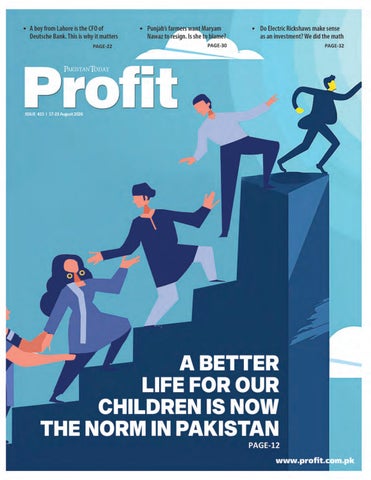
12 A better life for our children is now the norm in Pakistan 19 Forging the economic engine Muhammad Azfar Ahsan
22
22 A boy from Lahore is the CFO of Deutsche Bank. This is why it matters 26 Introducing ZM’s Welfare-GDP framework Zafar Masud
22
32
30
30 Punjab’s farmers want Maryam Nawaz to resign. Is she to blame? 32 Do Electric Rickshaws make sense as an investment? We did the math
Profit Publishing Editor: Babar Nizami - Senior Editor: Abdullah Niazi Business Reporters: Taimoor Hassan | Usama Liaqat | Zain Naeem | Shahnawaz Ali | Ghulam Abbass Ahmad Ahmadani | Aziz Buneri - Sub-Editors: Saddam Hussain | Abdul Hameed - Video Producer: Adnan Maqsood Director Marketing: Muddasir Alam - Regional Heads of Marketing: Agha Anwer (Khi) Kamal Rizvi (Lhe) | Malik Israr (Isb) GM Special Projects Zulfiqar Butt - Manager Subscriptions: Irfan Farooq Pakistan’s #1 business magazine - your go-to source for business, economic and financial news. Contact us: profit@pakistantoday.com.pk
12
A better life for our children is now the norm in Pakistan Intergenerational mobility is not something we associate with life in this country, but is rapidly becoming the norm in Pakistan, and that has consequences the country’s politics
COVER STORY
I
By Farooq Tirmizi
t was 8:50am and I was already running late to get to work. It was the summer of 2009, and I was then an early-20s investment research analyst at Faysal Asset Management, which was then headquartered on McLeod Road in Karachi. I had ambitiously thought I might be able to walk then length of the road, but looking at the time, decided to get into a rickshaw that was parked in front of the headquarters of Bank Alfalah. The driver let me in, but continued chatting with a young man, whom from the context I overheard, was likely a commercial banker at the bank. I was annoyed at the rickshaw driver for continuing to talk, since the seconds were ticking away, and I needed to get to work on time. But he then ended the conversation and we were on our way soon enough. He then told me that the young man he was talking to was a neighbour, and that his father was a vegetable hawker (thelay wala). The rickshaw driver said that both he and his neighbour (the banker’s father) were illiterate, but that they had been able to educate their children and that effort was finally coming to fruition. That is the kind of story of intergenerational mobility that made me snap out of my self-obsessed mode that morning. At the time, I had a college degree, but so did both my parents and two of my grandparents. The idea of incrementally doing better than one’s parents was vaguely at the back of our minds, but here was a rather stark example: an illiterate theley wala had a son who was a banker at Bank Alfalah. Since then, I started making more of a point to ask people what their parents do, and found more stories like this, and I mentioned this to an academic friend of mine (now a political science professor), who commented that these are isolated examples that are not
14
representative of any meaningful trend. In some senses, that view is correct. The sudden leap from illiterate labourer in one generation to college-graduate white collar worker in the very next generation is still not very common in Pakistan. But Profit’s analysis of the 2025 Labour Force Survey suggests that it may still be a meaningful number of people. Specifically, there are currently about 1 million college graduates in their 20s and 30s who still live in the same home as their illiterate parents. They go to work to their white collar jobs while the parents who gave them that education go to the same manual labour job that allowed them to pay for their children’s college education. From the same home, every morning, one person leaves to work in a likely-air-conditioned office, and their older parent leaves, with calloused hands, to labour in the heat. 1 million homes. That is not a majority in Pakistan, and indeed constitutes less than 3% of homes. But 1 million is not nothing. Crucially, our analysis is incomplete because it excludes people who were raised this way and no longer live in the same household (tracking families that do not live in the same household is not really possible using existing government survey data), so it is likely an underestimate of the wider phenomenon of Pakistani parents being able to give their children a vastly better life than they have been able to have for themselves. So what does this mean? Is this a niche, positive phenomenon in Pakistan’s wider political economy, or is it representative of something more meaningful. Using the rather limited tools available to us, we began to do the beginnings of an analysis of intergenerational mobility in Pakistan. And what we found is that, while Pakistan is not moving with the same speed of progress as the East Asian Tigers did in the
1960s and 1970s, we are moving rapidly enough where this kind of intergenerational progress is now the dominant mode of life in Pakistan. In other words, it is far more common in Pakistan for parents to have given their children a better life than their own than for the reverse to be true. Indeed, people who have made intergenerational progress are more numerous than those who did only as well as their parents and those who did worse than their parents combined. A better future constitutes an absolute majority of the experience of Pakistani families. All of this, by the way, excludes families that were able to do so because of emigration, since this data only includes households that live and work inside Pakistan.
Better educated, outearning their parents
F
irst let us get some important data points out of the way. Of the Pakistanis who still live with their parents, about 54.8% of them out-earn their parents. That represents approximately 9.9 million Pakistanis who make more money than their parents while living in the same home. So those 1 million college graduates who live with illiterate parents are part of a larger phenomenon of children being able to economically do better than their parents. Those nearly 55% of children who do better than their parents in terms of income form the vast majority of the 59.3% of Pakistanis who have an education that is better than their parents. Bear in mind, again, that this data is of people who still live in the same home as their parents, so if they have a better education and were able to make a home of their own, they would not be counted in this number, meaning it is likely an underestimate of that phenomenon.
COVER STORY
The above two data points are worth repeating: A clear majority of Pakistanis is able to give their children a better life – in terms of education and income – than they have themselves. It gets even better when you go a bit beyond those who did better, and try to include families that had already been a bit better off in the previous generation. Only about 16.9% of Pakistanis have an education that is worse than their parents. In this number, we include the illiterate children of illiterate parents (since the addition of one generation made no progress in education, we consider that being worse off than before) and exclude the children of educated people who were able to pass at least a high-school level education (intermediate, or A levels). Put in simpler terms, five out of every six children in Pakistan is doing at least as well, or more likely better, than their parents in terms of education. Better education, in short, is the key to a better economic life for one’s children, and on this front, Pakistani parents are doing rather well, at least insofar as giving their children better.
16
We do not mean to suggest that is all is well in Pakistan on the education front. Far from it. Pakistan lags behind not just developed countries, and the East Asian tigers but also its own regional peers and is uniquely bad in terms of any educational metric across any grouping of countries that could reasonably be described as Pakistan’s peers. But having fallen behind those peers, the question that the country needs to ask is not just “why are we behind” but “are we catching up?” and “are we doing better than we did?” And the answer to those latter two question is undoubtedly yes.
(Not) waiting for the government
I
n Jawab-e-Shikwa, Iqbal once describes the disgraced Muslims of India as “Haath par haath dhare muntazir-e-fardā ho” (sitting idle with folded hands, waiting for tomorrow). While that may once have described the people of this region, it not longer describes Pakistanis (of any religion) today. Every successive generation of children
is better educated than the generations before them, and the progress is by and large steady enough that it is measurable from year to year: children born in 2006, for example, were more likely to grow up to become literate than children born in 2005, and so on. Across both urban and rural areas, Pakistan is now able to consistently educate at least 70% of its children to be literate and numerate. While part of this progress is certainly driven by improvements to the government’s own infrastructure, measured purely by proportion of the increase in student enrollment, the private sector has contributed just under 75% of the total growth in enrollment between 2009 and 2022, according to enrollment estimates published in the Pakistan Education Statistics reports published by the Pakistan Institute of Education. The public sector accounts for the remaining 25%. In other words, Pakistanis are not waiting around for the government to fix the schools (even though the government is making some progress on that front). They are simply going ahead and paying for private schools themselves as soon as they have the
TEXTILES
ability to pay. This phenomenon helps explain why the fastest progress in terms of increasing literacy happened in the decade after Pakistan’s dependency ratios – the ratio of prime working age adults to the number of children under the age of 15 and retirees over the age of 65 – peaked. The dependency ratio peaked in 1995, and that year also represented an inflection point in literacy improvements: for every year after that, the 10-year progress towards improving literacy kept on rising at a rising pace (the second differential was positive) for the next decade. What does that mean? It means that once families started to find that they had a bit more spare cash to spend (with dependency ratios declining after 1995), they started investing that spare cash into private school fees for their children, especially in urban areas, and especially in the urban areas they did so at nearly identical rates for their sons and daughters. Having spent the lead up to 1995 being increasingly cash strapped, the first thing that Pakistani families did when the pressure on their cash flows eased a bit was to invest in the future economic productivity of their households by educating their children. And in perhaps a scathing indictment of how bad the public schools were, they did so through private schools even when public schools were available in their areas. This increased investment led to the fastest expansion in literacy rates in Pakistani history. Children born in 2004 have a literacy rate of nearly 72%, which is a full 18 percentage points better than children born in 1994. That 18 percentage point increase took place over just 10 years, the fastest 10-year increase at any point in Pakistani history. More than a century after Iqbal wrote those biting words, the lesson embedded in them – that there is no point in waiting around for Messiahs and that the only sure-fire way to improve one’s life is to take matters into one’s
own hands – has finally been imbibed in full by the majority of the people he was writing for. The government of Pakistan can continue debating banalities and fighting over pathetic scraps of power. The people of Pakistan are going ahead with improving their own lives and the lives of their families.
Who is able to make the leap?
I
f you search the academic literature on intergenerational mobility, academics appear much more inclined to talk about the limitations of the mobility. And it is certainly important to say that the ability of people to move up in the educational and income ladder is not uniform. Only about 34.5% of the children of those without even a primary school education are able to go on to complete their matriculation / O levels exams. Among those who were able to pass matriculation / O levels themselves, that number shoots up to 83.8% of their children being able to complete that level or higher. There is no denying the fact that the starting point matters. Two other factors are very important. The first is the rural-urban divide. In their 2014 paper “Intergenerational Mobility: Evidence from Pakistan Panel Household Survey” that appeared in the Pakistan Development Review, Sajid Amin Javed and Muhammad Irfan found that for someone born to a bottom-quintile father, the probability of reaching the top quintile was only 1.9% in rural Pakistan, compared with 7.5% in urban Pakistan. Their data set, of course, is from a decade and a half ago, and matters have improved significantly since then, but it is nonetheless a pattern that is likely to hold: if you want your children to do better than you, move to the city. The next factor is land ownership. In their 2013 paper “Historical Inequality and Intergenerational Educational Mobility: The
Dynamics of Change in Rural Punjab” that appeared in the Lahore Journal of Economics, Ali Cheema and Muhammad Farooq Naseer, both professors at the Lahore University of Management Sciences (LUMS), find that the likelihood of being more educated jumps substantially among those families who hold even small amounts of land compared to those who do not. Poverty traps, in other words, are real, and Pakistan has not suddenly managed to have its entire population move out of them entirely. And Pakistan is still not doing as well as other parts of the world, even with the relative improvements that the country has made. In a 2023 publication titled “Expanding Opportunities: Toward Inclusive Growth”, economists at the World Bank compared countries across the world in terms of their ability educate future generations better. The metric they focused on was the ability of a generation born to parents in the bottom half of the education distribution to be able to reach the top quarter of the education distribution. Based on that metric, only about 9% of Pakistanis were able to make this move, which ranks the country towards the bottom of the world in terms of educational mobility – at least historically – an towards the bottom even among South Asian peers. We cite all of these data points to note the fact that while much progress has been made, much remains to be done. This is not an article written by blind optimists. But the fact remains that a significant amount of progress has been made in Pakistan, particularly over the past two decades, and the fact that this progress is uneven does not negate the existence of progress. More importantly, it does require Pakistanis to think about the kind of changes that are taking place in our society and our economy.
COVER STORY
THE MOBILITY ENGINE
A POSSIBLE THREE-GENERATION CLIMB Education converts one generation's sacrifice into a higher starting point for the next.
1
2
3
LIMITED START
SCHOOL FIRST
CREDENTIALS
A parent has little or no schooling and earns through manual or informal work.
The family finds room for fees, books and time away from paid work.
Matric or O levels open the way to college, training and more specialised skills.
LITERACY BECOMES A FLOOR
OPTIONS BEGIN TO WIDEN
THE FIRST INVESTMENT Keep the child in school.
5
A HIGHER STARTING POINT 4
The next generation begins with more education, assets and choices.
FORMAL WORK
MANUAL WORKER → PROFESSIONAL
A salaried or skilled job raises income and creates more stability at home.
PROFESSIONAL → LEADERSHIP
THE CHILD OUT-EARNS A PARENT
The climb is not automatic. Urban access, even small amounts of land or other assets, and a parent's own education all increase the odds; poverty traps and weak services can still stop progress. Conceptual synthesis based on the article and the academic research it cites. The pathway is illustrative, not a guarantee.
Revisiting Pakistan’s conception of itself
T
here is a nation’s perception of itself, and then there is its reality. In some countries, it moves in the direction of reality not being quiet as rosy as their self-conception. In Pakistan, it appears we have the opposite problem. Our default national humour is gallows humour. The idea of success in Pakistan involves successfully leaving Pakistan, whether it be for education or work, and ideally permanently. The notion that it is possible to live and work in Pakistan and – across almost the entirety of the income and social spectrum – give one’s children a better life is simply not one that crosses our own minds, but that is exactly what is quietly playing in out in what we now know is not just a large number of households in Pakistan, but the overwhelming majority of Pakistani families. This can, and should, change the way the country approaches its development paradigm. The Pakistani public is no longer awaiting the government’s provision of infrastructure such as education, health, nor does it look for government leadership on matters such as encouraging economic activity that would ulti-
18
mately lead to job creation. If not in words, then at least in actions, the people of Pakistan have decided that it is a fool’s errand to sit around waiting for the government to fix things, and have begun to do so themselves, investing heavily in improving their own families’ lives. And this is now beginning to result in some dividends. Of course, this would all have been better had the government of Pakistan chosen to focus on providing services to its people. That would have resulted in Pakistan’s income and educational mobility numbers looking closer to those of South Korea and Singapore, which made the leap from being third world countries to being first world developed nations within a single lifetime. Pakistan is not that kind of country, nor is it the kind of place where the son of a factory labourer will become the owner of the factory. But this data does tell us that Pakistan is now the country where maybe the grandchild of the factor labourer can hope to become a C-suite executive, and perhaps even the owner, of the factor in which his grandfather once laboured. There was a time when rural aristocrats could say things like “Humare to naukar bhi khandaani hotay hain” (Even our servants are
from a family trade). That is no longer true because, while in generations past you had no choice but to continue working as a domestic servant in the same house as the one your parents worked in, almost nobody does that anymore. The aristocrats might mourn the passing of that world. The rest of us should celebrate it. This, by the way, is also why the aristocrats are losing control over Pakistani politics: because their control over avenues of opportunity is long gone and the median Pakistani now has far more freedom than they did even a generation ago. So complete is their loss of power that it almost feels quaint to even talk about them as being powerful. What it does mean for Pakistani politics is this: promising people goodies might win an election or two, but a multigenerational political machine will instead build something very different. They will build a mechanism for the government to provide high-quality physical infrastructure, a clear rule of law, and a political culture that respects individual autonomy and rights. The people of Pakistan do not really want the goodies. They want the government to leave them alone. They will work hard and buy the goodies for themselves. n
COVER STORY
OPINION
Muhammad Azfar Ahsan
Forging the economic engine
tivity, exports, employment and fiscal capacity. That is the difference between managing an economy and building an economic engine. A development state is not a larger state or one that seeks to control more of the economy. It is a state that knows what it must do, what it should stop doing and akistan does not lack potential. It lacks an economic enwhere public intervention can create the greatest national gine capable of converting that potential into sustained value. Its responsibility is to establish predictable rules, national strength. enforce contracts, protect competition, invest in human We have the raw material: a large domestic capital and infrastructure, facilitate enterprise and create market, a young population, entrepreneurial energy, the confidence under which private capital can take strategic geography, natural resources, and a private sector that productive risk. The objective is not to replace markets. It has repeatedly created value despite difficult circumstances. is to make markets work better. What we have not built is the institutional architecture capable For Pakistan, that begins with investment. FDI can of converting capital into productive investment, investment into bring capital, technology, management expertise, market productivity, productivity into exports, and exports into rising access and connections to global value chains, but it canincomes, fiscal capacity and national power. not substitute for domestic capital formation. An econoHaving worked at the intersection of government, investmy of Pakistan’s scale cannot build durable prosperity by ment and business, I have learned that capital does not move waiting for foreign capital. simply toward opportunity. It moves toward opportunity that The first investment signal must come from within. can be understood, risk that can be priced and rules that can be Are Pakistani businesses willing to expand capacity, trusted. Investors can tolerate complexity and difficult operating modernize, formalize, innovate and commit capital for the environments. What they cannot easily price is uncertainty about long term? When domestic investors reinvest confidently, taxation, regulation, approvals, contracts or whether today’s poliforeign investors notice. When domestic capital becomes cy will survive tomorrow’s political transition. defensive, they notice that too. Domestic and foreign This is why Pakistan’s economic challenge is larger than the investment should therefore be complementary: domestic latest fiscal deficit, balance of payments pressure, FDI figure or capital provides depth and resilience, while foreign capiexport target. These indicators matter, but they are symptoms of a tal can accelerate technology, capability and international deeper weakness: we have yet to create an economic architecture market access. in which capital, enterprise, productivity, human capability and Investment facilitation must become a continuing public policy reinforce one another. economic function rather than an event. Attracting an Stabilization is necessary, but it is not development. A investor is only the beginning. The real test is whether strong economy must continuously generate investment, producthat investor can establish, obtain approvals, access infrastructure, resolve legitimate grievances, operate efficiently, reinvest and expand. Pakistan therefore needs an investment confidence architecture, not another investment promotion Writer is a public policy advocate, business campaign. Federal, provincial and local institutions must coordinate around the strategist, and former Pakistan’s Minister investor’s journey, with time bound approvals, credible grievance mechanisms and for Investment and Chairman of the Board durable policy commitments. An investor should experience one coherent state, of Investment. He is a strategic advisor not a collection of disconnected departments. The same principle must apply to to leading corporate entities, focusing on domestic entrepreneurs: domestic reinvestment is among the clearest measures of business policy, investment facilitation, and confidence in the country’s future. leadership branding. He writes frequently But capital becomes economically meaningful only when it raises productivon the economy, governance, and society. ity. The more consequential question is whether investment expands productive
P
COMMENT
19
capacity, introduces technology, raises efficiency, creates skilled employment, generates exports and improves competitiveness. Productivity is the mechanism through which economic architecture creates value. Better infrastructure lowers costs; reliable energy improves industrial utilization; technology raises efficiency; competition drives innovation; human capital enables higher value production; efficient logistics connect producers to markets; modern finance allocates capital more effectively; predictable regulation reduces uncertainty. The engine works when these forces reinforce one another. Pakistan must, therefore, judge economic progress less by the volume of activity it generates and more by the productive capacity it builds. Strength comes from the ability to produce competitively, innovate continuously, export consistently and create opportunities that survive political cycles. That requires changing how the state taxes, spends, regulates and allocates resources. Taxation cannot remain an exercise in extracting more revenue from those already visible within the formal economy. A credible tax system must broaden the base; it must make formalization simpler, compliance predictable, and enforcement intelligent; using technology and better data. The tax base should expand because the productive economy expands. Public expenditure requires the same discipline. A development state cannot call every government outlay development. The relevant question is what productive and social capacity each rupee creates. Education, health, infrastructure, research, digital systems, and justice can generate returns for decades; expenditure that merely preserves inefficient structures or postpones structural decisions does not. State Owned Enterprises (SOEs) require a practical rather than ideological test. The question is not whether every SOE must be privatized or retained, but whether state ownership creates greater national value than credible alternatives. Where the private sector can perform better under effective regulation and competition, the state should release capital and administrative capacity. Where public ownership remains necessary, the enterprise should have a defined purpose, professional management, measurable performance and genuine accountability. The principle is straightforward: the state should own what it must, regulate what it should, and enable everything else to become more productive. Regulation deserves the same rethinking. Businesses experience the state not through policy documents but through licenses, inspections, tax notices, approvals, customs, utilities and courts. Every unneces-
20
sary permission adds cost; every ambiguous rule creates uncertainty; every discretionary decision creates room for delay. Regulatory reform should, therefore, be treated as a growth strategy: fewer unnecessary permissions, clearer rules, time bound approvals, transparent digital processes, and regulators capable of protecting the public interest without suffocating legitimate enterprise. Competition is equally important. Inefficient incumbents cannot be protected indefinitely and still be expected to become productive. Competition forces firms to reduce costs, improve quality, adopt technology, and respond to customers. Removing unnecessary barriers to entry is, therefore, not merely about fairness; it is a productivity strategy. Technology can multiply these gains. Pakistan should no longer treat the digital economy as a narrow sector alongside the real economy. Artificial Intelligence (AI), automation, cloud infrastructure, digital payments, and data systems are becoming capabilities across the economy. They can lower transaction costs, improve tax administration, modernize logistics, expand financial inclusion, and connect Pakistani businesses to global markets. But technology cannot compensate for bad processes. A digital bureaucracy that preserves unnecessary procedures simply puts inefficient bureaucracy on a screen. Digitization must begin with process reform. Human capital is equally central. A young population becomes a dividend only when people are educated, healthy, skilled, and connected to productive opportunity. Pakistan cannot build a high productivity economy while millions of children remain outside quality education, technical training remains disconnected from industry, and universities remain distant from the needs of a changing economy. Human capital is not a social sector afterthought; it is economic infrastructure. Infrastructure must be judged by the same standard. Roads, ports, energy, water, telecommunications, and logistics matter because they lower the cost of producing, moving, and selling. The test should not simply be the size or visibility of a project but also the productive capacity they unlock, the markets they connect, and the efficiency they create. Our cities deserve particular attention. Urbanization will increasingly determine national productivity. Transport, housing, utilities, municipal services, and digital connectivity affect labor mobility, investment decisions, and the cost of doing business. Stronger local governments can improve service delivery and economic planning where citizens and businesses actually experience the state. This requires better coordination among federal, provincial, and local institutions because
investment, industry, agriculture, skills, infrastructure, and urban development do not respect administrative boundaries. The same integrated thinking must shape exports. Pakistan cannot build durable prosperity through domestic consumption, borrowing, and periodic external financing. Exports bring foreign exchange, but their deeper value is that they force firms to meet international standards of cost, quality, reliability, technology, and efficiency. The answer to weak exports is, therefore, not another package of incentives. It is a competitive production system. Exporters need reliable energy, efficient logistics, skilled workers, modern machinery, finance, technology, and predictable taxation and regulation. Export competitiveness is created long before a product reaches a port. Pakistan must also broaden what it exports. Traditional agriculture and manufacturing remain important, but higher value manufacturing, engineering, pharmaceuticals, specialized agriculture and processing, technology enabled services, and other knowledge intensive activities offer greater room for the next phase of growth. We must move from exporting what we happen to produce toward deliberately developing the capabilities global markets demand. That means raising productivity across sectors. Agriculture needs better irrigation, seeds, mechanization, storage, processing, and market access. Manufacturing needs technology, scale, quality, and integration into global value chains. Services need connectivity, skills, and regulatory frameworks that permit international competition. The engine cannot be built around a handful of favored sectors; it must create conditions in which productive activity can emerge, scale, and compete wherever Pakistan possesses or can develop a genuine advantage. Capital formation is another essential component. Capital is savings converted into factories, machinery, infrastructure, technology, and businesses. When savings flow into productive investment, an economy expands its capacity. When capital remains trapped in speculative or low productivity activity, the economy may look busy without becoming stronger. Pakistan, therefore, needs a financial system capable of mobilizing long term domestic savings into productive investment. Banks, pension funds, insurance companies, mutual funds, development finance institutions, and capital markets can play a larger role in financing infrastructure, industry, technology, and entrepreneurship. The financial architecture should reward productive risk-taking rather than disproportionately financing short-term consumption or govern-
ment requirements. But an economic engine cannot run on capital alone. It requires confidence, and confidence is ultimately institutional. A company deciding whether to build a factory, an investor considering a long-term commitment, or an entrepreneur deciding whether to expand – all represent making judgments about the future. That judgment depends on whether the state can make credible commitments. Policy continuity is, therefore, a form of economic infrastructure. A road connects a producer to a market; predictable policy connects today’s investment to tomorrow’s expected return. Abrupt tax changes, regulatory reversals, administrative disruption, and political cycles break that connection. Businesses delay expansion, investors wait, and productive capital seeks more predictable environments. Pakistan needs agreement on a core economic direction that survives political transitions: fiscal discipline, investment confidence, export competitiveness, human capital, energy security, productivity, digital transformation, and institutional reform. Economic transformation takes time. Factories take time to establish, skills to develop, export markets to win, and institutions to mature. Confidence takes longer still. The cost of inconsistency is measured not only in lost investment but in opportunities that never materialize. This makes execution as important as policy. What we have lacked is institutional discipline to carry priorities from announcement to implementation and from implementation to measurable outcomes. A ministry should know what it is expected to deliver, how success will be measured, and who is accountable. This requires a professional civil service with stronger economic expertise, clear mandates, and continuity in key positions. Capable officials must have the authority to execute and be held accountable for results. Political leadership must provide direction without repeatedly disrupting the machinery responsible for implementation. That culture must extend beyond government. The private sector is Pakistan’s principal engine of enterprise, investment, innovation, and employment. But a stronger state does not mean permanent protection from competition or commercial risk. Pakistani companies must invest in technology, management, skills, governance, and export capability. Protection may provide breathing space; it cannot create globally competitive industries indefinitely. Corporate Pakistan should become an active partner in national development, contributing to skills, research, innovation,
and export capability while government creates conditions in which those investments make commercial sense. Universities and research institutions must also move closer to the productive economy. Applied research, commercialization, technology transfer, and industry-linked skills should become components of national productivity. The distance between an idea and its commercial application, a university and a factory, a technical institute and an employer, and Pakistani talent and global markets must become shorter. The same principle applies to digital transformation and investment facilitation. Pakistan does not need another layer of institutions competing to announce investors; it needs an institutional system that makes Pakistan easier to invest in. An empowered investment institution should coordinate across government, identify bottlenecks, facilitate legitimate investors, and ensure that commitments are implemented. An investor should not have to understand Pakistan’s administrative architecture to do business in Pakistan. The most valuable investment incentive is often not another concession. It is predictability. Domestic investors deserve the same treatment, because their willingness to reinvest is itself a measure of confidence. The government must also be selective about where it deploys public capital and institutional energy. It cannot finance every ambition; it must identify the constraints holding the economy back and concentrate scarce resources on removing them, whether through energy reform, logistics, infrastructure, commercial courts, tax reform, skills, or regulation. Reform must, therefore, be understood as a system rather than a collection of announcements. A tax measure that raises the cost of formalization can weaken investment; an energy reform that makes industry uncompetitive can damage exports; a tariff structure that protects inefficient production can reduce innovation; and an investment incentive without market discipline can attract capital without creating competitiveness. The parts of the engine must move together. Investment policy affects exports; energy policy affects industrial competitiveness; education affects technology; taxation affects formalization; infrastructure affects productivity; competition affects innovation. Pakistan’s deeper reform challenge is the state’s ability to see these connections and govern accordingly. That requires a small number of national economic priorities that survive political transitions – strengthen human capital, deepen domestic investment, attract quality foreign investment, raise productivity, expand exports, modernize infrastructure, improve
fiscal capacity, digitize government, strengthen competition, and build institutions capable of execution. The state’s role within this architecture must remain clear. It should provide macroeconomic stability, enforce contracts, protect competition, invest in public goods, and remove constraints that prevent citizens and businesses from creating value. It should not attempt to determine every commercial outcome. The choice is not between government and markets, but between a capable government that enables productive markets and a weak government that leaves uncertainty, privilege, and inefficiency to shape outcomes. There is no shortage of countries competing for capital, technology, talent, and markets. Pakistan cannot assume that its size, geography, or potential will automatically become economic advantage. Potential creates possibility; institutions convert possibility into performance. That is the lesson I have drawn from working with investors, businesses, policymakers, and decision makers in Pakistan and across the international investment community. Serious investors rarely ask whether a country has potential. They ask whether its institutions can convert that potential into predictable opportunity. Businesses do not need another assurance that reform is necessary. They need confidence that the rules will remain credible long enough to justify investment. Young Pakistanis do not need another speech about their country’s promise; they need an economy capable of giving that promise practical meaning. The economic engine is not another government program; it is the architecture through which a country converts capital into productive investment, investment into productivity, productivity into exports, and exports into rising incomes, resilience, and national strength. Pakistan has the raw material. We have the entrepreneurs, the market, the talent, the geography, and the ambition. What we have lacked is the institutional discipline to connect them and allow their combined strength to compound. For too long, we have treated every economic crisis as an event to be managed and every recovery as a reason to resume business as usual. The real task is harder: to build institutions and productive capabilities strong enough to make the next crisis less damaging and the next opportunity more valuable. Pakistan does not need another promise of transformation; it needs the discipline to make transformation cumulative. The engine is not waiting for better circumstances; it is waiting for better choices. And the time to build it is now! n
COMMENT
A boy from Lahore is the CFO of Deutsche Bank. This is why it matters Raja Jawad Akram’s ascent to the top of one of Europe’s largest banks makes him part of an elite club of Pakistanis who have made their mark in global financial markets. Many of this club’s luminaries have gone on to serve with distinction as public office holders in Pakistan. But that is not why his story matters
L
By Abdullah Niazi
ast week, I spoke to a friend from university in what turned out to be an unusually long conversation. The fact that it happened was a miracle unto itself. It was 6AM in Lahore when I got the call and 8PM in Chicago. I picked more to shut my ringer up than anything else and I suspect my friend, who was having trouble sleeping, thought speaking to me would do the trick. As we went through the mundane happenings of our lives, the conversation inevi-
22
tably turned towards our compatriots spread all over the world. We spoke of the friends in Toronto, the ones in London, Edinburgh, Frankfurt, and New York and then about the state of those of us (whether by choice or circumstance) still in Pakistan. We reminisced and ended the call as my friend went to sleep and I headed off to work. That conversation was still playing in my head when I spoke to Raja Jawad Akram later that day. Almost six months ago, Mr Akram was appointed as the Chief Financial Officer (CFO) of Deutsche Bank (DB). It is one of the largest financial institutions in the world,
a pillar of European banking, and has over a trillion euros in assets under management. His appointment means a boy from Lahore is now in charge of its finances. Mr Akram is a smooth talker; decades in the United States have given him only the hint of an accent beyond the clipped English he was taught at Aitchison College. He graduated in 1996, which would mean he is around 50 years old, but he still has a full head of hair. He rides a motorcycle to work, which is definitely not banky, and can be considered either cool or indicative of a mid-life crisis depending on how you feel about motorcycles.
His career began at KPMG and he has held senior management positions at Citi and Morgan Stanely. Despite the impressive stats, all I could think of was how much he reminded me of the friend I had just spoken to a few hours ago. Mr Akram also left Pakistan for the United States to pursue an education. He ended up finding a job there, and then another, and before he knew it more than three decades had passed. “One year turns into two, and two turns into five. Ten years later, you realise that maybe the definition of home has shifted in some ways,” he tells me during our conversation. My friend has been in the US for a few years now. They just got their first job and aren’t quite sure how long they plan on staying in the states. But even with increasing restrictions on students and migrants, the possibility that it might be for good is very much there. Raja Jawad Akram’s story matters for two reasons. The first is more obvious. He is a high-powered Pakistani in a prominent position at a global financial institution. Other Pakistanis have occupied such positions, and those Pakistanis have gone on to become finance ministers, prime ministers, central bank governors and the likes. But beyond that it matters that it is a Pakistani success story. Every year young Pakistanis travel abroad for higher education. For many it is the pursuit of knowledge. For others, it is a ticket out of the challenges of living in Pakistan. Some go backed by family fortunes, and others go with scholarships and little more than the clothes on their backs. But as Mr Akram’s story tells us, success can be found outside of Pakistan. But its cost can often be our definition of home.
The Expat Trope
A
pproximately one out of every eight Pakistanis around the age of 30 has at least some college education. This number is not particularly impressive, but it is higher than most people might assume it is. Of those with a college education, about one in 25 – about 4.2% to be precise – have at least one degree from a college or university outside Pakistan. Pakistani students are not yet a major force on the world stage – certainly not when compared to our neighbours in India and China which currently have 1.8 million and 1 million students outside their home countries respectively. But roughly 115,000 Pakistanis are studying abroad and while they are fewer in number than students from other countries, they represent a significant proportion of the country’s human capital, and in an emigration-obsessed country like Pakistan, they are also often the people most likely to become high-earning expatriates. In that sense, Raja Jawad Akram’s story is a pretty standard one. Most of the Pakistanis
A view of the exterior of the Citibank corporate headquarters in New York. Citi was one of the banks at the centre of the 2008 financial crisis. that end up going abroad for their education come from relatively affluent backgrounds. Mr Akram’s family owned a real estate business and he attended the prestigious Aitchison College. He completed his high school education in 1992 and having the means and background to go, chose Texas A&M for his undergraduate degree. His flight to Texas as a freshman was his first visit to the United States. In conversation, Mr Akram is very matter of fact about his ambitions at the time he went for his undergrad. There was no grand plan involved. The extent of his ambitions was returning to Pakistan with an American education and appearing for the civil service exams hoping to enter the foreign service. His failsafe was the family business. After completing his degree in accounting and finance, he received the standard one year work authorisation and got a job at KPMG. That one year set him off on a journey that quickly became his life. As he explains it, he never planned to stay. It just sort of happened. “Your home will always be your home, but you start feeling like you could belong to more than one place. And if you are doing well professionally, that adds a layer of motivation to stay and see what comes next and how far you can go,” he tells Profit. For Mr Akram, as long as he felt he was making an impact, he felt like staying. “If at any point in my career I had felt I wasn’t making a difference, I would have come back.” The career in question has been a bit of a whirlwind. In 2005 he left KPMG (where he had become a senior manager) and joined the Citi Group in its Mergers and Acquisitions department. The jump to banking came at an
interesting time. Mr Akram was in the trenches when the 2008 financial crisis came. Citigroup suffered massive losses from toxic subprime mortgage-backed securities. Its stock price crashed by roughly 80% in late 2008, forcing the U.S. government to step in with a massive rescue package totaling hundreds of billions in capital injections and asset guarantees to prevent a systemic collapse. The experience of the 2008 crash also gave him a long-term ambition: to become the chief financial officer of a global bank. “Around 15 years ago while I was at Citibank, I first remember having the thought that I’d like to be the CFO of a global bank. It was a wild dream at the time, but that was the thought,” he says. This is where the shape and trajectory of Mr Akram’s career really begins to develop a consciousness. He recalls a story where he approached his boss and expressed the ambition to eventually become the CFO of a major global bank. The advice he received was to broaden his horizons. Reaching that level required experience beyond the US, including an understanding of emerging markets and how global banks operate across different environments. And so, his christening by fire completed, Mr Akram made a move South. He went to the Citi office in Brazil, where he worked for nearly five years first as Country Controller and then as CFO of Citi Brazil in Sao Paulo. The assignment placed him in an unfamiliar setting and broadened his experience beyond American banking. After returning, he became Citigroup’s chief accounting officer and controller. The position put him at the centre of accounting, financial reporting and institutional control at one of the largest banks
FINANCE
in the US, and was the first major leadership role of his career. But after 14 years at Citi, Mr Akram says it was time for a change. He wanted to be a horse for all courses. During our conversation, he recalls how at the beginning of his career, his grandmother would ask him when he would return to Pakistan. Every time he’d say next year but something new would come up. Eventually, his grandmother told him he should stay in the US — don’t come back, but if he had made the decision then he should become exceptional, not just get by. That drive went beyond Citi. “Morgan Stanley was one of the best-performing banks on Wall Street, and it was hard to leave Citigroup, but I needed to take the chance. I needed to see whether I could work at another bank.” His appointment as Deputy Chief Financial Officer at Morgan Stanley put him one step closer to his desire to be the CFO of a global bank one day. His stint here lasted five years, and that is when he got a call from Frankfurt.
Why it is worth keeping an eye on Raja Jawad Akram
L
et’s take a gander at where Raja Jawad Akram stands in the annals of Pakistan’s financial history. He is by no means the first Pakistani to achieve great heights in the world of global finance. The most famous name most people can still recall is Agha Hasan Abedi, who founded the Bank of Credit and Commerce International. That was a case of a Pakistani actually being the founder of a global bank. At its height, the BCCI operated 400 branches across nearly 78 cities all over the world and was the seventh largest private bank in the world. It was one of
the foundational pillars of the close relationship Pakistani business has had with the UAE since the Abu Dhabi Royal Family was one of the bank’s earliest and biggest financiers. Of course, the BCCI fairytale turned grim after the bank was shut down by regulators on the back of major fraud in 1991. To this day, there are those in Pakistan who vehemently deny the fraud and claim Mr Abedi was the victim of an international conspiracy. The point being, men like Agha Hasan Abedi grow out of their hometowns but they continue to captivate the people back home. It is a phenomenon that is common enough, and these men often find themselves in public and government roles in Pakistan. Just take a look at the who’s who of Pakistani finance professionals. Perhaps the most illustrious individual was Moeen Qureshi. As the World Bank’s Senior Vice President for Operations, he supervised the World Bank’s worldwide lending operations and had earlier effectively headed the IFC. In 1993 he received a phone call from Pakistan while having coffee in Beirut. He was invited to become the caretaker prime minister of Pakistan. Another example is Dr Ishrat Husain, whose stories from his days at the World Bank are extraordinary. His account of a late-night meeting with Ghanaian President Jerry Rawlings in the midst of a civil war during the cold war era is incredible. He went on to first serve as Governor of the State Bank of Pakistan and later in Imran Khan’s cabinet. On the side of the private sector, Shaukat Aziz is the most pertinent example. He was Executive Vice-President and Global Head of Private Banking at Citigroup before he became General Musharraf’s Finance Minister. Well, technically he was Zafarullah Khan Jamali’s Finance Minister but that is just a detail. Especially since he later became President Musharraf’s Prime Minister. Shaukat Tarin was also the head of Citibank in Pakistan and
later became Finance Minister, although his experience was not as global. Even Pakistan’s incumbent Finance Minister, Muhammad Aurangzeb, has solid global finance credentials. Before coming to Pakistan and leading HBL, he was the CEO of JPMorgan’s Global Corporate Bank for Asia-Pacific. And yes, the current Finance Minister is also an ex-Citibanker. The Citibank connection is one Mr Akram acknowledges. He laughed when I mentioned the legendary status that the Citi label accords on Pakistani professionals. When he first joined Citi in New York, Shaukat Aziz was the PM. He recalls his mother telling him maybe he’d come back to Pakistan to become PM one day. While it was funny in 2006, the reality is that Mr Akram has joined a very small group of Pakistanis who mean something in the world of global finance. People with less experience than him have been tapped for rather important jobs in the past. And unlike Shaukat Aziz, he also has the advantage of being charming and well-spoken. It doesn’t hurt that he went to Aitchison college. One might recall that in 2019, there was a point when Pakistan’s Prime Minister, Finance Minister, and Foreign Minister (all three great offices of state) as well as the defence minister and central bank governor were all from Aitchison College — Imran Khan, Hammad Azhar, Shah Mehmood Qureshi, Pervez Khattak and Reza Baqir. Although the symmetry was ruined just a little bit when Hammad Azhar was sent packing after 19 days. But then he was replaced by, surprise surprise, Citibanker Shaukat Tarin! It is a possibility that Mr Akram does not seem in the mood to acknowledge directly, but he did tell Profit he would want to serve Pakistan in whatever way he can. He mentions his love for teaching and that he has thought about teaching at LUMS at some point, or perhaps sitting on some boards. But the exact shape of
From left to right: Moeen Qureshi, Dr Ishrat Husain, and Shuakat Aziz. All three men made their mark in the world of global finance, both with institutional organisations and private banks. Two of them became Prime Minister while Dr Ishrat served first as Governor of the State Bank of Pakistan and later in cabinet.
24
I’ve had people from Pakistan and India, and broadly from South Asia, work with me or for me. The reality is that our numbers are small compared with those of our neighbours. That is a consequence, first, of their population and, second, of the number of foreign students they send to the US. That obviously results in a much bigger population Raja Jawad Akram, Chief Financial Officer at Deutsche Bank
his ambition is not clear yet. “If at some point Pakistan needs me, I would consider it – not knowing at this point what ‘needing me’ could mean” he tells us.
The toll it takes
I
t would be surprising if the name Raja Jawad Akram, at the very least, does not come up for consideration within Pakistan’s state apparatus at some point. He has the credentials, the experience, and the international pedigree. By this point, he is a verifiable Pakistani success story. And beyond what he does after his banking career, there is much to reflect on. As he says himself, his was a relatively traditional path. He went to a good school, came from an affluent family, got an education, got a job, made a career for himself, received his American citizenship, and built his entire career away from Pakistan. Mr Akram also happens to be one of those expats that seem naturally good at keeping in touch with homebase. His wife’s family lives in Pakistan, and while his mother ends up spending six months of the year in the United States to be close to him, she spends the rest of her time in Pakistan. For him, a yearly visit to Pakistan is non-negotiable. And now that he is based out of Frankfurt for the foreseeable future rather than the familiarity of New York City, the desire to feel at home might be stronger than ever before. Beyond family, he is also close to his friends from school. To the extent that during our conversation, not only did he remind me of all of the many school friends I know scattered across the Atlas, he also gave me hope as to the sustainability of those friendships. “I had a really close group of friends at Aitchison. They all left after graduation, and we now live in different parts of the world, but my core group of five friends is exactly the same as it was 20 or 30 years ago. My best friends are still the same people who were my best friends in grade five,” he says. Even during
our interview he mentioned he was in a hurry because right after he was heading out with his boyhood friends to go away to Murree for a few days. “When you come here, you’re an entirely different person. You’re not coming in the capacity of Deutsche Bank CFO, where you have to be professional. Your friends from when you were 10 treat you the same way. They give you no respect, and the jokes are the same. Honestly, that’s the best part. They don’t care who you are professionally.” That is perhaps one of the key lessons to take away from Mr Akram’s story. He is clear about the costs that immigration takes on a person’s personal life. There is so much one misses out on when they leave, so many places and people they leave behind. But if one is committed to maintaining their roots, it is more than possible. As we mentioned earlier, Pakistani students are not a major force in international education but their numbers are increasing. Mr Akram has seen it himself. “I’ve had people from Pakistan and India, and broadly from South Asia, work with me or for me. The reality is that our numbers are small compared with those of our neighbours. That is a consequence, first, of their population and, second, of the number of foreign students they send to the US. That obviously results in a much bigger population,” he says. But for any Pakistani student hoping to take the leap, Mr Akram’s advice is simple. “When I got my first job, I realised I couldn’t outsmart everyone, but I could outlearn most people. I could read more than them and put in more effort than all of them. That would make me perform better.” Making a life outside Pakistan is a dream for many in this country. It is unfortunate that the dream is usually less out of a sense of adventure, and more because of economic realities. People like Raja Jawad Akram, people like my friend are lucky. They have the resources to go to the Global North as educated professionals, and even they face all kinds of trials and tribulations. But the emotional toll — the
pain of separation from everything you know is far greater when you are going to places like Dubai and Riyadh to drive a taxi or deliver food for the sake of your family back home. You see some of it in the way that Mr Akram speaks of his grandmother and the boyish expression he gets when he speaks of his school friends. I can tell whenever my friend mentions their father, who is 80 years old now. My own grandfather was an immigrant who, I like to think, had a pretty successful career. He graduated from King Edward and went to Wales for his specialisation. He spent years in the UK, where he was married, had my father, and worked for the NHS the entire time. He worked in Nigeria, and spent more than a decade with the Health Ministry in Guyana. Yet his brothers and his desire to stay connected to Pakistan always brought him back to his Pakistan. This country worried him, but he could not keep away. So much so that he moved back in 1989. My grandfather never claimed his British passport, and my father has not renewed his British Passport since 1986. He prefers to travel on his Pakistani passport despite the significant difficulties that come with it. For many, immigration means a slow, often painful distance from their home country. Visits thin out, connections become lost, time gets in the way before Pakistan becomes a place you used to belong to. Others cannot seem to stay away. I’m not sure which of my friends will make their moves permanent, but I hope they keep coming back like Raja Jawad Akram does. And as far as Mr Akram is concerned, he has a job to do for now. But as far as banking is concerned it might be his swan song. “If it’s up to me, I’m definitely not dying at my desk. I have clarity around a few things right now. One is that I would like Deutsche Bank to be my last stop in terms of my banking career. I love teaching, so this could be an option for my life after banking,” he says. One hopes he serves with distinction and honour, for Pakistan’s sake, if nothing else. n
FINANCE
Introducing ZM’s Welfare-GDP framework By Zafar Masud
P
akistan’s macroeconomic numbers are, at last, moving in the right direction — and yet reckoning is not necessarily development. Every economy keeps two ledgers by default and instinctively. One is kept by the state: it records that output rose 3.7 per cent last year, the best figure in four
years.
The other is kept, informally, by a hundred million kitchens: it records what a month’s income buys, and by that ledger the movement is not at the same pace as the state’s. Both books are authentic — they simply count different things. The state’s ledger counts production; the family’s counts purchasing power, per person, at the prices that family faces. Pakistan has never reconciled the two, in explicit numbers, and the reconciling entry may be the most important line our statistics could carry. I propose we start carrying it, under its own nomenclature: the “Welfare-GDP”. Having made the broad case for the concept already, what follows here is the next step — the full methodology. How is the number actually built? What assumptions does it rest on, and how honestly are they declared?Has it been independently verified? And what does it show when we run it not over the short run — one year or so — but over a longer timeline — a quarter of a century? A word on presentation of numericals before we begin: because parts of the construct are modelled rather than surveyed, every modelled figure in this thesis is reported as a range with a central estimate, never as a false-precision point. My purpose is to lay out the arithmetic in enough detail that readers can judge it for themselves rather than take my word for it. The construct fits in a single line: welfare growth equals real per-capita disposable income growth, distribution-weighted, deflated by a poverty-line price index. Every term in that line is one of four honest adjustments, none of them exotic, each a fact we already know; the only novelty is
26
applying them together and consistently. The first is population — and here the divisor is itself an interval, not a point. The census counts growth of roughly 2.5 per cent a year; international estimates run nearer to 1.6; and the true divisor should in any case be net population growth — births minus deaths minus net migration — because with some three-quarters of a million workers leaving annually, the resident population grows more slowly than the gross count suggests. The method, therefore, carries population as a declared range, and last year’s per-head growth accordingly lies between roughly 1.2 and 2 per cent, rather than at any single decimal. The second adjustment is income versus production.GDP is blind to more than forty billion dollars our overseas workers send home, through official banking channels, each year; replace production with income — gross national disposable income, or GNDI, taken net of outward transfers and factor payments, the same netting discipline applied to every flow — and the base runs some eight to nine per cent above GDP. Note the direction: this adjustment flatters the headline, which is evidence that the method is not stacked against it. The third is distribution, for an average is not a household — a mean can be lifted by gains at the top while the typical family stands still.The measure adopts the World Bank’s shared-prosperity cohort — the growth of mean income of the poorest forty per cent, which is also a formal indicator under the Sustainable Development Goals — so that the target population is an internationally defined standard rather than an author’s convenience. The fourth is the prices the poor actually pay: food and energy claim over half of a poor household’s budget, so the measure deflates each income group by a price index weighted to its own consumption basket rather than the national average. The architecture is deliberately built in two tiers, and the distinction is the heart of the method’s honesty. Tier one is the robust floor: the per-capita and national-income corrections, computed entirely from World Bank national accounts, where the only discretion is the choice of population series — carried, as above, as a range. Tier two is the indicative overlay: distribution and poverty-line prices, which must be parameterised because Pakistan does
not survey household income annually. The overlay divides the population into ten income groups and assigns each two parameters, both declared in full in Table 1. The first is a pass-through coefficient, φ — how much of each unit of aggregate income growth reaches that decile — rising from 0.35 for the poorest tenth to 1.38 for the richest.Only one point on that ladder is pinned by accounting identity: the income-share-weighted average of the coefficients must equal one, so that the ten deciles add back up to aggregateGNDI. The slope of the ladder is an assumption, anchored to an employment elasticity of roughly one-half — the empirical observation of how weakly growth translates into jobs and wages at the bottom of our labour market.The second parameter is the food weight in each decile’s deflator, taken directly from the latest Household Integrated Economic Survey: falling from 0.60 for the poorest decile to 0.25 Figure 1 — The five-year test (2021–2025): headline growth of 18.8 per for the richest, with 0.50 applied to the bottom-forty cent narrows to a per-head range of five to ten per cent depending on the category as a whole. Neither parameter family is population series, recovers to ten-and-a-half to thirteen counting remittance invented; both are anchored, and both are declared. income, and turns negative at the centre for the poorest forty per cent. Nor is decile-specific inflation an eccentric idea: as of Whiskers show declared ranges. this year it is official statistics in the United States, whose Bureau of Economic Analysis now publishes an income-stratified price index — external valida— φ and the food weights are fixed at their latest survey values even tion that the fourth adjustment is measurable at national-accounts when the model is run back twenty-five years, when in reality passstandard. through and food shares drift over decades. The remaining assumptions deserve to be stated just as plainly, Second, population growth is applied uniformly across the winbecause a measure proposed in good faith must declare where it is soft. dow, and the census-versus-international gap — compounded by the First, the parameters are held constant across every window question of netting out migration — touches every per-capita figure in the exercise; this is precisely why those figures are presented as bands. Third, there is still a timing mismatch in the price data: the headline index is calendar-year while the food index is fiscal-year, which adds noise to any single year’s premium, though it largely cancels across multi-year windows. Fourth, and most fundamentally, tier two is a parameterised overlay, not survey data — which yields the method’s standing instruction to every user: trust the ordering and the shape of the results more than any exact level, and read every modelled figure as a range around a central estimate. The precise numbers, therefore, are not sacrosanct; the concept is cardinal. It must be appreciated that this is a pioneering construct that may warrant refinement with the mentorship of researchers and economists, and I will be pleased to be challenged and corrected for its further improvement. Before presentation, the construct was stress-tested the only way that counts: by independent recomputation from the raw World Bank data, blind to the original worksheets. The mechanical series survived exactly — headline and per-capita growth matched to the decimal on a like-for-like population series. The income floor emerged as a range rather than a point — between roughly ten and a half and thirteen per cent over the five-year window, with the whole spread traced to the treatment of remittances in a single year: the same story, at a softer level.The verdict on the poorest forty per cent held, expressed as a range: cumulative welfare
OPINION
— minus 3.0 to minus 3.5, inside a range of minus 8.3 to plus 1.4 — for the poorest forty per cent of households.The single inflation year of 2022-23 did the damage: on the central path it erased around six and a half per cent of bottom-forty welfare, more than the four surrounding years of growth restored. Cut the population into ten income groups and the anatomy sharpens.On the central estimates in Table 1, the poorest tenth lost nearly seven per cent of its welfare over the window while the richest tenth gained ten, and the crossover from cumulative loss to cumulative gain sits almost exactly at the median household — half the country above the line, half below it, all inside the same headline number. The exact decile levels carry the overlay’s uncertainty; the ordering and the location of the crossover survive every parameter combiFigure 2 — The decile view (2021–2025), central estimates: the crossover from nation tried. cumulative loss to cumulative gain sits almost exactly at the median household. The longer horizons are the most Read the ordering and the shape, not the point values. instructive, because they acquit no particular change of somewhere between minus 8.3 and plus 1.4 per cent, with government and indict the growth model itself. Run the same decile model backwards, holding the declared paramecentral estimates of minus 3.0 to minus 3.5 — negative at the centre ters and reading direction rather than decimals. under both computations. Two further checks strengthen confidence. Over ten years, every group ends positive — but the poorest The third decile’s path independently reproduces the bottom-forty agkeeps under two points of a roughly twenty-five-point aggregate. gregate, an internal coherence test the model was never tuned to pass. Over fifteen years, the poorest tenth ends approximately where And when the model is narrowed from the bottom forty per cent to it started, against a gain of more than half at the top. the poverty cohort alone, the band tightens to between minus 9.3 and And over a full quarter-century, the richest tenth roughly douminus 3.1 per cent — negative under every parameter combination bles its welfare while the poorest gains under two per cent in total: a tried. round trip to the year 2000. A conclusion that survives a hostile recomputation, and holds Whatever else our growth model has produced across regimes across its entire declared range, is a conclusion worth publishing. civilian and otherwise, it has not compounded for the people at the What, then, does the measure show? Over the last five years, bottom of it. the story inverts as the adjustments accumulate: headline growth of The structure beneath these findings explains why the gap nearly nineteen per cent narrows to somewhere between five and ten endures. Only one Pakistani in four earns an income, and each earner per cent per head, recovers to between ten and a half and thirteen carries three dependents. when remittance income is counted, and turns negative at the centre Fewer than half our adults participate in the labour force, and among women only one in four. Against roughly three million young people entering the labour market each year, the economy generates perhaps half as many jobs — and around three-quarters of a million left to work abroad last year alone, continuing the trend of recent years. Under a third of the population produces for all of it: earnings in Riyadh, spendings in Karachi, Kharian and Mandi Bahauddin. This is also why a decade of stagnant household welfare is so calmly borne — an equilibrium I have come to call managed decline. Exit substitutes for pressure: the young who leave are drawn precisely from the category the economy failed to absorb, and every remittance-receiving household is a grievance settled privately rather than politically. Beneath the measured economy, an informal one of perhaps a third of GDP, kinship Figure 3 — Yearly welfare paths on the central estimates, indexed to 2020: the transfers and world-leading private charity poorest decile’s losses in the inflation year exceed everything the surrounding provide the safety net the state does not. years of growth restored.
28
These cushions are a mercy for social peace and a quiet warning to reform, for a system whose failures are privately insured generates little demand to fix them. The danger before Pakistan is, therefore, not upheaval but its opposite: an equilibrium just tolerable enough never to be broken. Breaking it is a choice — and composition matters more than pace, because forcing the pace under this structure would simply run the risk of reproducing another 2022-23, a culminaFigure 4 — The longer horizons: the same decile model run over ten, fifteen and twenty-five tion of preceding fiscal years, as years on central estimates. The ordering never changes; the poorest decile never meaningfully our balance-of-payments ceiling compounds. has repeatedly proven. The equilibrium worth that growth feeds wages and not only profits — all of it with inflation pursuing is different: growth of five and a half to six per cent, exheld in single digits. port-led and labour-intensive rather than forced past the external The Welfare-GDP is the instrument that tells us, year by year, ceiling; investment lifted from today’s anaemic thirteen per cent of whether that transition is actually happening. GDP towards eighteen; female participation raised from a quarter The world offers precedents but no template. Bhutan measures towards the global average of a third or more; and the employment “Gross National Happiness”, New Zealand “Budgets for Wellbeing”, elasticity of growth pushed from one-half towards seven-tenths, so and the OECD publishes a “Better Life Index” — yet none of these
Figure 5 — The structure beneath: the labour-market arithmetic that keeps measured growth from reaching the household ledger.
Figure 6 — The equilibrium worth pursuing: the composition targets that make growth reach households — investment, female participation and the employment elasticity of growth.
anchors an IMF-era stabilization to household welfare. Pakistan can be the first, and the first step costs nothing: publish the welfare-adjusted growth series beside the headline series, periodically, as official statistics — reported, like all honest statistics of this kind, as a central estimate with its band — and let the method be contested, refined and improved in the open, which is how national statistics earn their authority. A statistic, after all, is a promise about what a state will pay attention to. Once the number exists, it can graduate from report card to compass: growth reported, targeted and managed by the household ledger, so that every budget and every reform is tested against the only question that ultimately matters — did Pakistanis get better off? Stabilization can be negotiated with creditors; wealth creation can only be willed by a nation. This is where my theory of “Charter of Society” kicks-in, which I have already written about earlier. Stability is visible; welfare is not — until we choose to measure it — and “Welfare-GDP” is the answer. The silver-lining is that, while there is a distance still to be covered, the Welfare-GDP index has itself come a long way in the last four years and is moving in the right direction, like the headline GDP — with every income group back in the improvement trajectory in the latest year. n Th author is the president and CEO of the Bank of Punjab
OPINION
Punjab’s farmers want Maryam Nawaz to resign. Is she to blame? This year’s wheat procurement policy has caused an uproar among some farmers, who are calling for the Chief Minister to step down or face a “millions march.” Is it really her fault? By Abdullah Niazi
T
he decision by the Pakistan Kissan Ittehad to come out swinging against Chief Minister Maryam Nawaz is an indication of just how far into a corner Punjab’s farmers have
been pushed. Agitation, protest, and advocacy is pretty much the usual script for organisations like the PKI and other farmers’ collectives, but their rhetoric usually ramps up over time. After all, it can be a little awkward negotiating with someone if you’ve already called for them to step down. But the PKI has picked its target very clearly. At a press conference at the Lahore Press Club, not only did they threaten to initiate a “millions march” headed towards Rawalpindi if the Chief Minister did not resign, they went so far as to clarify that their issue was not with the ruling PML-N — it was specifically with Maryam Nawaz. For the Chief Minister, this is the second major confrontation she is having with Punjab’s farmers in a tenure that is only as old as February 2024. And both times the focal point of the crisis has been wheat procurement. In that sense, Maryam Nawaz has had a difficult hand: she came to power the same year that the IMF directed provincial governments to quit their wheat subsidies and procurement policies. That process has gone far from smoothly. Punjab has tried three different systems in three years, with the fruits of the latest causing the current uproar from the PKI. The Maryam Administration’s decision making has left a lot to be desired in the past two years. But the root of the wheat procurement crisis is much older than Maryam Nawaz. And she still has time to make it work. Three years, three systems — what happened to Punjab’s wheat procurement? For decades, Punjab used to follow one basic wheat system. The government an-
30
nounced a minimum price and bought wheat from farmers after the harvest. This procurement system gave farmers a guaranteed buyer and prevented prices from falling too sharply. The government then stored the wheat and gradually sold it to flour mills. But over the years this system had become riddled with problems. It was extremely expensive, and the Punjab government had to borrow heavily from banks to buy and store the wheat. The interest payments quickly ballooned into a circular debt crisis. By 2023 these borrowings had reached Rs 680 billion. The system also suffered from systemic corruption and often benefited large farmers, importers and middlemen more than small growers. Just take a look at what happened in the spring of 2024.
2024: Imports ruin a bumper crop
A
t the start of the year, the government had fixed the wheat price at Rs3,900 per 40kg, so farmers planted their crop expecting to receive roughly that amount. But the previous year, the caretaker government had already imported around 3.6m tonnes because they expected a shortage. Then in 2024 Pakistan produced a record wheat crop. This left Punjab with too much wheat and insufficient storage space. The province reduced its procurement target from more than 4m tonnes to around 2m tonnes and then largely stopped buying. Farmers who had planted wheat with the guarantee of the government as a buyer suddenly found the price
of their crop had collapsed on the market, and sold wheat for as low as Rs 2,200 per 40 kilograms. Small farmers were hit hardest because they needed immediate cash to repay loans and plant their next crop. The main problem in 2024 was therefore a sudden withdrawal of government procurement at exactly the moment when excessive imports had flooded the market.
private-sector purchasing incentives, but the measures proved too little too late. By harvest time in April, wheat was being sold at Rs 2,200 - Rs 2,300 per 40 kilograms. The support price in 2024 had been Rs 3,900. Protests immediately erupted demanding a support price of at least Rs 4,000.
2026: Private sector 2025: The IMF puts an companies fail to take in time end to support prices root n 2026, the Punjab Government devised
T
hen came the push from the International Monetary Fund (IMF). In September 2024, Pakistan entered a new $7 billion programme with the fund. The conditions for the programme barred provincial governments from setting crop prices. What the fund did not do was tell the Punjab Government how it was supposed to go about getting rid of a subsidy addiction that has afflicted it for more than six decades. The result was confusion. Think of it this way. Wheat is sowed at the tail end of the year around October/November, and is harvested in the Spring of the next year around April. The IMF’s condition came in September, and by the time sowing began in October 2024 for the 2025 crop, no wheat support price had been announced. By February, the federal government was operating on a policy of not issuing a national support price for wheat. This was a big shift. Normally, wheat procurement worked in three stages. The federal government consulted the provinces on what the wheat support price should be, and announced a national price. The provincial governments then set their procurement targets. Finally, the provinces borrowed money from commercial banks to buy and store this wheat. The federal government also maintains its own strategic reserves of wheat. Without a support price, Maryam Nawaz’s government decided to assist farmers in other ways. Instead of buying wheat itself, Punjab introduced the Electronic Warehouse Receipt system. Under this arrangement, a farmer could place wheat in an approved warehouse, receive a digital receipt and use that receipt to obtain a bank loan. This was supposed to give farmers cash for their next crop without forcing them to sell immediately at low prices. It essentially took storage power away from arthis. The idea was sensible, but Punjab did not have enough approved warehouses, participating banks or financing. Small farmers often produced too little wheat to transport it economically to a distant warehouse. Many also lacked the documents and banking access needed to use the system. The government also introduced financial assistance for farmers and
I
a new plan. The government selected 11 private companies to act as large-scale buyers of wheat. These companies were supposed to purchase 3 million tonnes of wheat at Rs3,500 per 40kg. The government offered them assistance with bank financing, subsidised borrowing and access to public warehouses. But the companies and banks were still negotiating financing and other rules when the harvest arrived. Nine of the 11 companies reportedly failed to buy any wheat by May, while total purchases remained only a small fraction of the target. Farmers again sold at low prices, generally between Rs2,800 and Rs3,200. Once much of their wheat had passed to traders and stockists, the price rose above Rs4,500. Lower production, reduced fertilizer use, limited stocks and hoarding all contributed. The government then considered importing wheat, even while PASSCO still held large stocks of its own.
What should the government do now?
W
hat we have here is a scenario in which the Punjab Government has some share of the blame. In 2024, they could point the finger at the previous caretaker government for importing excess wheat. In 2025, they introduced a system of Electronic Warehouse Receipts, which is a necessity for any modern agricultural market. However, the system could not be relied on because there were not enough warehouses to justify the system. In 2026, the government attempted to use private companies to fill the gap, but the system was not ready in time. Yes, the government’s attempts to come to grips with the change in wheat support price policy have not panned out, resulting in outrage from farmers. But the decision to leave the wheat crop to the free market originally came from the IMF. It is important to keep in mind that the old procurement system was far from free of flaws. It had burdened the provincial government under billions of rupees worth of
debt, and it was not serving the people it was meant to serve. Politically influential farmers were given access to procurement first, and smaller farmers were still at the mercy of middlemen and arthis. The immediate priority is not to restore the old procurement system. It is to ensure that the next harvest does not arrive before its replacement is ready. Banks should begin lending against verified warehouse receipts at the village level. A farmer could then store his wheat, use the receipt to obtain a short-term loan and repay the aarhti without immediately selling the crop. Farmers with existing bank loans should also receive an additional 90 days to repay them, with Punjab guaranteeing part of the risk. The financing of private procurement companies must also be settled before harvesting begins. Their credit limits, storage arrangements and purchasing rules cannot still be under negotiation in April or May. Meanwhile, PASSCO needs a clear system for moving its strategic stocks into areas facing shortages. The government should register private stockists, record how much wheat they hold and publish market prices. This would distinguish legitimate storage from hoarding while making shortages easier to identify. These are all suggestions that the government can and should begin planning for now, before the sowing season begins in October/ November. Farmers have suffered this year. They will need the confidence of good prices to stick to wheat. After all, the entire reason behind support prices in the first place was to make sure farmers keep producing strategically important crops that are the backbone of Pakistan’s food security. Without such confidence, farmers are wont to continue switching to crops like sugarcane and rice which take up more water. Chief Minister Maryam Nawaz has probably copped more criticism from Punjab’s farmers over the past two years than was warranted. Yes, her government has been at the centre of the uproar and has failed to find a way out of the post-subsidy world. However, it is also the first Punjab Government to deal with this problem. If action is taken in time and the government plans both for the short and the long term, the situation can be reversed. The wheat crop is as old as this region and there are ways to bring it towards the free market that benefit farmers and the end buyers. But that requires investment and infrastructure. To begin to do the work, the Punjab Government must listen to the farmers, even when their stance is as confrontational as it is right now. For the sake of Pakistan’s food security and the sector that backs it, it must be hoped that the Chief Minister does the needful. After all, this could be one of the factors that end up defining her legacy. n
AGRICULTURE
Do Electric Rickshaws make sense as an
investment? We did the math
Electric rickshaws offer attractive savings compared to driving a rickshaw on petrol. However, Pakistani rickshawwalas do not use petrol. LPG, which they use instead, performs much better, and dampens the potential savings shifting to an electric alternative might have brought 32
By Usama Liaqat
W
hen in recent months we saw interest in electric vehicles shoot up on the back of shooting oil prices, the reaction in one category remained comparatively muted. This was the three-wheeler category or, simply, the rickshaw. At some level, the less energetic response made sense. The target market for three-wheelers is different from the target market for twoor four-wheelers. The former is used almost exclusively commercially, while the latter two are used primarily for personal use. So, an ordinary consumer, i.e. most of us, is not exposed to the new products being introduced in the rickshaw-verse. But it is not simply a question of marketing hype or visibility on the road, especially if we consider that electric rickshaws possess some advantages which electric bikes do not. Since rickshaws can store bigger batteries, they should not offer range anxiety. And the gripe we had with some two-wheeler models – that they appeared to be optimized for the high usage segment – disappears in the case of rickshaws where high usage is the norm. Over 100 kilometers per day is not at all remarkable. They should have performed better. So, why the muted reaction? Profit did the math and found that there is a deeper issue which could potentially explain why rickshaw-walas haven’t shifted to electric in droves, while motorcycle and car users have (or have at least started to). The issue, simply put, is this: if you swap into an electric rickshaw, depending on some modalities, you will either be saving a little, or you’ll be losing a little more. This is counterintuitive, yes. Electric cars offer savings compared to petrol-powered cars. Electric motorcycles offer savings compared to petrol-powered motorcycles. Even electric rickshaws offer savings compared to petrol-powered rickshaws! The problem, however, is that Pakistanis don’t drive their rickshaws on petrol. Instead, they use Liquefied Petroleum Gas, or LPG. So, while shifting to an electric rickshaw would make financial sense if you were comparing it to driving the rickshaw on petrol, the equation totally changes if you compare it to driving the rickshaw on LPG. In this latter case, if, for instance, you don’t have to borrow money to finance your very-expensive electric rickshaw, your battery keeps working, your motor is friendly, and you are lucky, you might be able to save some money – not a lot, but nominal savings would likely accrue. Yet, as is perhaps more likely to be the
case, if you don’t meet these qualifications, you might actually lose some money by shifting to electric. But, as in most cases, financial aspects are only part of the story. Electric rickshaws do offer a cooler, much quieter ride, and should be better for the health of the rickshaw-driver than the ICE rickshaw. The LPG-rider would also have to contend with the vicious volatility in LPG prices, and a potential government subsidy might also change the feasibility. But, again, whether the decision to shift to electric makes sense would depend on how well a person is able to negotiate these benefits with potential costs of the electric.
The Electric Rickshaws Space in Pakistan
R
ickshaws on Pakistani roads are everywhere, sometimes even in spaces where they shouldn’t be. That’s to say that they are as Pakistani a thing you could have. Whether it’s the motorcycle rickshaws (known after their most successful champion in Pakistan: the Qingqi) or the more modern covered rickshaws, they have been used as a means of public transport for decades. The advent of the three-wheeler, however, preceded the partition, and remnants of that tradition still can be seen albeit rarely, especially across the border, where instead of an engine, a human being pedalling propels the contraption and the ensconced patron. Rickshaws, since then, have been in steady usage with around 398,000 units having been sold between FY17 and FY26. And, of course, there are thousands of rickshaws which are older, but still in operation. In Pakistan, there have been multiple brands of rickshaws over the years, but the end consumer (i.e., the ride hailer) has more or less been agnostic about them. They are usually pressed for time, and the cost of the trip is usually more a cause for concern than the particular rickshaw they are sitting in. Even haggling over fare has been running out of fashion with the advent of ride-hailing apps, but that’s another matter. What brand of rickshaw to use, then, is a decision mediated by the rickshaw-owner (who is often not the same as the rickshaw-driver) and the government, who sometimes thinks well enough to intervene. An example of the latter would be when it moved to ban in the 2000s and early 2010s the noisier, high-polluting, two-stroke rickshaws in favour of four-stroke ones, which were quieter and spewed less dirty air. The three-wheel ruler of the road has known many iterations in Pakistan — from Italian imports in the ‘60s to the old blue and
orange clunkers that dominated the roads for decades (some of which can still be seen on the roads today) and the green CNG rickshaws that replaced them. The latest iteration are the electric rickshaws that are slowly becoming more visible. The jury is still out on their viability. In Pakistan, perhaps the most prominent brand of rickshaws is Sazgar, which owes its recent fame to its cars that have sold very well and the stock that has skyrocketed. Manufacturing and selling rickshaws, however, is how they got their initial fame, and rickshaws they continue to manufacture and sell. One of their highest selling models is the Sazgar Deluxe XL, which costs around 450,000 rupees per unit. Being one of the leading rickshaw manufacturers in Pakistan, it is natural that they have also ventured into manufacturing electric rickshaws. Currently, they offer three models of their electric rickshaw – which they call eVe – with differing battery sizes. The unit with a 72v,90Ah battery and a 2kW motor costs around 12 lakh rupees and is claimed to offer 100 km of effective range per full charge. The rickshaw with a 72V,125Ah battery and a 3kW motor is priced at 13.8 lakh rupees, and, according to the company’s claims, offers 160 km range per charge. The final model contains a 72V,160Ah battery and a 3kW motor, and it retails at 15 lakh rupees, and offers up to 210 km charge, according to the company. Other established rickshaw manufacturers are also moving into the electric rickshaw space. Tez Raftar, for example, has been known for its ICE-powered rickshaws too. Their major model, a six-seater, retails for around 4.7 lakh rupees. But they too have started to offer electric models. Of their flagship E-Trike rickshaw, they offer two versions. Both contain the same battery – 72v,150Ah – but differ in the power of their motors. One model has a 1.8kW motor, and this model costs 8.4 lakh rupees, while the other has a 3kW motor and costs 8.9 lakh rupees. Both models purport to offer a range of 150+ km. Like Sazgar, Tez Raftar offers a 3-year warranty on the battery. There are other brands too, which are newer and are focused primarily on electric rickshaws (as opposed to the previous two companies, which still have the petrol rickshaws as their main offering). One such company is Yes Electromotive, whose main electric rickshaw is called the Muva. Although there is a 3kW motor in each of them, the Muva is available in three different battery options: 5.4kWh, 7.2kWh, and 16.5kWh, with prices ranging from 11 to 15 lakh rupees. The claimed range for these rickshaws ranges from 80 to 250 km per charge, as the battery power increases. Another company focused on the manufacturing of electric rickshaws is called Tezmo Motors. Their flagship rickshaw comes
AUTOMOBILES
The three-wheel ruler of the road has known many iterations in Pakistan — from Italian imports in the ‘60s to the old blue and orange clunkers that dominated the roads for decades (some of which can still be seen on the roads today) and the green CNG rickshaws that replaced them. The latest iteration are the electric rickshaws that are slowly becoming more visible. The jury is still out on their viability. installed with an 11.5kWh battery and a 3kW motor, and costs 10 lakh rupees. The rickshaw, according to the company, has a range of 180 km. The warranty period for the battery is 2 years or 40,000 km, whichever comes first.
The Decision Math
A
n electric rickshaw costs much lower to run than does a comparable petrol-powered rickshaw. That much, no one really disagrees with. The issue in Pakistan, however, is that people
34
who drive rickshaws do not use petrol. Rather, they use LPG. This is a crucial difference, since LPG can offer mileage that’s double of what petrol can offer at roughly the same price point. So, while a new rickshaw on petrol can offer 20-22 km per litre, the same can offer 40-45 km per kg of LPG. Of course, rickshaws do not come primed for LPG, rather they are converted from petrol through the installation of an LPG kit, which can cost between 5 and 10 thousand rupees. And these few thousands are enough to change the investment dynamics
of investing in an ICE – and therefore, electric – rickshaw. In our analysis comparing the costs of using an electric rickshaw, an ICE-rickshaw powered by petrol, and an ICE rickshaw powered by LPG, let us take Sazgar as a base example. While Sazgar might not be a representative electric rickshaw brand, we feel due to its prominence – and perceived quality – offers a stable benchmark to base our analysis on. Moreover, Sazgar offers both ICE and electric models, so comparison also makes sense due to that.
For the electric option, let’s consider their middle of the line model, the Sazgar eVe, which costs 13.8 lakh rupees, and has a 9kWh battery. The model, according to the company, offers a range of 160 km per charge. For the petrol and LPG scenarios, let’s consider the 6-seater Sazgar Deluxe XL, a high-selling model, which costs 4.55 lakh rupees, and, if new, can offer 22 km of mileage on a litre of petrol and 45 km on a kg of LPG. If we add the cost of LPG conversion, the effective price of an LPG rickshaw becomes 4.65 lakh rupees. Before we share our results, let’s go over a few assumptions that formed the basis of our analysis.
Assumptions:
F
irst, let us consider the range offered by electric rickshaws. According to the company, the 9kWh battery offers a range of 160 km on full charge. That would mean a range of 17.7 km per kWh or unit of electricity. In our conversations with rickshaw drivers, we ascertained that the real range appears to be around 14.5 km per unit of electricity, and this is what we went with. This would mean that the per km energy cost of an electric rickshaw comes to 3.45 rupees. As far as the ICE powered rickshaws are concerned, we took the mileage for petrol to be 20 km per liter, while for LPG we took 40 km per liter as the baseline mileage. For petrol, we took the per liter price to be 300 rupees, slightly higher than what it was prior to the recent Iran war. For LPG, we took the price to be 340 rupees per kg, again higher than what it was prior to the War. These basic figures yield the per km energy cost of running a rickshaw on petrol to be 15 rupees (4.3x higher than electric), and that of running it on LPG to be 8.5 rupees (2.5x higher than electric). There’s another important issue to be addressed here. The price of the electric rickshaw is so much higher in comparison to the price of a normal rickshaw that it is quite likely that a rickshaw driver might not possess the total amount of capital required upfront to finance the acquisition of the vehicle. In this case, they would have to borrow at least part of the upfront capital cost from the market through some financier or the other, such as Wasl Mobility Modaraba. However, such borrowing often comes at a steep rate, usually above 25 percent per annum. So, in our calculations we took two scenarios. In one of these, we assumed that a rickshaw buyer (who is not an investor, but a rickshaw driver himself) is able to self-finance half of the price of the electric rickshaw rupees, which is more than enough to cover the price of a normal, ICE rickshaw. The rest they would have to borrow from the market at (our conservatively estimated rate of) 25 percent
Pervaiz Elahi introduced the now-iconic green LNG rickshaws during the tail end of his term as CM in 2005. That was the time when Pakistan was placing a long bet on cheap LNG being a source of fuel. People all over Pakistan were getting their cars kitted out with CNG cylinders to offset expensive petrol, and CNG stations were popping up all over the country. The experiment with CNG cars did not last long, but the rickshaws went nowhere. Today, that legacy is a hurdle for those trying to power rickshaws with batteries. per annum. The total one-year cost of capital would, in this case, be 10 percent per annum on the self-financed amount, and 25 percent on the borrowed amount. Of course, it is possible that they might have the entire sum on hand, needing to borrow nothing. So, we have added a scenario too where there is zero borrowed amount, and where the cost of capital simply comes to 10 percent per annum of the rickshaw’s price. There might be other scenarios two, but these two appear to be representative enough to merit mention. Now to depreciation. And here is another complication. We split the depreciation of the electric rickshaw into two parts. First is the depreciation of the battery, which exists only in the electric rickshaw. Since it is claimed that such batteries can run 1500 cycles without loss of performance, we assumed the full lifecycle of a battery to be 5 years. The depreciation per annum would be 20 percent then, on the cost of the battery. This is a conservative estimate since the warranty only covers 3 years, and the battery might cough up before its advertised cycles are completed. Moreover, we took the price of the battery itself to be 4.5 lakh rupees, a slightly conservative estimate based on our market research. In addition to the battery, the electric rickshaw will also depreciate in its other
elements. For that part, we kept the rate of depreciation at 10 percent of the total price of the rickshaw excluding the cost of the battery. So, for the electric rickshaw, the total depreciation per year would be 20 percent on the cost of the battery and 10 percent on the cost of the rickshaw excluding the cost of the battery. For the ICE rickshaw, we kept depreciation at 10 percent per year on the total cost of the rickshaw. As far as the maintenance costs are considered, we took the annual maintenance spend for the ICE rickshaw to be 30,000 rupees, based on our conversations in the market. The spare parts are locally made, with a large network of mechanics who have trained on not only fixing the rickshaw but also coming up with cheaper jugaars or cheeky workarounds to the problems a rickshaw-wala might face. For an electric rickshaw, we took the yearly maintenance cost to be 20,000 rupees, or 2/3rd of the costs for the ICE rickshaw. The reason is that other than the battery (which we already accounted for in the depreciation section), the motor and the battery management system, there is not much of a difference between the normal and electric rickshaws (except for some trinkets like electronic display, automatic wipers, etc. in the latter). So, the costs of maintaining these same or
AUTOMOBILES
similar bits would be same or similar across both modalities. As far as the motor and the BMS are concerned, they too are liable to require maintenance. So, while the total costs of maintaining an electric rickshaw might be as high theoretically as an ICE rickshaw, let us for argument’s sake assume the maintenance costs to be much lower. One final assumption. We took the base daily travel to be 120 km, which we felt was a reasonable average based on our conversations with rickshaw drivers. Of course, a more driven rickshaw-wala might be able to cover longer distances of over 150 km per day, in which case they might be able to accrue more savings by shifting to electric. But that would be more beside the norm than within the norm. But we can take both these scenarios too to compare the potential savings of shifting to the electric alternative.
The Results:
B
efore we proceed, let us just say it outright – petrol-powered rickshaws cannot really compete with electric rickshaws on savings. So, we will focus on the LPG factor. Let us take two scenarios. Scenario 1: the electric rickshaw owner is able to self-finance the whole amount and therefore does not need to borrow anything. In this case, if they drive 120 km per day, they would be able to save a marginal 9 rupees per day, or 270 rupees per month by shifting to electric from LPG. If, however, they can drive 150 km per day, the savings would increase to 160 rupees per day, or 4800 rupees per month. So, some sense could be made in this latter scenario, but again it is not a scenario that everyone would be able to achieve. But let’s treat it as a real possibility. Scenario 2: the electric rickshaw owner cannot self-finance the whole of the rickshaw’s price, and must borrow the rest of the amount from the market at 25 percent. Scenario 1 (Sazgar)
day or 3,690 rupees per month. Still a loss, but more marginal. Of course, in this latter scenario, things can change too. If the proportion of the amount the rickshaw driver has to borrow increases, a quite likely scenario, the losses would increase as well. Similarly, if they are unable to borrow at a rate as low as 25 percent, their losses would increase as well. It goes without saying, of course, that if they are able to self-finance more, their losses would decrease, but we saw the logical conclusion Scenario 2 (Sazgar)
Monthly Savings compared to Petrol (rupees) 25,400
-3,690
150 km daily
15,000
-8,250
of that eventuality in the first scenario. The savings won’t be too much. We can see how in neither of these scenarios does the electric option offer very attractive savings compared to the LPG rickshaw. And in scenario 2, we saw how Scenario 1 (Tezmo)
to buy the rickshaw. In this scenario, if they travel 120 km per day, Tezmo would offer savings of 267 rupees per day, or around 8,000 rupees per month. If the rickshaw-wala is able to drive 150 km per day, the savings increase to around 430 rupees per day, or around 12,850
Monthly Savings compared to Petrol (rupees)
Monthly Savings compared to LPG (rupees)
120 km daily
31,240
8,000
150 km daily
41,930
12,850
you might actually lose money if you borrow the money from the market to finance your rickshaw. Petrol, of course, is the worst option in any case. But we can see how the fact that LPG is being used erodes – if not eliminates – the feasibility (at least for now) of shifting to an electric rickshaw. They might still make sense, but certainly not as much as shifting to an electric motorcycle or car. And in other cases, they don’t make financial sense at all.
Monthly Savings compared to LPG (rupees)
120 km daily
23,500
270
150 km daily
33,900
4,800
36
Monthly Savings compared to LPG (rupees)
120 km daily
Monthly Savings compared to Petrol (rupees)
Let us also assume that the amount they can self-finance is half of the price, i.e., 6.9 lakh rupees. The other 6.9 lakh, they borrow. In this scenario, if the rickshaw-wala drives 120 km per day, they actually lose money – 275 rupees per day, or 8,250 rupees per month – by shifting to electric. This loss is more than the gain they would make if they had self-financed the whole amount! If, however, they increase their daily distance travelled to 150 km, the losses reduce to 123 rupees per
Let us consider the Tezmo electric rickshaw. It retails at around 10 lakh rupees, and comes fitted with an 11.5 kWh battery and a 3 kW motor. The rickshaw can give a range of 185 km per full charge, which means that it can cover around 16 km per kWh. At a rate of 50 rupees per kWh, the per km energy cost comes to 3.13 rupees. Let us – as with Sazgar – take two scenarios. In Scenario 1, let us assume the rickshaw-wala doesn’t have to borrow anything
What About Other Electric Models?
T
here is another scenario, however, in which electric rickshaws might make a little more sense. As mentioned above, there are other, newer models in the market, and opting for those over Sazgar’s electric rickshaw might change the math. Let us see by how much.
per month. In scenario 2, let us assume that the rickshaw-wala has to borrow half the initial investment from the market at 25 percent. In this case, Tezmo would still offer savings, but only marginal: 61 rupees per day, or around 1,840 rupees per month. However, if they are able to drive 150 km per day, the savings increase to 223 rupees per day, or around 6,680 rupees per month. The math here is certainly better than it is with Sazgar’s electric rickshaw. You are not losing money in either case. However, the savings are not as much as electric options in other types of vehicles offer. Nova EV, for example, if it is able to compete with Alto, for example, will be considerably cheaper to run than the ICE model. In the case of electric bikes, it is a similar situation. The reason is simple: electricity is going against petrol. It’s not even a competition. What makes the rickshaw scenario different is that petrol is not the benchmark here. Sure, the electric option offers a lot of savings compared to petrol, but when LPG comes into the fray, the savings get muted considerably. It does not seem as foregone a conclusion as shifting to an electric alternative might in the case of two- or four-wheelers. That’s the whole point.
TEXTILES
Complicating Factors
O
f course, finances are part of the issue. In a vehicle intended for commercial use, they are perhaps the most important part of a decision to whether to invest or not. But there are several other factors that might also form a part of this decision. One major aspect in favour of the electric rickshaw is that it just offers a much better experience for the rickshaw-wala. See, in the ICE-powered rickshaw, the engine is located right beneath their seats, which in summers especially can grow quite savage. Then, there is the matter of noise too. Electric rickshaws slide noiselessly on the tarmac, while – as can be attested by anyone who has ever attempted to take a phone call within a moving rickshaw – the ICE rickshaws are quite a rambunctious bunch. For a ride-hailer, this is a temporary inconvenience, but for the rickshaw-wala, this is their day. Over time, of course, these things also add up. There is also the risk of a fire, which in LPG-powered rickshaws can be caused by an exploding cylinder. But electric rickshaws too aren’t immune to the possibility of causing a fire. Batteries – especially in the scalding Pakistani summer – do pose a risk of heating up and flaring. Ideally, they should not, but things don’t always work out ideally. You can ask anyone. There is another issue with LPG-powered rickshaws. The price of LPG is not as stringently regulated as the price of petrol. Unlike the latter, which is sold primarily at petrol pumps, the former is sold at various cylScenario 2 (Tezmo)
From love ballads to naughty limericks, political satire and ad space — every bit of a rickshaw can be utilized to say something. One hopes that the clean cut lines of and silence of electric rickshaws will not take away some of their most iconic features. was hot. Even though the prices of LPG fell after the ‘ceasefire’ a few weeks ago, the prices rose again when hostilities recently picked up again, and shot from 350 rupees per kg to 400
Monthly Savings compared to Petrol (rupees)
Monthly Savings compared to LPG (rupees)
120 km daily
25,000
1,840
150 km daily
35,760
6,680
inder shops spread across cities. The informal nature of distribution in the case of LPG means that its price can see wild fluctuations. Prior to the US-Israeli aggression against Iran this year, petrol and LPG were being sold at comparable prices, around 280 rupees or so. During the peak of the war, however, when the prices of petrol rose to cross 450 rupees per litre, the prices of LPG shot up to 550 rupees per kg, almost doubling. We have seen how it makes no financial sense to drive a rickshaw on petrol, but the wild fluctuations in the rate of LPG mean that given the volatility in the Persian Gulf and the Middle East, the rickshaw-walas might in the foreseeable future find themselves in periods of pain, just like they recently did when the war
rupees in some places, when the official rate was hovering at around 310 rupees. But even with the electric rickshaws, there are problems. We have considered above how it is not true, at this stage anyway, that electric rickshaws do not require maintenance. The motor is usually not covered by extensive warranties – most of which max out mostly at 2 years. And the developing nature of the electric rickshaw in Pakistan means that maintenance expenses are actually there. Of course, you might luck out that your battery lasts longer, or your motor serves the double of its lifetime, but then again you might not. And when we consider the fact that these rickshaws are priced quite highly compared to their ICE-powered counterparts, their feasibility starts to decrease if we com-
pare them to the cost of driving an ICE-rickshaw on LPG. This last point about prices, however, can see some change. Let us remember that the government has planned to launch phase 2 of its PAVE scheme, whereby it intends to offer a subsidy of up to 4 lakh rupees on a single rickshaw unit, dramatically cutting down the cost of capital required to own an electric rickshaw. In this second phase, the target is to distribute 2170 electric rickshaws. The effect would be clear upon the feasibility of electric rickshaws. In the case of the Sazgar eVe that we considered, the price would come down from 13.8 to 9.8 lakh rupees. The Tezmo rickshaw would become much cheaper to actually be close to the price of normal ICE-powered rickshaws. Once that comes into play, we might see the feasibility of electric rickshaws increase. But that would depend, again, on the government’s ability to properly execute the scheme, which it failed to do in the first phase. n Note: You can access the sheet we used to calculate the feasibility of various scenarios on this link: https://docs.google.com/spreadsheets/d/1Ig3BuCbV8IAy0XMwDgL8MSbgCJHEAFpy/edit?usp=sharing&ouid=107185436832950243946&rtpof=true&sd=true.
AUTOMOBILES
‘This 14th Aug we need to ask whether we’re really free,’ says property tycoon not given permission to build luxury villas inside F-9 Park
By Profit Laeeq Bhatti, a prominent property tycoon has used Pakistan’s Independence Day to question whether the country is truly free after authorities refused to grant him permission to construct a luxury villa development inside Islamabad’s F-9 Park. Speaking to reporters on Thursday, the CEO of Bhatti Builders Associates said that while Pakistan had achieved independence from British rule in 1947, it was important to ask whether Pakistanis were “really free” to pursue their dreams. “Of course, we are grateful to our founding fathers for giving us this country,” he said, standing beside a scale model of the proposed development. “But what exactly did they fight for? Was it merely to replace the British with government departments that tell me I cannot build a gated community on public land?” The tycoon said his proposed project, F-9 Fine Residences, would have transformed a “largely underutilised green space” into 38 luxury villas featuring private swimming pools, landscaped gardens, underground parking and “a tasteful little commercial area” containing a supermarket, coffee shop and several restaurants. He said he had initially been confident that
38
the project would receive approval after explaining that it would create jobs and significantly increase property values in the surrounding area. “I was told it was a public park,” he said. “I said, yes, exactly. Imagine how much more valuable the surrounding property would become if there were 38 villas here.” The businessman said the refusal had forced him to reflect deeply on the meaning of independence. “We sing Dil Dil Pakistan, we wave the flag, we remember our martyrs. But then when a Pakistani entrepreneur says, ‘I would like to put a boundary wall around a portion of this national asset and sell 2-kanal plots for 70 crores each,’ suddenly everyone starts talking about regulations.” He added that he had not spent decades building his business merely to be constrained by “technicalities”. “What is freedom if not the freedom to build?” he asked. “And if I cannot build here, then where? Everywhere I look, there is either a park, a road, a school, a nullah or some other piece of public land that apparently has some pre-existing purpose.” The tycoon also rejected criticism that F-9 Park was intended for public recreation.
“Who says luxury villas aren’t recreational?” he asked. “People could look at them while jogging.” At one point, the businessman acknowledged that he had been advised by several “well-connected friends” that the project could potentially be approved if certain “facilitation expenses” were paid to officials. “I was actually quite open to the idea,” he said. “But then I was told the amount.” He declined to disclose the figure, saying only that it was “completely unreasonable” and “almost as if they thought I had never done business in Pakistan before.” He said he had subsequently decided to pursue the matter through official channels. “I don’t mind corruption,” he clarified. “What I object to is inefficient corruption.” He said he hoped Pakistanis would use Independence Day to reflect on the issue. “Ask yourself: did our ancestors sacrifice everything so that, 79 years later, a man like me would be told he cannot build a luxury villa development wherever he wants?” He paused. “Because if the answer is yes, then frankly, I think we have completely misunderstood independence.” n
SATIRE