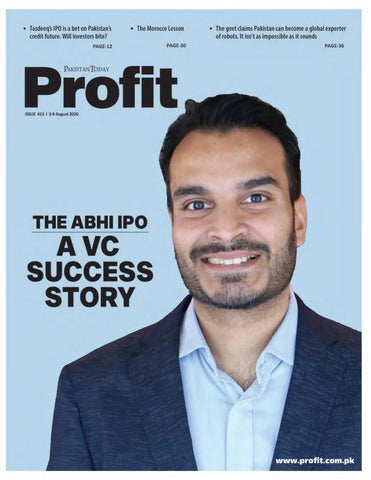
12 Tasdeeq’s IPO is a bet on Pakistan’s credit future. Will investors bite?
17 Pakistan’s food insecurity deepens as families quietly downgrade diets
18 The Abhi IPO: a VC success story
23 PTCL is (probably) about to bid for Easypaisa Digital Bank
25 PICT awakens from slumber, announces entry into trucking business
28 PEMRA’s Cyber Deadline Confuses Urgency With Resilience Zainab Samantash
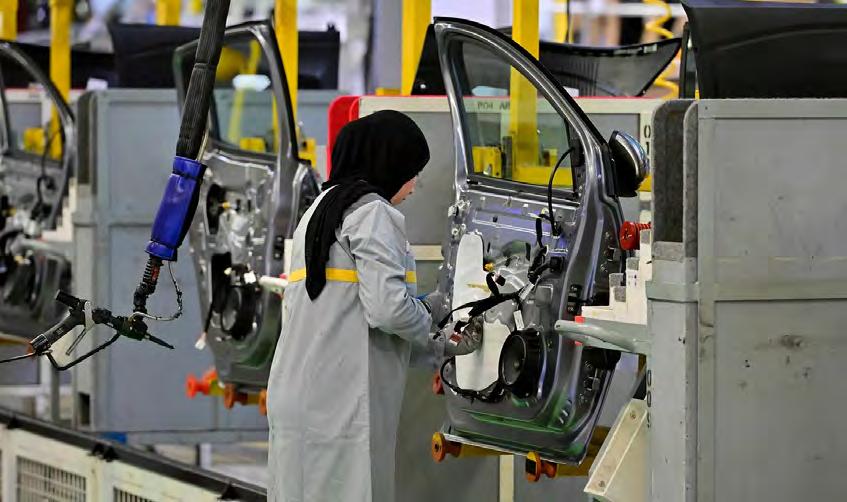
30 The Morocco Lesson
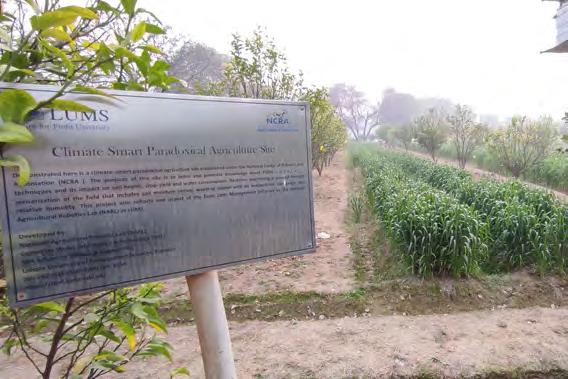
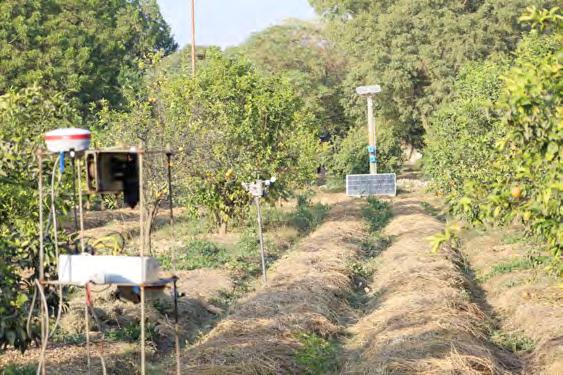
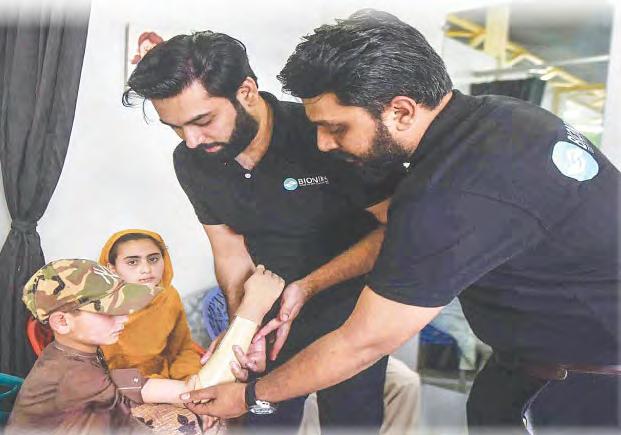
36 The govt claims Pakistan can become a global exporter of robots. It isn’t as impossible as it sounds
Publishing Editor: Babar Nizami - Senior Editor: Abdullah Niazi
Business Reporters: Taimoor Hassan | Usama Liaqat | Zain Naeem | Shahnawaz Ali | Ghulam Abbass
Ahmad Ahmadani | Aziz Buneri - Sub-Editors: Saddam Hussain | Abdul Hameed - Video Producer: Adnan Maqsood
Director Marketing: Muddasir Alam - Regional Heads of Marketing: Agha Anwer (Khi) Kamal Rizvi (Lhe) | Malik Israr (Isb) GM Special Projects Zulfiqar Butt - Manager Subscriptions: Irfan Farooq
Pakistan’s #1 business magazine - your go-to source for business, economic and financial news. Contact us: profit@pakistantoday.com.pk
Tasdeeq’s
IPO is a bet on Pakistan’s credit future.
Will investors bite?
With 41.5 million borrower records and its first annual profit on the books, Tasdeeq is offering 150 million shares at Rs1.90–Rs3 to finance its move from bank-facing credit checks into the far less proven consumer market. This is everything you need to know
By Zain Naeem
In much of the world, a credit score can determine whether someone secures a loan, rents a home or buys a car. In Pakistan, most borrowing still happens beyond the formal financial system.
Although financial inclusion rose from 7% in 2014 to 35% in 2024, 41% of Pakistanis who sought a loan in the past year could not obtain one. Friends and family remain the source of credit for 85% of borrowing households, compared with just 13% for banks and mobile-money providers.
That gap is the opportunity Tasdeeq Information Services hopes to capture. Licensed in 2018, Tasdeeq collects borrowers’ debt and repayment histories and converts them into credit reports, scores and risk-assessment tools for lenders. Its database now covers 41.5 million borrowers across 174 member institutions.
As more Pakistanis enter formal finance—and digital banks, microfinance pro-
viders and lending apps issue more loans—the number of credit checks should rise with them.
Tasdeeq is now taking that growth story to the stock market. Having reported its first annual profit in 2025, the company plans to issue 150 million shares through an IPO, raising capital to expand its consumer business, strengthen its technology and turn credit information into a mainstream financial product.
What is Tasdeeq?
Tasdeeq was established to solve a basic problem in Pakistan’s lending market: banks and other creditors often saw only fragments of a borrower’s financial history. Without a consolidated record, one lender could not easily determine how much an applicant already owed elsewhere, whether previous installments had been paid on time or how frequently the person had recently sought credit.
For example, a small shopkeeper could borrow from Khushhali Microfinance Bank
and later apply for financing from HBL, while HBL might not have a complete view of the applicant’s existing debt or repayment record.
Tasdeeq was built to bring that scattered information into one consolidated record. Incorporated as Aequitas Information Services in 2016 and licensed in November 2018, the company began operations in August 2019 with a focus on microfinance. By December 2021, it had developed the data coverage required to operate as a full credit bureau. It began serving commercial banks in April 2022 and has since expanded its network to 174 institutions, covering 41.5 million individual and commercial borrowers.
Its members include commercial and microfinance banks, microfinance institutions, digital lenders, fintech companies, nonbank financial institutions and Buy Now, Pay Later operators. Tasdeeq is also authorised to collect information from utilities, retailers, insurers and telecommunications companies— potentially useful sources of payment data for people without conventional borrowing
The IPO at a glance
histories.
When a lender receives a loan application, it can query Tasdeeq for a consolidated account of the applicant’s existing debts, repayment record, guarantees and recent credit-seeking activity. Repeated applications or rejections can indicate financial stress that may not otherwise be visible. Tasdeeq delivers this information through a web portal and application programming interfaces, allowing lenders to incorporate bureau checks directly into their underwriting systems.
Before Tasdeeq arrived on the scene, the only real source where credit data was available was the State Bank of Pakistan’s eCIB platform. The problem with eCIB was it was designed by the regulator for, well, regulating. It was a reporting system that stored important data. Tasdeeq came in and decided to add a commercial layer on top of storing credit information, offering scores, borrower alerts, portfolio reviews, recovery tools and customised analytics. In May 2023, it also launched a mobile application through which individuals can access their own credit information. The platform now has 232,000 paying users.
Tasdeeq earns revenue from four principal sources: credit information reports, credit scores, value-added services and specialised analytics or consultancy projects. Its basic business model is volume-driven. Regulated lenders must obtain credit information before issuing loans, so every expansion in formal lending creates more potential queries. Better analytics can also help Tasdeeq capture a larger share of those queries.
Building the database, technology and distribution network required heavy initial investment, supported by TenX, Aequitas and PACRA. Tasdeeq now argues that this investment phase is ending. Revenue rose from Rs90 million in 2021 to Rs320 million in 2025, when it reported its first annual profit of Rs70 million. That transition—from constructing the platform to attempting to scale it—is the central proposition behind the IPO.
The pitch behind the IPO
The timing of Tasdeeq’s IPO is tied to the stage the company believes it has reached. Its first few years were spent building the database, software and institutional connections needed to operate a credit bureau. Revenue rose from Rs90 million in 2021 to Rs320 million in 2025, while the company reported its first annual profit of Rs70 million. Having demonstrated that the basic model can make money, Tasdeeq now wants public capital to finance a more ambitious version of the business.
The company plans to issue 150 million new shares with a face value of Rs1 each, representing approximately 15.8% of its post-IPO shareholding. Of these, 112.5 million shares, or 75% of the issue, will be sold through book-building at a floor price of Rs1.90 and a maximum price of Rs3. The remaining 37.5 million shares will then be offered to the general public. Depending on the strike price, the issue could raise between Rs285 million and Rs450 million before expenses.
There is also a separate pre-IPO placement involving 69 million shares held by existing minority shareholders. These are being sold at Rs2.35 per share to United Bank Limited, Growth Securities, Shama Shabbir Mohammed and Shahid Hameed. This part of the transaction provides an exit to early investors; the money changes hands between buyers and existing shareholders rather than going towards Tasdeeq’s expansion.
The business currently rests on its institutional, or B2B, segment. Banks and other regulated lenders are required to obtain credit information before approving loans, meaning Tasdeeq earns money each time an institution requests a report, score or related service. The model therefore grows with lending volumes. Microfinance, nano-lending and Buy Now, Pay Later companies are particularly useful customers because they issue
large numbers of small, short-term loans. Five digital-bank licences issued by the SBP could add another layer of demand.
That makes B2B a relatively dependable foundation, but not an entirely insulated one. When interest rates rise, borrowing slows or the economy weakens, fewer loan applications can mean fewer queries. Tasdeeq’s larger growth bet is therefore the individual, or B2C, market.
The IPO proceeds will be used to place Tasdeeq’s services inside mobile wallets and payment applications, introduce real-time alerts and help users understand and improve their credit standing. Consumers may also be able to compare financial products and securely share authenticated reports with landlords, employers, visa officers or retailers offering instalment plans. The aim is to turn a credit report from something purchased occasionally into a service that people monitor regularly.
The theoretical market is large. Tasdeeq’s underwriters estimate that selling one Rs349 report annually to each of Pakistan’s roughly 42 million borrowers would create a market of around Rs14 billion. Applying the same calculation to the country’s 77 million employed people produces a potential market of Rs26 billion. These figures illustrate the scale of the opportunity, but they are not realistic revenue forecasts. They assume that millions of Pakistanis will begin paying for a product many do not yet understand or consider necessary. Tasdeeq will have to spend significantly on marketing, education and trust-building to create that behaviour. The underwriters have also not disclosed what proportion of current revenue comes from B2C, making its starting position difficult to judge.
The company also wants to deepen its B2B relationships by embedding data directly into lenders’ loan-origination systems and helping institutions build customised credit models. Further spending is planned on data storage, cybersecurity, disaster recovery and
From investment to profit
Rs90 mn revenue in 2021
Rs320 mn revenue in 2025
3.6x revenue growth in four years
Rs70 mn net profit in 2025— the company’s first
Rs180 mn revenue in the first five months of 2026
real-time processing. Its most ambitious proposal is to use utility, telecommunications and tax data to assess people without conventional borrowing histories. That could widen the market considerably, although its success will depend on data access, quality and regulatory safeguards.
Technology may deliver operating leverage, but this expansion will not run on software alone. Salaries and benefits already account for roughly half of Tasdeeq’s costs. Management says revenue has grown without a corresponding increase in headcount, but expanding consumer marketing, analytics and cybersecurity may still require more specialist staff.
The IPO is therefore financing a transition: from a bureau selling mandatory checks to financial institutions into a broader credit-information platform. The existing B2B business provides the base; B2C is where much of the promised upside—and execution risk—sits.
A moat built on data
Perhaps one of the things that works most in Tasdeeq’s favour is that they are insulated from competition to some extent. Setting up a credit bureau is not as simple as launching an application and asking lenders to sign up. The first hurdle is obtaining a licence. The harder one comes afterwards: building a database large and detailed enough for financial institutions to trust.
A new bureau must persuade lenders to share information, connect its systems with theirs and accumulate enough repayment history to generate meaningful reports. This requires substantial spending on technology, security and institutional integration long before the first report can be sold. It also creates a circular problem. Lenders are attracted to bureaus with comprehensive data, but a
bureau needs lenders before it can build that data.
For an established operator such as Tasdeeq, these barriers become a defensive moat. Its network of 174 institutions and records covering 41.5 million borrowers cannot be recreated overnight. Every new member and loan record potentially makes the database more useful, reinforcing its position and making the market harder for newcomers to enter. A new competitor would have to come in with serious cash and resources to take them on and they would still need time to catch up.
The competitive field is consequently small. DataCheck is Pakistan’s only other licensed private credit bureau. It is more heavily focused on institutional customers, while Tasdeeq is positioning itself as a more commercial and consumer-facing operator. Tasdeeq’s pitch is that it does more than supply basic reports: it offers credit scores, alerts, portfolio reviews, analytics and recovery tools alongside direct access for individual users.
The other alternative is the State Bank’s eCIB platform. But eCIB was built primarily to meet regulatory reporting requirements, not to operate as a commercial credit-intelligence business. Its coverage is centred on institutions within the regulatory reporting system and does not offer the same reach across fintech lenders, Buy Now, Pay Later operators and other non-bank providers. Nor does it provide consumers with the same range of services.
Limited competition is clearly helpful for Tasdeeq, but it is not absolute protection. Financial institutions can still choose between the two private bureaus, while eCIB provides a regulatory baseline. Tasdeeq must therefore compete on the breadth of its data, the quality of its analysis and how easily its products fit into a lender’s systems. The licence keeps the field small; the database determines who wins within it.
What the financial statements say
Tasdeeq’s financial story is one of rapid revenue growth, but only a recent move into profitability. Revenue increased from Rs90 million in 2021 to Rs320 million in 2025. During the first five months of 2026, it generated another Rs180 million—already more than half the previous full year’s revenue. The early performance is encouraging, although five months should not automatically be treated as a full-year forecast.
The company required substantial upfront investment to build its database and technology. Once that infrastructure was established, however, selling an additional report became relatively inexpensive. This explains Tasdeeq’s high gross margins: 78% in 2021, 66% in 2025 and approximately 75% during the first five months of 2026.
The difficulty has been covering salaries and other administrative costs. General and administrative expenses reached Rs170 million in 2023, while the company recorded an operating loss of Rs50 million in 2024. Rising revenue finally absorbed these costs in 2025, producing an operating profit of Rs60 million and a net profit of Rs70 million. For investors, the main question is whether this represents a lasting turning point or simply one good year.
Tasdeeq reported total assets of approximately Rs750 million at the end of 2025. Around Rs571 million—or three-quarters of the total—consisted of the internally developed CIB application. Its value therefore depends on the future cash flows the software is expected to generate. The application undergoes annual impairment testing, and no impairment had been recognised by December 2025.
Years of losses also left Tasdeeq with accumulated losses of around Rs190 million, despite sponsors repeatedly injecting equity.
Inside the balance sheet
Rs750 mn
mn current and non-current liabilities combined Rs571 mn value of the CIB application 76% of assets held in one intangible asset
Its issued capital stands at Rs800 million, while current and non-current liabilities total approximately Rs165 million. Liabilities are modest, but the balance sheet contains little physical collateral against which further borrowing could be secured. The IPO consequently offers Tasdeeq a more practical way to raise growth capital while strengthening its equity base.
The questions investors should ask
An IPO is ultimately a wager on what a company can become, not simply a review of what it has already achieved. For Tasdeeq, that wager rests on formal borrowing continuing to expand, consumers learning to value their credit profiles and new revenue streams growing fast enough to justify ambitious forecasts.
The following questions were put to Mohammad Nadeem, Head of Corporate Finance at Topline Securities Limited, which is underwriting the IPO. The responses address the potential size of Pakistan’s consumer credit-information market, the value of Tasdeeq’s software, its cost structure, the effect of Islamic banking and the reasoning behind its revenue and valuation forecasts. Together, they outline the case being presented to investors—and the conditions that must hold for it to work.
Q1: Credit bureaus are a new phenomenon in a country like Pakistan where borrowing through formalized channels is limited. Do you think there will be a time when credit scores and reports will become as ubiquitous as they are in the West?
Response: Borrowers in Pakistan have more than doubled from approximately 19 million to 42 million from 2021 to 2026. The National
Financial Inclusion Strategy (NFIS), led by the State Bank of Pakistan in collaboration with the Ministry of Finance and other stakeholders, aims to significantly increase access to formal financial services through digital financial inclusion, expansion of credit to underserved segments, SME finance, agricultural finance, housing finance, and innovative financial solutions.
As financial inclusion increases, a larger number of individuals and businesses are expected to enter the formal financial system and seek access to credit. This will naturally increase the demand for credit information, credit scoring, and other bureau services by banks, digital lenders, microfinance institutions, fintech companies, and non-bank financial institutions. The Strategy also emphasizes strengthening market infrastructure and promoting responsible finance, both of which are supported by the availability of reliable credit information.
The structural drivers are already in place. As banking, microfinance, digital lending and nano-lending expand, every new borrower generates a bureau footprint. The mandatory nature of bureau checks for regulated lenders means adoption doesn’t depend on voluntary uptake — it scales automatically with formal-credit growth.
Consumer-side — individuals routinely checking and caring about their own scores — currently lags the West, but the user base is growing. As Tasdeeq scales its targeted marketing through the IPO proceeds and educates individuals on why their credit standing matters, it expects to close that gap faster.
Q2: The company states that there are other applications to credit scores and reports like landlords checking on their tenants, employers checking employees’ credit scores. What percentage of the revenues are
related to this segment and are there plans to market such services to bring Tasdeeq into the mainstream?
Response: Tasdeeq has piloted its mobile app. It is available on android and IOS. Tasdeeq has its planned B2C expansion from the IPO proceeds. The prospectus positions the verified credit profile as a trust-and-verification layer for non-lending contexts (landlord–tenant, employer background checks, visa applications), delivered through the CIR Sharing feature: a consumer-controlled function letting individuals share their digitally-authenticated Credit Information Report directly with banks, employers, landlords or visa officers.
Mainstreaming it depends on IPO-funded consumer marketing and awareness.
Pakistan currently has approximately 42 million borrowers. Assuming the sale of one Credit Information Report (CIR) per borrower at the prevailing price of PKR 349 per report, the addressable market from the existing borrower base alone is approximately PKR 14 billion per annum, assuming an individual checks its credit score only once in a year.
A person’s credit profile provides valuable insights into financial responsibility and payment behavior, making it a useful risk assessment tool for landlords, property managers, rental service providers, and employers. According to the Pakistan Bureau of Statistics (PBS), Labour Force Survey 2024–25, Pakistan has approximately 77 million employed persons, creating a significant opportunity for employment-related background verification. Assuming the sale of one Credit Information Report (CIR) per employee at the prevailing price of PKR 349 per report, the addressable market is approximately PKR 26 billion per annum.
In addition to the formal financial sector, Pakistan has a significant informal market for the financing and leasing of household products, consumer electronics, mobile phones,
motorcycles, furniture and other consumer goods. A substantial portion of these transactions is undertaken by retailers, distributors and service providers who extend credit or installment payment facilities but have limited tools to assess the creditworthiness of prospective customers. Tasdeeq intends to develop a mobile application and digital platform through which individuals may securely share their Credit Information Report, and Credit Score with merchants and service providers. This will enable informal lenders to make more informed credit decisions, reduce default risk, and expand access to responsible financing.
Q3: The intangibles of the company, i.e. the CIB software, make up the primary asset base of the company. Are there expectations of this asset being impaired and how can this impairment be negated in the future?
Response: The CIB application is the Company’s most material asset, carried at PKR 571mn as at December 31, 2025 and classified as an indefinite-life intangible. The auditor conducts annual impairment testing on a value-in-use basis, and no impairment has been recognised — the asset’s recoverable value continues to exceed its carrying value.
Impairment would only arise from a material adverse change in the underlying assumptions — projected cash flows, the discount rate, or the long-term growth rate. That risk is negated in the ordinary course by the drivers those assumptions rest on: growing CIR query volumes, an expanding member-institution and borrower base, and continuity that keeps the platform current. So long as usage and cash flows keep growing, value-inuse stays comfortably above carrying value and no impairment is expected.
Q4: The primary cost that is faced by the company is made up of salaries and wages. Are there plans to implement Artificial Intelligence at the company to decrease some of these costs going forward?
Response: Salaries are the largest cost line, but they’re largely operational and fixed rather than volume-driven. The business is already built for operating leverage: revenue has grown sharply while headcount stayed broadly flat, because the CIR and mobile-app products are technology-delivered with minimal human intervention per transaction — which is why margins have expanded.
Q5: With Islamic banking becoming the norm going forward, how much of the revenues of Tasdeeq are related to Islamic banks and is the CIB application of Islamic banks and
Financial inclusion in Pakistan
25% — How many Pakistanis needed credit in the past year?
2014 — 7%
41% - The number of Pakistanis that could not access a loan
2024 — 35%
Top sources of loans for Pakistani households: Friends
and family —
Manyfamiliesborrowfrommultiplesourcesatatime.
conventional banks similar?
Response: The application is the same. Tasdeeq is a data business — it gathers and sells credit information — and a CIR records a borrower’s obligations and repayment conduct, not the contractual structure of the financing. So an Islamic bank consumes exactly the same product as a conventional one; in the prospectus both sit within the Commercial Banks segment rather than being reported separately.
Tasdeeq’s own operations are Shariah compliant, with a Shariah Compliance Certificate issued by its Shariah advisors. As Islamic banking grows, it simply adds to addressable query volumes — the product doesn’t change.
Q6: Forecasting is being carried out with sales doubling almost each year from 2026 to 2030. What is this growth being predicated on?
Response: growth is high but decelerating over the period. More importantly, it’s underpinned by a clear shift in revenue mix from institutional (B2B) toward consumer (B2C), with B2C overtaking B2B by the end of the forecast.
Three drivers sit behind that shift:
The core institutional CIR base keeps growing on volume — mandatory, structural demand across microfinance, fintech/nano lenders and commercial banks — though its share of revenue falls as consumer income scales faster.
The consumer channel (web portal and mobile app) becomes the main engine, driven
by IPO-funded digital marketing and awareness converting users into paying customers. Lead generation through the app is a genuinely new line, as institutions pay referral fees for borrowers acquired via the platform.
Q7: The FCFE model states that the terminal value after 2030 will be around Rs. 5.6 billion, which will be discounted back to Rs. 2.6 billion. Out of the total equity value of Rs. 3.6 billion, this is more than 70% of the total value. Do you expect this value to be realized?
Response: A 70%-plus terminal-value weighting is normal for a high-growth, asset-light company, not a red flag. The explicit five-year window captures the investment and ramp-up phase, when cash flows are still building and being reinvested; most of the value naturally sits in the mature steady state beyond it. So the high terminal share reflects the growth stage, not an aggressive assumption.
The terminal assumptions are conservative — a modest terminal growth rate, well below nominal GDP and the company’s own forecast, and a standard cost-of-equity build. The floor price sits well below the DCF-implied intrinsic value, so investors aren’t paying for the terminal value in full at entry. So yes, it’s expected to be realised, provided the business reaches the mature, cash-generative steady state the forecast builds toward. n
Pakistan’s food insecurity deepens as families quietly downgrade diets
By Shahzad Paracha
Pakistan is grappling with a deepening food insecurity crisis rooted not in shortage but in affordability, as new government data show households eating less wheat, pulses, milk and meat than six years ago and leaning instead on cheap vegetable ghee just to get enough calories.
The findings, from the Pakistan Economic Survey 2025-26 and the Household Integrated Economic Survey 2024-25, cut against the usual assumption that food security is mainly a supply problem. Enough food exists in the country. What growing numbers of Pakistanis lack is the income to buy it, a distinction that officials say is central to understanding the numbers.
The shift is reflected in the country’s overall diet. Officials said annual per capita food consumption declined from 115 kilograms in 2018-19 to 109 kilograms in 2024-25, underscoring a broad deterioration in household purchasing power and dietary quality rather than a shortage of food supplies.
Monthly per-capita wheat consumption slipped from 7.00 kilograms in 2018-19 to 6.59 kilograms last year. Rice fell from 1.06 kilograms to 0.86 kilograms, pulses dropped from 0.35 to 0.26 kilograms, milk declined from 6.85 to 6.15 kilograms, and meat consumption slid from 0.610.50 kilograms. Vegetable ghee, by contrast, jumped 81 percent, from 0.69 to 1.25 kilograms per person monthly.
That swap, trading protein-rich staples for a cheap, energy-dense fat, is itself a textbook symptom of food insecurity, in which households facing income pressure sacrifice nutritional quality to keep calorie intake up. The survey said such substitutions are compressing dietary diversity, a phrase that understates what nutrition
specialists describe as an early warning sign of worsening food insecurity, particularly for children. The squeeze has been compounded by rising costs. The minimum food basket’s per-capita monthly price climbed 3.2 per cent between July 2025 and March 2026, touching 6,417 rupees in October before easing slightly, a gap between wages and grocery bills that is, at its core, what food insecurity looks like in practice.
The wheat decline is especially significant given Pakistan’s growing population and its reliance on the grain as a national staple. Annualized wheat consumption fell from roughly 84 kilograms to 79 kilograms per person, a trend that could complicate government planning on production targets, strategic reserves, and import needs.
The Auditor General of Pakistan has floated one possible complicating factor.
Pakistan’s repatriation of large numbers of Afghan nationals in recent years, after past estimates reportedly folded in wheat demand tied to Afghanistan, including roughly 500,000 tonnes of wheat-equivalent once exported there. But the survey data offers no direct evidence linking the repatriations to the consumption drop, and officials say the connection would require separate study.
What is clear is less reassuring. Families are quietly downgrading their diets. Less milk for children, meat appearing less often at dinner, smaller portions of pulses the everyday texture of a food insecurity crisis that rarely makes headlines because it unfolds gradually, meal by meal, rather than in a single visible shock.
The findings leave policymakers facing a sharper question than simple food supply. Not just whether Pakistan has enough food, but whether its people can actually afford to eat well, the very definition of food insecurity now settles into millions of households. n
A Pakistani venture-backed company is planning the first domestic public listing of its kind; it’s not quite an exit for VC investors, but it matters anyway
By Farooq Tirmizi
There are two ways to look at the Abhi Microfinance Bank initial public offering (IPO). The first is that it is a small public listing of one of Pakistan’s smaller financial institutions, making the transaction notable, but not particularly ground-breaking. The second is to view it as the first time that Pakistan’s capital markets have been the venue for capital raising by a company that started its life as a venture capital-backed startup, that too barely five years ago.
Needless to say, that latter view is correct, and it is the result of the ambition of Omair Ansari, the founder and CEO of Abhi. Omair possesses a unique combination of talents: the ability to keep a longterm vision in mind, while at the same time having the ability to move with the hustle of a startup founder who needs to make it to the next milestone within a matter of weeks.
That ability to keep both the longterm and short-term in perspective, and make moves that sacrifice neither, is perhaps what resulted in Ansari accomplishing what many before him had dreamed of.
Because here is what Ansari has accomplished: the public listing of Abhi Microfinance Bank is not, strictly speaking, an exit for its venture capital investors, but it does represent the next best thing: public market validation for the valuation of the company, and thus a tangible way to measure the returns they have earned – thus far, still unrealized – on their investments.
And given the fact that Abhi’s investors include arguably the most important venture capital investor of all – the San Francisco-based startup incubator Y Combinator – this matters a great deal. It means that Y Combinator, the investor that sets the trends for all of Sand Hill Road, now has positive (if still unrealized) returns on its Pakistani investments, which may make them – and therefore other US venture capitalists – incrementally more likely to fund the next Pakistani startup that applies for funding.
That positive externality – one that does not directly benefit Abhi, or Ansari personally, but rather the broader Pakistani economy – is part of that long-term mentality that has made Ansari different from his peers. It is not simply a happy coincidence, but rather part of a deliberate strategy. Ansari understands, more than most, that if you are building a company in a market that does not yet exist, you first have to make the market itself.
Abhi’s founding story
Omair Ansari has a surprisingly strong passion for making things work in Pakistan for a person who spent the bulk of his education and career years outside Pakistan. Born in London, Ansari was raised in many countries and educated in Canada, graduating from McMaster University in 2006 before embarking on a career that would have him working in the Middle East, London, and New York in investment management – most recently at Morgan Stanley in New York – before starting Abhi.
He founded the company – along with his cofounder Ali Ladhubhai – in 2021, which was a somewhat fortuitous time in that it was when venture capitalists were most interested in investing in Pakistani startups. Global VCs pumped $350 million into Pakistani startups that year. Ladhubhai had four years of experience in Pakistani banking, along with Pakistani fintech experience that he brought to the table.
Shortly after being founded, the company raised $2 million in a seed round, and shortly thereafter was accepted to Y Combinator’s Summer 2021 batch.
The company launched with an early wage access (EWA) product which allowed individuals to borrow against their salary and have their repayments deducted directly from their payroll, though it quickly expanded into a variety of other lending products mostly targeting small and medium sized businesses.
In April 2022, Abhi announced a $17 million Series A round, led by European venture-capital firm Speedinvest. The round reportedly valued Abhi at approximately $90 million. They followed that round with something rather unique for a Pakistani fintech startup: raising Rs2 billion (then worth $8 million) through a sukuk (Islamic bond).
Towards the end of 2024, Abhi announced that it had raised a $25 million pre-Series B financing package, comprising a mixture of equity and debt. Public announcements did not provide a breakdown between the two components. Pre-Series B implies that the round was likely raised at a valuation close to the Series A valuation.
All of these rounds allowed the company to dive deep into SME lending, mainly working capital financing and build a name for itself as a provider of capital to businesses that might otherwise struggle to get capital from traditional Pakistani banks.
The company also expanded into Saudi Arabia and the United Arab Emirates, though it appears that Pakistan remains the company’s single largest market so far.
The FINCA acquisition
It is a neologism in the fintech world that every fintech company claims to not want to be a bank, but wants to become a bank, whether or not they are willing to admit it to themselves.
You can certainly see why this would be the case. For instance, Abhi started off as a lending non-banking financial corporation (NBFC) licensed by the Securities and Exchange Commission of Pakistan (SECP). That license allowed it to lend with relatively few restrictions, but it could only fund that lending through either its own equity or borrowing, both of which are high cost sources of capital, certainly when compared to the cheap deposit accounts available to the banks, which dominate the lending market in Pakistan.
That strategic disadvantage is what Abhi sought to alleviate with the acquisition of FINCA Microfinance Bank, which – as a licensed microfinance bank – could raise deposits very similarly to normal banks.
FINCA was founded in June 2008 (rather unfortunate timing) as Kashf Microfinance Bank, as a venture of the Kashf Foundation, a charitable foundation, backed partly by the “patient capital” New Yorkbased venture fund Acumen. It operated largely as part of the charitable activities of the foundation.
In 2013, however, after persistent losses, the bank was acquired by the Dutch company FINCA International which invested Rs820 million (then $8.1 million) into the bank. That additional capital allowed the bank to expand its branch network as well as its lending book.
But by the time it went up for sale to Abhi (which acquired it in partnership with TPL Holdings), it was in shambles.
“It was significantly loss making. For the past five years before we took it on, they were not meeting the regulatory capital requirements that the central bank had for it. So, we had a lot of concessions from the State Bank to be able to make this acquisition happen and to turn around the asset,” said Ansari, in an interview with Profit.
Abhi and TPL made the bid to acquire the bank in November 2023 and the transaction closed by January 2025. Abhi now owns 61.6% of the bank and TPL Corporation owns 33.2%. The remainder is held by the Kashf Foundation, with its former investors – FINCA International, Acumen, and the World Bank’s International Finance Corporation (IFC) – exiting.
Turning around the ship in record time
When they completed the acquisition, FINCA was, to put it mildly, not doing well.
Okay, we will not put it mildly: it was almost bankrupt. It had been losing money for so long that its book value (the value of its assets minus the value of its liabilities) was negative, and it continued to lose money every year.
Abhi and TPL injected Rs2.6 billion ($9.3 million) into the bank to help shore up its balance sheet. What helped the most, however, was Abhi moving its profitable lending book onto the balance sheet of the microfinance bank.
“When we inherited the bank only had a loan book size of just about Rs18 billion,” said Ansari. “The loan book now is north of Rs45 billion. So, this is all business that we’ve been able to generate by ourselves. This is all digital that we’ve been able to bring in as well. It’s purely been driven by our own organic growth as opposed to legacy [FINCA loans].”
“We have a few assets sitting outside simply because one of the restrictions on the microfinance license at this point in time is the ticket size for SME lending. We had some larger SME lending that sits on our NBFC entity. However, we’re working with the State Bank now to hopefully change those limits as there should be some changes hopefully happening within the next year or so which will allow us to be able to bring the entire book in. But the majority – over 95% – of our book now sits within the bank,” he said.
Bringing in that profitable loan book helped increase the net interest income of the bank, which allowed it to go from a loss of Rs1.75 billion in 2024 to a profit of Rs1.02 billion by the end of 2025. For the 12-month period ending March 31, 2026 – the latest for which financial statements are available – the bank hit a net income of Rs1.6 billion.
“The good news is that we were able to do [a turnaround] in a much, much quicker time span than we anticipated, given our background in technology as well as really just trying to cut away at the weeds,” said Ansari.
While Abhi’s technological know-how certainly helped, a big part of how the loan book was funded was also through increasing the microfinance bank’s deposits, which was done largely through term deposits raised from individuals. Term deposits, unlike current or savings accounts, tend to be the most expensive kind of deposits a bank can raise.
Ansari acknowledges that this is less than ideal but points out that it may be find for the current stage of the bank’s evolution.
“Remember this was a broken bank so,
at the end of the day, to raise deposits on a loss making institution that didn’t have the capital requirement that the central bank required, etc., that comes with an element of cost of risk. We had to essentially allow for us to be able to raise enough capital to be able to support the growth of the loan book. And the good thing on the second point is that we have a very healthy margins, since our margins on all our products tends to be very high. So we’re not like a traditional bank that has very thin margins to play with.”
“So we said: ‘you know what, at the beginning it’s okay if our cost of capital ends up being a few points higher than what we ideally would like’. Because it allows us to be able to build our track record and book to show profitability – show book size – to then bring down our cost of capital and move it more towards current accounts. So that’s the idea for us. I think going forward this will probably be – barring macro policy shift from key rates perspective – the most expensive that we ever raise capital at going forward because now we’ve been able to prove our profitability, the size of the book that we can manage. Slowly, I think our ability to then start raising capital and our deposit base at a much lower rate is going to be able to feed through.”
“It was very similar to our journey when we started the [SECP-licensed] fintech as well. At first, we raised through sukuks to be able to fund the balance sheet. The first sukuk we did, we raised pretty expensive. It was at KIBOR plus 2.5% and KIBOR was a 20%+ at that point. By the time we did our second sukuk, that dropped dramatically because we were able to prove ourselves to the market that we had a sustainable balance sheet. So, I think that’s kind of our focus going forward is saying ‘look, at the moment, it’s a hand we’re dealt because we’re new to the market, at the end of the day.’ We hadn’t run a bank before.”
Tapping the capital markets
Ansari also understands something that most Pakistanis do not: foreign investors will follow local investors, so if you want foreign investors to come in, you have to show them a local investor-backed success story first.
“Unfortunately, Pakistan remains a market which isn’t, I’d say, completely loved by foreign investors, especially in the growth phase,” he said. “And so, I think it’s very important domestically for us to support our institutions and be able to show international investors that there is a local market that’s there to be able to support during a downturn.”
“So this [IPO] allows us to shore up a
balance sheet and get us completely compliant with all the regulatory requirements of the central bank, but at the same time allows us to be able to put a foothold in the market of showing that if you are a technology company, whether it be fintech or otherwise, that there is a market for you domestically that you can be able to raise capital from and not have to rely on external capital continuously to be able to grow the company. And I think it’s one of the early steps that’s required for any country.”
He favorably cites the example of this happening in other economies, leaning on his decade and a half of experience as an international institutional investor.
“I remember when I invested in Brazil 10-15 years ago, they used to have the same problem. Everyone had the issue and now Brazil, after the listing of the likes of Nubank and others, a lot of people understood that actually, there’s a huge domestic market opportunity over here also, that there’s domestic capital that can support it, and then foreign capital ended up following that,” he said.
“So I think [this IPO is] playing that same kind of stepping stone role for Pakistan. There’s no reason why Pakistan shouldn’t have a listed digital bank and there’s no reason why in the future whenever we want to raise capital to be able to continue to grow Pakistan, we shouldn’t be able to rely on our domestic capital markets as opposed to going externally every time. So that’s really the main reason for us to go after this.”
It also helps that he can tap into the excitement of the novel among domestic investors, who are starved of access to high growth tech startups. “Another part of it – which was why we’re going the IPO route – is that it’s very important for, I think, the domestic market to really get access to some non-traditional banking sector companies which I think we’ve been able to build.”
The licensing conundrum
The most logical question about what comes next for Abhi is that, having graduated from a lending NBFC to a microfinance bank, does it want to take the leap into becoming a fully licensed digital bank, given the fact that the State Bank of Pakistan has tried to encourage the launch of such institutions with a full regulatory framework.
Ansari is surprisingly candid about the trade-offs involved.
“Look, I’ll be fairly honest: the digital banking license as it stands today is less attractive than what we have in place,” he said. “We are essentially running a traditional [microfinance] bank as a digital bank. We have
fewer controls and restrictions than a digital banking license. And the truth is, in a place like Pakistan, similar to places like Kazakhstan or India, etc., you need an omnichannel presence. Running a pure digital stack doesn’t really work. You do need physical presence to be able to build up your liability side of the balance sheet. And so, for us, we’re running this as a digital bank already. And we’re working with the State Bank to hopefully upgrade the license to be regarded as a digital banking license.”
“But to be honest, if it comes with the restrictions that are there currently that are there under the digital banking regime, it’s not something we actually want at this point in time. Even if you look at Nubank, for example, in Brazil, for the longest time they didn’t have a digital banking license. They just had a lending license. So for us, my view is that we run it like a digital bank should be run in the country. And just because we don’t have the license of digital bank doesn’t mean we cannot function similarly enough to a digital bank. The day will come, hopefully, that we are able to upgrade the license should it makes sense. But for now, we’re happy with the licenses that we have.”
That last comment has significant implications for the State Bank of Pakistan: they have functionally created licenses that are – for the entrepreneurs actually building in fintech –useless. They come with more restrictions than regular licenses for other types of financial institutions, and seem geared more towards protecting the power of incumbents than actually creating a new type of financial institution that serves the needs of the public.
Want proof of this assertion? Hey, remember those five weirdly politically connected companies that were granted digital banking licenses in 2023? It has been three years since then. Does even a single person in all of Pakistan use one of those institutions as their primary bank account?
Meanwhile, the one digital financial institution that is doing well enough to consider a public listing is one that worked with existing – non-digital – licenses to cobble together a set of financial institutions that approximate a digital bank.
And they did so while paving the way for the market to get an understanding of these kinds of institutions by raising both debt, and now equity in the domestic capital markets. Along the way, they have also given clear proof that, if you back the right kind of entrepreneur, Pakistan can be profitable for venture capital investors.
We do not want to read too much into this listing, since Pakistan’s history is full of false starts. But it is nonetheless encouraging to see a startup finally achieve a domestic public listing.
This is an IPO for the ages. n
PTCL is (probably) about to bid for Easypaisa Digital Bank
The state-owned telecom company has not formally disclosed the name of its acquisition target, but in an economy this small, there are only a few targets that fit the description
Pakistan Telecommunication Company Ltd has informed investors that it wants to acquire a company. It just has not told them which company.
In a notice sent to the Pakistan Stock Exchange on July 30, 2026, PTCL said its board had approved the submission of a binding offer to acquire a majority shareholding in the issued and paid-up ordinary share capital of an unnamed “target company”.
The announcement contained all the usual caveats. The transaction remains subject to negotiations, satisfactory due diligence, the execution of definitive agreements and the receipt of corporate, regulatory and statutory approvals. The consideration and other commercial terms have not been finalised, and PTCL has not yet signed a definitive agreement.
What was missing was the most basic piece of information: the identity of the business PTCL is trying to buy. The announcement did not even explicitly identify its industry.
For a listed company, this is an unusually cryptic way of announcing a potentially significant acquisition. Confidentiality is normal during competitive sale processes, particularly when multiple bidders are involved. But announcing a binding offer without naming the target creates an odd situation in which shareholders know that PTCL is preparing to deploy capital, while being denied the information required to judge whether that deployment makes strategic or financial sense.
PTCL did, however, leave one conspicuous clue. Its announcement began with the words: “Further to our letter dated July 21, 2023.” That earlier letter was not about telecommunications infrastructure, data centres, broadband or towers. It said PTCL’s board had authorised the company to explore potential investment opportunities in Pakistan’s microfinance sector and that any material development would be disclosed to the stock exchange.
The reference sharply narrows the field.
There are relatively few microfinance institutions in Pakistan large enough to justify a binding majority-stake offer by PTCL. There
are fewer still whose controlling shareholders are known to be considering a sale. And there is only one large digital financial-services business that was closely associated with a telecommunications company PTCL has just acquired, but which was deliberately left outside that transaction.
That business is Easypaisa Digital Bank. PTCL has not confirmed that Easypaisa is the target. Until it does, the identification remains an inference rather than a reported fact. Yet the chronology, the ownership structure and the wording of PTCL’s disclosures make Easypaisa by far the most plausible candidate.
The trail begins in 2022
The story begins not with PTCL, but with Telenor.
In July 2022, Norway’s Telenor Group began a strategic review of its Pakistan business as it reconsidered the position of its operations in a difficult and increasingly capital-intensive market. The company had already recorded a substantial impairment relating to Pakistan, citing deteriorating macroeconomic conditions and an adverse ruling concerning the renewal of its telecommunications licence.
A year later, in July 2023, PTCL announced that it had been authorised to explore investments in the microfinance sector. The announcement was broad enough to preserve flexibility, but its timing was notable. Telenor owned both a major mobile operator and a controlling interest in one of Pakistan’s largest branchless-banking and digital-payments platforms.
Then, on December 14, 2023, Telenor announced that it had agreed to sell its Pakistani telecommunications operations to PTCL.
The deal included Telenor Pakistan’s mobile business and Orion Towers, its telecommunications-tower company. The agreed enterprise value was approximately Rs108 billion, or NOK5.3 billion on a cash-and-debtfree basis. Telenor Pakistan had around 45
million customers at the time the agreement was announced.
But Easypaisa was not included.
That distinction mattered. Easypaisa had originated as a partnership between Telenor Pakistan and Tameer Microfinance Bank, launching in 2009 as one of Pakistan’s earliest large-scale branchless-banking services. Telenor subsequently acquired full ownership of the bank before selling a 45% stake to Ant Financial, now known as Ant Group, in 2018 for $184.5 million. Telenor retained the remaining 55% and therefore continued to control the institution.
The telecommunications company and the bank were related, but they were not the same legal asset. PTCL’s acquisition of Telenor Pakistan therefore did not automatically give it control of Easypaisa.
The telecom transaction also took considerably longer to close than initially anticipated. The Competition Commission of Pakistan approved the acquisition in October 2025, subject to an extensive set of conditions, while the Pakistan Telecommunication Authority issued its no-objection certificate in December. PTCL finally completed the purchase of Telenor Pakistan and Orion Towers on December 31, 2025. By then, Easypaisa itself had changed.
In January 2025, the State Bank of Pakistan granted the institution Pakistan’s first digital retail bank licence. Telenor Microfinance Bank was renamed Easypaisa Bank Ltd, turning what had long been perceived primarily as a mobile wallet into a fully licensed digital bank with the ability to accept deposits, extend credit and offer a wider range of regulated financial services.
The next clue appeared in June 2026. Telenor was reported to have appointed Citigroup to explore the sale of its 55% controlling interest in Easypaisa. Such a transaction would allow the Norwegian group to complete its effective withdrawal from Pakistan after selling the mobile network to PTCL. Reports suggested that the stake could attract a valuation of several hundred million dollars, although neither Telenor nor Easypaisa announced an
agreed transaction. Just weeks later, PTCL’s board approved a binding offer for a majority stake in an unnamed company, expressly linking the move to its July 2023 announcement about microfinance investments.
The pieces fit unusually neatly.
PTCL began examining microfinance investments while Telenor was preparing to exit Pakistan. It bought Telenor’s mobile and tower businesses but did not acquire Easypaisa. Telenor then reportedly put its 55% interest in Easypaisa up for sale. PTCL has now approved an offer for a majority stake in a business connected to its 2023 microfinance plans.
None of this proves that Easypaisa is the target. Another microfinance institution could theoretically be for sale, and PTCL could yet surprise the market. But the exact size of Telenor’s holding — 55%, and therefore a majority — corresponds directly with the language used in PTCL’s latest announcement. In an economy with dozens of large digital banks and telecom-backed financial platforms, such an identification would be speculative. Pakistan does not have such an economy.
Why Easypaisa is worth buying
Easypaisa is attractive partly because it is no longer merely a payments application.
The business combines a nationally recognised consumer brand, a large mobile user base, a low-cost deposit franchise, a regulated banking licence and more than a decade of transactional data. That combination is difficult to reproduce, even for a company with PTCL’s telecommunications infrastructure and customer reach.
Easypaisa’s 2025 financial results illustrate how rapidly the institution has developed. The bank reported profit after tax of approximately Rs17 billion, compared with Rs3.4 billion in 2024. The headline increase should be treated cautiously: around Rs10.8 billion of the 2025 profit resulted from the recognition of a deferred tax asset relating to unabsorbed tax depreciation and accumulated business losses. Even after accounting for that one-off tax benefit, however, the underlying numbers were strong. Revenue increased by approximately 19% to Rs46.1 billion. Non-mark-up income rose by nearly 38%, while operating expenses increased by a more restrained 7%. The costto-income ratio improved to 73.1% from 80.9%, suggesting that the bank is beginning to benefit from scale. Its deposit base may be the more strategically important number.
Easypaisa ended 2025 with deposits of approximately Rs127.7 billion, an increase of nearly 68% over the previous year. Almost 98% of those deposits were held in current or savings accounts, giving the bank an unusually
inexpensive source of funding. Its registered customer base exceeded 59 million, while monthly active users increased by roughly 24% to 20 million.
The bank’s lending business remained relatively modest, with advances of about Rs26.9 billion and a loan-to-deposit ratio of roughly 20%. That may be a limitation, but it is also an opportunity. Easypaisa has already gathered a large pool of low-cost deposits and transactional data without yet fully converting those relationships into credit, savings, insurance, merchant services and investment products. Its capital position also appears capable of supporting expansion. Easypaisa reported equity of Rs30.9 billion and a capital adequacy ratio of 20.4% at the end of 2025, comfortably above basic regulatory requirements. Its gross non-performing-loan ratio was approximately 4%, with loan-loss coverage of more than 144%.
The momentum continued into 2026. During the first quarter, Easypaisa reported profit after tax of Rs1.49 billion and profit before tax of Rs3.66 billion, with revenue increasing by around 24% compared with the same period a year earlier. Deposits reached approximately Rs153.4 billion by the end of March, up more than 50% year-on-year, while the current and savings account share remained close to 98%. For a conventional bank, such a deposit base would require a large physical branch network. Easypaisa has built it primarily through mobile accounts, agents and digital distribution. That model places it in the path of one of the clearest structural shifts in Pakistan’s economy.
During the January-to-March 2026 quarter, Pakistan processed approximately 3.7 billion retail-payment transactions worth Rs168.8 trillion. Digital channels accounted for 92% of transaction volume. Mobile-banking applications alone processed approximately 2.9 billion transactions, representing 78% of all digital payments during the quarter, with a value of roughly Rs42 trillion.
The value of cash and over-the-counter payments remains significant, but the direction is unmistakable. Pakistan’s consumers increasingly initiate transactions through mobile applications rather than bank branches or paper instruments. Every salary payment, utility bill, merchant purchase, person-to-person transfer and government disbursement that moves online increases the potential relevance of platforms such as Easypaisa.
The telecommunications infrastructure supporting that shift is already enormous. Pakistan has crossed 200 million mobile subscriptions and has around 160 million mobile-broadband subscriptions, according to the latest data published by the Pakistan Telecommunication Authority. For PTCL, the strategic logic is therefore straightforward. A telecom operator
provides connectivity. A digital bank provides the transaction layer that sits on top of that connectivity.
Owning both would allow the PTCL group to participate in a greater share of the economic activity generated by its network. The company could theoretically combine mobile connectivity, broadband, identity verification, billing, merchant acquiring, remittances, consumer credit and digital deposits within the same broader group.
There is, however, a complication: PTCL already owns a bank.
U Microfinance Bank, commonly known as UBank, is a subsidiary of PTCL and operates the UPaisa branchless-banking service. Acquiring Easypaisa would therefore leave the group controlling two regulated financial institutions with overlapping product categories.
That overlap does not necessarily make the acquisition irrational. Easypaisa is substantially larger as a consumer digital-payments platform and possesses a brand that would be extremely expensive to recreate. PTCL could keep the two banks focused on different customer segments, combine selected operations or eventually pursue a broader restructuring.
But the overlap would attract regulatory scrutiny. The State Bank would want to understand the proposed ownership and governance arrangements. The Competition Commission could examine concentration in digital wallets, branchless banking, merchant payments and telecom-linked financial services. PTCL would also need to explain how it plans to manage customer data across telecommunications and banking businesses.
Ant Group’s 45% stake introduces another layer. Unless Ant also sells, PTCL would not be purchasing an entirely owned subsidiary. It would be entering into a partnership with one of China’s largest financial-technology groups, inheriting shareholder arrangements, governance rights and potentially important technology relationships.
The commercial appeal is nevertheless evident. PTCL would be buying an established bank at precisely the point at which its costly early investment in customer acquisition, regulatory compliance and technology is beginning to translate into deposits and profits.
Telenor’s final exit
For Telenor, a sale of Easypaisa would mark the closing chapter of a two-decade presence in Pakistan.
Telenor Pakistan began commercial mobile operations in 2005 and became one of the country’s largest telecommunications companies. But Pakistan’s mobile market became increasingly difficult for international operators. Heavy taxation, spectrum costs, currency depreciation, repeated requirements
for capital expenditure and exceptionally low consumer spending in dollar terms made it difficult to earn returns comparable with those available elsewhere.
Telenor’s decision to sell reflected both Pakistan-specific pressures and a broader strategy of concentrating its Asian investments in markets where it could achieve greater scale. When it announced the PTCL transaction in 2023, the group explicitly argued that consolidation would help create a stronger operator and improve the long-term sustainability of Pakistan’s telecom sector.
The sale transferred Telenor Pakistan’s subscribers, spectrum, infrastructure and employees into a group that already owned Ufone. On the basis of PTA’s published subscriber shares, Telenor had around 21% of the mobile market and Ufone around 15%, compared with approximately 36% for Jazz and 27% for Zong. Combined, the two PTCL-controlled mobile businesses would have a subscriber position broadly comparable with Jazz.
Pakistan is therefore moving from four major national mobile operators towards three large groups: Jazz, Zong and the combined Ufone-Telenor business. The brands and networks may remain operationally distinct during the integration period, but the underlying ownership has already consolidated.
The Competition Commission’s approval conditions indicate how seriously regulators regard the concentration risk. PTCL was required to maintain separate governance arrangements during the integration process, avoid cross-subsidisation except on an arm’s-length basis, preserve non-discriminatory access to infrastructure and interconnection, and submit to independent compliance monitoring. The approval also contained provisions designed to prevent predatory pricing and ensure that transaction efficiencies are passed on to consumers. An Easypaisa acquisition would extend that consolidation beyond mobile connectivity.
PTCL’s group would encompass the country’s dominant fixed-line network, a large broadband business, two major mobile subscriber bases, tower infrastructure, UBank and, potentially, Pakistan’s largest home-grown digital financial-services brand. That could create a more financially resilient national telecommunications and technology group, with earnings spread across connectivity, banking, payments and data services.
It could also give the state-linked PTCL group an unusually large position at the intersection of communications and finance.
The balance between those interpretations will depend on matters that PTCL has not yet disclosed: the identity of the target, the acquisition price, the source of financing, the treatment of minority shareholders and the integration plan.
Price will be particularly important. Easypaisa is growing rapidly, but digital-banking valuations are highly sensitive to assumptions about future lending, customer monetisation and regulatory costs. A large registered user base does not automatically produce high profits, and the bank’s 2025 earnings were materially enhanced by a one-off deferred tax benefit. PTCL has also only recently completed the Rs108 billion purchase of Telenor Pakistan and is still undertaking the difficult work of integrating the mobile operations.
Buying Easypaisa could reunite the mobile and financial-services assets Telenor built in Pakistan under a new owner. It could give PTCL the strongest local platform from which to compete as payments migrate from cash to
mobile applications. And it could complete Telenor’s departure from the country while accelerating consolidation in two regulated industries at once.
Or PTCL’s unnamed target could be something else.
Formally, investors do not yet know. The company has disclosed a binding offer but neither a name nor a price, leaving the market to reverse-engineer the transaction from a threeyear-old announcement and the small number of assets that satisfy its description.
That exercise points overwhelmingly towards Easypaisa Digital Bank. The remaining question is not whether the clues fit. It is why PTCL is still unwilling to say the name out loud. n
PICT awakens from slumber, announces entry into trucking business
Three years after the end of its contracts to manage a portion of the Karachi Port, the company is putting its logistics expertise back onto the market, this time in last-mile trucking
For three years, Pakistan International Container Terminal Ltd has existed as something of a contradiction: a container-terminal company without a container terminal.
That contradiction may finally be coming to an end.
On July 27, PICT informed the Pakistan Stock Exchange that it had entered the logistics-services business. The company said it would begin delivering containers from marine terminals, transporting cargo, handling containers at terminals and offering last-mile delivery. Over time, it intends to provide integrated logistics services and manage dry ports and container terminals. In other words, PICT is going into trucking — although management’s ambitions extend beyond owning or contracting a fleet of lorries. The apparent objective is to build a company that can take responsibility for cargo after it has been unloaded from a ship, move it out of the port, store or process it at an inland facility and deliver it to the importer’s warehouse or factory. The announcement was careful not to overpromise. PICT said the initial financial impact would be limited and would depend on the development and volume of the business. It nevertheless described the move as part of a long-term growth strategy that would draw on the company’s operational expertise, infrastructure, industry knowledge and customer relationships.
It is a sensible enough direction for a former port operator. PICT spent more than two decades dealing with shipping lines, freight forwarders, customs agents, importers, exporters and the thousands of truck movements required to keep a container terminal functioning. If there is any business adjacent to terminal management in which the company should possess institutional knowledge, it is the movement of containers between the port and the rest of the country.
Yet the announcement is more consequential than an ordinary corporate expansion. It is an attempt to revive a listed company whose principal business disappeared almost overnight in June 2023 — and it comes less than a week after a new controlling shareholder formally completed its takeover. PICT is not merely adding trucking to an existing port business. It is being rebuilt around logistics because the terminal that once generated nearly all its revenue no longer belongs to it.
A port company loses its port
PICT’s former business model was based on a 21-year build-operate-transfer concession granted by the Karachi Port Trust.
The concession began on June 18, 2002 and gave the company responsibility for con-
structing, developing, operating and managing a common-user container terminal at the East Wharf of Karachi Port. At its peak, the terminal had annual handling capacity of more than 750,000 twenty-foot equivalent units and was equipped with six ship-to-shore cranes. PICT was also unusual in being Pakistan’s only publicly listed port-terminal operator. (Pict)
The concession was valuable because it placed the company at one of the narrowest points in Pakistan’s trade infrastructure. Importers and exporters may choose their shipping lines, customs agents and trucking companies, but containers entering through specific berths must be processed by the operator controlling those berths. That creates an attractive business when cargo volumes are healthy. Terminal operators charge for handling, storage and various ancillary services, while the concession structure limits the number of direct competitors operating within the same physical location.
In 2022, PICT generated revenue of Rs12 billion and profit after tax of Rs2.73 billion. Even in 2023, when it operated the terminal for only part of the year, sales reached Rs6.39 billion and net profit was Rs1.8 billion. (Data Portal) But the concession had a fixed expiry date.
On June 17, 2023, the 21-year term ended. The terminal and relevant operating assets reverted to Karachi Port Trust, and PICT transferred the operations to a new operator. Its former parent, the Philippines-based International Container Terminal Services Inc, subsequently treated PICT as a discontinued operation caused by the expiry of the concession. (ICTSI)
Karachi Port Trust did not renew the arrangement with PICT. Instead, it signed a new 50-year concession with a joint venture led by the UAE’s AD Ports Group. The new company, Karachi Gateway Terminal Ltd, took responsibility for the same East Wharf container facilities. AD Ports said the incoming joint venture would invest $220 million during the first ten years, including work to deepen berths, extend quay walls and increase storage capacity. It planned to raise annual container capacity from 750,000 to one million TEUs and accommodate larger vessels. AD Ports described the historical terminal as a business generating around $55 million in annual revenue and roughly $30 million in earnings before interest, tax, depreciation and amortisation. (adportsgroup.com)
Those figures illustrate what PICT lost. This was not a small contract among several business lines. The concession effectively was the company.
Once it expired, PICT retained its corporate existence, stock-exchange listing, cash, investments, employees, legal obligations and some peripheral assets. What it no longer possessed was the right to operate the berths that had produced nearly all its operating revenue.
Three years of treasury management
The financial statements after the handover make the scale of the collapse clear. PICT reported no operating revenue in 2024. In 2025, it generated only Rs10 million, arising from an agreement to provide technical and management services to related-party Sky Media. The cost of providing those services was Rs8.97 million, leaving gross profit of just over Rs1 million.
That was not enough to support a listed company with administrative costs of Rs242.8 million. PICT stayed afloat through its balance sheet. It earned Rs353.6 million of other income in 2025, largely from cash and investments. Profit before tax was Rs104.7 million, but a Rs238.7 million tax charge — including a substantial prior-year provision — pushed the company into a net loss of Rs134 million. The first quarter of 2026 looked much the same. Revenue was Rs2.5 million and gross profit only Rs500,000. Other income, by contrast, was Rs85.7 million, allowing the company to report profit after tax of Rs47.7 million. PICT itself said it was managing its treasury operations to preserve shareholder value while evaluating new opportunities. (Pict)
At the end of March 2026, it held Rs2.87 billion in short-term investments and Rs493.8 million in cash and bank balances. Total assets were Rs3.93 billion, against liabilities of Rs2.58 billion and shareholder equity of Rs1.35 billion.
PICT was therefore not an empty company in the literal sense. It had liquidity and net assets. But economically, it had become a treasury portfolio wrapped inside the legal structure of a former port operator. The company’s own governance arrangements reflected that diminished scale. Its 2025 annual report explained that the chief financial officer and company secretary positions were combined as a cost-saving measure, while the internal-audit function had been outsourced without a designated internal-audit head because of the company’s limited operations. The board repeatedly told shareholders that it was scanning the market for suitable opportunities. For nearly three years, however, nothing emerged that could remotely replace the terminal concession.
The eventual answer would come not from the old owner, but from a change in control.
New owners buy a listed shell
ICTSI’s continued ownership of PICT made progressively less strategic sense after the Karachi concession expired. ICTSI is a global port operator. PICT no longer operated a port. In March 2026, PICT disclosed that ICTSI Ltd had transferred its ownership of InnoVest Mauritius Ltd — the offshore company
through which the PICT stake was held — to Seychelles-incorporated Sea Link Group Ltd. The acquisition documents were unusually blunt about the target.
Sea Link and its associates said PICT’s concession had expired, its asset base and business had declined and it no longer had a meaningful footprint in a relevant market. They described the company as being acquired “merely as a shell company against a token consideration”. The future plan was to retain the listing and use PICT as a vehicle through which capital could be raised to acquire, develop and expand businesses. Sea Link agreed to pay $200,000 for all the shares in InnoVest Mauritius. Through InnoVest and its subsidiary Aeolina Investments, the offshore structure held 87 million PICT shares, equivalent to 79.71% of the listed company. The filing translated that consideration into an implied price of approximately Rs0.64 per PICT share. That figure was dramatically below the Rs42.13 per share Sea Link was required to offer minority investors under the public tender process. The difference should not automatically be read as evidence that ICTSI gave away billions of rupees of value. Sea Link was buying the offshore holding company, together with whatever obligations, risks or structural complications accompanied it, rather than purchasing clean PICT shares directly. The acquirer’s own description of the listed company as a shell also suggests the purchase price reflected the absence of the concession rather than the stock market’s valuation of PICT’s cash and prospective reuse.
Nonetheless, the gap is striking. It reveals how differently the former strategic owner and public investors valued a company that had lost the asset around which it was created.
Sea Link initially offered to acquire another 9.2 million shares, or 8.43% of PICT, from public shareholders. In the end, only 889,087 shares were transferred through the tender offer. Combined with the shares acquired through the offshore holding structure, Sea Link and its associates ended up with 80.52% of PICT.
The transfer and change of control were formally completed on July 21. Six days later, PICT announced its entry into logistics.
The timing leaves little doubt that the new business plan belongs to the new owners.
Who is Sea Link?
Sea Link Group is controlled by Bilal Shahid and Umer Shahid. The Seychelles company itself was incorporated only in June 2025, but its acquisition filing presents it as part of a broader shipping and logistics operation. According to the filing, the group’s activities include liner and feeder shipping services, non-vessel-operating common-carrier operations, full and less-than-container-load cargo, project and breakbulk cargo, refrigerated transport, customs clearance, warehousing,
multimodal transportation, last-mile delivery and container-terminal operations.
Sea Link is acting alongside Euroasia Terminal (Private) Ltd, a Pakistani company incorporated in 2020. Euroasia describes itself as an investment vehicle focused on ports, maritime logistics, container handling, stevedoring, inland container depots, bonded warehouses, freight stations and port-adjacent storage facilities. The two acquiring companies have the same ultimate beneficial owners. That background explains why PICT is moving into logistics rather than becoming a generic investment holding company. The buyers have not simply acquired a stock-exchange listing into which an unrelated factory or consumer business will be injected. They appear to be using the shell to consolidate and expand activities they already understand: shipping, cargo handling, storage and inland transport. PICT offers them several things.
First, it provides a listed platform capable of raising equity or debt from the capital markets. Building an integrated logistics group requires working capital, vehicles, handling equipment, yards, warehouses, information systems and potentially acquisitions. A listed company can, at least in principle, raise those funds more efficiently than a collection of private entities. Second, PICT retains a recognised name within Pakistan’s maritime industry. The brand is associated with container handling even though the company no longer controls the terminal.
Third, it has cash and investments that can help finance the initial phase of the new business, although a large portion of its balance sheet is offset by payables and other liabilities.
Fourth, it retains at least one potentially relevant physical asset. PICT’s quarterly accounts disclose a dry-port facility in Gadap Town, Karachi. The asset is fully depreciated and has a carrying value of zero, but its existence could be useful in a business centred on moving containers away from congested marine terminals and processing them inland.PICT has not explicitly said that the Gadap facility will anchor the new logistics operation. But when management refers to leveraging existing infrastructure and developing dry-port management, it is the most obvious disclosed asset to which that language might apply.
From the quay to the customer
The strategic logic behind port-to-door logistics is compelling. A container’s journey does not end when it is lifted from a ship. It must be placed in a yard, cleared through customs, collected by a haulier, transported through Karachi and delivered either directly to a customer or to an inland depot. Empty containers must then be returned, stored or repositioned.
Each step is often handled by a different
party. That fragmentation creates delays, duplicated paperwork and disputes over responsibility. A logistics operator capable of coordinating the full movement can sell reliability rather than simply transport. For PICT, trucking is therefore the entry point rather than necessarily the final product. The company’s announcement refers not only to road transport but also to cargo handling, integrated logistics and dry-port or container-terminal management. The new owners’ background in shipping and freight forwarding could allow PICT to combine ocean transport arrangements with inland handling and delivery.
There are also natural customer relationships to exploit. Shipping lines need dependable hauliers to evacuate containers from terminals. Importers want predictable delivery times and visibility over their cargo. Exporters need containers positioned at factories and returned to ports before vessel cut-off times.
A former terminal operator should understand where delays occur and what information customers need. Whether PICT retains enough of the former operating organisation to convert that knowledge into a new business is less certain. Terminal management and trucking share a supply chain, but they are not the same economic activity. A port concession is a scarce, location-specific right with substantial barriers to entry. Trucking is highly fragmented and intensely competitive. PICT will be competing against established logistics companies, shipping agencies, freight forwarders and thousands of independent truck owners. Customers may value reliability, but they are also extremely sensitive to price. Fuel costs, vehicle financing, maintenance, security, driver availability and empty return journeys can quickly consume margins. The company must also decide whether it wants to own trucks or operate an asset-light model using contracted hauliers. Ownership offers greater control but requires capital and leaves the company exposed when volumes fall. Contracting requires less investment but makes service quality harder to guarantee.
PICT’s statement that the immediate financial impact will be limited suggests a cautious rollout. It may initially coordinate transport through third-party fleets, using the new owners’ customer base and shipping connections, before committing substantial capital to vehicles or depots. That would be prudent. The company has only just emerged from three years without a meaningful operating business and should not confuse having cash with having unlimited room for experimentation.
Can PICT become more than a shell?
The central question is whether PICT can build a business large enough to justify its continued existence as an independently listed company.
Replacing the old concession will be difficult. In 2022, the terminal generated Rs12 billion in annual revenue. In the first quarter of 2026, the residual company generated Rs2.5 million. The distance between those two figures is enormous.
Even a successful trucking operation may produce much lower margins than a container terminal. PICT would need substantial volumes or a broader range of services — freight forwarding, warehousing, customs support, depot operations and perhaps terminal-management contracts — to reconstruct an earnings base comparable with its former one.
The new owners appear to understand that. Their acquisition documents did not promise merely to buy a few trucks. They described PICT as a capital-raising vehicle for the acquisition and development of multiple businesses. The July announcement similarly presents last-mile delivery as part of an integrated logistics and dry-port strategy.
The likely plan is therefore to use trucking as the first visible operating activity, then add or inject related logistics assets over time.
That makes the current PICT less a revival of the old company than the creation of a new one inside the old legal shell.
Its name, listing and maritime history remain. Its controlling shareholder, commercial model and source of future earnings have changed. Instead of collecting fees from containers passing through berths it exclusively controlled, PICT must now compete to move those containers after they leave terminals operated by somebody else.
There is a certain irony in that arrangement. The company that once controlled a gateway into Karachi Port will now be lining up alongside other transporters outside its gates.
Yet the move is more credible than allowing PICT to remain a treasury portfolio indefinitely. The new owners have relevant logistics experience, the company has liquidity, and its residual dry-port infrastructure may offer a base from which to expand.
The announcement is still only a beginning. PICT has not disclosed the size of its fleet, expected volumes, major customers, capital expenditure, revenue targets or whether the logistics business will be built organically or through acquisitions. Until those details emerge, investors are being asked to value a strategy rather than an operating enterprise.
Still, after three years of earning more from bank deposits and mutual funds than from moving cargo, PICT has finally found something to do.
The port concession is gone. The company is staying — and this time it intends to follow the containers out onto the road. n
OPINION
PEMRA’s Cyber Deadline Confuses Urgency With Resilience Zainab Samantash
Following coordinated attacks on broadcasters, PEMRA gave TV channels three days to file a cybersecurity plan and about a fortnight to carry it out. The financial sector’s experience shows why that timeline confuses emergency response with resilience, and why Pakistan keeps making the same mistake, one sector at a time
Across the world, cybersecurity is moving from the server room to the regulatory rulebook, becoming a condition of doing business rather than solely an internal technology concern. But that shift exposes a difficulty legislation alone cannot solve: the hard part of securing critical infrastructure is not declaring that it must be secured. It is building the capacity to secure it which cannot be ordered into existence on a three-day timeline.
Pakistan has just supplied a vivid illustration. After coordinat-
The writer is Head of Legal Affairs & Company Secretary at JazzCash, and was formerly Group Head of Legal Affairs at SadaPay. She holds an LL.M. from Harvard Law School and writes on financial regulation and digital finance in emerging markets. The views expressed here are personal and do not reflect those of JazzCash or any other organisation
ed attacks on multiple broadcasters in March, Pakistan Electronic Media Regulatory Authority (PEMRA) directed satellite television licensees to submit a cybersecurity roadmap within three working days; and to complete the substantive measures, like appointing chief information security officers, standing up monitoring systems and commissioning third-party audits, by 4 August, roughly a fortnight later.
Some controls, such as breach reporting, log preservation and resetting exposed credentials, can properly be required within days. A three-day roadmap may therefore be defensible as an emergency information-gathering measure. The error is treating that roadmap, and the fortnight that follows, as if they constitute a durable cybersecurity programme. Governance, specialist personnel, procurement, testing and repeated supervisory review cannot be meaningfully assembled in two weeks.
The deadline still reveals a familiar pattern: Pakistan regulates cyber risk reactively, sector by sector, after a breach rather than before one; and without a common baseline tying those sectors together.
This is where Pakistan's financial sector becomes instructive: it faced similar problems and answered them in the opposite order. Over the past decade, the State Bank of Pakistan (SBP) has built its cyber and technology-risk regime in deliberate stages. Its 2017 technology-governance framework established baseline obligations for banks, development finance institutions and microfinance banks across information security, third-party risk and incident reporting, including a requirement to report serious cyber incidents within forty-eight hours.
Crucially, the framework was expressly risk-based rather than one-size-fits-all, permitted phased implementation and gave institutions more than a year to comply. In October 2025, SBP extended this approach through a dedicated technology-risk-management framework for electronic money institutions, payment system operators and payment service providers. It again calibrated implementation to the institution’s size and technological complexity and gave the sector until 31 March 2026 to comply. The regime is demanding and far from perfect. But it was built incrementally, not compressed into a post-incident deadline.
The sequence is the point. The SBP set its standards against a capability the sector had been given time, guidance and support to build; PEMRA fixed the outcome and the deadline first, and left the capability to appear on its own. Two lessons follow.
The first is that capability has to precede the mandate, and obligations should scale to it. The SBP built its expectations against infrastructure that institutions could realistically stand up, calibrated the burden to the risk, heavier for large and complex institutions, lighter for small ones, and gave everyone a runway. A rule that fixes a deadline before it names an achievable, proportionate method is not regulation so much as an instruction to improvise.
The second, and more serious, is that a mandate without the surrounding architec-
ture manufactures risk rather than reducing it. An impossible deadline does not produce security; it produces a document, a roadmap filed to demonstrate motion while the attacker, who does not read submitted PDFs, carries on. Requiring a named CISO on a compressed timeline is worse still: it places nominal accountability on one person without the budget, authority or institutional support to discharge the role. If the audit finds gaps, that individual already owns them and accountability is handed over without the means to have earned it.
The map is fragmented. The SBP sets the rules for financial institutions. The Pakistan Telecommunication Authority governs telecom networks through its critical-infrastructure security regulations. The Securities and Exchange Commission issues guidance for firms under its remit, beginning with a dedicated framework for insurers in 2020. The newly created Pakistan Virtual Assets Regulatory Authority has also identified cybersecurity as a core requirement of the licensing framework it is developing for virtual-asset businesses. PEMRA has now added broadcasters to the list. A single company operating across these sectors can be accountable to several of them at once, reconciling requirements that were never designed to fit together.
Pakistan keeps promising to knit this together. A National Cyber Security Policy in 2021 envisaged central coordination which never fully arrived. More recently, the government has announced that it is preparing a Cyber Security Act that would establish a national Cyber Security Authority. But as of mid-2026, the legislation has not been enacted
and the proposed authority does not yet exist. In the meantime, the national and provincial Computer Emergency Response Teams (CERTs) handle incident response, and the National Threat Intelligence System monitors threats around the clock. But none of them sets binding security standards for the sectors themselves. So each regulator improvises its own, and PEMRA's three-day order is what that vacuum produces: overlapping expectations, inconsistent baselines, and gaps at the seams, precisely where attackers work.
Beneath all of this is a shift many boardrooms have not absorbed: cybersecurity is becoming a licensing condition. When a regulator converts security expectations into mandatory obligations, persistent non-compliance becomes a regulatory, and potentially licensing, risk. Security used to sit in the cost column, treated primarily as something the technology team owned. It is becoming a licensing and governance question, and that makes it a matter of business strategy.
The finance-to-broadcast comparison has a limit worth naming: a television channel is not a bank. It has a different threat model and holds no customer deposits. But that argues for the lesson, not against it. The value of the financial sector's experience is not that its rulebook transfers wholesale; it is that it demonstrates the method: build the capability, then require it. The method is sector-agnostic and the three-day deadline ignores it.
None of this argues for delay, it argues for sequencing. PEMRA could require the emergency measures now and set the rest on phased, size-calibrated milestones over the following months: independent audits, mon-
itoring capacity, board oversight, continuity testing. Smaller broadcasters could share or outsource security and monitoring rather than each rebuilding a large network's infrastructure. And the standard should align with the national CERTs, not stand as a self-contained PEMRA regime.
There is also a distributional cost. A smaller regional channel may not be able to appoint a qualified CISO and procure a sophisticated monitoring stack as quickly as a large media group, and will file a roadmap it cannot yet operationalise. A uniform deadline does not close the gap between the secure and the exposed; it widens the gap between those who can afford genuine resilience and those who can only afford the paperwork that resembles it. And there is a subtler danger: when a standard is one almost no one can fully meet, large numbers of licensees may remain technically in breach. This creates scope for selective or inconsistent enforcement, an uncomfortable amount of discretion to attach to a broadcast licence.
Regulating cyber risk is imperative, and after the March attacks the instinct to act was legitimate. But being seen to act and reducing risk are not the same thing. The roadmaps will be filed, the consultants retained, the news cycle will move on. Pakistan has already shown, in its own financial sector, that cyber regulation can be sequenced, proportionate and supervised; the slower, harder work this deadline skips. The only question that matters is whether a single channel is harder to attack on 5 August than it was on 1 August and nothing in a three-day deadline makes the answer yes. n
The Morocco Lesson
Beyond the postcards all of us see is the reinvention of an entire nation
By Muhammad Azfar Ahsan
Some countries surprise us not because they are unknown, but because they are profoundly misunderstood. We admire their history, celebrate their culture, and recognize their landscapes, yet often overlook the extraordinary transformation unfolding beneath the surface. Morocco is one such country.
For many, Morocco evokes images of the bustling souks of Marrakech, the blue streets of Chefchaouen, the ancient medinas of Fez, the Atlantic skyline of Casablanca, and the vast Sahara Desert. These images are authentic, but they reveal only one dimension of a nation that has quietly emerged as one of the developing world’s most compelling examples of political stability, institutional reform, economic diver-
sification, and strategic statecraft.
My own understanding of Morocco followed a similar journey. Although I had observed Morocco’s economic progress for many years, my appreciation of its transformation deepened through my friendship with His Excellency Ambassador Mohammed Karmoune, Morocco’s Ambassador to Pakistan, and Mr. Mirza Ishtiaq Baig, Honorary Consul General of the Kingdom of Morocco in Pakistan. Through their generosity, I had the privilege of engaging with Moroccan ministers, senior policymakers, business leaders, diplomats, academics, and members of the country’s intellectual community. Those conversations fundamentally reshaped my understanding of modern Morocco.
What impressed me most was not merely the scale of Morocco’s achievements but the clarity and consistency of its national vision.
Whether the discussion centered on industrial policy, infrastructure, renewable energy, tourism, logistics, investment, education, diplomacy, or Africa, every conversation reflected the same strategic mindset. Morocco was not pursuing disconnected development initiatives. It was executing a long-term national strategy in which institutions, policies, and investments reinforced one another, creating momentum that extended well beyond any single sector or reform. This coherence is, perhaps, Morocco’s greatest achievement.
Many developing countries formulate ambitious plans but struggle to sustain them through political transitions, shifting priorities, and institutional inconsistency. Morocco largely avoided that trap. Under the leadership of His Majesty King Mohammed VI, the Kingdom has pursued structural reforms with patience, discipline, and continuity for more than two
decades, steadily modernizing the state while adapting to an increasingly competitive global economy. The significance of this achievement lies not only in the reforms themselves, but in the determination to pursue them consistently over time.
The results are unmistakable. Since 1999, Morocco has more than doubled the size of its economy through sustained structural reforms, export-oriented industrialization, infrastructure development, and institutional modernization. Today, it stands among Africa’s fastest-growing and most diversified economies, with globally competitive industries in automotive manufacturing, aerospace, renewable energy, agribusiness, logistics, tourism, phosphates, textiles, electronics, and advanced manufacturing. More importantly, Morocco has established itself as a strategic gateway connecting Africa, Europe, the Mediterranean, and the Arab world.
This transformation was neither accidental nor inevitable. Many countries enjoy favor-
able geography, natural resources, or youthful populations. Far fewer succeed in converting those advantages into sustained competitiveness. Morocco demonstrates that geography creates opportunity, but institutions determine whether that opportunity is ultimately realized. Prosperity depends less on what a nation possesses than on how effectively it governs, organizes, and mobilizes its strengths in pursuit of clearly defined national objectives.
That lesson resonates deeply with me. Throughout my journey as an entrepreneur, investor, President of the Marketing Association of Pakistan (MAP), Chairman of the Board of Investment (BoI), Minister of State for Investment, and founder of platforms dedicated to investment and economic dialogue, I have repeatedly witnessed one enduring principle: investment follows confidence far more than incentives. Countries compete not merely through tax concessions or promotional campaigns, but through institutional credibility, policy consistency, and the ability to execute a long-term national vision.
Morocco embodies that principle. Rather than pursuing short-term gains, it invested patiently in building institutions capable of delivering predictable policies, attracting global capital, strengthening industrial competitiveness, expanding international partnerships, and inspiring confidence among investors and citizens alike. Its progress has been steady rather than spectacular, yet it is precisely that steady and disciplined evolution that has made its achievements both resilient and enduring.
The more I studied Morocco’s journey, the more I realized that its greatest accomplishment is not a single infrastructure project, industrial sector, or impressive economic statistic. It is the creation of a governance model in which political stability, institutional continuity, economic diversification, and strategic diplomacy reinforce one another to produce sustained national progress. Each element strengthens the others, creating a virtuous cycle of confidence that continues to expand Morocco’s economic influence and geopolitical relevance.
There is a compelling reason why Morocco deserves closer attention, particularly from countries such as Pakistan. Too often, development debates focus on announcements rather than outcomes, and on ambition rather than implementation. Morocco reminds us that national transformation is not achieved through isolated policy decisions but through disciplined execution sustained over decades. Leadership provides direction, institutions ensure continuity, vision inspires change, and execution ultimately delivers results.
For Pakistan, and indeed for many other developing nations, Morocco offers far more than an economic success story. It provides
a practical framework for strengthening institutions, attracting investment, enhancing competitiveness, and earning international respect through consistency, credibility, and disciplined execution. Above all, it demonstrates that lasting national progress is neither accidental nor immediate. It is built patiently through decisions that reinforce one another across generations.
This is not simply the story of Morocco’s economic rise. It is the story of how visionary leadership, capable institutions, disciplined execution, and an unwavering long-term national purpose can reshape the destiny of a nation.
That is the Morocco Lesson.
One of Morocco’s greatest strengths is that it never viewed investment as an isolated policy objective. Instead, it understood a principle that many developing nations continue to overlook – sustainable investment is the outcome of institutional credibility. Capital follows confidence, and confidence is built through capable institutions, predictable policies, transparent regulation, and governments that consistently honor their commitments.
When His Majesty King Mohammed VI ascended the throne in 1999, Morocco embarked upon a comprehensive program of national renewal. The objective extended far beyond accelerating economic growth. It was to modernize the state itself by strengthening governance, reforming public administration, improving regulation, empowering the private sector, and positioning Morocco as one of the world’s most competitive emerging economies. Economic policy, industrial development, education, diplomacy, social reform, infrastructure, and investment promotion were never treated as separate agendas. They became interconnected pillars of a single long-term national vision, ensuring that every major reform reinforced the next.
This integrated approach has become one of Morocco’s most significant competitive advantages. Administrative reforms streamlined regulatory procedures, modernized commercial legislation, strengthened investment promotion institutions, improved tax administration, expanded digital public services, and substantially reduced bureaucratic complexity. These reforms were not introduced merely to improve international rankings or satisfy development partners. Their purpose was far more fundamental: to create an environment in which entrepreneurs, businesses, and investors could make long-term decisions with confidence.
An equally important element of Morocco’s success has been its unwavering commitment to policy continuity. Governments changed, ministers came and went, and global economic conditions evolved, yet the country’s strategic direction remained remarkably consistent. Investors gained confidence that
infrastructure projects would be completed, industrial policies would endure, and economic reforms would survive political transitions. That continuity steadily reduced uncertainty, encouraged long-term investment, and strengthened Morocco’s credibility in international markets.
Morocco also recognized that access to global markets could become one of its greatest strategic advantages. Through an extensive network of free trade agreements with the United States, the European Union, Türkiye, and more than sixty African countries, the Kingdom transformed itself into an export platform rather than merely a domestic market. Companies establishing operations in Morocco gained preferential access to markets comprising well over one billion consumers, enabling them to manufacture competitively while serving Europe, North America, Africa, the Middle East, and other regions from a single production base. In doing so, Morocco fundamentally redefined its investment proposition.
To reinforce this vision, Morocco introduced the New Development Model, a comprehensive framework designed to promote inclusive, sustainable, and competitive growth. Rather than pursuing isolated reforms, the strategy aligned industrial policy, education, innovation, regional development, social inclusion, human capital, infrastructure, and private sector competitiveness within a coherent national agenda. The emphasis was not simply on expanding the economy, but on creating a balanced development model capable of generating opportunity and prosperity across regions, industries, and generations.
At the same time, a series of business-friendly reforms significantly enhanced Morocco’s competitiveness. Greater regulatory transparency, simplified administrative procedures, stronger investor facilitation, and a more responsive public administration reinforced the country’s reputation as one of Africa’s most attractive investment destinations. Strategically located industrial free zones, integrated with world-class ports and logistics corridors, attracted global leaders in automotive manufacturing, aerospace, electronics, and advanced industries, creating sophisticated industrial ecosystems connected to international value chains.
Throughout my discussions with Moroccan policymakers, one observation remained constant; regardless of the subject under
discussion, conversations invariably returned to the same philosophy. Governments do not create prosperity by controlling markets. They create prosperity by building institutions that establish clear rules, inspire confidence, encourage innovation, and enable the private sector to invest, compete, and grow. That philosophy has shaped Morocco’s transformation more profoundly than any individual policy, incentive, or investment package.
For Pakistan, this distinction carries profound implications. For decades, our national
debate has revolved around tax incentives, investment packages, special economic zones, and promotional campaigns. Morocco demonstrates that these instruments become effective only when supported by credible institutions, efficient governance, policy continuity, and disciplined execution. Investors rarely commit billions because incentives appear attractive. They invest because they trust that contracts will be honored, regulations will remain predictable, institutions will function professionally, and governments will pursue a coherent
Between 2003 and 2025, Morocco created a domestic automotive industry from scratch, becoming one of the rare industrial success stories outside of East Asia. The automotive industry shows how infrastructure, trade access and skilled labour can combine to create export competitiveness
Tangier Med has helped establish Morocco as a manufacturing and logistics gateway between Africa, Europe and global markets.
long-term strategy irrespective of political change.
Perhaps the most important lesson Morocco offers is that successful nations do not compete by offering the lowest taxes or the highest incentives. They compete by reducing uncertainty. Confidence is created when governments become reliable, institutions become credible, and policies become consistent. Incentives may attract attention, but institutions secure enduring investment.
Morocco did not simply market itself as an investment destination. It transformed itself into an investment platform. That distinction explains much of its remarkable success and provides one of the most valuable lessons for every nation seeking sustainable economic transformation.
Strong institutions inspire confidence, confidence attracts investment, investment accelerates industrialization, and industrialization strengthens competitiveness. Morocco’s transformation demonstrates that when these elements are pursued as part of a coherent national strategy, they reinforce one another, creating the foundations of sustained economic prosperity.
Perhaps Morocco’s most remarkable economic achievement has been its deliberate transition from a resource-dependent economy to a diversified, export-oriented industrial and services hub. Rather than relying primarily on agriculture and phosphates, the Kingdom systematically expanded into automotive manufacturing, aerospace, renewable energy, logistics, agribusiness, textiles, tourism, electronics, and advanced manufacturing. Diversification was never viewed simply as an economic objective. It became a strategy for resilience, competitiveness, and long-term national prosperity.
Infrastructure became the engine of that transformation. Over the past two decades, Morocco has undertaken one of Africa’s most ambitious infrastructure development programs, investing heavily in highways, airports, ports, railways, industrial zones, logistics corridors, and digital connectivity. These investments were never conceived as isolated construction projects. They formed part of an integrated national strategy designed to reduce business costs, strengthen supply chains, improve connectivity, and position Morocco as one of the world’s most competitive manufacturing and logistics platforms.
No project better symbolizes this vision than Tangier Med Port. Today, Tangier Med is the largest container port in both the Mediterranean and Africa, connecting
Morocco with hundreds of ports around the world. More than a maritime gateway, it has evolved into a fully integrated logistics and industrial ecosystem that attracts manufacturers, exporters, distributors, and global investors. It has fundamentally reshaped Morocco’s economic geography by positioning the Kingdom as a strategic production and distribution hub linking Europe, Africa, the Middle East, and the Americas.
The same strategic thinking is evident in Al Boraq, Africa’s first high-speed railway, operating at speeds of up to 350 kilometers per hour between Tangier and Casablanca. Beyond reducing travel time, the railway has strengthened regional integration, enhanced labor mobility, expanded tourism, improved business productivity, and brought Morocco’s principal commercial centers closer together. It stands as a powerful reminder that modern infrastructure is not merely about mobility. It is about creating new economic possibilities.
Modern highways, expanded airports, industrial parks, logistics corridors, and digital infrastructure complement these flagship projects, creating an ecosystem that supports industry rather than simply facilitating transportation. Morocco demonstrates an important principle: geography creates opportunity, but infrastructure transforms opportunity into competitive advantage.
This integrated ecosystem has enabled Morocco to emerge as Africa’s leading automobile manufacturing hub. Global manufacturers such as Renault and Stellantis have established major production facilities in the Kingdom, supplying markets across Europe, Africa, and beyond. Today, the automotive sector generates more than USD 15 billion in annual exports, making it Morocco’s single largest export industry and one of the principal drivers of industrial growth.
This success cannot be attributed to
competitive labor costs alone. It reflects the convergence of world-class infrastructure, industrial free zones, preferential market access through free trade agreements, skilled human capital, efficient logistics, political stability, and consistent economic policies. Morocco did not simply attract automobile manufacturers. It built an industrial ecosystem in which they could compete successfully on a global scale.
The Kingdom adopted a similar strategy in its phosphate sector. As one of the world’s leading producers of phosphate, Morocco moved beyond exporting raw minerals to producing higher-value phosphoric chemicals and fertilizers. Today, phosphate and phosphate-based products generate approximately USD 10 billion in annual exports, demonstrating how value addition strengthens industrial competitiveness while substantially increasing export earnings.
The same philosophy has guided the rapid expansion of aerospace, agribusiness, textiles, tourism, electronics, digital industries, and advanced manufacturing. Rather than depending on a single successful sector, Morocco deliberately created a diversified industrial base capable of withstanding shifts in global markets and changing economic conditions. Diversity became an instrument of resilience, allowing the economy to adapt while continuing to grow.
Energy has become another cornerstone of Morocco’s competitive advantage. Recognizing that reliable and affordable energy is indispensable for industrial growth, Morocco has invested aggressively in renewable energy. The Noor Ouarzazate Solar Complex, one of the world’s largest solar power facilities, symbolizes the Kingdom’s commitment to sustainable development and long-term energy security. Significant investments in wind energy and green hydrogen have further positioned Morocco as an emerging leader in the global energy
The Noor Ouarzazate complex reflects Morocco’s effort to turn renewable energy into a source of economic and strategic strength.
transition. Its ambition to generate more than fifty percent of its electricity from renewable sources reflects not only environmental responsibility but also a carefully considered economic strategy designed to strengthen future competitiveness.
These achievements have significantly enhanced Morocco’s standing among international investors and development institutions, which increasingly regard the Kingdom as one of Africa’s most credible, competitive, and investment-friendly economies.
Among Morocco’s important strategic partners is the Kingdom of Saudi Arabia, whose investments across infrastructure, tourism, energy, finance, and industry reflect confidence in Morocco’s long-term vision. Such partnerships reinforce an important reality: sovereign wealth funds and institutional investors allocate capital where governance is credible, policies are consistent, and execution inspires confidence.
For Pakistan, Morocco offers a lesson of profound importance. Competitiveness cannot be created through isolated projects or shortterm policy initiatives. It emerges when infrastructure, logistics, energy, industrial policy, education, trade, governance, and institutions operate within a coherent national strategy. Governments create lasting prosperity by building ecosystems in which businesses can innovate, manufacture, export, and compete with confidence in both domestic and international markets.
Ultimately, Morocco’s greatest infrastructure project is not a port, a railway, or a highway. It is the integrated economic ecosystem that connects these investments into a coherent model of national competitiveness. Built patiently over decades through disciplined execution and strategic foresight, that ecosystem has become Morocco’s most enduring competitive advantage and one of the principal foundations of its remarkable rise. Infrastructure can accelerate growth, industries can expand exports, and investment can transform an economy. Yet no nation’s progress can be sustained unless it is accompanied by investments in people, stronger social institutions, and growing international credibility. Morocco recognized this reality early in its transformation. Its national development strategy therefore extended well beyond economic reform to embrace education, healthcare, digital transformation, social inclusion, diplomacy, and national branding.
At the heart of Morocco’s long-term vision lies a simple but powerful conviction: a nation’s greatest asset is neither its geography nor its natural resources. It is the knowledge, skills, creativity, and resilience of its people. Guided by that belief, Morocco has consistently treated human capital not as a social obligation or a budgetary expense, but as the
foundation of long-term national competitiveness.
Over the past two decades, Morocco has significantly expanded access to education while strengthening technical and vocational training, scientific research, engineering, entrepreneurship, innovation, and workforce development. The objective has been to prepare future generations for a knowledge-driven global economy rather than one dependent upon traditional industries. By aligning education with the evolving needs of industry and technology, Morocco has invested not only in economic growth but also in the capacity of its people to sustain that growth for generations to come.
The same philosophy has shaped Morocco’s broader social development agenda. Recognizing that economic progress must ultimately improve the quality of life for all citizens, the Kingdom has expanded access to healthcare, introduced universal social protection and health insurance reforms, invested in affordable housing, strengthened poverty alleviation programs, and implemented initiatives aimed at increasing women’s economic participation and improving opportunities for young people. Together, these reforms have strengthened social cohesion while ensuring that economic growth remains inclusive, balanced, and sustainable.
Morocco has complemented these initiatives with an ambitious program of digital transformation. Public services have become increasingly digitized, administrative procedures have been simplified, and interactions between citizens, businesses, and government have become faster, more transparent, and more efficient. Technology has not been viewed merely as an instrument of modernization. It has become a powerful tool for improving governance, reducing bureaucracy, enhancing accountability, and strengthening public confidence in state institutions.
The cumulative impact of these reforms extends well beyond social development. Perhaps the most visible outcome has been the remarkable evolution of Morocco’s international image. Once recognized primarily for its rich history, vibrant culture, and tourism, Morocco is now widely regarded as an investment destination, an industrial manufacturing hub, a renewable energy leader, a logistics gateway, and one of Africa’s most influential diplomatic and economic actors. This transformation of national reputation was not achieved through advertising campaigns or carefully crafted slogans. It was earned through consistent reforms, credible institutions, disciplined execution, and sustained national performance.
Ultimately, country branding is built upon national performance. Morocco’s experience demonstrates that reputation is not created through marketing alone. It is the natural
consequence of delivering results consistently over time.
Tourism illustrates this transformation particularly well. Morocco has successfully combined its extraordinary civilizational heritage with modern infrastructure, improved connectivity, quality hospitality, and thoughtful urban renewal to create one of the world’s most attractive travel destinations. From the historic streets of Marrakech, Fez, Rabat, Tangier, and Casablanca to the blue city of Chefchaouen, the Atlas Mountains, and the Sahara Desert, Morocco has preserved its cultural identity while continuously enhancing the visitor experience.
The results have been exceptional. More than twenty million international tourists visited Morocco in 2025, and that figure is expected to rise to approximately twenty-five million, supported in part by changing regional travel patterns resulting from tensions in the Gulf and the conflict between the United States and Iran. Tourism has consequently become not only a major source of foreign exchange but also an important instrument for projecting Morocco’s stability, openness, confidence, and cultural richness to the world.
Sports have further strengthened Morocco’s international standing. Its historic journey to the semifinals of the FIFA World Cup in Qatar in 2022 inspired millions across Africa and the Arab world, while its appearance in the quarterfinals of the FIFA World Cup in the United States in 2026 reinforced its emergence as a serious global footballing nation. Morocco’s selection as a co-host of the 2030 FIFA World Cup alongside Spain reflects international confidence in its infrastructure, organizational capability, stability, and growing global stature. Football has become another expression of Morocco’s soft power, strengthening the country’s international profile far beyond the boundaries of sport.
Morocco’s diplomatic evolution has been equally impressive. Following its return to the African Union in 2017 after an absence of thirty-three years, the Kingdom significantly expanded its engagement across the African continent. Moroccan banks, telecommunications companies, insurance firms, and construction companies now operate across numerous African countries, making Morocco one of Africa’s leading outward investors. At the same time, the Kingdom has emerged as an important advocate of South-South cooperation and deeper African economic integration, demonstrating how diplomacy can reinforce trade, investment, and shared prosperity.
Beyond Africa, Morocco has strengthened strategic partnerships with the United States, the European Union, the Gulf Cooperation Council, China, and other emerging economies. Growing international support for Morocco’s Autonomy Plan for the Sahara,
reflected in the establishment of numerous foreign consulates in Laayoune and Dakhla, illustrates how diplomatic credibility can reinforce national development objectives while advancing strategic national interests.
What I find particularly compelling is Morocco’s ability to align foreign policy with economic strategy. Diplomacy has become an instrument for expanding investment, trade, tourism, market access, and regional connectivity rather than an end in itself. Economic policy and foreign policy reinforce one another within a coherent national vision that consistently advances Morocco’s long-term interests.
For Pakistan, this offers an equally important lesson. Too often, we treat education, healthcare, social development, tourism, diplomacy, digital transformation, and economic policy as separate policy domains, each competing for attention and resources. Morocco demonstrates that they are deeply interconnected. Sustainable national competitiveness is built not only through infrastructure and industry, but also through educated citizens, inclusive social policies, effective institutions, credible diplomacy, and an international reputation that inspires confidence among investors, partners, and the global community.
Ultimately, Morocco reminds us that the strength of a nation cannot be measured solely by the size of its economy. It is measured equally by the quality of its people, the resilience of its institutions, the inclusiveness of its society, and the respect it earns across the world.
As I reflected on Morocco’s remarkable transformation, one conclusion became increasingly inescapable. Nations do not become prosperous by chance. They rise because visionary leadership provides direction, strong institutions sustain progress, disciplined execution delivers results, and society develops the confidence to pursue long-term national objectives beyond the distractions of shortterm politics.
Throughout my professional journey as an entrepreneur, investor, President of the Marketing Association of Pakistan, Chairman of the Board of Investment, Minister of State for Investment, and founder of platforms dedicated to advancing investment and economic dialogue, I have had the privilege of studying numerous development models across the world. Every successful nation possesses its own unique history, geography, culture, and political context. Yet beneath these differences lies a remarkably consistent pattern. Sustainable national success is never built upon isolated projects, abundant natural resources, or temporary economic booms. It is built upon institutions that outlast governments, policies that survive political transitions, and leadership that remains focused on the national interest rather than immediate political expediency.
Morocco exemplifies this principle
with remarkable clarity. Over more than two decades, the Kingdom has steadily modernized its economy, diversified its industries, expanded its global partnerships, strengthened its institutions, invested in its people, and enhanced its international standing. None of these achievements occurred overnight, nor were they driven by dramatic policy shifts. They resulted from a patient, disciplined, and consistent national strategy that remained focused on long-term objectives while adapting intelligently to changing global realities.
Perhaps Morocco’s greatest accomplishment is not its ports, highways, factories, renewable energy projects, or tourism industry. It is the culture of continuity that underpins them all. Governments introduced reforms, institutions implemented them, the private sector responded with confidence, and society gradually embraced a shared vision of national progress. Each success created confidence for the next, producing a virtuous cycle in which governance, investment, industrial development, diplomacy, and human capital continuously reinforced one another.
This is precisely where the Moroccan experience holds profound relevance for Pakistan.
Our country possesses immense strengths; we are blessed with a strategic geographic location, abundant natural resources, one of the world’s youngest populations, entrepreneurial talent, resilient businesses, and a dynamic private sector. We enjoy privileged access to the Middle East, Central Asia, China, and South Asia. Few countries possess such a favorable combination of demographic and geopolitical advantages.
Yet history repeatedly reminds us that potential alone never guarantees prosperity. The true difference between nations that rise and those that struggle lies in the quality of their institutions, the consistency of their policies, the credibility of their governance, and their collective ability to execute a long-term national strategy with discipline and determination.
For decades, Pakistan has debated what needs to be done. We have produced countless reports, announced ambitious reforms, introduced incentive packages, launched development initiatives, and formulated longterm visions. Our challenge has rarely been the absence of ideas. More often, it has been the inability to implement them consistently across political cycles and institutional transitions. Morocco demonstrates that development is neither mysterious nor unattainable. It requires governments that honor commitments, institutions that function professionally, policies that remain predictable, and leaders who prioritize long-term national interests over short-term political considerations. Sustainable prosperity is not created through occasional breakthroughs. It is built through thousands of
disciplined decisions that reinforce one another over many years.
This lesson extends beyond economics. Nations earn international respect not through speeches or slogans, but through credibility. Credibility attracts investment. Investment creates employment. Employment strengthens social stability. Stability encourages innovation. Innovation enhances competitiveness. Competitiveness expands exports. Stronger exports generate prosperity. Prosperity, in turn, reinforces confidence both at home and abroad. This virtuous cycle lies at the heart of every successful nation, and Morocco has demonstrated how patiently and consistently such a cycle can be built.
The Morocco Lesson is therefore not about replicating another country’s policies or institutions. Every nation must find its own path, shaped by its own history, culture, geography, and aspirations. Rather, the lesson lies in understanding the timeless principles that underpin enduring national success: visionary leadership, institutional strength, policy continuity, strategic execution, investment in people, openness to the world, and an unwavering commitment to the national interest.
For Pakistan, these principles are neither unfamiliar nor beyond our reach. They require resolve more than resources, consistency more than grand announcements, and execution more than ambition. Our future will not be determined solely by what we possess, but by how effectively we organize those strengths into a coherent national strategy capable of enduring across generations.
Ultimately, Morocco’s greatest contribution to the developing world is not simply its own success. It is the demonstration that transformation is possible when nations choose discipline over improvisation, institutions over personalities, continuity over disruption, and execution over rhetoric.
Investment follows confidence.
Confidence follows institutions.
Institutions follow leadership.
That is The Morocco Lesson.
Muhammad Azfar Ahsan is a public policy advocate, business strategist, and former Pakistan’s Minister for Investment and Chairman of the Board of Investment. He is a strategic advisor to leading corporate entities, focusing on business policy, investment facilitation, and leadership branding. He writes frequently on the economy, governance, and society.
The govt claims Pakistan can become a global exporter of robots.
It isn’t as impossible as it sounds
A two day expo in Islamabad points to a new export frontier, robotics and Autonomous Systems. But there might be some distance to cover yet
By Shahnawaz Ali
On July 22 and 23, the Pak-China Friendship Centre in Islamabad hosted something Pakistan’s technology sector has rarely had the idea to attempt at this scale. A two-day reckoning with its own robotics ambitions, staged in front of the Prime Minister, government ministries, university labs, startups, and an estimated 10,000 to 12,000 visitors.
The Indus RAS Expo 2026, organised by the Ministry of Information Technology and Telecommunication through Ignite, its national technology fund, bills itself as Pakistan’s largest robotics and autonomous systems exhibition. Its theme, “Powering Pakistan’s Autonomous Future,” is a deliberately tall claim for a country still better known internationally for unfinished textiles and remittances, rather than robotics and machine learning.
Hence a question worth asking arises. Does that claim even have anything behind it, or whether it is simply an expo doing what expos, held in an echo chamber, are supposed to do.
The answer, on the evidence, is more interesting than either of the extremes.
The bottom line is that the Indus expo shows that Pakistan has most definitely built a real (if scattered) capability in robotics and autonomous systems. However, it is also true that we are racing against a global market that is compounding at rates that Pakistan’s underlying R&D base was never built to match.
A market faster than most economies
The scale of the global shift is worth stating plainly. The worldwide robotics market was valued at roughly $45 billion in 2024 and is projected to more than double to $110.7 billion by 2030, growing at nearly 14 percent a year, according
to an independent research by ABI research. Humanoid robots, arguably the most capital-intensive and attention-grabbing segment, are forecast by various research houses to grow anywhere from 28 to over 50 percent annually through the mid-2030s, driven by labour shortages, ageing populations in wealthy economies, and most of all manufacturing automation.
One thing that this information reveals is that the places that have proximity and exclusivity over that AI-driven technology are more likely to dominate that space.
Drones tell a similar story. Estimates for the global drone market in 2026 range from roughly $53 billion to $96 billion depending on methodology, with most forecasts pointing toward well over $100 billion by 2030, powered by agriculture, logistics, infrastructure inspection, and defence demand, as per various credible research reports.
All of this means that this is not a niche industrial category anymore. It is one of the fastest-compounding parts of the global econ-
Pictures from the NCRA’s National Agricultural Robotics Lab at LUMS applying automation to water management and precision farming
omy, and it is being built largely by countries that treat robotics as a strategic sector for consumption and export, rather than an export option or academic curiosity.
Where Pakistan actually stands
Set against that backdrop, Pakistan’s existing base is thinner than the ambition, but far from empty. The country’s most serious institutional bet on the sector is the National Centre of Robotics and Automation (NCRA), a government-backed consortium established in 2018 under founding director Dr Umar Shahbaz Khan.
Professor Khan is an alumnus of NUST and recieved his PhD in Electrical Engineering from the University of Liverpool. He has been the head of the NCRA for the past eight years, and is a professor at NUST.
The NCRA has since seeded specialised labs across the country’s leading universities. A Robot Maker Lab and Human-Centered Robotics Lab at NUST developing Pakistan’s first collaborative industrial robots and lower-limb prostheses; a Swarm Robotics Lab at UET Taxila working on multi-robot coordination with international partners in the UK and Germany, A National Agricultural Robotics Lab at LUMS applying automation to water management and precision farming, and a regional robotics and AI hub at Mehran University in Jamshoro extending the network into Sindh.
The clearest proof that this infrastructure can produce commercial, not just academic, results is Bioniks, a Karachi-based startup founded in 2016. Bioniks built Pakistan’s first 3D-printed prosthetic arm for a child that year and has since fitted more than 600 AI-driven myoelectric prosthetic devices to patients across five countries, roughly 80 percent of them free through its affiliated welfare foundation.
In the process, it has pushed the cost of a functioning bionic arm down from an international benchmark of $5,000 to $50,000 to roughly $2,000. While talking to Profit, Bioniks founder said that this reduction was achieved through indigenous 3D-printing and sensor design, not imported technology.
The company has since been recognised at GITEX Future Stars in Dubai, one of the region’s key startup showcases. On the defence side, the National Aerospace Science and Technology Park (NASTP), inaugurated in 2023, has anchored an emerging drone and unmanned systems ecosystem through statelinked platforms and its incubator, NICAT, which has supported 77 startups and roughly PKR 2.4 billion in investment commitments since 2022.
None of this happens in a vacuum. Pakistan’s broader digital economy, the pipeline
Bioniks was founded in 2016 by two friends, Ovais Hussain Qureshi and Anas Niaz. The company is the clearest proof that Pakistan’s infrastructure can produce commercial, not just academic, results.
that increasingly feeds robotics talent and capital, posted a record IT and IT-enabled services exports of $4.6 billion in FY2025-26, of which freelancers alone contributed over $1.1 billion, up sharply on the back of rising broadband penetration. The country’s venture-backed startup ecosystem, meanwhile, has grown to a cumulative enterprise value of about $4 billion, expanding faster than several more established markets, even if actual capital raised in 2025 was a modest $74 million.
The gap an expo can’t cover
The honest counterweight to all of this is that Pakistan spends almost nothing, by global standards, on turning research into products. R&D expenditure sat at just 0.16 percent of GDP in 2023, down from 0.24 percent in 2017, against a global average of 0.43 percent, and far below peers like Vietnam, India, or Thailand. What little funding exists is overwhelmingly public, with negligible private-sector co-investment, leaving university labs disconnected from the commercial capital that turns any prototype into an export item.
The talent pipeline is leaking at the same time it’s being built. Pakistan lost roughly 11,000 engineers over the two years to 2026 to migration, part of a wider professional exodus expected to top 1.5 million people, with emigration applications among engineers up 172 percent since 2011. It is telling that the Indus RAS Expo’s concept note lists “identifying
the Tech Gap” as an explicit objective, a rare admission, for a promotional event, that the gap between ambition and capacity is real and worth measuring in public.
Why the expo is the right kind of bet
This is precisely why an event like this matters more than a typical trade fair. Pakistan’s robotics capability today is fragmented. There are abs, a startup or two, defence-linked manufacturing, but no shared marketplace where government, universities, industry, and investors are forced to size each other up in the same room.
The Expo’s format, keynotes and panels aimed at students, live technology demonstrations, a startup and entrepreneurship pavilion, contests backed by Rs 5 million in prize money, is built to do exactly that; surface talent before it emigrates, and connect labs to capital before ideas stall, giving policymakers a public benchmark for a sector they are choosing to back.
Two days in Islamabad will not close a R&D gap measured in fractions of a percent of GDP, nor stem an engineering exodus running into the tens of thousands. But as a coordination point for a sector that has, until now, grown in isolated pockets, a university lab here, a startup there, a defence park somewhere else. Rather it is a reasonable, evidence-backed wager that Pakistan’s autonomous future is worth organising around, before the rest of the world moves further out of reach. n
Contractor fixing roof somehow works in Strait of Hormuz into justification of budget-overrun
By Profit
Citing heightened maritime friction in the Persian Gulf and severe supply-chain bottlenecks in global crude logistics, local contractor Khadim Hussein confirmed Friday that repairing a two-square-foot ceiling leak in Sector G-7 would now cost Rs. 520,000, up from the preliminary verbal estimate of Rs. 325,000 provided two days ago.
Speaking from the roof of a residential house alongside three mazdoors, the proprietor of Hussein Works explained that while the price of a bag of cement had not moved, global macro-economic volatility had rendered the original quote completely unviable.
“When my men first unstrapped the wooden ladder from the Suzuki pickup the day before, global crude logistics were in a state of relative equilibrium,” said Hussein, gesturing vaguely toward the Margalla Hills
to indicate the general vector of international shipping lanes. “However, by yesterday, regional friction near the Strait of Hormuz introduced an unprecedented risk premium into global asphalt supply chains. Because the bitumen sealant we use is a petroleum derivative, failure to immediately hedge our raw material procurement against Indian Ocean maritime freight insurance would expose this entire project to catastrophic capital depletion.”
When homeowner Dr. Farooq, a retired Grade-20 bureaucrat, pointed out that the bucket of tar in question was purchased forty minutes ago from a hardware shop in Rawalpindi, Hussein expressed profound disappointment in the homeowner’s complete lack of financial literacy.
“The Pindi spot-market prices in Persian Gulf risk before the tanker even clears the Gulf of Oman,” Hussein added, adjusting his shawl with measured gravity. “To sug -
gest that a hardware store on I.J. Principal Road operates in an economic vacuum isolated from Middle Eastern naval blockades is frankly irresponsible accounting.”
Hussein further clarified that the majority of the invoice comprised of a “Global Maritime Contingency Fee,” which protects his business from sudden fluctuations in the price of the imported diesel required to drive his 1998 Suzuki Carry from the site back to Rawalpindi.
“You are not just paying for Aslam to slap some plaster on a wet spot, Dr. Sahib,” Hussein explained. “You are paying for the geopolitical shield that allows Aslam to hold that trowel in a volatile multi-polar world.”
At press time, Hussein had updated the final invoice to Rs. 580,000 to account for the Red Sea shipping disruptions currently inflating the operational cost of the three cups of doodh-patti his crew consumed while explaining the invoice.