28 Why Pakistan’s Soda Ash industry was in the dumps 32 What the $6 billion oil refinery upgrades mean for the Pakistani economy 34 Pakistan overhauls fuel pricing: How the revised mechanism will work
Pakistan, Uzbekistan turn to China corridor as Afghan, Iran routes falter 36 Pakistan has bought its most expensive LNG this year; what does that mean?
Publishing Editor: Babar Nizami - Senior Editor: Abdullah Niazi
Business Reporters: Taimoor Hassan | Usama Liaqat | Zain Naeem | Shahnawaz Ali | Ghulam Abbass
Ahmad Ahmadani | Aziz Buneri - Sub-Editors: Saddam Hussain | Abdul Hameed - Video Producer: Adnan Maqsood
Director Marketing: Muddasir Alam - Regional Heads of Marketing: Agha Anwer (Khi) Kamal Rizvi (Lhe) | Malik Israr (Isb) GM Special Projects Zulfiqar Butt - Manager Subscriptions: Irfan Farooq Pakistan’s #1 business magazine - your go-to source for business, economic and financial news. Contact us: profit@pakistantoday.com.pk
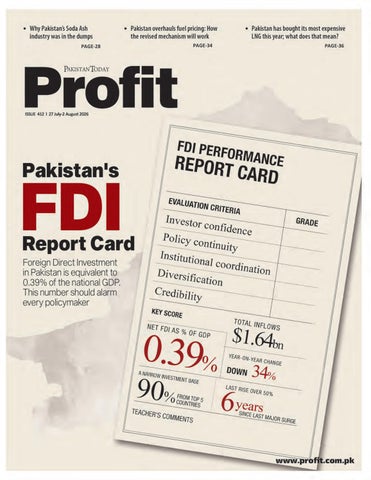
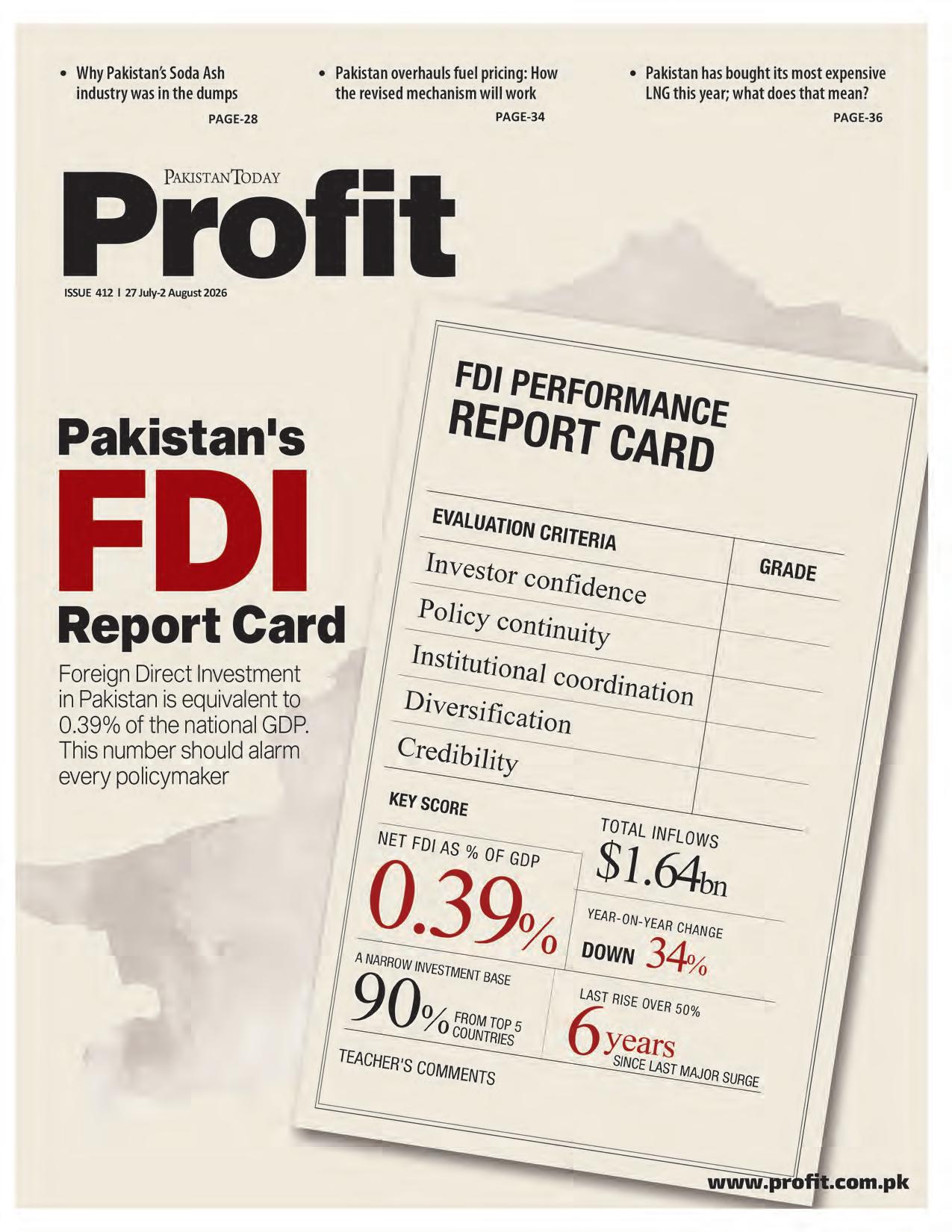
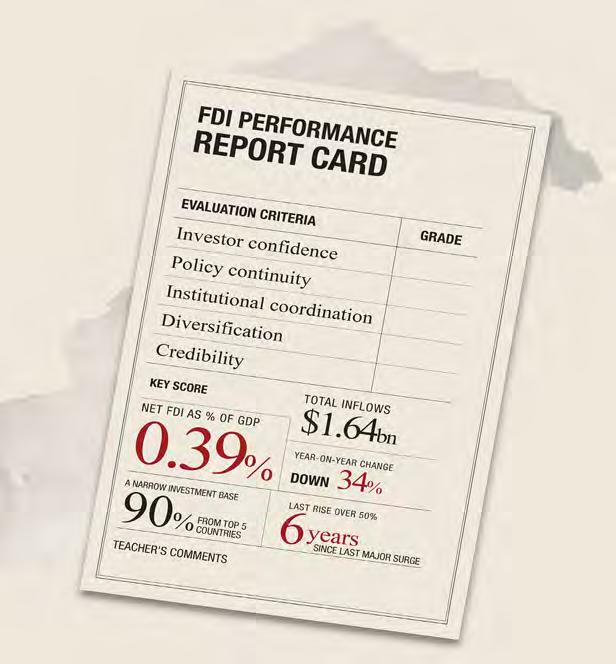
Pakistan’s FDI Report Card
Foreign Direct Investment in Pakistan is equivalent to 0.39% of the national GDP.
This
number should alarm every policymaker.
By Muhammad Azfar Ahsan
Pakistan’s latest Foreign Direct Investment (FDI) figures expose far more than weak investment inflows; they reveal the underlying health of the country’s entire investment ecosystem. They expose the deeper structural weaknesses of the country’s investment infrastructure, fragmented governance, policy inconsistency, and the persistent culture of ad hoc economic management. Unless Pakistan undertakes genuine institutional course correction, macroeconomic stability alone will not restore investor confidence or deliver sustainable growth.
Pakistan’s latest Foreign Direct Investment (FDI) figures are not merely an economic statistic; they are a national report card!
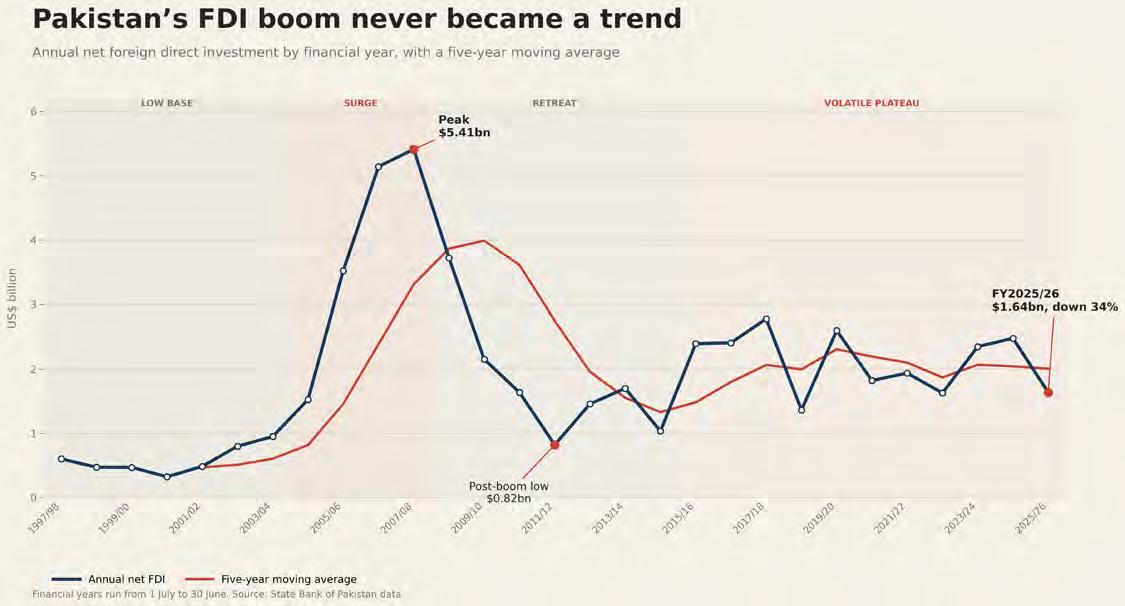
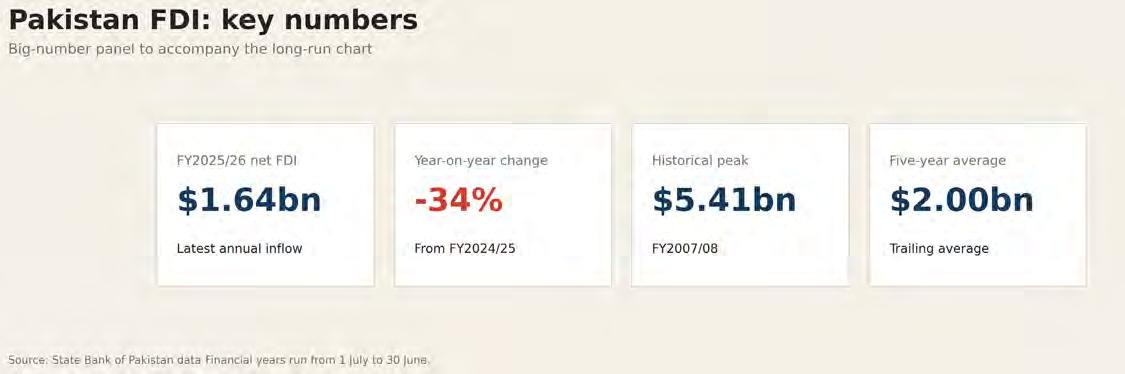
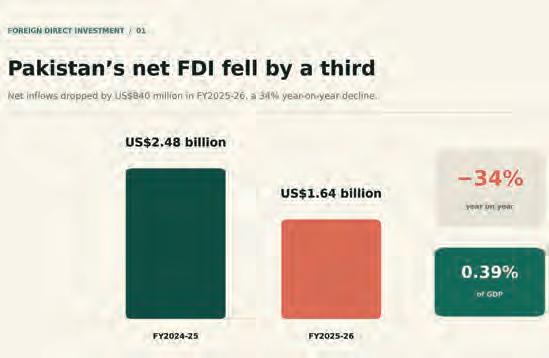
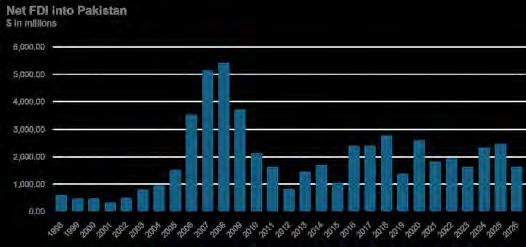
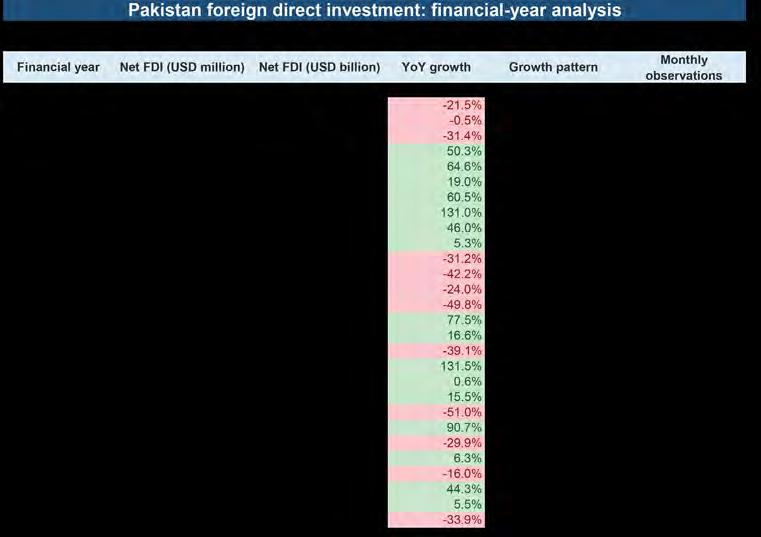
The State Bank of Pakistan (SBP) has now released the final FDI figures for FY2025-26. The numbers speak for themselves. Net FDI inflows stood at just USD 1.64 billion, equivalent to 0.39% of Pakistan’s GDP, down 34% YoY, and among the weakest performances recorded over the past twenty-five years. This is not simply another disappointing economic indicator. It is a comprehensive assessment of Pakistan’s investment infrastructure, business climate, governance standards, institutional credibility, policy consistency, and reform agenda. More importantly, it exposes the widening gap between the narratives we celebrate and the reality investors continue to experience.
Equally revealing is the composition of these inflows. China remained Pakistan’s largest foreign investor
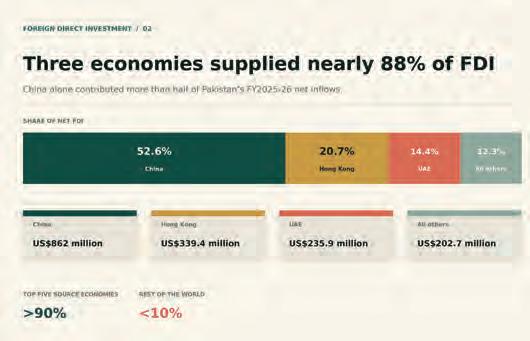
during FY2025-26, contributing USD 862 million, representing approximately 52.7% of total net FDI. Hong Kong followed with USD 339.4 million (20.7%), while the United Arab Emirates contributed USD 235.9 million (14.4%). Yet all three recorded significant year-onyear declines. Chinese investment fell by 28.5%, declining from approximately USD 1.20 billion in FY2024-25. Hong Kong’s investment declined by 27.8%, falling from roughly USD 470 million, while the UAE registered a decline of 19.8% compared to the previous year. Even Pakistan’s three largest investment partners are reducing their exposure rather than expanding it. That trend should concern policymakers far more than the headline FDI figure itself because it reflects weakening confidence among investors who already possess firsthand experience of Pakistan’s investment environment.
The concentration of Pakistan’s FDI presents an equally serious structural concern. China, Hong Kong, the UAE, Switzerland, and the United Kingdom together accounted for the overwhelming majority of Pakistan’s FDI during FY2025-26. China, Hong Kong, and the UAE alone represented almost 88% of total net FDI, while the addition of Switzerland and the United Kingdom pushed the share above 90%. Such concentration demonstrates that Pakistan continues to rely on a very narrow group of largely traditional investment partners while attracting only negligible levels of investment from the rest of the global economy. For a country of Pakistan’s size, strategic location, and economic potential, this limited geographical diversification is not merely an investment gap; it reflects the increasingly narrow international confidence in Pakistan as an investment destination.
More than ten African economies, many with significantly smaller populations, narrower domestic markets, and fewer natural advantages than Pakistan, now attract substantially higher annual FDI inflows. I deliberately refrain from comparing Pakistan with the Central Asian Republics, ASEAN economies, the Far East, or the Middle East because the gap has become too wide to offer any meaningful comparison. For the world’s fifth most populous country, this should concern every policymaker.
For far too long, we have become comfortable announc-
ing initiatives, launching institutions, introducing facilitation mechanisms, signing memoranda of understanding, and celebrating intentions. Yet investment has a remarkable habit of ignoring narratives. It responds only to confidence. Confidence, however, cannot be manufactured through official statements or optimistic projections. It must be earned through credibility, consistency, institutional competence, and disciplined execution. The latest FDI figures suggest that despite improvements in certain macroeconomic indicators, Pakistan has yet to restore the level of confidence required for long-term investors to commit their capital.
Why FDI matters as a marker for the economy
FDI occupies a unique position in economic policymaking across the world. Governments celebrate rising inflows as evidence of investor confidence. International institutions monitor them as indicators of economic integration, financial markets interpret them as signals of policy credibility, and economists increasingly regard them as one of the most objective measures of a country’s investment climate.
0.39% of GDP
FY2025/26
Unlike aid, FDI is not negotiated. Unlike loans, it is not borrowed. Unlike remittances, it is not driven by emotional or family considerations. Unlike portfolio investment, it cannot enter today and disappear tomorrow at the click of a button. FDI represents a long-term commitment of capital, technology, management expertise, and business confidence. Before making that commitment, investors undertake extensive due diligence, evaluating political stability, macroeconomic fundamentals, institutional quality, contract enforcement, regulatory certainty, taxation, infrastructure, governance standards, security conditions, judicial effectiveness, labor productivity, and long-term growth prospects before deciding where to allocate capital.
This is precisely why FDI should never be viewed merely as another economic statistic. It is the world’s most objective confidence barometer. FDI does not measure the confidence governments claim to have created; it measures the confidence investors are willing to risk their capital on. Every dollar invested reflects thousands of independent judgments made by investors, boards of directors, financial institutions, consultants, lawyers, and
risk analysts. When FDI rises consistently, it signals confidence in a country’s future. When it stagnates or declines over prolonged periods, it reflects structural weaknesses that no amount of official optimism can conceal.
It is equally important to recognize that FDI is a lagging indicator rather than an immediate one. Major investment decisions are often made only after months, and sometimes years, of due diligence, board approvals, financing arrangements, and regulatory assessments. Consequently, today’s FDI figures largely reflect yesterday’s policy environment rather than today’s announcements. This reality makes sustained policy continuity even more important. Governments cannot expect immediate investment responses to isolated reforms or short-term stabilization measures. Credibility is accumulated gradually through consistent execution and is equally lost through repeated policy reversals.
Unlike short-term capital flows, FDI builds productive capacity. It establishes factories, creates employment, transfers technology and managerial expertise, strengthens supply chains, expands exports, and contributes to sustainable long-term economic growth. That is precisely why economists regard it as one of the most reliable indicators of a country’s investment climate. Investment is the only vote of confidence that is backed by irreversible financial commitment.
History also offers an important lesson. No country has achieved sustained high economic growth over a prolonged period while consistently attracting negligible
levels of productive foreign investment. FDI is not the only driver of growth, but every major economic success story demonstrates that long-term investment and long-term growth reinforce one another.
This distinction has become particularly important for developing economies such as Pakistan. Countries competing for global investment are no longer competing primarily through tax concessions, subsidized land, or generous fiscal incentives. Such measures may influence individual investment decisions at the margins, but they rarely determine long-term capital allocation. Modern investors seek something far more valuable than incentives. They seek predictability. They seek confidence that policies will remain consistent beyond political cycles, contracts will be honored irrespective of changing governments, regulators will facilitate rather than frustrate business activity, and institutions will function professionally. Countries no longer compete for capital through incentives alone; they compete through credibility.
The latest FDI figures therefore deserve to be viewed not merely as another annual statistic but as an invitation to honestly examine why a country with enormous economic potential continues to struggle to earn the confidence of long-term investors. The report card is now before us. The question is whether we are prepared to learn from it.
Unlike aid, FDI is not negotiated. Unlike loans, it is not borrowed. Unlike remittances, it is not driven by emotional or family considerations. Unlike portfolio investment, it cannot enter today and disappear tomorrow at the click of a button. FDI represents a longterm commitment of capital, technology, management expertise, and business confidence. Before making that commitment, investors undertake extensive due diligence, evaluating political stability, macroeconomic fundamentals, institutional quality, contract enforcement, regulatory certainty, taxation, infrastructure, governance standards, security conditions, judicial effectiveness, labor productivity, and long-term growth prospects before deciding where to allocate capital.
This is precisely why FDI should never be viewed merely as another economic statistic. It is the world’s most objective confidence barometer. FDI does not measure the confidence governments claim to have created; it measures the confidence investors are willing to risk their capital on. Every dollar invested reflects
thousands of independent judgments made by investors, boards of directors, financial institutions, consultants, lawyers, and risk analysts.
When FDI rises consistently, it signals confidence in a country’s future. When it stagnates or declines over prolonged periods, it reflects structural weaknesses that no amount of official optimism can conceal.
Unlike short-term capital flows, FDI builds productive capacity. It establishes factories, creates employment, transfers technology and managerial expertise, strengthens supply chains, expands exports, and contributes to sustainable long-term economic growth. That is precisely why economists regard it as one of the most reliable indicators of a country’s investment climate. Investment is the only vote of confidence that is backed by irreversible financial commitment.
It is equally important to understand that headline FDI figures capture only one dimension of investor confidence. Equally revealing is the level of reinvested earnings generated by companies already operating in a country. When existing investors consistently retain and expand their profits domestically rather than repatriating them abroad, they signal confidence in the future of that economy. Conversely, weak reinvestment often reflects growing caution among investors who understand the local business environment better than anyone else. For this reason, policymakers should monitor not only new investment but also the reinvestment behavior of existing investors, because both together provide a far more complete picture of investment confidence.
History also offers an important lesson. No country has achieved sustained high economic growth over a prolonged period while consistently attracting negligible levels of productive foreign investment. FDI is not the only driver of growth, but every major economic success story demonstrates that long-term investment and long-term growth reinforce one another.
This distinction has become particularly important for developing economies like Pakistan. Countries competing for global investment are no longer competing primarily through tax concessions, subsidized land, or generous fiscal incentives. Such measures may influence individual investment decisions at the margins, but they rarely determine long-term capital allocation. Modern investors seek something far more valuable than incen-
tives. They seek predictability. They seek confidence that policies will remain consistent beyond political cycles, contracts will be honored irrespective of changing governments, regulators will facilitate rather than frustrate business activity, and institutions will function professionally. Countries no longer compete for capital through incentives alone; they compete through credibility.
The latest FDI figures therefore deserve to be viewed not merely as another annual statistic but as an invitation to honestly examine why a country with enormous economic potential continues to struggle to earn the
confidence of long-term investors. The report card is now before us. The question is whether we are prepared to learn from it.
Pakistan’s persistent weakness in attracting FDI is often explained away by external shocks, geopolitical uncertainty, regional instability, or temporary economic challenges. While these factors undoubtedly influence investor sentiment, they do not explain why Pakistan has consistently underperformed for decades while many countries facing similar, or even greater, challenges have succeeded in attracting substantially higher levels of investment. The problem runs much deeper.
The confidence deficit
Pakistan does not primarily suffer from an investment deficit; it suffers from a confidence deficit.
Confidence is not created through investment promotion campaigns or official declarations. It is built through institutions. Investors place their trust in countries where policies remain predictable, governments honor legal commitments, taxation remains transparent, regulators facilitate rather than intimidate businesses, and institutions continue functioning professionally irrespective of political transitions. Unfortunately, Pakistan has struggled on almost every one of these fronts.
Frequent policy reversals have become routine. Long-term investment commitments are disrupted by changes in governments. Legal and contractual obligations are revisited with alarming regularity. The tax regime remains unpredictable, while the culture of excessive discretion and harassment within the Federal Board of Revenue (FBR) continues to discourage both domestic and foreign investors. Businesses frequently spend more time navigating regulatory uncertainty than expanding productive capacity. The result is an investment environment where uncertainty
itself has become institutionalized.
The first test of any investment climate is not whether it attracts new investors but whether existing investors choose to reinvest. Existing investors already understand the country’s strengths and weaknesses. They have firsthand experience of its institutions, regulatory framework, and policy environment. If they remain reluctant to expand their operations, it sends a far more powerful signal than any international ranking or investment promotion campaign. Weak FDI inflows therefore indicate not merely the absence of new investors but also the hesitation of those who are already operating within Pakistan.
Existing investors are Pakistan’s most credible ambassadors. Their reinvestment decisions carry far greater weight than any investment promotion campaign because they are based on lived experience rather than expectation. When existing investors hesitate to expand, that signal travels quickly through international boardrooms and investor networks, influencing future investment decisions far beyond Pakistan’s borders.
The same factors discouraging foreign in-
6 years since last major surge Last rise over 50%: FY2019/20
vestors also suppress domestic private investment. No one understands Pakistan’s business environment better than Pakistani entrepreneurs themselves. When domestic investors increasingly diversify their capital abroad or postpone expansion plans at home, they are expressing the very same concerns that foreign investors identify during their due diligence. In reality, the investment climate is one ecosystem. It cannot be attractive for domestic investors while remaining unattractive for foreign investors, or vice versa.
This explains why Pakistan’s challenge is fundamentally one of credibility rather than capital. The country possesses a large domestic market, a strategic geographic location, abundant natural resources, and one of the world’s youngest populations. Yet these undeniable advantages have repeatedly failed to translate into sustained investment because they are overshadowed by institutional uncertainty. Pakistan therefore suffers from a widening credibility gap between what policies promise and what investors actually experience.
Persistently weak FDI carries consequences that extend far beyond disappointing
investment statistics. It slows industrialization, limits technology transfer, weakens export competitiveness, reduces the creation of quality jobs, discourages innovation, and increases dependence on external borrowing instead of productive capital. Countries that consistently fail to attract long-term investment eventually find themselves financing consumption rather than building productive capacity. That is precisely where Pakistan finds itself today.
Another important reality deserves attention. FDI is inherently a lagging indicator. Investors rarely respond immediately to reform announcements or temporary macroeconomic improvements. They observe whether reforms survive political transitions, whether institutions behave consistently over time, whether contracts continue to be honored, and whether implementation matches official commitments. In other words, today’s FDI reflects yesterday’s credibility. Similarly, the reforms implemented today will influence investment decisions several years from now. This time lag makes sustained policy continuity even more critical because confidence cannot be built through episodic reforms; it is accumulated through consistent execution over time.
Finding our investment strategy
Compounding this challenge is the absence of any coherent long-term national investment strategy. Pakistan has no comprehensive twenty-year investment vision identifying priority sectors, institutional responsibilities, measurable milestones, and a stable policy framework capable of surviving political transitions. Equally concerning, the country continues to operate without a comprehensive export strategy that integrates investment, industrial development, technology, productivity, competitiveness, and global market integration.
from top 5 countries A narrow investment base
Investment and exports are not separate policy domains. Investment creates productive capacity, while exports sustain investment by expanding markets, improving competitiveness, and generating foreign exchange. Countries that excel in one invariably perform well in the other because both are built upon the same institutional foundations and long-term policy discipline. Pakistan’s inability to formulate either strategy reflects a deeper absence of strategic economic thinking.
No successful economy competes for global capital without a coherent long-term investment strategy supported by measurable targets, institutional ownership, professional execution, and periodic performance review. Pakistan cannot reasonably expect different outcomes while continuing to operate without a clear national roadmap.
In the absence of a coherent national investment strategy, institutions inevitably begin pursuing their own priorities instead of a shared national objective. Fragmentation, duplication, policy inconsistency, and weak accountability are therefore not accidental outcomes; they are the predictable consequences of operating without one national vision, one strategic roadmap, and one institution responsible for coordinating investment policy across the federation.
This challenge extends beyond the federal level. Since investment decisions are implemented on the ground, the consistency of provincial governance is equally important. Investors evaluate land administration, utilities, taxation, licensing procedures, environmental approvals, dispute resolution, and regulatory efficiency across provinces before making long-term commitments. A strong federal investment strategy cannot succeed if
provincial implementation remains uneven. Successful investment destinations therefore function as one integrated national ecosystem where federal and provincial institutions pursue the same objectives through harmonized policies and coordinated execution.
This explains why adhocism has gradually become our governing philosophy. Instead of anticipating challenges, we respond only after crises emerge. Instead of implementing structural reforms, we introduce temporary measures. Instead of strengthening existing institutions, we create new ones. Instead of fixing the foundations, we continue treating the symptoms.
Over the past three years, I have probably used two words hundreds of times: adhocism and firefighting. I am tired of repeating them, yet unfortunately they continue to define the way Pakistan governs its economy. Sustainable economic transformation cannot be achieved through episodic interventions or short-term crisis management. Nations do not become competitive by continuously responding to emergencies. They become competitive by building institutions capable of preventing those emergencies in the first place.
The deeper concern is that we often appear reluctant to acknowledge the real nature of the problem. Unless we correctly diagnose the underlying structural weaknesses, meaningful solutions will remain elusive. We cannot continue celebrating isolated improvements in macroeconomic indicators while one of the world’s most respected measures of investor confidence continues to deteriorate. Treating the symptoms may provide temporary relief, but it will never cure the disease. Pakistan’s investment crisis cannot be resolved without first fixing the institutional foundations upon which investor confidence ultimately rests.
A weak investment strategy inevitably produces weak investment governance. Without a clearly defined national vision, institutions gradually begin operating in isolation, pursuing individual mandates instead of a shared national objective. Fragmentation is therefore not an administrative accident; it is the natural consequence of governing investment without a coherent national framework.
One of the least discussed, yet most damaging, weaknesses in Pakistan’s economic governance is the fragmentation of its investment infrastructure. While successful economies have consolidated investment governance under unified institutional frameworks, Pakistan has steadily moved in the opposite direction.
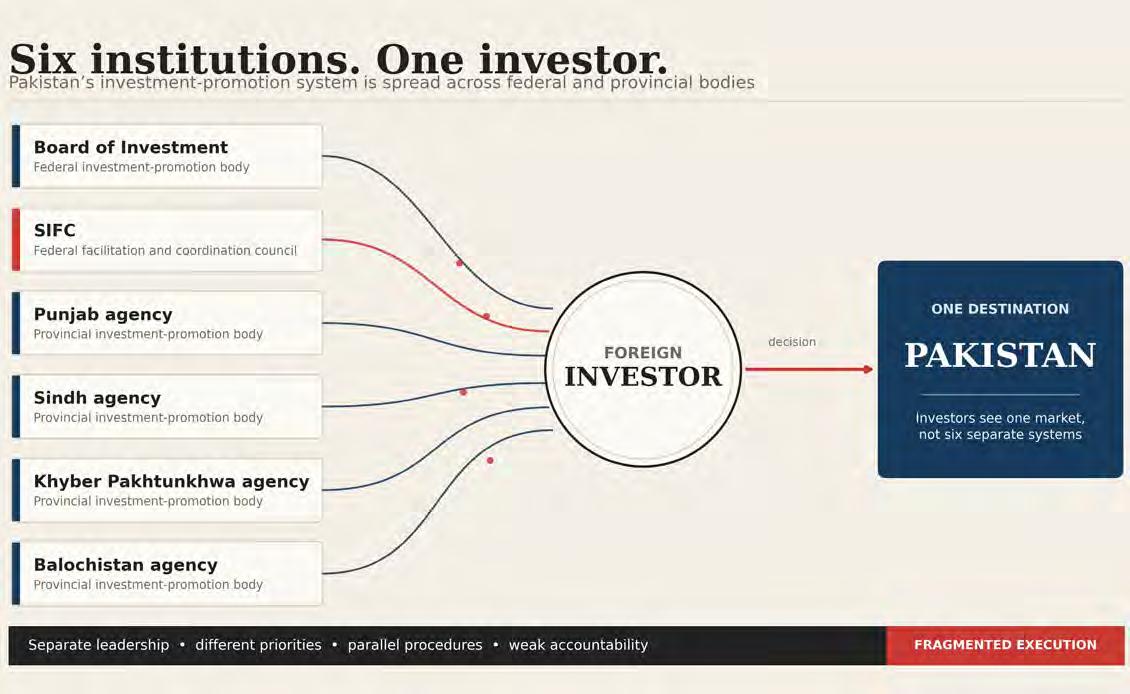
Today, investment promotion in Pakistan is spread across six different institutions: the Board of Investment (BOI), the Special Investment Facilitation Council (SIFC), and the four Provincial Investment Promotion Agencies of Punjab, Sindh, Khyber Pakhtunkhwa, and Balochistan. Each operates with its own leadership, priorities, procedures, and institutional culture. Rather than functioning as one coordinated national investment system, they largely operate in parallel.
Investors, however, do not distinguish between federal and provincial jurisdictions, nor do they differentiate between one investment agency and another. They evaluate one country, one investment destination, and one overall business environment. When institutions pursue different priorities without a unified national strategy, the inevitable outcome is duplication, policy inconsistency, delayed decision-making, weak accountability, and declining investor confidence.
Every public institution must ultimately be evaluated against the objectives for which it was created. In every serious organization, institutional performance is measured against clearly defined outcomes rather than intentions. Investment institutions should be no different. Their effectiveness cannot be judged by meetings, announcements, facilitation claims, or promotional activity. It must be judged by one measurable outcome: investment.
What the SIFC can do
The SIFC was established with the stated objective of transforming Pakistan’s investment landscape and substantially increasing investment inflows. Three years later, the evidence is clear – net FDI inflows remained around USD 2 billion during its first two years and declined further to approximately USD 1.64 billion in the third year, marking one of Pakistan’s weakest investment performances in the past twenty-five years. If investment outcomes are the primary measure of institutional success, these figures warrant an honest institutional evaluation rather than celebratory narratives.
The broader lesson extends well beyond one institution. Sustainable investment governance is ultimately judged by implementation credibility rather than institutional
architecture. Investors are largely indifferent to how many agencies exist or how responsibilities are distributed. What matters to them is whether approvals are delivered efficiently, policies remain predictable, commitments are honored consistently, and institutions function professionally. Governance structures create confidence only when they produce measurable outcomes. Where implementation remains weak, institutional redesign alone cannot restore investor trust.
Against this backdrop, the recent decision to place the administrative control of the BOI under the SIFC raises important policy questions. Rather than initiating an objective institutional review based on measurable performance, Pakistan has chosen to expand the ad-
ministrative footprint of an arrangement whose principal objective remains unfulfilled. More importantly, the decision does not resolve the underlying structural weakness because both organizations continue to exist separately, each with its own mandate, management structure, and operational framework. The reporting line may have changed, but the fragmentation remains.
Good governance demands that institutions demonstrating strong performance should be strengthened, while those falling short of their stated objectives should first undergo rigorous evaluation and reform. Expanding responsibilities without first evaluating outcomes risks institutionalizing underperformance rather than correcting it.
Accountability should never be selective. Investment institutions should be judged by investment outcomes, not by the number of meetings held, initiatives announced, roadshows organized, or narratives promoted. If institutions created specifically to attract investment fail to improve investment performance over several years, serious institutional review becomes not an option but an obligation.
The broader concern is even more fundamental. Major institutional decisions should always be guided by objective evidence, transparent analysis, and measurable performance indicators. When institutional restructuring appears disconnected from actual outcomes, it inevitably raises questions about the quality of policy advice reaching the country’s highest decision-making forums. National leadership deserves objective assessments, professional analysis, and evidence-based recommendations. Long-term institutional reform cannot succeed if difficult realities are softened by optimistic narratives or if institutional performance is judged by perception rather than measurable results.
This challenge is not unique to the pres-
ent arrangement. No government over the past few decades has undertaken genuine course correction for Pakistan’s investment climate, nor has any demonstrated the political resolve to fix the foundations. This is not the failure of one administration alone. It is the cumulative consequence of successive governments preferring short-term administrative adjustments over long-term structural reform.
As I have argued repeatedly over the years, Pakistan has unfortunately developed a habit of creating new organizations instead of undertaking genuine restructuring and transformation of the institutions it already possesses. Too often, we choose to build a rather than strengthening the foundations of existing institutions. Institutional multiplication has gradually become a substitute for institutional reform.
There is, however, a far better alternative. Pakistan must move beyond fragmented investment governance by consolidating the country’s entire investment architecture into a single, empowered national institution. We have consistently advocated restructuring and strengthening the BOI by integrating into it the SIFC together with the four Provincial Investment Promotion Agencies. This unified institution would become Pakistan’s single national investment authority, operating under one long-term investment strategy, one institutional leadership, one investor interface, one digital platform, and one transparent system of accountability.
Such a reform would eliminate duplication, improve policy coordination, streamline investor facilitation, strengthen accountability, and create a seamless investment ecosystem capable of attracting and retaining both domestic and foreign investment. It would also ensure that every ministry, regulator, and provincial institution works toward one national investment roadmap rather than multiple disconnected priorities.
$5.41bn
There are real world examples
Successful economies have already recognized this reality. Bangladesh has recently approved a landmark Investment Bill that consolidates its investment governance framework under one integrated institutional umbrella. Uzbekistan provides another compelling example, where the Ministry of Investment functions as the country’s lead institution responsible for shaping and managing the national investment ecosystem. It establishes the strategic direction, while all relevant ministries and government agencies align their work with its roadmap, ensuring policy coherence, institutional coordination, and disciplined execution across government.
Pakistan should study these examples with objectivity rather than complacency. The twenty-first century will not belong to countries that simply establish more institutions. It will belong to countries that build better institutions, institutions with clarity of purpose, professional leadership, technical competence, measurable accountability, and the authority to coordinate the country’s entire investment ecosystem.
Investment governance is therefore not about multiplying organizations. It is about integrating leadership, strategy, execution, and accountability under one coherent national vision.
The real challenge confronting Pakistan today is not the absence of ideas, opportunities, or potential. The country possesses a strategic geographic location, a market of more than 250 million people, abundant natural resources, and one of the world’s youngest populations. The challenge is that we have repeatedly failed to convert these strengths into investor confidence because we remain reluctant
to confront uncomfortable truths.
Every year we celebrate announcements, launch new initiatives, establish new institutions, and project optimism about the future. Yet every year, objective indicators quietly remind us that global investors remain unconvinced.
The latest FDI figures therefore compel us to ask a simple but uncomfortable question; If the outcomes remain consistently weak, why are we still satisfied with the process?
One defining characteristic of successful nations is their willingness to evaluate institutions against measurable outcomes. Performance is reviewed objectively, successes are rewarded, shortcomings are acknowledged, and timely course correction follows. Institutions exist to deliver results, not explanations.
Pakistan has too often chosen a different path.
Missed targets are explained rather than examined. Weak outcomes are rationalized as temporary setbacks. Structural weaknesses are treated as cyclical challenges. Increasingly, narratives substitute for evidence, while perception is allowed to overshadow performance.
This pattern extends well beyond investment policy. The Federal Board of Revenue (FBR), for example, missed its original annual tax collection target by more than Rs. 1 trillion, collecting approximately Rs. 13 trillion against the budget-assigned target of Rs. 14.131 trillion. Yet despite missing its revenue target for the third consecutive year, its
Uzbekistan
Ministry of Investment functions as the country’s lead institution responsible for shaping and managing the national investment ecosystem. It establishes the strategic direction, while all relevant ministries and government agencies align their work with its roadmap, ensuring policy coherence, institutional coordination, and disciplined execution across government.
Bangladesh
Bangladesh has recently approved a landmark Investment Bill that consolidates its investment governance framework under one integrated institutional umbrella.
performance was publicly appreciated. Recognizing sincere effort is commendable, but sustainable governance requires institutions to be evaluated primarily against measurable outcomes rather than optimistic narratives.
Accountability is not about assigning blame. It is about creating incentives for continuous institutional improvement. When missed targets become occasions for celebration rather than introspection, the culture of performance gradually gives way to a culture of narrative management.
Without accountability, meaningful reform becomes optional.
Supporting the State where it performs well is our collective responsibility. Equally, speaking honestly about policy shortcomings is also our collective responsibility. Constructive criticism should never be mistaken for opposition. Mature states strengthen themselves by encouraging evidence-based debate rather than avoiding uncomfortable conversations.
How long will we continue relying on cosmetic measures while postponing genuine structural reform? How long will we continue managing temporary situations instead of addressing permanent weaknesses? Sustainable economic progress requires acknowledging reality and confronting the underlying structural issues rather than celebrating missed targets or confusing short-term stabilization with long-term transformation.
The latest FDI figures should therefore not be interpreted as the failure of one institution or one government alone. They represent the cumulative consequences of decades of institutional neglect, fragmented governance, policy inconsistency, political instability, repeated breaches of contractual commitments, regulatory uncertainty, an unpredictable tax regime, excessive administrative discretion, weak implementation capacity, and the absence of both a coherent national investment strategy and a comprehensive export strategy. They reflect a governance culture that has consistently prioritized managing crises over preventing them.
Ultimately, Pakistan’s investment challenge is not simply about attracting additional foreign capital; it is about rebuilding credibility.
Credibility cannot be legislated; it cannot be announced; it cannot be marketed. It must be earned through insti-
All of these countries have built globally competitive investment environments not by relying on incentives alone, but by strengthening institutions, ensuring policy continuity, and executing long-term strategies with discipline.
tutions that function professionally, policies that remain consistent, governments that honor commitments, regulators that facilitate enterprises instead of obstructing them, and leaders who are prepared to confront reality rather than merely talk about it, or worse, ignore it.
The difficult truth is that nations rarely fail because they lack resources. They fail because they refuse to confront the structural weaknesses that prevent those resources from being transformed into sustainable prosperity. Pakistan has reached a stage where incremental adjustments are no longer sufficient. What is required is not another initiative, another committee, or another narrative, but the courage to undertake genuine structural reform.
Until we are prepared to speak the truth, we will continue managing the symptoms instead of curing the disease. And until we fix the foundations, every annual FDI report will continue telling us the same story, regardless of how optimistic the accompanying narrative may be.
Every major economic transformation begins with institutional honesty. Countries rarely reform because circumstances become comfortable; they reform because evidence makes complacency impossible. Pakistan’s latest FDI report card provides precisely that evidence. The challenge now is not whether the diagnosis is clear, but whether the political will exists to act upon it.
Pakistan does not need another temporary solution. It needs a genuine “Investment Reset.”
That “Reset” must begin by recognizing that sustainable investment is not created through incentives, promotional campaigns, or institutional proliferation. It is created through credibility. Credibility emerges from strong institutions, predictable policies, professional
governance, political stability, respect for legal contracts, regulatory certainty, policy continuity, disciplined execution, and the confidence that today’s commitments will survive tomorrow’s political transitions.
The world has already demonstrated what works. Bangladesh has begun restructuring its investment governance. Uzbekistan has shown how a single lead institution can coordinate an entire national investment ecosystem. Vietnam, Indonesia, Singapore, Malaysia, South Korea, Ireland, Egypt, Saudi Arabia, Qatar, and the United Arab Emirates have each built globally
competitive investment environments not by relying on incentives alone, but by strengthening institutions, ensuring policy continuity, and executing long-term strategies with discipline. Pakistan can do the same.
But only if we are prepared to abandon the culture of adhocism, move beyond perpetual firefighting, and replace episodic policymaking with strategic governance. A country of more than 250 million people cannot be managed through improvisation. It requires institutions that outlast individuals, policies that outlast governments, and a national vision that survives political cycles.
Our collective failure and shared responsibility
No government has undertaken genuine course correction for Pakistan’s investment climate over the past few decades, nor has any demonstrated the resolve to fix the foundations. This is not the failure of one administration alone. It is a collective failure and a shared responsibility of successive governments, institutions, policymakers, and political leaders.
Pakistan’s latest FDI figures should therefore be viewed not simply as another disappointing economic statistic but as a national wake-up call. They remind us that investors evaluate countries not by what they promise but by what they consistently deliver. The sooner we recognize that distinction, the sooner meaningful reform can begin.
History will not judge Pakistan by the number of institutions it created, councils it established, policy announcements it made, or narratives it celebrated. It will judge Pakistan by whether it built institutions capable of earning investor confidence, strengthening productive capacity, expanding exports, creating quality employment, and placing the country on a sustainable path of economic transformation.
FDI does not measure the confidence governments claim to have created; it measures the confidence investors are actually willing to risk their capital on. Investment is the only vote of confidence that comes with a financial commitment. Likewise, countries do not
compete for capital through incentives; they compete through credibility.
Capital follows confidence; confidence follows credibility; credibility follows institutions. Those institutions, in turn, are built through leadership, accountability, professional competence, policy continuity, disciplined execution, and, above all, the courage to confront reality instead of avoiding it.
Until Pakistan fixes those foundations, every annual FDI report will continue telling the same story, regardless of how optimistic the accompanying narrative may be. Investment institutions exist to produce investment outcomes, not investment narratives.
That is the lesson Pakistan can no longer afford to ignore.
The FDI report card has now been published. The real question is not whether we can explain these numbers. The real question is whether we finally have the courage, the leadership, and the institutional maturity to improve them.
The next report card will not be written by policymakers, economists, or commentators. It will be written by investors. And investors never grade on intentions; they grade on execution.
A Strategic Wake-Up Call
More than 90% of Pakistan’s FDI comes from just five countries.
By Muhammad Azfar Ahsan
Pakistan’s latest Foreign Direct Investment (FDI) statistics reveal a challenge that extends far beyond the volume of capital entering the country. The more revealing story lies not in how much investment Pakistan attracted during FY2025-26, but in who chose to invest and, more importantly, who chose not to.
The latest data from the State Bank of Pakistan (SBP) shows that net FDI stood at just USD 1.64 billion during FY2025-26, falling 34% year over year from approximately USD 2.48 billion and amounting to only 0.39% of GDP. For a country of more than 250 million people and the world’s fifth-largest population, that figure remains deeply concerning. Sustained FDI inflows are widely regarded as one of the world’s most objective indicators of investor confidence because they reflect how international investors assess a country’s business environment, institutional credibility, policy consistency, regulatory predictability, and long-term economic prospects. Strong inflows indicate that investors are willing to commit long-term capital, while persistently weak inflows signal structural weaknesses that continue to discourage productive investment.
Yet the more important story emerges when we look beyond the headline number.
China remained Pakistan’s largest foreign investor during FY2025-26, contributing USD 862 million, representing approximately 52.6% of total net FDI. Hong Kong followed with USD 339.4 million (20.7%), while the United Arab Emirates invested USD 235.9 million (14.4%). Together, these three economies accounted for almost 88% of Pakistan’s total net FDI. Once Switzerland and the United Kingdom are included, the contribution of the top five investing countries exceeds 90% of all FDI entering Pakistan.
The implication is striking: the entire rest of the world contributed less than 10% of Pakistan’s total FDI.
This concentration deserves far greater attention than it has received.
Every country naturally develops stronger investment relationships with certain partners. Geography, historical ties, trade linkages, and strategic cooperation all influence investment patterns. However, when more than 90% of a country’s foreign investment originates from only five countries, the issue is no longer one of preference. It becomes a question of diversification, resilience, and global competitiveness.
The real policy question, therefore, is not why these five countries continue investing in Pakistan. The far more important question is why an overwhelming majority of the world’s major investing nations remain largely absent.
Where are the United States, Canada, Germany, France, Italy, the Netherlands, Japan, South Korea, Singapore, Australia, the Nordic countries, and most of ASEAN? Why does Pakistan continue to attract only marginal investment from Latin America, Africa, Central Asia, and much of Continental Europe? Why do so many of the world’s leading sources of outward investment continue to bypass a country that possesses one of the world’s largest consumer markets, an exceptionally young population, and one of the most strategically located geographies connecting South Asia, Central Asia, China, and the Middle East?
These are not rhetorical questions. They go to the heart of Pakistan’s investment challenge.
The pattern also suggests that Pakistan’s FDI story is no longer purely an economic one; it increasingly reflects the country’s strategic relationships. Despite years of discussion about attracting diversified global capital, there is virtually no meaningful investment coming from the United States or most other major developed economies. Likewise, inflows from many leading emerging economies remain negligible.
For decades, Pakistan has measured investment performance almost exclusively through the annual volume of FDI inflows. While the quantity of investment remains critically important because it reflects the overall health of the business climate, an equally important dimension has received remarkably little attention: the diversity of investors choosing Pakistan. The breadth of a country’s international investor base often reveals as much about its competitiveness as the total amount of investment it receives. This is the missing dimension in Pakistan’s investment debate, and one that deserves urgent national attention.
The absence of a diversified investor base is not merely a statistical concern; it represents an economic and strategic vulnerability. A country that depends overwhelmingly on a handful of investment partners inevitably exposes itself to unnecessary risk. Changes in bilateral relations, economic conditions within those countries, shifts in investment priorities, or geopolitical developments can disproportionately affect future capital inflows. A resilient investment framework, by contrast,
attracts investors from multiple regions, sectors, and economic systems, reducing concentration risk while strengthening long-term stability.
Equally important is the quality of investment that different countries bring. Japanese investment typically strengthens advanced manufacturing and precision engineering. German firms contribute industrial technology and export competitiveness. American companies often lead in innovation, health care, digital services, and high-value industries. Singaporean investors excel in logistics, financial services, and urban infrastructure. Gulf sovereign wealth funds provide long-term capital for infrastructure, tourism, agriculture, and energy, while European investors increasingly focus on renewable energy, climate finance, sustainable manufacturing, and green technologies. A diversified investor base therefore contributes far more than financial capital; it brings technology, managerial expertise, research capability, international supply chains, global market access, and higher standards of productivity.
Pakistan is missing much of this opportunity.
The country’s challenge is therefore not simply attracting more investment from existing partners; it is becoming relevant to a much wider universe of global investors. That requires asking a difficult but necessary question: Why does Pakistan’s investment proposition continue to resonate with only a limited number of countries while failing to inspire comparable confidence across the broader international investment community?
The answer cannot be explained solely by external factors. Political uncertainty, regional tensions, and global economic slowdowns undoubtedly influence investor sentiment, but they do not explain why many countries facing similar, or even greater, challenges consistently attract investment from a far broader range of international investors. The more convincing explanation lies within Pakistan’s own investment environment.
Global investors do not invest because countries possess potential. They invest because they believe that potential can be converted into predictable, profitable, and sustainable returns.
Pakistan has never lacked potential. Its challenge has been converting that potential into confidence.
Before committing long-term capital, investors evaluate far more than market size or growth projections. They
assess the stability of economic policy, the continuity of regulations, the credibility of institutions, the enforceability of contracts, the efficiency of taxation, the quality of infrastructure, the speed of regulatory approvals, the independence of the judiciary, the professionalism of public administration, and the consistency with which governments honor their commitments. Investment decisions are therefore based not on a single incentive or policy announcement but on the cumulative credibility of the entire business environment.
One experience from my tenure as Pakistan’s Minister for Investment illustrates this challenge vividly. Saudi Arabia was one of my highest priorities, and I devoted considerable effort to building institutional relationships with its leadership, senior government officials, and leading family business groups. During one of my meetings, the Saudi Minister of Investment made an observation that has remained with me ever since. He explained that Saudi private-sector investment in Uzbekistan had already reached tens of billions of dollars despite Uzbekistan having a population of only about 37 million people. His message was simple: if Saudi investors could confidently invest such substantial capital in Uzbekistan, there was no logical reason Pakistan, with a population exceeding 250 million, deep historical ties, and an exceptional strategic relationship with Saudi Arabia, should remain overlooked.
Today, Saudi investment in Uzbekistan has reached approximately USD 30 billion over the past seven years, facilitated by the Saudi Ministry of Investment but driven almost entirely by Saudi private-sector companies. That conversation fundamentally changed my perspective. It confirmed that the constraint was never the availability of capital or the absence of strategic goodwill. The real constraint was Pakistan’s inability to convert diplomatic relationships into commercial confidence. Despite decades of exceptional bilateral relations, multiple high-level visits, and repeated announcements of investment memoranda, Saudi FDI into Pakistan has remained negligible.
This is not an isolated Saudi case; similar untapped opportunities exist across many countries where goodwill exists but investor confidence does not. The lesson is universal: countries do not receive investment because they enjoy friendly diplomatic relations; they receive investment because investors trust the domestic environment in which their capital will operate. Diplomatic goodwill can open doors, but only institutional credibility persuades investors to walk through them.
The United Arab Emirates offers another important perspective. Despite visible strains in bilateral relations over the past two years, it nevertheless remained Pakistan’s third-largest foreign investor during FY2025-26. This demonstrates that long-term strategic economic partnerships often extend beyond temporary diplomatic or political difficulties and should never be taken for granted.
Pakistan possesses another strategic asset that remains significantly underutilized: its overseas Pakistanis. Successive governments have rightly celebrated record remittance inflows, yet the diaspora represents something far more valuable than a source of foreign exchange. Millions of overseas Pakistanis occupy senior leadership positions in multinational corporations, manage successful businesses, advise global investment funds, and influence investment decisions across every major economy. Properly engaged, they could become Pakistan’s most credible investment ambassadors.
Yet many remain reluctant because their own investment experiences have too often been shaped by regulatory uncertainty, inconsistent policies, weak contract enforcement, taxation concerns, and administrative barriers. I have discussed this issue repeatedly with policymakers over the years. No country can expect its diaspora to confidently recommend it to global investors until it first earns the confidence of its own citizens abroad. Trust begins at home before it can be exported internationally.
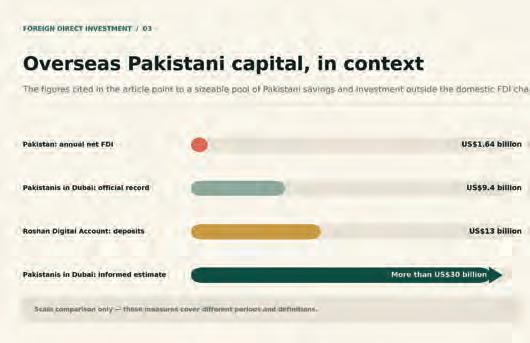
The scale of this unrealized opportunity is enormous. Overseas Pakistanis have demonstrated their financial strength repeatedly. Through the Roshan Digital Account (RDA) initiative alone, they deposited around USD 13 billion, a figure representing only a small fraction of their global savings. In Dubai, Pakistanis rank among the largest foreign investors, with officially recorded investments of around USD 9.4 billion, while informed estimates place the actual figure at well over USD 30 billion. These numbers illustrate a simple reality: Pakistani capital exists. The challenge is not the
availability of resources; it is creating sufficient confidence for that capital to return home as productive long-term investment rather than remaining abroad.
Remittances are invaluable for strengthening foreign exchange reserves and supporting household consumption, but they cannot substitute for productive investment, technology transfer, entrepreneurship, exports, and job creation. Countries build sustainable prosperity through investment-led growth, not remittance-led growth. Pakistan’s overseas community possesses global business networks, financial resources, professional expertise, and international credibility that few countries enjoy on such a scale. Restoring their confidence would not only unlock significant investment from the diaspora itself but also create powerful advocates capable of introducing Pakistan to a much wider international investor community.
The starting point for correcting this imbalance is not another promotional initiative or marketing exercise. It is fixing our own house. Existing investors must become Pakistan’s strongest ambassadors because satisfied investors attract new investors far more effectively than any advertisement or policy announcement. That requires political stability, long-term policy continuity across successive governments, a competitive and predictable tax system, stronger institutional coordination, faster regulatory decision-making, competent economic leadership, meaningful engagement with subject-matter experts, respect for legal contracts, an efficient dispute-resolution mechanism, and a secure operating environment. Global investors do not demand perfection. They demand predictability. Countries that consistently provide certainty outperform countries that repeatedly promise potential. Unless Pakistan strengthens these domestic foundations, investor diversification will remain an aspiration rather than an achievable national objective. The logical policy response is for Pakistan to adopt a
Global Investor Diversification Strategy (GIDS) as an integral pillar of its national investment policy.
The purpose of GIDS is neither to replace Pakistan’s existing investment priorities nor to reduce engagement with its longstanding partners. China, the Gulf countries, the United Kingdom, and other traditional investors will remain critically important to Pakistan’s economic future. Rather, the objective is to systematically broaden Pakistan’s global investor footprint so that future investment growth is supported by a more balanced, resilient, and globally diversified investor base.
A diversified investor portfolio strengthens economic resilience in much the same way that diversified financial portfolios reduce risk. Countries that depend on only a handful of investment partners remain vulnerable to external shocks beyond their control. Those that attract investment from multiple regions, industries, and institutional investors are better positioned to sustain long-term growth, absorb geopolitical volatility, strengthen exports, accelerate technology transfer, and maintain investor confidence during periods of global uncertainty. In today’s increasingly competitive global economy, investor diversification is no longer simply good policy; it has become an economic necessity.
GIDS should not be viewed as another policy document. It should become the foundation of Pakistan’s longterm investment architecture. For decades, Pakistan has relied on short-term initiatives, episodic decisions, and reactive policymaking to address structural investment challenges. What has consistently been missing is a bipartisan national investment strategy that survives political transitions, aligns federal and provincial priorities, and provides investors with confidence that the rules of the game will remain stable. Investment decisions are made over decades, not budget cycles. Pakistan therefore requires a long-term national roadmap supported by measurable milestones, institutional accountability, and uninterrupted implementation.
A practical Global Investor Diversification Strategy should rest on four mutually reinforcing pillars.
Market Diversification: Pakistan should identify priority investment markets beyond its traditional partners and develop country-specific engagement strategies for North America, Continental Europe, Japan, South Korea, Singapore, Australia, the Nordic economies, ASEAN, Central Asia, Africa, and Latin America. Each region possesses distinct investment priorities, sectoral
strengths, and risk perceptions. Pakistan’s investment outreach must therefore become research-driven, commercially focused, and tailored to the specific interests of each market rather than relying on generic investment promotion.
Sector Diversification: Pakistan’s investment narrative has historically revolved around a relatively narrow range of industries. Future efforts should actively position the country in high-growth sectors such as information technology, artificial intelligence, advanced manufacturing, agribusiness, renewable energy, climate finance, health care, logistics, critical minerals, and value-added exports. Different sectors naturally attract different categories of international investors, expanding both the depth and diversity of Pakistan’s investment portfolio.
Institutional Coordination: Investors evaluate Pakistan as one investment destination, not as a collection of federal ministries, provincial departments, regulators, and facilitation bodies. Regardless of the institutional architecture, investment governance must function as one coordinated national system with harmonized policies, integrated digital platforms, consistent implementation, and clearly defined accountability. Fragmented execution inevitably undermines investor confidence because inconsistency increases regulatory uncertainty, transaction costs, and decision-making delays.
Performance Measurement: Pakistan should begin publishing an annual Global Investor Diversification Scorecard alongside its FDI statistics. The scorecard should measure not only the volume of investment but also the number of investing countries, regional diversification, sectoral diversification, the concentration ratio of the top five investors, the entry of first-time investors, and the reinvestment behavior of existing investors. Such a framework would provide policymakers with a far richer assessment of Pakistan’s investment competitiveness than headline FDI figures alone while allowing institutional performance to be evaluated against longterm strategic outcomes rather than isolated annual numbers.
The importance of such a strategy becomes even clearer when viewed through Pakistan’s current geopolitical position. Recent macroeconomic stabilization and Pakistan’s renewed international visibility have created an opportunity to reposition the country before global investors who are reassessing supply chains, production networks, and long-term investment destinations.
Such opportunities are rare. Countries either convert them into durable economic partnerships through institutional readiness or watch competitors seize the moment.
Visibility alone, however, does not attract investment. Only credibility, policy continuity, institutional strength, respect for legal contracts, political stability, and a competitive business environment can convert international interest into sustained capital inflows.
Pakistan’s strategic geography, demographic strength, and regional relevance already provide the country with significant comparative advantages. The missing element has never been opportunity; it has been execution. If Pakistan succeeds in strengthening institutional credibility, ensuring political stability, maintaining policy continuity, respecting legal contracts, improving the ease of doing business, and systematically engaging both global investors and its overseas Pakistani community, the country can fundamentally reshape its investment profile. The objective should no longer be to attract isolated transactions but to build an investment ecosystem that consistently generates confidence across the international investment community.
Pakistan’s next phase of investment policy must therefore pursue two objectives simultaneously. The first is to increase overall FDI because stronger inflows remain the clearest international barometer of investor confidence, institutional credibility, and the health of the business environment. The second is to broaden the geographical diversity of those investors so that Pakistan is no longer dependent on a narrow circle of traditional partners. A country of Pakistan’s scale should never measure success solely by how much five countries invest. It should also measure success by how many countries choose to invest.
At the center of this transformation must be one overriding national priority: fixing our own house first. That means creating an environment where existing
investors prosper, overseas Pakistanis invest with confidence, institutions function professionally, policies remain predictable, contracts are honored, taxation is competitive, and governments demonstrate continuity rather than repeated policy reversals. Once that foundation is established, Pakistan’s global outreach will become significantly more credible because satisfied investors will become the country’s most persuasive ambassadors.
This transformation also demands a fundamental shift in how the state approaches economic governance. Pakistan needs an investment strategy measured not in months or electoral cycles but in decades, supported by clear fiveyear implementation plans, institutional accountability, and bipartisan ownership. Investment policy should become a permanent national agenda rather than a changing government priority. Equally important, investment governance deserves to occupy the highest level of economic policymaking because no country has achieved sustained economic transformation without sustained investment.
should also be measured by the growing number of countries, companies, sovereign wealth funds, multinational corporations, and long-term institutional investors that regard Pakistan as a credible destination for productive capital.
That is the benchmark by which globally competitive investment destinations are judged. It is also the benchmark Pakistan should now set for itself.
Ultimately, countries do not become globally competitive because they possess potential. They become globally competitive because their institutions consistently transform potential into confidence. That is the lesson demonstrated by every successful investment destination, from Singapore and Vietnam to Saudi Arabia and the United Arab Emirates. Capital follows confidence. Confidence follows credibility. Credibility follows institutions.
Pakistan’s investment challenge, therefore, is not simply about attracting more capital. It is about earning broader global trust. The Global Investor Diversification Strategy provides a practical framework for achieving exactly that. By strengthening domestic institutions, diversifying international partnerships, engaging overseas Pakistanis as strategic economic ambassadors, and measuring success through both the volume and diversity of investment, Pakistan can build a more resilient, competitive, and globally integrated investment ecosystem.
The country’s investment story should therefore no longer be measured only in billions of dollars. It
The current geopolitical environment has presented Pakistan with an opportunity that may not come again for many years. Whether this moment becomes a turning point or another missed opportunity will depend not on geography, goodwill, or potential, but on our willingness to undertake the reforms investors have been waiting for.
These figures should therefore be viewed not merely as annual statistics but as strategic signals. Whether we choose to act on those signals will determine if the country’s current international visibility evolves into lasting economic transformation.
The opportunity is before us. The choice is ours.
Muhammad Azfar Ahsan is a public policy advocate, business strategist, and former Pakistan’s Minister for Investment and Chairman of the Board of Investment. He is a strategic advisor to leading corporate entities, focusing on business policy, investment facilitation, and leadership branding. He writes frequently on the economy, governance, and society.
Why Pakistan’s Soda Ash industry was in the dumps
The National Tariff Commission recently came to the conclusion that soda ash was being dumped in Pakistan by exporters in Turkey and Kenya. What comes next?
SBy Usama Liaqat
oda Ash, one of the oldest locally manufactured products in Pakistan’s chemicals industry, has become the subject of a tug of war. Lucky Core Industries and Olympia Chemical have brought charges against Turkish and Kenyan soda ash exporters, claiming they are dumping large quantities of the vital salt and bringing doom for Pakistan’s own industry.
Together, Lucky and Olympia account for all of the local domestic production of the material. Both companies are owned by two of Pakistan’s most well known industrialist families. Lucky Core Industries is owned by the Tabba family. What is Lucky Core Industries today was once known as Imperial Chemicals Industries Pakistan — an offshoot of the global British conglomerate which introduced soda ash manufacturing to this region.. The Tabbas bought the business in 2012. Olympia Chemicals is owned by the Monoo Family, which has interests spread across all of the classic Pakistani businesses: textiles, real estate, agriculture, and power generation in addition to chemicals.
Last year on the 27th of June, both of these companies banded together to claim they had suffered and were continuing to suffer injury on account of dumped imports of Soda Ash from Türkiye and Kenya. Consequently, on 27 June 2025, they lodged a complaint with the National Tariff Commission (NTC) to investigate the matter and grant them relief.
During the course of its investigation, the NTC reached out to the Turkish and Kenyan exporters and producers. In doing so, it collected data to determine dumping margins and whether these dumped imports were significant enough to cause injury to the local industry. The commission calculated various indicators to determine whether these imports had indeed been injurious and considered the possible impact of these imports on the following: sales price of domestically produced soda ash, profitability of local industry, return on investment for the local industry, cash flows, as well as growth and ability to raise capital.
In analyzing the impact of these imports through the prism of these indicators, the commission concluded that soda ash was indeed being dumped from Turkiye and Kenya, and that these imports were indeed causing injury to the local industry. The commission reached a preliminary determination in January 2025, imposing antidumping duties for 5 years.
The final determination was concluded earlier this month, whereby the level of
preliminary duties was slightly increased to range from 3.49 percent to 12.54 percent, but these duties were still at a level below the dumping margin since the commission decided that these duties would be enough to remove the injury to the local industry. In accordance with the Anti-Dumping Duties Act, 2015, these duties would not be levied on soda ash imports that would be used as inputs in products meant solely for exports or for use in foreign grant-in-aid projects, which are covered under any scheme which exempts them from customs duties.
But what exactly is soda ash? What does the local soda ash manufacturing space look like? And how exactly did the NTC determine that the local industry was suffering injury because of the dumped imports? Let’s examine together below.
Background
The story of the investigation must begin with a brief overview of the history of soda ash in Pakistan, and where the two applicants LCI and Olympia Chemicals fit into that.
But even before that, we should know what soda ash is. soda ash’s chemical name is Disodium Carbonate (Na₂CO₂). It is a crystalline, white material that is water soluble. Its importance lies in the fact that it is a key raw material in the production of a whole array of products, including detergents, soaps, cleaning products, glass, tableware, as well as silicates, sodium-based chemicals, as well as various other industrial chemicals. The chemical is also a key material used in paper and metallurgical industries.
In Pakistan, the story of soda ash goes beyond before the partition and starts with ICI. ICI, or Imperial Chemical Industries, was formed in 1926 as the result of a merger between four of the leading British chemical companies of the time. The company launched its operations by the name of Khewra soda ash Company in what would eventually become Pakistan in 1944. After partition, ICI incorporated its Pakistan assets under Khewra Soda Ash Company, but the name was changed into ICI Pakistan in 1966.
By the 1990s, ICI Pakistan had three major verticals: the original soda ash and chemicals business, the paints business, and the comparatively new Pure Terephthalic Acid (used in the production of PET resin) business. In 2008, however, the Dutch paints and chemicals giant AkzoNobel bought out the global parent of ICI Pakistan, with the latter now becoming a part of the AkzoNobel portfolio.
AkzoNobel had plans of its own, and aiming to focus more on its paint business, in 2009 it sold the local PTA business to Lotte
Chemicals. The next year, AkzoNobel pursued a demerger, splitting into the paints business (AkzoNobel Pakistan), while the remaining chemicals business – which included the soda ash business – became (once again) ICI Pakistan. This latter entity went immediately for sale on the market, where it attracted the interest of the Lucky Group (through the Yunus Brothers Group), which bought a 75 percent stake in ICI Pakistan. ICI Pakistan was rebranded in 2022 to Lucky Core Industries, one of the claimants before the NTC against dumped imports of soda ash.
The other applicant in the dumping case is also one with a strong family behind it. Olympia Chemicals Limited, incorporated in 1995, is owned by the Monnoo family, which owns the Olympia Group which owns the chemical business. The company currently has a total production capacity of 1000 tonnes per day, with 160 tonnes per day dedicated to food-grade Sodium Bicarbonate. The major products of Olympia Chemicals include soda ash (in both dense and light grades) and refined Sodium Bicarbonate.
Together these two companies account for 100 percent of the local production of soda ash, with Lucky Core Industries accounting for around 2/3 of the local output, while Olympia covering the other third. Although in 2023 the Sapphire Group announced that its subsidiary Sapphire Chemicals intended to establish a soda ash manufacturing plant with an annual capacity of 220,000 tonnes, the plant is yet to begin operations. So, for now, Lucky and Olympia divide the spoils between themselves.
The Anti-Dumping Investigation
In June 2025, these two companies filed an application with the National Tariff Commission alleging that the soda ash is being exported to Pakistan at dumped prices and that this practice had caused and was causing harm to the local industry. This harm, they alleged, was being done through a host of effects resulting from the dumped shipments of soda ash into the local market. According to the applicants, these effects included price undercutting, price depression, and decline in the following: sales, market share, profits, production, cash flows, productivity, and return on investment. Lucky Core Industries and Olympia Chemical Limited identified 3 producers/exporters within Türkiye and 1 in Kenya as the potential culprits.
Before we proceed to see how exactly the commission conducted the investigation, and what factors it considered, let us converge on the definition of a few relevant terms. According to the Anti-Dumping Duties Act, 2015, an object would be considered dumped if “it is
introduced into the commerce of Pakistan at a price which is less than its normal value”.
Normal value is defined as “a comparable price paid or payable, in the ordinary course of trade, for sales of a like product when destined for consumption in an exporting country”. So, it would be the price of a product in the exporting country. Export price, on the other hand, is defined as “a price actually paid or payable for an investigated product when sold for export from an exporting country to Pakistan”. So, the price at which those exporters sell their products in Pakistan. The difference between the normal value and the export price is called the dumping margin.
Now to the investigation. The commission started by writing to the producers and exporters within Türkiye and Kenya, as well as their respective embassies to obtain information regarding the prices of these products and to determine dumping margins, if any. While the producers and exporters from Türkiye responded, initially no response was forthcoming from the Kenyan players. In order to verify the information, the commission also conducted on ground verification of the data provided by the Pakistani importers. Similarly, they also conducted on-the-spot verification on the premises of the Turkish producers/exporters in November 2025.
The commission analyzed domestic sales data as well as the data relating to the cost of sales of soda ash products to determine the normal price of the product within the Turkish market. As for the Kenyan players, they eventually responded but the data they provided was found to be insufficient for the commission’s purposes. Then, as they were mandated to do according to the Anti-Dumping Duties Act, they went on to determine the normal value of soda ash product by using “best information available”. They did that through a paid report from Mordor Intelligence, an India-based market intelligence research company.
The commission determined that the dumping margins (as percentage of the export price) for soda ash originating from Türkiye were 53.1 to 102.93 percent, whereas for the soda ash being exported from Kenya the margins were 28.64 percent. For Kenya, for instance, this means that if the normal value for soda ash was 128.64 rupees, it was being exported to Pakistan at 100 rupees. If we consider the Turkish exporter with 102.93 percent dumping margin, this will mean that if the normal value for soda ash was 202.93 rupees, it was being exported to Pakistan at 100 rupees.
As far as the volumes of dumped imports are concerned, the commission determined that 60 percent of the dumped imports originated from Türkiye, while the other 40 percent were of Kenyan origin.
Determination of the Injur
In order to determine whether the local industry had suffered injury on account of these dumped imports, the commission analyzed key indicators across the period it had specified as the period of investigation for the determination of injury, which was 1 April 2022 to 31 March 2025.
First of all, the commission determined that during the period of investigation, imports rose from zero to constitute 3.6 percent of the total domestic production. By the final year of the investigation period, all of these imports were dumped. At the same time, domestic production increased during the second year (from 100 to 105.67), but fell marginally during the third (from 105.67 to 104.3). The numbers here were indexed to 100 to preserve confidentiality.
The commission then moved to calculate the effects of these dumped imports on the sales price of domestically produced soda ash. In doing so, it took into account three particular scenarios.
The first of these eventualities was whether significant price undercutting had occurred. This meant determining the extent to which the price of the dumped soda ash was lower than the price of local soda ash. The commission investigated and related that in the second year of the period of investigation, the landed costs of dumped imports were 13.05 percent lower than the price of domestic soda ash. In the third year of the investigation period, the landed costs of imported soda ash were 12.35 percent lower than the price of domestically produced soda ash. The commission, therefore, determined that price undercutting had actually occurred, causing injury to the local industry.
The second major eventuality the commission was investigating was the extent to which the local industry experienced a decrease in its selling price because of the imports of dumped soda ash. The commission determined that the local industry was forced to decrease its price in the final year of the investigation period by 2.53 percent from 121.46 to 118.39 (compared to 100 in 2022-23). This caused, according to the commission, an injury to the local industry.
The third major factor the commission considered in determining whether the dumped imports had affected the sales price of the local industry was whether the dumped imports had caused price suppression. This meant checking the extent to which the domestic industry could not cover its increased cost by increasing its sales price. Here, according to the commission, during the second year of the period in question, the cost to make
and sell soda ash domestically rose by 12.51 index points, while the sales price rose by 21.46 index points. In the final year, however, both indicators fell; the former by 2.28 index points and the latter by 3.07 index points. The commission determined, in light of this, that the local industry did not suffer from price depression due to dumped imports.
The commission also considered whether dumped soda ash had suppressed the local industry’s market share in the domestic market. In determining this, it recognised that the domestic market was being served by local producers as well as imports. In the threeyear period of investigation, the commission concluded that the share of local industry in the domestic market had reduced from 100 to 95.29 percent, while the share of imports had risen from 0 to 4.71 percent. All of these imports by the third year of the relevant period consisted of dumped imports originating from Türkiye and Kenya. Similarly, the commission determined that in the three-year period of investigation the sales volumes of domestic soda ash fell from 100 (indexed) in 2022 to 87.44 by 2025.
As far as the local industry’s profitability is concerned, the commission determined that the profitability remained positive during the relevant period, rising from 100 to 120 in the second year, however falling significantly from 120 to 102.56 in the third. The commission also determined that the local producers’ ROI also increased during the period, and so did the net cash flows. However, it recognised that the companies were multi-product companies and therefore it could not determine the performance of these indicators for soda ash in isolation. Moreover, the commission also determined that the dumped imports did not suffer material injury on account of growth and ability to raise capital during the relevant period.
Overall, however, the commission concluded that the local producers did in fact suffer injury from the dumped imports in a preliminary determination in January 2025. There was indeed, according to the commission, a causal relationship between these imports and the injuries the commission had determined that the local industry was suffering from. Now in July, the commission made a final determination and imposed definitive dumping duties ranging from 6.58 to 13.58 percent on soda ash imports originating in Türkiye and Kenya. These duties would last for 5 years, starting from 15 January 2026. The reason the commission decided to impose duties lower than the dumping margins was that it believed that these lesser duties would be adequate enough to remove the injury dumped imports of soda ash had caused to the local industry. n
What the $6 billion oil refinery upgrades mean for the Pakistani economy
The government hopes to prod the sector into significantly improving its capacity to refine crude oil, but the process is more difficult than it seems at first glance
Pakistan’s oil-refining problem is not simply that the country lacks capacity. It already has five refinery groups capable of processing roughly 449,400 barrels of crude oil a day, equivalent to about 20.5 million tonnes annually. The real problem is that barely half of that capacity is being used.
According to a new report by Arif Habib Limited, actual refinery throughput is only around 10 million tonnes a year, implying utilisation of less than 49%. The plants are not idle because Pakistan has no need for petroleum products. They are constrained because most were designed to produce a large quantity of furnace oil, a fuel for which domestic demand has largely disappeared.
The government’s proposed solution is a nearly $6 billion programme to upgrade the five existing refiners: Pak-Arab Refinery Company, or PARCO; Attock Refinery; National Refinery; Pakistan Refinery; and Cnergyico. The upgrades are intended to nearly double domestic petrol output, increase diesel production by almost half, sharply reduce furnace-oil production and bring the industry broadly up to Euro-V fuel standards.
That distinction is important. Pakistan does not primarily need more basic refining capacity. It needs more sophisticated facilities capable of converting a larger proportion of each barrel of crude into petrol and diesel.
The government first tried to bring about that transformation through its Brownfield Refining Policy in August 2023. Three years later, however, only Pakistan Refinery has signed a formal upgrade agreement. The remaining companies have been held back by tax disputes, financing constraints and uncertainty over whether future governments will preserve the incentives offered today.
The Petroleum Division has now proposed revised terms, including a seven-year incentive period and new investor-protection clauses. The economic prize is considerable: fewer imports of finished fuel, lower production of unwanted furnace oil, greater energy
security and perhaps the largest wave of downstream petroleum investment in decades.
Yet the programme is also a reminder that announcing $6 billion of investment is easier than financing and executing it.
Pakistan’s refineries vary considerably in age, scale and technology.
PARCO and Cnergyico each account for roughly 120,000 barrels a day of capacity. National Refinery can process about 70,000 barrels a day, Attock Refinery 53,400 barrels and Pakistan Refinery 50,000 barrels.
Most of these plants are hydroskimming refineries. They can separate crude oil into its basic components and perform limited treatment, but they have much less ability than modern conversion refineries to transform heavy, lower-value products into lighter fuels such as petrol and diesel.
Some of the underlying facilities are decades old. Attock Refinery traces its origins to 1922, though its present plant and several units are much newer. Pakistan Refinery began operations in the 1960s, while National Refinery’s fuel-refining operations date to the 1970s. PARCO is the main exception, operating a comparatively more sophisticated mild-conversion refinery.
This industrial structure once made sense because furnace oil had a large domestic market. Pakistan’s power sector depended heavily on oil-fired generation, particularly after the private power policies of 1994 and 2002 encouraged investment in thermal plants.
That market has since collapsed.
Hydropower, nuclear plants, coal, liquefied natural gas and renewable generation have displaced furnace oil. Arif Habib estimates that local furnace-oil sales declined from 3.02 million tonnes in financial year 2019 to about 600,000 tonnes in 2026. Its share of electricity generation fell from 7.4% to roughly 1%.
Refineries, however, still produced furnace oil equal to around 21% of throughput in 2026. The surplus increasingly had to be exported, often at discounted international prices. Furnace-oil exports rose from virtually
nothing several years ago to an estimated 1.7 million tonnes in 2026.
This creates a physical constraint. A hydroskimming refinery cannot indefinitely increase petrol and diesel production without also producing furnace oil. Once storage fills with a product domestic buyers do not want, the refinery must slow production, export at unattractive prices or shut units temporarily.
Pakistan’s refinery problem is therefore one of product mix rather than merely headline capacity.
The proposed investments are intended to convert more of each barrel into products the economy needs.
Across the sector, daily petrol production is expected to increase from 10,702 tonnes to 21,251 tonnes, a rise of about 99%. Diesel output would increase from 21,237 tonnes to 31,288 tonnes, or 47%. Furnace-oil production would fall from 15,417 tonnes to just 3,414 tonnes, a decline of roughly 78%.
The largest transformation would take place at Pakistan Refinery. Its petrol production is projected to rise from 783 tonnes a day to 4,854 tonnes, while diesel output would increase from 1,793 tonnes to 6,111 tonnes. Furnace oil would decline from 1,350 tonnes to only 167 tonnes.
Cnergyico would increase petrol output by 86% to 6,500 tonnes a day and diesel production by 29% to 11,000 tonnes, while reducing furnace oil from 7,500 tonnes to 1,000 tonnes.
PARCO would almost eliminate furnace oil, cutting output from 3,290 tonnes a day to 212 tonnes. Petrol production would rise by 49% and diesel by 44%.
National Refinery would more than double petrol output and halve furnace-oil production. Attock Refinery’s project is less dramatic in volume terms. It plans to install a continuous catalyst regeneration unit to raise petrol production by roughly one-quarter and upgrade diesel to Euro-V specifications.
These changes matter because local refineries currently meet only about 30% of
Pakistan’s petrol demand and 45% of diesel demand, though they already satisfy essentially all demand for jet fuel and kerosene. Greater petrol and diesel yields would allow Pakistan to replace part of its finished-fuel imports with locally refined products.
The gross reduction in petrol and diesel imports would not translate directly into equivalent foreign-exchange savings. Refineries would need to import more crude oil, machinery, catalysts and spare parts. But the country would retain more value addition locally, reduce freight costs and become less dependent on the immediate availability of finished fuels in regional markets.
The upgrades could also provide a more reliable outlet for domestically produced crude. Refinery shutdowns or low utilisation can complicate local oil production because crude and associated natural gas are often produced together.
The most unusual part of the Brownfield Refining Policy is its financing mechanism.
Eligible refineries would receive tariff protection, known as deemed duty, in the ex-refinery prices of petrol and diesel for seven years after signing their upgrade agreements. The deemed duty on petrol would be 10%, while the incremental incentive available for diesel upgrades would effectively amount to 2.5%.
Those incentives would not simply become unrestricted refinery income. They would be deposited into escrow accounts jointly managed by the refinery and the regulator. Funds could be withdrawn only after the company achieved financial close and met specified construction milestones.
A refinery importing used equipment could withdraw escrow funds equal to as much as 24.5% of project cost. One importing new machinery could withdraw up to 27.5%. The balance would have to come from debt, equity or other financing.
In effect, the industry would use a portion of its future tariff protection to pay for its own modernisation.
The framework also contains penalties intended to prevent companies from collecting incentives without completing the investment. These include a Rs1 billion bank guarantee, third-party technical audits, penalties on delayed escrow deposits and the possible seizure of escrow accounts after prolonged default.
The revised proposal would add stability and parity clauses designed to protect investors against adverse changes in tax, regulatory or foreign-exchange policy. Such protections are particularly important for lenders financing projects that may take several years to complete and decades to repay.
Arif Habib estimates the five projects would cost a combined $5.7 billion, generally rounded to $6 billion.
Pakistan Refinery’s project is the largest at approximately $1.7 billion. PARCO’s is estimated at $1.4 billion. National Refinery and Cnergyico each require about $1 billion, while Attock Refinery’s upgrade is expected to cost around $600 million. Completion under the earlier timetable was expected between 2028 and 2030.
The escrow mechanism would finance only a minority of those amounts.
PARCO’s project is estimated to cost roughly Rs392 billion, against which it could withdraw about Rs108 billion from escrow. Pakistan Refinery would require approximately Rs476 billion and could withdraw up to Rs131 billion. National Refinery and Cnergyico would each need around Rs280 billion, with potential escrow withdrawals of roughly Rs77 billion apiece.
Attock Refinery’s Rs169 billion project would be eligible for around Rs46 billion.
Actual collections may also fall below those maximum amounts. Arif Habib estimates seven-year after-tax deemed-duty collections of around Rs175 billion for PARCO, Rs72 billion for Attock Refinery, Rs50 billion for Pakistan Refinery and approximately Rs44 billion each for National Refinery and Cnergyico.
Attock appears best placed to proceed. The company had Rs98.3 billion in cash as of March 2026 and no debt. Arif Habib assumes the project could be financed with 70% debt and 30% equity, leaving Attock well positioned to fund its equity contribution.
The research house estimates the upgrade could increase Attock Refinery’s earnings by about 18%. The elimination of penalties on lower-specification diesel, historically as high as Rs5 billion to Rs7 billion annually, would also improve profitability.
The other refiners face a harder financing task, particularly where project costs are large relative to their cash flows and balance sheets.
The original policy was notified on August 17, 2023, with a three-month deadline for signing upgrade agreements. That deadline was extended twice. Pakistan Refinery eventually signed, while the other four did not.
One obstacle was the sales-tax treatment of imported machinery. Refineries argued that taxes on billions of dollars of equipment materially damaged project economics. The FY27 Finance Act has now exempted qualifying upgrade machinery from sales tax, removing one of the principal disputes.
Financing, however, remains the larger challenge.
Pakistani banks would need to create unusually large lending consortiums. Refinery upgrades carry construction risk, exchange-rate risk, oil-price exposure and uncertainty over future pricing and taxation. The five companies could also be seeking financing
at roughly the same time.
Project costs are not yet completely firm. Reliable numbers emerge only after front-end engineering design. Lenders may therefore be asked to make preliminary commitments before the final capital requirement is known, while refiners could have only six months after signing to reach financial close.
The government and the companies are consequently exploring international financing, including export-credit agencies and foreign development institutions. That search suggests domestic banking capacity alone may not be enough.
There is also the question of policy credibility. Refiners and lenders want assurances that future budgets will not impose new taxes or change pricing rules in ways that cancel out the benefits of the upgrade policy. The proposed investor protections are designed to address that concern, but they may themselves require extensive government and IMF scrutiny.
The amended policy also introduces penalties for companies that failed to sign by October 2024. In some cases, deemed duty on diesel could be reduced, increasing the cost of further delay. Yet penalties alone cannot make an unfinanceable project financeable.
The economic logic behind refinery modernisation is compelling.
Pakistan’s existing plants are poorly matched with the country’s present fuel demand. They produce too much furnace oil, too little petrol and diesel and, in some cases, fuels below the quality now required. Without upgrades, utilisation is likely to remain weak, finished-fuel imports will continue and surplus furnace oil will have to be exported at unattractive prices.
If completed, the programme could nearly double petrol output, raise diesel production by 47% and reduce furnace oil by 78%. It would improve fuel quality, strengthen supply security and make better use of industrial assets that already exist.
But the policy is not a free lunch.
Consumers ultimately fund the tariff protection. Refineries still have to raise most of the investment themselves. Much of the equipment must be imported, exposing projects to currency depreciation. Construction will take years, and returns depend on future governments honouring today’s rules.
The $6 billion figure is therefore both the attraction and the warning. It represents a potentially transformative industrial investment, but also a financing requirement far beyond what the escrow mechanism alone can provide.
Pakistan does not lack refinery capacity on paper. It lacks the capital, technology and policy certainty required to make that capacity produce what the economy actually needs. n
Pakistan overhauls fuel pricing: How the revised mechanism will work
HSD imports in FY2027 will remain restricted to Pakistan State Oil, while OMCs will be allowed to import motor spirit according to their market share
Ahmad Ahmadani
Pakistan’s revised petroleum pricing mechanism introduces significant changes to the way fuel prices will be determined, published and monitored, while also tightening compliance requirements for oil marketing companies (OMCs) through strict conditions linked to fuel imports and refinery uplift.
The most fundamental change is the shift to daily fuel pricing based on international market movements. Under the revised mechanism, the Free on Board (FOB) price for Motor Spirit (MS) and High-Speed Diesel (HSD) will be determined using a seven-working-day rolling average of the published Platts Arab Gulf assessments for MS-92 RON and HSD 10 ppm. Unlike the previous pricing regime, OGRA will determine and publish ex-depot prices every day, while prices announced on Friday will continue to remain effective on Saturdays and Sundays.
The mechanism also revises the methodology for incorporating import premiums and other costs into domestic fuel prices. Where Pakistan State Oil (PSO) imports motor spirit during the previous seven working days, the weighted average of actual premiums, incidentals, and customs duty of those cargoes will be used. However, if no imports take place during that period, the calendar year-to-date average of premium, incidentals and customs duty will be applied.
The framework further provides that if PSO concludes a long-term supply arrangement with a foreign supplier, such as OQ Trading Oman, the premium under that arrangement will be used whenever there have been no imports during the previous seven working days.
For High-Speed Diesel, the revised mechanism follows a similar principle. Actual premiums, incidentals, and customs duty of PSO imported cargoes will apply where imports have taken place during the previous seven
working days. If no imports occur during that period, the KPC term-contract premium will be used, while incidentals and customs duty will continue to be calculated based on the calendar year-to-date average.
Another key feature of the revised framework is the enhanced operational role assigned to the Oil and Gas Regulatory Authority (OGRA). The regulator has been authorised to calculate and publish ex-depot petroleum prices daily on its official website without requiring prior approval from the federal government or the prime minister, although every daily publication will be intimated to the DG Oil office. To improve transparency, OGRA has also been directed to publish the daily Platts assessments for MS-92 RON and HSD 10 ppm on its website with effect from July 1, 2026, enabling market participants to compare international benchmarks with domestic prices.
The revised mechanism also spells out how the petroleum levy will be administered. The levy cannot exceed the ceiling approved by the Cabinet, while applicable rates for the fiscal year will be conveyed by the Finance Division to the Petroleum Division for notification. Any revision during the year will require consultation with and the consent of the Finance Division.
Perhaps the most significant compliance measure introduced under the revised framework is the linking of import allocations with the performance of oil marketing companies. Under the mechanism, HSD imports during
FY2027 will continue to be allowed only through Pakistan State Oil, while MS imports by OMCs will be permitted according to their market share, subject to a minimum import parcel of 10,000 metric tonnes.
More importantly, the revised mechanism ties future import allocations to compliance with both import and refinery uplift commitments. “In case of default in MS import commitment by any OMC, or delay beyond the agreed month of delivery, or default in committed upliftment from Refineries, it would be disqualified from grant of further import allocation for nine months by OGRA,” sources told Profit.
The provision effectively links an OMC’s future import eligibility with its adherence to committed import schedules as well as its obligation to lift agreed fuel volumes from domestic refineries. Apart from these changes, the revised mechanism retains the existing treatment of exchange rate adjustment, Refinery Regulatory Duty (RRD), Research Octane Number (RON), HSD sulphur penalties and IFEM settlement.
It also extends the daily pricing methodology to Superior Kerosene Oil (SKO) and Light Diesel Oil (LDO), both of which will now be priced using the same seven-working-day rolling average of the published Platts Arab Gulf assessments.
OGRA has further been tasked with developing detailed and transparent operating procedures for implementing the revised pricing mechanism. n
Pakistan, Uzbekistan turn to China corridor as Afghan, Iran routes falter
Revised transit protocol seeks to keep bilateral trade moving as Pakistan’s conflict with Afghanistan and renewed US-Iran fighting disrupt established western trade links
Shahzad Paracha
Pakistan and Uzbekistan have agreed in principle to route bilateral transit trade through China as the closure of trade corridors through Afghanistan and renewed fighting between Iran and the United States leave Islamabad with fewer reliable links to Central Asia, officials familiar with the matter said.
The two countries are expected to sign a protocol incorporating additions and amendments into the Pakistan-Uzbekistan Transit Trade Agreement during the visit of Uzbekistan’s Deputy Prime Minister to Pakistan on July 21st (today).
The amendment will formally add the China corridor to the available routes under the agreement, allowing goods to move through the Sost Dry Port and western China before entering Central Asia.
“The protocol is aimed at expanding transit options and ensuring uninterrupted movement of goods between the two countries despite evolving regional security challenges,” an official said on condition of anonymity.
Pakistan plans to use the corridor as an additional route for trade destined for the Central Asian Republics, including Uzbekistan. Tashkent, meanwhile, will retain access to Pakistan’s seaports under the revised framework, the official added.
The agreement reflects how quickly Pakistan’s regional connectivity plans have been overtaken by security developments on both its western borders.
For years, the shortest and commercially most attractive route between Pakistan and Uzbekistan ran through Afghanistan. The proposed Uzbekistan-Afghanistan-Pakistan corridor was also expected to become the foundation for a railway connecting Central Asia with the Arabian Sea.
That route, however, has effectively been
unavailable since relations between Islamabad and Kabul deteriorated sharply. Pakistan closed its main border crossings, including Torkham and Chaman, after cross-border clashes in October 2025. Trade through the main crossings has remained suspended amid continued fighting and disagreements over militant groups operating from Afghan territory.
The closure has affected more than transit cargo. Afghanistan itself has traditionally been an important market for Pakistani manufacturers, particularly because of its limited domestic industrial capacity.
Pakistani companies export cooking oil, soap, cement, aluminium cans, food products, pharmaceuticals and other basic consumer and construction goods to Afghanistan. The shutdown has therefore blocked both a route to Central Asia and a sizable export destination immediately across the border.
Business groups estimated earlier this year that the prolonged closure was costing Pakistani exporters around $177 million a month, with traders warning that Afghan and Central Asian buyers could permanently shift to suppliers using Iranian or other regional routes.
Iran initially appeared to offer Pakistan a workable alternative. Islamabad operationalised new corridors through Iran and China in April, including an Iranian route designed to connect Pakistani ports with Central Asian markets while bypassing Afghanistan. Pakistan also opened overland crossings to move cargo that had become stranded after maritime traffic through the Strait of Hormuz was disrupted.
But the renewed Iran-US war has weakened the dependability of that option. US strikes on Iran continued for a ninth consecutive day on Monday, while attacks on commercial vessels and infrastructure around the Strait of Hormuz raised freight, insurance and energy risks across the region.
The China corridor consequently gives Pakistan and Uzbekistan a route that avoids
both Afghanistan and Iran. It also supports Islamabad’s longer-term attempt to extend the China-Pakistan Economic Corridor towards Central Asia.
The route will nevertheless be longer and potentially more expensive than direct passage through Afghanistan. Cargo will face additional border procedures, handling costs and transit time, meaning the corridor is more likely to serve as a strategic safeguard than a complete commercial replacement for the Afghan route.
The decision is particularly important because Uzbekistan is Pakistan’s second-largest trading partner among the Central Asian Republics. A series of bilateral trade and transit agreements signed in recent years has helped expand commercial ties, although trade remains below the targets repeatedly set by both governments.
Bilateral trade reached $445.9 million in 2025. Pakistan exported goods worth $120.9 million to Uzbekistan, including food products valued at $56.2 million, chemical products worth $45.3 million, industrial goods worth $6.4 million and finished products totalling $5.2 million.
Pakistan imported $325 million worth of goods and services from Uzbekistan during the same period. These included food products valued at $260.2 million, services worth $30.1 million, industrial goods worth $21.2 million and non-food raw materials totalling $13.2 million.
Pakistan was Uzbekistan’s third-largest trading partner in South Asia in 2025, accounting for 12.7% of Tashkent’s total trade with the region.
The revised agreement will not resolve the cost and distance disadvantages created by the loss of the Afghan route. It will, however, prevent Pakistan’s Central Asian trade policy from remaining dependent on any single border or conflict-prone transit country. For Islamabad, that redundancy has moved from being a long-term connectivity ambition to an immediate commercial necessity. n
Pakistan has bought its most expensive LNG this year; what does that mean?
The war-instigated force majeure has extended beyond four months, putting Pakistan’s energy future in jeopardy
On Monday, Pakistan LNG Limited (PLL) accepted the most expensive spot cargo the state-run importer has bought since March 2026. A bid it had little choice but to accept since it was the only bid PLL received.
TotalEnergies Gas and Power Limited offered $21.88 per MMBtu for a single 140,000-cubic-metre cargo of liquefied natural gas, to be delivered between July 27 and 28. This fact, on its own, tells the story of how no one controls the price they pay for the fuel that keeps their lights on any more.
To understand why Pakistan is buying at spot rates despite having long-term contracts, and why a single tanker of gas now costs Pakistan more than at almost any point in the past four months, we have to go back to the start of the war.
A costly strike
On March 18 and 19, 2026, missiles struck Ras Laffan Industrial City, the sprawling complex on Qatar’s northeastern coast that anchors the world’s third-largest LNG export capacity. The
strikes, which came amid the wider Iran-Israel-US confrontation that had already unsettled energy markets since late February, damaged two LNG production trains and Qatar’s Pearl gas-to-liquids facility.
A later explosion at the site in June killed at least 13 people and left others missing. Between them, the attacks knocked out roughly 17 percent of Qatar’s LNG export capacity, about 12.8 million tonnes a year, with repairs expected to take three to five years. Not months, years.
Within days, QatarEnergy declared force majeure on a swathe of its long-term
supply contracts, including the agreement that is Pakistan’s single largest source of imported gas. The declaration, first issued around March 4 and repeatedly extended since, most recently through August, has now stretched into its fourth month.
What is force majeure and why does it affect existing contracts?
Why can’t Pakistan simply demand its gas?
Aforce majeure clause exists in almost every long-term LNG sale and purchase agreement precisely because LNG production is vulnerable to events no contract can prevent. Events like natural disasters, earthquakes, war, sabotage, sanctions etc.
When a seller successfully invokes it, the clause suspends its delivery obligations for as long as the event persists.
Crucially, the seller does not have to compensate the buyer for the missed cargoes, and the buyer has no straightforward legal claim to demand replacement volumes. To succeed, the seller must show a direct causal link between the disruptive event and its inability to perform. Mere inconvenience or rising cost is not enough, and it typically remains obligated to make reasonable efforts to mitigate the disruption. A missile damage to a production train comfortably clears that bar.
So for Pakistan, this has blunt practical consequences. The 10-year agreement Islamabad signed with QatarEnergy in 2021, for up to 3 million tonnes of LNG annually at a price pegged to roughly 10.2 percent of Brent crude, is currently unenforceable in practice. Qatar is not in breach. It is lawfully, not delivering, and Pakistan has no recourse but to wait, or to go and buy the gas itself, at whatever price the market demands. Which is what happened.
The second, less-discussed mechanic at work is allocation. When a supplier’s output is suddenly cut, it does not treat every buyer equally. LNG portfolios typically carry a hierarchy of contractual priority, where buyers with the longest-standing, most senior agreements, often called foundation customers, retain first call on whatever production capacity survives. This includes your rich and developed countries, and related industries. This generally happens on a pro-rata basis (proportionally) tied to their contracted annual quantity. Buyers further down the ladder, or those competing for uncommitted spot volumes, are served last if at all. This category includes poorer countries and clients.
This is precisely the bind Pakistan finds itself in. Its long-term Qatari supply has been suspended altogether, but even in the wider
global market, sellers with any spare LNG are prioritising their most contractually senior or most reliable counterparties before releasing anything onto the spot market. What little uncommitted supply is left is fought over by a shrinking pool of desperate buyers, presenting the conditions in which a seller can demand, and get, a premium.
The mechanics of an expensive cargo
This explains why PLL’s July 17 tender for a single cargo drew exactly one bid. With global buyers scrambling to cover the same shortfall, roughly 17 percent of Qatari export capacity removed from the market for years, the pool of sellers willing to release an uncommitted spot cargo on short notice has thinned dramatically.
Asian benchmark spot prices reflect the same squeeze: the Platts Japan-Korea Marker (JKM), the region’s reference price, was trading around $19–21 per MMBtu in mid-July 2026, up more than 37 percent in a single month and roughly 75 percent higher than a year earlier.
The arithmetic compounds quickly. PLL’s $21.88 print topped the previous fourmonth high of $20.6999 per MMBtu, paid to PetroChina International on July 15 for a cargo delivered July 21–22, which was itself the most expensive cargo Pakistan had bought since it re-entered the spot market following the US and Israeli strikes on Iran on February 28.
With this latest purchase, Pakistan will have brought in 12 LNG cargoes in the current supply period; seven bought competitively on the spot market and five delivered government-to-government by QatarEnergy under what remains of the long-term contract. Spot cargoes, at $20–22 per MMBtu, run at roughly double the effective cost of gas priced off the 2021 Brent-linked formula. This gap, if it persists, represents a real and growing bill for the state that has not been accounted for.
The toll on consumers
The immediate effect shows up in how Pakistan generates electricity. Regasified LNG’s (RLNG) share of the national power generation mix stands at 13.3 percent in the fiscal year ending June 2026. And just a while back, this used to be over 17% in FY25.
The slack has been picked up by a patchwork of substitutes: hydropower, still the single largest source at close to 31 percent of output; nuclear, whose share climbed to 17.7 percent; and, more uncomfortably, imported coal, which grew 52 percent year-on-year and now supplies nearly 11 percent of the mix, up
from 7.1 percent. Distributed rooftop solar, now an estimated 34 gigawatts of installed capacity nationwide, has also quietly absorbed demand that would otherwise have gone to the grid.
But 13% is a large share. It affects the total cost that the grid operates at, and during the summers that becomes a huge factor given the 60% higher electricity demand. In this time, the 13.3% energy mix is powered by LNG since the same plants produce, on average, 55% more expensive energy on the alternate thermal fuel that is Furnace Oil (FO).
In the short run, then, expensive LNG is pushing Pakistan back towards alternate fuels and expensive electricity, the effects of which may be seen in fuel cost adjustments in electricity and gas bills.
Moreover, this makes goods export more expensive, for the already struggling industry, making them globally less competitive.
The long-term toll
The deeper cost is fiscal, and it is compounding. Pakistan’s gas-sector circular debt had already climbed to roughly Rs3,200 billion by early 2026, driven in large part by late-payment surcharges tied to expensive LNG cargoes being priced nearly three times the cost of domestic gas.
SNGPL has reported difficulty repaying even a routine Rs50 billion bank loan taken out to cover LNG payments, with its own circular debt burden reaching Rs819 billion, as reported by Profit earlier.
On the power side, the circular debt stood at roughly Rs1.84 trillion as of February 2026, alongside an estimated Rs1.3 trillion a year the government pays independent power producers simply to keep idle capacity on standby.
Every expensive spot cargo Pakistan is forced to buy while the QatarEnergy force majeure remains in effect adds directly to that debt pile, because the price paid for the gas frequently exceeds what regulators allow utilities to recover from consumers, or is recovered only after a lag, a gap the state ultimately absorbs.
Electricity generation costs had already risen 14 percent on the back of higher fuel prices even before this latest cargo was booked. If the force majeure extends past August as feared, or Ras Laffan’s multi-year repair timeline holds, Pakistan faces months more of this arithmetic. A long-term contract it cannot draw on, a spot market that prices in every buyer’s desperation, and a power sector whose books absorb the difference until, eventually, consumers do too.
The missile strike on Ras Laffan lasted a matter of minutes. The bill it has handed Pakistan and other poor countries is still being written. n
Pakistan Maritime Academy urged to offer market-driven courses, including shipping MBAs and piracy
By Profit
Emphasizing the urgent need to align public sector education with dynamic regional conflict trends, speakers at a high-level stakeholder roundtable on Thursday urged the Pakistan Maritime Academy (PMA) to immediately diversify its curriculum beyond traditional nautical sciences and embrace high-yield, market-friendly disciplines.
The seminar, titled “Navigating the Blue Economy: From Deckhands to Disruptors,” brought together representatives from the Higher Education Commission (HEC), local maritime trade associations, and self-proclaimed venture capitalists.
Participants expressed deep concern that while PMA graduates routinely secure employment as officers and sailors in the merchant navy, the academy remains tragically unversed in corporate agility, strategic geography, and high-margin maritime arbitrage.
“The global shipping sector is undergoing a massive disruption,” noted chief guest and corporate consultant Syed Hammad Zafar. “Look at the map! Between the security premiums at the Strait of Hormuz and the operational bottlenecks created by Houthi drone swarms at Bab-el-Mandeb, the Arabian Sea is practically overflowing with supply chain inefficiencies waiting to be monetized. Where is our entrepreneurial grit?”
Regional Case Studies & ‘Lean Boarding’
To capture these emerging market shares, the forum presented a comprehensive policy paper recommending specialized, executive degree programs—specifically an MBA in Shipping & Offshore Distraction, alongside certificate courses in Practical High-Seas Arbitrage (formerly Piracy).
According to draft syllabus outlines circulated during the tea break, the proposed Piracy module will draw heavily on real-world regional case studies, including:
The Horn of Africa Pioneer Model: Analyzing how early-2000s Somalian coastal startups scaled low-cost speedboats into multi-million-dollar private equity buyouts with minimal overhead.
Chokepoint Arbitrage at Bab-el-Mandeb: Partnering with regional actors like the Houthis to understand the precise mechanics of strategic transit disruption and cargo rerouting.
Hormuz Insurance-Surcharge Extraction: Utilizing regional geopolitical tensions to apply dynamic pricing algorithms to seized tankers based on real-time Brent Crude rates.
Lean Boarding Methodologies: Utilizing minimal viable equipment (MVE), grappling hooks, and agile organizational structures for
rapid offshore scaling before international navies can file a response.
“Traditional piracy in Somalia was organic, localized, and largely unaccredited,” explained one educationist who requested anonymity because his nephew is currently applying for a PMA scholarship. “What we are proposing is a structured, HEC-approved framework. If our youth are going to navigate the dangerous waters between Yemen and the Gulf, they should at least possess an accredited PGD in Applied Hijacking.”
Institutional Synergies
Speakers also called upon the PMA management to phase out obsolete practical training, such as traditional seamanship and star navigation, in favor of mandatory workshops on Public-Private Partnerships in Cargo Interception and Cross-Border Hostile Takeovers.
The roundtable concluded with a unanimous resolution urging the federal government to grant PMA full autonomy to set up an “Inland Privateering Incubator” on campus, complete with co-working spaces, high-speed internet, and a dedicated speedlaunch pad facing the Arabian Sea.
A vote of thanks was presented by the organizers, followed by hot samosas and a solemn pledge to make Pakistan’s territorial waters the most venture-backed in the region.