25 The Board’s Real Job is not Oversight Asif Saad 27 PIBTL wants to become Pakistan’s minerals export gateway 30 Beyond Crypto, Global Market Access Is Becoming the Product Vugar Usi Zade
Bangladesh’s Investment Reset and Pakistan’s Opportunity Muhammad Azfar Ahsan 36 We’re going through a wheat shortage again. Is it hoarding or a bad harvest?
Publishing Editor: Babar Nizami - Senior Editor: Abdullah Niazi
Business Reporters: Taimoor Hassan | Usama Liaqat | Zain Naeem | Shahnawaz Ali | Ghulam Abbass
Ahmad Ahmadani | Aziz Buneri - Sub-Editors: Saddam Hussain | Abdul Hameed - Video Producer: Adnan Maqsood
Director Marketing: Muddasir Alam - Regional Heads of Marketing: Agha Anwer (Khi) Kamal Rizvi (Lhe) | Malik Israr (Isb) GM Special Projects Zulfiqar Butt - Manager Subscriptions: Irfan Farooq Pakistan’s #1 business magazine - your go-to source for business, economic and financial news. Contact us: profit@pakistantoday.com.pk
THE EMERGING UPPER MIDDLE CLASS
Why rising inequality may not inherently be bad for the economy, and what the next phase of Pakistani growth will look like
By Farooq Tirmizi
If you drive through the right neighbourhoods in Pakistan, you could almost forget how poor the country is. Cars that cost more than the median home in the country, restaurant bills higher than the median individual income, imported luxury items at specialty grocery stores that will make your local Marxist academic go into an apoplectic fit of rage.
If you are a recent graduate of an elite local university – or suffering from post-Fulbright depression, or its cheaper knockoff, post-Chevening depression – you might be tempted to view these as yet one more sign of Pakistan’s dysfunction. After all, these are clear signs of inequality, and inequality, you have been assured by your intellectual mentors, is bad. Throw in a barely relevant Gramsci quote and the intellectual superiority and self-righteousness cocktail is complete.
But while the righteous indignation may make some feel morally superior, it is not a useful framework to understand the phenomenon you are beholding.
Because what is unmistakably visible across urban Pakistan is not a handful of rich people continuing to get richer at the expense of everyone else, but rather the number of high-income individuals and households is expanding, and therefore the market that serves their consumption patterns is both expanding and diversifying.
In last week’s cover story, we talked about the rise of luxury retail through things like Yves Saint-Laurent, Armani, and Porsche operating retail outlets in Lahore as a signal of rising affluence among a small segment of Pakistani society. In this story, we will dive deeper into the characteristics of that affluent segment, the emerging upper middle class in Pakistan, and examine their place in broader Pakistani society.
Our contention: the upper middle class in Pakistan barely existed even 10 years ago, but now is a sizeable class in its own right, and is starting to exert real economic gravitational pull in the economy. This has both negative and positive shortterm effects, though the long-term effect is likely to be dominated by the positives. Finally, we talk about something that is a little less tangible, but perhaps more important: the emergence of a Pakistani dream (along the lines of the American dream).
The nature of income growth
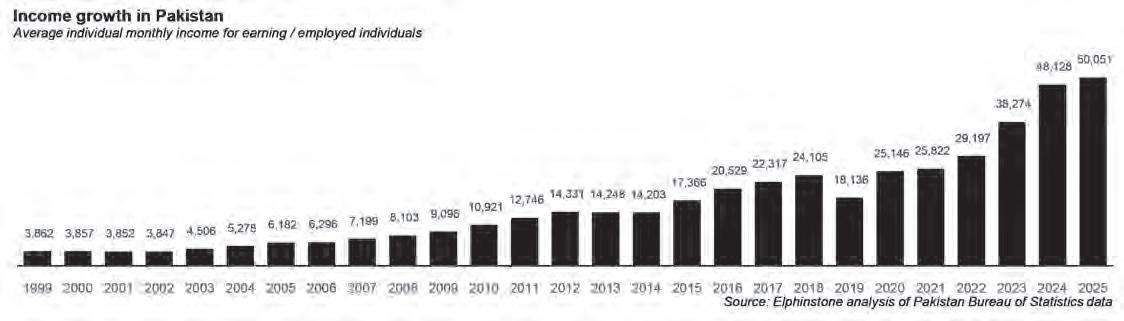
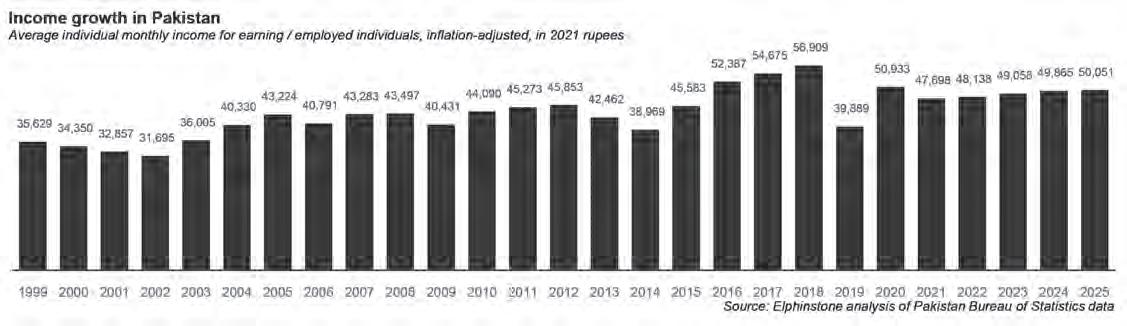
Here is an important fact to understand about income growth: it is never evenly spread across all segments of society, and in general, it tends to rise fastest among the most productive segments of an economy, meaning there will always be at least some people getting more prosperous than the rest of society at any given moment in time.
Then there is an important fact about consumption: it tends to not grow in a linear fashion, but rather has specific jump points. For example, there is a point of income beyond which a family is no longer simply able to house and feed itself, and instead can start thinking about the next phase of its growth, which typically involves investing in children’s education. For that family, above a certain income, their spending on private school tuition will go from zero to a relatively high number almost instantly.
At higher levels, it can go from things like struggling to afford fuel for one’s car to being able to afford to eat at restaurants on a regular basis. In that scenario, this person’s spending on fuel will incase to a certain point and then stop growing (because
his need for fuel has been met) and instead spending on restaurants will start rising at a relatively rapid rate.
What you are seeing with the rise of cafes that serve a cup of coffee for over Rs500 per cup is the rising number of people who have passed through those earlier levels of consumption, and still have money left over, which they are now spending on things like a cup of coffee at a nice café, or in the case of Lahore’s upper middle class, clothes from Armani.
The reason we know it is more people being able to consume – and not the already well-off increasing their consumption patterns – is through an analysis of income data. We explain our data analysis methodology in the next section (feel free to skip) and details in the section after, but the punchline is this: the number of people in higher income groups is rising faster than the overall size of the labour force expansion, and the rise is fastest for the topmost groups.
But first, let us explain how we arrived at our data.
Methodology note (feel free to skip)
We defined the upper middle class using various bands of individual income: either $10,000 a year, or $1,000 a
month (which would be $12,000 a year) and we also looked to see how many people make more than $20,000 a year. In our view, the lowest of these – $10,000 a year – is likely a reasonable estimate for where the upper middle class begins.
The data sets we utilised were the raw microdata sets from the Household Integrated Economic Survey (1999, 2002, 2005, 2006, 2008, 2011, 2012, 2014, 2016, 2019), the Pakistan Social and Living Standards Measurement surveys (2009, 2013, 2020, 2025), and the Pakistan Labour Force Survey (2018, 2021, 2025). We calculated the size of the labour force as a percentage of the total population, using data from the population census and the Labour Force Surveys.
For years for which we did not have data, we did straight-line projections between the two closest years for which we did have data.
We understand that mixing and matching varying data sets is not ideal, especially given the fact that they can have differences in methodologies, but we felt that the questionnaires and methodologies were sufficiently close to at least provide a reasonably accurate directional picture of what has happened to Pakistan’s income distribution and growth over the past two decades.
One more methodological note: we are aware that income surveys in Pakistan – like similar surveys around the world – vastly
undercount both the number of people as well as the incomes of people at the top end of the income spectrum. Umair Javed, an assistant professor of politics and sociology at the Lahore University of Management Sciences (LUMS), estimates that these surveys undercount as much as the top 8-10% of the income spectrum of Pakistan.
In fairness, the statisticians at the Pakistan Bureau of Statistics try to correct for this undercounting by adding estimated weights to each individual observation so that the spectrum can be observed in full, but we acknowledge this shortfall in our analysis based on the limitations of the data: we are likely underestimating the absolute size of the Pakistani middle – and especially upper middle – class, but are probably still close to being directionally accurate in terms of the growth rates and changes that have taken place over the course of the past two decades.
Finally, we chose to look at individual incomes rather than household incomes, in part because we wanted to examine trends that captured how much people are able to earn as individuals. Household data would have introduced the additional complication of the number of earners being different from household to household, as well as across time. Individual income data allowed us to control for that problem.
More people are entering the upper middle class
Let us start with some basics. Based on the 2025 data from the Pakistan Bureau of Statistics, we estimate that there are approximately 2.2 million individuals in Pakistan who make more than $10,000 a year in absolute income, which translates to approximately $40,000 a year in purchasing power parity income. That per capita income is roughly that of the European country of Montenegro, and that population is approximately the size of the metropolitan area of Prague in Czechia.
In other words, the broadest definition of the Pakistani upper middle class is roughly as prosperous – and as sizeable – as a mid-sized European city. Of course, they are spread out across the country, so it does not have the same agglomeration effects. But in the three areas of the country with the highest concentrations of these people – Clifton and DHA in Karachi, Gulberg and DHA in Lahore, and the oldest sectors of Islamabad – you can see glimpses of that level of prosperity.
As you move up to the higher definitions of upper middle class, the numbers get smaller, but get different in other ways. So, about 1.4 million individuals make more than $1,000 a
month in absolute terms, which translates to a purchasing power parity of $48,000 a year. That is more than the per capita income in Greece and that population is about the size of the metropolitan area of Oslo, Norway.
And a much smaller number – just over 400,000 individuals – make more than $20,000 a year, which would be about $80,000 a year in purchasing power parity terms, which is more than the per capita GDP of Germany. Of course, it is just 400,000 people, but as we shall observe, the growth rate in this population is remarkably rapid.
Here is where things get interesting: the higher the income category we look at, the faster the growth in the number of people entering that class.
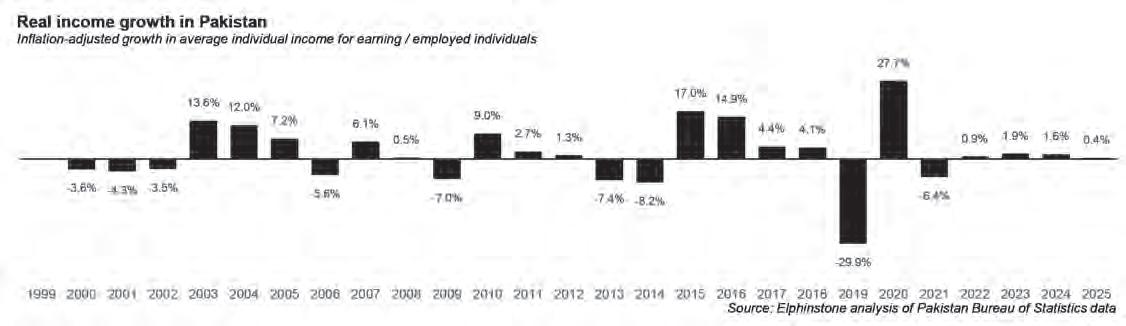
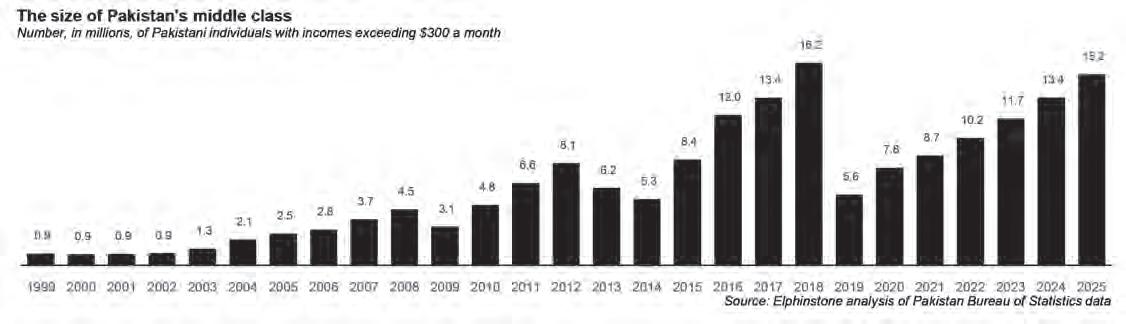
For the period between 1999 and 2025, the total population of the country grew by an average of 2.4% per year and the labour force grew by an average of 4.1% per year. The number of people entering the Pakistani middle class – $300 a month or more – grew by about 7% per year during that same period.
The upper middle class, however, grew way more rapidly. The class that makes more than $10,000 a year increased by 13.8% per year in terms of the number of people, the $1,000 a month class grew by 12.8%, and the class that makes more than $20,000 a year grew by more than 15.7% per year during that period.
Without a shadow of a doubt, the pro-
portion of people who are upper middle class in Pakistan is growing.
What expanding upper middle class means for Pakistan
If a country is slowly becoming more prosperous, these are the kind of numbers you would expect to see: more and more people climbing up to higher and higher levels of income every year. And as more of those people enter that class, it becomes more viable for businesses to start offering products to that class, products and services that are completely unaffordable to the country as a whole, but which those individuals would feel a desire to access as validation of their newfound economic status.
This class is still a relatively small proportion of the population. The 2.2 million people who make more than $10,000 a year are just 2.04% of the labour force. But their weight in consumer spending is starting to increase substantially. Our estimates indicate that despite constituting just 2% of the labour force, this upper middle class accounts for nearly 10% of consumer spending. If anything, we believe our estimate likely undercounts the upper middle class’ share of total consumer spending.
Given the fact that this population has grown so rapidly over the past quarter century,
it should be obvious that this is an expansion of the number of people who can access this level of prosperity, not a concentration of prosperity. But just for measure, we calculated that approximately 80% of the increase in this group’s spending power over the past 25 years came from more people being part of this class, not from increased incomes within the class.
We do not mean to suggest that Pakistan’s economy does not have distortions caused by an elite that seeks favours for itself. We do, however, contend that the Armani store in Lahore is not the result of a textile factory owner wanting to buy Armani shirts in Lahore instead of on his periodic Dubai trips, but the fact that an assistant branch manager at the Bank of Punjab can now afford to buy an Armani shirt at least once a year. A generation ago, that assistant branch manager would have been able to barely afford the fuel in his motorcycle.
And that, in turn, will influence some key trends in the Pakistani economy. As more people in Pakistan get the purchasing power of Europeans, they will consumer more products and services that Europeans consume. Initially, that will involve importing those products, which in turn will increase imports of what leftist economists will derisively describe as luxury imports. Over time, however, those goods will gain a large enough market within the country to justify domestic manufacturing.
A generation ago, diapers for babies were considered an outrageous luxury, with cloth nappies being the norm. Then started the imports of diapers, and now the world’s leading brand of diapers – Pampers, by Procter & Gamble – is manufactured in Pakistan, including sourcing many of the raw materials from Pakistan as well. (Yes, we know P&G is shutting down its offices inside the country, but that domestic manufacturing will continue.)
Consumption of goods that we consider luxury items today will grow, and it will do so initially through imports, which means Pakistan’s trade deficit is structural. We are a young country only just breaking into middle income country status, which means that the
most prosperous citizens within the country want to consumer items that are not manufactured within the country.
As the market size grows, more will be manufactured domestically, and once sufficient scale is achieved, perhaps some of it may even be exported to other markets nearby.
Meanwhile, life in the country will continue to have a growing set of incongruities. Audis and Porches will be sold in stores whose staff live in houses cheaper than the purchase price of those cars. Beggars will seek alms to buy food outside high-end grocery stores selling imported pet food. And people will buy boxes of chocolate worth more than the monthly salary of the cashier ringing up their purchase.
These all may feel jarring, but they are not indications of unfairness, but merely the fact that the future arrives unevenly and so different parts of society will get to experience prosperity at different rates. Yet the growth rates of the middle and upper middle class –particularly the fact that they are faster than the growth in the size of the labour force –indicates that the economic future of a broad base of prosperity is very much on the cards for Pakistan.
The regulatory capture and rent seeking, meanwhile, will also continue to exist and continue to be a problem, but they will not be the reason for those contrasts. At least not yet.
The Pakistani dream
Meanwhile, something else that is important may be about to take shape in the country: the development of a fully domestic Pakistani dream.
“The dream” in economic parlance is simply the idea of what constitutes a reasonable standard of living that most people in the country would be happy with, and thus the standard of living that the government and its elected leaders are held accountable for helping the population writ large achieve. It comes from the post-World War II idea of the American dream, involving a suburban home,
and “a chicken in every pot, and two cars in every garage.”
Unfortunately for Pakistan, the current Pakistani dream involves “study hard enough to get admission to a foreign university” or “get a job in a different country”. People in Pakistan, almost regardless of their economic circumstances, have a hard time considering themselves successful unless they have been able to spend at least some time outside the country, ideally on their own terms.
Part of this is due to the fact that, until relatively recently, the physical environs of even expensive neighbourhoods in Pakistan were far less pleasant than even middle class neighbourhoods in the developed world. And part of it is due to the fact that it was almost impossible for most people in the country to afford the best of what was on offer, so even dreaming about owning a 1 kanal home in Gulberg, Lahore was out of the question. And maybe that is still out of the question for the median LUMS graduate to achieve off income earned in their career within Pakistan, but a nice house in Bahria Town or an apartment in Emaar Karachi are a bit more realistically achievable.
It is a narrow sliver of Pakistanis who can afford the islands of first world living in Pakistan, but their numbers are growing, and perhaps with it will grow the idea that to achieve the Pakistani dream, one need not leave Pakistan, and instead one can earn the money to live the good life within the country.
That, in turn, would slow down the rate of the brain drain, which would have a significant impact on the ability of the economy to grow economic productivity. After all, the economy simply cannot make do with this level of hemorrhaging talent every year.
In short, we can either import the goods we consider luxuries today, or we can export the brains who have the intelligence and work ethic to earn the money to afford them. In the long run, it is much cheaper to import those goods than to lose the best minds and best earning power. n
By Aziz Buneri
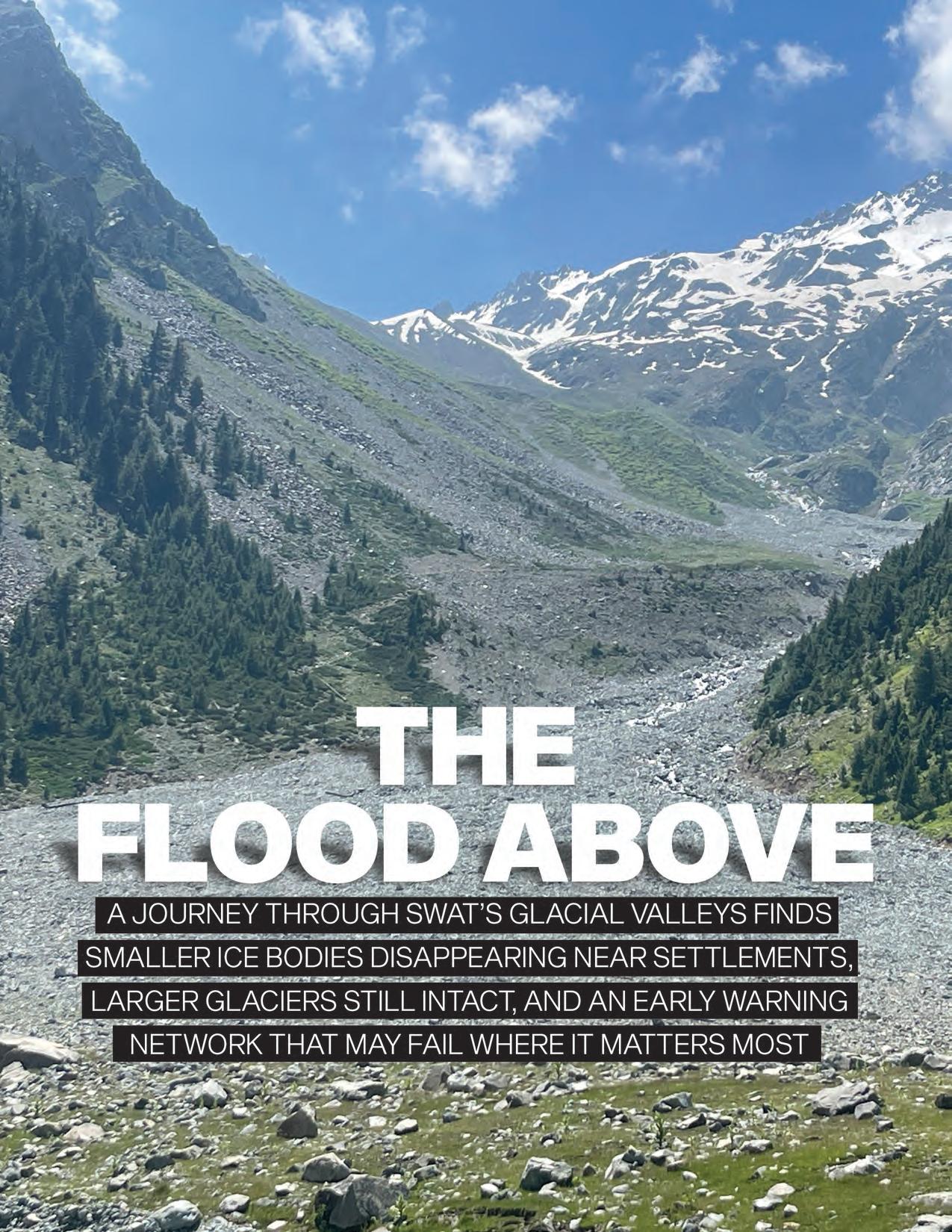
The first sign of the glacier was not ice. It was its absence.
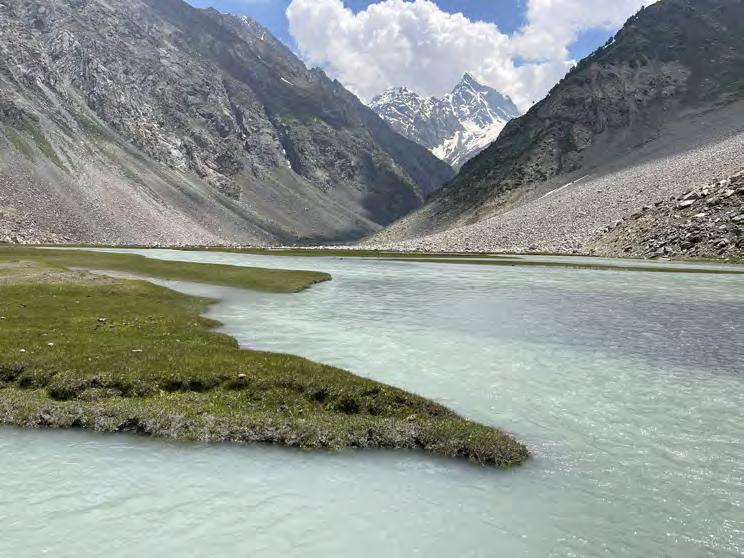
In the upper reaches of Swat, where the road narrows and the journey eventually has to continue on foot, smaller glaciers that local communities had known for years had almost disappeared. The larger masses of ice were still there, higher up and farther away, but the melt below them had already changed the landscape. Streams carried more water, protective structures showed signs of erosion, and villages sat uncomfortably close to the routes that floodwater would follow.
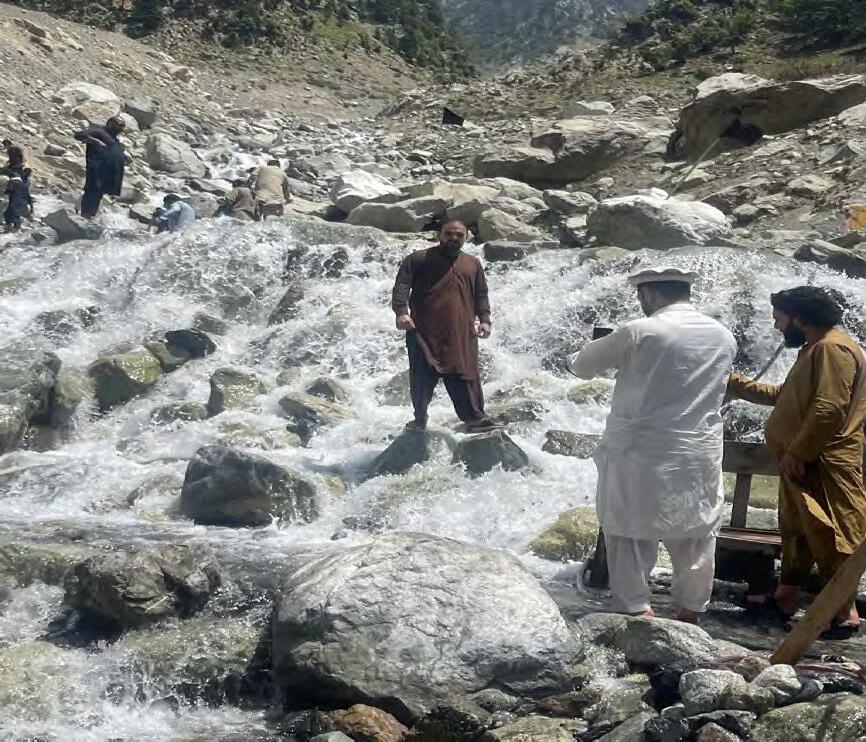
The Provincial Disaster Management Authority had issued an alert about glacial melting across Khyber Pakhtunkhwa. That alert took us from Bahrain towards Mankyal Valley, then to Jabba and onwards to the Seri Kat Glacier. Local residents walked with us for six to seven hours, guiding us through routes that are difficult to identify without people who know the mountain.
At Seri Kat, the smaller ice bodies around the main glacier had largely melted. The larger glacier remained intact. We then returned through the valley and headed towards Kamar Khwa, below Chukail Banda. The pattern was similar: the smaller glaciers beside it had receded sharply, while the main glacier still appeared to be holding.
That distinction matters. A large glacier remaining visibly intact can create a false sense of security. The immediate danger often develops not from the dramatic collapse of an entire glacier, but from meltwater accumulating in unstable lakes, channels becoming blocked by debris, or smaller ice formations giving way above settled valleys.
In the mountains, a great deal of destruction can begin with a change that appears modest from a distance.
Into Mankyal
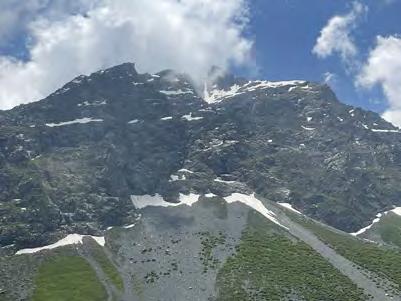
Mankyal Valley is one of the places where the geography itself explains the risk. Its glaciers are not hidden in an uninhabited mountain system. They sit above communities, agricultural land, roads, hotels and small markets that depend on tourism and seasonal trade.
Social activist Zubair Torwali identifies three major glaciers in the valley, including Seri Kat, which he estimates stretches for around
10 kilometres, and Kamar Khwa, along with several smaller glaciers. He considers Mankyal the most exposed part of Swat because the ice, water channels and population centres are packed into the same narrow landscape.
The most vulnerable locations are not necessarily next to the highest or largest glaciers. They are the places where water can gather momentum before entering settled areas. In Kamar Khwa, previous glacial flooding damaged an estimated 30% to 40% of agricultural land and affected settlements extending down towards the main road.
Protective works have been constructed, but parts of the structure are already being damaged by the water they are meant to control.
In Mankyal, a more substantial protective channel and wall system has been built. It is one of the clearest examples of the correct instinct: do not try to stop the mountain’s water, but guide it away from homes and towards a safer route. Yet even here, the effectiveness of the structure depends on maintenance, engineering capacity and the scale of the next flood.
This is the central infrastructure prob-
lem posed by glacial risk in northern Pakistan. A wall built for yesterday’s water may not withstand tomorrow’s volume. Climate change is altering the intensity and timing of melt, while unregulated construction is reducing the space through which water can safely move.
Where the ice has gone
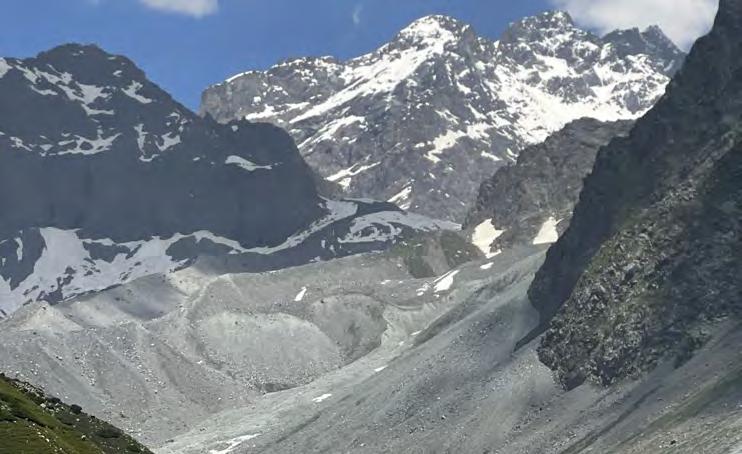
The journey continued towards Matiltan and the Ushu side of upper Swat. The glacier closest to the population centre in Matiltan had almost entirely vanished. Farther ahead, towards the higher boundary areas connected to Kohistan and Gilgit-Baltistan, the larger glaciers remained intact, but reaching them required more time, equipment and an overnight stay.
The same limitation shaped our visit to Gabral. Smaller glaciers could be observed and did not appear to present an immediate threat on the same scale as Mankyal. The larger glacier system towards the Chitral boundary, however, was too far to reach within the avail-
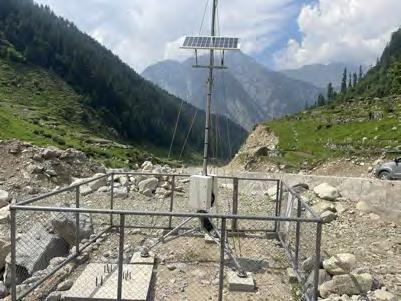
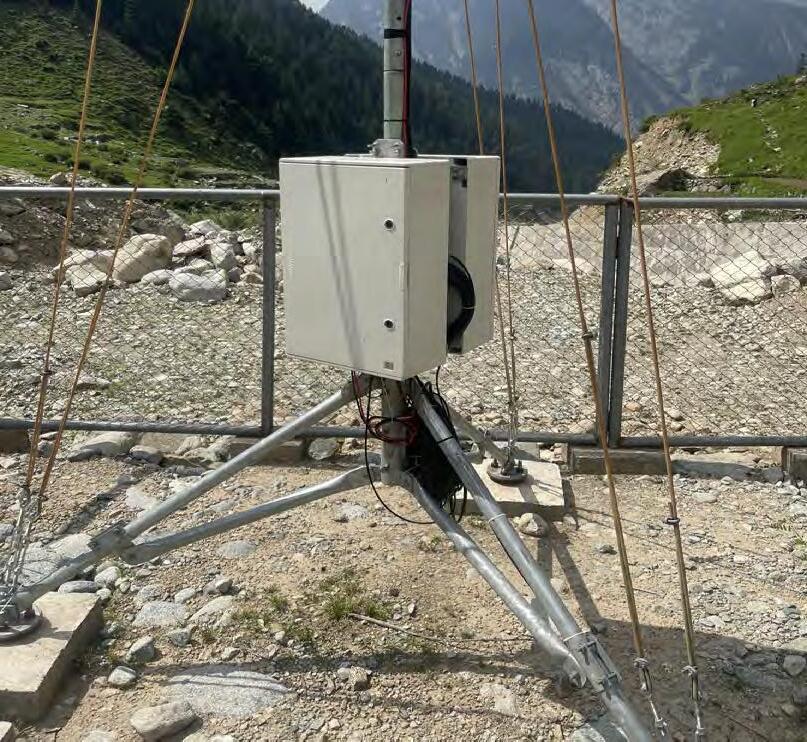
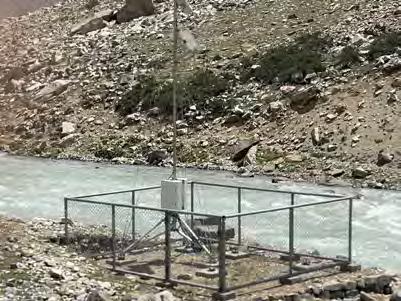
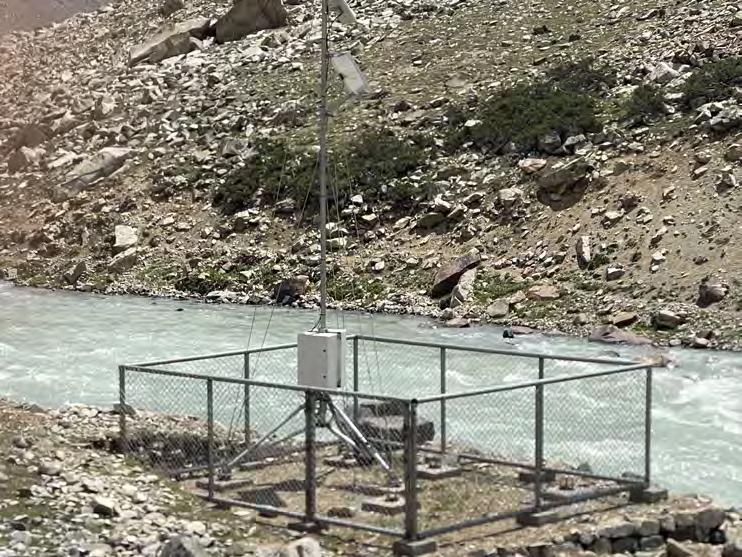
Close ups of the Early Warning Systems at Manakail
able daylight. The route was long enough to require spending the night on the way.
This is not a minor reporting inconvenience. It reflects the central monitoring challenge faced by the state. The glaciers that are easiest to visit are not always the ones that require the closest scientific attention. The most important ice bodies are often located beyond roads, mobile coverage and permanent government presence.
Khyber Pakhtunkhwa’s glacial belt stretches across Swat, Upper and Lower Chitral, Upper Dir, the Kohistan region and the Kaghan Valley. According to PDMA officer Sajid Khan, the authority’s current count places the number of small and large glaciers in the province at between 85 and 87.
The major systems include Tirich Mir, Broghil, Yarkhun and Laspur in Chitral; the glaciers around Mankyal, Matiltan and Ushu in Swat; glacial areas extending towards Upper Dir and Kohistan; and Lulusar in the Kaghan region.
The precise number is less important than the spread. These glaciers sit across several districts with very different road networks, administrative capacity and levels of exposure. A warning issued from Peshawar or Islamabad can only become useful if it reaches a village in a form residents understand and with enough time for them to act.
Five days later
Five days after the glacier visits ended, Upper Chitral provided a reminder of how quickly a risk assessment can become a disaster report.
Accelerated glacial melt triggered severe flooding in the Yarkhun area. A flash flood in Bang Gol caused water levels to rise sharply, damaging homes, orchards, roads and other property. The only bridge over Bang Nullah was washed away, closing the Yarkhun Valley Road and cutting off the sole land connection for around 50,000 residents.
The road from Mastuj to Broghil was also closed to traffic. Communities appealed for emergency relief, alternative access routes and immediate assistance, while the district administration began assessing the damage.
The flood did not need to sweep away an entire hotel on camera to become economically devastating. A bridge was enough.
In mountain districts, a single broken link can isolate tens of thousands of people, halt the movement of food and fuel, prevent tourists from leaving or arriving, and delay the transport of patients, livestock and agricultural produce.
This is why GLOFs are not only environ-
mental events. They are business interruptions, public finance shocks and infrastructure failures. They destroy assets built over decades and impose repeated reconstruction costs on districts that already have limited fiscal capacity.
The tourism trap
Over the years, images of hotels being torn from their foundations and swept down the rivers of northern Khyber Pakhtunkhwa have become disturbingly familiar. Yet tourism remains both an economic lifeline and a growing source of pressure on these valleys.
Torwali argues that rising tourist numbers, new settlements, commercial construction and higher local emissions are increasing stress on Mankyal’s environment. Hotels and tourist facilities are often built close to rivers and glaciers because that is where the view, access and commercial value are greatest. It is also where the physical risk is concentrated.
The incentives are clear. A hotel owner cannot move far from the road, river or attraction and still expect the same business. Local families convert land into shops, guest houses and parking areas because tourism offers cash income that farming and livestock increasingly cannot match.
But every new structure narrows natural drainage, increases waste, raises energy use and places another private asset in the path of a future flood.
Former Awami National Party ticket-holder and hotel owner Raja Mumtaz Chamot presents the frustration from the other side. He says repeated PDMA warnings during the tourist season discourage visitors and cause heavy losses to businesses that collectively invest billions of rupees ahead of the peak months.
He also questions whether disaster man-
agement officials have the equipment, technical capacity and field presence required to assess the danger accurately.
His criticism reflects a genuine credibility problem. A warning that is too broad can damage an entire tourism season. A warning that is too late can cost lives.
The answer, however, is not fewer warnings. It is better warnings: location-specific, time-bound, scientifically grounded and linked to clear instructions.
The tourism economy cannot be protected by pretending risk does not exist. Nor can it survive if every alert treats an entire district as equally unsafe. Businesses need a system that distinguishes between a valley under immediate threat, a route that requires closure and an area where activity can continue with precautions.
The warning network
Pakistan is not starting from zero. The United Nations has set 2027 as the deadline for universal protection through Multi-Hazard Early Warning Systems, and installations in 24 valleys across Khyber Pakhtunkhwa and Gilgit-Baltistan form part of the country’s effort to meet that goal.
In Khyber Pakhtunkhwa, the Pakistan Meteorological Department has installed Early Warning Systems in glacier-prone areas. According to PDMA, there are six installations in Upper Kohistan, 10 in Madaklasht in Lower Chitral, 12 in Upper Dir, eight in Mankyal, 13 in Gabral, 13 in Matiltan and 12 in Reshun in Upper Chitral.
These systems provide real-time readings on rainfall, temperature, river gauges, lake levels and water flows. The main server is managed by the PMD, while PDMA has access to the data. Sajid Khan says around 85% of the
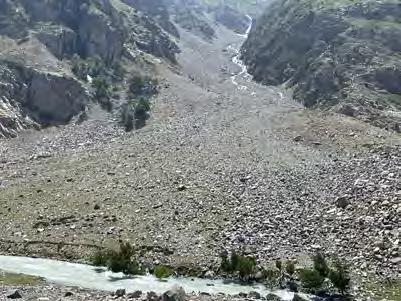
The domineering sights of the glaciers at Mankyal
network is operational, although some systems in Kumrat are no longer functioning.
The hardware is only one layer. A functioning warning system requires observation equipment, power, communications, trained analysts, district officials, evacuation plans and residents who trust the message. Failure at any one stage can make the entire network useless.
Reports from some mountainous communities suggest that solar panels, batteries and display screens have been removed from EWS installations. Poverty is part of the explanation, but the theft also reveals that these systems were introduced without sufficient local ownership.
A device placed in a village but not understood by the village remains an outside object. When its components have immediate resale or household value, the long-term public benefit can lose to short-term need.
There are also concerns that parts of the warning network are not fully integrated with the PMD and PDMA dashboards. Without continuous connectivity and coordinated data sharing, a sensor may collect information without producing a timely warning for the people in danger.
An Early Warning System is only as effective as its weakest connection.
What best practice requires
The strongest warning systems are not silent machines fixed to a pole. They are social systems built around reliable technology.
Each exposed valley needs local custodians who are paid, trained and accountable for checking power supplies, sensors and communication links. District administrations need ring-fenced maintenance budgets rather than waiting for a donor project or a fresh disaster allocation.
The PMD and PDMA dashboards must be fully integrated, with data moving in real time and alerts reaching district control rooms without manual delays.
Communities also need regular drills. Residents should know which siren means evacuation, which route is safe, where livestock can be moved and who is responsible for elderly people, children and those with disabilities. In areas where roads are routinely cut off, evacuation planning cannot begin after the bridge has already gone.
Protective walls and channels should be mapped, inspected before every melt and monsoon season, and redesigned where water is already eroding them. The damaged structure at Kamar Khwa is a warning in itself. Infrastructure that appears complete on a government list may already be failing on the ground.
The state must also regulate where
construction can take place. This is politically difficult because tourism, land values and local employment are involved. But a hotel built in a natural flood channel is not only a private risk. Its collapse can block water, create debris, damage downstream property and require a publicly funded rescue.
Torwali points to the Darolai Community Forest as an example of local conservation succeeding where official policy has struggled. The forest is divided into eight management units, and residents have voluntarily restricted tree cutting, increasing forest cover by around 60%.
His argument is straightforward: communities that preserve forests should receive development projects and incentives that make conservation economically worthwhile.
Forest cover will not stop a GLOF, but it can reduce erosion, stabilise slopes and limit the debris that turns fast-moving water into a wall of mud, timber and stone.
Institutions without depth
Pakistan’s climate institutions still operate too often through notices rather than systems.
PDMA can issue an alert. PMD can record rainfall and water levels. The Forest Department can plant trees. District administrations can build protective walls. But the risk sits between these responsibilities. No single institution owns the full chain from glacier monitoring to evacuation, land-use control, tourism regulation, maintenance and reconstruction.
Technical capacity remains thin. Pakistan needs more engineers, glaciologists, meteorologists, hydrologists and disaster managers who understand mountain systems. Training partnerships with countries such as Japan and China can help, but overseas exposure will matter only if expertise is retained, deployed in the field and connected to district-level decision-making.
Mankail EWS
There is also a need to separate political argument from technical assessment.
The debate over sand and gravel extraction from the Swat River illustrates the problem. Raja Mumtaz argues that restrictions on extraction have reduced the river’s carrying capacity and contributed to higher flood levels. Environmental regulation, however, cannot be based on commercial pressure alone.
Any review must examine sediment flows, river morphology, construction demand and flood behaviour through an independent technical assessment.
The objective should not be to choose between development and safety. It should be to identify which forms of development make the risk worse and which investments reduce it.
The first line of defence
By the time we returned from the glaciers, the most striking finding was not that all the ice was disappearing. It was that the risk was uneven.
The larger glaciers at higher elevations remained intact in several locations. Smaller glaciers closer to settlements had melted sharply or almost vanished. Some valleys had protective structures; others had structures already being damaged. Early Warning Systems were present, but not all were operational, protected or fully integrated.
Communities understood the mountains, but they had not always been made partners in the technology meant to protect them.
Then Yarkhun flooded.
That sequence should shape the policy response. Khyber Pakhtunkhwa does not need another cycle in which an alert is issued, a disaster occurs, roads and bridges are rebuilt, compensation is announced and the same exposure remains in place for the next season.
risk. Conservation must create income for the people being asked to protect forests.
It needs permanent glacier monitoring, valley-level risk maps, functioning warning networks, enforced construction controls, maintained flood channels, community drills and rapid-response access plans. Tourism policy must include carrying capacity and climate
Infrastructure spending must account for the fact that roads and bridges in glacial valleys are not ordinary assets. They are lifelines.
Early Warning Systems must similarly be treated as permanent public infrastructure rather than one-time development projects. They require maintenance, trained staff,
replacement parts, security, community participation and institutional ownership long after the initial installation ceremony has ended.
The glaciers above Swat and Chitral are not distant symbols of climate change. They are reservoirs of risk positioned above farms, hotels, markets and roads. The journey to reach them may take hours on foot. The water they release can reach a settlement much faster. n
The early warning system in Medan Gabral
The Maidan Gabral Glacier presents a foreboding picture
Water troubles from within and without
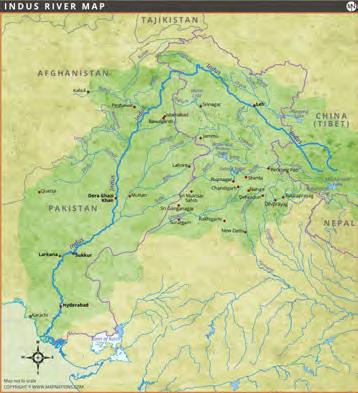
Pakistan’s water crisis now has two fronts. One begins upstream, across an international border. The other begins inside the country’s own dams, canals, regulators and provincial politics
The first is the larger threat. India’s decision to place the Indus Waters Treaty in abeyance has challenged an arrangement that protected the subcontinent from turning every dry season, dam repair and flood surge into a security crisis. The second threat is less dramatic but more immediate. It is already visible in delayed crops, dry canals, lost hydropower, provincial accusations and higher costs for farmers.
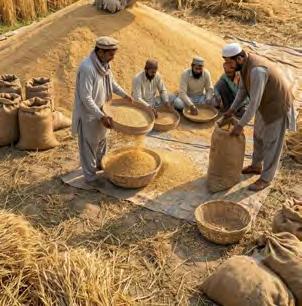
This year, paddy growers on the right bank of Sukkur Barrage struggled to prepare nurseries on time because releases from Tarbela were disrupted. A nursery that cannot be transplanted after roughly 35 to 40 days loses quality and becomes more vulnerable to pests. In Lahore, meanwhile, flood officials have had to prepare for possible surges in the Ravi with weaker information because India is no longer sharing river and flood data through the treaty system. One problem leaves a farmer waiting for water. The other may leave an entire administration waiting for warning.
India’s threat is existential. Pakistan’s failures are everyday. The country cannot afford to confuse the scale of one with the urgency of the other.
The threat from without
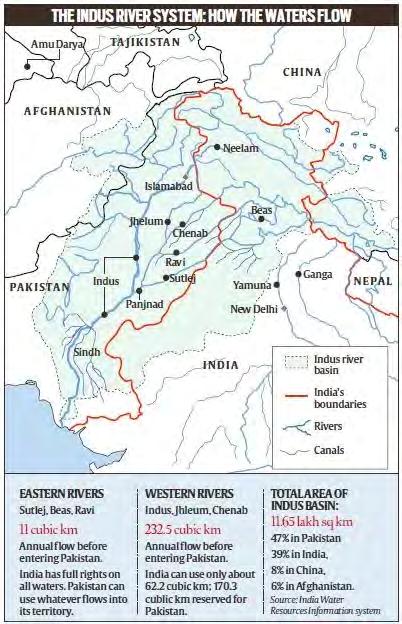
The Indus system was divided by a border before it was divided by a treaty. Partition left major canal headworks in India while large irrigated areas lay in Pakistan. An engineering network built as one system had suddenly become an international dispute. The World Bank entered the process in the early 1950s, and after years of negotiation the Indus Waters Treaty was signed in Karachi in 1960 by President Ayub Khan and Indian prime minister Jawaharlal Nehru.
The settlement was simple in principle. India received unrestricted use of the eastern rivers — the Ravi, Beas and Sutlej. Pakistan received the waters of the western rivers — the Indus, Jhelum and Chenab — subject to limited Indian uses allowed by the treaty. The agreement also created the Permanent Indus Commission, required regular information exchange and established procedures for resolving questions, differences and disputes. India also contributed £62.06 million towards the replacement works Pakistan needed after losing access to the eastern rivers.
This was not just an act of friendship. It was an act of risk management. The treaty survived wars, military crises and long periods when the two countries barely spoke. Its value lay precisely in keeping water insulated from the wider relationship.
That insulation was broken in April
2025. After the Pahalgam attack, India announced that the treaty would be held in abeyance by New Delhi. India blamed Pakistan for the attack; Pakistan denied involvement. India has still not provided any proof regarding this alleged involvement. The treaty itself contains no provision allowing either side to suspend it unilaterally. India’s move therefore did more than interrupt cooperation. It asserted that a binding water arrangement could be switched on and off as an instrument of pressure.
The rhetoric that followed made the danger clearer. Senior Indian officials spoke of diverting water away from Pakistan and towards Indian territory. Amit Shah said the treaty would not be restored. Such declarations may play well in domestic politics, but they are reckless statecraft. Pakistan is the downstream country. Its farms, cities, power system and food supply are tied to the Indus basin. Threatening those flows is not normal diplomatic signalling. It is a threat against the foundations of the economy.
There is an important technical distinction. India cannot simply close a tap and permanently stop the western rivers tomorrow. It does not currently possess enough storage capacity on those rivers to hold back their full flows for long. But that does not make the threat harmless.
Water is about timing as much as volume. A short disruption during sowing, transplantation or reservoir filling can inflict losses far beyond the amount of water involved. Changes in dam operations can also produce sudden downstream fluctuations. Reuters reported that flows at a key Pakistani receiving point briefly fell by as much as 90% during Indian maintenance work after the suspension.
The loss of data may be even more dangerous in the near term. The treaty was not only an allocation document. It was an operating system for two states sharing rivers. It required information on flows, projects and extraordinary releases.
Without that channel, Pakistani officials are being pushed towards satellite estimates, informal reports and social media. Dawn reported this month that Punjab had been told to prepare at a high-alert level because reliable upstream information was no longer available. The risk is not theoretical. A Ravi flood in August 2025 reached 220,000 cusecs and affected 31 villages and 82,952 people in Lahore district.
Pakistan’s official response has accordingly hardened. Prime Minister Shehbaz Sharif warned at the 80th session of the United Nations General Assembly against any attempt to stop, reduce or divert Pakistan’s treaty waters. At a recent international seminar in Islamabad, federal ministers and political leaders framed the dispute as a question of food, life and national survival. The language is severe because the stakes are severe.
Pakistan is right to treat the matter as a national security issue. It is also right to internationalise it. The treaty was brokered with World Bank involvement because the dispute was too dangerous to leave to power politics. India’s attempt to reduce it to a bilateral favour should concern every country that relies on a transboundary river agreement.
But Pakistan’s response cannot rest on speeches alone. It needs sustained legal work, technical monitoring and diplomatic pressure. It must document every disruption. It must improve its own gauges, satellite analysis and flood forecasting. It must also show that it is using its treaty entitlement responsibly.
A country arguing that every drop is vital weakens its case when its own infrastructure cannot deliver that water to the people who need it.
The trouble within
That contradiction is now visible at Tarbela. The Indus River System Authority asked for releases that Wapda could not fully provide because work on Tarbela’s Tunnel 4 low-level outlet and Tunnel 5 remained incomplete. In early July, an operational requirement of 170,000 cusecs was met with only 152,400 cusecs.
Sindh received 22,000 cusecs less than its indent, while Punjab received 22,500 cusecs less. Mangla was then used to cover part of the gap, costing it 0.5 million acre feet during a critical filling period. Irsa said a cumulative 75,000 cusecs of release capacity had been unavailable in May, when Sindh was entering peak kharif demand.
These are technical numbers until they reach a farm. Then they become income.
Paddy growers need water at specific stages. A delayed nursery cannot simply be carried forward without cost. Yields fall. Pests spread. Labour schedules are disturbed. Credit taken for seed, fertiliser and diesel still has to be repaid. Lower output then travels through
rice mills, transporters, exporters and food markets.
The shortage also became a federal dispute. Sindh challenged Irsa’s attempt to equalise provincial shortages and argued that surplus rain flows used earlier could not be adjusted against its share under the 1991 Water Accord.
Balochistan, in turn, accused Sindh of not passing on its full allocation through Guddu and Sukkur. By July 3, Balochistan said it had received 0.365 million acre feet against releases of 0.675 million acre feet, a deficit of 46%. Kotri had recorded a 65% reduction in flows by June 18.
This is the more immediate face of Pakistan’s water problem. It is not always a lack of water in the river. It is often a failure to release it, measure it, route it and account for it at the right time.
The scale of the system makes this difficult, but not excusable. The Indus Basin Irrigation System is the world’s largest contiguous irrigation network. It includes three major reservoirs, 19 barrages, 12 inter-river link canals, 45 major canal commands and more than 120,000 watercourses. Roughly 106 million acre feet is diverted annually into canals.
A system this large needs constant rehabilitation, credible telemetry and clear operating rules. Instead, disputes are frequently settled through political pressure after shortages have already reached the field.
Pakistan also uses water badly. The World Bank has estimated that water-related losses cost the economy around 4% of GDP each year. Wheat, rice, sugarcane and cotton consume close to 80% of water while generating less than 5% of GDP.
Pakistan’s water productivity was estimated at only $1.38 per cubic metre in 2015, among the lowest levels in the world. These figures do not mean the country should abandon major crops overnight. They mean the incentives around cropping, irrigation and groundwater are economically unsustainable.
More storage is necessary. It is not a complete answer. Existing storage has been estimated at around 68 days of average rabi irrigation supply. New dams can provide resilience, hydropower and flood control. But a new reservoir cannot fix an unlined watercourse, an unreliable gate, an unmetered tube well or a delayed tunnel project. Supply-side construction without demand reform merely pours more water into the same weak system.
The immediate agenda is clear. Tarbela’s delayed works need a public completion schedule and accountability for missed deadlines. Irsa’s daily accounts should be transparent enough for provinces to see releases, losses and deliveries in near real time. Telemetry must be independently verified.
Canal rehabilitation should be tied to measurable reductions in losses. Groundwater extraction needs monitoring. Crop policy should reward value per unit of water, not only acreage or political influence. Flood forecasting must be strengthened so Pakistan is not fully dependent on Indian data even while it continues to demand that India meet its treaty obligations.
Above all, the federation needs trust. The 1991 Water Accord cannot work if every shortage becomes evidence of theft and every surplus becomes an accounting dispute. Sindh cannot be expected to accept uncertain upstream releases. Balochistan cannot be expected to accept shortages below Sindh’s barrages. Punjab cannot plan crops on indents that reservoirs cannot deliver.
The system needs rules that operate before ministers, courts and parliament are forced to intervene.
India’s actions remain the larger strategic danger. A hostile upstream state challenging a treaty that protects Pakistan’s principal rivers is an existential matter. But internal failure has the faster economic impact. It reaches a paddy nursery in weeks. It reaches food prices in months. It reaches provincial relations almost immediately.
Pakistan must therefore do two things at once. It must defend every right provided by the Indus Waters Treaty and resist any attempt to turn water into a weapon. It must also repair the tunnels, gates, canals, gauges and institutions through which that water reaches its own people.
A treaty can protect Pakistan from its neighbour. It cannot protect Pakistan from neglect at home. n
OPINION
Asif Saad
The Board’s Real Job is not Oversight
Several years ago, I wrote an article arguing that many boardrooms in Pakistan were little more than a hoax. My argument was straightforward. Too many boards had become ceremonial institutions which met regularly, reviewed thick board packs, approved minutes, satisfied governance codes, and yet contributed very little to the quality of the company’s decisions.
The response surprised me. Directors, CEOs and even regulators acknowledged that the criticism had merit. Looking back, and after gaining more experience across many board rooms, however, I realise that the article only asked half the question.
If boards are ineffective, what should an effective board actually do?
For years my instinctive answer would have been oversight. After all, that is how we describe boards. They monitor management, oversee risk, review financial performance, approve major decisions and ensure compliance. These are essential responsibilities. Without them, companies expose themselves to poor governance and unnecessary risk.
But I no longer believe they represent the board’s greatest contribution. Instead, I have come to believe that a board’s most important job is to improve the quality of judgement. That may sound like a subtle distinction. I don’t think it is.
Over the years I have sat through board meetings where every committee report was presented, every governance requirement
The writer is a strategy consultant who has previously worked at various C-level positions for national and multinational corporations
satisfied and every agenda item completed. By any conventional measure these were successful meetings.
Yet nothing had changed.
Management entered the room believing exactly what it believed before the meeting and left believing exactly the same thing afterwards. The board had exercised oversight but it had added almost no value.
On more than one occasion I have advised shareholders to ask themselves an uncomfortable question: if this board disappeared tomorrow, would the quality of the company’s strategic decisions actually deteriorate? Where the honest answer was no, I recommended they rethink why they had a board in the first place.
By contrast, I have witnessed meetings transformed by a single question.
In one case, management spent considerable time explaining the operational problems of a particular business segment. The discussion revolved around how to improve performance. A director interrupted with a simple question.
“Why are we in this business at all?”
The room fell silent and the discussion shifted completely. Management was asked to evaluate whether exiting the segment might create more value than trying to improve it. No additional information had been presented. No consultant had been hired. No committee had been formed.
What changed was not the information available to the board, but the quality of judgement. That experience has stayed with me because it illustrates something I have learned and gradually come to appreciate. Boards create value in at least four distinct ways.
First, they change the question.
Management naturally concentrates on execution. Boards should periodically challenge the assumptions underlying the strategy itself. They should ask questions that management has stopped asking.
Second, they extend the time horizon.
Executives live with quarterly targets, annual budgets and immediate operational pressures. Boards exist partly to protect the long-term interests of the institution. Their perspective should stretch years ahead, not merely to the next reporting cycle.
Third, they bring pattern recognition.
A good director contributes far more than industry knowledge. They bring experiences from different organisations, industries and economic cycles. Often the greatest value a director offers is the ability to recognise a pattern that management has never encountered before.
Finally, and perhaps most importantly, boards challenge consensus.
Every leadership team develops a story about why the business is succeeding or failing. Some-
times those stories are correct. Sometimes they become dangerously comfortable. The board’s responsibility is not simply to agree or disagree. It is to ask, “What if our assumptions are wrong?”
That single question has prevented many poor strategic decisions. Seen this way, the board’s role is less about supervising management than about improving management’s thinking. Ironically, this distinction will become even more important as artificial intelligence becomes commonplace.
AI will soon analyse financial statements more thoroughly than most directors. It will prepare board packs, identify anomalies, mon-
itor compliance and summarise risks. Much of the informational work currently performed by boards will become faster and more accurate via AI. If information becomes abundant, what becomes scarce? Judgement and the ability to synthesise experience. The courage to challenge prevailing assumptions and the wisdom to recognise that a perfectly logical decision can still be strategically wrong.
In other words, the qualities that no governance checklist can guarantee.This also changes how we should think about corporate governance in Pakistan. For years our debate has focused on structure; independent direc-
tors, board committees, governance codes and regulatory compliance. Those reforms matter and should continue. But they are foundations, not the building itself. The harder challenge is creating boards that consistently improve the quality of collective judgement.That requires directors and chairmen to have different conversations and perhaps even different measures of success.
Instead of asking whether every agenda item was completed, perhaps we should ask a much simpler question: If management leaves a board meeting thinking exactly as it entered, what value did the board actually create? n
PIBTL wants to become Pakistan’s minerals export gateway
A supplementary concession at Port Qasim opens the terminal to copper, gold and other metals, but the Reko Diq windfall has been delayed and imported coal remains the business’s near-term engine
Pakistan International Bulk Terminal Ltd (PIBTL) was conceived as a solution to one of Karachi’s less glamorous logistical problems: how to unload millions of tonnes of coal without coating the country’s largest city in yet another layer of black dust.
Nearly a decade after the terminal began operating, however, its future may increasingly depend not on what Pakistan imports, but on
what it hopes to export.
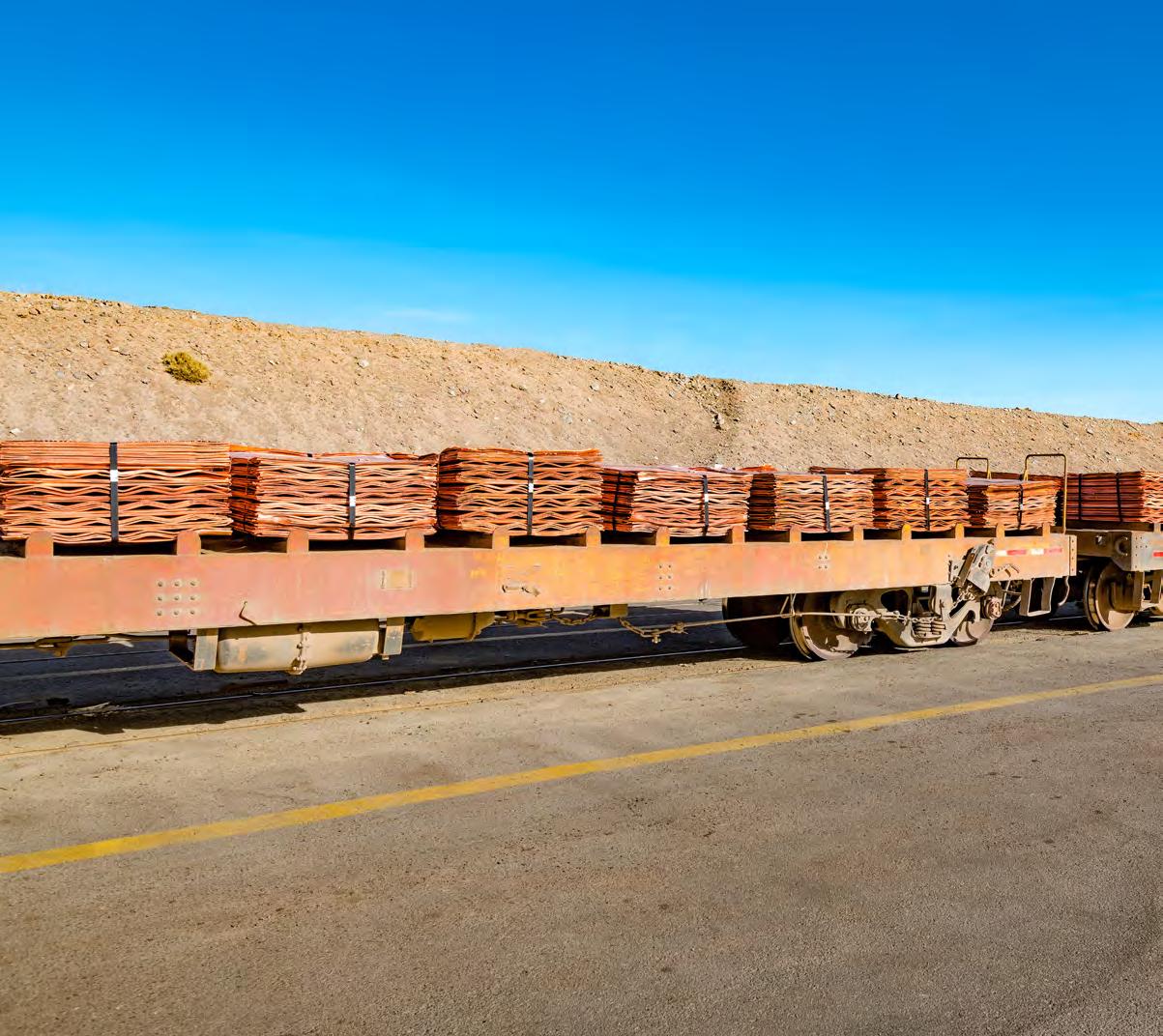
PIBTL has secured expanded rights from the Port Qasim Authority (PQA) to handle, store and export copper-gold commodities, metals, minerals and other natural earth products. It has also signed an agreement with Reko Diq Mining Company for the handling of copper and gold concentrate from the enormous mine being developed in Balochistan.
At an investor conference organised by Topline Securities in Karachi, PIBTL’s manage-
ment presented the supplementary agreement as the beginning of a broader transformation: from a terminal built mainly around imported coal and cement-sector cargo into an export gateway for Pakistan’s emerging mining industry.
The company’s formal disclosure to the Pakistan Stock Exchange, made in December 2025, said the supplemental implementation agreement grants PIBTL the concessions, rights and licences needed to handle cop-
per-gold commodities and other minerals and metals. Unlike its exclusive rights relating to cement and clinker under the original agreement, however, PIBTL’s new mineral-handling rights are explicitly non-exclusive.
That distinction matters. PIBTL has secured access to a potentially enormous new market, but not a monopoly over it.
The immediate story, nevertheless, is one of recovery. PIBTL handled approximately 7.6 million tonnes of cargo during the financial year ending June 2026, almost 60% more than the 4.79 million tonnes handled in the preceding year. Customers from the cement industry accounted for 41% of FY2026 throughput, followed by power producers at 26%, commodity traders at 17%, textile and other industrial users at 10%, and chemicals companies at 6%.
Those figures indicate that, despite all the excitement around Reko Diq, PIBTL remains for now a business overwhelmingly tied to Pakistan’s demand for imported coal. The minerals opportunity is the long-term story. The rebound in coal volumes is what repaired the income statement in the year just ended.
A terminal built around coal
PIBTL was incorporated in March 2010 and signed a build-operate-transfer agreement with PQA in November of that year. The 30-year concession, which may be extended for another 30 years, gave the company responsibility for constructing, developing and operating Pakistan’s first specialised mechanised terminal for coal, clinker and cement at Port Qasim. The assets are ultimately to be transferred to PQA when the concession expires.
The project represented an investment of approximately $305 million and was financed partly through debt and equity provided by the International Finance Corporation, the private-sector arm of the World Bank, as well as the OPEC Fund for International Development. The terminal was designed with annual capacity to import 12 million tonnes of coal and export four million tonnes of cement and clinker. It occupies approximately 72 acres in the north-western industrial zone of Port Qasim.
Commercial operations began in 2017. The terminal’s purpose was not merely to add port capacity. It was also intended to shift dusty bulk commodities away from the more densely populated Karachi Port, where traditional handling methods were slower, less efficient and considerably more polluting.
Mechanisation allowed vessels to be discharged more quickly, reduced losses during handling and provided industrial customers with a customs-bonded storage facility connected to Pakistan’s road network. In theory, those efficiencies should have created a rela-
tively straightforward infrastructure business: build the terminal, fill spare capacity and collect handling fees over a long concession period. The reality has been more volatile.
PIBTL’s volumes are determined largely by decisions taken elsewhere in the economy: whether cement manufacturers use imported coal or local alternatives; how much electricity coal-fired plants produce; whether the rupee is strong enough to make imports affordable; and whether industrial output is growing or contracting. The company has high fixed costs, significant depreciation and a large royalty obligation to PQA. Lower throughput therefore tends to have an outsized impact on profitability.
That became particularly clear in FY2025.
A fire at the terminal on November 19, 2024 damaged part of its infrastructure and temporarily disrupted cargo-handling operations. PIBTL resorted to manual handling and temporary arrangements at PQA’s Marginal Wharf while repairs were undertaken. The disruption coincided with a broader decline in Pakistan’s seaborne coal imports, pushing annual volumes down 25% to 4.79 million tonnes from 6.41 million tonnes.
Revenue fell 28% to Rs9.97 billion, while gross profit dropped to Rs2.06 billion from Rs5.05 billion. The company went from earning Rs1.76 billion in FY2024 to reporting a net loss of Rs258 million in FY2025.
PIBTL’s recovery in FY2026 was therefore not simply the product of a healthier economy. It also reflected a normalisation of operations following an unusually weak, fire-affected comparative period.
Even so, the financial turnaround has been substantial. For the nine months ending March 2026, PIBTL reported revenue of Rs11.70 billion, up from Rs7.44 billion in the corresponding period. Gross profit more than doubled to Rs3.86 billion, while the company moved from a marginal loss to a net profit of Rs2.13 billion. Finance costs fell to Rs562 million from Rs1.09 billion, magnifying the benefit of higher throughput.
The company had already generated more revenue and profit in nine months of FY2026 than it did during the whole of FY2025. The 7.6 million tonnes eventually handled during the full year suggest the final quarter remained active.
Deleveraging — and then borrowing again
The earnings recovery has coincided with progress on PIBTL’s original project debt.
Management told investors that the company fully repaid its foreign-currency loan in June 2026, leaving only the local-currency component outstanding. The repayment has eased most of the financial
covenants attached to the foreign facilities, and management expects the company to comply fully with those that remain.
At June 2025, PIBTL had Rs6.89 billion of secured long-term financing, including current maturities. Approximately Rs2.25 billion of that consisted of foreign-currency loans owed to IFC and the OPEC Fund, with the rest denominated in rupees. During FY2025 alone, the company repaid Rs3.42 billion of long-term financing.
By March 2026, total secured financing had declined to approximately Rs5.18 billion, split between Rs2.90 billion of non-current debt and Rs2.29 billion due within a year. The balance sheet was stronger than it had been nine months earlier, and the reduction in finance costs was beginning to show through in earnings.
Yet PIBTL is not about to become debt-free. Under its concession arrangement, approximately 30% to 32% of revenue is payable to PQA in royalties. At the end of FY2025, the company had recognised approximately Rs4.14 billion in royalties payable to PQA, in addition to Rs514 million of other charges. The royalty expense for that year alone was approximately Rs3.20 billion — roughly one-third of net revenue.
Management now says the accumulated PQA liability has reached approximately Rs6 billion to Rs7 billion. PIBTL plans to raise new debt to settle that amount.
In effect, the company is completing one refinancing cycle only to begin another. Paying off dollar-denominated debt is still valuable: it eliminates foreign-exchange exposure and removes restrictive covenants associated with international project financing. But the proposed borrowing means that investors should not interpret the June repayment as the end of PIBTL’s balance-sheet constraints.
The crucial questions will be the interest rate, maturity and repayment structure of the new facility. A long-dated rupee loan aligned with operating cash flows would be manageable, particularly if volumes remain near or above FY2026 levels. Expensive short-term financing would leave more of the company’s operating profit flowing to lenders rather than shareholders.
Management has already made clear that dividends are unlikely to resume until outstanding financial liabilities have been substantially settled. Any payout will remain subject to the board’s approval.
The implication is straightforward: the rebound in accounting profit may precede the return of cash dividends by some time.
The imported-coal problem
PIBTL’s need to diversify is partly driven by the changing composition of Pakistan’s energy system.
Imported coal was once ex -
pected to become an increasingly important fuel for new power plants and industrial users. That expectation helped justify construction of a terminal capable of handling 12 million tonnes annually. But Pakistan has since invested heavily in developing lignite reserves at Thar, creating a domestic substitute for imported bituminous coal.
Lucky Electric Power Company is the most immediate example. PIBTL’s management expects volumes associated with Lucky Electric to decline by between 1.2 million and 1.5 million tonnes a year as the plant shifts towards coal supplied by Sindh Engro Coal Mining Company. Lucky Cement had previously said expansion of the Thar mines would enable its power subsidiary to transition towards 100% Thar coal.
PIBTL believes the decline will be largely offset by demand from the Jamshoro Power Plant and other domestic consumers, which together could require a similar quantity of imported bituminous coal.
That may be correct in the near term. But the Lucky transition illustrates the structural risk facing the business. Pakistan’s policymakers have strong incentives to replace imported energy with domestic sources whenever possible. Each power plant that converts to Thar coal reduces the country’s import bill — but also removes cargo from PIBTL.
The cement industry offers a more encouraging near-term picture. Total cement dispatches in Pakistan rose by just over 7% to approximately 50.5 million tonnes in FY2026, with domestic sales increasing by about 9.5%. Exports declined slightly, but stronger local construction activity helped the sector emerge from several years of weak demand.
PIBTL expects a continuation of the domestic cement recovery to support coal imports by cement manufacturers in FY2027. At the same time, it is trying to persuade producers to make greater use of its bulk cement export infrastructure.
The terminal can store and handle approximately 50,000 tonnes of cement for export at one time, corresponding to the five 10,000-tonne silos included in the project’s original design. Management says it is in discussions with manufacturers to increase utilisation of that facility.
Bulk exports could provide PIBTL with a second source of cement-related volumes: not only importing coal for cement kilns, but also shipping the resulting cement and clinker to foreign markets. The infrastructure is already installed, meaning additional throughput should require considerably less capital than building an entirely new business.
Reko Diq changes the scale of the opportunity
Cement exports may improve utilisation. Reko Diq could change PIBTL’s strategic importance.
The mine in Balochistan is expected to operate for at least 37 years and produce a high-quality copper-gold concentrate. Barrick has planned its development in two phases, with combined processing capacity eventually reaching 90 million tonnes of ore annually.
PIBTL’s management estimates that concentrate volumes passing through the terminal could reach approximately 800,000 tonnes a year during the first phase, rising to between 1.6 million and two million tonnes during the second. Most of the capital expenditure required to align and modify the terminal’s conveyor system is expected to be borne by Reko Diq Mining Company rather than PIBTL itself.
For PIBTL, this is attractive for several reasons.
First, the cargo would be export-oriented and therefore less dependent on Pakistan’s recurring foreign-exchange shortages. Coal imports tend to fall when the rupee weakens or policymakers suppress imports to protect reserves. Copper and gold exports would instead generate foreign currency.
Second, mineral concentrate volumes should be relatively stable once the mine reaches production. A mine designed to operate for several decades offers considerably better long-term visibility than industrial customers whose coal consumption fluctuates with construction cycles, electricity dispatches and import restrictions.
Third, Reko Diq could establish PIBTL as the terminal of choice for other mining projects. Management says it is already talking to prospective customers about exporting minerals other than copper and gold. The supplementary PQA agreement allows the terminal to handle a broad range of metals and natural earth commodities, creating the legal foundation for those discussions.
But Reko Diq is not an immediate earnings catalyst.
PIBTL’s March 2026 accounts still referred to commercial operations beginning in 2028. Barrick subsequently announced that escalating security risks had forced it to slow development and continue a comprehensive project review until the middle of 2027. The miner warned that both the capital budget and timeline could increase significantly from the previous plan, which targeted first production by the end of 2028.
PIBTL’s management told Topline investors that it now expects the implementation
timetable to be extended by approximately one year. Barrick itself has not yet committed publicly to a replacement production date.
That means meaningful Reko Diq volumes may not arrive at Port Qasim until around 2029 or later. Even then, the first phase would add only around 800,000 tonnes — material, but equivalent to roughly one-tenth of PIBTL’s FY2026 throughput.
The much larger benefit comes later, if the mine proceeds into its second phase and PIBTL succeeds in winning additional mineral exporters.
A better business, but not yet a different one
PIBTL enters FY2027 in a healthier position than it did a year ago. Operations have recovered from the 2024 fire. Cargo volumes are rising. Finance costs are falling. The foreign project debt has been repaid. Cement demand is improving, and management has credible avenues for expanding both bulk cement and mineral exports.
The market has recognised at least part of that improvement. PIBTL closed at Rs16.50 a share on July 17, giving the company a market capitalisation of approximately Rs29.5 billion. Its 1.79 billion shares are widely held: Premier Mercantile Services, the Marine Group company that serves as the principal sponsor, owns 43.3%, while the PSX reports a free float of 45%.
Yet the central tension in the investment case remains unresolved.
PIBTL is operating a large terminal with considerable spare capacity, but it must surrender nearly one-third of revenue to PQA. It has eliminated its foreign loans, but plans to borrow again to clear Rs6 billion to Rs7 billion of accumulated port liabilities. Coal volumes have recovered, but a major customer is moving to Thar coal. Reko Diq promises decades of export cargo, but its development has been slowed by the security environment in Balochistan.
The supplementary concession is therefore important less for what it contributes today than for what it prevents PIBTL from becoming: an oversized piece of imported-coal infrastructure in an economy determined to reduce imported energy.
For the next few years, PIBTL will still make most of its money unloading coal for cement plants, power producers, traders and industrial customers. The longer-term ambition is more compelling — to load Pakistani copper, gold, cement and other minerals onto ships bound for the rest of the world.
Whether that ambition becomes reality will depend first on a mine hundreds of kilometres away, and on whether PIBTL can keep its balance sheet under control while it waits.n
Beyond Crypto, Global Market Access Is Becoming the Product Vugar Usi Zade
Financial markets have a timing problem. Information moves continuously. Access still follows a schedule built for another era. After the U.S. close, a chip supplier warning can reset expectations for technology stocks. On a Sunday, escalation in a commodity-producing region can change the risk calculus for oil, gold, or currencies before traditional venues reopen. Speculation around a potential SpaceX IPO moves through retail communities in hours. A practical route to exposure can take years.
For institutions, delayed access creates execution risk. For global retail users, it becomes a barrier to participation.
Traditional finance has started to move. Nasdaq has received SEC approval to extend trading to 23 hours a day, five days a week. NYSE Arca is pursuing a similar model, and DTCC’s NSCC is preparing 24x5 clearing support. Legacy infrastructure now acknowledges what crypto markets normalized for years: investors expect live access to live information.
Longer hours help. But the schedule is only one part of the problem. Account access, geography, product availability, and settlement rails still shape who can participate. Crypto platforms are moving into that gap. Their evolution from digital asset exchanges into broader “everything platforms” follows user demand: one account that connects crypto liquidity with equities, commodities, and other exposures
From asset venue to everything platform
Users increasingly reject separate venues when the same news cycle moves all of them. Traders who watch technology earnings, macro data, and digital assets through the same screen do not think in product silos. The financial industry still does. They want a single access layer that handles different instruments without disconnected account systems.
The next phase of platform competition will be shaped by how easily users can move between digital assets and traditional market exposure. Equity access is central to that shift because it connects crypto-native capital with the companies, sectors, and macro themes that already dominate global portfolios.
Prediction markets, tokenized equities, real-stock access models, and commodity perpetuals answer the same demand from different angles.
When a central bank decision surprises markets after local hours, a prediction market can turn scattered expectations into a live price for the outcome investors are trying to understand. The same logic applies to elections, legal rulings, policy announcements, and technology milestones. Growth in prediction-market open interest reflects the appeal of real-time signals. It also raises legitimate regulatory questions. These markets sit close to regulated event contracts, so platforms need objective settlement criteria, strong controls against manipulation, and clear rules around user eligibility before volume accelerates.
Tokenized equities extend the same logic through blockchain rails. They give users exposure to traditional assets with the settlement properties of digital ones. The model raises its own questions on rights, redemption, and custody. It also shows where expectations are heading: digital and traditional assets inside one ecosystem, not across fragmented platforms.
The writer is the CEO of MEXC, one of the leading crypto exchanges in the world
When a supply chain breaks on a Sunday, a commodity perpetual should not wait for a New York Monday. Gold, silver, oil, and other benchmarks often react to macro data and geopolitical events during local market closures. Perpetual contracts can help users manage exposure through crypto-native infrastructure. Like any leveraged product, they require robust risk controls and transparent mechanisms.
These products solve the same problem from different directions. Each gives users a way to respond when the narrative changes before traditional access catches up.
High-growth technology sharpens the demand
The access gap becomes more visible in high-growth technology. Private companies are staying private longer, and public listings often arrive after years of value creation. Retail investors follow product launches, satellite missions, valuation marks, and IPO speculation in real time, yet the path to exposure remains narrow.
SpaceX sits at the intersection of technology ambition, private-market scarcity, and global investor attention. Interest in a possible IPO shows how quickly demand can form around companies that define a sector before they reach public markets.
The commercial signal is already visible across the market. Retail users follow private-company news, valuation reports, launch milestones, and IPO speculation in real time. When access arrives only after a formal listing, the market has already spent years building demand elsewhere.
Users organize around opportunity windows first, then look for the venue that
provides access. Digital finance is becoming one of the main access layers into traditional markets. That shift still requires careful treatment across rights, valuation methodology, redemption design, eligibility rules and user disclosures, especially when products reference private or pre-IPO exposure. Demand alone cannot do the work of market structure.
Building trust beyond product innovation
As crypto platforms expand into new asset classes, trust matters as much as product innovation. Users want to know what they are buying, how the underlying assets are structured, and what rights they hold.
A single account can make complex products feel simple. That is a design achievement and a disclosure obligation at the same time. Platform design should make the differences between products clear rather than hide them behind a clean interface.
Execution will determine credibility. Product breadth is not enough. Reliable custody, resilient trading systems, transparent disclosures, and strong operational partner-
ships will distinguish the platforms that lead the next phase of digital finance.
Market access becomes the product
Connecting digital with traditional assets will be messy. Stocks, tokenized securities, commodities, and event-driven markets come with different rules, ownership structures, and liquidity profiles. Some products will remain institution-first for longer than users want. Others will run into local restrictions, liquidity gaps, or custody and redemption questions. Clearing and settlement need to coordinate across time zones, intermediaries, and regulators that operate on separate clocks.
Traditional venues are extending hours because the pressure is visible. Crypto platforms have operated on a continuous-market assumption from day one, and that operating model is now relevant far beyond crypto.
The next competition will turn less on where a platform started and more on how well it connects users to opportunity. For many investors, the distinction between crypto and traditional finance matters less than accessing both through a single experience. n COMMENT
Muhammad Azfar Ahsan OPINION
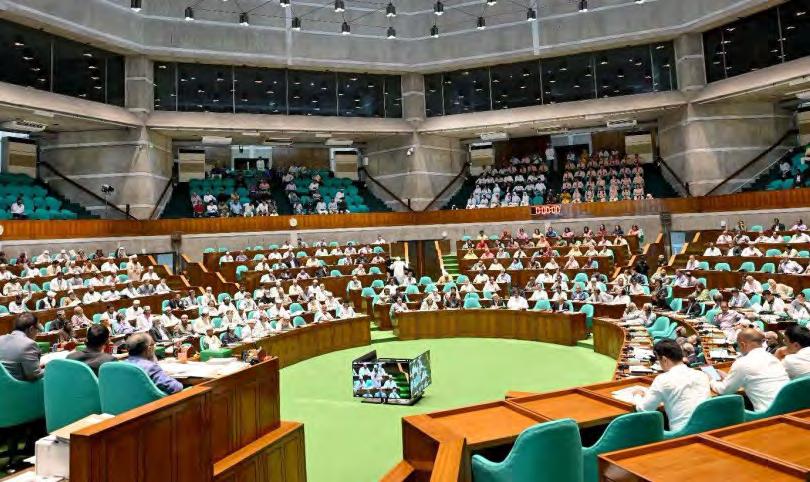
Bangladesh’s Investment Reset and Pakistan’s Opportunity
For decades, governments around the world sought to attract investment through a familiar policy toolkit: fiscal incentives, tax concessions, subsidized land, preferential regulations, and sector-specific privileges. Success was often measured by the generosity of incentives offered rather than the strength of institutions built. That approach reflected the realities of an earlier era. Today, however, the global competition for capital has fundamentally changed. Investment no longer flows primarily to countries offering the most attractive incentives; it increasingly flows to those offering the greatest institutional confidence.
Today's investors have unprecedented access to information, greater flexibility in allocating capital, and significantly higher expectations of governments than ever before. Before committing long-term capital, they ask questions that extend well beyond fiscal incentives. Are policies predictable? Are contracts enforceable? Do institutions coordinate effectively? Can governments implement decisions efficiently? Will today's commitments survive tomorrow's political transition? Increasingly, the answers to these questions determine where global investment ultimately flows.
Writer is a public policy advocate, business strategist, and former Pakistan’s Minister for Investment and Chairman of the Board of Investment. He is a strategic advisor to leading corporate entities, focusing on business policy, investment facilitation, and leadership branding. He writes frequently on the economy, governance, and society.
The competition for investment has therefore evolved into a competition for institutional credibility. Incentives may attract investors, but institutions persuade them to stay. In an increasingly uncertain global economy, countries are judged less by the opportunities they advertise and more by the confidence their institutions inspire. Institutional quality has become one of the defining determinants of national competitiveness.
This transformation offers an important lesson for Pakistan.
For decades, our national conversation on investment has revolved around promotional campaigns, incentive packages, international roadshows, and ambitious investment targets. These initiatives undoubtedly have value, but they seldom address the structural factors that shape investor confidence. Whenever investment slows, our instinctive response has often been another initiative, another facilitation mechanism, another special arrangement, or another institutional experiment designed to accelerate decisions. Yet sustainable investment has never been built through institutional improvisation.
Pakistan's investment challenge requires structural correction, not episodic reaction.
This distinction lies at the heart of our investment debate. Investment is not simply the outcome of effective promotion; it is the outcome of effective governance. Countries that consistently attract long-term investment do not outperform others because they market themselves more effectively. They succeed because investors trust the institutions through which governments formulate policy, coordinate decisions, honor commitments, resolve disputes, and deliver continuity across political cycles. Investor confidence is ultimately an institutional outcome.
Pakistan has never suffered from a shortage of opportunity. Its strategic location at the crossroads of South Asia, Central Asia, the Middle East, and China, a market of more than 250 million people, abundant natural and mineral resources, a resilient entrepreneurial class, and a rapidly expanding digital economy collectively provide advantages that many countries would envy. Yet despite these enduring strengths, Pakistan has consistently attracted investment far below its true economic potential.
The numbers tell a sobering story. Over the past thirty-eight years, Pakistan has attracted only about USD 57 billion in net FDI, averaging roughly USD 1.5 billion annually. For the world's fifth-most populous country, endowed with remarkable strategic and economic advantages, this is not merely an investment deficit; it is an institutional deficit. Geography cannot explain this outcome. Market size cannot
explain it. Natural resources cannot explain it.
Pakistan's greatest investment deficit is neither capital, geography, nor market size. It is institutional coherence.
For too long, we have understood infrastructure almost exclusively through a physical lens – roads, ports, airports, railways, industrial zones, power plants, and logistics corridors. These assets remain indispensable to economic development, but they represent only one dimension of national competitiveness. There is another form of infrastructure that receives far less attention; yet increasingly determines whether investment materializes at all.
I describe this as “Investment Infrastructure.”
Investment Infrastructure is the institutional ecosystem that transforms economic potential into investor confidence. It encompasses the legal and regulatory framework, policy continuity, institutional coordination, administrative efficiency, digital governance, investor facilitation, contract enforcement, dispute resolution, and the overall quality of public institutions. It is the invisible infrastructure that enables investors not only to enter a country with confidence, but also to remain, expand, and recommend that country to others.
Around the world, governments are beginning to recognize that institutional quality has itself become a strategic economic asset. Bangladesh's recent enactment of the Invest Bangladesh Bill, 2026 reflects this changing reality. More than an administrative reform, it represents a strategic recognition that coherent investment governance is itself a source of national competitiveness.
Bangladesh's reform deserves attention not because Pakistan should replicate its institutional design, but because it reflects a much larger global transition. The countries that will lead the next generation of investment competition will not necessarily be those offering the largest incentives. They will be those building the strongest institutions, reducing uncertainty, coordinating government more effectively, and inspiring greater investor confidence.
That is where Bangladesh's investment reset becomes Pakistan's opportunity.
Pakistan's response, however, should not be to replicate Bangladesh's institutional model. Every country must build institutions that reflect its own constitutional framework, governance realities, and development priorities. The real lesson from Bangladesh is not institutional imitation; it is institutional ambition. It is the recognition that investment governance has become a strategic pillar of national competitiveness and that institutions, when designed coherently, can become powerful economic assets in their own right.
That lesson is especially relevant because
Pakistan's investment architecture has evolved incrementally rather than strategically. Successive governments, responding to immediate challenges and changing economic realities, have established new mechanisms, specialized bodies, and coordination platforms. Each initiative was introduced with sincere intent and each responded to the needs of its time. Collectively, however, they have produced an investment ecosystem that has evolved through accumulation rather than deliberate design. The consequence is not institutional failure, but institutional fragmentation.
Today, Pakistan's investment ecosystem operates through six principal entities: the Board of Investment (BOI), the Special Investment Facilitation Council (SIFC), and the investment promotion agencies of Punjab, Sindh, Khyber Pakhtunkhwa, and Balochistan. Each institution contributes to the national investment agenda, and each performs an important function. The issue, therefore, is not institutional competence; it is institutional coherence.
Global investors do not distinguish between ministries, councils, boards, and provincial agencies. They invest in countries, not institutions. They expect governments to resolve internal coordination before they arrive at the negotiating table. When investment responsibilities are dispersed across multiple organizations with overlapping mandates, national messaging becomes fragmented, coordination slows, accountability becomes diffused, and the investor experience becomes unnecessarily complex. Every additional layer of institutional duplication increases transaction costs, prolongs decision-making, and gradually weakens investor confidence.
Pakistan's challenge, therefore, cannot be resolved through another committee, another coordination mechanism, or another institu-
tional layer. It requires a fundamental redesign of the country's investment architecture. In short, Pakistan requires an institutional reset.
The creation of the SIFC itself reflected an important recognition that Pakistan's existing investment governance framework required stronger coordination to remove bureaucratic bottlenecks, accelerate implementation, and restore investor confidence. The philosophy underpinning the SIFC was both timely and strategically sound. Bringing together the political leadership, military leadership, the civil bureaucracy, and the business community on one platform acknowledged a reality that successful investment destinations have long understood: sustainable investment flourishes when the state acts with unity of purpose.
Indeed, this philosophy is neither unfamiliar nor new. During my tenure as Minister for Investment and Chairman BOI, I consistently advocated the same whole-of-government approach because I believed that sustainable investment requires continuous alignment among political leadership, strategic state institutions, the civil bureaucracy, and the private sector. Strong collaboration among these pillars remains one of the most effective ways to improve the investment climate, remove red tape, eliminate unnecessary regulatory barriers, and strengthen investor confidence.
The question, therefore, has never been whether the philosophy behind the SIFC is correct; it undoubtedly is. The more important question is whether that philosophy should continue to operate through a parallel institutional structure or become permanently embedded within Pakistan's national investment architecture. In my view, the answer is clear. Pakistan does not need multiple investment institutions operating alongside one another with intersecting responsibilities and compet-
ing institutional identities. It needs one sovereign, empowered, professionally managed, and future-ready national investment institution capable of providing strategic continuity, policy coordination, institutional credibility, and investor confidence across political cycles. Investors should encounter one Pakistan, not multiple investment platforms representing different parts of the same state.
The objective should not be to dismantle institutions that have contributed meaningfully to Pakistan's investment agenda. It should be to preserve their strengths while eliminating fragmentation. The logical destination is therefore not another parallel institution, but one unified national investment platform. That platform should be a fundamentally restructured, empowered, autonomous, and professionally managed Board of Investment operating under a modern legal mandate and a contemporary governance framework.
The experience, coordination mechanisms, and implementation strengths developed by the SIFC, together with the institutional capacities of the four provincial investment promotion agencies, should be fully integrated into this restructured BOI. Such a transformation would represent far more than an administrative merger. It would establish one national investment strategy, one institutional leadership, one investor interface, one integrated digital platform, and one transparent system of accountability. Government institutions would continue to discharge their respective constitutional responsibilities, but investors would engage with one seamless, coordinated, and professionally managed national investment ecosystem.
That is the difference between institutional proliferation and institutional coherence. More importantly, it is the foundation upon which enduring investor confidence is built.
A modern investment institution, however, cannot be judged solely by its organizational structure. Its true strength will ultimately be measured by the quality of its governance. Institutional consolidation, therefore, must be accompanied by governance reforms that reflect commercial realities, international best practices, and Pakistan's long-term strategic priorities. A world-class institution requires not merely a new structure, but a new philosophy of governance.
To begin with, the longstanding overlap between federal and provincial investment institutions must give way to a more coherent model of cooperative federalism. Investment policy, promotion, facilitation, implementation, and investor aftercare should operate through one integrated national framework with clearly defined responsibilities, transparent accountability, and seamless coordination
between the federation and the provinces. Such an arrangement would not diminish provincial autonomy; rather, it would enable every province to leverage its unique comparative advantages while presenting Pakistan to investors through one nationally coherent investment strategy.
Equally important is the composition of the institution itself. Investment decisions are made in corporate boardrooms, not government offices. It is therefore imperative that Pakistan's restructured Board of Investment draws upon the experience of distinguished business leaders, seasoned investors, financial experts, and sector specialists with deep knowledge of international markets. Their participation would ensure that policymaking remains anchored in commercial realities, strengthen institutional credibility, and enable Pakistan's investment strategy to evolve alongside rapidly changing global economic trends.
Pakistan's governance realities also require strategic alignment between economic policymaking and national priorities. Today, large-scale investment increasingly intersects with infrastructure, energy security, logistics, technology, critical minerals, food security, and geoeconomic strategy. Rather than relying on parallel institutional arrangements to achieve such coordination, Pakistan should institutionalize it within the governance framework of the restructured Board of Investment itself. Representation from the offices of the Chief of Army Staff (COAS) and the Chief of General Staff (CGS) at the Board level for strategic guidance, national alignment, and inter-institutional coordination, not executive authority or operational management, would strengthen whole-of-government execution while preserving the Board's civilian, professional, autonomous, and commercially driven character. The objective is not to expand institutional influence, but to integrate national capabilities within one coherent investment architecture.
Institutional reform, however, extends well beyond organizational restructuring. A competitive Investment Infrastructure must also rest upon policy continuity, regulatory certainty, efficient dispute resolution, contract enforcement, competitive taxation, digital public services, a professional civil service, and a business environment where governments honor commitments consistently across political cycles. Investors do not expect perfection; they expect predictability. Confidence is built when institutions reduce uncertainty, implement decisions efficiently, and consistently deliver on their commitments.
Equally important is the need to redefine how Pakistan measures success. Governments often celebrate investment announcements, yet the strongest endorsement of any investment climate comes from investors who are
already operating in the country and choose to expand their businesses. Existing investors are Pakistan's most credible ambassadors. Their decision to reinvest sends a far stronger signal to global markets than any investment summit, international roadshow, or promotional campaign ever can. Investor retention, investor aftercare, and the systematic removal of regulatory barriers should therefore become central pillars of Pakistan's national investment strategy.
This is important because investment is never an end in itself; investment builds productive capacity. Productive capacity strengthens industry. Stronger industries expand exports. Higher exports generate foreign exchange. Foreign exchange reinforces macroeconomic stability. And macroeconomic stability lays the foundation for sustainable growth, productive employment, rising incomes, and long-term prosperity. Every successful economy has travelled this path. None has reached it without building institutions capable of earning and sustaining investor confidence. Ultimately, this discussion extends far beyond institutional reform. It is about Pakistan's long-term economic future. Bangladesh has recognised that investment governance itself has become a competitive advantage. Pakistan should view this not as a model to replicate, but as a timely reminder that the global competition for capital is increasingly being won through institutional excellence. The next phase of Pakistan's economic reform should therefore move beyond temporary arrangements and fragmented institutional structures towards a permanent, unified Investment Infrastructure capable of serving the country for decades to come.
Pakistan does not suffer from a shortage of opportunity; it suffers from a shortage of institutional coherence. We have spent decades building roads, ports, airports, power plants, and industrial zones because we understand that physical infrastructure is essential for economic growth. The next phase of Pakistan's economic transformation demands that we apply the same vision, commitment, and determination to building our institutional infrastructure.
The twenty-first century will not reward the nations that merely offer the most attractive incentives. It will reward those that build the most trusted institutions. Pakistan's next economic transformation will therefore begin not with another investment package, another conference, or another institutional experiment. It will begin by building the one form of infrastructure that ultimately determines the success of every other, the “Infrastructure of Confidence”, that is the true meaning of “Investment Infrastructure.” And that is Pakistan's opportunity. n
Glad I’m in profession that can’t be replaced by AI, says welder while required by employer to be wearing camera
on forehead
By Profit
Local welder and certified GTAW specialist Hamza Siddiqui spent the better part of the last two years reassuring increasingly anxious white-collar friends that he had deliberately chosen a profession that could never be replaced by artificial intelligence, moments before beginning another shift wearing an employer-issued camera strapped to his forehead.
“I’m not saying university was a waste,” Siddiqui clarified over coffee after finishing a twelve-hour shift at a Korangi fabrication workshop. “But while everyone was becoming marketing strategists, product managers and innovation consultants, I learned to TIG weld stainless steel.” Siddiqui, who completed a DAE in Mechanical Technology (Welding) from the Pak-Swiss Training Centre in Karachi, explained that his fluency in English, ability to read technical manuals, and willingness to fill out inspection reports had made him unusually valuable in an industry where skilled tradesmen remain in short supply.
Siddiqui, who completed a diploma in welding technology after A-levels, explained that his fluency in English, ability to read technical manuals, and willingness to fill out inspection reports had made him unusually valuable in an industry where skilled tradesmen remain in
short supply.
“I’m earning more than my brother, who’s an accountant,” he said. “He spends all day worrying about ChatGPT while I literally melt metal together. Good luck asking AI to do that.”
Friends confirmed that Siddiqui had become increasingly insufferable over the past year, frequently responding to discussions about layoffs with remarks such as, “Can your large language model hold a torch at exactly fifteen degrees?” However, colleagues noted that Siddiqui’s confidence had remained remarkably intact despite his employer recently requiring welders to wear lightweight cameras mounted above their safety visors throughout every shift.
“The company says it’s for quality assurance, safety compliance and preserving institutional knowledge,” Siddiqui explained. “Apparently management wants to make sure best practices aren’t lost.”
Asked why the company also requested welders verbally explain every movement, identify every tool being used, describe why they rejected certain techniques, and occasionally repeat particularly neat welds “a little slower this time,” Siddiqui said he assumed management had simply become more committed to continuous improvement.
“They’re really investing in us,” he said. “The engineers even stop by sometimes just to
ask why I positioned my body a certain way before making a difficult weld. They’re genuinely curious.” His brother Bilal, meanwhile, said he had stopped trying to explain what a training dataset was. “I told him that no company spends millions collecting perfectly labelled first-person footage because they’re worried about losing craftsmanship,” Bilal said. “He replied, ‘Exactly. They know craftsmanship can’t be automated.’”
Sources within the company confirmed that the camera programme had generated thousands of hours of footage capturing expert welders navigating awkward angles, adjusting torch speed, interpreting changing weld pools and instinctively compensating for imperfections in raw materials.
“The beauty is that they narrate everything voluntarily,” said one engineer while reviewing footage titled Hamza_Final_Final_V7_REAL. mp4. “Initially we had to ask questions, but now they naturally explain their reasoning because they think it’s helping improve the training programme.” At press time, Siddiqui was reportedly telling a visibly concerned electrical engineer that “people who work with their hands have absolutely nothing to fear from AI,” before carefully repositioning his head so the camera had an unobstructed view of a particularly difficult weld “in case the trainees need to learn this technique later.”
We’re going through a wheat shortage again. Is it hoarding or a bad harvest?
The government claims there is more than enough wheat to sustain Pakistan’s annual demand. But with prices rising and wheat disappearing from the markets, the familiar signs of hoarding season are emerging once more.
The price of roti has risen in Lahore. Recently, the United Nanbai Association announced an increase in the price of roti from 20 to 25 rupees and that of a naan from Rs 30 to 35. The reason cited was simple: increasing prices of flour, which for a 20 kg bag had risen to 2400 rupees. The government mandated rate of 16 rupees per roti, according to the association, was impossible to follow.
This hike in the prices of flour is not simply a Lahore phenomenon. In Peshawar, a 20 kg bag of flour is being sold at 3000 rupees in the retail market, and at 2900 rupees in the wholesale market. Rates of 2900 rupees per 20 kg of flour were also being reported in Karachi (compared to 1800 rupees a year ago). It was only a few days ago that the city government was able to fix the ex-mill price of flour at 2500 rupees. In fact, there are reports that in certain areas of Karachi, just like in Lahore, the price of roti has risen from 20 to 25 rupees.
But why are wheat prices rising? Very simply put, there is simply not enough supply of wheat to sustain the old prices. But whether that reduced supply is due to reduced wheat production or hoarding seems a question there is some contention on.
Earlier this week, for instance, in a meeting of the Wheat Board, representatives of flour mills, traders, farmers and the Cereal Association maintained that the wheat shortfall was estimated at 3.5 million tonnes, and that Pakistan might need to import at least 2 million tonnes of wheat to supply this deficit.
In the meeting, the Federal Minister for National Food Security and Research Rana Tanveer Hussain pointed out that the prices per maund of wheat had risen to 4,400 rupees, 900 rupees higher than the support price established by the government.
Soon after this meeting, the federal government categorically denied the existence of any wheat shortage in the country. Rather, it said, it had achieved seasonal production targets and surpassed last year’s production by 1.36 million tonnes. Provincial representatives claimed that there were sufficient stocks in all regions to meet consumption requirements, and the government announced that it would be cracking down on hoarding and manipulated price hikes, effectively claiming that the shortage of wheat was engineered.
Why is there this conflict in claims then? Is there enough wheat produced or not, regardless of whether it is available in the market? While the government has started its crackdown on hoarding, whatever its extent, there seems to be some pres-
sure at least on wheat stocks as well. But while that is for time to reveal, let us examine what has been happening that has pushed wheat prices to their current levels.
Wheat Procurement
Wheat is a complicated crop in Pakistan. It is both a necessity and the source of one of our oldest and deadliest addictions; wheat subsidies and support prices.
It began, of course, with the canalisation of the Punjab under British imperial rule. The Empire’s hunger for wheat dug canals, allocated lands to today’s jagirdars and waderas, and laid railway tracks to transport this wheat from Punjab all the way to Karachi and Mumbai’s ports.
Post partition, wheat is what Pakistani farmers continued to rely on. The crop made them good money and fed the country, which is why the government encouraged it. But this encouragement resulted in a new problem: suffering from success. Production was so high that farmers struggled to sell their crop. And here, the government made a decision. It would buy off the excess wheat from the farmers and store it for emergencies. The government would do this through the putting in place of minimum pricing. It would guarantee a minimum price to the farmers at which if they were unable to find a buyer in the market, they could simply sell their wheat to the government.
Support prices were a classic economic tool used by governments after the second world war. They were a means to sustain the production of the most basic and important commodities. Eventually, developed economies are weaned off this support. For Pakistan, it set of a six decade long addiction. Over time the government became the principal buyer of local wheat and the private sector’s role shrank.
And as time passed, this subsidy became laced with politics and favours. The system became quite charged with inefficiencies and bureaucratic red taping. Farmers with connections and political backing were often the ones that skipped to the head of the line while others were left to sell their crop cheaply to middle men. On top of this, it was also a massive burden for the government. Every year the provinces would borrow billions from banks to fund this purchase. By 2023 these borrowings had reached 680 billion rupees in a vicious cycle of circular debt, without the subsidy’s effects ever reaching the most deserving farmers.
The details of thi system have been covered by Profit before.
Then came 2024. The government, under pressure from the IMF, announced that wheat support prices would soon be a thing of the past. This was poorly received by a farming community that has grown used to the support. The problem is that without any storage capacity, farmers have to sell their wheat as soon as possible. Otherwise it would go bad and they would not have the means to plant their next crop. Without a legitimate buyer around, they can be exploited by middle men (“Arthis”) who have storage and transport facilities.
Last year, as part of these promised reforms, the Punjab government proposed a private sector led procurement model. The aim was to procure 3 million tonnes of wheat through 11 private companies, who were provided with incentives such as government-facilitated negotiation of bank loans, covering up of mark up costs, providing free storage in Food Department’s warehouses, and so on. Essentially, the government would help arrange financing for these companies to procure wheat at a set price.
The problem was that the system struggled to take off. The procuring companies and banks failed to reach meaningful agreements quickly enough about the financing rates. By mid-April, when wheat cultivation was picking up pace and the market was being inundated by wheat, the market prices fell below the minimum price set by the government at 3,500 rupees per maund (40 kg). Many farmers were forced to sell their wheat at distress rates, below the government-set support price. By May, it was reported by Dawn that at least 9 of the participating 11 firms had been unable to purchase any wheat at all. This was the case in Punjab, which accounts roughly for 2/3rd of the total domestic production of wheat.
The issue with timing, however, is that it determines price. Once, when there has been a surge in market supply, the balance is disrupted with large supply, it is then followed often by a steep decline in available stocks, which pushes prices back up. And this, at least partly, is what caused the prices of wheat to rise to levels higher than the government-mandated minimum price, in some instances to 3,700 rupees. And by then the farmers were unwilling to sell wheat to the government-mandated firms, since they – after having sold part of their wheat at distress rates – they could now find higher prices for their produce.
Other realities
On top of this, the crop itself has been under some pressure. Dawn, for instance, reported that in certain districts yields this cycle were
lower by 3 to 5 maunds per acre, due to the alternation of a heatwave and untimely rains which disrupted the crop cycle, meaning that there was at least some pressure from the supply side on the price. Now, it is not clear whether the government’s claims of having met wheat cultivation targets are based on a reduced estimate, or whether these lower yields in some markets were offset by higher yields in other districts.
There is some truth to claims about lower general availability of wheat as well. According to a report by the US Department of Agriculture, total production this cycle (May 2026) was 29 million tonnes, merely 120,000 tonnes higher than the figure in 2025, but lower by almost 4.4 million tonnes from the figure in 2024. On top of that, a crucial issue has been that the opening stocks this cycle were 2.8 million tonnes, which were 1.9 million tonnes less than what they were in the previous cycle, and 2.1 million tonnes less than in the cycle before that. The result was that total wheat supply this cycle was 31.8 million tonnes, almost 2 million tonnes lower than in 2025, and almost 5 million tonnes lower than in 2024. There was, therefore, at least some upward pressure on wheat prices, which was exacerbated by the issues associated with the ineffectiveness of the procurement strategy.
Now the procurement strategy’s failure to adequately account for local production of wheat obviously resulted in speculative pricing. In 2025, concerns over hoarding the grain during peak supply season and then offloading them in the winter before new year’s harvest came into the market were already raised. In fact, it was reported that the price of wheat had almost doubled from early summer (AprilMay) to mid-winter (December-January), seemingly rewarding those who had hoarded the grain in excess storage. Expectations about similar gains this year also likely motivated middlemen and mill-owners with sufficient storage to keep the grain under wraps, creating artificial shortage in the market. This is also what the recent government pronouncement about there being no real shortage of wheat seems to point at.
But there is another factor that’s been pushing these manipulators into fixing ‘artificial’ prices for wheat. And that’s the US-Israeli
war on Iran. With the closure of Hormuz in the past couple of months and the disruption in fertilizer supply chains, the prices of multiple crops rose due to production pressures. And wheat too saw its price rise. So, there was at least some pressure from that too. And now that signs are not looking too great and the threat of war is already lurking over the region, they might have had some justification in pushing the prices higher.
In any case, the government – as always, late – seems to be concerned foremost with the likelihood of hoarding going on and already, as we have seen in Sindh, has started crackdowns on those suspected of hoarding grain. Sindh seems particularly to have been affected by these ‘shortages’. The province had planned to procure 1 million tonnes of wheat, but by June had been able to procure only 81,348 tonnes. Part of the reason has to do with the timing; the government efforts took some urgency only after prices in the open market were higher than the 3,500 rupees per maund it had established as a support price. The buyers consequently were refusing to sell to the government because the prices were already high.
The crackdown, at least on the surface, appears to be yielding some results. On 14 July, for instance, the government announced that following its efforts to curb hoarding, the price per maund of wheat in Karachi had fallen from 4,600 to 4,100 rupees. Hoarding, after all, is not a new or an uncommon phenomenon. Even last year, the Punjab government did a crackdown on wheat during July and was able to recover hundreds of thousands of tonnes of hidden wheat, which hoarders had hid in order to inflate prices. Something on a similar scale, now the government is vowing to do.
But whether that will be enough to supply the shortfall and rein in the gnashing prices of wheat, it remains to be seen. The government in a recent meeting of the Wheat Board was told that the supply gap had to be covered through imports and that it could not be covered by anything else. Bickering already had started over which segments would benefit from these imports, and which would not. For now, however, the government has vowed to crack down on hoarding and wait for the next meeting in two weeks of the same Board to determine the needed course of action. n