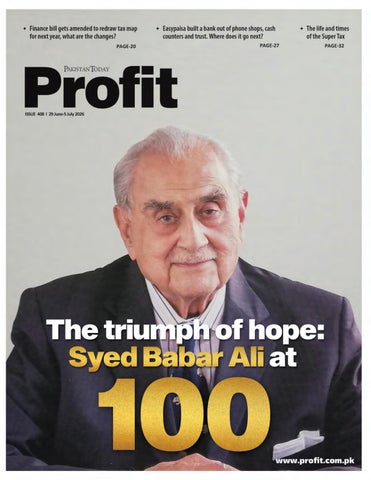
10 Finance bill gets amended to redraw tax map for next year, what are the changes? 13 The New Middle East Muhammad Azfar Ahsan
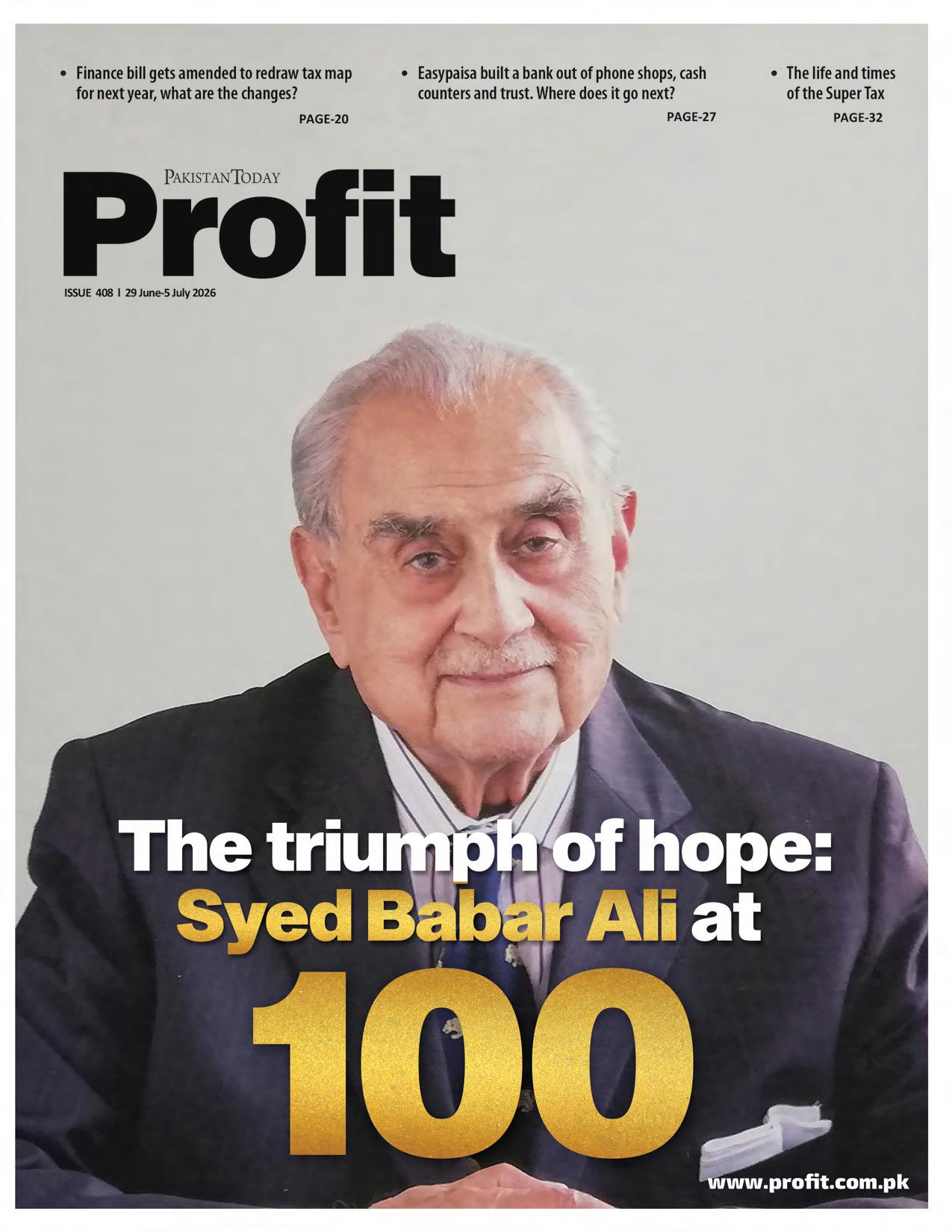
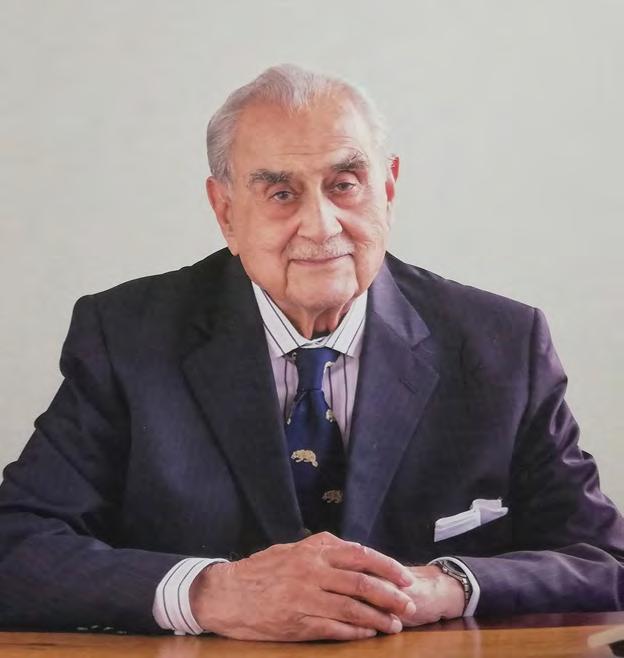
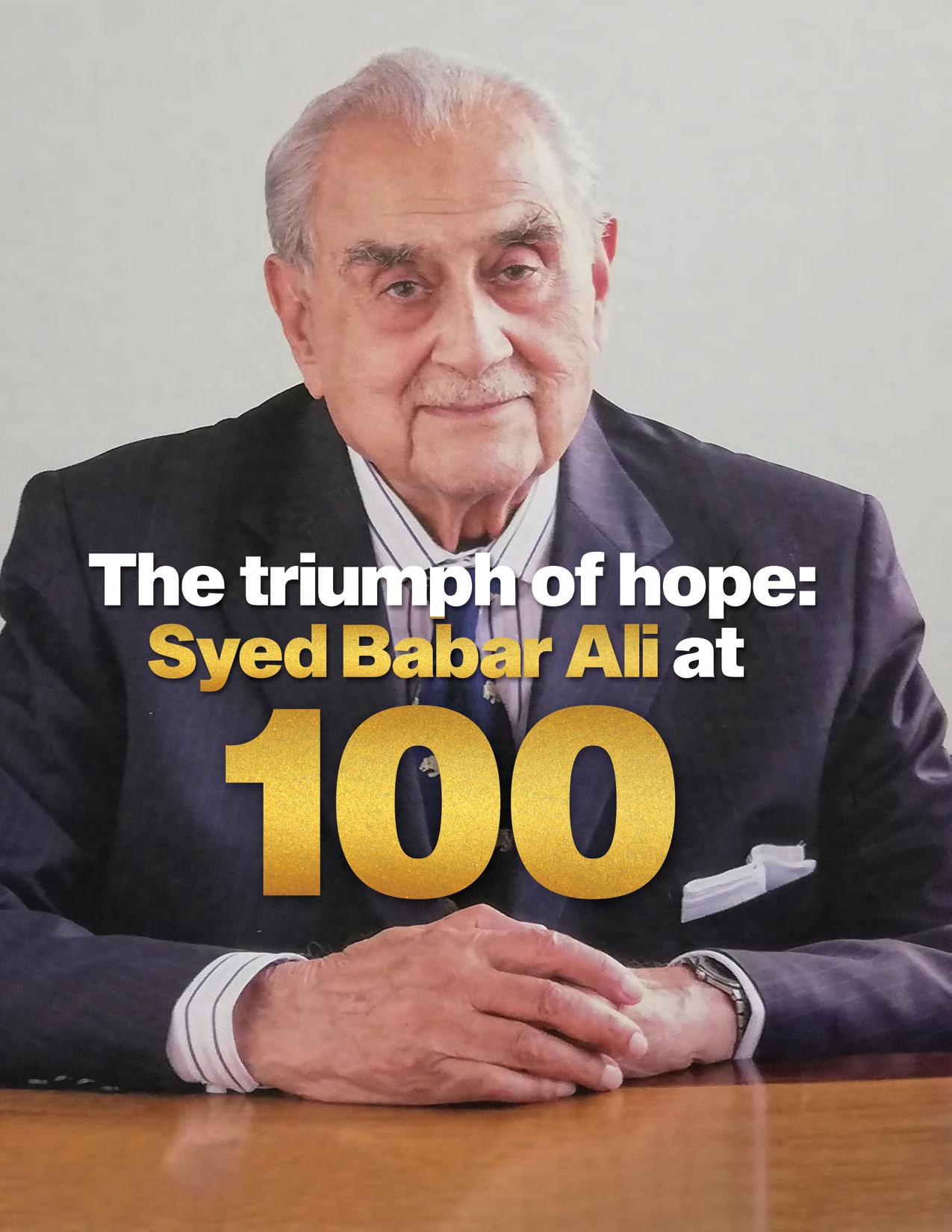
16 The triumph of hope: Syed Babar Ali at 100
22 Beyond Hormuz Sardar Ahsan Rasheed Khan
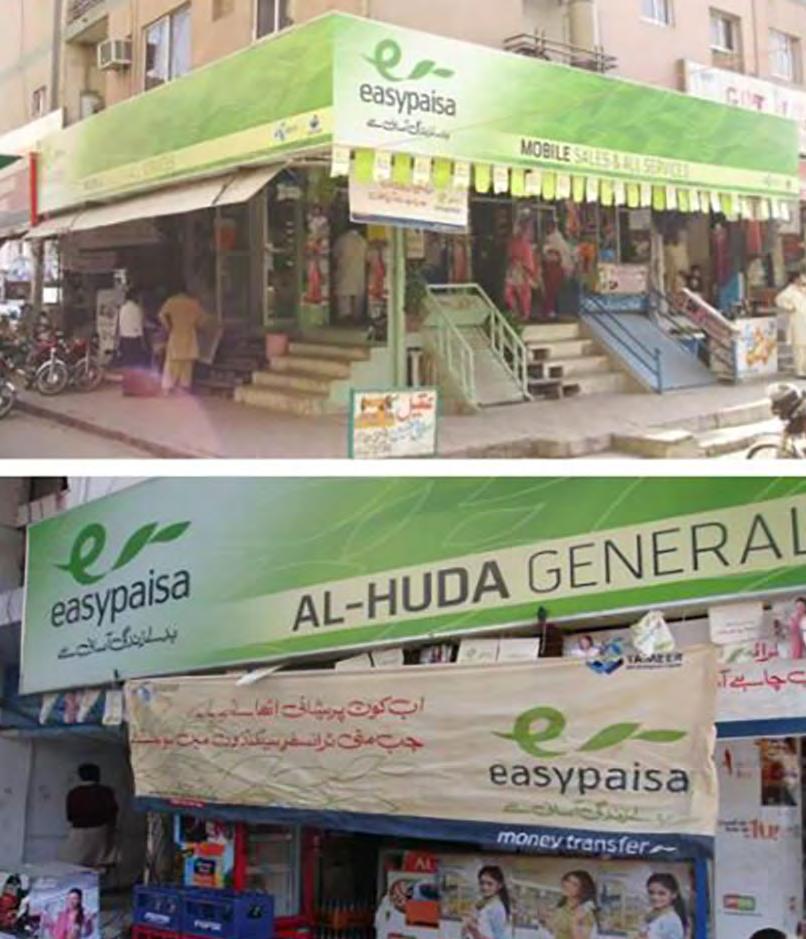
27 Easypaisa built a bank out of phone shops, cash counters and trust. Where does it go next?
32 The life and times of the Super Tax
33 Lucky Motors cuts the Sportage Alpha and Peugeot 2008 by up to Rs 1.3m and undercuts its own Stonic in the process
Publishing Editor: Babar Nizami - Senior Editor: Abdullah Niazi
Business Reporters: Taimoor Hassan | Usama Liaqat | Zain Naeem | Shahnawaz Ali | Ghulam Abbass
Ahmad Ahmadani | Aziz Buneri - Sub-Editors: Saddam Hussain | Abdul Hameed - Video Producer: Adnan Maqsood
Director Marketing: Muddasir Alam - Regional Heads of Marketing: Agha Anwer (Khi) Kamal Rizvi (Lhe) | Malik Israr (Isb) GM Special Projects Zulfiqar Butt - Manager Subscriptions: Irfan Farooq Pakistan’s #1 business magazine - your go-to source for business, economic and financial news. Contact us: profit@pakistantoday.com.pk
Finance bill gets amended to redraw tax map for next year, what are the changes?
Key amendments include changes in salary tax slabs, taxation structure on cars and others
Shahzad Paracha and Shahnawaz Ali
Pakistan’s latest attempt to balance revenue generation with economic growth has undergone significant revisions just days before final approval, revealing the government’s priorities days after tall commitments levelled in the budget speech.
On June 23rd, 2026, Minister for Finance and Revenue Senator Muhammad Aurangzeb moved three critical amendments to the bill as reported by the Standing Committee.
These changes, subtle in their presentation, present substantial implications and offer critical insights into the government’s evolving approach to tariff management, consumer taxation, and industrial incentives.
The most important signal is in automobiles. The amendments place cars at the centre of the new tax and tariff approach. A relief for smaller imported vehicles, a value-based token tax structure for vehicles in Islamabad Capital Territory, and heavier duties on expensive and high-capacity imported cars, including luxury electric vehicles.
At the same time, the bill brings social-media income, property transactions, banking data, digital invoicing and faceless tax proceedings deeper into the formal tax system.
Cars: relief at the bottom, protection and revenue at the top
The auto-sector changes are the clearest example of this balancing act.
Under the amended framework, duties on smaller imported vehicles are being rationalised under a new philosophy, with the stated aim of reducing business costs and bringing some relief to consumers.
According to the briefing held at the Ministry of Commerce regarding these amendments, the reported structure reduces the combined tariff on vehicles up to 850cc from 66pc to 42pc under a new National Tariff Policy, soon to be announced.
For vehicles between 850cc and 1000cc, the maximum tariff has been proposed at 47pc, while the combined rate on 1000cc to 1500cc vehicles is proposed to fall from 76pc to 52pc. For 1500cc to 1800cc vehicles, the rate is proposed to decline from 91pc to 57pc, while vehicles above 1800cc would move from 156pc to 74pc.
This marks a move away from a protected auto market where larger and luxury vehicles remain an important revenue target. That distinction becomes clearer in the
amended bill’s treatment of imported high-capacity vehicles. Imported motor cars, SUVs and other vehicles, including station wagons, double-cabin pickups and racing cars, face a new 86 % federal excise duty (FED) if they fall between 2000cc and 3000cc. Meanwhile vehicles above 3000cc face 92 % in FED, showcasing clear will to make high-end imported vehicles cheaper. It is important to note that the existing tariff and taxation structure will remain in place for these vehicles as new FEDs get levied.
The same logic applies to electric vehicles. Before the federal budget was announced, media reports emerged suggesting that the government might lift the protection it had placed on EVs upon IMF’s insistence. When it did not happen in the federal budget, financial pundits across Pakistan saw it as a signal that the finance division’s narrative had prevailed in the face of IMF’s, however, that assumption was short-lived. Some compromise has been reached upon the duties on EVs as well.
Imported electric cars and electric SUVs in completely built-up condition will continue to face 0pc federal excise duty if their value does not exceed $75,000. But the FED has now risen to 30% for vehicles valued between $75,000 and $110,000, and to 40% for vehicles above $110,000, compared to earlier relaxation in FED. Other duty and tariff structure on these cars remains. The signalling being that lower-priced EVs are still being encouraged, but premium EVs are being treated as luxury consumption.
Pakistan’s EV policy has often been presented as a climate and technology transition. The amended bill suggests that the government is still interested in encouraging EV adoption, but not at the cost of giving tax relief to high-end imported vehicles bought by wealthier consumers.
The bill also revised the token tax on motor vehicles in Islamabad Capital Territory. Vehicles up to 1000cc will pay Rs20,000. Vehicles from 1001cc to 2000cc will be taxed at 0.25pc of invoice value, while vehicles above 2000cc will be taxed at 0.35pc of invoice value. This shifts part of the burden from engine size alone to declared vehicle value. For local assemblers, the message is mixed. They face some pressure from import liberalisation, but the government has not abandoned protection for higher-end categories.
Talking to Profit, an industry expert stated that the complete picture will be visible when the new auto policy and sales tax rates become clearer in a few days. However one thing is for certain, if the prices of a certain Completely Built Unit (CBU) (imported) are reduced, the Completely Knocked Down (CKD) (Made in Pakistan) version’s prices will also follow suit through tax measures, meaning
that all new C-SUV’s may see a fall in price, no matter how premium.
He states that as imported 2000CC and above cars become almost impossible to buy with a cumulative 50% increase in price due to the new FEDs. Pakistan may be able to rationalise its measures better in front of the IMF.
Salaried taxpayers get new slabs
The amended bill also revises salaried income tax slabs.
Annual income up to Rs600,000 remains tax-free. Income between Rs600,000 and Rs1.2 million will be taxed at 1pc of the amount exceeding Rs600,000. From there, the rates rise in steps: Rs6,000 plus 11pc on income above Rs1.2 million up to Rs2.2 million; Rs116,000 plus 20pc on income above Rs2.2 million up to Rs3.2 million; Rs316,000 plus 25pc on income above Rs3.2 million up to Rs4.1 million; Rs541,000 plus 29pc on income above Rs4.1 million up to Rs5.6 million; Rs976,000 plus 32pc on income above Rs5.6 million up to Rs7 million; and Rs1.424 million plus 35pc on income above Rs7 million.
The lower end of the structure gives some relief to salaried individuals, particularly those around the Rs600,000 to Rs1.2 million band. But the higher slabs remain steep. The government is trying to protect the lowest-income salaried taxpayers while maintaining progressivity and preserving revenue from higher earners.
This is consistent with the wider design of the bill: protect or soften the impact on politically sensitive lower-income groups, while keeping pressure on higher-income consumption and documented income streams.
Low-sugar beverages get relief
The second visible shift is in beverage taxation.
The amended bill refines the treatment of mineral waters, aerated waters, hydration drinks and electrolyte beverages. The relief is not broad-based. It is tied to the sugar and sweetener profile of the product, with 5g per 100ml emerging as the key threshold.
This is a more targeted approach than simply taxing or exempting an entire beverage category. The government is trying to separate sugary drinks from hydration and electrolyte products that can be positioned as lower-sugar or functional beverages.
For beverage companies, this creates an incentive to reformulate. Products that meet the threshold can potentially benefit from relief, while higher-sugar versions remain
exposed to excise duty.
For the government, the measure is politically useful. It allows policymakers to present the change as health-conscious without giving up the broader revenue base from sugary beverages.
The practical impact will depend on how FBR applies the language. The distinction between hydration drinks, electrolyte beverages and conventional sweetened beverages will need clearer enforcement. Without that clarity, the measure could become another source of classification disputes between tax officials and industry.
Social-media income enters the withholding net
One of the more modern amendments is the introduction of withholding tax on revenues received from social-media platforms.
Banks and non-bank financial institutions will deduct 5pc tax when revenues from platforms such as YouTube, Facebook, Instagram, TikTok and similar digital platforms are credited or received. For residents, the tax will be treated as minimum tax. For non-residents without a permanent establishment in Pakistan, it will be treated as final tax.
The creator economy has grown faster than the tax machinery built to monitor it. Many content creators receive income through foreign platforms, payment intermediaries and banking channels that were not originally designed around domestic tax collection. By placing the withholding obligation on financial institutions, the government is choosing the point in the chain it can most easily monitor: the banking channel. The amendment does not require FBR to fully understand each platform’s monetisation system. It simply taxes the inflow when it enters the account.
Property transactions to face advance tax on both sides
The amended bill also changes advance tax on immovable property transactions.
Sellers will pay 2.75pc advance tax on the gross amount of consideration received. Buyers will pay 1.25pc on the fair market value of the property.
This keeps real estate inside the tax net at both ends of the transaction. It also reflects the government’s longstanding view that property remains a major store of undocumented wealth. By taxing both sale and purchase, the state is using transaction points to capture revenue and strengthen documentation.
The question is whether higher transaction costs will improve documentation or push some activity back into under-reporting. That depends on valuation enforcement, registry discipline and how consistently fair market values are applied.
FBR’s bigger shift is digital control
Beyond individual tax rates, the most important structural change in the bill is the expansion of FBR’s digital enforcement architecture.
The bill provides for electronic filing of income tax returns through IRIS. For companies, financial statements accompanying returns will have to be filed in electronically readable format from tax year 2026 onwards.
It also expands the use of faceless audit, faceless assessment and faceless appeals. Under these provisions, proceedings can be conducted through a national faceless centre. Hearings may take place electronically, and the identity of the officer conducting proceedings can be kept confidential.
The bill earlier introduced algorithmic settlement mechanisms, allowing the system to generate settlement offers based on factors such as stage of proceedings, compliance history and the nature of the discrepancy.
Another major change is the creation of a central data hub for banking information. Banking companies and electronic money institutions will be required to upload information on account holders whose deposits or withdrawals exceed Rs100 million during a reporting period. The stated purpose is algorithmic cross-matching of tax and banking information.
This also explains the penalties attached to electronic monitoring. Failure to integrate with FBR systems can lead to heavy fines and sealing of business premises. Tampering with monitoring systems can attract fines and imprisonment of up to five years. For businesses, the cost of remaining outside digital integration is rising.
Corporate and sector-specific changes
The amended bill also retains and revises several sector-specific tax measures.
Banks with income exceeding Rs150 million will face a 10pc tax. The same 10pc rate applies to certain income of persons under the Fifth Schedule and to those deriving income from the sale of fertiliser where income exceeds Rs150 million. Other persons with income above Rs500 million will face an 8pc tax.
The bill reduces the minimum tax rate to 0.5pc for distributors, dealers, sub-dealers and wholesalers of specified goods, including pharmaceuticals, fertiliser, sugar, locally manufactured mobile phones, electronics, beverages, dairy products, packaged foods, cosmetics and cleaning products, subject to active taxpayer conditions.
Export-oriented businesses also receive attention. The bill provides that section 4C will not apply to a person if export proceeds realised for the tax year represent more than 80pc of total turnover.
Aviation relief no longer limited to PIA
The bill also addresses aviation. Sales tax exemption on import or lease of aircraft and parts was initially provided for Pakistan International Airlines Corporation Limited only. The amended framework also introduces relief for any airline company registered in Pakistan, effective from July 1, 2027.
This is an important competition point. A tax exemption limited only to PIA would have created an uneven playing field, now that PIACL is no longer the government’s property. Extending the relief to other registered airlines, even with a delayed effective date, makes the measure more sector-neutral.
The broader policy direction
Taken together, the amendments show four broad policy choices.
The Finance Bill 2026, in its amended form, is a signal of the state’s preferred economic bargain: limited relief for selected consumers and industries, continued taxation of premium consumption, and a much stronger push towards digital documentation.
For businesses, the lesson is simple. Tax planning can no longer be limited to rates and exemptions. It must now include data visibility, invoice systems, transaction trails and sector-specific thresholds.
For consumers, the bill offers uneven relief. Smaller imported cars may benefit from tariff rationalisation, low-sugar beverages may receive favourable treatment, and lower salaried income remains protected. But high-end cars, expensive EVs, property transactions and documented digital income will face greater scrutiny.
For FBR, the real challenge will be implementation. The bill gives the tax authority wider tools. Whether those tools produce fairer taxation or simply a more complex compliance burden will depend on how consistently, transparently n
OPINION
Muhammad Azfar Ahsan
The New Middle East
Iwrite this from Cairo, where I recently attended the MOSAIC Forum: Middle East & Africa Edition and had the privilege of chairing a session titled “From Conflict to Capital: Investment & Public Affairs in the New Middle East.” Over the course of several days, I engaged with ministers, diplomats, investors, business leaders, public affairs practitioners, and policy experts from more than forty countries. Amid diverse perspectives and national interests, one observation emerged with remarkable consistency: the Middle East is changing and the world is beginning to view it differently.
For decades, the Middle East was largely understood through the lens of conflict, security crises, political instability, and great-power rivalries. Those realities have not disappeared, nor should they be underestimated. Yet another story is increasingly shaping the region’s future, one of economic transformation, investment, institutional reform, technological advancement, and growing regional confidence. The conversation is gradually shifting from managing conflict to creating opportunity.
The Middle East is no longer seeking merely to manage conflict; it is seeking to compete for capital. In many ways, the region’s next chapter will be written less by battlefields and more by boardrooms. What struck me most in Cairo was not the discussion of conflict itself, but how frequently conversations returned to investment, connectivity, competitiveness, technology, and economic opportunity. Even discussions on geopolitics were increasingly framed through the language of growth, resilience, economic diversification, and capital formation. That observation alone says much about the direction in which the region is moving.
Writer is a public policy advocate, business strategist, and former Pakistan’s Minister for Investment and Chairman of the Board of Investment. He is a strategic advisor to leading corporate entities, focusing on business policy, investment facilitation, and leadership branding. He writes frequently on the economy, governance, and society.
This shift is neither accidental nor temporary. It reflects a deeper transition taking place across the region. The Middle East has moved through several defining eras. For much of the twentieth century, it was shaped by energy geopolitics and the strategic importance of oil. The decades that followed were dominated by conflict management, regional rivalries, and security concerns. Today, a new phase is emerging, one in which competitiveness, diversification, innovation, connectivity, and institutional quality are becoming increasingly important determinants of national influence and success.
The most significant aspect of this transformation is that it is being driven increasingly from within the region itself. For many years, the Middle East was often viewed as a theatre where external powers shaped outcomes. While global powers continue to play an important role, regional actors are demonstrating a growing capacity to define their own priorities, pursue their own interests, and shape their own future. This growing sense of ownership may prove to be one of the most consequential developments of the coming decade.
Recent geopolitical tensions have once again reminded the world that stability remains fragile. Yet they have also highlighted another reality: the growing importance of regional diplomacy, mediation, and dialogue. Countries within the region and beyond are increasingly playing active roles in reducing tensions, facilitating communication, and encouraging engagement among competing actors. This evolution deserves greater attention because it signals the emergence of a more mature regional architecture, one in which influence is derived not only from military strength or economic size, but also from the ability to build trust and facilitate solutions.
Indeed, one of the most underappreciated developments of our time is that diplomacy itself has become an economic asset. In an interconnected world, successful mediation and constructive engagement create value far beyond politics. They reduce uncertainty, strengthen investor confidence, improve economic sentiment, and create conditions that support trade, investment, tourism, and regional cooperation. Stability is no longer merely a security objective; it is increasingly an economic imperative.
This reality helps explain why economic transformation has become such a central priority across the region. Saudi Arabia’s Vision 2030, the United Arab Emirates’ diversification strategy, Qatar’s continued expansion, Egypt’s infrastructure investments, and similar initiatives across the broader Middle East all reflect a shared recognition that future prosperity cannot depend solely on traditional sources
of wealth. Governments are investing heavily in technology, logistics, renewable energy, Artificial Intelligence, manufacturing, tourism, financial services, and human capital. The objective is not simply economic growth but long-term resilience and competitiveness.
The rise of sovereign wealth funds has accelerated this transition. Today, Middle Eastern investors are among the most influential allocators of capital globally. Their investments are shaping industries, technologies, infrastructure projects, and financial markets across continents. At the same time, new economic corridors, logistics networks, and connectivity initiatives are strengthening the region’s position as a bridge between Asia, Africa, and Europe. Geography remains an advantage, but it is increasingly being complemented by strategic economic ambition.
This transformation is also reflected in the emergence of new regional and interregional economic architectures. Initiatives such as Saudi Arabia’s Vision 2030, expanding GCC economic integration, the India-Middle East-Europe Economic Corridor (IMEC), and broader connectivity projects linking Asia, Africa, Europe, and the Middle East demonstrate how infrastructure, trade, investment, and technology are shaping strategic relationships more than ever before. While these initiatives differ in scope and purpose, together they point toward a region that is becoming more connected, more integrated, and more central to the future of global commerce.
Yet the nature of capital itself has changed. Investors today are more selective than they ever were. They are not attracted solely by market size, natural resources, or ambitious announcements. They seek policy consistency, institutional credibility, regulatory transparency, and execution capability. Potential remains important, but confidence has become decisive.
This is perhaps the most important lesson for policymakers across the developing world. Nations compete for capital, but capital ultimately follows confidence. Confidence, in turn, is built through trust, credibility, consistency, and delivery. The future will belong to countries that can successfully convert confidence into capital.
From my experience in investment governance and facilitation, I have learned that these two are fundamentally different. Many countries excel at attracting attention; they organize conferences, launch initiatives, announce incentives, and market opportunities. Far fewer succeed in converting interest into sustained investment. Investors ultimately judge countries not by their presentations but by their experiences. They assess the ease of doing business, the efficiency of institutions, the predictability of regulations, the enforceability
of contracts, and the continuity of policy. This is why institutions matter more than headlines. Across much of the developing world, the challenge is rarely a shortage of vision. Most countries have plans, strategies, and ambitious aspirations. The real challenge lies in execution. Vision may inspire change, but execution determines outcomes. History is filled with countries that announced ambitious reforms; far fewer succeeded in implementing them consistently over time. Sustainable progress requires continuity beyond political cycles, consistency beyond leadership changes, and institutional capacity that endures over time. Capital rewards countries that demonstrate reliability, discipline, and long-term commitment.
The recent geopolitical developments involving Iran, Israel, and the United States further illustrate the close relationship between security and economics. Markets react to uncertainty, energy prices fluctuate, investment decisions are reassessed, supply chains adapt. Yet these events have also reinforced the value of diplomacy and bridge-building. Countries capable of facilitating dialogue and reducing tensions create strategic value not only for regional stability but also for economic confidence.
In this evolving environment, middle powers are becoming increasingly relevant. Influence in the twenty-first century is no longer determined solely by economic scale or military capability. Countries that can build relationships, maintain credibility with diverse stakeholders, and facilitate constructive engagement are discovering new avenues of relevance. Pakistan’s recent diplomatic engagement during a period of heightened regional tensions serves as an example of how trust, communication, and bridge-building can contribute positively to regional stability. In a more interconnected world, the ability to connect competing interests can be as valuable as traditional forms of power.
These developments are unfolding against the backdrop of a broader transformation in the international system. The world is moving steadily toward a more multipolar and interconnected order. The United States remains the most influential global actor, but economic power, technological innovation, investment capital, and political influence are becoming increasingly distributed. China, India, the Gulf states, Türkiye, and several emerging economies are playing larger roles in shaping global outcomes. The defining characteristic of this new environment is not the disappearance of power, but its diffusion.
The Middle East occupies a unique position within this changing landscape. Located at the intersection of three continents, it sits astride some of the world’s most important trade routes, energy corridors, logistics net-
works, and financial flows. But geography alone does not create success. The real opportunity lies in how effectively countries can leverage their strategic position through sound policy, institutional reform, investment attraction, and regional cooperation.
Technology is adding yet another dimension to this transformation. Artificial Intelligence, digital infrastructure, advanced manufacturing, and data-driven decision-making are reshaping economies worldwide. As investment decisions become increasingly influenced by data, transparency, governance quality, and institutional performance will become even more important. Governance is no longer simply a public policy objective; it is becoming a core determinant of economic competitiveness.
Despite the remarkable progress being made across the region, one reality remains unchanged: trust remains the foundation of sustainable development. Investment follows confidence, confidence follows credibility, credibility follows delivery. Countries that consistently deliver on their commitments attract not only capital, but also talent, innovation, partnerships, and long-term opportunities.
The defining question for the Middle East, therefore, is not whether change is taking place. That question has already been answered. The more important question is whether the region can sustain its momentum, institutionalize its reforms, deepen regional cooperation, and transform diplomatic openings into lasting economic outcomes.
The New Middle East is not defined by the absence of conflict. It is defined by the growing recognition that influence, prosperity, and stability increasingly depend on competitiveness, institutional strength, economic diversification, and the ability to attract and retain capital. Geopolitics will continue to matter, but economics is increasingly becoming the language through which the future is being written.
History occasionally presents nations and regions with rare opportunities to redefine themselves. The Middle East may be experiencing one of those moments today. The countries that succeed will not necessarily be those that win the next geopolitical contest or dominate the next headline. They will be those that build strong institutions, sustain reform, foster trust, attract confidence, and create environments where businesses and people can thrive.
In the years ahead, the New Middle East will not ultimately be judged by the conflicts it endured, but by the opportunities it seized. The most successful nations will be those that transform stability into confidence, confidence into investment, and investment into broadbased prosperity. History rewards those who recognize change early and act decisively. The New Middle East now has that opportunity. n
The story of Pakistan’s economy, and much of what is good in it, can be told in how he has built his businesses, and his obsessive pursuit of creating and nurturing LUMS
By Usama Liaqat
At the expense of sounding self-referential, we would like to state the following: there is quite simply no Pakistani business leader other than Syed Babar Ali about whom we at Profit would write a cover story simply because he had reached a milestone birthday.
Syed Babar Ali is important for the following reasons: in a country that lacks institutions, he has built them; in a society that woefully lacks trust, he builds companies that his counterparties and stakeholders tend to trust a great deal; and in a society content with complacency, Syed Babar Ali seeks out innovation.
If Pakistan ever develops a world-class economy, with a highly educated workforce, companies that invest and innovate, and a financial system that banks on ambition, it will in large part be because Syed Babar Ali (and a very small handful of others) dragged the country kicking and screaming in that direction.
He is also important for another reason: as the living memory of Partition and the pre-independence era fades away, he is the last remaining link among major Pakistani business leaders to that era, a symbol of understanding just how far the country has come from its beginnings.
On Monday, June 30, 2026, he will turn 100 years old. We can learn a lot about the story of Pakistan’s economy through the story of his life.
First, for the uninitiated, Syed Babar Ali is the man who, through joint ventures, brought to Pakistan the following list of major global companies: Coca Cola, Nestle, American Express, Hoechst, Alliance Insurance, Mitsubishi Corporation, Bayer, and Tetra-Pak.
But he is best known as the founder of the Lahore University of Management Sciences (LUMS), the best institution of higher education in Pakistan, bar none.
Of course, he is someone who has made a lot of money, to be sure, but that is secondary as he points out in one of his interviews: “I don’t care if I am the tenth richest man of Pakistan or the hundredth. I want to be known as someone who ran a good business rather than a big business.” He is someone whose eyes are always set on something yet to be gained.
The roots of such a man lie in the relentlessness of his drive to learn. “My life’s mission is never to be satisfied,” he says at one point. One could, for instance, marvel at the 94-yearold man learning during Covid how to grow paan, learning about plants and trees, watching TED talks, and cooking up new recipes. One cannot but think of Tennyson’s Ulysses, grown old yet determined still to “drink Life to the lees.” Yet no less important to his worldview has been an absolute insistence on integ-
rity and honesty. For someone of his breadth of experience and realised success, his life has been remarkably spotless of any scandals. He once said: “Once you give up your inquisitiveness and the desire to learn, you are dead and I don’t want to die before I am dead.” Given the sharpness of his mind even at his age, and the pugnacious willingness to engage in conversations about how things could be improved - the sheer drive to make a difference even towards the fading light of one’s life - one cannot but wonder at the capaciousness and magnanimity of such a mind.
Early Life and Early Business
Syed Babar Ali was born in 1926 in a household of enterprising businessmen. His grandfather Syed Wazir Ali had set up shop in Ferozepur in 1875, where his career involved supplying resident British troops with their needs, including food, clothing, and so on, as the need might be. He brought his two sons – Syed Maratib Ali and Syed Ahsan Ali – with him into the business. Yet, unfortunately, on a visit to Lahore in 1900, Syed Wazir Ali passed away, and the sons shifted their headquarters to Lahore.
The sons continued in this line of business, and over time became trusted suppliers to the British Indian Army. They kept winning contracts, not only for Lahore, but for various regiments all across India. The timing here is critical to understand.
Syed Maratib Ali played a vital role in transforming his father’s business into one of national importance. The origin of the family fortune was in the demands of the First and Second World Wars. The family had been supplying the British army since 1875 but by the time of the Great War the size of the British Indian Army had increased six fold.
In 1914, on the eve of the First World War, the total number of personnel in the British Indian Army were about 250,000, which included non-combatant support staff. Then came the war, and the size of the Army skyrocketed to more than 1.5 million, with more than half being from Punjab. To be an important supplier to the British Indian Army in Lahore suddenly became far more profitable as the sheer size of the force increased six-fold. Money kept coming, and the brothers made their way up into Lahore’s elite circles, composed primarily of Muslim and Sikh landlords and Hindu businessmen. By the time little Babar was born in Lahore to Syed Maratib Ali, the brothers had established a name for themselves, and regularly rubbed shoulders with the political and cultural elite of Lahore. It was in this milieu that Syed Babar Ali grew. Under his mother, Mubarik Begum, herself a scion of the Faqir family that had served the Sikh court in the 19th century, he gained appreciation for local languages and literatures, while his father and elder brothers tried to initiate him from a very young age into the worlds they moved in. From age 6, Syed Babar Ali had to sit at the table whenever there was a guest visiting the house. “The boy should not be idle,” his father had reasoned. Whenever the family travelled to Murree in the summers, his father would often take him to the canteen of the British Army contingent stationed there. From an early age, Syed Babar Ali learnt how to deal with people, how to take stock of them,
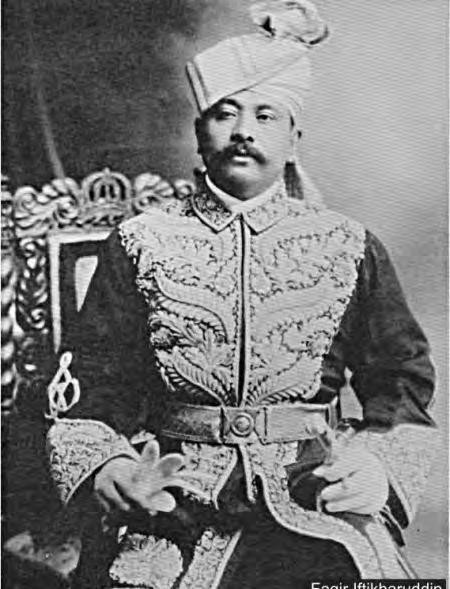
Syed Babar Ali’s father was married into the Faqir family, Faqir Syed Iftikharuddin being his maternal grandfather. With three brothers in Ranjit Singh’s court, with two considered intimate confidants of the Maharaja, the Faqirs were what counted as front rank amongst ‘the Chiefs gentry’ of Lahore.
and how to forge and develop relationships. This would be a skill his whole career would depend on.
As he grew up and attended school, first at Sacred Heart, then at Aitchison College, he began to develop a personal vision of how one should live, under the influence especially of his mother.
Around the time he was at Aitchison, the Second World War broke out, and the interwar army suddenly found itself swelling in size by ten-fold to hit 2.5 million men, the largest volunteer army ever assembled in human history. This, too, was an important commercial opportunity for his family to capitalize on.
He completed his bachelor’s degree from Government College Lahore, and afterwards was sent to the United States to the University of Michigan for higher education in 1947.
that actually had money – was tasked by the government to assist in helping provide for the people of this newly created state. They were tasked, for instance, with helping with the import of cotton and wheat, and also to set up industry in Pakistan. Prior to the partition, the family already had set up a textile mill (in collaboration with Sir William Roberts) and ghee and soap factories (in collaboration with the Lever Brothers) in Rahim Yar Khan. The government inducted the family into the management of more cotton mills, while they themselves bought a new cotton-seed oil mill in Hyderabad. Syed Babar Ali was thrown into the deep end as soon as he arrived.
And this is where he cut his teeth. Taking up base in Karachi, he was tasked with handling machinery for the textile mill
ny, as their main dealer in Pakistan. Here too was Syed Babar Ali involved, and in 1950 was sent as a representative of Ali Motors to Ford in the United States to try to procure spare parts for military vehicles. This was one of his earliest successes, where he was able to procure the material and learn in the meantime how to do so on the job. The family business kept growing with the establishment of Treet Razor Blade Company (as a joint-venture with the American Safety Razor Corporation of New York) as well as the founding of IGI insurance (in partnership with Alliance Insurance, a UK based company).
Syed Babar Ali was learning the ropes and already assuming responsibility for key support functions. Yet he still had to make his mark, to do his own thing. And the opportunity for that soon came.
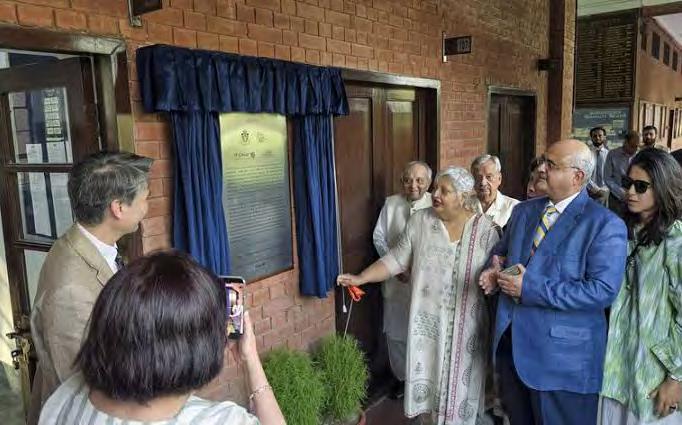
Babar Ali has long maintained a deep connection to his alma mater, Aitchison College. At the time that he attended it, Aitchison was still very exclusive, and many among the students belonging to the ruling families of the many states dotting then undivided India, sons of Maharaja of Patiala and Nawab of Bahawalpur, among them. In April 2026 he dedicated a room as the “Balochistan Room” at the school in memory of his Baloch friends including the late Nawabs Akbar Bugti and Khair Bakhs Marri. The notice is on the left. On the right, his son Syed Hyder Ali dedicates a room to his father’s childhood friend Sardar Harcharan Singh Brar in June 2026. Harcharan Singh later became Chief Minister of Indian Punjab.
While the young Babar was studying, debating politics, and travelling across the United States, Pakistan achieved independence. Sir Zafrullah Khan, a close friend of the family, was leading the Pakistan declaration at the United Nations in New York, and upon the request of Syed Maratib Ali, Babar was allowed to hang around the Pakistani delegation and attend sessions, sometimes even as the main representative. He was already being brought up to speed to hold his own in such high circles.
Upon his return to Pakistan, he found that his family – since it was one of the few
and dispatching it from the Karachi port north to the textile mill in Rahim Yar Khan. At the same time, Syed Babar Ali was charged with frequenting the oil mill at Hyderabad, and trying to support it in any way he could with anything they needed. And as time grew on, he frequently travelled abroad to maintain contact with the agents of the family’s business, collaborate with newer merchants, and to assist with the export of oil cake and cotton to the United Kingdom, Russia, and Egypt, among others.
In the meantime, the family had also set up a joint venture with Ford Motor Compa-
Packages and Other Ventures
ASwedish Packaging Company called Åkerlund & Rausing had repeatedly offered Treet its packaging products, but the offers did not come through because the latter felt that the price was too high. Then, in 1954, Syed Babar Ali was visiting the Scandinavian region, and felt perhaps he should meet with them and posit that rather than buying from them, it might be better to enter into business with them and set up a Pakistani packaging company. The Swedes liked the idea, and helped
Syed
set the factory up in Lahore, and supplied talent and machinery to boot.
Perhaps more than the company itself, what had a great impact on the young businessman was the mentorship of Ruben Rausing, the majority owner of Åkerlund & Rausing. As Syed Babar Ali describes, at the time of their meeting he was 28, while Ruben was in his 60s. And it was here that he first saw the gelling together of visionary values and the pragmatic reality of running a business. In fact, Syed Babar Ali later compared him to a father figure. One of Ruben’s pronouncements that he cherished was one that insisted on the absolute centrality of trust and honesty to the practice of business: “The most important thing in running a business is that you have got to trust your people. If you cannot trust them, don’t go into business.” To this, Syed Babar Ali added, “This trust will only come if you have the discipline in your blood and bones that you can’t cheat”.
It is from Rausing that Syed Babar Ali
learned the practice of leadership, just as the latter was setting up a business for the first time. Syed Babar Ali fondly recalls an incident where Rausing was planting oak trees and said that since the harvest would take a minimum of 70 years to achieve, “none of my children will benefit from it, but maybe my grandchildren will.” Here Syed Babar Ali developed his belief that a leader was someone who had to look beyond themselves - and also beyond the present - and have their eyes fixed on the goal. The goal was the most important.
As he was running Packages, he also learned how to create a team. “A leader never thinks of himself as a leader. He is one of many. His real success is the people around him doing a better job than he does,” he says at one point. And it was here that at Packages, he started building a culture where teams and individuals were empowered to work together, to do the best job they could, and to contribute to the success of the institution. No one was more important, not even Syed Babar Ali. And the
Perhaps one of the most significant business opportunities in the history of corporate Pakistan was the one presented to Syed Babar Ali by a Swedish post-War stalwart of packaging industry Ruben Rausing, an innovator who was not just a friend but a mentor as well.
practices at Packages reflected that: employees were sent abroad for training, even to lead newer ventures, and the company continued to work with just about anyone who would - including their customers - to position themselves in a way to stay ahead of the curve. “If the business doesn’t keep growing, it will die. Hameshgi tou sirf khuda ki zaat ko hai. [Immortality belongs only to God].”
As Packages continued to chart new heights, newer business opportunities emerged. The Rausings sold their stake in Åkerlund & Rausing in 1965, and focused their energies on a new company called Tetra Pak, which dealt in liquid packaging. And, again, it was through a joint venture with Syed Babar Ali that they were able to establish in 1984 Tetra Pak Pakistan, a rare joint venture for Tetra Pak.
Joint ventures with foreign companies have been the main strategy that Syed Babar Ali employed. For instance, let’s take the example of how he brought Nestle into Pakistan. He had started MilkPak as a joint venture with Tetra Pak and Danish Turnkey Dairies. While Tetra Pak would provide packaging for the milk, and Danish Dairies would provide the processing technology, the management of MilkPak was intended to manage the dairy operations. But they soon realised that milk did not in itself offer margins high enough to sustain the operations, and nor were the partners able to support them in what they needed. They started looking into other products such as powdered milk, baby formula, and so on.
As had been their practice they sought a foreign partner, and entered into “serious discussions” with Friesland. Yet one day they heard that a senior executive from Nestle wanted to visit their office in Lahore. The visit went quite well, and both parties recognised the merits of a joint venture within the first half hour. Nestle would obviously bring in the technology, the brand power, and the product, while Syed Babar Ali and company, with their extensive local experience would provide the practical know-how to scale the business.
And this strategy has landed him partnerships with some of the biggest names in the world such as Coca Cola, American Express, Hoechst, Bayer, Sanofi, Tri-Pak Films, etc.
One can see why this model would appeal to someone like him. A partnership relies on a shared goal and realisation that the achievement of that goal is in the best interests of both parties. It is also not hard to see how the early grooming that Syed Babar Ali had under the shadow of his father and brothers, where he learnt how to maintain relationships and rely upon the strength of one’s connections has been an integral part of his worldview. It goes back to his no-nonsense, yet morally charged, way of conceiving an enterprise.
One remarkable thing about his joint ventures is not simply their success, but the sheer number of these successes. For a space such as Pakistan’s, this is striking. And that too speaks to the kind of reputation Syed Babar Ali had built for himself. You would want to enter into a partnership only with someone whom you believe would help you succeed. That global giants thought so of him is a testament to his track record. But, the possibility merely of success is insufficient. One also has to trust in the way the other party runs their business. When he was asked about the reason behind so many successful foreign joint ventures, Syed Babar Ali replied that it was because of the way he approached business: “I treat my partner the way I want him to treat me.”
This ethos is also reflected in another of his statements that “We have had separations, but never a divorce.” Business is serious business, but even more serious is the relationship between two parties. There is solid pragmatic sense in this; why would you want to leave a bad taste in the mouth? No one benefits from that. And no one recognised this better than the subject of this piece.
Lahore University of Management Sciences
In 1973, something happened. Syed Babar Ali was suggested by a colleague to enrol in the Advanced Management Program at Harvard University. The 13 weeks he spent in that program changed his vision of what he wanted to do in his capacity as a leader. As he mentioned later, “the time there was very rewarding; one got to feel that one knew very little, but that everybody also knew very little.” While at Packages, he had already realised the importance of such training. At the time they used to send around 20 employees abroad for training every 3 months, but the effort was limited mainly to the company.
Things changed when Syed Babar Ali was drafted under Bhutto to lead the National Fertiliser Corporation in 1974. And it was there that he realised how acute the need for a training programme for managers was. The number of well-trained professionals was just not enough to sustain the ambitious programme, and when he returned to the private sector after three and a half years, an idea took hold in him: something modeled on the Harvard Business School needed to be set up in Pakistan.
This soon became an obsession as he went on to discuss the idea with other major businessmen of Pakistan. In a personal capacity, he continued to make many visits to Harvard and finally approached Javed Hamid, a Harvard MBA, who was working at the International Finance Corporation at the time. Syed
Babar Ali enlisted his help, as well as the support of several professors in leading American universities, to finetune the ideas the university would be based on, the curriculum that would be taught, as well as the method of pedagogy it would use. He started raising funds and there was no shortage of connections that Syed Babar Ali could approach to contribute to the university. For the charter, he set up a meeting with the then ruler Zia ul Haq, who readily granted the request to set up a Business School that would enable it to grant its own degrees.
This was an opportunity for Syed Babar Ali to make a real contribution to the mould of society by shaping the upcoming generation of leaders. As he explained, “a university is different from a business in that while in the former you are looking at the balance sheet, the profitability, and the product, in the latter you are looking at the next generation. You are working with unknowns here”. Yet here again, this vision of what the university was supposed to achieve was personally influenced by the driven mania of Syed Babar Ali, who took a personal interest in expanding it, attracting world class talent, and shaping its vision for the students who were to graduate its portals.
This was his personal project. He compared himself to a blotting paper, saying that wherever he saw anything on his travels abroad or in the world of business, he would try to bring it back and see if it could be implemented in LUMS. He would come and spar
with the faculty and challenge them on whether they were doing the right thing? What could he do to help them succeed better? But what he looked for most of all was a passion in the people who were in charge: “You don’t want to drag them to a meeting and then they come half an hour late! You’ve got to have that fire burning in you: let me go to learn, let me go and see, let me go and smell here - you need that kind of passion!” In fact, it can be argued that a great determinant of LUMS’ success has been the personal involvement and imposing, ambitious vision of Syed Babar Ali.
He himself has been the biggest practitioner of his ideas. As LUMS grew from a business school to a full-fledged university, he would often be seen roaming about the campus, accosting just about anyone and asking them about their experience, just before health stepped in and restricted his mobility. His passion has been almost intimidating; at one point, he said “Mein LUMS ki khatir bheek mangnay ko bhi tayyar hoon. For the sake of LUMS, I am willing even to beg.” He has demanded excellence, even as he has exerted his time and energies into the project. One of his targets, which might bring a smile to some faces, is that he wants a Nobel Laureate from LUMS in the next 50 years. But, the eagle-eyed benefactor is quite serious.
And this founder’s dream for the graduates of LUMS is manifold, and these visions offer insight into the kind of man he himself
Even if the vast business empire that Syed Babar Ali built under the banner of Packages fails to maintain its position at the top of Pakistan’s corporate food chain, LUMS will endure and ensure his legacy.
2000:
successive
is. He wants them to be honest above all. He wants them to be hungry for knowledge at all times, like he himself is. He wants the student to be a lover of the country, but not in a superficial way; rather, he wants there to be a “direct pull of the soil to the individuals’ soul,” and that can only come through the love of the country and the study of “the great thinkers this soil has produced, local music, and culture”. And finally he wants them to give back to LUMS; that is how, in his mind, institutions prosper.
This is not simply a matter of LUMS, but rather offers a great window into the soul and fire within the grand man of Pakistan.
A Life Beyond the Circle
Syed Babar Ali, for all his business accomplishments, is greater because of his insistence on giving; it is giving only that assures the future. And this is what has been the mainstay of his life as he has grown older. You and me, our personal arbitrariness is important to be sure; but what’s perhaps more important is the prerogative to give back, to share, and to sacrifice one’s energy for a better world, which one might not get to see themselves, but whose coming on would be assured by one’s drive to make a positive difference in the world.
And this world is something that has
been important to Syed Babar Ali. And it is a very particular world. He has been someone who is remarkably cosmopolitan, but who is tied fervently to local roots – though the route he took was circuitous. He remarks how during his time at Aitchison he was taught only the British perspective on Indian history, and how he had to go through a personal journey to become more cognisant of the ‘complex’ he had developed for the British. In that journey, he has had to rely on teachers, one of whom was Victor Kiernan, who he later found out was a card carrying Communist. His other mainstay has been literature, and this he has his mother to thank for. The only subject that he ever failed, as he recalls, was Urdu in school; embarrassed, he was forced to take classes from a special tutor appointed by his mother, Mubarik Begum, who herself was quite interested in local literature and cultural expression. She counted Allama Iqbal as one of her interlocutors in Lahore, and upon her travels across India with her family, she often visited authors. And under her influence he picked up an interest in the classical poets of the Persian tradition in particular, including Saadi and Rumi, and local Sufi tradition, such as Bulleh Shah and Sultan Bahu, something he has continued to cherish as he settled into advanced age. Even at Packages, he involved his old teachers and friends of the family into this initiative, with the
consequence that Packages published multiple editions of the works of many regional poets. He has been more than a businessman, then, in his capacity as a university founder and even cultural revival in a sense. Then there’s also the fact that there is good, hard sense in what he is talking about. In his autobiography, for instance, he deplores the state of military spending in both India and Pakistan. He says “One F-16 costs as much as a university,” and implores us to imagine “if this could be cut down to half and that money applied to health and education, what progress the two countries could make”. Who could disagree with this? Of course he has achieved so much, but now things have been handed over into newer hands: the businesses, the university, and other non-profit organizations.
Looking back on his career, we can see how Syed Babar Ali has spent his life trying to make things better. Listening to him you get the feeling of someone extremely curious, willing to learn, but also of someone who has a strong ethical sense and insists on following it through to the end. From someone so earnest, someone who recognises the amount of work to be done, someone who walks the talk, one can take advice. One only hopes that many with the same drive, determination, generosity and selflessness such as his rise up from the ranks of the millions whose lives he has so warmly touched. n
COVER STORY
Three
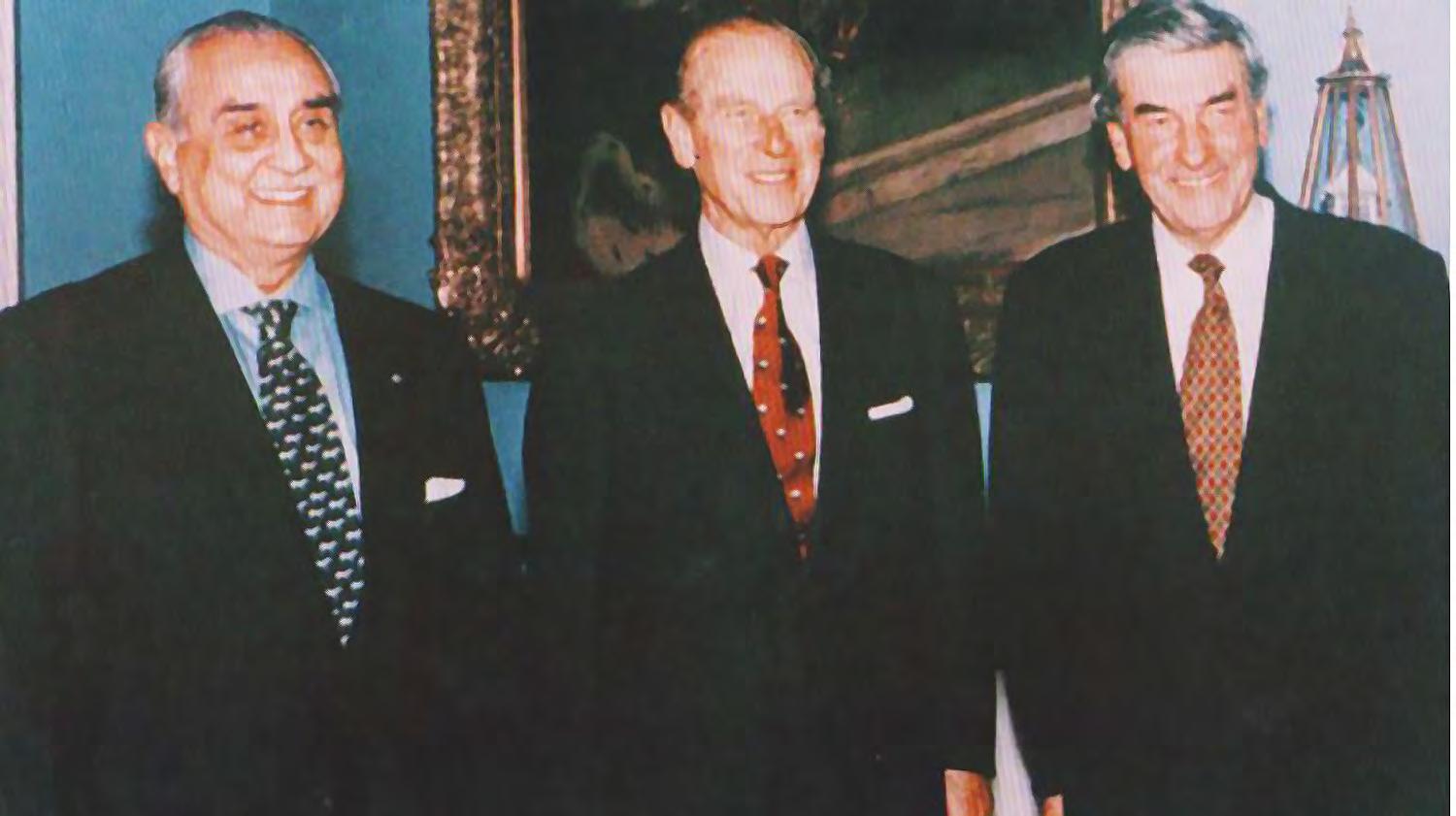
presidents of WWF International HRH The Duke of Edinburgb (1981:1996); Syed Babar Ali (1997-1999) and Ruud Lubbers (2000) at St James’s Palace, London
OPINION
Sardar Ahsan Rasheed Khan
Beyond Hormuz
Pakistan’s Case for a Gulf-Owned Strategic Energy Reserve Corridor
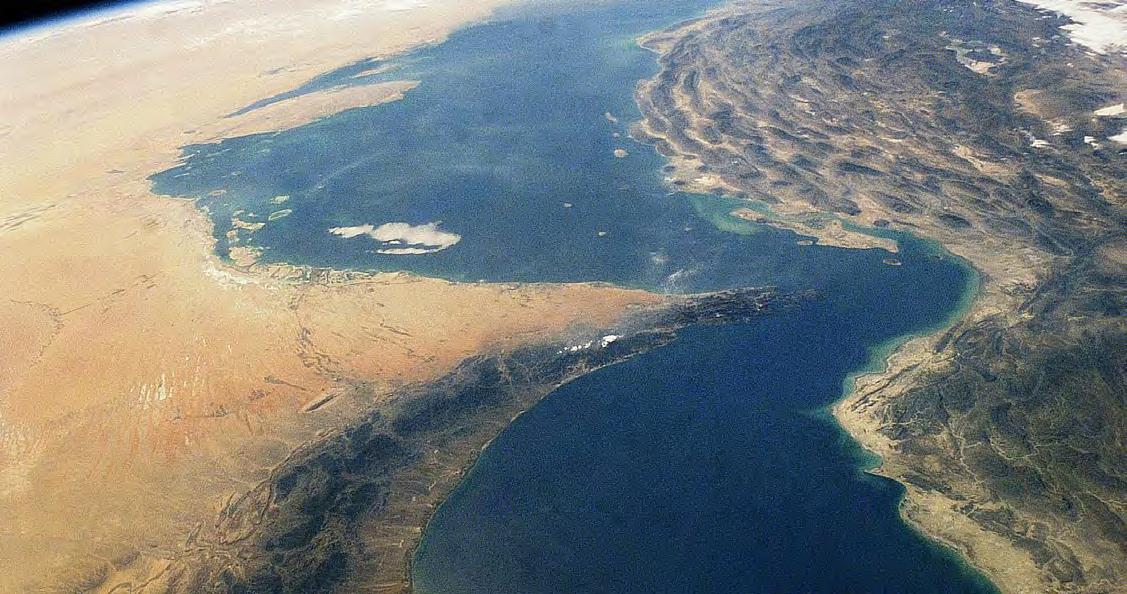
The reopening of the Strait of Hormuz after the recent Gulf crisis brought immediate relief to energy markets, but it should not bring intellectual complacency. Reuters reported on June 19, 2026, that oil shipments through Hormuz had picked up after a U.S.-Iran ceasefire arrangement, with 25 commercial crossings recorded on June 18, still well below the pre-conflict level of about 120 daily crossings. That single comparison captures the core strategic problem: even when a crisis appears to be ending, shipping confidence, insurance availability, port clearance, mine-risk advisories and political uncertainty can lag behind the diplomatic headline.
For Pakistan, the lesson is more direct than for many other countries. According to Reuters reporting on a Pakistan government document, Pakistan depends on supplies through the Strait of Hormuz for up to 90% of its oil and LNG imports and lacks strategic petroleum reserves. The U.S. Energy Information Administration separately notes that in the first half of 2025, total oil flows through Hormuz averaged 20.9 million barrels per day, equivalent to about 20% of global petroleum liquids consumption and one-quarter of global maritime traded oil. In other words, Hormuz is not merely a Gulf problem. It is an Asian
The writer is a Stanford LEAD and NDU alumnus with 23+ years of experience in the technology and corporate sector. He can be reached at sark242@gmail.com
inflation problem, a South Asian balance-of-payments problem and a Pakistani national security problem.
The usual response to a crisis around Hormuz is diplomatic: de-escalate, escort shipping, reopen lanes, calm markets and wait for normalcy. That is necessary, but insufficient. The bigger question is how to reduce the world’s exposure to the next disruption. Pakistan’s opportunity lies not in pretending it can replace Hormuz, Fujairah, Rotterdam or Singapore. It cannot. Its opportunity lies in becoming a geographically nearby, politically friendly and lower-cost redundancy platform for Gulf producers that want to hold some crude, refined products or LNG outside their immediate conflict geography.
The Strategic Idea: From Transit Country to Reserve Host
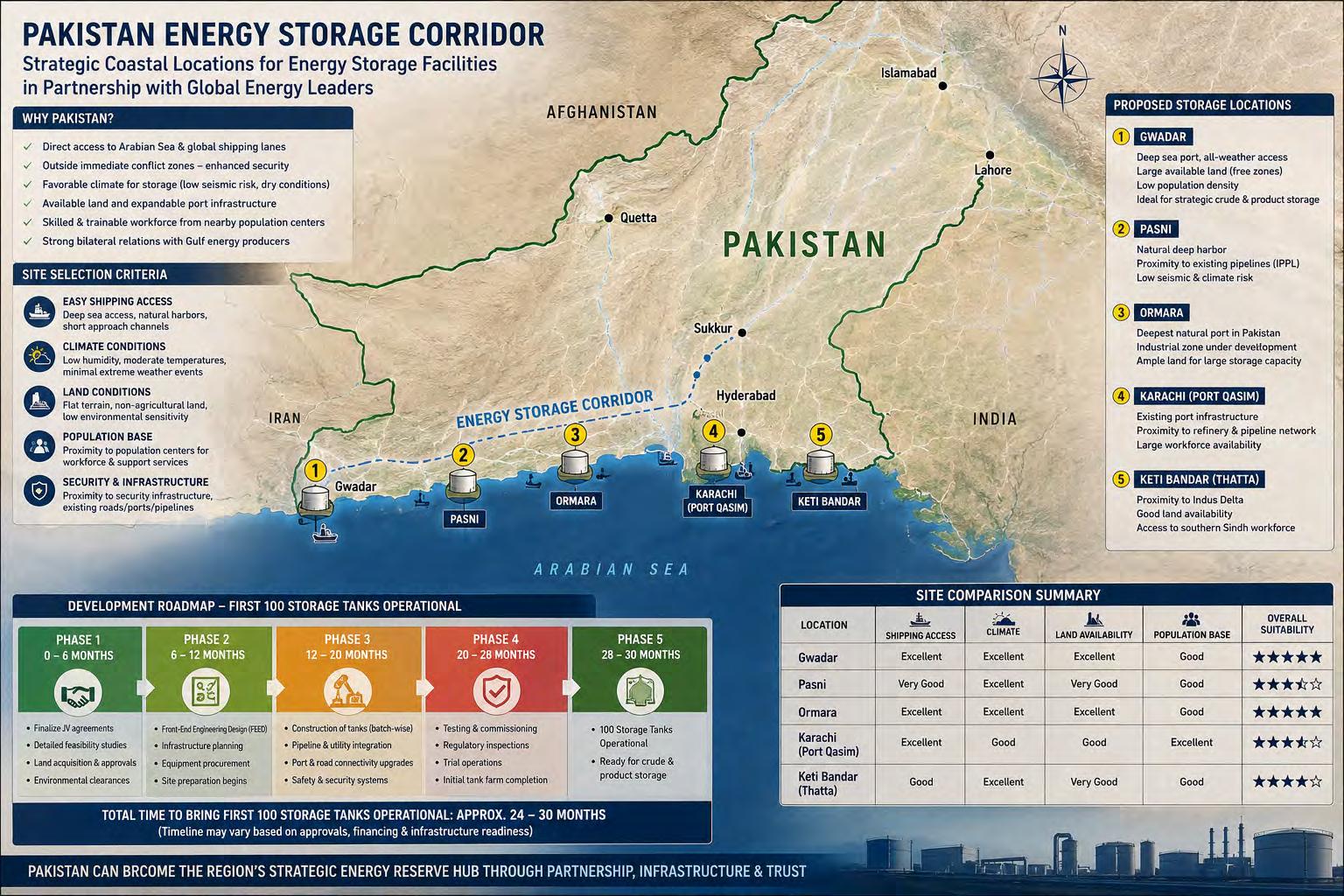
Pakistan should propose a “Pakistan Strategic Energy Reserve Corridor” stretching from Gwadar to Port Qasim, with selected nodes at Pasni, Ormara, Hub/Karachi and eventually Keti Bandar. The core concept would be simple: Saudi Arabia, the UAE, Qatar, Kuwait, Oman, Bahrain and potentially Iraq could own or jointly own dedicated storage assets on Pakistan’s coastline. The stored inventory would belong to the foreign national oil company or its JV vehicle. Pakistan would provide land, customs-bonded treatment, security, port access, utilities, long-term legal protections and emergency coordination. In return, Pakistan would receive foreign direct investment, lease income, port fees, throughput charges, skilled jobs, local infrastructure, technology transfer and negotiated emergency access rights for its own crises.
The proposal should not be framed as foreign sovereign territory. That phrase would create constitutional, political and public sensitivities in Pakistan and unnecessary geopolitical anxiety abroad. The better formulation is “treaty-backed bonded strategic reserve zones under Pakistani sovereignty.” This structure is closer to a special economic zone, a bonded warehouse regime, a long-term port concession and a bilateral emergency stockholding agreement. The International Energy Agency already recognizes that countries can hold emergency oil stocks abroad under bilateral arrangements that guarantee access during a crisis. Pakistan can learn from that principle without needing to become an IEA member or surrendering sovereignty over land.
This structure also answers a public concern: why should foreign countries store
oil in Pakistan if Pakistan itself is energy insecure. The answer is that Pakistan should not borrow billions merely to fill tanks with imported oil. Instead, it should invite foreign-owned inventories to be held on Pakistani soil, while negotiating limited emergency draw-rights, first-refusal rights, rotation rights and domestic supply support during severe disruptions. This converts Pakistan from a passive importer into an active host of regional resilience.
What Exactly Would Be Built
Astrategic reserve is not simply a tank farm. A bankable reserve zone requires a complete energy security system: crude oil tanks, refined product tanks, firewater reservoirs, foam systems, bund walls, oil-water separators, pumps, pipelines, metering systems, control rooms, laboratories, security fencing, drones, radar, cybersecurity, truck loading bays, emergency response units, power backup, water supply or desalination, environmental monitoring, marine loading arms, jetties or single-point moorings, and a dispatch regime that determines who can move which product under normal and emergency conditions.
A large above-ground crude tank can hold about 500,000 to 1 million barrels. A 10 million barrel crude block therefore requires roughly 10 to 20 tanks depending on tank
size. Refined products are more complicated because petrol, diesel, jet fuel and furnace oil cannot simply be blended at will, they require separate product tanks, quality controls and
Table 1: Core Components of a Strategic Reserve Zone
Component Purpose Critical notes for Pakistan
Crude oil tanks Emergency and Best suited for Gwadar, Ormara and Pasni,requires commercial crude buffer large land and marine access.
Refined product Immediate domestic More useful for Pakistan during disruptions because tanks fuel support diesel, petrol and jet fuel can move faster to market.
Marine Tanker unloading and SPM, jetty, loading arms and tugs determine whether a infrastructure loading reser ve can actually move during a crisis.
Pipelines and Distribution and Port Qasim has advantages because of existing liquid truck loading re-export cargo and industrial infrastructure.
Fire, safety and Risk control
Essential for public acceptance and international environment insurance.
Security and Protection of strategic Must include coast guard/naval coordination, drones, systems cyber assets sur veillance, OT cybersecurity and emergency command centers.
Legal and Bankability
Bonded storage, dollar-indexed tariffs, international regime customs arbitration and emergency access rules are central.
Source: Author estimates and international strategic stockholding practice, see references
more frequent rotation. LNG is in a different category altogether. It requires cryogenic tanks, specialized insulation, boil-off gas handling, regasification equipment, safety exclusion zones and high-specification marine infrastructure. For Pakistan, crude and refined products should be phase one. LNG should be treated as a separate, more expensive Qatar/ UAE/Oman track once the first petroleum corridor has credibility.
Cost: The Tank Is One Bill. The Oil Inside It Is Another
The most important analytical distinction is between infrastructure cost and inventory cost. A reserve project can look manageable when discussed as tanks and pipelines, it becomes far larger when the stored oil is included. Industry and policy estimates vary by site conditions, port access, land preparation, seismic design, environmental rules, imported equipment costs and security standards. As a rule of thumb, a coastal tank farm connected to marine infrastructure can cost tens of dollars per barrel of storage capacity before inventory is purchased. LNG costs are much higher: VINCI’s 2023 contract for a single 180,000 cubic metre LNG tank in the Netherlands was valued at €160 million, while the earlier Gate terminal in Rotterdam involved an €800 million investment for a regasification plant, two jetties and three 180,000 cubic metre tanks.
For the Pakistan corridor, a practical first-generation target should be 60 million to 80 million barrels of crude and refined products, not an immediate 200 million barrel mega-reserve. At an indicative infrastructure cost of $60 to $90 per barrel for greenfield coastal facilities and $40 to $65 per barrel for brownfield or semi-brownfield facilities, the first-generation petroleum corridor could require around $4 billion to $7 billion in physical infrastructure. Filling 60 million to 80 million barrels at $75 to $85 per barrel would require another $4.5 billion to $6.8 billion in inventory. Therefore, a realistic petroleum corridor could require $8 billion to $14 billion including stored oil, depending on product mix and phasing. If LNG is added at scale, the number rises materially.
This is why Pakistan should not finance the inventory itself. The infrastructure can be financed by foreign equity, project finance, port concession models, sovereign wealth funds and Pakistani JV participation. The oil and LNG inventory should be owned by Saudi Aramco, ADNOC, QatarEnergy, Kuwait Petroleum Corporation, OQ Oman, Bapco Energies or other participating companies. Pakistan’s contribution should be land, regulation, secu-
rity, utilities and the political framework that makes the investment bankable.
Country-by-Country Reserve Allocation
The corridor should not treat every Gulf country in the same way. Saudi Arabia is the anchor crude investor. The UAE is the trading and refined-products partner. Qatar is the LNG and condensate specialist. Kuwait is a crude and refinery-linked reserve participant. Oman is the maritime-balancing partner with strong logic for Pasni and Gwadar. Bahrain is better suited to a smaller refined-products or shared reserve block. Iraq can be a later-stage participant if the corridor is positioned as a neutral South Asian energy platform rather than a GCC-only project.
Site Selection:
Why One Location Is Not Enough
Asingle mega-site would defeat the purpose of redundancy. Pakistan should build a corridor, not a monument. Each site has a different logic.
Gwadar offers land and strategic proximity to the Gulf, but it needs deeper supporting infrastructure, stronger local legitimacy and climate resilience planning. Port Qasim offers existing liquid cargo capability, including FOTCO and LNG-linked infrastructure, but faces land congestion, urban proximity and environmental constraints. Ormara offers strategic defensibility and distance from the Karachi urban belt, but requires more greenfield marine investment. Pasni offers a useful secondary node between Gwadar and Ormara, especially for Oman or shared Gulf facilities. Keti Bandar should be considered a long-term expansion zone, not the first anchor site, because it would require larger supporting investments.
Port Qasim is the fastest route to a credible first win. The Port Qasim Authority describes FOTCO as an oil terminal developed on a build-own-operate basis with an initial cost of $87 million, capacity of 9 million tonnes per year and potential growth to more than 27 million tonnes with three additional berths. It also notes that 77 acres have been earmarked for a POL storage tank farm. This does not mean Port Qasim alone can host the corridor, but it does mean Pakistan already has a liquid cargo base from which an ADNOC, Aramco or Bapco-led product reserve could move faster
Table 2: Indicative Country Allocation, Capacity and Cost
ADNOC Karachi strategic crude/
tanks products
Qatar / Gwadar or LNG, 1-2 LNG tanks
QatarEnergy Port Qasim condensate, LPG + liquids LNG tanks
Kuwait / KPC Ormara Medium 10-15 mbbl 10-20 crude $0.7-1.3bn $1.5-2.6bn crude reser ve tanks
Oman / OQ Pasni + shared Crude, marine 8-12 mbbl 10-16 tanks $0.5-1.0bn $1.1-2.0bn Gwadar fuels, balancing reserve
Bahrain / Bapco Port Qasim or Refined product/ 3-5 mbbl 8-14 product $0.2-0.5bn $0.45-0.95bn Energies Keti Bandar trading storage tanks
Total Gwadar, Port Multi-countr y Approx. 46–82 Approx. 58– $4.25–9.5bn $8.4–17.4bn+ phase-one Qasim/Karachi, strategic crude, mbbl petroleum 117 tanks/ corridor Ormara, Pasni, products, LNG capacity + 1–2 units Keti Bandar and trading LNG tanks reserve
mbbl = million barrels. Costs are indicative and combine author estimates with external benchmarks for storage, LNG and marine facilities, inventory value varies with oil/LNG prices.
than a greenfield coastal site.
Gwadar is the strategic prize, but it should be sequenced carefully. The Gwadar Port Authority describes Gwadar as Pakistan’s third port intended to address limitations at Karachi and Port Qasim, including Karachi’s physical constraints arising from its location within the city. Gwadar also offers a free zone and expansion space. But the honest assessment is that Gwadar must first prove execution reliability: water, power, road access, local hiring, community buy-in, environmental safeguards, customs performance and port throughput. A Saudi-led 10 million barrel starter reserve is a more credible first move than a 50 million barrel announcement that sits on paper.
Timeline: First 100 Tanks, Not 100 Separate Sites
The phrase “first 100 storages” should be reframed as “first 100 tanks.” One hundred separate sites would be commercially irrational and impossible to secure. One hundred tanks across four to five properly designed coastal reserve zones is plausible. If the average tank is 500,000 barrels, 100 tanks create about 50 million barrels of storage. If the average is closer to 1 million barrels, 100 tanks create about 100 million barrels. A practical first target should be 60 million to 80 million barrels across mixed crude and refined-product capacity.
A credible timeline for the first 100 tanks is six to eight years, not two to three years. Port Qasim product storage can move faster because of existing infrastructure. Gwadar can deliver a strategic starter block if land, power, water and security are resolved early. Ormara and Pasni should come in phase two because
they require more greenfield work. Keti Bandar should be treated as phase three. An aggressive fast-track could deliver the first 40 to 50 tanks within four years, but that requires treaty framework, land demarcation, environmental approvals, financing and marine design to be completed upfront.
A Corridor, Not an Enclave
Pakistan’s strongest legal proposition would have five layers. First, a Federal Strategic Energy Reserve Zones Act that defines bonded petroleum and LNG reserve areas, investor eligibility, customs treatment, safety standards, land rights, tariff regulation and emergency access. Second, bilateral government agreements with each participating country guaranteeing that foreign-owned stocks can be accessed by the owner during crisis, while also defining Pakistan’s domestic emergency rights. Third, concession agreements for the operating companies, whether 100% foreign-owned, JV-owned or public-private. Fourth, international arbitration and political risk insurance to reduce investor fear of policy reversal. Fifth, provincial/local development compacts to ensure that local communities see employment, training, health, water and contractor opportunities.
This model is better than a symbolic sovereign corridor because it is more legally acceptable and more financeable. Investors do not need flags over their tank farms,they need enforceable rights, secure access, dollar-indexed tariff recovery, operational autonomy, predictable taxes, customs clarity, insurance acceptance and crisis protocols. Pakistan does not need to give up sovereignty,it needs to give up policy unpredictability.
Phase Years Priority sites Indicative Strategic purpose tanks
Phase 1 Years 1-4 Port Qasim + 30-45 Fast proof through ADNOC/Aramco starter Gwadar blocks, establish bonded storage credibility.
Phase 2 Years 3-6 Ormara + Pasni 30-40 Geographic diversification, Oman/Kuwait shared reser ve blocks, reduce overconcentration.
Phase 3 Years 5-8 Keti Bandar + 20-30
Long-term industrial expansion, petrochemicals, expansions refined-products and potential re-export hub.
Phase 4 Years 8-12 Corridor Additional Refining, petrochemicals, pipelines, bunkering, integration tanks + LNG trading and potential Central Asia/Western China options.
A first 100-tank target is realistic only as a phased corridor, not as a single-site mega-project.
What Pakistan Would Earn
The economic case is not merely rental income. During construction, a first-generation corridor could generate tens of thousands of jobs in civil works, steel fabrication, pipeline installation, marine construction, electrical systems, safety systems, surveying, trucking, port services and security. During operations, the permanent job base would be smaller but higher quality: terminal operators, maintenance engineers, instrumentation technicians, safety officers, environmental monitors, customs specialists, port logistics planners, cybersecurity teams and emergency responders.
The larger value would come from ecosystem formation. If Pakistan hosts credible storage for Aramco, ADNOC, QatarEnergy, KPC, OQ and others, supporting industries will follow: inspection companies, calibration labs, marine service firms, bunker suppliers, tank cleaning specialists, insurance surveyors, energy trading desks, refinery upgraders, pipeline operators and industrial training institutions. That is how storage hubs become economic hubs. Fujairah did not become important merely because it had tanks, it became important because storage, bunkering, trading and shipping reinforced one another. Pakistan should also negotiate knowledge transfer. Every JV should include Pakistani engineering apprenticeships, emergency response training, scholarships, local university partnerships, port management training, industrial cybersecurity programs and minimum local procurement thresholds. Without this, the corridor risks becoming a fenced-off foreign asset that creates resentment. With it, the corridor can become a coastal industrial capability program.
Why the Idea Could Fail
The largest risk is not engineering. It is credibility. Gulf investors will ask whether Pakistan can maintain a 30- to 50-year policy framework across multiple governments, currency crises, IMF programmes and changes in petroleum taxation. They will also ask whether Pakistan can protect critical infrastructure during political unrest, insurgency, cyberattacks or regional conflict. If the answer is uncertain, the project will not move beyond memoranda of understanding. The second risk is local legitimacy. Gwadar and the Makran coast cannot be treated as empty land. Fishing communities, water stress, climate vulnerability and
Table 3: Phased Build-Out Plan
local employment expectations matter. The Makran coastline also faces seismic and tsunami hazards associated with the Makran subduction zone, which means site design must include robust geotechnical, coastal flooding, storm surge and emergency evacuation planning. A reserve corridor that ignores local communities will face political resistance. A reserve corridor that visibly improves local water, training, health, roads and jobs will gain durable acceptance.
The third risk is geopolitical perception. India may view large Gulf-owned reserves in Pakistan through a strategic lens. China may welcome investments that strengthen Gwadar, while the United States may scrutinize the role of Chinese-linked infrastructure. Gulf states will not want the corridor to look anti-Iran. Pakistan must therefore present the project as neutral energy resilience for South Asia, not as a military asset or bloc project. The more commercial and legally transparent the model, the less vulnerable it becomes to geopolitical suspicion.
The fourth risk is competition. Fujairah, Singapore and Rotterdam already have deep credibility. Pakistan cannot compete with them by claiming instant hub status. It must compete on a specific proposition: Gulfowned emergency and commercial stocks located close to South Asian demand, outside the immediate Gulf conflict geography, on lower-cost land, with treaty-backed access and potential linkage to Pakistan’s own demand, Western China and Central Asia. That is a narrower but stronger claim.
The Best Case Vision - Build Pilots First, Scale Toward a $35 Billion Corridor
Pakistan can begin with a vision for a $35 billion mega-project announcement. However, it should start with two bankable anchor projects. The first should be a Saudi Aramco-led Gwadar Strategic Crude Reserve of 10 million barrels, expandable to 30 million barrels. The second should be an ADNOC-led Port Qasim Commercial and Strategic Product Reserve of 10 million to 15 million barrels. These two pilots would test both strategic and commercial models: Gwadar as the long-term reserve hub and Port Qasim as the faster operational trading/product hub.
Once those two are bankable, Oman can be brought into Pasni or a shared Gwadar-Pasni block, Kuwait can be offered Ormara, Qatar can be offered LNG and condensate, Bahrain can join a refined-product block at Port Qasim or Keti Bandar and Iraq can be considered as a later optional participant. Two or more countries can share a zone, but they should not share legal ambiguity. Each country’s tanks, inventory ownership, access rights, insurance responsibilities and emergency drawdown rights must be ring-fenced. Shared jetties, utilities, fire systems and security can reduce cost by 15% to 25%, but shared assets only work if dispatch priority and crisis rules are settled in advance.
The Lesson of Hormuz
The recent crisis has shown that energy security is no longer only about who produces oil. It is about where oil is stored, how quickly it can move, who controls the route, how markets price political risk and how much redundancy exists when a chokepoint becomes uncertain. The Strait of Hormuz will remain central to world energy. But the smarter strategic response is to build buffers around it.
Pakistan’s coastline gives it a rare opportunity to move from being a vulnerable importer to becoming a host of regional resilience. The idea is ambitious, but not fanciful. The IEA stockholding framework already recognizes the principle of stocks held abroad under bilateral agreements. Pakistan is already discussing bonded storage and strategic petroleum reserves with major oil companies and trading firms. Port Qasim already has liquid cargo infrastructure. Gwadar has the land and strategic location. The missing element is not geography, it is execution credibility.
If Pakistan turns this idea into another headline without legal clarity, local legitimacy and phased financing, it will fail. If it builds a serious treaty-backed, bonded, Gulf-financed strategic reserve corridor, it can attract investment, create jobs, improve energy security, transfer knowledge and make its coastline central to the next generation of South Asian energy resilience. The end of the crisis should not end the conversation. It should begin the build-out. n
Easypaisa built a bank out of phone shops, cash counters and trust. Where does it go next?
After bringing millions into Pakistan’s digital payments system, Easypaisa faces the harder task of making them active banking customers — and proving that a bank built on agents, apps and trust can go where branches never did
By Taimoor Hassan
There is a strange irony at the heart of the Telenor story. If Telenor succeeds in selling its 55% stake in Easypaisa Digital Bank, the Norwegian telecom giant may ultimately be remembered in Pakistan not for the telecom company it built, but for the bank it created.
That is not how the story began. When Telenor entered Pakistan in 2004, it came as a telecom operator. The Norwegian company had years of proven success in the field. The
objective in Pakistan was straightforward: build a network, acquire subscribers and establish a position in one of the fastest-growing mobile markets in the world.
For years, that is exactly what happened. Telenor invested heavily in network expansion, distribution and customer acquisition. Alongside Mobilink, Ufone, Warid and later Zong, it was part of a telecom industry that expanded mobile connectivity across the country.
Over time, however, Telenor executives began exploring an adjacent problem. Mobile phone adoption was increasing rapidly, but access to formal financial services remained
limited. In many parts of the country, telecom networks reached customers who had little interaction with the banking system.
Workers in cities could communicate easily with family members in rural areas but often relied on informal channels to send money. Many small businesses operated entirely in cash. Large sections of the population remained outside formal finance.
Nearly two decades later, the result of that exploration is Easypaisa Digital Bank. What began as a branchless banking service in 2009 has evolved into one of Pakistan’s first operational Digital Retail Bank (DRB).
When we started, we were trying to solve a problem in telecommunication. We were not trying to build a digital financial services platform
Irfan Wahab Khan, chairman of Easypaisa Digital Bank
EasyPaisa says it has more than 60 million registered users and processes trillions of rupees in annual transactions.
The timing is notable. Telenor is reportedly exploring the sale of its stake in Easypaisa at a point when the institution is entering a new phase of its development. In many ways, Easypaisa has become larger than the company that created it which makes the timing of Telenor’s potential departure particularly fascinating: most companies are sold after they have reached maturity. Easypaisa appears to be entering a new phase altogether.
“When we started, we were trying to solve a problem in telecommunication. We were not trying to build a digital financial services platform,” says Irfan Wahab Khan, chairman of Easypaisa Digital Bank and former chief executive of Telenor Pakistan. Over the past two decades, Khan has been at the heart of Telenor’s Pakistan journey, from its roots in communication tech to its banking pivot.
The story of Easypaisa is closely linked to Khan’s own journey inside Telenor, where he moved from strategy and corporate affairs into leadership roles spanning telecommunications and financial services. But it is also a story about how a telecom operator, regulators, a microfinance bank and later a global fintech investor helped build one of Pakistan’s largest digital financial institutions. Profit sat down with Irfan Wahab to look back at Telenor’s history in Pakistan, how it arrived at the threshold of Easypaisa Digital Bank, and what the future might hold.
Looking Beyond Telecom
When Telenor secured a telecom licence in Pakistan in 2004, Khan says he joined as the company’s first local management hire, serving as executive vice president for strategy and corporate affairs. The company launched commercial operations in 2005 and expanded rapidly.
This was the time when mobile penetration across Pakistan was increasing quickly, competition among operators was
intense and subscriber growth remained the industry’s primary focus. By 2007, Telenor had crossed 10 million subscribers.
During this period, Khan says he became increasingly interested in whether mobile technology could be used to expand access to financial services.
Pakistan’s banking sector had historically concentrated on urban centres and higher-income customers. Large sections of the population remained unbanked or underbanked, particularly in rural areas. Estimates at the time suggested that more than 75% of Pakistanis had little or no access to formal financial services.
At the same time, telecom operators had spent years building extensive retail and distribution networks. Thousands of retailers sold airtime, registered subscribers and handled customer interactions on behalf of operators. The question being explored inside Telenor was whether those networks could support financial services as well.
The idea was influenced in part by developments in other markets, including Kenya’s M-Pesa. But Pakistan lacked both a regulatory framework and a proven business model for mobile financial services. By Khan’s account, in 2007, he presented the concept to Telenor’s board. The proposal was rejected.
According to Khan, concerns centred on risk and reputation. Mobile financial services sat outside the company’s core business and would expose Telenor to a different set of regulatory and operational challenges.
A telecom operator could afford occasional service interruptions. Financial services involved customer deposits, regulatory oversight, anti-money laundering controls and consumer protection obligations. The risk profile was fundamentally different.
A year later, the discussion resumed.
Khan says Telenor began working with the State Bank of Pakistan to explore how branchless banking could operate within a formal regulatory framework. “There were no regulations. We started working with the State Bank because branchless banking regulations simply did not exist,” he says.
The process would eventually lead to Pakistan’s branchless banking framework. The discussions were important because they established the structure that would later be adopted across the industry. Rather than allowing telecom operators to operate independently as banks, the framework required partnerships with regulated financial institutions. That requirement would shape the next stage of Easypaisa’s development.
In 2008, Telenor acquired 51% shareholding in Tameer Microfinance Bank. Telenor invested approximately $12.5 million for this acquisition. The transaction gave Telenor majority control of the bank and created the foundation for the launch of Easypaisa in 2009.
In 2009, Khan moved to Oslo in a group-level role with Telenor. According to him, the experience also provided an opportunity to discuss financial services at a broader level within the group.
At the time, Telenor had operations across multiple emerging markets. The questions being asked in Pakistan were not unique. Mobile phone adoption was increasing across Asia, while financial inclusion challenges remained significant in many countries.
In 2013, Khan returned to Pakistan as chief marketing officer and also joined the board of Telenor Microfinance Bank while heading its branchless banking committee. In 2015, Telenor acquired the remaining shareholding in Tameer Microfinance Bank and renamed it Telenor Microfinance Bank, bringing the institution fully under the group’s ownership.
Building Easypaisa
The next challenge was structural. A telecom operator could not provide banking services on its own. The model required a regulated financial institution. That led to Telenor’s investment in Tameer Microfinance Bank, which
provided the banking platform necessary to launch branchless financial services.
In 2009, Easypaisa formally launched. Today, mobile wallets and app-based payments are common. At the time, neither consumer behaviour nor the regulatory environment was fully developed. According to Khan, the original model anticipated wider use of digital wallets. Customers, however, largely preferred agent-assisted transactions.
Instead of maintaining wallets, many users visited retailers, handed over cash and completed transactions through an agent. These transactions became known as over-the-counter, or OTC, transactions. For Easypaisa and later JazzCash, OTC became the dominant use case.
“Customers felt that if something went wrong, they could always go back to the retailer and ask where their money had gone,” Khan says.
The approach reflected how consumers preferred to interact with financial services at the time. Retailers already existed in local communities and were often familiar to customers. Rather than push customers toward wallet adoption immediately, Easypaisa expanded its agent network and continued supporting OTC transactions.
The strategy helped the company scale its early operations while introducing customers to digital financial transactions. The original vision behind many mobile-money systems around the world was that customers would maintain digital wallets and transact directly with one another. In Pakistan, adoption followed a different path.
In the case of M-Pesa in Kenya, for instance, wallet users would use agent networks to cash in or cash out but would conduct the transactions themselves through the wallet. In Pakistan, on the other hand, a customer in Karachi could hand money to an agent, initiate a transfer and have a family member collect cash from another agent hundreds of kilometres away. The transaction moved through digital rails even if the customer never interacted with a wallet. From a product-design perspective, this differed from the original vision. From a distribution perspective, it worked.
The model enabled Easypaisa to scale without waiting for consumers to change financial habits that had developed over decades.
Why Distribution Mattered
One reason Easypaisa was able to expand quickly was that much of the required infrastructure already existed.
Banks traditionally expand through branches, but building branches requires capital, staffing, regulatory approvals and ongoing operating expenses. Expansion into lower-income or geographically dispersed areas can be difficult because transaction volumes may not justify the cost.
Telecom operators had built a different model. Instead of branches, they relied on retailers and agents.
By the late 2000s, telecom retailers were present across urban centres, towns and many rural markets. They sold airtime, registered subscribers and handled customer support functions. Consumers already interacted with them regularly. Easypaisa repurposed that infrastructure.
Rather than constructing a parallel branch network, it expanded through agents. The approach lowered the cost of customer acquisition and gave the service
a presence in locations where traditional banking infrastructure was often limited. This distribution advantage became one of the defining characteristics of Pakistan’s branchless banking industry.
Years later, Khan would point to distribution as one of the most important factors behind Easypaisa’s growth. During his time in Bangkok as Telenor’s Head of Distribution for Asia, he worked on systems that improved visibility over inventories, commissions and retail operations across multiple markets.
The objective was not simply expansion. It was making large distribution networks more efficient and easier to manage. The same capabilities later supported financial-services operations.
Distribution also influenced the economics of the business. For traditional banks, expansion often requires physical investment before customer acquisition occurs. For
Early Easypaisa-branded retail outlets in Pakistan. These neighborhood stores served as Easypaisa agents where customers could pay utility bills, send money, and conduct over-the-counter (OTC) financial transactions without needing a bank account or even a mobile phone
branchless banking providers, distribution networks already existed. Financial services could therefore be layered onto infrastructure that had originally been built for telecommunications.
This did not eliminate the complexity of banking. Compliance, risk management and regulation remained essential. But it did change how services reached customers. The result was a model that looked different from traditional banking and different from traditional telecommunications. It sat somewhere between the two, one that required time for trust to be developed.
For many users, cash remained the preferred medium for storing and transferring value. Mobile wallets represented a new concept. The OTC model allowed customers to use digital transaction rails but without changing familiar habits immediately.
Money could be deposited with an agent, transferred digitally and collected elsewhere without requiring customers to maintain accounts themselves. This distinction mattered because branchless banking was not simply introducing a new product; it was introducing a new way of interacting with financial services.
The process took time. As Khan tells us, with the increase in transaction volumes, customers became more familiar with digital channels and wallet adoption gradually improved.
The experience also shaped Easypaisa’s broader approach: rather than treating technology as the primary challenge, the company increasingly focused on customer behaviour, use cases and accessibility.
The lesson became visible in the way the platform evolved. Easypaisa’s early growth was driven less by sophisticated financial products and more by solving practical problems such as domestic payments, utility-bill payments and mobile top-ups.
For many customers particularly in the rural population centres of the country, these were their first interactions with the formal financial infrastructure. The importance of these services was not necessarily the transaction itself but the frequency. Utility bills are paid every month, mobile balances are topped up regularly and families send money repeatedly.
Repeated usage created familiarity with digital transactions in a way that one-time products often cannot. Those considerations would remain important as Pakistan’s technology landscape evolved. Later on, smartphones changed the equation
For much of Easypaisa’s first decade, Pakistan remained a feature-phone market. Mobile phones were widespread, but smartphones and mobile internet adoption were still developing. To reach these users, Easypaisa relied heavily on USSD technology, allowing customers to access services through simple
An early Easypaisa teaser campaign launched by Telenor Pakistan ahead of the service’s commercial debut in October 2009. The advertisement introduced “EP,” a mystery character symbolizing convenience, and invited consumers to guess the meaning of the initials for a chance to win iPods
menu-based interfaces without requiring internet connectivity. Think dialing *345# to do financial transactions.
Users could transfer money, pay utility bills and top up mobile balances through basic phones. The approach expanded access beyond smartphone users and helped establish branchless banking services in a market where internet penetration remained relatively low. For several years, this model remained central to the business. The smartphone transition altered the equation.
As smartphone adoption increased and mobile internet became more accessible, customers became accustomed to app-based experiences in other parts of their lives. Messaging, eCommerce, transport and entertainment increasingly moved to smartphones. Financial services followed.
In 2016, Easypaisa launched its mobile application. The app expanded the range of available services and shifted more activity toward direct digital engagement. Users could transfer money, pay bills, purchase insurance products, make government payments and access a growing range of services through a smartphone interface.
The shift did not eliminate the role of agents, but it added a new channel for customer engagement. Broader changes in Pakistan’s telecommunications market also supported adoption. Smartphone prices declined, internet access improved and mobile data usage increased.
These developments created conditions for wider adoption of app-based financial services. The app also changed the economics of customer engagement. Agent networks remained important, but digital channels allowed Easypaisa to interact directly with customers
and introduce additional services. As engagement increased, the platform expanded into areas such as savings, investments and insurance.
The transition reflected a broader change in strategy. The company was no longer focused solely on enabling transactions. It was increasingly attempting to build a broader digital-financial-services platform.
Covid, Competition and the Growth of Digital Payments
By the late 2010s, the environment in which Easypaisa operated looked very different from the one it entered in 2009.
Smartphone adoption was increasing. Mobile internet had become more accessible. Consumers were becoming more comfortable using digital services in other areas of daily life. At the same time, the broader digital-payments ecosystem was becoming more competitive.
JazzCash, operated by Jazz, had emerged as a major player in branchless banking and mobile financial services. While Easypaisa had entered the market first, JazzCash expanded aggressively and built a significant scale of its own.
The development of Pakistan’s digital finance sector is often told through the story of a single company. In practice, it evolved through competition between multiple players, regulatory initiatives by the State Bank and changes in consumer behaviour. Easypaisa and JazzCash competed for customers, merchants and transaction volumes, but both also benefited from broader growth in digital payments.
As more consumers adopted smartphones, the addressable market expanded. As more merchants accepted digital payments, us-
age opportunities increased. As regulators introduced new infrastructure and frameworks, the ecosystem became easier to navigate. Khan explains that the Covid-19 pandemic accelerated many of these trends.
Lockdowns, mobility restrictions and concerns about physical interaction increased demand for digital transactions. Consumers who had previously relied heavily on cash began experimenting with digital alternatives. Businesses looked for ways to receive payments remotely. Government programmes increasingly used digital channels for disbursements.
“Covid became an inflection point. People realised that work, payments and daily life could all be managed through technology,” Khan says. The shift was visible across the industry. Transaction volumes increased, digital-wallet usage grew and more consumers became comfortable conducting financial activities through smartphones.
The pandemic did not create digital finance in Pakistan, but it accelerated adoption among users who may otherwise have taken years to transition.
At the same time, regulators continued building the infrastructure necessary for a more digital financial system. One of the most important developments was Raast, the State Bank’s instant payment system. Raast was designed to allow real-time digital payments between financial institutions and service providers.
The significance of systems such as Raast is often overlooked because they operate largely in the background. Consumers see apps, businesses see payment interfaces, but the infrastructure connecting these systems is less visible. Yet it is this invisible infrastructure that often determines how efficiently money moves through an economy.
For branchless banking providers, Raast improved interoperability, reduced friction and expanded opportunities for digital transactions. The result was a financial-services landscape that looked increasingly different from the one that existed when Easypaisa launched.
Ant Group Arrives
Amajor development in Easypaisa’s history came in 2018 when Ant Financial acquired a 45% stake in Telenor Microfinance Bank for $184.5 million. At the time, Ant was one of the most influential companies in global financial technology.
Through Alipay and its broader ecosystem, the company had helped develop one of the world’s largest digital payments and financial services platforms. For Easypaisa, the investment brought more than capital.
It brought operational experience, technology expertise and exposure to business models that had achieved scale elsewhere.
“That’s when we partnered with Ant Group, the largest fintech company in the world. They brought technology, expertise and global best practices,” Khan says.
The investment also reflected how international investors viewed Pakistan. That despite the challenges associated with financial inclusion, the opportunity was vast. Large portions of the population remained underserved or unserved by traditional financial institutions. At the same time, mobile phone adoption was high, smartphone adoption was increasing, and so was internet penetration. In comparison to regional markets, digital payments remained underdeveloped.
For Ant Financial, a company focused on digital finance, Pakistan represented a market with substantial room for growth. Within Easypaisa, the Ant partnership coincided with broader efforts to expand products and services.
The company increasingly positioned itself as a digital financial services platform rather than a payments provider. This distinction matters: a payments company primarily moves money. A financial services platform attempts to help customers manage money.
Those are related but fundamentally different objectives.
Becoming a Digital Retail Bank
As Easypaisa evolved into a digital financial services platform, another question emerged. How far could the platform evolve within the framework of branchless banking? The introduction of digital banking licences by the State Bank provided one answer.
The digital banking framework recognised that financial services were increasingly being delivered through software rather than physical branches. While traditional banks remain important, digital first institutions operate differently, acquire customers differently and serve customers differently.
And they often have different cost structures.
In 2022, Easypaisa began the application process for a Digital Retail Bank licence. Competition was significant, and more than 20 applicants participated in the process. The evaluation extended over a lengthy period and involved a detailed regulatory review.
In 2023, Easypaisa received in-principle approval from the State Bank. According to the company, it was the only incumbent among the successful applicants that received a license. Even its competitor JazzCash was in the race to secure the license but the State Bank opted for EasyPaisa instead.
In 2025, Easypaisa received approval to commence commercial operations as Pakistan’s first Digital Retail Bank. The development
reflected how far the business had evolved since 2009.
The original service focused largely on transfers and payments. The institution now offered savings products, investments, insurance and a broader range of banking services under the Digital Bank license.
For Khan, who by then had served as chief executive of Telenor Pakistan, global head of financial services for Telenor Group and now serving as chairman of Easypaisa Digital Bank, the approval represented the latest milestone in a process that began nearly two decades earlier.
Today, Easypaisa occupies multiple roles simultaneously. It is a bank, it is a payments platform and it is a distribution network. The platform’s scale reflects broader changes in Pakistan’s financial services sector over the past two decades.
Mobile wallets, digital payments and app-based financial services are substantially more common today than they were when Easypaisa launched in 2009.
At the same time, the original market opportunity remains. Large segments of Pakistan’s population remain outside formal finance. Credit penetration remains low by regional standards. Insurance penetration remains limited and cash continues to play a dominant role in the economy.
In many respects, the questions being asked today are different versions of the questions that existed in 2007. How can financial services reach customers that traditional institutions struggle to serve? How can technology reduce distribution costs? How can more people participate in formal finance?
Different companies may propose different answers, but the underlying questions remain relevant. This is partly what makes Telenor’s potential exit noteworthy. Most companies dispose of mature assets after opportunities have been largely exhausted. Pakistan’s financial services market still contains substantial room for growth.
Whether that growth ultimately benefits Easypaisa, traditional banks, new digital banks or other fintech firms remains to be seen. What is clear is that the market that originally attracted Telenor remains very much in existence.
If Telenor ultimately exits Easypaisa, it will close a chapter that began with a telecom licence in 2004 and expanded into financial services five years later. The company entered Pakistan to build a mobile network. Two decades later, one of its most valuable assets may be a digital bank.
Whether the next phase of Easypaisa unfolds under Telenor or a new shareholder, the institution traces its origins to a telecom company’s effort to extend the reach of its distribution network beyond communications and into financial services. n
The life and times of the Super Tax
First introduced in 2015, the idea of the Super Tax really took root in 2022 and quickly became the major flashpoint between the state and corporate Pakistan. This is its story so far
By Usama Liaqat
The Super Tax was born, contested, buttressed, and then finally abandoned (for some). If there’s anything that points at the heart of Pakistan’s taxation issues, it is the heavily contested life of this tax.
The roots of the super tax were laid in 2015, where it was imposed to collect funds to rehabilitate the IDPs, created by the operation Zarb-e-Azab. Yet since then, the government extended and expanded it, and continued to use it as an avenue of revenue. The major push came in 2022, with the Finance Bill of that year amending the Income Tax Ordinance, 2001.
What this became essentially was a double tax. Companies and eligible individuals falling in certain income slabs had to pay tax on their incomes, and then another tax or surcharge on that income if it exceeded certain thresholds. The maximum possible tax rate was set at 10 percent, and given that the normal corporate tax rate in Pakistan was 29 percent, this effectively meant that companies could be paying nearly 40 percent of their incomes (not profits) in taxes.
Companies, expectedly, took the government to court on this issue. By the end there were over 2000 cases filed against the super tax, alleging its non-constitutionality. Initially the companies put their case to the provincial high courts, which effectively watered down – and in some cases struck – the double tax as non-constitutional. The case was then referred to the Federal Constitutional Court, which in a controversial decision in January 2026, upheld the super tax as constitutional.
Yet, even as things appeared to be becoming settled, albeit a portentous calm, the government decided to abolish the super tax on certain slabs in the latest budget, and
reduced the rate on certain slabs. It appears that the government is finally listening to reason, but given the opportunity it offered the government to extract tax revenue, it has to look elsewhere, since broader tax reforms still seem part of an unlikely future. And pending large scale reforms to bring the vast parts of undocumented economy into the tax net, the government will still be looking for some easy way - one like the super tax - to finance its collection shortfall.
The Background of the Super Tax
The super tax was introduced in 2015 by the Finance Act, which instituted Section 4B into the Income Tax Ordinance, 2001. Ostensibly, it was put in place to “for rehabilitation of temporarily displaced persons,” who had been forced from areas where the Operation Zarb-e-Azab was being carried out. The super tax, here, applied to entities earning over 500 million rupees to raise money to support the IDPs.
Yet, the emergency tax kept being extended, and expanded to cover newer industries, essentially the entire corporate world, with the culmination coming around in 2022, when the year’s Finance Act imposed a super tax by adding Section 4C into the Income Tax Ordinance, 2001. What this did was to impose a maximum 10 percent surcharge that companies and individuals earning over a certain threshold would have to pay, in addition to the normal taxes they were already paying. Thirteen sectors felt the brunt: banks, cement, iron and steel, sugar, oil and gas, fertilizers, LNG terminals, textiles, automobiles, cigarettes, beverages, chemicals, and airlines.
Certain slabs were established. Unlike the previous super tax which applied only on entities earning more than 500 million, now entities earning over 150 million were liable for
this surcharge. For entities earning between 150 and 200 million rupees, the effective super-tax rate was 1 percent, over the normal 29 percent they were already paying as income tax. The rate increased gradually until 500 million rupees, after which there was a flat 10 percent super tax surcharge. This would make 39 percent the effective tax rate for a majority of corporations. For banks, who normally pay a higher tax rate of 39 percent, their effective tax rate now increased to 49 percent. Furthermore, under the Finance Act, the super tax was to be applied retroactively with effect from July 2021. Companies rose up in an uproar against what they felt was an unconstitutional double tax, and challenged it, more or less successfully, in multiple high courts of the country. The Lahore High Court deemed the tax discriminatory and reduced the rate from 10 percent to 4 percent, refusing, however, to strike it down completely. The Sindh High Court too invalidated the retrospective application of the surcharge, while the Islamabad High Court declared the super tax illegal.
The decisions of these high courts were challenged by the commissioners of Inland Revenue of Lahore, Karachi, Peshawar, and Islamabad in the Supreme Court, and after the passage of the controversial 27th amendment to the Constitution, the cases were transferred to the Federal Constitutional Court (FCC).
The Happenings of 2026
In January 2026, the FCC finally reached a decision. In a widely-criticized decision, the FCC dismissed all challenges against the super tax and upheld it and struck down the judgments of the high courts, especially concerning Section 4C of the Income Tax Ordinance. The high courts, the FFC argued, did not have the authority to re-determine tax slabs, rates, thresholds, or fiscal policy. Therefore,
their decisions constituted judicial overreach. At the same time, the FCC declared that Section 4C (of 2022) did not amount to double taxation. The decision effectively settled over 2200 cases and opened access to 310 billion rupees in revenue for the government, and given that the government had already provisioned for this influx, this decision was welcomed by them.
For companies, this decision felt like a bag of bricks. When the super tax was imposed in 2022, they provisioned for their tax liability in their books, yet when the high courts effectively removed or reduced their super tax liabilities, these companies had removed these tax liabilities and showed them as their income. Now that the FCC restored these taxes, the companies had again to re-provision all of that tax amount, starting from the year the super tax was applicable from. The result was a shock reduction in their profits. In fact, the slump in the Pakistan Stock Exchange from its peak at over 191,000 points – before the Iran war – was partly attributable to the effect of the reinstatement of this super tax.
Just as the companies were resigning themselves to this new reality, the government seemingly did an about-face in the recently announced budget for FY2027. What they had fought so hard for against the whole corporate world of Pakistan, they relented seemingly on their own. In the recently announced budget for FY27, the government proposed to remove super tax on businesses earning up to 500 million rupees annually, and for those earning more than that, it proposed a reduced super tax rate of 8 percent. Even while doing so, the government stipulated that this exemption would not apply to banks, oil and gas exploration companies, and fertilizer companies.
So, now it would appear that of the 13 industries on which the super tax was applicable, companies earning less than 500 million rupees in at least 10 sectors are now exempt from the super tax. These companies, however, would still need to pay the super tax arrears on all income they earned from the time the super tax became effective until June 2026.
Super Tax – A Problem and the Symptom of a Problem
The idea of a super tax, in an already heavily taxed economy, has often been seen as something that would depress company performance and discourage further investment. Critics argue that if a company is paying almost 40 percent of its income in taxes, after accounting for other liabilities, not much is left to the company to invest in the development of its capabilities and the expansion operations. The result, as
the argument goes, – and there’s certainly some merit in that – is reduction in the return on investment. This obviously has spillover effects since it directly affects the companies abilities to spend massive amounts in setting up infrastructure and driving exports.
Then, there is another point – one that has often been argued – that such measures erode the ability of businesses to plan for the future. This is the case, especially, with the judgment of the FCC which appeared to be applied retrospectively. Such measures discourage planning since they appear to cut away at the framework of certainty that underpins any healthy growing economy.
The problem of the super tax runs deeper, however. And it is not a new story either. The government effectively uses such measures to make up for any shortfall in its tax collection figures. It is a fact not uncommonly known that massive swathes of Pakistan’s population and economy lie beyond the legibility of the tax net. Making these realities transparent and reflected in the tax revenue of the state would require broad-based and forward-looking tax reforms, something which not many govern-
ments in Pakistan have been interested in. So, essentially, they have been taking the easy way out. They have been plastering the wound with bandages upon bandages of levies and surcharges, while the wound has been festering underneath. This super tax, too, was one of these bandages, but it appears that the government is now willing to forgo part of it, one can hope, in a bit to give some breathing space to local businesses.
Yet the problem is not simply of super tax, but of taxation, and until something real is done about that, we might see the same thing happening again, possibly in a different shape, but with a similar effect nevertheless. We already have been seeing another cash lever in the shape of the petroleum levy which the government moves in order to meet its revenue targets. And let’s not forget the three industries upon whom the recent watering down of the super tax does not apply. They will still be paying the super tax as it was prior to the budget. So, it would still be a pain for some of the biggest companies in Pakistan. And this is a situation that might not be sustainable for very long.
Lucky Motors cuts the Sportage Alpha and Peugeot 2008 by up to Rs 1.3m and undercuts its own Stonic in the process
The fourth time in three years Lucky has had to walk back its own pricing. The question is whether this round is different or just the same mistake wearing a new excuse
Abdul Hameed Niazi
Lucky Motor Corporation has cut prices on two of its less than hot selling name plates . The Kia Sportage L Alpha drops Rs 1,000,000, from Rs 8,899,000 to Rs 7,899,000. The Peugeot 2008 lineup falls harder still the Active variant down
Rs 1,200,000 to Rs 5,799,000, the Allure down Rs 1,300,000 to Rs 6,499,000. Unlike almost every previous price move from this company, the notification offers no stated reason. No tax circular, no CKD anniversary, no EMI scheme winding down. Just new numbers.
That silence is itself a tell. Every other time Lucky has cut a price this sharply,
it has reached for a justification the Stonic’s “celebratory” five-year CKD offer in April 2024, the NEV Levy hike blamed for July 2025’s increases, the sales-tax notification that forced the Stonic’s hand in 2023. This time there’s nothing to hide behind, which means the only honest reading is the simplest one: demand needed fixing, and fixing it cost Rs 1.2 million off a car that was selling fine ten months ago.
The pattern, again
This story has now been written enough times that it’s less a one-off than a genre. The Sportage Alpha alone has been priced four different ways in eighteen months: launched at Rs 9,499,000 in February 2025, cut to Rs 8,499,000 that May, hiked to Rs 8,899,000 in July under the NEV Levy, and now cut again to Rs 7,899,000 a figure below where it sat even after May’s reduction. The Peugeot 2008 has had an identical arc with longer gaps between moves: stable at Rs 6,999,000/7,799,000 since its August 2025 facelift, now down by the largest single cut either trim has ever taken, bigger even than the Rs 350,000–450,000 reduction that came riding on the Stonic’s coattails in April 2024.
The mechanism is the same every time. Lucky prices a car aggressively on launch, watches demand undershoot, and then corrects hard enough that the correction itself becomes the headline bigger news than the car. It did this with the Sorento in 2021, the Stonic in 2024 (a 24% cut that Profit’s reporting at the time traced to weak monthly sales below 100 units), and now the Sportage Alpha and the Peugeot 2008 together, again. The only thing that’s changed is that Lucky has stopped explaining itself. Whether that’s confidence or fatigue is hard to say from the outside but it should not stop anyone asking the obvious question: if you can cut a four-month-old price by Rs 1.3 million, what were you charging for in the first place?
The cannibalization nobody priced for
There’s a second story buried in these numbers that’s arguably sharper than the headline cut. Lucky’s other subcompact crossover, the Kia Stonic, currently sells at Rs 4,862,000 for the base EX and Rs 5,999,000 for the EX+ unchanged since July 2025. At Rs 5,799,000, the new Peugeot 2008 Active now sits Rs 200,000 below the Stonic’s own top trim.
This matters because Lucky has spent four years building its pricing architecture around exactly the opposite outcome. Back in 2022, when the 2008 Active was first discounted, Profit noted that Lucky’s logic was deliberate: keep the Peugeot priced just under the
Sportage so the two brands complement rather than compete, and let the 2008 raid C-segment sedan buyers instead of KIA’s own customers. That logic still technically holds against the Sportage the Active-to-Alpha gap actually widened slightly today, from Rs 1.9 million to Rs 2.1 million. But nobody appears to have run the same check against the Stonic. For the first time, Lucky is selling a Peugeot for less than the top trim of its own KIA crossover. Two cars under the same parent company, built in the same plant, are now fighting over the same Rs 5.8–6 million buyer a fight Lucky created for itself.
Will it work, and what does “work”
even mean here
Short-term, almost certainly yes, in the narrow sense that matters to a dealership quarter. The Stonic’s 2024 cut moved roughly 700 units in just a couple of days. The Peugeot 2008’s 2022 discount sold out Lahore dealer inventory and created a 1–2 month wait. Steep cuts on under-performing SUVs reliably produce a sales spike in Pakistan, because a chunk of every buyer pool is simply waiting for exactly this kind of signal. The harder question is whether it works in the sense Lucky actually needs it to restoring durable demand rather than borrowing a quarter’s worth of sales from the future. The track record there is worse. The Stonic’s price collapsed, recovered, collapsed again, got a quiet variant swap, and is still, two years on, a car nobody prices with confidence. The Sportage Alpha has now been cut, raised, cut, raised, and cut again in eighteen months which is not a pricing strategy, it’s a coin flip that happens to be public. Every one of those reversals has a buyer on the wrong side of it: someone who paid Rs 9,499,000 for an Alpha in February 2025 has watched its company-set price fall by Rs 1.6 million in sixteen months, with no compensation and, this time, not even an explanation. Hyundai’s Tucson undercut last year already had Sportage buyers calling dealerships for refunds; this cut gives an entirely separate cohort of buyers the exact same grievance. That is the real cost, and it compounds. Pakistan’s car market runs partly on the assumption that a new vehicle holds or gains value in the months after purchase it’s why “on money” and resale premiums function as a culture, not just an inefficiency. Every time Lucky cuts a price this hard, it teaches the market the opposite lesson about its own products specifically: that buying early is a bet against the company’s own future pricing, and a bet you will probably lose. A car that loses Rs 1.3 million in showroom value overnight is not behaving like the asset Pakistani buyers expect it to be, and at some point this is arguably past
that point for the Stonic, and getting there for the Sportage that reputation becomes harder to fix than the price.
Is this the Chinese effect, one tier removed
It’s worth asking why now, even without a company statement to lean on. Profit asked a version of this question in December, when Toyota cut Fortuner prices by over Rs 2.5 million a move explicitly read against mounting pressure from newer and fast-growing competitors like Haval, Jaecoo, and BYD, brands offering newer platforms and longer feature lists at lower prices in the same showroom conversation. The Sportage and the 2008 sit a notch below the Fortuner’s segment, but the same forces apply, arguably with more teeth. The Sportage Alpha competes for the same buyer as the Haval H6 and the MG HS, both Chinese-platform SUVs that have spent two years undercutting Korean and Japanese rivals on equipment-per-rupee, and the Peugeot 2008’s price band is exactly where buyers are now also weighing BYD’s Atto 2 against legacy options on brand trust and resale confidence.
None of this means Lucky is reacting to Chinese cars specifically with this cut there’s no evidence of that, and the company hasn’t said so. But the broader environment it’s cutting into is one where Toyota, the market’s most conservative pricer, has already blinked once this cycle under that exact pressure. Read against that backdrop, this isn’t Lucky inventing a new problem. It’s Lucky applying its oldest fix the panic discount to a newer source of pressure than the tax notifications and Sorento-style misjudgments that forced its hand in years past.
The actual test
The numbers will tell a clearer story within a quarter than any notification could today. If Sportage Alpha and Peugeot 2008 volumes hold at these new prices without another correction inside six months, this was a genuine reset possibly tax-relief-driven, possibly just Lucky finally pricing for the segment it’s actually competing in. If either price moves again before the year is out, in either direction, it confirms what four years of this company’s history already suggests: that Lucky doesn’t yet have a stable theory of what its cars are worth, only a reactive one for what they aren’t selling for. Buyers have started pricing in that instability themselves. The real risk for Lucky isn’t this one cut it’s that the next one matters less, because fewer people are still listening. n