24 What does the continued closure of the Strait of Hormuz mean for Pakistan? Umair Zia
26 Criminal sales tax fraud cases taken away from regional FBR offices, but who are they being given to?
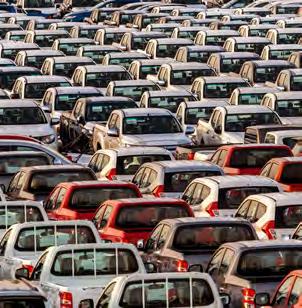
28 Pakistan’s auto industry is going through a green patch. Structural problems mean it won’t last
Publishing Editor: Babar Nizami - Senior Editor: Abdullah Niazi
Business Reporters: Taimoor Hassan | Usama Liaqat | Zain Naeem | Shahnawaz Ali | Ghulam Abbass
Ahmad Ahmadani | Aziz Buneri - Sub-Editors: Saddam Hussain | Abdul Hameed - Video Producer: Adnan Maqsood Director Marketing: Muddasir Alam - Regional Heads of Marketing: Agha Anwer (Khi) Kamal Rizvi (Lhe) | Malik Israr (Isb) GM Special Projects Zulfiqar Butt - Manager Subscriptions: Irfan Farooq
Pakistan’s #1 business magazine - your go-to source for business, economic and financial news. Contact us: profit@pakistantoday.com.pk
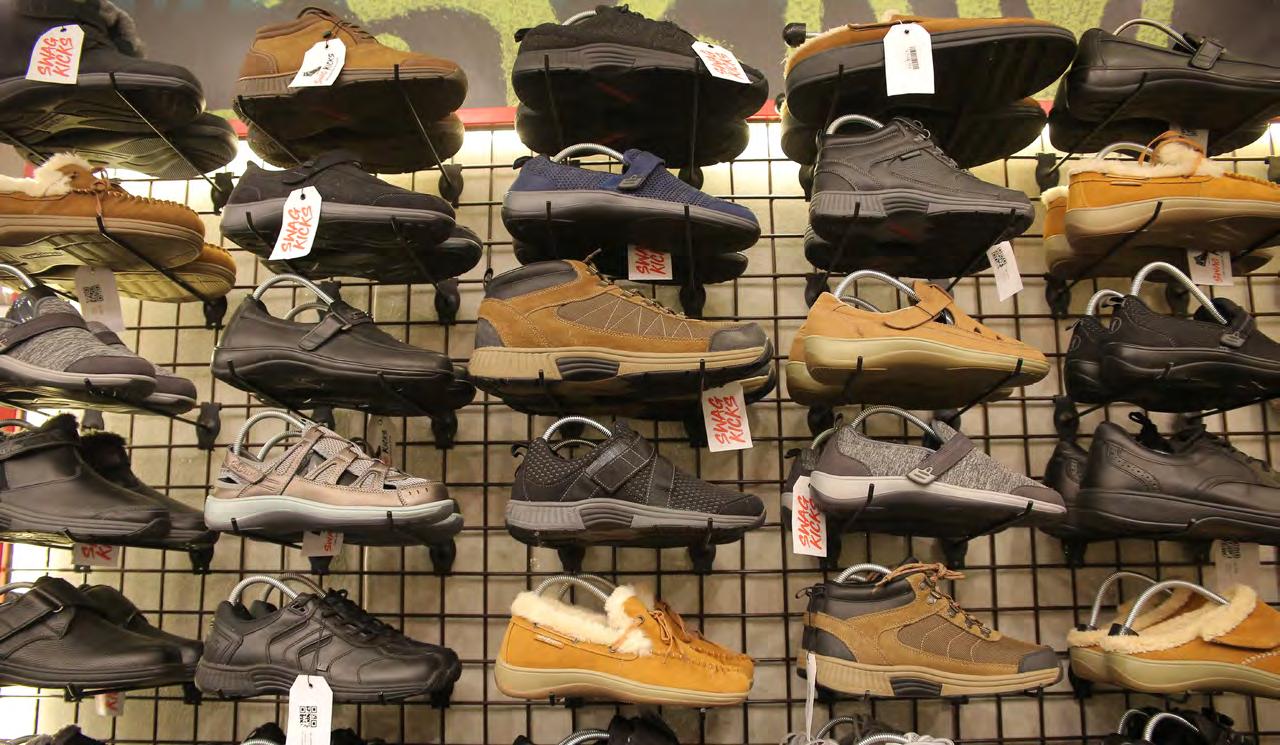
MOVES TO SAAS AS IT TRIES TO ESCAPE PAKISTAN’S BRUTAL RE-COMMERCE UNIT ECONOMICS SWAG KICKS
In a country with one of the largest reliance on used clothes and shoes and an emerging startup scene, Swag Kicks entered with a unique idea. Why are they changing course now?
By Taimoor Hassan
The boom years of Pakistan’s startup ecosystem now feel like a different era. Between 2020 and 2022, venture capital poured into the country as investors chased the promise of a rapidly digitizing market of over 220 million people. Founders raised millions of ambitious ideas spanning fintech, eCommerce, logistics, and retail technology.
Headlines about funding rounds appeared one after the other. Yet when Pakistan’s macroeconomic crisis intensified in 2023 bringing currency depreciation, import restrictions, soaring advertising costs, and collapsing consumer purchasing power, the momentum quickly faded. Some startups shut down quietly while others scaled back operations. But a handful chose another path: reinvention. Among them is Swag Kicks, a Karachi-based eCommerce startup that began as an online marketplace for pre-loved sneakers and streetwear but is now transforming itself into a software company serving thrift
retailers globally.
Swag Kicks was founded in 2019 by a group of young entrepreneurs led by Nofal Khan, Mateen Ansari and Hamza Abid. The idea was rooted in a simple observation: Pakistan’s youth were increasingly connected to global fashion trends through Instagram and TikTok, yet most international brands remained financially out of reach.
Authentic sneakers from brands like Nike or Adidas often cost several times the average monthly income of a young Pakistani consumer. Swag Kicks sought to bridge that gap through recommerce – the online resale of pre-owned fashion items.
The company sourced pre-loved branded sneakers, apparel, and accessories from global suppliers, restored and disinfected them, photographed each item individually, and listed them on its online platform for resale at more affordable prices. The approach created a curated thrift experience that differentiated the company from Pakistan’s traditional “Lunda” markets where second-hand clothing is typically sold in bulk piles with little quality control.
The concept resonated with urban Gen-Z
consumers who wanted access to global streetwear culture without paying retail prices. As demand grew, investors began to take notice. Swag Kicks raised early backing from international startup programs and venture investors before closing a $1.2 million seed round in 2023 led by i2i Ventures, with participation from several global venture funds and angel investors.
For investors, the opportunity extended beyond Pakistan. The global eCommerce industry driven by sustainability concerns and rising fashion prices has been expanding rapidly, with analysts projecting the resale market to reach hundreds of billions of dollars within the next decade. Pakistan, with its price-sensitive consumers and long-standing culture of second-hand markets, appeared particularly well-suited to the model.
Yet operating a thrift marketplace at scale proved far more complicated than running a traditional eCommerce store. Unlike conventional retail, where companies sell large quantities of identical items, thrift inventory is inherently unique. Every sneaker, jacket, or bag is a single unit with its own condition, price, and description.
This means every listing requires individual photography, cataloguing, pricing, and logistics, turning what might seem like a simple online marketplace into a labor-intensive operation. As the company grew, these operational realities began to reveal a deeper problem: the economics of selling one-of-a-kind items online were far more fragile than they appeared.
The unit economics crisis that pushed Swag Kicks toward software
In venture capital circles, startups are often judged not just by their growth but by something far more fundamental: unit economics. At its core, unit economics asks a simple question – does a company make money on each unit it sells? For eCommerce companies, that unit is typically a product order. If the total revenue from selling an item exceeds the cost of acquiring the customer, sourcing the product, delivering the order, and running the operation, the business works. If it does not, growth simply accelerates losses.
During the global venture capital boom of the early 2020s, many e-commerce startups were able to ignore this equation temporarily. Cheap capital allowed companies to spend aggressively on customer acquisition while prioritizing scale over profitability. The assumption was that once a company achieved sufficient market share, operational efficiencies and brand loyalty would eventually improve margins. But when capital tightens and economic conditions deteriorate, the arithmetic of unit economics returns with brutal clarity.
Few places have demonstrated this more dramatically than Pakistan’s startup ecosystem over the past two years. As inflation surged, the Pakistani rupee depreciated sharply, and consumer purchasing power weakened, eCommerce companies suddenly found themselves squeezed from multiple directions. Import costs rose, digital advertising priced in dollars became significantly more expensive, and customers became far more sensitive to price. Businesses that once relied on scale to drive growth now faced a more uncomfortable question: did their underlying economics actually work?
For Swag Kicks, a Karachi-based recommerce startup founded in 2019 by Nofal Khan and his co-founders, the answer became increasingly complicated.
Swag Kicks built its early identity around a compelling idea: bringing global sneaker and streetwear culture to Pakistan through thrift. International brands such as Nike and Adidas command high prices in the country, often placing them beyond the reach of younger consumers. By sourcing pre-loved branded sneakers and apparel from interna-
tional suppliers, cleaning and restoring them, and selling them online at lower prices, the startup positioned itself as a curated alternative to Pakistan’s traditional second-hand clothing markets.
Yet beneath the surface, the economics of running a thrift marketplace were more fragile than they initially appeared.
In traditional retail, companies often sell standardized inventory of hundreds or thousands of identical items that can be stocked, priced, and managed efficiently. Thrift commerce operates very differently. Every item is unique. Each sneaker, jacket, or bag arrives in a different condition and requires its own inspection, cleaning process, photographs, pricing, and listing. That complexity creates significant operational overhead, particularly for companies attempting to scale beyond small Instagram storefronts.
For Swag Kicks, the unit economics of this model initially worked because demand was strong and margins were manageable. To break even, a product typically needed to sell for roughly three times its sourcing cost, explains Nofal Khan. “If the company acquired a sneaker for the equivalent of Rs100, it would need to sell it for around Rs300 to cover marketing costs, logistics, warehouse operations, payment processing fees, and staff salaries. During periods of strong demand, the company could sometimes achieve even higher margins selling items for four to four-and-a-half times their sourcing cost,” he says.
But the macroeconomic environment changed rapidly in 2023. Pakistan’s currency crisis drove up import costs, while restrictions on dollar payments slowed procurement. At the same time, digital advertising costs surged as platforms like Facebook and Google –priced in dollars – became significantly more expensive in local currency terms. Meanwhile, consumer purchasing power weakened, making customers far more price sensitive and suddenly the delicate balance of unit economics began to break down.
A sneaker that once sold comfortably at a three-times markup now faced resistance from customers looking for cheaper alternatives. Smaller thrift sellers operating through Instagram pages often with minimal overhead could undercut organized startups on price. Without warehouses, staff, or formal logistics operations, these micro-businesses could sell products more cheaply, even if their scale remained limited.
For Swag Kicks, that meant maintaining healthy margins became increasingly difficult. Procurement costs rose while selling prices could not increase proportionally without losing customers. Marketing expenses consumed a larger share of revenue, and the operational complexity of handling continued to demand
significant resources. At one point, the company came dangerously close to shutting down altogether, revealed Nofal.
Yet the same operational challenge that made thrift retail difficult would ultimately offer a new opportunity. Early in its journey, the Swag Kicks team had realized that traditional retail software was poorly suited for thrift operations. Systems designed for standardized inventory struggled to manage unique items that required individual listings and pricing. To solve the problem internally, the company built its own software platform to manage warehouse intake, inventory tagging, pricing workflows, and product listings.
Initially the tool existed purely to support internal operations. But as the founders examined the global thrift ecosystem, they discovered that many retailers around the world faced the exact same problem. Small thrift stores and vintage retailers frequently relied on spreadsheets or outdated systems to manage inventory. Even large charity resale operations struggled with inefficient workflows.
The SaaS model
What began as an internal tool gradually evolved into a potential product.
Today Swag Kicks’ own software platform is being sold as a softwareas-a-service product aimed at thrift retailers globally. The system is designed specifically for businesses handling one-of-one inventory, allowing them to manage warehouse intake, track individual items, streamline product listing, and automate parts of the pricing process.
The shift represents a fundamental change in the company’s business model. Retail remains part of the operation, but the software platform offers a far more scalable opportunity. Unlike retail, which requires constant inventory sourcing and marketing spend, software can generate recurring subscription revenue with relatively low marginal costs.
The contrast between the two models reflects a broader lesson about startup economics. Retail businesses, particularly in emerging markets, are highly sensitive to macroeconomic volatility. Currency fluctuations, advertising costs, and consumer purchasing power can all reshape the underlying economics of a company overnight. Software, by comparison, offers a degree of insulation from those pressures.
Swag Kicks today operates with roughly equal focus on both sides of the business, with the retail arm continuing to serve customers while the software platform begins to attract clients in global markets. The revenue split between the two businesses is 50/50. For the founders, the goal is no longer simply building a sneaker resale platform but potentially creating infrastructure for the global thrift industry. n
How big is the landa bazaar, and is it strangling local shoe manufacturers?
Pakistan’s imports of used clothes and shoes from the West have been consistently increasing in value and volume over the past decade. Local players are not happy with the impact of these imports
By Usama Liaqat
In a recent meeting with Commerce Minister Jam Kamal Khan, representatives of the footwear industry came suited, booted, and ready to complain about the increasing import of second-hand shoes in Pakistan.
For shoe makers in Pakistan, it makes sense to be wary of imported second hand shoes. They are cheap and when they flood the market they take away shares from them. According to their own estimates, imported shoes make up around 30-40 percent of Pakistan’s domestic footwear market.
What they based this data on is not clear. But what they essentially said was that these used shoes are imported under the broader customs category of “used clothing and accessories”. This, their argument went, cuts into the potential of local manufacturing to grow properly by shifting demand to imported footwear. Consequently, the manufacturing potential of the local industry is far from fully utilised, with deleterious consequences for the local industry, since they are unable to compete with those prices.
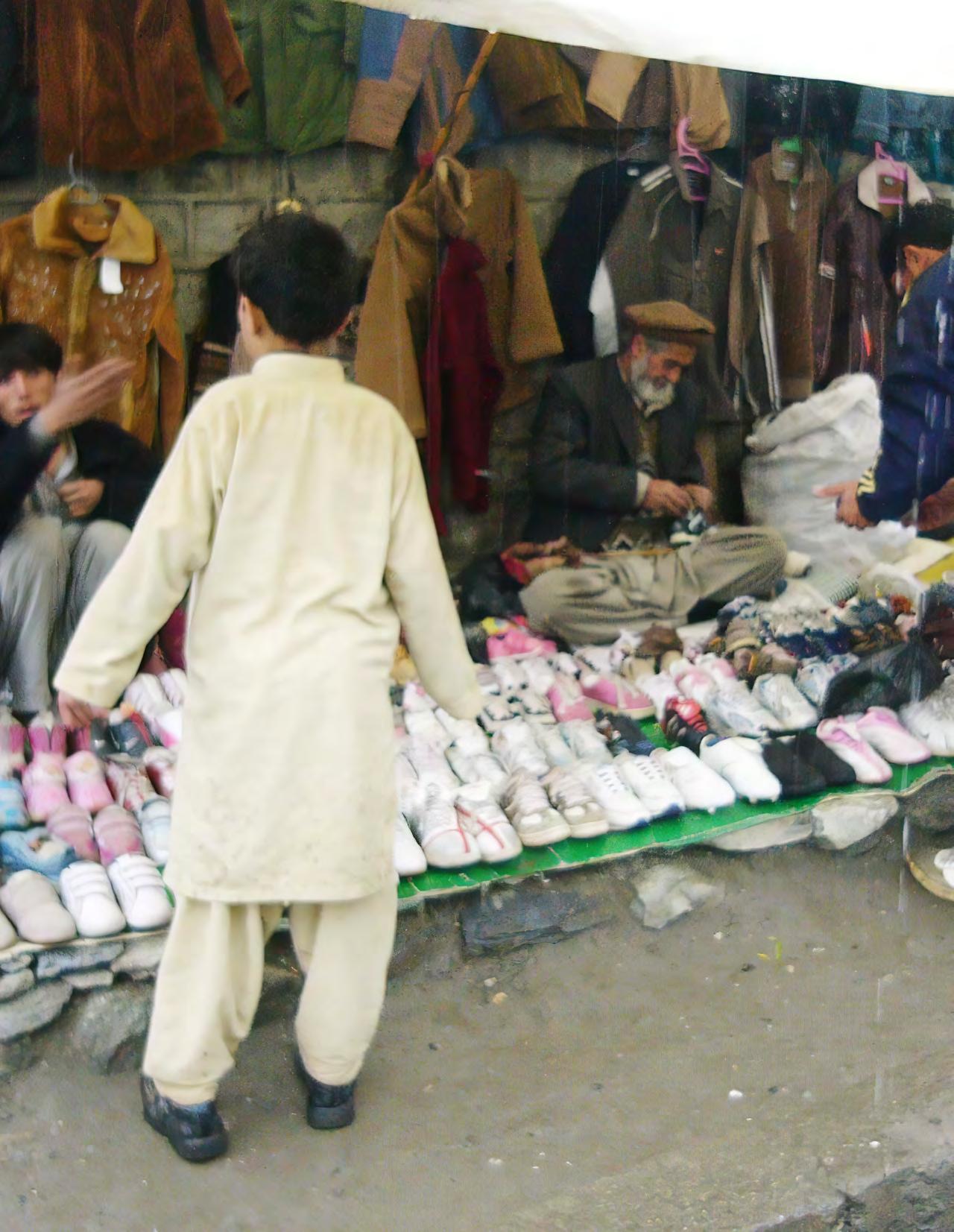
This reflects a broader trend in recent years in the increase of imports of used clothing, sold traditionally in flea markets, more commonly known as the landa bazaar. Used –sometimes pre-worn, at other times essentially new – articles of clothing are shipped in massive containers, which are then sold at prices much lower than of the same articles if bought from the store. Not only has it given consumers a cheaper alternative to increasingly expensive newer clothes, but it has also expanded the array of choice available to them.
The import of used clothing and footwear is growing, and it is unlikely to decrease meaningfully any time soon. The measure proposed by the footwear industry representatives that a separate category be made for imports of used shoes appears to be a needed measure, just to keep track of such imports and to prevent under-invoicing, and introduce sector-specific regulatory measures. In such a context, however, this won’t be enough. The local footwear industry might be better served by government-led efforts to improve affordability, enhance quality, and to create brands that are globally recognised, ones that can compete not only in local but also in international markets.
The Footwear Industry Claims
According to the representatives of the local footwear industry, the local annual demand for shoes stands at around 550 million pairs, whereas
the installed local manufacturing capacity stands at around 700 million pairs. Now, the demand figure is an estimate, based on certain assumptions, here that an average woman buys between 4 and 6 pairs per year, that an average man buys 1 to 2 pairs per year, and that an average child is bought 1 to 3 pairs per year. According to the Trade Development Authority of Pakistan, this is much below the global average consumption of 8 to 10 pairs of footwear for women, and 2 to 4 pairs for men.
Even if we consider that the assumed demand is lower than global standards, the real local demand might be even lower, considering much of the population lies in poverty. In February 2026, it was reported that Pakistan’s poverty rate had reached 29 percent, meaning that around 7 crore people are living in abject poverty. The assumption that women of this considerable category would buy between 4 and 6 pairs of shoes per year, might seem a little far-fetched. However, since we do not have the exact breakdown of footwear consumption by income groups, let us take the consumption numbers at their face value, though they could quite conceivably be degrees lower.
In this context, let us examine the footwear industry representatives’ claim that around 30 to 40 percent of this annual demand is met through used, imported shoes. That would mean that the annual number of imported used shoes is somewhere between 165 and 220 million pairs. Yet according to the data released by the Pakistan Bureau of Statistics, the total number of pairs imported by Pakistan during FY24 stood at 8.275 million, while in FY23 this number stood at 3.468 million. This is nowhere close to what the purported amount should be if the industry representatives are to be believed.
But there is an explanation for this. The industry representatives alleged that these
used shoes are being imported under the “used clothing and accessories” category. Now, that’s a separate category, technically mentioned as “worn clothing and other worn articles,” with the HS code 6309. If the representatives’ claims are correct, we can deduce that the footwear category (whose numbers we mentioned above) deals in new footwear and is not used. Or if it includes used footwear, it is not all used footwear, since there is no other category for imports of footwear, and we do import new articles as well.
Now, this category “worn clothing and other worn articles” broadly refers to the import of second-hand clothes, sold majorly in the landa bazaar and, to an increasing though comparatively much modest extent, platform of thrift stores run by entrepreneurs on Instagram. This is not an inconsiderable category. Before we return to the footwear industry representatives’ claims, let us examine in brief what this whole business is.
The Landa Bazaar
According to some estimates, at least 80 billion articles of clothing are produced each year across the globe. Given that a big chunk of these is ‘fast fashion,’ much of these 80 billion is discarded, either given or thrown away. Usually, such clothes are donated to charities, such as the Salvation Army, Goodwill, or various churches. Now, these organisations usually do not have the capacity to sift through these massive amounts of clothes and wash and package them for people in need.
So, what they do instead is make massive bundles of these clothes and sell them by weight to merchants at dirt cheap rates. These merchants sort and package the contents of these bundles by category and ship them to
third world markets, at higher rates. This is essentially the mechanics behind the landa bazaar. Once clothes and other articles are here, people visit them and with discerning eyes pick those units which strike their fancy. The key attraction of these articles is that they are sold at still very low prices, even after the merchants have kept their commissions. They make a profit, and the consumer finds what they like at much lower prices that they would otherwise have had to pay for it. Both can go home happy.
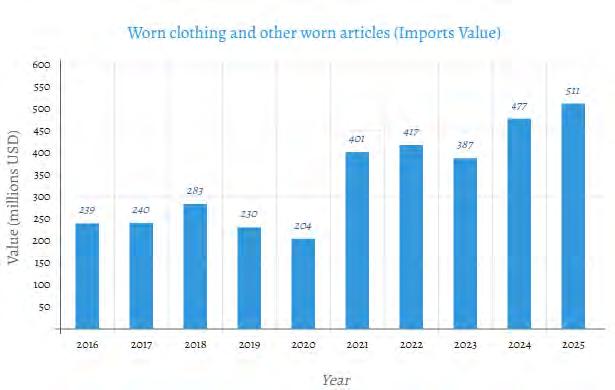
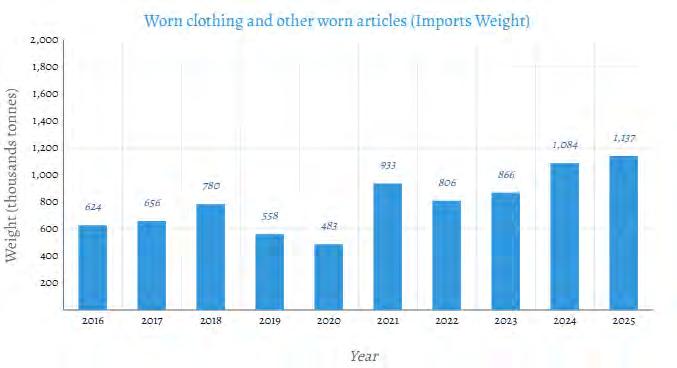
The fact that Pakistanis like to shop there can be gauged quite simply from the numbers.
The data is clear: the demand is there; in fact, it is increasing. This is reflected in the increase in both import value as well as weight over the past decade. While the dollar value has increased by 7.9 percent per year, the tonnage imported too has increased by a comparable 6.18 percent per year. The massive numbers, and the relatively stable increase means that this is a market that’s here to stay. The main reasons remain that the articles imported are much cheaper, and offer a greater variety of choices to the consumer.
In fact, the popularity of such articles is not limited to their main economic group that consumes them: the lower and middle classes. Increasingly, consumers from the upper middle class have been resorting to buying imported used clothes. This has given rise to a more ‘hi-end’ alternative to the landa bazaar, where enterprising individuals have opened up their own online shops, often on Instagram.
What these entrepreneurs – often young women – do is go to the landa bazaar, search for and find branded articles in good condition. They bring them back, clean them up, and take photos of the articles. Sometimes, they even model themselves. These clothes are branded as ‘pre-loved’ or ‘rescued’ and also appeal to
(Source: WITS - World Bank)
those who want to contribute to reducing pollution by not buying more of ‘fast’ clothes, choosing recycled clothes instead. These clothes are then sold at higher premiums, yet it must be underscored, still at rates much affordable than newer articles. The consumer doesn’t have to go to the market themselves, and are often able to receive their desired piece through home delivery.
With more economic segments of the population turning towards these used imported pieces of clothing, and the common person’s demand for cheaper clothes rising consistently, the market for imported used clothing is likely to continue to grow. It is not a fad, and has the heft of volume and decades of history behind it.
Return to the Shoes
Now that we have seen that this market is not going anywhere, and is in fact on its rising shining way to newer heights, let us return to the beef the footwear industry representatives had against the current state of affairs. They alleged that used shoes were also being imported as part of the broader ‘worn clothing and other worn articles’ category. It is quite possible that this is the case.
Although most of the articles imported as part of this category appear to be clothes, shoes, it is estimated, are also likely to be a considerable part of this category. The point, however, is that we do not know how big this part exactly is. For this, the industry representatives proposed a measure: used shoes should be categorised separately in the HS classification system, so that their share can be properly tracked. This, they rightly point out, would help the government to better regulate such imports and to improve customs valuations of such imports and therefore to prevent under-invoicing.
Currently, there is a separate classifica-
tion number for the ‘worn clothing and other worn articles’ category, and another one for shoes. This latter category uses the code 64, with subcategories like waterproof shoes, rubber shoes, plastic shoes, leather shoes, canvas shoes, etc, all falling into subgroups of 64. The category also includes (as a separate subcategory) parts of footwear, such as insoles, heel cushions, and even leggings and gaiters, etc.
Now, although they have claimed that imported used shoes take up 30 to 40 percent of the local footwear market, in order to verify their claim, we would need such data – data that will be available only once used footwear is classified as a separate category in the HS classification system. Regardless of this share, however, the industry’s broader complaint, that the massive influx of such used shoes cuts in the demand for local shoes, does make sense.
But the fortunes of the local industry would not rise by simply restricting the import of such used footwear. The consumer has the right to choice, and in the worsening inflation-infested environment, such markets offer a necessary relief to the millions. Such markets, in fact, appear to be an economic necessity, so it would be unfair to the consumers to give up cheaper, often better-quality shoes just because they need to care about the local industry. And this is not considering the environmental benefits of reduced waste by consuming recycled clothes.
A better way out would be through government incentives to local manufacturers enabling them to better utilise their capacity and offer more affordable shoes. Investment into local brands, which could compete with international footwear brands in niches such as sportswear, would not only build trust with the local population, but also enable us to utilise much of our local manufacturing capacity for exports, to possibly offset the loss in demand from the import.
The fact remains that it is unlikely – given the consistent, increasing trend – that the consumption of used footwear (and clothing) will abate. The macroeconomic situation, if it continues to worsen, will likely not lead to a greater number of people forsaking imported articles for local ones than the number of people shifting towards imported footwear.
Currently, most people buying such clothes are doing it for the simple reason that these cost less for equal or better quality. A real move away would require a shift in consumer preferences, and this would need to be driven by growing wealth among the general population. That seems like a pipe dream, for now. And given the recent trend towards ethical consumption as evinced by the increasing entry of upper classes into this sphere, the prospects that the landa is going away anytime soon are not too bright. n
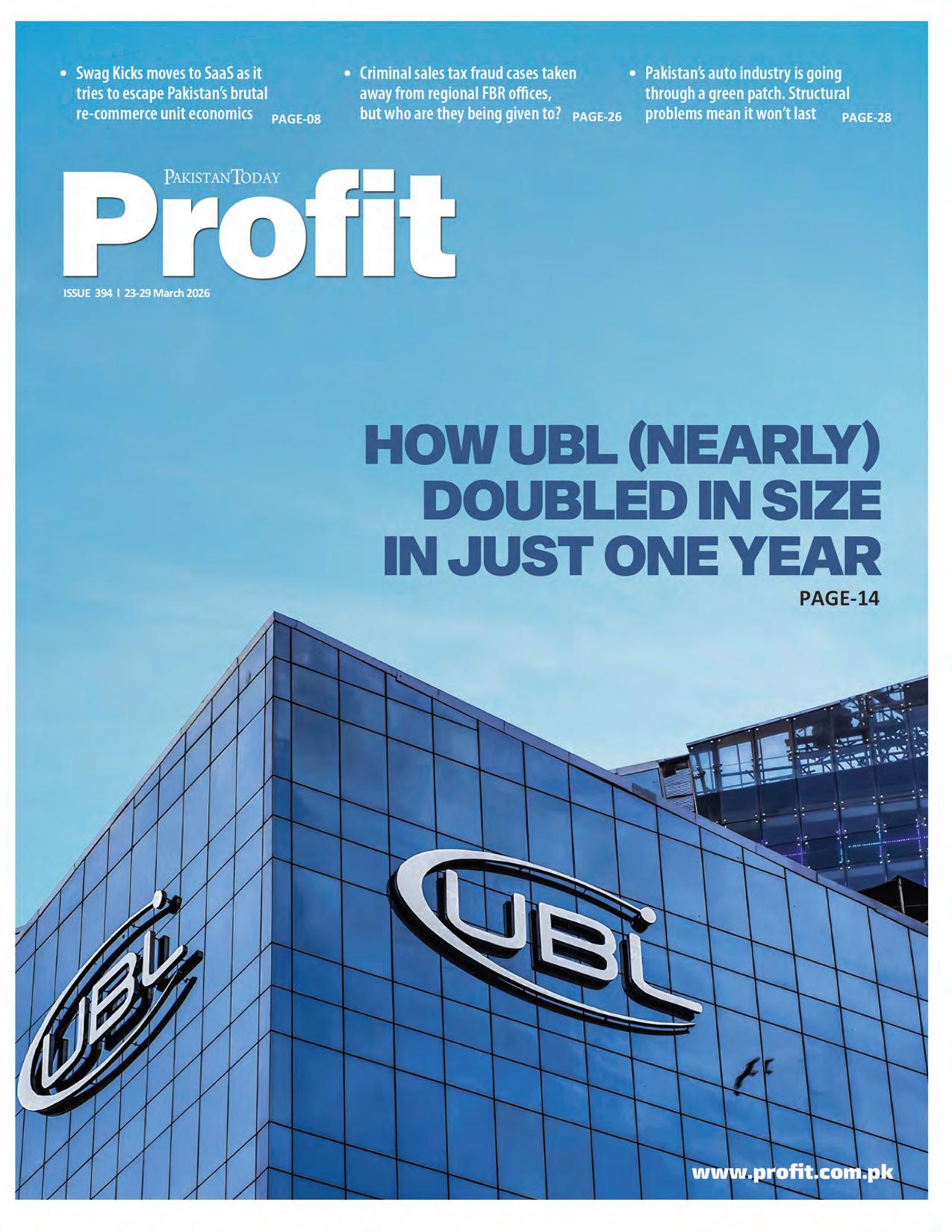
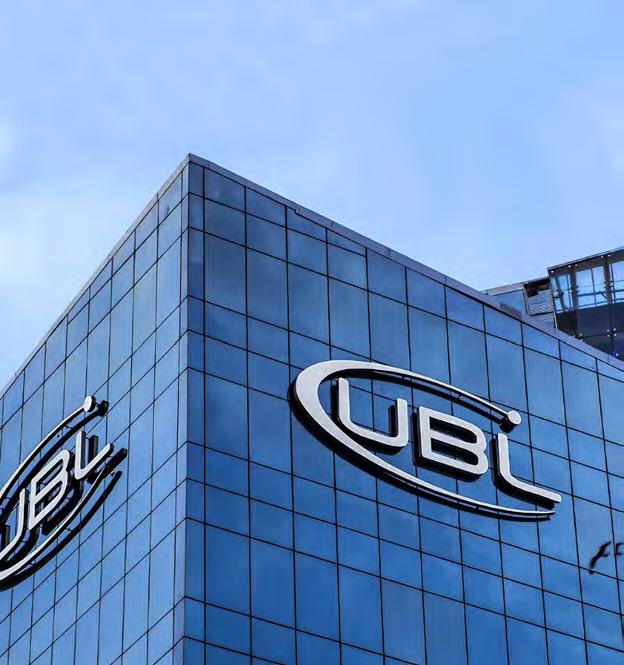
Pakistan’s third largest bank has become its second largest, and is rapidly chasing the number one title, under an ambitious new CEO. Here is how they have done this
By Farooq Tirmizi
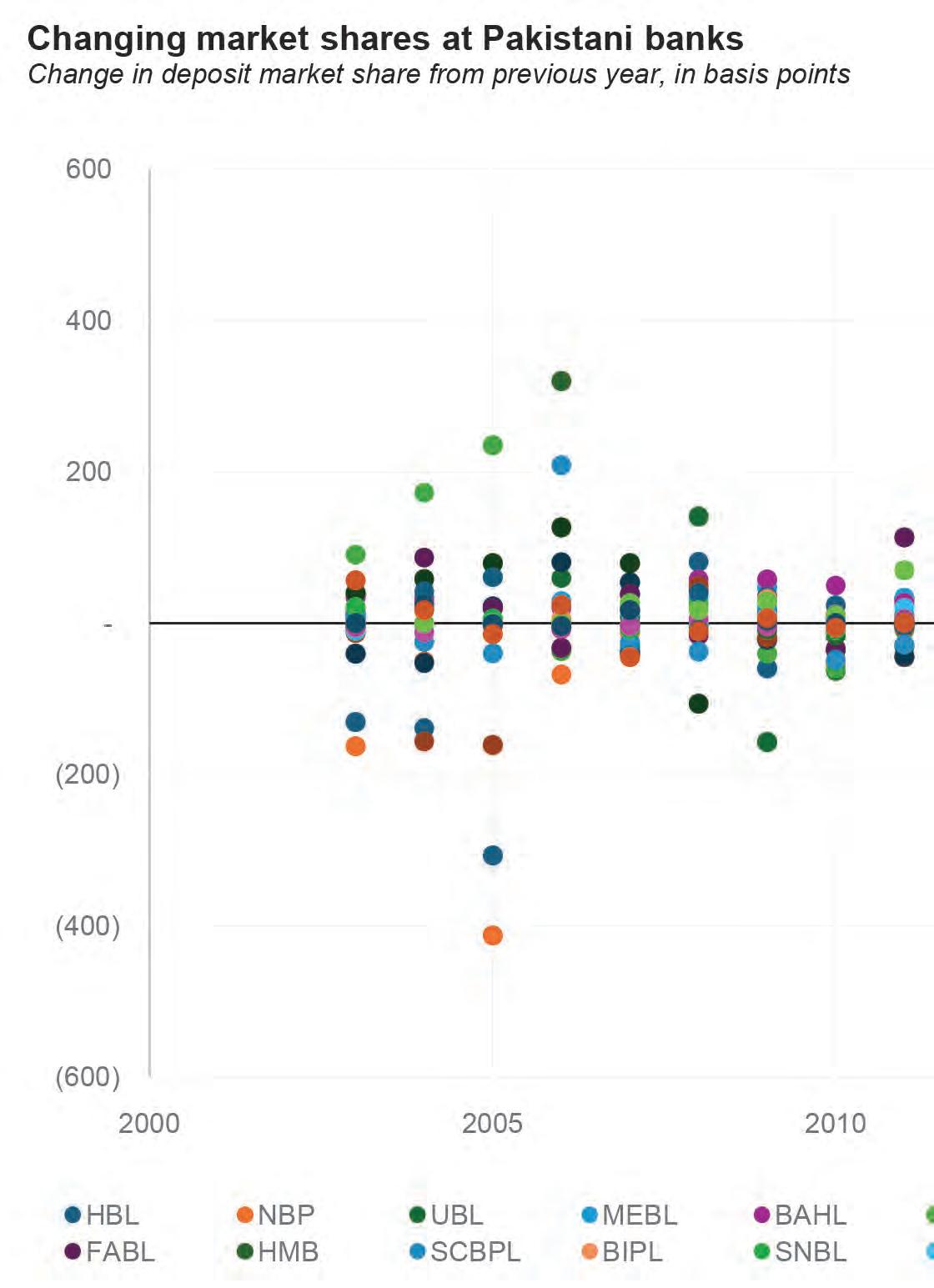
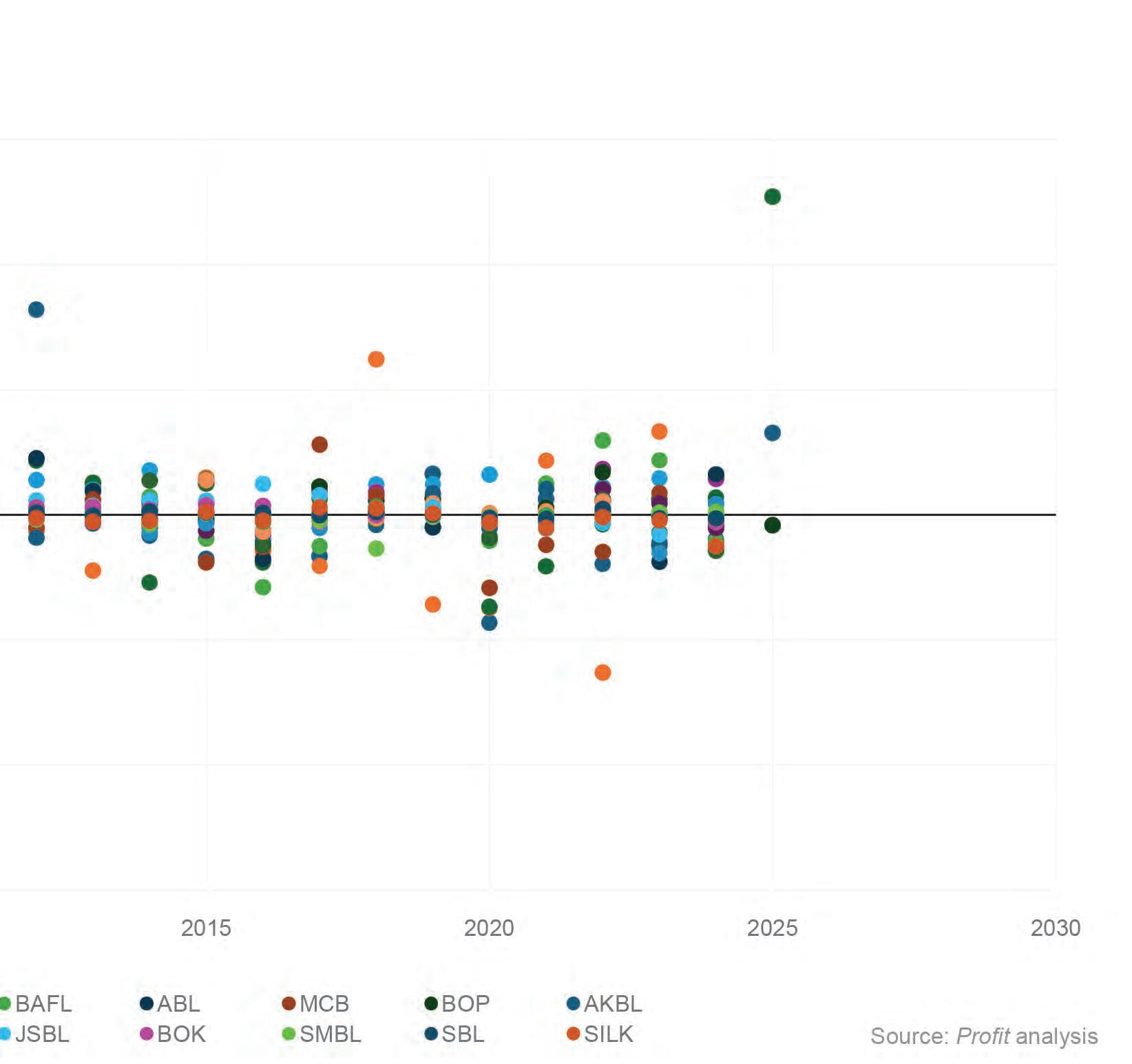
In 2025, United Bank Ltd increased its market share in terms of deposits by more than any bank in Pakistan over the past 25 years.
And just to be clear, we do not mean the total amount of the increase in deposits, which is a number that would axiomatically go up because of inflation each year. No, we mean in terms of percentage of total deposits that it gained in one year was greater than any one year increase we have been able to find in the past 25 years of Pakistani banking industry data.
Indeed, it is so much of an outlier that the single-year increase in market share that UBL achieved in 2025 is greater than any other three-consecutive-year cumulative market share increase by any Pakistani bank in the past 25 years.
Yes, you read that correctly: UBL did more in one year than any other bank has done over a three-year period in Pakistani banking sector history after the modern, competitive sector came into being in the early Musharraf era.
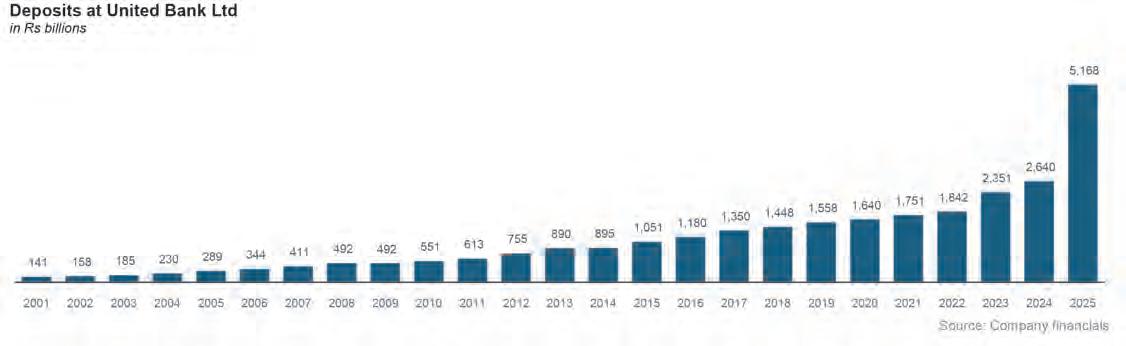
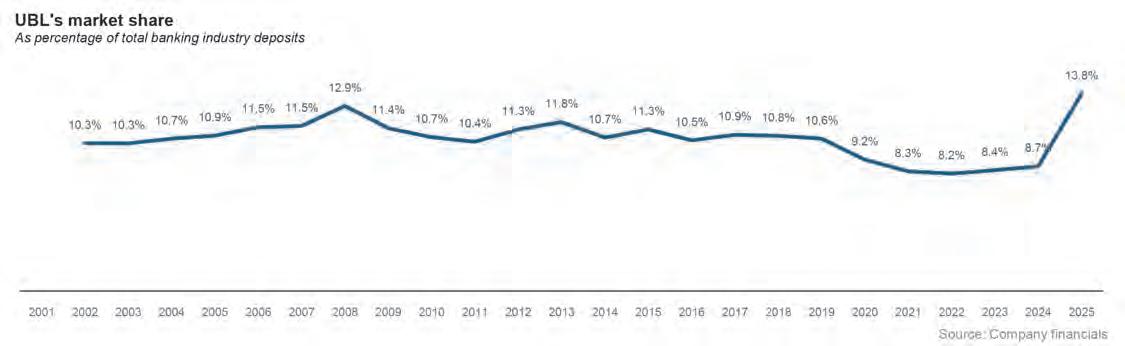
Here is what we are talking about: as of December 31, 2025, United Bank Ltd had Rs5.2 trillion in deposits, which is 13.8% of the banking industry’s total deposits. As the end of 2024, that number was Rs2.6 trillion, or 8.7% of the banking sector’s deposits. In absolute terms, this was a 95.7% increase in deposits (nearly doubling in just one year), and an increase of 509 basis points (bps) in its market share. One basis point is one-hundredth of one percent.
The previous record for the highest single-year growth in market share was in 2012 by Habib Bank Ltd (HBL), when it grew its share by 328 basis points, and overtook the National Bank of Pakistan to become the largest bank in Pakistan by deposits (functionally, the most important measure by which the size of Pakistani banks is determined).
This, ladies and gentlemen, was big. It would have been a major achievement for any bank to have accomplished in a single year, but the fact that UBL did it as the third largest bank in Pakistan, and as a bank that has been established for the past 66 years (it was founded in 1959) makes it more remarkable still. UBL started the year 2025 as the third largest bank in Pakistan and ended it as the second largest. It is now just 6.8% smaller than the still-largest HBL.
There is a very real possibility that, within calendar year 2026, UBL could overtake HBL as the largest bank in Pakistan.
This is the story of how this bank, and its new, very ambitious, energetic CEO, made this happen.
The story of UBL
Ambition was perhaps baked into the bank’s inception. It was founded by Agha Hasan Abedi, the notorious banker who is most famous for the downfall of the bank he founded later, the Bank of Credit and Commerce International (BCCI) on charges of money laundering and a slew of other financial crimes.
But before he did all of that, Abedi was the epitome of a young man with a chip on his shoulder and a lot to prove.
He was born in 1922 in Lucknow to a family that had, prior to the 1857 War of Independence, had been advisors to the Nawab of Awadh, arguably the nawabiest of nawabs. But by the time Abedi was born, the Nawab’s kingdom was gone, and all that were left were tall tales of the good old days from over a century ago, and the nawabi graces that came with those, but not the money to fund the sedentary lifestyle they were meant to accompany.
Abedi joined Habib Bank when he was 24 and the following year, when Partition happened, moved with the bank to Pakistan. For the next 12
years, he worked at Habib Bank, helping develop the new country’s banking system after virtually all of the old banks that held people’s money left because they were owned by people who either migrated to, or always lived on, the other side of the new border. By 1959, he managed to develop enough contacts with the bank’s high net-worth clients, including the man who would later become the President of the United Arab Emirates – Zayed bin Sultan al-Nahyan – who helped finance the bank’s founding.
It started its life as the fourth local bank (the Pakistani banking sector had many foreign
bank branches back then) and rapidly began growing with the economy.
Then two disasters struck. First, the 1970 Bangladesh war of independence resulted in the bank losing all of its branches and deposits in what had previously been East Pakistan. And then, in 1974, the disaster that was Zulfikar Ali Bhutto struck Pakistan’s banking sector, and United Bank, along with all other locally owned banks, was nationalized.
The next 23 years of the bank’s history are a haze of nationalized, bureaucratic blur. Then, when Nawaz Sharif returned as Prime Minister,
he restarted the privatization drive for the banks. In his first term from 1990 through 1993, he had privatized MCB Bank and Allied Bank. Now, he turned his attention to the bigger challenges at HBL and UBL. At HBL, he appointed Shaukat Tarin to lead the turnaround effort. At UBL, it was another ex-Citibanker, Zubyr Soomro. Soomro led the bank from 1997 through 2000, a period of intense retrenchment of the excess employees who had been hired by successive governments for political reasons, the kind of futile and costly “jobs” program that socialists like to dream up. Death threats from the thuggish
union leaders leveled towards the bank’s executives were common.
But after finally implementing a massive “golden handshake” program (read “bribes to unions to make them go away without violence”) and restructuring the holes on the bank’s balance sheet, it was ready to be privatized.
In 2002, a consortium of the Abu Dhabi Group (led by a different member of the Nahyan family) and British Pakistani billionaire Sir Anwar Pervez’s Bestway Group won the bid for a 51% stake and management control in the bank. At the time, UBL was still the fourth largest bank in the country, a position that it had occupied virtually uninterrupted since the early 1970s.
The post-privatization evolution
The bank we know today as UBL is a product of what transpired next: a bank that sought to go back to its ambitious roots as a meaningful disruptor in Pakistani financial services.
In 2005, it was publicly listed on the Karachi Stock Exchange, and in 2007, it became the second Pakistani company to launch a Global Depositor Receipt listing on the London Stock Exchange, raising $650 million from foreign investors in the process. Back then, London was still a prestigious global financial center. It was in the latter half of the Musharraf era that UBL firmly overtook MCB Bank as the third largest bank in Pakistan, a status it occupied from 2005 through 2024.
Also in 2005, it opened up the first retail branch of an asset management company in Pakistan. In 2007, it launched its own property and casualty insurance company called UBL Insurers. In 2010, it launched a branchless banking division called UBL Omni. And during this whole time, it also kept expanding its physical branch network throughout Pakistan as more and more cities became part of larger metropolitan regions and started needing connectivity to more formal financial services.
The driving force behind much of this were the bank’s longtime CEO Atif R. Bokhari, who held the position from 2004 through 2014.
The board support for that innovation and ambition came from the Bestway shareholders, with the Abu Dhabi Group mostly focusing on their other bank in Pakistan, Bank Alfalah. The conflict of interest between being a major shareholder in two prominent banks eventually became unwieldy enough that, in two transactions between 2011 and 2013, the Bestway Group bought out the Abu Dhabi Group’s entire shareholding in UBL. And in 2014, the government of Pakistan sold off its remaining 19.8% share in the bank for $387 million.
The men (and woman) who led the bank
Between 1997 and 2023, all of the five people who held the title of CEO of UBL had either a foreign education, or significant foreign work experience, and frequently both. The current CEO, Muhammad Jawaid Iqbal, appointed in 2023, has neither. (His Harvard Business School certificate is not a degree and the kind of thing one emphasizes in one’s profile after a lifetime of having been made to feel inferior by the Anglophone Pakistanis who have historically dominated the senior echelons of the non-public part of the Pakistani banking sector.)
Zubyr Soomro, the CEO who led the restructuring prior to the privatization process, is the epitome of his generation of Anglophone Pakistanis: educated at Karachi Grammar School from where he graduated in 1966, then the London School of Economics for an undergraduate degree in Economics in 1970, followed by a long stint at Citibank, in London, the Middle East, and Pakistan, culminating in the Citibank Pakistan country head position from which he retired shortly before the 2008 financial crisis. Soomro’s stint as CEO of UBL from 1997 through 2000 was effectively a sabbatical from his Citibank tenure.
Then came Amar Zafar Khan, who trained in the early 1970s as a chartered accountant in the UK at a small firm called Bennet Nash Woolf & Company, before joining Pricewaterhouse in 1978. Shortly thereafter, in 1981, he joined Citibank, serving in Saudi Arabia, Nigeria, and the UK
for the next 11 years. He then set up a securities brokerage firm in Nigeria on behalf of the World Bank’s International Finance Corporation in 1992, before returning to Pakistan in 1996 and shortly afterwards, joining Zubyr Soomro’s team to help prepare UBL for privatization.
When Soomro went back to Citibank, Amar Khan took over as CEO at UBL, where he served until 2004 and was CEO at the time Bestway and the Abu Dhabi Group took management control. He stayed on for two years after their takeover, following which he retired.
The next CEO was Atif R Bokhari, the first CEO who was appointed by the new shareholders, and one who went on to serve as the bank’s head for the next 10 years, giving the bank much of its current shape. Bokhari, unlike his two predecessors, was not a Citibank alumnus. Educated at the University of Central Missouri from which he graduated with an MBA in 1983, Bokhari spent the formative part of his career at the Bank of America from 1985 through 2000, mainly in their Pakistan branches before the bank exited the Pakistani market entirely.
He had joined the pre-privatization HBL before he was tapped in 2004 to lead UBL. His strategy was simple: Pakistan’s financial services sector was expanding, and UBL should tap into all of it. He added 300 more branches to the already 1,000+ branch network for the bank. He significantly bolstered the investment into the asset management subsidiary, and started the insurance subsidiary. He pushed for the creation of the Islamic banking operations, and the branchless banking operations.
But the growth that Bokhari saw in the bank came at a pace that was set in large part by the growth in the banking sector as a whole. The single fact that attests to this is that when he took over in 2004, UBL’s share of total banking sector deposits was 10.7% of the industry and when he left in 2014, despite having fluctuated up and down in the intervening years, it was at 10.7% of banking deposits. Almost exactly unchanged.
Next came Wajahat Husain, the IBA alumnus from the class of 1982 who had spent the bulk of his career at banks in the United Arab Emirates and had initially joined UBL in its UAE operations in 2005. He took over as CEO in 2014,
lasted three years, and left in 2017 with no major developments taking place during his tenure.
Then the UBL board did something unprecedent in the country and decided to appoint the first woman to head a major Pakistani bank: Sima Kamil.
Also a Karachi Grammar School alumna (graduating in 1976), Kamil had an undergraduate degree from Kingston University in London and an MBA from the City University of London. She began her Pakistani banking career in 1986 at American Express Bank before moving to ANZ Grindlays in 1988, where she then stayed for 11 years, mainly in Pakistan but also briefly working in Melbourne for two years during that time. As part of ANZ’s sale to Standard Chartered, she joined SCB’s operations in Pakistan in 2000 before moving to HBL in 2001.
At HBL, she held several positions, heading up wealth management, the asset management subsidiary, and the branch banking network. She was the person leading HBL’s branch banking network from 2011 through 2016, a period during which it became the largest in the country. In 2017, she was appointed the new CEO of UBL.
In an earlier era, Kamil’s credentials might have been overlooked, but this was the peak of the MeToo era, and boards were looking to promote more women. Kamil’s impeccable credentials made this an easy choice: on her own merits, a qualified candidate, and the fact that she was a woman was an added bonus.
Her tenure was also largely uneventful, and in 2020, she left the bank to join the State Bank of Pakistan as a deputy governor.
Next came Shazad Dada, yet another alumnus of Karachi Grammar School. Dada was a graduate of the elite Wharton School at the University of Pennsylvania, from where he did both a bachelors degree in 1990 and an MBA in 1996. He worked for 20 years at Deutsche Bank, in New York and London, before moving back to Pakistan in 2010 to lead Barclays’ mistimed entry into the Pakistani banking market. He worked there for four years, following which he left to lead Standard Chartered Bank Pakistan in 2014, a position he stayed at for nearly 6 years. His very first position at a Pakistani entity was as CEO of UBL. ada’s tenure at UBL appears to
have prematurely been cut short, since his 3-year contract was not renewed and it was unclear as to why he left.
Jawaid Iqbal and his approach
The new CEO, appointed after Dada left, is different from all of the others. In a pedigree obsessed industry, he is an alumnus of Bahauddin Zakaria University, who worked all his life in Pakistan at banks like Emirates Bank International, National Bank of Pakistan, and Allied Bank. At the time that he was tapped to lead the bank, he was running a personal investing company called Providus Capital.
But this CEO is also known for injecting a degree of ambition into what is normally thought of as the most sluggish portion of an already sclerotic industry. Pakistani banks do not innovate, and hardly even lend to entities that are not the government of Pakistan. And into this foray has jumped in Muhammad Jawaid Iqbal – possessing possibly the most common of Pakistani male names – and delivered what appears to be uncommonly energetic results.
The increase in deposits has come not from a single trick, but appears to be an across-theboard expansion that the bank has been able to achieve in its balance sheet.
For the financial year ending December 31, 2025, the bank saw its deposits from individuals increase by 42%, and corporate clients increase by 127% compared to the previous year. Taken together, these two categories of depositors – the most diversified kind that a bank can have – account for over 58% of the increase in deposits that took place at UBL.
Yes, the banks’ deposits from government entities and non-banking financial institutions (NBFIs) rose by abnormally large amounts –344% and 403% respectively – but those two categories only account for less than 35% of the increase in deposits: substantial, to be sure, but this does not appear to be a case of winning a handful of relationships to pump up the numbers, at least from the data available.
Nor is this a case of attracting deposits by
offering abnormally high interest rates, at least not in quantities to become a meaningful problem for the bank. Current accounts and savings accounts fell from about 91.5% of total deposits to 84.3% of total deposits, a noticeable drop, but hardly a catastrophic one. More importantly, clearly not even a plurality of the increase in deposits that the bank was able to achieve in 2025.
The broader story is both more mundane and more impressive: that UBL was able to grow its deposit base – and double from an already very high base – by pulling on all levers available to management in order to grow its deposits.
They grew relationships with individuals, and businesses, with the government, and with financial institutions. It is a broad growth story, which suggests that the key ingredient in growth, more than anything else, is likely just the ambition to wanting to grow as fast as possible despite being a large bank with a comfortably steady stream of profits from its existing business lines.
One possible area to look at deeper is the foreign deposits, which more than doubled from Rs594 billion at the end of 2024 to Rs1,237 billion at the end of 2025. But even here, the overwhelming majority of the increase came from current accounts by individuals, and given the fact that individual foreign currency accounts increased by about $1.9 billion, it is highly unlikely that this increase came from a highly concentrated set of depositors. And given the fact that these are current accounts, it also means that the bank is not taking on an abnormally large interest rate liability either. In short, Jawaid Iqbal, the man unlike any of his predecessors at UBL, appears to be leading the bank in a manner unlike any of his predecessors. Part of that might be explained by the fact that he owns more of the bank than they did: Iqbal personally, and entities controlled by Iqbal collectively, own about 4% of the bank, based on estimates made by Profit from the disclosures made by UBL.
In other words, the most important thing that distinguishes Iqbal from his predecessors is not his credentials, but the fact that he is more of an owner-operator than anyone else previously in his position, except perhaps Abedi himself. Let us hope Iqbal’s career ends on a happier note than Abedi’s. n
Logistics charges expose deeper cracks in Pakistan’s meat export ambitions
Adhoc fees on exporters highlight structural gaps, rising costs and untapped $3 trillion global market potential
Cold chains are designed to keep temperatures stable. But in a recent meeting between exporters and officials, it was not refrigeration that seemed under strain — it was patience. Representatives of Pakistan’s meat industry arrived with a familiar complaint dressed in new urgency: a fresh layer of costs had been added to an already fragile export equation. Gerry’s Dnata, a major ground handling service provider, had introduced an additional charge of Rs50 per kilogram on meat exports, with warnings that consignments would not be processed without payment. For exporters dealing in a product where margins are thin and timing is unforgiving, the implications were immediate. Shipments could stall, contracts could fray, and buyers — particularly in the Gulf — could begin to look elsewhere.
The All Pakistan Meat Exporters and Processors Association has since approached the Ministry of Commerce, asking for intervention and questioning both the legality and the logic of the charges. Exporters argue that these costs, which translate to roughly $180 per ton, are being imposed at a moment when Pakistan can least afford friction in its export sectors. The country is attempting to expand exports to stabilise its external account. Yet, as industry representatives point out, the system continues to produce small, avoidable shocks — a new fee here, a logistical disruption there — that cumulatively erode competitiveness.
APMEPA Chairman Mian Abdul Hannan said exporters were already operating in a highly competitive global environment where even small increases in logistics costs can determine whether a product secures or loses market share.
“Pakistan’s exporters require stable, predictable and rational logistics costs in order to remain competitive in global markets,” he said, warning that sudden and unilateral cost increases could damage the credibility of Pakistan’s export supply chain.
The dispute is, on its surface, about a
surcharge. But it also serves as a window into a broader problem: Pakistan’s meat export sector, often cited as an area of untapped potential, continues to operate in an environment where structural weaknesses and policy inconsistencies limit its growth. The latest charges are not an isolated issue. They are part of a pattern in which the ambition to expand exports collides with the reality of how those exports are handled.
Untapped potential
Pakistan is not short of supply. The country produced around 5.8 million metric tons of meat in 2024, including approximately 2.63 million metric tons of beef, 2.36 million metric tons of poultry, and 0.82 million metric tons of mutton. By volume, this places Pakistan among the world’s larger producers. Yet its presence in global markets remains marginal, accounting for roughly 0.4% of international meat trade.
Exports have been growing, albeit slowly. In the past year, Pakistan exported close to 130,000 tonnes of meat, with the overwhelming majority destined for Gulf Cooperation Council markets. The geography is favourable. Short distances allow for the export of fresh and chilled meat, a segment where Pakistan has carved out a position. The country is the largest supplier of fresh or chilled bovine meat to GCC countries, with an estimated market share of around 45%.
This advantage is reinforced by cost dynamics. Air freight for fresh meat to the Gulf typically ranges between $1 and $2 per kilogram, while sea freight can bring costs down to approximately $0.2 per kilogram. Increasingly, exporters are shifting towards sea routes to maintain price competitiveness. In a market where margins are narrow, these differences are decisive.
There are also signs of diversification. Pakistani firms have begun entering new markets, most notably China. One company secured approval from Chinese customs authorities and signed a $12 million contract to export frozen cooked beef. The initial ship-
ments have been received positively, suggesting that there is scope for expansion beyond traditional destinations.
Despite these developments, the gap between production and export performance remains striking. Pakistan produces millions of tonnes of meat but exports only a fraction of it. The reasons lie not in demand but in the structure of the industry itself.
Structural gaps
Much of Pakistan’s meat production takes place outside the formal economy. Animals are typically slaughtered in unregistered facilities that lack basic infrastructure such as hoisting systems, proper lighting, and reliable water supply. Hygiene standards are inconsistent, and waste management is often inadequate. While this system supports domestic consumption, it is incompatible with the requirements of international markets. Export-oriented production is concentrated in a limited number of facilities. Pakistan has 34 slaughterhouses approved by the Animal Quarantine Department for exports. These facilities are equipped with modern machinery, trained staff, and financing structures that meet international standards. Yet they operate at only 25% to 40% of their capacity. The constraint is not demand but supply — specifically, the availability of livestock that meets export criteria and the limited access to international markets.
The segmentation of the market adds another layer of complexity. Export facilities adhere to strict hygiene and traceability requirements, which increase their costs. This makes it difficult for them to compete domestically, limiting their ability to scale production. As a result, exports remain concentrated in a narrow range of products, primarily fresh or chilled carcasses and half carcasses.
Pakistan has little presence in higher-value segments such as processed or boneless meat. Nor has it developed significant capacity in frozen meat, where global competition is more intense but also more diversified.
Countries like Brazil and India dominate this space, benefiting from lower production costs and more integrated supply chains. Estimates suggest that Pakistan’s production cost for frozen meat exports is around $4 per kilogram, compared to $3 per kilogram in India.
The result is a sector that is competitive in a specific niche — fresh halal meat for nearby markets — but struggles to move beyond it.
Systemic barriers
The limitations of the sector are rooted in deeper structural issues. One of the most persistent is the absence of a livestock traceability system. In most developed meat-exporting countries, animals are tracked from birth through slaughter, with detailed records of health, vaccination, and movement. Pakistan lacks such a system.
The livestock economy is largely informal, organised around small farmers and intermediaries. There is no comprehensive database of animals, and tagging systems are rare. For farmers, the cost of adopting such systems is prohibitive. For regulators, the absence of data makes it difficult to certify exports for markets with stringent requirements.
Disease control presents another challenge. Foot and Mouth Disease remains prevalent, reflecting gaps in veterinary infrastructure and the absence of a coordinated national control programme. High-income markets such as the European Union, the United States, and Japan require either country-wide disease-free status or clearly defined disease-free zones with strict controls. Pakistan does not meet these standards, limiting its access to these markets.
Production practices further constrain supply. Livestock in Pakistan is primarily raised for milk rather than meat. Farmers typically sell animals for slaughter only when their productive life has ended. This results in lower-quality meat and limited availability of animals suitable for export. The average carcass weight is relatively low, reflecting both breed characteristics and feeding practices.
Large-scale feedlots, which are essential for efficient meat production, are scarce. Without them, it is difficult to achieve the consistency and scale required for international markets. At the same time, smuggling of livestock across borders reduces domestic supply and contributes to price volatility.
These structural issues are compounded by policy inconsistencies. Exporters point to disruptions such as transport strikes, regulatory delays, and now additional logistics charges as examples of how the operating environment can shift unpredictably. Each disruption may be manageable on its own, but together they create an ecosystem where planning becomes difficult and risk increases.
“Pakistan’s exporters require stable, predictable and rational logistics costs in order to remain competitive in global markets”
Mian Abdul Hanan, Chairman All Pakistan Meat Exporters and Processors Association
Cost pressures
The introduction of additional logistics charges must be understood within this broader context. For exporters, logistics is not a peripheral issue but a central determinant of competitiveness. Meat is a perishable product. Delays can lead to spoilage, while higher costs can quickly render shipments unviable.
Exporters argue that the new charges imposed by Gerry’s Dnata are particularly problematic because they are both unilateral and unexpected. They also raise questions about the allocation of costs within the supply chain. According to industry representatives, handling and service charges are typically settled between airlines and service providers. Passing these costs directly to exporters, they argue, disrupts established arrangements.
More broadly, the charges highlight the fragility of Pakistan’s export ecosystem. When margins are thin, even small increases in cost can shift demand towards competing suppliers. In the GCC market, where Pakistan faces competition from countries with more developed logistics systems, maintaining cost discipline is essential.
The concern is not only about immediate shipments but about longer-term relationships. Exporters report that foreign clients are sensitive to disruptions and may seek alternative suppliers if reliability is compromised. In a market where trust and consistency are critical, such shifts can be difficult to reverse.
The tension between ambition and execution is evident in the government’s approach to exports. On the one hand, there is a clear recognition of the need to increase exports. Officials have set targets and announced policies, including a halal meat export strategy aimed at expanding the sector.
On the other hand, the implementation of these policies often falls short. Exporters point to a gap between rhetoric and reality. While the government emphasises the importance of exports, the day-to-day experience of exporters is shaped by regulatory complexity, infrastructure gaps, and occasional disruptions.
The meat sector illustrates this dynamic. It is frequently identified as a growth area, given Pakistan’s livestock base and proximity to key markets. Yet the investments required to realise this potential — in infrastructure,
disease control, and market access — have been slow to materialise.
Path forward
Unlocking the potential of Pakistan’s meat exports will require a coordinated approach that addresses both structural and operational issues.
Financing is a starting point. Export-oriented facilities need access to capital to expand capacity and upgrade technology. Targeted support, such as low-interest loans or grants, could enable processors to invest in modern slaughterhouses and equipment. This would help increase output while maintaining compliance with international standards.
Cold chain infrastructure is another priority. The ability to store and transport meat at controlled temperatures is essential for both fresh and frozen products. Investment in storage facilities, refrigerated transport, and port infrastructure would reduce losses and improve reliability. Public-private partnerships could play a role in developing this infrastructure.
Market access will also be critical. Expanding exports beyond the GCC will require diplomatic engagement and compliance with international standards. This includes addressing disease control through vaccination programmes and establishing traceability systems that meet the requirements of high-income markets.
Regulatory reform is equally important. Simplifying procedures, reducing bureaucratic hurdles, and ensuring consistency in policy implementation would make it easier for exporters to operate. At the same time, addressing informal practices within the supply chain would improve transparency and traceability.
Finally, the immediate issue of logistics costs must be resolved. Ensuring that charges are transparent, justified, and aligned with industry practices would help restore confidence. More broadly, maintaining a stable cost environment will be essential if Pakistan is to compete in global markets.
The dispute over adhoc charges may be resolved through negotiation or intervention. But the underlying issues it has brought to the surface will remain. For Pakistan’s meat export sector, the challenge is not only to keep products cool as they move across borders, but to ensure that the system supporting those exports remains steady. n
Podcasting about which jobs that still safe from AI, amongst jobs that are safe from AI
By Profit
The podcasting and general commentary/ OpEd industry’s AI-disruption sector is reported to be safe in the upcoming waves of retrenchments due to AI.
In a paper titled Talk the Sack, not Sack the Talk, economists Clive Matherson and S Afridi at the University of Chicago’s Department of Economics say that not only is there not going to be any lack of demand for this crucial sector, but that it is going to see massive increases.
“It is for certain that this sector is going to be sitting pretty in what will certainly be a ‘jobacopalyse,’” said Matherson. “The demand is pretty much going to increase as the layoffs increase.”
“Every successive wave of layoffs is going to raise apprehensions and anxieties, making the viewers click and subscribe in even larger numbers,” he said.
“The barrier to entry into this profession is also pretty low; just about anyone can hop on, no need to be an expert. And since the scope of the layoffs and the so-
phistication of every successive AI model is so high, even the supposed experts like me, for instance, get it wrong so much that the general audience is relatively more forgiving of commentators that have made inaccurate predictions,” he said.
Matherson’s self-deprecating assessment of his abilities to predict the safety of jobs was revealed, on Saturday, to not be off the mark, as Clear Out Your Desk (COYD), the most-subscribed jobs-of-the-future channel on YouTube replaced two of its three hosts with AI-based talking animated avatars.
Umair Zia OPINION
What does the continued closure of the Strait of Hormuz mean for Pakistan?
On February 28, 2026, U.S.-Israeli airstrikes on Iran set off a chain of events that effectively sealed one of the most important 21-mile stretches of water on Earth. Within days, over 150 tankers had anchored outside the Strait of Hormuz rather than risk transit. Maersk, Hapag-Lloyd, and MSC suspended sailings. Not just that but shipping diversions surged 360%. To add insult to injury, oil prices jumped 10–13% in the first week alone.
For most of the world, this is a serious disruption no doubt. But for Pakistan, it is something closer to an existential economic crisis — one unfolding in slow motion across four interconnected pressure points: energy, fertilizer, labor, and technology. Let’s go by it sector by sector.
There is no petroleum cushion
Pakistan’s structural position going into this crisis was already precarious. The country imports 80–85% of its petroleum requirements, with the vast majority of those shipments historically routed through the Strait of Hormuz before reaching Karachi and Port Qasim. Its strategic petroleum reserves cover roughly 10 to 14 days of normal consumption. This is in sharp contrast to India’s significantly larger buffer, something that should trigger concern in those concerned with national security.
Then there is LNG. Pakistan has been importing liquefied natural gas since 2015 as domestic gas reserves have declined, and LNG now powers nearly a quarter of the country’s electricity. The problem is where that gas comes from: Qatar and the UAE together account for 99% of Pakistan’s LNG imports. Both countries’ export infrastructure now sits inside a
The writer is a freelance columnist
closed maritime corridor, with QatarEnergy having halted production entirely and declared force majeure on its contracts.
That phrase “demand destruction” is a clinical way of saying rolling blackouts. Not just higher electricity bills but actual loss of power to homes, shops, hospitals, and factories.
Every $10 increase in global oil prices raises Pakistan’s annual petroleum import bill by approximately $1.8–2.0 billion. In the worst-case scenario, analysts at PIDE (Pakistan Institute of Development Economics) have warned that a three-month disruption could push oil to $120–$150 per barrel and raise Pakistan’s monthly oil import bill to between $3.5 and $4.5 billion; this would consume the country’s foreign exchange reserves at catastrophic speed.
The government’s response has included: a four-day workweek for government employees, two-week school closures, a ban on in-person government meetings, caps on wedding guest lists, and — most jarring — the largest fuel price increase in the country’s history. Petrol jumped 20% in a single week.
Pakistan is also attempting to reroute crude purchases. A Pakistan National Shipping Corporation vessel has reached Saudi Arabia’s Red Sea port of Yanbu and is heading to Karachi with 73,000 tonnes of crude. It is a creative workaround, but an expensive and uncertain one — especially since the Red Sea route now faces increased risk of Houthi attacks (in solidarity with Iran), and routing entirely around Africa’s Cape of Good Hope adds weeks and millions of dollars per voyage.
Fertilizer is a crisis within the crisis
Roughly one-third of global seaborne fertilizer trade passes through the Strait of Hormuz. The Gulf is not only one of the world’s primary production regions for fertilizers, but also facilitates a good chunk of trade for it as well. Cheap natural gas from Qatar and Saudi Arabia provides the feedstock for nitrogen fertilizers like urea and ammonia. When the gas stops flowing, so does fertilizer production. This is dire for Pakistan as many powerplants in the country heavily rely on Qatari LNG to meet their operational needs.
Pakistan’s domestic fertilizer producers have been forced to curtail output. At the same time, imported urea prices have already risen roughly 25% since the conflict began, reaching around $591 per tonne globally. That figure is climbing, and it is yet to be seen if Pakistan can rely on other major trading partners to address the shortfall.
The timing also presents challenges. The closure happened during Pakistan’s pre-Kharif planting window — the months when farmers lock in fertilizer purchases for the summer crop cycle, which produces the bulk of the country’s wheat, rice, cotton, and sugarcane. If farmers reduce fertilizer use now, it’s reasonable to expect yields to fall in six months. And lower yields mean higher domestic food prices, reduced rice and agricultural exports (two of Pakistan’s primary foreign exchange earners). It also deepens food insecurity in a country already suffering food hyper-inflation.
The
remittance
lifeline is under threat
Pakistan’s economy has often been described as running on three main engines: exports, foreign borrowing, and remittances. Of the three, remittances from the Gulf are both the most substantial and the most vulnerable right now.
Approximately 4.9 million Pakistanis work in GCC countries; they are the second-largest expatriate community in the Gulf after India. In February 2026 alone, Pakistan received $3.3 billion in foreign remittances, with the UAE and Saudi Arabia contributing the top two shares at $696 million and $685 million respectively. The full-year projection stood at $38 billion — a lifeline that has kept Pakistan’s current account and foreign reserves from collapsing during repeated economic crises.
Iranian strikes have targeted energy facilities, airports, and commercial infrastructure across parts of the Gulf, including areas near Dubai’s Jebel Ali port. Even Dubai International Airport (the world’s busiest airport) has been forced to temporarily suspend operations. Hotels, construction projects, and retail businesses across the UAE and Qatar have also experienced disruptions. These sectors happen to employ large numbers of Pakistani blue-collar workers, particularly in construction, hospitality, and logistics. If remittance flows were to fall by even 30–40%, Pakistan could face a monthly gap of roughly $500–700 million. In a more catastrophic scenario, wherein the Gulf economies face broader economic disruption, the shortfall could move closer to $1.5 billion per month. Combining falling remittance inflows with increased reliance on imports, the pressure on foreign exchange reserves could escalate quickly, potentially forcing emergency discussions with the IMF.
There is also a human dimension that economic analysis tends to paper over. Millions of families in Lahore, Karachi, Multan, and smaller cities depend directly on monthly transfers from fathers, sons, and brothers working in Riyadh, Dubai, and Doha. For those families, the Gulf crisis isn’t just another geopolitical development — it determines whether school fees get paid, rent is covered, and basic household expenses can be met in the coming months.
There is a crisis in tech as well
The technology impact on Pakistan is less dramatic than the others, but it is real and compounding.
Pakistan’s IT sector has been one of the country’s genuine recent success stories: it contributes via growing exports, establishing a large freelancer base (already under threat of
unemployment thanks to AI), and increasing foreign exchange contributions. It is also a sector with specific dependencies on the Gulf supply chain that are now strained.
Most IT hardware entering Pakistan — servers, networking equipment, consumer electronics — transits through Dubai’s Jebel Ali port, the Middle East’s largest container hub. With Jebel Ali partially disrupted by Iranian strikes and now congested with diverted cargo that cannot reach Gulf-side ports, inbound hardware shipments face delays, surcharges of $2,500–$3,500 per container, and deep uncertainty about routing timelines. One could argue that Pakistan’s technology importers are navigating the most disrupted logistics environment since the COVID-19 pandemic.
More acutely, Pakistan’s IT sector depends on reliable power. Remote workers, software houses, data centers, and the freelancers contributing to foreign exchange earnings all need stable electricity — which has always been a consistent problem and is now at further risk from the LNG shortfall. Prolonged rolling blackouts would hit Pakistan’s tech export capacity directly and sharply. There is also a cloud infrastructure dimension. Pakistani businesses and developers rely heavily on Microsoft Azure and AWS nodes hosted in the UAE and Qatar as their nearest low-latency cloud infrastructure. Both providers have reported latency issues and service disruptions at Middle Eastern nodes following strikes on Gulf facilities. For a sector that runs on connectivity and uptime, even degraded digital infrastructure is a meaningful operational setback.
The effects will compound
What makes Pakistan’s position uniquely fragile is not any single one of these channels in isolation — it is how they
reinforce each other.
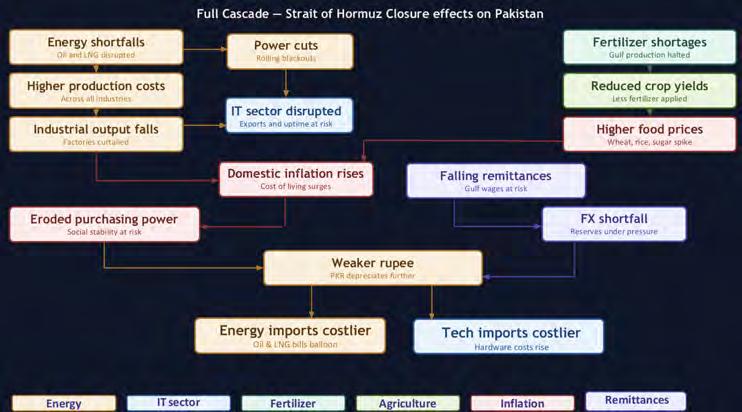
Energy shortfalls raise production costs and cause power cuts. Power cuts hit industrial output and the IT sector. Fertilizer shortages reduce agricultural yields and increase food prices. Higher food prices increase domestic inflation, eroding purchasing power and social stability. Falling remittances reduce the foreign exchange available to pay for energy imports. A weaker rupee makes energy and technology imports more expensive in local currency terms, thus worsening the trade deficit even more.
Analysts at Pakistan Institute of Development Economics have modeled a threemonth maximum-intensity disruption scenario and arrived at cumulative losses approaching $9 billion. This is much more devastating than the balance-of-payments crises in the past that have repeatedly forced Pakistan to the IMF for emergency support.
Pakistan entered this crisis with 10–14 days of petroleum reserves, near-zero fertilizer stockpiles, an almost total LNG dependence on the now-disrupted Qatari corridor, and a remittance base centered in the conflict zone. The government’s emergency austerity measures — fuel price hikes, government shutdowns, school closures, navy escorts for merchant vessels — are buying time. They are not resolving the structural vulnerability.
The Pakistan Navy has launched escort operations for merchant vessels carrying essential cargo. The government has formed a high-level cabinet committee meeting daily to monitor petroleum stocks, foreign exchange exposure, and supply chain disruptions. These are the actions of a government managing a crisis in real time, not a government in control of one.
This article is based on current reporting as of mid-March 2026. The Strait of Hormuz crisis remains active, and conditions are changing rapidly. n
Criminal sales tax fraud cases taken away from regional FBR offices, but who are they givenbeing to?
New SOP rollout fuels debate on centralisation, due process and overlapping enforcement. Does solving red tape mean creating more of it?
By Shahzad Paracha
For years, Pakistan’s sales tax fraud cases began where most tax disputes began. Inside the same field formations and regional offices that handle assessments, audits, refunds and recoveries. But now the Federal Board of Revenue wants that criminal track to run somewhere else.
The Federal Board of Revenue (FBR) has withdrawn the powers of regional tax offices to initiate criminal prosecution in sales tax fraud cases and has instead authorized the Directorate General of Intelligence and Investigation Inland Revenue (I&I-IR) to handle such matters.
In this regard, the FBR has issued detailed Standard Operating Procedures (SOPs) governing inquiries, investigations, prosecutions and arrests under Section 37A of the Sales Tax Act, 1990 during assessment proceedings involving alleged tax fraud.
Under the new framework, criminal prosecution in sales tax fraud cases will be processed by the Directorate General of Intelligence and Investigation Inland Revenue, while the FBR’s Operations Wing and regional tax offices will no longer deal with such prosecutions.
According to an FBR notification, cases of tax fraud that are already under investigation will continue to be processed by respective RTOs However, all future cases will be handled by the directorate of the I&I-IR.
The cases requiring criminal prosecution will be forwarded to the directorate, which will follow the procedures prescribed under the Finance Act 2025 and other relevant notifications and circulars issued by the FBR.
What is the amendment?
The latest changes to Section 37A of the Sales Tax Act, introduced through the Finance Act 2025-26, were meant to put clearer limits around the state’s power to arrest in sales tax fraud cases.
Under the revised framework, arrest is meant to be used only in serious cases of alleged tax fraud, particularly those involving fake or flying invoices or larger fraud cases generally said to involve around Rs50 million or more.
But just as important as the threshold is the process. Under the amended law, an
arrest cannot be made simply because suspicion exists or because a discrepancy has been detected in the course of proceedings. A formal inquiry must first be conducted by an Inland Revenue officer not below the rank of Assistant Commissioner. Even at that stage, the process is not meant to move automatically. A prior written approval from the Commissioner Inland Revenue is also required before matters can proceed further.
The law adds another institutional check before an arrest warrant is issued. A designated committee must authorise the move, which means the decision is intended to pass through multiple administrative layers.
Taken together, these amendments appear designed to narrow the use of criminal proceedings to cases involving deliberate and substantial fraud, while reducing the risk that ordinary taxpayers are exposed to coercive action over disputes that may not justify such treatment. The stated objective, in effect, is to reserve the harshest enforcement powers for the most serious cases rather than allowing them to hover too loosely over the wider tax base.
Before these changes, however, the enforcement structure looked different. The FBR had empowered regional tax offices and Inland
Revenue officers to register criminal cases or First Information Reports in sales tax fraud matters, especially where evidence pointed to the use of fake or flying invoices. In practice, this meant that the field formations that were already dealing with tax matters could also become the starting point of criminal enforcement.
Following consultations with trade organisations during the budget anomaly exercise, the government sought to calm those concerns by promising additional safeguards. The broad understanding that emerged was that only cases involving significant and deliberate elements of tax fraud would be referred to the Directorate General of Intelligence for action under Section 37A. Minor discrepancies, even where they might technically fall within an expansive reading of tax fraud, were not supposed to be pushed into the same channel.
The issue was also taken up in the Senate Standing Committee on Finance during post-budget meetings attended by trade body representatives and FBR officials. That forum became an important space where the proposed enforcement architecture was tested not only as a legal measure, but as a question of taxpayer confidence and administrative restraint.
During those discussions, FBR officials sought to clarify a key point which was that the mere invocation of Section 37A does not automatically result in the arrest of a taxpayer or businessman. Any such action, they said, must still follow the due process requirements laid down in Section 37(8) of the Sales Tax Act. In other words, the provision may open the door to criminal proceedings, but it does not allow that door to be crossed without procedural compliance.
What does the amendment mean?
Before this latest shift, a sales tax fraud case in Pakistan did not really leave the tax office where it began. The same field formations that audited returns, detected suspicious invoices, questioned refunds and pursued recoveries was responsible for pushing a matter toward criminal prosecution.
In legal terms, Section 37A already gave an Inland Revenue officer of at least Assistant Commissioner rank the power to arrest, on the basis of material evidence and a belief that tax fraud had been committed, while regional tax offices and the Operations Wing remained part of the machinery that handled such cases in practice. The criminal track was therefore not fully separate from the ordinary tax-administration track, but rather it sat inside it.
This meant that a dispute over invoices or input claims could begin as a routine encounter with the tax department and gradually acquire a harder edge without ever
changing rooms. The officer assessing your sales tax position, the office examining your refund, and the formation building the case against you were often part of the same administrative universe.
This redundancy creates a larger room for corruption. Informal accommodations between traders and local tax offices become easy, sometimes not only at the level of senior officers but deep within the office chain itself. That made the old system look like a negotiated local ecosystem in which some businesses buy themselves the leverage to delay consequences and settle matters quietly before they ever harden into a criminal case.
This blurs the line between civil enforcement and criminal suspicion was one reason the business community reacted so sharply when arrest powers under Section 37A came under renewed focus.
This does not mean that the amendment absolves the trader for tax theft. Traders are now genuinely fearing that what should have remained a tax dispute could too easily begin to look like a criminal case.
There is a second structural complication. Pakistan’s legal map for tax-fraud enforcement is becoming more crowded, not less. Section 30A covers the Directorate General of Intelligence and Investigation, Inland Revenue. Section 30AB, inserted through the Finance Act 2024, separately created a Tax Fraud Investigation Wing with its own fraud intelligence, investigation, legal, forensic and data-analysis units and empowered the Board to define its functions and jurisdiction. Field formations under Section 30 still retain broad tax powers.
On top of that now sit the committee approvals, member-level consultations and grievance mechanisms built around Section 37A. That can make the system look more specialised, but it can also produce overlap unless FBR keeps jurisdictions and handoffs exceptionally clear. Under this new system the regional tax offices are not disappearing, but their responsibility is being reduced. They will still be the ones who detect irregularities, raise demands and pursue civil enforcement.
On the traders’ end, the business community is also generally more comfortable appearing before field offices than before the Directorate General of Intelligence and Investigation, Inland Revenue. The more power moves away from territorial formations and into an intelligence-led forum, the greater the perception that tax administration is turning from compliance management into criminal enforcement.
There is also a risk of bottlenecks. Every suspected case now has to be screened by the relevant directorate within 30 days, which may improve consistency but could also slow down decisions if referrals rise sharply. And the only thing standing in the way of all that now is a
much higher office, which is more difficult (not impossible) to game in your favour.
So the older arrangement can be described less as a specialised fraud regime and more as an enforcement system in which criminal power was embedded within day-to-day tax administration.
Tax experts have gone further in stressing what due process must mean in practice. In their view, a person accused of tax fraud must be given a proper opportunity to be heard before any arrest is made. They argue that the accused should be confronted with the allegations in a transparent manner and, as previously notified by the FBR, in the presence of representatives of the business community so that the process does not become one-sided or opaque.
Their final point is constitutional as much as procedural. Article 10A of the Constitution guarantees the right to fair trial and due process, which means any enforcement mechanism that sidesteps these protections risks more than criticism from traders.
It risks legal challenge. That is why the debate around Section 37A is not simply about tax administration. It is also about where Pakistan draws the line between fraud enforcement and the minimum protections owed to any person facing the possibility of criminal action.
As for the Directorate of Intelligence and Investigation Inland Revenue, it has already existed and already had a legal standing under the Act, but it was not yet the sole gateway for future Section 37A prosecutions. The significance of the new SOP, then, is not that FBR has invented an intelligence arm overnight, but rather it is that it has decided the moment a tax dispute turns criminal, it would no longer be controlled by the same regional office.
The amendment also brings into light the capacity and role of the DG of Intelligence and Investigation, Inland Revenue. It raises questions like what volume and nature of work was the directorate already handling before this transfer of powers, and does it have the manpower, administrative support and operational resources to process these additional cases within the 30-day window now prescribed?
Because if that capacity does not already exist, the shift will require further public spending on personnel, mobility and investigative infrastructure. And if that expenditure is not made the opportunity cost of expedited procession is going to be selective, and sometimes poor justice.
The more important question, however, is not simply whether the state can expand this machinery, but whether the fiscal and enforcement gains from doing so justify the cost. Any such restructuring will ultimately have to be judged not only by the number of cases it pursues, but by whether it delivers credible, timely and economically rational enforcement. n
PAKISTAN’S AUTO
INDUSTRY IS GOING THROUGH A GREEN PATCH.
STRUCTURAL PROBLEMS MEAN IT WON’T LAST.
A report by the Competition Commission of Pakistan (CCP) sheds light on the continued problem the industry faces despite many more players entering the market, and they go deep
The automotive industry in Pakistan is a curious case. While the local industry has grown to 17 OEMs, the industry is still working much below its installed capacity, and cars remain out of reach for an overwhelming majority of the population. And although the number of cars being bought is rising (especially after a major slump in 2023), they are still nowhere close to what the installed local manufacturing capacity is.
Contributing just under 3 percent to the national GDP, the automotive industry supports over 2 million direct and indirect jobs. The industry has gradually developed since the time of the partition from consisting almost totally of assembly operations to now have some measure of localisation. Yet, this localisation still has ways to go, especially with the new entrants into the market in recent years, which have until now relied overwhelmingly upon the import of CKD and CBU units to produce and distribute cars.
At the same time, the industry has suffered from an inconsistent vision. Now, during the growth phase, depending on the stage, it is not unreasonable to have different policies for different stages. But for these to be effective, the driving vision has to be there consistently. Yet, this has often not been the case, with ad hoc SROs often invoked to break continuity and to institute a continuity that is broken by yet another ad hoc measure. Similarly, the policy towards imports has also been warped and little-thought-out, so that we are stuck in the debate between whether imports should be banned outright to protect local industry, or whether they should be liberalised to increase consumer choice.
This is compounded by the fact that variation in Pakistan’s car consumption levels roughly correlates with variations in local macroeconomic stability. With low per capita incomes, however much the industry grows (if the current situation persists), local car production levels might not see as big of an uptick for the economies of scale to really kick in, especially for the new entrants. At the same time, while the emphasis on exports has been recently pressed, the industry is still far from achieving the technological deft and the industrial heft necessary for such initiatives.
Before exploring these problems
in more detail, let us examine what this industry looks like.
The Local Cars Industry – A Brief History
Manufacturing, generally, is an industry which touches on many aspects of the economy. Car manufacturing, it follows, relies upon a host of other factors, metal, leather, electronics, glass, plastic, drivetrain components, nuts, bolts, braking systems, etc, each of which is manufactured in its own space. Car manufacturing is therefore the coming together of diverse ecosystems into one, and by that virtue it touches and sustains the lives of many. According to a CCP report, the auto sector supports 330,000 jobs directly and 1.83 million jobs indirectly. In doing so, the industry contributes 2.8 percent to the national GDP.
The industry has, since its inception, tended towards more localisation, but even that process hasn’t been smooth, and does not represent a final state (we’ll come back later to this).
The local car industry started essentially in 1949, when General Motors and Sales Co established Pakistan’s first assembly plant. This was soon followed by Ford (1955), Chrysler (1956), and American Motors (1962). At this stage, however, these plants relied totally on the import of SKD kits, which were then assembled into cars and trucks within plants. Gradually, through rising demands there came a push for more localisation, yet it did not reach significant levels, and the industry continued to suffer from high prices, limited models, and import dependence.
In 1972, however, the auto industry – like many others – was nationalised. The focus shifted from ensuring the industry had a broad local manufacturing base to running the plants profitably. Yet, in the 1980s, the understanding that competition was required to actually push the industry to the next level took hold. Private partnership emerged again as a mainstay of this effort, and this and the following decade saw the formation of multiple partnerships between local players and Japanese brands. Awami Autos partnered with Suzuki to form Pak-Suzuki Motor Company. Atlas Group and Honda partnered to form
Honda Atlas Motors, while Indus Motors entered into a joint venture with Toyota to progressively manufacture Toyota vehicles locally. Consumers now had more choice with better options, and there was competition among these three pushing them to attract consumers by newer means even as they aimed to capitalise on a rising demand market for cars.
This ushered in a new phase, where each of these partnerships led to the formation of a local support ecosystem of vendors, laying groundwork for greater localisation to take place. A Deletion Policy was introduced in 1987, whereby local car manufacturers were mandated to progressively ensure that the part of locally sourced components grew in their produced cars. CBU imports were taxed heavily. This Policy was phased out and replaced with a Tariff-Based System in 2006, as part of compliance with WTO’s trade measures. It kept higher import duties on parts that were being locally manufactured, but reduced these duties for the import of non-localised parts.
At the same time, the government started to introduce dedicated policies to promote and expand the auto industry. The Auto Industry Development Program (AIDP) was introduced in 2007 in order to improve efficiency, enhance productivity and quality standards, and to strengthen local vendor capacity. Although it laid a comprehensive plan for long-term industrial growth, the AIDP suffered from a lack of consistent policy support, as well the government’s inability to fund and carry out key initiatives laid out.
After the AIDP ran out its course, and after a 4-year delay, an Automotive Development Policy (ADP) was introduced in 2016. The ADP aimed to promote competition by encouraging new entrants, to increase localisation, and to facilitate the local industry to become competitive and affordable, eventually leading to exports. Through the ‘New Investment Policy,’ customs, tax, and duty incentives were granted to both Greenfield and Brownfield investors. Imports of vehicles were allowed under the gift, personal baggage, and transfer of residence schemes. Although the installed production capacity increased, some crucial capacity-building and quality and testing framework standards failed to be met.
In 2021, another auto industry policy
framework was announced. The Auto Industry Development and Export Policy (AIDEP) aimed to ensure affordability, enhance local manufacturing capacity, and encourage exports. Perhaps the key part of this policy was the incorporation of a framework to promote EVs and Hybrid adoption. Tax incentives were granted to improve affordability, and to encourage new entrants into this category. Ambitious localisation targets – such as 60 percent for passenger cars – were set, and although there has been some progress in this regard, the real breakthrough of local production of higher-value parts remains out of reach.
Another thing that must be mentioned is the category of used car imports, since it has increasingly come to dominate the local market. The proportion of imported used vehicles in the total number of ‘new’ vehicle units in the market has risen to 20 percent in 2025 from 7.5 percent in 2020-23. The imports of these cars usually take through one of three schemes allowed to import cars for foreign residents: gift, transfer of residence, and personal baggage. The government, through an SRO abolished the personal baggage scheme in January 2025, and tightened restrictions on the other two schemes to discourage imports of used cars.
However, the government already allowed in 2025 the commercial import of cars, as old as 5 years, with a regulatory duty of 40 percent in the first year. Through its IMF deal, it aims to liberalise tariffs, progressively reducing them on the import of used cars by 10 percent each year, until they reach parity by 2030. For the import of CBUs, the tariffs over the next 5 years are envisioned to be reduced from 20 percent to 15 percent. Although the terms for this allowance are not clear, it sets the scene for increasing imports of cars in the near future.
Now, to the problems
One of the major problems that’s facing the auto industry in Pakistan is that of underutilisation. The recognised capacity is to produce around 418,000 cars per year. Yet, according to latest numbers, the total number of cars sold during FY25 were 148,023. According to Mashood Ali Khan, the former Chairman of Pakistan Association of Automotive Parts & Accessories Manufacturers (PAAPAM), 200,000 cars per year remains the target. Even that is not likely to be achieved this year. Even if we take the aimed-for 200,000 units as the real figure, more than half of the capacity would still be unutilised.
In such an environment, the total number of cars being produced is not much higher than what was the case when much fewer OEMs were there. Underutilisation in this case means that these newer players still continue
to struggle to achieve economies of scale which might have been possible if the utilisation rates were higher. It also means that even though the number of cars is rising (after the massive fall in 2023), the share available to these newer cars is rising comparatively slowly.
This is linked to broader economic factors. In fact, variations in Pakistan’s auto sales numbers correlate roughly to variation in economic stability, with stable times with lower inflation and higher GDP growth rates seeing bigger amounts of cars being purchased. Cars, in general, continue to be out of reach of the overwhelming majority of Pakistanis. Only 11 in 1000 residents own a car, the lowest in the region. Per capita income is around USD 1700, much lower than the USD 30,000 required for any meaningful increase in the car market. The slew of taxes on cars, sometimes even reaching as high as 58 percent, ensures that people stay off the four wheels.
If macroeconomic indicators continue to stay similar or worse, it might be quite some time before Pakistan’s automobile industry is able to register real growth in its production numbers. Unless that happens, an increasing number of auto manufacturers might be forced to fight for scraps over half the pie, the other half just never having even been there. The benefits of meaningful economies of scale might recede out of the grasp for many a new entrant, and what appears to be a great advance (more OEMs) might sadly fizzle out in the future.
If the local population continues overwhelmingly to be unable to buy cars, that is, if the demand continues to be low, the other option for utilising the installed capacity is to increase imports. Yet, even there, we are still quite far from achieving that. But even export competitiveness requires efficiencies that come from scale, which as we argued above is still out of reach for many. There is little support for exports anyway: there are no government backed export rebates or export-financing schemes, or mutual recognition agreements. Yet, the question still remains, why would you rush to export when there is a massive market at home? Who is to supply this market? If not our cars, then whose?
Then, there are the ever-present issues of the lack of policy continuity and policy changes. For instance, we didn’t have an auto policy after the AIDP expired in 2012 and before the ADP was introduced in 2016. Key measures under the AIDP such as the Productive Asset Investment Incentive, the Technology Acquisition Support Scheme, and the Auto Cluster Development fell prey to insufficient budget allocations, and never took off. And, then there is the constant tinkering with the processes through SROs, which often lead to confusion and erode investor trust.
Even when the government allowed the commercial import of cars in 2025, it failed to specify key criteria to open Letter of Credits for such imports or the processes by which pre-inspection certificates were to be obtained. And often measures that the government takes don’t stay for too long. The banning in January 2026 of the import of used cars through the personal baggage scheme, according to some analysts, even this might not stay for long. The government relies on taxes on imports – and in case of the import of used cars, people from outside the country are paying for the cars (so there’s no money going out), while the government is still able to charge duties on the imports. It’s essentially free money for them, and such schemes have often been instituted and then reversed in the past.
While we are on the matter of imports, local manufacturers protest the allowance of imports – even with higher customs duties –on the grounds that it erodes real localisation of manufacturing. The consumer can buy better cars at similar prices, so local manufacturers cannot compete. There is truth to it, but there is the flip side as well. There might be few people who would give up the chance to buy a better, albeit used, Japanese vehicle for the same price as a locally produced one, only on the grounds that it would serve national interest. And it would be unfair to expect the consumer to do so. It is not their fault that they have to make this choice.
While the localisation by parts percentage for some local Toyota, Suzuki, and Honda might reach 50 to 70 percent, even they are dependent on imports for higher-value parts such as engines, transmissions, and hybrid systems to be used during the manufacturing process. In this context, the government’s push to liberalise imports over the next 5 years without adequately building local capacity and providing necessary financing mechanisms to compete with these imported units might make things worse for the local industry.
It won’t be anything new, however. Unless real investments are made towards the indigenisation of technology to make the industry competitive, advances are likely to remain in the perpetual future. Similarly, macroeconomic growth leading to affordability for the population would be necessary if meaningful leaps are to be made. Considering that a great part of these prices consists of government taxes, the situation doesn’t appear to be ameliorating any time soon, especially since the tax net continues to be deepened rather than broadened. Exports, too, would remain a dream, unless local industry is able to utilise more of its capacity, and government-led initiatives are taken to advance technological transfer and adoption and to promote local players’ integration into global value chains. n