CONTENTS
08
10
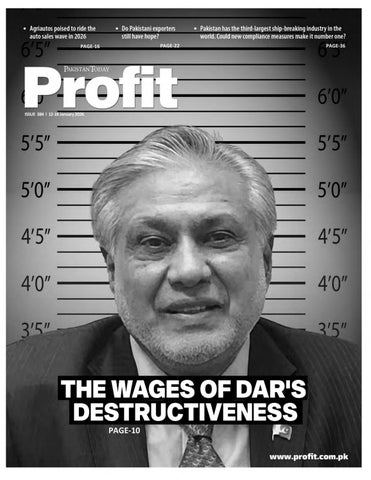
10 The wages of Dar’s destructiveness 16 Agriautos poised to ride the auto sales wave in 2026 18 For GSK, declining costs boost margins as much as rising prices
22
20 Pakistan is in talks with American companies to supply antimony. But what is the unique chemical element with wide military uses? 22 Do Pakistani exporters still have hope? 25 Ghazi Fabrics to sell land for almost as much as it makes selling clothing
33
Sugar production is on the rise and it will bleed our agricultural land dry
28
36
27 Mari’s production expansion to boost fertilizer sector
Pakistan has the third-largest ship-breaking industry in the world. Could new compliance measures make it number one?
29 Haleon investing heavily in Jamshoro factory expansion for exports 31 Spectrum auction directive, a recipe for reform or revenue grab?
Profit Publishing Editor: Babar Nizami - Editor Multimedia: Umar Aziz Khan - Senior Editor: Abdullah Niazi Editorial Consultant: Ahtasam Ahmad - Business Reporters: Taimoor Hassan | Usama Liaqat Shahab Omer | Zain Naeem | Nisma Riaz | Shahnawaz Ali | Ghulam Abbass Ahmad Ahmadani | Aziz Buneri - Sub-Editor: Saddam Hussain - Video Producer: Talha Farooqi Director Marketing : Muddasir Alam - Regional Heads of Marketing: Agha Anwer (Khi) Kamal Rizvi (Lhe) | Malik Israr (Isb) GM Special Projects Zulfiqar Butt - Manager Subscriptions: Irfan Farooq Pakistan’s #1 business magazine - your go-to source for business, economic and financial news. Contact us: profit@pakistantoday.com.pk
10
THE WAGES OF DAR’S DESTRUCTIVENESS
COVER STORY
How one man’s obsession with the exchange rate has decimated a decade of progress on raising incomes and shrunk the Pakistani middle class
I
By Farooq Tirmizi
n the early 1940s, Soviet scientists – like their German and American counterparts – were working on trying to get their country to start a nuclear weapons program. Their problem was that Joseph Stalin, the Soviet dictator, did not understand the then nascent science of nuclear physics, and was not bothered to learn anything about it either. Then they brought him a piece of information that got his attention: the fact that American physics journals had suddenly stopped publishing papers on nuclear physics. Atomic nuclei were not something Stalin understood. Missing information, he understood instantly. Missing information is almost never a coincidence. Between 2005 and 2021, the government of Pakistan has published the results of a Household Integrated Economic Survey, a Social and Living Standards Measurement survey, or a Labour Force Survey either every year, or every other year. In some years, more than one survey result was published. But after 2021, the next survey to be published was one that captured data from the fiscal year ending June 30, 2025, a gap of a full three years. These surveys are meant to measure the economic and social well-being of Pakistanis, and for all its flaws, the government has done a reasonable job of trying to measure progress on many fronts, and to make its data freely available to researchers outside the government. This three-year gap is the longest gap to have occurred in the collection and dissemination of this kind of data since at least 1990. Not coincidentally, the years for which data are missing happen to also be the worst years for the Pakistani economy since the aftermath of the 1971 war, as measured by GDP growth, when measured in nominal US dollar terms. Did the government run at least one of these surveys during this period and simply not publish the results because they were unfavourable? There is no reason to believe that happened. But did the government guess that conducting such a survey would quantify the misery its citizens were going through and decide to simply not conduct the surveys? That is certainly possible. The results of this survey reveal a middle
12
class that continues to expand and contract based on the cyclicality of the government’s policies, specifically with respect to exchange rates. And one man, more than any in the past two decades, is responsible for the volatility of Pakistanis’ incomes and middle class insecurity: Ishaq Dar, currently the foreign minister, but the man who tends to be at the helm of the Pakistani economy whenever the Pakistan Muslim League Nawaz (PML-N) is in office. Dar is obsessed with the Pakistani rupee’s exchange rate the way Gollum was obsessed with the One Ring in The Lord of the Rings: he has absolutely no actual control over it, the obsession sucks the life out of all that it touches, and yet, it remains his precioussss. More specifically, as we will demonstrate in this article, the minister’s favoured policy of trying to artificially control the exchange rate has a tendency of artificially boosting income growth in the country for a time, but then causing economic crashes that bump literally millions of people out of the middle class into which they had been able to step into for perhaps as little as a year or two. It is the single most important reason why middle class status in Pakistan is one of precarity: for no fault of one’s own, families can find themselves going from feeling the ability to engage in some discretionary spending to barely being able to afford the essentials. But before we dig into that, a short note on the analysis we have conducted, and what it tells us.
Methodology note: who is part of the middle class?
T
his is a perennially difficult question to answer, and candidly, we cannot say we have an original response to it. For the purposes of this analysis, we used the World Bank’s definition of middle class: individuals who make more than $10 a day, which we rounded off to $300 a month on average over the course of a given year. The data sets we utilised were the raw microdata sets from the Household Integrated Economic Survey (1999, 2002, 2005, 2006, 2008, 2011, 2012, 2014, 2016, 2019, and 2025), the Pakistan Social and Living Standards Measurement surveys (2009, 2013, and 2020), and the Pakistan Labour Force Survey (2018). We calculated the size of the labour force as a
percentage of the total population, using data from the population census and the Labour Force Surveys. For years for which we did not have data, we did straight-line projections between the two closest years for which we did have data. This has the unfortunate effect of not telling what is likely the true picture of severe pain that took place over the preceding three years. Sadly, there is no good way to be able to capture what happened during those years without a comparable data set, and that does not appear to exist. We understand that mixing and matching varying data sets is not ideal, especially given the fact that they can have differences in methodologies, but we felt that the questionnaires and methodologies were sufficiently close to at least provide a reasonably accurate directional picture of what has happened to Pakistan’s income distribution and growth over the past two decades. In particular, we were interested in getting as much data as possible that would help us get an impression of what we consider economic inflection point years. For example, 2018 was a critical year since it marked the end of the Nawaz Administration and their economic policies, in particular holding the rupee at a near-fixed exchange rate to the US dollar. Hence, examining how incomes changed between 2018 and 2019 was important for us to understand. But the Household Integrated Economic Survey only had data from 2016 and 2019, which would not give us an accurate view of what happened between those years, which is why we used the raw microdata from the Labour Force Survey for 2018 to supplement our understanding of what happened at the end of the Nawaz Administration. We would absolutely have loved to have had a survey from 2022 or 2023 (and ideally both years) to determine how the political turmoil of those years – coupled with horrendous economic management on the part of both the Pakistan Tehrik-e-Insaf and the PML-N – affected Pakistani households. But as we have established, the government appears to have decided not to bother measuring the effects of its negligence. One more methodological note: we are aware that income surveys in Pakistan – like similar surveys around the world – vastly undercount both the number of people as well as the incomes of people at the top end of the
income spectrum. Umair Javed, an assistant professor of politics and sociology at the Lahore University of Management Sciences (LUMS), estimates that these surveys undercount as much as the top 8-10% of the income spectrum of Pakistan. In fairness, the statisticians at the Pakistan Bureau of Statistics try to correct for this undercounting by adding estimated weights to each individual observation so that the spectrum can be observed in full, but we acknowledge this shortfall in our analysis based on the limitations of the data: we are likely underestimating the absolute size of the Pakistani middle – and especially upper middle – class, but are probably still close to being directionally accurate in terms of the growth rates and changes that have taken place over the course of the past two decades. On the upper middle class: we chose to define it as individuals who make in excess of $10,000 a year. We chose this benchmark because it comes closest to giving us a view of people in Pakistan who have individual incomes equal to the per capita income that the World Bank defines as average for high income countries (which is about $12,000 per year). Finally, we chose to look at individual incomes rather than household incomes, in part because we wanted to examine trends that captured how much people are able to earn as individuals. Household data would
have introduced the additional complication of the number of earners being different from household to household, as well as across time. Individual income data allowed us to control for that problem.
The state of the Pakistani middle class
F
or a Pakistani who had income during any part of the year in fiscal 2025, the average income was Rs50,051 per month, which is about 93.8% higher than the last measured average of Rs25,822 per month in 2021. In inflation adjusted terms, however, it is a wage increase of 0.98% per year over the four-year period in question. Sadly, this is actually on par with the long-term track record for Pakistani wage growth, which has been averaging about 1.1% per year in inflation-adjusted terms between 1999 and 2025. As Khurram Husain once wrote in Dawn in June 2017, quoting an anonymous economist: “They’ll produce growth, and for a few years, people will feel like their standard of living is rising,” he said, about the kind of thinking that usually informs economic policies in this country. “But then they’ll take it all back through inflation.” It is this volatility that is on sharp display in the next set of statistics that we will share, starting with the size of the Pakistani
middle class. Let us start with the most basic definition of the Pakistani middle class: those who earn $10 a day or more, or about Rs84,000 per month in fiscal 2025. There are about 15.2 million such individuals in the Pakistani labour force (which may currently exceed 109 million individuals, based on some extrapolation of data from the 2025 Labour Force Survey). This represents just shy of 14% of the labour force. That sounds reasonably high until you consider the fact that this number has been as high as 20.6% in 2018 and as low as 7% the very next year, in 2019. That is an extreme level of volatility by any standard. How did that happen? Well, in 2018, to earn $300 a month, you needed to make Rs33,000 a month, but in 2019, you needed just shy of Rs41,000 and most of the people who used to make Rs33,000 in 2018 did not get a Rs8,000 per month raise in 2019, and hence they dropped out of the definition of middle class. You might argue that this is semantics, and the numbers do not reflect reality. But consider the following fact: in 2019, the rupee declined by 24% in value, meaning any imported consumer good – including fuel – became that much more expensive. What impact would that have had on the feeling of economic security of someone making, for example, Rs35,000 per month?
COVER STORY
It is, of course, a good thing that the number of people part of the middle class has increased from 5.6 million in 2019 back up to 15.2 million people in 2025. But it might have been better if almost 10 million people had not dropped out of the middle class because Ishaq Dar did not want to lose a bet he made with Shaikh Rasheed on a talk show. And the fact that the middle class is smaller in absolute terms than it was in 2018 – despite a much larger labour force – is just reflective of how much of a deep hole the Pakistani economy was pushed into, and how long we still have to go before we are fully out of it. So exactly how does the exchange rate cause such wild fluctuations in the number of people in the middle class? It works something like this. Since 1982, almost every single government (with only one exception) has tried to artificially control the price of the rupee as a means of keeping inflation lower than it naturally would be if the exchange rates were left alone. Every time, the cycle is exactly the same: the government raises foreign debt as a means of securing more dollars, which is slowly sells over time so that it can create an artificially high supply of dollars in the economy and artificially high buying of the Pakistani rupee. This is obviously unsustainable, largely because the government is using borrowed money
14
not to finance investment into future income opportunities for the economy but present consumption. Eventually, foreign lenders want their money back and are not willing to refinance, and hence the government’s ability to prop up the rupee ends, causing the currency to suddenly crash. What makes this worse is that Pakistan ends up with more foreign debt and nothing to show for it. Instead of financing investments into future income – in the form of infrastructure that ultimately increases the productive economic activity of the country – the government is effectively financing the monthly electricity bills and automobile petrol costs for the urban middle class by using borrowed money to artificially deflate the cost of imported energy. A significant portion of Pakistan’s electricity generation relies on imported fuels. The critical thing to remember is that this debt and inflation cycle is not something that is imposed on the government of Pakistan by an external lender. It is a policy choice made by the government itself, one that many international lenders – including the International Monetary Fund (IMF) – would like Pakistan to get out of. But a look at the history of the country’s inflation and exchange rates reveals that this exercise only has the effect of creating unnecessary shocks. It does absolutely nothing to arrest inflation, or the exchange rate. A
substantial proportion of the variation in exchange rates and inflation – including the size of the subsequent economic shocks – can be explained by just how much effort previous governments have put into trying to control both. Dar, more than any other politician, has been obsessed with trying to control inflation through the exchange rate, almost to the point where it feels like his ego is attached to a specific exchange rate of the rupee to the US dollar. That his actions have now caused three of the five worst years of economic growth in Pakistani history (the other two being in the aftermath of the 1971 war) does not seem to persuade him to try to do any better. For the Pakistani economy to not choke on itself, it must be kept out of the hands of Ishaq Dar.
The upper middle class is larger than ever
F
or people in business, however, it does not help to dwell on just the doom and gloom, and there appears to be at least one area where Pakistan’s economy is reaching all-time highs: in the size of its upper middle class, which is larger than it has ever been, by just about any metric.
TEXTILES
Let us start by defining the upper middle class: people who make more than $1,000 a month, or about $12,000 a year. There are now almost 1.5 million people in the country who make more than that – as individuals. They represent a little over 1.3% of the total labour force, which is the highest it has ever been. If you use a slightly lower definition of upper middle class, and make it people who make more than $10,000 a year, the number of individuals in Pakistan who fit that category comes out to about 2.2 million people, or about 2% of the labour force. This number is also the highest ever recorded. Now, let us go one level higher, and take a look at the number of Pakistanis who make more than $20,000 a year. These are people who might reasonably be called part of the global consumer middle class. In purchasing power terms, these people make the equiva-
lent of someone making $71,000 a year in the United States. The total number of people who fit this description is about 407,000 people, or about 0.37% of the labour force. Both the absolute number and proportion of labour force of people who are part of this category is the highest it has ever been. Less than half a million people being part of the global consumer class is hardly something to get excited about, but the absolute number is starting to get close to being interesting. There are two ways to interpret these numbers. There is the Marxist / socialist interpretation, which sees this as evidence of rising inequality and a cause for concern. But there is also another perspective: that the number and proportion of people who are living affluent lives in Pakistan is growing. Economic progress
does not arrive all at once, and having some people attain affluence first is pretty much what the path to prosperity would look like. If you are a startup, or a business owner of an established company, and you are in a business line that is anything other than basics like food or medicine, these numbers represent your total addressable market (TAM). Not the 250 million people in the country, nor the labour force. Just this tiny number of people who actually have the ability to spend disposable income on new products and services just because they want to try them out. And the volatility of how many people fall into these categories also explains why it is so hard to scale a business in Pakistan: imagine starting a business whose core market is people who make more than $10,000 a year. Suppose you started this business in 2015, when there are about 670,000 people who fit this description, a number that rises to above 1 million in 2017. You start to see revenue growth and feel good about your company’s prospects. But then comes 2018 and 2019, and the number of people who fit this category has fallen to just 385,000 – a nearly 62% reduction from its peak, right after you may have made investments to expand capacity. Such a business would struggle to stay afloat, let alone scale in a rapidly shrinking market. Across the economy, this happens to thousands of businesses every time there is a macroeconomic shock, which tends to be largely government incompetence inflicted in Pakistan. It would be better for the numbers to rise slower, but more steadily: a business that starts serving one corner of the market will not suddenly face a shock that puts them out of business. Eventually, the slow-but-steady cycle will start feeding on itself, and the steadiness will result in faster overall growth as more and more companies are able to achieve escape velocity. But for that to happen, Dar – and his ideas – must go away. n
COVER STORY
Agriautos poised to ride the auto sales wave in 2026 The company’s revenue and profit margins have recovered sharply from the crash in 2022, with nascent export sales also contributing to profit growth Profit Report
A
griauto Industries Ltd (PSX: AGIL), one of Pakistan’s bestknown makers of locally manufactured auto parts, is starting 2026 with the kind of operating momentum that was hard to imagine during the industry’s 2022–23 slump. After two difficult years for the wider auto market, the company’s sales have rebounded, and margins have snapped back, helped by rising car assembly volumes at its biggest customers, long-delayed vendor price adjustments finally coming through, and early signs of diversification beyond the core original equipment manufacturer (OEM) channel. A recent research note by Chase Securities describes a “strong OEM recovery” driving sales growth of more than 50% year-on-year, while gross margin has climbed from 7% to 15% over five quarters, a recovery that the brokerage argues looks sustainable. The numbers tell a story of a vendor that suffered alongside Pakistan’s car assemblers, then bounced back hard once production lines restarted. Agriauto’s consolidated net sales fell sharply after FY22, as the market seized up. Net sales were RS15.4bn in FY22 before dropping to RS8.3bn in FY23, a year in which the company slipped into a net loss of RS173m. The pain deepened in FY24: revenue remained muted at RS8.5bn, and the net loss widened to RS348m as operating leverage turned against the business and margins compressed. FY25 marked the turn. Net sales rose to RS11.9bn, while profit after tax swung back to a profit of RS238m, pushing net margin back into positive territory. The margin recovery has accelerated into FY26: in 1QFY26
16
alone, Agriauto posted RS3.86bn in sales and RS193m in after-tax profit, with gross margin reported at 15% – a level last seen before the crisis years. Chase Securities attributes the nearterm margin bounce to OEM approvals for “long-pending price adjustments,” with management also indicating that another major OEM is finalising further price increases effective from November 2025 – an important detail for investors because price resets, once embedded, can stabilise margins even as input costs fluctuate. The broker’s base case assumes the momentum persists, projecting FY26 earnings per share of around RS30.60 at a 15% gross margin scenario, a sharp step-up from FY25’s EPS of RS6.62. Agriauto’s recent fortunes are inseparable from the macro shocks that hit Pakistan’s auto sector from mid-2022 onward. The crash was not driven by a single factor; it was a pile-up. First, interest rates and collapsing affordability. As inflation surged and monetary tightening followed, auto financing became punishingly expensive. Local reporting in 2024 pointed to interest rates around 22% alongside central bank curbs on auto financing, including a cap on the financed amount and shorter repayment tenors – conditions that drove many buyers away from showrooms. Second, the supply-side choke: import controls and LC restrictions. Even willing buyers faced empty delivery pipelines. In 2023, Pakistan’s auto industry struggled with restrictions related to letters of credit and access to dollars for importing parts, tightening the supply of completely knocked down (CKD) kits and essential components. Business Recorder described LC issues from July 2022 to February 2023 that kept supply “under pressure,”
pushing prices higher and depressing demand in a high-inflation environment. For a parts manufacturer like Agriauto, this double squeeze – demand destruction and OEM production stoppages – was devastating. When assemblers cannot secure imported parts, they stop building cars; when they stop building cars, they stop ordering parts from local vendors. The margin impact is often amplified: factories run below capacity, fixed costs bite harder, and price increases can lag rising input costs. So what changed? The recovery narrative in 2024–25 has been built around three interconnected developments: a stabilising currency, easing interest rates, and a gradual thawing of financing availability, and the clearing of production backlogs. Chase Securities points to improving OEM capacity utilisation and a demand tailwind: passenger car OEM volumes up strongly, helped by lower interest rates, better financing availability, and backlog normalisation. Its report also notes a surge in auto financing growth through much of 2025, interpreting it as pent-up demand being released as monetary easing gained traction. For Agriauto, the key leading indicator is what happens at Indus Motor Company (Toyota) and Honda Atlas Cars, because those assembly lines translate directly into vendor orders. Chase Securities highlights that INDU and HCAR volumes rose 68% year-on-year to 28,347 units in the first five months of FY26, capturing the pace at which production has restarted. Agriauto is not a single-product vendor; it is better understood as a portfolio manufacturer of “high entry barrier” components that require tight tolerances, consistent quality, and – crucially – OEM approvals that can take years
to secure. The company, incorporated in 1981 and listed on the Pakistan Stock Exchange, has long positioned itself as a supplier of suspension and structural components across multiple vehicle categories. Its product range spans 4-wheeler suspension components, including shocks, struts and McPherson assemblies, body and structural parts such as door hinges, hood hinges, and door impact beams, interior mechanisms including window regulators and instrument panel-related parts, press parts and dies, with capabilities for sheet metal press parts and stamping dies, as well as jigs and catalytic converter-related tooling, 2-wheeler shock absorber components, including pipe forks, case dampers and piston rods, and tractor components, including steering boxes and camshafts. The company’s own disclosures underline the role of technical partnerships in building this capability. Agriauto says its shock absorbers and struts are manufactured under technical assistance agreements with KYB Corporation (Japan) and Gabriel Ride Control (US), while it also produces window regulators under technical assistance with Japan’s Shiroki, and door hinges under a technical arrangement with Aisin (Japan). That international technical link is not window dressing: in vendor-heavy industries, technical collaborations can improve design, quality systems and process control – exactly what is needed to stay on OEM approved-vendor lists. A VIS credit rating report similarly notes long-term technological collaborations with major Japanese and US partners and identifies the company’s manufacturing facility at Hub Chowki in Balochistan. Just as important for investors is the direction of travel. Agriauto is attempting to reduce cyclicality by expanding non-OEM revenue streams such as the aftermarket, exports, and even a potential foothold in Pakistan’s power distribution supply chain. Chase Securities notes management commentary that ED-coated clamps have been approved for the power sector and that the company is pursuing registration as an approved vendor with power distribution companies – an adjacent market that could be less tied to the passenger car cycle. In Pakistan’s auto supply chain, scale and stability come from being tied to the dominant assemblers – and in that sense, Agriauto sits in the slipstream of the two brands that have historically defined the market: Toyota and Honda. Chase Securities notes that the top three customers still contribute around 80% of revenues, with Toyota the largest contributor – concentration that can look risky on paper, but also signals that Agriauto is embedded in the country’s most valuable OEM supply chains. The payoff from that embedment is visible in FY26’s recovery phase. As Indus Motor and Honda Atlas ramped volumes, vendor order flows improved. Chase Securities explicitly links Agriauto’s OEM momentum to the recovery in
passenger cars and SUVs, highlighting the 68% year-on-year sales growth at INDU and HCAR early in FY26. However, the deeper story is about pricing power – or at least pricing negotiation. Local parts makers often operate with input costs that can shift quickly due to exchange rates and imported raw materials, while OEM price adjustments can lag. That lag is one reason margins collapsed during the downturn. The current rebound has been turbocharged by OEMs approving previously delayed price revisions and, if the additional price increase expected from November 2025 is finalised, the margin floor may sit higher than it did during the crisis period. The dependency cuts both ways, of course. Chase Securities flags risks such as OEM slowdown, currency depreciation versus cost pass-through lags, and – more structurally – any policy shift away from localisation that could encourage imported parts and weaken the local vendor ecosystem. That last point is worth pausing on. Pakistan’s auto sector has long been built on managed localisation: gradually increasing locally produced parts content as vendors achieve quality and volume thresholds. If future policy tilts decisively towards cheaper imports, the value of being an approved local manufacturer could erode. For now, though, the direction of travel among policymakers and assemblers appears to be towards deeper localisation plus selective export readiness – particularly as some assemblers talk up exports of locally assembled models. The recovery in volumes is not simply “cars are back.” It is also about which cars Pakistani consumers are buying – and why. Chase Securities argues that Agriauto benefits from supplying localised hatchbacks and sedans where competitive intensity from new entrants has remained limited, providing a comparatively stable runway. This matters because, even as new brands enter Pakistan, the market has historically been anchored by models with strong resale value, readily available spare parts, and proven service networks – advantages that tend to favour incumbents. The broker notes that despite some new entrants in the sub-RS6m segment, Indus and Honda continue to retain substantial share. It points to combined sales of Corolla, Yaris, Corolla Cross, City and Civic rising sharply year-on-year in the early FY26 period, and suggests challengers such as Changan’s Alsvin and Kia’s Stonic have struggled to take large share – partly because of resale value perceptions and parts availability. Two structural shifts underpin this: (a) Financing constraints reshape what is “affordable.” When instalment plans are constrained – whether through caps, tenors, or high rates – the practical ceiling for many buyers moves down. That tends to strengthen demand in categories where monthly payments remain viable, reinforcing volume in certain mid-tier segments
even when top-end demand is patchy. Pakistan’s experience of financing restrictions during the downturn made this dynamic especially visible. (b) The used car channel has become less of a safety valve. If inflows of used cars are restricted or reduced, buyers who might otherwise have shifted to imported used vehicles can be pushed back toward locally assembled options – particularly if they value warranty cover and parts support. Chase Securities notes reduced used car inflows as one of the factors affecting the mid-tier segment. At the same time, a parallel shift is also underway: the gradual move towards SUVs and electrified options at the top end of the local assembly mix, driven by consumer preference for higher ride height, perceived durability on poor road infrastructure, and a growing awareness of fuel economy. Toyota Indus, for example, has highlighted milestones around locally built hybrid electric vehicles and continued promotion of models like the Corolla Cross – signals that assemblers are trying to keep Pakistani demand aligned with global product trends. For Agriauto, this evolution matters less as a brand story and more as a product-mix story: as long as the company remains embedded in the platforms that dominate local assembly volumes – sedans, hatchbacks, and increasingly SUVs – its order book should rise with the broader cycle. One of the more underappreciated parts of the current rebound is that Agriauto is not relying solely on OEMs. Chase Securities shows non-OEM sales rising, with FY25 aftermarket sales around RS1bn and export sales also increasing (albeit from a smaller base). Management expects export sales to grow further, supported by OEM relationships in overseas markets. That matters because the aftermarket tends to be less cyclical than new vehicle assembly. When car sales crash, existing vehicles still need replacement parts – sometimes more so, as owners keep cars for longer. If Agriauto can deepen its aftermarket reach while maintaining OEM quality standards, it may dampen earnings volatility across future cycles. The bull case for Agriauto is straightforward: if assemblers maintain production momentum and if vendor price increases remain embedded, margins can stay higher while volumes rise – an earnings double tailwind. The bear case is also clear: any renewed FX stress that disrupts CKD imports, a spike in rates that freezes auto financing, or policy changes that reduce localisation incentives could hit both volumes and pricing power. For now, however, the direction of traffic looks favourable. The sector has moved from survival mode to recovery mode – and Agriauto, with its close ties to Toyota and Honda platforms and a product suite that spans suspension, structural parts, and specialised components, looks positioned to ride the next leg of Pakistan’s auto upcycle into 2026. n
AUTOMOBILES
For GSK, declining costs boost margins as much as rising prices
Deregulated drug pricing is only part of the story for many pharmaceutical players, with a decline in global API prices boosting profits for some
W
hen Pakistani investors talk about the pharmaceutical sector’s margin revival, the conversation often begins – and ends – with deregulated pricing. Yet for GlaxoSmithKline Pakistan Limited (PSX: GLAXO), the story is increasingly about what is happening to costs as much as it is about prices. In a market where more than 60% of raw materials are typically imported, and currency swings can impact quarterly profitability, the easing of global active pharmaceutical ingredient (API) prices is proving to be a quiet but powerful tailwind. Combined with regulatory shifts that have allowed broader price rationalisation, this cost relief is reshaping the earnings outlook not just for GSK Pakistan, but for a range of domestic drugmakers that depend heavily on imported inputs. For most pharmaceutical manufacturers in Pakistan, APIs are the single biggest factor in the cost of sales. When API prices rise, gross margins compress quickly; when API prices fall, margins can expand just as quickly, especially if selling prices are also being adjusted upward. This is precisely the “double benefit” analysts argue is now playing out. Topline Securities points to an “unusual combination” of easing input costs and rising average selling prices across the sector, with the result that industry gross margins jumped to around 41% by the September 2025 quarter from about 36% in late 2023. GSK Pakistan’s own margin recovery has been even more striking. Topline estimates the company’s gross margin rose from roughly 25% in December 2023 to 37% by September 2025, and expects margins to hold in a 37–38% range over the 2026–2029 period. That kind of stability matters for a stock that has historically been treated as defensive – high cash generation, regular dividends, and relatively predictable demand – yet still exposed to currency depreciation and import bottlenecks. A major reason is what has happened outside Pakistan: the global normalisation of supply chains after the pandemic, softer petrochemical-linked input costs, and intensifying competition among API manufacturers. Topline links lower API costs partly
18
to the decline in crude oil from 2022 peaks and the subsequent easing in packaging and petrochemical benchmarks. Independent global indicators tell a similar story. QYobo’s API1000 Price Index – tracking prices for a basket of widely traded APIs – reported that API prices fell year-on-year in both 2023 and 2024, reflecting a structurally softer pricing environment after the post-pandemic spike. For procurement-heavy companies in Pakistan, that trend can translate directly into lower landed costs – provided the exchange rate does not move sharply against them. The link to GSK Pakistan is not theoretical. The company’s biggest brands are tied to a handful of core APIs used repeatedly across antibiotics, dermatology products, and topical anti-infectives. Topline highlights that amoxicillin and clavulanic acid underpin Augmentin; amoxicillin is used in Amoxil; cefradine supports Velosef; while betamethasone and clobetasol drive brands such as Betnovate and Dermovate. When those inputs become cheaper globally, the cost relief can be meaningful. It is also worth noting that API tailwinds do not benefit every player equally. Firms with stronger procurement systems, better working capital discipline, and larger scale can lock in advantageous terms, manage inventory cycles, and avoid overbuying at the top of a pricing cycle. In Topline’s view, companies with established brands and balance-sheet strength – including GSK Pakistan – are better
positioned to manage volatility in input costs and exchange rates. GSK Pakistan is not a “one molecule” company. Its portfolio spans high-volume, physician-driven antibiotics, mature but sticky dermatology franchises, and well-established paediatric and OTC-adjacent products. Topline identifies the company’s major local portfolio as Augmentin, Calpol, Velosef, Amoxil, and the Vates dermatology range, which together account for roughly 39% of volumes and 52% of value – an unusually concentrated mix that reflects the depth of a few longstanding brands. Several of those brands are among the most recognised medicines in Pakistan: Augmentin, the flagship antibiotic, is described by Topline as the first antibiotic brand in Pakistan to surpass the Rs11bn mark, underpinning its position in anti-infectives. Calpol, with a legacy of decades, remains a trusted fever and pain relief product (particularly in paediatrics) and is cited by Topline as being worth about Rs3.5bn. The Vates dermatology portfolio (including names like Dermovate, Clobevate, Cutivate, and Betnovate) is estimated by the report at around Rs11bn in turnover. Velosef, another key antibiotic franchise, is highlighted as reaching a Rs5bn milestone in 2024. On the vaccines side, Topline points to the launch of Shingrix, positioning it as part of a broader push into higher-science segments even as the bulk of the business remains in branded generics and mature molecules.
This brand strength shows up in market share data presented in the report: in 2024, GSK Pakistan held the largest share by volume among the top companies at around 12%, and ranked among leaders by value as well. Financially, Topline frames 2025 as a “base year” that absorbed competitive and volume pressures, particularly after Afghan exports were halted and competition intensified. The broker notes the stock delivered an almost flat adjusted return during 2025 while the broader KSE-100 rallied strongly – arguing that investors may have overreacted to near-term volume weakness. On the numbers, Topline’s model puts net sales at about Rs61bn in 2024, hovering around the same level in 2025 before rising in 2026 and beyond. It forecasts EPS of Rs33.71 in 2026, rising further in subsequent years, underpinned by higher gross margins and steady volume growth assumptions. Two points stand out for investors who value consistency: Liquidity and balance sheet: Topline describes GSK Pakistan as debt-free and notes that it held around Rs7bn in cash as of September 2025, giving it flexibility in working capital and capacity upgrades. Dividends are back: After a two-year pause, dividends resumed in 2024 and continued with interim payouts in 2025, with Topline modelling a continuation of that payout pattern into 2026 and 2027. The company’s Pakistan Stock Exchange profile, meanwhile, describes GLAXO as a manufacturer and marketer of research-based ethical specialties and pharmaceutical products, and confirms it is ultimately owned by GSK plc (UK) via intermediate holding structures. GSK Pakistan occupies a unique place in Pakistan’s corporate history: it is not only one of the best-known multinational subsidiaries on the PSX, but also one of the country’s earliest listed pharmaceutical names. On its local corporate website, GSK Pakistan notes that its legacy company Glaxo Laboratories Pakistan Ltd. was the first pharmaceutical company listed on the Karachi Stock Exchange in 1951 – a detail that underlines how deeply embedded the franchise is in Pakistan’s formal economy. Over time, that legacy consolidated into the present entity through global and local mergers. A historical annual report published on GSK Pakistan’s site describes the company as having been created through the merger of earlier Pakistan operations tied to SmithKline and Glaxo-era entities, aligning with the global formation of GSK. Operationally, the company’s footprint remains heavily Karachi-centric. GSK Pakistan’s own “locations” page says it employs over 1,700 people and operates a manufacturing network producing over 400 million packs annually, spread across three facilities in Karachi (West Wharf, SITE, and Korangi). The Topline report similarly outlines three
Karachi manufacturing sites and puts total annual capacity at about 402.8 million packs, underscoring the scale of domestic production. For listed-company watchers, governance details are publicly visible. The PSX portal lists Erum Shakir Rahim as CEO and identifies the company’s registered address in Karachi, while reaffirming the ultimate parentage at GSK plc in the UK. Understanding the “GSK Pakistan story” also requires understanding what the parent has become. Globally, GSK plc has repositioned itself as a more focused biopharma company, emphasising vaccines and specialty medicines rather than the slower-growth consumer health aisle. In its 2024 annual report, GSK reported group turnover of £31.4bn and highlighted growth driven by specialty medicines momentum. The defining corporate event of the past few years was the demerger of its consumer healthcare business. On its investor site, GSK states that on 18 July 2022 it separated Consumer Healthcare from the GSK Group to form Haleon plc, an independent listed company. That separation matters directly in Pakistan because it clarified the boundary between two very different listed plays: GSK Pakistan (GLAXO): primarily pharmaceuticals (branded generics and mature molecules), operating under DRAP-linked pricing rules and imported-input cost exposure. Haleon Pakistan (HALEON): consumer healthcare – with brands like Panadol – whose growth and pricing dynamics can differ materially from prescription-heavy pharma. Topline makes this contrast explicit, describing GLAXO as structurally lower margin than the parent (because of regulation and imported API exposure) but offering relatively stable earnings visibility and dividends, whereas GSK plc’s global model relies far more on R&D and patent-driven pricing power. Even with company-specific tailwinds like API costs, the bigger picture is that Pakistan’s pharmaceutical industry has moved into a different policy regime – one that is reshaping investment decisions across the sector. For years, pricing in Pakistan operated under tight controls, creating a familiar set of problems: product shortages, periodic supply disruptions, and long lag times between inflationary shocks and permitted price adjustments. Under the Drug Pricing Policy framework, drug prices were linked to CPI through a structured regime distinguishing essential versus non-essential medicines, with caps and procedural requirements for price changes. The shift came in early 2024. A Drug Regulatory Authority of Pakistan (DRAP) document notes that the government introduced amendments to deregulate the prices of non-essential medicines not included in the National Essential Medicines List, via S.R.O. 228(I)/2024. This aligned
with the broader direction outlined in market commentary at the time, as analysts described deregulation of non-essential drug prices as a major policy shift away from the CPI-linked approach for that segment. Topline estimates that this deregulation affected around 40% of GSK Pakistan’s portfolio, giving it greater flexibility to protect margins where products are not on the essential list. But the crucial nuance – and the reason the subheadline matters – is that pricing freedom is only half the margin story. The other half is the concurrent decline in API prices, which has improved gross margins across the board. The sector-wide outcome, according to Topline, has been stronger profitability and better availability of drugs across the country, alongside renewed focus on new launches and exports. In 2025, Topline cites IQVIA data suggesting Pakistan’s retail pharmaceutical market exceeded Rs1.049 trillion, reflecting the impact of post-deregulation price resets and improving supply dynamics. Exports are increasingly the “next chapter.” Public reporting in 2025 indicated Pakistan’s pharmaceutical exports reached a record $457 million in FY25, reflecting a step-up in export ambition for an industry that historically relied overwhelmingly on domestic demand. The same export narrative is being reinforced by corporate investment decisions: Reuters, for example, has reported on Haleon Pakistan’s plans to manufacture products locally for domestic sales and exports, illustrating how improved economics can encourage companies to invest in export-oriented lines and broader international footprints. In that context, the government and industry have floated ambitious targets – sometimes extremely ambitious – for scaling exports over the coming years. While the precise targets vary by forum and speaker, the direction is clear: policymakers want pharmaceuticals to become a much bigger non-traditional export category, and companies are increasingly responding with investment in product lines and capabilities that can travel across borders. For GSK Pakistan, the upshot is that its future profitability may depend less on dramatic volume surges – and more on sustaining a healthier margin structure through a mix of (1) more flexible pricing in part of the portfolio, (2) disciplined procurement as API prices remain soft, and (3) portfolio management that keeps the company anchored to its strongest brands while selectively expanding into higher-value segments. That is why, heading into 2026, the company’s margin story is not simply a tale of price hikes. It is also a reminder that in pharmaceuticals – especially in import-dependent markets like Pakistan – sometimes the biggest earnings catalyst is a quiet one: cheaper inputs arriving at the factory gate. n
PHARMACEUTICALS
Pakistan is in talks with American companies to supply antimony. But what is the unique chemical element with wide military uses? While Pakistan has found deposits of antimony in Balochistan, systemic shortcomings, infrastructural lack, and political volatility risk, make it a more precarious undertaking than has been generally advertised
By Usama Liaqat
N
ova Minerals, a mining exploration and development company focused on gold and critical minerals, recently issued a clarification. And this clarification tells a tale. In December last year, it was reported that the NASDAQ- and ASX-listed company had entered into an agreement with Pakistan to import over 100 tonnes of antimony for around USD 2 million. This antimony would then be tested and processed in Alaska. Eventually, a downstream processing site would also be set up in Pakistan. Nova’s clarification concerned this reporting. In a press release, the company hedged itself against the reports of an agreement in the works, and stated that any discussions were in the exploratory stages, with nothing solid that had been agreed. It was premature to read anything practically significant and binding in these talks. Now Pakistan has prided itself on its mineral deposits, and there is a good reason for this. The existing copper, gold, and silver ex-
20
traction projects in Balochistan, such as Reko Dik and Saindak, contain massive amounts of ores worth tens of billions, and have brought in a lot of money to the government. Antimony, however, is another thing, literally and figuratively. It was only last year that it was announced that significant deposits of this metal had been found in Pakistan. While this was immediately taken up and proclaimed as a promise of Pakistan’s great potential, there is still some hesitation around what it might actually translate into. The promises are there, but the indicators that these might sustainably bear fruit are not many. Considering the infrastructural constraints, political instability in Balochistan, and geopolitical pressures, the project’s road to reality is beset by various blocks.
The Strategic Significance of Antimony
A
ntimony is a metallic element that exists as “lustrous silvery bluish white solid that is very brittle and has a flaky texture”. It is used by
multiple sectors (electrical, battery systems, semiconductors, and energy), but perhaps the most strategically relevant use of this metal is in the military industry, where it is used in the production of night vision goggles, bullet casings, tanks, explosives, flares, nuclear weapons, and infrared sensors used in missiles. The global antimony market is dominated by China, which produces almost 50% of the world’s total antimony, controls around a third of the global antimony reserves, and possesses around 60% of the global processing capacity. The United States, on the other hand, produces almost none of antimony on its own, but relies instead on imports to supply its local industry needs. This is seen as a problem in Washington, which, especially recently, has been aiming to reduce its reliance on China for access to critical and rare minerals and metals. In light of China’s ban on antimony exports to the US instituted in September 2024 (but suspended in November 2025), the United States designed antimony as a “critical defence material,” and started exploring other potential suppliers of the critical metalloid. In fact, in October last year, the United States Department of War deployed almost
USD 1 billion to replenish domestic stockpiles of antimony to be used in defence applications. Companies like Nova Minerals, which was granted a USD 43.4 million award to source and produce military-grade antimony trisulfide, are seen as a critical part of this venture. And so is looking for antimony from elsewhere while domestic production is set up.
Where Pakistan Comes In
I
n early 2025, it was announced that large quantities of antimony had been discovered in Balochistan, especially in regions of Zhob, Pishin, and Killa Abdullah. According to the US Geological Survey, however, Pakistan’s reserves account for just over 1 percent of the global total, concentrated mostly along the volatile border with Afghanistan. Local production of antimony, similarly, is low. In 2024, for instance, Pakistan was estimated to have produced around only around 0.25 percent of global antimony. In any case, the Pakistan government had extolled the potential of these minerals – as well as others – to contribute to the country’s exports and reduce some pressure on the terrible trade balance. And the United States looking for non-China suppliers found in Pakistan a possible partner. This, mind you, is also the time after the clash with India mid-2025, after which Pakistan’s standing in Washington considerably increased. In early September 2025, Pakistan through Frontier Works Organization (FWO) and the United States through U.S. Strategic Metals (USSM) signed a USD 500 million agreement, whereby Pakistan would export to the United States readily available minerals including antimony, copper, gold, tungsten, and other rare earth minerals. This agreement was posited as part of a broader effort to collaborate on “critical minerals essential for the defence, aerospace and technology industries”. It outlined a three-phased framework, where the first phase would involve the export of readily available minerals, while the second phase would focus on capacity building in Pakistan, while the third phase would lead to large scale mining and production. Pursuant to the agreement, Pakistan sent its first shipment of these critical and rare earth minerals to the United States in October 2025, mainly for quality testing. The real commercial benefit would still be in the future. Since then, Nova Minerals has also been in talks with various stakeholders, reportedly including Himalayan Earth Exploration, to explore antimony resources in Pakistan, but as mentioned earlier, Nova recently said nothing substantial had materialised, and the talks were still wallowing in the exploratory stage.
Whatever the outcome may be, Pakistan has been trying to position itself as a strategic partner to the United States, and this effort to enter into agreements to supply critical and rare earth minerals forms a part of it.
The Challenges Lying Ahead
T
he benefits touted are many, but to the general tune of it being a great source of potential revenue for Pakistan in the future. While there might be credence to this view – Pakistan, after all, does have the reserves – it is unclear how big of an opportunity antimony might present on its own. Even the amount floated around for the imaginary Nova deal was a mere USD 2 million. On the other hand, while the agreement with USSM was worth much more (250 times more), it is not confirmed that it was a binding contract. The financing and legal structure of the agreement also remains unclear. It, therefore, is not much to really bank on, considering where we currently are. At the same time, as we have seen, Pakistan does not produce a lot of antimony on a global scale. While probably not much can be done about it considering it just doesn’t have vast reserves of the element, antimony alone cannot be seen as a panacea, but must be viewed in the context of the general mining industry, including the extraction and production of other critical and rare earth minerals. Here, the situation doesn’t appear to be too great. In fact, while the number of USD 6 trillion is frequently thrown around as the worth of Pakistan’s natural resources, the contributions to the national GDP amount to less than 3 percent. Contributions to global trade are a pitiful 0.1 percent, and it is not clear if anything more than a small percentage of that figure will be accessible in the near future. This disparity between the potential of Pakistan’s natural resources and what is actually obtained from them points to systemic inadequacies, which raise questions about the viability of this broader push towards antimony as a source of economic and strategic advantage. Most of Pakistan’s mining production is at the lower end of the value chain, and the situation with antimony does not appear to be anything more. Pakistan lacks largescale refining and metallurgical capacity to process critical and rare earth minerals at home. In fact, Pakistan had proposed Oman as a potential refining partner for extracted antimony. This, of course, would not only be cumbersome – transporting the extracted minerals across rugged terrain – but also cause the prices to rise, and expose the supply chain to geopolitical risk. At the same time, Pakistan hasn’t had a
consistent mineral strategy, which has exposed private enterprises to great risk, especially in a capital-intensive venture such as this. The Mines and Minerals Act 2025 aimed to provide a coherent framework to promote mining, but the effort – with the Balochistan version of the Act – fell into controversy. The opposition parties rejected it on account of its giving more power to the centre over the province’s natural resources, something that’s long been a point of contention. And this brings us to the next point: the history of Balochistan’s resources and their extraction. While other provinces have benefitted much from resources found in Balochistan (such as natural gas, copper, gold, etc.), the people of Balochistan have found little corresponding increase in their standards of life. In fact, this is one of the main terms of resentment within this province, where political actors rightfully decry what they term exploitation of the province’s resource with not a fair share in the proceeding proceeds from them. And, whether Balochistan would get a fair share from what antimony might bring in remains to be seen. A relevant point is the volatile situation in the Balochistan province, where insurgency is on the rise. While Pakistan might be able to protect the mining sites, which have also been recipients of attacks, it is a whole other question whether transportation and logistical routes would see equivalent protection. Considering that Pakistan does not have an advanced transportation network for conveying mined material from areas far away from the metropoles, it remains to be seen how antimony’s supply chain would be modernised to really cash in on the deposits. And, to top it all, since the antimony opportunity is geopolitically strategic, it would require diplomatic mastery by Pakistan to accommodate separate agreements with both the United States and China, the latter of whom already has multiple ongoing projects in the same province. Given that these two countries are at great odds in terms of their geopolitical and economic manoeuvring, Pakistan would also need to strike a delicate balance to bolster its own position without alienating either of the two. Pakistan would, therefore, require a coherent and consistent mining and political strategy, government-led infrastructural investment, and patient implementation to address these problems. These efforts must also be part of a broader framework that not only encapsulates the current metal mining efforts, but also accounts for the critical and rare earth minerals found in Pakistan. Failing these, the country might be stuck in the role of an intermittent supplier of antimony, with little economic or strategic gain to show for it. n
MINING AND MINERALS
Do Pakistani exporters still have hope?
Inconsistent policies and a fast changing market have left textile exporters jolted. This is their story in their own words — and it holds the key to Pakistan’s economic future
22
I
Profit Report
Pakistan is the only country where 99% of the brands are local brands, and the remainder are basic global brands like Nike. To be able to take a brand global, we need the infrastructure there
n the heart of Pakistan’s economic engine lies its textile industry, a sector that has powered the country’s exports for decades. As one of the world’s largest producers of cotton, Pakistan once dominated textile exports. Yet, today, the industry is on the brink, weighed down by rising costs, outdated infrastructure, and inefficiencies that have left many players in the sector struggling to remain afloat. The once-vibrant hub of textile production in Sindh and beyond is now a shell of its former self, as government policies fail to keep up with the needs of an increasingly globalized and competitive marketplace.
A Shifting Landscape: From Booming to Struggling
I
t wasn’t always this way. The early 2000s saw a boom in Pakistan’s textile industry, particularly in Sindh, where the cost of gas was lower and the supply of energy more stable. The textile mills flourished, powered by cheap and predictable energy. “In the 2000s, we had very good years because we had a stable energy supply and the cost was predictable,” recalls Asif Inam, former Chairman of APTMA. Inam, who was once at the helm of the textile association, witnessed firsthand how the promise of cheaper gas in the southern regions of the country spurred rapid industrialization. But the good times didn’t last. As energy prices rose, Pakistan’s textile industry began to buckle under the weight of the increasing costs. “Unfortunately, this began to be disrupted. Oil became more expensive, and these issues have persisted,” Inam says, looking back at the painful transition that left many factories struggling to stay competitive.
Asad Shafi, owner of Cross Stitch
With energy now one of the highest operational costs for textile mills, it became increasingly difficult for businesses to maintain their margins, especially smaller players who didn’t have the financial muscle to weather the storm. The shift was also amplified by a deepening crisis in the cotton sector, which, despite being one of Pakistan’s largest agricultural exports, was no longer enough to meet the growing demand for raw materials. Inam points out that small and medium enterprises (SMEs), already operating on thin margins, are further burdened by costly raw materials and high turnover taxes. “Small and medium enterprises get expensive raw materials. They are taxed by having to pay turnover tax as much as four times,” Inam explains. “The margins in this business are already thin, and when you give an uneven playing field, the smaller players suffer. Those make up for a lot of the shut downs you are seeing.” For many, these shutdowns are not only a sign of financial strain but an indicator that the sector is reaching its breaking point.
It has never been this expensive, whether that is gas or electricity. Our entire energy policy is the victim of crosssubsidization Naveed Ahmed, Chairman of APTMA South Zone
The Energy Crisis: A Weight Too Heavy to Bear
T
his challenge of rising costs is not a new issue for the industry. For years, manufacturers have voiced concerns about the increasingly unstable energy supply, particularly gas and electricity. Naveed Ahmed, Chairman of APTMA South Zone, who has deep roots in the cotton industry and oversees a significant portion of spinning and weaving operations, echoes Inam’s sentiments. He argues that the industry’s energy policy has been a major hindrance to growth. “It has never been this expensive, whether that is gas or electricity. Our entire energy policy is the victim of cross-subsidization,” Ahmed states, highlighting the fact that energy prices are not only rising but are also unfairly burdening industrial users like textile mills. In Pakistan, the energy sector is plagued by cross-subsidies, where industrial consumers bear the brunt of the financial inefficiencies of the power sector. “Even today, the industry pays 3.6 rupees per unit to finance the bill of circular debt. Lifeline consumers are also supported by industrial bills,” Ahmed continues. “There are no line losses in industrial consumers, but we also pay for line losses among other users.” This system of cross-subsidization has long been a point of contention among business leaders in the textile sector, who argue that it forces industries to bear the costs of inefficiencies that have nothing to do with their operations. Ahmed believes the current energy model is unsustainable, and without a major overhaul, the industry will continue to falter. The result is clear: textile exports, once a thriving sector for Pakistan, are now in decline, weighed down by high energy costs and an unpredictable supply of raw materials.
TEXTILES
In the 2000s, we had very good years because we had a stable energy supply and the cost was predictable. Unfortunately, this began to be disrupted. Oil became more expensive, and these issues have persisted Asif Inam, former Chairman of APTMA
A Call for Innovation and Value Addition
T
he inability to modernize and move up the value chain is another factor driving the stagnation of the textile sector. The industry remains overly reliant on cotton and basic textile products, even as competitors in the Far East and China develop advanced polyester and synthetic fibers. “At the end of the day, you do not have viable polyester, so you will remain dependent on cotton. How can you progress like this?” Inam asks pointedly, describing the stagnation that has plagued the industry for decades. To survive in the global marketplace, textile mills must not only meet the rising demand for cotton but also diversify into synthetic materials and finished goods, a challenge that has not been met with much success. Asad Shafi, Chairman of APTMA North and owner of Cross Stitch, which has made a name for itself in the retail market, calls for a shift in focus. “We need to export a $30 T-shirt instead of a $3 T-shirt,” Shafi argues, underscoring the need for higher value addition in the textile sector. Shafi’s emphasis on moving away from low-margin products and towards more lucrative offerings—such as high-end retail goods and branded items—speaks to a broader vision for Pakistan’s textile industry. According to
him, the key lies in shifting focus from raw materials to finished, value-added products that can compete with international brands. “Pakistan is the only country where 99% of the brands are local brands, and the remainder are basic global brands like Nike,” he says. “To be able to take a brand global, we need the infrastructure there.”
The Importance of Local Commerce and Tax Compliance
S
hafi also highlights the vast untapped potential in Pakistan’s local retail market. “Local retail has many challenges. One of the biggest challenges is that a lot of the industry is not tax compliant in our retail industry,” he states. The informal nature of Pakistan’s textile market is a significant hindrance to growth, with many businesses avoiding tax payments and leaving compliant businesses at a disadvantage. Despite the potential of a market of 250 million people, this lack of tax compliance prevents the sector from reaching its full potential. “If we can manage to collect tax on this, we can go quite far,” he adds, emphasizing that better management of local commerce and tax collection could unlock significant growth for the sector.
If you look at Pakistan’s exports, 80% is finished and shipped to be on the shelf. Our base inputs are now being imported, which means real exports are falling Adil Bashir, former Chairman APTMA
24
Import Dependency and the Decline of Raw Materials
A
t the same time, Pakistan’s growing dependence on imported raw materials has had a devastating effect on the country’s textile exports. Once self-sufficient in raw materials, the country is now importing increasing amounts of yarn and fabric. Adil Bashir, former Chairman of APTMA and current owner of Suraj Cotton Mills, provides a sobering assessment of the situation. “If you look at Pakistan’s exports, 80% is finished and shipped to be on the shelf,” he says, defending the claim that Pakistan does, in fact, export value-added goods. However, he points out that the situation is far from ideal. “Our base inputs are now being imported, which means real exports are falling.” Bashir identifies the rising cost of utilities—especially energy—as a major factor in the growing reliance on imported materials. “Today, we are almost touching 60% in utility costs, and that is a significant increase,” he explains. The cost structure has become unsustainable, and with many mills now facing the prospect of closure, it is unclear how the industry will continue to compete.
The revival?
T
he common thread in these interviews is the urgent need for reforms in Pakistan’s textile sector. Industry leaders are unanimous in their call for government intervention, with a particular focus on reducing energy costs and addressing the structural issues that have led to an unsustainable business model. In addition, there is a clear demand for tax reforms to ensure that the sector can compete both locally and globally. Finally, the call for greater investment in value addition and infrastructure to allow Pakistani brands to expand into global markets is louder than ever. “We have the ability to work under low cost as Pakistani business people, we can dominate global commerce,” Shafi concludes. “But we need the infrastructure and the right policies to make it happen.” n
TEXTILES
Ghazi Fabrics to sell land for almost as much as it makes selling clothing
The Lahore-based textile mill is selling excess land for about Rs500 million, almost as much as its total revenue in fiscal year 2025
G
hazi Fabrics International Limited (PSX: GFIL) says its board has approved the highest bid price of Rs500 million for the sale of an “extra piece of land”, with the company noting that the offer is higher than the property’s assessed market value and was recommended by its audit committee. While the latest filing did not spell out the location of the parcel, Ghazi Fabrics previously sought (and obtained) shareholder approval to dispose of a sizeable landholding measuring roughly 175 kanal and 10 marla in
REAL ESTATE
Mohal Chak No 66 (Dina Nath), Tehsil Pattoki, District Kasur – a location that sits within Punjab’s wider textile-and-logistics belt. The timeline matters. In mid-2025, the company formally convened an extraordinary general meeting to secure member consent under company law for the Kasur sale property. By January 2026, it was disclosing to the Pakistan Stock Exchange that a top bid had been accepted in principle – suggesting the board has now moved from “permission to sell” to price discovery and execution. For a small listed textile manufacturer, monetising land is not just a housekeeping ex-
ercise. It is a high-signal event: a business built around turning cotton into yarn and grey cloth is, at least for one year, finding that selling a non-core asset can raise almost as much cash as selling its core output. The comparison is stark in black and white. In the year ended 30 June 2025, Ghazi Fabrics recorded net sales of Rs594.0 million, versus Rs4.4 billion the year before. That makes the Rs500 million bid it has accepted equivalent to roughly 84% of FY2025 revenue – a rare ratio for an operating manufacturer, and one that underlines just how compressed the company’s topline became in the last reported
25
year. Revenue weakness has not been the only issue. The company remained loss-making, reporting a gross loss of Rs289.1 million and a loss after tax of Rs376.8 million in FY2025 (improved from a Rs666.3 million loss in FY2024). A closer look at the company’s own sales split shows how small its export footprint became in FY2025. Management reported local sales of Rs571.0 million and export sales of Rs23.0 million – a dramatic decline from FY2024, when local sales were Rs3.95 billion and exports Rs428.7 million. In other words, the company not only shrank; it also de-globalised, losing the higher-volume export channel that many Pakistani mills rely on to keep utilisation rates stable. Against that backdrop, asset monetisation can look less like opportunism and more like triage. In the explanatory material circulated to shareholders for the earlier land-sale approval, the company said proceeds would be used for repayment of a director’s loan – a detail that frames the disposal as a balance-sheet repair tool rather than a growth investment. This is particularly relevant because the audited accounts flag financial stress directly: Ghazi Fabrics disclosed accumulated losses of Rs3,032.6 million at year-end, and noted that this condition indicates a material uncertainty that may cast significant doubt on the company’s ability to continue as a going concern (while also outlining management’s mitigation plans and sponsor support). In that light, the Rs500 million inflow – assuming the transaction completes cleanly – could buy the company time: lowering related-party leverage, easing liquidity pressure, and potentially funding selective modernisation. But it is not, by itself, a turnaround. A textile mill cannot permanently sell land every year; it has to sell yarn and cloth at a margin. Ghazi Fabrics is not a start-up caught out by a single bad cycle. The company was incorporated in Pakistan on 30 April 1989 as a private limited company and converted into a public limited company on 7 January 1990. Its shares are quoted on the Pakistan Stock Exchange. Operationally, it is anchored in Punjab. Its registered office is in Gulberg III, Lahore, while its mill is located at 46-km Multan Road, Bhaiphero, Kasur – a corridor that has long attracted industrial units because of its connectivity to Lahore and onward routes to central Punjab. The audited accounts describe the core of the business as textile manufacturing – specifically the production of cotton and poly-cotton (P.C.) yarn and grey cloth, marketed both within Pakistan and abroad. That positioning places Ghazi Fabrics in the “upstream” part of the value chain: closer to commodity textile inputs than to branded garments. Yet it still
26
lives and dies by the same macro forces as downstream exporters: energy tariffs, cotton availability, working capital costs, and the health of international demand. Beyond the formal filings, the company’s own corporate profile markets Ghazi Fabrics as a vertically integrated player and highlights its “PANTHER” yarn branding, built over time in export markets. That branding matters because, in a commodity-heavy industry, even modest differentiation (consistent quality, reliable counts, dependable delivery) can help keep a mill on supplier lists when buyers are pruning procurement panels. Ghazi Fabrics’ product proposition is relatively straightforward: convert fibres into yarn, and yarn into fabric, with enough flexibility to serve a range of buyers. On the spinning side, the company says it operates two spinning units of 25,536 spindles each, with the ability to run different raw materials and produce blends such as poly-cotton and chief value cotton yarns. It also notes optionality in higher-spec yarn types, including core-spun and siro yarn. On the weaving side, it says it has upgraded to 192 Toyota air-jet looms and positions itself as capable of producing a wide spectrum of fabrics – from basics like twills, drills, poplins, satins and sateens to more demanding constructions and higher thread counts. This combination – spinning plus weaving – should, in theory, offer better control over quality and lead times than a single-process unit, while also helping capture more value per bale of cotton. Yet the FY2025 numbers show that capacity and capability are only half the battle; utilisation and pricing power are what convert machinery into profit. The directors’ report provides a clue on strategy, noting that management has focused on cost-reduction measures and efficiency wherever feasible in response to severe economic pressures. There is also evidence of a willingness to reshape the asset base: the annual report text references board proposals around disposals and modernisation as part of operational realignment. In that context, the land sale begins to look like one element of a broader “survive and simplify” playbook – free up cash, reduce financing pressure, and keep the plant in a position to respond when demand normalises. Ghazi Fabrics’ decision to monetise land is ultimately a micro story sitting inside a macro one: Pakistan’s textile sector has been operating with a higher cost base and greater policy volatility than many regional competitors. Energy costs have been one of the most persistent pressure points. Pakistan’s broader debate over “regionally competitive energy tariffs” has swung over time, with industry and policy research repeatedly warning that higher
electricity and gas tariffs directly erode export competitiveness, especially in energy-intensive segments like spinning and weaving. Ghazi Fabrics’ own directors explicitly point to elevated power prices following changes in gas supply mix (including increased reliance on imported RLNG) as a factor straining the industry. Then there is the cotton problem – a structural issue disguised as an agricultural statistic. Official and semi-official reporting has highlighted sharp declines in cotton arrivals in recent seasons, tightening local supply and raising the need for imports (and therefore foreign exchange exposure). For example, Pakistan Cotton Ginners Association figures cited in an industry review showed cotton arrivals falling from 8.39 million bales in 202324 to 5.52 million bales in 2024-25. A separate USDA assessment also projected a meaningful decline in Pakistan’s 2024-25 cotton production versus the prior season. For mills, lower domestic cotton availability can mean higher input costs, quality variability, and working-capital strain – particularly when interest rates are high. Policy and tax uncertainty adds another layer. Industry bodies have warned that shifting tax treatments and documentation requirements can squeeze cashflows and disrupt supply chains, sometimes pushing marginal factories towards closure. At the macro level, Reuters has also reported on business concerns around budget measures and the burden on exporters, including textiles, in Pakistan’s fiscal consolidation efforts. Even when the sector shows headline growth, it is rarely evenly distributed. Pakistan’s textile exports have posted periods of recovery – press reports citing PBS data put FY2024-25 textile exports at around $17.9 billion, up year-on-year. But aggregate export numbers can mask pain in upstream commodity lines (yarn, grey cloth) and among smaller mills that have less bargaining power on energy, financing, and freight. For a company like Ghazi Fabrics, these pressures translate into a simple question: can it operate at a utilisation rate and margin that justify keeping capital locked up in machinery and working capital? The FY2025 collapse in sales, alongside ongoing losses and going-concern disclosures, suggests it has not yet found a stable answer. That is why a land sale worth Rs500 million matters. It is not merely “excess land” being converted into cash. It is a visible sign of how difficult it has become for smaller textile manufacturers to fund operations and modernisation purely through the sale of yarn and fabric – and how asset sales are increasingly being used to bridge the gap between today’s balance-sheet reality and tomorrow’s hopedfor recovery.
REAL ESTATE
Mari’s production expansion to boost fertilizer sector
A steadier supply of domestic gas will allow the sector to have more consistent production schedules than has been the case historically
M
ari Energies Ltd (PSX: MARI) is positioning itself to become one of the most consequential winners from Pakistan’s latest attempt to reshape how scarce domestic gas is allocated – and the knock-on effects could extend far beyond the exploration and production (E&P) sector. A new allocation framework centred on Mari’s Mari Field reservoirs, combined with infrastructure build-out over the next two to three years, is expected to lift flows from Mari’s key formations to more than 1,050mmcfd, from an estimated 850–900mmcfd today. For fertiliser makers, the promise is simple: fewer abrupt disruptions and less dependence on stop-start gas arrangements that have repeatedly complicated production planning. For Mari, it is something else entirely: volume growth of roughly 20% and a step-change in earnings power if those additional molecules reach paying industrial customers. In a note analysing the policy shift, Topline Securities said Mari has secured approval for gas allocation from its Ghazij/Shawal discoveries in the Mari Field at wellhead prices notified by OGRA under Petroleum Policy 2012. The gas is expected to be transported to end-users through the Sui companies’ network under Third-Party Access (TPA) Rules 2018, with wheeling charges applied. The headline figure is the revised allocation trajectory: Topline cites an official Ministry of Energy document showing cumulative flows from Mari’s HRL, Ghazij/Shawal, Deep
ENERGY
(Goru-B) and SML/SUL reservoirs rising to 1,054mmcfd over the next two to three years, up from current direct allocation of roughly 850–900mmcfd. That implies incremental volumes of about 180mmcfd – enough to change the company’s earnings profile and enough to matter for Pakistan’s largest gas-consuming industrial value chain. The revised allocation is also notable for the way it reorders the “who sells to whom” mechanics of the gas market. Topline expects Mari to gain more direct access to fertiliser customers, bypassing the Sui intermediaries that have historically sat between producers and captive industrial users – a change the broker says could also ease cashflow friction for Mari. On the fertiliser side, the government has simultaneously been moving to make certain allocations more permanent rather than seasonal or ad hoc. Topline notes that gas allocations for Agritech and FatimaFert – previously routed via the Sui companies and often framed as subsidised or special approvals – have now been made permanent, while Engro Fertilizers’ allocation is increased from 26mmcfd to 105mmcfd from the HRL reservoir, shifting it from reliance on swing volumes to fixed base supply. Public reporting around the ECC process adds colour. Business Recorder reported in September 2025 that the federal government decided to allocate 222mmcfd of indigenous gas to three fertiliser plants from Mari’s Ghazij/Shawal reservoir at OGRA’s prescribed price, with the stated aim of keeping urea and
DAP prices stable. One important technical footnote: Mari’s Mari Field produces low-BTU gas, which means it does not always meet pipeline-quality specifications without treatment or blending. Topline says capital expenditure will be required to convert this gas into pipeline-quality gas, and expects the beneficiary companies to bear that cost. For Mari, the policy shift is not just “more gas”. It is a quantifiable earnings lever. Topline estimates that an incremental 100mmcfd uplift in Mari volumes would add Rs13.5 per share in earnings, equivalent to around 25%–29% of its FY2026/27 earnings base. At the full incremental uplift implied by the revised allocation – roughly 180mmcfd – Topline models an EPS impact of Rs24.1 per share, or roughly 40%–50% uplift, assuming the incremental volumes are priced at Petroleum Policy 2012 rates. The strategic logic is also tied to Pakistan’s uneasy relationship with imported LNG. Topline explicitly links the revised allocation to the likelihood of reduced RLNG imports being replaced by increased domestic production, and argues a “large portion” of substituted RLNG volumes could effectively be captured by Mari’s incremental supply. For fertiliser manufacturers, the most meaningful benefit may be less about margins and more about predictability. Topline argues the new allocation framework secures gas supply and removes some of the variability that has historically forced producers to operate with caution,
27
intermittent shutdowns, or reliance on costly imported RLNG. It expects that with certainty in supply, urea production can remain around 6.7–6.8 million tonnes – similar to 2025 output – versus an average of 6.3 million tonnes between 2020 and 2023. That continuity matters for Pakistan’s broader food-security calculus. Urea demand and pricing are politically sensitive; any domestic shortfall often ends up being plugged through imports – which pressure foreign exchange and create subsidy questions. Pakistani policy discussions around gas allocation have repeatedly returned to this point, with ECC and cabinet-level deliberations emphasising the link between uninterrupted gas, local urea production, and price stability. There is, however, a trade-off for the gas distribution companies. Topline notes that removing captive consumers from the Sui networks can increase unaccounted-for gas (UFG) as volumes are curtailed or diverted towards retail consumers that are more prone to losses, pushing UFG up in percentage terms. The broker says it is still awaiting clarity on whether the displaced volumes were natural gas or RLNG, but flags the risk dynamic clearly. At a national level, policymakers are trying to reduce exposure to imported gas costs – but Pakistan’s LNG situation has been anything but stable. Reuters reported in July 2025 that Pakistan was facing an LNG surplus due to weak demand, prompting considerations such as resales and deferrals, while also causing local producers to scale back. Later Reuters reporting described Pakistan cancelling or deferring cargoes and seeking to renegotiate supply terms as the country grapples with oversupply and a re-think of LNG strategy. In that environment, incremental domestic gas that can be reliably allocated to high-priority industrial users such as fertiliser makers offers policymakers a way to reduce the system’s dependence on imported molecules – and, crucially, to do so while keeping agricultural inputs flowing. Mari Energies is one of the most significant listed E&P companies in Pakistan – and, unlike some peers, it is deeply anchored in a “mother field” that has been producing for decades. According to the Pakistan Stock Exchange company profile, Mari Energies (formerly Mari Petroleum Company Ltd) was incorporated in Pakistan on 4 December 1984 and is primarily engaged in the exploration, production and sale of hydrocarbons. The PSX profile also notes the company’s involvement in exploration and production-related services, and ventures related to mineral mining and technology businesses.
28
The company has rebranded over time as its scope evolved. Public background sources describe the business as formerly Mari Gas Company Ltd, later Mari Petroleum, and renamed Mari Energies in 2025 – a rebrand that aligns with its broader ambitions beyond a single gas field identity. Mari Energies’ own corporate history roots the franchise in the discovery of the Mari Gas Field, first found in 1954 under a Pakistan Stanvac/Esso-era venture, and describes the Mari Field as one of the larger indigenous natural gas reserves in Pakistan. Operationally, Mari Field itself is now discussed as a set of vertically stacked reservoirs and formations – including HRL, SML/ SUL, Goru-B (Deep) and Ghazij – exactly the reservoirs referenced in the latest allocation framework. Business Recorder, summarising the ECC briefing, described Mari Energies as the operator of the Mari Gas Field in Ghotki, Sindh, producing and supplying gas from these stacked reservoirs. Pakistan’s fertiliser sector runs on gas. Not metaphorically – literally: natural gas is the primary feedstock for ammonia and urea production, and also a major fuel input. When gas supply becomes uncertain, plants cannot simply “run a bit less”; they often face stopstart operations that are expensive, inefficient, and disruptive. Two plants have been emblematic of the problem: FatimaFert and Agritech. Industry coverage has repeatedly highlighted that these SNGPL-network plants have relied on RLNG since 2018, with operating decisions subject to government reviews and periodic interruptions, contributing to production losses that were sometimes offset through urea imports. This stop-start history is one reason the government’s allocation shift is being framed as a stabilisation measure rather than a subsidy giveaway. When gas supply is uncertain, urea production can fall below potential, which becomes politically sensitive ahead of sowing seasons and can trigger emergency imports. Policy discussions have explicitly tied uninterrupted gas supply to avoiding shortfalls and import bills, particularly during high-demand seasons. Topline’s analysis adds a useful nuance: it notes that in 2025 fertiliser plants operated at full capacity, implying gas supply was at optimal levels that year – but it also points out that some plants were being supplied RLNG (FatimaFert and Agritech), while others drew gas via SSGC or multiple field sources. In that framing, substituting RLNG volumes with new Ghazij/Shawal flows can help stabilise supply while easing the imported fuel burden. The industry-wide implication is straightforward: when urea producers can plan on consistent feedstock allocations, they can
run steady campaigns, avoid frequent shutdowns, and reduce the operational “shock” that feeds into both cost structures and market pricing. The policy push to maximise domestic supply allocation comes against a longer-term structural decline in Pakistan’s indigenous gas production. A 2025 Pakistan Energy Market Review by Renewables First stated that Pakistan’s indigenous gas production averaged 3,117mmcfd in FY2024, a 4% year-on-year decline, and argued that falling domestic output increases exposure to LNG import costs. This decline trend is also widely acknowledged in policy and market commentary: domestic production has struggled to keep pace with demand growth, and new discoveries have not consistently offset depletion in mature fields. Yet the imported side of the equation has been complicated by demand shifts. Reuters has reported that Pakistan has at times faced an LNG surplus due to reduced power-sector demand and structural changes such as greater solar uptake, prompting cargo deferrals, cancellation discussions, and attempts to renegotiate terms. Put these together and the logic of the Mari allocation becomes clearer: Pakistan is trying to reserve the cheapest and most controllable molecules – domestic gas – for priority industrial uses where supply continuity matters most (fertiliser being the obvious example), while simultaneously managing the contractual and financial baggage of imported LNG. That does not mean the system becomes simple. Mari’s incremental volumes depend on infrastructure completion over the next two to three years, and low-BTU gas conversion adds an additional layer of capex and coordination. But the strategic direction is visible: if Pakistan can raise Mari’s delivered flows towards 1,054mmcfd, it can materially improve feedstock certainty for fertiliser producers – and, in turn, reduce the sector’s historic vulnerability to supply stops that ripple into the farm economy. In Pakistan’s energy economy, it is unusual to see a policy change that simultaneously offers a measurable, volume-led earnings catalyst for a major listed E&P producer, and a credible pathway to smoother operations for a politically sensitive downstream industry. This is one of those moments. If the infrastructure build-out stays on track, Mari Energies’ expansion is set to lift domestic gas availability right where Pakistan’s industrial policy needs it most – at the fertiliser plant gate, where steady feedstock can mean steady urea output, and steady urea output can mean fewer shocks for both prices and production planning. n
ENERGY
Haleon investing heavily in Jamshoro factory expansion for exports The Panadol manufacturer is betting big on its ability to tap into export markets for growth, starting with nutraceuticals
H
aleon Pakistan is placing a large bet on Jamshoro. In a material disclosure, the company said it would invest about $10 million at its Jamshoro manufacturing facility to produce its Panadol base portfolio, including Panadol 500mg and Panadol Extra tablets. The investment will also go toward upgrading technology and increasing Panadol production capacity to 8.0 billion tablets. The company also disclosed an additional $2 million investment to enhance the production of CaC1000 Plus, citing both domestic demand and export opportunities. This total $12 million outlay is being framed as more than routine capacity maintenance. In Pakistan’s volatile pharmaceutical supply environment—where
PHARMACEUTICALS
import constraints, FX shortages, and periodic disruptions in raw material availability can quickly translate into stock-outs—greater local production of a mass-market brand like Panadol is a strategic hedge. It also builds “surplus” capacity that can be directed abroad when local demand is adequately served. Sell-side analysts at Chase Securities argue the Jamshoro shift is central to Haleon Pakistan’s margin story. Their thesis is that moving Panadol production from outsourced (“toll”) manufacturing to in-house production structurally lowers the cost of goods sold, improves gross margins, and adds operating leverage as volumes rise. In other words, Jamshoro is not only a factory expansion; it is a re-wiring of Haleon Pakistan’s cost structure and export readiness.
Haleon Pakistan’s local portfolio is anchored by three dominant brands, which— according to a report by Chase Securities— collectively account for roughly 80%–88% of revenue: Panadol, Sensodyne, and CaC-1000 Plus. Panadol is described as Pakistan’s leading analgesic brand, with a 40%+ share in the analgesics market, and its range is heavily skewed toward “essential, stable-demand” SKUs. Haleon has steadily extended the brand (including Ultra, CF, and other line extensions) to widen the addressable market while defending its core paracetamol franchise. How big is Panadol in rupee terms? Public market-size data suggests it is enormous even by Pakistan’s large pharma standards. Topline Securities, citing IMS/industry data, lists Panadol as the largest product in
29
Pakistan (across segments) by both volume and value, with about 2% share of the overall market. Topline also cites IQVIA data showing Pakistan’s retail pharmaceutical market exceeded Rs1,049 billion after deregulation. A simple estimate based on those two datapoints implies retail sales of roughly Rs21.0 billion (2% of Rs1,049 billion). While this figure is not the same as Haleon Pakistan’s net sales for Panadol—since retail market value includes trade margins and channel effects—it is a useful scale marker. Panadol is not merely a leading brand; it is one of the country’s few genuinely “systemic” consumer-health products. If Panadol is Haleon Pakistan’s volume engine, Sensodyne is positioned as a premium repeat-purchase franchise. The Chase report puts Sensodyne at 70%+ share in the sensitivity segment—an important distinction because sensitivity toothpastes behave more like a “therapy” product than a commodity oral-care item, with higher repeat usage and stickier consumers. CaC-1000 Plus is the third pillar, with an estimated 30%–35% share in bone and joint health supplements. It benefits from legacy physician familiarity and strong demand among women and older consumers. It is also directly included in the Jamshoro capex plan, with the company explicitly tying the $2 million upgrade to export opportunity. Management’s messaging, at least as presented in the Chase note, is increasingly volume-led. The company’s CEO, Qawi Naseer, is quoted as saying volume is the single biggest driver for consumer acquisition, and the strategic intent is to commit to a “robust volume-led growth strategy.” That strategy is paired with a manufacturing pivot. The company estimates that about 36% of its portfolio was outsourced at the time of the corporate briefing, and it expects that to fall to about 4% after the move to in-house Panadol production. The strategic logic is straightforward: manufacturing in-house allows more of the value chain to sit inside the listed entity, reducing unit costs and making margins less dependent on third-party manufacturing economics. It also strengthens the export proposition. Chase says Haleon Pakistan is opening channels to 18–19 international markets—mainly in South East Asia and Africa—and is exploring exports across the portfolio, not only a single hero product. Globally, Haleon is a relatively new name built on older consumer-health assets. Haleon’s corporate history traces a decade-long consolidation of consumer healthcare businesses—starting with a joint venture involving Novartis (formed in 2015 and later bought out), and culminating in the major GSK–Pfizer consumer healthcare joint venture formed in 2019. Pfizer’s own disclosure on that transaction described the combined business
30
as the world’s largest OTC player at the time, with Pfizer holding 32% and GSK 68% of the joint venture. The “Haleon” chapter began when GSK separated (demerged) its consumer healthcare business into a standalone listed company in July 2022. GSK described the separation as a demerger of roughly 80% of its holding in the consumer healthcare JV to GSK shareholders, creating Haleon as an independent business. Haleon’s own history page also notes the listing as an independent company on the London and New York stock exchanges in July 2022. For Pakistan, the corporate lineage matters because it explains why the listed entity has such globally recognisable brands but operates with local manufacturing and a Pakistan-specific cost base. It also helps explain why Pakistan is being pitched as a potential export hub: the company’s global portfolio gives it brand equity, while local manufacturing can create cost advantages and FX-linked export revenue if regulatory and execution barriers can be managed. If Panadol is the anchor, Centrum is the new growth narrative—particularly for exports. Chase Securities describes Centrum as the world’s number-one multivitamin brand, entering a Pakistani vitamins-and-supplements market where penetration remains low but awareness is rising. In management commentary quoted by the broker, the company launched Centrum Adult and Centrum Silver variants in Pakistan and expects to keep expanding the category over time. The mechanics are important. The Chase note says Haleon is importing finished Centrum tablets from Italy, while lobbying the regulator for permission to manufacture Centrum locally using existing pharma-grade infrastructure. It highlights a regulatory constraint: Pakistan’s drug regulator requires nutraceuticals and pharmaceuticals to be manufactured in separate facilities, meaning local production is not a simple switch-flip. But the export angle is already moving from theory to action. In a notice disclosed on Haleon Pakistan’s own website, the company said it dispatched its first consignment of Centrum—manufactured at Jamshoro—to Kenya, framing it as the start of a broader export journey. That single export shipment does not make an export business—but it matters for two reasons. First, it tests the company’s ability to navigate regulatory approvals, quality requirements, and logistics in a way that is scalable. Second, it positions nutraceuticals as a high-margin export segment: the Chase report argues vitamins, minerals, and supplements typically carry attractive margins because of premium positioning. In effect, Centrum is being used as the “export wedge”: an early product line that can establish processes and
channels, before potentially expanding exports across the broader portfolio. Haleon Pakistan’s recent financial trajectory—at least on reported numbers—has been striking. Chase’s snapshot shows net sales rising from Rs27,507 million in 2022 to Rs37,206 million in 2024, with gross margins expanding from 17% to 34% over the same period. The broker projects net sales of Rs50,455 million by 2026, with gross margins reaching 40%. Profitability is equally sharp: Chase shows EPS rising from Rs2.8 (2022) to Rs39.1 (2024), and forecasts Rs64.3 by 2026. It also notes management expects to sustain and improve gross margins around 38% through efficiencies and cost optimisation. On return metrics, Haleon looks unusually strong by local pharma standards. Chase’s peer chart places Haleon’s trailing ROE at about 47%, described as the highest among listed peers shown. Topline Securities’ peer table (based on trailing metrics) similarly shows Haleon with ROE of 43.7% and ROA of 23.7%, both at the high end for the sector, alongside a trailing P/E of 17.3. This is where the debate begins. Chase argues that despite strong earnings momentum, Haleon Pakistan trades at a “modest” multiple, noting a trailing P/E of about 19.6 and a forward P/E (CY26E) of about 15.2, which it views as unjustified given brand strength and structural margin tailwinds. The broker’s blended approach (DDM and earnings multiple) produces a target price of Rs1,320.0, implying 35% upside from the referenced last close in the report. Public PSX data also reflects the margin expansion story in its ratio summaries, with gross profit margin increasing materially over recent years. Still, the risks are not cosmetic. Chase flags regulatory risk (including potential reversal of pricing flexibility), FX exposure given imported raw materials, and concentration risk due to reliance on the top three brands. In a country where policy shocks can be sudden—and where counterfeit and grey-market products can distort brand economics—premium consumer-health franchises are not risk-free even when they look structurally advantaged. Put simply, Haleon Pakistan is trying to turn local dominance into regional optionality. The Jamshoro investment is the enabling step: it increases Panadol capacity, strengthens supply stability, and changes the cost curve by pulling production in-house. From there, exports become less of a slide-deck ambition and more of a capacity allocation decision—especially if the company can build a nutraceutical export lane through Centrum and adjacent products. And that is why Jamshoro matters to investors: it is where the domestic cash-cow andthe export narrative meet. n
PHARMACEUTICALS
Spectrum auction directive, a recipe for reform or revenue grab? By Ahtasam Ahmad
P
akistan’s Ministry of Information Technology and Telecommunication has issued its long-awaited spectrum auction policy directive, setting the stage for the country’s most ambitious frequency release ever. With nearly 560 MHz on offer across six bands, the auction represents a potential turning point for a nation struggling with chronic spectrum scarcity. Yet as operators and analysts digest the details, a familiar tension emerges: is this genuinely a reform-oriented framework designed to accelerate digital transformation, or another revenue-maximization exercise dressed in progressive language?
The spectrum scarcity crisis
P
akistan operates as one of Asia’s most spectrum-starved markets. With only 274 MHz of commercially deployed spectrum serving 240 million people, Pakistani operators face an impossible task. The GSMA estimates Pakistan’s allocation at roughly one-third of the Asia-Pacific average of 700 MHz. Federal Minister for IT and Telecommunications Shaza Fatima Khawaja has acknowledged the crisis, “We are a spectrum-starved country. To put this in perspective, Bangla-
TELECOMMUNICATIONS
The government’s latest policy directive promises transformation, but industry experts warn pricing and structural gaps could repeat past failures
desh, with about two-thirds of our population, provides 600 MHz.”
The consequences are tangible. Average mobile broadband speeds hover between
Timeline of Spectrum Auctions in Pakistan Year
Band
Spectrum
Spectrum
Per MHz Base
Offered (MHz)
Sold (MHz)
Price ($ million)
Remarks
2004
900/1,800
13.6
13.6
–
Bought by Telenor & Warid
2014
850
7.38
0
291
UNSOLD (was reserved for
1,800
20
10
21/MHz (210)
some new entrant) 10 MHz sold to Zong at
base price
10 MHz remained unsold
2,100
30
30
29.5/MHz (295)
10 MHz sold to Jazz
10 MHz sold to Zong
5 MHz sold to Ufone
5 MHz sold to Telenor
2016
Bought by Telenor (single
850
10
10
39.5/MHz (395)
bidder)
2017
Bought by Jazz (single
1,800
10
10
29.5/MHz (295)
bidder)
2021
9 MHz sold to Ufone at base
1,800
12.8
9
31/MHz
price
3.8 MHz remained unsold
2,100
15
0
–
Unsold
31
15-20 Mbps while regional leaders deliver 40-60 Mbps. Monthly data consumption has exploded from 3 GB per customer in 2019 to 8.8 GB in 2025, yet infrastructure has remained largely static.
What’s on the block
market concentration, with additional limits of 55 MHz on aggregate low-band holdings and band-specific caps of 140 MHz for 2600 MHz and 200 MHz for 3500 MHz. The directive also acknowledges broader sectoral challenges, proposing a joint task force to address industrial power tariffs, infrastructure sharing, fiber backhaul expansion, and duty-free 5G equipment imports.
T Band
Amount
Type
Base Price (per MHz)
Total Base Value
700 MHz
15 MHz
Paired
$6.5 million
$97.5 million
1800 MHz
3.6 MHz
Paired
$14 million
$50.4 million
2100 MHz
20 MHz
Paired
$14 million
$280 million
2300 MHz
50 MHz
Unpaired
$1 million
$50 million
2600 MHz
190 MHz
Unpaired
$1.25 million
$237.5 million
3500 MHz
280 MHz
Unpaired
$0.65 million
$182 million
he directive authorizes PTA to auction spectrum across six bands with 15-year technology-neutral licenses.
The distinction between paired and unpaired spectrum is technically significant. Paired spectrum uses Frequency Division Duplex (FDD), employing two separate frequency bands for simultaneous two-way communication, one for uplink (device to tower) and one for downlink (tower to device). This full-duplex approach suits voice-centric networks requiring symmetrical communication. Unpaired spectrum uses Time Division Duplex (TDD), where a single frequency band handles both directions by allocating different time slots for each. While only one direction transmits at any given moment, TDD offers greater flexibility for asymmetric data usage, well-suited for modern consumption patterns where downloads heavily outweigh uploads. The bulk of this auction, 520 MHz of the 558.6 MHz total, is unpaired TDD spectrum in the higher bands, reflecting the government’s 5G ambitions.
Payment terms and flexibility
T
he directive introduces several operator-friendly provisions. A oneyear moratorium allows licensees breathing room before payments commence. Thereafter, operators can choose between full upfront payment or a deferred option, 50% at the first anniversary, with the remainder spread over five annual installments at KIBOR plus 3%. Spectrum assignments are technology-neutral, allowing deployment for 4G, 5G, or future technologies. Spectrum trading and sharing provisions offer operational flexibility. A 40% overall spectrum cap prevents
32
The pricing problem
Y
et the directive’s base prices have drawn immediate criticism. The 1800 MHz and 2100 MHz bands at $14 million per MHz are levels that industry experts consider high given Pakistan’s market realities, where average revenue per user sits at just $1.10-1.30, among the lowest globally. It is to be noted that for the last auction conducted in 2021, the base price for the 1800 MHz and 2100 MHz bands was $31 million and $29 million, respectively. Telecom lawyer and regulatory expert Aslam Hayat offered a pointed assessment: “Reserve price is still high. Dollar denomination of spectrum fee instead of Pakistani rupees interest on payments is objectionable. The base price of 1800MHz and 2100MHz is exceptionally high, compared to other spectrum blocks.” The GSMA has consistently advocated for conservative reserve pricing, recommending spectrum costs remain within 12-15% of operator revenue. Pakistan’s previous auctions demanded 25-30%, levels that left significant spectrum unsold in both 2014 and 2021. The industry body also urged rupee-denominated pricing to shield operators from currency volatility, a recommendation the new directive ignores. Since 2020, the Pakistani rupee has depreciated approximately 80% against the dollar. An operator locked into a $100 million commitment in 2020 now faces Rs 27.8 billion rather than the original Rs 15.4 billion, capital diverted from network expansion into currency hedging. However, the recent directive does lock-in the dollar price this time around. The USD/PKR conversion rate will be locked a day before the auction, which will remain applicable for payments in 5 years.”The spec-
trum fee shall be set in the license in equivalent Pak Rupees. For USD/PKR conversion, National Bank of Pakistan (NBP) TT selling rate prevailing on the date preceding the date of spectrum auction shall be locked/used,” the directive reads.
Structural gaps
H
ayat’s critique extends beyond pricing to governance concerns. “The Policy only mentions the spectrum to be auctioned and base prices, whereas the rest has been delegated to PTA without any guidance,” he noted, adding that quality of service requirements and rollout obligations, critical determinants of investment requirements, remain unspecified pending PTA’s Information Memorandum. On the directive’s reform provisions, he was equally skeptical: “Clause 3(n) acknowledges structural bottlenecks like power costs, infrastructure sharing, fiber backhaul, device affordability, and spectrum pipeline planning but no binding commitments, timelines, or enforceable policy actions are there to resolve these.” His verdict was unsparing: “Sorry but I still see it a revenue-maximization exercise rather than a genuine enabler of next-generation services.”
What to expect
P
akistan’s auction history offers cautionary lessons. The 2014 auction left the entire 850 MHz allocation unsold while only half the 1800 MHz spectrum found buyers. The 2021 auction repeated the pattern with the 2100 MHz band going entirely unsold. In both cases, high reserve prices prioritized immediate government revenue over long-term infrastructure development. Industry analysts suggest operators may bid selectively this time, prioritizing lower bands suited for 4G coverage expansion while avoiding premium-priced midband spectrum. The economic calculus favors a market-aligned approach: lower reserve prices might yield less auction revenue but would enable significantly greater network investment and economic impact over time. The directive represents progress, acknowledging structural challenges, offering payment flexibility, and releasing substantial spectrum. But with USD pricing intact, base prices still high, and reform commitments lacking enforcement mechanisms, the fundamental question remains unanswered. The Information Memorandum will reveal whether PTA can bridge the gap between policy rhetoric and market reality. n
TELECOMMUNICATIONS
Sugar production is on the rise and it will bleed our agricultural land dry Exporting sugar is the equivalent of exporting water. But with the decimation of cotton, what other options to farmers have?
By Usama Liaqat
P
unjab’s sugar production in the current crushing season is on the rise. In the month and a half since the crushing season began, 41 operational mills were able to process 15.06 million metric tonnes (MMT) into 1.36 MMT of sugar. The figure for sugarcane processed represented a 1.14 MMT increase over last season, and the figure for sugar production was higher by 156,000 MMT. On the surface, this seems like a good thing. But one must look at the costs of this rise to obtain a fuller picture. And this picture is more bitter and less sweet. The sugar industry’s storied history of undue political influence, corruption, market manipulation is well-known. The industry is deeply tied in with the political elite, who have been able to influence the government – on the off chance that they are not part of the government themselves – to provide support to the industry at the expense of other considerations. Another major reason why the rise of the sugar industry is not an unadulterated cause for merriment is that of cotton. Traditionally one of Pakistan’s most significant crops, and
AGRICULTURE
fuel for the largest export-oriented industry in Pakistan (textile), it has suffered at the expense of sugarcane production. And sugarcane production takes up considerable amounts of water, raising questions around the long-term sustainability of this crop. At the same time, the proposed IMF reforms calling for the deregulation of the sugar industry do not appear to be making the situation easy for consumers anytime soon. Given the influence and power of the sugar lobby and the removal of protections for consumers, the general population might be left at the mercy of the ravenous sugar barons, raising questions about how welcome this rise in sugar production really is.
The Rise of the Sugar Industry
S
ugar is used everywhere in Pakistan. For a country with a high prevalence of diabetes and other diseases that interfere with the human body’s energy processing mechanisms, it is a bit unironic, perhaps a little sad too. But the case is what it is: Pakistanis have sweet jaws. And to satiate these cravings, local mill owners – often owned by powerful people – process massive amounts
of sugarcane. At the time of independence, there were only two sugar mills in Pakistan. Reliant upon imports to satisfy most of its local demand, Pakistan through a heavily regulated system encouraged the private sector to boost local production. Incentives from the government, combined with the great gap in the market, led to the strong expansion in the number of mills. By 1962, the number of mills had grown to 6; by 1971, the number was 20; and by 1980, there were 34 sugar mills. In the initial decades, it was usually the landed elite, controlling sugarcane production, who also came to set up sugar processing mills. Later, especially with the Sharifs, hardened industrialists – not the farmers – entered the market, and changed the mechanics of the industry. Non-agriculturalists with political wield also came to influence the market of this necessary commodity. The problem, however, was that while the government encouraged the expansion in these mills – the number had grown over 90 by the mid-2000s – the corresponding product was not very competitive. Local sugarcane production was lower compared to international yields, and the sugar extract percentage from the crop wasn’t exactly high either.
33
But the industry continued to thrive on the back of the government’s protectionist policies. These policies, driven by political patronage and the machinations of the sugar lobby, included restrictions on imports and generous subsidies. At one point, the government even banned these imports while subsidising local sugar mills to cushion their production. For what a crop that had its limitations, and for a product that was frequently a subject of controversy, the government, influenced by vested interests, was fond of protecting the industry. Eventually, this resulted in excess capacity. Increased pressure from imported sugar, which could – since local sugar production wasn’t very efficient – compete against local sugar, combined to induce the government to ban the setting up of new sugar mills. One result of this move was the consolidation of the industry in the hands of those who were. The sugar barons’ club was closed to newer members, and in an industry which was already characterised by well-connected protagonists, one can easily imagine why the interests of the purveyors of this crop continued to be overweighed in the official policy calculus.
Cotton, the Forgotten
O
ne of the ways in which sugar’s rise was achieved was neglect towards cotton. Farmers increasingly came to abandon the fluff of cotton for the rod of sugar. Traditionally, cotton has been one of the major crops of Pakistan, and one that through the textile industry helps to considerably ease the burden on our balance of trade. Yet this crop – often known as ‘white gold’ – has been losing ground in the country. Two stats tell a stark tale: in 2005, Pakistan’s cotton yield stood at 14 million bales; in 2024, this number was 5 million bales. There are certain reasons for this. While the cotton crop is vulnerable to weather shifts, the sugarcane is more resistant to any atmospheric changes. Moreover, while the cotton crop requires more manpower and supervision than the sugarcane, which needs attention mostly during the harvest time. At the same time, cotton, which has been ravaged by pests, hasn’t seen much support from the government in terms of seed development and R&D initiatives to bulwark its production against threats. Instead, the government has been busy incentivising what doesn’t really need incentivising. In the calculations of what to grow, the short-term advantage of the sugarcane is clear. In fact, one of the main way sugarcane production has been expanding is through the unchecked spread of sugarcane crops in zones designated for cotton production. The main problem with this is that this
34
conversion isn’t environmentally sustainable. The cotton merely sips water; the sugarcane is a guzzler. While cotton, on average, needs water six to eight times per season, the sugarcane needs to be watered up to sixteen times. In terms of water consumption, cotton is also more economically viable. Each litre of water used in cotton production brings in a more than 2.3 times higher net return than sugarcane. Similarly, each litre of water used in the production of raw cotton generates 3.8 times more revenue than sugarcane at the second stage of the value chain. This cuts in the already precarious local reserves of water depleting groundwater, further exacerbating Pakistan’s looming water crisis. Then there is the issue of exports. Cotton allows for much more value addition than sugar – on its own – and therefore represents a significant potential for international, a potential that was reality just a few years ago. Exports of sugar, on the other hand, are tantamount – in terms of environmental impact – to exporting water, given the water needs of the sugarcane crop. Moreover, the export mechanism for sugar in Pakistan has been working in a way that can only be described as wonderful (derogatory). For context, local production is roughly similar to local consumption. Local consumption of sugar in 2025 was 6.4 MMT, while the local production was estimated to be 6.8 MMT, just a fraction more. Pakistan often – as in 2025 – allows for the exports sugar, without meeting domestic demand first. This creates a shortage in the local market, which drives prices up. Then, the government resorts to imports to fulfil the shortfall, heavily reducing the impact sugar exports might have had on Pakistan’s mountainous trade deficit. This (usually) tariffed sugar turns bitter on the purse of the population. The average consumer hurts. The sugar barons make their bucks. A never-ending story. And this pattern has continued as the government has continued vouchsafes its blessings on the sugar barons’ shoulders. Meanwhile, poor cotton patiently tufts itself in a neglected loneliness under the sharp sun of the Pakistani sky.
Is the rise in production good, then?
C
onsidering these costs, does the rising yield of sugarcane give room for optimism for the common man? Not exactly, if we go by the history of price fixing and the sugar industry’s patterns of conduct. And if we account for the environmental impact – given Pakistan’s projected
water shortages, the reality might give us cause for concern rather than induce us to brandish pom-poms at the rise in sugar production. At the same time, IMF has been pushing for deregulation in the sugar sector as part of its push for economic reforms in return for the USD 7 billion loan. These reforms – expected to be applied by June 2026 – include the removal of government controls on the use and sale of sugarcane, and call for the abolition of licensing requirements for new sugar mills. The demands also stipulate the government to eliminate price controls and reduce import duties and liberalise exports. One of these conditions is also that the government reduces the ban on setting up new sugar mills. While some of these – such as opening the market to newer players – might in theory reduce the influence of the sugar barons, the political heft of the existing players will probably pile heavy pressure on any newcomers. Government, forced by these reforms to curtail its own intervention, might not be able to institute enough protection in the market to protect these newcomers, leaving them exposed to weather the storms largely on their own. Similarly, the removal of price controls would likely lead to higher sugar prices for the common consumer. First, the removal of support pricing the government had instituted to protect the sugar industry would mean that fluctuations in the price of the raw material would be passed directly to the consumer. And, secondly, government had in recent years tried to remove tariffs from imports – necessitated by sugar shortages caused by exports – in order to reduce price for the customers. The last time it did so – in 2025 – IMF expressed its displeasure. One can easily imagine its attitude if this sort of thing happens again. While the reforms might be geared towards opening up the market, they might not be instrumental in really opening the market up, and might further entrench power in the hands of the sugar barons. In theory, the stipulation for government deregulation would also mean abstinence from protecting these sugar barons. But given that these barons are closely tied to the political elite, and that these policies – whatever their motives – in some cases did try to protect the consumers, the prospect of deregulation, in the short term at least, does not give cause for unmitigated joy. If we consider this possible course of events, along with Pakistan’s water table depleting, it paints a more sober picture of what this rise in sugar production means. Of course, this time it might be different, but this is a statement more in hope than expectation. The sway of the sugar barons hasn’t seen any reduction. Sugarcane doesn’t consume any less water. And Pakistanis aren’t going to be consuming less sugar anytime soon. n
AGRICULTURE
35
Pakistan has the third-largest ship-breaking industry in the world.
Could new compliance measures make it number one?
Bangladesh and India are market leaders in what has become a serious business in South Asia, but Pakistan lags behind
P
Profit Report
akistan recently announced that one of its ship recycling facilities had been certified under the Hong Kong International Convention (HKC). Prime Green Recycling Yard, which has been operating for over two decades in the Gadani shipbreaking yard, recently obtained this certification, making it the first Pakistani shipbreaking yard to do so. Shipbreaking, at its core, is a recycling industry. In theory, it is supposed to reduce waste by salvaging reusable material from end-of-life ships, and free it up for usage in other industries. The most important of these materials are metal and steel, key components in a ship’s make and build, which are then used to supply the country’s metal needs. Yet, what ideally would have led to green consequences has been beset by various bottlenecks which have restricted its potential to be a force for good. The industry, dominated by South Asian countries of India,
36
Bangladesh, and Pakistan, has been a hub of practices that have not only been environmentally detrimental, but also harmful to human life. Poor regulatory oversight, lack of adequate protection for both the environment and the workers, and blasé attitudes towards modernising the industry have led it to become one of the most dangerous professions in the world. But, there have been efforts to mitigate these harmful effects and to push back against these practices in an effort to make shipbreaking a more sustainable practice. The HKC is one such effort. Pakistan’s first steps to bring its shipbreaking industry in line with global standards as exemplified in this recent move are a necessary step to ensure that this industry remains competitive globally and is better for the employees as well as the natural environment. Much more, however, needs to be done to ensure that Pakistan’s shipbreaking infrastructure is developed and safe enough for it to be competitive in a world that is increasingly moving towards reducing carbon
emissions and helping conserve the climate.
Shipbreaking Industry
B
ig ships, like small things, have a lifespan. Usually, after 20 years, these ships – such as cargo vessels, tankers, bulk carriers, cruise liners – become costlier to maintain. The owners think better of keeping these vessels, and sell them off for scraps to shipbreaking yards. They get money, and the shipbreakers get to keep and use all that’s of, on, and within the ship. The process of breaking ships up into manageable pieces is heavy and intensive. According to Business Insider, a 150 ft tall and 900 ft long vessel would require 200 workers to spend around 3 months of effort to fully knife through it. Cruise ships, which are the most complex sort of ships, can take up to a year to be fully dismantled. It is estimated that 95% of the metal (mostly steel, copper, and aluminium) that is obtained in this process of destruction is
reusable. Other valuable kinds of material include glass, wood, furnishings, plumbing, batteries, generators, and electronic appliances, all of which can be sold again in various flea markets, if not supplied to small businesses. The process of breaking a ship is also very dangerous. An old ship, beside the things mentioned above, also contains residual oil, asbestos from insulation, lead from paint, and other kinds of toxic and heavy metals. All these things can, if not properly managed, cause great hazards. The oils, for example, could lead to massive explosions, considering blowtorches are the main implement used to cut metal up. Similarly, toxic material can seep into the environment and ravage local species and their habitat. Now there are various methods of picking apart a ship. The most dangerous one of these is the beaching method, which is, you guessed it, mainly used in the shipbreaking yards of South Asia. It is also the cheapest method of breaking ships. In this method, a ship is ‘beached,’ i.e., thrust on the beach while its engine is on so that the front part of it is on land, while the rear part is on the sea. Then, this process involves pulling down large pieces of metal from the ship; these pieces fall to the ground or on the water, from which they are towed to be broken into further smaller pieces.
Obviously, this process is dangerous since, as NGO Shipbreaking Platform points out, “cutting operations take place in the intertidal area, pollutants are inevitably discharged into the environment and washed away by the tide.” At the same time, massive pieces of falling metal can catch and crush workers, whether suspecting or not. This practice is banned in much of the world but has found a fervent practitioner in the shipbreaking yards of South Asia. And that is part of the reason why these beaches are preferred. Most of the ships, for example, in these yards originate either in Europe or China. The reason is that lax regulatory regimes, poor oversight, cheap labour, and high demand for scrap in local markets mean that the ship-sellers can command a higher price in these markets, by some estimates, over 10 times more than in the industrial north. Although there are protocols, such as the Basel Convention of 1992, to prevent developed nations from exporting hazardous waste, such as is present in older ships, to developing nations, these regulations have been routinely bypassed. One of the most common methods is to change the ship’s flag to that of a country – such as Panama, Comoros, or Saint Kitts and Nevis – that has lenient laws regarding the export of end-of-life vessels to countries with poor shipbreaking infrastructure and practices. The HKC, too, aims to promote safe and environmentally sustainable ship recycling practices. Adopted in 2009 by the International Maritime Organization, it sets out standards that govern the management and disposal of waste and hazardous material as well as the promotion of worker safety in shipbreaking yards. According to these standards, every ship arriving at a shipbreaking yard must contain an inventory of all the hazardous material present in the ship, and delineate a clear plan to handle it. The shipbreaking yard, before accepting this, also needs to submit a report to the local government and attest to its own ability to handle the hazardous material in a safe and environment-friendly manner. Moreover, all shipbreaking activity is to be carried out on impermeable flooring, and there must be oil-water separators to properly treat runoff. The beaching strategy, where ships were cut on beaches, had also to give way to cutting in controlled, land-based zones. The three major nations of South Asia, which together accounted for over 84 percent of the global tonnage processed in 2024, were slow to ratify this. The slowest however was Pakistan, which only did so in late 2023, meaning it had less time than its neighbouring counterparts India and Bangladesh to take systemic measures to bring their shipbreaking operations in like with the protocols set forth in the HKC.
The treaty went into effect in June 2025, by which time Pakistan had not a single HKC-compliant shipbreaking yard across its length or breadth. And now it finally has its first.
Shipbreaking In Pakistan
P
akistan’s shipbreaking industry is concentrated in the Gadani shipbreaking yard, which is the third largest yard of its kind in the world. According to some reports, it was once the largest such yard in the world, and employed over 30,000 direct employees in the 1980s. Located almost 40 km south of Karachi, Gadani is spread across a stretch 10 km long, and is composed of over 130 functional plots, where various shipbreaking companies have been leasing out space to carry their harsh business. 34 of these plots are owned by the Balochistan Development Authority (BDA), while the rest are owned by various businessmen and landlords. Gadani emerged as a hub of shipbreaking in the 1960s. One good reason for this was the geographical characteristics of this beach, which was particularly suited for carrying out the beaching strategy mentioned above. The water level is deep here, while the sand is firm. This means that unlike other beaches where there is wait for the tide to be high to push the ship onto the sand, here ships could make it to the shore comparatively easily. This shipbreaking yard can process over 120 ships in a year, and generate around 1.2 million tonnes of metal, which is then re-rolled and supplied to the metal industry. And it is here that the shipbreaking industry’s chief significance lies. By some estimates this recycled metal fulfills anywhere from 15 to 20% of the local metal industry’s annual demand for raw material. Other than that, the industry employs thousands of people. It was said to have employed 12,000 in 2020, though the NGO Shipbreaking Platform sets the current employment at around 5,000, with potential to rise up to 20,000 in peak periods. It also generates approximately billions of rupees in taxation and other duties. Dewan Farooqui, ex-Chairman of the Pakistan Ship Breakers Association (PSBA), mentioned in 2020 the figure of PKR 16 billion as the industry’s yearly contribution to the national exchequer during normal times. But this valuable industry has seen a decline in the past few decades, losing ground to yards such as Alang in India, and Chittagong in Bangladesh, and even Aliaga in Turkey. Even as recently in 2014, the number of vessels dismantled by Pakistani shipbreakers had numbered 110. In 2024, this number had fallen to 24. While in the 1980s, the government
PORTS
had supported shipbreaking, the industry fell prey to the growing government indifference, as well as the removal of subsidies and tax disadvantages. At the same time, the regulatory framework the industry was supposed to be working under was consistent; in fact, shipbreaking wasn’t even recognized as industry proper until July 2025. This meant that this industry could not benefit from various government schemes and incentives, outlined in either the national budget or the Public Sector Development Program, to promote the general economic health of various sectors. Moreover, the depreciation of the rupee, like for other industries, harmed this one too, by eroding the ship-buying potential of the shipbreakers. Other than that, the underdeveloped infrastructure as well as the lack of investment have contributed to a general falling in the capacity of the industry. This downward trend was combined with the poor working conditions, which led to the biggest explosion in the global shipbreaking industry in 2016, where at least 29 workers died and more than 60 were injured while dismantling an oil tanker at Gadani. There was another fire in 2017, claiming the lives of 5 people. The government placed a ban on shipbreaking after that, but it was soon reversed without any substantial change in the conditions. The workers continued to be exposed to risk, while earning as little as USD 4 per day working in dangerous conditions and living in areas without proper sanitation and access to basic amenities of life. Furthermore, the industry’s situation continued to exacerbate since it was slow, compared to others in the region, to institute infrastructural reforms to reduce risks to human health and safety, as well as the environment. Bangladesh, on the other hand, though also slow, was much quicker than Pakistan, and was able to convert 14 of its 153 registered shipping yards compliant with new green standards. Pakistan has celebrated its first only now. Consequently, Bangladesh and India, the other two major shipbreaking countries are miles ahead, while Pakistan – even after the decline in its industry – comes third in terms of tonnage processed in 2024, though the number of ships has declined manifold from the more than hundred that it used to process in a year. Shipbreaking Industry Statistics (2024): Country Gross Number Tonnage of Ships Bangladesh 2,417,731 130 India 1,459,209 101 Pakistan 638,747 24 Turkey 476,303 84 Rest of the World 341,678 45 Source: NGO Shipbreaking Platform
38
What is the Significance of this New Shipbreaking Certification?
O
ne thing must be stated at the outset. Carried out under the International Labour Organization’s Safe and Environmentally Sound Ship Recycling and Decent Work programme, which is facilitating the upgrading of local shipyards to meet international standards as set out in the HKC, it is only the first step, a small step; but it is a necessary step, and one that does give some room for hope. There are signs that the government is also becoming serious about this upgrade of the industry. In June 2025, for example, the Ministry of Maritime Affairs approved PKR 12 billion to support the modernisation of the Gadani shipyard into a “model green facility”. It also, as mentioned above, formally recognized shipbreaking as an industry, making its protection and flourishing part of the government’s economic responsibility. This is supposed to not only encourage the overhaul of practices, but also help set up of critical infrastructure to help improve working and living conditions for the thousands of workers at the yard, many of whom are not native, but have shifted across large distances (sometimes as far as Khyber Pakhtunkhwa). In fact, the Minister of Maritime Affairs also announced the construction of a 30-bed hospital with residential blocks for the medical staff, as well as labour colonies, 32 km of road, a school, a public park, and modern water supply and treatment systems. At the same time, there is some Chinese interest as well in the general maritime industry of Pakistan. For instance, as recently as December 2025, a Chinese conglomerate called Shandong Xinxu Group, proposed the building of a €2 billion Integrated Maritime Industrial Complex at Port Qasim. This complex is proposed to contain not only shipbuilding and shipbreaking facilities, but also the revival of the Iron Ore and Coal Berth Jetty, and the establishment of a steel mill integrated with port operations. So, there’s evidently interest in the potential of Pakistan’s shoreline. And it’s not that the potential is invisible to us. As mentioned above, the shipbreaking industry supplies anywhere from a sixth to a fifth of the local metal demand. In doing so, it eases pressure on destroying more of the environment to cudgel up more metal from the hurting earth, but also helps the balance of payments by reducing Pakistan’s reliance on steel imports.
On this point, while the government has been subsidising the importers of scrap metal, it has generally left the shipbreaking industry without such incentives. Given that this industry also employs thousands of people, some subsidies must also be given so that – while locally supplying scrap to the industry – it can also bring in tax revenues for the exchequer, grant employment to thousands of people, and rebuild what was once the biggest player in this industry across the globe. At the same time, these policies would require adequate follow-up, and consistency in its focus and effort, while being supported by central and provincial authorities. Not only must the rights of the workers – especially at least to the minimum wage, but given the risks involved to a higher wage – be protected, but a real regulatory framework must also be established to monitor the progress of Pakistan’s shipbreaking yards in their bid to be compliant with the latest international standards. While it remains to be seen how much of Pakistan’s recent moves turn to hot air in the future, there is not much of a choice. The world is moving towards a new direction, and not getting in line would leave Pakistan stuck behind in practices that are not only harmful to workers and the environment, but which also increasingly fail to bear fruit, and are rapidly losing their attraction. The HKC mandate, for instance, would take full effect by 2030. And in the future, shipbreaking would be allowed only on facilities compliant with EU standards. In fact, globally such shipbreaking facilities are moving away from the beaching method, shunning it for its destructiveness, and towards alternative methods like dry docking, which involve shipbreaking operations to be performed on stabled and controlled platforms with stringent safety requirements. There’s no shortage of ships to be dismantled anytime too. In fact, Pakistan is already eyeing a share of the estimated 400 ships damaged in the war between Russia and Ukraine. But, given that shipbreaking in Pakistan is done primarily by the beaching method, and in order to be competitive this method must give way to more sustainable ones, there certainly is a tall task of development ahead. And, though it is a fair enough reason, this fear of being left behind should not be the only motivation for Pakistan to modernise its shipbreaking industry. Pakistan should instead take charge and proactively work to transform its industry given that it spells out potential material benefits which would in no small measure help stabilise Pakistan’s general economic condition. n
PORTS