CONTENTS
08
12
08 Pakistan has a new vaccine policy to promote local production. Will it be enough? 12 Can Pakistan’s textiles be revived? 19 Supernet announces major push towards regional expansion
22
22 For the Telenor acquisition to work, PTCL needs to be able to raise prices 24 After strong 2025, grown stalls at Symmetry Group 26 Sluggish growth at ABL, as bank continues to lose market share
08
28
35
28 Diamond to resume mattress manufacturing after years off the market 30 Telcos have their valentines month sorted, 5G auction set for February 35 Meet Pakistan Reinsurance: The profitable backbone of Pakistan’s insurance industry
Profit Publishing Editor: Babar Nizami - Editor Multimedia: Umar Aziz Khan - Senior Editor: Abdullah Niazi Editorial Consultant: Ahtasam Ahmad - Business Reporters: Taimoor Hassan | Usama Liaqat Shahab Omer | Zain Naeem | Nisma Riaz | Shahnawaz Ali | Ghulam Abbass Ahmad Ahmadani | Aziz Buneri - Sub-Editor: Saddam Hussain - Video Producer: Talha Farooqi Director Marketing : Muddasir Alam - Regional Heads of Marketing: Agha Anwer (Khi) Kamal Rizvi (Lhe) | Malik Israr (Isb) GM Special Projects Zulfiqar Butt - Manager Subscriptions: Irfan Farooq Pakistan’s #1 business magazine - your go-to source for business, economic and financial news. Contact us: profit@pakistantoday.com.pk
Pakistan has a new vaccine policy to promote local production.
Will it be enough?
After the fraught times of Covid-19, there is an understanding that Pakistan needs to be more reliant when it comes to basic vaccinations By Usama Liaqat The government recently announced Pakistan’s first vaccine policy. Aimed at encouraging the local production of much-needed vaccines, which form the backbone of our public health system, the policy would now be presented to the Prime Minister for approval. For a country that barely produces any vaccines of its own, the policy aims to not only usher the country into self-reliance and reduce the hefty import bill, but also to eventually position Pakistan as an exporter of vaccines in neighbouring markets. An aim like that requires the state to not only foster a sustainable R&D ecosystem, but also institute WHO-compliant quality stan-
8
dards, induce the pharma industry through appropriate incentives to take up production, and then create a whole economic environment where at least the local needs are being met first. The government would also need to bring together the private sector and research institutes, at the same time facilitating the build-up of industrial capacity. The policy aims to address these factors in a cohesive manner. While there might be more bottle-necks than the policy might envision, especially with the pharma industry’s already heavy reliance on imports of raw materials, the policy might yet be the thing that ushers in a new phase in the local pharma industry’s history. Consistency of policy, with appropriate focus on long term capacity development, would be needed to make this policy a success.
The Current Landscape
T
he world is a place where sickness and disease thrives; it came with the package. Or whatever Hamlet said. Vaccines are – beside access to clean water – perhaps the greatest public health advance humanity has seen in our effort to fight against disease. While some are given at specific times during childhood to prevent life-changing (sometimes changing life to death) diseases like polio and diphtheria, others such as the vaccines for rabies and snake poison are more ad-hoc and administered when needed. Pakistan’s history with vaccines has been complicated, to say the least. With local suspi-
cions towards these imports from the western world, which were thought to lead to various diseases of their own, not the least of which was impotence, the real history of violence towards vaccine workers only underscores the deep sensitivity of this issue. That a vaccine drive was also allegedly involved as an intelligence front in the lead-up of the killing of Osama bin Laden, did little to allay these misgivings. Whatever the attitude towards these medicines, vaccinations remain a key part of Pakistan’s public health infrastructure. The Expanded Program on Immunization (EPI), which was launched in 1978, is the major program bringing vaccines to the population, primarily focused on immunizing children against various diseases like childhood tuberculosis, poliomyelitis, diphtheria, pertussis, tetanus and measles. The problem – which the proposed policy is responding to – is that we don’t make these vaccines. There is a small capacity for “filland-finish” operations working with foreign partners – such as for COVID – but for the large part, we import these vaccines. Now, not only are we dependent on imports for our public health needs, we are also dependent to finance these imports. In this latter case, we rely on GAVI, UNICEF, and WHO to subsidize our vaccine import bill, through donations and discounts. Currently, after this assistance, the total racks up to around PKR 26 billion, which without their assistance would be almost PKR 100 billion. The issue is that GAVI, which is the main organization driving vaccination efforts, is ending its support in 2031, raising concerns on how Pakistan would finance the difference. At the same time, such total reliance on external sources for critical raw materials makes the supply chain vulnerable, and exposes the product to direct cost fluctuations. It doesn’t take a genius to figure out that the current situation is not sustainable.
Enter the policy
T
he new vaccines policy was responding to these looming constraints, but was also driven by a positive vision to reduce Pakistan’s trade deficit, improve local manufacturing capacities, and strengthen public health capabilities. One of the policy’s key recommendations is the creation of a National Vaccine Alliance, an association of various stakeholders including the Drug Regulatory Authority of Pakistan (DRAP), representatives from the pharma industry, public sector manufacturers, academic partners, federal authorities, and development partners. The policy envisions a partnership between the public and the private sector, where the former would drive research, provide regulatory oversight, and facilitate technol-
ogy transfer to private firms, while the latter leads large-scale manufacturing, and would be responsible for scaling up production, and commercialization. This roadmap would involve first improving and expanding local capabilities for fill-and-finish operations. The main ingredients for vaccines would be being imported at this stage. Concurrently, facilitated by government oversight and technological transfers, latest technologies would be introduced in partnership with WHO or other joint ventures. This is expected to ultimately lead to the institution of the complete production process. Since exporting vaccines requires a prequalification stamp from the WHO, and the process can take more than 5 years, the focus would be to first incentivize manufacturing to meet local demands, with exports coming in - or, rather, going out – later. Beside facilitating public-private partnerships, the policy also aims to institute clear regulatory mechanisms, which would involve the streamlining of regulatory approval pathways, aligning of manufacturing standards with WHO requirements, and strengthening the capacity of the National Regulatory Authority. One key feature of this policy is its focus on advocating for innovative mechanisms to finance this aimed-for vaccination self-sufficiency and export-capability. In fact, one of the immediate action items proposed by the policy is the establishment of a National Vaccine Fund, as an investment platform to provide “patient, risk-sharing capital” through various investments, facilitating the scale-up of local vaccine production, clinical development, regulatory readiness and the advancement of good manufacturing process. At the same time, the government would offer financial cushion to local manufacturers in the form of long-term, buy-back contracts, which would make the government share in the risk and incentivise the local pharma players to involve themselves in what promises to be a national project.
Will It Work?
T
he fortunes of the pharma industry have seen a boom in the past 2 years. The main reason is that in February 2024, the government finally allowed manufacturers of non-essential drugs to adjust prices without DRAP’s cumbersome approval process. This move saw profits shoot up, with the industry increasing its exports by 34% in the year 2025. Bulk of the local demand (70% by one estimate) is also being met by these pharmaceutical players. Since this policy has allowed them more financial room, they have been able to expand their offerings and put some money towards product innovation. The fact remains, however,
that the local pharma industry is still heavily reliant on imports for Advanced Pharmaceutical Ingredients (APIs), with estimates that this reliance accounts for over 90% of the total APIs in the local market. Local capabilities haven’t really been a point of massive investment. One question that might be asked is whether an industry, which is so heavily reliant on imports itself, would be well-placed to admit this newer burden of producing vaccines on top. It is not to say that they are thoroughly unprepared for vaccine production, but to point out the fact that they are working under constraints for the current products. Though these current capabilities might be transferable to the initial stages of the vaccine manufacturing roadmap envisioned by the policy, the more ‘assembly’ side, it remains to be seen when and how exactly will the real leap forward come. At the same time, though there have been smaller R&D advancements – researchers at the Dow University of Health & Sciences were able to create a local variant of the rabies vaccine, for example – the current R&D capabilities are nowhere near to sustain what the government is envisioning. In September 2025, for instance, the government set an export target of USD 30 billion in the next five years, a mere USD 29.5 billion more than the 2025 figure (USD 457 million). Just to make it clear, we haven’t yet seen an investment in capabilities that corresponds to this giant step. While it is likely that this aim might not be achieved, the push might still bring in something positive. There is no denying the need of developing local capabilities to not only reduce reliance on imports, but also to become an exporter of such products. And the government in its policy appears to be willing to take a well-rounded approach in fostering partnerships between different sectors, and also to identify practical ways to facilitate its aims. This is good to see. But, it must be stressed, this would require a sustained and patient effort, prioritizing long-term development of capabilities in both research and production side. Since an earlier part of the roadmap is the meeting of local demand, this long-term goal would necessarily have to be balanced against sharper short-term needs. In an atmosphere of political volatility, which Pakistan routinely gets caught up in, consistency of policy would be needed to solidify the gains in scale, as well. Whether we achieve the status of a key exporter of vaccines to the world in 10 years or 15 or more, there is room to be cautiously optimistic that the government’s push could help revitalize the local manufacturing industry, and open up new venues of partnership with leading global players, especially in the fields of biotechnology, and help build capabilities against new health crises. n
PHARMACEUTICALS
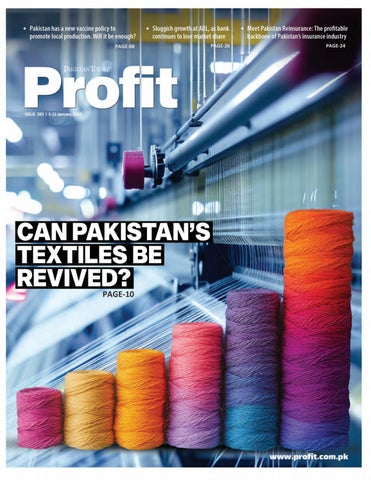
Can Pakistan’s textiles be revived?
Years of neglect have left a once thriving industry in shambles. The road ahead is arduous, but it must be taken
12
COVER STORY
By Abdullah Niazi This story is the second in a two-part feature focusing on the problems that plague Pakistan’s textile industry, and the solutions voices from within the industry have to offer. With unprecedented access and interviews across the entire textile supply chain from cotton fields to foreign markets, the story charts the history and future potential of Pakistani textiles. Find the first part in last week’s issue of Profit and online at https://profit.pakistantoday.com.pk/.
I
n our previous story, we traced the decline of Pakistan’s textile industry, following the path of cotton from the field to the retail market. Along the way, we identified the many hurdles that have crippled the once-thriving sector. From raw material shortages, particularly the decline in cotton production, to energy inefficiencies, unpredictable government policies, and a crippling tax regime, each step of the textile value chain has faced severe challenges. The impact has been profound: Pakistan’s textile exports have stagnated, its share of the global market has dwindled, and once-bustling factories have shuttered, leaving behind only the memories of a once-vibrant industry. But is there hope for Pakistan’s textile sector? Can this cornerstone of the country’s economy, which accounts for more than 50% of exports, be revived? The answer is complex. The problems are deeply rooted, spanning decades of mismanagement, policy inconsistency, and underinvestment. Yet, despite the gravity of the situation, there is a way forward. With the right mix of timely government intervention, a focus on longterm industrial policies, and the restoration of investor confidence, Pakistan’s textile industry can rise again. Reviving the textile sector is no easy task. It requires not just addressing the immediate pain points but also creating a conducive environment for sustainable growth. Pakistan’s global textile competitors like Bangladesh, Vietnam, and India have shown remarkable resilience, largely due to their focus on consistent, pro-business policies, affordable energy, and a steady supply of raw materials. For Pakistan to catch up, it will need a coherent and integrated strategy that spans the entire textile value chain, from cotton farming to the retail floor. The challenges may seem insurmountable, but experts and industry leaders agree that with proper intervention, Pakistan can turn things around. Kamran Arshad, Chairman of the All Pakistan Textile Mills Association (APTMA), highlights that the industry has the potential to grow, but the government’s focus on short-term measures,
14
such as debt servicing, rather than long-term industrial policies, has hindered progress. “We need stability, long-term policies, and affordable energy to allow the entire value chain to thrive,” says Arshad. This is where the government’s role becomes critical. Over the years, policymakers have failed to create an enabling environment for the textile industry. Unpredictable tax rates, energy crises, and inconsistent regulations have crippled the sector. But if the government takes concrete steps to streamline policies, stabilize energy prices, and provide incentives for value addition, the situation can be reversed. In particular, the introduction of stable, long-term energy policies and a revamp of the taxation system could provide the necessary foundation for the industry’s revival. For cotton farming, a return to the golden days of cotton cultivation is possible, but it requires significant investment in research, better seed varieties, and subsidies for farmers. “Cotton cannot survive without support from the government,” says Khalid Khokhar, President of Kissan Ittehad, highlighting the vital need for investment in cotton research and pest-resistant seeds. In addition, incentivizing cotton farmers to return to cultivation—by offering better returns and financial support—would ensure a consistent supply of raw materials for the textile industry. In the ginning, spinning, and weaving stages, energy efficiency is key. Pakistan’s textile mills face some of the highest energy costs in the region, making it nearly impossible to compete globally. Tariq Basharat Cheema, an energy expert, emphasizes the need for a shift towards renewable energy sources. Solar and wind power could help reduce costs and increase competitiveness. “If utilities simply finished, industrialists wouldn’t have to worry about this,” says Cheema, urging the government to increase investment in green energy initiatives to power the textile industry. At the retail level, Pakistani brands have tremendous potential to scale globally. Asad Shafi, owner of the fashion retail brand Cross Stitch, points to the success of local brands like Rastah as evidence of Pakistan’s capacity to dominate the global market. With the right infrastructure and investment, these brands could expand beyond the local market, competing with global giants. However, Shafi stresses that local brands cannot grow without a supportive domestic market infrastructure. “Our brands need better retail infrastructure and policies to help them grow locally before they can expand globally,” he says. The textile industry’s revival is certainly an uphill battle, but it is far from impossible. If the government provides the necessary
support and consistency, there is every reason to believe that Pakistan can regain its former glory as a textile powerhouse. The road ahead will be tough, but the opportunity is there. With the right policies in place, Pakistan can once again become a global leader in textiles. This is the story of the fixes we need from the cotton field all the way to the export container.
Reviving the foundations
P
akistan’s textile industry has always been built on a strong foundation of locally grown cotton. For centuries, the fertile plains of Punjab and Sindh have supplied the world with this “white gold,” but in recent decades, the cotton crop has been in a steep decline. From 14 million bales in 2005 to just 5 million bales last year, Pakistan’s cotton output has halved. The reasons for this decline are multifaceted, but the most pressing issue is the inability to meet the evolving needs of cotton farmers. While the textile sector is deeply interconnected with the agricultural sector, the lack of consistent policy support for cotton cultivation has left the industry in a precarious position. The first step toward reviving the textile industry lies in restoring cotton farming to its former glory. This requires substantial government intervention to ensure that farmers have access to better seeds, modern farming techniques, and consistent, favorable policies. Khalid Khokhar, President of Kissan Ittehad, emphasizes that Pakistan’s cotton industry cannot recover without addressing the root causes of its decline. “The biggest problem in agriculture today is climate change, and without addressing it, we cannot expect our cotton fields to flourish again,” he explains. He points to the decline of cotton farming in key regions like Kasur, Rahim Yar Khan, and Sargodha, where sugarcane and rice have taken over. These crops, though profitable, are water-intensive and ultimately unsustainable, leaving the land barren. To combat this, the government must prioritize cotton research and seed development. “We’ve been growing the same seed varieties for years, but they are not disease-resistant anymore,” says Khokhar. Without research into new, pest-resistant cotton varieties, farmers will continue to face losses. The development of these varieties should be a government-funded initiative, focusing on not just disease resistance, but also resilience to the changing climate. This, paired with better access to fertilizers and pesticides, would allow farmers to increase yields and make cotton farming a more attractive option. Incentivizing cotton cultivation with subsidies, tax breaks, and loan facilities
How can the industry work with such a heavy tax burden?” Pakistan’s tax policies need to align with global best practices, where exporters are either exempt from taxes or receive timely refunds to maintain cash flow and stay competitive in the international market Raza Baqir, Secretary general of APTMA
would also help ensure a steady supply of raw materials for the textile industry. As Kamran Arshad, Chairman of APTMA, points out, “To utilize our labor advantage, we need to encourage local cotton growth, even if it means supporting farmers for a few years.” Currently, the market does not provide enough financial incentive for farmers to invest in cotton cultivation, especially when the crop is so susceptible to diseases and climate shifts. The government must intervene by offering support packages to cotton farmers that include direct subsidies, loans for buying modern equipment, and guaranteed prices for their harvests. Lastly, improving the efficiency of irrigation systems is vital for increasing cotton yields. Pakistan’s cotton-producing regions have been plagued by water shortages, a problem exacerbated by the shift to more water-intensive crops. With water becoming an increasingly scarce resource, it is imperative that cotton farming is prioritized in water allocation policies. The government must invest in modern irrigation techniques, such as drip irrigation, which can drastically reduce water waste and ensure that cotton fields receive the adequate amount of water they need. Restoring cotton farming to its former glory is a key component of Pakistan’s textile industry revival. However, this can only happen through long-term, consistent
government policies that support farmers and address the root causes of the decline. With proper investments in research, subsidies, and irrigation infrastructure, Pakistan can once again become a major player in the global cotton market, ensuring that its textile sector remains competitive on the world stage.
Tackling energy costs
E
nergy is one of the most significant costs for Pakistan’s textile sector. Whether it is powering the spinning mills, weaving machines, or ginning plants, the energy-intensive nature of the textile industry makes it highly vulnerable to fluctuating energy prices. The high cost of energy, especially electricity and gas, has been a constant challenge for Pakistan’s textile sector, significantly affecting its ability to compete with regional competitors like Bangladesh, Vietnam, and China. The energy crisis in Pakistan has also spilled over into the agricultural sector. As Khalid Khokhar points out, “Farmers are being bled dry because our energy prices are higher than industrial accounts.” The cost of running irrigation pumps and processing cotton at the farm level is significantly higher in Pakistan than in competing countries, further discouraging cotton farmers from cultivating
Even if two or three of our big problems could be solved, the industry can play its historic role in helping Pakistan’s economy Kamran Arshad, Chairman of APTMA
the crop. In turn, this raises the cost of raw materials for textile mills, compounding the challenges faced by the industry. One of the key solutions to the energy problem lies in shifting towards renewable energy sources. Tariq Basharat Cheema, an energy expert, advocates for the integration of solar, wind, and biomass energy into Pakistan’s industrial energy mix. “Renewable energy can provide a cheaper, more sustainable alternative to the current reliance on expensive imported oil and gas,” Cheema says. This would not only reduce energy costs for textile mills but also help mitigate the environmental impact of fossil fuel-based power generation. The government can play a crucial role by offering incentives for industries to invest in renewable energy infrastructure, such as tax rebates or subsidies for the installation of solar panels or wind turbines. Moreover, Pakistan’s current energy tariff structure needs a complete overhaul. “The price of electricity for industries in Pakistan is about 12.5 cents per unit, while in competing countries, it’s as low as 6-9 cents per unit,” says Kamran Arshad. This price disparity puts Pakistani textile manufacturers at a severe disadvantage. To level the playing field, Pakistan must work towards reducing energy prices for the textile industry, ideally bringing the cost of electricity down to around 8 cents per unit, as suggested by Arshad. This can be achieved through a combination of policy changes, such as reducing energy subsidies for other sectors and redirecting them to energy-intensive industries like textiles. Furthermore, streamlining energy access for cotton farmers is also a critical step in addressing the high cost of production. As mentioned earlier, cotton farming in Pakistan is heavily reliant on irrigation systems that consume large amounts of energy. Providing farmers with access to cheaper, renewable energy for irrigation pumps and processing plants could significantly reduce their production costs and make cotton farming more viable. Beyond renewable energy, Pakistan
COVER STORY
Energy Costs: The Core Issue
E
nergy costs remain the most significant burden on Pakistan’s textile sector. The price of industrial electricity has reached an unsustainable 12 cents per kWh, far surpassing the costs in neighboring countries such as India, Bangladesh, and Vietnam, where rates range between 5 and 9 cents per kWh. This tariff disparity has had a profound impact on Pakistan’s textile industry, which relies heavily on energy to drive production. Despite government assurances to bring tariffs down to a more competitive 9 cents per kWh by 2025, the situation has only worsened, as energy prices continue to climb. Many textile units have resorted to setting up their own captive power plants, which, while providing a more stable supply, come at a higher cost and are less energy-efficient than grid-based power. This dual burden—expensive electricity tariffs combined with poor grid supply quality— has made it nearly impossible for textile manufacturers to compete on the global stage. The government’s energy policy, intended to alleviate these issues, has instead created further complications. Despite introducing the Regionally Competitive Energy Tariff (RCET) in 2018, which initially offered a reduced rate for export-oriented units, the government’s continued hikes in electricity prices have nullified much of the sector’s progress. The RCET, which was supposed to provide a stable, competitive rate of 7.5 cents per kWh, has already been revised upwards to 9 cents per kWh in 2020, with further increases projected. The RCET’s implementation has been inconsistent, undermining the confidence of textile manufacturers who are unable to plan or invest for the long term in such a volatile environment. n
must also focus on improving the efficiency of its energy distribution systems. Tariq Basharat Cheema emphasizes that the government needs to fix the failures within its electricity distribution system, which often leads to power outages and high transmission losses. By investing in grid infrastructure and reducing technical losses, the government can help ensure a more reliable and affordable
I
n addition to skyrocketing energy prices, Pakistan’s textile industry faces an oppressive tax regime that exacerbates its challenges. Exporters in the textile sector are subjected to a range of taxes that make it increasingly difficult to remain competitive. The dual taxation system—where exporters are taxed both under the normal income tax regime and a fixed tax on export proceeds—has created a heavy financial burden for textile manufacturers. The effective tax rate for exporters can reach as high as 135% of profits, undermining the profitability of textile exports and making it more attractive for businesses to focus on domestic markets instead. Furthermore, the imposition of new taxes, such as the recent re-imposition of electricity duties by the Punjab government, has only added to the industry’s woes. These taxes increase operational costs for manufacturers, further eroding their ability to compete in the global market. Many other countries have adopted tax policies that incentivize export growth, offering tax breaks, rebates, and other support measures to bolster the competitiveness of their textile sectors. Pakistan, on the other hand, seems to have adopted a more punitive approach, which disincentivizes expansion and investment in the textile sector. The situation is made worse by the multiplicity of taxes and levies that textile exporters face. With more than 18 different federal and provincial taxes and levies imposed on textile exports, the effective tax burden is disproportionately high. These taxes, many of which are unrelated to exports, create a complex and burdensome system that stifles growth and discourages investment. While other countries in the region have streamlined their tax regimes to encourage growth, Pakistan’s tax system continues to hinder the growth of its most important export sector. The lack of consistency in tax policies only adds to the instability. Exporters face the constant threat of new taxes or changes to existing tax structures, making it difficult to plan for the future. This uncertainty, combined with high taxes, has made Pakistan’s textile industry less competitive compared to other nations, which have more stable and supportive tax environments for exporters. n
energy supply for the textile industry. Lastly, the government should provide incentives for industries to adopt energy-efficient technologies. The implementation of energy-saving measures such as LED lighting, high-efficiency motors, and automation in the production process can reduce overall energy consumption and lower costs. This will not only help textile mills become more competi-
Renewable energy can provide a cheaper, more sustainable alternative to the current reliance on expensive imported oil and gas Tariq Basharat Cheema, former MD PEPCO
16
Taxation: A Burden that Stifles Growth
tive but also contribute to the broader goal of reducing Pakistan’s carbon footprint. No single factor is more important in the revival of Pakistan’s textile sector than addressing the high cost of energy. By shifting towards renewable energy, streamlining energy access for farmers, and overhauling the energy tariff system, Pakistan can significantly reduce the cost of production in its textile industry. With the right policies and investment, the country can ensure that its textile sector becomes globally competitive once again, while also fostering sustainable growth in its agricultural sector.
Going back to exports
B
ut even for the players that manage to get to the stage of global competition and have sustained their factories there are significant challenges. With global competition intensifying and regional competitors like Bangladesh, India, and Vietnam gaining ground, Pakistan’s textile exports have stagnated. As Kamran Arshad points out, the lack of a consistent policy
TEXTILES
Inconsistent Policy and Regulatory Uncertainty
O
Declining Cotton Production: A Raw Material Crisis
ne of the most damaging aspects of the challenges facing Pakistan’s textile sector is the constant flip-flopping of government policies. Over the past decade, the textile industry has been subjected to a myriad of policy changes that have created an unpredictable environment for manufacturers. The most glaring example of this is the government’s handling of energy tariffs. The promise of a stable, regionally competitive tariff for export-oriented units under the RCET policy was quickly undermined by repeated increases in electricity prices, leaving manufacturers scrambling to adjust. The government’s inconsistent policy decisions have left the textile sector in a state of perpetual uncertainty. Manufacturers are unable to plan for the long term, as they never know what policy changes may be coming down the pipeline. This lack of predictability is especially damaging for an industry that requires long-term investment and stability to thrive. As a result, textile manufacturers in Pakistan are hesitant to invest in new technologies or expand their operations, as they are unsure if government policies will continue to support the sector in the future. Moreover, the lack of coordination between different levels of government has created a fragmented policy environment. The federal government’s energy policies, for example, are often at odds with provincial policies, leading to confusion and inefficiencies. This disjointed approach has hindered the ability of the textile sector to grow and modernize, as manufacturers are forced to navigate a complex web of regulations that often conflict with one another. In the absence of clear and consistent policy, Pakistan’s textile sector is caught in a cycle of uncertainty and stagnation. Without a comprehensive, long-term strategy that prioritizes the needs of the textile industry, the sector will continue to face steep challenges in the coming years. The lack of policy continuity, combined with rising costs and regulatory confusion, makes it increasingly difficult for textile manufacturers to remain competitive in the global marketplace. n
environment has been a major hindrance. “We need stability, long-term policies, and affordable energy to allow the entire value chain to thrive,” Arshad says. The issue lies not just in raw materials or energy costs, but in the broader export environment that is shaped by taxation and policy inconsistency. Despite the obstacles, there are examples within Pakistan’s textile industry that demonstrate its potential. For instance, Gul Ahmed, one of the country’s most well-known textile companies, has managed to weather the storm and continue its operations in the global market. Contrary to recent rumors, the company is not shutting down its exports. Instead, it has focused on diversifying its product lines and strengthening its presence in international markets. This resilience is a testament to the capacity of Pakistan’s textile sector to adapt, even in the face of adversity. If other textile companies adopt similar strategies—focusing on product diversification and expanding market outreach—there is hope for the revival of Pakistan’s textile export potential. However, for a sustained recovery, the government must provide a stable and favor-
T
he textile industry’s heavy reliance on cotton has become another major source of vulnerability. Over two-thirds of Pakistan’s textile exports are based on cotton, yet the country’s cotton production has been on the decline in recent years. From a peak of 14 million bales, cotton production has now fallen to just 5.5 million bales. This drastic reduction in domestic cotton production has created a raw material crisis for textile manufacturers, who are now forced to rely on expensive imports to meet demand. This crisis is exacerbated by the high import tariffs on polyester, a key material used in synthetic textiles. The government’s decision to impose steep tariffs on polyester imports has left manufacturers with little choice but to continue relying on cotton, despite the volatile price fluctuations in global markets. This over-reliance on cotton not only exposes the industry to price and climate risks but also limits its ability to diversify into high-growth segments of the global textile market, such as synthetic apparel. Moreover, the decline in domestic cotton production has serious implications for the livelihoods of millions of people who depend on the cotton industry for their livelihoods. Cotton farmers are facing increasingly difficult conditions, with lower yields and a lack of support from the government. This has led to widespread poverty in rural areas, as cotton farming, once a thriving industry, has become increasingly unprofitable. Without a strategy to revitalize the cotton sector and address the challenges faced by cotton farmers, Pakistan’s textile industry will remain at the mercy of global market fluctuations, further diminishing its competitive edge. n
able export environment. The government should eliminate export taxes or, at the very least, refund them promptly, as is common in other textile-exporting countries. Pakistan’s tax regime currently imposes a heavy burden on exporters, with rates reaching up to 50% in some cases. This is a major deterrent for businesses looking to scale their export operations. As Raza Baqir, Secretary General of APTMA, explains, “How can the industry work with such a heavy tax burden?” Pakistan’s tax policies need to align with global best practices, where exporters are either exempt from taxes or receive timely refunds to maintain cash flow and stay competitive in the international market.” Another challenge to Pakistan’s textile exports is the lack of support for expanding domestic brands to international markets. While local brands like Cross Stitch have made strides in catering to the domestic market, they face significant barriers when it comes to international expansion. As Asad Shafi, owner of Cross Stitch, explains, “We have massive brands here that can scale globally, but they need to work and grow in the local market first.” The government must play
a role in creating export-oriented industrial parks that provide the necessary infrastructure for brands to grow. These parks could offer logistical support, access to export incentives, and partnerships with global retailers, making it easier for brands to establish a foothold in international markets. At the same time, textile mills must focus on improving the quality and competitiveness of their products. Product diversification is key to expanding into new markets. Musadaq Zulqarnain’s Interloop, for example, achieved significant success by focusing on the production and export of socks, which have a global demand. His story shows that Pakistan’s textile sector can achieve success with a focused, niche approach that aligns with global trends. Local textile companies must take inspiration from such success stories and explore niche markets, such as eco-friendly textiles or premium quality garments, to increase their competitiveness. Additionally, the development of a stronger domestic retail market can serve as a foundation for export growth. Asad Shafi highlights the importance of building a competitive local market before going global.
COVER STORY
“If our brands can grow locally, they can go beyond,” he says. Pakistan has a burgeoning middle class with growing demand for high-quality, locally made products. This domestic market can provide the foundation for textile companies to refine their products, build brand recognition, and gain the experience necessary to succeed in international markets. The export sector needs coordinated action from both the government and textile mills. The government must provide financial incentives, tax breaks, and infrastructure support to encourage local brands to expand internationally. Simultaneously, textile mills need to focus on product innovation, quality improvement, and market expansion. The combination of these efforts could help Pakistan’s textile industry reclaim its global standing, making it a significant contributor to the country’s economy once again.
Taxation barriers
W
hile the export challenges are clear, taxation and the retail sector represent additional hurdles that need to be addressed for Pakistan’s textile industry to thrive. The tax system in Pakistan has long been a point of contention for textile manufacturers. As Raza Baqir points out, the textile industry in Pakistan faces a tax rate that can exceed 50% when considering the combined effects of export taxes, fixed taxation regimes, and contributions to various social funds.The high tax burden, coupled
18
with delays in tax refunds, has placed textile manufacturers at a severe disadvantage. A major reform in the tax system is urgently needed. Pakistan’s tax collection rate, which remains below 10% of GDP, is one of the lowest in the region. Instead of squeezing the already taxed businesses, the government should focus on broadening the tax base and improving tax collection efficiency. By providing tax rebates or exemptions for textile exporters, the government can help ensure that the industry remains competitive on the global stage. Timely tax refunds would also help ease the cash flow issues that many textile manufacturers face, allowing them to reinvest in their businesses and expand their operations. The taxation challenges are exacerbated by the lack of infrastructure support for retail businesses. While brands like Cross Stitch have made significant inroads in the domestic market, there is a clear need for better retail infrastructure to support the growth of textile brands. As Asad Shafi explains, the ability to scale local brands into global markets depends on the infrastructure available within Pakistan. “We need the infrastructure to take our brands to international markets,” he says. The government can help by creating retail parks, offering logistical support, and facilitating access to international retail channels. In addition to supporting retail infrastructure, the government must also address the issue of informal businesses that avoid tax compliance. Small-scale retailers often oper-
ate cash-based businesses, evading taxes and creating an uneven playing field for larger, registered companies. This undermines the formal retail sector and discourages investment in the textile industry. The government must prioritize formalizing the retail sector, enforcing tax compliance, and ensuring that all businesses contribute to the economy. Despite these challenges, there are success stories that highlight the potential of the retail sector. Pakistan has a growing demand for locally made, high-quality textiles, and this market can be the stepping stone for textile companies to expand internationally. However, to fully capitalize on this potential, the government must ensure that retailers have access to affordable financing, modern retail infrastructure, and favorable tax policies. By leveling the playing field and providing the necessary support, Pakistan’s textile industry can foster a competitive retail sector that will drive growth in both domestic and export markets.
The potential is there
T
he challenges facing Pakistan’s textile industry may be daunting, but the potential for revival remains strong. With a rich history of textile production stretching back thousands of years, Pakistan has the resources, talent, and capacity to once again become a global textile powerhouse. However, this requires urgent and sustained intervention from the government, as well as a concerted effort from textile mills to modernize, innovate, and diversify their offerings. The experiences of countries like Bangladesh, which has managed to carve out a significant share of the global textile market despite facing similar challenges, offer valuable lessons. By adopting consistent, pro-business policies, investing in energy infrastructure, and supporting value-added production, Bangladesh has been able to increase its textile exports exponentially. Pakistan can follow suit by focusing on policy consistency, addressing energy issues, and fostering a supportive tax and retail environment. Kamran Arshad, Chairman of APTMA, encapsulates the industry’s hopes when he says, “Even if two or three of our big problems could be solved, the industry can play its historic role in helping Pakistan’s economy.” With the right policies, stable energy prices, and a focused effort on export and retail growth, Pakistan’s textile industry can once again thrive and take its rightful place in this country’s economy. n
COVER STORY
Supernet announces major push towards regional expansion The company aims to increase its investment in its Dubai-based subsidiary as the launchpad for a wider international growth strategy
S
upernet Ltd, the Islamabad-headquartered ICT and connectivity services provider listed on the Pakistan Stock Exchange’s GEM Board, has told investors it is rebranding itself as “Supernet Global” as it sets its sights beyond Pakistan and into higher-growth regional markets. In a material information notice submitted to the PSX dated 31 December 2025, the company said its board had approved the strategic rebranding initiative to reflect an intention to “selectively expand into high-growth international digital markets”. The company pointed explicitly to the Middle East, Africa and Central Asia as target regions, positioning the move as a way to export “Pakistan-origin digital, ICT and managed service expertise” to overseas customers. The most concrete detail, however, is the geographic anchor: Dubai. Supernet told the exchange that Dubai would serve as its “first regional hub”, leveraging its UAE-based subsidiary Phoenix Global FZE, which it said has been operational since 2018. Under the proposed model, the customer-facing and commercial expansion would be pushed out from Dubai, while “technical delivery, engineering and managed services functions” remain anchored in Pakistan. That “Dubai hub, Pakistan delivery” approach is not just a branding choice; it is a strategy aimed at solving a perennial problem for Pakistani technology exporters: how to win contracts and build relationships with regional clients who often prefer to buy from entities with a presence in the Gulf, while still keeping delivery and engineering talent based at home. Just as importantly, the company sketched what it expects to sell abroad. Its “international service portfolio”, it said, will include cybersecurity services, cloud and data solutions, managed ICT services, smart / Internet of Things (IoT) platforms, enterprise connectivity via local partnerships, and satellite-based connectivity solutions, which the company said will remain “a cornerstone” of its strategy. Supernet also sought to reassure domestic customers and investors that this is an additive move rather than a pivot away from Pakistan: it stated that existing operations, customer relationships and commitments in
TECHNOLOGY
Pakistan will remain unchanged. The rebranding announcement comes on the heels of another PSX disclosure that hints at what Supernet thinks “going global” looks like in practice. In a separate material notice dated 15 December 2025, Supernet disclosed that Phoenix Global FZE had signed a three-year collaboration agreement with UAE-based Athena Telecommunications Equipment Trading Co. L.L.C. to pursue maritime connectivity, safety, security, earth observation and IoTlinked solutions in regional and international markets, using co-branded offerings and revenue-sharing arrangements. Taken together, the two disclosures suggest a company that wants Dubai not merely as a sales office, but as a platform – likely requiring greater investment into Phoenix Global FZE’s headcount, partnerships and working capital – to win projects that would be difficult to originate from Pakistan alone. Supernet is not a start-up discovering international ambition late in life. It is a 1995-founded telecoms and ICT services player that has repeatedly reinvented itself alongside Pakistan’s communications market. According to the group’s own disclosures in its PSX filings, Supernet was incorporated on 14 March 1995 and operates as a provider of satellite and microwave communication services. The company’s corporate briefing presentation delivered to investors in late 2025 provides a more detailed narrative arc. It describes Supernet as one of the first private-sector telecoms providers in Pakistan, starting as a dial-up ISP and evolving into a nationwide B2B provider of ICT, power and telecom services. That same investor presentation states that Telecard Ltd acquired Supernet in 2004, and charts Supernet’s migration into a business-to-business model, including managed services for connectivity and telecom backhaul. Supernet’s PSX filings also highlight its regulatory posture in Pakistan: it has a licence from the Ministry of Communications to establish and operate a data network, and it provides satellite and microwave services such as internet connectivity and radio links, alongside the sale and installation of related equipment. One notable recent milestone is tucked into the same quarterly filing: Supernet states it was awarded Fixed Local Loop (FLL) licences by the Pakistan Telecommunication Authority
for 20 years, covering all 14 telecom regions across Pakistan, replacing an older CVAS licence and granting additional rights, including the ability to deploy its own infrastructure and provide additional services. Finally, Supernet’s own investor materials emphasise reach: it says it has engineering and support resources spread across Pakistan in more than 200 cities and towns, and frames its value proposition as being able to deliver services even in remote areas – one reason it has historically been relevant to telecoms operators, banks and enterprises with distributed footprints. A rebrand is cheap. Regional expansion is not. Investors, therefore, will likely judge “Supernet Global” less by the new name and more by whether it can fund and execute the expansion while sustaining growth and margins at home. On performance, Supernet has been on a sharp upswing – particularly at the consolidated level. In the company’s PSX corporate briefing session presentation, Supernet disclosed consolidated financial trends that show a stepchange between FY24 and FY25. Revenue rose from Rs8.502 billion (FY24) to Rs9.269 billion (FY25). Profit after tax (PAT) rose from Rs241 million to Rs473 million. The same presentation shows profitability improving after a margin squeeze in FY24: consolidated gross profit margin rose to 20% in FY25 from 16% in FY24, while operating margin improved to 9% from 6%. At the same time, the PSX’s company page (which presents standardised figures and flags that they may differ from issuer “as reported” data) shows unconsolidated annual sales and profits that are lower than the consolidated figures – an important nuance for investors who only glance at the default PSX snapshot. From a market perspective, the PSX company page lists Supernet’s market capitalisation at roughly Rs8.2 billion (as displayed on the portal at the time of capture), and shows a very strong one-year price move. The bigger question now is whether the company’s improving profitability can withstand the costs of internationalisation – travel, compliance, partnership building, longer receivable cycles, and the “soft costs” of establishing credibility in overseas enterprise markets.
19
For the Telenor acquisition to work, PTCL needs to be able to raise prices
Analysts believe that PTCL has all the ingredients to stage a comeback, provided it is able to raise the stubbornly low prices in Pakistani telecoms, without losing market share
P
akistan Telecommunication Company Ltd (PTCL) has finally closed its long-anticipated purchase of Telenor Pakistan – a transaction that has been years in the making and, in many ways, a referendum on whether Pakistan’s telecoms market can move from destructive price wars to something closer to “pricing power”. In a filing with the Pakistan Stock Exchange, PTCL said it has completed the acquisition of 100% shareholding of Telenor Pakistan (Pvt) Ltd and Orion Towers (Pvt) Ltd on 31 December 2025, with shares transferred into PTCL’s name. The deal was first announced in December 2023, and has created a combined operator that is a much stronger No. 2 in the market. The purchase has never been framed as a bargain-basement tuck-in. The agreed purchase price to acquire Telenor Pakistan on an enterprise value of Rs108 billion, on a cash-free, debt-free basis. And PTCL arranged up to $400 million of financing with an IFC-led consortium (including the Silk Road Fund and British International Investment), a seven-year facility with quarterly repayments. That arithmetic dictates the core question for investors: what has to happen for PTCL to earn an adequate return on a heavily leveraged, politically sensitive, regulator-scrutinised telecoms consolidation? A growing number of analysts are converging on the same answer: prices must rise – not necessarily through a single dramatic “tariff shock”, but through sustained improvement in average revenue per user (ARPU). In a recent research note, Chase Securities argued that PTCL’s medium-term thesis hinges on consolidation leading to “pricing hygiene” (less promotional cycling and better tariff discipline), plus quality-of-service improvements and integration synergies that increase willingness to pay. In that framing, consolidation is the prerequisite and ARPU repair is the mechanism. Chase’s base case assumes mobile ARPU gradually climbs toward roughly $2 per user per month over about five years, with 2026 mobile ARPU around Rs280 per month and then a steady climb thereafter. The same note sketches how higher ARPU translates into earnings power, highlighting that a mid-2025 run-rate (normalised PTCL profitability plus Telenor
22
profitability) could plausibly be in the range of Rs6–8 billion per quarter, even before deeper merger synergies. The strategic bet is that the market structure now gives PTCL a chance to do what Pakistan’s telecom operators have historically struggled to do: raise effective pricing without immediately handing subscribers to a rival. In theory, the deal changes the rules of the game. Before consolidation, Pakistan’s mobile market was a four-player fight where each operator had incentives to undercut on headline packages, especially for prepaid users. Prior to the merger, Jazz led with 37%, Zong held 26%, Telenor controlled 22%, and Ufone lagged with 14%. The merger compresses that into a three-operator structure, with the combined entity becoming a serious challenger. The combined base of around 70 million subscribers creates a clear second player behind Jazz. But the key phrase here is “in theory”. Pakistan is not a normal telecoms market. It is an extremely price-sensitive market where the regulator and the political system pay close attention to tariff optics – and where operators face persistent pressure from taxation, power and fuel costs, currency depreciation, and costly spectrum. That is why the first and biggest “to-do” on PTCL’s post-merger integration list is not just network integration or branding; it is engineering a gradual, defensible path to higher ARPU. Two things likely determine whether that happens. Consolidation must reduce price war intensity in a durable way – fewer operators, fewer “race-to-the-bottom” promotions, and more rational tariff resets. And secondly, subscribers must feel they are getting more value, so price increases do not produce mass churn. That means better coverage, better speeds, better service, and more coherent data-led bundles. And this is where Pakistan’s telecom reality bites. The sector’s prices are not just low – they are among the lowest anywhere. A GSMA report on Pakistan’s digital nation ambitions noted that mobile ARPU in Pakistan is among the lowest globally, below $1, versus a global average of $8, arguing the industry’s long-term sustainability requires reform. If that is the baseline, it is not difficult to see why PTCL’s analysts keep coming back to the same point: you cannot finance a $400 mil-
lion-plus consolidation, invest in networks, and prepare for new spectrum, all on sub-$1 ARPUs – at least not comfortably. If the “bull case” is straightforward (consolidation – pricing discipline – ARPU rise – earnings re-rate), the “bear case” has multiple moving parts – and several of them have little to do with PTCL’s operational competence. Regulatory and political optics risk on pricing. Even in a consolidated market, the ability to raise prices depends on what regulators and politicians will tolerate. Chase explicitly flags “regulatory/optics risk” – the possibility that post-merger tariff actions face greater scrutiny, especially in periods when inflation or political pressure makes price increases unpopular. That caution looks especially relevant given the Competition Commission of Pakistan (CCP) approved the transaction with conditions and a heavy emphasis on consumer safeguards. The CCP approval highlighted conditions including separate boards and independent management structures for PTCL and the merged entity, along with requirements around senior leadership integrity and competence. The broader message is clear: regulators want consolidation to produce efficiency and better service, not a free hand to extract rents. Affordability risk in a prepaid-heavy market. Pakistan’s mobile market is still dominated by prepaid consumers, and demand can be sensitive to macro stress. Chase’s “left tail” scenario notes that weak real incomes, inflation shocks, or GDP softness can delay migration to higher-value bundles – exactly the path that ARPU repair needs. The uncomfortable truth is that telecom services may be essential, but upgrading those services is discretionary when household budgets are strained. FX and interest rates: the squeeze on “room to invest”. Telecom is capital intensive, and much of that capital expenditure is either dollar-linked or influenced by imported equipment pricing. Chase flags a scenario where rupee weakness raises funding needs and high rates lift finance costs, slowing the pace of QoS-driven monetisation. For PTCL, this matters doubly because the acquisition itself has been financed through sizeable debt arrangements. Spectrum auction risk – a looming swing factor. Pakistan is also approaching
another potentially expensive moment: more spectrum. Chase notes that the PTA is expected to hold a spectrum auction in late January–February 2026, and argues this could accelerate monetisation if done on rational terms – or delay free cash flow if it becomes a fiscal extraction event. Media reports in Pakistan have similarly pointed to a February 2026 target for spectrum auction timing. PTCL’s challenge is that spectrum is not optional if the sector wants better speeds and capacity – but spectrum costs, if punitive, can quickly swallow the benefits of higher ARPU. Integration complexity – and the “two cultures” problem. In telecom mergers globally, the hardest work is rarely the legal completion; it is the operational integration – network harmonisation, IT stack convergence, retail rationalisation, brand strategy, staff and tower overlaps, and customer experience continuity. PTCL is not only merging subscriber bases; it is merging operating cultures. And because the acquisition includes Orion Towers, the integration story also extends into passive infrastructure. Despite the risks, the post-merger PTCL story is not short of “right tail” scenarios – outcomes that could meaningfully exceed conservative expectations. ARPU repair could happen faster than the market expects. Chase outlines an upside case where ARPU accelerates to about $2 per user per month within roughly three years. In its sensitivity framework, every +$1 per month in ARPU is worth about +Rs28 in annual earnings, and a faster ARPU recovery could imply dramatically higher EPS outcomes by 2028. The intuition is straightforward: if Pakistan’s ARPU is truly “too low to sustain the sector”, then consolidation plus better service could produce a quicker pricing reset than investors have learned to assume. Synergies may be larger – and more “physical” – than people think. One of the most tangible synergy levers is infrastructure overlap. Chase notes that in Year 2 after consolidation, the combined network could potentially decommission or rationalise up to ~7,000 overlapping towers, estimating run-rate savings of Rs250,000–300,000 per month per tower, plus additional savings from reduced marketing intensity and staff rationalisation. Even if only a portion of that is realised, it could materially change the cost structure. Better quality of service can convert into pricing power – if it is visible. The telecom sector often talks about QoS as a regulatory obligation. In a consolidated market, QoS becomes a commercial weapon: faster data, fewer dropped calls, broader 4G coverage, and more stable networks increase perceived value. Chase explicitly ties QoS improvements and integration synergies to higher willingness to pay.
The timing could also matter. If additional spectrum becomes available on workable terms, and operators deploy it to boost speeds and coverage, that may create the “permission structure” for higher tariffs. Optionality: asset monetisation and corporate actions. Telecom groups often have hidden value: property holdings, data centres, and structurally undervalued subsidiaries. Chase lists several low-probability but potentially high-impact actions: monetising or spinning off the data centre business, restructuring or spinning off Ufone, and monetising property/land holdings. If PTCL were ever to pursue one of these levers credibly, the market capitalisation response could be disproportionate – because investors tend to reward clarity and simplicity in complicated, state-linked corporate structures. Valuation support: PTCL screens cheap on a “per subscriber” basis. Chase also argues that on a post-merger market-cap-per-subscriber comparison, PTCL still appears inexpensive at around $15.6 per subscriber, below many emerging-market peers. That does not guarantee a re-rating – but it does suggest that if ARPU repair becomes visible and credible, a higher valuation multiple is not hard to justify in relative terms. To understand why this merger matters, it helps to understand what PTCL is – and what it is not. PTCL positions itself as “Connecting the Nation since 1947,” tracing its roots to Pakistan’s early telephone and telegraph department and presenting itself today as the country’s largest integrated ICT company, and a subsidiary of e&. It is still, by any measure, the backbone fixed-line operator – with deep infrastructure advantages that new entrants cannot easily replicate. Financially, PTCL has shown that it can grow revenues even in a difficult telecom environment, but profitability has been uneven, particularly at the consolidated group level. In its published financial statements for the year ended 31 December 2024, PTCL’s consolidated revenue was Rs219.78 billion, but it reported a consolidated loss of Rs14.39 billion, with a loss per share of (Rs2.82). On a standalone basis, PTCL (excluding full subsidiary effects) reported revenue of Rs107.77 billion and profit after tax of Rs4.83 billion (EPS Rs0.95) for the same period. That split matters: PTCL’s fixed-line and ICT footprint can be cash generative, but mobile competition has historically weighed on group profitability. The acquisition of Telenor Pakistan is, in part, an attempt to change that equation by bringing scale to the mobile arm. Telenor’s own 2023 announcement of the sale described PTCL as part of e&, noted that PTCL’s major assets include Ufone, and
said the transaction valued Telenor Pakistan at NOK 5.3 billion on a cash-and-debt-free basis at announcement time. This was not a casual exit; it was Telenor concluding a strategic review and choosing consolidation over continued investment in a market it saw as structurally challenging. For PTCL, the strategic narrative is therefore simple: become the “strong local champion” in a market where global operators have struggled to make the economics work. Pakistan’s telecom sector is full of contradictions – and those contradictions are exactly why PTCL’s post-merger strategy is so hard. On the one hand, usage is booming. The regulator’s annual reporting has pointed to record revenues and enormous subscriber scale. PTA’s annual report said Pakistan’s telecom revenues reached a record Rs955 billion in FY2023–24, with total telecom subscribers around 196 million, mobile subscribers 193.4 million, and broadband subscribers 142.3 million. The same report cited ARPU of Rs302 per month (April–June 2024). On the other hand, Pakistan’s mobile economics are notoriously thin. The GSMA’s assessment that Pakistan’s ARPU is below $1 is a stark reminder that high usage does not automatically translate into high profitability – especially when prices are low and costs are rising. Competition is central to this dynamic. Even before the merger, operators fought aggressively on bundles, promotions, and “free” data or minutes – often in ways that trained consumers to treat telecom services as a commodity and churn as a rational strategy. The consolidation to three main mobile operators may reduce the temperature of that competition, but it will not eliminate it. Jazz remains the market leader with deep distribution and a strong brand; Zong has the backing of China Mobile and a heavy data focus; and the merged Ufone–Telenor platform will need to prove that “scale” can translate into better service and better monetisation. Meanwhile, the sector is approaching another strategic inflection point: spectrum and 5G-readiness. If Pakistan proceeds with further spectrum auctions in early 2026, operators will have to balance capital commitments with the need to keep consumer pricing politically acceptable. That tension is precisely why analysts view pricing power – not just subscriber growth – as the variable that will decide whether consolidation actually improves shareholder outcomes. In that sense, PTCL’s acquisition is not merely a corporate transaction; it is a bet on a new telecom equilibrium in Pakistan – one where the market is rational enough to allow ARPU to rise, but competitive enough to force operators to earn those price increases through better networks and services. n
TELECOMMUNICATIONS
After strong 2025, growth stalls at Symmetry Group Company looks to AI and acquisitions to fuel additional productivity and revenue growth respectively
F
or Symmetry Group Ltd (PSX: SYM), FY2025 looked like the sort of year that convinces investors a small-cap technology story is finally graduating into something bigger: stronger topline, higher earnings, and an expanding footprint beyond Pakistan. But the first quarter of FY2026 has landed with a thud, showing just how quickly momentum can fade in project-led digital services. According to a recent equity research briefing note, Symmetry posted consolidated net sales of Rs767 million for FY2025 (year ended 30 June 2025), up 33% from Rs578 million in FY2024. Profit after tax rose to Rs168 million (up 23% year-on-year), lifting earnings per share to Rs0.59 from Rs0.48. That is the good news. The less flattering detail sits behind the headline growth: gross margin fell to 54% from 63%, reflecting a sharp rise in cost of sales even as revenue climbed. The company still delivered higher operating profit for the year, but the squeeze on margins is a reminder that scaling a services-heavy business often means hiring ahead of demand, absorbing salary inflation, and taking on more complex work that does not always price as richly as management would like. Then came FY2026’s opening quarter (ended 30 September 2025), which exposed a more immediate challenge: growth stalled. In 1QFY2026, Symmetry’s net sales rose just 5% year-on-year to Rs188 million (from Rs179 million). Gross profit was flat at Rs112 million, while operating profit fell 16% to Rs49 million as administrative expenses rose. Net profit did increase 15% to Rs47 million, but that improvement was helped by lower taxation and stronger other income rather than accelerating core operations. For a company whose market narrative has rested heavily on rapid expansion, that
24
5% topline growth rate is the number investors will circle in red. On the Pakistan Stock Exchange portal, SYM was trading around the mid-teens in early January 2026 and had fallen roughly 31% over the past year, a sign that the market has already been repricing expectations. In other words: FY2025 still reads like a “breakout” year on paper – but 1QFY2026 reads like a warning label. One clue as to how Symmetry itself is thinking about the next phase is in shareholder payouts. The company’s dividend per share for FY2025 was lower than the year before, and in its annual report it explicitly links dividend conservatism to keeping cash for growth ambitions – including Aurion IPO-related costs expected in FY2026 – as well as funding R&D and expansion efforts. That sets the stage for the real question now confronting the market: If organic growth is slowing, what will Symmetry do next to keep the story intact? Management’s message – at least as communicated through recent briefings – is that the next leg of growth will be powered by two levers: AI to improve productivity, and acquisitions to add scale and revenue. In the research briefing note, management is described as looking into “already profitable acquisitions” both inside and outside Pakistan to help grow the business, while also planning to use technology and AI more deeply across operations. Neither of those ideas is controversial in isolation. The timing, however, matters. When a company pairs “AI productivity” with “acquisitions” just as quarterly revenue growth cools, it can read like an admission – tactful but meaningful – that winning new work organically is no longer as easy as it was a year ago. There are at least three plausible interpretations investors are debating. First, acquisitions may be the quickest
route to defend growth rates. In services businesses, organic growth is often linear – more people, more projects. Buying an already-profitable niche player can add revenue faster than hiring and training teams from scratch, and it can open doors to clients that were previously out of reach. Second, AI-driven productivity could be defensive as much as it is offensive. If margins are compressing, AI becomes a tool to protect profitability: automate repetitive work, reduce rework, speed up delivery, and allow teams to handle larger volumes without adding headcount. That logic fits Symmetry’s margin story in FY2025 and the early FY2026 operating profit dip. Third – and less comfortably – AI may also be changing client expectations. The same generative AI tools that can help Symmetry deliver faster can also push clients to demand more output for the same price, or to internalise work that used to be outsourced. In advertising and content, for example, some brands are already experimenting with in-house creative generation, while technology teams can use AI coding assistants to cut time-to-prototype. If clients begin asking, “Why does this take two weeks when an AI tool can generate a first draft in two hours?”, pricing power weakens unless the vendor can move up the value chain into strategy, integration, and measurable performance outcomes. Symmetry appears aware of this shift. In its corporate briefing materials, the company frames a longer-term strategy that includes “carving products out of custom solutions” and scaling through partners – language that suggests a desire to be less dependent on one-off project billing and more exposed to repeatable, scalable platforms. That pivot is not easy. Platform thinking requires upfront investment, patience, and a willingness to accept that some R&D will not
pay off. But if services growth is slowing, the argument for building proprietary IP becomes stronger – because IP can scale without linearly scaling payroll. To understand why growth can surge one year and stall the next, it helps to look at what Symmetry is and is not. Symmetry describes itself as a digital technology and experiences company, focused on the digitalisation of marketing, sales, and consumer-centric business functions, with activities spanning four core areas: transformation, interactive marketing, commerce, and mobility. Those labels can sound generic, but the underlying service catalogue is fairly specific. From the company’s PSX corporate briefing presentation, Symmetry’s business divisions include: • Interactive: digital marketing strategy, digital advertising, creative and content production, design, social media marketing, performance marketing, influencer marketing, digital PR, and search engine marketing. • Transformation: data science, web/software/application development, IoT devices, digital strategy, technology consulting, and digital consultancy. • Commerce: digital commerce design, back-end system development, third-party integrations, and global e-commerce deployment. • Mobility: mobile marketing solutions, WhatsApp business solutions, voice and messaging solutions, mobility tools development, and geo-location/tagging solutions. In practice, Symmetry is operating across the overlapping worlds of digital transformation delivery and digital marketing execution – an overlap that is increasingly common as banks, telcos, and FMCG firms build more of their customer journey on mobile apps, data platforms, and targeted media. It is also not just a single operating entity. Symmetry’s prospectus describes the listed group as the parent of two key subsidiaries: Symmetry Digital (Pvt.) Ltd and Iris Digital (Pvt.) Ltd – both of which operate in the broader digital services space, in addition to the parent company’s activities. What is notable is the company’s emphasis on branded products alongside services. On its own website, Symmetry lists a range of brands and platforms, including: Symmetry Digital (positioned as a full-service digital marketing agency), and Iris Digital (a digital agency focused on strategy, user experiences and creative). It also highlights platforms that look more like product bets: • SymmetryTrade, described as an authorised channel partner and Gold Supplier of Alibaba.com, supporting Pakistani brands selling on a global marketplace.
• Corral and Corral Performance, which focus on data, analytics, and advertising performance visualisation across platforms such as Facebook and Google properties. • Appabilities, which builds mobile apps and focuses on UI/UX. • Survit, a SaaS customer satisfaction measurement solution based on CSAT-style measurement and reporting. • Mobits, a cloud-based platform for mobile marketing, reporting, engagement and push notifications. • Influsense.ai, described as an AI-powered influencer marketing solution with largescale influencer discovery and campaign tools. This “services plus products” mix is important to the growth question. Services can scale quickly when demand is strong, but they can also slow abruptly when clients pause discretionary spend or delay projects. Products can be stickier and more scalable, but they take time to mature and require distribution, partnerships, and often international expansion to reach meaningful size. Symmetry’s expansion footprint reflects that ambition. The company lists offices in Karachi, Islamabad, Lahore, and the Middle East (Sharjah), underscoring that it is trying to sell beyond Pakistan’s borders rather than relying only on domestic corporate budgets. Symmetry’s client list reads like a cross-section of Pakistan’s most competitive sectors: banking, telecoms, and consumer brands – all industries where digital channels have become existential rather than optional. In its corporate briefing materials, the company states it serves 46 clients, employs around 185 people, and operates across multiple geographies. That client base is not evenly distributed, however. The same presentation shows revenue concentration, with a large share tied to a limited number of clients – an advantage when relationships are strong, but a risk when big customers delay or cut spend. The research briefing note and PSX corporate materials point to major customers including Jazz, HBL, SBP/NBP, JS Bank, and MCB among top local accounts, with export customers including Al-Waha Computers, Humming Bird, S Ventures, Digicel (Prism Holdings) and Luminus Trading. Symmetry also appears to have been winning institutional work in Pakistan’s financial ecosystem. In a PSX filing covered by local business press, the company disclosed contracts expected to generate revenues exceeding Rs300 million, with clients including the State Bank of Pakistan, Pakistan Banks’ Association, ONIC Pakistan, Jubilee Life Insurance, English Biscuit Manufacturers, and Colgate Palmolive. These are precisely the kinds of clients that can underpin a digital services firm’s credibility – especially when competing for export
work in the Gulf, where references and track record matter. On partnerships, Symmetry’s strategy has leaned into platform alliances rather than trying to build everything in-house. The equity research note highlights management’s intention to pursue and integrate partners such as Backbase, Codebase, Glu, and Spotify, though it also notes delays around the Spotify opportunity. The Spotify angle is worth dwelling on because it reveals both upside and fragility in Symmetry’s growth plan. In early 2025, Symmetry announced a partnership with Aleph Holdings, which represents Spotify in the region, with Symmetry expressing optimism about generating around $5 million of additional business in the first year of the partnership. A distribution partnership tied to a global platform like Spotify can be transformative for a local firm – if execution matches the pitch. But it is also a reminder that Symmetry’s growth is partly exposed to decisions made elsewhere (platform policies, regional realignments, advertiser adoption cycles), which can introduce timing risk. That’s especially relevant given the current market focus on whether the company can re-accelerate after a slow quarter. If Symmetry’s near-term story is about whether growth re-accelerates, its medium-term story may hinge on something more structural: Aurion.ai. In corporate briefing materials, Symmetry explicitly flags “Aurion.ai IPO” as part of its future outlook, alongside phrases like “AI is the way forward” and plans to scale products globally through investment and strategic partners. The IPO idea is not speculative. In a formal “Material Information” disclosure to the Pakistan Stock Exchange dated March 12, 2025, Symmetry said its board had approved initiating the IPO process for a new AI-focused subsidiary, aiming to raise approximately Rs1.5 billion to Rs2.0 billion, and had appointed KTrade Securities Ltd as IPO adviser to complete the process within six months. The disclosure also referenced AI platforms including Influsense.ai and Vidfy.ai. Business press coverage at the time echoed those details, framing the listing as a major milestone in Symmetry’s growth strategy and emphasising the funding target and platforms. And in its FY2025 annual report, Symmetry ties its dividend stance to preserving cash for Aurion IPO-related costs expected in FY2026, implying that the IPO plan has remained live well beyond the initial announcement. The equity research briefing note further suggests the process is moving along, indicating management planned to file for Aurion.ai’s IPO around January 2026. n
TECHNOLOGY
Sluggish growth at ABL, as bank continues to lose market share In a record-breaking year for the banking sector, ABL’s revenue growth has barely beaten inflation.
A
llied Bank Ltd (ABL) has posted another set of soft results, reinforcing the sense that a lender once counted among Pakistan’s “Big Five” is now struggling to keep up in a banking market that – at least for most large players – has been defined by boom-time revenues and outsized profitability. In the three months ended September 2025 (3QCY25), ABL reported consolidated earnings per share of Rs7.71, down 29% from Rs10.84 in the same quarter last year. That translates into profit after tax of Rs8.8 billion, versus Rs12.4 billion a year earlier. Despite the earnings drop, the bank held its quarterly payout steady, declaring a Rs4 per share dividend – unchanged from 3QCY24. The top line also moved in the wrong direction. Total income for the quarter fell to Rs35.0 billion, down 11% from Rs39.1 billion, as net mark-up/interest income declined 15% year-on-year (from Rs31.7 billion to Rs27.0 billion). That quarterly contraction matters because it lands at a moment when investors have been conditioned to expect banks to defend earnings – through balance-sheet positioning, fee growth, or cost discipline – even as the interest-rate cycle shifts. Instead, ABL’s
26
most recent numbers show a bank absorbing the downside of an easing-and-repricing environment without a compensating uplift elsewhere. On a full-year basis, the story is only marginally better. In calendar year 2024 (CY24), ABL’s total income rose to Rs146.5 billion, up 5% from Rs139.5 billion in CY23. Profit after tax increased 7% to Rs44.4 billion, while earnings per share rose to Rs38.77 and the dividend per share increased to Rs16 (from Rs12 the year before). But those nominal gains look thin once compared to inflation. Using Pakistan Bureau of Statistics data, inflation was 12.9% for the 12 months ending December 31, 2024, and 3.4% for the 12 months ending September 30, 2025. That means ABL’s 5% revenue growth in CY24 falls far short of the 12.9% inflation backdrop associated with the year ending December 2024 – implying that, in purchasing-power terms, the bank’s revenue base effectively shrunk despite headline growth. This gap between nominal growth and real growth is central to the concern around ABL: even in years when the bank stays profitable and pays dividends, its underlying momentum has not matched either the cost environment or the sector’s broader expansion.
Market pricing has been sending a similar signal. In late December, ABL shares were trading around Rs183, with a market capitalisation a little over Rs200 billion, according to a corporate briefing note published by Chase Securities. The stock was below its 52 week high (about Rs219.8), even if comfortably above its 52 week low (about Rs122). ABL’s soft growth matters because the institution is not a niche player. Allied Bank traces its origins to 1942, when it was founded in Lahore as Australasia Bank, before Partition. The bank describes itself as the first bank established in Pakistan, and positions its franchise as a nationwide institution with a legacy spanning more than 75 years. The modern ABL also reflects Pakistan’s banking history in miniature. The bank was renamed Allied Bank of Pakistan in 1974 following nationalisation. Allied Bank was later privatised in 1991, in an employee-led buyout that was widely watched as Pakistan experimented with new ownership models for formerly state-run banks. The current ownership era, however, is defined by a later turning point. In August 2004, a major capital restructuring transferred ownership to a consortium led by the Ibrahim Group, and that in 2005 it adopted the name Allied Bank.
Crucially, ABL remains a large national franchise. The bank says it now operates 1,500+ online branches and 1,500+ ATMs across Pakistan, and highlights its digital channels, including myABL internet & mobile banking, payments features, and other “technology-enabled services”. In other words: this is not a small bank being squeezed by scale. It is a well-established, widely distributed institution – precisely the kind of bank that should be able to translate footprint into customer growth, customer growth into earning assets, and earning assets into rising income. Yet, as the latest financials show, ABL has not been converting that national presence into sector-leading growth. In a market where competitiveness has increasingly meant the ability to invest in technology, product design, analytics, and distribution, ABL’s scale has not delivered the growth premium investors typically associate with the biggest banks. To understand why ABL’s slower growth reads as a market-share issue, consider how fast the rest of the listed banking universe has been moving. One widely cited snapshot of sector performance shows just how large the income pool has become. Profits at Pakistan’s listed banks rose 5% year-on-year to Rs597 billion in 2024, according to data compiled by Topline Securities, driven by a 9% increase in net interest income to Rs1.9 trillion and a 50% surge in non-interest income to Rs560 billion. Even if individual banks had mixed quarters, the aggregate picture has been one of extraordinary earnings power – fed by a combination of high interest rates (particularly through 2023 and early-to-mid 2024), large holdings of government securities, and increasingly monetised fee businesses in payments, cards, and digital channels. The rate cycle adds important context here. The State Bank of Pakistan reduced its policy rate to 12% in March 2025 after substantial cuts from 22% in June 2024 – a reminder of how quickly the market moved from peak tightening into easing. For the banking sector, that shift changes the game. In a high-rate environment, a bank can “ride the cycle” by holding significant government paper. In an easing cycle, the banks that keep outperforming tend to be those that can protect spreads and grow fee income, deepen relationships, and keep costs under control. In that environment, a bank growing more slowly than the industry is not just “underperforming” – it is effectively surrendering share in an expanding profit pool. ABL’s 5% total income growth in 2024 looks modest in isolation; set against the broader listed banking system’s strong net-interest and especially non-interest income expansion, it looks like
slippage. ABL’s slower growth does not appear to be driven by a funding problem. Deposits are rising. Instead, the evidence points to a conservative asset mix, shrinking credit intensity, and weaker operating leverage – set against a market where competitors are pushing harder on lending, fee businesses, and digital-led customer acquisition. The Chase Securities briefing note highlights that ABL’s total deposits rose from Rs2.02 trillion at end 2024 to Rs2.23 trillion by end 3QCY25, a 10% increase. Importantly, current and savings accounts now comprise 85% of the deposit base – typically a positive indicator, as low-cost deposits support margins. But where that money is going tells a more cautious story. Investments stood at Rs2.04 trillion in September 2025, up 80% from Rs1.13 trillion at the end of 2024. Management highlighted that this includes around Rs1.27 trillion in Pakistan Investment Bonds (PIBs) and about Rs471 billion in T bills. This is the classic “low-risk” bank strategy: gather deposits and deploy into sovereign paper. It can be a rational approach – especially when private-sector credit risk is volatile. The clearest single indicator of ABL’s conservatism is the bank’s gross advances-to-deposit ratio (ADR), which dropped to 30.1% as of September 2025 from 52.8% as of December 2024. A low ADR can be read as prudence. But in a booming banking sector – where peers are typically expanding loan books selectively into corporate, SME, consumer and Islamic segments – such a sharp fall can also suggest the bank is not competing as aggressively for credit market share. Less lending can mean fewer opportunities to earn ancillary fees, deepen customer relationships, and build longterm growth beyond the interest-rate cycle. At the same time, ABL’s capital position is extremely strong. The bank’s capital adequacy ratio (CAR) improved to 31.2% as of September 2025 (from 26.7% as cited in the briefing note). Again, that is not a negative in itself. But very high capital buffers can also indicate under-deployment of capital – particularly if they coexist with low credit expansion and subdued revenue growth. For investors, a bank can be both safe and stagnant. The income statement shows why investors are uneasy even when profits hold up. In 2024, net mark-up/interest income grew just 2% to Rs115.4 billion. Fee and commission income did rise strongly – up 37% to Rs16.2 billion – but from a smaller base. Total non-mark-up income increased 17% to Rs31.2 billion. Total income rose 5% to Rs146.5 billion. Now look at costs: operating expenses climbed 21% to Rs57.8 billion in CY24.
That is the opposite of what high-performing banks try to demonstrate in a boom: operating leverage, where revenue growth outpaces costs and the cost-to-income ratio improves. ABL’s trend suggests the bank is not extracting enough additional revenue from its existing platform to justify the cost base. The pattern persisted in the latest quarter too: operating expenses rose 17% year-onyear in 3QCY25, even while total income fell 11% and profit after tax dropped 29%. ABL’s sluggishness is also increasingly framed as a strategy and execution issue – particularly in technology. On paper, the bank has built (and markets) a substantial digital stack. Its own website lists a wide range of digital services, including myABL internet & mobile banking, WhatsApp banking, open banking, Raast, and even “Allied Bank’s Metaverse”. Yet Pakistan’s competitive frontier has moved beyond simply “having digital”. The fight is now about seamless payments and merchant acceptance, product-led acquisition (especially for younger customers), data-driven cross-sell and credit scoring, partnerships and integrations that make the bank part of the customer’s daily financial workflow. Fintechs and wallet-based ecosystems have trained customers to expect instant onboarding, near-frictionless payments, and always-on support. Meanwhile, larger banks have been spending heavily to defend their franchises, expand fee lines, and build multi-product ecosystems. In that context, a bank can have many digital channels and still fail to convert them into faster revenue growth if product design, customer experience, and go-to-market execution lag peers. The Chase Securities note records that ABL management is focused on increasing low-cost deposits and on the integration of technology and AI to modernise operations. But the bank’s relative revenue underperformance – especially compared to the wider listed sector’s sharp improvement in non-interest income – suggests the technology push has not yet translated into the kind of fee expansion that is increasingly driving market-share gains elsewhere. ABL is not failing. It is profitable, well-capitalised, and still paying dividends. Deposits are growing, and the bank has scale that many smaller lenders can only envy. But in a banking system where the income pool is expanding quickly – and where competitors are investing aggressively in product innovation, digital-led distribution, and fee businesses – ABL’s slower top-line growth looks less like stability and more like drift. In a record-breaking year for the sector, ABL is still moving forward. It is just moving forward more slowly than the rest of the pack – and that is how market share gets lost. n
BANKS
Diamond to resume mattress manufacturing after years off the market
The company has resumed manufacturing operations in a rented factory in Lahore
D
iamond Industries Ltd (PSX: DIIL), a small-cap listed manufacturer best known for its long-running association with the Diamond Supreme Foam brand, has formally restarted commercial production after a prolonged shutdown, signalling an attempted return from the corporate wilderness to Pakistan’s crowded consumer durables market. In a PSX filing, the company said it has signed a lease agreement and taken possession of a “running factory” engaged in manufacturing foam and spring mattresses, furniture, and allied products, located at 58-km Multan Road, Khankay More, Bhai Pheru, Lahore. The company said it has commenced manufacturing
28
operations effective 1 January 2026, describing the move as a bid to capture market share and protect the interests of minority shareholders. The restart is not a spur-of-the-moment decision. The company has framed it as the execution of a management plan approved at a board meeting held in late November 2025, aimed specifically at resuming manufacturing operations after a multi-year pause. That earlier board approval matters because it sets out the architecture of the comeback: DIIL’s directors approved a fiveyear lease arrangement beginning 1 January 2026 under which the company would take over a fully operational Lahore facility. The arrangement, as described in contemporaneous reporting, includes possession of the complete
operational facility and its plant and machinery, as well as inventories of raw materials and finished goods as of 31 December 2025 – suggesting DIIL was keen to restart with minimal “cold start” friction on working capital and procurement. The stock has been volatile through the turnaround narrative. On the PSX company page, DIIL was quoted at Rs54.86 as of 2 January 2026, within a 52-week range of Rs18.00 to Rs70.11. The PSX data also shows a sharp oneyear change (as presented on the PSX portal), underlining how quickly sentiment can swing in a thinly traded revival story. The immediate question for investors and the broader market is less about whether DIIL can switch machines back on – because
it has – and more about whether it can turn a “rented factory restart” into a sustainable operating model in an industry where brand strength alone is not enough: distribution discipline, raw material access, pricing power, and consistent quality tend to decide who wins. DIIL is not a new name on the exchange, even if it has felt like a dormant listing in recent years. According to the PSX company profile, Diamond Industries was incorporated on 18 June 1989 as a private limited company (Diamond Industries (Pvt.) Ltd). Its principal activity as the manufacture and sale of foam products and PVA products for industrial and domestic consumption. But the company’s cultural footprint comes less from corporate filings and more from what Pakistanis saw on television in an era when a handful of channels could make a jingle ubiquitous. Across Pakistan’s consumer market, few mattress and foam brands have had the kind of “stuck in your head” recall of “Kaam Kaam Kaam” – a hook associated with Diamond Supreme Foam marketing. The brand’s own product page calls it “one of Pakistan’s most loved commercial jingles” and explicitly ties it to cross-generational recognition. What anchors that jingle in the 1990s specifically is a “looking back” clue provided through the brand’s social media promotion of a later revival: a 2016-era promotional video notes the original was composed “over 2 decades” earlier, a timeframe that points back to the mid-1990s (and earlier) for the original campaign’s creative roots. DIIL also sits within a wider ecosystem of related businesses and brands that operate under the Diamond Group umbrella. On its corporate website, Diamond Group traces its origins to 1968 (Diamond Tyres) and says it diversified into foam, bedding and mattress businesses by 1974, listing brands including Diamond Supreme Foam, Dolce Vita Home, Dolce Vita – the King of Mattresses, and others. That overlap – between a listed manufacturing entity, an extended family of brands, and the brand equity built through mass-market advertising – helps explain why the DIIL story still draws attention disproportionate to its current scale. For many consumers, it is not “a small PSX miscellaneous stock”; it is the company behind a jingle they can still hum. DIIL’s shutdown was not a mystery, and it was not unique. It was part of the wider industrial stop-start cycle triggered by Pakistan’s foreign exchange constraints, import restrictions, and raw material supply disruptions in 2022–23. On 10 January 2023, Business Recorder reported that the company suspended manufacturing operations with effect from that date,
citing an adverse economic situation and the non-availability of imported raw material, and describing the suspension as “for a short term till further notice,” subject to raw material availability. DIIL reiterated that framing in later disclosures. In September 2025, ProPakistani reported the company told the PSX it had suspended manufacturing on 10 January 2023 due to adverse economic conditions and shortages of imported raw materials, and that it intended to restart operations with support from directors, sponsors, and associated undertakings. That same disclosure laid out the comeback plan: restart by leasing factory premises in Lahore equipped with plant and machinery to regain market share, while reducing transport costs for supplying dealers across the country. The financial consequences of being “off” for so long are laid bare in DIIL’s own annual reporting. For the year ended 30 June 2024, DIIL told shareholders it had suspended all industrial activities since 10 January 2023, resulting in no sales and no gross profit for the year. It still incurred operating expenses, reporting an operating loss of Rs11.497 million and a loss after tax of Rs24.233 million. For the year ended 30 June 2025, the income statement shows just how messy the transition period can be even before a formal restart. DIIL reported sales (net) of Rs18.100 million but also recorded cost of raw material sold of Rs168.983 million, producing a large gross loss and a loss after taxation of Rs153.761 million (with EPS shown as (17.08)). Those numbers – especially the sharp mismatch between sales and raw material cost – strongly suggest the company was cleaning up legacy positions (inventory and valuation issues, or other operational accounting adjustments) while still operating in a constrained environment. The bigger point for readers is simpler: remaining dormant was expensive, and the balance sheet could not carry inactivity indefinitely without erosion. That is why the “rented factory in Lahore” decision looks, at least in part, like an attempt to compress the time-to-market. Rather than waiting for a perfect macro environment (or for the original plant to become viable again), the board opted for a route that prioritises speed: take over an existing operational facility, with its machinery and inventory, and resume production immediately. The Lahore unit, however, is only one phase. Reporting around the board’s 2025 decisions describes a broader, multi-step revival plan: DIIL plans to resume production of highend foam and spring mattresses at its Gadoon factory by 1 September 2026, supported by a feasibility exercise, while also approving the disposal of old and obsolete plant and machin-
ery at the Gadoon site (on an “as-is-where-is” basis) before September 2026. Taken together, DIIL’s restart is best understood not as a single “factory restart” but as a restructuring-by-operations: getting product back into the market first, then rationalising and modernising the older manufacturing base in parallel. The Lahore restart – at least as DIIL has described it through market reporting – tilts the story back towards the consumer-facing side of that capability. The company’s restarted facility is engaged in manufacturing foam mattresses, spring mattresses, and other furniture. That mix matters because the competitive battlefield in bedding is no longer only about producing foam blocks; it is about owning a portfolio that can meet multiple price points and comfort preferences (foam, hybrid, spring, premium “sleep systems”), while also leveraging retail presentation and dealer relationships. The broader Diamond Group’s brand portfolio provides a clue to where the market has moved. The group’s brand page positions Diamond Supreme Foam as a long-running bedding solutions brand and pitches Dolce Vita – the King of Mattresses as a premium spring mattress line developed with “luxury foam and advanced pocket spring engineering.” Meanwhile, the Diamond Supreme Foam product page for “Supreme Foam” underscores the mass-market positioning – chosen by millions since 1974, and supported by the wellknown “Kaam Kaam Kaam” advertising legacy – while also highlighting newer iterations (such as “re-engineered high recovery foam technology”). For DIIL, the operational implication is clear: if it can execute consistently, the Lahore unit gives it a platform to supply the mainstream foam category and the spring/hybrid categories (and adjacent furniture offerings) without waiting for the longer lead-time of rebuilding capacity at Gadoon. But the commercial reality is unforgiving. Product lines alone will not decide whether DIIL’s comeback works – unit economics will. Foam manufacturing is sensitive to imported inputs and price volatility, and spring/pocket systems require tighter quality control and more sophisticated sourcing. The company’s own recent history shows what happens when imports seize up: production stops, losses accumulate, and the brand risks fading from shelves even if it remains bright in memory. DIIL is now, at least on paper, back in the market. The harder part begins next: proving that this restart is not merely a symbolic return, but a durable, repeatable operating business that can survive Pakistan’s next macro shock – and still deliver the kind of reliability its famous jingle always promised. n
CONSUMER GOODS
Telcos have their valentines month sorted, 5G auction set for february 30
As the country prepares for its most ambitious spectrum release ever, the stakes couldn’t be higher
P
By Ahtasam Ahmad
akistan’s telecommunications sector stands at a pivotal juncture. After years of policy missteps, failed auctions, and mounting infrastructure deficits, the country is preparing for its most ambitious spectrum release ever, nearly 600 MHz across multiple frequency bands. The outcome will determine whether Pakistan accelerates toward digital competitiveness or continues its slide into regional irrelevance. The stakes could not be higher. Independent analyses estimate that getting this auction right could catalyze over $4 billion in economic growth and position Pakistan as a regional digital hub. Getting it wrong risks repeating the pattern that has plagued South Asian telecommunications, under-subscription, delayed deployment, and billions in foregone economic opportunity.
The spectrum desert
P
akistan operates as one of Asia’s most spectrum-starved markets. With only 274 MHz of commercially deployed spectrum, Pakistani operators struggle to serve a population increasingly hungry for
data.
runs 35% below regional averages, e-commerce growth faces connectivity barriers, and enterprise adoption of cloud and IoT services remains constrained by network limitations.
A history of failure
T
he root cause of Pakistan’s spectrum scarcity lies in how successive governments have approached frequency allocation. Spectrum sales have historically been viewed as a one-time source of fiscal revenue, with network improvement and technological advancement treated as secondary concerns. This philosophy has produced a string of auction failures. The 2014 auction covering 850 MHz and 1800 MHz bands left spectrum unsold due to prohibitively high reserve prices. The 2021 auction for 1800 MHz and 2.1 GHz bands repeated the pattern. In both cases, the Pakistan Telecommunication Authority’s (PTA) pricing strategy prioritized immediate government revenue over long-term infrastructure development. The contrast with regional success stories is instructive. India’s spectrum auctions between 2021 and 2024 raised $19 billion while achieving 95% subscription rates. The difference was not operator appetite, it was auction design. India set reserve prices at 12-15% of operator revenue and extended payment terms to 20 years, allowing operators to simultaneously acquire spectrum and invest in network deployment. The result: 5G coverage across 200+ cities within 18 months, the fastest rollout in Asia outside China. Pakistan’s challenge has never been operator interest. It has been creating auction conditions that reflect market realities rather
“We are a spectrum-starved country. Pakistan has a population of 240 million people, yet our telecom industry operates on just 274 MHz of spectrum, extremely limited by any measure. To put this in perspective, Bangladesh, with about two-thirds of our population, provides 600 MHz,” remarked, Federal Minister for IT and Telecommunications Shaza Fatima Khawaja The analogy that resonates with industry insiders Timeline of Spectrum Auctions in Pakistan is simple: Pakistan is running six-lane traffic on a two-lane Year Band Spectrum Spectrum Per MHz Base Remarks Offered (MHz) Sold (MHz) Price ($ million) road. Monthly data consumption has exploded from 2004 900/1,800 13.6 13.6 Bought by Telenor & Warid 3 GB per customer in 2019 to 850 7.38 0 291 UNSOLD (was reserved for some 8.8 GB in 2025. Yet the infra- 2014 structure to carry this traffic new entrant) has remained largely static. The result is the congestion that frustrates millions of users daily through dropped calls, sluggish speeds, and network timeouts during peak hours. Average mobile broadband speeds in Pakistan hover between 15-20 Mbps, while regional leaders deliver 40-60 Mbps. This performance gap translates directly into economic consequences: digital services penetration
1,800
20
10
21/MHz (210)
2,100
30
30
10 MHz sold to Zong at base price 10 MHz remained unsold
29.5/MHz (295)
10 MHz sold to Jazz
10 MHz sold to Zong
5 MHz sold to Ufone
5 MHz sold to Telenor
2016
850
10
10
39.5/MHz (395)
Bought by Telenor (single bidder)
2017
1,800
10
10
29.5/MHz (295)
Bought by Jazz (single bidder)
2021
1,800
12.8
9
31/MHz
2,100
15
0
-
9 MHz sold to Ufone at base price 3.8 MHz remained unsold Unsold
TELECOMMUNICATIONS
The design of Pakistan’s upcoming spectrum auction will play a defining role in shaping the telecom sector’s future. There is a need to align spectrum pricing with the rupeebased revenue model of telecom operators, as this would ease financial pressures and enable faster network deployment Aamir Ibrahim, CEO of Jazz
than wishful government revenue projections.
The financial squeeze
B
ehind the spectrum statistics lies a more troubling story of industry financial stress. Pakistan’s telecommunications sector presents a case study in how rapid technological change can destroy traditional business models when pricing policies ignore economic fundamentals. Pakistani consumers have embraced mobile data with unprecedented enthusiasm, yet operator revenues have moved in the opposite direction. This inverse relationship reflects Pakistan’s ultra-competitive pricing environment, where fierce competition has driven data costs to $0.12 per gigabyte, among the world’s lowest. Monthly average revenue per user sits at just $1.10-1.30, compared to $2.20-2.50 in India, $3.50-4.00 in Vietnam, and $5.50-6.50 in Thailand. The tax burden compounds operator distress. Pakistan leads the region with 34.5% total information and communication technology taxes, the world’s most punitive environment for telecom investment. Operators face a bewildering array of levies including 39% corporate tax, 19.5% provincial sales tax, multiple import duties, and various regulatory
fees that drain cash flow needed for network investment. When spectrum costs consume 25-30% of operator revenue, as Pakistan’s previous auction designs demanded, there is simply no capital left for the towers, radios, and fiber that transform frequency allocations into actual network improvements.
The Bangladesh warning
P
erhaps no case study better illustrates the gap between spectrum auction success and deployment reality than neighboring Bangladesh. In March 2022, Bangladesh conducted what appeared to be a model spectrum auction, raising $1.2 billion as all four major operators purchased allocations across 2300 MHz and 2600 MHz bands. The mechanics worked perfectly. Grameenphone and Robi each acquired 60 MHz in the 2600 MHz band for approximately $336 million each. Banglalink took 40 MHz in the 2300 MHz band for $224 million, while state-run Teletalk secured 30 MHz for $168 million. Spectrum was allocated, licenses issued, and regulatory frameworks established for 5G launch by late 2022 or early 2023. Nearly three years later, not a single commercial 5G service has launched in Bangladesh.
The initial optimism has given way to quiet acknowledgment of failure. The 2024 regulatory guidelines quietly removed “5G” from their title and omitted specific rollout obligations, acknowledging industry-wide reluctance to deploy despite spectrum ownership. Operator executives have been remarkably candid about their 5G skepticism. The group CEO of Banglalink’s parent company dismissed 5G as “vanity,” emphasizing that “4G for all, not 5G for a few” remains the strategic priority when almost half of Bangladeshi mobile users still lack 4G access. Telenor’s CEO noted that while 5G offers theoretical benefits, consumer benefits remain minimal compared to 4G, with true value lying in specialized industrial applications rather than mass market deployment. Bangladesh’s experience delivers a sobering lesson: conducting spectrum auctions without addressing underlying deployment prerequisites creates the worst possible outcome, operators pay billions for spectrum they cannot viably utilize while governments claim success for auctions that produce no actual service improvement. “The commercial rollout of 5G in Pakistan will take time, even after the planned spectrum auction. Initially, the spectrum will mainly enhance existing 4G service delivery. For widespread 5G adoption, it is essential to
We are a spectrum-starved country. Pakistan has a population of 240 million people, yet our telecom industry operates on just 274 MHz of spectrum, extremely limited by any measure. To put this in perspective, Bangladesh, with about two-thirds of our population, provides 600 MHz Shaza Fatima Khawaja, Federal Minister for IT and Telecommunications
32
In the past PTA had conducted auctions and allocated spectrum during the pendency of court cases. In the first instance during the pendency of the case of Space Telecom in 2004, 900/1800 Mhz spectrum with mobile cellular license was awarded to Warid. Similarly in 2016, 850 MHz spectrum was awarded to Telenor in the presence of a claim by Instaphone on the said spectrum. In the absence of a court injunction, the case of Sun TV seems to be weak as it could not show a prima facie case and irreparable loss to the court to get an injunction. Since there is no injunction against holding the spectrum auction, the spectrum auction should proceed without further delay Aslam Hayat, Senior telecom lawyer and regulatory expert
address demand-side factors, establish clear cutoff dates for phasing out 2G and 3G, upgrade backhaul infrastructure, and implement necessary pricing reforms,” explained, Parvez Iftikhar, senior IT consultant and founding CEO of Pakistan’s Universal Service Fund
Legal clouds on the horizon
A
dding to Pakistan’s challenges is a complex web of litigation and regulatory uncertainty. Approximately 161.6 MHz of spectrum, more than 25% of the total proposed for auction, remains entangled in unresolved litigation, primarily in the critical 2600 MHz band central to 5G deployment. The pending Sun TV dispute over 2600 MHz allocations creates legal obstacles that could complicate auction proceedings regardless of operator financial capacity. “In the past PTA had conducted auctions and allocated spectrum during the pendency of court cases. In the first instance during the pendency of the case of Space Telecom in 2004, 900/1800 Mhz spectrum with mobile cellular license was awarded to Warid. Similarly in 2016, 850 MHz spectrum was awarded to Telenor in the presence of a claim by Instaphone on the said spectrum,” remarked, Aslam Hayat, Senior telecom lawyer and regulatory expert “In the absence of a court injunction, the case of Sun TV seems to be weak as it could not show a prima facie case and irreparable loss to the court to get an injunction. Since there is no injunction against holding the spectrum auction, the spectrum auction should proceed without further delay,” he added.
However, international precedent suggests disputed spectrum auctions achieve 30-50% lower bids, with Bangladesh’s 2021 experience showing litigation-affected bands receiving 40% lower bids than clean spectrum. The recommended approach in these cases is either intensive resolution of all disputes before auction, or ring-fencing disputed spectrum for a future auction while proceeding with the legally clear 440 MHz.
The 4G reality, the 5G Dream
P
akistan’s own infrastructure realities make Bangladesh’s challenges appear manageable. Less than 15% of Pakistan’s telecommunications towers connect to fiber optic networks, compared to the global recommended standard of 40%. This creates a fundamental bottleneck for 5G deployment, which requires fiber connectivity to virtually every cell site. Device ecosystem challenges compound the problem. Smartphone penetration sits at roughly 60%, and only a tiny fraction of handsets in the market are 5G-capable. Building 5G networks for a population that cannot access them makes little commercial sense. Industry experts argue that the priority should be improving speeds for the largest possible segment of the population, and for
that, strengthening existing 4G networks is critical. According to the telcos, better spectrum availability can increase speeds by 10-20 times on current networks. This is where immediate, tangible benefits lie. The government, however, appears keen on headlines around 5G rollout. There is nothing wrong with building infrastructure for the future, 5G will eventually enable Pakistan to move up the value chain in areas such as artificial intelligence, advanced manufacturing, and next-generation services. But as one industry observer noted, “securing today’s potential is more important” than chasing tomorrow’s headlines. The technical reality is that spectrum bands below 2,000 MHz are better suited for expanding 4G coverage, while higher bands above 2,600 MHz are more conducive for 5G capacity. The upcoming auction spans this entire range, from 700 MHz to 3,500 MHz. How operators deploy this spectrum will ultimately be their commercial decision, but policy design will heavily influence those choices.
The path forward
T
he upcoming auction offers Pakistan a genuine opportunity for reset. With nearly 600 MHz on offer across multiple bands, including 700
Band
Primary Purpose
Rollout Priority
700 MHz
Coverage (rural, highways)
Geographic coverage
2600/3500 MHz
Capacity (urban, 5G)
1800/2100 MHz
Hybrid (coverage +capacity)
Population coverage, enterprise services Both
TELECOMMUNICATIONS
The commercial rollout of 5G in Pakistan will take time, even after the planned spectrum auction. Initially, the spectrum will mainly enhance existing 4G service delivery. For widespread 5G adoption, it is essential to address demand-side factors, establish clear cutoff dates for phasing out 2G and 3G, upgrade backhaul infrastructure, and implement necessary pricing reforms Parvez Iftikhar, senior IT consultant and founding CEO of Pakistan’s Universal Service Fund
Spectrum for 5G in Pakistan Frequency Band
Available Frequency Spectrum Range
Total Available Bandwidth
700 MHz
723–738 / 778–793 MHz
2x15 MHz
1800 MHz
1733.9–1737.5 / 1828.9–1832.5 MHz
2x3.6 MHz
2100 MHz
1960–1975 / 2150–2165 MHz
2x15 MHz
2300 MHz
2350–2400 MHz
50 MHz
2600 MHz
2496–2690 MHz
194 MHz
3500 MHz
3300–3415 MHz / 3415–3585 MHz
285 MHz
MHz, 1800 MHz, 2.1 GHz, 2.3 GHz, 2.6 GHz, and 3.5 GHz, success could transform the country’s digital trajectory. This represents Pakistan’s most comprehensive spectrum release ever, more than doubling existing capacity. But industry experts caution that the government will be fortunate if even half the spectrum on offer finds buyers. Industry insiders agree: success hinges on three variables—price, currency, and payment terms. International evidence offers clear guidance. Reserve prices should target 12-15% of operator revenue, not the 25-30% levels that torpedoed previous auctions. GSMA research spanning over 50 emerging market spectrum sales reveals a consistent pattern: each 5% increase in spectrum cost as a share of revenue correlates with a 3-4% drop in network investment and a six-month delay in deployment. Payment structures matter equally. Analysts recommend extending tenors to 10-15 years, incorporating grace periods and graduated schedules aligned with infrastructure investment cycles. India’s trajectory is instructive, stretching payment terms from 10 to 20 years to free operator capital for rapid network buildout. Bangladesh chose the opposite path: its five-year tenor drained
34
operator reserves and stalled network investment by 18 months. Currency denomination presents another critical lever. Operators are pressing for rupee-based pricing with inflation indexation, arguing that dollar-denominated obligations have wrecked financial planning amid the rupee’s 80% depreciation since 2020. The arithmetic is punishing: an operator locked into a $100 million commitment in 2020 now faces Rs 27.8 billion rather than the original Rs 15.4 billion, a near-doubling in local currency terms that diverts capital from network expansion into currency hedging. Complementary fiscal measures could amplify these reforms. A five-year tax holiday on 5G capital expenditure, duty exemptions on network equipment, and industrial electricity tariffs for telecom infrastructure could collectively unlock $700 million to $1.5 billion for deployment. The integrated calculus is compelling. A market-aligned approach might yield $4-6 billion in auction proceeds, ostensibly less than the $6-8 billion a high-reserve strategy could theoretically extract. But here is the trade-off: the market-aligned path enables $3.5-4.5 billion in network investment and $10-15 billion in economic impact over five years. The extractive approach suppresses in-
vestment to $1.5-2 billion and caps economic gains at $3-5 billion. Forgoing $2 billion in auction revenue to unlock $10 billion in economic value is not a concession, it is sound policy. Aamir Ibrahim, CEO of Jazz, underscored that the design of Pakistan’s upcoming spectrum auction will play a defining role in shaping the telecom sector’s future. He stressed the need to align spectrum pricing with the rupee-based revenue model of telecom operators, as this would ease financial pressures and enable faster network deployment. Drawing parallels with the PIA auction, he said a rationally structured, long-term policy approach anchored in national objectives is indispensable for expanding affordable internet access nationwide. Moreover, he urged the government to incentivize the adoption of 5G-enabled devices to strengthen the country’s digital ecosystem
The moment of decision
R
ecent developments have cleared key hurdles. The Ufone-Telenor merger has received regulatory approval, establishing a three-player market structure. The legal and commercial framework is in place. The time to move forward has arrived. Pakistan must design this auction to maximize long-term value rather than short-term extraction. It must learn from India’s success and Bangladesh’s stagnation. It must recognize that spectrum is not a fiscal windfall to be harvested but infrastructure foundation to be cultivated. The PIA privatization demonstrated that strategic deal design, prioritizing sustainable growth over immediate fiscal gains, can transform national assets into engines of long-term value. The same principle applies to spectrum. The framework is clear. The evidence is unambiguous. The choice is Pakistan’s. n
TELECOMMUNICATIONS
Meet Pakistan Reinsurance:
The profitable backbone of Pakistan’s insurance industry
Other than providing a much needed certainty to the sector, Pakistan Reinsurance is able to carve out a profit for itself By Zain Naeem
C
onsider a high rising tower. The glinting facade of glass and chrome. The towering presence of the skyscraper as it blocks out the sky from the eyeline. The whole skyline is populated by one tower bigger than the last one as if trying to reach out and touch the stars present in the space above it. While it is astounding to see such a man made structure dominating the eye sight, there is something much more incredible about the buildings as well. It is the steel that was used to build these monstrosities. The amount of metal that went in while constructing these buildings allowed it to stand tall from the ground to the top. The unsung hero in this case is the steel which forms the backbone of the building, however, it does not get the recognition that it deserves. Something similar exists in the insurance industry. There needs to be a certain amount of assuredness that needs to be present in the industry which allows it to function. For the insurance sector, the integral role is played by reinsurers. The fundamental task of these companies is to insure the policy that has been made by another company. In simple terms, it is known as insurance for insurers. The importance of the reinsurers can be explained through an example. Suppose there is Company A which sells insurance policies to the public. When an individual buys an insurance policy, they commit to pay a premium on
INSURANCE
this policy for any damage that can take place in the future. They pay a price for any claim that might arise from the insured asset in the future. On the other side, Company A gets to earn the premium from the policy while being liable to pay back a claim in case any such case arises. In a simple model, the customer is paying the premium while the company is on the hook to pay off the claims. The model can be considered risky from the point of view of the company who might feel that they will not be able to pay back the claims in case they come up. In such a situation, they can then go to the reinsurer and make a commitment to them that they will pay a premium to the reinsurer while taking out an insurance on the policy that they have already sold. The benefit to Company A in this situation is that they can transfer the risk of any claim arising in the future to the reinsurer against a premium that they will end up paying. In case a claim comes from the customer, they can essentially just become a middle man and transfer the claim from the reinsurer to the customer and bear no additional cost. Company A has been able to transfer the risk from their books to the reinsurer against a fee that they have to pay. The benefit to the reinsurer is that they are able to secure a premium from Company A while having the additional risk of being liable to pay the claim if and when it comes. The role of the reinsurance companies, thus, becomes important for the insurance industry as other companies will be willing
to sell more policies knowing that they can reduce their risk thanks to the role of the reinsurance company. In Pakistan, this role is played by Pakistan Reinsurance (PAKRE) which is responsible for carrying out this task. Usually, in cases where institutions are established to help an industry or sector, the goal is to provide stability and certainty rather than look to earn a profit. When the State Bank of Pakistan establishes a protection for the depositors of the private banks, the aim is to provide support to the banking segment in case a bank goes under. The surprising element for Pakre has been that it has not only helped the sector but has also been able to earn a profit while being able to do so. This is the story of how Pakre went from being a support system to a profitable entity.
The historical importance of Pakistan Reinsurance
I
t is no hidden secret that Pakistan’s economy has been in a fragile state since very long. After bouts of nationalization, the macroeconomic challenge makes it difficult to have any certainty in the economic landscape of the country. Dollar shocks, inflation, sudden changes in policies and dependence on imports has meant that the economic trajectory has zig zagged throughout its history. Even in such an erratic environment, there are guard rails that have been built into the system which have helped the country
35
weather some shocks that could have further derailed its economic progress. One such entity has been Pakistan Reinsurance. The company counts itself as the sole domestic reinsurer in the country and forms the backbone on which the whole industry is based upon. The badge of honour that has been attained by Pakre is not only based on the fact that it is a safeguard for the industry but has been able to do so while earning profits. While the rest of the economy has faced external shocks of exchange rate volatility, high interest rates and economic downturn, Pakre has been able to earn consistent profits owing to operational strengths. As the insurance industry has grown over time, its progress has been intertwined with the evolution of Pakre itself, strengthening the domestic insurance market and allowing for the risk to be transferred from the companies to the reinsurer. At the time of independence, the insurance market of the country was underdeveloped and the market was dominated by foreign insurers and reinsurers. The insurance function was carried out by foreign companies while reinsurance was carried out outside the country. This meant that rather than building the local market, there was an outflow of foreign exchange while leaving it vulnerable to any external shocks that were taking place. Seeing the exposure of the industry, the strategic importance of industry development was seen which would be able to foster trade, infrastructure and local industrialization. Private insurers had to be incentivized to enter the market which would provide a cover of security to the traders and industrialists. A reinsurer was required which would allow insurance companies to be able to underwrite large risks while providing a local alternative. This would reduce the dependence on foreign institutions which were carrying out the task
36
in the past. This led to the establishment of Pakistan Reinsurance in 1952. The government set up the reinsurer as a state-owned company which was mandated to accept a portion of the insurance market which was underwritten by local insurers through compulsory cession. The role of the company was to retain the insurance premiums within the country, limiting the dependence on foreign reinsurers and reducing the outflow of foreign exchange. With a lack of expertise in the industry, the company was also tasked with building domestic expertise and capacity in underwriting, actuarial sciences and claims management. Lastly and most importantly, it was created to transfer the risk from the companies to the reinsurer. The benefits of this step could be seen in the manner in which the insurance industry started to prosper as they expanded their services from life to marine, fire, aviation and engineering based policies. The decades following the creation of Pakre saw economic development taking place
in the country which was primarily led by the state. The government took the initiative to help establish public infrastructure and large scale industrial projects which increased the trade volumes of insurance policies. The state was responsible for setting up power sector projects, transportation and manufacturing. As the policies grew in size and value, the reinsurance function was fulfilled by Pakre. Increasing demand led to expansion in underwriting capacity and building international relationships to spread the risk further.
Nationalization and corporatization
T
he nationalization drive of Bhutto in the 70s saw Pakre being impacted as well. As the economy started to come under the control of the government, the period saw a turning point in the financial sector. The insurance industry as a whole was brought under the control of the state leading to the role of Pakre becoming even more pronounced as it was already a public sector entity. Nationalization should have brought stability and public accountability to the company, however, bureaucratic inefficiencies and lack of commercial viability proved to be challenging. As the country moved towards privatization and economic liberalization, there was a call for adopting corporate governance and practices in order to improve efficiency and transparency. In 2000, the company was converted into a public limited company leading to an institutional shift and aligning its corporate norms that were being practised. The benefits of this drive was a more efficient governance structure, enhanced accountability and transparency of financial operations. This shift also saw the company being listed on the stock exchange which further led to disclosures and increased transparency.
Even though the government was the major shareholder, there was an interest of private investors to take a stake in the company. This led to market expectations and increased scrutiny of its financial performance. The most recent development for the company has been the expansion of Pakre in the retakaful operations. As the country sees a shift towards Shariah-compliant financial products, there is a plethora of companies providing takaful services to their customers. Takaful is the Shariah-compliant alternative to insurance that has been developed. In line with this, there is also a need for reinsurance services in takaful leading to retakaful.
Financial performance
T
he history and importance of Pakre is only half of the story. The other half concerns the financial performance of the company and how it has been able to fulfil a vital role while returning a stable profit as well. The basic business model of the company is to generate premiums from the insurance policies that they are able to sell themselves. The goal of the company is to be able to sell more policies while maintaining a low exposure to risk of claims coming in the future. Based on this, it has gross premiums which it collects on all the policies it is able to sell. In order to hedge their own exposure, the company itself buys insurance from other companies willing to insure their policies. This is a way to make sure a lot of risk is not being collected on its own books. Once these premiums are deducted, the company is able to generate net premiums. In order to generate business, Pakre also pays out commissions to different agents which end up being an expense for the company while it also looks to net out any of the claims that have been made against it. The expenses borne by the management are also taken into account which lead to underwriting profit being generated by the company. The underwriting profit tells how well the risk is being managed while trying to earn as much revenue as possible. When premiums are earned by an insurance company, they look to invest these proceeds into different income bearing assets which are able to help it cover any claims or expenses that might be made in the future. This function allows the company to utilize their funds currently and be able to earn a profit on their investments which end up leading to higher profits in the future. This income supplements any operational or underwriting income the company earns and helps to increase its profits as well. Going as far back as 2002, the one con-
stant at Pakre is the fact that it has shown consistent profits which have only increased since then. In 2002, the gross premiums earned by Pakre were around Rs 3.5 billion leading to net premiums of Rs 1.6 billion and profit after tax of Rs 33 crores. Pakre was able to retain nearly half of its premiums from gross premiums while it was able to generate underwriting profit which was around 3% of its gross premiums. Once the investment income was considered, the net profit margin increased to 9.5%. From 2002 to 2024, gross premiums grew by 7 times which is a cumulative growth rate of around 10% per year. Similar to this, the net premiums also grew by the same rate which shows that the risk control management of the company has been dependable and sustainable. The most important fact has been that the company actually saw its net premium percentage grow which had been declining since 2018. Starting at 46% in 2002, this rate touched a high of 66% in 2016. Since then, the rate kept falling till 2024 touching a low of 27.45%. In 2024, this trend was finally bucked and the rate jumped back to 44% in the most recent year. In comparison to this, the expenses made up 43% of gross premium in 2002. Around 2016 and 2017, this rate increased to more than 60% and touched 71% in 2017. 2024 closed out with this ratio standing at 34.5% which means that almost a third of gross premiums were being paid out in expenses. One way to cover these expenses is to generate positive returns from investments that have been carried out. In 2002, investment return made up 7.7% of gross premiums which were clocked in at around 14% in 2024. Based on these incomes and expenses, the net margin of Pakre started at 9.5% in 2002 and will increase to 15% by the end of 2024. This shows that Pakre has been able to increase its revenues while also controlling its expenses to a greater degree. This allows them to retain more of its premiums as profits. The fruits of this labour are evident in the balance sheet of the company which has
retained profits of Rs 8 billion which have accumulated since its inception. In addition to this are the reserves that the company has been able to carve out which are worth Rs 6.3 additionally. Due to this, the equity of the company stands at Rs 23.5 billion. This is complemented by additional financing where Pakre has taken liabilities of Rs 56.6 billion which are primarily composed of underwriting provisions of Rs 36.2 billion. These two sources of funds have been used to pay for assets worth Rs 81.7 billion. The biggest asset on the books is investments worth Rs 26.4 billion which are made up of Rs 10.5 billion in equities and Rs 16 billion in debt securities. In addition to this, Rs 21.2 billion was from receivables, Rs 13 billion was in the form of prepayments and Rs 10 billion was reinsurance recoveries that had been made against claims. With a portfolio of Rs 26 billion, the reinsurance company has some heft and sway in the capital markets. With that being said, the investment strategy of the company seems to be erring on the cautious side. Interest rates had been hovering at an all time high of 22% for most of 2023 and 2024. Since June of 2024, these rates have been cut and are now at around 11%. In response to this, Pakre seems to be too slow to react to this change. The company is still relying too heavily on debt securities. As the rates have decreased, the return on its investments has fallen. The company could have covered this fall with better returns in the equity market which it has missed out on. At the end of December 2024, Rs 16.8 billion were invested in debt securities with only Rs 6.9 billion being invested in equities. In the 9 months after that, debt securities are still worth Rs 16 billion while equities have only increased to Rs 10.5 billion. The difference becomes starker when it is considered that the equity markets have increased almost 4 fold since June of 2023 which could have improved the net margins and profitability even further. n
INSURANCE
PSX Market Rally, Gym Memberships Spike in First Week of ‘26 Attributed to New Year’s Resolutions
By Profit The sharp rise in the Pakistan Stock Exchange during the first trading week of 2026, alongside a simultaneous spike in gym memberships across major cities, has been attributed to a nationwide burst of New Year’s resolutions, according to people who describe both developments as “encouraging, but early.” The benchmark index jumped from 170,000 to 178,500 points in just two sessions of trading, a pace market observers said closely resembled the enthusiasm typically seen at fitness centres during the first week of January, when attendance is high and long-term plans remain theoretical. Analysts noted that many retail investors entering the market this week framed
38
their participation in self-improvement terms, often describing investing as “finally getting serious” and “something I’ve been meaning to do for a while.”
Dr Saleem Khan, who entered the market on January 2. “Like the first workout. You don’t know what you’re doing yet, but you’re sweating, so it must be working.”
“There’s a clear behavioural overlap,” said Sidhart Rajwani, a Karachi-based market strategist. “In January, people sign up for gyms, download budgeting apps, and decide they’re going to beat inflation. All of this happens before reality has a chance to respond.”
Market veterans cautioned that while long-term performance over the past year had been strong, the speed of the early-January rally suggested motivation-driven participation rather than sustained institutional conviction.
Brokers reported a noticeable influx of first-time investors, many of whom placed trades shortly after the holidays and expressed confidence rooted less in valuation models and more in renewed personal discipline. “It felt productive,” said one investor
“This phase doesn’t usually last,” said another analyst. “By February, both the markets and the gyms tend to look more realistic.” At press time, analysts said participation levels were expected to normalize as resolutions quietly adjusted to more flexible interpretations.
SATIRE