CONTENTS
10
14
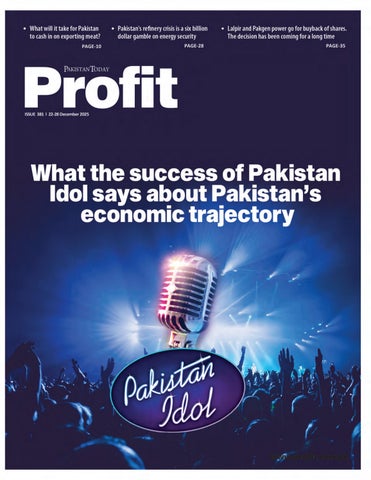
10 What will it take for Pakistan to cash in on exporting meat? 14 What the success of Pakistan Idol says about the country’s economic trajectory
20
20 What Maple Leaf’s $400 million acquisition of Pioneer means for the cement industry 22 How some IPPs are evolving beyond power generation 24 TPL agrees to Jazz’s bid for insurance business 26 Systems’ acquisition of Confiz to be a share swap
10
32
28
28 Pakistan’s refinery crisis is a six billion dollar gamble on energy security 32 How serious is India’s water threat for Pakistan’s future? 35 Lalpir and Pakgen power go for buyback of shares. The decision has been coming for a long time
Profit Publishing Editor: Babar Nizami - Editor Multimedia: Umar Aziz Khan - Senior Editor: Abdullah Niazi Editorial Consultant: Ahtasam Ahmad - Business Reporters: Taimoor Hassan | Usama Liaqat Shahab Omer | Zain Naeem | Nisma Riaz | Shahnawaz Ali | Ghulam Abbass Ahmad Ahmadani | Aziz Buneri - Sub-Editor: Saddam Hussain - Video Producer: Talha Farooqi Director Marketing : Muddasir Alam - Regional Heads of Marketing: Agha Anwer (Khi) Kamal Rizvi (Lhe) | Malik Israr (Isb) GM Special Projects Zulfiqar Butt - Manager Subscriptions: Irfan Farooq Pakistan’s #1 business magazine - your go-to source for business, economic and financial news. Contact us: profit@pakistantoday.com.pk
WHAT WILL IT TAKE FOR PAKISTAN TO CASH IN ON EXPORTING MEAT? In its search for exportable products, the government has turned some attention towards halal meat. But are we really serious about promoting exports?
By Abdullah Niazi
T
he news coming out of Q Block these days is full of contradictions. On December 17, the Prime Minister and the Chief of Defence Forces received a detailed briefing on the state of the economy. The main agenda item was getting rid of Pakistan’s addiction to the IMF. With the ongoing bailout programme set to end in September 2027, the civil-military leadership seems unified in wanting to get this particular monkey off their backs. And why wouldn’t they? Pressure from different industries has been mounting to cut interest rates and ease trade restrictions. Economic governance in the country is little more than paper pushing the
10
directives of the Fund these days. But the government will not have a viable path out of the quagmire of the IMF unless it can somehow increase exports. Ahsan Iqbal, in his press conference after the briefing, did not mince his words: Pakistan would need to increase its exports by $20 billion in the next four years to $63 billion if it had any chance of making do without the IMF. The only problem is that Pakistan’s exports have been decreasing in recent times. During the July-November period, exports reduced by over 6% instead of showing any growth. The textile industry, which makes up Pakistan’s largest export sector with nearly 60% of total exports, has recorded four straight months of declining exports. The government likes to talk a big game about increasing exports, but most of what they say is hot air filled with
ridiculously outdated terms such as “breaking the begging bowl” and “roadmaps.” The government’s actions massively contradict their words. If exports really are the number one priority in Pakistan, then why did a transporters’ strike caused by hefty traffic fines cause trade at the Karachi port to basically come to a grinding halt for more than ten days? Textile exporters have already received notices from foreign clients informing them they will have to find alternatives to Pakistani companies. This attitude is pervasive in all corners of government. That is why one does not hold very high hopes for the recently approved Halal Meat Export Policy. A day after the all-important briefing, the PM approved the policy and directed relevant authorities to present a comprehensive, three-year strategy within two weeks, comprising measures to increase exports.
Pakistan is the world’s 10th largest producer of meat, with more than 5.2 million tonnes of meat produced annually. However, on the list of exporters, Pakistan only holds a 0.4% share of the total global market. While this is a very small portion of a global market worth $3 trillion, within Pakistan the significance of meat exports has slowly been growing — particularly in the GCC markets. Last year, Pakistan exported close to 130,000 tonnes of meat. Most of this went to the GCC because Pakistan is uniquely poised to provide halal meat. However, opportunities have been opening up with some Pakistani companies entering the Chinese market. Meat, it seems, can be one of a number of products that can help Pakistan achieve its export needs, but only if it is given the necessary environment.
Pakistan’s meat production
P
akistan produced around 5.809 million metric tons of meat in 2024, including 2.630 million metric tons of beef, 2.362 million metric tons of poultry meat, and 0.817 million metric tons of mutton. Most of the animals in Pakistan are slaughtered at unregistered and unregulated slaughter slabs, slaughterhouses, and abattoirs. Such facilities typically lack hoisting facilities, a lighting system, and a regular water supply. Hygiene standards are often ignored, while both wet and solid waste disposal are poorly managed. For exports, meat has to be prepared and stored in very specific facilities. These are severely lacking in Pakistan. The country has 34 Animal Quarantine Department-approved slaughterhouses that focus on exports for international markets. These facilities encompass imported machinery along with expert labour and accredited financing. According to the Board of Investment (BOI), these facilities are estimated to be operating at 25% to 40% of their peak capacity due to insufficient livestock raised for meat production and limited access of Pakistani meat exporters to international markets. The output of these facilities could be doubled or tripled if their access to international markets is enhanced. The export-oriented facilities follow stringent hygiene requirements and quality standards, including traceability of meat, unlike unregulated slaughterhouses. This increases their production costs, restricting their ability to compete in the domestic market, increase production, and diversify their portfolio, resulting in the concentration of meat exports in particular segments. Pakistan’s meat exports are limited to only a handful of markets that permit the import of its meat, despite the prevalence of FMD in its livestock. Pakistan’s export destinations
are led by six GCC countries, which include the United Arab Emirates, Saudi Arabia, Qatar, Bahrain, Kuwait, and Oman. These countries account for $444 million (92.7%) of Pakistan’s total meat exports, while 88% of Pakistan’s meat exports are concentrated in the category of fresh or chilled carcasses and half carcasses for both beef and mutton, with beef and mutton representing shares of 82.3% and 17.7%, respectively. The country’s proximity to the GCC gives it a competitive advantage in supplying halal fresh and chilled carcasses at a reasonable rate to the region. Moreover, Pakistan is increasingly exporting its fresh and chilled meat to the region through sea rather than air in order to be more competitive in the segment. As per the estimates of 2021 by the Pakistan Business Council, air freight of fresh and chilled meat to the Gulf costs around $1 to $2 per kg, while sea shipments cost only $0.2 per kg. Pakistan is the largest supplier of fresh or chilled bovine meat to the GCC countries, controlling a market share of around 45%. Fresh or chilled carcasses of bovine meat exported to GCC countries amounted to $348.417 million, approximately 72.7% of the total meat exports of Pakistan in 2023. Nevertheless, this moat is limited to the segment of bovine meat products that have not been processed further, like carcasses, half carcasses, and cuts with bone in. Pakistan has no share in the space of boneless fresh or chilled bovine meat segment. When it comes to frozen meat, Pakistan has limited operational capacity. Moreover, since frozen meat has a longer shelf life, it is feasible for countries to import from anywhere in the world, disarming Pakistan of its advantage of being in the vicinity of the GCC. Local meat processors in Pakistan fail to outdo their international competitors like Brazil and India due to high production costs led by high costs of animal sourcing and low meat
yield. According to estimates, Pakistan’s production costs are $4/kg for exports of frozen meat, whereas India produces the same products at $3/ kg. The price competition is even more intense in the frozen market segment. The country managed to only export frozen meat worth $11.276 million to the GCC region and $26.954 million across the globe in 2023. Frozen bovine products amounted to $25.528 million (94.7%) out of the total and were primarily supplied in the form of carcasses and boneless meat, which held shares of 51.2% and 34.8% of the total frozen bovine meat exports. Apart from that, Pakistan also managed to export frozen mutton products worth $1.426 million, which was dominated by the boneless category, making up 88.6% of the total frozen mutton exports.
The roadblocks
B
ut meat exports have some serious problems in Pakistan. Despite being a major producer of meat, with an output of 5.809 million metric tons in 2024, the country’s export potential remains largely untapped due to structural issues plaguing the sector. These challenges range from the absence of a robust livestock traceability system to the prevalence of Foot and Mouth Disease (FMD), and from the lack of large-scale feedlots to the persistence of informal, undocumented supply chains. However, amidst these obstacles, a ray of hope emerges in the form of Pakistan’s strategic geographical position and its growing presence in niche markets. The country has carved out a significant market share in the Gulf Cooperation Council (GCC) countries, particularly in the fresh or chilled bovine meat segment. This success, while noteworthy, also highlights the need for diversification as global meat consumption trends shift towards frozen and processed
TRADE
products. Numerous structural roadblocks hinder the growth of Pakistani meat exports. The first one is the traceability of livestock. It is an arduous task to trace animals due to the absence of a basic tagging system along with a national livestock database. Farmers in Pakistan are not interested in meat production on a mass scale; therefore, they are reluctant to purchase expensive tags and related equipment. Moreover, the development of infrastructure for a tagging system needs substantial investment, which would increase costs of meat production significantly, leading to lower profit margins specifically for small-scale farmers who work informally. The entire meat value chain in Pakistan is, for the most part, undocumented, informal, and highly fragmented, governed by an archaic arthi-based system, which further complicates the task of traceability, due to the unavailability of animal sales records and history of animals like birth, vaccinations, and genetics. Secondly, Foot and Mouth Disease (FMD) is prevalent across livestock in Pakistan due to flimsy veterinary infrastructure, which fails to cater to livestock in rural areas, where most of the livestock is concentrated. Furthermore, the lack of a national FMD control programme, scarcity of disease-free zones, and inadequate ability of the government to track livestock have exacerbated the situation. High-income markets like the United States, European Union, and Japan require meat-exporting countries to demonstrate that they are a country free of FMD or have contained the spread of FMD through stringent controls; however, in the case of the latter, the country needs to ensure that the meat exported is only from FMD-free zones and complies with food safety standards like HACCP (Hazard Analysis Critical Control Points). Since Pakistan fails to meet these standards, its meat exports to these markets are minimal. Thirdly, farmers in Pakistan only sell livestock for meat production when it is unable to work in the fields and its milk yield falls to negligible levels. Therefore, there is a dearth of largescale feedlots or fattening farms. Furthermore, most of the country’s native breeds constitute milk breeds, which have poor feed conversion rates, resulting in low average carcass weight and low meat yields. The average carcass weight in Pakistan is 130 kg/animal, therefore, slaughtering the buffalo would only get the farmer Rs. 130,000, while an average buffalo produces milk for a decade, resulting in earnings above Rs. 2.5 million for the farmer. Lastly, we observe rampant smuggling of livestock across the border into neighbouring countries, Iran and Afghanistan, which reduces its supply in the domestic market, resulting in increased prices of livestock in the country. The
12
government imposed a complete ban on the export of live animals in July 2013 to stabilize the prices of live animals in the domestic market; however, the ban has had little to no impact on the smuggling of live animals.
The TOMC model — expanding beyond the GCC
T
here are some examples in Pakistan that are worth emulating. Although Pakistan has historically struggled to enter the Chinese meat market, the Organic Meat Company Limited (TOMCL), a publicly listed company involved in the processing, sale, and export of halal meat and related products, succeeded recently. TOMCL became the first Pakistani company to be granted approval by the General Administration of Customs China in October 2023 and managed to ink a contract of $12 million to export frozen cooked beef meat to China in 2024. Its initial consignments of frozen cooked beef meat have received positive reviews. The exports to China accounted for 2.1% of the total revenue of the company during 9MFY24. It is indeed a significant development as the company’s revenue stood at only $22.89 million in 2023. This endeavour will not only allow the company to scale its business verticals but also enable it to establish its footprint in an international market like China, which has a growing demand for frozen cooked beef meat products. This partnership perfectly aligns with Pakistan’s meat export strategy and the company’s vision of diversifying its meat products and expanding into new markets. Assuming the company’s entrance into China will enable it to continue its growth in exports and local sales at breakneck speed, which would have slowed down otherwise, the company’s
revenue and net income are expected to reach Rs. 32.6 billion and Rs. 1.1 billion by 2029.
So what do we do?
T
o truly unlock the potential of Pakistan’s meat industry, the government must focus on key areas that can create an environment conducive to growth. First, the government should establish financing opportunities for meat processors and exporters to upgrade their facilities and improve production capacity. Grants or low-interest loans could be provided for the establishment of modern slaughterhouses with necessary equipment to meet international standards. Second, the creation of proper storage and cold chain facilities is crucial for both fresh and frozen meat. The government must incentivize the private sector to build modern, temperature-controlled storage facilities to ensure that the meat remains fresh and reaches international markets in optimal condition. Third, diplomatic support must be strengthened to open new markets, especially those that require stringent health and safety standards, such as the European Union, the United States, and Japan. Bilateral trade agreements should include clauses that provide preferential access for Pakistan’s meat products while addressing FMD concerns through joint vaccination programmes and increased veterinary support. Finally, the government should streamline the process of doing business for meat exporters by simplifying regulations, reducing bureaucratic hurdles, and providing incentives for producers to formalize their operations. It is only through these concrete actions that Pakistan can genuinely start to compete in the global meat export market and achieve the necessary export growth to break free from reliance on IMF assistance. n
TRADE
What the success of Pakistan Idol says about the country’s economic trajectory
14
The business model captures lessons from recent successes, and the contestants are capturing a hinge moment in Pakistan’s economic trajectory
COVER STORY
By Usama Liaqat
Y
ou might have come across reels on Instagram featuring a strangely childlike, haunting voice singing Jis Din Se Piya Dil Le Gaye, a 1956 Madam Noor Jehan classic. The sound in some of these reels has been transposed on graphics depicting the loneliness of someone whose sight haunts the distances as the past slowly rises in their chests. Some of these reels even feature Eminem, Peter Griffin, or Batman, all in poses solitary and contemplative of loss and dolour. The Batman in one of these, to give you an idea, is sitting transfixed in a raining parking lot, his mind borne elsewhere on this voice that seems well-suited to ponder the evanescence of things. In other reels featuring the same voice, you might see the singer herself: a 23-year old, bespectacled girl from Layyah, whose voice as it lilts finds a hypnotic conductor in her expressive right hand. Rawish Rubab is one of the many singers in the current edition of Pakistan Idol, whose renditions of classics of Pakistan’s music industry has won both them and the almost-forgotten music new fans. This season of Pakistan Idol started with much hype. It was being broadcast over multiple TV channels. Clips of its performances were being regularly uploaded by its official YouTube channel, gaining massive reach. At the same time, the episodes were available to stream both live and post-broadcast on Begin, the first well-funded entrant in Pakistani domestic streaming services, for free. But most of all, it was the return of the Idol franchise to Pakistan. People who are routinely astonished at the realisation that people born in 2007 can now legally vote and drive would remember well the craze Indian Idol had on Pakistani TV screens in the 2000s. They might also remember the last iteration of Pakistan Idol, which was broadcast in 2013-14 to great popular acclaim, and the decade-long drought since. There was good reason, then, to hail this renaissance. It’s what this Idol stands for that is a big part of it: a celebration of our musical heritage, which introduces younger and newer voices to be the custodians of that tradition. The newer forms of media, especially social media, have catapulted these singing performers – even though the show hasn’t ended yet – into mini stardoms of their own. But what is behind this season? What are the different arrangements behind the scenes, and how is this edition of Pakistan Idol capitalizing on changing economies surrounding the smartphone and internet usage as well the music industry? And most importantly,
16
how has this edition of Pakistan Idol managed to capture the collective national imagination in ways that previous iterations have not?
The Idol format and its origins
I
n 2001, Simon Fuller, a British TV producer and talent manager, came up with a reality singing show format. Inspired by a New Zealand show, Popstars, Fuller was the mind behind the first season of the Pop Idol, for the UK. The idea was to give a platform to young singers who did not really have a career in music, who had not signed any record deals yet, and enable them to reach mass audiences. These select few were chosen after extensive auditions, where ordinary people who felt they had a knack for the song could try their luck. Once selected, the singers were supposed to perform in various rounds, each with its own themes and challenges. Gradually, with these rounds, the singers got eliminated, and the contest boiled down towards the end to a handful of finalists. Of this crème de la crème was chosen the winner – a much-vaunted honour since it meant not only monetary prizes, but also a recording deal which would help kickstart their professional careers. A distinguishing part of this format – that perhaps was the key determinant in its undeniable success – was the involvement of the audience, as well as the general population, in the show. Their votes determined in part who was eliminated, who proceeded to the next round, and ultimately who the winner was. This was not simply a clever ploy to boost ratings, but to really engage the audience in a project that was to shape the way music was listened to and interacted with in their communities. The Idol was on the lookout for stars. That would mean someone who was a great singer, of course, but also a little more: someone who was charismatic and entertaining, someone who people could identify with, someone who could look like they were the future of music. This was entertainment, after all. Many were the singers it catapulted into fame. Those who heretofore were unknown became household names. This exposure was valuable since it wasn’t always necessarily the one who won, who would go on to have the best or the strongest career. For example, Jennifer Hudson, who came 7th in the 2004 edition of the American Idol, went on to become a rare EGOT, by winning the four major awards in American entertainment industry: Emmy, Grammy, Oscar, and Tony The potential in this show format, therefore, was great. Owned by Fremantle Limited – a media production and distribution company behind successes such as the Got
Talent and the X Factor format shows – the rights were gradually sold to other countries. Over 56 countries went on to produce their own versions of Idol, including the United States, South Africa, the Netherlands, Indonesia, India, and Pakistan. In Pakistan, the first edition was produced and broadcast by Geo Network in 201314. Although the rights had been secured years ago, production issues – essentially making the necessary arrangements for the complex adherence to the format’s demands – meant that it was six years before the show finally hit the TV screens. Although the show was marred by controversies – especially regarding the caustic attitude of the judges – it went well overall. The public participated, the singers sang, and a winner arose.
Rebirth in Pakistan
S
ince 2014, the format had vanished from Pakistan TVs, and all remnants of the show were to be seen only in pixelated videos ripped from TV broadcasts, and available on YouTube. The singers fell out of the public gaze, and only occasionally would someone comment on a video of their favourite singer from years ago, proffering thoughts on the eventual result, how their favourites were criminally underrated and deserved more recognition, and so on. It became a long exercise in nostalgia. Until over a decade later when promos featuring the new judges were released. The public was hooked, though pleasantly surprised. The show was finally back, and the years of yearning for some popular TV entertainment that was not TV dramas was finally over. The season 2 of the Pakistan Idol was here. The bidding process was led by Merchant Holdings Ltd (MHL), a media house owned by the industry veteran Raihan Merchant and which is the main investor behind this bid, and 313 Productions, a newly-launched production house owned by Badar Ikram, the erstwhile Head of Hum Films and a Senior Vice President at Hum TV, with an earlier stint as Managing Director of Geo TV and Aag TV. While MHL would assume the office of the executive producer, it was to Badar’s 313 Productions that the on-ground task of production fell. Speaking to Profit, Badar explained why they had pitched to Fremantle about the resurrection of the Pakistan Idol. “There was a gap in the market,” he says. “The current entertainment landscape is 99% drama. But, music resonates with young people, and the channels weren’t doing anything regarding that, so we stepped in.” After working out a proposal that
detailed how the complicated arrangements were to be carried out, as well highlighting the potential in the market, they were able to win Fremantle over. The contract they signed was for 3+2 years, i.e., 3 years of production with potentially 2 more where the buyers reserved the rights of refusal. So, evidently, this is a plan to kickstart the rise of the most popular format show in the world in Pakistan, and give a boost to its diabetic music industry. Part of the show would be overseen by Fremantle to ensure compliance with its requirements as the rights holder of the Idols franchise, which would include, among other things, the make and feel of the studio as well as the shape of the production plans. The on-ground production and compliance with Fremantle’s SOPs, as Badar mentioned, has many challenges of its own. There are a lot of moving parts. The live bands must be managed. Rights for the music need to be obtained. Contestants too need to be managed. Different sets for different stages of the contest also need to be constructed, each set with different dimensions and design. At the same time, at the scouting stage there were even questions regarding whether they would be able to attract enough talent, especially female contestants. But, according to Badar, it is all going well, and Fremantle “are very happy with us”. Part of the reason is that these guys are dedicated and driven to revive the live entertainment format show, but also because this is a multi-pronged effort with many partners. For example, 313 is co-partnering with NJ Media, a “boutique production house” led by M. Nadeem J. This partnership is responsible for handling the TV media side of things, including the shoot, logistics management, as well as the music production. A partnership with Big Idea is responsible for creating the graphics, while Zong and Begin are used to handle the voting process. There are also PR partners working to tell the stories of the contestants. These include platforms such as Fuchsia Magazine, which has been interviewing candidates on its YouTube channel. This last part is one of the most important parts in the bid to expand the influence of the Idol. Badar emphasized the need of the audiences to relate with and empathize with the contestants, to buy into their stories, and become their “fans”. This, when it happens, would be the tipping point in the journey of Pakistan Idol, since with it comes not only broad influence, but also the monetary rewards the organizers hope to reap. But, this latter aspect, Badar insisted, was less of a priority than really making the contestants performers and household names, with fandoms of their own. As he said, “It is not how much the show is viewed, but rather
how much it is loved”. The show, therefore, is dependent – like other such shows – on how many people can access it. And here the organizers were able to extract a couple of clauses in the rights contract with Fremantle which were without precedent in the history of the Idols format. One concerned the broadcasting system that will be used in this edition, and the other dealt with the permissibility of remote auditions in the pre-screening phase.
The Idol comes to you
W
hen the previous iteration of the Pakistan Idol aired, it was broadcast primarily on one media channel: Geo TV. And that has been the tradition in the Idol’s history. Only one TV channel is given the rights to broadcast the show to anticipating audiences. But the team behind this season of Pakistan Idol were able to convince Fremantle to abandon this strict tradition. The show was now to be broadcast in a syndicate model, with production being overseen by MHL and 313 Entertainment, but being distributed on seven different TV channels: Geo Entertainment, Express Entertainment, GREEN Entertainment, PTV Home, AUR Life HD, Aan TV, and BOL Entertainment. While this would imply that none of the individual TV channels has a reach of its own to satisfy the distribution demand of the organizers, it also speaks to the changes in the TV channel industry, where the market once dominated by a few channels is being disrupted by newcomers and smaller channels, each carving niches of their own. At the same time, the show is also being streamed live on Daraz, Tapmad, and Begin TV. The latter is a streaming app owned by MHL,
based in Dubai, and launched in 2023, which allows post-broadcast access to the shows as well. While the earlier episodes are free to watch on Begin, there are plans to put the later episodes behind the paywall. But the real opportunity these streaming services offer is that it enables the show to be directly broadcast to international audiences, including India, where apparently the market is huge. One only has to go to the comments section of any of the videos put out by the Pakistan Idol YouTube channel to see people from across the border rooting for their favourite candidates and proclaiming the musical talent Pakistan has to offer. Speaking of YouTube, the Pakistan Idol channel, which currently has 151,000 subscribers, regularly puts out videos of the contestants’ performances – timed almost perfectly to when they are being streamed live on the various broadcast avenues. The videos have been viewed a total over 57 million times, while the most watched video remains the Girls’ Medley in the Gala Round which has been viewed over 3 million times. These numbers are lower than comparable statistics for Coke Studio Pakistan (17.3 million subscribers, popular videos routinely crossing 100 million views), but that show has had about 17 years to build an audience. Pakistan Idol is just getting started. Other than YouTube, Instagram has also emerged as a key part of this strategy to make the contestants famous. While some of the contestants have their own Instagram pages, where they interact with the fans, much of the music they have sung has also found its way into reels, an odd form of honour. Often the contestants also post backstage videos of them interacting with each other, having fun, and becoming friends.
There are also plans to launch the Idol performances on Spotify, with talks being currently held with several music labels to make that a reality as well. At the same time, there has been a general – gradual, but sure – shift away from TVs to mobile phones which provide 24/7 access to content. A recent survey conducted by Gallup Pakistan, revealed that more 54% of Pakistanis now owned a smartphone, surpassing the percentage of people who own TVs (46%). While smartphones dominated urban residents and the younger segments of the population, TV found more purchase in rural areas and the older generations. It is in these forms of social media, which are more likely to attract younger audiences, that the show will find independent marketers and bona fide reach-makers. Once the Idol regains its place in the local cultural lexicon, and as social media consumption continues to rise, it will likely snowball into its own mountain.
The internet show
T
he second major unprecedented concession that the organising team was able to obtain from Fremantle was the allowance of online auditions in the pre-screening phase. The concerns behind this demand were regarding the mobility of people from far-flung areas, as well as to make it easy for female participants to participate, who won’t have then to stand in thousand-souled queues just to be screened for audition before the judges. Of course, the shortlisted candidates from these virtual auditions would still have You might have marvelled at the professional and refined audition rounds this time, quite unlike the raw, often idiosyncratic characters with every sort of odd performance that were the stuff of conversation in the Idol editions of yore. Now you know the reason behind it. Pushing for remote auditions was also an effort to leverage the expanding internet coverage in Pakistan. With the ever-increasing smartphone ownership in Pakistan – across classes and regions – the internet has seen a similar rise in reach. Assisted by the (comparatively) low-price of locally produced phones, and the cheaper broadband internet packages, mobile internet has seen rapid rise in Pakistan. Official statistics by the Pakistan Telecom Authority reveal that as of October 2025, there are 148 million mobile broadband subscribers in Pakistan, while the number of regular broadband subscribers is 152 million. Assuming that there isn’t a totally neat overlap between these two groups of internet users, the total number of internet users in Pakistan is a significant proportion of the 250 million population.
18
This conquering horde of smartphones on their broadband couriers is quickly conquering the country. And therefore, there was a double opportunity for the organizers of Pakistan Idol to leverage that. The first was obviously to increase the pool of potential contestants, by making the conditions for participation easier so that excellent and diverse talent would not have to face too many hurdles to access this opportunity. The second concerns the revenue side. Social media has great potential to bring in bucks as evinced by the case of Hum TV, in whose share of revenues, YouTube has seen a rise in the share of their total revenues, reaching 17.7% in 2024. This was actually a dip from the record high 25% in 2023. This dip was not due to a fall in revenues, but due to the size of the total pie being increased with the acquisition of Ten Sports. However, as Badar pointed out, the monetization from these views does not start until at least six months have passed. So, currently while there are no proceeds for the Idol organisers from these views, the situation will surely change. It is only a matter of time. In fact, this is a part of the plan. According to Badar, such multi-year contracts are not profitable in the first year, but only start to pay dividends later. In the first year it grants them the necessary infrastructural and technical clarity and makes them a national name. The cash comes in later. In all this, the revenue from these social media posts will soon become a more important part of the digital revenue. It is, after all, where the show’s key target audience – the younger generations – gets their fix, and where they haunt all their days and nights.
In musical context
I
n all this, we can see how the traditional models of making money are being supplemented with newer internet-focused means, and how the timing for the revival of Pakistan Idol is just right. In the 1990s and 2000s, virtual musical entertainment for the public was mainly concentrated on TV channels that were dedicated to music, as well as the broadcast of international music contest shows, especially from India which included the Indian Idol, but also joint Indo-Pak musical contests such as Chhote Ustaad. The channels dedicated to music included names like ARY Musik, 8XM, Oxygene, and MTV Pakistan. The key way of making money here was through the sale of broadcast rights as well as broadcasting. Although there was a considerable audience, especially for the musical contest, the reach was limited by access to the medium. Those who had the TV could watch it, and those who did not mostly could not. At the
same time, the content could only be viewed at certain times, and there were great barriers to sharing and building communities surrounding the music on TV. These were followed – though there was a considerable overlap – with the development of musical ecosystems that saw and capitalized on the opportunity presented by the internet. These would include shows like Coke Studio and Nescafe Basement, a major bulk of whose viewership was through online social media, primarily YouTube. Supplemented by the rise of streaming services such as Patari, and later Spotify, these relied majorly on digital revenue streams to make money. Beside the obvious consequence of these platforms encouraging local musicians to produce music, and providing some opportunities for them to make their big or first break, these also laid down two different ecosystems. One geared towards the TV, the other towards the phone. The first platform to really capitalize on the possibility that these two did not need to be kept separate but together could open new opportunities to drive engagement and revenues was the second season of the Pepsi Battle of the Bands. Released in 2017, the Battle followed a syndicated format along with mechanisms for online viewing and posting of the shows. At the same time, the processes have become more streamlined, since there are now precedents to learn from and improve upon. While TV ads that are run during commercial breaks might be cheaper, the advertisers like to have their products be a part of the show itself. One only needs to remember the Tapal Tea Moments during cricket matches in Pakistan to remark at what has become almost a standard practice across the entertainment industry. In a show like Pakistan Idol, for example, which is also relying on proceeds from online media platforms, such advertising opens up newer modes of partnerships between the producers and the sponsors. For example, we see how on YouTube, some of the latest videos uploaded by the Pakistan Idol official channel also show EcoStar as one of the collaborators in the media, something unprecedented – at least at this scale – in the Pakistan music industry. This would obviously not only bring in money for the organizers, but also enable sponsors to expand their reach in newer ways, that might bring them more visibility. Pakistan Idol therefore finds itself in a moment rife with opportunity. Building on and refining a developing ecosystem, they have come up with an ambitious plan to revive what is the biggest musical show in the subcontinent. Currently with a 40-episode plan, each with its own themes and musical and performative
TEXTILES
requirements, it is surely an ambitious project. But with what we have seen until now – the production quality, the calibre of the contestants, and the expanding reach on social media – they are likely to pull it off, and usher in a new chapter in the musical annals of Pakistan.
Why the show resonates now
B
ut perhaps even more than the sophistication with which the producers have launched the show is the hinge moment in Pakistan’s cultural and economic history in which the show is being launched. The songs being sung are often from a past Pakistan that was poorer, sadder, and generally more dominated by themes of struggle. The present - embodied by the show’s contestants - may be from varying socioeconomic backgrounds, but there is more hope in their own futures. A moment that captured this more than most was during the auditions in Sukkur. The
contestants were dressed very simply, in clothing one imagines was not too different from what they were at home on most ordinary day, a reflection of still small disposable incomes in most households. Tariq Ali, one of the contestants from Jacobabad, had a high fever from malaria, an illness that mostly exists when the public sanitation infrastructure has not yet been built up in large parts of most cities in Pakistan. But he and his fellow contestants stepped onto stages that were the modern Pakistan: with lighting, backdrops, and sound that would not be out of place in a developed economy, judges dressed in clothing that was more elevated - and perhaps a bit costlier. As they sang their hearts out, whatever the themes of their songs (and some of them are rather sad ones), one felt a sense of hope and joy: hope for the contestants coming from the most ordinary homes in ordinary streets in Pakistan and their ability to rise above where they were born, and a small amount of joy in knowing that the economy has developed to a
point where the size of the pie is large enough to support serious careers for many, if not most, of these aspiring artists. There are the interviews with parents who are encouraging of their children’s aspirations for careers in the performing arts, something that was virtually unheard of in the 1990s, because again, there is an understanding this economy has room for more than just traditional careers in things like medicine, engineering, business, or government. Artists in Pakistan can not just make money, but have reasonably financially stable lives even without outstanding success. We watched the show and saw the faces of Pakistan, and rather liked what we saw, perhaps in ways we were not expecting, and that serendipity sparked joy. For all the views and online comments from outside the country, Pakistan Idol is fundamentally a conversation Pakistanis are having with ourselves, about our past, our hopes and dreams, and a nervously optimistic outlook for our own future. n
COVER STORY
What Maple Leaf’s $400 million acquisition of Pioneer means for the cement industry
Continuing the recent trend of consolidation in the cement sector, the transaction will establish a highwater mark for valuations
M
aple Leaf Cement Factory Limited’s move to buy control of Pioneer Cement is shaping up to be one of the most consequential corporate actions Pakistan’s cement sector has seen in years – both because of the scale (an enterprise value around $400 million) and because of what it signals about where valuations may settle in an industry navigating weak domestic demand, high financing costs, and intensifying competition. Maple Leaf Cement Factory Limited (PSX: MLCF) has disclosed an acquisition price for Pioneer Cement Limited (PSX: PIOC) of Rs478.43 per share, a price that (based on analyst calculations) implies an enterprise value of around $400 million for Pioneer. Maple Leaf is pursuing a controlling stake, with an intention to buy at least 58.03% of Pioneer Cement and assume control. Regulators have also begun to weigh in. The Competition Commission of Pakistan (CCP)
20
has cleared Maple Leaf’s acquisition of additional shares in Pioneer Cement, concluding the transaction does not materially lessen competition or create a dominant position in the relevant market for grey cement. From the buyer’s side, the strategic logic is straightforward: Pioneer Cement is a sizeable northern producer, and combining it with Maple Leaf meaningfully boosts Maple Leaf’s footprint in the region where pricing and utilisation dynamics are generally stronger than in the south. The financing plan being discussed in the market is just as notable as the operational logic. The research note estimates Maple Leaf would need roughly $271 million (Rs75–76 billion) to fund about 70% acquisition (broken down as 58% from a major shareholder bloc and 11.7% from the public, per the analyst’s framing). The deal is likely to be executed largely as a leverage buyout, with MLCF accessing an approved lending facility of about $200 million from an international lender and parallel
efforts to raise around Rs70 billion from local banks. In other words, this is not just a capacity play – it is also a capital-structure event, and the balance between debt and equity funding will determine how quickly the combined entity can translate operating cashflows into higher shareholder returns. The headline numbers are attention-grabbing for a reason. At Rs478.43 per share, the deal implies an enterprice value per ton (EV/Ton) of ~$76.9 (based on Pioneer’s 5.2 million tons capacity) and an enterprise value to earnings before interest, taxes, depreciation and amortization (EV/EBITDA) of ~9x (using an estimated LTM EBITDA of Rs12.6 billion). These metrics stand above what many investors have come to view as the “going rate” in the sector, particularly when domestic volumes are soft. The same research note flags that a separate, still-unfinalised transaction in the market – Attock Cement (ACPL) – was being discussed at Rs300–350 per share, translating (again, per the analyst’s calculation) into
EV/Ton of $43–48 and EV/EBITDA of 8–9x. That comparison matters because it reinforces a long-running sector reality: northern assets tend to command a premium. The note attributes that to the fact that the north caters to the bulk of the country’s cement demand – estimated at 80–85% – and generally sustains better domestic utilisation. There is also a longer historical benchmark that still shapes boardroom expectations. In 2015, Lafarge sold its Pakistan cement operations to Bestway at an enterprise value of $329 million, a deal that – given Lafarge Pakistan’s capacity at the time – translated into an eye-watering EV/Ton of roughly $130–140, according to the analyst note. That enterprise value figure is also echoed in Lafarge/Holcim’s own announcement of the transaction. Another way of thinking about the Pioneer valuation is to compare it to replacement cost – what it would cost to build similar capacity today. The research note estimates Pakistan’s brownfield replacement cost at roughly $50–60 per ton and a greenfield build at $90–100 per ton. Pioneer at ~$77/ton sits above brownfield replacement economics (suggesting “scarcity value” and the advantage of buying an operating platform), but below greenfield replacement economics (which is often the ceiling used to sanity-check aggressive bids). This is why analysts are calling it a potential highwater mark for valuations: it sets a fresh reference point that other sellers (and boards) can cite – especially for well-located northern assets with integrated plants, captive power, and reliable limestone. Maple Leaf Cement is one of the sector’s established names, and its corporate history stretches back to the early years of Pakistan’s industrial development. In its FY2024 annual report, the company describes itself as part of the Kohinoor Maple Leaf Group and notes that it was formed in 1956 through a collaboration between the West Pakistan Industrial Development Corporation and the Government of Canada. Operationally, Maple Leaf highlights a scale advantage that few local players can match at a single site. The company says it operates four production lines for grey cement and one line for white cement, and reports total installed clinker capacity of 7.8 million tons annually, with a clinker production capability of 26,000 tons per day at its facility. Two points from the company’s own positioning stand out in the context of consolidation. 1. Geographic reach and exports: Maple Leaf markets across Pakistan and reports exports to Afghanistan, the Middle East and African countries. 2. White cement franchise: Maple Leaf
claims it holds more than 90% market share in white cement – an important differentiator in a largely commoditised grey cement landscape. That said, even scale leaders have been bruised by the macro cycle. Sector-wide dispatch data over the past year has pointed to a market leaning more heavily on exports to offset slower domestic off-take. For example, reporting on APCMA numbers has shown domestic dispatch weakness alongside stronger exports in certain periods. Against that backdrop, acquiring Pioneer is a way for Maple Leaf to expand scale in the same broad geography where it already has a premium brand presence – rather than attempting to “build through the cycle” with a new plant that could take years to commission and ramp. Pioneer Cement, for its part, is not a small bolt-on. It is a substantial northern producer with a long operating history and an asset base built around the core input advantage that still matters most in cement: limestone. In a corporate briefing document, Pioneer notes it was incorporated in 1986, is listed on the Pakistan Stock Exchange, and has its plant located at Jauharabad, Khushab, an area it describes as having some of the country’s finest limestone reserves. The same briefing reports installed annual cement capacity of 5.2 million metric tons. Public profiles of the company also emphasise its investments in captive and efficiency-linked power infrastructure – critical for margins in a country where grid reliability and energy pricing volatility remain persistent operational risks. Business Recorder reporting notes Pioneer has made investments in a 12MW waste heat recovery plant and a 24MW coal power plant, and operates multiple production lines in Punjab. Pioneer’s capacity build-out over time – including the commissioning of a large integrated expansion project – has been tracked by specialist industry media as well, underlining that the asset being bought is not just “capacity on paper” but an operating platform that has already absorbed the heavy lifting of construction and commissioning risk. For Maple Leaf, the appeal is not only the extra tons. It is also the option value: optimising logistics, sharpening the combined entity’s pricing discipline, and using the enlarged footprint to better manage export flows when domestic demand is weak. This transaction lands in a sector that has been slowly, steadily consolidating – driven less by exuberance and more by necessity. Pakistan’s cement industry has spent the past couple of years dealing with soft domestic construction activity, high interest rates and tighter credit, and public spending constraints, which can dampen infrastructure-led cement
demand. Dispatch data reported by industry trackers has repeatedly highlighted sharp yearon-year swings and periods of notable declines, particularly in domestic volumes for certain regions. In that environment, consolidation becomes a rational response. Larger platforms can more easily withstand periods of low utilisation, negotiate better energy/fuel procurement, allocate volumes between domestic and export markets, and defend margins through operating efficiency. The sector has precedent for landmark consolidation events. The Bestway–Lafarge Pakistan deal is still the reference point for what a “strategic premium” can look like, with Lafarge’s own group disclosure putting the enterprise value at $329 million. More recently, other combinations and control transactions have reinforced the theme that Pakistan’s industrial groups are comfortable pursuing scale in cement when the asset quality is right. A prominent example is the merger of Fauji Cement and Askari Cement, which has been analysed in the local business press as a major consolidation among large producers. And the consolidation story is not limited to cement-on-cement combinations. The proposed joint acquisition of 84.06% of Attock Cement by Fauji Cement and Kot Addu Power Company (KAPCO) is another sign that cash-generative corporates – sometimes even outside the sector – see cement as a strategic destination asset when pricing is attractive and the platform is credible. What makes Maple Leaf’s proposed acquisition of Pioneer especially consequential is that it sits at the intersection of three themes: 1. A premium northern asset: The deal’s valuation implicitly endorses the “north premium” thesis in a way few public datapoints have recently. 2. A financing-led play: If executed as a heavily debt-funded deal, it becomes a test case for whether Pakistani corporates can responsibly lever up for industrial consolidation and still deliver equity value through disciplined deleveraging. 3. A new valuation anchor: The note explicitly contrasts Pioneer’s implied valuation with both a “current sector EV/ton” baseline and other recent deals, suggesting this transaction could reset expectations across listed names. If the acquisition closes at or near the disclosed terms, boards and controlling shareholders across the sector are likely to cite it the next time an asset comes to market – especially in the north. That is why market participants are already describing it as more than just a corporate action: it is potentially a valuation event for the entire industry. n
CEMENT
How some IPPs are evolving beyond power generation Using their robust cash reserves, some power companies are investing in other business lines, including car assembly and acquiring cement manufacturers
F
or years, Pakistan’s listed independent power producers (IPPs) have been treated by many investors as “bond-like” equities: predictable contracts, a single buyer, and (when the system pays on time) reliable dividend cheques. But as the country tightens the terms under which it buys electricity – and as demand patterns are reshaped by rooftop solar – some of these same companies are being forced to behave less like steady utilities and more like opportunistic holding companies. A recent equity research report published by Arif Habib Ltd, an investment bank, focused on three such names – Kot Addu Power Company (KAPCO), Nishat Power (NPL) and Nishat Chunian Power (NCPL) – argues that diversification is now acting as a catalyst for re-rating, after years in which investors discounted the sector because of tariff adjustments, contract uncertainty and circular-debt risk. The report points to a striking market reaction: NPL and NCPL shares rising sharply after entering the auto segment, and KAPCO moving higher after signalling interest in buying into cement. The two Nishat Group IPPs, NPL and NCPL, have approved equity investments of up to Rs2 billion each – described as equivalent to 33% stakes – plus one-year working-capital loans of Rs500 million each in NexGen Auto, a vehicle venture that plans to bring “new energy vehicles” to Pakistan under the Omoda and Jaecoo brands. The companies have framed it as a long-term portfolio investment: NPL has sought shareholder approval for a package combining equity and a working-capital facility, and has said NexGen Auto is preparing local CKD assembly with Chinese partner Chery Automobile to introduce Omoda and Jaecoo in Pakistan. KAPCO’s pivot is different – and arguably bolder in ticket size. It has been linked to a consortium bid to buy the Pharaon Investment Group’s controlling stake (84.06%) in
22
Attock Cement Pakistan Ltd (ACPL), an acquisition that would move KAPCO decisively into heavy industry at a time when its own long-term power revenues are far less certain than they once were. A public-announcement trail around the deal indicates the original “intention to acquire” involved KAPCO and Fauji Foundation, with subsequent reporting suggesting Fauji Cement (FCCL) later replaced Fauji Foundation as joint acquirer alongside KAPCO. Underpinning both moves is the same feature: cash. Recovering receivables and strengthening balance sheets – with NPL and NCPL collecting overdue amounts and KAPCO reducing trade receivables sharply while also eliminating short-term debt – leave these former power pure-plays with the liquidity to pursue opportunities outside electrons. Nishat Power is listed on the Pakistan Stock Exchange and is part of the broader Nishat Group ecosystem. Its core business is operating a fuel-fired power station with a gross capacity of 200 MW at Jamber Kalan, Tehsil Pattoki, District Kasur, Punjab. That single-asset simplicity has historically made the company easy to value: earnings and dividends were ultimately a function of dispatch, tariff mechanics and the government’s payment behaviour. But the same concentration now magnifies regulatory risk. The market had long overlooked NPL despite cash and dividends, largely because investors feared tariff re-openers and contract terminations. NPL’s non-power move is through NexGen Auto, where NPL and NCPL have approved up to Rs2 billion each in equity plus Rs500 million each in working-capital loans. Separately, NPL’s PSX-linked disclosure (as reported in the financial press) described the proposed structure as an equity purchase (Rs2 billion) plus a working-capital loan (Rs500 million), with NexGen Auto working on CKD assembly for Omoda and Jaecoo vehicles in partnership with Chery.
NCPL is another listed IPP with a similar footprint. Its core business a furnace oilfired power station with 200 MW gross and 195.722 MW net capacity, and notes it sells power under a long-term PPA with CPPA-G. NCPL is pursuing the same auto diversification as NPL, via NexGen Auto. KAPCO is one of Pakistan’s bestknown listed power names. Its core business is a multi-fuel fired power station with 15 generating units and a 1,600 MW nameplate capacity in Kot Addu, Muzaffargarh, Punjab. KAPCO’s diversification track is centred on cement. KAPCO (with a Fauji Group partner) has submitted a binding offer to acquire Pharaon Investment Group’s 84.06% stake in ACPL. The acquisition would be split evenly – roughly 42.03% each – and would confer joint control, with a public-offer process and regulatory deadlines shaping the timetable. This comes as KAPCO’s own cash position has improved. KAPCO’s trade receivables falling from Rs37.8 billion (Dec 2022) to Rs8.6 billion (Sep 2025), short-term debt reduced to zero, and cash of Rs39.7 billion – liquidity that provides room to fund “new projects and growth initiatives”. To understand why power companies are eyeing cars and cement, it helps to revisit what made Pakistan’s IPP model so lucrative – and why the state is now trying to rewrite the bargain. Most thermal IPPs in Pakistan operate under power purchase agreements (PPAs) where the buyer (today, usually CPPA-G as the central offtaker) pays not only for energy dispatched, but also for “capacity” – essentially, the availability of the plant even if the grid does not need the electrons. CPPA-G’s own training material explains that the Capacity Purchase Price (CPP) is a fixed payment made each period for each kilowatt of available (not dispatched) capacity, covering components such as return on equity, financing costs, fixed O&M, working capital and insurance.
That framework made sense in a power-short system: the state needed to attract capital quickly, and investors required protection against dispatch risk and currency volatility. But it also created a political economy problem: when demand underperforms, or when expensive plants are not dispatched due to fuel costs, the country still pays for capacity – and those bills compound into circular debt. By 2024, capacity payments had become a national flashpoint, with analysts arguing the government was forced into renegotiations under fiscal pressure and IMF-linked reform expectations. An IEEFA report described capacity payments reaching Rs2.1 trillion in 2024 and argued that overly generous PPAs – including payment guarantees, dollar indexation and high returns – contributed to Pakistan’s circular-debt burden. This has translated into a recurring cycle of renegotiations. IEEFA notes Pakistan has attempted PPA renegotiations in 1998, 2012, 2020 and 2024, and argues that moving some plants toward take-and-pay structures can be seen as reasonable where debt is paid down and plants are underutilised. NPL and NCPL are among the cohort of plants brought into “Phase III” power sector reforms, where agreements were transitioned to a Hybrid Take-and-Pay model effective 1 November 2024. In NPL’s case, the note says it received outstanding receivables of Rs9.6 billion (as of 31 October 2024), while late payment surcharge of Rs1.8 billion was waived and excess profits are to be shared with the government; return on equity shifts such that 65% is on take-and-pay and 35% on take-or-pay. For NCPL, the note describes a similar structure: outstanding receivables of Rs6.7 billion were received, Rs2.3 billion of late payment surcharge was waived, and excess profits are to be shared. This “hybrid” approach aligns with broader reporting that the government taskforce reached agreement with multiple IPPs under earlier policy regimes, targeting tariff rebasing, profit-sharing adjustments and changes to indexation, with the hybrid model taking effect for specific plants from November 2024. For IPPs, the shift is not merely a tariff tweak; it is a reallocation of risk. A greater share of revenues becomes contingent on dispatch, while legacy entitlements (like late-payment surcharge) are curtailed. These changes reduce predictability – precisely the quality that made IPPs popular with income-seeking investors in the first place. KAPCO illustrates an even more dramatic form of uncertainty. KAPCO’s original PPA was extended (as part of a settlement) and then expired in October 2022, after
which the company recorded gross losses for multiple quarters. Under a newer arrangement, NEPRA approved a provisional tariff for 500 MW (Blocks I & II), with a tri-partite power purchase agreement (TPPA) process completed by September 2025 and regulatory issues resolved by December 2025; a threeyear renewal through 2028 is described as being agreed “in principle” under a hybrid take-and-pay model, including “certain fixed costs” and a minimum guaranteed return of 25% subject to availability. Here, the strategic lesson is stark. If an IPP’s revenue line can go from contracted certainty to prolonged losses – and then to a partial, time-bound revival – management teams have a powerful incentive to cultivate alternative earnings streams. Regulatory change is not happening in a vacuum. It is, in large part, a response to structural shifts in Pakistan’s power market: first, a rapid build-out that solved shortages but created surplus and fixed-cost stress; and second, a rooftop-solar boom that is now eroding grid demand – the very demand needed to “absorb” take-or-pay style contracts. Pakistan’s energy crisis of the early 2010s made new generation capacity a political imperative. The result was an aggressive expansion programme. NEPRA’s State of Industry Report 2017 described a “major transformation” of the power sector, noting that Pakistan added more than 7,000 MW of generation capacity since 2013, while also inducting about 1,500 MW of wind and solar by that point. It put total installed capacity at 28,399 MW as of 30 June 2017. This build-out reduced blackouts, but it also locked the system into long-term payments – and, crucially, relied on demand forecasts that did not fully anticipate later economic volatility, industrial slowdown, or the speed with which consumers would defect from the grid through self-generation. By FY2022–23, NEPRA’s State of Industry Report showed Pakistan’s installed capacity had climbed dramatically: it cited a “grand total” installed capacity of 45,885 MW, with CPPA-G system capacity of 42,362 MW. Yet utilisation tells the more important story. NEPRA reported a capacity utilisation factor of 34.68% for “derated thermal capacity” in FY2022–23 – a striking indicator of how much expensive thermal plant sits underused. In a system with large fixed costs, low utilisation is not merely inefficient; it is financially destabilising. Capacity charges must still be paid, which then raises tariffs, which then suppresses demand further – a feedback loop that intensifies the pressure to renegotiate PPAs and revise risk allocations. Just as surplus capacity was becom-
ing a macro problem, Pakistan experienced a surge in solar adoption. Early indicators were already visible in NEPRA’s reporting: as of 30 June 2023, NEPRA recorded 56,427 net-metering consumers, with net-metering generation of 482 GWh in FY2022–23. But the real acceleration came thereafter, driven by falling panel costs, high grid tariffs and a rush by households and businesses to stabilise energy bills. By end-2024, an IEEFA briefing note said net-metered solar PV connections surged from 226,440 (Oct 2024) to 283,000 (Dec 2024), while installed capacity doubled between June and December 2024 to reach 4,124 MW. International reporting underscores the scale. Reuters reported that solar accounted for 25.3% of Pakistan’s utility-supplied electricity in the first four months of 2025, with solar imports from China rising fivefold to 16,600 MW from 2022 to 2024 and continuing in 2025 with over 10,000 MW imported in just four months. The policy system is now reacting to this demand shift. In December 2025, PV Magazine reported NEPRA initiated a public consultation on proposed revisions to net-metering regulations, including cutting the buyback tariff for surplus solar power (as discussed publicly) from around Rs26/kWh to Rs13/kWh. In a high-fixed-cost grid, distributed solar effectively removes high-paying customers from the cost-sharing pool, while leaving the system with the same legacy capacity charges and network costs. The result is a sharper focus on renegotiating PPAs – particularly for older, debt-free or underutilised plants – and a faster migration toward contract structures where the state pays less for idle capacity. For companies like NPL, NCPL and KAPCO, that evolution turns “cash generative” into “cash at risk”. In that environment, management teams have every incentive to use accumulated liquidity to buy optionality elsewhere. Investors have noticed. Arif Habib analysts argue that the “narrative” is changing and links the diversification announcements to sharp share-price moves in all three names. Whether these pivots ultimately deliver sustainable value will depend on execution – building a competitive auto assembly platform is not the same as running a contracted power plant, and cement is famously cyclical. But the direction of travel looks unmistakable: as Pakistan’s electricity market moves away from blanket guarantees and towards more market-linked dispatch risk – while rooftop solar reshapes demand – some IPPs are evolving into broader industrial investors, using yesterday’s cashflows to buy tomorrow’s relevance. n
ENERGY
TPL agrees to Jazz’s bid for insurance business
Pakistan’s largest mobile network continues to deepen its foray into financial services
T
PL Corp has formally moved a step closer to selling its insurance arm after its board approved the signing of a share purchase agreement with Jazz International Holding Ltd for the acquisition of shares and control of TPL Insurance Ltd, the group’s listed general insurer. In a notice to the Pakistan Stock Exchange dated 17 December 2025, TPL Corp said the board meeting gave “final approval” for the transaction, subject to “obtaining all required approvals”. The update matters because it turns what had been an interesting bid into a board-sanctioned corporate action. TPL Corp had previously told the market, on 8 September 2025, that the board had granted “in-principle approval” for a potential acquisition of TPL Insurance by an entity that was, at the time, described as part of the VEON/Jazz orbit. The 17 December notice explicitly frames the latest decision as a continuation of that earlier disclosure. Alongside TPL Corp’s announcement, the buyside investment bank, Arif Habib Ltd, circulated an addendum to the Public Announcement of Intention (PAI) to acquire shares and control of TPL Insurance. That addendum, published in newspapers on 17 December 2025, confirmed a key structuring detail: the acquirer is now being presented as Jazz International Holding Ltd, with Pakistan Mobile Communications Ltd (PMCL) – the operating company behind the Jazz brand – identified as a party “acting in concert”. This distinction is more than paperwork. In takeover situations, who is formally named as the acquirer can shape the approvals
24
required, the sequencing of disclosures, and how regulators assess “fit and proper” criteria – particularly relevant in a regulated business like insurance. What about the price? The blunt answer is that neither TPL Corp’s board notice nor the PAI documentation publicly sets out a definitive purchase price for the controlling block. Multiple press reports around the earlier September disclosures noted that the number of shares and purchase price had not been disclosed at that stage, because the deal was contingent on due diligence and definitive agreements. However, the initial PAI did provide market reference points for TPL Insurance’s trading price: it listed a closing market price of Rs19.51 “one day before” the public announcement, and a 28 day volume-weighted average price (VWAP) of Rs13.47. Those figures are not an offer price – but they do signal what the market looked like when the process became public and help investors model possible takeover premia once a formal offer price is eventually announced. Finally, it is worth flagging that the transaction structure implies more disclosure ahead. Under Pakistan’s takeover framework, an acquirer seeking control is typically required to make a public offer for at least 50% of the remaining voting shares, a point referenced in coverage of the deal process. In other words: even if the first step is a negotiated block purchase from TPL Corp (and potentially other large holders), the second step is likely to be a regulated offer process that forces pricing and terms into the open. TPL Insurance is not a start-up insurer being bought for optionality; it is a long-stand-
ing underwriter that has been repositioning itself as a technology-forward player in a low-penetration market. TPL Insurance was incorporated in 1992 and has been listed on the Pakistan Stock Exchange since September 2011. In 2005 it became Pakistan’s “first Direct Insurance Company”. In 2014 it started Window Takaful operations, and in 2021 DEG (Germany Equity Investments) invested in the company. The company’s more recent operating narrative is about scale and digitisation. In its 2024 annual report, TPL Insurance reported gross written premium (GWP) of Rs5.02 billion (a 23% increase), a loss ratio of 48%, and profit before tax of Rs145 million – a snapshot management uses to argue that technology investment and product diversification are starting to translate into financial momentum. That diversification is visible in the way it talks about new product categories (cyber insurance, agriculture and livestock covers, and lifestyle lines) and partnerships that embed insurance into other platforms. Even in its own reporting, the company highlights tie-ups and product launches as central to growth rather than as peripheral experiments. TPL Corp sits above this insurance platform as a listed holding company – and the proposed sale is consistent with a broader pattern in Pakistan’s corporate groups: recycling capital out of mature subsidiaries and redeploying it into growth businesses, debt reduction, or other group priorities. On its corporate history timeline, TPL describes its origins in TPL Trakker, a car tracking service, in 2000, followed by a sequence of diversification moves. It also describes a 2017 turning point when TPL Trakker
“demerges into a diversified conglomerate with TPL Corp as the parent company”, framing the group as an investment holding platform rather than a single-operating-company story. This matters for how the market interprets the insurance deal. For TPL Corp, selling TPL Insurance is not only about exit value; it is about where the group wants to concentrate its strategic bandwidth. And for Jazz, acquiring the insurer is not simply about buying premium income – it is about plugging underwriting capability into a distribution engine that already reaches tens of millions of Pakistanis. Jazz is Pakistan’s largest mobile network operator by scale and one of the country’s most aggressive “telco-to-tech” transformations. In a June 2025 statement marking Pakistan crossing 200 million mobile subscribers, Jazz described itself as having over 73 million mobile users and 53 million 4G subscribers, alongside more than 100 million digital customers across its platforms. Corporate lineage matters here because the buyer is presented as Jazz International Holding Ltd, while the operating company behind the Jazz brand is Pakistan Mobile Communications Ltd (PMCL). PMCL commenced operations in August 1994. VEON is the ultimate parent at the group level, with the board largely composed of VEON representatives – underscoring that this is a VEON-backed strategic move rather than a standalone local bet. VEON itself has repeatedly described Jazz as a “digital operator” rather than a pure telecom business. In a VEON press release relating to Jazz securing a large syndicated credit facility, VEON highlighted Jazz’s digital services portfolio, explicitly naming JazzCash (fintech), Garaj (cloud and cybersecurity), and Tamasha (OTT video streaming and entertainment). Against that backdrop, an insurance acquisition looks less like a bolt-on and more like a continuation of a deliberate positioning: build a consumer-facing digital ecosystem on top of mass connectivity, then monetise via financial services, content, cloud, and embedded offerings. Jazz’s most visible financial-services brand is JazzCash, which sits at the centre of its ambition to move from airtime to everyday transactions. A telecom-industry analysis notes JazzCash launched in 2012 (as MobiCash) through a joint venture structure with Waseela Bank – and makes an important regulatory point: mobile network operators are not allowed to hold banking licences directly, which is why the commercial model is typically a partnership between the telco (distribution and customer relationship) and a licensed bank (deposit-tak-
ing and regulated financial activity). Mobilink Microfinance Bank – now branded “Mobilink Bank” – is that regulated backbone. The bank’s Annual Report 2024 describes it as a licensed microfinance institution since 2012 and says it serves as the “financial backbone for JazzCash”. It also provides a sense of scale: over 48 million registered users, 113 branches, and more than 274,000 branchless banking agents. Earlier bank reporting also pins down the timeline of the branchless banking rollout: Mobilink Microfinance Bank (formerly Waseela) started operations in 2012 and launched branchless banking under the JazzCash brand in partnership with Pakistan’s largest telecom operator in November 2012. So when Jazz looks at insurance, it is doing so with an established financial rails-and-distribution network already in place: app users, agents, merchants, and a bank partner it effectively controls within the VEON ecosystem. Jazz already has experience distributing insurance products through digital channels. The logic of acquiring TPL Insurance is that it moves Jazz from distribution into underwriting control. And the prize, if executed well, is large precisely because Pakistan remains underinsured. Insurance penetration remains below 1% of GDP, a reminder that the market’s ceiling is far above its current floor. Jazz is not inventing a strategy from scratch. Globally, telecom operators have been among the most successful creators of mass-market digital financial services – but the outcomes vary sharply by region depending on regulation, competition, and the maturity of banking infrastructure. The most cited example is Kenya’s M Pesa, which turned a telecom operator into a dominant financial-services player by leveraging an agent network and a simple mobile interface at a time when formal banking access was limited. Safaricom’s FY2024 reporting shows just how material M Pesa has become: it reported M Pesa revenue of about KSh 139.9 billion and active M Pesa customers of 32.41 million. That level of scale demonstrates a core lesson for telcos: if you can make a wallet ubiquitous, you can build adjacent financial products (credit, savings, insurance, merchant services) on top of a daily-use payment habit. The M Pesa story is part of a much wider phenomenon. A GSMA “State of the Industry” global deep dive for 2024 summarised the industry at end 2023 as having 1.75 billion registered mobile money accounts, and it also cited an estimate of mobile money’s contribution to GDP by 2022 at over $600 billion. That scale matters because it explains
why telcos are increasingly unwilling to remain “dumb pipes”. Financial services can be a meaningful profit pool, but it also protects the core business by reducing churn: if a customer’s wallet, payments, and financial history live inside a telco ecosystem, switching SIMs becomes more costly. The same global trend has not played out uniformly everywhere, and the reasons are instructive for Pakistan: 1. Regulatory design can accelerate or cap growth. In many countries, telcos cannot hold deposit-taking licences, which forces bank-partner models (or regulated subsidiaries). That can be a strength (bank-grade compliance) but can also slow product speed if governance is complex – a dynamic explicitly highlighted in the telco/bank model behind JazzCash. 2. Competition from banks and instant-payment schemes can compress margins. Where banks already have strong digital channels, telco wallets often struggle to dominate daily payments and instead compete on remittances, cash-in/cash-out, and merchant acquisition. 3. Agent networks are decisive. Sub-Saharan Africa’s mobile money success is closely tied to dense agent footprints and interoperability improvements. GSMA’s regional reporting highlights how mobile money providers connect into banking systems and process enormous monthly bank-to-mobile flows – a reminder that “cash-to-digital” conversion capacity is not a side issue; it is the business. Insurance is, in some ways, harder than payments: it requires trust, transparent claims handling, and products that feel relevant to households under economic pressure. But it also has a powerful advantage for a telco-led platform: insurance can be embedded. If Jazz can package bite-sized covers – handset insurance, hospital cash, travel, personal accident, crop-linked micro covers – and distribute them through channels already used for airtime, bills, and transfers, it may be able to grow the market rather than merely steal share. The acquisition of an insurer like TPL Insurance would give it the underwriting capability and regulatory footprint to attempt that at scale, rather than remaining dependent on third-party carriers. The biggest question investors will ask, once the formal offer documents disclose valuation and timelines, is whether Jazz is buying earnings – or buying an operating licence and capability stack to accelerate a much larger ecosystem play. For a country where both digital payments and insurance remain underpenetrated, the answer could shape not just one takeover premium, but the next phase of competition between telcos, banks, and insurers. n
INSURANCE
Systems’ acquisition of Confiz to be a share swap Company continues rapid revenue growth and margin expansion with export sales, though risks to margins from stable rupee remain a concern
S
ystems Ltd’s latest results underline a familiar story for Pakistan’s largest listed IT exporter: strong top-line momentum driven by overseas clients, paired with constant margin-management work as local costs rise and currency tailwinds fade. At the nine-month mark of calendar 2025, management told analysts the company posted profit after tax of Rs7.94 billion (EPS Rs5.42), up 46% year-on-year, while 3QCY25 profit after tax rose 28% YoY to Rs2.79 billion (EPS about Rs1.9). The quarter’s improvement was attributed to higher technology services exports and better gross margins. The detailed quarterly picture in the briefing notes shows 3QCY25 net sales of Rs20.68 billion (up 20% YoY) and a sharp improvement in gross margin to 30%, versus 25% in the same quarter last year. Operating profit for the quarter climbed 47% YoY, while EBITDA rose 44% YoY, supporting the view that Systems is still expanding profitability as it scales export delivery. But the most market-moving disclosure from the briefing was not in the income statement – it was in the fine print around Systems’ planned acquisition of Confiz. Management clarified that the Confiz transaction will be executed as a 100% share swap, with no cash consideration from Systems, meaning the company will not deploy balance-sheet cash to fund the acquisition. The deal is expected to be implemented through a court-approved scheme of arrangement, with an indicative timeline of roughly three months for regulatory and court approvals and a targeted consolidation date from January of the following year. Systems expects to issue roughly 3.8%– 4.0% new shares to complete the transaction – implying around 4% dilution for existing shareholders – while Confiz is described as about 10% of Systems’ size in revenue and profitability terms. Confiz is also expected to retain sufficient working capital to continue operations without requiring additional funding from Systems. Strategically, management positioned Confiz as a way to deepen Systems’ access to
26
the Microsoft ecosystem and accelerate growth in the US, UK and Europe, while creating cross-sell opportunities into Confiz’s client base (where SAP, Salesforce and other enterprise platforms have historically been less prominent). Still, management also flagged the perennial exporter risk: with around 90% of revenue USD-linked, margins can come under pressure if the rupee appreciates or stays stable for prolonged periods, particularly while wages and other domestic costs keep rising. Systems is one of the few Pakistani corporate names that can credibly claim to have built a global technology business from Pakistan over decades, not years. The company was incorporated in 1977 and is listed on the Pakistan Stock Exchange; its core activities include software development, trading of software, and business process outsourcing services. In its filing accompanying the FY2024 results, Systems described its revenue engine as being anchored in Digital/Data/Cloud Services, managed services, consulting, IT outsourcing and BPO/contact centre services. It also disclosed that approximately 87% of revenue comes from exports across North America, Europe, the Middle East and Asia Pacific, with the remaining 13% from Pakistan. Those export markets are not simply “nice-to-have” diversification – they are central to Systems’ growth model and cost structure. The same FY2024 filing shows revenue currency composition dominated by the US dollar (about 90%), a fact that explains why the direction of the rupee can materially influence reported profitability. That sensitivity was visible in FY2024: while Systems’ consolidated revenue rose 26% to Rs67.47 billion, the company said profit declined mainly due to an exchange loss versus a large exchange gain the year before – highlighting how currency can swing bottom-line performance even when operations are expanding. Operationally, Systems has been using acquisitions to build deeper vertical capabilities and to extend its geographical reach – an approach management reiterated in the analyst briefing, noting it continues to evaluate M&A opportunities that can accelerate expansion
particularly in the US and UK. The same briefing also referenced the company’s recent “BAT-related” transaction (a specialised shared services/BPO vertical) as having commenced operations smoothly, reinforcing that Systems is trying to climb the value chain rather than competing purely on low-end outsourcing. Systems’ importance in Pakistan’s corporate landscape is partly symbolic and partly measurable. Symbolically, it is one of the country’s best-known examples of a tech business that has translated local engineering talent into sustained export revenues – an outcome policymakers frequently cite when advocating for IT exports as a stable source of foreign exchange. Measurably, Systems is Pakistan’s largest listed IT services company by scale and is widely regarded as a bellwether for the country’s broader IT export narrative. Its PSX profile places it in the Technology & Communication segment and describes it as a public company principally engaged in software development and BPO. On the delivery side, Systems is also deeply embedded in global vendor ecosystems. Microsoft, for example, has profiled Systems as a long-standing partner (since 2012) with multiple cloud competencies, and describes it as diversified across BPO, application development, data integration, and cloud and digital services. That is the context in which the Confiz acquisition – also framed as strengthening cloud, data and AI modernisation capabilities in higher-value markets – fits into a longer strategy rather than a one-off corporate action. The key question for investors now is whether Systems can keep widening margins as it scales exports – particularly if the rupee remains stable and wage inflation persists. Management says it is exiting loss-making contracts and prioritising “higher-margin” sustainable growth, while continuing to hunt for inorganic opportunities. In the near term, Confiz’s contribution – largely in North America and Europe, with higher revenue per employee – could help. But the structural test remains familiar: in Pakistan’s IT export model, execution matters, and currency never stays quiet for long. n
MERGERS AND ACQUISITIONS
Pakistan’s refinery crisis is a six billion dollar gamble on energy security
28
When good intentions meet fiscal reality, everything is not guaranteed to go right
I
By Ahtasam Ahmad and Ahmad Ahmadani
n the sprawling industrial landscape of Karachi, Pakistan’s largest refineries stand as monuments to both the country’s industrial ambitions and its policy paralysis. These facilities, designed decades ago to process crude oil into the fuels that power the nation’s economy, now face an existential crisis that threatens Pakistan’s energy security and economic stability. Pakistan imports 70% of its petrol and 30% of its diesel, draining precious foreign exchange reserves at a time when every dollar counts. Meanwhile, domestic refineries operate at just around two-thirds of capacity, producing outdated Euro II and Euro III standard fuels while the world moves toward cleaner alternatives. This is not merely an industrial challenge, it’s a national crisis playing out in slow motion.
The anatomy of Pakistan’s refining sector
P
akistan’s refining sector comprises five major players with a combined capacity of 20 million metric tons annually. PARCO leads with 44% market share, followed by Pakistan Refinery Limited, National Refinery, Attock Refinery, and Cnergyico. Together, they employ thousands and represent billions in industrial infrastructure. Yet despite this capacity, the sector’s financial health has deteriorated dramatically, gross margins crashed from 5.9% to just 2.2% in FY25, while net profits plummeted 84% year-on-year. The root of the problem lies in obsolete technology. Most Pakistani refineries operate on decades-old infrastructure that urgently requires modernization. Except for Cnergyico and PARCO, most facilities lack the capability to fully convert naphtha into Motor Spirit, resulting in inefficiencies, lower yields, and continued dependence on imports. These refineries are essentially “hydro-skimming” facilities, the petroleum equivalent of using a typewriter in the age of computers. They lack the sophisticated cracking and coking units that modern refineries use to convert heavy residues into valuable products. Consequently, Pakistani refineries produce excessive furnace oil (24% of output) that nobody wants, while the country imports the high-quality diesel and petrol it desperately needs.
Why upgrades are not optional but essential
T
he importance of refinery upgrades extends far beyond corporate balance sheets. Industry sources emphasize that post-upgradation, refineries will produce Euro-V standard fuels with significantly lower sulphur content, a transformation that would deliver immediate and tangible benefits to public health through improved air quality. The current Euro II/III fuels contain sulphur levels that contribute directly to respiratory diseases, cardiovascular problems, and premature deaths, particularly in urban centers where vehicle emissions are concentrated. For the companies themselves, modernization means survival. Without upgrades, refineries will continue producing fuels that will eventually become unmarketable as environmental standards tighten globally and domestically. They’ll remain stuck with furnace oil that must be exported at a loss while watching helplessly as imports capture the growing market for quality fuels. The domestic consumption of furnace oil has already become commercially unviable following the imposition of petroleum levy in the current federal budget, further squeezing refinery economics. For the government, the stakes are equally high. Every barrel of imported petroleum product represents foreign exchange bleeding from an economy that can ill afford it. In FY25 alone, Pakistan spent $11.4 billion on petroleum imports, nearly 20% of total imports. Upgraded refineries could double petrol production, increase diesel output by 50%, and reduce furnace oil production by 80%, potentially saving billions in foreign exchange annually while improving the country’s current account deficit.
Why refineries can’t go at it alone
T
he $6 billion question, literally, is why refineries need government support for upgrades. The answer lies in the brutal economics of refining and the regulatory constraints under which the sector operates. The refining sector functions under a government-controlled pricing regime where product prices are determined by
authorities, not market forces. Consequently, refineries cannot recover upgradation costs through product pricing adjustments, they’re essentially price-takers in a market where the government sets all the rules. Given that the required investment runs into several billions of dollars, and considering current economic conditions where refineries are barely covering operational costs, it is simply not feasible for these companies to finance such massive projects entirely from their own resources. Pakistani refineries, already struggling with single-digit margins and 84% profit declines, cannot generate the internal cash flows necessary for such investments. Moreover, international investors understand these risks all too well. Chinese investors withdrew from Pakistan Refinery Limited’s tender, explicitly citing policy uncertainty. Without government guarantees and incentives, no rational investor, foreign or domestic, will commit billions to projects that could be rendered unviable by the next budget announcement or IMF review mission.
Promise and paralysis
R
ecognizing these realities, the government introduced the Brownfield Refinery Policy in August 2023, later amended in February 2024. The policy mandates all refineries to minimize furnace oil production and make their entire product slate Euro-V compliant within a sixyear timeframe. The government committed funding support of approximately 25-27% through duties collected on High-Speed Diesel and Motor Spirit, with an escrow mechanism allowing refineries to retain portions of deemed duty collections for upgrade costs. The policy set ambitious targets: within six years, refineries would upgrade to produce Euro-V standard fuels, double petrol production, increase diesel output by 50%, and slash furnace oil production by 80%. Refineries had agreed on all commercial and technical terms of the upgradation agreement and were prepared to proceed, investments amounting to approximately $6 billion were at an advanced stage of readiness. Yet today, although the policy was approved two years ago, implementation has effectively stalled. Only Pakistan Refinery Limited has signed the upgradation agree-
ENERGY
Courtesy Advanced Energy Technology ment so far, and even PRL’s tender failed to attract investors. The other four refineries remain uncommitted, and the entire program sits in limbo, primarily due to unresolved taxation issues that emerged after policy approval.
The sales tax curveball
T
he antagonist in this narrative isn’t just the IMF, it’s also the government’s own unilateral decision-making. Background discussions with the refining sector reveal that the government’s decision to exempt petroleum products from sales tax, while intended to provide consumer relief, significantly increased project costs and undermined the entire feasibility of the upgrade program. At present, nearly all petroleum products are exempt from sales tax, except furnace oil, which remains taxable despite its domestic consumption becoming commercially unviable. This exemption prevents refineries from recovering input taxes on goods and services, creating an annual loss of Rs.35 billion. For upgrade projects requiring billions in imported machinery and equipment, the inability to recover sales tax adds hundreds of millions to project costs. While the government offers sales tax exemptions and income tax holidays under the Greenfield Refinery Policy which has been in place for several years but failed to attract any meaningful investor interest, the
30
Brownfield Policy, with $6 billion in ready investments, remains stalled over the same tax issues. Industry sources argue that to ensure equitable treatment and unlock these investments, the Brownfield Refinery Policy should, at minimum, offer sales tax exemptions similar to those available under the Greenfield policy.
The IMF veto
C
ompounding the sales tax problem is the IMF’s inflexible stance. Under Pakistan’s Extended Fund Facility, the IMF insists on an 18% GST on all petroleum products with no exceptions. When the government tried to compromise, proposing a partial 0-3% GST, the IMF refused. The IMF has also rejected tax-free imports of machinery for upgrades and insisted on petroleum and carbon levies on furnace oil from July 2025, even though refineries use this furnace oil internally for operations. These levies would increase operational costs by 80%, potentially forcing some refineries to shut down entirely.
What the industry wants to do about it
T
he refining sector has proposed specific, implementable solutions that could break the deadlock. First, they argue that since the government is already reimbursing sales tax related to fiscal year 2024-25 through product price
adjustments, a similar mechanism should be adopted to reimburse sales tax incurred on current production costs. This would provide immediate relief without requiring IMF approval for structural tax changes. Second, all imports related to refinery upgradation projects should be exempted from sales tax to ensure timely implementation and financial viability. This targeted exemption would reduce project costs by hundreds of millions of dollars without affecting broader revenue targets. Industry sources emphasize that these aren’t requests for subsidies but for policy consistency and a level playing field. If the government can offer comprehensive tax holidays for theoretical Greenfield projects that never materialize, surely it can provide similar support for Brownfield upgrades with $6 billion in committed investments. As 2025 draws to a close, Pakistan’s refinery sector stands at a crossroads. The tragedy is that all stakeholders, government, refineries, even the IMF, agree on the end goal: modern, efficient refineries producing clean fuels for Pakistan’s growing economy. The disagreement is merely on how to get there, and this disagreement has paralyzed progress for two years. The refinery crisis exemplifies a broader challenge facing Pakistan: how to balance immediate fiscal pressures with long-term development needs. It’s a test case for whether the country can execute complex industrial policy in an environment of fiscal constraints and international oversight. n
ENERGY
Here is how net-metering will change if NEPRA’s Draft Prosumer Regulations, 2025 get approved
T
he National Electric Power Regulatory Authority (NEPRA) has released the draft of the Prosumer Regulations, 2025 for public opinion, seeking feedback on a new framework that would consumers to generate their own electricity. Trying to revise net-metering regulations for over a year, NEPRA has finally released the draft that has haunted every solar net-metering consumer, and potential prosumer. As domestic Pakistan showed a nuclear adoption of the solar revolution, the excess capacity generated, and the net-metering balance had become a problem for NEPRA and its incumbent IPPs and DISCOs. This is because the rooftop-solar not only increased the payables of DISCOs, but it also rendered the capacity-payment-denominated contracts of the government with the IPPs, a loss that would keep on giving. This meant that sooner or later, an axe had to fall on the consumers of self-installed solar energy. The draft, available for review on NEPRA’s official website, proposes significant changes in how distributed generation will be handled, focusing on smart metering, a new billing system, and integration of renewable energy sources. In this draft, the term prosumer, is used for someone who is both consumer and a solar plant owner. Key Changes and Impact on Prosumers:
Smart Metering and Two-Way Energy Flow:
One of the key provisions in the new regulations is the rollout of smart meters for all prosumers, enabling them to measure two-way energy flow. These smart meters will allow consumers to not only consume electricity from the grid but also supply surplus electricity back to the grid. The smart meters will measure and record both the consumption and generation of electricity in real-time, ensuring accurate and transparent billing, replacing the contentious and analog “green meter”, previously issued.
Net Billing System:
Under the new rules, net metering, or as the new regulation calls it, net billing, will also allow prosumers to receive credits for the electricity they generate and supply back to the grid, like the older system but with a twist. Instead of an older offsetting of consumed units, a net billing regimen has been introduced by NEPRA, different from the old net-metering. According to the draft resolution; ““net billing arrangement” means an arrangement
under which electricity generated by distributed generation facility of prosumer is purchased by the licensee and the licensee raises the bill on the prosumer for his consumption at the applicable tariff, after giving credit for electricity supplied by prosumer to the licensee at the national average energy purchase price.” Here’s how the calculation works: Basically this means that total bills will now be netted, instead of total units consumed for bill calculation. Say, a prosumer generates 1,000 kWh of electricity in a month and consumes 800 kWh from the grid. Under the older net metering, the prosumer used to receive credits for the 200 kWh they supply back to the grid. This meant that their total bill is (-200 x NAPP). If the NAPP is 27, the bill comes out to be -5400. (The negative sign signifies that this bill is a receivable) Under net billing, however, this changes. If the electricity purchase rate, the NAPP, is Rs. 27 per kWh, the prosumer would receive a credit of (-1000 kWh * Rs. 27), which comes out to be Rs, 27,000. But the bill for his electricity import will be calculated at (800 kWh * Rs 47), which comes out to be Rs 37,600. The amount payable will be the net of these bills, which is Rs 10,600. (A three-phased connection’s consumption of over 600 kWh is billed at ~Rs 47, according to current pricing regulations). If the consumer produces an extraordinary amount of units such that the net bill is still negative, they would get PKR credits like before, which can then be used to offset future electricity bills or be paid out based on the agreement. The new regulations specify that the net metering system will apply to both renewable and non-renewable sources. However, the prosumer will only receive credits at the national average purchase rate (NAPP), which is lower than the retail price.
Sanctioned Load Calculation:
The capacity of the distributed generation facility in the new Prosumer Regulations, 2025 is now tightly tied to the sanctioned load of the applicant’s premises (Section 3.2). The previous regulations allowed for 1.5x the sanctioned load. The new rules do not include that buffer, instead keeping the generation capacity equal to or below the sanctioned load. Another significant proposed limitation is a capacity threshold at the transformer level. Distribution companies (Discos) are explicitly prohibited from accepting new applications
once the total distributed generation connected to a given distribution transformer reaches 80% of its rated capacity, in order to prevent overloading and maintain stability in the local distribution network.
Transition from Previous Regulations:
The draft Prosumer Regulations, 2025 replace the 2015 Distributed Generation and Net Metering Regulations. One of the most significant changes involves the threshold for distributed generation, which has now been set at 1 MW. This change aims to encourage smaller-scale projects and ensure greater participation from local businesses and households in generating renewable energy. Under the earlier system, the cap was lower, which limited participation. The new regulations also expand the scope of net metering by allowing more types of consumers (such as industrial users and large commercial establishments) to participate. While the 2015 regulations allowed for some degree of net metering, the new policy enforces greater standardisation of the process and ensures compliance with national energy goals by promoting cleaner energy sources.
Contract Period:
Under the previous Alternative and Renewable Energy Distributed Generation and Net Metering Regulations, 2015, the contract period for net-metered consumers was set at 7 years.However, the draft Prosumer Regulations, 2025, propose a reduction in the contract period to five years. This shift is part of Nepra’s effort to create a more balanced approach between the utility’s sustainability and consumer benefits. Importantly, the new rules are set to apply only to new consumers or those who enter into fresh agreements under the revised regulations. Existing consumers, who are currently bound by the previous 7-year contract, will not be majorly affected by the new contract period terms until they opt to re-enter the contract under the new framework. However, the regulations clearly state that billing will be “in accordance with regulation 14 commencing from the billing cycle subsequent to the month in which these regulations come into effect”. This means that the era of net-metering is over, and the era of net-billing has now begun. This ensures that the changes are applied prospectively, protecting the rights of current prosumers while adjusting future terms in line with the revised policies.
31
How serious is India’s water threat for Pakistan’s future? AS CLIMATE CHANGE EXACERBATES RIVER FLOW
UNPREDICTABILITY, PAKISTAN FACES MOUNTING PRESSURE FROM INDIA’S SHIFTING WATER POLICIES. THE ESCALATING TENSIONS SURROUNDING THE INDUS WATER TREATY, COMPOUNDED BY NATURAL DISASTERS, SIGNAL A LOOMING CRISIS. CAN PAKISTAN’S AGRICULTURAL ECONOMY SURVIVE THE STRAIN?
32
I
Profit Report
n the final months of 2025, Pakistan’s agricultural sector was shaken by a crisis that not only devastated crops but also brought attention to the growing tensions over water control in the region. The Chenab River, a vital artery for Punjab’s agriculture, swelled to catastrophic levels, flooding thousands of acres of farmland that were supposed to be nourished by the river’s steady flow. What caused this sudden surge? India’s decision to release large volumes of water from its upstream reservoirs, triggered by severe flooding within India’s own borders. This was a necessary move for India, forced by its own monsoon rains and flood management needs. But for Pakistan, the release highlighted a much more serious issue—the increasing unpredictability of water flow from shared rivers, especially the Chenab, Jhelum, and Indus, all of which flow from India into Pakistan. India’s sudden water release was not the problem per se. The issue lies in India’s failure to notify Pakistan, as stipulated under the Indus Water Treaty (IWT). Under the IWT, India is required to inform Pakistan before releasing significant amounts of water, a crucial provision designed to prevent agricultural disasters like the one that just occurred. Over the past week, we have once again seen the issue of water take centre stage between India and Pakistan. Irregular changes in the flow of the Chenab and Jhelum have left the wheat crop in some regions severely strained. On December 14th, the inflows and outflows of the Jhelum River at Mangla stood at 5,000 and 33,000 cusecs, respectively. However, inflows decreased to 3,300 cusecs on December 15 and remained at that level until December 19, while outflows remained at 33,000 cusecs. Water flow at the same time last year was recorded at inflows of 4,400 cusecs and outflows of 25,000 cusecs.The office of the Pakistan Commissioner on Indus Waters said that the Jhelum River was experiencing reduced inflow from upstream in India to downstream at Mangla Dam. “It is really serious and alarming because around 15 million of the total 25 million acres of agricultural land, which is irrigated through various canals, is receiving either less water or no water these days,” a senior official of the irrigation department explained, expressing concern. The foreign office’s swift response—issuing a formal letter to India on December 19, 2025, seeking clarification—was an urgent attempt to address not just the imme-
diate damage, but the growing risk posed by India’s failure to follow treaty guidelines. This incident, while part of the broader environmental issues caused by climate change and unpredictable weather patterns, also underscored the geopolitical reality at play: India controls the taps of the Indus River Basin, and Pakistan is left dependent on India’s compliance with the treaty to secure water for its agriculture and people. However, this water dispute is not merely an agricultural issue—it is a matter of national security. Water is the lifeblood of Pakistan’s agriculture, and disruptions to the flow of water threaten not just food security but the very stability of the nation.
A diplomatic anchor come loose
T
o begin to understand what is happening, we need to go back more than 85 years. The Indus Water Treaty (IWT), signed in 1960, has long been regarded as one of the world’s most successful and resilient international agreements. The treaty, brokered by the World Bank, was the result of years of political negotiations between India and Pakistan to resolve their differences over the shared waters of the Indus River Basin. The agreement allocated control over six rivers in the basin, with India retaining rights over the eastern rivers (Ravi, Beas, Sutlej) and Pakistan receiving rights to the western rivers (Indus, Jhelum, Chenab). This division of water was seen as a diplomatic triumph, averting conflict over a resource that both countries depended upon. For Pakistan, this treaty was of paramount importance. The Indus, Jhelum, and Chenab rivers provide around 80% of Pakistan’s water supply, much of which is used for irrigation. Pakistan’s agricultural sector—which employs over 40% of the population and contributes 24% to the country’s GDP—is heavily reliant on these rivers. Without the guaranteed flow of these rivers, Pakistan’s economy and food security would be decimated. In contrast, India’s control of the upper reaches of the rivers grants it significant power over Pakistan’s water supply. However, the IWT was designed to ensure that India’s power to control the flow of these rivers was tempered by strict rules: India could use the water for hydropower generation and non-consumptive purposes, but it could not divert or store water for consumptive purposes without proper consultation with Pakistan. This system of water sharing has largely held, despite the periodic ten-
sions that arise between the two countries, including wars, disputes over Kashmir, and escalating geopolitical tensions. India’s compliance with the treaty was seen as essential for peace and cooperation in the region. While Pakistan’s dependence on these rivers was evident, India’s ability to control the flow was also recognised as a strategic advantage. The treaty was not merely about water; it was about maintaining a fragile peace that allowed both nations to coexist despite their deep political and territorial differences. Yet, as recent events have shown, this peace is increasingly fragile, and the stability once afforded by the treaty is under threat. In April 2025, following the Pahalgam attack that killed several Indian nationals, India’s government made an unprecedented move. It announced that it was placing the Indus Water Treaty in abeyance. This decision was, on the surface, a response to security concerns following the terrorist attack. However, the implications were far-reaching. By suspending the treaty, India essentially signaled its intent to disregard the established framework for water sharing between the two nations, throwing into question the very stability of the relationship. For Pakistan, this was a direct challenge to its survival. The Indus Basin— which sustains the livelihoods of millions of Pakistanis—was suddenly under the control of an India that was now willing to manipulate water flows to suit its own needs. While the IWT had been respected for more than six decades, India’s actions revealed how vulnerable Pakistan is to India’s whims. As the upstream country, India holds the keys to the water flow, and its decision to withhold or release water can have devastating consequences for Pakistan’s agriculture and economy. While India’s power to withhold water entirely is not feasible in the short term—it would require decades of infrastructure development and billions of dollars in investments—the threat of water manipulation is real. India’s ability to disrupt water flow, even without full-scale diversion or damming, already presents significant challenges for Pakistan’s agricultural sector. The Indus Water Treaty was designed to prevent such manipulation, but as Indiaincreasingly flexes its political muscle, the question remains: how much longer can Pakistan rely on the treaty’s framework? The growing geopolitical tensions between India and Pakistan have made water control a more potent tool of political leverage than ever before. India’s release of water without proper consultation with Pakistan in recent months has exacerbated
WATER
the risks associated with water management. Pakistan’s agriculture, economy, and national security are all tied to the steady flow of water from these rivers, and any disruption could spell disaster for the nation.
The human cost of playing with water
T
he 2025 monsoon season has been particularly devastating. In India, the Chenab and Jhelum rivers swelled due to heavy rainfall, and the Indian government released water from its upstream reservoirs to prevent flooding within its own borders. While this move was necessary for India, it was a decision that came at a severe cost to Pakistan. The floodwaters that India released, without warning, inundated farmland in central Punjab, wiping out wheat crops just before harvest. The unilateral release of water, though justified on the grounds of India’s own flooding crisis, violated the terms of the Indus Water Treaty, which mandates that Pakistan be notified in advance of such releases. Information sharing is vital in these situations. In Punjab, particularly in areas like Hafizabad and Jhang, farmers were left devastated as the floodwaters swallowed fields that were meant to nourish the country. With Pakistan’s agricultural system heavily dependent on the Indus, Chenab, and Jhelum, these water disruptions have a far-reaching impact. The floods in Punjab displaced over 250,000 people, and the aftermath has left farmers scrambling for assistance as the water flows damaged irrigation channels, homes, and vital infrastructure. The lack of prior notification by India, a breach of the IWT, exacerbated the crisis. While Pakistan was scrambling to cope with the floodwaters, India, who had been in control of the water releases, left Pakistan vulnerable, with no way to predict or manage the surge of water. India’s posturing over water is not new, but its recent withdrawal from the treaty has shifted the balance of power in the region. India’s control over the headwaters of the Indus River Basin has long been a source of leverage, but this strategic power has been tempered by the treaty. The Indus Water Treaty was designed to ensure that both countries had fair access to water, and it included provisions to prevent the manipulation of water flows for political gain. The recent suspension of the treaty, however, has thrown into question the entire framework that has governed water-sharing in the region for decades. If India continues to manipulate water flows or withhold water entirely, Pakistan could find itself facing an
34
existential crisis. With no control over the source of its water and climate change exacerbating the unpredictability of the region’s river systems, Pakistan’s reliance on India’s cooperation has become a serious liability. While India’s threats to cut off Pakistan’s water may seem like a political move, the geopolitical consequences of such a decision would be immense. If India follows through on its threats to manipulate water flow, it could lead to a regional conflict that would make the Indus Water Treaty seem like a distant memory. The potential for military escalation over water disputes is real. Water is now seen as a strategic resource by both nations, and as tensions rise, the danger of conflict grows.
Deathground for Pakistan—A Future at Risk
W
ater is no longer just a natural resource for Pakistan; it is a matter of survival. The recent water disruptions
have shown that Pakistan’s agricultural economy, its food security, and its national sovereignty are now dependent on India’s willingness to abide by the terms of the Indus Water Treaty. If India continues to manipulate water flows, Pakistan will have no choice but to fight for its life. The success of Pakistan’s military in the May 2025 conflict demonstrated that Pakistan will not back down when its survival is at stake. The Indus Water Treaty has been the framework for peace and stability in the region, but as India pushes the limits of the treaty, the risk of conflict over water becomes more real. Water is Deathground for Pakistan—and the stakes have never been higher. As climate change, geopolitical shifts, and water scarcity begin to define the future of the Indus Basin, one thing is clear: Pakistan’s struggle to secure its water supply is far from over. The question is no longer just about sharing resources—it’s about how long Pakistan can survive without a fair and cooperative arrangement governing the shared waters of the Indus Basin. n
WATER
Lalpir and Pakgen power go for buyback of shares. The decision has been coming for a long time The buyback could be the first domino to fall in the energy sector By Zain Naeem
N
early a year ago, Profit did a story which highlighted the fact that many of the listed companies in the energy sector were trading at a market price which was even below the amount of cash they held on their books. In simple terms, the assets of the company were worth much more than what the market was pricing the company at. The reason? The recent cancellation of the government contracts made under the Central Power Purchasing Agency (CPPA-G) would have meant that the revenue stream of many of these
PSX
power generation companies was going to be cut short. The result? As profits were expected to fall, the market priced in the losses and was willing to pay a price much lower than the company was worth. Now it seems that the energy sector has taken a step in response. Lalpir and Pakgen power are two companies who are jumping on the opportunity and buying back their shares at a discount price in the market. Rather than being reactive, both these companies have taken the proactive decision to take advantage of the opportunity and buy back their own shares. The reason they have given for this purchase is that it will increase the book value per share. This can prove to be the first in a domino effect
that might see similar buybacks being carried out by the other listed companies as well. What led to the current situation, what will the buyback entail and how can the other companies take the buyback to its extreme limits? Profit tries to unpack what the future holds for these companies and how this can prove to be a crossroads for the sector.
The history of CPPA-G
T
he act of contract cancelling can be traced back to the 1980s when the seeds of this crisis were sown. The power sector of the country has been
35
through a history of loadshedding and excess demand. As the demand kept increasing, during the 1990s and 2000s, there was a constant issue of power breakdowns and outages that were carried out on an everyday basis. The government could not mobilize its own resources to develop the power infrastructure. Due to lack of foresight and proper planning, the country was failing to meet its energy needs which was the result of its earlier policies dating back to 1985. In 1985, a strategy was developed in order to spur economic growth which would have required the power sector to keep pace with this economic development. This could not be carried out as demand grew by 12 percent in the next 10 years while supply only expanded by 5 percent. By 1994, the gap between supply and demand had reached 1,500 MW. With a lack of resources to use, the best course of action taken by the government was to introduce a stop gap solution leading to the Power Policy introduced in 1994. Rather than look to invest in the sector themselves, the private sector was incentivized to set up power generation plants in order to fill the generation capacity gap. The additional power would be bought by the Central Power Purchasing Authority under contract. The deal was sweetened by putting in a provision for capacity charges to be paid in case the government did not purchase the additional capacity that could be produced by the plant. The private sector was being encouraged to establish a power plant as they would be paid whether the power was purchased from them or not. The result of this policy was that Independent Power Producers (IPPs) started to enter the sector to sell their power while they were bought by a single customer. The cherry on top of such a sweetheart deal was that these contracts were made for a period of 30 years which could be renewed once they had elapsed. Not only were the IPPs getting compensated on their capacity rather than actual production, these revenues were locked in for 30 years in one go. The result of this policy was that by the end of 2018, 40 IPPs were operating in the market. The problem with this policy was that it was expected that demand would keep increasing in a linear manner and that any need for additional demand in the economic activity could be paid for as the capacity payments were already being made. It was actually beneficial for the electricity users to keep using more electricity as it would lead to a fixed capacity charge to be divided over a larger number of units. The policy failed to accommodate for the case in which the demand would actually fall which is exactly what started to take place. In 1991, demand stood at 31,534 GWh which had
36
increased to 76,789 GWh in 2014 and stood at 116,816 GWh by 2021. This trend should have kept going upwards, however, it started to fall and was at 83,109 GWh by 2024. The demand in 2024 was the same it was in 2015 which meant that many of the plants that had come online since 2015 were obsolete. It would have been better if none of these power plants had been established. The IPPs were doing exactly that by shutting down production at these plants as no production was required while they still received the capacity payments. The impact of this was that consumers were using a lower amount of power which meant that the capacity charges were being divided over a lower number of units. This increased the per unit cost of electricity and burdened the consumers with paying for the bad policy of the government. With the cost of electricity becoming unbearable, the government decided to cancel many of the contracts that had been made with the IPPs and pay off any dues that were pending on them. From now on, a new take and pay model would be followed which would buy electricity in case there was excess demand in the system.
The new reality for the electricity producers
W
ith that, a new reality started to dawn on the IPPs. With the cancellation of the contracts, the steady and long term flow of revenues was going to dry up. Lower revenues would mean lower profits which would lead to lower valuation on the stock market. The reaction to the cancelling of the contracts proved to be detrimental to the share price of many of the power producers. Some of the companies saw the share price fall to such a level where they were lower than the net book value per share, net current asset value and net cash value of the companies as well. Based on the earlier analysis carried out, 15 of the listed companies were studied and it was seen how the share price of each of these companies compared to their net asset value, net current asset value and net cash value held by the company per share. The share price is compared to these values as the stock price is the perception the market has in regards to how they perceive the company to perform in the future. The stock price takes into account a long term perspective of the company and integrates them into the value they attach to a company. The conclusion from the analysis carried out earlier was that there were certain companies which were trading below their net cash value. In basic terms, these companies could shut down and be sold for more compared to what the market was ready to pay for them.
These companies were termed as being worth more dead than alive. Just the cash held by these companies was more than the perceived value even if all the other assets were ignored. Now it seems two of the companies have decided to buy back their shares in order to take advantage of the low prices prevailing in the market. Lalpir Power Limited and Pakgen Power Limited have announced that they are interested in buying back their shares from the market. Let’s take a closer look at the buy back announced by each company.
Lalpir Power
O
n 22nd October, Lalpir Power announced its Extraordinary General Meeting (EOGM) to be held on the 20th of November with one agenda item to approve the resolution to buy back 100 million of its own shares. The board had already approved this resolution which was being carried out in order to cancel these shares after they had been bought back. This would make up 26.3% of the total outstanding shares of the company and would be purchased from 27th of November to May 15th of 2026. The cancellation of the shares would improve the book value per share of the company. On the day of the EOGM, the resolution was passed by the shareholders as well. The buying started on the 4th of December and by the 16th, the company announced that it had bought back the complete number of shares it required. The buyback was successful around Rs 24. One of the biggest sellers of the shares was Jahangir Firoz who held 69 million shares and used this buyback to sell his total holdings at Rs 24.5297. In order to understand the impact of the cancellation of the contract, the three quarter performance of Lalpir can be seen from January 2025 to March 2025 compared to the same period last year. The contracts had been curtailed from January of 2025 which meant that in the most recent quarter, the company earned no revenues leading to losses of Rs 1.22 per share. In the same period last year, the company was able to earn revenues of Rs 8.8 billion which led to profit per share of Rs 3.81. Things only got worse as the next quarter saw losses increase further by Rs 0.61 to Rs 1.83 for the six months ended. By the end of September, Lalpir had made losses of Rs 2.18 per share and there was no signs of revenues restarting ever again. To put this performance in context, Lalpir had been able to earn Rs 12.47 in the same period last year which had turned into a loss of Rs 2.18. To gauge the performance of the company, the net book value will be considered at different intervals. At the end of December 2024, the net book value was at Rs 39. By March end, this had fallen to Rs 37.83, by June to Rs 37.22 and
by September end to Rs 36.86. In comparison to this, the share price had started 2025 at Rs 21.74 touching a high of Rs 30 and is currently hovering at Rs 24. Based on the share price, it can be seen that the market expects the losses to keep continuing causing book value to further decrease. The solution to this issue has been set by the company by buying back the shares at the lower rate. In terms of the shareholding pattern, Lalpir showed at December end 2024 that its directors and associates held around 65% of the shares while 35% was held by outsiders. Included within the directors and related parties was the shareholding held by Jahangir Firoz as well. Once the shares are bought and cancelled, the number of outstanding shares would fall to 280 million out of which 63% would be held by the director and associates while the number of shares held outside the company would increase to 37%. The reason for this decrease in ownership is due to the fact that the company is buying almost 70% of the shares from one of its related parties leading to the decrease in their shareholding after the cancellation.
Pakgen Power Limited
S
imilar to Lalpir, Pakgen Power also announced on 22nd October that it was going to hold its own EOGM on the 20th of November 2025. The one item on the agenda was to approve the resolution to buy back 185 million shares from the market. This would constitute 49.72% of its total outstanding shares and these would be cancelled after they were bought back. The buyback would go from the same dates as Lalpir Power. On the day of the EOGM, the resolution was passed by the shareholders as well. The buying started on the 11th of December and the purchase has not been completed as of yet. The company has bought 170 million shares by the 15th of December at a rate around Rs 62 per share. One of the biggest sellers in the activity was Providus Capital (Pvt) Limited which sold 57 million of their shares. Even though the contracts had been cancelled, Pakgen was able to earn revenues of Rs 93 crores leading to earning per share of Rs 0.1. This was in stark contrast to the year before when the company earned revenues of Rs 5.1 billion and profit per share of Rs 5. Things started to deviate further as by the end of June, losses had accumulated to Rs 1.11 per share compared to Rs 10.75 of profit a year ago. The slide was stunted to some extent in the most recent quarter as the company made other income of Rs 70 crores leading to a earning per share of Rs 0.31 only. The losses had fallen slightly to Rs 0.8 per share for the 9 months ended September 2025. The year before
that, the company had earned Rs 16.66 per share in the same nine month period. The impact of these losses can be seen on the balance sheet and the book value per share as well. At December end 2024, the book value per share was at Rs 71.47 which decreased to Rs 68.68 by the end of September 2025. In comparison to this, the share price was hovering at Rs 100 at the start of the year and touched a high of Rs 293. Currently, it is trading at Rs 60. Even after taking the losses into account, the market expects the trend to continue and for more losses to be suffered leading to lower market price. Based on the low share price, the buy back has been considered by the company.
The first of many?
A
buyback is mostly considered by the company when they perceive their share as being undervalued in the market. Both Lalpir and Powergen can see that the market is valuing the shares at a much lower rate compared to the assets it holds on its books which has led to the move being undertaken by them. As the contracts were being cancelled in March of 2025, there were different courses of actions that were considered by the energy producers. One course of action that was taken for these companies was to look for alternative ventures and investments. Companies like Hub Power and Nishat group itself have recently decided that they have ample resources on their balance sheets and have invested in assembling electric vehicles in the country. Hub power was the first company to do so when they decided to import and assemble BYD cars from China. At that point in time, the management at Hub Power decided to invest in electric vehicle assembly and set up a nationwide charging network under the name of Hubco green. Companies under the Nishat group of companies like and Nishat Power have chosen this route as well in order to divert their investment into a new venture which was not being done in the past. Lalpir and Powergen also count themselves as part of the Nishat Group and can consider that option for themselves. Pakgen Power currently holds Rs 23.7 billion from its Rs 25.9 billion of total assets in the form of current assets. Out of total current assets of Rs 23.7, most of it is held in short term investment. A similar story can be seen at Lalpir where current assets are worth Rs 12.1 billion out of total assets of Rs 14.3 billion. From these current assets, Rs 11.3 billion are held in short term investment which can be converted into long term investments very easily. The Nishat Group has set up its manufacturing venture at $100 million to assemble Jaecoo and Omoda brand cars. The assets held by either of these companies can be used to establish their own plant independently or in collaboration with another investor.
For now, both these companies are joining together with other Nishat Group companies in order to make a bid for the takeover of Rafhan Maize Products Company Limited which will see both these companies invest into a small portion of the takeover bid. The second option for the companies can be to delist from the stock exchange on the voluntary basis. The buy back already shows that the share price being traded at is considered to be low. Making this the basis, the company can voluntarily apply for a delisting for now. Something similar was carried out by Pak Suzuki two years ago where they chose to buy back the shares from the public. Pak Suzuki contended at that time that they were facing huge losses on their books and wanted to give an opportunity for investors to sell their investments at a good price. In order to make this buy back successful, they have to acquire 90% of the shares and both the companies are already close to that threshold. Another track that can be ventured down is to look to wind up the company completely which was carried out by Pakistan Hotel Developers in the recent past as well. Pak Developers had sold its sole asset called Regent Plaza to SIUT and gave out the proceeds to the shareholders in the form of dividends. This disbursed most of the assets that it had on its books and allowed investors to recoup their investment. The parallel can be drawn with the energy sector as the revenues were going to dry up for the hotel operator which is also taking place here. Energy producers can start to liquidate their assets and then distribute the proceeds to their shareholders. Any scope of continuing to operate these plants further will only prove to be a drain on their assets. In case any alternative venture cannot be formulated, winding up will allow the shareholders to earn back their investment while the management will be able to earn a premium by selling their assets at a price higher than the amount they had bought back the shares for. One reason given by the companies was that they wanted the book value per share to rise after the cancellation took place. This was a good reason, however, it should also be noted that after the cancellation, the loss per share would also increase due to a lower number of shares. Rather than avoiding the inevitable, a better option would be to wind up the companies. The recent buyback being carried out can lead to other companies choosing one of the two routes as well. They also have the option of either finding a new venture or winding up their operations to give the best value to the shareholders and themselves. The buyback could prove to be the first in a series of dominos leaving the energy sector or finding a new niche for themselves. n
PSX
Nation aghast after chief crypto bro turns out to be crypto bro
By Profit The nation’s financial commentators were aghast Friday when a series of interviews of Pakistan Virtual Assets Regulatory Authority chairman revealed him to be a crypto bro. “This is a clear conflict of interest,” said economist Dr Saleem Hassan. “How can a babbling talkinghead spouting vague word salads when asked solid questions about cryptocurrency be expected to regulate the
38
nation’s babbling talkingheads who spout vague word salads when asked solid questions about cryptocurrency?” Bilal Bin Saqib, who has in a recent spate of interviews, not only claimed that the working robots of the future will be consuming cryptocurrency, but also that the nation would have been “on another economic trajectory” if cryptocurrency had been adopted by the government of Pakistan, has revealed himself to be quite a strange choice to be the watchdog of the sort of people who
believe in the exact same things. “He has also, on several occasions, said he is not a financial advisor, when asked questions about how to get into cryptocurrency,” said Hafeezullah Ahmed, a brokerage and investment analyst at II Chundrigar Road, Karachi. The PVARA chairman, when asked for his comments about these apprehensions, told Profit, “Blockchain. Crypto. Internet of Things. Dollars. Money for Nothing, Chicks for Free.”
SATIRE