11 Searle Pakistan subsidiary to begin contract manufacturing of biologics
With Bank Makramah bid, the Essarani family may become the first Pakistani Hindu bank owners since Partition
The Second Act 24 Aftab Chaudhry’s SPAC to give investors pure play access to Pakistan’s solar boom 28 What iTANZ’s Rs4.3 billion investment in its Australian subsidiary will buy 31 Development spending stays stagnant at Rs 1 trillion
32 A Budget to remember? M A Niazi 34 The government maintains the concessionary IT exports tax rate. Will this be enough to change the fortunes of our IT industry?
35 There is a new Chair of the US Federal Reserve in town. This is how it could affect Pakistan
Publishing Editor: Babar Nizami - Senior Editor: Abdullah Niazi
Business Reporters: Taimoor Hassan | Usama Liaqat | Zain Naeem | Shahnawaz Ali | Ghulam Abbass
Ahmad Ahmadani | Aziz Buneri - Sub-Editors: Saddam Hussain | Abdul Hameed - Video Producer: Adnan Maqsood
Director Marketing: Muddasir Alam - Regional Heads of Marketing: Agha Anwer (Khi) Kamal Rizvi (Lhe) | Malik Israr (Isb) GM Special Projects Zulfiqar Butt - Manager Subscriptions: Irfan Farooq
Pakistan’s #1 business magazine - your go-to source for business, economic and financial news. Contact us: profit@pakistantoday.com.pk
Searle Pakistan subsidiary to begin contract manufacturing of biologics
The company will be working on behalf of Martin Dow and Atco Laboratories, though it has not disclosed which products it will be manufacturing for them
In Pakistan’s pharmaceutical industry, the more sophisticated end of the industry — biologics, biosimilars, monoclonal antibodies and other injectable therapies produced through biotechnology — has mostly been the preserve of imports, licences and multinational partnerships.
Searle appears to be betting that this is about to change.
The Searle Company Ltd has informed the Pakistan Stock Exchange that its indirect subsidiary, Nextar Pharma (Pvt) Ltd, has entered into separate arrangements with Martin Dow Marker Ltd and Atco Laboratories Ltd for the potential manufacture of biological
products at Nextar’s production facility. The announcement, made in the formal language of stock-exchange disclosure, was short. It did not name the products. It did not disclose financial terms. It did not specify volumes, timelines, margins, technology-transfer arrangements, or whether Nextar will be manufacturing active pharmaceutical ingredients,
finished dosage forms, or undertaking some narrower form of sterile filling, packaging or release testing. But the strategic direction was unmistakable.
Nextar, which Searle says is in the process of being renamed Searle Biopharma (Private) Ltd, is being positioned not merely as a captive unit for Searle’s own biological portfolio, but as a contract manufacturer for other pharmaceutical companies that either lack the facilities to produce biologics locally or prefer to outsource that capability. For Martin Dow Marker, the arrangement is described as a memorandum of understanding for the manufacturing of certain biological products. For Atco Laboratories, it is described as an in-principle agreement for the potential manufacturing of selected biological products, subject to the finalisation of commercial terms. In both cases, Searle says the arrangements are expected to contribute positively to Nextar’s future profitability once operational.
That phrase — once operational — is doing a fair amount of work. Pakistan’s capital market has seen enough exuberant pharmaceutical announcements to know that memoranda of understanding are not the same as recurring revenue. Still, this development matters because it comes weeks after Searle announced a broader internal restructuring of its biologics business. In May 2026, Searle’s board approved the transfer of its biological and associated products portfolio to Nextar in a transaction valued at up to Rs4 billion, to be routed through Searle BioSciences. The transfer included not just products, but the related trademarks, authorisations, registrations and technical information. In plain English, Searle is trying to put its biopharma assets into one dedicated vehicle, capitalise it, rename it, and then use it as a platform.
If the plan works, Nextar will become one of the few Pakistani pharmaceutical subsidiaries with a plausible claim to being a focused biopharmaceutical manufacturing business rather than merely a conventional drug company with a few imported specialty products in its portfolio.
Nextar’s industrial base is what makes the announcement more than a marketing flourish. Searle describes the Port Qasim facility as a purpose-built biotechnology manufacturing plant and says it acquired the facility in 2014. The company presents it as Pakistan’s first and only integrated facility built to manufacture therapeutic biosimilar active pharmaceutical ingredients and finished biopharmaceuticals in compliance with US FDA good manufacturing practice guidelines, with qualified building management and environmental monitoring systems. That is an unusually ambitious claim in a country whose pharmaceutical manufacturing has tradition-
ally been strong in oral solid dosage forms, generics, branded generics and selected sterile products, but far less developed in biotechnology.
The distinction is important. A conventional pharmaceutical plant can make tablets, capsules, suspensions and many injectable medicines through chemical synthesis, formulation and packaging. A biologics plant must handle products that are more complex, more fragile and far more sensitive to the manufacturing process. The facility must control contamination risks, environmental conditions, purification, sterile processing and analytical testing in ways that go beyond much of ordinary generic manufacturing. Even small process differences can matter. In biologics, the process is not merely the method of producing the product. To a considerable extent, the process defines the product.
Nextar’s public-facing biopharmaceutical association has also become clearer through Searle’s own product portfolio. Searle markets several biopharmaceutical products, including adalimumab under Dalimab, bevacizumab under Cizumab, denosumab under Denosu and Rexeva, rituximab under Tuximab, filgrastim products such as Neutromax and Nexfil, and erythropoietin products such as Hemax and NP-poetin. Not all of these are necessarily manufactured at Nextar, and Searle has not always made the manufacturing chain clear to public investors. Some products involve licensing and international supply relationships. But taken together, they show the therapeutic areas in which Searle wants to compete: oncology, rheumatology, nephrology, haematology, osteoporosis and supportive cancer care. These are precisely the areas where biologics have changed medicine globally. They are also the areas where Pakistani patients have often faced the worst access problem. Cancer drugs, autoimmune-disease therapies and injectable biologics can cost far more than ordinary medicines. In a country where most healthcare expenditure is paid out of pocket, cheaper local manufacturing or locally handled biosimilar supply can be more than a commercial opportunity. It can alter whether a treatment is available to middle-income patients at all.
Martin Dow Marker, the first named customer in Searle’s announcement, is not a marginal player. It is part of the Martin Dow Group, one of Pakistan’s most recognisable privately held healthcare groups. The Akhai family’s pharmaceutical history goes back to the 1960s, while Martin Dow Pharmaceuticals was established in the 1990s. The group’s modern identity was built through a series of acquisitions and partnerships. In 2010, Martin Dow acquired Roche’s manufacturing facility in Pakistan along with rights to several product
lines. In 2016, it acquired Merck’s shareholding in Merck Pakistan, and Martin Dow Marker Ltd was later established as the successor to the former Merck business in Pakistan.
That inheritance explains why Martin Dow Marker’s product list looks different from that of many local pharmaceutical companies. It includes familiar chronic-care brands such as Glucophage in diabetes and Concor in cardiology, vitamins such as Neurobion and Evion, gastrointestinal medicines, antibiotics and pain products. But it also includes products that sit in more specialised categories: Erbitux, the brand name for cetuximab; Gonal-F, a follitropin alfa product; Ovidrel, a choriogonadotropin alfa prefilled syringe; Pergoveris, a fertility product combining recombinant gonadotrophins; and Cetrotide, a peptide hormone-related fertility product. Some of these are biologics or recombinant biological therapies; others are complex specialty injectables that sit near the same hospital and specialty-care market.
For that reason, Martin Dow Marker is an obvious candidate for a local biopharmaceutical manufacturing arrangement. If a company has a portfolio inherited from Roche and Merck, strong brands in chronic and specialty therapy, and ambitions to broaden its manufacturing base, it may not want to build an entire biologics facility from scratch. Contracting with a specialist manufacturer could be cheaper, faster and less risky. It could also allow Martin Dow Marker to reduce dependence on imported finished products where local manufacturing is commercially and regulatorily feasible.
Atco Laboratories, the second named customer, is a different kind of institution. Founded in its current form in 1978 after being acquired by the Kohinoor Group, Atco is one of Pakistan’s older local pharmaceutical manufacturers. Its official profile presents it as a top-ten player in unit terms, with more than four decades of operating history, exports to more than 20 countries, and a broad portfolio that runs across anti-infectives, cardiovascular and metabolic medicines, dermatology, oncology, injectables, hospital products and other therapeutic areas. It has long operated from Karachi’s SITE industrial area and has emphasised its cGMP-compliant manufacturing base.
Atco’s public product list is broad rather than focused. It includes conventional products such as sitagliptin, metformin combinations, anti-malarials, antibiotics, dermatology products, oncology drugs such as doxorubicin and epirubicin, injectable hospital products and supportive-care therapies. But the more relevant clue for the Searle agreement is Atco’s partner list. Atco identifies Celltrion, the South Korean company, as one of its partners and describes it as a leading biologics compa-
ny involved in the research, development and manufacture of biosimilars and new biopharmaceutical products. Celltrion is best known globally for biosimilars, including monoclonal antibody products used in autoimmune disease and oncology.
That does not prove which product Atco intends to have Nextar manufacture. It does, however, narrow the field. If Atco’s arrangement with Nextar involves biological products rather than ordinary injectable generics, the logical candidates would be products connected to its biopharma partnerships, particularly imported or licensed biosimilars where local sterile manufacturing, filling, packaging, batch release or eventual broader production might make commercial sense. Public pharmacy listings in Pakistan have associated Atco with Remsima, Celltrion’s infliximab biosimilar, though Atco’s own website does not prominently present a detailed public biologics catalogue. That distinction matters. A pharmacy listing is useful market evidence, but it is not the same as a company disclosure.
The best way to read Searle’s announcement, therefore, is not to assume that Nextar will immediately manufacture any specific named biologic for Martin Dow Marker or Atco. It is to understand the overlap in capabilities. Nextar says it has a facility for biosimilar APIs and finished biopharmaceuticals. Martin Dow Marker has publicly visible specialty injectable and biologic-related products, including a monoclonal antibody and recombinant fertility therapies. Atco has a broad injectable and oncology portfolio and a stated partnership with Celltrion, a biologics and biosimilars company. The intersection of those facts points towards sterile injectable biologics and biosimilars, not ordinary tablets or syrups.
Among Martin Dow Marker’s products, Erbitux is the most obvious biologic from the public list because cetuximab is a monoclonal antibody used in oncology. Gonal-F, Ovidrel and Pergoveris are also relevant because they are recombinant hormone therapies used in fertility treatment. For Atco, the plausible area of overlap would be biosimilar monoclonal antibodies or other injectable biologics connected to Celltrion-type products, including autoimmune-disease or oncology therapies. But without product names, any list is necessarily an assessment of possibilities rather than a factual statement of what Nextar will produce.
The distinction between possibility and certainty is especially important in biologics because manufacturing arrangements can mean many different things. A company may manufacture the active biological substance. It may import the bulk drug substance and do local fill-finish. It may undertake packaging and quality release. It may make only selected strengths or presentations. It may begin with
technology transfer and validation batches before commercial production. It may manufacture for local sale only, or it may eventually seek export approvals. Each version has a very different economic profile.
For Searle, the highest-value scenario would be for Nextar to become a credible domestic contract development and manufacturing organisation for biologics. That would give it revenues beyond Searle’s own brands, improve utilisation of a capital-intensive facility, and place it in a part of the pharmaceutical value chain where barriers to entry are higher than in ordinary generics. It would also allow other Pakistani companies to enter biologics without building their own plants. The lower-value scenario would be a narrower service arrangement that produces some incremental revenue but does not fundamentally change Nextar’s economics. The truth will probably emerge only after commercial production begins and Searle’s financial statements show whether the subsidiary is becoming material.
The development also says something about the maturity of Pakistan’s pharmaceutical sector. For decades, the industry’s main complaint was price control. Companies argued, not without reason, that the government squeezed margins so tightly that serious investment in research, quality upgrades and advanced manufacturing became difficult. Recent deregulation and price adjustments have improved profitability for several listed pharmaceutical companies, giving them more room to invest. Some of that money will go into expanding ordinary capacity. But the more interesting question is whether the industry can climb the technology ladder. Biologics are one way to do that.
The science explains why. Most conventional medicines are small-molecule drugs. They are usually chemically synthesised, relatively stable, and easier to copy once patents expire. A generic version of a small-molecule drug can be shown to be equivalent through well-established tests, and manufacturing can be scaled with predictable chemistry. A tablet of metformin or paracetamol is not simple in a regulatory sense, but it is simple compared with a monoclonal antibody.
Biologics are different. They are derived from living systems, such as cell lines, microorganisms, animal cells or other biological sources. They are often large, complex molecules: proteins, antibodies, hormones, enzymes or other therapies that interact with the body in highly specific ways. Because they are produced in living systems, their structure and performance can be affected by the manufacturing process. Two companies cannot simply copy a biologic in the same way they copy a small chemical molecule. Instead, they make biosimilars: products that are highly similar to
an already approved reference biologic, with no meaningful clinical differences in safety, purity and efficacy, but not identical in the way a small-molecule generic is identical. That complexity creates commercial barriers. It also creates opportunity. Patients need more affordable versions of advanced therapies. Governments need to reduce the cost of specialised care. Local pharmaceutical groups need products that are less exposed to the commoditisation of ordinary generics. A company with a validated biologics facility, regulatory expertise, licensing partners and contract-manufacturing customers can occupy a more valuable niche than a company selling one more antibiotic into an overcrowded market.
Searle has been trying to occupy that niche for some time. Its denosumab announcement in 2025 signalled a desire to be identified with Pakistan’s biosimilar market. Its May 2026 restructuring suggested that biologics would be housed in a dedicated subsidiary. The latest agreements with Martin Dow Marker and Atco suggest the next step: using that subsidiary not only for Searle’s own portfolio, but for other companies’ products as well. That is a sensible strategy, but not an easy one. Biologics manufacturing requires technical discipline, regulatory credibility and commercial patience. Customers will not entrust high-value specialty products to a manufacturer that cannot deliver consistency. Regulators will not treat biosimilars like ordinary generics. Doctors may take time to build confidence. Patients may still find the products expensive. And investors will need more than optimistic announcements; they will need evidence of scale, margins and repeat business.
Still, the direction of travel is clear. The Pakistani pharmaceutical industry is moving from a world in which biologics were mostly imported and marketed by a few large players to one in which domestic groups want to manufacture, license, fill, finish and distribute them locally. If Nextar can turn its announced arrangements into actual commercial production, Searle will have done something more consequential than signing another partnership. It will have created a platform that could make Pakistan’s biopharmaceutical market less dependent on imported finished products and more integrated into the manufacturing chain.
For now, the products remain unnamed. That is frustrating for investors, analysts and patients alike. But in a market where companies often disclose grand ambitions before they have the infrastructure to support them, Searle’s announcement is notable for a different reason. The infrastructure appears to exist. The customers are named. The portfolios overlap. The economics are plausible.
The missing piece is execution.
With Bank Makramah bid, the Essarani family may become the first Pakistani Hindu bank owners since Partition
The family, prominent in industrial, agricultural, and commodities trading sectors, is expanding its footprint into financial services for the first time
In Pakistan’s banking industry, ownership changes usually follow a familiar script. A Gulf investor arrives with capital. A domestic industrial group tries to diversify into financial services. A bank with a damaged balance sheet searches for a sponsor with the money and patience to repair it. Regulators, wary of weak capital and poor governance, proceed slowly. Minority shareholders watch for a public offer. The State Bank of Pakistan, quite properly, makes everyone wait.
The proposed transaction at Bank Makramah Ltd has all of those elements. It also has one that is highly unusual in Pakistan’s post-Partition corporate history: the prospective buyer is a Hindu business family from Sindh. If the transaction is completed and if the group ends up with control, the Essarani family may become the first Pakistani Hindu family to own a bank since Partition. That is not the formal issue before regulators. The formal issue is capital, ownership, fitness and propriety, and whether a new sponsor can strengthen a small Islamic bank with a chequered past.
Bank Makramah informed the Pakistan Stock Exchange on June 11 that its board had received expressions of interest from prospective investors and had granted in-principle approval to proceed with discussions with a consortium led by DM Holdings Ltd. The consortium has submitted a letter of intent to acquire a significant shareholding in Bank Makramah and to inject up to Rs26 billion of capital into the bank. Any investment will be subject to due diligence, negotiation of transaction documents, and corporate and regulatory approvals.
A subsequent public announcement of intention filed through Arif Habib Ltd, the manager to the offer, made the possible change of control more explicit. The percentage of shares to be acquired through a share purchase agreement has not yet been determined, nor has the size of the possible public offer. But under Pakistan’s takeover rules, an acquisition that leads to control can trigger an obligation to make an offer for at least half of the remaining voting shares. The transaction is, therefore, not merely an expression of interest. It is the beginning of a process that could change the ownership of a listed bank.
The proposed acquirer, DM Holdings Ltd, is new. It was incorporated in May 2026 as a privately held investment and holding compa-
ny, barely a month before the Bank Makramah announcement. Its paid-up capital is modest. The substance lies not in the vehicle but in its owners: Deoomal Essarani, who owns 50%; Dr Tara Chand, who owns 25%; and Mahesh Kumar, who owns 25%. All three are directors and ultimate beneficial owners of the company.
The Essaranis are not bankers. That is part of what makes the transaction interesting. They are an industrial, agricultural and trading family whose businesses sit in the older economy: fertiliser, sugar, ethanol, grains, coal, chemicals, packaging and distressed-asset restructuring. Their operating platform is commonly associated with DM United Group or United Group, a diversified organisation founded in 1984 by Deoomal Essarani. The group’s own description is straightforward: it began with sugar and fertiliser trading and expanded into ethanol and packaging. It now presents itself as a diversified industrial group active in manufacturing, trading and distribution.
At the centre is Deoomal Essarani, the group chairman. He has been in the fertiliser business for about half a century and is described by the group as one of Pakistan’s largest fertiliser importers through United Agro Chemicals, marketed under the “7 Stars” brand. United Agro Chemicals, incorporated as a partnership in 1999, imports phosphatic and potassic fertilisers, distributes them through a dealer network across agricultural districts, and has also traded in wheat and sugar. That business is important not simply because of its scale, but because it explains the family’s access to rural cash flows, farmers, dealers and commodity markets.
The next layer is sugar. The family acquired Sindh Abadgar’s Sugar Mills in 2005, a listed sugar company based in Tando Muhammad Khan. The mill has long been part of Sindh’s sugar belt, with a crushing capacity of thousands of tonnes of cane per day. Later, the group acquired SGM Sugar Mills in Ghotki, a much larger unlisted sugar operation, and Ranipur Sugar Mills in Khairpur. Sugar mills in Pakistan are not merely factories. They are political-economic institutions: they buy from farmers, finance crops, store inventory, manage seasonal working capital, negotiate with provincial governments, and sit at the intersection of agriculture, industry and rural influence.
The Essarani family has also built a linked
ethanol business. United Ethanol Industries operates a plant in Sadiqabad producing high-purity ethanol from molasses, the by-product of sugarcane crushing. The company says it exports to markets including the Middle East, Europe, Japan and Korea. This is the classic industrial logic of a sugar group: own or influence cane procurement, operate mills, use molasses for ethanol, sell into export markets, and capture more value from the same agricultural raw material.
Then there is the trading arm. Agro Trade imports and distributes coal to textile, power, paper and cement companies, with coal depots and transport arrangements. United Commodities provides indenting, sourcing and distribution services in petroleum products, coal, chemicals, additives and other industrial raw materials. The group has also acquired a petroleum storage terminal at Keamari, Karachi. Synergy Packaging manufactures HDPE drums, PET bottles and other packaging materials for industrial users. Pakistan Corporate Restructuring Company, in which the family is disclosed as having an interest, takes the group even closer to financial-sector assets: it is a vehicle created under the Corporate Restructuring Companies Act to acquire and resolve distressed assets.
The Bank Makramah bid, therefore, is not coming from an unknown speculative investor. It is coming from a family whose businesses are old-fashioned but substantial, whose balance sheet is linked to agriculture and commodities, and whose operations have required constant interaction with banks. Mahesh Kumar’s role in the group is especially relevant. The family’s own materials describe him as responsible for sales, banking and finance, with relationships that have facilitated the group’s financial requirements. In that sense, the family is moving from being a heavy user of bank credit to attempting to own a bank.
That is a large leap. Owning mills and trading houses is not the same as owning a regulated deposit-taking institution. A bank is not simply another balance sheet. It is a public trust, supervised by the central bank, dependent on confidence and governed by capital rules, related-party exposure limits, anti-money-laundering obligations, technology standards and Shariah governance in the case of an Islamic bank. Any new sponsor will have to pass the State Bank’s fit-and-proper scrutiny. It will also have to
persuade regulators that a commodities-and-industrial family can run, recapitalise and govern a bank without treating it as a treasury arm for affiliated businesses.
The bank they are seeking to buy has its own complicated history. Bank Makramah began life far from its current identity. Its origins lie in the Pakistani operations of Rupali Bank, which were acquired by the Arif Habib group and transformed into Arif Habib Bank in the mid-2000s. Arif Habib Bank was listed in 2008. In 2010, Suroor Investments, a Mauritius-based investment company, owned by a Dubai-based investor, Nasser Abdulla Hussain Lootah, acquired a majority stake from the Arif Habib group and rebranded the lender as Summit Bank. Suroor then acquired Atlas Bank and MyBank, and those banks were folded into Summit, creating a larger branch network but not, ultimately, a stronger franchise.
For years, Summit Bank was one of Pakistan’s problem banks: small, undercapitalised, burdened by legacy issues and often discussed in the same breath as restructuring, sponsor support and regulatory forbearance. It had a network, customers and a banking licence, but not the financial strength of the larger commercial banks. Its name also became associated in the public mind with controversies of the preceding decade, even though the institution itself remained a regulated listed bank.
In 2023, Lootah, then a plurality shareholder, acquired a controlling stake and the bank began its transition from Summit Bank to Bank Makramah. The new name was approved as part of a broader effort to leave the Summit legacy behind and reposition the institution as a fully fledged Islamic bank. The bank’s own profile says the 2023 acquisition of 60.45% of its shares marked a new era and that the institution was being reshaped into an Islamic financial institution. More recent takeover documents identify Abdulla Nasser Abdulla Hussain Lootah as the largest shareholder with more than four-fifths of the issued capital.
The bank has been trying to repair itself. As of March 2026, it reported deposits of about Rs158.8 billion, total assets of Rs203.3 billion, net advances of Rs26.3 billion and investments of Rs83.8 billion. It still posted a loss before tax of Rs1.21 billion for the first quarter of 2026, though the after-tax loss narrowed compared with the same period of the previous year. Its gross non-performing-loan ratio remained high at 39.5%, though down from 41.5% at the end of 2025. The Islamic-banking business inside the bank was profitable in the quarter, but the overall institution remained in restructuring mode. The existing sponsor had already deposited Rs5 billion as advance against share subscription, which the State Bank allowed to be considered for minimum-capital and capital-adequacy purposes subject to conditions.
In other words, DM Holdings is not
bidding for a trophy bank. It is bidding for a turnaround. The asset is a bank licence, a branch network, a deposit base, an Islamic conversion plan, a listed status and a balance sheet that needs capital and careful management. That explains the proposed capital injection of up to Rs26 billion. It also explains why the regulator’s approval will be the heart of the transaction. In Pakistan, anyone can dream of owning a bank. Far fewer can convince the State Bank that they should. The religious dimension of the deal should be handled carefully. It would be easy to overstate it and turn a financial transaction into a cultural spectacle. The Essaranis are not buying a bank because it is Islamic; they are buying the bank that is available. Bank Makramah happens to be in the Islamic-banking lane because its current sponsor took it there and because the entire Pakistani banking system is being pushed in that direction. The Federal Shariat Court has directed the state to move the economy and banking system away from interest-based finance by the end of 2027. The State Bank has repeatedly said it is working towards that transition. Islamic finance is no longer a niche proposition in Pakistan. It is the official destination.
That means the apparent paradox — a Hindu family buying an Islamic bank — is more interesting than it is contradictory. Pakistan’s banking market is becoming Islamic by law and policy. If any Pakistani business family, Muslim or non-Muslim, wants to buy a bank in the current environment, it is increasingly likely to buy either an Islamic bank or a conventional bank that must become one. The owner’s religion is not the point of the banking model. Islamic banking in Pakistan is a regulated financial architecture: Shariah boards, profit-and-loss sharing structures, Murabaha, Ijarah, Diminishing Musharakah, Sukuk investments and product approvals. A non-Muslim shareholder can own an Islamic financial institution just as a Muslim shareholder can own a company that exports ethanol or manufactures pharmaceuticals. The regulatory question is governance, capital and compliance.
Still, history gives the transaction resonance. At Partition, Pakistan inherited a fragile banking system. Many banks had head offices in India, and much of the pre-Partition banking and trading capital in the areas that became Pakistan was associated with Hindu and Sikh communities. The movement of people and deposits after 1947 hollowed out parts of that system. Pakistan’s early banking sector was then built largely around Muslim-owned institutions such as Habib Bank, Australasia Bank and later United Bank, before nationalisation in the 1970s and privatisation decades later reshaped ownership once again. For a Hindu business family from Sindh to potentially own a Pakistani bank would therefore be unprecedented in the post-Partition period. It would also reflect the quiet resilience of Hindu capital in Sindh’s real economy. In public
discourse, Pakistan’s non-Muslim minorities are often discussed through the language of vulnerability, representation or rights. Far less attention is paid to minority business families that have continued to accumulate capital, run factories, trade commodities, employ workers and participate in the mainstream economy. The Essaranis are not entering banking from the margins. They are entering from sugar mills, fertiliser depots, ethanol plants, packaging lines, coal yards and commodity contracts.
That background may also shape their strategic interest in a bank. A group embedded in agriculture and commodities understands working capital. It understands seasonal finance. It understands farmers, dealers, mills, transporters, importers, exporters and industrial borrowers. A small Islamic bank with a rebuilt capital base could, in theory, be positioned around trade finance, agricultural value chains, SME banking and commodity-linked clients. That would be a more coherent strategy than trying to compete with HBL, UBL, MCB, Meezan or Bank Alfalah on national scale. Bank Makramah does not need to become a giant to be valuable. It needs to become solvent, credible and focused.
There is also the question of timing. Pakistan’s banking sector is entering a period of structural change. Falling interest rates are putting pressure on spreads. Islamic conversion will require product redesign, staff training, systems changes and Shariah-compliant asset generation. Smaller banks face rising technology and compliance costs. Customers are becoming more digital. The largest banks have the scale to absorb these changes. A smaller bank in turnaround mode has less margin for error. For DM Holdings, the deal would be a first step into financial services at a demanding moment. For Bank Makramah, it may offer another chance at recapitalisation and sponsor-led repair. For the market, it is a reminder that Pakistan’s listed banking sector is still capable of surprises. A bank that began as Rupali’s Pakistani operations, became Arif Habib Bank, then Summit Bank, then Bank Makramah, may now pass from a Dubai investor to a Sindhi industrial family whose wealth was built in sugar, fertiliser and commodities.
Whether that family becomes the first Pakistani Hindu owner of a bank since Partition will depend on approvals, share transfers and final control. Whether that fact matters commercially will depend on what happens afterwards. If the Essaranis bring capital, discipline and a sensible niche strategy, the symbolism will be remembered as a footnote to a successful turnaround. If they fail, it will become another episode in the long history of weak banks looking for sponsors and sponsors discovering that banking is harder than trading sugar or importing fertiliser.
For now, Bank Makramah has a bidder, a possible Rs26 billion capital injection, and the prospect of a new controlling family. The State Bank has the next move.
The Asset
A bank with the cheapest money in Pakistan that will not lend it
What is actually on the block
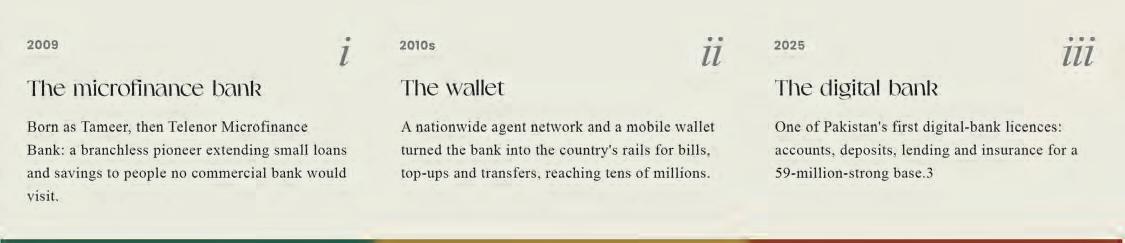
Telenor announced its exit from Pakistan in November 2022, after seventeen years and more than two billion dollars of investment. It took three years to execute the first half. On 31 December 2025, PTCL Group completed its purchase of Telenor’s telecom business for roughly Rs108 billion, about $380–400 million, folding the network into Ufone.1
What the telecom deal did not include was the
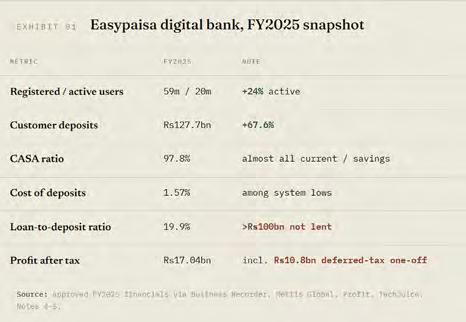
money. Easypaisa, the separately licensed financial arm, was carved out and kept. In June 2026, Telenor retained Citigroup to sell its 55 percent controlling stake; the remaining 45 percent belongs to China’s Ant Group. The buyer is not acquiring a telecom operator. They are acquiring a State Bank–regulated digital retail bank with 59 million registered users.3 The thing being sold is a bank, and that distinction frames everything that follows.
Scene 2 • Three Lives
One institution, three business models
Each life solved a different problem, for a different Pakistan
The sale is being marketed at the precise moment the third life is most uncertain. Inclusion and scale are largely done. What remains unproven is whether
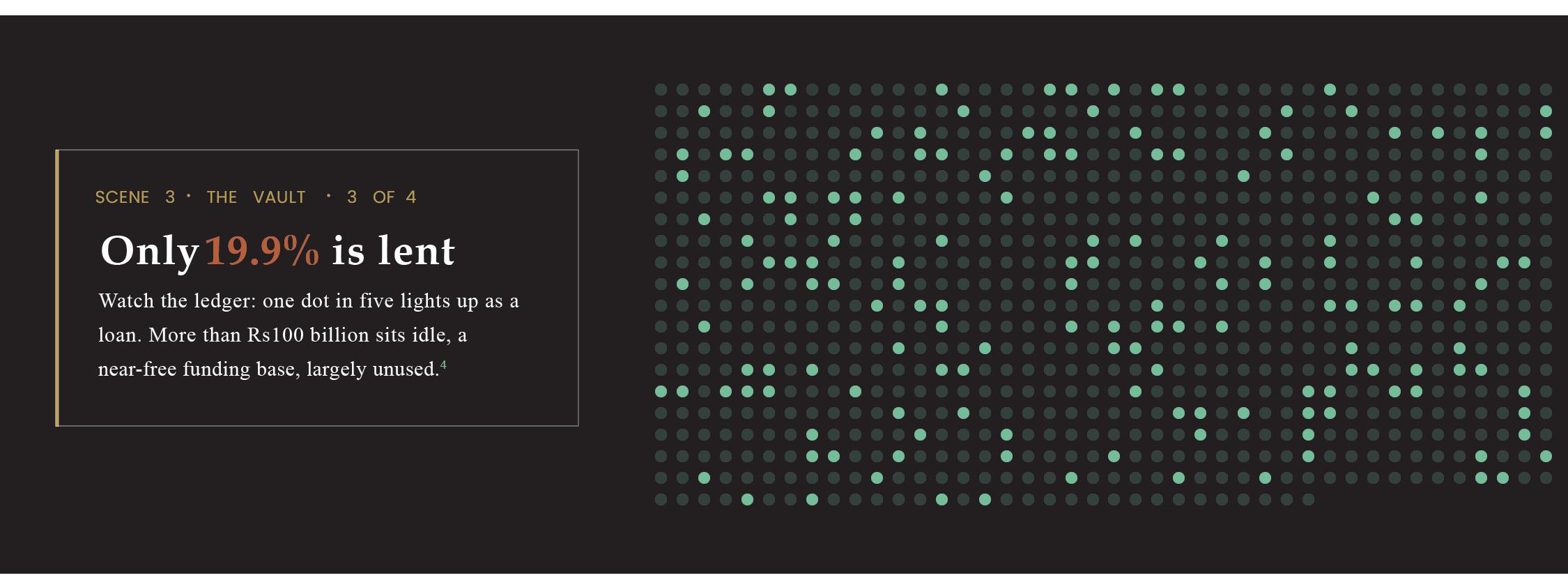
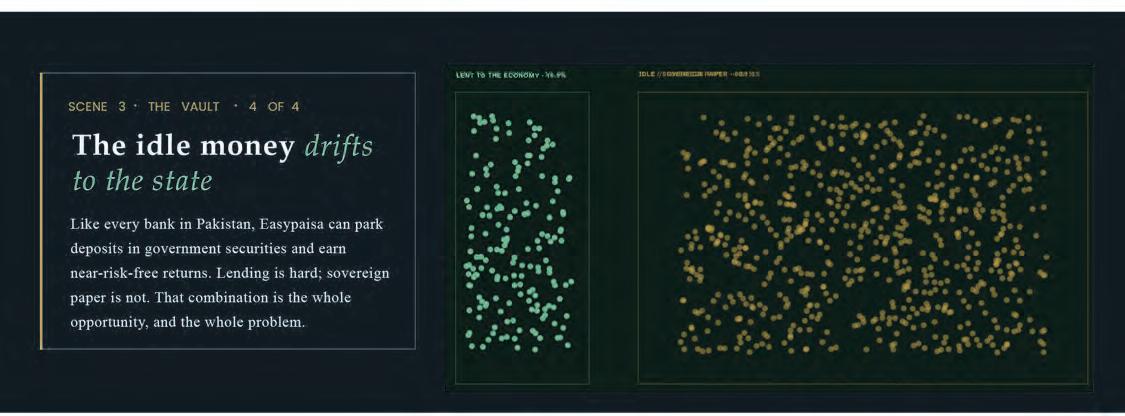
59 million relationships can be turned into the thing a bank is ultimately for: lending. To see the problem, watch the money itself.
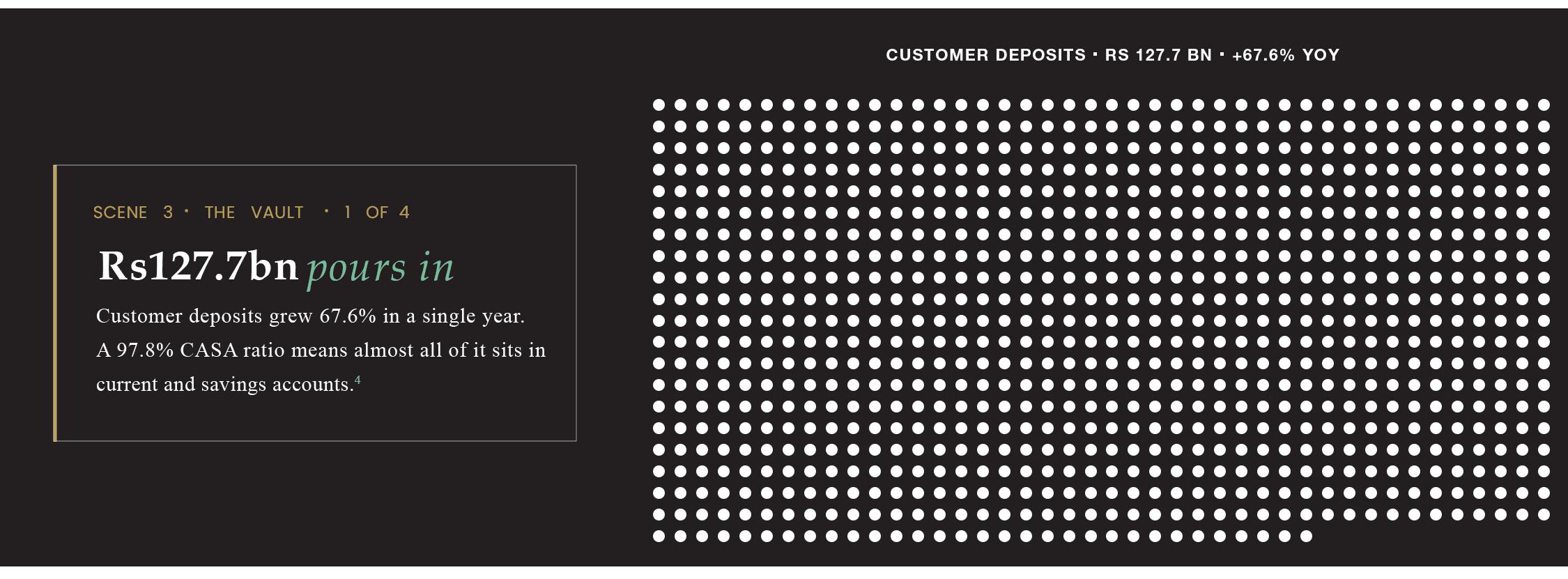
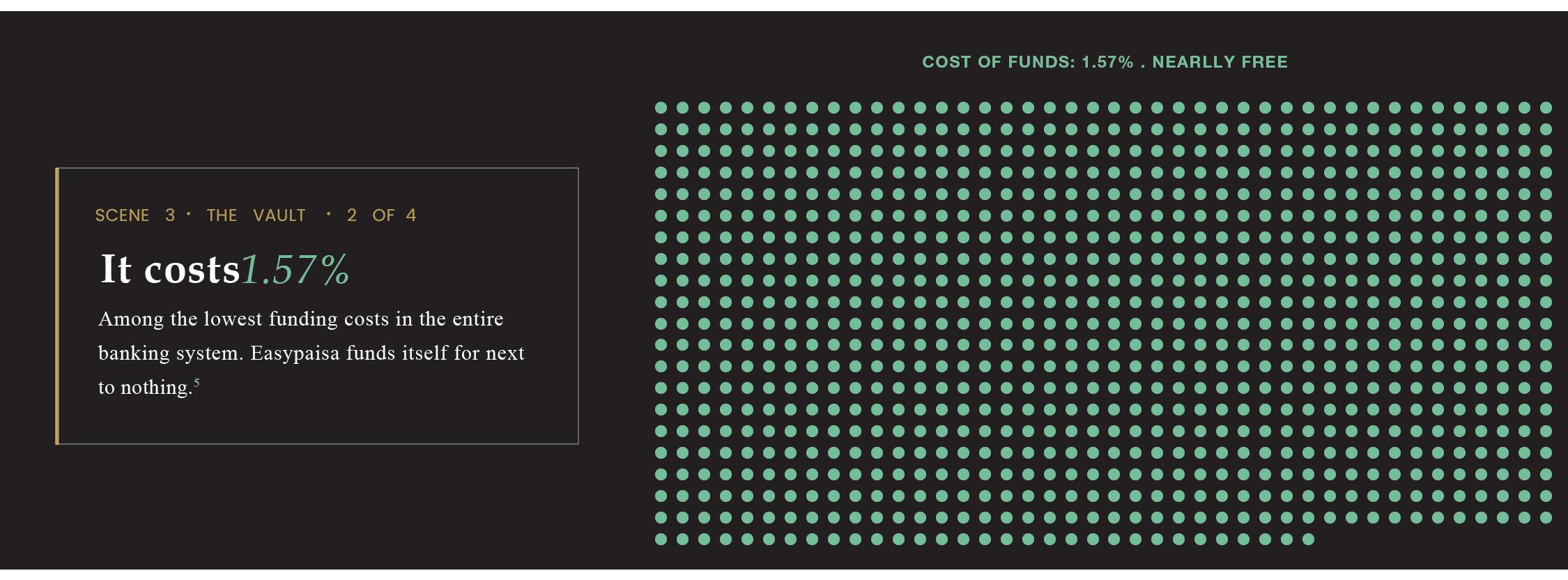
The obvious question is why a bank with money this cheap lends so little. The answer is structural, not simply a failure of nerve: thin credit-bureau data, weak tooling to underwrite informal and irregular incomes, conservative capital rules and, above all, the easier alternative of sovereign paper. Hold that in mind. It is the key to reading both the opportunity and what it would take to seize it.
The Erosion
Two engines built this institution. Both are being driven toward zero at once.
Scene 4 · Two Engines, One Cliff
Why the timing of this sale is not an accident
The legacy business runs on two engines. The first is transfer fees: for years, fee and commission income supplied roughly half the bank’s revenue. Then came Raast, the central bank’s instant payment system, free by design, now carrying 603 million person-toperson transactions worth Rs15.7 trillion in a single
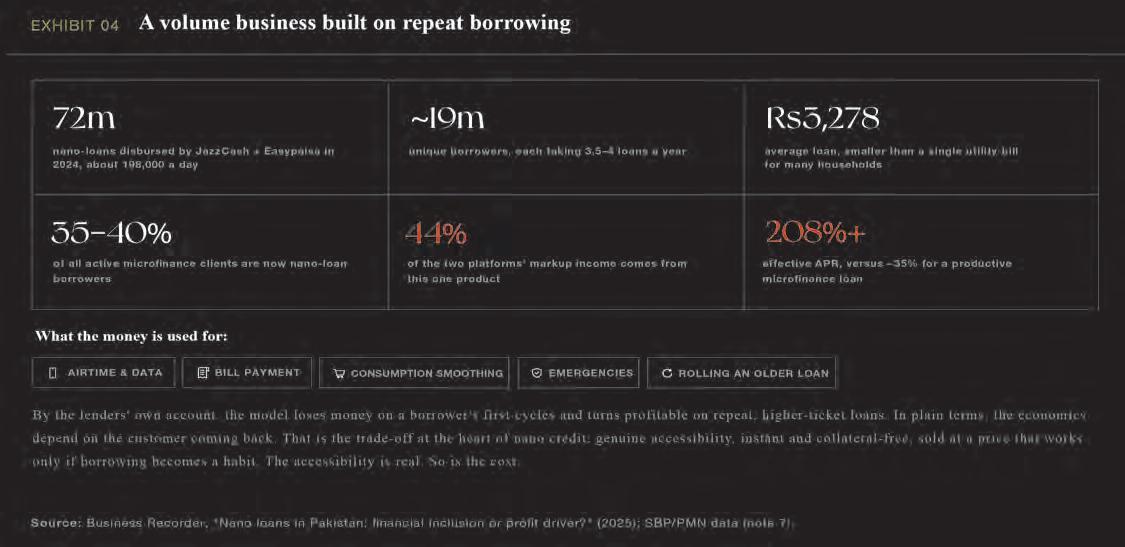
quarter, with 92 percent of all retail transactions digital.6 The fee a customer once paid to move money is being abolished by the state. The second engine is more profitable, and more uncomfortable: nano-lending. The regulator is now circling it.23
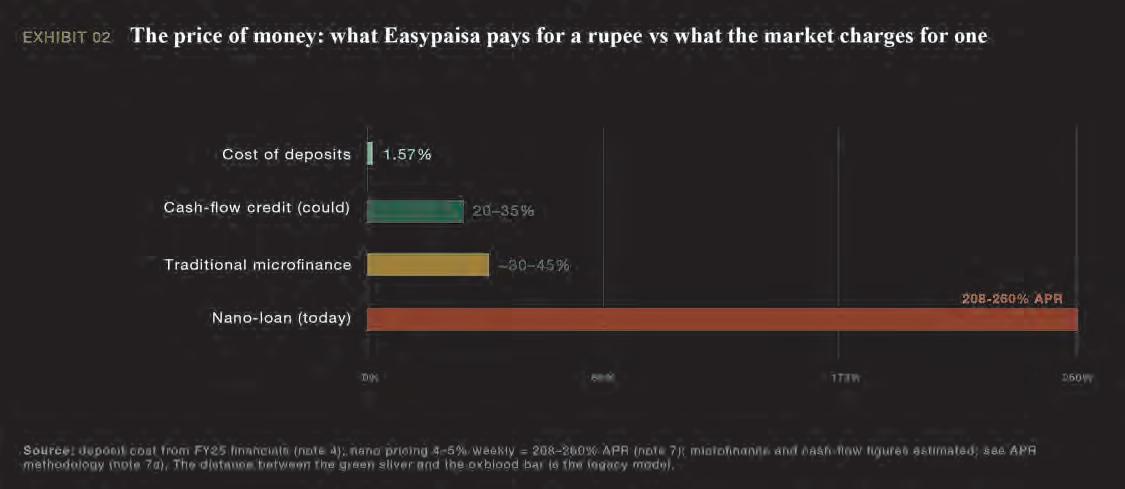
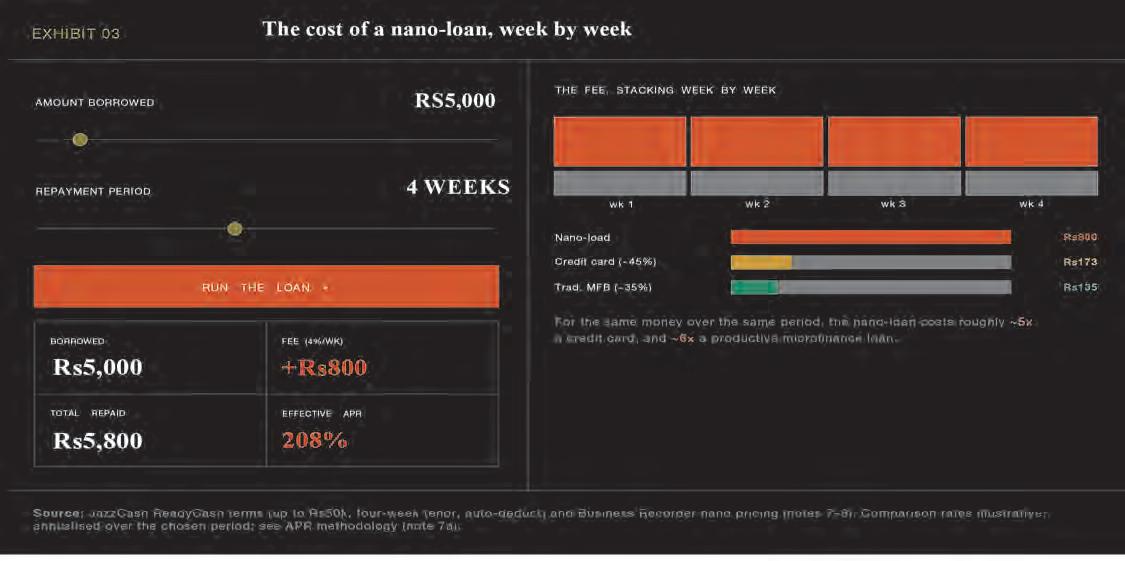
Nano-loans contribute roughly 44 percent of the markup income of Easypaisa and JazzCash combined, from a product that charges the poorest borrowers 4 to 5 percent a week.7 The SECP is
weighing APR and total-cost caps.23 The asset is changing hands at the exact moment both legacy profit pools are draining. To feel why that matters, run the machine yourself.
Borrow Rs5,000. Watch what happens
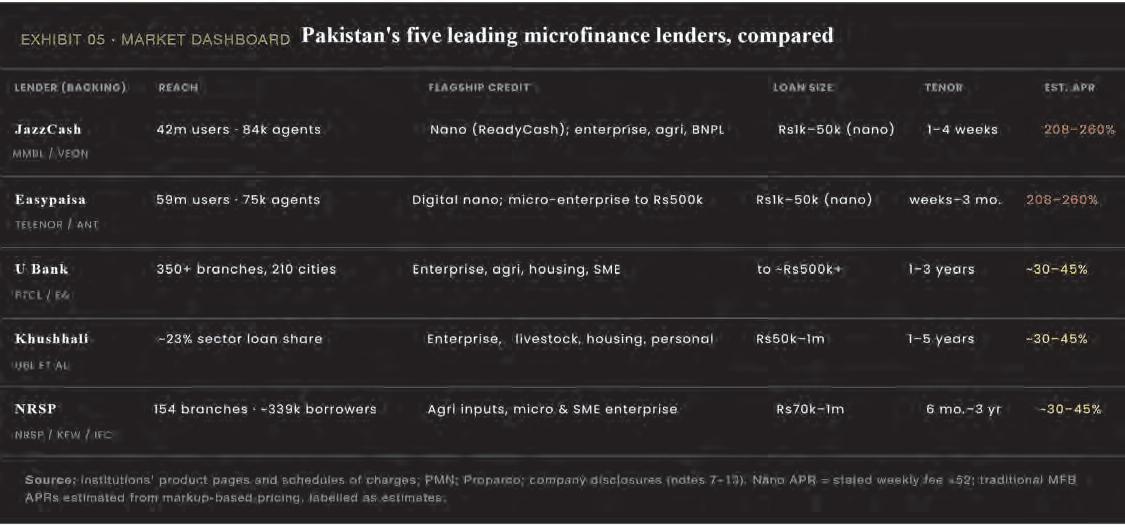
The point is not that nano-credit should not exist. For millions of households it is the first formal credit they have ever held: instant, collateral-free, underwritten for people the banks never bothered to score. The question is one of dominance, not existence. As it stands, the two institutions with the most digital reach have aimed it at the smallest, shortest and most expensive form of credit, while the traditional microfinance banks, U Bank, Khushhali, NRSP, lend for production but reach few.11 12 13 Digital scale has yet to be meaningfully paired with productive credit in Pakistan. That gap points directly at the country’s wider banking problem.
Scene 6 · Banks Without Banking
A system that funds the state, not the economy
Pakistan’s financial leadership has long emerged from a relatively narrow set of educational and social institutions. The critique that follows is not one of competence. It is one of proximity. The fastest-growing parts of the economy, freelancers, digital merchants, home-based entrepreneurs, small exporters, earn incomes that are observable digitally but remain institutionally invisible. The
people who run the banks are rarely the end users of what they sell.
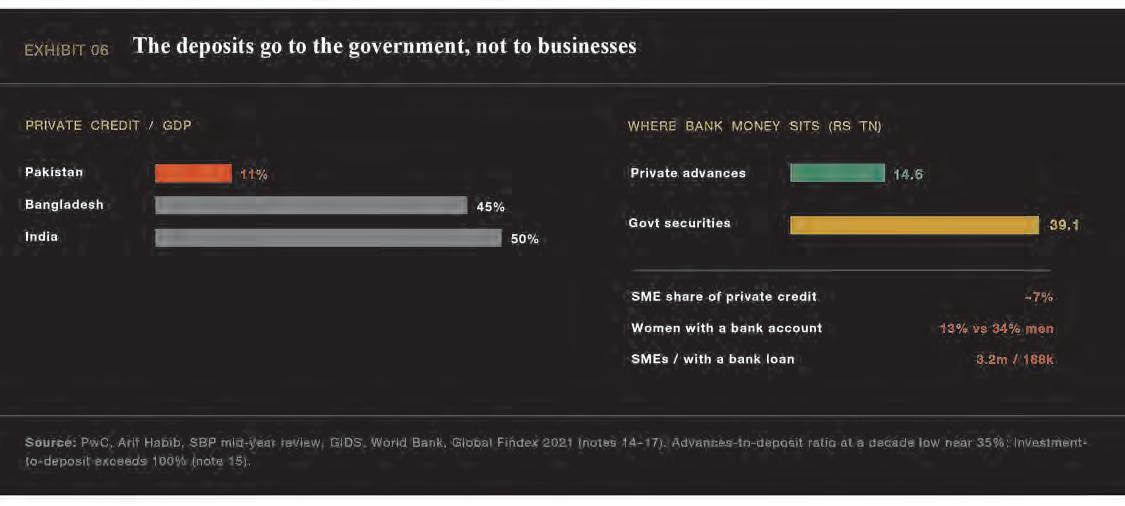
The result is a paradox. Pakistan has banks. Yet private-sector credit, at roughly 11 percent of GDP, is among the lowest in comparable emerging markets, against about 50 percent in India and 45 percent in Bangladesh.14
The mechanics are plain. Banks hold roughly Rs39 trillion in government paper against Rs14.6 trillion in private advances.15 Micro, small and medium enterprises, 3.2 million of them, receive about 7 percent of private credit and hold fewer than 200,000 loans between them.16 Only 13 percent of women hold a bank account, against 34 percent of men.17 The head of the Pakistan Banks’ Association described the posture without embarrassment: the government comes to us; we do not go to the government.18
The Unwritten
Scene 7 · Many Doors
Tap a door to see how it opens
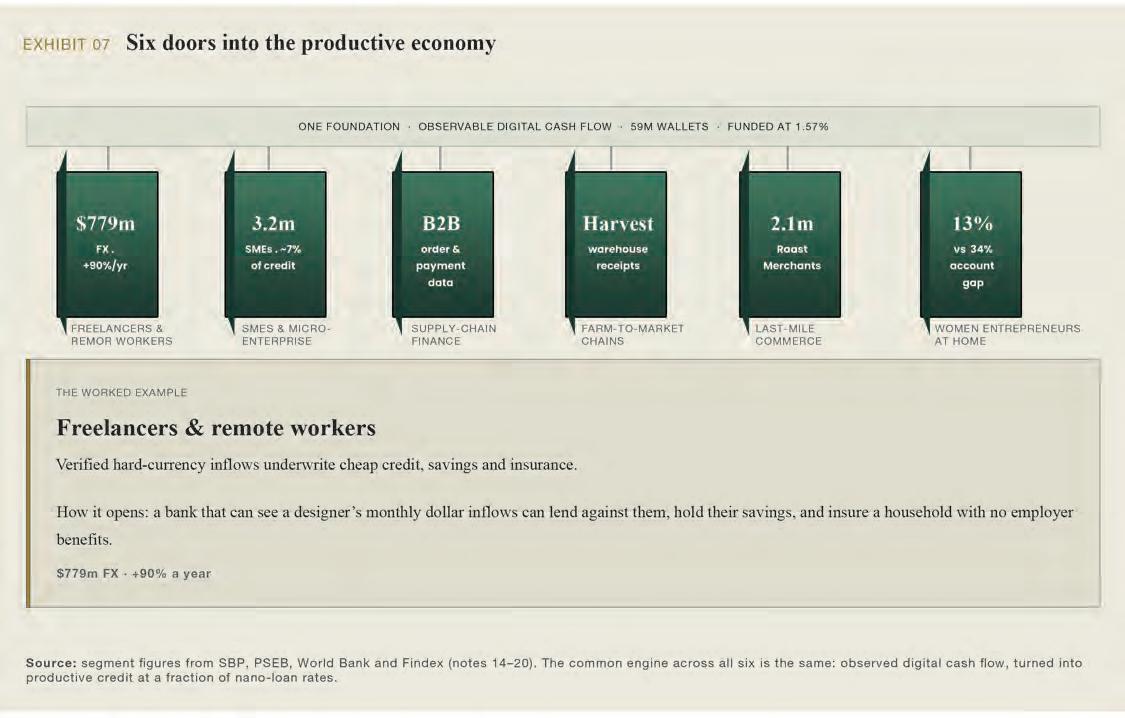
If there is an institution positioned to bank what the system cannot see, it is one that already sits in 59 million pockets, funds itself at 1.57 percent, and can read a customer’s cash flow directly from their wallet. Each door below rests on the same foundation, observable digital cash flow, and they can be opened concurrently or in sequence.
None of these is a new product; the traditional microfinance banks already serve versions of each. What a digital institution changes is scale and cost: the ability to underwrite millions of such customers from data already in the wallet, at a marginal cost approaching zero. The freelancer door is simply the one furthest along, and the cleanest to examine.
Scene 8 · The Freelancer Case
One door, examined in full
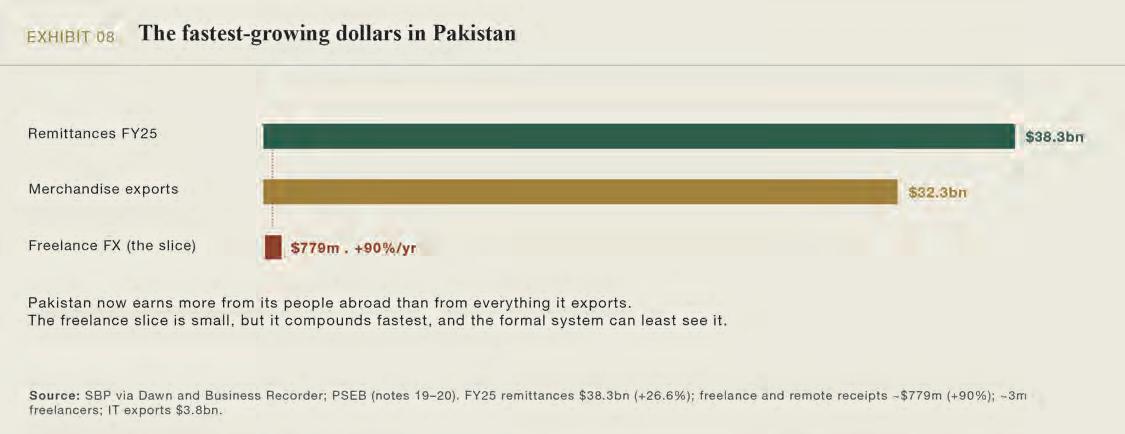
Workers’ remittances reached a record $38.3 billion in FY25, for the first time larger than everything the country ships abroad.19 Inside that flow sits its fastest-growing slice, and almost none of it is banked beyond the transfer itself.
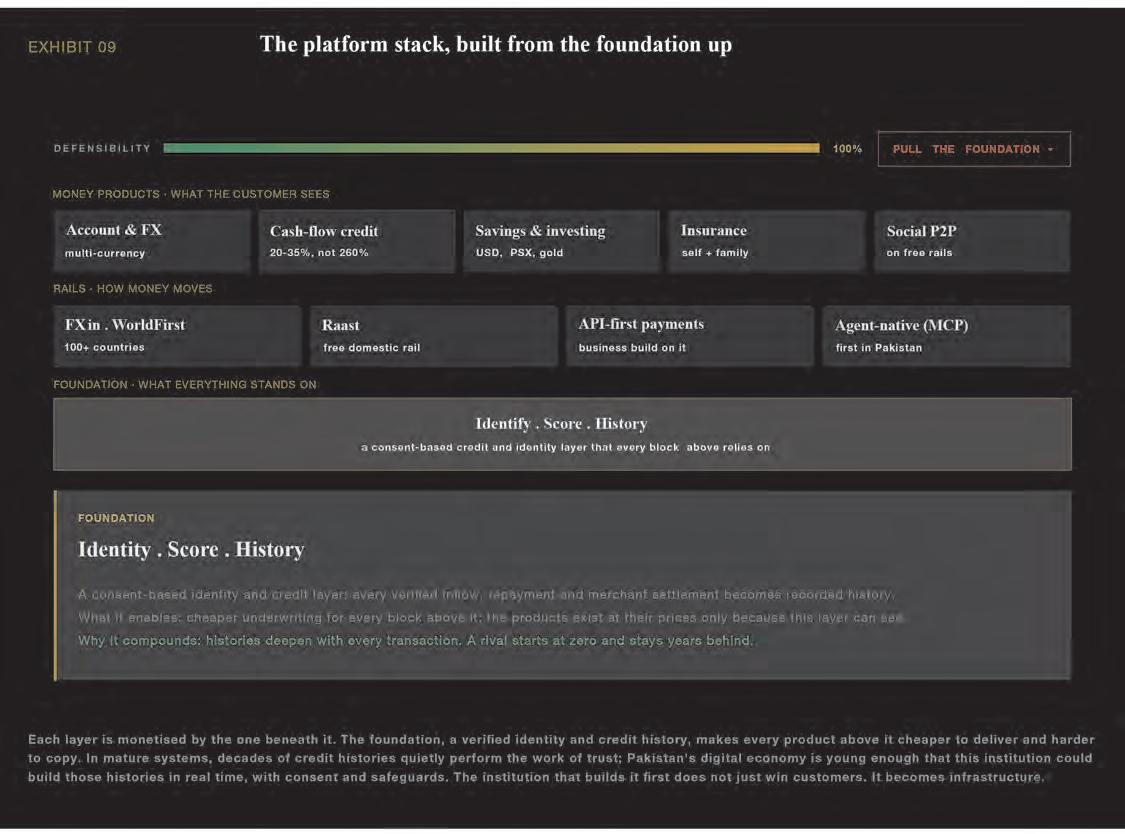
In December 2025, Easypaisa switched on Ant International’s WorldFirst rail, letting customers receive money from more than 100 countries, naming freelancers and exporters explicitly.21 That matters because of a simple mechanic: the moment an income becomes observable, it becomes bankable. A single verified inflow can anchor cash-flow credit at 20–35 percent instead of 200-plus, dollar savings and investing for a customer with no employer plan, household insurance in a country where penetration is below 1 percent22, and a verifiable identity that can finally separate a genuine foreign-exchange earner from everyone else, resolving a tax grey zone examined in an earlier piece.24
Scene 9 · From Wallet to Platform
What a verified income makes possible
Each layer is paid for by the one beneath it, and harder to copy than the last
Scene 10 · The Ant Question
Shareholder, or advantage waiting to be activated
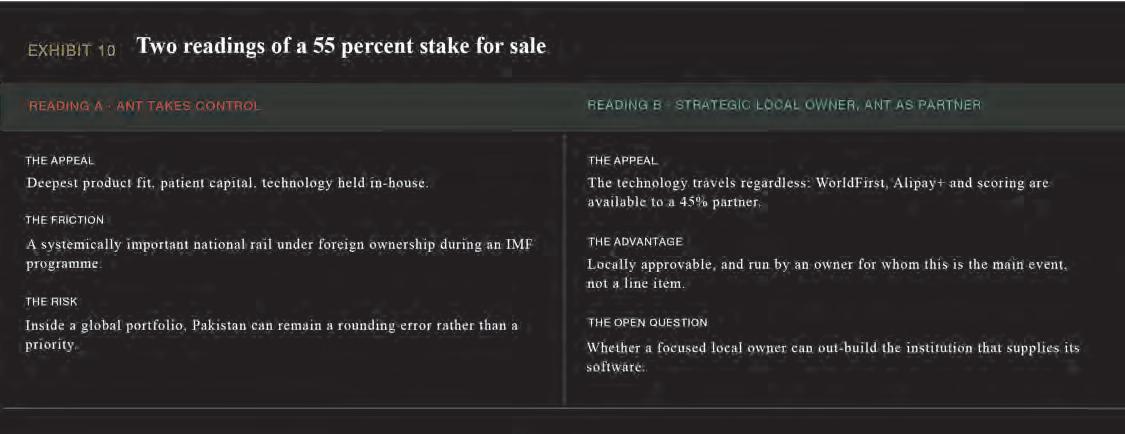
Ant Group already owns 45 percent of Easypaisa and supplies much of its technology. That makes the central question of this sale less about price than about posture: is Ant merely a financial shareholder, or a strategic advantage that has not yet been switched on?
What Ant could bring is not in doubt: WorldFirst cross-border rails already inside the app, the Alipay+ acceptance network, scoring and risk technology refined on hundreds of millions of users. The harder question is why none of it has produced an Alipay-style ecosystem in Pakistan, and the answer is mostly structural. A central bank, rightly, guards a systemically important rail closely; strict foreign-exchange controls limit what can move; bureau and identity data remain too thin to underwrite at scale; and a 45 percent holder has influence but not control. The technology was never the binding constraint. Permission, data and control were, which is precisely why the ownership question matters more than the price.
Scene 11 · The Second Act
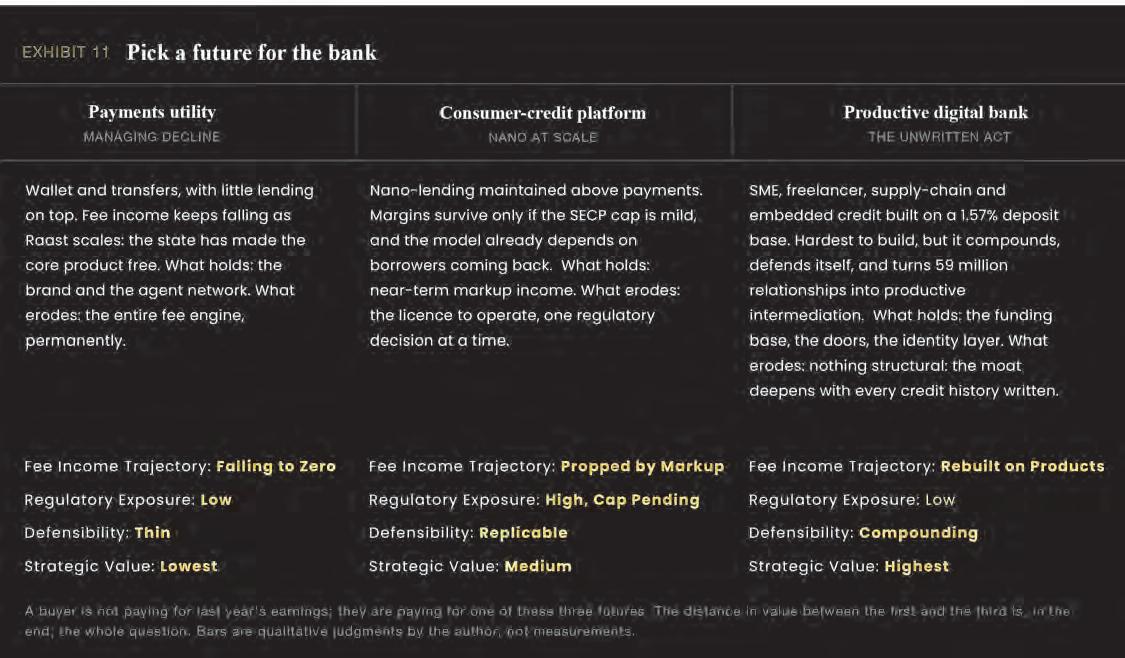
What the buyer is actually paying for: three futures
Choose one. The price of the stake is downstream of this choice
The answer will determine whether Easypaisa becomes a payments utility managing decline, or Pakistan’s first genuinely consequential digital bank. In that sense, the sale is not merely a transaction. It is a referendum on what kind of banking Pakistan intends to build next.
The views expressed in this article are the author’s own and do not necessarily reflect those of the publication. For the full, interactive, visual feature, visit Profit’s website.
What iTANZ’s Rs4.3 billion investment in its Australian subsidiary will buy
The investment is structured as an interest-free seller note into a company that services public sector and regulated entities in Australia
For most of its life on the Pakistan Stock Exchange, the company now known as iTANZ Technologies Ltd was not a technology company at all. It was Zahur Cotton Mills, a small textile manufacturer whose operations had fallen into suspension, whose balance sheet carried accumulated losses, and whose listing had become a reminder of a familiar problem in Pakistan’s capital markets: too many listed companies were shells of their former selves, kept alive more by legal existence than by operating
ambition.
That makes the latest announcement from iTANZ all the more striking. The company has now told shareholders that its board has approved an investment of up to A$21.86 million, or approximately Rs4.34 billion, to acquire a 51% stake in ITANZ Infinity Pty Ltd, an Australian company already associated with the same sponsor group. The investment is to be settled over five years, subject to State Bank of Pakistan approval and other regulatory formalities. iTANZ will become entitled to dividends from the date the shares are trans-
ferred. Shareholders are being asked to approve the transaction at an extraordinary general meeting in Lahore on June 27, 2026. In ordinary language, this is a control transaction. In economic language, it is also a form of seller-financed acquisition. The listed Pakistani company is not paying all the cash upfront. It is acquiring majority ownership of the Australian business through a deferred payment arrangement, with the official circular stating that the consideration is payable over five years and that no interest shall accrue on payments delayed due to reasons beyond
the company’s control, including regulatory approvals. The filing does not use the phrase “seller note” in the Wall Street sense. But for investors trying to understand what is happening, the substance is close enough: the seller is accepting staged settlement rather than immediate cash, while the buyer obtains dividend entitlement from the share-transfer date.
That structure matters. A company with only Rs424 million of revenue in the nine months ended March 2026 is proposing to buy control of an Australian associate at a valuation running into billions of rupees. It is not using bank debt, according to the notice. The stated sources of funds are excess profits and fresh equity injection. For a young listed technology company that only recently emerged from a defunct textile shell, the transaction is audacious. It also reveals what iTANZ wants investors to believe it has become: not a small domestic software house, but a Pakistan-listed holding company for a global enterprise software and consulting group.
The asset being bought is ITANZ Infinity Pty Ltd, an Australian private company registered in Victoria. It has been active since 2017 and operates from Melbourne. In the group’s own telling, ITANZ Infinity is not a generic outsourcing shop. Its market is the dull but lucrative world of public-sector systems, regulated utilities, healthcare administration and enterprise workflow. That is a very different business from building websites or selling one-off software licences. It is about replacing, integrating or extending the systems that councils, water utilities, healthcare organisations and asset-heavy enterprises use to collect bills, manage property records, process citizens’ requests, track assets and make data usable across departments.
The Australian company’s product set appears designed for institutions that do not move fast but do pay for continuity. Public materials from the group describe solutions for local councils, utilities and healthcare providers, including an Intelligent City Platform, council asset-management modules, council property-management tools, utility billing and revenue-management systems, analytics, self-service portals, medical coding, patient referral processing, booking management and digital-assistant tools. Much of this sits in the unglamorous middle layer of government and regulated-enterprise technology: the place where data from old systems has to be cleaned, connected and presented to employees and customers in a form that is actually useful.
That unglamorous layer can be a good place to earn money. Local governments and utilities are difficult customers to win, but once a vendor is embedded, replacement is not trivial. Water utilities do not change billing systems for amusement. Councils do not re-
build property and asset-management systems every year. Healthcare workflows require compliance, audit trails and institutional confidence. A successful vendor in these areas can develop a recurring revenue base, especially if it sells subscriptions, support services, maintenance, analytics and incremental modules. The group has been keen to publicise that kind of traction. Recent disclosures and corporate materials refer to projects with Australian councils, utilities and enterprise clients. The Shire of Irwin in Western Australia has been preparing to go live with iTANZ’s property-management module. The company has disclosed negotiations for an Intelligent City Platform engagement with a Queensland city council. It has referred to work for Icon Water, the water utility in the Australian Capital Territory, and has announced subscription and analytics work for Global Blue, a global tax-free-shopping and VAT-refund company. The corporate briefing also claims a pipeline of additional council deployments and healthcare artificial-intelligence software-as-a-service revenue.
The manufacturing angle is less explicitly disclosed than the local-government and utility work. Public materials show stronger evidence of iTANZ’s exposure to councils, utilities, healthcare, banking, enterprise and logistics than to named Australian manufacturing clients. But the products it sells — asset management, ERP integration, analytics, automation, billing systems, cyber security, cloud services and managed support — are the same kinds of systems used by manufacturing and industrial businesses. In that sense, the Australian business appears best understood as a vertical-software and integration company for regulated and asset-heavy organisations, rather than a narrowly defined software exporter. Its financials give investors a clearer sense of what the Pakistani listed company is buying. For the year ended June 30, 2025, ITANZ Infinity reported revenue of A$5.55 million and net profit of A$820,119. Total equity stood at A$3.38 million. Total assets were A$12.23 million, including A$10.94 million of non-current assets and A$1.29 million of current assets. Liabilities were also sizeable, with non-current liabilities of A$1.98 million and current liabilities of A$6.86 million. Earnings per share rose from A$5,826.62 in 2023 to A$8,201.19 in 2025, while break-up value per share increased from A$20,323.67 to A$33,818.28.
Those numbers are respectable. They also show why the valuation deserves scrutiny. The circular places the fair value of ITANZ Infinity at A$45.39 million on a post-money basis. Compared with the 2025 revenue of A$5.55 million, that is a multiple of more than eight times revenue. Compared with 2025
net profit of A$820,119, it is roughly 55 times earnings. For the 51% stake being acquired, iTANZ is paying A$21.86 million for a share of trailing profit of about A$418,000. That is not a bargain-basement acquisition of an unnoticed foreign subsidiary. It is a platform valuation. The price only makes sense if the Australian company’s pipeline, recurring revenue base and cross-border delivery model produce substantial growth.
There is also an unavoidable related-party dimension. The investee company is an associated company because of common directorship. Syed Ahmed Bilal, who is the ultimate beneficial owner and director of ITANZ Infinity, is also chairman and a major shareholder of iTANZ Technologies in Pakistan, holding 44.64% of the listed company’s issued share capital. That does not make the transaction improper. Related-party transactions are common in sponsor-led corporate groups, especially during restructuring. But it does mean minority shareholders should pay close attention to the valuation, payment terms, dividend entitlement, due-diligence documents and the mechanics by which the Australian business will be consolidated into the Pakistani group.
The company appears aware of that sensitivity. The transaction is being placed before shareholders under Section 199 of the Companies Act, 2017, which governs investments in associated companies and undertakings. The circular says due diligence has been carried out and that the due-diligence recommendations, audited accounts of ITANZ Infinity and a third-party valuation will be available for inspection. That is exactly where shareholders should focus. The strategic case for the acquisition is not difficult to understand. The harder question is whether the price is justified by contracted revenue, not merely hoped-for revenue.
There is one additional Australian footnote shareholders may want clarified before approving the deal. Public insolvency-notice records appear to indicate that a winding-up application against ITANZ Infinity Pty Ltd was commenced by Westpac Banking Corporation in April 2026. A winding-up application is not the same as a completed liquidation; such applications can be settled, withdrawn, dismissed or otherwise resolved. But for a Pakistani listed company proposing to acquire control of that business at a multibillion-rupee valuation, the status of any such proceeding matters. The EOGM documents say due diligence has been done. Investors should expect management to explain how that due diligence treated the Australian court or creditor record, whether the matter remains live, and whether it has any bearing on valuation or cash flows.
To understand why iTANZ is willing to take that risk, one has to look back at the
extraordinary route by which the company reached the stock market.
Zahur Cotton Mills was incorporated in 1990. Its principal business was the manufacture and sale of grey fabric. Like many small textile companies, it struggled with working-capital shortages, unfavourable business conditions and the brutal economics of low-margin manufacturing. By the time iTANZ entered the picture, the textile operations had effectively ceased. The company’s old accounts described suspended operations and accumulated losses that cast doubt on its ability to continue as a going concern.
That is precisely the kind of listed shell that attracts reverse-merger interest. A functioning private business wants access to the stock market. A listed company no longer has a viable business but still has a listing. The solution is a scheme of arrangement: the listed company acquires the private operating business by issuing shares to its owners, changes its name and principal line of business, and becomes a new company in substance while retaining the listing.
That is what happened here. In 2024, the board of Zahur Cotton Mills approved a scheme to acquire the whole undertaking of ITANZ Technology (Private) Ltd by issuing new shares. The transaction eventually raised the paid-up capital to 107.82 million shares, changed the company’s principal activity to software development, implementation, IT supplies, services and consultancy, and transformed the old textile mill into iTANZ Technologies Ltd. The Lahore High Court sanctioned the arrangement in March 2025, with the merger treated as effective from October 2023.
The result was one of Pakistan’s more unusual listed technology stories. Rather than coming to market through a conventional initial public offering, iTANZ arrived by taking over a dormant textile listing. That route will discomfort some investors. Reverse mergers can be efficient, but they also require trust in the quality of the incoming business, the integrity of the valuation and the discipline of post-merger reporting. The new iTANZ has therefore had to prove, quarter by quarter, that it is not merely a new name on an old shell.
So far, the reported financial performance has been strong, albeit from a small base and with some accounting complications created by the merger. In the financial year ended June 2025, net sales rose 30.3% to Rs441.5 million. Export sales were Rs411.1 million, accounting for more than 93% of revenue, while local sales declined to Rs30.4 million. That revenue mix is important. iTANZ is pitching itself not primarily as a domestic Pakistani software vendor, but as an export-oriented technology company earning foreign revenue
from international customers.
Profitability was even more eye-catching than revenue growth. Gross profit rose 43.4%, and the gross margin improved to 67.7%. Operating profit increased 64.6%, while profit after tax more than doubled to Rs344.8 million. Earnings per share for the year were Rs34.97, though EPS comparisons require care because the share count changed substantially after the merger. Net profit margin was unusually high at 78.1%, helped by other income that included payables written back and exchange gains. That is impressive, but it also means investors should distinguish between recurring operating profitability and one-off or non-core boosts.
The momentum continued into the new financial year. In the first half of FY2026, iTANZ reported revenue of Rs242.8 million, up 100.5% from the comparable period. Gross profit rose 106.7% to Rs181.0 million, and profit after tax increased 145.8% to Rs162.0 million. By the nine months ended March 2026, revenue had reached Rs423.9 million, compared with Rs247.7 million in the same period a year earlier. Profit after tax for the nine months was Rs283.0 million, up from Rs93.3 million. For a company that had only recently emerged from a non-operating textile shell, the improvement was dramatic.
Yet there are details worth watching. At March 31, 2026, iTANZ had total assets of Rs1.32 billion and total equity of Rs1.06 billion. Trade receivables were Rs1.13 billion, an unusually large figure compared with reported revenue and cash of only Rs7.7 million. That does not mean the profits are unreal; software and consulting businesses can have lumpy receivables, especially with enterprise and foreign clients. But it does mean cash conversion is central to the story. A company that proposes to pay A$21.86 million over five years will need not only accounting profits but actual cash flows, regulatory approvals and access to foreign exchange.
The acquisition of ITANZ Infinity would change the scale and geography of the company. At the implied exchange rate in the announcement, the Australian company’s 2025 revenue of A$5.55 million translates into roughly Rs1.1 billion, more than twice iTANZ Pakistan’s own FY2025 revenue. Its net profit of A$820,119 translates into roughly Rs163 million. If consolidated, the Australian business could make iTANZ look much larger and more global. It could also shift the centre of gravity of the group towards Australia, where contracts are larger, customers are more institutional and regulatory expectations are higher.
That may be exactly the point. Pakistan has no shortage of software companies that describe themselves as global. The more difficult task is building a repeatable business in
developed markets, especially in sectors where customer acquisition is slow and trust matters. ITANZ Infinity appears to have positioned itself in those slower, stickier markets. Its council and utility products are not fashionable in the way generative artificial intelligence is fashionable. They are not likely to produce overnight hockey-stick growth. But they can produce durable relationships if the product works and the vendor remains solvent, responsive and technically credible.
For iTANZ’s Pakistani shareholders, the bet is therefore twofold. First, they are betting that the Australian business is worth a high multiple because it owns customer relationships, domain expertise and software assets that can grow into recurring revenue. Second, they are betting that the Pakistani listed parent can use its lower-cost delivery base to service Australian and other developed-market clients at attractive margins. That is the classic offshore-technology arbitrage, but applied to vertical public-sector and regulated-enterprise software rather than generic outsourcing.
The risks are equally clear. Public-sector sales cycles can be long. Integration projects can overrun. Enterprise customers can delay payments. Currency approvals from Pakistan can take time. Related-party valuation questions can irritate minority shareholders. Australian compliance issues, including any creditor disputes, must be resolved transparently. And a five-year deferred payment structure does not eliminate the cost of the acquisition; it merely spreads it.
Still, it is difficult to deny that iTANZ has travelled a remarkable distance. In less than two years, a dormant textile company has been turned into a listed technology platform reporting export-heavy revenue, high margins and plans to acquire control of an Australian software business serving councils, utilities and regulated entities. That is either a case study in capital-market innovation or a reminder that investors should be especially careful when a shell company becomes a growth story very quickly. Perhaps it is both.
What will the Rs4.3 billion buy? On paper, control of an Australian company with A$5.55 million in revenue, A$820,119 in annual profit, a public-sector and regulated-enterprise product suite, and a pipeline of council, utility and healthcare work. Strategically, it buys iTANZ a claim to being more than a Pakistani software exporter. It buys a developed-market front office, a product catalogue, customer references and the possibility of recurring software revenue. Financially, it buys a business at a demanding valuation that will need to grow quickly to justify the price.
That is the wager. The seller note gives iTANZ time. The Australian subsidiary gives it a story. Now it has to deliver the cash flows. n
Development spending stays stagnant at Rs 1 trillion
Pakistan’s development budget seems to have stagnated at the 1 trillion mark for the last few years. The same allocation was repeated this year in the federal budget compared to the revised expenditure of 820.5 billion from the previous year. It is important to remember that the initial allocation for the last year was also at Rs 1 trillion.
The total development outlay stood at Rs 3.675 trillion, down from last year’s Rs 4.1 trillion. This is owed to a major drop in the provincial development budget from Rs 2.9 trillion to Rs 2.2 trillion. This is now a concurrent trend in which the government continues to keep PSDP lower down on its priority list in the budget. While a country always needs to repay debts and run the civil government, it is often the development expenditure that is credited with increasing a country’s output in terms of productivity, be it health, education, vocational training or the construction/ facilitation of facilities that make progress possible.
Following is a breakdown of this year’s PSDP and the things that it is being spent on.
What is this year’s PSDP being spent on?
One thing becomes immediately clear from the Public Sector Development Programme in the budget for the coming year: the government’s development priorities remain anchored in transport infrastructure. Even a cursory reading reveals hundreds of road-building, rehabilitation and connectivity projects scattered across the document. The clearest indication is the Rs224 billion allocated directly to the National Highway Authority, equivalent to almost a quarter of the entire federal PSDP. But this does not capture the full scale of road-related spending.
A majority of the Rs16 billion allocated to Housing and Works will also finance critical road-improvement projects. A substantial proportion of the federal PSDP share assigned to provinces has similarly been directed towards roads and connectivity, while several schemes classified under other ministries are, in practice, aimed at expanding the same infrastructure network. Outside the allocations for provinces and special areas, the largest spending head belongs to the Water Resources Division, whose allocation has risen from Rs101.6 billion to Rs103 billion, an increase of almost 17%. Much of this money will carry forward projects already under construction. The most significant among them is the Dasu Hydropower Project, which has received
Rs15 billion. Other major allocations include Rs22 billion for the Mohmand Dam, Rs10 billion for the Diamer-Bhasha Dam and Rs10 billion for the Greater Karachi Bulk Water Supply Scheme.
The next-largest share, after provinces and water resources, has gone to the Cabinet Division. Its allocation stands at Rs64.08 billion, of which Rs63 billion will be distributed among members of the National Assembly under the Sustainable Development Goals Achievement Programme (SAP) for schemes in their respective constituencies. The fund has repeatedly attracted criticism over its discretionary character and the suspicion that development money is being channelled according to political calculations rather than a coherent strategy.
In a departure from the restraint seen in previous years, the Higher Education Commission has also received a significantly larger allocation this year. Its development funding has risen to Rs46 billion from Rs34.9 billion last year. Among the largest projects are the PhD Scholarship Programme under the Pak-US Knowledge Corridor, allocated Rs1.5 billion, and hostel construction at the University of Engineering and Technology Lahore, allocated Rs1 trillion. Other schemes include scholarships for students from the former Federally Administered Tribal Areas (FATA) and Balochistan, alongside a range of university expansion projects. Taken together, the allocation appears more evenly distributed across access, infrastructure and advanced study.
The Federal Education and Professional Training Division has also received an increase, with its allocation rising from Rs26.6 billion to Rs36.3 billion. This head includes programmes such as the Prime Minister’s Youth Skill Development Programme and the Prime Minister’s Pakistan Fund for Education.
Railways has emerged as one of the budget’s most visible gainers. Its development allocation has increased by more than 120%, rising from Rs18.5 billion to Rs40.6 billion. The increase gives rail development a larger place in a PSDP, mainly targeting the coal rail connectivity from Port Qasim, maintenance of existing tracks and procurement of newer high-capacity bogie wagons.
The National Food Security and Research Division has also secured a considerable increase, with its allocation rising from Rs1.6 billion to Rs4.2 billion. The allocation for National Health Services has increased more modestly, from Rs13 billion to Rs16 billion.
Among the smaller ministerial and divisional allocations, the Special Investment Facilitation Council has also notably received Rs479 million under the PSDP. The detailed budget
documents place the entire amount under a single head titled “Invest Pakistan”.
Not every institution benefited. SUPARCO, the Revenue Division and the Petroleum Division were among the few PSDP heads to receive lower allocations than in the previous year.
The most notable gainers, meanwhile, include Railways, the Ministry of Religious Affairs and Interfaith Harmony, and the Kashmir Affairs Division. Together, these allocations reveal the political and economic hierarchy embedded in the development programme. Roads remain dominant, water projects continue to absorb large sums, constituency-based schemes retain their place, and several social and institutional sectors are left to compete for what remains.
The three stages of Pakistan’s development expenditure: While the allocated value is a real metric to gauge commitment to development, it is often not the full picture of what is going to be spent on the people in Pakistan.
Previous years show us that there is almost always 3 levels of Pakistan’s PSDP. First comes the amount that the govt allocates in the budget, this is what the aforementioned is all about.
Second happens when the IMF asks the govt to trim it down, this usually happens after the budget speech or in the first two reviews of the IMF after the budget. A prime example of this was in 2024-25 when the government reduced its own PSDP before passing the budget from Rs 1.4 trillion to Rs 1.1 trillion. Finally comes the figure that the government ends up spending and is represented in the summary. Historical reports have suggested that even that expenditure is often flowing over into the next year but at least that is the PSDP that we can claim, saw the light of day.
Even in the last financial year, the revised PSDP of 820.5 billion was considerably less than the allocated PSDP of Rs 1 trillion.
The real value of PSDP
While the PSDP allocation, year on year, contrary to other budget items is not steadily upwards. It is also not unclear. The earlier graph indicates that our PSDP spend is circumstantial and shows no possible trend.
However, expenditure is always mapped based on inflation. That is the reason why the budget always increases and the major heads’ nominal values shows an upward trajectory. However, another picture is presented when we map the PSDP like that. The government’s commitment to progress through the PSDP can be noted through looking at the real value of the PSDP, i.e; the value adjusted for inflation. n
OPINION
M A Niazi
A Budget to remember?
The IMF pressure worked
Perhaps the 2026-2027 Budget will be best remembered in future as the one in which the federal government finally accepted the fixed-tax regime for small businesses. The scheme not only flies in the face of the principles of tax collection, but also reflects the visceral fear-based dis like of the business community for the tax administration. The scheme itself was announced before the Budget, as members of the government scrambled for the political credit. However, if one person deserved the credit, it was Prime Minister Shehbaz Sharif, who became involved with the issue about 40 years ago, when Lahore Chamber of Commerce and Industry President in 1985. The fixed-tax regime is a trader-originated solution, and has a certain specious logic. It is based on the assumption that taxes are paid by businesses not as part of any social contract, but because the state has coercive machinery. The state has got a monopoly of force, so it can administer a rules-based order. One important component is that it maintains law and order, so that businesses can continue unmolested. Peace, ease of communication (good roads), and a robust settlement dispute mechanism are desired by businessmen, and the state is supposed to give that. In response, it is supposed to raise taxes.
In other words, taxes are a sort of blackmail. If you don’t pay, society could descend into chaos. As they say, ‘death and taxes are inescapable.’ Or at least they should be. But what if
you slip a little something to the tax collector. He gets something more than his salary. The businessman incurs an expense lower than his assessed share. The state suffers, and has less money than it should.
That means it pays the judges who settle disputes less than enough to ensure honesty. Businessmen don’t mind, because a judge who accepts bribes will always decide in their favour. An honest judge would decide in their favour only if they deserved to win. Taxmen were also corrupt, and introduced businessmen to methods of corruption, according to businessmen. Taxmen on the other hand claim that businessmen were the fertile minds behind most of the methods of corruption. Whatever the case may be, the businessman’s fear of the taxman is reflected in what seems almost vindictiveness in the fixed-rate’s scheme of excluding the taxman from even entry into the premises if the requisite QR code is affixed outside th e establishment. The prohibition from the conduct of an audit is specifically provided.
The total audit is akin to having a tooth extracted without any anaesthetic. Bribes have been extracted on the threat of a total audit, without the carrying out of one. Not only is it almost certain to reveal some concealed income, which will be duly penalized, but it is also found by businessmen to be very cumbersome, involving the use of records of every transaction. It is rightly the most feared tool in the taxman’s repertoire, and under the fixed-rate scheme, it has been excluded.
Being allied to file a one-page return under the fixed-rate scheme requires paying a fee of Rs 25,000, apart from the one percent of the turnover mandated. This is the point at which the scheme begins to resemble blackmail. Of course, it could be said that all taxes are blackmail anyway. Since they are all backed by the coercive apparatus of the state, collectors have force to back them up.
There is punishment for not paying taxes, mostly fines or imprisonment. Income tax has been particularly pleasant for businessmen, because they have to pay it out of their profits, which they have already received. By contrast, salaried individuals find it easier, because the tax is deducted at source, whic h means they never receive it.
This is the principle behind withholding taxes, for which credit can be claimed in a return. This is the essential demand for businessmen: they should not be asked about where they get their money. They want to evade tax, and the best way is not to get caught up in the tax net. That is why they have long insisted on a fixed-tax regi me, and have only partially responded to amnesties. One problem with obtaining an amnesty is that one was then in the net. One still ends up in the net with the fixed-rate regime, bu t at least one is protected from awkward questions from sleek and well-fed-looking taxmen.
The writer is editor of Pakistan Today
It is because of this desire to ask questions that taxmen resisted the fixedtax regime. If they were perfectly honest, a fixed-tax regime would result in loss of revenue to the government, for businessmen only wanted to avoid the taxman so that they could make money on which money would not be paid to the state. But enter the IMF, which has perpetually hounded the IMF to increase revenues.
This led to the invention of the withholding taxes, which nonfiling businessmen treat as a pass-through expense. However, the taxation machinery first tried amnesties, then the Tajir Dost Scheme, after the bright spark in the IMF noticed that the tax potential of untaxed businessmen was in the trillions.
The fixed-rate regime is thus a signal victory for businessmen; it not just means that one of their longstanding demands was accepted, but that it was accepted despite the taxmen. However, there are two issues.
Does this provide businessmen with their desire, which is to remain untaxed, just as farmers are. It is noteworthy that agricultural incomes are not taxed to the same extent as business or salary incomes. Apart from the possibility of showing taxable income as agricultural, it just does not seem fair. Land revenue has not been levied since 1996-7 Rabi, so the old justification for not levying income tax has ended. That apparently has become the next target of the IMF, for now it seems the businessmen have delivered themselves into the hands of the Inland Revenue, even as they avoided it.
The agreement on the fixed-tax regime provides that under certain circumstances, usually quite extreme, an audit may be conducted despite the exemption. Taxmen have shown themselves very adept in the past at expanding the space in which they operate. There is no reason to assume that they will act differently, especially under IMF pressure.
It is perhaps worth examining other possible regimes. The one that seems to suit the businessmen most would be to abolish income tax altogether. That would require an Islamic state raising only taxes permitted by Islam. With income tax and sales tax abolished, there would be left the Zakat as the mainstay of taxation. For businessmen, that would mean two streams of taxation. First, their stock-in-trade would be taxed. Also, any savings from their income retained for a year. Businessmen being businessmen, they would still attempt concealment. Tax collectors would be subject to temptation. And the country would have to leave the IMF orbit. Of course, that means a fundamental question is unanswered. What is the purpose of taxation? Why should anyone, including businessmen, have to shoulder the burden of the interest of loans that have been embezzled? Will the fixed-rate regime encourage businessmen to enter the tax net they have avoided so carefully all these years?
The government maintains the concessionary IT exports tax rate. Will this be
enough to
change the fortunes of our IT industry?
Although the continuation of the incentivised tax rate on proceeds from IT exports has been touted as a way to boost our IT exports, doing so without meaningful investment in upskilling local talent, might not yield the results the government is hoping to achieve.
As part of its bid to encourage IT exports, the government has decided to keep unchanged the tax rate on IT exports.
The effective tax rate on IT exporters remains 1 percent, which whittles down to 0.25 percent if you are also a member of P@SHA, the country’s leading association of software houses. This tax incentive was set to expire at the end of June 2026, but the government has decided to extend this facility for 3 more years until June 2029.
This incentive has been part of a broad push by industry leaders, especially P@SHA, which has lobbied for the continuation of this incentivized tax rate. In an earlier conversation with Profit, the chairman of P@SHA, Sajjad Syed, underscored the importance of continuing this measure, warning that export numbers would drop if this facility were to be removed. His reasoning was that IT companies often have long term contracts, and if they see that their incentives are getting scrapped in the middle of such contracts, they might become more circumspect in negotiating for newer business opportunities.
But the question remains whether these incentives would be enough to lead to higher IT exports. That these incentives would not reduce IT exports on their own, one can reasonably grant the government. But the state of our IT exports merits a deeper examination. While the government has been pushing the narrative of high growth in our incentives – in his speech, for instance, the Finance Minister Aurangzeb declared that Pakistan’s IT exports had grown by 20 percent and are expected to reach 4.5 billion USD by the end of the current fiscal year – industry insiders point to a different picture, where for many of the major players, revenues have stagnated.
And if we add to this the growing noise that these numbers are inflated because of
companies misdeclaring their proceeds as ensuing from IT exports in order to avail the tax benefits, we see how these benefits alone might not be enough to change the fortunes of our IT industry. This is especially since the IT exports numbers – even with current incentives –are alleged to be inflated by multiple industry leaders. But let us, for argument’s sake, grant that the numbers are correct. But then again there are other pressures on our IT exports, which cannot simply be incentivized away.
The major question mark here is the IT skill level of our youth. A recently conducted national IT skills competency test conducted by the HEC revealed that skills of the IT graduates being produced by Pakistani universities were less than stellar. 61 percent of the 33,038 students who sat the test scored less than 50 percent, while only 3.6 percent scored more than 68 percent. Those who scored over 80 percent constituted only 0.4 percent of the total pool. Learning modes have become outdated, and in a context where industry tools are being developed by the day, university curricula, especially in IT, have lagged behind. The results were there to see in the results of the competency test.
This is especially concerning if we consider the crushing speed at which developments within the field of artificial intelligence are taking place. In fact, in a previous survey conducted by Profit magazine, AI emerged as a key reason for those who were pessimistic about the state of our IT exports for the near future. The reasons are clear;
many of the lower-value tasks outsourced by foreign clients that our IT professionals used to perform can now be done by anyone with access to an LLM such as Claude or Gemini or ChatGPT.
With such work now being eliminated in droves, it is not a stretch to see why a lack of appropriate training and comfort with newer technologies will continue to push our exports down. Of course, the advent of AI would generate newer jobs, but given the expertise of our IT graduates, as shown in the recent competency test, it does not appear that we are ready to quickly adapt to these shifting dynamics at a large scale. And this is something that incentives on exports cannot fix on their own. Broader reforms, especially in upskilling of our graduates, need to be instituted in coordination with industry leaders as well as thought leaders within the academia. The government has, for instance, allocated 46 billion rupees for higher education, which includes support for the enhancement of research capabilities within universities as well as the promotion of digital learning and integration of AI in curricula. Whether these measures would ever see the light and, even if they do, will they be successful, remains to be seen. n
There is a new Chair of the US Federal Reserve in town.
This
is how it could affect Pakistan
As Kevin Warsh accelerates the shrinking of the Fed’s balance sheet, the danger to Pakistan is not lower United States interest rates by themselves. It is the combination of a renewed oil and inflation impulse from the conflict with Iran, a loss of confidence in the Federal Reserve’s commitment to its inflation target, and tighter global dollar liquidity.
By Muhammad Muntaha Ashraf
On the 13th of May 2026 the United States Senate confirmed Kevin Warsh as the seventeenth Chair of the Federal Reserve by a vote of 54 to 45. He took office on 15 May, when Jerome Powell’s term as Chair expired. In an arrangement not seen for roughly eighty years, Powell has chosen to remain on the
Board of Governors rather than leave, keeping a seat and a vote on the policy committee.
But what appears to be a routine change of guard at the Fed might have wider implications this time around. This transition means an increased probability of a monetary policy error in the United States. Over the short and medium term that error will seep into Pakistan’s economy.
The how of this is quite clear. The danger to Pakistan is not lower United States interest rates by themselves. It is the combination of
a renewed oil and inflation impulse from the conflict with Iran, a loss of confidence in the Federal Reserve’s commitment to its inflation target, and tighter global dollar liquidity as the new Chair accelerates the shrinking of the Fed’s balance sheet. If the front end of the policy rate is cut too early under political pressure while inflation is still being driven by supply, long-term United States yields can rise rather than fall. That outcome squeezes Pakistan’s import bill, reserves, fiscal space, and external refinancing at the same moment, and
it does so while the International Monetary Fund programme leaves little room to absorb shocks. But what is behind the increase in this probability?
The Federal Reserve transition and the cost of a policy error
Kevin Warsh and Jerome Powell now occupy very different positions, and the difference matters for how policy will be set. Warsh is the Chair. He served as a Fed Governor from 2006 to 2011, sat alongside Chairman Bernanke through the 2008 crisis, and has spent the years since as a sharp critic of the institution he now leads, going so far as to call publicly for “regime change” at the central bank. His instincts are well documented: he is sceptical of a large Federal Reserve balance sheet, he believes the Fed should stop acting as a backstop for government borrowing, and he wants to speed up the runoff of the trillions of dollars in Treasuries and mortgage securities the Fed still holds.
Powell is no longer Chair, but he is not gone. His separate term as a Governor runs to 2028, and he has elected to keep that seat, an unusual step that has not occurred in roughly eighty years. In practice this creates a shadow Chair: a former leader who retains a vote and considerable institutional weight on the committee, and whose dissent or assent now carries unusual signalling power. The risk is not personal friction; it is policy incoherence and mixed signalling at a delicate moment.
To understand the shift at the Fed, it is important to recap the powers it actually has. For all intents and purposes most central banks and federal reserves all over the world have a couple of levers they can push and pull to exert their influence on the economy. These tools can broadly be put into two categories:
a. Price-based policy: This is the familiar tool: raising or lowering the federal funds rate. It works through demand. Higher rates make mortgages, car loans, and credit more expensive, so households and firms borrow and spend less.
b. Quantity-based policy: This works through the balance sheet. Instead of declaring that money is more expensive, the Fed makes money scarcer by removing cash from the banking system. With less liquidity to lend, banks compete less to push it out, and lending spreads and market rates drift up on their own.
In terms we can all understand, a pricebased approach is like adding sugar to a cake and then hoping the person on a diet close to the cake will have the willpower not to eat it. A quantity-based approach simply takes the cake off the table.
This difference actually matters. Taking
the cake off the table is the exact move Warsh wants to make. The intellectual case for it is that today’s inflation is largely supply driven, coming from an energy shock and geopolitical disruption rather than from excess demand. Interest rates act on demand, so they are a poor instrument for a supply problem. Worse, raising rates lifts the cost of capital for the very firms that would need to invest to relieve a shortage, which can prolong the inflation it is meant to cure. Several large drivers of the current US economy, healthcare spending tied to demographics and the investment supercycle in IT and AI, are also relatively insensitive to interest rates. Raising rates will not stop them and cutting rates will not speed them up. Warsh’s logical conclusion is that the balance sheet, not the policy rate, is the more appropriate tool for the present mix of forces.
Why the cost of an error is unusually high right now (and
how Pakistan should read it)
The reason a mistake would be so costly is the inflation backdrop. After the US and Israel went to war with Iran in late February 2026, the conflict disrupted the Strait of Hormuz. Brent crude, which had been comfortable, surged. The effect on United States prices was immediate. Headline consumer price inflation, which had eased to about 2.4 percent before the war, rose to 3.8 percent in the year to April 2026, the fastest pace since May 2023, with energy up roughly 18 percent and gasoline up more than 28 percent. Core inflation, which strips out food and energy, also firmed to 2.8 percent, and the Fed’s preferred core measure was tracking toward its highest level in over two years. For the first time in three years, American wages stopped outpacing prices.
The point for policymakers is that the inflation impulse is real and could reignite on any setback. A supply shock of this kind is easy to mislabel as “transitory.” If it is treated as temporary and policy is loosened into it, and the shock then persists, the central bank can find itself behind the curve with its credibility already spent.
Here is the tension at the heart of the next six months. The President of the United States has made no secret that he expects the new Chair to lower interest rates, having criticised the previous chair repeatedly for keeping policy too tight. That is pressure toward pricebased easing, cutting the funds rate, at the very moment the supply shock and sticky core inflation argue against it.
A critical mechanism for Pakistan to
understand is the back end of the yield curve. Short-term rates are set by the Fed. Long-term yields, such as the ten-year Treasury, are set by the market and reflect expected inflation and the compensation investors demand for holding long debt. If the Fed cuts the short rate while investors doubt its resolve on inflation, long yields can rise even as short rates fall. The curve steepens for the wrong reason. The ten-year yield is already near 4.5 percent and touched a sixteen-month high around 4.7 percent in late May. Because the ten-year Treasury is the global benchmark against which emerging-market borrowing is priced, a rising back end raises the cost of capital everywhere, including for Pakistan, regardless of what the Fed does at the front end.
The market’s base case is that the new Chair holds rates steady, and a notable body of opinion argues that even today’s settings are not actually restrictive. The probability the market assigns to a rate increase by December has risen. The expert debate sorts into recognisable camps, ranging from those who see a deal with Iran clearing the way for cuts, to structuralists who argue the neutral rate is higher and that the Fed may need to hold or even hike to keep inflation expectations anchored.
Suppose the new Chair, under political pressure, signals or delivers at least one cut before year end while also advancing his preferred balance-sheet shrinkage. Markets are likely to read the front-end cut as inflationary, push the back end of the curve higher, and price in lost credibility. Some committee members would very probably dissent in earnest, and the public conversation would shift openly to the language of a “policy error.” The result is not the gentle easing of global financial conditions that an emerging market would welcome. It is a higher and more volatile long-end and tighter dollar liquidity as the balance sheet contracts. That specific combination is what carries the heaviest consequences for Pakistan.
What this means for Pakistan
Pakistan enters this period in a better but still fragile position. The economy is recovering under the 37-month Extended Fund Facility agreed with the IMF in September 2024 and the accompanying Resilience and Sustainability Facility. The third review was completed on 8 May 2026 and released about 1.3 billion dollars, bringing cumulative disbursements to roughly 4.8 billion. Gross reserves had risen to about 16 billion dollars at the end of December 2025, and the rupee has been broadly stable near 278 to 279 to the dollar. Growth is running near 3.6 percent and inflation near 7 percent. The Fund itself, however, has warned that the war in
the Middle East clouds the near-term outlook, and it has raised its inflation forecast for the next fiscal year to 8.4 percent while trimming growth. Crucially, Pakistan sources roughly 90 percent of its energy imports from the Middle East region, which places the country directly in the path of the shock described above.
How will this shock reach Pakistan? It is worth being precise about the channel, because the obvious one is not the most important one here. The danger is not mainly Pakistan’s own oil-import bill. It is the second-round effect of this potential policy path. If the Fed cuts too soon, or if the market simply comes to fear a policy error, the working assumption becomes that inflation stays elevated for longer. That single expectation drives two things that matter for Pakistan, none of which depend on the price of oil.
a. Higher commodity prices broadly, not just energy. If markets price in persistent inflation and a Fed unwilling to lean against it, the response shows up across the commodity complex, in industrial metals, building materials, and food inputs, not only in oil. For an import-dependent economy, that raises the landed cost of the materials and inputs Pakistan must buy regardless of where commodities trade, feeding domestic inflation and squeezing the State Bank’s room to keep easing.
b. A higher back end of the curve. Most important of all, a loss of confidence in the Fed lifts long-term United States yields. Because the ten-year Treasury is the global benchmark against which emerging- market debt is priced, a higher back end raises the cost of capital everywhere, including for Pakistan, regardless of what the Fed does at the front end.
Can Pakistan do something to prepare?
The risks of the Fed transition are staring us in the face. But there are ways to mitigate these challenges. The first step would be to refinance at the front end, not the long end. The policy-error risk is a higher long end of the curve, so concentrate new borrowing and refinancing in short maturities. Borrowing short avoids locking in elevated long-term yields and keeps the debt stack cheap while the back end is at risk.
Secondly, if a long-dated dollar issue is unavoidable, execute it in the narrow window right after the war is resolved but before the dissent and inflation debate opens up among Fed members. That is when long yields are lowest: the oil relief is already priced in, while the credibility fight that lifts the back end has not yet started. Miss that window and the cost rises.
And finally, it is imperative to hedge the commodity prices that drive the import bill. Lock in forward or hedged pricing on key procured inputs (fuel, fertilizer, wheat, and similar) so a renewed spike in the broader commodity complex doesn’t blow out import costs. Hedge while prices sit in the calm, not after the next move higher.
Of course, global realities change fast. Take a look at the scenarios and their readthrough for Pakistan in the table below:
However the situation develops, what matters most is knowing this in advance, but also knowing what to watch. The shock to Pakistan would arrive through prices, the currency, and financing conditions weeks to months after the signals appear in Washington and in
global markets. Watching the right indicators converts a surprise into a managed risk. The following are the most useful early-warning signals, in rough order of lead time:
1. Federal Reserve communication around the 16 to 17 June meeting and after: any shift toward cutting the funds rate while inflation is elevated. This is the trigger condition for the policy-error scenario.
2. The United States 10-year Treasury yield and the shape of the curve. A back end that rises while the Fed eases is the clearest market signal that Pakistan’s external financing is about to get more expensive.
3. Dissents at the Fed, A visible split, especially one involving the former Chair, would confirm the policy-error narrative is taking hold.
4. The state of the Iran ceasefire and the status of the Strait of Hormuz, given Pakistan’s direct energy exposure and its diplomatic role between the parties.
In sum, the change of Chair is not, by itself, the threat. The threat is a specific and plausible sequence in which political pressure, a live supply shock, and a credibility-sensitive market interact to raise the global cost of money rather than lower it, at least in the short term. Pakistan is exposed to that sequence chiefly through the cost and availability of external financing, through higher commodity prices, and through the imported inflation those prices carry, and it is exposed while its margin for error is thin. Recognising the sequence early, and acting in the calm rather than the storm, is the advantage this report is meant to provide. n
The writer is chairman of the Punjab Board of Investment and Trade.
BUDGET 2026-27
Pakistan should increase exports, says independent-minded rebel economic commentator
By Profit
As economists, politicians, journalists, podcasters, YouTubers, former cricketers, and that one uncle who once bought dollars at Rs 104 all weighed in on the federal budget this week, one fearless commentator distinguished himself from the herd by proposing a truly unconventional idea: Pakistan should increase exports.
The remark came during a 27-minute television appearance in which the commentator repeatedly stressed the need for “out-of-the-box thinking” before unveiling what observers described as a trade policy framework broadly understood by merchants in Bronze Age Mesopotamia.
“We need to export more and import less,” the independent-minded rebel thinker declared, pausing to allow viewers time to absorb the groundbreaking insight.
The studio audience reportedly fell silent. “I’ve never heard anyone put it that way before,” said one visibly shaken viewer. “Usually people just talk about exports and imports. But he connected the two.”
The commentator later expanded upon his theory, explaining that Pakistan should also broaden the tax base, encourage investment, reduce wasteful expenditure, improve productivity, support industry, increase remittances, stabilize the rupee, and focus on long-term planning.
Economists spent several hours reviewing the remarks before confirming that all of the recommendations had also appeared in every economic discussion held in Pakistan since approximately 1978.
Despite this, social media users praised the commentator’s courage.
“In an age of conformity, it takes guts to say the economy should grow,” one
supporter posted on X.
Another described him as “one of the few people willing to tell hard truths,” specifically that exports generate foreign exchange.
The budget debate has generated thousands of similar interventions across television channels, newspapers, podcasts, and WhatsApp groups, with experts competing to offer increasingly daring proposals such as improving governance, increasing revenues, reducing the fiscal deficit, and investing in human capital.
Meanwhile, several television anchors have reportedly become economics specialists after spending most of last week as experts on the Israel-Iran conflict.
At press time, another prominent fiscal visionary was preparing to release a 14-post thread explaining that sustainable economic growth requires sustainability and economic growth.