10 Pakistan’s energy is twice the price of its neighbours’. Here’s how we cut it down
14 The changing nature of Pakistani savings habits
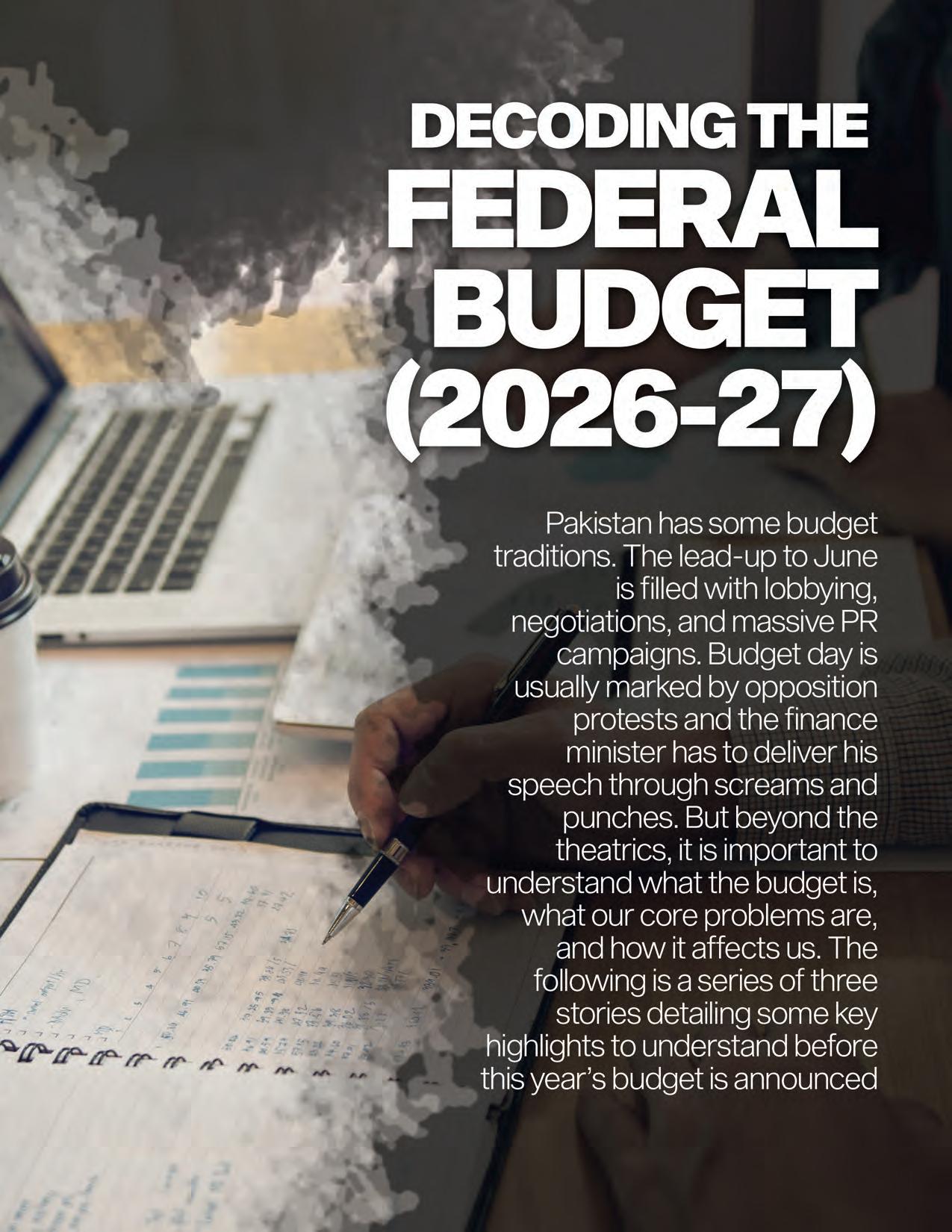
20 Decoding The Federal Budget (2026-27)
27 When good ideas go nowhere Mohsin Leghari
29 The Capital Illusion Muhammad Azfar Ahsan
32 How can you make your money work for you? A beginner’s guide to long term investing
Publishing Editor: Babar Nizami - Senior Editor: Abdullah Niazi
Business Reporters: Taimoor Hassan | Usama Liaqat | Zain Naeem | Shahnawaz Ali | Ghulam Abbass
Ahmad Ahmadani | Aziz Buneri - Sub-Editors: Saddam Hussain | Abdul Hameed - Video Producer: Adnan Maqsood
Director Marketing: Muddasir Alam - Regional Heads of Marketing: Agha Anwer (Khi) Kamal Rizvi (Lhe) | Malik Israr (Isb) GM Special Projects Zulfiqar Butt - Manager Subscriptions: Irfan Farooq Pakistan’s #1 business magazine - your go-to source for business, economic and financial news. Contact us: profit@pakistantoday.com.pk
Pakistan’s energy is twice the price of its neighbours’.
Here’s how we cut it
down
Electricity prices in Pakistan are at 21 cents per unit. In India and Bangladesh, they stand at 9 and 9.5 cents respectively. What is the reason, and can the grassroots solar boom help change things around?
By Abbas Hasan
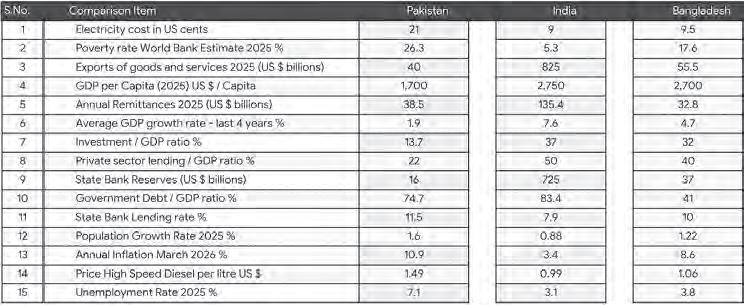
Pakistan stands at a critical economic crossroads, pulled down by a “catastrophic” power crisis. At Rs 58 (approximately 21 cents) per unit, the cost of electricity in Pakistan is now more than double that of its regional neighbours, India and Bangladesh, where costs hover
around 9 to 9.5 cents.
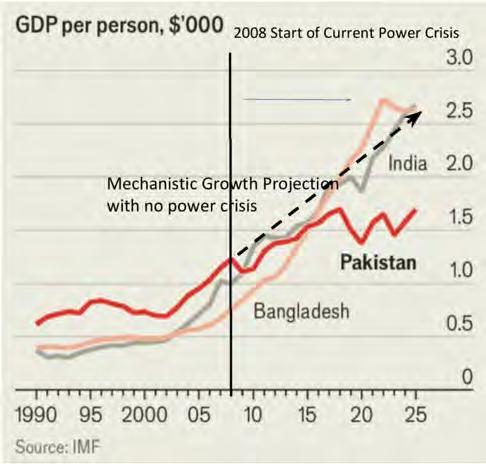
This disparity has led to a stark divergence in economic health. While Pakistan’s GDP growth has languished around 2% over the last four years (a third of what it was before 2005 and the lowest since 1947) its neighbours have seen their GDPs grow to be 70% higher than Pakistan’s. The human cost is equally severe, with a national poverty rate of 26% compared to just 5% in India. As per
the HIES survey, most people blame increased electricity costs for their poverty.
To avert a future as an uncompetitive state, reliant on loan and overseas remittances, Pakistan must pivot from the failed policies of the past toward a technically sound, solar-centric energy future. The government is fast running out of economic runway, as highlighted by the 15 economic indicators in the table below.
The Legacy of the Power Policy
The current high cost of electricity is not a result of international market fluctuations but a “direct result” of several pernicious power policies, particularly the 2015 Power Policy. This policy established over 10,000 MW of “hyper-expensive” power plants reliant on imported fuel. Crucially, these projects were locked into “take or pay” contracts with dollar-based fuel and capacity charges. Because the electricity is sold domestically in rupees, this mismatch has depleted foreign exchange reserves.
This was a missed opportunity of historic proportions. Had the government prioritised the development of 4,000 MW of indigenous Thar coal instead of 10,000 MW of imported coal and LNG, the price of power today would be lower by Rs 15 per unit, and the nation would have saved foreign exchange. In contrast, India’s reliance on indigenous coal for 70% of its power (remaining is hydel and renewable) allows it to generate electricity at a mere 4.25 cents per unit.
Another crisis is circular debt, by 2025 this had increased to 2.3 trillion, the government paid 1.3 trillion borrowed from the market for - which every consumer is paying a Rs 3 surcharge in his bill, now again it has increased to 1.7 trillion. The gas circular debt - due to imported LNG has ballooned to 3.5 trillion, combined the two circular debts today are Rs 5.2 trillion ($ 18 bn or 4.3% of
Pakistan simply cannot improve its balance of payments by increasing exports; the government is being delusional by stating that it will attract foreign investments or increase exports to $100 bn by 2030. Because, as compared to their neighbours Pakistani exporters, have to pay 220% more for electricity, 45% more for transport, have half the availability of bank loans, while interest rates are 15-45% higher, and foreign exchange is scarce. The same goes for talented salaried staff that must pay more for utilities and transportation on a lower salary and higher taxes.
GDP) - plus 1.3 trillion previous loan.
The Grassroots Solar Revolution
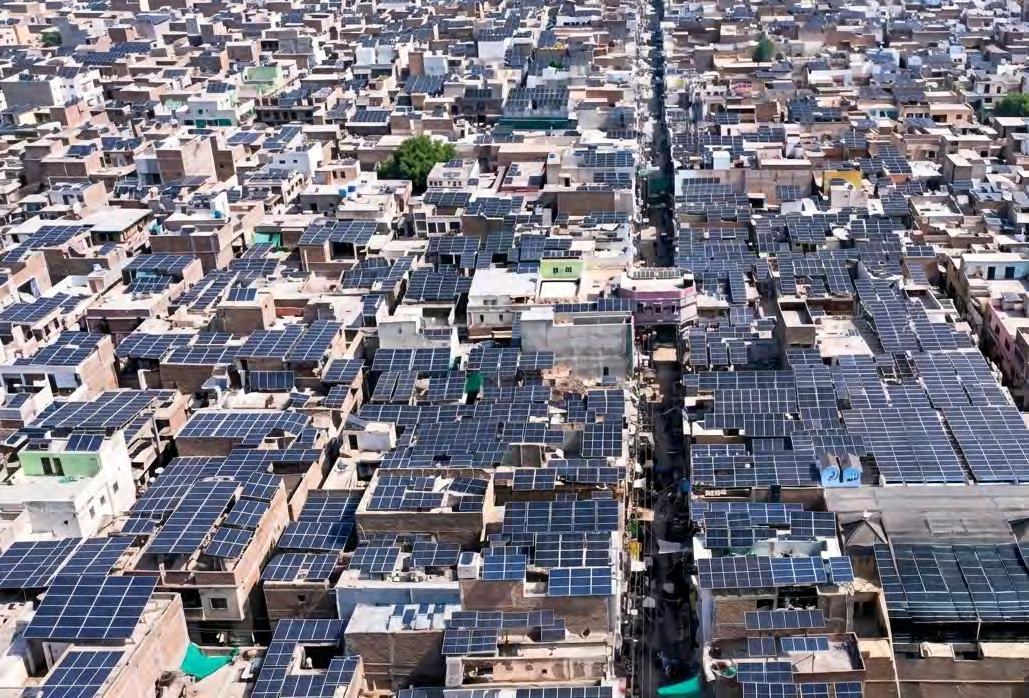
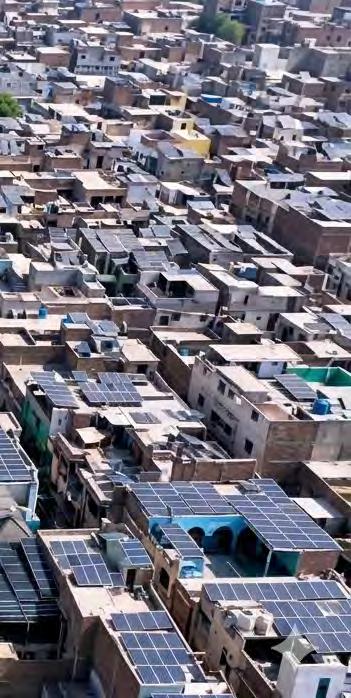
While formal policy has struggled, the Pakistani public and industry have already begun their own transition. There are currently approximately 38,000 MW of solar power installed across the country, with another 8,000 to 10,000 MW being
added annually. An estimated 12% of households—roughly one in eight—now have solar installations.
This shift is driven by economic necessity. The “purchase point” for the Pakistani consumer is approximately 8 cents (Rs 24); when prices exceed this, demand for grid power falls as consumers migrate to solar. Currently, solar accounts for over 25% of power generating 45 TWh compared to 127 TWh from non-solar sources. Industry leaders are also leading the way; for example, Cherat Cement and Lucky Cement integrated solar with Battery Energy Storage System (BESS) to ensure an economical and stable power supply
Another significant failure noted is that the power sector has been led by economists, accountants, lawyers, and civil servants rather than engineers and technical experts. This has resulted in a lack of technical foresight regarding grid modernization and the integration of cheaper renewable energy.
Narrow Focus on Transmission and Distribution (T&D) Losses; The government narrative has focused heavily on T&D losses as the main issue. However, the sources argue that while these losses are high, they do not explain why Pakistan’s electricity is double the cost of India’s, where losses are only 1% lower. The true failure lies in an uncompetitive “whole chain” of production. Even if the target of 12% line loss is achieved the maximum it would save is Rs 2.5/ unit.
Failure to Modernise the Grid; There has been a lack of policy support and investment in an Advanced Distribution Management System (ADMS) and smart grid components, which are necessary to handle the transition to solar energy and address technical issues like “Reverse Load Flow”, “Reactive power” and “Harmonic Distortion”.
Based on regional benchmarks power should be produced at around 4-5 cents per unit (1.5 cents energy cost and 3 cents production - capacity) costs and sold at 8-10 cents after allowing for Transmission and Distribution (T&D) losses etc. In Pakistan our energy cost is Rs 9 (3 cents) and capacity charges around Rs 15 (5.4 cents) or a total of 8.4 cents and we sell at 20 cents. By comparison India relies on rupee based indigenous coal for 70% of its power, the rest is hydel, nuclear and renewable. Their energy production cost is 4.25 cent and sale price 9 cents respectively.
At 0.5 MW per capita power consumption per capita in Pakistan is very low. There is much potential for growth, provided of course that the prices are affordable. India is at 1.6 MW per capita, Bangladesh at 0.75 MW while Turkey and South Africa are around 3.5 MW per capita. Typical consumption for OECD countries is 6-8 MW per capita. With the advent of New Electrical Vehicles (NEV),
general electrification as people move away from gas for heating and cooking, as well as data centres, the demand for electricity will only move upwards.
Technical Solutions for Solar Grid Integration
Acommon “urban legend” suggests that solar is too unreliable for the national grid. However, with modern technology up to 50% of total generation can be solar without compromising stability, provided the grid is managed by an Advanced Distribution Management System (ADMS). Transitioning to a solar-heavy grid requires addressing four primary technical constraints:
1. Reverse Load Flow: In a traditional system, power flows from a central generator to the consumer. Solar turns the consumer into a generator and that too is transient, requiring constant monitoring of individual feeders to prevent overloading or under servicing to avoid grid destabilisation.
2. Harmonic Distortion: Converting DC current from solar panels to AC via inverters can create “sinusoidal waves” that do not
match the grid. This can be mitigated through high-quality inverters and harmonic filters.
3. Reactive Power: Unlike traditional rotating machinery, solar does not naturally produce the reactive power needed for industrial production. However, modern solutions like Variable Frequency Drive (VFD) motors reduce the need for this power, or it can be injected into the system, making targeted stabilization manageable.
4. Island Effect: Not knowing if the grid is live or not. This can also be addressed through the implementation of an ADMS.
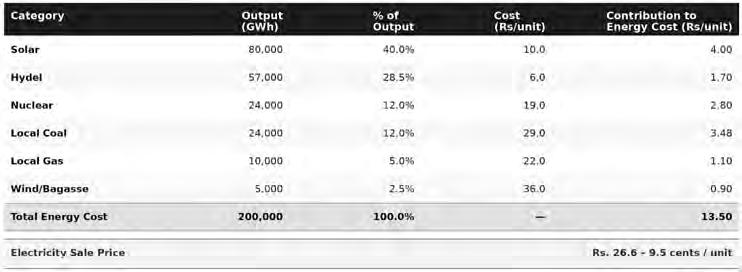
To regain regional competitiveness, the goal is clear: Pakistan must reduce its power generation cost to approximately Rs 13.5 (4.8 cents) per unit and the sale price to approx. Rs 26.6 (9.5 cents). Achieving this would result in annual national savings of $12 billion—roughly 3% of the GDP—and save $3 billion in foreign exchange annually.
By reversing the “pernicious” policies of the past and
leveraging indigenous resources and solar technology, Pakistan can lower its energy costs, revitalise its exports, and provide much-needed relief to its citizens requires several key policy and structural changes:
• Shift in Leadership: The most fundamental policy change required to help deliver this challenge is to place the leadership of the
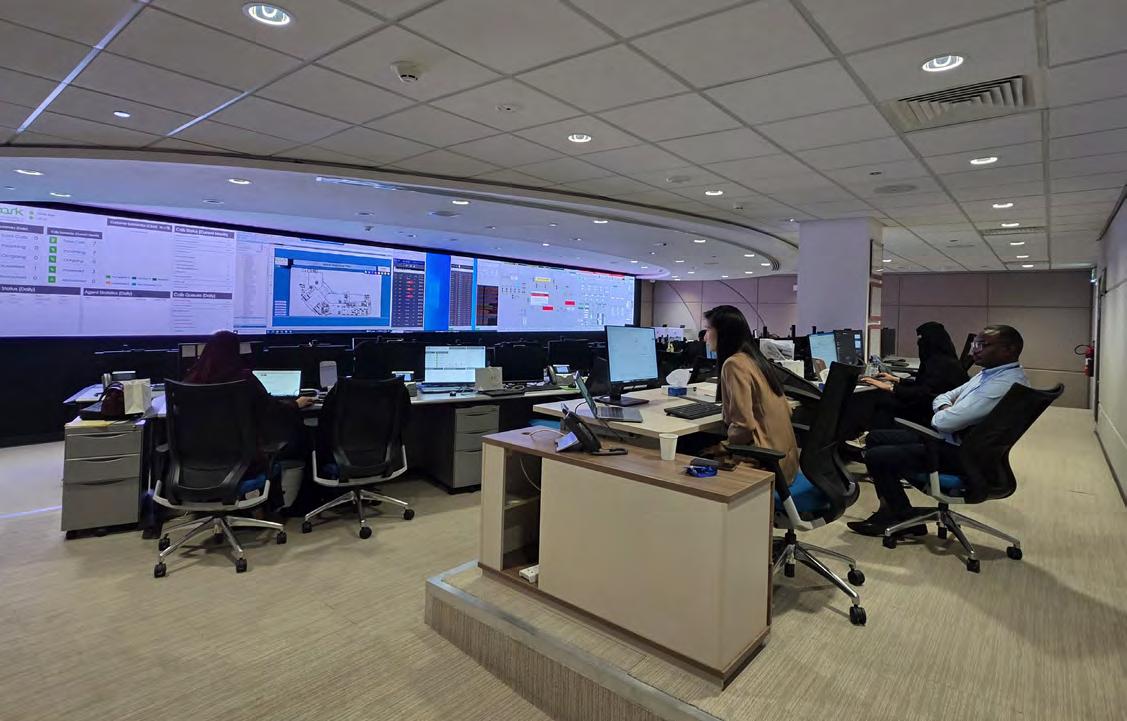
The SPARK control centre at the King Salman Energy Park is a Saudi Aramco subsidiary.
power sector in the hands of engineers and technical experts rather than economists, politicians or bureaucrats.
• Focus on Indigenous and Renewable Resources: A policy reversal that moves away from “hyper-expensive” imported and dollarized fuel plants and toward indigenous Thar coal, hydel, and solar energy, which are the cheapest available sources.
• Investment in Advanced Grid Management: Policy must prioritize and fund the implementation of an Advanced Distribution Management System (ADMS) and associated Remote Energy Resource Management System (RERMS). This technical solution is necessary to manage the transition to a grid where up to 50% of generation could be solar and would facilitate Virtual Power Plants as well as micro grids.
• Infrastructure Modernization: Enabling the grid for solar requires investment in the distribution system to reduce line losses, specifically by placing distribution networks underground. Additionally, the grid must be upgraded with smart components, micro grid controllers, harmonic filters, and Battery Energy Storage Systems (BESS) to ensure grid stability.
• Regulatory Oversight and Standards: A strong regulatory agency is needed to oversee utility monopolies and prevent them from taking advantage of customers. Furthermore, policies should enforce higher quality standards for inverters to reduce harmonic distortion and encourage the use of Variable Frequency Drive (VFD) Motors in industry to minimize the need for reactive power.
For the past ten years, I have been involved as project delivery director - now as consultant with King Salman Energy Park (SPARK), a Saudi Aramco subsidiary that is the third mandated distributor of power in KSA. SPARK has installed one of the most advanced utility distribution systems using
ADMS automation and smart components for its utilities. This has provided me with a unique insight as to how these systems may be used to help include roof top solar into the grid.
The point is we are where we are and need a solution rapidly, therefore based on my experience, a proposal has been developed pointing to how to lower the cost of electricity from the current Rs 58 to Rs 26.6 driven by a solar-centric energy future using modern technology for grid adaption. I am not by any means saying that this is the only solution, however instead pointing to the direction of travel required for a competitive energy price.
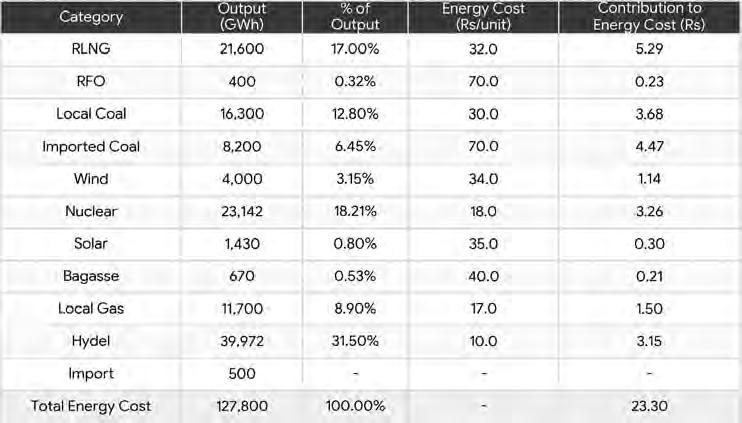
As a comparison based on data from 2025 the current cost of power per component is below. After accounting for taxes, line losses; DISCO costs and lifeline user subsidy etc the average electricity sale price today is around Rs 58/ unit:
Revised Profile after adapting grid solar power using ADMS system the price may be reduced to Rs 26.5 per unit, based on the distribution below:
The model assumes 4,000MW (17,000 GWh) additional Hydel due for completion in 2027. It assumes that 400bn/year from the legacy capacity payments are transferred to a separate toxic assets account to be paid for by the government. All other capacity payments
are accounted for, it also assumes reduction in line loss from current 17% to 13.5%.
Implementing connection solar to the grid is fiendishly difficult, which is why it is recommended to start a pilot project in a specified area and scale up with the lessons learnt. For a modern utility system the Automation Control is as important as the electrical engineering component, skills in Pakistan in such fields are gold dust. Another key element is financial incentive and access to capital for users to install more solar and storage.
As a rule of thumb the cost is important the cost of “smarting” the grid is approximately 70% of the solar so if we assume solar cost is $0.5m/ MW then the smart grid and associated automation would be around $0.35m/MW, so for 35 MW one is looking at $12 billion plus say another $2 billion for the BESS. Given that the country will be saving $12 bn per year the payback period sounds reasonable with most of the cost being the hardware itself.
With decreasing cost of solar panels and battery storage currently around $90-120/ MWh or 25-35 rupees/ unit but falling, and the world may well be moving off grid but this won’t happen overnight and even if it does; it will leave a lot of vulnerable people at a loss. Otherwise, we are moving towards a country where about 30% or so of the population that can afford solar and storage will have a better quality of life, while the remaining 70%, will be condemned to poverty and deprivation.
No country can progress if, as compared with its competitors, it spends an extra 3% of its GDP on power. To revive our export and economy and alleviate poverty, it is imperative for the country’s leadership to urgently seek how it can reduce the price of power and the cost of business. Unless a solution is found quickly, the consequences for Pakistan are serious; including deindustrialization, unemployment and a dire security outlook, and unfortunately time is running out. However, given the vested interests at stake, I doubt if anything will actually happen. n
The writer is Senior Consultant at SPARK.
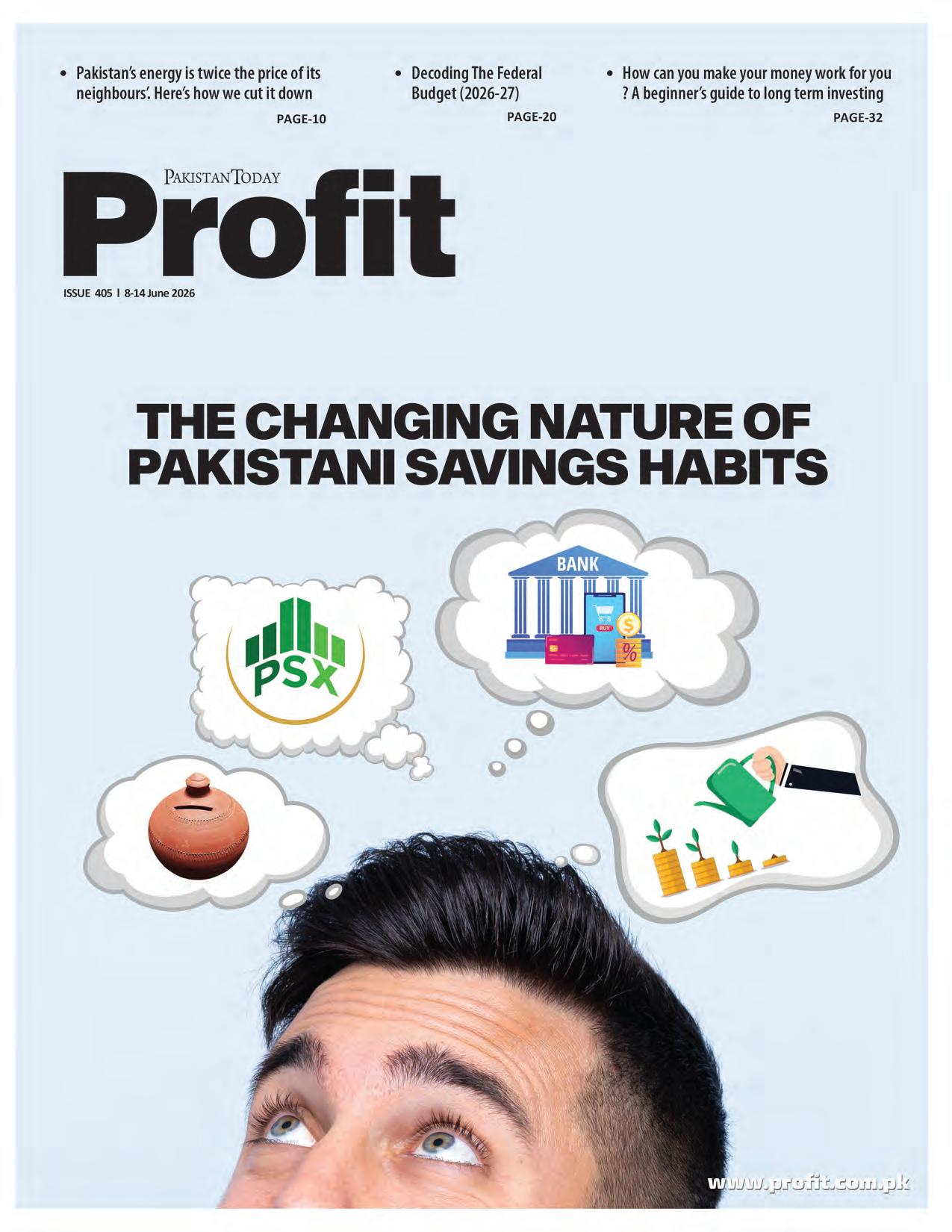
The changing nature of Pakistani savings habits
Historically, most long-term saving in what is now Pakistan has not involved financial institutions. That is changing as the upper middle class start to invest through the stock market and mutual funds.
By Farooq Tirmizi
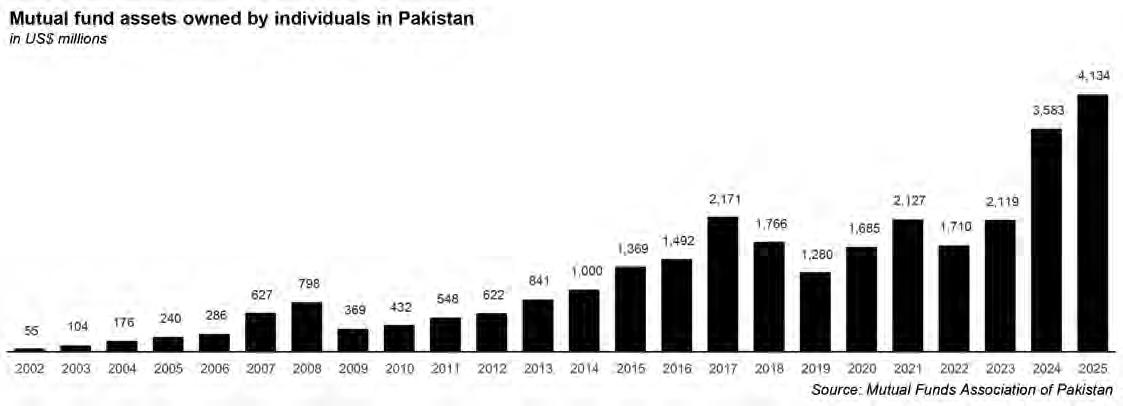
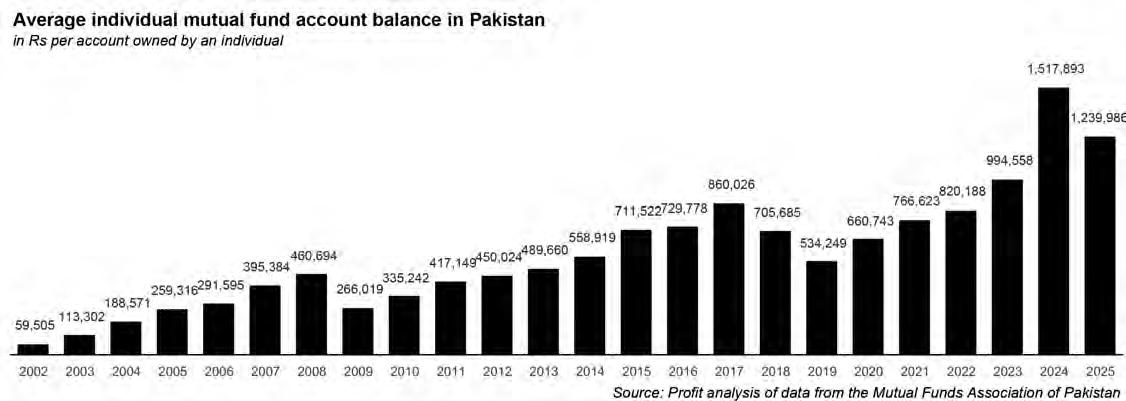
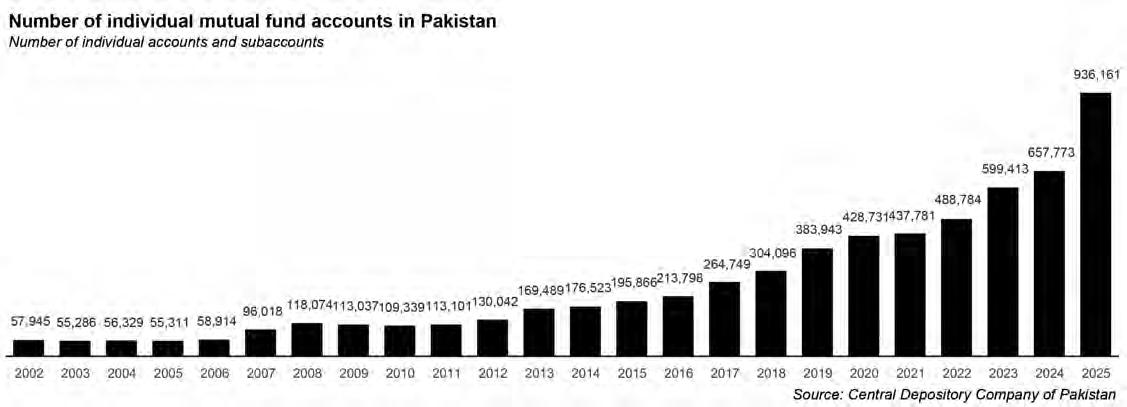
There are almost one million mutual fund accounts owned by individuals in Pakistan, and the average account has more than one million rupees in it. The aggregate numbers of individuals saving through mutual funds, or directly investing in the stock market, are still tiny, but after decades of stagnating, they are finally beginning to rise again, and that has implications for the economy, and for the country’s financial institutions.
First, a look at some of the headline numbers: the mutual fund industry has seen absolutely explosive growth over the past few years, with assets under management (AUM) increasing 7 times during the fiscal years between 2019 and 2025 (fiscal year ends June 30), with industry-wide AUM hitting Rs3.8 trillion ($13.6 billion) as of June 30, 2025, according to data from the Mutual Funds Association of Pakistan (MUFAP).
What makes this data more impressive is the degree to which it is reliant not just on financial institutions and corporations utilizing mutual funds for short-term parking of cash, but by individuals for long-term savings. During that same period, the total number of individuals who have mutual fund accounts increased from 243,000 to 669,000, a rise of 175%. Those individuals own about 936,000 accounts as of the end of fiscal year 2025, with total assets in those accounts of Rs1.16 trillion, which puts the average balance in each account at Rs1.24 million (Rs12.4 lac).
Of the individuals who do own mutual funds, the average amount they hold in mutual funds across all their accounts comes out to Rs17.4 lac in 2025, more than doubling from just Rs8.4 lac in 2019.
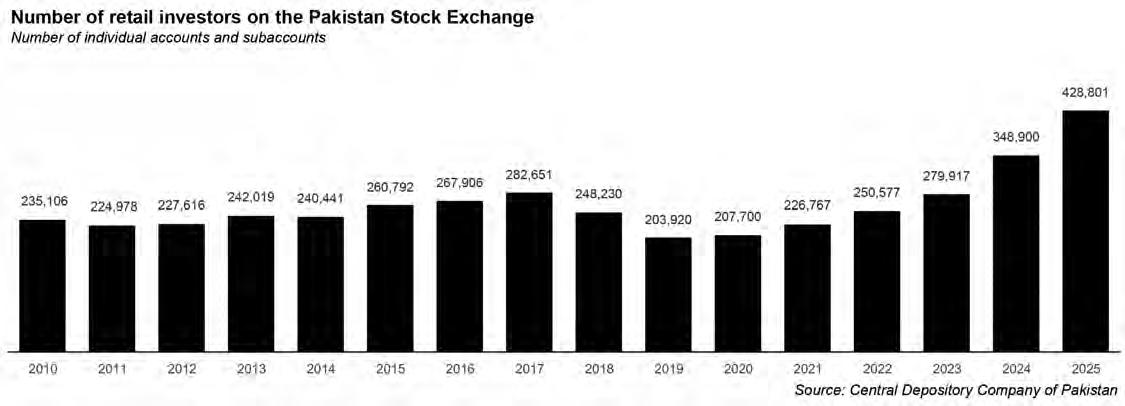
The numbers on the stock exchange side are smaller, but still rather impressive. The total number of individuals with brokerage accounts has crossed 500,000 recently, and was languishing around 204,000 in 2019. The recent run up in the stock market no doubt pulled in some investors from the sidelines.
These numbers are still a tiny fraction not just of the total population, but also of the relatively small middle class in Pakistan.
But they represent the beginnings of what is likely a very important shift in behaviour: the use of financial instruments for long-term savings, something that only happens in a society that is beginning to develop trust in its own rule of law, and long-term economic future.
In this story, we will first look at how Pakistanis have historically saved, and why this new behaviour represents a serious shift, where in the global spectrum of financial behaviour Pakistan belongs, and why Pakistani banks are sleeping on what is likely their biggest long-term opportunity.
The history of savings and investments
Let us first define the two terms: saving is what happens when you decide not to spend money you have earned, and instead set it aside. Investment is the next step: taking that money that you decided not to spend, and instead putting it to work in some form of asset that you hope will appreciate in value over time, or else start generating income for you.
Historically, Pakistanis have saved very little, and invested even less, because until very recently, incomes across the entire economic spectrum were simply too low for there to be any meaningful amounts left over after the most basic of consumption was done at the end of the month. But as more and more of the country’s households move out of a subsistence level existence, the capacity to save is increasing across society, and that, in turn, is producing savings at a scale that is about to hit a tipping point (more on that later).
So when it came to investing, most Pakistani households have not had much to invest to begin with, and what little they had, they put in three asset classes as ancient as time: cattle, land, and gold. Of these, gold has always been a purely price appreciate play: the only way to make money off gold is to sell it for more than you bought it. Cattle are an income generating asset: two goats can produce more goats that can then be sold and create and income generating stream. A cow and bull can generate more cows, and some milk to be sold.
Land could go either way: if it was farmland, it could help generate income right away (within one year, at least). If a house, it might generate some rent. It could also be a speculative plot, not in use now, but perhaps in a growing area that might cause its value to grow over time and be sold for more than it was bought for.
For nearly all of our history, this was pretty much the menu of options for most people. Gujratis and Chiniotis might invest in the working capital of businesses owned by their extended families, some clans in Sindh and Punjab might invest as lenders to farmers in their local area, but these were relatively small exceptions.
One thing they all had in common: a bare minimum reliance on paperwork, or trust of anyone who you do not already trust. Even the land usually involved buying in an area where one’s extended clan could help offer some degree of protection.
Here is how little the part of the world that is now Pakistan cared for financial institutions: at Partition, there were hundreds of small, unregulated banks that were almost all owned by Hindu families that migrated to India after independence. To have had so many banks disappear overnight would have caused a major financial crisis in any country today, but you may notice that any older relatives who ever tell Partition stories never mentioned a financial crisis. There probably was one, but not nearly as disruptive as one might be today.
In theory, bank accounts represent a way to start saving, though as we will note later, that is not how they are used in Pakistan, or really most parts of the world.
The oldest financial instruments for formal investing in this part of the world were life insurance policies, issued by small companies beginning with Christian Mutual in 1847 and Indian Life in 1892. The Government of India created the National Savings Bureau in 1873 to channel domestic Indian savings to finance infrastructure construction in the British Raj, and that institution helped raise some money for the British Indian contribution to the war effort during both world wars.
The Bombay Stock Exchange was created in 1875, and some traders from that ex -
change moved to Karachi after Partition and helped set up the Karachi Stock Exchange in 1948. And the government of Pakistan set up the National Investment Trust (NIT) in 1962 that created the country’s first mutual fund. The private sector did not create its first mutual fund until AKD Investments’ Golden Arrow Selected Stock Fund in 1983. The first open ended mutual fund – what is normally thought of as a mutual fund – created by a private sector entity was JS Abamco’s Unit Trust of Pakistan, launched in October 1997.
All of these remained tiny parts of the Pakistani economy, used by a few thousand people in total for nearly the entirety of the country’s history. Even during the Musharraf-era stock market boom, the number of individuals who had stock brokerage accounts never crossed 100,000 people.
So what is changing now? And will this trend continue moving in this direction, or is this a blip that will end up not meaning much?
Banks vs non-banks
In most economies in the world, Pakistan included, the banks are the most important financial institutions, both in terms of total assets and the number of individuals and businesses served. This might lead one to think that bank accounts are an instrument of savings and investments, but this view is mostly wrong: bank accounts enable the initial act of saving (leaving money unspent on consumption) but they are not unto themselves an investment.
This basic fact is one that most Pakistani bankers do not understand. Indeed, if one were to administer a basic financial literacy test to the management committees of every single bank in Pakistan, it is very likely that nearly all of them would fail.
How do we know this? Because all of them seek to develop “wealth management” divisions and affluent client strategies that all depend on deposit accounts at their core, not realizing that building a long-term relation-
ship with affluent clients – or offering wealth management solutions to even higher networth clients – is not about deposits at all.
The proof lies in the data of how bank accounts in Pakistan are used, which is how they are used in nearly the whole world: as a means of transacting, not as a venue for savings.
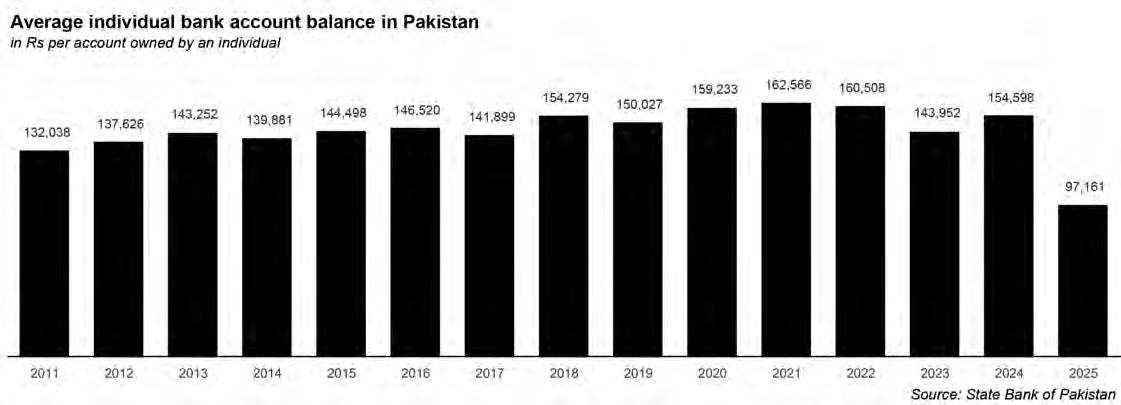
Here is one data point about Pakistani bank account holders’ behaviour that illustrates this point: the average balance in a bank account owned by an individual in Pakistan in 2024 was Rs154,598. That number in 2011 was Rs132,038. Over that 13-year period, during which inflation averaged 9.9% per year, the average amount held in an individual-owned bank account increased by just 1.2% per year.
Yes, that is correct: the purchasing power of the average balance in bank accounts held by individuals in Pakistan went down over the course of the nearly a decade and a half.
In other words, the average Pakistani is
not using their bank account to save. They are simply using it to conduct their transactions, and whatever amount that gets left over after they are done spending on consumption does not stay in their bank account but is instead moved out to a non-banking savings instrument.
And the pace of this moving out from the bank account appears to be accelerating (because the purchasing power of the average balance is going down) right as the non-banking financial services sector such as mutual funds and stock brokerage accounts appear to be gaining popularity.
The reasons are somewhat obvious: a current account at bank has a 0% nominal return, and after accounting for inflation, a significantly negative real rate of return. Savings accounts are slightly better, but in most years, they still offer negative real rates of return.
So it makes sense to use bank accounts only for current transaction needs, where inflation is less of a consideration, and leave the need for investment – where beating inflation
is of paramount importance – to other investment vehicles, not deposit accounts.
Of course, not all of it is going into mutual funds or the stock market, and indeed most of it is likely going into real estate. But that is part of the point: banks are the country’s primary financial intermediary, but the entire industry is single-mindedly obsessed with deposits – which are not how the overwhelming majority of Pakistani wealth is stored.
If the country’s wealth is going to be channeled towards productive investments, it is that non-deposit part of the wealth that needs to be moved into financial instruments. In previous articles, we at Profit have estimated that bank accounts constitute perhaps 3% of the total wealth in the country. Yet bank CEOs view mutual funds and other non-banking financial instruments as competing against their highly profitable deposit product, rather than a means for them to capture a greater portion of the 97% of the country’s wealth that is not kept in bank accounts.
Deposit vs non-deposit financial products
Here is the thing to remember about the Pakistani financial system: the majority of assets managed by non-banking financial institutions (NBFIs) are in NBFIs owned by the banks. Nearly all of the largest asset management companies are bank-owned, and the asset management companies account for the overwhelming majority of NBFI assets.
In short, the banks do not need to choose between deposits and non-deposit products. Nearly all of them offer both. But the problem for the banks is that they are staffed – and in some cases, led – by financially illiterate management that cannot understand the difference between a deposit and a non-deposit financial product.
Most astoundingly, they tend to think of them as competing products. A bank earns a net interest margin of 6-8% on every rupee
brought into the bank in the form of deposits, but would earn between 1-2% in management fees on a mutual fund. To them, it makes sense focus on generating more deposits rather than trying to invest in the infrastructure to get more investments in mutual funds.
While on a theoretical level, they understand that the mutual fund helps them capture a part of the 97% of non-deposit wealth held by Pakistanis, as a practical matter, they have chosen to go after deposits to the exclusion of all else.
Indeed, to be a banker in Pakistan right now (and for the last two decades) has essentially been one long carry trade: bring in low cost deposits and deploy them effortlessly into government bonds, which will guarantee that the State Bank of Pakistan – the regulator – will ask absolutely no questions about lending policy because everyone is operating under the assumption that government bonds are risk-free.
That carry trade has been enormously profitable as the banking sector’s deposits have continued to grow. While the average account balance has not meaningfully grown, the aggregate level of deposits has continued to grow, allowing the banks to maintain healthy growth trajectories while maintaining high profit margins.
That era, however, might be coming to a close.
The end of the
easy deposit flow?
It is still too early to have a definitive comment on this, but there is one data point among the more recent data release about bank deposits in Pakistan that should have Pakistani banks worried. According to Profit’s analysis of the data released by the State Bank of Pakistan, the average balance on bank ac-
counts owned by individuals in Pakistan went down by 37% in 2025, from Rs154,598 in 2024 to Rs97,161 per account in 2025. This happened largely because the total number of accounts went up. But that, in itself, tells us something that should concern the banks.
Deposit growth in Pakistan has come largely from an expansion of the number of people in the country who re participants in the formal banking sector, a number that has risen as the formal employment share of the labour force has risen. (If you are employed in a formal setting, you need a bank account to get paid your salary. If you are employed informally, you do not need a bank account.)
But while that has been the story of aggregate growth in the sector, each individual bank has also grown by capturing share from other banks, and one of the ways this happens is through company salary accounts. Most banks insist on making it difficult for employers to pay their employees’ salaries to accounts in other banks, so employers often force their employees to open accounts at the bank that the company maintains its main corporate account.
This is partly why the number of accounts has been increasing faster than the number of individuals who own bank accounts in Pakistan. The problem is that in 2025, the pace of churn among bank accounts appeared to hit unprecedented levels: the total number of bank accounts owned by individuals went from 96.6 million to 176.6 million, a rise of about 80 million accounts.
What does that mean? The creation of 80 million new accounts in a single year means that bank accounts are more fickle than ever before, which means that the cost of acquiring new deposit accounts is about to rise sharply.
There is a reason United Bank Ltd is giving away Toyota Land Cruisers (retail cost of around Rs10 crore) to branch staff who are bringing in significant amounts of deposits:
this costly bonus is about to become the norm in the banks as competition to increase their share of deposits intensifies in an industry where there is no difference between a current account at, for example, Bank Alfalah or Habib Bank.
Meanwhile, the banking customer is demonstrating through their behaviour that they value non-deposit financial instruments – which the majority of banks have the ability to provide through their own wholly owned subsidiaries.
Mutual funds are harder for banks to sell than deposits, but they are also more unique: funds offered by UBL Fund Managers are not the same as those offered by JS Investments, and one client may genuinely prefer one versus the other. There is also more room to differentiate not just on the basis of returns performance but also in fund design: the right combination of equity and fixed income may suit one client better than a generic fund.
In short, the competition among the banks is about to heat up – and get enormously costly – if they only thing they are all selling is an undifferentiated current account. One way to avoid that costly competition is to seek longer-term relationships with clients, which are likely to be easier built with products that might have lower margin, but potentially better long-term revenue potential.
But that will require the banks to think of themselves as holistic financial institutions, not just deposit-gathering machines. Alas, the post-2008 carry trade might have made them too complacent to be able to conceive of themselves as anything else.
There may yet be at least one or two banks that might pull themselves out of the current model and adopt a more holistic approach based on what the customer clearly wants. And it is entirely likely that the ones that do will be the ones that win market share. n
Here is how you can make sense of the upcoming budget
Profit Report
Pakistanis talk about the economy every year with a strange mix of exhaustion, urgency and vigour. As the budget season approaches words like default, reserves, inflation, taxes, power tariffs, circular debt and development cuts, start getting thrown around more often in conversations. And the main reason is that, the central anxiety around a budget is the same, will the budget cause hikes in prices? What does it signal? How will it affect me?
The budget is afterall an objective, empirical exercise and everyone should be able to deduce something from it, even if it is simple. But most public discourse around the budget comes from a place of bias and vindication.
Without the proper tools to ask the right questions, the public discourse gets marred with political rhetoric by politically-tied “experts”, and inconsequential comparisons to the days of past glory (Remember when petrol used to be Rs x/ litre under (insert name) leader?). Meanwhile, no one calls out ideological inconsistencies between the budget speech and the numbers laid out.
In most democracies, political debate is the thing that creates public demand, and public demand eventually shapes legislation. But if the public debate and demand are shaped by inadequate information, the legislation you get is like we get in Pakistan. Here, political parties often begin with their own narrative, turn that narrative into policy, and then ask supporters to defend it and opponents to reject it. In such an environment, something as astute as economic policy becomes a political loyalty test, which should not be the case.
What is the Budget?
At the centre of any country’s annual economic policy is the exercise called the federal budget. It is the document through which the government decides how much it wants to collect, how much it wants to spend, and how much it is willing to borrow to fill the gap between the two.
It tells citizens whether the state intends to spend more on development or paying debts, whether it will protect subsidies or cut
them, whether it will target to tax new sectors or squeeze the same documented base dry, and whether the promises made in political speeches can survive contact with numbers.
It is an accounting exercise with policy objectives. The usual cycle is built around preparation, authorisation, execution, reporting and monitoring, review, and policy-setting for the next round.
On paper, this sounds like an easy loop to follow, but in practice, the first two steps often decide everything. If revenue is overestimated, expenditure is understated, or politically difficult reforms are pushed into the future, the later stages become a record of correction rather than control.
The annual budget statement is the central document of the federal budget. Once prepared and approved by the cabinet, it moves to parliament and then to the public.
It has two main sections, in which the state’s finances are divided into receipts and expenditures.
Receipts
Receipts are the resources the government expects to collect. These include tax revenue (the taxes we pay), non-tax revenue (includes the petroleum levy, fines, profits etc), capital receipts, external receipts and other inflows. Together they form federal gross receipts. From this pool, the provincial share is deducted under the NFC Award, after which the federal government is left with net receipts to finance its own expenditures. This is why the federal government can announce a large gross revenue figure and still have far less money available for federal spending.
The NFC Award is central to this arrangement, because it determines how revenue collected by the federation is shared with provinces. The logic is that since provinces require resources to perform devolved functions, including health, education, agriculture and local services, the centre, which collects most taxes should pay it.
Additional resources can also be made a part of receipts which can come from privatisation proceeds, external financing (foreign loans), domestic borrowing, non-bank borrowing, and other financing channels.
But these are not “income” in the same sense as tax revenue. Borrowing fills a gap
today by creating an obligation tomorrow. Similarly, privatisation can provide a one-off inflow, but it cannot be treated as a permanent substitute for recurring revenue, because you cannot sell the same SOE every year.
The total revenue/ receipts then define how the government will spend that money.
Expenditure
The other side of the annual budget statement is expenditure. Spending is mainly divided into current expenditure and development expenditure. The current expenditure keeps the state running i.e, debt servicing, defence, pensions, subsidies, grants, salaries, administration etc. And the development expenditure is supposed to build future capacity through roads, water systems, schools, hospitals, energy projects and other public investments.
The biggest current expenditures on the revenue account that Pakistan incurs are General Public Service and Defense affairs and services. The General Public Service mainly inculcates the servicing of domestic and foreign debt.
The expenditures are also separately shown for expenditure on Revenue Account and expenditure on Capital Account. Expenditure on Revenue Account signifies that portion of expenditure which is met from resources such as tax revenue and receipts, whereas expenditure on Capital Account refers to expenditure which is financed from loans, finances, credits, grants, and other borrowings.
The revenue and expenditure get balanced and at the end the total number under both these heads is the same. This is the reason why we called the budget an accounting exercise earlier. Because the reality, while hidden right inside them, is a bit different from the numbers.
The context for FY27 budget
So while the fundamentals are simple, reading the budget seems to be a more daunting exercise. Afterall, from what has been explained to this point, the budget sounds like a hunky dory jigsaw puzzle that fits together at the end. But why does it not do that? To get that, we need to have some context of the FY27 budget.
The first problem is that Pakistan’s current expenditure is so large that it leaves
limited room for development which means that any development budget would be ceremonious to begin with.
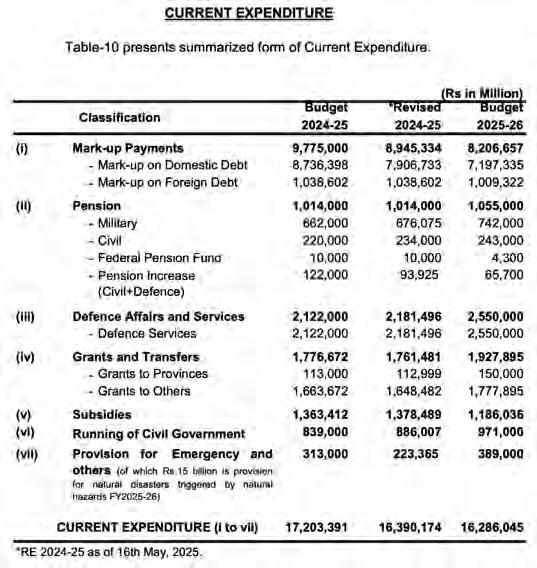
For example, in the outgoing FY26 budget, the federal government’s total expenditure was estimated at Rs17.573 trillion, of which current expenditure alone stood at Rs16.286 trillion. That means current spending consumed nearly 92.7% of total budgetary resources, before development and net lending were even counted.
Interest payments were budgeted at Rs8.206 trillion, defence affairs and services were budgeted at Rs2.550 trillion and pensions at Rs1.055 trillion.
Against net federal revenue receipts of Rs11.072 trillion, current expenditure was even larger, at about 147%, showing that the federal government could not finance its routine obligations from its own net revenue and had to rely on borrowing and other financing before development even enters the conversation. For the reader, this means that there is already a constrained environment in which this budget is made, so most of the estimates tend to over-reach particularly because they need to, especially if they are estimates regarding debt, privatisation proceeds, or any reform related freeing up of the funds. These things have been budgeted in the past only to be revised later.
For FY27, the context is even more constrained because the budget is being prepared under a strict IMF programme. The IMF mission that visited Islamabad in May said
Pakistan had committed to achieving a primary surplus of 2% of GDP in fiscal year 2027. A primary surplus means the government must collect more than it spends before interest payments. It is a measure of whether the state can finance its current operations without adding to the debt problem, even though interest payments themselves remain outside that calculation.
How to make sense of the budget?
While reading any kind of economic data, trends are a key aspect of it, and the same applies to reading the budget. What happened in July is best compared to June and second best to June previous year. So most numbers are viewed not in isolation, but in comparison to how they were last year, just to get a sense of how that number’s lived experience will be different this year.
For example, let us assume that the budget states that the petroleum levy collected in FY27 will be Rs 1.6 trillion, that information on its own is not much to go by. But seeing that this number was Rs 1.47 trillion last year, puts it into some perspective. It tells us that it is almost 10% more than the target from the previous year. Now to achieve the target from the previous year, the government had to piggy back off of a global war and raise the levy to Rs 100 at one point.
promotions+ inflation, proportionally raising tax) it means that either some new kind of enforcement is in play or the tax is about to be increased.
There is always a third possibility, that the estimate can not be realistically met and that this figure is bound to get revised. Balance on paper does not always mean realism in execution. It is important to understand that the budget always closes because it must, not because it actually is going to. Receipts, borrowing and financing are arranged to equal expenditure. Collection of taxes from businesses (export, import, retail, advance) is usually estimated by that logic. So a more useful question is how credible those assumptions are, and how will it be achieved instead of which government did it better.
In FY25, for example, FBR revenue was budgeted at Rs12.97 trillion but later revised down to Rs11.9 trillion, while total federal expenditure was also revised down from Rs18.877 trillion to Rs17.249 trillion.
So if the next year’s budget sets a higher revenue target, the number must be read against last year’s revised collection, not only against last year’s budgeted ambition.
So, this means that the amount of levy will remain around where it is right now, because monthly collection has to be over Rs 133 billion (1.6 trillion/12 months), which was equal to the highest month we had in the current fiscal year (March). This gives us a good read of how the year is going to be for petrol prices. A similar exercise can be done with other numbers, if the income tax from salaries’ targeted projection is more than, say 15% of what it was the previous year, it means that it is exceeding the “bracket creep” phenomenon ((people getting increments/
Another such deduction comes from comparing expenditure heads with the previous year. Some costs are rigid while others are not. Things like interest payments, defence, pensions and subsidies cannot be reduced easily without political or financial consequences. Meanwhile some costs like “other grants (Rs 1.7 trillion)” or “Running of Civil Government (Rs 971 billion)” can be reduced.
An important part of reading the budget is whether the government is standing firm on its speech. For example, every year we hear the government planning fiscal consolidation or reducing the size of government through rationalisation drives and other gimmicks, but every year the “Running of Civil Government” expenditure head rises. This rise in this expenditure was recorded at over 15% last year, a year when the government was “consolidating” its operations.
This is why development expenditure often becomes the sacrificial lamb of the budget in Pakistan. If revenue targets are unrealistic, the government either borrows more, raises more indirect taxes and levies, or it simply cuts PSDP and other adjustable spending later in the year, foregoing any opportunity of increasing the possibility of future growth.
If you have read this far along, you have a rudimentary understanding of how to perceive the news around the coming budget, but this is also the part where we admit that you have been misled by the title of this article. While understanding it is one problem, the “making sense” of Pakistan’s federal budget, simply does not exist. n
Pensions
How Pakistan’s pension bill swallows development space
Unfunded retirement
promises
cost about Rs1.06 trillion this year as government prepares to extend contributory system to new military recruits
Pakistan’s federal budget contains many large numbers, but few explain the state’s shrinking room for manoeuvre as neatly as its pension bill.
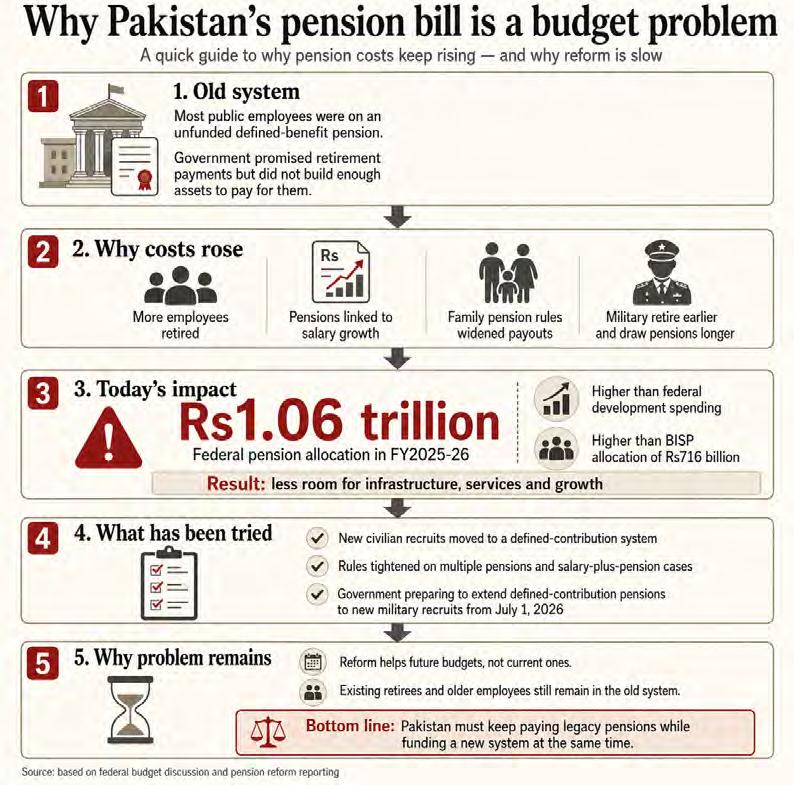
In the current financial year, the federal government set aside about Rs1.06 trillion for pensions. That is more than the Rs1 trillion federal development programme and far above the Rs716 billion allocated to the Benazir Income Support Programme. Islamabad is spending more on people who have left government service than on the roads, water systems, hospitals and other projects through which it hopes to expand the economy.
This is not because pensioners have suddenly become unusually expensive. It is the result of a promise made over decades without building the pool of assets needed to pay for it.
Under Pakistan’s traditional system, most public servants receive a defined benefit after retirement. The benefit is linked to salary and length of service, while the government bears the risk and guarantees payment. Employees generally did not contribute to a dedicated retirement account during their careers. Once they retired, their pensions were paid from that year’s budget.
This is an unfunded, pay-asyou-go system. Current taxpayers pay current pensioners, and another batch of employees is added when the next budget arrives.
A defined-benefit pension is attractive to an employee because the retirement income is predictable. For the government, however, it creates an open-ended liability.
Salaries rise, pension increases are granted, people live longer and more employees retire. Unless revenues and a pension asset pool grow at a similar pace, the gap lands directly on the exchequer.
That gap has widened quickly. The federal pension allocation was about Rs480 billion in 2020-21. By 2024-25 it had reached
Rs1.014 trillion, and the current year’s allocation is around Rs1.06 trillion. Pensions now consume roughly 6.4 per cent of federal current expenditure.
The composition matters too. Of the Rs1.055 trillion shown in the current budget documents, Rs742 billion was allocated for military pensions and Rs243 billion for ci -
vilian pensions, with the remainder covering pension increases and the federal pension fund. Roughly seven of every ten rupees in the main pension allocation therefore go towards retired armed forces personnel.
And this is only the federal bill. Provincial governments, autonomous bodies, public universities and state-owned enterprises carry pension obligations of their own. Research by the Pakistan Institute of Development Economics has repeatedly warned that the wider system is fragmented and lacks a matching asset base.
The problem is not merely that the figure is large. Pensions sit inside current expenditure, alongside interest payments, defence, salaries, subsidies and the cost of running government. These expenses are difficult to compress quickly. When revenues disappoint, development spending is easier to postpone than a monthly pension payment.
How did the bill become so unwieldy?
Part of the answer is accumulation. Pakistan recruited millions of permanent public employees under arrangements that could require the state to pay a salary for three decades and a pension for another two. The burden remained manageable while fewer employees had retired and salaries were lower. As larger cohorts left service, the cash demand accelerated.
The design also allowed costs to multiply. Pension calculations were traditionally linked to the last salary drawn, creating a higher base after a late-career promotion or pay increase. Family pension rules extended payments to several categories of dependants. Some retirees could receive more than one pension, while re-employed officials could, in certain cases, draw both a government salary and a pension.
Military pensions add another complication. Armed forces personnel often retire earlier than civilian employees, so payments may continue for a longer portion of their lives. Many then take other employment while continuing to receive a pension earned through service. The question is not whether that pension was promised; it was. The fiscal question is how the government finances promises whose full cost was not funded when they were made.
Pakistan has known about this problem for years. Pay and pension commissions were formed and international examples studied. The prescription barely changed: stop adding employees to the unfunded system, tighten existing benefits and build professionally managed funds. Implementation was another matter.
Khyber Pakhtunkhwa moved first among the major governments. It introduced a contributory arrangement for employees
hired from July 1, 2022, under which employees contribute 10 per cent and the government 12 per cent. It also narrowed categories of family beneficiaries, raised the minimum age for early retirement, restricted multiple pensions and tightened benefit calculations.
The federal government eventually followed. In 2024, it approved a defined-contribution scheme for new civilian entrants and announced that the system would later cover new armed forces recruits. Under the federal rules, an employee contributes a fixed share of pensionable salary and the government adds its contribution. The money is meant to be invested through authorised pension fund managers, creating an individual retirement pot rather than another undefined claim on future taxpayers.
Under the old system, the benefit is promised and the government must find the money. Under the new one, the contribution is fixed and retirement income depends on accumulated savings and investment returns. Risk moves partly to the employee, but the liability is funded as it is created.
The government has also begun changing the old system around the edges. Reforms notified in 2025 restricted multiple pensions, shifted benefit calculations away from the final salary alone towards an average of recent pay, and stopped retired civilian employees who return to government jobs from collecting both full salary and pension simultaneously. These changes can reduce leakages and slow future growth, although they do not erase pension rights already earned.
This is the awkward part of pension reform: even a sensible reform can take decades to improve the headline number.
Moving a new recruit out of the old system prevents a future liability, but does little to pay today’s pensioner. For a long transition, the government must finance the legacy scheme while contributing to new accounts. It is paying for the past and saving for the future simultaneously.
That is why the upcoming budget should not be judged only by whether the pension allocation rises or falls. It will almost certainly remain close to, or above, Rs1 trillion. Existing pensioners remain entitled to payment, and any increase announced for retirees will add immediately to expenditure. A contributory scheme cannot make that cost disappear by July.
The more consequential development expected in the 2026-27 budget is the extension of the defined-contribution system to armed forces personnel recruited from July 1, 2026. The military switch was originally intended to begin earlier but was delayed. Because military pensions form the largest component of the federal bill, bringing new recruits into a funded arrangement would
close the most important remaining door through which fresh unfunded liabilities are entering.
But an announcement alone will not settle the matter. Three questions should be asked when the budget is presented.
First, who exactly is covered? Restricting reform to new recruits protects existing rights but delays the fiscal benefit. Changes affecting serving employees, retirement ages, family pensions or post-retirement work would produce different costs and must be stated clearly.
Second, where is the money? Employee and government contributions should enter identifiable, ring-fenced accounts managed under transparent investment rules, not quietly become cash for routine spending. The federal budget allocated Rs10 billion for the pension fund in 2024-25 and Rs4.3 billion in 2025-26, but the government has yet to provide a full public account of contributions collected, assets accumulated, managers appointed and investment returns.
Third, is the government reducing the legacy burden or merely slowing its growth? Limiting multiple pensions, averaging salaries for calculations, reviewing family benefits and regulating salary-plus-pension arrangements can produce nearer-term savings. Without such measures, the contributory scheme remains a reform for future finance ministers while today’s finance minister continues paying the old bill.
Pension reform should not be confused with an argument against pensioners. A pension is deferred compensation and, once promised under law, cannot be treated as a discretionary favour. Reform is needed so that the promise can be honoured without steadily displacing spending on citizens who never held a government job.
That requires a bargain. Employees need a credible fund and clear ownership of their savings. Government needs predictable contributions. Taxpayers need consistent rules without exemptions for politically connected groups.
Pakistan has finally begun moving from a system built on promises to one supported by assets. That is an important change, but only the start of a long handover.
When the budget arrives, the eye-catching figure will again be the pension allocation. The more useful clues will be buried nearby: whether military recruits are finally brought into the contributory system, how much has been collected, where those funds are invested, and whether the old scheme is being cleaned up rather than simply carried forward.
The pension problem will not be solved in one budget. The immediate task is more modest: stop making it larger.
What is the Petroleum Development Levy — one of the govt’s largest non-tax revenue sources
With the budget season almost upon us, one of the most important factors to watch out for will be the Petroleum Development Levy (PDL). This is one of the only levers the government has to increase or decrease the price of fuel, but also one of its safest bets to collect revenue that it does not have the share with the provinces.
It is one of those things that will feature in the budget, but which the government tweaks throughout the year (every fortnight when petrol prices are revised) and can during drastic times become front page news. This is everything you need to know to understand what it is, and why it might matter to you.
What is the PDL?
The PDL is essentially a surcharge that the government charges on every liter of fuel that you consume, including petrol, diesel, kerosene oil and so on. Though it isn’t billed as a tax, it effectively functions like one, with one key difference: the government has the power to modify the amount on a fortnightly basis, whenever it decides to change the prices of petrol, if at all.
The reason it can do that is because petrol prices in Pakistan are not simply prices of petrol. First, there is the ex-refinery price of petrol, which is essentially the price at which refineries sell fuel to OMCs. This ex-refinery price makes up the bulk of the price you finally pay at a fuel station. To these are added inland freight margins, essentially the transportations charges, the OMC’s margins, and the dealer’s margins. On top of this is added the PDL, and then the sales tax.
What’s important to understand is that of all of these components it is by changing the PDL which is the means through which the government usually controls the prices of petroleum products. Essentially, the PDL functions as the lever through which the government - short of an actual subsidy or tax - can modify the prices of fuel on a short-term basis.
For instance, when the oil prices rocketed after US-Israeli attacks on Iran, it was primarily through a hike in the PDL to approximately 160 rupees that the government increased the prices of petrol to record levels (although the removal of some fuel subsidies also contributed
to the price hike). Yet, at the same time, the government reduced the PDL on diesel to zero rupees to mitigate the impact of this hike on freight costs and food inflation. And when, a few weeks later the government decreased the price of petrol, it did so primarily by slashing the PDL by around 80 rupees. We can see, therefore, how it is essentially by changing the heft of the PDL that the government is able to change prices of petrol and modulate demand for fuel. Therefore, the Levy functions as a rapid means for the government to respond to any emergency changes in the global prices of oil, or other urgent need for general revenues to meet a particular revenue collection shortfall. Of course, the latter would not make sense if the PDL was insubstantial, and that brings us to the Levy’s importance to our annual budget.
PDL and the Budget
The budget is a balance between the estimated earnings the government is expected to generate and the projected expenditures the government is expected to make during the course of a fiscal year.
In the budget for FY26, the government set a target to collect 1.468 trillion rupees through the PDL. This not inconsiderable amount represented 28.5 percent of the total non-tax revenue (5.14 trillion rupees) the government expected to come its way. Similarly, the target revenue from the PDL constituted 8.4 percent of the total income the government projected to generate. The PDL, therefore, is an integral part of the framework through which the government finances its expenditures.
During the current fiscal year, for example, the government had already raised 1.234 trillion rupees through the PDL by the end of April, with the remaining amount slated to be collected by the end of June 2026. Effectively, the Levy proceeds are used to finance any tax shortfalls in the government’s collection.
It is far from perfect
One might already have heard of a few criticisms levied at this Levy. One of the major points of concern is that the PDL is classified as non-tax revenue. This means that unlike revenues from some of the
other taxes - such as the general sales tax - the proceeds aren’t shared by the federal government with the provincial governments. This is a source of consternation with the provinces, which feel that they should have a share in these revenues as well. However, the fact remains that the federal government is responsible for some of the biggest expenditures in the budget, such as debt financing and defense. A dedicated pool of revenues available to the federal government allows it to deal with any emergencies and to tweak its collection in light of any fiscal exigencies.
The other major criticism has to do with the burden the PDL places on the common citizen. Pakistan’s inability (or worse, unwillingness) to effect meaningful tax reforms means that the government concentrates its revenue collection on avenues where it can do so without the need of doing the hard yards. We have already seen how the salaried class is taxed more than its fair share merely because it’s caught in the tax net, and massive businesses and whole informal economies aren’t just because they aren’t caught in the tax net.
The hikes in PDL are used to finance any targets missed in tax collection. And here, since the tax applies uniformly across all income segments, the lower-income segments have to bear the brunt of any shortcomings in the government’s tax collection performance. The government has been relying on this low-hanging fruit to reliably generate revenues; this allows it to eschew any widespread reforms which would represent a more sustainable way of dealing with taxation revenue shortfalls. Moreover, there’s a limit to how much you can extract by the way of the PDL; of course, fuel prices get priced into just about everything we need to live.
Yet given the nature of our situation, we also have to factor in IMF’s recommendations, which ,according to the latest staff-level report, suggest that the PDL target for the upcoming fiscal year, due to be announced in a few days, might be set at 1.727 trillion rupees, an increase of 17.6 percent over the target set in last year’s budget. With such pressures on the government’s head, in case there is no real increase in demand for fuel in the coming fiscal year, the government might have to finance this target by raising the amount of the PDL, effectively driving higher the prices of petrol. n
OPINION
When good ideas go nowhere Mohsin Leghari
Pakistan’s problems have been studied and diagnosed ad nauseum. We have diagnoses for and answers to everything from water management and tax administration to civil service reform and digital governance. But beyond knowledge, ownership also matters.
Pakistan has no shortage of reform plans.Over the past three decades, development partners, researchers, and public institutions have produced an extraordinary body of work on the country’s governance challenges.
Water management, tax administration, local government, public finance, civil service reform, climate resilience, procurement, and digital governance have all been studied with rigour. The resultant diagnoses are detailed. Policy options have been evaluated against international experience. Recommendations have been refined through successive rounds of technical assistance.
In many sectors, Pakistan already knows what needs to be done. Yet implementation remains stubbornly uneven. To the extent that by the time a new programme arrives for a sector, its recommendations are strikingly similar to those contained in reports written a decade earlier. And why wouldn’t they be? Reform is a step by step process. If older recommendations are never implemented, there is no change for newer ones to come in, which is how progress hemorrhages. This raises a question that deserves a direct answer. If the knowledge is there, why doesn’t change follow?
The Comfortable Explanation and the Harder One
The comfortable answer is institutional capacity. Departments need stronger systems. Civil servants need training. Data management needs modernisation. Development partners have invested heavily in all of this, often with genuine results in the areas they could directly control.
But after decades of investment, something important must be said plainly: the principal constraint in Pakistan is no longer a lack of knowledge. It is a lack of ownership. These are not the same thing, and confusing them has cost a great deal of time and money.
Ownership means that an institution, or a political actor within it, has enough stake in a reform to defend it when it becomes inconvenient. To protect its budget when finance departments cut. To sustain it through a change of minister or secretary. To absorb the political cost when powerful interests push back.
Knowledge without ownership produces reports. Ownership without knowledge produces bad policy. Pakistan has had more than enough of both. What it has rarely had is the two together, in the same place, at the same time, with the same institution.
The consequences of this gap are visible in a pattern that repeats across sectors. When a project management unit is established outside the ministry it is meant to strengthen, staffed with consultants, operating on separate financial systems, and reporting through separate lines, it creates a parallel structure. Within that structure, results are achievable and attributable. When the project closes, the structure closes with it. The ministry that was supposed to be transformed continues largely as before. The institutional memory leaves with the consultants.
This is not a failure of intent. It is the logical consequence of designing for delivery rather than designing for absorption.
The author is former Minister of Irrigation Punjab, a former Senator and Member of the National Assembly. He is currently affiliated with UNDP as Senior Water Sector Expert and has worked with the EU/ GIZ on parliamentary capacity building. He writes in his personal capacity and does not represent any past or current affiliated organisation.
Why the System Produces This Outcome
Here is what makes this problem genuinely difficult: nearly everyone involved is acting rationally. Development partners are accountable to their own governments and boards. They need to demonstrate results within defined project cycles. Consultants are expected to produce rigorous analysis and deliver on contracted terms. Government departments seek
administrative continuity. Politicians operate within electoral cycles that rarely reward the long-term costs of structural reform.
None of these incentives are unreasonable in isolation. The problem is that they do not align around implementation. A donor’s definition of success is often a completed programme. A consultant’s definition is analytical quality. A bureaucracy’s definition is administrative continuity. A politician’s definition is political survival. Each is understandable. None automatically guarantees that a reform will survive once a project closes.
The result is a system that often excels at producing reform plans while struggling to produce reform itself. Development scholar Lant Pritchett’s concept of isomorphic mimicry is useful here. It describes institutions that successfully adopt the outward characteristics of reform, including new structures, strategies, procedures, and reporting systems, without always acquiring the political support and accountability mechanisms needed to sustain change over time. Pakistan’s experience suggests that technical improvements, while essential, are not always sufficient on their own. Institutions can be strengthened, trained, and equipped, yet still struggle to deliver their intended outcomes if reform remains confined to the administrative sphere and does not acquire broader political ownership.
This is not an argument against technical assistance. Pakistan’s ministries need it, and the professionals who provide it perform an important public service. Rather, it is an argument for completing the circuit: ensuring that the same rigour applied to technical design is also applied to the institutional and political arrangements that must sustain reform beyond the life of a project. The most sophisticated policy paper in a ministry file remains a recommendation. That same paper, when subjected to legislative scrutiny, debated by elected representatives, and embedded within accountability mechanisms, has a greater chance of becoming durable reform. Many of the patterns visible across Pakistan’s reform landscape can be understood through this lens.
Three Patterns Worth Naming
Beyond the incentive misalignment, three specific practices have consequences that are now well documented, not as failures of intent but as structural tendencies that the reform community itself has increasingly begun to recognise.
The pilot that was never meant to scale.
Pakistan’s development landscape is full of successful pilots. A three-district demonstration of
community water management. A model health facility in a single tehsil. These pilots are often genuinely well-executed. They prove that something can work under controlled conditions. What they rarely prove is whether government, at scale, with its actual staff and budget, can sustain what the pilot demonstrated.
Scaling in Pakistan requires a political decision, a recurring budget allocation, a civil service posting policy that maintains continuity, and often a regulatory or legislative framework. Pilots are typically designed to demonstrate technical feasibility. They are rarely designed to generate the political and institutional conditions for scale. The gap between the two is where most reforms lose momentum.
The sustainability question that goes unanswered.
Every project document contains a sustainability plan. These plans often struggle to answer the most important question: how will the reform be financed, owned, and defended once external support ends? Sustainability requires a budget line that does not yet exist, a political champion who may not survive the next cabinet reshuffle, and a bureaucratic system restructured to absorb the function. These conditions lie largely outside any project’s control. That is precisely why they deserve more attention at the design stage, not less.
The political economy that goes unnamed.
Reform programmes frequently operate in sectors where significant interests benefit from the existing arrangement. Irrigation inequity is rarely accidental. Procurement opacity protects established networks. Tax exemptions serve organised constituencies. A reform programme that does not engage with this political economy will tend to be managed around it rather than through it. This does not reflect bad faith on anyone’s part. It reflects the absence of sufficient political cost for non-implementation, a condition that external programmes alone cannot create, but can sometimes help to change.
What Needs to Change
None of this is an argument against technical assistance. Pakistan’s public institutions need it, and the professionals who provide it perform a genuine service. It is an argument for completing the circuit: ensuring that the rigour applied to technical design is also applied to the conditions that determine whether reform survives. Three shifts would make a material difference.
Fund through institutions, not around them.
Where government systems are weak, the answer that produces durable change is strengthening those systems, even at some cost to speed and clean attribution. Genuine institutional strengthening means embedding project staff within ministries rather than alongside them, using government financial systems rather than parallel ones, and accepting that results will be harder to attribute. The messiness is not a design flaw. It is a sign that the work is actually transferring.
Match project cycles to reform cycles.
A three-to-five year project cycle may be appropriate for infrastructure. It is rarely adequate for institutional reform, which often operates on a ten-to-fifteen year horizon. Longer programmatic commitments, or at minimum exit strategies designed to leave behind changed systems and sustained budget lines rather than reports and trained individuals, would significantly improve the odds of durability.
Invest in legislative ownership, not just executive capacity.
Governance reform programmes have traditionally focused on executive institutions, ministries, departments, and regulators. This is logical because these are the institutions that implement. But implementation without legislative anchoring is fragile. Reforms that have been scrutinised in committee, embedded in law, reflected in public accounts scrutiny, and defended by elected representatives are reforms that survive transitions. Parliamentary committees, provincial assemblies, and public accounts bodies are not peripheral to governance. They are the institutions that convert recommendations into mandates and policies into durable public commitments. They have been systematically underinvested in.
A final thought
Pakistan does not need more diagnosis. It does not need more pilots. What it needs is a more honest conversation among government, donors, and civil society alike about what reform actually requires: political ownership, legislative anchoring, institutional absorption, and time horizons that match the problem rather than the project cycle. The knowledge to govern better exists in abundance. Pakistan’s reform story over the coming decade will be written not by the quality of its next round of technical assistance, but by whether that knowledge finally acquires the ownership needed to endure. n
The Capital Illusion Muhammad Azfar Ahsan OPINION
Foreign Direct Investment (FDI) has become one of the most frequently cited indicators of economic strength, reform momentum, and global investor confidence. Governments celebrate inflows, markets react to headline numbers, and analysts often compress complex cross-border capital movements into a single annual figure. Yet beneath this apparent clarity lies a persistent analytical weakness: net FDI, viewed in isolation, can be deeply misleading, particularly when comparing emerging economies with mature, globally integrated markets. In global capital systems, net FDI is increasingly a lagging accounting outcome rather than a forward-looking indicator of investment strength. Modern FDI analysis must move beyond net inflows and stock positions toward understanding capital velocity, circulation intensity, and reinvestment depth as the true indicators of economic strength.
India’s recent FDI trajectory captures this paradox clearly. The country has attracted record gross inflows of around USD 94-95 billion in FY2024-25, reflecting sustained global investor confidence across technology, manufacturing, financial services, and infrastructure. Yet net FDI remains significantly lower at roughly USD 7-8 billion after accounting for repatriation, disinvestment, and outward investment. This sharp divergence is not a contradiction; it reflects capital circulation within a mature financial ecosystem where inflows, exits, and reinvestment operate simultaneously.
FDI is not a one-directional flow. It is a continuous cycle of inflows, reinvestment, exits, profit repatriation, and outward investment
Writer is a public policy advocate, business strategist, and former Minister for Investment of Pakistan. He advises leading corporate entities on policy advocacy, strategic communications, investment strategy, and leadership positioning, and writes regularly on the economy, governance, and national development.
by domestic firms. Net FDI is therefore a residual outcome of these movements. It reflects retention, not necessarily attractiveness. This distinction is often lost in policy debate, where a single number is treated as a complete measure of economic strength.
India today stands as one of the most dynamic investment destinations among emerging economies. Strong gross inflows reflect deep global engagement across multiple sectors. More importantly, India has entered a phase where capital does not merely enter, it circulates, compounds, exits, and re-enters through increasingly sophisticated financial channels.
The key point is that India’s “USD 95 billion inflow” and “USD 7-8 billion net” are not competing narratives. They are two expressions of the same integrated system: one reflects global confidence; the other reflects global financial integration.
This divergence is driven by three structural realities. First, foreign investors increasingly operate as long-term strategic participants rather than passive capital holders, making profit repatriation a natural part of investment cycles. Second, India’s deep financial markets enable structured entry and exit by private equity and institutional investors, increasing capital turnover. Third, Indian corporations have become global allocators of capital, investing abroad in energy, technology, manufacturing, and services.
Taken together, these dynamics lead to a clear conclusion: India’s relatively low net FDI is not a sign of weakness, but of a high-velocity capital system where money moves fluidly across borders.
Pakistan presents a fundamentally different investment structure. Gross FDI remains modest, typically in the range of USD 1-2 billion annually in recent years, concentrated in energy, telecommunications, and selected infrastructure-linked inflows. Unlike India, Pakistan does not yet experience significant outward foreign investment by domestic firms, nor large-scale cyclical exits by global investors, primarily because the initial stock of foreign investment remains limited.
Pakistan therefore reflects not a failure of capital retention, but an earlier-stage investment ecosystem where the binding constraint is capital arrival, not capital cycling. Net FDI often appears closer to gross FDI. However, this should not be misread as strength. It reflects a low-velocity system where inflows are limited, sectoral depth remains narrow, and investment cycles are not yet self-sustaining. The binding constraint is no longer investor interest alone, but the institutional conversion of that interest into sustained, repeatable, and scalable investment cycles.
Direct comparisons between India and Pakistan using net FDI alone are therefore structurally flawed. In India, low net FDI coexists with high gross inflows and deep capital mobility, reflecting maturity and global integration. In Pakistan, low net FDI reflects constrained inflows and a narrow investment base. The same metric captures entirely different realities depending on the stage of economic development.
South Asia’s broader investment challenge is that the region continues to debate the arithmetic of capital flows while the world’s leading economies have already moved toward understanding the architecture and velocity of capital systems.
Modern capital is no longer simply searching for low-cost destinations; it is increasingly seeking ecosystems capable of absorbing, scaling, protecting, and multiplying investment over long cycles.
Global investors do not respond merely to incentives; they respond to predictability, institutional continuity, and confidence that economic direction will survive political and bureaucratic transitions.
This pattern is not unique to India. Across a wide spectrum of economies, net FDI is increasingly an incomplete and sometimes misleading measure of investment strength. In advanced OECD economies such as the United States, the United Kingdom, Germany, France, and Canada, capital moves continuously across borders through acquisitions, portfolio restructuring, reinvestment cycles, and profit repatriation. High inflows are frequently matched by high outflows, making net retention a weak standalone indicator of economic vitality. In these economies, strength lies not in how much capital remains at a point in time, but in the continuity of capital circulation within globally integrated financial systems.
A similar trend is visible across Gulf economies such as the UAE, Saudi Arabia, Qatar, and Kuwait, where sovereign wealth expansion, outward investment strategies, and large-scale global asset allocation have transformed them into major recyclers of international capital. Likewise, Central and Eastern European economies such as Poland, the Czech Republic, Hungary, and Romania are deeply embedded in European manufacturing supply chains, producing continuous cycles of reinvestment and restructuring. In Asia, Vietnam and Indonesia are experiencing rising manufacturing-linked FDI with increasing reinvestment activity, while Mexico’s integration with US industrial supply chains has created similar patterns of capital rotation. Even Israel exhibits high capital mobility driven by venture capital flows and global technology investment. Together, these examples reinforce a broader global reality: as economies mature,
circulation increasingly matters more than static net retention.
A useful way to understand this dynamic is through real-world investor behavior. For example, a multinational manufacturing investor entering Vietnam or India may establish production facilities, export for several years, repatriate profits, and simultaneously reinvest part of those earnings into expansion while shifting incremental capacity to another geography within the same global supply chain. In such a model, gross inflows, reinvestment, and repatriation coexist continuously, making net FDI a partial and delayed reflection of a far more complex capital cycle.
The policy lesson is therefore not about celebrating or criticizing net FDI figures in isolation, but about understanding the quality of capital cycles that an economy is capable of generating. In more mature and globally integrated economies, the challenge is increasingly about improving the durability of capital, encouraging reinvestment, strengthening long-term investor anchoring, and deepening domestic value creation.
Ultimately, FDI should not be viewed as a scoreboard of inflows and outflows. It is a reflection of how deeply an economy is integrated into global capital networks and how effectively it converts external investment into sustained domestic growth. In mature economies, capital mobility produces lower
net retention but higher systemic efficiency. In emerging economies, limited capital mobility results in lower inflows and constrained expansion.
For India, the challenge is refinement within an already global system, enhancing reinvestment intensity and long-term value creation. For Pakistan, the priority remains structural: building the conditions that allow capital to enter at scale, remain productive, and integrate into global investment cycles.
In both contexts, the real question is not how much capital remains within borders at a point in time, but how effectively an economy attracts, deploys, multiplies, and reintegrates capital into global flows. In a globalized investment system, the true measure of strength is no longer how much capital arrives or stays, but how effectively it is transformed into sustained economic momentum before it moves again.
A recurring analytical error in public debate is to interpret short-term fluctuations in net FDI in mature economies as evidence of structural decline or equivalence with emerging-market constraints. In reality, such movements often reflect deeper capital market maturity, higher repatriation cycles, and expanding outward investment capacity, factors that are fundamentally absent in early-stage investment ecosystems where inflows, not recycling of capital, remain the primary dynamic. n
capital
‘Nasir
Khan Jan
Index’ shows actual inflation remains in check, says govt
By Profit
Information Minister Attaullah Tarar on Thursday rejected claims that inflation remains a concern for ordinary Pakistanis, citing the remarkable price stability of social media influencer Nasir Khan Jan’s personalised birthday videos.
“Petrol prices have fluctuated. Electricity tariffs have fluctuated. Even tomatoes have fluctuated,” Tarar told reporters. “But one thing has remained constant through wars, pandemics, IMF programmes, and political upheavals: Nasir Khan Jan’s birthday video price.”
The minister was referring to a recent social media post in which Khan Jan noted that despite rising petrol prices, he continues to charge Rs 5,000 for a personalised birthday greeting — the same amount he reportedly charged eight years ago.
“This is not just a video,” Tarar said. “This is data.”
According to government sources, the Finance Ministry has quietly begun using the “Nasir Khan Jan Index” (NKJI) as an alternative measure of inflation after officials grew frustrated with economists who kept focusing on food, fuel, housing and other “negative indicators.”
A briefing prepared for cabinet members noted that while the rupee has depreciated significantly against the dollar since 2017, it continues to purchase exactly one Nasir Khan Jan birthday video.
“That is what economists call price stability,” explained a senior ministry official.
The official, speaking on condition of
anonymity because he was not authorised to discuss birthday-based monetary policy, said the government had become increasingly concerned by conventional inflation measures.
“Every month we would release statistics and people would complain. Then somebody pointed out that Nasir Khan Jan still charges Rs 5,000. That’s when we realised the economy needed a more positive benchmark.”
The ministry has reportedly commissioned a team of economists to study why Khan Jan’s birthday video prices have remained frozen despite years of inflation.
One preliminary theory suggests that the market has reached what experts call “peak Nasir.”
Another attributes the phenomenon to Khan Jan’s personal commitment to affordability.
“Unlike selfish industries such as food production and transportation, Mr Khan Jan has chosen not to pass higher costs on to consumers,” the report states.
Government officials now hope to expand the index into a broader framework for economic planning.
Under one proposal, the Pakistan Bureau of Statistics would replace its Consumer Price Index basket with a single monthly survey asking whether the cost of obtaining a birthday greeting from Nasir Khan Jan has changed.
“If the answer is no, inflation is effectively zero,” said the official.
The idea has already attracted interest from financial markets.
Several brokerage houses are reportedly developing Nasir Khan Jan futures contracts,
allowing investors to lock in birthday-video prices months in advance.
“Suppose your niece’s birthday is in November,” explained one investment banker. “You buy a September NKJ futures contract today. If birthday video prices unexpectedly rise to Rs 5,001, you’ve protected yourself against inflation.”
Analysts described the market as particularly attractive because no one currently believes prices will ever move.
“The expected annual return is zero,” said one Karachi-based trader. “But so is the volatility. It’s the closest thing Pakistan has to a risk-free asset.”
The State Bank is also said to be exploring whether Nasir Khan Jan videos could be added to the country’s foreign exchange reserves.
Economists, however, remain divided. Some argue the NKJI is a valuable complement to traditional indicators.
Others note that a man charging the same price for eight years may not necessarily prove the absence of inflation.
These concerns were dismissed by government officials.
“Look, ordinary people don’t understand basis points, monetary tightening or real interest rates,” said Tarar. “But they understand one thing.”
He then held up a framed screenshot of Khan Jan’s Facebook post.
“Eight years. Five thousand rupees. Not a paisa more.”
“Frankly, if that’s not economic resilience, I don’t know what is.”
How can you make your money work for you?
A beginner’s guide to long term investing
VPS,
Mutual funds and stock market. What are all these terms and how do they help planning for the future?
By Zain Naeem
Imagine you’re a young 20 something just starting off your career. You have sailed through your probation period and have spent the last 30 days working hard. Perhaps you’re a doctor on your House Job, starting out a management trainee programme at a bank or a telco, or as a research assistant somewhere.
The phone pings and you get the message. Your first salary has just been credited. After the initial euphoria, there is likely to be that first moment of surprise and betrayal. The amount sent to your bank account is not the amount that was written in ink in the contract. Slowly the realization hits that the taxman has taken out his own cut. The company mandated to withhold a part of your salary has done their job while the sleepy bureaucrats at FBR have legitimized another round of perks and gifts for themselves.
You pay off some of the expenses that were pending and at the end there is a nice chunk of change left over. What to do with this now? One of your friends was talking about investing in the stock market and taking advantage of the recent dip in prices. Another had mentioned that there are mutual funds which can help build this savings into something substantial. Then the acronym VPS enters your mind which was being discussed by the Human Resource manager while you were signing your contract.
For many young professionals, one of the biggest financial goals is to look to build their savings today which can last them for their tomorrow. Salaries that are being paid right now are used to cover some of the expenses that are being faced in the present, but there is an eye on the future to make sure that future family responsibilities, housing costs, inflation and retirement is paid for what is saved from today. Savings also allow for a rainy day fund to be created for any unforeseen circumstances or events that might take place in the future. The best way to accommodate that is to not only work for money but make the money work for you too.
Some of the most common options available to a young investor are Voluntary Pension System (VPS), mutual funds and stock market. There are different pros and cons of each of these investments based on risk, returns, flexibility and active management. An investor can pick the option that caters to most of their needs. Based on the
requirement, the investment can be designed into long term planning which can generate wealth over time. The risk and reward equation is key in this as an investment with higher return is going to see higher risk as well.
The decision making process for an investor is based on a few key factors that determine which investment is considered at the end. The investor has to figure out their financial goal in terms of whether they want to grow their savings or just reach a value at which their goal is met. The risk tolerance they can handle and can live with for a long period of time. The time frame or investment horizon they have to reach their financial goal. Should there be a focus on stable and slow accumulation or do they want rapid growth in a short period of time.
Based on the answer to each of these questions, the investment options can be narrowed down and an investor can determine the investment that best suits all of their needs.
What is the best investment which can guarantee that your savings are able to grow and you have a nest egg at the end when you retire. Here is a breakdown of each of these options and which one suits you the best.
{Note: There is no better point to start saving than now. If you’re just starting out your career like the hypothetical person we started with at the beginning of this article, this is for you. But if you’re a professional that has been working for more than a decade but your concept of saving and investments beyond committees and a savings account, this is for you too. The most important thing is to make informed decisions}
Voluntary Pension System
Let’s get the most basic one out of the way first. This is the investment vehicle an investor can choose the easiest without any additional paperwork and effort. In a voluntary pension system, the company chooses a bank or an investment company who is given a portion of the young person’s current salary each month and sets it aside. VPS is a retirement focused investment scheme where the investor contributes money regularly. These funds are given to professional asset management companies who invest these funds.
Based on the investment mandate, these funds are then invested in a basket of shares or equities, government securities, sukuks,
bonds and money market instruments. The aim of the investment is to grow it at a rate which is more than what the bank is giving to the investor and to counter any inflationary pressure which might decrease its value if left untouched.
Regardless of the choice of investment made, the aim is to carry out long term savings which can be utilized at the retirement age. One of the biggest advantage of this system is that it provides tax relief for the young professional. If the salary was given out today, a portion would have been deducted and taken away by the FBR bogeyman. Rather than taking it out, a portion is invested and no tax is charged against it. As this investment grows, the tax benefit magnifies which is attractive to a salaried individual.
Another advantage of this system is that the funds are being managed by professionals as they take the onus to manage your funds. For a salaried professional with no experience in the investment industry, this takes away a huge burden off their shoulders. With no involvement of any sorts, there is no emotional attachment to the investment and the investor does not have to actively manage the investment either. The only downside of this system is that the investment is locked in giving limited liquidity or ability to withdraw this investment before retirement age as the scheme is centred around long term wealth accumulation.
So what if you want the investment to be managed by a team of professionals while having the flexibility to withdraw the funds whenever you want? Well for that mutual funds seem to fit the bill.
In terms of risk, VPS can be considered the least risky as they guarantee a certain amount of return due to the nature of the investment being a long term retirement plan. Even an equity heavy pension fund has long term stability in mind as it follows disciplined investing which is able to take away most of the risk associated with it.
Due to these features, VPS are best suited to conservative investors and salaried individuals who have long term planning in mind.
Mutual funds
Mutual funds look to pool money from different investors and then manage a portfolio of assets which best fit the risk and reward paradigm of these investors. The de-
cision making is carried out by them and they choose which assets are added to deducted from the portfolio from time to time. Based on the risk tolerance of the investors, these funds invest in equity funds, income funds, balanced funds and even commodities. There can even be a fund of funds created which purely invests in other mutual funds. For this service, these asset managers charge a fee for managing these funds.
Mutual funds provide an exposure to an asset class without having to actively manage it. With limited knowledge, the investor is able to see his wealth grow. One of the best aspects of mutual funds is that the risk of an investor can be diversified to the n-th degree with tools like fund of funds which diversify the risk further. The only downside of this tool is that investors are expected to fill out paperwork and manage the investment into and out of the funds themselves.
In terms of risk, mutual funds can be considered as going from low risk to high risk based on the investment mandate of the fund. A money market fund will be low risk while an equity based one will carry higher risk. The plus point for a fund is the fact that it is able to diversify its holdings which means that the portfolio is protected from catastrophic losses compared to buying an individual stock.
Due to the nature of the mutual funds, they are best suited for beginners, busy professionals and investors who cannot actively managed their portfolio. The thing that sets them apart from VPS is that they are flexible and allow withdrawals based on the choice of the investor.
But what if you have an amazing tip that is bound to work because I guy you know know’s someone they know who gave you this solid recommendation. Well in that case you can invest in the stock market directly.
Stock exchange
There might be some professionals who feel like VPS and mutual funds are investment with baby wheels and they want the complete exposure of investment in individual stocks. For a complete no holds barred experience of investment, the investor can open their account with a broker and start trading immediately. For beginners, it might be a daunting task to choose a viable and feasible company but over time, they can learn how to invest properly.
The investor needs to be aware whether they will be able to handle the losses and cost of learning while investing and whether they can absorb the associated pains. The rewards on the other hand are also limitless as they can earn a high amount of upside for their investments. Consider a portfolio being maintained by a mutual fund where
they have 100 shares of different companies. A gain in one can be neutralized by a loss in another share. Even without a loss, the size of the profit making company in the portfolio will be tampered down due to the size of the whole portfolio.
A stock market investor can invest in just that one stock and reap the complete return and profit from their investment. The issue is getting to find that company which makes that much of a return which is a tall order for someone who does not even know how to open a brokerage account.
Another strategy can be to buy the shares of a company without expecting prices to rise too much and to earn the dividends that are distributed by the company. The aim is not to bank on a one in a million share which gains value over days but to invest in a solid company with a history of dividends. The investor gets a steady stream of income from these dividends which is to supplement his retirement income in the future.
This is a practise that is being carried out where a portfolio is built by an investor at a young age and then over time more and more dividend is added back to keep accumulating the portfolio further. By the time the investor is ready to retire, the income from the dividend alone is large enough to bear the expenses left after retirement.
In order to make this return, the investor needs to build up knowledge and understanding of the market and the company. There has to be intellectual and emotional discipline in order to carry out a strategy and then have patience to not look at the price of the shares on a regular basis.
The recent interest in the stock market has been fuelled by young investors who feel that there is an opportunity to earn from the market. There would be certain investors looking to make a quick buck which they had been doing in the crypto or commodities market in the past. Other investors would have a long term perspective and would keep investing a small portion of their salary into their portfolio in order to increase its size and the fruit that it bears.
Investing in the stock market is the riskiest by far and holds the most amount of risk as they are attached to performance of a selection of companies chosen by the investor. Due to the risk involved, the return is the highest while there is a chance that the investor can end up losing everything as well.
Due to these features, the stock market is best for investors who can study the markets, carry out active trading, have long term discipline in the markets and have the ability to absorb the losses and volatility of the market.
The core principle at the heart of such
investing is compounding.
The best allegory of any of these investments is the one of snowballing used by Warren Buffet where it keeps accumulating more snow to grow bigger in size. Regardless of which strategy or instrument is chosen, at the heart of any investment is the principle of compounding. The fundamental understanding is that the investor wants the investment to grow. In order to do so, the investment that is expected to made should be put aside.
Over time, they can keep adding to the size of their portfolio and chip in a part of their salary on a continuous basis leading to their portfolio and the magnitude of their return to increase over time. To show how compounding can work wonders for an investor, consider that he starts off with Rs 10,000 in an investment which is expected to give a steady 10% return per year. In a span of 10 years, this investment can increase to Rs 25,937 which increases to Rs 174,494 in a span of 30 years. This is in the case that the investment size is not increased.
In case an investor feels that they can take out Rs 10,000 each month for the next 30 years, this investment will be expected to grow to a size of Rs 21 million. This is the beauty of compounding which allows the investment to increase by this magnitude. The investor is taking a small pain of taking out Rs 10,000 per month and then seeing a return of Rs 21 million at the end of 30 years.
For every investment that is chosen, this compounding can allow the investment to grow based on the size of investment the investor can make, the return of each asset and the time frame for which they can commit to an investment.
The utility of these types of investment is that young investors carry it out not to become billionaires overnight but want to see their savings grow steadily over time. Such investment allows them to build emergency savings and beat inflation by seeing their portfolio grow. In addition to that, they are able to have passive income which is able to supplement their active income and save for a large expenditure they might be interested in carrying out.
These investors prioritize growth with stability, liquidity and sustainability of their investment till the time that they retire.
The best course of action for a young investor might be to choose all three rather than restructuring them to just one option. A balanced strategy can be implemented where they look to invest a third of their investment into each. This allows the investor to have the best aspect of each where they get retirement security, diversified growth, high upside potential and learning the ropes of the market as they end up creating a nest egg for themselves as well. n