08 Do lenders get the short end of the stick in Pakistan? 12 Honda’s car sales up 57% in Pakistan in 2026
16 How the UAE flight cut off will show up on Pakistani store shelves
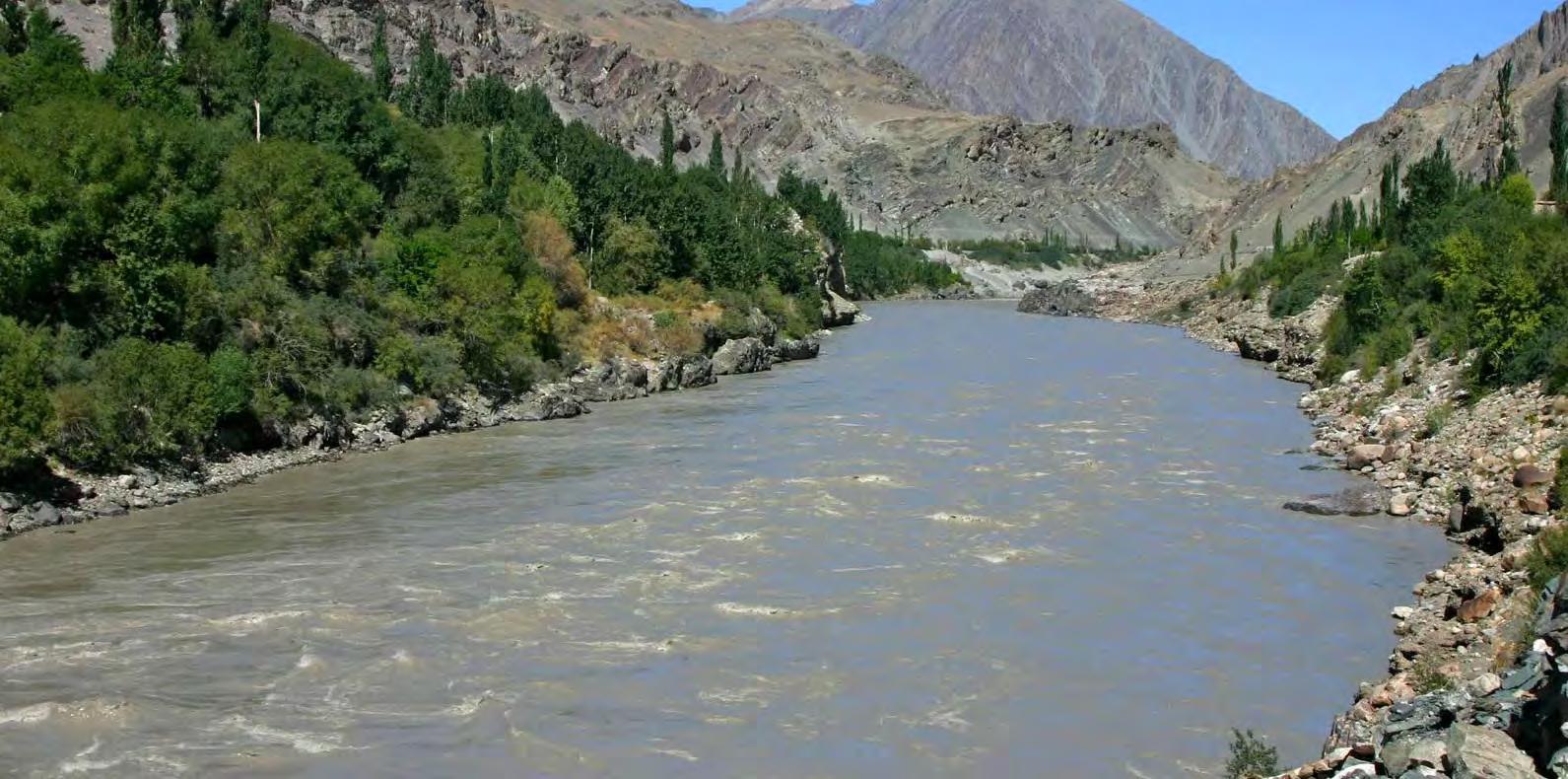
22 Water is an existential imperative for Pakistan Mohsin Leghari
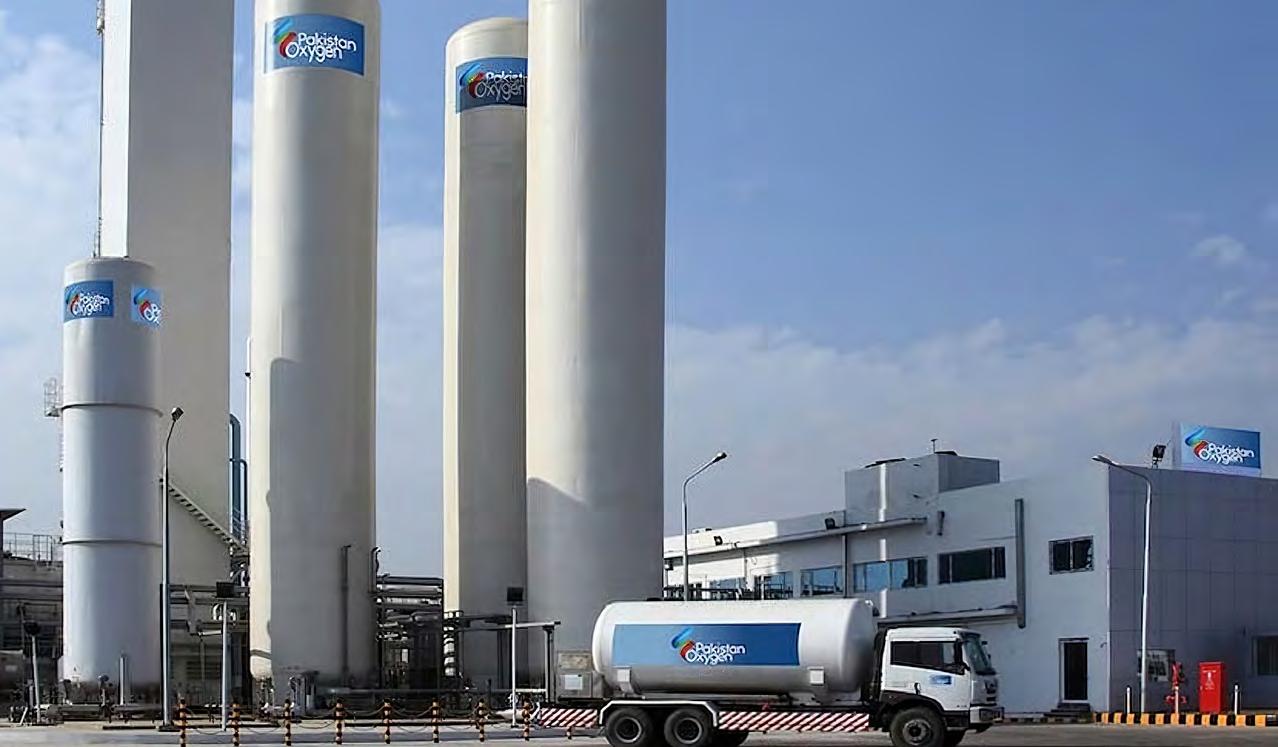
24 Pakistan Oxygen’s profits more than double as new plant starts to breathe
26 Fragmented Governance: Institutional Reset Muhammad Azfar Ahsan
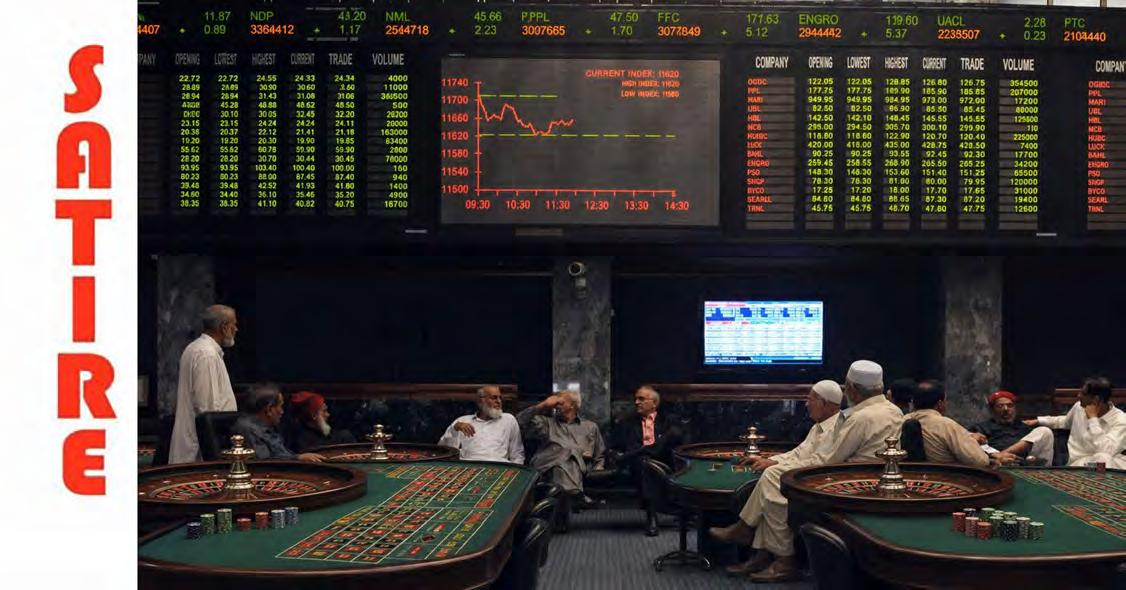
28 What Bitcoin Pizza Day Says About Pakistan’s Digital Economy Vugar Usi, CEO, MEXC
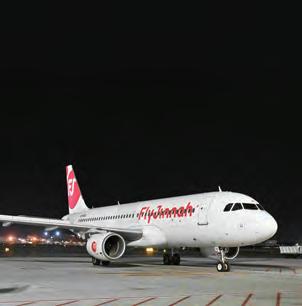
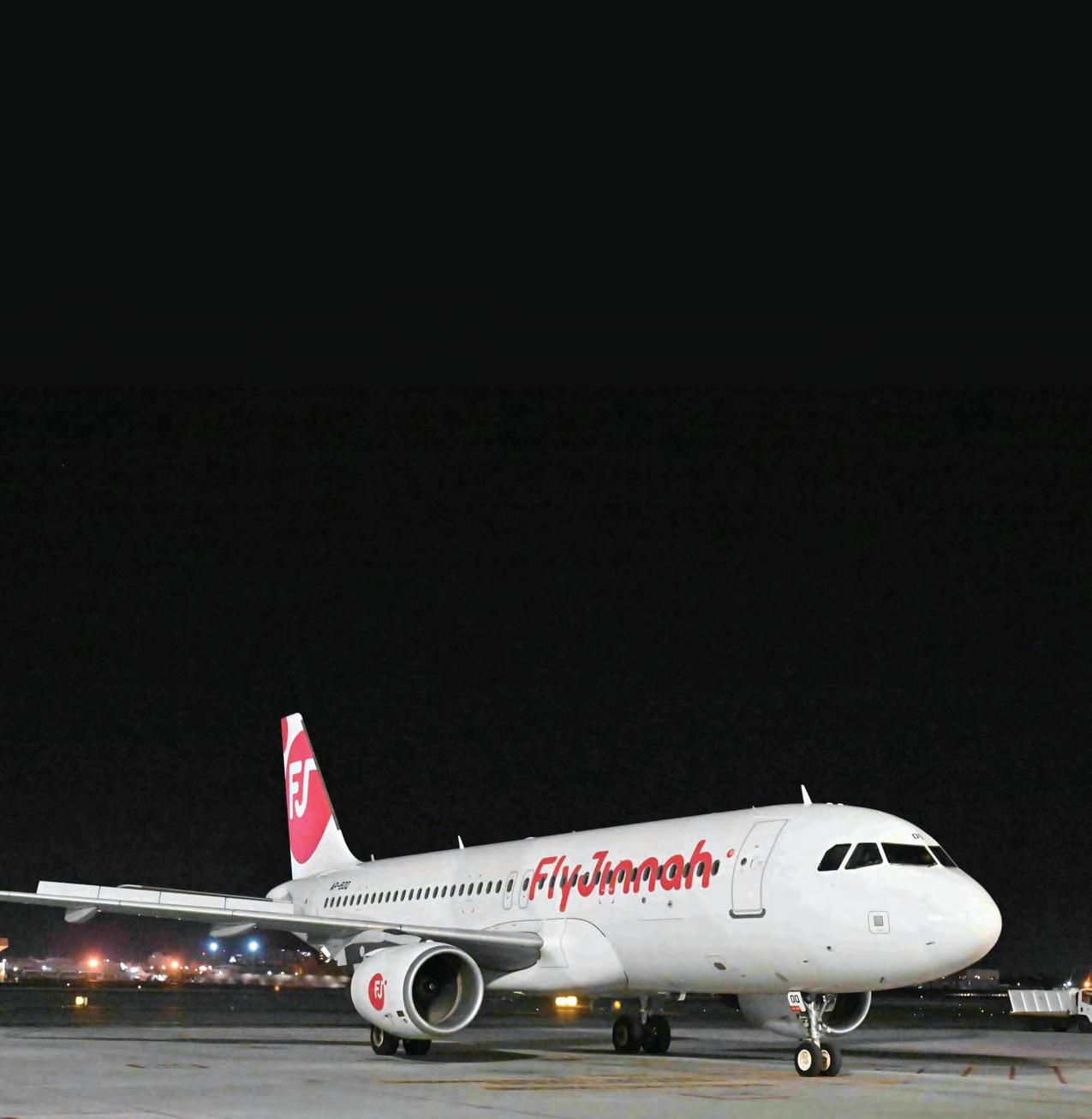
31 FlyJinnah’s Lahore-Islamabad route is not attracting the kind of crowds the carrier would have hoped for. Do the flights make sense?
Publishing Editor: Babar Nizami - Senior Editor: Abdullah Niazi
Business Reporters: Taimoor Hassan | Usama Liaqat | Zain Naeem | Shahnawaz Ali | Ghulam Abbass
Ahmad Ahmadani | Aziz Buneri - Sub-Editors: Saddam Hussain | Abdul Hameed - Video Producer: Adnan Maqsood Director Marketing: Muddasir Alam - Regional Heads of Marketing: Agha Anwer (Khi) Kamal Rizvi (Lhe) | Malik Israr (Isb) GM Special Projects Zulfiqar Butt - Manager Subscriptions: Irfan Farooq
Pakistan’s #1 business magazine - your go-to source for business, economic and financial news. Contact us: profit@pakistantoday.com.pk
Do lenders get the short end of the stick in Pakistan?
Pakistan’s banking industry is pushing for reforms which will resolve the bottlenecks the industry faces
By Zain Naeem
In Pakistan, banks can lend money in minutes and spend years trying to recover it. Is it any wonder then that the banks are averse to lending to the private sector in the first place?
Focusing on government lending is far easier and usually not as much of a cause for a headache. The problem is not always that borrowers default. Default is part of banking; it is priced, provisioned and modelled. The bigger concern is what happens after the default, when a loan secured by property, machinery, inventory or receivables begins its slow migration from a bank’s balance sheet into the country’s legal system.
At that point, what looked like collateral can start to behave like an argument. A mortgage becomes a dispute over title, valuation, service of notice or possession. A pledged asset may no longer be where it was supposed to be. A hypothecated stock of goods can thin out, move or disappear. A decree, even when obtained, may not translate quickly into cash. For a banker, recovery is not merely about winning a case. It is about converting a legal right into
money before time, litigation and uncertainty eat away at its value.
And this is not necessarily because banking laws in Pakistan are weak. On paper, Pakistan has built a recovery framework that should reassure lenders. Banking courts exist for this purpose. Financial institutions have statutory remedies. The law gives banks the ability, in certain cases, to proceed against mortgaged property without waiting for the full ritual of ordinary civil litigation. The architecture is meant to be swift, specialised and commercially sensible.
In practice, recovery often becomes a test of endurance. Stays, objections, adjournments, appeals, possession disputes and weak execution can stretch the process far beyond what any credit officer would have assumed when the loan was approved. By the time an asset is actually sold, its market value may have fallen, the buyer pool may have shrunk, and the bank may have recovered far less than the security once promised.
This is where a legal problem becomes a financial one. Banks that cannot rely on recovery do not simply absorb the risk. They change their behaviour. They lend more carefully,
demand more collateral, favour larger and better-known borrowers, and find comfort in government paper rather than smaller businesses whose credit needs are harder to underwrite and even harder to recover.
The law is caught between two risks. If foreclosure is too easy, banks become too powerful. If foreclosure is too difficult, banks become too afraid. But Pakistan’s banking industry, it seems, is done being afraid. They want to lend and they want to keep things moving along. A big part of that will be better enforcement of recoveries, and it seems the industry is banding together to push for better implementation.
The banks’ prayer
On April 30, 2026, the Law and Justice Commission of Pakistan convened a meeting under the chairmanship of the Honourable Chief Justice of Pakistan. Around the table were the Chairman of the Pakistan Banks Association and members representing the banking sector. The stated agenda was broad enough to sound almost technocratic: legislative, procedural and regulatory reforms in the corporate, banking
and taxation legal framework of the country.
The conversation began, as many conversations with banks now do, with tax. The industry had been asked to provide its input on the recovery and taxation framework, and to suggest reforms that would allow the sector to function more efficiently. There were concerns over retrospective tax demands, slow tax appeals, disputed liabilities, accounting treatment, write-offs and the uneven treatment of different banking models. But inevitably, the discussion returned to an older and more stubborn grievance: what happens after a borrower defaults and the bank tries to recover its money.
For the banking industry, the recovery question is not a side issue. It is central to how banks price risk, how they decide who is creditworthy, and how willing they are to lend beyond the safest names in the market. The purpose of the meeting, therefore, was not simply to air a list of complaints. It was to ask whether the legal code, and more importantly the way it is implemented, could be reformed to remove some of the frictions that banks say have made lending a more cautious business than it needs to be.
The complaint has to be understood from the position banks occupy in Pakistan’s financial system. Based on the section you shared, here is the rewritten version in a hypothetical-example format.
Consider a mid-sized manufacturer in Sialkot that borrows from a commercial bank to expand production. The loan is secured against factory land, machinery and stock. At the time of approval, the credit file looks defensible. The borrower has an operating business, collateral has been identified, repayment schedules have been agreed, and the bank has priced the facility on the assumption that, if things go wrong, the legal system will allow it to recover at least part of its exposure.
For the bank, this is not an unusual act of risk-taking. It is the business of banking. Pakistan’s banks are the largest formal lenders in the economy, and once they advance money, the responsibility for recovering it in the event of default rests almost entirely with them. If the manufacturer stops paying, the bank must issue demands, pursue the borrower, consider restructuring, initiate legal proceedings, negotiate a settlement and, if all else fails, try to convert its contractual claim into actual cash.
That is where the relationship begins to look lopsided. The money left the bank quickly. It may return slowly, partly, or not at all. The loan can remain on the books long after repayments have stopped. Even after formal notices are issued, the lender remains trapped inside the recovery process. The borrower may still be operating, in which case recovery is difficult enough. If the business has begun
making losses, has lost cash flows, or can no longer meet the original repayment terms, the bank’s options narrow further. It can either restructure the loan into the future and hope the borrower recovers, or it can go to court.
In a more efficient recovery regime, the court process would preserve the value of the bank’s security. The factory land could be sold, the machinery realised, and the borrower pushed towards settlement. The point of secured lending is that collateral should reduce uncertainty. In Pakistan, banks argue, collateral often becomes the beginning of another dispute. Once the matter enters court, the borrower can use procedure to delay payment. A case filed to enforce a contract can become a case about notices, adjournments, stay orders, valuation, objections and time.
This is precisely why the industry keeps returning to enforcement. The Financial Institutions (Recovery of Finances) Ordinance, 2001 and the subsequent Amendment Act of 2016 were created to help lenders recover loans and to stop ordinary civil litigation from swallowing banking disputes. The architecture exists. It is supposed to give banks a more direct route to recovery.
The complaint is that the route is often blocked in practice. In the hypothetical case, the borrower obtains a stay without depositing the outstanding liability. Adjournments are sought and granted. Fresh suits are filed, which the bank considers frivolous, but which still consume time. Months become years. Legal fees mount. The value of the factory declines. Machinery deteriorates. Potential buyers discount the asset because litigation hangs over it. Senior management is dragged into a dispute that the recovery department must now manage as if it were a separate business line.
At that point, the recovery suit itself changes character. The bank may not file it because it expects a quick judicial outcome. It files because the case creates pressure. The objective becomes to force the borrower into restructuring, settlement or partial repayment. The borrower, meanwhile, knows that repayment under the original terms is no longer possible, but also knows that the court process can be delayed. The legal system becomes less a forum for resolution than a bargaining tool.
This is the Kafkaesque quality banks want removed. Their demand is not simply for new law, but for existing law to be enforced. They want no stay orders without deposits of liabilities, adherence to the 90-day disposal timeline, limited adjournments, automatic lapse of stay orders, disposal within three months of cases pending for five years, and costs imposed on frivolous lawsuits. In their view, recovery will improve only when the borrower knows delay is no longer a strategy.
The inherent subsidy on interest
Then comes the part of the Faisalabad example that worries banks the most. Even if the bank finally recovers something, the law may reduce what the borrower has to pay.
Assume the factory owner took a loan at a commercial interest rate. The bank agreed to lend because it expected to earn that interest over time. But after default, under the banks’ reading of the Financial Institutions (Recovery of Finances) Ordinance, 2001, the borrower may only have to pay the principal amount and the bank’s cost of funds from the date of default. The original interest agreed between the bank and the borrower may no longer apply in the same way.
For the borrower, this can become useful. Suppose he borrowed the money and used part of it to buy land, property, stock or another asset that gained value over time. When repayment became due, he defaulted. The bank issued notices, filed a case and tried to recover the money. But the case dragged on for years.
After seven to ten years, a settlement may finally be reached. The borrower pays back the principal and the bank’s cost of funds. But by then, the asset he bought with the borrowed money may have risen sharply in value. The return he earned from using the bank’s money may be far higher than what he eventually pays back.
From the bank’s perspective, this is not just delayed repayment. It is cheap long-term financing created through default. The borrower used expensive bank money but, because of weak enforcement and long delays, ended up paying much less than the original bargain required. The bank, meanwhile, lost the contractual return, spent years in litigation, carried the bad loan on its books and paid legal and administrative costs.
There is supposed to be a punishment. The borrower’s name can appear in the State Bank of Pakistan’s eCIB record, making it harder for him to borrow again. But banks say this does not go far enough. Once the record is cleared after five years, the same borrower may return to the credit system.
This is why banks become cautious. They prefer safer borrowers, strong collateral and government securities. Smaller businesses, new borrowers and micro-borrowers face tougher conditions because banks are not confident that money lent today can be recovered tomorrow. The law is caught between two risks: make recovery too easy and banks become too powerful; make it too hard and banks stop taking chances.
This is how it can go
Of course, recovery is not the only religion in banking. Banks may complain loudly about weak enforcement, delayed decrees and borrowers who learn to weaponise procedure, but they do not actually want every troubled borrower dragged to liquidation. A bank is not a scrapyard. It does not lend to acquire factories, poultry plants, machinery or warehouses. It lends to be repaid.
That distinction matters. The demand for stronger recovery tools is not necessarily a demand for harsher recoveries in every case. It is a demand for leverage. Banks want the law to give them a credible final option so that restructuring, settlement and sponsor support can happen from a position of seriousness rather than desperation.
Chenab Limited explains this better than any abstract complaint about recovery law. The company was once one of Pakistan’s major exporters, growing quickly on the back of borrowing from banks that had recently been privatised and were willing to finance the private sector. Then, from 2008, operational problems began to hurt profitability. By 2014, Chenab declared that it could not meet its obligations.
At that point, the banks did what lenders do when a borrower stops paying: they went to court. From 2014 to 2017, they fought to liquidate the company and recover their funds. In 2017, the court ruled in favour of the banks and winding-up proceedings were passed. On paper, this was the moment when the lenders could have pushed towards selling the company’s assets and clawing back whatever they could.
But that is not what happened.
Mian Latif, the owner of Chenab, went back to the banks and asked for another chance. More than that, he insisted the business could be made to work again. The banks listened. Instead of immediately moving to sell everything, they agreed to restructure the debt and allow the company to restart manufacturing. They even provided additional working capital.
This is the part that complicates the usual story. The banks had already spent three years fighting the case to reach the point of winding up. During those three years, the loan was effectively stuck because of the court case. Chenab, too, had time to attempt a recovery. Yet when the legal route finally gave lenders the upper hand, they did not simply choose liquidation. They chose revival.
That decision says something important. Banks are not blind to business realities. They know that a running company may be worth more than a broken one. They know that forced asset sales can destroy value. They know that workers, suppliers, exporters and lenders may all be better served if a distressed
business can be nursed back to life. In Chenab’s case, the banks appeared to believe that a second chance could produce a better outcome than selling assets after years of distress.
The problem is what comes next. Four years later, the lenders still felt they were exposed to a loan they believed could have been recovered earlier. That is where restructuring begins to look different from the bank’s side of the table. It is no longer just a generous commercial compromise. It becomes another extension of risk. The borrower gets time. The lender gets another promise. If the turnaround works, everyone can claim the system saved a business. If it does not, the bank has lost more time, more money and perhaps more confidence in the next borrower.
Big Bird Foods shows a different way out. Here, the story was not simply a long fight over liquidation. It was a case in which litigation and restructuring existed alongside sponsor support. The company appeared to be improving operationally. After suffering losses as recently as 2023, it reported after-tax profits of more than Rs1 billion by June 2025. Its latest nine-month profit was equal to the annual figure for 2025.
Yet its credit position told a more strained story. According to the eCIB report for February 2026, Big Bird had a credit exposure limit of around Rs2.9 billion. It had outstanding principal of Rs1.5 billion and markup of Rs1 billion, meaning Rs2.5 billion of that limit had already been used. As far back as December 2024, total dues stood at Rs1.9 billion, of which Rs1.7 billion was more than one year old.
That is not a small timing mismatch. A debt unpaid for more than a year tells banks that something has gone wrong with repayment discipline, cash conversion, or both. Big Bird’s stress had been visible for some time. A recovery suit had been filed against the company in July 2022, when Pak China Investment Company approached the Lahore High Court. The company had also suffered cumulative losses of Rs2.4 billion from 2019 to 2023. In five years, 19 of its loans with different banks had been restructured in one form or another.
The company had taken long-term financing from conventional and Islamic banks, including National Bank of Pakistan, Soneri Bank, Bank of Punjab, United Bank Limited, Saudi Pak IAIC Limited, Pak China Investment Company and JS Bank. The loans were secured against assets and supported by personal guarantees from sponsors. But many had to be extended. National Bank’s loan, due in 2021, was restructured for another six years. Soneri Bank’s loan, due in 2025, was restructured for repayment by June 2029. Bank of Punjab’s loan, due in 2020, had a restructuring request under process. Two Saudi Pak IAIC loans
were restructured in June 2024 for payment by 2029. Pak China’s loan was extended in 2019, restructured in 2021, and then taken to court in 2022 when payments were not made under the revised arrangement.
The core issue was not that Big Bird had no business. It was that profits were not translating into enough cash. Sales were rising, but money was tied up in trade debts and inventory. Trade debts alone stood at Rs2.1 billion by March 2026, while inventory was worth Rs2.5 billion. Current liabilities remained around Rs2.5 billion from 2021 to March 2026. Instead of using short-term borrowing to fund working capital, the company had used longterm loans.
That is where the sponsors mattered. Long-term finances fell from Rs1 billion in June 2023 to Rs64 crore, while loans from directors rose from zero in June 2024 to Rs1.5 billion by December 2025. In March 2026, the outstanding sponsor loan of Rs1.5 billion was converted into equity against 30.35 million shares. This was not recovery in the narrow legal sense. It was a market signal. The sponsors were not merely asking banks to wait; they were putting more of their own pockets behind the company.
That helped create a way out. The Pak China litigation was resolved through new terms, with repayment extended to December 2030. The Saudi Pak Industrial and Agricultural Investment loan was repaid in December 2024. But the stress had not disappeared. Long-term finances later rose again to Rs1 billion after the company took on Rs36 crore in new loans. Accrued and deferred markup under long-term finance stood at Rs77 crore by June 2025, while the eCIB report later showed overdue interest of Rs1 billion and principal of Rs1.2 billion.
So what happens?
What does all of this tell us? The banks may go to court, but it may still choose restructuring. It may have the legal right to sell assets, but it may prefer revival. It may face overdue debt, but sponsor equity can change the conversation. Recovery is the stick in the room, not always the chosen outcome.
But the stick has to exist. Without credible recovery tools, restructuring stops being a commercial choice and becomes the only escape from a broken process. Banks can and do find alternatives: second chances, extensions, sponsor injections, equity conversions and negotiated settlements. What they are asking for is not the power to destroy every borrower in distress. It is the power to ensure that when they choose patience, they do so voluntarily, not because the law has left them no other practical option. n
Honda’s car sales up 57% in Pakistan in 2026
The car manufacturer appears to be benefiting from the recovery of purchasing power among the Pakistani upper middle class
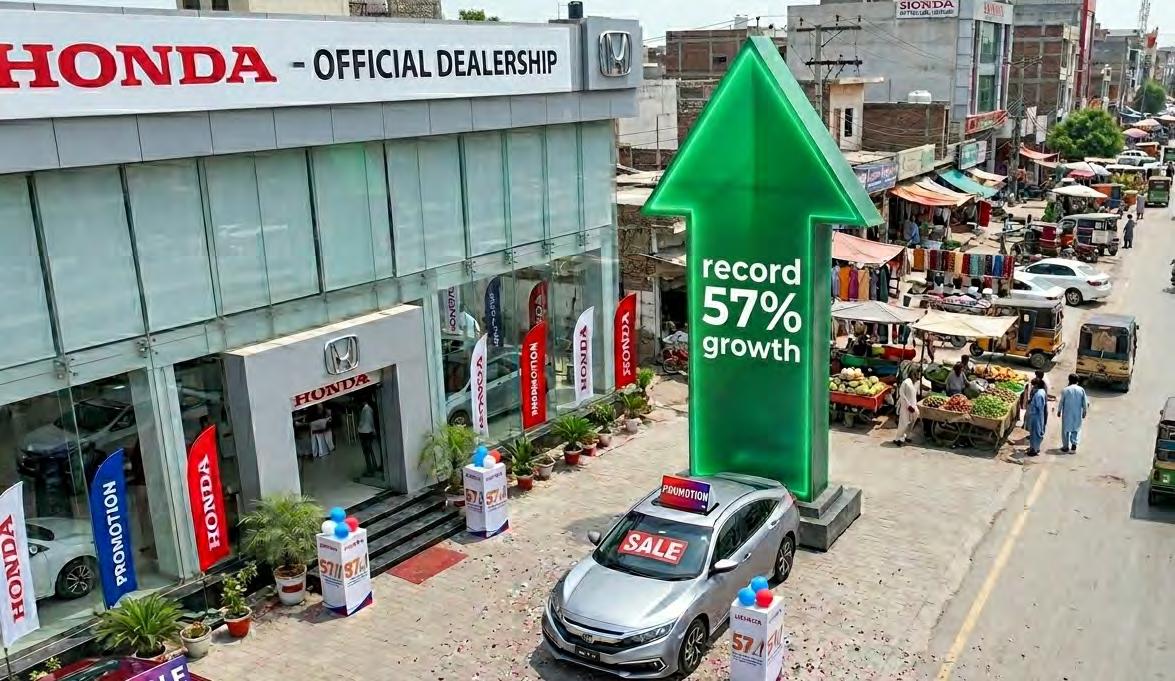
For Honda Atlas Cars Pakistan, the year ended March 31, 2026, looked like the long-awaited turn in the cycle. After several miserable years in which Pakistan’s car assemblers were battered by import restrictions, a collapsing rupee, record-high interest rates and customers who simply stopped walking into showrooms, Honda’s Pakistani subsidiary reported a 57% increase in annual sales, to Rs 122.3 billion from Rs 78.1 billion a year earlier. Profit after tax rose by a more modest 19%, to Rs3.23 billion, with earnings per share of Rs 22.64. The distinction matters: this was not a year in which margins exploded. It was a year in which the top line came back.
That makes the results revealing. Honda Atlas did not post a dazzling profit number because cars suddenly became cheaper to
build. Quite the opposite. Its cost of goods sold rose 58%, slightly faster than revenue, while gross margins narrowed to 7.8% from 8.5% for the year. The company’s gross profit still rose 42%, to Rs9.48 billion, but that was mainly because it sold more expensive metal in greater quantities, not because each car was vastly more lucrative. Operating expenses rose 38%, finance costs nearly doubled, and other income more than doubled, cushioning the effect on the bottom line.
The final quarter showed both sides of the recovery. Revenue in the fourth quarter of Honda Atlas’s 2026 market year rose 35% year on year to Rs37.3 billion, driven primarily by a 43% increase in volumetric sales to 8,058 units from 5,653 units, according to AKD Securities. The brokerage attributed the jump to the launch of the Honda City facelift and
the hybrid variant of the HR-V. Yet quarterly profit fell 40% year on year to Rs1.0 billion, as gross margins shrank to 7.5% from 10.1%. AKD blamed the margin squeeze on the imposition of the carbon levy from July 2025 and a shift in sales mix towards lower-segment variants.
This is the Honda recovery in miniature: more cars, more revenue, but still not a return to the fat-margin days that Pakistani assemblers once enjoyed. A car company can raise volumes in a recovering market and still discover that the government has already taken its cut, the buyer is still price-sensitive, and the supply chain remains import-dependent. Dawn recently reported that the new carbon, or NEV adoption, levy is charged at 1% for engines below 1,300cc, 2% for 1,300cc to 1,800cc engines, and 3% above 1,800cc, applied on the invoice price including duty and taxes. For
a company whose products sit mostly above the entry-level end of the market, that is not a trivial impost.
Still, the timing has turned in Honda’s favour. Pakistan’s auto market is one of the most cyclical consumer markets in the country, and the cycle has finally begun to move upwards. After the State Bank of Pakistan took interest rates to 22% in 2024, car financing became a luxury. By late 2025, after a long easing cycle, the policy rate had fallen sharply; the SBP later raised it by 100 basis points to 11.5% in April 2026, citing risks from global energy prices and supply-chain disruptions, but borrowing costs remained far below the crisis peak.
The revival of car financing tells the same story. Outstanding auto loans reached Rs328 billion in January 2026, up from Rs 319 billion in December, marking the fourteenth consecutive month of growth, according to Dawn’s reporting on State Bank data. A few months earlier, outstanding auto loans had already risen to Rs 315.4 billion by the end of October, helped by cheaper rates and bank financing offers. For Honda, whose cars are not impulse purchases and rarely fit into the budgets of first-time low-income buyers, that matters enormously. The return of financing is, in effect, the return of the upper-middle-class customer.
Honda Atlas is particularly exposed to that consumer. Its Pakistani line-up is not built around the cheapest possible mobility. The company’s current model range includes the City, Civic, BR-V and HR-V. On Honda’s own website, the City starts at Rs4.737 million, the BR-V at Rs6.429 million, the HR-V at Rs7.549 million, and the Civic at Rs 8.499 million. These are not mass-market motorcycles, nor even the cheapest small cars. They are badges of middle-class advancement: the car bought after a promotion, a property sale, a remittance windfall, or the decision that the family has outgrown the hatchback.
The company’s history in Pakistan explains why the rebound matters beyond one year’s accounts. Honda Atlas Cars Pakistan Limited was incorporated as a public limited company on November 4, 1992, as a joint venture between Honda Motor Co of Japan and the Atlas Group of Pakistan. The joint venture agreement was formalised in August 1993; the first car rolled off the assembly line in May 1994; and the company was listed on the Karachi and Lahore stock exchanges later that year. Honda Motor owns 51% of the company, Atlas Group 30%, and the public 19%, according to Honda’s global disclosures.
From the start, Honda Atlas occupied a distinct place in Pakistan’s automotive hierarchy. Suzuki sold mass mobility. Toyota became the default for families, fleets and farmers who wanted durability. Honda sold a slightly
more aspirational proposition: sleeker sedans, higher-revving engines, better-finished cabins, and a brand image that appealed to urban professionals. The company began with the Civic in 1994, added the City in 1997, brought in the BR-V in 2017, and launched the locally assembled HR-V in 2022. Its Manga Mandi plant near Lahore was expanded in 2006, doubling annual production capacity to 50,000 units on a double-shift basis.
That capacity has often looked generous relative to Pakistan’s boom-and-bust market. Honda says it has manufactured and sold more than 556,100 vehicles in Pakistan cumulatively. Yet in a country where macroeconomic shocks periodically make car buying feel reckless, even established assemblers can spend long stretches operating well below rated capacity. VIS Credit Rating, in a sector report, noted that Pakistan’s auto market remains highly import-dependent, that many components are imported, and that assembly is more common than full manufacturing. It also described the sector’s growth as being driven by improving consumer sentiment, easier vehicle financing, lower interest rates and renewed investment in production capacity.
Honda’s current product cycle has helped. The City remains the volume workhorse, the Civic the aspirational sedan, the BR-V the practical seven-seat family vehicle, and the HR-V the company’s answer to Pakistan’s infatuation with crossovers. In July 2025, Honda Atlas launched the locally produced HR-V e:HEV, calling it Pakistan’s first Honda HR-V hybrid and marking the start of local production of what it described as its most advanced hybrid SUV in the country. The timing was useful: fuel prices, environmental levies and consumer fascination with hybrids have all made electrified vehicles more attractive, even if Pakistan’s charging infrastructure remains inadequate for a full electric shift.
The most important industry trend for Honda, however, may be the revival of larger vehicles. PAMA data for July 2025 to March 2026 show that the 1,300cc-and-above passenger-car segment sold 58,447 units, compared with 35,194 units in the same period a year earlier. Total car sales rose to 109,655 units from 75,397 units, meaning larger passenger cars gained share as well as volume. Honda’s City and Civic sales reached 17,438 units in the nine-month period, up from 11,460 units a year earlier, while Honda BR-V and HR-V sales more than doubled to 2,659 units from 1,316 units.
March 2026 captured the trend neatly. Sales of cars of 1,300cc and above rose 44% year on year to 6,447 units, while Honda Atlas sold 2,324 units in the month, up 63% year on year and 10% month on month. City and Civic sales rose to 2,049 units, while BR-V and HR-V sales reached 275 units. That is precisely
the kind of market in which Honda should do well: a market in which buyers are no longer merely searching for the cheapest possible vehicle, but are once again willing to pay for sedans, crossovers and family cars with a more premium badge.
There is, of course, a less flattering way to read the same numbers. Pakistan’s car market is recovering from a depressed base. Sales collapsed in earlier years not because consumers forgot how to drive, but because cars became unaffordable, banks tightened, factories struggled with imported kits, and the rupee’s decline made each new price list more absurd than the last. A rebound from that trough can look dramatic while still leaving the industry short of its historic highs. The Rs122 billion revenue number is therefore both impressive and a reminder of inflation: selling fewer cars at much higher prices can still produce very large rupee sales.
Honda is also facing a more crowded market than the one it dominated with Toyota and Suzuki for much of the past three decades. Chinese-backed entrants and Korean brands have normalised the idea that Pakistani buyers can have a crossover at roughly the same psychological price point as a traditional sedan. Sazgar’s Haval line-up, Hyundai’s Tucson and Santa Fe, Kia’s Sportage, and newer electric and hybrid entrants are all competing for the same urban household that might once have defaulted to a Civic. VIS describes a market still led by Suzuki, Toyota and Honda, but increasingly shaped by Hyundai, Kia, MG and EV players such as BYD.
That is why Honda’s 2026 results are less a victory lap than a proof of life. The company has shown that demand for its cars is still there when financing is available, when the rupee is not in free fall, and when households feel just confident enough to take on a multi-year purchase. It has also shown that the HR-V and City can carry volume while the Civic preserves the brand’s aspirational aura. But the margin pressure in the fourth quarter suggests that Honda is still having to work hard for every rupee of profit.
For Pakistan’s upper middle class, a Honda has long been a small declaration of having arrived. In 2026, more of those declarations were made at dealerships. The question for Honda Atlas is whether that is the beginning of a sustained recovery or simply the release of pent-up demand after several bruising years. For now, the company can take comfort in one fact: the customer who disappeared during Pakistan’s macroeconomic crisis has begun to return. And Honda, with its sedans, crossovers and hybrid ambitions, is once again positioned where it has usually liked to be — just above the mass market, and just within reach of those who believe they are moving up. n
How the UAE flight cut off will show up on Pakistani store shelves
As the diplomatic spat between Pakistan and the UAE continues, the reduction in flights between the two countries cuts off smugglers’ access to a set of products urban Pakistanis take for granted
IBy Abdullah Niazi and Farooq Tirmizi
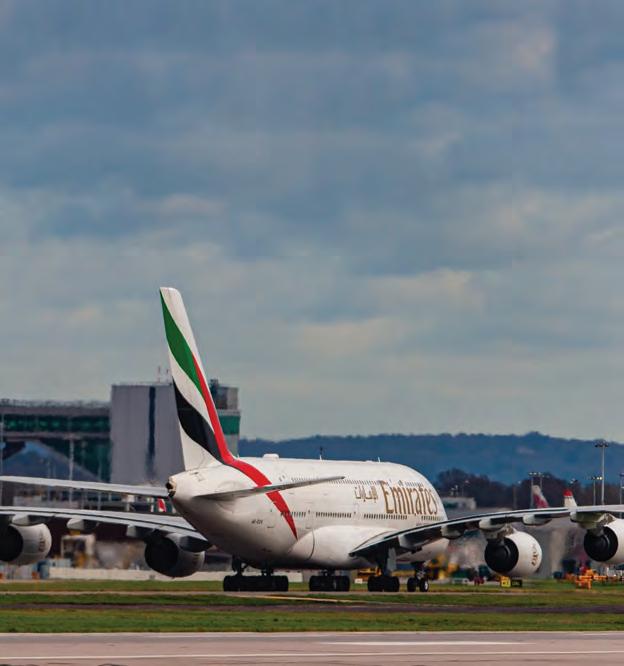
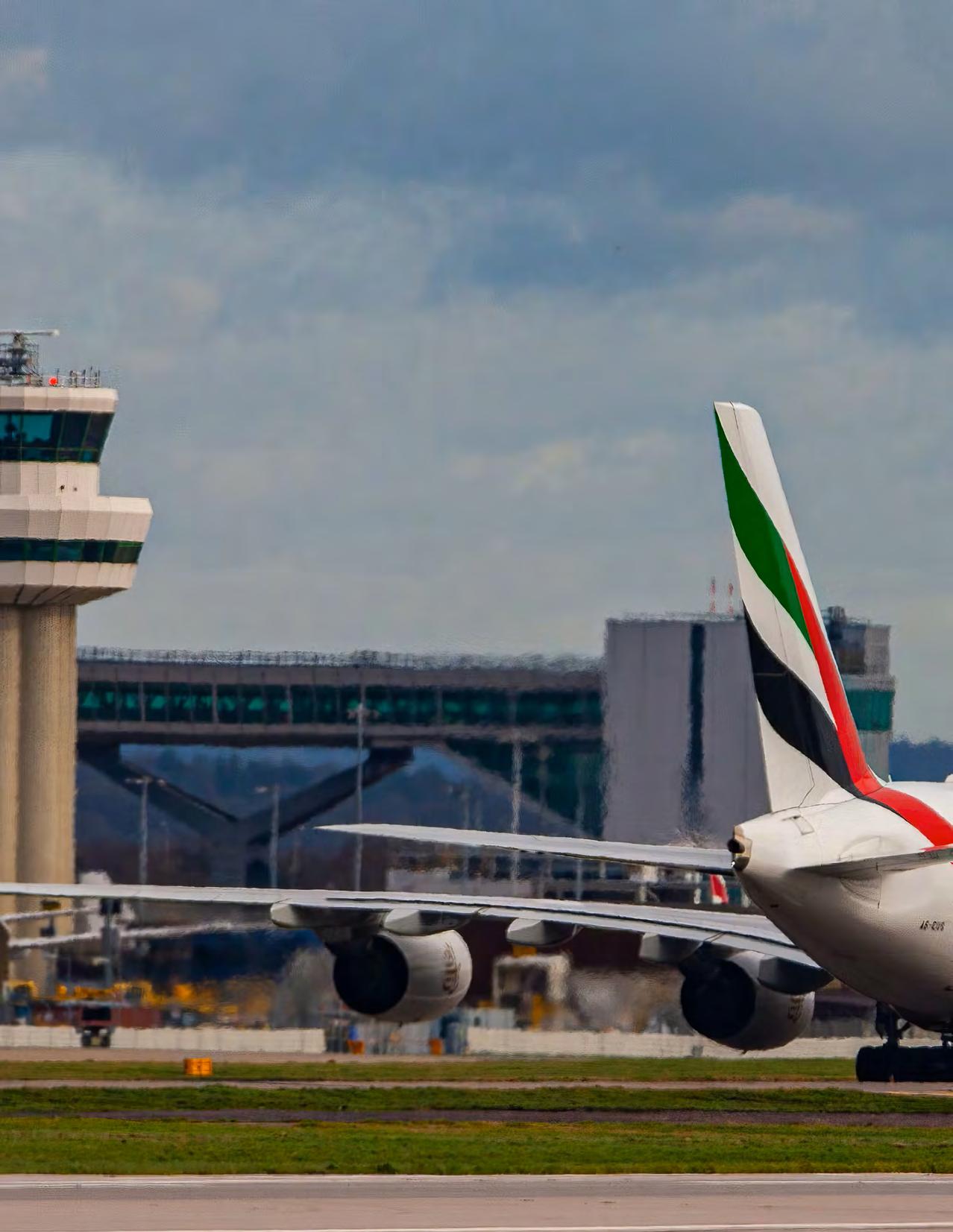
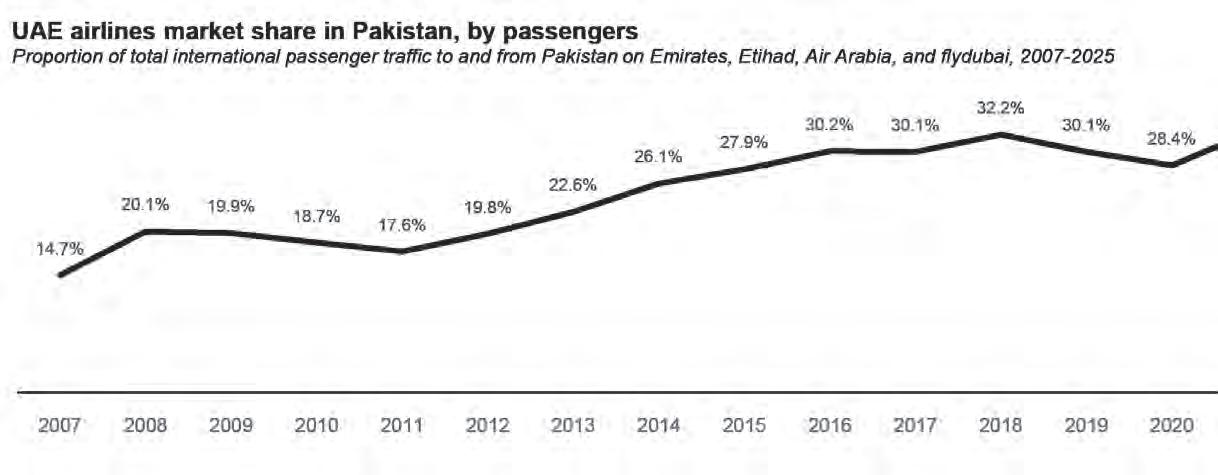
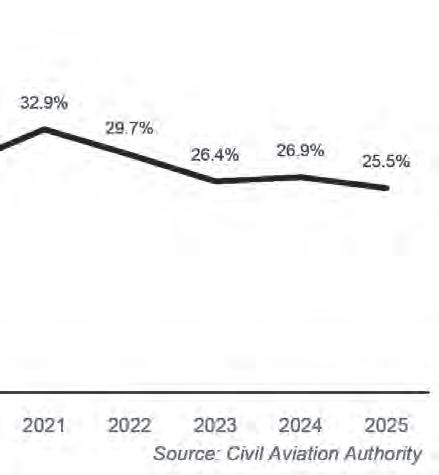
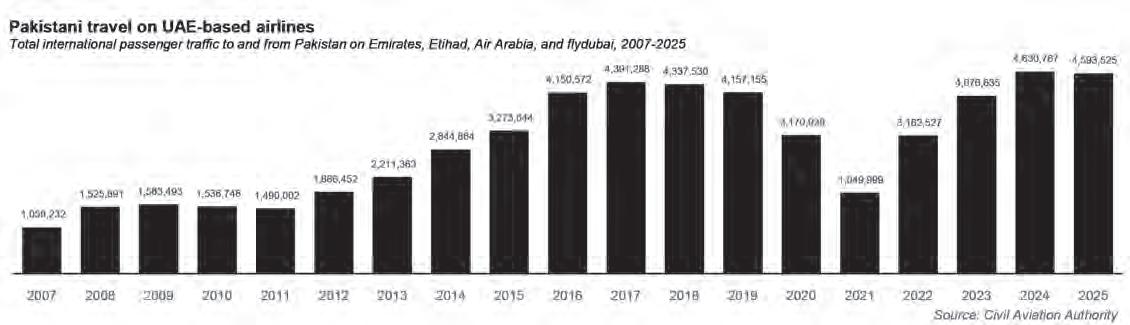
n 2025, there was a flight between the UAE and Pakistan, on average, every 12 minutes, according to Profit’s analysis of data published by the Pakistan Civil Aviation Authority (PCAA). More than half of those flights were operated by UAE-headquartered airlines: Emirates, flydubai, Etihad, and Air Arabia.
In recent weeks, as Pakistan has sought to mediate the conflict between Iran and the United States, the UAE government has made its displeasure with Islamabad known. At least some Pakistani expats have been expelled from the UAE, economic ties have turned frosty, and
sustained disruptions in oil supplies remain a possibility. The effect has also been felt in aviation. Recently, flydubai flights from Dubai to Peshawar, Islamabad, and Lahore have been cancelled. Etihad and Emirates have also significantly reduced schedules to major Pakistani airports.
Considering the UAE is the second largest source of remittances to Pakistan and also its second largest source of oil imports, the economic impact of this diplomatic shift is very real. The macroeconomic consequences will take time to materialise. The most immediate impact, however, will be felt in the most informal aspect of Pakistan’s ties to the UAE: the presence of smuggled imported goods on store shelves across the country, particularly in middle and upper-middle-class neighbourhoods.
You see, over the past 30 years most Pa-
kistanis that belong to these neighbourhoods have become used to certain luxuries. Expensive tech like iPads and MacBooks, perfumes, designer bags, cosmetics, skincare, chocolates and clothes are all available in Pakistan even if the brands that make them have no retail or distribution presence in the country. This has only been made possible through the intervention of a type of person called a khepia.
A khepia, for those who have not heard the term before, is a professional luggage carrier. These are individuals who, either for a living or some extra cash on the side, bring goods from foreign countries into Pakistan with the express intention of selling them.
These people are why imported consumer goods in Pakistan went from being a vanishingly rare luxury until the mid-1990s to being
so common that many upper-middle-class households no longer ask visiting expat relatives to bring them anything from abroad because “ab toh Pakistan mai sab milta hai”. It is this network that carries many consumer goods now taken for granted in Pakistan, and it relies mainly on flights between Pakistan and Dubai. Disrupt those flights, and you will soon see the impact on store shelves you may not even have realised depended on the khepia network.
What is the khepia network?
There is no way to estimate just how large Pakistan’s khepia network was at its height, but as recently as 2018 there were reports that on average
every flight between Karachi and Dubai had at least eight passengers on board carrying illegally smuggled consumer goods in their luggage.
A formal history of the practice in Pakistan is thin, but one can trace a faint trail of where it began. The first khepias emerged right after partition. What is now Pakistan, India and Bangladesh was once one economy. That meant no borders, largely free trade, and a population used to having access to products from different areas of the subcontinent. But once the British left and borders were drawn, many products were cut off for some consumers. In Pakistan, for example, there is no indigenous gold. That is where legendary smugglers like Seth Abid got their break, bringing in gold from India for a population that still had a cultural obsession with yellow metal even though it had no gold mines.
But beyond smuggling gold there were other products. Certain teas, herbal medicines, embroidered clothes, paan leaves and many other little cultural items that could only come across from the border. To fill this gap, people travelling between India and Pakistan to see their families (yes there was a time when this was common) would bring these products. This correspondent recalls that as early as the 1990s, any time there was a family wedding, relatives coming from India to attend would bring a special necklace for the bride wrought out of cloves and silver. The craftsmen that prepared it were only available in India.
When you have such frequent travel, networks begin to build naturally. One day you tell your neighbour your cousin is coming from Delhi. They ask if the cousin can bring a particular kind of dupatta for their daughter. We will pay of course, even pay a premium if need be, they say. One thing leads to another and this transport of goods can quickly become a business.
But India, of course, was just the beginning of the khepias. Over the years as borders have tightened and visas have become impossible the trade between India and Pakistan has ground to a halt. The khepias, however, have thrived.
The biggest source of this informal trade has been the United Arab Emirates. Pakistanis have been going to the UAE for work since the country was first established in 1971. Over the past 55 years they have gone as engineers, as labourers, as doctors, as taxi drivers, as students, and as cleaners and they have poured their blood, sweat, and mental prowess into helping build the country along with workers from all over South Asia.
Given the frequency with which Pakistanis have historically travelled to and from the UAE, it was inevitable that these khepia networks would develop. As the UAE has grown and become an internationally
important city of luxury, the span of products traded by khepias has also grown. Everything from the latest iPhones to designer bags, perfumes, chocolates, skincare, cosmetics, and watches are traded through these networks. There are dedicated Whatsapp Groups and Facebook pages where you can put in requests for what products you want from Sephora, the Apple store, Ralph Lauren and anything else that is available in Dubai and can be carried back in a suitcase.
These networks have grown and thrived with the connivance of corrupt officials within the administrative machinery. Profit spoke to three khepias and two individuals that regularly avail their services for high-end tech items. All of them had the bribe rates learned by heart for different products. In fact, even the laws governing passenger luggage are so arbitrary and dependent on the discretion of officials at the airport that it seems almost as if they are written with the khepia networks and their beneficiaries in mind.
But over the past couple of years, the khepia networks have been struggling. “Up until 2024 we were easily able to do as many as 8-10 flights a month per person. We would take luggage from here for people that had requested some items from Pakistan such as lawn suits,” says Umar, one of the individuals Profit spoke to. Umar operates out of Lahore, even though Karachi is the main hub for such activity. “On our way back we would bring iPads and Macbooks. I remember on my last trip I had around a dozen polaroid cameras with me. These things were becoming quite popular in Pakistan apparently, and I had a client on Nisbat Road who was going to buy them off me. My brother who lives in Dubai had found a great discount deal for them. It was a good bit of money I made on that flight.”
But the past two years have been tougher. Umar says he has been denied a visa even though he has been travelling back and forth between Dubai and Lahore for years. He knows other associates who have faced the same problem. On top of this, his brother who lives in Dubai also faced issues with his work permit. “His visa was also not renewed and we had to spend a lot of money to show he had an income of 12,000 rials for a better visa. He spent some very nervous days in Dubai where his visa was expired.”
But the visa troubles were only the tip of the iceberg. Since February 28th this year, business has come to a screeching halt. “Ever since the war broke out flights have become so rare and so unpredictable that we cannot do business. We have clients who we cannot deliver to anymore. Things are bleak.” According to Umar, many khepias had also started running routes from Doha after the UAE visa issue but the Gulf crisis has brought that to
an end as well. “For Dubai, we can get flights from AirBlue or PIA which are cheaper. Flights to Doha are more expensive, but the benefit is that it has visa free entry for Pakistanis. Now after the war they have completely stopped visas for Pakistanis,” he explains.
Two kinds of khepias
It is important, here, to understand how the khepias operate. There are essentially two kinds of khepias. The first are regular passengers. These can be students, workers, or frequent travelers that are visiting family. Taimoor, a student at NYU Abu Dhabi who graduated in 2021, explains how it works. “I got into it accidentally. I remember my sister asked me to bring some skincare products for her, and when her friends found out they started asking her to ask me to bring things for them as well. They obviously paid for them, and I found out later my sister was charging her friends a premium,” he says laughing. “It became a pretty good business at one point. To the extent that I was able to come back to Pakistan more frequently. There were trips where I covered the entire cost of my ticket just by carrying a couple of laptops.”
According to him, as time went by he picked up on how to operate. “At the airport, there is no real rule for how much of one
thing you can carry or not. It is pretty much at the discretion of the officer checking your bag. If they feel you are carrying a suspicious quantity of something they will stop you. I was never stopped because I was careful but I have heard there are set bribe rates for how to get out of it. You also need to be the sort of person that won’t easily be intimidated by the officials. Knowing English can be helpful, and so does knowing about the stuff you’re bringing in. You just need to be able to convince them the amount of things you’re bringing make sense for your personal use”
Taimoor stopped doing this after he graduated and got a job at a bank in Dubai. But according to him it is a pretty common practice for students. “I remember there was a point where carrying the latest iPhone you could get Rs25,000 for one phone. Laptops and tablets were even more. Surprisingly, things like perfumes you could often get a big premium on — especially if you found them at a discount in Dubai.”
Meanwhile Ali Azam, a shop owner in Hafeez Centre, is having to rely more on parttime khepias these days. Ali, who is a client of the khepia Umar we just mentioned, says he is unable to fulfill orders. “My business model is simple. I import tablets and laptops from Dubai through people carrying them in their luggage. I usually get Umar to bring in some set models that are most in demand. For example I get a few iPad Airs that are 11
inches in basic colours. If someone comes to the shop looking for them I sell them. If they want something a little less common like a Macbook Pro or a 14 inch iPad, I place an order with Umar and ask the customer to come back in xyz days.”
But in recent days, he has mostly been relying on his own network in the UAE to get stuff for his shop. “Casual travel between Pakistan and the UAE has almost ended. You have to be a resident there to come and go. I have a cousin that works there and he brings some things for me, but it has been a struggle. Go around the market and you will find shortages of most imported products.”
When it comes to high end tech devices, Pakistan’s market has changed. “The biggest items at one point were phones. iPhones had a big carry cost and they were handy. If you could manage to carry 4-5 phones in one trip, you could cover the cost of a one-way ticket from Dubai during peak season. But then in 2019 Mercantile introduced official distribution in Pakistan, and the customs duty on these phones which most people call “PTA Tax” made them a losing prospect.”
The PTA can block phones which are not custom duty paid. As a result, most imports of these expensive phones happen through official channels now. However, when it comes to devices like laptops and tablets the government cannot block them. That is why on the tech side the focus of the
khepia network has shifted towards these.
“Some people still bring in phones issued by telecom companies like AT&T and Vodafone that are reported stolen abroad. They are usually bought by content creators that need good cameras, but this is a small portion of overall phone sales,” explains Ali.
According to Umar, he specialises in bringing in tech devices but has also brought in things like perfumes and chocolates. “You’ve seen the imported chocolates section and perfumes at these big grocery stores, right? I have brought many of them myself,” he says with a grin. But he is also worried about the future. “For people that do this casually it is a nuisance. For me, it is my main source of earning. I’ve made some very good money from this, and trust me airport officials have made plenty too.”
“We are not doing anything wrong here. We are simply traders, and if anything trading is also an act of worship in Islam. I never deal in any kind of illicit products. Many people take cigarettes from Pakistan to Dubai as well but I don’t even deal in those,” he adds.
Why Dubai?
The volumes at which the khepia networks work are often astounding. In 2020, Customs caught 38 khepias on one Emirates flight from Dubai to Karachi and recovered laptops, iPhones, Apple Watches, iPads, Samsung tablets, cosmetics, expensive chocolates, perfumes, cigarettes and other goods worth Rs 6 crore. The report also alleged collusion by airport/customs staff.
Since Dubai has become a more difficult destination because of visa issues, the khepia network has tried other routes but with less success. Flights are more expensive and the Dubai networks have been developed over years. “In Dubai, I can trace most Pakistanis that are coming and going. People in Lahore tell me themselves when they have a relative travelling. It is very easy to even move small orders at a pretty convenient cost. If I don’t
go directly I can use this network. Some people have tried going through Malaysia and other places but I do not think that is viable,” he says.
In 2025, Customs at Lahore intercepted 102 iPhones from a Bangkok-origin passenger. In 2026, Customs recovered Rs 58 million worth of gold jewellery, cosmetics, perfumes and handbags from a passenger at Karachi airport.
But Dubai as a centre makes sense. For the khepia, Dubai has the Apple stores, Sephora outlets, perfume shops, wholesale electronics markets, luxury malls, discount deals, and re-export networks that Pakistani consumers want access to. More importantly, it has the one thing no other destination has at this scale: a constant churn of Pakistanis travelling back and forth. Dubai International Airport handled 95.2 million passengers in 2025, remaining the world’s busiest airport for international travel, while Pakistan was reported as its fourth-largest country market in the first nine months of the year with 3.2 million passengers.
A formal importer needs containers, customs agents, bank paperwork, commercial invoices, duties, taxes, and documentation. A khepia just needs a ticket, a buyer in Pakistan, and some understanding of how much risk they can take at the airport. The reason Dubai works better than Malaysia, Bangkok or Doha is not simply that goods are cheaper there. It is that the network already exists. There are Pakistanis living there, Pakistanis visiting there, Pakistanis working there, Pakistanis returning from there, and Pakistanis using Dubai as a transit point to somewhere else.
IATA data shows the Middle East accounted for around 70% of Pakistan’s international origin-destination passenger departures in 2023, which explains why this corridor is so central to informal passenger trade.
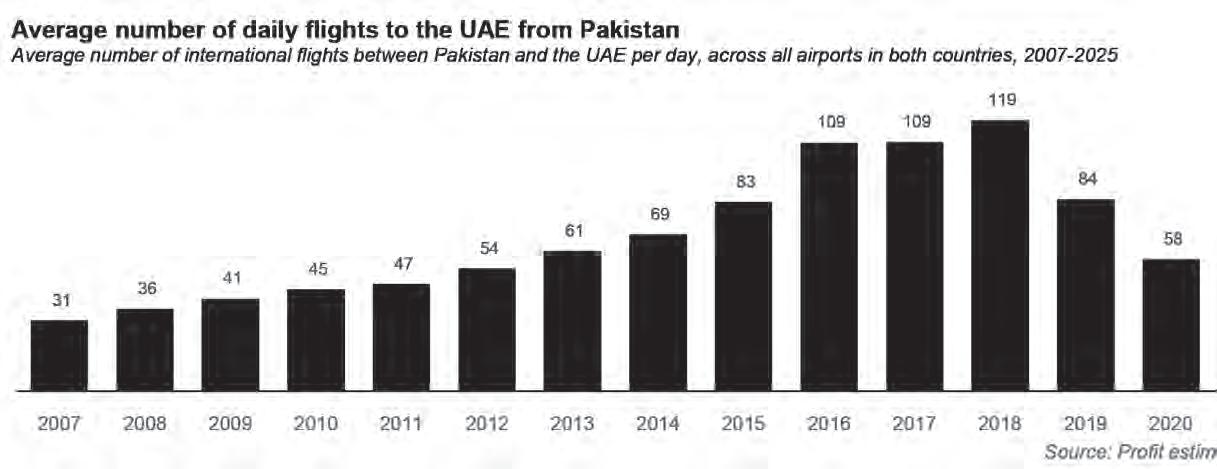
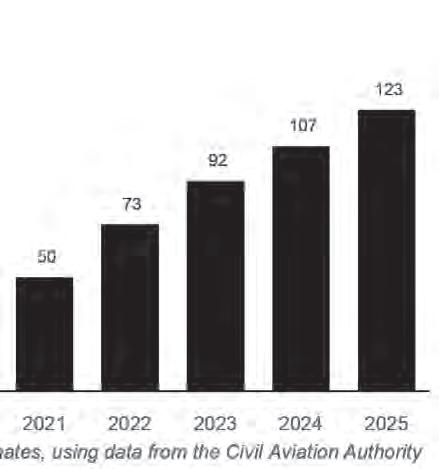
The total number of flights between Pakistan and the UAE hit about 123 per day, according to Profit’s analysis of data from the Pakistan Civil Aviation Authority (PCAA), up from just 31 flights a day in 2007. Not only
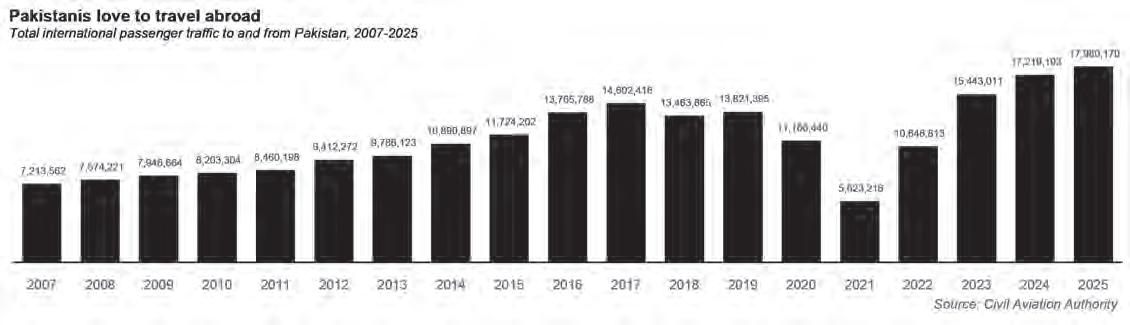
is Pakistan’s air linkage to the UAE relatively large, it is also growing, and accounts for about 45% of all Pakistani travel outside the country.
Dubai also matters because it is not just a consumer market. It is a re-export hub. Consider the issue of trade with India. If a Pakistani wants to buy an Indian sarri or an Indian wants to buy a lawn suit from Pakistan, those items will have to be transported through a khepia in Dubai.
The small luxuries at risk
Ultimately, at stake is the quality of life for Pakistan’s affluent urban upper middle class. That may sound trivial, but considering the relative dearth of human capital inside Pakistan, the small number of talented people who do make a good living in the country by dint of their hard work have a disproportionate impact on the economic fabric of the country.
These people, not unreasonably, want the availability of small luxuries like a particular brand of chocolate or a perfume they like without having to travel outside the country. And yes, much as the Marxist-leaning Karachi University professor and advisor to provincial governments Kaiser Bengali might object, they want cat food and dog food for their pets.
The UAE has decided it wants to limit Pakistanis’ access to its consumer markets, its job market, and increasingly its aviation services industry. That may not matter to the overwhelming majority of Pakistanis, but it matters most to the small minority that are best educated part of the labour force, those employed in the highest paying positions in the country, the kind of people who can afford, and seek out, such imported items, and are disproportionately responsible for driving economic growth in the country.
A temporary disruption may not matter in the long run. But it highlights a vulnerability the country did not think it needed to account for. n
OPINION
Mohsin Leghari
Water is an existential imperative for Pakistan
The Indus crisis demands honesty about external threats and internal failures.
The twentieth century was shaped by oil. The twenty-first will be shaped by water. Ismail Serageldin saw it coming in 1995 when, as World Bank Vice President, he warned that the wars of the next century would be fought over water, not oil.
Water is no longer only an environmental concern. It is inseparable from national security, food, energy, migration, and political stability. Population growth, groundwater depletion, glacier retreat, erratic rainfall, and upstream control are converging into a harsher reality: demand is rising while reliable supply becomes less predictable. Unlike oil, water has no substitute.
More than 260 international river basins and hundreds of transboundary aquifers cross national boundaries. States tried to discipline shared rivers through law and institutions: the 1909 Boundary Waters Treaty, the Mekong cooperation framework, the 1997 UN Convention
The author is former Minister of Irrigation Punjab, a former Senator and Member of the National Assembly. He is currently affiliated with UNDP as Senior Water Sector Expert and has worked with the EU/ GIZ on parliamentary capacity building. He writes in his personal capacity and does not represent any past or current affiliated organisation.
on Non-navigational Watercourses, and the Nile Basin Initiative. Each reflected a simple belief: rivers that cross borders must be governed before they become instruments of pressure.
The Indus Waters Treaty of 1960 was long considered the strongest expression of that belief. Brokered by the World Bank, it divided the Indus Basin between India and Pakistan. Pakistan received the three western rivers, carrying roughly 80 percent of system flows. India received the three eastern rivers. For more than six decades, the treaty kept a minimum legal order around a source of existential dependence.
That order is now under stress.
On 23 April 2025, following a militant attack in Indian-administered Kashmir, India placed the treaty in abeyance, citing national security. Data sharing and joint oversight were suspended, leaving Pakistan without advance information on rivers, floods, and droughts. In June 2025, the treaty’s Court of Arbitration, administered by the Permanent Court of Arbitration in The Hague, held that India’s abeyance position did not limit its competence. In August, it issued a further award on issues of general interpretation. India rejected the proceedings. The treaty remains in abeyance, and the uncertainty this has produced is without modern precedent in the Indus Basin.
Pakistan is not alone in facing this new water politics. Ethiopia’s Grand Ethiopian Renaissance Dam has altered the equation for Egypt and Sudan. The Mekong faces upstream construction and unilateral regulation. The Colorado River, over-allocated and climate-stressed, is forcing painful negotiations in the American West. In each case, scarcity weaponises geography. When trust collapses, rivers become leveraged.
Boutros Boutros-Ghali once warned that the next war in the Middle East would be over water, not politics. For Pakistan, that future has arrived not as a prophecy, but as a policy challenge.
Pakistan is one of the most exposed nations on earth. The Indus Basin underpins national survival. It contributes more than a quarter of national GDP and sustains nearly 90 percent of food production. Agriculture employs over a third of the workforce and depends overwhelmingly on the Indus canal network. Per capita water availability has fallen from about 5,260 cubic metres in 1951 to around 900 today, below the scarcity threshold. Between 40 and 80 percent of river flows
originate as glacial and snowmelt in the Hindu Kush, Himalaya, and Karakoram, where warming is altering timing and reliability.
The pressures compound. Groundwater is being depleted by largely unregulated tube wells. Salinity affects millions of hectares. Flood irrigation loses enormous volumes before water reaches crop roots. The Indus delta is shrinking. What appears in policy papers as basin stress appears in daily life as a cracked field, an empty well, a weak canal turn, or a higher roti price.
Honesty demands precision about the external threat. The conventional fear is that India will simply stop Pakistan’s water. Geography and treaty architecture make wholesale diversion of the western rivers difficult. That does not make the threat less serious. It makes it more technical, and therefore easier to misunderstand.
The more serious frontier is timing.
India’s run-of-river hydropower projects on the Chenab and Jhelum may not permanently remove large annual volumes, but they can affect the pattern in which water arrives. Daily and seasonal fluctuations matter profoundly in an irrigation economy. WAPDA’s hourly discharge records at Marala already show sharp oscillations associated with upstream turbine operations. For a farmer, water received too late for sowing or too suddenly near harvest is not the same water. A crop is not saved by an annual average. It is saved by timely delivery.
This is the new frontier of the Indus dispute: not only how much water crosses the border, but when it crosses, how predictably
it arrives, and whether Pakistan has the data, institutions, and diplomacy to respond. In an irrigation-dependent country, predictability is power.
Pakistan’s case cannot rest on general appeals to rights. It must be built on evidence. If the issue is hydraulic timing, Pakistan needs credible, real-time records of flow behaviour. It must show where upstream operations alter daily and seasonal patterns, how those changes affect canals, crops, flood management, and food security. Vague anxiety will not persuade the world. Data can.
This is where external threat and internal weakness meet. Pakistan cannot demand transparency from others while tolerating opacity at home. Its water governance remains weakened by poor measurement, weak enforcement, politicised allocations, and chronic distrust between provinces. We have not lacked laws, policies, authorities, or commissions. What we have lacked is implementation discipline.
The first answer is measurement. National telemetry, tamper-resistant flow data, and public reporting of river and canal deliveries are no longer technical luxuries. They are instruments of sovereignty. Without trusted data, every shortage becomes a political accusation. With trusted data, denial space narrows.
Pakistan’s largest recoverable gains also lie inside its own system. Canal rehabilitation, transparent measurement, better on-farm water management, drip and sprinkler irrigation where suitable, and demand-responsive pricing can improve reliability. Crop choices must also
be confronted. Sugarcane and rice cannot keep expanding in water-stressed zones as if supplies are infinite. Groundwater regulation can no longer be deferred because it is politically difficult.
Pakistan’s downstream rights under the treaty and customary international law should be advanced through legal forums, diplomacy, and coalitions with other lower riparian states. Its strongest argument is that cooperative river governance cannot survive if one party can suspend obligations unilaterally whenever relations deteriorate.
China also warrants attention. Beijing is an upper riparian across several major Asian river systems and has deep investments in Pakistan’s water, energy, and infrastructure sectors. Pakistan should engage China not as a substitute for treaty rights, nor as a party to the treaty, but as a regional actor with an interest in Himalayan hydrology, climate adaptation, infrastructure resilience, and basin stability.
The lesson from the Nile, Mekong, Colorado, and Indus is the same. Water frameworks take decades to build and moments to weaken. Once trust collapses, the costs fall on farmers awaiting irrigation, families facing food inflation, cities searching for groundwater, and communities receiving flood warnings too late.
The age of abundant and predictable water is ending. A harder era of hydro-political rivalry, climate-driven scarcity, and weaponised timing has begun. Pakistan’s future will be decided by whether the state can measure honestly, govern fairly, negotiate intelligently, and act before uncertainty becomes collapse. n
Pakistan Oxygen’s profits more than double as new plant starts to breathe
The industrial and medical gases supplier has turned a big Port Qasim investment into record earnings, helped by better plant efficiency, disciplined pricing and lower finance costs
For most consumers, Pakistan Oxygen is invisible. It does not sell soap, cement, cars or mobile-phone packages. Its products are piped into hospital wards, stored in cryogenic tanks, carried in cylinders, used in welding torches, deployed in refineries, glass plants, food factories and steel shops. Yet in 2025, this usually quiet corner of Pakistan’s industrial economy produced one of the more striking corporate performances on the stock exchange.
Pakistan Oxygen Limited posted record profit after tax of Rs1.7 billion for calendar year 2025, up 134% from Rs712 million the previous year. Earnings per share rose to Rs19.16 from Rs8.17. Net sales increased by a much more modest 15%, to Rs13.0 billion, but gross profit jumped 71% to Rs5.24 billion, turning a year of decent revenue growth into one of extraordinary operating leverage. AKD Securities, in its analyst briefing note on the company, put the essence of the story plainly: margins widened sharply because the new 270-tonnes-per-day air separation unit at Port Qasim operated more efficiently than designed, while management held pricing discipline.
That is the peculiar beauty of the industrial gas business. Once the plant is built, the eco-
nomics depend less on glamour than on physics, utilisation and electricity consumption. Pakistan Oxygen’s flagship Port Qasim air separation unit, commissioned in 2023, appears to have changed the company’s cost curve. Management told analysts that the unit’s specific power consumption — effectively the amount of electricity required to produce a unit of gas — was better than design. For a company whose products are, in many ways, air plus engineering plus electricity, that matters enormously. PACRA’s sector work notes that electricity is the main energy input in air separation, and that larger-scale production enjoys an advantage because smaller units consume more power.
The result was a margin expansion that would look implausible in a more commoditised business. AKD calculates that Pakistan Oxygen’s gross margin expanded by 1,320 basis points to 34.8% in 2025 from 23.4% a year earlier. The company’s own corporate briefing, using net sales as the denominator, shows gross profit margin rising to 40% from 27% in 2024. Whichever denominator one uses, the direction is not in doubt: Pakistan Oxygen did not merely sell more gas; it sold it much more profitably.
Below the operating line, the story was
helped by the interest-rate cycle. Finance costs fell 52% year on year to Rs483 million, reflecting both lower policy rates and the early repayment of Rs1.7 billion in long-term debt. Operating profit nearly doubled to Rs4.1 billion, but the bottom line was held back by a heavy tax bill. Income tax and levy of roughly Rs2.0 billion translated into an effective tax rate of 54%, compared with 38% the year before, as the company absorbed the full impact of super tax and an associated deferred-tax charge. Even so, profit after tax more than doubled.
The momentum did not end with the calendar year. In the first quarter of 2026, Pakistan Oxygen reported net sales of Rs3.61 billion, up 23% year on year, while profit after tax rose 76% to Rs690 million. Gross profit increased 58% to Rs1.57 billion, with the company attributing the improvement to broad-based volume and price growth, stable operations at its ASU plants and the same efficiency gains that helped in 2025. In other words, the 2025 result was not just a one-off burst caused by accounting quirks or delayed price increases. The new plant is continuing to show up in the income statement.
The company now known as Pakistan Oxygen has had almost as many identities as Pakistan’s industrial economy has had phases. It was
incorporated as Pakistan Oxygen and Acetylene Company in 1949, converted into a public limited company in 1958, renamed BOC Pakistan in 1995, and then became Linde Pakistan after BOC and Linde merged globally. In 2018, after Adira Capital Holdings and its affiliates acquired majority control, the company reverted to the Pakistan Oxygen name. That reversion was not merely cosmetic. It allowed the business to retain the technical legacy of BOC and Linde while reasserting a local industrial identity.
The modern Pakistan Oxygen is part chemical company, part healthcare supplier, part engineering contractor and part welding-products distributor. It supplies industrial and medical gases, designs and installs medical gas pipeline systems, sells welding consumables and hardgoods, and provides associated medical equipment and services. Its customers range from single-cylinder users to large refineries, food and beverage companies, chemicals firms, hospitals and fabrication businesses. Its own website describes it as a leading supplier of medical and industrial gases in Pakistan, with a portfolio that stretches from specialty gases to welding consumables and hospital pipeline systems.
Its production footprint is now substantial by local standards. Pakistan Oxygen operates total air separation capacity of 533 tonnes per day: three units at Port Qasim with capacities of 270, 100 and 30 tonnes per day, and a 133-tonnes-per-day unit in Lahore. It also operates around 17 tonnes per shift of electrode capacity through 11-tonnes and 6-tonnes-per-shift plants at Port Qasim. Beyond that, the company has hydrogen, nitrous oxide, dissolved acetylene and on-site nitrogen assets, more than 260 bulk industrial and medical customer tanks, a delivery fleet of 43 VITTs and oxygen storage capacity of 1.2 million cubic metres.
The heart of the business remains industrial, medical and other gases. That segment generated Rs11.4 billion in revenue in 2025, up 16% year on year, and Rs4.85 billion in gross profit at a 43% gross margin. It accounted for roughly 88% of total revenue. Welding, a smaller but still meaningful business, generated Rs1.65 billion in revenue, up 10%, and Rs392 million in gross profit at a 24% margin. AKD notes that the welding segment continues to face pricing pressure from low-cost Chinese imports, with the company’s higher-end electrode range marketed under the ESAB brand. There is an appealingly prosaic reason why this business matters. Industrial gases are not the headline act in an economy. They are the oxygen mask, the welding flame, the controlled atmosphere, the coolant, the process input and the hospital utility. PACRA describes industrial gases as inputs used across healthcare, food, manufacturing, construction, cutting and welding, refrigeration, and food processing and packaging. Steel, glass, oil and fibre-optic segments are among the intensive users. Oxygen is used in medical and chemical processing, general engineering,
fabrication, steel manufacturing, welding and shipbreaking; nitrogen serves chemicals, oil and gas, blanketing, healthcare and food storage.
That makes Pakistan Oxygen a useful barometer for a particular kind of economic activity: not consumer sentiment, but industrial pulse. When factories run, welders weld, hospitals expand, food processors preserve, refineries operate and chemical plants produce, gases move. When large-scale manufacturing stalls, the sector feels it. PACRA estimates that Pakistan’s industrial gases sector generated revenue of around Rs26.0 billion in FY25, up 14.6%, even though large-scale manufacturing contracted by around 0.73%. The drag from weak industrial output was partly offset by growth in automobiles, food and beverages, pharmaceuticals and construction.
The sector is also concentrated. PACRA describes Pakistan’s industrial gases market as organised and dominated by two major players, Pakistan Oxygen and Ghani Chemicals, with those two accounting for about 74% of market share in terms of production among PACRA-rated clients. Pakistan Oxygen’s own briefing describes it as the market leader in industrial and medical gases, with a market share of about 38% and the country’s largest national footprint and integrated supply model.
That concentration gives the leaders advantages, but it does not make the business easy. Industrial gases are heavy to move, expensive to store, power-intensive to produce and unforgiving on reliability. A hospital oxygen system cannot wait for a better tariff. A refinery does not want excuses about power outages. A customer that needs continuous supply does not want to discover that the supplier built capacity only after demand appeared. This is why Pakistan Oxygen’s management told analysts that its plants are deliberately built ahead of demand, because multi-year lead times require capacity to be in place before the industrial cycle turns.
That philosophy explains the importance of the Port Qasim ASU. Capacity built too early can punish a company through depreciation, finance costs and underutilisation. Capacity built too late means missed demand. Pakistan Oxygen’s 2025 results suggest that the company is now entering the happier portion of that cycle, in which the plant is in place, operating efficiently, and beginning to pull volumes and margins through the income statement. The improvement in interest cover to 8.53 times in 2025, from 2.18 times in 2024, underlines the shift from balance-sheet strain to operating strength.
The next bet is hydrogen. In 2025, the board approved a 500Nm³-per-hour hydrogen electrolyser plant at Port Qasim, which AKD says will be the largest of its kind in Pakistan. Mettis Global reported that the investment is expected to be around Rs1.3 billion and that the company has signed a 15-year supply agreement with a leading specialty chemicals manufacturer; Gasworld
identified that customer as Archroma Pakistan for its Jamshoro facility. Management has also said the company is engaged with the IFC on Pakistan’s National Hydrogen Strategy.
Hydrogen gives Pakistan Oxygen a more fashionable growth story than oxygen cylinders and welding rods. Globally, hydrogen has become shorthand for decarbonisation, clean energy and industrial transition. Locally, its near-term economics are likely to be more practical than ideological: specialty chemicals, process industries and customers that need reliable supply. For Pakistan Oxygen, the value lies not in promising a green revolution by Tuesday, but in securing long-term industrial contracts in a market where reliability is itself a competitive edge.
There are other signs that management is trying to broaden the company beyond the old industrial-gases template. Pakistan Oxygen launched KuickApp in 2024, describing it as Pakistan’s first low-code/no-code enterprise application platform. The company says the platform has more than 16 enterprise customers, over 50 ready templates and more than 100 active proofs of concept, though revenue from the platform is still consolidated within an existing segment rather than broken out separately. It is an unusual adjacency for an oxygen company, but perhaps not as odd as it first appears: workflow automation, plant reliability, delivery scheduling and enterprise integration are all part of running a distributed industrial supply network.
Still, the company’s core risks are stubbornly old economy. Electricity costs matter. Gas availability matters. Factory activity matters. So do tax policy, competition from cheaper imported welding products and the ability of large industrial customers to keep operating through Pakistan’s recurring macroeconomic squeezes. The spectacular margin expansion of 2025 should not be mistaken for immunity from the country around it. Pakistan Oxygen is more efficient than it was; it is not operating in Switzerland.
That is what makes the year interesting. The company’s profit surge was not caused by a single boom in one customer industry, nor by a sudden medical emergency of the sort that inflated oxygen demand during the pandemic. It was the result of several less dramatic things working at once: a large new plant running well, prices holding, volumes growing, interest rates falling and debt coming down. Those are the sorts of improvements that make for dull boardroom slides and excellent financial statements.
In Pakistan, industrial success stories often come wrapped in import substitution, real-estate speculation or regulatory largesse. Pakistan Oxygen’s 2025 was something more elemental. It separated air, consumed less power doing it, delivered gases to customers that needed them, and turned efficiency into cash. For a company whose business is to make the invisible indispensable, that is a fitting sort of triumph. n
Muhammad Azfar Ahsan OPINION
Fragmented Governance: Institutional Reset
Pakistan’s investment story is no longer being debated in theory; it is being written in data. And the data is now delivering a consistent message; structural weaknesses in governance are outweighing economic potential and investor confidence is responding accordingly.
According to the latest State Bank of Pakistan (SBP) report, Foreign Direct Investment (FDI) declined by 31% during the first ten months of the current fiscal year, falling to USD 1.409 billion. This is not a cyclical adjustment; it is a sharp contraction in external capital inflows for an economy of over 250 million people with significant untapped potential across energy, industry, services, and infrastructure.
The deeper concern is not the size of the decline alone, but its persistence over time. Pakistan’s investment trajectory has repeatedly failed to convert economic potential into sustained capital inflows. This reflects a structural governance challenge rather than isolated policy shortcomings or external shocks.
At the core of this challenge lies a fundamental principle of investment behavior: capital responds to predictability, not institutional density. Where policy direction is unclear, investors
is a public policy advocate, business strategist, and former Minister for Investment of Pakistan. He advises leading corporate entities on policy advocacy, strategic communications, investment strategy, and leadership positioning, and writes regularly on the economy, governance, and national development.
delay. Where authority is diffused, execution slows. And where accountability is fragmented, confidence erodes, gradually but consistently.
Investment decisions are ultimately shaped by a simple chain of transmission: policy clarity influences risk perception, risk perception determines cost of capital, and cost of capital determines investment location. In Pakistan’s case, fragmentation increases uncertainty at every stage of this chain, raising transaction costs and shifting marginal investment decisions toward more predictable regional destinations.
Over time, Pakistan’s investment ecosystem has evolved into a structure defined by overlapping mandates, parallel institutions, and diffused responsibility. Instead of simplifying investor engagement, it has introduced additional layers of complexity, resulting in what is best described as governance fragmentation rather than governance strength.
The creation of the Special Investment Facilitation Council (SIFC), alongside the Board of Investment (BOI) and provincial investment bodies, was intended to improve coordination and accelerate decision-making. However, in practice, it has contributed to institutional overlaps rather than institutional consolidation, creating ambiguity in roles and diluting clarity in execution.
For nearly three years, investment promotion has effectively operated under the SIFC framework, while BOI has functioned within a redefined and constrained mandate. Despite this structural realignment, investment inflows have not improved. Instead, they have continued to weaken, reinforcing the need for a rigorous institutional reassessment.
This leads to a critical policy question, If institutional restructuring was meant to improve outcomes, why is it that investment outcomes have continued to deteriorate?
International experience offers a clear and consistent answer. Investment flows do not respond to multiplication of institutions; they respond to clarity of governance. Successful economies have not built parallel systems; they have built unified, empowered, and professionally managed investment institutions with long-term continuity and clearly defined authority.
Singapore’s Economic Development Board, Saudi Arabia’s Ministry of Investment (MISA), and comparable institutions in Vietnam, Malaysia, Indonesia, the UAE, and Central Asia demonstrate a shared principle: investors prioritize certainty over complexity. Capital does not respond to institutional layering; it responds to institutional predictability.
Pakistan’s trajectory, however, has moved in the opposite direction. Instead of consolidation, the system has drifted toward fragmentation. And fragmentation carries a structural cost: delayed approvals, inconsistent signaling, institutional duplication, and ultimately weakened investor confidence.
This concern is further reinforced by global governance indicators. Under the World Bank’s Ease of Doing Business framework, Pakistan ranked 108 out of 191 economies in 2020, placing it in the third quintile (40-60% band). At its peak, it temporarily improved to rank 88, reflecting limited gains in select reform areas.
However, under the World Bank’s Business Ready (B-Ready) framework, Pakistan’s relative position has deteriorated. In the latest assessments, it has been placed in the fourth quintile (20-40% band), implying a position below approximately 147 out of 191 economies in comparable terms. This shift reflects structural stagnation in regulatory efficiency and investment climate performance rather than short-term volatility.
When combined with SBP data showing that net FDI inflows over the past two years are among the weakest in nearly two decades, the conclusion becomes increasingly difficult to ignore. For a country of Pakistan’s scale and potential, this gap between capacity and outcome reflects institutional inefficiency more than external constraint.
At this stage, the issue is no longer diagnostic, it is structural. Investment systems cannot function effectively when mandates overlap, and accountability is dispersed across multiple institutions. Whether through SIFC, BOI, or provincial bodies, fragmentation introduces uncertainty for investors and inefficiency within the state apparatus.
This inefficiency is compounded by an execution gap within the governance system. Even where policy intent exists, delays in implementation, inconsistent follow-through, and weak inter-agency coordination dilute the impact of reforms. In such an environment, the State’s credibility becomes as important as its policy direction, because investors evaluate not only what is announced, but what is actually delivered.
This is why the debate must move beyond institutional positioning and toward structural clarity. The question is not whether one institution should replace another; the question is whether Pakistan is prepared to build a unified national investment framework that is legally empowered, professionally managed, and insulated from short-term administrative shifts.
Global evidence is unambiguous: sustained investment growth occurs where institutional frameworks are stable, authority is clearly defined, and policy direction remains
consistent over time. Investors commit capital where regulatory behavior is predictable and accountability is enforceable. Pakistan’s current framework does not yet provide that level of certainty.
The argument that these measures are being undertaken under IMF pressure does not appear to be accurate. In fact, the IMF had expressed concerns over the establishment of SIFC as a parallel structure alongside an already existing institution. Rather than endorsing such duplication, the IMF recognized the Board of Investment (BOI) as an institution assuming an increasingly strategic role in policymaking. This is clearly reflected in paragraphs 114 and 193 of the IMF’s report on Governance and Corruption.
The way forward is, therefore, not incremental adjustment but institutional reset. This requires consolidation into a single, coherent national investment architecture that eliminates duplication and restores clarity of mandate.
First, investment promotion and facilitation must be unified under one national framework with clearly defined federal, provincial coordination. Fragmentation across multiple bodies must give way to a single accountable structure with clear authority and measurable responsibility.
Second, the investment institution must be professionalized, with merit-based leadership, sector-specific expertise, and performance evaluation systems anchored in measurable outcomes rather than administrative tenure or institutional overlap.
Third, Pakistan requires a long-term strategic foundation in the form of a 20-year National Investment Strategy, supported by a binding implementation roadmap. Without continuity at this level, even well-designed
institutions risk becoming reactive rather than transformative.
Equally important is a recalibration of focus from new investors alone to existing investors already operating in Pakistan. Globally, reinvestment and expansion by existing investors constitute the most stable driver of FDI growth. In Pakistan’s case, this dimension remains underdeveloped despite being the most reliable signal of investor confidence.
Domestic investment behavior further reinforces this signal. In every credible investment economy, domestic investors are the first responders of confidence. Foreign investment typically follows domestic conviction, not the other way around. Weak domestic expansion therefore reflects not just liquidity constraints, but confidence constraints within the broader economic governance framework.
The broader cost of fragmented governance is no longer theoretical. It is visible in declining inflows, weakening global rankings, and persistent hesitation in investment decisions. Over time, these costs compound into structural disadvantage that becomes progressively harder to reverse.
Pakistan now stands at a decisive policy juncture where incrementalism is no longer sufficient. The choice is increasingly binary: continued institutional fragmentation or coherent governance; layered authority or unified mandate; short-term adjustments or long-term structural reform.
The evidence is already visible, the data is consistently aligned, and the direction of travel is unmistakably clear. What remains is the willingness to act. In investment governance, delay does not preserve stability; it compounds decline. Fragmentation is not a structure; it is a cost. And Pakistan can no longer afford this trajectory. n
OPINION
Vugar Usi Zade
What Bitcoin Pizza Day Says About Pakistan’s Digital Economy
Long before Bitcoin Pizza Day became crypto folklore, Pakistan had its own adoption story with pizza. It arrived in cities as a foreign novelty, then became something more local, with chicken tikka, malai boti, garlic ranch dips, family boxes, and late-night orders. Pizza found staying power because it fit everyday habits.
Bitcoin Pizza Day carries a similar message. On May 22, 2010, Laszlo Hanyecz paid 10,000 BTC for two pizzas, a purchase worth about $41 at the time. At recent Bitcoin prices, the same amount would be worth hundreds of millions of dollars. The number still attracts attention because it turns a simple lunch order into financial history.
Price, however, is a narrow way to read the moment. Bitcoin moved from code, forums, and mining circles into commerce through a pizza order. Pakistan stands at a similar stage: crypto has already moved from curiosity to behaviour, and behaviour is where real participation begins.
Pakistan’s adoption test
Pakistan’s crypto story began with users who needed faster settlement, access to dollar-linked value, global payment options, and mobile-first financial tools. Many came through peer-to-peer networks before any formal policy path existed. Demand grew through freelancers, young
The writer is the CEO of MEXC, one of the leading crypto exchanges in the world
savers, remittance users, and traders who met global markets through a phone screen.
Pizza Day was not just a quirky moment in Bitcoin history where digital currency was exchanged for two pizzas. It was a signal of something far more fundamental: a buyer and a seller connecting directly, peer to peer, without intermediaries, across a borderless financial network.
That same principle is now moving beyond payments into the real economy. Blockchain is enabling Pakistani talent, workforce, services, and goods to be exchanged globally in the same direct way, without relying on traditional gatekeepers, slow settlement systems, or geography-bound financial rails.
In practical terms, this shift expands who can participate in global markets. It allows Pakistani builders, freelancers, entrepreneurs, and exporters to compete not only locally, but for global projects, global clients, and global capital—settling value in real time, with fewer frictions and lower barriers to entry.
Coming after India and the United States, Pakistan ranks third in the 2025 Crypto Adoption Index, while Bangladesh also appears in the global top fifteen. Pakistan’s rise from sixth place in 2022 shows how quickly grassroots adoption has moved, even as much activity still flows through informal or peer-to-peer channels. Its second-place ranking for retail centralized-service value received points to everyday usage rather than a narrow speculative class.
Across South Asia, the demand is for financial tools that are global, digital, and usable at smaller ticket sizes. India offers scale and a deep trading base. Bangladesh shows how adoption can grow under tighter financial constraints. Pakistan sits close to the centre of this regional pattern: young users, organic market activity, and a growing need to connect informal demand with safer access.
Price cycles often dominate public debate, yet utility is the part that survives market noise. In Pakistan, the use cases point toward access. Freelancers seek smoother cross-border payments. Households look for protection during periods of currency pressure. Small investors want exposure to global markets without the friction of older financial systems.
For exchange operators, these are the signals that matter most. The strongest adoption often starts far from the loudest market narratives.
The next phase of crypto adoption will be defined by how well digital platforms connect people to the wider economy. Trading access opens the door. Information, transparent markets, safer custody, lower-friction payments, and global opportunities help people participate with greater confidence.
Access needs confidence
Pakistan’s regulatory path has been uneven, but the direction has started to change. In May 2025, officials still described cryptocurrency as illegal while also raising the need for a legal framework. By April 2026, banks were allowed to open accounts for licensed virtual asset service providers, following the Virtual Assets Act, 2026. For users, this signalled that crypto activity is beginning to move closer to the formal financial system.
Confidence has become part of adoption. Users who enter through peer-to-peer channels, mobile apps, or global platforms need clearer information, safer custody, and visible
protections. Without those basics, participation remains fragile.
For platforms, that means protection can no longer sit behind the scenes. Proof-of-reserves, user-protection funds, stronger account security, and responsive support are becoming part of the basic trust layer for digital finance. MEXC’s $100 million Guardian Fund is one example of how the industry is starting to make user protection more visible, beyond a back-office promise.
The next Pizza Day
Fifteen years after the first Bitcoin pizza purchase, the world no longer debates whether digital assets can move value. Countries have to shape that movement into a system people can actually trust.
Pakistan already has the demand. The next stage will be defined by execution.
Execution should start with the citizen, Small users need safer access. Freelancers need smoother ways to receive value. Families need more efficient financial tools. Builders need platforms that connect local demand to wider markets Pakistan’s pizza culture shows how ideas travel. Global ideas spread when people make them useful in their own setting. Bitcoin Pizza Day gave a young network social proof through a simple purchase. Pakistan’s crypto moment now carries a larger responsibility: to bring community-led digital-asset adoption turn community-led digital-asset adoption into broader participation in the global digital economy, while keeping the access that made it grow in the first place
After stock options, PSX eyes roulette tables for trading floor diversification
By Profit
Following nearly five years of consultations, stakeholder engagements, framework reviews, technical sessions, subcommittee deliberations, and catered lunches, the Pakistan Stock Exchange (PSX) is reportedly preparing to move to the “next logical phase” of capital market modernisation: roulette tables directly on the trading floor.
Officials confirmed this week that the successful introduction of single-stock options would pave the way for “faster, more intuitive investment products” for retail participants already accustomed to losing money in emotionally devastating ways.
“The modern investor demands efficiency,” said one senior market partic-
ipant involved in the talks. “In the soon to be implemented setup, an investor has to buy an option, hold it, panic, borrow money from cousins, and then lose everything over several months. Roulette allows wealth destruction to occur in real time.”
Sources familiar with the fifth stakeholder session said participants spent nearly three hours debating whether the roulette wheel should be regulated under the Securities Act 2015 or classified as a “market-linked probability instrument.”
According to draft proposals, traders placing particularly large bets would continue to receive complimentary tea, while high-net-worth individuals may qualify for a premium VIP lounge adjacent to the KSE100 display board.
Retail investors, meanwhile, ex-
pressed cautious optimism.
“At least roulette is honest,” said one trader who claims to have lost three cars, two plots, and his daughter’s wedding fund averaging down on cement stocks, and who himself admits, will lose more when the options trading system comes in. “In roulette, when the wheel destroys your future, it does not also send you PDF research reports explaining why this is actually bullish long-term.”
The Securities and Exchange Commission of Pakistan (SECP) clarified that the proposed roulette framework would include strong investor protections, including mandatory warning labels reminding participants that past performance is not indicative of future results, although future results will almost certainly also be terrible.
FlyJinnah’s Lahore-Islamabad
route is not attracting the kind of crowds the carrier would have hoped for. Do the flights make sense?
Pushed by the Iran war’s impact on Middle Eastern flight traffic and the falling demand on the Pakistan-UAE route, Air Arabia (which partly owns Fly Jinnah) launched this new route. Yet, given the convenience of other options and the cost savings, the flight route might make sense only for a select few, and not the multitude
By Usama Liaqat
If you were to take the 7 30 AM flight from Lahore to Islamabad at any point this week you would notice a few things. The first would be that the flight is kind of affordable — around Rs 10,000 one way, which at current petrol prices is
not significantly more than taking your own car would cost and is definitely cheaper than renting a cab. The second thing you might notice is that the plane you board has the familiar red-white colours of FlyJinnah, but the livery emblazoned on the side of the Airbus A320 is that of AirArabia, not FlyJinnah. But perhaps the thing you would notice most of all is that most of the seats
on the plane would be empty.
Over the past 10 days (11th May to 21st May), Profit tracked the state of the daily Islamabad-Lahore and Lahore-Islamabad flights that FlyJinnah launched at the start of the month. Since airlines do not disclose their flight data, as is their right, we had to find different methods to cobble together how travellers are responding to
this new offering.
Initially, our correspondents visited the airports to speak with FlyJinnah’s desk to ask how many seats were available. We also placed calls a few hours before the flights were due to take off to ask them how many people could be adjusted. The information desk and call centre declined to give exact numbers, but on each occasion said that out of the 174 seats available on the plane, more than 70 seats were empty. This was consistently the answer throughout the 10 days for the morning flights as well as the evening flights.
To get a more accurate measure, Profit reached out to people taking the flight and asked them to report back with how many seats were empty on the plane. On the 7 30 AM flight on the 12th of May, one passenger reported back that as per their count 60% of the seats were empty. On the flight from Islamabad to Lahore that evening, there were even fewer passengers. Passengers on different flights claimed on different days that 40-70% of the seats were empty.
Now, as far as passengers are concerned this sounds like a pretty sweet deal. The cost is cheap, the flight is quick, the route is scenic, and there are few feelings in life as sweet as having the seat next to you on a flight be unoccupied.
But the question is, why did FlyJinnah introduce this route and does it make sense for them?
Understanding the route
The Lahore-Islamabad route is for a certain kind of passenger. There was a time when PIA regularly ran this route and the flights would be full early in the morning with bureaucrats, businessmen, politicians, lobbyists, and others that had business
in Islamabad and wanted to be back in Lahore quickly. The concept was simple. You hop on to a plane in Lahore, get to Islamabad in 30 minutes, attend a few meetings, have lunch with some colleagues and be back home in time for evening tea.
It was a flight meant for people that valued time, travelled frequently, did not want to be tired out by the long drive and had the money to afford such trips. This was a luxury facility available to those that needed it, and for a while there was regular demand for it as well. Even now, consider this: we are smack dab in the middle of budget seasons. Lobbyists from different industries are doing their best to get the smallest of concessions in the wording of the budget to benefit their industries. And if these industries are based in Lahore, they will want to go and talk to the relevant stakeholders in Islamabad. For them, this is a business expense worth paying.
After all, if you are a single passenger and especially if it is a business expense then the flight makes sense. Your alternative was to get a bus to go through GT Road (at least before the M2 was completed) or hop onto a train. When travelling with family it made more sense to share a cabin or a car and cut costs. When travelling alone the flight was quicker and more efficient.
FlyJinnah was banking on that same logic when they reintroduced these flights. As far as the pricing is concerned FlyJinnah got it right. A Rs 10,000 ticket is enough that the plane’s fuel costs can be covered more than easily with decent attendance, and it might just cost less than taking a car. Currently, an InDrive or a rent-a-cab from Lahore to Islamabad can cost anywhere from Rs 15,000- Rs 20,000 depending on the car you get and how busy a day it is. Now, if two people are travelling the cost of the car gets chopped in half. But if you’re travelling alone, the convenience of the flight and the pricing both
Inaugurated in November 1997, the M2 between Lahore and Islamabad has changed how inter-city travel works. Lahore in particular is easily, safely, and comfortably connected to the federal capital.
beat taking a car. Even if you drive your own car, assuming a good average of 20kilometers per litre, and adding the toll on the way you only really end up saving a couple hundred rupees.
Essentially, the increased price of petrol means flights can actually compete with the road route. At the refinery level, jet fuel (which is highly refined kerosene) is often cheaper to produce than petrol. But some of the old issues with a flight that covers a distance of only 370 kilometers remain. As far as time is concerned, you have to factor in the fact that you need to get to the airport at least 45 minutes in advance to the flight. There are almost always minor delays in departure and sometimes longer ones. Add the drive to the airport and your journey becomes a little bit longer.
The airport drive is actually a big factor in this. The new Islamabad airport is some distance from the city. It takes, for example, at least 45 minutes to get from the airport to F7 in Islamabad. Hypothetically speaking if a person lives in Model Town in Lahore, they could climb in their car at 6AM, be on the motorway by 6 30AM, make a quick stop at Bhera around 8 30AM, enter Islamabad by 10 30 AM and reach a meeting in F7 by 11 AM at a cost of around Rs 12,000 (22 litres of fuel, motorway toll, and a coffee at Bhera). They would also have the convenience of having their own car to get around within Islamabad. If you’re free from your engagements by 4PM, you can head back immediately and be back home by 8 30PM. It costs another Rs 12,000 on the way back.
Compare that to the flight. You leave your house at 6 15 AM and reach the airport by 6 45 AM., assuming you are the sort of person that is comfortable arriving exactly 45 minutes before your flight, which is when the gates close. You wait around until boarding, and let’s say the flight takes off at exactly 7 30 AM. You reach Islamabad by 8 15 AM. Exiting the plane takes around 20 minutes if you’re near the tailend of the plane, and going through the airport and finding a cab takes another 15. By the time you are on your way to the city from the airport it is almost 9AM. You get to F7 by 9 45 AM and head in for your meeting. Once you’re done, you have spare time in Islamabad because the flight back leaves at 6 PM. That means you have to reach the airport at 5 15 PM, which means you head at around 4PM because this is peak rush hour. Your flight leaves at 6PM on the dot, you land at 6 45PM and getting to a cab takes around 30 minutes. Another 30 minutes and you’re home at 7 45 PM. Your total cost is around the same as if you took a car — Rs 24,000 with the cabs you take added in.
Both scenarios are pretty evenly split with pros and cons. What it comes down to is personal preference. How tiring do you find driving? Do you find flying anxious? Do you want to take the flight time and the airport time to get some work
done? Are you a slow driver?
Between the two it is a very subjective choice. But the point is that FlyJinnah has introduced that choice. Some passengers have responded very favourably to the choice. There is a particular kind of traveller that this route suits. People that want to save time, have comfort, and need to make the journey between Lahore and Islamabad in one day without staying overnight. For those sorts of passengers this option is now available, which it was not until recently. What waits to be seen is whether this class of passenger thinks the flight is more or less convenient than what is a very comfortable drive on the motorway.
But as the numbers shared above and later in this story indicate, there is not enough demand to fill the flights. The passengers Profit contacted were all fans of the concept and said it was far less tiring than a drive and financially feasible as well. Again, most of them were solo travellers. If you’re travelling with family it just makes more fiscal sense to take a car. A car with 5 people will cost a few thousand more for the trip while a plane ride for five people would cost Rs 50,000. But for the kind of travellers this flight is aimed at, it makes more than enough sense. But does it make sense for the carrier?
Fly Jinnah & Air Arabia
Aword about Fly Jinnah before we explore the reasons behind this new initiative. Fly Jinnah is a joint-venture between the Air Arabia group of the UAE and the Lakson Group of Pakistan.
The Lakson Group, of course, is behind the Express Media Group, McDonald’s in Pakistan, Colgate-Palmolive in Pakistan, Cybernet, and Century Paper and Board Mills among other enterprises. Air Arabia, on the other hand, is a low-cost airline based in the UAE, which has subsidiaries across the Arab world and offers budget-friendly travel across the region.
Now there was already a massive demand for the route between Pakistan and the UAE. For decades, there had been a steady transit of migrant workers from Pakistan to the Gulf state. On top of this, as gates towards the West began to tighten for Pakistani nationals, the UAE also started to become a viable alternative to those seeking to expand their professional careers. The pay was good, and the place wasn’t as far as the West. This was crucial especially for those who had families living in Pakistan. Now they did not have to worry about seeing them only once a year or twice.
Sensing the opportunity, Air Arabia started flights between Pakistani cities and Emirati destinations such as Sharjah and Ras al-Khaimah in the 2000s. Yet the demand continued to rise, so much that the thought of another subsidiary focused on Pakistan crossed their minds. And this is how the airline entered a 50-50 joint venture with the Lakson Group to establish Fly Jinnah. The rationale is that there are benefits to owning an airline through local partners.
Fly Jinnah, therefore, started operations in 2021, offering a reliable intra-country airline experience and rapidly made a name for the quality of its experience. Yet, since there was such high demand for the UAE-Pakistan route, Fly Jinnah also offered flights from Lahore, Islamabad, and Karachi to destinations in the UAE such as Sharjah and Ras al-Khaimah. So, essentially, the Air Arabia Group was catering the demand for this route through both the Air Arabia and the Fly Jinnah brands.
It was going well. Why then did they decide to add another route, a route that PIA had plied years ago but abandoned for the poor returns it yielded?
What Changed?
Air Arabia’s hand was compelled by two factors. This was not a decision they would have made otherwise.
The first, obvious to anyone in the past few weeks, is the war in the Persian Gulf. Since the US and Israeli-led attacks on Iran, and Iran’s subsequent retaliation, the region has been in flames, which seem now to have given way, at least temporarily, to a deadlock. Yet, during the exchange of fire, the Gulf states were hit hard, which significantly damaged the image they had tried to cultivate of themselves as a haven of sorts for all manner of businesses, influencers, and celebrities. Add to this the fact that airports too were objects of attack. The air travel industry in the whole region was badly hit, with tourism dropping, hotel occupancy rates plummeting, and flights being disrupted.
So, that was an external pressure on Air Arabia’s operations. The demand had fallen for
FlyJinnah took to the skies as Pakistan’s first “low-cost carrier” in October 2022. The airline was launched as a joint venture between Pakistan’s Lakson Group and AirArabia.
The new Islamabad Airport was first conceived of over four decades ago in 1983, but finally came to fruition in
all geographies. Moreover, for the Pakistanis working in the UAE, specifically, there was fear that if they were to come back to Pakistan during the hostilities and were the airspace to be controlled, they might find themselves stuck out of the country of their employment. It wasn’t a risk most were willing to undertake, so the traffic between Pakistan and the UAE slowed down further for that reason as well. They were compelled, then, to look for alternate routes that might yield them some return on their fixed costs.
Yet, this slowing down of the traffic on the UAE-Pakistan route was not initiated by the recent war, and this takes us to the second reason. For months prior to the recent war in the region, a frigidity had already set in between Pakistan’s relations with the UAE. The result was that visas for Pakistanis were being rejected en masse. Even applicants who had valid visas for some of the notoriously restrictive countries for Pakistanis, such as the US, found themselves staring at stamps of Emirati rejections.
The cause behind this remains unclear. Some have pointed to Pakistan’s cosying up to Saudi Arabia – which the UAE views as its chief opponent in the race towards hegemony in the Arab world – as a potential cause. Yet, there have been official denials from both sides, alleging that there has been no such shift and the relations remain as brotherly as ever. Even very recently, when reports started to emerge that the UAE had deported masses of Pakistani nationals, the Pakistani Ministry of Interior rejected the idea of a campaign of “targeted deportations of Pakistani nationals”.
Whatever the mechanics behind the scenes might be, the fact remains that the way to the UAE has become more restricted in the recent past. For Air Arabia, this means the loss of a crucial source of revenue. They could no longer count on a steady flow of traffic between the two countries. Bear in mind that the route was so important that the group was catering to it both through Air Arabia and Fly Jinnah brands.
But they had another problem on their hands. The fixed costs did not go away anyway. These costs did not care about the falling demand. Fly Jinnah had the planes which would need maintenance, they had the crew which would need salaries, and so on. And, what’s more, with the plummeting demand, these assets would otherwise have been left idling, and the fixed costs would still need to be addressed. A better use would then be, the reasoning went, to try new routes within Pakistan. Regardless of whether that route yielded profits, it was envisioned as a less loss-making route than the one to the UAE.
This was the rationale behind the new Lahore-Islamabad route: the flights did not have to be profitable overall; they just had to make enough to cover the variable costs of the flight.
Anything on top was a bonus.
Does the route make sense for Fly Jinnah / Air
Arabia?
To sum it up, Fly Jinnah does not need to make a profit on these flights to justify their existence. They just need to make enough to cover the variable costs, and the biggest of these variable costs consists of fuel costs. Let us run some rough calculations, then, to see whether the flight makes sense even for Fly Jinnah.
The aircraft used by Fly Jinnah is the Airbus 320-200. According to some estimates, this aircraft would consume around 1900 litres of jet fuel for a 45-minute flight. At the current PSO JP-1 rates of 330.22 rupees/litre, that would cost around 6.27 lakh rupees. So, the flight would have to make at least this much money for it to make a modicum of sense for the company.
If we look at the ticket pricing, we see that the price you pay is divided into two sub-segments: the money that goes to the airline and the money that goes to pay airport taxes and surcharges. Here’s the breakdown:
the seats were empty.
This would mean that only around 70 seats were occupied, give or take. Now, this number falls between the numbers shared by Fly Jinnah officials, one of whom said that 52 seats were occupied, while the other that less than 100 seats were occupied. 70 occupied seats seems, then, a reasonable enough figure, close to the mean.
Profit also tracked multiple other flights, and each time, the operator announced that there were more than 50 seats available. If we generously concede that more than 50 seats means 51 seats, then we can see that the utilised capacity was equal to 123 occupied seats. Based on our calculations, this figure is just slightly enough to cover the fuel costs.
We also need to mention here that this estimate is based on the current jet fuel prices which represent a 25 percent decrease from the prices on May 11. There is a lot of volatility in jet fuel prices because of the war in the Persian Gulf, and prices may rise as sharply as they may fall, meaning that the equation could well become precarious again for Fly Jinnah and its parent company.
Of course, these are estimates based on around a dozen flights tracked over 10 days. Other flights might have more passengers. Conversely, other flights might even have less passengers.
Price Breakdown for 1 Adult
We can see here that the airline makes 5265 rupees per ticket. And it must use this revenue to cover the variable costs of the flight, chief among these the fuel cost. We have already estimated that fuelling the plane costs around 6.27 lakh rupees in terms of fuel alone. To cover the costs of the fuel alone, then, the plane must have around 119 seats passengers paying for their tickets. In other words, it should be around 68 percent full.
This, dear reader, was not the case.
Profit investigated the number of passengers on the Fly Jinnah flight from Lahore to Islamabad on Monday, May 11. On Sunday, at 8 pm, on call, the customer service representative informed us that 122 seats were available for the flight due to take off at 8.30 am the next day. Two hours before the flight, although the Fly Jinnah counter representative at their booth in the airport declined to share the exact number of seats available, they did intimate that of the 174 total seats, more than 70 were available. And reports from passengers who took the flight kindly let Profit know that almost 60 percent of
9,998.64
Bear in mind that it is peak budget season: intense lobbying efforts from businessmen are underway. In this context, this should have been the ideal time for such flights, with occupancy prospects being the brightest. Anyway, the point is, even if the plane is half-full, the company is not covering the fuel costs of the flight. And then there are other variable costs as well, such as maintenance charges tied to usage, which are higher on shorter routes, and so on.
In this context, the situation starts looking bleaker for the company: the new flights appear not to be generating enough activity for this route to make sense. Of course, it must be mentioned here that these 10,000 rupees prices are introductory, and if the usage remains low, the rates might have to be increased in order for this route to make sense. But then again, would increasing prices still attract enough people? The select segment these flights are targeted might not be bothered by a few thousand rupees’ hike in the prices. For them, the fact that it costs less is a bonus. What matters more than anything else is the convenience. n