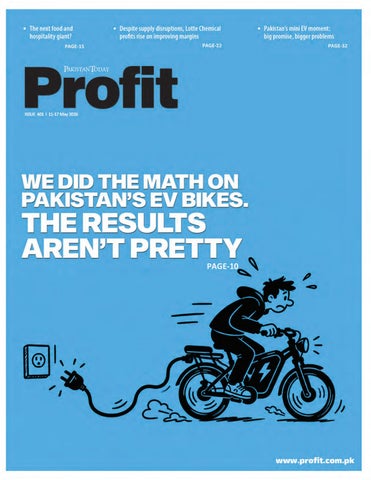
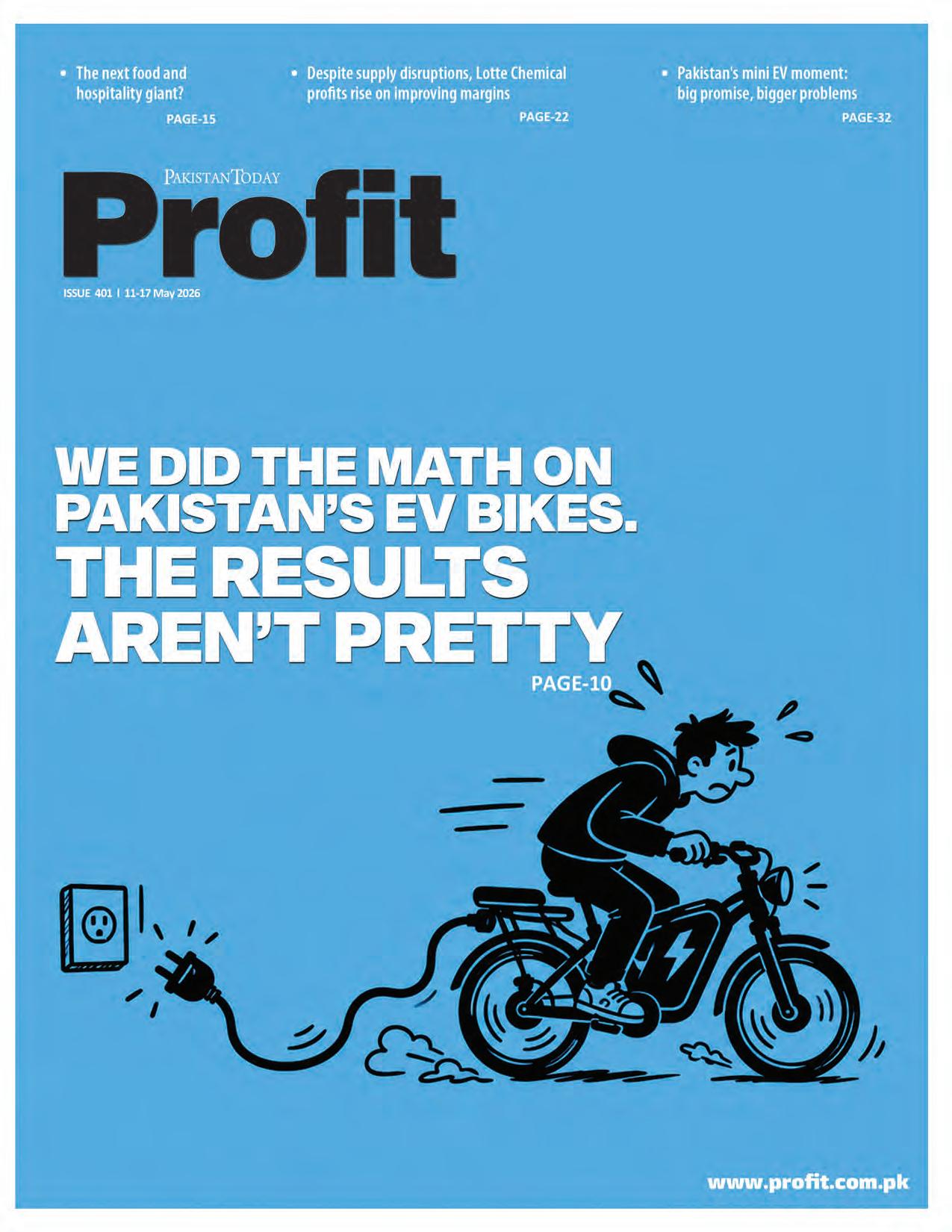
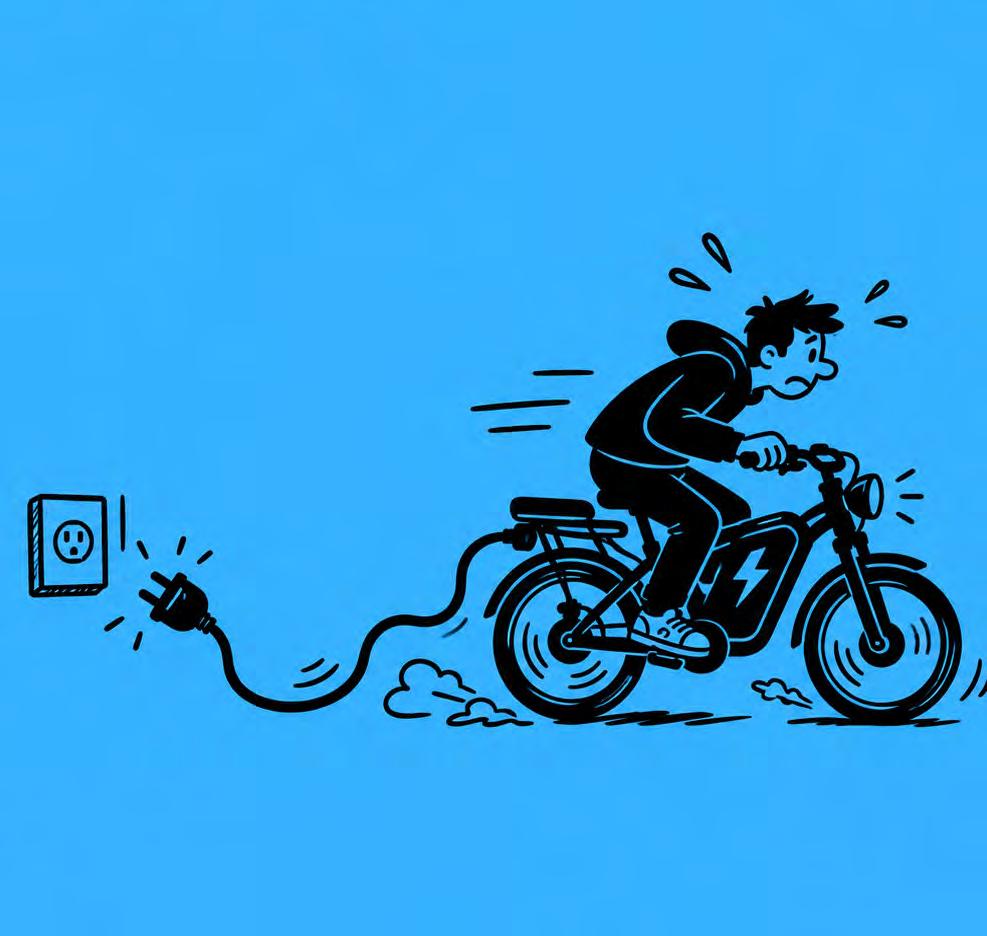
10 We did the math on Pakistan’s EV bikes. The results aren’t pretty.
15 The next food and hospitality giant?
20 As revenue rise among pharma companies, competition for market share heats up
22 Despite supply disruptions, Lotte Chemical profits rise on improving margins
24 As war disrupts Middle Eastern LNG supplies, OGDC steps up domestic gas production
27 Pax Sinica or Judaica? M A Niazi
29 Pakistan needs a Farmer-First grain storage policy Faisal Hassan
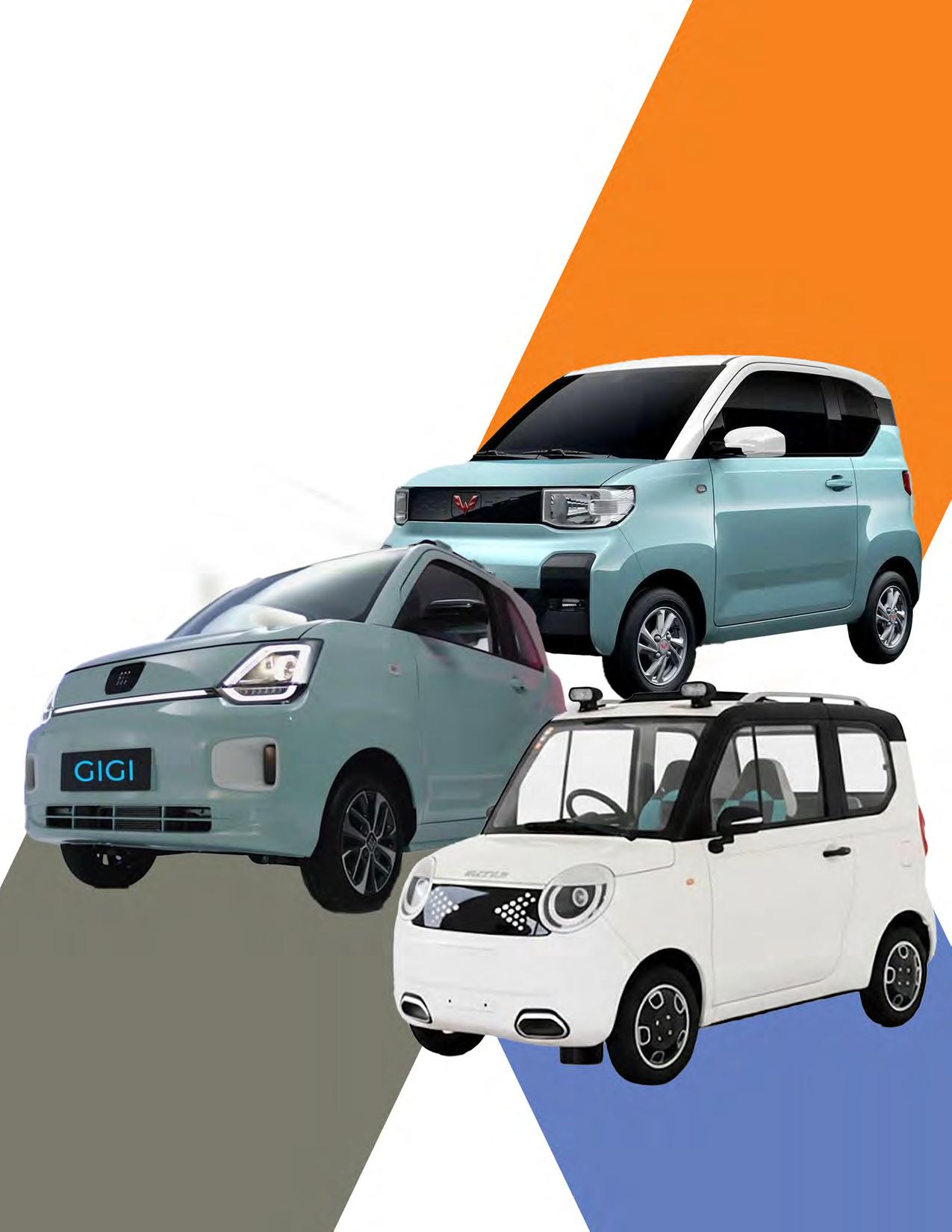
32 Pakistan’s mini EV moment: big promise, bigger problems
Publishing Editor: Babar Nizami - Senior Editor: Abdullah Niazi
Business Reporters: Taimoor Hassan | Usama Liaqat | Zain Naeem | Shahnawaz Ali | Ghulam Abbass
Ahmad Ahmadani | Aziz Buneri - Sub-Editors: Saddam Hussain | Abdul Hameed - Video Producer: Adnan Maqsood
Director Marketing: Muddasir Alam - Regional Heads of Marketing: Agha Anwer (Khi) Kamal Rizvi (Lhe) | Malik Israr (Isb) GM Special Projects Zulfiqar Butt - Manager Subscriptions: Irfan Farooq Pakistan’s #1 business magazine - your go-to source for business, economic and financial news. Contact us: profit@pakistantoday.com.pk
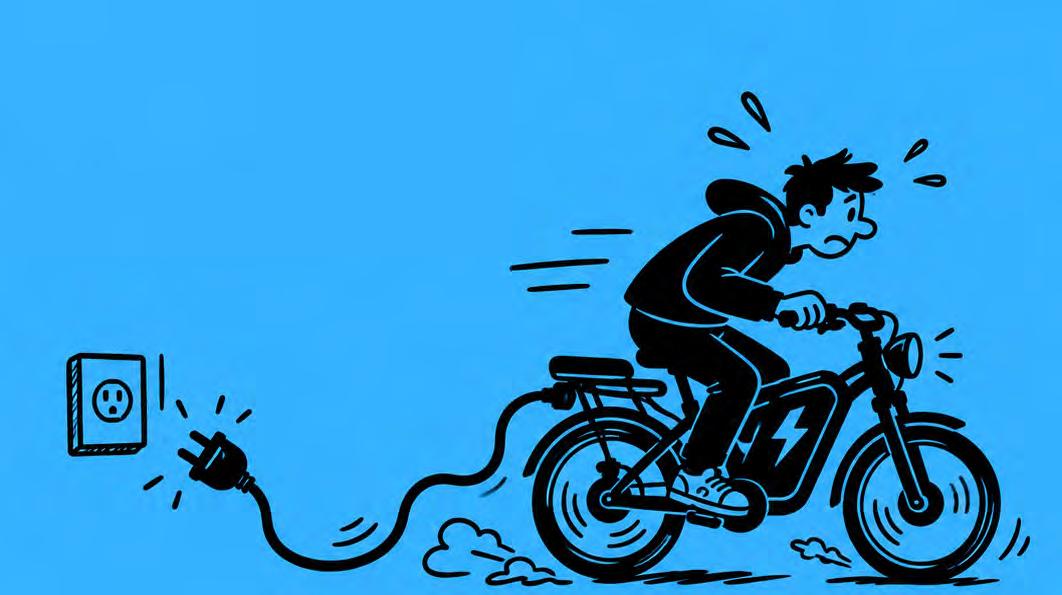
We did the math on Pakistan’s EV bikes. The results aren’t pretty.
Everyone from flashy startups to the government is selling the electric two-wheeler revolution. But a revolution requires the masses. And the truth is unless you’re a high-mileage Foodpanda rider or a student learning to ride, switching to electric right now does not make a lot of financial sense. Here is the full math the industry won’t show you.
By Usama Liaqat
This story is, essentially, exactly what the headline and shoulder say. And if you have the sort of blind faith in Profit’s math that gives you the luxury to make decisions based on just those two things, then by all means skip everything that is to come. Because we have a feeling that the sort of person that picks up a feature length cover story comparing electric bikes to petrol bikes for different segments probably wants to see the receipts. And if that is you, then buckle up because the results are not what Pakistan’s growing e-bike industry would like you to believe.
So without further adieu: The electric bikes market in Pakistan is more crowded and possibly more contentious than a Mughal family reunion. There is a veritable flood of fresh, new contenders with their own bright ideas mulling about trying to cobble together alliances and followers. All of them think it should be them next. All of them can’t say it in public but they are annoyed that others exist. And all of them
are at least a little scared that all their planning and dreams will never work out because the Emperor is never going to die.
In Pakistani mobility, that might just prove to be the case. Because the Emperor is less King and more Myth. The mighty CD 70 was first introduced to the Pakistani market in 1962 and has outlasted all manner of challengers. And as things stand, it will most likely survive the flood of e-bikes that are hitting Pakistan.
Very bluntly put, the savings do not justify the investment, and they definitely do not justify the risk. On top of this, range anxiety continues to be a major factor that is preventing these bikes from breaking through. On paper it might make sense for electric bikes to come in and sweep the market. After all,
There are around 60 lakh cars in Pakistan compared to over 2.5 crore motorbikes in Pakistan, with 15 lakh sold every year. Along with rickshaws, bikes consume around 40% of Pakistan’s petrol — all imported. Switch to electric bikes and, especially given Pakistan’s solar glut, you solve a pretty big problem.
But getting the masses to adopt electric bikes has proven difficult everywhere in the
world. A summary of Profit’s analysis indicates that EV motorcycles make sense for a relatively narrowly defined commuter: one who needs to commute more than 35 kilometers, but less than 60 kilometers (the range on most bikes) each day, or one who commutes longer, but expects to be able to charge their bike at their workplace.
That said, even though electric bikes do not make sense right now, it does not mean a path forward is impossible. The sea of ideas that have hit the market to make electric bikes common are clearly coming from a belief that this can work in Pakistan. And besides private enterprise, the government also has an interest in making this work. Together, these stakeholders might be able to bring the masses on board.
But as far as the consumers are concerned, let us start with the cost trade-offs.
Higher purchase price, lower ongoing costs
In Pakistan, the most commonly available EV motorcycles – we would even say, almost all of the available motorcycles – come with a fitted battery, either the cheaper lead-acid
‘graphene’ battery with a limited lifespan or the more expensive but longer lasting lithium iron phosphate one. Though the market is now flooded with many OEMs, the largest brands in the market include names like Evee, Yadea, AIMA, Vlektra, Jolta, etc.
Profit conducted a feasibility analysis of multiple EV motorcycle models, taking into account not only the costs of running (fuel + maintenance), but also the cost of capital as well as vehicle depreciation. For the EV motorcycles we analyzed, we took two of the most popular models: the Evee Gen-Z Pro (with a lithium battery) and the Evee Gen-Z (with a graphene battery). What the analysis yielded was the net present value (NPV) of different motorcycle models over a 5-year period. The purpose of this analysis was to determine the feasibility of these models compared to a Honda CD-70.
{Editor’s note: Scan the QR code in the print story, or click the link at the bottom of this story to access our analysis sheet. This includes our detailed working as well as our assumptions. Please feel free to download the sheet and add your own daily usage figures and assumptions and see which model works best for you.} n our analysis, we did make some assumptions (as all models require). We took the price of petrol to be 300 rupees/litre, which is slightly-above the levels it was pre-US/Israeli war on Iran. We also assumed certain mileage for these bikes which we believed were reasonable based on our conversations with users: 50 km/litre for the Honda CD70, and 65km/charge for each of the EV bikes. The advertised ranges are higher, of course, but those are based on perfect conditions that don’t really hold out in normal daily usage.
Similarly, our model also assumed certain depreciation costs for these bikes; a few of these models haven’t even crossed the 5-year mark since they were brought into market, so these figures are also estimates. You can find these more of our assumptions in our sheet (link at the end).
Why compare against the Honda CD-70?
Because it is quite simply the best-selling motorcycle in Pakistan. It costs more than any other motorcycle of a comparable engine size, but before the advent of EV motorcycles, commanded well over 50% of the market. It is, by number of units, the most popular vehicle in Pakistan by a long shot. Pakistan drives the Honda CD-70.
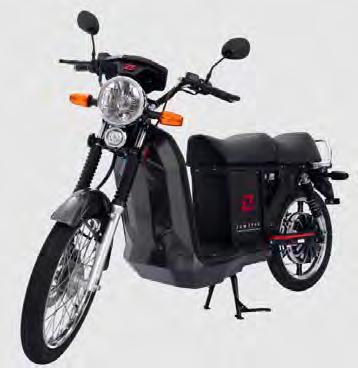
Each of the EV motorcycles we examined cost more than the CD-70, which has a retail price of approximately Rs160,000. By comparison, the EVEE Gen Z (Graphene) costs Rs175,000, the EVEE Gen Z Pro (Lithium) costs Rs239,000, and the Zum 2000 costs Rs270,000.
We then compared that to the ongoing costs of owning a motorcycle at varying usage levels, measured by average length of daily commute. This includes not just fuel costs, but also maintenance costs, and general depreciation of the motorcycle. So we have accounted for everything and the unique costs of both vehicles. Oil changes, battery swaps, and punctures among other things have all been accounted for.
Before we move on to examine the results of our analysis, let us lay out the exact costs of any potential savings that would accrue if you were to shift from a CD70 to an EV bike. And in order for the shift to make sense, not only should there be savings compared to the CD70, let’s say, but those savings should be enough to offset the extra risk you are taking, after accounting for the higher initial cost of an EV bike.
Now what exactly are these risks? There are fears about the performance of the bikes. What if the battery deteriorates much faster than you had hoped? What if the battery catches fire? Then there are fears about the companies. Much of the existing space is taken by newcomers, and if there’s one thing we know about startups, it’s that most of them fail. What if the company whose bike you own goes out of operation and your bike needs repairs? What if the parts stop coming in? What if the resale value of the bike goes down and the depreciation just
gobbles up all that you had saved on petrol?
The point is that a CD70 does not have these problems. It is a mature product with technology that has developed over decades. We know what its problems are. And you are as likely to find a mechanic that knows how to fix a CD70 as you are to find a petrol pump. When you move towards an EV, you suddenly find yourself in the dark. Its technology is still developing, and chances are it might become so advanced that the bike you buy today might not fetch much upon resale a few years down the road. And these risks have to be factored into your decision to shift to an EV bike.
Now let’s see a snapshot of our results of the aggregate cost savings offered by two Evee bikes over five years, relative to the purchase of a Honda CD-70 based on usage.
If we look at the chart above, we see that in each of the scenarios, the lithium battery model, i.e., the Gen-Z Pro offers more savings than the graphene battery powered Gen-Z. Let us drill down on those results. If your usage is low (around 35 kilometers), the Gen-Z Pro offers some savings, but these on their own are not nearly enough to encourage shifting from a CD-70, especially considering that it takes five years for it to yield only around Rs65,000 in savings, or just over a Rs1,000 per month. This is not mentioning the well-developed aftermarket ecosystem that a CD70 boasts, which such EV bikes lack.
The graphene battery also turns out to be a bit gimmicky. At one of the many showrooms Profit visited to test out the bikes and speak to customers, one individual we spoke to said he was buying his second EVEE Gen Z with a Graphene battery. Interestingly enough he had come to the showroom on a CD70. “I have a car at home as well but I try to use my CD70 the most. It gives me savings and I don’t have to worry about how far I can go or can’t go. This e-bike is more for my kids. They are whizzing around on them here and there but never too far from home.”
In such situations, buying an EV motorcycle might make sense for other reasons, but not for the savings it might offer. Since the motorcycle is comfortable and easier to learn to ride, it might make more sense for girls and women to take it out as their first forays into riding. It might also make sense for people to keep in their houses as a secondary vehicle, for short-distance chores or just for whooshing about in the neighbourhood streets. But for the average user of a motorcycle in Pakistan – the overworked, middle-class man, baking his back under the sun – this comfort might not be a good enough consolation. A CD-70 would still make more sense.
For a user who travels around 60 kilometers, however, the EV motorcycle starts to make more sense. The savings over 5 years rise to a level where it is a half-decent sales pitch, with monthly savings averaging a little over Rs3,000
An increase in oil prices following the closure of the Strait of Hormuz has led to a surge in electric bikes. Can this inflationary moment prove to be one that the country’s e-bike contenders can capitalise on?
per month. But then again, there is the matter of the loss of freedom. For a motorcycle such as the ones analysed, the average range is around 60-65 kilometers per charge. What if someone has to travel more than that any day?
This brings us to the range question.
The range problem
For the majority of motorcycle users, a motorcycle is all they have for transportation. They use it to do everything: drop their kids to school, to commute to and from the office, to run household chores, to make a little excursion over the weekend, and to travel within the city for all kinds of purposes. What these consumers essentially need is freedom and flexibility. They need to be able to change their plans, to account for any emergencies – essentially – to make room for reality.
What if there is an emergency? There are crucial questions for someone who has only one motorcycle to do everything with. They need the freedom to drive both 20 kilometers and over 100 kilometers every day, and not have to suffer hours of charging in the middle of their day just to do that.
Do the EV motorcycles available in the market offer this? With ranges of around 60-65 kilometers per charge for most models, the answer appears to be: probably not, at least not as a standalone product.
And the batteries take hours to recharge.
That is why the savings for commuters who drive about 100 kilometers per day, as in the chart above, though great on paper, are just not realistic enough to actually matter.
There is an additional matter: the last few kilometres of the range are not really accessible. You have to spend the last 10 percent or so of your battery power either hurrying back home, or if you are already at home, putting it on charge rather than risking the battery giving up on you on the road. This effectively reduces the range you can reasonably access on a daily basis. So, that is an additional problem. These motorcycles, therefore, limit your effective movement. For a normal Pakistani driver, this freedom is not a luxury to be compensated for by marginal savings. Rather, this freedom is a need. You cannot just be waiting for hours after every 60 or so kilometres for your motorcycle to recharge. There is, however, a technological solution to this limitation: the swappable battery models. This might help address the range problem for at least some commuters, and may help increase the total size of the EV motorcycle market.
The swappable battery model
This is exactly what it sounds like. Under this model, the battery within your motorcycles is swappable. The idea is that there are multiple battery
swap stations in the city, and when you are driving your motorcycle on the road and see that the charge remaining is low, you just go to your nearest battery swap station and exchange your drained battery for a fully recharged one. The process takes no more than a minute, and you are back on the road. Companies like ZYP Technologies and ESwap are spearheading these models in Lahore.
Just a brief word on each of these models. The ZYP Technologies model goes something like this: you buy the bike, but not the battery. Rather, you use the battery on rent, and pay a Rs 2.5/km rent on that. Essentially this is supposed to be a life-time guarantor against the battery depreciation normal EV bikes go through, where their batteries need to be replaced every few years. On top of that, upon swapping you pay Rs 195 for a full charge (let’s say, when you are swapping a fully drained battery), but the rate depends on the charge of the battery you are swapping out.
The ESwap model is slightly different and much simpler. Here you don’t even need to own the bike, or care for its maintenance on your own. Instead, you pay a flat monthly rent of Rs 17,000 (at current rates, though these might increase in the future) for using 3000 kms. If you travel more than that in a month, you pay an extra Rs 4 per km used.
We believe that if EV motorcycles are to take off in any sustainable way, the battery swappable model makes the most sense as the model of choice. You can actually travel long distances and not worry about charging times. This especially makes sense for people whose livelihoods depend on their motorcycles, such as foodpanda riders, or inDrive or Bykea captains. It also makes sense for normal people who can find the kind of freedom their CD-70 gives them now available through an EV motorcycle.
This freedom, however, like all freedoms, comes at a cost. You have to pay the rent for owning the battery and for driving the motorcycle. And currently, the level of rent means that these motorcycles again make enough sense only for people who cover large enough distances. Here we see how the higher the distance travelled, the more the savings make sense. For the ESwap model, the savings begin making any sense around 100 kilometers of daily usage (below that, it actually costs more than a CD70!). As the usage rises, the savings compared to a CD-70 increase exponentially. This is a model optimised for delivery riders, who would now not even need to own a bike to make a living. And boy does it offer enough savings for such users over five years! In fact, in our model, this is the scenario where any EV bike makes the best case for its usage. The only problem, however, is that not everyone is a delivery rider. The normal rider does not travel as long distances everyday. For delivery riders, of course, it is a great deal because their margin of earning is increasing. If
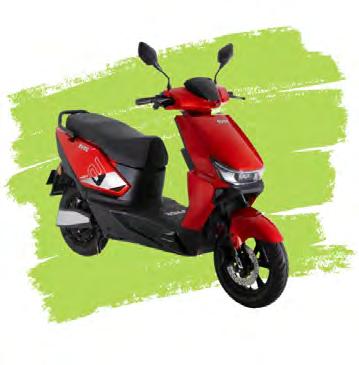
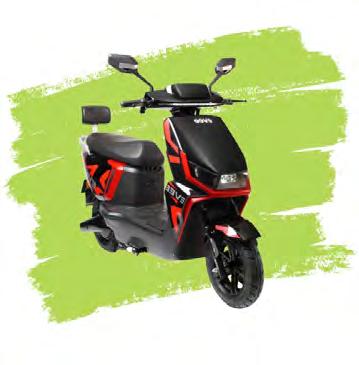
Evee Gen-Z Pro
Evee Gen-Z
they use the bike, for example, in the day time for domestic needs and in the evening for deliveries, they are reducing costs and also making more money.
If we consider the ZYP Technologies model, we see again that the savings rise the more you drive the motorcycle, but at a much muted rate than the ESwap model. The reason behind this (other than the 2.5 rs/km rent) is that the per unit effective cost for you increases the longer you travel. For instance, if you charge it at home, the per unit cost is around 50 rupees; but if you use a battery swap, it costs 97.5 rupees per unit. And since you cannot just go back home during your workday to recharge the bike (and wait for it for hours), you need to make the swap. That effectively increases the per unit electricity costs that it takes for you to run your bike.
The ZYP model, unlike the ESwap model, however, has an added risk: you have to invest in the motorcycle, so if the company goes under, you are left with a motorcycle, a battery, and no swapping infrastructure to support you into eternity. The savings at lower distances are just not enough to justify the risk premium of shifting from an established brand like Honda to a startup. Rather, we believe that in this model, the savings begin to make enough sense only when your daily commute is over 130 kilometers.
Though both of these models do offer a solution to the range problem of the normal EV motorcycles, are they good enough for the average CD-70 user who doesn’t travel that much? Then, there is the problem that the battery swapping infrastructure is just not big or visible enough to generate trust in the consumer to trust in this model. These two models have fairly small operations, and are only available in Lahore at the moment. By contrast – though it is a little unfair – the ecosystem surrounding petrol motorcycles has taken decades to mature: you are always close to a petrol pump, and the aftersales maintenance services that a brand like Honda can offer you render everything pale in comparison.
So, here again, given the current situation, a CD-70 might make the most sense for most motorcycle users of Pakistan. Though delivery riders and inDrive captains can find great savings through this model (especially the ESwap variant), the fact remains that most people just don’t drive that much during the day. If we factor in the comfort of using a CD-70 (no need to worry about refueling, ranges, repairs, or the company shutting down), the case for a CD-70 still remains strong enough for the average consumer to be not very compelled by the battery swap model. Things might change in the future as the battery swap operations achieve economies of scale - ZYP, for instance, is planning on launching a much cheaper bike priced at 195,000 rupees - and the economics start to make more sense for
the average user.
What it will take for the market to take off
EV motorcycles, on the whole, have not really taken the world by the storm as EV 4-wheelers have. We believe that range anxiety is a major reason for this hesitation (though there are other structural constraints as well). In a context such as Pakistan, where bikes are not simply toys but real parts of people’s lives, the freedom that a CD70 offers needs to be at least equalled, if not better, by an EV alternative. We have discussed how fixed-battery units have limitations in this regard. And we believe that an EV solution that addresses the range problem – such as the battery swap model – is the way to go in Pakistan.
There are two more reasons why the battery swap model does make the most sense for the range anxiety problem. With normal EV bikes, you might have two solutions. First, that they carry bigger batteries to extend their range. However, this would make the bikes bigger and therefore much more expensive, moving out of competition with a CD70. Secondly, EV bikes, unlike EV cars, cannot feasibly work through a battery charging infrastructure. This is because EV bike’s batteries are not liquid-cooled and therefore need to be charged slower. Recharging at a charging station would take hours for an EV bike to charge, so this is not a practicable solution either.
But in Pakistan, the promotion of the Savings compared to a Honda CD 70 (over 5 years)
Zum-2000 offers some savings, but these are not enough to cover the risk premium of shifting from a CD70; ESwap makes no sense
Zum-2000 offers more savings, but over 5 years, these might not be enough to cover the risk premium of shifting from a CD70; ESwap makes good sense at current prices
Zum-2000 probably provides usage, deliver riders, etc.) enough savings to justify the risk premium; ESwap continues to make good sense
200 kilometers
Both Zum-2000 and ESwap (delivery riders, etc.) provide enough savings to justify a shift, though ESwap is cheaper
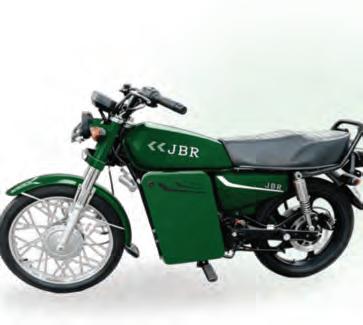
Zum-2000 (by ZYP Technologies) JBR Bike (E-Swap Rental Model)
battery swap model requires heavy upfront investment. Such models often suffer from the chicken-and-egg problem. What comes first? Infrastructure or Sales? Each appears to require the other to come into being. Often this problem is solved by blitzscaling: you throw enough money to build the infrastructure first. The idea is that once you have the chicken, you can get the egg (or vice versa), but you need to force one thing into existence. Ideally, sales would naturally follow.
Over the course of the past month, Profit has spoken to executives, buyers, delivery riders and many others that have switched towards electric bikes. We have also spoken to those that have not made the switch. The general sentiment is clear: savings would be great in this economy, but the risk is not worth it. In a market where the investment has not been made, the savings are not enough for consumers taking on that risk en mass. That means either the government or private capital has to take on the mantle of driving battery-swapping infrastructure at scale.
Just take a look at other countries in the world. Electric bikes have not really made a dent in most countries comparable to Pakistan. While electric bicycles (a whole different thing) are common in China, France, Germany, and a bunch of other environmentally conscious and walkable European cities where dallas without number plates won’t mow you down, the only place that can be compared to Pakistan where electric bikes have seen success is Vietnam.
VinFast in Vietnam has been catalysed by massive initial investment. VinFast was able to raise $1.5 billion in the first phase of its development. The problem with Pakistan is that, although there are people with enough ideas, not many appear to be interested in supporting this model with the sort of capital intensive customer acquisition that this project needs.
One cannot discount the environmental angle as well. The world is shifting towards cleaner technologies, and motorcycles in Pakistan remain the main polluter and contributor to smog. Similarly, there is another angle as well: we already import a lot of oil and by some estimates around 40% of the total petrol in Pakistan goes towards powering motorcycles and rickshaws. This is not a problem without a solution, a partial one at least. We have a lot of electricity surplus. Our installed capacity is 46,605 megawatts, while the peak demand during the summers reaches only between 28,000 and 30,000 megawatts. During other timings when the consumption falls, such as during nights when industries are closed, the surplus can even reach 25,000 megawatts.
The need for a shift towards EVs does make sense then, especially from the government’s point of view. And the government, through the recently approved second phase of the Pakistan Accelerated Vehicle Electrification (PAVE) scheme, does appear to realise that. It appears to have learned lessons from the ineffectiveness of its previous strategy: instead of giving a subsidy
to the consumer through banks, it now plans to grant the subsidy directly to the OEM, which is essentially the brand manufacturing the bike.
By granting a subsidy of 80,000 per EV motorcycle (but only those with lithium iron phosphate batteries), the investment horizon would change for many people. The motorcycles would become cheaper by the amount of the subsidy, and the total cost of ownership would decrease since the cost of capital would decrease. This is also important since high upfront costs of an EV bike are often prohibitive, though financing initiatives like the Wasl Mobility Modraba, are trying to change the situation by providing loans to those interested in EV bikes. But then again, the interest charged by them only adds to the cost of your capital invested in buying an EV bike. But now, the outlook might change**, especially since it is also thought that with this subsidy, if the OEMs keep their previous margins, the prices of EV bikes, for instance, should ideally fall by more than the amount of the subsidy.
The problem however remains that, as mentioned above, normal EV motorcycles don’t make enough sense for the average Pakistani’s patterns of usage and needs. However, the solution - the battery swap model - is currently just not big enough for people to use the government’s subsidy to adopt it in droves. And even for the government, a large-scale shift towards EV bikes makes sense only if consumers with the highest usage form a significant portion of those making the shift. Savings on petrol, which the government seeks to achieve, would become appreciable only in that case. And we have seen how for high-usage consumers, a normal EV bike does not make enough practical sense.
What is needed, therefore, is a concentrated focus on helping companies championing the battery swap model through high upfront investment into infrastructure. This need becomes more urgent since the reason a brand such as ZYP is not able to offer more competitive rates is the shortage of upfront capital investment. Efforts to address this problem would, therefore, not only put this model on the map, but by allowing them to exploit economies of scale make them much cheaper than their current rates, making them more feasible even for the normal consumer.
Some efforts have already been made. Once the NEECA’s recommended electricity rates (Rs. 39/unit) for EV battery charging stations kick in, the battery swap rates should see a decrease. At that point, the calculations for the swappable model will start to make more sense than they currently do. But to really bring in a revolution, this, on its own, might not be enough. Whether it is the government that does that through a targeted scheme, or an enterprising business magnate puts their money in, it does not matter. What matters is the fact that unless something like this happens, the CD-70 would continue to make the most sense for most of the consumers, and the EV revolution would continue to recede dream-
like into the future. So, although there is a lot of activity in the space, with newer OEMs flooding the market – mostly with Chinese motorcycles –and loan financing companies like Wasl Mobility Modraba entering the fray, the hoped-for EV revolution might continue to remain a dream in the foreseeable future. That is, unless things change. And this change would have to be led by big money – either through some enterprising businessman, or through the government or a combination of both. Pending that, a motorcycle such as the CD-70 might continue to make the most sense for a normal user.
Dissenting note: A glimmer of hope?
Pakistan’s electric bike industry is currently a sea of ideas. While the industry is still figuring out what the best models are, there are some options that would make sense. Take, for example, Vlektra’s Velocity electric bike which boasts the biggest battery in its league. Their base model costs Rs 339,000, which is more expensive than any of the other bikes Profit has analysed above. While the initial cost is high, it advertises a range of 180 kilometers. Even if we only take 2/3rds it as reality, a range of 120 kilometers solves the range anxiety problem for most users. On top of that, let us not forget the indomitable spirit of the average Pakistani. If enough bikes hit the roads battery swap stations will not be the only solution. People will make relationships with parking managers, workplaces could provide charging services as an incentive. We do not know what shape things will take, but trust Pakistanis to find a way and figure out a juggar. The third factor is volatility. Electricity prices are generally more stable in Pakistan than petrol prices, which are entirely dependent on imports and global markets. With the stability factor in mind, despite the current math of electric bikes people might still choose to give them a try. n
*You can access our analysis sheet on this link if you are reading the online version, or by scanning the QR code in the print edition. This includes our detailed working as well as our assumptions. Please feel free to download the sheet and add your own daily usage figures and assumptions and see which model works best for you.
**You can access our analysis sheet with the PAVE subsidy accounted for on this link
The next food and hospitality giant?
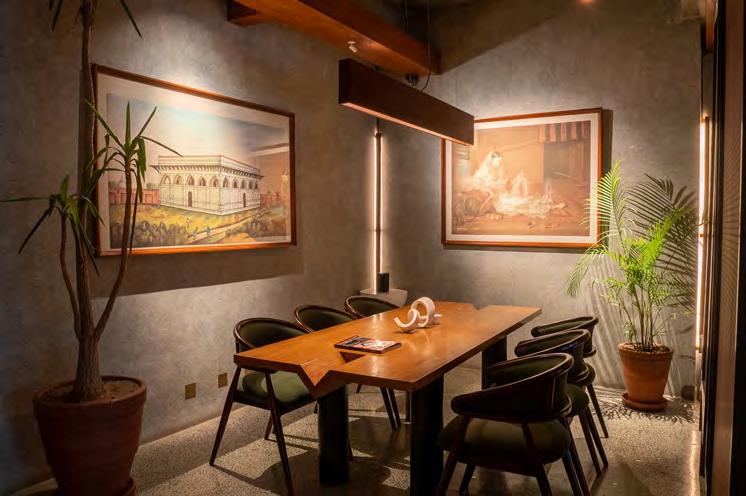
A second-generation scion of the family that owns Bareeze, Zain Aziz has changed the shape of hospitality in Lahore and given the legacy hotels a run for their money
By Abdullah Niazi
On paper, Zain Aziz seems an unlikely candidate to lead the fight against what he describes as “the hijacking of our national aesthetic.”
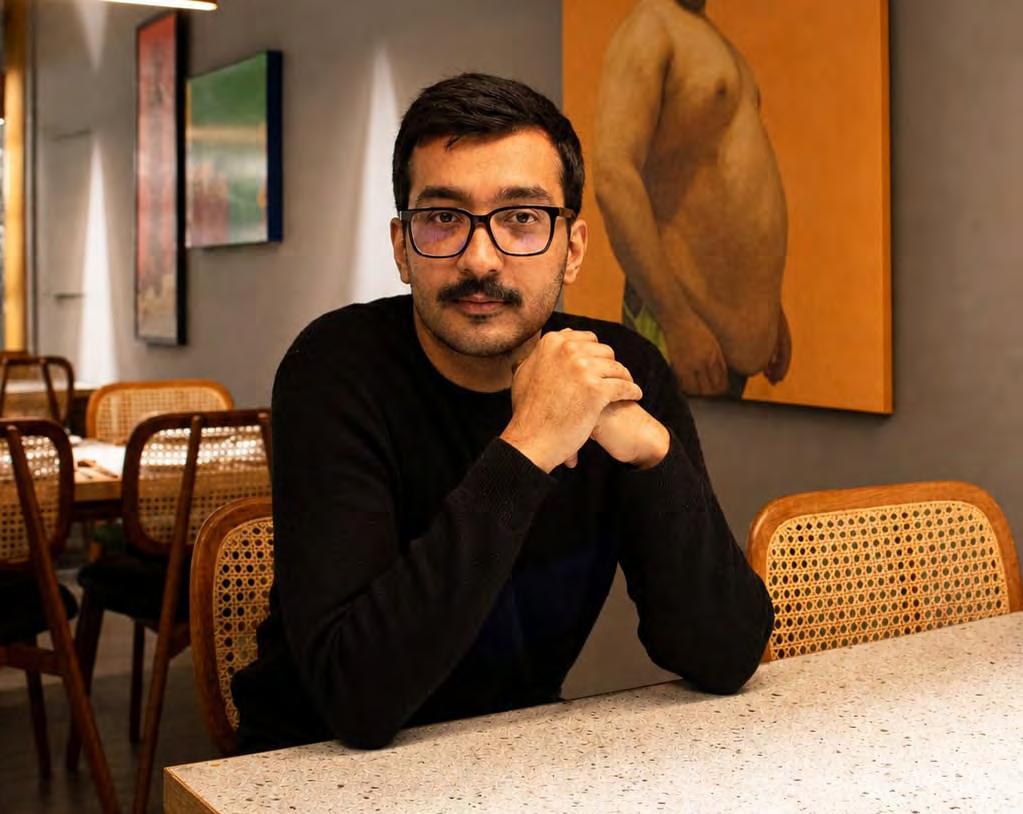
Born in Lahore in 1985, Zain Aziz went to Aitchison College before shifting to the United Kingdom to study mechanical engineering. There, he went on to complete a Masters in mechanical transmissions and robotics from Imperial College London. He briefly worked as an IT consultant in the UK. His family owns Sefam, the retail fashion giant most well known for its flagship brand Bareeze among others.
Over the past seven years, he has grown a sizable umbrella of establishments in the food and hospitality sector that have not just seen rapid acclaim for their taste and service, but have also quickly become known for their design philosophy. He has done so with no formal education or training in the sector.
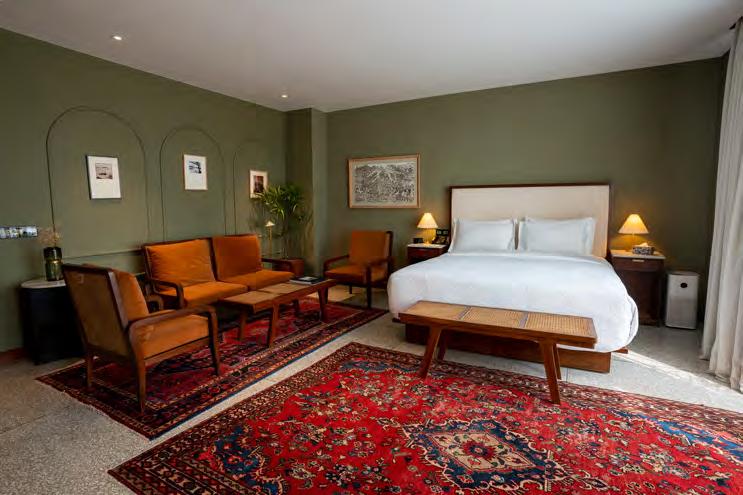
The crown jewel in this fledgling empire is The FRED Hotel — a 37 room luxury boutique hotel right off Main Boulevard, Lahore. A go-to destination for foreign travellers coming to Lahore, the hotel has a rating of 9.3 out of 10 on Booking.com. Avari and Pearl Continental, the two legacy competitors in the same price range, have 7.8 and 6.8 respectively. The only hotel in the price range that matches The FRED’s rating is The Nishat.
But in a very short amount of time The FRED and its associated establishments have managed to do something brands and companies often spend millions doing but rarely pull off. They’re cool. The aesthetic of The FRED and its restaurants has appealed to people. It is not just a good place to spend the night or go for a meal, it is a space one wants to spend time in.
As the umbrella grows, The FRED is also emerging as a serious enterprise. In an interview with Profit, Zain Aziz explained the model behind the hotel. The asset is owned by the family company, and Zain runs it as an operator and takes a cut for his service. He is now in a position to buy the asset in its entirety from the family firm. And he is just getting started.
Unsuspecting origins
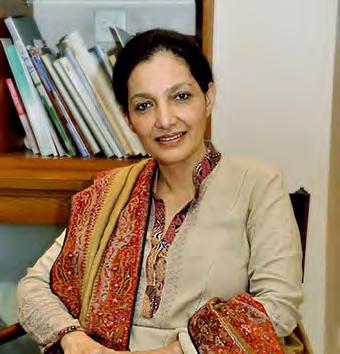
To tell the story of the FRED, it would be remiss not to understand where Zain Aziz comes from. His mother, Seema Aziz, has become a legend in Pakistan’s retail fashion industry over the past four decades.
In 1985, Seema and her brother Hamid Zaman established a small production unit in the basement of a Lahore marketplace. The idea was to build a Pakistani textile product
from beginning to end that matched international standards. The brother-sister duo had a lot to prove. Their father was the owner of Ali Embroidery Mills (AEM). Once a part of Pakistan’s vast textile industry supply chain, AEM had hit a wall in the 1980s. A 2020 case study by the Asian Journal of Management Cases claims AEM ended up “floundering” when regional unrest caused a drastic drop in demand for their products.
Sefam was Seema and Hamid’s attempt reestablish the family’s embroidery business. Using AEM’s discarded assets, they got to work with two embroidery machines. In 1985 they opened their first branch in the middle of a retail hotspot to challenge the existing fabrics. The name they chose for their store was Bareeze — originating from the same Persianate root that gives us the words “bar-
Seema Aziz grew Bareeze from the basement in a Lahore marketplace and grew it to one of the largest chain retails franchises in Pakistan.
sa” and “barkat”, meaning blessing. Their racks were empty within days.
Over the past 40 years Sefam has become one of the largest retail chains in Pakistan, with over 400 points of sale and a team of more than 5000 people.
Zain Aziz got his first break through the family business. Profit interviewed him at his office located inside The FRED Hotel. The office space was a far cry from the hotel’s vibe — brightly lit, cubicles everywhere, and stacks on stacks of papers. Zain’s own office reflects more of the hotel’s aesthetic — moodily lit, rich colours, solid wood and motorbike motifs. His involvement in the family business, he explains, was entirely coincidental. He had come back to Pakistan from the UK in 2010 and a misplaced passport meant his return was delayed by a few months. During that time he started going to the family offices to help out. It was a role he was used to. When he was younger his mother would dictate replies to emails and he would diligently type them out.
What started as a temporary arrangement quietly became a permanent one. Zain got involved in the launch of Bareeze Man, designing their stores and managing the brand. It is not an unusual trajectory for the scion of a major business family. there was a universe in which fashion retail could have been the extent of this ambition. That, fortunately for Lahore more than anyone else, has not happened.
The origin of FRED
Before we get into the origin of The FRED Hotel, Zain Aziz wants you to know something. The name is an acronym. It stands for Food, Research,
Over the past seven years, he has taken a pop-up space on the top floor of a clothing store and scaled it up to a 37-room luxury boutique hotel accompanied by a number of restaurants and cafes
Experience and Design. Zain himself, at least as an interview subject, is easygoing and has a nervy charm about him. He looks younger than he is.
“I used to design and manage for Bareeze Man, and we were opening a flagship store in DHA Y Block. I was designing the store, and we had bought the entire building
because we got a really good price for it. The upstairs space was really cool, and I thought, ‘Why don’t we do a restaurant?’ At that point I had the realization that if not now, I will never do it. I didn’t have a lot of bandwidth, so we did a pop-up space instead,” he says.
The idea for a restaurant had been a seed in his mind for years. He had often
discussed it with an uncle. As soon as the space revealed itself, he got down to it. But in the midst of starting a flagship store, tacking on a full service restaurant on top was going to be a big ask. Instead, he turned it into a pop-up.
The place was there to rent out for dinner parties, events, and the like. They invited chefs from outside Pakistan with the goal of using the space to test Lahore’s appetite for different cuisines. That is where the name FRED emerged from, and by all accounts those first few months were as chaotic as they were some strange sort of crossover episode. He already knew people in the restaurant business, and in the very small world of Lahore’s elite circles, he was getting help from Paolas, Bamboo Union, and Sumo. But he also leveraged the existing infrastructure of Sefam.
“Honestly, a lot of it was luck. In the early pop-up days, it was all hands on deck— people from completely different roles just jumped in. The Entertainer’s head of sales was service captain, Bareeze Man’s comms person was a floor manager —it was chaotic at first, but fun. What started as a passion for food and innovation, slowly built a real following. We really felt we could push the envelope in the restaurant business, but then Covid hit,” he explains. The FRED had opened its doors as a pop up kitchen in December 2019. By March 2020, the world was going under lockdown.
“Flying chefs in was not an option but the dedication to keep going was definitely there. We made a decision to search for someone locally if we wanted to continue, and luckily that’s when we found a team, most of which is still with us today. This
An engineer by profession, opening a restaurant had been an old dream for Zain Aziz.
shift forced us to grow up—from a pop-up into a full-service restaurant. In an unexpected way, Covid was the turning point.”
Bursting out and building up
After the pandemic hit, The FRED started operating as a restaurant with a dedicated kitchen staff. At the same time, Zain was still working for Sefam. His office building was right off main boulevard in Lahore’s Gulberg region. It was a central location, but the building was old and over capacity. It housed over 700 employees and at one point during the interview, Zain described it as “the ugliest building in Lahore.”
A search ensued for a new office building, and Zain claims he must have looked at every empty building in the city. But the answer was under his nose the whole time. Right next to their office building, a brand new grey structure was already under construction. The problem was that it was far too large for their needs. They needed around 10,000 square feet and the grey structure was six stories tall and covered 40,000 square feet. still, they inquired about it and it turned out that the developer was an acquaintance. They got a good deal for a long-term lease. And so the papers were signed.
But this left a small problem. The office space required around 2 floors, leaving most of the building empty. Last time, Zain Aziz had used the top floor of the Bareeze Man flagship store to set up The FRED. With all this space on hand, ideas were already
This building wasn’t designed to be a hotel— it was meant to be a large office—so that was a tough task. We approached this from an engineering perspective rather than a purely architectural one. We had to build a lot from scratch, and material choices became a major focus - I wanted longevity, quality and practicality. We ended up doing a lot of “jugaars” or innovative engineering solutions as we like to call them
Zain Aziz, founder The FRED
buzzing.
What is now The FRED Hotel started off as a grey structure for an office building. It was leased by the Sefam group but proved to be more space than they needed. The empty space resulted in the hotel.
That is where the idea for a hotel first came up. Lahore has a few old-school hotels that come with pools and event halls. There is Avari, Pearl Continental, Ramada, the recently revived Ambassador Hotel, and Falettis. These are grand old institutions that have been around for ages. Muhammad Ali Jinnah, in fact, stayed at Falettis where his room has been preserved. But old hotels are predictable. They fall out of fashion, their facilities age, and they often have to rely on legacy more than anything else. While other hotels exist in Lahore, the only real challenger to the estab-
lished players in recent times was The Nishat Hotel. They opened in Gulberg in 2014, and eventually in Johar Town in 2017. It was an easy equation as well — the group had just built Emporium Mall and had the space to set up a second hotel in a short span of time.
For The FRED, the competition was easy to identify. But the challenge was also large. This was an office building and a portion of it was being carved out to turn it into a hotel. “The building for the hotel came together not-so-slowly but surely. I prefer working things out from the first principles rather than hiring consultants to try and figure it out. So, the team and I started designing, sampling furniture, lights etc., and executing the space for the fifth floor along with the two restaurants. It was a lot of learning on the job and applying our collective wisdom – overall this project pushed us the hardest, but we learnt a lot,” says Zain. According to him, this was an idea that had been budding somewhere in his mind for a long time, and the engineer within him seems to have taken over the logistical and technical side.
“I used to travel a lot for work and I always stayed at a different hotel. It’s cool how there are so many variables in a place like a hotel or a restaurant, and pulling a single lever can change so many different things.”
But setting up a hotel takes time, money and patience. Even before the FRED opened its doors to guests, Zain began by emulating something he had already done and opened a restaurant on the top floor of the building called The Observatory. This was followed by a Japanese restaurant, Gaijin. Both restaurants are still housed in the same building, but their setup and operational cost was separate. Overall, the setup cost for the hotel was Rs 50 crores. This did not include the cost of the long-term lease for the building, which they have for 10 years. As of now, The FRED is probably the priciest hotel in Lahore, with
a regular room going for around Rs 35,000 per night on some booking platforms. It is not particularly more than what legacy hotels like Avari and Pearl Continental charge.
What makes it click
“This building wasn’t designed to be a hotel—it was meant to be a large office—so that was a tough task. We approached this from an engineering perspective rather than a purely architectural one. We had to build a lot from scratch, and material choices became a major focus - I wanted longevity, quality and practicality. We ended up doing a lot of “jugaars” or innovative engineering solutions as we like to call them,” says Zain Aziz.
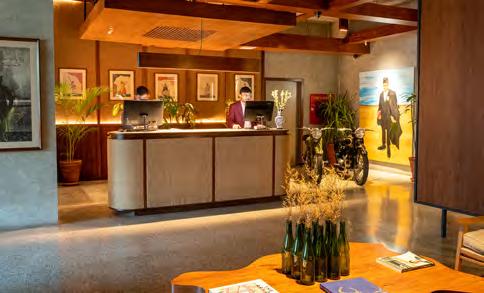
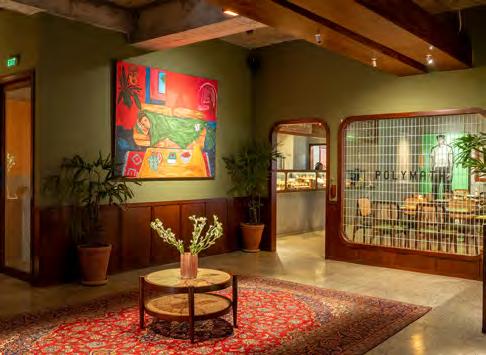
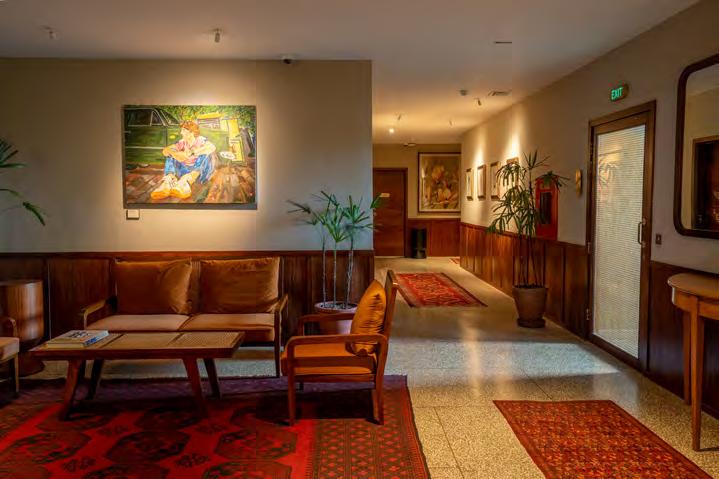
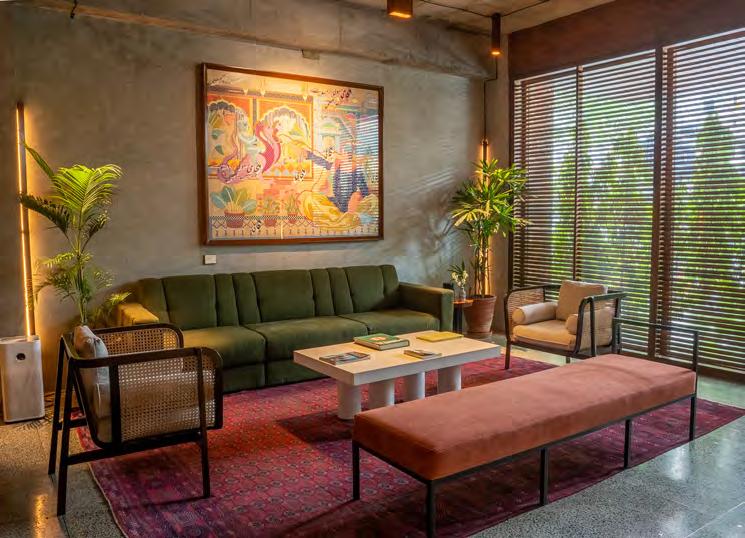
There are some things about the hotel that one can tell are unique decisions. There is a lot of solid wood all over the place. There are no tiles, except in the kitchens. There is terrazzo, sheesham has been used abundantly, and the marble was brought in from Ziarat — not imported. These decisions are rooted both in financial sensibility and The FRED’s design philosophy according to Zain Aziz. “We opted for finishes that were practical as well as aesthetic – for instance instead of things like MDF, we chose solid wood for durability. Similarly, we chose materials like chips for flooring – inspired from my naanis house – but also practical as they last forever over these expensive imported tiles.”
The idea behind using these materials is longevity. According to Zain, when hotels use MDF or cheaper materials it saves them initial investment costs but they end up spending more on repairs and renovations over time. On top of this he also had a very particular idea for the kind of vibe he wanted — which he described as “a luxury version of naani ka ghar.”
It is a subject he feels strongly about. In the course of the interview, he spoke about everything from food to ugly pedestrian crossings to the “Spanish” style houses that have taken over posh areas in Lahore. These strong opinions were shaped by his time at Bareeze Man, where he also went in with a very distinct design philosophy.
“I felt that subcontinental clothing had been hijacked by Bollywood and commercial forces into a carnival sideshow. Menswear especially had become something else. The idea with Bareeze Man was to change this. We wanted to bring out an aesthetic that was more of an evolution of our heritage, while staying true to our roots - using quality and design as the sole focus. Understated embroidery, clean cuts – we want to make pieces that resonate with the intent we began with – remaining anchored in our origins,” he says about his
experience at Bareeze Man.
This feeling is pervasive for Zain, and beyond fashion goes to housing and urban design as well. As he explains it, a big part of it is cheaper imported materials that end up costing more in the long run and have become the standard in building.
“I feel our national aesthetic has been hijacked by economic forces. Consumers are forced to buy whatever is available and whatever’s available is the cheapest stuff from China that importers can find,” he says. “Due to lack of choices, consumers, although reluctantly, end up choosing this and importers end up buying it again - it’s a vicious cycle. This is why within a generation this cheaper stuff is normalized, and it’s hard, but necessary to break through it.”
Perhaps what sums up his approach entirely was the inspiration behind the design. “I wanted Pakistan’s very strong tradition of hospitality to be at the core of the hotel. Growing up I’ve seen this culture of hosting up-close with my naani. She loved having people over – be it feeding them, or playing bridge. The inspiration for the interior and overall look of the hotel also comes from her home - built in the 1930’s, perfectly preserved. If you look at it, the hotel is essentially my naani’s house on steroids – the terrazzo floors, rattan accents etc., it’s what I grew up appreciating.”
Where next?
Since opening the doors of The FRED Hotel, in addition to The Observatory and Gaijin - the building also houses Polymath Cafe. Another branch of Polymath has already been opened at Dolmen Mall. On top of this, another cafe inside Bareeze’s flagship store in Gulberg Lahore by the name
“Cafe Bareeze” has also been launched.
The next test for The FRED will be whether its design-led hospitality model can move beyond one well-located Lahore building without losing cost discipline. The operator-asset owner structure mentioned earlier gives it one possible route. Instead of tying every expansion to full ownership of real estate, the business can operate assets owned by others and earn a management or operating return. That model lowers the upfront capital requirement for the operator, while giving asset owners access to a brand, operating systems and food-and-beverage concepts that can improve yields from their properties.
Expansion, therefore, is likely to come in layers rather than through a conventional hotel chain rollout. Cafes and restaurants are the easier first step, as seen with Polymath’s move into Dolmen Mall and the launch of Cafe Bareeze. These formats require less capital than hotels, are easier to replicate, and can test demand in new locations before larger commitments are made. The hotel side will be slower because it needs suitable buildings, service consistency and higher setup costs.
For now, The FRED’s growth depends on whether it can standardise what has so far been a highly personal project. Its next phase will require more than taste and founder involvement. It will need trained teams, repeatable procurement, tighter controls and a clear separation between the brand, the operator and the asset owner. If that structure holds, The FRED can expand through selected hospitality and food spaces in high-footfall or premium locations. If it does not, it risks remaining a successful Lahore original rather than a scalable hospitality business. n
As revenue rise among pharma companies, competition for market share heats up
Cash flows in the sector have improved, and companies are increasingly spending more on marketing and distribution to capture greater market share
Pakistan’s listed pharmaceutical companies entered 2026 with higher profits, wider margins and a visible shift in how they are using the cash released by drug price deregulation: not only to repair balance sheets, but also to fight harder for market share.
The first quarter numbers compiled by Topline Securities show that the listed pharmaceutical sector posted profit after tax of Rs10.19 billion in January-March 2026, up 17% from Rs8.68 billion in the same quarter last year. Net sales increased 7% year-on-year to Rs90.65 billion, while gross profit rose at a much faster pace of 18% to Rs38.84 billion. Gross margins reached 43%, compared with 39% in the first quarter of 2025 and 44% in the final quarter of 2025.
That gap between sales growth and gross profit growth tells one part of the story. The more revealing number is further down the income statement. Selling and distribution expenses rose 20% year-on-year to Rs17.10 billion, nearly three times the pace of revenue growth. As a share of sales, selling and distribution costs increased to almost 19% from about 17% a year earlier, indicating that pharmaceutical companies are spending more aggressively on field force expansion, brand promotion, trade channels, doctor engagement, distributor reach and product-level marketing.
For an industry long defined by price controls, margin compression and periodic shortages of low-priced medicines, the numbers mark a change in the competitive cycle. The sector is no longer merely passing through higher prices to restore profitability. It is now redeploying the benefit of stronger gross margins into commercial activity. In other words, companies are trying to convert pricing power into volume growth, shelf presence and prescription share.
Topline attributed the year-on-year profit growth mainly to price-led growth, higher volumes and lower finance costs. Finance cost fell 24% year-on-year to Rs932 million, helped by lower interest rates and reduced debt at some companies. The fall in finance cost is important because it gives firms more room to spend on
operations without fully sacrificing net margins. Even after the increase in selling and distribution expenses, the sector’s net profit margin remained around 11% in the first quarter, compared with 10% in the same period last year.
The quarter was, however, weaker sequentially. Profit after tax declined 28% from Rs14.21 billion in the fourth quarter of 2025, while net sales dropped 11% from Rs102.18 billion. Topline linked the quarter-on-quarter decline largely to seasonality-led lower sales volumes and lower other income. That does not change the broader annual story, but it shows that the sector’s earnings are still exposed to quarterly demand cycles, product mix and timing of promotional allowances.
China and India.
The gross margin trend is the central structural change. According to Topline’s quarterly data, sector gross margins were around 27% to 28% in late 2022 and early 2023, dropped to 22% in the second quarter of 2023, and then began a steady climb. Margins reached 31% in the first quarter of 2024, 37% in the third quarter of 2024, 39% in the first quarter of 2025, 42% in the third quarter of 2025, 44% in the fourth quarter of 2025 and 43% in the first quarter of 2026.
That movement is not only a function of better pricing. It also reflects a more favourable operating environment after the rupee stabilised from the worst of the 2022-23 shock, import constraints eased, and companies were able to rebuild inventories. Still, the sector remains vulnerable to active pharmaceutical ingredient prices. Pakistan continues to import most of its pharmaceutical raw material, with Dawn reporting in 2022 that the country produced about 15% of its raw material requirements while the remaining 85% was imported mainly from
That dependence explains why the Topline report flags API prices as a key risk for 2026. A sector with 43% gross margins is in a very different place from one operating in the low 20s, but those margins can still be squeezed if imported input prices rise or the rupee weakens. The difference now is that companies have more cash flow and more pricing flexibility than they had before deregulation.
The company-wise numbers show how uneven the gains are. GlaxoSmithKline Pakistan and Abbott Laboratories remained the largest contributors to sector sales in the first quarter, with net sales of Rs17.03 billion and Rs17.71 billion respectively. Haleon Pakistan followed with Rs9.59 billion, while The Searle Company reported Rs8.60 billion. Together, these companies accounted for a large share of listed-sector revenues.
But the faster growth stories were elsewhere. Searle’s net sales rose 44% year-on-year, gross profit also rose 44%, and profit after tax increased 70% to Rs524 million. BF Biosciences posted 42% sales growth and 77% gross profit growth, although its net profit fell 6%, showing that operating leverage does not always flow cleanly to the bottom line. IBL HealthCare reported 28% sales growth and a 77% increase in profit after tax. Otsuka Pakistan, from a much smaller base, saw profit after tax rise 287%.
The high-margin players are also worth noting. AGP, Highnoon Laboratories and Searle reported the highest gross margins in the quarter at 58.3%, 58.2% and 52.7%, respectively. These margins are substantially above the sector average of 43%, suggesting a stronger mix of branded products, niche portfolios, imported or licensed products, or more favourable pricing structures.
Highnoon’s numbers illustrate why the market has been paying attention. The company reported net sales of Rs7.52 billion, up 7%, while gross profit rose 19% to Rs4.38 billion. Profit after tax increased 10% to Rs1.05 billion. That is not the fastest earnings growth in the sector, but it came with one of the strongest gross margins and a relatively low finance cost of Rs20 million.
The company has also moved on capacity. In January 2026, Highnoon held the groundbreaking ceremony for Project FORCE, a greenfield manufacturing expansion at the Quaid-e-Azam Business Park in Sheikhupura. The project is aimed at establishing a globally compliant pharmaceutical manufacturing facility to support domestic and export markets.
Haleon Pakistan is making a similar capacity bet, but in the consumer healthcare segment. In January 2026, the company announced a £3.58 million investment to expand and modernise its Panadol Liquid packaging line, with the plan covering advanced packaging machinery, infrastructure upgrades and quality control enhancements.
That came alongside a larger Jamshoro investment plan. Haleon said it would invest about $10 million at its Jamshoro facility to produce its Panadol base portfolio, including Panadol 500mg and Panadol Extra, and increase Panadol production capacity to 8 billion tablets. It also disclosed a further $2 million investment to enhance production of CaC-1000 Plus, citing domestic demand and export opportunities.
Haleon’s expansion is not only about local demand. Reuters reported in December 2024 that Haleon Pakistan planned to start manufacturing Centrum multivitamins in Pakistan after an initial import phase, with market-specific variants for Pakistan and export markets. The company also said it wanted exports to account for at least 10% of sales within two years, up from 5% to 6% at a previous peak.
Searle has also been expanding its portfolio. In September 2025, the company secured DRAP approval to market and sell Denosumab injections, a biosimilar used in osteoporosis and oncology care, under a licence arrangement with Mabwell Pharmaceuticals of China. The approval gave Searle rights to market and sell the 60mg and 120mg injections in Pakistan.
AGP is moving through licensed products and commercial arrangements. In April 2026, its board approved arrangements linked to Xanax, Viagra and the Oilatum skincare range, along with authorisation to explore acquisitions,
investments and business combinations. Under one arrangement, AGP is to act as a contract manufacturing organisation and also receive marketing rights for Viagra in Pakistan, with launch expected in May 2026 after completion of formalities.
Citi Pharma, meanwhile, has been pursuing a different route: diversification and APIlinked manufacturing. In September 2025, its wholly owned subsidiary Citi Veterinary Limited commenced operations with an initial line-up of 32 veterinary products, including vaccines, and projected turnover of about Rs1.5 billion for 2025-26. The move pointed to growing competition not only in human pharmaceuticals but also in adjacent health categories.
The export context matters here. Pakistan’s pharmaceutical exports grew 34% in FY25 to $457 million, the strongest growth in two decades, while broader therapeutic goods exports reached $909 million. The Pakistan Pharmaceutical Manufacturers’ Association linked the export jump to favourable pricing policies, saying deregulation helped firms adjust for inflation, invest in production and focus on exports.
This is where the post-deregulation story becomes more complex. Higher medicine prices are politically sensitive in a country where outof-pocket healthcare spending is high and household purchasing power has been under pressure. But for listed pharmaceutical companies, the end of full-spectrum price control has changed the economics of production. If margins are no longer trapped below viable levels, companies have more reason to keep products available, invest in capacity and launch new brands.
The regulatory shift began with the federal cabinet’s decision in February 2024 to move towards deregulating medicines outside the National Essential Medicines List. Business Recorder reported that the Ministry of National Health Services, Regulations and Coordination had proposed exempting drugs and biologicals not included in the national list of essential medicines from Section 12 of the Drugs Act, 1976.
The amended Drug Pricing Policy 2018 now states that maximum retail prices of drugs and biologicals included in the National Essential Medicines List will be fixed and regulated under the policy, while drugs and biologicals not included in that list are exempt from Section 12 of the Drugs Act, 1976.
For companies, that means non-essential and over-the-counter segments now offer far more commercial room than before. For consumers, it means prices in many categories can adjust more freely. For investors, it means the sector has shifted from a regulated-margin story to a market-share story.
That is why selling and distribution expenses are becoming such an important line item. In the old regime, companies often had limited incentive to push lower-margin regulated
products aggressively, especially if input costs were rising faster than allowed price increases. In the new regime, stronger gross margins create a larger prize for companies that can win doctors, chemists, hospitals and distributors. The race for share is, therefore, likely to become more expensive.
The sector’s own numbers show this already. In the first quarter of 2026, every rupee of additional sales came with a disproportionate increase in selling and distribution spending. That does not necessarily signal inefficiency. It may instead show that companies are investing ahead of future growth, especially in new launches, export registrations, portfolio extensions and field force activity. But it also means that profitability will depend on execution. Companies that spend heavily without gaining share could see margin benefits absorbed by operating costs.
The listed sector’s improved position is also visible in full-year 2025 numbers. Profit reported in April 2026 that listed pharmaceutical companies posted record net earnings of Rs42.2 billion in 2025, up 78% year-on-year, while net sales rose 14% to Rs365.7 billion and gross margins increased to 41% from 35% in 2024.
The first quarter of 2026, therefore, is not an isolated recovery. It is the continuation of a multi-quarter rerating of the sector’s earnings power. Margins have expanded, finance costs have fallen, product launches are increasing, and capital expenditure is returning. The next phase will depend on whether companies can convert this improved cash flow into durable market share rather than short-term price-led growth.
That will not be easy. Pakistan’s pharmaceutical market remains fragmented, with hundreds of firms and a heavy reliance on imported raw material. PIDE noted in a 2024 brief that Pakistan’s pharmaceutical industry consists of around 750 firms, including about two dozen multinationals, while shortages of life-saving medicines continue to occur.
The listed companies have an advantage: stronger access to capital, recognised brands, established distribution and the ability to invest in compliance. But they also face sharper competition from private local manufacturers, imported brands, distributors and niche players. As margins expand, more firms will chase the same therapeutic categories.
For now, the first quarter numbers suggest that the listed sector has entered 2026 in a stronger position than it did a year earlier. Revenue is up, gross margins remain near recent highs, finance costs are lower and profit growth has continued despite higher selling expenses. The real story, however, is not only that pharma companies are earning more. It is that they are spending more to make sure those earnings do not remain a one-off gift from deregulation, but become the foundation for a larger share of Pakistan’s medicine market. n
Despite supply disruptions, Lotte Chemical profits rise on improving margins
The company is expected to complete the acquisition of Engro
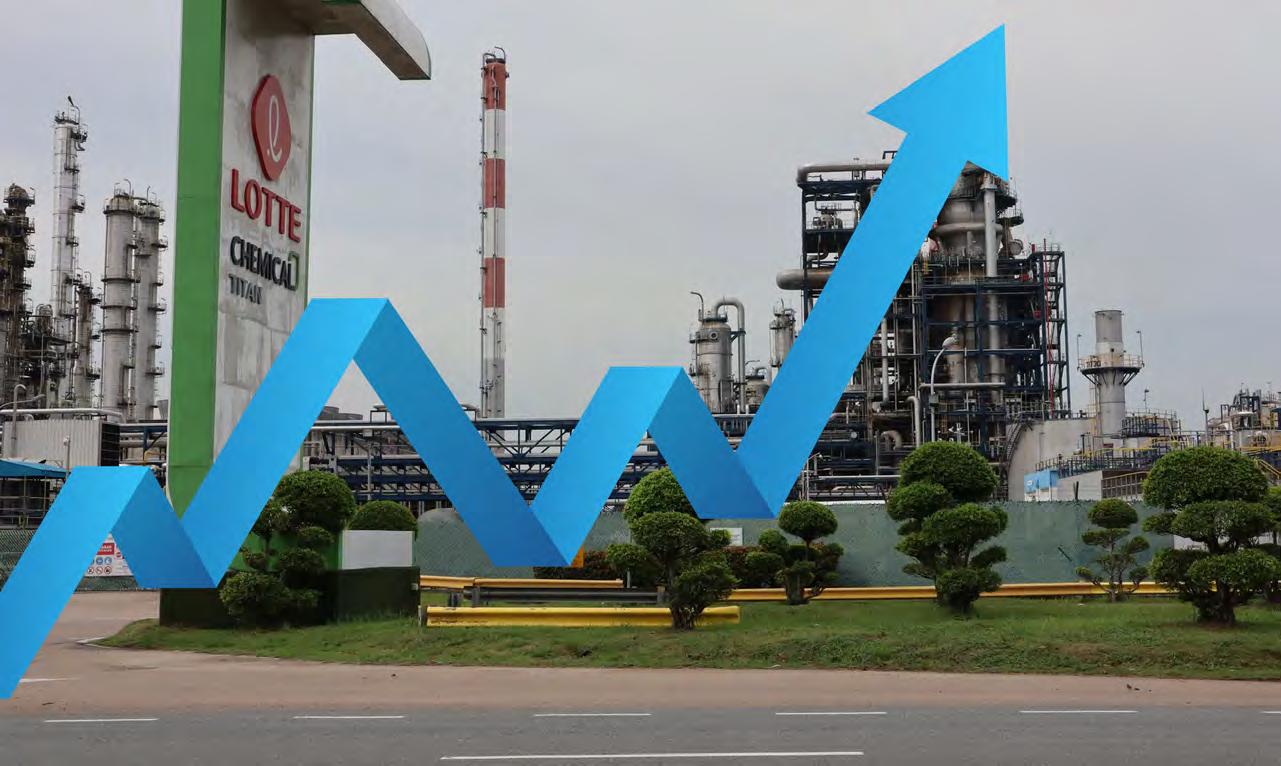
Lotte Chemical Pakistan Limited began 2026 with a sharp recovery in profitability, as inventory gains, better PTA spreads and improving domestic demand helped the company more than double its quarterly earnings despite raw material supply disruptions from Kuwait.
The company posted revenue of Rs20.9 billion in the first quarter of calendar year 2026, slightly lower than Rs21.5 billion in the same period last year, according to AKD Securities. But profit after tax rose 123% yearon-year to Rs1.5 billion, while earnings per share increased to Rs1.0 from Rs0.4 in the first quarter of 2025.
The recovery was driven by margins rather than topline growth. Gross profit rose 120% year-on-year to Rs2.9 billion, compared with Rs1.3 billion in the same period last year, while gross margin expanded to 14.0% from 6.2%. AKD attributed the improvement to inventory gains amid an upstream price rally.
The results are notable because they came at a time when the company’s feedstock arrangement with Kuwait remained under force majeure. Lotte Chemical Pakistan has
Polymer and Chemicals soon
been sourcing alternate paraxylene from Oman on a spot basis to bridge the gap, while management indicated that capacity utilisation in 2026 is likely to be constrained more by paraxylene availability than demand. In 2025, total PTA demand was around 750,000 tonnes, including Export Facilitation Scheme re-export demand, of which Lotte supplied 380,000 tonnes and the remainder was imported.
That marks a reversal from 2025, when demand was the main constraint. The demand-side support this year has come partly from anti-dumping action against Chinese PTA imports. The National Tariff Commission initiated an investigation into dumped imports of purified terephthalic acid from China in August 2025 and imposed provisional duties ranging from 2.63% to 9.50% in January 2026, with the final determination still in progress.
For Lotte, which is Pakistan’s sole local producer of purified terephthalic acid, the anti-dumping duty gives some protection against lower-priced imports at a time when the company is trying to rebuild margins. Its competitive set is not another domestic PTA producer, but imported products from regional suppliers, particularly China, the same source
that triggered the local trade remedy process.
Lotte Chemical Pakistan’s main product, PTA, is a base raw material used in Pakistan’s textile and PET packaging industries. The company says PTA is used in the manufacture of polyester staple fibre, polyester filament yarn and PET, and that its plant at Port Qasim was built with ICI technology in 1998. The plant continues to operate under a technology licence from Invista Performance Technologies, one of the global suppliers of PTA technology.
That places Lotte in the middle of two large industrial chains. On one side are textile producers using polyester fibre and filament yarn. On the other are PET packaging manufacturers supplying bottles and containers to the beverage, edible oil, food and consumer goods sectors. When domestic demand is weak, the company also exports to other markets, although its primary focus has historically been meeting Pakistan’s PTA requirement.
The company’s history closely follows the development of Pakistan’s petrochemical value chain. The PTA plant was commissioned in 1998, the PTA business was demerged from ICI Pakistan into Pakistan PTA Limited in 2000, and KP Chemical, a subsidiary of South
Korea’s Lotte, acquired Pakistan PTA in 2009. The company was later renamed Lotte Chemical Pakistan Limited in 2013.
For more than a decade, Lotte Chemical Pakistan operated as the Pakistani subsidiary of South Korea’s Lotte Chemical Corporation. That changed in November 2025, when the South Korean parent sold about 75% of the Pakistani company to Dubai-based PTA Global Holding for 98 billion won, or about $68.94 million. Reuters reported that the sale came as Lotte Chemical was restructuring its portfolio under a South Korean government-led programme aimed at supporting loss-making petrochemical firms amid weak demand and oversupply.
The ownership change has altered the company’s strategic direction. PTA Global Holding is a special purpose vehicle linked to AsiaPak Investments and Montage Commodities FZCO, and the change in control brought in Adnan Afridi as chief executive officer. Reuters reported after the sale that the company planned aggressive growth through mergers and acquisitions to enable diversification and scale.
The first major move under the new ownership appears to be the proposed acquisition of Engro Polymer & Chemicals Limited. Lotte Chemical Pakistan announced in March 2026 that it intended to acquire control of EPCL through a transaction involving Engro Corporation’s 56.19% stake and a public offer to minority shareholders. Business Recorder reported that 510.73 million shares, representing around 56.19% of EPCL’s paid-up capital, would be acquired through a share purchase agreement, while a public offer would be made for 159.09 million shares, representing 17.5% of the target company.
Engro Corporation’s board authorised management to negotiate and finalise terms and transaction documents after reviewing Lotte’s non-binding offer. The process was still moving through commercial discussions and due diligence, but AKD Securities noted after Lotte’s briefing that due diligence was well advanced and commercial discussions with the seller were progressing towards finalisation of a share purchase agreement.
The proposed transaction would significantly change Lotte’s business mix. EPCL is Pakistan’s only fully integrated chlor-vinyl chemical complex and produces polyvinyl chloride, caustic soda, sodium hypochlorite, hydrochloric acid and other chlorine by-products. Its PVC products are used in pipes and fittings, footwear, films and packaging, profiles, flooring, roofing, cables and doors, serving construction, agriculture, packaging, healthcare and consumer goods markets.
That would give Lotte exposure beyond PTA into PVC and chlor-alkali products. While PTA links the company to polyester and
PET packaging, EPCL links it to construction, pipes, fittings, cables, caustic soda and allied chemical markets. It would also put two of Pakistan’s more important listed petrochemical assets under one platform, creating a larger industrial group with exposure to both polyester-chain and chlor-vinyl-chain chemicals. The logic of the transaction is not only product diversification. It is also energy. AKD Securities said Lotte management identified energy as the largest synergy it brings to EPCL. EPCL is currently not connected to the grid and runs on co-generation based on gas and RLNG, with a total power requirement of 54 megawatts and an effective power cost of around Rs49-50 per kilowatt-hour. At a captive gas rate of Rs3,500 per mmbtu plus an IMF captive levy of Rs1,406 per mmbtu, AKD estimated EPCL’s annual energy cost at more than Rs22 billion.
Lotte’s plan for EPCL involves connecting the PVC producer to the grid in two phases after the acquisition closes. Phase one, which management said could be deployed within a couple of months after completion, would cover 50-60% of EPCL’s load through the existing spare line. Phase two would scale grid supply to 100% within 12-18 months and require additional capital expenditure on transformer installation. The intended end-state is for neither site to rely on co-generation, with both plants using grid power to capture renewable energy savings.
The importance of energy costs is also visible inside Lotte’s own operations. Management disclosed that producing one tonne of PTA requires 420 kilowatt-hours of power, 2 mmbtu of natural gas for processing, and 0.7 tonnes of paraxylene as feedstock. In an industry where margins can move with international prices, currency depreciation and energy tariffs, even small reductions in conversion cost matter.
The company has already taken one step in that direction. Its battery energy storage system became operational in late April 2026, eliminating the need for diesel-backed standby generators and yielding an expected reduction of about $5 per tonne in conversion cost going forward. AKD also noted management’s view that the recent 60% reduction in the captive gas levy has a much smaller actual impact and that grid electricity remains materially more competitive than co-generation for both Lotte and EPCL on an ongoing basis.
This is a major shift for a company that commissioned a co-generation plant in the previous decade. For years, large industrial consumers in Pakistan invested in captive or co-generation facilities because grid power was unreliable and expensive. That equation has changed as gas prices and captive levies have increased, while grid electricity, espe-
cially when blended with renewable supply arrangements, has become more commercially attractive for some large industrial users. The battery energy storage system also changes the reliability question. Rather than depending on diesel generators for standby power, Lotte can use storage as a backup layer while reducing fuel-linked conversion costs. In a PTA plant, where continuous operations matter and outages can be expensive, the system gives the company a way to combine lower grid-linked costs with a degree of operational resilience.
The broader industry backdrop remains difficult. PTA margins are influenced by international spreads between PTA and paraxylene, while imported feedstock leaves Lotte exposed to global petrochemical cycles and supply disruptions. The force majeure on the Kuwait contract shows how quickly procurement arrangements can affect utilisation, even when domestic demand is available. Spot procurement from Oman can fill the gap, but it also exposes the company to short-term pricing and logistics conditions.
Still, the first quarter results suggest that Lotte has entered the year with stronger operating leverage than in 2025. Revenue declined slightly, but gross profit more than doubled. Demand has been supported by trade protection against Chinese imports. Margins have improved sharply. The company has moved towards grid power and storage-backed reliability. And, through EPCL, it is attempting to turn itself from a single-product PTA manufacturer into a broader petrochemical platform. That transition is not without risk. The EPCL acquisition still requires definitive documentation and completion of the regulatory and transaction process. The energy savings will depend on timely grid connection, transformer installation and execution after acquisition. PTA supply will depend on resolving or replacing the Kuwait paraxylene arrangement. And the anti-dumping duty, while supportive for local demand, remains provisional until the final determination.
But the direction is clear. Lotte Chemical Pakistan is no longer just the local PTA producer inherited from the ICI era and held for years by a South Korean petrochemical group. Under AsiaPak-linked ownership, it is becoming an acquisition-led industrial platform built around chemicals, energy optimisation and import substitution.
For shareholders, the first quarter offered an early sign of what that strategy could look like in numbers: lower revenue but much stronger profit, a gross margin more than twice last year’s level, and a management team trying to use energy savings and consolidation to protect margins in a volatile petrochemical market. n
As war disrupts Middle Eastern LNG supplies, OGDC steps up domestic gas production
The state-owned company no longer needs to curtail domestic production to accommodate global contracts for natural gas imports by the government of Pakistan
For years, Pakistan’s largest state-owned exploration and production company had a problem that would have sounded absurd in any normal energy market: it had oil and gas available underground, wells capable of producing more, and yet it was being forced to hold back domestic output because the country had locked itself into imported liquefied natural gas contracts that the pipeline system could not fully absorb.
That equation is now changing. The war around Iran and the disruption of Gulf LNG flows have turned Pakistan’s imported gas surplus into a shortage risk, easing pressure on domestic fields just as Oil and Gas Development Company Limited is trying to lift crude oil production to levels not seen in years. Pakistan had earlier been selling or diverting excess imported cargoes and shutting domestic wells to avoid excess pressure in the gas network, while Qatar and the United Arab Emirates together accounted for almost all of the country’s LNG imports.
In the first quarter of calendar year 2026, OGDC’s oil and gas production crossed 40,000 barrels per day for the first time in nearly six and a half years, helped mainly by the addition of Baragzai, which is contributing around 6,000 barrels per day. Management has told analysts that output would have been another 2,671 barrels per day higher in the absence of curtailment, largely at Bettani and Nashpa because of pressure constraints in Sui Northern Gas Pipelines Limited’s network. The company is now targeting 48,000 to 50,000 barrels per day by December 2026, even without a major new discovery, after production optimisation measures added roughly 11,000 barrels per day since FY24.
The timing is important. Pakistan LNG Limited recently cancelled two low-priced emergency spot LNG bids for May delivery, apparently betting that Middle East tensions would ease and Qatari supplies would resume. The move came after Bloomberg reported that Pakistan was expecting two cargoes from Qatar and that spot supplies were nearly twice as expensive as long-term Qatari contracted volumes.
For OGDC, that volatility has created an opening. The company’s nine-month results for FY26 were still hit by production curbs and weaker realised crude oil and LPG prices, with profit after tax falling to Rs115.263 billion from Rs129 billion a year earlier and net sales declining to Rs300.127 billion from Rs311 billion. But the company also said the extent of curtailment moderated in the later part of the period after the US-Iran war disrupted LNG imports, allowing its gross crude oil production to cross the 40,000 barrels per day milestone.
The clearest driver of the recovery is Baragzai X-1 in the Nashpa exploration licence in Kohat. OGDC said in April that the well was producing about 5,300 barrels of oil per day, 17 million standard cubic feet per day of gas and 15 metric tons of LPG. An 8-inch, 8.1-kilometre flowline has connected the well to the Mela facility, enabling onward processing at Nashpa, with gas injected into the SNGPL system. OGDC holds a 56.45% working interest in the licence,
with Pakistan Petroleum Limited holding 26.05% and Government Holdings Private Limited holding 17.50%.
Topline Securities’ flash note on OGDC’s analyst call places Baragzai at the centre of the company’s production growth story. Management estimates the field’s reserve size at 100 million barrels of oil equivalent and expects output from the field to rise to 22,000 to 25,000 barrels per day over the next two to two and a half years. Additional wells are expected to be drilled from January to December 2027, with production to be routed through Manzalai infrastructure and Nashpa capacity enhancement. The oil is being supplied to Attock Refinery Limited.
The Baragzai ramp-up is only one part of the near-term field pipeline. Management also told analysts that Gurgalot, a new discovery in Khyber Pakhtunkhwa, is nearing completion and has strong prospects, with the drilling cost so far estimated at $15 million to $20 million. At Bettani, a field development plan is already in place, but pipeline capacity enhancement by SNGPL is required before the field can reach its full potential. Management expects that network work to take six to nine months.
Other development projects are also expected to contribute over the next year. Earlier briefings noted that OGDC had six planned development projects, of which Jhal Magsi and Dakhni had been completed, while Uch, KPD-TAY, Bettani and Sinjhoro were under development and expected to be online over the second half of FY26 through FY27. Once complete, those projects were projected to add about 215 million cubic feet per day of gas and 5,342 barrels per day of oil.
OGDC is also trying to squeeze more output from mature fields. The company has partnered with a French company to install water injection facilities at Kunner and Pasakhi to improve reservoir pressure and raise oil production. Its KPD compression project has faced delays but is now expected to be completed by the end of calendar year 2026. The reserve replacement ratio stands at 153% including joint venture fields, and 240% for OGDC-operated fields alone, according to management.
This is a classic upstream story: old fields decline, new wells take time, and infrastructure can be as important as geology. What makes OGDC’s current position unusual is the import substitution angle. Pakistan’s LNG system, designed to compensate for falling domestic gas output, ended up forcing the country to hold back its own gas because imported cargoes had to be accommodated. Now, with LNG imports disrupted and spot cargoes expensive, the same domestic wells that were previously curtailed have become more strategically valuable.
That does not mean OGDC’s growth plan is free of constraints. Management’s own briefing shows that pipeline pressure remains a limiting factor at Bettani and Nashpa. Recovery of receivables also weakened during the quarter, with the recovery ratio falling to 87% mainly because of lower recovery from Uch and Central Power Purchasing Agency-Guarantee. Management said April collections were much higher than in the previous quarter, but gas-sector circular debt remains an unresolved risk and a plan
has been submitted to the International Monetary Fund.
The company is also trying to change the shape of its portfolio beyond conventional oil and gas. OGDC has been expanding work on tight and shale gas, with Reuters reporting in December 2025 that the company had tripled its tight-gas study area to 4,500 square kilometres and planned to expand a shale pilot to five or six wells in 2026-27. Each shale well is expected to produce 3 to 4 million standard cubic feet per day if successful, and management has indicated that a wider shale programme could eventually add 600 million cubic feet per day to 1 billion cubic feet per day of incremental supply, although commercial viability remains unproven.
Then there is Reko Diq, the copper-gold project that has turned OGDC from a pure oil and gas producer into an energy-and-minerals company. OGDC is part of the federal state-owned enterprise consortium that owns 25% of the project through Pakistan Minerals Private Limited, alongside Pakistan Petroleum Limited and Government Holdings Private Limited. Barrick Gold holds 50% and has management and operatorship rights, while the Government of Balochistan holds the remaining 25%. OGDC says the feasibility study has been completed, early works have started and project finance is at an advanced stage.
The economics explain why management remains confident. Barrick’s chief executive said in January 2025 that Reko Diq could generate about $74 billion in free cash flow over 37 years based on consensus long-term prices. The first phase is expected to produce 200,000 tons of copper annually at an estimated cost of $5.5 billion, with a second phase costing $3.5 billion and doubling output. Production is expected by the end of 2028.
OGDC has continued to fund its share. In February 2026, the company invested $25 million in the project during the quarter, part of a total $75 million injected by Pakistan Minerals Private Limited as mine development continued. The official line remains that the project is moving forward, though security risks in Balochistan and the size of the financing package mean that Reko Diq will remain one of the company’s largest non-core exposures for years.
The more immediately curious offshore story, however, is in Abu Dhabi. OGDC’s management told analysts that the ADNOC project is expected to come online according to its earlier schedule. That statement has not attracted the attention it deserves, because it places a Pakistani state-owned company inside an Abu Dhabi upstream project at precisely the moment Gulf energy infrastructure is under pressure.
OGDC, Pakistan Petroleum Limited,
MariEnergies and Government Holdings
Private Limited formed Pakistan International Oil Limited in Abu Dhabi for Offshore Block-5, which was awarded by ADNOC. OGDC says two wells have already been drilled, exploration, appraisal and development activities are being conducted on a fasttrack basis, and a field development plan has been submitted to ADNOC.
The concession has since moved beyond the original exploration award. OGDC’s own first-quarter FY26 report says that the Supreme Council for Financial and Economic Affairs awarded the Production Concession Agreement to ADNOC and Pakistan International Oil Limited in June 2025 for Offshore Block-5, with Pakistan International Oil Limited holding a 40% participating interest. The same report says four wells are planned at the block, including two appraisal wells, one shallow well and one deep exploration well, with first production expected in the second half of 2028.
On paper, the project is still moving. In practice, it deserves skepticism. The UAE said this week that an ADNOC-affiliated national carrier was targeted by two drones while transiting the Strait of Hormuz, calling the incident a threat to regional stability and global energy security. Reuters has also reported that Iranian attacks have knocked out 17% of Qatar’s LNG export capacity, with QatarEnergy cancelling cargoes and extending force majeure on supplies to customers.
There is no public indication that Abu Dhabi has suspended the Pakistani consortium’s concession. But the assumption that the ADNOC schedule will remain untouched looks optimistic in the current environment. Offshore projects depend not only on licences and reservoir studies, but also on marine logistics, insurance, rig mobilisation, service-company access, security clearances and the willingness of host governments to keep foreign partnerships insulated from geopolitical shocks. The fact that the project remains on schedule is therefore notable; the idea that it cannot be affected by the regional escalation is harder to accept.Add on top of that the strain that has emerged between the UAE and Pakistan since the Iran crisis and it becomes even more suspect.
The Abu Dhabi venture is also important because it is one of OGDC’s first real attempts to turn itself into an international upstream player. The company has spent most of its history as Pakistan’s national exploration and production arm. Its origins go back to a 1961 loan agreement with the USSR, under which Pakistan received 27 million roubles for equipment and Soviet expert services. OGDC was established under an ordinance in September 1961 to run a systematic exploration programme and promote Pakistan’s oil
and gas prospects.
OGDC remained a statutory corporation until October 1997, when it was converted into Oil and Gas Development Company Limited. The government sold part of its shareholding to the public in 2003 and later listed the company on the London Stock Exchange in December 2006. The company says it has built a broad operating base, including drilling rigs, workover rigs, geological and seismic field parties, data processing capacity, cementing, mud and logging units, and pipeline construction crews.
That operational depth is why OGDC still matters to Pakistan’s energy system. It is not simply another listed company with a high dividend yield. It is the country’s largest upstream producer, the anchor of domestic oil and gas output, and one of the few stateowned enterprises with the technical capacity to execute exploration, drilling, field development and reservoir management on its own balance sheet. VIS Credit Rating Company describes the Government of Pakistan as the principal shareholder with an 85.02% stake and identifies OGDC as a leading entity in Pakistan’s oil and gas sector in terms of acreage, reserves and production contribution.
That is also why the production rebound is politically and economically significant. When imported LNG is plentiful, domestic production is sometimes treated as a variable that can be turned down to manage pipeline pressure. When imported LNG is disrupted, the same domestic production becomes a hedge against blackouts, dollar shortages and industrial shutdowns. OGDC’s latest output milestone shows what Pakistan has been leaving on the table when local fields are curtailed to accommodate imported fuel.
The company is not about to solve Pakistan’s energy crisis by itself. Even 50,000 barrels per day of oil production would not remove the country’s dependence on imported crude and petroleum products. Its gas growth depends on pipeline capacity, pricing, collections and field execution. Its Reko Diq exposure will take years to mature. Its Abu Dhabi project is exposed to a region where energy assets are now part of the conflict map.
But the direction of travel is clear. OGDC is moving from a period in which excess LNG suppressed domestic production to one in which local barrels and gas molecules have regained strategic importance. If Baragzai ramps up, Bettani is debottlenecked, KPD compression is completed, Reko Diq moves towards financing and Abu Dhabi stays on track despite the Gulf crisis, 2026 could become the year Pakistan’s largest upstream company stopped being treated as a mature state-owned cash cow and began to look again like a growth story.
OPINION
M A Niazi
Pax Sinica or Judaica?
Is the USA out of the Gulf?
AT PENPOINT
One of the consequences of the US attack on Iran has been handwringing within the media about the end of the American Empire. This does not yet appear to have seeped into Academia, but Academia figures have started appearing in the media expressing this view.
A larger number sees the USA as losing out to China. This seems mainly because China has a very big stake in the conflict, as it receives the largest portion of its oil imports from the Straits of Hormuz. Though Chinese oil production is not insignificant, it can only meet about a quarter of its consumption. While oil exporters like the USA or Russia are mainly hurt by the Hormuz Strait closure because that drives up fuel costs for its domestic consumers, China faces the strangulation of its industry. Already hit by Trump’s tariffs in its largest market, already hurt by the overall economic slowdown, China is peculiarly vulnerable to Hormuz closure.
This might explain why there are some scholars who seem reluctant to predict that China will emerge as the successor to the USA. They have an extremely different choice, but there is some logic behind it, and they think that Israel is expanding its regional position, and is aspiring to replace the USA in the region as the hegemon.
The writer is editor of Pakistan Today
The analysis about China is fairly obvious. First, there is a Sino-US tension which makes it likely that China would like to replace the USA as world hegemon. One role has been keeping the world’s oil supply secure, a role first performed by the UK, then by the USA. However, the world seems to be experiencing a change which will leave oil behind, and make magnets and the rare-earths that power them as crucial as oil used to be, and still is. China has established such a stranglehold on them that it has successfully used them to force the USA to dial down its tariffs recently, by threatening to put restrictions on them.
Second, China has been on the side of Iran in this confrontation. While it has not contributed any forces, its help has been useful. Also, it wants Taiwan. Taiwan is a former Chinese possession, and is only separate because of US help, even though it has developed and capable armed forces. It is a leader in the manufacture of computer chips, and thus is of a value to China if it falls into its hands intact, or at least with minimal damage. This would enable China to develop a monopoly over Artificial Intelligence, which means control over the technology that is expected to act as the central pillar of the world’s future growth.
China’s wide interests seem to be positioning it for the role of the adult in the room, the power that plays the role of peacemaker and peacekeeper. The USA has been playing this role, the best example being the 1962 Indo-Chinese War. When the Indian military position collapsed, and China seemed poised to take the war into Indian territory, Indian PM Jawaharlal Nehru made an appeal to US President John F. Kennedy, who conveyed to China his support of India.
Now it is China’s turn to take its place in the limelight, and though India would have liked to, it is irrelevant to the whole scenario, except peripherally as one of the countries depending on oil from the Hormuz Strait. If any other country has been mentioned as a successor to the USA, it has been Israel.
At first, that might seem counter-intuitive. The USA is vast, Israel is not. However, Israel has been the loyal US mercenary, and there are a number of precedents where mercenaries have taken over themselves. There are two developments which indicate that Israel is positioning itself for a bigger role in the Middle East than it has.
First, it seems engaged in its first territorial expansion since 1967, when it took over the West Bank from Jordan and the Gaza Strip from Egypt, thus taking the rest of the old British mandate of Palestine, which it had missed in1948. Its latest incursion into Lebanon, under the cover of suppressing Iranian proxy Hezbollah, during the war with Iran, represents its first bid for territorial expansion since 1967.
The Golan Heights were occupied from Syria in 1967, and annexed in 1981. That annexation has been recognized only by the USA, and that in 2019, by the Trump Administration,
which moved the US embassy to Jerusalem. There are now 25,000 Jewish settlers in the Golan Heights. They now outnumber the 20,000 Druze who still live there.
Syria and Lebanon were under French occupation after World War I, Palestine under the British. Israel is now trying to create more defensible boundaries for itself by occupying lands and ultimately annexing them. But there is the map of the ‘Greater Israel’ which includes large patches of Egypt and reaches into Saudi Arabia, down to Madina. This is much more ambitious than the more recent ‘Greater Israel’, which is supposed to cover only the Biblical Kingdoms of Judah and Samaria, as it includes both the lands of the Egyptian captivity (Egypt) and the Jews of Yathrib.
Apart from the search for secure boundaries, Israel has the expansionist attitude of all colonialists, and is thus naturally inclined to expanding its territory. But apart from its desire to expand territorially, it also needs to make itself important to the region, and that is through the Hormuz Strait. The strait itself could fall into its greatest extent possibly, but that would be so far into the future that it is
of no immediate use, or even medium-term use. More to the point, a pipeline could be built transporting oil from the Gulf to the Israeli coast, from where it could go all over Europe, and even to the Far East, though the Suez Canal.
Israel has already laid the groundwork, with its treaties with Egypt and Jordan allowing it Suez Canal passage and possible access for a pipeline. Getting the UAE and Bahrain into the Abraham Accords also brings potential pipeline users into the plan. If only Saudi Arabia would join the Abraham Accords, with the other Gulf Cooperation Council members following suit, the producers presently depending on the Hormuz Strait would also be lined up.
The Abraham Accords is also a framework in which Israel will assume the role of a guarantor of the flow of oil, at least for the Middle East (who will act as guarantor in the Indian and Pacific Oceans?). At the moment, the Arab monarchies are seeking security guarantees, now that the US guarantees, which replaced the British after World War II, have become shaky.
They have not disappeared, but the US ability to enforce its will is no longer as certain as it was. The handover by the British to the USA provides a template that might be used now. It hinges on regime stability. The oil sheikhdoms are, like Iran, interested in regime survival. The dynasties ruling them do not want a scenario resembling World War I, where crowns tumbled all around Europe, including the Ottoman Caliph. If Israel can keep the dynasties going, then the Abraham Accords are the path to be chosen.
It is interesting that there are doubts cast about the legitimacy of the Iranian regime the USA is trying to overthrow, and none of those of the Gulf regimes it is trying to defend. Oil is on its way out, and though there are innumerable teething troubles, renewables seem the most likely option for the world. Oil is a finite resource, but it is likely that before the last drop is burnt, the planet would have polluted itself to death.
It is possible that what the world is seeing is not just the last gasp of the American Empire, but also some of the death throes of the oil era. n
OPINION
Faisal Hassan
Pakistan needs a Farmer-First grain storage policy
The Central Argument: The Farmer Has the First Right
Pakistan’s grain sector stands at a critical juncture. For too long, policy has been shaped by the interests of machinery importers and corporate commodity buyers rather than the farmers who actually grow the grain. The core proposition of this article is straightforward: the farmer who grows wheat, rice, sesame or corn has the first right to store, preserve, and market that produce — and government policy should be structured to enable and reward exactly that.
No blanket subsidies are being proposed here. What is needed is a purposeful enabling environment, short-term post-harvest financing to help farmers hold their grain, and long-term financing for grain handling, cleaning, and drying equipment. If these three pillars are put in place, the gains are substantial: more income for the farmer, higher-quality grain for exporters, and a reliable strategic grain reserve for the government.
The post-harvest crisis: Why quality Is lost
The most critical stage is being ignored
The period immediately after combine harvesting is the most critical stage of grain quality control — and it is the stage receiving the least policy attention. At present, grain discharged from the combine’s auger ends up in a trolley or hired truck and is rushed to a mandi floor or directly to a flour or rice mill. There is no structured drying, cleaning, or interim storage at the farm level.
For moisture-sensitive crops such as rice, corn, and sesame, this gap is not merely inconvenient — it is destructive. If moisture levels are not reduced within approximately 24 hours of harvest, grain quality deteriorates rapidly and aflatoxin can form. Pakistan’s rice exports to the European Union have suffered repeated setbacks precisely because of aflatoxin contamination. Each time it occurs, meetings are convened, dryer financing is discussed, and nothing changes on the ground.
All three crops — rice, corn, and sesame — are predominantly sun-dried, leaving them entirely exposed to erratic post-harvest weather. Mechanised grain drying at the farm level is not a luxury; it is a quality imperative.
Distress sales and the erosion of farmer income
Government procurement policies have historically pushed farmers into distress sales at harvest time, when prices are at their lowest. The farmer who has battled input costs, weather uncertainty, and water scarcity is then compelled to offload grain immediately simply because there is no infrastructure or financing to allow him to wait.
Faisal Hassan is a farmer and agribusiness practitioner. He has over four decades of experience in harvesting and post-harvest operations, including exposure to bulk grain handling through a USAID project in the 1990s. He has advocated for farmer-led grain storage and post-harvest mechanisation for over two decades
This season, something notable has shifted. A significant volume of wheat is being stored by farmers themselves, and mandi floors are near-empty. Wheat prices are hovering around Rs 3,500 per 40 kg, and the government-shortlisted procurement companies are struggling to source at that price. The farmer has, quietly, begun to exercise his right to hold. The policy framework must now catch up with this reality.
I have advocated for farmer wheat storage support for nearly 20 years. With the government now largely out of direct wheat procurement, the urgency has only grown. The first right to store farmer-grown wheat must rest with the farmer.
What needs to happen: Three enabling pillars
1. A policy framework that rewards preserved grain
Government policy must shift from one that encourages distress selling to one that recognises and rewards quality grain storage. This means allowing farmers to pledge their landholding at commercial rates and, subsequently, to pledge their stored grain as collateral for financing. The farmer sleeping on the roof of his wheat godown — his grain store doubling as his bedroom — is not a figure of poverty. He is a custodian of national food security who deserves formal recognition and institutional support.
2. Short-term post-harvest financing
Farmers need access to bridge financing between harvest and the point at which they choose to sell. This enables them to avoid distress pricing and hold grain until market conditions improve. Such financing is not a subsidy — it is a working capital facility analogous to what any commercial trader already accesses routinely.
3. Long-term financing for grain handling, cleaning and drying equipment
Bulk handling, drying, and cleaning equipment must become accessible at the farm (dera) level. The technology is not exotic. The same farmer who now manages a combine harvester — or sends his sons to operate and repair one — is entirely capable of operating grain handling and drying equipment. What is lacking is access to affordable long-term financing for this machinery, not the farmer’s capability.
For wheat: grain handling equipment to clean and store in bulk on-farm.
For rice: mechanical dryers financed at scale. For sesame and corn: specialised, gentle-handling dryers appropriate to the crop’s sensitivity.
The
mechanisation
debate: Where ADB financing should be directed
What Is Already Working
Combine harvesting has transformed over four decades of organic, farmer-driven growth. In 1986, I was part of
one of the first small-scale combine harvesting service provider ventures in the region. Today, the grandchildren of those early operators own combines, discuss credit in crores, and train the next generation in repair and operations — without formal degrees, and without ongoing subsidies.
The same organic growth is visible in mechanical rice transplanting. Farmers and service providers are already adopting the technology, understanding its constraints and working around them. Nursery management, the additional 10-day maturation period caused by transplanting shock, and the once-problematic weed control issues are all being addressed at the grassroots level. Along the Gujranwala bypass connecting to Hafizabad and Alipur, one can find 30 to 40 setups selling used rice harvesters, transplanters, and parts. The market is working.
Where the ADB financing should be going
Against this backdrop, I have strong disagreements with ADB Project 57196-001 (November 2025): “Capacity Building to Support Just Transition to Low Carbon and Mechanised Agriculture.” The project proposes subsidised financing and import credit lines for harvesting and mechanical rice transplanting equipment — machinery that is already commercially established, privately financed, and, in many cases, already benefiting from government loan schemes offering five-year mark-up-free credit and machinery subsidies of up to Rs 1 million.
Subsidising an already-thriving commercial sector serves machinery importers, not farmers. It crowds out used machinery service providers — who typically acquire three machines for the price of one new unit — with artificially cheapened new imports. There is no commensurate improvement in grain quality from a new machine versus a well-maintained used one.
The financing being sought from ADB should instead be redirected to post-harvest grain handling, cleaning, and drying infrastructure — the country elevator concept, adapted to Pakistan’s conditions. This is where the transformative quality and income impact lies, and where the market has not yet delivered on its own.
The rice transplanting question
Abroader question deserves consideration: is continued heavy public investment in rice cultivation prudent? Mechanical transplanting has its place, but manual transplanting persists — supported in Punjab increasingly by Sindhi labour migrating seasonally from as far as Badin. The labour market has adapted. Directly Sown Rice
(DSR), once hampered by weed control challenges, is re-emerging as a viable alternative given improved herbicide availability.
As a farmer who has been growing rice for 26 years, I have fundamental questions about whether perpetuating a water-intensive, subsidy-dependent rice monoculture is the right long-term answer. Sesame, a soil-building, less water-intensive, export-oriented crop, deserves serious policy encouragement as a replacement for early rice. The infrastructure needed to support sesame — multi-crop or specialised dryers, and gentle bulk handling equipment — overlaps substantially with the post-harvest infrastructure argued for throughout this article.
The vision: Bulk handling, country elevators, and farmer empowerment
Pakistan must move from bag-based grain handling to bulk. Grain currently sun-dried on roadsides and mud-plastered surfaces, loaded bag by bag onto trucks, represents enormous quality and quantity losses. The country elevator concept — adapted to local scale and conditions — offers a pathway to transforming this picture.
The farmer who grows grain against all odds, manages combine harvesters, and now quietly holds wheat back from a depressed market is demonstrating exactly the entrepreneurial capacity that policy should be channeling, not suppressing. Trust your farmer. Finance his post-harvest infrastructure. Get the policy framework right.
This is doable. It is sustainable. It is essential if Pakistan is to maintain and improve grain quality for both domestic food security and export competitiveness.
Policy recommendations at a glance
1. Establish the farmer as the primary rights-holder for storage of farm-grown grain.
2. Introduce short-term post-harvest pledge financing against stored grain.
3. Provide long-term financing for on-farm grain handling, cleaning, and drying equipment.
4. Redirect ADB financing from already-subsidised harvesting machinery to post-harvest grain management infrastructure.
5. Promote sesame as a strategic alternative to water-intensive early rice, backed by appropriate drying and handling infrastructure.
6. Adopt the country elevator model — adapted to local conditions — as the national vision for bulk grain storage. n
‘There’s more
money in day trading than passive investing,’ says man in opening scene of Greek tragedy
By Profit
Standing atop what historians would later identify as the emotional high point of the narrative arc, local IT professional Saad Ahmed on Thursday declared long-term passive investing to be “a scam for people with no instincts” shortly before entering what market analysts - and literature professors - described as the irreversible first act of a classical Greek tragedy.
“Why would I settle for 12% annually when I made 18% between breakfast and lunch?” asked Ahmed while showing increasingly worried relatives a screenshot of his position for that day in separate cement stocks, one fertilizer company he “has a feeling about”, and a technology firm whose business model he admitted he had not fully understood “but like[d] the….vibe of.”
At press time, Ahmed had reportedly begun referring to himself as “an adna taalib-e-ilm of the market.”
Witnesses say the 34-year-old’s transformation began earlier this year after the Pakistan Stock Exchange crossed historic highs, triggering a nationwide epidemic of men discovering candlestick charts and speaking confidently about “resistance levels” after watching four YouTube videos.
“I used to think Warren Buffett was smart,” Ahmed said. “Now I realise he just lacked courage.”
Sources confirmed the statement was delivered moments after Ahmed muted a cousin in the family WhatsApp group for suggesting index-style investing through diversified mutual funds.
According to friends, several ominous signs had already emerged.
“He has started saying things like ‘this time it’s different,’” said one associate, requesting Jordan Belfort anonymity out of fear of being blamed later in the story. “Yesterday he compared himself to Jordan
Belfort because he correctly timed one refinery stock. That’s usually when the Greek gods enter the plot.”
“Yes, this is all as per the familiar literary structure,” said Dr Nabeela Kiyani, literature professor at the Govt College, Lahore. “A structure in which excessive confidence invites divine punishment, or in modern financial terms, “buying at the exact top.”
“We’ve seen this many times,” said veteran broker Khalid Mehmood, staring silently at the KSE-100 index as if remembering past wars. “First they say passive investing is dead. Then they discover margin financing. Then comes the catharsis.”
“Excuse me, I need some time to myself now…”
At press time, Ahmed had reportedly expanded his trading strategy to include taking financial advice from anonymous accounts named things like “PSX_King123” and “ChartMaestro.”
Pakistan’s mini
EV moment: big promise, bigger problems
A new generation of cheap electric quadricycles like Nora, Alektra, GuGo Gigi are flooding showrooms with the same seductive pitch Pakistan has heard before: finally, a people’s car. But as broken chargers, load shedding, and Chinese white-labels pile up, the ghost of the Mehran looms large
By Abdul Hameed Niazi
There is a particular kind of hope that blooms on the roads of Pakistan. It is the hope of the first-time car buyer, someone who has spent years on the back of a motorcycle, squinting against diesel fumes in Lahore traffic, dreaming of four walls, a roof, and an air conditioner. For three decades, the Suzuki Mehran was that hope made metal.
It was obsolete the day it launched, carbureted long past shame, and stripped of every safety feature known to modern engineering. And yet, it sold. Half a million of them, right up until Pak Suzuki finally pulled the plug in March 2019. Now, another generation of vehicles is making the same pitch. They are smaller, stranger-looking, run on electricity, and arrive bearing names like Nora, Alektra, and GuGo Gigi. But can they make the same impact?
The vehicles
The most affordable of this new cohort is the Alektra Metro, a two- or four-door quadricycle that arrived in Pakistani showrooms in late 2025 with a starting price of Rs 10.45 lakhs, making it, for a brief moment, the cheapest four-wheeled enclosed vehicle in the country’s history. Technically, it is an L7e-class quadricycle, a regulatory classification that places it somewhere between a heavy electric moped and a microcar. It is smaller than a Suzuki Alto. It has four seats, air conditioning, a Bluetooth multimedia system, and a claimed range of 80 to 180 km depending on the battery variant chosen.
What it does not have is a manufacturing pedigree. PakWheels, the country’s largest automotive marketplace, noted soon after launch that Alektra does not manufacture these vehicles itself. Instead, it white-labels a Chinese-made car typically sold on Alibaba, adds its own badge, and backs it with local warranty and sales support. User reviews on the platform have been blunt. One buyer called it “totally a waste of money” citing poor build quality and a range that collapsed on bumpy roads which, in Pakistan, means nearly every road. Another compared it to “a caddy” with buttons that felt like they belonged on a children’s toy.
Then there is the Nora EV, Pakistan’s first battery-swappable electric car, launched in March 2026 at a starting price of Rs 18.89 lakhs. The Nora comes in three variants Eco, Eco+, and EcoX with claimed ranges of 120 to 160 km, a 3000-watt motor, a top speed of 65 km/h, and a five-year battery and motor warranty. Its headline feature is battery swapping, with the company promising sub-three-minute swap times at stations placed at existing petrol pumps across Lahore. The top EcoX variant, at Rs 22.99 lakhs , extends range to a claimed 300 km through a petrol-powered range extender making it technically a hybrid.
GuGo’s Gigi occupies slightly higher ground in both price and aspiration. Unveiled at the Pakistan Auto Show in 2023 and priced at approximately Rs 37.5 lakhs, it is a twodoor electric hatchback with a 16.8 kWh battery, a claimed 200 km range, and a design that borrows heavily from the MG Comet. It has keyless entry, cruise control, an 8.8-inch infotainment screen, and airbags, a feature conspicuously absent on the budget quadricycles below it. GuGo has since launched additional models, including the Box EV, as it attempts to build a credible lineup. Buyers on PakWheels have noted one purchasing the car for Rs 26 lakhs against a listed price of Rs 3.7 million suggesting a market where negotiation is wide, perhaps a signal that demand is softer than the press releases suggest.
The infrastructure problem
Every one of these vehicles faces a problem that no amount of swappable batteries or claimed ranges can fully solve: Pakistan is spectacularly unprepared to charge them. As of 2025, the country has fewer than 100 public EV charging stations, concentrated almost entirely in Karachi, Lahore, and Islamabad.
The government’s National Electric Vehicle Policy has set an ambitious target of 3,000 stations by 2030, but the math requires a level of execution rarely seen in Pakistani infrastructure planning.
The more immediate problem is at home. Most Pakistani households that would consider buying an entry-level EV are not in DHA. They live in older neighborhoods where wiring is aged, load shedding is a nightly ritual, and a dedicated wall-box charger (which itself
costs Rs 8 lakhs to Rs 12 lakhs when bundled with a solar system for reliable charging) is a big investment.
Overnight load shedding fragments charging time into irregular one-hour windows. A standard three-pin socket adds roughly 2 to 3 percent battery per hour. Every power cut forces the car and charger to perform a handshake reboot. On a busy school-run day in Lahore, you arrive home with a nearly empty car and a broken charging session.
Public fast chargers exist as a theoretical backup, but commercial tariffs and generator running costs push prices to Rs 80 to 120 per kWh narrowing the per-kilometre cost advantage over petrol to a margin that makes range anxiety feel genuinely rational rather than psychological. The battery-swapping promise of the Nora, if it materialises, could sidestep some of this. But the infrastructure for swapping does not yet exist at scale, and Pakistan has a long history of infrastructure promises that take a decade to become reality.
What is also missing is a standardised approach. Public DC fast chargers currently support CCS-2 connectivity only in testing phase, according to industry sources, with adapters for the quadricycles’ AC-only charging systems not yet available as of early 2026. The result is a market where the cars exist but the ecosystem around them does not.
The Mehran question
To understand what is happening with Pakistan’s mini EVs, it helps to understand what happened with the Mehran. The Suzuki Mehran was, by any objective automotive measure, a terrible car. It was introduced in 1989 as a rebadged version of the 1979 Suzuki Alto — already a decade old at launch. By 2012, it was the last car anywhere in the world still using a carbureted engine.
It had no airbags, no ABS, no rear seatbelts in early variants, and side air conditioning vents that were simply absent. In 2015, it was selling for US$6,500 to $7,700 pricing that in most markets would demand considerably more cars.
And yet it was loved. Not in spite of its limitations, but almost because of them. Every roadside mechanic in Pakistan knew how to fix it. Parts were universally available and universally cheap. Its resale value
was remarkably stable and used Mehran in reasonable condition sold quickly and reliably, which matters enormously in a country where financing is inaccessible to most and liquidity is everything.
It sold 47,199 units in 2017-18 alone, representing 21 percent of the entire passenger car market. The Mehran did not succeed because it was good. It succeeded because it was known, trusted, predictable, and cheap to own, not just to buy.
Pak Suzuki finally discontinued it in March 2019, replacing it with the Alto 660cc. The industry expected a seamless handover. What followed instead was a period of genuine confusion. New entrants like United Bravo and Prince Pearl arrived in the 800cc space, but none achieved Mehran’s grip on the mass-market imagination. The Alto was better in every technical sense, safer, more efficient, more modern but it started at Rs 1.5 million, pricing out the exact buyer the Mehran had served. Six years later, used Mehrans still circulate on PakWheels at prices that reflect the persistent demand gap at the bottom of the market.
The Mehran did not succeed because it was good. It succeeded because it was known, trusted, predictable, and cheap to own. No EV in Pakistan has yet earned that trust.
The structural problem the Mehran exposed and which its successors, petrol and electric alike, have yet to solve is that Pakistan’s auto industry is not a manufacturer. It is an assembler. Suzuki transfers technology, Pak Suzuki bolts the kits together, and whatever localisation occurs happens around the edges.
The same dynamic is now playing out with EVs. Alektra white-labels from China. Nora is building on a Chinese platform. GuGo’s GiGi mimics MG Comet body lines. This is not inherently disqualifying white-labelling Chinese platforms is how a dozen successful EV markets started. But it means that the spare parts ecosystem, the after-sales service network, the mechanic familiarity none of it exists yet. And in Pakistan, that is precisely the gap where trust lives or dies.
Quality control and the missing warranty
Pakistan’s EV buyers are discovering a truth familiar to anyone who has watched a new technology enter a price-sensitive, infrastructure-poor market: the specification sheet and the lived experience are rarely the same document. The Alektra Metro’s PakWheels rating sits at one out of five stars based on owner reviews. Common complaints are not minor. Buyers describe suspension that bottoms out on ordinary potholes — a critical failing in Pakistani cities where road surfaces vary wildly block to block. Others describe charging that takes five or
more hours on a drained battery, a significant constraint when load shedding can consume much of the overnight charging window. The build quality concerns are consistent: panels that flex, buttons that feel borrowed from cheaper products, and a general sense that the car has been priced for the Pakistan market but quality-controlled for somewhere with less demanding expectations.
There is also the resale question. All of these vehicles are too new to have an established secondary market, which is a serious problem in a country where resale value functions almost as part of the purchase calculation. The Nora EV’s battery-swapping system, for instance, is built on an infrastructure that does not yet exist at scale. What happens to the resale value of a battery-swappable car if the swap station network does not materialise? What is the used-car value of an Alektra Metro in three years, when the brand may or may not still be operating service centres? These are questions the Mehran never had to answer, because everyone already knew the answer.
The Nora’s five-year battery and motor warranty is a genuine differentiator and signals seriousness of intent. The battery-swap model, if executed well, directly addresses one of the most concrete barriers to EV ownership in Pakistan: the anxiety of being stranded with a dead battery far from a charger. But whether the company can deliver on this promise through the operational chaos of Pakistan’s retail and infrastructure landscape remains the test that time, not press releases, will determine.
The economic logic and its limits
The case for these vehicles is not imaginary. Petrol prices in Pakistan crossed Rs 320 per litre in early 2026, and the structural pressures of IMF conditionality, rupee weakness, no subsidy buffer, petroleum import dependency costing approximately USD 13 billion annually are not going away. The arithmetic of operating an EV in Pakistan, when charging is available and reliable, is genuinely compelling. A household running a 1,000cc petrol car in Lahore can spend Rs 4,000 to Rs 6,000 monthly on fuel. An EV charged at home, on a working tariff, can reduce that dramatically. Solar penetration is accelerating in Pakistan faster than almost anywhere in the world. The country imported 17 GW of solar panels in 2024 alone which means a growing segment of the target market can charge their EVs effectively for near-zero marginal cost.
The problem is that this economic logic applies cleanly only to a subset of buyers: urban, homeowning, with the capital to install solar and a wall-box charger, and with commuting patterns short enough that a 120 km
range does not generate anxiety. That is not a bad market. But it is not the Mehran market. The Mehran market was everyone else, the person renting a house in Shahdara, the small trader in Faisalabad, the family in Rawalpindi who needed the car to occasionally reach a city 100 km away for a wedding. For that buyer, the EV proposition, at its current stage of infrastructure development, is incomplete.
There is also the matter of financing. Bank Alfalah offers a five-year EV loan on the Alektra at approximately Rs 28,700 per month on a 20 percent deposit, according to available financing structures. That is a meaningful monthly commitment for a vehicle with uncertain resale value, immature spare parts availability, and a charging ecosystem that still requires significant personal investment to make it functional. The Mehran, whatever its faults, could be bought second-hand for cash by someone who trusted that its parts would be available at the corner market for the next decade.
What comes next
Market analysts tracking Pakistan’s automotive evolution are increasingly suggesting that the near-term answer is not the pure EV quadricycle but the plug-in hybrid, a technology that allows electric operation for daily urban commutes while retaining petrol backup for the range anxiety, the grid anxiety, and the infrastructure anxiety that pure EVs cannot yet resolve. China’s export strategy, which shapes what arrives in Pakistan’s auto market, is increasingly oriented toward PHEVs for markets with developing charging infrastructure. The Nora’s range extender variant is essentially a concession to this same logic, even if the company markets it as an EV with a safety net.
What remains unchanged, and what the industry has consistently failed to address across thirty years of assembling rather than manufacturing, is the last-mile question: what happens when something goes wrong? Mehran’s genius was not its engineering. It was the fact that the answer to that question was always the same: find the nearest mechanic, any mechanic, pay a small amount, drive away. The EV industry in Pakistan — import-heavy, brand-new, with service networks measured in handfuls of locations — cannot yet offer anything close to that assurance.
Until it can, Pakistan’s mini EVs will remain what the Mehran never was: a car for early adopters. And Mehran’s ghost, rusting gently in second-hand lots across every city in the country, will continue to make the case that Pakistanis do not want the best car. They want the car they can trust to be there the morning after it breaks n