CCONTENTS ONTENTS 1417
08 07
08 Turkish fintech unicorn Papara
07 This is the fastest growing set to acquire SadaPay in possible sport in the world. Can it take $50inmillion deal root Pakistan? 11 A policy abyss Ammar H. Khan
12 14
12 Can Easypaisa sustain exit? 14post-Telenor’s Time of Death: Pakistan’s Super-App Dream
17 How Gohar Ejaz used textile to become real estate 16lobbying How inflation killedaRetailistan tycoon and political power broker
08 10
22 23
19 22
19 Productive policies or PR fluff — How useful were the interim 22 The proxy war government’s IT initiatives?
PTCLraw Group grows inZaraye size but 2324 Need materials? fails to be profitable hopes you’ll turn to them
Profit Profit Publishing Editor: Babar Nizami - Editor Multimedia: Umar Aziz Khan - Senior Editor: Abdullah Niazi Sub-Editor: Basit Munawar - Video Editors: Talha Farooqi | Fawad Shakeel Business Reporters: Daniyal Ahmad | Shahab Omer | Zain Naeem | Saneela Jawad | Ghulam Abbass | Ahmad Ahmadani Shehzad Paracha | Aziz Buneri | Nisma Riaz | Mariam Umar | Urooj Imran | Shahnawaz Ali | Meerub Amir Regional Heads of Marketing: Mudassir Alam (Khi) | Sohail Abbas (Lhe) | Malik Israr (Isb) Pakistan’s #1 business magazine - your go-to source for business, economic and financial news. Contact us: profit@pakistantoday.com.pk
Papara commits to invest $10mn further to solidify SadaPay’s position as banking challenger Taimoor Hassan & Nisma Riaz
I
n what might prove to be the first major outcome of Pakistan’s startup revolution, the Turkish fintech giant Papara is all set to acquire Pakistan’s prominent fintech company SadaPay. While the finer details of the acquisition are yet to be announced, the all-stock deal is reportedly valued between $30 to $50 million. What will be more encouraging for the country’s fintech landscape as well as its regulator, the State Bank of Pakistan (SBP), is that Papara has also committed an additional investment of $10 million into Sadapay to further solidify the company’s position as a banking challenger. In the middle of a global funding crunch, this will mark much needed investment not just in the startup ecosystem but specifically in Pakistan’s diverse fintech space. While the details of the deal are still being worked out, we are certain that it is going to happen. Insiders have confirmed that the SBP was approached months ago to give its regulatory blessing to the acquisition, which sources close to the deal say could be coming any day now.
8
The transaction may come as a surprise to sceptics, who have had doubts about EMIs being a profitable business due to limited avenues of earning. EMIs that had received approval from the State Bank to undertake this business have withdrawn one after the other, casting doubts on the workability of this model in the Pakistani market. The Turkish company, which has made a similar model work in the home country, now plans to buy out 100% of SadaPay, according to internal deal documents available with Profit. The acquisition will not alter the corporate or operational fabric of SadaPay Pakistan Limited, and the entire SadaPay team including people in the management, and directors would be retained. Brandon Timinsky, the founder and the current CEO, will continue serving as the company’s chief executive. The company will maintain its strategic course under the new ultimate beneficial owner (UBO), the Turkish fintech company Papara. Following the acquisition, Papara has planned an immediate $10 million injection into the Pakistani entity for expenditures on technological advancements and market expansion to solidify Sadapay’s position as
the leading EMI. The acquisition and the investment is expected to provide an impetus to SadaPay’s plans of moving into the remittance business for expatriate Pakistanis in the UK and Saudi Arabia.
Why sell? Because it checks all the boxes
S
adaPay has refrained from commenting on the deal altogether. However, based on what sources have conveyed to Profit, the size of the deal is expected to range between $30 million to $50 million, in an all stock deal in which shareholders of SadaPay will receive shares in Papara rather than cash in exchange for SadaPay’s share capital. SadaPay shares will also become more liquid this way because Papara has plans to go public in 2025. SadaPay, which has raised over $20 million so far in funding between two rounds, is being valued at less than what the company was valued at in its last round. Sources have said that the fintech startup SadaPay was valued close to $100 million in its last round, marking a 50% or more value reduction in the new deal. But perhaps everyone now knows
that startups all around the world were overvalued when risk capital was abundant. As sobering started, valuations started getting cut left, right and centre. In fact, SadaPay getting acquired at the numbers mentioned above is not bad at all, sources say. Even unexpected, as a source said. A $30 million price tag would be a fair deal in the current market. A $50 million tag would be a great deal in these times. Getting any of these prices is good for the company before valuation drops to a point of zero returns on investment.
The questionable sustainability of EMIs in Pakistan
T
hen the EMI business model is perceived as shaky at home, with questions around sustainability of the business. How they would make money has been the big question. The EMI regulations essentially allows a company to create a payments business, which is not considered a lucrative line of business. EMIs that are focused mainly on e-commerce and point-of-sale transactions earn primarily from a transaction fee, which is typically 1%. “You cannot earn [enough] purely on a transaction basis on an EMI licence. Based on my own calculations, an EMI cannot make money from that in the first five years at least,” Omer Salimullah, the COO of SadaPay had told Profit in an earlier interview. For these initial years, he said, EMIs would need strong investors to carry them. The recent State Bank circular decreasing interchange fee from 0.5% to 0.2% further
caps revenue from POS transactions, which are still very small. The State Bank of Pakistan’s data on payments shows that POS transactions through EMIs were 2.5 million in volume and Rs4.9 billion in value. Overall transactions from EMIs are mostly funds transfers, which for 2023 were 50.7 million in volume and Rs 173 billion in value. But EMIs for instance SadaPay offer these funds transfers free of cost, limiting it as a revenue source. In the transactions business, the EMIs are competing with banks because EMIs are also focused on the similar target market as banks and have not yet tapped into the unbanked segment. Encouragingly, however, Papara in Turkey also offers most of these transactions free of cost and has yet achieved profitability. Unlike banks, EMIs are allowed to invest up to 75% of their deposits in government securities. This is again a segment that is heavily dominated by the commercial banks that can lend to the government without any cap. EMIs can further only lend to consumers through partnerships with banks or other financial institutions licenced to carry out lending and not directly. Some of the EMIs have even tried buying or becoming banks for a better shot at sustainability. While becoming a full bank is a logical outcome for an EMI, fintech companies in Pakistan have tried to do that sooner rather than later. TAG, a competitor to SadaPay whose licence had been revoked by the central bank, for instance tried buying Samba Bank when it wasn’t even commercially launched as an EMI. Finja, another one of the EMIs, partnered with HBL to get a digital bank licence and eventu-
ally sold its EMI licence to Nigerian fintech company OPay. Some others have withdrawn altogether. Paymax unexpectedly requested business closure and licence withdrawal in October 2023, while Careem withdrew the licence in August last year. Similarly, UAE-based YAP faces potential downfall as it reportedly let go of nearly its entire workforce in the country. The team, now insufficient to run a fintech, faces the risk of getting its licence revoked. All of the above supports the scepticism in the market that EMIs can’t make money. They can if they can create more products specific for the Pakistani market. For instance, SadaPay has a product called SadaBiz that allows freelancers to bring money into Pakistan. But there still are regulatory bottlenecks that do not allow roll out of products such as investment into gold. A headway was recently made in the EMI space with the State Bank allowing EMIs to enter into the remittance business, which has increased some charm for this licence but broadly, the distrust remains strong. On record, these companies can become profitable, however, that would take a while, as Salimullah also said. How does a company sustain itself until profitability is achieved? It has mostly been venture capital so far that companies like SadaPay and NayaPay have been relying on to fund operations but venture funding is running dry these days. So, on the one hand, the company needs funds to sustain and possibly try to achieve a bigger scale, while on the other, the funding required to do that tends to run out overnight. The reduction in funding availability creates an environment where sustaining innovation and growth for fintechs, like SadaPay, can be particularly
TECHNOLOGY
challenging. It isn’t illogical then that the CEO of SadaPay Brandon Timinsky considered it beneficial to sell his fintech company, that he grew to over 1 million customers, to a company like Papara that has excellent financial heft to keep the operations of SadaPay going, and actually grow it further, giving it a better shot at sustainability. The other alternative for SadaPay would have been an ugly one: raise relatively smaller amounts of money in a funding winter and at highly unattractive valuation and terms.
If you aren’t with Papara, you are against it
T
here would have been another big downside of choosing not to sell to Papara. The Turkish fintech company is planning an initial public offering (IPO) in 2025 and has been aggressively unlocking new markets. Papara, which has been valued at over a billion dollars and is the first fintech unicorn out of Turkey, recently acquired Rebellion Pay in Spain and is reportedly making another acquisition in Egypt. In October last year, Ahmed Karslı, the CEO of Papara, had said that the company was actively entering into mergers and acquisitions in the European market. Like other markets, an acquisition would be a faster entry into the Pakistani market as well and sources close to the deal have revealed to Profit that if it wasn’t SadaPay, Papara would have gone on to acquire any of the other EMIs in Pakistan like NayaPay. And that would have made things very difficult for SadaPay. Established in 2016, Papara is a fintech subsidiary of PPR Holding A.Ş., Papara is also
10
an EMI in Turkey that has made it work in the home country and that too with limited venture capital. The company has over 17 million users and an e-money licence, offering a suite of services, such as money transfers and payments. Crunchbase data shows Papara has only raised as much as $2 million in funding. The company processes an estimated 528 million transactions yearly, with a volume of $32 billion. At home it plans to become a financial superapp and offers investment services as well, allowing users to buy Turkish stocks, US stocks, commodities and bonds. The financial health of Papara is enviable: deal documents show Papara exceeded $200 million in revenues for trailing 12 months until November 2023, and was projecting an EBITDA exceeding $100 million for financial year 2023. So, instead of having a formidable partner in Papara, SadaPay would have been competing with a formidable opponent instead, had SadaPay refused the offer.
Plans post acquisition
T
he acquisition is useful for Pakistan considering Papara has proven it can make EMIs work. It has done that by rolling out numeros products in the Turkish market and the key to making EMIs work here would also be to roll out various products distinct for the Pakistani market. SadaPay and Papara plan to do exactly that. To reiterate, Papara plans to immediately bring $10 million as foreign direct investment into Pakistan to solidify SadaPay’s position in the market. Over a few years, this could go up to $50 million, which could set SadaPay up for securing a digital retail bank licence (DRB) licence in the future. In the immediate horizon, this investment has been earmarked
for technological advancements, which would enable rolling out new products and market expansion. Specifically, SadaPay plans to use the investment to expand its consumer footprint, including scaling SadaPay’s consumer base, enhancing marketing efforts and developing new customer acquisition channels. These funds would also be deployed towards enhancing the acceptance of QR codes via Raast at SMEs, and towards rolling out credit products through collaboration with partner banks. One of the plans in the works for SadaPay has been introducing remittance services for overseas Pakistanis. Papara happens to have similar plans and the acquisition would accelerate the rollout of remittance service in key markets, with a significant Pakistani expatriate population, such as in the UK and Saudi Arabia. On the tech integration and strategy front, the company aims to install a unified technological platform across all regions where Papara operates. Since there is a substantial overlap with the technology infrastructure at SadaPay and the one developed by Papara, Papara’s current technology stack will be integrated in SadaPay, wherever feasible, post acquisition. Deal documents show that on the back of technological integrations, SadaPay would be able to accelerate the launch of advanced financial products and services that Papara has in other markets, such as diverse card options, including ghost virtual cards for one time use and voice cards for the blind. Customer loyalty programs, multi currency accounts, automated savings accounts, investment and wealth management services, insurance and other products are on the list of products and services to be rolled out. n
TECHNOLOGY
With Telenor Pakistan’s sale to PTCL, key synergies between the bank and telco evaporate By Mariam Umar
L
ast year, there was a flurry of speculation regarding Telenor’s departure from Pakistan. However, the rumour mill was finally laid to rest in December 2023 when the Norwegian telecom company officially announced its exit from the Pakistani market. Telenor had reached an agreement to sell its operations to the government-backed Pakistan Telecommunications Limited (PTCL). The deal is expected to have a significant impact on Pakistan’s telecom sector, bringing about a major redistribution of subscribers and telecom infrastructure. Read: Telenor finally packs up shop from Pakistan, what all will change? However, the focus of this story is not on that. The often overlooked aspect of this transaction is the potential impact that Telenor Pakistan’s sale to PTCL could have on Telenor Microfinance Bank (Telenor Bank) and its
12
flagship service, Easypaisa, which is one of the largest digital wallets in Pakistan. Despite being distinct entities, Telenor Bank and Telenor Pakistan worked in tandem on various fronts, including the provision of services through the flagship digital financial services app Easypaisa. As the telecom company goes through the formalities for its exit, there is a possibility that the bank might lose the synergistic benefits it has enjoyed for more than a decade. However, the question remains: how significant will the impact actually be?
History of Telenor Bank
T
elenor Microfinance Bank commenced its journey as Tameer Bank in September 2005. It was founded by Nadeem Hussain, a former Citi Banker, at a time when the microfinance industry was still in its nascent stages. Hussain aimed
to bring the discipline of 27 years of Citi Group experience, including consumer banking, into the microfinance industry to bring some new discipline, learn the business and scale it. In 2005, the bank commenced operations and had an exceptional year with zero delinquency. Speaking at the first merger and acquisition conference organised by TerraBiz on December 7, 2016, Hussain said that in the first year, Tameer Bank had 20,000 customers and 15 branches – all in Karachi. With such a stellar performance, the bank anticipated that it would break even in its third year of operations instead of what we had projected earlier. However, in the subsequent year, reality set in as the delinquency ratio went up to 25% due to the low recovery of loans. Hence, the bank suffered a double cash burn - on one side the bank had to pay operational costs like salaries, rent, etc. and on the other side it was bleeding cash on defaulted loans. Hussain and the other sponsors were compelled to reassess their approach and
As far as Telenor Pakistan’s sale is concerned, our operations remain unaffected and are not part of this transaction in any way. We believe that we will not need to rely on any telecommunications alliances. Instead, as first movers, we will be able to share our learnings with the industry as we go along, and we look forward to it Farhan Hassan, head of the Easypaisa wallet business
develop a new strategy as the bank faced challenges in maintaining its financial stability. To address these issues, the sponsors injected an additional million dollars and embarked on exploring opportunities for expanding the bank’s operations beyond Karachi into other parts of Pakistan. To scale sustainably and minimize lending risks, Tameer Bank started providing loans to farmers and individuals, this time securing them against gold collateral. This approach allowed the bank to build its loan portfolio without jeopardising its equity. However, the sponsors soon realised that relying on traditional brick-and-mortar operations would impede their ability to achieve scalability. As a result, Hussain turned to the uncharted territory of branchless banking, where he found the solutions he was seeking. Fortunately, for Hussain and his sponsors, the State Bank of Pakistan (SBP) and Pakistan Telecommunication Authority (PTA) were also looking to create branchless banking regulations. After much deliberation, the SBP issued branchless banking regulations in 2008. These regulations also led to the telcos’ adventure into the microfinance sector as it presented an opportunity for the telcos to collaborate with banks to launch mobile financial service products in the country. In the same year, which was the third year of operations for Tameer Bank, the bank had its first negotiations with Telenor Pakistan. “Telenor had some branchless banking dealings outside Pakistan and had a vision of what they wanted to do. They didn’t trust us completely. However, they were looking at the licence play – (acquiring a stake in an already established microfinance bank) rather than creating their microfinance bank and applying for their licence”, said Hussain while addressing the conference on mergers and acquisitions. At that time, Tameer’s capital base had come down to minimum capital levels and the bank was experiencing some liquidity issues as cash burn was increasing while turnaround was taking longer. Therefore, the bank had to strike a deal within 3-6 months or go for
another capital raise. Similarly, the telco was facing its own challenges, as per Hussain, their Average Revenue Per User (ARPU) had come down from $15 to $2. Telenor Pakistan had invested $1-1.5 billion in infrastructure, merchant networks and licences, however, voice was not making them money so they had to come to financial services. Negotiations went back & forth. Finally, Telenor put an offer on the table. A merger with Telenor was desired because it would not only give Tameer Bank capital but an earning stream as well. However, Telenor wanted a 75% stake in the bank which the SBP would not approve, so a deal was struck with the SBP to allow Telenor a 51% stake in Tameer Bank, subject to pricing, with an option to buy another 25% stake later. A year later in 2009, Tameer Microfinance Bank and Telenor Pakistan jointly launched Easypaisa, Pakistan’s first branchless banking solution. In 2016, Telenor acquired the remaining 49% stake in Tameer Microfinance Bank, making it a wholly-owned subsidiary of Telenor Pakistan B.V. This made Tameer Bank a wholly-owned subsidiary of the Norway-based telecommunications company. While Easypaisa was launched as a joint venture between the telco and the bank in 2009, this changed on 7 March 2017 when Easypaisa parted ways from the mobile operator, Telenor Pakistan. The product and its operations were transferred to Tameer Bank. Later on 27 March 2017, the Telenor Group acquired all regulatory approvals to rename Tameer Microfinance Bank to Telenor Microfinance Bank. Telenor Bank found its ownership structure changing once again in November 2018 when Telenor Microfinance Bank entered into a strategic partnership with Ant Financial Service Group. According to the Pakistan Credit Rating Agency Limited (PACRA) report and Telenor Bank’s annual reports, the bank received capital injections from Ant Financial worth $184.5 million, through its investment
arm Alipay resulting in Ant Financial holding a 45% share by the end of 2019 while Telenor Pakistan B.V. still holds the remaining 55% share in the bank. The investment by Ant Financials was considered one of the biggest in the fintech space of Pakistan.
Financial performance
T
elenor Bank had an impressive record for almost a decade primarily due to the success of Easypaisa. However, competition picked up when Mobilink Microfinance Bank started to invest heavily in Jazzcash aiming for the market leader position in the mobile wallet space which it eventually got by the end of 2018 as per Karandaaz Data Portal. Things took a turn for the worse in 2019 when a massive employee fraud in Telenor Bank was unearthed resulting in heavy loan defaults. It also led to a lot of controversy for the microfinance bank. Apart from the controversy, the fraudulent loans resulted in huge losses. In 2019, Telenor Bank had accumulated losses of around Rs 16.6 billion Read: Telenor Bank fires employees over fraud, concedes involvement of many employees across various branches The accumulated loss surged to a whopping Rs 27 billion in 2020. Additionally, the advent of the pandemic in 2020 also took a toll on the bank’s loan portfolio as the industry-wide non-performing loans grew due to an economic slowdown. At the same time, the State Bank’s decision to abolish interbank fund transfer (IBFT) charges in 2020 also added to Telenor Bank’s woes as its main source of branchless income was affected. In 2020, the bank suffered a loss of Rs 230 million from branchless banking which more than doubled to Rs 541 million in the next year. In 2022, the loss increased to Rs1.5 billion. Accumulated loss increased to around Rs 38 billion in 2021. The fraudulent loans contributed to more than half of the losses the bank experienced between 2019 and 2021.
Telenor Global’s desire to exit has been hindered by its inability to find a buyer due to the bank’s history of significant losses, which resulted in the depletion of its equity. Consequently, despite efforts to sell, potential buyers are deterred by the bank’s poor asset quality (quality of its loan portfolio). Any prospective acquirer would have to incur losses on those loans as well, thus impeding the sale process Ammar Habib Khan, an independent analyst
To counter this, Easypaisa restructured its books. The bank cleaned up its lending portfolio, wrote off loans, and exited the agriculture bullet lending business where a majority of fraud had occurred. Apart from restructuring loans, Telenor Bank’s sponsors injected more equity into the business. $45 million were injected in 2020, followed by a $70 million injection in 2021. The bank eventually moved the business to a new strategy of the digital-first bank. “We embedded both businesses into one business and made the entire bank on a digital-first strategy. And in that process, we had to take an impairment charge on the lending portfolio of roughly Rs14-15 billion” said Mudassar Aqil in a previous conversation with Profit Telenor Group and Ant Financials, major shareholders of Easypaisa, funded the impairment loss which gave the bank a clean slate to establish the business once again. In 2022, a further $37 million was injected to pursue a digital-first strategy as the bank also applied for a digital retail banking (DRB) licence. Telenor Microfinance Bank (Easypaisa) is one of the five recipients of the DRB licence. It was granted NOC in January 2023, followed by an in-principle approval in September 2023. The DRB licence would replace the existing microfinance bank licence as per the PACRA report. Yet, according to the PACRA report, the aspiration for a sustainable consumer platform hinges on bolstering acquisition, retention, and transactional throughput within branchless banking wallet accounts. Moreover, as per PACRA, sponsor support through equity injections would help absorb substantial cash and accounting losses. The bank would receive an equity injection of $15 million in 2023.
Decision to sell
G 14
iven the increasing losses, finally, at the end of 2021, the Telenor Group had decided that it had had enough. In November 2021,
the Telenor Group posted a statement on its website that said the company was considering a potential sale of its 55% ownership stake in Telenor Microfinance Bank in Pakistan, and that a process to evaluate interested partners has been initiated. Similarly, the Telenor Group was also looking for merger opportunities for its telecom business in Pakistan. In November 2021, news agency Reuters quoted the CEO of the Norwegian telecom operator as saying that the global entity “will continue to look for merger opportunities in Asia, including in Pakistan and on a regional basis”. Read: Telenor finally packs up shop from Pakistan, what all will change? In November 2021, MCB Bank expressed its interest in acquiring 55% shares in Telenor Microfinance Bank held by Telenor Pakistan BV. A few months later in February 2022, United Bank Limited (UBL) also expressed interest in acquiring a major stake in the bank. While prominent banks have expressed interest in the bank, there has been no execution. “Telenor Global’s desire to exit has been hindered by its inability to find a buyer due to the bank’s history of significant losses, which resulted in the depletion of its equity. Consequently, despite efforts to sell, potential buyers are deterred by the bank’s poor asset quality (quality of its loan portfolio). Any prospective acquirer would have to incur losses on those loans as well, thus impeding the sale process,” said Ammar Habib Khan, an independent analyst. However, on the telecom front, the Telenor Group sold 100% of its stake in Telenor Pakistan to the PTCL. This also implies that once the sale is executed, the acquirer may decide not to continue the partnership with the bank, which consequently would result in the dissolution of existing synergies. But what are these synergies?
Synergies
T
he biggest synergy between the telco and Telenor bank was the distribution network of franchises and retailers. In Pakistan, telcos sell their products through a few channels: digitally and through a retail distribution network of franchises and agents. Digital platforms include the telcos’ applications. For example, Ufone has a ‘My Ufone’ application for its customers. One can transfer money from their bank account or wallet to these platforms to recharge their account and buy airtime. Telenor Pakistan, like any other telco, operated through a network of franchise retail networks to extend their reach and services to consumers across the country. The franchises have a contractual relationship with the telco. Then there are retailers that sell various products apart from selling airtime. These retailers are connected to franchises who oversee them. The role of retail networks is essential due to low penetration of smartphones in Pakistan, which stands at around 50% as per an industry source. However, when smartphone penetration increases in future, the need for this distribution network might decrease. Concurrently, Telenor Bank has been following a digital-first strategy. They have been shutting down their branches and have transitioned to digital lending. As of December 2022, they had 61 branches down from 120 branches in 2019. At the same time, Telenor Bank needs some sort of network that can provide cash-in (deposits) and cash-out services (withdrawals) for the bank. This is where Telenor Pakistan’s (telco) retail distribution network comes in. Telenor Pakistan acted as the primary agent for Telenor Bank’s branchless banking endeavours. The agent network provides people with the convenience of depositing and withdrawing money.
Essentially, it oversaw Easypaisa’s extensive agent network, which comprised hundreds of franchisees responsible for managing retailers selling airtime for the telco while also providing cash-in and cash-out services for Easypasia. In this capacity, Telenor Pakistan served as the intermediary for the bank’s mobile financial services. The Telenor Bank, in return, paid commissions on these transactions to retailers, and thus franchises. Both entities mutually benefited from their collaboration: Telenor Pakistan granted Telenor Bank access to its vast network of franchises and agents. In return, Easypaisa’s network drove substantial foot traffic to these retailers. Notably, as per an industry source, nearly half of the revenue generated by retailers, and consequently franchises, is attributed to Easypaisa. When both entities synergize, it becomes a win-win scenario, particularly advantageous for the telco. This symbiotic alliance not only benefited both parties but also enhanced the distribution network’s financial prospects which incentivised these agents to work more with both Easypaisa and Telenor Pakistan. This distribution network is the core synergy of both entities. Moreover, Telenor Microfinance Bank enjoyed cross-marketing and other preferential pricing like the SMS costs for transaction prompts on USSD-supported Easypaisa accounts. If these services are to be discontinued, it will increase costs for the bank. An industry source disclosed to Profit that the SMS costs have increased significantly, by as much as 2000%. “The SMS that used to cost Rs 5-6 is now at Rs 80”, the source expounded. Additionally, Easypaisa wallet users can use their wallet to recharge. This would save the commission paid to retailers for the telco.
Impact on synergies
U
ntil now, Telenor Bank and Telenor Pakistan (telco) have had a strategic preferred party relationship, granting each other discounts and leveraging each other’s services like EasyPaisa has been relying on Telenor Pakistan’s distribution network. The sale of Telenor Pakistan could impact Easypaisa and Telenor Bank in two ways. Firstly, the value that was created through access to the retail network that served as branchless banking agents for the bank and EasyPaisa might get affected as Telenor Pakistan, now under PTCL, might be open to other financial services providers. Profit spoke to another source affiliated with the industry who said that with this retail network gone, EasyPaisa will need some entity which can give access to the retail foot-
print. “EasyPaisa needs some entity that can give access to the retail network of agents for cash-in and cash-out transactions. The importance of agents increases as cash-in (deposits) is increasing, while cash-out (withdrawals) is declining due to new users preferring to convert physical credit to digital within their wallets.” This claim is substantiated by statistics released by the SBP. According to SBP’s payment system review, in the first quarter of fiscal year 2024 (July 2023 to September 2023), over-the-counter cash withdrawals declined in both value and volume, whereas cash deposits have increased in both volumes and value. “JazzCash and EasyPaisa are effectively the largest digital banks. JazzCash and Easypaisa move about 7-10% of GDP in payments”, remarked an industry source. This became possible because of the expansive retail distribution network from the telcos. “EasyPaisa and JazzCash became successful on the back of the agent distribution network of telecommunication because people trusted these agents,” the source added. This is not the case with other digital banks. Moreover, the PTCL group has its digital wallet – Upaisa. Would PTCL prefer Upaisa, which is much smaller, over Easypaisa? For context, Easypaisa has more than 50 million downloads, as per Google Play Store whereas Upaisa has more than a million downloads only. With retail distribution now under PTCL, the ball is in PTCL’s court, and there are two directions that they can take: they can either be strategic or they can be territorial. In the first option, PTCL, instead of focusing on its wallet – Upaisa, can leverage its ongoing collaboration with Easypaisa. That is, it continues to offer its franchise and retailer network with Telenor Bank’s operations. By combining the franchise and retail networks of Telenor and Ufone, they might become more profitable because now there is a bigger base to do transactions. At the same time, more transactions would lead to higher commissions for the franchise network, which would be more motivated to sell the services. In the other option, PTCL Group can assert detachment from the preferential commercial agreement. You see, Telenor Group which staunchly supported Easypaisa has a 55% stake in the bank. While the two entities i.e. Telenor Pakistan and Telenor Bank operated at an arm’s length, they were intertwined at commercial level which was beneficial for the Telenor Group. The current quandary arises from the potential scenario where Telenor Bank flourishes. As PTCL does not have a stake in its success and thus any profits, it might dismiss the presence of any benefit of a commercial
arrangement with Telenor Bank, despite the existence of underlying commercial advantages at an operational level. (PTCL on the other hand has a wholly owned subsidiary - U Microfinance Bank (UBank). While UBank is not a player in the digital space as it has a completely different strategy, it is still one of the biggest players in the microfinance sector.)
Telenor’s stance
P
rofit reached out to Telenor Bank to find out how the sale of the telco has impacted the synergy. “As far as Telenor Pakistan’s sale is concerned, our operations remain unaffected and are not part of this transaction in any way,” said Farhan Hassan, head of the Easypaisa wallet business. Hassan went on as far as to say that they would not need a branchless banking network. “We believe that we will not need to rely on any telecommunications alliances. Instead, as first movers, we will be able to share our learnings with the industry as we go along, and we look forward to it”, added Hassan. Telenor Bank and Easypaisa emphasised their status as independent financial institutions, licensed and regulated by the SBP. They reassured that their journey towards becoming a digital retail bank, supported by shareholders Telenor B.V. and Ant Group, remains unaffected by Telenor Pakistan’s exit. Profit also reached out to corporate communications personnel at Telenor Pakistan (the telco) to find the impact of the change of ownership on the synergy between the telco and the bank who stated that it is still under process. As mentioned earlier, Telenor Group wants to exit Pakistan. As per an industry source, Telenor Group will continue to find buyers for their share of stake in Telenor Bank. “They’ve already offloaded their telecom business and officially attempted to sell Telenor Bank previously, albeit without success in striking a deal with any party. They’ll probably persist in pursuing a favourable deal to divest their stake in the coming years”. However, amidst this backdrop, Easypaisa stands as one of the recipients of the DRB licence. As per an industry source, much of this development hinged on the technology and commitment of Ant Financials Group which prompted the SBP to grant the licence. The SBP might not support a sudden change in ownership post-issuance of the licence as that could reflect badly on the prospect of digital banking, which would mean that Telenor Bank will continue with its transition towards digital banking and then in a few years Telenor Group may sell its shareholding, contingent upon the terms of the deal and available partners. n
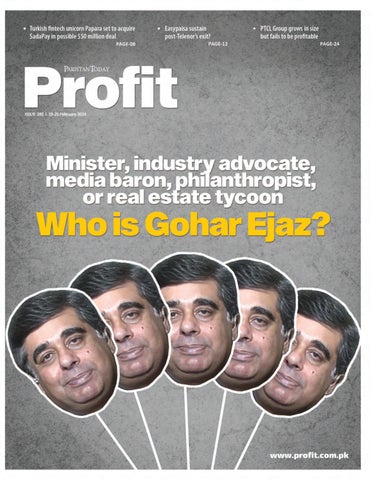
How Gohar Ejaz used textile lobbying to become a real estate tycoon and political power broker
Interior minister, industry advocate, or real estate tycoon — Who is Gohar Ejaz and just how many hats does this one man wear? By Shahab Omer
G
ohar Ejaz wears many hats. To most of the population, he is the man that shut down cellular phone and internet services on election day. To the business community he is the commerce minister. In the world of media he is the owner of Channel 24. To the world of real estate he is the man behind Lake City in Lahore. And to the country’s textile millers, he is their patron-in-chief and strongest advocate. But how did this one man acquire so many hats and how does he manage to don them all at the same time? The secret is that every role he plays is interconnected. He has spread his interests far and wide on purpose and become perhaps one of the most influential people in the country. To understand the rise of Gohar Ejaz and the intricacies of the web he has spun we must go back to the very beginning. Back in the late 1980s, when he started off in the world of business by spinning a different kind of yarn — textiles.
Not so humble beginnings
M
oney has never been an issue for the Ejaz family. Gohar’s father, the late Sheikh Ejaz Ahmad, had established the Ejaz Group of Companies in 1950, for international commodities trading of products such as petroleum, metals, edible oils and industrial raw material. In 1980, the group ventured into manufacturing and set up the first industrial unit under the banner of Mian Nazir Sons Industries. But the one thing that the family has always seemed to put a high premium on is connections and relevance. It is perhaps why Gohar’s father served a stint in the Pakistan senate during the Zia era. It was also possibly why Gohar Ejaz was sent to Lahore as a young man. In 1988 Senator Ejaz had just finished his term. The family business was in a position where it was ready to expand and Central Punjab was fast emerging as the home of Pakistan’s most thriving sector: Textiles. First established in the 1950s, textiles
emerged as a central part of Pakistan’s industrialization in the decades to come. And what’s more, this was an almost entirely export-oriented business. The Multi-Fiber Agreement of the 1970s meant that by the 1980s the United States and Europe had opened up as markets to Pakistani textile manufacturers. It was in this environment that Gohar Ejaz made his start. The Ejaz Group of Companies launched its textile division in 1990 with the first yarn manufacturing unit, Ejaz Textile Mills Limited, in Bhai Pheru. By 1992, Ejaz expanded the business by establishing Ejaz Spinning Mills Limited in Sheikhupura, equipped with modern machinery and an independent power generation plant. In 1995, Gohar was one of the early movers in setting up a captive power plant by the name of Ejaz Power Limited. The company set up three power plants with a total power generation capacity of 30 MW. This self-sufficiency in electricity enabled the group to better fulfil its commitments, by reducing its dependence on power from the government. With the textile business set up and his father’s original business still intact, the
17
Ejaz Group, at this point, employed over 3000 people and reported a turnover of $100 million according to sources from within the family. But there was something else happening at the same time. While the initial period had been very beneficial for the family, the textile business was new territory and there was a steep learning curve for Gohar Ejaz. Both the textile mill and the spinning mill faced problems in keeping up with a very competitive industry. But this did not seem to bother Gohar Ejaz very much. In fact, his more immediate interest seemed to be less about expanding the business, and more about networking and making friends. And pretty soon it became evident why.
The APTMA connection
I
t seems that it became very clear to Gohar Ejaz early on that he was not going to be able to compete with the big boys of textiles. He was new to the business, the competition was tough, and the names that dominated the field were the likes of Nishat. But getting into the textile business meant he now had access to some of the wealthiest and most influential industrialists in Pakistan. Remember, textiles are Pakistan’s biggest export industry. As such the industry plays a big role in the economy. As such, the organisation needs to deal with the government a lot as well. Managing this relationship is the job of the All Pakistan Textile Mills Association (APTMA). This is perhaps one of the most powerful industry associations in Pakistan. Organisations like APTMA are essentially advocacy groups. Lobbying in very simple terms. Different members of an industry band together to form a body that fights for their communal interests. Now remember, a group like APTMA represents some of the richest industrialists in the country responsible for a major export oriented sector of the economy. This means that whoever is in charge at APTMA is constantly in touch with government representatives and is engaged with policymakers at all levels. It was through this platform that Gohar Ejaz gained prominence. He started actively participating in APTMA’s activities and quickly became known to others in the field. In fact, by 2003 Gohar Ejaz had become enough of a player within APTMA that he managed to orchestrate what was the closest thing to a coup that the organisation had seen. Backed by Mian Mansha and other large mills such as Sapphire, Gohar Ejaz led over 100 members of APTMA from across the country to demand the resignation of the sitting chairman Waqar Monnoo. The story was covered in detail back then by Dawn. But within a few years, despite his
18
relatively small mill, Gohar Ejaz was playing in the big leagues. This was so much so that other Chinioti textilers in particular trusted him to lead them on a real estate venture as well in the hopes of expanding their businesses. That was why in 2004 Gohar launched Lake City in Lahore — a mega real estate project spread over more than 2000 acres of land. Among the investors in this project were Shahid Iqbal of Mayfair as well as the Sapphire group and at least two more major players in the textile industry. In this way, Gohar Ejaz not just became a prominent member of APTMA but was also business partners with a number of important textillers. But a tsunami was coming. Pakistan’s textile business was facing a downturn after 2005. Between 2007-8 Pakistan was hit by the global recession. The textile industry also faced challenges due to high energy costs, rupee depreciation, and a high cost of doing business. As a result, there was a reduction in the number of textile mills operating in the country from about 450 units in 2009 to 400 units in 2019. The Ejaz Textile Mills also faced serious problems. Around 2006 the mill had defaulted and the banks were demanding their money back. On top of this, the Lake City project was not chugging along as well as Gohar and his investors had hoped. All in all the situation was quite bleak. But by this point Gohar had enough of a rapport within APTMA to keep up appearances.
Gohar the Wheeler-Dealer
I
t was through APTMA that Gohar Ejaz became a public figure. And he didn’t start out big. Established under the auspices of the Federal Ministry of Commerce, APTMA officially commenced operations in July 1991 from its Faisalabad headquarters. This was around the time that Gohar Ejaz had joined the textile industry. Throughout his life he had steered himself into such roles. Sources close to him have said he spent more time focusing on association business and being involved in every place he possibly could. As a result, his roles in associations and boards were diverse. He served as the Chairman of the Alternate Dispute Resolution Board of FBR- Sales Tax Wing, convener of the textile committee for the Government of Punjab, and a member of the Federal Textile Board of the Ministry of Industries and Production, Government of Pakistan, and the Cotton Board, Government of Punjab. Additionally, he was on the boards of National Textile University-Faisalabad, Government College University-Lahore, King Edward Medical University- Lahore, and the Executive Committee Member of Care Foundation Lahore. Ejaz was also a board
member of the Punjab Institute of Cardiology, Punjab Social Security Health Company, and Lahore General Hospital. His first major appointment at APTMA was when he was elected as the Chairman of APTMA Punjab Region for the year 200910. This period coincided with the Pakistan People’s Party’s governance in Pakistan and multiple sources say the same thing: That Gohar’s position was strengthened due to Asif Ali Zardari. During the 2009-10 period when Gohar Ejaz was first elected as APTMA Chairman of the Punjab region, the PPP government had just started. At the time President Zardari was interested in maintaining positive relations with the Punjab business community, an initiative that benefitted Ejaz. His association with APTMA positioned him as one of the close associates of President Zardari. In 2010-11, he was elected as Chairman of APTMA. At the time a number of large industrialists did not contest the election in favour of Gohar Ejaz. The impression was that because of his closeness with Zardari, he could get things done for the industry. From this point on Gohar Ejaz was the main man at APTMA. During this era, Zardari’s administration reportedly responded positively to APTMA’s demands. For instance, Zardari assured the continuation of a zero-rating regime on textile exports under the Reformed General Sales Tax (RGST) and was open to discussions regarding uninterrupted gas supply, as requested by APTMA. In response Ejaz publicly acknowledged President Zardari’s industry-friendly policies and his swift implementation of APTMA’s recommendations for Pakistan’s economic revival. He credited Zardari for giving full support to the textile industry, declaring 2011 as the Year of Textile, and ensuring that the bureaucracy adhered to APTMA’s guidelines. Which is why, perhaps, even when his tenure as chairman ended in 2011, Gohar Ejaz was appointed as Patron-in-Chief of APTMA. That same year, Zardari awarded Ejaz the Hilal-i-Imtiaz, one of Pakistan’s highest civilian honours. The Patron-in-Chief position became a permanent one and Gohar Ejaz would hold onto it for more than a decade — until just recently.
Consolidating power
I
n 2011 Gohar Ejaz was at a critical point. He had just ended his one year term as chairman of APTMA despite being the owner of a pretty small textile operation. In this time he had gotten closer to President Zardari and had formed a block within APTMA of smaller textillers that had all banded together against larger players such as Nishat. In the meantime, he had also made a splash in the world of real estate and Lake City
was emerging as a roaring success (more on that later). But when his term ended, Gohar Ejaz was not willing to let go. Backed by Zardari, he was appointed as “patron-in-chief” of APTMA — a newly created position that overshadowed the post of chairman. He has continued in that role to date and only stepped away when he was appointed to the caretaker cabinet. “Gohar Ejaz’s APTMA story has a lot to it,” says one former APTMA chairman. The older groups resent him severely. Gohar started a campaign against Waqar Monnoo back in 2003 and then became a formidable force. Gohar spearheaded this and became popular. Later, however, he ditched the big boys and got the smaller textillers to band together and became their leader. The Mansha group panel lost as a result of this engineering. Once this happened, larger manufacturers stepped away from APTMA and it has since been dominated by Ejaz as the boss of these smaller players.” Ejaz maintained his relationship with Zardari. In 2014, he hosted a dinner for the PPP co-chairman at his residence. This event stirred perceptions among some that influential textile industry leaders were aligning with a former president, who was also the head of a political party. During Zardari’s presidency, the textile industry had seen a significant increase in exports, from about $8.5-9 billion to $13.5-14 billion. Traditionally, Punjab’s business community has been wary of the PPP, recalling the widespread nationalisation of industries and banks in the 1970s, which had a profound impact on industrialists. This historical context has often led them to favour pro-business parties like the PML-N. In industry circles, there are differing opinions about Ejaz’s role in APTMA. Some industry insiders, preferring to remain anonymous, questioned the appropriateness of his position as Patron-in-Chief, noting that such a role is not defined in the trade bodies act. They acknowledged Ejaz’s intelligence and experience but speculated that his continual presence in APTMA might be due to a lack of engagement from larger groups within the association. Ejaz is believed to have established a strong lobby within APTMA, making it challenging for other major industrialists to gain influence. His keen interest in self-promotion and public relations, coupled with the time he dedicates to the association, are seen as factors contributing to his sustained influence. “Back in the day APTMA chairman used to be a big deal but he is now patron-in-chief making the chairmanship a very irrelevant position. His own mills are shut down. He is now a real estate tycoon and textile is not his thing. That is only his way to garner influence. He has used that influence to help Lake City grow and
glow,” says one source from within APTMA. And that, perhaps, best explains what Gohar Ejaz was trying to do.
Friends with everyone
G
ohar Ejaz has positioned himself as a middle-man and a trusted friend of the country’s establishment. In the process he has been labelled by some as the “PR King”. He contributed to several charitable, health, and educational institutions. He established the “Sheikh Ejaz Ahmed Dialysis Centre” at Jinnah Hospital, Lahore, which provides around 1000 free dialysis treatments per month. Both his close associates and opponents have remarked on his ability to spin a narrative. It is widely acknowledged that Gohar Ejaz effortlessly establishes relationships with various figures, be they politicians, bureaucrats, or members of the establishment. He has become a notable leader in the textile sector, particularly recognized for his strategic relationship with Zardari, which proved beneficial to APTMA members by solving their challenges. Within the textile sector, it is believed that no APTMA member, irrespective of their personal views on Gohar Ejaz, is prepared to publicly oppose him. This was apparent when industry stakeholders were approached for information about Gohar Ejaz; they either claimed complete ignorance of his affairs or showed reluctance to discuss them. His influence spans across political boundaries, including ties with Asif Ali Zardari, PML-N, PTI, and virtually all major political parties. In May of the previous year, amid the heated political climate following the events of the 9th of May 2023, Gohar Ejaz hosted a significant meeting at his residence in Lahore Lake City. This gathering, aimed at demonstrating the business community’s readiness to contribute to national affairs, included prominent figures like Karachi businessman Aqeel Karim Dhedhi, media and education sector businessman Mian Amir Mahmood, Mian Ehsan from Indus Hospital, former chairman of Lahore Chamber of Commerce Almas Haider, among others. Reports at the time suggested that the business leaders at this meeting were open to dialoguing with all political stakeholders, including then-caretaker Prime Minister Shahbaz Sharif, Imran Khan, Nawaz Sharif, President Arif Alvi, senior military leadership, and Asif Ali Zardari, to help defuse the political crisis. Gohar Ejaz confirmed this meeting at his home and was hopeful about the improvement of the situation. In a similar vein, during Asif Ali Zardari’s visit to Lahore in June of the same year, he was warmly received by Gohar Ejaz at APTMA House, where a press conference was
also held. The close relationship between Asif Zardari and Gohar Ejaz was highlighted by the PPP’s proposal of Gohar Ejaz for the role of caretaker Prime Minister. During the tenure of PTI, Gohar Ejaz was observed openly praising Imran Khan. In a notable instance, he presented a check of Rs 5 crore rupees on behalf of APTMA to the Prime Minister’s Covid Relief Fund during a meeting with Imran Khan. However, there were suggestions that Imran Khan was somewhat hesitant in forging a strong relationship with Gohar Ejaz. Industry sources indicated that Imran Khan received unfavourable briefings about Gohar Ejaz. Additionally, an incident of disagreement between Gohar Ejaz and then Finance Minister Hammad Azhar of PTI regarding FBR issues became public knowledge. In this incident, Hammad Azhar reportedly asked Gohar Ejaz to leave his office in a stern manner. Despite these challenges, Gohar Ejaz consistently endeavoured to maintain cordial relations with the government, advocating on behalf of the entire industry. He persistently addressed industry issues such as captive powers, electricity tariffs, and taxation, presenting these concerns in writing to the PTI government. His approach towards maintaining relationships appeared consistent across different political administrations, including PML-N. This was exemplified recently when Shahbaz Sharif, in his first term as Prime Minister, mentioned Gohar Ejaz during the inauguration of Indus Hospital in Lahore. Shahbaz Sharif acknowledged Gohar Ejaz’s donation of 1.2 billion rupees to the hospital. Gohar Ejaz clarified that he had donated 2 billion rupees, prompting Shahbaz Sharif to joke that someone might have misled him about the amount, but that Gohar Ejaz could afford to donate even Rs 10 billion. In response, Gohar Ejaz humorously offered an open check, which led the Prime Minister to request a specific commitment, asking how much and within what timeframe the donation would be made. Gohar Ejaz then pledged to donate Rs 10 billion to the Prime Minister. Observers at the time noted Shahbaz Sharif’s apparent interest in maintaining a good relationship with Gohar Ejaz. The Prime Minister even went so far as to offer that he will reciprocate this donation by getting Ejaz’s legitimate requests related to his businesses approved.
Real estate tycoon and all-powerful caretaker
I
t was this attitude and his ability to maintain cordial relations with everyone that have allowed Gohar Ejaz to become a power broker in his own right. In the
COVER STORY
past six months, he was first appointed as the caretaker minister for commerce and later as the caretaker minister for interior. In what has probably been the most empowered and significant caretaker government in Pakistan, he has played a major role both in the Economic Coordination Committee and been a prominent member of Anwar Kakar’s cabinet. This political wheeling and dealing has also been useful at times in his other endeavours. In addition to being a politician and an industrialist, Ejaz also has interests in real estate. In fact, it would not be incorrect to say that Ejaz made most of his money from his real estate business. He founded Lake City Lahore in 2004, spanning 2000 acres and master-planned by Meinhardt. The project includes a golf resort community. Garnering support from leading banks and industrialists, Lake City made significant strides in 2005. This year marked the establishment of a mosque, the opening of the Lahore office, and the international launch of Lake City. Notable developments in Bella Vista also occurred. But in the initial days the project was not doing well, and a lot of his backers from within the textile industry cut ties with the project and Gohar Ejaz had to buy them out. But since then he has had a no-mercy policy in promoting his society. For example, he provided land for free to Coke Fest to host the festival so that people would come to the farflung society and see that he was developing it. In addition to this, he also offered a number of restaurants and other businesses rent-free commercial space to set up shop in Lake City. All of this has paid off, with the society developing and commercial spaces being highly valued now. There were, of course, issues. In 2014, complaints emerged that Lake City Housing Society, a decade after its launch, was still incomplete. Issues like land disputes, unfinished development, and a lack of infrastructure contributed to the society’s deserted appearance. Plot owners in various sectors had not received land ownership despite numerous deadlines. They appealed to the then Chief Minister Shahbaz Sharif for intervention against the housing society’s management. Some owners were even willing to sell their property at the price they had paid, but found no buyers due to the lack of land ownership. The commercial area of the society was undeveloped, with no transportation arrangements or electricity grid station. The society also lacked a hospital. In Sector 2 and M:2A, not a single house was completed due to infrastructural deficiencies. Most of Sector M3 remained undeveloped, with the land still being farmed by previous owners. Despite promises to build roads in the sector by July 2013, only a few streets had been paved. Sector M:3
20
(Ext) and Sector M4, reserved for larger plots, were largely deserted, with only two model houses, one of which was incomplete. But the property consultants in the real estate market of Lahore claim that now the situation in Lake City is completely different and almost all controversies have been resolved by the management. But that wasn’t the end of the society’s problems. In 2018, Lake City’s appeal was significantly boosted, partly due to hosting the Coca-Cola Food and Music Festival – Coke Fest at the Lake City Golf and Country Club. Attracting over 50,000 attendees, the event highlighted the community’s accessibility, especially following the recent inauguration of the Lahore Ring Road. This exposure is believed to have positively impacted local property prices, as visitors could directly experience Lake City’s accessibility and amenities. On the surface, this society appears extremely successful in business, but it has faced controversies in the past. About two years ago, during a period when politician Aleem Khan departed from PTI and acquired Samaa TV, Aleem Khan’s Park View housing society was under significant pressure from the PTI government. The Lahore Development Authority was involved in discussions about an unapproved housing society scandal that implicated government officials. During this period, a dispute arose between Abdul Aleem Khan, Gohar Ejaz, and the current caretaker Chief Minister regarding Lake City. Samaa News reported that the ‘Gang of Three’, involving Gohar Ejaz, S.M. Imran, and Mohsin Naqvi, was implicated in the Government Servants Cooperative Society scandal. According to the report, during Usman Buzdar’s tenure, these individuals started occupying land of the Government Servants Cooperative Society worth billions of rupees. Former Registrar Cooperative Usman Moazzam and former Secretary Cooperative Mansoor Qadir were also significantly involved. The report mentioned that Circle Registrar Asad Riaz, instead of banning the land transfer to Lake City, suppressed the file, but Deputy Registrar Moazzam Butt eventually exposed the fraud. Samaa’s report also indicated that former President of the Government Servants Cooperative Society, Mohammad Arshad, was acting as a frontman for Gohar Ejaz. Naeem Aslam, a member of the society, claimed that the land allocation for Lake City contravened rules and regulations, with Lake City having acquired 242 Kanals of land through fraudulent means. Additionally, Samaa TV alleged that then Provincial Minister for Cooperative Societies, Raja Basharat, remained a passive observer during these events.
Rumours also circulate in the real estate and media market about Gohar Ejaz’s secret partnership in the media house of the current caretaker Chief Minister Mohsin Naqvi, and his investments in Lake City’s advertising campaigns in this media group. The friendship between Mohsin Naqvi and Gohar Ejaz is well-known, with both being close associates of Zardari. Sources claim that Gohar Ejaz utilises the golf course in Lake City for promoting personal relationships, reserving it for his close friends, including politicians, business personalities, and high-profile officers. Interestingly, this is Pakistan’s only private golf course, reserved only for Ejaz and his influential friends.
A man to watch out for
C
aretaker portfolios are usually retirement slots for most. In normal circumstances, these governments come in for three months to watch over affairs and those that are inducted into cabinet see it as an accolade to add onto their CVs. But this was a singularly unique caretaker government. The ministers in it were empowered and involved in policy making. Their direction will leave a mark for the next government to come as well. As part of this caretaker government, Gohar Ejaz has established his place as a mover-and-shaker not just in the business world, but also in politics. While he may not be a traditional politician (even though he has the pedigree of a senator father) he might be among a crop of emerging ‘technocrats’ that we can expect to see more of in the future. His political journey with APTMA and the contacts he made along the way made him have two of the most important portfolios in government at a crucial time for the economy and the nation state. Ejaz is recognized by some for his dedication and effort in achieving these positions. During the formation of the caretaker federal cabinet, Ejaz was a contender for the Prime Minister role, with reports suggesting Asif Zardari’s personal lobbying efforts to position him as the caretaker Prime Minister. And much like he almost became prime minister, Gohar Ejaz has used good PR to make his way in the world. He has used his contacts in APTMA to promote and help his real estate business, and the contacts he has made along the way have landed him in his current multiple portfolios in cabinet. Once this stint is over, he is likely to go back to his fortress of APTMA and real estate. But in the time to come, he is not someone to ever be counted out of the picture. n
COVER STORY
The proxy war
The proxy might just be the most underappreciated tool at the disposal of an investor
S
By Zain Naeem
omething odd happened on the 13th of February at 9 AM. Security Paper was supposed to hold its 8th EOGM in order to elect its directors. They even arranged a shuttle service from the stock exchange to their offices in order to facilitate the shareholders who wanted to participate in these elections. However, as soon as the meeting started, it was adjourned by its Chairman. This might seem innocuous on the face of it but the reality is that the company was fighting a losing battle. Seeing their loss imminent, the company decided that the best course of action was to take this step. But what was the rationale for this move? Let Profit explain.
Background of Security Paper
S
ecurity Paper is a listed company which was established in the 1960s by State Bank of Pakistan (SBP). The company has the function to manufacture the special paper required by the SBP to print its own currency. Due to the sensitive nature of the product, the company to date, is the sole manufacturer of security paper in the country, most of which is naturally used in printing currency-notes. But this is not all. From ballot papers used in elections to stamp papers, passport booklet paper, and cheque book paper and the paper used to print college degrees, Security Papers makes it all. But since the main use of its security paper is in currency, its major buyer is a fully owned company of the SBP called Pakistan Security Printing Corporation, with more than 80% of Security Papers sales being made to Pakistan Security Printing. The company has been marred by one controversy or another. From related party transactions to the independence of its directors, the company has faced complaint after complaint. With the recent implementation of the State Owned Entities Act, it seems like these complaints will continue. The company is owned primarily by associated companies making up 60% of its
22
shareholding while general public owns 23.5% respectively. This is the point of contention which was the reason for the meeting being adjourned. So what was this bone of contention? For that, we need to understand the rights of a shareholder.
control, there is a trust gap. Shareholders who are much more savvy in terms of the market step into the vacuum and take advantage of this situation. They actually end up turning the situation advantageous for themselves and reap the benefits as well. So what exactly is a proxy vote?
Rights of shareholders
What is a proxy vote?
T
here are many rights and privileges that are provided to a shareholder when they buy a share of a listed company. From getting a share of the profits and dividend to having a say in terms of the resolutions passed in the meetings, shareholders get to take part in the decision making process as part owners. But what if the shareholder cannot vote or participate in a meeting or does not want to do so? In that case, one of the privileges that is enjoyed by the shareholder is that they can transfer their vote to another person or company who can then use this voting power as they may choose.
Proxy Votes
P
roxy votes or getting to choose proxy voters might be the best kept secret of the capital markets of Pakistan. One of the responsibilities and privileges enjoyed by a shareholder is the fact that they get to participate in the decision making of a company as they hold a portion of the company. In line with this, they get to participate in the meetings held by the board of directors and get to raise their voice. In Pakistan, however, the shareholders fail to realize the importance of their votes. Voters usually feel that they have little to no power in terms of swaying the decision making process and do not take part in the elections. Any similarity of this situation with the current political situation of the country is purely coincidental and no shareholders were harmed in the writing of this story. Hurt egos and damaged reputations do not constitute harm. Anyhow, due to this sense of lack of
P
roxy or more specifically proxy votes are votes that are allotted to a shareholder. In case the shareholder can not or does not want to participate in the elections, they are given a right to transfer their vote to another individual or corporation. They would need to fill out a form and meet all the formalities placed by the Securities and Exchange Commission (SECP) in order to facilitate this transfer. Compared to not voting or wasting a vote, this would seem like the next best thing as the vote can still be cast. This can be considered a facility that is being provided to the shareholder in case they cannot attend the meeting physically or do not want to do it for some reason. In the days gone by, it would have been difficult for a shareholder to travel to the city where the meeting was going to be held in order to cast their vote. Now with the advent of e-voting and mail in ballots, the physical limitation has also been eliminated so the reason for not voting falls primarily on the voter themselves. Even though voting is a way to make your voice heard, in the corporate landscape of Pakistan, the voting process is a mere formality. Lets say a company has 100 shares. This would mean that they would have 100 votes. Most of the time, there would be a majority shareholder who will own a large chunk of these shares. In a straight up and down vote, the majority will get its way and the vote from a small shareholder will not matter. So what power do the proxies actually hold?
Why the fuss?
T
he fact is that the use of a proxy comes mostly around the time when elections of a director have to be carried out. This publication has
discussed this issue in detail before as well. Consider a company which had 7 directors whose tenure is ending. Now as the next elections have to be carried out, the company nominates its 7 directors who want to be elected again. Investors and shareholders of the company can now nominate a director that they want to get elected. The majority shareholder has 75% shareholding of the company while there are smaller shareholders in the market who have the remaining 25%. To keep things simple, we can assume that there are only 100 shares of the company to begin with. As 7 directors have to be chosen, each shareholder will get 7 votes for each of the director positions. They can use all these 7 votes to elect one director as well. Out of the 700 votes, the majority will have 525 votes while the smaller shareholders will get 175 votes. This is where the importance of proxy voters comes in. The directors are selected based on the candidates who get the most votes. The majority would want to use its quota of votes to get all of its candidates elected. We can suppose that they divided their votes and gave each candidate 75 votes. On the other hand, the minority shareholders can join together and give their candidate all of their 175 votes. This would mean that the minority will get one director on the board while the majority will get 6 of theirs. The minority shareholders are able to bind together into a block and have made election of a director possible even though they held only a quarter of the shares. The block can be created by asking for proxy votes from all the shareholders who hold the shares and then a united front can be presented in the elections of the director. This is why, when an election of a director is going to be contested, there are calls and proxies are sought by one group or the other. Individuals who either want to be elected or want one of their directors to be elected start to collect proxies from actual shareholders which can then be used to make this possible. Even though this can be considered an abuse of the privilege that was given to the shareholders, there is some twisted sense of fairness and equilibrium which is brought into the capital markets. Minority shareholders can either come together or give their proxies to someone who wants to get an outsider elected on the board which might not be possible if they were scattered. The tale of the bundle of sticks and textbook definitions of synergy come to mind where the whole is greater than the sum of parts.
The rights of a proxy voter
I
n technical terms, a proxy voter gets to enjoy all the benefits of an ordinary shareholder. In essence, it is just a transfer of voting power and rights from one individual to another. They get to vote on resolutions proposed by the board of directors in the form of ordinary or special resolutions. In addition to that, they are able to participate in the meeting on behalf of the original shareholder. Companies Act of 2017 has set out all the rights and privileges that the proxy voter can enjoy. Section 134 (7) states that no member holding shares or other securities carrying voting rights shall be debarred from casting his vote, nor shall anything contained in the articles have the effect of debarring him. This will also apply to proxy votes as it is applicable to other shareholders. In case the company does end up violating this right, they can be reprimanded and punished by the SECP and a penalty can be placed on them. Similarly, the Companies Act also gives the right to the shareholders where they can invalidate a whole meeting or the proceedings of a meeting. Section 136 states that the proceedings of a general meeting can be invalidated by the court if a member, having at least ten percent of the voting power, files a petition based on any irregularity in the meeting. These irregularities can include measures which prevent members from effectively using their rights as a shareholder. The court can also ask for a fresh meeting to be held subsequently if the petition has been made within 30 days from the impugned meeting taking place. Section 137 is related to proxies alone and states how a proxy can be appointed outlining all the formalities that have to be fulfilled in order to appoint a proxy. It also states in subsection (5) that a proxy needs to be filed with the company not later than 48 hours before the said meeting has to take place and that members can even ask to check the proxies that have been lodged with the company anytime they want. Lastly, subsection (10) talks about how the notices issued by the company have to conform to law and in case any defects are seen in the notices which prevent participation of a proxy will see punishments placed on them by the SECP.
Why the long lecture and law tutorial?
W
ell the basic purpose of going on the legal tutorial was to highlight the laws and regulations that pertain to voters and specifically to voters who have attained proxies from other shareholders. When so much
care and attention has been given to explain the laws, let’s get to the fun part. Security Paper was supposed to hold its elections for directors which was to be carried out in its 8th Extraordinary General Meeting (EOGM) to be held on November 29th 2023. A day before the meeting was to be held, the Islamabad High Court had a petition filed in it which meant that the 8th EOGM was suspended and the elections could not be held. On 14th December 2023, the petition was dismissed which meant that elections could be carried out. On 23rd January 2024, the company sent out a new date for the 8th EOGM to be held and stated that the elections would take place on 13th of February. One point stated in the notice of the EOGM was that the company stated in the notes that in light of Section 134 and 137, the proxies that had been obtained earlier were being rendered invalid and were being canceled and that new proxies had to be obtained in order to be considered legitimate proxies to participate in the elections. As should have been done, a complaint was filed to the SECP as the Section 134 and 137 mentioned by the company do not allow any proxies to be canceled and actually enshrine the rights of the participation of the proxies and voters alike. The complainant was rightfully angry at the fact that, even though he had valid proxies, the company was trying to cancel the old proxies when this was a continuation of an old meeting and had no right to do so. The complainant had got his previously attained proxies with the share registrar and had gotten the official confirmation which meant that he should be seen as the rightful owner of the proxies even now. The regulations being quoted only allow proxies to be canceled if one shareholder appoints more than one proxy under Section 137(1)(c). This has not happened here so it is an invalid logic being used by the company. This case was taken up by the SECP and a representative from the regulatory had stated that “It is informed that the matter has been taken up with the company and its response is awaited. We will be in a position to provide a detailed response to your queries once the response of the company is received.” Before the meeting was supposed to take place, 18 hours before the meeting, the SECP gave out an order that the proxies had been canceled inappropriately as the company had no right to do so. The proxies were declared valid and could be used by the individual. Seeing its obvious and imminent defeat in sight, the meeting held the next day was adjourned by the Chairman. What will happen to these proxies’ votes now will have to be seen but it can be expected that the SECP will have a keen eye on the developments in the future. n
STOCK MARKET
PTCL Group grows in size but fails to be profitable What is the reason behind the company’s 2023 net loss of Rs 14.15 billion? By Shahnawaz Ali
T
he year 2023 was no short of a roller coaster for the telecom industry in Pakistan. The industry painted a very different picture at the end as opposed to what it presented at the start. The shift in the industry’s dynamics comes with a huge thanks to one major player, Pakistan Telecommunication Company Limited (PTCL). And as the year has closed, so has the financial endeavours of PTCL. However despite having one of its most action packed years, PTCL has not been able to turn things around in terms of profitability.
24
PTCL reported its financial results for the calendar year 2023 and despite a 25.75% surge in revenue to Rs 190.61 billion, up from Rs 151.58 billion in 2022, the company faced an elevated after-tax loss, reaching Rs 14.15 billion compared to the previous year’s loss of Rs 10.49 billion. The revenues grew on the back of a robust performance in the consumer segment, particularly in fixed broadband, mobile data, and wholesale & business solutions, along with the positive contribution from the microfinance subsidiary. Even though the gross profit witnessed a commendable rise of 22.88% to Rs 38.64 billion, the company showed a slight decline in gross margins, from 20.74% to 20.27%.
Escalating costs of sales, rising administrative and general expenses (up by 26.50% and 26.27%, respectively), as well as significant jumps in finance costs and other expenses (73.98%), impacted the group’s overall financial health. While this is enough to gauge the consolidated finances of the group, Profit delves deeper into the group companies and their financial health to dissect this loss.
The PTCL company
P
TCL itself (Landline and broadband) enjoyed a profitable year. According to the financials of the company the revenue marked a 15% increase at
Rs 96.27 billion. This in turn left the PTCL company with an eventual profit of Rs 9.4 billion, its highest ever since 2013. However the telco, while a significant part of the group, could not carry the weight of the other enterprises. These enterprises include Ufone and ONIC (PTML) and U microfinance Bank. PTCL operates as a significant provider with a broad spectrum of products and services. Their offerings encompass voice services, broadband internet, Fiber to the Home (FTTH) services, CharJi wireless internet, Smart TV (IPTV) service, Smart Link App, Touch App, digital-content streaming through Starzplay, and enterprise-grade platforms like Smart Cloud, Tier-3 Certified Data Centers, Managed and Satellite Services. It holds a prominent market position in Fixed-line Voice and Wireline Broadband & IPTV, as reflected in their ratings. The company has initiated the migration of existing customers to premium FTTH services, expanding its fibre footprint to 60,000km, making it the country’s second-largest FTTH operator. This strategic move has resulted in a revenue growth of 102.7% over time, constituting 56% share of the industry’s net additions. As PTCL’s rating report issued by VIS credit rating, the broadband & IPTV subscriber base, a significant revenue source, saw a slight increase closing in on 1.88 million by the end of CY23 (CY22: 1.86 million; CY21: 1.78 million). Meanwhile, the retail subscriber count remained unchanged at 4.23 million during the rating review period at end-1HCY23 (CY22: 4.24 million; CY21: 4.23 million). Not only did the company perform well, it contributed the lion’s share in the group’s profit. PTCL’s current focus lies on the wholesale and corporate business segment as part of their growth strategy for the future and as of now, the strategy seems to be working for PTCL. The company is working on an asset monetization strategy whereby 12 commercial properties are planned to be sold and expected to bring sizable cash inflow over the next three years. Moreover, few other properties are also being considered for monetization in the long-term.
U Microfinance Bank
U
bank, a subsidiary of the group, was surrounded by controversy during the last quarter of CY 2023. Right before former CEO Kabeer Naqvi left Ubank, the bank took a sharp U-turn from its unconventional approach, labelled as overly aggressive, which
led to an astonishing threefold growth in its balance sheet amidst industry turmoil in 2022. Previously, Ubank significantly increased its balance sheet through a reciprocal arrangement, with a major portion of deposits coming from other financial institutions. These funds were reinvested in the same institutions, creating a concentration risk ranging from 25% to 77% of the fund’s assets. Despite credit rating concerns, UBank wasn’t acknowledged as the primary investor. Financial entities like Faysal Asset Management orchestrated a strategy, involving depositing funds, purchasing securities, and pledging them back to borrow more against treasury bills, inflating UBank’s balance sheet threefold. Investments grew from Rs 46.5 billion to Rs 137 billion, borrowings rose from Rs 36.8 billion to Rs 115 billion, and deposits increased from Rs 55 billion to Rs 92 billion. UBank’s unique approach aimed to mitigate risks by heavy borrowing while actively managing investments, leveraging interest rate fluctuations. CEO Naqvi also clarified the strategy, focusing on shorter-term instruments to capitalise on rising interest rates. Even if treasury operations incurred losses due to economic uncertainties, the goal was to secure the bank against a liquidity crisis, ensuring board and shareholder satisfaction. The new status quo in the last two quarters has dialled back on the aforementioned approach and has decreased borrowings and in turn, investments. The brunt of this decrease is likely to have translated in the annual financials of the PTCL group. As per a report by Profit based on the latest
financial reports of Ubank (Q3 CY23), a significant investment, upwards of Rs 2 billion has been withdrawn. From the same reports of Ubank, one can find out that the bank made a profit of Rs 1.7 billion in the period ending on 30th September and might still end the year in profitability, albeit a low one. This achievement is noteworthy as it occurred despite a decrease in interest income derived from government securities. Simultaneously, there was a reduction in interest expenses linked to borrowings. As per the deposit rate sheet of UBank, markup on deposits ranged between 5% and 24%, while earnings on markup ranged between 30% and 50% on the advance book. On average, this implies the bank maintains a spread of about 25%. According to the latest statement by the PTCL group on the yearly financials, the ‘U Microfinance Bank’, posted a remarkable 76.5% revenue growth during 2023, showing positive signs. But if, despite their circumstances, both PTCL and Ubank were profitable, where did the PTCL group bleed?
Ufone: The loss carrier
A
ccording to PTCL’s statement, Ufone (PTML), the telecom subsidiary of PTCL Group, (also) achieved substantial revenue growth of 25.6%, attributed to the ongoing network modernization activities of Ufone 4G, as per the company. However, the financials reveal that this was indeed the company that drove the losses for the PTCL group. Even though these results aren’t
TELCOS
publicly available yet, a total loss more than the group’s losses of Rs 14.1 billion seems appropriately possible. The financial risk profile paints a bleak picture of the company with decreased margins, persistent losses, limited cash coverages, and a highly leveraged capital structure. During the financial year, the telco experienced a decrease in gross margins due to an increase in power tariffs and currency devaluation. Additionally, elevated policy rates and incremental debt procurement have resulted in higher finance costs for the company, causing the loss to widen. The increase in PTML’s debt can be attributed to the acquisition and prepayment of 4G spectrum, as well as heavy capital expenditures incurred for network expansion. However, according to the VIS credit rating, PTML is on the path to improvement since the acquisition of the 4G Spectrum in September 2021. The company has witnessed improvements in its topline and Average Revenue Per User (ARPU) levels. To address other issues, the management has implemented cost-cutting measures such as technological optimization, vendor negotiation, and initiatives focused on revenue diversification and price increases. However, the effects of these are still to materialise in Ufone’s performance. The road to recovery, as per its management, goes through enhancing gross margins while maintaining service quality and financial stability through the aforementioned initiatives. The management has also reiterated to the rating agency that any future financial assistance will be in the form of equity injection, ruling out additional long-term debt from commercial banks. The company’s ratings are supported by sponsors’ equity injection, contingent upon the restoration of profitability and improvements in liquidity and gearing indicators in the medium term. This strategic approach reflects the company’s commitment to ad-
26
dressing its financial challenges with a focus on sustained growth and stability. Another move that was made by PTML, earlier this year was the launch of its digital telecom brand ONIC, with a diversified portfolio of brands, PTML aims to improve consumer retention and improve service quality. One significant development in 2023 for PTCL Group was the signing of a Share Purchase Agreement with Telenor Pakistan B.V. (Telenor) to acquire a 100 percent stake in Telenor Pakistan (Pvt) Ltd. The enterprise value of this acquisition was Rs 108 billion on a cash-free, debt-free basis. The transaction value, though not translated in the group’s consolidated 2023 financials, makes
PTCL group the biggest Telecom player in Pakistan, inspiring confidence in its operations. With the recent acquisition of Telenor Pakistan’s infrastructure and consumers, Ufone hopes to make the comeback that it needs to contribute to the group’s profitability as opposed to dragging it down. According to PTCL, the Group’s overall revenue growth was driven by the strong performance of PTCL in both retail and business segments. These increased losses at the individual company level, primarily due to escalating expenses and external economic factors, also highlight the importance of effective financial management and strategic planning for sustained success in the dynamic telecommunications industry. Experts suggest that with only 3 major telecom players left, the industry might converge to solving some of these problems. The Group’s overall profitability also shadows the country’s tough economic climate. PTCL, much like any other company, faces huge challenges due to rupee devaluation and high-interest rates during the year. The rupee devaluation decreases the company’s ability to make future capital expenditure in dollars, while the high interest makes access to credit extremely hard. Topping it off with higher direct and indirect taxes, these financials underscore the complex economic landscape impacting the telecommunications sector in Pakistan. n
TELCOS