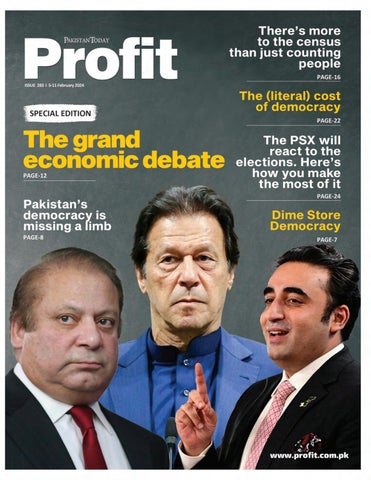
CONTENTS 12
08 08 Pakistan’s democracy is missing a limb
14 12 The Economy Debate 16 There’s more to the census than just counting people
16
22
22
22 The (literal) cost of democracy 24 The PSX will react to the elections. Here’s how you make the most of it
Profit
Publishing Editor: Babar Nizami - Editor Multimedia: Umar Aziz Khan - Senior Editor: Abdullah Niazi Sub-Editor: Basit Munawar - Video Editors: Talha Farooqi | Fawad Shakeel Business Reporters: Daniyal Ahmad | Shahab Omer | Zain Naeem | Saneela Jawad | Ghulam Abbass | Ahmad Ahmadani Shehzad Paracha | Aziz Buneri | Nisma Riaz | Mariam Umar | Urooj Imran | Shahnawaz Ali | Meerub Amir Regional Heads of Marketing: Mudassir Alam (Khi) | Sohail Abbas (Lhe) | Malik Israr (Isb) Pakistan’s #1 business magazine - your go-to source for business, economic and financial news. Contact us: profit@pakistantoday.com.pk
Note from the editorial board
Dime-store Democracy There is an election around the corner we hear. This Thursday all of the country’s registered voters will have the opportunity to choose their elected representatives for both the federal and provincial legislatures. It has been an arduous road to the polls paved with dubious intentions. One worries for the state of democracy in the country. Perhaps the largest political party in Pakistan has been blatantly targeted, stripped of its electoral symbol, and its chairman incarcerated in what can only be described as a judicial kamikaze campaign. The resulting atmosphere of fear and disillusionment has made this election one of the dullest in memory. Perhaps nothing illustrates this better than the half-hearted campaigns that major political parties have been running. The PML-N didn’t bother to start campaigning until a couple of weeks ago and were equally lazy in releasing a manifesto. Nawaz Sharif’s rhetoric has focused more on personal grievances than pressing problems and his party’s manifesto has offered little insight into how he plans to fix an ailing economy. The PPP’s campaign has been similarly lukewarm, and the vigour that marked the 2008, 2013 and 2018 elections is direly missing. The slow campaigning is in fact one of the many topics Profit’s team has covered in this week’s special edition. There is surprisingly very little to do on election day for a business and economics publication. Political analysis is best left to the political beat hacks. But the lead-up to a national election is a flurry of economic activity and possibilities. Our main story for this special issue explores what a civil debate about these possibilities might look like. In this story, Profit’s former managing editor pens down what a conversation between Pakistan’s political leadership (with some helpful insights from other quarters) might look like. In the absence of pointed, technical conversations in the political sphere this might be the closest we get to an electoral debate. There is more of course. Another story goes in-depth about how campaign financing works in Pakistan, the limits that the Election Commission of Pakistan (ECP) places on candidates in terms of spending, and how these are circumvented. We also look at the absence of local governments in Pakistan
and how this missing third tier of democracy is robbing the electorate of representation that matters the most in our day-to-day lives. Then there are more pressing questions about this election in particular, that our reporters have tried to shed some light on. Heading into the polls one might recall that Anwar ul Haq Kakar has been Prime Minister for six months and Mohsin Naqvi has been Chief Minister of Punjab for over a year. These are terms far beyond their constitutionally mandated limits. Both judicial and political leaders have turned a blind eye to this unfortunate new precedent. The instrument of this delay was first the insistence of the outgoing government that a new census had to be conducted. Before this, the government had also tried to claim they did not have enough money to conduct the polls. So how much do elections cost the national exchequer exactly? Who pays? What are the costs associated? And why was it so important to conduct this census so close to the election? Does it serve any purpose aside from marking constituencies? And how is it conducted? These are all questions we try to answer. The coming weeks will mark an important moment in the country’s history as a new government takes charge and charts the same old problems that many others have tried to tackle in the past. But the mood of the nation seems amiss. Elections are supposed to be a moment of hope. The tides of history have famously changed with the power of the ballot. It was the election of FDR as President that marked the end to the depression. Churchill’s elevation to office was a turning point for Britain in the second world war. Sheikh Mujeeb’s victory in Pakistan marked the start of the labour pains of Bangladesh. All of that hope seems missing in this election. Already statisticians and pollsters are predicting a low turnout and the electorate seems disillusioned.The country’s decision makers would do well to remember that an informed and empowered electorate has time and again been proven the best answer not just to nation building, but also to fixing economic woes. Besides, it isn’t as if we’ve done particularly well without a functioning democracy. Might as well give it a shot?
7
Pakistan’s democracy is missing a limb An energy policy in the morning, and your road in the evening is a tall ask for anyone
By Daniyal Ahmad
A
s you read this article, history is about to be made. Pakistan stands on the brink of a momentous occasion: the third consecutive democratic election in its tumultuous
history. It is a contentious election for many reasons. Not because it is particularly hotly contested but because there are more than the usual few aspersions on the integrity of the electoral process. And while political engineering and level playing fields are on everyone’s mind, most people might not realise there is an entire tier of democracy they are being deprived of in this election. It is not noticeable because this deprivation is nothing new. Local governments simply do not exist in Pakistan. They are very much supposed to. When the 18th Amendment was passed in Pakistan in 2008, powers were stripped both from the President of Pakistan and the Federal Government. Some powers and responsibilities previously held by the centre were devolved to the provinces. These provinces were then further supposed to devolve powers to a third tier democracy: local governments. The concept was simple. Before 2008, the federal government was responsible for everything from foreign policy to health and education. After the amendment, matters like health and education were given over to the provinces. This way, legislators in parliament would get time to focus their energy on the larger picture. Similarly, the provincial legislature is supposed to let local governments deal with issues such as taxation, and local water and sanitation issues. The case for local governments is one that has been flogged to death, whilst local governments never draw a single breath. However, that does not diminish their significance. It may sound trite to say that they are more vital than ever now, but the case is
8
especially compelling when any prospective government will need all hands on deck to tackle a relentless economic crisis on a war footing.
Local Governments 101
L
ocal administrations represent the most fundamental tier of public governance within a state or district. In a multitude of nations, they embody the third tier of governance. This holds true for Pakistan as well, where local administrations are subordinate to both federal and provincial governments. The three varieties of local governments are: district government administrations, town (tehsil) municipal administrations, and union council administrations. This publication has already covered the details of what a local government can, and cannot do previously. Read more: The great local government gambit Every tier boasts its own distinctive service functions and obligations. At tehsil level, the spotlight is on health, community development, education and agriculture. Infrastructure and municipal services are concentrated at the district level, whereas community services occur at union level. These three levels of local government are harmonised and consolidated with the aid of a bottom-up system, composed of clear-cut electoral arrangements, planning systems, and specific procedures for overseeing service delivery. The history of these local governments have been exhaustively penned by myriad publications. Their existence predates the creation of Pakistan, functioning within the modern boundaries of Pakistan prior to its inception. At present, local governments are operational solely in Azad Jammu & Kashmir, Khyber Pakhtunkhwa, and Sindh. Of these, the one in Sindh is perhaps the most note-
worthy, owing to the presence of Karachi. Consequently, we extended an invitation to the Mayor of Karachi — Murtaza Wahab. An interview was agreed upon in principle, yet it remains unrealised at the time of writing. Has there been a local government system that historically towered above the rest? “Although we harbour differences with Pervez Musharraf’s government, primarily due to the illegitimacy of his regime, one commendable act was the empowerment of local government. For the first time, we witnessed an effective local government,” asserts Ahmed Bilal Mehboob, the President of the Pakistan Institute of Legislative Development and Transparency (PILDAT). Firstly, Musharraf’s local government system was far from perfect. It was met with widespread disapproval. A survey conducted by Pattan, assessing the performance of district nazims (Mayor) from 2001 to 2006, revealed that over 50% of males and females were dissatisfied with their District Nazims by the end of their tenure. However, many nostalgically hark back to the Musharraf era local governments, viewing them as the closest Pakistan has come to a functioning system of this sort. Providentially, it is also the most extensively documented and will consequently serve as the cornerstone of this piece.
The service delivery question
I
t is a widely held belief that decentralisation enhances accountability, as voters can more effectively scrutinise the actions of policy-makers due to their relative closeness, and policy-makers, in turn, seeking re-election, are attentive to voter preferences. Given that the median voter in a developing country is impoverished, and that advancements in basic education, health and physical infrastructure services benefit the poor, this attentiveness leads to better service delivery. This argument forms one of the key pil-
Development, while not exclusive to the presence of local government, tends to be executed with greater efficiency under its auspices. Projects are not only more abundant but also completed at a brisker pace Ahmed Bilal Mehboob, president of the Pakistan Institute of Legislative Development and Transparency
lars that advocates of local governments lean on when extolling their numerous virtues. “Development, while not exclusive to the presence of local government, tends to be executed with greater efficiency under its auspices. Projects are not only more abundant but also completed at a brisker pace, largely because those responsible for their execution are more directly accountable to the local populace,” contends Mehboob. “I believe if you inquire with anyone in Karachi, they will recount how the most development transpired when powers were delegated to the local level in 2001,” Mehboob adds. Sadly, we cannot regale readers from Karachi with the nostalgia that Mehboob points towards. However, we did find the data for Punjab. A cursory examination of the provincial and district development expenditures in Punjab from 2006 to 2007 reveals a striking emphasis on physical infrastructure. These projects, while small-scale, are tailored to meet the specific needs of individual neighbourhoods. Of the Rs 23 billion collectively allocated in their annual development plans during the aforementioned period, a significant 46% was earmarked for roads, electrification, and water. If we discount the mandatory 25% that was allocated to citizen community boards,
then a staggering 64% of the total discretionary funds of the local government were allocated to these categories. The localised nature of these projects is evident in the average outlay: Rs 1.5 million for a road and Rs 300,000 for a water and sanitation scheme. The expenditure itself ensured that these initiatives were designed for the immediate gratification of the local government’s constituency, rather than for broader, cross-provincial appeal. Furthermore, local governments also mitigate the bias that provincial governments have for dedicating expenditure to their own heartlands. Examining the data further
reveals that in per capita terms, districts were out pacing the Punjab Government on various accounts for developmental projects. The logical consequence of this is more equitable distribution of development across the province. Healthcare and education were the only notable gaps in local government spending. Could it be that these crucial sectors were met with indifference by local governments? We cannot say for sure. However, what we do know is that the Punjab Government launched the Punjab Education Sector Reform Programme during this period, and also invested heavily in basic health units. It is reasonable to assume that these provincial initiatives influenced the choices of local policy-makers. The task of claiming credit for a service becomes a labyrinthine endeavour when multiple tiers of governance partake in its provision. Such a scenario can engender incentives for politicians to shift their focus towards targeted benefits or on more conspicuous interventions. Furthermore, there is no detriment in district governments ceding some areas to the province. “Some responsibilities transcend the purview of local authorities. Highways, perhaps, are more fitting for the provincial government’s attention, while motorways may be more aptly handled by the federal
GOVERNANCE
The constitutional mandate of local government, if properly implemented, would transform our lawmakers from contractor representatives to bona fide legislator Abdul Moiz Jaferii, senior partner at HWP LAW Waheed Masood Jaferii Kayani
their local governments accomplished years ago. This not only culminates in unfulfilled promises and resentment but may also result in subpar legislation. What if a significant number of these legislators harbour no authentic interest in being part of the legislature to begin with? What if their sole purpose is to serve their constituents in whatever capacity they can?
The better legislator question
A government,” posits Mehboob. It is not far-fetched to imagine that district administrations deferring to the province on these issues was not a grave mistake. Perhaps it was not an error in the slightest. One conceivable rationale for districts prioritising physical infrastructure is its inherent ‘diversity’ compared to social infrastructure. Roads and drains exhibit a variety in size and form, whereas primary schools and basic health units maintain a relative uniformity. This diversity paves the way for ‘specialisation’, empowering district policy-makers to focus on and claim credit for smaller, local schemes, and provincial policy-makers to claim credit for the larger ones. A survey conducted by the Devolution Trust for Community unveiled that the majority of reasons for contacting union councillors, as reported by both male and female respondents, pertained to personal issues such as financial assistance, identity card issuance, police-related problems, or disputes. Those who reached out for service delivery reasons did so primarily concerning water, roads, and electricity. A mere 2% of re-
10
spondents sought local officials for education and health matters. If these were the driving factors behind public interaction with their local government, then it is evident that the local government was indeed responsive to the people’s demands at the time. Let us revisit the issue. In a developing country, service delivery implies basic infrastructure development. The local governments, when fully empowered, accomplish precisely that. Moreover, they launch projects at a scale that is tailored for their own district and, consequently, cater only to those people whom they represent. This seems rather obvious. If the criterion of service delivery is to enhance physical infrastructure in your district, then local governments are superior. If anyone is casting their ballot for their prospective legislator, hoping they will resolve these local infrastructure problems, then they would have been better off with the local governments of two decades ago. Nonetheless, constituents will still harbour expectations that this year’s elections will impel their legislators to emulate what
prevalent contention posits that legislators ought to concentrate on legislating, eschewing administrative duties. To put it differently, a legislator hailing from the provincial or national assembly should immerse themselves in their respective assembly’s debates, rather than diverting their focus to, for instance, the construction of a stadium. This, however, is a contentious issue. Let us examine both sides of the argument, and proceed from there. “The constitutional mandate of local government, if properly implemented, would transform our lawmakers from contractor representatives to bona fide legislators, compelling them to extend their concerns beyond mere roadworks, local waterworks, and gas and electricity connections,” proclaims Abdul Moiz Jaferii, a Senior Partner at HWP LAW Waheed Masood Jaferii Kayani. “Robust local governments would also amplify the incentive to become a lawmaker. It would revolutionise the political status quo, where the majority of individuals currently vying for provincial assemblies would then covet a mayoral ticket within their own constituencies,” Jaferii adds. Now for the other perspective. “Legislators at all tiers of government, be it the provincial assembly or the national assembly, juggle both legislative and executive functions. We elect a cohort of individuals tasked with overseeing the bureaucracy and the legislature,” posits Umar Ijaz Gilani, a Partner at Law and Policy Chambers. “For instance, a member of the nation-
Democracies can only thrive where there is political commitment to the institutions of democracy from rival political forces. It will be easier to foster that commitment if there are multiple tiers of government Umar Ijaz Gilani, partner at Law and Policy Chambers
al assembly could potentially ascend to a ministerial role or find themselves in a position to hold a minister accountable. Similarly, those elected for the district assembly, the union council, wield the authority to enact certain rules for the governance of the union council,” Gilani expounds. One potential reconciliation of these divergent opinions lies in the scarcity of options, or elected avenues in this context, for individuals to partake in. While it would be fallacious to assert that all legislators aspire to be administrators, it is not incorrect to suggest that a significant number might harbour no interest in the legislative assemblies to begin with and are only present due to a lack of alternatives. PILDAT’s report on the performance of the 15th National Assembly (the outgoing one) revealed that the average attendance of members of the national assembly in their five-year tenure was recorded at 61%. It also discovered that out of the 218 members, 50 refrained from speaking for even a single minute. Clearly, a few would prefer to be elsewhere. Looking back at history, we see this to be indisputably the case. The newly elected members of the provincial assemblies in 2002, many of whom had been seasoned politicians, discovered that this time around they had been stripped of their real power at the constituency, local, and grassroots level. Their authority and influence had been supplanted by a novel invention — that of district governments. With numerous provincial functions ostensibly devolved to the district level, the role of the provincial government and its representatives had been reconfigured in a way that did not favour them. District governments and their nazims, perhaps for the first time in history, were in a position to contest, at least theoretically, the provincial monopoly of power. As a result, many provincial assembly heavyweights opted for the local government offices. Salim Jan Khan Mazari is a prominent example. A provincial assembly veteran, he secured a national assembly seat for Kashmore only to resign later and get elected in the local government. Other notable District Nazims
(Mayors) include Shah Mahmood Qureshi, Faryal Talpur, and Nafisa Shah, among others. It is noteworthy here to also emphasise that the 2001 and 2005 local government elections witnessed higher voter turnouts than the 1993, 1997, and 2002 national assembly elections. It is reasonable to infer here that if the local governments were empowered and esteemed as their counterparts, then not only would there be a better distribution of candidates across each tier of government, but also a better performance. Beyond the aforementioned superior service delivery aspects, national and provincial legislators are not as potent as we perceive them in terms of implementing projects for their constituencies. The person orchestrating the affairs in the ultimately is the Chief Minister, through the bureaucracy. It is not the members of the provincial assembly. Legislators from the two assemblies can merely propose projects whilst sanctioning and executing them is contingent upon the Chief Ministers and the provincial secretaries. It is a poor deal for any legislator who wants to make a difference in their district. It is also worse for anyone expecting their legislator to improve their constituency — obviously excluding a certain class of legislators. So, to revisit the main point. Local governments would have facilitated better service delivery and legislation, however, they currently lack the capacity to do either. If improvements on the past cannot sway one to revisit local governments, then what if we said that the current constitutional crises might have been mitigated at least if there had been an effective local government mechanism.
Could local governments have mitigated the current constitutional crisis?
T
he current constitutional crisis stems from the leader of the House in Parliament deciding that one day he could no longer tolerate sitting in the
House to begin with. One perspective to consider is whether there existed a mechanism to deter a political party from deserting the national assembly, along with two provincial assemblies? “Democracies can only thrive where there is political commitment to the institutions of democracy from rival political forces. It will be easier to foster that commitment if there are multiple tiers of government because every political actor will have the incentive to stay in the system so that he can continue to wield power at one tier or another,” asserts Gilani. Then there are the caretaker government(s). This batch of caretaker governments is set to be the most famous that we have ever seen. While one can argue about what a caretaker government can and cannot do, it is likely that everyone can concur that having the roads of Mall Road scrubbed clean to combat smog is rather ludicrous. “If we had efficient local governments who were in charge of policing and land revenue matters, then the need for a caretaker government at the provincial level would be diminished,” affirms Gilani. The caretakers are perhaps the best note to end on. While many have scorned the caretaker governments for overstaying their welcome, their district counterparts — the district administrators — have been equally guilty of overstaying their welcome in local governments for decades. Similarly, while we chastise the caretaker governments for certain initiatives that might overstep their mandate, our provincial governments are equally culpable of violating the rights of local governments with impunity. This is not to insinuate that one violation begets another, and that curbing one will necessarily curb the other. However, it is conceivable that if our legislators were not burdened with the task of resolving issues related to electricity transformers in their districts, they could have focused their energies on crafting superior laws that might have circumvented the current constitutional impasse. n
GOVERNANCE
12
The A Economy Debate Profit imagines what a debate between the major political parties would look like to help voters decide which vision of the economy they most closely align with
By Farooq Tirmizi
t Profit, we sometimes like to pretend that Pakistan is a more functional country than it actually is. Our once-every-fiveyears imaginary pre-election debate between the political parties is perhaps our most deluded effort yet: we imagine what a reasoned, well-argued, good faith debate between the major political parties would look like, and present the voters with it. The truth is, however, that while it is deluded for us to think that the political parties are capable of a reasoned, well-argued, good faith debate, they do have very real differences in policy positions, and those positions are usually not irrational. There is a “best form” of the argument to be made for each party’s political agenda, and the voters deserve to have it presented to them, even if the parties themselves are incapable of making that presentation. As with our last attempt at this debate, we will seek to present what we believe are the key issues facing Pakistan’s economy, first by laying out what we understand to be the facts about an issue, followed by a debate between the major political parties: the Pakistan Muslim League Nawaz (PML-N), the Pakistan Tehrik-e-Insaf (PTI), the Pakistan Peoples Party (PPP) and the Pakistan Army. (Technically, the army is not a political party, but it clearly has political interests, and no conversation about Pakistan’s economic prospects would be honest or complete without a representation of their positions.) Each of these parties is represented by a fictional character who will be an amalgam of their stated party positions, mainly as expressed in their manifestos, with the exception of the Pakistan Army, for which we interpret the actions of the Special Investment Facilitation Council (SIFC) as the representation of their position. We need you to not imagine a real human being saying any of these things because we all know that if you held a gun to the heads of all major party leaders in Pakistan, maybe 2-3 of them would be able to have a coherent conversation about Pakistan’s economy. This, by the way, represents progress by historical standards. If you held the same exercise in the 1990s, you would have had zero people being able to say anything of substance. Unlike the previous election debate issue, instead of us laying out the facts first and then following it up with the debate, we will let the characters lay out the facts in the course of structuring their arguments. We think it is healthy for a democracy to have participants in a debate lay out objective facts and then argue about interpretations, rather than debating the very basis of reality itself. Since this is a fictional debate, we have taken a bit of license and focused the conversation on energy: our premise is that Pakistan’s core economic management problems cannot be solved without the government choosing a sustainable set of policies to govern the energy sector. Only once that is done can fiscal space – and from that the space to spend on other policy priorities – emerge. One other note: We are an economic and financial publication, and while we recognize that Pakistan faces many non-economic issues on which the political parties have meaningful differences, you can find that commentary in every other publication in the country.
ELECTIONS
Energy: The heart of the mess
PML-N: Alright, we will start on this one since we initiated the set of policies that have largely solved the problem of too little generation capacity in Pakistan. PPP: That is an exceptionally generous characterization of what happened. Yes, it is indisputable that Pakistan’s power generation capacity went up substantially during your tenure. I will give you credit: it was a big achievement to increase power generation capacity by 64% in a single term, from 23,825 megawatts (MW) to 38,995 MW [data from the National Electric Power Regulatory Authority (NEPRA)]. But you gave away absurdly generous deals to the independent power producers (IPPs), and we now have the problem of having to pay for way more capacity than we can utilise right now. You did solve the power generation problem, but in the most expensive way imaginable. And we are not a rich country to be able to afford those kinds of boondoggles. PML-N: Firstly, thank you for acknowledging our success. I never tire of hearing you say it. Secondly, we admit we got that wrong and we outright say so in our manifesto. We have committed to moving forward with less generous equity return promises and removing the US dollar-denominated contracts. Thirdly, we wanted to lay out that preamble so that we could get to what we all agree is the heart of the problem, which is the circular debt. PTI: We agree that we should talk about circular debt, but two things: first, may we just get you to acknowledge that rupee-denominated contracts were our idea and that you have decided to adopt it? And secondly, no, the manner in which you added capacity really was irresponsible and is now at this point a bigger problem than theft, which we did not think was possible. PML-N: Acknowledged on the contract renegotiation front. We were genuinely concerned that it would not work and scare off investors, but it does not yet seem to have been the disaster that we feared it would be. You were right and we were wrong on that one. Renegotiating the IPP contracts to a more reasonable deal was possible. Though, let’s also concede that the renegotiation only solved a small portion of the problem and the bulk of it remains. PTI: Sure, though we did make a dent in cleaning up that mess of yours. And the size of the mess is no joke. We are now at a point where consumers have to pay more for the excess power generation capacity than the actual cost of the electricity consumed. The latest NEPRA report projects that 67% of the cost of their energy purchase price (EPP) in fiscal year 2024 will be capacity charges. That
14
means that 40% of everyone’s electricity bill will literally be paying for electricity that we are not even using. Come on, you cannot keep on calling it a success like that when it came at such a tremendous cost. Wasn’t the whole point to generate cheaper electricity? You have actually made it more expensive! PML-N: Look, we are not denying that we made a mistake on those incentives, and yes, we clearly have an overcapacity problem right now. But what would you rather have? Too much electricity generation capacity or not enough? Pakistan Army: Also, we would like to point out that at least part of the excess capacity can be made to go away by not renewing the expiring contracts of older power plants. PPP: You say that, but do you have a number for how much capacity that would take offline? And more importantly, are you going to be the one to have the conversation with all of those billionaires that we are taking away one of their most reliable sources of cash flows? Pakistan Army: We really don’t see why it should not be you guys having that conversation with them. PPP: The same reason it cannot be you: money talks, and you cannot suddenly take away that large a volume of income from some of the richest people in Pakistan without there being a serious backlash. PML-N: I actually want to come back to the point I was making earlier: I agree that the massive amount being paid in capacity payments is a problem. I disagree that it is a permanent catastrophe. It is a temporary situation that is about to resolve itself. PTI: Ok, that is a big claim. What do you mean by that? Back it up with data. PML-N: The key metric to look at is maximum energy demand. The biggest growth spurt in generation capacity that took place during our last full term was in fiscal year 2017. Before that, from fiscal year 2009 through 2016, electricity generation capacity lagged peak demand constantly, and so demand effectively remained stagnant for almost that entire period. The first year we brought a meaningful amount of capacity online resulted in barely a surplus of generation capacity that year. What does that tell you? There is latent demand that will be unleashed once we can get the pricing right. PTI: We keep coming back to this point. Nobody disputes that having surplus capacity is better than having a deficit. What we are saying is that the way you achieved it has rendered it nearly impossible to get to a point where we will be able to offer electricity at cheap enough prices to be able to utilise that full capacity. PPP: Right, the surplus right now is 12,000 megawatts of excess capacity. And that is be-
cause we added 17,000 megawatts of capacity over the past five years, but only increased peak demand by about 5,000 megawatts during that time. Do we think people want to use more electricity? Probably. But you’ve made it so expensive that it will take way longer for that excess supply to be used up. PML-N: Ok, but if we work on reducing theft, we can make a significant dent on the cost. PPP: Of course we should try to reduce theft, but here is the stark reality: theft accounts for 16% of electricity in Pakistan that is generated but not paid for, so even if we fully pass that cost on to consumers – and we mostly are at this point – the maximum it will consist of is 16% of electricity bills. Did we mention that capacity charges are 40% of electricity bills right now? The maximum you can reduce line losses by is 10%, because some is just natural. The capacity payments problem is four times the size of the theft problem now. Pakistan Army: Right, we had one really bad problem, which was circular debt caused by electricity theft. And you went ahead and not only did you not solve that one, but you also added a problem four times as big. PML-N: We have a solution: have industrial users stop cross-subsidizing domestic consumers. Industrial consumers can ramp up consumption much faster than households. That’ll make a significant impact on the scale of the problem, and oh by the way, will also significantly increase employment opportunities in the country. PPP: Wait, so you want to have the poor of this country pay more than the richest industrialists? Why do you think that kind of policy is justified? Pakistan Army: He’s right, actually. It sounds bad to charge industrial consumers less, but the fact of the matter is that theft happens mostly among domestic consumers and far less among industrial ones. And if the goal is to ramp up electricity consumption fast, then getting the biggest users of electricity to use more is the fastest way to achieve that. PML-N: Right, so if we get them to use more electricity from the grid, we would reduce what we owe in capacity payments, which would then reduce tariffs for everybody. PPP: Charging the rich less than the poor is just plain wrong and immoral. Pakistan Army: It sounds bad, yes. But it is not. Not when you consider the second and third order ramifications of this policy. PPP: So are we even going to talk about the theft problem and what to do to solve it? Pakistan Army: We can, but the three of us agree on one approach, which is privatization of the electricity distribution companies (DISCOs), and you are the only one who disagrees. Though I would argue that you actually agree with us, but just cannot get
yourself to say it. PPP: We are pretty unequivocal about our opposition to privatization. We believe stateowned companies need to be better managed, but remain within public ownership. Pakistan Army: Yes, we have heard you say that before, but you also talk about eliminating the monopolies of the DISCOs and introducing competition. That sounds a lot like you want to use market mechanisms to solve the problem at the distribution level, which heavily implies – but yes, avoids saying outright – that you are in favour of privatization. PPP: … Pakistan Army: You can give me that look all you want, the fact is that we are all agreed on privatization, and you just cannot get yourself to say it because your Gramsci-loving trust-fund Marxist friends will pretend to throw a hissy fit while sipping their thousand-rupee lattes. PPP: I thought we agreed to not engage in personal attacks. Pakistan Army: Old habits…
Fiscal deficit: Taming the beast
PPP: There is that small matter of Pakistan’s debt and deficit that both seem to keep growing. We think it is important enough that two out of the five points in our Five Pillars of a New Peoples Economy are about getting on a more sound fiscal footing. PTI: Yes, I noticed that, but what specifically are you proposing to do about it? I noticed, for instance, that you mentioned the need to raise the tax-to-GDP ratio, but how? Also, where are the spending cut proposals? PPP: We are clear that we want to reduce spending on untargeted subsidies. We think it is a travesty that over 90% of subsidy spending ends up benefitting the upper middle class and the rich. We think cash grants through an expanded Benazir Income Support Program (BISP) would be the better approach. PML-N: Expanding BISP, I think, is something that we are all at least in principal in favour of. But cutting subsidies is not a magic
wand and you know it. PPP: Fair enough. To be honest, our view is that the government of Pakistan has more of a revenue problem and less of a spending problem. We think we need to expand spending on a lot of areas, particularly in social services. That is why we want to try to raise the tax-toGDP ratio. Our main proposal is that sales tax collection for goods should be handed over to the provincial governments. PTI: Why do you think that will increase sales tax collection? Provincial tax collection as a percentage of GDP has barely budged over the past seven years or so. PPP: If we are moving towards fiscal federalism, and I think we should, then we need to flip the premise from the federal government being the default center of political and fiscal power that then magnanimously grants some of those to the provinces and instead think of the provinces as the default centers of power that cede some of it to the federal government for the common good. PTI: Your imitation of an American libertarian is uncanny, but the evidence for moving more tax collection to the provinces being a mechanism for increasing tax collection does not seem particularly well fleshed out. Pakistan Army: An easier solution would be to rethink the National Finance Commission award. PPP: Over my dead body are we even talking about this. No, the federal government needs to learn to live within its means. The provinces provide the bits of government services that most directly affect people: education, healthcare, infrastructure. The fact that we have moved these functions towards the provinces is what will ensure that progress in these sectors will not be cut short every few years when Islamabad runs out of money. Pakistan Army: Since you will not let us even debate this, will the provinces at least be willing to take full control over the ministries that they are supposed to own? Or do you like having the federal government pay the provinces to do a job that it then still has to do? PPP: We are hardly the ones resisting the transition, That is mostly federal bureaucrats
who have yet to reconcile themselves to the fact that they must suffer the indignity of becoming provincial civil servants. Pakistan Army: Probably true. PTI: On the subject of reducing the fiscal deficit, we still think the wealth tax is a good idea. PML-N: You bring this up every time, but now you have been in power and were not able to implement it. How are you still not convinced that this is not a good idea. PTI: Look, it is pretty clear that the wealthy in Pakistan do not pay their fair share of taxes. Income is much harder to determine than the value of assets. So taxing that for the wealthiest is the most efficient – and most fair – way to raise tax revenue for the government. PML-N: There are multiple levels as to why this is wrong. The fundamental problem with wealth taxes is that it is unreasonable to ask people to pay taxes on assets that may not yield cash income. What if I own undeveloped land that appreciates in value? How will I get the money to pay the tax on it? Why is the government forcing me to sell my land in order to pay taxes on that land? That makes no sense. PTI: We’re not remotely suggesting that it will be anything close to an amount that will make people have to sell their land. And like we said, it will be adjustable against income tax liabilities, so the actual amount of wealth tax will not be one that will force people into asset sales against their will. PML-N: This is exactly what you said in 2018. You then came into office and did not implement the tax. There is no way you did not at least look into it, which tells me that you have at least come to the conclusion that it would be difficult to implement a wealth tax, which is why you did not do so when you were last in office. One would hope that you also agree that it does not work in principle, but perhaps the former is enough. PPP: I mean, the dude is still convinced that “land reforms” are still necessary in Pakistan, which makes me think he still believes his Pakistan Studies textbooks. PTI: That is just uncalled for. n
ELECTIONS
There’s more to the census than just counting people Almost every piece of data in the country finds its way back to an activity that we seemingly do not care much about
I
By Daniyal Ahmad
s this your house? How many people live here? How many of them are your family members? These were some of the myriad of queries that Pakistanis were asked by a person with a tablet, accompanied by guard, on a mundane day in spring of 2023. It was not until August that the responses to the queries were revealed. Turns out, Pakistan’s population had soared from 207 million to 241 million. Witty remarks were exchanged about how ‘Decemberistan’ was contributing to the population boom, while politicians bellowed for recounts in various corners of the nation. These seemingly innocuous questions mask the monumental significance of what the nation achieved with this undertaking. It marked the seventh occasion in Pakistan’s 76year history that the country had conducted a census and had charted its population. The infrequency and benign nature of
16
the undertaking belies its importance in the nation’s governance. Rarely does a state adopt the stance that it does not wish to know the actual number and conditions of residents in various parts of its country, or that conducting a census itself may ignite uncontrollable discord among its people. Then, there is Pakistan. The reasons for the dearth of our censuses are aplenty. They range from more important administrative issues, to political hostilities, and sometimes lack of the requisite capacity altogether. The indifference to the census that successive governments have shown is nothing short of sinful. This is because the census is not merely the plumbing for our political system during an election, but it is also the bedrock upon which all the data that we utilise to comprehend Pakistan is constructed. So, how vital is this endeavour that we treat with blasé? And what does the census influence, beyond just the petty squabbling that politicians engage in on prime time news?
Census 101
A
population census — or a population and housing census, as it is also known — is a stock taking of human resources of a country and their living conditions at one point of time. It provides basic data on demographic, social and economic variables about each person and each housing unit. Politically, the census is a sovereign enterprise; countries tally the populace within their sovereign territory in accordance with their own legislation and laws, and for policy and planning purposes. It also forms one component of the preparatory work for elections in Pakistan, albeit diverging from the standard practice globally. The execution of a decennial census is a relatively straightforward affair in most countries: the state mobilises its bureaucracy of enumerators every decade to determine how many individuals reside within its borders and under what conditions they live.
I don’t think our governance system and our bureaucracy are equipped to utilise data in any significant manner. We seem to have a culture of collecting data for its own sake, and then neglecting it in the ways that it can add value Taimur Jhagra, former provincial minister of Khyber Pakhtunkhwa for Finance and Health
It was not always like this. The census was established in the region that is now Pakistan during the British Raj. The inaugural census, confined to what were then termed the North Western Provinces, was conducted in December 1852, with a reference date of January 1, 1853. Subsequent intermittent censuses were held until 1881, when the first comprehensive census was undertaken. Thereafter, the British carried out a regular census with increasing proficiency at ten-year intervals. Following independence in 1947, the nascent government established the Pakistan Census Organisation, which enumerated both East and West Pakistan in the 1951 and 1961 census reports. Due to political conditions culminating in the December 1971 war with India over the secession of East Pakistan, the census was deferred to September 1972. The subsequent decennial census was conducted in March 1981. The government of Pakistan, then under the leadership of Benazir Bhutto, had scheduled the next decennial census from November 22 to December 16, 1990. However, before it could be carried out, Bhutto and her Pakistan People’s Party government were ousted from power. Nawaz Sharif’s Pakistan Muslim League rescheduled the census to be conducted in March 1991, the following year. In 1992, the government postponed the census until the spring of 1993, citing catastrophic floods as the primary reason for the delay, but no new make-up date was given. The year 1993 was virtually marred by political turmoil, with a major rift between the prime Minister and the president over which office wielded supreme authority. Benazir Bhutto’s subsequent government, elected in October 1993, decreed the following month that it would finally hold the census between March and April 1994. The dates were then shifted to between October 23 and November 1, 1994, but Bhutto’s government subsequently cited inclement weather and again postponed the census. However, before the census could be conducted, Bhutto’s government was dismissed once again.
Sharif’s government finally scheduled the census to commence on October 18 and last until October 31, 1997. A mere two weeks before it was due to start, the government postponed the census once again, citing administrative reasons. The census was finally carried out from March 2 to March 18, 1998. The elusive sixth national census was postponed several times due to various reasons. It was originally scheduled to take place in 2001, and later in 2008 and 2010, but none of those plans could materialise. A futile attempt in March 2011 was scrapped, allegedly after discovering ‘statistical anomalies’ during the preliminary phase of a housing census. The April 2012 round of census counts was also deemed ‘unreliable’ and discarded. The Council of Common Interests (CCI) finally sanctioned the sixth census in March 2016, but it ended up taking place from March 15 to May 25 in 2017. However, the 2017 census was fraught with difficulties. The outcomes of the 2017 census ignited controversy and were met with vehement resistance from the Sindh government, and several political parties such as the Pakistan People’s Party, Jamaat-e-Islami Pakistan, the Muttahida Qaumi Movement, and the Pak Sarzameen Party. They collectively rejected the final results and demanded a recount. In response to the persistent opposition, the CCI held back the publication of the final results for years. At the heart of the issue was Karachi. The official figures, revealing a populace teetering around the 16 million mark, were met with a wave of scepticism and dispute. The parties in question vociferously argued that this estimate grossly undervalued the city’s true population, with a chorus of voices asserting that the actual tally soared beyond 20 million. Furthermore, the Pakistan People’s Party, the party heading the Sindh government, contended that the entire province of Sindh had been undercounted. They maintained that the official figure of 48 million was a far cry from the projected 61 million plus, a number that other agencies, including Unicef, had
previously cited. At last, in April 2021, the CCI surmounted the impasse and endorsed the final results of the 2017 census, stipulating that Pakistan would conduct another census before the tenyear deadline, and the results of that census would determine the constituencies for the 2023 general election. By February 2022, a schedule for the census had been devised, predicated on the enumeration taking place in August 2022. However, the plan to execute the census was shifted to between October 15 and November 15, before it ultimately took place in March 2023.The postponements were predominantly ascribed to the cataclysmic floods of 2022, which served as a formidable obstruction to the indispensable fieldwork. However, they were also imputed to ‘unavoidable circumstances’.
The immediate economic decision making a census influences
I
s there more to a census than just the delimitation process for the elections? Yes. The census wields a significant influence over the allocation of funds to the federating units by the NFC. The NFC award, a fiscal distribution framework, endeavours to equitably distribute financial resources between the federal government (vertical distribution) and the provinces (horizontal distribution). The NFC award encapsulates the division of taxes accrued by the federal government, forming a divisible pool. This pool encompasses taxes on income — inclusive of corporate tax, sales tax, and export duties — among others. The quantum of funds that are disbursed to the provinces hinges on population, revenue, poverty, and inverse population density. Of these factors, population accounts for 82% of the funds that are to be received. Consequently, the census determines how provincial and
GOVERNANCE
The most immediate application for the PBS’ census data in conjunction with the SBP’s own data is developmental finance, housing finance, consumer finance, and microfinance Kazi Abdul Muktadir, former deputy governor at the State Bank of Pakistan
federal governments will chart their financial planning till the next census is conducted. “The allocation of funds across the provinces remains predominantly determined by their population size. The seventh national financial commission (NFC) award addressed persistent controversies of revenue sharing and adopted a more comprehensive multi-criteria formula — yet, population still constitutes 82% of the ultimate disbursement” articulates Dr Sajjad Akhtar, a former chief statistician at the Pakistan Bureau of Statistics (PBS). The next salient factor of the census is ascertaining the quota for recruitment to all civil posts in the federal government. The Pakistani government remains the single largest employer of individuals across the country, and therefore these quotas are more important than one can fathom. “The quota is especially crucial in Sindh, where the Sindh government’s employment quotas are subdivided according to the proportion of population of Sindh Urban and Sindh Rural,” Akhtar elaborates. These are the immediate economic ramifications of the census. Then there are the ancillary implications.
The secondary economic decision making a census influences
A
census is a comprehensive source of information on the demographic, social, and economic attributes of each individual and each dwelling unit. The census covers a wide range of topics, such as demographic and social features, educational attainment, geographical and migration patterns, economic status, and fertility and mortality rates among the general population. It also collects additional data, such as disabilities, national identification cards, and household members living abroad. This is where a whole array of benefits from the census emerges. The census aids with various essential aspects, such as employment planning, government revenues, education provision, health services, transportation projects, and housing.
18
However, that is merely the tip of the iceberg. The importance of a census is better understood when we look at how a government operates in the absence of it. Imagine ordering a bespoke suit without giving the measurements. It sounds ludicrous, right? How could one possibly craft something that fits without knowing certain vital details: age, size, and shape? Sadly, this is what has been occurring in Pakistan for decades due to the absence of an updated census. “Between two censuses, for instance, from 1998 to 2017, the National Institute of Population Studies produces annual population estimates using a sophisticated model. Nevertheless, these estimates rely on the growth rates derived from the census base year, such as 1998, and entail a margin of error. The actual figures from the census are parameters, and hence definitive.” explains Akhtar. Does it matter if the implied rate, and the actual rate differ from one another? Going into the 2017 census, the highest estimate for the population was at around 200 million, whilst the actual number was 207 million. The stark contrast between the projected and actual population growth rates necessitated a greater allotment of funds to human development initiatives. This implied that, in the absence of the census, the government would have constructed fewer schools, hospitals, and so on. While the discrepancy of seven million — from 200 to 207 million — may appear negligible, it represents a colossal number of people that the government had overlooked in its planning and budgeting. Without the census, they would have faced a dearth of facilities, along with a cascade of adverse effects on their well-being and those associated with them. The census also influences more macro-level decisions that we might not readily consider, such as trade policies and our balance of payments. “Population parameters profoundly influence trade balance, education, and health ratios. A burgeoning population necessitates increased food imports and/or diminishes food surpluses available for exports, unless productivity rises accordingly,” Akhtar expounds. Governments are not shackled to reactive policymaking when scrutinising census data either. All the aforementioned forecasts
have discussed the needs of a populace that a government will have to address due to increases or decreases in population. However, it can also aid countries in determining where they aspire to be. All per capita metrics, such as income per capita or gross domestic product per capita, can be predicted using future economic and population growth forecasts. If a government wishes to attain certain levels of productivity per person, then it knows what measures it would need to implement going forward if it already knows the rate of population growth the country is poised to experience.
The knock-on benefits of the census
A
ny institution looking to record statistical data involving Pakistan finds great utility in the census. The main beneficiaries of the census are the PBS, the SBP, and international financial institutions like the IMF. Let us begin with the PBS itself. The census is the cornerstone of every other survey the PBS conducts. “The sampling framework that the PBS employs for its other surveys is also derived from the latest census. The census has a ripple effect on every survey the PBS conducts through the sampling framework,” explains Akhtar. To put this into perspective, the PBS gauges the country’s inflation statistics for starters. The PBS also assesses industrial activity through the large-scale manufacturing survey. The PBS also carries out the standard and living measurement survey. It also evaluates industrial activity through the large-scale manufacturing survey. Furthermore, it undertakes the standard and living measurement survey. These three surveys alone sculpt the economic planning for all policymakers. The census, through the sampling framework, essentially dictates the lion’s share of the PBS’ endeavours. Then, there is the SBP. “The State Bank collects its own data independently through
The sampling framework that the PBS employs for its other surveys is also derived from the latest census. The census has a ripple effect on every survey the PBS conducts through the sampling framework Dr Sajjad Akhtar, former chief statistician at the Pakistan Bureau of Statistics
its statistics department; however, when we are crafting our data and data collection, the PBS’ data serves as the foundational data that we utilise,” expounds Kazi Abdul Muktadir, former deputy governor of the SBP. So, what does the SBP use the PBS’ data for? “The most immediate application for the PBS’ census data in conjunction with the SBP’s own data is developmental finance, housing finance, consumer finance, and microfinance,” Muktadir clarifies. Similarly, the International Monetary Fund, in particular, utilises not only the census data but also other surveys conducted by the PBS for its own staff assessment reports. Just to jog your memory, the supplementary surveys are also predicated on the census. Consequently, some of the most influential financial institutions in Pakistan’s financial landscape utilise the census for their own evaluation and understanding of the country prior to devising their solutions.
Keeping the treasure buried
C
ensus enumeration in Pakistan carries a political charge that is perhaps more potent than in other countries. It forms the bedrock upon which political boundaries are redrawn, national and provincial assembly seats are apportioned among provinces and regions, and inter-provincial resources are allocated. Hence, whenever it is conducted, there will inevitably be someone who is disgruntled. The most conspicuous issue with the current census is the discrepancy in the numbers pertaining to Balochistan. The population of Balochistan was estimated to be around 22 million in various updates during the census process. However, in the final report sanctioned by the relevant authority, the population of Balochistan was slashed to 15 million. If the final population had concurred with the original projection, the province could have gained an additional 22 seats in the National Assembly. Another bone of contention is the situation in Sindh, where critics of the census
claim that the average family size has been understated. They argue that if the headcount had been consistent with what UNICEF’s, for instance, discovered, then Sindh’s population would be higher by roughly 10%. Lastly, there is the predicament of the census delaying elections and prolonging the caretaker governments. Invoking the census results, the electoral watchdog resolved to finalise the process of fresh delimitation of both national and provincial assembly constituencies by 14 December, over a month past the constitutionally stipulated deadline for conducting general elections. This was in spite of Article 224 of the constitution obliging the watchdog to conduct general elections within three months of the National Assembly’s dissolution. All of this sparks debates about whether there can be revisions to how we conduct the census in the first place. The PBS is aware of all the grievances, and strove to enhance the trust people had in its census this time compared to the one in 2017. The 2023 census was subjected to a third-party audit — a feature conspicuously absent in the 2017 edition — which, in theory, lends greater credibility to its findings than its predecessor. Furthermore, the PBS unveiled a comprehensive field operation plan, thereby making all standard operating procedures transparent to the public. For the first time, it extended a self-enumeration facility to the public and equipped the provincial authorities with online dashboards, thereby rendering data accessible to them as it was being collated. Its complaint centre remained operational round the clock, and its social media handles routinely disseminated provisional results and other details. This is not to say that more could not be done .For starters, the 2023 census did not make all the detailed information readily available for public consumption, which only fuelled the doubts that people had. As to how these doubts manifest going forward is anyone’s guess. However, it has led to some suggesting that it might be time to revamp or replace the census in its current iteration altogether. “Would we need the census if the
NADRA database exists and is kept updated? If we have birth and death statistics, then we could essentially have a live running census,” proposes Taimur Jhagra, a former Provincial Minister of Khyber Pakhtunkhwa for Finance and Health. Scepticism will inevitably persist, and those who believe they have been shortchanged due to the demographic shifts will invariably voice their dissent. Furthermore, rather than malevolence, most people that we approached whilst crafting this article merely questioned the rationale for the piece to begin with, when delimitations had already been executed. This delineates the second reason for the triviality of census data. No one genuinely seems to care about the findings beyond the delimitations. “I don’t think our governance system and our bureaucracy are equipped to utilise data in any significant manner. We seem to have a culture of collecting data for its own sake, and then neglecting it in the ways that it can add value,” Jhagra candidly asserts. In a similar vein, “I have witnessed international organisations inquire numerous times for elucidations as to how all of Pakistan’s data is collated, the methodologies that underpin it, and how it can be employed. I have never had a solicitation from a Pakistani governmental institution exhibit similar keenness to comprehend the data that is available,” Muktadir supplements. The reality is that if the government of Pakistan shirks its responsibility to conduct the census, augment its transparency, and elevate its importance and respect, then no one will do it on their behalf. Neither the World Bank nor the International Monetary Fund are in the business of conducting censuses on our behalf, nor do they serve to jog our memory of its importance. However, when we inevitably resort to them for assistance, they do require it. We can opt to disregard the importance of the census, but then we find ourselves inexorably bound to depend on the PBS’ surveys for all our reports, which hinge on this seemingly innocuous activity. n
GOVERNANCE
Visa’s ambitious plans for financial inclusion in Pakistan
The global digital payments leader is rolling out safe, secure products in Pakistan that will enable better acceptance of digital payments
D
igital payments in Pakistan have made a headway in the last few years. However, the opportunities for more concentrated efforts to increase digital payments are numerous. Global payments services provider Visa is transforming digital payments in Pakistan, as a gateway to financial inclusion within the country. Profit had the opportunity to learn about Visa’s plans for Pakistan from Michael Berner, Senior Vice President, Head of Merchant Sales and Acquiring, CEMEA, Visa. What role do payment facilitators play in increasing access within the financial ecosystem? Globally, payment facilitators are driving increased acceptance by empowering eCommerce, small and medium-sized businesses (SMBs), and unique segments not often target-
ed by banks. They are spearheading the growth of merchants, increasing access to a digital economy, and propelling financial inclusion. We see this realized fully within Pakistan from the radical rise in the number of payment facilitators, tremendous opportunities for growth, and new technologies coming into force. This fully aligns with Visa’s mission – to enable everyone and uplift everyone, everywhere. We want to enable SMBs, a segment that is vital to economic growth. What is the impact of digital inclusion on individuals and SMBs in driving economic growth? In many markets including Pakistan, small businesses represent a significant share of the market and are playing a pivotal role in enabling economic growth. Payment inclusion gives SMEs an introduction to new opportunities that were previously unavailable. This includes access to digital payments, strategic advisory on business optimization, and new
clients. A classic example is a business with a physical presence that becomes an eCommerce merchant. This opens up access to new information, new markets and cross-border sales. Is the regulatory environment in Pakistan conducive to growth of digital payments? Pakistan has taken significant steps to enable its economy, enhance transparency, promote inclusivity, and strengthen the fundamentals for further growth. The State Bank of Pakistan has demonstrated a commitment to moving in the right direction. We collaborate with regulators globally to enhance transparency in the ecosystem and ensure effective risk management. Our Visa Payfacs program provides acquirers, payment networks, and payment facilitators themselves access to learnings and data, and brings some rules to all participants of the ecosystem which reduce fraud and operational risk. The certification helps payment facilitators grow rapidly and onboard more merchants. The advantage is that banks working with these payment facilitators achieve more transparency and more data. While the program is supported by regulators, there remains an opportunity for additional efforts in this direction to elevate financial inclusion to the next level. How crucial is trust and security in digital transactions and services? Our legacy of ensuring trust and security in digital payments is visible in the progress we have made over a period of 60 years, in 200 countries and territories around the world. Trust plays a pivotal role, built on factors such as transparency and robust risk management. From a risk management perspective, we are continuously innovating to bring to market new products and solutions that creates a
20
B
I
O
G
R
A
P
H
Michael Berner
Y
Senior Vice President, Head of Merchant Sales and Acquiring, CEMEA, Visa
M
ichael Berner serves as Senior Vice President, Head of Merchant Sales and Acquiring (MS&A) for the Central Europe, Middle East and
Africa region. In his role, Michael leads Visa’s relationships with merchants and their enablers across CEMEA, helping build acceptance strategies that capitalize on the acceleration of digital payments, and capturing opportunities to shape the future of commerce. Michael joined Visa in 2019 as Country
safe and transparent payment infrastructure for everyone including issuers, acquirers, and merchants. Some products that fall in this category are tokenization and the Visa Advance Authorization (VAA) that counter fraud and enable secure transactions. We are committed to ongoing innovation, introducing new technologies that make the payment ecosystem safer, more secure, and financially inclusive. This not only addresses trust concerns but also contributes to building a more robust payment environment. Is Visa working with financial institutions to counter the incidence of social engineering scams? We have observed the rise of social engineering scams around the world. We conduct risk awareness educational sessions, workshops and seminars with payment providers and issuers where we impart information on risk management solutions such as Visa Secure, which is a risk based identification process that eliminates the need for card holders to enter their passwords, tokenization, which is the replacement of a 16-digit card number or PAN or a token which is a lot safer and securer, and getting a lot of big advantages from UI and UX. We also speak about the importance of biometrics. For consumers, we have campaigns such as Visa Stay Secure, which reflects Visa’s commitment to raising awareness, strengthening education, and building confidence to combat social engineering threats. The campaign aims to pave the way for a secure and seamless digital payments experience. In Pakistan, what unique challenges do you think payment facilitators face? Pakistan is a very cash intensive economy. His-
torically, this market is impacted by the lack of financial literacy and education among many players within the ecosystem. Therefore, there is reduced trust towards digital payments, further exacerbated by a lack of infrastructure. But these challenges are not unique to Pakistan we see similar challenges in many parts of the world where we operate. We are trying to bridge the gap by introducing technologies and working with other stakeholders in the ecosystem to increase financial inclusion. This way we build trust and security in digital payments across the ecosystem. In Pakistan, we see increased usage of smartphones which are the next generation of payment devices. We see 17 million mobile banking users now, 10.3 million internet banking users, 2.4 million e-wallets and 61 million m-wallets which is a very solid number. And this number keeps growing . Smartphones are a very secure way of payment because it is in the consumer’s hand and has all the security elements embedded in biometrics. Over time, this will help to increase security, which should lead to increasing trust and subsequently increase eCommerce with more people transacting digital payments. While the number of eCommerce merchants is not that high compared to other markets, it is undoubtedly growing at a rapid pace. This will also help Pakistan to have a more transparent digital payments infrastructure. However, 54 million payment cards issued for a population of 240 million probably is not that high. In developed markets, we see that typically everyone above 14 years of age would have 1.7 or 1.8 cards per person. This is a long way ahead for Pakistan. While this number is growing, we would like to observe the growth of credit cards which would
Manager for Russia, bringing more than 20 years of professional experience across multiple disciplines in financial services. Prior to Visa, Michael was a Managing Director, Member of the Executive Board and Consumer Business Manager at Citibank Russia. Michael graduated from Moscow Automobile and Road Institute (MADI) and holds a Master’s degree in financial management. He also completed a number of postgraduate programs in Columbia Business School, University of California, Berkeley and Harvard University. provide a number of advantages for consumers, merchants, and economy. Currently, it is 79% debit cards, 17% social cards and just 4% credit cards. Credit cards increase spending power, provide more confidence to consumers. This enables the usage of Buy Now, Pay Later products, which Visa is bringing to the market as well. Especially with the BNPL products, which Visa is bringing to the market as well, over time, we believe that the proportion between the debit and credit cards would change. This holds true for digital payments as well. Are there any other unique opportunities for payment facilitators in Pakistan? We see that the number of untapped merchants in Pakistan is very high. In CEMEA overall it is 60 million, and only 11 million in the last year were accepting digital payments, few of these would be inactive. The number of active merchants would be even lower. So, there is a very significant opportunity to increase the number of merchants accepting digital payments. And payment facilitators will be playing a very significant role in increasing acceptance, as we have seen in other parts of the world. We, at Visa, have a strategy to enable payment facilitators and banks that support them to move faster. Our initiatives such as the Payfacs certification program and also a number of conventional arrangements where we are bringing the best of Visa solutions to support payment facilitators in their journey of bringing growth to the economy. This will bring transparency to eCommerce and enable more secure and safe methods to pay. n
NATIVE CONTENT
The (literal) cost of democracy Just how financially burdensome are elections for Pakistan? What do the numbers say?
22
By Shahnawaz Ali
A
s the country moves to the upcoming 2024 General Elections, an apparent discontent reverberates through the nation. The alarm of unfairness has already been sounded, challenging the very legitimacy of the electoral process. Even though similar concerns have been levelled against the process almost every time in the past, the government’s financial conditions have never been as bad as they are this time around. This has led to a strange debate. Essentially a cost-benefit analysis of the general elections has been carried out in the past one year. It was said that the elections are a tedious and expensive process. The argument was even used by the PDM-led government last year to delay provincial elections, sidestepping the Elections Act and even the apex court’s ruling. Are the elections expensive? And how expensive do they need to be for them to become a bad choice?
Election expenditures
T
o look at what the elections truly cost, it is important to know the major expenditures involved in conducting the elections, from the government’s side. As per the Election Commission of Pakistan, these expenditures are categorised under various heads for a smooth budgetary process. These heads include constituencies, revision of electoral rolls, training, payment to polling agents, election material, printing of ballots, voter education and (civil) security etc. The approved budget by the parliament for the Election Commission of Pakistan (ECP) under all these heads for the polls on national and provincial assembly seats in 2024 is Rs, 42.5 billion. On top of this, the Election Commission pays for external help and consultations such as additional security personnel from the military. After factoring that cost in, an estimate of Rs 47 billion was given to the National Assembly, in January last year. However, the figure is expected to touch Rs 49 billion according to latest media reports. This increase in cost comes due to high inflation and additional security requirements for the general elections. There are a number of ways to put this number into perspective. On one hand the electoral budget is only three times the size of Pakistan’s “Recreation, Culture and Religious” expenses for the financial year, while on the other hand Pakistan’s defence budget is 37 times larger than what it takes to hold these elections. While the cost of ballot papers at Rs 24 crores (243 million) is revealed through the publishing process, the election commission does not provide a detailed breakdown of its remaining
expenditures. Any requests for such details made by your correspondent, were hence denied by the ECP before the filing of this report.
Breakdown and comparison
C
omparing the current cost to the previous general elections in 2018, the expected expenditure marks a 133% nominal increase. Dividing this expenditure by constituency, a single national assembly constituency of a total of 272, sets the national exchequer back by Rs 180 million on average to hold polls. The same number for the 2018 election stood at Rs 77 million. However, there are various factors to take into account when measuring an increase in the cost of elections. For starters, every year, Pakistan’s population grows, adding more people to the registered voters list. Not to mention the effects of inflation and rising prices on the cost of holding elections. So perhaps a way to look at this expenditure is by categorising this expense over voters. What does it cost an average Pakistani to vote? The total number of registered voters in Pakistan are 128,585,760 as per the latest Election Commission of Pakistan data. This means that on average, cost per registered voter is Rs 381. However, since the number of people that vote is almost always significantly lesser than the people who are registered to vote. Another way to determine the cost is the average cost per vote cast. In the past the voter turnout in Pakistan has remained abysmal, with the national assembly voter turnout at 51.5% across constituencies in 2018, characterised as one of the best voter turnouts in history. The average cost per vote cast for the 2018 elections at an election budget of 21 billion stands at Rs 386 per vote cast. Taking the average of the last 5 general elections gives us an average turnout of 45.45%. If we take that as our expected turnout, the cost per vote cast comes out at Rs 838 for the upcoming elections. This marks a 117% increase in the cost of average vote cast.
Is the 2024 poll expensive?
I
t seems that the 2024 elections are more expensive than the elections held before this, however, that is also one side of the picture. Over the last 6 years, inflation has majorly changed the landscape of expenditures. The inflation adjusted value of Rs 21 billion in 2018, at the end of 2023 stands at Rs 44.5 billion, a value less than the approved budget for the 2024 elections. Now let us come back to whether the cost of holding polls is ever too much. When asked to hold provincial polls as per the Supreme Court
under the Elections Act in May 2023, the federal government cited unavailability of funds as one of its main concerns. The prevalent argument was that since the government has to conduct elections for general assembly seats within the year anyway, it would be less expensive to hold the provincial elections then. Is this accurate? We have to take into account the principles of economies of scale. Aside from some distinctive expenses, such as ballot papers, the costs incurred during provincial and national assembly elections within a constituency are nearly identical. This encompasses expenses related to polling stations, transportation, and staff, among others. This means that holding separate polls for provincial and national assemblies at different points in time would most definitely be costlier. Even if we hypothetically assume that conducting a provincial election in Punjab would mirror the proportional budgetary allocation based on Punjab’s NA seat proportion, which is 51.4%, the overall expenditure would amount to Rs 25.1 billion. It’s crucial to note, however, that the expense of organising elections in Punjab is comparatively lower due to the predominant costs being accrued in say Balochistan, where the regions are more remote. But the question is, is Rs 25.1billion a lot of money? It sure sounds like it. For example, the election commission asked for Rs 14 billion in 2023, through written correspondence to the finance division for the very purpose, on top of the budgeted Rs 47 billion. Logic dictates that this economies of scale do save Pakistan some money but here is where the true cost of democracy comes. The financial investment in elections, though seemingly burdensome, pays dividends in terms of political stability, social cohesion, and the safeguarding of human rights make democracy an invaluable asset. One might be able to calculate the cost saved on delaying elections but the delays in policy caused by operating with interim governments give rise to opportunity costs that cannot be comprehended by accounting practices. A mere 25 billion could give legitimacy to a long term government that is representative of the people’s wishes. Such a government can set the base for projects of public welfare, the benefits of which could exceed trillions. Over the last two years, one of the biggest economic costs that Pakistan paid was political uncertainty, with downgraded credit ratings and no sight of an elected government coming to power, the problem got much worse than it should have been. Elections may be expensive, but the alternative is an erosion of democratic principles and loss of individual liberties. Thus, the cost of democracy is not merely a fiscal concern but an investment in a society where the collective voice of the people guides the course of governance. n
BUDGET
The PSX will react to the elections.
Here’s how you make the most of it.
With elections on the horizon, what can be expected at the stock market, and can you manipulate it to your own advantage? By Zain Naeem
T
he stock market is in for a spin. No matter what happens on the 8th of February the Pakistan Stock Exchange (PSX) will react in response to the country’s general elections as it does to any large or small event in the country. Because the stock market represents perceptions of the economy, major events in the country have an impact on whether trading is
24
bullish or bearish. Normally, historic events that might have an impact on the economy come as surprises. Elections, however, are pre-planned events that send tremors through the markets. So with this foresight in hand, can investors make a buck with some educated guessing? It might help to see what has happened to the stock market in the past following elections. Since the turn of the century, Pakistan has seen four elections. These elections saw four different parties coming into power. An
analysis can be carried out where the returns at the stock market can be considered a month and a week before the elections and compare them to a week and month after the elections have been carried out. Logic suggests that as there is affirmation and continuity of the democratic process, the market should rise. As political norms are continued, it should see a positive sentiment sweeping into the market. Foreign and local investors would be bullish and the stocks should see an overall rise.
as uncertainty regarding political outcomes increases. • The market might experience fluctuations as political parties finalize their strategies and campaigns. • Month Before Elections: • Volatility could increase as polls and political events influence investor sentiment. • Investors may take defensive positions or adopt a wait-and-see approach. • Week Before Elections: • Short-term uncertainty might lead to increased market volatility. • Traders may adjust their portfolios based on the latest polls and political developments.
After Elections:
• Week After Elections: • If the election results are perceived positively by investors (indicating political stability and continuity), the market may experience a short-term rally. • Initial market reactions may be influenced by the formation of the new government, economic policies, and political stability. • Month After Elections: • Investor confidence may further solidify as the new government settles in. • Market trends may align with the perceived economic and political direction set by the new leadership. • Year After Elections: • Long-term market trends may begin to emerge as the government implements policies and economic reforms. • Foreign and local investors may gain more confidence, leading to sustained market growth.
Behavior of Markets
A
nalyzing the historical stock market data surrounding elections can provide insights into potential market trends, but it’s important to note that past performance is not always indicative of future results. Various factors, including global economic conditions, geopolitical events, and other unforeseen circumstances, can influence market behavior. In the context of Pakistan’s elections, here’s a general framework for understanding how the stock market might respond before and after elections:
Before Elections:
• Year Before Elections: • Investors may adopt a cautious approach
It is important for investors to conduct thorough research, consider a diverse range of factors, and, if possible, seek advice from financial experts when making investment decisions around election periods. Additionally, markets can be unpredictable, and caution should be exercised.
Elections of 2002
E
lections of 2002 marked a pivotal juncture in Pakistan’s political landscape. Held on the 10th of October 2002, these elections were prompted by a Supreme Court directive to then-President Musharraf, compelling him to legitimize his coup through this democratic exercise. The outcome witnessed the Pakistan Muslim League (Q) emerging victorious, forming a coalition government at the center. As the curtain rose on the year 2002, the stock market index commenced trading at 1,273. By the time the elections unfolded,
the index had already surged from its starting point, reaching 2,067—a remarkable increase of 77% within the year. A month preceding the elections, returns registered at approximately 4.4%, with the week immediately prior witnessing returns at 3.09%. Following the electoral event, returns experienced a brief dip to less than 1% one week after, only to rebound impressively to 5.85% over the subsequent month. This narrative aligns with the paradigm that elections, ushering in a new government, coincided with positive market returns. This surge amounted to an annualized return of over 60%, mirroring the upward trajectory witnessed prior to the elections. Expanding the analytical horizon reveals an astounding market return of almost 100% from the time of the elections. A necessary caveat underscores the principle that correlation does not imply causation. The market is a complex ecosystem, influenced by a myriad of factors that contribute to its fluctuations. This analysis, however, serves as a historical compass, offering insights into the market’s direction at distinct intervals post-elections. While not prescriptive, it provides a nuanced understanding grounded in historical trends, guiding stakeholders in navigating the complex interplay of political transitions and market dynamics.
Elections of 2008
E
lections of 2008 were held on the 18th of February. This electoral episode witnessed the ascendancy of the Pakistan People Party to power, necessitated by President Musharraf’s resignation, thereby facilitating the transfer of power to a democratic framework. In the preceding year, the KSE 100 index exhibited a robust 26% return, a figure that tapered to approximately 3% a month before and 2.5% a week before the elections. The backdrop leading to these elections was marred by protests and chaos following the assassination of Benazir Bhutto, an event that had a dampening effect on pre-election returns. Post-election, the one-week return rebounded to around 4.2%, only to see a subsequent increase to 5% a month later. However, the year following the elections witnessed a stark downturn with a return of -60%, attributed to the 2008 stock market crisis and the subsequent freeze on the KSE from August to December 2008.
Elections of 2013
E
lections of 2013, held on 11th May, marked a paradigm shift as democratic power transitioned smoothly, with Pakistan Muslim League (N)
STOCK MARKET
assuming the majority at the center. Characterized by political and economic stability, the positive sentiment permeated the stock market, translating into substantial returns. A year before the elections, returns stood at an impressive 38%, a figure that moderated to 6.3% a month before and 3.6% a week before. Post-election, returns in the week after remained steady at 3.1%, escalating to 11% a month later. The year following the elections maintained the upward trajectory with a return of 42%.
Elections of 2018
T
he most recent elections in 2018, conducted on 25th July 2018, culminated in the victory of Pakistan Tehreek-e-Insaaf. This electoral episode further bolstered democratic and political values by strengthening the process of transition of power. The year before the elections witnessed a return of around -11%, while a month and a week before, returns were less than 1% and 3.5%, respectively. Post-election, the market experienced a surge of 5.3% in the week after, settling at 3% a month later. However, the year after the elections saw a downturn, with the market losing value at -22%. Amidst a prevailing bearish trend in the market, characterized by corrections and negative sentiments persisting until 2022, it’s crucial to contextualize returns within the broader market direction. Nevertheless, on average, the data suggests a post-election buoyancy in the market, with returns up by 6% on average a month after election results are announced. This underscores a discernible impact that elections have on the market
Elections
One year before
Just history or possible precedent?
A
s the impending election date approaches, the market is undergoing a surge in volatility, reflecting the heightened uncertainty surrounding the political landscape. Even a mere week before the elections, the political scenario remains in limbo, with concerns mounting over the possibility of election postponement due to a surge in terrorist attacks or escalating political tensions. Reflecting on the market’s recent trajectory, the index, which triumphantly breached the 66,000 points threshold in December of the preceding year, has encountered a setback, shedding 4,000 points since then, with a substantial 3,000 points lost in the past week alone. Despite the ongoing publication of ballot papers and robust campaign activities, an air of tentativeness pervades the market, indicating lingering uncertainty that has rendered investors cautious. This hesitancy is also palpable among foreign investors, who, after being net buyers in the market from July 2023 to December 2023, amounting to $71 million, have swiftly liquidated nearly half of this investment in the past month. According to analysts, however, the majority of net selling was attributed to a single player. “On Jan 19, 2024, Global X ETFs, the New York-based provider of exchange-traded funds, announced the scheduled liquidation of the 19 ETFs including Pakistan ETF, based on an ongoing review process of its product lineup to ensure it meets the evolving needs of its clients,” read a report by Topline Securities. “At the end of Dec 2023 this ETF had an investment of US$33.23mn in Pakistan. And now based on Jan 30 2024 stats this
ETF holding in Pakistan has come down to ~US$2.3mn. Based on these numbers, the selling by this fund is almost over,” it added. However, if the elections proceed as scheduled on the 8th, a surge in the market index is anticipated. This optimism stems from the elections signaling a return to normalcy and the continuation of democratic norms in the country, thereby catalyzing a boost in bullish sentiment. Moreover, historical data supports the notion that elections typically elicit a positive response from investors, a trend expected to manifest in the week and month following the elections. A substantial impetus to the market would be the anticipated approval of the next installment of the Stand By Agreement (SBA) with the International Monetary Fund (IMF). As per the agreement, one installment was designated for the departing PDM government, another for the caretaker government, and one for the government that will assume office post-elections. This fulfillment of conditions is poised to trigger a positive market response, potentially clawing back some of the losses of the past month. Moreover, the key to both market stability and overall economic cohesion in the coming months lies in a seamless transition from the current Stand-By Arrangement (SBA), ending in March, to a long-term extended fund facility with the IMF. Elections, viewed as positive events by the markets, hold the potential to replicate historical trends in the latest electoral cycle. In the event of elections being conducted in a peaceful environment, the market is poised to echo history and extend a resounding welcome to the incoming government. However, the trend remains contingent on multiple factors, including the outlook for interest rates and inflation, as well as the risks associated with debt sustainability. n
One month One week One week before before after
One month One year after after
2002
77%
4.40%
3.09%
0.73%
5.85%
97%
2008
26%
3%
2.50%
4.20%
5.03%
-60%
2013
38%
6.30%
3.60%
3.10%
11.22%
42.00%
2018
-11%
0.90%
3.50%
5.30%
3.02%
-22%
Average Return
32.50%
3.75%
3.17%
3.33%
6.28%
14.25%
26
STOCK MARKET