CONTENTS 12
08
07 Ditch the lehenga, grab the ledger: a practical guide to navigating finances as a newly-wed 09 Climate check: can Pakistan add more cars without impacting the environment? Syed Shabbir Uddin
14
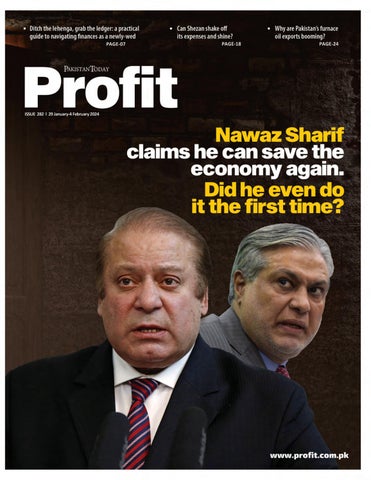
12 Nawaz Sharif claims he can save the economy again. Did he even do it the first time? 18 Can Shezan shake off its expenses and shine? 21 Clicks and confidence: the rise of women nano-influencers in Pakistan
18
22
24
23 Mr Chief Minister, please rest! Abdullah Niazi 24 Why are Pakistan’s furnace oil exports booming?
Profit
25 Collapsing sales? No problem; Honda carries the torch nine months into market year
Publishing Editor: Babar Nizami - Editor Multimedia: Umar Aziz Khan - Senior Editor: Abdullah Niazi Sub-Editor: Basit Munawar - Video Editors: Talha Farooqi | Fawad Shakeel Business Reporters: Daniyal Ahmad | Shahab Omer | Zain Naeem | Saneela Jawad | Ghulam Abbass | Ahmad Ahmadani Shehzad Paracha | Aziz Buneri | Nisma Riaz | Mariam Umar | Urooj Imran | Shahnawaz Ali | Meerub Amir Regional Heads of Marketing: Mudassir Alam (Khi) | Sohail Abbas (Lhe) | Malik Israr (Isb) Pakistan’s #1 business magazine - your go-to source for business, economic and financial news. Contact us: profit@pakistantoday.com.pk
Ditch the lehenga, grab the ledger: a practical guide to navigating finances as a newly-wed
Shaadi season may be over, but the post-wedding financial tango has just begun. Here’s how Pakistani couples are making their rupees waltz
I
By Saneela Jawad
n Pakistan, the whimsical notion of “Decemberistan” has taken root, revolving around the extravaganza of weddings. Whether you are the one getting married, or you are attending ceremonies for friends and family, December marks the peak of these joyous celebrations. A reprieve from the nuptial whirlwind is only granted until the onset of summer when the cycle recommences. The commitment to these weddings is not just emotional but also financial, as newly-wed couples and their families invest significant sums in creating memorable festivities. However, once the festivities conclude, the challenge shifts to managing finances and determining the fate of the salamis (gifts). The post-wedding financial puzzle can be perplexing, prompting individ-
PERSONAL FINANCE
uals to contemplate their next steps amidst the aftermath of the grand celebrations. Profit is here to help. We interviewed several newly-wed couples, of which five gave us extensive insight into their financial habits. Our research revealed a few underlying themes across the board. First, that all newlywed couples crave a financial partnership that balances long-term goals with spontaneous expenses. While joint accounts and dedicated savings are a popular option, most couples also appreciate the occasional splurge. Second, there is a clear split in how partners approach finances. Couples can either be a single-income household, or a double income household. Within double income households, husbands often take the lead on household expenses, while both partners contribute to savings, ensuring a secure future. We have included examples of both
scenarios in this story. Finally, all the couples who spoke to Profit thought that open communication is your secret weapon. All advised other newly-weds to discuss income, expenses, and financial goals honestly and regularly. This transparency builds trust and avoids surprises, leading to a smoother journey. While there are many ways one can go about it, here are some approaches being used by newly-weds.
Single-income households
S
ingle-income households are where one partner is the sole breadwinner. Couple A were married in December, and started their journey with the first step of prioritizing spending and savings. Essential running expenses like rent,
7
utilities, and groceries top the list. They allocate a pre-determined amount for groceries. Beyond necessities, Couple A prioritized paying off wedding-related loans through their salamis. They also used a portion of their salamis to diversify their personal investments, using some for highyield investments like property blockchain or mutual funds, and reserving some in a readily accessible savings account for emergencies. After savings, a fair amount is allocated for each spouse’s “pocket money,” allowing individual freedom to spend whatever they want for the month. Open communication about monthly earnings and total savings forms the cornerstone of Couple B’s financial strategy. Transparency reigns supreme for this husband. He keeps his wife fully informed about his monthly earnings and diligently tracks their growing savings, which reside entirely in her bank account. This “shared savings account” approach fosters trust and joint vision, ensuring both partners are aware of their financial standing and future goals. The discipline is clear – this account serves as a sanctuary for deposits, not withdrawals. The husband also contributes a portion of his salary regularly to his mother. Despite their generally mature financial approach, the couple acknowledged instances where decisions might not have been the most prudent. For instance, their salamis were spent on their honeymoon, which they recognize might not have been the most financially savvy decision. Still, Couple B believes in keeping each other informed and setting common goals in order to achieve financial harmony in a single-income household.
Double-income households
I
n Couple C, both partners are working professionals, but the couple decided only one partner would contribute to household expenses. This includes rent, utilities, groceries, and household essentials. Recognizing the importance of longterm planning, they dedicate 10-20% of their combined income to savings, aiming for a safety net and pursuing future goals. This strategy ensured both responsible spending and a steady nest egg for the future. Creating a realistic budget was key. They prioritize necessities like rent and food, but also factor in fun and leisure, striking a balance between responsible saving and enjoying life together. They closely track their spending, adjusting as needed to avoid impulsive purchases and stay on track. They adopted a “brick by brick” approach for their home. Instead of going
8
Stay flexible, adjust plans as needed, and allow your budget and goals to evolve with changing circumstances Advice from a newly-wed couple
all out immediately, they focused on adding essentials gradually, prioritizing practicality over extravagance. For larger expenses, they considered dipping into salamis, but ultimately allocated any remaining funds towards shared goals like vacations or additional savings. Sharing financial responsibility was central to their success. Couple C told Profit that the most important tip was to abandon the “hero mentality” and recognize that both of them contributed to the collective effort. “Stay flexible, adjust plans as needed, and allow your budget and goals to evolve with changing circumstances,” partner one of couple C said. Regular financial check-ins ensured they were on the same page and could address any emerging issues together. Couple D, who tied the knot recently, shared the importance of a financial buffer. Like some of the aforementioned couples, this duo also settled pre-wedding loans by utilizing their salamis. As both are working, they decided to contribute Rs 5,000 -10,000 each month in a joint account to save for emergency funds. A transparent budgeting strategy is in place, with Rs 30,000 allocated for essential household expenses, including maid services and groceries. This structured approach not only addresses immediate needs but also lays the foundation for long-term financial stability. The husband further stated that a significant portion of the salary, or Rs20,000 was saved, and supplemented by additional income from freelancing and sales commissions. The couple will be saving in foreign currency or investing in reliable sources once a substantial amount is accumulated. While managing household expenses and her own savings, this wife enjoys the freedom to personalize her financial goals. This balanced approach acknowledges individual aspirations while prioritizing joint stability. The husband’s job not only provides
medical coverage for both but also boasts a robust Provident Fund with flexible withdrawal options. Meanwhile, the other spouse directs their earnings towards personal savings, ensuring a dual-pronged approach to financial security. This adds another layer of security to their financial system. Another couple, Couple E, has a different approach. As both spouses are working, every payday the first step is to allocate a portion of each spouse’s salary to the joint account. This designated joint account becomes the bedrock for savings, emphasizing the importance of financial planning right from the outset. Following this allocation, the couple then utilizes one of the salaries to cover day-to-day expenses, including rent, bills, and personal spending. This method not only facilitates a clear delineation of responsibilities but also allows for a balanced and organized approach to managing the household’s financial affairs. After the primary salary is exhausted during the month, the couple seamlessly transitions to utilizing the second salary for any remaining expenses. What happens when they have any leftover funds at the end of the month? There are options: add them to the joint savings account for an extra financial upsurge, treat themselves to a surprise date night, or invest in personal development courses. Whether you’re a single-income or a double-income duo, remember that open communication is important. These are some model strategies that can be taken into consideration by newly-wed couples for a secure and prosperous future. Couples must shed the inhibitions surrounding money matters and establish clear financial goals. Laying out individual expenses, income sources, and existing debts creates transparency and fosters trust. Navigating finances can be daunting, but grab a cup of chai, take a deep breath, and step into your happily ever after, one budget at a time. n
PERSONAL FINANCE
OPINION
Syed Shabbir Uddin
Climate check: can Pakistan add more cars without impacting the environment?
The table below shows which country is dumping how many million tons of CO2 to add $1,000 in their GDPs. It shows that 47% of global CO2 is emitted by five countries - within our very neighborhood. Against the global emission of 0.28 ton CO2/$1k, these countries are dumping a staggering 0.45 ton of CO2/$1k. Pakistan is the clear victim in the region, producing a paltry 0.18 ton of CO2 / $1k.
An influx of 350,000 cars is expected every five years: here’s what we can do about it
I
n the intricate world of climate challenges, Pakistan faces a critical question: can the nation sustain an influx of 350,000 new cars every five years, especially when it stands as the eighth most vulnerable country to global warming? This question was asked by one of the readers of my opinion piece last week. Here is my take on the issue.
A climate reality
L
et’s start with a clear perspective: in the global climate narrative, Pakistan is more the victim than a perpetrator. The country contributes only 0.58% to global carbon emissions; yet it is surrounded by five top carbon (CO2) emitting countries that collectively contribute to 50% of the world’s total carbon emissions. Keep in mind that 91% of global CO2 emission is a result of large scale economic activities, mainly power generation, industrial combustion or transportation, in other words, to contribute to the GDP of respective countries. Data Source: European Commission’s Emissions Database for Global Atmospheric Research (2023)
Crunching the carbon numbers
The author has two decades of experience in the automotive industry. He can be contacted on the platform X, @Shabbir_uddin, or on LinkedIn: www.linkedin.com/ in/shabbiruddin
COMMENT
O
ur global standing notwithstanding, Pakistan’s carbon footprint is still growing. From 110 million million tons in 2000 to 216 million million tons in 2021 (a 3.3% compounded annual growth rate), Pakistan’s CO2 emissions are anticipated to reach 253 million million tons by 2030. Now, let’s delve into the numbers. According to the Statista Mobility Market Outlook report of January 2022, a typical B-segment passenger car (for example, Toyota Yaris or Suzuki Swift) releases around 1,470 kg of CO2/15,000km. Considering the usual mileage of 24,000km in Pakistan, the carbon impact is calculated at 2,352kg/year. The potential impact of 350,000 new cars hitting the roads every five years equals 0.823 million tons of CO2. This contributes 0.3% to the national carbon footprint.
9
Neutralizing the carbon footprint
S
o, what can be done about this? The US Department of Agriculture reported in 2015 that a mature tree absorbs 22kg of CO2 annually. So the nation requires 108 mature trees to neutralize the carbon footprint of one car. The quantum of 350,000 cars would require a massive plantation drive to plant 37.7 million trees. This is not very far fetched. As we talk about large scale forestation drives, the spotlight turns to government initiatives like the Billion Tree Tsunami started in 2014. The first phase of planting 1 billion trees was completed with over 35,000 hectares of land in KPK in
July 2018 at a cost of Rs 21 billion. The project was expanded into Ten Billion Tree Tsunami, a four year project scheduled to complete in 2023 with a total budget of Rs 125 billion. It was started in 2019, however as per the latest update on the website of the Ministry of Climate Change, there was a massive budget cut of 78% in fiscal year 2021. Hence, uncertainties linger, introducing a dimension of unpredictability in the environmental narrative. Still, even if the government initiative is in doldrums, I propose a shared responsibility. The cost of planting 108 trees per car is not more than Rs 50,000 per vehicle. Pakistan Automotive Manufactuerer’s Association (PAMA) should step forward towards an industry-wide initiative to plant trees, engaging
all vehicle manufacturers who have been in the industry for the past four decades.
Euro emission standards: a path to cleaner air
A
nother way of thinking about reducing our carbon footprint is to consider the cars currently on the road and whether they meet European emission standards. Euro 5 or 6 petrol cars emerge as the environmentally conscious choices, as they are 45% cleaner than their Euro 2 counterparts. Consider the list below. Only one vehicle in Pakistan comes with a Euro 6 engine, and it is of Chinese origin. Other Euro 5 engines are also of Chinese origin. Only one Korean model comes with a Euro 5 engine, the remaining Korean and Japanese models are Euro 4 or Euro 2. As cleaner fuel is now widely available in the country there is no excuse for auto manufacturers to resist emission regulations. It’s high time the government should take a structured approach to phase out any vehicle below Euro 4 emission standard.
In conclusion
A
s we think about climate changes, adding 350,000 cars every five years in Pakistan might seem like a small thing compared to the big pollution from neighboring countries. To consider: making more cars to meet demand might cause some environmental problems, but it also creates new jobs and helps the economy grow – especially when over 45% of car prices goes directly to the national exchequer. It is a careful balancing act between taking care of the environment and growing the economy. But there are some steps we can take, as I have outlined above, to mitigate the impact of growth in cars.
10
COMMENT
12
COVER STORY
By Abdullah Niazi
T
here was some sense of trepidation heading into the 2013 elections. The country was at a point of economic implosion. The PPP government was leaving behind a huge crisis in terms of swelling domestic debt, the energy crisis had crippled major export oriented industries, and a new political force in the shape of the PTI was emerging to challenge Pakistan’s political status quo. Who would take Pakistan out of this crisis? At the time, Mian Nawaz Sharif claimed he was the man for the job. The Sharif Patriarch claimed to have experience in government and a proven track record as an efficient administrator, promising to provide business-friendly economic policies and solutions to the country’s energy crisis. The economy-first approach worked and the league rode into power on the back of a massive majority and established governments in Punjab and Balochistan as well as the centre. More than a decade later Mian Nawaz and his party stand at a similar crossroads. Inflation is hitting record highs, reserves are in the dumps, exports have fallen, and the value of the rupee is at its lowest in history. The former three-time prime minister claims he is the man for the job once again. But the country he aims to govern is starkly different from the one he took over in 2013 and left in 2019. For starters, he does not have the popular support he once did. The way his legal problems have fallen like dominos makes it seem like he has once again cosied up with the corridors of power. His messaging has been mixed, focusing less on the country’s grave issues and more on his own personal grievances. Vengeful and uninterested in grassroots politics, the one thing Mian Nawaz is still trying to capitalise on is his supposed reputation as an economic administrator. The reality is not so simple. The PML-N continues to claim that their time in government was a golden period for Pakistan economically — an era that can be repeated if Mr Sharif is brought back to power. Economists, politicians, and experts are all in agreement however. The 2013-18 government was neither better nor worse than previous or future ones. It was very much business as usual except on a number of issues the League got incredibly lucky. To understand this, Profit zooms in on Pakistan’s economy from 2013-18.
14
So who wants to be finance minister?
Y
ou’ve got to hand it to the PML-N, at least they know who their finance minister is going to be. Ishaq Dar has held the office of finance minister four times in his political career, making him the most prolific holder of what some consider the second most important role in the federal government. And it is no secret that if the Pakistan Muslim League-Nawaz (PML-N) manages to form a government after the elections on the 8th of February, he is slated to take charge of Q-block for a record fifth stint. Compare that with the two other major parties in the country. Both the PPP and the PTI have a distinct lack of economic leadership. Look at it this way. After the 2008 elections when the PPP came to power they first formed a government with the PML-N as a coalition partner. Even in this scenario the League insisted on having Ishaq Dar as finance minister. When the PML-N split away and sat on the opposition benches, the PPP propped up Naveed Qamar as a finance guru which ended up being an experiment that didn’t last a year. Eventually, the PPP appointed the non-political Abdul Hafeez Sheikh as finance minister and then Shaukat Tarin to follow him. The PTI is not much better in how uninspired their economic leadership has been. Imran Khan’s party had for a long time touted Asad Umar, the former CEO of Engro, as their finance whizz. While Mr Umar took office immediately after the PTI came to power, this was also a disastrous experiment. Not only did he end up resigning, the PTI also decided to go the route of appointing non-political finance ministers. And as we now know, the lack of creativity was so strong that they also picked Abdul Hafeez Sheikh and Shuakat Tarin as finance ministers. In this regard the PML-N is at least ahead of their competitors. Say what you will about Ishaq Dar, at least his party knows who their finance guy is. The senator might be a confounding man, but you know exactly what his role in the PML-N is. Except even within the PML-N he is difficult to categorise. His political party by all accounts is a centre-right political party with a conservative, business-friendly, strictly capitalist fiscal ideology. Yet despite these credentials he is also incredibly statist in his management of the economy. Senator Dar believes it is for the government to not just manage but micromanage the economy. In this approach he has found many detractors including from within the PML-N. But that doesn’t seem to have made a differ-
ence. Economists and free market proponents might abhor his disciplinarian inclinations, but as party insiders have told Profit, Mr Dar holds sway where it really matters.
The Dar approach
S
o what has the contradictory Dar’s track-record been in managing the economy? While he has had more than a few stints at the job, his longest and most sustained run was from 2013-17. This is when Darnomics took root. But what exactly does this mean? “What we call Darnomics is a fairly widely held view on how the economy should be managed in Pakistan. Dar is just the most public figure that espouses this point of view but he’s not the only one. The entire political elite of the country all hold these views. And the view is that the government should have a role in just about every economic decision being made in the country whether that is setting or monitoring prices. Being answerable to the government is at the heart of it,” explains senior analyst Khuram Husain. What we call Darnomics is essentially a top-down approach where those in power feel that the free market is not quite trustworthy and believe the government should interfere at all points possible to ensure efficiency.This was the approach that Dar brought to the job. In 2013, Pakistan was facing a serious debt problem. From 2008 to 2013, the total government debt increased by over 135pc, going from Rs6,435 billion to Rs 15,096 billion. As a percentage of the GDP, the total government debt increased by 4.4 percentage points, going from 62.8pc to 67.2pc during this period. Before this the PPP government had also had to rely on an IMF programme. “It was under this crisis that the PML-N took over the reins of the economy in 2013 and, much like the PPP, it had to seek a bailout from the IMF soon after coming to power,” writes economist Uzair Younus. “It faced issues like those faced by the PPP: chronic power shortages, lack of sufficient financial resources, oil prices that remained high at over $100 a barrel and the rate of inflation hovering around 10pc per year.” But there was also a lot for Dar and the League to work with. “The silver lining was that the PPP’s borrowing policy relied more on domestic than external borrowing. Much of this had to do with the prevalent economic conditions around the world, where the Great Recession significantly reduced the ability of economies like Pakistan to borrow money from the international bond market. This meant that the total government external debt increased by only 22pc between 2008 to 2013, going from $42.8 billion to $52.4 billion,” Younus writes in an earlier article.
What we call Darnomics is a fairly widely held view on how the economy should be managed in Pakistan. Dar is just the most public figure that espouses this point of view but he’s not the only one. The entire political elite of the country all hold these views. And the view is that the government should have a role in just about every economic decision being made in the country whether that is setting or monitoring prices. Being answerable to the government is at the heart of it Khuram Husain, senior journalist
This would mean that with the right mix of borrowing and spending, Pakistan’s reserves could rise, inflation could fall, and exports could increase. Dar’s immediate priority became securing loans from multiple bilateral partners. The last time Pakistan had been in such a predicament was the 2002 economic crisis when General Musharaf had just taken over. Back then, however, Pakistan had generous offers of debt restructuring from the Paris Club and a steady flow of military aid coming in from the US thanks to the war on terror. The PML-N had to rely on countries like Saudi Arabia, China, rather than on aid and institutions like the World Bank or the ADB. At the same time, Dar also went on a crusade to try and control all aspects of the economy. One of Dar’s most contentious decisions was the imposition of withholding tax on withdrawal of cash from bank accounts. It led to a crisis of deposits and the percentage of total deposits declined from 27.6 to 25 percent right after it was introduced. Pakistan was in a serious balance of payments crisis in 2009 when the current account deficit was as high as 5.5 percent of GDP. But the PML-N was fortunate to get Generalised Scheme of Preferences Plus status in 2013 and managed to bring down the trade and current account deficits. All of this managed to help the PML-N in stabilising the economy to a great extent. Just look at the indicators. From 2013 to 2017 Pakistan’s foreign exchange reserves rose from $6 billion to $16.2 billion. The FBR was also given a lot of power which resulted in the tax to GDP ratio rising from 8.7% to 10.5%.
Just a stroke of luck?
O
ne thing is very clear. The PML-N promised growth and they delivered it by and large. Inflation was on average 12% between 2008-13. By Dar’s four year mark in 2017 it had dropped
to around 5% while the volume of Pakistan’s economy surpassed $300 billion. On top of this energy reforms had been very seriously undertaken. In 2013 the country faced a power deficit of 5,500MW and its industrial and urban sectors were facing 12 hours load shedding, while the rural areas faced 14 hours power outage leading to low industrial output, higher unemployment and loss of economic growth. The PML-N government changed the strategy in 2014 by improving cash flows, optimising generation, having predictable load management, better customer service and investment facilitation. It led to record high recoveries of Rs 51b or 93.40 per cent; highest in past 10 years. The transmission and distribution losses were cut down to 10b, or 18 percent; the lowest in the past 10 years. The circular debt had also been effectively capped. By 2018,10,000 MW of additional electricity had become part of the national grid. The government also spent lavishly on infrastructure, work was in progress on 13 motorway projects in the first few years of this government. In 2013 the length of the motorway in the country was 580 km, and by 2018 it would be extended to 1800 km. The resulting economic activity from this also helped with inflation and unemployment. But what was the trick to this growth? Ask the experts and they will tell you a lot of it was pure dumb luck. “Two things, however, worked greatly in its favour later: by 2015, international oil prices had fallen dramatically, going below $50 a barrel. Secondly, at that time, the world was awash in liquidity as record-low interest rates and quantitative easing (essentially the printing of money) in the US, Europe and Japan led to a reach for yield in the international bond market. This meant that countries like Pakistan could borrow money at low interest rates,” explains Uzair Younus. And since Pakistan was planning on
building a lot of mega infrastructure projects, the low interest rates were greatly beneficial for Pakistan. “The league definitely got lucky. The year 2014 is when oil prices plummeted after going to record highs in late 2007 well over $100 a barrel. These guys reaped that bonanza. Energy importers are a big component. And this was also the time when China went all in on the belt and road initiative which had nothing to do with the Pakistani government of the time,” explains Khuram Husain.
The flip side
O
f course, there is a flip side to all of this. The growth and infrastructure development that the PML-N have made a cornerstone of their messaging for this election as well was all built on a lie. You see Pakistan in the 2013-17 period had a golden opportunity. Interest rates were low, the price of oil was in the dumps, and there was an opportunity to stabilise the economy once and for all. Helped by low international oil prices and boosted by the start of work on the $56bn China Pakistan Economic Corridor (CPEC), economic growth stood at close to 6% its highest level in 13 years, taking the gross domestic product to an estimated $297bn this year. The only problem was that instead of consolidating at this time, Dar and the PML-N focused on growing the economy through a consumption led approach. It was the same thing that happened in the Musharaf era and it is the same thing that has happened time and again in Pakistan’s economic history. Most of the growth was led by government spending on development projects, which raised problems of long-term sustainability. Pakistani exports dropped from $25bn in 2013 to $22bn in 2017, according to central bank data, stretching Pakistan’s foreign exchange reserves and putting further stress on the country’s current account deficit. By the time Nawaz Sharif was ousted
COVER STORY
It was under this crisis that the PML-N took over the reins of the economy in 2013 and, much like the PPP, it had to seek a bailout from the IMF soon after coming to power. It faced issues like those faced by the PPP: chronic power shortages, lack of sufficient financial resources, oil prices that remained high at over $100 a barrel and the rate of inflation hovering around 10pc per year Uzair Younus, economist
by a judicial order in 2017 and Shahid Khaqan Abbasi and Miftah Ismail took over, the chickens were coming home to roost. Inflation was rising and the government needed to borrow more money to pay back its debt. From
The PML-N took on more debt in the 2013-18 period. The PTI took even more than that. The PDM outdid even them in a year, and I can guarantee unless there are serious reforms the next government will take even more than that Miftah Ismail, former finance minister
16
July to October of 2017 alone, the federal government has obtained $2.3 billion in foreign loans, including $1.02 billion in commercial loans. The country’s official foreign currency reserves, which peaked to $19 billion, slid on the back of foreign borrowings to $13.54 billion as of November 17, barely enough to finance two-and-a-half months of imports. A big reason for this was Dar’s insistence on pumping the market with dollars to keep the value of the rupee high. This of course caused the economy to start becoming a bubble. Because the rupee was overvalued, people went crazy on importing and the consumption led growth continued leading to a classic case of overheating. The only recourse was going to be a sudden correction, decrease in imports, a slowdown in economic activity and eventually an implosion. “The bilateral debt increased during Noon’s time but that is because we need to make many payments and give a lot of interest. There are deficits that need to be completed through that. Ever since the NFC awards, this was always going to be the case. The PML-N took on more debt in the 2013-18 period. The PTI took even more than that. The PDM outdid even them in a year, and I can guarantee unless there are serious reforms the next government will take even more than that,” explains former finance minister Miftah Ismail, who was at the helm of affairs at the tail end of the PML-N government of that period. “During the early years the PML-N did get lucky but the luck could have been anybody’s. The important thing then and the important thing now are reforms. Pakistan’s entire system of governance and economic management is broken. Its very foundations are weak and crumbling. That means making sure we make moves that we can realistically implement and cut down on our spending.” He is pointing of course towards the same old issue of consumption led growth and its eventual consequences. During the
2013-17 period, there could have been much done. As Khuram Husain points out, just the issue of circular debt could have been nipped in the bud by focusing on stopping losses and reforming DISCOs. Instead, they set up more power plants and built highways that were going to be of very little use. “There was no need for superhighways for example. That money could be spent on a lot of other things but what they did build was unnecessary. Urban transit is one thing but these highways are absolutely something else.”
Nothing new nothing different
T
he PML-N’s economic management from 2013-18 is not the flex they might want most to think. While they might have some numbers to show in terms of growth, the reality remains that this period was more than anything else an opportunity squandered. What is worse is that if the League comes into power again, one can expect more of the same particularly with Ishaq Dar in charge. One former finance minister who spoke to Profit on the condition of anonymity said that on some matters Dar would even override Nawaz Sharif on matters of the economy. “Sharif himself was very pro market and wanted to float the dollar as far as we know. Dar was the one that was not and he was essentially running the economy. He stopped rebates, and gave the FBR a lot of authority. The worst part was buying dollars and selling in the market. In the last 11 months he threw so many dollars in the market it was criminal. Everything else was ok but doing this to sustain the current deficit was wrong.” And that is the crux of the matter. The PML-N’s time in power from 2013-18 was not the worst time for Pakistan. Part of that was because the international market was in a steady place and Pakistan’s trade partners n
TEXTILES COVER STORY
Can Shezan shake off its expenses and shine? Quarterly sales rise, but high finance costs cast a shadow on Pakistan’s beloved juice maker
I
By Saneela Jawad
n the midst of economic challenges, Shezan International Limited, a prominent player in Pakistan's food and beverage sector, released their quarterly report ending in September 2023. The company appears to be navigating through a transformative phase, as it has seen an upward trajectory in its sales. However, it has been facing challenges in maintaining a robust net profit due to a notable increase in indirect costs, particularly finance costs. Why is that the case? Profit finds out. First, some quick history: established in 1964 as a joint venture between the Shahnawaz
18
Group in Pakistan and the Alliance Industrial Development Corporation in the United States, Shezan International Limited has evolved into a recognized food brand celebrated for its quality. Headquartered in Lahore, Pakistan, and belonging to the Shahnawaz Group, Shezan stands as a prominent figure in the country's food and beverage sector, publicly traded on the Pakistan Stock Exchange. The company is renowned for its flagship product, the 'Shezan Mango' juice, which is an impulse buy at schools, canteens, and markets. Shezan expanded operations in 1981 with a unit in Karachi, established a bottle filling plant in 1983, and opened an independent Tetra Brik plant in 1987. In 1990, the company
inaugurated a juice factory in Hattar, Khyber Pakhtunkhwa, reinforcing its commitment to meeting both domestic and international market demands. Shezan then diversified its product range to include soft drinks, juices, ketchups, and jams. Notably, Shezan holds the distinction of being Pakistan's largest mango grower, with an impactful workforce of around 1,000 individuals.
The annual figures
A
s outlined in its annual report for the year 2023, Shezan has faced economic downturns, regulatory changes such as the imposition of
excise duty, and inflationary trends. The annual sales trajectory reflects a positive trend, standing at Rs 7.7 billion in 2019 with a slight dip to Rs 6.6 billion in 2021, and then rising to Rs 8.7 billion in 2023. Notably, the gross profit increased from Rs 1.5 billion in 2019 to Rs 2 billion in 2023. The gross profit margin has improved over the years, from 19.9% in 2019 to 23.8% in 2023. The operating profit doubled from Rs 220 million to Rs 450 million during the same period, demonstrating improved control over administrative and sales costs, leading to an increased operating profit margin from 2.86% to 5.16%. However, the concerning aspect arises from the net profit. The company saw a profit of Rs 113 million in 2019, but then experienced a significant downturn in 2020, resulting in a loss of Rs 235 million. While recovery was witnessed in 2021 and 2022 with Rs 123 million and Rs 80 million respectively, there still seems
to be a low net profit of Rs 38 million in 2023. The finance cost continues to be a pressing issue, with costs increasing every year from Rs 68 million in 2019 to Rs 280 million by 2023. The net profit margin dwindled from 1.5% in 2019 to 0.4% in 2023, which indicates the adverse impact of rising finance costs on overall profitability. In order to address the challenge of increasing finance costs and ensure sustained profitability, Shezan needs to control indirect costs, which is the total of administration costs and the distribution expenses, particularly those that cannot be recovered from sales. According to the director’s report, the fiscal year 2023 was a challenging one which contributed to the low net profit and sales. “Pakistan faced import restrictions, rupee devaluation, higher financing costs, expensive energy, and domestic economic and political instability contributed to this downturn. The imposition of a 10% Federal Excise Duty on sugary fruit
juices, later increased to 20%, raised concerns about its impact on consumer purchasing power and the potential shutdown of juice manufacturing companies. The finance cost of the working capital component surged due to an 825 basis point upward revision in policy rates, reaching a cumulative 2200 basis points.” Not only that, the nationa’s average inflation rate hit 30%, which affects consumer buying power. Various factors, including market slowness, increased prices of key raw materials, high payroll expenses, flooding, and rising costs of fuel and utilities, negatively impacted profitability. To mitigate the impact of this, the company was forced to enforce price rationalization – which means the rationalization of business costs, as the reduction in artificially inflated prices leads to lower input costs for the business – negatively affecting sales volumes
Quarterly sales
B
etween 2021 to 2023, Shezan International Limited experienced a notable decrease in sales during the second quarters, ending in December. This pattern is attributed to the winter season when their popular selling products, such as bottled juices and tetrapaks, witness a decline in consumer demand as people tend to purchase these items less frequently in colder weather. Conversely, during the quarters ending in March, June, and to some extent in September, there is an observable upward trend in sales. This uptick can be attributed to more favorable weather conditions, which tend to stimulate demand for Shezan's products, showcasing a correlation between seasonal variations and consumer purchasing patterns. This further reveals the cyclical nature of Shezan's sales, with the fourth quarter of 2022 (ending June 2022) boasting the highest sales at Rs 3.1 billion, and the second quarter of 2021 (ending December 2020) recording the lowest at Rs 905 million. The most recent quarter ending in September 2023 saw sales of Rs 2.1 billion, indicating a consistent pattern of sales increase in the third and fourth quarter, followed by a decline in the first quarter and the lowest point in the second quarter. The company had the lowest gross profit in the second quarter of 2021 of around Rs 161 million, and the highest in the last quarter of 2022 in June with Rs 674 million. Still, the company made an overall loss in these quarters, because of an increase in indirect expenses. The losses were Rs 45 million in 2021 and Rs 1 million in 2022. Similarly in the recent quarterly report, the company made an overall loss of around Rs 28 million due to a decrease in sales of Rs 2.1
COMPANIES
billion, as compared to the previous quarter of Rs 2.4 billion. In order to maintain a noticeable net profit, the company needs to maintain a gross profit margin of about 24% or above, and decrease indirect expenses. The company in their report has also expressed a keen interest in expanding its
20
presence in the global market, with a specific emphasis on export growth. The company's products, including juices, are identified as having growth potential in countries such as the United Arab Emirates, United Kingdom, Saudi Arabia, and the United States of America. As Shezan strives to secure a stable financial footing amid economic downturns and
regulatory changes, the road ahead demands strategic decisions. While the company has witnessed positive trends in annual sales and profitability, the impact of rising finance costs poses a significant challenge. The cyclicality of Shezan's sales, influenced by seasonal variations, emphasizes the need for adaptive strategies. n
COMPANIES
Clicks and confidence
the rise of women nano-influencers in Pakistan
Platforms like CIRCLE and Walee Pakistan are helping budding nano-influencers, as women smash stereotypes and build businesses from their homes
I
By Saneela Jawad
n Pakistan, where smartphones light up villages and megacities alike, a revolution is brewing under the glow of social media screens. Women, long confined by tradition and limited access, are breaking free: specifically, through the curated realms of Instagram and TikTok. These are the nano and micro-influencers, and they’re rewriting the script of what it means to be a woman in Pakistan. Programs like the Nano Influencer Academy by the CIRCLE Association, and platforms like Walee Pakistan, now encourage influencers to be a part of the working community in Pakistan. These influencers are trained to build businesses, challenge stereotypes, and shape the future of their communities – all from the comfort of their homes. This is their story, a story of pixels and progress, of clicks and confidence, where Pakistani women are finally taking the helm, one tap at a time.
Refining social media influencer marketing
S
o who is a nano-influencer? These are content creators with a following between 1,000 and 10,000 who are becoming widely popular, as small businesses are emerging and looking for content creators
PEOPLE
with highly engaged social media following. Those influencers have already learned to craft compelling content, navigate brand collaborations, and build their brand. But they still need that extra help to make money off of their ‘brand’. That is where platforms like Walee Pakistan and the CIRCLE Association come in to equip aspiring female influencers with the tools to build a sustainable income from this digital stage. Founded in 2018, CIRCLE Women Association has pursued its mission of empowering one million women through digital literacy, financial inclusion, and entrepreneurial skills. Recognizing the transformative potential of the digital realm, they launched the innovative Nano Influencer Academy for Women in September 2023. This is a customized, hands-on training curriculum, spanning over 18 hours of basic training and 6-week advanced training, and is part of their Digital Literacy Program. It helps low-income women with the compass they need to navigate online platforms, understand digital tools, and harness the internet’s power for personal and professional growth. Delivered in Urdu and complemented by online engagement and WhatsApp groups, the program ensures accessibility and fosters a supportive community. “L’Oreal Women’s initial funding ignited the program, but sustainable funding is crucial for expansion. By building relationships with
participants and fostering a supportive ecosystem, the academy aims to secure partnerships and adapt to evolving technology, ensuring continued growth and wider outreach,” said CIRCLE Founder and CEO Sadaffe Abid. The four-day training program lays the foundation for economic empowerment. Women learn the intricacies of content creation, influencer marketing strategies, and affiliate marketing, equipping them to monetize their social media presence. From brand pitching to building personal brands, the Academy opens doors to financial independence and entrepreneurial ventures. Women learn to build small businesses and personal brands, driving economic growth at both individual and community levels. Mobility limitations that may have previously restricted their options become irrelevant in the virtual world. The impact transcends individual success. These women become role models, challenging traditional gender roles and inspiring others to participate in the digital labour market. Beyond passive participation, the Nano Influencer training academy fosters entrepreneurial spirit. Similarly, Walee is a platform with over 150,000 registrations and a unique focus on amplifying brands’ voices while empowering creators. More than just a bridge between brands and consumers, Walee has grown into a comprehensive ecosystem for digital content and
21
social commerce, serving campaigns across 10 countries. But in Pakistan, where traditional employment can pose unique challenges for women, influencer marketing shines as a beacon of opportunity. The flexibility and income potential of home-based work like this resonates deeply with women seeking economic independence. According to Walee Pakistan’s influencer industry report 2021-2022, the influencer landscape is undergoing a shift, with micro- and nano-influencers gaining prominence. Their smaller followings translate to higher engagement rates and niche expertise, attracting brands looking for authentic connections. Video content is at the forefront, with platforms like TikTok and Instagram Reels driving influencer partnerships. Brands are increasingly focusing on local languages and cultural nuances, recognizing the importance of tailored campaigns for specific audiences. Data-driven influencer selection is on the rise, as metrics like engagement, affinity, and reach become crucial. Simultaneously, influencers and brands are adapting to evolving regulations, prioritizing transparency in paid partnerships. Ali Imran Memon, senior vice president creator media and marketing at Walee stated that the company recognised this trend and has been supporting women influencers. In fact, Walee’s data revealed that 62% of their platform’s profiles belong to women. “This isn’t just a reflection of the global ‘femfluencer’ (female influencer) surge, which sees 84% of sponsored Instagram posts coming from women; it’s a deliberate choice by Walee to tap into a powerful market driving force,” Memon told Profit. “The rise of micro-influencers with highly engaged niche audiences presents another exciting opportunity. Walee recognizes the potential of “Go Big” strategies that utilize diverse micro-influencers across demographics and regions for wider reach and deeper impact.” Walee emphasizes the importance of “adapting to evolving regulations, embracing new technologies like e-commerce integration and video content creation, carving out specialized niches, and making data-driven influencer selections”. Women who can embrace these trends, excel in metric-driven performance, and navigate the changing landscape have the potential to truly own this space. Walee, similar to the CIRCLE Association, has a range of initiatives, such as the Digital Literacy Program, She Loves Tech, Digital Agent Program and Elevate. These various initiatives encompass performance training programs, coaching, work opportunities, collaborations, and transparent payment systems. They help influencers refine their content and maximize campaign outcomes. “Walee’s vision goes beyond audience monetization, we offer training on diverse income streams like photography and social media
22
Sadaffe Abid, CEO and Founder CIRCLE Association
Ali Imran Memon, SVP Creator Media & Marketing at Walee Pakistan
management,” Memon said. Walee also started the Creator’s Academy, which featured content targeted to aspiring creators learning from each other, and growing their business and influence efficiently. The first season featured established creators like Hamza Bhatti and Muzamil Hasan, demonstrating their dedication to fostering a healthy ecosystem. The second season of the Academy promises even greater support, and features 36 influencers who will share their journeys and hacks to tackle content and platforms.
practices and gaining access to further opportunities, these women have made their mark in the industry already. Walee’s Creator Academy generated over 2.5 million views on their social media platforms for their first season. In 2023, the platform partnered with the Bill & Melinda Gates Foundation and Influencers of Pakistan to train 150 women influencers and onboard 20 women-led SMEs through “Power of Influence’’ workshops. Founder and CEO of Walee Pakistan, Ahsan Tahir applauded CIRCLE’s initiative and said, “Platforms like the ‘Nano Influencer Academy for Women,’ are recognizing the significant impact such programs can have on social inclusion and economic growth. They actively seek collaboration with similar initiatives, understanding the immense potential within this space.”
Results so far
T
he Nano Influencer Training Academy has completed three cohorts of the four-day training program, with participants in Lahore and Skardu experiencing noticeable changes. “Online engagement and follower growth are rising, a testament to the program’s effectiveness in helping women build their online presence. Two participants even received interview invitations to share their stories, while another attracted the interest of a PR agency, opening doors to future collaborations,” Abid emphasized. These seemingly small wins hold immense significance. For participants facing economic hardship and limited digital knowledge, these initial successes are powerful motivators. Abid further told Profit that one of the students from a cohort was a jewelry maker who successfully integrated personal branding into her business is a prime example of the success of the program. “By utilizing social media strategies learned at the academy, she’s reached new audiences and showcased her work at exhibitions, paving the way for business growth,” Abid said, adding that measuring the program’s full impact is still in its early stages. With the four-month tracking period yet to be completed, the long-term effects remain to be seen. These success stories, however, paint a promising picture. It offers a glimpse into a future where social media becomes not just a platform for entertainment, but a powerful tool for economic empowerment. Similarly, the success stories of micro-influencers who have thrived under Walee’s guidance speak volumes. From securing their first paid brand collaborations to mastering industry
What does the future look like for these influencers and platforms?
C
IRCLE academy’s impact shines through in the improved online presence and the growing recognition its graduates experience. While small-scale, these achievements hold weight. The organization now aims to reach more women, such as in new districts in Gilgit-Baltistan and eventually major cities in Pakistan. However, the focus remains on low-income women, both within existing project communities and new areas. “To maximize reach and inclusivity, exploring an online version of the program is also on the table,” Abid told Profit. Similarly, Walee Pakistan is also anticipating a rise in popularity driven by micro- and nano-influencers, whose historically higher engagement rates are a magnet for brands. But sustainability goes beyond mere expansion. It’s about creating an ecosystem where successful influencers thrive. Increased internet penetration and smartphone adoption in Pakistan have created fertile ground for this dynamic market, but the journey toward a truly inclusive digital landscape is still in its early chapters. But these influencers are all armed to make a change in the future and claim their place in the digital era. n
PEOPLE
OPINION
Abdullah Niazi
Mr Chief Minister, please rest!
massive flyovers and underpasses worth billions of rupees aimed at making the tiring commute of motorists heading to defence signal-free. His commitment has been so unparalleled that even after his constitutionally mandated 90 days were up, he wordlessly continues to serve as Chief Minister of Punjab. In fact, the CM extraordinaire has now been in charge for just over a year. That is a longer stint in power than both Pervez Elahi and Hamza Shehbaz combined. And now it seems he has found a new mission in life as well. Mr Naqvi has graciously accepted the post of chairman of the Pakistan Cricket Board (PCB). One would do well to remember that there is a lot to the job of PCB Chairman. Unlike being a caretaker CM, it actually involves some sense of manow much can one man really do? How many fires agement skill and business acumen. People don’t quite realise can a single public servant put out? How many that the chairman of the cricket board’s primary responsibility broken institutions can be made thriving by the is to make sure the PCB is thriving and profitable. singular force of will of one person? Of course, Mr Naqvi would feel well qualified for this. And perhaps more importantly, what is the For starters, he is a media tycoon. And really, how different cost of such dedication? can running a local-news empire be from being the head One cannot quite help but feel afraid for Mohsin Naqvi because honcho of the largest sport in the country really be? On top of just how much he is taking on. Afraid for his health, afraid for his of this there is some precedent to a former caretaker CM of sanity, afraid for his being. The gentleman Chief Minister had selfPunjab becoming Chairman of the PCB. In fact, Najam Sethi lessly taken charge of Punjab at a time when the province had become has had four goes at the chairmanship since stepping down as the object of a mean tug-of-war between the PTI and the PML-N. caretaker CM in 2013. Although to be very fair, Mr Sethi only Not only did the man take over the mantle of the Chief Ministership was CM for 90 days and he also took the job at the PCB after he has gone above and beyond his duty. Mr Naqvi had come in for a stepping down as CM. mere 90 days. In that time he was supposed to conduct elections, cut Besides, if anyone is concerned about Mohsin Naqvi a few ribbons, maybe get the odd favour done for a second-cousin and being CM and PCB chairman then they shouldn’t worry. The try to sit in his chair and watch the province not burn to the ground. overlap will barely be for a week or so. One might even say Mr Instead he answered this call to public service with a resolve Naqvi doesn’t want to waste even a single day between jobs so far greater than the constitution recommends. Not only has he been thought he’d get started a bit early. In any case, there is precbusy visiting hospitals, chairing meetings, and unveiling plaques but edent for holding high office and also running cricket in the he has also been showering Lahore with artificial rain and approving country. After all, the late Field Marshal Ayub Khan was both Army Chief and President of Pakistan when he was chairman of the then Board of Control for Cricket in Pakistan (BCCP) from 1958-1960 before handing it over to Justice Cornellius. The late Chief Justice thankfully didn’t take the job while he writer is senior editor at was still the country’s premiere judge, but he did take up the appointment the very next month after Profit. He can be reached his retirement. at abdullah.niazi@ All this precedent aside, one worries for Mohsin Naqvi. He has taken on so much in such little pakistantody.com.pk time. A difficult turn is coming for Pakistan Cricket as it is. The franchise fees of PSL teams will be up for negotiation, there are concerns regarding how much money the ICC will give Pakistan this year, and we are supposed to host the ICC Champions Trophy in 2025. How much can this one man really do? We implore you Mr Chief Minister. Please give it a rest. For your own sake if nothing else. n
Mohsin Naqvi is a one-man army. Should we not have some sympathy for this overworked hero and relieve some of his burdens?
H
COMMENT
23
Why are Pakistan’s furnace oil exports booming? Halfway into the year, Pakistan’s 6MFY24 furnace oil exports outstrip all of fiscal year 2023’s numbers By Daniyal Ahmad
P
akistan is witnessing a historic surge in its exports of furnace oil — or fuel oil, as it is also known. The first half of the fiscal year 2024 has already eclipsed the total volume exported in the entirety of the previous fiscal year. What is behind this phenomenon? The answer lies within the evolving preferences of power plants, which have pivoted towards more cost-effective and efficient alternatives, leaving the once-dominant furnace oil plants languishing in their wake. In the six-month period spanning from July to December 2023, Pakistan has dispatched a mind-boggling 433,945 metric tons of furnace oil to foreign shores. This figure utterly overshadows the 276,979 metric tons it exported throughout the entire fiscal year of 2023 — from July 2022 to June 2023. This staggering quantity also signifies the zenith of furnace oil exports in the annals of Pakistan’s history. So, one might ask — what precisely is going on? The first thing at play is Pakistan’s plummeting electricity generation is in freefall. The most recent example being December’s generation output being the nadir since December 2017. The most recent manifestation of this decline was in December, when generation output hit its lowest point since the same month in 2017. This downturn has led to a multitude of power plants lying idle, particularly those at the lower end of the National Transmission & Despatch Company’s merit order. The plants operating on furnace oil — colloquially known as residual fuel oil (RFO) plants — languish at the very bottom of the merit order. “The low priority and merit order list stipulates that the low or no furnace oil consumption trend in Pakistan will persist in the future,” clarifies Aftab Hussain, Director and former Managing Director & CEO at Pakistan Refinery. The reason for their relegation to the bottom? Their cost of electricity generation dwarfs that of other alternatives. “RFO plants generate electricity at a rate of Rs 38/kWh, in stark contrast to the reliqui-
24
fied natural gas plants which operate at Rs 26/ kWh, and the coal plants that generate electricity at Rs 17/kWh and Rs 12/kWh, contingent on whether they utilise imported or local coal,” expounds Mohammad Aitazaz Farooqui, the Head of Research at Providus Capital. “The RFO plants had a paltry share of 2.4% across the calendar year 2023 due to their exorbitant costs. Their current Rs 38/kWh is a staggering increase from the 26/kWh from December 2022,” adds Faizan Kamran Khan, the Chief Executive Officer at FRIM Ventures. Pakistan also harbours long-term plans to phase out furnace oil altogether, with initiatives such as the Indicative Generation Capacity Expansion Plan 2022-31. This is further bolstered by the burgeoning interest in Thar-based power plants that Pakistan has witnessed of late. “The influx of new nuclear plants, and coal plants such as Thal Nova, Shanghai Powergen, and Thar Energy have further diminished the appeal of RFO plants,” asserts Kamran. Currently, there is a dearth of data regarding the final destinations for Pakistan’s furnace oil, and the foreign exchange it’s accruing. However, the numbers are likely to be trifling — that is, if they exist at all. Furnace oil is a low to negative margin product for local refineries. Its survival is solely due to it being an unavoidable byproduct of refining crude oil at a refinery. Modern refineries across
the globe produce minimal to no furnace oil, however, refineries in Pakistan are yet to attain such technological prowess. At best, it is a nuisance. At worst, it obstructs storage facilities and compels refineries to find a means to discard it before they can resume refining crude oil. The cost of transporting the furnace oil also contributes to the loss in some instances. “The export of furnace oil is the last resort for the refineries to operate and safeguard their refinery margins from motor spirit and high speed diesel production until their upgrade projects materialise in the coming six years period as per the Refinery Policy (2023/4),” adds Hussain. The only deviations to the continuous increases in export are likely to be the sporadic resurgence of local demand, particularly when other sources of fuel are incapable of meeting demand or on the rare occasion that Pakistan’s electricity demand spikes to levels closer to its total installed capacity. Read more: Refineries halt fuel oil exports amid rising local demand, energy shortages “Ephemeral surges in local demand may materialise under the influence of seasonal variations or extraordinary events, yet its persistence and sustainability remain dubious. It’s akin to the annual canal cleaning ritual that occurs in January and February,” Hussain muses. n
ENERGY
Collapsing sales? No problem; Honda carries the torch nine months into market year
Honda’s gross and net profit margins rise despite collapse in sales revenue By Daniyal Ahmad
H
onda, officially operating as Honda Atlas Cars in Pakistan, has experienced its most lacklustre performance in terms of sales revenue, gross profit, and operating profits for a nine-month period of a market year, over the past half-decade. Yet, paradoxically, this seems to be of no consequence. It has astonishingly achieved its third-highest final profit in the same duration for a nine month period. Moreover, it has also registered its most impressive gross and net profit margins. Honda has concluded the third quarter of its market year, commencing from April 1 to March 30, with a profit amounting to Rs 143 million. This has culminated in a cumu-
AUTO
lative profit of Rs 964 million for the nine month period. Judging by the sheer numbers, this is the worst quarter for Honda in a quarter that it has not incurred a loss over the past five years — it’s the lowest profit they have ever made whenever they have made a profit over the past five years. It is only when we look at Honda’s cumulative final profits for the nine month period that we understand Honda’s success. On a net profit basis, Honda is currently basking in its third-best nine-month period in the past five years. This is despite its revenue for the nine months ending December 31, at Rs 30 billion, being 59% lower on a year-on-year basis when compared to the same period last year. “It’s a commendable result considering the very low sales. They’ve managed to achieve this by maintaining higher prices,”
elucidates Yousuf Farooq, Director Research at Chase Securities. Farooq’s remark encapsulates the crux of the situation. It is actually its plummeting revenue that paradoxically reveals how well
25
Honda is actually doing. The diminished demand, coupled with the inflated prices of Honda’s products, is one of the factors propelling the soaring profit margins. Margins are pivotal here, because Honda is thriving on this metric. Its gross profit margin ranks second over a five-year span, while its net profit margin tops the list. Only its operating profit
Honda’s sales composition has also undergone a subtle metamorphosis. Its crossovers, the BR-V and HR-V, now constitute 21% of the total sales volume. This is the highest proportion they have ever achieved in the last three years. What does this imply? They are, on average, pricier than Honda’s sedans, which bolsters the aforementioned high-pricing strategy that Honda is employ-
Honda Atlas Cars’ Profit Margins Gross Profit Margin Operating Profit Margin Net Profit Margin
9M MY 2024 9M MY 2023 9M MY 2022 8.0% 6.0% 5.4% 2.7% 3.7% 3.8% 3.2% 1.5% 3.0%
9M MY 2021 5.8% 3.6% 2.0%
9M MY 2020 8.2% 5.2% 1.8%
Source: Honda Atlas Cars’ financials margin seems to lag behind, but that also reveals the source of its earnings.
26
ing. This is how Honda secures its gross profit margin. Now, net profit margin. The secret
behind this impressive figure is simple: ‘other income’. Honda’s ‘other income’ for the nine-month period stands at a staggering Rs 2 billion. This is the highest level it has ever reached over a five-year span. It’s a 27% increase on a year-on-year basis, and almost a 900% leap from the ‘other income’ Honda registered in the nine-month period ending on December 31, 2019. What’s truly astounding here is that Honda could have, in fact, reported an even loftier ‘other income’. “It’s logged a lower ‘other income’ compared to its preceding quarters,” notes Mustafa Mansir, the Director Research and Business Development at Taurus Securities. Honda’s ‘other income’ for the third quarter of the fiscal year 2024 is the solitary instance it has dipped below Rs 500 million, with it recording Rs 897 and Rs 903 million in the two preceding quarters respectively. Do Honda’s financials going into the final quarter pose any cause for concern for the future? “The issue is with the volumes. Everything else is shipshape,” clarifies Mustansir. Is there anything Honda can do about this? Its scope of action is limited, however, there are now hopes that external assistance is on its way. “A significant catalyst for sales could be the decline in interest rates over the ensuing year, and as volumes incrementally ascend, so too will the overall profitability,” asserts Farooq. Whether this surge in volumes can materialise before Honda concludes its fiscal year on March 31 is anyone’s guess. However, Honda has clearly found a winning formula to weather the storm that is the current automotive slump. n
AUTO