CONTENTS 14
08 08 The case for industrial electricity tariffs as a solution to our energy crisis
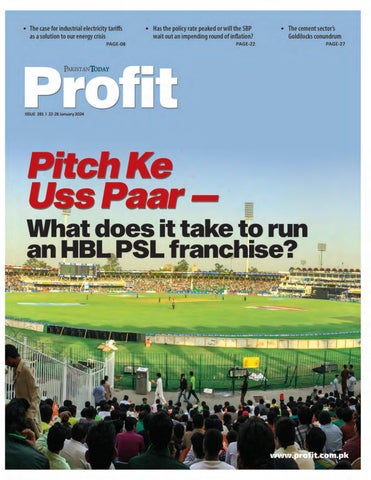
14 14 Pitch Ke Uss Paar — What does it take to run an HBL PSL franchise? 20 Pakistan’s auto industry has a bright future. Here’s why. Syed Shabbir Uddin
27
22
08
22 Has the policy rate peaked or will the SBP wait out an impending round of inflation?
Profit
27 The cement sector’s Goldilocks conundrum
Publishing Editor: Babar Nizami - Editor Multimedia: Umar Aziz Khan - Senior Editor: Abdullah Niazi Sub-Editor: Basit Munawar - Video Editors: Talha Farooqi | Fawad Shakeel Business Reporters: Daniyal Ahmad | Shahab Omer | Zain Naeem | Saneela Jawad | Ghulam Abbass | Ahmad Ahmadani Shehzad Paracha | Aziz Buneri | Nisma Riaz | Mariam Umar | Urooj Imran | Shahnawaz Ali | Meerub Amir Regional Heads of Marketing: Mudassir Alam (Khi) | Sohail Abbas (Lhe) | Malik Israr (Isb) Pakistan’s #1 business magazine - your go-to source for business, economic and financial news. Contact us: profit@pakistantoday.com.pk
The case for industrial electricity tariffs as a solution to our energy crisis Can reverse Robin Hood economics make a more equitable energy market for everyday customers?
8
By Daniyal Ahmad
P
akistan’s power sector is dying. Much like cholesterol clogging our veins, the circular debt in our power sector stands on the precipice of inducing a system-wide cardiac arrest. This is not a gradual, one paratha a day induced heart failure we’re talking about. Rather, Pakistan’s power sector is hurtling towards a cataclysmic collapse.One large coronary incident away from complete annihilation. At the heart of the matter lies revenue collection. The Government of Pakistan has amassed a painful tab of Rs 2.7 trillion with every stakeholder in our power system, and the consumers it had earmarked to foot the bill are using less and less electricity with each subsequent price hike. Our power system is a veritable maze of complexity, and its latest potential saviour is likely to baffle many. Pakistani companies, it seems, have reached their limit and thus have devised their own remedy to the chaos we find ourselves in. The solution? A reduction in electricity tariffs for industries. Providing cheaper electricity at a time when electricity bills are soaring is, to put it mildly, perplexing. The government in response to this quagmire has been operating on a policy of sit and think. This is where lots of very important bureaucrats and politicians sit and vaguely discuss targets and measures whilst slurping tea and brushing biscuit crumbs off their chins. But despite the much-ado-about-nothing behaviour, suggestions do filter in every now and then. And in recent days one particularly proposition has been gaining a lot of steam: Industrialist Electricity Tariffs. What does that mean? In very few words it means offering more affordable electricity to the wealthiest businesses in Pakistan. The proponents of this plan are, surprise surprise, big businesses. But what exactly does the proposal say and how in the world does it resolve our power crisis?
Capacity utilisation 101
P
akistan’s problem is it is far too hot. And the summer months are especially cruel in this heat. Imagine, it’s midday, and the mercury has soared above a blistering 40°C. Without warning, the electricity supply is severed, leaving you marooned in the sweltering heat. The fan halts its comforting whirl, the lights surrender to darkness, and the refrigerator ceases it’s reassuring hum. Your provisions are on the brink of decay until the refrigerator revives, and your only solace is the hope that your electronic devices possess
enough charge to tide you over until the power is restored. At this moment, the prevailing assumption is that Pakistan is simply deficient in its electricity supply. However, this is a misconception. In theory, Pakistan has an abundance of electricity — more than it can feasibly manage. The full potential of Pakistan’s power sector remains untapped. In other words, we have never truly harnessed the full output that our power plants are capable of generating. Our utilisation has oscillated between approximately 40% and 50% from the fiscal year 2004 to the fiscal year 2022.
from prior periods. However, it constitutes 90% of the final tariff, excluding these two costs. The National Electric Power Regulatory Authority’s (NEPRA) benchmark PPP for the fiscal year 2024 stands at Rs 23 per unit. Out of this, Rs 16 are allocated towards capacity payments. But what exactly is a capacity payment? A capacity payment is a fee paid by a user of an energy asset to the asset’s owner in exchange for the rights to utilise the asset’s capacity. Capacity payments are unique in the sense that they must be paid irrespective of whether a unit of electricity is consumed.
Herein lies our quintessential conundrum. The invoices for the electricity that Pakistan generates remain largely unaffected by the rate of utilisation. At the heart of the issue is the Power Purchase Price (PPP). The PPP encompasses the cost of electricity generation, the capacity charge, transmission expenses, and market operator fees. It provides an approximation of the final electricity tariff, excluding taxes. The only additional costs are distribution and supplier margins, along with any adjustments
Unlike the remaining Rs 7 in the PPP, which could potentially dwindle to Rs 0 if no electricity is consumed or generated, the capacity charge moves in the opposite direction. This is because it is based on an annual outlay of Rs 2 trillion, divided by the number of electricity units consumed by Pakistani customers. “If everyone were to leave the country, and no unit of electricity were generated or consumed, then Pakistan would still owe Rs 2 trillion this fiscal year in capacity payments due to the sovereign guarantees it has grant-
ENERGY
You currently have surplus generation capacity that is not being utilised, so why not create incentives for the industry to do so? You are already paying the independent power producers for that capacity either way. Allowing industry to use the unutilised capacity at marginal cost would reduce the government’s burden, generate economic activity including jobs Ehsan Malik, Chief Executive Officer of the Pakistan Business Council
ed,” says Dr Fiaz Ahmad Chaudhry, Director at the LUMS Energy Institute and a former Managing Director of the National Transmission & Despatch Company. The converse is also true. The Rs 16 can be reduced at a per-unit level if more units are consumed. This is because the Rs 2 trillion outlay is for the installed capacity, while the Rs 16 charge is an estimate based on expected consumption. The aforementioned upward and downward revisions are possible based on the units consumed. This presents a paradox for the Government of Pakistan. It needs someone to foot the bill, otherwise, it will have to do so itself, as the capacity charge remains constant. The more customers increase their electricity consumption, the lower the perunit capacity payment, making it cheaper for everyone to consume electricity. However, the reverse is also true. The fewer people that consume electricity, the more expensive it becomes per person. This is also what the Pakistani companies are pitching. “You currently have surplus generation capacity that is not being utilised, so why not create incentives for the industry to do so? You are already paying the independent power producers for that capacity either way. Allowing industry to use the unutilised capacity at marginal cost would reduce the government’s burden, generate economic activity including jobs,” posits Ehsan Malik, the Chief Executive Officer of the Pakistan Business Council (PBC). The current proposal for reduced tariffs, which the Government of Pakistan is contemplating, is also the brainchild of the PBC. So, how will this scheme function?
10
The PBC’s thought process
J
ust a bit about the PBC before we get into the details of this proposition. The PBC is a large umbrella organisation that advocates for macro policy changes that will be pro business in Pakistan. Since it has a lot of stakeholders, it is not exactly a lobbying organisation in the same way that industry associations are. This is a sort of loose confederation of big business in Pakistan that advocates for the freedom to do business and a good working environment in Pakistan. As such, one of the things you’d expect all industries across the board to agree to is that electricity should be cheaper. Industries across Pakistan are currently subjected to a tariff that fluctuates between Rs 32 to Rs 38 per unit, exclusive of fuel charge adjustments. This rate is contingent upon their consumption patterns and the timing of their energy usage. The Pakistan Business Council (PBC) proposes a uniform rate of Rs 27 or 9 cents per unit for all
industrial customers. They project that this would incur a cost of Rs 385 billion to the Government, under the assumption that the industry accounts for 25% of the total current electricity demand (140,000 Gwh x 25% x Rs11 = Rs 385 billion). The PBC posits that this scheme would lead to an additional offtake of 1,500 megawatts, thereby reducing the net cost for the Government of Pakistan to Rs 180 billion (1,500 x 24 x 365 = 13,000 Gwh x Rs 16 = Rs.208 billion). They contend that the Rs 180 billion would be offset by the advantages of increased exports, reduced imports, job creation, and higher tax revenue resulting from the enhanced competitiveness of the industry. The calculations seem plausible in theory. Consumer profiles across Pakistan’s power sector also support the PBC’s argument to some extent, particularly if the objective is to simply amplify the overall electricity consumption. Industrial customers, despite constituting only 1% of the total connections, command a disproportionate 25% of the final demand for electricity. This stands in stark
The foremost question the industries should pose is whether they can procure a steadfast assurance from the government for a reliable electricity supply to satiate the escalating demand, particularly in light of our existing supply crunch Haneea Isaad, Energy Finance Specialist at the Institute for Energy Economics and Financial Analysis
contrast to domestic customers who, while making up nearly 90% of the total customer base, account for just under half of the total consumption over the same period, from fiscal years 2016 to 2022. Now then, what could possibly backfire in all this?
The considerations the scheme might need to incorporate
“T
he foremost question the industries should pose is whether they can procure a steadfast assurance from the government for a reliable electricity supply to satiate the escalating demand, particularly in light of our existing supply crunch,” argues Haneea Isaad, an Energy Finance Specialist at the Institute for Energy Economics and Financial Analysis (IEEFA). What engenders this crunch and simultaneous underutilisation? Our energy mix. Thermal energy reigns supreme as Pakistan’s primary energy source, constituting approximately 60% of the total, according to NEPRA’s State of Industry Report, 2022 — the most recent data available. Within
Pakistan’s thermal mix, only Thar coal and domestic gas emerge as local solutions, with the fuel for all other plants necessitating importation. One of the reasons Pakistan does not fully utilise its installed capacity, aside from demand scarcity, is that when demand does surge, the fuels required to operate the plants cannot be imported due to our balance of payments predicament. A similar dilemma manifests on a smaller scale during the winter months, when hydroelectric power nearly grinds to a halt due to weather conditions. The excess capacity is, in essence, nuanced. Our available capacity is restricted by whatever the grid can provide at any given time, and it is often curtailed by external factors. This, in turn, would inevitably lead to electricity rationing should demand skyrocket. “You can supply electricity as close to the installed capacity as the foreign exchange position allows. When the marginal cost to provide electricity escalates, then you can prioritise it. You could, perhaps, allocate it to exporters, or to curtail supply to domestic users where the majority of the demand is for air conditioning in the winters,” explains Chaudhry. Rationing would prove more challenging than one might anticipate. Firstly, prioritis-
ing exporters is not a novel concept. The All Pakistan Textile Mills Association (APTMA) has long insisted that they be the exclusive beneficiaries of any tariff reductions, owing to the foreign exchange they generate for the country. The PBC, with their current initiative, are opposed to this bifurcation. “Supply chains tend to be quite extensive. When providing energy at regionally competitive cost to the final exporter, what about those in the supply chain leading up to them? If they do not receive electricity at a competitive rate, then the cost to the final exporter escalates, which needs to be passed on to the overseas customers or absorbed by the exporter,” expounds Malik. Rationing demand does not operate in such a straightforward manner. In a supply crunch, someone will have to be prioritised, lest no one is prioritised. The industrial versus domestic user debate is even more contentious. Curtailing domestic demand is unlikely to resonate well with the Government, given their need for votes. It has protected categories; we can’t touch them. It has unprotected categories, which are already bearing a steep price. The upper tier of domestic customers are already paying even higher than the industrial segment. It’s an incredibly delicate matter altogether. Industries will have to ensure that the Government can devise a strategy to provide them with a reliable supply come what may, otherwise they risk production interruptions themselves. Then there is the cost of the entire initiative. The companies will likely achieve the boost in economic activity they are pledging in the long run. But what about the immediate consequences? “In light of Pakistan’s tenuous macroeconomic climate, the luxury of an additional subsidy is one we can ill afford,” Isaad explains. “The power sector operates on a model of cross-subsidisation. Our energy mix
ENERGY
The aspiration should be to employ electricity in a productive manner. Allocating our energy use for consumptive purposes is the very pitfall that ensnared our power sector in its current quandary Dr Fiaz Ahmad Chaudhry, Director at the LUMS Energy Institute and a former Managing Director of the National Transmission & Despatch Company
leans heavily on imports, leaving us vulnerable to external shocks that could send the cost of generation — and consequently, the net cost of reduced tariffs — into a tailspin,” Isaad adds. The PBC, however, staunchly refutes the notion that they are beneficiaries of a subsidy. “The term ‘subsidy’ is a misnomer in this context,” Malik asserts with conviction. “If you compete globally, customers will not pay for inefficiency of inputs. A subsidy would be a reduction beyond justifiable cost of generation and delivery of power. The removal of an unjustifiable burden such as charges for unutilised capacity, transmission and distribution losses, theft, under-recovery etc is not a subsidy. It is a price correction,” Malik asserts. The PBC further contends that they are, in fact, subsidising the rest of Pakistan’s power consumers. “The industry presently covers the cost to generate electricity, compensates for the transmission and the associated losses. It also shoulders the burden of theft committed by others and the non-recoveries by the distribution companies,” Malik affirms. Could there be a middle ground in terms of the initiative’s cost? Chaudhry believes so. He proposes a simple solution for exporters: the Government could recoup the additional costs by offsetting them against any tax benefits the companies receive on exports. For companies serving the domestic market, Chaudhry suggests a straightforward approach of stock keeping and inventory management. The additional output resulting from the lower tariffs could easily be charged to the companies at a fair rate. “The goal,” Chaudhry indicates, “to ensure that the cost of electricity remains reasonable for all, especially the industrial consumers. Should the cost of generation escalate, the Government should look for opportunities to adjust it in the profits that the power companies earn and in the fuel prices that their respective plants use.” Is this the end of the story? There is one final argument that advocates for slashing tariffs across the board, should the ultimate ambition be to amplify utilisation rates. This
16
is what Hammad Azhar, the former Minister for Energy, did in October 2021 for the winter season. To his commendation, electricity consumption skyrocketed. Thus, one might ponder — why not replicate this strategy? This query takes on paramount importance if another pivotal goal is to diminish the capacity payment for all, thereby enabling a greater use of electricity. Whilst industrial consumers guzzle more electricity than their domestic, commercial, and agricultural counterparts, they are eclipsed by bulk and miscellaneous users on a per connection basis. If electricity were to be perceived merely as infrastructure, then the objective would undeniably be to maximise the number of individuals harnessing this infrastructure. Correct? “The aspiration should be to employ electricity in a productive manner. Allocating our energy use for consumptive purposes is the very pitfall that ensnared our power sector in its current quandary,” Chaudhry posits. His argument, though cogent, is likely to present the primary hurdle for the project, should it ever receive the green light. It may indeed hold true that other customers do not generate economic activity at a level commensurate with the industrial sector. However, this does not imply their contentment with such an arrangement. Consequently, industrialists may find themselves needing to secure a plethora of assurances that this will not be a commitment the Government of Pakistan backpedals on.
Sovereign assurances from an unreliable sovereign
A
s we draw to a close, let us revisit the aforementioned sovereign guarantees for the capacity payments. The Government of Pakistan is legally bound to honour them. However, whether it fulfils this obligation in a timely manner is a different matter altogether — and that is how we ended up in our circular debt. The notion that the Government of Pakistan will bestow some of the
wealthiest enterprises in the country with access to more affordable electricity whilst the tariffs skyrocket for everyone else is unlikely to garner any public support. This holds true despite the potential long-term benefits that such an endeavour may bring forth for the common good. The amalgamation of the Government of Pakistan’s historical unreliability and the political pressure that will intensify if electricity rationing ensues will put industrialists in a quandary they would rather eschew. Our power infrastructure is in a state of chaos, and any effort to amend it is indeed commendable. The month of December 2023 witnessed a generation output that fell short of the figures from December 2017. There is no room for prevarication — our system is shattered and totters on the verge of further decay. If there ever was a time for inventive cogitation, it is this very instant. However, for this venture to yield fruit, the industrialists will need to meticulously compute all feasible calculations. The crux of the argument at present is that higher consumption, if viewed as the denominator to the total outlay for capacity being the numerator, then the per unit cost will diminish for all. The gamble on this particular cohort of users is that they possess the requisite multiplier to not only invigorate the local economy but also usher in the necessary foreign exchange to maintain the steady supply of fuel needed to generate the additional demand for electricity that they will engender. All of this pivots on the proposition that they can achieve something concrete before the Government of Pakistan harbours any second thoughts. Consequently, the guarantees are almost as crucial as the mathematics upon which the initiative is predicated. A considerable number of industrialists are proprietors of their own independent power production companies. Perhaps these industrialists, in particular, can illuminate their peers about the discrepancy between the promises proffered by the government and the actual treatment that is dispensed once the ink solidifies on a monumental accord. n
ENERGY
Pitch Ke Uss Paar —
What does it take to run an HBL PSL franchise? Cricket is quickly turning into a massive industry worth hundreds of millions of dollars. How do some of its most significant stakeholders plan to capitalise?
14
C
an you smell it in the air? The faint scent of sparks flying and the gravely tenor of battle lines being drawn? The ninth edition of the HBL Pakistan Super League (PSL) is just under a month away. And even as the cricketers from all around the world prepare to descend on Karachi, Lahore, Islamabad, and Multan to take positions, the behind the scene boardroom drama is heating up even more than on the competition on the field. The HBL PSL is going through a pivotal moment. This is the penultimate edition of the tournament before the franchise fees for the teams are renegotiated. And as we get closer and closer to the all important tenth edition, a not-so-secret tug of war is developing between the PCB and the franchise owners. As the tournament has grown, the franchises have been demanding a bigger slice of the pie. The PCB has at different points acquiesced, but constant management changes and bureaucratic red-taping at the board make dealings
a slow, tedious process. On top of this, very clear lines have been drawn between the interests of “bigger” PSL franchises such as Multan, Karachi or Lahore against those of the “smaller” teams like Quetta, Peshawar, and Islamabad. So, where do we start to understand the financial intricacies of franchise cricket in Pakistan? Nowhere other than the tournament’s newest (and most expensive) team, the Multan Sultans.
The Big Bucks
B
y all rights the biggest news from this season’s HBL PSL should have been (and might still prove to be) the appointment of Hijab Zahid as general manager of the Multan Sultans. Not only is she the first woman to become the GM of an HBL PSL franchise, at 28 she is also the youngest person to find herself in this position. She has joined a very small group of women that have run mens sports franchises and has in the process shattered a glass ceiling or two.
COVER STORY
Trailblazer Hijab Zahid never thought she’d be running a cricket team. When she started her engineering degree from COMSATS in Lahore in 2013, even the idea of the HBL Pakistan Super League (PSL) had not quite been conceived. By the time she graduated and went to the United Kingdom in 2018 to pursue a Masters degree in Project Management, the tournament had only been through two editions played entirely outside Pakistan with the exception of one game. And nobody really knew if it would take off or have to be scrapped. Throughout this time, even though she always held a deep rooted love for the game, Hijab’s role in the vast world of cricket remained limited to that of a fan. Yet in the span of barely 18 months Hijab has gone from being a fan with a day job to becoming one of the most powerful people in one of the biggest cricket franchise tournaments in the world. At the age of 28, her appointment as General Manager of the Multan Sultans makes her the only woman to ever be appointed GM of an HBL PSL team and the youngest to boot. “As general manager I have to speak many different languages. I need to constantly see how it is that I’m communicating with people and using different voices for different audiences whether that is my players, my team, or the team’s owner,” she tells Profit. The job of general manager in the world of sports is never clearly defined but is almost always more than it seems. In addition to looking after the players and the cricket, the GM also has commercial responsibilities to fulfil. So everything from negotiations with the PCB to media management, contracts, and advertising has to go through Hijab. That means while she is looking after the cricket, she also has to work towards protecting the team’s bottom line. As general manager, it will be Hijab’s job to navigate this myriad of challenges. She is not alone in this. By her side is Ali Tareen, the team’s owner who has come back in charge this year and was responsible for hiring her. The only question is, what will this duo be able to achieve?
That she did so with a degree in project management and her initial entry into the cricketing world as a broadcaster and journalist only highlights her whirlwind journey. But barely six months into the job Hijab has been thrown into the deep end. The Lahore office of the Multan Sultans was buzzing when Profit’s team arrived for a scheduled interview with the team owner Ali Tareen and his newly appointed GM. Smack dab in the middle of the city the office is a shared space which Ali Tareen used to conduct his businesses outside of cricket and the Multan Sultans as well. But on the day it was alive with the spirit of cricket. Right before the interview was scheduled both the team’s owner and its general manager had been in back to back meetings first to discuss social media strategy and next to decide on this year’s team jersey. “There are more things happening off the field than on the ground,” says Hijab Zahid. As she takes a seat in the spacious office littered with cricket regalia including the HBL PSL winner’s trophy that Multan clinched in 2021, it isn’t hard to tell she has been on her feet all day. Sitting behind his desk, Tareen was relaxed and watchful as Hijab spoke, very much cutting the figure of the mentor guiding the new manager through her first season in charge. “My job title really does describe
16
what I do. I am very much a ‘general’ manager in the literal sense of the word. Everything from management to operations, media, communications, and the game itself have to involve me in the decision making process.” Most people don’t really think about sports beyond the playing field. The Multan Sultans, for example, is a cricket team that participates in the HBL PSL, has a fan base, and competes to win a tournament. But the Sultan themselves are owned and operated by a company called “Janoobi Cricket Limited”. This is a private limited company that has been created for the purpose of running a profitable enterprise. The main investment vehicle of this company is the Multan Sultans franchise, the rights to which have essentially been leased out by them from the PCB. As such while the goal of the Multan Sultans players and coaching staff is to win the tournament, the goal of the team’s owners and management is to win the tournament and make a profit while doing so. It helps to look at the franchises not just as teams but as companies participating in Pakistan’s cricket industry. And these aren’t any companies either. All of the HBL PSL franchises have multi-million dollar annual operating budgets and none of them are as expensive as Multan. A late entrant on the scene, Multan was added to the HBL PSL tournament two years
after the tournament started. Back when the PCB had first auctioned off the rights to teams in 2015, there had only been five spots to vie for. Back then the PCB sold the rights to five franchise teams that would play the tournament for $93 million for a 10 year period. The most expensive team to be sold was Karachi Kings for $26 million, followed by Lahore Qalandars for $25 million, Peshawar Zalmi for $16 million, Islamabad United for $15 million, and the Quetta Gladiators for $11 million. Since the teams were sold for a 10-year period, the total cost was payable over 10 years in the form of a yearly franchise fee equivalent to 10% of the team’s value. Essentially, each franchise owner would rent out the use of the franchise for the year for a fixed price. This was also a failsafe. In case the tournament tanked or one of the owners decided the price they paid had been too high, they could duck out after a year or two and sell the franchise to someone else. But the tournament was almost an instant success. So much so that when Multan Sultan became the sixth team added to the tournament’s third edition it sold for a whopping $41.6 million – and that too only for an eight year period to the Schon group. That meant the Schons were paying an astounding $5.2 million a year to the PCB to keep the Multan Sultans which was double the price that Salman Iqbal was paying to keep Karachi Kings. And that is just the franchise fee — all the other operating costs from paying players and staff to marketing are not included in this. However, the $5.2 million franchise fee was too much for Asher Schon to keep up with, and after one year the PCB terminated the Schon group’s ownership of the Multan Sultans on good terms. Even this, however, did not stop the price of the team from rising even more. Initially sold for a $41.6 million price tag for eight years, the team was now sold for $45 million for seven years to Aalamgir and Ali Khan Tareen. That meant the Tareens would be paying an astonishing yearly franchise fee of $6.35 million each year to keep ownership of their team. In an interview with Profit, Ali Naqvi of Islamabad United brought up the rising values of new teams and worried about being sensible regarding expansion. “We are largely happy with how the brand has risen but have sometimes felt us going from one extreme to another. The PCB made a killing with the Multan Sultans fee but that was probably going towards a different extreme and not the true value that the actual financials and brand value would put it at,” he explains. He is pointing towards the fact that the Multan franchise, which was introduced later in the
We are largely happy with how the brand has risen but have sometimes felt us going from one extreme to another. The PCB made a killing with the Multan Sultans fee but that was probably going towards a different extreme and not the true value that the actual financials and brand value would put it at Ali Naqvi, owner Islamabad United
tournament, is worth a lot more than the original five franchises. So what was the plan? After going through the initial teething stages it became very clear that the HBL PSL would be worth some money and the team owners had made a good gamble. With a new team entering and sources of revenue increasing, something had to give.
Changing times for the HBL PSL
F
or the first few years the team owners of the HBL PSL bided their time. This was still a new project and they were willing to face a few losses. But almost from the get-go there was a feeling that the division of the spoils from the tournament would become a bone of contention. You see the HBL is run on a strange business model. Back when the teams had first been sold by the PCB, it had been agreed that at least 80 percent of the revenue from the broadcast rights would be split equally among the five PSL franchises. The remaining 20 percent will go to the PCB. Similarly at least 50 percent of the revenue from the sponsorship rights will be shared among the franchises and the PCB will utilise the other 50 percent. This was all done with the understanding that this was an initial breakdown and the teams would negotiate with the PCB depending on how the tournament was going. After all, this was everybody’s first time doing something like this and none of the stakeholders knew how much their operating expenses would be beyond projections or what kind of return they might or might not get. In the first year, for example, the HBL PSL turned a profit of $2.6 million. Out of this, the PCB pocketed $0.6 million while the rest of the $2 million were divided equally among the five sides – leaving each side with a mere $0.4 million. The sides all ended up making a significant loss in the first year. And they weren’t particularly quiet about this.
The addition of Multan as part of the tournament in 2018 made things worse. For starters the central revenue pool was now being split six ways instead of five. On top of this Multan’s owners had to contend with even higher franchise fees than the others which made them massively unprofitable. In September 2020, all six of the teams banded together and sued the PCB. As pressure mounted with the court case the teams also began to dilly dally. They began making payments late, blaming the dividends they got from the league. Karachi and Lahore in particular became serial offenders, and the PCB ended up having to pay a lot of expenses out of pocket that they should have been paying from the money they were getting from the teams. Even when it comes to paying the players, when the PSL draft happens, the PCB pays the players and then collects the money from the franchises later or cuts it from the revenue pool before declaring its final profits. By 2021 the PCB was under Ramiz Raja’s administration who negotiated a new deal with the franchises. The first was that the teams would now get a 95 percent share of the central revenue pool rather than the 5% they used to get. Other concessions were also made. The price of the dollar was fixed for the franchise owners at Rs 170 (it has since risen to as high as Rs 320 in the open market), and the PCB also gave the franchises some relief during the seasons played during Covid-19 lockdowns. But there was one concession that was absolutely not made. One that is very important to all of the franchises, and in particular to the Multan Sultans.
A question of ownership
A
s we’ve gone into painful detail to explain, the HBL PSL has been a financially lucrative proposition both for the PCB, for the sponsors, and for the players as well. It hasn’t, however, been particularly lucrative for its biggest in-
vestors — the franchise owners. Now that the time is coming near, the franchise owners are demanding some sort of shift in the business model, among which one key demand is the introduction of ownership rights in perpetuity. Of the three team owners Profit was able to speak to all three agreed with this policy point. Back in 2021 when the negotiations were taking place under Ramiz Raja, the franchises wanted the PCB to give them rights in perpetuity. This was refused. Remember, the teams were given to the franchise owners at these rates back in 2015 for 10 years with Multan being given to the Tareens in 2019 for seven years. That means after the 10th edition of the tournament in 2025, the teams will be up for rebidding. The current owners will have the opportunity to pay an increased franchise fee, which will be calculated as the existing fee + 25% or 25% of market value of the franchise, whichever is higher. If any of the owners refuse to do this, the team will go up for bidding again. Essentially this means that the franchise owners are less owners and more tenants. The PCB has the final rights to the teams and this gives them an undue advantage in what should be a simple business partnership. “Negotiating with the PCB feels like being Sisyphus. Plans are just plans, there is no execution and anytime you feel like you’re getting somewhere suddenly you find yourself back to square one,” explains Ali Tareen. Hijab nods along. She has only been at the job six months but has already seen a glimpse of just how difficult it is to manage a relationship with the country’s cricket board. It is now part of her job to manage this all important relationship. “This isn’t just about the Multan Sultans. As a league the PSL has to give ownership. Right now we are kind of renting the team from the PCB every single year. If we bring in a new partner to invest in the franchise we have to go to the PCB first. If we want to change ownership we have to ask them too,” explains Tareen. “They are the real owners. And that is why there is some hesitation to invest further.”
COVER STORY
My job title really does describe what I do. I am very much a ‘general’ manager in the literal sense of the word. Everything from management to operations, media, communications, and the game itself have to involve me in the decision making process Hijab Zahid, general manager Multan Sultans
This is a bigger issue than it might seem at first glance. The way franchise sports tournaments work is that one expects the team owner to invest in their teams so that they can then make a profit off of it. This investment further increases the value of the tournament and helps in growing it. In this scenario, however, since the owners are really only tenants they do not particularly want to pour more money into something that is not an asset. The thinking is that early entrants that bought rights to the team in 2015 or 2017 took a risk and now that the tournament has taken off they should have their reward for that risk. “Karachi, Lahore and Multan are all making losses at the current franchise fees. The only way to grow the tournament is for the teams to invest further in it. When you’re already posting losses and you don’t even own the asset and are only renting it, why would you pour more money into it? Unless we own the asset we will not want to invest more into it. As the teams grow the desire to invest in it will also increase. That is the point of being an early mover. You get that ownership for cheap and then help grow a new brand,” Tareen says. “If the team is an asset I will invest more. So how do we convert this into a perpetuity model? That is the question. Because when that happens is when the tournament really blossoms. That is when you’ll have owners investing in stadiums and paying players more money. I think this is the future of the PSL and we need to talk to the PCB about this as team owners.”
The Times They Are A-Changin?
S
o here is what we have. The HBL PSL is nearing a point where all of the franchise fees will be up for a raise. The tournament has become a critical and commercial success but no finalised business model for it has taken shape. As the time draws closer, the teams are preparing their arguments and figuring out what their ideal scenarios will look like. On the one hand there are smaller teams like the Islamabad United or Quetta Gladiators which have significantly smaller franchise fees and have been turning modest profits out of the tournament’s equally divided central revenue pool. They are relatively happy with the current system but are afraid their franchise fees might be raised to an unsustainably high rate in 2025. There are the larger teams like Lahore and Karachi which have been running from pillar to post about this since nearly the beginning trying to get a better deal. There is the Multan Sultans which falls into a separate category all together. And then there is the PCB which wants to add more teams to the tournament, collect more franchise fees in the process, and divide the central revenue pool down further. So what will happen? For starters, all of the teams are united in their opposition to new teams being added to the tournament under the current revenue sharing model. The
central revenue pool is already divided neatly between the six sides and new teams will only reduce each team’s cut further. There have been suggestions made that the bigger teams get a bigger slice of the pie and the smaller ones less of a cut, but this is not viable since the equation will always be three teams against three when time comes for negotiation (IU, QG, and PZ against KK, LQ, and MS). On top of this, the PCB will use this divide between the franchises to their own advantage. As of now it seems that the demand the franchises will bring to the table is ownership in perpetuity. “If you ever want to change the equity model you will have three versus three. The share of the central pool is divided six ways. Some teams are still tolerating losses while others are at least breaking even. If you want to add more teams that revenue gets split in more directions and then you will have even bigger losses perhaps for all of the teams. Every single team will oppose this,” claims Tareen. “But there is one solution. If there is perpetuity you can add as many teams as you want.” What shape the HBL PSL takes eventually is up to the imagination. What we can tell with some certainty is that the PCB is going to be looking to take full advantage of their position, but that the teams are not going to agree meekly. They are stakeholders in Pakistan’s cricket infrastructure now and with that comes power. Only time will tell whether they are able to band together and leverage their positions. n
Negotiating with the PCB feels like being Sisyphus. Plans are just plans, there is no execution and anytime you feel like you’re getting somewhere suddenly you find yourself back to square one Ali Tareen, owner Multan Sultans
18
COVER TEXTILES STORY
OPINION
Syed Shabbir Uddin
Pakistan’s auto industry has a bright future. Here’s why Cautious optimism for the auto industry in 2024: understanding the driving forces
A
s we embark on a new year, the dynamics of the auto industry have been a subject of recent discussion and analysis. In a recent dialogue with a prominent journalist, I shared insights derived from my two decades of experience in the field. This conversation sparked interest, leading to the publication of an article highlighting my analysis, particularly emphasizing a potential surge in demand, estimated at 350,000 units every five years due to population growth. In response to inquiries from friends seeking more details on this forecast, I've decided to delve deeper into the subject in this article.
Population pyramid chart
U
nderstanding the trajectory of population growth is crucial, especially when considering its profound impact on future demand. A population pyramid chart illustrates the distribution of people across age groups, serving as a predictive tool for assessing future needs. Take Japan, for instance; their upward triangle pyramid in 1950 set them on an economic superstar path, where a youthful population played a pivotal role. Fast forward to today, Pakistan has a promising upward triangle, rather better than Japan’s, meaning a lot of young
The author has two decades of experience in the automotive industry. He can be contacted on the platform X, @Shabbir_uddin, or on LinkedIn: www.linkedin.com/ in/shabbiruddin
20
blood. With some smart economic moves, we stand at the threshold of significant opportunities.
Relevant age group
T
he age group that makes car purchasing decisions typically ranges from 25 to 55 years, which is predominantly male. Though women also buy cars, for the ease of explanation I’m limiting to the dominant car buying gender. It can be different for different industries: for example, for mobile phones, the relevant age group could start from as low as 15 years, both male and female.
Identifying the size of the target consumer universe
L
et's break down the numbers: Currently, 12.3 million young men fall within the 20–24 year old age bracket in Pakistan. Over the next five years, as they transition into the car-buying age group of 25-60 years, a substantial market emerges. Leveraging data from Ipsos Consumer Book 2022, we find that 7% of the national population belongs to the affluent SEC-A category, which includes educated employed or self-employed
middle-top executives and small to large scale business owners. Consequently, out of the 860,000 young men in the 25-30-year age range within SEC-A, a conservative estimate suggests that 40% may seek new cars for their need to showcase social status, travel over larger geographical stretches and avoid weak public transport systems in urban centers. This culminates in a projected demand of 350,000 units over the next five years. Extending this projection to a decade unveils an additional demand of 380,000 units, potentially surpassing a million units by 2035.
Recognize different buying behaviors
U
nderstanding the psyche of Generation Z is paramount, as Gen-Z encompasses those in the age brackets of 15-20 year-olds and 20-24
year-olds. They have a very pragmatic approach to finances and an emphasis on product value, as opposed to intangible brand allure. They're all about bang for their buck and are quite different from earlier generations. Recognizing these nuances in attitude and buying behavior is fundamental for crafting effective marketing strategies tailored to this demographic.
Expectations for 2024
T
he annual demand for cars reached a commendable figure of 320,000 units in recent years. The automotive sector's performance is intricately tied to prevailing interest rates, not merely due to the facilitation of car financing but also owing to its impact on overall industrial growth resulting from low-interest rates. Forecasts indicate an anticipated reduc-
tion in policy rates to 15% in the year 2024. This reduction, coupled with the pent-up demand from the preceding year, leads us to anticipate a robust resurgence in car sales, likely three months after the implementation of reduced interest rates. Another critical determinant influencing car demand is the fluctuation in PKR parity against USD. The projection for the coming year suggests a moderate devaluation of the rupee. In conclusion, while the intricate dance of interest rates, currency valuations, and market forces shapes the trajectory of automotive demand, my outlook for the second half of 2024 is optimistic. As a stakeholder in the auto industry, I remain cautiously optimistic, navigating through economic nuances and demographic shifts that paint a promising picture for the year ahead.
COMMENT
Has the policy rate peaked or will the SBP wait out an impending round of inflation?
Market sentiment suggests potential rate cuts, yet contingencies remain By Mariam Umar and Ahtasam Ahmad
T
he State Bank of Pakistan (SBP) has been in the firing line over the past two years due to its lagging monetary policy stance. This has resulted in record levels of inflation and a consistent erosion of purchasing power, particularly for individuals who rely on fixed income sources such as the salaried class. The elevated price levels have necessitated the central bank to raise the policy rate to an unprecedented level, which currently stands at 22%. It is, however, believed by experts that the policy rate has finally peaked. Contributing to this sentiment is the movement in the secondary markets, where yields are on a downward trajectory. According to an analysis by JS Global, the difference between the policy rate and the secondary market yield is currently at its highest since 2009. The secondary market has already started to factor in the possibility of a rate cut in the near future. As stated in a report titled ‘PSX: The ‘hundred thousand’ question’ by JS Global, yields across various tenors have reduced by 1% since September 2023. Likewise, the interbank lending rates have also declined. “Interest rates in Pakistan have already dropped by around 4%. The lending benchmark interest rates (6-Month KIBOR) have decreased from their recent peak of 24.7% on September 13, 2023, to 20.8% on January 16, 2024,” tweeted Topline Securities, a Karachi-based brokerage house. There has been a lot of noise surrounding the potential for upcoming policy rate cuts in light of recent developments. According to Bloomberg, the SBP is expected to begin lowering its policy rate from March 2024 as inflation gradually subsides. Bloomberg has forecasted a
22
Even though rates should start to decline from March onwards, calling a 7% rate cut is premature because Pakistan’s macroeconomic stability is vulnerable to factors that are not in our control like commodity prices and IMF targets. These variables could create problems on the external account and push the inflation outlook higher than expected Mustafa Pasha, Chief Investment Officer at Lakson Investments
cumulative reduction of 7% by the end of 2024. However, the implementation of rate cuts is contingent upon the ability to control inflation levels, which in turn depends on various factors such as stability in commodity prices, regional security and trade outlook, maintaining fiscal stability and monetary discipline. So, the question remains: Are we ready to raise a green flag, or is it still too early?
Rate outlook
A
nalysts anticipate that SBP is likely to maintain the status quo in the upcoming monetary policy meeting at the end of January. However, a rate cut near the end of the first quarter of the calendar year is the prevailing sentiment. “Though SBP has maintained the policy rate at 22% since July 2023, there is a high probability
that rates will go down in the coming months,” tweeted Topline Securities. The rationale behind the expected monetary easing stems from the anticipated disinflation trend projections. As explained in JS Global Capital’s report, “PSX: The hundred thousand question”, with recent inflation trends displaying relatively lower growth rates (excluding the impact of gas prices in November 2023) and the impending high base effect, it is anticipated that the first rate cut will occur once the country’s real effective interest rates enter the green zone on a spot basis, which is projected by March 2024.
Inflation outlook
W
hile the analysts predict disinflation, the optimism surrounding the policy rate cut is tempered by concerns
about potential exogenous shocks. “Even though rates should start to decline from March onwards, calling a 7% rate cut is premature because Pakistan’s macroeconomic stability is vulnerable to factors that are not in our control like commodity prices and IMF targets. These variables could create problems on the external account and push the inflation outlook higher than expected,” commented Mustafa Pasha, chief investment officer at Lakson Investments. Pasha also warned that the inflation rate may not decline smoothly, as there are geopolitical risks and IMF conditions to consider. “As far as inflation rates are concerned a gradual decline should occur but we also need to consider the geopolitical situation. Potential shocks in commodity prices pose risks to Pakistan’s inflation outlook. Moreover, as Pakistan will have to negotiate a new IMF Program, further increases in taxes, gas and electricity prices cannot be ruled out which could push the inflation higher than expected”, added Pasha. The fallout of irresponsible power sector planning is likely to have a significant impact on the price levels in the coming months. “The cost of power generation arrived at PKR 10.13/KWh during Dec’23 while including transmission losses and previous adjustments, the fuel cost grew to PKR 11.02/ KWh. As a result of this, there is a projected rise of PKR 5.62/KWh in fuel charge adjustment which will be charged from customers with the Feb’23 bills,” read an analysis report by Arif Habib Limited (ARHL). The World Bank’s 2023 Commodity Market Outlook has also highlighted the potential threat posed by geopolitical risks, particularly to the oil market. The report emphasized that the ongoing escalation in the Middle East has raised geopolitical risks for commodity markets, as this region represents a significant portion of the world’s seaborne oil trade. According to the report, Brent pric-
MACRO
Pakistan’s 2023-24 budget aims for a primary surplus of 0.4% of GDP (as per the IMF’s conditions to achieve fiscal consolidation and ensure budget stability), but rising interest payments are likely to result in a deficit. The government has imposed more tax measures, decreased spending, and lifted import restrictions, but the budget deficit is anticipated to remain significant Nida Gulzar Siddiqui, Economist at KTrade Securities Limited
es have been experiencing instability due to the potential impact of the conflict on supply and concerns about global economic growth slowing down. If regional conflicts remain under control, the current trends in commodities indicate a positive outlook. Average oil prices have declined from $94/bbl in September 2023 to $78/bbl in December 2023. This decrease can be attributed to weak global economic activity, increased output from the United States, and consistent production and exports from Russia. The World Bank projects that oil prices will further decline
24
to $81/bbl in 2024 and gradually moderate to $83/bbl in 2025.
Sufficient grounds for a rate cut?
T
he aggressive monetary stance of the SBP has been influenced, at least in part, by the conditions set by the International Monetary Fund (IMF). These conditions require the implementation of an appropriately tight monetary policy, aimed at curbing the price riding levels.
Following the approval of the first review of the stand-by arrangement on 11 January 2023, the Fund expressed concerns about Pakistan’s economic situation, highlighting that average consumer price index (CPI)-based inflation of 24% is anticipated in the fiscal year 2023-24. However, the IMF also expected a decreasing trend in inflation going forward, projecting it to reach 18.5% by the end of June 2024. The Fund emphasized the importance for Pakistan to maintain a strict monetary policy and adhere to a market-based exchange rate in order to effectively manage these pressures. Additionally, the private sector has consistently exerted pressure to lower the policy rate, as the high interest rates of the past 18 months have restricted their access to credit markets. According to data from the State Bank of Pakistan, the advances-to-deposits ratio, which measures lending to the private sector, decreased to 44% in December 2023 from 53% in December 2022. Meanwhile, the investment-to-deposit ratio, which measures investment in government securities, increased to 91% in December 2023. Furthermore, a significant portion of domestic debt held by the government is at a floating rate. Therefore, maintaining a high policy rate also contributes to a higher fiscal deficit and creates a cycle of acquiring more debt to meet servicing obligations. As previously explained and also highlighted by the IMF, a decrease in the inflation rate is the prerequisite for reducing the policy rate. The powers that be acknowledge this fact, and recent news flow indicates that the Special Investment Facilitation Council (SIFC) has intervened to mediate in a disagreement between the Pakistan Bureau of Statistics and the Ministry of Energy regarding the calculation of gas price hikes. Experts have observed that energy
The current stability hinges critically on containing current account deficits and continues securing rollovers to meet exorbitantly high external debt servicing burden. Any change in monetary policy stance must consider these facts Dr. Ahmed Jamal Pirzada, Senior Economist
prices have a considerable impact on inflation rates, and any alterations in the accounting methodology can potentially manipulate the final inflation figure. It is worth noting that in the last monetary policy meeting, the SBP maintained status quo citing that the decision took into consideration the impact of the surge in gas prices in November 2023, which exceeded the MPC’s initial projections for inflation. While there is a sense of urgency to lower rates, it is important to consider the potential repercussions that may arise from an abrupt policy change. “Pakistan’s 2023-24 budget aims for a primary surplus of 0.4% of GDP (as per the IMF’s conditions to achieve fiscal consolidation and ensure budget stability), but rising interest payments are likely to result in a deficit. The government has imposed more tax measures, decreased spending, and lifted import restrictions, but the budget deficit is anticipated to remain significant,” remarked Nida Gulzar Siddiqui, economist at KTrade
Securities Limited. “The government intends to streamline taxation for small businesses. Furthermore, market forecasts indicate the possibility of an interest rate cut of 700bps (7%) in 2024. This development would likely incentivize the private sector to increase its borrowing and capital provision, thereby fostering expansions and ultimately stimulating economic activity. In its entirety, this interest rate reduction will alleviate the government’s debt obligations,” she added. Balancing between the monetary stance and fiscal objectives remains imperative for an economic recovery. As per senior economist, Ahmed Jamal Pirzada, “The current stability hinges critically on containing current account deficits and continues securing rollovers to meet exorbitantly high external debt servicing burden. Any change in monetary policy stance must consider these facts.” “A premature decrease in the policy rate can once again increase the current account deficit which the country cannot fi-
nance given its precarious financial condition. This will result in the exchange rate coming under pressure and higher inflation persisting for even longer. The current monetary policy stance is reasonable. However, the fiscal authorities must use this space to restore external debt sustainability. Only then the monetary policy stance should return to business as usual,” he emphasized. The projections are based on multiple variables, and it is essential to acknowledge that any significant changes in domestic or international circumstances can potentially disrupt these projections. An example of this can be seen in Iran’s recent misadventure in Balochistan, which highlights the importance of stability in both security and political fronts for Islamabad’s economic revival plan. n
MACRO
The cement sector’s Goldilocks conundrum The industry carried out capacity expansion but now the economy has slowed down. What’s next?
I
By Zain Naeem
magine we are back in 2018. The country is seeing economic growth and development. There is sustained expansion in economic activity as the GDP is growing at a steady rate. 2018 has seen year-on-year growth of 6.15%. There is infrastructure development taking place under the Public Sector Development Program (PSDP) coupled with international investment in the form of CPEC related projects. Just like macro level development is being carried out, private sector and housing schemes are also seeing a boom. Who benefits from this? The spillover effect of these developments falls into the construction sectors. Mainly cement, steel and other allied industries related to it. In the context of Pakistan, many of the cement manufacturers were operating at capacity and the next move was to expand their capacity. This would prove detrimental in retrospect. Since then, Covid-19 pandemic and an
CEMENT
economic downturn has had a huge impact. Manufacturing, which was operating at near capacity, has fallen due to lower demand. This has been coupled with the fact that the cost of the expansion is still weighing down on many of the manufacturers. As sales fall and costs increase, what is next for the manufacturers?
Expansion bonanza
I
n order to understand the expansion frenzy seen by the industry, it has to be considered that the country had gone through a prolonged period of economic stability and certainty. The GDP recorded a healthy growth in successive years and the trajectory was expected to continue. Even when the government changed hands in 2018, an amnesty scheme was provided to investors and builders working in the real estate sector. This only made the situation even more conducive to expansion being carried out and justified. The cement industry earns healthy margins and when demand rises, the logical next step is to expand capacity in order to
absorb the excess demand. The recent wave of expansion has come in a series of expansions that have taken place in the past. In 1995, the total capacity of the industry was 10 million tons. Since then, there have been three significant waves of capacity upgrades. These are due to the fact that as time passes, the demand catches up to the supply and a step forward is required in order to meet the market demand. The jumps in the production capacity increased in steps from 1995 to 2023 as the capacity increased by more than 8 folds. This is an organic process and the manufacturers make sure they have demand before they expand their capacity. The recent episode of this was carried out after 2018 when the economy was firing on all cylinders. The industry was producing nearly 49 million tons and it was expected that the capacity would increase to 73 million tons by the end of 2021. This figure was based on the expansion that had been announced by some of the large manufacturers. As time passed, some of the small companies also expanded their capacities.
27
Cement industry is working on increasing its efficiencies and bringing down cost of production. For this significant investment has been made by the industry in environment friendly energy which is solar, wind and waste heat recovery. However increased inflation, high interest rates, slowing down GDP, increase in energy prices continue to pose significant challenges for the industry Atif Kaludi, Chief Financial Officer of Lucky Cement
with mega projects like Dasu and Diamer Bhasha dam being announced which would have contributed to the demand. The government was also planning expansion of power stations and building highways and motorways which would have stimulated demand further. Lastly, the private sector was also seeing sustained growth and demand would also increase in relation to new housing societies being set up. This factor was based on the notion that as there is a huge housing divide in the country, new houses will be built in order to close this gap. All these factors would come together and the demand will be stimulated to new highs. This was reason enough for the cement industry to commit to large scale infrastructure development and even setting up new plants.
Cement industry as a whole
T
he cement industry is considered one of the integral parts of the large-scale manufacturing of the country and contributes around 7-8 percent. It is also connected to other industries like steel
and construction. In 2018, many of the larger manufacturers decided that they were looking to expand their production capacity. Initially, a total of eleven companies announced plans to expand which would have cost more than $2 billion and would have added 23 million tons of production in the industry. This was almost an addition of half of the existing production capacity. In reality, other competitors also joined in and currently the production capacity of the sector stands at 83 million tons.
Business sense for expansion
I
t is a well known fact that the cement industry operates on healthy and high margins. The industry is one that has one of the best gross profit margins in the economy topping at nearly 35 percent. A close second is food products at 27 percent and chemicals and pharmaceutical earning around 25 percent as gross profit.
The reason for the optimism
T
he key players in the industry hinged their demand estimates on the development of infrastructure projects under CPEC. The industry was already performing at capacity and expansion was deemed necessary. There was also an expectation that the government would expand their own spending
28
Due to such healthy profit margins, it is felt that the capacity expansion can be funded by the margins earned. The manufacturing sector, on the whole, earns an average of 16 percent
South exports increased by 147% in 1HFY24 compared to the same period last year. This strategy is expected to continue until local demand improves Saleem Sami, Investment Analyst at Providus Capita
in its gross profit while the cement industry is doubling their gross profit margin. The industry was also helped by the fact that the country was seeing low coal and oil prices and lowest interest rates in the lead up to 2018. The industry is also able to pass on costs to its customers by increasing their prices in the market which protects the gross profit margin at these high levels. The companies had decided to fund much of these financing needs by taking on more debt and using their own cash reserves. Interest rates from 2016 to 2018 were at record low levels of 5.75 percent which was seen as manageable at that time. As the expansion would take 3 to 4 years to complete, the increase of capacity of 50 percent needed to see annual growth in demand or sales to increase by 11 percent. The past increase in demand had increased at 12.6 percent in FY 16-17 and it was felt that the capacity will be absorbed by the demand. Even if local dispatches were considered, increasing income, boom in real estate and government spending would have increased demand justifying the expansion alone. In addition to demand, expansion would allow for economies of scale which would have reduced cost and the export market could also be considered as an important avenue which can be looked into for future revenue generation.
What has happened since then
S
ince these plans were announced and carried out, there have been different shocks which have directly impacted the cement sector. First of all, the pandemic and then an economic downturn has meant that demand has not grown by the same rate as it was expected to. In addition to that, as the currency has depreciated, the import cost of raw materials has increased which has impacted the gross profits of the company. Lastly, the interest rates are at record high levels now of 22 percent which has meant that the debt which was used to finance the capacity expansion has now become much more expensive for the companies. The impact of each of these shocks can be seen in different metrics. The cement industry was able to produce
at capacity and sell most of their production in the market in 2017. This can be seen as a
justification for the expansion to be carried out. However, the misalignment started during the pandemic and then got worse in 2022 and 2023 due to falling demand while more capacity came online. It was expected that demand would sustain and grow at a steady rate, however, in the last two years, demand has actually shrunk as the industry saw falling demand. As demand falls, the companies cut down on their production which impacts their capacity utilization. Historically, companies were seeing capacity utilization in excess of 80 percent consistently. Once the new capacity became available, their capacity utilization fell from a high of 90.42 percent to 62 percent in 2023. This shows that on average, only two-thirds of production capacity is being used while the companies bear the brunt of higher costs. In order to understand the impact of rising raw material costs due to currency depreciation and international price movements, it is vital to take an average of the companies operating in the industry. Based on that, it can be seen that the gross profit margins were around 40 percent in 2016 which fell to 2 percent during the pandemic and have only recovered to 22
percent in 2023. This shows how the fall in the Pak Rupee and an increase in price of coal in the international market was detrimental to the profitability of the whole industry. Similarly, the operating margin was around 33 percent in 2016 for the industry which has fallen to 18 percent in 2023 which shows how the costing has impacted the profitability for the whole sector. The last shock that was felt by the industry was based on the fact that they had increased their debt in order to finance the expansion which had an impact on their profitability and debt to equity ratios. In order to fund the investment, the cement industry saw its debt to equity ratio expand from 0.17 in 2017 to almost triple its size in 2023 at 0.46. This shows that the companies looked towards debt financing in order to fund these expansions. In case the demand had remained stable, this increase in liabilities and subsequent finance cost would have funded itself in the form of increased profits, however, as sales fell, this liability became a burden on the companies which ate into their profit margin. In order to understand the magnitude of debt taken on by the companies, it can be seen that net profit margin for the industry on
CEMENT
average was around 23 percent in 2016 which fell to 7 percent in 2023 due to decrease in sales, increase in costs and the impact of finance cost on the net profits. The interest expense as a percentage of sales increased from being 1.5 percent of sales to 5 percent for the whole industry. To put it into context, for every 100 rupees earned, the company was paying 5 rupees of it just to service the debt in terms of its interest payments. The last nail in the coffin comes from the fact that interest expense used to make up only 6 percent of the net profit in 2016. Now it makes up around 76 percent of it. This shows how badly the debt and the increase in the interest rates has impacted the cement industry on the whole. At this point in time, the manufacturers are looking towards increasing their efficiency. The effective tax rate on the cement sector also comes to around 50 percent which is taking away much of the profit for the manufacturers as well. So what is next for the cement industry?
Exports
W
ith the local economy being under pressure, one avenue that can be considered by the cement manufacturers is to look to produce above and beyond the local demand and look to export it. Recent trends do point towards the fact that export
30
sales have increased in terms of the dispatch mix that is being offered in the market. Exports which were not existent in the 1990s have started to ramp upwards. The country made its first exports in 2002 and exports steadily increased from 2002 to 2010 reaching a high of 11 million tons exported. Since then the trend has been mixed with exports floundering. This is an avenue that many manufacturers feel has potential going into the future. Recent trends show that in the first half of FY 2024, exports increased by more than 110.66 percent compared to last year as the industry exported 3.65 million tons compared to 1.734 in HFY 2022. This trend can mean that exports for the year can be around 9.6 million tons which will be equal to the last two years worth of exports combined. Industry analysts also point towards the fact that as costs cannot be changed in the near future, the best course of action would be to stimulate demand.
Operational efficiencies
O
ne of the main reasons behind the high gross profit margins seen in the cement sector is due to the fact that they are able to maintain their customer base while being able to increase their prices by passing any cost addition to their customers. There is a strict pricing discipline
in the sector and it is easy for them to pass on additional costs to their customers. The challenge is to be able to sustain high levels of debt and fixed costs which still have to be borne by the manufacturers themselves. In the future, it can be expected that prices will be maintained or even increased to maintain the margins that these companies have seen in the past. The cement industry is also looking to improve the retention of its customers where north based manufacturers are trying to sell closer to their plants while south region ones are able to use the port in order to export most of their production. “South exports increased by 147% in 1HFY24 compared to the same period last year. This strategy is expected to continue until local demand improves.” states Saleem Sami, Investment Analyst with a specialized focus on cement sector at Providus Capital. Analysts also believed that demand will improve at the end of FY 24 as inflation and interest rates decrease which can provide a boost to the construction sector. As elections take place, PSDP related programs will also be funded which are currently on hold due to budget constraints. Optimistic view points see positive development tied to future government spending, however, recent news in relation to Pakistan Development Fund Limited might dampen some of this optimism. n
CEMENT