CONTENTS 16
08
08 The PSL media rights have not really seen any increase in value. Here’s why 11 Merit Packaging is selling off its land and building. Why?
13
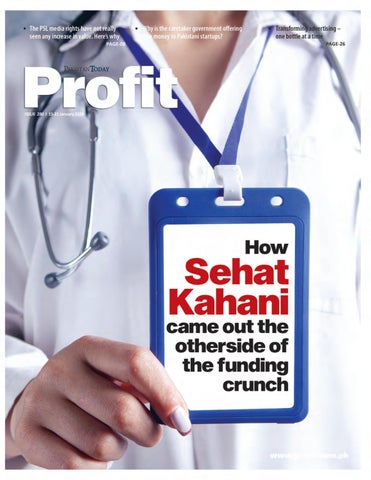
13 Has economic turmoil placed the Pakistani businesses and startups on the back foot? Osman Rashid 16 How Sehat Kahani came out the other side of the funding crunch 21 Why is the caretaker government offering free money to Pakistani startups?
11
23
23 Trick or Treet: Decoding the meteoric rise in the stock price of the battery manufacturer
13
26 Transforming advertising – one bottle at a time
Profit
28 Chinese banks throw a curveball in $600 million loan talks with Pakistan. Are we surprised?
Publishing Editor: Babar Nizami - Editor Multimedia: Umar Aziz Khan - Senior Editor: Abdullah Niazi Sub-Editor: Basit Munawar - Video Editors: Talha Farooqi | Fawad Shakeel Business Reporters: Daniyal Ahmad | Shahab Omer | Zain Naeem | Saneela Jawad | Ghulam Abbass | Ahmad Ahmadani Shehzad Paracha | Aziz Buneri | Nisma Riaz | Mariam Umar | Urooj Imran | Shahnawaz Ali | Meerub Amir Regional Heads of Marketing: Mudassir Alam (Khi) | Sohail Abbas (Lhe) | Malik Israr (Isb) Pakistan’s #1 business magazine - your go-to source for business, economic and financial news. Contact us: profit@pakistantoday.com.pk
The
media rights have not really seen any increase in value.
Here’s why
PSL’s TV rights have been sold for 45% more than the last time, but is that as “massive” an increase as PCB will have everyone believe? By Shahnawaz Ali
T
he Pakistan Cricket Board (PCB) has finally announced who the broadcasting rights for HBL Pakistan Super League (PSL) have been sold to. While trying to remain discreet about the exact figure, the chairman and secretary respectively stated that this was the highest ever " deal" and that the deal was “at least Rs 3 bn more than the last bid”. Over the years, the PCB has remained discrete about the amount of money these deals go for. Unluckily, this time, the value of the deals and reserve prices have been revealed by various media reports and there seems to be vast consensus on these values. The PCB historically only reveals the percentage increase in the amount for which TV and digital rights are sold. This time around, the PCB claims that it has seen a “massive increase” in the value of PSL’s media rights. But to know how “high” this deal really was, it is important to first know what the real values of the deal are. The PCB press release states that the TV rights have been sold for a 45% increase and the digital rights have been sold for 113% increase. From previous reports we know that the TV rights for PSL were sold for Rs 4.35 billion in 2021. Reconciling with the figure reported by other media outlets this time, we establish that the PSL broadcast rights were sold for Rs 6.30 billion. This figure also becomes mathematically verifiable. Including the digital rights, the amount PCB earned is Rs 8.15 billion in total. Of this, Rs 1.85 billion was fetched from digital streaming rights, as
8
revealed in various media reports. Now that the numbers are clear, an important question is raised, is this amount higher than the last auction? And is the PCB management correct in touting its own horn for a “massive” improvement?
The real value conundrum
E
ven though not mandatory, it is a worldwide practice to report broadcasting rights of major sports leagues in dollar terms. One of the main reasons for that is comparability to other major leagues, but another major reason is the stability of the US dollar, being a peg for many currencies around the globe. For example the IPL sold its TV rights to Star for approximately INR 24,000 Crores or $3.02 billion last year. Similarly, it is common knowledge that Cricket Australia sold rights to 7even and Fox Cricket at $1.5 billion for the next 7 years. There is however, another important reason for this form of reporting, and that is the real and nominal economic value. A concept well heard of in economic and accounting practices, seems to have eluded the PCB. While some readers may be aware of the difference between real and nominal values of a commodity, it is important to explain what they mean to understand the PSL media rights problem. The current economic climate is perfect to explain this phenomenon. Say a 75g bag of chips used to cost Rs 50 in 2021. The same bag is currently going for Rs. 100 in the market and a 40g bag now costs Rs 50. The explanation for that is inflation, as everyone
understands it. The decrease in the size of the bag of chips happened due to huge inflation numbers in the last two years. This inflation was caused by a steep devaluation of the rupee, increase in global commodity prices etc. While the price of the bag of chips has increased, was it because of the increase in demand for the chips or an appreciation in its brand value? Not entirely!It could be but for that we need to take inflation out of the picture. So to map the increase in the value of PSL media rights, one has to adjust it for inflation. A much simpler way to get to the ballpark figure, which news media around the world would generally do while reporting, is taking the dollar value of the increase. However, the dollar economy itself sees a certain amount of inflation so the real economic value is the correct way to measure an increase in value. The media rights for the 2022 and 2023 seasons, sold in December 2021 were awarded for approximately $24.6 million (Rs 4.35 billion), as per the dollar-rupee conversion rate from December 2021. Calculating the value of the current bid, the dollar value for TV broadcasting rights has not seen a “massive increase” but is rather lesser than the previous deal, at $22.6 million. The decrease in dollar terms is therefore calculated to be 8%. Profit, however, delves deeper to carry out the real value determination, adjusting the PSL deal with inflation. With the average annual inflation between December 2021 and December 2023 at 27.1%, taking 2021 as the base year, the real rupee value of the PSL media deal is Rs 3.899 billion in December 2021
terms. This marks a 10% real decrease in value and hence does not really give any bragging rights to the Zaka Ashraf led board. To find the real value of a statistic by adjusting it for inflation is not a new concept, in fact all the growth statistics published by the Pakistan Bureau of Statistics are already adjusted for inflation. While the PCB is not an entity well-known for its prowess in economic valuations, it is important to point these out when gauging board performances. With the reveal of the current value of the PSL deal, we can also calculate the two-year value of the broadcasting rights sold to Blitz and Tech front in December 2018. While the price leaked by the media, at the time, was $36 million dollars (Rs 4.7 billion for 3 seasons), a reconciliation with the percentage increases reported over the next two deals lands the pointer at a calculated Rs 4.45 billion for the deal with Blitz and Techfront in Dec 2018. Taking December 2018 as the base year, the graph below shows the real increase in the value of PSL’s brand rights over the last 6 seasons that have been auctioned. This goes to conclude that the “highest ever” rights valuation for the HBL PSL was fetched, not this year, but in 2021.
The Digital Front
T
here is however one medium where the PCB has outperformed its previous bid, though due to no brilliance of its own. This is the digital rights for PSL. A nominal increase of 113% marks a significant real increase as well. Once again, the present value of the bid by Walee Technologies,
as revealed by media at Rs 1.85 billion, means that the previous bid made in December 2021 was Rs 868 million. Even after adjusting for inflation, this shows a 32% increase in real value. Over the last 3 years the viewer migration to OTT platforms has been great. With a steep rise in broadband and 4G connections, Pakistanis are now much more at home, watching cricket from their phones. It would in fact not be wrong to say that the Over The Top (OTT) services and video streaming apps that operate in Pakistan, primarily do so on the back of cricket. To state a few numbers, 14.4 million people watched Asia Cup 2023 on Jazz’s Tamasha app. More than 21 million people joined the live stream of Daraz during the Pakistan vs India match in Asia Cup 2022. As of now, all the leading cricket streaming apps have more than 4 million downloads. In fact 3.8 million people downloaded tamasha and 2.8 million downloaded Daraz during the Cricket World Cup 2023, alone. This goes to show that the market size on the digital platforms has increased by a large quantity, ever since December 2021. Where does this place the growth in the value for which PSL’s digital rights were sold? The answer is still not clear due to lack of availability of user data. However, numbers from across the world suggest that Pakistan still hasn’t cashed in on digital rights sales. To take the IPL example, it is seen that the digital viewing rights, last auction, went for the same amount of money as the TV rights. In the case of other boards and leagues, Cricket Australia signed a 7 year deal with 7even and Fox for $1.5 billion, of which
digital rights amounted to 33% of the total bid value (~$500 million).
The Reasons
N
ow that it has been established that the value of PSL’s rights has decreased over time, let us answer why. A TV deal is only as good as the amount of money it will fetch. Given the current economic climate of Pakistan, the amount of money anticipated to be earnt through PSL is not huge. An economic slowdown and less availability of credit, does not allow companies to invest as heavily in marketing and expansion as they normally would. It is also important to mention that one of the biggest advertiser demographics, that has spearheaded the sponsorship for the majority of leagues in the recent past, has been betting apps or surrogate companies representing those betting apps. With a potential ban on these advertisers by the PCB, the pool of money that PSL normally earns from has already shrunk compared to the previous years. Before the auction of PSL’s media rights, the PCB hired Colganbauer, a UK-based consulting firm to determine the valuation of the PSL media rights. Reportedly, according to Colganbauer, the total worth of the TV rights of Pakistan Super League, sit at 6 billion US dollars. This is after taking into account currency depreciation, real values and expected revenues. Considering the figure given by the consultant, the PCB has done well to sell off the rights for 6.3 billion. However, is this a jackpot? Absolutely not. The PSL has, for sure, seen better days. n
Merit Packaging is selling off its land and building. Why?
Board of directors explores leasing or rental agreement for the same property
L
By Haris Javed
ast week, Merit Packaging, one of the larger packaging companies in Pakistan, informed the stock exchange that it plans to sell its factory building and land situated in Karachi’s Korangi Industrial area. And no, this does not mean the company is shutting down its operations. Instead, Merit’s board of directors disclosed their plans to enter a lease or rental agreement for the same property with the prospective purchaser. In simple words, the plan is to sell the factory building, along with the land on which it is built, and rent it back from the new owner of the real estate asset. The company has called an Extraordinary General Meeting (EGM) on Thursday, February 15, 2024, to get shareholders’ approval for this plan. The resolution will stand passed if 75% or more shareholders present in the EGM vote in favour of the sale.
COMPANIES
Why is Merit selling?
W
aqas Ghani, Deputy Head of Research at JS Global Capital, told Profit, “During the outgoing year, Merit got its assets revalued and resultantly recorded a surplus of Rs 1.39 billion. In light of this, the company has recently expressed its intent to engage in a sale and leaseback arrangement, anticipating benefits such as immediate cash inflow and enhanced operational flexibility.” The company has been experiencing losses for at least the last five years. However, in the last two years, there has been some improvement which has allowed the company to post a profit on its operations.
But despite the positive operating profit in 2022 and 2023, Merit Packaging reported net losses in both years after interest and tax expenses were deducted from operating profits. More specifically, the company made an operating profit of Rs 279 million (Rs 28 crores) in 2023, which was completely wiped off by Rs 344 million (Rs 34 crores) of financial charges, leading to a net loss of Rs 136 million (Rs 13 crores). This is despite the fact that the company has actively reduced its dependence on debt over the last few years. Presently, 65% of the company’s assets are financed through shareholders’ money, with only 35% financed through debt. Just two years ago, the balance clearly favoured debt when 84% of the assets were financed through debt. However, this still
11
has not led to decreased interest expense for the company in a high-interest environment, where debt providers now demand more than 22% interest rates. Iqbal Ali Lakhani, chairman of Merit Packaging, highlighted the same issue in the 2022-2023 annual report. “Despite these macroeconomic challenges, the company has been able to sustain growth momentum and registered a considerable increase in revenue by 51% to Rs 6,340 million and consequently declared a reasonable operating profit of Rs 278 million, however, the same could not be significantly translated into the bottom-line due to hefty surge in finance costs.” And even though the company did not disclose what it plans to do with the cash it will generate from the sale of its real estate asset, it is likely that the proceeds will help repay expensive debt, leading to lower finance costs going forward. Editor’s Note: The public announcement by Merit Packaging does leave a lot wanting. Investors should have been informed clearly of the reason for the sale and what the company plans to do with the money. Also, it should be disclosed if a sponsor shareholder is an interested buyer. And even though these points are expected to be disclosed through subsequent announcements, we feel the best practice is to disseminate all price-sensitive information as soon as possible.
How much can Merit save?
T
he land and building in question were revalued at Rs 1.45 billion (Rs 145 crores) excluding plant and machinery. Assuming it will be sold close to this figure and the company decides to at least repay its long-term debt of Rs 1.3 billion (Rs 130 crores), the company can save approximately Rs 310 million (Rs 31 crores) in finance costs, assuming an interest rate of 24%.
12
Are shareholders ecstatic?
G
iven the rental yields in Pakistan range between 3% to 7%, it is reasonable to assume that the rent paid by the company to the new
owner of the factory building will be insignificant compared to the reduction in finance costs if the company chooses to pay back its debt. This could potentially make Merit a profitable company once again. However, right after the announcement, the company’s share price, instead of increasing, dropped from Rs 13.34 to Rs 12.63 – a 5.32% reduction despite increased shares trading volume. A stock broker, on the condition of anonymity, explained this phenomenon, “Since Merit’s share price had consistently increased in the days and weeks prior to the announcement, it is possible that some insiders might have bought the shares before the public announcement, driving up the price then, and are now selling their shares leading to a drop in the price now.” Only the regulators with access to otherwise confidential trading data may want to investigate this. Profit reached out to Amir Chapra, CEO Of Merit Packaging, for his comments on all these matters, but he declined to respond stating “I can not disclose any details before the EOGM on 15th Feb, 2024”. n
COMPANIES
SATIRE
Osman Rashid
Has economic turmoil placed the Pakistani businesses and startups on the back foot?
The founder’s case is simple: for early-stage startups, if you are a “techie” co-founder, you should not take on management responsibilities until your product has matured enough. Only after going through the grind and reaching your 40s and 50s, and having tried your hand at multiple things, should you consider transitioning to a different role. The processing power before that simply does not exist. Contrary to popular belief, the problem of the modern Pakistani founder is not that of a lack of effort. In fact, they might be putting in too much effort. Simply put, if you have one problem deeply entrenched in your subconscious, you continue to work on it regardless of any distractions or obstacles that may arise. The country’s enterprising class appears to However, while juggling with other managerial tasks and be growing more risk averse over time failing to prioritise, a solution to that problem might never be found. akistan’s startup ecosystem has been through a lot If the passion is there for the product, founders do over the past few years. From being pitched as the not go on blaming the market and investor sentiment. One next big thing in the emerging markets ecosystem to a can be apprehensive of the situation but it must never be dearth of funding over the past two years, the nascent an excuse. Think of it this way, what else is the job of the market has had its ups and downs. entrepreneur? It is literally finding solutions. If the problem This has triggered a certain behavioural shift is that the founders have a strong affinity for their product, in the market which I observed recently at a conference in Silicon but the market conditions are unfavourable, they should Valley. In my interactions with a few Pakistani entrepreneurs presview it as just another obstacle that needs to be overcome. ent there, there was a certain realisation. All the three co-founders When the 2008 crisis hit, I was in New York City, were simultaneously juggling between multiple things. It appeared navigating the Series-D for my startup. The entire market as if they were hedging their bets, and most of the young entreprewas crumbling, yet the company had 1 billion dollar worth neurs find themselves in a similar kerfuffle when they embark upon of term sheets on the table. Why? Simply because there was their journey. They are trying to fend off the risk posed by scarcity a product market fit that was performing well. The team of resources, the possibility of failure and the market climate. could have easily said that the climate was bad and would This is precisely where the startup founders in Pakistan have have decided to tackle the crisis first. However, the focus gone wrong, and it is not limited to just the founders. Pakistan as remained on building the product. Even in the midst of the a country has become highly risk averse in terms of business, from calamity-stricken market, we were able to successfully raise the founders to the investors to the government. funds. Venture funds drying up, currently, is a shared concern for startups across the globe. Even the markets in the US are a bit wayward right now. Employees over there are being laid off as well. Yet, our local founders have figured out a hack to the never ending search for VC funding. If their company does well, there are international companies owned by Pakistani origin The writer is a Pakistan-born entrepreneurs that will be interested in financing. silicon valley investor and is This is where defensiveness becomes apparent. Pakistani founders are often enticed the co-founder and the former by the hype surrounding international funding rounds, as they can have a significant CEO of ed-tech unicorn “Chegg” impact on valuation, ultimately leading to a smoother path towards an IPO. However, at
P
COMMENT
13
an early stage, founders should not be preoccupied with the thought of an exit. Instead, they should remain focused on building the company, as this will eventually open doors for better exit opportunities. There is no doubt that immense potential lies untapped in Pakistan. Evident from the fact that it is the only country among its neighbours that is yet to take off. But I would reiterate the fact that Pakistanis in general have become very defensive. When it comes to the government, it is a completely different setting. Let’s take tourism as an example. During the process of opening up our own resort in Shigar valley, I was in contact with a few Pakistani diplomats who gave assurances about the political situation. My apprehension is that when you go to Africa, one does not look at who is in power. Nobody talks about the political situation. The only concern should be around the security of the investor’s assets. Pakistanis as a
14
nation have intertwined security with politics and it is unfortunate that politics has also become a violent discourse. People highlight the negatives and that does not attract positive sentiment. Look at the number of school shootings in the US, you will realise that Pakistan is also not that unsafe. Not to imply that the country does not have problems of its own. But we are not even remotely comparable to that country when it comes to an investment framework. Probably the biggest factor behind it is that Pakistan has an image problem that stems from terrible marketing and a lack of branding. The country needs a Chief Marketing Officer who can spread the positive word around the world. As for the government, it only needs infrastructural tweaks to make business feasible. Again tourism serves as a perfect example. The Skardu airport, for instance, is beautiful, but the condition of washrooms at that airport
is appalling to say the least. It is just a small problem possibly costing 1-2 million rupees to resolve. Spend that and it will reduce a pain point for the tourists. 95% of the tourists at our resort in Shigar valley are Pakistanis. 75% of them commute for almost 12 hours before reaching there. For them, the primary problem is not politics, it is the unavailability of basic sanitation and other facilities during the journey. These are just examples but with the same philosophy, all the industries can flourish and with proper help, there is no reason why Pakistan cannot create a unicorn. For a country boasting a population of over 250 million, the path forward is an upward trajectory. However, in order to achieve progress, it is imperative to dispense with the idea of a saviour and instead concentrate on diligent effort. The key lies in investing in our own inherent capabilities; this is the singular solution for success. n
COMMENT
16
How
Sehat Kahani
came out the other side of the funding crunch The startup which aims to provide a platform for Doctor Brides to practise medicine found unique ways to generate money and got very good at it. But can they now scale?
I
By Taimoor Hassan
t was a simple problem with a simple solution. For decades now Pakistan has been home to the unique problem of ‘Doctor Brides’. Women make up the majority of medical students in Pakistan. In fact, in medical colleges spread across the country, around 70% of those attending are women. Yet only around 23% of these women end up practising because many either drop out in their final years or opt not to practise medicine after getting married. It is a persistent social issue that causes intense debate and has been linked to Pakistan’s abysmal doctor-to-patient ratio. With a total medical workforce of over 2 lakh doctors, there is only one doctor available for every 1200 patients. The conspicuous absence of these qualified and talented women doctors from the medical workforce is a sore spot within the medical community. Dr Sara Saeed was one such ‘Doctor Bride’. After graduating from medical school in 2010 Saeed married and her medical degree sat
COVER STORY
collecting dust. Throughout this time as she navigated married life and motherhood there remained an itch in her to use her education not just to help patients in need, but also other women doctors like her whose careers were cut short by social expectations and pressures. Today she runs Sehat Kahani. This is a telehealth startup that connects doctors to patients on a single platform for basic, online consultations. The idea was that the startup would give the opportunity to female doctors like Sara herself to practise from the comfort of their homes while also giving users access to qualified doctors at the click of a button. Around three weeks ago Sehat Kahani announced a $2.7 million Series A funding round at a time when startups are finding it increasingly difficult to find money. The round is the largest for a telehealth startup and underscores the success that Sehat Kahani has found in this growing segment. Over the past few years Sehat Kahani led by Dr Saeed has won multiple prestigious awards and grants that have propelled Sehat Kahani in its journey. But the story is not so simple. Behind the scenes of Sehat Kahani is a complicated reality. The telehealth segment is over-saturated with competitors trying to make it work one way or the other, customers are hesitant to trust (and pay for) online consultations, and the entire industry’s business model is still a work in progress. One of the competitors even might have succumbed in this space in absence of great avenues to monetize and ruthless competition. Not only is the competition stiff in a developing industry, there is also bad-blood within the competitors. So how did Dr Sara Saeed manage to take Sehat Kahani in such an environment and bring it to the forefront of this industry? To understand the story we must go back to where Dr Saeed first got into the telehealth business. Because Sehat Kahani is not the first telehealth startup in Pakistan. And it is also not Dr Saeed’s first startup.
The DoctHer brides
I
n 2007 Dr Asher Hassan setup Naya Jeevan — a social enterprise that would provide low-income workers in the corporate world with affordable healthcare through insurance. Now this is important to understand. Naya Jeevan was the entity set up by Dr Asher and its goal was providing healthcare solutions to corporations for their low-income workers. It was for this company that Dr Hassan hired Dr Sara Saeed in 2012. The two doctors worked closely and Hassan learned about how his new employee was one of many doctors in her batch that did not practice after graduating from med-school because they got married.
18
By 2015 Dr Asher had conceived the idea of DoctHers. This was supposed to be a platform to connect the at-home female doctors to patients in low income communities. Dr Sara served as the first female doctor of the platform who served patients in the first e-health clinic in the Sultanabad area of Karachi. The project was incubated under Naya Jeevan with Dr Asher as the cofounder, CEO and chairman of the new business that was later spun off as a separate entity. The other co-founders of the business included Dr Sara Saeed and Dr Iffat Zafar Agha, who were both given equity in the new venture and served as its chief operating officer and chief development officer, respectively, and given all the authority to run the business as they pleased but under the supervision of Dr Asher. The startup immediately started making some noise. The best startup ideas are the ones that solve very specific problems. And DoctHers was trying to wrangle an incredibly unique issue that had not just vast local application, but was bound to drum up some international attention. In 2016, the United Nations International Children’s Emergency Fund (UNICEF) launched the Global Goal Awards to honour individuals and companies for their contributions towards achieving the Sustainable Development Goals by 2030. One of the initial winners of this award, announced in September 2016, was DoctHers which was recognized for contributing towards the goal of improving the lives of girls and women by connecting female doctors to vulnerable girls and women via telemedicine. At UNICEF, DoctHers were represented by none other than Dr Sara Saeed — the face of the company.
Fault lines appear
T
here is an eerie silence regarding what exactly happened from this point onwards. All we do know is that after the UNICEF award DocHers focused on gaining more and more grants to keep running. As part of this, Dr Saeed took the lead in looking for such opportunities and was very much the person running the show at DoctHers. What we do know is that in the process of finding these grants there was a fallout between the founders of DoctHers. One explanation given by a source was that there was a serious disagreement following a USAID grant application that was being implemented by Dr Sara Saeed and Dr Iffat Zafar. In any case, DoctHers was soon demerged. As this split continued to grow Dr Saeed and Dr Zafar took centre stage. Even though he was the original founder of Naya Jeevan, Dr Asher Hassan had already left a lot up to these
two. On top of this, Dr Saeed and Dr Zafar had themselves been ‘Doctor Brides’ before they helped create DoctHers. This meant that as far as marketing was concerned they had an edge over Dr Hassan. By 2017 the split had been finalised and DoctHers was demerged into two entities, the other one being Sehat Kahani. Following the demerger in March 2017, Dr Sara said that all matters were amicably settled between all three founders to demerge operation in a manner that all existing clinical operations, tangible assets, contracts, MoUs etc. are transferred to newly formed venture Sehat Kahani. What is interesting however is that Sehat Kahani seems to have gotten a pretty sweet deal out of the split. It was decided that the new entity would execute all “existing contracts/partnerships” until their expiry under the supervision of the dedicated team which has now become the part of the Sehat Kahani organisation. Whereas doctHERs will be strategically pivoting to focus on the corporate sector and corporate value chains (factory workers, suppliers, distributors, retailers, micro-retailers, etc) and will continue to expand its nationwide network of remotely located female doctors.
Sehat Kahani takes flight
T
here has been no looking back for Sehat Kahani since the demerger with DoctHers. Not only does Sehat Kahani have a unique mission it has managed to present itself well to investors. The startup raised a $1 million in pre-Series A funding and recently managed to get a $2.7 million Series-A round. But perhaps even more than funding from investors Sehat Kahani has also focused on donations and grants. And once again, we’d like to repeat that Sehat Kahani is presumed to be the leader in the telehealth space. The idea of telehealth in a country like Pakistan makes sense. It is a business-to-consumer model in which a platform directly connects doctors with patients. Because of crumbling healthcare infrastructure people require doctors for basic consultations and there is a ready crop of doctors available to provide this service online in the shape of these many unutilised women doctors. Yet there is a major problem in this business model. As one source in the industry explains to Profit, given the size of Pakistan’s population, 99.99% of the people still prefer physical consultations, even though the uptake of digital has increased but as a percentage of the size of the population, it would be the remaining minute 0.01% that is digital. This is because consumers are not yet willing to pay for a doctor that they can not
physically visit at a clinic or a hospital and hence not yet monetizable in a silo. Consumers would, however, be willing to adopt online consultations if they are able to get all or most of the services in the primary healthcare continuum. That is to say a consumer would be unwilling to go online to see a doctor for primary healthcare services if it is only a consultation with a doctor, but they would be more inclined to use digital as a mode of healthcare if they are also able to order medicines and lab tests along with the video consultation. Pakistan’s telehealth business is small with only a handful of players in the market, struggling and fledgling around. The list includes names such as DoctHers, Ailaaj, Oladoc and Sehat Kahani, most of which started with teleconsultations or medicine delivery but have now either consolidated or are trying to consolidate all the services together with teleconsultation, to make their platforms monetizable. Some of these have raised venture capital rounds but smaller ones, which attests to the inability to scale very quickly in Pakistan despite the very large size of the population. For instance, OlaDoc raised $1.8 million in their pre-Series round over a year ago. Ailaaj raised $1.6 million in a pre-Series round over two years ago. There is no public announcement from DoctHers of any funding, while MedIQ has announced a $1.8 million raise in April 2022. Sehat Kahani is the only recent one to have raised a $2.7 million funding round. Why are the rounds not being raised very frequently and why are they not so big? Because there is not enough growth of consumers yet, and there is not enough ability to monetize those consumers. It is going to take a while, as a source said. What you need ideally is an integrated business model. The model we are talking about is the business to consumer model where through an app, the telehealth companies would reach out to a target market virtually of 230-240 million people, which is the entire size of the Pakistani population because everyone is going to get sick and everyone is going to need to see a doctor. While growth could not come from the B2C segment, the telehealth companies have been looking at other avenues of getting revenue and some even using the teleconsultation business as a means to generate business from other business lines. Oladoc, for instance, which only used to be an aggregator for doctor appointments, has recently ventured into directly providing telemedicine services, but does not expect to generate profits from this business. Instead, for Oladoc, telemedicine would be a loss leader for the business. That is to say telemedicine would bring customers to the Oladoc platform but it doesn’t expect to make money from this business. Instead, it will convert those
customers into ones that would now book physical appointments with doctors at the Oladoc platform, from where it actually thinks it can make money. On the other hand, some of the telehealth startups in Pakistan provide telemedicine services to employees of corporations, either directly or through insurance companies. This segment, otherwise called B2B, is also riddled with problems. The corporate target market is small and there are more competitors than there should be to cater to this market, decreasing prices for everyone and turning losses. In the words of a source familiar with the telehealth business in Pakistan, “targeting corporations for telehealth business in Pakistan is a race to the bottom because of the presence of so many companies in this segment.” Then there is an issue of low level of utilization in corporations. Utilization is to say how many employees use a telehealth platform for virtual consultations. If the utilization is low, less people in a corporation are paying for the service which means less revenue. On the other hand, the current model also leads to higher losses in case the utilization increases. The corporate model, otherwise called B2B model, in Pakistan is also presumed to be unworkable in its current state and more so in the presence of increasing competition. The B2B is not a very big market to begin with. If a high value startup is to be produced in the telehealth space, B2C needs to be adopted at a bigger scale and people need to pay for it too. According to a source, the current unit economics of the B2C model for it to make sense as a business looks something like this: about 50% goes to the doctor providing the consultation on the platform, 20-25% is operating cost and 20-25% is profit. Why do we think so? Just take a look at Sehat Kahani’s financial performance which corroborates with this thesis. For the financial year 2021, the company booked a small revenue of Rs 7.4 crore and incurred a net profit of Rs 3.2 crore (why was it a net profit and not a loss comes below). For the year 2022, Sehat Kahani’s revenue swelled to Rs 9.36 crore, still a small amount, but incurred a net loss of Rs 1.94 crore. And this is the company that is raising the best rounds and is the most prominent in the telehealth sectors.
If you can’t find investors where do you go?
A
ll of this means that getting outside investors becomes a problem. There is not enough growth and there is not enough profits. Hence the infre-
quent and small rounds. On the other hand, cash burn is high due to the costs associated with the business and the spend required on marketing to bring the growth numbers. So what do you do if you are a business that can not access enough VC money to plug cash flow issues?The answer is you turn to free money or non-dilutive capital. That is what Sehat Kahani did. It turned towards securing that free money from donations and non-dilutive capital in the shape of grants. Donations are monetary gifts given in pursuit of a cause someone believes in, while grants are funds given to organisations to attain a certain goal with KPIs to be achieved but are not intended to be paid back. It has won donations and grants and it has also been able to win some high profile awards such as the Rolex Awards and Cartier Awards, both of which come with hefty prize money that would have played an instrumental role in growing the company to the point that it was able to raise venture capital funding and reduce reliance on prize money, grants and donations. This is actually a very interesting approach. One of the harsh realities of the startup world is that founders start their journeys with an idea that people want to be part of and find themselves spending less and less time on the idea and more on convincing investors so they can scale their idea. The reliance on investors continues to grow and the results are less than ideal. So finding streams of revenue for a startup that aren’t equity funding is always a bonus. After all, there is no money that is better than free money. SK’s losses for the year 2022 would have been much bigger and net profit for the year 2021 would have been a net loss hadn’t it been for the sizable grants that the company reported in the other income section of its financial statements. For the year ending June 30, 2021, the company reported having earned a grant income of Rs 85.7 million, bigger than the revenue from core business, and received Rs 2.7 million in donations. For the year ending on June 30, 2022, the grant income received by the company was Rs58.2 million and donations received were Rs 1.2 million. Sehat Kahani’s recent Series-A round of $2.7 million also hosts investors that are not VCs. USAID for instance is not an investor but a donor organisation that gives money to organisations to achieve certain goals and monitors the progress of these goals, but does not take equity in the company or asks for the grant to be paid back unless the criteria set by the organisation is not met. Sehat Kahani has not yet disclosed, in question asked by Profit, what proportion of the recent round was equi-
COVER STORY
ty-based, how much was debt and how much was grant money. This is actually a very clever way to fund an organisation that is passionate about creating a successful business but can not do so because of the state of the market that doesn’t allow much monetization. Sehat Kahani is a good story to tell and has a founder that knows how to present it well. Pakistan is an underdeveloped economy, the western society and some of the local businesses care about healthcare and are ready to give money to social causes that also empowers women. It is the kind of pitch organisations would lap right up. Consequently, Dr Sara Saeed has been able to win some high profile awards from, for example, Rolex, known for the prestige of the brand, as part of their ESG (environment, sustainability and governance) program. The winners get up to 200,000 Swiss Francs in prize money, which in today’s time is over $250,000. The award also comes with international publicity through Rolex (and a Rolex gold chronometer watch to boot). Dr Sara Saeed won the Rolex Award in 2019. These awards are a great way to funnel money into a business. They not only come with money, but also with prestige. They can seriously elevate the profile of the candidate so that next time winning is not difficult. And as you might expect, Sehat Kahani is not the only organisation looking to capitalise on these awards and grants. Their competitors too want a slice of the pie. The only problem is when some of the achievements of the founders applying are mixed together. Take for example the $30,000 Cartier Initiative Award that Dr Saeed and Sehat Kahani won in 2018. The award was supposed to be for a business that was creating impact and was an original iddea. Cartier’s own rules of participation for the Women’s Initiative Award say that the idea must be original and not a copy of some other business. While Sehat Kahani is an impactful business driven to the cause of improving lives through healthcare, it is not an original idea. After all, DoctHers was the original company trying to solve this problem. The issue is that Dr Saeed was a co-founder in that company as well. Her original cofounder, however, might try and argue it was his decision. So how do you determine this? In media interviews, however, Dr Sara has admitted that DoctHers was Dr Asher’s idea and did not take credit of the company for herself. Clearly the committee managing the Cartier award felt the idea was originally Dr Saeed’s and not Dr Asher’s. Why would organisations as prestigious as Cartier ignore their own rules? Well according to a source, due diligence is sometimes surprisingly lax at these awards. “Winning awards is a big business. All you need is a good
20
story. And these awards are foreign so they can not carry out thorough due diligence much like VC funds who tend to believe what is told to them. And much like VCs, these awarders also believe that if an award has been won earlier and that the awarder is a prestigious entity, that awarder would have done the due diligence before giving the award.” That is to say that if UNICEF gave DoctHers the first award and Dr Sara and Dr Iffat Zafar were the cofounders, the new organisation such as Rolex or Cartier would believe that UNICEF would have done its due diligence before giving the award, making them comfortable to hand out the award without doing a thorough due diligence on their own. Later in 2020, Dr Iffat Zafar Agha also won the Elevate Foundation Prize award which comes with an award money of up to $300,000.
The product itself
S
o here we have a unique startup that has found a market perhaps not quite ready for its product. It has instead of wilting found a unique solution and has marketed itself well. But how exactly does the product measure up? At the centre of this murky situation is Sehat Kahani’s mobile application. Launched in 2019, after a very short operational duration, the app has a clunky interface with the saving grace that it works. As a ‘for-profit’ social impact enterprise, as Sara likes to call it, providing healthcare services to marginalised communities the application was always going to be a topic of conversation. As it stands, Sehat Kahani’s claims to have a network of 7,000 doctors that it works with. That is to say about 7,000 doctors could potentially provide healthcare services to patients through the Sehat Kahani application. But when it was launched, it had doctors, most of whom simply have an MBBS degree. The problem is that a lot of them were listed as having certain specialities. Now remember, they did not at any point say a certain doctor had completed a specialisation but rather they were “good” at certain things. Since the app is meant for primary care, it is known that the doctors will all be GPs, and it will be their duty to forward the case to a specialist if it comes to it. Nowhere on the app is it claimed that the doctors have a degree that they do not have. But was this just a clever misrepresentation? Or was Sehat Kahani luring patients by using the word ‘specialist’ irresponsibly? Dr Sara’s response to the accusations was in the form of indignation. The Pakistan Medical and Dental Council (PMDC), the body that has been regulating medical practice
in Pakistan until recently, has its own code of ethics which upholds preservation of human life as the cornerstone of medical practice One might say that a doctor claiming expertise is simply giving the patient more trust in themselves, especially at the primary level, but doctors masquerading as specialists can actually put a patient’s life in danger. Dr Arshad Taqi, a specialist in the field of Anaesthesia and the President of the now dissolved Pakistan Medical Commission (PMC), the successor organisation to the PMDC, had agreed, in an interview with Profit, on the unethical nature of such practice and its consequences in the form of danger to the life of a patient. “An MBBS doctor can never be a specialist without a degree, even if he has 20 years of experience in a specialist domain,” said Dr Javed Akram, Chancellor of University of Health Sciences (UHS). “It is an unethical practice that can endanger a patient’s life,” a Lahore-based psychiatrist said, affirming the dangers of such practice. And not only that, it also undermines the status of a qualified specialist, who, being a specialist, actually understands the subtleties associated with the profession. The idea of the platform is that patients come to general physicians for a consultation. These doctors can then either refer them to a specialist or if it is a simple case prescribe medicine. From a patient’s perspective, the problem is that Sehat Kahani is a paid platform, and if a patient consults a doctor on the Sehat Kahani app thinking that a doctor is a specialist, the patient would essentially be paying for nothing if that doctor ends up referring that patient to an actual specialist. Though the same can happen offline in physical clinics that MBBS doctors operate, so what really is the difference then? So what is ahead for Sehat Kahani? For now the company has managed to not just cleverly get through the funding crunch, they have also found ways to keep their operations funded by maintaining and promoting their brand image. And after going through these initial birthing pains, it has now been able to secure VC funding. This means they will now be able to burn money, acquire customers, and grow further. This will in turn lead to a higher valuation. If they can keep that up they will be a pretty successful startup. They also plan to go global. Up until now Sehat Kahani has managed to do so with grants and awards, building an impressive profile for itself. But if it has any hopes of going the distance it must now look towards convincing investors to put in the money. And to do that, Dr Sara Saeed and the Sehat Kahani team must look towards their business fundamentals. n
COVER STORY
Why is the caretaker government offering free money to Pakistani startups?
Unlike VC funds, the PSF is an equity-free grant, aimed at bolstering the tech ecosystem in the country – but can it do so?
E
By Nisma Riaz
arly on January 9, 2024, every person imaginable from the Ministry of Information and Technology congregated in Islamabad to launch the Pakistan Startup Fund (PSF). What followed was a typical “launch ceremony” organised by the government. The minister gave a speech to a packed audience. The protocol flunkies nodded vigorously, the ministry lackeys clapped loudly, and the press minions (including two of Profit’s own correspondents) took notes diligently. There was talk of ‘revolutionising Pakistan’s IT landscape’, and ‘uplifting the youth’ was mentioned for good measure. It was as standard as it gets. We won’t even question why a caretaker minister is launching funds and making policies and plans that will have far-reaching effects well beyond his constitutionally mandated time in office. But what exactly is the Pakistan Startup Fund? To hear Dr Umar Saif (caretaker minister of IT & Telecom) and his ministerial entourage speak of it, the government wants to use the annual Rs 2 billion fund to help Pakistan’s nascent startup ecosystem. But what exactly does “helping” startups mean in this context? The Rs 2 billion up for grabs here are being offered equity free which makes this, for all intents and purposes, a subsidy. The money isn’t being given directly by the government but is instead being managed by Ignite, a non-profit company run by the Ministry of Information and Technology. So how will this fund work, and is it the best idea in the world?
Why create the fund?
T
his part is simple. Over the course of the past year startup funding has tanked all over the world. Pakistan, which since 2018 has been home to a steadily growing startup industry, has been
STARTUP
adversely affected with many large startups having to shut shop. The government clearly believes in the potential of Pakistan’s startup ecosystem. That is why they have introduced the Pakistan Startup Fund. The Rs 2 billion are meant to act as a cover for underwriting risks for startups. What that means is if a startup needs to raise, for example, $700,000 in a particular year to stay on track but only end up raising $500,000 they can approach the fund to bridge the gap. As funding has dipped in Pakistan potential founders might be becoming more riskaverse. Startups are already a risky business with 90% of startups likely to fail from the getgo. So in an environment where investment is rare and business risks are high, the appetite to create a startup might be significantly lower. The PSF, at least as envisioned by Saif, would offer an encouraging cushion for startups. The Pakistan Startup Fund has also been launched to bring in the much needed FDI (foreign direct investment) into the country. For starters, the fund has been launched with the backing of the Special Investment Facilitation Council (SIFC), whose mandate is to facilitate investments into Pakistan to alleviate hurting macroeconomic conditions. If the risk of the VCs is underwritten by the government, they would be more likely to invest in the country, than in the absence of such a fund. This brings in dollars into the country while the fund gives the money to the startup in rupees, resulting in a net gain of dollars.
What are the terms of the fund?
N
ow this is where things get interesting. As mentioned above, the fund has been created in collaboration with the SIFC which means it has the backing of state institutions. This makes the fund a serious investment pool that startups can look towards. The only problem is that this fund has been created entirely equity free. Profit was
informed that this fund will essentially function as the last cheque of equity free money in a round, whereby startups can access this government grant after they have raised 70% of the initial amount from VC funds. The government would be facilitating rounds by underwriting the last cheque for 25% to 30% of the round, without claiming equity and helping VCs by sharing some burden and helping startups finish the round. This means the government will be giving the startups this money and not taking any equity in exchange. Essentially, they are offering the startups money for free. If the startup still ends up failing the money has been burnt. If it does succeed, the government does not get any returns. The fund will be fueled by revenue from Ignite, a program funded by a portion of the federal government’s telecom receipts. This is the earlier mentioned company which also looks after and funds the network of eight National Incubation Centres (NICs) established in major cities of the country. The minister had previously told Profit that the government already gives quite hefty grants, which go to waste the majority of the time. However, in this case the government would tie this money to a VC round, or a private risk capital, essentially giving these grants to a company with a promising idea and commitment.
What do the caretakers hope this will do?
A
t the launch of PSF, attended by Secretary IT Hasan Nasir Jamy, Additional Secretary Ayesha Humera Chaudhry, and representatives from prominent investment firms and foreign diplomats, Saif emphasised that the PSF is particularly tailored to assist startups in securing their initial external investments, as the fund’s grants will be essentially underwriting risks
21
for investors and venture capitalists. Saif, confident in Pakistan’s potential, said, “Pakistan is the fifth-largest country, and with smartphones in every household, there is no reason why we won’t see unicorns.” He highlighted that Pakistani startups had received over $800 million in investments in recent years, with some poised to become unicorns. And this isn’t a new plan. In October last year, Saif told Profit that venture capital growth in Pakistan needs to be encouraged and to assist with that, the government will be introducing the Pakistan Startup Fund, with a billion rupee value each year. However, the value of the fund was revised and bumped up by another billion rupees. The fund’s equity-free capital is expected to encourage more foreign VC funding in the country. Saif highlighted its role by stating, “If a foreign VC is considering a $1 million investment in your Pakistani startup, they only need to invest $700,000 — the Pakistan Startup Fund will provide a $300,000 grant to facilitate closing the round.” “We will refrain from seeking any equity, shares, or board positions in your startup. The PSF is strategically crafted to mitigate the risks for international investors venturing into Pakistani startups. Once we have issued a check, we commit to a hands-off approach, placing our trust in you and your VC investors to drive your success,” he asserted. The government’s objective with this fund is to generate a value of at least Rs 50 billion annually in Pakistan’s startup ecosystem.
Not a new idea not the same fund
N
ot only is this an old idea that Saif has pitched, it was floated before by the previous government as well. It is pertinent to note that the Pakistan Tehreek-e-Insaf (PTI) government had also announced a Rs1 billion fund for startups in Pakistan, which was reportedly going to be managed by the National Investment Trust Limited (NITL). The said fund was never formally launched. When asked if the new fund was the continuation of the earlier fund announced by PTI, a representative from the Ministry of IT and Telecommunications expressed shock at the question, insisting that the idea was completely from Saif. In a conversation with Profit, Saif said “Markets are largely for service provision, whereby no serious risk is involved and steady returns are generated when you invest in a good IT company. It takes a while for startups to reach a level where they can turn to financial markets and unlock more value and potential. However, we need to warm up mar-
22
kets to mobilise resources because a lot of IT companies are still sole proprietorships.”
Possible concerns
B
ut is the fund an efficient way of bringing in investment? An economist told Profit that subsidies are generally unhealthy for any industry. “The government has not released more details around how much investment is expected to come into Pakistan with this measure, what would be the potential for taxation and how many jobs would be created to say if this is going to be a good policy.” There could be better uses for the money that is being used for the fund. While there is a precedent for governments to fund startups, like in India, they also have ecosystems that allow for the growth of these companies. VCs are often less willing to risk their money investing in Pakistan because of unstable macroeconomic conditions, no precedence of gains from exits for investors, concerns around ease of doing business and persistent uncertainty about political situation. Pakistan has a perception problem and if there are some exits in the market where foreign investors and founders are able to make some hefty gains, the perception changes. For gains, investors would be willing to take more risk in Pakistan and the government wouldn’t have to underwrite their risk. To achieve this, the government needs to craft a long term strategy and create a conducive environment where startups are able to achieve high valuations and exit successfully. Funding is just one aspect of it. Many onlookers have expressed concern over two aspects of the fund. Firstly, the PSF has been launched without sufficiently transparent and inclusive debate. Secondly, eyebrows were raised over how a temporary government is starting new projects and initiatives instead of overseeing existing ones. The government’s representatives eluded this particular question. Ali Hasnain, the head of the Economics Department at LUMS, told Profit, “In the last 18 months, the Pakistani state has rapidly redrawn the rules governing it, throwing out long-standing structures and replacing them with a concentration of unchecked and ad hoc power. A caretaker government’s normal mandate per the Elections Act is to attend to day-to-day matters of the government and it must restrict itself to activities that are routine, non-controversial, urgent, and in the public interest. Reading narrowly or in principle, it is hard to understand how a caretaker government can launch a new and multi-year program like the Pakistan Startup Fund (PSF).” Hasnain explained how this may have
been legitimised and continued to add, “However, the recent Board of Investment (Amendment) Act which established the Special Investment Facilitation Council (SIFC) empowered that body with practically unlimited and unaccountable powers to raise new investments, including the ability to issue binding advice to other ministries. These powers can presumably be used to provide legal cover to the IT Ministry’s new program, notwithstanding concerns of principle and legitimacy.” It is a fact that caretakers’ authority is usually limited to overseeing elections, however the current interim set-up is the most empowered one in Pakistan’s history. This is largely due to recent legislation and mandates that allow it to make policy decisions on economic matters, so that measures could be taken to keep a nine-month $3 billion International Monetary Fund (IMF) bailout on track. So, this particular caretaker government is dissimilar to the orthodox understanding of the term. When asked whether it is advisable for the government to invest in startups as a means of encouraging digitization and tech integration in Pakistan, Hasnain postulated, “Supporters of public investment into private firms argue that the potential upside is high. Since its first Unicorn – or company valued above $1 Billion – in 2011, India has established more than one hundred such companies. Indonesia, Philippines and Vietnam all have three or more. If Pakistan can create even one, the investments into PSF will have been worthwhile.” Meanwhile, he also highlighted that detractors point to the lack of capacity within the government to manage such a fund and question whether this money couldn’t have been better spent elsewhere – e.g. on improving our derelict schools or expanding child nutrition programs. “They argue that the recent slowdown in IT sector investments in Pakistan have more to do with country risk, repatriation challenges, and the substantial skilled labour brain drain that has resulted from the political and economic upheavals of the past two years, than with valuation concerns. Sporadic and unexplained internet outages and the throttling of websites adds to the overall negative picture we are portraying to the world.” He added, “I am cautiously pessimistic about the PSF: I see some arguments in favour of it, but I am concerned about the lack of capacity in the IT ministry and elsewhere in government to run such a program productively and on merit. At a minimum, the ministry should put the program’s feasibility studies and other background documents in the public domain and invite debate. It should also lay out program targets and clarify how these will be evaluated in the future.” n
STARTUP
Trick or Treet: Decoding the meteoric rise in the stock price of the battery manufacturer
Treet Batteries Limited experienced an astonishing 358.3% returns in less than a month By Zain Naeem
O
n January 8th, Treet Battery Limited received a notice from the Pakistan Stock Exchange (PSX) in relation to its stock price movement. This is a routine inquiry to companies when their share price or volume sees unusual movement which needs to be explained. The aim of this practice is to oblige the companies to disseminate all information pertaining to unusual stock movements. This ensures that market participants are not at a disadvantage due to some having access to preferred or insider information. In the notice itself, the PSX acknowledges the fact that the annual accounts of the company were made available on the 27th of
PSX
November 2023 but the price movement that has been seen in the share since 15th December 2023 was concerning and a clarification was sought from the company itself. Can there be something deeper behind the increase in the share price?
What is Treet Battery?
B
efore we delve into the notice and the share price performance itself, let’s take a step back and start from the beginning. Treet Battery was formerly a part of the First Treet Manufacturing Modaraba which was manufacturing soap, corrugated boxes and batteries. The Modaraba was set up in 2005 and was managed by Treet Holdings Limited which was its parent company.
In simple terms, a modaraba is a financial contract between an investor and a manager who is supposed to share the profits or losses of the investment between the investor and the manager based on the agreement. In this case, a manufacturing modaraba is using those funds to manufacture products and then giving back a return to the investors. The Modarba set up the commercial production of batteries in February of 2018 and the Modarba has been in active efforts to demerge the battery division from the company itself since its inception. The batteries division of the company was involved in manufacturing of Daewoo batteries which is an established Korean brand. The project was carried out under the guidance of Korean experts and the product has been able to carve up a market share of itself in the
23
battery market. The company prides itself for being the only one manufacturing maintenance free sealed batteries (MFSB) which do not require any form of maintenance from the customers. In terms of the performance, the company saw losses in its initial years due to high training costs that had to be carried out for the staff. The Korean staff was hired to train the local workforce in order to work in the manufacturing of batteries. In addition to that, raw materials had to be imported in order to carry out production in the initial stages. The company earned gross losses from 2018 to 2021 while the net profits of the company remained in the red from 2018 to 2022.
A turn in fortunes
T
he company has seen a renaissance of sorts at the helm in recent years. Initially, they had to hire Korean experts as part of their workforce which was having an impact on the costs faced by the company. As time has gone on, it has seen that the administrative costs have decreased as the trained workforce is taking over more responsibilities which has allowed some of the foreign staff to be gradually replaced. Additionally, increased plant efficiency, cost pass-on to consumers due to inelastic demand, and increased localization have elevated the company’s performance. The implementation of these measures resulted in a significant turnaround for the company’s financial performance. Sales increased from Rs. 1.8 billion in 2019 to Rs. 8.2 billion in 2023. The profitability of the company also improved, with gross losses of Rs. -1.1 billion in 2019 turning into gross profits of Rs. 1.3 billion in 2023. Additionally, operating losses of Rs. -2.1 billion in 2019 were transformed into operating profits of Rs. 0.6 billion in 2023. Similarly, the gross profit margin has gone from -60 percent to 16% in the same period while the operating margin has gone from -114 percent to 6.9 percent. Syed Shehryar Ali, CEO of Treet Battery stated that “the executive team at Treet Battery Limited is highly optimistic about the future prospects of our business. We firmly believe in the potential and premium quality of our products. Furthermore, we are excited to announce that the launch of new battery SKUs is underway, which we anticipate will significantly contribute to our growth and market presence.” These factors point towards the fact that this upturn in performance is expected to continue. Ali also points towards the fact that “at Treet Battery Limited, we are constantly exploring innovative ways of product development.” “Our focus is on leveraging technology
24
3M 2024
2023
Total Sales
2,165,783
8,247,903 4,881,872 3,561,854 2,186,546 1,844,273
Gross Profit
516,897
1,349,325 155,170
-134,784
-854,145
Operating Profit
319,374
563,462
-296,605
-660,796
-2,309,084 -2,106,042
Gross Profit Margin
23.87
16.36
3.18
-3.78
-39.06
-59.84
Operating Profit Margin 14.75
6.83
-6.08
-18.55
-105.60
-114.19
to stay ahead in the market. While we are examining the potential advantages of MFSB technology, we will keep the market informed about any definitive developments in this area,” he added.
Demerger of Battery Segment
E
ver since the battery plant was set up, the company was looking to demerge it from the Modarba company. After the legal and regulatory requirements were met, the company was finally able to demerge the battery segment on 1st of April 2023. After the demerger was carried out, the battery segment has been able to post results for two of its quarters ending in June and September respectively. These results also show that the company is going strong and its results are going from strength to strength. After the demerger took place, the shareholders of the Modarba were given the shares of the demerged battery company in proportion to their shareholding in the Modaraba. Before the demerger, Treet Corporation and Treet Holdings owned 99.3 percent of the shares in the Modaraba and after the demerger, they own 99.3 percent of the shares in Treet Battery. The demerger meant that the assets and liabilities of the battery company were separated from the Modarba and its stand alone accounts have been reported by the company which were references in the PSX notice mentioned earlier. Since 1st April 2023, it is understood that Treet Battery Limited is a separate company now and their financial performance and statements are going to be released as a separate entity from the Modarba itself.
The listing and share price performance
A
fter the demerger took place, Treet Holdings decided to list Treet Battery Limited as a separate scrip on the Pakistan Stock Exchange. The shares were listed and trading started on 15th of December 2023 from an initial price of Rs. 10 per share. Since then, 17 trading sessions have taken place and in every session, the
2022
2021
2020
2019
-1,103,684
share price has reached its upper lock. This is the highest price the share can reach in a day and the company has been able to see its share price increase to the maximum limit each and every day.
Open
Close Change % Change
15-Dec
10
11
1.00
10.00
18-Dec
11
12
1.00
9.09
19-Dec
12
13
1.00
8.33
20-Dec
13
14
1.00
7.69
21-Dec
14
15.05
1.05
7.50
22-Dec
15.05
16.18
1.13
7.51
26-Dec
16.18
17.39
1.21
7.48
27-Dec
17.39
18.69
1.30
7.48
28-Dec
18.69
20.09
1.40
7.49
29-Dec
20.09
21.6
1.51
7.52
1-Jan
21.6
23.22
1.62
7.50
2-Jan
23.22
24.96
1.74
7.49
3-Jan
24.96
26.83
1.87
7.49
4-Jan
26.83
28.84
2.01
7.49
5-Jan
28.84
31
2.16
7.49
8-Jan
31
33.33
2.33
7.52
9-Jan
33.33
35.83
2.50
7.50
Is the share price increase justified?
I
t is a given fact that when the share price of a company is seeing returns of 358.3 percent in a period of less than a month, eyebrows will be raised which has taken place in this situation. However, it can be seen that some of the price increase can be justified. The market seems to be optimistic that the performance of the company is going in an upwards trajectory and, just like the share price,
the actual results of the company will follow the same trend. The financial performance of the company does warrant some of this increase in share price. Now that the burden of corrugated boxes and soap segments will not dilute the results of the battery company, the battery company by itself will be able to post better results going forward. The results from first quarter ended September 2023 show that operating profits were Rs. 319 million while the soap and corrugated division earned Rs. 87 million of operating profits for the same period. In addition to that, the asset base of the battery division is primarily made up of plant, property and equipment while the Modaraba has 70 percent of its total assets locked in loans, prepayments and trade debts. As a whole, the battery division would have been adversely impacted by this burden. As the demerger has taken place, it has unloaded much of this weight off its shoulders. The benefits of having local suppliers for raw materials, local trained workforce and increased efficiency will be better for the profitability of the company. Ali also points towards the fact that the company is looking to change the current debt structure as it is costly and is squeezing the profit potential of the company. The company has borrowed heavily from Treet Corporation and the company is looking to bring its debt down to sustainable levels.
more than justifiable. There are other battery companies which are listed in the stock exchange like Exide and Atlas Battery. Both these companies are well established in their field and are providing good returns in the form of earnings to their shareholders. “Performance has improved significantly over the last year with margins for Atlas and Exide also up” Yousuf Farooq, Director Research at Chase Securities opines. But this needs to come with a caveat. The fact is that these are companies which are established and have been giving out dividends on a consistent basis. Comparing Treet Battery to these juggernauts will be premature. Both of these companies are earning profits on a sustained basis. Some skeptics say that the earnings do not justify the increase in price and there is no comparison between Treet and either of these two companies. To put things into perspective, “Atlas and Exide are trading roughly at a multiple of 8 times their earnings while Treet is trading at 14966 times,” states Yousuf Saeed, Head of Research at Darson Securities. Even if these two companies are used as a benchmark, these companies have earned a return of less than 100 percent over the last year while Treet Battery has earned more than
3 times its listed price which comes to around 36 times on annualized basis. Treet Battery declared an earning per share of 0.07 for its recent financial year which shows that the company still needs to increase its returns and profits to be considered a competitor to Exide and Atlas. Exide earned an EPS of Rs 97 per share while Atlas earned Rs 62 per share. One bright spot for Treet Battery is that it experienced a net profit margin of 2.84 percent while Exide had a net profit margin of 3.22 percent and 5.25 percent for Atlas Battery. So it is showing signs of a recovery after becoming profitable but the quantum of sales seen by Treet was Rs 2 billion compared to Exide which earned revenues of Rs. 23 billion and Atlas of Rs. 42 billion. There is still a long way to go. Therefore, the numbers do present Treet as an outlier, and it remains to be seen whether market forces or other factors are responsible for this trend.
Can the price be manipulated?
U
sually what happens in certain shares is that due to the low free float available in the market, market participants can look to increase the market price as there are not many buyers and sellers trading in the market. In case of Treet Battery, more than 99 percent of the shares are held by the Treet Group. First of all, Treet is not manipulating the shares. In case they trade even a single share, they have to disclose this information in the market as they are mandated to do so. So let’s get that fact out of the way. An illiquid share which barely has a free float of 1 percent is ripe for manipulation as a buyer can easily increase the prie with little to no volume being traded on a daily basis. This is one thing that is a reality in the Pakistan Stock Exchange as lack of participation allows for this form of trade manipulation to be carried out. With a free float of 8 million shares available to the market, there is an opportunity to increase the price with little trade activity. n
Is it all rosy and peachy?
B
ut hold your horses folks. Even though some of the increase can be justified, the increase of more than 3 times share price in a span of a month is
PSX
Transforming advertising –
one bottle at a time From redefining advertising with branded water bottles to addressing societal needs, FreePaani’s mission may be just a little bit ambitious
S
By Saneela Jawad
hould water be free? In an ideal world - yes. Given that without access to clean, safe drinking water, humans cannot survive, it would be expected that this is a commodity that would be prioritized. And in many countries, it is prioritized, with governments investing in public water supply systems for its citizens. But the failure of global public water supply systems, and concerns about the safety of the water provided has seen a global rise in bottled water. According to a report in Reuters, the market saw a 73% growth from 2010 to 2020, and consumption is on track to increase to 460 billion litres by 2030. So if the future is bottled water, what’s an entrepreneur to do? In 2021, an American called Josh Cliffords started FreeWater: a Texas-based beverage company that innovatively merged a traditional beverage company and an advertising firm. Rather than selling water to consumers, FreeWater provides it for free, with advertisers covering the production and distribution costs in exchange for ad space on the packaging. This unique business model transforms the product packaging into an advertising medium, creating a hybrid between an advertising agency and a beverage company.
26
One Pakistani was immediately struck by this idea. Abu Bakar Siddique, a former resident of New York City, had returned to Pakistan in 2016 with a commitment to make a significant impact on the homeland. This seemed like the perfect idea: after all, Pakistan’s bottled water market stands at $327 million in 2024, and is expected to grow to $557 million in 2029. But the decision to embark on a similar venture in Pakistan wasn’t just a business choice; it was a mission to redefine advertising and also address a fundamental societal need – access to clean drinking water.
How does it work
F
reePaani produces branded water bottles, utilizing them as innovative advertising mediums. The startup collaborates with various clients according to their requirements, and the client is promoted on the three ‘sides’ of the bottle. The fourth ‘side’ is FreePaani advertisement and people have the choice to add call-to-actions on the bottle. The idea is to spread visibility and increase impressions for the brand. This approach can be highly effective, surpassing traditional advertising methods. FreePaani’s fusion of water distribution, advertising, and social impact marks a pioneering venture in the market.
Operating with a hybrid team of six members handling various roles, including supply chain, accounts, procurement, legal, and sales, the startup has carved a niche by providing free water bottles to the people at various distribution points. This discreet yet effective ad space encourages customer interaction through QR codes, directing them to engage with the brand on social media or websites. All the FreePaani bottles, with three sides available for promotions, act as mobile billboards. The Lahore-based company collaborates with Superior Natural Mineral Water, by Superior Group. The company employs a toll manufacturing approach to streamline operations and bypass licensing complexities. Toll manufacturing is when a company is hired by another company to produce specific components, products, or provide manufacturing services on behalf of the hiring company. This outsourcing model allows the hiring company to leverage the expertise, facilities, and resources of the toll manufacturer without the need to invest in its own production capabilities. So far, the response has been positive. For instance, FreePaani distributed its branded bottles during an event at the Expo Centre in Lahore in December 2023 with 40,000 attendees. This resulted in the distribution of 12,000 bottles, achieving an impressive 95% impression rate.
Costs and distribution
S
iddique highlighted the effectiveness of the free water concept, comparing it favorably to traditional advertising methods like flyers. Despite a higher upfront cost per bottle, the impressions and value derived from the free water model surpass conventional marketing tools. He said that the cost per bottle, including advertisement, is Rs 50. However, the charges vary if the startup is hired to do the graphics as well. Clients opting for basic designs are offered a simplified fee structure depending on the expertise of the designer. As for costs for advertisers, it varies based on quantity, with a minimum order quantity of 3000 units. The average price for 3000 units is Rs 50 per bottle, with the option for advertisers to subsidize one side of the bottle for non-competing brands. Larger orders, such as 100,000 bottles, can lead to more favorable pricing. The cost structure varies from client to client, taking into account the number of units, designing requirements, and distribution preferences. Clients with in-house design teams can opt for template-based designs to reduce costs. The distribution strategy strategically targets specific locations such as Model Town Park or Packages Mall, aligning with the client’s target audience and marketing goals. The startup’s unique approach has garnered interest from various clients, including Shafi Steel, Happilac, Kale Tiles and Sika Chemicals.
Sustainability
S
iddique also told Profit about the startup’s commitment to sustainability by opting for eco-friendly packaging options, including the Alumi-Tek bottle and paper cartons. This aligns with the global trend toward environmentally responsible practices, appealing to a growing market segment focused on sustainability. The company plans on launching paper cartons and aluminum variants in February 2024. “The Alumi-Tek bottle, priced at Rs 300 per bottle, offers a durable and anti-theft capped solution lasting for a year. In comparison, plastic bottles cost Rs 50 each but can be refilled around 50 times, providing 80% effective impressions,” Abu Bakar told Profit. Another form of packaging used by FreePaani is the Tetra-Rex, a product of Tetra-Pak, which is designed for sustainable water packaging, providing a shelf life of one year. This packaging material, sourced from China, resembles Prema’s milk box, specifically tailored for water. Abu Bakar said that the “es-
tablishment of the supply chain and machinery in Pakistan was necessary for its introduction in the country”. The founder considers each Rs 50 water bottle not just as a free offering but as a form of charitable contribution. The company contributes an additional amount to the Customs Healthcare Charity, known for its extensive charitable work. The NGO engages in various activities, including constructing wells in Thar and collaborating with the Red Crescent during conflicts in the Middle East. Thus, turning the purchase and consumption of water into a means for consumers to indirectly donate to a cause.
The future
S
o what’s next for Siddique? For starters, strategic partnerships could be a game-changer. Collaborating with industries such as cricket, or political parties during significant events like elections, opens up new avenues for distribution and advertising. “These partnerships will enhance brand visibility and also provide opportunities for increased engagement in diverse domains,” the founder said. Another potential idea that Siddique has is the introduction of “FreeGrocery”, a platform that pays in credit to users for watching ads, creating an ecosystem where advertisers pay for user engagement and eventually establishing physical stores. “This will allow us to gather honest data about users and the credits will enable them
to get the products for free. It will allow them to make genuine choices without financial constraints,” Siddique stated. While acknowledging the ambition of the grocery store model, he said that it will take time to implement and plans to start working on it immediately. The startup’s unique approach aligns with the global movement of providing essential products and services for free, supported by ad revenue and user data. That being said, even though FreePaani has a unique position in the market as of now, there are potential challenges on the horizon. Economic downturns pose a risk factor, as advertisers’ willingness to invest in such a distinctive model may be impacted. During periods of economic uncertainty, reduced advertising budgets could potentially affect FreePaani’s revenue stream, emphasizing the need for adaptability. Resistance to change is a common challenge in the introduction of innovative approaches. Consumers and advertisers accustomed to traditional advertising methods may initially resist embracing FreePaani’s model. Overcoming this resistance and effectively educating the market about the benefits will be crucial for the sustained success of the venture. FreePaani’s ambition to transform advertising and make a social impact is commendable, positioning it as a potential trailblazer in the industry. However, the venture’s ambitious goals may face challenges in the uncertain landscape of Pakistan. The true impact and success of this will only be revealed over time as it expands its operations. n
ADVERTISING
Chinese banks throw a curveball in $600 million loan talks with Pakistan.
Are we surprised?
new conditions set forth indicate that the Chinese might not always bail Pakistan out
By Mariam Umar
A
leading print media outlet recently reported that negotiations between Pakistan and Chinese banks – Industrial and Commercial Bank of China (ICBC) and Bank of China for a $600 million loan – faced a setback due to new conditions, linking the loan disbursements to the resolution of Pakistan’s debt to Chinese Independent Power Plants (IPP). As per the reports, these conditions were rejected by the government due to budget concerns and the risk of setting a precedent. However, Chinese officials asserted that the condition of the settlement of Chinese IPP debts is inaccurate and that they are actively collaborating with Pakistani counterparts to resolve the issue. While speaking to Profit, Dr Ammar A. Malik, senior research scientist at AidData, commented, “This is probably the first time in the history of CPEC that the Chinese are putting this sort of pressure on Pakistan. Of course, the Chinese have denied and said that they are trying to resolve the situation but it looks like the government’s ministry of finance has clearly said that they feel that the Chinese are putting conditions.” While this situation is unprecedented, are we really surprised?
IPP policy of Pakistan
I 28
n the early 1990s, Pakistan faced severe electricity shortages due to administrative negligence towards power sector infrastructure. This imbalance between
Source: Power Sector - An Enigma with No Easy Solution demand and supply resulted in unprecedented electricity outages, creating a crisis for domestic and industrial consumers. Conse-
quently, Pakistan introduced a new power policy in 1994 to address the situation. These policies attracted foreign invest-
Chinese state-owned policy banks and commercial banks work in concert – as “China, Inc.” – to maximize their leverage over a sovereign borrower to minimise default risk. They also include cross-default and cross-suspension clauses in lending contracts. They also withhold the provision of new funds until borrowers honour their repayment obligations Bradley C. Parks, executive director at AidData
ment, in other words, independent power producers (IPPs). To incentivise IPPs, a capacity charge was introduced, which covered debt servicing, operation costs, insurance expenses, and the return on equity. Energy price was added on top of it based on energy sold. The government bought electricity from IPPs by paying a power purchase price. The capacity charge, high tariff offered to IPPs, no incentive for cost reduction and inefficiencies added to the circular debt predicament. Circular debt is the payment withheld by the Central Power Purchasing Agency (CPPA) due to cash flow deficit leading to cash flow problems for other players in the supply chain. The main causes of circular debt according to the Arif Habib Pakistan Strategy 2024 report are: “Inadequate sector governance, Delays in tariff determination and notification, Lag in fuel price adjustments, Insufficient revenue recovery from both government and private consumers, High Transmission and Distribution (T&D) losses.” Poor collections revenue collection of power distribution companies (DISCOs) from private and government customers along with delayed and incomplete tariff differential subsidies (TDS) payment by the
government to DISCOs and K-Electric adds to the shortfall in inflows. This sets in motion a series of outstanding receivables in the books of multiple companies in the supply chain including fuel suppliers, generation companies and transmission companies.
line of upcoming projects,” remarked Basit Ghauri, an energy markets professional at a think tank in Islamabad. These investments have also elevated China’s position on Pakistan’s debt table, as the country holds around 30% of Pakistan’s external public debt.
Chinese investment in Pakistan
China’s shifting its strategy
A
s per data released by AidData, China’s development finance committed to Pakistan between 2000 and 2021 valued at $70.3 billion, out of which 98% was in the form of loans while grants made up for remaining 2%. Of this financing, 8% was official development assistance (grants and highly concessional loans) and 89% was other official sector loans. The average interest rate on loans is 3.72% with 9.84 years maturity and 3.74 years grace period which means a portion of these loans has entered the repayment phase. In terms of sectoral distribution, the energy sector saw a lion’s share at 40%, amounting to $28.4 billion. A large chunk of it came under the CPEC initiative post 2014. “Currently 14 IPP projects are operational under CPEC while there also exists a pipe-
B
eijing is currently grappling with a domestic banking crisis of its own. As AidData’s recent findings, China is faced with the challenge of navigating an unfamiliar and uncomfortable role as the world’s largest official debt collector. Around 55% of its loans to low-and middle-income countries have already entered their principal repayment periods, and this percentage is projected to increase to 75% by 2030. Additionally, Beijing is finding its footing as an international debt collector at a time when many of its biggest borrowers are illiquid or insolvent. This situation exposes Chinese state-owned policy banks, commercial banks, and enterprises to the risk of default from overseas borrowers. In December 2023, Moody downgraded its outlook on China’s government credit
This is probably the first time in the history of CPEC that the Chinese are putting this sort of pressure on Pakistan. Of course, the Chinese have denied and said that they are trying to resolve the situation but it looks like the government’s ministry of finance has clearly said that they feel that the Chinese are putting conditions Dr Ammar A. Malik, senior research scientist at AidData
ratings to negative from stable. Similarly, it downgraded eight Chinese banks from stable to negative. The lenders that were downgraded included the big four Chinese lenders: ICBC, Agricultural Bank of China, Bank of China and China Construction Bank Corporation. Moody’s linked the downgrade of these banks to a decline in the central government’s rating. Moody’s downgrade reflects concerns over rising debt levels and the impact on broader growth as Beijing resorts to fiscal stimulus to support local governments and contain the spiralling debt crisis.
How circular debt affects Chinese IPPs and banks
T
he circular debt pertaining to Chinese IPPs has crossed the Rs 400 billion mark, leaving these companies with a severe liquidity problem. Large infrastructure projects like those in the energy sector usually require substantial financing. “Debt to equity ratio is typically 80:20 or 75:25 for all IPPs,” said Ghauri. This means that IPPs’ 75-80% of capital is funded through loans, and in the case of Chinese IPPs, these loans are from Chinese banks like ICBC and Bank of China. For example, let’s look at the case of Huaneng Shandong Ruyi (Pakistan) Energy (Pvt.) Limited (HSR), a Chinese IPP built under CPEC has established the Sahiwal Coal Power Project. According to a PACRA credit rating report, debt financing
constitutes 80% of the project cost which was funded by the Chinese lenders with the consortium led by ICBC and others including Agriculture Bank of China Ltd., China Construction Bank., and Bank of China Ltd. When receivables are delayed, due to circular debt, IPPs struggle with cash flows to make payments back to the primary lender across the border in China. Coming back to HSR’s example, as per the PACRA report, outstanding receivables from CPPA increased to Rs 111 billion by June 2023 which has created liquidity concerns for the IPP. “The delays in payments from CPPAG have created liquidity concerns for IPPs. To bridge the working capital gap, as of June 2023, the Company has availed 100% short-term borrowing lines of Rs 49.5 billion to fund its working capital needs,” read the PACRA report.
Why did the Chinese banks set forth such conditions?
C
hinese banks’ unprecedented move in Pakistan, noted by Malik, departs from their historical sympathy and frequent bailouts. “But seems like at least these two banks are not in the mood to do that,” added Malik. This shift reflects actions taken in Ethiopia where ICBC suspended about $67 million worth of disbursements and halted additional loan agreements in response to
Currently 14 IPP projects are operational under CPEC while there also exists a pipeline of upcoming projects” Basit Ghauri, an energy markets professional at a think tank in Islamabad
30
the government’s loan repayment default. “Bank of China and ICBC appear to now be taking a similar approach with Pakistan”, remarked Bradley C. Parks, executive director at AidData. Park told Profit that Chinese stateowned policy banks and commercial banks work in concert – as “China, Inc.” – to maximize their leverage over a sovereign borrower to minimise default risk. They also include strategic clauses in lending contracts. “They also withhold the provision of new funds until borrowers honour their repayment obligations,” said Park. Beijing’s conditions for providing additional balance of payments support (liquidity support loans), as explained by Parks, are linked to the repayment of overdue infrastructure project debts. The failure of a borrower like Pakistan to settle these debts, even after substantial balance of payments support, might have prompted Beijing to reconsider further financial assistance. Malik emphasised the commercial orientation of these state-owned Chinese banks. “This means that they want their loans back on time.” He underscores the banks’ perception that since Pakistan owes them through the IPP energy projects, they perceive that this is not conducive to extending new loans. “Furthermore, the current political uncertainty is likely influencing the banks’ decisions as banks like to have more political stability,” added Malik. Pakistan is currently being run by an interim government which is going to be around for less than a month now. Moreover, there is uncertainty around elections even though an election date has been announced. While the imposed condition is unfavourable for a cash-strapped country, Malik reassures that, given the ongoing IMF program, this is not an existential problem as the IMF is responsible for making sure that the country stays afloat and takes the right decisions to fill its financing gaps. n