CONTENTS
07
16
07 A brief history: The rot in our DISCOs
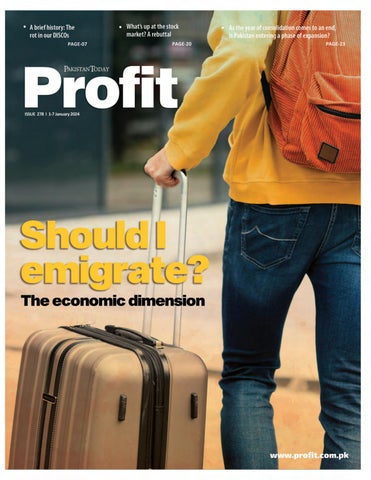
16 16 Should I emigrate? The economic dimension 20 What’s up at the stock market? A rebuttal Zain Naeem
07
23
23 23 As the year of consolidation comes to an end, is Pakistan entering a phase of expansion?
Profit
Publishing Editor: Babar Nizami - Editor Multimedia: Umar Aziz Khan - Senior Editor: Abdullah Niazi Sub-Editor: Basit Munawar - Video Editors: Talha Farooqi | Fawad Shakeel Business Reporters: Daniyal Ahmad | Shahab Omer | Zain Naeem | Saneela Jawad | Ghulam Abbass | Ahmad Ahmadani Shehzad Paracha | Aziz Buneri | Nisma Riaz | Mariam Umar | Urooj Imran | Shahnawaz Ali | Meerub Amir Regional Heads of Marketing: Mudassir Alam (Khi) | Sohail Abbas (Lhe) | Malik Israr (Isb) Pakistan’s #1 business magazine - your go-to source for business, economic and financial news. Contact us: profit@pakistantoday.com.pk
I
By Daniyal Ahmad
n Pakistan’s energy sector, nobody seems to want to go to the disco. Excuse the very obvious pun, but the state of the country’s power distribution is such that everyone wants to steer clear of the DISCOs with a ten-foot pole. Perhaps nothing captures this better than a recent damning report of the National Electric Power Regulatory Authority (NEPRA). Unveiled in December 2023, the
7
report laid bare the illicit and unlawful manoeuvres of the DISCOs that led to millions of consumers shouldering inflated bills for the months of July and August. The severity of NEPRA’s indictment? Throughout the two-month period, millions of Pakistanis were billed for electricity consumption exceeding the standard 30-day
monthly billing cycle. To compound the issue, the electricity slab for millions was altered due to the overcharging, resulting in higher rates. Very simply put the DISCOs, which are responsible for billing consumers for electricity, were making up the bills. Adding salt to the wound, millions of the most economically vulnerable consumers — those whom the
ENERGY
Our DISCOs are akin to uncontrolled kites, adrift in the wind. The negligence originates from the top. The Ministry of Energy, the overseers of the DISCOs, and the boards they appoint as administrators, are at the helm. If the problem is to be rectified, they must acknowledge their blunder and heads must roll Tahir Basharat Cheema, former Managing Director of PEPCO
State of Pakistan purports to shield with its flawed subsidy policies — found themselves bereft of subsidised rates and subjected to those applicable to regular consumers. The DISCOs occupy a strange place in Pakistan’s energy history. No one is quite sure who is, or more appropriately, who should run them. From suggestions to devolve them to the provinces and to recent bright ideas like handing them over to the military it seems no one quite knows what to do with this little problem. Most also do not quite understand what they do, where they came from, or why we need them. So we asked ourselves, what exactly are these DISCOs and is there a better way to run them? What started off as a simple question quickly evolved into what is a comprehensive history of Pakistan’s DISCO problem.
What is a DISCO?
T
he connotation of the word DISCO around the globe is vastly different from its designation in Pakistan. In Pakistan, ever since the 1970s, it does not conjure up any notion of leisure or entertainment. The only resemblance it bears to its international equivalent is the monetary agony one experiences when they behold the bill. This is because the word ‘DISCO’ is an acronym for Pakistan’s electricity distribution companies. These are the companies whose name is emblazoned on your electricity bill at the commencement of every month. These are also the companies that we contact when we are deprived of electricity for interminable hours, when there is a malfunction in the wiring, or when our local transformer is defunct, among other things. At this juncture, the name of the DISCO that will have sprung to your mind will vary depending on your location throughout the expanse of Pakistan. There are presently 12, with the newest one emerging only this year, whilst the oldest one tracing its origins to the early 20th century. So, how did these DISCOs come about?
8
Our forgotten energy history
B
efore Pakistan came into existence, its DISCOs were already lighting up the region. Among them, K-Electric stands out as the most renowned, and deservedly so. Established in 1913 under the Indian Companies Act of 1882 during the British colonial epoch, the Karachi Electric Supply Corporation (KESC) — now known as K-Electric — holds the distinction of being Pakistan’s oldest DISCO in ceaseless operation. The company was initially founded with a humble capital of Rs 13 lakh, to satiate the escalating demand for electricity in Karachi as the city’s populace surged past the 100,000 milestone. It is not, however, the oldest of the DISCOs. That distinction belongs to the Lahore Electric Supply Company. Before we proceed, let us clarify a crucial point: the Lahore Electric Supply Company that we are about to discuss bears no relation to the contemporary one that goes by the acronym LESCO. They are distinct organisations that coincidentally share the same appellation. We shall revisit the latter version in due course, but for now, let us focus on the original DISCO. The Lahore Electric Supply Company materialised in February 1912, with a capital of Rs 5 lakh. Nestled at the junction of McLeod-Cooper Road, it was the brainchild of Lala Harkishen Lal, who ascended to the position of its inaugural Chairman. An industrialist, entrepreneur, and politician from India, fewer men have left a more indelible mark, even by contemporary standards, on the industrial progress of Lahore and Punjab than Lala Harkishen Lal. He catapulted Lahore into the forefront of modern banking, power generation, insurance, newspaper production, and flour milling. The Lahore Electric Supply Company was one of the many enterprises that Lal initiated. He was a co-founder of the Punjab National Bank, the founder of the Punjab
Cotton Press Company, the People’s Bank of India, the Amritsar Bank, and the Kanpur Flour Mills, to name a few. He also played a pivotal role in the establishment of the Indian Associated Chamber of Commerce, the forerunner of the Federation of Indian Chambers of Commerce & Industry. As the decades rolled on, more companies sprouted within the geographical boundaries of what is now Pakistan. The Multan Electric Supply Company was established in 1922, the Rawalpindi Electric Power Company in 1923, the Small Town Electric Supply Syndicate in Muzaffargarh in 1935, and finally, the Attock Electric Supply Company Campbellpur in 1939. These companies can be viewed as the historical precursors of Pakistan’s modern DISCOs — there are contemporary precursors too, but we’ll delve into them shortly. Of these original companies, those based in Karachi, Lahore, and Rawalpindi can be deemed the most successful ones, judging by the available data. KESC continued to illuminate Karachi and its surrounding areas, whereas the other two expanded beyond their initial frontiers. The Rawalpindi Electric Power Company procured the licences to electrify Jhelum in 1928, Abbottabad in 1931, and Gujar Khan and Chakwal in 1935. As for the Lahore Electric Supply Company, by 1941, it was powering as many as 12 towns located in other provinces of the country, including the Central Provinces, the United Provinces, Sindh and the NorthWest Frontier Province. It was the single largest power generating entity outside the Government Electric Supply Branch system. By the time partition dawned, only KESC, the Rawalpindi Electric Power Company, and the Multan Electric Supply Company remained operational. What befell the rest? The Attock Electric Supply Company Campbellpur was incorporated into the Rawalpindi Electric Power Company, according to the records. The fate of the Small Town Electric Supply Syndicate in Muzaffar-
Malpractice within a DISCO is akin to a ladder, ascending from a meter reader to upwards. If, at any stage of this cycle, appointments are made based on criteria other than merit, then such an outcome is inevitable Shahid Iqbal Chaudhry, former Chief Executive of IESCO
garh remains a mystery. The Lahore Electric Supply Company, on the other hand, met with a rather intriguing denouement. By 1942, all of its licences — bar the one for supplying electricity to Lahore — were terminated or disposed of. The company’s downfall stemmed from a conflict with the Government of Punjab that erupted in May 1934, after which the government sought to annex the company. The Punjab Electricity (Emergency Powers) Act, 1941, is most likely the legal instrument that heralded the end of the company. Consequently, by 1946, the Lahore Electric Supply Company had also forfeited its licence to serve Lahore. The company lingered on as a defunct entity, managing its proceeds instead of providing electricity, until the early 1950s in the newly formed Pakistan. The fate of the remaining duo of Punjab-centric corporations, albeit divergent, remains murky. No tangible evidence exists regarding their evolution post-partition until the advent of the 1980s. The most credible conjecture suggests their integration into the Government of Punjab in some capacity. This supposition stems from the nascent state of Pakistan’s electrical infrastructure. “In the beginning, electricity was a matter confined to provincial jurisdiction. It didn’t command national attention. The focus
was solely on generation within urban hubs and subsequent distribution within these same centres,” expounds Himayat Ullah Khan, a former Federal Secretary at the Ministry of Water and Power, and a former Energy & Power Advisor to the Chief Minister of Khyber Pakhtunkhwa. KESC was the most notable aspect of Pakistan’s electricity infrastructure at the time. In 1949, KESC became the first utility to obtain registration from the Karachi Stock Exchange. By 1951, it had become an organised and profitable entity. Despite the company becoming nationalised pursuant to the the Electricity Control Act, 1952 (Sindh), it was the most important part of Pakistan’s electricity infrastructure. This state of affairs persisted until the pivotal year of 1958.
WAPDA, and the creation of Pakistan’s modern energy infrastructure
T
he sector underwent a formal planning process after the Planning Commission devised the first FiveYear Plan (1955-1960). Envisioned
as the blueprint for Pakistan’s economic metamorphosis, the Five-Year Plans were a series of nationwide, centralised economic strategies and objectives. These plans were inspired by the quintessential five-year plans of the Soviet Union. The concept was the brainchild of the then Finance Minister, Malik Ghulam Muhammad, who proposed it to the then Prime Minister, Liaquat Ali Khan. Spanning half a century — from 1950 to 1999 — eight such plans were crafted and executed. In 1956, the Pakistan Government realised the imperative to establish and equip an electric system of each region on a national basis. However, 1958 was the pivotal year in the five-year period. In February of that year, under the Federal Ordinance, the Electricity Department of each region and province integrated. Subsequently, in April 1958, the West Pakistan Water and Power Development Authority (the precursor of WAPDA) was born as a specialised corporation. Its mission was to harness water resources effectively for irrigation, flood control, and to cultivate electricity sources and manage electricity supply enterprises. A subtle nuance to note here is that while the WAPDA Act was passed in 1958, WAPDA actually commenced its operations in 1959. WAPDA was an autonomous and statutory body under the administrative control of the federal government. Its purpose was to coordinate and provide a unified direction to the development of schemes in the water and power sectors, which the respective Electricity and Irrigation Departments of the Provinces had previously handled. Everything going forward hinges on what transpired in this period. Especially so because the creation of WAPDA resulted from another player entering into Pakistan’s electrical fray — the World Bank. This was the period when the World Bank intervened in Pakistan and assisted in developing the master plan for an integrated power system through the “Water and power resources of West Pakistan: a study in sector planning”. Upon its inception, WAPDA was
ENERGY
In the beginning, electricity was a matter confined to provincial jurisdiction. It didn’t command national attention. The focus was solely on generation within urban hubs and subsequent distribution within these same centres Himayat Ullah Khan, former Federal Secretary at the Ministry of Water and Power and former Energy & Power Advisor to the Chief Minister of Khyber Pakhtunkhwa
entrusted with two major responsibilities: to meet the electricity demand of the country (except for Karachi) by installing new power plants, transmission lines, and distribution systems; and to develop hydro storage projects (dams) for meeting the irrigation and power needs of the country and install hydro plants at dam sites. WAPDA was bifurcated into two wings: the Power wing, responsible for power matters, and the Water wing, responsible for water matters. The former becomes pertinent to our story later on. WAPDA swiftly ascended to become the best-financed agency in the country. In the 1960s, WAPDA administered 41% of the total West Pakistan development budget, excluding expenditures on the Indus Basin. If Indus Basin expenditures are included, WAPDA’s budget amounted to an average of 70% of West Pakistan development budget. Similarly, the lion’s share of foreign aid funds fell under WAPDA’s administration. In the 60s, approximately 46% of total foreign aid (again excluding Indus Basin Funds) came under WAPDA’s purview, while the remainder was split over all the other sectors. If the Indus Basin is included, WAPDA was administering about 75% of the aid available to West Pakistan and roughly 50 to 55% of the total aid to Pakistan. It was also during WAPDA’s heyday that it introduced the unified tariff for the country in 1969. This too is something that
10
haunts our sector to this day because it is something only WAPDA could pull off, but we’ll get to that later. The monumental project of the Indus Basin Works — which encompassed the building of the Mangla and Tarbela Dams, eight link canals, and five barrages — represented the most significant venture in Pakistan at that time. Consequently, WAPDA became the most influential agency in West Pakistan. The Indus Basin Works were, however, the last major hydropower project until the Ghazi-Barotha Hydropower Project in 1995. Consequently Pakistan entered the 1980s with a crisis that was poised to hit it in the face. Until 1972, WAPDA existed in a symbiotic relationship with semi-private utilities. This equilibrium was disrupted under the regime of Zulfiqar Ali Bhutto, who promulgated the “National Economic Reform Order”, catalysing the swift nationalisation of a plethora of industrial plants. This included the private constituents of KESC, Multan Electric Supply Company, and Rawalpindi Electric Power Company from the energy sector. Intriguingly, this era also witnessed the genesis of discourse on the unbundling of WAPDA. A watershed event that underscored the necessity for, and ultimately precipitated, WAPDA’s unbundling, was the realisation that the integrated power system was burgeoning into an entity too gargantuan for
WAPDA’s solitary management.. The fourth Five-Year Plan (1970-1975) pointed to “serious doubts having been expressed about the ability of WAPDA to shoulder the responsibility of retail distribution of power, along with the construction of major power and irrigation facilities. Consideration, therefore, should be given to the bifurcation of the power wing from WAPDA.” The plan also proposed an alternative strategy to hand over the retail distribution to an ‘autonomous’ power corporation. The mid-1970s marked the advent of the first power crunch, triggered by a surge in demand. However, this was adroitly mitigated as the hydel power station of Tarbela, along with several thermal power stations, became operational — providing respite for approximately a decade. Nevertheless, the military coup d’état of 1977 indefinitely deferred the plan to restructure WAPDA. The 1980s was the penultimate decade before the establishment of Pakistan’s DISCOs. It was during this decade that the groundwork for their inception was laid. In 1981, under the auspices of the World Bank, the WAPDA Act was amended to engender Area Electricity Boards (AEB) within WAPDA. These entities, the precursors of our modern DISCOs, were tasked with the responsibility for local electricity service in specific areas. Eight AEBs were established within WAPDA: the Peshawar region encompassed the Khyber Pakhtunkhwa, the Quetta region enveloped Balochistan, and the Hyderabad region incorporated Sindh, excluding Karachi (KESC). Punjab was divided into four regions: Gujranwala, Lahore, Faisalabad, and Multan. Additionally, an Islamabad Region was created to cover parts of Punjab and Islamabad itself. The 1980s also witnessed the extinction of private sector utilities. The Quetta Electric Supply Company was delisted from the Pakistan Stock Exchange (PSX) on 14 June, 1981. It bears repeating that, akin to the precedent of the Lahore Electric Supply Company, this Quetta Electric Supply Company stands dis-
tinct from the contemporary Quetta Electric Supply Company, colloquially known as QESCO. This is merely a fortuitous coincidence, or perhaps a dearth of originality. It is in the 1980s that KESC was finally reigned in and was made a subsidiary of WAPDA in 1984, yet managed to retain its listing on the PSX for reasons unknown. The Rawalpindi and Multan Electric Companies were not as fortunate, both being delisted on September 18, 1985. By the mid-1980s, the gargantuan, interconnected power system was besieged by conspicuous issues. The nation was grappling with recurrent breakdowns, power outages, and shortages. A multitude of critics pointed fingers at the generation capacity of WAPDA and KESC, accusing them of failing to manage the crisis during the 1980s. However, the average generation capacity factor for the entire power sector (46) was on par with other developing nations such as Hong Kong (43), Malaysia (42), and the Philippines (46.9). Consequently, the dearth of electricity could not be ascribed to inefficient utilisation of the existing installed capacity. Nevertheless, in the realm of electricity, the total production might deviate from the actual delivery to the consumers. Herein lies an issue that we hear about till this day — system losses. These losses could have originated from technical complications such as unreliable and ageing generation plants, low-voltage transmission and distribution lines, and inappropriate location of grid stations, as well as non-technical factors such as inaccurate metering and billing, default payments, un-metered supplies, and theft (through illicit connections). Throughout the period from 1960 to 1995, the average system losses (28%) in Pakistan’s electricity infrastructure were significantly higher than in other developing countries such as India (19%), China (15%), the Philippines (19%), and Hong Kong (11%). In terms of financial performance, both KESC and WAPDA also underperformed from 1960 to 1995. Although WAPDA marginally outperformed KESC, neither of the enterprises had achieved satisfactory results in the long run from 1960 to 1995. For instance, in terms of financial performance, the average annual net profit after interest, as a proportion of sale for both WAPDA (12%) and KESC (9%), was substantially lower than the net profit for the public corporation for electricity in Turkey, i.e., in the range of 20-36%. In terms of economic performance, total factor productivity growth — growth in output that is not attributable to growth in factor inputs — had been negative in the case of KESC and relatively low in the case of WAPDA. The need for reforming these enterprises was compelling, and alternative
modes of organisation, finance, and ownership were being explored. While privatisation was a viable option, it mainly stemmed from the desire for improvement on past performance. However, context is crucial. Donor financing for thermal power in the public sector had dwindled because it became trendy to involve the private sector in power generation. WAPDA, and consequently Pakistan had no hydropower projects lined up, and the international financial institutions also started advocating private power. The dye was essentially cast. By the dawn of the 1990s, WAPDA had morphed into a colossal burden. The power sector was besieged by operational inefficiencies that screamed for a comprehensive overhaul. As early as 1991, the government had directed WAPDA to kick-start the privatisation of certain operations. However, it wasn’t until 1992 that the government, under the stewardship of Nawaz Sharif, decided — prompted by the recommendations of loan lending agencies such as the IMF and the World Bank — to craft and endorse the ‘Strategic Plan for Restructuring the Pakistan Power Sector (PPRSP)’. The political baton’s transition from Nawaz Sharif to Benazir Bhutto halted the unbundling process. Benazir reignited the potential unbundling of WAPDA, a vision encapsulated in the 1992 Strategic Reform Plan by passing an amendment to the WAPDA Act in 1994. This amendment empowered WAPDA to gear up to “privatise or otherwise restructure any operation of WAPDA except hydel generating power stations and the national transmission grid”. Yet, the political pendulum swung once again, obstructing the unbundling as Benazir’s government was supplanted by Nawaz’s. In 1997, Nawaz Sharif reclaimed power and the policy towards the power sector resumed with the actual unbundling of WAPDA — the power wing was fragmented into 12 incorporated state-owned entities, comprising three thermal generating companies (GENCOs), one National Transmission and Dispatch Company (NTDC) — responsible for both transmission and the single-buyer market clearing entity — and the separation
of the eight AEBs into eight regional distribution companies (DISCOs). Established in 1998 by another amendment to the WAPDA Act, the Pakistan Electric Power Company Limited (PEPCO) was a temporary custodian of WAPDA’s assets and operations. With a two-year mandate, PEPCO was entrusted with the responsibility of disintegrating and privatising WAPDA components, transforming WAPDA from a bureaucratic behemoth to a corporate, competitive, and efficient organisation, and managing the thermal generation plant that was previously under WAPDA’s jurisdiction. In short, it was supposed to be new boss of Pakistan’s DISCOs
Beginning of the end
W
hat is the first thing that Pakistan did after unbundling its DISCOs, and creating a new entity to manage them? Hand them over to the Pakistan Army in January 1999 — a full nine months prior to the Musharraf coup d’état of October 1999. The Water and Power Development Authority (WAPDA) was on the brink of financial disaster in 1998, owing to a multitude of factors. The Government revealed that by the end of 1998, WAPDA had accumulated a deficit of Rs.45 billion (roughly US$870 million at the time) — a staggering amount that was projected to soar to Rs.74 billion (approximately US$1.43 billion at the time) by June 1999. This would have inevitably resulted in the dissolution of WAPDA. Without funds to pay the salaries, the organisation would have laid off tens of thousands of workers. Moreover, it would have crippled the entire country, rendering the lives of the citizens unbearable. Hence, to prevent a total meltdown of WAPDA, the federal Government handed over WAPDA and the new DISCOs to the Army. The Army was thus tasked with assisting the WAPDA management in restoring the financial viability of the organisation by curbing pilferage and power theft. The Government emphasised that this was a desperate measure and taken solely to revive WAPDA.
ENERGY
A three-star general was appointed as the Chairman of WAPDA, and consequently the Chairman of PEPCO. Likewise, one-star generals were assigned to lead the various DISCOs, including KESC. The Army’s involvement in WAPDA spanned two phases. In the first phase, which concluded on 25 July 1999, 31,444 army personnel were deployed to WAPDA. After 25 July 1999, only about 10% of the army personnel remained and the rest returned to their units. The army personnel aided the organisation in: (a) removing unauthorised connections, which numbered in the tens of thousands; (b) replacing faulty metres; (c) ensuring prompt and accurate billing; (d) checking the metres by surveillance teams; (e) issuing detection bills where theft was detected; (f) maintaining the system to minimise technical losses; and (g) launching a recovery campaign to collect public revenue. These specific benchmarks would become the standard for all anti-theft campaigns in the power sector in the future. The Army also had an additional mission that it had to accomplish within a two-year period, after which, as a logical consequence, it would withdraw, as by then WAPDA would have been unbundled through the process of corporatisation, with some of its offshoots, such as FESCO, LESCO, and at least two generation companies, securely transferred to private hands. Regrettably, none of the aforementioned materialised. The next major development for the DISCOs came across 2001 and 2002 when NEPRA granted them generation, transmission, and distribution licences. Hydel generation and water management, however, remained with WAPDA. The real watershed moment came in 2005 when KESC was financially restructured and then privatised in December 2005 with the purchase of a 71% stake in the company by a consortium of Pakistani and foreign businesses with the most prominent being Al-Jomaih Holding Company, a diversified Saudi Conglomerate, and the National Industries Group, a publicly listed Kuwaiti financial conglomerate (which also owns a large stake in Meezan Bank). However, the usual approval process and deliberation by the Council of Common Interest (CCI) did not take place prior to the sale. This is something that would rear its head for the other DISCOs over a decade later. No progress was made for the remaining DISCOs until 2007. In November 2007, the Government of Pakistan finally notified the unbundling, separation and corporatisation of the power wing of WAPDA into Pakistan Electric Power Company (PEPCO). Earlier it was established in 1998 but remained non-functional because the Chairman of WAPDA was also the Chairman of PEPCO
12
and in effect held the reins. Slowly, PEPCO also took over the work of appointing boards of directors to these companies and then directly took over operations of the DISCOs. In parallel to this for three years, the Saudi-Kuwaiti conglomerate failed to make any headway in turning around the company, finally turning in 2008 to Arif Naqvi, the former Karachiite who had gone on to create Abraaj Capital in Dubai.In October 2008, Abraaj bought out half of the Jomaih-NIG stake in KESC, injecting $391 million into the company. It then began a turnaround effort the likes of which have never been seen in Pakistan before. The subsequent metamorphosis of the DISCOs took place at the NTDC, rather than within the DISCOs themselves. In the year 2009, the Central Power Purchasing Agency Guarantee (CPPA-G) materialised as a formidable power entity, inheriting the Centre for Power Purchase Agreement (CPPA) and market development responsibilities from NTDC. However, the CPPA-G would remain in a state of dormancy until half a decade later, following the downfall of a DISCO management entity. The residual DISCOs, in the wake of Abraaj’s acquisition of KESC, were relegated to a secondary concern as the nation grappled with a myriad of crises, and the energy sector pivoted its focus towards the independent power producers and the mitigation of load shedding. Amidst the load shedding that besieged the country, PEPCO found itself in the line of fire. The Peshawar High Court, in its suo motu action on unscheduled load shedding in 2010, decreed the dissolution of
PEPCO. 2010 is also when the Sukkur Electric Supply Company (SEPCO) was carved out of the Hyderabad Electric Supply Company (HESCO) to raise the count of the DISCOs to 11. The Cabinet of the then Prime Minister, Raja Pervaiz Ashraf, concurred with the Peshawar High Court’s decision in October 2011. The Board of Directors of PEPCO sanctioned its dissolution in 2012, and its functions were initially transferred to the NTDC and subsequently to the CPPA. The decision to dissolve PEPCO encompassed more than just load shedding. Since PEPCO was positioned directly under the Ministry of Water and Power, which also controlled the Private Power and Infrastructure Board, the latter relinquished its independence. One rationale was that the international donor agencies simply opposed an entity to manage the DISCOs. “The International Monetary Fund and World Bank were once again engaged with Pakistan at the time. During their engagement, they stated that they did not want to create another WAPDA,” explicates Tahir Basharat Cheema, a former Managing Director of PEPCO. The other argument was that PEPCO had degenerated into a bad WAPDA and that placing PEPCO directly under the Ministry of Energy — the policy arm of the government and not an executive implementation entity — was the main culprit for the failure of PEPCO. There were allegations of PEPCO lacking similar checks and balances or accountability akin to WAPDA’s main decision-making ‘Authority’ or its ‘Central Contract Cell’ to impartially evaluate projects and resolve all
TEXTILES
issues on merit. The Federal Government was accused of micromanaging PEPCO. Did the DISCOs attain independence after the dissolution of PEPCO? Not in the slightest. Intriguingly, PEPCO never ceased to exist either, despite being effectively defunct. However, we’ll delve into that later in the piece. The power crisis was one of the primary election talking points among the contenders — violent protests erupted in various parts of the country due to power outages in 2011, 2012, and 2013. Consequently, the Nawaz Sharif government that ascended to power in 2013 devised “The National Power Policy (2013)” immediately after coming into power. The revised power policy, formulated in 2013, delineated the newly elected government’s road map for the power sector. Though this policy has been lambasted for being overambitious and unrealistic, it preserved the essentials of the reform plan laid out in 1992. In addition to reaffirming the government’s focus on privatisation of the DISCOs, it also stipulated the reform of CPPA as a corporate entity separate from NTDC’s transmission and system operation business Did the DISCOs attain independence after the dissolution of PEPCO? Not in the slightest. Intriguingly, PEPCO never ceased to exist either, despite being effectively defunct. However, we’ll come to that later in the piece. The power crisis was one of the primary election talking points among the contenders — violent protests erupted in various parts of the country due to power outages in 2011, 2012, and 2013. Consequently, the Nawaz Sharif government that ascended to power in 2013 devised “The National Power Policy (2013)” immediately after coming into power. The revised power policy, formulated in 2013, delineated the newly elected government’s road map for the power sector. Though this policy has been lambasted for being overambitious and unrealistic, it preserved the essentials of the reform plan laid out in 1992. In addition to reaffirming the government’s focus on privatisation of the DISCOs, it also stipulated the reform of CPPA as a corporate entity separate from NTDC’s transmission and system operation business. With the aim of privatising all the DISCOs and some generation units, the new government announced the first wave of its ambitious plan — the Lahore Electricity Supply Company (LESCO), the Islamabad Electricity Supply Company (IESCO), and the Faisalabad Electricity Supply Company (FESCO) were among the chosen ones. To kick-start the privatisation campaign, the government launched a nationwide anti-theft drive that involved the provincial and the federal bureaucracy, and spanned from 2013 to 2014. Perhaps the most intriguing initiative during the drive was the
Peshawar Electric Company’s (PESCO) advertisement in newspapers that appealed to the religious sensibilities of the consumers in an attempt to curb theft. It was also in 2014 that KESC rebranded itself as K-Electric. The commercial operation of CPPA-G commenced in mid-2015 after the transfer of functions between NTDC and CPPA-G were finalised and completed. What was the significance of the CPPA, NTDC, and CPPA-G in this context? The CPPA-G was supposed to create a competitive market for electricity in Pakistan, whereby the DISCOs could purchase from any supplier they wanted. It would be the next step in their autonomy. Did it materialise? Not in the slightest. The DISCOs remained under state control, so the blame could not be solely attributed to the CPPA-G. 2015 bore witness to mounting legal pressure against the manner in which K-Electric was privatised, and the effectiveness of privatisation was called into question. Political and economic apprehensions led to the abandonment of the privatisation plans. These concerns stemmed from the government’s scepticism that the previous privatisation experience with KE had not yielded the anticipated outcomes of reduced subsidy burden and enhanced service delivery to the end-users. Nevertheless, the incumbent government managed to make one last significant decision regarding the separation of the DISCOs. In 2017, a distinct Ministry of Water Resources was established, and WAPDA was placed under its jurisdiction, while all aspects of power were transferred to the Ministry of Energy (Power Department). As the 2018 election year approached, political opposition from other parties and the workers’ union intensified. Consequently, the government altered the privatisation mode for LESCO and FESCO from strategic sale to gradual divestment through capital markets. This process was anticipated to span the next three to five years. However, as the election loomed large, the government shelved any discussion of privatisation, leaving the future of the energy sector in a state of suspense. What was the strategic blueprint of Imran Khan’s administration to grapple with Pakistan’s vexing DISCOs upon seizing the reins of power? The answer lies in yet another campaign against theft. The nascent administration dedicated the entirety of 2019 to the relentless pursuit of this anti-theft initiative. Concurrently, the government revisited the concept of privatisation, as it embarked on a mission to rejuvenate Pakistan’s PEPCO for centralised supervision and regulation of all ten public DISCOs — a preliminary step towards a reform agenda that could potentially culminate in their privatisation. According to the scheme, PEPCO was to function as the ‘Management Agent’ for all
the DISCOs, through a Management Agent Agreement — endorsed by the pertinent boards of directors — to aid the Privatisation Commission or any other entity or department in executing the government’s privatisation blueprint, and to evaluate and propose alternative methods of relinquishing the ownership of these autonomous corporate entities. In the subsequent year, 2021, PEPCO underwent a rebranding exercise and emerged as the Power Planning and Monitoring Company (PPMC). The company’s headquarters were translocated from Lahore to Islamabad, and it ultimately amalgamated with the Ministry of Energy. Regrettably, no further progress was made during Imran’s tenure, as political upheaval, a recurring theme by then, once again took centre stage.
Back to the future
T
he past eighteen months have arguably been the most tumultuous for the DISCOs, as the Shahbaz Sharif and Anwar Kakar governments proposed every possible measure to improve the DISCOs. The former advocated provincialisation and privatisation, while the latter suggested handing over the Hyderabad Electric Supply Company to the Army — yet again. The current government is also mulling over awarding professional managerial contracts. Coincidentally, at the time of writing, the Ministry of Energy is conducting another anti-theft campaign. This is the fourth such campaign since the DISCOs came into being less than a quarter of a century ago. The only noteworthy development that has occurred since 2022 until now is that the Hazara Electric Power Company (HAZECO) has been split from PESCO, increasing the total number of DISCOs to 12. Furthermore, K-Electric went through another spell of ownership change which we have covered in detail earlier this year. Read more: Who is Shaheryar Chishty and what does he want with K-Electric?
What is with the overcharging?
N
ow, let us return to where we began. Overcharging. How does it operate? How severe is it? The essence of the matter is that metre readers essentially recorded electricity consumption readings exceeding 30 days and billed them as a 30-day bill. Is this detrimental? It depends. “The DISCOs do overbill due to various reasons — legiimatet or otherwise. However, it is usually rectified in the subsequent month. Suppose that you received a bill of 110. If next
ENERGY
month your reading is for 200 units, then they will adjust it. Therefore, to assert that the DISCOs have overbilled customers to enrich themselves may be erroneous but surely it is done to culture poor results. That is not how it works,” explains Cheema. “The problem emerges when a customer’s slab is altered, and they are charged a higher rate than they would have otherwise. People who experienced a change in their slab due to the overbilling have been wronged. There is no question about that,” Cheema adds. What does all this imply? Let us do some simple arithmetic. At 290 units, an individual’s bill would have amounted to 10,730. If you were to charge them 20 units extra and they fall into the 300 slab, their bill would have soared to Rs 13,330. Because the slab is different up to 300 units. The rate up to 300 units is Rs 37. When it goes above 300, then all the units have to be charged Rs 43. You have directly inflicted a loss of roughly Rs 4,000 on a consumer. So, will the DISCOs be penalised for this error? Unlikely, the Ministry of Energy is currently conducting its own investigation as to the validity of NEPRA’s report. Is NEPRA’s report correct? Likely, but not because NEPRA is very good but because the DISCOs have done this numerous times before. So, why does a DISCO do this? And more importantly, is there any way to fix the 100 year mess that we’ve just read about?
Why are our DISCOs the way they are
L
et us begin with the most fundamental of things. DISCOs have no need to overcharge customers to compensate for their losses. “Exorbitant pricing is not a sustainable solution. A more fitting approach would be to perpetually monitor areas with high theft trends and conduct regular meter inspections and kundas. Furthermore, in areas with high technical losses, the conductors and transformers could be replaced. It’s crucial to note that electricity theft is not the sole contributor to a DISCO’s losses; wastage of electricity due to inadequate infrastructure also plays a significant role,” elaborates Shahid Iqbal Chaudhry, a former Chief Executive of IESCO. So, one might wonder, why would a DISCO resort to such measures? It’s undeniably unethical. The answer lies in a labyrinthine escalator with multiple exits. “Malpractice within a DISCO is akin to a ladder, ascending from a meter reader to upwards. If, at any stage of this cycle, appointments are made based on criteria other than merit, then such an outcome is inevitable,” Chaudhry expounds. However, this is merely
14
the tip of the iceberg. There exists a more flagrant reason. “Our DISCOs are akin to uncontrolled kites, adrift in the wind. The negligence originates from the top. The Ministry of Energy, the overseers of the DISCOs, and the boards they appoint as administrators, are at the helm. If the problem is to be rectified, they must acknowledge their blunder and heads must roll,” Cheema asserts with conviction. Quite straightforward, indeed. So, how does one rectify the DISCOs? The succinct answer is that there is no definitive answer. There is a semblance of consensus during our discourse in penning this narrative that the optimal time to rectify the DISCOs was when they were a part of WAPDA. The next best time was when PEPCO wielded some authority. The best time now? It might vary from DISCO to DISCO. Let’s scrutinise each potential solution, and subsequently discuss why it might not be feasible. Let’s start with privatisation. “K-Electric, despite all its negative criticism, some of which is indeed valid, provides a blueprint for the DISCOs. It’s not a flawless blueprint, but it’s a model that doesn’t contribute to our circular debt,” Khan explains. The issue with privatising the DISCOs is that not everyone covets all the DISCOs. The Punjab-based DISCOs and IESCO might pique the interest of a buyer. The others may not, due to their financial predicament and because they cater to customers with considerably lower purchasing power. They cater to far fewer industrial customers and they operate in areas that are generally perceived to lack the rule of law relative to Pakistan’s larger urban areas. All of this does not paint an enticing image for any private investor. What is another solution? Some form of provincial accountability. “If the DISCOs are incapable of curbing the rampant theft, they must be relinquished to the provinces. The provinces will remain oblivious to the magnitude of the issue as long as the circular debt is a federal responsibility. In the event that the provinces are unable to bear the entire burden, perhaps they should be held accountable for the additional losses that the energy infrastructure incurs due to theft specific to their province,” Chaudhry expounds. Chaudhry’s proposal deserves some consideration. Given that the police falls under the jurisdiction of the provincial government, and that theft cannot be curbed without the participation of law enforcement, it seems logical to align the interests of the provinces. However, the predicament here is that the provinces are already struggling with self-management. Expecting those components of Pakistan’s federation, who are unable to efficiently run their own healthcare and education
systems, to oversee a colossal DISCO and its losses is akin to throwing the baby out with the bathwater. This is not to imply that it’s fair for customers based in Punjab and Islamabad to endure higher electricity tariffs due to the tariff rationalisation surcharge that subsidises those DISCOs customers where theft is rampant. But concurrently, does anyone want to ignite a provincial rights crisis in addition to the energy crisis? Is there another solution? “The remedy to this is to award its management contracts to the financial entity that possesses the financial depth and brings the best technical or professional team,” Cheema expounds. While accurate, the question remains: will any management team be willing to serve the DISCOs if they do not have a long-term vested financial stake in it? How would any management contract differ from merely hiring a regular consultant? This is the approach we have adopted for other governmental departments with varying degrees of success. Some state-owned enterprises even boast boards of directors that rival the best companies in the private sector, yet they lack the outcomes to show for it. Some state-owned companies even employ individuals from the best private sector companies but fail to deliver the results. Do you want to know the cherry on top? There’s a chance that the DISCOs might never be rectified. “The distribution business is not profitable in Pakistan. K-Electric is able to maintain its profitability from its generation business, not its distribution business. When WAPDA was a singular entity, it did the same. Distribution companies cannot turn a profit as long as electricity in Pakistan is subsidised,” Khan clarifies. Remember that unified tariff? The best part is that it cannot be reversed, at least not easily. “The unified tariff should have been abolished by now. The only opportunity that existed to remove it was when WAPDA was first de-bundled. You cannot feed people cake for so long, and then expect them to revert to bread,” Chaudhry explains. “As a first step regional regulators should be enacted to decide distribution tariff. The province unhappy with higher tariffs ‘based on high loss of their area’ may pick up the difference,” Chaudhry continues. So, how do you rectify the DISCOs? The optimal approach would be to experiment with all three aforementioned solutions on different DISCOs, and observe what works. Pakistan’s electricity infrastructure has been trapped in a vicious cycle since its inception. The DISCOs do not face novel problems. We are not devising new solutions. It has been the same problem since day one, and everything done to fix it is the best example of a truck ki batti that the country could have. n
ENERGY
16
By Farooq Tirmizi
W
hen does it make sense to leave Pakistan, and when does it make sense to come back home? Embedded in the consciousness of Pakistani society are seemingly immutable and incontrovertible answers. When does it make sense to leave Pakistan? At the very first feasible opportunity. When does it make sense to come back home? Never, if possible. Given the state of Pakistan’s political economy over the last two years, those answers seem to have further been ingrained in people’s minds. Leave, and never come back home, many, many people seem to be saying not just with their words, but with their feet, given the rise in emigration numbers. Emigration from one’s homeland is a deeply personal decision and one that can have multiple dimensions to it, not all of which will be common across people. But it does have an economic one as well, and one that lends itself well to examination through the lens of personal finance. As people in living rooms across Pakistan talk about trying to leave the country, we cannot claim to offer a guide to everything relating to that decision, but we do believe that we can offer the economic layer, or at least some important tools in understanding the economic layer, of that decision. In this article, we will lay out three components to the decision: what kind of income a prospective emigrant should be willing to accept in order to be financially better off in the country they are moving to, how immigration laws in their destination country should affect their decision, and what kind of factors would mean that it makes sense to come back home to Pakistan? We will also state an opinion up front: the top of the emigration opportunity spectrum (those with the most means and most opportunities in both Pakistan and abroad) are most better off leaving, as well as those at the bottom of that spectrum. The picture is more mixed for those in the middle, and hence they should probably do a bit more homework before deciding to leave. But first, some numbers on where people are going.
The data on emigration
S
ay what they will about patriotism, Pakistanis do love to move out of the country. According to the admittedly incomplete data from the Bureau of Emigration and Overseas Employment, 823,000 Pakistanis left the country for work in 2022, the
highest since 2015, when 947,000 people left the country. (Note: the 2015 number might be artificially higher for two reasons: the government started getting better about keeping records of emigration that year, and Saudi Arabia had a massive increase in the need for labour that year as well, owing to the launch of several infrastructure projects, shortly after Mohammed Bin Salman became the de facto ruler of that country in January 2015.) Data on emigration is not well-kept, not least because the government does not keep track of people whose first exit is not on a work visa, and does not keep track of people who have come back, nor of people who come back and leave again. As a result, in government statistics, it looks like very few people have left Pakistan for places like Canada, the United States, and Australia, even though if you look at statistics produced by those governments, you can see that there are at least a few thousand Pakistanis moving there every year (sub-15,000 per year for each of those three countries, and closer to 10,000 per year for each of them.) Nonetheless, even allowing for those short-comings, it is abundantly clear that when Pakistanis talk about moving out of the country, they are largely talking about moving to the Gulf Arab states, and really very specifically to Saudi Arabia and the United Arab Emirates. Five out of every six Pakistanis who left the country for work since 2010, according to BEOE data (84% to be precise), go to those two countries. That proportion does not correct for the undercounting of emigration to the US, Canada, and Australia. But even adding about 30,000 a year to those countries’ count would not materially reduce the dominance of Saudi Arabia and the UAE as destinations for Pakistani workers. We tried to do a wholistic accounting of emigration to those countries, but the only one that gave out detailed data is the United States, and the BEOE data on the United States, while undercounting the number of Pakistanis who move to the US work, nonetheless is not off by more than 1,000-2,000 per year. It is also difficult to do comparable numbers across those countries. While in Canada and Australia, the majority of Pakistani emigres arrive as legal permanent residents, in the United States, more than half of Pakistanis first arrive as students or employees before eventually converting to a green card.
What makes moving out worth it?
S
o, what makes a move worth it from a strictly financial perspective? Simply put, your standard of living – specifically the purchasing power of your income
PERSONAL FINANCE
– should be higher in the place that you move relative to the place that you came from. That phrase “purchasing power” is key. It is simply not enough to make more in absolute terms (you almost certainly will make more when you calculate the value of your foreign income in rupees), but one must make more by a large enough margin to sufficiently cover the higher cost of living in one’s destination country. This might seem obvious, but calculating what that means is not exactly easy. Specifically, there are two complicating factors: the first is that data on cost of living comparisons is not something that is often readily available (but will be made available through this article). And the second factor is that a large majority of Pakistanis are living in family homes and not homes that they pay rent or a mortgage on, and hence often do not factor in the implied cost of replacing that home to which they have free access, when deciding to move. (The implications of this second factor are interesting: Pakistani employers are being subsidised in their cost of labour by our joint family system.) What we have done is tried to do that calculation for you: showing how much a prospective emigrant from Karachi, Lahore, or Islamabad might need to make in a number of foreign cities and metropolitan areas in order to be financially as well off as they are in Pakistan. For cost of living data, we utilised the estimates compiled by The Economist Intelligence Unit for all foreign cities and for Karachi, and then calculated the implied values of the cost of living index for Islamabad and Lahore using comparative real estate prices from Zameen.com’s index for home prices. (Note: Yes, the Economist data is from the perspective of western expats living in cities around the world, but we would argue that prospective emigrants are seeking a lifestyle more similar to those expats than to their own countrymen, and hence the use of that sort of data – and the relative index levels – are still useful in calculating those differentials in the cost of living.) From there the calculation is straightforward. Convert your salary into the relevant foreign currency, multiply it by the cost of living index value of the city you wish to move to, and divide it by the value of the cost of living index for your home city. The resultant number should serve as a baseline of the kind of income you should be targeting – or hoping to exceed – if you are considering moving to another country. If you live in a family home, you should add the approximate rental value of a home similar to the one you live in – or home you would be willing to accept living in – before doing the currency conversion and
18
index calculations. How would you find out the number for the foreign salary you should be comparing against? It helps to know people in your own industry who have moved to the country you are considering moving to. For those who do not have such connections, perhaps looking at salary data for companies in your industry on websites such as Glassdoor might help. Whatever source you use, do not go into this blind. Arm yourself with data on what the market rates are for salaries of people at your level, and assume you will have to take a demotion – either in seniority level or even in function – because that is simply what is called the “immigrant tax”: the reason people from other countries let you in in the first place is because they get your talent for a price cheaper than what local talent would be getting. In other words, expect to make less than a local, but if you have some information about how your desired foreign market works, maybe you will be able to avoid completely being taken advantage of. With that salary data in hand as a baseline, you can then start thinking about what immigration will mean for you. When we say baseline, we really do mean that sincerely, since this is where the limits of personal finance end and other factors begin to take hold. For instance: are you reluctantly moving away from family, or are you eagerly running away from them? If the former, you should hope to make at least your baseline or higher to compensate for the distance from family. If the latter, maybe you’d be willing to take even less than the baseline number just to get away. (For those of you in your 20s who want to escape your families because you are in the middle of The Big Fight about marriage, just remember that emigration does not actually solve The Big Fight. It merely puts it on ice, and the Fight will resume every time you visit. Better to get it over with and resolve it rather than looking to emigration as the solution.) With all that said, let us take a look at some of the results. For someone who makes about Rs200,000 per month in Karachi, and lives in a family home that would take approximately Rs150,000 per month in rent to replicate, they should make at least a little over AED 10,000 per month if they wish to move to
Dubai to live a comparable life. For someone who makes Rs500,000 per month and lives in a nicer house – say the kind that would take Rs300,000 per month in rent to replicate, they should seek to make closer to AED 23,000 per month in Dubai, SAR 24,000 per month in Riyadh, and C$100,000 per year in Toronto. Editor’s Note: Some readers might find a difference in the costs of living laid out above and what they might have gleaned in casual conversation from family and friends living in Dubai. This difference could be because of a difference in consumption habits of an average Pakistani family compared to a typical western family, and the relative weights that the Economist Intelligence Unit assigns to each category of goods and services. For example an average Pakistani family, due to its larger size, might have higher schooling requirements than a typical western expat. This would lead to a need to earn a few thousand additional Dirhams than the calculations shown above, as schooling, compared to other consumption categories, is substantially more expensive in Dubai as compared to Pakistan. Readers are advised to make certain adjustments based on their own circumstances. For some of you, in certain professions or perhaps because of your personal credentials and circumstances, these numbers can be easily beaten, and if that is your situation, then we cannot argue that emigration would make you worse off from a purely personal finance perspective. What would be left for you at that point would be to consider the non-financial factors such as distance from family, the extent to which you feel comfortable living in Pakistan because of your personal circumstances (e.g. women who like going for walks are probably more comfortable in Canada than anywhere in Pakistan), or any other factors. The more astute of you will notice that we do not seem to make any calculations regarding the relative taxation levels of the countries we are offering for comparison, which might seem like a grievous oversight, considering the zero income tax rates of the Gulf Arab states. That is not an oversight. It is quite deliberate. The late US Supreme Court Justice Oliver Wendell Holmes, said “taxes are the price we pay for a civilised society.” Western countries may charge far higher tax rates than the Gulf Arab states, but we argue that what looks free in terms of zero income tax comes at a high
cost, and the high taxes of Western countries come with benefits that are worth paying for.
The citizenship question
T
he problem with migrating to the Gulf Arab states – despite their zero taxes and first world infrastructure – is the fact that they require you to accept the fact that no matter how much of your life you spend there, you will never be allowed to call those places home. That no matter how hard you have worked there, one lost job, one spate of bad luck, one car accident could mean that you have to leave the place you have built a life in, and come back to Pakistan without a plan. We are now half a century removed from when Pakistanis first started moving to the Gulf en masse, and while there are many stories of success, there are also many stories of broken men returning home with little to show for their labour. Many who have raised their families in Saudi Arabia and UAE and have children who know no other home, but who must find ways to beg and plead with the governments in those countries to allow them to stay. Contrast that with those who move to the US, UK, Canada, or Australia and find themselves able to secure citizenship which, once in hand, gives them equal right to call those places home, for their children to plan to spend their whole lives there without asking anyone for permission, for their education and retirement to be the taken care of by the social contract in those countries. You would be entitled to the same pension as the native-born alongside whom you worked, your children could attend the same free public schools, attend the same free (or subsidised) universities, and you would have access to the same healthcare (free public, or employer insured) as anyone else in those societies. Where you were born would not affect any of it. In other words, once you move to the West, you do not need an exit plan. If you move to Saudi Arabia, the UAE, or any other Gulf State, you absolutely need an exit plan. Some of the more well off emigrants to the Gulf Arab states save up to buy permanent residency in Western countries, which eventually allows their children to become citizens of those states. But only fools move to the GCC without a plan for what to do next.
How to think about moving back to Pakistan
F
ully recognizing that this sentiment will be mocked, but we would argue that moving back to Pakistan can make a lot of sense for many, if not
most, emigrants, especially those who moved to the Gulf Arab states, but even those who have migrated to the West. If you live abroad, try that same calculation from earlier in the article in reverse. As an example, we will use a certain professional who lives in New York and makes about $400,000 a year. To move back to Karachi, he could accept a 72% pay cut and come out at breakeven in terms of the purchasing power of what he would be able to get in Karachi. Granted, a Rs2.6 million per month salary is not very common in Pakistan, but for this finance professional, a banking sector job that paid Rs1.7 million in monthly salary and paid out industry average bonuses would result in the same compensation level – in purchasing power terms – as what he is currently making in New York. That number – while still not very common – is perhaps a bit more realistic. Add in the pull factor of family, and perhaps even a lower number would do the trick. A banker in New York making $400,000 a year and considering a move back to Karachi is relatively rare. More common might be someone who lives in Dubai and makes AED 50,000 a month. To move back, they would need an income of about Rs1.7 million a month, or – if in banking – a base salary of about Rs1.2 million a month. If they make AED 35,000 a month? Maybe even a Rs800,000 a month salary with a hefty annual bonus would result in a comparable purchasing power. In other words, people make the mistake of not discounting correctly for how much less they need to make in Pakistan in order to afford the lifestyles they have grown accustomed to abroad. Yes, Pakistan has a lower quality of infrastructure, but it also has other comforts that those countries do not have, most commonly, proximity to family. One assumption underlying the entirety of the conversation thus far about relative compensation and cost levels is that we have so far
been talking about point-in-time comparisons. We have yet to look at the way salary levels vary across the span of one’s career, and how those rates of change differ across economies. This is necessarily complex and very difficult to do, since this kind of data tends to not be readily available for most economies. Without the benefit of robust data to back up this piece of the analysis, it can be argued that the biggest pull for emigration from Pakistan often comes for white collar workers when they hit their early 30s. Salaries in Pakistan for white collar workers start low, but for the first 5-10 years of one’s career, they rise quite rapidly. It is not uncommon for people to be making 3-5 times their starting salary before they hit 30. Even accounting for high inflation in Pakistan, that represents a substantial increase in buying power. Once you hit 30, however, the middle management curse kicks in. A handful of high-fliers continue to get promoted and see substantial income increases, but most people find themselves making about the same in inflation-adjusted terms for a decade or more. Sometimes, as in 2022, when inflation rises very rapidly, those salaries do not rise fast enough, and one finds oneself in the position of making less in inflation-adjusted terms than in earlier parts of one’s career. By contrast, incomes in the West, at least (and perhaps even in the Gulf) tend to keep rising until one hits about the age of 40 at which point they plateau at a higher level than in Pakistan – even in purchasing power terms. Why is this? Because those economies are larger, there are more large companies serving them, meaning more layers of middle management required, which means one can keep rising for longer while still being in the middle of the organisational pack. Companies in Pakistan are smaller, so it does not take as long to get close to the top and then be stuck for a long time. n
PERSONAL FINANCE
SATIRE
Zain Naeem
What’s up at the stock market? A rebuttal What’s up at the stock market? Contrary to recent opinion, its share prices and market sentiment
O
n 14th December, a leading English newspaper published an opinion piece by the title “What’s up at the stock market?” The fact that the write-up showed little understanding of the stock market needs no mention. But it becomes alarming when an attempt is made to understand a larger-than-life scenario in a few words. It would be like trying to write a page length summary of War and Peace expecting to get all the nuance and significance of the literary masterpiece.
profits after tax seen for the first quarter, more than a third are from banks totalling Rs 149 billion, while Rs 30 billion are from oil marketing companies alone. Even based on their past results, this is a huge increase for both sectors. Banks have earned due to high interest rates, while oil marketing companies have profited from the depreciating currency and inventory gains. The op-ed also mentions this idea of the ‘bad broker’, who is seen as being an agent of only a few clients and high net worth individuals. He is responsible for pumping the market in the direction which one or two clients want, while the broker is able to disadvantage all his remaining clientele to benefit a few. There is little economic relevance to the market turning the corner – instead, it is funded by a few brokers and their clients.
What is not in the op-ed?
T
he writer leaves out some key insights from his piece which need to be mentioned. First, let us address the earnings question. As mentioned earlier, banks have earned due to high interest rates, while oil marketing companies have profited et’s start off by trying to understand what the writer has from the depreciating currency and inventory gains. The tried to say. The writer admits outright that he rarely writes writer is correct in regards to the main factor behind the about the stock market and that he has a pessimistic view earnings of these two sectors – but there is a need to widen even when he does write. This already sets the expectation the scope of the study. The market has still seen a further that he is not going to laud the market for its recent rally. rise in profits, and the writer fails to take into account the The skepticism shown here is warranted to an extent. Too other Rs 238 billion that have been earned in after tax profits. many times in the past, the rally and gains in the stock market have These make up more than 57% of the remaining profits. been artificial in nature and have left retail investors holding the Secondly, and more importantly, let us examine the short end of the stick. This publication recently did a series on the short-term view. It is true that the market has increased three stock market crashes seen in a span of nine years at the Karafrom 40,000 points on June 23, 2023 to 66,500 on December chi Stock Exchange. 12, 2023, which is an increase of 66.3%. Out of this total inSo it is no surprise that the op-ed’s central theme is that crease, 45% is contributed by the banking and energy sector the current rise needs to be seen with some suspicion. The rise including the fertilizer sector. The remaining 21% has come is seen as being made up of 22,500 points which have primarily from the remaining index constituents. Is the writer correct? been made up of two sectors: banking and energy, where enerNot quite. The KSE 100 index is weighted in such a gy includes the fertiliser sector. Banks and energy have a high manner which means that 60% of the weightage is given to weightage in the KSE 100 index, and as these companies will see the banking and energy sector while the remaining is made an increase, so will the index. up by the rest of the index. This would mean that when Is the increase justified by the rise in earnings of these two index increases by 100 points, 60 points are expected to come sectors? The writer highlights the fact that out of Rs 417 billion of from these two sectors while the remaining will come from the other companies. When things are put in that context, it can be expected that the whole index has gained and rather than just a few sectors, the whole index has seen an increase. What is the analysis company wise? Considering the increase seen in individual shares, 18 comThe writer is a panies have seen an increase of more than 70% which are part of the banking and energy sector in member of staff the period analysed. An additional piece of information that is needed here is the fact that there are also 16 other index constituents which have seen an increase of more than 70% which are not part of these sectors.
What is in the op-ed?
L
20
Company K-Electric Limited Service Industries Limited Fauji Fertilizer Bin Qasim Limited National Refinery Limited Pak Elektron Limited Interloop Limited Bank AL Habib Limited Attock Refinery Limited Pakistan State Oil Company Limited Askari Bank Limited Habib Metropolitan Bank Limited International Steels Limited International Industries Limited Thal Limited Meezan Bank Limited Pakistan Petroleum Limited Pakistan Tobacco Company Limited National Bank of Pakistan
Sector Energy Leather & Tanneries Fertilizer Energy Cable & Electric Textile Bank Energy Energy Bank Bank Steel Engineering Auto Bank Energy Paper & Board Bank
Similarly, once accounting for weightages, 23 companies from the banking and energy sector contributed more
Weightage 0.70% 0.65% 0.64% 0.41% 0.50% 0.90% 2.68% 0.66% 1.98% 0.49% 1.19% 0.54% 0.43% 0.52% 3.32% 3.79% 0.68% 0.83%
Return 176.83% 166.30% 155.70% 150.63% 148.46% 116.68% 112.70% 108.41% 107.88% 106.27% 106.25% 105.62% 105.57% 105.26% 104.55% 104.04% 94.51% 93.89%
than 0.5% each and 13 other companies also increased by more than 0.5% each. In short, it can be seen that it is not only these two
Company Sector Weightage Return Weighted Return The Hub Power Company Limited Energy 5.42% 87.89% 4.76% Pakistan Petroleum Limited Energy 3.79% 104.04% 3.94% Meezan Bank Limited Bank 3.32% 104.55% 3.47% Bank AL Habib Limited Bank 2.68% 112.70% 3.02% Habib Bank Limited Bank 3.38% 81.49% 2.75% United Bank Limited Bank 3.99% 68.02% 2.71% Oil & Gas Development Company Ltd. Energy 3.72% 68.20% 2.54% MCB Bank Limited Bank 3.56% 68.74% 2.45% Pakistan State Oil Company Limited Energy 1.98% 107.88% 2.14% Lucky Cement Limited Cement 3.46% 57.58% 1.99% Millat Tractors Limited Auto 2.55% 64.47% 1.64% Engro Fertilizers Limited Fertilizer 3.11% 43.33% 1.35% Bank Alfalah Limited Bank 1.67% 79.34% 1.32% Habib Metropolitan Bank Limited Bank 1.19% 106.25% 1.26% K-Electric Limited Energy 0.70% 176.83% 1.24% Mari Petroleum Company Limited Energy 2.61% 44.34% 1.16% Engro Corporation Limited Fertilizer 3.98% 27.37% 1.09% Service Industries Limited Leather & 0.65% 166.30% 1.08% Tanneries
When the context of all share index is considered, the situation gets more interesting. From the period of June till December, there were 48 companies which saw a return of more than 100%. Banking and energy only made up 10 of these companies while the remaining were companies that trade on the stock market but are not part of the KSE 100 index.. The writer posits that most of the index has seen a rise which is based on just two sectors. But in fact the stock market has actually seen a much wider sale increase in both index related and shares not part of the index. This can lead to additional worries of bubbles being created, and that can be addressed with mechanisms developed by the stock exchange. However, this does not mean that the index has only increased due to movement in these two sectors.
Company Unity Foods Limited Pakistan Telecommunication Company Ltd The Bank of Punjab The Hub Power Company Limited Pak-Gulf Leasing Company Limited Habib Bank Limited Cnergyico PK Limited Bank Alfalah Limited Kohinoor Textile Mills Limited Yousaf Weaving Mills Limited Sui Northern Gas Pipelines Limited Pakistan International Bulk Terminal Standard Chartered Bank (Pak) Ltd Frieslandcampina Engro Pakistan Limited Pakistan Stock Exchange Limited Fauji Cement Company Limited
Return 91.31%
IT Bank Energy Financial Services Bank Energy Bank Textile Textile Energy Transport Bank
0.41% 0.50% 5.42% 0.00% 3.38% 0.46% 1.67% 0.23% 0.01% 1.02% 0.30% 0.32%
90.81% 89.66% 87.89% 83.45% 81.49% 79.57% 79.34% 79.13% 76.32% 74.15% 73.57% 73.10%
Food & Personal Care Financial Services Cement
0.33% 0.27% 0.80%
72.58% 71.14% 71.08%
sectors which have contributed to the gain but other sectors have also contributed to the increase.
Company Sector Weightage Return Weighted Return Interloop Limited Textile 0.90% 116.68% 1.05% Fauji Fertilizer Bin Qasim Limited Fertilizer 0.64% 155.70% 1.00% Fauji Fertilizer Company Limited Fertilizer 3.83% 23.83% 0.91% Colgate-Palmolive (Pakistan) Limited FMCG 1.82% 49.68% 0.90% National Bank of Pakistan Bank 0.83% 93.89% 0.78% Dawood Hercules Corporation Limited Fertilizer 2.01% 38.16% 0.77% Sui Northern Gas Pipelines Limited Energy 1.02% 74.15% 0.76% Pak Elektron Limited Cable & Electric 0.50% 148.46% 0.74% Attock Refinery Limited Energy 0.66% 108.41% 0.72% Pakistan Tobacco Company Limited Paper & Board 0.68% 94.51% 0.64% National Refinery Limited Energy 0.41% 150.63% 0.62% Systems Limited IT 3.60% 16.35% 0.59% International Steels Limited Steel 0.54% 105.62% 0.57% Fauji Cement Company Limited Cement 0.80% 71.08% 0.57% D.G. Khan Cement Company Limited Cement 0.82% 67.17% 0.55% Thal Limited Auto 0.52% 105.26% 0.55% Askari Bank Limited Bank 0.49% 106.27% 0.52% Maple Leaf Cement Factory Limited Cement 0.92% 56.17% 0.52%
The evil stockbroker
T
Sector Weightage Food & Personal Care 0.49%
he second part of the op-ed deals with the notion that the evil stock brokers are able to dictate the movement of shares. These are stock brokers who are able to game the system for some of their clients, and benefit a few among them. I strongly disagree with this notion. The fact of the matter is that no broker in the market is so large that he can cause and sustain a rally of this magnitude for this long. As already shown, the movement is taking place all across the board and no broker has the resources to be able to lead to such a sustained rally by themself. Even if they are able to join forces, they still do not have the capital to be able to lead to a rally like the one seen recently. Even if it is agreed upon that clients are being disadvantaged by selling snake oil to smaller investors, how is this model sustain-
able? Once this rally is over, and one is able to dupe retail investors in losing their money, how will the broker sustain himself in the future? Here, let us recap what the market is and who its participants are. On the face of it, the market is made up of buyers and sellers. In order to buy from the market, there has to be someone who is willing to sell their shares. But it is important to understand who is buying and who is selling. Pakistan is able to get investments from outside its own borders where foreigners can trade in the stock market. This is known as Foreign Investors Portfolio Investments (FIPI). Similarly, when local investors invest in the market, these are known as Local Investors Portfolio Investment (LIPI). Both these categories are made up of individuals and corporations who invest and divest their shares in the market. In terms of LIPI, trade data is also broken down for individuals, companies, banks, non-banking financial
COMMENT
companies, mutual funds, brokers themselves, insurance companies and other organizations that might wish to invest in the stock market. The trade data for FIPI from June 23, 2023 to December 15, 2023 shows that foreigners were net buyers of $72 million. This means that foreign investors, who have their own research to back their decision making of investment, invested in the market. Brokers can have the best manipulative powers in the world but to make a foreign investor fall for your trap would seem highly unlikely. Foreign investors have a long term view towards investment and have to justify their investment rather than say ‘the broker asked me to invest’. In terms of LIPI, most of the buying was carried out by companies and insurance compa-
22
nies, while individuals and brokers sold their shares. Again, seeing only the sale would point towards shares being offloaded but the shares were bought by companies and insurance companies who have investment committee and advisory bodies who dictate how investment has to be carried out. The investment committees have to rationalize every investment decision before they follow through on it.
The need for a better understanding
I
t might seem like a good idea to have someone to blame and someone to target when a rally is going on in the market. After all, if an asset bubble is being created,
the best course of action would be to point it out to investors beforehand. The problem begins when an incomplete picture is used to make a judgment. Just like the tail of three blind men seeing something different rather than the elephant in the room, there is a need to take all factors into consideration before a judgment is made. The real winners, losers and the one left ‘holding the bag’ will be revealed in due time. Even I don’t feign to know the actual reasons behind this rally and am able to separate the fact from fiction. However, the op-ed feels like a knee jerk reaction on the basis of few facts, and it fails to take into account all factors relevant in this rally. This rebuttal is a small attempt to provide some reason to the recent rise. n
As the year of consolidation comes to an end,
is Pakistan entering a phase of expansion? The country has just wrapped up another year filled with uncertainty and instability, as economic, political, and security challenges continue to persist By Ahtasam Ahmad and Shahnawaz Ali
T
he curtains close on 2023, Pakistan concludes another year marked by economic misery, combined with uncertainty on the political front and a looming security threat that has the potential to exacerbate the suffering. While 2022 may be remembered as one of the worst years in the country's history, its successor, though not as dire, failed to meet the expectations of an economic recovery. The economic cohesion has been challenged by multiple factors. The inflation levels remained consistently high during the year while the fiscal deficit continued to pile up. The reserve position still remains challenging and interest rates are at a record high. All of the aforementioned factors have resulted in an implementation of imposed austerity measures as the government grapples with a catch-22 situation. As a consequence, the general public endured hardship and resentment has heightened. In response to this situation, the establishment has adopted a heavy handed approach, and "Danda" remained the prevailing theme throughout the year.
YEAR ENDER
The economy at a glance
T
he year began with little to no respite for the people. The cost of living crisis persisted from 2022 as inflation remained close to 30% throughout the year. The combination of high commodity prices, rupee devaluation, and a significant correction in economic fundamentals resulted in elevated prices for 2023, even after factoring in the high base effect from the previous year. As per an analyst note published by
Insight Securities, “The inflation trajectory in 2QFY24 has surpassed the expectation of the analyst community. Despite expectations of decline in the headline CPI due to high base effect, the inflation remained high due to the adjustment in gas tariffs in Nov'23 and higher FCA in Dec'23, deviating from earlier forecast.” In response to the crisis, SBP resorted to fire fighting measures as the policy rate was hiked by 6% during 2023. An inflation targeting regime was already in the works, but when inflation in March touched its peak, beyond SBP’s expectations, due to a freefall of the rupee value, the central bank announced an
23
2024 is an election year for Pakistan. While faces matter, market is focused on continuation of reforms – irrespective of faces. Given importance of a new IMF program post completion of the current one in 1Q24, it is likely that any incoming government will abide by the discipline necessary to attract foreign flows which are adequate to fund the debt repayment and current account Amreen Soorani, Head of Research at JS Global Capital
aggressive hike of 300 basis points in just one meeting. According to the data compiled by Bloomberg, “Pakistan, which has raised rates by a cumulative 600 basis points since January, now ranks fourth on the list of world’s 50 central banks that have made the biggest rate
24
changes this year.” However, analysts over the past three years have reiterated the fact that the central bank has been completely off in terms of its medium term inflation expectation. Further, irresponsible fiscal behavior from the sovereign has led to a massive amount of money being
pumped into the system. Adding to the fiscal conundrum was the debt servicing cost. The government borrowing has crossed the Rs 60 trillion mark and two-thirds of it pertains to domestic lending. In the last few years, the government has doubled down on borrowing by offering short-term securities in the domestic market. This has negatively impacted the maturity profile and resulted in exposure to high debt servicing costs. In a podcast, journalist Khurram Husain pointed out that successive governments have pursued an aggressive growth strategy over the past three years, particularly in 2020 and 2021, through a substantial infusion of money into the system. This has led to an unchecked expansion of the money supply, and we are currently witnessing the consequences of this approach. The sustained high policy rate has curbed the expansion in money supply to some extent. However, this came at the expense of the private sector, which has almost been cut-off from the credit market. Consequently, the large-scale manufacturing industry has suffered throughout the year, as the rising costs of financing, demand destruction measures and the crowding out of private credit have hindered the continuation and expansion of business operations. “The broad money (M2) growth decelerated to 13.7 percent y/y as of November 24, 2023 from 14.2 percent as of end-June. This deceleration is attributed to net retirements in private sector credit and more than seasonal decline in commodity operations financing,” read the official statement of the monetary policy committee meeting held on 12th of December. But, the economic pain was not limited to this. The Pakistani rupee also faced significant depreciation, falling approximately 20% against the US dollar during the year. Currency volatility was a recurring theme, as the then Finance Minister, Ishaq Dar, remained firm on maintaining the currency peg, adhering to his
infamous principles of "Daronomics". Dar was also involved in a standoff with the International Monetary Fund (IMF) as he struggled to see through the ninth review of the Extended Fund Facility (EFF) that Pakistan had signed in 2019. However, thanks to direct intervention from the Prime Minister, Pakistan managed to secure a 9-month StandBy Agreement with the Fund. After returning to the IMF's fold, some stability was achieved at the economic front. Almost a month later, the tenure of the PDM government concluded and a caretaker setup took charge. However, the currency markets continued to speculate with open market rates breaching the 330 mark. But this time around “the establishment” stepped up and a nationwide crackdown against money exchanges and speculators led to a sharp correction of the open market rate. The heavy-handed approach set the scene for the rest of the year, during which the caretaker government's primary aim was to comply with the requirements of the IMF agreement. Additionally, the establishment took matters in its own hands and formed the Special Investment Facilitation Council (SIFC) to attract investments into the country and address the balance of payment issues. However, the forum is yet to yield the desired outcomes as the external account situation continues to be challenging. Despite the inflows of multilateral and bilateral funds, the burden of high debt payments has maintained the pressure on reserves. According to an analysis note released by JS Global Capital in November, the Governor of the SBP conveyed, following the Monetary Policy Committee (MPC) meeting on 30th October, that the total external debt payment obligations for Fiscal Year (FY) 2024 stand at $21 billion. Out of this amount, $4.3 billion has already been disbursed during the first four months of the fiscal year, leaving an outstanding balance of approximately $17 billion. The SBP expects to roll over $12.3 billion, a slightly higher figure compared to the $11 billion discussed in the previous briefing held in September 2023. The remaining $4.4 billion is scheduled to be repaid to the respective lenders. Therefore, the highlight for 2023 was the government being able to control the economic freefall and the country averting what looked as an imminent default.
2024: A year of miracles?
T
he year holds significant importance not just for Pakistan, but also for the world. Nearly half of the global population will be going into general polls,
Debt relief is unlikely and should not be expected. The only way forward is doing small, consistent current account surpluses and keeping the currency at levels where exports grow Yousuf Farooq, Director Research at Chase Securities
including the subcontinent nations: India, Pakistan, and Bangladesh. Pakistan is scheduled to hold elections on 8th February 2024, yet it is expected to be a controversial affair, to say the least. The Time magazine has assigned a comparatively low Freedom and Fairness score to Pakistan's upcoming elections, positioning it below India and only above countries like Russia, Bangladesh, and Venezuela, which are governed by authoritarian regimes. “The country’s most popular politician, former Prime Minister Imran Khan, sits in jail, while his party has been suppressed and his supporters arrested in the run-up to February’s election,” it remarked.
propaganda has contributed to its expansion in Khyber Pakhtunkhwa and Balochistan provinces. The emergence of new actors like the Islamic State of Khorasan Province (ISKP), which has absorbed other extremist groups, adds additional challenges. The Baloch insurgency has also evolved, with educated, middle-class individuals leading a separatist movement that employs violent tactics. Political volatility, economic challenges, and a growing gap between the state and society hinder Pakistan's efforts to address these threats effectively. All of these factors contribute to the predicament of stability, which is crucial for facilitating an economic recovery.
Source: Time Magazine
As per Fitch’s December 2023 credit report for Pakistan,“We expect general elections to take place as scheduled in February, and to produce a coalition government along the lines of Shebhaz Sharif's government. Former prime minister Imran Khan's Pakistan Tehreek-e-Insaf party likely remains popular, but its electoral prospects may be limited by Mr Khan's imprisonment and the departure of
Additionally, the situation at the security front doesn’t inspire much confidence as well. The country faces an increasingly complex jihadist threat landscape, as the Tehreek-e-Taliban Pakistan (TTP) demonstrates greater tactical sophistication and political astuteness. The TTP's effective use of social media for
YEAR ENDER
senior leaders. Space for political expression has shrunk since widespread protests in May 2023. Nevertheless, further delays to elections or renewed political volatility cannot be excluded and would jeopardise IMF negotiations and external funding,” Additionally, exacerbating the situation is the pessimistic outlook on the external front in the near term. Rating agencies like Fitch maintain a distressed rating for Pakistan which has shut the country off from the global credit market. Further, for private investors, the Country remains an unlikely investment destination and only hot money flows can be expected due to high interest rates and the recent uptick in the stock market.
Source: Chase Research “Pakistan’s gross external financing needs stand at USD 55.5Bn over the next two years. Hence, Pakistan will need to enter another IMF program following completion of the SBA in Mar '24, once a newly elected Government is in place. Wherein, the outcome
26
of the negotiations for a new, long-term IMF program will depend entirely on Pakistan’s performance under the SBA. Future multilateral disbursements i.e. World Bank & ADB etc. along with support from friendly countries
would also be tied to Pakistan remaining in the IMF program,” read a strategy note published by Taurus Securities Limited. “2024 is an election year for Pakistan. While faces matter, market is focused on continuation of reforms – irrespective of faces. Given importance of a new IMF program post
Graph Source: Taurus Securities Limited completion of the current one in 1Q24, it is likely that any incoming government will abide by the discipline necessary to attract foreign flows which are adequate to fund the debt repayment and current Account,” remarked Amreen Soorani, Head of Research at JS Global Capital. Therefore, bilateral and multilateral flows become the sole source of hope for 2024. A new IMF program would involve additional reforms and heightened austerity measures, resulting in a reduction of the development spending capacity. The strategy of managing imports through demand control to maintain a modest and steady current account surplus is expected to continue, as the country is unlikely to pursue external debt relief. “Debt relief is unlikely and should not be expected. The only way forward is doing small, consistent current account surpluses and keeping the currency at levels where exports grow,” remarked Yousuf Farooq, Director of Research at Chase Securities. Unfortunately, the average Pakistani is expected to bear a disproportionate fallout from these measures, which is likely to be the reality in 2024. Unless there is a genuine effort to address these issues and distribute the burden equitably, the cycle is likely to persist. n
YEAR ENDER