CONTENTS
07
14
07 Ladies and gentlemen, meet PSO; the fintech company and Rs1.7 billion VC fund 11 Traditional banking globally is changing. Will Pakistani banks pay attention? Asif Saad
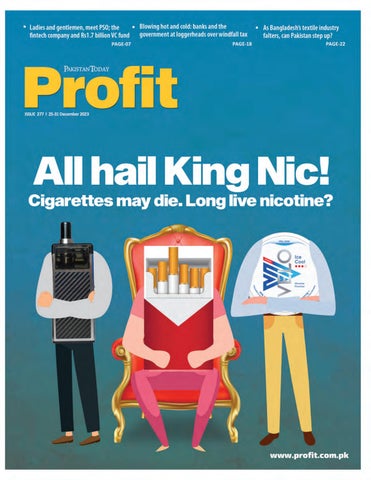
14 14 All hail King Nic! 18 Blowing hot and cold: banks and the government at loggerheads over windfall tax 22 As Bangladesh’s textile industry falters, can Pakistan step up?
07
22
25
25 ‘Shared e-KYC’ introduced for banks, as PBA and SBP move towards more open banking
Profit
26 DISCOs seek highest fuel charges adjustment for 2023
Publishing Editor: Babar Nizami - Editor Multimedia: Umar Aziz Khan - Senior Editor: Abdullah Niazi Sub-Editor: Basit Munawar - Video Editors: Talha Farooqi | Fawad Shakeel Business Reporters: Daniyal Ahmad | Shahab Omer | Zain Naeem | Saneela Jawad | Ghulam Abbass | Ahmad Ahmadani Shehzad Paracha | Aziz Buneri | Nisma Riaz | Mariam Umar | Urooj Imran | Shahnawaz Ali | Meerub Amir Regional Heads of Marketing: Mudassir Alam (Khi) | Sohail Abbas (Lhe) | Malik Israr (Isb) Pakistan’s #1 business magazine - your go-to source for business, economic and financial news. Contact us: profit@pakistantoday.com.pk
Ladies and gentlemen,
meet PSO; the fintech company and Rs1.7 billion VC fund
Is the state-owned enterprise doing the right thing by venturing into fintech and the world of venture capital?
I
By Taimoor Hassan
n the world of retail, coffee giant Starbucks is considered a bank. Because the mammoth coffee chain operates a digital wallet, which held $1.5 billion in customer cash as of 2022. Starbucks app has as many as 31 million app users. The numbers are staggering! For context, more than 85% of the banks in the US hold less than $1 billion
in assets. What could this possibly achieve for Starbucks? A lot really. Because the $1.5 billion in customer cash solves all the cash flow issues for Starbucks. All the money remains in the Starbucks ecosystem that the coffee retailer can use as a loan without any interest. Customers preload money onto the app, order coffee and pay through the app, without any exchange of cash or card swipes. The funds that remain in the app
7
can be used by Starbucks as working capital as well as to grow operations. This is ingenious and the success of the Starbucks wallet makes it one of the top apps in the world. There are lessons that can be learnt from this and if you are Pakistan State Oil (PSO), you would definitely want to replicate this. Because the state-owned oil company struggles with serious cash flow issues mainly because of the persistent circular debt problem in the country. The choking of the cash flows means inefficiency of operations and an impact on overall financial performance on the company. How could it be solved, you might think? The answer to this lies in digitising payments. What if the retail payments at PSO were made through a digital wallet instead of cash, just like in the case of Starbucks? Realistically, that should plug some of the cash flow issues of PSO. At the same time it should also help bridge the pesky cashless world the State Bank keeps telling us about which in turn should mean more customers for PSO. A win-win-win, right? In its financial statements, PSO revealed they were launching the fintech venture under the name of Cerisma as a longterm corporate strategy. It is also a move that, the company believes, will endear them to shareholders. But it seems like PSO is not only following the Starbucks model but also taking it a notch above. Because the oil marketing and distribution company is also gunning to secure an Electronic Money Institution (EMI) license under its fintech ambitions. The company has not yet confirmed to Profit if it plans to secure the license in any official communication but we understand that the wheels are already in motion. It is not only fintech that PSO wants to do. The plans are grander with the company also planning to invest in startups via its venture capital arm, PSO VC Pvt Limited. Since 2021, the company has earmarked as much as Rs1.7 billion for this fund, all from its own pre-tax profits. What could all of this mean for PSO and are these plans substantial? Before we try to explain this, let’s delve into the recent financial woes of PSO.
The financial woes of Pakistan State Oil
P
SO has a problem. It is massive, tied to governmental sluggishness, and in a constant liquidity crunch. Allow us to demonstrate in some key statis-
tics.
PSO’s national presence spans 3,528 retail outlets, holding a 51% market share, marking a 1.8% growth from the previous
8
year. Notably, in motor gasoline, it maintains a robust market presence with a 44.2% share, selling 3.3 million tons against industry sales of 7.5 million tons. Despite a 29% decline in diesel consumption, PSO increased its market share to 54.4%, hitting 3.4 million tons, a growth of 2.8% from the prior year. Despite this, PSO faces a critical challenge hindering its strategic plans. This risk stems from the accumulation of long-outstanding circular debt receivables, which reached an amount of Rs 524 billion
rates in the fiscal year 2023, on account of an increase in the policy rate by 825 basis points by the State Bank of Pakistan, resulted in a substantial increase in the company’s finance cost and severely impacted its profitability. Finance cost in the fiscal year 2023 stood at Rs 43 billion as opposed to around Rs 6 billion in fiscal year 2022. This has impacted profitability adversely as nearly 60% of the operating profit has been consumed by finance costs, leading to a net profit of only Rs 5.7 billion.
as of June 30, 2023. These debts include an aggregate amount of Rs. 434 billion due from GENCO Holding Company Limited (GENCO), Hub Power Company Limited (HUBCO), and Sui Northern Gas Pipelines Company Limited (SNGPL) on account of Inter-corporate circular debt. These include past due trade debts of Rs72 billion, Rs18 billion and Rs298 billion from GENCO, HUBCO and SNGPL respectively, based on the agreed credit terms. As of September 30, the issue of circular debt remained a significant concern with outstanding receivables reaching Rs 511 billion, with SNGPL accounting for 72% of total outstanding receivables amounting to Rs 366 billion of the total receivables. To cope, PSO had to resort to increasing their short-term borrowings to meet their working capital requirements. Short-term borrowing increased by 2.6 times to Rs 453 billion in fiscal year 2023 as compared to Rs 175 billion in fiscal year 2022. As of September 30, 2023, this figure stood at Rs 392 billion. Consequently, there has been a substantial increase in finance costs, which have risen by 114% compared to the same period last year. Moreover, a steep rise in interest
Despite an increase in market share for oil products to 51%, reduced sales demand for white oil products due to an overall reduction in the industry’s sales volumes also contributed to this increase in the finance cost for the year which reached Rs 40 billion. Summing up, these long-outstanding receivables are increasing the financial burden and adversely impacting the company’s profitability, hindering retained earnings and overall equity. To mitigate these challenges, PSO is collaborating with the government, actively pursuing solutions to the circular debt issue. Once the circular debt receivables are settled, PSO will be in a better position to realize its strategic plans for expansion, integration, and diversification. And it is also being creative to solve these problems in case the government stays in deep slumber.
Making sense of the PSO fintech
T
his isn’t the first Hurrah, of course. In 2019, the Pakistan State Oil launched its wallet by the name of DIGICASH. Users can manage the wallet via the PSO Fuellink app and get a virtual as well as a physical DIGICASH
card to make purchases at retail fuel stations. These cards can be topped up through a bank, branchless banking agents and at some retail outlets of PSO. This wallet is currently closed loop which means that only PSO customers can use it for purchases from PSO. What does that achieve? While the customer gets the convenience of not carrying cash, PSO is able to get cash in these wallets that stays with PSO. These top ups could be big and customers could keep them unused for a while. The unused customer cash could be used by PSO as working capital or investment purposes. The impact of wallets has already been in billions of rupees. In 2019 alone, PSO added 80,000 DIGICASH customers and by the end of 2021, this number had increased to 190,000 DIGICASH users, with Rs5.7 billion in top ups in the wallet. Essentially, this is the concept of deposits at banks. Users deposit their money with the bank, the bank issues them a card and the users use that card to make purchases wherever the card is accepted. But unlike a bank card, a PSO card can not be used anywhere else other than PSO. And unlike banks, PSO can not lend that money out to anyone. Instead, it could use that money to plug any cash flows. Think of it this way: for the financial year 2023, PSO had sales worth Rs3,605 billion. If half of these sales are done through the DIGICASH wallet on which the money is preloaded, PSO has access to that money before the actual sale which can be used to timely pay stakeholders in the supply chain and ensure smooth operations of its core business. This is the strategy that Starbucks also applied. Remember also that access to such money removes or diminishes the need of going to a bank for financing which can charge high interest rates and ask for securities and collateral. As mentioned above, financing costs are a big pain for PSO. The big question, however, is why would people use the wallet instead of making purchases on cash, which is (apparently) easier and more prevalent? The answer to this question is loyalty programs. Loyalty programs are incentives provided by businesses in the form of rewards, discounts or any other special inducements to attract customers or retain them. One of the biggest hooks for Starbucks customers to get to use the wallet is a points-based rewards system. On each purchase, customers get points that are equivalent to a certain amount of dollars. When accumulated enough, these points can be used to make purchases at Starbucks. A similar points-based rewards system is in place for PSO when using the DIGICASH card. Every time you use your DIGICASH card to make a payment for fuel at PSO, you get points worth a certain amount.
When accumulated enough, these points could be used for a refuel free of cost as a reward for using DIGICASH. Besides giving PSO a free loan everytime you top up your DIGICASH card, you are also giving PSO access to money that is now moving quickly in the PSO supply chain. According to a source expert in fintech and familiar with operations of PSO, electronic transactions are settled quicker, giving PSO quick access to money. But what if PSO could also attract deposits like a bank, and use that money to invest in government securities and use those earnings to plug liquidity issues? What if PSO cards could also be used at all the PoS machines in the country and for fuel purchases only? Not only does this help them plug liquidity issues in their core operations but also opens up new revenue lines. This is perhaps why PSO has set up its own fintech company by the name of Cerisma Private Limited which is gunning to get an EMI license. PSO is also rumored to be in the race to secure a digital bank license. As mentioned earlier, PSO has a mammoth presence with over 3,500 fuel stations. All these stations could have four different types of retail operations: first is the sale of fuel and lubricants; secondly a convenience store; third and fourth are a tyre shop and a service station. Now wouldn’t it be a good deal if you could use your fuel card that your company gave you or a PSO DIGICASH card to pay for all the aforementioned retailers at PSO stations? This is the broader strategy in place, apparently. Your corporate fuel card or your DIGICASH card could be branded as Visa or MasterCard once PSO gets the EMI license and you could use that for all four of the retail transactions, provided they have PoS machines to accept these cards. Now fuel purchases are a significant expense, perhaps second only to groceries, and a frequent one. If you could use your PSO card to do groceries and other purchases such as buying clothes besides fuel, the PSO card has the potential to become your default debit card. And PSO has a head start. Unlike other EMIs, PSO already has corporate users of its fuel card and DIGICASH users before it even is an EMI. PSO also has a very strong retail network where these cards could be used. According to an expert in fintech, new EMIs would need at least 2-3 years to build the kind of presence that PSO has now for its EMI. The EMI operations would also not only help PSO save money from MDR but make it a new revenue line altogether. If you currently have, say, an HBL debit card, and you use it to purchase fuel at PSO, there is a fee that the fuel station owner pays to HBL
for the card payment. Part of that fee is borne by PSO. Once PSO has its own cards as an EMI, it saves that fee paid to HBL, and also starts earning that fee (negotiated differently with different types of retailers) for itself when you use the PSO card to purchase, say grocery at Carrefour. “The PoS transactions at PSO have a huge volume and the company already issues its wallet card. They could have in mind that while a piece from MDR goes to issuers, they could capture a piece of that being an EMI,” said a source in the fintech industry, who is familiar with PSO’s fintech plans. PSO identifies MDR as a significant issue in its company reports. Late last year, PSO told its dealers that it will no longer be able to foot its share of the MDR bill. According to its arrangement with the dealers, whatever MDR on card payments was negotiated with a bank, the dealer would pay a certain percentage and the oil marketing company, in this case PSO, would pay the rest. But after PSO said that it would no longer pay its share of the MDR, dealers could either continue accepting card payments at their own expense or discontinue accepting cards completely. The MDR that could be charged by the banks was between 1.5-2%. Later into the year, in a letter to the State Bank Governor, the OMCs asked the central bank to cap the MDR at 0.3% for the oil industry. This would mean that the merchants, fuel stations in this case, would have to pay less from the per liter price for accepting card payments. The rationale provided by OMCs was that since the fuel industry margins are regulated, a percentage charge of 1.5-2% on card payments was a significant hit on their bottom line. In big cities like Lahore and Karachi, card penetration is high which means volume of sales on cards is high. As more sales are processed on cards against cash, the MDR starts becoming a bigger problem since now most of the sales are subject to the MDR percentage charged by banks, while margins are fixed because they are regulated. As a consequence of this, PSO dealers either stopped accepting card payments or started passing it onto consumers, hampering PSOs sales on cards, wherever they were high in volume. According to the company financials, it was able to successfully negotiate a favorable MDR applicable on bank card transactions. “This achievement led to significant annual savings of over Rs300 million, which will continue to benefit the company in the long run.” Under the EMI license regime, fintech companies are allowed to invest up to 75% of their e-money balance in treasury bills and government securities. This could be of huge benefit to PSO. Since PSO users are big in
FINTECH
number and if they switch to PSO cards, this would essentially mean big deposits for EMI. Now unlike a bank, PSO can not use that money to lend to anyone. But it could use the majority of that money to invest in treasury bills and government securities, just like conventional banks. And whatever income PSO earns from that, it could use it as working capital in its core operations, for expansion or for any other investment. PSOs plans with regards to fintech fall together. Not only does this help the company solve cash issues in its operations, it could also add to PSO’s earnings. But whether PSO would be able to execute this plan efficiently is the big question. Because when contacted, Profit was told that the company does not have anyone who could say for certain what the plans were. This lack of discipline could also compromise PSOs other endeavor, that of launching a venture capital fund.
The PSO Venture Capital. But does it make sense?
P
art of PSO’s strategy is also to launch a venture capital fund, from its own profits. “PSO Venture Capital (PVC) has been created as a strategic investment division of PSO, aiming to unlock new streams of revenue and enhance the overall value of the parent company,” a representative from PSO said in a statement to Profit. “By strategically investing in a wide range of businesses, high-growth companies, start-ups, and cutting-edge technologies, PVC is poised to drive substantial asset growth within the predefined risk boundaries.” One could wonder though that if PSO has liquidity issues, why would it allocate money from its own profits? The company said in a statement to Profit that for the venture capital fund, it would be contributing
10
up to 1% of its profit before tax in PVC for the purpose. Adnan Sami Sheikh, assistant president at Pak Kuwait Investment Company (PKIC), says that the scale of the company is big enough that taking out 1% for investment purposes is not going to be an issue for PSO. “PSO has sales worth trillions of rupees. Even at a pre-tax profits level, a 1% contribution wouldn’t affect PSOs’ liquidity much,” Adnan said. This makes some sense. For the year 2022, PSO’s pre tax profits were close to Rs150 billion. Consequently, the company contributed Rs1.47 billion to its venture capital fund. For the financial year 2023, PSOs profits were Rs 24.3 billion. For that year, the company contributed Rs243 million to the VC. Collectively, that’s over Rs1.7 billion in its VC fund. That’s a hefty amount that wouldn’t affect PSO much as Adnan says but shouldn’t PSO be trying to save every penny? According to a senior investment analyst familiar with PSO’s operations, who chose to comment anonymously, PSO getting into venture capital as a diversification strategy makes sense because global oil prices have a high volatility which could result in losses. Any diversification for PSO would be helpful for its sustainability. For PSO, he explained, positive cash flows could be seen in the coming days because of the increase in gas prices by the government in November. “The increase in gas prices would result in a positive GDS of Rs57 billion. Fixed charges have also been increased from Rs10 per month to Rs400 for protected consumers and from Rs460 to Rs1,000 for unprotected consumers which would have an impact of approximately Rs80 billion.” “This would help the government pay for the tariff differential caused by RLNG sales to consumers instead of industries. PSO
being an RLNG importer would receive this money which would help it achieve positive cash flows,” he explained. Regardless of PSO being able to take out money to invest without affecting cash flows or not, the big hazard here is that the company plans to invest in ventures that are extremely high risk but come with very high gains as well. VC investments are a game of patience. A fund has to keep on investing, anticipating that out of multiple investments it made, one or two could give them gains so big that they would offset any losses on the other investments. But these gains come after a few years. So PSO upsetting its cash flows to invest in very risky ventures could turn out to be a double edged sword. This kind of a risky endeavor can be undertaken by Saudi ARAMCO and the likes that have a very stable financial position and invest in startups for the sake of innovation, without worrying about cash flows or gains. In fact Saudi ARAMCO has a $500 million fund called Wa’ed Ventures to invest in startups. “If PSO is planning to replicate ARAMCO, know that people at ARAMCO are seasoned professionals and do everything with precision. I don’t expect the same from PSO,” said a prominent Pakistani venture capitalist. This is one more hazard of PSO’s VC ambitions. That venture capital investments require a certain type of expertise and discipline. Being a government owned and controlled entity, that discipline is likely not there. Because although there has been a lapse of two years since PSO started contributing money to the VC fund, no investments have been made by the company yet. In fact the company has not been able to secure a license from the Securities and Exchange Commission of Pakistan (SECP) to undertake this endeavor, and doesn’t even have a team yet to look after these investments. On the other hand, folks at the SECP were amused and struggled to comprehend that a government-owned entity like PSO was launching its own venture capital fund. They haven’t yet been able to confirm the status of PSOs VC license. According to an expert, PSO would likely be better off if it partners with a local fund to make such investments and does not do it on its own. That is to say that whatever allocations PSO has for its VC fund, it should give that money to a local VC fund and let them decide where to invest. This would not only cover the discipline but also the expertise issue. Or being a government entity itself, PSO should contribute its money to the $10 million fund that the Government of Pakistan also plans to launch. n
FINTECH
OPINION
Asif Saad
Traditional banking globally is changing. Will Pakistani banks pay attention?
processes for lending (or more like non-lending), and even corporate advisory remain completely indistinguishable from one bank to the other. Imagine promoting “free cheque books” as a feature of your service in this day and age! But let me come to the faux pas of the Pakistani banking industry in a bit. First, let us look at the international arena. Global banking heading towards specialisation The biggest change in the global banking industry is driven by the introduction of new technology, which has seriously challenged the economies of scale model built on bricks and mortar. A bank’s size used to be an advantage in reaching customers, aggregating services and building loyalty. But not Global banks are heading towards specialisation and anymore. In the last 10 years or so, hundreds of digital banks technology adoption. Traditional operating models – have appeared along with payment platforms, wealth management providers, venture capital firms as well as e-commerce like the ones in Pakistan – need to be rethought. retailers bundled with consumer finance options. All of them have raised the bar for customer expectations. am amused to see the frequent advertisements showcasing one Consumers now demand much more from their financial serbank or the other winning awards like “Bank of the Year”. For vices providers and are likely to seek specialised services from one, it is rather well-known how underhanded means are used differentiated organisations. A working example is the number to win some of these accolades. And even if these awards are of unicorn fintechs – estimated at 274 companies in 2022, each genuinely won, it is often done following conventional methods valued at over $1 billion! Their collective valuation was then of doing business. more than $1 trillion. Traditionally, if a bank is well-capitalised, generates a decent At the same time, traditional banks face declining deposit base and has economies of scale, then it should be able to do revenues and profits and consequently trade at an “acceleratwell – until now. ing discount” to other industries in the world’s largest stock My hypothesis of the traditional industry structure being unable markets. This means that global investors are not making rosy to withstand emerging changes is based on watching consumer needs predictions for the future profitability and sustainability of the and technology evolve over the last decade or so. existing business model. Products such as checking and savings accounts, outdated With the era of monolithic banking under serious threat, the important question is: what will replace it? With the aggressive move towards a “zero cash” economy, the developed world is unlikely to need cash storage and related services. A bank account will still be required along with credit and debit cards, which could be The writer is a strategy competed for by traditional banks and fintechs. consultant who has Investment, project finance and personal wealth advisories are already becoming areas which are previously worked at offered by specialised firms. The trends in housing and commercial mortgages point towards the increasvarious C-level positions ing presence of developers who can combine selling, renting and operating real estate projects. REITs are for national and already quite common in the developed world and hold sizable real estate portfolios. Marketplaces for multinational automobiles offer combinations of leasing and maintenance, while e-commerce financing, both for B2B corporations and B2C segments, is rapidly making headway. Besides these industry-specific trends, there are wider social and technological changes driving change. Data, for instance, is now regarded as the new oil, implying data ownership to be much more valuable than any product or service. And if cryptocurrencies can break the shackles of the regulatory
I
COMMENT
11
frameworks, they will be able to neutralise the raison d’etre for a bank. In other words, it is unlikely that a traditional bank offering the entire universe of financial services under its umbrella can compete with specialised providers, who are much nimbler and are likely to be far ahead in technology adoption as compared to the giant banking bureaucracies. The evolution of banking globally seems to be heading towards specialisation of one kind or another. This is why future banking stock valuations are probably building the break-up of traditional banks into smaller and more efficient platforms of the particular service they choose to compete in.
Banks losing talent
B
anks are also losing the war for talent. The best students from my school class or even my graduate school class (in the late 80s) started their careers with international banks and have pretty much stayed with that profession, even if they switched to local banks. This is hardly true anymore with the best students being lured by technology firms, start-ups, consulting and the development world. According to EY, “young people today
12
have a sceptical view of the banking sector, regarding it with disinterest or even distrust. For various reasons, a career in banking might not be as appealing as it once was…this would drain the supply of inbound talent to the sector and pose business continuity and financial risks to banks around the world.” “You can’t put tomorrow’s talent in yesterday’s jobs,” says a senior EY executive in the USA.
Pakistani banking industry
L
et us now look at the situation in our homeland. But let us also look at it from a longer-term perspective, and not at local banks’ annual or quarterly reports, which make for fancy numbers these days. Unfortunately, banks have never been a widespread source of capital for businesses in Pakistan. This negative trend has only been enhanced over time. From their inception when the norm was lending to the politically powerful, to the 21st century when the main borrower from banks is the state itself, the journey remains far removed from banks ever being providers of capital for economic growth. Blame it on the reforms brought about at
the start of the decade or loan conditions from external lenders, but banks in Pakistan have taken risk aversion to an extreme. As anyone who has ever tried to borrow from Pakistani banks would know, you need to provide foolproof securities in addition to unlimited personal guarantees to qualify for a loan! The basic point is that it is nearly impossible for a common person to borrow from Pakistani banks. Banks in Pakistan have insisted upon bricks and mortar driven growth, with the number of retail branches and deposit generation being major achievements for bank management. This has continued despite the onset of tech-driven changes, as mentioned earlier. Where do Pakistani banks go from here? I am sure our local bankers have understood that technology does not recognize geographical boundaries, and will be here sooner than later. Yet, they continue to follow the same decadent business models. Like their global counterparts, Pakistani banks need to choose the sectors they will specialise in, build talent in the same area, redefine their purpose and restructure their organisations into smaller, more efficient units. But most of all, whatever strategic direction they choose, it must be from the perspective of becoming facilitators of business and entrepreneurship in the country. n
COMMENT
Cigarettes may die. Long live nicotine?
Cigarettes are fast falling out of fashion but the demand for nicotine is going nowhere. This is how Big Tobacco plans to answer the challenge By Abdullah Niazi
W
e start in the heart of Lahore’s Model Town. The area’s famous circular bank-square market is a peculiar sight these days. Dead in the centre of the pre-partition co-op, the market has been known over the years for its cheap food and communal sitting area. It is a sort of glorified food court really. There is a circular brick platform in the middle with lots of plastic chairs and tables. The little sitting area is surrounded by shops, stalls, and kiosks selling all manner of food cheap and pricey. The market has been around for decades. Before there was H Block market in
14
DHA or G1 Market in Johar Town or Karim Block there was Bank Square Market. It has served, in particular, as a haunt for young students looking for cheap food and spaces to loiter. And of course where there are young people loitering there is tobacco. And for years that has indeed been the case. Little khokhas and corner shops have long been the widespread distribution arm of Big Tobacco. Even in 2023 small grocers are the largest distribution channel for cigarettes in Pakistan in retail volume terms. But the little round Bank Square Market today tells a story of changing times. Within this market that has a radius barely over 200 metres there are a grand total of seven shops that sell vapes. The shops are renting out prime real estate. They specialise in selling just vapes
— that means they don’t keep cigarettes with them. And Bank Square isn’t the only place where this phenomenon has been observed. All over Lahore and indeed all over Pakistan the dedicated stores selling vapes have become common over the past few years. While vapes and e-cigarettes have been around in the country for longer, they have become far more easily accessible since around 2019-20 when a number of retailers began importing vaping devices, flavours, and in large quantities from China and Thailand to grow their retail footprint. The threat from the growing trend of vaping has not gone unnoticed. Pakistan’s tobacco industry has been watching closely as these imported products gain more traction. Not only are people now getting their nicotine fix elsewhere, but a lot more people that would otherwise have started smoking have instead
chosen to start vaping instead. According to one report that has been used by the tobacco industry for information, in the five years from 2017 to 2022 the number of people that vaped in Pakistan grew by four times. In response Big Tobacco in Pakistan has decided to introduce its own non-tobacco nicotine products. Pakistan Tobacco Company (PTC) has introduced the VUSE vaping systems that are manufactured and distributed by its parent company, British American Tobacco (BAT), to Pakistan. And they have brought it to the market with a big marketing and customer acquisition splash. In response, Philip Morris International (PMI) has also introduced their “heated tobacco” line called IQOS, although they have done so in a decidedly more subtle fashion. At the same time, PTC has also hit the market with their nicotine pouches under the brand name Velo, after which PMI has come up with a near identical product under the brand name Zyn. As the competition heats up for the nicotine market that exists outside of traditional cigarettes in Pakistan, the question is, who will come out on top? And will these new products ever really replace the Big Kahuna that is the cigarette?
Tobacco Kingdom
L
et’s get this out of the way. Cigarettes are bad for you. They are nasty, brutish, disgusting things that poison and cripple some of the best amongst us. They are a filthy, deadly, dangerous, plague upon humanity that have killed more people in the 20th century alone than both world wars combined. Governments across the world have tried (and failed) to wrangle this industry. As a result, cigarettes are still the Big Kahuna in Pakistan. In 2022 alone, which is the year for which we have the latest available data, a whopping 60 billion cigarette sticks were sold in Pakistan equating to around three billion packs. This is enough cigarettes for every single man, woman, and child to puff away around a cigarette a month in the country. But with only about 13.4% of the population identifying as smokers in Pakistan, it comes out to an average of around 2000 cigarettes per smoker a year. That is, in fact, a modest number. The average smoker globally consumes upwards of 5000 cigarettes a year. But all of the sticks add up, and the cigarette market in Pakistan did retail sales worth nearly Rs 454.4 billion in 2023.
These sales are by and far dominated by two companies in Pakistan. There is the Pakistan Tobacco Company Limited (PAKL), which is the Pakistani subsidiary of British American Tobacco. The other company is Philip Morris Pakistan Ltd (PMPK). Together these two companies control around 95% of this massive market. The bigger player among the two is PTC, which up until last year held about 70% of the market share compared to Philip Morris which controls just under a quarter of it. Both of these companies manufacture locally and depend on the vast tobacco fields of Khyber Pakhtunkhwa. The trajectory of tobacco farming in Pakistan has actually been quite interesting. At the time of partition in 1947 there were plenty of smokers in Pakistan but no tobacco was grown here. Big Tobacco saw this for the opportunity it was and encouraged planting tobacco in the erstwhile North West Frontier Province (NWFP). From 1948 onwards some efforts were made to try and grow the crop, beginning with an experimental 20 acre farm. It was very quickly discovered that KP’s land and climate was ideal for growing tobacco, and by 1968 Pakistan was no longer a net-importer of tobacco. According to a study by the Abdul Wali Khan University in Mardan, the area under tobacco cultivation in Pakistan was 43,134 hectares in 1980–1981 and 50,800 hectares in 2019–2020, indicating that the area under tobacco cultivation expanded over time due to its profitable nature. The same study found that tobacco production in KP increased from 43,408 tonnes in 1980–1981 to 71,410 tonnes in 2019–2020, while the area under cultivation only rose by around 4,000 hectares between that time. The remaining 5% of the pie is split between around 50 small scale tobacco companies based out of Khyber Pakhtunkhwa set up by tobacco farmers in the province. These smaller players sell their cigarettes cheap, off brand, and often untaxed. It is a point of particular annoyance for PTC and Philip Morris, with both companies spending exuberant amounts of money each year lobbying for these small cigarette manufacturers to be taxed. And while this in itself is a fascinating dumpster fire, what it tells us is very important: the
figures we have for how many cigarettes are consumed in Pakistan are not quite accurate. And the actual amount of cigarettes sold here are much higher than the 60 billion sticks we know of.
The Goliath faces mortality
C
igarettes have been around for a very long time. Early in the 16th century beggars in Seville began to pick up discarded cigar butts, shred them, and roll them in scraps of paper (Spanish papeletes) for smoking, thus improvising the first cigarettes. These poor man’s smokes were known as cigarrillos or “little cigars” in Spanish. From those antiquated origins the cigarette has persevered and it will continue to persevere. As a product the cigarette has gone through many changes and rebrands. It has been at the centre of some of the greatest marketing campaigns in modern advertising history. Despite the many adverse health effects and direct deaths caused by smoking cigarettes nothing seems to have stopped these unassuming little sticks that are both a product and a cultural cornerstone. But there is definitely a threat. The indicators are similar all around the globe, and some of the most readily available data comes from the United States where cigarette smoking has fallen to an all time low but the use of vapes and e-cigarettes has continued to climb. About 11% of adults told the CDC in 2023 that they were current cigarette smokers. These rates have fallen consistently since the 1960s when it was first widely publicised that smoking cigarettes causes cancer. At the time nearly half of the global population smoked cigarettes. Meanwhile the use of e-cigarettes in the United States has risen from 4% in 2021 to 6%. That is still around half of the total number of cigarette users but the trend is clear. In Pakistan as well, cigarettes are far ahead of any other competition. The total retail sales for cigarettes this year have been over Rs 450 billion — and that is despite rising prices of cigarettes due the the government imposing additional taxes on smokes on the direction of the International Monetary Fund. In comparison other products that deliver nicotine are small fries. The overall sales from non-cigarette related nicotine products including nicotine pouches, vapes, and heated tobacco (more on what this is later) amount to a mere Rs 54 billion in 2022.
COVER STORY
The competition heats up
T
he point is not that cigarettes are going anywhere, but rather that other methods of consuming nicotine are fast becoming very popular. Nothing is more indicative of this shift than the reaction that PTC and Philip Morris have had to this situation. Remember, up until around 2018-19 vapes and e-cigarettes in Pakistan were imported products that were hard to find. In around 2019 a number of chain retailers for vapes started popping up. Shops like Vape Mall, VGod, and Artisan Vapour all became very popular very quickly off the back of large scale import of vaping devices. For those unaware there are essentially a few kinds of vapes available in Pakistan. There are vaping devices you can purchase and fill with “flavour” — which is an oily sort of liquid that contains both the flavouring and the nicotine that reaches the consumer. The vape device is charged and when you inhale it heats the flavour and delivers nicotine in the form of vapour to the person taking the hit. Then there are pods, which are a similar concept except instead of a liquid bottle of flavour the device comes with little capsules you can insert and smoke away. And then finally there are disposable vapes. These are devices that last anywhere from a day to a few weeks and are thrown away once they finish. “Back in 2019 the items being most imported were vaping devices and vape liquid,” says one tobacco industry executive. ”At the time we were already looking at and considering introducing non-cigarette products but then soon after Covid we noticed an influx of disposable vaping devices. These were less expensive than an entire device and not as much of a commitment. As a result, a lot of people tried them out and became regular users. ” Profit was surprised to discover that the tobacco industry was surprisingly hesitant to speak to a business publication. For an industry that is not allowed to market their products but still have marketing departments with budgets higher than most entire newspapers could ever dream of, one would think their officers would want to talk to the media. But neither the communications nor marketing departments of PTC and Philip Morris responded to any of Profit’s requests for interviews or comments. One executive spoke to us as a personal favour but off the record since it was not their relevant department. According to the information available with Profit, the abundance and easy availability of e-vapour products in the urban centres of Pakistan, includingIslamabad, Karachi, Lahore, Peshawar,and other major cities, supported the growth in awareness and demand.Shenzhen IVPSTechnology remained the leader in retail value sales of open vaping systems through its
16
SMOK brand,ahead of Shenzhen Smoore Technology and Shenzhen Joye Technology with their respective Vaporesso and Joyetech brands. Since then a number of other Vape brands have also entered the market. The proliferation of vaping was enough that Big Tobacco knew it had to make a move. That is why in December 2019 the Pakistan Tobacco Company launched Velo. This brand of nicotine pouches was launched amidst great fanfare and was heavily marketed as well. Because this is not a product that burns, there is no regulation in Pakistan that governs it. Velo even tried to pull off a Coke Studio like move by introducing Velo Sound Station and quickly nicotine pouches also became commonplace. “But there was always going to be more. Nicotine pouches were the first foray into launching non-tobacco products in Pakistan. The only problem was this was a product tailored to helping people quit. It was discreet and didn’t have any of the best elements of smoking,” explains our anonymous tobacco executive. “You just pop it in your mouth and that is it. There is no social element to it like smoking or vaping. It also takes away the allure of blowing smoke. But with people veering away from tobacco something obviously had to shift.”
Enter the Big Boys
P
akistan Tobacco Company was the first to move. Internationally British American Tobacco introduced their Vuse brand of e-cigarettes and vaping devices as early as 2013 when the trend of vaping was on the rise in the United States. In Pakistan they decided to launch it earlier this year, making it the first vape officially produced in Pakistan. Once again, thanks to fewer restrictions, they marketed it with a shabang pulling out all the stops from hiring dance crews at launch events to placing agents and free testers at vape shops. Since the product is local and not imported by individual importers and businesses, the price of the product is also cheaper. In very quick time Vuse has gained traction and popularity in Pakistan. At the same time, Philip Morris has not been sitting idly by. But their approach to the problem (or opportunity?) has been rather different. You see Philip Morris lagged behind
when it came to nicotine pouches. They have only recently introduced their Zyn brand, although they have brought it out with aplomb spending a hefty bit on marketing. And now, much like PTC, they are also bringing their own alternative to cigarettes. The only difference is that instead of bringing in their own vape Philip Morris has what is known as a heated tobacco product. Internationally as well Philip Morris sells their heated tobacco under the IQOS brand name. This is not a vape. Essentially, it is a hand-held device a bit larger than the average vape that comes with a small pack of “Heets”. These are small filters with what looks like a tiny cigarette attached to them. You insert this butt into the device which then starts vibrating. After this, there is a period of around two minutes in which the device and the filter are active. The device heats the tobacco producing smoke without actually burning the paper or tar and other carcinogens in the cigarette. One would assume it is supposed to be healthier but as with all nicotine consumption it is not recommended by doctors. The IQOS device gives more of an effect of a cigarette than a vape does. It lasts around the same amount of time/puffs as a cigarette and you still get the feeling of buying a pack. It is significantly more expensive, with devices costing anywhere from Rs 30,000 to Rs 50,000. But unlike PTC and their Vuse vapes, Philip Morris seems to want to market this as a more exclusive product. They have been undertaking an effort whereby they try to sell the product to a high-end market. These devices and heated tobacco are not new in Pakistan. People have been importing them or bringing them back from trips for some years now. But Philip Morris is now importing them directly from their counterparts in South Korea, which is making them significantly cheaper. While Vuse has the edge of being cheaper, more accessible, and vapes being more commonplace, it seems Philip Morris is trying to focus instead on creating its own niche.
The tobacco farmers
P
akistan grows a lot of tobacco. Tobacco is grown in all four provinces in Pakistan, but it is predominantly grown in KP where it is a major
part of the local agrarian economy. KP’s provincial economy is pegged majorly to the growth of tobacco. More than 80% of KP’s population lives in rural areas, with agriculture accounting for around 30% of provincial GDP. Pakistan currently grows tobacco on some 50,800 hectares, with KP making up nearly 30,000 of these hectares. It is one of those rare agricultural products where Pakistan is ahead of the curve. Over the more than 50,000 hectares on which tobacco is grown, Pakistan’s yield per hectare stands at nearly 2.3 tonnes per hectare with a total production of 113.6 million kilograms. In comparison, the world average production for tobacco is 1.84 tonnes per hectare. Meanwhile KP in 2021 produced 71.38 million kilograms on 28,089 hectares of land, giving an average yield of 2.5 tonnes per hectare — a 66% rise on the global average. A report of the planning commission from 2020 explain how during 2000-16, the production of tobacco in Pakistan has increased at a rate of 1.90% per annum mainly because of the improvement in per ha yield (at 1.64% per annum) as area under the crop expanded at 0.26% per annum. In KP, where 63% of total tobacco area lies, the growth in tobacco area during 2000-16 was highest at a rate of 0.63% per annum, while in Punjab which contributes about 32% of the total tobacco area, growth in tobacco area was on a declining trend. The tobacco area in Balochistan is also declining from a very small base, while in Sind it is increasing also from a very small base. The highest growth in tobacco production also came from KP at 2.03% followed by Punjab and Sindh. The highest growth in per ha tobacco yield was in Punjab. Now remember, most of this tobacco is purchased from the farmers by PTC and Philip Morris, with the smaller tobacco companies making up a very small proportion. There is no serious projected dip in cigarette manufacturing in Pakistan over the next few years but in the long run there might be a bigger shift towards non-tobacco nicotine products. When that happens, one of Pakistan’s more successful crop stories might face some problems. Of course, we cannot quite say we’re sad about that. The reality that tobacco is a harmful substance that we should long have been rid of is very real. However, tobacco is here to stay for now. If we are to take any good from it we must encourage more growth that benefits farmers and is largely export oriented. Because there really is very little other benefit from its cultivation. n
COVER STORY
Blowing hot and cold:
banks and the government at loggerheads over Banks retaliate to 40% additional income tax on foreign exchange which could have generated a revenue of more than Rs 40 billion for the cash-strapped government By Mariam Umar
F
ew entities in Pakistan’s corporate circles have mastered the art of arbitrage as well as our commercial banks. They are so good at it that, despite the economic turmoil, the sector as whole has managed to achieve record profitability. Most of it can obviously be attributed to the healthy interest margins enjoyed by commercial banks, thanks to a prolonged high policy interest rate set by the central bank. Furthermore, the government’s reliance on deficit financing has presented banks with an opportunity to boost their profitability without having to take much risk. The investment-to-deposit ratio of the sector, a measure that shows the extent of investments that banks made in government bonds, exceeded 90% in November 2023. Despite these advantageous conditions, financial institutions have consistently sought out additional opportunities to make a quick buck. One standout example is the currency market, where banks have faced accusations of engaging in speculation. However, they had managed to avoid any repercussions for these activities— until recently. On November 15 2023, the caretaker government approved the imposition of a 40% windfall tax on the banking sector’s foreign exchange income, through Section 99D of the income tax ordinance. A week later, the Federal Board of Revenue, (FBR) issued a Statutory Regulatory Order (SRO), which outlined the formula for calculating the windfall gains accumulated by banks between tax years 2021 and
18
2023. If implemented, this one-time tax could generate a revenue of more than Rs 40 billion for the cash-strapped federal government. As anticipated, the banking sector contested these measures and appealed against the order. Asad Ladha, partner at Raja Mohammad Akram and Company, told Profit that various banks approached different high courts, according to where they file their tax returns. For instance, Askari Bank approached the Islamabad High Court (IHC), while Habib Bank Limited approached the Sindh High Court (SHC) on November 28. Similarly, Soneri Bank and Allied Bank approached the Lahore High Court (LHC) on November 29 and 30 respectively. Consequently, the higher courts granted a stay to halt the implementation of the tax. The first stay order came on November 29 in the writ petition filed by Askari Bank by IHC. LHC followed course by granting a stay to two other banks.
Speculative spectacles
T
he federal cabinet’s endorsement of the windfall tax was a response to intense criticism of banks, which reportedly made substantial profits of Rs110 billion in 2021 and 2022 through allegedly speculative rupee-dollar trading. According to a JS Global Capital report titled ‘Banks – The first sector to be hit by Section 99D’, “almost 4% of the sector’s total revenue, encompassing both net interest income and non-interest income, stemmed from earnings derived from foreign exchange dealings on an annual basis. However, in 2022, the scale of this income notably surged due to heightened fluctuations in forex rates, resulting in its contribution spiking to 7%.”
Note: The calculations are limited to major banks covered by the brokerage house
There is nothing wrong with borrowing as long as you are creating assets to generate returns through economic and commercial activity. In our case, the problem has been that we have been funding wasteful and unproductive expenditure. The reality today is that the servicing of external debt, and in my opinion also the domestic debt, looks increasingly unsustainable Shahid Hafeez Kardar, ex-governor of SBP and the ex-provincial financial minister
Profit has previously covered the modus operandi of the banks to carry out these speculative trades. Simply put, banks in Pakistan make money in the foreign exchange market through LCs, but they face restrictions on spreads buying and selling rates set by the State Bank of Pakistan (SBP). Allegedly, banks have tried to circumvent SBP regulations. According to the Foreign Exchange (FE) Manual issued by the SBP, banks are prohibited from charging a margin that exceeds the limit specified by the SBP. However, some banks have exceeded this limit, with margins reaching well above the allowed threshold. What led to this increase? A banking industry insider revealed to Profit that banks raised the rates for forward LCs due to prevailing market sentiment. For instance, when individuals sought a forward LC for imports, the bank would quote a higher rate than the current forex rate. For instance, if the forex rate stood at Rs 295 on that day, the bank might propose Rs 305 for the forward LC. This strategy was driven by significant fluctuations in the forex market. Hence, customers agreed to these rates, thereby enabling banks to widen their profit margins. This, however, hasn’t gone unnoticed. Successive finance ministers have accused banks of manipulating exchange rates. In November 2021, the advisor to then PM Imran Khan, Shaukat Tarin lashed out at banks for manipulating exchange rates. Similarly, Tarin’s successor, Miftah Ismail, who served as finance minister from April 2022 till September 2022, said in a podcast that eight commercial banks made a profit through speculation – while assuring the SBP that they were making a loss. “The National Bank of Pakistan (NBP) sold dollars to Pakistan State Oil (PSO) at the rate of Rs 242 the day when the market closed at Rs 230,” he said while explaining the role of the banks in currency speculation. A source from NBP, on condition of anonymity, told Profit that the state-owned bank used to charge PSO “an arm and a leg”. This source revealed that they used to charge LI-
BOR + 5% even though the norm was charging LIBOR plus 1.7%. Ismail was replaced with Dar in October last year, who pledged to take action against banks accusing them of manipulating exchange rates and making substantial profits. However, no visible action was taken against any bank during his tenure. The only information that surfaced was a briefing to the Senate’s Standing Committee on Finance, where the SBP governor disclosed that eight banks had received notices for their alleged involvement in manipulating exchange rates. However, no further details or outcomes were made public following the issuance of these notices. Yet Dar managed to insert Section 99D in the budget for fiscal year 2024, which would subsequently be leveraged by the caretaker government to penalise the banks.
The first casualty of Section 99D
S
ection 99D of the Income Tax Ordinance empowers the federal government to impose an additional tax on a company operating in a specified sector on windfall income, profit or gains arising due to economic factors for any of the last three years preceding the tax year 2023 and onwards, i.e, the tax years 2021, 2022 and 2023. The tax rate, however, can not exceed 50%. The caretaker government assumed office in mid-august 2023 and was faced with a daunting task of upholding the agreed-upon targets under the International Monetary Fund’s (IMF) Stand-by Agreement (SBA) signed in June. One of the main concerns of the fund revolved around the massive fiscal deficit recorded by the federal government. A large chunk of it is attributable to interest servicing costs which have soared in the past two years. However, the government had limited options on that front, so it opted to maximise revenue. Hence, on November 15, in a federal cabinet meeting, the Caretaker Prime Minister
Anwar ul Haq Kakar accorded approval on the recommendation of FBR to impose a 40% tax on windfall profit earned by banks on the foreign exchange transactions during the years 2021 and 2022. Following this approval, FBR released a notification SRO1588 of 2023 (SRO) on November 21 notifying a 40% additional tax on windfall profits of banks arising from foreign currency deals throughout 2021 and 2022, corresponding to tax year 2022 and 2023 respectively. The due date for the windfall tax payment was November 30. However, taxpayers had the option to request an extension of up to 15 days. The SRO outlined a formula to determine the windfall income, profit and gains of banks. It stipulated that the payment of the additional tax should be made to the federal treasury via a prescribed challan or a computerised payment receipt. (Banks maintain their financial records from January to December, adhering to the calendar year. However, tax regulations operate on a fiscal year basis, spanning from July to June of the following year. This means that even though banks close their books in December, they file taxes for that year in the subsequent June. For instance, profits from the calendar year 2021 are taxable in the fiscal year 2022, with banks closing their accounts in December 2021 but paying taxes for that period in June 2022)
The retrospective perspective
F
or the tax year 2022, banks’ “windfall income” is calculated as the difference between how much money the bank made from foreign exchange in 2021 and the average amount the bank made in the six years before that (2015-2020). Now, for the tax year 2023, the calculation is slightly different. The windfall income of the tax year 2022 has been reduced from the sum of foreign exchange incomes of the preceding six years to calculate the average of the preceding six tax years (2016-2021). This figure
BANKING
In the calculation for windfall income, only one factor (i.e. currency fluctuation) has been incorporated, while other factors (such as economic growth and inflation) which may impact the overall income of the banks have not been incorporated M. Amayed Ashfaq Tola, an advocate of High Court and the president of Tola Associates
is then deducted from the foreign exchange income for the calendar year 2022.
would adversely affect earnings per share by 9% on average, which, if transpired, may raise some
It also stated that if there is a negative windfall income in tax year 2022, it will be considered as zero when calculating the windfall income for tax year 2023. Additionally, if there’s an exchange loss in any year, that year won’t be counted when calculating the average exchange gain, reducing the total number of years considered. For example, if there was a loss in tax year 2017, it wouldn’t be factored in, making the denominator 5 instead of 6 for the calculation.
concerns about some banks’ payout capacity for the last quarter of the calendar year 2023, assuming they do not utilise available CAR buffers for the same.
The tax’s impact
A
s mentioned earlier, this one-time tax could generate a revenue of more than Rs 40 billion for the cash-strapped federal government. For the banks, this additional tax could adversely affect their earnings per share. According to the JS Global Report, the additional 40% tax on retrospective foreign exchange income
20
The banks retaliate
W
hile the notification was dated November 21, Dr Ikram ul Haq, partner at Huzaima Ikram and Ijaz, informed Profit that it was updated on the FBR’s website on the evening of November 22. This left banks with only a brief period of six to seven days to comply with the additional tax requirement. The reaction of banks to the FBR’s notification was swift. Understandably, banks raised objections. As mentioned earlier, several banks contested the tax in various high courts across Pakistan. While most banks challenged the
new taxation, a few might have opted to pay the additional tax. Haq noted that government-owned institutions such as the National Bank of Pakistan and Bank of Punjab might comply with the tax, while private banks are more inclined to legally challenge it.
Ground taken
P
rofit consulted two lawyers, Haq (petitioner on behalf of Soneri Bank and Bank Al Habib), and Ladha (petitioner on behalf of Askari Bank and Allied Bank). (Haq told Profit that Farogh Naseem will be filing a petition on behalf of five banks in SHC). Firstly, the objection was raised regarding the caretaker cabinet’s approval of the tax, which operates under different constitutional definitions than the federal government. “Federal government is defined in article 90 of the constitution whereas caretaker government is defined in article 232 of the constitution,” said Haq. He added that the basic principle of tax can be derived from article 77 of the constitution which says ‘no taxation without unless by the act of Parliament’. “We call it ‘no taxation without representation’ in simple words”, added Haq. He mentioned that the caretaker government can only attend to day-to-day affairs and cannot extend its authority to a fresh taxation measure. Secondly, and more importantly, the notification lacked specifics of ‘economic factors’ that led to windfall gains for the banks. “Section 99D says that the notification will specify the economic factor based on which the windfall income has arisen. Whereas the SRO 1588 does not mention economic factors,” highlighted Ladha. Haq reiterated that by not specifying economic factors, they (the federal government and FBR) have not fulfilled the conditions set forth for levying windfall income tax. Thirdly, according to Section 99D (3), the notification imposing an extra tax on windfall income must be presented to the National Assembly within 90 days. This assumes the existence of a National Assembly. The deadline for submitting the notification to the National Assembly is February 19, 2024. With the general
elections scheduled to take place in the coming months, the formation of the National Assembly is unlikely to occur before the February 19 deadline. This raises questions about the validity of the FBR’s notification and the enforceability of the windfall tax. Fourthly, Section 99D lacks clarity regarding the consequences if the National Assembly rejects the government’s calculation of windfall income or its chosen tax rate. This ambiguity ultimately leans in favour of the taxpayer. Finally, if the National Assembly disagrees and doesn’t approve the notification issued under Section 99D, the additional tax becomes invalid. If the tax had been collected earlier, the banks would face a loss for the interim period, during which the federal government is unlikely to pay any interest on the amount that they have taken as tax. This scenario, according to the banks, is considered an irreparable loss due to the temporary loss of the taxpayer’s funds without compensation. (In 2022, the Government introduced the concept of a super tax on high-earning individuals through the Finance Act. Slab-wise rates were prescribed for the 2022 tax year, with a maximum rate of 4%.) The banks challenged the SRO based on these reasons. On November 29, the IHC gave interim relief in the form of stay order and suspended the SRO in the hearing of the petition filed by Askari Bank against the SRO. Justice Sardar Ejaz Ishaq Khan of the IHC issued notices to the revenue division secretary and others for the upcoming hearing on December 8. During Askari Bank’s hearing against the SRO proceeding, the FBR’s lawyer argued that the legislation would remain in effect until declared otherwise. However, the judge acknowledged the petitioner’s argument that interim relief was sought specifically concerning the SRO—an executive act, not legislation. Consequently, Justice Khan ordered, “The foregoing submissions, therefore, demonstrate not only a prima facie case but also that the ingredients of the balance of convenience and irreparable loss operate in favour of the petitioner. Resultantly, the operation of the impugned SRO shall remain suspended till the next date of hearing.” This stay order was followed by the LHC, which also suspended this notification on December 30 for two banks until it gains approval from the National Assembly (given other legal grounds supporting the government thereafter). SHC, too, followed suit in granting a stay against the SRO to the aggrieved banks on December 1.
Equitable taxation?
M
. Amayed Ashfaq Tola, an advocate of High Court and the president of Tola Associates, which provides tax and corporate advisory,
explained to Profit that the normal tax rate for banking companies is 39% for the tax year 2023 (35% for 2022), whereas banks are subjected to 10% super tax year for the tax year 2023 and 4% for the tax year 2022. This means the bank will be subjected to 89% tax in case of its forex income in tax year 2023 (79% for tax year 2022). This 89% still does not include the effect of administration expenses (which may be 20-25% of the income) incurred by the banks, which if accounted for, may make it a ‘confiscatory taxation’ and may also lead to litigation by the aggrieved parties (banks). “In the calculation for windfall income, only one factor (i.e. currency fluctuation) has been incorporated, while other factors (such as economic growth and inflation) which may impact the overall income of the banks have not been incorporated,” added Tola. He also highlighted that retrospective application of section 99D may unlawfully vitiate past and closed transactions. Ladha referenced the precedent set by the Islamabad High Court’s decision on Super Tax in Writ Petition No 4027 of 2022 for Fauji Fertilizer Company Limited vs. The Federation of Pakistan and others. He stressed that charging retrospective taxes is not permissible since the companies have already paid taxes for those corresponding years and made investments with the remaining funds. According to him, reopening previous books is not an option. The decision of the respective High Court read, “4C, as read down, will have prospective application only, and will not apply to any transactions or events past and closed on or before 30th June 2022.” Read: Amendments to Super Tax in Finance Act 2023 challenged in IHC In an article for Business Recorder, Tola wrote, “Currently, Banks will be affected by this tax as they may have reported windfall profits on account of currency fluctuation. However, the currency exchange companies have been left out for now, even though they may have made windfall profits on account of currency fluctuation as well.” “It is also likely that this windfall tax will discourage corporatisation if extended to other sectors of the economy, since it is only applicable to companies. In a business environment that already suffers from a lack of documentation, this windfall tax may not make things any better”, Tola added.
Between rock and a hard place
W
hile the axe has fallen on the banking sector, other sectors are likely to be next as the government is left with few alternatives due to years of fiscal mismanagement.
At a forum held on November 27, Shahid Hafeez Kardar, ex-governor of SBP and the ex-provincial financial minister said, “There is nothing wrong with borrowing as long as you are creating assets to generate returns through economic and commercial activity. In our case, the problem has been that we have been funding wasteful and unproductive expenditure. The reality today is that the servicing of external debt, and in my opinion also the domestic debt, looks increasingly unsustainable”. The government debt has crossed the Rs 60 trillion mark and two-thirds of it pertains to domestic lending. Additionally, in the last few years, the government doubled down on borrowing by offering short-term securities in the domestic market. This has negatively impacted the maturity profile and resulted in exposure to high debt servicing costs. During July-October of fiscal year 2024, interest payments rose to Rs 2.3 trillion, equal to nearly one-third of the annual allocations. This has been the single largest drag on the national exchequer in the past few months. On the flip side, banks made whopping profits primarily by lending to the government. According to an Arif Habib report ‘Commercial Banks Bumper profits YTD, more in the offing’ published on November 7, there has been a 97% year-on-year increase in profitability between January and September 2023. This milestone resulted in an unparalleled peak in dividend distributions and overall profitability within the banking sector for this timeframe. “Additionally, the upswing in the banking sector’s profitability was primarily fueled by a substantial increase in net interest income, which posted an impressive 67% year-on-year surge during nine months,” read the report. This was enough of a prompt for the government to take its share from the extraordinary returns generated from primarily a rent-seeking sector. Kardar, in his address, highlighted that as domestic debt restructuring is pretty much off the table, the government is likely to carry on with taxing the banking sector to mitigate the fiscal impact of high debt servicing costs. While speaking to Profit, S.H. Irtiza Kazmi, an ex-banker, opined that banks have made money through government securities so they should also pay taxes. Perhaps this is precisely what the government had in mind. However, Ladha told Profit that FBR, for the time being, cannot recover additional tax from banks due to multiple stay orders. Moreover, as mandated by Section 99D, the SRO requires approval from the National Assembly by February 19, 2024. However, the government, in its efforts to find quick fixes, is likely to explore additional options for taxing the formal sector, as there has been a lack of action for expanding the tax base for decades. n
BANKING
As Bangladesh’s textile industry falters,
can Pakistan step up? A serious labour crisis has sent shockwaves through one of the strongest textile industries in the world. The opportunity presents itself By Shahab Omer
T
here was a time when Pakistan’s textile manufacturing sector was booming. The country had a steady domestic supply of high grade cotton and plenty of clients not just in the Gulf but also in Europe and the United States that relied on Pakistan’s ability to produce clothes fast and export them. It is no wonder then that textiles are still the largest export oriented sector in the country. In fact, 2005 marked a milestone year for Pakistan with GMO cotton seeds being introduced in the country with the following years being some of the highest output for Pakistan in terms of both the cotton crop and textiles manufactured. But in the nearly twenty years since, something has gone wrong. Here is a sobering fact. Two decades ago, Pakistan’s cotton was in demand globally. However over those 20 years, countries such as Bangladesh, Vietnam and Cambodia have all surpassed Pakistan. In 2003, when Pakistan’s textile exports were $8.3 billion, Vietnam’s textile exports were $3.87 billion, Bangladesh’s were at $5.5 billion. Now Vietnam is at $36.68 billion and Bangladesh is at $40.96 billion, while Pakistan is struggling to hit $25.3
22
billion in 2022. The reasons for this are manifold. Perhaps most significant in contributing to this was the energy crisis of 2008. Between 2007-8 Pakistan was hit by the global recession. The textile industry faced challenges due to high energy costs, rupee depreciation vis-à-vis the US $ and other currencies, and a high cost of doing business. As a result, there was a reduction in the number of textile mills operating in the country from about 450 units in 2009 to 400 units in 2019. It was in this vacuum that countries like Bangladesh and Cambodia made their own space. That is until now. The last two years have seen two things happen. The first is that Pakistan’s textile industry has seen a bit of a resurgence. A few good cotton crops along with the falling rate of the rupee have made exports an attractive proposition and textile mills have made big profits. On the other hand, textiles in Bangladesh have seen a downward trend. Could this be just the opening Pakistan’s textile industry needs?
Bangladesh’s troubles
B
angladesh’s textile sector, a cornerstone of its economy valued at $27 billion, stands as a major global player. With its roots dating back to 1976, the garment
industry now accounts for 80% of the nation’s exports, featuring over 4,800 factories and employing over three million people, predominantly women. The sector has shown significant growth over the past 35 years, driven by government support, infrastructure investments, and labour-friendly practices. The key to its success are Bangladesh’s low minimum wages, which attract labour-intensive industries. Coupled with a vast, skilled workforce, the industry efficiently handles large orders, maintains competitive pricing, and meets international demand. The sector’s efficiency is further bolstered by strong transportation networks, ensuring timely deliveries. The industry has diversified into various segments, including ready-made garments, knitwear, and fashion apparel, aligning with global trends. In response to past disasters, there has been a concerted effort to improve workplace safety and conditions, leading to the closure of unsafe factories and enhancing Bangladesh’s global reputation. In 2023, Bangladesh’s textile sector achieved a remarkable milestone. The ReadyMade Garment (RMG) exports increased by 10.67% to $42.63 billion in the first 11 months, exceeding the target of $42.308 billion. The sector’s ongoing growth is supported by continued investments in infrastructure and effective marketing strategies, solidifying Bangladesh’s
Large retailers have certainly in the last 4 or 5 years pre and post covid have already started shifting their sourcing to Pakistan due to labour and health & safety issues in Bangladesh so the recent turn of events will surely push this shift further Pervaiz Kazi, Chief Operating Officer of Towellers Limited
position as a leading textile exporter. Bangladesh has made substantial investments in textile-related infrastructure, such as textile parks and industrial zones, which have improved the efficiency and productivity of its labour force. The country has also excelled in employing foreign marketing techniques to promote its exports. The on-going textile workers’ conflict in Bangladesh in 2023, driven by demands for higher wages, has led to significant unrest with far-reaching implications. The Bangladesh Garment Manufacturers and Exporters Association (BGMEA) proposed a 20% increase in the monthly minimum wage to $90, which was significantly lower than the $208 demanded by the workers. The Bangladeshi authorities, responding to the widespread protests, announced a new salary structure, increasing the monthly minimum wage by 56% to $113. However, this increase was still considered inadequate by workers and their groups due to rising living costs. The protests, involving thousands of workers in Dhaka and Gazipur, escalated into violence, including the torching of factories and clashes with police, resulting in fatalities and significant property damage. These events underscored the critical issues of low wages and poor living conditions for the estimated four million workers in this sector. Bangladesh, as the second-largest global garment producer, earns about $55 billion annually from garment exports, contributing nearly 16% to its GDP. The sector is under pressure from reduced pricing by global brands and increased production costs, including higher energy and transportation expenses. The workers argue that the wage increase is inadequate to counter the sharply rising prices of daily commodities and rent, aggravated by a 9.5 percent inflation rate, making their income insufficient even with overtime work. About 300 garment factories in areas such as Mirpur, Ashulia, Chandra, and Gazipur have closed due to the protests, leading to significant industry disruptions. There are concerns that these protests might not achieve the desired outcomes and could further complicate the
situation. The unrest has attracted international attention, with various entities urging the Bangladeshi government to address workers’ grievances and respect their right to peaceful protest. Concerns among Bangladeshi ready-made garment (RMG) exporters have risen due to potential trade restrictions from Western nations. Global buyers are including clauses in their orders to avoid responsibility for goods or payments if such restrictions are imposed. Faruque Hassan, BGMEA President, noted the inclusion of such clauses in letters of credit by some buyers, indicating non-receipt of goods or payments if Bangladesh faces sanctions. The situation has drawn pressure from global rights groups, institutions, and governments, particularly the United States, which has warned of potential trade penalties and visa restrictions against those undermining labour rights in Bangladesh. The European Union and the United Kingdom have also expressed concerns about labour and human rights in the country. A European brand representative highlighted the potential impact of U.S. sanctions, including the possibility of empty shelves in stores and a ripple effect in the global apparel market. This indicates that while some customers seeking affordable apparel may remain loyal to Bangladeshi products, those with stricter buying practices might shift to alternatives in other countries, a change that could take years to reverse. The protests highlight the need for fair labour practices and sustainable production methods in the global textile industry. The situation has been exacerbated by inflation and the devaluation of the local currency against the US dollar. The Bangladeshi Taka has devalued by approximately 16% over the past year, increasing the cost of imports, including raw materials for garment production. This devaluation, coupled with the highest inflation rate in the last decade, has compounded the financial struggles of the workers and the garment manufacturing industry. The economic strain is evident from the bankruptcy of 313 factories, including 80 garment units, from Jan-
uary to mid-August 2023, reflecting challenges beyond a decline in global demand and encompassing banking complexities and the currency’s devaluation.
Pakistan’s opportunity
T
he textile industry in Pakistan, valued at $16-19 billion, is facing a series of challenges that are hampering its growth and productivity. Key issues include demotivated employees, inadequate pay structures, and reliance on outdated production methods. These are exacerbated by a lack of innovation, insufficient training, and a need for modern manufacturing techniques to compete internationally. During the COVID-19 pandemic, Pakistan implemented a ‘smart lockdown’ which allowed its textile operations to continue, unlike in countries like Bangladesh. This strategy led to a boost in Pakistan’s GDP in 2021. However, for further improvement in exports, Pakistan needs to streamline export procedures and ensure timely delivery. As per the figures and details obtained from All Pakistan Textile Mills Association (APTMA) the textile and apparel exports from Pakistan have seen significant shifts recently. Between FY20 and FY22, exports increased from $12.5 billion to $19.3 billion, supported by a $5 billion investment in upgrading and expanding manufacturing facilities. This investment aimed to add another $5 billion in annual exports and create 300,000 to 500,000 new jobs. A notable shift towards high value-added goods is observed, moving away from traditional exports like yarn and grey cloth. The value addition has increased, with every unit of cotton input now being converted to 3.9 units of value-added exports, compared to 2.5 units a few years ago. In the year 2023, despite textile manufacturers making big bucks, textile exports in terms of volume actually dipped by 15% to $16.5 billion, influenced by the withdrawal of the RCET amid a broader macroeconomic crisis. High energy
TEXTILE
costs, constituting 12-18% of total input costs, are a significant burden. An increase in power tariffs from 9 cents/kWh to 14 cents/kWh drastically reduced profitability, impacting major textile exporters. Despite these efforts, the textile exports in FY 2023 fell by 15% to $16.51 billion, failing to reach the $24 billion target. A major issue is the sector’s focus on exporting raw materials rather than developing own brands and customer-focused strategies, essential for gaining a global market share. High power tariffs are a critical issue, with any increase beyond 12.5 cents/kWh causing a significant impact on the export sector. This leads to shutting down of existing units, halting investment in expansion, and a decline in production and exports. “Tariffs are not the only contributing factor, the Bangladesh government provides cheaper utilities, subsidies in finance just for an overview lending rates in Bangladesh rates 7.15% as opposed to Pakistan’s 25% which discourages investors to upgrade plant and machinery. Pakistan textile industry has in the last decade grown leaps and bounds as the scope of adding value to products has grown where investors using their own resources have invested as the government policies have been discouraging of late. The textiles and apparel sector, contributing 60% to Pakistan’s export earnings and employing 40% of the labour force, plays a crucial economic role. The exit of firms from this sector could reduce export earnings, increase the need for external borrowing, and potentially trigger a recession. It could also lead to increased government borrowing and debt servicing, loss of employment affecting millions of households, and spillover effects on other sectors like cotton, retail, and power, further impacting output, investment, and employment. Additionally, the collapse of publicly listed firms in this sector could affect the stock market, impacting public savings and reducing both foreign and domestic investments. Pakistan’s textile industry, though heavily subsidised, faces challenges such as demotivated employees due to employment instability, inadequate pay, and outdated production methods. The industry requires more trained personnel, innovation, and modern production capabilities.
What is the path forward?
P
akistan’s Federal Caretaker Minister for Commerce, Gohar Ejaz, recently announced a vision to significantly boost the country’s textile export to a hundred billion dollars over the next five years. To achieve this ambitious target, Ejaz formed a sixteen-member Export Advisory Council, which includes influential figures from both the government and the textile sector.
24
The council is composed of ten owners of leading Pakistani textile companies, including Musadaq Zulqarnain from Interloop Holdings, Fawad Anwar of Alkaram Textile, Shahid Soorty of Soorty Textile, Aamir Fayyaz Sheikh of Kohinoor Mills, Shahid Abdullah of Sapphire Textile Mills, Ahmad Kamal of Kamal Textile Mills, Ashraf Salim Makda of Liberty Textile Mills, Yaqub Ahmed of Artistic Milliners, and Mian Muhammad Ahsan of US Group. Additionally, the council includes high-ranking government officials such as the Secretary of Finance Division, the Governor of the State Bank of Pakistan (SBP), the Chairman of the Federal Board of Revenue (FBR), and the Chief Secretaries of the provinces. Gohar Ejaz, a prominent figure in the textile industry, serves as the chairman of the council. According to documents obtained by Profit, the council believes that while various export growth policies have been developed over the years, their implementation has been consistently inadequate. They pointed out that the Textiles and Apparel Policy 2020-25, despite offering a comprehensive framework for export growth, was not effectively implemented. The council members suggest revising and implementing the existing Textiles and Apparel Policy 2020-25 in line with the current economic conditions, rather than creating a new policy. They stress the importance of a unified policy framework for the export sector, encompassing all government sectors, to ensure full implementation and continuity for sustainable growth. As per the council’s perspective, the textiles and apparel sector in Pakistan faces a critical challenge due to its limited variety of exportable products. Dominated by cotton, the sector’s product range is restricted to items like denim, knitwear, and home textiles. This narrow focus impacts the industry’s ability to compete globally, as many international buyers only turn to Pakistan when items are unavailable in larger markets like Bangladesh and Vietnam. To counter this, a significant diversification of the export basket is necessary. A promising area for expansion is the man-made fibres (MMF) sub-sector. However, this segment is hindered by a lack of industry expertise and production capacity. Additionally, the sector suffers from price distortions due to a protected monopoly held by three major PSF manufacturers in Pakistan, who impose high import duties on foreign PSF. These practices keep domestic PSF prices high, making MMF production financially challenging. There is also a growing need to incorporate recycled materials in manufacturing, aligning with the increasing global emphasis on sustainability and the circular economy. From the council’s perspective, Pakistan’s textiles and apparel manufacturing capacity is severely limited and requires substantial investment. This includes the development of
industrial export processing zones equipped with comprehensive facilities like plug & play setups, infrastructure for power and water, effluent treatment plants, and various other support services. To boost apparel exports by an estimated $20 billion, the establishment of 1000 new garment factories is essential. The implementation of plug & play and shared facilities in these industrial zones can significantly reduce the costs associated with setting up new factories, as infrastructure expenses constitute a major part of the initial investment. The council suggests starting with a pilot project to develop 25 factory sites with comprehensive facilities near major cities and textile hubs. To attract investment in these new capacities, the government must offer competitive tax incentives, matching those provided by other regional textile and apparel exporting economies. The council pinpointed a significant shortfall in Pakistan’s transport and logistics infrastructure, stressing the need for major enhancements in inland transportation, including freight rails and inland waterways. This improvement is essential to reduce transport costs. A particular issue is the long outbound shipping times from Pakistan, as major shipping lines (mother ships) do not frequent Pakistani ports, relying instead on time-consuming feeder vessels. Moreover, the council highlighted the growing dominance of India in the international textiles and apparel markets, attributed to strong government relations and effective lobbying in key Western countries. In response, the council suggested exploring high-potential markets like Japan and Southeast Asia. Industry leaders and the Minister for Commerce are encouraged to conduct an international “roadshow” in Europe and the United States, including networking sessions at industry events and meetings with top executives of leading apparel firms, to attract them to set up sourcing offices in Pakistan. However, the COO of Towellers pointed out the effective approach of India’s government and trade bodies in promoting the ‘MADE IN INDIA’ slogan and label. He noted that the Indian government not only incentivizes its export industries but also actively champions the ‘Made in India’ brand at every international platform. He suggested that it would be wise for the Pakistani government and its Ministry of Textiles to adopt a similar approach to globally promote Pakistani brands. The Secretary for Commerce addressed the Council, highlighting the role of the Export Development Fund (EDF), now under the Ministry of Commerce, in promoting exports. He stressed the need for a framework allowing export-oriented firms and trade organisations to access and utilise EDF funds for export promotion activities. n
TEXTILE
‘Shared e-KYC’ introduced for banks, as PBA and SBP move towards more open banking
The SBP has advised banks to join a shared e-KYC platform, which will use blockchain technology to store and share customers’ identity information across the banking industry By Mariam Umar Farooq
T
he Pakistan Banks Association (PBA) has introduced a new platform that allows banks to share customer data across the industry, in an effort to improve the onboarding experience for new customers and lower costs for banks. In a circular issued on December 18, the State Bank of Pakistan (SBP) announced the launch of the platform, also called “Shared Electronic Know Your Customer (e-KYC) Platform”. This platform, initiated by the PBA and guided by the SBP, aims to improve the efficiency of the KYC process. The SBP has advised banks to join this shared platform and allocate dedicated resources for its effective implementation. Financials institutions, such as banks, use KYC to verify the identity of their clients. This is typically conducted in two stages: during the onboarding of a new customer, and periodically for existing customers. For instance, individuals in Pakistan wishing to open a bank account must submit identification documents, proof of income, and contact details, among other things, as per SBP guidelines. The shared e-KYC platform, built on distributed ledger technology, allows customers’ KYC and customer due diligence (CDD) related information to be stored with the banks themselves, eliminating the need for a central entity to hold this crucial data. To safeguard customers’ rights, the data can only be accessed with their explicit consent. This new platform offers numerous benefits to banks, such as the timely exchange and updating of customers’ KYC or CDD information across the banking industry via a secure digital channel, the standardisation of KYC or CDD data, improved customer onboarding experience, and cost savings for banks. The initiative is also likely to ease the process of switching for customers.
BANKING
This is now possible because according to the circular, the SBP has over the years bolstered the Anti-Money Laundering (AML) and Combating the Financing of Terrorism (CFT) regime, including KYC and CDD processes. To further optimise these processes, the SBP has permitted banks to rely on third-party institutions for efficient and effective KYC or CDD. Raza Matin, CEO and co-founder of Brandverse, applauded the move. “After RAAST, this may be the single greatest driver of FinServ (financial services) quality in Pakistan. Shared KYC means faster account opening and not putting up with poor service. Real money mobility,” Matin tweeted.
PBA works on e-KYC project
E
arlier, the PBA, representing all its member banks, signed a contract with the Avanza Group for the development and execution of Pakistan’s first blockchain-based national e-KYC banking platform. The signing ceremony took place at the PBA office in Karachi on March 2, 2023. The e-KYC project is part of the SBP’s ongoing efforts to strengthen the AML and CFT control infrastructure in the country. The PBA has managed the project planning on behalf of the banking industry, under the auspices of the State Bank of Pakistan. The Avanza Group spearheaded the project from the development end with its e-KYC platform, ‘Consonance’, being implemented for the PBA. The distinguishing feature of the
platform is that it leverages blockchain technology to allow banks to standardise and exchange their details via a decentralised and self-regulated network, with the consent of their customers.
Shared e-KYC in other countries
A
ccording to the “Central KYC (C-KYC)” report by PwC published in August 2020, the C-KYC registry as a concept has been implemented in India. Additionally, countries such as Singapore, Sri Lanka, and the Bahamas, are in the process of implementing C-KYC. In Pakistan, the KYC repository can only be accessed by banks; however in India, the shared e-KYC can be accessed by many different financial institutions. In India, the C-KYC was initiated by the Central Registry of Securitisation and Asset Reconstruction and Security Interest of India (CERSAI), in collaboration with the government of India. The programme was launched in July 2016, and commenced operations in mid-2017. As of March 31, 2023, the C-KYC record registry hosts more than 70 crore KYC records – which accounts for approximately 50% of India’s total population.
25
The C-KYC aims to streamline the KYC process by creating a centralised database with customer identification details. This can be accessed by financial institutions including banks, mutual funds, insurance companies, and other regulated institutes. It does away with the need for customers to submit KYC documents multiple times when signing up with different financial institutions. On August 16, 2023, the Reserve Bank of India (RBI) announced the initiation of a pilot program for a digital platform, the
Public Tech Platform for Frictionless Credit. This pilot aims to provide various types of loans to individuals including credit card loans, dairy loans, loans to micro, small and medium-sized enterprises without collateral, and personal and home loans. It will do so by consolidating data from C-KYC to streamline credit appraisals and enable lending via an open API. Such initiatives are the building blocks for the broader digital open banking ecosystem. “It achieves this by facilitating shared
KYC and enabling digital banks to tap into existing customer bases through embedded finance partnerships,” read a recent report by Karandaaz on open banking in Pakistan. “Moreover, open banking-mediated collaborations between digital banks and other fintechs can promote knowledge and data sharing, significantly improving the market entry capabilities of digital banks by reducing the trial-and-error phase in areas such as consumer segmentation and product pricing.” n
DISCOs seek highest fuel charges adjustment for 2023 Massive tariff hike on the cards as DISCOs seek Rs 4.7 per unit increase in tariffs for November
I
By Ahmad Ahmadani
n a development poised to jolt consumers, all power distribution companies (DISCOs) — with the exception of K-Electric — have requested a significant increase of Rs 4.6617 per kilowatt hour (kWh) in the electricity tariff, citing fuel charges adjustment (FCA) for November 2023. The requested FCA is the highest for the year 2023 and marks the highest point since June 2022. The Central Power Purchasing Agency (CPPA), acting on behalf of the DISCOs, has submitted an application to the National Electric Power Regulatory Authority (NEPRA) to adjust the electricity tariff under the FCA for November 2023. NEPRA has scheduled a public hearing on the 27th of December 2023 to consider this FCA proposal. Once a verdict is reached, the FCA will be levied on units of electricity consumed in November, against the
26
Generation Percentage of Price per (GWh) Total Generation Unit (Rs) Hydel 2,755 36.5% 0.0 Coal 1,473 13.1% 15.3 Gas 695 9.2% 14.6 RLNG 798 10.6% 23.7 Bagasse 27 0.4% 6.0 Wind 148 2.0% – Solar 50 0.7% – Nuclear 1,572 20.8% 1.2 Iran 30 0.4% 27.7 meter readings recorded throughout December, and will eventually be billed to customers in January. Consequently, the inflationary impact of the decision will be recorded in February 2024. The CPPA’s application reveals that the total electricity generated from various fuels in November was 7,547 GWh, at a cost of Rs 7.1704 per unit, resulting in a total energy cost of Rs 54,113 million. The data also indicates
that the net electricity delivered to DISCOs in November 2023 was 7,288 GWh, at a rate of Rs 9.4448 per unit, with the total cost amounting to Rs 68,834 million. We have already covered in extensive detail as to what an FCA is, and how it is calculated. Read more: What in the world is a fuel charge adjustment and why is it swelling your bill? To regurgitate, the FCA represents the disparity between the reference and actual costs. The actual cost can deviate from the reference cost due to fluctuations in the fuel mix and cost. So, what has precipitated the FCA to clock in at its current level? Rao Aamir Ali, Vice President Research at Arif Habib, attributes it to the 33% year-on-year decline in nuclear-based generation, the 6% year-on-year decline in wind-based generation, and, finally, the 37% year-on-year decline in solar-based power generation. How much of the FCA requested by the DISCOs will be passed on to the customers? That is anyone’s guess. NEPRA has not matched the requested FCA in any of the months across 2023 till date with the regulator even giving a negative FCA — a rebate to customers — in February. So, what does all this signify for consumers? “It will undeniably exert an upward pressure on inflation,” declares Afia Malik, Senior Research Economist at PIDE. “For domestic consumers, the demand is already low in winters, so the impact will be minimal. However, it will have a negative impact on industrial customers particularly given how gas prices have escalated irrespective of its unavailability,” Malik elaborates. n
INDUSTRY