CONTENTS
08
11
08 Is Pakistan Steel Mills stuck in a time-loop or are we going crazy?
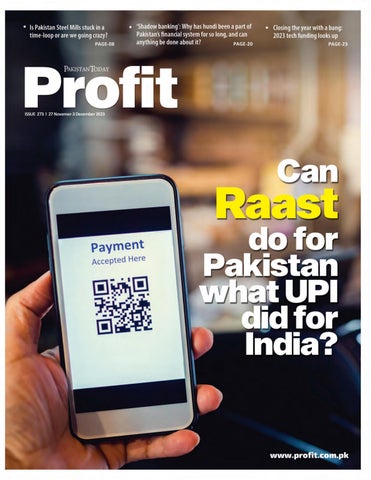
11 11 Can Raast do for Pakistan what UPI did for India? 18 Pakistan’s hordes of unskilled IT labourers Asif Saad
08
20
20
20 ‘Shadow banking’: Why has hundi been a part of Pakistan’s financial system for so long, and can anything be done about it?
Profit
23 Closing the year with a bang: 2023 tech funding looks up
Publishing Editor: Babar Nizami - Editor Multimedia: Umar Aziz Khan - Senior Editor: Abdullah Niazi Sub-Editor: Basit Munawar - Video Editors: Talha Farooqi | Fawad Shakeel Business Reporters: Daniyal Ahmad | Shahab Omer | Zain Naeem | Saneela Jawad | Ghulam Abbass | Ahmad Ahmadani Shehzad Paracha | Aziz Buneri | Nisma Riaz | Mariam Umar | Urooj Imran | Shahnawaz Ali | Meerub Amir Regional Heads of Marketing: Mudassir Alam (Khi) | Sohail Abbas (Lhe) | Malik Israr (Isb) Pakistan’s #1 business magazine - your go-to source for business, economic and financial news. Contact us: profit@pakistantoday.com.pk
Is Pakistan Steel Mills stuck in a time-loop or are we going crazy? Four years on and we are back to square one. And not for the first time By Zain Naeem
O
n 13th November 2023, The Ministry of Privatisation formally handed over Pakistan Steel Mills (PSM) to the Ministry of Industries and Production (MoI&P). This was the first step in trying to privatise the ailing national asset. Except this first step wasn’t quite being taken for the first time ever. The case of Pakistan steel mills is a bit like two steps forward and then two steps back repeated in an endless loop until anyone following what happens to the company goes just a little bit loopy. Because nearly four years ago the same sequence of events had taken
8
place as well. The PSM is one of those grand old state owned companies that have seen better days and have become a bit of a strain. Nobody knows what to do about them so different ministries keep playing pass the parcel with it. Entire little economies of consultants, bureaucrats, and politicians develop around these entities. And the entire time the company is stuck in the limbo known as privatisation in Pakistan. So why is the national exchequer bleeding money so boring men in big conference rooms can keep kicking the same can down the road, then back up it, and back down again? Perhaps a quick look at the recent history of this unwanted behemoth can offer some clues.
A short background
O
n the face of it, PSM is one of the largest industrial corporations of Pakistan which has the capacity to produce 1.1 to 5.0 million tonnes of steel and iron foundries. The mill was a mammoth undertaking from the stage of a seed to a full grown tree. How long did this take? To get context of how this plan went from idea to execution, it took more than half the country’s history or roughly 38 years to come into life. The bureaucratic behemoth was the vision of Liaquat Ali Khan who wanted to make the country self dependent for its own production. The vision became a reality after Soviet
was felt prudent to hand over the reins of the company to the private sector. This was done under the PM ship of Shaukat Aziz who wanted the government to offload the company. This led to the sale of PSM to a consortium in 2006. It seemed like the national nightmare was finally over. Or was it? The issue with this sale was that it was seen as being given at throwaway price of $362 million and the sale was carried out in a non-transparent manner. Due to the suspicion revolving around the sale, the Supreme Court of Pakistan annulled that privatisation.
From losses to a full blown disaster
A
cooperation came through and the stone setting ceremony was carried out by Zulfikar Ali Bhutto in 1973. The plant started production in 1985 after it was inaugurated by Zia ul Haq. It seems the history of PSM is intertwined with the politics of the country. In short, the Mills saw ten prime ministers from the thought till it started operations.
Recent past
I
n the 2000s, there was an active effort to give the company to private owners. Around 2006, there was a push to sell the State Owned Enterprise (SOE). This was based on the fact that since early 2000, the company had become profitable and much of its accumulated losses had been wiped out. It
t this stage, the company was still performing well as it earned profits through 2007 and 2008 but fortunes changed from 2008 onwards. From that period till now, it has been seen that the company has become bloated and operationally cumbersome. Hit by the country’s energy crisis and mounting legacy costs, the company was used for little else than for political purposes. Overemployment was allegedly carried out with political interference taking place at the top — another reason why many feel it is better for the government to wash its hands of PSM. The result of these steps has been that the company has run into cash flow shortages and has accumulated huge losses on its books. The situation got so bad that during the Yusuf Raza Gillani administration, the company had to be taken under the fold of the government in order to sustain it. The government had to give Rs. 2.9 billion as a bailout to the company in order to make sure that the company could function. Since then the company has been through multiple discussions of privatisation with the first one taking place before 2015. At that point of time, a consortium of Russian and Chinese companies offered to invest $778 million but the process was never completed. The company has been suffering losses of around Rs 23 billion on an annual basis. To put this in context, the total health expenditure to be carried out for health affairs and services was Rs. 23 billion in the Federal Budget for 2023. Again, the federal health budget is not the most important part of the federal budget and more important in a provincial context because of the 18th amendment, but the staggering losses do give you some perspective.
The backdrop to 2019
S
o what happened the last time privatisation was considered? It is important to understand what happened before 2019 which led to the company again being placed on the pri-
vatisation list. After the plant had shut down in 2015, the PTI government had pledged that they would revive the dying company and take it under Government control in order to do so. In October of 2018, the company was delisted from the privatisation program and MoI&P was asked to develop a plan to make the company operational again. This will happen a lot because the government always feels it can turn the fortunes of the company. Until it can’t and gives up. Around March of 2019, the Senate Standing Committee on Industries and Production was told by the management at the steel mills that the government and the bureaucracy were both not serious in addressing the issues. The workers had not been paid salaries for the last three months and no decision making was being carried out to allay the concerns and problems present at the company. This was the first sign that the planned turnaround was not going to happen. So what then was the cure to the problem? A revival plan was shared in April 2019 by the Expert Group. The group suggested that the best course of action was to privatise the company and to appoint a Transaction Advisory Consortium (TAC) which could help set up appropriate public private partnership models that could be acted on by the government. A bit of a “circle of life” moment. Government promises to not privatise and revive the company. Revival plans are sought with little to no changes taking place in the management of the company. The revival plan is to privatise it. And the circle keeps going on. In May 2019, the Economic Coordination Committee (ECC) decided to privatise the company based on the recommendation made by the MoI&P. This came after months of uncertainty where the representative in the government kept saying that it would not be privatised. So much so that Asad Umar, the then finance minister, actively opposed this step and was responsible for the removal of the company from the privatisation list earlier.
The carousel starts again
T
he bureaucracy did its job and the long journey to bring the privatisation to fruition started. After the approval from the ECC, the MoI&P was asked to put the matter in front of the Competition Commission of Pakistan (CCoP) which directed the Mills to be placed on the privatisation list formally. The first step after this move was to advertise for the Transaction Advisor to be recruited and this decision was ratified by the Federal Cabinet. This Kafkaesque nightmare then continued as from July 2019 to January 2020, the formalities of placing a financial advisor, due
PRIVATISATION
diligence of accounts and other legal technicalities had been out into place. From April to August 2020, the due diligence reports presented by the financial advisor were considered and a transaction structure was decided upon. Even after such lengthy time being taken, reservations and concerns were raised at different levels which had to be addressed. No more so than by the Chairman of the PSM Board who felt that the transaction structure was not justified. After issues were raised, meetings were held at the MoI&P which looked to resolve these issues and decided that the whole exercise needs to be put into action rather than being prolonged for a period of time. Finally in December of 2020, the CCoP approved the transaction structure which was to incorporate a separate subsidiary company, identify the key operating assets and get the proper No Objection Certificates (NOCs) from the relevant authorities. A Scheme of Arrangement (SoA) was devised by PSM itself which would transfer its assets to the subsidiary company being set up. This brought to an end a period of two years and four months where internal memos and meetings had decided on the transaction structure and the assets which were going to be sold. It is true that Rome was not built in a day, but if it had bureaucracy like this, it would never have been built at all. The process which had started in May of 2019 had just been concluded after 2 years and 4 months and even then there was no bidding process even on the horizon. CCoP invited Expression of Interest (EOI) to be sent for PSM in August of 2021. The EOI led to bidders from China, Russia and Iran. From these, four bidders were pre-qualified for the bidding process who could then carry out their own due diligence.
The interest shown
S
o here we finally had four parties qualified as interested parties by January 2022 which included (i) BaoSteel Group Xinjiang Bayi Iron & Steel Co. Ltd (BaoSteel); (ii) Tangshan Donghua Iron and Steel Enterprise Group Co. Ltd (Donghua); (iii) Maanshan Iron and Steel Co. Ld (Maanshan) and;(iv) Tianjin Jianlong Iron & Steel Industry Co. Ld. and MCC (“Jianlong’’ and MCC). By March 2022, the interested parties were asked to carry out buy-side due diligence which led to Jianlong and MCC expressing disinterest in the deal. After this, BaoSteel and Donghua were asked to conduct on-site by August 2022. This led to a subsequent withdrawal of interest by BaoSteel and Maanshan based on the country’s macroeconomic outlook and the global economic conditions with a
10
slowdown in steel demand. This was further compounded by the fact that the country was facing difficulties in importing raw materials due to controls placed by the State Bank of Pakistan’s (SBP) Foreign Exchange Regulations. It seems like the economic policies, the global economic outlook and the regulations of SBP were going to create the perfect storm for the deal to not go through. So what ended up happening?
The deal dies a slow death
W
ith interested parties falling by the wayside, it was becoming obvious that the deal would be broken at some stage. In the SIFC Apex Committee held on October 4th 2023, it was decided to annul the current bidding process which only had Donghua as the interest party left. The recommendation was made in the light of the fact that a single bidder auction will lack transparency and will lack a competitive process to lead to a better valuation for the plant. A new recommendation was made to form a Working Group which could come up with a new way to auction the plant with private sector participation to be carried out. In short, a long spiel of bureaucratic talk to say that we have failed to find suitable buyers for the plant and that we would rather like to hold onto it for a little longer until a better buyer comes along or we can sell the plant to a more attractive bid. The process which had started in 2019 was finally dead. On 10th October 2023, the last nail was put into the privatisation deal of PSM when the caretaker government declared that PSM was a dead asset. This is a legalese way of saying that the country cannot look to sell off the asset and now it was the task of the MoI&P to revive the non-operational company back to its glory days. What was the real cost of all this dilly dallying?
What was forgone?
T
he privatisation process and the interest shown by Chinese, Russian and an Iranian company showed that there was foreign interest in investment and take over of PSM. It feels like a great platform was squandered with a lack of commitment towards this process. For the first time, four Chinese companies were looking to revive the flailing SOE and were looking to technologically upgrade and expand the existing capacity of the plant. The transaction being talked about would have meant that PSM would have given up a stake of anywhere between 51 percent to 74 percent to one of the bidders giving them
ownership and right to control the management. This would have been a much needed boost in terms of foreign investment in the country with the added advantage of the company not having to be subsidised by the state anymore. The failure to privatise shows that the Privatization Commission (PC) lacks the expertise and capability to carry out such transactions. The company has been used as a political football from time to time as well where any talks of privatisation are met with union strikes and actions. It seemed that this time round things were going to be different as contact feedback from the PC showed that privatisation was at an advanced stage and was even censured in February of 2023 by the then PM Shehbaz Sharif for not completing the process quickly. This was the best the country has come to unload PSM as it is obvious that no amount of restructuring will be able to make the company viable technically and economically. The equipment that is installed at the plant has become damaged after the plant was abruptly shut down in June of 2015. Even the machinery that is functioning is more than half a decade old and needs to be updated. In addition to machinery being replaced, the company also needs a working capital of around $100 million to carry out the necessary repairs and start functioning.
Where do we stand now?
I
n order to start the process of privatisation yet again, the caretaker Federal Cabinet has approved the recommendations of the Privatization Ministry after the decision was taken by the Special Investment Facilitation Council (SIFC). In line with this, the Privatization Board has also appointed the necessary personnel forming part of the formalities in order to execute the privatisation. It seems that we have travelled back in time to May of 2019 when such an attempt was made last time. The frustrating fact around this story is that each time there is a consensus to sell the company, there are blockages in the regulatory, economic and political framework which slows the whole process down. It takes months of bureaucratic minutiae to carry out substantial effort which can finally lead to the privatisation finally taking place until some problems derail the whole process. Time and time again this has happened and this time the efforts might again go towards a dead end. It is high time for the government to sell off these loss making SOEs which is the need of the hour. Let’s hope we are not writing this story again four years later. n
PRIVATISATION
Can
Raast do for Pakistan what UPI did for India?
Raast promised to bring a digital payments revolution when it was rolled out in 2021 – the platform’s upcoming phase is going to be the real test which will determine whether it will boom or bust
By Mariam Umar and Taimoor Hassan
A
s you walk down the bustling streets of Karachi, the scorching sun mercilessly beats down on you, leaving you longing for a drink. Your eyes light up as you spot a nearby kiryana store. You ask for a bottle of chilled water. As you guzzle it down, you realise you forgot your wallet at home. “No problem”, you say to yourself. Instead, you take out your phone and scan the QR code on the counter. Within a second, the shopkeeper's account details appear on your screen and you enter the required amount. With a tap of your finger, you confirm the
DIGITAL PAYMENTS SYSTEM
transaction and return your phone safely to your pocket. Your experience is so seamless and secure, that you prefer to pay by your phone, even though you have your wallet, the next time you are at a kiryana store. As of today, however, you are unlikely to find yourself in this scenario. But if the State Bank of Pakistan (SBP) has their way it will be the future not just of Karachi but all of Pakistan. The central bank rolled out its payment system, Raast, all the way back in 2021. The hope was that Raast would be able to do in Pakistan what the Unified Payments Interface (UPI) was able to do across the border in India where QR payments in particular have become wildly popular and successful. While Raast was not modelled off UPI, it was trying to permeate a very similar market. Like UPI, there were also high hopes
for Raast. And after almost three years, Raast is finally about to enter its next stage which will define its success or failure. That’s right, Raast has finally deployed person-to-merchant payments (P2M). P2M payments refer to transactions where an individual customer (person) is able to make payments to a retailer/shopkeeper (merchant). This phase is the real test as it is where the mass consumers and retailers will interact with Raast payments on the ground. You see if the Indian model is any indicator this is the make or break. It was P2M transactions in India that gave UPI its momentum. The widespread acceptance of digital payments in India largely hinges on the QR-based payment system, where even the smallest shopkeepers, like kiryana store owners or fruit stall vendors, facilitate and
11
receive payments through QR codes. Could Raast potentially mirror UPI’s success? The answer lies not just in its forthcoming interaction with the masses, and the shopkeepers, but also in how the banks, fintechs and the banking regulator play their cards. Because while the markets are similar, the stories of the players dealing with Raast and UPI are very different.
What is Raast?
T
here is a lot that one can do with Raast. But very basically put, Raast is a back-end payments system that allows real-time settlement of transactions and makes them more instantaneous. The idea was to use it to fix Pakistan’s low digital payments penetration compared to other countries such as India or Brazil. There are a lot of reasons behind this such as banks relying heavily on expensive card-based payment schemes, the high cost of transactions and the unwillingness of ordinary citizens and businesses to digitise their daily transactions. What is relevant is Raast’s position in this. When the SBP first rolled out Raast in 2021 they introduced it with its first feature which is bulk payments. This would allow, for example, companies to disburse salaries instantaneously with the tap of a single button. The idea was to roll out the features one at a time. In February 2022, Raast launched its next big feature, person-to-person payments which would allow simple, seamless transfers of money between two individuals using any Raast power bank account anywhere in the country. Raast picked up. According to the payment systems review 2023, there have approximately been 20 crore and 80 lakh P2P payments made through Raast worth Rs 4.2 trillion. According to Faisal Mehmood, the head of National Payments Infrastructure at
12
Most of our banking industry is still lagging behind in Raast adoption, which is deplorable Jameel Ahmed, Governor SBP
Karandaaz Pakistan, there are approximately 5 - 6 crore unique account holders in the country, and around two thirds of these users now have Raast IDs. While there have been reports that the increased Raast P2P transactions have been a result of the forced rerouting of IBFT transactions to Raast amid a push from the regulator, the SBP insists that Raast is slowly building its profile. “The progress in terms of numbers that we predicted to reach in around three years, we have already achieved those within a year. If you compare the rate of change, from that perspective, I don’t think that Raast has been a failure,” says Syed Sohail Javaad, the executive director of SBP’s Digital Financial Services Group on Raast’s progress. Remember, these numbers are only for direct payments made by one person to another. The real test of Raast was always going to be whether or not it managed to become popular as a method to pay businesses. Yes, whether or not you could use Raast to pay for that cold bottle of water on a hot summer day from any kiryana store in the country. And for that to happen, it was always going to be a question of QR codes.
Person-to-Merchant payments - the test case for Raast
S
o how exactly does Raast propose you pay this kiryana store in exchange for the bottle of water it has sold you? For this Raast was going to introduce P2M payments where a person makes a payment, digitally, to a business entity or shopkeeper (merchant) for goods or services rendered. These transactions involve the transfer of funds from the individual's account (could be a bank account, mobile wallet etc.) to the merchant's account. Now, you might be wondering why we need Raast for this. Card payments at Point of Sale (POS) machines have already become fairly common in the country. The only problem is that we don’t realise just how many small and micro retailers there are in the country. And deploying POS machines to all of them is a painfully expensive process for all banks. On the other hand there is a much cheaper option: QR Codes. All this requires is that any small kiryana store owner has their own personalised QR code printed out on plastic or laminated and placed at their counter. Anyone with a Raast enabled banking app just has to scan that QR code and make the payment directly with no hassle. Pretty simple, right? As always there is a catch. While the QR code is simple and inexpensive for the average kiryana store, it still requires investment from our banks which will need to size up their digital capabilities and their marketing efforts to bring such a change. This is perhaps why when P2M was initially supposed to be launched in November 2022, the date was extended to June 2023 and later to September 2023 when the P2M use case finally went live, because the banks were not yet ready for such deployment. Perhaps that is why during his speech at the Pakistan Banking Awards ceremony on November 24, 2023, SBP Governor Jameel Ahmed expressed
Our industry is still trying to figure out how to implement these use cases. This is why enabling their systems onto Raast merchant payments is relatively low. Once they understand only then they will go to merchants or make changes to their systems Faisal Mehmood, the head of National Payments Infrastructure at Karandaaz Pakistan
chant’s QR code in plastic at a shop through your wallet or banking application right off your merchant’s phone, and the payment will be processed immediately. The only problem is that QR codes haven’t quite caught on in Pakistan. There have been serious issues of interoperability in the past. That is because all introductions of QR codes in the past have been done independently by different mobile wallets or banks. This means if JazzCash has put their QR code at a shop, you can’t make a payment through the QR code with anything other than a JazzCash account. What Raast does is enable this interoperability. Read: QR codes did not bring a payments revolution. That doesn’t mean it’s over
P2M - a catalyst for the death of cash?
deep concern, remarking, "This means that most of our banking industry is still lagging behind in Raast adoption, which is deplorable." Urging immediate action, he appealed to the chief executives of banks not only to fully embrace P2P transactions but also to swiftly incorporate the newly introduced P2M functionality of Raast to expedite the digitisation process for businesses.
So how is the P2M roll-out going
N
ow that P2M payments on Raast have been initiated, so far, six participants have been onboarded: Bank Alfalah, MCB Bank, Allied Bank, JS Bank, Easypaisa and 1Link. According to the payment systems review of 2023, the SBP is working to bring more banks on board for the P2M journey, with a few currently in the pilot stages. The SBP has only just initiated the process of deployment. Presently, partner
banks are conducting transactions through their employees which means that Raast is not commercially live. Mehmood opined that these banks will start their live transactions by the end of December. He anticipated that by the middle of the following year, at least 15 banks and by the end of next year nearly 27 banks will be onboarded on Raast merchant payments. Now, overall the Raast P2M scheme has a number of features. You can make requests to pay, there is the option for third-party initiated payments, as well as social disbursements and the instant settlement of PayPak Merchant transactions. These are all important and in some instances pretty cool use cases. But what matters most is the main one — push payments. These are payment transactions initiated by the payer through QR codes. So in the case of our example, you would be the person scanning the QR code for a bottle of water and making a “push” payment. As a customer, you would scan a mer-
T
he idea is that with interoperability covered, Raast will surge once P2M is well and truly introduced. After all, that is how it happened in India as well with UPI. Conceptually there is nothing wrong with this hope. Rahman, for example, expressed his belief that Raast's P2M functionality possesses the potential to ignite a digital payment revolution. “Even if the payments don't result in staying in the form of deposits for a very long time, as long as they're touching the banking system in some way or form, ideally digital payments, we'll start chipping away at cash component of the economy,” Raza Matin founder of Brandverse and Chikoo said. And that’s where he sees Raast evolving payments. He added that Pakistan is starved for bank deposits. “The only way we're going to ease access to credit to private individuals, other than the government, is by expanding the bank deposit base. The easiest way to do that is by moving cash payments into the digital realm through Raast.” But there is something built into the business model here that is different from India and that might just end up having
DIGITAL PAYMENTS SYSTEM
Banks find themselves in a slightly awkward position because they already have products that cater to this use case and make boatloads of money with cards. Having invested heavily in card issuance and promotional efforts, banks now grapple with the task of balancing these services and seamlessly integrating Raast P2M into their suite of offerings for both merchants and consumers Raza Matin, CEO and co-founder of Brandverse
enough of an effect to change the trajectory. MDR is the fee that businesses must pay to banks and payment processors for the privilege of accepting digital payments from customers. It's essentially a percentage of the transaction amount, and it helps cover the various expenses associated with processing the payment, such as technology costs, fraud prevention, and customer support. So if Bank Alfalah provides its POS machine to a merchant, it will charge the merchant a fixed percentage on each card transaction processed through the POS machine. In the case of UPI, the Indian government executed a distinctive move in 2019 by keeping the merchant discount rate (MDR) on payments through QR codes at zero. This strategic decision rendered transactions through UPI significantly more appealing. In the case of Raast, there is no clear instruction on the pricing structure of P2M. Discussing the pricing structure of Raast P2M, Matin highlighted the absence of a defined business model for P2M and the
14
uncertainty surrounding pricing. However, sources in SBP confirmed to Profit, that the regulator has decided to allow the MDR to be a maximum of 1% on P2M, while ensuring that MDR charges are not passed on to customers, preserving free payments for consumers. But this is distinctively different from UPI, which was completely free for both the consumers, as well as the merchants. Why would the SBP not follow the zero MDR model that proved so successful for the UPI?
Why the MDR makes a difference to the banks
T
his is where two distinct players come in. On the one hand there are the banks. The banks are currently getting an MDR of around 1.5% on card transactions at a much higher investment cost because of the expensive POS machines. If the SBP announces a 1% MDR rate for QR
code transactions, which entails much less investment by the banks, common sense dictates that the banks should be willing to bite and promote Raast based QR codes. However, this 1% MDR would somewhat discourage merchants to start accepting QR based payments, instead of the usual cash sales, which they get in full. Not only is there no MDR deduction on cash sales, cash transactions are easier to hide from tax authorities. It is true, the central bank had initially wanted a model similar to the UPI one with the MDR completely eradicated. This would naturally have worried the banks which are cautious institutions by nature. On top of this, notable banks like Habib Bank, UBL, Bank Alfalah, Meezan Bank etc are in the card acceptance business, earning decent income from MDR. However, a source in the central bank told Profit that it was perfectly doable for banks to charge zero MDR to merchants and not pass because banks also make money from these merchants on other services. The primary source is deposits that merchants have with banks. On the other hand you have the fintechs which run EMIs and Mobile Wallets. Afterall, SBP could always turn to the fintechs to deploy and promote QR codes, especially if the banks were not playing ball, owing to a zero MDR. You see, the first adopters of the UPI system in India were not banks either. They were the fintech companies, the giants like GooglePay, PayTM and PhonePe. It is these fintech companies that made UPI a success and are the biggest in terms of apps that use the UPI system. Why were they early adopters? Because they were able to afford such adoption. Remember that banks are conventional businesses that rely on their own profits to maintain their operations. They are also answerable to the shareholders, public as well as private. So if a big investment does not start giving profits in the short run, banks would be unwilling to make such investments. Mass
The progress in terms of numbers that we predicted to reach in around three years, we have already achieved those within a year. If you compare the rate of change, from that perspective, I don’t think that Raast has been a failure Syed Sohail Javaad, the executive director of SBP’s Digital Financial Services Group
deployment of QR codes in the market is an expensive endeavour because it requires incentivising merchants by not charging them or lowering the charge enough for them to make it business sense. On the customer side, such adoption requires incentivising users to use mobiles as the dominant form of payment by giving them discounts. Fintech companies follow a different business model. By virtue of being venture-funded, care a little about losses. In fact, losses mean growth in the startup business which translates into a higher valuation. So incentivising QR adoption on the back of cashback and discounts is pretty much doable for venture capital-backed startups. It is unfortunate for Pakistan that now that the final phase of P2M on Raast is being rolled out, there is a global dearth of venture capital and fintech companies do not have access to abundant venture capital and are required to follow a more ‘sustainable’ approach to business. This is further complicated in Pakistan as some fintech companies are rolling back their EMI operations, which could be attributed to the dearth of aforementioned funding, as well as competition such as from up-and-coming digital banks. So what does a regulator do in this case? You see the central bank has a vested interest in digitising cash transactions, and charging a fee on digital transactions is always going to be counterproductive. Remember also that Raast is a donor-funded project and an expensive one. If there isn’t enough traction on the Raast platform, donors wouldn’t want to fund it further. And if Raast is monetised, it becomes expensive for merchants who would be unwilling to push digital payments. Unlike bulk payments and P2P payments, the SBP can not ensure a wide adoption of P2M QR codes using force, largely because of the many different stakeholders involved here So in the case of P2M payments, the approach of SBP seems to be rather cautious. The central bank is poised to let banks make money out of P2M payments by allowing a 1% MDR, and not let it be completely free for merchants. This way SBP will be incentivising the banks to make the QR codes a success.
But could the 1% MDR be only in the initial phases. As more and more merchants start deploying QR codes, the central bank might ditch the banks and make it totally free. The central bank has done this before.
Change the game rules, mid-game
W
hen the talk about the digitisation of payments started, there was a growing demand from the banking industry that all stakeholders - the acquirers (the banks that deploy the POS machine), the issuers (the banks that issue the cards) and the merchants - in the process need to be adequately incentivised. All should be able to make money, they said. QR codes had busted because of a lack of interoperability and card payments were a thing of the present. The regulator felt that card payments could be improved further if acquirers were incentivised adequately. POS acquiring requires a hefty investment because the machines are all imported and with the increasing dollar rate, it doesn’t make sense to the banks if they are not able to make money off of merchants. Merchants too, need to be incentivised adequately because a 3% MDR on cards doesn’t make sense for them. Cash makes more sense in this case. Consequently, in January 2020, the State Bank issued a circular regarding the MDR. The MDR was set between a range of 1.5% to 2.5%, with the share of the issuer capped at 0.5%. The share of the issuers now went to the acquirers and POS acquiring suddenly became a lucrative business and the number of POS machines in the market picked up. Now the State Bank is also a very smart regulator. It perhaps knows that the banks play foul and just want to make as much money as possible, even though they can keep the MDR lower. In a smart move, the State Bank issued a circular in March this year limiting further the issuer share from MDR to 0.2% on debit cards, and removing the lower cap of 1.5% on MDR. What does this achieve? Acquirers have already deployed machines and issuers have already issued cards. None of them can withdraw
these back so both issuers and acquirers would now have to settle for less money from these transactions. Instead, by removing the lower cap, the State Bank incentivised further the acquisition of those merchants for whom paying a 1.5% charge on cards was also a problem. The banking industry cried foul - that the State Bank had in one stroke destroyed their business feasibility by further capping the rate on debit cards and removing the lower cap on MDR, stoking a distrust of the central bank’s policies. What if it is repeated again? What if the State Bank allows a 1% charge on QR codes initially and then makes it completely free only say a year down after the SBP sees an increase in adoption. This distrust also explains why the banks are shirking on P2M payments via QR codes. The State Bank is also not wrong in this approach. Commercial banks are failing to look at the bigger picture for short-term gains. If a lower or no MDR incentivises digital payments, cash turns into deposits which translates into better earnings for the banks. Numbers also align in this regard. According to the data from the State Bank, the surge in digital transactions is paralleled by a notable rise in deposits within the financial landscape. Remarkably, the correlation between the upsurge in digital transactions and the escalation in deposits over the last five fiscal years stands at an impressive 97%, underscoring a robust positive relationship between these two variables. Sources at the State Bank also said that in the absence of VC funding for fintech companies and to allay the concerns of the banks with regard to costs associated with acquiring merchants and getting customers used to making P2M payments, the State Bank was contemplating setting up a fund with the help of the government to subsidise such transactions. This would be a good move until the time the VC funding picks up, which is likely to start happening next year, which would bring the hungry young guns in the fintech scene back in the game. Matin comments on the predicament faced by banks. As mentioned earlier, some “Banks find themselves in a slightly awkward position because they already have products
DIGITAL PAYMENTS SYSTEM
that cater to this use case and make boatloads of money with cards. Having invested heavily in card issuance and promotional efforts, banks now grapple with the task of balancing these services and seamlessly integrating Raast P2M into their suite of offerings for both merchants and consumers,” commented Matin. On the other hand, Mehmood raised the point that while cash payments are inherently more costly, banks don't charge anything on cash transactions, unlike MDR applied to digital payments. According to SBP’s unconsolidated financial statement for fiscal year 2023, banknote printing charges amounted to Rs 21 billion. “Digital payments have a one-time cost. If a transaction occurs 500 times, it won't get damaged like a physical note. However, in digital payments, we often ask shopkeepers who work on very thin profit margins for an MDR of 1.5%. The shopkeeper, a small kiryana store owner, for instance, has a margin of Rs 3-4. MDR of 1.5% would erode his profit margin. Then he also has to cover expenses like rent, electricity bills, worker salaries, and support their own family, so you're essentially taking a percentage of their income away.” Mehmood argued that this practice is unfair and calls for addressing these issues. He also highlighted international practices, stating that in Europe, the MDR on credit cards is 0.4%, and on debit cards, it's 0.2%. In contrast, in Pakistan, the MDR starts at 1.8%, regardless of whether it's a credit or debit card. Mehmood emphasized the significant difference between 0.2% and 1.8% and urged the industry to address these issues. He argued that simply imposing MDR and commissions on all transactions is not a viable solution. To make a successful cashless ecosystem, he suggested the need for an alternative plan, as the current approach, especially in Pakistan, is
16
unlikely to work.
Learning from the mighty UPI
R
aast being a success is contingent upon addressing the aforementioned issues. If done rightly, it could mirror the success of UPI in India. According to the National Payments Corporation of India (NPCI), over 11 billion transactions worth INR 17.16 trillion (equivalent to Rs 59.21 trillion) via UPI took place in October 2023. Currently, there are 300 million UPI users and 500 million merchants who use UPI to accept payments for their businesses. By the end of 2022, UPI transactions had reached a staggering INR 125.95 trillion (equivalent to Rs 429.6 trillion), accounting for almost 86% of India's GDP for the financial year. The growth of UPI is remarkable, with transactions surging by over 90% between 2021 and 2022, despite a high base. The platform continues to attract more customers every day and is expected to reach INR 825.73 trillion (equivalent to Rs 2,816 trillion) by 2026. In the case of India, UPI got traction when it launched P2M and by 2025, it is estimated that 75% of the payments processed on UPI would be P2M payments. What did the Indian government do differently to reach such numbers? First, it abolished the very same MDR that, as discussed above, is holding Raast back. While this move made digital payments appealing to merchants, it adversely affected the bottom lines of banks as banks lost one of their revenue streams. Besides, the cost of investing in technology was too high for the banks and the lack of business value associated
with technology, at the time of its release left banks with no incentive to scale up the new technology. Consequently, banks resorted to ceding the UPI space to non-banks like fintech and third-party aggregator platforms like PhonePe, Google Pay, and Paytm which ultimately became a household name in India. These nonbanks were venture-backed. Together these three TPAPs now account for nearly 96% of UPI transactions.
Drawing parallels between India’s UPI and Pakistan’s Raast
P
rofit spoke to the Raast team who requested to remain unnamed. The Raast team said India’s UPI had additional extraneous advantages, such as the government's demonetisation initiative. The team further added that if demonetisation hadn't happened and platforms like Google Pay were not present in India, UPI wouldn't have been able to attain the same level of scalability it ultimately achieved. Indeed, UPI was launched at a time when there was free money circulating in the economy and startups were raising big rounds of money. Raast is late in the sense that now funding for startups has dwindled and interest rates are soaring high. Thus, fintechs and nonbanks in Pakistan no longer have the cash to burn. When asked if the fintech or startups in Pakistan would be willing to step up, Matin asserted, “It is not a question about whether startups will want to integrate with Raast or whether they can afford to integrate it, it's whether they'd be allowed to intervene.” “If you're expecting the startup and developer community to help you drive adoption and usage of Raast, you need to make it easier for them by publishing technical specifications for your platform, having a developer portal, and not wrapping up access in bureaucracy,” said Matin. He opined that Raast should be one of those pieces of common digital public infrastructure that's open to all entities, as long as they can meet a defined standard for legitimacy. On the other hand, Mehmood told Profit that fintechs have not been coming forward. “Lack of funding could be one reason. But more than that I think there is a gap in understanding.” For instance, he said multiple fintech CEOs were still unsure of the difference between P2P and P2M payments, and what was so special about merchant payments. “The industry is still confused and tied to the term digital payments and cannot differentiate digital payments from instant payments. Our industry is still trying to figure out
Indian street vendor accepting payments through QR Codes how to implement these use cases. This is why enabling their systems onto Raast merchant payments is relatively low. Once they understand only then they will go to merchants or make changes to their systems”. More importantly, the zero MDR also made transacting through UPI more attractive. “In India, NPCI announced zero MDR on transactions up to INR 3000, and even when they introduced MDR later, it was very nominal. This is why 75% of merchant transactions in India are now happening digitally via UPI,” said Mehmood. Mehmood added that apart from zero MDR, support from the government also played a major role. In fact, the political ownership of UPI was one of the major reasons for its success. Modi ji took UPI very seriously under his Digital India ambition and turned UPI into a product that his government was able to later export to other countries. Such ownership was visible under Imran Khan who launched the Raast platform when he was in government and was passionate about Digital Pakistan. “The Indian government set specific targets and allocated significant resources. The Indian government has spent $1.6 billion annually for the adoption of digital payments, including advertising. They have created 2.5 lakh digital payment support systems across India to address any digital transaction errors that shopkeepers might encounter. India has
made substantial investments in promoting digital payments, and that's why digitization has been successful there,” informed Mehmood. Pakistan may not have the financial resources to match India's $1.6 billion investment, but it can still take meaningful steps to promote digital payments and drive digitization in the country. It might need to explore creative and cost-effective strategies to achieve this goal. Mehmood believes that it is time for the government to step up and drive digital payment acceptance. “Most of the merchant payments are cash-based. And hardly anyone pays taxes. So, I think it is about time that the government announces a policy saying that there is an amnesty for 5 years on any transaction under Rs 5000 that happens digitally.” He added: “If it continues, in five years, people will become habitual of digital payments. By that time, you will have built enough data for taxation. And even if you levy a nominal 0.1% tax then, you could reap enough revenues.” According to Mehmood, an average person does two financial transactions in a day. Around 250 million people would translate into 500 million transactions. But the size of digital transactions is only around 3 million per day which means that less than 1% of payments are digital in Pakistan. Whereas in India, 75% of merchant payments are digital.
The future of Raast
A
s we contemplate the potential trajectory of Raast in Pakistan, the question looms large: Can Raast become Pakistan's UPI? Matin rightly emphasises that Raast is a force to be reckoned with, capable of disrupting payment businesses profoundly. Drawing parallels with India's UPI, Matin pointed out that Raast is something that you don't want to sleep on because Raast can disrupt payment businesses like nothing else.“UPI in five years has upended the Visa and Mastercard in India,” said Matin. The success of UPI in India was underpinned by crucial factors—zero cost on merchant payments and substantial government support, with significant investments to ensure widespread acceptance. The pivotal question now revolves around whether the SBP can replicate this success with P2M adoption in Pakistan. The answer hinges on the SBP's policy initiatives to drive P2M adoption and, perhaps more critically, on the willingness of banks and fintechs to embrace and champion this transformative shift. Raast stands at a crossroads, and its performance in the upcoming P2M phase will be pivotal. The challenges faced, such as pricing structures and merchant onboarding, need to be navigated effectively. The SBP's ability to craft and implement policies that incentivise digital transactions, coupled with industry collaboration, will shape Raast's destiny. n
DIGITAL PAYMENTS SYSTEM
OPINION
Asif Saad
Pakistan’s hordes of unskilled IT labourers
for any application – so very simply the program that runs basic email applications such as Gmail or Yahoo is software. When sold as a program, this is a software product. If you develop the software in-house and do not sell it as a product, you will allow usage of the same under an agreement or license. This is software as a service. Other services would include analytics, Most of Pakistan’s IT exports are based on cloud computing and security. We hypothesize that not everything is quite as rosy and low-value IT related services. Investment in the wish to make an honest attempt at improving our knowledge. right education can change that We may not have the perfect data sets to arrive at a clear conclusion but we can start the conversation and this can be hy do all good things or potentially great followed by more research and analysis by industry players. things stray invariably towards mediocrity So let’s dig a bit deeper with the help of data organization. in the land of the pure? A lot is being made To start with, let us look at data from the Pakistan Softof the great potential for IT-related exports ware Association(P@asha). On its website, it shares the size of from Pakistan. It is naturally a very excitthe Pakistan export revenues as well as domestic sales, number ing idea since everything else seems to be of IT companies etc. The data shows us that annual IT remitsouthbound at a serious pace. Perhaps, we dream that the country can tances to Pakistan through banking channels have grown imleapfrog economic development and progress at a rapid pace by becompressively. The estimated sector size is $280 billion, with more ing a haven for the information technology sector. than 12000 companies operating in Pakistan and contributing The so-called IT experts in government are often seen dropping nearly 5% to the GDP. All of this amounts to a total export random numbers for Pakistan’s IT export potential – someone says $100 revenue of just over $2 billion. Naturally, our current numbers billion, someone else says $50 billion. I think even a decent fraction of are miniscule as compared to other regional players. this would be nice to have, given that we are currently only at around Data from the State Bank of Pakistan (SBP) sheds some $2.5 billion! further light on this. The SBP data for investment in this sector Before getting carried away with this, the skeptic in me needs a bit very clearly shows that there is a preference for the services more evidence – is this really something we can bet our lives on? Don’t sector as opposed to software development. In fact, services we have to have better talent than most in the world to make such a account for nearly 70% of the already meager funding that this leap? Do we have the know-how to excel in this market? We are curious sector receives showing a very clear preference. if what our IT industry is doing will lead us towards those big numbers. This is just an assumption, but the definition of services is In order to develop a basic understanding of the subject, we need much broader than just software. It would also cover, for examto clearly define the various categories making up the revenues under ple, the body shopping business model where the IT companies information technology; software development is the program written hire local talent at a minimal Pak rupee cost and then place the same talent at some international project at USD pricing. This is the most basic form of labor arbitrage and happens to be the favored model of our leading IT companies. The other areas within the services sector would be things like website development and manageThe writer is a strategy ment, social media marketing, content creation etc. Nothing at all wrong with these, but the skill level consultant who has required in these areas is basic IT know-how with an increasing level of sophistication achieved with previously worked at experience. People in these fields do not have to be good at mathematics – unlike high-skill fields like various C-level positions software engineering or data science, where math and statistics are basic prerequisites. for national and Pursuing the skill gap hypothesis, data from the World Bank provides more information. Pakistan’s multinational ranking on the GKI scale is one of the lowest in the world. (This scale measures a country’s capability in corporations the Information and communication fields, along with being a general indicator for the quality of education and human resources). The outline of the emerging story now seems to add up. We are educating and training for low-quality skills and using these resources to service international customers for basic services. This
W
18
implies that we do not have products to sell. We are only cheap suppliers of service and the output of hundreds of Information Technology institutes is basically following the demand from the lowest end of the IT universe. A deeper dive into P@sha data shows that less than half of our software and data science workers have the required certifications. This is not too bad since we understand that it is possible to self-learn in these areas, especially with the online learning tools available nowadays. But it does point out that our educational institutes are out of sync with the need for value addition and capturing market share at the higher end of the market. Unfortunately, we could not find any data for the breakup of IT graduates’ employment in terms of their field of work (software development vs other services). This would definitely make our study more interesting. Just take another look at the data provided by the State Bank for ICT exports from Pakistan in comparison with our neighbors and other regional players. While there was a positive uptick in growth rates in the last couple of years, unfortunately, our export level is so small that, unless we grow 4-5 times the region for a number of years, we will be unable to catch up. Already, our cost of doing business exceeds that of many countries in the region that are able to outbid us. India, for example, has not only developed much better product capability but also has a huge worker base at the lower end – meaning it can compete in multiple ends of the market. In fact, according to the Financial Times: “Companies offering data, cloud and analytics support have made India a software services export powerhouse. But multinationals are opening a growing number of their own back offices, called global capability centres, to develop in-house technology, including cyber security systems and artificial intelligence” The reality is that in India there is a talent war between IT services export and these
Global Capability Centers! On the other hand, Pakistani IT companies are unable to find the required quality of manpower. In support of this there is the recent news report in which the CEO of a better-known Lahore-based software house recently mentioned that less than 10% of local IT graduates are able to pass a basic computer test for his organization. A State Bank of Pakistan report also mentions that only 10% of IT graduates in Pakistan are employable. For those who have followed the trajectory of the Pakistani industry in general, whatever has been described in this piece and what evidence is showing us, is a
bit scary – to say the least. Unfortunately, Pakistan’s traditional export sectors have followed the same path without product innovation and research and development and with management and organizational limitations for a long time. As a consequence, undoubtedly, their viability is now under serious threat. It does not take rocket science to understand that competing at the lower end of any market can only be done on the basis of lower costs. For this to happen, a country has to have the right fundamentals - infrastructure at a competitive cost, access to cheap capital, a dynamic domestic market, and many other critical components. If it does not happen to have most of these, then one should seriously question the basis of an industry business model pitched at the lower end of any market. One only hopes that Pakistan’s IT industry has learnt its lessons – both from its own evolution thus far – and from those who have been on this path before. Someone also needs to check the mushrooming of information technology institutes and colleges that claim to offer IT education. They may not all be doing a bad job, but if we believe the 10% number for employability – we would definitely suggest a change in their curriculum. n
COMMENT
‘Shadow banking’:
hundi Why has
been a part of Pakistan’s financial system for so long, and can anything be done about it?
The informal method of transferring money has existed for centuries, but is outlawed in many countries, including Pakistan, India and Bangladesh By Urooj Imran
T
o a person living in a remote area where bank branches are few and far between, it is a blessing. To law enforcement, it can be a nightmare. The mechanism in question is hundi, also known as hawala. Both words refer to an alternative channel to send money that operates outside the formal banking system. Hawala is an Arabic word which means transfer. Hundi is its South Asian equivalent. In this article, we will be using the latter. This ‘shadow banking’ system has existed for centuries, and will likely not go away anytime soon. Profit explains what hundi is, how it is conducted, what the problem with it is, and why it is hard to get rid of.
How does hundi work?
H
undi is an informal way of transmitting money from one country to another without using a financial institution, such as a bank or a money exchange. It has been operational for centuries, but as concerns arose globally about its potential use in money laundering and
20
terror financing, some countries, including Pakistan, India and Bangladesh, outlawed it. On the other hand, countries such as the United Arab Emirates with a large number of foreign workers, regularised it. The hundi business is based entirely on trust and relies on a network of Hundi dealers (in Arabic, these dealers are known as Hawaladars). Let’s say you are a Pakistani working in Dubai and want to send a portion of your salary to your family member back home in Karachi. You go to a Hundi dealer, Mr A, and inform him about the amount you want to send and the city. You and Mr A agree on a password or code, which you will tell to the family member. Meanwhile, Mr A contacts another hundi dealer, Mr B, who is based in Karachi, and informs him about the amount and the password as well. Your family member will then go to Mr B’s shop, tell him the password and receive the amount. This entire process can be done as soon as a few hours and requires little to no documentation. The dealers will settle their accounts at a later date either through money or goods. Remitters choose hundi primarily because of its speed and low cost compared to financial institutions. According to the
International Monetary Fund, discussions between officials have “tended to confirm that this system often has advantages compared with banks, money exchanges, Western Union, MoneyGram, and other providers of this service”. The World Bank’s Migration and Development Brief released in June 2023 also confirms this. According to the report, banks are the costliest channel for sending remittances, with an average cost of 11.8%, followed by post offices (6.3%), money transfer operators (5.4%), and mobile operators (4.5%). Hundi can also be an attractive option because it may provide better exchange rates compared to the official ones, especially if the government has imposed a cap, such as when it did in September 2022 (the cap was lifted in January 2023). Since it is an informal system that does not require documentation, hundi also becomes a far more viable option to send money to relatives in far-flung areas, or those who cannot access the banking system. There are two types of hundi dealers. The first type already run cash-intensive legitimate businesses, such as travel and tourism, gold, import and export, or foreign currency trading. In this case, they are able to ‘mix’ their legitimately earned money with proceeds from their
hundi business, and can even make it a part of the formal system through international payments or transfers for their legitimate business. Zafar Paracha, general secretary of the Exchange Companies Association of Pakistan (ECAP), elaborated the role of jewellers in the hundi business. He said jewellers who were a part of the hundi network would give the recipient the money, and receive payment from the other hundi dealer in the form of gold. The original dealer would send or smuggle gold to the jeweller, with the latter claiming that it was simply sent from a country such as the UAE so he (the jeweller) could modify it and add value, and then “export” it back. In reality, however, the jeweller or local hundi dealer would get fake documents showing the gold had been ‘exported’; it was later sold in the market, according to the ECAP general secretary. “The entire gold business in Pakistan is unregulated. There is no bank transaction or money trail for such instances,” Paracha said, adding that when the government launched a crackdown on illegal foreign exchange trading in September, people had initially gone to gold jewellers who also dealt in it, which is why the crackdown was later expanded to the gold sector. The second type of hundi dealers are those directly involved in just illegal foreign exchange trading. Both types make their money through fees (which are lower than the fees charged by banks and money changers), and by bypassing the official exchange rates. Hundi dealers settle their accounts in several ways: through future reverse transfers, import or export of goods, smuggling, or
property purchases on behalf of the receiving dealer (to whom the money is transferred) in the country the money is sent from.
Hundi’s popularity in Pakistan
S
hahid Mehmood, an economist and research fellow at the Pakistan Institute of Development Economics, explained that hundi is a trust-based system that has historically catered to the diaspora, particularly the manual labour force in Gulf countries, whose hometowns have lacked viable banking services. “For example, in erstwhile FATA, now part of Khyber Pakhtunkhwa, there is still little presence of formal banks, which is worsened by very poor service standards. Cash, for example, is often in short supply in the branches there, and the security situation is such that going to a bank carrying cash is a risky venture. So, why not avail the services of a reliable person in the area, who has got loads of cash stacked at his place?” he questioned rhetorically. He added: “The relative or family member working in a foreign country can pay that reliable person’s relative there, and in return, his family members avail ready cash without all the hassle and risk associated with availing a bank’s services. Additionally, anonymity remains intact, which could be of real value not only in far-flung areas of the country, but also in risky cities such as Karachi where extracting cash from ATMs or carrying cash from banks increases the risk of muggings substantially.” After all, the system became popular
in South Asia centuries ago mainly because of security concerns. According to ‘Ancient Banking, Modern Crimes’, a research paper by Joseph Wheatley, hundi became famous in the subcontinent because it removed the inconvenience of carrying large amounts of cash and the risk of robbery for Arab traders travelling along the Silk Road. In more recent times, Mehmood said, some of Pakistan’s biggest foreign exchange firms initially started out as small hundi businesses. “It is not that their business was not known to the governments at the time, but that they generally turned a blind eye since dollar inflows were not a big issue back then [during the Soviet-Afghan war]. However, as it came to an end, dollar inflows dried up, and the issue of terrorism took centre stage. This brought pressure to close down informal channels, and there was this sudden urge to preserve as many dollars as possible to shore up reserves as inflows dried up. It was at that time that the first big wave of formalising the ‘hundi companies’ began.” He added: “However, one would have to be really naive to believe that the same companies have completely given up their informal channels. Just as ordinary folk always take the prevailing risks into account, forex suppliers such as these companies do as well. The biggest risk comes from government policies, especially from policies like the ones followed assiduously by [former finance minister] Ishaq Dar,” he commented. “His infatuation with controlling the forex rate through administrative actions created a huge gap between the market and the administered rates, as we witnessed recently during the time of the PDM government. No forex company or bank would like to sell at official rates given such a wide gap. In the case of forex companies, they revert to long-established informal channels, something that the government finds difficult to track. In other words, keeping informal channels open is a kind of an insurance for these companies against administrative measures that could lead to losses on forex exchange.” An official at the Federal Investigation Agency, who covers financial crimes, also told Profit that whenever there is a wide difference between the rates in the interbank and open markets, or the exchange rate is artificially fixed, hundi transactions start rising as the dealers
MACRO
offer better rates. He also explained that while one of the primary purposes of hundi in cities such as Peshawar and Quetta was smuggling, in Karachi, it was trade-based transactions. “For instance, an importer wants to get solar panels or clothes from abroad. He undervoices the payment [to dupe] Customs officials and pays half of it through formal channels and the rest through hawala. He gets a few benefits: he is able to buy dollars for cheaper, he doesn’t have to do the complete transaction through a banking channel as he has cash on hand which he has not declared, and he also has to pay less duties. So, it’s a very convenient situation for him. This is why a portion for almost all imports, other than those by large, registered firms, is done through hawala,” he added.
The problem with hundi
W
hile hundi may have some advantages, especially for countries with underdeveloped banking systems, there are several concerns, including exchange rate manipulations, money laundering and terror financing. For a country like Pakistan, when inflows in the form of remittances are not sent through formal channels, it affects the foreign exchange reserves, which in turn puts pressure on the exchange rate, and the current account deficit. [For those who may be a bit bewildered about what this means: when remittances are not sent through legal channels or the amount is low, the foreign exchange reserves are affected and a shortage of dollars in the legal currency markets emerges. This weakens the rupee, since the demand for dollars outstrips the supply, making the latter more expensive. And since the foreign currency is not being sent via legal channels, official data shows a widening gap between all the money Pakistan earns through exports and remittances and the money it loses through imports and loan payments (called the current account).] In 2022, when the government imposed an artificial cap on the dollar to rupee exchange rate, a large chunk of remittances were diverted to the hundi market. This was one reason annual remittances in fiscal year 2023 fell for the first time since fiscal year 2017. Last fiscal year, remittances declined by $4.25 billion, with analysts and currency dealers attributing it primarily to the hundi market. Since the hundi market was offering much better rates — up to Rs 25 more per dollar — than the interbank and open markets, buying or selling of currency was also diverted to it, creating a shortage of dollars in the legal currency markets.
22
In the first week of September, law enforcement agencies launched a crackdown against illegal foreign exchange trading. Dozens were arrested in one month alone. A PTV report shared on October 1 stated that 239 people had been arrested across the country in September over hundi and currency smuggling. According to a report from APP dated November 3, the crackdown is still ongoing.
What do the laws say?
H
undi is illegal in Pakistan under the Foreign Exchange Regulation Act (FERA) of 1947, which prohibits any person not authorised by the State Bank of Pakistan (SBP) from trading in foreign currency. Section 23 of the Act states that anyone found to be involved in illegal foreign currency trading shall be punishable with rigorous imprisonment for a term which may extend to five years or with fine or both. In addition, the law states that any currency found with such a person shall be confiscated. Since illegal foreign exchange trading, especially if the transaction spans two or more countries, is also considered money laundering, the Anti-Money Laundering Act 2010 is also applicable. It states anyone convicted of money laundering shall be punished with rigorous imprisonment for a term which shall not be less than one year but may extend up to 10 years and shall also be liable to fine which may extend up to Rs 2.5 crores and shall also be liable to forfeiture of property involved in money laundering or property of corresponding value. If that money laundered through hundi ends up being used for terror financing, then the Anti-Terrorism Act 1997 will also be applicable, which lays out different punishments for different crimes.
Why is it so hard to eliminate?
A
ccording to the FIA official, eliminating hundi is difficult, because the crime in question is highly organized, and it is hard to present evidence for it in court. “There are no specific places where these dealers conduct their business, and we can simply go there and arrest them. These are ordinary people. If we arrest someone, we have to show that the person had dollars [or other foreign currencies] in his possession, and that he was doing hundi,” he said. “What can this evidence be? Consider how hundi transactions are done. You give your local dealer the money and he asks his offices in the US, UK, or UAE to give that money to whoever you wanted. Around 10 to 15 years ago, the dealers would maintain registers,
which we would seize and we would say, ‘look here is the evidence of those transactions’. Those registers are no longer there.” As digitisation increased, hundi dealers methods of recording transactions changed. This makes it much more difficult to collect evidence, the FIA official said. Another problem, he continued, was that the law was outdated. FERA does not explicitly define hundi, and states that the person can be jailed or fined or both. “The law is weak. The judges are not aware of [the scope and complexity of] hundi either. They will know what it is by definition, but our society in general does not consider hundi a crime. The judges do not really understand this crime or its consequences, and there is societal support for it.” The FIA official said that in his knowledge, no one has ever been jailed after being convicted of being a hundi dealer. The fines are not prohibitive as well, he said, adding that the money recovered from the arrested dealers never makes it to the treasury because the law does not have a specific provision for it. “In a way, we are only a deterrent. We arrest the person and give them warnings,” the FIA official said. The weak laws and the judiciary’s limited understanding of how hundi can be harmful for the economy or eventually result in financing of a terror attack is one reason the illegal trade has continued to exist, and at times, thrive. He said the onus to crack down on hundi dealers also lay on customs officials, who should be more vigilant about under and over-invoicing issues. “Let’s say a company requests SBP that it wants to remit dollars abroad for imports or services, but the central bank refuses. However, the transaction still happens and imports are received or services are taken. Nobody investigates how it happened. Of course, the transaction was done through hundi.” “This is not about one institution. The problem is everywhere,” he pointed out. The SBP, FIA, and Customs would have to work together to ensure that hundi is minimised, if not eliminated. However, as the official himself noted, “hundi had, in a way, become a necessity for the country.” He was, perhaps, referring to the import restrictions imposed by the PDM government last year shortly after coming to power, and which were eventually completely lifted in June 2023. “The laws need to be updated. It is not one institution’s job,” he iterated. “Hundi is a transnational crime. It originates in one country and ends in another. It does not only happen in Pakistan but other countries as well,” he said, bringing up the UAE specifically - the Gulf country mandated hundi dealers to register in 2020. Thus, efforts to end hundi would by necessity have to be international. n
MACRO
Closing the year with a bang:
2023 tech funding looks up After nine long months of a funding drought, startup funding has taken a sharp turn for the better in the fourth quarter of 2023 By Nisma Riaz
T
he start of this quarter has been the breath of fresh air the startup ecosystem in Pakistan desperately needed. A total of five startups announced successful rounds and even broke records, by collectively raising a total of over $15.6 million, restoring the industry’s faith in the country’s startup scene. EduFi, a study-now-pay-later fintech announced a raise of $6.1 million earlier this month, with Zayn VC leading the pre-seed round, along with investment from Palm Drive Capital, Deem Ventures Ltd, Q Business, Abhi, Adalfi, Techlogix, and a few angel investors. Aleena Nadeem’s EduFi broke Krave Mart’s record of $6 million pre-seed round in December 2021. EduFi also broke Oraan’s record of the largest round by a female-founded startup in Pakistan. In this quarter’s pre-seed rounds, three other startups announced million dollar rounds. Voyage Freight secured over a million dollars, with the aim of revolutionising global shipping and digitising logistics in the country. Meanwhile, home services tech company Helpp Technologies secured $ 1.1 million in a SAFE pre-seed round. Lastly, mobility startup BusCaro recently announced that it had raised $1.5 million in pre-seed financing. As for this quarter’s seed rounds, online
STARTUPS
grocery company Krave Mart also closed a round of a little over $6 million, over the last year. They previously made history through a successful $6 million pre-seed round in 2021, raising a total of $12+ million in less than two years. Looking back, it has been a tough year for startups globally, but a particularly bad one for Pakistan. Two prominent and seemingly successful startups went under in the second quarter of calendar year 2023: Medznmore announced their closure this summer, with Jugnu following suit. In fact, nine months into 2023 and the total investment in the industry was standing
at a meagre $35.1 million. According to Data Darbar insights, this was an 89.4% drop compared to the first three quarters of 2022. Let’s take a closer look at the harsh impact of international and domestic economics on Pakistan’s startup ecosystem before discussing the successful rounds closed in this quarter.
The funding drought
I
n October 2023, Data Darbar released a report on funding deals in the third quarter of 2023, highlighting a slump that recorded the lowest number of funding
23
Winter is a season that by definition passes. Emerging markets go through cycles at an accelerated rate, typically every 3 to 4 years, compared to developed markets, which is every 10 years. The overexuberance of 2020 to 2021 won’t return, and this should not be the benchmark that people use to judge the seasons in emerging markets. The next 12 to 18 months will be challenging but good businesses will be able to raise at sensible valuations Robin Butler, partner and head of impact at Sturgeon Capital
deals in the third quarter since 2018. The funding pullback of 2023 was not limited to Pakistan: in fact, it was a global trend. According to Pitchbook-NVCA Venture Monitor, in the third quarter of 2023, global funding stood at $73 billion, a 10.2% quarter-on-quarter decrease compared to the previous quarter’s $81.4 billion. Moreover, compared to the same time last year, the decline was even more apparent, with a 31% decrease. To put things in perspective, the third quarter of this year marked the lowest funding value since the fourth quarter of 2017. In volumetric terms, the global deal count had dropped to 7,434 deals. This was the first time in over six years for the total global deal flow to be below 8000, since the third quarter of 2016. Meanwhile in Pakistan only five rounds were announced in the third quarter, signifying a 50% year-on-year reduction and a 37.5% drop from the previous quarter. This resulted in a substantial 70.5% year-on-year decrease in the average funding amount, which now stood at $1.36 million for the third quarter of 2023, down from $4.26 million.
Industry’s sentiments
T
he year 2023 started with an impending economic crash and looming threat of default in Pakistan. A few months in and the political instability made matters even worse, with a nationwide internet outage in May after former Prime Minister Imran Khan’s arrest. Amidst all kinds of disheartening news, a funding ‘winter’ was the last thing the tech industry needed. Profit reached out to startup founders and venture capitalists to understand the industry’s sentiments during such a trying time. Kulsoom Lakhani, partner at i2i Ventures, told Profit how difficult it had been to navigate through the crises and explaining the current ecosystem to her limited partners
24
(LP). She said, “If your investors were already in the door, it has been about explaining how we, as funds, are navigating this environment and demonstrating how our strategy is reflecting the realities. If you’re raising from new LPs, it’s been incredibly difficult. The word Pakistan itself shuts down conversations, given the current macro environment.” Lakhani also shared how she worked around these challenges: “You lead with discussing the opportunity for early stage investment, how a fund’s life is not short-term, and how this is part of a longer cycle.” Similarly, Robin Butler, partner and head of impact at Sturgeon Capital told Profit, “The reality is that 95% of LPs would never look at venture capital in emerging markets, due to the perceived risk level. This was true when the market was on the way up and is still true today. For those that are willing to look at emerging markets, the current environment means they are taking longer in their due diligence and preferring multi-country exposure to diversify country-specific risks. The long-term secular trend of digitalisation remains as true as it did before and this is what LPs find most compelling.” When asked whether she had any hope of the situation improving in upcoming months, Lakhani’s response reflected concern yet optimism. “I feel that 2021 to 2022 were outlier funding years – 2021 was 5.5x of 2020, and most emerging markets saw that swell of international funding everywhere. I think we’ll see growth again next year, but I’m not sure whether it will be to the extent of the past two years.” She continued, “This market does need growth stage capital, especially for companies that raised two years ago, and that gap will need to be plugged. I believe over the next few quarters, we’ll see this dip reflected before numbers start coming back up, hopefully, post the first quarter of 2024. I also think we’ll continue to see a lot more local M&A activity.
With the scarcity of capital, some larger players will acquire smaller players, or merging of entities might occur.” Butler had a slightly more optimistic response: “Winter is a season that by definition passes. Emerging markets go through cycles at an accelerated rate, typically every 3 to 4 years, compared to developed markets, which is every 10 years. The overexuberance of 2020 to 2021 won’t return, and this should not be the benchmark that people use to judge the seasons in emerging markets. The next 12 to 18 months will be challenging but good businesses will be able to raise at sensible valuations.” Lo and behold, Butler’s assertion held true. Good businesses were indeed able to raise at sensible valuations, and that too in just a month. When asked which sectors might be the best performing in a market like Pakistan’s, Butler predicted: “Lower cash burn business models that are solving key problems affecting the day to day lives of businesses and consumers will do well. Sturgeon remains focused on fintech, B2B software and marketplace opportunities that have large addressable markets and strong unit economics.” While VCs remained focused and hopeful, Profit also spoke to Farooq Tirmizi, founder of Fintech startup Elphinstone that raised $1 million in a seed round last quarter. Tirmizi said, “A tiny $1 million deal in a seed round back in 2021 and 2022 would frankly not even be worth announcing, when companies were easily raising upwards of $10 million in seed rounds. You were starting to see some deal sizes roughly approaching what was considered normal in Silicon Valley pre 2019.” This reflects how dismal the overall funding in the last quarter was. Tirmizi also highlighted there tends to be a significant lag between when a deal is announced and when the money actually comes in. “We waited until the last check cleared before we announced it but that is not
A tiny $1 million deal in a seed round back in 2021 and 2022 would frankly not even be worth announcing, when companies were easily raising upwards of $10 million in seed rounds. You were starting to see some deal sizes roughly approaching what was considered normal in Silicon Valley pre 2019 Farooq Tirmizi, founder of Elphinstone
always the case.” So, there might be others who have raised capital but have not made an announcement. However, it is safe to say that this quarter has been a positive one, in terms of funding announcements. Tirmizi said Pakistan is often overlooked compared to larger markets like India and faces reluctance from investors due to perceived risks. He emphasised on the need for companies in Pakistan to adopt a broader strategy, focusing on being “Pakistan first” rather than exclusively targeting the local market. According to Tirmizi, the lack of funding taught startups some harsh but valuable lessons, such as being more disciplined in their spending. He recognised that some expenses previously considered necessary for the image of a successful company were, in fact, not essential for the business’s success. Tirmizi saw this as an opportunity for many to adopt more efficiency in resource utilisation, as opposed to the practices of startups with more freely available funding, especially back when money was often wasted on experimental and cosmetic endeavours. The silver lining in the current market downturn is the opportunity for startups to learn frugality and develop a more sustainable business model. It is not an uncommon accusation for startups to burn through money, but Tirmizi emphasised the importance of wisely allocating funds to genuinely develop the business’s products that people want and are willing to pay for.
The quarter of golden opportunities?
L
akhani told Profit that VCs don’t just invest in a pitch deck, but also in the founders ability to materialise a good idea. And that is exactly what many witnessed this quarter. Despite prominent startups winding up operations, along with the growing scepticism of international VCs in the Pakistani market, some founders made ripples that have the potential to make waves in upcoming months. Let’s start with EduFi. EduFi, short for
education finance, is a fintech startup that enables financially strapped students to secure loans for their tuition fees. Aleena Nadeem, a graduate of MIT with prior experience at Goldman Sachs and Ventura Capital, witnessed firsthand the financial challenges faced by many individuals striving for quality education while working at the Progressive Education Network (PEN) in Pakistan. PEN is a nonprofit organisation providing free and quality education to financially disadvantaged children. Nadeem said, “I was thinking about what the biggest problems we currently face in Pakistan are and how we can use technology to solve them. It boiled down to poverty and illiteracy. While many children in Pakistan make it to high school, there is a significant decline in those who can pursue higher education. EduFi aims to bridge the financial gap between high school graduation and the first year of university admission.” In Pakistan, approximately 40% of students opt for private schools due to the subpar quality of public schools, resulting in an annual expenditure of over $14 billion on education. Additionally, more than 50% of the adult population lacks access to essential financial services like bank accounts and insurance. The two-year-old company has established partnerships with 15 universities, making the app accessible to approximately 200,000 students across Pakistan who need to pay fees for undergraduate, Master’s, and Ph.D. programs. Most interestingly, this student loan fintech utilises AI tools to assist with credit scoring. “Our credit scoring model uses AI to ensure that we take education sector related statistics to have a low NPL (non-performing loan). So what do I mean by education sector related data? Basically, a very small example of that could be our dropout rates,” Nadeem said. She continued, “If a student has a low attendance or a low academic record, his dropout rate is likely to be higher, and therefore he may not be eligible for a student loan or a size of a student loan that is the largest we can give, which is Rs 25 lakhs.”
Nadeem also explained that what they have built from a product perspective is really building a loan management system for their liquidity providers which allows for the loan’s fast dispersal. “The point of fintech in my opinion is to have fast 24 hour dispersal, like within 24 hours or five to six hours to actually disburse the loan, not to annoy the consumer with hassle. So, when a consumer applies, all they need is a bank statement and no additional collateral. So, if our model gives them a relatively good score, they are genuinely able to get the credit in their account within five hours, which is a massive feat for us.” They also use AI for unsecured patterning. This entails clustering certain types of credit consumers into a bucket and predicting how these consumers will behave. Currently, the company’s main target is medical and dental students. According to Nadeem, these students often have the highest tuition fees, and many promising students tend to drop out due to financing constraints. EduFi loans are dispersed against the fee bill, rather than a large student loan for the entire four to five year program. On the loan repayment front, EduFi mainly offers a year’s time for payback, which can be broken down into monthly instalments. They also offer three and six month payback periods to students who can or wish to return the loan sooner. The interest rate on these loans is the lowest in the market currently, which is 29-30% annual percentage rate. The company is domiciled in Singapore. Having one’s startup registered in Singapore is a growing phenomenon among both Pakistani and other tech and non-tech companies. This is because it is a strategic Southeast Asian region that not only offers greater access to major markets, but also attracts better investments. According to Nadeem: “I based it out of Singapore because investors are more comfortable with the holding company being in Singapore, but we have an entity in Pakistan. Secondly, we do have plans to expand to southeast Asia.” Voyage Freight, a digital freight for-
STARTUPS
If your investors were already in the door, it has been about explaining how we, as funds, are navigating this environment and demonstrating how our strategy is reflecting the realities. If you’re raising from new LPs, it’s been incredibly difficult Kulsoom Lakhani, partner at i2i Ventures
warding startup, secured over $1 million in its pre-seed round, led by Indus Valley Capital. The startup aims to transform logistics for Pakistani exporters by providing a frictionless end-to-end global shipping solution. The founders said their digital platform addresses challenges in traditional freight forwarding processes, offering exporters a user-friendly one-stop solution. Voyage’s platform consolidates shipping operations on a single dashboard, providing real-time visibility and control, reducing time and costs, and enhancing the competitiveness of Pakistani goods globally. To solve export related challenges in the country, Voyage aims to tackle the current account deficit and support the economy by streamlining logistics. Profit asked Omar Mukhtar, the co-founder of Voyage, how his company will navigate export related challenges, such as ensuring the quality and volume of export goods, considering that exports have declined in the past months due to output limitations relating to electricity issues, raw material shortage from 2022 floods and the import ban from earlier this year. Mukhtar said, “The current industry is extremely fragmented. It consists of over 1000 plus freight forwarders. Even in the midst of declining exports, we believe that by digitalisation, there is ample room for us to grow. If we are even able to cater to 5% of the total existing market, we could potentially become one of the largest logistics companies in Pakistan.” He elaborated, “In regards to declining exports, we honestly believe that within the next few years, you will see an astounding growth in exports. Our devalued currency will be a boon for exporters, which, due to the current global decline in consumption, is hampering our country’s growth in the short term.” In the service sector, Singapore-based home services app Helpp Technologies announced a $1.1 million pre-seed round closed this quarter. The round was backed by E Planet Global, You Ventures, Engie Saudi Arabia, J Holding Pakistan and other high net worth and business executives from the US, UK and Saudi Arabia.
26
The company has a business-to-business (B2B) arm, as well as a business-to-customer (B2C) arm, which together enables it to provide on-demand services in four main verticals, including at home salon, laundry, paint and air conditioning services in Karachi and Lahore. The B2B arm, through partnerships with big box chains and small and medium enterprises, aims to strategically make service provision easier through digitisation, while the B2C arm functions to revolutionise home services and improve customer satisfaction. Mustafa Iqbal, founder and CEO of Helpp Technologies told Profit, “We believe that creating a social impact and making profits are not mutually exclusive. We wanted to build a budget brand to solve people’s household needs. A core part of our business, especially in the woman-led salon vertical, is to empower individuals and small businesses by giving them the platform to elevate their incomes. The increase in salon workers’ income after partnering with Helpp has been almost 5x.” In the ride-hailing startup space, mobility startup BusCaro raised around $1.5 million in a pre-seed round. Founded by Maha Shahzad, who previously worked at a similar startup called SWVL that went under, BusCaro is the third attempt at solving the same problem. Will BusCaro succeed where startups like Airlift and SWVL failed? Shahzad claims to consciously ensure that the business remains profitable and does not offer subsidies and discounts that would ultimately derail the company’s own profitability. Interestly, to combat the capacity utilisation issue, BusCaro currently uses a subscription-based B2B2C model and a B2B partnership model to acquire customers, instead of treading down the B2B route taken by Airlift and SWVL. Kassim Shroff, Hammad Bawany, Haziq Ahmed, and Ahsan Kidwai’s Krave Mart also announced a successful $6+ million seed round this month. The capital was raised between 2022 and 2023, with the last deal closing in the fourth quarter of 2023. This startup had previously held the record of securing the highest pre-seed funding in Pakistan, a
mantle recently taken over by Nadeem’s fintech EduFi. The founders had previously worked within the industry, at companies such as Foodpanda, Daraz, and SWVL. In the same vein, Krave Mart seeks to provide a hassle-free grocery shopping experience. Krave Mart entered a deal-by-deal syndicate fund with Japan-based platform PROTOCOL Capital. Interestingly, soccer star Keisuke Honda, known for playing for celebrated football clubs like AC Milan, is the lead LP in Krave Mart’s syndicate with PROTOCOL. The founders refrained from confirming the current valuation of Krave Mart, stressing that numbers do not reflect the true success or potential of a company. They did, however, provide some other useful insights. Profit asked Shroff how it has been operating a grocery business in the current high inflationary environment, where there has been belt-tightening across the board. He said, “Grocery is a necessity. You will eat three times a day, so roughly nine times a month. However, in inflationary times you will first cut down on luxuries, like travelling and in the second stage you would try to reduce expenses, such as dining out but you still need to eat. What you end up doing is, you start switching between brands.” This would mean you start buying a local chocolate and hazelnut spread instead of buying a big imported jar of nutella. But you will not stop grocery shopping altogether. Shroff elaborated: “If grocery was 30% of your monthly spending, it might become 50% because you let go of other unimportant things. I wouldn’t say that our business was impacted too much and it has even grown, but yes trends show that people are buying cheaper items.” These numbers might not be considered much in the global tech ecosystem but for an emerging market like Pakistan, these same numbers do offer some hope. Whether these startups can actually solve real life problems using technology as they claim to is a different problem altogether. But it looks like the funding ‘winter’ may just be over - for now. n
STARTUPS