CONTENTS
08
10
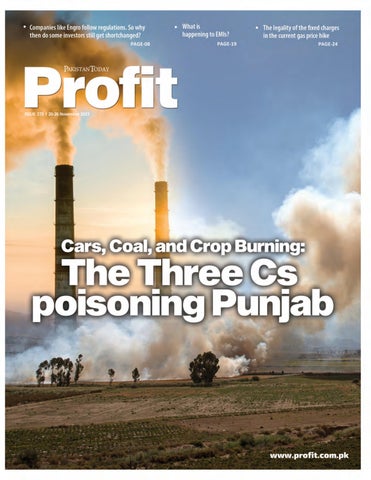
08 Companies like Engro follow regulations. So why then do some investors still get shortchanged? 10 Cars, Coal, and Crop Burning - The Three Cs poisoning Punjab
14 17 Silkbank delays releasing 2021 financials till March 2024 as it inches closer to merging with UBL 19 What is happening to EMIs?
24
08
23 Despite approval coming through, Regent Plaza’s sale fails to woo PSX investors
25
24 The legality of the fixed charges in the current gas price hike
Profit
25 Here’s why Pakistani bank account holders cannot donate to the Palestine embassy’s account
Publishing Editor: Babar Nizami - Editor Multimedia: Umar Aziz Khan - Senior Editor: Abdullah Niazi Sub-Editor: Basit Munawar - Video Editors: Talha Farooqi | Fawad Shakeel Business Reporters: Daniyal Ahmad | Shahab Omer | Zain Naeem | Saneela Jawad | Ghulam Abbass | Ahmad Ahmadani Shehzad Paracha | Aziz Buneri | Nisma Riaz | Mariam Umar | Urooj Imran | Shahnawaz Ali | Meerub Amir Regional Heads of Marketing: Mudassir Alam (Khi) | Sohail Abbas (Lhe) | Malik Israr (Isb) Pakistan’s #1 business magazine - your go-to source for business, economic and financial news. Contact us: profit@pakistantoday.com.pk
Companies like Engro follow regulations.
So why then do some investors still get shortchanged? There are many issues with companies buying back their own shares. This one change in regulation can at least fix one of the criticisms By Zain Naeem
T
wo things can be true at the same time. For example, it is true that Engro is one of the most well-managed and responsible companies in Pakistan with professional standards that can possibly even compete on the global scale. At the same time, it is also true that Engro operates in a country that some would consider a regulatory Wild West. As such Engro is beholden to the realities of running a business in Pakistan and might not be above taking advantage of some of the weaker laws and regulations in place. Just take a look at Engro’s recent dividend issue. On 20th of April 2023, the company announced the financial results for the first quarter ending 31st March 2023. The results brought glad tidings. Engro was planning to release a massive Rs 23 billion in an interim cash dividend at Rs 40 per share. This would have translated to a return of 15% for investors who had bought the shares only a few days before the announcement. Essentially, Engro had decided to distribute a big chunk of the profits it had accumulated over the years to the shareholders in just this one quarter. As soon as this massive dividend was announced, the share price went up from Rs. 292 to touch the upper lock at Rs. 314.6. It was obvious that the shareholders were ecstatic. Except there is a small problem here. You see in the world of stock market trading, a lot of relevance is given to maintaining fairness. That is because the game by its very nature is rigged. A company’s share price responds to decisions that the company makes. Now, people that are on the board of the company or are decision makers at the company have prior knowledge of these decisions. So for example if a company is about to announce a big dividend, the insiders like the CEO, CFO, or board members, will know before any of the other investors. And since these officials can also be shareholders, there are always chances that some of them might try to benefit from this information by buying the shares before the good news is announced to the public. This is called illegal insider trading. It seems something similar happened in the case of Engro’s dividend announcement. Similar, but not the same. For starters, the insider in this case was not an individual, but the company
8
Engro itself. And as per regulations, this type of insider trading is not illegal either. Unfair maybe, but not illegal. So what exactly happened, and how does it reflect on Pakistan’s regulatory framework?
Background
O
n the 14th of December 2022, months before the massive dividend was announced, Engro had announced its plan to buy back 70 million of its own shares from the market in order to cancel them. This was around 12 percent of all its issued shares. Buybacks are a way for companies to buy some of their own shares and decrease their outstanding shares in the market. This also signals to the markets that the company feels its shares are trading below their true value. After getting approval from its shareholders, the company started the share buyback process on the 16th of February 2023, and continued to off-and-on buy, till 20th of April 2023. This is the same day when the company had announced the massive dividend. By the 31st of March 2023, Engro had already bought back 36.75 million out of its intended 70 million shares at an average price of Rs. 294.41 per share. On the 7th of April, Engro told PSX that it will hold its board meeting on the 19th of April to announce the quarterly results. But between these two dates, the company carried out 4 more buyback transactions. On the 17th of April, they bought 1,085,000 shares at Rs. 273.82. On the 18th, they bought 538,236 shares at Rs. 282.98. It is interesting to note here that on the 19th of April, the board meeting was supposed to start at 10:30 AM and at 1:25 PM, the company notified the PSX that the meeting was still in progress. Companies are supposed to disclose this information as a signal that investors expecting an announcement before market close at 3:30 PM should not expect an announcement on the current day. The company then discloses the results before the market opens the next day. Which is exactly what happened on the morning of the 20th of April 2023 when the company announced their results at 9:00 AM. The result announced was an earning of Rs. 10.63 per share and the company decided to give out a dividend of Rs. 40 per share which was the biggest one time dividend they have given out in
their history. While the meeting was going on over a course of two days, the company was able to buy a further 1,013,526 shares at Rs. 289 per share before the dividend announcement was made and 150,000 shares were bought on the 20th of April at Rs. 299.5 per share on the day of the announcement. After this, no further buying transaction was carried out. The buyback finally ended on 25th of July after the company had bought back a total of 39,536,762 shares from the market. Everything went by smoothly and without a hitch. Engro followed all of the regulations of the SECP and PSX. However, there is just one problem.
The buyback story and the close period angle
T
his isn’t really a story about Engro. Profit has already covered the dividend payout in April, detailing how it worried some that the payout might mean Engro was throwing their hands up on the issue of finding suitable investment opportunities in Pakistan. READ MORE: Engro announces massive Rs23bn in dividends. But is this a good thing? Instead, this is a story about weak regulation. The problem is that the laws that exist on the books in regards to buyback are contrary to the laws that exist governing trading by company insiders. What do we mean by this? Allow us to explain. In order to understand the problems that exist in the regulation, first what needs to be understood is what a buy back is. A buyback is a move made by the company when it thinks that it has excess cash flow on hand and can use some of these funds to buy back or cancel some of its shares floating in the market. Buybacks are also considered a signal in the market that the stock is undervalued as even the company feels that the share price is below compared to what it should be and is buying back its own shares. This allows the company to use some of its funds it has on its books and boost its earnings per share in the future. If you are still scratching your head on what is actually wrong here, just wait a little longer.
Then comes what is known as the ‘Close Period’. In order to protect the interest of the shareholders, regulations exist which state that when a board of directors is looking to announce its financial results, it needs to observe a closed period. This closed period ensures that from the time the management and the board get the accounts till the time they release it, they do not get to trade in the shares of the company itself. This is necessitated due to the fact that the board of directors gets to look at the accounts and approve them before they can announce and distribute these results to its shareholders. As the executives of the company have access to the results and the accounts, regulations place a closed period for the CEO, executives and directors along with their spouses. This makes sure that no inside information is used by the insiders of the company until all the shareholders have had access to internal information. The purpose of this regulation is that as the management of the company has sensitive information before it is disclosed to the public, they should not be allowed to use this information to trade by themselves. Once the board meeting is carried out and the results are announced, the closed period ends and then anyone can trade in the shares. Such regulations are designed to protect the shareholders and build trust in the market for investors.
Why are companies not subject to this?
T
he question that arises from this whole situation is the fact that when the management and insider of the company are subject to a closed period, why doesn’t the same apply to the company itself? Let us look at this from a different angle. On the one hand there are the CEOs, directors and other individual insiders that are subject to a close period. The reason they are made subject to this is so they don’t have an unfair advantage over any other shareholders. By that same logic, a close period should also apply to companies themselves. No such regulation exists in the PSX for companies carrying out buybacks and the case is the same for SECP and its Buy Back regulations. Now look at this from the point of view of an average shareholder. At the time that Engro would have initiated the buyback, the average shareholder would not have known that they planned on releasing a big dividend. So when Engro approaches a shareholder with the offer to buy the share back at around Rs 280, the shareholder wanting to make some money would sell it. At such a time Engro will have known full well what they were planning to do . So when the dividend was announced and the share price rose to Rs 315, Engro was essentially making gains at the expense of the selling shareholders. And
since the company is owned by the shareholders that did not sell, which includes the directors/ sponsors, the individual insiders would benefit at the expense of the selling shareholders. Once again, there is nothing illegal or against regulation here. But the selling shareholders might feel shortchanged at Engro using this regulatory loophole. To highlight the weakness of this regulation further, let us note here that Mr. Mohammad Yasir Khan, General Manager - Investments and Company Secretary at Engro Corporation Limited, was authorised by the company to carry out the buy back. According to the regulations in place, Khan cannot trade in the shares of the company during the closed period as an individual. Khan is an executive by the definition used by PSX and so any trades carried out by him will be subject to the regulation. The regulations made by the SECP, Listed Companies (Buy-Back of Shares) Regulation 2019, do state that an appointment of an officer has to take place, however, it does little to stop this officer from not purchasing the shares of the company in a buyback. Section 14 of these regulations do give the power to the SECP to give directions in case it feels an abuse is taking place, however, there is no explicit clause that stops this transaction from being carried out. However, no such regulations exist when he is doing it on behalf of the company. In either case, he is an executive who is going to get access to information on the inside of the company. The regulations, on the other hand, see him as two different people who cannot trade for himself but trade for the company. This is the crux of the problem where an individual is being governed by a different set of rules compared to a company. The law is being followed but what about the spirit of the law? When reached for a comment, Engro stated that they had “fulfilled all of its corporate and regulatory obligations in all material respects in relation to the Buyback process.” In simple terms, there are no regulations pertaining to the company following a closed period — something Engro is correct about. They further went on to say that “Regulation 12(2)(a) of Regulations restrict….. (insiders)...from buying its own shares during a buyback period. However, there is no provision in the said Regulations or under Section 88 of the Companies Act, 2017 which stops the company from buying its own shares during a closed period that happens to fall within the buyback period.” This is also correct.
The double standard
T
he regulations that exist on the books state that if any member of the management or the board were going to carry out any transaction
in the company during the closed period, the regulator would have stepped in as they were taking unfair advantage. As only a few people had the inside information regarding the results, they should not have the opportunity to gain by themselves while other shareholders were left out in the dark. In such a case, an action by the regulator would have been warranted and expected. Why is it then that when the company carries out a similar decision, it has no action taken against it? Granted that when the buyback was announced, no such dividend was even on the horizon but when the meeting was announced, shouldn’t the company have similar regulations be imposed on them? When equal application is not carried out, it can be seen that the company was able to acquire shares from the shareholders when the company had information regarding the results of its first quarter. If the shareholders had any inkling of such a dividend being announced, they might not have sold their shares to Engro in the market in the first place. Secondly, Engro knew that it could buy back its shares and then get the dividends for itself once it was done carrying out the buyback. The dividend which was handed out by the company could have gone to the shareholders who would have wanted to earn the dividend and not sell the shares. As they did not have any such information, they sold their shares and the company was able to earn the dividends for itself.
The regulators know there are loopholes
T
he problem in this case is the fact that the company was able to buy back 2,786,762 shares at a time when the individuals of the company had to adhere to a closed period. This was not applicable to the company itself. SECP needs to look into its regulations and amend them. This will assure that the market is functioning properly and that regulators have an eye on the companies. The SECP has told Profit that “to address the concerns of buyback during the close period and further rationalise and make it transparent, the SECP has already taken up the matter with the PSX for initiation of respective regulatory amendments in the PSX Rules Book.” This shows that the issue is being considered and that it needs to be regulated in the same manner that individuals are. This is good news. Here we have a company that is generally known for its responsibility. And they are operating in a market where the government and its appointed regulators are not always the fairest business partners in the world. Still should the company be expected to not take advantage of lax rules. Maybe, maybe not. Which is why the onus is on the regulators to step up and run a tighter ship. n
PSX
10
I
By Abdullah Niazi
t came almost out of nowhere. In the winter of 2016, late in the month of November, Lahore was engulfed in a way it had possibly never been before. Thick, yellow sheets of dense air surrounded the city’s roads, schools, parks, homes, bridges, and hospitals indiscriminately. Most people were caught unaware. The winter in Lahore and its surrounding rural districts has always been cold and foggy. But this particular haze was strange. It was new and it was making people sick. Numbers from public hospitals at the time indicate a severe increase in complaints of chest pain and breathing problems in Outpatient Departments in public hospitals across the country. The air was making people sick, and the very visible wave immediately caused concerns. Since 2016, the smog has returned every single year with varying degrees of severity. But what that one, drastic, eye-opening episode back in 2016 did was make the smog an issue of public concern. In the past seven years awareness of the smog issue has gone from non-existent to widespread. Yet the understanding of the issue has remained low. The reality of the matter is that the smog problem is not limited to Lahore. In fact, it is acutely felt all across Punjab. And it is also not a problem that has appeared in the last decade. The smog issue was actually first identified in Punjab back in the mid 1990s. It has only been in recent times that it has become a very common talking point because of how visibly worse it has gotten. There is limited data about what causes this phenomenon but the information available is clear. It is also clear that the only way to solve this problem is by targeting the main pollutants responsible for the state of the air — automobiles, bad fuel, industrial pollution, and crop burning. Instead, the response to the smog crisis has largely remained unimpressive and tame. Over the past week, Profit spoke to activists, professors, and government officials to try and understand the cost of the smog crisis and the path to potential fixes.
The extent of the problem
T
he first thing to understand here is that the air quality in Lahore isn’t just bad in the winter months. It is bad all year around. According to the Environmental Protection Department (EPD) of Punjab, the ambient air quality of the capital city Lahore in the year 2022 revealed that there were only 17 days of good or satisfactory AQI (PM2.5) out of the total 309 monitored days. This is important to understand. You
ENVIRONMENT
The government of Punjab passed the clean air act last year. The federal government also came up with an action plan. There is more or less just one thing which is improving fuel quality, investing in renewable energy, electric vehicles and clean transport. These are the things you have to do Rafay Alam, environmental lawyer
see the air we breathe in contains particulate matter — small, microscopic bits of different substances. Particulate matter that is less than 10 microns (for context, one micron one-thousandth of a millimetre) in diameter is inhalable by the human lungs. And once these very small particles are inside your lungs in enough quantities they can cause adverse health effects. Now imagine that the air we breathe every single day contains these particles that are less than 10 microns. With every single breath you take there is poison entering your lungs. And it gets worse. You see, 10 microns or a particulate matter reading of “PM 10” is already bad for you. But when the particulate matter gets to a value of 2.5 microns or less (which is what we refer to when saying PM2.5) is categorised as “Fine Particulate Matter.” Now the more Fine Particulate Matter you have in the air, the worse your air quality is. And this amount of particulate matter is constant throughout the air. In the winter months, however, a thin layer of the atmosphere near the earth becomes cooler than that above it. As a result pollutants are trapped at ground level until there is a change in the weather. So this is what you have. Lahore as a city and Punjab at large is producing toxic fumes and throwing them into the air every single day of the year. For most of the year they do not notice just how adversely this affects them. But for a quarter of the year stretching from at least November to January, the cold air traps these toxic fumes turning the province into a deadly den of disease. During these months the smog’s threat to health and life is worse. The effects are clear. According to a report of the World Health Organisation (WHO), the exceeding levels of air pollution have resulted in the loss of 5.3 and 4.8 years of life expectancy from 1998-2016 among populations of Lahore and Faisalabad cities, respectively. The rate of deaths attributable to air pollution (including indoor PM2.5, and ozone) in Pakistan is also well above global averages. The World Bank estimates Pakistan’s annual burden of disease from outdoor air pollution to be responsible for
12
around 22,000 premature adult deaths.
The Three Cs
P
unjab’s smog problem is entirely the creation of years of neglect and bad policy implementation. And it is human-made in a very direct way. A lot of the environmental issues faced by the global south in today’s day and age are caused by emissions from the global north. According to the Center for Global Development, developed countries are responsible for 79% of historical carbon emissions. Yet studies have shown that residents in least developed countries have 10 times more
chances of being affected by these climate disasters than those in wealthy countries. But the smog problem is entirely removed from this reality. Instead it is a bit of a localised environmental disaster. The air quality in and around Lahore and the other districts of Punjab is bad because of pollutants within. The fine particulate matter in the air is high because it is released from automobiles, industrial units, and the burning of crops. The data on what causes the smog is limited but the information available is quite clear. The main work on this is a 2018 study conducted by the Food and Agriculture Or-
We need to get the old clunkers off the road and bring in regulation that ensures all vehicles have things like catalytic converters and do not overly pollute. Fixing the entire infrastructure of a province and bringing in public transport are very long term solutions and we need to include these in our master plans for cities but we can at least get the bigger polluters off the roads Sanval Nasim, academic
ganisation (FAO). The study found that the main polluting sectors include transport (43 per cent share in total emissions), industry (25 percent), agriculture (20 percent), and power (12 per cent).
Cars:
T
he most obvious pollutant is the transport sector. When it comes to smog this is the big bad wolf everyone talks about. And the data is quite clear. Air quality in Punjab from 1998 to 2023 has fallen consistently. Over this same 25 year period, the increase in the number of vehicles on the road has been astronomical. According to a government report, while private transport rose by 332%, public transport increased by only 165% and road networks by a mere 6% in the past 25 years. “There have been a lot of reasons for this increase,” explains academic Sanval Nasim. “Incomes have increased over time and people that were once using bicycles are using motorbikes instead. Then there is the issue that public transport has not expanded so people have come to rely on motorbikes to get to their places of work and travel in a city that is growing and expanding every single day.” There are currently nearly 20 lakh registered cars in Punjab and close to 1 crore 57 lakh motorbikes in the province. And while this large number of vehicles is not by any means good and there is a dire need for a good, robust, interconnected system of public transport, the sheer number of vehicles alone is not the problem. A bigger issue is the quality of fuel that these automobiles burn in order to run. The European emission standards are vehicle emission standards for pollution from the use of new land surface vehicles sold in the European Union and European Economic Area member states and the United Kingdom, and ships in EU waters. The standard measures the sulphur content in fuel that is being used which is detrimental to the amount of pollution that
these emissions cause. In Pakistan, most fuel being used does not fit the Euro2 standard when the acceptable fuel quality is Euro5. Then there are the other contributing factors. There is the issue of massive coal powered industrial units polluting the air. Then there are the constant pollutants poisoning the air such as brick kilns and the burning of crop stubble.
Crop Burning:
C
rop stubble has often been used as a scapegoat by policymakers as a driver of the smog. There is some credence to this. Crop residue burning is a common practice in the districts especially for rice in the month of November. You see, when farmers harvest a crop like rice, they need to pick the product quickly. They need to pack it, transport it, and sell it as well. With very tight deadlines speed is of the utmost importance. Which is why it is easier for a crop like rice to use massive threshers to cultivate the rice and leave the roots or “stubble” still in the ground.
Once the land is needed for the next crop, it would literally be back-breaking work to remove all of that stubble. So instead the farmers choose to light this stubble on fire which is a quick and efficient method that saves labour costs. A report of the FAO says that for the rice crop, 20-23% of the farmers reported that crop residue burning has increased in the last few years. Overall, farmers reported burning
of crop residue for the past 16 years, ranging from 5 to 30 years. An important fact is that in the past farmers used crop residues as fodder for their animals before starting burning of residues. This is no longer widely practised.
Coal:
A
nd then come the industrial units. According to data given to Profit by the EPD, emissions of air pollutants from various key fuel types/ activities of Punjab province from 1990 to 2020 show that Biomass fuel is one of the major sources of PM10 emissions from 1990 to 2015. However, from 2015 to
ENVIRONMENT
2020 it is observed that the emission of PM10 from coal burning is contributing a significant role in the overall emission. According to one official, the main reason for this is the increasing number of coal-based power plants and brick kilns in the Punjab province. Overall, it is an amalgamation of these three factors that the situation in Punjab is what it is. It must be understood here that even the smog in different areas of the province is very different. Air pollutants are of different and varying kinds. Pollutants include substances such as Sulphur Dioxide, Particulate Matter, Carbon Monoxide, and Volatile Organic Compounds. Burning coal, for example, leads to the production of more Sulphur Dioxide while fuel combustion is responsible for a lot of particulate matter. Regarding the contribution of different fuel types, the major source of PM2.5 is biomass burning (387 kT/Y) followed by coal burning (156 kT/Y). In contrast, for PM10, coal burning is found to be the largest emitter (565 kT/Y) followed by biomass burning (400 kT/Y). Liquid fuels (e.g., petrol, diesel) are estimated to have major contribution in emission loads of CO (2072 kT/Y), SO2 (225 kT/Y) and NOx (400 kT/Y) in year 2020. An overall increasing trend was observed during 1990–2020 for all air pollutants: PM10 (245 – 1156 kT/Y), PM2.5 (161 – 525 kT/Y), NOx (225 – 617 kT/Y), SO2 (142 – 460 kT/Y), CO (1008 – 3773 kT/Y), and VOCs (231 – 486 kT/Y). But by and large the biggest polluters are these three with the transport sector far ahead. The only question is, what can be done about this?
14
Ridiculous solutions and simple answers
“T
he government of Punjab passed the clean air act last year. The federal government also came up with an action plan. There is more or less just one thing which is improving fuel quality, investing in renewable energy, electric vehicles and clean transport. These are the things you have to do,” explains environmental lawyer Ahmad Rafay Alam. “I don’t know where you come up with these ridiculous short and long-term measures I swear to God,” he said in response to Profit’s query. Mr Alam’s frustration was the direct result of this publication’s line of questioning. In the course of Profit’s investigation we came across a number of proposed solutions to the problem. One short term fix, for example, was the suggestion by a former senior academic and head of a major government agency that half the cars be pulled off the road. Under this solution cars with number plates starting with even numbers would be allowed on the road three days a week and cars with odd numbers on their number plates would be allowed on the remaining days. On the other hand, suggestions were also made to provide subsidies to farmers to encourage them to get better threshers or hire more labour and not burn crop stubble which is a major driver of rural smog. The unfortunate part, and perhaps what Mr Alam was trying to point towards, was that Pakistan and Punjab actually have frameworks in place to fight the smog problem. But
instead of implementing them there seems to be an effort to take very short term measures that do little and (quite literally) pray for rain when it gets bad. The government of Punjab, for example, responds by shutting down schools or imposing lockdowns when the smog really gets bad. But if implementation were possible, what can possibly be done? Let’s take this one cause at a time.
Cars:
T
he most drastic suggestion available is to pull cars off the road. This method has also seen some success in places like China where limiting the number of cars on the road has resulted in a reduction in emissions and also in the levels of smog. In Pakistan, however, it might not be such a good idea. “New Mexico, which has a similar governance situation as Pakistan, tried this method as well. So did New Delhi. In many of these places you had people buying second hand cars with horrible fuel efficiency and different number plates to circumvent this solution,” explains Sanval Nasim. He is right. Even at times when there has been very little traffic, fewer cars on the roads have proven not as effective in controlling the smog. Lahore’s daily average PM2.5 concentration exceeded the World Health Organisation’s and Punjab Environmental Protection Department’s standards on most days in this period — even on days when Covid-19 led to lockdowns. In winter, Lahoris experienced PM2.5 levels up to 13 times the EPD’s maximum permissible limit. According to him the answer exists in
getting rid of older cars and bad fuel. “We need to get the old clunkers off the road and bring in regulation that ensures all vehicles have things like catalytic converters and do not overly pollute. Fixing the entire infrastructure of a province and bringing in public transport are very long term solutions and we need to include these in our master plans for cities but we can at least get the bigger polluters off the roads,” says Sanval Nasim. The EPD also says that vehicular emissions can be reduced by increasing public transportation, strengthening of vehicular inspection certification system, retiring excessively old vehicles, installation of catalytic converters/diesel particulate filter, adoption of latest Euro Standards for vehicular emissions and vehicle manufacturing are required for the betterment of air quality.
Coal:
T
he answer here is a no-brainer and one that not many people would have to think of. Pakistan desperately needs to rely more on renewable sources of energy. As it is, Pakistan’s experiment with coal has turned out to be far less of a success than had been previously hoped (for a variety of reasons), and the environmental cost – which we always knew would be high – turns out to be simply not worth the benefits at all. Which is why it was a welcome change when Imran Khan’s government in 2021 that Pakistan would seek to take a step back from its recent policy of promoting coal-fired power plants. Despite this coal plays a pivotal role in electricity generation, and that sector uses around 7.2 million metric tonnes of coal per year, amounting to 47.3 percent of the country’s total coal consumption. On both an economic and environmental level coal is inefficient and unreliable. In addition to this the whole reason the country went into coal-fired electricity generation in the first place was to take advantage of ‘indigenous’ coal in Thar, and the overwhelming majority of coal-fired power plants are running on imported coal instead.
Crop burning:
T
his one should also ideally be a no-brainer. According to the Food and Agriculture Organisation, Pakistan produces around 69 million tons of stubble annually, which contributes to 20 percent of air pollution. Stubble burning augments black carbon emission, causing smog, especially in colder weather. It brings down work productivity and causes health problems. This is an area where a lot can be done and the Punjab Clean Air Action Plan 2023 has also set clear goals. Farmers need to be encouraged to deal with their stubble in a
productive manner rather than by burning it. As mentioned in our problems section, there was a time when this stubble was used as feed and converted into mulch. On top of this, most of the threshers available to farmers are ones that do not remove the stubble and thus they resort to burning. Under the Punjab Clean Air Action Plan, a three-step policy was introduced. In the first step, measures to discourage stubble burning were introduced along with alternate farming practices. In the second step, legislative actions were suggested to demarcate air pollution control areas and install emission control systems. The third step was focused on capacity building. Stubble burning is still being practised all over Punjab which contributes to 60 percent of agriculture in Pakistan. To act upon alternate farming measures, the Punjab government has distributed 500 Happy Seeders – a planter that shreds crop residue and mulches it into the soil. The equipment has the potential to reduce carbon emissions by 78 percent. However, owing to the huge amount of crop residue, the number of machines distributed could not meet the demand. They were also provided for the ‘red zone’ only and the cost of the machine is beyond the buying capacity of small farmers. To discourage stubble burning, the government of Punjab has also penalised it with a fine of Rs 50,000 per acre. Although the action plan was comprehensive, it failed to eliminate smog. The penalties failed to work due to a lack of enforcement and the absence of alternative technology. “The biggest problem with this is that farmers are resistant to change. They do not want to use new methods and have a hard time accepting help,” explains Sanval Nasim. “They are already working with very fine margins and very specific time frames in which they must harvest and eventually plant their next crop. The government needs to understand their realities first and foremost and then try to introduce different farming methodologies.” “Keeping in view these policy backdrops and the surging smog crisis, the stakeholders need to take long-term structural and technological reforms. The foremost policy measure could be setting up an apparatus for biomass plants. As stated, Pakistan is annually producing 69 million tons of crop residue. At the same time, Pakistan is facing an energy crisis due to costly non-renewable energy sources,” writes Naba Fatima, a researcher at the Centre for Aerospace and Security Studies, for Pakistan Today. “Secondly, the provincial governments need policies on solid waste disposal of crop residues. Compositing and incineration technologies could be introduced according
to the region. For fertile and populous areas composting could be used to manage organic waste as it turns crop residues into an organic conditioner for the soil. Subsequently, as Pakistan has 1.89 million hectares of saline land, incineration technology could be introduced in these unused saline regions. Lastly, subsidised mulch chippers and happy shedders should be distributed by the government. The government of Punjab took the initiative to subsidise 500 happy shedders. It was a constructive pilot project and needs to be adopted by other provinces.” To make this work, the government will have to take very direct action. In a survey conducted by the FAO, when asked if they would agree to a ban on burning residue, 42% of farmers said they would accept the ban provided that alternative methods for cleaning the eld to facilitate the tillage operations are made available. These farmers also demanded the Government to provide subsidy or better technology for incorporation of crop residue. On the other hand, 46% of the farmers would oppose the ban as they face a huge problem in land preparation and ploughing and in their view they have no other alternative. And this micro example of how the smog issue has played out in the agricultural sector says a lot about the larger problem we have at hand. The smog is not a difficult problem to understand. Our air is polluted and it is bad for our health. The pollutants causing this are automobiles, dirty fuel such as coal, and the burning of crop stubble. There are certain inactionable solutions to this and certain actionable ones. Pulling cars off the road and shutting down schools does nothing. Similarly, it is difficult to convince farmers to change their habits and impose bans and fines of burning stubble but providing them with better threshers might just do the trick because it solves their problems too. There are clear frameworks in place to fix these problems. As Sanval Nasim points out, Pakistan actually has a rich history of environmental legislation. The recent efforts by former Prime MInister Imran Khan’s government for environmental protection were not the first attempt. In fact, in the first Benazir Bhutto administration, Asif Ali Zardari’s first ever portfolio was as minister for environmental affairs. With a federal and provincial policy in place for clean air, it is simply a matter of getting down to business. Once again, there are three causes of the smog. Cars, coal, and crop burning. We have frameworks in mind that suggest using better fuel, switching to renewable energy, and encouraging better farming techniques. Just starting on one of them would at the very least start to make a difference. n
ENVIRONMENT
Silkbank delays releasing 2021 financials till March 2024 as it inches closer to merging with UBL
The bank has been granted an extension by the Islamabad High Court
I
By Mariam Umar
t is telling how much of a delay Silkbank has shown in announcing its annual reports, that its last publicly available annual report still mentions the Covid-19 pandemic. And yet, here we are: on November 6, 2023, Silkbank announced to the Pakistan Stock Exchange (PSX), that it was prolonging the annual general meeting (AGM) for the year ending December 31, 2021, until March 5, 2024. This extension was granted by the High Court of Islamabad through its order dated November 6, 2023. That’s right: the annual report for 2021 will now be released a full three years later, in 2024. In fact, this is not even the first time the High Court of Islamabad has granted an extension: earlier, on August 8, 2023, they granted an extension for holding the bank’s AGM until December 05, 2023. So, what gives? The multiple extensions are being sought because two major banks, United Bank Limited (UBL) and MCB Bank Limited (MCB), are in the final stages of their due diligence process for potentially acquiring and merging with Silkbank.
BANKING
In fact, multiple sources have confirmed to Profit that UBL has completed the due diligence of Silkbank and is in the final stages of closing the deal. According to a senior source privy to the negotiations, if everything goes well, the deal will be announced ‘any day’ now.
has a fairly decent position in the consumer segment with a portfolio of services consisting of consumer loans, and credit cards. However, it has been struggling recently and has found itself in a less-than-desirable financial position in the last few years.
Silkbank Limited
Financial woes
S
ilkbank Limited is one of the smallest commercial banks in Pakistan. It began its life in 1995 as Prudential Commercial Bank Limited. Under the guidance of the State Bank of Pakistan (SBP), the institution underwent a change in ownership on September 15, 2001, when it was acquired by Saudi Pak Industrial and Agricultural Investment Company (Pvt.) Limited and rebranded as Saudi Pak Commercial Bank Limited. Seven years later on March 31, 2008, a consortium comprising of International Finance Corporation, Bank Muscat S.A.O.G, Nomura European Investment Limited and Sinthos Capital Advisors (led by Shaukat Tarin and Sadeq Sayeed) acquired a majority stake in Saudi Pak Commercial Bank Limited, which was subsequently rebranded as Silkbank Limited on June 1, 2009. Despite its relatively small size, Silkbank
U
sually, annual reports are released three months after the accounting year’s end, as the reports need to be audited, which can take some time. But sometimes, banks do not release their reports according to these timelines – especially if there have been excessive losses. This is the case with Silkbank. The bank released its annual report for the year 2020 a whole two years later on June 6, 2022. Silkbank has been making losses for a few years now. In 2018, the bank reported a profit of Rs 13.2 billion in 2018. But just one year later, in 2019, the bank reported a net loss of Rs 3.95 billion. This loss increased to Rs 6.57 billion by the end of 2020. In fact, its accumulated losses amounted to Rs 20.3 billion at the end of 2020, the latest period for which the bank has published its financial accounts.
17
According to the 2020 annual report, Silkbank’s capital stood at a mere Rs 3.16 billion. For context, the SBP mandates a minimum capital requirement of Rs 10 billion. Similarly, its capital adequacy ratio stood at -4.45%, against the SBP prescribed level of 11.5%. So, what happened? The Covid-19 pandemic of 2020 did not help, to say the least. According to the annual report, the pandemic presented unique difficulties for the bank. Businesses nationwide suffered due to multiple lockdowns, scarcity of imported raw materials, and the contraction of both domestic and export markets. These factors significantly impacted the bank’s corporate and commercial clients. The SBP’s COVID-19 relief program did help restructure some corporate loans, but it affected the bottom line of the bank adversely. According to the annual report of 2020, the loss declared is mainly attributable to provisioning over the bank’s non-performing loans. Provisions were taken against specific borrowers engaged in the real estate businesses which were secured against land mortgages. Non-performing loans led to a halt in income due to regular provisioning under the SBP’s regulations. The report further stated that the bank was taking steps to fix its capital levels and achieve a stable financial position. This involved injecting at least Rs 12 billion in fresh capital. Additionally, the bank expressed plans to recover real estate loans and non-banking assets using Developmental Real Estate Investment Trust (REIT) schemes. What does this mean? In short, the bank is in desperate need of new capital to meet regulatory requirements. Therefore, it is looking for investors. Earlier this year, Silkbank said in a press release that the bank is on a growth trajectory. However, it is impossible to actually quantify that statement, since annual reports since 2020 have not been made available to the public.
Who has expressed interest in Silkbank?
A
ccording to a senior investment banker quoted by Profit, when a smaller bank finds itself in a situation similar to Silkbank’s, the SBP tends to encourage larger banks to merge with or acquire the smaller bank. This action is taken to safeguard the depositors. When smaller banks merge with larger ones like UBL, it is insignificant for the larger banks; it is akin to a minimal addition for them. On May 2, 2023, UBL announced its intention to pursue a potential merger with SilkBank. At the end of the same month on 29 May 2023, MCB informed through a filing on the PSX of its interest in Silkbank and that its board of directors had given a green signal to the management to conduct a due diligence of Silkbank. This announcement from MCB made it the fourth party that has shown an interest in acquiring SilkBank in the past few months after UBL, International Commercial Bank
(ICB), and Pakistan Housing Finance Company (PHFC). Earlier on April 6, 2023, ICB, a South Sudanese bank, expressed its intention to invest up to 50 million euros (equivalent to Rs 15.4 billion) in Silkbank. And on April 19, 2023, Silkbank informed via a filing on the PSX that PHFC, a subsidiary of Lake City Limited and a leading consortium of an investor group, supported and backed by Burj Capital, had proposed an investment of up to Rs 12 billion into Silkbank’s equity. Previously, in early 2021, the Fauji Foundation, which has a stake in Askari Bank, had expressed interest in acquiring a major stake in Silkbank. The foundation subsequently lost interest. Then, in mid-2021, Habib Bank Limited and Bank Alfalah expressed an interest in acquiring Silkbank’s consumer portfolio. In May 2022, Park View Enclave (Private) Limited, owned by businessman Aleem Khan, expressed an interest in acquiring 51% of Silkbank. The company later withdrew its intention in October 2022, citing a change in its business priorities.
Who has a stake in Silkbank?
A
ccording to Silkbank’s latest annual report for the year ending December 2020, around 62.91% of the bank’s shares are held by associated companies and related parties. This includes the Arif Habib Corporation which holds 28.23%, banker Shaukat Tarin, who holds 11.55%, the International Finance Corporation which holds 7.74%, Zulqurnain Nawaz Chattha who holds 7.76%, Nomura European Investment Ltd which 3.93%, and Bank of Muscat which holds 3.48%. Separately, the directors and chief executive hold 4.62% of the bank’s shares. n
18
BANKING
By Urooj Imran
W
hen news about electronic money institutions (EMIs), including SadaPay and NayaPay, started gaining traction in late 2021 and early 2022, it was exciting for anyone tired of the way banks in Pakistan worked. Customers would no longer have to visit a branch any time they needed something done, and signing up for a debit card that could be used for international transactions appeared to be easier than ever. There was a palpable feeling that the payments system would finally have something new, something better, and that a financial revolution was just around the corner. But almost two years down the line, that optimism is fading. Almost half of the 12 entities that were in the running for an EMI licence or had already received it have either withdrawn or shut down for other reasons. First, in October 2022, the State Bank of Pakistan (SBP) revoked TAG Innovation’s pilot operations approval citing regulatory violations and other concerns. Then, in April 2023, UK-based company Checkout withdrew its EMI license application. In August 2023, Careem Pay followed. Meanwhile, in October 2023, Finja sold its EMI operations to Opay International. Separately, there are reports that YAP Pakistan has also withdrawn its license, though Profit was unable to get a confirmation from the company on the matter. Under the SBP’s rules, EMIs are granted a licence in three stages: in-principle approval, approval for commencement of pilot operations and the final approval or licence. Only four companies have been granted the licence
FINTECH
EMI 1. NayaPay
Products e-money wallet for consumers e-money wallet for merchants
Status
Date of Approval
Live
Aug 30, 2021
2. SadaPay
e-money wallet for consumers e-money wallet for freelancers
Live
April 18, 2022
3. Keenu
e-money wallet for consumers & merchants Payment gateway for consumers & merchants
Pilot approval
July 8, 2020
4. AFT
e-money wallet for consumers
Pilot approval
Dec 16, 2022
5. OneLoad
e-money wallet for consumers e-money wallet for merchants
Pilot approval
Jan 18, 2023
6. Hubpay e-money wallet for consumers e-money wallet for merchants approval 7. TAG Innovation e-money wallet for consumers
In-principle
Feb 2, 2022
8. Careem Pay
e-money wallet for consumers
Withdrawn
Aug 28, 2023
9. Checkout
e-money wallet for merchants e-commerce payment gateway for consumers & merchants
Withdrawn
April 29, 2022
10. Paymax
e-money wallet for consumers e-money wallet for merchants
Withdrawn
March 22, 2022
11. YAP Pakistan
e-money wallet for consumers (reportedly)
Withdrawn
April 29, 2022
12. Finja
e-money wallet for consumers e-money wallet for merchants
Set to be sold
Sep 14, 2021
— NayaPay, Finja, Paymax and SadaPay. So, it came as a bit of a shock — especially weeks after news that Finja was set to be acquired — that in October 2023 Paymax had requested the closure of business and withdrawal of its licence. Profit reached out to Paymax’s CEO to ask why the company had decided to withdraw its licence, but was informed that there was a hold on external communication at present. The consistent withdrawals of EMI
Approval revoked Oct 7, 2022
licence applications has raised questions about the EMIs’ business models and their sustainability. In this article, Profit attempts to find the answers.
Why did EMIs close shop? Razor-thin margins and limited revenue sources
19
T
here are two ways a typical EMI makes money, according to SadaPay Chief Operating Officer (COO) Omer Salimullah. First, it can use deposits to invest in government securities such as T-bills, which have a return of 21% to 23% in the current high interest rate environment. EMIs were previously allowed to invest up to 50% of the last three months’ daily average outstanding e-money balance; this was increased to 75% in June 2023. “This is a significant line of revenue”, he said. However, EMIs that are focused mainly on e-commerce and point-of-sale transactions earn primarily from a transaction fee, which is typically 1%. This fee is paid mostly by merchants, Salimullah said. However, at times, merchants include the fee in the customers’ bills after informing them, the COO said, adding that this scenario was changing rapidly. But are these two sources of revenue enough, especially given the wallet transaction limits set by the SBP? Banker and financial services consultant Mir Nejib Rahman believes not. In a conversation with Profit, he pointed out how wallet limitations have affected EMIs’ business. In June this year, the SBP revised regulations allowing EMI customers who have completed their biometric verification from NADRA to make transactions of up to Rs 400,000 per month. However, this is not enough, according to Rahman. Commercial banks and microfinance banks (MFBs) invest heavily in government securities, which accounts for 60% of their interest income, while another 30% of it is generated through corporate lending, agricultural lending, and consumer lending, he elaborated. All these venues remain unavailable to EMIs as they can only do transactions, and not lending - for which they require a non-banking financial institution licence from the Securities and Exchange Commission of Pakistan, similar to what Finja did. “You cannot earn [enough] purely on a transaction basis on an EMI licence. Based on my own calculations, an EMI cannot make money from that in the first five years at least,” he added. For these initial years, he said, EMIs would need strong investors to carry them. This is because the transactional charges are very little, or in most cases, non-existent. Meanwhile, Amer Pasha, former country head for VISA, said one needs to look at the different licences offered by the SBP and what sets each apart. There are microfinance bank licences such as the one that EasyPaisa has, payment service providers and payment service operators such as 1Link and NIFT, EMIs, and most recently, digital bank licences. “If you go back in time, telcos, including EasyPaisa and Jazzcash, acquired microfinance
20
bank licences only so they could operate in the payments space. They had no intention of being microfinance lending banks. Later, the State Bank introduced EMI licences and now, digital bank licences,” he said. At the core of it, a customer can make payments using their Easypaisa or Jazzcash accounts, 1Link via their bank account, EMIs, and in the future, digital banks as well. If payments can be done through all of these, what really sets EMIs apart? According to Pasha, nothing really. “In my assessment, there is no real benefit of operating any kind of business solely on an EMI licence. If you want to be a full-service bank, there’s a digital bank licence for that. And people who want to operate in that space have gotten that licence because payments, per se, cannot stand on their own unless there are huge volumes. It’s a very, very razor-thin margin business,” Pasha commented. “What is the use case?” Rahman asked separately. If a consumer already had a debit card from a commercial bank, why would they choose to get one from an EMI as well? He acknowledged that while the product was the same, the experience differed. However, the problem was how to make money. Sooner or later, the EMIs would also have to impose a transaction fee (or increase it if it already existed), he said. But then again, would that be enough, he questioned. “Bring a use case that is different. What gap are you filling in the market?” EMIs were being squeezed from all ends, Pasha said, adding that they were not likely to have much success unless they could diversify. “Just operating within the confines of an EMI licence is getting tougher and tougher.”
Marketing and people
A
ccording to Salimullah: “Payments, all over the world, is a very low-margin business. We’re only getting 1% of the transaction. So what that means is, if you want to make money and be profitable, you have to keep a very close eye on your bottom line. If you can control your expenses, then these two revenue lines can add up to something that is meaningful. If you let your costs balloon out, then that is a problem.” The biggest expense for a startup is marketing, according to the SadaPay COO. This is where outflows can rack up quickly while inflows are still low. One reason that SadaPay and NayaPay have survived, and perhaps thrive, according to him, is that both EMIs kept a very close check on their marketing expenses. “As far as SadaPay is concerned, we have spent almost zero on paid marketing. We have scaled in a very non-traditional way i.e. word of mouth. We created experiences that
people were almost forced to tell their friends and family about,” he said. “I think NayaPay is also very concentrated on this side of things. I haven’t seen them spend any real money on marketing.” “Where I think we have done better than non-fintech startups is that we didn’t blow a lot of money on marketing. So, that’s why we have been able to control our bottomline,” Salimullah added. Besides low-margins and overspending on marketing, another reason why some EMIs may have given up was because they were unable to create a team they felt comfortable going to the market with, according to the SadaPay COO. “One of Pakistan’s biggest problems with scaling in any industry, especially fintech, is that unfortunately, we do not have the talent base that we need to scale 10 to 12 EMIs, five digital retail banks and on top of that, digital departments in 30 plus banks. We just do not have the people. And we do not have the mindset we need to scale this.” Those companies may have looked for people who could make their plans successful but realised there were not many out there and then wondered how to build their EMI, he continued. “It is a low-margin business, the economic conditions are undoubtedly tough. [They must have thought,] ‘where are the people who can create this sort of company and fight against all the challenges that we have?’” “So, I think that would’ve played a big part in their thinking to just wrap it up and that it’s just not worth it. And thinking, ‘we can’t keep holding on to this licence forever because there are some compliances and overheads because of it’. I’m just guessing - they must have thought it is just too hard at this point to do this in Pakistan and they exited,” he concluded. Rahman also acknowledged that not being able to find the right people was “definitely one factor”.
Targeting the underbanked vs the unbanked
A
major factor that limits the potential of EMIs, according to both Rahman and Pasha, was that their area of focus has been the underbanked, not the unbanked. Put in the simplest terms, the unbanked are those with no access to the banking system. For example, a domestic worker whose every transaction is in cash and who has never had a bank account. Meanwhile, the underbanked have some access to the banking system. For instance, a lower middle class family of five, which mainly uses the account of one person to deposit or withdraw money, or make payments for anyone in the family.
Rahman noted that one of the primary purposes for introducing EMI licences, in the SBP’s own words, was to promote digital payments and increase financial inclusion. However, it would be hard to achieve that goal if EMIs continued to operate in the big cities and focused solely on the middle and upper classes. “What marketing have EMIs done in second and third-tier cities? Look at all the EMIs marketing material - it is mainly in English. It is apparent from their marketing strategy on social media that they are only targeting middle and upper classes.” According to the 2023 census, Pakistan’s total population stands at around 24 crores. This is roughly the same number as total accounts in the country encompassing scheduled banks, MFBs and MFIs, and branchless banking wallets. “This means there is a very high level of duplication and triplication, and we do not know the unique customer accounts,” Rahman pointed out. This leads to questions whether the EMIs have sized the market correctly, and if their focus remains on the middle and upper class, whether the market they are targeting will be large enough to generate enough revenue to be sustainable, he added. Meanwhile, Pasha pointed out that Jazzcash and Easypaisa were targeting the unbanked while EMIs, such as SadaPay and NayaPay, were going after the underbanked because they wanted to increase the number of transactions they were processing. “This is why they [SadaPay in this case] are looking at freelancers because they want money to be deposited into wallets from abroad,” he said, adding however, that there was nothing stopping commercial banks from attempting something similar.
Tough environment?
P
asha rejected the assumption that EMIs withdrew because they failed to analyse the market correctly, attributing it instead to inconsistent policies. “When someone was applying for an EMI licence, a digital banking licence was nowhere on the horizon. So, you could argue that inconsistent policies of the government don’t help these companies. They applied for an EMI licence, they went through the bureaucracy and everything just to find out that now there’s a digital banking licence that will be given. I don’t think it’s the fault of the companies that applied for an EMI licence.” When asked whether the economic situation of the country could have been a reason for certain EMIs deciding to shut down, SadaPay COO Salimullah said not really. “I feel Pakistan is a non-obvious opportunity. It is not an easy opportunity
but we have an American founder who has scaled the company from zero to this size and we are overcoming all the challenges that we faced one by one. It is not impossible by any means. It requires a team and a mindset that is about overcoming challenges and never really complaining.” Talking about SadaPay, he said the startup was founded because there were problems in the financial sector and the EMI was very well-placed to solve them. For instance, SadaPay saw that freelancers were struggling to receive payments from abroad, so the EMI integrated Apple Pay and Google Pay. EMIs could also look at solving problems in the insurance sector, and offer avenues to invest in mutual funds, he said. He also brought up lending - which both Rahman and Pasha referred to, and which is currently not allowed under an EMI licence. “I think anybody complaining about a tough economic situation is just giving up. Where there are problems, there are also opportunities, and SadaPay and NayaPay are testament to the fact that this never say never attitude gets you places,” Salimullah said. “I do not subscribe to this narrative that Pakistan is some other planet and this is some weird economic scenario that is impossible to work in,” he iterated. So, with all said and done, is the current business model sustainable? Pasha said no. “The companies applied for EMI licences because they saw an area that banks were not pursuing. If the banks did what they were supposed to do and took care of all the customers, the EMIs would not even have had a window of opportunity.” But if the commercial banks level up their game and/or once the DRBs come into play and if their service is better, what happens then? “What I foresee happening is that only 2 to 3 companies will be left in the EMI space,” Pasha commented. Rahman pointed out that at the end of the day, investors wanted to make money. And if an EMI was unable to make money for the first five years, that was a problem. It was costly to operate on an EMI licence unless the company started lending, which was what Finja had done, he said. “EMIs cannot make money from transactions. It cannot be sustainable. Even Raast (the State Bank’s payment system) is not sustainable,” he added. The financial services consultant noted that the economic and political uncertainty, which has marked much of the previous and the current year, has also been a factor. He mentioned a Middle-East-based firm he was advising that was interested in obtaining an EMI licence in Pakistan but pulled back because of the prevailing situation.
“The investors who have already committed are also now thinking that their initial projections may no longer be accurate. Basically, a bit of reality has hit.” [Profit also reached out to NayaPay but they were unavailable for detailed comments.]
What about the future?
D
oes this mean it is all doom and gloom? No. Rahman said opportunities “definitely” exist. Pakistan is a huge market but it would depend on whether the EMIs targeted all of it, in a language that enough people understand. After all, over 61% of the population lives in rural areas. Whichever EMI could reach them would do well, he commented. “The first test is who can survive three years,” he said, adding that one way to do that would be for EMIs to start charging transaction fees (or increasing them if they already are). But fee income would still not generate the same revenue as interest income, he said, stressing that this was why EMIs needed to move towards lending. Salimullah appeared to have the same view, saying “lending is the next frontier.” “SadaPay and NayaPay have solved payments to a large extent. The experience in the last 1.5 to 2 years has completely changed for the average Pakistani consumer,” he continued. “We need to take that innovative mindset to lending.” This was where EMIs required the State Bank’s help, the COO said. He shared that the central bank was already working on a regulatory framework for open banking — a mechanism that allows third-party apps to access consumer banking and financial data via application programming interfaces — but requested it to accelerate the process. “Let’s say you have a bank account in UBL or HBL. We should be allowed to access that data stored with them, compile it and give a credit score on the basis of which we could lend. This is the next great unlock when it comes to fintech innovation in Pakistan,” he propounded. The State Bank has broadened the scope of EMI operations this year, revising the regulations in June 2023 to allow EMIs to increase wallet limits, offer new payment services such as payments aggregation, bill/invoice aggregation, escrow services for domestic e-commerce transactions, services via APIs to financial institutions/fintechs, and inward cross-border remittances. Salimullah was clearly excited about the future. “EMI is a great licence. It is a fantastic licence,” he told Profit. n
FINTECH
Despite approval coming through,
Regent Plaza’s sale fails to woo PSX investors The shareholders of PHDL have approved SIUT’s offer to buy the hotel. The market has not reacted in the way one would expect. What gives? By Zain Naeem
T
he deal between Pakistan Hotel Developers Limited (PHDL) and the Sindh Institute of Urology and Transplantation (SIUT) for the sale of Karachi’s Regent Plaza Hotel is facing an interesting conundrum. Despite PHDL approving the sale of their main asset to SIUT, it seems market participants are not overly confident that the deal will go through. News of the deal which would see PHDL sell its crown jewel to SIUT had broken back in late September. The hotel had been valued at Rs 10 billion by the company itself in its last financials, and the sale at Rs 14.5 billion was
PSX
expected to bolster shareholder value. But despite the announcement of the deal, the share price of PHDL’s stock tells a very different story. The price of PHDL’s shares has been rising steadily but has not achieved the value they should have. In fact, at the bid price placed by SIUT, the book value of the company should have settled around Rs. 750 per share upon approval. While PHDL’s share price has increased, it has only been fluctuating between Rs 445 and Rs 532 for the last month. It was thought that since an official nod had not come from PHDL, investors were perhaps a bit shy to put the money in. The recent announcement that the deal is finally going through and has been accepted should have
triggered a rise in price moving towards the actual book value of the hotel, closer to Rs. 750 per share.This has not happened and actually the share price moved downwards on the day the announcement of the shareholder approval was made. Why is that?
The background to the deal
L
et’s begin with some context. More than a month ago Profit reported on how SIUT was looking to take over Regent Plaza Hotel from PHDL. The topic of that story centered around the fact that before the formal announcements of a takeover were even announced to the share-
23
holders, the share saw unusual movement in volume and price. A call to investigate the matter was made to SECP and PSX to put rumors circulating in the market to rest. Well to get to the bottom of this mystery, it has to be realized that the stock market in Pakistan is prone to manipulation. Especially in a share as illiquid as PHDL, major participants could act against the herd mentality and take up a contrarian stance. What that means is that while smaller investors would expect the price to increase after an announcement takes place, major shareholders could still ensure that does not happen. In order to gain the maximum advantage, the smaller shareholders initially keep holding their position expecting the proverbial shoe to drop and the price to increase. After a while, they lose patience and think that the rise will never come. This is the best they can expect based on the lukewarm interest in the market and sell their shares out of desperation more than anything else. This is the moment major players swoop in and take advantage of the situation. This can be one possibility where a game of chicken is being played between the sellers and the buyers. it will take some time for the price to increase if such ploys are being used. Read This:Can the miracle called SIUT be replicated? Another possibility in such a situation is that even though both the parties are confident that a deal will go through, market participants are not as enthused as these two. Investors can expect that the deal might break down or might be finalised at a lower price than originally offered. Credible sources have told this publication that Regent Plaza was being sold at only around Rs 4 billion at the end of 2020 and a consortium of investors were considering buying it at this price. This was when the hotel industry was facing a crisis and prices might have been deflated due to that. The source also stated that the investors did not end up acquiring the property as it is in a red zone or close to military installations and there was no approval for a high rise to be made in such an area. Due to these reasons, the source states that the price being quoted seems high. Read This: Rs14.5bn – Is Pakistan about to record its biggest ever corporate real estate sales? Based on the reaction of the market, either case can be true and it will take some time to determine what has happened here. Founding trustee of SIUT, Shabbar Zaidi, was contacted to inquire regarding the slow reaction of the market to the announcement and to ask him if the deal was going through or not. Mr Zaidi did not answer the very direct question regarding whether the deal was going through or not. Instead he asked why he should answer this question.
24
Profit also reached out to the management and executives of both companies to ask them regarding the status of the deal and whether the figure of Rs. 4 billion stated by
the credible source was true or not and if the location of the hotel near military installations was a negative. All of Profit’s queries remained unanswered at the time this report was filed. n
The legality of the fixed charges in the current gas price hike There’s one item in the gas bill that’s led to the debate as to whether or not it can be levied
By Daniyal Ahmad
A
fixed charge on domestic gas customers, imposed by the Government of Pakistan, has ignited a heated debate over its legitimacy. The charge was included in the prevailing gas prices, sanctioned by
the Government of Pakistan on October 30 and announced by OGRA on November 8. The crux of the controversy lies in the fact that the charge was not mentioned by the Oil and Gas Regulatory Authority (OGRA), the foremost gas regulatory body, in its final verdict on the gas tariff for fiscal year 2023-2024. To grasp the problem, we need to first
understand the gas pricing mechanism and OGRA. OGRA, instituted by the Federal Government on March 28, 2002 under the Oil and Gas Regulatory Authority Ordinance, 2002, is Pakistan’s paramount gas regulatory body. Section 6 of the Ordinance authorises OGRA to “prescribe, review, approve and regulate tariffs for regulated activities pertaining to natural gas and operations of the licensees for natural gas and marketing of refined oil products”. OGRA determines the necessary tariff for gas in Pakistan, aligning with the revenue requirements of the two Sui companies, per Section 8(2) of the Ordinance. The bone of contention arises from the fact that OGRA’s final verdict — which based the revenue requirement for the fiscal year 2023-2024 on June 2 — makes no allusion to any fixed charges. It merely proposed a stipulated price of Rs.1,291/ mmbtu. The Natural Gas Tariff Rules 2022 unambiguously state that “no licensee shall charge…any fixed or variable amount in excess of the relevant determined, approved, modified, or revised by the Authority”. This chain of events has prompted the question of whether the current static charge in the gas prices is lawful. The Government has imposed it, yet OGRA has remained silent. Opinions on the legality of the matter are split. Consequently, we went and got both.
The legality of the fixed charge
A
natural solution to this conundrum might be to consult OGRA directly, right? That is precisely what we did. “OGRA’s role is the determination of prescribed prices of Sui companies (SNGPL and SSGCL) based on the petition filed by these companies, taking into account the revenue requirements which are based on the cost of gas as well as the operating costs of these companies,” elucidates Imran Ghaznavi, Spokesman OGRA. “Fixation of category-wise consumer gas sales prices is the sole prerogative of the Federal Government, based on its socio-economic agenda and sectoral policies. The Federal Government has recently revised the gas sale prices for various categories of consumers, effective from 1 November 2023, including determination of fixed and minimum charges,” Ghaznavi adds. Here’s the first snag. Whilst OGRA says the Government fixes the prices, it’s a bit more intricate legally speaking. “Fixed charges revision without cause and without OGRA setting the tariff are unlawful,” asserts Abdul Moiz Jaferii, Partner at HWP LAW Waheed Masood Jaferii Kayani. “It’s bad policy responding to a problem created by even worse policy. But this is a necessary stop-gap solution where a desper-
ate regime is trying to balance the long overdue gas subsidy book, and I don’t see any court in the country intervening here,” adds Jaferri. The bone of contention isn’t limited to whether the Government of Pakistan could make the decision or not. It extends to whether even such a provision exists. “The concept of ‘fixed charges’ bears no legal weight in the determination of gas prices. Fixed charges are solely pertinent to the calculation of electricity purchase prices, which are established in the electricity tariff. Moreover, the fixed charge component of the electricity tariff regime has been challenged in the Lahore High Court, and a decision is pending,” explains Taimur Malik, Senior Partner at Kilam Law. However, in terms of this act being legal, the argument is that there is a confusion regarding whether the fixed charges are an increase in meter rent or a minimum bill. “Had this increase been in the meter rent, the assertion of its illegality would have held water. The presumption is that the meter rent has surged. Meter rent falls under the jurisdic-
tion of the OGRA, which issues a determination for it, and that determination can solely be executed by the OGRA, not by the federal government. However, this is not a case of meter rent,” clarifies Mirza Mehmood Ahmad, Founding Partner at Mirza and Tahir and former board member of SNGPL and SSGCL. “What the government has enacted is treating this as a minimum billing—that this would be the least charge for a consumer to utilise gas,” Ahmad expounds. “We need to be cognisant of two types of prices: the prescribed price, and the sale price. The prescribed price is a baseline price that OGRA needs to generate revenue for activities in the sector. The sale price is the price at which the government notifies that gas will be sold to consumers. This doesn’t fall under OGRA’s domain. This is a policy decision, and as such, falls under the purview of the Government,” Ahmad concludes. Perhaps the only surefire way to test both sides of the claim would be to take the matter to the court. n
Here’s why Pakistani bank account holders cannot donate to the Palestine embassy’s accounts Bank Alfalah finds itself at the centre of a boycott campaign, that too for doing the right thing By Urooj Imran
L
ast week, an internal memo of Bank Alfalah, which directed its branches not to accept any donation funds to the accounts of the Palestinian embassy in Pakistan, got leaked. People erupted in anger, accusing the bank of refusing to collect donations for Palestinians. Profit explains why this is not the case, and what are the relevant regulations in Pakistan.
Background
A
s the Israeli bombing of the Gaza strip in Palestine continues into its second month, anger and frustration are building up around the world over the widespread civilian
deaths in the conflict. There have been rallies in countries around the world protesting the violence, including in Pakistan. As such, emotions are heightened regarding this issue. Therefore, when recently an internal memo of Bank Alfalah, which directed branches not to accept any donation funds to the Palestinian embassy account, got leaked, people erupted in anger. The internal memo is dated November 3, with the subject ‘Donations – Embassy of the State of Palestine’, and advises all branches to not accept donations to either the USD or PKR bank accounts of the Palestinian Embassy maintained with Bank Alfalah. Post the leak, there were calls to boycott the bank on social media, and a hashtag to this effect was one of the top trends, generating hundreds of posts in
INDUSTRY
support. Later, a second memo of the bank was leaked. Only this time it seemed that the bank had leaked the memo itself, probably to try and mitigate the PR disaster the first leak had caused. This internal circular dated November 8, stated that the previous circular was withdrawn and Bank Alfalah would continue to facilitate donations into accounts permissible by law. This was followed by an official statement issued by the bank on November 9, which said the internal memo had created a ‘misunderstanding’ that banks had been instructed by the State Bank of Pakistan (SBP) to stop accepting donations. “This misleading impression … is absolutely incorrect,” the statement said. “In Pakistan, operational accounts of embassies are restricted from receiving donations; instead, contributions should be directed to legally permissible donation accounts,” it said. “Bank Alfalah Limited remains committed to enabling donations from people in Pakistan in accordance with the law to appropriate and authorised accounts that are designated for the purpose of donations,” it added.
What the Palestinian Ministry said
S
eparately, Palestine’s Ministry of Foreign Affairs and Expatriates posted a statement on its verified Facebook page on November 9 stating that its Monetary Authority, on the decision of the Council of Ministers and instructions of the ministry, had circulated four bank account numbers “since the start of the devastating war to our people as well as all our embassies and missions”. The account numbers of the Monetary Authority and three account numbers of the Palestinian Zakat Fund were also shared. The statement further said that the ministry had also shared the numbers of the Red Cross, the United Nations Office for the Coordination of Humanitarian Affairs, and the Red Crescent. “In this context, the ministry confirms that no embassy is allowed, under any circumstances, to open its bank accounts to collect any donations, but instead, it must direct any donations through the central accounts of the Monetary Authority only. It must also direct any in-kind donations of medicines, food and daily relief supplies through the Red Crescent addresses,” it added. The Palestinian ministry’s statement makes it clear it does not want its embassies and missions to collect any donations in the country in which they are based. But what are the specific rules in this case in Pakistan?
26
SBP did not issue instructions
S
BP spokesperson Noor Ahmed confirmed to Profit that the central bank did not issue any instruction to Bank Alfalah in this particular case to stop accepting donations into the Palestinian embassy’s account. Instead, he explained, that Bank Alfalah likely took the step under Regulation 6 of the Anti-Money Laundering/Counter Terror Financing Regulations, which relates to NGOs/NPOs/charity/trust accounts. Point 5 of the regulation states, “Personal accounts/customer relationships shall not be allowed to be used for charity purposes/
donations.” This is applicable to all accounts maintained at all banks that are not specifically donation accounts. This is what Bank Alfalah also said in its official statement. When asked whether such an instance had happened previously with the embassy of another state in Pakistan, the SBP spokesperson said it had not. “This was an internal policy matter and part of the customer due diligence, which created a misunderstanding, and now Bank Alfalah has issued the clarification,” he said, adding that donation accounts could be opened subject to the regulatory requirements. “If the embassy approaches Bank Alfalah, or Bank Alfalah approaches us, we will facilitate them as soon as possible,” he commented. n
BANKING