CONTENTS
09
11
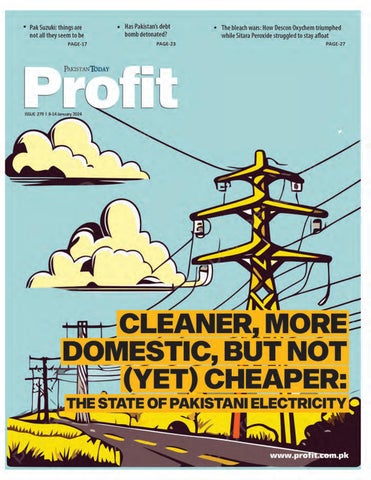
09 Hopium- II: how Pakistan needs to rethink its planning Sheikh Imranul Haque 11 Cleaner, more domestic, but not (yet) cheaper: the state of Pakistani electricity
17 17 Pak Suzuki: things are not all they seem to be 21 EV adoption: moving customers along the funnel Naveen Ahmed
27
23
23
23 The bleach wars: How Descon Oxychem triumphed while Sitara Peroxide struggled to stay afloat
Profit
27 Has Pakistan’s debt bomb detonated?
Publishing Editor: Babar Nizami - Editor Multimedia: Umar Aziz Khan - Senior Editor: Abdullah Niazi Sub-Editor: Basit Munawar - Video Editors: Talha Farooqi | Fawad Shakeel Business Reporters: Daniyal Ahmad | Shahab Omer | Zain Naeem | Saneela Jawad | Ghulam Abbass | Ahmad Ahmadani Shehzad Paracha | Aziz Buneri | Nisma Riaz | Mariam Umar | Urooj Imran | Shahnawaz Ali | Meerub Amir Regional Heads of Marketing: Mudassir Alam (Khi) | Sohail Abbas (Lhe) | Malik Israr (Isb) Pakistan’s #1 business magazine - your go-to source for business, economic and financial news. Contact us: profit@pakistantoday.com.pk
SATIRE
Sheikh Imranul Haque
Hopium- II: how Pakistan needs to rethink its planning
levy on LPG/petroleum and GIDC should be implemented over the next five years. . The FIPPA applicability to investments in ambitious projects e.g. TAPI, Riko Diq, Refinery, Petrochemical, CASA 1000 etc by the concerned Ministry without approval by cabinet, deregulation of sector combined with the wealth fund will encourage PSO, OGDCL, PPL, Utilities and DISCOs to partner with qualified and experienced partners. No longer ‘hopium’ should be the norm as has been Pakistan needs disruptive changes, a repeated constantly by various stakeholders in the last 75 years. Our lack of data-driven decision making encourages deregulated business environment, and our ‘4th world’ journey. SOE reform if its economy is to grow The World Bank’s country director recently commented that Pakistan’s current economic model is not he fortnightly energy pricing for fuel, LPG and LNG, working since it has fallen behind its peers, significant monthly pricing for power, and six-month pricing progress in poverty reduction has now started to reverse, for gas needs an approach that smoothens the impact and the benefits of growth have accrued to a narrow elite. and reduces the risk, without causing political Stakeholders need to coordinate and move beyond point despair every fortnight, every month, and every six scoring, not be economical with truth, communicate the months. A review of tariff adjustments by Business way forward for a plan. Recorder highlights that it is manageable. Our political manifestos should focus on that instead Starting in July 2024, the rationalization of tariffs with reducof building the usual ‘hopium’ given that Pakistan requires tion in government intervention necessitates empowering combined a sustained GDP growth of 7-9% for the next 30 years. We OGRA and NEPRA, and providing indigenous gas only to power should focus on reducing the fertility rate, and providing a plants and fertilizer. Any leftover molecules are to be “stored” by minimum standard of living to our citizens with minimum reducing production at field level. Captive power plants, 3 RLNG pay set at Rs 75000 per month, subject to revision with units, fertilizer and all of industry to utilize RLNG/LPG/LPG Air respect to inflation every July. A focused subsidy with Mix should be phased in by 2027. The case for fuel pricing based on matching funding can deliver free units of electricity, health futures – with the role of PMEX – should be defined and implefacilities, houses to homeless, youth and kissan card, hunger mented by a combined regulator. eradication and quality education. In parallel, the regulator along with CPPA-G, DISCOs and Sui However it will be ‘old wine in new bottles’ if this is companies should determine timelines for power and gas sector loss done without challenging the status quo and highlighting reduction (losses 15%, recovery 95% target and UFG 5% target). the revenue measures. And the case for reducing circular debt by investing in above and The next decade requires tough choices, disruptive increasing royalties on oil and gas, windfall levy against crude oil, inspiration and no business as usual. It necessitates a credible structural reform package, a conducive investment environment, encouraging regional trade, changing state of patronage and taking decisions by allowing professionals to undertake their job diligently as they tackle scenarios that evolve and be able to modify the The writer has served as the path accordingly without repercussions. managing director of Pakistan The effective enforcement of laws will facilitate investment and this has to be State Oil (PSO) and chairman encouraged by the federation providing continuity of policies, transparent procedures and of the Petroleum Institute of contract award with changes effective prospectively and obligations met per contractual Pakistan and OCAC. He can be obligations. contacted at ihaque58@gmail.com A deregulated and competitive environment requires regulator policies which
T
COMMENT
9
provide enforcement authority only when self monitoring fails. The staged and limited investment incentives include the reduction in number of permissions required and encouraging new approaches without regulator checklist selecting investors. A conducive business environment provided by a tolerant society includes the definition of the role of judiciary in commercial matters with a viable and timely contract dispute resolution mechanism with no judicial activism as has seen in the past that does not cancel contracts but rather ensures an effective contract arbitration process. Finally, the strengthening of defamation laws, discouraging media trials aimed at victimization and providing retribution for false cases. Given increasing interdependency, Pakistan’s most disruptive paradigm change requires effective integrated planning necessitating a Planning Commission working as “Pakistan NDRC” along the lines of National Development and Reform Commission (NDRC) of China, defining institutional parameters and boundaries for growth based on guidance of Strategic Investment Facilitation Council (SIFC) acting as “Board of Directors”. This challenge to the status quo requires
10
the consolidation of commerce, technology industries, transport industries, the energy sector and the education sector. It should be led by a professional deputy prime Minister, or a senior minister, who should be assisted by experts, think tanks and financing institutions to evolve a home grown executable strategy. The next disruptive measure recommended earlier is the revival of the PIDC as a holding company to manage the federal and provincial government shareholding in state owned enterprises (SOEs), followed by their aggressive transformation, consolidation of roles, merger of departments, encouraging new opportunities for export, partnering with defence industry, focusing on regional cooperation and undertaking strategic infrastructure investments. SOEs “Employment Exchange” role needs to end as Federal SOEs are the least profitable in the region with subsidies, loans, equity injections at 1.4 % of GDP with stock of guarantees and loans of 3.1% in 2016 and 9.7% during 2016-21. With bills in place and review aimed to rationalize and strengthen the SOE’s policy and oversight being undertaken, the goal now has to be consistency and confidence building through measures that ensure ease of doing
business, encouraging FDI while restructuring SOEs assets and debts. The rebuilding of 206 SOEs is more cost effective and reflects commitment to change, instead of initiating green field projects. The PIDC would have the role of wealth fund as well, and is to be a corporate holding company structure. The PIDC also requires CPEC Authority’s chairman and other officials immunity from investigations by NAB and FIA and SOEs involved in Reko Diq copper and gold project being entitled to indemnification in case of losses, administrative and legal matters. This disruptive measure is essential given our history of privatization and efforts for reorganizing and transforming SOEs has had limited success. The execution will only happen with an experienced technocrat chairman designated as deputy prime minister or senior minister. Instead of a big bang approach, sustained efforts by an effective empowered leadership team is required, to manage the SOEs based on principle of working for profit and are not to be bailed out beyond three years. The final message: if unable to reduce the number of institutions: merge them: Corporatize them and force them to be financially self reliant, productive and competitive. n
COMMENT
11
COVER STORY
By Farooq Tirmizi
L
adies and gentlemen, the unexpected has happened. Against all odds, the government of Pakistan has solved an important problem facing the country. They did it in the most irresponsible way imaginable, and we will be paying far too high a price for it, but in exchange, we will have solved a very real and very big problem that had been staring at the country for the past 20 years: Pakistan’s electricity generation capacity will not become dependent on imported fuel after all. We would also like to state up front that we as a publication, and this author in particular, got this very wrong: in August 2021, we wrote that Pakistan might soon reach a tipping point where the majority of the country’s electricity generation will come from imported primary fuel sources rather than domestic ones. Not only has that not happened so far, but it seems as though it may end up not happening at all. We could not be more delighted at being wrong. So, what are we talking about?
Pakistan’s energy problems
I
n the fiscal year ending June 30, 2004, about 84.4% of the total electricity used in Pakistan came from domestic fuel sources, primarily hydroelectricity and natural gas-fired thermal power, with that natural gas coming from domestic gas fields, according to Profit’s analysis of data from the National Electric Power Regulatory Authority (NEPRA). That meant that even as the Iraq War of 2003 drove up global oil prices, Pakistani consumers of electricity remained largely unaffected. Even back then, however, the government of Pakistan knew we had a problem. As early as 1995, the government of Pakistan had access to estimates that suggested that Pakistan’s natural gas production was predicted to peak in 2010 and precipitously fall thereafter. Reality ended up being only slightly better: production peaked
12
in 2012 and has since then been falling dramatically almost every single year. That natural gas had to be replaced, but for almost 10 years, the government of Pakistan did nothing, despite the fact that in 2008, the problem got so bad that 8-12 of load shedding a day was the norm in most major Pakistani cities and electricity all but vanished in the smaller towns and villages. It is not as though the Musharraf Administration did not know of the problem. And it is not as though they did not try something. The problem was that they were convinced that the only solution was hydroelectricity, and in 1999, when General Musharraf took power, the only dam the government of Pakistan had a feasibility study completed for was the politically controversial Kalabagh Dam. The Musharraf Administration tried hard to push through the political opposition to Kalabagh but was unsuccessful. They then initiated feasibility studies on other dams, notably the Diamer-Bhasha dam and the Dasu dam. But it takes 10 years to even finish the feasibility study for a dam and another 10 years at least to build one, so they would never have been able to begin construction on those dams, let alone have them completed. That, however, was all they tried. The Geological Survey of Pakistan has known since at least 1991 that the Thar desert has substantial coal deposits, but the Musharraf Administration all but ignored Thar. They converted part of Pakistan’s thermal power generation to natural gas, but the bulk of it – particularly the private sector power generation capacity that was rapidly becoming the country’s base load capacity – remained fired by oil. So when the 2008 rise in oil prices came, Pakistan was uniquely position for a lot of pain. The government of Pakistan spent down its dollar reserves on oil subsidies to prevent the prices of both petrol and electricity from rising, but of course, the money ran out faster than they could secure more, so we had a massive fiscal and currency crisis in one go and out went General Musharraf. The incoming Zardari Administration
inherited a massive mess, but moved at an alarmingly slow pace in trying to solve the problem, and pursued far too many of the wrong solutions (remember rental power plants, anyone?). They even created hurdles for private sector players that tried to provide solutions. For years after Engro decided to create a coalmine and mine-mouth coal-fired power plant in Thar, the Sindh government – led by Zardari’s Pakistan Peoples Party (PPP) – simply did not bother to build the road the company would need to transport equipment to and from the mine to the nearest highway. It was the Nawaz Administration in 2013 that pursued a solution to part of the problem, and actively sought to commercialise power generation in Thar, replace the waning domestic natural gas with imported liquefied natural gas (LNG) from Qatar, and above all, incentivize the private sector to build lots and lots of thermal power plants, while simultaneously embarking on a massive government spending spree on increasing hydroelectric power generation. Those policies are now bearing fruit, and after nearly a decade and a half of almost consistent decline, the domestic share of primary fuels for electricity generation in Pakistan rose substantially in fiscal year 2023, and may continue to rise in the coming few years.
What is going right: more domestic generation mix
T
wo things are going very right with Pakistan’s electricity sector: power generation is getting reliant on more domestic fuel sources and is getting
cleaner. Let us start with the domestic vs imported mix. According to Profit’s analysis of NEPRA data, between 2007 and 2017, about one-third of Pakistan’s electricity was generated using furnace oil, nearly all of which was imported. This was a major contributor to Pakistan’s balance of payments problem during that decade: the country needed to import oil just to keep the lights on during a time when – for most of that era – oil
prices hovered above $80 per barrel. Over the past 10 years – since the Nawaz Administration began dramatically altering Pakistan’s electricity generation mix – the country has increased its power generation output by 42%, from 98,655 gigawatt-hours (GWh) in fiscal 2013 to approximately 140,493 GWh in fiscal 2023. The aggregate increase, however, is not the full story. During that time, imported LNG replaced imported oil, and imported coal replaced the decline in natural gas. And when we say replace, we mean that almost literally. Between 2013 and 2023, electricity generation from oil-fired power plants declined by 29,162 GWh, and that generated by LNG-fired power plants went up by 29,282 GWh, an almost exact one-to-one replacement. Power plants run on domestic natural gas saw production decline by 12,942 GWh and replaced almost exactly by an increase of 12,457 GWh in imported coal-fired power
production (which itself is now being replaced at least partially by Thar coal). If those two fuel sources are seen as merely replacements for the previous fuel mix, then about half of the increase in electricity generation – nearly 20,000 out of the 42,000 GWh increase in power generation – has come from nuclear energy. It does not get much coverage in the press, but Pakistan’s nuclear energy program is a quiet success story. As recently as 2009, Pakistan got less than 2% of its electricity from nuclear energy and now that number is above 17% of the total electricity generated in the country, largely on the back of Chinese-backed nuclear power plants at Chashma, and a substantial increase in the generation capacity at the nuclear power plant in Karachi. So important is nuclear to Pakistan’s increase in electricity generation that the net amount of nuclear energy added to the grid is about equal to the total added by Thar coal, wind, and the new
hydroelectric power plants combined. Here is how good and reliable nuclear power is: that 17% of electricity generated comes from power plants that constitute just 8.5% of the country’s installed power generation capacity. It is the only category of power generation where the actual production exceeds its share of installed capacity. Basically, the nuclear power plants got turned on once and have not been turned off since. (Strictly speaking, this is not true, but the variation in month-to-month generation of the nuclear power plants is lower than that of any other category of power plant in the country.) That we even have this capacity is nothing short of a miracle: only 35 countries in the world even have any kind of nuclear energy program and Pakistan is one of them. We are the 18th largest producer of nuclear electricity in the world, and get a larger share of electricity from nuclear power than India does (though India generates
COVER STORY
more than twice as much in absolute terms). But while nuclear helps explain the ability to increase power generation through domestic means, it is not the only part of the story. The other part is Thar coal, which is increasingly beginning to replace imported coal in Pakistan’s power generation mix, a trend that has become more visible over the past 12 months. December 2022 is the first month when Pakistan generated more electricity from Thar coal than imported coal. Combine the massive increase in nuclear energy with the additions to hydroelectric power generation, and domestic coal-fired power plants, and Pakistan’s reliance on domestic sources of fuel has gone from 52.1% of electricity in fiscal 2022 to 65.2% in fiscal 2023. And the number for fiscal 2024 might end up being even higher if the trend in Thar coal replacing imported coal continues.
What is going right: cleaner energy
T
he other big thing that appears to be going right – especially given how vulnerable Pakistan is to climate change – is that despite the massive increase
14
in coal-fired electricity generation, Pakistan’s electricity generation now has a higher share of zero-carbon sources than at any point in the last two decades, and quite likely even three decades. During the fiscal year 2023, about 47% of the electricity generated in Pakistan was through zero-carbon sources, the two largest of which were hydroelectric (25.8% of the total) and nuclear (17.1%) followed by wind (2.9%) and then solar (0.93%). This is much better than 30% of electricity that was being generated by zero-carbon sources as recently as 2018. One small thing to note about solar energy, which is getting a lot of attention among Pakistan’s upper middle class neighbourhoods owing to the popularity of rooftop solar installations in many homes. Yes, rooftop solar is increasing in scope, but it is not yet a meaningful percentage of the overall electricity supply of the country. While NEPRA does not have an estimate of how much electricity is generated by those rooftop solar installations, it does now report how much electricity is purchased by the grid through net metering, where people with rooftop solar panels sell some of the excess electricity they generate back to the grid. That number
for fiscal year 2023 for the whole country was about 280 GWh, or about 0.2% of the total electricity generated by the country. Industry experts estimate that net metering accounts for between 20% and 40% of the total electricity generated by rooftop solar panels. If we are generous and assume that 80% of the electricity being generated by rooftop solar is being used in the homes of those who installed the panels and only 20% being sold back to the grid, we arrive at an estimate of 1,400 GWh of electricity being generated by rooftop solar panels, or about another 1% of the grid’s total power generation. Distributed generation is not (yet) a significant threat to the grid.
What is still going wrong: theft and subsidies
O
f course, fixing how much electricity can be – and is – generated by the national grid is hardly enough if that electricity is not sold and paid for by end-consumers. And that is where the Pakistani system has not improved nearly as much as it should.
TEXTILES
Transmission and distribution losses – the proportion of electricity units that are produced but never billed because they get stolen, or lost owing to transmission over long distances – average about 17.2% in the state-owned portion of the grid that cover the whole country except Karachi, according to NEPRA’s data for fiscal 2022, the latest year for which complete data is available. And in Karachi, those losses are slightly worse at around 17.9% of total electricity generated. Some losses are natural and the result of simple physics: wires have resistance to electric current and so some energy is lost in that resistance. In an efficient grid like the United States, that loss is around 6-7% of total electricity generated. So the fact that Pakistan’s system-wide losses exceed 17% suggests that 10-11% or more of the electricity generated in the country is stolen. Unfortunately, the problem does not end there, because even when the utility companies are able to deliver a unit of electricity to a customer they can issue a bill to, they are not very good at collecting those bills. The state-owned portion of the grid was only able to collect about 90.5% of the amounts it billed in 2022, meaning almost 10% of the billed amount is just never paid. The privately-owned K-Electric did a bit better, leaving just 3.3% of the billed amount unpaid. And then there are the subsidies. So much is wrong with the subsidies it is hard to even know where to begin. They are highly untargeted meaning, according to one World Bank study, approximately 90% of the benefit of those subsidies goes to the upper middle class, and not the poor, its intended recipients. They are supposed to cover part of the cost of theft – in itself a bad idea since it disincentivizes the utility companies from doing more to crack down on theft. But worst of all, they are promised by the government but have not been paid in full for at least the last 15 years. In fiscal 2022, the government set the subsidy levels such that – by its own calculations – it would owe Rs564 billion
to the electricity companies. Those unpaid subsidies have created what is now famously called the “circular debt”. The only good thing that can be said about the circular debt – which currently stands at close to Rs2.3 trillion, according to NEPRA’s most recent disclosures in August 2023, is that the number has only risen by about Rs150 billion in the last three years. But even that may be misleading, since the electricity circular debt is now no longer the only circular debt in Pakistan. There is now also the natural gas circular debt, which for years the government refused to even acknowledge existed. That number stands at Rs2.9 trillion. Failure to deal with these leakages and thus creating an unreliable source of revenue for companies that do business in the energy sector means that Pakistan’s energy sector is financially inefficient: it produces expensive electricity, has too much capacity that needs to be paid for, and then does not have the means to have it all paid for by either collected bills or subsidies paid on time. But the silver lining: it is here.
The upside of a debt binge
I
deally, we would live in a country that was run by a government that could collect enough taxes to live within its means, or at least not be fiscally irresponsible and go on a debt-fueled spending binge. We know not to expect that. We’re Pakistani. We do not have that kind of luck. The best we can hope for is the next best thing: if our government is going to go on a debt-fueled spending binge, then hopefully it will spend that money on things that will actually deliver economic benefits to the country in the long run. And on that score, the debt binge from the China-Pakistan Economic Corridor (CPEC) has at least that virtue: we got a large increase in power generation capacity out of it. What that means is that the economy can increase substantially in size – by as much as 50% from
its current levels, based on Profit’s rudimentary analysis of data from NEPRA and the Pakistan Bureau of Statistics – and it would not need to materially add to its electricity generation capacity. (Transmission and distribution continue to need investment, though.) Electricity is expensive now, and yes, with better planning it would not have been this expensive. But in relative purchasing power terms, this may mark the high point for how expensive electricity is in Pakistan. As demand goes up, the marginal cost of producing each unit will go down. And if the planned privatization of the state-owned electricity distribution companies goes through and results in a meaningful crackdown on theft like the one executed by K-Electric, that transition may come faster still. It may come as a surprise to most Pakistanis that the country actually already has enough electricity to begin its industrialization process. According to the economist Charlie Robertson, the level of electricity at which most countries gain the ability to start industrializing is around 300 kilowatt-hours (kWh) per capita. Pakistan’s electricity generation hit that number in 1999, during fiscal 2023, hit 582 kWh per capita, well above the level required for rapid industrialization to begin. There are other ingredients missing which have prevented Pakistan from industrializing, namely insufficient literacy, and a low national savings rate, but those are also problems that are likely to be solved some time over the next decade (more on those two in subsequent articles). More to the point, think of the progress we have made as a country: power outages just a few years ago were happened for several hours a day every day and a large amount of mental energy had to be exerted in planning around those outages. Now, in some parts of some cities in Pakistan, a power outage comes a mild surprise: not that you do not know what it is or think of it as unusual, but usually something you are not expecting to happen. That is a small shift, but one that is a precursor to a much longer, sustained industrial take-off for Pakistan. But more on that later. n
COVER STORY
The company has given its own valuation for its buyback, however, the market does not concur
F
By Zain Naeem
or those who follow the stock market, Pak Suzuki Motors Company Limited is the talk of the town. The share price of the company jumped from Rs 136 on 11th October 2023 to Rs 673 on January 6, 2024. This is a return of 400% in a period of less than three months. So why did the price soar? In simple terms, the company announced a buyback and voluntary delisting, which means that they are offering to buy the remaining shares held in the market and delisting the company. The market has responded positively, to put it mildly. What is the issue then? Well, it is a case of valuation discrepancy. Ever since the buyback and voluntary delisting was announced, the market waited with bated breath to see what was going to be the rate at which the buyback would take place. On December 4, the company set the minimum purchase price at Rs 406 per share. This leads to the main conundrum: why
PSX
are investors willing to purchase the shares from the market at Rs 673, when the company has announced a minimum price of Rs 406 per share? Or put another way, why is there such a huge discrepancy in the two valuations, and which valuation is correct?
A mixed financial performance
T
he company’s recent performance has been mixed, to say the least. The problems stem from the fact that the company – and the whole industry – faced a multitude of challenges. These included historically low vehicle sales and import restrictions by the State Bank of Pakistan (SBP) due to lower exchange reserves. As raw material became scarce, the company saw rising raw material costs eating into its gross margin and the companies had to carry out frequent non-production days. As the policy rate soared, it led to higher auto financing rates. The year also saw relentless depreciation of the Pakistani rupee against
the US dollar, imposition of tariffs and additional GST as part of the government’s efforts to tighten policy. All these factors compounded and translated into declining sales and high operational costs, leading to low valuations for major listed players operating in the segment. The story for Suzuki wasn’t any different. Recent annual statements for 2022 show that the company was able to increase its gross profit margin from 2.8% to 5.7% by year end, due to average operating losses shrinking. However, the net profit margin declined from -1% and grew to -3%, owing to rising interest rates and markup being paid to customers. The last quarter of fiscal year 2023 has been much more promising for the company, where the gross profit margin went from 9% at the end of first quarter to 14.5%, which coincided with an increase in sales. The company was able to grow its margins due to stable currency. Similarly, operating margin increased from 1% in the first quarter to 11% in the latest quarter, while net profit margin improved from nearly -59% to 13%. The dramatic shift in net margins was due to the fact that the company booked
17
Suzuki, along with other automobile players, was adversely affected by the increase in the policy rate, which effectively hampered the auto lending segment. Furthermore, the significant depreciation of the rupee and rampant inflation have eroded the disposable incomes of the urban middleclass population, which constitutes the target customer base for Suzuki. However, as the policy rate gradually decreases, there is the potential for a rebound in lending and auto sales, benefiting the company. Suzuki still maintains its dominant position in the 1000cc and below segment. Additionally, incomes are expected to adjust upwards in the next year or two, partially restoring the purchasing power of Suzuki’s target customers Yousuf Farooq, Director Research at Chase Securities
much of its cumulative exchange losses in the first quarter of 2023, easing off the operating
cost pressures in the recent two quarters. Additionally, the working capital situa-
tion for the company also improved as the cash margin restrictions were removed by the SBP, which allowed Pak Suzuki to free up a significant amount of capital.
The buyback being announced
S
uzuki announced on October 12, 2023, that it was going to hold a board meeting in a week’s time to voluntarily buy back its own shares. The board of directors were going to consider the request made by the majority shareholder who wanted to buy back all the shares available in the market after which they would be able to delist the company from the market. The biggest shareholder in Pak Suzuki is the Suzuki Motor Company in Japan. In response to this notification, the share price shot up from Rs 136 to trading at Rs 589 as on December 7, 2023. This indicates the market realized that the shares were trading at a price lower than the fair value at which the company would be purchasing the shares back. At this juncture, it is important to understand that the PSX has set out certain rules which dictate how voluntary buyback and delisting has to be carried out. The reason given for the buyback (to be carried out by the majority shareholder, Suzuki Motor Company Japan) was that the company had been making losses for three of the last four years, and the share price was recorded at lowest levels in its history. This would be a good way to provide a fair exit to the minority shareholders who made up 26.9% of the shareholding (Suzuki Motor Company Japan holds 73.1%).
The process of voluntary delisting
A
fter the company announced to the PSX that they were interested in a buyback, the next step is to determine the price at which the
18
buyback has to take place. Clause 5.14.2 of the PSX regulations states there are five criterias for this. The price should not be less than: a. Weighted average closing market price of the last five days preceding the date of board meeting in which the company resolved to delist. This would have meant the price would have been around Rs 135. b. The three year weighted average market price one day preceding the date of the board meeting in which delisting is resolved. This would have made the price equal to Rs 201. c. Price to earning multiple approach which can be used based on the recent earnings of the company and price to earning multiple of other comparable companies in the market to determine a market price. This is not applicable in this case as the recent annual and quarterly accounts show that the company made a loss. d. The highest price at which the sponsor bought the shares of the company in the market. This is not applicable as the sponsors did not buy any additional shares in the last year or so. e. The intrinsic value of share after the revaluation of assets has been carried out by an independent valuator which has been chosen by the PSX and shall not be older than three months from the date of application of delisting. The purvey of the auditor and the assets being assessed can include any factor that is seen as being relevant by the auditor. This value cannot be determined as there are many assets, like freehold land, held by the company which will need to be revalued before a definite figure can be given. The last point is the most important one as it seems that this measure is being used by the company and the market in order to determine the purchase price that will prevail in the end. The company is providing for a purchase price as a lower end of the spectrum and it seems that the market is valuing the shares at a much higher rate using this method.
Independent valuation and need for transparency
A
fter carrying out its due diligence, the company announced on December 4, 2023 that it was going to buy the 22,145,760 shares floating in the market, which made up 26.9% of the total shareholding at a minimum purchase price of Rs 406 per share. Arif Habib was made the purchase agent who would be tasked with carrying out the process, and the company was looking for an approval from the PSX. In the documentation and formalities that have to be provided by the company, one
requirement is the valuation report by an independent valuator and an auditor’s certificate that certifies the intrinsic value per share. The valuation was carried out by Iqbal A. Nanjee & Co. (Pvt) Limited. Even though the annexures have been filed with the PSX, these are not available for the market. Why is this a point of concern? Disclosures are integral for the market to know what is going on inside the company. The company can feel that this is arbitrary and the final number will be determined by the PSX after its own valuation. Still, the fact that this number is not being disclosed should raise some concerns. Just like when the company needs investors to invest in the company, they need to be transparent, this transparency is not evident in this case. This is one of the reasons why the purchase price determined is shrouded in some secrecy. If these annexures were made public, it could be seen how the valuation had been carried out by the company and whether there are items which have not been included in the final calculations. As these annexures are not made public, there can be some speculation and distrust in regards to the valuation being carried out. If these are made available to the public, it will help them connect a few of the dots in terms of how the company is valuing some of its own assets and how the valuator sees these assets in terms of their valuation.
The final valuation to be carried out
T
he final verdict in this tug of war still lies with the PSX. According to Clause 5.14.4, the exchange shall determine the minimum purchase price which cannot be less than the buyback price criteria. This clause also gives the power to the PSX to add in any additional factors that they
feel should be accounted for when the price of the shares is being determined. Based on its own accounts, the company saw that the book value per share was at Rs 240 at the year end 2022 and subsequent losses in the nine months since then have dragged down the value further to Rs 169 per share. This is based on the fact that if the company decides to close shop and sell everything, this is what the value of the shares should be. Another fact to be considered is that the accounts have not revalued certain assets which will be revalued for the delisting. The freehold land that the company bought in 2008 is one example of asset which is being shown at its cost when it was purchased and needs to be revalued upwards. The land was bought for Rs 373 million in 2008 and is located at Tragga Manga Mandi, Multan Road, Lahore. This land is over an area of 247 Kanals, 19 Marlas and 200 square feet. The current cost this asset was shown as at end of fiscal year 2022 was at Rs 371.5 million. In addition to that, there are other assets like buildings on the freehold land and the leasehold land under Pak Suzuki’s control which will be revalued which will drive the book value further upwards. Once all this is taken into account, it is not wonder that the book value per share will increase. Speaking to some industry experts, there is a view that the actual value of the buyback should be between Rs 500 and Rs 600, based on how the valuation of the assets is carried out. The annexures and calculations have been filed with the relevant authorities.
Quantum Leap
T
he PSX has set a quantum or threshold that needs to be crossed. Clause 5.14.5 states that if a sponsor initially had a shareholding of less than 90%,
PSX
they need to at least increase their holding to 90% to qualify for the delisting. In cases where their shareholdings are above 90%, they do not need to carry out any mandatory additional purchase to qualify for the delisting. This is an important rule for two reasons. The first reason is that it gives the minority the assurity that purchase will be carried out and the sponsor will have to make a bid higher than the minimum purchase price in order to get the shares in the market. A band of investors can join together and demand a higher purchase price if they seem it is reasonable. This action can also make the exchange take notice and take this as a factor under consideration when they are determining the purchase price themselves. This is one of the reasons that investors who already hold the shares or are willing to buy the shares as they feel that they can get a higher price for their shares as they have bonded together. Once the majority shareholder starts to buy these shares, the signal from the market will show that the investors are not willing to settle for a price lower than the one prevailing in the market. The second reason this is an effective regulation is the fact that companies cannot be blackmailed by a small portion of the minority shareholders into paying through the nose for the buyback. As the threshold is set at 90%, the majority does not have to buy all the shares in the market and can ignore a small part of the minority shareholders who are holding out. In this case, one percent of the shareholders cannot force the company to pay Rs 1000 for shares which other shareholders are willing to sell for much less.
What happens from here?
I
t needs to be understood here that there is a tug of war that is initiated with a voluntary buyback and delisting is being carried out. The market can feel a certain way, while the company can itself look to respond in their own manner. In this war, the first salvo was fired by the market when the share price increased by four folds over the course of two months. In response, the company also gave a purchase price which was much lower than the market value on the day. The purchase price spooked the market so much so that the announcement of the price came at 2:52 PM, and before the market closed at 3:30 PM, the share went from its upper lock to its lower lock which is a price movement of 15% in a day. The next day, sanity was restored when the market stabilized and the price started increasing again. Why was this the case? The market came to the realization that the company was low balling
20
as the first move in the negotiation and that either the PSX or the company will end up increasing the price eventually. Just like when you go to a shop and are told that something is for Rs 500, there is a natural instinct to bargain and say that you will buy it for Rs 100. This tells the shopkeeper that you are willing to buy but the price is too high. What ends up happening is that a compromise is reached where the shopkeeper decreases his expectation while you increase what you are willing to pay. This will happen in this case as well as the company and the market will end up meeting in the middle somewhere.
The reason for delisting
E
ven though this story is mostly about the valuation carried out by the company and the market, a side note needs to be made for the company’s reason to delist. The company feels that it has made losses in three of the last four years and that it has not given out any dividend. In addition to that, the share price of the company is trading at an all time low and that due to low volumes, shareholders do not have a chance to exit the market. The company also states that it wants to buy back all the shares of the company while committing its future to the Pakistani market in the long term. They feel that they need to stay in Pakistan as part of its long term strategy. At first sight, this might seem like a credible enough reason, but this seems like a slap in the face of the investors themselves. The company is saying that they feel they know what is better for the shareholders themselves and that rather than giving a choice to the shareholders whether they want to stay invested in the company, they are making a decision for them. In addition to that, the shareholders might feel that the company will turn around and have a belief in better days to come, however, the company is strong-arming them into making a decision. There are three possible reasons for this buyback. One possible reason could be that the company feels that, due to lack of chances to repatriate their earnings or dividends, it is better to leave the country as the State Bank of Pakistan has restricted foreign currency to be sent. They can do so by buying back all of its shares and then finding a buyer who would want to buy the whole company from Suzuki Motor Company Japan. Another reason could be that the company wants to limit dissemination of information to the market and lessen its compliance workload by delisting from the market. Now
every small development will not have to be disclosed when it takes place. Companies have been known to delist as they feel the burden of compliance and cost of listing is too much for a company and they can opt to delist in order to get rid of this burden. Lastly, the company may feel that they are going to turn a corner. Recent accounts show that exchange losses, markup on booked vehicles and other loss making heads in the accounts have been realized and booked. The first quarter of the company saw a loss per share of Rs 156.9 in March 2023. These losses turned into profits of Rs 39.4 per share by June, and increased to Rs 46.2 by September. The losses the company was making have reversed and due to exchange losses being realized, the company was able to bear fruit from the stable exchange rate in the last two quarters. The same upswing has also been seen in terms of sales of vehicles and motorcycles which are now back to their 2018 levels, while motorcycle sales have increased by more than two folds from their low in 2020. The increase in sales and the stabilization in the currency shows that the company might have turned the page financially speaking, and expects better results in the coming months. Additionally, as the policy rate is expected to gradually decrease over the coming months, lending at the auto front might accelerate. This will ultimately reflect through an uptick in Suzuki’s sales volume. “Suzuki, along with other automobile players, was adversely affected by the increase in the policy rate, which effectively hampered the auto lending segment. Furthermore, the significant depreciation of the rupee and rampant inflation have eroded the disposable incomes of the urban middle-class population, which constitutes the target customer base for Suzuki. However, as the policy rate gradually decreases, there is the potential for a rebound in lending and auto sales, benefiting the company. Suzuki still maintains its dominant position in the 1000cc and below segment. Additionally, incomes are expected to adjust upwards in the next year or two, partially restoring the purchasing power of Suzuki’s target customers,” remarked, Yousuf Farooq, director of research at Chase Securities. The company might want to earn those profits directly and take them into their own records by buying back all shares from the market as well. Whatever the reason for the delisting will become evident in a few months time. What needs to happen right now is for the disclosure of the proper valuation, and all workings and annexures given to the market so they can make a more informed decision for themselves going forward. n
PSX
OPINION
Naveen Ahmed
EV adoption: moving customers along the funnel What is stopping Pakistanis from buying more electric vehicles?
M
ost conversations on sustainability echo the urgency for a global transition towards a zero-carbon future, and the adoption of electric vehicles (EVs) is an important checkpoint along this journey. Momentum in markets like India and China, has already demonstrated product-market fit, beyond the luxury segment. However, with less than 15,000 EVs on our roads today, the enthusiasm in Pakistan is quite restrained. This indicates that a structural shift in consumer preference towards electric vehicles is still a few years away. Market research on purchase intent for the two-wheeler (E2W) and four-wheeler (E4W) segments in fleet and retail markets turns up mixed results too. Clearly, many young Pakistanis acknowledge our vulnerability to climate change, have first-hand experience with poor air quality, and are increasingly eco-conscious. Yet, even amongst the most ardent supporters of climate action, EV ownership levels are dismal. What then is needed to move customers along the adoption funnel? Within any economic stratum, buying a vehicle constitutes
The author is an investment banking professional, board member and an academic
COMMENT
a substantial investment. The decision-making process involves considerations such as affordability, the presumed value for money, trust in the brand's reliability, the perceived quality and durability of the vehicle, and its potential resale value. Peer influence, recommendations and anecdotal accounts are known to sway people too. For those in the high-income bracket, additional factors such as safety, comfort, features and automation, also assume relevance in screening their purchases. While the upfront cost of an EV is higher than internal combustion engine (ICE) vehicles of comparable specifications, the fuel savings and maintenance costs are substantially lower over the life of the vehicle and are correlated with the mileage accumulated by the vehicle. Simply put, the more it’s driven, the cheaper it ends up in the long run. A recent UNDP study, evaluating vehicle options available in Pakistan, presents an analysis of the initial and then ongoing vehicle expenditures over a five-year period. It estimates that the total cost of ownership is 30-50% lower for electric motorcycles and rickshaws than comparable ICE models. Since the tipping point for cars is not yet reached, our exploration of dynamics in this article will feature mainly two-wheelers, as this space has the greatest potential for electrification. In this sector, while the entry price disparity is a hump, when we segment the target market by income levels, groups above the median can potentially stretch their budgets if value for money is established and the price-quality schema is leveraged. Aside from higher price tags, a lack of widely available public charging infrastructure is often cited as an impediment to adoption, contributing to range anxiety. This is definitely a consideration for commercial vehicles and fleets. For the average urban commuter, though, who uses their vehicle for daily activities, a full charge with a range of 50-100 km for E2W, and 250-450 km for E4W is more than enough
to last a typical day and then some. Given this context, the primary barrier to adoption appears to be rooted in the intertwined concepts of brand credibility and consumer confidence in the technology. For a durable good with a lifespan of hundreds of thousands of kilometers over perhaps a decade, the purchase of which requires a substantial tap into savings or even a loan, the consumers would understandably want to buy from a business that is expected to outlast the vehicles they sell and be assured that their vehicle would be supported throughout its lifecycle. While the scheduled opex for EVs is low under optimal conditions, real life situations such as damages resulting from road accidents, overheating, accelerated wear and
21
tear from subpar road infrastructure, or simply poor driving habits and inadequate maintenance routines, will necessitate access to reliable and trained technicians and availability of spares or replacement options. Presently, the supply side for E2W, is speckled with tens of fledgling startups, who rely heavily on imports for core components. Many of them source white-label drivetrains, motors and battery cells, giving rise to skepticism about product quality and after-sales user experience over the medium to long term. While luxury vehicle buyers can navigate the supply chain limitations, restricted choices, and the financial implications of maintaining cars imported through dealers and distributors, the larger demographic in the lower-end market, may face substantial disruptions to daily activities from potential incompatibility or delayed or expensive availability of key parts. Looming over this complex terrain, is also the sentiment of mistrust that the local consumers tend to harbour towards locally-engineered goods, mainly because our market lacks robust consumer protection, regulatory oversight, or industry standards, thus making brand building a challenging endeavor. To assess the impact of brand credibility on customer purchase decisions, we can look over the fence, towards our neighbour where the adoption of EVs is on an exponential trajectory with over a hundred thousand vehicles sold monthly. Leading the charge in the E2W segment is Ola, a homegrown startup that has evolved into the world's largest ride-hailing company. Ola's decade-long history in India prior to entering the electric two-wheeler market has played a pivotal role in inspiring trust. In the passenger car segment, Tata Motors commands dominance, leveraging its well-established reputation. Fortunately for Pakistan, the E3W space is marked by the presence of Sazgar Engineering, as the market pace-setter in driving the adoption of electric rickshaws. In contrast, the market development in the two-wheeler segment is more chaotic, with the leading names still cautiously on the sidelines. The EV value chain has several stakeholders with distinct offerings. Broadly, on the manufacturing side, there are vehicle manufacturers, battery or cell manufacturers and charging equipment providers. Service-oriented offerings include software solutions, charging stations, vehicle and battery leasing and subscription models, and battery swap services. Overwhelmed by these possibilities, many electric motorcycle startups try to become end-to-end solution providers, revealing a lack of clear focus and effective market positioning. While this approach may seem comprehensive at first, it demands substantial financial resources, a commitment to robust R&D, and execution excellence. In
22
their early stages, these companies often rely on third-party funding which is hard to access, and typically do not have a significant runway. Attempting to add offerings along multiple points in the EV value chain, from manufacturing to charging to swaps, ultimately leads to a thin spread of resources with diluted and generic products or services, under-developed domain expertise, and a missed opportunity to create a distinctive ‘Purple Cow’ that could help them survive a shakeout. Amongst the various offerings, the battery swap service appears to be the fan-favorite cash guzzler. The typical vehicle-to-battery ratio for this business model is 1:1.5, necessitating substantial investment in inventory. However, the service appeal is limited primarily to commercial or fleet users, making the overall economics unfavorable for investors when viewed over a five to seven year horizon. EV pioneer Tesla’s strategic choice to prioritize super-chargers over swap stations underscores the cost-effectiveness and efficiency of the former. Meanwhile, Nio, which owns and operates the world’s largest battery swap network, has accumulated a $1bn loss in the five years since it rolled out this service. As super-fast charging technologies, capable of achieving 80% charge in 10-15 min, become affordable and widespread, it is foreseeable that the demand for battery swapping services might even decline. Therefore, before substantial capital is allocated to a segment with a delayed return profile, it is prudent to explore more efficient
and cost-effective charging solutions. Collaboration and standardization across products and services are also essential in delivering a user-friendly experience and minimizing redundancies in the value chain. Various components within the ecosystem like charging stations, battery packs, and software systems must be interoperable. This means that vehicle owners of diverse makes are able to conveniently use the same charging infrastructure without compatibility issues. Likewise, interoperability in battery packs would enable competing models or brands to use interchangeable batteries. We can draw parallels with the evolution of the telecom sector here, which moved from owned to shared infrastructure. Likewise, phone and device manufacturers adopted the USB-C standard for the same purpose, highlighting the long-term effectiveness of standardization. The end goal is to enhance flexibility, scalability, and optimal resource allocation within the industry to build customer confidence in the products and services, thereby boosting demand. Guiding consumers through the adoption funnel from awareness to advocacy demands prioritizing the user experience, by offering a thoughtful selection of products and efficient charging solutions as well as establishing brand trust. Collaborative efforts amongst the industry players would be the key to accelerating this journey towards sustainable transportation. n
COMMENT
Has Pakistan’s debt bomb detonated?
The country is left with limited options to tackle its increasingly unsustainable debt obligations
MACRO
23
By Ahtasam Ahmad
T
he global economic landscape has experienced significant changes in recent decades, resulting in noticeable geopolitical fragmentation. China has emerged as the world’s second-largest economy, playing a crucial role in global growth and industrial supply chains. Additionally, the global south, represented by platforms like BRICS, is consolidating its economic power. These changes can partly be attributed to some challenges faced by emerging economies, including the economic fallout of Covid-19 pandemic, rising food and energy prices due to the war in Ukraine, and higher interest rates. As a consequence, these countries are burdened with high levels of debt and are experiencing slow economic growth. However, the funding provided by multilaterals like the International Monetary Fund (IMF) and World Bank has not kept pace with the expanding global economy. The World Bank acknowledges that debt has become a significant burden for the poorest countries, hindering their ability to invest in vital areas such as public health, education, and the environment. Consequently, these countries are compelled to allocate a substantial portion of their budgets to debt servicing rather than focusing on their pressing developmental needs. Pakistan’s case is similar to its counterparts in the global south. The country’s economy has been severely affected by a series of exogenous shocks in the past two years, shaking it to its core. The situation has become so critical that the primary goal of successive administrations has been to simply keep the country afloat.
The debt situation
A
ccording to the State Bank of Pakistan’s (SBP) latest debt statistics released on January 5, 2024, the central government’s domestic and external debt stocks increased from Rs 62.5 trillion in October 2023 to Rs 63.4 trillion in November 2023. The long-term domestic debt saw a significant increase of 6.1%, reaching Rs 33.2 trillion, while the short-term domestic debt decreased by over 15% to Rs. 7.6 trillion. The central government’s external debt also increased by 1.6% to Rs 22.4 trillion during the same period. Domestic borrowing represents the largest portion of the overall public debt and, as a result, carries the highest servicing cost. The government’s significant appetite for deficit financing through short-term do-
24
mestic borrowing, coupled with record high interest rates, has resulted in a dual crisis of elevated interest expenses and short maturity terms. Addtionally, domestic debt servicing consumes over half of the federal budget, resulting in a significant fiscal burden. Over the past year, the government has strategically focused on borrowing through T-bills and floating PIBs. Both options have
led to substantial costs of debt servicing due to the prevailing inverted yield curve over the past year. Additionally, relying on T-bill borrowings has increased the vulnerability to rollover risk because of their short-term nature. However, to address this issue, it appears that the government is now transitioning towards issuing longer-term bonds, which has been
“In terms of Pakistan’s short term loan repayment risk, the IMF holds the key. China’s position is that it would only provide rescue lending to countries that remain in good standing with the IMF” Dr. Ammar A. Malik, senior research scientist at AidData made possible by positive bids from market participants who anticipate forthcoming interest rate reductions. The external front also presents a challenging situation. The government is facing the daunting task of managing borderline unsustainable debt, along with low SBP reserves, making it difficult to stay financially afloat. According to a report by JS Global Capital, “Recent external flows post IMF’s fresh program addressed investor’s concerns on piling external debt and its servicing. Where Pakistan’s external debt has reached 21% of GDP, its servicing is at 2.8x of outstanding SBP reserves. These levels have remained at ~1x historically, while increasing to 7.5x in Jan-2023. A key factor for Pakistan’s external debt is its lender composition. The majority share of the pie is contributed by China and its lenders, followed by bilateral/multilateral lending agencies and Middle East countries.” Hence, the composition of Pakistan’s external commitments indicates that the prospects for debt relief are dim. This reality has been acknowledged by Shahmshad Akhtar, the caretaker finance minister, who, in her recent media interactions, reiterated that the majority of Pakistan’s external debt is held by multilateral agencies, which cannot
be rescheduled due to their “preferred creditor” status. The commercial debt, which forms a smaller portion of the external debt, is also challenging to restructure due to the involvement of multiple stakeholders and a cumbersome process. Bilateral debt constitutes almost onethird of the external debt, and as per the Finance Minister, the government has already availed itself of the payment moratorium under the G-20 debt relief initiative following the COVID-19 pandemic. Furthermore, any debt negotiations would require China’s stamp of approval, as the country holds around 30% of Pakistan’s external public debt. This condition itself poses a major hindrance to initiating debt relief discussions. Regarding domestic restructuring, the country lacks the capacity to effectively manage the economic consequences of such an event. Economic analyst Ammar Habib Khan told Profit that the chances of domestic debt restructuring remain low. Instead, he expressed the view that the government will be content with inflating away the debt due to gradually reducing the real value of
domestic borrowing through the impact of high inflation. Khan emphasized that the primary challenge lies not in the current debt, but rather in the pressing need for liquidity to bolster reserves and support economic growth. “Pakistan’s external debt obligation for FY24 is $24.6 billion with $20.7 billion principal repayment and $3.9 billion interest payment. Out of this, $5.4 billion has already been paid. Following these repayments, the remaining debt stands at $19.2 billion. Out of this amount, $12.4 billion is expected to be rolled over by creditors, leaving a net repayment of $6.8 billion for the rest of the fiscal year. This net repayment includes $ 4.3 billion of principal and $2.5 billion of interest,” read a report by Ismail Iqbal Securities.
China’s Role
W
hen examining Pakistan’s debt dynamics, it is crucial to consider the role of China, which is heavily invested in the country. However, it is worth noting that Beijing is currently grappling with a domestic banking crisis of its own. Additionally, it has experienced setbacks due to a series of defaults by borrower nations. As per research lab AidData’s recent findings, China is faced with the challenge of navigating an unfamiliar and uncomfortable role as the world’s largest official debt collector. A significant portion – around 55% – of its loans to low-and middle-income countries have already entered their principal repayment periods, and this percentage is projected to increase to 75% by 2030. The total outstanding debt, which includes principal but excludes interest, owed by developing countries to China is estimated to be at least $1.1 trillion. According to AidData, approximately 80% of China’s overseas lending portfolio in the developing world is currently supporting financially distressed countries. Furthermore, overdue repayments to China are on the rise, both in absolute terms and as a proportion of total overdue loan repayments to official creditors, such as bilateral and multilateral
MACRO
institutions. Pakistan is a major contributor to this statistic. “With 161 loans worth $68.92 billion, Pakistan is China’s 3rd largest country-level loan portfolio anywhere in the world, after Russia and Venezuela. At $28.13 billion, rescue lending to Pakistan originating in China is the highest in the world, followed by Argentina, Ecuador, and Venezuela – pointing to the particularly close “all-weather friendship” between the two countries,” reads the AidData report released in November of last year. The Chinese strategy of rolling over payments that are due is expected to persist, as Beijing has a vested interest in ensuring Pakistan’s stability. However, those in Islamabad who anticipate China to provide a smooth resolution to Pakistan’s debt crisis may be in for a harsh awakening. While speaking on Tabadlab’s platform, a Pakistan-based think tank, Dr. Ammar A. Malik, senior research scientist at AidData stated, “Chinese companies operating in Pakistan prioritize commercial objectives and are primarily accountable to their shareholders for profitability. While it is in their best interest to ensure Pakistan remains financially stable, the likelihood of significant debt relief in collaboration with the West seems improbable.”
All roads lead to the IMF
P
akistan’s economic stability is now contingent on securing a long-term agreement with the IMF once the current Stand-by Agreement expires in March 2024. The situation is further complicated by the fact that the country is expected to hold general elections just one month prior, in February. The significance of being under the IMF’s umbrella is amplified due to its impli-
26
cations on bilateral cooperation. “In terms of Pakistan’s short term loan repayment risk, the IMF holds the key. China’s position is that it would only provide rescue lending to countries that remain in good standing with the IMF,” remarked Malik. Pakistan’s other major bilateral partner, Saudi Arabia, also has a similar stance. At the January 2023 World Economic Forum in Davos, the Saudi Finance Minister Mohammed al-Jadaa pointed towards a shift in the approach of giving direct grants and deposits without any conditions attached. He mentioned that Saudi Arabia is strongly advocating for recipient countries to undertake reforms. Emphasizing the need for reforms, he highlighted that while Saudi Arabia is imposing taxes on its own people, it also expects other countries to make similar efforts.
However, analysts believe that there are no significant obstacles hindering Pakistan’s ability to secure another IMF program, as all factions of the state are aligned towards this common objective. Yet many analysts, including Dr. Vaqar Ahmed, joint executive director at the Sustainable Development Policy Institute, are of the opinion that while short-term measures like rollovers and borrowing from China and Gulf countries might offer temporary relief, a comprehensive debt restructuring plan is necessary. In his analysis for UNDP’s Development Advocate October - November 2023, Ahmed highlights the significance of the incoming government, after the 2024 elections, conducting a thorough evaluation of debt management options. The IMF has emphasized the importance of developing a sustainable program facility. For Pakistan to maintain solvency, it is crucial to have a functional economy that generates favorable foreign currency inflows through exports, foreign investments, and remittances. Therefore, addressing the root causes of public finance mismanagement is crucial, including fostering transparency, accountability, and efficiency in financial procedures. Implementing tax reforms, enforcing stricter budget controls, and strengthening fiscal responsibility are vital steps towards improving revenue collection and preventing reckless borrowing. Encouraging domestic savings, attracting foreign direct investment, and seeking public-private partnerships can help reduce reliance on external borrowing in the long run. n
MACRO
The bleach wars:
How
Descon Oxychem triumphed while
Sitara Peroxide
struggled to stay afloat While Sitara scrambled to keep its operations running, Descon amassed market share and doubled its profits By Mariam Umar
D
uopolies around the world are not a common sight; however, there are some notable examples that have managed to hold onto their position and consolidate market share over time. The most prominent ones include the Apple - Google duopoly in the smartphone operating systems market, and another is the Visa - Mastercard duo in the credit card industry. While global duopolies have kept their competitors on their toes, there exists a domestic duopoly that once perfectly exemplified two players engaged in a fierce battle. However, the dynamics have shifted, with one player now surging ahead while the other lags behind. This is the case with Pakistan’s hydrogen peroxide (HPO) industry, where one company has attained great heights while the other has struggled to stay afloat. Welcome to the bleach wars: the opponents are Sitara Peroxide and Descon Oxychem. Both companies were founded not too long ago, in 2008 and 2009 respectively; and at least until 2016, both companies were neckin-neck in competition. But then, their paths diverged. What happened?
COMPANIES
What is hydrogen peroxide?
B
efore we wade into the details, let’s understand what HPO is. HPO is a colourless, sticky liquid with strong oxidising properties. It can bleach, oxidize, and sterilize anything from textiles to paper to food which makes it an important chemical in the industrial sector. It is used in a variety of industries including textile, paper, food packaging and healthcare sectors. The major consumer of HPO is the textile industry, accounting for more than 70% of the total domestic demand, followed by the mining, paper and board, and food industries. It is also eco-friendly, as it breaks down into water and oxygen. The cost of producing HPO depends largely on the raw materials and power. The raw materials are hydrogen and oxygen, which can be obtained from different sources and chemicals. According to a report by PACRA, raw materials account for around 30% of the cost of production, power on average accounts for approximately 18% of the cost, and other expenses account for the remaining 34% of the cost. The industry’s reliance on gas and
electricity as the basic raw materials for the production process generates substantial risk since prices remain volatile and the supply of gas is not always assured. Worse, the government has hiked gas prices. Rao Aamir Ali, vice president of research at securities brokerage Arif Habib Limited told Profit that the government has recently hiked gas prices from Rs 1,100 per mmbtu to Rs 2,400 per mmbtu.
Hydrogen peroxide industry
S
itara Peroxide marked the genesis of Pakistan’s HPO industry in 2008, establishing the first large-scale plant. Before Sitara’s commercial operations, HPO was usually imported and the domestic industries had to incur transportation, storage and handling costs as well as contamination risk. The local general public is the largest shareholding category of Sitara Peroxide Limited with a stake of 49.3% in the company. This is followed by Directors, CEO, their spouse and minor children holding 37.3% shares of Sitara Peroxide Limited. Sitara Chemical Industries Limited, the parent company of Sitara Peroxide, holds about 6% share in Sitara Peroxide. Sitara was soon followed by Descon Oxy-
27
chem, which began its production in 2009, with a capacity of around 28,000 million tons per year. Descon Oxychem is a part of the Descon Group. Abdul Razak Dawood, advisor to the former Prime Minister for Commerce, Textile, Industry & Production, is the founder and former Chairman of Descon Group. The principal sponsor of Descon Oxychem holds a majority shareholding of around 72.6% through associated companies while the remaining 27.4% stake rests with the general public and financial institutions.
sector, along with high power tariffs and prices of imported raw materials affected profitability. The situation improved slightly in 2016 when the National Tariff Commission (NTC) imposed an anti-dumping duty on imported hydrogen peroxide for five years to protect local players from competition from cheaper imports. Up until financial year 2016, both Descon and Sitara were engaged in a stiff neck-to-neck competition battling for market share as demonstrated by their profit margins and sales revenue.
In the financial year 2011, both Descon and Sitara enjoyed a spell of profitability, but soon plunged into losses in the next few years. The main reasons for the poor performance were the low demand and prices of HPO. Cheaper imports from Bangladesh, which had emerged as a new hub for hydrogen peroxide manufacturing, gave stiff competition. Moreover, revenue and margins for this sector are dependent on the performance of the textile sector as it is a major consumer of hydrogen peroxide. The underperformance of the textile
The gap between their revenues and profits started widening from financial year 2017 onwards.
The years 2017 to 2019
S
itara Peroxide slipped into losses again in 2017 and 2018 due to low capacity utilisation of the plant as technical issues hampered the production and hence sales volumes. In the first half of financial year 2017, capacity utilisation dropped to 60%, picking up
later in the second half after corrective measures had been taken. Hence, the volumes sold were also comparatively low. Since costs remained more or less unchanged, margins declined resulting in a net loss of Rs 87 million. During the financial year 2018, sales grew by nearly 25%, owing to the higher selling price of HPO, specifically in the second half of the year. However, the increase in the price of imported raw materials and RLNG prices caused the cost of manufacturing to increase. Other income from the sale of catalysts brought some relief, however, it was not sufficient to cover the increase in costs overall, thus causing a net loss. The year 2019 was a turning point for Sitara Peroxide, as it achieved its highest-ever revenue and profit. The company benefited from the higher selling price and production of hydrogen peroxide, which resulted from higher capacity utilisation. The company also managed to lower its cost of manufacturing, as a percentage of revenue, significantly. The company finally emerged from a period of loss, despite the economic instability caused by the change of government in 2018. Unlike Sitara Peroxide, whose revenues and profits kept fluctuating, Descon Oxychem experienced a steady growth in revenues and profitability. Revenues grew by 24%, 6.5%, and 30% in financial year 2017, 2018 and 2019 respectively. This surge can be attributed to several strategic factors. Firstly, Descon Oxychem focussed on becoming cost-effective. In the financial year 2016, production costs accounted for over 78% of the revenues. This came down to 74%, 70%, and 69% in financial years 2017, 2018 and 2019 respectively. In financial year 2017, Descon converted sponsor loans into preference shares capital which eradicated finance costs that accounted for almost 5% of revenue. However, in the financial year 2019, finance costs again increased due to “intercompany borrowing for the redemption of preference shares”. Moreover, in the financial year 2018, Descon Oxychem made changes to its pricing strategy which enhanced gross margin. Secondly, the company successfully shifted its focus to more lucrative market geographies. In the financial year 2019, Descon Oxychem’s revenue increased due to currency devaluation which made exports more favourable in the global arena. Consequently, profit margins improved substantially from 2.8% in the financial year 2016 to around 10%, 15%, and 15% in the financial years 2017, 2018, and 2019 respectively.
COVID strikes
T
he financial year 2020 was another challenging year as the COVID-19 pandemic disrupted the textile industry and the overall economy. Both Sitara Peroxide’s and Descon Oxychem’s reve-
28
nues contracted by 14% and 2.3% respectively as demand and production declined. To cope with the situation, both companies introduced disinfectants and sanitisers which helped mitigate the impact of low sales. Sitara Proxide’s plant operated at 78% capacity in 2020 and produced 23,295 tons of HPO – 6% lower than the previous year which resulted in a lower cost of sales. However, the gross profit margin also decreased to 18.5% due to an increase in tariff on RNLG. The company incurred higher distribution and administrative expenses due to increased payroll, commission, and advertisement costs for its new product. On the other hand, the company reduced its other expenses by 70% year-onyear and increased its other income by 17% year-on-year, mainly from the sale of catalyst in 2020. Yet, these measures were not enough to offset the weaker sales and the company’s net profit dropped by 64% year-on-year to Rs 74.2 million in 2020, with a net profit margin of 4%.
On the other hand, despite implementing selling price cuts, Descon Oxychem managed to bolster its gross margin through cost-saving measures, with production costs accounting for 67% of revenue. Consequently, the gross margin improved to a commendable 32%. These enhancements translated to the bottom line, as overall expenses remained relatively steady year-on-year, resulting in a net profit margin of 15.8%.
Post-COVID performance
I
n financial year 2021, revenue for Sitara Peroxide and Descon Oxychem grew marginally by 7% and 6% respectively, reaching Rs 1.9 billion and Rs 2.8 billion. In financial year 2021, plant operations for both companies were disrupted, but for completely different reasons. In the case of Sitara Peroxide, the lack of demand coupled with
a shortage of gas led to lower plant utilisation as only 73% of plant capacity was utilised to produce 22,006 tons of HPO. Low capacity utilisation rendered the company unable to absorb the fixed overhead cost, pushing up the cost of production per unit. Moreover, increased tariffs on RNLG as well as the high cost of chemicals and packaging materials impacted gross profit adversely. Other expenses grew due to inflation. Despite a 169% year-on-year increase in other income from the sale of catalyst, unwinding gain on GIDC provision and exchange gain, the net profit shrivelled by 53% year-on-year to clock in at Rs 34.7 million with a margin of 1.9%. On the other hand, Descon Oxychem undertook and successfully concluded its expansion project, resulting in a substantial 25% augmentation in production capacity. However, this expansion incurred additional costs, including a depreciation expense of Rs 120 million, alongside shutdown expenses and heightened utility prices, causing production costs to surge to 78% of revenue. Consequently, the gross margin contracted to nearly 22% while net profit margin declined to approximately 10% for the year. Meagre revenue growth attained by Sitara Peroxide in 2021 was reversed in 2022 as its revenue fell by 7% year-on-year on the back of low sales volume due to constricted economic activity despite higher prices of HPO during the year. Owing to the unavailability of gas, Sitara couldn’t even meet the reduced demand and operated at 61% capacity and produced only 18,247 tons of HPO in 2022. The cost of sales of the company increased to Rs 1.8 billion due to the huge rise in the tariff of RLNG, resulting in a gross loss of Rs 63 million in the financial year 2022. The company recorded a net loss of Rs 341 million during financial year 2022. In financial year 2022, Descon Oxychem reaped the rewards of its 2021 capacity expansion, as it achieved astounding 52% yearon-year growth in revenue due to heightened production, improved pricing strategies, and enhanced product placement. The expansion also facilitated economies of scale, elevating the gross profit margin to 26%. The bottom line experienced substantial growth, increasing by 69% to reach Rs. 470.9 million. Notably, the net profit margin, which had decreased to 10% in 2021, slightly improved to 11% in 2022. Production cost decreased from 78% in 2021 to 74% of revenues in 2022.
Sitara’s 2023 report card
T
he troubles that began in financial year 2022 for Sitara Peroxide continued in financial year 2023 as the company was hardly operational for
COMPANIES
continued its prudent cost control measures that led to efficient utilisation of resources which led to an increase of around Rs 1 billion in net profit — net profit surged to Rs 1,401 million from Rs 471 million – despite facing the impact of high taxation. Challenges such as fluctuations in gas and packaging material costs persisted, but the company managed to offset these by leveraging improved pricing strategies and enhanced product placements. Moreover, the capacity expansion generated economies of scale, allowing for increased exports and the exploration of new markets, contributing significantly to the company’s overall growth trajectory.
Future of the hydrogen peroxide industry in Pakistan
six months. According to a notification filed on the Pakistan Stock Exchange (PSX), Sitara Peroxide had only been operational from July to September 2022 and March to June 2023. That means the plant was only operational for five to six odd months in the financial year 2023. The company had to curtail operations due to the quickly dwindling production capacity of the plant. This was due to a series of unfortunate circumstances: from the economic downturn that Pakistan experienced this year, to limited access to raw materials from the non-clearance of LCs due to forex shortage, to overdue plant maintenance. “Sitara has been on a shutdown for the past many months which has given Descon the market”, Waqas Ghani, deputy head of research at JS Global Limited told Profit. According to the notification, the company has defaulted on the instalments of long-term financing and rental payments of Sukuk. The company’s material uncertainty has proven to be a roadblock in production.
30
Consequently, Sitara Peroxide reported a gross loss of Rs 273.4 million and a net loss of Rs 792.8 million in the financial year 2023. Read: Sitara Peroxide Ltd struggles to resume production The situation took a dire turn in financial year 2024 as the company has not been operational for a single month. The company has not resumed production since June 2023, and now Sitara Peroxide’s company profile on the PSX features a bright red sign that reads “DEFAULTER” in all upper-case bold fonts.
Descon’s 2023 report card
I
n financial year 2023, Descon Oxychem continued to grow, with revenue soaring by 58% year-on-year. This surge was fueled by increased production, refined pricing strategies, and enhanced product placement, resulting in a notable uptick in gross profit margin at 41%. The company
T
he HPO industry in Pakistan is not a static one, however, and there are new developments on the horizon. According to Ghani, “There are two players in the HPO business: Descon Oxychem Limited (Descon) and Sitara Peroxide Limited (Sitara). The only two for now. Engro will also enter this segment in a few months,” he said. Engro Polymer and Chemicals Limited (EPCL) is a subsidiary of Engro Corporation and one of the largest conglomerates in Pakistan. EPCL plans to set up a new HPO plant with a capacity of around 28,000 million tons per year. This will increase the competition and supply in the market. However, according to PACRA estimates, the domestic demand for HPO lies between 80,000-110,000 million tons per year, all of which is currently not met by local production. As a result, around 10%-15% of the demand is fulfilled by imports, which creates an opportunity for local producers to expand their market share and reduce their dependence on foreign suppliers. Hence, EPCL’s entry might help substitute imports. Nonetheless, with continually rising local demand and enhanced capacity expansion, Descon Oxychem is expected to remain the leading player in the industry. According to a May 2023 PACRA report, Descon Oxychem has been dominating the market, with a market share of more than 50%. On the other hand, despite being the pioneer of the industry, Sitara Peroxide is grappling with staying operational. Sitara Peroxide has not been operational for a single day in financial year 2024 so far. The latest notification dated December 11, 2023, notified an extension of 30 days in the suspension of plant operations. Will Sitara Peroxide be able to make its rebound or will it make this almost chronic ‘temporary’ closure a permanent one? Only time will tell. n
COMPANIES
BANKING THE UNBANKED® AAM AADMI KI AZAADI®
FINANCIAL ACCESS FOR THE COMMON PERSON
CELEBRATING
10 MILLION ASAAN MOBILE ACCOUNTS (AMA) OPEN A MOBILE BANK ACCOUNT IN LESS THAN TWO (2) MINUTES HOW TO OPEN AN ASAAN MOBILE ACCOUNT Dial *2262# Select Option #1 Select Your Desired Bank Enter Your CNIC Number Enter CNIC Date of Issue Terms & Conditions Nationality Check Your Mobile Bank Account has been Opened
NO INTERNET
*2262#
ANY PHONE
CONGRATULATIONS to the two REGULATORS
for successfully achieving a MILESTONE for FINANCIAL INCLUSION and WOMEN EMPOWERMENT under the NATIONAL FINANCIAL INCLUSION STRATEGY (NFIS) and WORLD ECONOMIC FORUM’s (WEF) in their 1 BILLION LIVES CHALLENGE targeting
30 Million ASAAN MOBILE ACCOUNTS in PAKISTAN by the end of 2025
FINANCIAL SERVICES & TECHNOLOGY DIVISION